Autumn trip from Puglia to Naples via Basilicata...
Translated into English.
182 replies
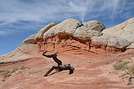
As soon as our luggage arrived and we picked it up in the common room of the small hotel, we took a quick tour of the place: it has 8 rooms, each different in size, location, and layout because they followed the church’s architecture without altering it. Some have 2 floors with the bathroom accessible by a ladder, while others, like ours, have an opening that leads directly to the path...
The staff member managing the hotel offers us a large, detailed map and points out (even highlighting them!) all the places we should see: viewpoints with scenic overlooks, rock-hewn churches outside the walls, the Duomo, and that’s just the beginning. We decide to head there as soon as possible...
We return to Piazza Veneto by a different route than the one we took to get there—completely unintentionally! Our first general view of the sassi; in the center of the square, the Palumbaro Lugo, a colossal cistern dug starting in the 16th century to meet the city’s water needs.
We take the main street: Via Domenico Ridola. At first, there are upscale shops, a few discreet bars and restaurants, and soon, churches start lining the street: First, Saint Francis of Assisi Church, with its 18th-century façade.
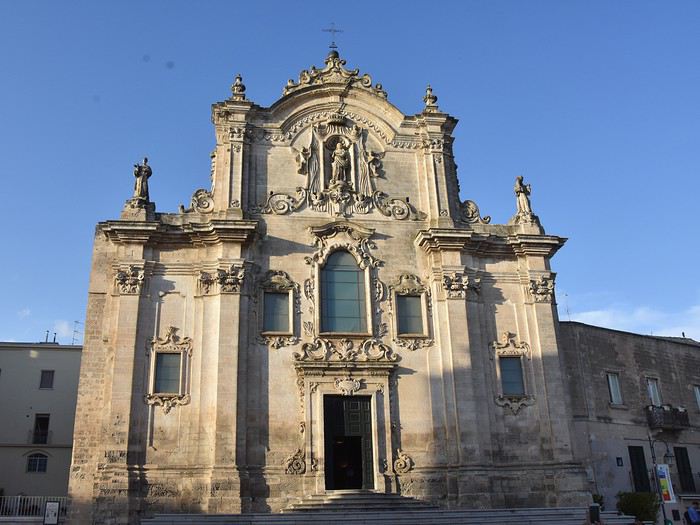
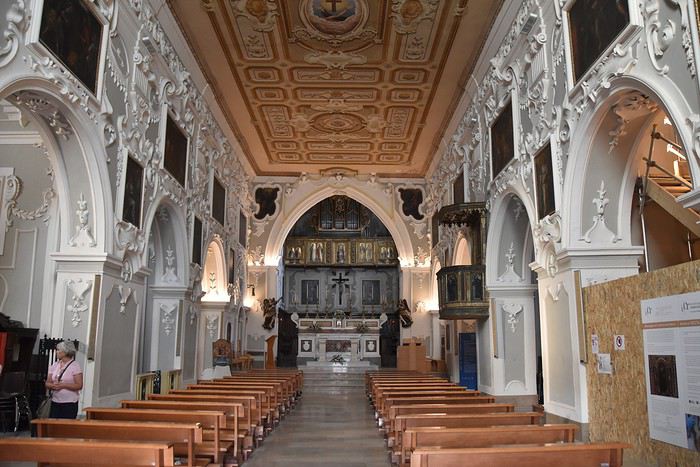
Its interior is in late Baroque style.
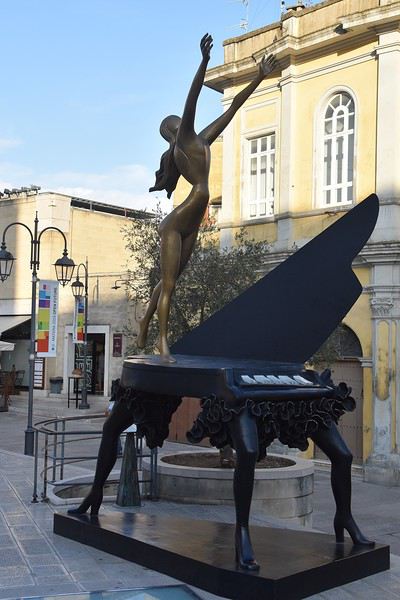
On Piazza San Francesco, a sculpture by Dalí, whose works are temporarily exhibited in town as part of a temporary exhibition in one of the palaces:
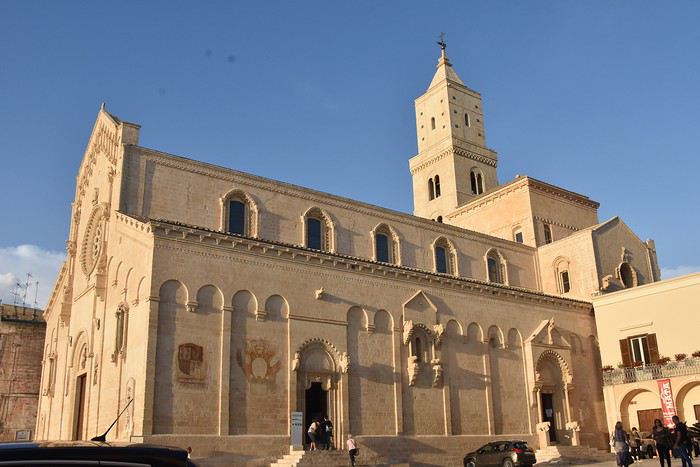
We continue toward the Duomo, our last goal for the evening. Lit by the setting sun, it basks in golden light. It occupies the highest point in the city, dates back to the 13th century, and features a very pure Romanesque style.
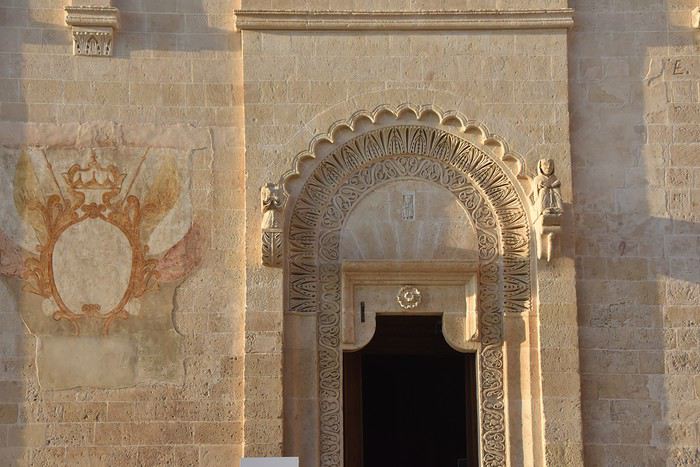
Details of the side:
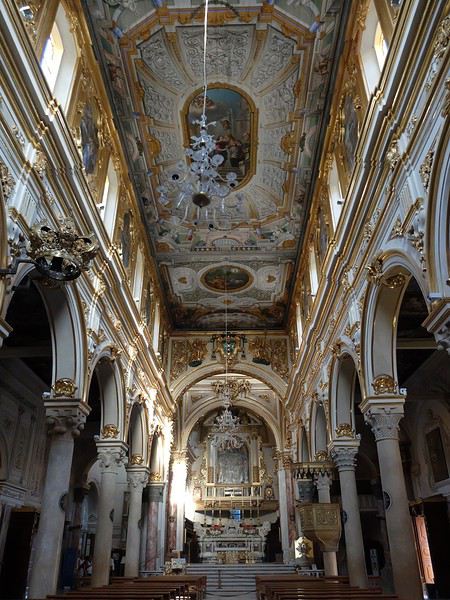
And the interior, which dates back 4 to 5 centuries after its construction: only the columns and a fresco are from that era. The rest is Baroque...
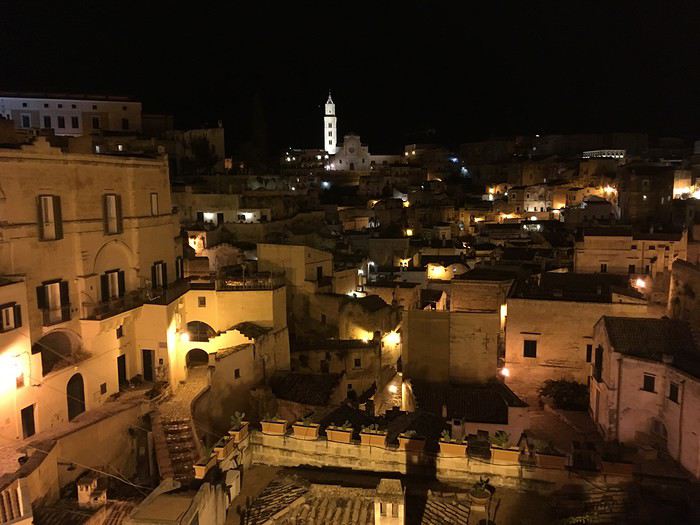
As we leave, we’re in the front row to enjoy the changing light over the city: from twilight...
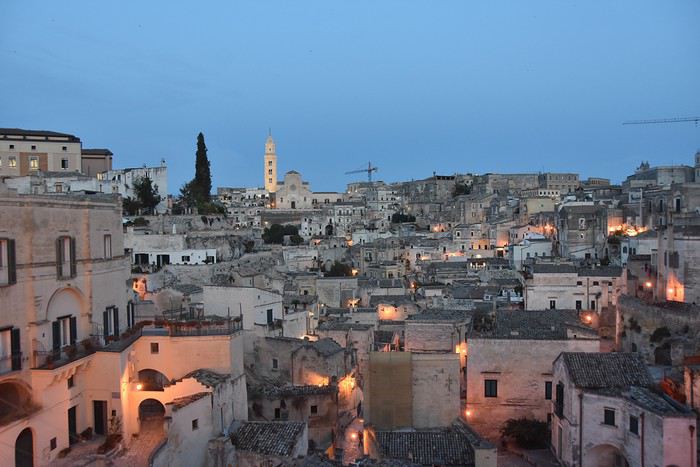
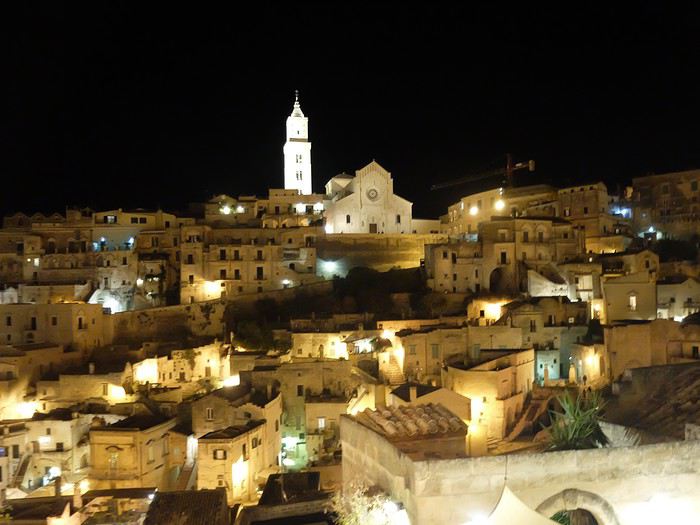
 To nightfall!
We head back down to the hotel (big mistake: a round trip for nothing!!!) to freshen up a bit, and then we’re off to the heart of the Sassi for what promises to be a great dinner!
The staff member managing the hotel offers us a large, detailed map and points out (even highlighting them!) all the places we should see: viewpoints with scenic overlooks, rock-hewn churches outside the walls, the Duomo, and that’s just the beginning. We decide to head there as soon as possible...
We return to Piazza Veneto by a different route than the one we took to get there—completely unintentionally! Our first general view of the sassi; in the center of the square, the Palumbaro Lugo, a colossal cistern dug starting in the 16th century to meet the city’s water needs.
We take the main street: Via Domenico Ridola. At first, there are upscale shops, a few discreet bars and restaurants, and soon, churches start lining the street: First, Saint Francis of Assisi Church, with its 18th-century façade.
Its interior is in late Baroque style.
On Piazza San Francesco, a sculpture by Dalí, whose works are temporarily exhibited in town as part of a temporary exhibition in one of the palaces:
We continue toward the Duomo, our last goal for the evening. Lit by the setting sun, it basks in golden light. It occupies the highest point in the city, dates back to the 13th century, and features a very pure Romanesque style.
Details of the side:
And the interior, which dates back 4 to 5 centuries after its construction: only the columns and a fresco are from that era. The rest is Baroque...
As we leave, we’re in the front row to enjoy the changing light over the city: from twilight...
To nightfall!
We head back down to the hotel (big mistake: a round trip for nothing!!!) to freshen up a bit, and then we’re off to the heart of the Sassi for what promises to be a great dinner!
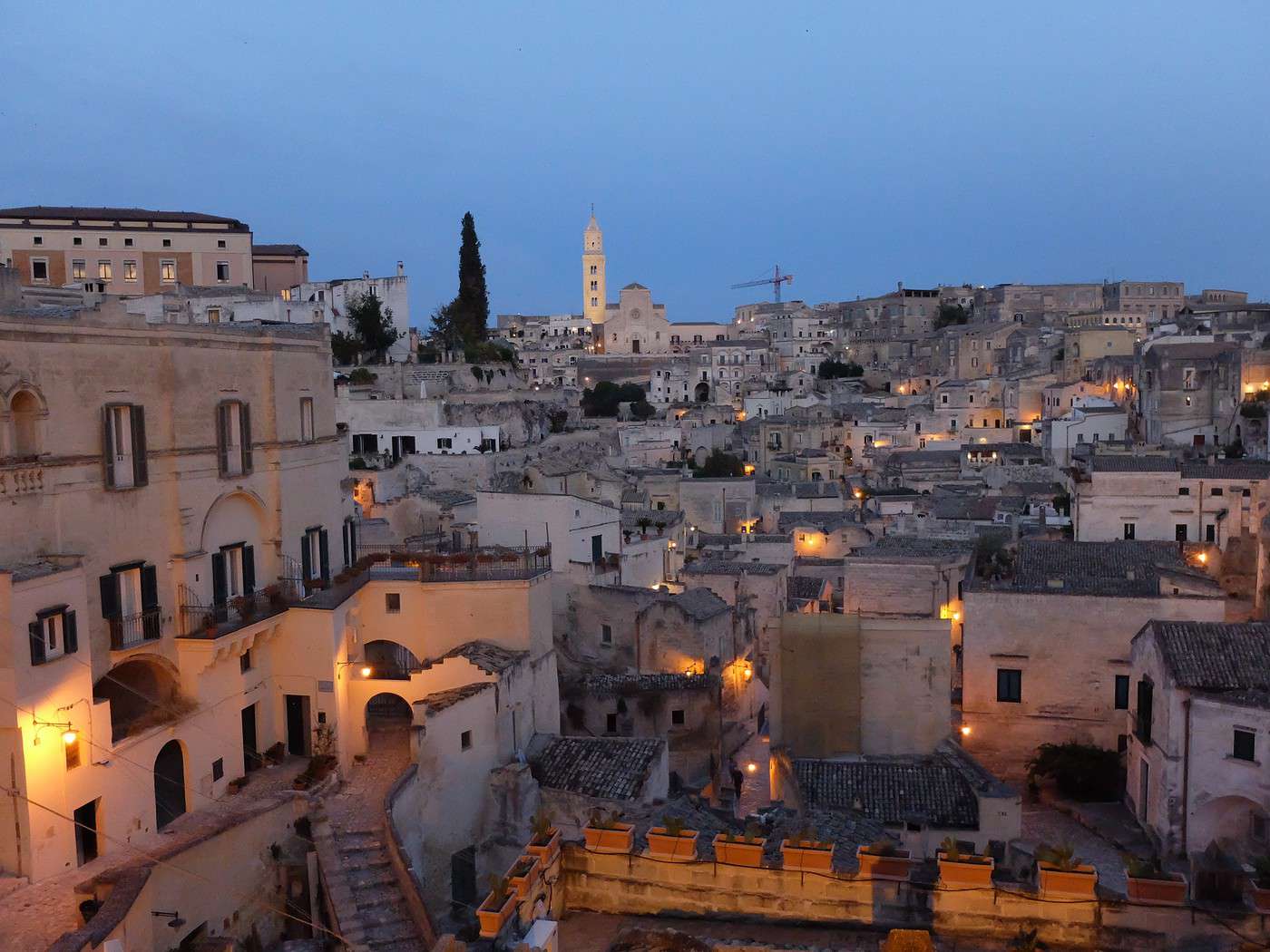
Day two recap!
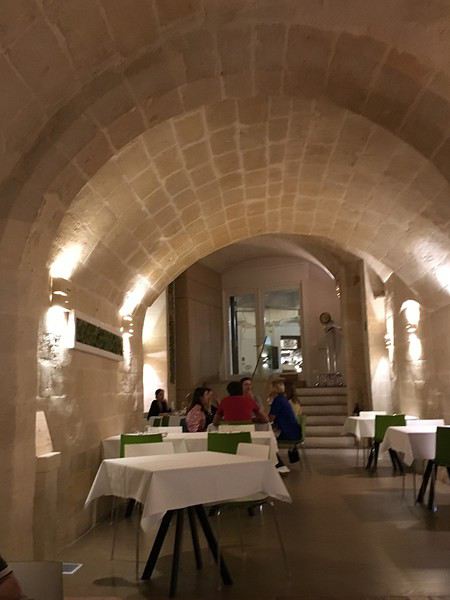
Last night, before heading back up to our high-perched guesthouse in town, we had spotted a restaurant recommended by guidebooks down below: it’s Gatta Buia, which I highly recommend (see Tripadvisor). It’s located on Via delle Beccherie (Butcher Street), named after the shops that once lined it. When the population resettled in the city and businesses opened, this street became packed with restaurants! It was a big mistake to go back up just to come down again! Golden rule in the Sassi: never lose elevation if you can help it—unless you’re under 30 or in Iron Man shape!!! You’d also need an infallible sense of direction… and cat-like night vision… After many pointless back-and-forths and running late, we finally made it to the restaurant. We didn’t regret it: modernized local cuisine, young and efficient service, and the setting—blond tuff stone and arches!
The next day, our second and last in Matera: Guided walk in the Sasso Caveoso, less crowded than the first, on the other side of the ravine.
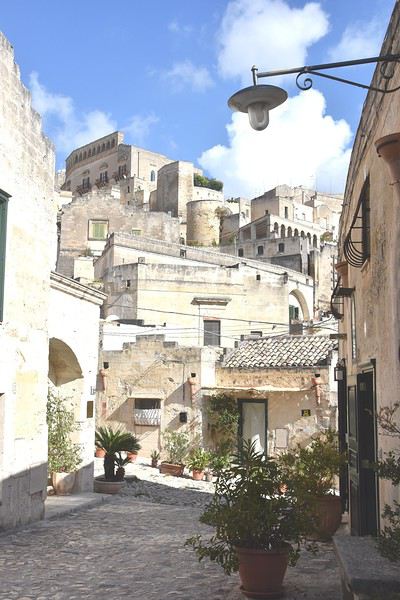
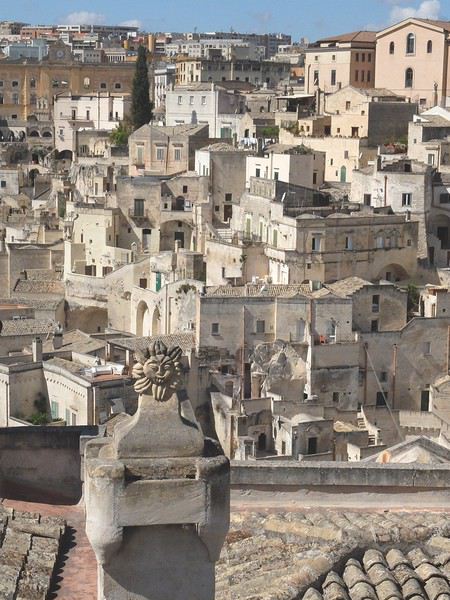
With age, we’ve come to accept that a good local guide can be more efficient and interesting than exploring alone with notes, a map, and glasses (!!!) while trying to find your way. This became especially clear in Matera.
I scoured guidebooks—print, Tripadvisor, and the web—ruled out large-group tours, and sent three messages a bit blindly. I settled on Marjorie, a charming young woman who’s a local (her family is from there). She spoke about what she knows and guided us for half a day with four other French speakers, all around our age. We exchanged a few ideas, and she gave me tips for self-guided visits the day before… The morning was incredibly enriching. We met at 9:30 AM in Piazza Veneto, the usual gathering spot for tour groups. When we saw buses unloading groups of 40 or 50 people, all clustered in sets of 25 behind guides holding closed umbrellas, we felt relieved. A quick glimpse of the Palazzo del Governatore’s façade as we passed…
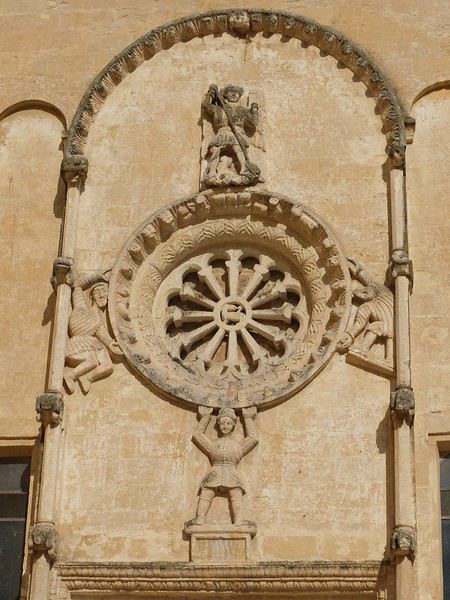
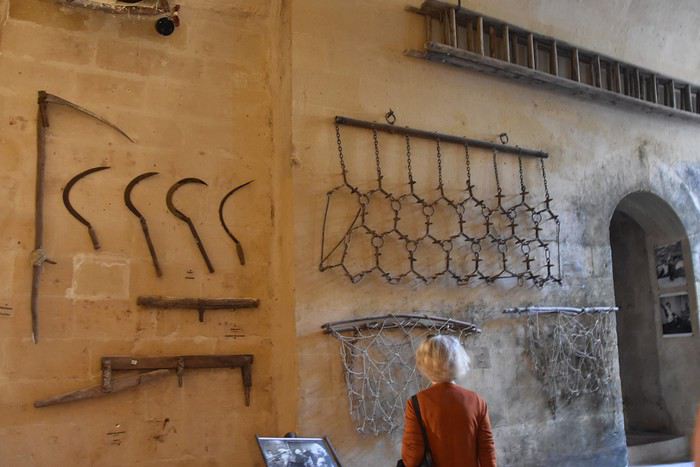
The tour started with the classic climb to the Duomo, then we crossed to the other side to visit a historic cave-house preserved as it was in 1950. The living space, where animals also lived, is filled with period tools and utensils collected from other homes: no electricity, no running water, and no heating beyond makeshift solutions. It’s hard to imagine people lived like this in the 20th century!
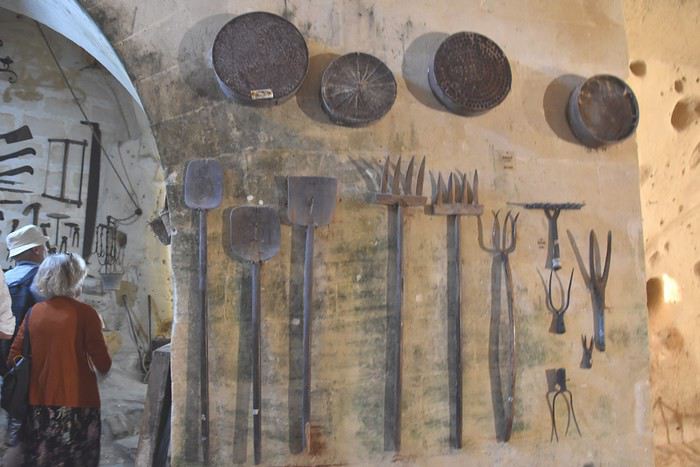
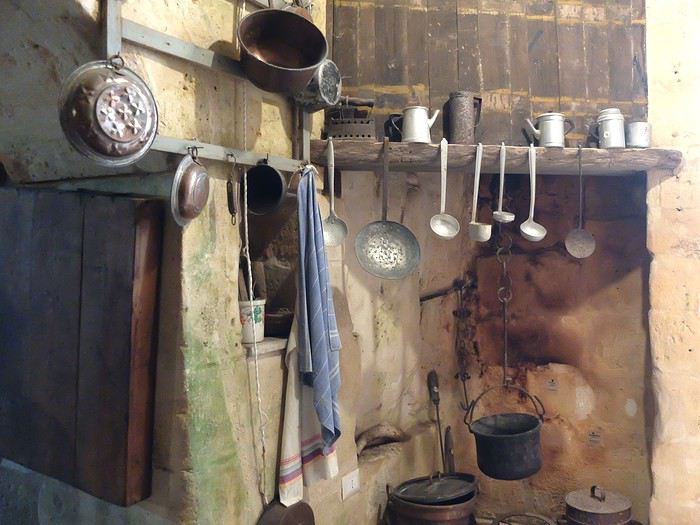
Next, we admired Saint Peter’s Church in Caveoso and visited the rock-hewn church of Santa Maria de Idris, carved into a limestone mass overlooking the city. Its walls are adorned with beautiful Byzantine frescoes restored in the late 1930s (no photos allowed…). The other churches like this are farther away and require a vehicle…
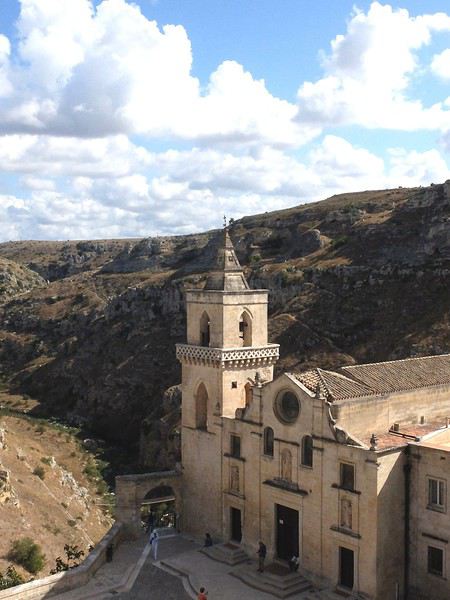
Here’s the road leading to the Park of the Rock Churches!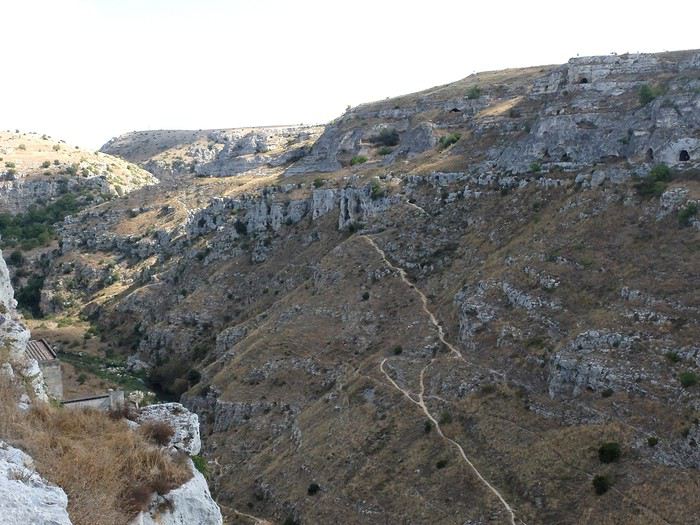
We also visited ‘La Riccolta delle Acque’ (The Water Collection), which explains the ingenious water-recovery system that supplied the entire Sasso Caveoso.
During the tour, stops were interspersed with anecdotes, historical details about the city, and tips for other possible visits that day. In the afternoon, we decided to head to Palazzo Lanfranchi to learn more about Carlo Levi… Have a great day, and see you soon!
Last night, before heading back up to our high-perched guesthouse in town, we had spotted a restaurant recommended by guidebooks down below: it’s Gatta Buia, which I highly recommend (see Tripadvisor). It’s located on Via delle Beccherie (Butcher Street), named after the shops that once lined it. When the population resettled in the city and businesses opened, this street became packed with restaurants! It was a big mistake to go back up just to come down again! Golden rule in the Sassi: never lose elevation if you can help it—unless you’re under 30 or in Iron Man shape!!! You’d also need an infallible sense of direction… and cat-like night vision… After many pointless back-and-forths and running late, we finally made it to the restaurant. We didn’t regret it: modernized local cuisine, young and efficient service, and the setting—blond tuff stone and arches!
The next day, our second and last in Matera: Guided walk in the Sasso Caveoso, less crowded than the first, on the other side of the ravine.
With age, we’ve come to accept that a good local guide can be more efficient and interesting than exploring alone with notes, a map, and glasses (!!!) while trying to find your way. This became especially clear in Matera.
I scoured guidebooks—print, Tripadvisor, and the web—ruled out large-group tours, and sent three messages a bit blindly. I settled on Marjorie, a charming young woman who’s a local (her family is from there). She spoke about what she knows and guided us for half a day with four other French speakers, all around our age. We exchanged a few ideas, and she gave me tips for self-guided visits the day before… The morning was incredibly enriching. We met at 9:30 AM in Piazza Veneto, the usual gathering spot for tour groups. When we saw buses unloading groups of 40 or 50 people, all clustered in sets of 25 behind guides holding closed umbrellas, we felt relieved. A quick glimpse of the Palazzo del Governatore’s façade as we passed…
The tour started with the classic climb to the Duomo, then we crossed to the other side to visit a historic cave-house preserved as it was in 1950. The living space, where animals also lived, is filled with period tools and utensils collected from other homes: no electricity, no running water, and no heating beyond makeshift solutions. It’s hard to imagine people lived like this in the 20th century!
Next, we admired Saint Peter’s Church in Caveoso and visited the rock-hewn church of Santa Maria de Idris, carved into a limestone mass overlooking the city. Its walls are adorned with beautiful Byzantine frescoes restored in the late 1930s (no photos allowed…). The other churches like this are farther away and require a vehicle…
Here’s the road leading to the Park of the Rock Churches!
We also visited ‘La Riccolta delle Acque’ (The Water Collection), which explains the ingenious water-recovery system that supplied the entire Sasso Caveoso.
During the tour, stops were interspersed with anecdotes, historical details about the city, and tips for other possible visits that day. In the afternoon, we decided to head to Palazzo Lanfranchi to learn more about Carlo Levi… Have a great day, and see you soon!
Jourdes· 7 years ago
Hi Brigitte,
So many beautiful photos!!
Amazing restaurant in a vaulted cave...
Gorgeous shots taken in cobbled alleys...
As for that 1950s house "just as it was," yeah, it’s hard to imagine people actually lived there back then.
A memory: we left our native Brittany to arrive in Charente in the Southwest. It was 1962. I remember a small farm just a few hundred meters from our house. A large family living in one main room with a dirt floor, uneven walls quickly painted... The little city girl I was at 9 years old had never imagined such a harsh life, straight out of another era...
D
S
Sissi57· 7 years ago
As for this 1950s house "in its original state," yeah, it’s hard to imagine people actually lived there back then.
It’s true that in the 1950s, comfort standards started to change—things we take for granted today—and everyone could enjoy better sanitary conditions. But after visiting the "model" house in the sassi, I wasn’t horrified by the living conditions. They actually seemed pretty comfortable compared to what non-troglodyte homes were like in the 19th century, for example, or even earlier. I remember as a kid in the 1960s, when we’d drive across France to vacation on the Vendée coast (my parents loved it), restaurant toilets were usually at the back of a courtyard or garden. My grandmother only got a bathroom in her apartment after the war, by converting a room. And my husband’s aunt, who lived in Paris’s 1st arrondissement and passed away in 1989, never had a bathroom—she’d installed a shower stall in her kitchen, and the toilet was shared with the whole floor and located on an outdoor walkway.
It’s true that in the 1950s, comfort standards started to change—things we take for granted today—and everyone could enjoy better sanitary conditions. But after visiting the "model" house in the sassi, I wasn’t horrified by the living conditions. They actually seemed pretty comfortable compared to what non-troglodyte homes were like in the 19th century, for example, or even earlier. I remember as a kid in the 1960s, when we’d drive across France to vacation on the Vendée coast (my parents loved it), restaurant toilets were usually at the back of a courtyard or garden. My grandmother only got a bathroom in her apartment after the war, by converting a room. And my husband’s aunt, who lived in Paris’s 1st arrondissement and passed away in 1989, never had a bathroom—she’d installed a shower stall in her kitchen, and the toilet was shared with the whole floor and located on an outdoor walkway.
Hi Sissi,
I have to say I’m really surprised by your reply—maybe we didn’t visit the same place?
I’m coming back to this house (just so you know, they were ALL like that, except the one I saw was spacious enough to fit a millstone or a press in the common room, turned by a donkey all day long). The HUGE difference between my childhood in the countryside and what the Sassi inhabitants lived through was the overcrowding among family members (just one bed, sometimes 10 kids of all ages...) and the animals that spent the night in the SAME room to share warmth...
Above all, it was the extreme poverty they had to endure, and it got even worse when they were displaced. For example, kids were required to go to school, BUT there was no money at all to clothe them, no transportation, etc.
Did you know that because of the extreme poverty and appalling sanitary conditions, the child mortality rate (ages 3, 4, etc.) was over 50%? In one family, from what I’ve read and seen on-site, the father and older boys would go cultivate a small plot of land on the outskirts of town and only come home once a week...
You mention that conditions in the Sassi weren’t worse than those in non-troglodyte dwellings in the 19th century, for example, and earlier. I totally agree with you there—they lived like other peasants, but 100 years behind!
Back to the living conditions we experienced in MP! It’s not unpleasant to chat about this...
Have a good evening, best wishes.
Back to the living conditions we experienced in MP! It’s not unpleasant to chat about this...
Have a good evening, best wishes.
Thanks for your message, and I’m glad you liked the photos!
It was pretty tough to write the historical summary about the city of Matera, but it was necessary for understanding the visit!
I’m resting until tomorrow—have a good night. Hugs. Brigitte.
It was pretty tough to write the historical summary about the city of Matera, but it was necessary for understanding the visit!
I’m resting until tomorrow—have a good night. Hugs. Brigitte.
S
Sissi57· 7 years ago
I think we saw the same place, with a room where the bed is. The loom was at the back, there was a second room, and to the side an alcove where the kitchen is?
I completely agree that their living conditions were very harsh, and indeed, 100 years behind. Even in London’s East End at the start of the 20th century, it wasn’t paradise, and the conditions shown in Italian films like *Bitter Rice* weren’t exactly enviable.
Unfortunately, these are still the conditions in some less fortunate countries today.
Jourdes· 7 years ago
Good evening Sissi,
I live near a fortified town that "has history." And indeed, when visiting some houses on the plateau, you can still see tiny rooms built outside the house, on kinds of stilts attached to the walls, on the upper floor. These tiny rooms were the first bathrooms for the wealthiest people.
My husband, who spent part of his youth in the countryside, told me that his grandparents' bathroom was set up in part of one of the bedrooms. But before this renovation, each bedroom had its own sink. Before having a bathtub, "baths" were taken in what they called "tubes": a sort of huge basin placed in front of the sink...
I must admit I never experienced any of that...
Show 10 more replies
S
Sissi57· 7 years ago
My parents also told me about taking their weekly bath in the kitchen in a big tub before they converted a room in the apartment into a bathroom. For my mother’s family, this also meant a loss of space since three families were living in what we’d now call a two-bedroom apartment in France...
Jourdes· 7 years ago
Yes, but let's admit that a weekly bath is not much...
But, you should know that I experienced this as a child when I arrived in the Southwest. Nine kids, two grandmothers under the same roof—I remember that weekly bath and shampoo... No running water, just water from a spring, so we had to be careful.
Today, we hear that a daily shower or bath might be "too much"...
I mention it, but it didn’t really traumatize me!!!
Jourdes· 7 years ago
But there was running water!!!
But it was spring water or from a stream flowing into a well.
I can assure you that at my parents' place, a property sold in 2011, there was running water, but no utility connection.
A spring, a well, a pump, and... water.
So, water had to be "managed" carefully, especially in summer and during droughts...
I can assure you that at my parents' place, a property sold in 2011, there was running water, but no utility connection.
A spring, a well, a pump, and... water.
So, water had to be "managed" carefully, especially in summer and during droughts...
Frampton37· 7 years ago
Hi there!
Great summary and amazing photos. Such a pleasant read!
Josiane
Great summary and amazing photos. Such a pleasant read!
Josiane
Thanks Josiane!
I’m still going, but we’re about two-thirds done—it’s taking quite a bit of time... but I’d do the trip all over again!
Have a great day.
Have a great day.
Hiacinthe· 7 years ago
Hi Brigitte,
That’s really interesting.
I love this photo: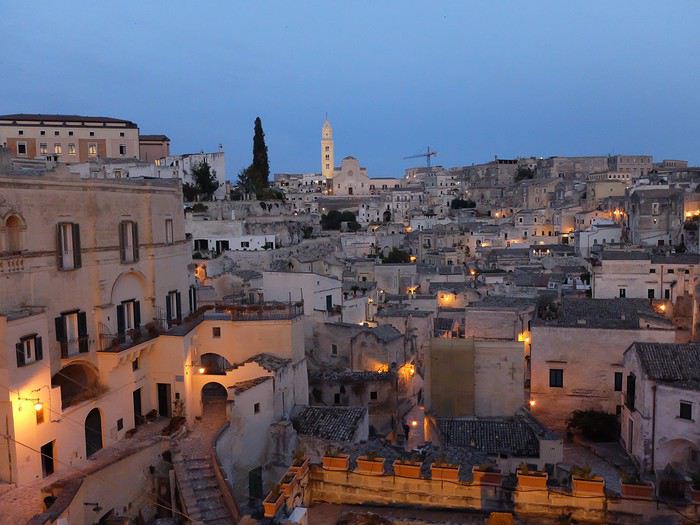
Was there a hotel employee at the garage to whom you entrusted the luggage so they could take it to the hotel?
Cheers,
Christine
To make it quick, here’s a summary of the key milestones in Matera’s history! *** It’s important to know that cave dwellings carved into the soft limestone appeared in the region 250,000 years ago, as far back as the Paleolithic era. *** The city boasts numerous rock-hewn churches beautifully decorated with Byzantine frescoes: hidden places of prayer for immigrants, particularly from Turkey, Armenia, and Asia Minor. *** In the 14th and 15th centuries, the city was enriched with many churches and monuments within the fortified walls surrounding the Center... *** Unfortunately, in the last century (the 20th century!), living conditions—both sanitary and economic—became increasingly precarious for the growing population, which reached 16,000 inhabitants after World War II.
In 1950, following a visit by A. Gasperi, a prominent minister at the time, *La Gazzetta del Mezzogiorno* published a front-page article on Matera with the bold headline: "NATIONAL SHAME." In 1945, Carlo Levi’s autobiographical book *Christ Stopped at Eboli* was published. I’ll talk more about it later: it recounts the miserable living conditions of the peasant world under fascist Italy. Politicians, having researched and been shocked by the reality described in the book, sought a solution to the problem. They decided to build public housing (HLM) around the Sassi to relocate the peasants who lived there—these are the buildings we saw at the entrance. In 1952, the forced transfers of inhabitants began, and a law mandated the complete isolation of the Sassi: the districts were left in total ruin, caves were walled up, and access was blocked. It was Carlo Levi, once again, who advocated for the need to preserve and enhance the historical and social treasure we can see today.
In 1993, the Sassi were recognized as a UNESCO World Heritage Site, and in 2014, Matera was named European Capital of Culture for 2019. From then on, the Sassi became symbols of the development and valorization of an Italian territory, in the eyes of the whole world!
That’s really interesting.
I love this photo:
If you’re still with me, we were on our way to the hotel, and the luggage was supposed to follow—they almost beat us there!
Was there a hotel employee at the garage to whom you entrusted the luggage so they could take it to the hotel?
Cheers,
Christine
Feeling fresh and fit?
We’re continuing our visit on our own... but first, let me slip in a photo for Sissi: after touring la casa-grotta, we didn’t quite see eye to eye on what life was like for the Sassi residents, and I wondered if we’d even visited the same place...
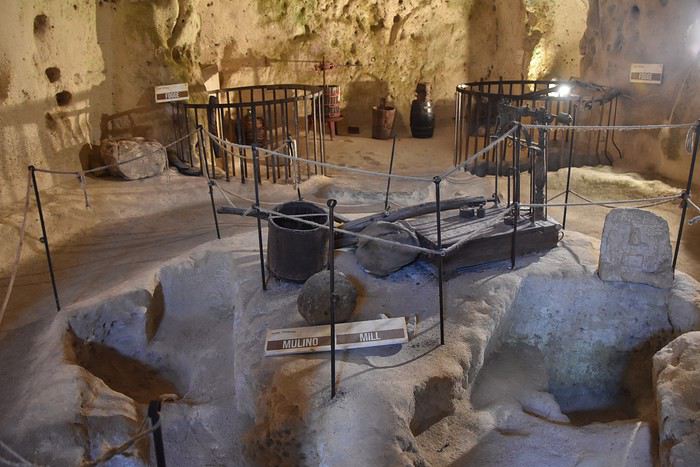
In the house I saw—which apparently belonged to a miller—here’s an unpublished photo: next to the main room (with the bed and a small wardrobe), the only space used by the family and children, there’s a second, fairly large room housing the millstone. You can clearly see the tracks from the donkey that tirelessly walked in circles all day to power the mechanism; at night, it slept right there...
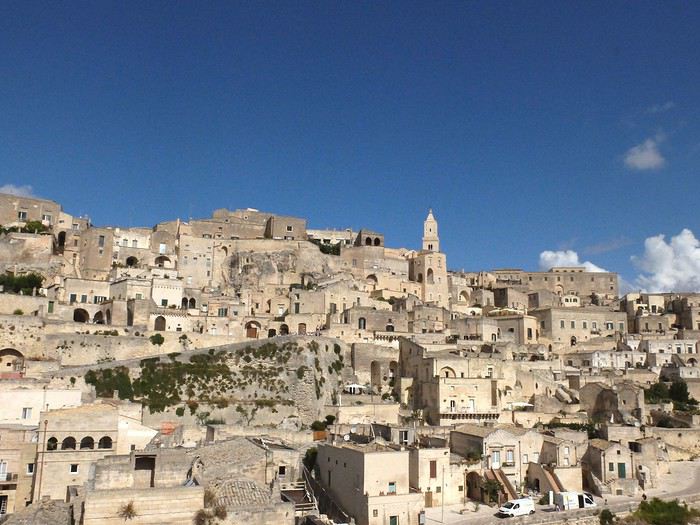
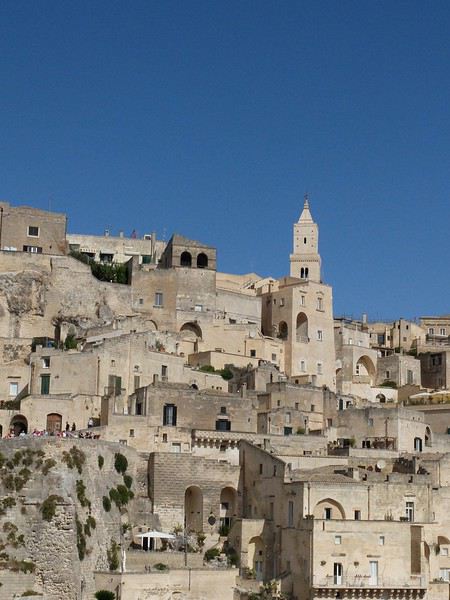
Time for something lighter: after a morning of climbing, visits, and fascinating explanations, we need a break—and, most importantly, a drink. So, the two of us leave Sasso Caveoso (no shops or bars there) and head back to Barisano. A few sunny photos:
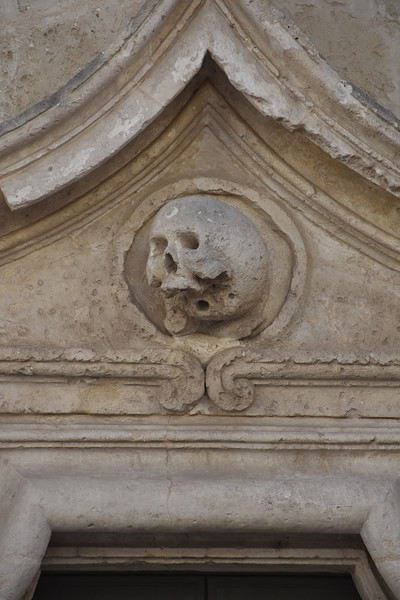
We’re happy to return to the little snack bar where we had aperitivo last night! It’s a bar with a terrace, tucked in a street near a busy thoroughfare, Via Ridola, and it’s right across from l’église du Purgatoire. You can’t miss it... I’ll have Prosecco, my husband a beer, then panini to order! We’ll have plenty of time during our meal to admire the church’s facade: bones and skulls of high-ranking officials, clergy, and ordinary people—all equal in death. Its decoration was completed in the late 18th century.
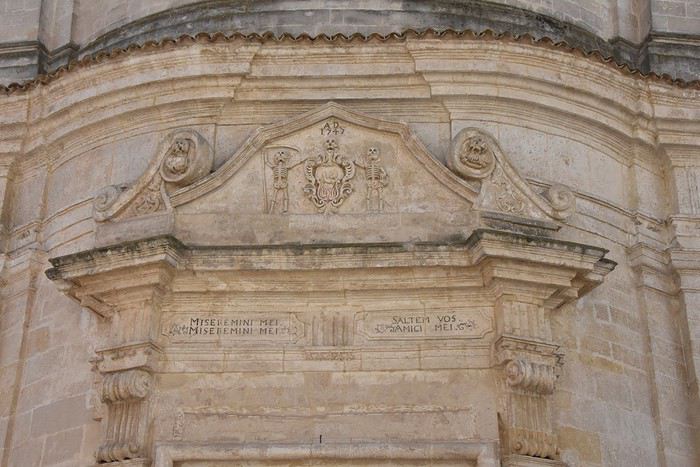
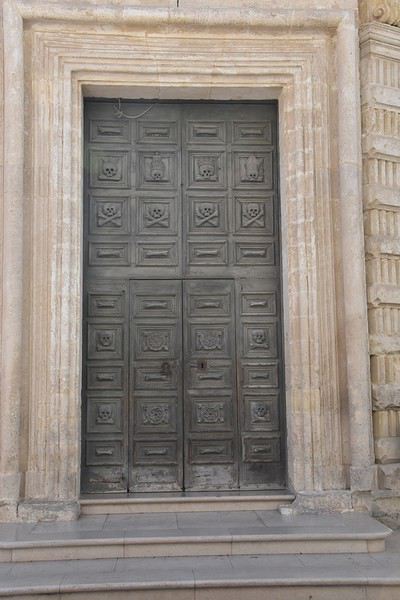
Check out the door details too...
After 45 minutes of rest (yes, we’re fearless...), we’ve set our agenda for the next few hours: passing by the Church of Santa Chiara, near an old hospital, we’ll visit the Museo Nazionale Domenico Ridola, a 19th-century doctor passionate about archaeology who took part in digs and donated his collection to the city. The prehistoric sections confirm what I’ve read and what Marjorie, our guide, told us.
Next, we’ll get to our main plan: heading to Palazzo Lanfranchi, whose ground floor is dedicated to Carlo Levi. A fitting summary: Carlo Levi was a 20th-century humanist.
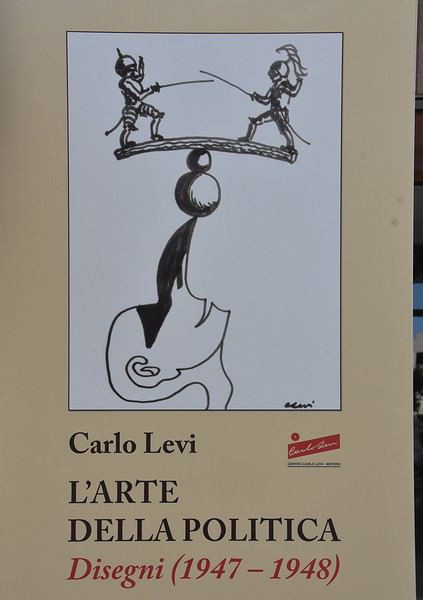
C. Levi was born in Turin in 1902. He was a doctor, painter, writer... and politician. His ideas led to his arrest by the regime in 1935, and he was sentenced to confinement in the rural village of Aliano, 40 km from Matera. At the villagers’ request—who lived in extreme poverty and were decimated by malaria—and despite being banned from practicing medicine or writing, he briefly resumed his role as a doctor there. His stay inspired his novel, which I mentioned yesterday, *Christ Stopped at Eboli* (published in 1945), about the harsh lives of Basilicata’s rural inhabitants and its haunting landscapes. He also found inspiration for a massive fresco, commissioned for the 1961 Turin exhibition, now displayed in this palace. Freed in 1936, rearrested later, he spent the war in prison before resuming his political work. His role from 1952 onward, and later as a Senator from 1963, was crucial for Matera and its people...
More to come soon... Have a great day!
Time for something lighter: after a morning of climbing, visits, and fascinating explanations, we need a break—and, most importantly, a drink. So, the two of us leave Sasso Caveoso (no shops or bars there) and head back to Barisano. A few sunny photos:
We’re happy to return to the little snack bar where we had aperitivo last night! It’s a bar with a terrace, tucked in a street near a busy thoroughfare, Via Ridola, and it’s right across from l’église du Purgatoire. You can’t miss it... I’ll have Prosecco, my husband a beer, then panini to order! We’ll have plenty of time during our meal to admire the church’s facade: bones and skulls of high-ranking officials, clergy, and ordinary people—all equal in death. Its decoration was completed in the late 18th century.
Check out the door details too...
After 45 minutes of rest (yes, we’re fearless...), we’ve set our agenda for the next few hours: passing by the Church of Santa Chiara, near an old hospital, we’ll visit the Museo Nazionale Domenico Ridola, a 19th-century doctor passionate about archaeology who took part in digs and donated his collection to the city. The prehistoric sections confirm what I’ve read and what Marjorie, our guide, told us.
Next, we’ll get to our main plan: heading to Palazzo Lanfranchi, whose ground floor is dedicated to Carlo Levi. A fitting summary: Carlo Levi was a 20th-century humanist.
C. Levi was born in Turin in 1902. He was a doctor, painter, writer... and politician. His ideas led to his arrest by the regime in 1935, and he was sentenced to confinement in the rural village of Aliano, 40 km from Matera. At the villagers’ request—who lived in extreme poverty and were decimated by malaria—and despite being banned from practicing medicine or writing, he briefly resumed his role as a doctor there. His stay inspired his novel, which I mentioned yesterday, *Christ Stopped at Eboli* (published in 1945), about the harsh lives of Basilicata’s rural inhabitants and its haunting landscapes. He also found inspiration for a massive fresco, commissioned for the 1961 Turin exhibition, now displayed in this palace. Freed in 1936, rearrested later, he spent the war in prison before resuming his political work. His role from 1952 onward, and later as a Senator from 1963, was crucial for Matera and its people...
More to come soon... Have a great day!
You might also like
 A "relaxed" 16-day tour of Corsica in autumn 2024
Travel logs › France › Corsica·274 photos
 Amalfi Coast stroll
Travel logs › Italy·81 photos
 Visiting Bologna in Photos
Travel logs › Italy·45 photos
 Palermo street art
Travel logs › Italy·38 photos
 Tuscany: Arezzo province and the Siena area
Travel logs › Italy·286 photos
 Two weeks under the Puglia sun
Travel logs › Italy·275 photos
 Polynesia: How to choose between the Society Islands, Tuamotu, and the Marquesas?
Features › French Polynesia·4 photos
 A Few Days in Turkmenistan from Uzbekistan
Travel logs › Turkmenistan·73 photos