Autumn trip from Puglia to Naples via Basilicata...
Translated into English.
182 replies
Hiacinthe· 7 years ago
Hi Antoinette,
Speaking of which, the book *Call the Midwife* by Jennifer Worth https://www.albin-michel.fr/ouvrages/appelez-la-sage-femme-9782226248534 does a great job describing their living conditions. The story takes place in the 1950s in the East End docks.
Cheers,
Christine
... though London in the East End, even at the start of the 20th century, wasn’t paradise
Speaking of which, the book *Call the Midwife* by Jennifer Worth https://www.albin-michel.fr/ouvrages/appelez-la-sage-femme-9782226248534 does a great job describing their living conditions. The story takes place in the 1950s in the East End docks.
Cheers,
Christine
Hiacinthe· 7 years ago
Hello Marie-Benoîte,
Until I was 8 years old, I lived in an apartment without a bathroom (for washing up, we used the kitchen sink), and the toilet was on the landing.
Cheers,
Christine
My husband, who spent part of his youth in the countryside, told me that his grandparents' bathroom was set up in part of one of the bedrooms. But before this renovation, each bedroom had its own washbasin. Before having a bathtub, "baths" were taken in what they called "tubs": a sort of huge basin placed in front of the washbasin...
I must admit I never experienced any of that...
Until I was 8 years old, I lived in an apartment without a bathroom (for washing up, we used the kitchen sink), and the toilet was on the landing.
Cheers,
Christine
S
M
Mick013· 7 years ago
Back in the early 60s, in the Bouches-du-Rhône—which wasn’t the most remote department in France—many rural villages didn’t have running water. The luckier residents had a well, while others had to fetch water from public fountains. And those living in isolated houses outside the village didn’t even have electricity.
Hiacinthe· 7 years ago
Next, we’ll get to our main idea: visiting the Palazzo Lanfranchi, whose ground floor is dedicated to Carlo Levi. A brief but fitting description: Carlo Levi was a 20th-century humanist.
C. Levi was born in Turin in 1902; he was a doctor, painter, writer... and politician. His ideas led to his arrest by the regime at the time, starting in 1935, and he was sentenced to isolation in the rural village of Aliano, 40 km from Matera. At the request of the locals, who lived in extreme poverty and whose population was decimated by malaria, and despite the ban on practicing medicine and writing, he temporarily resumed his role as a doctor there. He drew from his stay the subject of his novel, which I mentioned yesterday, *Christ Stopped at Eboli*, published in 1945. It deals with the miserable life of the inhabitants of rural Basilicata and its poignant landscapes.
Hi Brigitte,
I didn’t know that!
We hear a lot about Primo Levi (also born in Turin), but I’d never heard of Carlo Levi.
Thank you so much for this informative travel journal, illustrated with such beautiful photos
See you soon!
Hugs and have a great afternoon, everyone!
Christine
Hi Michel,
that’s how it was in Belgium too, and I experienced it!
however, as I said, it wasn’t comparable to what was happening in Matera!!!
That said, there’s no need to travel through time and space to get to London: I was shocked to SEE, in Brussels—the capital of Europe—one or two social housing units, meaning rent-controlled housing (???), and that the CPAS (municipal groups meant to help people in need) allocates them to low-income families. There, we’re back to living conditions like in the Sassi: unsanitary due to dampness, mold on all the walls, impassable bathrooms, and lung diseases in children... It’s inexcusable, and it’s going to cause irreversible damage... Have a great day!
That said, there’s no need to travel through time and space to get to London: I was shocked to SEE, in Brussels—the capital of Europe—one or two social housing units, meaning rent-controlled housing (???), and that the CPAS (municipal groups meant to help people in need) allocates them to low-income families. There, we’re back to living conditions like in the Sassi: unsanitary due to dampness, mold on all the walls, impassable bathrooms, and lung diseases in children... It’s inexcusable, and it’s going to cause irreversible damage... Have a great day!
Is everyone here?
We’re entering the Palazzo; as soon as we bought our tickets, the attendant stands up and guides us, without hesitation, to the ‘Carlo Levi’ room where the monumental fresco ‘Lucania ’61’ is on display... For him, it’s obvious that’s what we want to see! Here we are: it’s very realistic, impressive, and moving. Levi depicted the people—men, women, and children—he met and tried to help during his exile; the painting really conveys the idea that these peasants were condemned to a life of isolation: forgotten by everyone...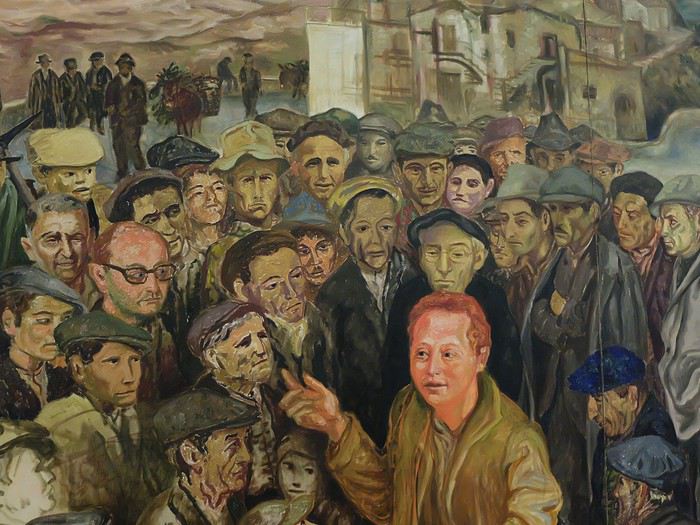
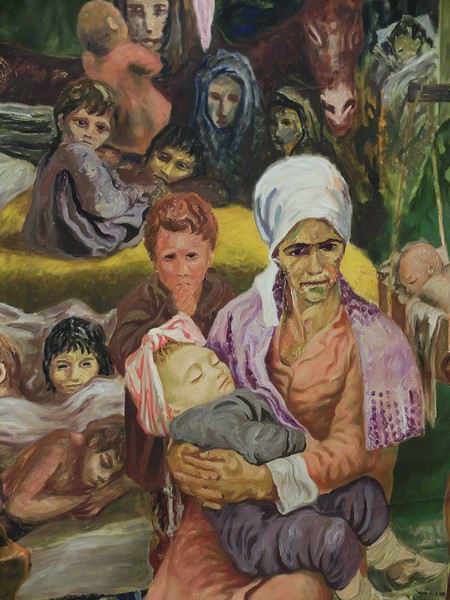
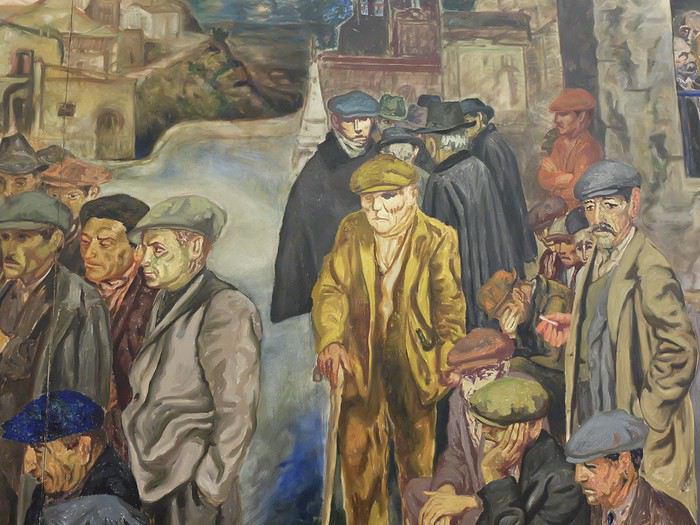 Changing the subject: a half-hour walk on flat ground, then a quarter-hour descent will take us back to ‘In Pietra’.
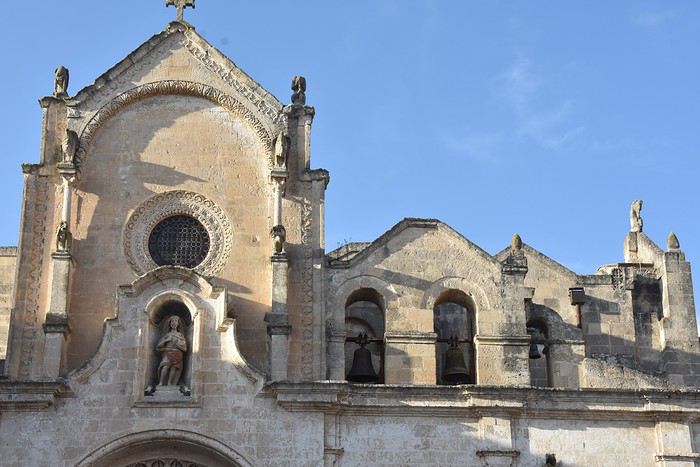
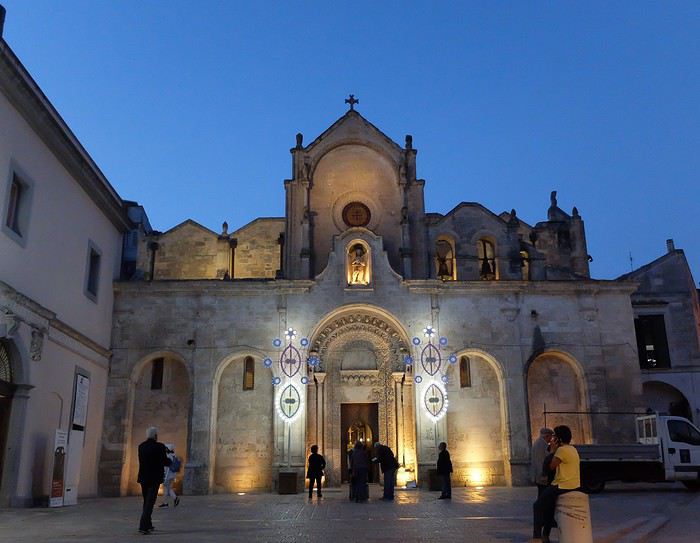
We photograph Saint John the Baptist Church as we leave Piazza Veneto: it’s a beautiful Romanesque building and served as our landmark for two days to start the descent toward the hotel, all the way to the right via the stairs... or to signal, when leaving the hotel, that we’d reached the new town!!!
First, during the day:
Then, after nightfall: it’s just been decorated and shines with all its lights; it looks like Christmas is coming!
Tomorrow, we’ll leave Matera with a pang in our hearts: a captivating and unique city in the world... Maybe we’ll return?
Did I mention that many films have been shot here, starting in 1950? Around thirty in total, including Pasolini’s famous film, *The Gospel According to St. Matthew*, released in 1964, which I watched this year—those landscapes seemed unreal... An extraordinary film, in everyone’s eyes: you either loved it or hated it!!! Francesco Rosi adapted the novel *Christ Stopped at Eboli* into a film released in 1979, and some scenes were also shot in Matera. The main action takes place in Aliano, the village where the writer was exiled, but most scenes were filmed in Craco, a neighboring village we’ll pass through tomorrow on our way to the coast. In a completely different genre, there’s also... a 2016 remake of *Ben Hur*, then *Wonder Woman* in 2017. I also heard (to be verified!) that Matera will be the setting for the next James Bond...
To wrap up the trip, we’ve got 3 days of relaxation—sun, beach, and walks—followed by 2 more days dedicated to culture... before returning the car (yikes...) and our flight home.
See you tomorrow, have a great day everyone.
We’re entering the Palazzo; as soon as we bought our tickets, the attendant stands up and guides us, without hesitation, to the ‘Carlo Levi’ room where the monumental fresco ‘Lucania ’61’ is on display... For him, it’s obvious that’s what we want to see! Here we are: it’s very realistic, impressive, and moving. Levi depicted the people—men, women, and children—he met and tried to help during his exile; the painting really conveys the idea that these peasants were condemned to a life of isolation: forgotten by everyone...
Changing the subject: a half-hour walk on flat ground, then a quarter-hour descent will take us back to ‘In Pietra’.
We photograph Saint John the Baptist Church as we leave Piazza Veneto: it’s a beautiful Romanesque building and served as our landmark for two days to start the descent toward the hotel, all the way to the right via the stairs... or to signal, when leaving the hotel, that we’d reached the new town!!!
First, during the day:
Then, after nightfall: it’s just been decorated and shines with all its lights; it looks like Christmas is coming!
Tomorrow, we’ll leave Matera with a pang in our hearts: a captivating and unique city in the world... Maybe we’ll return?
Did I mention that many films have been shot here, starting in 1950? Around thirty in total, including Pasolini’s famous film, *The Gospel According to St. Matthew*, released in 1964, which I watched this year—those landscapes seemed unreal... An extraordinary film, in everyone’s eyes: you either loved it or hated it!!! Francesco Rosi adapted the novel *Christ Stopped at Eboli* into a film released in 1979, and some scenes were also shot in Matera. The main action takes place in Aliano, the village where the writer was exiled, but most scenes were filmed in Craco, a neighboring village we’ll pass through tomorrow on our way to the coast. In a completely different genre, there’s also... a 2016 remake of *Ben Hur*, then *Wonder Woman* in 2017. I also heard (to be verified!) that Matera will be the setting for the next James Bond...
To wrap up the trip, we’ve got 3 days of relaxation—sun, beach, and walks—followed by 2 more days dedicated to culture... before returning the car (yikes...) and our flight home.
See you tomorrow, have a great day everyone.
Hi Christine,
That’s exactly it: included in the price of the garage and/or hotel, most likely!
There were lots of stairs, both uphill and downhill, for about 15 minutes... for him. We took a good half-hour because we kept losing our way at every fork, the first time, despite the link...
Same when we left: the luggage arrived at the garage before we did. Most hotels and B&Bs do this, but the next day, we saw two women our age who, wanting to save money (why not?), had booked a guesthouse with an unscrupulous owner in the Sassi. The night before, around midnight, they found themselves not knowing where to go... they ended up paying a guy to guide them!
Have a great rest of the day!
Have a great rest of the day!
Show 10 more replies
Hi there,
You can send them to me by email!
I’ll keep going...
Hi Christine,
I’d heard of both of them by name...
I looked into it: same route, same origin.
Weird, right?
Cheers.
Cheers.
Thanks for the compliments!
Puglia: well, I don’t have an answer for that! Apart from some fanciful ones, I haven’t found anything—if I do, I’ll let you know.
Cheers! !
Puglia: well, I don’t have an answer for that! Apart from some fanciful ones, I haven’t found anything—if I do, I’ll let you know.
Cheers! !
Hiacinthe· 7 years ago
I knew both by name... I looked into it: same journey, same origins.
Yes,
Carlo Levi was part of the anti-fascist movement. He also became a member of the Partito d'Azione. Arrested in 1935, he was sentenced by the regime to confino (house arrest) in a desolate region of the Mezzogiorno, in Grassano, then in Aliano, in Basilicata, an experience that inspired his book "Christ Stopped at Eboli", published after the war in 1945, which deeply influenced his painting.
Primo Levi was an Italian writer and chemistry doctor Italian made famous by his book "If This Is a Man", in which he recounts his imprisonment during the year 1944 in the Auschwitz concentration and extermination camp-Monowitz. He began his writing career late, shaped by the scientific analysis of his experience as a Holocaust survivor, with the goal of showing, transcribing, passing on, and explaining.
Both wanted to bear witness.
Cheers,
Christine
Mimalou· 7 years ago
"Tomorrow, we’ll leave Matera with a pang in our hearts: a captivating and unique city in the world... Maybe we’ll return?
Did I mention that many films have been shot here, starting in 1950?
I also heard (to be confirmed!) that Matera will be the setting for the next James Bond..."
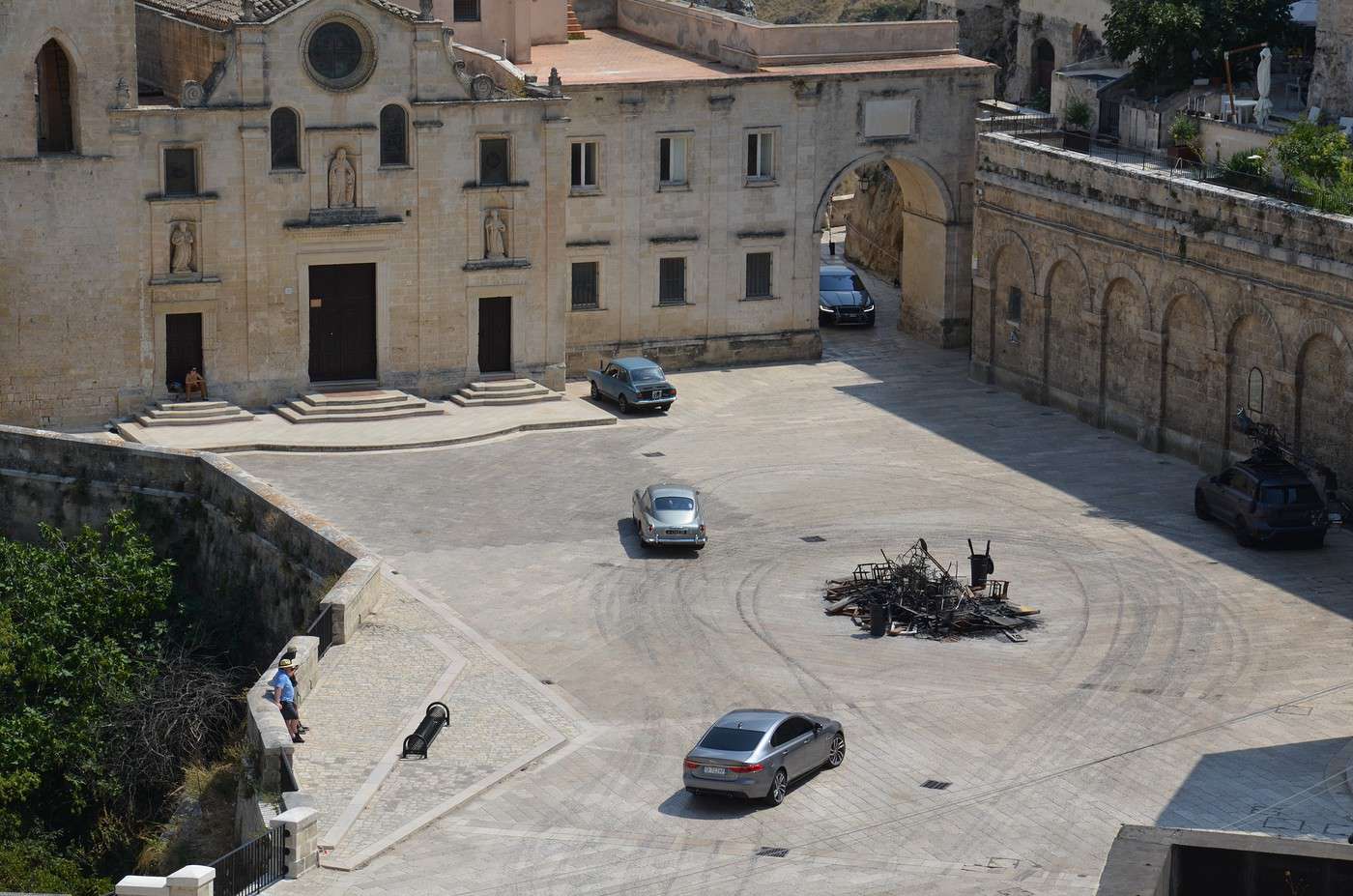
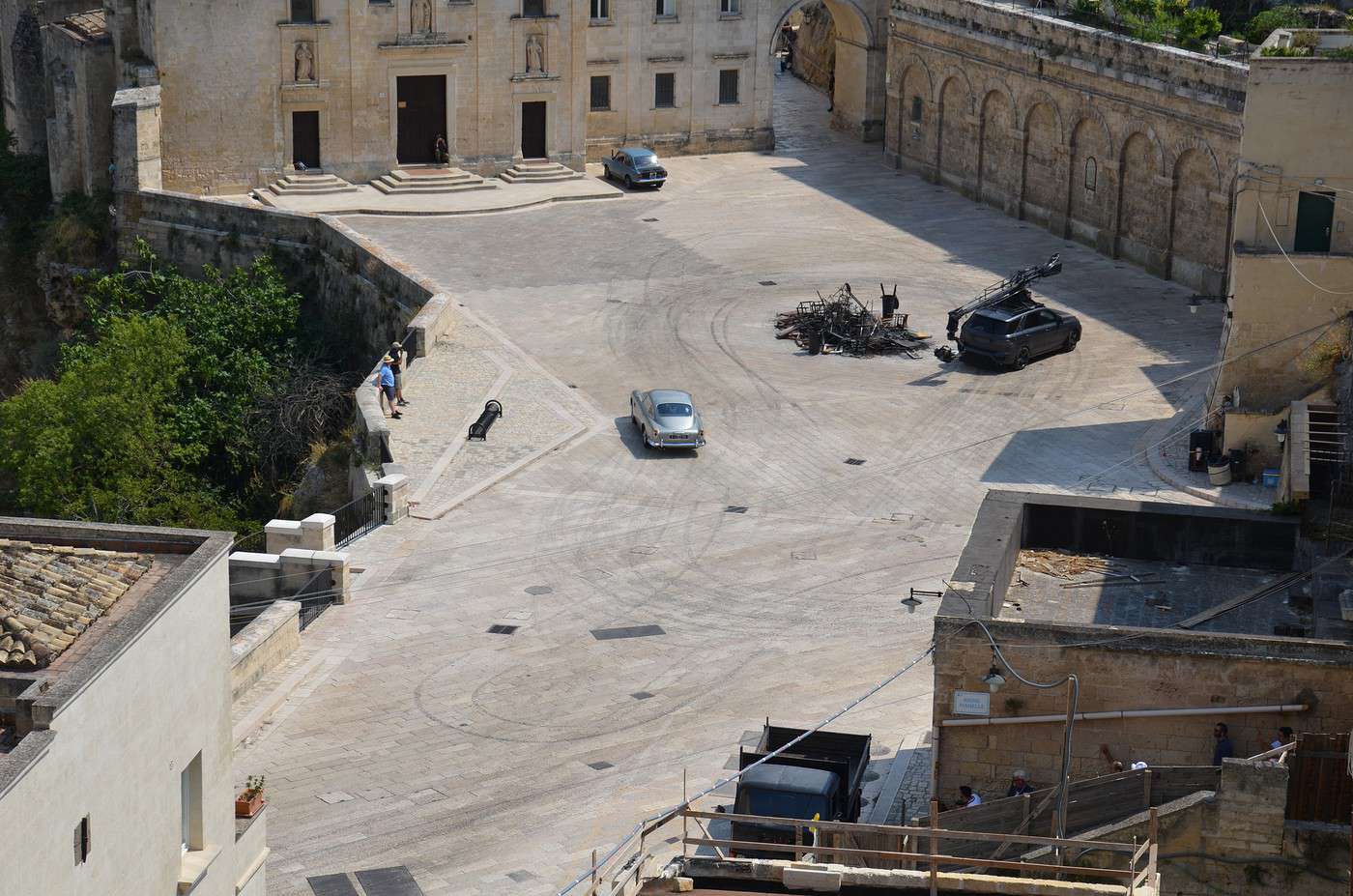
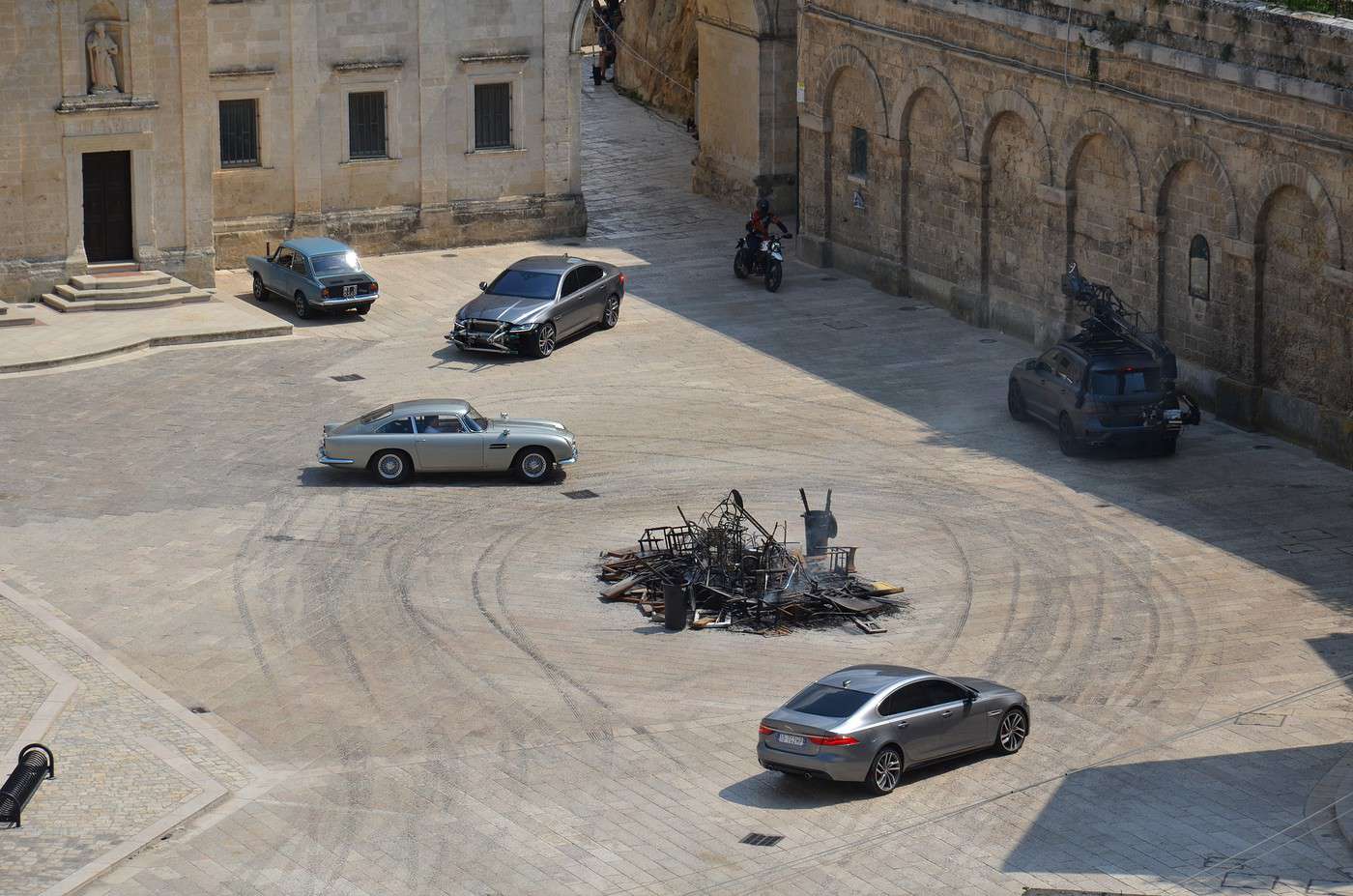
Good evening, I can confirm that scenes for the next James Bond were filmed in MATERA this summer. We spent 3 nights there in August, and some access points at the bottom of the city were completely blocked off due to filming, with security agents at every street corner. Despite that, we were able to watch (for hours, if you're a fan!!) while leaning along a very long staircase overlooking that famous square where the photo of the church you included in your travel journal is taken. We saw about ten takes of the same scene and the fine-tuning that follows, shot after shot. It was a car and motorcycle chase with a blaze in the middle of the square. I guess there must’ve been tire marks left on the square long after filming.
Good evening, I can confirm that scenes for the next James Bond were filmed in MATERA this summer. We spent 3 nights there in August, and some access points at the bottom of the city were completely blocked off due to filming, with security agents at every street corner. Despite that, we were able to watch (for hours, if you're a fan!!) while leaning along a very long staircase overlooking that famous square where the photo of the church you included in your travel journal is taken. We saw about ten takes of the same scene and the fine-tuning that follows, shot after shot. It was a car and motorcycle chase with a blaze in the middle of the square. I guess there must’ve been tire marks left on the square long after filming.
M
Mick013· 7 years ago
Puglia—known as "la Puglia" in Italian (approximate pronunciation: la Poo-lya)—comes from the Latin Apulia, which itself derives from the Greek Iapyghia. It’s a proper name with no particular meaning.
Super interesting!!
I love learning about the history of the places I visit.
That said, the curious side of me wants to know where the word "Pouilles" comes from!!
I could look it up, but I love your explanations so much.
Hi Mick,
I wasn’t going any further than Latin... thanks!
Have a great day.
Have a great day.
You might also like
 Tuscany: Arezzo province and the Siena area
Travel logs › Italy·286 photos
 A "relaxed" 16-day tour of Corsica in autumn 2024
Travel logs › France › Corsica·274 photos
 Off we go on an adventure in Puglia!
Travel logs › Italy·128 photos
 Autumn trip from Puglia to Naples via Basilicata...
Travel logs › Italy·149 photos
 Palermo street art
Travel logs › Italy·38 photos
 Veneto: Dolomites and Opera
Travel logs › Italy·154 photos
 Polynesia: How to choose between the Society Islands, Tuamotu, and the Marquesas?
Features › French Polynesia·4 photos
 A Few Days in Turkmenistan from Uzbekistan
Travel logs › Turkmenistan·73 photos