pour un voyage en Russie en mai 2018 je cherche un moyen pour téléphoner en Russie à moindres frais. Quelqu'un peut-il me dire s'il faut prendre une extension de forfait en France ou bien si en Russie on trouve des cartes SIM ? Merci de votre réponse.
I took a few days to get some fresh air outside the Schengen-NATO prison. Between March 18, 2026, and March 25, 2026, as shown by the passport stamps:
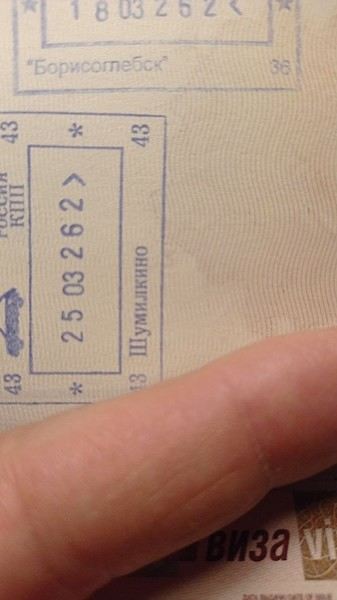
Borisoglebsk is the Russian border checkpoint after Kirkenes, on the road to Murmansk.
Kirkenes is a tiny town with a correspondingly small airport. Nothing has changed there: the minibuses to Murmansk wait on the right as you exit the airport. They’re synchronized with the two daily flights from Oslo—the SAS around 11:00 AM and Norwegian around 11:30 AM. They stop in Kirkenes at the corner of the Scandic for an hour, where other passengers can board, then head straight to the nearby border.
This is the least hassle Frontex/Schengen border. The Norwegian agent quickly scans your passport, and that’s it. No customs, since Norway is Schengen but not in the EU. On the Russian side, there’s a passport check and a quick customs inspection. All in all, crossing both the Norwegian and Russian checkpoints takes about 15 minutes.
A paper visa is required; e-visas aren’t accepted.
Two companies run the route: Avto Ekspress and Borodin: https://ae51.ru/routes/kirkenes-murmansk/ https://borodinbus.com/
The one-way fare is 5,500 ₽. You can either buy it online in rubles with a MIR card or make a formal reservation and pay in NOK cash to the driver. I took Borodin, and the price in NOK was much more expensive than in ₽.
=========================
On March 25, I left from Pskov via the Estonian border post at Luhaama. I spent three days in Murmansk, flew to St. Petersburg (SPB), stayed there for two days, then took an evening train to Pskov.
Since the end of February—and reportedly until the end of May—the Estonians have restricted the opening hours of the two border crossings near Pskov: Koidula (Pechory on the Russian side) and Luhaama (Izborsk on the Russian side). They’re closed at night between 7:00 PM and 7:00 AM. Right now, there’s a bus from Pskov at 7:00 AM to the border. It drops you off at the end of the road where truckers—many Kazakh and Serbian—are parked on the side. You finish the rest on foot to the barrier, where there’s a quick initial check for Ukrainian stamps in passports. Then you walk to the customs building, followed by passport control at the kiosk for motorists. After that, it’s a 500-meter walk to the Estonian checkpoint. At the moment, things seem calmer. Passport control is quick. The usual silly questions in English: "Where were you? Where are you going?" I just gave my most clueless smile: "Sorry, I don’t understand." Yeah, right—I don’t speak English, especially not at an Estonian border with a French passport. If they’re in a mood, though... A very quick bag inspection. Once you exit the Estonian post, walk to the bus stop sign by the road where another coach takes you to Riga.
The catch: in my case, last Wednesday, there were two passengers (Russians) with old Ukrainian stamps in their passports. The bus from the Estonian post to Riga was supposed to leave around 9:30 AM. We ended up leaving around noon after the two were grilled by the FSB. Since it was a weekday outside of holidays, the bus was half-empty. The fuller the bus and the more people with Ukrainian stamps, the worse the nightmare. Don’t book a same-day flight from Riga. I had a flight at 6:00 PM, so it worked out.
=============
The Kirkenes-Murmansk route is still clearly the easiest and fastest. But it’s not the most convenient since it’s way up north.
Next, I’d say the Gdansk-Kaliningrad route in the middle of the week. Avoid weekends and holiday departures/returns.
Avoid the Narva-Ivangorod route during Christmas, Easter, May 9, and *all* summer.
==============
About flights from Murmansk to St. Petersburg: prices are good. I bought my ticket the day before departure on Rossiya for 7,500 ₽, including 10 kg of luggage + a handbag.
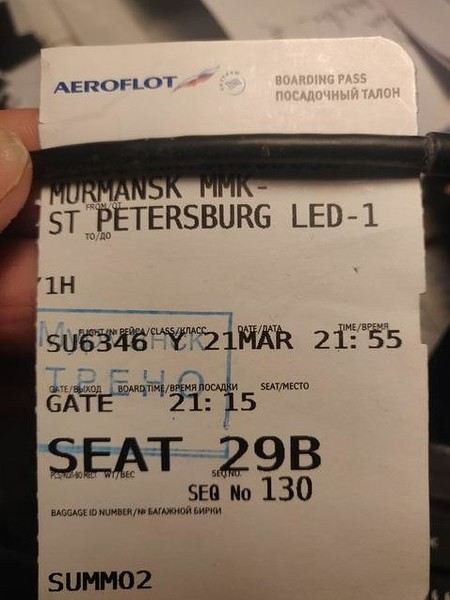
It’s the tail end of the northern lights season, and there were still crowds of Chinese tourists.
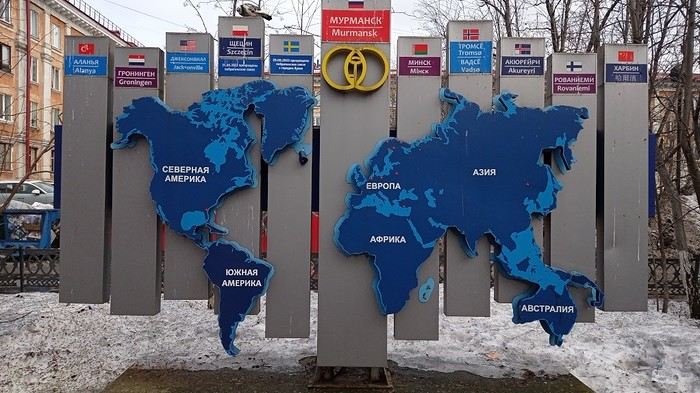
By the way, Murmansk is twinned with Harbin:
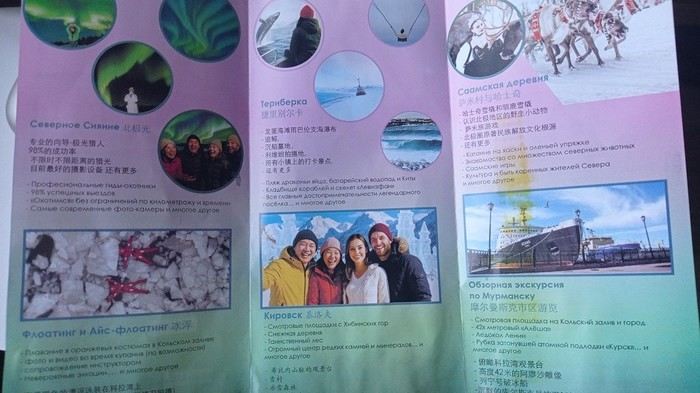
Chinese tourists are the largest foreign group, followed by Indians, then a mix of others from the Far East, Turks, Arabs, etc. Brochures are bilingual—Russian and Chinese:
============================
But let’s talk practical stuff. --
My domestic SIM card was restricted for SMS and internet for 24 hours. After that, if you want to keep using SMS, don’t turn off your phone—restarting triggers another 24-hour purgatory.
My Russian SIM cards (Megafon, MTS, Beeline) were activated as soon as I logged into their respective apps with my credentials.
Internet --
Telegram is heavily slowed down by authorities. To use it, you need to connect through proxy servers, which you load into the latest version of the app. Traffic is then rerouted internally within Telegram to servers outside Russia (Germany, Poland, Sweden, etc.). You can find these proxies on various channels. One is ChatVPN—check their website too.
For general internet use, like browsing the web, VPNs that work right now use the VLESS protocol. You can find several on Telegram by searching "VPN." A few free days, then payment in rubles or crypto.
Rozkomnadzor’s team are experts at this, so things can change. It’s a constant cat-and-mouse game.
Pskov is a special case. The city is near Estonia and has a large military base. Depending on NATO drone swarms launched from the Baltics, Wi-Fi can be completely suspended except for the most essential mobile apps. The drone swarms use the 4G network, and the powerful electronic jamming and drone suppression systems cause periods without Wi-Fi—including in hotels. Wired connections aren’t affected.
Borisoglebsk is the Russian border checkpoint after Kirkenes, on the road to Murmansk.
Kirkenes is a tiny town with a correspondingly small airport. Nothing has changed there: the minibuses to Murmansk wait on the right as you exit the airport. They’re synchronized with the two daily flights from Oslo—the SAS around 11:00 AM and Norwegian around 11:30 AM. They stop in Kirkenes at the corner of the Scandic for an hour, where other passengers can board, then head straight to the nearby border.
This is the least hassle Frontex/Schengen border. The Norwegian agent quickly scans your passport, and that’s it. No customs, since Norway is Schengen but not in the EU. On the Russian side, there’s a passport check and a quick customs inspection. All in all, crossing both the Norwegian and Russian checkpoints takes about 15 minutes.
A paper visa is required; e-visas aren’t accepted.
Two companies run the route: Avto Ekspress and Borodin: https://ae51.ru/routes/kirkenes-murmansk/ https://borodinbus.com/
The one-way fare is 5,500 ₽. You can either buy it online in rubles with a MIR card or make a formal reservation and pay in NOK cash to the driver. I took Borodin, and the price in NOK was much more expensive than in ₽.
=========================
On March 25, I left from Pskov via the Estonian border post at Luhaama. I spent three days in Murmansk, flew to St. Petersburg (SPB), stayed there for two days, then took an evening train to Pskov.
Since the end of February—and reportedly until the end of May—the Estonians have restricted the opening hours of the two border crossings near Pskov: Koidula (Pechory on the Russian side) and Luhaama (Izborsk on the Russian side). They’re closed at night between 7:00 PM and 7:00 AM. Right now, there’s a bus from Pskov at 7:00 AM to the border. It drops you off at the end of the road where truckers—many Kazakh and Serbian—are parked on the side. You finish the rest on foot to the barrier, where there’s a quick initial check for Ukrainian stamps in passports. Then you walk to the customs building, followed by passport control at the kiosk for motorists. After that, it’s a 500-meter walk to the Estonian checkpoint. At the moment, things seem calmer. Passport control is quick. The usual silly questions in English: "Where were you? Where are you going?" I just gave my most clueless smile: "Sorry, I don’t understand." Yeah, right—I don’t speak English, especially not at an Estonian border with a French passport. If they’re in a mood, though... A very quick bag inspection. Once you exit the Estonian post, walk to the bus stop sign by the road where another coach takes you to Riga.
The catch: in my case, last Wednesday, there were two passengers (Russians) with old Ukrainian stamps in their passports. The bus from the Estonian post to Riga was supposed to leave around 9:30 AM. We ended up leaving around noon after the two were grilled by the FSB. Since it was a weekday outside of holidays, the bus was half-empty. The fuller the bus and the more people with Ukrainian stamps, the worse the nightmare. Don’t book a same-day flight from Riga. I had a flight at 6:00 PM, so it worked out.
=============
The Kirkenes-Murmansk route is still clearly the easiest and fastest. But it’s not the most convenient since it’s way up north.
Next, I’d say the Gdansk-Kaliningrad route in the middle of the week. Avoid weekends and holiday departures/returns.
Avoid the Narva-Ivangorod route during Christmas, Easter, May 9, and *all* summer.
==============
About flights from Murmansk to St. Petersburg: prices are good. I bought my ticket the day before departure on Rossiya for 7,500 ₽, including 10 kg of luggage + a handbag.
It’s the tail end of the northern lights season, and there were still crowds of Chinese tourists.
By the way, Murmansk is twinned with Harbin:
Chinese tourists are the largest foreign group, followed by Indians, then a mix of others from the Far East, Turks, Arabs, etc. Brochures are bilingual—Russian and Chinese:
============================
But let’s talk practical stuff. --
My domestic SIM card was restricted for SMS and internet for 24 hours. After that, if you want to keep using SMS, don’t turn off your phone—restarting triggers another 24-hour purgatory.
My Russian SIM cards (Megafon, MTS, Beeline) were activated as soon as I logged into their respective apps with my credentials.
Internet --
Telegram is heavily slowed down by authorities. To use it, you need to connect through proxy servers, which you load into the latest version of the app. Traffic is then rerouted internally within Telegram to servers outside Russia (Germany, Poland, Sweden, etc.). You can find these proxies on various channels. One is ChatVPN—check their website too.
For general internet use, like browsing the web, VPNs that work right now use the VLESS protocol. You can find several on Telegram by searching "VPN." A few free days, then payment in rubles or crypto.
Rozkomnadzor’s team are experts at this, so things can change. It’s a constant cat-and-mouse game.
Pskov is a special case. The city is near Estonia and has a large military base. Depending on NATO drone swarms launched from the Baltics, Wi-Fi can be completely suspended except for the most essential mobile apps. The drone swarms use the 4G network, and the powerful electronic jamming and drone suppression systems cause periods without Wi-Fi—including in hotels. Wired connections aren’t affected.
Le départ approche et d'un coup j'ai un doute..
Une carte SIM data achetée en Mongolie nous permettra-t-elle d'accéder à internet avec un de nos smartphones occidentaux?
N'y a-t-il pas des histoires de fréquences différentes?
Merci de m'éclairer!
Marie
Hey fellow travelers! Could anyone tell me if it's possible to buy a SIM card in Murghab? Thanks in advance for your tips!! 🙏🙏🙏
hello,
je ne trouve aucune information concernant la possibilité d acheter une carte SIM prépayée pour un séjour de 15 jours en Ouzbékistan ....
interdiction aux étrangers ? personne n a essayer d en acheter ? ou ils ne communiquent qu avec des signaux de fumée ... ?
plaisanterie mise a part, si quelqu un a des informations récentes et précises a ce sujet la, ça serait sympa ...
merci d avance
Bonjour,
Nous partons en juillet et aimerions savoir si pour communiquer, il est plus d'aller téléphoner dans des boutiques, d'acheter une carte Sim local, ...
quels sont les couts de communication ?
bref, si vous avez des connaissances ...
Merci d'avance
Jean-Luc
Il semblerait qu'il ne soit plus possible, pour les touristes, d'acheter les cartes Iransell !
Qui aurait des infos récentes ?
Merci par avance (départ mardi 😀)
Nous serons en Iran en avril-mai et avons l'intention d'acheter une carte SIM pour pouvoir appeler nos contacts là-bas. On a un petit souci, parce qu'on possède un simple téléphone portable, pas un smartphone (et les Iraniens sont comme tout le monde semble-t-il, ils ne jurent plus que par le smartphone !). Acheter un smartphone, dont on ne veut par ailleurs pas, juste pour ce voyage serait un peu bête, alors la question est : est-ce qu'on trouve en Iran des cartes SIM « normale », « classique », enfin juste des bêtes cartes pour téléphoner avec son portable ?
Question annexe : tout le monde nous conseille les cartes Irancel, qu'en pensez-vous ? Et aussi : combien ça coûte ?
Merci d'avance.
Question annexe : tout le monde nous conseille les cartes Irancel, qu'en pensez-vous ? Et aussi : combien ça coûte ?
Merci d'avance.
Je m'adresse à ceux qui ont séjourné en Iran dernièrement
Comment se passe la communication avec la France?
E-Mail? Facebook?WhatsApp ?Autres?
Dois-je emmener mon smartphone ou aller dans des cafés @ ?
Sans être ferrue du Net, je voudrais au moins donner quelques signes de vie de temps à autres
Merci
Bonjour
On réfléchit en ce moment à l'achat d'une carte téléphonique internationale prépayée comme celle ci
https://www.explod.com
À la lecture de ce blog
http://oiseaurose.com/2017/02/2…letranger/
Cela semble intéressant pour des destinations hors Europe avec plusieurs pays traversés.
Certains d'entre vous ont-ils déjà utilisé cette carte ?
Ou d'autres cartes similaires ?
Petite précision c'est pour une utilisation en Russie, Kazakhstan, Ouzbékistan, et Kirghizistan.
On part fin mai avec notre fourgon aménagé faire un périple qui devrait nous mener jusqu'au lac Baïkal.
Cordialement
Marc
Hi there,
I’ve never bought a SIM card abroad or even used prepaid cards in France...
So I’m wondering how it all works?
You buy a SIM card and pop it into your phone. Okay, so far so good... 😏
But after that?
I can’t find the price of prepaid cards or how they work with MegaCom.
If someone could give me a step-by-step guide... 😊
Thanks! 🙂
I’ve never bought a SIM card abroad or even used prepaid cards in France...
So I’m wondering how it all works?
You buy a SIM card and pop it into your phone. Okay, so far so good... 😏
But after that?
I can’t find the price of prepaid cards or how they work with MegaCom.
If someone could give me a step-by-step guide... 😊
Thanks! 🙂
Bonjour,
Je voudrais savoir s'il est possible d'acheter une carte sim prépayé en kirghisie pour appeler un numéro d'urgence ou un hotel ou un bureau CBT.
Si oui, Où peut-on en acheter?
Yoann
Si oui, Où peut-on en acheter?
Yoann
Bonjour à tous,
Les téléphones portables achetés en France sont-ils utilisables en Russie en y mettant une carte SIM achetée là-bas ?
Même question pour un téléphone portable acheté en Argentine ?
Merci d'avance pour vos infos et expériences
Les téléphones portables achetés en France sont-ils utilisables en Russie en y mettant une carte SIM achetée là-bas ?
Même question pour un téléphone portable acheté en Argentine ?
Merci d'avance pour vos infos et expériences
Bonjour,
Je voudrais savoir si on peut utiliser un portable avec une carte sim locale au Kyrgystan afin d'effectuer des réservations sur place ?
Est-ce que ça marche et est-ce que ça vaut le coup ?
Qui peut me renseigner ?
A+
Olala
Bonjour,
On traverse ces pays, et on est en camion. On voudrait savoir s'il a des laveries, ou des endroits ou faire laver ses affaires pour pas cher ? Et question bonus : un opérateur fait des sim card pour ces pays là, ou faut choper a chaque pays une nouvelle sim ?
Bonne journée
On traverse ces pays, et on est en camion. On voudrait savoir s'il a des laveries, ou des endroits ou faire laver ses affaires pour pas cher ? Et question bonus : un opérateur fait des sim card pour ces pays là, ou faut choper a chaque pays une nouvelle sim ?
Bonne journée
Bonjour à tous,
Lorsque je pars en voyage je me sers de mon tél portable pour envoyer des SMS, moyen le plus économique pour rester en relation avec ses proches.
Peut-on s'en servir dans les pays d'Asie Centale?
Simone
Bonjour! :D
Je me rend en Russie la semaine prochaine et je me demande si vous ne connaissez pas un opérateur téléphonique sur place qui propose une carte prépayée pour surfer en 3G sur mon smartphone pour pas trop cher.
J'ai trouvé des pistes sur le Forum mais c'est souvent des abonnements.
Merci à tous! :D
Bonjour à tous,
Je vais en Ouzbekistan en décembre 2020 et je souhaite savoir s’il est possible de conduire par soi-même?
J’ai lu le contraire sur des blogs réalisés il y a quelques années mais peut-être que cela a changé entre-temps.
Merci pour vos réponses:-) Daniel
J’ai lu le contraire sur des blogs réalisés il y a quelques années mais peut-être que cela a changé entre-temps.
Merci pour vos réponses:-) Daniel
Bonjour à tous!
je vais passer quelques jours à St Petersbourg, et j'ai une petite question à propos du réseau de téléphonie. J'ai un mobile orange (et bien sûr sur orange.fr aucune info, et je n'ai pas le temps ni d'argent à donner aux services téléphoniques d'orange, mais c'est un autre débat..) avec l'option "accès à l'international", et comme j'aurai besoin de téléphoner à mes contacts une fois sur place, je voulais savoir s'il y avait une couverture mobile compatible avec les téléphones de chez orange, pour téléphoner ou envoyer des sms. J'ai vu qu'il y avait apparemment des soucis pour des usagers SFR, d'où ma légère inquiétude..
Sinon, y' a t il des payphones? Si oui, y'en a t il beaucoup? Faciles d'utilisation?
Merci d'avances pour vos réponses et conseils!
je vais passer quelques jours à St Petersbourg, et j'ai une petite question à propos du réseau de téléphonie. J'ai un mobile orange (et bien sûr sur orange.fr aucune info, et je n'ai pas le temps ni d'argent à donner aux services téléphoniques d'orange, mais c'est un autre débat..) avec l'option "accès à l'international", et comme j'aurai besoin de téléphoner à mes contacts une fois sur place, je voulais savoir s'il y avait une couverture mobile compatible avec les téléphones de chez orange, pour téléphoner ou envoyer des sms. J'ai vu qu'il y avait apparemment des soucis pour des usagers SFR, d'où ma légère inquiétude..
Sinon, y' a t il des payphones? Si oui, y'en a t il beaucoup? Faciles d'utilisation?
Merci d'avances pour vos réponses et conseils!
Salut a tous
je doit partir pour 6à7 mois pour ce pays .
Je voudrais savoir si il y a des opérateurs téléphoniques las-bas car j'aimerais utiliser mon portable.
merci pour vos conseils
Recent information about this country is scarce, so I’m starting this post in addition to my travel journal to help fill the gap.
- Which airline from Europe?
Turkish Airlines seems like an excellent option. The price is very reasonable (just over 500 €), the layover isn’t too long, the in-flight comfort is decent (great movie selection), and the planes are modern. Plus, the price automatically includes 30 kilos of luggage, which is perfect for campers.
The downside: the outrageous prices at Istanbul Airport.
- Bishkek Airport
The airport is under full reconstruction. It’s chaotic. There are SIM card vendors upon arrival, but no currency exchange or ATMs in the baggage claim area. You’ll find those in the departures section, which means you have to exit and re-enter under the current setup.
Personally, I pre-booked a VTC with my hotel for the transfer to the city. (Prices vary depending on the hotel’s standard—1200 soms for mine.)
There are taxis and a bus available.
- Entry Requirements
No visa is required for French citizens for stays of up to 30 days.
- Currency
The currency is the som, and the conversion is easy—just divide by 100...
You can get soms by exchanging euros (dollars are useless) or by withdrawing from an ATM. Some ATMs charge fees. Those from Mbank and Optimabank are fee-free.
The maximum withdrawal is usually 20,000 soms.
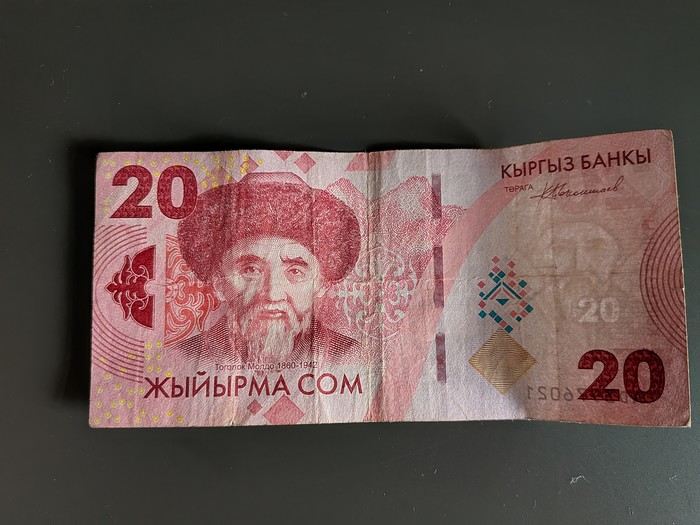
Bills come in 5000, 1000, 500, 200, 100, 50, and 20 soms.
Coins: 10, 5, 3, and 1 som.
- Paying
Card payments are accepted in supermarkets like Globus, some restaurants, gas stations of major chains (Bishkek Petroleum, Partner Neft, Red Petroleum), some hotels, national park entrances, tolls, etc.
But it doesn’t always work.
So always carry cash with you!
If the card works, great—otherwise, it’s back to the old days of wads of bills.
- Cost of Living
It’s really cheap (gas, affordable restaurants even at a decent standard, hotels, souvenirs, fruits, vegetables, water, bread...). For example, a lagman costs only 3.20 €, fixing a flat tire is 3.5 €, a full hour-long wash for a filthy 4x4 is 6 €, washing a big bag of laundry is 3 €, and a liter of 95-octane gas is 0.86 €...
On the pricier side: guesthouses and meals in guesthouses. The value for money is poor. I paid 40 € for a mediocre room with a very basic shared bathroom, while a double with AC, private bathroom, and fridge in a non-touristy hotel cost 20 €... Meals in guesthouses are the worst I’ve eaten and often the most expensive. Plus, they’re very light—don’t expect to fill up after a long day of hiking!
Car rentals are also quite expensive (70 $ per day for a RAV4 in my case).
In short, for two people, excluding accommodation and car rental, we spent an average of 45 € per day (groceries, restaurants, guesthouse dinners, souvenirs, paid activities, gas).
The trip cost us 2200 € per person all-inclusive for 3 weeks on the ground. Roughly 1/4 for the flight, 1/4 for the car, 1/4 for accommodation, and 1/4 for everything else.
- Getting Around
I’ve met cyclists, motorcyclists, people renting cars, those who drove their own vehicles from Europe, and others using public transport and taxis.
Personally, I chose to rent a car.
If you’re not planning long hikes or multi-day horse treks, it’s a great option for exploring the country.
Each car rental company has its own list of forbidden tracks. Make sure your planned route is allowed! Don’t think about ignoring this—vehicles are equipped with GPS trackers...
An international driver’s permit is required.
Police and speed cameras are everywhere, so it’s best to respect the signs (daytime running lights, seatbelts, 40-60 km/h in populated areas, 90 km/h on roads, zero tolerance for alcohol).
Locals have a unique driving style, and it can be dangerous on main roads (they overtake recklessly...). Like in Greece, South Africa, or Malta, a two-lane road is treated as a three-lane one. You pull over to let others pass or to let oncoming traffic overtake.
Without a car (at least a pseudo-4x4), you won’t be able to go everywhere. This country is a nature destination, but nature isn’t always accessible by public transport.
If a spot is near a road, great—the bus will get you almost to the door. Otherwise, you’ll need to hire an agency or take a taxi.
Cyclists will face steep climbs and dust. I’d advise avoiding main roads as much as possible—traffic isn’t on your side...
Motorcyclists will also eat a lot of dust and should research gas stations along their route (this advice also applies to vehicles running on 95-octane).
There’s a 95-octane pump in Kazarman and Gulcha.
Bikes and motorcycles have an advantage over cars, even 4x4s, as they can access some very remote tracks that other vehicles can’t (hikers and horses can obviously take them too!).
Be careful: some areas require a permit (border zones). Research this well in advance—the formalities don’t take an hour or even a day!
Be warned: Google Maps is completely unreliable (it shows roads that don’t exist, routes you through difficult tracks instead of paved roads, etc.). It’s essential to download Maps.me in advance. This app is much more reliable for this country, works offline, and is handy for hiking navigation.
A reminder: horseback riding is like cycling... If you’re not used to it or naturally padded in the right places, your backside will suffer in no time!
Think carefully before embarking on a multi-day trek!
Finally, this country is a kingdom of construction... The Chinese have taken over the market to improve truck circulation and are paving everywhere. (Good news: the Kazarman-Osh section via the tunnel is finally open in summer, even if the road isn’t quite finished.)
- Eating
I had prejudices about Kyrgyz food.
I was both wrong and right.
Supermarkets don’t offer much that’s appealing for picnics. It’s cheap, filling food, full of junk, and not gourmet. If you follow Yuka, I think you’ll be on a diet the whole trip. Bringing some pâté, sausages, or freeze-dried meals for certain nights is a good idea...
Guesthouse dinners consist of the eternal cucumber-tomato salad, a soup, and a light noodle or rice dish where you’ll be searching for the meat... Usually tough and unidentifiable. Beef? The bread is stale, and there’s no dessert or fruit.
Breakfasts always revolve around eggs or porridge... The homemade jam is usually good.
Tea is the number one drink, followed by kompot (a fruit-based drink), Coke, and Fanta.
If you want real coffee, bring your own—it’s very rare.
On the other hand, you eat well in restaurants. Lagman (homemade noodles, vegetables, spices, and usually beef), crispy eggplant, kuurdak (a kind of lamb stew with potatoes), kebabs, plov (pilaf rice with onions, carrots, and meat), and rainbow trout... For dessert? Nada!
And alcohol?
It’s available in all Globus stores: beer, wine, spirits, and you can consume your purchases in some guesthouses (depending on the owner’s religious tolerance). It’s also available in some restaurants (Bishkek, Karakol, Osh...).
The deadly specialty?
White fermented milk balls called kurut. If you think a raw-milk camembert is strong, steer clear! This is more like an old, dry, spicy goat cheese.
- Accommodation
In remote areas, it’s better to check availability on Booking a few days in advance rather than showing up last minute with high hopes.
Booking and Airbnb only offer a small portion of what’s available.
Not necessarily guesthouses, but mostly accommodations aimed at locals (business or leisure travel).
These places are generally more comfortable. There’s even some upscale options.
So it’s necessary to scour Google Maps or Yandex Maps... These accommodations are usually found on Instagram, and WhatsApp is handy for booking!
Prices are a bit of a lottery. So is the comfort. From 20 to 80 € for a double, usually with a private bathroom. (Average around 40 €). These rates are for mid-range options.
Otherwise, this country is a paradise for wild camping. In a camper van, rooftop tent, or ground tent... There are beautiful spots everywhere!
- Climate
I thought it would be quite cool/cold at altitude.
I packed too many warm clothes...
If you’re not doing high-altitude treks or sleeping in a tent, there’s no need to overload yourself with winter gear.
A good fleece, a windproof rain jacket, and technical base layers will be enough.
It only got really cold in the evenings at Song Kul Lake and Tash Rabat, and the yurts are equipped with thick blankets and a stove.
Elsewhere, temperatures ranged from 15 to 30 °C.
In short, I used the AC more than the heater! (It’s hard to drive with the windows open unless you want to be covered in dust in no time...)
- Communication
I bought an eSIM before the trip with a data plan for Kyrgyzstan (Beeline network). Perfect for communicating via WhatsApp right after landing, but this network isn’t the best in Kyrgyzstan.
We then got a physical SIM card with an unlimited one-month plan (less than 4 € including the SIM) at a Mega store downtown. This network is much better, and you get coverage in all cities and most villages. Usually in the mountain passes too.
To make yourself understood, it’s essential to download Google Translate with French, Kyrgyz, Russian, and English options.
Very useful for translating menus, signs, and communicating with locals.
Hosts and other tourism professionals will even pull out their phones to communicate with non-Russian speakers.
The police too...
- Religion
There’s a noticeable difference between the north and the southwest of the country.
In the north, it’s a bit like Albania. People are Muslim by culture but not really by religion.
In the southwest, radical Islam is growing. Mosques are more numerous and imposing. Men are more bearded, women more veiled.
For travelers, religion isn’t an issue except for the near-total absence of pork.
There’s Russian sausage, but reading the ingredient list, it’s more like a one-way ticket to cancer than an Auvergne dry sausage...
You can find the detailed account of the trip here.
- Which airline from Europe?
Turkish Airlines seems like an excellent option. The price is very reasonable (just over 500 €), the layover isn’t too long, the in-flight comfort is decent (great movie selection), and the planes are modern. Plus, the price automatically includes 30 kilos of luggage, which is perfect for campers.
The downside: the outrageous prices at Istanbul Airport.
- Bishkek Airport
The airport is under full reconstruction. It’s chaotic. There are SIM card vendors upon arrival, but no currency exchange or ATMs in the baggage claim area. You’ll find those in the departures section, which means you have to exit and re-enter under the current setup.
Personally, I pre-booked a VTC with my hotel for the transfer to the city. (Prices vary depending on the hotel’s standard—1200 soms for mine.)
There are taxis and a bus available.
- Entry Requirements
No visa is required for French citizens for stays of up to 30 days.
- Currency
The currency is the som, and the conversion is easy—just divide by 100...
You can get soms by exchanging euros (dollars are useless) or by withdrawing from an ATM. Some ATMs charge fees. Those from Mbank and Optimabank are fee-free.
The maximum withdrawal is usually 20,000 soms.
Bills come in 5000, 1000, 500, 200, 100, 50, and 20 soms.
Coins: 10, 5, 3, and 1 som.
- Paying
Card payments are accepted in supermarkets like Globus, some restaurants, gas stations of major chains (Bishkek Petroleum, Partner Neft, Red Petroleum), some hotels, national park entrances, tolls, etc.
But it doesn’t always work.
So always carry cash with you!
If the card works, great—otherwise, it’s back to the old days of wads of bills.
- Cost of Living
It’s really cheap (gas, affordable restaurants even at a decent standard, hotels, souvenirs, fruits, vegetables, water, bread...). For example, a lagman costs only 3.20 €, fixing a flat tire is 3.5 €, a full hour-long wash for a filthy 4x4 is 6 €, washing a big bag of laundry is 3 €, and a liter of 95-octane gas is 0.86 €...
On the pricier side: guesthouses and meals in guesthouses. The value for money is poor. I paid 40 € for a mediocre room with a very basic shared bathroom, while a double with AC, private bathroom, and fridge in a non-touristy hotel cost 20 €... Meals in guesthouses are the worst I’ve eaten and often the most expensive. Plus, they’re very light—don’t expect to fill up after a long day of hiking!
Car rentals are also quite expensive (70 $ per day for a RAV4 in my case).
In short, for two people, excluding accommodation and car rental, we spent an average of 45 € per day (groceries, restaurants, guesthouse dinners, souvenirs, paid activities, gas).
The trip cost us 2200 € per person all-inclusive for 3 weeks on the ground. Roughly 1/4 for the flight, 1/4 for the car, 1/4 for accommodation, and 1/4 for everything else.
- Getting Around
I’ve met cyclists, motorcyclists, people renting cars, those who drove their own vehicles from Europe, and others using public transport and taxis.
Personally, I chose to rent a car.
If you’re not planning long hikes or multi-day horse treks, it’s a great option for exploring the country.
Each car rental company has its own list of forbidden tracks. Make sure your planned route is allowed! Don’t think about ignoring this—vehicles are equipped with GPS trackers...
An international driver’s permit is required.
Police and speed cameras are everywhere, so it’s best to respect the signs (daytime running lights, seatbelts, 40-60 km/h in populated areas, 90 km/h on roads, zero tolerance for alcohol).
Locals have a unique driving style, and it can be dangerous on main roads (they overtake recklessly...). Like in Greece, South Africa, or Malta, a two-lane road is treated as a three-lane one. You pull over to let others pass or to let oncoming traffic overtake.
Without a car (at least a pseudo-4x4), you won’t be able to go everywhere. This country is a nature destination, but nature isn’t always accessible by public transport.
If a spot is near a road, great—the bus will get you almost to the door. Otherwise, you’ll need to hire an agency or take a taxi.
Cyclists will face steep climbs and dust. I’d advise avoiding main roads as much as possible—traffic isn’t on your side...
Motorcyclists will also eat a lot of dust and should research gas stations along their route (this advice also applies to vehicles running on 95-octane).
There’s a 95-octane pump in Kazarman and Gulcha.
Bikes and motorcycles have an advantage over cars, even 4x4s, as they can access some very remote tracks that other vehicles can’t (hikers and horses can obviously take them too!).
Be careful: some areas require a permit (border zones). Research this well in advance—the formalities don’t take an hour or even a day!
Be warned: Google Maps is completely unreliable (it shows roads that don’t exist, routes you through difficult tracks instead of paved roads, etc.). It’s essential to download Maps.me in advance. This app is much more reliable for this country, works offline, and is handy for hiking navigation.
A reminder: horseback riding is like cycling... If you’re not used to it or naturally padded in the right places, your backside will suffer in no time!
Think carefully before embarking on a multi-day trek!
Finally, this country is a kingdom of construction... The Chinese have taken over the market to improve truck circulation and are paving everywhere. (Good news: the Kazarman-Osh section via the tunnel is finally open in summer, even if the road isn’t quite finished.)
- Eating
I had prejudices about Kyrgyz food.
I was both wrong and right.
Supermarkets don’t offer much that’s appealing for picnics. It’s cheap, filling food, full of junk, and not gourmet. If you follow Yuka, I think you’ll be on a diet the whole trip. Bringing some pâté, sausages, or freeze-dried meals for certain nights is a good idea...
Guesthouse dinners consist of the eternal cucumber-tomato salad, a soup, and a light noodle or rice dish where you’ll be searching for the meat... Usually tough and unidentifiable. Beef? The bread is stale, and there’s no dessert or fruit.
Breakfasts always revolve around eggs or porridge... The homemade jam is usually good.
Tea is the number one drink, followed by kompot (a fruit-based drink), Coke, and Fanta.
If you want real coffee, bring your own—it’s very rare.
On the other hand, you eat well in restaurants. Lagman (homemade noodles, vegetables, spices, and usually beef), crispy eggplant, kuurdak (a kind of lamb stew with potatoes), kebabs, plov (pilaf rice with onions, carrots, and meat), and rainbow trout... For dessert? Nada!
And alcohol?
It’s available in all Globus stores: beer, wine, spirits, and you can consume your purchases in some guesthouses (depending on the owner’s religious tolerance). It’s also available in some restaurants (Bishkek, Karakol, Osh...).
The deadly specialty?
White fermented milk balls called kurut. If you think a raw-milk camembert is strong, steer clear! This is more like an old, dry, spicy goat cheese.
- Accommodation
In remote areas, it’s better to check availability on Booking a few days in advance rather than showing up last minute with high hopes.
Booking and Airbnb only offer a small portion of what’s available.
Not necessarily guesthouses, but mostly accommodations aimed at locals (business or leisure travel).
These places are generally more comfortable. There’s even some upscale options.
So it’s necessary to scour Google Maps or Yandex Maps... These accommodations are usually found on Instagram, and WhatsApp is handy for booking!
Prices are a bit of a lottery. So is the comfort. From 20 to 80 € for a double, usually with a private bathroom. (Average around 40 €). These rates are for mid-range options.
Otherwise, this country is a paradise for wild camping. In a camper van, rooftop tent, or ground tent... There are beautiful spots everywhere!
- Climate
I thought it would be quite cool/cold at altitude.
I packed too many warm clothes...
If you’re not doing high-altitude treks or sleeping in a tent, there’s no need to overload yourself with winter gear.
A good fleece, a windproof rain jacket, and technical base layers will be enough.
It only got really cold in the evenings at Song Kul Lake and Tash Rabat, and the yurts are equipped with thick blankets and a stove.
Elsewhere, temperatures ranged from 15 to 30 °C.
In short, I used the AC more than the heater! (It’s hard to drive with the windows open unless you want to be covered in dust in no time...)
- Communication
I bought an eSIM before the trip with a data plan for Kyrgyzstan (Beeline network). Perfect for communicating via WhatsApp right after landing, but this network isn’t the best in Kyrgyzstan.
We then got a physical SIM card with an unlimited one-month plan (less than 4 € including the SIM) at a Mega store downtown. This network is much better, and you get coverage in all cities and most villages. Usually in the mountain passes too.
To make yourself understood, it’s essential to download Google Translate with French, Kyrgyz, Russian, and English options.
Very useful for translating menus, signs, and communicating with locals.
Hosts and other tourism professionals will even pull out their phones to communicate with non-Russian speakers.
The police too...
- Religion
There’s a noticeable difference between the north and the southwest of the country.
In the north, it’s a bit like Albania. People are Muslim by culture but not really by religion.
In the southwest, radical Islam is growing. Mosques are more numerous and imposing. Men are more bearded, women more veiled.
For travelers, religion isn’t an issue except for the near-total absence of pork.
There’s Russian sausage, but reading the ingredient list, it’s more like a one-way ticket to cancer than an Auvergne dry sausage...
You can find the detailed account of the trip here.
Hi everyone!
Any idea what the current situation is like for homestays in Russia? Any recent firsthand experiences?
Thanks in advance! :)
bonjour,
je projette un sejour en Ouzbékistan, j'ai lu beaucoup de discussions sur le sujet. j'ai une interrogation : internet, avec ou sans WIFI
comment faites vous ? avez vous un portable avec une puce locale ? utilisez vous votre smartphone européen sous Wifi ? celle ci est-elle répandue dans les hébergements ? quels sont les opérateurs locaux ? je demande cela pour trouver sur place les hébergements, acheter mes billets de train ect … (et bien sur la com en générale avec l'Europe)
merci de vos infos et conseils Béatrice
je projette un sejour en Ouzbékistan, j'ai lu beaucoup de discussions sur le sujet. j'ai une interrogation : internet, avec ou sans WIFI
comment faites vous ? avez vous un portable avec une puce locale ? utilisez vous votre smartphone européen sous Wifi ? celle ci est-elle répandue dans les hébergements ? quels sont les opérateurs locaux ? je demande cela pour trouver sur place les hébergements, acheter mes billets de train ect … (et bien sur la com en générale avec l'Europe)
merci de vos infos et conseils Béatrice
Bonjour à tous
On part à 4 au Kirghizistant en août 2015, nous comptons faire Bishkek/Cholpon-Ata en bus Cholpon/Karakol en bateau, Karakol/Naryn en bus, Naryn/At-Bashy à cheval, Naryn/Song-Köl en 4X4 ou mieux on aimerais louer deux side car type Ural et Naryn/Osh en bus.
Mes questions sont
Bishkek/Cholpon-Ata en bus, ça peux se faire en une journée ? et facile ou pas de trouvé les bus ?
Cholpon/Karakol en bateau, quelqu'un à t-il déjà louer ? ou y à t-il des lignes régulières ?
Karakol/Naryn en bus, direct ou y à t-il de long correspondance ? en une journée ?
Naryn/ At-Bashy à cheval quelqu'un en à t-il déjà louer la-bas ? on aimerai en 3 ou 4 jours
Naryn/Song-Köl en 4X4 ou Ural, même question qu'au dessus
Naryn/Osh en bus, direct ou y à t-il de long correspondance ? en une journée ?
Si en plus vous avez les contact et les tarif c'est le top 😉 Je vous en remercie Laurent
Si en plus vous avez les contact et les tarif c'est le top 😉 Je vous en remercie Laurent
Bonjour à tous,
Voilà ! Je vais faire un voyage à St Petersbourg et Moscou en juin.
Si quelqu'un est déjà allé là bas, quels sont les consignes, conseil, choses dont il faut prendre attention.etc...
peut-on avoir acces au réseau GSM ?
Merci pour les renseignements
Voilà ! Je vais faire un voyage à St Petersbourg et Moscou en juin.
Si quelqu'un est déjà allé là bas, quels sont les consignes, conseil, choses dont il faut prendre attention.etc...
peut-on avoir acces au réseau GSM ?
Merci pour les renseignements
Curieux d'entendre de la part d'automobilistes au sujet de l'assurance responsabilité civile obligatoire, désignée par son acronyme OSAGO.
Mon assureur auto délivre une carte verte qui couvre uniquement la Russie d'Europe, et ne propose pas la possibilité d'acheter une extension de couverture. C'est le cas général de tous les assureurs norvégiens du reste. La carte verte comporte pour la Russie une mention d'avertissement sur cette limitation.
Or, je me rendais là où je suis en ce moment pour plusieurs semaines: Yekaterinburg, donc en Russie d'Asie, et pour ne pas perdre de temps sur le trajet, j'ai examiné:
- la possibilité d'achat en ligne d'une police électronique, ce qui est possible sur http://reso.ru si on dispose d'une carte SIM russe - la possibilité d'acheter en contactant le bureau finlandais de Alfa, mais il faut alors passer à leur bureau de Kotka pendant leurs horaires de travail un jour ouvré - directement acheter à la frontière
pour des raisons de temps essentiellement, j'ai opté pour l'achat à la frontière. Sur la route principale Finlande-Saint Pétersbourg, une fois sortie de la zone de contrôle russe, plusieurs kiosques dès la station Lukoil, proposent la vente de la carte verte pour les russes qui eux se rendent en Finlande, mais ces kiosques ne sont pas équipés pour la vente de l'OSAGO. Finalement en roulant un peu après la station Neste, se trouvent deux cabanes, sur la gauche lorsqu'on roule vers Saint-Pétersbourg:
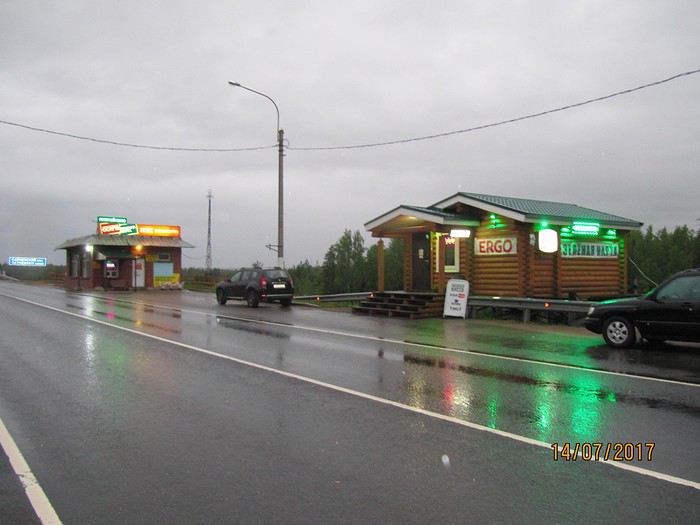
je me suis arrêté au premier, qui réclame l'OSAGO;
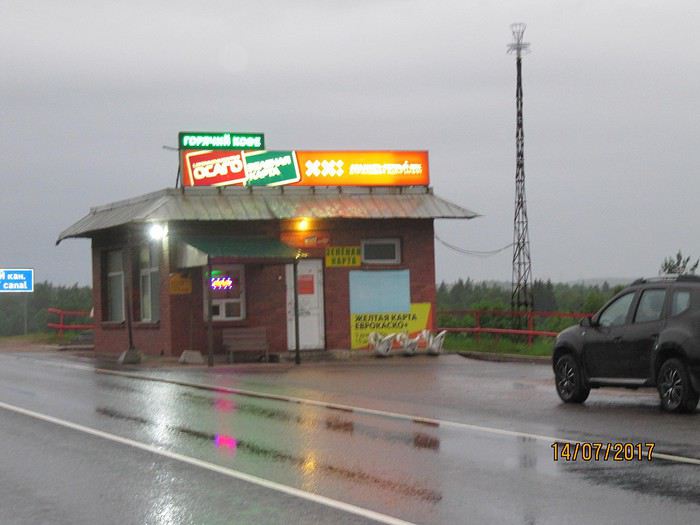
il était une heure du matin et bien que la fenêtre indiquait "ouvert", il fallait sonner pour réveiller l'emploi de faction. Le temps de traduire et expliquer les données sur la carte grise, pour remplir le formulaire en ligne sur l'intranet de l'assureur, je ressortais une heure plus tard avec une police OSAGO pour 30 jours:
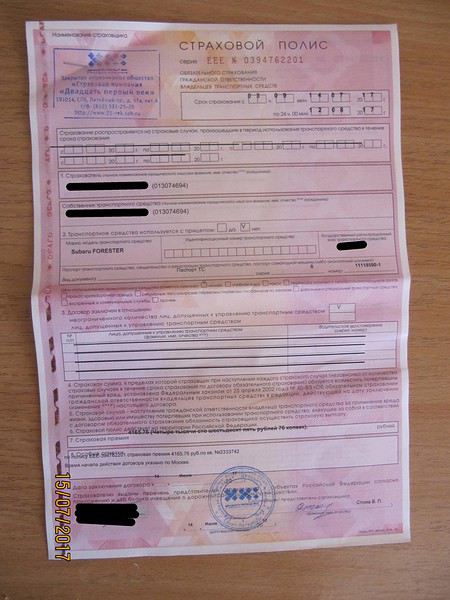
prix: 4160 rub.
Je suppose que les prix à la frontière sont plus élevés qu'en agence normale.
Voilà, donc je suis curieux de savoir ce qu'il en est aux autres points frontaliers et/ou d'autres options d'achat.
- la possibilité d'achat en ligne d'une police électronique, ce qui est possible sur http://reso.ru si on dispose d'une carte SIM russe - la possibilité d'acheter en contactant le bureau finlandais de Alfa, mais il faut alors passer à leur bureau de Kotka pendant leurs horaires de travail un jour ouvré - directement acheter à la frontière
pour des raisons de temps essentiellement, j'ai opté pour l'achat à la frontière. Sur la route principale Finlande-Saint Pétersbourg, une fois sortie de la zone de contrôle russe, plusieurs kiosques dès la station Lukoil, proposent la vente de la carte verte pour les russes qui eux se rendent en Finlande, mais ces kiosques ne sont pas équipés pour la vente de l'OSAGO. Finalement en roulant un peu après la station Neste, se trouvent deux cabanes, sur la gauche lorsqu'on roule vers Saint-Pétersbourg:
je me suis arrêté au premier, qui réclame l'OSAGO;
il était une heure du matin et bien que la fenêtre indiquait "ouvert", il fallait sonner pour réveiller l'emploi de faction. Le temps de traduire et expliquer les données sur la carte grise, pour remplir le formulaire en ligne sur l'intranet de l'assureur, je ressortais une heure plus tard avec une police OSAGO pour 30 jours:
prix: 4160 rub.
Je suppose que les prix à la frontière sont plus élevés qu'en agence normale.
Voilà, donc je suis curieux de savoir ce qu'il en est aux autres points frontaliers et/ou d'autres options d'achat.
Hi there,
We’re heading to Saint Petersburg from June 30 to July 7, 2026, and we’ll be arriving late (9 PM) at our hotel on June 30. Unfortunately, the hotel can’t pick us up from the train station. Is it easy to get a taxi at Saint Petersburg coach station?
Thanks for your help!
Bonjour à tous,
Je pars avec ma compagne en Russie 2 semaines en Août. Programme : - samedi 12 : arrivée à St Petersbourg - mercredi 16 : train pour Moscou - dimanche 20 : départ pour l'anneau d'or en voiture de location - samedi 26 : retour à Paris de Moscou
Je cherche différent circuit pour l'anneau d'or et je suis tombé sur celui la : https://www.sixt.fr/news/road-trip-en-russie-dans-la-region-de-moscou/
Que pensez vous de ce circuit ? Est ce intéressant de dormir dans chaque ville étape ?
Merci de vos réponses
Je pars avec ma compagne en Russie 2 semaines en Août. Programme : - samedi 12 : arrivée à St Petersbourg - mercredi 16 : train pour Moscou - dimanche 20 : départ pour l'anneau d'or en voiture de location - samedi 26 : retour à Paris de Moscou
Je cherche différent circuit pour l'anneau d'or et je suis tombé sur celui la : https://www.sixt.fr/news/road-trip-en-russie-dans-la-region-de-moscou/
Que pensez vous de ce circuit ? Est ce intéressant de dormir dans chaque ville étape ?
Merci de vos réponses
Bonjour tout le monde !
J'ai pour projet de me rendre à Astana pour l'Expo Internationale cette année en juin ou juillet. Aussi, je voudrais savoir si quelqu' un à des infos sur des hôtels-hébergements corrects et pas trop cher, pas trop loin du site de l'Expo. A ce sujet, existe-t-il un métro à Astana ? Pour tout autre conseil-plan sur ce pays, je suis preneur. Merci.
J'ai pour projet de me rendre à Astana pour l'Expo Internationale cette année en juin ou juillet. Aussi, je voudrais savoir si quelqu' un à des infos sur des hôtels-hébergements corrects et pas trop cher, pas trop loin du site de l'Expo. A ce sujet, existe-t-il un métro à Astana ? Pour tout autre conseil-plan sur ce pays, je suis preneur. Merci.