Hi there,
I’m planning a trip to Georgia this summer and I’ve been comparing some airlines. I’m not particularly set on flying with Pegasus (though it’s convenient with direct flights from Lyon to Tbilisi), but right off the bat, Pegasus states this:
As of January 1, 2026, all foreign nationals traveling to Georgia for tourism purposes will be required to present valid travel health insurance. Guests who fail to provide the relevant health insurance will not be accepted on our flights to Georgia.
Sincerely,
Pegasus Airlines
In other words, if you don’t show proof of travel health insurance, you’ll be denied boarding.
Personally, my credit card insurance has always been enough for me, and I’d rather not take out extra coverage...
Have any of you run into this issue before? If not, what do you think? Why is Pegasus asking for this proof? Other airlines don’t mention it at all.
61 similar discussions in English
Hi there,
Do I need a return ticket? Proof of insurance and a hotel reservation?? I’m French.
Also, is there any control on meds and sleeping pills?? Thanks a bunch!
Hi everyone,
Even though I come to Morocco four times a year, it’s been a long time since I’ve made the trip by car. I need to refresh my knowledge! I’ll be traveling in early October. I have a car that’s about 20 years old. The plan is to cross via Algeciras/Ceuta.
A few questions:
1) Does this crossing still exist? If so, do I need to buy the ticket in advance or on the spot? From whom? Any advice is welcome!
2) What documents are required for the car?
3) If anyone is making the trip around the same time, it could be fun to drive together 😊
I know there are experts on this forum.
Thanks in advance
Hello,
My partner, who is Malagasy, would like to visit France (ideally in mid-August) and therefore apply for a short-stay visa (90 days).
I’ve heard that many applications are refused even when all the required documents are submitted, which is why I’m here—to get advice and guidance to be "almost" sure the application will be accepted.
I have a lot of questions, and your help would be invaluable to us.
She is 27 years old, has a passport with her current occupation listed as self-employed (she owns a "taxi-brousse" truck) and thus has a statistical card, a business license, and annual tax certificates. She started her business at the beginning of this year.
As for me, I am an adult with a disability. I receive disability benefits until May 2026. I’m in the process of professional reintegration and will start a job in a few days, likely on a fixed-term contract (CDD).
Here are my questions about the supporting documents to provide:
-Purpose of the trip/stay
Flight ticket reservation (round-trip) (the ticket should only be purchased once the visa is approved). Letter of commitment to return, written on plain paper. Any other document demonstrating potential family, economic, or material ties in the country of residence. Confirmation of a booked organized trip or any other document outlining the planned itinerary.
I’ve been told that for the flight reservation, my partner just needs to go to Air Madagascar in Antananarivo and pay around 50,000 ariary to get this reservation. Given that the French short-stay visa takes between 15 to 45 days (I might be wrong) to be processed and approved, I wonder if the reservation will still be valid if the visa is approved late. For the letter of commitment to return, I assume two sentences are enough, and what matters most are the documents proving ties to the country of residence (her economic activity). Do you think that will be sufficient? And for the planned itinerary, since this isn’t an organized trip, what document could work? A handwritten letter explaining a few planned visits?
-Proof of residence in the country of origin
For employees: original work certificate, original leave certificate, last 3 payslips (or bank statements). For retirees: pensioner’s card and last 3 pension statements. For traders or entrepreneurs: professional registration, professional card, and recent bank statements.
For liberal professions: professional registration, professional card, and recent bank statements. For unemployed applicants and students: sponsorship letter and copies of the sponsor’s financial documents.
For this point, she can justify her self-employed status with the statistical card, business license, and annual tax certificates. As for bank statements, she deposits her earnings in cash into her bank account—will this be an issue during the application review?
-Financial resources
Bank account statements (last 3 months). Last 3 payslips or pension statements. Foreign currency allocation certificate, whose origin must be demonstrated (recent bank statement, savings account), issued by local banks or exchange offices (minimum 32.50 € per day if staying with a private individual or 65 € per day if staying in a hotel) or presentation of an international bank card with supporting account statement.
I need help with this point because I don’t fully understand what she needs to provide as a self-employed individual, especially since she doesn’t earn 32.50 € per day. I can obviously transfer money to cover this. So, overall, what documents should be provided for this section?
-Accommodation
Confirmed hotel reservation with the hotel’s phone number and reservation number / payment confirmation for stays longer than 1 month or original hosting attestation.
For this point, do I just need to write a handwritten letter stating that I will be hosting her? Then scan it and email it to her? Is that all?
-Travel medical insurance
Insurance certificate: must specify the amount and scope of coverage (30,000 € coverage / medical expenses and repatriation).
For this, I’ll opt for AXA Schengen insurance (low-cost). Any advice is still welcome...
I have one last question about the following point:
The short-stay visa allows you to stay for a maximum of 90 days for a continuous stay or multiple stays within the Schengen area over a 180-day period.
If we decide to leave the Schengen area during the stay (to visit the United Kingdom, for example), will the 90-day visa be paused and resume once we return to the Schengen area? And if so, can we plan a return ticket beyond the 3 months by justifying an exit/entry?
Thank you in advance for all your advice and suggestions. I may have forgotten some important points—feel free to let me know.
Best regards.
Hi everyone, after a trip to India last October, I stayed in touch with an Indian guide who speaks French. His dream is to visit France. To get his visa, he told me he needs a letter from me confirming that I met him during my trip to his country and that I’m able to host him. He has other contacts in France, and he mentioned he’s asked them for the same thing. I’m reaching out to see if his request is legitimate or if he’s taking advantage of my kindness. I’m sorry if I offend anyone—it’s not my intention. I’m very spontaneous and don’t want to put myself in a bad situation. Thanks for your feedback. Have a great weekend. Florence/florie73
Hi everyone,
So great to be back on this forum😉
I just lightened my wallet by 3000 € for 3 tickets: Paris > Tokyo > Osaka > Paris (well, not just mine—I’m exaggerating, there are two of us). For my daughter’s 10th birthday, we’re heading to Japan—it’s her "decade gift," though I thought she’d pick London🏴☠️. But I’ve been dreaming of going back to Japan since my 2013 trip, so I’ll admit this trip is (a lot) for me too. We’re traveling during school holidays, so the ticket prices are unfortunately sky-high. Maybe I could’ve gotten a better deal if I’d waited, but who knows... oh well, it’s done now. We leave at the end of October, so we still have a few months to prepare. That said, I’d rather start early to make sure we don’t miss anything (like the Ghibli Museum—I couldn’t go last time, and anyway, I’ll have to wait until September to book). Last time, there were three adults, so it was pretty straightforward. Eleven years later, well, now it’s two adults with a 10-year-old😛.
So I’m wondering how many days to spend in Tokyo. My daughter idealizes the city (that’s why she wants to go to Japan), and she’s really drawn to Japanese culture and food. Actually, what first got her interested in Japan were all the *kawaii* character products... Tokyo is such a fascinating city, but it can also be exhausting—especially for a kid, and I’m not sure what to expect. Beyond Tokyo, honestly, I’m not entirely sure. I was thinking of Hakone and maybe stopping by Fujikyu Highlands. Then heading down to Osaka for a few days in Kyoto before flying home (our return flight is from Osaka). We only have 11 days there (not counting the arrival day, and since our flight leaves at 11:30 PM on departure day, we’ll have the whole day), so it’s not a ton of time. I already spent a week in Kyoto on my last trip (huge crush on it), and I’d love to have two months there, but... well, you know how it is.
For example: 5 days in Tokyo 2 days in Hakone 4 days in Osaka/Kyoto
What do you think? If you’ve done this trip with kids, do you have any tips for family-friendly accommodations in Tokyo and Hakone? My daughter would love to try an onsen. We have a decent budget, but it’s not unlimited. We’d like to book as we go to spread out the costs a bit.
Thanks in advance for your thoughts
Hi there,
I’m planning a month-long trip that’ll take me from San Francisco to Seattle, stopping in Vancouver BC along the way. After tweaking this route every which way and trying to balance must-see spots with more relaxed stops (like the Oregon coast), I’ve landed on this itinerary—I’d love your thoughts!
Days 1 and 2: San Francisco Days 3 and 4: Lassen Volcanic Park Days 5 and 6: Crater Lake Days 7 to 9: Portland Day 10: Astoria or Cannon Beach Day 11: Ruby Beach or Forks (for the Hoh Rain Forest) Days 12 and 13: Port Angeles (for Hurricane Ridge) Day 14: Victoria (Vancouver Island) Days 15 to 17: Ucluelet (Vancouver Island) Days 18 to 20: Vancouver BC Days 21 and 22: North Cascades NP Days 23 to 25: Mt. Rainier Days 26 to 28: Seattle
Of course, there’s travel time built in—for example, the third day on Vancouver Island will mostly be eaten up by getting back to the mainland and Vancouver.
Do you think there are any extra stops or anything I’ve missed? A month feels like a lot and not a lot at the same time… Thanks!
Hi,
We’ll be in Nepal from November 1st to 12th, 2026. We paid for our flight tickets with a Visa Premier card. Is it worth getting additional insurance? And if so, which one would you recommend? Thanks, Guylaine
We’ll be in Nepal from November 1st to 12th, 2026. We paid for our flight tickets with a Visa Premier card. Is it worth getting additional insurance? And if so, which one would you recommend? Thanks, Guylaine
Hi there,
We’re planning an MSC cruise departing from Dubai. On MSC’s website, it says we need to take out health insurance for Doha. The issue is that some insurers are asking if we’ve got a visa, but French citizens don’t need one. Has anyone had a layover in Doha? What’s the deal with this health insurance?
Thanks so much!
Hello,
We’re a couple in our seventies planning a 12-day trip to Namibia this coming September.
We have a Visa Premier card.
In your opinion, should we take out additional travel insurance like Europ Assistance or Chapka?
We don’t want to repeat our bad experience in 2020: we’d taken out insurance with Allianz (over 500 € for 11 days). Our trip to Botswana was canceled due to COVID-19, and they were quick to cite the "epidemic" exclusion to refuse reimbursement.
Just to clarify: the flights will be with Lufthansa, departing from Luxembourg.
Thanks in advance to anyone who can give us some advice!
.hi there
I'm looking for travel insurance for the USA for a 1-month trip as a tourist.
Could anyone give me some advice?
Thanks so much
Hi there.
First, please excuse the dry nature of my post—I’m going to talk about insurance and credit cards!
I’m renting a car in Bulgaria using my "Gold Mastercard." I know the benefits, and in this case, I don’t need to take out additional insurance from the rental company.
However, the assistance booklet states: "The insurer cannot, under any circumstances, reimburse the insured for the amount of the CDW (Collision Damage Waiver) or LDW (Loss Damage Waiver) insurance paid to the rental company if the insured forgot to decline it or if it’s automatically included in a package the insured accepted."
The issue is that when I look at different rental companies, it’s often specified that "insurance is included" (non-declinable because it’s part of the package), and I’m worried there might be some minimal CDW or LDW coverage that would prevent my Gold Mastercard coverage from applying if needed.
Since it’s difficult to contact or communicate with rental companies (most bookings are made online) and Mastercard’s responses are pretty vague, I’m turning to you all for help.
Here are my questions: - How can I be sure the rental company’s insurance doesn’t include CDW or LDW? - Do you know of any rental companies where this is clearly stated? - Does Gold Mastercard coverage work with local agencies? - Is it possible for a rental company to refuse Gold Mastercard coverage?
I assume travelers who can answer have already had this experience.
Thanks in advance for your help.
Hi there,
I’m planning a trip to Cuba this summer and I’d love some info: Is travel insurance really necessary? Can you easily get online by buying a local SIM card or internet card? Apparently, there’s only one currency now—is it better to exchange money with your *casa particular* host? Thanks for all these valuable tips!
I’m planning a trip to Cuba this summer and I’d love some info: Is travel insurance really necessary? Can you easily get online by buying a local SIM card or internet card? Apparently, there’s only one currency now—is it better to exchange money with your *casa particular* host? Thanks for all these valuable tips!
Hi,
I want to invite a Malagasy friend and I’m surprised to learn there are procedures (that seem complicated) to follow…
It would be a short stay (max 3 months).
She’s got her passport, I’m paying for the flight ticket, and I read that I need to get an accommodation certificate from my town hall—but what else is required after that? What other documents are needed? What are the processing times?
I’m really disappointed that in 2026, it’s still such a hassle for this kind of thing.
Hi there,
I’d like to know if anyone has already applied for a private visa to Russia with an invitation from a Russian resident. I traveled earlier this year with an e-visa, but since I want to stay longer, I’ll be visiting my friend who lives in eastern Russia. For the visa application, does the invitation need to be on an official paper form issued by the Russian ministry? And most importantly, do I need to present the original for the application, or is there an electronic version that can be sent directly to the consulate in France? Thanks for any info if you’ve gone through this process before!
Best regards,
Gilles
Hi there! So, I'm hesitating about taking a long trip. I'd like to go away for 2 to 3 months and travel across several continents. I’d love some advice. I often have unexplained allergies and need to follow a daily treatment for my diabetes (insulin). I think I can get authorization from my doctor to travel for 6 months with the treatment—is that correct? After those 6 months, is it possible (instead of bothering a relative to send the medication) to see a foreign doctor to get another 6-month travel authorization? How does it work at the airport? Do I need just one medication transport authorization, or do I have to request a new one in each country (once the treatment runs out) for both the flight and a DCI? Also, travel insurance doesn’t cover chronic illnesses, so will I have to pay for foreign consultations out of pocket? I’m not sure if I explained myself clearly. Oh, and just to repeat—travel insurance doesn’t cover chronic illnesses, so foreign consultations will be at my own expense? Thanks in advance for your help!
Hi there,
I have a 9-seater passenger vehicle that I use for my business in Paris, transporting people.
I’m planning to go to Algeria with my family.
The vehicle registration lists my company as the owner.
Can I get a TPD (Temporary Admission Document)?
Will I need a KBis extract or a power of attorney?!?
Thanks for your help.
Worst case, I can add my personal name as a co-owner on the registration, but that would be a real shame!
Hi everyone,
First post here to share a quick recap of our west-to-east bike trip along Algeria’s coast in January 2025. It was just the two of us—my partner and I—with French passports and not a word of Arabic. No friends or welcoming hosts in the country.
Under those conditions, we’d strongly advise against going.
Our original plan was to follow the coast from Algiers to Tunis. We ended up cycling from Algiers to Béjaia, then took the train from Béjaia to Annaba (with a stop in Constantine), and finally biked to the border. We were tailed by police the whole way—whether on our bikes, on the train, or even on foot while exploring towns. On top of that, we couldn’t wild camp and were limited to the few state-approved hotels that accept foreigners. Under those circumstances, connecting with locals was especially tough.
With such an omnipresent and intrusive police presence, we’d definitely recommend against this destination for bike touring. A really sad situation that completely cuts you off from the local population...
We’d been warned, we went to check it out, and we weren’t disappointed!
You’ve been warned.
Hi everyone!
What a joy to be back on this forum where I’ve spent so many hours traveling and gathering info—let’s get started! 👋
Almost everything’s in the title, but just to clarify: As far as I know, you currently need a full French motorcycle license (A) to legally ride a scooter in Thailand, since they don’t recognize A1 or A2 licenses. Yes, I know most rental places only ask for an international car license (B), or sometimes nothing at all… but that’s not what I’m asking. What I’d like to know is whether you think this might change in the future, allowing A1 licenses (which are easier to get) or even car licenses (B), since you can ride a scooter in France with one. I don’t want to get a motorcycle license—I’m scared of motorcycles, even though I’m comfortable on a scooter. I’m a bit confused by their regulations. Thanks for any insights you can share!
Lulu56😅
Just back from Georgia and Armenia.
Trip in April 2011 with a small Renault Trafic van.
No particular difficulties... except the GMR.
Hi there,
I’m planning a trip to Russia and Mongolia, starting from France.
Crossing the border at Poland/Belarus or Georgia/Russia—other borders seem either closed or complicated.
Tourist visas for 3 months with multiple entries.
Do you have any info on Russian companies that cover a 4x4 vehicle for 3 months, and what prices in rubles or euros you’ve paid?
Which bank did you use for expenses? (EuroMastercard and Visa cards no longer work.)
Regarding Russian SIM cards, a new system called "Gosuslugi" has been introduced. How long did it take you to get one, and what steps did you follow?
Thanks
Which bank did you use for expenses? (EuroMastercard and Visa cards no longer work.)
Regarding Russian SIM cards, a new system called "Gosuslugi" has been introduced. How long did it take you to get one, and what steps did you follow?
Thanks
An 80-Day Tour of Southern Africa
Back in South Africa
January 12, 2013, 5:30 AM, Flight BA043 London-Cape Town
Directly below, Windhoek glittered like a tangle of fairy lights still lit and tossed into a box.
The horizon, edged in purple, was setting up a backup fireworks display, and suddenly, like a cherry on the platter and with unbearable intensity, in less than two minutes the entire sun revealed a gray dam and then a vast, untouched massif.
A few more minutes and the glare to the east of the plane was total. In Africa, the sun is swift.
We still had a France to cross before landing, but it felt as if we were already there. To the west, the raking light revealed what looked like acne and long, swollen scars in a desert region that might be the Swartkloofberg. Further still, straight as far as the eye could see, the two parallel tracks of a dirt road.
At 11,500 meters altitude and 940 km/h, we had a sense of stillness until the Orange River appeared, an incongruous serpent, gray edged with green.
The first South African settlements were dotted with trees providing shade, then rivers highlighted by continuous lines of vegetation.
Water and shade that make life possible.
We’ll return here by the backroads.
Half an hour from Cape Town, the plane tilted toward the sea, crossing plantations (likely citrus) and then an explosion of cultivated greenery in circles on either side of an unruly river. Finally, the coastline was no longer just sand and water—a frothy hem, a suture?
A peninsula came into view, forming two magnificent bays, and... a flight attendant firmly instructed me to return to my seat: we’d arrived!
The Colors of Cape Town
The city was dressed up as I like them—deserted, fluid, free of its vendors.
In the parking lot of the endless beach next to the commercial port north of the city, about two hundred people were unloading their goods in front of their pickups or combis, none of which were from this century: mixed-race, ageless Black people, and white folks who looked like they’d stepped out of another era.
After a few minutes, intrigued, I played a game: first looking at the merchandise, then imagining who was selling it, and finally looking at who was actually manning the stall. Tall Black vendors were selling what they often sell in Europe—leather, sunglasses, watches; mixed-race folks offered discount bundles, and the tanned older white people seemed to have emptied their attics.
We left with an antique tin kettle for morning tea over an open fire, a pack of five exercise books (that’s 600 pages to fill), Bill Bryson’s earliest stories in English, some snoek rillettes (a local fish), and—never seen before—tuna biltong and snoek biltong.
In so-called advanced countries, Sunday is for sports: white cyclists dressed like pros sweating diligently, Black street vendors running in loops at red lights to sell trash bags that day; white golfers losing their balls, which a scantily clad Black man retrieves from the water; under the sails of kite surf boards, it’s all blondes, and in the foam, joyful splashes from a bunch of Black kids.
Searching for an unusual spot for lunch, we drove through the fishing port looking for a dive and, at the end of a dead-end road with no warning, we arrived at the Shimmy Beach Club—quite the program.
The place, open for just three weeks, aims to be ultra-trendy. You could be in San Francisco, Lisbon’s docks, or St. Barth. This time, the "visible" staff was diverse, but the clientele was exclusively white, except for one mixed-race couple.
For this Sunday lunch, the women had pulled out all the stops, and local starlets—who’d make ours look tame—were turning the terrace into a frenzy.
At Cape Town’s port, the girls have *port*. The trend seems to be crochet dresses over swimsuits.
For two hours, a team of employees watered and raked the sand, starting over when they finished. A child in a floaty pink dress and a gold headband, but a future adventurer, stepped onto the freshly raked artificial beach sand for the first time.
A lanky mixed-race man dragged a hose across the ground, followed by a white woman—enchanted?—who then started watering the sand herself, carelessly splashing the glass terrace her colleague had just swept. I suspect a tacit work arrangement to keep everyone employed.
A galleon packed with tourists (are there any in the hold? Does it take tourists to Robben Island?) left the port. A helicopter took off in its wake. Trawlers returned, cutting through a ballet of catamarans, their waterlines well above the water: a bad catch.
If there’s one country where you can’t pretend to ignore skin color, it’s this one. The question is in everyone’s mind, and here more than anywhere else, it’s a decisive economic and political factor.
Columbine of Brittany
200 km north of Cape Town and 9,000 km south of the Breton coast, but on the same cold ocean, we camped on the shore of the Columbine Cape Nature Reserve, sheltered by a rocky chaos that, at first light tomorrow, would transport us to Perros-Guirec.
Our first encounter with wild animals wouldn’t end well for them: it was crayfish season, and they were the size of lobsters at Lorient’s fish market. Bought for R60 (5.5 €) a pair from kids in Pater Noster, they’d end up between two rocks, over a fire. But first, we had to pair the Chenin blanc with some snoek biltong.
With no wood, I lit a fire at dawn with dried seaweed and kelp, as if petrified; it gave off a smell of court-bouillon and... tires. Two hundred fathoms away, on an outpost, an army of cormorants stood at attention, unmoved among the frolicking seals.
At the reserve’s exit, the guard spoke French; Patrick Mwanba had arrived from Congo three years earlier to study, but the cost of living here forced him to drop out. He’d like to return home because life is cheaper there, but the war made him hesitate.
Ding ding dong! Vroom! Arf arf, Woof! Buzz! (A night from hell!)
I’d long planned to visit Calvinia, the center of a region known for extensive sheep farming. An excellent provincial museum, run by an enthusiastic curator, kept us too late to start the drive north.
So we camped in a tiny, charming campsite set up in the garden of a house. A few trees, a patch of resilient grass, and a view of a pretty lit-up steeple—what else?
Well, it turned out to be a sound-and-light show, with the pretty steeple chiming the hours and half-hours. Then suddenly, we were in the VIP stands of the Karoo-Kalahari Truck Race: roaring trucks paraded under our canvas windows, and we realized we were on the main road through town. To top it off, we enjoyed an uninterrupted canine cacophony, from the *arf arf* of little dogs to the *woof* of a mastiff. Oh, and some mosquitoes—the first ones—insisted on keeping us company in the tent, and we hadn’t yet bought the arsenal to neutralize them.
I walked through Calvinia at night; the house gardens weren’t fenced, nor did they have the «Armed Response» signs so common in the country.
The Kalahari Trails
(No, no, I haven’t converted to hiking.)
North of Calvinia, in the south of the Northern Cape, small towns follow one another up to Upington, about a hundred kilometers apart—welcome havens. Between them, with no trees in sight, we stopped in the shade of a motionless cloud: the temperature exceeded 40°C in mid-January.
We were almost out of the High Karoo and into a region of pans drying up, until the first red dunes appeared, precursors of the Kalahari. In the sparse veld vegetation, gatherings of quiver trees in the kopjes, and a caravan of camels without a handler or packs, marching in perfect formation across a pan (no, I hadn’t overdone the Windhoek at the last stop, and no, I wasn’t dehydrated enough to hallucinate).
The historic part of these towns, European in style, was built on the same plans as those in the American Midwest or the Australian Outback: a grid of streets wide enough to turn a wagon pulled by eight pairs of oxen. The architecture was Dutch-inspired, tropicalized with awnings.
Then came more recent housing, functional in style, where the wealthier mixed-race people—who make up the majority of this state—lived, and further on, the township, an assemblage of corrugated iron and plastic, like everywhere else.
Orange, Right Bank
North of Augrabies Falls National Park, on the other side of the Orange River, stretches a rugged and wild territory the size of fifty Groix islands, crisscrossed by a few tracks—the Riemvasmaak.
The inhabitants were driven out half a century ago for a military base, and as soon as President Mandela was elected, he made it a symbol by allowing the exiled populations to return. Several ethnic groups live here on almost nothing, in government-built shacks.
A community camp is set up in a small cirque at the end of a canyon that, while not in the history books, offers a good descent. By mid-afternoon, the air was at 44°C, but luckily there was a spring... except it was a hot spring, with water at 38°C. And they haven’t invented a reversible spring yet. Once the birds and baboons had settled in, in absolute silence and far from any light pollution, we enjoyed the stars like nowhere else (well, that’s what they claim in the region).
The Orange didn’t choose the easy path: arriving from Lesotho, it was almost at the ocean. The terrain to the south and north of this massif seemed easier to cross. Was it to avoid the curse of the Okavango, whose waters disappear into the sands without ever seeing the sea, that it chose this rocky route, thinking that at least the granite wouldn’t steal its water?
I Love You, I Eat You
In the dry bed of the Auob, it lay panting, head raised, alert, between its paws but head-to-tail, a tawny springbok, motionless.
A few minutes earlier, their story had been written in a lightning-fast chase, captured in photos by the driver of the car that alerted us.
It would be a long time before it started eating at the groin without breaking its surveillance.
Earlier, there was a lion lounging in the shade and hundreds of antelopes: springboks and gemsboks (oryx) in herds, hartebeests and steenboks alone. Strange pairs, apart several times, formed by a springbok and a gemsbok.
A few solitary jackals moved slightly sideways, looking furtive. Ostriches, alone, looking a bit dazed.
It was a lucky morning in the Kgalagadi (KTP).
In and Out
Kgalagadi, Nossob Camp.
We were at the very end of the almost-empty camp, ten meters from the fence, whose structure wouldn’t resist an elephant (though there aren’t any here), but it was electrified.
At dusk, on the other side, ten meters away, three lions passed in a row, as if on parade, seemingly focused on their goal and indifferent to the camp, though they glanced at it.
A jackal had gotten into the camp and was trying to get out without success while scavenging. I offered it two pieces of snoek biltong (Don’t feed the animals!) from three meters away—it smelled strong and had bones (bones in biltong!). When it passed by again, it sniffed but didn’t dare approach. Curled up in the chair, motionless, by the faint moonlight, I finally saw it come closer, grab the nearest piece, and move ten meters away to enjoy it (how many jackals know the finer points of sea biltong?). A little reassured, it came back for the second piece.
Another Morning
By morning, the jackal was gone, but our luck hadn’t left us. Two cheetahs again, who found me in the way and slowly moved toward a calmer shadow. Enough birds of prey to form a squadron, but they’re solitary hunters. Two ostriches busy with their dozen unruly chicks. And while we’re at it, a group of four Kalahari lions, sprawled under a thorny bush. Lots of oryx crossing the dunes and herds of red hartebeest. Kori bustards and secretary birds.
It was the first time the Kgalagadi had spoiled us so much.
I'm currently converting a DAF/HEULIEZ MB205 bus.
Cheaper and more spacious than a regular vehicle, the paperwork (in France) isn't too difficult for approval.
I'm ready to help anyone who wants to tackle this kind of project. Those who know, help those who want to....
Cheaper and more spacious than a regular vehicle, the paperwork (in France) isn't too difficult for approval.
I'm ready to help anyone who wants to tackle this kind of project. Those who know, help those who want to....
Hi, what’s the amount to pay for the proof-of-income certificate for a visa extension, to make the payment?
Thanks
Thanks
A trip often gets complicated because of small details: a passport about to expire, a low bank limit, or documents that aren’t accessible offline. A checklist a few days before departure helps eliminate most avoidable risks.
1. Check passport, visa, and entry requirements Passport validity requirements vary by destination, as do visa or electronic authorization rules. Service-Public.fr recommends planning ahead for ID renewals. Before booking anything non-refundable, verify the country’s requirements and those of any layovers.
2. Consult official destination information France Diplomatie’s Travel Advice provides country-by-country security information, entry conditions, health recommendations, and recent alerts. Checking before departure—and again closer to the trip—helps avoid outdated information.
3. Register for Fil d’Ariane for short stays For tourist or business trips under six months, Fil d’Ariane lets you receive security alerts in case of major events in your destination country. The service is free. It doesn’t replace insurance or geolocation services but is a simple way to stay reachable during a crisis.
4. Plan multiple payment methods A blocked or lost card can quickly strand a traveler. Two separate payment methods, a small cash reserve, and verified withdrawal limits reduce this risk. Also, save emergency contact numbers before departure.
5. Know how to activate your medical coverage Before leaving, travelers should identify coverage suited to their trip and understand how to use it: who to contact, which documents to keep, which expenses require approval, and how to request reimbursement. This practical info is often more useful when a problem arises than just a list of limits.
6. Keep documents in duplicate Passports, tickets, certificates, prescriptions, and reservations should be stored as secure digital copies—and mostly offline. Avoid keeping all originals and copies in the same place.
7. Download essentials before takeoff Offline maps, tickets, your first accommodation address, booking confirmations, and emergency contacts can all be downloaded before departure. This habit is still useful even with an international plan—a dead battery, no signal, or a finicky local connection can make a document inaccessible at the worst time.
A short checklist for peace of mind The goal isn’t to plan everything but to secure the things that are hard to fix once abroad. Documents, official info, payments, medical coverage, and offline access form a simple foundation. The rest of the trip can stay unpredictable—in the best way.
Verified sources: France Diplomatie – Travel Advice | France Diplomatie – Fil d’Ariane | Service-Public.fr – Travel Documents
hi everyone
We’ll be applying for a retiree OA visa by September. For our part, we’ll head back to France for a bit and return a month BEFORE our current OA visa expires to renew it at immigration. We’ve emailed several immigration offices but haven’t gotten any responses. We’ve searched online for info but haven’t found anything. What we’re really interested in is knowing which documents they’ll ask for at the immigration office in Phang Nga, for example, for our renewal. We’ve seen all the paperwork needed for the initial OA visa on the official online visa application site... but for the renewal, do we need to provide ALL the same documents? Thanks in advance
We’ll be applying for a retiree OA visa by September. For our part, we’ll head back to France for a bit and return a month BEFORE our current OA visa expires to renew it at immigration. We’ve emailed several immigration offices but haven’t gotten any responses. We’ve searched online for info but haven’t found anything. What we’re really interested in is knowing which documents they’ll ask for at the immigration office in Phang Nga, for example, for our renewal. We’ve seen all the paperwork needed for the initial OA visa on the official online visa application site... but for the renewal, do we need to provide ALL the same documents? Thanks in advance
This catchy and somewhat mysterious title comes from several questions I’ve been asking myself.
VF has been back open for a reasonable number of weeks and months now. The number of visitors overall matches past averages, but the number of members online in the last 24 hours seems relatively lower than what we used to see.
Yet, to my surprise, I’m seeing fewer travel journals, way fewer messages, and way fewer questions. I don’t see many new registered users online, and I notice a number of members who are logged in but either aren’t participating or have stopped participating.
Something’s not adding up for me because, in my opinion, VF is still appealing, and I don’t see which other sites could really compete.
Was there a real break between pre- and post-Covid? Does it just take more time for some people to discover the site or learn that it’s active again? Do people now prefer quick consumption on sites like FB or others I’m not familiar with? Where have the site’s old-timers gone, and what are they doing with their time now? What’s really going on here?
Good evening everyone! 🙂
We’re back from our September 2025 road trip, this time to explore Arizona and New Mexico, and it’s time for me to start my travel journal—especially since everything’s already booked for another trip in September 2026 (to California), and I need to get started on the planning.
I was a little worried this new visit to Uncle Sam’s country might not be as "wow" as the others, but we still discovered some incredible places.
For those who don’t know us, we’re a couple in our seventies who speak very little English, but that didn’t stop us from fully enjoying our stay.
For this 6th road trip in the U.S., we spent 21 nights there, drove 4,160 km by car, and walked nearly 160 km in a loop starting from Phoenix.
We’d been to Arizona before (but not this side) and never to New Mexico. This whole road trip was a huge discovery for us.
In the prices mentioned (some in euros, others in dollars), bank fees and exchange charges are included. The flights, car rental, and parking were all paid for in December 2024 when we booked.
We’d downloaded the MPC (Mobile Passport Control) app, but there wasn’t a dedicated line at Phoenix Airport. Still, we got through quickly with friendly, smiling agents.
I don’t drive at all (I hate it), so the stops were chosen based on activities but also, for some, to limit daily mileage for the sole driver. The kilometers listed in the itinerary are the daily distances.
We traveled from September 9th to 22nd, unfortunately once again without our dear friends Mimi and Maumau.
The itinerary
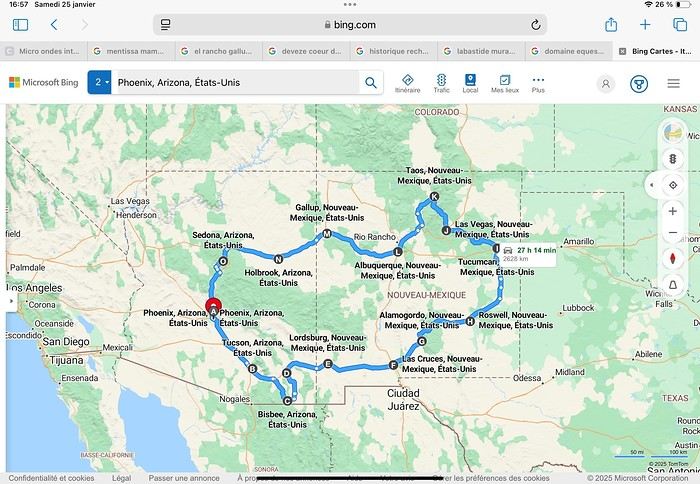
Day 1: Flight Marseille-Paris-Phoenix, then Gold Canyon (133 km) Day 2: Tucson (271 km) Lost Dutchman State Park Day 3: Tucson (155 km) Day 4: Tucson (34 km) Day 5: Bisbee (182 km) Day 6: Lordsburg (345 km) Day 7: Las Cruces (253 km) Day 8: Alamogordo (162 km) Day 9: Roswell (264 km) Day 10: Tucumcari (369 km) Day 11: Las Vegas (281 km) – the one in New Mexico Day 12: Taos (213 km) Day 13: Santa Fe (224 km) Day 14: Albuquerque (123 km) Day 15: Gallup (246 km) Day 16: Holbrook (224 km) Day 17: Flagstaff (179 km) Day 18: Sedona (118 km) Day 19: Sedona (48 km) Day 20: Sedona (41 km) Day 21: Phoenix (256 km) Day 22: Phoenix Airport (35 km)
📊 **Budget**: A little over 7,500 € for both of us, all included. The exchange rate was in our favor (1.17 dollars to 1 €). 📊 **Flights**: Marseille-Paris Charles de Gaulle-Phoenix: 1,787 € for two, with one checked bag each (Air France) 📊 **ESTA**: $42 📊 **America the Beautiful Pass**: $80 📊 **Parking**: 134 € (super eco at Marseille) 📊 **Car rental (Hertz)**: 865 €. Since there were no SUVs left in the reserved category (Nissan Rogue), we got an upgrade (4x4 Ford Explorer). We booked through Air France (15% discount). We’d originally reserved it in December for 1,140 €, but since prices dropped in March, we canceled and rebooked for 865 €. Hertz offers a free Hertz Gold Plus Rewards program, which gives you priority counter service when picking up the car. 📊 **Accommodation**: 2,400 € We stayed in hotels and motels of varying standards (from 60 to 203 € per night, depending on the city), all booked through Booking.com or Hotels.com. Out of 21 nights, only two didn’t include breakfast in the price. Booking.com sometimes offers slightly cheaper rates if you book by phone using the mobile app, and our Genius 3 status on the site also got us some preferential rates. 📊 **Supplementary insurance**: AVA 200 € for medical care if needed 📊 **Cash**: $2,078. We left with 1,000 € exchanged before departure and made two withdrawals of $500. This cash covered: - Evening restaurants and tips - Midday picnics - Gas: $298 for 4,160 km - Museum and private park entries (per person): - Lost Dutchman: $10 - Arizona-Sonora Desert Museum: $28 - Bird Cage Theater: $16 - Tombstone Shootout: $8 - New Mexico Farm & Ranch Museum: $12 - Roswell International UFO Museum: $5 - Billy the Kid Museum: $7 - Rancho de Taos: $22 - West Fork Oak Creek Trail entry: $15 We got a few discounts thanks to our senior age (+65). - Souvenirs and little treats
Like on our previous road trips, we didn’t rent a GPS. We got around using offline GPS apps Here WeGo and Organic Maps, with maps of the states we visited downloaded before we left (on our phones).
❤️❤️❤️ **Highlights** (there are so many!) 📍 Goldfield Ghost Town (even if it’s a reconstruction) 📍 The standing army of Saguaro cacti at Saguaro National Park West 📍 Diving into the cowboy universe of Tombstone 📍 The welcome from Rick and Henry at our guesthouse in Bisbee (Garden at Mile High Ranch) 📍 The tangled rocks of Chiricahua National Monument 📍 The flavored pistachios from Dwayne’s Fresh Jerky and Mac Ginnis Pistachioland 📍 Restaurants: La Posta (Las Cruces), Diner 66 (Albuquerque), and the Haunted Hamburger (Jerome) 📍 The old plazas of New Mexico 📍 The solitude and beauty of the white dunes at White Sands National Park 📍 Stepping back in time at the Billy the Kid Museum (Fort Stanton) 📍 Sections of historic Route 66 and the old motels of Tucumcari, especially at night when all the neon lights are on 📍 Taos Pueblo and diving into Native American culture 📍 After the Rio Grande Bridge, the descent via NM 567 to the very bottom of the Rio Grande Gorge, then the road along the riverbanks to Taos 📍 The tranquility of the Chimayo Sanctuary 📍 Discovering the ingenious native dwellings at Bandelier National Monument and Walnut Canyon National Park 📍 The small towns along the Turquoise Trail 📍 The red rocks of Red Rock Park and the Painted Desert 📍 The extraordinary colors of the petrified trees at Petrified Forest National Park 📍 Sedona, its red rocks, and the reward of the viewpoints at the end of hikes (Devil’s Bridge, The Subway, and West Fork Oak Creek) 📍 The immersion in Mexico when visiting Tlaquepaque 📍 The almost-ghost town of Jerome and its terraced streets 📍 The incredible kindness of Americans, always ready to help and up for a chat ❤️
☹️☹️☹️ **Flops** (there are very few) 📍 Several museums and churches being closed, so we couldn’t visit them 📍 Some museums and visitor centers opening late (10 AM) and closing early (4 PM) 📍 A 64 € phone roaming charge because we got near the Mexican border and picked up their cell tower 📍 The outrageous price ($5.99) for a gallon of gas at the Shell near Phoenix Airport
I hope this helps! Anyway, thanks for reading my long post. Don’t hesitate to reach out, even via PM, if you see I haven’t replied and you’d like more details. Have a great evening, everyone! 🙂
We’re back from our September 2025 road trip, this time to explore Arizona and New Mexico, and it’s time for me to start my travel journal—especially since everything’s already booked for another trip in September 2026 (to California), and I need to get started on the planning.
I was a little worried this new visit to Uncle Sam’s country might not be as "wow" as the others, but we still discovered some incredible places.
For those who don’t know us, we’re a couple in our seventies who speak very little English, but that didn’t stop us from fully enjoying our stay.
For this 6th road trip in the U.S., we spent 21 nights there, drove 4,160 km by car, and walked nearly 160 km in a loop starting from Phoenix.
We’d been to Arizona before (but not this side) and never to New Mexico. This whole road trip was a huge discovery for us.
In the prices mentioned (some in euros, others in dollars), bank fees and exchange charges are included. The flights, car rental, and parking were all paid for in December 2024 when we booked.
We’d downloaded the MPC (Mobile Passport Control) app, but there wasn’t a dedicated line at Phoenix Airport. Still, we got through quickly with friendly, smiling agents.
I don’t drive at all (I hate it), so the stops were chosen based on activities but also, for some, to limit daily mileage for the sole driver. The kilometers listed in the itinerary are the daily distances.
We traveled from September 9th to 22nd, unfortunately once again without our dear friends Mimi and Maumau.
The itinerary
Day 1: Flight Marseille-Paris-Phoenix, then Gold Canyon (133 km) Day 2: Tucson (271 km) Lost Dutchman State Park Day 3: Tucson (155 km) Day 4: Tucson (34 km) Day 5: Bisbee (182 km) Day 6: Lordsburg (345 km) Day 7: Las Cruces (253 km) Day 8: Alamogordo (162 km) Day 9: Roswell (264 km) Day 10: Tucumcari (369 km) Day 11: Las Vegas (281 km) – the one in New Mexico Day 12: Taos (213 km) Day 13: Santa Fe (224 km) Day 14: Albuquerque (123 km) Day 15: Gallup (246 km) Day 16: Holbrook (224 km) Day 17: Flagstaff (179 km) Day 18: Sedona (118 km) Day 19: Sedona (48 km) Day 20: Sedona (41 km) Day 21: Phoenix (256 km) Day 22: Phoenix Airport (35 km)
📊 **Budget**: A little over 7,500 € for both of us, all included. The exchange rate was in our favor (1.17 dollars to 1 €). 📊 **Flights**: Marseille-Paris Charles de Gaulle-Phoenix: 1,787 € for two, with one checked bag each (Air France) 📊 **ESTA**: $42 📊 **America the Beautiful Pass**: $80 📊 **Parking**: 134 € (super eco at Marseille) 📊 **Car rental (Hertz)**: 865 €. Since there were no SUVs left in the reserved category (Nissan Rogue), we got an upgrade (4x4 Ford Explorer). We booked through Air France (15% discount). We’d originally reserved it in December for 1,140 €, but since prices dropped in March, we canceled and rebooked for 865 €. Hertz offers a free Hertz Gold Plus Rewards program, which gives you priority counter service when picking up the car. 📊 **Accommodation**: 2,400 € We stayed in hotels and motels of varying standards (from 60 to 203 € per night, depending on the city), all booked through Booking.com or Hotels.com. Out of 21 nights, only two didn’t include breakfast in the price. Booking.com sometimes offers slightly cheaper rates if you book by phone using the mobile app, and our Genius 3 status on the site also got us some preferential rates. 📊 **Supplementary insurance**: AVA 200 € for medical care if needed 📊 **Cash**: $2,078. We left with 1,000 € exchanged before departure and made two withdrawals of $500. This cash covered: - Evening restaurants and tips - Midday picnics - Gas: $298 for 4,160 km - Museum and private park entries (per person): - Lost Dutchman: $10 - Arizona-Sonora Desert Museum: $28 - Bird Cage Theater: $16 - Tombstone Shootout: $8 - New Mexico Farm & Ranch Museum: $12 - Roswell International UFO Museum: $5 - Billy the Kid Museum: $7 - Rancho de Taos: $22 - West Fork Oak Creek Trail entry: $15 We got a few discounts thanks to our senior age (+65). - Souvenirs and little treats
Like on our previous road trips, we didn’t rent a GPS. We got around using offline GPS apps Here WeGo and Organic Maps, with maps of the states we visited downloaded before we left (on our phones).
❤️❤️❤️ **Highlights** (there are so many!) 📍 Goldfield Ghost Town (even if it’s a reconstruction) 📍 The standing army of Saguaro cacti at Saguaro National Park West 📍 Diving into the cowboy universe of Tombstone 📍 The welcome from Rick and Henry at our guesthouse in Bisbee (Garden at Mile High Ranch) 📍 The tangled rocks of Chiricahua National Monument 📍 The flavored pistachios from Dwayne’s Fresh Jerky and Mac Ginnis Pistachioland 📍 Restaurants: La Posta (Las Cruces), Diner 66 (Albuquerque), and the Haunted Hamburger (Jerome) 📍 The old plazas of New Mexico 📍 The solitude and beauty of the white dunes at White Sands National Park 📍 Stepping back in time at the Billy the Kid Museum (Fort Stanton) 📍 Sections of historic Route 66 and the old motels of Tucumcari, especially at night when all the neon lights are on 📍 Taos Pueblo and diving into Native American culture 📍 After the Rio Grande Bridge, the descent via NM 567 to the very bottom of the Rio Grande Gorge, then the road along the riverbanks to Taos 📍 The tranquility of the Chimayo Sanctuary 📍 Discovering the ingenious native dwellings at Bandelier National Monument and Walnut Canyon National Park 📍 The small towns along the Turquoise Trail 📍 The red rocks of Red Rock Park and the Painted Desert 📍 The extraordinary colors of the petrified trees at Petrified Forest National Park 📍 Sedona, its red rocks, and the reward of the viewpoints at the end of hikes (Devil’s Bridge, The Subway, and West Fork Oak Creek) 📍 The immersion in Mexico when visiting Tlaquepaque 📍 The almost-ghost town of Jerome and its terraced streets 📍 The incredible kindness of Americans, always ready to help and up for a chat ❤️
☹️☹️☹️ **Flops** (there are very few) 📍 Several museums and churches being closed, so we couldn’t visit them 📍 Some museums and visitor centers opening late (10 AM) and closing early (4 PM) 📍 A 64 € phone roaming charge because we got near the Mexican border and picked up their cell tower 📍 The outrageous price ($5.99) for a gallon of gas at the Shell near Phoenix Airport
I hope this helps! Anyway, thanks for reading my long post. Don’t hesitate to reach out, even via PM, if you see I haven’t replied and you’d like more details. Have a great evening, everyone! 🙂
Hi everyone!!!
I’m finally getting around to writing about this 20-day trip to southern Italy: we didn’t travel this summer, and luckily, we found beautiful light and dreamy weather there at the end of September.
First, here’s the context of the trip: we’re both "confirmed seniors" but still curious and alert enough to enjoy the itinerary we’d imagined! We wanted a mix of discoveries—culture, cities, and nature—with guaranteed sunshine and the occasional short hike... We’re flying to Naples, round-trip, because the flight times work better for us. We rented a car online, picked it up at the airport (details to come... and it won’t be the highlight of the trip!), and booked our hotels in advance.
A quick overview of the itinerary: leaving Naples on September 15th, early in the morning, we’ll drive straight across the boot of Italy to Bari. After 11 days in Puglia, we’ll head back toward our starting point, taking our time: Matera in Basilicata, Maratea by the sea, and finally Paestum with its incredible temples.
Day 1: Brussels-Naples flight (Brussels Airlines) went smoothly; it landed an hour early, and we were thrilled, thinking we could use that time for a quick visit or two... Everything went well until we left the airport. We took the shuttle to the car rental offices, and at first glance, we realized this wouldn’t be smooth sailing!!! In front of every office (they’re side by side), there were already lines and kids sitting on suitcases—everyone looked exhausted... We resigned ourselves to waiting: nothing moved until tempers flared at the counters, and two people nearly came to blows. Things sped up a little, and after 2 (two...) hours of waiting, we finally got our chariot: a black Fiat Tipo, dirty, with a few dents and scratches that we made sure to note in the contract... but it ran!
Off to Bari, then: no time for sightseeing along the way! From there, we headed straight to our hotel in the countryside near Polignano a Mare.
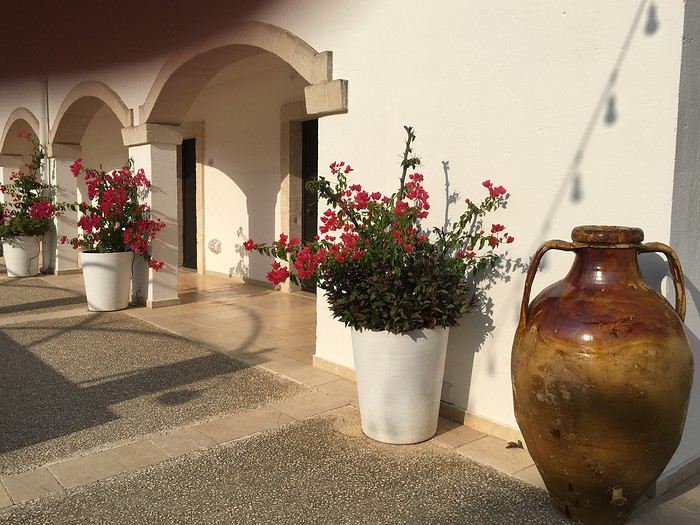
A recurring detail: this happened constantly during our travels. We’d installed our own GPS, fully updated... In recent years, many dirt roads have become drivable, and lots of hotels and hostels have opened in the outskirts of towns. It was extremely rare for our ‘guide’ to recognize the street—let alone the number—we entered. Often, we got by calling the hotel reception: it might seem like a small thing, but it happened so often it became frustrating. In hindsight, it seems like without Google Maps, we’d have been lost!
Anyway, we were beautifully settled, with a terrace overlooking olive groves and the sea in the distance: all was well.
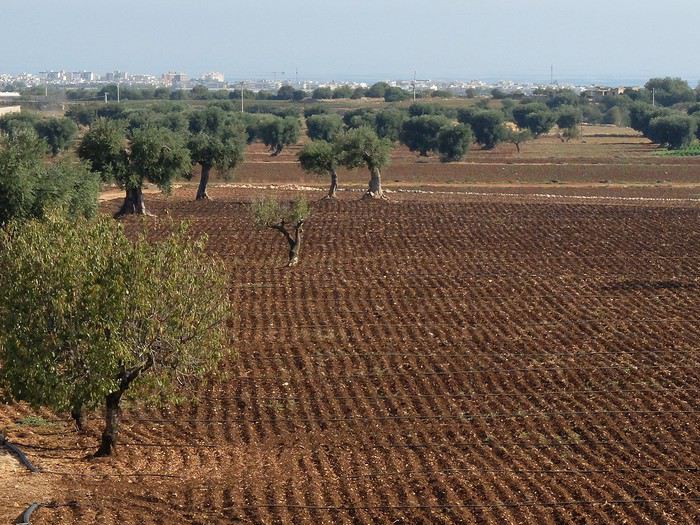
To be continued...
I’m finally getting around to writing about this 20-day trip to southern Italy: we didn’t travel this summer, and luckily, we found beautiful light and dreamy weather there at the end of September.
First, here’s the context of the trip: we’re both "confirmed seniors" but still curious and alert enough to enjoy the itinerary we’d imagined! We wanted a mix of discoveries—culture, cities, and nature—with guaranteed sunshine and the occasional short hike... We’re flying to Naples, round-trip, because the flight times work better for us. We rented a car online, picked it up at the airport (details to come... and it won’t be the highlight of the trip!), and booked our hotels in advance.
A quick overview of the itinerary: leaving Naples on September 15th, early in the morning, we’ll drive straight across the boot of Italy to Bari. After 11 days in Puglia, we’ll head back toward our starting point, taking our time: Matera in Basilicata, Maratea by the sea, and finally Paestum with its incredible temples.
Day 1: Brussels-Naples flight (Brussels Airlines) went smoothly; it landed an hour early, and we were thrilled, thinking we could use that time for a quick visit or two... Everything went well until we left the airport. We took the shuttle to the car rental offices, and at first glance, we realized this wouldn’t be smooth sailing!!! In front of every office (they’re side by side), there were already lines and kids sitting on suitcases—everyone looked exhausted... We resigned ourselves to waiting: nothing moved until tempers flared at the counters, and two people nearly came to blows. Things sped up a little, and after 2 (two...) hours of waiting, we finally got our chariot: a black Fiat Tipo, dirty, with a few dents and scratches that we made sure to note in the contract... but it ran!
Off to Bari, then: no time for sightseeing along the way! From there, we headed straight to our hotel in the countryside near Polignano a Mare.
A recurring detail: this happened constantly during our travels. We’d installed our own GPS, fully updated... In recent years, many dirt roads have become drivable, and lots of hotels and hostels have opened in the outskirts of towns. It was extremely rare for our ‘guide’ to recognize the street—let alone the number—we entered. Often, we got by calling the hotel reception: it might seem like a small thing, but it happened so often it became frustrating. In hindsight, it seems like without Google Maps, we’d have been lost!
Anyway, we were beautifully settled, with a terrace overlooking olive groves and the sea in the distance: all was well.
To be continued...
Hello forum,
Did any of you feel the same things we did in China?
We spent a good twenty days there in August. First, we traveled solo around Chengdu, then joined an organized tour for 12 days (Beijing, Pingyao, Xi'an, Guilin, Xingping, Yangshuo, Shanghai, Wuzhen) and extended our stay by 4 extra days to visit Zhangjiajie.
The landscapes were stunning, and we have unforgettable memories... but we were really disappointed by the following points:
- The food: way too spicy. Lacking in flavor, not much taste. I’m speaking "in general" because we did enjoy some good steamed dumplings, smoked pork, and other dumplings... But compared to Thailand, Cambodia, or India, Chinese cuisine didn’t impress us at all.
- The behavior of the Chinese: disrespectful, rushed, agitated. You constantly have to fight—people push, crowd, and overwhelm you... At the entrance to the Terracotta Army (and other sites), it’s a human tidal wave... and I mean that literally. We were carried by the crowd without even touching the ground. It was like a situation where you have one bowl of rice and 20,000 starving people diving for it...
You’re at a ticket counter, and they cut in front of you. You’re in line for boarding, suitcase ready to go on the conveyor belt, and someone shows up out of nowhere to put THEIR suitcase down... even though they have a flight ticket with THEIR seat number and won’t be leaving before you!!!! You’re getting on the bus, and someone shoves past you just so they don’t end up behind you.
It’s like these people only think about themselves. I didn’t see a single person let someone else go first or even ask—it’s as if politeness and respect are completely foreign to them.
It’s honestly exhausting and draining...
- Communication: In every other country we’ve visited, whether in Asia or Europe, we always manage—with English, a few words of Italian, French, or Spanish. In China, I’ll be blunt: if you don’t speak Chinese, you’re screwed. And yet, a pair of kids around ten or twelve years old asked us in English where we were from :)
- Understanding: Here’s the rule. Even if the person you’re talking to speaks a little English and says they understand you... make sure they *really* do, because 9 times out of 10, they don’t. Out of pride or just cluelessness, they’ll give you a big smile and nod, but in reality, they didn’t get what you were saying.
Several times with our group, in the evening at a restaurant, if we hadn’t been helped by someone at another table who spoke a little English, we’d still be there. The classic example: the waiter brings one menu (for 10 people at the table), and we’re all trying to explain that we need 4 or more menus. Five minutes later, he’s still staring at us with that same blank smile...
In 3* or 4* hotels, you go to the front desk for a hot water or AC issue. Three or four staff members just stand there beaming at you. You try to explain with photos or a translator, but in the end, you leave with the problem unresolved.
They don’t speak—they shout... on buses, in hotels...
We were also surprised to find that self-service laundromats were almost nonexistent. We got scammed once at a hotel with an astronomical bill!
As for flights, we flew Air China on the way there and Austrian Airlines on the way back—no comparison. Air China had zero service and food that was "baby food" quality. Austrian Airlines had multiple services, a decent meal, and smiling flight attendants.
I don’t know if any of you had the same experience in this country, but I’m definitely not eager to go back. Whereas if someone offered me India, Thailand, or Vietnam tomorrow, I’d be there in a heartbeat!!!