Hello,
I just booked the flight tickets for two people. We arrive on July 21st in the afternoon in São Vicente and will leave again on August 11th from Praia.
I was thinking of staying around 4 days in Mindelo to explore São Vicente using shared aluguers. Then take the boat to Santo Antão, stay there for about five days to do different hikes, staying in Ponta do Sol.
After that, it gets a bit tricky—we’ll return by boat to São Vicente to reach São Nicolau.
I wanted to know when the ferry leaves in terms of days and times? Or the plane?
We’ll stay there for about four days, then take the ferry or plane to Santiago.
Same question—what days does the ferry leave and at what time? Or the plane?
Finally, we’ll end our trip in Santiago; I’m thinking of staying in Tarrafal.
I also wanted to know where in São Vicente we can exchange euros for Cape Verdean escudos.
I was planning to use shared aluguers for all our travel.
Thanks in advance for your answers—I’ll probably have more questions later.
Nolwenn
36 similar discussions in English
Hi,
We’re heading to Cape Verde in January. We’re scheduled to arrive in Praia on a Saturday around 11 AM.
I read somewhere that the exchange rate for Euros to Escudos is the same everywhere—110 escudos for 1 euro. Can anyone confirm this? If that’s the case, I assume there’s a currency exchange desk at the airport, and the rate isn’t too bad? So, it’s better to exchange at the airport, right? What do you think? I don’t want to use ATMs.
Otherwise, are banks in town open on Saturdays? I read they close by 3 PM?
Hello,
We’ve just returned (2 senior couples) from 18 days in Cape Verde (21/01 to 7/02) that we really enjoyed. The temperature was great—20° to 27°—admittedly a bit windy at times, but the friendliness of the Cape Verdeans made up for it.
Paris Orly, direct flight with Transavia (cheap if you book in advance). We landed in São Vicente, with a 12 € city transfer. We had a fantastic 2-bedroom apartment in downtown Mindelo—Av. Fernando Ferreira Fortes, "Casa So Morabeza"—for 58 € per night. The owner lives in France and communicates instantly via WhatsApp.
We spent 2 days exploring the (beautiful) city of Mindelo and its port activity, plus a private taxi tour of the island (6000 CVE for the day).
Then we took the Armas ferry (recommended company—1500 CVE) to Santo Antão.
From there, a collectivo (450 CVE per person) took us to Ribeira Grande, a central base for hikes.
We stayed in a brand-new, modern, and well-equipped 2-bedroom apartment—*Apartamentos Modernos*—for 6770 CVE per night, staying 6 nights. I highly recommend it for its location in town and proximity to *aluguers* and *collectivos* for hiking.
The hikes were stunning:
- The coastal trail from Fontainhas to Cruzinha (taxi for 1500 CVE)
- The route from Corda to Coculi (taxi for 2000 CVE + 100 CVE per person for the return)
- The trail from Cova to Cidade de Pombas (taxi for 2000 CVE + 100 CVE per person for the return)
- The hike from Miradouro to Ribeira Grande (taxi for 2000 CVE)
- The coastal road from Ribeira Grande to Ponta do Sol (visit and lunch at *Mini Familiar* in the city center—excellent and affordable) for the round trip.
Ribeira Grande has plenty of restaurants, but avoid *5 de Julho*—it’s loud and slow.
We loved: *Bellcanto*, *Cantinho da Amizade*, and *Boca-Fina Churrasqueria*.
Meals with drinks cost around 800–1000 CVE.
Back to São Vicente by ferry (1500 CVE), then an airport transfer (12 €) and a flight (99 €) to Santiago’s Praia. The airport-to-city transfer was 15 €.
We stayed at *Kelly’s* in Plato, Praia, which was disappointing—not ideal for two couples—but well-located.
One day was spent visiting the massive *Suspicia* market, then a collectivo to Cidade Velha (2 x 200 CVE round trip per person). We hiked up to the fort, explored *Rua Banana*, and had lunch at *Praça do Mar* by the beach.
We rented a car for 6 days (29000 CVE) from *Slimpycar* in Praia.
On Saturday, we visited the huge *Assomada* market—don’t miss it!—then hiked to *Boa Entrada* and *Poilon*, the largest and most impressive tree we’ve ever seen.
We stayed for 2 nights (138 €) in a beautiful valley in *Picos*—a spacious, lovely house with 2 bedrooms, 2 bathrooms, and a large living area, surrounded by nature and animals.
Lina, the charming neighbor, prepared dinner (8.50 €) and breakfast (4.50 €) for us.
Next, we headed to *Tarrafal*, stopping to visit the concentration camp (500 CVE)—a must-see—before arriving.
We spent 3 nights (184 €) in a fantastic house called *"Maison Familiale"*—huge, with 3 bedrooms, 2 bathrooms, 2 kitchens, 5 toilets, and a large terrace with sea views. It was absolutely stunning and very close to the beach and numerous restaurants.
We did a beautiful 3.8 km hike to the *Farol da Ponta Preta* lighthouse.
Tarrafal’s beach is lively and pleasant, with bars, restaurants, and even acrobats!
We also explored *Ribeira da Prata* to see the *Piscina Natural de Cuba* (not easy to find).
We loved discovering isolated villages like *Ponta Furna*, *Ponta Labrão*, and *Fazenda*.
For food, I recommend *Mira Mar* at *Mama’s*.
On the way back to Praia, we took the east coast route via *Calheta de São Miguel*, *Pedra Badejo*, and *Praia Baixo*—nothing extraordinary, just a rugged, wild coastline with beaches that seemed a bit tricky to access.
Our last evening in Praia was nice. The seaside esplanade was lively, and many Cape Verdeans were swimming at *Prainha* beach, which seemed very accessible and safe.
If you’d like more info—addresses, etc.—feel free to message me privately. I’ll respond.
Jacquesler.
And we still haven’t seen everything!
Before setting off for new horizons at the end of this year, it’s time for me to share my trip to Cape Verde this summer 2025.
I particularly love these spontaneous trips, and our stay in Cape Verde is one of those because it was only at the beginning of April that we decided on this getaway, which had been catching our eye for a while, given our love for the mountains.
As always—well, when it’s open—I turned to VF, and I want to immediately thank Marie, aka ptitortue, who helped me a lot in planning this trip through her travel journals and our exchanges!
Because Cape Verde is both small and vast! We decided not to rush from one airport to another, to enjoy the places and the people, but also to relax, since the work backlog from being stuck in May (see my previous travel journal 😅) had to be caught up on in June.
So, 4 islands will be our winners from 06/28 to 07/19:
Santiago first for logistical reasons, as round-trip flights from the capital Praia were the cheapest (650 €/person from Lyon via Lisbon with TAP, still!)
São Vicente, because it’s the gateway to the next one but ultimately more than that...
Santo Antão, pretty much the main goal of the trip since Marie (and the photos) had really sold it to me.
And finally, Sal Island, for some rest—a non-negotiable condition for my other half—and we’ll see that I should’ve listened to Marie...
That said, what a chatterbox I am—buckle up, flight attendants at the doors, off we go on new beautiful escapes! (Thanks to Sophie for the easy loan)
Last note for my eager fan club 😏: yes, there will be alcohol—how could there not be in the land of grogue!
It starts here:
https://voyageforum.com/v.f?post=10790234;a=10790234

I particularly love these spontaneous trips, and our stay in Cape Verde is one of those because it was only at the beginning of April that we decided on this getaway, which had been catching our eye for a while, given our love for the mountains.
As always—well, when it’s open—I turned to VF, and I want to immediately thank Marie, aka ptitortue, who helped me a lot in planning this trip through her travel journals and our exchanges!
Because Cape Verde is both small and vast! We decided not to rush from one airport to another, to enjoy the places and the people, but also to relax, since the work backlog from being stuck in May (see my previous travel journal 😅) had to be caught up on in June.
So, 4 islands will be our winners from 06/28 to 07/19:
Santiago first for logistical reasons, as round-trip flights from the capital Praia were the cheapest (650 €/person from Lyon via Lisbon with TAP, still!)
São Vicente, because it’s the gateway to the next one but ultimately more than that...
Santo Antão, pretty much the main goal of the trip since Marie (and the photos) had really sold it to me.
And finally, Sal Island, for some rest—a non-negotiable condition for my other half—and we’ll see that I should’ve listened to Marie...
That said, what a chatterbox I am—buckle up, flight attendants at the doors, off we go on new beautiful escapes! (Thanks to Sophie for the easy loan)
Last note for my eager fan club 😏: yes, there will be alcohol—how could there not be in the land of grogue!
It starts here:
https://voyageforum.com/v.f?post=10790234;a=10790234
Hi,
Without booking in advance through an agency, is it possible/easy to organize luggage transfer from one night to the next between accommodations in Santo Antão?
Thanks.
Hi there,
We’re planning an 8-day backpacking trip on the island of São Nicolau. We’re torn between taking the boat from São Vicente or an inter-island flight. I’ve heard the boats don’t always run?
We’d like to make three homestay stops to travel in a star pattern from each of the three points.
First stop around Juncalinho, second stop near Cachaco, and finally a third leg near Tarrafal. We’re looking for simple but authentic guesthouses (no hotels). Any suggestions?
Thanks
Hi everyone!
The forum has been a huge help during my moments of doubt, and since Cape Verde isn’t a destination with many discussions, I felt I had to share my trip report 🙂
First, the EASE: I could never validate it from my phone—I tried 50 times without success, and on the computer, it worked the first time. Then, Cabo Verde Airlines: forget online check-in. I went to the airport early to get my window seat (and in the end, the plane wasn’t full—I had three seats to myself, so I could finish my night peacefully). No in-flight entertainment for those who don’t sleep on planes.
Monday 9: Flight + arrival at Antonio’s (Oia Mindelo Guesthouse). Antonio’s apartment is up on the hill, but really, it’s only a 10-minute walk to the beach and 10 minutes to the city center (depending on where in the center). He picked me up at the airport (1000$). I continued relaxing by doing... nothing on the beach. Dinner in town at Café Mindelo: a pretty place, but otherwise meh—expensive and not necessarily good (2100$ for a beer and a fish that didn’t seem freshly caught as advertised). Tuesday 10: Antonio offered to do a tour of the island (for cheap), and we left with his other guests (a lovely English couple, 76 and 77 years old). Stops at Salamansa (I felt something special on that beach—I could’ve stayed there for an hour doing nothing), then another scenic spot, a restaurant, and Baias das Gatas (I took a quick dip, but to me, it had less charm than Salamansa). Then we crossed the island to return to São Pedro (beautiful but windy; the village looks cute). Exhausted, I went to bed early because of the ferry to Santo Antão the next day. Wednesday 11: Antonio took me to the ferry, and we’ll see each other again since he’s hosting me at his aunt’s place during Carnival. On the ferry, I had a Booking.com reservation for what I thought was in Ribeira Grande (the town), but it was actually *in* the ribeira—specifically in Manta Velha (aluguer to Cruzinha ~600$). I thought I’d fallen into a hole, but I ended up loving it—Casa Familiar Gilda. Gilda is a divine cook (dinner for 1000$—don’t eat lunch, or there won’t be room), the village has a typical rural Santo Antão vibe, the place has great energy, and you can get around easily by aluguer. Thursday 12: I left early by aluguer to Ribeira Grande (250$), then another aluguer to Ponta do Sol (100$)—a sleepy beauty at that hour—to do the Ponta do Sol-Cruzinha hike, finishing in Cha de Igreja. Departure at 8:22 AM from the cemetery in Ponta do Sol, passing through Fontainhas (those doing it the other way will have a fabulous climb at the end 😏), and let’s go! I loved this glimpse of rural life—past or present—the sea is stunning, and we were shaded most of the way (though it goes up and down, it’s manageable). The arrival at Cha de Mar is breathtaking, and Cruzinha is a charming little town (arrived at 12:30 PM). I’d brought my swimsuit after reading there was a beach, but I packed it back up—too many waves and big pebbles. I continued to Cha de Igreja (25 more minutes) after a short break (ask for the path that doesn’t go by the road). It’s adorable with its church square (you don’t see this layout much elsewhere). I might’ve stayed longer to enjoy the place, but a taxi driver asked if I wanted to return to Manta Velha (1000$), and like a fool, I said yes (it was 2:30 PM—I could’ve waited for the 4:30 PM aluguer for 100$, but oh well). But since I still had energy, I decided to see if I could find a grog distillery. I ran into a French guy arriving at Gilda’s, and we ended up talking to Rodrigo, who explained everything from A to Z about how they make grog (the simple cane juice is amazingly good—but the work is clearly tough). Friday 13: Transfer to Xoxo on Djalma’s advice 😉, where I’d booked a room at Casa Xoxo. I did the hike to Rabo Crusto... it’s tough, but I kept quiet when I saw a pregnant woman doing it with her two little ones 😄. There’s also a distillery I didn’t linger in, and I took a tea break with that wonderful landscape before heading back. I couldn’t find the path Jean-Michel had told me about (take a right at the village entrance), so I went back down to the water reservoir to turn off and take the waterfall path (anyone can point it out if needed). The bedding at Casa Xoxo was perfect, but the dinner atmosphere was less family-like. Saturday 14: No one at Casa Xoxo could tell me when the aluguer passed, so I scarfed down my breakfast and headed down a bit. I found one (not sure if he’d planned to work, but there were three of us, so he left). Arrived in Ribeira Grande, an aluguer driver told me the coastal road to Porto Novo was closed and we had to take the Corde road—but no one was leaving, so we’d have to charter... Sometimes, you just have to say it: aluguer drivers say there’s no ride just to make you pay the private price (3500$). But this time, it was true! With another French couple, we wanted to go to Tarrafal. Our driver called the Porto Novo-Tarrafal aluguer to wait for us. The Corde road is stunning—more different landscapes (thorny forest, misty peaks...). Changed aluguers in Porto Novo and headed to Tarrafal. Another world—lunar landscape on the way. Arrived in Tarrafal and relaxed. Sunday 15: Hike from Tarrafal to Monte Trigo, left at 8 AM, and I’m glad I did—I was in the shade until about 9:30 AM, then the sun got strong. Beautiful walk, arrived in Monte Trigo around 11:30 AM. The people weren’t particularly friendly, but oh well. Swam at the little beach in Monte Trigo (the water is *so* good). I waited for other French people who had “booked” a boat for the return. Came back with Javi (50 min—1000$ each), who lent us masks and snorkels for some snorkeling. Had grog with Ludo, Estelle’s husband, who was waiting at the bar, then filled my grog bottle at the *mercearia*. I admit, it’s delicious, but I don’t remember much of that evening 😇🤪. Except Javi put on a show saying he’d been robbed, had no money, and needed to pay the boat owner, etc. People paid again (apparently not me, since Ludo, Estelle, and I arrived at the restaurant after Javi’s drama). FYI, Javi does this often—my host had warned the couple renting the other room to watch out for him because he scams people for money. So Javi is 35 with hazel/special-colored eyes. But if you don’t repay the “service,” the day was still great. Monday 16: Several of us were taking the late-afternoon boat, so we chartered an aluguer (7000$) to avoid the 6 AM one—trip—boat to Mindelo. Antonio picked me up at the ferry, and boom—Carnival! I found a spot on Rua de Lisboa. My neighbor was from Santo Antão just for Carnival, spoke French, and explained that last year’s Carnival started 3 hours late because a float couldn’t fit under the power lines 😏 (like they don’t know the height by now hahaha). On Monday, it’s the teachers (nice—kind of a warm-up) and the Madingas. Once they passed my spot, I followed them along the route—I LOVED it! By midnight, they still hadn’t reached Praça Nova, and the police told them to speed up, but I loved that energy! Tuesday 17—Mardi Gras: Beach day, then Carnival! Antonio had bought me a seated ticket just in case (300$). Ended up in front of a punch stand, where I ran into two French women I’d met in Manta Velha. Two guys from Mindelo talked to us, and we did Carnival with them. And what was bound to happen, happened: a float couldn’t pass because... it was taller than the power lines 😏😏😏. The dancers kept dancing while the crowd tried to lift the cable. Finally, a guy in a tree climbed higher and used a pole to lift it... and the parade could continue 😉. Around 12:30–1:30 AM, when the concert was supposed to start, the power went out. I went home and later learned the concert started around 3 AM. Wednesday 18: I went home because I was taking the boat back to Santo Antão, heading to Casa Familiar Gilda. Walked the loop from Manta Velha. Thursday 19: Left early for Ribeira da Paul to do the loop to Sandra’s House. It’s truly breathtaking! Back at Gilda’s, I chilled. I wanted to go to Sinagoga’s natural pools, but the hike had worn me out. Friday 20: Return to Mindelo on the red company’s ferry—no comparison: way more comfortable than the blue company’s, especially for someone prone to seasickness. Beach. Exhausted, I struggled to sleep because the shop on the ground floor of my rental had a party until 3 AM (and the windows aren’t double-glazed—*hi*—but that’s common in Mindelo). Saturday 21: Ran into Estelle and Ludo by chance (the city’s small), and we arranged to share a taxi the next day since we had the same return flight. Beach (I tried Lazaretto Beach, but nope—not great—dead fish + weird smell = bad signs). So Laginhia was fine, and in the evening, a restaurant with singers, then Caravelle (the ground-floor shop didn’t bother me since I got home when they were saying goodbye 😏). Too bad—I dance salsa, bachata, kompa, zouk, but not kizomba hahaha, but it was still fun. Sunday 22: Took a taxi with Ludo and Estelle (1200$). Arrived *ages* before takeoff (no exchange office—get escudos in town if you have any left). Boom—CDG, boom—RER... home.
There you go—a super long trip report. Not sure if it’ll help, but the digital detox was amazing. These two islands are very different but so beautiful. I only got a glimpse, but they’re worth the trip. I was lucky to see Carnival (what joy in that city!) and happy the Cambodia ticket (my first idea) was way too expensive 😉
Hi there,
We’re planning a two-week couple’s trip hopping between the Cape Verde islands at the end of November 2025.
Our arrival and departure airport will be on the island of SAL.
We’ve got some hikes lined up.
Based on your experiences, what recommendations and suggestions do you have?
Thanks in advance for your valuable tips!
Hi everyone who loves Santo Antão in Cape Verde! 🙂
I’m arriving at São Vicente Airport in Cape Verde around 2:00 PM. Are there buses or *aluguer* that go to Mindelo, and is it possible to catch a ferry to Santo Antão right after, or is it better to leave the next day?
Thanks so much for your help
I’m arriving at São Vicente Airport in Cape Verde around 2:00 PM. Are there buses or *aluguer* that go to Mindelo, and is it possible to catch a ferry to Santo Antão right after, or is it better to leave the next day?
Thanks so much for your help
Hi there,
I’ve been looking for a destination for a 2-week trip early next spring, and Cape Verde has been growing on me. (The flight isn’t too long, the temperatures are more than pleasant, and it’s an unknown country for me.)
The thing is, Cape Verde is pretty complicated when it comes to inter-island transfers, and I don’t want to spend my time in airports or on ferries—especially since those transfers aren’t exactly known for their reliability...
So, I’d like to limit internal flights to just 2, meaning the island I arrive on plus one other.
I’ve ruled out the all-inclusive islands: Sal and Boa Vista.
I’m torn between combining Santo Antão + São Vicente or Fogo + Santiago.
The goal of the trip is to see beautiful landscapes, go on day hikes (nothing multi-day), swim a little—though I prefer quiet spots—and enjoy 1 or 2 days in a city, but not much more than that!
In your opinion, which option would be the best, and why?
Thanks! :)
Hi everyone,
It’s my turn to share my impressions, itineraries, and addresses in Cape Verde. I actually drew a lot of inspiration from travel journals to choose which islands to visit... I set off with a friend for 12 days there.
We chose the islands of Santo Antão for its hikes and São Vicente to enjoy Carnival.
We arrived in São Vicente and spent the first half-day gathering information on ferry schedules to Santo Antão and finding two nights of accommodation for our return to São Vicente during Carnival. We were lucky to find an available room in a guesthouse very close to Laghina Beach, while all the hotels and guesthouses in town were fully booked. Indeed, it’s best to book in advance to secure a room during Carnival.
We also bought a phone card, which turned out to be useful for making a few reservations during our stay. We got some tips from the tourist office located right in the city center.
We left for Santo Antão the same day at 2:30 PM. The ferries from São Vicente to Santo Antão are supposedly the most punctual. And for good reason—they’re very on time, even leaving 5 minutes early. Boarding starts 30 minutes before the scheduled departure to avoid missing it.
On the ferry, we met Vany, who runs a guesthouse near the Paul Valley. He told us his restaurant is very good. He was adorable, and we kept his contact info—we weren’t disappointed!
We arrived in Santo Antão and asked the *colectivo* (shared taxi) to take us to Ponta do Sol for 400 escudos per person. Meanwhile, we bought the 1:500,000 map of Santo Antão (essential for hiking without a guide).
The *colectivo* dropped us off right at the door of a very kind lady who rents rooms on the upper floor of her house (3,000 escudos per night + breakfast for 2 people). We dropped off our things and chatted with a local contact to decide on our itineraries and hikes. We decided on the following route (which sometimes changed day by day):
From Ponta do Sol to Cha d’Igreja (path 212) From Cha d’Igreja via Cabo de Mocho to Ribeira Grande (then return by *colectivo* to Ponta do Sol) (paths 213a, 213, 208a, then the road) The *Rota da Corda* (by taxi) to Cova de Paul, then the Paul Valley (with a guide, likely paths 101 and 102) Cha de Morte to Alta Mira III (starting from Tia Rosa’s place, then paths 302 and 303) Alta Mira III via the Mira Valley to the sea, then back to Alta Mira III (paths 303 and 305a, returning by road)
One thing to remember: the hikes are non-stop uphill and downhill—no flat sections!
From Ponta do Sol to Cha d’Igreja (path 212)
We left our guesthouse around 8:30 AM with a light backpack, water, some snacks for the road, and a few things for our overnight stay in Cha d’Igreja (our host kindly agreed to keep our big backpacks for the night; we’d return the following night).
The path was very easy—impossible to get lost. We were advised to do it in this direction because it’s supposedly prettier and easier than the other way. The scenery includes the coast and villages perched on the lush mountainside. The only downside was the cloud of sand particles that reduced visibility, especially over the sea. We arrived in Cha d’Igreja at 2:30 PM and checked into a guesthouse we’d been recommended (5,600 escudos for 2 people, including dinner, night, and breakfast).
In Cha d’Igreja, there’s a square where people gather in the evenings. That night, kids were dressed up because Carnival was already starting. We also visited an ecolodge run by French people just before the village entrance. The place was really nice—they had bungalows and fully equipped tents. I think it’s worth staying there, but we’d already booked our guesthouse (maybe next time!).
From Cha d’Igreja via Cabo de Mocho to Ribeira Grande
We left around 8:00–8:30 AM for a 3–3.5 hour hike to Boca de Ambas. The scenery was stunning the whole way. We stopped at a *merceria* (small shop) in Boca de Ambas to buy fruit juice and eat some fruit. There, we met an old man who asked, “Are you French? So you don’t speak English?” But then—bluff—we *did* speak English (he was stunned!). We started chatting; he told us he’d traveled a lot, introduced us to his neighbors, and insisted on accompanying us to Zeca’s house (about a 40-minute walk away). We happily accepted his company, but his idea wasn’t to walk—it was to drive us there. So off we went in his 4x4. From there, he showed us the way to Coculi via Cha de Lobhinos. We still asked for directions a few times because we weren’t always sure which path to take. We passed through Ribeirão, Lombo de Negrinho, then hiked with a group on the road to Cha de Saída (about 2.5 hours of walking). The scenery was magnificent again. Then we came across the track to Coculi. It was less pretty, so we decided to hop into the first passing vehicle to take us to Ribeira Grande and then to Synagogue, where we swam in the natural pools.
We returned to Ponta do Sol around 5:00 PM. We had dinner at an excellent restaurant by the sea, right in front of the diver statue (a turtle’s body is on the restaurant’s facade). Lucky for us, there was one table left—the place was packed!
Ponta do Sol is a pretty lively town. We even caught Carnival rehearsals. It was a nice change from the quiet of Cha d’Igreja.
The *Rota da Corda* (by taxi) to Cova de Paul, then the Paul Valley with a guide
The taxi picked us up at 8:30 AM, and we headed to the Cova crater. We left with a small backpack because our *colectivo* driver kindly agreed to drop off our big bags at the guesthouse we’d booked in Paul. We stopped along the way—the scenery was breathtaking. I already regretted not hiking part of this route on foot. We climbed to the top of the crater and descended into the Paul Valley. I expected it to be cloudy, but it was actually very clear and green. The Paul Valley is beautiful. The guide gave us brief explanations about the plants we encountered. There was a lot of downhill walking—it was pretty tough on the feet. I think I would’ve preferred a mix of hiking in the *Rota da Corda* and the Paul Valley.
Guide fee: 4,500 escudos for the day, and 3,000 escudos for the taxi.
We arrived at the guesthouse we’d booked, which is famous for its great food (and for good reason). When we got there, the cook picked out the fish for that evening’s menu from the day’s catch—a lobster... and it was for us! :) The terrace setting of this guesthouse (where the restaurant is) is gorgeous, and the staff is adorable (especially Vany, who runs the place and whom we’d met on the ferry). There’s even a small dedicated space with a stage for live music nights. However, the room was a bit less comfortable (no water at times, quite noisy), but it didn’t matter—the setting and the people made us quickly forget the minor inconveniences. Address: DM me if you want it.
Cha de Morte to Alta Mira III (starting from Tia Rosa’s place, then paths 302 and 303)
We left Paul via Porto Novo, where we took advantage of the *colectivo* change to buy our ferry tickets (for two days later). We decided to head toward Alta Mira III. The owner of the (only?) guesthouse there is also a *colectivo* driver for the route from Porto Novo to the Alta Mira Valley. He dropped us off along the way near Tia Rosa’s house (marked on the map), and we took path 302. The scenery changed dramatically—it was much more arid than the northern and eastern parts of the island. Still, the landscapes and “dykes” in the second part of the route were spectacular. We hiked for about 3.5 hours and arrived at the guesthouse (DM for contact—2,000 escudos per person for the night, including dinner and breakfast). The calm in the village contrasted with the lively atmosphere at Vany’s the night before. The food was excellent—we loved it!
Alta Mira III via the Mira Valley to the sea, then back to Alta Mira III (paths 303 and 305a, returning by road)
Our last hike before returning to São Vicente. We went to the Alta Mira Valley via Alto Mira II to the sea (about 4 hours of walking). The first part, up to Dominguihas, was especially beautiful. After that, I found the scenery a bit monotonous. We returned by road, and luckily, we ran into a car (unexpected on a Sunday in this remote area) near Jorge LUIS’s village, which dropped us off at the Selada viewpoint, 4 km from our guesthouse. Otherwise, it would’ve been a long uphill walk back (not very fun). Second night at our guesthouse (with another amazing dinner).
We left the hiking island to arrive on the party island: São Vicente. A Carnival parade was happening that very evening. We had dinner at a restaurant on Rua Lisboa, which offered a view of the parade from the balcony (packed to the brim). We were lucky to see a magnificent parade in “little Rio” style (with feather costumes, floats, dancing, music, singing, and *batucada*). Once the procession passed, we headed a bit farther (to Praça Nova) to enjoy it longer. Tuesday, February 9: Carnival Day (though the parades had been going on since Friday, including school parades... the city had been celebrating for days). Four groups were set to parade starting at 3:00 PM. We decided to try the same spot as the night before, but this time, all the restaurants had their doors closed—you needed tickets to enjoy the balconies... and tickets were sold out. We really wanted a high vantage point... so we tried the railing of the Alliance Française, like many other Cape Verdeans (the wall was the width of a flip-flop...). It barely held, but we got our spot, which we kept for nearly 5 hours. The vibe was the same as the night before: floats, costumes, dancing with participants aged 7 to 77 (and older...). The evening ended with a big outdoor concert, then... nothing. We looked for other places with music but had no luck. We went back a bit unsatisfied—we would’ve loved to extend the moment. Three days left in São Vicente: a walk on the beach (between Calhau and Praia das Gatas, about 3 hours—go at low tide). The sea brings in a lot of trash, which is a shame because the beach is beautiful (but hard to swim due to strong currents). We hiked to the top of Monte Verde (great view if the weather’s clear, but the wind is very strong at the top—you can also take a taxi). We swam at Mindelo Beach (Laghina), drank coffee at the Pergola (next to the Alliance Française), and enjoyed the sun while it was pouring rain in Paris :)
All in all, it was an amazing trip. I hope you’ll have just as great a time in this little corner of paradise.
I hope this travel journal might interest some people, but since we were completely self-sufficient (tent, sleeping bag, pot, cooking over a wood fire…) almost every day, I don’t have many hotel addresses or great restaurant tips to share! Sorry!
We used the Maio map at 1:50,000 scale. It’s part of the Boa Vista/Sal/Maio map. Bought on Amazon, but currently unavailable as of the latest news.
The people of Maio are extremely welcoming and warm, and we were always more than well received in the villages where we pitched our tent!
We’re usually big hikers, but since Maio is a beach island (gorgeous ones, at that!), we alternated a few hours of walking in the morning with some relaxation in the afternoon: beach, reading, fishing, resting…
1 euro = 110 escudos
Day 1 (Friday) Transfers by plane: Fogo-Praia-Maio We opted for the plane to save some time on transfers, as the boat connections between Fogo and Praia take a while, and those between Praia and Maio are almost nonexistent.
You should budget around 40-50 euros per flight per person.
There are 2 flights per week between Praia and Maio—on Tuesdays and Fridays when we were there (January 2016), but currently on Mondays and Fridays.
Tickets were booked directly and without issue on the TACV website: https://flytacv.com/?lang=en
A bit of a delay leaving Praia, but we arrived on Maio without any problems around 4 PM.
We took an *aluguer* (shared transport, 200 escudos per person) to the center of Vila do Maio, but it’s totally doable on foot with a backpack.
Since it was already a bit late, for this first night, we dropped our bags at Big Game Maio. A standard European-style hotel run by a very nice Italian family. It’s a bit pricey for us (5500 escudos for 2 people with breakfast), but after our 2 weeks in a tent on Fogo, we were happy to find a little comfort. And the breakfast is ultra-generous, with fresh products (cured ham, fruit, cheese, bread) and top quality. The hotel restaurant offers dishes that are a clever mix of Italian and Cape Verdean cuisine. Excellent!
Little tip: We didn’t try it, but Big Game Maio offers big-game fishing trips, diving, and quad rentals.
The hotel is 2 minutes from Vila’s beautiful beach, and we went for a dip at sunset and took a stroll around town. They’re redeveloping the waterfront with pretty sidewalks and light stone walls.
 Vila beach
 Sunset behind Santiago

Day 2 (Saturday): rest day + fishing After 2 weeks of hiking and since Vila is such a peaceful place where it’s nice to take your time, we decided to spend an extra day there. We took the path heading south along the coast to reach Ponta Preta beach in 20 minutes. The path isn’t very pretty because there’s quite a bit of construction going on, which prevents you from really walking along the shore. Lots of real estate agencies, especially Italian ones, have taken over the land. But Ponta Preta beach is a stunning black-sand beach where we had the whole place to ourselves. We decided to go fishing from the rocks.
At 1 PM, the sun was blazing, so we headed back to Vila and dried the fish for the following days.
At 6 PM, we went fishing again, but this time at night from the rocks at the end of Vila beach.
8:30 PM: back to shower and eat at the restaurant.
 The rocks and sea at Ponta Preta
Day 3 (Sunday): from Vila do Maio to Calheta de Baixo, via Monte Batalha (path 101) Hiking time: 5h Since there aren’t many “summits” on Maio, we decided to head to Calheta de Baixo but via Monte Batalha. We left at 8:20 AM and somehow made it to Monte Batalha by 11 AM (2h40 of hiking). But the path is really hard to find in the middle of the dry grass and acacia trees. We kind of cut through randomly, aiming for the summit. Even though it’s not very high (around 300 m), the view is amazing—you can see all of Maio at 360°!
Short 30-minute break. The descent through the “forest” of acacias is even worse for finding your way. We oriented ourselves a bit by the sun to find the road connecting Vila to Calheta. We arrived around 1:30 PM at Calheta de Baixo. A very pretty little seaside village with colorful houses. An idyllic beach, a newly renovated square, and super-friendly people. We pitched our tent facing the sea on the terrace of an abandoned house (after asking the locals for permission).
We cooked some of the dried fish we’d caught the day before, along with fresh beans we’d brought from Fogo (and were still carrying!).
 At the summit of Monte Batalha
 Calheta
 Calheta de Baixo
Day 4 (Monday): From Calheta de Baixo to Morrinho on foot. Hiking time: 3h. Then hitching a bus to Cascabulho, and a car to Pedro Vaz. We left around 9:30 AM heading north (path 201), following the coastline where the beaches just keep coming—each one wilder and more beautiful than the last: Praia de Soca, Calheta Braca, Ponta de Pau Seco, Calhetina. We reached the dunes of Baia de Santana. There’s no real path, so you have to follow the coast, then go around the dunes, and when you spot the 3 coconut trees, head east toward them to find the track leading to Morrinho. Again, we discovered a village with a Wild West vibe, with colorful houses lined up on either side of a paved road. Just enough time to accept a drink offered by a local before jumping onto the passing school bus that took us to Cascabulho. There, we waited for a ride. A political delegation of 10 cars drove right past us without stopping. Luckily, one of the cars had a flat tire and came by 30 minutes later—and that one, thankfully, gave us a lift! They were heading to the inauguration of a water pump in Pedro Vaz. So that’s where we stopped too. After getting permission from the school principal, we pitched our tent in front of the village school… and became the attraction for all the kids who kept us company until nightfall! A woman gave us 2 jugs of water, but with all that company, it was tough to take a peaceful shower!!
Dinner: pasta with beans.
We were woken up by rain during the night and had to rush to bring all our stuff inside the tent!

 The beaches just keep coming...
 The dunes
 The 3 coconut trees, a landmark to find the track
Day 5 (Tuesday): Rest day and fishing at Boca da Ribeira beach We packed up at 8 AM because the kids had school. We filled the 2 water jugs that the woman lent us and headed down to camp at Boca da Ribeira beach, which is a bit further east of Pedro Vaz. It took less than an hour to get there. This time, we really were alone in the world! We pitched the tent and spent the day fishing, reading, playing, and swimming regularly because the sun was beating down hard!!! We caught a nice fish that we grilled over the fire in the evening. With the crabs and shellfish we gathered, we made a seafood rice! Yum! What a feast!
That night, once the tent was zipped up, we felt something like rain on the tent fabric. I decided to go out and gather our things, and then—shock!!! It wasn’t raindrops we were feeling and hearing, but bugs attracted by the light!! Not just a few bugs—a huge swarm of them!!! Thousands of bugs covering the whole tent, the ropes, slipping into the seams and hems! Everywhere! The blue tent had turned green!!! After that, it was a real struggle to get back inside without letting any in! A real challenge, and there were always 3 or 4 that managed to sneak in anyway. Total war!!!
 Boca da Ribeira beach

Day 6 (Wednesday): From Boca da Ribeira to Ribeira Dom João. Hiking time: 3h30 We woke up leisurely and waited for the sun to dry our things, damp from the dew. A man passed by, and we gave him the water jugs we’d borrowed, which saved us a trip back to Pedro Vaz to return them to the woman.
We left around 10 AM. We followed the sea to Alcatraz, then headed toward Pilão Cão. The path runs alongside the small hills on our right, and we passed above Lagoa Cimidor. The terrain is arid, and the path is hard to find among the many goat tracks.
After 3h30 of hiking, we reached Ribeira Dom João with 2 young people we’d met along the way.
Since it was a public holiday in Cape Verde, the kids didn’t have school, and with the principal’s permission, we pitched our tent in the kindergarten. She even kindly opened the school toilets for us. The neighbor gave us the water we needed to wash up and cook. We cooked beef steaks on charcoal. A nice change from fish!! Charcoal is a widespread artisanal product on the island. People almost never cook directly over wood but always with these big chunks of charcoal.
 The hills on our right
 Ribeira Dom João
Day 7 (Thursday): From Ribeira Dom João to Vila do Maio. Hiking time: 3h30 We woke up at 6:30 AM to clear out of the school by 8 AM. The neighbor made us coffee to save time. It took us 2 hours to reach Barreiro, another Wild West-style town! Since we didn’t want to walk on the road, we took the old track and reached Vila do Maio in 1h30.
Last night before taking the plane back to Praia the next day.
 Barreiro
 The old track
 The church in Vila do Maio
That’s where this trip ends!
Maio is truly a magical island! A remote, isolated place with incredible, wild beaches and villages with a Wild West feel—colorful houses on either side of well-paved, well-maintained, and decorated streets. And the locals are so warm and welcoming.
Even for hikers like us, it was a great discovery, and we were able to alternate hiking and relaxation with great pleasure! Too bad the area around Vila do Maio is being overrun by real estate construction—ongoing, unfinished, abandoned…
Safe travels to all!
We used the Maio map at 1:50,000 scale. It’s part of the Boa Vista/Sal/Maio map. Bought on Amazon, but currently unavailable as of the latest news.
The people of Maio are extremely welcoming and warm, and we were always more than well received in the villages where we pitched our tent!
We’re usually big hikers, but since Maio is a beach island (gorgeous ones, at that!), we alternated a few hours of walking in the morning with some relaxation in the afternoon: beach, reading, fishing, resting…
1 euro = 110 escudos
Day 1 (Friday) Transfers by plane: Fogo-Praia-Maio We opted for the plane to save some time on transfers, as the boat connections between Fogo and Praia take a while, and those between Praia and Maio are almost nonexistent.
You should budget around 40-50 euros per flight per person.
There are 2 flights per week between Praia and Maio—on Tuesdays and Fridays when we were there (January 2016), but currently on Mondays and Fridays.
Tickets were booked directly and without issue on the TACV website: https://flytacv.com/?lang=en
A bit of a delay leaving Praia, but we arrived on Maio without any problems around 4 PM.
We took an *aluguer* (shared transport, 200 escudos per person) to the center of Vila do Maio, but it’s totally doable on foot with a backpack.
Since it was already a bit late, for this first night, we dropped our bags at Big Game Maio. A standard European-style hotel run by a very nice Italian family. It’s a bit pricey for us (5500 escudos for 2 people with breakfast), but after our 2 weeks in a tent on Fogo, we were happy to find a little comfort. And the breakfast is ultra-generous, with fresh products (cured ham, fruit, cheese, bread) and top quality. The hotel restaurant offers dishes that are a clever mix of Italian and Cape Verdean cuisine. Excellent!
Little tip: We didn’t try it, but Big Game Maio offers big-game fishing trips, diving, and quad rentals.
The hotel is 2 minutes from Vila’s beautiful beach, and we went for a dip at sunset and took a stroll around town. They’re redeveloping the waterfront with pretty sidewalks and light stone walls.
Vila beach
Sunset behind SantiagoDay 2 (Saturday): rest day + fishing After 2 weeks of hiking and since Vila is such a peaceful place where it’s nice to take your time, we decided to spend an extra day there. We took the path heading south along the coast to reach Ponta Preta beach in 20 minutes. The path isn’t very pretty because there’s quite a bit of construction going on, which prevents you from really walking along the shore. Lots of real estate agencies, especially Italian ones, have taken over the land. But Ponta Preta beach is a stunning black-sand beach where we had the whole place to ourselves. We decided to go fishing from the rocks.
At 1 PM, the sun was blazing, so we headed back to Vila and dried the fish for the following days.
At 6 PM, we went fishing again, but this time at night from the rocks at the end of Vila beach.
8:30 PM: back to shower and eat at the restaurant.
The rocks and sea at Ponta PretaDay 3 (Sunday): from Vila do Maio to Calheta de Baixo, via Monte Batalha (path 101) Hiking time: 5h Since there aren’t many “summits” on Maio, we decided to head to Calheta de Baixo but via Monte Batalha. We left at 8:20 AM and somehow made it to Monte Batalha by 11 AM (2h40 of hiking). But the path is really hard to find in the middle of the dry grass and acacia trees. We kind of cut through randomly, aiming for the summit. Even though it’s not very high (around 300 m), the view is amazing—you can see all of Maio at 360°!
Short 30-minute break. The descent through the “forest” of acacias is even worse for finding your way. We oriented ourselves a bit by the sun to find the road connecting Vila to Calheta. We arrived around 1:30 PM at Calheta de Baixo. A very pretty little seaside village with colorful houses. An idyllic beach, a newly renovated square, and super-friendly people. We pitched our tent facing the sea on the terrace of an abandoned house (after asking the locals for permission).
We cooked some of the dried fish we’d caught the day before, along with fresh beans we’d brought from Fogo (and were still carrying!).
At the summit of Monte Batalha
Calheta
Calheta de BaixoDay 4 (Monday): From Calheta de Baixo to Morrinho on foot. Hiking time: 3h. Then hitching a bus to Cascabulho, and a car to Pedro Vaz. We left around 9:30 AM heading north (path 201), following the coastline where the beaches just keep coming—each one wilder and more beautiful than the last: Praia de Soca, Calheta Braca, Ponta de Pau Seco, Calhetina. We reached the dunes of Baia de Santana. There’s no real path, so you have to follow the coast, then go around the dunes, and when you spot the 3 coconut trees, head east toward them to find the track leading to Morrinho. Again, we discovered a village with a Wild West vibe, with colorful houses lined up on either side of a paved road. Just enough time to accept a drink offered by a local before jumping onto the passing school bus that took us to Cascabulho. There, we waited for a ride. A political delegation of 10 cars drove right past us without stopping. Luckily, one of the cars had a flat tire and came by 30 minutes later—and that one, thankfully, gave us a lift! They were heading to the inauguration of a water pump in Pedro Vaz. So that’s where we stopped too. After getting permission from the school principal, we pitched our tent in front of the village school… and became the attraction for all the kids who kept us company until nightfall! A woman gave us 2 jugs of water, but with all that company, it was tough to take a peaceful shower!!
Dinner: pasta with beans.
We were woken up by rain during the night and had to rush to bring all our stuff inside the tent!
The beaches just keep coming...
The dunes
The 3 coconut trees, a landmark to find the trackDay 5 (Tuesday): Rest day and fishing at Boca da Ribeira beach We packed up at 8 AM because the kids had school. We filled the 2 water jugs that the woman lent us and headed down to camp at Boca da Ribeira beach, which is a bit further east of Pedro Vaz. It took less than an hour to get there. This time, we really were alone in the world! We pitched the tent and spent the day fishing, reading, playing, and swimming regularly because the sun was beating down hard!!! We caught a nice fish that we grilled over the fire in the evening. With the crabs and shellfish we gathered, we made a seafood rice! Yum! What a feast!
That night, once the tent was zipped up, we felt something like rain on the tent fabric. I decided to go out and gather our things, and then—shock!!! It wasn’t raindrops we were feeling and hearing, but bugs attracted by the light!! Not just a few bugs—a huge swarm of them!!! Thousands of bugs covering the whole tent, the ropes, slipping into the seams and hems! Everywhere! The blue tent had turned green!!! After that, it was a real struggle to get back inside without letting any in! A real challenge, and there were always 3 or 4 that managed to sneak in anyway. Total war!!!
Boca da Ribeira beachDay 6 (Wednesday): From Boca da Ribeira to Ribeira Dom João. Hiking time: 3h30 We woke up leisurely and waited for the sun to dry our things, damp from the dew. A man passed by, and we gave him the water jugs we’d borrowed, which saved us a trip back to Pedro Vaz to return them to the woman.
We left around 10 AM. We followed the sea to Alcatraz, then headed toward Pilão Cão. The path runs alongside the small hills on our right, and we passed above Lagoa Cimidor. The terrain is arid, and the path is hard to find among the many goat tracks.
After 3h30 of hiking, we reached Ribeira Dom João with 2 young people we’d met along the way.
Since it was a public holiday in Cape Verde, the kids didn’t have school, and with the principal’s permission, we pitched our tent in the kindergarten. She even kindly opened the school toilets for us. The neighbor gave us the water we needed to wash up and cook. We cooked beef steaks on charcoal. A nice change from fish!! Charcoal is a widespread artisanal product on the island. People almost never cook directly over wood but always with these big chunks of charcoal.
The hills on our right
Ribeira Dom JoãoDay 7 (Thursday): From Ribeira Dom João to Vila do Maio. Hiking time: 3h30 We woke up at 6:30 AM to clear out of the school by 8 AM. The neighbor made us coffee to save time. It took us 2 hours to reach Barreiro, another Wild West-style town! Since we didn’t want to walk on the road, we took the old track and reached Vila do Maio in 1h30.
Last night before taking the plane back to Praia the next day.
Barreiro
The old track
The church in Vila do MaioThat’s where this trip ends!
Maio is truly a magical island! A remote, isolated place with incredible, wild beaches and villages with a Wild West feel—colorful houses on either side of well-paved, well-maintained, and decorated streets. And the locals are so warm and welcoming.
Even for hikers like us, it was a great discovery, and we were able to alternate hiking and relaxation with great pleasure! Too bad the area around Vila do Maio is being overrun by real estate construction—ongoing, unfinished, abandoned…
Safe travels to all!
It’s been a month and a half since our family returned from Cape Verde, and I’ve finally found the time to write this travel journal about this beautiful yet little-known destination.
Cape Verde is a small volcanic archipelago made up of ten isolated islands in the middle of the Atlantic Ocean. At the crossroads of maritime routes between three continents—Africa, the Americas, and Europe—its name is tied to the history of slavery.
But today, this little piece of Africa with Creole influences has a lot to offer travelers craving a change of scenery and adventures off the beaten path.
We visited three of these ten lovely islands rising from the ocean: Maio, the wild and authentic island; Fogo, the volcanic one; and Santiago, the cosmopolitan hub.
MAIO: THE SMALL, WILD, AND AUTHENTIC ISLAND
To travel between the neighboring islands of Santiago, where we landed from France, and Maio, the first stop on our trip, there are two options: plane or boat. To avoid the risk of the boat being canceled due to rough seas—and to save time—we chose to fly. The flight takes just fifteen minutes, while the boat ride lasts three hours. Since our stay was only fifteen days, saving that half-day was a big deal.
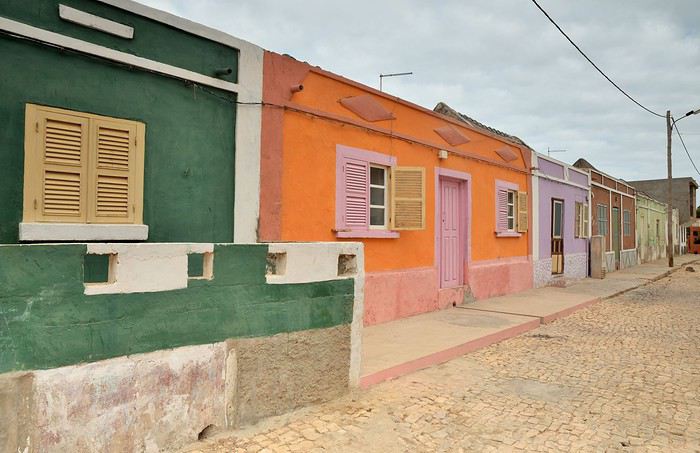 The colorful houses of Vila de Maio
Our first day on the island didn’t let us see the sun. It’s mid-August, the very start of the rainy season—which should really be called the cloudy season. This “rainy” period has nothing to do with what happens in other parts of the world, like Southeast Asia, where the monsoon can be devastating. Here, locals hadn’t seen a drop of rain in nearly a year, and for them, it’s a tragedy. That’s why the ground is so dry and the vegetation so sparse.
As a result, fruits and vegetables are scarce, and livestock are suffering so much that some farmers are forced to cull their herds. Ironically, back in France, we’d just come out of a miserable winter with nearly five months of nonstop gray skies and frequent rain, especially in some regions. Is our climate out of whack?...
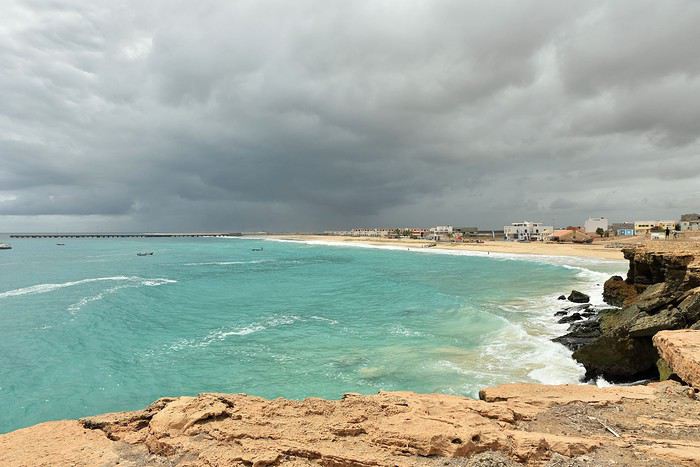 The beach bordering the village of Vila de Maio
We stayed a week on Maio. We were lodged at Stella Maris Village, a small residence at the edge of Vila. A shared pool, perched on a small cliff, overlooks the deep blue sea.
 Sunset at Stella Maris Village
The cliff isn’t very high, but it offers a nice view of the surroundings.

From the residence, it’s just a ten-minute walk through the village to reach the beach.
> The beach and the fishermen
We didn’t choose Maio just for its calm, wild, and authentic vibe. It was also so Victor and Arthur, our two sons, could earn their Level 1 scuba certification in Cape Verde’s beautiful waters, known for their abundant marine life but still relatively untouched by divers—for now...
On the first day, we met Bernard, who runs AAA Maio Plongée, to plan the five dives needed for their certification.
The dive sites are accessible by boat, but to reach it, you have to cross the surf. The waves vary in strength, and while they were gentle for our first snorkeling trip, getting past them with scuba tanks on our backs was a bit more of a workout for the later dives.
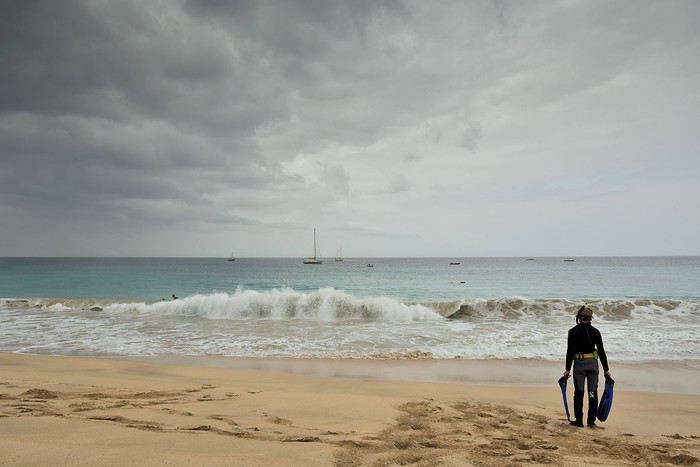
Snorkeling trip: this time, the waves were gentle...
The week of diving with Bernard went perfectly, in Cape Verde’s surprisingly fish-rich waters. On the morning of the last dive, while checking the sea to cross the surf safely, we even spotted a pod of dolphins swimming across the bay in the distance. Always a magical moment...
In a week, the beach at Vila, where the dive club is located, was the liveliest spot we saw on the whole island. All day long, fishing boats returned loaded with fish of all sizes.
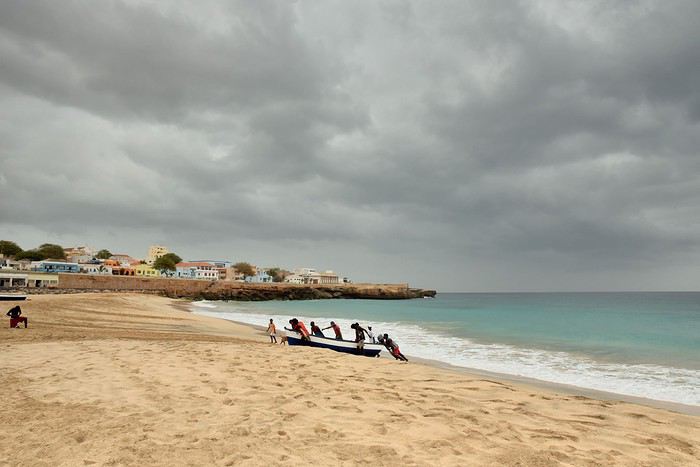 Return from fishing
Here, fishermen have a strong sense of solidarity because they can’t pull their boats out of the water alone, especially when the waves are rough.
So, all day long, whenever a boat comes in, the fishermen on the beach rush to help drag it ashore and secure it higher up on the sand, away from the sea.
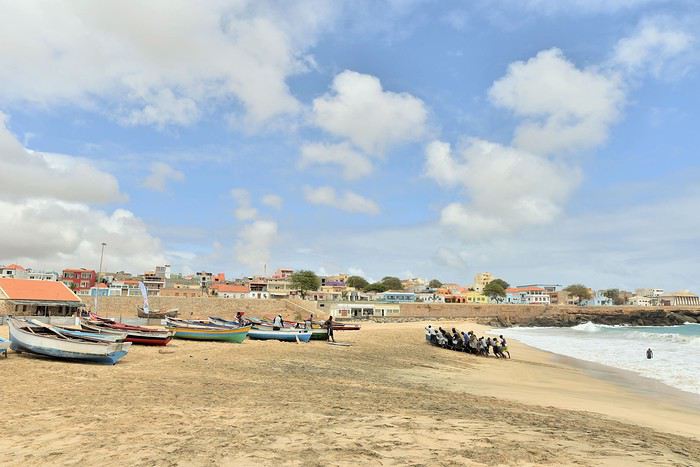
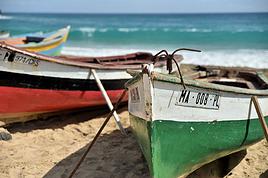
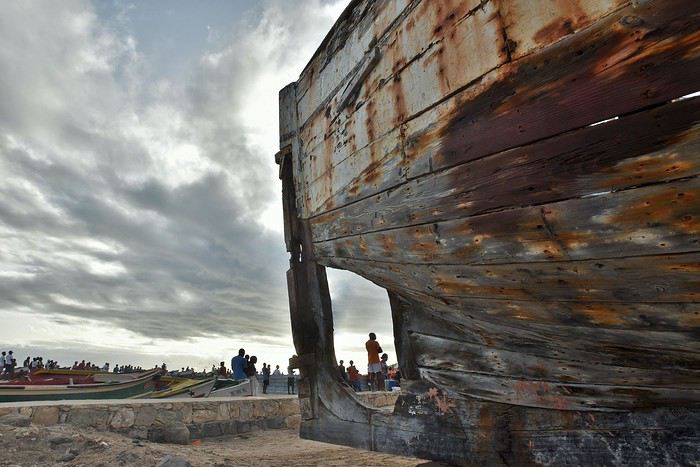
The sight of these colorful fishing boats on the beach is something we saw everywhere in Cape Verde.

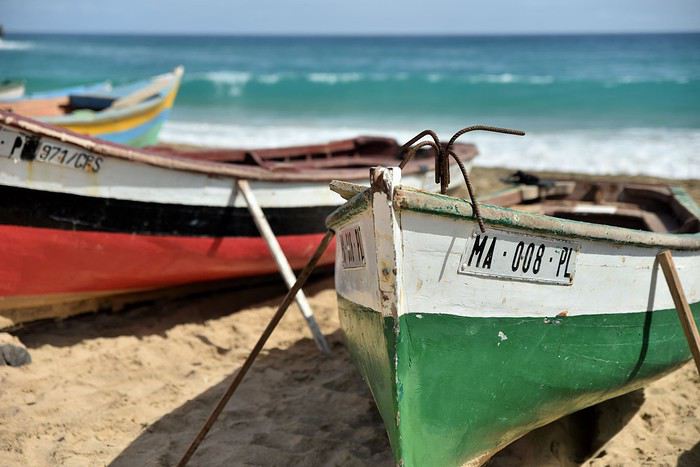
Sometimes, the fishermen bring back impressive catches. Instead of carrying the fish by hand to a proper spot, they clean them right on the beach.
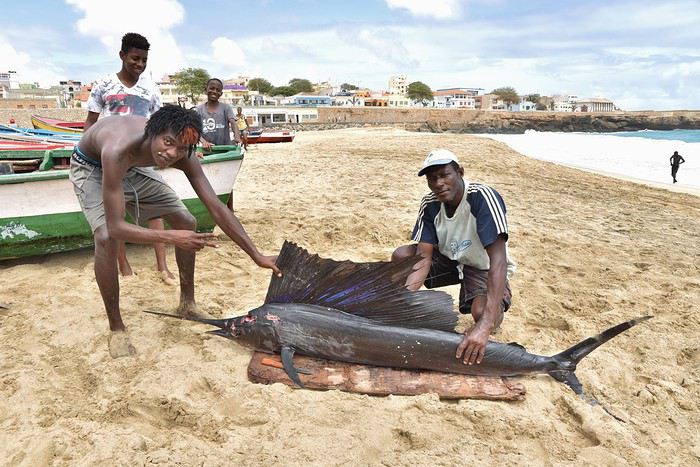
Sailfish
But every evening during our stay, this beach also hosted Maio’s annual soccer tournament. Residents from villages across the island gathered here at the end of the day to compete, including a few women’s teams.
Players were cheered on by hundreds of spectators—which is a lot for a small island with barely 8,000 inhabitants.
The beach doubled as a stadium: sand replaced grass, and the fishermen’s colorful boats served as seats and bleachers. The celebration had a laid-back vibe, with loudspeakers blasting music and the smell of grilled fish in the air.
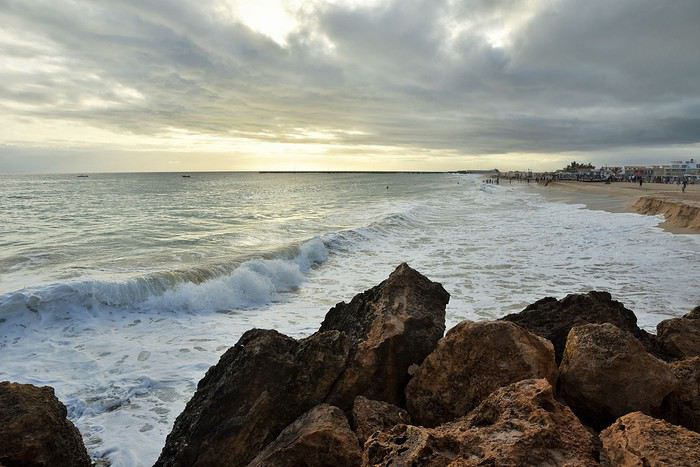
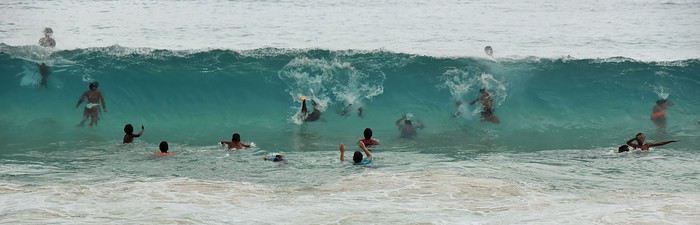
Meanwhile, kids splashed around in the sea, which could sometimes be dangerous. The waves could be strong, but the currents were the real concern.
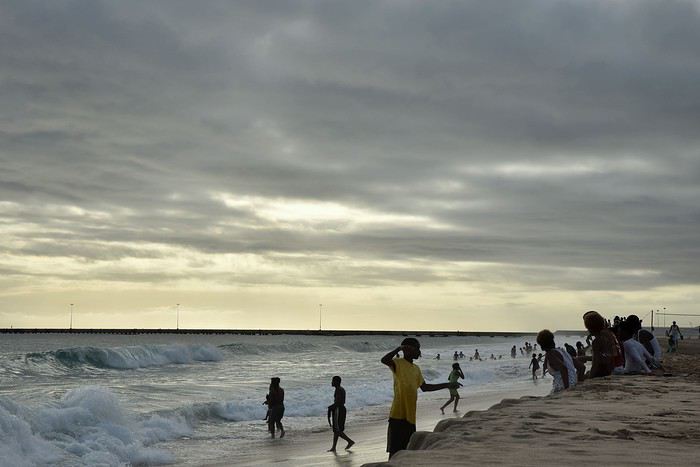
Hi everyone,
After a year where I’ve worked way too much and with a house under renovation, it’s become essential to take a breather. My contract ends on 01/30, and I’ll try to find a new client for early March, so overall, let’s go somewhere in February!
I thought Réunion with the full trek around the Mafate cirque for reconnecting with Nature would be perfect, but since it’s cyclone season, it wasn’t such a great idea. Then came the idea that Southeast Asia could fulfill the peace-and-beach vibe, especially Cambodia with its cultural past, but the flight ticket price and a chat with a friend made me change my mind—and boom, Cape Verde popped up, with Santo Antão for hiking and São Vicente for culture and the beach.
So I bought a ticket a week ago, and oh, what a coincidence—it’s during Carnival!
Except now, I don’t know if it’s reality or just exhaustion talking, but I feel like I’m making a mess of things.
I’ve traveled a lot without even booking the first night, but this time, I pre-booked 2 nights in Mindelo (though one of them ended up canceling itself).
But the main issue is that I arrive on Monday, 02/09 at 6 PM and leave on Sunday, 02/22 at 11 AM, and there’s a little hiccup in the logical organization—actually, several hiccups—since I don’t really have any organization right now, and that’s where I need help
Because Carnival is in full swing from 02/15 to 02/17, right in the middle of my trip, so the logic of my visit to Santo Antão isn’t clicking for me. Plus, I just checked, and there’s zero accommodation available in Mindelo from 02/15 to 02/18 😕
So I don’t know: should I skip Carnival, should I forget about planning and just wing it once I’m there, should I stay on São Vicente after Carnival (because I read Montaganrd’s trip report, and he made São Vicente sound like a rock !), or should I keep in mind the option of heading to Santiago afterward and buying a return flight to Paris from Praia?
I need help 🏴☠️
Hello everyone!
Booked the cruise a year in advance for a departure from Rio on April 5th.
Air France flight to Rio on April 3rd, arriving at the Windsor Plaza hotel, very well located just 300 meters from Copacabana Beach, with a pool on the 15th floor offering a view of Rio.
The next morning, a behind-the-scenes visit to Rio’s Carnival—there were still some floats not yet dismantled and a little samba session. At noon, lunch on Copacabana Beach, which was deserted due to rain and gray skies all day.
Saturday, April 5th, boarding the *Marina*—still raining :( To get around Rio, we used Uber, which was really cheap—5 euros for a 15-minute ride, while taxis cost double... Arrived at the cruise terminal, boarding was very quick as usual with Oceania. The cabins would be ready around 3 PM, with luggage at the cabin door. We had booked an inside cabin. Despite numerous offers from Oceania to upgrade (with a supplement, of course), we stuck with our first choice. It’s worth noting that at least 200 cabins remained unoccupied—about 800 passengers for this transatlantic crossing... Last September, since the cruise wasn’t filling up well, Oceania lowered the price by 1,000 euros per person for an inside cabin—a great deal for us, as they adjusted the rate downward when we asked.
For this cruise, weekends and drinks at the table were included—champagne, wine, beer...—plus an onboard credit that’s now only for excursions (before, it was more flexible—another downgrade, lol).
Headed to the Terrace Café for our first meal, and what a surprise when we saw the changes... No more staff mixing your chosen salad, and way fewer options: big bowls of salad, trays of potato salad, beets, lentils—I don’t remember seeing that before—thin slices of cold cuts and cheese. On the meat side, not much choice and lower quality. Desserts also had fewer options. Well, we’ll make up for it at Jacques on the first night ;) The menu hasn’t changed much—it’s still top-notch. The seasoning is average, but it’s a safe bet.
A little note on the 15-day cruise: we ate at 11 different restaurants—3 at Jacques, 3 at Polo Grill, 3 at Toscana, and 2 at Red Ginger. Not bad for two weeks ;) A French officer invited us to Toscana, which was really nice of her. Polo Grill is still amazing—I’d rank it second after Jacques, with Toscana third and Red Ginger last. I think since the ship wasn’t full, it was easier to get into these restaurants ;)
The staff was, as always, excellent. There were 3 French employees on the *Marina*: 1 waiter at Jacques, 1 manager at Wave, and 1 officer in the offices.
In the afternoon, Tea Time had way fewer pastry choices than before... Cost-cutting seems to be happening at every level. We met people who used to stay in Penthouse Suites—before, they got a bottle of champagne in their suite every night, but since January, it’s been Prosecco instead... Just a small example of Oceania’s cost reductions. At the Terrace Café in the evening, there was no more lobster on this cruise :(
Still, the value for money on this cruise was excellent given the price we paid per person. This transatlantic crossing had 4 stops in Brazil, 1 in the Cape Verde Islands, then Dakar in Senegal, and ended in the Canary Islands.
Mich74
A nice itinerary for 3 weeks in Cape Verde. Hiking, beaches, music, meeting Cape Verdeans.
Thanks,
fabie
Easily accessible from Sal or São Vicente, São Nicolau is the forgotten island of the Barlavento group. With two large villages, volcanoes, jagged peaks, lush valleys, and vast rocky expanses, it has nothing to envy its big sister Santo Antão. It’s slipped under travelers’ radar a bit (in January, there were probably fewer than a hundred European tourists on the whole island), and that’s just fine! Accommodations aren’t overrun by groups like in Santo Antão, and connecting with locals is even easier. But don’t come to São Nicolau for wild nightlife—it’s incredibly peaceful here, and on Sundays, it’s total silence!
A little favorite of mine: Pensão Jardim in Ribeira Brava, the capital; Residencial Palice in Queimadas; and especially Pousada d’Anna in Estância de Brás, where the raging sea crashes against the black lava spurs.
Weather-wise, it was chilly this year but perfect for hiking. If you’re up high (like Monte Gordo), dress warmly or wait for spring! Fog gusts can ground you completely. Trails are generally less marked than in Santo Antão; if you’re wary of apps, you can find a 1:50,000 map at the small travel agency in Tarrafal.
Those who enjoy sharing experiences with other travelers over a Strela or two in the evening might feel a bit frustrated on São Nicolau, but the island’s beauty, the resilience of its farmers in extreme conditions, and the kindness of its people make it a fantastic stop for any visitor to Cape Verde!
Hello,
We’re a couple in our sixties and have finally decided to spend 15 days in Cape Verde from March 1 to 15, 2025, focusing exclusively on the four Leeward Islands.
We’ve planned to take the boat between these four islands and adjust our stays based on the ferry schedules. If there are any difficulties or need to adjust the route, we might take a flight instead.
Here’s our planned itinerary with the boats:
Day 1: Flight from France to Santiago Island
Day 2: Boat from Santiago Island to Brava Island
Day 3: Brava Island
Day 4: Brava Island
Day 5: Boat from Brava Island to Fogo Island
Day 6: Fogo Island
Day 7: Fogo Island
Day 8: Fogo Island
Day 9: Boat from Fogo Island to Santiago Island
Day 10: Santiago Island
Day 11: Boat from Santiago Island to Maio Island
Day 12: Maio Island
Day 13: Boat from Maio Island to Santiago Island
Day 14: Santiago Island
Day 15: Flight from Santiago Island to France.
Based on your experiences and knowledge, could you share: - Your favorite places to visit and hikes - Accommodations that charmed you - Restaurants you enjoyed
Thanks in advance to all travelers and locals from these islands who’d like to share their favorite spots! !
Based on your experiences and knowledge, could you share: - Your favorite places to visit and hikes - Accommodations that charmed you - Restaurants you enjoyed
Thanks in advance to all travelers and locals from these islands who’d like to share their favorite spots! !
Hi there,
A friend has osteoarthritis in the knee and a meniscus problem, treated with regular injections.
Do you know of any insurance companies that cover pre-existing conditions in case their knee locks up in Africa?
Thanks a bunch!
Hello,
We’ve booked our tickets for July—there’ll be 4 of us, maybe 6 (all in our sixties). We’d like to visit 4 islands: Arrival in Praia on July 8th Return from São Vicente on July 29th
Between those dates, I’m not sure how to split our time across each island. We’ll definitely spend at least a week on Santo Antão. We’re planning to visit Santiago, Fogo, São Vicente, and Santo Antão. We’re looking for easy hikes, diving, sightseeing, and a little beach time (but not too much). How do you think we should divide the 3 weeks among the islands? Is 3 days in Fogo enough? Are guides essential, and can we easily find them on the spot? Should we rent a car, given we won’t just be hiking?
Thanks in advance for your advice, tips, warnings, and anything else you can share… and I’ve still got plenty more questions! Valéry
Hello, my wife and I are planning a trip to Cape Verde at the end of May for 20 days. We’re still unsure which islands to prioritize (they all look amazing!). Santo Antão and São Vicente seem like must-sees. Which other islands should we visit, given that we love hiking (nothing too challenging) and swimming?
Thanks
Hello,
In mid-November, we’ll be in Mindelo and Santo Antão.
We’ve booked transportation with Kapverden Tours.
One trip is from Porto Novo to Ponta do Sol, including the hike from Corda to Coculi.
What’s the trail like?
Then we’ll be staying in Ponta do Sol,
Here’s what we’re planning: A hike to Fontainhas—what’s the best direction, considering we’re not great with climbs? No problem with flat terrain or descents. Take an aluguer to Ribeira Grande and continue along the coastal road.
With the agency: An excursion to Cruzinha with a short walk. Return to Porto Novo via the path from Cova to… I’m not sure where yet, to pick up the car for Porto Novo, since we’ll be taking the ferry that evening. We’ll have a guide for this hike.
We’d love to spend a day in Tarrafal, but getting back requires a boat or taxi, and it’s really expensive!
We’re a couple, 78 and 76 years old. What do you think of this itinerary?
Hello,
We’re a family of 5 (2 adults and 3 kids who’ll be 2, 7, and 10 years old) planning to visit the islands of Santiago, Fogo, and Maio this summer. We’ll have 22 full days on the ground. It’s a shame (financially, logistically, and environmentally speaking!), but we’ll be taking 4 flights: a round-trip from Santiago to Fogo and another from Santiago to Maio. We’d like to position Maio toward the end of our stay since we enjoy ending our trips with a quieter beach phase.
For now, based on flight schedules and dates, we’re thinking of doing: 23/07: Arrival in Santiago 24/07 – 30/07: Fogo (5 full days) 30/07 – 05/08: Santiago (5 full days) 05/08 – 11/08: Maio (5 full days) 11/08 – 15/08: Santiago (3 full days) 15/08: Return to France
FOGO: Of course, we want to visit Cha das Caldeiras, where we’d like to spend 3 nights. We’d love to explore the valley and are also considering hiking the smaller Pico (the taller one seems too ambitious for us with the kids). Do you have any info on that hike? What else do you recommend doing on the other days? Where can we go for other walks? I’ve seen that it’s possible to descend from Cha das Caldeiras to Monteiros, but I’m worried it might still be too challenging. It looks amazing!! But how do we manage with our luggage? Otherwise, the north of the island intrigues me, though we’re not thrilled about São Filipe, even though we know we’ll have to spend at least one night there before returning to Santiago.
On this island, we initially thought about not renting a car, but I’m wondering if that’s a good idea for us with all the luggage. If we do rent one, is it easy to reach Cha das Caldeiras by car? Any advice is welcome!
MAIO: Here, I think renting a car will be essential for us to get around easily. We’d like to do an excursion to observe turtle nesting. I haven’t found much info on this—where and with whom should we go? Otherwise, the plan is to do some snorkeling directly from the beach, independently, since we’ll need to take turns so one adult can stay with our 2-year-old. Any spots you’d recommend?
Which towns would you suggest staying in? All options work for us—we’re fine with settling in one place or splitting our time (e.g., 3 nights in one spot and 3 nights elsewhere).
Basically, I’m open to all tips and recommendations for this little week on Maio (short walks, places to relax, beaches, etc.)!
SANTIAGO: Nothing too original, but for Santiago, we’re considering visiting Cidade Velha, Tarrafal, and Ribeira da Prata (for the black sand beach and natural pools), as well as Serra Malagueta for a hike. There must be so much more to do, especially with the time we have. What else would you recommend?
I’m struggling to figure out how to organize our time there since we’ll have 5 full days first, then 3 more. How would you do it?
Thanks,
Good morning! We're heading to Cape Verde for 2 weeks at the end of April—São Vicente, Boa Vista, and Santiago. We’re a family of 5: 3 kids (4, 6, and 12) and 2 adults.
My questions revolve around beaches (a spot with interesting snorkeling and safe swimming for the kids), accommodation (kid-friendly, parks nearby, pool, beach, or nature—more like guesthouses or family-run pensions), hikes (accessible for kids), and whether renting a car makes sense depending on the island, even though local buses are an adventure in themselves.
**Santiago:** - Beach & snorkeling: Tarrafal, Quebra Canela in Praia, Ribeira da Barca (okay for kids?), Águas Belas? - Any nice places to stay? - Hikes: Malagueta?, Baobab Boa Entrada, Pico António (accessible? elevation gain, time to climb, difficulty, interest for kids?)
**Boa Vista:** - Beach + snorkeling: Santa Mónica, Praia de Chaves, Gatas, ... Estoril Beach in Sal Rei maybe? - Can we swim at Turtle Bay to see the turtles even though it’s not nesting season? - Any nice places to stay? - Hikes: Viana Desert? Can we explore it solo by renting a 4x4 and easily find the points of interest? - Is it worth renting a 4x4 for our stay in Boa Vista?
**São Vicente:** - Beach + snorkeling: Laginha, Porto Grande, Praia Grande, Baía das Gatas, São Pedro...? (safe, good snorkeling?) - Any nice places to stay? - Hikes: cliffs?, Monte Verde?
Thanks for your feedback, great tips—especially for accommodation where we’re totally in the dark! And your thoughts on whether renting a car is a good idea and which beaches are safest for kids.
See you soon! Christophe
Hi there, for those who’ve been recently—is it possible to find other solo travelers in March on the island to share transport or room costs? It doesn’t seem easy to travel on a budget.
If you have any recommendations for simple lodgings or places with dorms, I’d love to hear them.
For those who’ve done multi-day treks while moving around: do you need to bring your own sleeping bag? I’d love to hear about itineraries you’ve done without a guide, just with a map and GPS.
Thanks, and have a great day!
Hi,
I’m going on leave to Cape Verde on 12/06/25 and completed the mandatory registration to enter the country. After filling in my identity, passport number, and hotel address, I tried to pay with my debit card. However, I couldn’t validate the payment—an error message appeared, and the same thing happened with two other cards (bug?). If it still doesn’t work by the time I leave, can I pay the fee upon arrival? Is there a way to do it at the Cape Verde Consulate in Paris?
Thanks.
Hi everyone,
I’d like to share our travel plans for March 2026 to get your valuable feedback...
- Arrival in Sao Vicente on Tuesday, March 3rd at 9:20 AM from Lisbon (EasyJet) - Direct departure the same day or the next day for Santo Antao – 3 or 4 nights on Santo Antao (depending on whether we spend the first night in Mindelo or on Santo Antao) - Return to Sao Vicente for 3 nights - Flight to Boa Vista via Sal (Cabo Verde Airlines) on Tuesday, March 10th – 5 nights on Boa Vista - Return flight on Sunday, March 15th (Boa Vista to Porto: EasyJet)
Given the various bits of info I’ve seen about the unreliability of inter-island transport, is this itinerary realistically doable without stress? Would it be better to just take a simple flight from Sao Vicente to Sal and end the trip there (from where it’s also possible to return to Europe or France)? I’m still more drawn to Boa Vista... but I’m worried that two flights in a row might be complicated, unless it’s the same plane that just makes a stopover and continues...
Also, I’m calling on the expertise of hikers for Santo Antao: I’m not a big sports enthusiast—I enjoy walking when I travel, but not distances much longer than 10 km, and nothing too difficult (especially steep climbs where I quickly run out of breath)... For the hike from Ponta do Sol to Cruzinha: can you confirm that the hike is easier in the direction from Ponta do Sol to Cruzinha (less climbing)? I’ve found info that this hike is 14 km and takes about 5 hours. Do you think it’s possible to shorten it by taking a taxi or *aluguer* to Fontainhas? If so, how long would the hike be then, and how much time would it take?
For the hike from Xoxo (starting at the Bela Vista kiosk on the Cova road), I’ve found info that it’s 12 km and takes 5 hours of walking. I think it goes to Ribeira Grande. Apparently, you can shorten the hike and find *aluguers* on the road near Café Melicia... In that case, do you know how long the hike would be? Is this the hike that lets you walk along *levadas* (like in Madeira), cross banana plantations, and pass by the Cachoeira de Vinha waterfall?
Sorry for all these questions, but I can’t find a guide with hikes and difficulty levels... I think two hikes (one along the coast and one inland with terraces, *levadas*, and banana plantations) would suit our level.
On the third free day, do you think we could rent a 4x4 to explore: take the two scenic routes on the east side and maybe venture a little off the beaten path (without taking risks, of course)... Otherwise, hire a guide for the day: do you have any recommendations and an idea of the price?
One last thing: in March, is it worth (or pointless) to choose accommodation with a pool (especially on Santo Antao)? Is the pool water warm enough? What about the ocean temperature?
Thanks so much for your help, have a great day!
Hello,
We’re planning a trip to São Vicente and Santo Antão in January.
We’re a couple (ages 51 and 57).
My husband is really into hiking. As for me, I’m not at my best right now—I’ve just recovered from a long illness and am still on medication that exhausts me and causes a lot of pain, so I won’t be able to keep up with very "physical" hikes.
That said, I still enjoy walking in nature.
We’re looking for advice on where we could stay. A place where my husband can go hiking while I take shorter walks. But also somewhere I can relax in nature, maybe go for a swim if possible, and enjoy local life—markets, music, etc.
Boat trips would be a great bonus for us.
Thanks in advance for your suggestions.
Virginie
Hi there,
I’m considering Cape Verde for an upcoming trip, but I’m wondering if it’s really doable, and if so, which areas would work. We prefer traveling on our own without going through agencies, and without a car to keep costs down. However, since we’re traveling with a baby and a young child, we don’t want to rely on the "usual tricks" like sleeping in a tent, hitchhiking, or walking for kilometers on end. Our walking limit is probably around 4 km max with the little one. Are there enough interesting spots where we can easily see and do things from a central point, walking no more than 4 km? Places with frequent buses to reach activities or sights?
Thanks
Hi there,
I’m looking for a female travel buddy to hike and also enjoy some cultural visits over two weeks starting April 18th. I’m open to destinations but have a soft spot for Cape Verde, and I’m also interested in the Canary Islands or the Balearics. I travel on a small to medium budget—local transport, maybe renting a car where it’s necessary, eating local food, and connecting as much as possible with locals, even getting invited to their homes when possible.
No beach lounging or long days by the sea—this trip is all about geographical and cultural discovery.
Anyone curious and energetic is welcome to reach out! 😊