Hi everyone,
I’m trying to figure out how to get from Paris to Marseille or Montpellier with non-disassembled bikes by train in early July 2025... and it’s a total flop!!! Can’t find any trains that offer the bike-on-board option! It’s so complicated between SNCF-CONNECT, OUIGO, and TER INTERCITÉS!!! Nothing’s simple!
I want to take my teens and their cousins on a bike trip to the Camargue, but I’ll have to start planning way ahead to sort out bike transport!!!
So glad I found VoyageForum for tips! !
Good evening,
We’re planning a cycling tour in Denmark and I’m figuring out how to get there. We have electric mountain bikes (and since I’m really happy with mine, I’d prefer not to rent bikes there). We have 9 days.
- I looked into trains, but the prices aren’t great, and I’m worried we won’t always be able to take our bikes. Packing them in a bag and disassembling them seems overwhelming, especially given how big mine is.
- The Flexibus: we’d have to go through Paris from Lyon, which would waste a lot of time.
- Flying? It might not be more expensive than the train.
- We have a camper van, and I’m wondering if that’s an option. Do you know if you can park your vehicle for a week in a parking lot? I get the impression that parking time is limited. Thanks for your advice! Have a great evening,
Sandrine
We’re planning a cycling tour in Denmark and I’m figuring out how to get there. We have electric mountain bikes (and since I’m really happy with mine, I’d prefer not to rent bikes there). We have 9 days.
- I looked into trains, but the prices aren’t great, and I’m worried we won’t always be able to take our bikes. Packing them in a bag and disassembling them seems overwhelming, especially given how big mine is.
- The Flexibus: we’d have to go through Paris from Lyon, which would waste a lot of time.
- Flying? It might not be more expensive than the train.
- We have a camper van, and I’m wondering if that’s an option. Do you know if you can park your vehicle for a week in a parking lot? I get the impression that parking time is limited. Thanks for your advice! Have a great evening,
Sandrine
Hi there,
I’m currently looking for a bike to do my first bike trip across France, with the ultimate goal of cycling through Latin America. I’ve got a lot of questions and I’d love to hear if you have any answers or advice to share. First off, I’ve been through this before with hiking. I want to get top-quality gear right away. When I started hiking, I ended up buying everything three times—first beginner gear, then intermediate, then expert, etc. For biking, I’d prefer to skip that process and invest right now in a bike that could ideally handle Latin America. I’ve set a total max budget of around 5000 € (roughly 4000–4500 € for the bike and the rest for accessories: panniers, helmet, cycling shorts, etc.).
So, I’ve got quite a few questions:
* I’ve read in several places that some people recommend buying the bike directly in Latin America. Since I need a first bike to train in Europe, would it be better to buy an entry-level bike in France (and sell it before the big departure)? Or is it preferable to start right away with my final bike to get used to it? Is buying it there just to save a bit of money?
* For a long-term trip (around six months) in Latin America, is it better to go for a gravel bike or a mountain bike?
* Should I buy a new bike or a refurbished one? Even more so given that I’m planning a long trip—could a refurbished bike end up causing more breakdowns?
If you have any advice on models, technical features to prioritize, or recommended sellers or resellers, I’d love to hear it. I’m a total beginner—I’ve only just started watching videos and reading up on the subject, and all the technical specs are new to me!
Thanks in advance for your help!
I’m currently looking for a bike to do my first bike trip across France, with the ultimate goal of cycling through Latin America. I’ve got a lot of questions and I’d love to hear if you have any answers or advice to share. First off, I’ve been through this before with hiking. I want to get top-quality gear right away. When I started hiking, I ended up buying everything three times—first beginner gear, then intermediate, then expert, etc. For biking, I’d prefer to skip that process and invest right now in a bike that could ideally handle Latin America. I’ve set a total max budget of around 5000 € (roughly 4000–4500 € for the bike and the rest for accessories: panniers, helmet, cycling shorts, etc.).
So, I’ve got quite a few questions:
* I’ve read in several places that some people recommend buying the bike directly in Latin America. Since I need a first bike to train in Europe, would it be better to buy an entry-level bike in France (and sell it before the big departure)? Or is it preferable to start right away with my final bike to get used to it? Is buying it there just to save a bit of money?
* For a long-term trip (around six months) in Latin America, is it better to go for a gravel bike or a mountain bike?
* Should I buy a new bike or a refurbished one? Even more so given that I’m planning a long trip—could a refurbished bike end up causing more breakdowns?
If you have any advice on models, technical features to prioritize, or recommended sellers or resellers, I’d love to hear it. I’m a total beginner—I’ve only just started watching videos and reading up on the subject, and all the technical specs are new to me!
Thanks in advance for your help!
Hi everyone,
I’m planning a cycling trip in Algeria and looking for concrete firsthand accounts from cyclists who’ve recently traveled there (or residents who know the terrain well). My goal is to map out a realistic 2–4 week itinerary that prioritizes discovery, safety, and solid water/bivouac management.
My profile and gear
Semi-bivouac autonomous cyclist (light tent + sleeping bag + stove), with the option of simple accommodations in towns.
All-road/gravel bike with a rear rack, 40–45 mm tires (I can go up to 47–50 mm if needed).
Compact drivetrain with a small gear range for climbing while loaded.
Modular water capacity of 4–7 liters (soft flasks + bottles), plus a filter and purification tablets as backup.
Navigation via offline maps + GPS, GPX tracks if available.
Planned period
Late winter/early spring (timing to be refined based on your feedback about weather, wind, and day/night temperature swings). I’d love a seasonal breakdown: which areas are more pleasant/rideable during this time? Are there zones to avoid while others become ideal?
Preferred itinerary style
High plateaus and accessible Saharan fringes for a loaded bike, alternating between secondary roads and rideable tracks.
Moderate pace (60–90 km/day depending on terrain and wind), with stops in resource towns to restock, shower, and rest.
Safety and logistics (water/supplies) take priority over pure athletic performance.
My specific questions for those who’ve cycled in Algeria 1) Routes and areas
Which roads/tracks did you enjoy for their scenery and interest without being too rough for a loaded gravel bike?
If you’ve ridden the high plateaus: which connections do you recommend to avoid traffic and stick to small roads?
Saharan fringes: which sections are realistic for partial autonomy (reasonably spaced water points, rideable tracks, not too much soft sand)?
Areas to avoid by bike (recently) due to security, road conditions, katabatic winds, construction, etc.?
2) Water and supplies
How frequent were water points on your routes: reliable wells? taps? sources in towns/villages?
In “desert” sections, how many liters did you carry between secure points? Does a 6–7 L capacity seem comfortable, or should I aim for more on certain stretches?
Food: small shops, markets, availability of basics (semolina, sardines, dates, biscuits, powdered milk, etc.) — how often can you reasonably restock?
Filtration: did a filter + tablets suffice? Are there areas where you’d advise against filtering from unprotected wells?
3) Bivouacking and accommodations
Tolerance for discreet bivouacking (far from dwellings, leave-no-trace): recent experiences?
Simple alternatives: guesthouses, small hotels/hostels, campgrounds (if any), municipal lodgings?
Practical stopover towns for restocking, resting, and securing your bike overnight: reliable spots or neighborhoods to prioritize/avoid?
4) Roads, tracks, and weather
Road surface quality on secondary routes: generally decent or highly variable?
Tracks: rideable (compact gravel, laterite) or sometimes sand/washboard? At what tire width would you recommend switching (45 vs. 50 mm)?
Prevailing winds this season: direction, strength, most exposed hours; do you adjust your departures to ride “before the wind” in the morning?
Temperatures: day/night range; sun protection (long gloves, buff, sunscreen, sunglasses), managing nighttime cold at altitude or in the open desert.
5) Safety, formalities, and connectivity
Recently discouraged zones (please note the date if possible).
Roadside checks: which documents to keep handy; are there specific registrations or declarations required upon arrival or when moving between wilayas?
Local SIM/data: which operators work well on the routes you took; tips for recharging/buying credit.
Useful apps/maps on the ground (and reliable offline maps) for locating water, grocery stores, garages, accommodations, rideable segments, etc.
Bike security: how did you handle anti-theft and parking during errands/overnight stays?
6) Gear and adjustments
Recommended minimum gearing for loaded climbs on local roads/tracks.
Ideal tire width and casing (puncture resistance on gravel and rocks).
“Sweet spot” water capacity based on your experience (and tips: frame bags, extra bottles on the fork, bladders in frame bags, etc.).
Maintenance: dust/sand — greases/seals, drivetrain cleaning frequency, breathable filters, protective socks for zipped panniers.
Sample itinerary outline (to validate with your feedback)
Week 1: Arrival, adjustments, high plateaus, linking resource towns to get into the rhythm, test supplies and water.
Week 2: Accessible Saharan fringes, alternating road/track, nights in discreet bivouac when possible + simple accommodations every 3–4 days.
Week 3–4 (optional): Extend toward a second Saharan area or head back to a more temperate zone depending on weather/wind, prioritizing routes known to cyclists.
If you have GPX tracks (even partial), waypoints (water, grocery stores, accommodations), or a travel journal with dates, I’d love to see them. Dated info (year/month) will help me weigh what may have changed recently.
What I can share in return
After the trip, I’ll publish a detailed report with:
Final itinerary + cleaned GPX tracks,
List of confirmed water points and open supply spots,
Gear review (tires, gearing, water capacity),
Notes on bivouacking/accommodations and safety,
Budget and daily distances, to help future travelers.
Thanks in advance for your tips, warnings, good addresses, and updated feedback. Your experience is invaluable for planning a safe, smooth, and enjoyable cycling route in Algeria. Happy trails! 🚴
I’m planning a cycling trip in Algeria and looking for concrete firsthand accounts from cyclists who’ve recently traveled there (or residents who know the terrain well). My goal is to map out a realistic 2–4 week itinerary that prioritizes discovery, safety, and solid water/bivouac management.
My profile and gear
Semi-bivouac autonomous cyclist (light tent + sleeping bag + stove), with the option of simple accommodations in towns.
All-road/gravel bike with a rear rack, 40–45 mm tires (I can go up to 47–50 mm if needed).
Compact drivetrain with a small gear range for climbing while loaded.
Modular water capacity of 4–7 liters (soft flasks + bottles), plus a filter and purification tablets as backup.
Navigation via offline maps + GPS, GPX tracks if available.
Planned period
Late winter/early spring (timing to be refined based on your feedback about weather, wind, and day/night temperature swings). I’d love a seasonal breakdown: which areas are more pleasant/rideable during this time? Are there zones to avoid while others become ideal?
Preferred itinerary style
High plateaus and accessible Saharan fringes for a loaded bike, alternating between secondary roads and rideable tracks.
Moderate pace (60–90 km/day depending on terrain and wind), with stops in resource towns to restock, shower, and rest.
Safety and logistics (water/supplies) take priority over pure athletic performance.
My specific questions for those who’ve cycled in Algeria 1) Routes and areas
Which roads/tracks did you enjoy for their scenery and interest without being too rough for a loaded gravel bike?
If you’ve ridden the high plateaus: which connections do you recommend to avoid traffic and stick to small roads?
Saharan fringes: which sections are realistic for partial autonomy (reasonably spaced water points, rideable tracks, not too much soft sand)?
Areas to avoid by bike (recently) due to security, road conditions, katabatic winds, construction, etc.?
2) Water and supplies
How frequent were water points on your routes: reliable wells? taps? sources in towns/villages?
In “desert” sections, how many liters did you carry between secure points? Does a 6–7 L capacity seem comfortable, or should I aim for more on certain stretches?
Food: small shops, markets, availability of basics (semolina, sardines, dates, biscuits, powdered milk, etc.) — how often can you reasonably restock?
Filtration: did a filter + tablets suffice? Are there areas where you’d advise against filtering from unprotected wells?
3) Bivouacking and accommodations
Tolerance for discreet bivouacking (far from dwellings, leave-no-trace): recent experiences?
Simple alternatives: guesthouses, small hotels/hostels, campgrounds (if any), municipal lodgings?
Practical stopover towns for restocking, resting, and securing your bike overnight: reliable spots or neighborhoods to prioritize/avoid?
4) Roads, tracks, and weather
Road surface quality on secondary routes: generally decent or highly variable?
Tracks: rideable (compact gravel, laterite) or sometimes sand/washboard? At what tire width would you recommend switching (45 vs. 50 mm)?
Prevailing winds this season: direction, strength, most exposed hours; do you adjust your departures to ride “before the wind” in the morning?
Temperatures: day/night range; sun protection (long gloves, buff, sunscreen, sunglasses), managing nighttime cold at altitude or in the open desert.
5) Safety, formalities, and connectivity
Recently discouraged zones (please note the date if possible).
Roadside checks: which documents to keep handy; are there specific registrations or declarations required upon arrival or when moving between wilayas?
Local SIM/data: which operators work well on the routes you took; tips for recharging/buying credit.
Useful apps/maps on the ground (and reliable offline maps) for locating water, grocery stores, garages, accommodations, rideable segments, etc.
Bike security: how did you handle anti-theft and parking during errands/overnight stays?
6) Gear and adjustments
Recommended minimum gearing for loaded climbs on local roads/tracks.
Ideal tire width and casing (puncture resistance on gravel and rocks).
“Sweet spot” water capacity based on your experience (and tips: frame bags, extra bottles on the fork, bladders in frame bags, etc.).
Maintenance: dust/sand — greases/seals, drivetrain cleaning frequency, breathable filters, protective socks for zipped panniers.
Sample itinerary outline (to validate with your feedback)
Week 1: Arrival, adjustments, high plateaus, linking resource towns to get into the rhythm, test supplies and water.
Week 2: Accessible Saharan fringes, alternating road/track, nights in discreet bivouac when possible + simple accommodations every 3–4 days.
Week 3–4 (optional): Extend toward a second Saharan area or head back to a more temperate zone depending on weather/wind, prioritizing routes known to cyclists.
If you have GPX tracks (even partial), waypoints (water, grocery stores, accommodations), or a travel journal with dates, I’d love to see them. Dated info (year/month) will help me weigh what may have changed recently.
What I can share in return
After the trip, I’ll publish a detailed report with:
Final itinerary + cleaned GPX tracks,
List of confirmed water points and open supply spots,
Gear review (tires, gearing, water capacity),
Notes on bivouacking/accommodations and safety,
Budget and daily distances, to help future travelers.
Thanks in advance for your tips, warnings, good addresses, and updated feedback. Your experience is invaluable for planning a safe, smooth, and enjoyable cycling route in Algeria. Happy trails! 🚴
Hi fellow travelers! I’m planning a trip to Japan from March 22 to April 12 and really want to bike the Shimanami Kaido starting from Onomichi, but I don’t cycle regularly. Has anyone here done it and could share their experience or tips? Is the weather in March-April favorable? Should I plan for 2 or 3 days? Electric or regular bike? What’s better—having my luggage forwarded along the route or leaving it in a locker? Any recommendations for accommodations or bike rentals? Thanks in advance for your replies!
Hello fellow cycling friends,
I’m heading out very soon for a few weeks in France and elsewhere on my trusty two-wheeled steel steed, with a total of me + luggage = around 120 kg gross weight, and I’ve never really tackled mountain passes before—something I’ll definitely be facing this time...
Currently, I’m running 700c wheels and a Deore XT 10-speed drivetrain (long-cage derailleur) with a 26/36/48 chainring setup and an 11-36 cassette. I’m considering two options (and possible modifications) to get a lower gear ratio (currently 0.72) and spin more easily on steep and mountainous climbs...
1 – Install an 11-42 cassette This would give me a gear ratio of 0.61. Would this be feasible with my current rear derailleur, please?
I have several new chains with 116 links—would these work for this cassette, which would have 6 more teeth on the largest cog, or would I need a longer chain?
2 – Swap the 26-tooth small chainring for a 24-tooth one This would give me a gear ratio of 0.66. Would this be feasible, please?
When switching to a 24T, will the gap be accepted by the 36-tooth middle chainring, and will shifting remain as smooth as it is now? Will this setup (24/36/48 + 11-36 cassette) still work well together, in your opinion?
Which of these two options do you think would be more feasible and preferable?
What drivetrain and gearing do you use on your bikes for loaded touring that sometimes involves climbing mountain passes and other steep ascents?
So many questions... Thanks for your answers and advice! Have a great day,
Spady
I’m heading out very soon for a few weeks in France and elsewhere on my trusty two-wheeled steel steed, with a total of me + luggage = around 120 kg gross weight, and I’ve never really tackled mountain passes before—something I’ll definitely be facing this time...
Currently, I’m running 700c wheels and a Deore XT 10-speed drivetrain (long-cage derailleur) with a 26/36/48 chainring setup and an 11-36 cassette. I’m considering two options (and possible modifications) to get a lower gear ratio (currently 0.72) and spin more easily on steep and mountainous climbs...
1 – Install an 11-42 cassette This would give me a gear ratio of 0.61. Would this be feasible with my current rear derailleur, please?
I have several new chains with 116 links—would these work for this cassette, which would have 6 more teeth on the largest cog, or would I need a longer chain?
2 – Swap the 26-tooth small chainring for a 24-tooth one This would give me a gear ratio of 0.66. Would this be feasible, please?
When switching to a 24T, will the gap be accepted by the 36-tooth middle chainring, and will shifting remain as smooth as it is now? Will this setup (24/36/48 + 11-36 cassette) still work well together, in your opinion?
Which of these two options do you think would be more feasible and preferable?
What drivetrain and gearing do you use on your bikes for loaded touring that sometimes involves climbing mountain passes and other steep ascents?
So many questions... Thanks for your answers and advice! Have a great day,
Spady
Hello, I spent a month cycling in Thailand earlier this year with a touring bike equipped with two rear panniers. I loved being able to ride and stop at a hotel every night, and eat just about anywhere. I tried India two months ago but gave up because of the road conditions and chaotic traffic.
I’m looking for countries where I can cycle "without autonomy"—so no tent, no stove, just the bare minimum. Ideally, I’d like to stop at hotels or similar accommodations regularly, without having to cover 200 km a day!
I’d love to hear from your experiences—what countries make it easy to travel this way? Thanks!
I’m looking for countries where I can cycle "without autonomy"—so no tent, no stove, just the bare minimum. Ideally, I’d like to stop at hotels or similar accommodations regularly, without having to cover 200 km a day!
I’d love to hear from your experiences—what countries make it easy to travel this way? Thanks!
Hi everyone,
After a break of a few years, I’m heading back to Madagascar this October. I’d like to travel from Diego to Maroantsetra via Cap Masoala as much as possible by bike—it’s my favorite way to travel. My questions: for the return trip to Diego once I’m in Maroantsetra, is there a possibility to take a flight, since the road option only starts much further south than Tamatave? Or where can I rent or buy a decent bike between Diego and Cap Masoala? For this bike trip, I’m open to any info—I love traveling rough. Someone might even want to join me on this adventure.
After that, I’d also like info on the northeast part (Mozambique Channel side) of Diego, which I’d like to explore by bike as well.
Thanks, and feel free to share any tips—just skip the paternalistic safety advice. Laurent
After that, I’d also like info on the northeast part (Mozambique Channel side) of Diego, which I’d like to explore by bike as well.
Thanks, and feel free to share any tips—just skip the paternalistic safety advice. Laurent
I’ve gotten used to crossing Europe by bus to return by bike.
It was really convenient to take the bike without having to disassemble it.
But FlixBus no longer accepts bikes...
What alternatives do you know about?
Thanks.
Hi there! Every year, we go on a cycling trip abroad with panniers, lasting about two weeks. We stay in step lodgings, guesthouses, and the like. We mostly take small roads and really enjoyed northern Montenegro and Albania last year.
We’d love to hear from anyone who’s cycled in these countries before: tips on finding quiet roads, highlights of the regions we’ll pass through, how welcoming the locals are, and so on. Thanks in advance for any replies or exchanges!
We’d love to hear from anyone who’s cycled in these countries before: tips on finding quiet roads, highlights of the regions we’ll pass through, how welcoming the locals are, and so on. Thanks in advance for any replies or exchanges!
Who among you has explored northern Italy along the Mediterranean, in Liguria?
I’m dreaming of cycling there from Nice, crossing through villages like Menton, Ventimiglia, Dolceacqua, Apricale, Monte Ceppo, Triora, Ponte di Nava, Ormea, Garessio, Ceva, Mondovì, and Cuneo.
Beyond that, it’s the route toward Queyras in France via the Col dell’Agnello, on the slopes of Monte Viso.
A few questions for those who know the area: Is it interesting by bike? Is the road surface decent? Is car traffic low, or at least manageable?
We had this plan back in 2009 as part of a Nice-Rome crossing, but we ended up doing it differently. I might get to revisit it this summer (solo this time, not on a tandem like we usually do).
Looking forward to your thoughts and comments!
Beyond that, it’s the route toward Queyras in France via the Col dell’Agnello, on the slopes of Monte Viso.
A few questions for those who know the area: Is it interesting by bike? Is the road surface decent? Is car traffic low, or at least manageable?
We had this plan back in 2009 as part of a Nice-Rome crossing, but we ended up doing it differently. I might get to revisit it this summer (solo this time, not on a tandem like we usually do).
Looking forward to your thoughts and comments!
Hi there,
We’re leaving from Montreal and planning to bike the Petit Train du Nord route.
Any ideas for loops so we don’t have to return the same way?
We’re thinking of a one-week trip.
Thanks in advance for your tips!
Rachel
Hi,
I'm looking for a train to get to Orly Terminal 4—I'm leaving from Charleroi in Belgium.
Does it seem complicated?
I'm looking for a train to get to Orly Terminal 4—I'm leaving from Charleroi in Belgium.
Does it seem complicated?
Hi there,
I’m planning the route to cycle from Lille to Nordkapp with my partner.
Duration: 3 months, from May 1st to July 31st, 2026.
In the attached details below, I need to add some "non-riding" days (rest days, basically).
So I’m looking to "shorten" the trip by taking ferries or trains for some stretches. Which areas could I skip?
Thanks in advance for your great tips.
Have a good evening.
https://www.komoot.com/fr-fr/collection/4023980/-lille-cap-nord-1er-mai-au-31-juillet-2026?ref=collection
I have 5 months left to prepare for the most ambitious project of my life...
In 5 months, I’ll hit the road, heading to Nepal. Not by plane. Not by train. But by bike.
13,000 km, 18 countries crossed. Powered only by my legs, my will, and a dream.
This journey isn’t just a physical challenge. It’s:
🌍 A human and cultural adventure, meeting locals, landscapes, and traditions. 🌱 A meaningful project: discussing climate change and, above all, listening to those who experience it daily. 🔥 An inner quest, to push my limits and inspire others to step out of their comfort zones. A message of hope for self-discovery.
I have 20 weeks left to: ✅ Finalize my route ✅ Gather the budget and equipment ✅ Sort out the logistics ✅ And most importantly… find committed sponsors to bring this adventure to life.
Any help is welcome!
In 5 months, I’ll hit the road, heading to Nepal. Not by plane. Not by train. But by bike.
13,000 km, 18 countries crossed. Powered only by my legs, my will, and a dream.
This journey isn’t just a physical challenge. It’s:
🌍 A human and cultural adventure, meeting locals, landscapes, and traditions. 🌱 A meaningful project: discussing climate change and, above all, listening to those who experience it daily. 🔥 An inner quest, to push my limits and inspire others to step out of their comfort zones. A message of hope for self-discovery.
I have 20 weeks left to: ✅ Finalize my route ✅ Gather the budget and equipment ✅ Sort out the logistics ✅ And most importantly… find committed sponsors to bring this adventure to life.
Any help is welcome!
Good evening everyone,
Since the forum came back, it's been a bit quiet—no one's sharing their adventures yet. I know it's the start of the season, so let's hope it picks up!
Last Saturday, my buddy Jean Paul (who’ll be 84 next month) and I rode through the cedar forest between Cavaillon and Bonnieux—I highly recommend it! I already knew the area. We started from Pont Royal: me on my latest women’s FUN RIDE SOLO mountain bike (kept it as simple as possible), and him on a road bike with gravel tires. The road starting near Cheval Blanc, called the Vidauque route, is paved but completely wrecked—full of potholes, abandoned for ages, and technically off-limits to cars (though 4x4s still use it). The views over the Cavaillon plain are stunning, but we had to push our bikes a few times. After that, we did 10 km through the gorgeous cedar forest, followed by all downhill and flat terrain through the Lourmarin valley, then Cadenet, before heading toward La Roque-d'Anthéron. From there, we tackled the dirt paths of Provence by bike—beautiful trails—and made our way back to Mallemort and Pont Royal. A great loop: 81.51 km with 908 m of elevation gain. And Jean Paul? Fresh as a daisy at the finish—what an impressive guy!
Now, the real reason for this post: At the start, we followed the Carpentras Canal, which runs from Mallemort to Travaillan (69 km total). I’ve seen some photos on Komoot, and it looks amazing—apparently, there’s always a towpath.
**HAS ANYONE DONE THIS BY BIKE BEFORE? COULD YOU SHARE YOUR EXPERIENCE? THANKS IN ADVANCE!** Serge
Since the forum came back, it's been a bit quiet—no one's sharing their adventures yet. I know it's the start of the season, so let's hope it picks up!
Last Saturday, my buddy Jean Paul (who’ll be 84 next month) and I rode through the cedar forest between Cavaillon and Bonnieux—I highly recommend it! I already knew the area. We started from Pont Royal: me on my latest women’s FUN RIDE SOLO mountain bike (kept it as simple as possible), and him on a road bike with gravel tires. The road starting near Cheval Blanc, called the Vidauque route, is paved but completely wrecked—full of potholes, abandoned for ages, and technically off-limits to cars (though 4x4s still use it). The views over the Cavaillon plain are stunning, but we had to push our bikes a few times. After that, we did 10 km through the gorgeous cedar forest, followed by all downhill and flat terrain through the Lourmarin valley, then Cadenet, before heading toward La Roque-d'Anthéron. From there, we tackled the dirt paths of Provence by bike—beautiful trails—and made our way back to Mallemort and Pont Royal. A great loop: 81.51 km with 908 m of elevation gain. And Jean Paul? Fresh as a daisy at the finish—what an impressive guy!
Now, the real reason for this post: At the start, we followed the Carpentras Canal, which runs from Mallemort to Travaillan (69 km total). I’ve seen some photos on Komoot, and it looks amazing—apparently, there’s always a towpath.
**HAS ANYONE DONE THIS BY BIKE BEFORE? COULD YOU SHARE YOUR EXPERIENCE? THANKS IN ADVANCE!** Serge
Hi everyone,
I’m planning to bike around the Mediterranean. I’m supposed to go through North Africa, but it seems a bit complicated. Visas and travel in Algeria and Egypt only work if you book a hotel (no nights spent outside?). Libya is generally very unclear, and it seems you can only travel there with a local guide (which doesn’t exist for bike trips). If necessary, I’d skip Libya, but neither a bus ride nor a boat detour seems possible to enter Egypt.
Does anyone have tips on how to get around these issues and secure a visa?
Thanks for any advice!
I’m planning to bike around the Mediterranean. I’m supposed to go through North Africa, but it seems a bit complicated. Visas and travel in Algeria and Egypt only work if you book a hotel (no nights spent outside?). Libya is generally very unclear, and it seems you can only travel there with a local guide (which doesn’t exist for bike trips). If necessary, I’d skip Libya, but neither a bus ride nor a boat detour seems possible to enter Egypt.
Does anyone have tips on how to get around these issues and secure a visa?
Thanks for any advice!
Hi,
We’re planning to start the Camino del Cid from Vivar del Cid (Burgos) to Atienza in April.
How can we get back and pick up our car, which we left in Burgos? I haven’t found any info on this.
Thanks for your tips!
Hi there,
I’m planning to ride the Dutch section of the EuroVelo 19, from Maastricht to Rotterdam.
Since it’s too complicated to bring my bike on the train, I’m looking to rent one locally.
I’d love any tips or bike rental shop recommendations—I’m struggling to find options even in Rotterdam.
The plan is to rent in Rotterdam, take the train to Maastricht with the bike, then cycle back to Rotterdam.
Thanks in advance for any advice or suggestions!
Nath
Hi everyone,
I’m heading to Japan for the second time with my 20-year-old son. During our first trip, we spent two weeks in Tokyo and Kyoto (plus the surrounding areas). This time, we’re planning to stay in Tokyo for at least 4-5 days and then head to the island of Naoshima. I’m looking for suggestions and advice: Is getting to Naoshima from Tokyo complicated? If so, do you have any recommendations for a stopover somewhere? Given that we’d prefer not to move every day, we’d rather settle in one place and then explore on day trips... Do you think it’s possible to do something like this: 5 nights in Tokyo (Shinjuku) 3 nights in Kyoto 2 nights in Naoshima (or is one night enough??) and if one night is enough, where could I spend a second night on the way back to Tokyo? 2 nights in Tokyo (I’d love your advice on staying in a different neighborhood—last time we stayed near Ueno Park)—keeping in mind we’re flying out of Narita.
I’m considering maybe skipping Kyoto, which I love but has apparently become *very* touristy... Not really keen on Osaka... since we’ll already have done Tokyo as our "big city." I’d prefer towns where nature is present... (a bit like Kyoto, which offers all that...)
For info, we’ll be traveling by train. Thanks in advance for all your suggestions and help!
I have one last little question: Is cash still widely used in Japan, or not at all anymore?
Thanks so much,
Karine
I’m heading to Japan for the second time with my 20-year-old son. During our first trip, we spent two weeks in Tokyo and Kyoto (plus the surrounding areas). This time, we’re planning to stay in Tokyo for at least 4-5 days and then head to the island of Naoshima. I’m looking for suggestions and advice: Is getting to Naoshima from Tokyo complicated? If so, do you have any recommendations for a stopover somewhere? Given that we’d prefer not to move every day, we’d rather settle in one place and then explore on day trips... Do you think it’s possible to do something like this: 5 nights in Tokyo (Shinjuku) 3 nights in Kyoto 2 nights in Naoshima (or is one night enough??) and if one night is enough, where could I spend a second night on the way back to Tokyo? 2 nights in Tokyo (I’d love your advice on staying in a different neighborhood—last time we stayed near Ueno Park)—keeping in mind we’re flying out of Narita.
I’m considering maybe skipping Kyoto, which I love but has apparently become *very* touristy... Not really keen on Osaka... since we’ll already have done Tokyo as our "big city." I’d prefer towns where nature is present... (a bit like Kyoto, which offers all that...)
For info, we’ll be traveling by train. Thanks in advance for all your suggestions and help!
I have one last little question: Is cash still widely used in Japan, or not at all anymore?
Thanks so much,
Karine
I’m planning a journey of about 2500 km starting from San Pedro de Atacama (duration: max. 2 months). This trip, almost entirely on remote trails, promises to be an extraordinary adventure.
Highlights of the trip - Crossing the Florido Desert (during the blooming season: October 15–30) - Hiking ascents of legendary volcanoes: - Ojos del Salado (6879 m) - Llullaillaco (6739 m) - Uturuncu (6008 m, with 5820 m reachable by mountain bike!) - A 300 km stage through the heart of the desert, with no resupply or habitation: the ultimate experience of solitude and self-transcendence.
Practical details - Daily distance: max. 100 km and 1000 m elevation gain per day - Average altitude: 4000 m (between 3500 and 5000 m) - Temperatures: ~15 °C during the day, down to -25 °C at night (in a tent) - Accommodation: ~50% in villages (with locals or small hostels), ~50% camping
Estimated budget - 1400 € for the flight ticket (including bike supplement) - 1000 € for on-the-ground expenses
Required equipment - Fatbike (essential for deep sand) - -25 °C comfort sleeping bag - Single-wheel trailer (indispensable for these tough terrains)
My experience In 2022, I completed a similar 1200 km trip north of San Pedro de Atacama: - Full crossing of the Salar de Uyuni (170 km) - Ascents of the Ollague (5868 m) and Aucanquilcha (6176 m) volcanoes - Two 200 km stages with no resupply or human presence Videos available for a glimpse of the adventure: - Atacama Crossing 2022 - Part 1 - Atacama Crossing 2022 - Part 2
Next steps If this adventure interests you, I suggest: 1. A first phone call to get to know each other 2. A meet-up over a drink or a test ride in the Bardenas Reales (similar terrain, and I live 100 km away)
Don’t hesitate to contact me for more info or to discuss the details!
Highlights of the trip - Crossing the Florido Desert (during the blooming season: October 15–30) - Hiking ascents of legendary volcanoes: - Ojos del Salado (6879 m) - Llullaillaco (6739 m) - Uturuncu (6008 m, with 5820 m reachable by mountain bike!) - A 300 km stage through the heart of the desert, with no resupply or habitation: the ultimate experience of solitude and self-transcendence.
Practical details - Daily distance: max. 100 km and 1000 m elevation gain per day - Average altitude: 4000 m (between 3500 and 5000 m) - Temperatures: ~15 °C during the day, down to -25 °C at night (in a tent) - Accommodation: ~50% in villages (with locals or small hostels), ~50% camping
Estimated budget - 1400 € for the flight ticket (including bike supplement) - 1000 € for on-the-ground expenses
Required equipment - Fatbike (essential for deep sand) - -25 °C comfort sleeping bag - Single-wheel trailer (indispensable for these tough terrains)
My experience In 2022, I completed a similar 1200 km trip north of San Pedro de Atacama: - Full crossing of the Salar de Uyuni (170 km) - Ascents of the Ollague (5868 m) and Aucanquilcha (6176 m) volcanoes - Two 200 km stages with no resupply or human presence Videos available for a glimpse of the adventure: - Atacama Crossing 2022 - Part 1 - Atacama Crossing 2022 - Part 2
Next steps If this adventure interests you, I suggest: 1. A first phone call to get to know each other 2. A meet-up over a drink or a test ride in the Bardenas Reales (similar terrain, and I live 100 km away)
Don’t hesitate to contact me for more info or to discuss the details!
Great news that the forum is back—we’ve been waiting for this for ages! Now we can chat again with the die-hards like Claudio, Luc Bertand, and everyone else...
Voyager à vélo
A shout-out to a cycling colleague from Savoie
Claudio specializes in the route of the Savoie lakes Here are his travels Between Bornes, Chartreuse, the Savoie foothills, and Dauphiné Five lakes: Léman, Annecy, Paladru, Aiguebelette, Bourget, not to mention a few ponds along the way Plenty of accommodation options: camping, hotels, and more...
A lovely route not far from his place Rural and quite peaceful A road cycling route created by Serge B...
N+1 reconnaissance trips on a loop of about 400 km This way, he avoids the SNCF and its troubles http://cbandiera.free.fr/vv/lacs-savoie/recos.php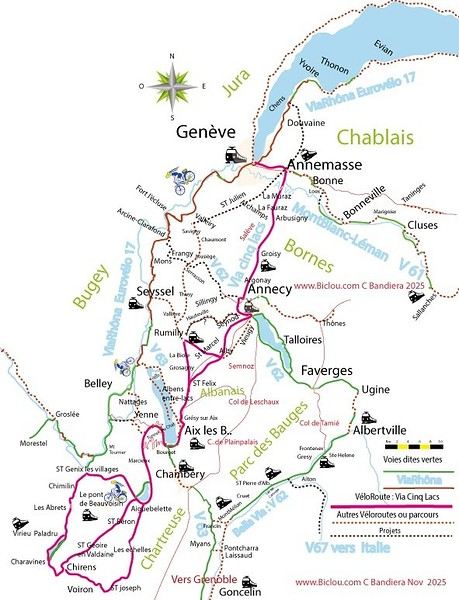
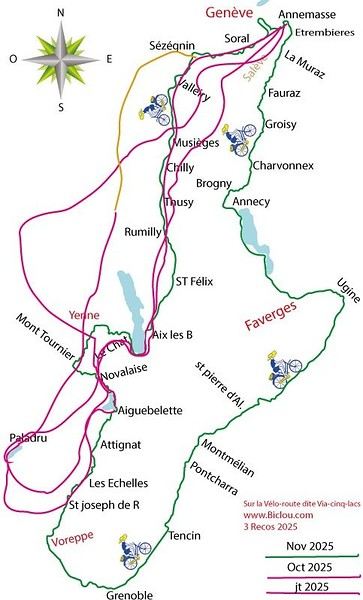
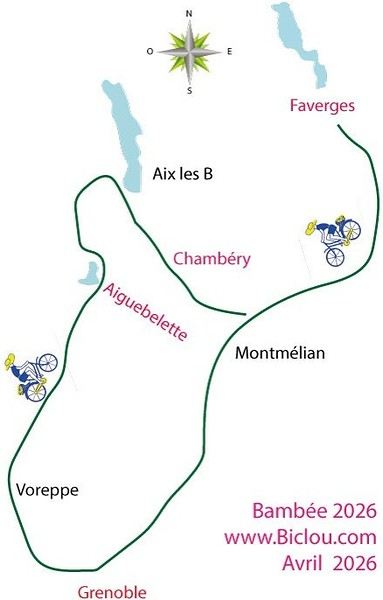
The latest reconnaissance trip from April to May 2026 http://cbandiera.free.fr/recits/2026-grenoble-H/index.php
Claudio specializes in the route of the Savoie lakes Here are his travels Between Bornes, Chartreuse, the Savoie foothills, and Dauphiné Five lakes: Léman, Annecy, Paladru, Aiguebelette, Bourget, not to mention a few ponds along the way Plenty of accommodation options: camping, hotels, and more...
A lovely route not far from his place Rural and quite peaceful A road cycling route created by Serge B...
N+1 reconnaissance trips on a loop of about 400 km This way, he avoids the SNCF and its troubles http://cbandiera.free.fr/vv/lacs-savoie/recos.php
The latest reconnaissance trip from April to May 2026 http://cbandiera.free.fr/recits/2026-grenoble-H/index.php
Hi everyone,
I’m planning a bike trip to cycle around the Baltic Sea (gravel). Starting from Rostock. I’d love to hear from any cyclists who’ve ridden through the countries involved—especially tips on wild camping spots, must-see areas, and where to stock up on supplies, etc.
Thanks in advance!
I’m planning a bike trip to cycle around the Baltic Sea (gravel). Starting from Rostock. I’d love to hear from any cyclists who’ve ridden through the countries involved—especially tips on wild camping spots, must-see areas, and where to stock up on supplies, etc.
Thanks in advance!
Hi there!!
We’re planning a bike trip down the Douro from the Spanish border to Porto in May 2025. We’re looking for any info on possible routes and trails, as well as camping options and/or homestays. Thanks so much!!
We’re planning a bike trip down the Douro from the Spanish border to Porto in May 2025. We’re looking for any info on possible routes and trails, as well as camping options and/or homestays. Thanks so much!!
Hi everyone,
First of all, thank you for all the valuable information you share—it’s really helpful.
My husband and I are heading to South Korea from September 19 to October 6. We know the timing might not be ideal because of Chuseok, but for various reasons, we didn’t have other date options. Plus, this period coincides with some festivals we’ve been eager to check out: the Andong Mask Dance Festival, the Jinju Lantern Festival, and the Hwaseong Festival in Suwon.
Here’s our tentative itinerary:
09/19: Arrival in Seoul 09/20: Bus to Sokcho – explore the city or short hike 09/21: Seoraksan Park 09/22: Return to Seoul 09/23–09/26: Seoul 09/27: Bus or train to Andong – explore the city 09/28: Hahoe 09/29–10/01: Gyeongju 10/01–10/03: Busan 10/03–10/04: Jinju 10/05: Bus/train to Suwon 10/06: Suwon
So here’s my question: Given that several of our trips fall during or around festivals, will it be possible to book bus/train tickets once we’re there, or is there a risk they’ll already be sold out? Specifically for Seoul-Andong, Busan-Jinju, and Jinju-Suwon. I was thinking of booking everything on our first day in Seoul. And if it’s better to plan ahead, how should we go about it? I can’t seem to access the Korail (letskorail) or Kobus websites. Thanks in advance for your answers and help—and sorry for the long post! :)
Have a great day!
09/19: Arrival in Seoul 09/20: Bus to Sokcho – explore the city or short hike 09/21: Seoraksan Park 09/22: Return to Seoul 09/23–09/26: Seoul 09/27: Bus or train to Andong – explore the city 09/28: Hahoe 09/29–10/01: Gyeongju 10/01–10/03: Busan 10/03–10/04: Jinju 10/05: Bus/train to Suwon 10/06: Suwon
So here’s my question: Given that several of our trips fall during or around festivals, will it be possible to book bus/train tickets once we’re there, or is there a risk they’ll already be sold out? Specifically for Seoul-Andong, Busan-Jinju, and Jinju-Suwon. I was thinking of booking everything on our first day in Seoul. And if it’s better to plan ahead, how should we go about it? I can’t seem to access the Korail (letskorail) or Kobus websites. Thanks in advance for your answers and help—and sorry for the long post! :)
Have a great day!
I’m leaving from Munich in May to reach Bran (Dracula’s Castle in Romania).
The plan: crossing Austria, Hungary (via Lake Balaton), and Romania (through the Carpathians). The idea is to avoid following the EuroVelo 6 route.
Do you have any route ideas in Austria to get to Hungary? I get the feeling there aren’t many options for taking secondary networks, and most routes follow valleys carved out by major road axes.
Thanks for your ideas and experiences biking in Austria!
Cheers,
Do you have any route ideas in Austria to get to Hungary? I get the feeling there aren’t many options for taking secondary networks, and most routes follow valleys carved out by major road axes.
Thanks for your ideas and experiences biking in Austria!
Cheers,
Hi there,
Do you know if it’s possible to book train tickets from France on the IRCTC website with a non-Indian phone number? https://www.irctc.co.in/nget/train-search
12GoAsia lets you do it but adds extra fees we’d rather avoid—like an extra 9 € in taxes for two Ahmedabad–Mumbai tickets that cost 38 €. https://12go.asia/fr The same tickets are 3360 rupees on IRCTC.
Thanks in advance for your tips! Alod
Do you know if it’s possible to book train tickets from France on the IRCTC website with a non-Indian phone number? https://www.irctc.co.in/nget/train-search
12GoAsia lets you do it but adds extra fees we’d rather avoid—like an extra 9 € in taxes for two Ahmedabad–Mumbai tickets that cost 38 €. https://12go.asia/fr The same tickets are 3360 rupees on IRCTC.
Thanks in advance for your tips! Alod
Hi there,
I’m heading to Sri Lanka for a month on January 6th.
I’d love to know whether it’s more interesting to start in the north or the south of the country, especially for the beauty of the landscapes—by train in particular.
Thanks for your help!
Hi there,
I can’t seem to complete the payment for my trip on the IRCTC (Indian Railways) site. No matter which payment method I choose, my Visa card isn’t accepted. Has anyone here managed to do it, and if so, could you share the method you used? Thanks in advance! Charlie
I can’t seem to complete the payment for my trip on the IRCTC (Indian Railways) site. No matter which payment method I choose, my Visa card isn’t accepted. Has anyone here managed to do it, and if so, could you share the method you used? Thanks in advance! Charlie