Hi there,
I’ve got a few questions about my upcoming 3.5-week trip to Tamil Nadu and Kerala (January 2025).
On the itinerary, we’re supposed to spend 3 or 4 days in Thanjavur (Tanjore). I thought the location would let us explore the surrounding area, but I’m realizing everything I want to see won’t fit into the schedule!
I’d planned:
1 day to arrive from Pondicherry
1 day to go to Darasuram
1 day to go to Tiruchirappalli
1 day to head to Madurai with a stop in Chettinad
Basically, we won’t see anything of Thanjavur itself! Should I skip one of the destinations?
In Kerala, after 3 days in Munnar, I’ve planned to spend a few days in Munroe Island since I didn’t get great feedback about Alleppey. I wanted to "wander" through the backwaters. Has anyone been there?
Finally, we’re ending the trip in Cherai. After booking, I realized the beaches seemed unusable (trash, rough sea...) and I’m pretty frustrated about not being able to swim. Unless there’s a better spot nearby?
Thanks for your input!
Hello,
I’m interested in the 10-day/8-night "Discover Nepal" tour offered by Capitales Tours, among others. For Day 4, it lists Kathmandu-Mugling-Pokhara as 200 km and 8/9 hours of travel. Is this duration due to the road conditions? I assume the stop in Mugling for lunch is included in the travel time.
For Pokhara-Chitwan, only the distance is mentioned: 160 km. Should I expect a long bus ride there as well?
The proposed flights would be with AIR-INDIA via DELHI. We had issues with AIR-INDIA before—they denied us boarding for Paris even though we arrived at the airport more than 3 hours early. There was no specific counter for PARIS; the counters were for all destinations, and we waited in line for over 2.5 hours only to be told "too late"... Thanks for your advice: Mum49 Is it still like this?
I’m interested in the 10-day/8-night "Discover Nepal" tour offered by Capitales Tours, among others. For Day 4, it lists Kathmandu-Mugling-Pokhara as 200 km and 8/9 hours of travel. Is this duration due to the road conditions? I assume the stop in Mugling for lunch is included in the travel time.
For Pokhara-Chitwan, only the distance is mentioned: 160 km. Should I expect a long bus ride there as well?
The proposed flights would be with AIR-INDIA via DELHI. We had issues with AIR-INDIA before—they denied us boarding for Paris even though we arrived at the airport more than 3 hours early. There was no specific counter for PARIS; the counters were for all destinations, and we waited in line for over 2.5 hours only to be told "too late"... Thanks for your advice: Mum49 Is it still like this?
Hi everyone,
I'm heading to Nepal solo for over 3 weeks at the beginning of March and wanted to get your thoughts on this itinerary:
Mon 03/03: Visit Kathmandu in the afternoon (night in Kathmandu) Tue 04/03: Kathmandu (night in Kathmandu) Wed 05/03: Swayambunath – Pashupatinath (night in Kathmandu) Thu 06/03: Kathmandu in the morning then go to Boudhanath (night in Boudhanath) Fri 07/03: Shechen - Patan (night in Boudhanath) Sat 08/03: Bhaktapur (night in Bhaktapur) Sun 09/03: Changu Narayan (night in Bhaktapur) Mon 10/03: Bhaktapur (night in Bhaktapur) Tue 11/03: Panauti – Namo Buddha (night in Dhulikhel – drop off my bag at the hotel in the morning) Wed 12/03: Dhulikhel (night in Dhulikhel) Thu 13/03: Nagarkot (night in Nagarkot) Fri 14/03: Kathmandu Airport – Flight to Chitwan Park (night in Chitwan) Sat 15/03: Chitwan Park (night in Chitwan) Sun 16/03: Chitwan Park (night in Chitwan) Mon 17/03: Departure to Pokhara (6-hour bus ride) (night in Pokhara) Tue 18/03: Pokhara (Poon Hill trek) Wed 19/03: Pokhara (Poon Hill trek) Thu 20/03: Pokhara (Poon Hill trek) Fri 21/03: Pokhara (Poon Hill trek) Sat 22/03: Pokhara (Paragliding or Sarangkot? Is it possible to do both in one day?)
Sun 23/03: Bandipur (night in Bandipur) Mon 24/03: Kathmandu (night in Kathmandu)
I plan to travel mostly by bus and taxi (for destinations where I can’t take the bus), except for the trip from Kathmandu to Chitwan Park, where I’ll take a flight. Should I book the flight now, or can I do it once I arrive in Nepal? Is a trekking permit required for the hike from Panauti to Namo Buddha Monastery? And is it required for the trek from Dhulikhel to Nagarkot?
Is it better to book the Poon Hill trek in advance through an agency, or is it best to do it independently (without an agency) without a guide or porter? Is it easy to do this trek without getting lost? What’s the typical price for the Poon Hill trek when going through an agency? Is it better to book accommodations for the Poon Hill trek before leaving for Nepal, or can I easily find places to stay on the same day without prior booking? Is it possible to do both the sunrise excursion to Sarangkot and paragliding over the lake in one day (on my fifth and final day there)? Thanks in advance for your help!
I'm heading to Nepal solo for over 3 weeks at the beginning of March and wanted to get your thoughts on this itinerary:
Mon 03/03: Visit Kathmandu in the afternoon (night in Kathmandu) Tue 04/03: Kathmandu (night in Kathmandu) Wed 05/03: Swayambunath – Pashupatinath (night in Kathmandu) Thu 06/03: Kathmandu in the morning then go to Boudhanath (night in Boudhanath) Fri 07/03: Shechen - Patan (night in Boudhanath) Sat 08/03: Bhaktapur (night in Bhaktapur) Sun 09/03: Changu Narayan (night in Bhaktapur) Mon 10/03: Bhaktapur (night in Bhaktapur) Tue 11/03: Panauti – Namo Buddha (night in Dhulikhel – drop off my bag at the hotel in the morning) Wed 12/03: Dhulikhel (night in Dhulikhel) Thu 13/03: Nagarkot (night in Nagarkot) Fri 14/03: Kathmandu Airport – Flight to Chitwan Park (night in Chitwan) Sat 15/03: Chitwan Park (night in Chitwan) Sun 16/03: Chitwan Park (night in Chitwan) Mon 17/03: Departure to Pokhara (6-hour bus ride) (night in Pokhara) Tue 18/03: Pokhara (Poon Hill trek) Wed 19/03: Pokhara (Poon Hill trek) Thu 20/03: Pokhara (Poon Hill trek) Fri 21/03: Pokhara (Poon Hill trek) Sat 22/03: Pokhara (Paragliding or Sarangkot? Is it possible to do both in one day?)
Sun 23/03: Bandipur (night in Bandipur) Mon 24/03: Kathmandu (night in Kathmandu)
I plan to travel mostly by bus and taxi (for destinations where I can’t take the bus), except for the trip from Kathmandu to Chitwan Park, where I’ll take a flight. Should I book the flight now, or can I do it once I arrive in Nepal? Is a trekking permit required for the hike from Panauti to Namo Buddha Monastery? And is it required for the trek from Dhulikhel to Nagarkot?
Is it better to book the Poon Hill trek in advance through an agency, or is it best to do it independently (without an agency) without a guide or porter? Is it easy to do this trek without getting lost? What’s the typical price for the Poon Hill trek when going through an agency? Is it better to book accommodations for the Poon Hill trek before leaving for Nepal, or can I easily find places to stay on the same day without prior booking? Is it possible to do both the sunrise excursion to Sarangkot and paragliding over the lake in one day (on my fifth and final day there)? Thanks in advance for your help!
Hi there, it's me again with more questions about Kerala!
I'm thinking of making the trip from Mysore to Cochin by private car (with a driver, of course) in one day. I'd love to get an idea of the price and travel time (and if you know a reliable agency).
Alternatively, maybe it's more interesting to do this trip by bus? I'm worried it might take much longer than with a private car. This will be my first trip to South India, and I'm not really sure about travel times or how easy it is to get around by local buses or trains. Thanks!
Marsyork
I'm thinking of making the trip from Mysore to Cochin by private car (with a driver, of course) in one day. I'd love to get an idea of the price and travel time (and if you know a reliable agency).
Alternatively, maybe it's more interesting to do this trip by bus? I'm worried it might take much longer than with a private car. This will be my first trip to South India, and I'm not really sure about travel times or how easy it is to get around by local buses or trains. Thanks!
Marsyork
Hi there,
We’re just back from a three-week trip to Sri Lanka, from July 15 to August 11. A few random tips—if you’ve got more specific questions, just ask. If we know the answer, we’ll be happy to help!
What an amazing country! I had a small bias at first, wasn’t totally convinced, but that disappeared fast. Stunning coastal and mountain landscapes, cultural visits, hikes, and such a warm welcome.
Here’s our itinerary in order: Colombo-Anuradhapura-Trincomalee-Polonnaruwa-Dambulla-Sigiriya-Kandy-Haputale-Ella-Tangalle-Galle-Negombo.
Whenever we can, we travel only by public transport, and in Sri Lanka, it’s totally doable. Trains, of course, and buses all the time—everywhere and super cheap. We’d head to the bus station to get a seat, but they also stop along the route. From the airport to Colombo Fort, take bus 187—it’s parked on the right as you exit.
Weather-wise, despite it being the less favorable season for some regions, we only had two half-days of rain. That was one of our worries, but maybe we just got lucky.
For hiking, beyond the well-known climbs in all the guidebooks and blogs (which are great too), there’s a long-distance trail in the mountain region (Kandy, Ella, etc.) that’s really well marked. It’s called the Pekoe Trail, and there’s an app you can download (Pekoe Trail) that gives you the full route and details for each stage—25 in total, I think, ranging from 9 to 15 km. We did 4 of them, not in a row, but starting from our different accommodations. They’re not loops, but you can always find a bus, train, or tuk-tuk to get back or to reach the end of a stage and return. The landscapes are beautiful, the encounters plentiful, and tourists are rare—which is nice sometimes.
Happy travels!
What an amazing country! I had a small bias at first, wasn’t totally convinced, but that disappeared fast. Stunning coastal and mountain landscapes, cultural visits, hikes, and such a warm welcome.
Here’s our itinerary in order: Colombo-Anuradhapura-Trincomalee-Polonnaruwa-Dambulla-Sigiriya-Kandy-Haputale-Ella-Tangalle-Galle-Negombo.
Whenever we can, we travel only by public transport, and in Sri Lanka, it’s totally doable. Trains, of course, and buses all the time—everywhere and super cheap. We’d head to the bus station to get a seat, but they also stop along the route. From the airport to Colombo Fort, take bus 187—it’s parked on the right as you exit.
Weather-wise, despite it being the less favorable season for some regions, we only had two half-days of rain. That was one of our worries, but maybe we just got lucky.
For hiking, beyond the well-known climbs in all the guidebooks and blogs (which are great too), there’s a long-distance trail in the mountain region (Kandy, Ella, etc.) that’s really well marked. It’s called the Pekoe Trail, and there’s an app you can download (Pekoe Trail) that gives you the full route and details for each stage—25 in total, I think, ranging from 9 to 15 km. We did 4 of them, not in a row, but starting from our different accommodations. They’re not loops, but you can always find a bus, train, or tuk-tuk to get back or to reach the end of a stage and return. The landscapes are beautiful, the encounters plentiful, and tourists are rare—which is nice sometimes.
Happy travels!
Hi everyone,
I’m currently on the lookout for adventure and can’t stop thinking about the Himalayas. My main goal is this: I’d like to make a documentary about the region’s wildlife and flora using my own resources.
For now, I’m planning to stay there for a few months. I’d love to exchange ideas with you all to help me prepare for this trip as best as possible.
I’ve got a few questions in particular: - On this kind of trip, where and how do you find food?
- Which are the quiet spots where you won’t see another soul, and which are the best places to spot wild animals? (I’m guessing the two are connected)
- I’ve read several times that adventure/independent travel can be tricky in certain countries or areas—is that still the case today?
This is also my first solo trip, and I’m wondering if I’m being too ambitious. What do you think?
Thanks in advance for your feedback,
Axel
I’m currently on the lookout for adventure and can’t stop thinking about the Himalayas. My main goal is this: I’d like to make a documentary about the region’s wildlife and flora using my own resources.
For now, I’m planning to stay there for a few months. I’d love to exchange ideas with you all to help me prepare for this trip as best as possible.
I’ve got a few questions in particular: - On this kind of trip, where and how do you find food?
- Which are the quiet spots where you won’t see another soul, and which are the best places to spot wild animals? (I’m guessing the two are connected)
- I’ve read several times that adventure/independent travel can be tricky in certain countries or areas—is that still the case today?
This is also my first solo trip, and I’m wondering if I’m being too ambitious. What do you think?
Thanks in advance for your feedback,
Axel
Hi there,
I’m thinking of heading to Tamil Nadu and Karnataka in early 2026.
Two places I’m curious about: Tiruvannamalai (Tamil Nadu) and Kollegal (Karnataka).
For Tiruvannamalai, I’ve already found quite a bit of info on this forum, but the most recent posts are from 2018. Has anyone been there more recently? My plan is to stay for about a week, book a guesthouse, visit the big Shiva temple, Ramana Maharshi’s ashram, and the caves in the mountain. Any other spots in this town you’d recommend? Would you happen to know a nice guesthouse (preferably around 1500 rupees, doesn’t need to be near the ashram)?
As for Kollegal, I’m not finding much info. And I’m stuck on this permit issue for staying in the town. Can anyone fill me in?
Thanks for your help!
I’m thinking of heading to Tamil Nadu and Karnataka in early 2026.
Two places I’m curious about: Tiruvannamalai (Tamil Nadu) and Kollegal (Karnataka).
For Tiruvannamalai, I’ve already found quite a bit of info on this forum, but the most recent posts are from 2018. Has anyone been there more recently? My plan is to stay for about a week, book a guesthouse, visit the big Shiva temple, Ramana Maharshi’s ashram, and the caves in the mountain. Any other spots in this town you’d recommend? Would you happen to know a nice guesthouse (preferably around 1500 rupees, doesn’t need to be near the ashram)?
As for Kollegal, I’m not finding much info. And I’m stuck on this permit issue for staying in the town. Can anyone fill me in?
Thanks for your help!
Hi everyone! 🙂
My partner (who’s a teacher—hence the summer holidays) and I are heading to Eastern India for 23 days in July. This is my 5th trip to India, but her first.
We fly into Delhi on July 7th and leave from Delhi on the 23rd (since our flight to Kolkata arrived late at night, and I wanted to show Agra and Varanasi to my partner).
We love getting off the beaten track and meeting people, so we’ll mostly be taking the train.
Here’s what we’re planning:
- **DELHI**: 1 night on the way (short because the plane is supposed to land at 01:55), then we take the train at 13:00 - **GWALIOR**: 3 nights, including a day trip to **AGRA** by train to see the Taj Mahal and the Red Fort (I find Agra too touristy to stay overnight). Otherwise, in Gwalior, the Fort, the temples, the Man Mandir Palace, and the Jai Vilas Palace if we have time. - **ORCHHA**: 2 nights... *maybe skip this to spend more time in VARANASI?* - **VARANASI**: overnight train + 3 nights, the Ghats, temples... maybe a day trip to **SARNATH**. - **KOLKATA**: overnight train + 3 nights. Maybe a countryside excursion to the ashram in Channa. *- Here we’re hesitating over 2 nights: either 2 nights in **SHANTINIKETAN** with a visit to **CHANNA** on the way, or a 2-day excursion to the **SUNDARBAN** nature park. But is it worth it in July during the monsoon?* - **PURI**: overnight train + 4 nights. *We’re planning to do everything from Puri, as it seems nicer than staying in BHUBANESWAR. What do you think?* Visit **KONARK** and **CHILIKA LAKE**. *Is it worth visiting Chilika Lake this season? Another question: can you swim in Puri, or is it too dangerous (waves)?* - Train to **BHUBANESWAR**, then a flight from BHUBANESWAR to **DELHI**, - 2 nights in **DELHI**, visiting Jama Masjid, and *either Humayun’s Tomb, Safdarjung’s Tomb, or Qutb Minar.*
Back to Paris. Total: 23 nights.
What do you think of these choices? What about the options we’re still unsure about *(in bold/italics)*? Thanks so much! 🙂
We fly into Delhi on July 7th and leave from Delhi on the 23rd (since our flight to Kolkata arrived late at night, and I wanted to show Agra and Varanasi to my partner).
We love getting off the beaten track and meeting people, so we’ll mostly be taking the train.
Here’s what we’re planning:
- **DELHI**: 1 night on the way (short because the plane is supposed to land at 01:55), then we take the train at 13:00 - **GWALIOR**: 3 nights, including a day trip to **AGRA** by train to see the Taj Mahal and the Red Fort (I find Agra too touristy to stay overnight). Otherwise, in Gwalior, the Fort, the temples, the Man Mandir Palace, and the Jai Vilas Palace if we have time. - **ORCHHA**: 2 nights... *maybe skip this to spend more time in VARANASI?* - **VARANASI**: overnight train + 3 nights, the Ghats, temples... maybe a day trip to **SARNATH**. - **KOLKATA**: overnight train + 3 nights. Maybe a countryside excursion to the ashram in Channa. *- Here we’re hesitating over 2 nights: either 2 nights in **SHANTINIKETAN** with a visit to **CHANNA** on the way, or a 2-day excursion to the **SUNDARBAN** nature park. But is it worth it in July during the monsoon?* - **PURI**: overnight train + 4 nights. *We’re planning to do everything from Puri, as it seems nicer than staying in BHUBANESWAR. What do you think?* Visit **KONARK** and **CHILIKA LAKE**. *Is it worth visiting Chilika Lake this season? Another question: can you swim in Puri, or is it too dangerous (waves)?* - Train to **BHUBANESWAR**, then a flight from BHUBANESWAR to **DELHI**, - 2 nights in **DELHI**, visiting Jama Masjid, and *either Humayun’s Tomb, Safdarjung’s Tomb, or Qutb Minar.*
Back to Paris. Total: 23 nights.
What do you think of these choices? What about the options we’re still unsure about *(in bold/italics)*? Thanks so much! 🙂
hi everyone, I’m putting together an itinerary for Sri Lanka in September 2026, so I’m focusing on the east side of the island because of the monsoon on the west coast:
Day 1 Kandy: botanical garden, fruit and vegetable market, traditional dance show
Day 2 Kandy-Ella train
Day 3-4 Kumana NP or Lunugamvehera Block 6+5
Day 5-6 Komari / Pottuvi lagoon safari
Day 7 head up the east coast along the beaches to reach Wasgamuwa NP
Day 8 Wasgamuwa NP early morning safari, then Polonnaruwa (temple and palace)
Day 9-10 Sigiriya Lion’s Rock and Dambulla, cave temple
Day 11-12 Wilpattu NP early morning safari, then late afternoon
Day 13-14 Kalpitiya, snorkeling and chilling
Day 15 return to Colombo
Thanks for sharing your thoughts on whether this route is doable—we’ll be traveling with a driver-guide.
Feel free to mention any great tips or good homestay experiences you’ve had, since we prefer those.
Hi there,
I’d like to head to Upper Dolpo in September/October 2026.
Does anyone know the current state of the roads in the area?
Specifically for getting from Saldang to Dho Tarap.
Also, what do you think about the weather between September 20th and October 20th?
Any tips would be much appreciated.
I’ve already checked out the info on Martinpierre’s site—it’s super detailed about the region, but the details are a bit outdated.
Thanks in advance for your advice.
Thierry
Hi there,
I’m planning a 3-week trip to Sri Lanka in January. I’ve always traveled with a backpack, moving every couple of days or so, and I’ve seen the recommended itineraries where you only need one night in each place.
But this time, since I’m really tired, I’d like to settle in for a few days when I arrive. I’d love to find a quiet, pretty spot where I can rest, swim, and eat well ;)
Are there still beautiful places by the sea with few tourists? And do any of you know some great spots or hostels you could recommend for those few days?
After that, I’ll move on to a short itinerary—I know I won’t be able to see everything, and that’s not the goal. No rushing this time ;) just enjoying and discovering at my own pace.
Thanks in advance for your tips!
I’m planning a 3-week trip to Sri Lanka in January. I’ve always traveled with a backpack, moving every couple of days or so, and I’ve seen the recommended itineraries where you only need one night in each place.
But this time, since I’m really tired, I’d like to settle in for a few days when I arrive. I’d love to find a quiet, pretty spot where I can rest, swim, and eat well ;)
Are there still beautiful places by the sea with few tourists? And do any of you know some great spots or hostels you could recommend for those few days?
After that, I’ll move on to a short itinerary—I know I won’t be able to see everything, and that’s not the goal. No rushing this time ;) just enjoying and discovering at my own pace.
Thanks in advance for your tips!
Hi there! 🙂
Please, how can I get from:
- PATNEM to GOKARNA
- GOKARNA to UDUPI (or UDIPI)
- UDUPI to MANGALORE
- MANGALORE to KANNUR
What are the different transport options, the price (if possible, otherwise no worries), and the approximate travel time 😉
Thanks so much to those who take the time to reply!
Have a wonderful day!
Sandra
Hi there,
We’re a family with kids aged 10 and 12, and we’ll be in Sri Lanka during the Kandy Esala Perahera. I’d love to know if it’s really worth prioritizing the procession on the final night—is it that different? What do the other nights miss out on? From what I’ve gathered, you can watch for free if you’re okay with sitting on the ground, which isn’t an issue for us. In that case, is it still easy to get a good view? We’ll be coming from Jaffna—are train tickets to Kandy harder to get during the Perahera? Also, August 8th is a public holiday. Do trains still run on public holidays?
Thanks in advance for your tips! !
We’re a family with kids aged 10 and 12, and we’ll be in Sri Lanka during the Kandy Esala Perahera. I’d love to know if it’s really worth prioritizing the procession on the final night—is it that different? What do the other nights miss out on? From what I’ve gathered, you can watch for free if you’re okay with sitting on the ground, which isn’t an issue for us. In that case, is it still easy to get a good view? We’ll be coming from Jaffna—are train tickets to Kandy harder to get during the Perahera? Also, August 8th is a public holiday. Do trains still run on public holidays?
Thanks in advance for your tips! !
Hi everyone, and first of all, I wish you all wonderful travels in 2025! ;)
My partner and I (we're seniors) are leaving at the end of January for a 40-day trip to India, arriving in Cochin and departing from Delhi. After reading lots of travel journals about India, I’ve put together an itinerary, but I’m worried it might be too (very?) packed... Here’s my plan:
5 or 6 days in the backwaters Munnar: 1 or 2 nights? Ideally next: Madurai, Trichy, Tanjore, Kumbakonam, Chidambaram, Pondi, Mahabalipuram (number of nights in each place to be decided if I keep Tamil Nadu) Flight from Chennai to Varanasi Varanasi: 2 or 3 nights Overnight train to Agra Agra: 1 night Drive to Jaipur with a stop in Fatehpur Sikri Jaipur: 3 nights Bundi: 3 nights Drive to Udaipur with a stop in Chittorgarh? Udaipur: 2 nights Drive to Jodhpur with a stop in Ranakpur Jodhpur: 1 night Jaisalmer: 3 nights Flight to Delhi, then back to France.
This all feels *very* packed. We’re thinking of taking taxis between cities fairly often if public transport is too complicated or time-consuming. Do you think this is doable? Otherwise, the alternative would be to spend more time in Kerala (though we’re not really beach people) and skip Tamil Nadu (which I’d hate to do!!) to focus more on the north instead. We’ve never been to India before, and I’m a little worried about feeling overwhelmed with all the city and temple visits. We’re more used to alternating nature and culture. Looking forward to your valuable advice to finalize our itinerary!
My partner and I (we're seniors) are leaving at the end of January for a 40-day trip to India, arriving in Cochin and departing from Delhi. After reading lots of travel journals about India, I’ve put together an itinerary, but I’m worried it might be too (very?) packed... Here’s my plan:
5 or 6 days in the backwaters Munnar: 1 or 2 nights? Ideally next: Madurai, Trichy, Tanjore, Kumbakonam, Chidambaram, Pondi, Mahabalipuram (number of nights in each place to be decided if I keep Tamil Nadu) Flight from Chennai to Varanasi Varanasi: 2 or 3 nights Overnight train to Agra Agra: 1 night Drive to Jaipur with a stop in Fatehpur Sikri Jaipur: 3 nights Bundi: 3 nights Drive to Udaipur with a stop in Chittorgarh? Udaipur: 2 nights Drive to Jodhpur with a stop in Ranakpur Jodhpur: 1 night Jaisalmer: 3 nights Flight to Delhi, then back to France.
This all feels *very* packed. We’re thinking of taking taxis between cities fairly often if public transport is too complicated or time-consuming. Do you think this is doable? Otherwise, the alternative would be to spend more time in Kerala (though we’re not really beach people) and skip Tamil Nadu (which I’d hate to do!!) to focus more on the north instead. We’ve never been to India before, and I’m a little worried about feeling overwhelmed with all the city and temple visits. We’re more used to alternating nature and culture. Looking forward to your valuable advice to finalize our itinerary!
Hi there,
I’ve sketched out a rough itinerary for Sri Lanka (from late February to late March), starting in Colombo and then going clockwise (so I’d begin with Negombo, Anuradhapura, and I don’t think I’ll head all the way north to Jaffna because that’s a lot of kilometers just for a round trip—unless you can convince me otherwise! ;)). After that, I’ll hit the Cultural Triangle and then the tea plantations in the center of the island. The east coast will depend on how much time I have left and the weather (I’ve heard March can be rough on the east coast). I’ll wrap up my trip with the beaches in the south, back to Colombo. 😊
What do you think of this 4-week itinerary? (On the map, a few points aren’t connected by lines—that means I’m not sure if I’ll go there):
https://www.google.com/maps/d/edit?mid=1TX9sgHSjh9iwINIIknOG4LtCieNdUOw&ll=7.716250171694787%2C81.39557361748045&z=7
Maybe there are a few too many stops, so I’d love some suggestions to streamline this itinerary a bit.
Thanks in advance for your feedback and advice on how many days to spend in each place! :)
hi there,
what a joy this forum is back up and running!
so happy to be the first Sri Lanka post.
it’s helped me plan so many real trips—unlike other sites that are mostly commercial, pushing drivers, and such.
new adventure in Sri Lanka! here’s our itinerary from November 6th to 22nd, 2024.
Our plan: 3 days in Habarana (Mineriya or Kaudulla, Polonnaruwa, Dambulla, Sigiriya) 3 days in Kandy (including two days at the Elephant Freedom Project) 1 day on the train from Kandy to Haputale (Lipton’s Seat) 2 days in Ella 1 day in Uda Walawe 1 flexible day to adjust as needed 2 days in Tangalle or nearby (which beaches are the quietest?) 1 day in Galle 1 day in Colombo
thank you in advance for any tips or advice you can share—we’re so excited to explore this amazing country!
looking forward to hearing from you, we’ll be sure to share our experience when we’re back.
Monique
new adventure in Sri Lanka! here’s our itinerary from November 6th to 22nd, 2024.
Our plan: 3 days in Habarana (Mineriya or Kaudulla, Polonnaruwa, Dambulla, Sigiriya) 3 days in Kandy (including two days at the Elephant Freedom Project) 1 day on the train from Kandy to Haputale (Lipton’s Seat) 2 days in Ella 1 day in Uda Walawe 1 flexible day to adjust as needed 2 days in Tangalle or nearby (which beaches are the quietest?) 1 day in Galle 1 day in Colombo
thank you in advance for any tips or advice you can share—we’re so excited to explore this amazing country!
looking forward to hearing from you, we’ll be sure to share our experience when we’re back.
Monique
Hello, we’re planning a trip to Sri Lanka in April 2025.
We’re a family of four adults, and we love getting off the beaten path while still enjoying local life and, of course, visiting the main tourist sites (after all, you can’t visit a country without appreciating its highlights!).
We’re looking for a reputable travel agency for a private trip with a driver and a guide—whether they speak French or not. Yes, it’s possible! We were lucky enough to have this experience on our last two trips to India and Laos. It was absolutely wonderful, insightful, and enriching thanks to the local visits.
Anyway, if anyone has done a similar road trip, we’d love to follow in your footsteps.
Thanks for all your tips!
NorGra
Namaste everyone,
We went to Nepal last October and literally fell in love with this country (like so many others, it seems). During our trek, we had the chance to meet and travel with an incredible independent local guide, Apsara Luitel. She told us about a unique project she’s organizing starting mid-May, and we wanted to share it in case it interests anyone. We mentioned it on another travel forum, but just in case, we’re posting it here too to reach as many people as possible.
Apsara, who knows the Api mountain valley (a name as joyful as it is intriguing!) in Nepal’s Far West (on the border between India and Tibet, at the edge of the world) perfectly, is offering an off-the-beaten-path trek for a group of 3 to 8 people max. The program? An authentic and preserved itinerary combining homestays and small mountain lodges, all the way to the Api base camp. Once at base camp, locals will guide us to secret spots only they know, where we’ll harvest yarsagumba (those famous caterpillar-fungi, rare and prized for their medicinal properties in traditional Chinese medicine—they were going for $20,000 per kilo last year!).
Mid-May is the ideal time to discover this almost unexplored region and take part in harvesting these natural treasures. This kind of adventure, led by an inspiring young woman like Apsara, is rare, and we think it could appeal to Nepal lovers and those who enjoy authentic treks far from the usual tourist routes.
No matter how many participants there are (between 3 and 8), there will always be two guides: Apsara, who speaks English (and is learning French!), and a French-speaking guide. The dates are flexible around May 15th, depending on the availability of those who’d like to take on the adventure.
We went to Nepal last October and literally fell in love with this country (like so many others, it seems). During our trek, we had the chance to meet and travel with an incredible independent local guide, Apsara Luitel. She told us about a unique project she’s organizing starting mid-May, and we wanted to share it in case it interests anyone. We mentioned it on another travel forum, but just in case, we’re posting it here too to reach as many people as possible.
Apsara, who knows the Api mountain valley (a name as joyful as it is intriguing!) in Nepal’s Far West (on the border between India and Tibet, at the edge of the world) perfectly, is offering an off-the-beaten-path trek for a group of 3 to 8 people max. The program? An authentic and preserved itinerary combining homestays and small mountain lodges, all the way to the Api base camp. Once at base camp, locals will guide us to secret spots only they know, where we’ll harvest yarsagumba (those famous caterpillar-fungi, rare and prized for their medicinal properties in traditional Chinese medicine—they were going for $20,000 per kilo last year!).
Mid-May is the ideal time to discover this almost unexplored region and take part in harvesting these natural treasures. This kind of adventure, led by an inspiring young woman like Apsara, is rare, and we think it could appeal to Nepal lovers and those who enjoy authentic treks far from the usual tourist routes.
No matter how many participants there are (between 3 and 8), there will always be two guides: Apsara, who speaks English (and is learning French!), and a French-speaking guide. The dates are flexible around May 15th, depending on the availability of those who’d like to take on the adventure.
Hi there,
I’m planning a trip to Bangladesh for tourism during All Saints' Day 25. The government website is pretty discouraging! I’d love to hear from people living there or who’ve been recently before I buy my tickets.
How’s the security level and feasibility of a circuit (boat, train, bus around the country)? We’re used to basic conditions :)
Thanks in advance for your tips!
Cécile
Hello,
We’ve already traveled to India twice before, but only for two-week stretches (2013, a loop from Mumbai including Hampi, and in 2019, Tamil Nadu). This time, we’re leaving at the end of October for nearly three months of travel—something completely new for us! We’ll arrive in Delhi and depart from Bangalore. Our goal is to explore Northern India and then head down to Kerala, taking a maximum of one flight and prioritizing trains.
Traveling for this long should let us plan longer stops to slow down the pace and fully enjoy our trip...
What are the places you’ve loved with this in mind? I’ve already thought of Gokarna... Do you have any other suggestions, especially in Northern India? Thanks in advance for your tips!
Traveling for this long should let us plan longer stops to slow down the pace and fully enjoy our trip...
What are the places you’ve loved with this in mind? I’ve already thought of Gokarna... Do you have any other suggestions, especially in Northern India? Thanks in advance for your tips!
Hi everyone!
So great to be back on this Forum!
My question is in the title: is it possible to reach Bhutan from Kolkata by entering through the Phuntsholing border crossing? If anyone has already done this route, it would really put my mind at ease... 😉
Thanks in advance for all your replies! 🤪
Lydie
It seems there’s a ferry from Nagapattinam to Jaffna in India. Has anyone here taken this ferry before? My main question is how to get to Nagapattinam—by train, bus? And from which town further south, of course.
Thanks, friends!
Gaston
Gaston
Hi everyone,
We’re heading out in March for this trek. We’re used to hiking and long-distance treks, but this’ll be our first time in Nepal.
QUESTION: People from Nepal are telling us it’s MANDATORY to have guides! Is this true, or is it just agencies trying to get work for their staff?
The Lonely Planet says: "In April 2023, the government announced that every trekker would need to hire the services of a porter or a licensed guide to obtain the TIMS permit. The law isn’t enforced, and by 2025, there were no longer any obligations for teahouse treks."
What do you think? What’s your experience? Thanks for your feedback.
We’re heading out in March for this trek. We’re used to hiking and long-distance treks, but this’ll be our first time in Nepal.
QUESTION: People from Nepal are telling us it’s MANDATORY to have guides! Is this true, or is it just agencies trying to get work for their staff?
The Lonely Planet says: "In April 2023, the government announced that every trekker would need to hire the services of a porter or a licensed guide to obtain the TIMS permit. The law isn’t enforced, and by 2025, there were no longer any obligations for teahouse treks."
What do you think? What’s your experience? Thanks for your feedback.
Hi there, I’m spending about ten days in Kerala, and of course, I’d love to see the backwaters (I’m open to all possible tips—I don’t want to sleep on a houseboat). My question is:
Is it doable to spend a good half-day in the backwaters while staying at Marari Beach?
Thanks!
Marsyork
Is it doable to spend a good half-day in the backwaters while staying at Marari Beach?
Thanks!
Marsyork
Hi everyone.
The tickets for SRI LANKA are booked—arriving in COLOMBO on 12/21 and returning from the same place on 01/17. I’ve read here and there that it’ll be high season, but we don’t have a choice, so we’ll make do...
My first question is obviously about the itinerary: Most of the ones I’ve seen go clockwise, and I’m wondering if I should do it the other way: - To avoid the cultural triangle between Christmas and New Year’s - To start with a bit of rest (we’re really wiped out) Does that make sense?
My second question is about the time allocated to each stop, which you’ll find below. Is it balanced? Too much here and not enough there?
My third question will be about Jaffna: yes or no? How long is the trip from Anuradhapura? Where can I fit in the 3 days needed?
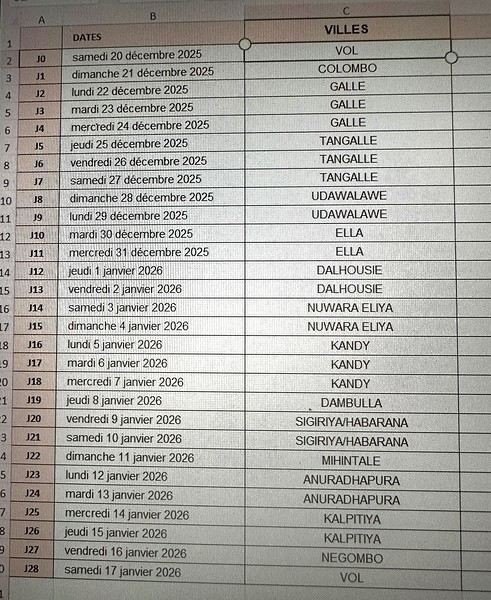
Thanks for your replies. A few details: ultra-independent travelers, using public transport, hikers, minimum 2 nights per accommodation. First time in Sri Lanka! !
The tickets for SRI LANKA are booked—arriving in COLOMBO on 12/21 and returning from the same place on 01/17. I’ve read here and there that it’ll be high season, but we don’t have a choice, so we’ll make do...
My first question is obviously about the itinerary: Most of the ones I’ve seen go clockwise, and I’m wondering if I should do it the other way: - To avoid the cultural triangle between Christmas and New Year’s - To start with a bit of rest (we’re really wiped out) Does that make sense?
My second question is about the time allocated to each stop, which you’ll find below. Is it balanced? Too much here and not enough there?
My third question will be about Jaffna: yes or no? How long is the trip from Anuradhapura? Where can I fit in the 3 days needed?
Thanks for your replies. A few details: ultra-independent travelers, using public transport, hikers, minimum 2 nights per accommodation. First time in Sri Lanka! !
Hi there, I think you're on the right track—you plan the itinerary and book the rooms in advance, and that’s it.
Not only do you save time, but you also know where you’ll be staying each night. Choosing well on Booking (or elsewhere) is actually a pleasure!
For safaris, given the number of jeeps with drivers available, it’s unlikely you’ll be turned away... the real issue is more about the concentration of jeeps around the animals.
I travel like you do—train, bus, tuk-tuk, and sometimes taxi. Ride-hailing apps like PickMe and other VTCs are mostly in big cities.
For the mountain train, due to severe flooding, service was interrupted on the line between Kandy and Ella. Check ahead, because reservations for this train are very complicated, if not impossible.
For the Colombo/Kandy train, you reserve your seats by buying the ticket before boarding. In the south, no need to book in advance for trains.
In Sri Lanka, there’s always a solution for getting around—just ask your hosts. They have trusted contacts at their fingertips. But still, compare prices—😏 smart move!
I stick to booking my nights and keep pre-planned activities to a minimum.
For reservations you can’t skip, it’s the beach stays you’ll want to secure.
Hello,
I’m heading to Sri Lanka for 3 weeks in July with my two 11-year-old kids, and I’m wondering about how to organize the trip. We’re used to traveling on the go, staying 1 to 2 or 3 nights per place depending on how we feel.
Do you recommend planning the itinerary and booking accommodations in advance to save time once we’re there? Or is it pretty easy to organize everything as we go without any issues?
Same question for activities: Should we book safaris and tours ahead of time, or can we arrange them easily on the spot? Is there a risk of not getting a spot, for example, to visit a park since we’ll be there in July?
We’ll be using local transport (train, VTC via PickMe, tuk-tuk) to get from one place to another.
In short: Are there any must-book things we should reserve now? So far, I only have the flight tickets!
Thanks in advance for your help! 😊
I’m heading to Sri Lanka for 3 weeks in July with my two 11-year-old kids, and I’m wondering about how to organize the trip. We’re used to traveling on the go, staying 1 to 2 or 3 nights per place depending on how we feel.
Do you recommend planning the itinerary and booking accommodations in advance to save time once we’re there? Or is it pretty easy to organize everything as we go without any issues?
Same question for activities: Should we book safaris and tours ahead of time, or can we arrange them easily on the spot? Is there a risk of not getting a spot, for example, to visit a park since we’ll be there in July?
We’ll be using local transport (train, VTC via PickMe, tuk-tuk) to get from one place to another.
In short: Are there any must-book things we should reserve now? So far, I only have the flight tickets!
Thanks in advance for your help! 😊
Hi there,
We’re planning a trip to Nepal and would love to do a helicopter tour to Everest with Namche Heli Service. Has anyone here used this agency? I can’t seem to find any reviews online. Thanks in advance!
Kloki
We’re planning a trip to Nepal and would love to do a helicopter tour to Everest with Namche Heli Service. Has anyone here used this agency? I can’t seem to find any reviews online. Thanks in advance!
Kloki
Hi fellow travelers!
I arrive in New Delhi on January 5th, and this is the third time I’ve come across what turns out to be a scam (after some research outside of booking.com): dirty places, fake reviews, etc.
So I’m starting to distrust booking.com because it really doesn’t seem like a reliable site (at least when it comes to booking hotels in New Delhi).
If you have a good place to stay (max 1500 € per night, and I don’t want a dorm) in New Delhi, I’d love to hear about it! :)
Looking forward to your replies!
If you have a good place to stay (max 1500 € per night, and I don’t want a dorm) in New Delhi, I’d love to hear about it! :)
Looking forward to your replies!
Hi,
I’m leaving this Saturday for Northern India from 15/02 to 27/02. I’m planning to visit New Delhi, Agra, Chand Baori, Jaipur, Ranthambore, Bundi, Udaipur, and Jodhpur.
What’s the best way to get around? I was thinking of doing everything by train. Maybe taking the bus for some stretches?
As for renting a car with a driver, it seems expensive, so I’ve pretty much ruled that out. Unless someone’s got space for the same dates?
Thanks for your insights!
What’s the best way to get around? I was thinking of doing everything by train. Maybe taking the bus for some stretches?
As for renting a car with a driver, it seems expensive, so I’ve pretty much ruled that out. Unless someone’s got space for the same dates?
Thanks for your insights!