Discussions TerryTara took part in
13 results on this page.
More options
Search results
Road conditions
Hello,
Can anyone tell me what the current road conditions are like around Kathmandu, Pokhara, and Australian Camp? Thanks! Guylaine
Can anyone tell me what the current road conditions are like around Kathmandu, Pokhara, and Australian Camp? Thanks! Guylaine
Poon Hill trek in February: what are the conditions?
Hello,
I know there are plenty of discussions on VF about the Poon Hill trek, but most seem outdated and/or don’t provide info specific to February. That’s why I’m bringing this topic back up.
Here’s my plan: - Spending about two weeks in Nepal in the first half of February. - Maybe extending by a few days to a week if needed. - Heading to Pokhara—first time for my partner, second for me (I was there in September/October 1982!). - Doing a relatively easy 4- to 5-day trek. We’re not exactly spring chickens anymore (though we’re in pretty good shape for our age). - We don’t want to go above 3,000–3,500 meters, deal with difficult sections if there’s too much snow, or face daytime temperatures below 10°C. No problem if it drops to 0–5°C at night since we’ll be sheltered somewhere.
So, I’m wondering if the Mardi Himal trek might be too demanding for us, and if we’d be better off sticking with Poon Hill. What do the experts think?
Local agency and French-speaking guide for Annapurna Circuit in Nepal
Hi there, I’m planning the Annapurna Circuit for March 2027 and I’m looking for a local agency with a local guide—preferably French-speaking—to arrange this trek for us. Any suggestions? Thanks
Annapurna Circuit trek: when to book accommodations?
hi,
we’d like to do a trek in Nepal, and we’re thinking of the Annapurna Circuit—it’s cheaper than the Everest trek.
Our plan is to do it without a guide or porter. We’re used to the mountains, not so much to high altitude, but if we acclimate well, there’s no reason it should go wrong ;)
No guide = handling permits, transport, and accommodation on our own...
So my question is: is it possible to book lodges in advance before departure? Or, even better, day by day?
I’ve read some older posts, so I’m asking again to get up-to-date info on what’s happening now. We’re planning to go mid-November 2026 or March 2027.
Thanks for your tips! :)
Langtang – Trekking in the Rain
We did the Langtang trek (hike) from September 10th to 17th, with the first and last days being the trip from Kathmandu and back—so 6 days of actual walking. It’s a fairly well-known trek but certainly not as famous or crowded as those in the Annapurna or Everest regions, which is why we chose it.
In theory, it’s mandatory to have a guide for this trek. In reality, it seems there are ways to bypass the regulations: we met at least two people hiking without a guide—a South Korean, a New Zealander, and possibly also a couple of English women and an American couple, though we’re not sure if they had a guide.
The agency we booked with had told us it was an affordable trek for relatively older people in good shape—which is our case (I’m 72 myself). I have to say upfront that we found it quite challenging, maybe because we didn’t have good weather—it was the end of the monsoon season. To be clear, no matter your fitness level, I’d say doing this trek in the middle of the monsoon season would be suicidal.
Day 1 – Journey from Kathmandu to Syapru Besi
On Monday, September 8th, there had been violent protests in Kathmandu against the government, which had, among other things, blocked access to social media and been accused of nepotism and corruption. There were 19 deaths. The situation was very tense on the day of our departure, Wednesday the 10th. The agency warned us that public transport was very unreliable. So, we decided to take a jeep, at an additional cost of $100 ($160 minus what was already budgeted for the bus).
We left a little before 7 a.m. and it took us a good hour just to reach the outskirts of Kathmandu. Along the way, we saw several houses and vehicles set on fire by protesters.
The road to Syapru Besi is only 120 km, but it’s frankly awful. It’s always narrow, winds through endless mountains, and the shoulders range from bad to confusing to nonexistent. Several sections are just dirt tracks. We didn’t regret opting for the jeep, as we could stop several times at our convenience—if only to let Y (my Thai partner) throw up everything she had. She’d taken her usual motion sickness medication, but the constant turns, accelerations, and braking eventually made her terribly carsick.
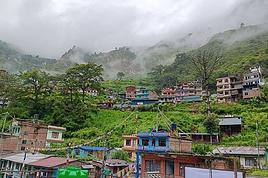
In Nuwakot, we stopped for breakfast at a nice little restaurant, Jimbu. It was around 8:30 a.m., and we’d barely covered 60 km. The restaurant has a lovely garden overlooking the Trishuli Ganga, the river flowing down from Syapru Besi. First photo: the river in the bottom right corner, mist and clouds over the mountain on the other side.
An hour later, my second photo: the hills along the Trishuli Ganga. You can see the different crops—lush green rice paddies in the lower right and corn, already yellowed and likely harvested, in the foreground on the left. And of course, the mist and clouds through which you can glimpse the mountain on the other side of the river.
Is it possible to do the Api Himal trek staying in lodges or tea houses?
Hi, has anyone been to the Api Himal region recently? Can you do the trek staying in lodges or tea houses in 2025? Thanks, Aichatou
Looking for recent info on climbing Mera Peak
Hi there,
I’ll be in Nepal in October. I’m planning to do the Annapurna trek and climb Mera Peak. From what I’ve heard, it’s one of the most accessible 6,000m peaks and doesn’t require a mandatory guide? The info I’ve found is pretty scattered—mostly just travel agency blogs. :-) Has anyone here already done this climb? I’ve heard you can find guides in Khare for just the final part of the ascent (which is way cheaper).
Thanks for your feedback!
Can’t wait to be there! :-)
Short family trek options in Nepal?
I’m heading to Nepal at the end of April 2026 with my brother, the two kids, and my mom.
My mom is 75, in good shape, she walks but isn’t a big sports enthusiast. My daughter is 16, she’s not really into hiking but with the right vibe, she’ll step up.
I’m looking for a 5-6 day trek that’s not too difficult—around 4-5 hours of walking and 500-600m of elevation gain per day. What’s our goal?
Well, like everyone, we’d love something not too crowded. We want to experience Nepali village life away from the main routes—terraced fields, all that. Some encounters, authenticity, sharing... And if we can catch a glimpse of some high peaks, even better.
Any suggestions?
Trek in Nepal's Far West: Between Mountains and Yarsagumba Harvesting
Namaste everyone,
We went to Nepal last October and literally fell in love with this country (like so many others, it seems). During our trek, we had the chance to meet and travel with an incredible independent local guide, Apsara Luitel. She told us about a unique project she’s organizing starting mid-May, and we wanted to share it in case it interests anyone. We mentioned it on another travel forum, but just in case, we’re posting it here too to reach as many people as possible.
Apsara, who knows the Api mountain valley (a name as joyful as it is intriguing!) in Nepal’s Far West (on the border between India and Tibet, at the edge of the world) perfectly, is offering an off-the-beaten-path trek for a group of 3 to 8 people max. The program? An authentic and preserved itinerary combining homestays and small mountain lodges, all the way to the Api base camp. Once at base camp, locals will guide us to secret spots only they know, where we’ll harvest yarsagumba (those famous caterpillar-fungi, rare and prized for their medicinal properties in traditional Chinese medicine—they were going for $20,000 per kilo last year!).
Mid-May is the ideal time to discover this almost unexplored region and take part in harvesting these natural treasures. This kind of adventure, led by an inspiring young woman like Apsara, is rare, and we think it could appeal to Nepal lovers and those who enjoy authentic treks far from the usual tourist routes.
No matter how many participants there are (between 3 and 8), there will always be two guides: Apsara, who speaks English (and is learning French!), and a French-speaking guide. The dates are flexible around May 15th, depending on the availability of those who’d like to take on the adventure.
Tips for a trip to Bangladesh
Hi there,
I’m heading to Bangladesh in less than a month for about three weeks—a country I’ve never traveled to before and one with no recent guidebooks (Routard, Lonely Planet, etc.). I’m reaching out to those of you who’ve explored it in the last few years and are willing to share your experiences. I’d love your help planning my route so it takes me not just to the "tourist" spots but also to places where local life is a real treat, especially for someone who’s a true contemplative traveler. Thanks so much for your invaluable tips!
Philou
Budget hotel in New Delhi
Hi everyone,
I’m not sure if this is a good idea... but I’m throwing a message in a bottle out there again...
I’m looking for a hotel in New Delhi for the end of the month (just one night—for a layover). I’m wary of scams on the usual sites. You find all sorts of prices and huge discounts... but reviews on other platforms scream "scam" about those same hotels. Not that I’m not up for adventure, but if I can avoid making an avoidable mistake, I’d rather learn and discover with kind people than through unscrupulous tourist touts. At the same time, maybe this’ll be helpful to others too.
Is a budget of 40 € (+/-) doable? 50 € (+/-)? Does that sound reasonable? What do you think? Your experiences would really help me out. Thanks, friends.
Looking forward to reading your replies.
Warm regards to all
Feasibility and safety for a trip to Bangladesh
Hi there,
I’m planning a trip to Bangladesh for tourism during All Saints' Day 25. The government website is pretty discouraging! I’d love to hear from people living there or who’ve been recently before I buy my tickets.
How’s the security level and feasibility of a circuit (boat, train, bus around the country)? We’re used to basic conditions :)
Thanks in advance for your tips!
Cécile
Transport to eastern Nepal / Low Himalayan Trail
hi, I'm looking for info on possible transport to Ilam and then Phidim from KTM, as well as details about this trek. I found the PDF but no feedback from those who’ve tried it... have a great day, Aichatou