Posts by Pierlu
About 382 results.
More options
Search results
Which VPN for a month in China?
Hi there,
Last February, I used the free version of Proton VPN. It worked. Except for connecting to VF. Because this site blocks VPN connections. But it also often blocks connections coming from China without a VPN, seeing them as suspicious activity. 😏
Since my smartphone doesn’t support eSIMs, I also had Bouygues’ China plan. That worked really well.
As for eSIMs, I saw that Alipay offered plans for much cheaper that let you access sites usually blocked for Chinese users (WhatsApp, Google, etc.).
Safe travels
What bike for a long trek to Nepal?
1/ Should I go for 26" or 28" wheels for my project? 26" seems better for rough terrain, but 28" feels more comfortable on roads. I’ve also read that 26" tires/tubes are easier to find.
2/ Do you recommend a steel fork and frame over aluminum? I’m thinking a good-quality aluminum frame and fork would be better than a low-quality steel one, right?
3/ Is 0.71 a good gear ratio for a loaded bike in the mountains?
4/ Finally, what do you think of these four models for my trip? I’m leaning toward the TX-400—it seems to offer the versatility and durability I’m looking for. But the price difference with the T-700 LTD makes me hesitate!
1/ 26" is a standard that’s disappearing worldwide. Either way, in remote parts of the world, you won’t find spare parts, no matter the standard. My current bike has 26" wheels. My next one will be 28".
2/ My current touring bike’s frame is steel. The one I’m building now is also steel. If I’d found a good aluminum frame, I would’ve gone with aluminum because it’s lighter.
3/ It depends on your fitness. That said, grinding up steep climbs (over 8-10%, even 15-20%) with a loaded bike is a myth. In those situations, you’ll do what everyone else does—push your bike. Or stop every 100 meters. Or take a bus. 😄
4/ Watch out for bike sizing. Fharrad’s frame sizes, for example, are very limited (47, 52, 57). If one of those fits you, great. Otherwise, the bike might be too big or too small. The downside of rim brakes, like V-brakes, is that they’re less effective (loaded bike on descents 😅) and wear out the rims quickly (I ruined a pair of wheels in Iceland riding in the rain on volcanic ash trails—wrecked the pads *and* the rims in just a few kilometers). Hydraulic systems are impossible to repair on the road unless you carry a full toolkit. As for mechanical disc brakes, I’ll be able to share my thoughts once I finish building my new bike and take it on my next winter trip to Southeast Asia. 🏡🏡🏡 Happy trails
Tips and feedback on China, Vietnam, Cambodia
Kunming
The bike path along Dian Lake is pretty and often well protected from cars. But as everywhere in China, there are huge crowds. Not much advice for your visits since the flower market is a wholesale market and not very interesting in the end. As for the Museum of Minorities, it closed right in front of us.
All the big shopping malls are good places for your shopping.
Hi Arnaud,
In Kunming, I really enjoyed visiting the Yuantong Buddhist Temple:
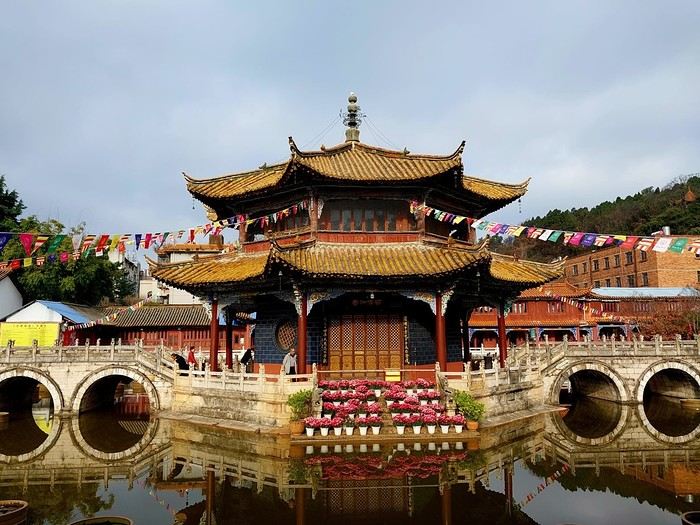
I also liked the Emerald Lake Park. But there, it was crowded—really packed with Chinese tourists, especially since I was there during Chinese New Year:
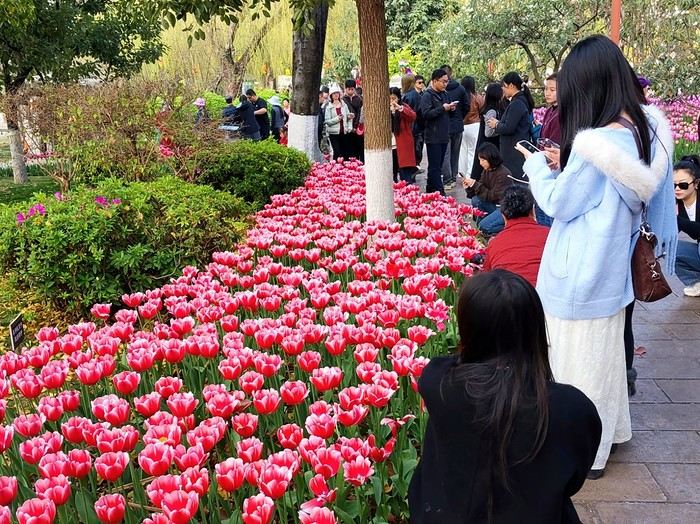
Otherwise, regarding Dian Lake, there’s no problem cycling along it. Even when there’s no bike path, it’s relatively calm because Chinese drivers are generally careful with cyclists. I experienced this a few months ago during my bike trip in this region of China: https://voyageforum.com/forum/compte-rendu-periple-dans-yunnan-velo-d11466713/
Hi Arnaud,
In Kunming, I really enjoyed visiting the Yuantong Buddhist Temple:
I also liked the Emerald Lake Park. But there, it was crowded—really packed with Chinese tourists, especially since I was there during Chinese New Year:
Otherwise, regarding Dian Lake, there’s no problem cycling along it. Even when there’s no bike path, it’s relatively calm because Chinese drivers are generally careful with cyclists. I experienced this a few months ago during my bike trip in this region of China: https://voyageforum.com/forum/compte-rendu-periple-dans-yunnan-velo-d11466713/
Low-travel telescopic fork for a touring bike
Hello,
Thanks to everyone for your feedback.
As I mentioned in a previous post, wide tires (which therefore require low inflation pressure) weren’t enough to handle the roads I shared photos of.
For reference, I had Marathon Mondial tires that were 2 inches (5 cm) wide, with a recommended pressure of around 2.5 to 5 bars, if I remember correctly.
The issue is that the load a tire can support decreases as the pressure drops.
For example, the Marathon Mondial can handle a maximum load of 130 kg, but only at maximum pressure (according to the manufacturer’s data).
So, riding with a fully loaded bike at minimum pressure isn’t recommended.
To improve comfort, another option is to switch to tubeless soft tires. But that’s not suitable for the kind of travel I do.
I have a gravel bike set up tubeless, so I’m speaking from experience.
These tires are more fragile.
Plus, sealant only works for very small punctures. If the hole in the tire is too big, repairs—like using a plug—usually don’t last. Eventually, you’ll need to replace the tire entirely, which means carrying one or even two spare tires and a bottle of sealant for trips to remote areas.
That leaves my question about the durability and reliability of a telescopic fork...
PS: I’m ruling out the Lauf Grit fork because it’s carbon. I’m also excluding a suspended seatpost because my issue is bike stability and hand pain, not discomfort in the saddle.
Low-travel suspension fork for touring bike
Today, I’m on a mission to lighten my load overall so I can tackle positive elevation changes more smoothly, and I’ve gone for wider, more flexible tires and added gel inserts under my handlebar tape to absorb vibrations.
Absolutely, handlebar tape with gel and large-section tires (which therefore require lower inflation pressure) help absorb road imperfections. But my question about the usefulness of a suspension fork concerns roads that are pretty degraded, like the ones I encountered last March in northern Laos. To illustrate, here are three photos of national roads 13 N and 7, a good portion of which are in poor condition:
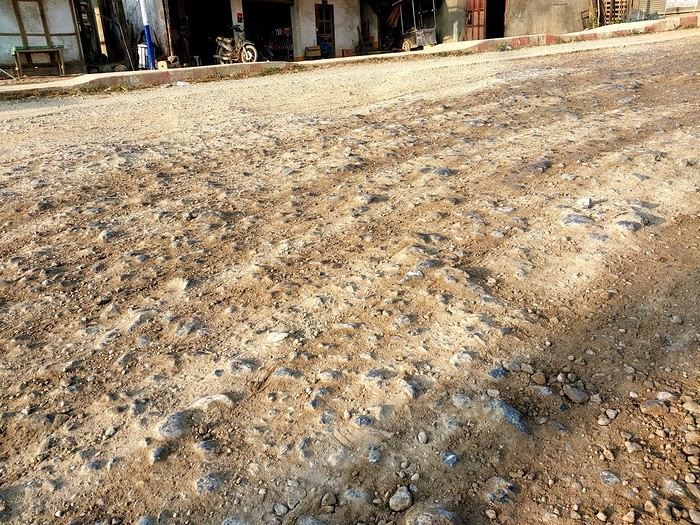
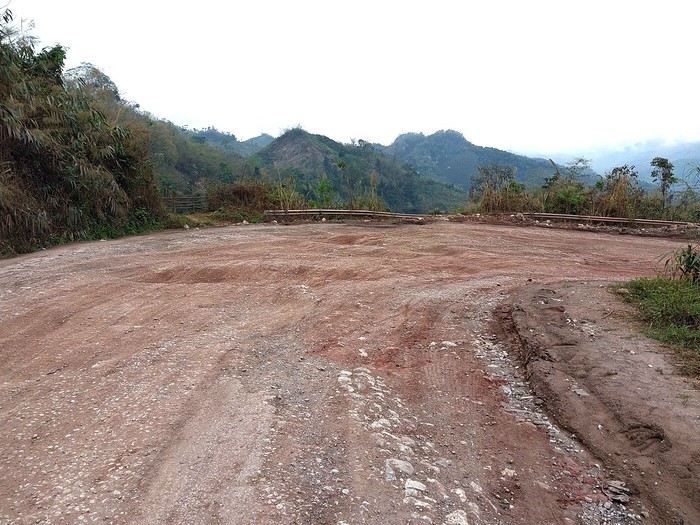
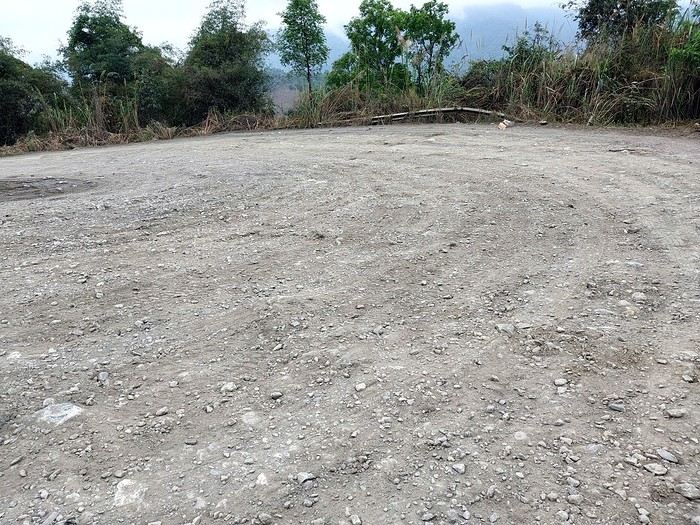
Absolutely, handlebar tape with gel and large-section tires (which therefore require lower inflation pressure) help absorb road imperfections. But my question about the usefulness of a suspension fork concerns roads that are pretty degraded, like the ones I encountered last March in northern Laos. To illustrate, here are three photos of national roads 13 N and 7, a good portion of which are in poor condition:
Low-travel suspension fork for a touring bike
Hi there,
I’m planning to build a new touring bike. I want to prioritize lightness. That said, I’m tempted by a suspension fork that could offer some comfort on rougher roads. The recent appearance of gravel suspension forks on the market might meet my needs—at least on paper. I’m particularly considering the RockShox Rudy Ultimate XPLR fork. Unlike MTB forks, its travel is short: either 30 mm or 40 mm. It weighs 1400 g, which is 400/500 g more than a steel fork.
Any thoughts or real-world feedback on this?
I’m also wondering about the durability of magnesium (lower leg) for long-distance bike touring. And what’s the impact of skipping the manufacturer-recommended maintenance every 50 and 200 hours? That’s bound to happen on a long trip unless you carry extra gear. More generally, how reliable are these kinds of forks?
Thanks in advance
Entering China: Proof of exit required if leaving by land?
Hi there,
My experience dates back to February 2026.
I entered China by bike via the Sino-Vietnamese land border crossing at Lào Cai / Hekou under the 30-day visa exemption scheme.
At the border, the Chinese authorities didn’t ask me for anything. Not far from the border, I was stopped at 3 checkpoints, plus one check by a patrol. Again, no request for any proof of exit. However, the Chinese police were keen to know the exact purpose of my stay in China.
I left the country via the Sino-Laotian land border crossing at Mohan / Boten.
Otherwise, the website of the Chinese Embassy in France doesn’t mention the requirement for proof of exit from the territory: https://fr.china-embassy.gov.cn/fra/zgzfg/zgsg/lsb/202511/t20251113_11752805.htm
My travel journal for my stay in Yunnan is here: https://voyageforum.com/forum/compte-rendu-periple-dans-yunnan-velo-d11466713/
Account of my cycling trip through Yunnan
Hi there,
Just a few words about the loop I did by bike in Yunnan.
Entry and exit
I entered China through the Sino-Vietnamese border crossing at Lào Cai / Hekou under the 30-day visa exemption currently available to French nationals and others.
The process was simple and quick. A Chinese police officer even helped me complete my electronic pre-registration at a computer kiosk. I wasn’t aware this formality was required—it’s similar to Thailand’s TM6.
No issues with the bike.
I left the country via the Sino-Laotian border crossing at Mohan / Boten.
The atmosphere was a bit chaotic there, but again, no problems with the bike.
The timing
I visited Yunnan in February 2026.
Weather-wise, at higher altitudes (between 1,500 and 2,000 meters), it was around ten degrees at night and in the mornings, and around twenty degrees at the hottest part of the day.
I had two days of rain, so I took the bus to keep moving. Otherwise, clear blue skies.
Culturally, Chinese New Year fell on February 17th (and the 15 days following), right in the middle of my trip. Because of this, my take on the traffic might be off.
Accommodation and food I always found a hotel to stay in for prices ranging from 8 to 15 €. Except in Kunming (the capital), where many hotels were fully booked (Chinese New Year). I ended up at a 100 € hotel with great value for money.
A bowl of noodles costs about 1.5 € on average.
Onboard electronics Since my smartphone doesn’t support eSIMs, I subscribed to a China plan with my carrier. Otherwise, for much cheaper, Alipay offers eSIMs for foreigners that allow access to services usually blocked for Chinese users (WhatsApp, Facebook, etc.).
An internet connection is essential for paying with Alipay or WeChat, as this payment method is widespread.
I only managed to use Alipay.
Either way, always carry cash because sometimes there’s no signal, or the merchant only accepts WeChat.
Also, it’s best to bring a power adapter when you arrive rather than struggling to find one.
Traffic and roads The Chinese aren’t reckless drivers. They follow traffic rules and watch out for cyclists. This is slightly less true in Xishuangbanna (the region bordering Myanmar and Laos).
In urban areas, there are almost always wide bike lanes, separated from other roads, where bikes, electric mini-scooters, and scooters share the space pretty harmoniously.
The roads are in great condition, and traffic is generally manageable—even light—except for one stretch (Eshan -> Yangwu).
Most traffic is absorbed by expressways, China’s equivalent of highways: toll roads that are off-limits to slow vehicles.
You’re never far from these expressways; sometimes you even ride alongside them, which can be noisy at times.
The climbs are usually reasonable, around 5% to 6%. From what I remember, the steepest section was between Menglun and Mengla, with gradients of 8% to 10%, sometimes more.
Riding at these altitudes—though modest—took a bit of getting used to.
The route I didn’t plan anything in advance. My only goal was to reach Kunming. I don’t know why, but just hearing the name of that city, like Yunnan, always felt dreamy to me.
Here’s the breakdown: Hekou -> Man Hao (94 km); Man Hao -> Yuanyang (64 km); Yuanyang -> Jianshui (bus); Jianshui -> Tong Hai (78 km); Tong Hai -> Chenjiang (85 km); Chenjiang -> Kunming (60 km); Kunming -> Kunyang (60 km); Kunyang -> Eshan (67 km); Eshan -> Yangwu (58 km); Yangwu -> Yuanjiang (59 km); Yuanjiang -> Pu'er (bus); Pu'er -> Dadugang (75 km); Dadugang -> Jinghong (80 km); Jinghong -> Menglun (67 km); Menglun -> Mengyuancun (51 km); Mengyuancun -> Mengla (43 km); Mengla -> Boten (67 km).
Otherwise, I’m currently in Thailand and just hoping my return flight with Qatar won’t get canceled.
Oh well... 😉
Traffic conditions on the Louang Namtha - Houei Sai road for a bike crossing
Hi Gandiji,
Actually, I took the scenic route. Roughly: Boten -> Oudomxai -> Pakmong -> Luang Prabang. I’d like to go to Phonsavan by bus and come back by bike. I’m a bit hesitant—the bike transport (17 €) costs more than the passenger ticket.
Otherwise, I was surprised by how degraded the Pakmong -> LP road is. Back in 2013, the pavement was in good condition.
Maybe the same goes for the Louang Namtha area.
By the way, are you the Justin I had a drink with in Korat back in 2017?
@+
Airports in the Gulf Emirates
A heartfelt thought for them and for the hassles this is going to cause
Thanks.
I’m currently in Yunnan and about to enter Laos in a few days. I’ve got a flight back home in mid-April from Bangkok with... Qatar.
If the situation drags on, with my Visa card, I think I can hold out for a few months under the coconut trees. Maybe even until my card expires in 2028. 😉
PS: I’m flagging for the mods that it’s almost always impossible to connect to VF from China, VPN or no VPN.
Traffic conditions on the Louang Namtha–Houei Sai road for cycling across
Hi there,
Coming from Laos (*), I’m planning to enter Thailand by bike via the Fourth Thai–Lao Friendship Bridge.
Before this bridge was built, I’d already cycled the road from Louang Namtha to Houei Sai and crossed the river by boat to reach Thailand.
At the time, the condition of that road was impeccable, and most importantly, traffic was light.
So I’m wondering if anyone who’s taken it recently can tell me whether traffic has increased since the bridge opened.
Thanks in advance!
(*) I’m currently cycling in China (Yunnan)
Payments in Vietnam
I just checked: for an ATM withdrawal of 3 million Dong, the fee was around 50,000 or 55,000 dong (less than 2%)
For a withdrawal of 3 million Dong (around a hundred euros), I was charged 130,000 Dong (4.3 €) in fees by the Vietnamese bank (Agribank). The fee amount was displayed before confirming the transaction.
For a withdrawal of 3 million Dong (around a hundred euros), I was charged 130,000 Dong (4.3 €) in fees by the Vietnamese bank (Agribank). The fee amount was displayed before confirming the transaction.
Paying in Vietnam
Hi,
I’m currently in Vietnam.
I’ve used my international Visa card twice to withdraw cash from an ATM. The Vietnamese bank fees were around 4.5%, not counting my own bank’s hefty charges.
Personally, I prefer using cash (banks, exchange offices).
For hotels booked on Booking.com, the site’s commission is already included in the price you pay.
Just so you know, since I don’t book anything in advance, I’ve noticed that by booking rooms directly with hotel owners, their prices are often lower than those listed on booking sites.
Information on Mondulkiri and Ratanakiri regions
Hi,
My experience is a bit dated. I went there in 2015 by bike during the dry season. The roads were paved. These regions have undergone massive deforestation. We were far from the wild areas described in some guidebooks. For treks in general, check out this post that summed up the situation at the time: voyageforum.com/...i-cambodge-d7583560/
Safe travels
Cycling trips—how old is too old?
Hi everyone,
My most recent trip at 70 was last winter in Southeast Asia. This time, I stayed exclusively in Thailand, covering 2,700 km in two months. I treat every trip as if it might be my last. And then, once I’m back home, I start dreaming all over again 😎. Maybe next late winter, I’ll do a round trip from Bangkok (Thailand) to Kunming (Yunnan, China), passing through northern Laos—where I’ve already cycled—and northern Vietnam, where I’ve never been. That said, since I travel solo, I find I need to muster more mental energy than I used to. The biggest challenge is still the journey from home to Roissy with my bike box 😉 ...
My most recent trip at 70 was last winter in Southeast Asia. This time, I stayed exclusively in Thailand, covering 2,700 km in two months. I treat every trip as if it might be my last. And then, once I’m back home, I start dreaming all over again 😎. Maybe next late winter, I’ll do a round trip from Bangkok (Thailand) to Kunming (Yunnan, China), passing through northern Laos—where I’ve already cycled—and northern Vietnam, where I’ve never been. That said, since I travel solo, I find I need to muster more mental energy than I used to. The biggest challenge is still the journey from home to Roissy with my bike box 😉 ...
Documentary: "Angkor, The Mystery of the Bronze Temples"
Hi there,
As a follow-up to the exhibition "Royal Bronzes of Angkor" organized by the Guimet Museum (Paris), France 5 is airing a documentary called "Angkor, The Mystery of the Bronze Temples."
You can already watch it on replay.
https://www.france.tv/documentaires/documentaires-science/7241768-angkor-le-mystere-des-temples-de-bronze.html
All you need to do is create an account. It’s free and no commitment required.

Scams and Violence in Thailand
Hi,
Small scams have always existed in Thailand. Generally, they’re not easy to detect and are often financially painless. It’s one of the charms of the Land of Smiles: getting scammed, but gently😉. Sometimes, though—more rarely—the scam is blatant, and that’s really unpleasant, like booking a VIP bus ticket at the VIP price and ending up traveling in a local, rickety bus (that was over 20 years ago).
As for the vibe in Pattaya, I don’t see what you can expect from a city that developed largely thanks to the sex trade. And this despite prostitution being illegal...
Just to clarify, I first went to Thailand about fifty years ago. Back then, it was a cesspool that attracted pedophiles, junkies, and criminals on the run from all over the world.
Personally, I think the country has improved a lot.
Cycling Northern Thailand: Bangkok to Chiang Mai Route
I’d recommend planning your route carefully before you leave and sticking to it. Avoid the main roads. Thailand has tons of small roads that are really beautiful and pleasant, but it’s super hard to improvise once you’re there—because the alphabet is unreadable on maps and signs, there are so many intersections, and people will always direct you toward a main road instead of showing you the small paths.
Hi there, In Thailand, where I cycle regularly, there’s indeed a pretty well-developed secondary road network. But that’s mostly true in the plains. In the mountains, secondary roads are limited or even nonexistent, so your route choices are pretty much made for you. To avoid getting lost, the best thing is an offline smartphone app like Maps.me, OsmAnd, or Mapy.cz. These apps can sometimes have errors, though. Last winter, I upgraded my setup with a 5G SIM card and started using Google Maps. Now it’s impossible to get lost, but the sense of adventure is gone 😅. The mobile network with the best coverage is AIS. Otherwise, I can confirm that the Mae Hong Son loop is really tough, with steep climbs of 20% or more. For cycling in Northern Thailand, I wrote a trip report here: https://voyageforum.com/v.f?post=9945930#9945930
Hi there, In Thailand, where I cycle regularly, there’s indeed a pretty well-developed secondary road network. But that’s mostly true in the plains. In the mountains, secondary roads are limited or even nonexistent, so your route choices are pretty much made for you. To avoid getting lost, the best thing is an offline smartphone app like Maps.me, OsmAnd, or Mapy.cz. These apps can sometimes have errors, though. Last winter, I upgraded my setup with a 5G SIM card and started using Google Maps. Now it’s impossible to get lost, but the sense of adventure is gone 😅. The mobile network with the best coverage is AIS. Otherwise, I can confirm that the Mae Hong Son loop is really tough, with steep climbs of 20% or more. For cycling in Northern Thailand, I wrote a trip report here: https://voyageforum.com/v.f?post=9945930#9945930
Changing bike chainring or cassette
Hi there,
After some research, the TX 400 is normally equipped with a Shimano Deore XT RD-T8000 long-cage rear derailleur.
This derailleur accepts cassettes where the smallest sprocket must have 11 teeth. The largest sprocket should have between 32 and 36 teeth. So, it's impossible to fit an 11-42 cassette.
Regarding the chainring, the difference between the large and small chainring shouldn't exceed 22 teeth. So, replacing the original chainring with a 44-32-22 chainring is possible (44-22 = 22).
The derailleur's capacity is 47.
PS: Shimano's automatic site translator clearly isn't up to scratch 😄, but it's the numbers that count.

Changing bike chainring or cassette
Hi,
To know if the rear derailleur can work properly with an 11-42 cassette, you need to check its capacity. The capacity of a derailleur is expressed in number of teeth. It’s manufacturer data.
Next, you need to determine the required capacity for the planned drivetrain. The required capacity is calculated as follows: (Number of teeth on the large chainring - number of teeth on the small chainring) + (number of teeth on the largest rear cog - number of teeth on the smallest rear cog)
In your case, (48 - 26) + (42 - 11). That’s 22 + 31. So, 53.
Your rear derailleur must therefore have a capacity of at least 53 teeth.
If that’s not the case, you’ll need to either change the chainrings (while keeping the same tooth difference between the small and large chainring) or find a derailleur with that capacity.
So, it might be a question of rear derailleur capacity that’s why you’re not finding any feedback on changing the cassette.