Posts by Pir971
About 1,480 results.
More options
Search results
Gorgeous Botswana
The title of this travel journal really lives up to its name, thanks Mathilde.
Incredible all these beautiful observations. I’m not sure—were you there in 2017 or 2016?
Because we were there in July 2017, and it’s funny how we had such different experiences at Nxai Pan and Moremi (and even at Chobe River Front where we didn’t see any lions). I’ll look into how to visit Khwai for a future trip. It’s really inspired me. 🙂
Four Weeks in Botswana
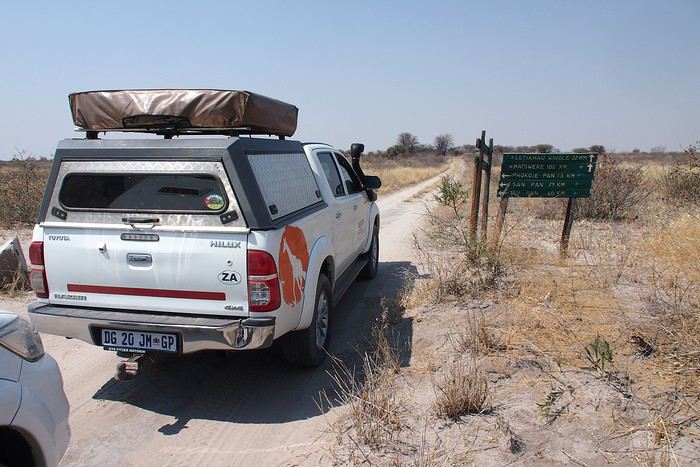
Hmm, I was thinking I’d seen this license plate somewhere before. Memories from 2017 🙂

The Hilux we almost sank in the Okavango Delta... 🏴☠️ Unbelievable we made it out of that one 😐
98,403 km when we picked it up in July 2017. It had really racked up the miles since then...
Wild destination: Botswana
I found it, it's this one The striped jackal—so weird, I’d never seen one before. I was happy enough with the black-backed jackal and didn’t miss a thing...
OH WOW!!
I was surprised no one reacted to this insane sighting of a striped jackal! First time I’ve ever seen one in a Southern Africa travel journal, from what I remember. Maybe once or twice in Kruger Facebook group photos.
Amazing sighting! 🙂 With the big gear 😎
The striped jackal—so weird, I’d never seen one before. I was happy enough with the black-backed jackal and didn’t miss a thing...OH WOW!!
I was surprised no one reacted to this insane sighting of a striped jackal! First time I’ve ever seen one in a Southern Africa travel journal, from what I remember. Maybe once or twice in Kruger Facebook group photos.
Amazing sighting! 🙂 With the big gear 😎
In the Land of the Tswana (Botswana)
Hello Ludo,
Thanks for this feedback—it reminds me of a few things, haha! 😇 Everything’s been said about the madness of your canine and feline observations! You were incredibly lucky, and it’s great because we share the same way of experiencing safari, from dawn till sunset. Makes you think luck smiles on the brave 😎. Even more thanks for this gorgeous travel journal, beautifully illustrated—it’s dreamy. 🙂 Too bad about the Pila photos! !
Thanks for this feedback—it reminds me of a few things, haha! 😇 Everything’s been said about the madness of your canine and feline observations! You were incredibly lucky, and it’s great because we share the same way of experiencing safari, from dawn till sunset. Makes you think luck smiles on the brave 😎. Even more thanks for this gorgeous travel journal, beautifully illustrated—it’s dreamy. 🙂 Too bad about the Pila photos! !
Tanzania 2019 - Polé Polé
Day 8 (08/09/19) continued:
We stop at a picnic area, where we enjoy our meal under the curious gaze of a few mischievous monkeys. Then, accompanied by an armed ranger, we start a short walk to a hidden waterfall in the forest. The air is cool and humid, moss covers the tree trunks, and the scent of damp earth surrounds us.
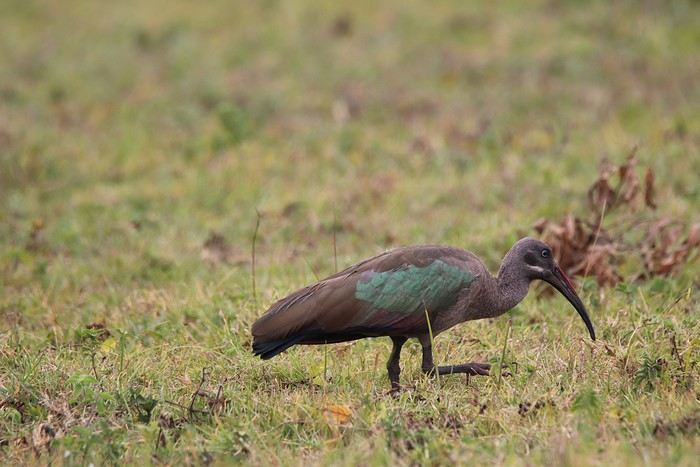
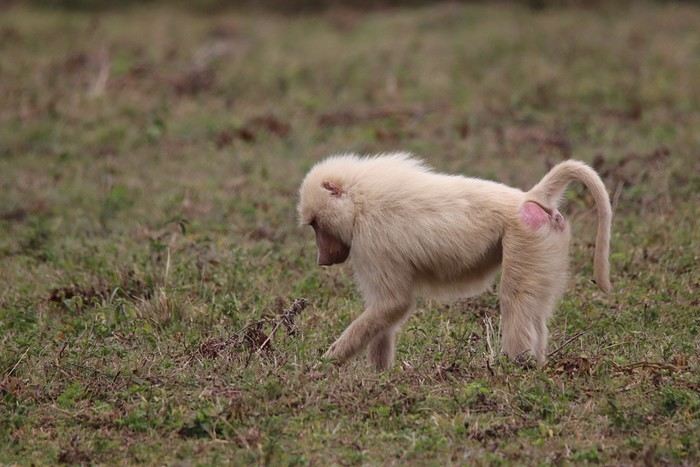
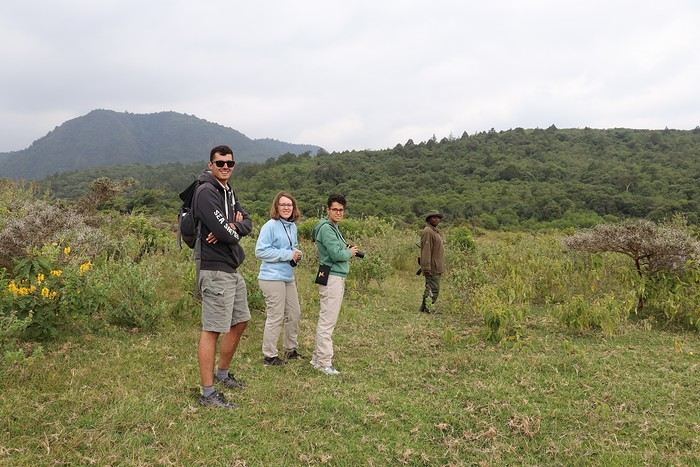
Suddenly, around a bend in the trail, a giraffe appears before us. Motionless, it watches us with mutual curiosity.
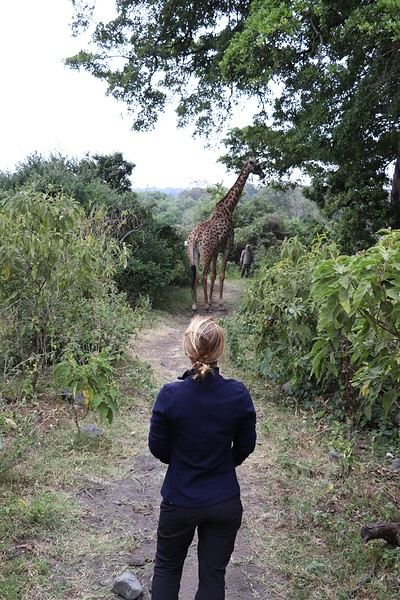
A moment frozen in time. We fall silent, captivated by the grace of this giant animal, before it disappears in a few fluid steps into the dense vegetation.
The altitude and overcast sky remind us that we’re far from the stifling heat of the plains. As the day draws to a close, a cool breeze blows through the park, and we put on our sweaters for the ride back. After this successful first wild immersion, we hit the road toward Tarangire National Park, where we’ll spend the night at Kanga Camp.
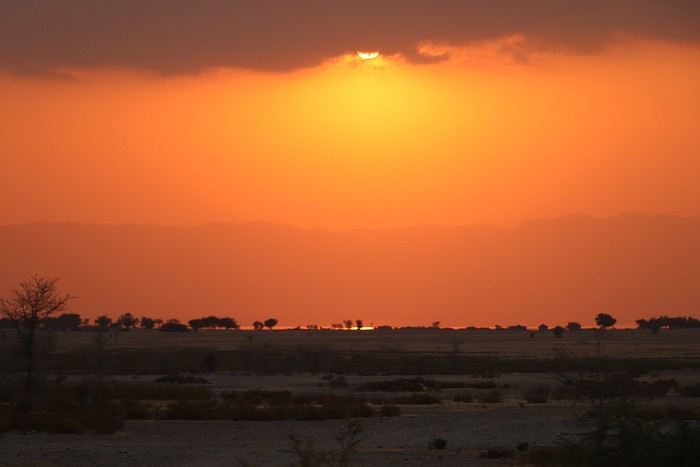
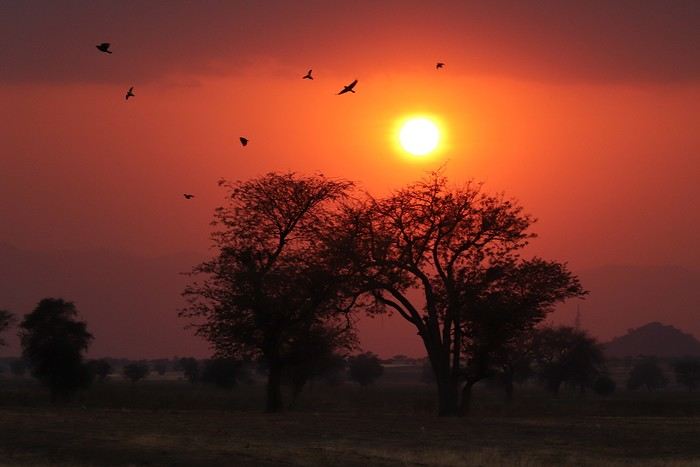 We arrive at the camp just after sunset.
We’ll explore the park tomorrow. A new landscape awaits us—one of giant baobabs and hundreds of elephants. But for now, it’s time for dinner and rest.
Suddenly, around a bend in the trail, a giraffe appears before us. Motionless, it watches us with mutual curiosity.
A moment frozen in time. We fall silent, captivated by the grace of this giant animal, before it disappears in a few fluid steps into the dense vegetation.
The altitude and overcast sky remind us that we’re far from the stifling heat of the plains. As the day draws to a close, a cool breeze blows through the park, and we put on our sweaters for the ride back. After this successful first wild immersion, we hit the road toward Tarangire National Park, where we’ll spend the night at Kanga Camp.
We arrive at the camp just after sunset.
We’ll explore the park tomorrow. A new landscape awaits us—one of giant baobabs and hundreds of elephants. But for now, it’s time for dinner and rest.Tanzania 2019 - Polé Polé
Day 8 (08/09/19)
The day dawns over Moshi, wrapped in a soft morning light. After a hearty breakfast at the hotel with the girls, I head back to reception to sort out the laundry issue from the day before. I ask to see the manager or the director. They show me the list of prices for washing and drying each item individually. Outrageous! If we’d known... 2000 TZS for a pair of socks, 2000 TZS for underwear, 3000 TZS for shorts... of course it adds up fast at that rate! For that price, I think when an establishment has the most expensive washing machine in the world, they should warn customers BEFORE! But they tell me the manager isn’t in yet and suggest I settle the dispute directly with our agency. I won’t hesitate to share my thoughts on this place’s business practices with Kessy Brothers. End of this little laundry interlude.
After a good night’s rest, we’re excited to start a new adventure with the girls!
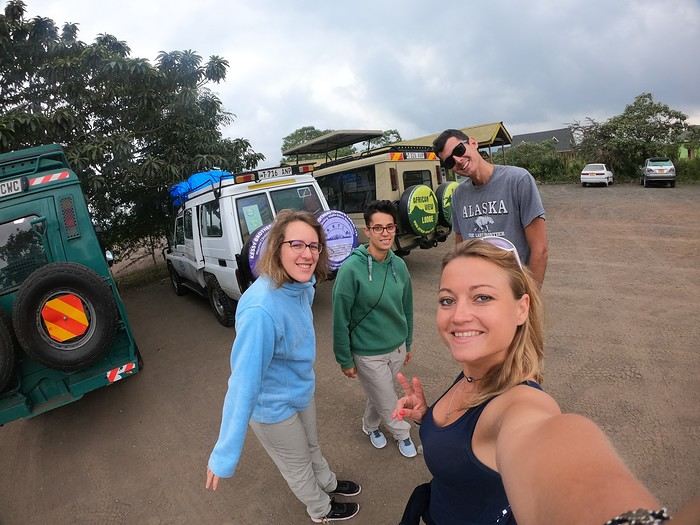
We meet Franck, our young guide with a... "memorable" smile, and January, our experienced cook, a true trail chef who’ll spoil us throughout the trip. It’s time to board our Land Cruiser Troopy, a rugged 4x4 built for adventure. Officially designed for five passengers, the back space is cramped, and with four of us, we’re already packed in tight.
We drive through the hustle and bustle of Arusha, this lively city at the foot of Mount Meru (4,566 m), Tanzania’s second-highest peak and the only African volcano where you can spot buffaloes, giraffes, and even leopards up to 3,500 m. Unlike cities in Southern Africa, Arusha is bursting with life: colorful markets spill onto the sidewalks, dala-dalas (local minibuses) zip through what’s more or less organized chaos, and the streets are packed with pedestrians, cyclists, and street vendors. On the outskirts, small farms gradually give way to wilder landscapes.
After an hour’s drive, we reach the entrance of Arusha National Park, a lush haven spanning 137 km². Though it’s one of the country’s smallest parks, it’s no less spectacular or unique. Bordered by the majestic Mount Meru, whose perfect volcanic cone dominates the horizon, the park boasts exceptional biodiversity thanks to its varied topography—alternating tropical forests, open savannas, alkaline lakes, and ancient volcanic craters. It’s also home to the small Ngurdoto caldera, a sanctuary for buffaloes, warthogs, and numerous primates.
We let Franck handle the program and park entry details. I’m really getting into this way of traveling with a guide.
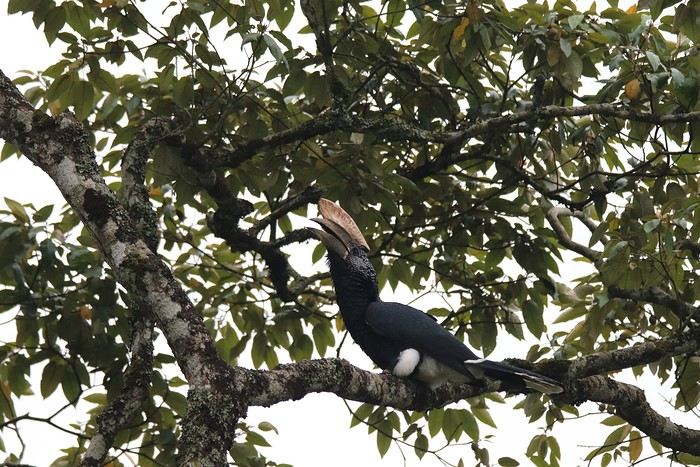
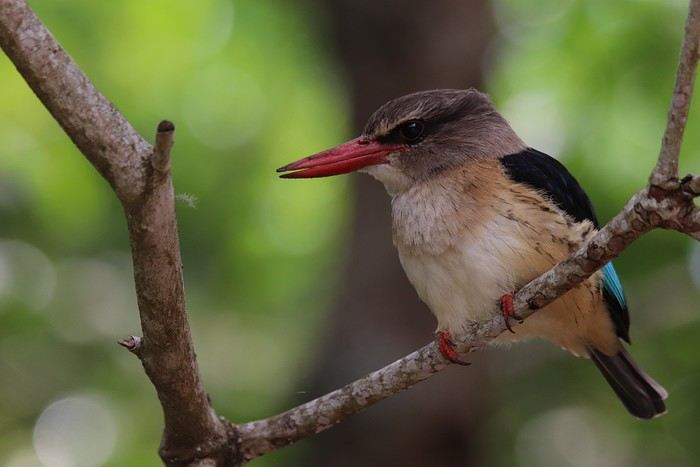
As soon as we enter, we plunge into a dense forest where giant ferns and lichen-covered acacias hint at the humid, mountainous climate. The atmosphere is misty and mysterious, a far cry from our previous safaris in vast, arid plains. As we wind along the trails, wildlife slowly reveals itself: A trumpeter hornbill welcomes us
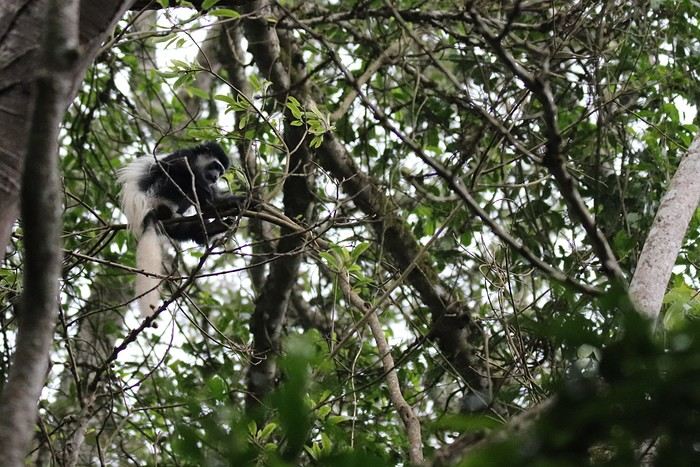
Colobus monkeys, with their silky black-and-white fur, leap from tree to tree, their long tails swaying in the air.
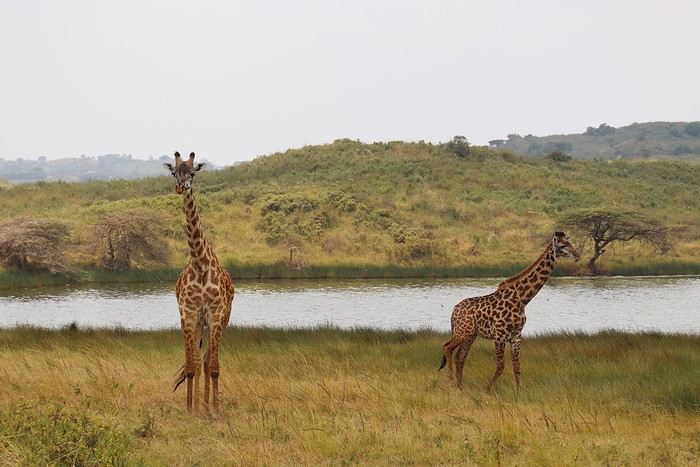
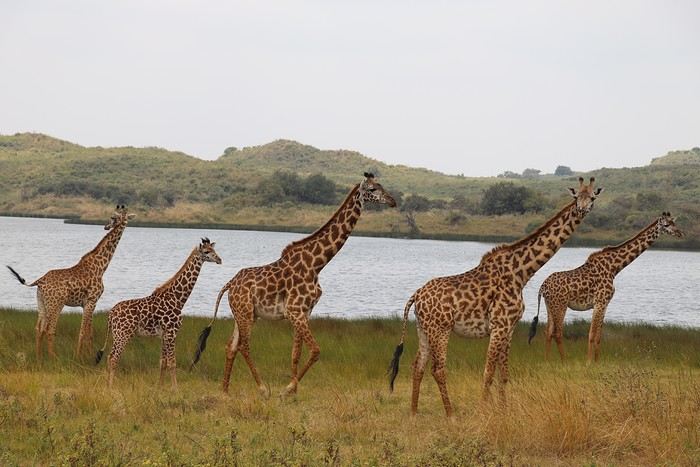
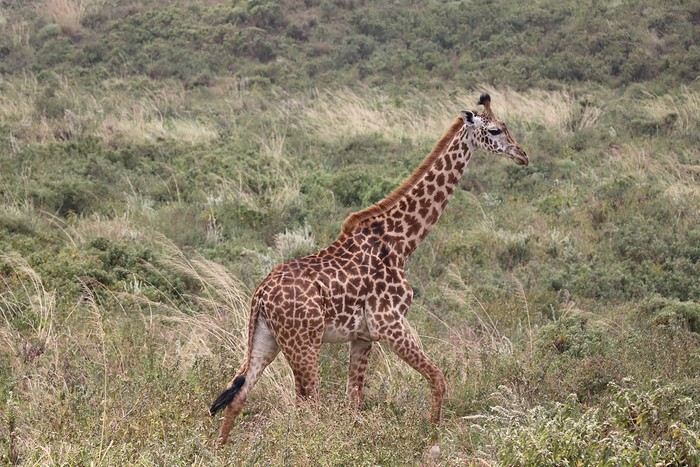
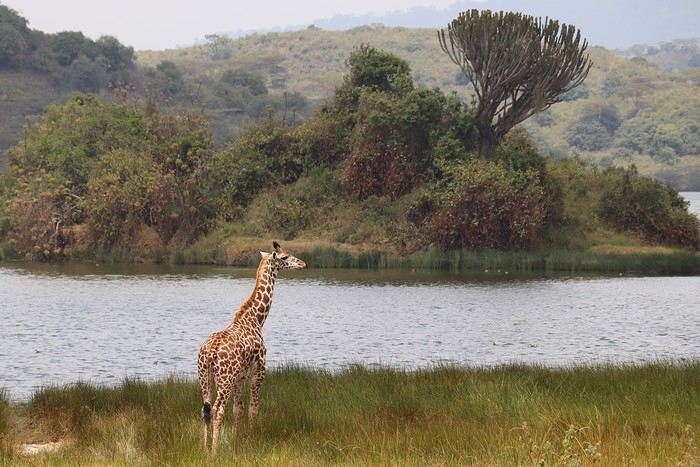
Our first giraffes, majestic and silent, stand out against the green backdrop.
Herds of buffalo graze peacefully in the damp clearings. Waterbucks squabble with a family of mongooses chattering in the background.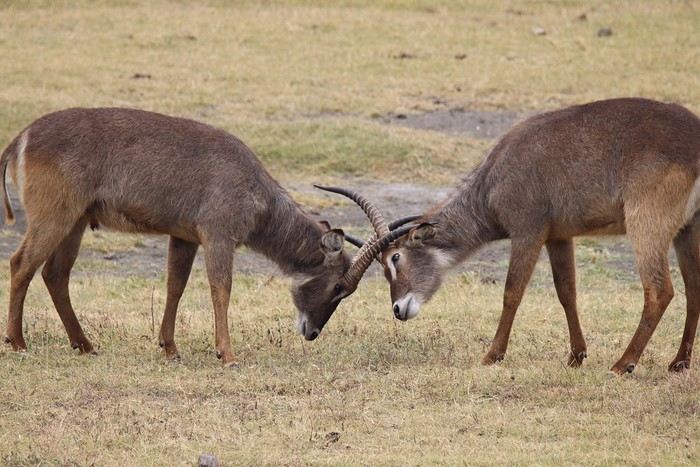
There are no lions in this park, but in 2018, rangers discovered a pride of stray lions that had likely migrated from the Serengeti or the nearby Kilimanjaro National Park. Several herds of cattle had been attacked, echoing the legend of the man-eating lions of Tsavo. Authorities had to relocate them to avoid conflicts with local communities.
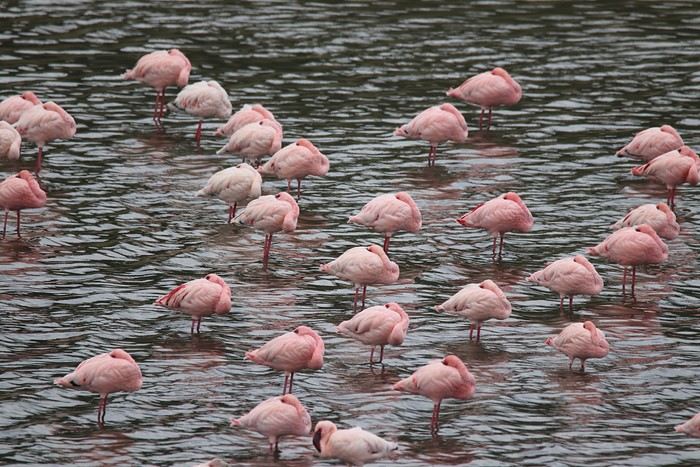
We stop near the Momella Lakes, a series of small alkaline lakes shimmering under the gray sky. Here, hundreds of pink flamingos balance on one leg, filtering the water for tiny crustaceans.
Despite its proximity to civilization, the park is rarely crowded, which makes us feel like we’ve got the place to ourselves. A really nice introduction for Mélissa and Doriane, who are experiencing their first safari in style.
The day dawns over Moshi, wrapped in a soft morning light. After a hearty breakfast at the hotel with the girls, I head back to reception to sort out the laundry issue from the day before. I ask to see the manager or the director. They show me the list of prices for washing and drying each item individually. Outrageous! If we’d known... 2000 TZS for a pair of socks, 2000 TZS for underwear, 3000 TZS for shorts... of course it adds up fast at that rate! For that price, I think when an establishment has the most expensive washing machine in the world, they should warn customers BEFORE! But they tell me the manager isn’t in yet and suggest I settle the dispute directly with our agency. I won’t hesitate to share my thoughts on this place’s business practices with Kessy Brothers. End of this little laundry interlude.
After a good night’s rest, we’re excited to start a new adventure with the girls!
We meet Franck, our young guide with a... "memorable" smile, and January, our experienced cook, a true trail chef who’ll spoil us throughout the trip. It’s time to board our Land Cruiser Troopy, a rugged 4x4 built for adventure. Officially designed for five passengers, the back space is cramped, and with four of us, we’re already packed in tight.
We drive through the hustle and bustle of Arusha, this lively city at the foot of Mount Meru (4,566 m), Tanzania’s second-highest peak and the only African volcano where you can spot buffaloes, giraffes, and even leopards up to 3,500 m. Unlike cities in Southern Africa, Arusha is bursting with life: colorful markets spill onto the sidewalks, dala-dalas (local minibuses) zip through what’s more or less organized chaos, and the streets are packed with pedestrians, cyclists, and street vendors. On the outskirts, small farms gradually give way to wilder landscapes.
After an hour’s drive, we reach the entrance of Arusha National Park, a lush haven spanning 137 km². Though it’s one of the country’s smallest parks, it’s no less spectacular or unique. Bordered by the majestic Mount Meru, whose perfect volcanic cone dominates the horizon, the park boasts exceptional biodiversity thanks to its varied topography—alternating tropical forests, open savannas, alkaline lakes, and ancient volcanic craters. It’s also home to the small Ngurdoto caldera, a sanctuary for buffaloes, warthogs, and numerous primates.
We let Franck handle the program and park entry details. I’m really getting into this way of traveling with a guide.
As soon as we enter, we plunge into a dense forest where giant ferns and lichen-covered acacias hint at the humid, mountainous climate. The atmosphere is misty and mysterious, a far cry from our previous safaris in vast, arid plains. As we wind along the trails, wildlife slowly reveals itself: A trumpeter hornbill welcomes us
Colobus monkeys, with their silky black-and-white fur, leap from tree to tree, their long tails swaying in the air.
Our first giraffes, majestic and silent, stand out against the green backdrop.
Herds of buffalo graze peacefully in the damp clearings. Waterbucks squabble with a family of mongooses chattering in the background.
There are no lions in this park, but in 2018, rangers discovered a pride of stray lions that had likely migrated from the Serengeti or the nearby Kilimanjaro National Park. Several herds of cattle had been attacked, echoing the legend of the man-eating lions of Tsavo. Authorities had to relocate them to avoid conflicts with local communities.
We stop near the Momella Lakes, a series of small alkaline lakes shimmering under the gray sky. Here, hundreds of pink flamingos balance on one leg, filtering the water for tiny crustaceans.
Despite its proximity to civilization, the park is rarely crowded, which makes us feel like we’ve got the place to ourselves. A really nice introduction for Mélissa and Doriane, who are experiencing their first safari in style.
Tanzania 2019 - Polé Polé
Day 7 (09/07/19):
The morning starts with the final descent, between Mweka Camp (3,100 m) and Mweka Gate (1,640 m). About ten kilometers covered quickly.
After a last breakfast with the team, the tricky moment of tipping arrives. Elias brings it up awkwardly, and as always, this topic makes us uncomfortable. This imposed tipping system is still hard for us French to understand. On one hand, we think it should simply be included in their salary and the service price. On the other, we get that this financial incentive pushes everyone to give their best for the hikers' comfort and success—a mentality that, let’s be honest, might be lacking elsewhere...
We warmly thank our adventure companions and hand over what’s due. For reference, in 2019, the standard tipping recommendations were:
$20/day for the main guide $12/day for the assistant guide $12/day for the cook $5/day per porter
Pretty unequal amounts when you consider that the porters do the most physical work... We capture this last moment together with one final photo before parting ways.
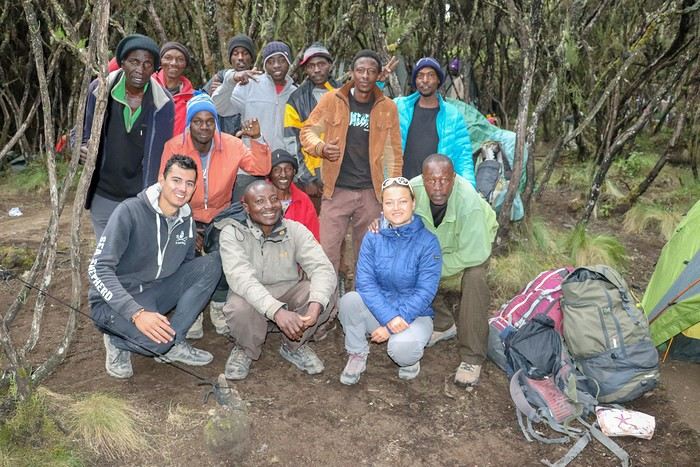
At 7:15 AM, we set off again through the tropical forest, under a light drizzle.
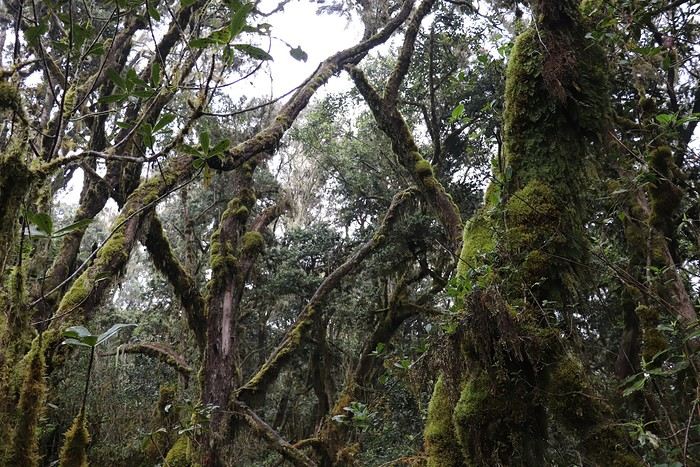
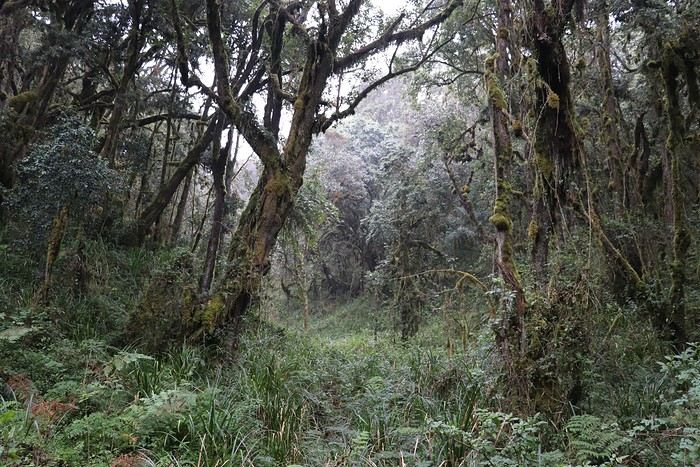
The atmosphere is cheerful and light. The guides and porters sing and dance with us: "Jambo, Jambo bwana Habari gani? Mzuri sana Wageni, wakaribishwa Kilimanjaro hakuna matata!" A suspended moment, a parenthesis of shared happiness.
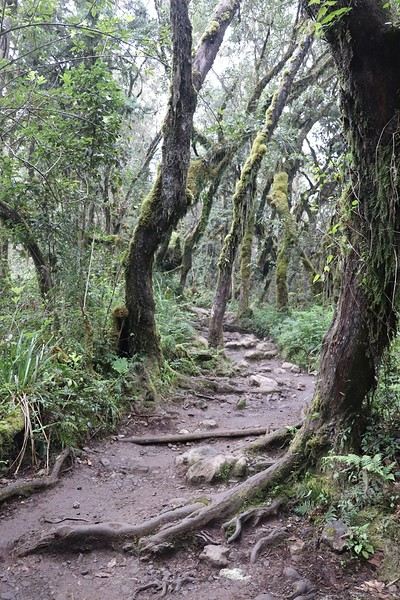
Alison, true to herself, is still the fastest on the descent (and no, I’m not talking about vodka). We savor our last kilometers together, and at 9:30 AM, we finally reach Mweka Gate, the endpoint of our trek.
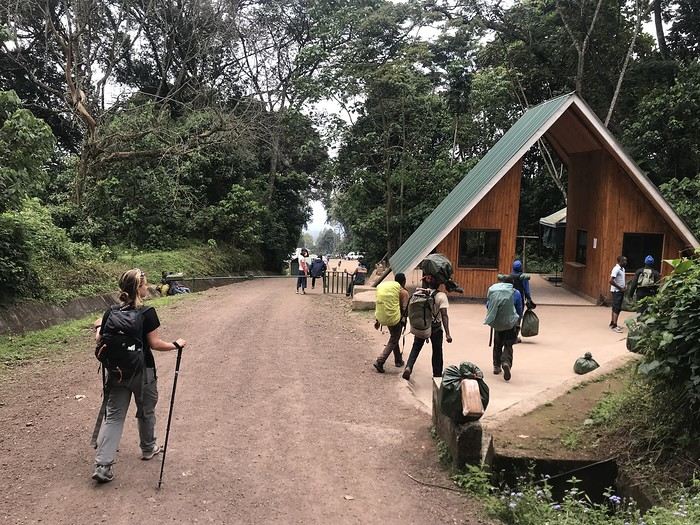
We’ve completed 64 km, 4,980 m of elevation gain, and 5,140 m of descent—Mweka Gate being lower than Machame Gate, our starting point. According to the register, 167 hikers attempted the summit the day before, mostly French and Germans.
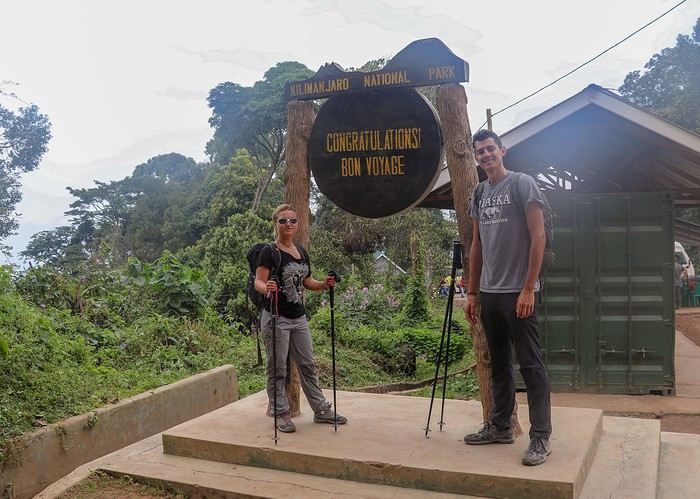
We’re almost alone but have to wait a while to get our souvenir certificates. Then, a van takes us back to Moshi. Back in town, we meet up with Faustin and Elias for one last drink in front of the Kessy Brothers office.
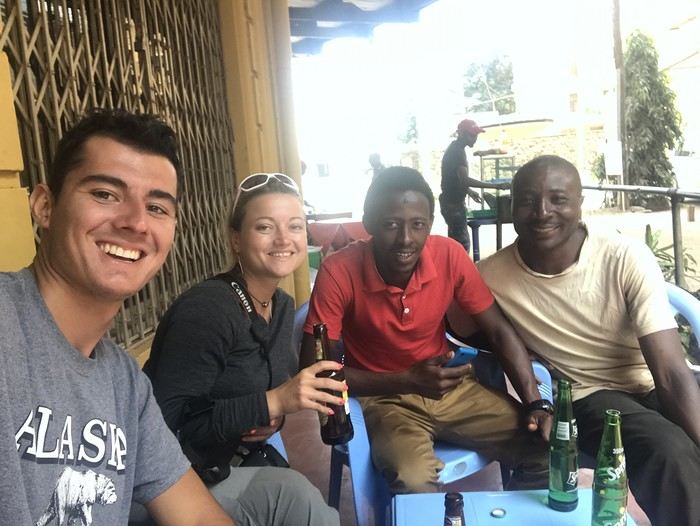
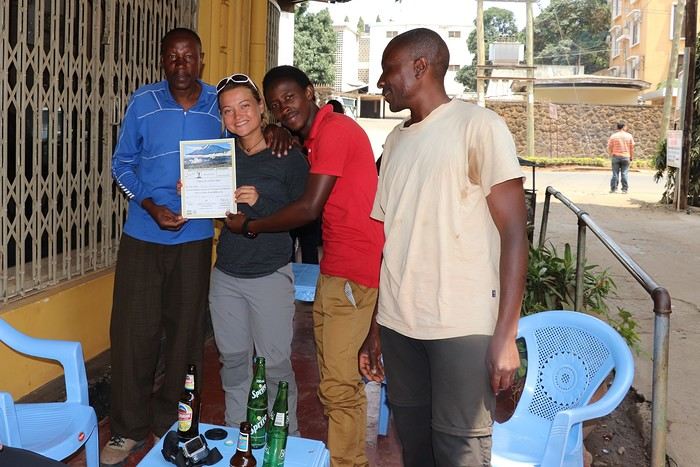
We take the opportunity to review the safari program and meet Franck, who will be our guide starting tomorrow. At noon, we’re dropped off at the Sal Salnero Hotel, a charming place where we’d hoped to find a washing machine. Bad surprise: there isn’t one. They offer an external laundry service but can’t tell us the price—it’ll depend on the amount of laundry. Makes sense. So we leave a small bag of clothes at reception. Once again, we ask for the price, and they tell us they don’t know. Okay, okay, Hakuna Matata!
Then we go rest.
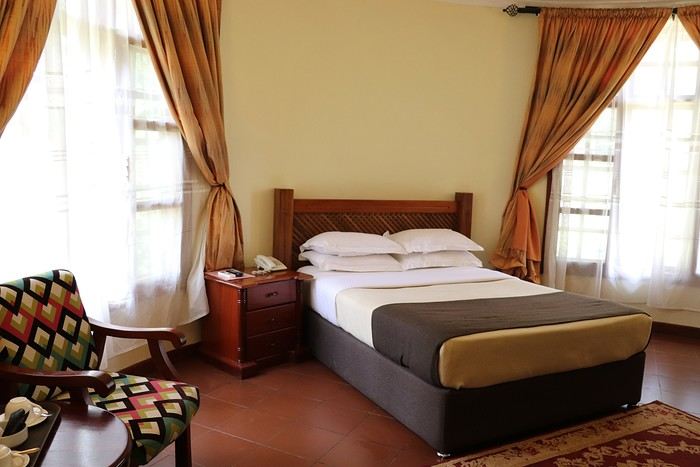
A well-deserved nap, then an exciting reunion with Mélissa and Doriane, freshly arrived from France! We spend the evening dining together, swapping stories and laughing.
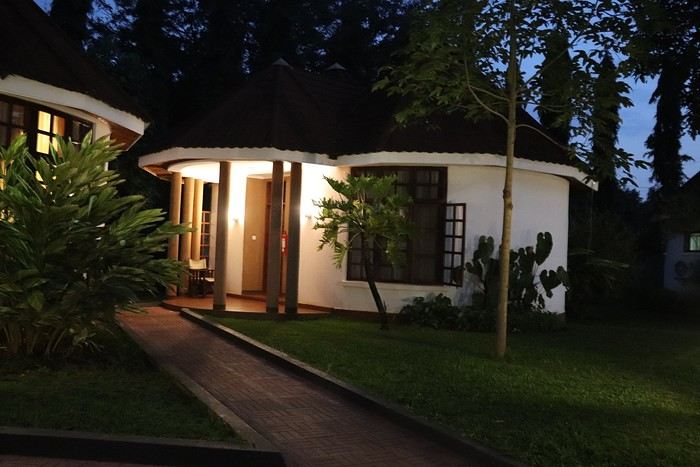
We return to our room. The laundry was supposed to be delivered at 8:30 PM, but by 9 PM, still nothing, and we’re exhausted. At 10 PM, the receptionist wakes us up and quickly drops our clothes on the bed. She’s in a hurry and asks for $85 in cash for the laundry.
"- Excuse me???" I make her repeat it, thinking I misheard. No, she confirms: $85 for a few clothes, mostly underwear. An outrageous price, almost the cost of a night at the hotel... and even more expensive than our flight between Arusha and Zanzibar! Anger rises. This isn’t just a misunderstanding—it’s outright extortion. The immense gratitude and infinite peace are gone... I feel frustration taking over. I hate injustice, and even more, this shameless audacity. We have no choice but to pay, but I go to bed drained, annoyed, and determined to sort this out first thing in the morning. A contrasting return to reality, then. Between reunions and scams.
The morning starts with the final descent, between Mweka Camp (3,100 m) and Mweka Gate (1,640 m). About ten kilometers covered quickly.
After a last breakfast with the team, the tricky moment of tipping arrives. Elias brings it up awkwardly, and as always, this topic makes us uncomfortable. This imposed tipping system is still hard for us French to understand. On one hand, we think it should simply be included in their salary and the service price. On the other, we get that this financial incentive pushes everyone to give their best for the hikers' comfort and success—a mentality that, let’s be honest, might be lacking elsewhere...
We warmly thank our adventure companions and hand over what’s due. For reference, in 2019, the standard tipping recommendations were:
$20/day for the main guide $12/day for the assistant guide $12/day for the cook $5/day per porter
Pretty unequal amounts when you consider that the porters do the most physical work... We capture this last moment together with one final photo before parting ways.
At 7:15 AM, we set off again through the tropical forest, under a light drizzle.
The atmosphere is cheerful and light. The guides and porters sing and dance with us: "Jambo, Jambo bwana Habari gani? Mzuri sana Wageni, wakaribishwa Kilimanjaro hakuna matata!" A suspended moment, a parenthesis of shared happiness.
Alison, true to herself, is still the fastest on the descent (and no, I’m not talking about vodka). We savor our last kilometers together, and at 9:30 AM, we finally reach Mweka Gate, the endpoint of our trek.
We’ve completed 64 km, 4,980 m of elevation gain, and 5,140 m of descent—Mweka Gate being lower than Machame Gate, our starting point. According to the register, 167 hikers attempted the summit the day before, mostly French and Germans.
We’re almost alone but have to wait a while to get our souvenir certificates. Then, a van takes us back to Moshi. Back in town, we meet up with Faustin and Elias for one last drink in front of the Kessy Brothers office.
We take the opportunity to review the safari program and meet Franck, who will be our guide starting tomorrow. At noon, we’re dropped off at the Sal Salnero Hotel, a charming place where we’d hoped to find a washing machine. Bad surprise: there isn’t one. They offer an external laundry service but can’t tell us the price—it’ll depend on the amount of laundry. Makes sense. So we leave a small bag of clothes at reception. Once again, we ask for the price, and they tell us they don’t know. Okay, okay, Hakuna Matata!
Then we go rest.
A well-deserved nap, then an exciting reunion with Mélissa and Doriane, freshly arrived from France! We spend the evening dining together, swapping stories and laughing.
We return to our room. The laundry was supposed to be delivered at 8:30 PM, but by 9 PM, still nothing, and we’re exhausted. At 10 PM, the receptionist wakes us up and quickly drops our clothes on the bed. She’s in a hurry and asks for $85 in cash for the laundry.
"- Excuse me???" I make her repeat it, thinking I misheard. No, she confirms: $85 for a few clothes, mostly underwear. An outrageous price, almost the cost of a night at the hotel... and even more expensive than our flight between Arusha and Zanzibar! Anger rises. This isn’t just a misunderstanding—it’s outright extortion. The immense gratitude and infinite peace are gone... I feel frustration taking over. I hate injustice, and even more, this shameless audacity. We have no choice but to pay, but I go to bed drained, annoyed, and determined to sort this out first thing in the morning. A contrasting return to reality, then. Between reunions and scams.
Tanzania 2019 - Polé Polé
Day 6 Follow-up (09/06/19):
We have to descend now...
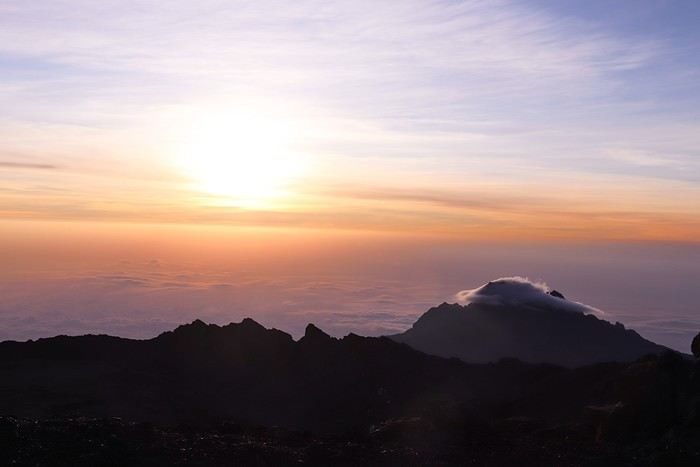
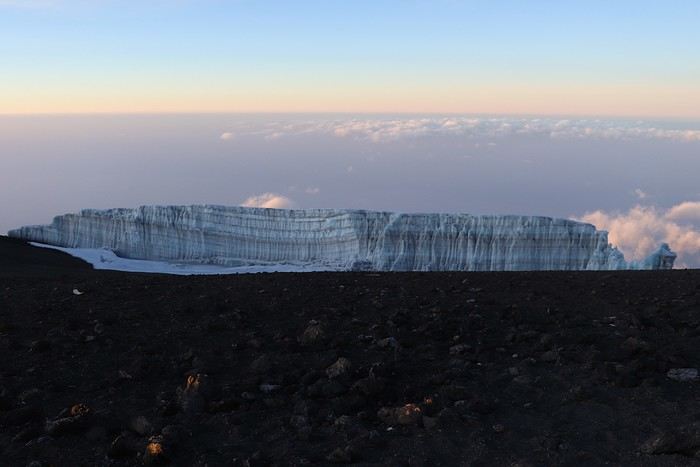
The guides are starting to rush us. We’ve been past Stella Point for nearly two hours now, at over 5,700 meters above sea level. Oxygen is scarce, blood oxygen saturation is very low, and the risk of complications is increasing. They don’t want to take any chances.
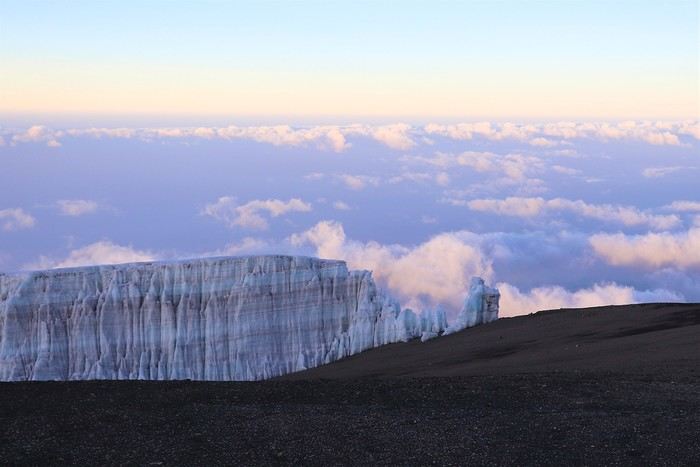
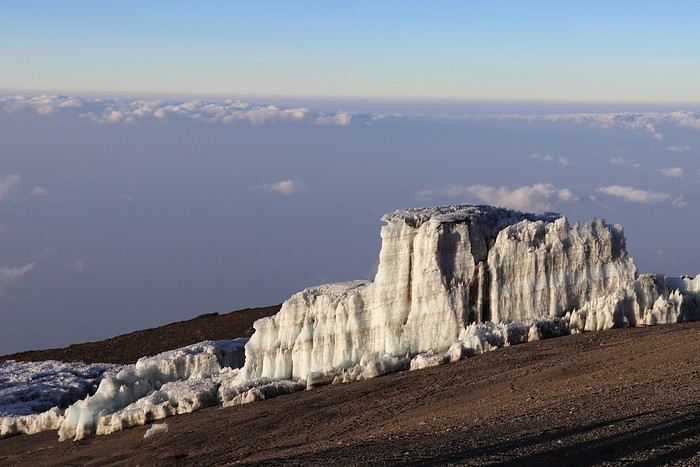
The first part of the descent down to Stella Point isn’t difficult after that long break at the summit. The sun has risen, gradually warming the icy air. The landscape reveals itself in a new light, and we’re still floating on cloud nine from the euphoria of our achievement.
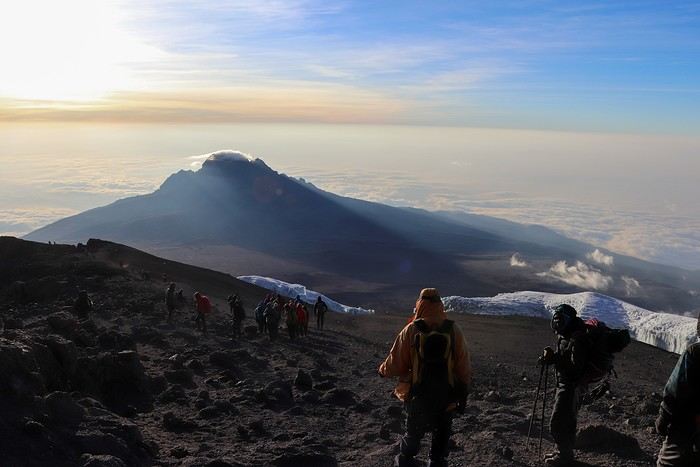
But the hardest part is yet to come. The descent to Barafu Camp is a challenge in itself. Steep and endless, it involves sliding through volcanic ash while trying not to fall—a task that demands energy I no longer have. The heat becomes stifling under my multiple layers of clothing, but I don’t even have the strength to stop and take them off.
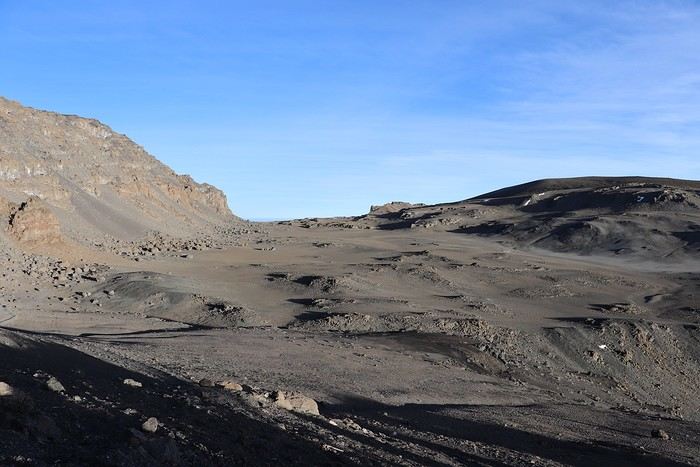
I switch to autopilot mode, moving mechanically and taking frequent stops. Faustin and Alison pass me again and continue without stopping—I won’t see them again. The descent to Barafu was supposed to take 2 to 3 hours; I’ll arrive at camp 2 hours after Alison... I drag myself to our tent, painfully remove my sweat-soaked clothes, and collapse immediately, plunging into the most well-earned nap of my life.
A few hours later, we still have to leave and say goodbye to Barafu Camp (4,673m). The stage isn’t over yet: another 9.5 km awaits us to reach Mweka Camp.
I feel better. My muscles are still heavy, and my knees are sore from the descent, but at least I can walk without too much pain. I can finally appreciate the scenery and relive that strange, surreal night—unsure if it was a dream or a nightmare. Still a bit in shock from that sensation, that void of all vital energy, like being at death’s door. Was it the coffee? The two Diamox tablets? The altitude? The cumulative fatigue? Probably a bit of everything...
Vegetation reappears. Temperatures soften. The air becomes more breathable. On this trail, the fastest way down, we cross paths with several porters carrying stretchers. The mountain doesn’t give any gifts. We pass through High Camp and arrive at Mweka Camp (3,100m) before nightfall.
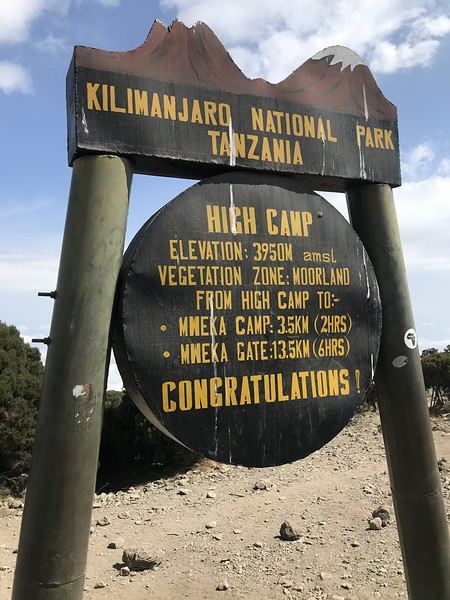
But the memories of this day will remain hazy. No photos, no notes—just exhaustion and an overwhelming urge to sleep.
The guides are starting to rush us. We’ve been past Stella Point for nearly two hours now, at over 5,700 meters above sea level. Oxygen is scarce, blood oxygen saturation is very low, and the risk of complications is increasing. They don’t want to take any chances.
The first part of the descent down to Stella Point isn’t difficult after that long break at the summit. The sun has risen, gradually warming the icy air. The landscape reveals itself in a new light, and we’re still floating on cloud nine from the euphoria of our achievement.
But the hardest part is yet to come. The descent to Barafu Camp is a challenge in itself. Steep and endless, it involves sliding through volcanic ash while trying not to fall—a task that demands energy I no longer have. The heat becomes stifling under my multiple layers of clothing, but I don’t even have the strength to stop and take them off.
I switch to autopilot mode, moving mechanically and taking frequent stops. Faustin and Alison pass me again and continue without stopping—I won’t see them again. The descent to Barafu was supposed to take 2 to 3 hours; I’ll arrive at camp 2 hours after Alison... I drag myself to our tent, painfully remove my sweat-soaked clothes, and collapse immediately, plunging into the most well-earned nap of my life.
A few hours later, we still have to leave and say goodbye to Barafu Camp (4,673m). The stage isn’t over yet: another 9.5 km awaits us to reach Mweka Camp.
I feel better. My muscles are still heavy, and my knees are sore from the descent, but at least I can walk without too much pain. I can finally appreciate the scenery and relive that strange, surreal night—unsure if it was a dream or a nightmare. Still a bit in shock from that sensation, that void of all vital energy, like being at death’s door. Was it the coffee? The two Diamox tablets? The altitude? The cumulative fatigue? Probably a bit of everything...
Vegetation reappears. Temperatures soften. The air becomes more breathable. On this trail, the fastest way down, we cross paths with several porters carrying stretchers. The mountain doesn’t give any gifts. We pass through High Camp and arrive at Mweka Camp (3,100m) before nightfall.
But the memories of this day will remain hazy. No photos, no notes—just exhaustion and an overwhelming urge to sleep.
Tanzania 2019 - Polé Polé
Congratulations, you must have gotten married since 😂
Thanks so much, Isabelle and Régis :) Well, no, we still aren’t married, and it’s still not planned Lots more travel journals to come...
You’re really amazing 👏
Still a bit of madness in hindsight...
Thanks so much, Isabelle and Régis :) Well, no, we still aren’t married, and it’s still not planned Lots more travel journals to come...
You’re really amazing 👏
Still a bit of madness in hindsight...
Tanzania 2019 - Pole Pole
Following Day 6 (09/06/19):
"The rest relies on a few fragments of memory, spared by the hypoxia and fatigue of that night. I realized I hadn’t taken any notes for the entire upcoming week of travel—understandable, since the ascent was grueling, and events then unfolded at a dizzying pace."
We follow the twinkling stars through the night, or perhaps we’re already at the heart of the Milky Way, continuing our endless climb. Each step is a trial; our progress is painfully slow yet utterly exhausting. I dig deep for the last bit of energy I don’t have to thrust my trekking poles forward and place one foot in front of the other, carving my path centimeter by centimeter. Behind me, Elias seems to have stopped, tirelessly encouraging me and giving me a push forward now and then. The wind picks up, biting and relentless.
We finally meet at Stella Point, 5,756 meters. I feel at the absolute limit of my strength. Alison is holding up, mostly suffering from the cold. Me? I’ve never been in such a state. There’s something thrilling, almost warrior-like, about pushing your limits like this... but also terrifying. What comes next? Will it pass? What if it gets worse? What happens if I can’t walk anymore?
It must be around 5 a.m. We take shelter behind a rocky outcrop, out of the wind—I’m completely slumped on the ground, facing the Stella Point sign. The break feels like an eternity. Am I sweating? Freezing? Hard to tell. Dawn is breaking on the horizon. Around us, a few groups emerge from the darkness and slowly pass us, focused on the final goal. No one speaks. Each of us will carry a unique and personal memory of this night’s ascent. Some have left a partner behind, too exhausted to continue; others won’t reach the summit for several more hours.
Our guides stay calm and don’t rush me. That reassures me. I recover a little and find my voice again. As if in a final effort, I stand up, wobble slightly, and grip my poles. One foot in front of the other. My stomach cramps ease. The slope seems gentler. We follow the ridge. Over there, in the distance, Uhuru Peak. The summit. The highest point on the entire African continent.
The sky lights up with sublime hues: blue, violet, orange, and bright pink. We’re in the middle of a rainbow.
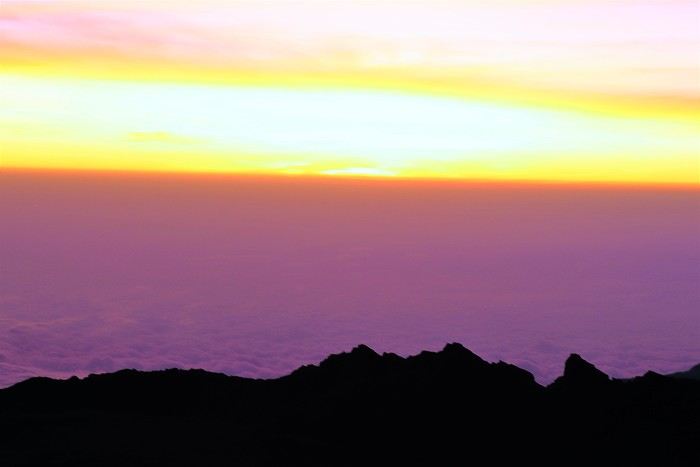
Here we are. Before our eyes, we dominate an endless panorama—the crater, the doomed glaciers, Mount Meru, and even the sun. The clouds float far below. It’s 6 a.m. The famous sign is right in front of us, like an accomplishment. I don’t know exactly what I’m feeling; I let myself be overwhelmed by all the emotions at once, especially an immense gratitude. I feel blessed, as if I’ve lived a rich life, filled with happiness, love, success, and adventures all around the world and now here, at the summit of Kilimanjaro. All that at the sight of a simple sign! This trek and ascent haven’t changed me; I’m not a new man or even a new version of myself, but there’s a strong sense of accomplishment in this moment.
I’m 27 years old. Just a few months ago, I never would’ve imagined finding myself in Tanzania, climbing this legendary mountain. I finished my studies; in a few months, I’ll be a medical intern. I’ve traveled beyond my wildest dreams, explored places more incredible than I ever thought possible. I’ve felt happiness, been happier than I ever dared hope... The sun rises on this new day, and I’m here, on the roof of Africa, with the love of my life. We’ll have to descend. But in this exact moment, I feel absolute peace, the sense of having lived a fulfilling life and embraced the meaning of my existence. The rest will just be a bonus. And I’m sober!!
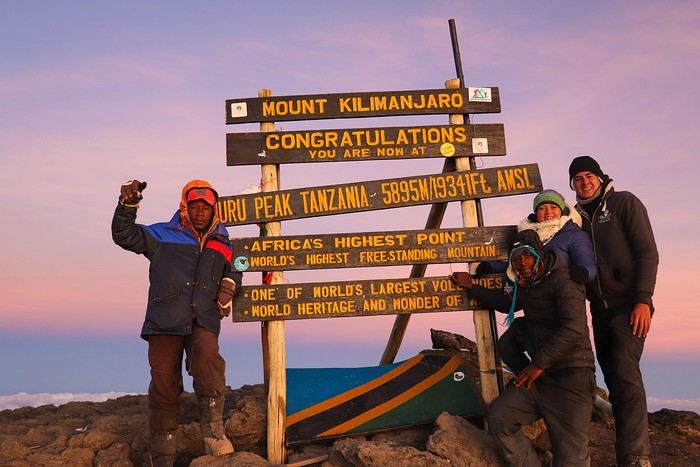
We’re among the first to arrive; there’s almost no one around. The very first trekkers are just starting to descend. A few victory cries, a few exchanged words. For safety, we shouldn’t stay more than fifteen minutes, but the guides don’t rush us, and with the excitement, I feel much better. We stay a little over half an hour, savoring every moment, capturing this memory in photos. We also take pictures for other French trekkers whose cameras didn’t survive the cold (Hi Alix and Aurélien! 🙂).
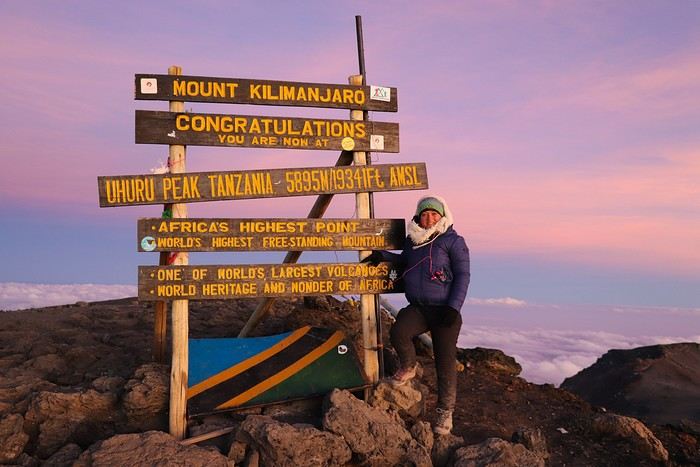
Then comes the time to leave. Too bad—I could’ve stayed longer, and I have no desire to walk again. Hard to say if it’s the mountain’s intoxicating effect or just exhaustion...
But I have one last mission. I take Alison’s hand and lead her a little farther along the ridge. I kneel on the volcanic rock—no, it’s not a dizzy spell. Hidden in my layers, a solitaire tanzanite ring, a question barely articulated, then a “Yes” carried away by the wind, forever whispered in the mountain’s silence.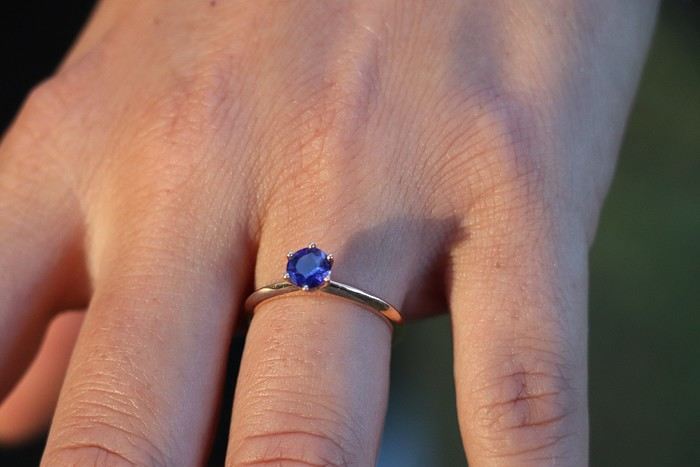
One last kiss. The second of the rest of our lives. Bonus!
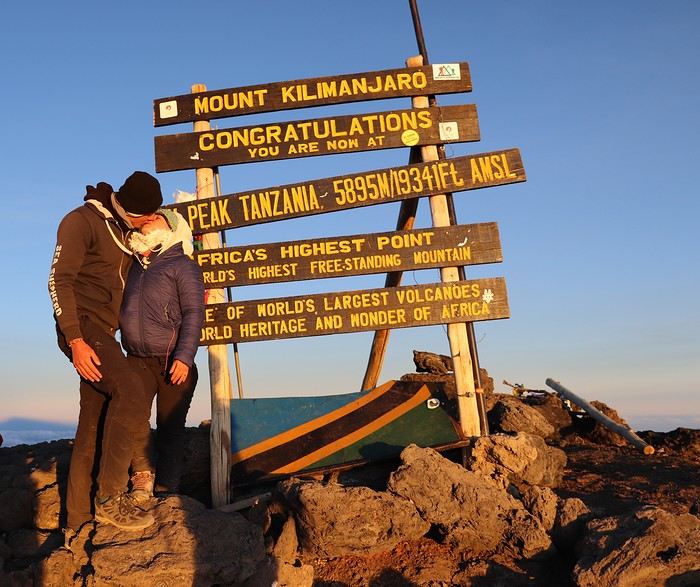
Then we descend, hand in hand, carried by the echo of this moment.
"The rest relies on a few fragments of memory, spared by the hypoxia and fatigue of that night. I realized I hadn’t taken any notes for the entire upcoming week of travel—understandable, since the ascent was grueling, and events then unfolded at a dizzying pace."
We follow the twinkling stars through the night, or perhaps we’re already at the heart of the Milky Way, continuing our endless climb. Each step is a trial; our progress is painfully slow yet utterly exhausting. I dig deep for the last bit of energy I don’t have to thrust my trekking poles forward and place one foot in front of the other, carving my path centimeter by centimeter. Behind me, Elias seems to have stopped, tirelessly encouraging me and giving me a push forward now and then. The wind picks up, biting and relentless.
We finally meet at Stella Point, 5,756 meters. I feel at the absolute limit of my strength. Alison is holding up, mostly suffering from the cold. Me? I’ve never been in such a state. There’s something thrilling, almost warrior-like, about pushing your limits like this... but also terrifying. What comes next? Will it pass? What if it gets worse? What happens if I can’t walk anymore?
It must be around 5 a.m. We take shelter behind a rocky outcrop, out of the wind—I’m completely slumped on the ground, facing the Stella Point sign. The break feels like an eternity. Am I sweating? Freezing? Hard to tell. Dawn is breaking on the horizon. Around us, a few groups emerge from the darkness and slowly pass us, focused on the final goal. No one speaks. Each of us will carry a unique and personal memory of this night’s ascent. Some have left a partner behind, too exhausted to continue; others won’t reach the summit for several more hours.
Our guides stay calm and don’t rush me. That reassures me. I recover a little and find my voice again. As if in a final effort, I stand up, wobble slightly, and grip my poles. One foot in front of the other. My stomach cramps ease. The slope seems gentler. We follow the ridge. Over there, in the distance, Uhuru Peak. The summit. The highest point on the entire African continent.
The sky lights up with sublime hues: blue, violet, orange, and bright pink. We’re in the middle of a rainbow.
Here we are. Before our eyes, we dominate an endless panorama—the crater, the doomed glaciers, Mount Meru, and even the sun. The clouds float far below. It’s 6 a.m. The famous sign is right in front of us, like an accomplishment. I don’t know exactly what I’m feeling; I let myself be overwhelmed by all the emotions at once, especially an immense gratitude. I feel blessed, as if I’ve lived a rich life, filled with happiness, love, success, and adventures all around the world and now here, at the summit of Kilimanjaro. All that at the sight of a simple sign! This trek and ascent haven’t changed me; I’m not a new man or even a new version of myself, but there’s a strong sense of accomplishment in this moment.
I’m 27 years old. Just a few months ago, I never would’ve imagined finding myself in Tanzania, climbing this legendary mountain. I finished my studies; in a few months, I’ll be a medical intern. I’ve traveled beyond my wildest dreams, explored places more incredible than I ever thought possible. I’ve felt happiness, been happier than I ever dared hope... The sun rises on this new day, and I’m here, on the roof of Africa, with the love of my life. We’ll have to descend. But in this exact moment, I feel absolute peace, the sense of having lived a fulfilling life and embraced the meaning of my existence. The rest will just be a bonus. And I’m sober!!
We’re among the first to arrive; there’s almost no one around. The very first trekkers are just starting to descend. A few victory cries, a few exchanged words. For safety, we shouldn’t stay more than fifteen minutes, but the guides don’t rush us, and with the excitement, I feel much better. We stay a little over half an hour, savoring every moment, capturing this memory in photos. We also take pictures for other French trekkers whose cameras didn’t survive the cold (Hi Alix and Aurélien! 🙂).
Then comes the time to leave. Too bad—I could’ve stayed longer, and I have no desire to walk again. Hard to say if it’s the mountain’s intoxicating effect or just exhaustion...
But I have one last mission. I take Alison’s hand and lead her a little farther along the ridge. I kneel on the volcanic rock—no, it’s not a dizzy spell. Hidden in my layers, a solitaire tanzanite ring, a question barely articulated, then a “Yes” carried away by the wind, forever whispered in the mountain’s silence.
One last kiss. The second of the rest of our lives. Bonus!
Then we descend, hand in hand, carried by the echo of this moment.
Tanzania 2019 - Polé Polé
Day 6 (09/06/19):
It’s the big day! Well, theoretically, it’s still September 5th. The alarm goes off at 11 PM, but I’ve been awake since 10:15 PM, unable to sleep as this long-awaited moment approaches. The departure, initially planned for 11:30 PM, is delayed by a few minutes to avoid the small group that already left and to steer clear of traffic on the trail. Tonight, we have to reach the summit of Kibo, Uhuru Peak, which stands at 5,895 meters—nearly 1,200 meters of elevation gain over 5 km. The goal is to get there early enough to avoid climbing in the sun’s heat and to have time to descend to Mweka Camp before tomorrow evening.
A frugal "breakfast": coffee, sweetened rusks called "Glucose" (seriously, haven’t they ever heard of diabetes here?). I decide to take my two Diamox tablets (125 mg) in one go, knowing we’re supposed to descend to 3,100 meters by tonight. Finally, after some delays caused by Alison and the guides, we leave camp at 11:45 PM. I’ve layered up, changed the batteries in my headlamp, and I’m feeling great. After waiting so long for this moment, I’m ready to take it on! 😎
Elias tells us that other travelers had to turn back last night, defeated by the altitude. But he’s confident about us. It seems it was the girls from the American group—the same ones who were singing cheerfully this morning on the Barranco Wall. 😕
The nighttime spectacle is magical: the side of Kibo glows with a thousand lights—or rather, dozens of colorful tents, lit from within, illuminating the mountain and creating a fairy-tale scene. Behind us, the majestic shadow of Mount Mawenzi stands out against a sea of stars. The conditions are perfect, a true gift for this long-dreamed-of ascent!
Of course, today we’re only climbing to Camp 4. The porters will wait for our return before descending to the next camp tomorrow afternoon. Faustin leads the way, followed by Alison, me, and Elias bringing up the rear. Alison, not a morning person, is a bit grumpy. Elias, ever thoughtful, quickly takes her backpack, which she’s loaded like a mule. 🤪 We cross the camp in solemn silence and begin the ascent. Polé polé.
Very quickly, a sharp abdominal pain hits me, like a sudden cramp. I blame the coffee—I almost never drink it, and every time, it upsets my stomach and gives me a headache. What a poison! But as the meters pass, the pain doesn’t go away. I start to feel really bad and struggle to focus on walking. Still, Alison walks just as fast, so I keep up. We pass several groups. Faustin sets a brisk pace; his physical condition is impressive. Walking in the ash and rocks is exhausting. We slip often—two steps forward, one step back. Occasionally, a rock rolls down the slope for a few dozen meters, breaking the solemn silence of this almost sacred ascent.
At 5,200 meters, I can’t take the pain anymore. I ask for a first break to take a Doliprane and a Spasfon, all we have with us. As we resume, the wind picks up, freezing our faces and hands. The pain eases briefly before returning even stronger... I don’t know if I’ll die from the cold or from an exploding cramp. My mind starts to wander; my nostrils and lungs burn from the cold, and my breath becomes shorter and shorter.
Below, we can still see the camp and a line of headlamp lights snaking slowly up the mountain like a river of fireflies defying the night.
Every now and then, I take my hand out of my pocket, defying the biting cold to check the altitude on my smartphone.
At 5,300 meters, I’m forced to ask for another break. I lie down behind a rock to try to recover a bit, but you have to pick your spot carefully—there’s toilet paper everywhere. In a moment of dark humor, I say, "Leave me here, I’m going to die. Go on without me!"
A little black humor that betrays my growing panic. We’re not even halfway up the elevation gain, and I have no idea how I’ll manage. It’s pitch black, and I have no strength left. Even descending back to camp seems impossible...
Alison continues with Faustin, while Elias stays by my side. We had agreed that if one of us couldn’t go on, the other would continue alone. Barely do I stand up and take one step before I’m exhausted again. I stop every 10 meters—it’s a disaster.
At 5,400 meters, we briefly catch up with Alison and Faustin. Their headlamps blind me for a moment, and I sense their worried looks as they glance at me—asking if I’m okay would almost be cruel. Then they pull ahead in silence.
At 5,500 meters, it’s over. I’m done. Nausea joins the pain. Every sip of water I force myself to drink threatens to come back up. I have no strength left. I take a long break and warn Elias that I’ll need many more. I try to push through. I move forward 10 meters at a time... "Polé Polé!"
Elias encourages me tirelessly in the dark. I feel his presence behind me, but I don’t see him. Sometimes I catch the beam of his headlamp cutting through the darkness ahead, and I think I hear his steps. My half-closed eyes are locked on mine, as if hypnotized, blocking out everything else.
My memories of that night are hazy, but Elias’s voice still echoes in my mind. Polé Polé... Faustin eventually takes my backpack, which isn’t that heavy, giving me a little relief. Every bathroom break is a Herculean task and another temptation to give up. Taking off all those layers of clothing and putting them back on requires overwhelming energy... The fatigue, the pain, the cold... What a macabre trio!
I’ll spare you the poetic details about the diarrhea breaks. Between the euphoria of the goal and the inner struggle against my own body, every half-step becomes a victory over myself. The shadow of the summit draws closer, but the path is still long.
I remember the surprising statistics about the number of hikers who don’t make it to the summit... About 30%. A little less via the Machame route. 10 to 20 deaths per year.
Tanzania 2019 - Pole Pole
How is this a recurring topic? I must have missed something.
Well, no, we didn’t feel like we were on a highway at all—except a little on the morning of the Lava Tower ascent and when crossing the Barranco Wall. But in the afternoons, we always ended up alone, which was amazing. There were between 130 and 140 tourists at Machame Camp the first night. And that’s not counting all the porters... Just the two of us had about ten porters (guide, assistant guide, cook, waiter, porter for the portable toilet).
So far, the steps are still coming together just fine. More to come!
Tanzania 2019 - Polé Polé
Day 5 (09/05/19):
The night was interrupted by a first wake-up at midnight for a discreet and freezing bathroom break, followed by a hard time falling back asleep and then another trip at 4:30 AM... 🏴☠️ This story’s gonna end with a prostate check-up! The 6:30 AM alarm didn’t even wake me, and it was Brysson, our porter/server, who finally roused us at 6:40. Alison got a bit cold last night.
Outside, everything was white with frost—grass and water basins covered in a thin layer of ice. At 7 AM, as usual, they brought us hot water, a blessing in this freezing air. By 7:30, breakfast was served, and we could finally warm up. Barranco Camp is nestled in a basin between the Barranco Wall, the summit of Kibo, and a towering cliff. It was still in shadow at this hour, so it was *very* cold. We got ready for the legendary part of the day: crossing the Barranco Wall.
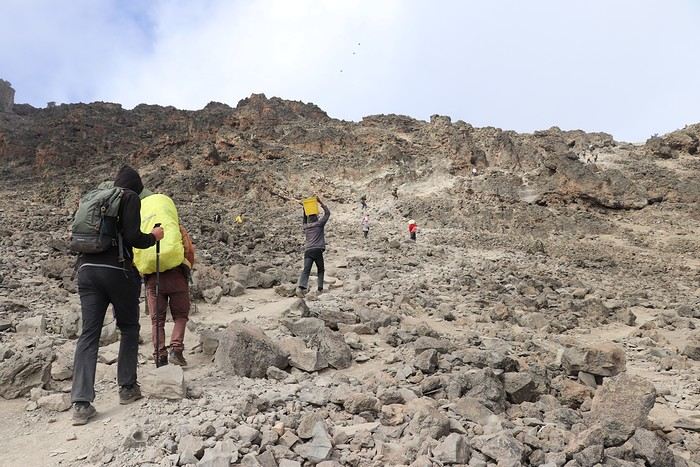
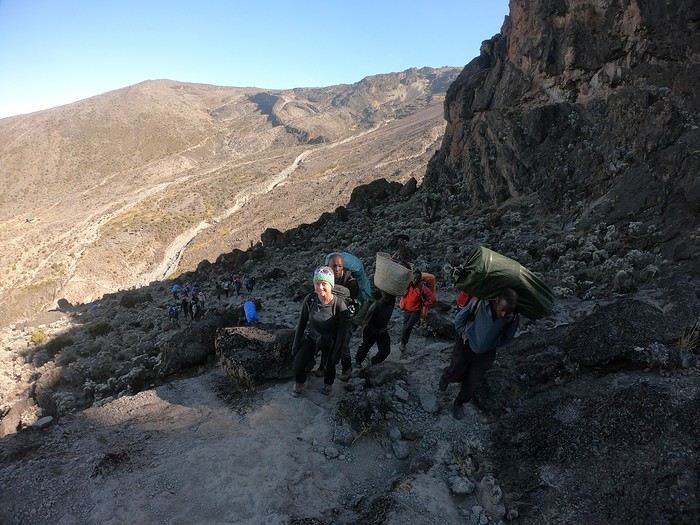
This is the only truly technical section of the Machame route, though it’s known to be very accessible. The part that makes it into guidebooks, travel journals, and videos. A cliff of several hundred meters of crumbly rock with little safety, exposed to the wind, climbing single-file in freezing cold. We set off at 8:15 AM, still in the shade. The icy air stung our nostrils with every breath. The climb demanded focus and caution. In some spots, you literally had to hug the rock face to avoid slipping or falling. Almost all of us left camp at the same time, and some sections created bottlenecks on the wall, giving us welcome breaks to enjoy the view—but also exposing us to the cold again.
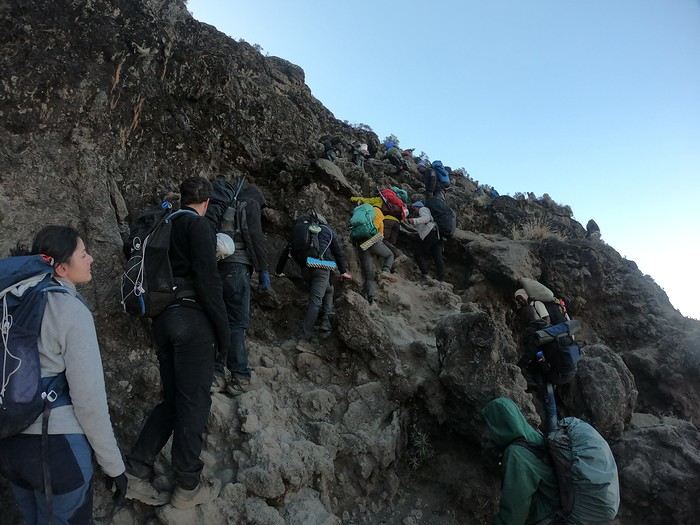 A group of young American women ahead of us sang to keep warm. The vibe was great for this "last day."
Finally, we reached the top of the wall at 4,250 meters, bathed in sunlight. We lingered for a moment, exchanging a few words with a French couple we’d met earlier. Below, clouds were slowly rising, gently wrapping Kibo in a white veil.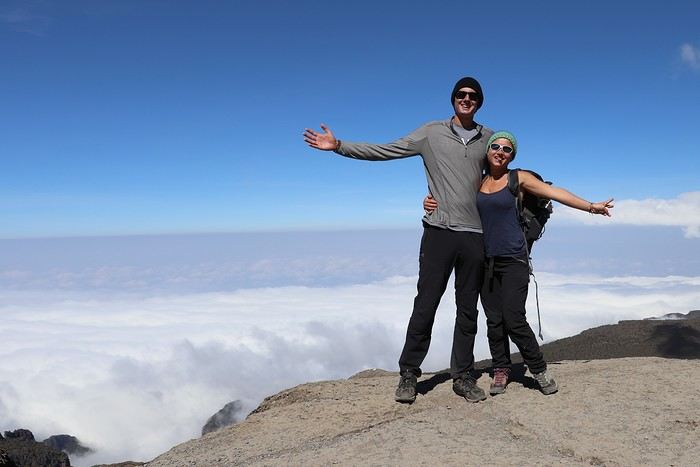 The descent to Karanga Camp was another challenge—unstable gravel and dust made every step tricky. Despite our trekking poles, we slipped several times, nearly falling. Luckily, our ankles held strong. Even the experienced and fast porters stumbled occasionally... After a steep, nerve-wracking descent, we finally reached Karanga at 3,900 meters by 11:50 AM.
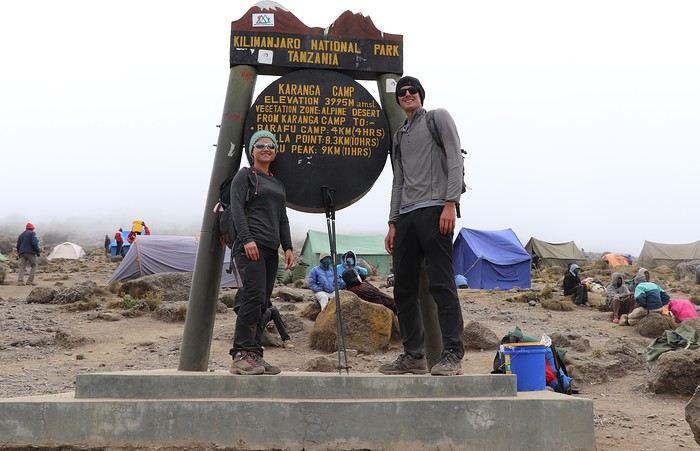
The camp was shrouded in clouds, swept by a cold wind. Our "mess tent" was already set up, and we took refuge there to enjoy a ratatouille broth.
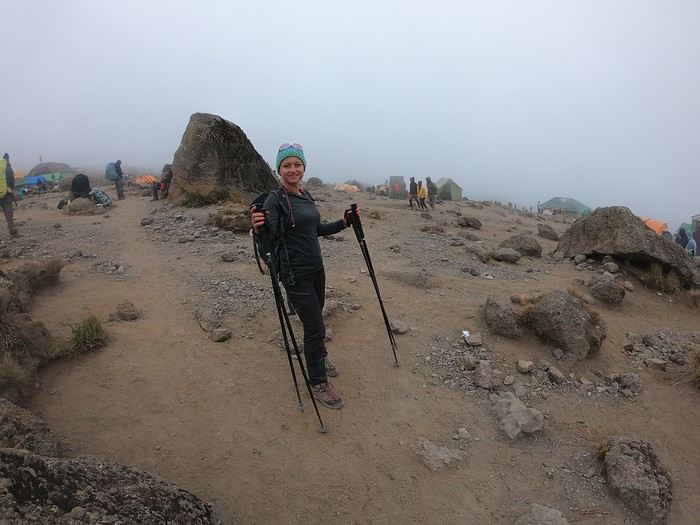
Those doing the 6-day ascent would stay here for the night, but not us: at 1 PM, we set off again with Elias for the day’s final leg to Barafu Camp.
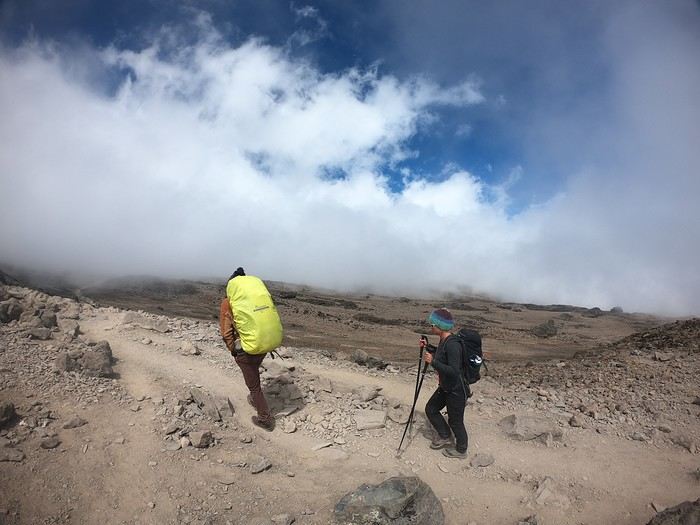 The climb was slow—"polé polé"—through thick fog. Not many photos, then. The cold and poor visibility made the ascent tough, but Faustin caught up with us along the way, bringing some human warmth. Gradually, the clouds lifted, revealing a stunning view of Mount Mawenzi. The atmosphere was almost Martian: an arid, reddish landscape that seemed like another planet. Kibo, though, remained hidden in the clouds.
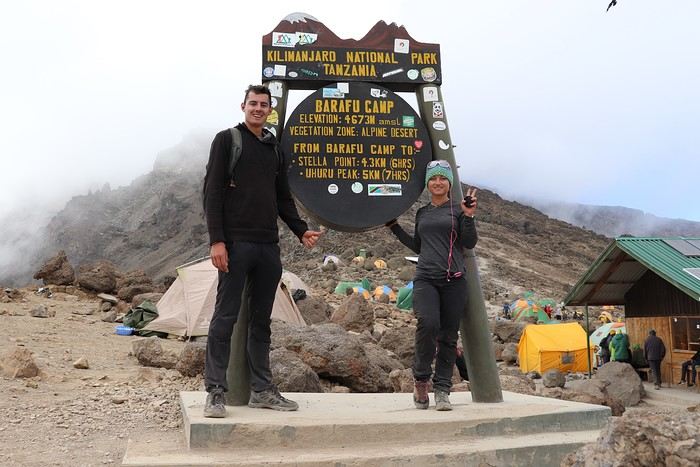
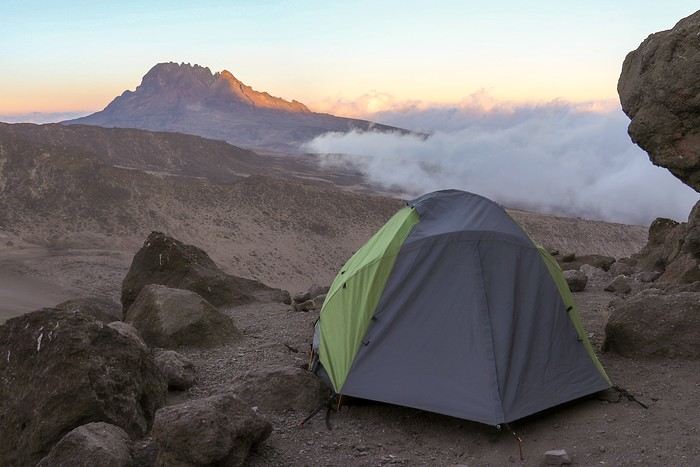
We finally reached Barafu Camp at 4,650 meters by 3:30 PM. The camp was logically more rudimentary than the previous ones, a bit dirtier too, but we were lucky to have an ideal spot: flat, sheltered from the wind, and with a clear view of Mawenzi.
Though we were pretty satisfied and reassured by our performance so far, we crossed paths with a young Asian woman being urgently escorted down to lower altitudes. She was staggering, stumbling like a zombie... The helicopter was waiting for her below. It was over for her. She wouldn’t go any further and would likely be hospitalized, hoping she’d recover quickly. The scene was chilling and a stark reminder of the danger lurking around us. The rest of the afternoon passed quietly. Hot water to freshen up, followed by our usual cup of hot chocolate.
Despite the hike, we felt surprisingly good, which left us both puzzled and optimistic.
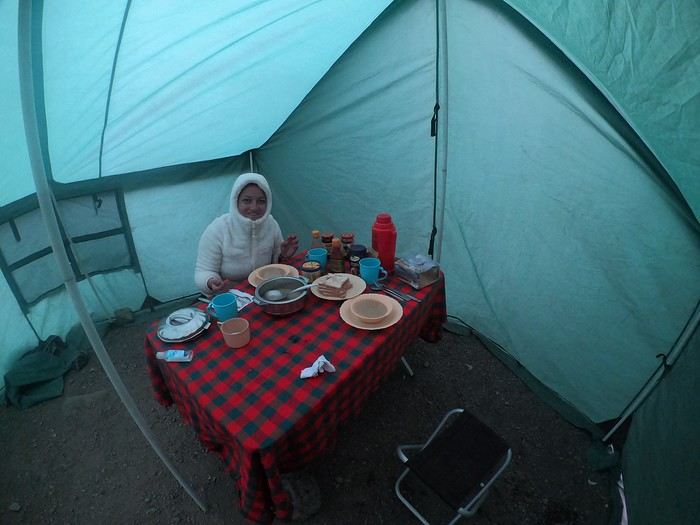
After dinner at 5:30 PM and a briefing with Elias and Faustin, we crawled into our sleeping bags at 6:30 PM for a very short night. The wake-up call was at 11 PM. The final ascent was tonight. The guides were confident about the weather. The satellite phone updates were positive. A mix of excitement and apprehension... the adventure continues.
The night was interrupted by a first wake-up at midnight for a discreet and freezing bathroom break, followed by a hard time falling back asleep and then another trip at 4:30 AM... 🏴☠️ This story’s gonna end with a prostate check-up! The 6:30 AM alarm didn’t even wake me, and it was Brysson, our porter/server, who finally roused us at 6:40. Alison got a bit cold last night.
Outside, everything was white with frost—grass and water basins covered in a thin layer of ice. At 7 AM, as usual, they brought us hot water, a blessing in this freezing air. By 7:30, breakfast was served, and we could finally warm up. Barranco Camp is nestled in a basin between the Barranco Wall, the summit of Kibo, and a towering cliff. It was still in shadow at this hour, so it was *very* cold. We got ready for the legendary part of the day: crossing the Barranco Wall.
This is the only truly technical section of the Machame route, though it’s known to be very accessible. The part that makes it into guidebooks, travel journals, and videos. A cliff of several hundred meters of crumbly rock with little safety, exposed to the wind, climbing single-file in freezing cold. We set off at 8:15 AM, still in the shade. The icy air stung our nostrils with every breath. The climb demanded focus and caution. In some spots, you literally had to hug the rock face to avoid slipping or falling. Almost all of us left camp at the same time, and some sections created bottlenecks on the wall, giving us welcome breaks to enjoy the view—but also exposing us to the cold again.
A group of young American women ahead of us sang to keep warm. The vibe was great for this "last day."Finally, we reached the top of the wall at 4,250 meters, bathed in sunlight. We lingered for a moment, exchanging a few words with a French couple we’d met earlier. Below, clouds were slowly rising, gently wrapping Kibo in a white veil.
The descent to Karanga Camp was another challenge—unstable gravel and dust made every step tricky. Despite our trekking poles, we slipped several times, nearly falling. Luckily, our ankles held strong. Even the experienced and fast porters stumbled occasionally... After a steep, nerve-wracking descent, we finally reached Karanga at 3,900 meters by 11:50 AM.The camp was shrouded in clouds, swept by a cold wind. Our "mess tent" was already set up, and we took refuge there to enjoy a ratatouille broth.
Those doing the 6-day ascent would stay here for the night, but not us: at 1 PM, we set off again with Elias for the day’s final leg to Barafu Camp.
The climb was slow—"polé polé"—through thick fog. Not many photos, then. The cold and poor visibility made the ascent tough, but Faustin caught up with us along the way, bringing some human warmth. Gradually, the clouds lifted, revealing a stunning view of Mount Mawenzi. The atmosphere was almost Martian: an arid, reddish landscape that seemed like another planet. Kibo, though, remained hidden in the clouds.We finally reached Barafu Camp at 4,650 meters by 3:30 PM. The camp was logically more rudimentary than the previous ones, a bit dirtier too, but we were lucky to have an ideal spot: flat, sheltered from the wind, and with a clear view of Mawenzi.
Though we were pretty satisfied and reassured by our performance so far, we crossed paths with a young Asian woman being urgently escorted down to lower altitudes. She was staggering, stumbling like a zombie... The helicopter was waiting for her below. It was over for her. She wouldn’t go any further and would likely be hospitalized, hoping she’d recover quickly. The scene was chilling and a stark reminder of the danger lurking around us. The rest of the afternoon passed quietly. Hot water to freshen up, followed by our usual cup of hot chocolate.
Despite the hike, we felt surprisingly good, which left us both puzzled and optimistic.
After dinner at 5:30 PM and a briefing with Elias and Faustin, we crawled into our sleeping bags at 6:30 PM for a very short night. The wake-up call was at 11 PM. The final ascent was tonight. The guides were confident about the weather. The satellite phone updates were positive. A mix of excitement and apprehension... the adventure continues.
Tanzania 2019 - Polé Polé
You're welcome, Fred!
Hang in there to those keeping up the pace 😉
Tanzania 2019 - Pole Pole
Day 4 (01/04/2025) Continued:
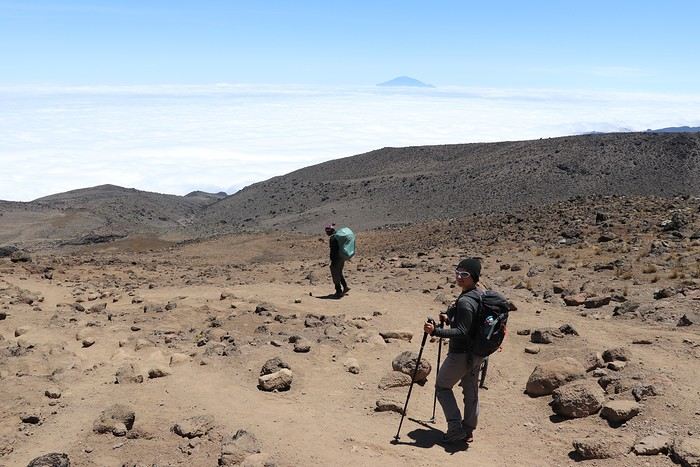
“Twende tchini,” Elias encourages us as we head toward Barranco. The landscapes continue to delight us. To the right, Mount Meru keeps us company, reassuring, watching over our ascent;
To the left, in the north, Kibo looms with grandeur, challenging us. Or maybe it’s the other way around...
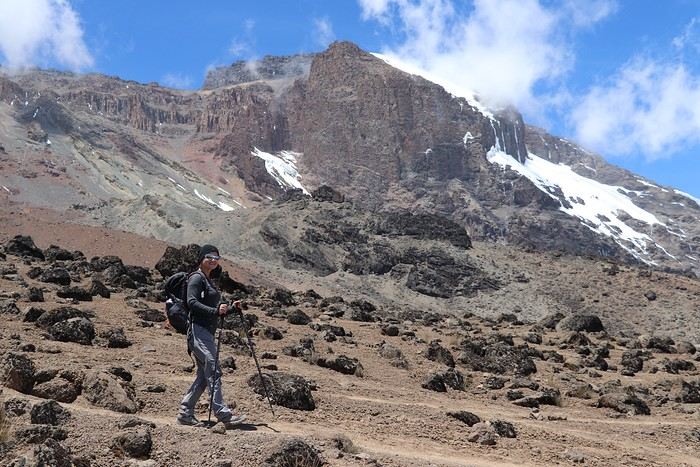
The descent is more technical than we imagined: dust and gravel make every step precarious and potentially dangerous. We’re almost alone this afternoon, and we appreciate these moments with our guides even more, who tirelessly remind us “pole pole dada,” “pole pole kaka,” urging us to slow down.
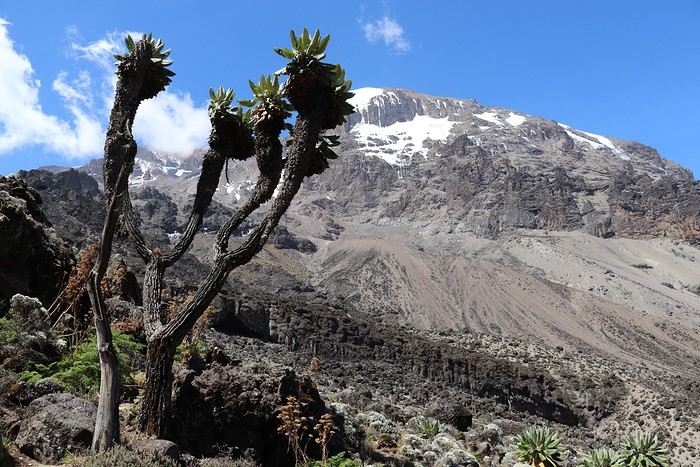
In the distance, Barranco Camp finally comes into view, nestled in the mountain’s fold at the foot of a steep cliff. The descent winds along a stream lined with lush vegetation, where majestic giant groundsels—endemic plants of the Kilimanjaro’s afro-alpine zones—stand tall with their unique silhouettes. A breathtaking beauty that leaves us gasping... and our breath gradually but surely growing shorter.
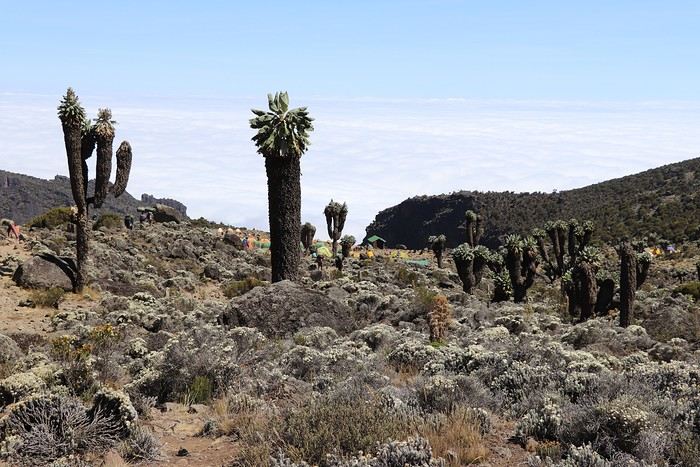
We arrive at Barranco Camp (3900m) at 2:30 PM. The camp is nearly empty.
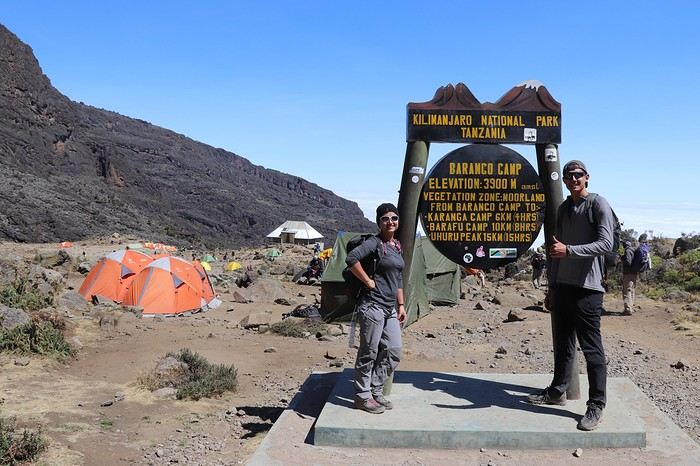
After signing the register, we find our tent and our belongings, carefully transported by the porters. Satisfaction: we’re in great shape, despite a little heat exhaustion. The scorching sun got to us a bit, even with sunscreen.
At 3:15 PM, it’s tea time, accompanied by popcorn. Water, salt... hmm. The gears start turning. Tomorrow, we’ll have to tackle the famous Barranco Wall, and if all goes well, tomorrow night will be the final ascent to Uhuru Peak. Back to our tent for a well-deserved nap. Later, a really nice walk around the camp and some photos to capture these special moments in front of Kibo and the Barranco Wall.
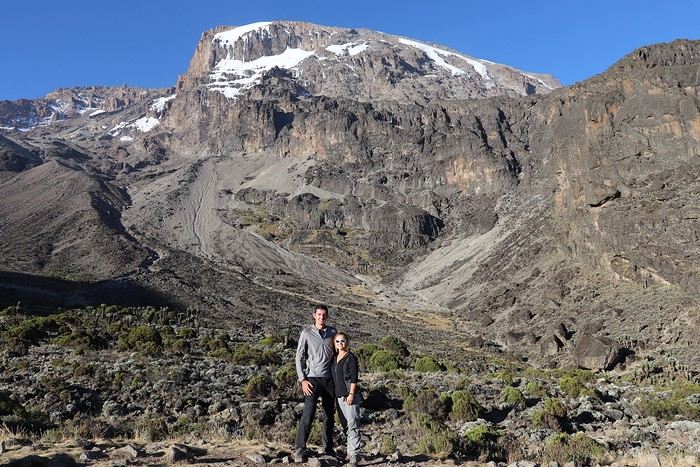
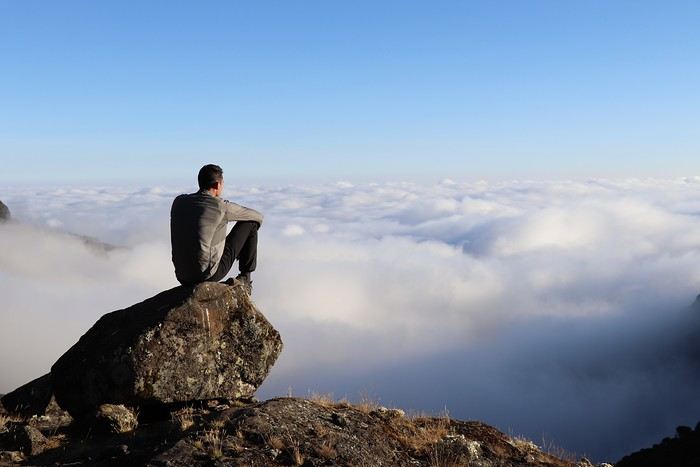
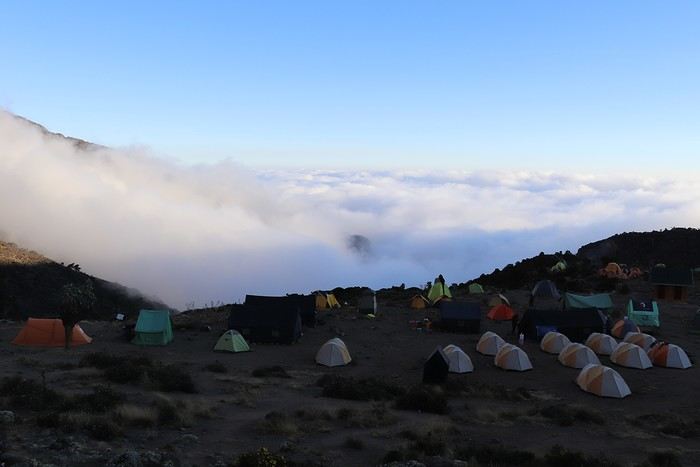
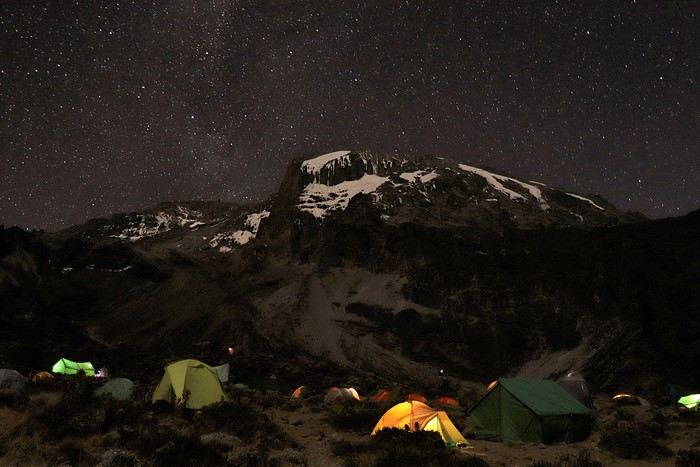
Dinner is served at 6 PM. I don’t linger and by 7:30 PM, I’m in my sleeping bag, pretty tired, while Alison goes out to take some night photos. No sea of clouds tonight—the day ends under the stars, filling our hearts with gratitude.
“Twende tchini,” Elias encourages us as we head toward Barranco. The landscapes continue to delight us. To the right, Mount Meru keeps us company, reassuring, watching over our ascent;
To the left, in the north, Kibo looms with grandeur, challenging us. Or maybe it’s the other way around...
The descent is more technical than we imagined: dust and gravel make every step precarious and potentially dangerous. We’re almost alone this afternoon, and we appreciate these moments with our guides even more, who tirelessly remind us “pole pole dada,” “pole pole kaka,” urging us to slow down.
In the distance, Barranco Camp finally comes into view, nestled in the mountain’s fold at the foot of a steep cliff. The descent winds along a stream lined with lush vegetation, where majestic giant groundsels—endemic plants of the Kilimanjaro’s afro-alpine zones—stand tall with their unique silhouettes. A breathtaking beauty that leaves us gasping... and our breath gradually but surely growing shorter.
We arrive at Barranco Camp (3900m) at 2:30 PM. The camp is nearly empty.
After signing the register, we find our tent and our belongings, carefully transported by the porters. Satisfaction: we’re in great shape, despite a little heat exhaustion. The scorching sun got to us a bit, even with sunscreen.
At 3:15 PM, it’s tea time, accompanied by popcorn. Water, salt... hmm. The gears start turning. Tomorrow, we’ll have to tackle the famous Barranco Wall, and if all goes well, tomorrow night will be the final ascent to Uhuru Peak. Back to our tent for a well-deserved nap. Later, a really nice walk around the camp and some photos to capture these special moments in front of Kibo and the Barranco Wall.
Dinner is served at 6 PM. I don’t linger and by 7:30 PM, I’m in my sleeping bag, pretty tired, while Alison goes out to take some night photos. No sea of clouds tonight—the day ends under the stars, filling our hearts with gratitude.
Tanzania 2019 - Polé Polé
Day 4 (01/04/2025):
Early wake-up at 6:30 AM at Shira Cave camp. After a relatively peaceful night—just one nocturnal trip to pee—I wake up full of energy. The sky is a pristine blue, but the cold air reminds us we're at altitude and gives us a taste of what's to come... In the morning chill, we're offered hot tea in the tent, but we prefer to enjoy it with breakfast. At 7 AM, hot water is brought to us to help us wake up before the meal. Half an hour later, the sun finally breaks through, bathing the camp in its rays and dispelling the cold. A hearty breakfast awaits us in the mess tent: toast, omelets, pancakes, mangoes, coffee, and hot chocolate. We don’t forget our Malarone tablets and, for the first time, Diamox, which we’ve finally decided to take as a preventive measure—before any symptoms—against altitude sickness (this isn’t medical advice, and if it’s based on any recommendations, I don’t remember which ones). As promised, no more porridge on the menu—thank you so much. We tried it, but neither Alison nor I like it.
We set off at 8:15 AM. Today, a more demanding stage awaits us: 800 m of elevation gain to Lava Tower, then 600 m of descent, for a total of 10 km to Barranco camp. The first section takes us to Lava Tower, at 4,630 m. A gentle but steady climb, maintaining a good pace, accompanied by Faustin, our assistant guide, while Elias stays behind at camp for a bit.
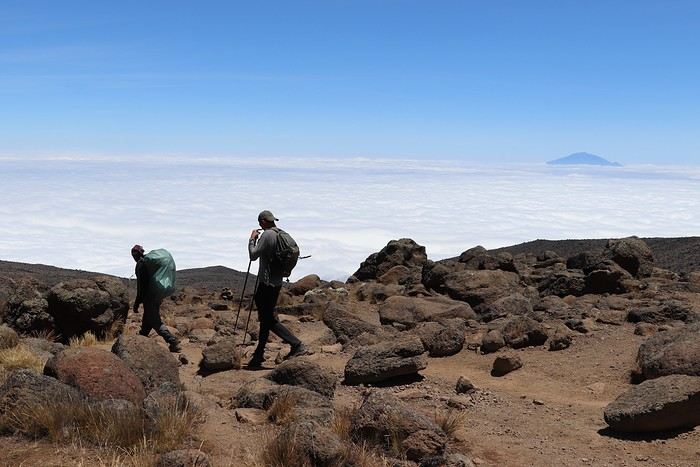
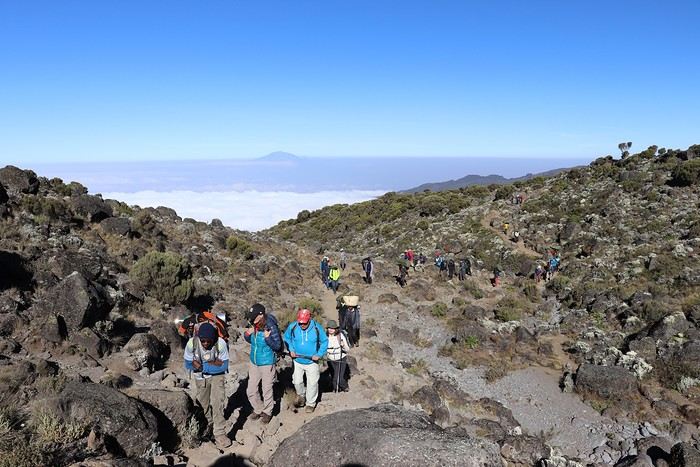 The climb is more pleasant than yesterday’s, with multiple parallel paths that spread out the groups. Mount Meru still watches over us, majestic, but seeming lower and lower—are we starting to surpass it? Hard to say. The two mountains are 67 km apart.
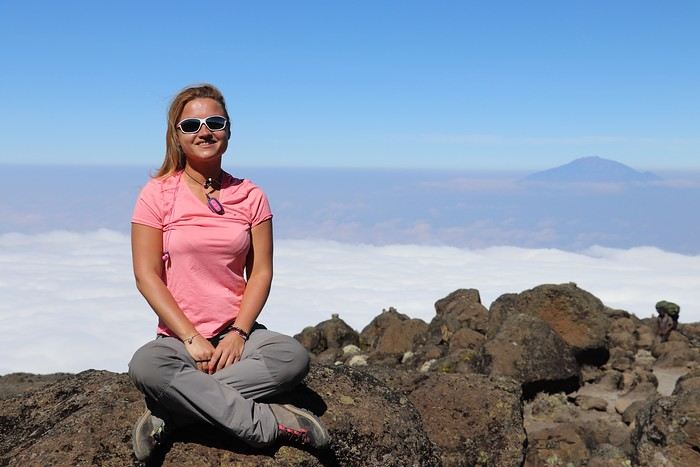
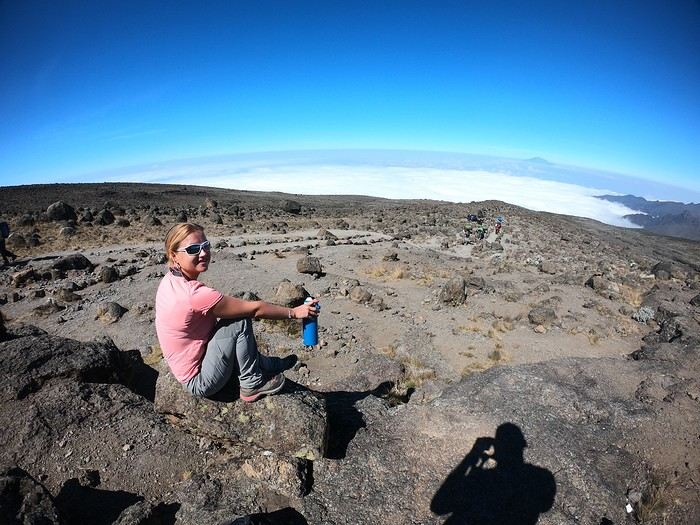
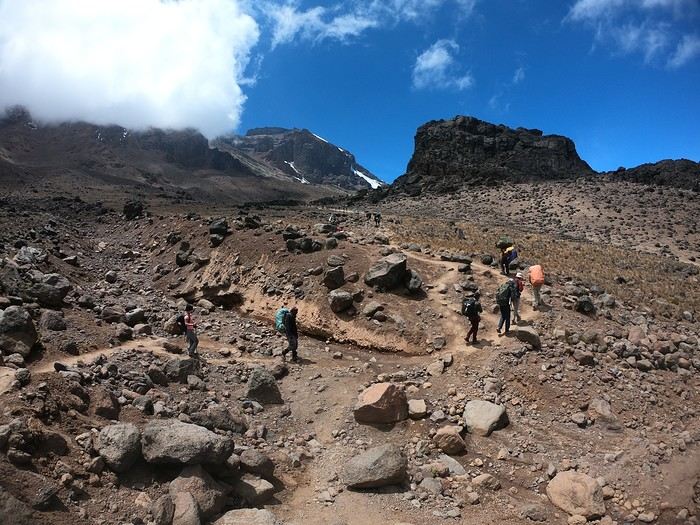 After an hour and a half of walking, at 4,200 m, a slight headache starts to creep in. Unusual for me. I take a short 10-minute break to acclimatize, rest, drink, and pee. My urine is quite concentrated for the first time—my hydration since last night hasn’t been optimal, a choice to limit nighttime wake-ups, but I’ll need to adjust that. One sip of water at a time, and I quickly feel better.
I give Alison a beanie because she still hasn’t protected her head, and the sun is beating down hard.
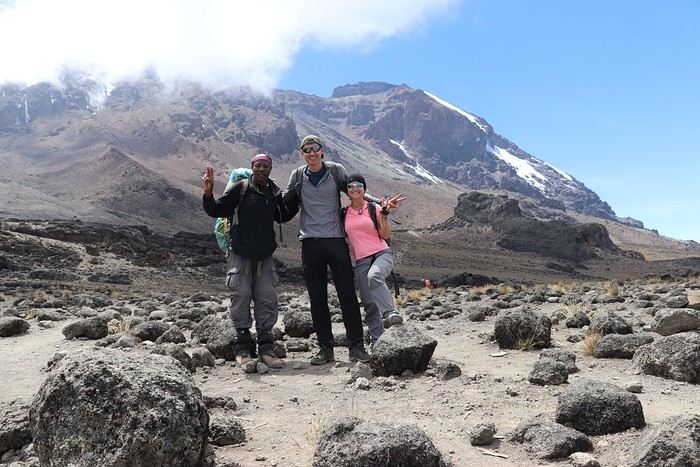
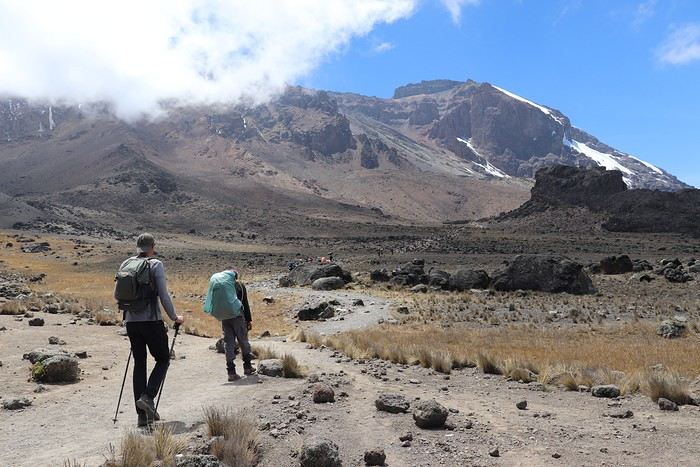 We continue on our way, and at noon, after less than four hours of walking, we reach Lava Tower.
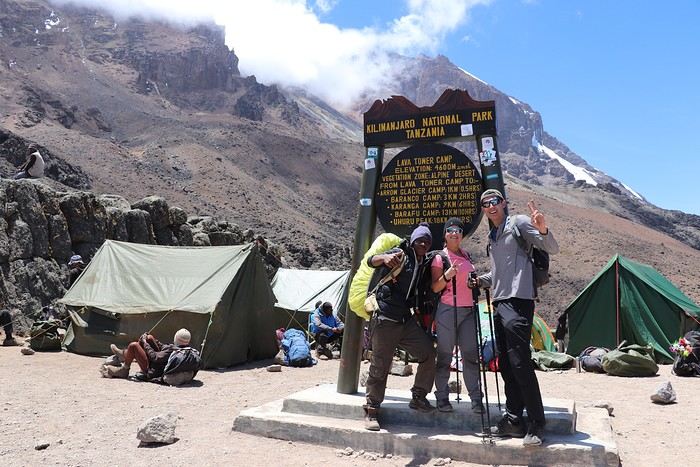 This mineral stronghold, perched at 4,630 m, is a crossroads for climbers. Some set up their tents here for a night of acclimatization, while others use it as a base for the final ascent. We dig into our lunch boxes with Faustin and Elias, who’s caught up with us, swallowing another Diamox tablet before setting off again at 12:45 PM.
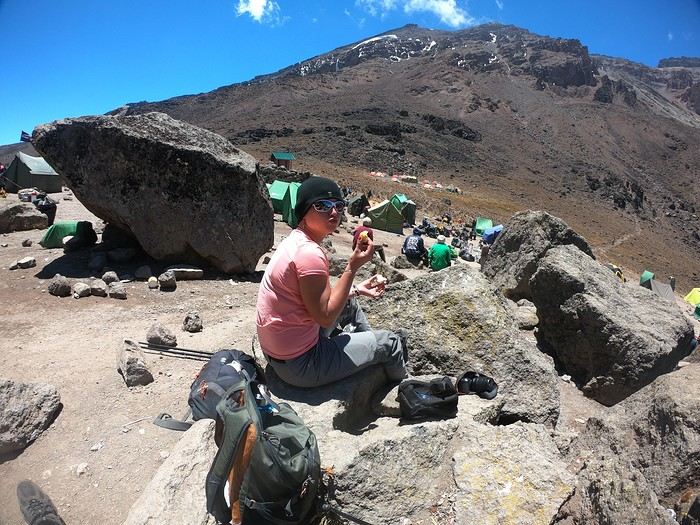
Early wake-up at 6:30 AM at Shira Cave camp. After a relatively peaceful night—just one nocturnal trip to pee—I wake up full of energy. The sky is a pristine blue, but the cold air reminds us we're at altitude and gives us a taste of what's to come... In the morning chill, we're offered hot tea in the tent, but we prefer to enjoy it with breakfast. At 7 AM, hot water is brought to us to help us wake up before the meal. Half an hour later, the sun finally breaks through, bathing the camp in its rays and dispelling the cold. A hearty breakfast awaits us in the mess tent: toast, omelets, pancakes, mangoes, coffee, and hot chocolate. We don’t forget our Malarone tablets and, for the first time, Diamox, which we’ve finally decided to take as a preventive measure—before any symptoms—against altitude sickness (this isn’t medical advice, and if it’s based on any recommendations, I don’t remember which ones). As promised, no more porridge on the menu—thank you so much. We tried it, but neither Alison nor I like it.
We set off at 8:15 AM. Today, a more demanding stage awaits us: 800 m of elevation gain to Lava Tower, then 600 m of descent, for a total of 10 km to Barranco camp. The first section takes us to Lava Tower, at 4,630 m. A gentle but steady climb, maintaining a good pace, accompanied by Faustin, our assistant guide, while Elias stays behind at camp for a bit.
The climb is more pleasant than yesterday’s, with multiple parallel paths that spread out the groups. Mount Meru still watches over us, majestic, but seeming lower and lower—are we starting to surpass it? Hard to say. The two mountains are 67 km apart.
After an hour and a half of walking, at 4,200 m, a slight headache starts to creep in. Unusual for me. I take a short 10-minute break to acclimatize, rest, drink, and pee. My urine is quite concentrated for the first time—my hydration since last night hasn’t been optimal, a choice to limit nighttime wake-ups, but I’ll need to adjust that. One sip of water at a time, and I quickly feel better.
I give Alison a beanie because she still hasn’t protected her head, and the sun is beating down hard.
We continue on our way, and at noon, after less than four hours of walking, we reach Lava Tower.
This mineral stronghold, perched at 4,630 m, is a crossroads for climbers. Some set up their tents here for a night of acclimatization, while others use it as a base for the final ascent. We dig into our lunch boxes with Faustin and Elias, who’s caught up with us, swallowing another Diamox tablet before setting off again at 12:45 PM.
Tanzania 2019 - Pole Pole
Day 3 Follow-Up (09/03/25):
Back at camp by 5:30 PM, we witness a spectacular sunset.
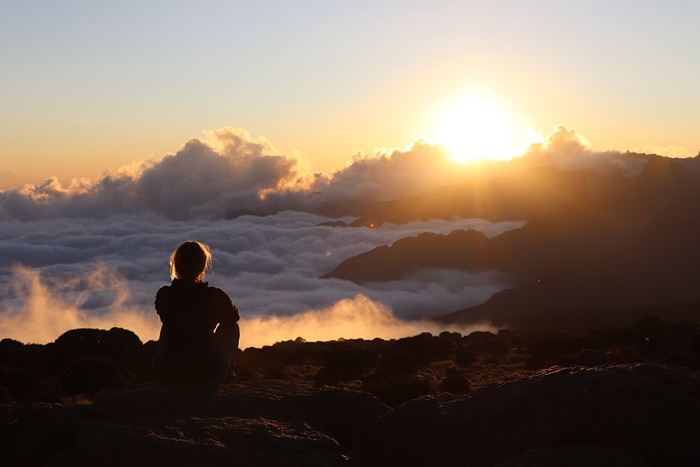 Mount Meru stands proudly above the clouds, bathed in pink and orange hues.
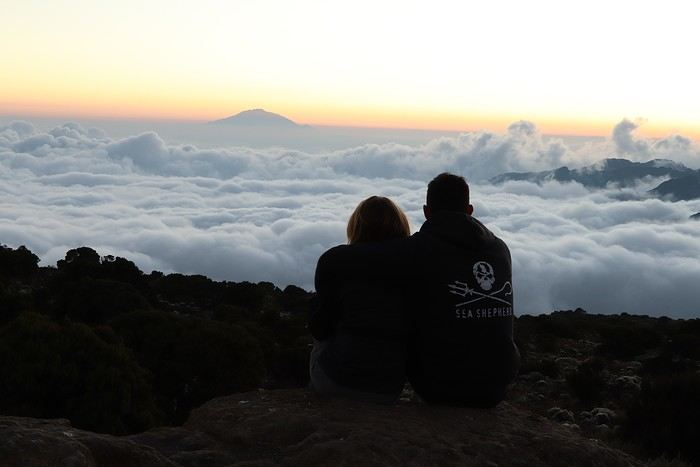
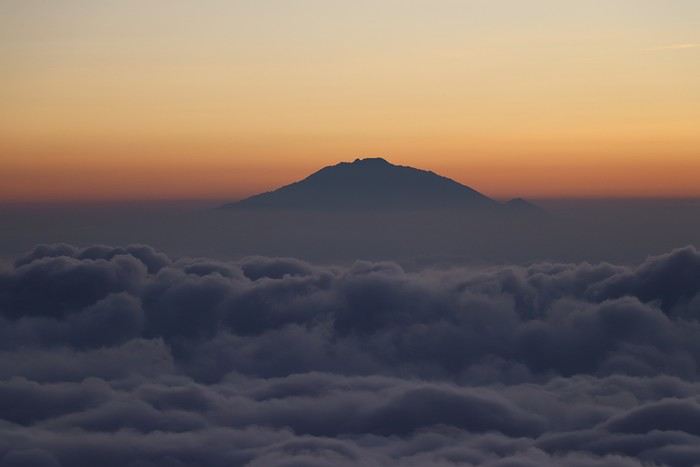
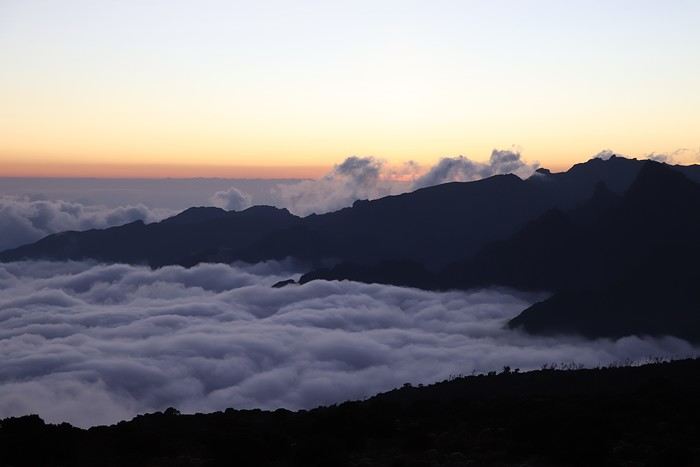
It’s a magical moment, an unreal memory that reminds us why we’re here. After a comforting dinner in the tent—cucumber soup, rice, and vegetables—we attempt a nighttime photo session.
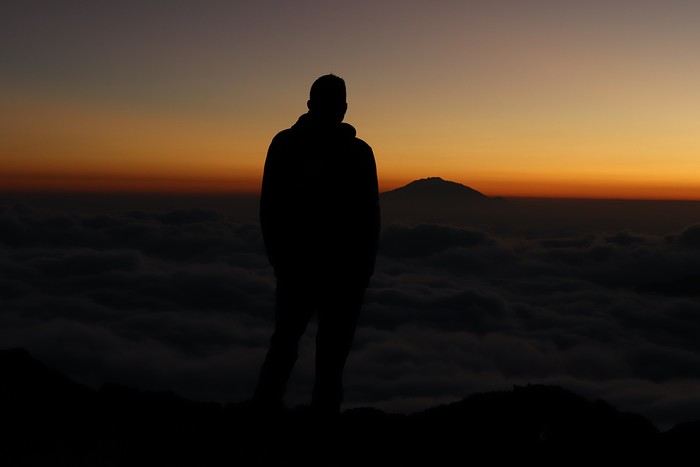
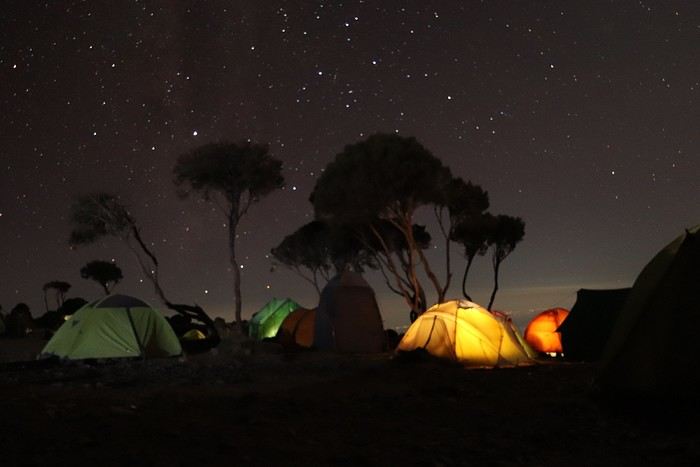
But the cold is biting, and we quickly retreat to our sleeping bags, bundled up in all our layers. By 9 PM, lulled by the icy silence of the mountain, we drift into a restful sleep, ready to tackle the Lava Tower.
Back at camp by 5:30 PM, we witness a spectacular sunset.
Mount Meru stands proudly above the clouds, bathed in pink and orange hues.It’s a magical moment, an unreal memory that reminds us why we’re here. After a comforting dinner in the tent—cucumber soup, rice, and vegetables—we attempt a nighttime photo session.
But the cold is biting, and we quickly retreat to our sleeping bags, bundled up in all our layers. By 9 PM, lulled by the icy silence of the mountain, we drift into a restful sleep, ready to tackle the Lava Tower.
Tanzania 2019 - Pole Pole
Day 3 (09/03/25):
We were supposed to wake up at 6:30 AM, but we were woken up at 6:15 by the porters’ laughter. I slept really well, but my bladder was bothering me. I forced myself to drink a lot yesterday even though I hadn’t sweated much.
So I had to get up three times during the night when it was about 5°C outside.
Alison was a bit embarrassed—she was wheezing last night, so she took two puffs of her Ventolin.
At 6:45 AM, they brought us hot water for a quick wash, then served tea and hot chocolate in the tent. Royal! It was still chilly when we left our tent, but the sun quickly warmed the air.
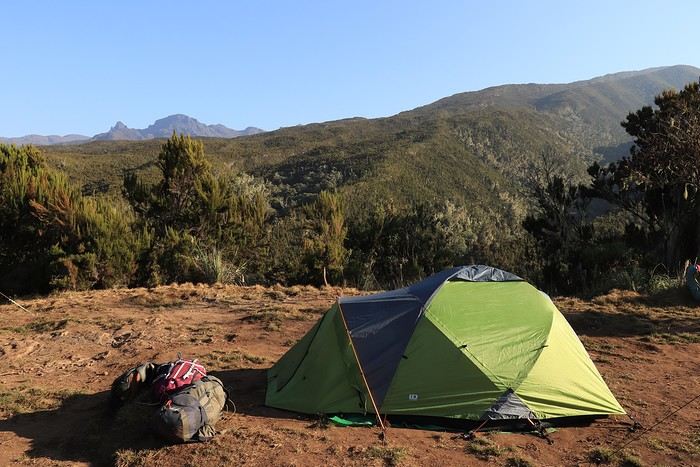
At 7:30 AM, breakfast in the tent, along with our Malarone tablets.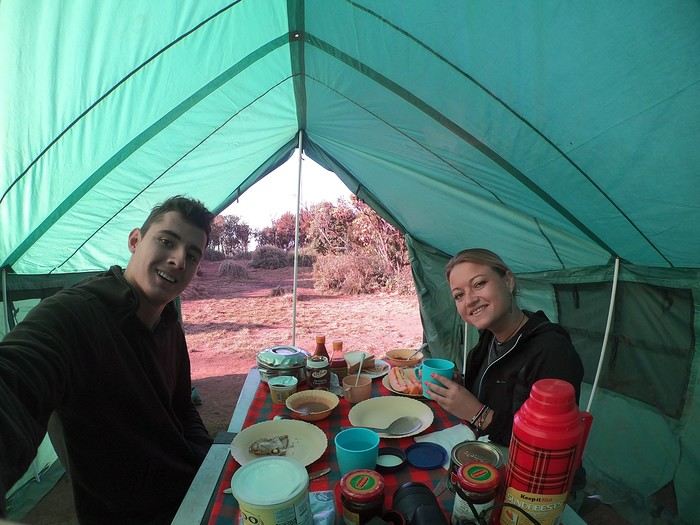
Meanwhile, the porters were busy dismantling the camp with impressive efficiency. By 8:15 AM, with our bags on our backs, we started walking with Elias and Faustin under a bright blue sky. Today’s stage is shorter: 5 kilometers and 900 meters of elevation gain to reach Shira Cave Camp.
I grabbed my trekking poles right away to save my energy for the coming days.
Elias wanted us to go *pole pole* (slowly), but we preferred to start with a sprint to pass the group that had left before us. Alison is still walking strong, even if her feet are bothering her a bit, like they did in Alaska last year.
The trail is pretty narrow on this stage, and we’re not fans of walking behind everyone.
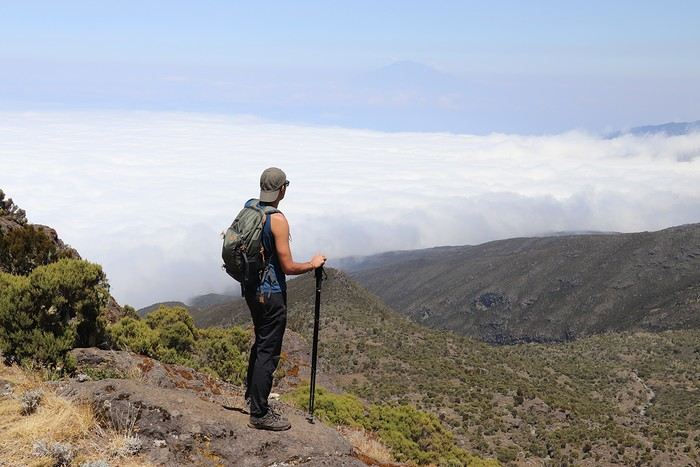
Communicating with Elias isn’t easy—he doesn’t understand French at all, so I often have to switch to English. It’s not a big deal for now. We’re taking the opportunity to learn a bit of Swahili.
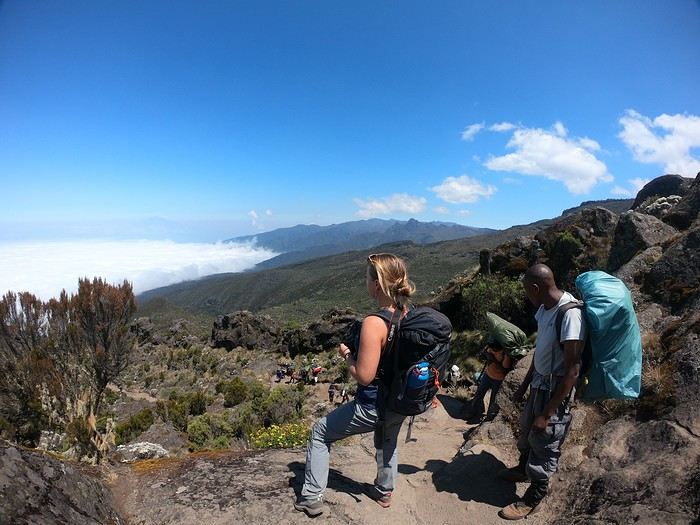
We found our rhythm and are walking well. I’m happy—I feel like we’re in good shape. The first part of the climb is rocky, then it turns to dust.
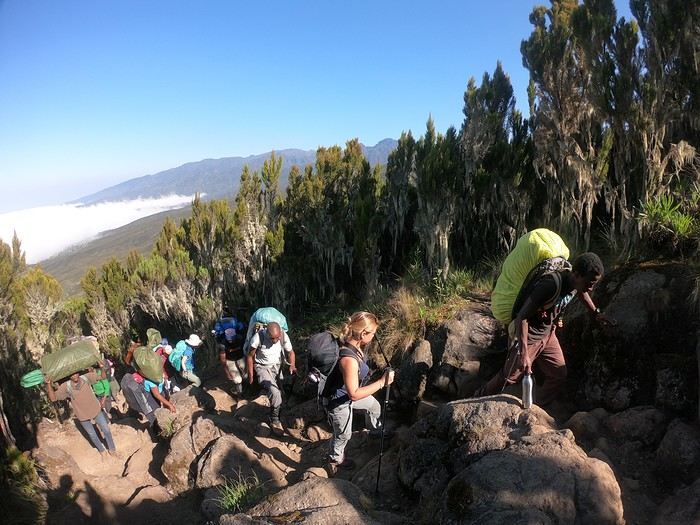
We took a few breaks to enjoy the stunning view—a sea of clouds stretching as far as the eye can see, with the majestic Mount Meru rising on the horizon and the snow-capped peak of Kibo dominating the landscape.
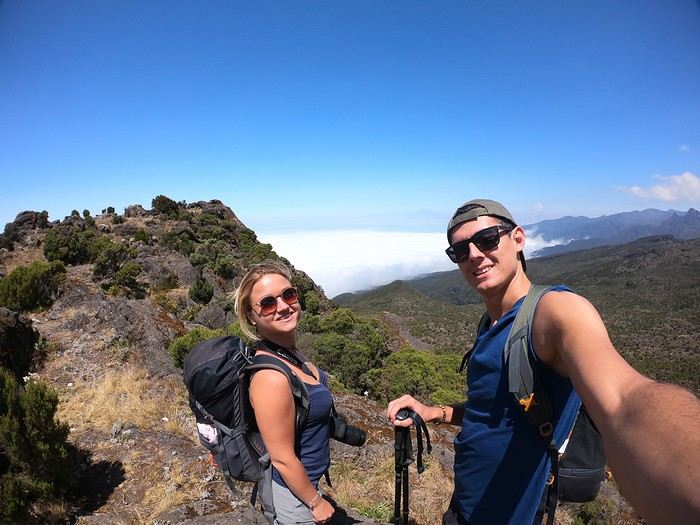
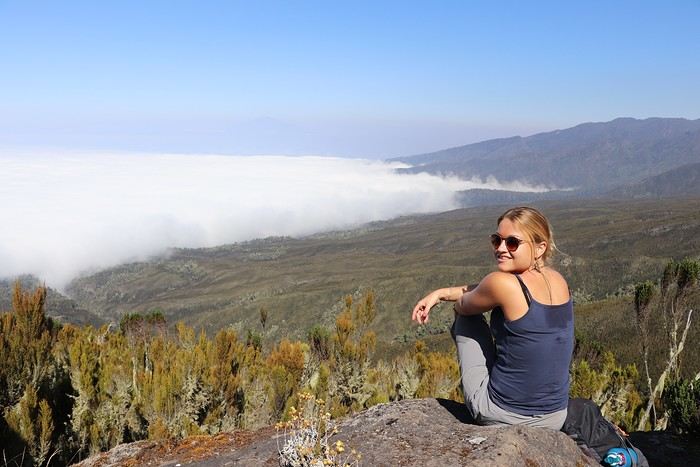
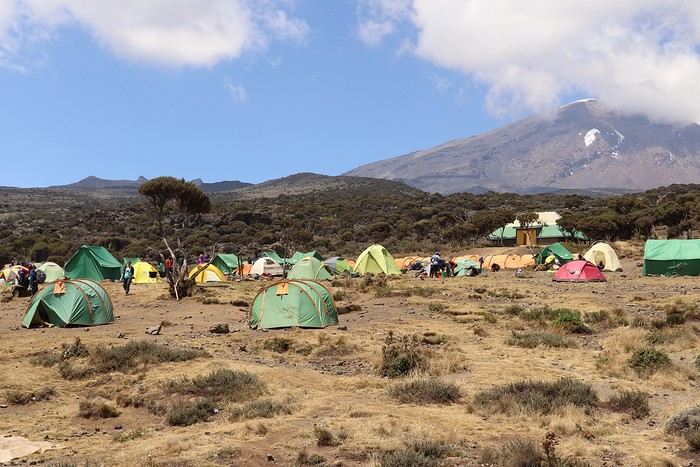
The sun was blazing during the last stretch, and the climb was a bit tiring, but we quickly reached the ridge at 3,900 meters and descended calmly toward Shira Camp. Today was very different from yesterday—full sun, very hot, with breathtaking panoramic views. However, the trail was narrower, and we were constantly overtaking or being overtaken. We arrived at Shira Camp (3,850m) at 12:30 PM after 4 hours and 15 minutes of walking.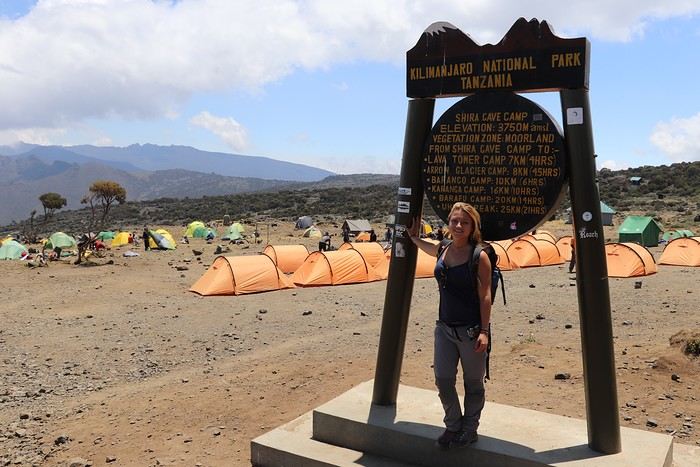
Most of the porters were already there, setting up the tents and preparing lunch. According to the logbook, we’re the 9th and 10th tourists to arrive.
I quickly counted that there were about 140–150 people at the camp last night.
We settled into our tent. This time, we’re in the middle of all the other tents, but the ground is pretty flat, and the camp is huge, situated on a flattened slope of the mountain.
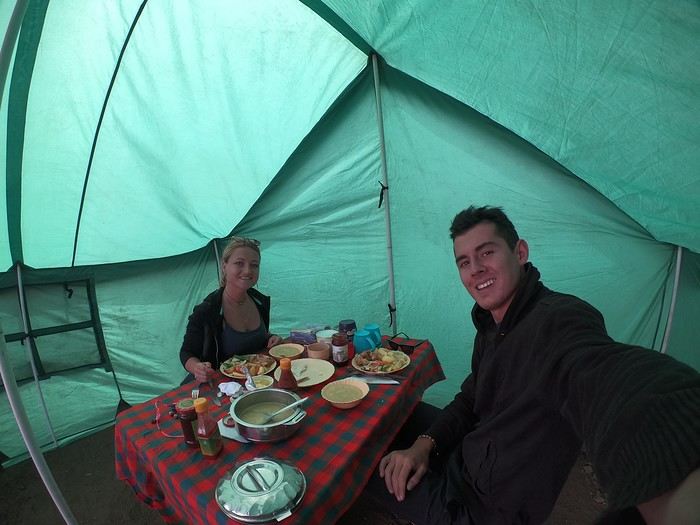
I took a quiet moment to close my eyes, while Alison enjoyed the view with some music. At 2 PM, a delicious meal awaited us: carrot soup, fish, vegetables, potatoes, and an orange for dessert. A welcome feast after the effort. We dug in.
The sea of clouds began to roll into the camp, slowly enveloping the tents. After a short nap, we set off at 4 PM for an acclimatization walk. This relaxed stroll was a chance to learn more about Swahili and Maasai culture from Elias and Faustin. Despite the fatigue, the atmosphere in the camp was electric—excitement was building among the hikers. Everyone was talking about the challenges ahead and the high-altitude passage waiting for us tomorrow. How will the next few days go? What will the weather be like?
The first two days weren’t too tough, and even though there’s a small helicopter drop zone at Shira Cave, most altitude-related issues don’t happen at this elevation.
Tomorrow, we’ll have to climb to the Lava Tower, at over 4,600 meters.
For most of us, this will be the first time we’ve been at such an altitude. The unknown...
We were supposed to wake up at 6:30 AM, but we were woken up at 6:15 by the porters’ laughter. I slept really well, but my bladder was bothering me. I forced myself to drink a lot yesterday even though I hadn’t sweated much.
So I had to get up three times during the night when it was about 5°C outside.
Alison was a bit embarrassed—she was wheezing last night, so she took two puffs of her Ventolin.
At 6:45 AM, they brought us hot water for a quick wash, then served tea and hot chocolate in the tent. Royal! It was still chilly when we left our tent, but the sun quickly warmed the air.
At 7:30 AM, breakfast in the tent, along with our Malarone tablets.
Meanwhile, the porters were busy dismantling the camp with impressive efficiency. By 8:15 AM, with our bags on our backs, we started walking with Elias and Faustin under a bright blue sky. Today’s stage is shorter: 5 kilometers and 900 meters of elevation gain to reach Shira Cave Camp.
I grabbed my trekking poles right away to save my energy for the coming days.
Elias wanted us to go *pole pole* (slowly), but we preferred to start with a sprint to pass the group that had left before us. Alison is still walking strong, even if her feet are bothering her a bit, like they did in Alaska last year.
The trail is pretty narrow on this stage, and we’re not fans of walking behind everyone.
Communicating with Elias isn’t easy—he doesn’t understand French at all, so I often have to switch to English. It’s not a big deal for now. We’re taking the opportunity to learn a bit of Swahili.
We found our rhythm and are walking well. I’m happy—I feel like we’re in good shape. The first part of the climb is rocky, then it turns to dust.
We took a few breaks to enjoy the stunning view—a sea of clouds stretching as far as the eye can see, with the majestic Mount Meru rising on the horizon and the snow-capped peak of Kibo dominating the landscape.
The sun was blazing during the last stretch, and the climb was a bit tiring, but we quickly reached the ridge at 3,900 meters and descended calmly toward Shira Camp. Today was very different from yesterday—full sun, very hot, with breathtaking panoramic views. However, the trail was narrower, and we were constantly overtaking or being overtaken. We arrived at Shira Camp (3,850m) at 12:30 PM after 4 hours and 15 minutes of walking.
Most of the porters were already there, setting up the tents and preparing lunch. According to the logbook, we’re the 9th and 10th tourists to arrive.
I quickly counted that there were about 140–150 people at the camp last night.
We settled into our tent. This time, we’re in the middle of all the other tents, but the ground is pretty flat, and the camp is huge, situated on a flattened slope of the mountain.
I took a quiet moment to close my eyes, while Alison enjoyed the view with some music. At 2 PM, a delicious meal awaited us: carrot soup, fish, vegetables, potatoes, and an orange for dessert. A welcome feast after the effort. We dug in.
The sea of clouds began to roll into the camp, slowly enveloping the tents. After a short nap, we set off at 4 PM for an acclimatization walk. This relaxed stroll was a chance to learn more about Swahili and Maasai culture from Elias and Faustin. Despite the fatigue, the atmosphere in the camp was electric—excitement was building among the hikers. Everyone was talking about the challenges ahead and the high-altitude passage waiting for us tomorrow. How will the next few days go? What will the weather be like?
The first two days weren’t too tough, and even though there’s a small helicopter drop zone at Shira Cave, most altitude-related issues don’t happen at this elevation.
Tomorrow, we’ll have to climb to the Lava Tower, at over 4,600 meters.
For most of us, this will be the first time we’ve been at such an altitude. The unknown...
Tanzania 2019 - Polé Polé
Hey everyone,
So glad to see you all and welcome to our side for this challenging climb! 😉
So glad to see you all and welcome to our side for this challenging climb! 😉
Tanzania 2019 - Polé Polé
Day 2 Continued (02/09/25):
We start the hike at 1:30 PM with Elias. The porters are still weighing their loads, but we set off into the humid forest. We’re all alone, and walking in this environment is really enjoyable. Elias encourages us with his "Twende dju, polé polé!"—an invitation to move forward slowly but surely.
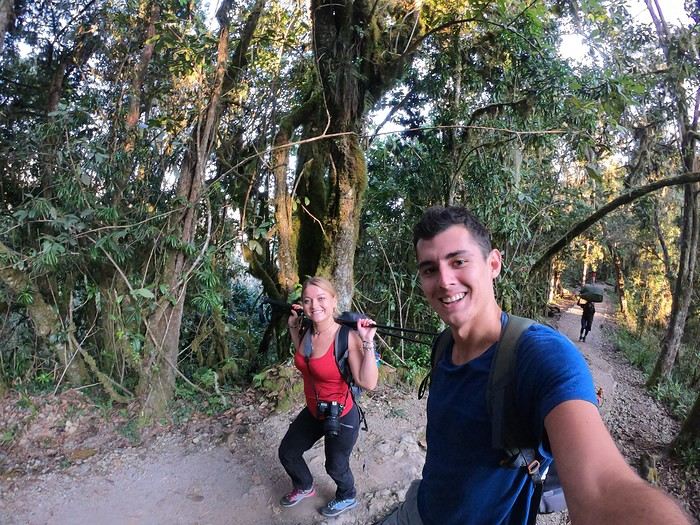
From time to time, porters—loaded like oxen—pass us with fascinating energy, their music echoing through the mist. We catch up with them on the climbs, a back-and-forth that feels almost choreographed. The forest is simply stunning, bathed in a mysterious fog. The atmosphere is magical, almost otherworldly.
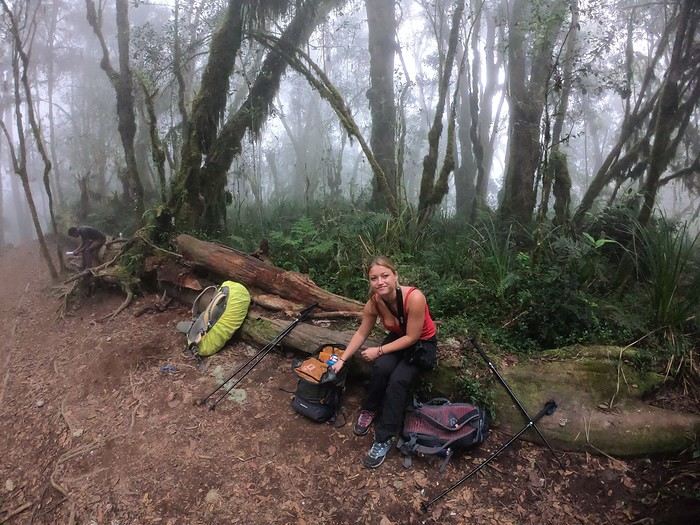
Halfway through, we pull out our trekking poles for the first time. A novelty for both of us: while Alison isn’t convinced, I find a certain satisfaction in focusing on where to place my poles with each step. It adds a playful rhythm to the hike.
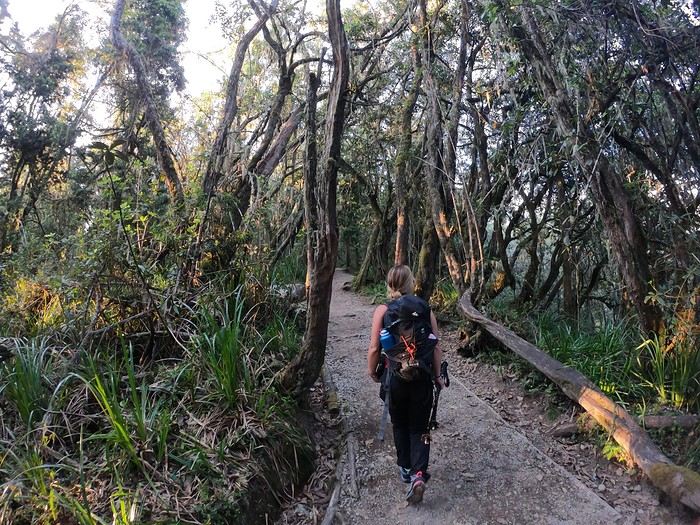
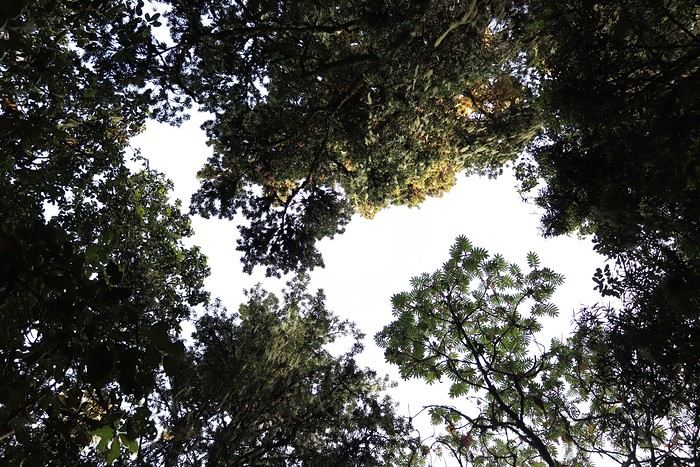
We spot monkeys jumping from branch to branch, adding a touch of life to this natural haven. Every now and then, we stop for a break, sitting on a fallen tree trunk to drink and breathe in the fresh air.
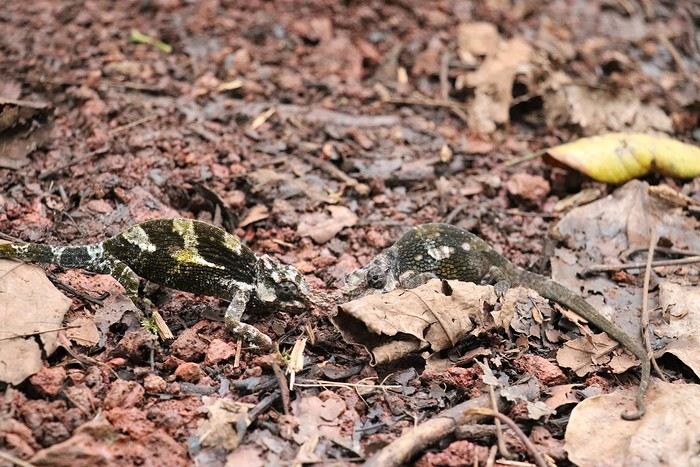
While we’re standing still, a sudden noise startles us. Something falls on us. My first thought? A monkey’s fecal attack! But no—it’s two chameleons locked in a fierce battle. Excellent!
We eventually leave the forest
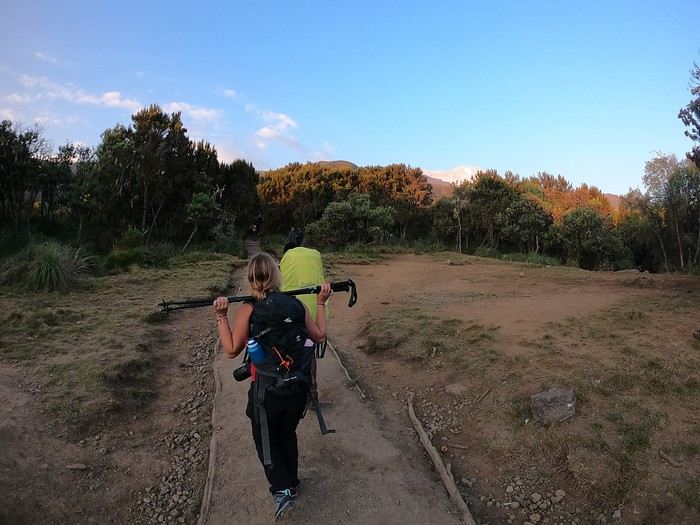 The goal in sight
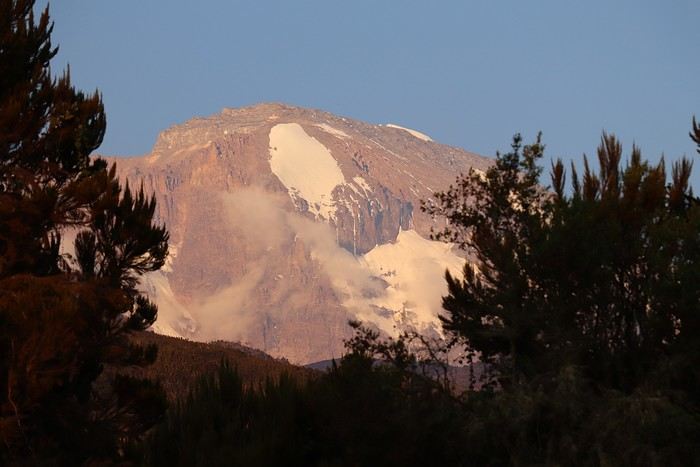 and reach Machame Camp at 6:30 PM.
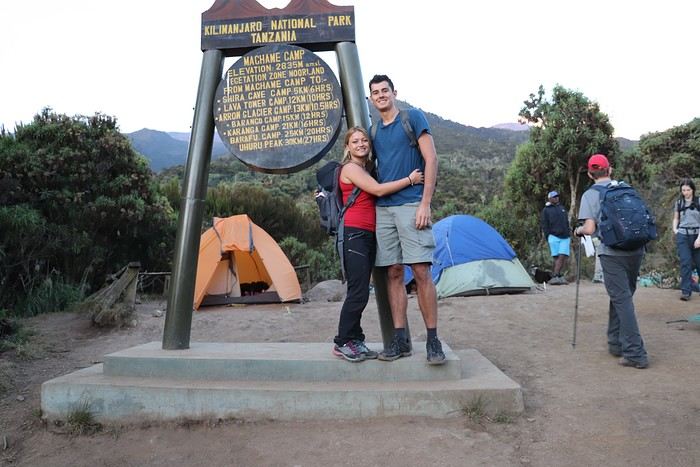
Just in time to admire a breathtaking sunset. The view lives up to our expectations. We sign the register, but there’s a line. Judging by the number of people, we must be the last to arrive for the day. That suits us just fine, as our camp is set up off to the side, at the edge of the forest. A little clearing all to ourselves—a real luxury. The temperature drops quickly. Our tents and sleeping bags are already set up, along with our portable toilets. The porters bring us our backpacks, and hot water is provided for a quick wash. Then, it’s off to the dining tent where a hot tea awaits us. The aperitif—hot chocolate and popcorn—plunges us into a cozy atmosphere, a moment of connection by candlelight.
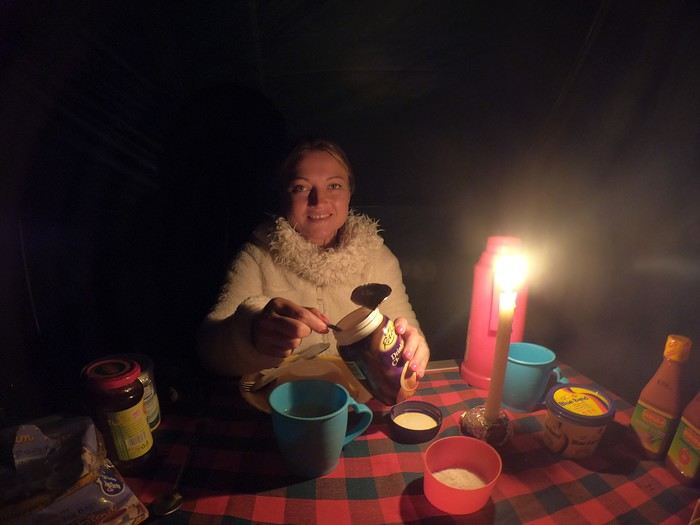
Next, Brysson, our server, brings us dinner: soup to start, followed by pasta, and finally a mix of vegetables... with beef! Six months of specifying to Kessy Brothers that we prefer vegetarian meals... Oh well. 🏴☠️But hakuna matata—the pasta is delicious and soothes the day’s efforts. Bananas for dessert cap off this hiker’s feast. We wanted to photograph the stars, but the sky clouded over during dinner. A small disappointment, quickly replaced by the need for rest. Unfortunately, I’m hit with abdominal pains after the meal, but they pass quickly. It’s very cold. We bundle up in our leggings and sweaters before crawling into our sleeping bags. Lights out at 10 PM, the body tired and a bit jet-lagged but the spirit fulfilled by this first day of adventure.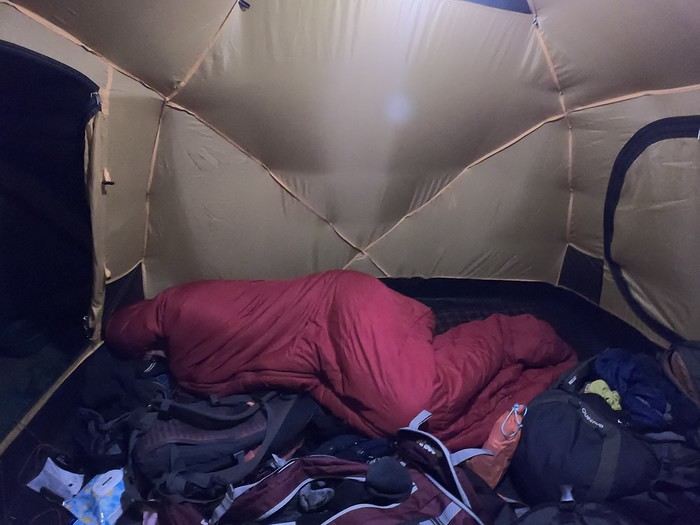
We start the hike at 1:30 PM with Elias. The porters are still weighing their loads, but we set off into the humid forest. We’re all alone, and walking in this environment is really enjoyable. Elias encourages us with his "Twende dju, polé polé!"—an invitation to move forward slowly but surely.
From time to time, porters—loaded like oxen—pass us with fascinating energy, their music echoing through the mist. We catch up with them on the climbs, a back-and-forth that feels almost choreographed. The forest is simply stunning, bathed in a mysterious fog. The atmosphere is magical, almost otherworldly.
Halfway through, we pull out our trekking poles for the first time. A novelty for both of us: while Alison isn’t convinced, I find a certain satisfaction in focusing on where to place my poles with each step. It adds a playful rhythm to the hike.
We spot monkeys jumping from branch to branch, adding a touch of life to this natural haven. Every now and then, we stop for a break, sitting on a fallen tree trunk to drink and breathe in the fresh air.
While we’re standing still, a sudden noise startles us. Something falls on us. My first thought? A monkey’s fecal attack! But no—it’s two chameleons locked in a fierce battle. Excellent!
We eventually leave the forest
The goal in sight
and reach Machame Camp at 6:30 PM.Just in time to admire a breathtaking sunset. The view lives up to our expectations. We sign the register, but there’s a line. Judging by the number of people, we must be the last to arrive for the day. That suits us just fine, as our camp is set up off to the side, at the edge of the forest. A little clearing all to ourselves—a real luxury. The temperature drops quickly. Our tents and sleeping bags are already set up, along with our portable toilets. The porters bring us our backpacks, and hot water is provided for a quick wash. Then, it’s off to the dining tent where a hot tea awaits us. The aperitif—hot chocolate and popcorn—plunges us into a cozy atmosphere, a moment of connection by candlelight.
Next, Brysson, our server, brings us dinner: soup to start, followed by pasta, and finally a mix of vegetables... with beef! Six months of specifying to Kessy Brothers that we prefer vegetarian meals... Oh well. 🏴☠️But hakuna matata—the pasta is delicious and soothes the day’s efforts. Bananas for dessert cap off this hiker’s feast. We wanted to photograph the stars, but the sky clouded over during dinner. A small disappointment, quickly replaced by the need for rest. Unfortunately, I’m hit with abdominal pains after the meal, but they pass quickly. It’s very cold. We bundle up in our leggings and sweaters before crawling into our sleeping bags. Lights out at 10 PM, the body tired and a bit jet-lagged but the spirit fulfilled by this first day of adventure.