Results for "Ghana"
About 2,184 results.
More options
Many results are in French, the community’s main language. English translations are added over time.
Search results
Chroniques indiennes
Si ca vous interesse, je vais vous raconter de temps en temps un peu de l’Inde, pas celle des voyages mais celle que je vis tous les jours, pour vous transporter ailleurs le temps de quelques minutes.
Chapitre 1 : Monsoon wedding (un super film de Mira Nair decouvert en France. J’ai donc achete le DVD ici.. bon malheureusement c’est en hindi sous-titre hindi. Heureusement que sur la pochette il etait precise hindi sous-titre anglais !)
Hier soir j’avais un diner (succulent jugez du peu : spinach shorba, murg tikka, paneer butter masala et roti !) avec mes collegues et leur familles.
Curieuse comme tout (et gaffeuse aussi des fois !), j’ai demande au collegue avec qui je bosse le plus quand et ou il a rencontre sa femme.
« je ne l’ai pas rencontre, je l’ai connue a mon mariage ! »
et oui, le cliche des mariages arranges est encore vrai.
J’ai fait un petit sondage discret : sur environ 20 personnes dans l’equipe, au max 5 sont des mariages d’amour…
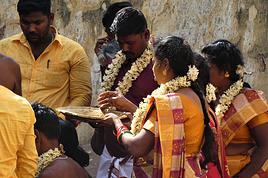
Quand le jeune homme atteint 26-28 ans (l’age moyen pour la femme est 23-24 ans), la famille commence a chercher la femme a qui le lier. On fait appel aux connaissances et connaissances de connaissances. Les familles regardent la situation sociale du futur epoux, son metier et surtout les membres de la famille. En effet les 2 familles (parents, grands parents, oncles et toutes les descendances) vont passer beaucoup de temps ensemble, il faut donc des atomes crochus !
Mon chef indien, lui a rencontre sa femme 30 minutes avant le mariage. Ils ont discute de leur vision de la vie a deux, de l’education des enfants et comme ils etaient d’accord, hop, en route pour la ceremonie !
Bref quand je dis que en France les couples restent souvent 2-3 ans ensemble avant de se marier (quand ils se marient), ca les surprend plus qu'un peu !!!
« un couple peut-il vivre sans etre marie ? »
« oui ca arrive, mais il se cache ! » ... !
Les mariages arranges sont donc encore beaucoup a la mode en Inde, un peu moins dans les grandes villes plus « occidentalisees » que dans les campagnes profondes. Souvent aussi, les epoux sont encore plus jeunes quand ils sont maries d’office (j’ai vu dans le journal des epoux de 14-16 ans !)
Un mariage d’amour cette fois ci, un autre collegue. Il est de la caste des brahmanes, sa femme d’une caste inferieure. Il a du batailler 2 ans (!) avant de reussir a convaincre ses parents et avoir l’autorisation de se marier.
Faut savoir etre patient ! Et encore ca ne marche pas a tous les coup. Mais les castes c’est une autre histoire et encore un vaste debat !...
Je comprends donc mieux pourquoi quand on me demande (en VO, c’est plus authentique !):
« are you married ? »
« no »
« how old are you ? »
« 27 »
« what, 27 and not married ! »...
Et la mousson dans tout ca? Ben c’est de pire en pire. Pleut toujours les jours ou j’ai mes tongs et jamais les jours ou j’ai mon kway ! Allez comprendre ! En tout cas, c’est « rigolo » (enfin quand on est au sec) de voir ces rivieres prendre naissance au milieu de la route, tous ces gens avec des sacs plastique en guise de chapeau, les marchandes proteger leurs colliers de fleurs avec un parapluie troue… Bref la mousson, c’est une periode tant attendue, mais aussi un peu cocase a vivre (et je ne parle par des morts a cause des arbres qui s’ecrasent sur les auto-rickshaws, c’est malheureusement encore arrive la semaine derniere…)
Chapitre 1 : Monsoon wedding (un super film de Mira Nair decouvert en France. J’ai donc achete le DVD ici.. bon malheureusement c’est en hindi sous-titre hindi. Heureusement que sur la pochette il etait precise hindi sous-titre anglais !)
Hier soir j’avais un diner (succulent jugez du peu : spinach shorba, murg tikka, paneer butter masala et roti !) avec mes collegues et leur familles.
Curieuse comme tout (et gaffeuse aussi des fois !), j’ai demande au collegue avec qui je bosse le plus quand et ou il a rencontre sa femme.
« je ne l’ai pas rencontre, je l’ai connue a mon mariage ! »
et oui, le cliche des mariages arranges est encore vrai.
J’ai fait un petit sondage discret : sur environ 20 personnes dans l’equipe, au max 5 sont des mariages d’amour…
Quand le jeune homme atteint 26-28 ans (l’age moyen pour la femme est 23-24 ans), la famille commence a chercher la femme a qui le lier. On fait appel aux connaissances et connaissances de connaissances. Les familles regardent la situation sociale du futur epoux, son metier et surtout les membres de la famille. En effet les 2 familles (parents, grands parents, oncles et toutes les descendances) vont passer beaucoup de temps ensemble, il faut donc des atomes crochus !
Mon chef indien, lui a rencontre sa femme 30 minutes avant le mariage. Ils ont discute de leur vision de la vie a deux, de l’education des enfants et comme ils etaient d’accord, hop, en route pour la ceremonie !
Bref quand je dis que en France les couples restent souvent 2-3 ans ensemble avant de se marier (quand ils se marient), ca les surprend plus qu'un peu !!!
« un couple peut-il vivre sans etre marie ? »
« oui ca arrive, mais il se cache ! » ... !
Les mariages arranges sont donc encore beaucoup a la mode en Inde, un peu moins dans les grandes villes plus « occidentalisees » que dans les campagnes profondes. Souvent aussi, les epoux sont encore plus jeunes quand ils sont maries d’office (j’ai vu dans le journal des epoux de 14-16 ans !)
Un mariage d’amour cette fois ci, un autre collegue. Il est de la caste des brahmanes, sa femme d’une caste inferieure. Il a du batailler 2 ans (!) avant de reussir a convaincre ses parents et avoir l’autorisation de se marier.
Faut savoir etre patient ! Et encore ca ne marche pas a tous les coup. Mais les castes c’est une autre histoire et encore un vaste debat !...
Je comprends donc mieux pourquoi quand on me demande (en VO, c’est plus authentique !):
« are you married ? »
« no »
« how old are you ? »
« 27 »
« what, 27 and not married ! »...
Et la mousson dans tout ca? Ben c’est de pire en pire. Pleut toujours les jours ou j’ai mes tongs et jamais les jours ou j’ai mon kway ! Allez comprendre ! En tout cas, c’est « rigolo » (enfin quand on est au sec) de voir ces rivieres prendre naissance au milieu de la route, tous ces gens avec des sacs plastique en guise de chapeau, les marchandes proteger leurs colliers de fleurs avec un parapluie troue… Bref la mousson, c’est une periode tant attendue, mais aussi un peu cocase a vivre (et je ne parle par des morts a cause des arbres qui s’ecrasent sur les auto-rickshaws, c’est malheureusement encore arrive la semaine derniere…)
Lybie sans agence
qui est allé en lybie pour passer des vacances sans passer par une agence ? merci pour vos bons plans.
françoise
françoise
Kathak, danse de l'Inde du Nord
Bonjour,
Y-aurait-il sur ce site des passionnés de Kathak ? (danse de l'Inde du Nord). Je viens de commencer un cours et je trouve vraiment extraordinaire. Si qqn veut échanger à ce sujet.....
Y-aurait-il sur ce site des passionnés de Kathak ? (danse de l'Inde du Nord). Je viens de commencer un cours et je trouve vraiment extraordinaire. Si qqn veut échanger à ce sujet.....
Oman, at the edge of the sands and the horizon

If I close my eyes and think of the Sultanate of Oman, I first smell a light scent of incense, feel the warmth of a sunbeam on my skin, before sand slips through my fingers. I taste the sweetness of a date, a real candy, then the flavor of coffee with a hint of cardamom and rosewater... I hear the desert wind whistling in my ears, the distant call of a muezzin, then the murmur of water. I open my eyes to see smiles, welcoming gestures, a turquoise sea, rocks ranging from ochre to purple, deep wadis where torrents burst forth, orange dunes, white sandy beaches where tiny crabs scurry at full speed. I see incredible oases emerging between arid mountains. I see abandoned villages that I’d dream were full of life, imposing fortresses overlooking valleys, and lively souks where offers are delicate and negotiation is a mutual courtesy.
All that, and so much more.
This is what I tried to capture in my illustrated travel journal, which I’ll fill in here and there with photos. I drew this journal “cold,” after my return (actually, I made it this summer, while our trip was last winter). It’s a pretty special format—I bought it in Japan without really knowing what I’d do with it. Well, it found its purpose! Below is a photo of this accordion-style journal: here, it’s only partially open, because when fully unfolded, it’s 5 meters long!
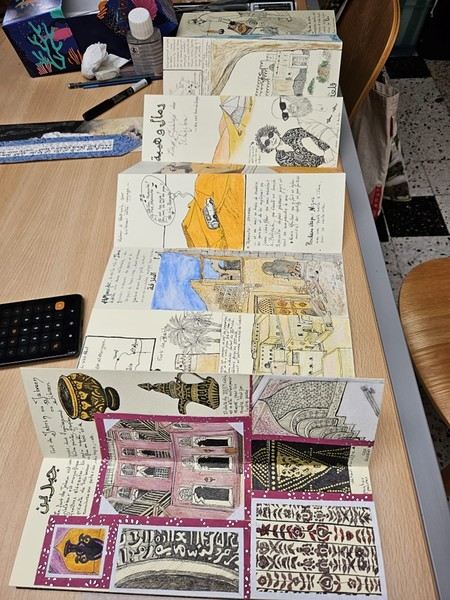
For drawing enthusiasts: The accordion format is both a constraint (each sheet is 9 cm x 27 cm) and a freedom (you can create a fresco). The paper is also a bit special: it doesn’t allow for fine lines, but it takes ink well (liner pen). However, everything has to be done almost in one go (with a very light pencil sketch) because it erases poorly. It absorbs too much water for coloring with markers or watercolors (unless you avoid soaking it), but it works well with oil pastels and their use with a brush and solvent. Since it’s yellowish, it allowed me to create contrasts even with white pastel.
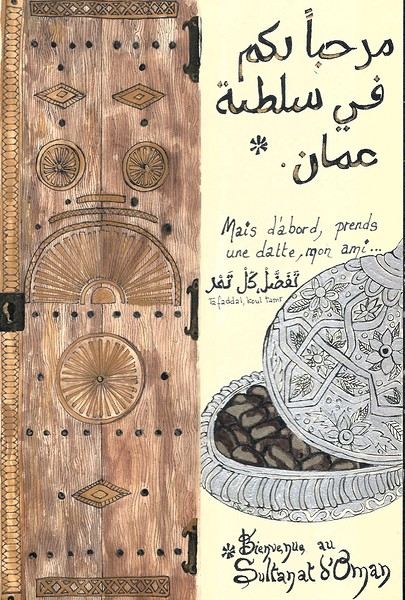 On the right, the "welcome marker"—those dates offered everywhere as a sign of hospitality. On the left, a tribute to those stunning doors worn by time, admired all over the old quarters, including the abandoned ones.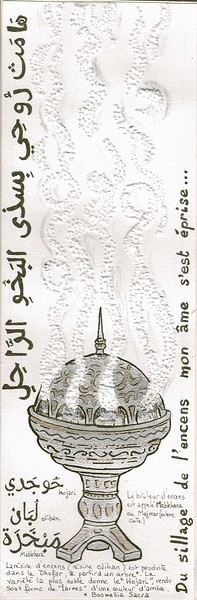
Oman is one of the world’s largest producers of frankincense resin. Incense burners are everywhere, from the simplest clay ones to the most precious handcrafted silver ones...
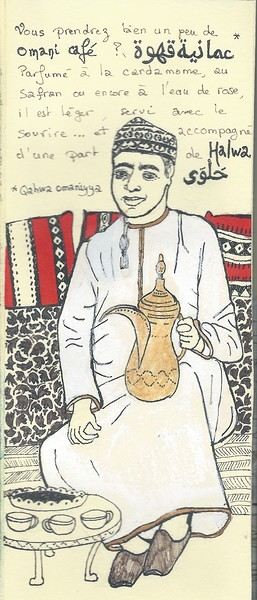 Hospitality will often lead you to accept a small coffee, an "Omani coffee," very light, subtly flavored with cardamom, maybe a touch of saffron, and occasionally rosewater.
Here, I’ve depicted a man in the common everyday attire of Omanis: the dishdasha, mostly white (during the week and daytime; colors are more common in the evening or on Fridays and Saturdays). While you’ll see some men dressed in Western clothes, they’re very few. The white dishdasha is truly the shared attire of all men. The dishdasha, which has no hood, is distinguished by a small pom-pom attached to the collar, the furakha, which is soaked in perfume. And believe me, Omanis go overboard with it! "It smells like the pom-pom" is an expression that’s now part of our shared language, my husband and I.
Another must of men’s attire is the kuma, a small round head covering, usually white with brightly colored patterns. The keffiyeh is also worn (but without the cord called an agal in Arab countries), and it’s mostly worn by those with roots in the desert, from what I understood.
And what about the women, you might ask? Some are veiled, some in full black (but not a burka—more like a chador + abaya), due to the influence of Saudi Arabia and the United Arab Emirates, whereas the traditional outfit used to be a layering of very colorful dresses. Most of the women we saw wore neutral clothing, a plain veil over their hair, but with their faces uncovered. We also saw many saris and colorful veils—don’t forget that 40% of the population consists of Indian, Nepalese, and Bangladeshi immigrants, who work a lot in tourism, hospitality, restaurants, services, and construction.
Just to clarify, as a tourist, there’s no pressure to wear a veil, and never any disapproving looks. Of course, you’ll save the mini shorts, plunging necklines, bare shoulders, and midriffs for the hotel terrace—but I’d say that’s the same for men and women, and with the sun being strong, it’s better for your skin too.
Here’s the introduction! In the next post, I’ll tell you about my itinerary, and we can dive in!
Hospitality will often lead you to accept a small coffee, an "Omani coffee," very light, subtly flavored with cardamom, maybe a touch of saffron, and occasionally rosewater.
Here, I’ve depicted a man in the common everyday attire of Omanis: the dishdasha, mostly white (during the week and daytime; colors are more common in the evening or on Fridays and Saturdays). While you’ll see some men dressed in Western clothes, they’re very few. The white dishdasha is truly the shared attire of all men. The dishdasha, which has no hood, is distinguished by a small pom-pom attached to the collar, the furakha, which is soaked in perfume. And believe me, Omanis go overboard with it! "It smells like the pom-pom" is an expression that’s now part of our shared language, my husband and I.
Another must of men’s attire is the kuma, a small round head covering, usually white with brightly colored patterns. The keffiyeh is also worn (but without the cord called an agal in Arab countries), and it’s mostly worn by those with roots in the desert, from what I understood.
And what about the women, you might ask? Some are veiled, some in full black (but not a burka—more like a chador + abaya), due to the influence of Saudi Arabia and the United Arab Emirates, whereas the traditional outfit used to be a layering of very colorful dresses. Most of the women we saw wore neutral clothing, a plain veil over their hair, but with their faces uncovered. We also saw many saris and colorful veils—don’t forget that 40% of the population consists of Indian, Nepalese, and Bangladeshi immigrants, who work a lot in tourism, hospitality, restaurants, services, and construction.
Just to clarify, as a tourist, there’s no pressure to wear a veil, and never any disapproving looks. Of course, you’ll save the mini shorts, plunging necklines, bare shoulders, and midriffs for the hotel terrace—but I’d say that’s the same for men and women, and with the sun being strong, it’s better for your skin too.
Here’s the introduction! In the next post, I’ll tell you about my itinerary, and we can dive in!