This journal recounts a trip to Rajasthan that’s already over a year old and that I’ve only now found the chance to write about. The summer of 2024 marked my return to India—my tenth trip—after six long years away since my last solo wanderings in Tamil Nadu in 2018 (the journal of which is published on this site). That absence was partly (but not only) due to the long COVID and post-COVID period, which saw a complete halt and then a major slowdown in global tourism. To top it off, Voyage Forum announced its closure in an end-of-the-world atmosphere. A sad time for our favorite social activity…
A few weeks after returning from Rajasthan, I tried to motivate myself to start writing a journal to publish on a forum claiming to be VF’s successor, which I’d eventually signed up for out of desperation. But I kept hesitating and putting the project off because, for one, I no longer have the time I used to. For another, the vibe wasn’t really taking off on that forum—it was overrun with ads and not very active, contrary to what its host’s name suggested. Despite its good intentions and commendable role as a stopgap, it also turned out to be very impractical to use, especially when you don’t have much time like me. I’ll admit I’d occasionally check back on VF to see if anything was happening. But all the discussions remained frozen in time, stuck in that fateful year, 2020. Then, rumors swirled online about shady reasons behind its closure, leaving little room for hope.
And then, one fine morning, I got a message at work from Marien informing me that VF had reopened. What a huge surprise! Even though the forum’s “end” had played out in a somewhat apocalyptic atmosphere, the memories of passionate and heated discussions, the frank debates, and the useful exchanges that made this site a traveler’s goldmine and a unique hub of conviviality all came rushing back to me like a breath of fresh air. I finally saw a sign and tried to motivate myself to find the time to publish the journal of this tenth trip to India and fifth to Rajasthan. But in the end, I got bogged down in professional and family obligations and never managed to find the time to get started. That’s now fixed, though, because I had two reasons for wanting to do it: I find that looking back on a trip to tell others about it is a highly beneficial introspective exercise. Also, I thought this journal could be useful to other travelers on a few points.
Because, “do we really need yet another journal about Rajasthan?” you might rightly ask! Especially in a time when so many journals about the “Land of Kings” have been published since VF’s return, not to mention the countless stories you can already find online about this region, one of India’s most touristy. And I’d add, why go back to Rajasthan for a fifth time, where I’ve already dragged my feet more than enough—through its forts, deserts, temples, cities, villages, bumpy roads, train stations, tasty street food stalls, cheap guesthouses, and more? Where some might see just another overhyped tourist destination full of the same old *Arabian Nights* clichés, worn to a thread, that I mentioned earlier, when there’s so much else to see in India?
Well, first because it’s a magnificent country I never tire of, where I started an academic study and made so many connections. It’s also packed with places where you won’t find a single tourist (right, Marie-Jo?), even in the heart of well-trodden paths and classic itineraries. And most importantly, as I said earlier, things have changed in recent years. First, after six years without traveling far, the urge to go back to India was getting stronger. But this time, no more solo trips (often) or duo adventures (sometimes)—now it’s a team of four that has to come along! And even if you can argue with that, what better place than Rajasthan to introduce India to people who’ve never seen it? To kids you want to amaze?
Plus, traveling with your new little family to your favorite country isn’t the same as going solo in often spartan conditions that only affect you. It’s a different challenge, but ultimately probably much harder. So, is it really reasonable to take two kids to India, including a two-year-old baby? That’s one of the main goals of this journal (but not the only one)—to try to answer that question.
As you can tell, it’s not so much the destination but the slightly unusual setup of this trip that, in my opinion, will make this journal interesting. Despite my experience and expertise (yes, I dare say it) in India, there were plenty of questions before we finalized the plan and said, “Alright, let’s go!” The questions were flying for us parents. Is it wise to travel to India with a two-year-old? What would we do (it happened) if the kids got very sick? Would they be able to handle a road trip on Rajasthan’s bumpy, dusty roads using public transport? Could they handle the shock of such a different world—the dirt, poverty, pollution, noise (…and the smell, as they say), the spicy food, monkeys, mosquitoes, snakes, tigers, leopards, and so on? In short, all the clichés that I usually joke about suddenly became potential realities. Another concern: as a mixed Franco-African family (not me, but my partner and her oldest), wouldn’t we risk not always being well received, given what you sometimes hear about that in India? How would Indians react to seeing a mixed-race family, the ultimate taboo in a country of purity and social segregation, which would undoubtedly raise many questions for them? Of course, not everything went as expected… Because, as you know, with India—and what makes it charming for some—there are always complications: sometimes where you don’t expect them… and sometimes where you do. I’ll go into detail about that in the journal to come (not right away) and in the final review (even later). These experiences could be useful to travelers who find themselves in similar situations and have the same questions we did before embarking on such a journey. And maybe it’ll spark the curiosity of those who aren’t concerned and will read yet another Rajasthan journal, but with its own unique twists.
Despite my unchanged constraints, which mean I have little time to write this, I don’t want to rush the story, so I’ll take my time. There will probably be lulls. I hope that won’t stop people from coming to react, debate, share their impressions, or ask for information.
Re: Another travel journal in this (all-too-familiar) Rajasthan, but with family and kids
... in the heart of well-trodden paths and classic itineraries.
Maybe those well-trodden paths and classic itineraries feel like a first time when you explore them alongside two little people.
Their tiny hands clutching yours, your adult eyes meeting their surprised, amazed, scared, or calm gazes... the unfamiliar takes on new perspectives.
Re: Another travel journal in this (all-too-familiar) Rajasthan, but with family and kids
Here’s a prologue that piques curiosity. We’ll be patient for the rest...
« Tout le monde s'interroge sur comment laisser une meilleure planète à nos enfants, mais on devrait plutôt penser à laisser de meilleurs enfants pour notre planète. » Clint Eastwood
Re: Yet another travel journal in this (all-too) familiar Rajasthan, but with family and kids
Awesome!
Hi there, and I really encourage you!
I can’t wait to read your post. But traveling with family must be a little different, I imagine...
No Gujarat, just a small part? ;-)
Re: Another travel journal in this (all-too-familiar) Rajasthan, but with family and kids
If I can also rope in Marco, I’ll be over the moon! [:)] Hope you're doing well!
Yes, there’ll be a tiny bit of Gujarat since we landed in Ahmedabad! I wanted to add it to the title, but it was too long for the character limit.
Re: Yet another travel journal in this (all-too-familiar) Rajasthan, but with family and kids
Hello, I’m really looking forward to this journal—it’ll be different from many others because of the kids, including a very young one. I love diving into all travel journals, even those about Rajasthan, which I’ve explored countless times. Every now and then, I discover a spot I haven’t visited or hear anecdotes and personal storytelling styles that make the trip unique.
While waiting for the meet-up with the locals and mixed-race families, I’ll hijack your journal for a moment to share an anecdote from my first trip to India in 1991 (Gujarat and Rajasthan). I was traveling with a young couple—he was white, and she was Black from the Caribbean, with very long hair.
Her hair made the trip challenging at times. Women and girls all wanted to touch her gorgeous locks. For these Indian women, the mix of dark skin and long hair was a beautiful surprise—they were absolutely fascinated...
Re: Another travel journal in this (all too) familiar Rajasthan, but with family and kids
Ah! You finally took the first step! Ever since we talked about it... I was starting to think it’d never happen...
Safe travels! !
Je rencontrai sur mon chemin tant de difficultés
Qu’elles furent toutes surmontées
MIRZA GHALIB poète urdu (1796 -1869)
https://www.telling-india-pictures.com
https://youpic.com/marien
Re: Yet another travel journal in this (all-too-familiar) Rajasthan, but with family and kids
If I also rally Marco, I’ll be over the moon :) Hope you're doing well!
Yes, there’ll be a tiny bit of Gujarat since we landed in Ahmedabad! I wanted to add it to the title, but it was too long for the character limit.
What a masterstroke! You actually got him out of his den—that’s no small feat. I’ve been waiting for him for ages… Really missed him! A brief reappearance when the forum reopened, and then poof… damp squib, no more fireworks…
Je rencontrai sur mon chemin tant de difficultés
Qu’elles furent toutes surmontées
MIRZA GHALIB poète urdu (1796 -1869)
https://www.telling-india-pictures.com
https://youpic.com/marien
Re: Yet another travel journal in this (all too) familiar Rajasthan, but with family and kids
Every now and then, I checked your profile to see if you’d started that famous travel journal.
At last, here it is! With a lovely cherry on top: Pagal and the little ones [:)]
I’m sure you’ll share some wonderful stories with us.
Mes photos sur Flickr:
https://www.flickr.com/photos/153304262@N05/albums
"Le Temps nous égare. Le Temps nous étreint. Le Temps nous est gare. Le Temps nous est train".
I’m more interested in personal impressions, feelings, raw emotions—what you *lived* with your gut—than travel anecdotes. But I know you’ve got this...
Especially the kids’ reactions. I’d planned to bring one of my grandsons on my next trip, and a friend from VF did the same, but apparently, it wasn’t a success at all. The kid didn’t enjoy it.
I asked mine what he was looking forward to about the trip. He always dodged my questions, never answering. I think he was fantasizing about India, just like so many people do...
Given my serious health issues, which you know about, I already struggle to take care of myself. I’m not even sure I’ll be able to go in October, so the project’s been put on hold—if not abandoned altogether...
So I’m really looking forward to your journal and the kids’ reactions, especially the older one. What he liked, what he didn’t—with the hope that this trip with my grandson might still happen, if not this year, then at least next year. You see, I’m still keeping my spirits up... Because everywhere I go, people tell me India is no longer an option for me.
After all, Alexandra David-Néel renewed her passport at 100 years old...
Je rencontrai sur mon chemin tant de difficultés
Qu’elles furent toutes surmontées
MIRZA GHALIB poète urdu (1796 -1869)
https://www.telling-india-pictures.com
https://youpic.com/marien
Re: Yet another travel journal about this (all-too-familiar) Rajasthan, but with family and kids
Hi Didier,
I occasionally come across a spot I haven’t visited and some anecdotes—a very personal way of recounting the journey.
That’s exactly my mindset too.
Before we get to meeting locals with mixed backgrounds, I’ll share a little story from my first trip to India in 1991 (Gujarat and Rajasthan). I found myself in India with a young couple—he was white, she was Antillean and Black with very long hair. Her hair made the trip tough at times; the women and girls all wanted to touch her gorgeous locks. For these Indian women, the mix of dark skin and long hair was a beautiful surprise—they were amazed...
I’ll go into more detail in my travel journal, but without spoiling what’s next—it’s more about what happened to us, in a positive way, without the tough side, though.
Re: Yet another travel journal in this (all too) familiar Rajasthan, but with family and kids
I found myself in India with a young couple—he was white, she was Antillean and Black with very long hair.
Your description of the young woman really matches what we call "Indian hair" in Guadeloupe, descended from Malabar coolies...
That explains it...
Je rencontrai sur mon chemin tant de difficultés
Qu’elles furent toutes surmontées
MIRZA GHALIB poète urdu (1796 -1869)
https://www.telling-india-pictures.com
https://youpic.com/marien
Re: Yet another travel journal in this (all too) familiar Rajasthan, but with family and kids
Jojoone = I hope I won’t disappoint—neither your curiosity nor your patience.
Kate = Yes, there’ll be some great stories!
Marien = And no hard feelings, there’ll be personal reflections too—mine and the kids’. I’ll also wrap up with our hot takes and the perspective a year later. As for writing this journal, I didn’t think I’d ever get around to it either!
Let’s just say I’m preparing something that might broaden your horizons a bit—I’m obviously talking about India... But not in this travel journal of Pagal’s! !
Let’s just say I’m preparing something that might broaden your horizons a bit—I’m obviously talking about India... But not in this Pagal travel journal!
But it’s wonderful if you’re sharing this surprise with us. A new travel journal, I assume... Thanks in advance...
Je rencontrai sur mon chemin tant de difficultés
Qu’elles furent toutes surmontées
MIRZA GHALIB poète urdu (1796 -1869)
https://www.telling-india-pictures.com
https://youpic.com/marien
Perhaps well-trodden paths and classic itineraries feel like a first time when you walk them alongside two little people.
Their small hands clutching yours, your adult gaze resting on their eyes—astonished, awestruck, fearful, or calm—the unfamiliar reshapes itself with new perspectives.
That’s exactly it. Even though our Rajasthan itinerary stayed largely classic, revisiting places I’d already seen up to four times was ultimately a completely different experience with the kids, especially with our 2-year-old, but also with our 10-year-old. I could say the same for my partner, who, despite knowing Africa and many other countries, was also experiencing India for the first time. So, I sometimes felt like I was rediscovering these familiar places with, as you so aptly put it, redrawn perspectives. Speaking of which, I was flipping through my photos and came across ones from Mount Abu, where I’d gone for the second time—I realized how different my perception of that place was between the two trips. The same goes for the other stops we made, of course, and I’ll sprinkle in some comparative reflections here and there in the journal.
Your comment gives me the perfect segue into the second part of my prologue (after this, I promise I’m done [:P]).
Prologue (Part 2)
In the months leading up to our big departure, we took the time to prepare the kids for what they’d see by watching plenty of documentaries about India, consulting the few accounts of traveling in the country with children to reassure ourselves, and eating Indian food often (even more often than usual!). And, of course, by sharing my own wanderings, anecdotes, and knowledge by the fireside (or rather, in the comfort of our living room). I should mention that beyond my travels in India, I’ve studied Indian culture extensively and speak Hindi well. That’s obviously a huge advantage—it makes logistics, getting around, and connecting with locals (I don’t like that word, but it sounds better than "natives" or "savages") so much easier, and it opens a lot of doors.
After solidly pre-planning the trip, considering several possible destinations and ultimately seeing no reason not to go, we settled on Rajasthan. We’d initially considered Tamil Nadu—cooler, no monsoon in the summer, and a unique vibe—before thinking about Goa or Kerala for their beaches, but it was definitely the wrong time to go (especially knowing the devastating monsoons that hit during our trip). But once again, the unavoidable and majestic Rajasthan won out. It’s got some serious selling points that work almost every time. It’s a fantastic gateway for anyone who’s never set foot in India, offering everything the Western (and even global) imagination projects about "eternal India." Plus, it’s one of the few regions not too affected by the monsoon during that season. We also figured it’d be more fun and engaging for the kids with its fairytale forts and palaces in the middle of the desert, overlooking shimmering lakes or colorful cities, its legends of brave warrior princes and self-sacrificing princesses, its divine heroes, snake charmers, locals in vibrant clothing, wildlife reserves, and camel rides in the Thar Desert near the Pakistan border... All those stereotypes, but powerful ones that spark adventure and captivate kids’ imaginations.
Like my last journal, the goal here is to share my subjective impressions, even if I aim for as much objectivity as possible. It’s also a chance to provide practical info—or update it—since India changes quickly in some areas while other things never seem to. And to answer the questions and concerns that first-time India travelers or seasoned backpackers might have when planning their trip.
I won’t stifle debates about photos that might come up, but I’ll say this upfront: I’m not a good photographer, and even though I do my best, I’m more in the "Aunt Ginette" school of photography than anything else. I try to take interesting photos, but I have zero technical knowledge. The ones I’ve selected for this journal will at least help illustrate my long descriptions and reflections. So, I won’t be offended if someone says they’re too dark, too bright, or poorly framed—I’m fully aware!
Before we start, here’s some general info about this trip:
- **Period**: This journey took place from July 23 to August 14, 2024—22 days in total.
- **Flight**: Paris-Mumbai-Ahmedabad with the Indian airline Vistara (great airline!). 599 € for the base round-trip ticket per person in economy, and about 650 € including the now-mandatory seat selection for the four flights and extra baggage. Our initial plan was to arrive via Delhi, the classic gateway to Rajasthan, but we found this flight to Ahmedabad, which is just as interesting as the capital for entering Rajasthan, with a layover in Mumbai on Go Voyages at a price that was unbeatable, especially for summer vacation and the usual price hikes.
- **Itinerary**: Ahmedabad - Jaisalmer - Jodhpur - Jawai Bandh - Udaipur - Mount Abu - Ahmedabad. It’s a pretty classic route that covers the Rajasthan "must-sees." Still, there are a couple of little twists: arriving via Ahmedabad, the leopard sanctuary at Jawai Bandh (which I discovered while researching for this trip), and to a lesser extent, Mount Abu—though well-known, it’s not often recommended by travelers.
With two kids, including a 2-year-old, we didn’t systematically visit all the "must-see" sites. And even when we did, we didn’t always explore them fully or in depth because it’s just not possible for a 2-year-old suddenly transported into a strange new world. Instead, we prioritized urban or rural walks to discover local life or connect with people. It was sometimes a bit frustrating for me as an Indian culture and history buff, but it’s another way to travel. And anyway, I’ve already visited all these places multiple times—might as well revisit them from this new perspective we talked about at the start of the post.
- **Travel style**: Comfortable backpacking—public transport (train, bus, rickshaw, camel, and once a driver) and mid-range or mid-range-plus hotels. We opted for a bit more comfort for the kids without giving up the "roots" and adventure side, which I’d struggle to let go of and which was undeniably a plus for them.
- **Total budget for 4 people (2 adults and 2 kids) over 22 days**: 4600 €, including 2600 € for flights and about 2000 € on the ground covering absolutely everything (hotels, restaurants, transport, tourist sites and activities, souvenirs, baby supplies...). That said, we could’ve easily reduced the budget to 1500 € by being more careful with purchases and accommodation categories. Despite recent inflation, India remains very affordable.
- **Guidebook**: We bought the latest Lonely Planet Rajasthan-Agra-Delhi (2020 edition). I find Lonely Planet gets worse and less useful over time, but while it’s not essential, it’s still a nice complement to the wealth of cultural and practical info you can now easily find online.
- **Bookings**: Unlike my usual style, and to avoid making the kids suffer in the heat by playing too much *Pékin Express* or *J’irai dormir chez vous*, we booked our accommodations in advance—either on Booking.com or directly with places we found via Lonely Planet or Google Maps. This sometimes required paying a deposit, and Western Union is by far the cheapest option for fees (if the hosts accept it). The commissions are tiny compared to bank fees (even online banks that advertise free foreign payment fees can’t avoid the high charges from the local partner bank). Another useful tip: staying in touch with hosts via WhatsApp before arrival made everything smoother, helped us bond a little beforehand, and made arrivals easier. Given the difficulties of doing this outside India, we even asked one of our hosts to book our first train for us, reimbursing them via Western Union along with the deposit we owed—no extra fees.
- **Visa**: 30-day e-tourist visa online for 26 € per person, all included. No major issues, and we got confirmation within 48 hours. But what a hassle to get a photo of our very wriggly 2-year-old that met India Visa Online’s requirements! We had to get a professional photo taken and then scan it...
- **Phone and internet**: We’re with Free, which offers 35 GB of data for a month in India (and many other countries). Super handy for looking up info and using WhatsApp almost anytime without extra charges. When we could, we used hotel or restaurant Wi-Fi to save data. In the end, we didn’t even use 15% of our data without really restricting ourselves. So, we didn’t get an Indian SIM card.
- **Currency exchange**: First withdrawal at Mumbai airport—just enough to get started, since the exchange rate is terrible, even with an online bank card (Indian banks still charge fees). Then, a big exchange in the back room of a trusted shop at the entrance to Jaisalmer Fort: 1 € = 90 rupees, while the official rate was 91 rupees that day—a great deal!
Alright, enough chatter—let’s get started with the adventures of Pagal/Michaël (that’s me), Magali (my partner), Kelyandre (her oldest), and Théo (the little one). Off into the unknown!
Re: Yet another travel journal in this (all too) familiar Rajasthan, but with family and kids
It already makes me want to...
read... leave again...
Je rencontrai sur mon chemin tant de difficultés
Qu’elles furent toutes surmontées
MIRZA GHALIB poète urdu (1796 -1869)
https://www.telling-india-pictures.com
https://youpic.com/marien
Re: Yet another travel journal in this (all-too-familiar) Rajasthan, but with family and kids
Hey Mark,
Sorry, I can’t reply to your PM. It’s glitching! It’s spinning and spinning, and I just can’t write...
So I sent you an email instead. Hope you haven’t changed your address...
See you+
Je rencontrai sur mon chemin tant de difficultés
Qu’elles furent toutes surmontées
MIRZA GHALIB poète urdu (1796 -1869)
https://www.telling-india-pictures.com
https://youpic.com/marien
Re: Another travel journal in this (all too) familiar Rajasthan, but with family and kids
Hello, I’m also waiting for Jawai Bandh—it’s been 10 years since I last visited the area...
You shouldn’t be disappointed—it was a highlight of our trip! I’d never heard of this place despite my many visits to Rajasthan, and I only discovered it while browsing the Lonely Planet website under the Rajasthan section. Oddly enough, there’s no mention of Jawai Bandh in the print version.
Day 0 and 1, July 23-24: Paris-Mumbai-Ahmedabad
"The Big Day(s)"
After checking a thousand times that we hadn’t forgotten anything, we ordered an Uber, and our little crew piled into a battered vehicle headed for Roissy-Charles de Gaulle Terminal 2C. Théo (who had just turned 2 shortly before our departure) seemed to understand he was going on a trip. I mean, we’d been hammering it into him for weeks, and at his very young age, his travel résumé is maybe even more impressive than mine was at 15. He’d already followed us on a stay in Brittany, crisscrossed France from Paris to Lille, the Auvergne, Occitanie, the Pyrenees, Burgundy, Norway (and later crossed France several more times, seen the Netherlands twice, Senegal, Andorra, and soon Turkey). The oldest, Kelyandre, who was 10 at the time, was a little anxious about the strange things he’d find in this country we’d sold him as so mysterious. He knew Senegal but had few memories of it. That said, we were all excited at the idea that in just a few hours—and after months of preparation and waiting—the dream we’d been talking about for months would finally come true! And for me, it was a chance to return to my "second country" after six years. Still, we had no idea how everyone would react to the unknown for some and the unexpected inconveniences for all...
Once at the airport, everything went smoothly: we cleared all the hurdles, loaded down with luggage as we were, and finally reached the boarding gate. As usual, the little one was wild, running and jumping on the seats, which already tired us out but at least helped pass the time. He’s way ahead in language and speaks easily—sometimes too much! That bodes well for India... Finally, we boarded. The plane took off at 9:30 PM, and despite the usual challenges of sleeping well on a night flight in economy, the trip went smoothly. With all those screens in front of and around him, we had no choice but to let Théo watch, even though we’d have preferred to avoid it. Still, it helped make the start of the journey go off without too much fuss and even let us sleep—a little, at least. We were surprised at how good Vistara was, with very professional staff and decent food.
The next morning, we arrived in Mumbai slightly late. The five-hour layover had given us hope of stepping out of the airport and quickly visiting the Juhu Beach area, a spot Mumbaikars love for strolling by the sea or enjoying Mumbai’s famous street food. It would’ve been a nice break before the next flight and an easier first contact with India for my three newbies. But the line, the time it took to process our e-tourist visas for four, the fact we had to collect and recheck our luggage for the next flight to Ahmedabad, the possible traffic jams to reach this neighborhood so close to the airport, and the stress of having to queue up again to make our boarding time in the end made us give up. Why spend half an hour at Juhu Beach and risk so much hassle? Our entry into India would happen in Ahmedabad. After the e-visa counter process, which still took a while for four people—even though we’d managed to find a counter without too much of a wait—we used the time we had left to exchange some money at an ATM to start the trip: the maximum allowed, 10,000 rupees each. Our online bank lets us avoid foreign withdrawal fees, but not the airport’s terrible exchange rate... It’s really just a stopgap. Then we set off to explore the airport’s many restaurants, starting with a selection of South Indian specialties: dosa, idli, vada, yogurt rice, and a chai, just so I could relive the sensations (even though Indian food is part of our daily life, here in India, it’s different). Théo was already playing with an Indian kid his age, which, as a warm-up, gave me the chance to start a conversation in Hindi with the father, who was originally from Rajasthan. Time flew, and we reboarded for Ahmedabad, the main city of Gujarat, home of the controversial Prime Minister Narendra Modi. An hour’s flight, and around 4 PM, it was the moment of truth—we were really here!
Ahmedabad’s airport is very modern and spotless, a bit like airports in Gulf countries. It’s as if Modi wanted "his" city to have a very *shāndār* ("lavish," "showy") gateway to India for visitors from around the world—him, who so modestly named the city’s relatively new stadium after himself and aims to host the 2036 Olympics. Not in Delhi, not even Mumbai or Bangalore, but in Ahmedabad. We got out quickly since we’d already done the e-visas in Mumbai. A few taxi drivers approached us, offering crazy prices (for India) to reach our hotel in the heart of the old city, near the Gheekanta metro station, 8 kilometers away. I answered in Hindi (Gujarat’s language is Gujarati, but Hindi, which is linguistically close, is very well understood there) with what I thought was a reasonable estimate. "Oh, *hindi aati hai* (you speak Hindi)?!" Surprised, they laughed, shook my hand, and patted my shoulder. To pay less, they advised us to leave the airport parking lot and hail a rickshaw. We moved forward, and very quickly, a tout came up to us and stopped a rickshaw, which we negotiated as much as we could. It was gray and dark in the late afternoon, and it was drizzling, so we finally agreed on 350 rupees. Though the local price was probably cheaper, we were four and a bit loaded down: I figured it was fair for both sides. Some might see all this as a hassle to save a few euros, but we and the kids found it hilarious! We got into the vehicle, Magali and the two kids in the back, me in the front with the driver, a small part of my body sticking out of the cabin. The roads leaving the airport area were wide and clean, the traffic not yet too dense. Again, this entry into the city might make a newcomer think India isn’t as dirty, polluted, or noisy as they’d been told. But I knew it wouldn’t last—and sure enough, it didn’t. Around a bend, the traffic thickened, horns blared from everywhere, and vehicles came from all directions, some nearly hitting us. The wide avenues suddenly became much less *shāndār*, and the Indian chaos set in. The little one, who loves disorder and noise, was over the moon, wearing a delighted smile, somewhere between hilarity and surprise. But Magali and Kelyandre were terrified! They screamed every time a vehicle cut us off or scraped us. Magali pointed out several times to the driver that a vehicle was about to hit us and didn’t understand this anarchic traffic code that worked only on instinct and noise. I laughed, trying to reassure them that everything was normal and that our *rikshāwālā* knew exactly what he was doing, just like those who seemed to want to hit us head-on. But no luck—they weren’t reassured at all and weren’t sure we’d arrive in one piece. From Bollywood-style Modi to total chaos, this was the best possible introduction for my crew of explorers. I’d warned them about this joyful mess, and my good old India didn’t let me down!
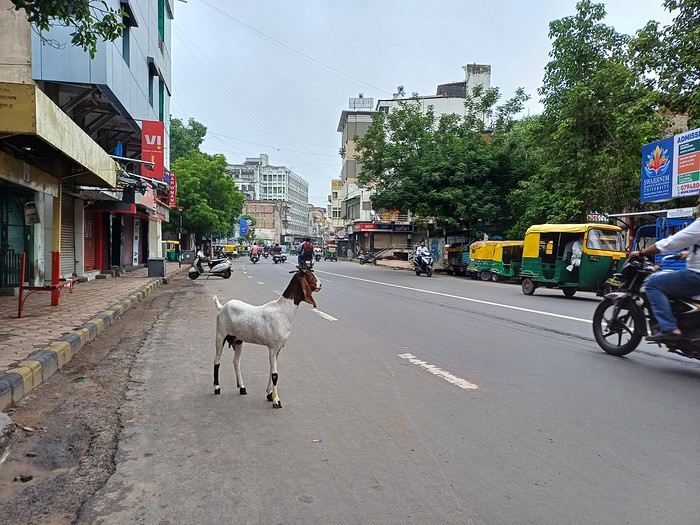
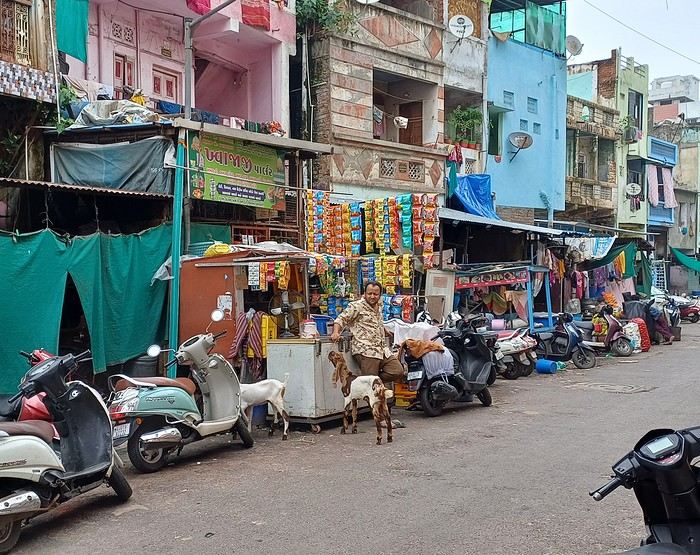
From our wind-battered carriage, we watched the street scenes of this world unknown to them but so familiar to me. We quickly reached Relief Road, one of the main thoroughfares where our hotel was located, running through the city from Kalupur Station to Laal Darwaza (the Red Gate), one of Ahmedabad’s liveliest bazaars. The animals roaming freely on Relief Road—goats, cows, dogs, and others—obviously delighted the kids, as it was another of the Indian quirks I’d promised them. In the heart of this hubbub of vehicles and horns, we kept an eye out to the left to help our driver, who didn’t know exactly where our hotel was. Finally, we spotted the Hotel Prime sign. Seeing us get out of the rickshaw, the hotel guard immediately came to meet us, and two porters rushed to grab our suitcases. Despite the scares, my team fully approved of the rickshaw ride, their faces still shaken and exhilarated, like they’d just ridden a roller coaster at an amusement park. It was their first experience of India, and it was positive for everyone!
But little complications are never far away and remind you that in this country of emotional contrasts, you always have to stay on your toes: "Don’t dream in India!" Claire Landais warns in her travel novel of the same name, which I recommend (or not). We arrived at the reception, which didn’t look too bad. But I’m sure you can already sense something coming... We announced our reservation, explaining that we’d contacted them via WhatsApp and paid a 1,000-rupee deposit to book the room. The three managers searched their computer and paperwork, frowned several times, conferred among themselves... My experience in India whispered that there was a hitch—I was sure of it. And here was the first classic Indian scam: "the unrecorded reservation." I’d mentioned the possibility to Magali, who was skeptical, and as soon as we arrived, India didn’t let me down again. "Here we are, welcome to India!" After a few minutes of fruitless searching, they announced, unsurprisingly, that there was no trace of the reservation or mention of a deposit sent by Western Union. And that the large deluxe room we’d booked with that deposit was therefore not available... "You see, it’s starting!" I said to Magali with a smirk. But in a sudden twist, like in a last-minute Bollywood plot turn, they announced "good news": the person I’d been in contact with on WhatsApp wasn’t a scammer but actually hotel staff—though they didn’t explain whether it was one of them or someone who wasn’t there anymore. I showed them my WhatsApp exchanges and the receipt for our transfer as proof. Like gentlemen, they agreed without argument to honor the advance payment and gave us a large air-conditioned room at the initially agreed price (2,000 rupees) at the end of the hallway, next to a dilapidated and slightly creepy nook that looked like a squat or a pigeon coop, and clearly a bit less nice than the one we’d carefully reserved. That said, it was spacious enough for us and, though not 100% spotless, was pretty clean and did the job. Anyway, we’d only be there for two nights for our two and a half days in Ahmedabad, since the third would be spent on the train to Jaisalmer. I figured it was a perfect and funny initiation. And besides, it wouldn’t do to get used to too much ease and luxury right from the start! Anyway, no one saw any problem with it.
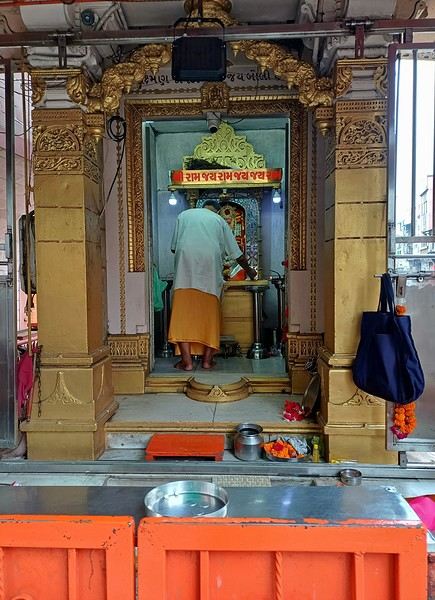
We took a little breather in the room, resting, showering, then went down for a quick neighborhood tour to stock up on water bottles and scout out the area. It was late afternoon, the sky was darkening, it was drizzling again, and this little walk through the alleys behind the hotel was the chance for Magali, Kelyandre, and Théo to take their first steps on solid ground in the heart of Indian life. As we walked, it got harder to make out details with the falling night, but the few lights that dimly lit the darkness, the candles behind temple walls, the smell of burning ghee, and the temple bells ringing for the *pūjā ārti* offered to the gods hinted at a somewhat mysterious world. This atmosphere—both bustling and peaceful—so particular to Indian cities at dusk immediately plunged me back into the deep end. We briefly visited a Krishna temple where a small group of devotees attended the evening *ārti*, the priest waving his tray of candles in a circular motion before the deity.
To avoid an accident during the trip, we had to try to explain to Théo the constant danger Indian traffic posed for him, especially in these crowded little streets where motorcycles, scooters, and cars trampled the "sidewalks"—or rather, the edges of the road... Naturally restless, curious, and a true motor-vehicle enthusiast, he’d landed in the right country. But his enthusiasm could lead to disaster at any moment. We explained that vehicles came from everywhere all the time and that he couldn’t act like he did on French sidewalks. He seemed to understand a little and preferred to let us carry his 15 kilos, which, much to our vertebrae’s dismay, would unfortunately become a habit throughout the trip. But we couldn’t see how a stroller would’ve been practical on India’s impassable streets and potholed paths! On our way back to the hotel, still soaking in the slices of life around us, the scene of a family with three very thin children living in a rickshaw parked on the side of Relief Road moved us. This scene let us illustrate with reality what we’d told Kelyandre about the poverty plaguing this amazing country. The father gratefully accepted the vegetarian chickpea masala sandwiches left in our bags from the many snacks Vistara had served us. A humble, kind exchange of smiles—he distributed the food to his kids, and we let the rickshaw fade into the night behind us.
Back at the hotel, the kids were thrilled (and so were we) because we spotted our first monkey on the hotel roof—a langur, which made another of my pre-departure stories real and restored my credibility, since we hadn’t seen any until then and I could tell they were starting to doubt. Finally safe in the comfort of our room, I connected to the Wi-Fi and scanned the city on Google Maps for a place to eat. After a few suggestions, we opted for Ambrosia, the kind of middle-class vegetarian restaurant I love—always clean and air-conditioned, with authentic food and a varied menu, for about 200-300 rupees per person. It was on the other side of the Sabarmati, near the Gandhigram metro station. In the rain, which was getting heavier, the old, friendly guard who always sat on an old chair at the hotel entrance in his uniform with his stick helped us flag down a rickshaw that took us for 50 rupees (for all our trips in the city, we’d always pay between 40 and 60 rupees, almost the local price). A second rickshaw experience that delighted everyone! We left the old city for a brighter, less dense area, crossed the huge Nehru Bridge, and arrived at our destination in a very quiet, upscale neighborhood where our restaurant was, in the pouring rain. Seeing this motley crew of rain-soaked aliens taking refuge in their restaurant, the manager and his team looked a bit stunned. You could tell they were momentarily puzzled by this odd family: a European man, a mixed-race woman with her hair braided in a tribal style, a mixed-race kid with curly hair, and a little white kid with reddish-blond curly hair but whose features somehow echoed the African traits of the other two... I sensed a moment of identification in their gaze, as if they were staring at a picture with incoherent elements and thus a bit suspicious. People’s looks would give me that feeling for almost the entire trip, though with less surprise for us. Quickly, ordering in Hindi did the trick and snapped them out of their stupor. They did their best to serve us like special guests. What a great find! Everything was delicious: Kelyandre played it safe and chose his usual Indo-Chinese stir-fried noodles (which he’d rarely abandon during the trip), and they made Théo a simple but delicious *khichḍi*, Indian kids’ favorite dish (a mix of *dal* and rice boiled together with just salt and turmeric). We didn’t forget a few sides and desserts. We feasted, and our hosts seemed delighted. It took us a while to find a rickshaw in this deserted neighborhood at that hour, and we returned to the hotel for a well-deserved night’s sleep, since we’d been on the go for the last 24 hours. And I knew that when you arrive in India in the evening, you always see things in a whole new light the next morning.
I don’t have many photos from these departure and arrival days.
Re: Yet another travel journal in this (all-too) familiar Rajasthan, but with family and kids
I can’t help thinking of Samuel Clever while reading you. Love it!
I didn’t remember there was a metro in Ahmedabad...
Je rencontrai sur mon chemin tant de difficultés
Qu’elles furent toutes surmontées
MIRZA GHALIB poète urdu (1796 -1869)
https://www.telling-india-pictures.com
https://youpic.com/marien
Re: Yet another travel journal in this (all too) familiar Rajasthan, but with family and kids
I don’t know Samuel Clever, but I’ll check it out—thanks (I guess)!
Ahmedabad’s metro was set up in 2014, I think. I was in Gujarat in 2013, and it wasn’t there yet. Now it still looks brand new—I’ve got a segment on it in the next episode, which I should manage to publish today.
Re: Yet another travel journal in this (all-too-familiar) Rajasthan, but with family and kids
I don’t know Samuel Clever, but I’ll check it out—thanks (I think)!
I wanted to talk about the epic breath that sweeps us into adventure at the start of this journal... It was a nod to a distant past...
Je rencontrai sur mon chemin tant de difficultés
Qu’elles furent toutes surmontées
MIRZA GHALIB poète urdu (1796 -1869)
https://www.telling-india-pictures.com
https://youpic.com/marien
Re: Yet another travel journal in this (all too) familiar Rajasthan, but with family and kids
The title of your travel journal wasn’t changed. Lucky you... Mine (recent) was changed again... but there are others that were too...
Je rencontrai sur mon chemin tant de difficultés
Qu’elles furent toutes surmontées
MIRZA GHALIB poète urdu (1796 -1869)
https://www.telling-india-pictures.com
https://youpic.com/marien
Re: Yet another travel journal in this (all too) familiar Rajasthan, but with family and kids
What’s the point of wanting to change people’s travel journal titles... Why not change the text while you're at it?
Besides, I think there are too few characters—the title I wanted didn’t fit the requirements.
Re: Yet another travel journal in this (all too) familiar Rajasthan, but with family and kids
Besides, I think there are too few characters—the title I wanted didn’t fit the naming rules.
At least you’re making me laugh! Because the title length is already not bad...
Je rencontrai sur mon chemin tant de difficultés
Qu’elles furent toutes surmontées
MIRZA GHALIB poète urdu (1796 -1869)
https://www.telling-india-pictures.com
https://youpic.com/marien
Re: Yet another travel journal in this (all too) familiar Rajasthan, but with family and kids
I didn’t remember there was a metro in Ahmedabad...
Huh, me neither!
FYI—just throwing this out there, not for the author of this story, but for everyone else: Indians never pronounce the name of this city as AH-MED-ABAD, but rather "Em dabad"...
[:P]
Re: Yet another travel journal in this (all too) familiar Rajasthan, but with family and kids
That’s exactly how it’s pronounced!
About the Ahmedabad metro, I got the date wrong when replying to Marien: it opened in 2019, not 2014, which explains why it still looks almost brand new.
I’ve made a few tweaks—added a couple of missing descriptions and a modest photo. The rest shouldn’t be too long in coming...
Re: Yet another travel journal in this (all-too-familiar) Rajasthan, but with family and kids
That’s exactly how it’s pronounced!
For the Ahmedabad metro, I got the date wrong when replying to Marien: it opened in 2019, not 2014, which explains why it still looks almost brand new.
I’ve made a few tweaks with a couple of missing descriptions and a measly photo. The rest shouldn’t be too long in coming...
That’s why... We went in December 2018
Je rencontrai sur mon chemin tant de difficultés
Qu’elles furent toutes surmontées
MIRZA GHALIB poète urdu (1796 -1869)
https://www.telling-india-pictures.com
https://youpic.com/marien
Re: Another travel journal in this (all too) familiar Rajasthan, but with family and kids
Day 2, July 25: Ahmedabad
"First steps in the Indian light"
We didn’t wake up too late, helped in that by the simultaneous call of several muezzins—each with wildly varying talent for hitting the right notes in their surah chanting. One was howling into the loudspeaker like a madman, his hoarse voice cracking into uncertain notes that derailed into random microtonal wobbles, as unpleasant for the eardrums as it was involuntary. Another, more disciplined, tried to harmonize with the hieratic melodic line of his companion, creating an improbable disharmonic duo that gave us our morning laugh. The old city of Ahmedabad is steeped in a still-vibrant historical Muslim culture, and our hotel is located in a small area surrounded by neighborhood mosques.
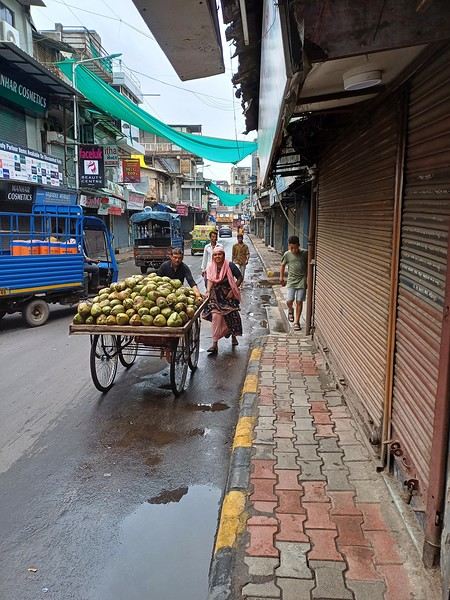
After getting ready and ordering a breakfast of toast-omelet, some spicy Indian snacks, and, of course, the inevitable chāy masālā in our room, we decided to head to Manek Chowk, one of the old city’s lively bazaars, particularly famous for its street food—a perfect place to start. This time, Magali and the kids would experience their first real daylight images of India, and as I mentioned earlier, I know how rediscovering an Indian city the next morning in daylight has this power to reveal everything that was lurking in the shadows the night before, waking up all the bustle that had retreated into hiding during the night, making us perceive things in a completely different way. It was 8:30 AM, and at this early hour, the air was still cool, the streets still a little empty, and we only crossed a few rickshaws or vendors with carts full of coconuts. My crew watched in surprise at these medieval-looking street scenes, the tangled electrical wires that amazed us, the wet ground with scattered trash and colorful puddles, their nostrils getting acquainted with this composite smell of incense, exhaust fumes, humidity, sweet milk, spices, and urine. Senses and bodies gradually immersed themselves in another world...
We strolled leisurely as activity slowly picked up: a few shops opened, temple attendants and Hindu devotees performed their morning rituals at the small street shrines.
We passed by the entrance of the Jama Masjid, one of the country’s largest mosques, dating back to the 15th century. I had already visited (and enjoyed) Ahmedabad ten years earlier, yet passing by the Great Mosque, I didn’t really recognize the place. That said, I have fond memories of it because, infinitely less crowded than Delhi’s, the ambiance is much freer and more peaceful. We kept its potential visit for later (which never happened). In this moment of discovery for my crew, we preferred to soak in the street scenes stress-free while drinking coconut water straight from the shell (40 rupees). It was still too early for India, and most shops remained closed, to the point that I barely recognized the bustling neighborhood I had crossed years before.
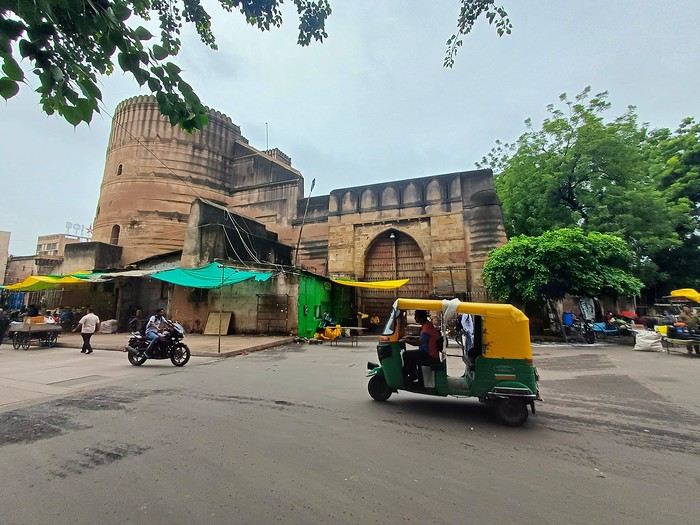
Since we were still a bit hungry for a lively bazaar, I suggested continuing to Laal Darwaza, a gigantic and labyrinthine market, the most famous in Ahmedabad, where you can find almost anything—especially clothes, all kinds of textiles, saris, shawls, bracelets, bags... This time, I recognized the place and the remnants of its towers and walls. The old city has a pleasant atmosphere, undeniably Muslim with its old Islamic architecture, mosques, women in niqabs, and men in kufis and djellabas—something intriguing for the cultural and economic heart of a state that is the bastion of Hindu fundamentalism. It reminded me of Old Delhi, but more pedestrian-friendly and a little less chaotic... well, sort of...
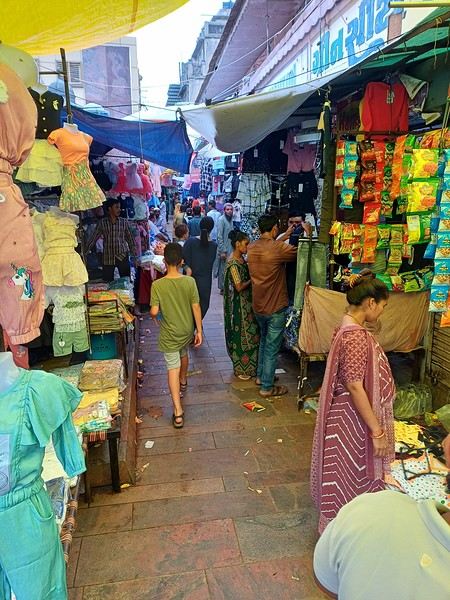
We plunged into the colorful stalls, not knowing where to look first—there was so much beauty per square meter, and in this explosion for the eyes, we wanted to buy everything. As we wandered through different sections, Magali, who was looking for practical Indian outfits for the rest of the trip, browsed the shops and fell for two gorgeous kurtī, these traditional dresses, here with Kutch patterns. Kutch is a desert region bordering Pakistan and Rajasthan in northern Gujarat, renowned for the craftsmanship of its tribal populations. For sure, with one of the kurtī she put on right away and her African braids made for this trip, she’d be mistaken for a tribal! In fact, quite a few passersby, especially women, would literally freeze, stopping in their tracks with a bodily and ocular halt, punctuated by a low grumble in Gujarati at this mixed-race girl with long braided extensions—more often out of great surprise than rejection. It was only in Ahmedabad, upon arrival and return, that I noticed this kind of reaction. I’m not saying there weren’t reactions elsewhere, but certainly not the same ones.
In these situations, I always remember what a young Indian engineer from Delhi I met in Jodhpur once told me, in essence, about how Indians perceive Black Africans: "Indians aren’t racist against Black people; they’re just afraid they’ll do magic and kill them to eat them." If a modern Indian repeats such grotesque clichés, I wonder what others we crossed must have thought...
It was getting a bit hotter and more humid. The fatigue was even more noticeable since Théo, who usually walks a lot, kept asking to be carried. Naturally excitable, fearless, and chatty as can be, we discovered him here extremely impressed by the uninterrupted flow of cars, trucks, scooters, rickshaws, and all kinds of carts, and their cacophony of "tut-tuts" and "cling-clings" coming from all directions. He had found something even more bustling than himself in this crazy country and seemed unusually inhibited, yet positively fascinated when we asked if he liked it. Before heading back to the hotel, we walked through the shopping streets where Kelyandre made a few stops to try exotic candies, ice cream chips, or sodas, while we stocked up on water bottles and bananas.
We made a quick and necessary return to the hotel to rest in the cool AC, use the bathroom, and change Théo’s diaper. We had packed the bare minimum to avoid overloading our already bursting luggage, so we’d have to find diapers quickly in Ahmedabad. We set off again toward the Sabarmati riverside for lunch, as unconditional fans of Tamil cuisine, at a South Indian restaurant aptly but simply named... South Indian Restaurant. Another excellent find: dosa, idli, curd rice, vada, chutneys... everything was delicious and really cheap in this small, clean room with outdated colonial-style decor. The place was close enough to Laal Darwaza that we walked back to digest. As I often do, I followed my phone’s GPS to avoid detours, and we suddenly emerged into one of those small, very traditional residential alleys where you’re not really supposed to be—because you end up disturbing the intimate daily life of Indian families. Those in the know will understand. In my experience, foreign visitors are sometimes invited by locals to turn back with hand gestures and quick invitations to look elsewhere. Théo’s attention was then drawn to a cat, and as the animal became our focus, two women in saris doing household chores in front of their house watched us. I vaguely understood from their exchange in Gujarati that they were making fun of us because we were impressed by a cat, but they said something else I didn’t catch. I asked them in Hindi what was going on, but they replied, "Nothing at all," with an air of wanting to cut it short rather than admit they’d made an unkind remark. But with the language barrier somewhat lifted, they became friendlier and exchanged a few usual words with us before saying goodbye and returning to their domestic tasks.
A short return to the cool hotel, and we had to leave quickly to buy the train tickets for our circuit. We had already booked our first ticket, Ahmedabad-Jaisalmer, in advance through the owner of the camp where we reserved a tent in Jawai Bandh. I had contacted him via WhatsApp after finding his number on Google Maps, and we’d hit it off a bit. Since he asked for a deposit and we couldn’t book on IRCTC from France, we proposed that he reserve our first trip for us and that we send the deposit and reservation price via Western Union, which worked perfectly for only 3 € in fees. But we still had to book the Vande Bharat (India’s "deluxe" TGV) between Jodhpur and Falna, and our final trip between Abu Road and Ahmedabad.
We hailed a rickshaw that took us up Relief Road to Kalupur, Ahmedabad’s central train station. We searched for a moment for the reservation hall, which no station staff could clearly point out to us, but after wandering a bit, we found the place—good news, it was air-conditioned. Now came the famous paper forms. The people were very friendly with us, chatting, lending us a pen that the stern ticket clerk refused to provide. Then we tried to hold our place in line with Théo, who was becoming unmanageable, while others shamelessly cut in front of us... Magali and Kelyandre left me alone to take a walk with the little one, who found peace and bliss watching the trains on the platform and wondering why people were walking on the tracks. Meanwhile, an (overly) kind station staff member asked me to follow him to the immediate departure counters in one of the entrance halls, thinking I’d get through faster. But after waiting a bit, I was told to go back to the reservation hall, where I’d obviously lost my place. He was kind and sorry, but he’d almost made me lose half an hour trying to save me time. I finally got to the counter and booked my seats. My crew had found me in the meantime after searching for me once while I was in the other hall. But, having left her phone at the hotel, she didn’t panic and came back later.
Rickshaw, back to the hotel, and we returned to Manek Chowk to buy diapers at a store we’d spotted online. The neighborhood, so peaceful that morning, was absolutely unrecognizable in the evening, making us wonder if we were in the same place. There wasn’t a single patch of sidewalk that wasn’t invaded by stalls selling all sorts of goods, the compact crowd, and torrents of rickshaws and scooters coming from all directions. Despite having the shop’s location, addresses were hard to find in this chaos. We finally arrived in front of a small store that sold (among other things) baby items. We left with a large pack of Indian diapers, whose very limited effectiveness we’d later discover (far from the double-thick Pampers...), though the price was quite high for the country—something like 300 or 400 rupees for twenty, I’ve forgotten. It’s a "luxury" product that not everyone uses here.
Night was slowly falling as we walked back up the dimly lit streets for our ritual rejuvenating stop at the hotel before heading back to Ambrosia, the restaurant from the night before (since you don’t change a winning team), but this time by metro. The Ahmedabad metro, inaugurated in 2019 and completely unknown to me, is stunningly clean and modern—even more so than Delhi’s—and we were thoroughly impressed. It’s air-conditioned, with top-notch electronic displays and announcements, spotless chrome elevators, never too crowded, and lets you travel easily around the city for just a few rupees. I think it’s the most modern and pleasant metro network I’ve ever seen in the world. The aerial view it offers of the Sabarmati River at night is absolutely beautiful. Then we feasted once again at Ambrosia, where the staff was happy to see us return and served us warmly, showing great attention and enthusiasm in taking our order. Finally, after trying to hail a few rickshaws in the light rain, we found one that stopped—but refused to take us, pretending not to want to go to our hotel’s neighborhood, which was very central, before driving off and disappearing into the night. But to our great surprise, we saw him come back a minute later to pick us up! He charged us 60 rupees for the ride, slightly more than usual ("It’s fine, it’s only 20 cents!" I heard murmured in the background), but he got us home safely. As we got out of the vehicle, the old guard, who always sat on his chair at the foot of the hotel, recognized us immediately and came to meet us, accompanying us with his benevolent presence to the elevator. The little ones were tired and would sleep well...
Re: Yet another travel journal in this (all too) familiar Rajasthan, but with family and kids
Yes, I’m itching to go back to India too... This winter, I hope!
In the meantime, I’m going to enjoy this new travel journal by Pagal—I really love their style, and I drew a lot of inspiration from it for our trip to Tamil Nadu in 2019.
Anne
Anne
Mes récits de voyages : www.unendroitoualler.fr
Re: Yet another travel journal in this (all too) familiar Rajasthan, but with family and kids
This winter, I hope...
Plan to come see me this time in Kannur ;)
Je rencontrai sur mon chemin tant de difficultés
Qu’elles furent toutes surmontées
MIRZA GHALIB poète urdu (1796 -1869)
https://www.telling-india-pictures.com
https://youpic.com/marien
Re: Yet another travel journal in this (all too) familiar Rajasthan, but with family and kids
I’ll take this opportunity to say I’ve slightly expanded my previous post with some interesting little details that came back to me!
You’ll have to read it all over again to spot them...
Je rencontrai sur mon chemin tant de difficultés
Qu’elles furent toutes surmontées
MIRZA GHALIB poète urdu (1796 -1869)
https://www.telling-india-pictures.com
https://youpic.com/marien
Re: Yet another travel journal in this (all-too) familiar Rajasthan, but with family and kids
I’m still not entirely sure where we’ll go—probably Kerala (thanks again to Marien for inviting us to visit him in Kannur, maybe we’ll take him up on it!) and Karnataka... but before that, I’m still undecided...
In the meantime, I’m continuing to read your trip with your little ones. Now that we’re grandparents, I can imagine that a trip like this with kids isn’t exactly a walk in the park! [:P]
Anne
Mes récits de voyages : www.unendroitoualler.fr
No obligation to read everything, of course 😄
Since I don’t have much time to write and do it at moments when I’m not exactly fresh, I keep going back to correct mistakes, missing words, and typos. And sometimes, details and memories come back to me later—unexpectedly at night or at work—because the trip was a year ago. These are details I add that matter to me and the story’s coherence, so I’m just mentioning it in case anyone’s interested.
Yann55=❨Non, indeed, it requires extra planning and vigilance! It’s a completely different way to travel, but no less interesting.
Re: Yet another travel journal in this (all too) familiar Rajasthan, but with family and kids
and fell in love with two stunning kurtis, these traditional dresses, here with Kutch motifs—a desert region bordering Pakistan and Rajasthan in northern Gujarat, renowned for the craftsmanship of its tribal populations
Sorry, I can’t resist sharing this extraordinary and unique documentary about the Rabaris, whom I’ve encountered many times in Gujarat. Their faces are stern, and their gazes cold toward us, outsiders—but in this documentary, it’s a whole different world!
A must-watch for anyone interested in Gujarat’s folklore—you won’t be disappointed. A truly unique opportunity!
That was my little digression about the traditional dresses of Kutch...
Watch it in 4K—you can choose French subtitles.
Here’s the link: https://www.youtube.com/watch?v=0pf2Gi2f0Cw
Thanks Marco, I haven’t had time to watch the video yet but I’ll do it as soon as I can because I spent some time studying the Rabari camel herders of Rajasthan, where they’re most present. But you’re right, they’re also found in Gujarat, where I think they have some traditions different from those in Rajasthan.
I’m still making occasional edits and will soon get to the next part of the travel journal.
Re: Yet another travel journal in this (all-too-familiar) Rajasthan, but with family and kids
Day 3, July 26: Ahmedabad-Adalaj-Ahmedabad
"A little detour for exhilarating wanderings"
Wake-up, breakfast in the room just like the day before, and we get ready without dawdling too much because an intense day awaits us. The day before, just to get out of Ahmedabad a bit, I suggested to Magali that we take a trip to Adālaj ni Vāv, one of the remarkable bāolī of Gujarat, which I had also visited ten years earlier. The bāolī (vāv in Gujarati and Marathi) are these large Indian stepwells adorned like temples that served both practical and religious functions. It’s not the most impressive bāolī in Gujarat (the Rānī kī vāv in Patan, a bit further north, is on my list of the most beautiful things I’ve seen in India), but it’s remarkable and only about twenty kilometers from the center of Ahmedabad, which allows us to take our first trip into the Indian countryside without going too far. Magali, who doesn’t dislike Ahmedabad, isn’t absolutely smitten with the city—or maybe she’s just not yet accustomed to the joys of the hustle, pollution, and dirt of Indian metropolises. It’s also our last moment before taking the overnight train to Jaisalmer that same evening. We decide to walk to Laal Darwaza this time, as all roads seem to lead there, because I saw online that it’s from the bus station there that you can reach the village of Adalaj. We walk along Relief Road with its many clothing shops, restaurants, and all kinds of stores, still closed at this rather early hour. We make a quick stop along the way at a great lassi and juice stand, Masti Juice (Juice of Happiness), to enjoy the specialties and stock up on water in this muggy monsoon heat of Gujarat that makes us sweat a little. That said, we haven’t suffered too much from the heat since our arrival: the occasional rains cool the air a bit, the mornings are pleasant, and during the sunny spells, it’s hot but not unbearable.
We arrive at Laal Darwaza relatively quickly despite Théo, who often needs to be carried. He’s taken our warnings about the dangers of traffic and Indian sidewalks to heart and is very cautious amid the noise, though he’s usually so outgoing. He takes the opportunity to ask us to carry him more often than usual, citing fatigue. We know he’s exaggerating a bit, but it’s true that even if he walks, he’s only 2 years old and isn’t used to hiking so much, nor to this humid, heavy heat. We find the Laal Darwaza bus station and ask around to find the bus line(s) going to Adalaj. Several people—employees or just friendly passersby—help us out with great kindness and chat easily with us. We wait maybe half an hour before someone signals that a bus to Adalaj is pulling in. Everyone rushes toward the opening door, and we try our best not to get pushed aside, as is the tradition in India. We manage to find seats, the bus leaves, and we buy tickets from the conductor for a ridiculous sum, the equivalent of a few dozen cents. It’s our first public bus ride, and everyone appreciates the folklore of this old bus packed with colorful saris, immaculate white shirts and kurtās, and more...
I track our route by regularly checking my phone’s location on Google Maps and see that, heading north through the city, we’re indeed going in the right direction along the Sabarmati to Gandhi’s famous ashram (which we’ll never find time to visit), then past the Narendra Modi Stadium. Traffic is dense, but we gradually leave the city behind. Adalaj is halfway between Ahmedabad and its more modern satellite city, Gandhinagar, which is incidentally (and curiously) the capital of Gujarat. At one point, I notice the bus veering west, but since we’re not far from Adalaj, I think it’s a detour to the village of Shantigram and that it’ll head back east. But the road stretches on, and we keep moving northwest, getting farther and farther from our destination. I ask the driver if we’re really going to Adalaj’s stepwell. He seems a little embarrassed, nods vaguely without giving a clear answer—anyone who knows India knows that’s a bad sign! Then he finally tells me not to worry, that the bus isn’t going to Adalaj but will pass within 5 kilometers, and he’ll let us know when to get off to take another bus or a rickshaw. I catch a passenger telling him, “rather *pandrah kilometers*,” meaning 15 kilometers... I quickly check Google Maps, which confirms the passenger’s words and contradicts the conductor’s: if we keep going this way, geometry dictates it’s impossible to pass within 5 kilometers of Adalaj... or even 15... more like 20-25... I don’t know why everyone at the bus station told us this bus was going to Adalaj when it clearly isn’t, and I start wondering where the conductor will tell us to get off... Some passengers finally realize what’s happened and explain the confusion: the bus isn’t going to Adalaj but to... ADRAJ... which sounds almost the same! Several feelings wash over me, but though a little annoyed, I accept our fate. I tell myself that even when speaking Hindi and with helpful people, these kinds of mix-ups still happen when traveling in India... We continue our journey through fields and villages for what feels like an eternity, as I can’t help feeling we’re getting even farther away. But I never panic in these situations—it’s happened to me several times on India’s roads, and there’s always a solution. That’s why it’s an ideal country for wandering: you’re never truly lost, and these moments of aimlessness that invite letting go are, for me, part of the joy of travel. I explain to my crew that we need to keep things in perspective: we’re not that far from Adalaj, we’re on vacation to discover India, we have time, and taking a rickshaw through the Gujarati countryside will be even more fun. We finally arrive in a village called Vamaj, where the conductor tells us to get off and find a rickshaw.
The small village is at the crossroads of several roads, and there’s hardly anyone around—no crowd, barely a soul, and not even a place to grab a chāy or eat a samosā. We start wondering if we’ll find any way to leave this village. I ask just in case if there’s a bus to Adalaj, but no... The few travelers who got off with us all rush toward the few rickshaws there and leave without waiting, leaving us alone in this middle of nowhere. Kelyandre doesn’t quite share my mindset: his anxious nature doesn’t handle surprises well, and he seems to see the situation as a failure. I try to reassure him by reminding him that I know the country well and that these unexpected moments are often the most interesting parts of travel (which is true, since I’m the one saying it). We sell this little unplanned detour to the kids as a super attraction (which is also true), and we dive right in! We finally spot two rickshaws. One offers an outrageous price (for India) before lowering it to 500 rupees. Since I flat-out refuse because I know it’s way too much, even for “30 kilometers,” as he claims, they call over a colleague further away who, they say, will be cheaper. It’s an old man to whom I carefully emphasize the long and short “a” sounds, telling him we’re going to “ADAALAJ!” and not “AADRAJ!” We agree on 350 rupees. It’s certainly still above the usual price, but he’s the only one left in this deserted village, and we don’t want to linger here since we have a busy schedule. Plus, as Attila (the traveler, not the Hun emperor) would say, we’re not here to quibble over a few cents—it’s a fair price for us: it’s only 4 € to take four people 25 kilometers. And if we see it as an attraction (with air conditioning thanks to the wind), then it’s practically a steal! In the end, Magali and the kids, who love rickshaws, thoroughly enjoy this ride through villages and countryside. It’s even their most authentic experience of India since our arrival: cows, goats, and dogs on the road, rickshaws packed to the brim, overloaded motorcycles, decorated trucks with blaring horns, rural life scenes, and even urban ones as we pass through the crowded town of Kalol INA, an “industrial notified area.” It’s indeed a satellite industrial-urban area of Gandhinagar, and at times, we’re stuck in traffic. This proximity allows people to wave hello at us. Everyone’s delighted, and we even feel like the trip is really starting now. After about forty minutes, we finally arrive in Adalaj, where our very friendly driver finds the stepwell area, which I recognize immediately. A really nice experience in the end!
To recover from our emotions and since it’s almost lunchtime, we look for a place to grab at least some chaat (quick food), but there are only two small shops in front of the monument’s entrance, and we have to settle for chips, ice cream, and small Amul-brand lassi cartons—the indispensable national dairy brand, which, like Tata or Birla, was founded by wealthy Gujarati industrialist families who played a major role in helping Nehru develop the country after independence. These 20-rupee lassi cartons are filling and safe: a blessing for Théo, who loves them and won’t risk getting sick.
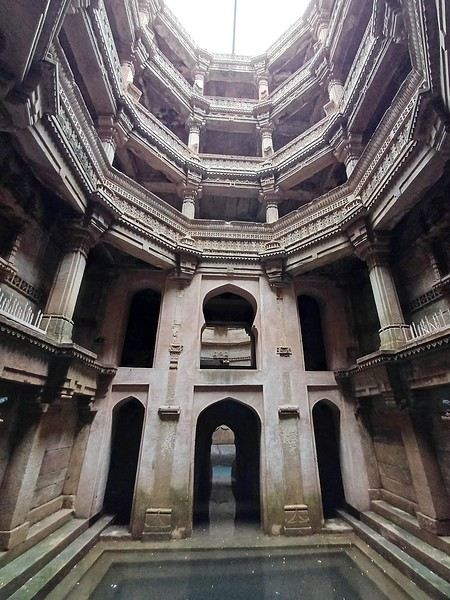
At the site’s entrance, we take a quick look at the small temple of the goddess Ambe Māta, then head to the ticket counter to buy our tickets (250 rupees for adult foreign visitors, free for kids). The Adalaj bāolī is one of those ornate stepwells typically found in western India, especially in the arid regions of Rajasthan or northern Gujarat, as they were used to store rainwater. This one was commissioned by a Hindu ruler in the late 15th century before a Muslim ruler, grandson of Sultan Ahmed Shah (founder of Ahmedabad, which logically means “Ahmed’s city”), invaded this neighboring kingdom. He married the defeated king’s daughter, who later allegedly committed suicide in the stepwell’s waters, according to legend... It’s absolutely stunning, with a distinctly Gujarati style blending Hindu, Jain, and Muslim influences.
These intricately carved pillars, like lace, form square lattice structures leading down to a large octagonal well accessible by steps.
The murky waters and rays of light filtering through the top and cracks in the structure create a beautiful visual effect.
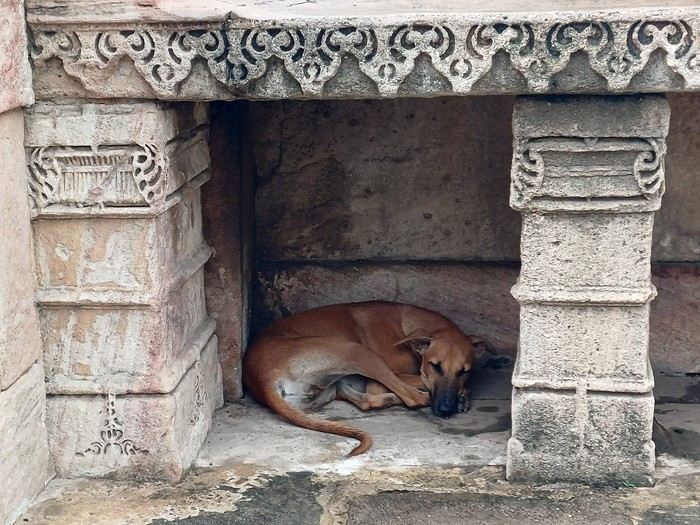
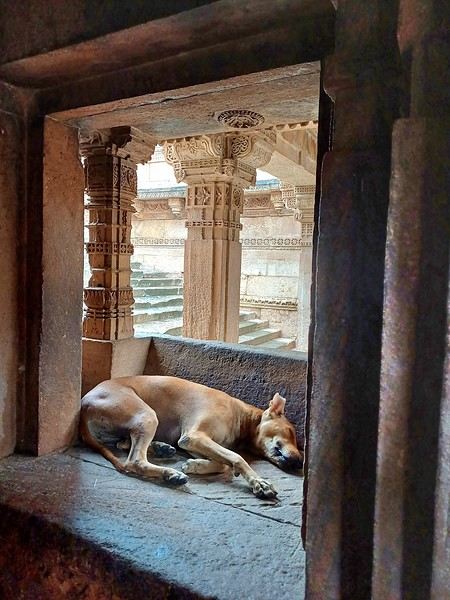
Here and there, while exploring the nooks and crannies, I spot dogs curled up, asleep and undisturbed, in hidden corners of the monument or small alcoves sheltered from the sun and humans.
You can even walk on the roof (carefully) for an overview and admire other beautiful decorations. It’s all the more pleasant because the area around the stepwell is quiet, with flower-lined paths and large grassy areas to stroll, where Théo can eagerly watch gilahari (those little Indian squirrels) and big lizards scurrying along the stone walls, as well as an impressive banyan tree.
Plus, there aren’t too many people, which is nice. There’s a small group of Asian tourists, which makes us realize we haven’t seen (or hardly any) foreign tourists since arriving in Ahmedabad. We take advantage of the very clean restrooms (rare enough to mention) at the back of the site and the benches to rest a bit.
Then we head out, happy with this beautiful visit, in search of a real place to eat quickly, as we have our overnight train early in the evening. We find a tiny little eatery in the alleys near the site that looks promising. The friendly owners seat us at the side table of their narrow shop and serve us delicious samosās, kachaurīs (small fried stuffed pastries), and other spicy chaat for next to nothing. While we eat, some Banjārā girls (Indian gypsies) show up to buy food and try to beg from us. Théo can’t think of anything better than to want to play with them—just when we wanted to eat without being bothered! But the owner asks them to leave us alone. Once we finish our meal, we quickly look for a rickshaw and ask the driver to take us to the nearest bus stop. He’s a bit lost because he says there are stops everywhere... I remember that ten years ago, all we had to do was stand by the regional highway, the SH41, which borders the village, and wait for the first bus to Ahmedabad. He asks a colleague for help, who tells him to drop us off at a specific spot by the road where a direct line to Laal Darwaza passes. We arrive at the indicated spot: a chāy and snack stand that serves as a stop. The vendor and a few customers assure us we just need to watch for the red bus that’ll arrive in “ten minutes.” But time passes, and nothing happens. It becomes a game to watch every bus coming from afar... which quickly gets annoying because either they pass without stopping, or our fellow passengers dissuade us from boarding because they’re heading to Ahmedabad but not the old city... and anyway, our bus should arrive in “ten minutes.” After an hour of waiting for “ten minutes” while buses speed past us, we fend off rickshaw drivers offering to take us directly to Laal Darwaza for exorbitant sums, chat amiably with our new friends, down bottles of water, chāy for the parents, and weird sodas/chip bags for the kids (Nutri-Score Z, but no choice...), meet a sādhu who shows off his outfit to squeeze a little money out of us before leaving not too happy with 10 rupees. We finally convince our chāywālā friend that the bus won’t arrive in “ten minutes” and that we’ll take whichever one comes since they’re all going to Ahmedabad. An unassailable argument he eventually accepts. We’re not late yet, but we will be if we don’t take our fate into our own hands. We finally board a bus whose terminus is 4 kilometers further, at the Chandkheda bus station. And as soon as we get off the first bus, we hop onto a second one that leaves immediately for a northern neighborhood of Ahmedabad, where we arrive much faster than on the way there. We realize just how close Adalaj actually was to Ahmedabad! Before getting off at the new stop, the conductor explains that our ticket will still be valid on the next bus. I want to emphasize here that up to this point, people have been incredibly kind upon seeing this quirky French family exploring India. Then, after a short chat with a man under the bus shelter trying to sell us trinkets, he points us to a bus going to Laal Darwaza. In the nearly empty vehicle, we feel reassured and satisfied to be on the home stretch.
In no time, we’re back along the Sabarmati, turning by the grand Siddi Saiyyed Mosque before arriving at Laal Darwaza. We take a rickshaw that drops us off at our hotel, where our faithful guard is still on duty: he rushes to accompany us into the old elevator. Between the mishaps on the way there and the three buses on the way back, we’ve definitely taken the scenic route, but it’s made for a rich day full of stories and images that’ll stay with us.
Time to shower one by one while we efficiently pack our suitcases, then we leave our room for check-out, give a small tip to the hotel guard and his two young helpers who’ve always assisted us, and load our suitcases into a rickshaw once more for the day’s final destination: Kalupur Station. We’re early enough to grab a bite to eat. We settle on Darshan, a small restaurant packed with travelers but air-conditioned, right next to the station, which has the advantage of serving almost all the North Indian, South Indian, and other Indo-modern classics you could want: everyone finds something they like. Théo is restless, probably on edge from this long day. Finally, we enter the huge station and head to the platform where our train, the Bandra Terminus Jaisalmer Superfast, arrives on time, once again announced by the two synthetic trumpet notes followed by the cheerfully robotic voice of Indian Railways’ virtual lady. We head to our 2AC compartment (for the uninitiated, a good air-conditioned class with 4 berths and no real separation from the corridor except curtains), which, though simple, pleasantly surprises Magali and Kelyandre with its quality. It cost us 1600 rupees per person, except for Théo, who rides for free. We stow our big suitcases under the seats and settle onto our benches. Delivery guys come and go, dropping off big bags for their clients, as apps now let you order meals on the train, at certain stations and times, from various restaurants: we wonder if that’s what we should’ve done. The train gradually fills up and leaves right on time at 7:30 PM. In a little over 14 hours, if all goes well, at an average speed of 50 km/h—which is “superfast” by Indian rail standards—we’ll be in Jaisalmer!
Trains (like almost all services in India) are free for children under 5, as long as they sleep with one of the parents and don’t take up an extra berth. We share our compartment with a solitary, somewhat curious man in his sixties who’s come from Hyderabad to visit Jaisalmer, the train’s terminus. We chat with him a bit, but he seems quite reserved by nature. Despite my attempts to lighten the mood with comments like, “Ah, Hyderabad, the city of biryani!” he eventually retreats to his phone, where he listens to news from his region in Telugu at full volume. When we booked three berths in this four-berth compartment back in France, we wondered what kind of person would share the space with us. Now we know, and we’re not too bothered to have ended up with this curious and noisy co-traveler. But to our delight, a man sitting with his friend on the side benches across from us finally tells him firmly, “Uncle! Use headphones!” Our neighbor, who doesn’t have any, puts his phone away with a somewhat depressed look that makes me wonder: my imagination starts spinning stories about this strange but not unkind character’s life... My little family checks out the train’s restrooms, which they find less dirty than I’d warned them. The train gets a big thumbs-up from the crew! Then the blue-upholstered benches become berths, and we fall asleep pretty quickly, especially me, who so easily drifts off to the rocking of Indian trains. Goodbye, Ahmedabad and Gujarat—we’ll be back in just under three weeks! Now we can start dreaming of Rajasthan, of Jaisalmer and its desert fort, of camel caravans... zzzzzzzzzzzzzzzz...
Re: Yet another travel journal in this (all too) familiar Rajasthan, but with family and kids
That’s why it’s an ideal country for wandering: you’re never really lost, and those moments of aimless exploration that encourage letting go are, for me, an essential part of the joy of travel. I explain to my crew that we shouldn’t sweat it—we’re not that far from Adalaj, we’re on vacation to discover India, we’ve got time, and taking a rickshaw through the Gujarati countryside will be even more fun
Next time in India, we’re taking you with us!
A discreet and caring guide, finding solutions to every worrying situation, knowing the country inside out, speaking French and Hindi, a top-notch negotiator, and seemingly always in a good mood [:P][;]
Mes photos sur Flickr:
https://www.flickr.com/photos/153304262@N05/albums
"Le Temps nous égare. Le Temps nous étreint. Le Temps nous est gare. Le Temps nous est train".
Re: Yet another travel journal in this (all-too) familiar Rajasthan, but with family and kids
Hi there, I see you’ve immersed your family in the daily life of the locals.
I don’t think I’d have dared take the bus with a 2-year-old.
They must’ve been wide-eyed after a day like that. What an adventure for your family.
I travel really comfortably with my drivers and in 1AC or CC... sometimes rickshaws and very rarely overnight buses.
Looking forward to the rest. Best,
Thanks for your message!
This reflection really resonates with me and seems spot-on because it’s almost exactly what someone I traveled to India with four times in the 2010s shared with me. She felt it was a privileged situation to discover India with the comfort of someone who knows the country well, speaks Hindi, has studied its culture, has opportunities to easily get invited into people’s homes, gives advice on what you could visit but leaves the decision up to you based on your desires (after all, I already know), doesn’t see unexpected events as negative situations but as part of the discovery process, etc... Like traveling in a bubble of ease that allows you to let go, while still being immersed in local life and really traveling off the beaten path!
It’s almost like having a private guide, and I also love it because, as Kola and I mentioned earlier, it allows the person who knows the place to rediscover things through the fresh perspective of someone else. But it’s truly all the solo trips I’ve taken that have given me this freedom and mindset that I can now share with others.
That said, I have to temper the picture you’re painting a bit! I know it’s not always easy for the other person to keep up with my travel pace or my desire to visit more remote places. That I can handle things that might be harder for others to endure. That I can sometimes be a bit demanding about certain things, which can create little tensions. But those moments are rare!
Thanks Didier for your comment, which echoes Kate’s a bit.
Actually, I took my little family on a near-total immersion trip—my presence and handling of situations allowed them to experience these "roots" conditions in a "comfortable" way. You’ll see in the rest of the journal that this was pretty much the case every day, even more roots (especially arriving in Jawai Bandh 😅) than that day between Ahmedabad and Adalaj. And these are ultimately the moments they loved the most and that remain the fondest in their memories.
I get that people might question the safety of traveling in such conditions with a 2-year-old, but I have to say, it’s in these moments that we received the warmest welcome. I never could’ve imagined Rajasthani villagers being so kind and welcoming to us. But I won’t spoil too much of what’s coming...
Re: Yet another travel journal in this (all too) familiar Rajasthan, but with family and kids
This reminds me of that person—father or grandfather—who knows how to tell stories to kids and keep them on the edge of their seats...
Your story takes me back to a rough night on our way back from Pondicherry with my friend Johny, as we were heading to Kannur. The bus we’d originally booked for the whole trip dropped us off in the middle of the night in a deserted village, with dirty, dark streets, to catch another bus "connecting" with only 20 minutes to wait for the second one.
But we didn’t handle the situation as well as you did. It was nighttime, we didn’t see a single person, and soon huge cockroaches started climbing up our bags and suitcases left on the ground—no sidewalk in sight. Then came the rats... But the worst part was when swarms of mosquitoes showed up and stayed for what felt like forever, feasting on us while we had no way to protect ourselves. Every time a bus passed, we waved frantically, but either they wouldn’t stop, or they’d say they weren’t going to Kannur, Calicut, or anywhere else along the Malabar Coast. We waited there for hours, feeling completely abandoned and lost, convinced we’d be spending the night among that vermin.
It was awful, and yet, not long ago, Johny reminded me of that adventure over 10 years later, and we had a good laugh about it.
Je rencontrai sur mon chemin tant de difficultés
Qu’elles furent toutes surmontées
MIRZA GHALIB poète urdu (1796 -1869)
https://www.telling-india-pictures.com
https://youpic.com/marien
Re: Yet another travel journal in this (all too) familiar Rajasthan, but with family and kids
Ah, the bus and train stations of Pondicherry at night 😊
I’ve had my share of not-so-comfortable overnight transits while traveling solo, but still, nothing like what you went through this time. It’s always tough in the moment, but like you said, it makes for great stories and memories.
I’ll share more in the next part of the journal about the many transport adventures we had (some of our best memories!), but we’d never have put the kids through middle-of-the-night departures or connections. Our golden rule when planning the trip was to stick to early morning departures or full overnight journeys. With kids, there’s a limit to how "roots" you can go.
Re: Another travel journal in this (all too) familiar Rajasthan, but with family and kids
Day 4, July 27: Jaisalmer
"Discovering the Golden and Fiery City"
We wake up gently in the daylight, a little after 6:30 AM. I call out to my crew and point toward the window of our compartment: the urban landscape of Ahmedabad, which we left almost twelve hours earlier, has given way to the arid yet green plains of the Thar Desert. We’re starry-eyed, feeling like we’ve entered a different country, a different journey. We’re truly in Rajasthan, entering directly through the gateway of the desert-like Mārwāṛ ("Land of Death"), while most travelers coming from Delhi logically start with the gentler Mewāṛ. Our carriage has emptied out quite a bit in the meantime. Many travelers get off at Ramdevra, a major pilgrimage site in Rajasthan where the temple of the highly revered divine hero Bābā Rāmdevjī is located. A few minutes later, the train briefly stops at Pokharan, a desert town famous for having been the site of nuclear tests in 1998 aimed at intimidating the Pakistani neighbor, and revered as a sacred place by some Hindu fundamentalists. I step onto the platform toward the only small shop open at 7 AM to grab some chāy and local biscuits before the train starts moving again almost immediately—because in India, trains restart very slowly, and people don’t rush to get back on when they see it leaving. We really enjoy this morning chāy, and the kids love the Indian biscuits you find in every train station, roadside stall, or small grocery store worth its salt: Parle-G ("G for genius," as the slogan next to the pure and angelic child on the packaging says—true, what a genius idea to make those little butter biscuits... oops, I mean "gluco-biscuits"!) or Hide & Seek with bourbon flavor (just "flavor," mind you) which wins their vote. For a good two hours, the Thar landscape rolls by—scrawny but green thorny bushes, occasional stretches of sand and dunes, villagers in vibrant clothing, and even a few chhatrī, those royal cenotaphs typical of Rajasthan... before we finally arrive in Jaisalmer. I was expecting a significant delay for such a long journey, which is routine in India, but the train arrives just a few minutes off schedule—a truly impressive performance. Everyone is absolutely enchanted by the Indian train, which has been a huge hit! We haul our heavy nomadic gear out of the air-conditioned carriage to experience the heat of Jaisalmer in July—and it’s only morning... From the platform, we spot the fort in the distance, a majestic citadel perched on its fragile mound of rubble above a twisted cluster of cubic houses, rising like an ochre mirage in the middle of the desert city.
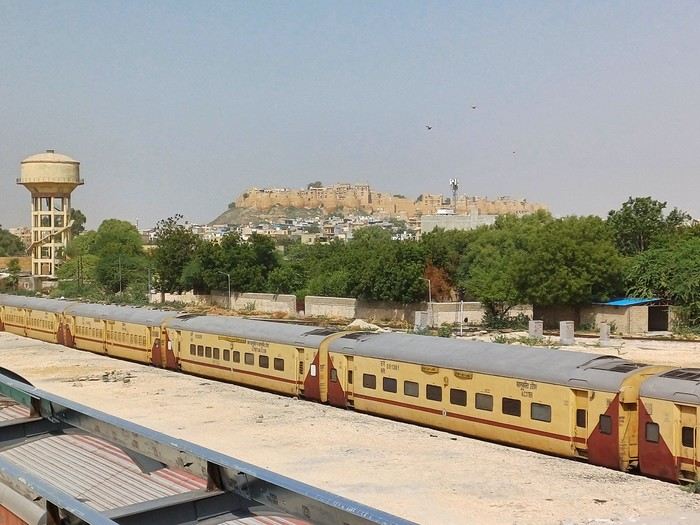
We carry our suitcases up the steps of the footbridge and arrive in front of the station, where a contrast with Ahmedabad strikes us: there are so many tourists! Travelers are almost forming a line in front of the station, while rikshāwālā, taxi drivers, and other touts swarm the crowd, asking for hotel names and quoting outrageously high prices. Some even speak a bit of French here and there. As usual, I don’t give in and manage to halve the price. It’s still more than it should be, but from a station in a tourist spot, the competition is united in not going below a certain floor price (which I think I’ve reached) for Western tourists. We mention the Hotel Tokyo Palace, located on a street near Gadisar Road, the main thoroughfare that forms the southern periphery of the old city. Among the plethora of accommodations available in Jaisalmer—many of which look alike and adopt that slightly tacky but charming style imitating the architecture of the havelī and the fort in a modern version—we booked this one by contacting the owner via WhatsApp. The hotel has a good reputation, known for its quality service (especially among Japanese and Asian clientele—the name doesn’t lie), its excellent food, and its pool, all at a price that seems almost too good to be true... Will there be a catch? The rickshaw pulls into a quiet street where hotels are under construction, unloads our luggage, and we enter the vast lobby of the Tokyo Palace, where we’re warmly welcomed by the owner and his team. We’ve booked a large deluxe room for four at just 1,850 rupees! Curiously, there’s almost no one in the establishment, and the owner offers us one of his suites for 2,500 rupees. But after visiting both, we stick with our first choice because the room already exceeds the comfort we expected: spotlessly clean, full of white sheets, blankets, and cushions with Rajasthani patterns, spacious, and beautifully decorated. A 21st-century Rājpūt room! How do they manage to maintain such a beautiful place with so few guests? It’s true that monsoon season is a low period, but still... On the other hand, this might explain the strong presence of touts in this city—otherwise, how would travelers discover them among so many options? We find a credible explanation for why we have such a nice hotel at such a low price: exotic Jaisalmer, even for Indian visitors, is a victim of its own success, and the competition is so fierce that prices have to drop to fill rooms. Either way, we appreciate the cool air conditioning, and after a night on the train, we each take turns freshening up in the fairly large bathroom. As we go down the wide stairs, we glance at the pool, which looks decent but turns out to have murky water with pigeon feathers and a dead bat floating in it... The owner explains that it’s due to the monsoon and that the water will be changed soon...
We set off on foot to conquer the fortress, climbing the alleys. What strikes us first in Jaisalmer is the sheer number of hotels—not to mention all the ones under construction. Fortunately, they all respect the colors and architectural style of the old city, almost entirely ochre, especially that of the havelī made of Jaisalmer’s yellow sandstone. These beautiful 19th-century homes were once (and often still are) inhabited by notables from princely Rājpūt castes or wealthy and pious merchant castes mārwāṛī. So, the slightly tacky style doesn’t clash with the older buildings. People greet us warmly from their doorsteps, as warmly as the scorching sun, and I exchange a few words in Hindi with them. I had memories of relentless touting during my previous visits in 2007 and 2014, so I’m pleasantly surprised by this disinterested welcome. Is it because we’re traveling as a family? I have a feeling it is—the kids are a hit, especially Théo with his blondish-reddish curls, and Magali with her African braids. We’ve only been walking for a few minutes, but the climb through the alleys is already making us sweat!
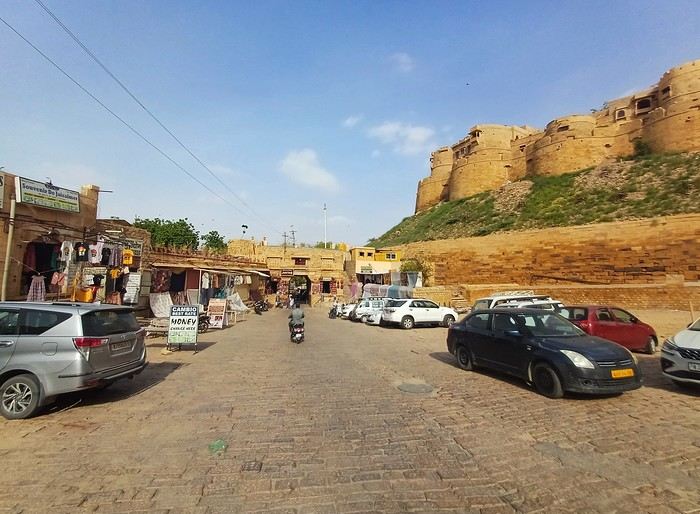
The atmosphere starts to change as we approach the fort, where tourist activity is concentrated, and we’re soon approached by touts. One of them, who heard us speaking, says: "I speak Fraaanch! I lived in Fraance, which city are you from?"... a line I’ve heard countless times from Rajasthani touts, often from gypsy and itinerant artist castes, who learn tourists’ languages to better hook them. Some of them have even actually lived in France for a few years, hosted by their French girlfriends while they’re married back home (true story). His jeans and plaid shirt don’t fool me: with his Rajasthani mustache and caste-specific jewelry, he’s a Bhopā—easy to imagine in a dhotī and turban, with his staff and goats grazing on the paths of the Thar. I try to make Magali understand that we should avoid engaging too much with his apparent friendliness and tempting references to France, because that’s the trap: he’s trying to create a connection so he won’t let us go so easily... And even though I have the experience to make it clear I don’t need his services, I know how time-consuming and draining it can be to shake them off! Sure enough, he sticks to us, offering a thousand services: tours of the fort and other city sites, restaurants, shops, etc... I tell him we haven’t planned any visits right away and don’t have time because we urgently need to exchange money, which is actually true since we’re running low. He fires back that he knows a clothing store at the fort’s entrance that exchanges money at a great rate because they take a very small commission. We don’t risk much by following him, and we’re free to refuse if it doesn’t suit us. Passing through the fort’s main gate, he introduces us to the owner of a small shop on the right. The rate is indeed very good: 1 € for 91 rupees, while the official rate is 92. Deal! We exchange a large sum that will last us almost the entire trip, and we take our time counting the bundles several times under the watchful eye of our desert gypsy, who observes the transaction from a distance. Everyone’s happy: we got a great exchange rate, and our sticky shadow, who won’t completely let us go, relaxes a bit because he earned a commission. He still offers to take us to see the gypsy women every Jaisalmer visitor has met, who sell jewelry and other tribal items further up the fort’s entrance. Again, we follow him because Magali isn’t against taking a look and bringing some back for herself and as gifts. I chat a bit with these Bhopā women, pastoral musicians of the Thar who, in the local caste system, traditionally serve the Rabārī camel herders (also called Rāīkā), for whom they play and sing the epic of the divine hero Pābūjī Rāṭhauḍ during performances that once lasted several days. I mention encounters with other bhopās I met during my previous stays in Rajasthan, whom they know well. Then Magali’s hair becomes the center of their attention: the mood turns friendly. Then we move on to negotiations, always under the sharp gaze of our companion, who tries to understand what we’re saying in French and intervenes somewhat authoritatively in mārwāṛī (the local dialect) to give them instructions. Clearly, they’re from the same family. Our new friends unsurprisingly quote outrageous prices for India, which we haggle over just as outrageously—a game that makes everyone laugh. Either way, we let them know we didn’t plan to buy anything today and that we’ll come back to visit the fort another time because we’re going to eat. Our buddy, of course, quickly suggests a restaurant near the fort, which we refuse because we’ve already spotted another one online that suits us, a bit away from the old city: the Green Park. He doesn’t give up and hails a rickshaw for us, giving the driver orders to take us to the Green Park as if he were the godfather of the fort’s touts, boasting that he negotiated the Indian price for us at 50 rupees—which, this time, isn’t far from the truth. He’s no longer too pushy about forcing other services on us: we’re tougher tourists than usual, and his commission has relaxed him a bit. Also, he doesn’t have time to waste and will move on to more innocent prey. He tells us to see him "next time."
The rickshaw leaves the fort’s vicinity, crosses the neighborhood of our hotel and Gadisar Road to take us a kilometer further to the entrance of a private alley leading to the Green Park restaurant. The area is quiet, slightly outside the city. The establishment faces a military building of the border forces because Jaisalmer is only 80 kilometers from the sworn enemy, Pakistan. The Green Park is once again that type of clean, air-conditioned, authentic, and affordable restaurant aimed at India’s upper-middle class that I particularly love—and which is definitely the category that suits us best, adults and kids alike. On average, it always costs us around 1,500–1,600 rupees for four without skimping on extras for high-quality dishes. We’re almost the only ones in the dining room, and we once again enjoy a wonderful welcome and exquisite cuisine: a Rajasthani thālī bringing together the region’s best specialties, dāl bāṭī chūrmā, another Rajasthani specialty of crispy bread balls dipped in dāl with crumbled sweets, the ever-present Kelyandre noodles, and Théo’s dāl khichṛī. Kelyandre even gets spoiled by the chef with a five-star ice cream scoop! We start walking back to the hotel, which isn’t too far, but the blazing sun, lack of shade, and Théo’s fatigue force us to (literally) disturb a rikshāwālā napping in his vehicle, who really doesn’t want to take us. He finally gives in for 40 rupees—a small price, but expensive for the one-minute ride it represents. An essential nap in the coolness of our cheap palace room, which even has window benches behind the curtains to lounge like Rājpūt princesses.
Around 4:30 PM, we set off again to visit Jaisalmer kā kilā (the fort). At this still scorching hour, activity around the site is almost at a standstill, and there aren’t even any touts bothering us—though we expected to run into the one who had latched onto us. As a Carcassonne native (among other things), I find that, for once, the tourist nickname "Desert Carcassonne" isn’t too far-fetched—you could imagine the famous medieval Cité of Aude under a *One Thousand and One Nights* spell, transplanted into the desert. The fragile 12th-century citadel, dangerously sinking over time due to human activity, has just had its twinning with Carcassonne officially announced barely two weeks ago, on August 30, 2025—a partnership strongly desired by the current Maharaja to strengthen exchanges in medieval city preservation. Like Carcassonne, Jaisalmer Fort is a living city, meaning it’s inhabited. Unfortunately, many of these homes are now hotels, shops, and restaurants that further threaten its slow erosion.
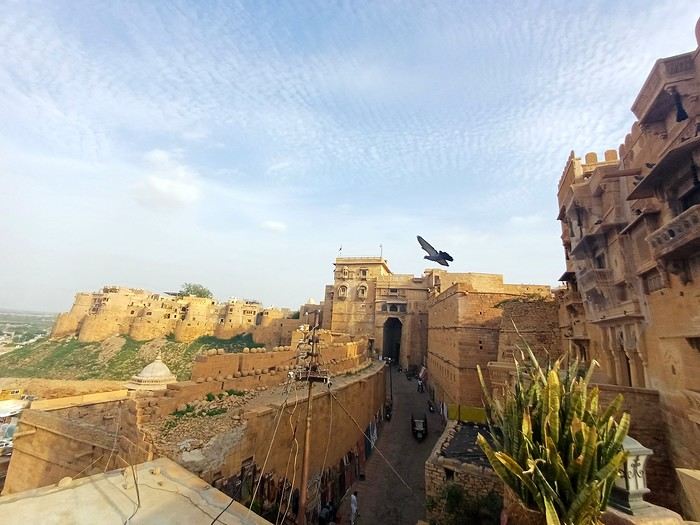
For today, we don’t want to visit the paid section and are content to explore the alleys at our own pace. Unlike its status as a living city, it feels more dead this afternoon: the interior is almost deserted, except for a few rare inhabitants and even rarer tourists we occasionally cross paths with—so much so that we wonder if we’ve stumbled upon a holiday or something. The fort is practically ours! We wander a bit through the alleys of beautiful houses, not all in good condition.
We’re (finally) approached by a woman in a sari who invites us into her shop. Not to pressure us into buying, she promises, but because she wants to talk to us. We’re glad we did because her story is fascinating: she’s a very committed and locally well-known feminist. She fights for women’s rights in India—a task that takes a lot of courage here—and her shop sells only handicrafts made by women from the region’s villages. In excellent English, she tells us how, against the grain of society, she chose her husband and resisted her in-laws’ disdain. I smile inwardly when she suddenly interrupts her life story with feminist slogans, raising her voice and fist, before returning to a normal tone—as if she’s experiencing brief, uncontrollable personality splits! And since she practices what she preaches, we see her husband, quite subdued, enter the shop without a word with their little girl, whom he’s just picked up from school, while she shares her militant thoughts and explains her association’s principles. Totally unusual for India! She shows us some beautiful items in her shop—fabrics, jewelry, bags, and other trinkets—explaining their context without pushing us to buy, which we wouldn’t do anyway because they’re expensive... Later, checking Lonely Planet, I realize it’s the Bellissima boutique, well-known and praised for its initiative. Satisfied with this unique encounter, we say goodbye. In search of coolness, we continue to the nearby Desert Café, which makes a good impression with its décor blending Rājpūt and Art Deco styles favored by the Maharajas of the early 20th century—a bit cozy with a beautiful view of the city from its rampart terrace.
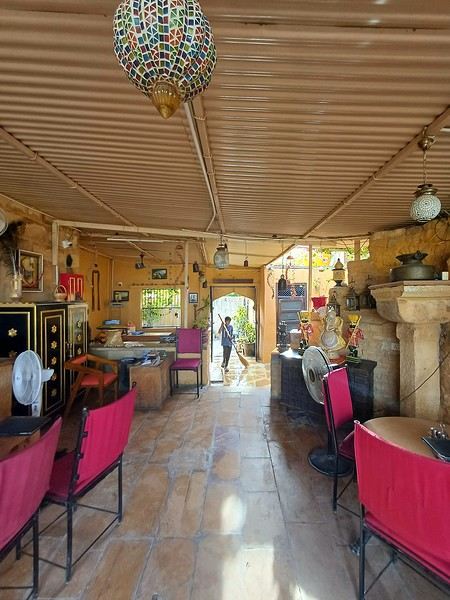
Then we end up at Cannon Point, a stretch of ramparts accessible by a rather dangerous stone staircase, especially for kids. This place gets its name from the cannons, perfect for striking poses and pretending to fire through the battlements for the kids, or admiring the towers, the fort’s rooftops, and another beautiful view of the city’s west side as the sunset begins.
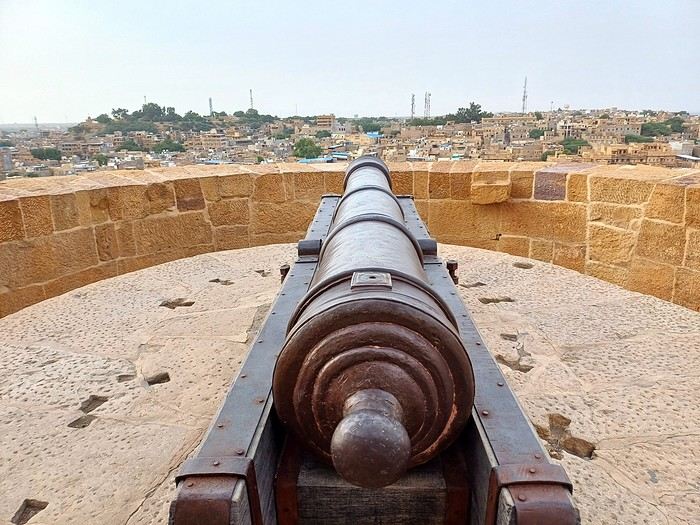
On the way, near the exit, we visit Śrī Lakṣmī, goddess of wealth and First Lady of the great Viṣṇu, master of the cosmos’ construction—which is no small feat when you think about it. A few devotees perform their pūjā (ritual to the deity) at this crucial transition time between day and night, while kids play cricket, by far the nation’s most popular sport, in the adjacent street.
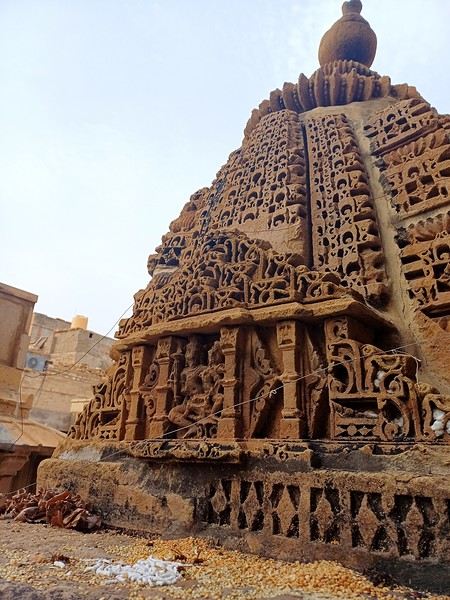
We finally leave the fort to take a stroll through the alleys outside the ramparts. A shop catches Magali’s eye where she’s spotted some beautiful scarves: the very friendly vendors set us up, and there follow many fittings and haggling sessions while Théo has fun diving into the soft cushions. Then, deal made, both parties agree on a very reasonable price. We then find a small shop to stock up on diapers, which are starting to run low—a good thing done, so we’re set for a few days. We push a bit further toward a havelī neighborhood.
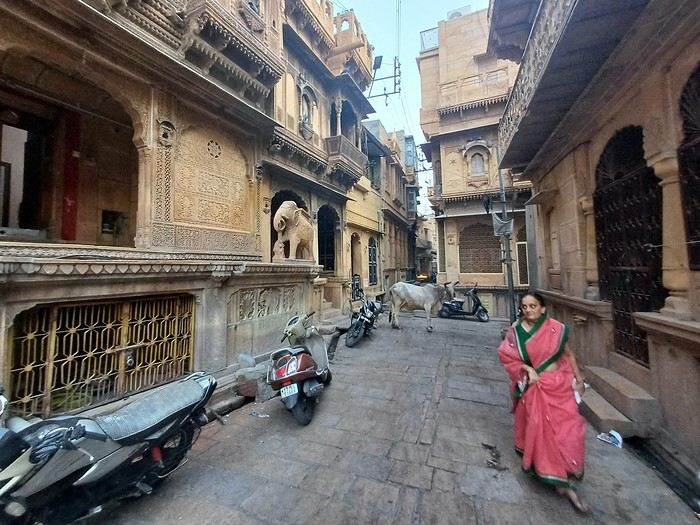
The last glimmers of daylight still illuminate the façade and finely carved windows of the five stories of Paṭwon kī havelī, which belonged to a family of wealthy and pious Jain merchants. Considered the most remarkable in Jaisalmer, it’s possible to visit its sumptuous interior, but not at this slightly late hour.
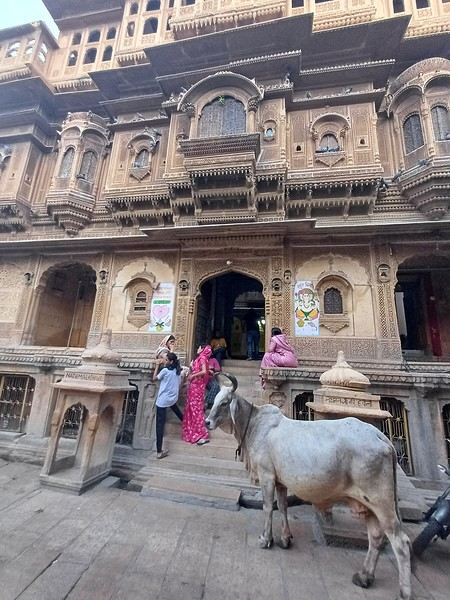
Since we won’t have time to come back, we admire its façade and meet a neighboring owner who comes to greet us: he owns a shop next to the famous mansion, but we explain that we’ve just made our purchases, which he good-naturedly admits were at a great price. That doesn’t stop him from having a very pleasant conversation with us about our respective lives. But night falls, and we hail a rickshaw to return to the Tokyo Palace. A short cool break before the owner tells us that his rooftop restaurant, which we’d read so much about, isn’t open in this low season. He recommends the well-known Desert Boy’s Dhani at the end of the street, where you can either eat on the floor on cushions indoors or by candlelight in the beautiful garden. We first choose the indoor option, but it’s unbearably hot without AC. So we switch to the garden. Despite the mosquitoes forcing us to break out our Odomos cream bought at a pharmacy in Ahmedabad airport (nothing’s more effective than this Indian brand), the meal is delicious. Magali tries kājū masālā (cashew curry, a Rajasthan specialty) again, which she enjoys, though it’s not as good as the one that blew her away at our beloved Ambrosia in Ahmedabad. We quickly head to the nearby bus station, where we ask the only small private agency still open for information on buses to Jodhpur, where we’re heading in two days. But for now, we need to go to Khuri, a desert village where we’ve booked a homestay with a short camel safari in the evening. The owner of the Tokyo Palace, who agreed to keep some of our luggage until we return, calls a rickshaw driver to drop us off at the bus stop. The appointment made, we return to our cozy cardboard havelī to recharge after this intense day. Tomorrow, the desert...
Re: Yet another travel journal in this (all-too-familiar) Rajasthan, but with family and kids
I guess you were 4 in the rickshaw?
Same for us, but 4 adults, so not much room... It was borderline dangerous, so with kids...? [:/]
Mes photos sur Flickr:
https://www.flickr.com/photos/153304262@N05/albums
"Le Temps nous égare. Le Temps nous étreint. Le Temps nous est gare. Le Temps nous est train".
Re: Yet another travel journal in this (all too) familiar Rajasthan, but with family and kids
Yes, we’d squeeze four of us into the rickshaw—either all in the back with the little one on our laps, or me up front with the driver and one leg and one arm hanging out a bit. After all, Indians manage to fit even more in them! 😄
No, it wasn’t dangerous because the smallest was held securely, but it’s true that when there were potholes, the oldest sometimes bumped against the metal bar that forms the rickshaw’s frame—nothing too serious, though. The rickshaw was actually one of the things they enjoyed most in India.
I’ve just made a few minor tweaks: fixed typos, repetitions, and added a bit more info... nothing major.