Results for "Guatemala+hébergement"
About 4,968 results.
More options
Many results are in French, the community’s main language. English translations are added over time.
Search results
Pérou, Costa Rica, Nicaragua ou Équateur?
Pérou, Costa Rica, Nicaragua ou Équateur?
Où me conseiller vous d'aller entre ces trois pays selon ces critères: J'adore la rando en montagne, et j'adore voir des paysages totalement différents se cotoyant J'adore les palmiers Je ne parle pratiquement pas espanol (mais je compte apprendre quelques mots clés avant de partir) J'aimerais partir 3 semaines, les 3 dernières de mai (et je ne veut pas que mes journées soient ruinées par la pluie) Je part seule (chose que je n'ai jamais fait apparavant) J'aimerais ne pas avoir à me louer voiture ou de 4x4 pour me déplacer J'aimerais ne pas avoir à prendre des moyens de transports seule très longtemps (l'avion ca va, mais pas faire 12 hres de bus)Merci énormément pour vos conseils et suggestions!!!
Où me conseiller vous d'aller entre ces trois pays selon ces critères: J'adore la rando en montagne, et j'adore voir des paysages totalement différents se cotoyant J'adore les palmiers Je ne parle pratiquement pas espanol (mais je compte apprendre quelques mots clés avant de partir) J'aimerais partir 3 semaines, les 3 dernières de mai (et je ne veut pas que mes journées soient ruinées par la pluie) Je part seule (chose que je n'ai jamais fait apparavant) J'aimerais ne pas avoir à me louer voiture ou de 4x4 pour me déplacer J'aimerais ne pas avoir à prendre des moyens de transports seule très longtemps (l'avion ca va, mais pas faire 12 hres de bus)Merci énormément pour vos conseils et suggestions!!!
Le Mexique à sac à dos: déplacements, sécurité et visites
Bonjour,
Moi et mon copain voulons faire un voyage à sac à dos au mexique. Nos points d'intérets sont les sites historique particulièrement.
J'aimerais savoir si quelqu'un l'a déja fait, et si oui, quel place sont importante de ne pas manquer et quel place je dois éviter pour cause de sécurité.
Je connais beaucoup les site touristique comme acapulco et puerto vallarta, mais j'aimerais etre plus "dépayser".
Aussi, j'aimerais savoir s'il existe des moyen de transport pas cher dans le pays qui nous permette d'aller un peu partout. Sa ne me derange meme pas de prendre l'avion, train, autobus ou meme location de voitures. Nous fesons actuellement des évaluations des couts que nous devrons débourser, mais nous avons encore le temps de rammasser notre argent alors toute les possibilités sont envisagés.
Finalement, (enfin!!) Je voulais savoir les regle de sécurité importante a respecter dans le pays (si vous connaisser un site internet pertinent ne vous gener pas!!) pour etre sur de ne pas avoir d'ennui et aussi quoi amener dans se genre de voyage et quoi ne pas amener.
Merci beaucoup de votre aide meme si sa fait beaucoup d'informations! J'en suis encore au stade préliminaire.
Moi et mon copain voulons faire un voyage à sac à dos au mexique. Nos points d'intérets sont les sites historique particulièrement.
J'aimerais savoir si quelqu'un l'a déja fait, et si oui, quel place sont importante de ne pas manquer et quel place je dois éviter pour cause de sécurité.
Je connais beaucoup les site touristique comme acapulco et puerto vallarta, mais j'aimerais etre plus "dépayser".
Aussi, j'aimerais savoir s'il existe des moyen de transport pas cher dans le pays qui nous permette d'aller un peu partout. Sa ne me derange meme pas de prendre l'avion, train, autobus ou meme location de voitures. Nous fesons actuellement des évaluations des couts que nous devrons débourser, mais nous avons encore le temps de rammasser notre argent alors toute les possibilités sont envisagés.
Finalement, (enfin!!) Je voulais savoir les regle de sécurité importante a respecter dans le pays (si vous connaisser un site internet pertinent ne vous gener pas!!) pour etre sur de ne pas avoir d'ennui et aussi quoi amener dans se genre de voyage et quoi ne pas amener.
Merci beaucoup de votre aide meme si sa fait beaucoup d'informations! J'en suis encore au stade préliminaire.
Le bêtisier des voyageurs
Je n'ai pas l'impression que cette discussion ait déjà eu lieu ici. On se moque facilement des autres, voyageurs ou non, mais on oublie souvent de raconter les petites mésaventures, cocasses ou ridicules, dont on est à la fois l'auteur et la victime. Voyons voir sir les vfistes sont capables d'auto-dérision, et oseront raconter leurs erreurs ou bévues.
Je commence avec deux petites histoires toutes récentes. Je suis particulièrement fier de la deuxième. 🙂
Hier matin, dans mon hôtel à Dubai, après une longue journée de travail et un vol de nuit Shanghai-Dubai, je savoure enfin une douche bien méritée, et entreprends de me raser. Damned! Je fouille ma valise de fond en comble mais il faut me rendre à l'évidence: j'ai oublié mon rasoir à la maison, et suis bon pour m'en acheter un autre en catastrophe. Il n'est que 6 heures du matin, et il faudra patienter avant l'ouverture des magasins. Je finis donc par m'acheter un petit rasoir électrique, pas cher, pour me dépanner pendant deux semaines.
Et voilà qu'arrivé à Nice, je cherche un truc au fond de ma valise, et... tombe sur le rasoir que j'étais persuadé d'avoir oublié.
Ce matin donc, je devais attrapper un vol Dubai-Nice à 7h30 du matin, et avais mis mon réveil à sonner à 4h45, en demandant à la réception de l'hôtel de m'appeler à la même heure. Il fallait en prendre des précautions, car avec toute la fatigue accumulée, il était évident que mon sommeil serait de plomb. Je me suis pourtant réveillé au milieu de la nuit et ai tranquillement regardé l'heure sur mon téléphone portable: 6h23. Nom di diou!!! Ce n'était pas le milieu de la nuit! 67 minutes pour m'habiller, boucler ma valise, prendre un taxi, aller à l'aérport et faire toutes les formalités? Impossible n'étant pas français, j'ai voulu tenter le coup sans trop y croire. En trois minutes j'ai eu le temps de boucler les deux premières étapes, tout en me passant en tête les pires scenarios catastrophes sur mes vacances déjà amputées car j'aurais forcément loupé mon avion. Quel con mais quel con! Comment ai-je pu me piéger de manière aussi stupide? Et ces imbéciles de la réception? Pourquoi ne m'ont-ils pas téléphoné? J'étais plein d'idées noires en ouvrant la porte de ma chambre, valise à la main. Je regarde ma montre avec inquiétude: 2h26 du matin. Hein, quoi? Mais oui bien sûr! Mon téléphone portable était encore à l'heure shanghaienne et je n'étais donc pas du tout à la bourre. Je me suis vraiment trouvé particulièrement ridicule sur ce coup, mais j'ai quand même évité le pire, car si j'avais fait un scandale à la réception, pour sûr que je n'aurais jamais osé remettre les pieds à Dubai de ma vie. 😎
Je commence avec deux petites histoires toutes récentes. Je suis particulièrement fier de la deuxième. 🙂
Hier matin, dans mon hôtel à Dubai, après une longue journée de travail et un vol de nuit Shanghai-Dubai, je savoure enfin une douche bien méritée, et entreprends de me raser. Damned! Je fouille ma valise de fond en comble mais il faut me rendre à l'évidence: j'ai oublié mon rasoir à la maison, et suis bon pour m'en acheter un autre en catastrophe. Il n'est que 6 heures du matin, et il faudra patienter avant l'ouverture des magasins. Je finis donc par m'acheter un petit rasoir électrique, pas cher, pour me dépanner pendant deux semaines.
Et voilà qu'arrivé à Nice, je cherche un truc au fond de ma valise, et... tombe sur le rasoir que j'étais persuadé d'avoir oublié.
Ce matin donc, je devais attrapper un vol Dubai-Nice à 7h30 du matin, et avais mis mon réveil à sonner à 4h45, en demandant à la réception de l'hôtel de m'appeler à la même heure. Il fallait en prendre des précautions, car avec toute la fatigue accumulée, il était évident que mon sommeil serait de plomb. Je me suis pourtant réveillé au milieu de la nuit et ai tranquillement regardé l'heure sur mon téléphone portable: 6h23. Nom di diou!!! Ce n'était pas le milieu de la nuit! 67 minutes pour m'habiller, boucler ma valise, prendre un taxi, aller à l'aérport et faire toutes les formalités? Impossible n'étant pas français, j'ai voulu tenter le coup sans trop y croire. En trois minutes j'ai eu le temps de boucler les deux premières étapes, tout en me passant en tête les pires scenarios catastrophes sur mes vacances déjà amputées car j'aurais forcément loupé mon avion. Quel con mais quel con! Comment ai-je pu me piéger de manière aussi stupide? Et ces imbéciles de la réception? Pourquoi ne m'ont-ils pas téléphoné? J'étais plein d'idées noires en ouvrant la porte de ma chambre, valise à la main. Je regarde ma montre avec inquiétude: 2h26 du matin. Hein, quoi? Mais oui bien sûr! Mon téléphone portable était encore à l'heure shanghaienne et je n'étais donc pas du tout à la bourre. Je me suis vraiment trouvé particulièrement ridicule sur ce coup, mais j'ai quand même évité le pire, car si j'avais fait un scandale à la réception, pour sûr que je n'aurais jamais osé remettre les pieds à Dubai de ma vie. 😎
Rencontre à Paris le dimanche 22 janvier 2006
Bonjour à tous,
Le gang de Paris revient après une longue pause cet automne pour une nouvelle rencontre ouverte à tous les voyageurs d’ici et d’ailleurs.
Date : Dimanche 22 Janvier 2006 à midi pour pouvoir profiter de la journée
Lieu : je laisse le soin aux pros des restos atypiques de vous l’annoncer plus tard dans le post ( lieu à déterminer en fonction du nombre de participants )
Thème : chaque participant emmène un objet ( en rapport avec le voyage ) lui appartenant et qui lui tient particulièrement à cœur ( ça peut être un objet acheté ici ou là qui a une valeur inestimable, matérielle ou sentimentale, ça peut être un objet qu’on vous a offert lors d’un voyage et qui ne vous quitte plus, une trouvaille, du sable magique, etc… ) Cet objet a certainement une histoire puisqu’il vous tient tellement à cœur et ce serait sympa de la raconter….et de partager ensemble nos coups de cœur.
Si l’idée vous tente, rendez-vous le 22 Janvier…..
Sur ce, je m’éclipse pour quelque temps et laisse le soin aux participants de faire vivre ce post en mon absence… Je passerai de temps en temps dire bonjour…😉
A bientôt de vous voir ou de vous revoir, avec le sourire…..🙂
Ailleurs
Le gang de Paris revient après une longue pause cet automne pour une nouvelle rencontre ouverte à tous les voyageurs d’ici et d’ailleurs.
Date : Dimanche 22 Janvier 2006 à midi pour pouvoir profiter de la journée
Lieu : je laisse le soin aux pros des restos atypiques de vous l’annoncer plus tard dans le post ( lieu à déterminer en fonction du nombre de participants )
Thème : chaque participant emmène un objet ( en rapport avec le voyage ) lui appartenant et qui lui tient particulièrement à cœur ( ça peut être un objet acheté ici ou là qui a une valeur inestimable, matérielle ou sentimentale, ça peut être un objet qu’on vous a offert lors d’un voyage et qui ne vous quitte plus, une trouvaille, du sable magique, etc… ) Cet objet a certainement une histoire puisqu’il vous tient tellement à cœur et ce serait sympa de la raconter….et de partager ensemble nos coups de cœur.
Si l’idée vous tente, rendez-vous le 22 Janvier…..
Sur ce, je m’éclipse pour quelque temps et laisse le soin aux participants de faire vivre ce post en mon absence… Je passerai de temps en temps dire bonjour…😉
A bientôt de vous voir ou de vous revoir, avec le sourire…..🙂
Ailleurs
Sites incontournables et acitivés au Nicaragua
bonjour je men vais au nicaragua dans un mois pour une duree denviron 3 semaines et je voudrais savoir quelles sont les endroits a voir absolument et quelles activitées sont a ne pas manquer. merci davance !
Tour du monde à pied
Vous allez me trouver surement assez rêveur ou utopiste, mais j'aimerais bien faire un tour du monde à pied, en stop et en train. J'ai déjà tracé une ligne d'est en ouest sur un planisphère et j'envisage de le réaliser en trois ans, tout au plus.
J'aimerais vos conseils. A savoir si c'est réalisable. A quoi je dois faire attention. Quelles formalités je dois m'astreindre pour passer les frontières, etc ...
Merci d'avance.
J'aimerais vos conseils. A savoir si c'est réalisable. A quoi je dois faire attention. Quelles formalités je dois m'astreindre pour passer les frontières, etc ...
Merci d'avance.
Nice Acte VII - Samedi 3 décembre 2005
A la demande de VILCANOTA .... 😉, et vu que mon humeur s'est retrouvé beaucoup plus joyeuse aprés la rencontre de Marseille, trop bien ......, j'officialise une nouvelle rencontre sur Nice le Samedi 3 décembre ......
Pour à nouveau échanger dans le calme, et également s'amuser un peu, je vais faire " classique " comme en décembre 2004, prévoir une rencontre en début d'aprés midi avec un RDV à l'hôtel le Petit Palais où on se trouve bien pour pouvoir discuter de notre passion en toute décontraction, libre à certains membres de se retrouver en petits comités pour déjeuner auparavant ..... on prévoiera un petit goûter quand même, et puis une sortie au restau le soir, certainement de nouveau à la cigale orientale qui avait ravi bon nombre d'entre nous ......
Et le Dimanche, nous tenterons de mettre quelquechose sur pied afin de pouvoir continuer la rencontre sur tout le week end .....
Avis à ceux qui ont des idées, à ceux qui peuvent héberger des membres, le Petit Palais mettra des chambres à disposition suivant un tarif avantageux pour les membres, mais plus sympa d'être hébergé chez les membres locaux...... Yann, je t'attend avec ta famille à la maison comme promis et si ta petite femme peut se libérer .....
Ce serait sympa que des belges, des canadiens, des parisiens, des lyonnais, et surtout des marseillais, etc ..... soient présents ........
A bientôt de vous rencontrer .....
Pour à nouveau échanger dans le calme, et également s'amuser un peu, je vais faire " classique " comme en décembre 2004, prévoir une rencontre en début d'aprés midi avec un RDV à l'hôtel le Petit Palais où on se trouve bien pour pouvoir discuter de notre passion en toute décontraction, libre à certains membres de se retrouver en petits comités pour déjeuner auparavant ..... on prévoiera un petit goûter quand même, et puis une sortie au restau le soir, certainement de nouveau à la cigale orientale qui avait ravi bon nombre d'entre nous ......
Et le Dimanche, nous tenterons de mettre quelquechose sur pied afin de pouvoir continuer la rencontre sur tout le week end .....
Avis à ceux qui ont des idées, à ceux qui peuvent héberger des membres, le Petit Palais mettra des chambres à disposition suivant un tarif avantageux pour les membres, mais plus sympa d'être hébergé chez les membres locaux...... Yann, je t'attend avec ta famille à la maison comme promis et si ta petite femme peut se libérer .....
Ce serait sympa que des belges, des canadiens, des parisiens, des lyonnais, et surtout des marseillais, etc ..... soient présents ........
A bientôt de vous rencontrer .....
Combien sommes-nous à préparer un tour du monde?
Bonjour à Tous,
Comme nombreux d’entre vous ici, je prépare un Tour du Monde, en lisant les différents forums, je constate que nous sommes vraiment beaucoup à partir dans les 12 prochains mois, alors ce serait sympa de recenser tous les projets de tour du monde en préparation, en donnant quelques infos,
Je me lance :
Dates de départ...................................env 15 janvier 2006 Nombres de mois, années....................env 2 ans En solo, duo, voir plus ........................solo Continent par ordre de passage ..........Asie, Océanie, Amérique du Sud et Centrale, Afrique Premier pays ......................................Inde Dernier pays ......................................Israel Nombre de vols prévus ......................entre 12 et 20 Site Web de votre tour .......................oui en construction
Et le LIEU incontournable de votre tour : ( si vous arrivez à répondre )
Voila pour moi, j’attend vos merveilleux projets ....
Mpolo57
« Il arriva à la croisée de 2 chemins, et là il décida d’aller là où il n’allait pas «
Comme nombreux d’entre vous ici, je prépare un Tour du Monde, en lisant les différents forums, je constate que nous sommes vraiment beaucoup à partir dans les 12 prochains mois, alors ce serait sympa de recenser tous les projets de tour du monde en préparation, en donnant quelques infos,
Je me lance :
Dates de départ...................................env 15 janvier 2006 Nombres de mois, années....................env 2 ans En solo, duo, voir plus ........................solo Continent par ordre de passage ..........Asie, Océanie, Amérique du Sud et Centrale, Afrique Premier pays ......................................Inde Dernier pays ......................................Israel Nombre de vols prévus ......................entre 12 et 20 Site Web de votre tour .......................oui en construction
Et le LIEU incontournable de votre tour : ( si vous arrivez à répondre )
Voila pour moi, j’attend vos merveilleux projets ....
Mpolo57
« Il arriva à la croisée de 2 chemins, et là il décida d’aller là où il n’allait pas «
Y a t-il de belles plages au Costa Rica?
Je ne me suis pas encore plongée dans la préparation de mon voyage. J'aimerais savoir si au costa rica il y a de belles plages 😉
Cuba: nouveau délire d'un dictateur sénile...
Dernier délire en date de la dictature cubaine et de son dirigeant sénile : l'obligation faite aux cubains, y compris et surtout ceux travaillant dans le tourisme, de limiter au maximum les contacts avec les étrangers et l'interdiction d'accepter des cadeaux et autres pourboires de leur part sous peine de devoir les restituer ensuite aux autorités cubaines ! Lorsqu'on sait qu'un cubain travaillant dans un hôtel à touristes gagne en moyenne l'équivalent d'une quinzaine de dollars US/mois, on imagine facilement les conséquences.
Quant au but officiel de la manoeuvre, il s'agit de "défendre la pureté de la révolution castriste et des valeurs socialistes", dixit le Ministre cubain du tourisme. Lamentable...
Prix dément du traitement anti-paludéen
Bonjour
Connaîtriez-vous des pharmacies ou autres endroits qui vendraient le MALARONE moins cher que ....44, 95 Euros la boite de 12 comprimés !?
Comment font les couples et familles qui voyagent plusieurs semaines/quelques mois en Birmanie, Thaïlande et alentour !?
Merci d'avance
Connaîtriez-vous des pharmacies ou autres endroits qui vendraient le MALARONE moins cher que ....44, 95 Euros la boite de 12 comprimés !?
Comment font les couples et familles qui voyagent plusieurs semaines/quelques mois en Birmanie, Thaïlande et alentour !?
Merci d'avance
Recherche hôtel à Buenos Aires
Salut !!!🙂
Je vais etre 3 jours sur Buenos aires, fin janvier, et je voudrais avoir une adresse d'un hotel crrect mais pas trop cher et dans un quartier qui ne craint pas pour une fille toute seule.
Si possible dans le centre.
Et aussi comment se rendre du centre ville a l'aeroport ?
Merci pour votre aide
Berenice
Je vais etre 3 jours sur Buenos aires, fin janvier, et je voudrais avoir une adresse d'un hotel crrect mais pas trop cher et dans un quartier qui ne craint pas pour une fille toute seule.
Si possible dans le centre.
Et aussi comment se rendre du centre ville a l'aeroport ?
Merci pour votre aide
Berenice
Machu Picchu au Pérou: visites, budget pour un mois
Bonjour,
j'ai comme projet de partir en janvier visiter le Pérou (essentiellement le macchu picchu)! si qq un a des conseils a me donner pr les lieux a visiter, l'argent nécessaire pr une période d'un mois environ... et éventuellement si ca vaut le coup de faire l'equateur ?
Merci pour votre aide, ca m aidera à planifier ce voyage !
Nathalie
j'ai comme projet de partir en janvier visiter le Pérou (essentiellement le macchu picchu)! si qq un a des conseils a me donner pr les lieux a visiter, l'argent nécessaire pr une période d'un mois environ... et éventuellement si ca vaut le coup de faire l'equateur ?
Merci pour votre aide, ca m aidera à planifier ce voyage !
Nathalie
Le Touriste Français
Comme c'est un site francais sur les voyages que je découvre par hasard j'aimerais si possible m'y exprimer sur l'attitude des touristes francais à l'étranger qui me laisse quelque peu perplexe, honteux parfois et en colère souvent.
Comment est-il possible pour un peuple qui exprime une vision universalite de liberté et de fraternité de présenter une façade imbue d'un tel ultra-nationalisme et de sentiments de supériorité absolue (que ferait le monde sans la France?) aux autres peuples du monde? Plus nationalistes que les Americains: les Français. Chapeau, messieurs.
Je suis moi-même parfois coupable de tels abus, je l'avoue, mais je crois que chaque jour je m'améliore et réussis un peu plus à me soustraire du poids et carcan de mon éducation hexagonale et de ma supériorité intellectuelle qui me donne bien sûr ascendance sur toute autre créature humaine rencontrée en pays non-français.
Au Vénez, où je suis, j'ai eu à plusieurs reprises la malchance d'écouter quelques touristes francais s'exprimer en espagnol en affectant à outrance leur accent (qui peut être non seulemet ridicule mais même fort laid), pour bien démontrer leur supériorité d'être Français et donc de leur appartenance à quelque race "supérieure" ou plus "évoluée".
Ici se situe le paradoxe: Comment peut-on à se point vouloir conserver et affecter son accent (français), parfois après des dizaines d'années de vie dans un pays étranger, alors qu'il existe une intolérance quasi-totale en France pour une personne qui ne se donnerait pas âme et corps pour s'adopter une prononciation d'autochtone Français de quatrième génération?
GB
Comment est-il possible pour un peuple qui exprime une vision universalite de liberté et de fraternité de présenter une façade imbue d'un tel ultra-nationalisme et de sentiments de supériorité absolue (que ferait le monde sans la France?) aux autres peuples du monde? Plus nationalistes que les Americains: les Français. Chapeau, messieurs.
Je suis moi-même parfois coupable de tels abus, je l'avoue, mais je crois que chaque jour je m'améliore et réussis un peu plus à me soustraire du poids et carcan de mon éducation hexagonale et de ma supériorité intellectuelle qui me donne bien sûr ascendance sur toute autre créature humaine rencontrée en pays non-français.
Au Vénez, où je suis, j'ai eu à plusieurs reprises la malchance d'écouter quelques touristes francais s'exprimer en espagnol en affectant à outrance leur accent (qui peut être non seulemet ridicule mais même fort laid), pour bien démontrer leur supériorité d'être Français et donc de leur appartenance à quelque race "supérieure" ou plus "évoluée".
Ici se situe le paradoxe: Comment peut-on à se point vouloir conserver et affecter son accent (français), parfois après des dizaines d'années de vie dans un pays étranger, alors qu'il existe une intolérance quasi-totale en France pour une personne qui ne se donnerait pas âme et corps pour s'adopter une prononciation d'autochtone Français de quatrième génération?
GB
Pourquoi l'humanitaire à l'étranger?
Ce forum, et d'autres, est envahi par des messages de personnes souhaitant aller faire de l'humanitaire dans un pays étranger, bien souvent sans avoir aucune compétence pour cela. Dans le même temps les associations travaillant en France ne trouvent plus de bénévoles; que ce soit les pompiers, la croix rouge, ceux qui s'occupent des plus démunis...
Personnellement je m'occupe d'une association d'aide au développement, et comme toutes ces associations nous sommes submergés de demandes de la part de candidats au départ au Pérou ou en Afrique, alors qu'on ne peut pas trouver quelqu'un pour nous donner un coup de main pour tenir un stand ou s'occuper d'une animation qui nous permet de collecter des fonds pour financer nos actions.
Alors quelle est votre véritable motivation pour partir aider sous les tropiques plutôt qu'à côté de chez vous ?
Personnellement je m'occupe d'une association d'aide au développement, et comme toutes ces associations nous sommes submergés de demandes de la part de candidats au départ au Pérou ou en Afrique, alors qu'on ne peut pas trouver quelqu'un pour nous donner un coup de main pour tenir un stand ou s'occuper d'une animation qui nous permet de collecter des fonds pour financer nos actions.
Alors quelle est votre véritable motivation pour partir aider sous les tropiques plutôt qu'à côté de chez vous ?
Racket culturel en Inde
juste un mot sur la politique de l'Inde concernant le droit d'entree dans les musees ;
depuis environ 4 ans, il faut savoir que les "etrangers" sont tenus de payer parfois jusqu'a 50 fois plus cher que les locaux pour le billet d'entree dans certains musees (la grande majorite)...
quand un indien obtiendra un billet pour 2 ou 5 roupies, on vous demandera selon les sites de 50 a 300 roupies(comme au musee du Prince de Galles a Mumbay) voire plus de 900 roupies pour penetrer le Taj-Mahal...
vous devrez de plus essuyer l'attitude goguenarde de certains guichetiers tres conscients de l'enormitee des sommes qui nous sont demandees, voire la rudesse des gardiens qui n'hesitent pas a vous arreter pour vous controller....
savoir aussi que les appareils photos et cameras, cette fois ci la loi est la meme pour tous, sont habituellement taxes, voire interdit d'entree dans certains cas(mais vous ne pouvez pas les garder sur vous, des vestiaires payants(...) vous attendent).
C'EST UN VERITABLE RACKET D'ETAT qui s'appuit sur une logique xenophobe; quand a l'argent ainsi recolte, son devenir reste completement flou...il est notoire qu'une partie importante de la recette du Taj-Mahal disparait dans la nebuleuse du systeme du back-shish et de la corruption sans que cela profite a l'entretien du batiment, dans un etat de degradation certain encore accentue par les restauration malhabiles et bon-marche. Des monuments et oeuvres d'arts, souvent dans des conditions pitoyables qui serrent le coeur...
un etudiant en histoire de l'art ou toute personne qui s'interesse a l'art et la museographie doit donc s'attendre a debourser entre 20 et 100(rare) francs plusieurs fois par jours (monuments et musees...) de plus, nombres de musees appliquent cette loi trop heureux de l'opportunite d'un back-shish juteux, sans pour autant offrir aux visiteurs un avoir culturel a la hauteur du prix demande.
le prix d'une entree au musee du Louvre et au Musee "prince de galles" de Mumbay est a peu pres la meme....pourtant a l'interieur, la difference est grande ! le musee de Mumbay possede dans les quelques salles obscures qui le constituent, des collections de qualite tres inegale...
nous sommes victime d'une loi raciste, profondement arbitraire et injuste :
C'EST INACEPTABLE ...REFUSEZ D'ENTRER DANS LES MUSEES ET SITES HISTORIQUES INDIENS QUI PARTICIPENT A CE RACKET !( et avant, faites savoir au guichet la raison de votre refus) salut voyageurs,
C'EST UN VERITABLE RACKET D'ETAT qui s'appuit sur une logique xenophobe; quand a l'argent ainsi recolte, son devenir reste completement flou...il est notoire qu'une partie importante de la recette du Taj-Mahal disparait dans la nebuleuse du systeme du back-shish et de la corruption sans que cela profite a l'entretien du batiment, dans un etat de degradation certain encore accentue par les restauration malhabiles et bon-marche. Des monuments et oeuvres d'arts, souvent dans des conditions pitoyables qui serrent le coeur...
un etudiant en histoire de l'art ou toute personne qui s'interesse a l'art et la museographie doit donc s'attendre a debourser entre 20 et 100(rare) francs plusieurs fois par jours (monuments et musees...) de plus, nombres de musees appliquent cette loi trop heureux de l'opportunite d'un back-shish juteux, sans pour autant offrir aux visiteurs un avoir culturel a la hauteur du prix demande.
le prix d'une entree au musee du Louvre et au Musee "prince de galles" de Mumbay est a peu pres la meme....pourtant a l'interieur, la difference est grande ! le musee de Mumbay possede dans les quelques salles obscures qui le constituent, des collections de qualite tres inegale...
nous sommes victime d'une loi raciste, profondement arbitraire et injuste :
C'EST INACEPTABLE ...REFUSEZ D'ENTRER DANS LES MUSEES ET SITES HISTORIQUES INDIENS QUI PARTICIPENT A CE RACKET !( et avant, faites savoir au guichet la raison de votre refus) salut voyageurs,
3 weeks in Laos, stress-free
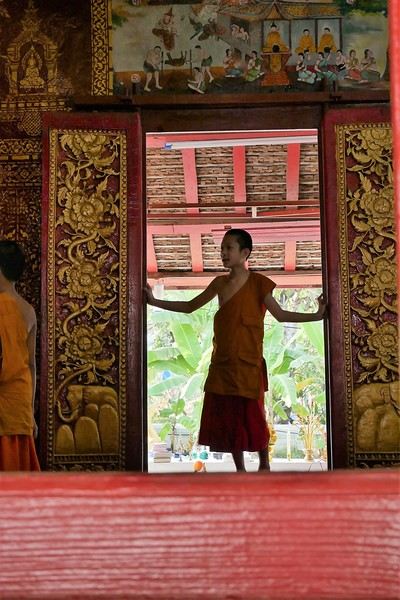 Come along, I'm taking you to this country where it's so nice to wander and slow down...
This trip was in 2023, but when I wanted to write my travel journal, VF was still closed to contributions... So, now that I've just finished my Japan travel journal here, I figured it was high time to honor this destination we came back from so enchanted. Disclaimer 1: This is a written travel journal. There’ll be text! Too much, for some! Disclaimer 2: This is an illustrated travel journal. There’ll be photos! Too many, for some!
I have to say, every time I try to discipline myself, to keep it shorter, to include fewer photos... I end up adding more. It feels like my dear Aunt Nicole, who exhausted us with her slide-show evenings in the 70s/80s, decided to take her revenge. The upside for you, readers, is that you can slip away anytime without offending Aunt Nicole. I won’t even notice!
Anyway, since I love maps, here’s one to give you an idea of where I’m taking you. As you can see, we only saw a tiny part of Laos (the areas circled in red); we only had 3 weeks for ourselves (my husband’s newly retired, I still work), and we prefer taking our time over rushing around like crazy.
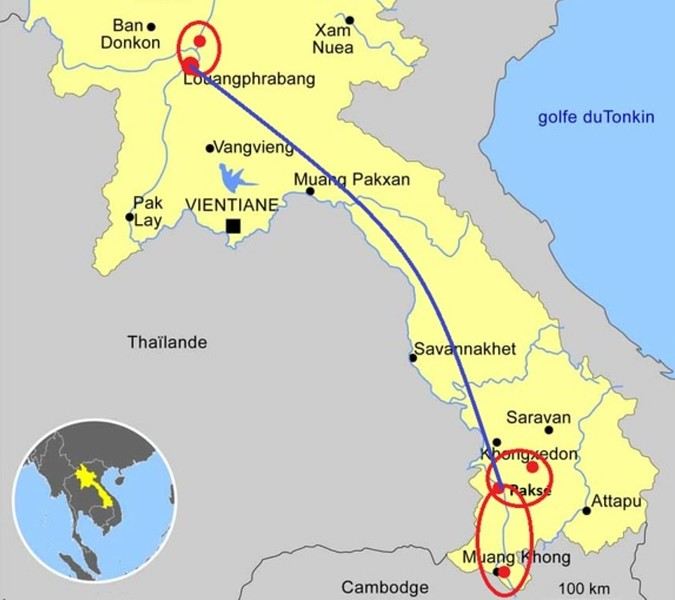
In broad strokes, it was very classic:
First, we “settled in” at Luang Prabang (8 days), because we wanted and needed to. From there, we took three days to venture a little further north—not far in kilometers, but as we know, distances aren’t just about km! Then we flew south to Paksé, letting ourselves drift down to the 4,000 Islands while stopping by the pre-Angkorian archaeological sites. We wrapped up with the Bolaven Plateau.
A few practical notes: We arrived via Bangkok, then took a Bangkok-Luang Prabang flight, having picked up our luggage in Bangkok to check it in for Luang Prabang. No issues—the Bangkok airport, which many of you know, is very well organized. We got our visas on arrival in Luang Prabang. Quick, but to be fair, we were on a “small” plane, and the big flights had arrived earlier, so we weren’t too crowded in line! At the end of our trip, we didn’t fly out of Paksé but from the nearby airport in Thailand, Ubon Ratchathani (a 2.5-hour drive from Paksé), then Bangkok and Paris. You’ll notice we skipped Vientiane to stay longer in Luang Prabang. That said, there’s now a high-speed train between Vientiane and Luang Prabang—good to know—and soon the (Chinese) train will go all the way to Bangkok and even Kuala Lumpur!
With that intro out of the way, let’s dive into the heart of the matter. To be continued: Slowing down the pace... in Luang Prabang
Some trips are born twice - Peru April - May 2025
Some trips are born twice.
Ours was supposed to happen in 2020. Everything was ready: the itinerary, the flight tickets, hotel reservations and Machu Picchu, the rental car, dreams of high altitudes and wide-open spaces. And then the world stopped.
Like so many other plans, our trip to Peru was put on hold. Disappointment was followed by a more concrete reality: paperwork, endless back-and-forth, and battles to recover some of the costs we’d already paid.
The years went by. Life moved on, with its shifting priorities and unexpected twists. Rescheduling this trip wasn’t possible until 2025.
The itinerary stayed mostly true to what we’d imagined five years earlier. One major difference, though—in 2020, we’d planned to rent a car and explore the roads completely independently. Most importantly, we hadn’t included the three-day Ausangate trek, due to lack of time.
For 2025, our plans evolved. 4x4 rental prices had skyrocketed, and when we looked at our schedule more closely, we realized quite a few days didn’t actually need a vehicle. So we made a different choice and opted for private drivers instead. A decision we never regretted. Always punctual, thoughtful, and available... they were so much more than just drivers.
All our reservations were made in January, except for the trek, which we booked in February.
Finding reliable drivers on our own was tough, so we asked Laurent from Tout Pérou to handle it for us. Going through Tout Pérou also gave us a discount on the train ride to Aguas Calientes, so Laurent booked those tickets too. He also bought our Machu Picchu entrance tickets at the same price we would’ve paid on the official website. When comparing domestic flight prices, we found it was cheaper to book from Peru, so Laurent took care of those as well.
This time, nothing was going to stop us. Peru was waiting. And we were ready. 🙂
Ours was supposed to happen in 2020. Everything was ready: the itinerary, the flight tickets, hotel reservations and Machu Picchu, the rental car, dreams of high altitudes and wide-open spaces. And then the world stopped.
Like so many other plans, our trip to Peru was put on hold. Disappointment was followed by a more concrete reality: paperwork, endless back-and-forth, and battles to recover some of the costs we’d already paid.
The years went by. Life moved on, with its shifting priorities and unexpected twists. Rescheduling this trip wasn’t possible until 2025.
The itinerary stayed mostly true to what we’d imagined five years earlier. One major difference, though—in 2020, we’d planned to rent a car and explore the roads completely independently. Most importantly, we hadn’t included the three-day Ausangate trek, due to lack of time.
For 2025, our plans evolved. 4x4 rental prices had skyrocketed, and when we looked at our schedule more closely, we realized quite a few days didn’t actually need a vehicle. So we made a different choice and opted for private drivers instead. A decision we never regretted. Always punctual, thoughtful, and available... they were so much more than just drivers.
All our reservations were made in January, except for the trek, which we booked in February.
Finding reliable drivers on our own was tough, so we asked Laurent from Tout Pérou to handle it for us. Going through Tout Pérou also gave us a discount on the train ride to Aguas Calientes, so Laurent booked those tickets too. He also bought our Machu Picchu entrance tickets at the same price we would’ve paid on the official website. When comparing domestic flight prices, we found it was cheaper to book from Peru, so Laurent took care of those as well.
This time, nothing was going to stop us. Peru was waiting. And we were ready. 🙂
Tunisian Impressions (Live)
Hi there,
I arrived in Tunisia this afternoon for a full 14-day stay.
I took a direct Tunisair flight from Nice, which departed about thirty minutes late (that’s nothing compared to the "nightmares" I’ve had on some of my recent trips).
The flight lasts around 1 hour and 20 minutes, and a small snack was served on board (a sort of quiche with chickpea purée, a small bread roll, a portion of cheese like La Vache qui rit, and a small chocolate cake). It’s worth mentioning because it’s becoming increasingly rare on short flights. I was seated between two Tunisian gentlemen who gave me some great tips for my trip, especially about negotiating prices. One of them is a former cameraman for France Télévisions, very cultured and well-traveled—his daughter is a journalist at France Télévisions (I found some of her articles online). In short, the flight was very pleasant and quick.

I’m staying at the Hôtel Royal Victoria. I booked it yesterday afternoon by email without providing my credit card number. The room costs 241 TND (71 €) with breakfast included. It has heating, a small fridge, a safe, a hairdryer, Wi-Fi, and a TV with international channels. There’s a police van permanently parked in the square where the hotel is located.
This hotel is housed in the former British consulate and later embassy. It has a lot of charm with its painted wood ceilings and doors, and its bathroom covered in ceramic tiles. The tiny elevator is from another era. The main advantage of the hotel is its location between the medina and Avenue Bourguiba. Nearby, there’s the Magasin Général, where you can find groceries and some typical products like rose water, geranium water, and tons of halwa (a customer kindly explained how to eat it and which is the best).
After nightfall, I took a short stroll down Avenue Bourguiba. There weren’t many people around—it’s windy and cold.
I’ve already noticed the warm welcome from Tunisians. The supermarket cashier welcomed me to Tunisia, and a gentleman I asked for directions to the Magasin Général (I was about to climb stairs leading to a mosque!) insisted on inviting me for coffee, but I declined.
The rest of my itinerary will depend on the weather. If it doesn’t rain tomorrow, I might visit Carthage since the Bardo Museum is closed on Mondays, as are the museums in Sidi Bou Said.
TO BE CONTINUED...


I arrived in Tunisia this afternoon for a full 14-day stay.
I took a direct Tunisair flight from Nice, which departed about thirty minutes late (that’s nothing compared to the "nightmares" I’ve had on some of my recent trips).
The flight lasts around 1 hour and 20 minutes, and a small snack was served on board (a sort of quiche with chickpea purée, a small bread roll, a portion of cheese like La Vache qui rit, and a small chocolate cake). It’s worth mentioning because it’s becoming increasingly rare on short flights. I was seated between two Tunisian gentlemen who gave me some great tips for my trip, especially about negotiating prices. One of them is a former cameraman for France Télévisions, very cultured and well-traveled—his daughter is a journalist at France Télévisions (I found some of her articles online). In short, the flight was very pleasant and quick.
I’m staying at the Hôtel Royal Victoria. I booked it yesterday afternoon by email without providing my credit card number. The room costs 241 TND (71 €) with breakfast included. It has heating, a small fridge, a safe, a hairdryer, Wi-Fi, and a TV with international channels. There’s a police van permanently parked in the square where the hotel is located.
This hotel is housed in the former British consulate and later embassy. It has a lot of charm with its painted wood ceilings and doors, and its bathroom covered in ceramic tiles. The tiny elevator is from another era. The main advantage of the hotel is its location between the medina and Avenue Bourguiba. Nearby, there’s the Magasin Général, where you can find groceries and some typical products like rose water, geranium water, and tons of halwa (a customer kindly explained how to eat it and which is the best).
After nightfall, I took a short stroll down Avenue Bourguiba. There weren’t many people around—it’s windy and cold.
I’ve already noticed the warm welcome from Tunisians. The supermarket cashier welcomed me to Tunisia, and a gentleman I asked for directions to the Magasin Général (I was about to climb stairs leading to a mosque!) insisted on inviting me for coffee, but I declined.
The rest of my itinerary will depend on the weather. If it doesn’t rain tomorrow, I might visit Carthage since the Bardo Museum is closed on Mondays, as are the museums in Sidi Bou Said.
TO BE CONTINUED...
Adventures of a Bygone Era: The Philippines in 1984
After several discussions on VF about travel journals from the Philippines, I decided to write this curiosity: a trip report from a journey made in 1984, when traveling to the Philippines was still an adventure.
A curiosity because writing a travel journal about a trip 35 years later isn’t common, but also (mostly?) because exploring the Philippines at that time had little in common with traveling there today.
Obviously, I’ve forgotten a number of facts, most of the details, but with the help of a few notes from that time and a stack of slides (yes, there was life before digital 😊), many memories came back and added to the highlights I’d never forgotten. The scanned slides aren’t always great quality, but there are still quite a few to brighten up this chatter. Back then, we didn’t snap photos like we do now—film was too expensive—so I don’t have pictures of every place we visited... too bad, comparing some of those spots to how they look today would’ve been interesting.
Why "Adventures"? Why call it "Adventures" in the Philippines in 1984, a word so often used for a simple exotic trip? - Because the lack of information (no *Guide du Routard*, no *Lonely Planet*, no *Michelin Guide*, nothing, and obviously no internet) gave this trip what’s at the heart of adventure: the unknown. - Because the political situation made the stay sometimes dangerous. - Because transportation conditions were always epic, often perilous. - Because the question of where we’d spend the night came up almost every evening. - And for... quite a few other reasons.
That said, we weren’t exactly explorers!
Why the Philippines? First of all, why go to the Philippines in 1984—a country not exactly set up for tourism and about which we knew very little? How could we get an idea of the beauty of the Philippines and its points of interest when we had no guides or photos?
The idea came to us from Thailand a year earlier, during our first long-haul trip. After touring the north of the country, we met a Frenchman living in Phuket, where there were only a few tourists in Patong, with just a few small hotels and guesthouses. Kata and Karon had no buildings or roads, Rawai only had three palm-thatched bungalows, including ours, and the other islands were unknown to tourists. There was plenty to discover, and we wanted to return to this beautiful country... but the Frenchman made us dream about the Philippines—a country to explore, with wild landscapes.
Long evenings of discussion over multiple Sprite-Mekong cocktails (what memories of those headaches!) finally convinced us we had to go to the Philippines.
Episode 0: Before Departure The decision was made: we’d go to the Philippines in May 1984. Our friends and family were surprised when we announced we were going on vacation to the Philippines (a bit like saying today we were going paddleboarding in the Kerguelen Islands 🤪).
These days, preparing for each of our trips takes long evenings of research, planning, and noting down good addresses... etc. But for the Philippines in 1984, preparation was quick: we had very little information about the country, we were leaving almost at random, and the discovery would only be more exciting.
We still had a few bits of info gathered here and there: the rice terraces in northern Luzon, volcanoes, Negros where we were supposed to visit an acquaintance, Cebu and its marine life (we ended up going elsewhere), and absolutely avoid Mindanao, which was practically at war with the regime. That was about it, but it was already a great itinerary.
Nothing was organized in advance; we’d see day by day. We had no idea about travel times or even the existence of transportation options. The main (and sometimes only) way to connect two islands was by overloaded, rusty ferry. Only the big cities had airports.
Let’s Go: Episode 1: Paris to Manila My travel journals always start after arriving at the airport—the Europe-to-“Other Continent” trip isn’t interesting—but the flight to the Philippines was already an adventure, so I’ll make an exception.
This was the era when only a few Asian airlines were on par with Western ones: Thai, Singapore Airlines, and Philippine Airlines. They had beautiful, brand-new planes, and to attract customers (almost exclusively “businessmen”) from the usual airlines (Air France, Lufthansa, British Airways), there was opulence on board: unlimited champagne, all sorts of cocktails... Compared to today’s long-haul flights, there was still one small difference: no personal screens, just one screen at the front of the cabin with one mandatory movie. And I don’t know why, but we only got James Bond films, both ways... that must’ve been the trend at the time.
The tourism boom to Southeast Asia hadn’t started yet, and the “Asian Tigers” weren’t a thing, so there weren’t many business trips. That meant long-haul flights made stops everywhere to fill the planes. Our Philippine Airlines Boeing 747 left London, picked us up in Paris, then stopped in Frankfurt to take on a few Germans. I don’t know why we then made a stop in Dubai—a totally exotic place at the time. There was nothing to do there... things have changed a lot since. It was a small town lost in the desert. The airport was tiny, with just one or two buildings and a supermarket. During the stopover, everyone had to get off the plane and walk to the supermarket. Photo and electronic equipment were dirt cheap—I guess that was the only reason for the stop. Maybe it was their first commercial move. Emirates didn’t exist yet, as I checked online, but anyway, the idea that such a remote place could have its own airline was unthinkable.
Online, I found this photo of Dubai Airport in 1980. Anyone who’s transited through today’s massive airport with its rows of A380s will appreciate it: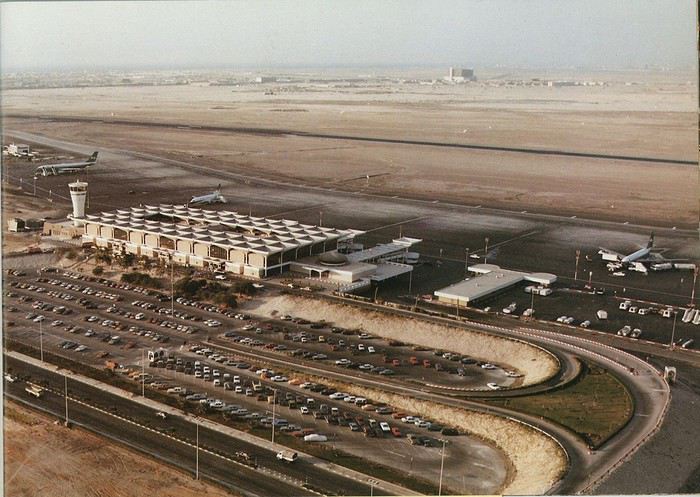
Next stop: New Delhi to drop off some Europeans and pick up a few Indians, and finally, the terminus: Manila. I don’t remember how long the trip took with its five stops—an unimaginable journey today. Despite all those stops to fill the plane, there was still enough space to stretch out on the four center seats of the 747, something that never happens these days despite all the flights in every direction.
So here we are, finally at Manila Airport around midnight.
Episode 1: Manila and Baguio To start, a quick note on the political and economic situation in the Philippines in 1984, which had consequences for us as tourists, as we’d soon realize upon arrival.
After several centuries of Spanish colonization, the Philippines became American at the start of the 20th century, then independent. In 1966, Marcos took power, and little by little, his regime sank into corruption and mismanagement, becoming a dictatorship with martial law, all for the benefit of his family and friends, who enriched themselves endlessly. The peak was the assassination of opposition leader Benigno Aquino in August 1983, which triggered harshly repressed protests. So we arrived a few months later in a very poor country, with omnipresent corruption and an extremely tense political situation, as we’d soon see for ourselves. Major protests took place in the main cities during our trip—I’ll come back to that. Two years later, Marcos fled to Hawaii after being forced out of power following rigged elections. This historical context explains a lot of the situations we found ourselves in over the following weeks.
Arriving in the middle of the night isn’t very cheerful. Manila was already a huge city with many slums, where you could find a few business hotels like the Hilton or Intercontinental—way out of our budget—and plenty of run-down hotels. Luckily, two Indians we’d chatted with on the plane offered to take us to their usual hotel. They came to Manila twice a year for business. We accepted their offer, relieved not to have to look for a place to stay in the middle of the night, figuring the address must be good since they came back every time... we were wrong 🙁
We left the airport and immediately got a taste of the local vibe when we got into the taxi: the police asked for our passports. We thought: what’s more normal than police in a dictatorship?
But that wasn’t it at all. Our two Indian friends explained that the police were noting our names along with the taxi number and time. Crime in Manila was so bad that the taxi driver would be held responsible if anything happened to us... welcome to the Philippines 😎 😎
Historically, the Philippines was a very violent country, where everything was settled with guns or machetes. Previous governments had banned carrying weapons, but Marcos later allowed the free sale and carrying of guns, and disputes were settled with pistols again (or worse, as we’d discover later). Since he’d released most of the criminals from prison to form a paramilitary militia at his service (I’ll talk about our encounter with these “heroes” later), it was pretty dangerous to go into many parts of Manila, where these “tonton macoutes” ruled.
We arrived at our hotel without incident... and then things started badly. The room was infested with big cockroaches—exactly what I hate most in those kinds of countries. No way to find another hotel at that hour. After the long flight, the urge to take a shower was so strong that we squeezed into the bathroom as best we could. After that, I don’t remember—I guess we must’ve fallen asleep exhausted under the sheets in the heat... air conditioning wasn’t widespread yet.
The next day, we just wanted to leave that dump as soon as possible. So we decided to head north right away, stopping in Baguio, and we’d visit Manila a bit on the way back.
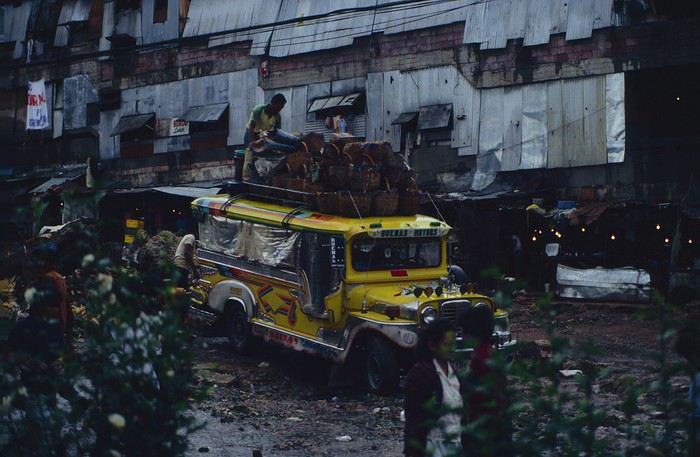
When we stepped outside, we discovered a pretty run-down neighborhood with potholed streets. But we also discovered the jeepneys. They were everywhere, flooding the streets.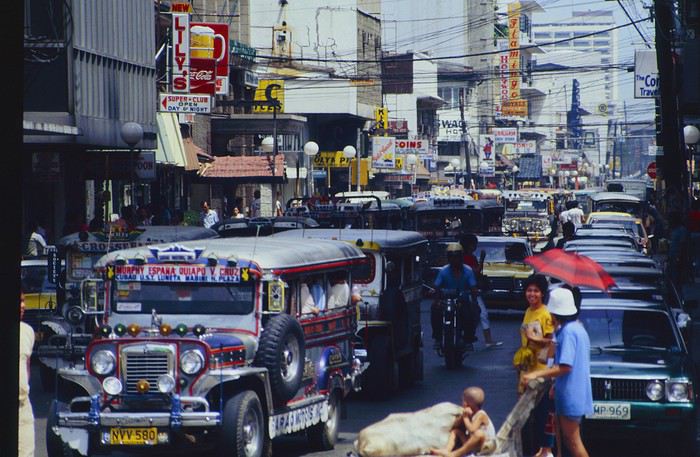
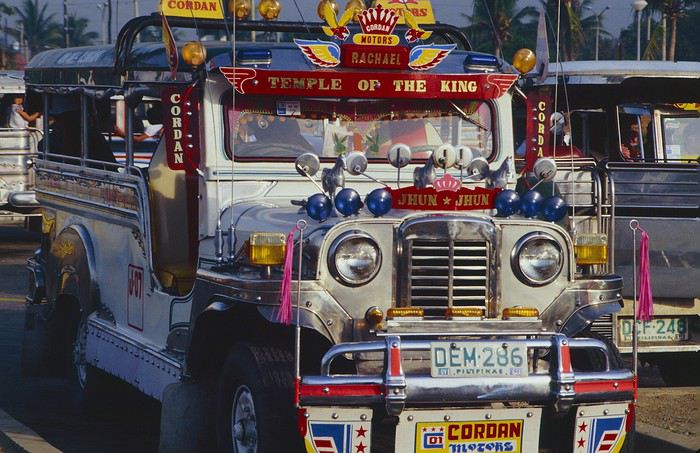
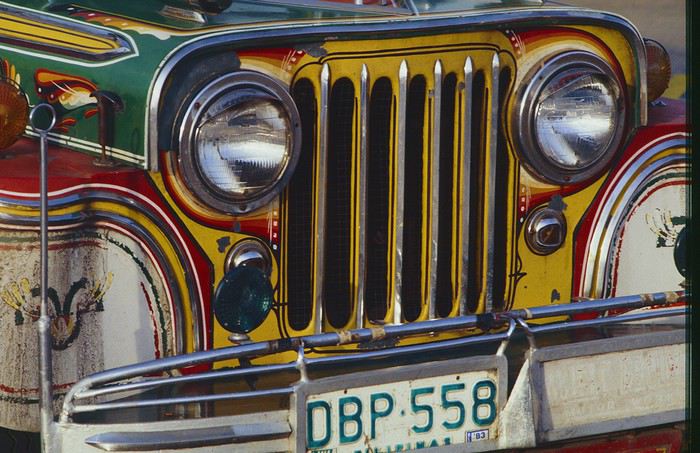
They had crazy sound systems, each one blasting louder than the last. The interiors were kitschy but fun. There weren’t many private cars—almost all transportation was by jeepney, with buses reserved for intercity trips.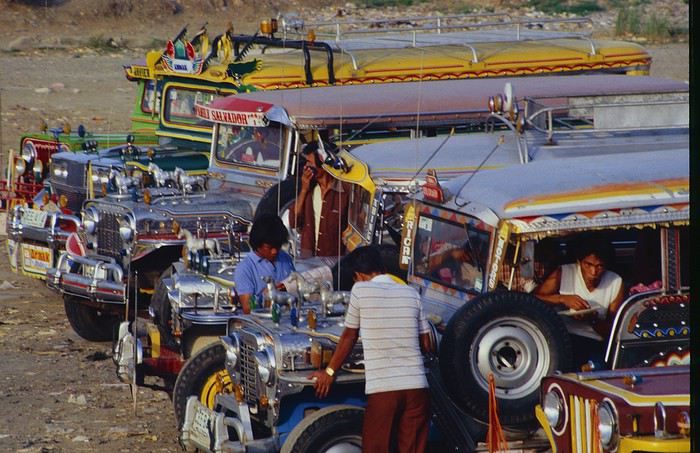
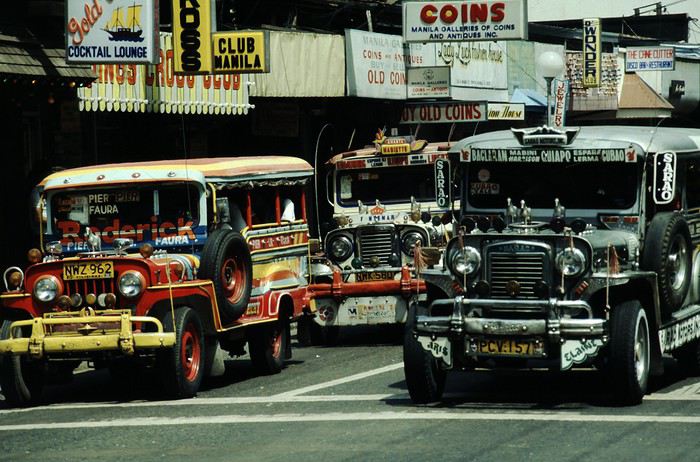
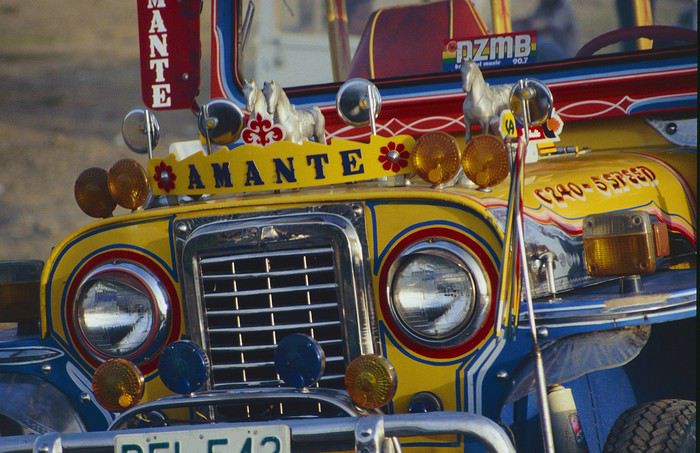
Before heading to the bus terminal for the north, somewhere on the outskirts of the city, we needed to exchange some money. I don’t remember how we ended up in a policeman’s jeep who offered his services: - Exchange money on the black market at a better rate than the banks. - Take us wherever we wanted, in this case, the bus terminal.
We accepted both offers (we’d still checked the official exchange rate from dollars to pesos). So we found ourselves in his jeep. After exchanging money, we left in his vehicle and stopped for gas. Without turning off the engine, he calmly smoked a cigarette while filling up. Since we were in a jeep with no doors or roof, we were ready to jump out if things went south, our travel bag in hand.
But we weren’t done with surprises yet. Once we left the small streets, we ended up in a neighborhood with wide avenues and not much traffic, which didn’t justify his incredible behavior. At every intersection, he made the sign of the cross, closed his eyes, and crossed without looking. I was more stunned than terrified! It wasn’t until we got out of the car later that I told Anne-Marie what had happened. I’d seen everything because the cop had put me in the front seat. Luckily, A-Marie hadn’t noticed anything from the back. Crossing Manila by trusting God rather than the rules of the road was ultimately effective. We were lucky—the trip was off to a good start. 🙂 🙂
We then passed through a neighborhood where slums stretched on for a while, and we left our policeman—friendly but a bit crazy—with relief.
A few hours by bus later, here we are in Baguio, cool in the mountains. My memories of Baguio are pretty fuzzy. I remember a small town. After some research while writing this journal, I found that the population was 120,000 in 1980. Given the population density in each home, that confirms my memory of a smallish town. Outside the “official” district with the president’s summer residence and government buildings, there were two or three paved streets with nice houses. The rest was very dirty and very poor, with lots of slums and dirt roads.
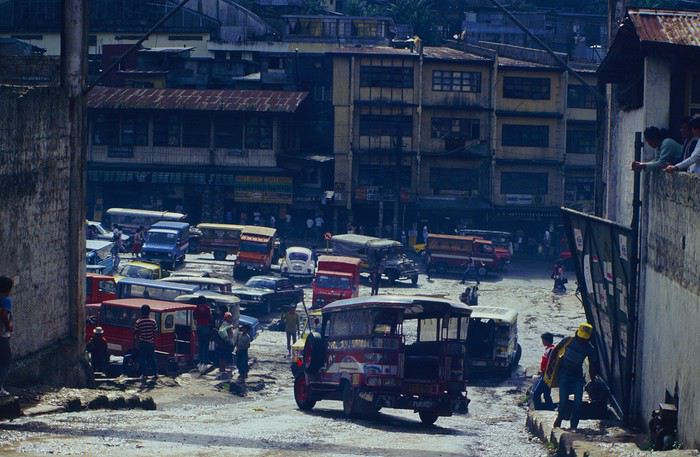
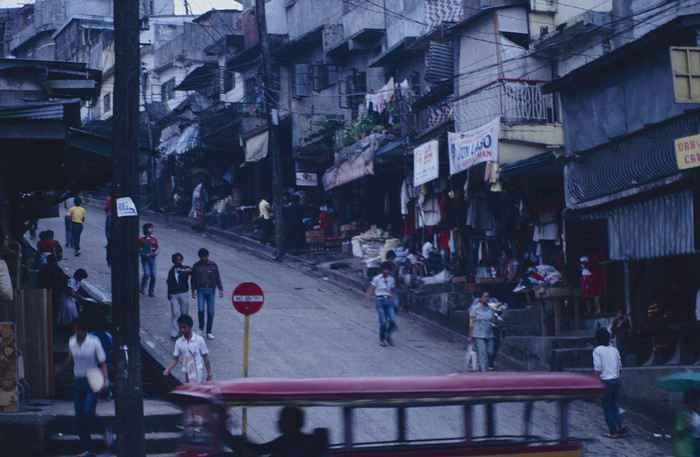
People we met on the street invited us to stay with them. These days, we wouldn’t just show up at strangers’ houses, which we should’ve done in Baguio—it would’ve saved us from an unimaginable and dangerous situation... which I won’t say anything about... !😊
The simple wooden house was on stilts at the edge of a hill with a view of the mountains. Since it was the start of the rainy season in a city that gets a lot of rain, we saw a lot of water. Our outings in town happened between downpours.
View from our lodging: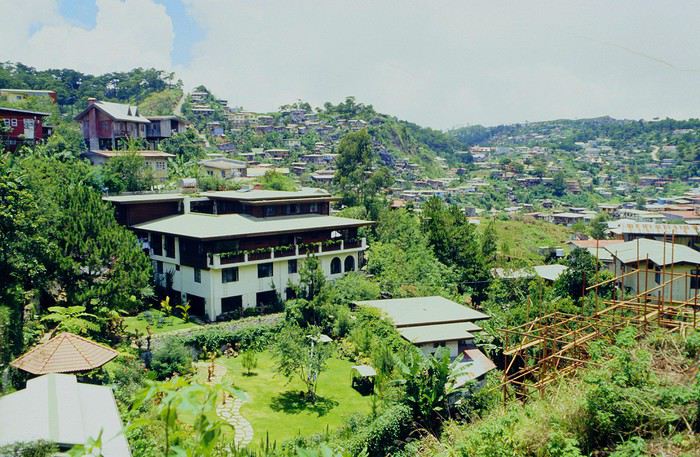
Episode 2: Baguio to Bontoc Aside from the situation briefly mentioned above, it was on the next leg to Bontoc that the adventure really began: an endless and dangerous road, a bus from another era, breathtaking landscapes, and surprising people.
We didn’t know the distance or how long it would take to get to Bontoc. When we arrived after about ten hours, we learned that Baguio to Bontoc was 140 km.
We got on a bus with wooden seats and settled in, two to a seat meant for two. As the bus filled up, passengers squeezed in three or four per seat, with chickens and baskets full of all sorts of things in the aisle. A little embarrassed, we didn’t know if we should squeeze in three on our seat. The seats were super tight (luckily, Filipinos are small), and I didn’t know where to put my legs given my height. I don’t remember if we stayed alone on our bench or if we ended up sharing with others.
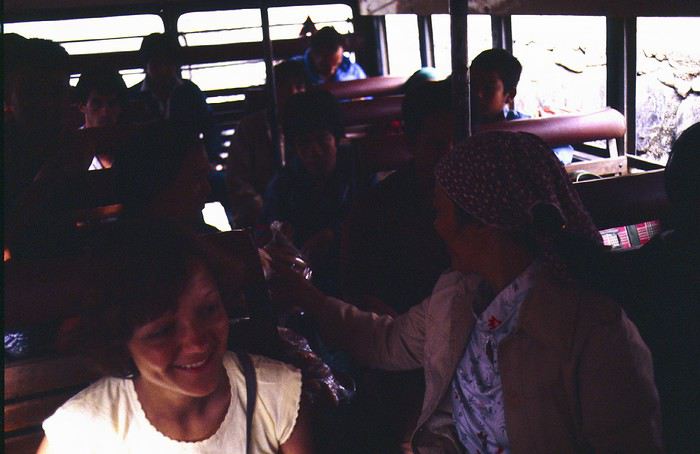
The “road” was a dirt track (or rather, a mud track) with endless turns. We held on as best we could to our slippery wooden seats—it was shaking in every direction. The woman behind us was carsick and throwing up... gross... but what were we doing there? Then we plunged into the Sierra Madre... just the name is dreamy!
Rice terraces started to appear: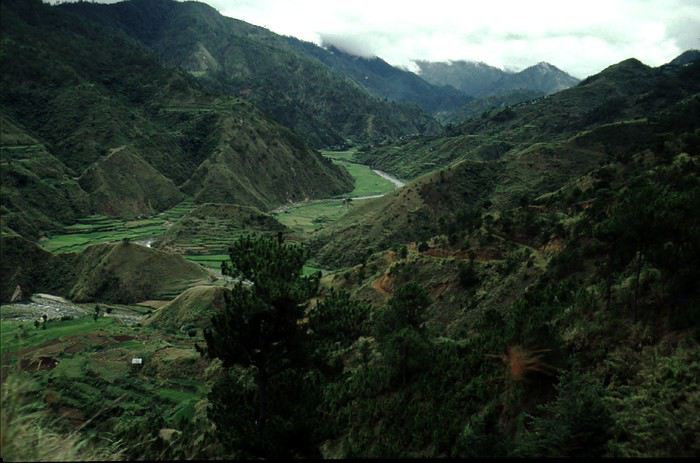
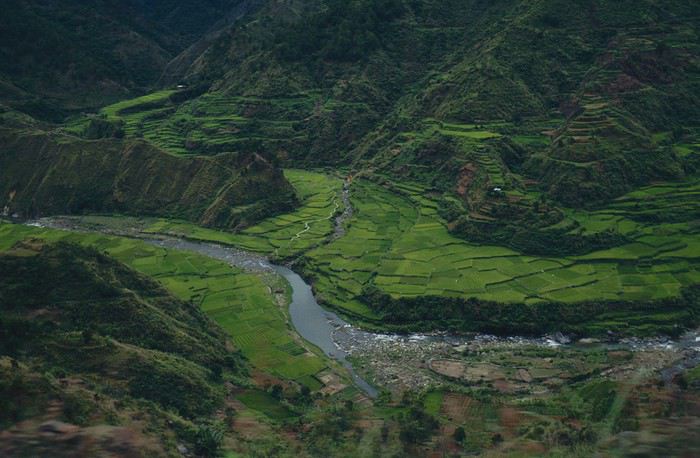
they took up more and more space along cliffs where we weren’t always reassured,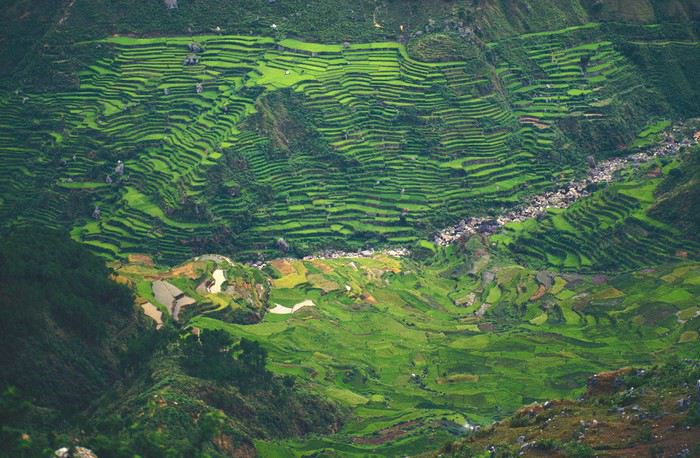
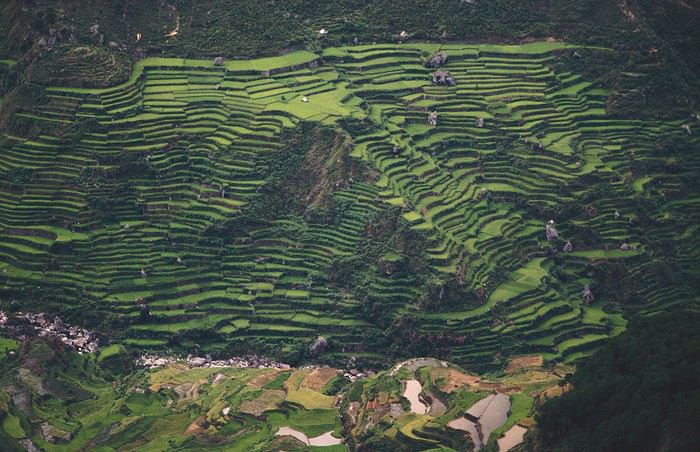
with lots of waterfalls (all that water had to go somewhere).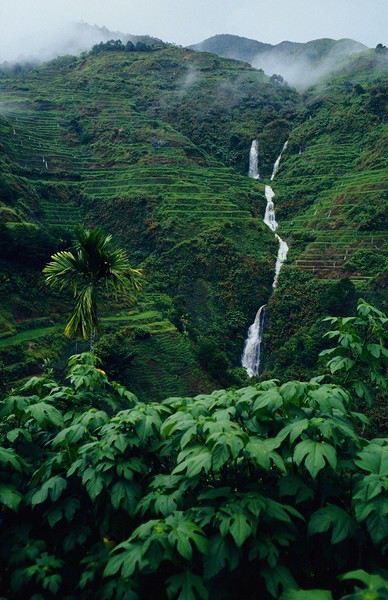
A few miserable villages stretched along the track, most often just a few houses balancing between the road and the drop. The bus stopped in every village—people got on or off and settled inside or on the roof. Street vendors offered their products to the bus passengers—a common sight in Asia, even today.
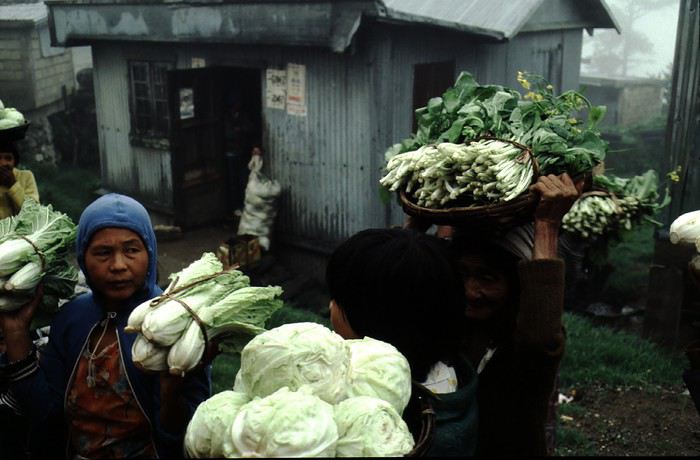
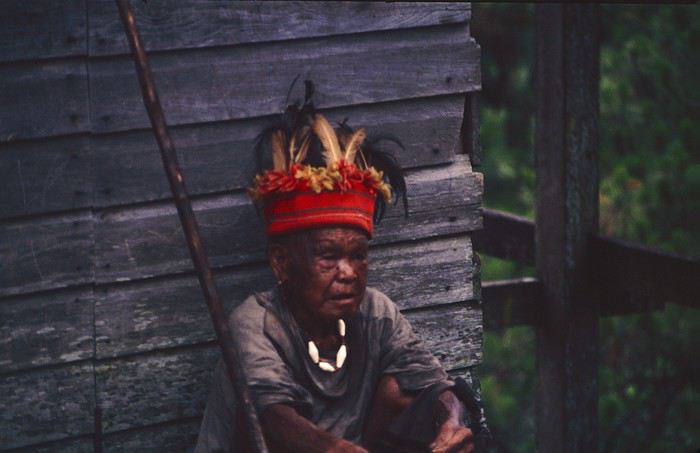
We were in another world—villagers were in loincloths, others had spears. The atmosphere was strange... but all good, we wanted exoticism, and we got it: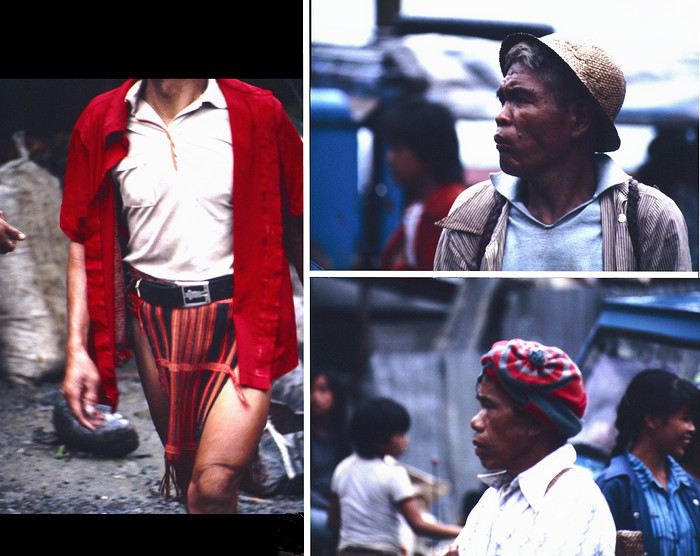
This so-called traditional outfit was everyday wear—it wasn’t for tourists since there weren’t any.
A curiosity because writing a travel journal about a trip 35 years later isn’t common, but also (mostly?) because exploring the Philippines at that time had little in common with traveling there today.
Obviously, I’ve forgotten a number of facts, most of the details, but with the help of a few notes from that time and a stack of slides (yes, there was life before digital 😊), many memories came back and added to the highlights I’d never forgotten. The scanned slides aren’t always great quality, but there are still quite a few to brighten up this chatter. Back then, we didn’t snap photos like we do now—film was too expensive—so I don’t have pictures of every place we visited... too bad, comparing some of those spots to how they look today would’ve been interesting.
Why "Adventures"? Why call it "Adventures" in the Philippines in 1984, a word so often used for a simple exotic trip? - Because the lack of information (no *Guide du Routard*, no *Lonely Planet*, no *Michelin Guide*, nothing, and obviously no internet) gave this trip what’s at the heart of adventure: the unknown. - Because the political situation made the stay sometimes dangerous. - Because transportation conditions were always epic, often perilous. - Because the question of where we’d spend the night came up almost every evening. - And for... quite a few other reasons.
That said, we weren’t exactly explorers!
Why the Philippines? First of all, why go to the Philippines in 1984—a country not exactly set up for tourism and about which we knew very little? How could we get an idea of the beauty of the Philippines and its points of interest when we had no guides or photos?
The idea came to us from Thailand a year earlier, during our first long-haul trip. After touring the north of the country, we met a Frenchman living in Phuket, where there were only a few tourists in Patong, with just a few small hotels and guesthouses. Kata and Karon had no buildings or roads, Rawai only had three palm-thatched bungalows, including ours, and the other islands were unknown to tourists. There was plenty to discover, and we wanted to return to this beautiful country... but the Frenchman made us dream about the Philippines—a country to explore, with wild landscapes.
Long evenings of discussion over multiple Sprite-Mekong cocktails (what memories of those headaches!) finally convinced us we had to go to the Philippines.
Episode 0: Before Departure The decision was made: we’d go to the Philippines in May 1984. Our friends and family were surprised when we announced we were going on vacation to the Philippines (a bit like saying today we were going paddleboarding in the Kerguelen Islands 🤪).
These days, preparing for each of our trips takes long evenings of research, planning, and noting down good addresses... etc. But for the Philippines in 1984, preparation was quick: we had very little information about the country, we were leaving almost at random, and the discovery would only be more exciting.
We still had a few bits of info gathered here and there: the rice terraces in northern Luzon, volcanoes, Negros where we were supposed to visit an acquaintance, Cebu and its marine life (we ended up going elsewhere), and absolutely avoid Mindanao, which was practically at war with the regime. That was about it, but it was already a great itinerary.
Nothing was organized in advance; we’d see day by day. We had no idea about travel times or even the existence of transportation options. The main (and sometimes only) way to connect two islands was by overloaded, rusty ferry. Only the big cities had airports.
Let’s Go: Episode 1: Paris to Manila My travel journals always start after arriving at the airport—the Europe-to-“Other Continent” trip isn’t interesting—but the flight to the Philippines was already an adventure, so I’ll make an exception.
This was the era when only a few Asian airlines were on par with Western ones: Thai, Singapore Airlines, and Philippine Airlines. They had beautiful, brand-new planes, and to attract customers (almost exclusively “businessmen”) from the usual airlines (Air France, Lufthansa, British Airways), there was opulence on board: unlimited champagne, all sorts of cocktails... Compared to today’s long-haul flights, there was still one small difference: no personal screens, just one screen at the front of the cabin with one mandatory movie. And I don’t know why, but we only got James Bond films, both ways... that must’ve been the trend at the time.
The tourism boom to Southeast Asia hadn’t started yet, and the “Asian Tigers” weren’t a thing, so there weren’t many business trips. That meant long-haul flights made stops everywhere to fill the planes. Our Philippine Airlines Boeing 747 left London, picked us up in Paris, then stopped in Frankfurt to take on a few Germans. I don’t know why we then made a stop in Dubai—a totally exotic place at the time. There was nothing to do there... things have changed a lot since. It was a small town lost in the desert. The airport was tiny, with just one or two buildings and a supermarket. During the stopover, everyone had to get off the plane and walk to the supermarket. Photo and electronic equipment were dirt cheap—I guess that was the only reason for the stop. Maybe it was their first commercial move. Emirates didn’t exist yet, as I checked online, but anyway, the idea that such a remote place could have its own airline was unthinkable.
Online, I found this photo of Dubai Airport in 1980. Anyone who’s transited through today’s massive airport with its rows of A380s will appreciate it:
Next stop: New Delhi to drop off some Europeans and pick up a few Indians, and finally, the terminus: Manila. I don’t remember how long the trip took with its five stops—an unimaginable journey today. Despite all those stops to fill the plane, there was still enough space to stretch out on the four center seats of the 747, something that never happens these days despite all the flights in every direction.
So here we are, finally at Manila Airport around midnight.
Episode 1: Manila and Baguio To start, a quick note on the political and economic situation in the Philippines in 1984, which had consequences for us as tourists, as we’d soon realize upon arrival.
After several centuries of Spanish colonization, the Philippines became American at the start of the 20th century, then independent. In 1966, Marcos took power, and little by little, his regime sank into corruption and mismanagement, becoming a dictatorship with martial law, all for the benefit of his family and friends, who enriched themselves endlessly. The peak was the assassination of opposition leader Benigno Aquino in August 1983, which triggered harshly repressed protests. So we arrived a few months later in a very poor country, with omnipresent corruption and an extremely tense political situation, as we’d soon see for ourselves. Major protests took place in the main cities during our trip—I’ll come back to that. Two years later, Marcos fled to Hawaii after being forced out of power following rigged elections. This historical context explains a lot of the situations we found ourselves in over the following weeks.
Arriving in the middle of the night isn’t very cheerful. Manila was already a huge city with many slums, where you could find a few business hotels like the Hilton or Intercontinental—way out of our budget—and plenty of run-down hotels. Luckily, two Indians we’d chatted with on the plane offered to take us to their usual hotel. They came to Manila twice a year for business. We accepted their offer, relieved not to have to look for a place to stay in the middle of the night, figuring the address must be good since they came back every time... we were wrong 🙁
We left the airport and immediately got a taste of the local vibe when we got into the taxi: the police asked for our passports. We thought: what’s more normal than police in a dictatorship?
But that wasn’t it at all. Our two Indian friends explained that the police were noting our names along with the taxi number and time. Crime in Manila was so bad that the taxi driver would be held responsible if anything happened to us... welcome to the Philippines 😎 😎
Historically, the Philippines was a very violent country, where everything was settled with guns or machetes. Previous governments had banned carrying weapons, but Marcos later allowed the free sale and carrying of guns, and disputes were settled with pistols again (or worse, as we’d discover later). Since he’d released most of the criminals from prison to form a paramilitary militia at his service (I’ll talk about our encounter with these “heroes” later), it was pretty dangerous to go into many parts of Manila, where these “tonton macoutes” ruled.
We arrived at our hotel without incident... and then things started badly. The room was infested with big cockroaches—exactly what I hate most in those kinds of countries. No way to find another hotel at that hour. After the long flight, the urge to take a shower was so strong that we squeezed into the bathroom as best we could. After that, I don’t remember—I guess we must’ve fallen asleep exhausted under the sheets in the heat... air conditioning wasn’t widespread yet.
The next day, we just wanted to leave that dump as soon as possible. So we decided to head north right away, stopping in Baguio, and we’d visit Manila a bit on the way back.
When we stepped outside, we discovered a pretty run-down neighborhood with potholed streets. But we also discovered the jeepneys. They were everywhere, flooding the streets.
They had crazy sound systems, each one blasting louder than the last. The interiors were kitschy but fun. There weren’t many private cars—almost all transportation was by jeepney, with buses reserved for intercity trips.
Before heading to the bus terminal for the north, somewhere on the outskirts of the city, we needed to exchange some money. I don’t remember how we ended up in a policeman’s jeep who offered his services: - Exchange money on the black market at a better rate than the banks. - Take us wherever we wanted, in this case, the bus terminal.
We accepted both offers (we’d still checked the official exchange rate from dollars to pesos). So we found ourselves in his jeep. After exchanging money, we left in his vehicle and stopped for gas. Without turning off the engine, he calmly smoked a cigarette while filling up. Since we were in a jeep with no doors or roof, we were ready to jump out if things went south, our travel bag in hand.
But we weren’t done with surprises yet. Once we left the small streets, we ended up in a neighborhood with wide avenues and not much traffic, which didn’t justify his incredible behavior. At every intersection, he made the sign of the cross, closed his eyes, and crossed without looking. I was more stunned than terrified! It wasn’t until we got out of the car later that I told Anne-Marie what had happened. I’d seen everything because the cop had put me in the front seat. Luckily, A-Marie hadn’t noticed anything from the back. Crossing Manila by trusting God rather than the rules of the road was ultimately effective. We were lucky—the trip was off to a good start. 🙂 🙂
We then passed through a neighborhood where slums stretched on for a while, and we left our policeman—friendly but a bit crazy—with relief.
A few hours by bus later, here we are in Baguio, cool in the mountains. My memories of Baguio are pretty fuzzy. I remember a small town. After some research while writing this journal, I found that the population was 120,000 in 1980. Given the population density in each home, that confirms my memory of a smallish town. Outside the “official” district with the president’s summer residence and government buildings, there were two or three paved streets with nice houses. The rest was very dirty and very poor, with lots of slums and dirt roads.
People we met on the street invited us to stay with them. These days, we wouldn’t just show up at strangers’ houses, which we should’ve done in Baguio—it would’ve saved us from an unimaginable and dangerous situation... which I won’t say anything about... !😊
The simple wooden house was on stilts at the edge of a hill with a view of the mountains. Since it was the start of the rainy season in a city that gets a lot of rain, we saw a lot of water. Our outings in town happened between downpours.
View from our lodging:
Episode 2: Baguio to Bontoc Aside from the situation briefly mentioned above, it was on the next leg to Bontoc that the adventure really began: an endless and dangerous road, a bus from another era, breathtaking landscapes, and surprising people.
We didn’t know the distance or how long it would take to get to Bontoc. When we arrived after about ten hours, we learned that Baguio to Bontoc was 140 km.
We got on a bus with wooden seats and settled in, two to a seat meant for two. As the bus filled up, passengers squeezed in three or four per seat, with chickens and baskets full of all sorts of things in the aisle. A little embarrassed, we didn’t know if we should squeeze in three on our seat. The seats were super tight (luckily, Filipinos are small), and I didn’t know where to put my legs given my height. I don’t remember if we stayed alone on our bench or if we ended up sharing with others.
The “road” was a dirt track (or rather, a mud track) with endless turns. We held on as best we could to our slippery wooden seats—it was shaking in every direction. The woman behind us was carsick and throwing up... gross... but what were we doing there? Then we plunged into the Sierra Madre... just the name is dreamy!
Rice terraces started to appear:
they took up more and more space along cliffs where we weren’t always reassured,
with lots of waterfalls (all that water had to go somewhere).
A few miserable villages stretched along the track, most often just a few houses balancing between the road and the drop. The bus stopped in every village—people got on or off and settled inside or on the roof. Street vendors offered their products to the bus passengers—a common sight in Asia, even today.
We were in another world—villagers were in loincloths, others had spears. The atmosphere was strange... but all good, we wanted exoticism, and we got it:
This so-called traditional outfit was everyday wear—it wasn’t for tourists since there weren’t any.