A curiosity because writing a travel journal about a trip 35 years later isn’t common, but also (mostly?) because exploring the Philippines at that time had little in common with traveling there today.
Obviously, I’ve forgotten a number of facts, most of the details, but with the help of a few notes from that time and a stack of slides (yes, there was life before digital 😊), many memories came back and added to the highlights I’d never forgotten. The scanned slides aren’t always great quality, but there are still quite a few to brighten up this chatter. Back then, we didn’t snap photos like we do now—film was too expensive—so I don’t have pictures of every place we visited... too bad, comparing some of those spots to how they look today would’ve been interesting.
Why "Adventures"? Why call it "Adventures" in the Philippines in 1984, a word so often used for a simple exotic trip? - Because the lack of information (no *Guide du Routard*, no *Lonely Planet*, no *Michelin Guide*, nothing, and obviously no internet) gave this trip what’s at the heart of adventure: the unknown. - Because the political situation made the stay sometimes dangerous. - Because transportation conditions were always epic, often perilous. - Because the question of where we’d spend the night came up almost every evening. - And for... quite a few other reasons.
That said, we weren’t exactly explorers!
Why the Philippines? First of all, why go to the Philippines in 1984—a country not exactly set up for tourism and about which we knew very little? How could we get an idea of the beauty of the Philippines and its points of interest when we had no guides or photos?
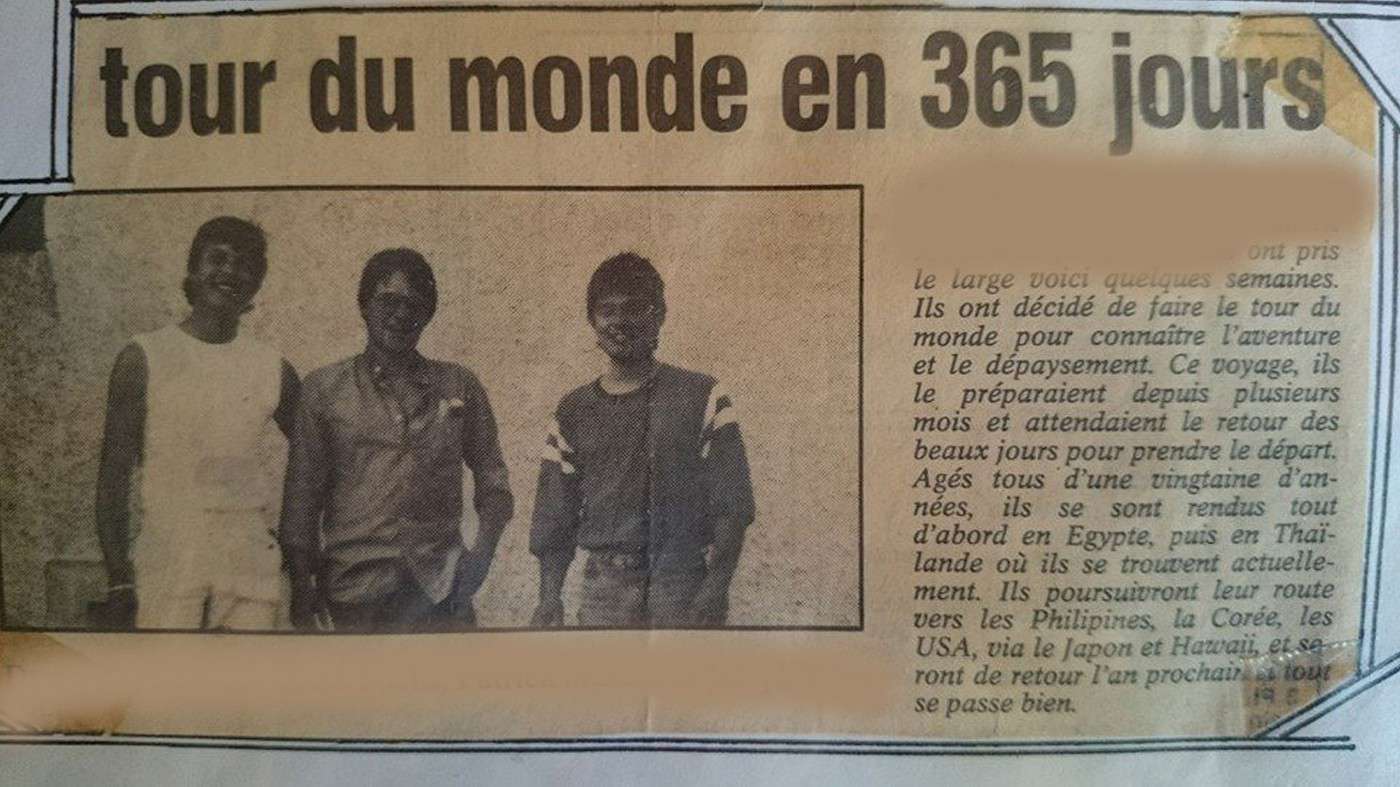
The idea came to us from Thailand a year earlier, during our first long-haul trip. After touring the north of the country, we met a Frenchman living in Phuket, where there were only a few tourists in Patong, with just a few small hotels and guesthouses. Kata and Karon had no buildings or roads, Rawai only had three palm-thatched bungalows, including ours, and the other islands were unknown to tourists. There was plenty to discover, and we wanted to return to this beautiful country... but the Frenchman made us dream about the Philippines—a country to explore, with wild landscapes.
Long evenings of discussion over multiple Sprite-Mekong cocktails (what memories of those headaches!) finally convinced us we had to go to the Philippines.
Episode 0: Before Departure The decision was made: we’d go to the Philippines in May 1984. Our friends and family were surprised when we announced we were going on vacation to the Philippines (a bit like saying today we were going paddleboarding in the Kerguelen Islands 🤪).
These days, preparing for each of our trips takes long evenings of research, planning, and noting down good addresses... etc. But for the Philippines in 1984, preparation was quick: we had very little information about the country, we were leaving almost at random, and the discovery would only be more exciting.
We still had a few bits of info gathered here and there: the rice terraces in northern Luzon, volcanoes, Negros where we were supposed to visit an acquaintance, Cebu and its marine life (we ended up going elsewhere), and absolutely avoid Mindanao, which was practically at war with the regime. That was about it, but it was already a great itinerary.
Nothing was organized in advance; we’d see day by day. We had no idea about travel times or even the existence of transportation options. The main (and sometimes only) way to connect two islands was by overloaded, rusty ferry. Only the big cities had airports.
Let’s Go: Episode 1: Paris to Manila My travel journals always start after arriving at the airport—the Europe-to-“Other Continent” trip isn’t interesting—but the flight to the Philippines was already an adventure, so I’ll make an exception.
This was the era when only a few Asian airlines were on par with Western ones: Thai, Singapore Airlines, and Philippine Airlines. They had beautiful, brand-new planes, and to attract customers (almost exclusively “businessmen”) from the usual airlines (Air France, Lufthansa, British Airways), there was opulence on board: unlimited champagne, all sorts of cocktails... Compared to today’s long-haul flights, there was still one small difference: no personal screens, just one screen at the front of the cabin with one mandatory movie. And I don’t know why, but we only got James Bond films, both ways... that must’ve been the trend at the time.
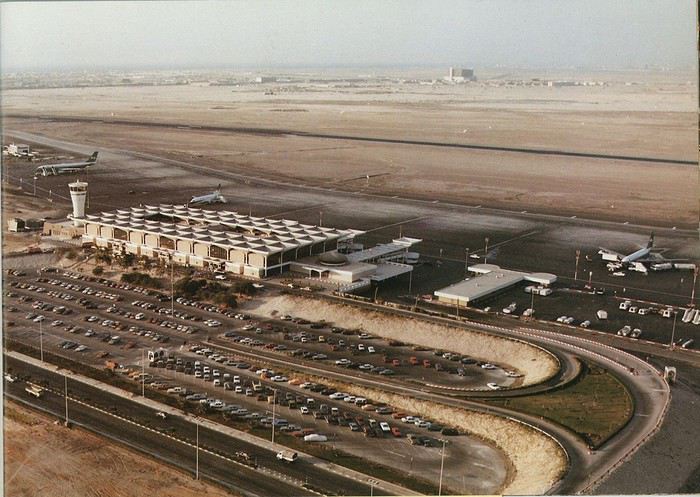
The tourism boom to Southeast Asia hadn’t started yet, and the “Asian Tigers” weren’t a thing, so there weren’t many business trips. That meant long-haul flights made stops everywhere to fill the planes. Our Philippine Airlines Boeing 747 left London, picked us up in Paris, then stopped in Frankfurt to take on a few Germans. I don’t know why we then made a stop in Dubai—a totally exotic place at the time. There was nothing to do there... things have changed a lot since. It was a small town lost in the desert. The airport was tiny, with just one or two buildings and a supermarket. During the stopover, everyone had to get off the plane and walk to the supermarket. Photo and electronic equipment were dirt cheap—I guess that was the only reason for the stop. Maybe it was their first commercial move. Emirates didn’t exist yet, as I checked online, but anyway, the idea that such a remote place could have its own airline was unthinkable.
Online, I found this photo of Dubai Airport in 1980. Anyone who’s transited through today’s massive airport with its rows of A380s will appreciate it:
Next stop: New Delhi to drop off some Europeans and pick up a few Indians, and finally, the terminus: Manila. I don’t remember how long the trip took with its five stops—an unimaginable journey today. Despite all those stops to fill the plane, there was still enough space to stretch out on the four center seats of the 747, something that never happens these days despite all the flights in every direction.
So here we are, finally at Manila Airport around midnight.
Episode 1: Manila and Baguio To start, a quick note on the political and economic situation in the Philippines in 1984, which had consequences for us as tourists, as we’d soon realize upon arrival.
After several centuries of Spanish colonization, the Philippines became American at the start of the 20th century, then independent. In 1966, Marcos took power, and little by little, his regime sank into corruption and mismanagement, becoming a dictatorship with martial law, all for the benefit of his family and friends, who enriched themselves endlessly. The peak was the assassination of opposition leader Benigno Aquino in August 1983, which triggered harshly repressed protests. So we arrived a few months later in a very poor country, with omnipresent corruption and an extremely tense political situation, as we’d soon see for ourselves. Major protests took place in the main cities during our trip—I’ll come back to that. Two years later, Marcos fled to Hawaii after being forced out of power following rigged elections. This historical context explains a lot of the situations we found ourselves in over the following weeks.
Arriving in the middle of the night isn’t very cheerful. Manila was already a huge city with many slums, where you could find a few business hotels like the Hilton or Intercontinental—way out of our budget—and plenty of run-down hotels. Luckily, two Indians we’d chatted with on the plane offered to take us to their usual hotel. They came to Manila twice a year for business. We accepted their offer, relieved not to have to look for a place to stay in the middle of the night, figuring the address must be good since they came back every time... we were wrong 🙁
We left the airport and immediately got a taste of the local vibe when we got into the taxi: the police asked for our passports. We thought: what’s more normal than police in a dictatorship?
But that wasn’t it at all. Our two Indian friends explained that the police were noting our names along with the taxi number and time. Crime in Manila was so bad that the taxi driver would be held responsible if anything happened to us... welcome to the Philippines 😎 😎
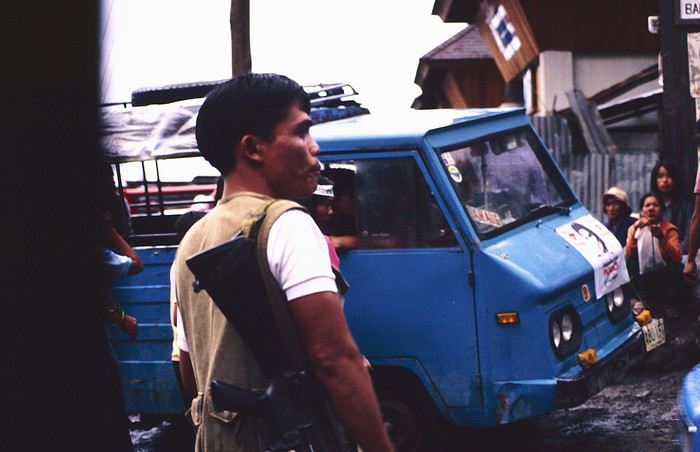
Historically, the Philippines was a very violent country, where everything was settled with guns or machetes. Previous governments had banned carrying weapons, but Marcos later allowed the free sale and carrying of guns, and disputes were settled with pistols again (or worse, as we’d discover later). Since he’d released most of the criminals from prison to form a paramilitary militia at his service (I’ll talk about our encounter with these “heroes” later), it was pretty dangerous to go into many parts of Manila, where these “tonton macoutes” ruled.
We arrived at our hotel without incident... and then things started badly. The room was infested with big cockroaches—exactly what I hate most in those kinds of countries. No way to find another hotel at that hour. After the long flight, the urge to take a shower was so strong that we squeezed into the bathroom as best we could. After that, I don’t remember—I guess we must’ve fallen asleep exhausted under the sheets in the heat... air conditioning wasn’t widespread yet.
The next day, we just wanted to leave that dump as soon as possible. So we decided to head north right away, stopping in Baguio, and we’d visit Manila a bit on the way back.
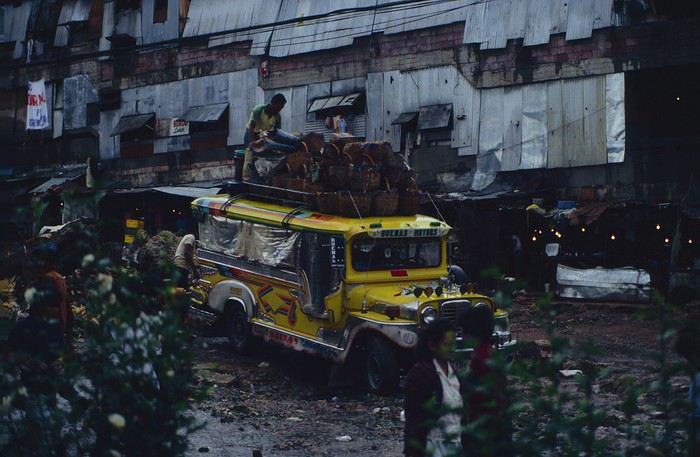
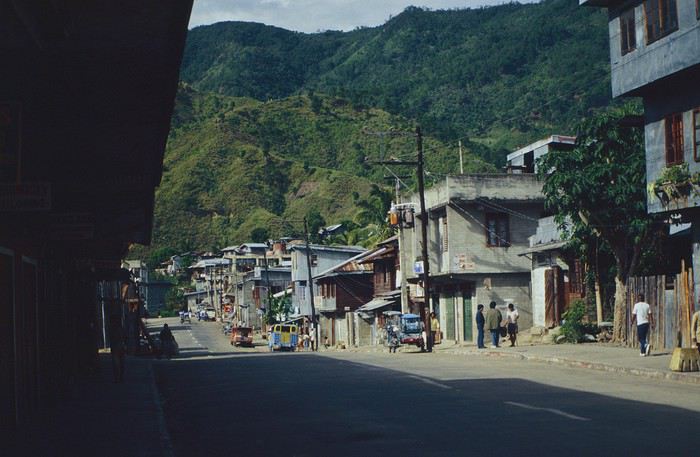
When we stepped outside, we discovered a pretty run-down neighborhood with potholed streets. But we also discovered the jeepneys. They were everywhere, flooding the streets.
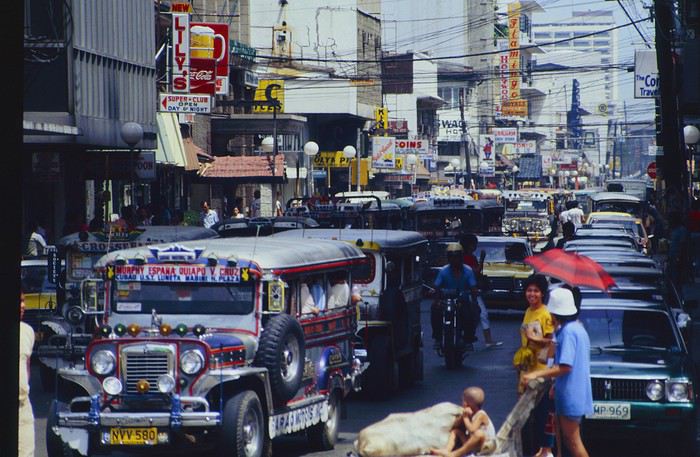
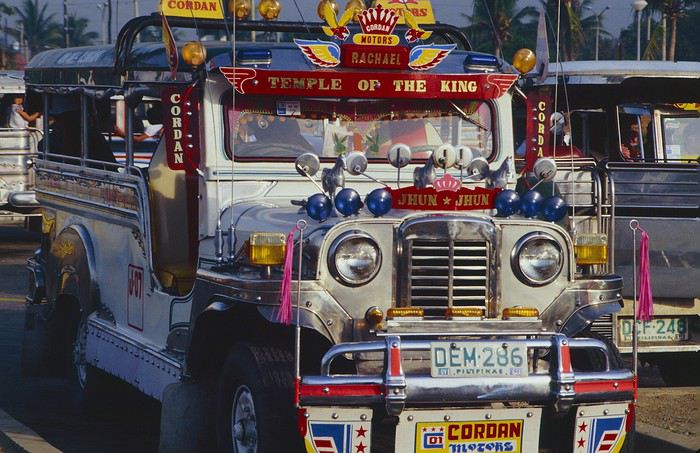
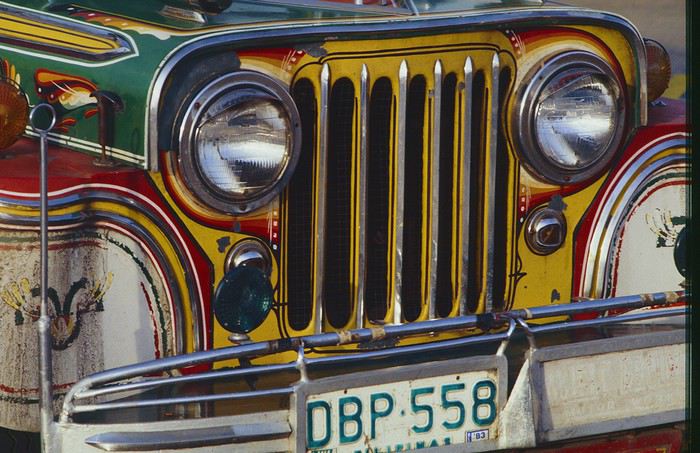
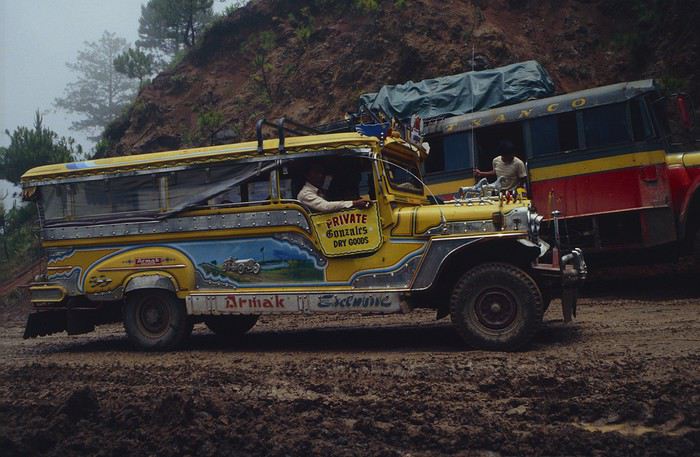
They had crazy sound systems, each one blasting louder than the last. The interiors were kitschy but fun. There weren’t many private cars—almost all transportation was by jeepney, with buses reserved for intercity trips.
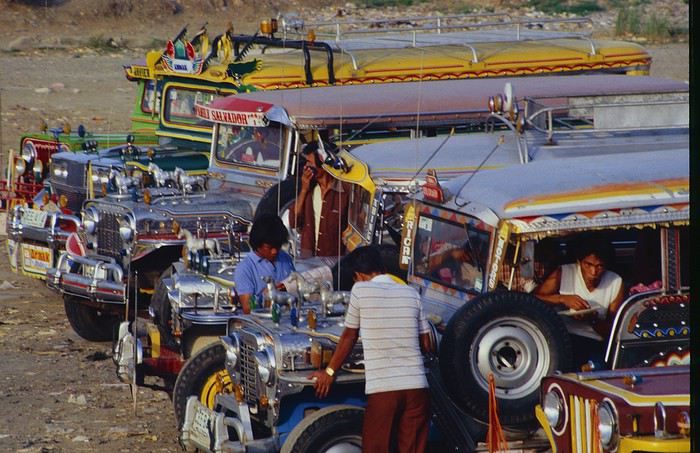
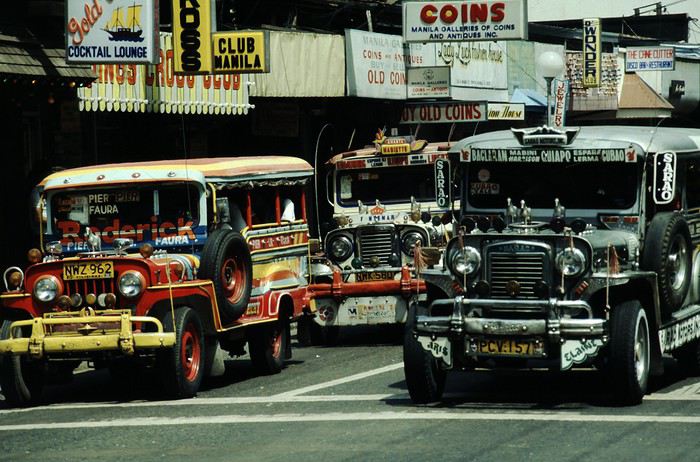
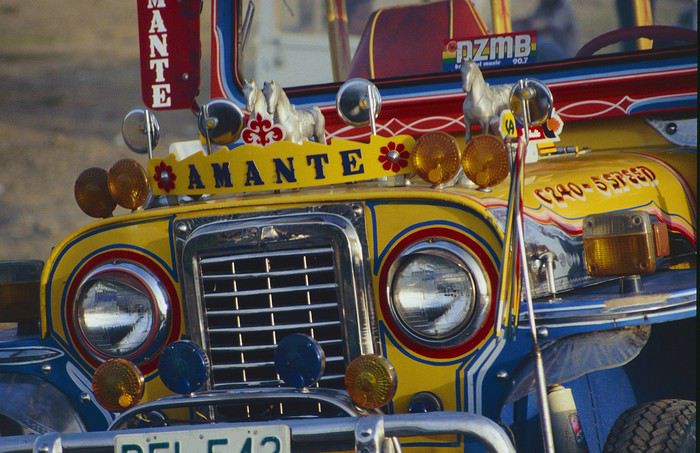
Before heading to the bus terminal for the north, somewhere on the outskirts of the city, we needed to exchange some money. I don’t remember how we ended up in a policeman’s jeep who offered his services: - Exchange money on the black market at a better rate than the banks. - Take us wherever we wanted, in this case, the bus terminal.
We accepted both offers (we’d still checked the official exchange rate from dollars to pesos). So we found ourselves in his jeep. After exchanging money, we left in his vehicle and stopped for gas. Without turning off the engine, he calmly smoked a cigarette while filling up. Since we were in a jeep with no doors or roof, we were ready to jump out if things went south, our travel bag in hand.
But we weren’t done with surprises yet. Once we left the small streets, we ended up in a neighborhood with wide avenues and not much traffic, which didn’t justify his incredible behavior. At every intersection, he made the sign of the cross, closed his eyes, and crossed without looking. I was more stunned than terrified! It wasn’t until we got out of the car later that I told Anne-Marie what had happened. I’d seen everything because the cop had put me in the front seat. Luckily, A-Marie hadn’t noticed anything from the back. Crossing Manila by trusting God rather than the rules of the road was ultimately effective. We were lucky—the trip was off to a good start. 🙂 🙂
We then passed through a neighborhood where slums stretched on for a while, and we left our policeman—friendly but a bit crazy—with relief.
A few hours by bus later, here we are in Baguio, cool in the mountains. My memories of Baguio are pretty fuzzy. I remember a small town. After some research while writing this journal, I found that the population was 120,000 in 1980. Given the population density in each home, that confirms my memory of a smallish town. Outside the “official” district with the president’s summer residence and government buildings, there were two or three paved streets with nice houses. The rest was very dirty and very poor, with lots of slums and dirt roads.
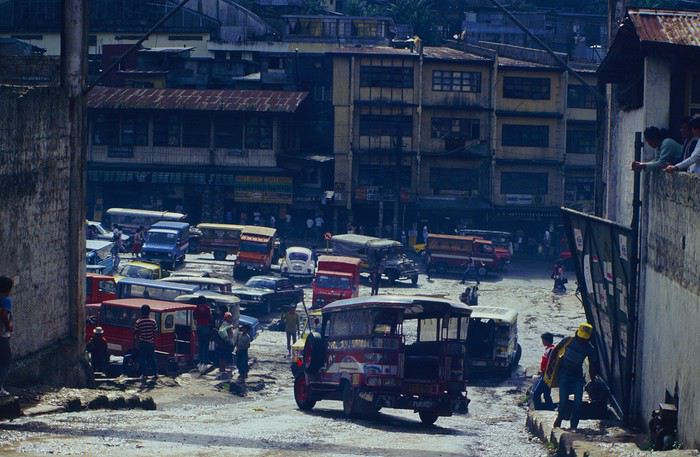
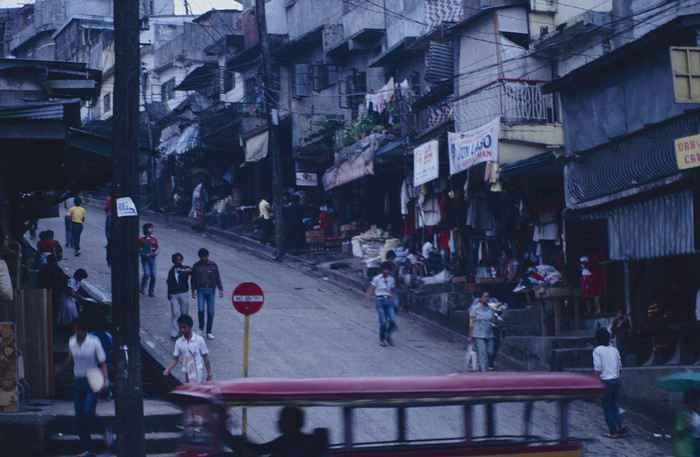
People we met on the street invited us to stay with them. These days, we wouldn’t just show up at strangers’ houses, which we should’ve done in Baguio—it would’ve saved us from an unimaginable and dangerous situation... which I won’t say anything about... !😊
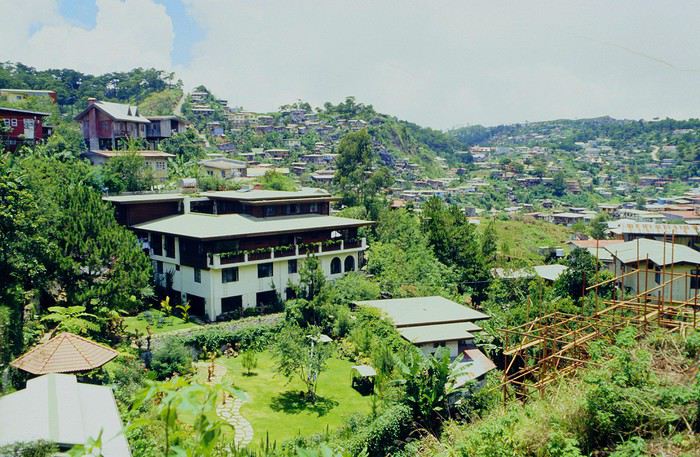
The simple wooden house was on stilts at the edge of a hill with a view of the mountains. Since it was the start of the rainy season in a city that gets a lot of rain, we saw a lot of water. Our outings in town happened between downpours.
View from our lodging:
Episode 2: Baguio to Bontoc Aside from the situation briefly mentioned above, it was on the next leg to Bontoc that the adventure really began: an endless and dangerous road, a bus from another era, breathtaking landscapes, and surprising people.
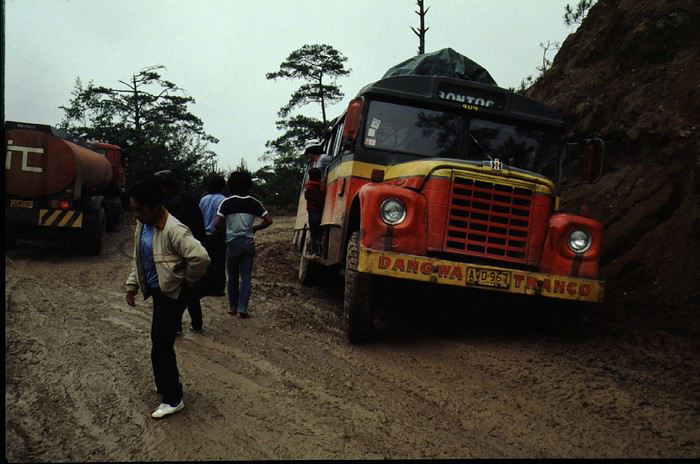
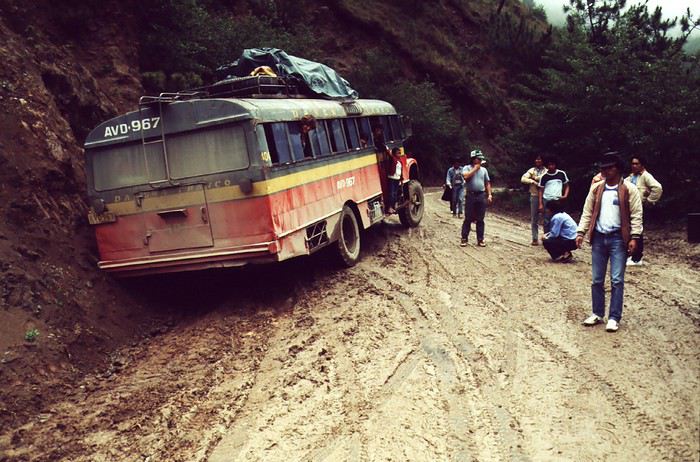
We didn’t know the distance or how long it would take to get to Bontoc. When we arrived after about ten hours, we learned that Baguio to Bontoc was 140 km.
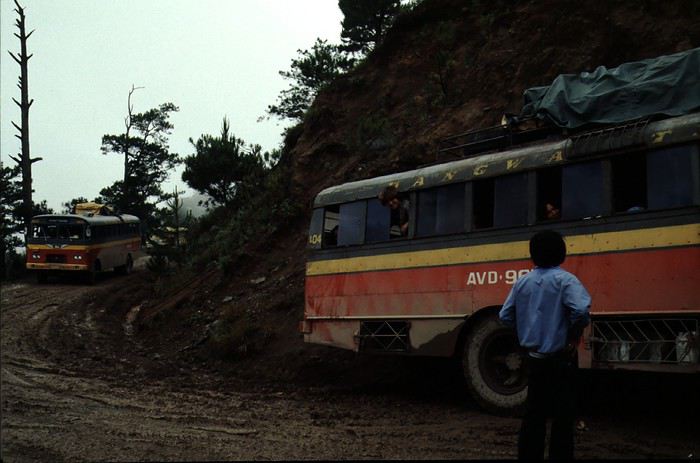
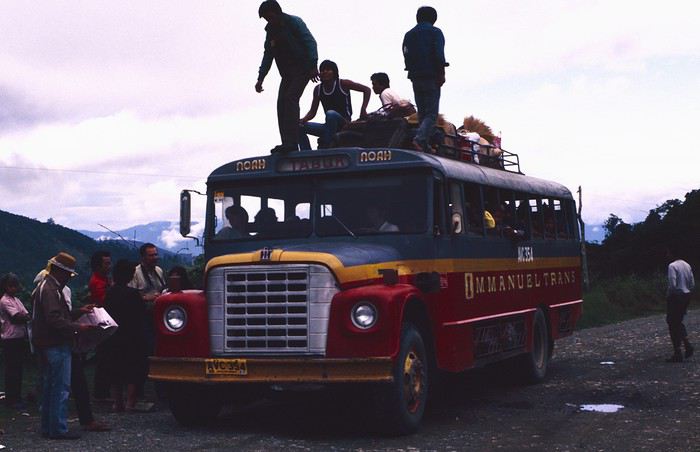
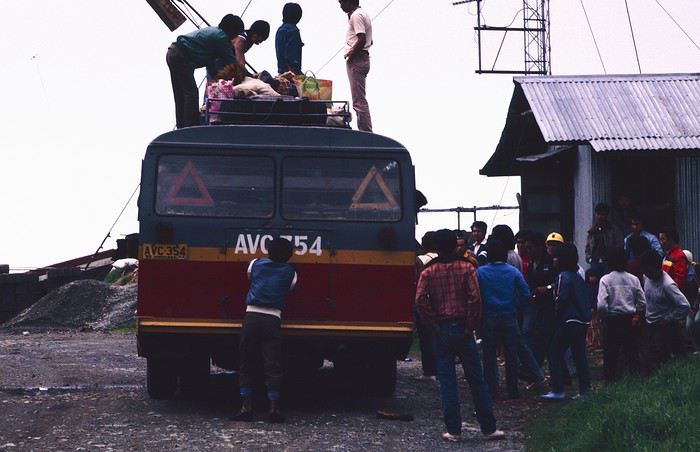
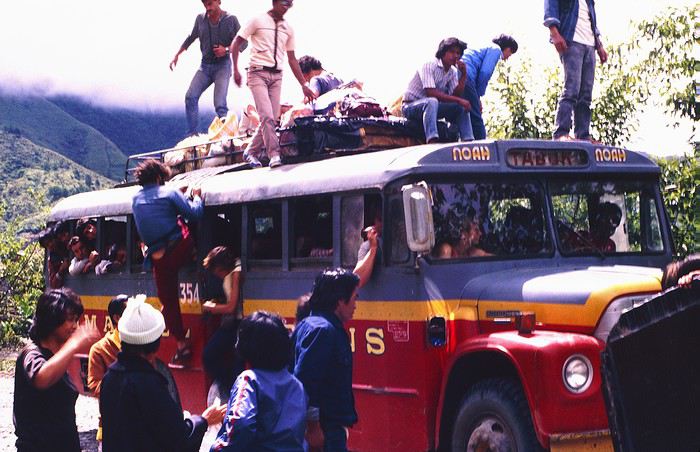
We got on a bus with wooden seats and settled in, two to a seat meant for two. As the bus filled up, passengers squeezed in three or four per seat, with chickens and baskets full of all sorts of things in the aisle. A little embarrassed, we didn’t know if we should squeeze in three on our seat. The seats were super tight (luckily, Filipinos are small), and I didn’t know where to put my legs given my height. I don’t remember if we stayed alone on our bench or if we ended up sharing with others.
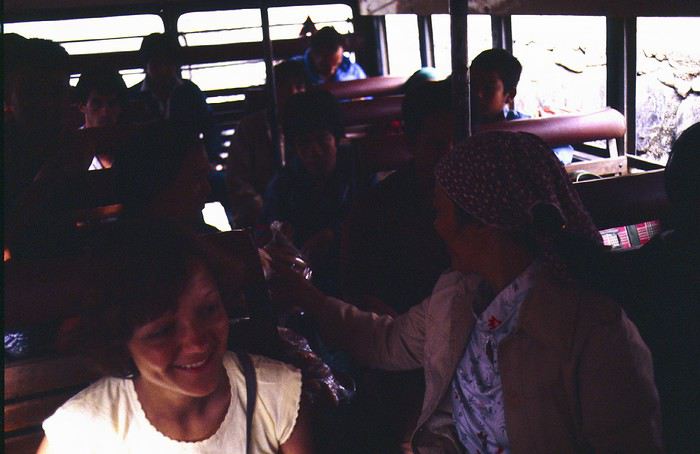
The “road” was a dirt track (or rather, a mud track) with endless turns. We held on as best we could to our slippery wooden seats—it was shaking in every direction. The woman behind us was carsick and throwing up... gross... but what were we doing there? Then we plunged into the Sierra Madre... just the name is dreamy!
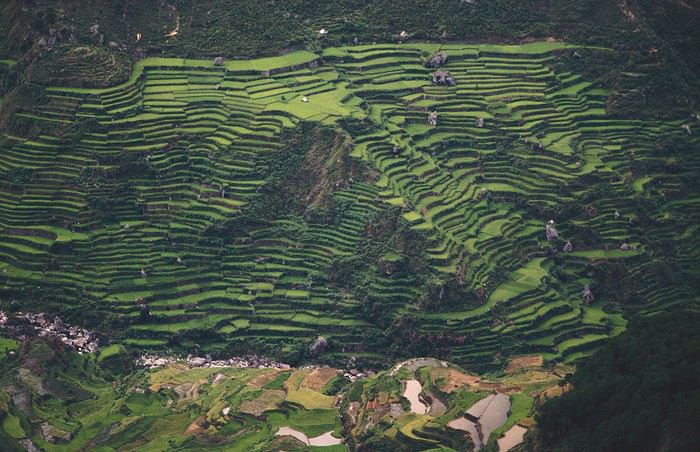
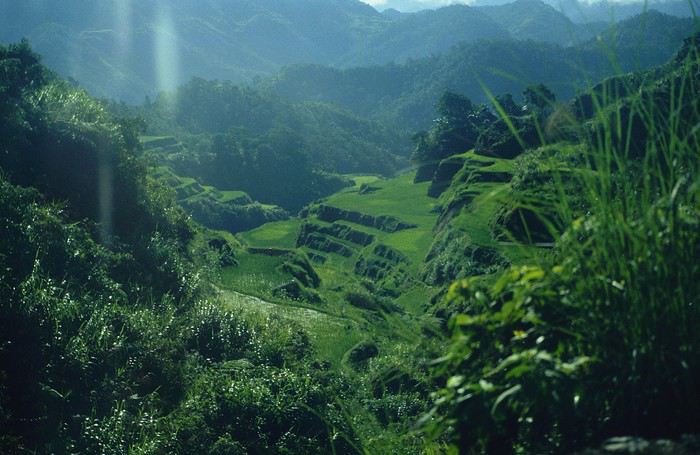
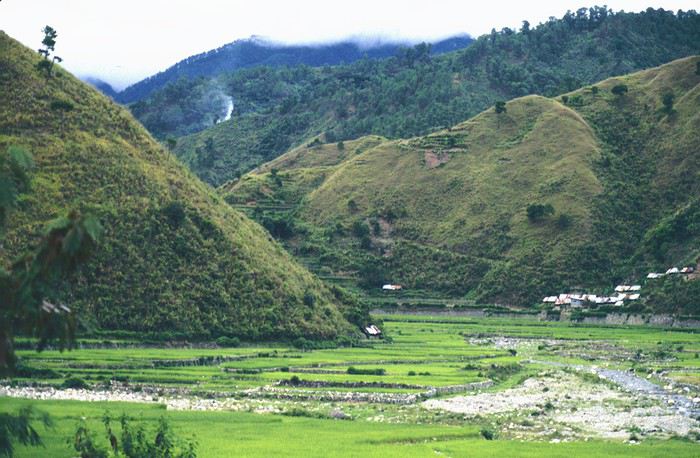
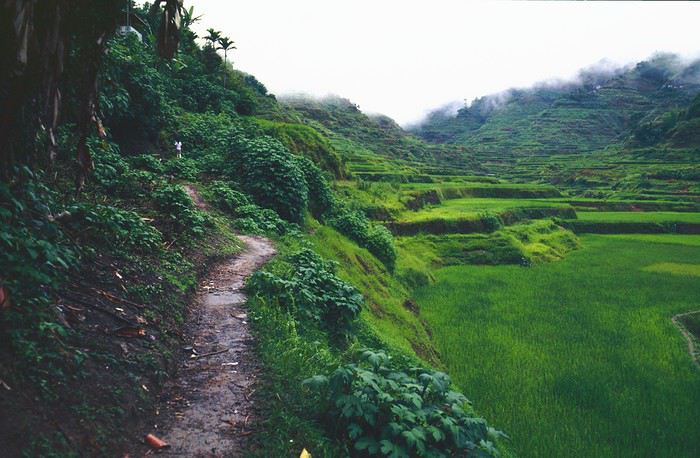
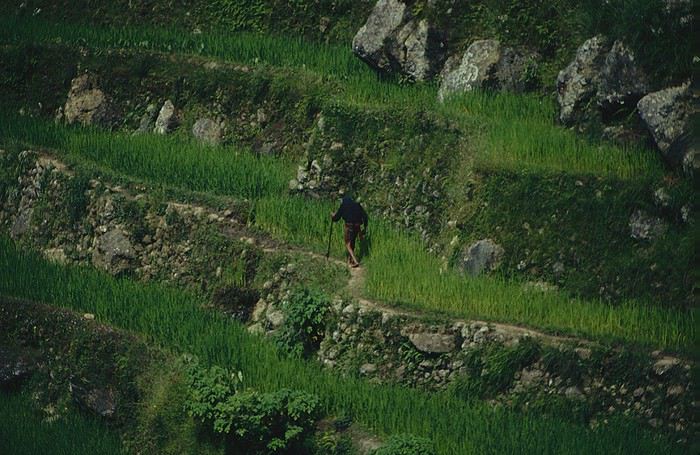
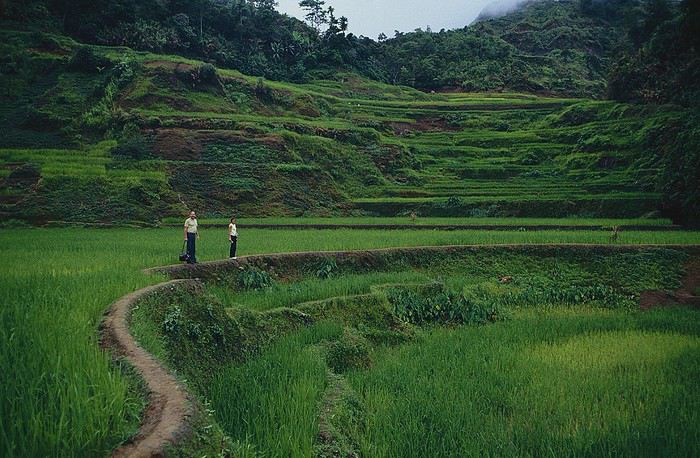
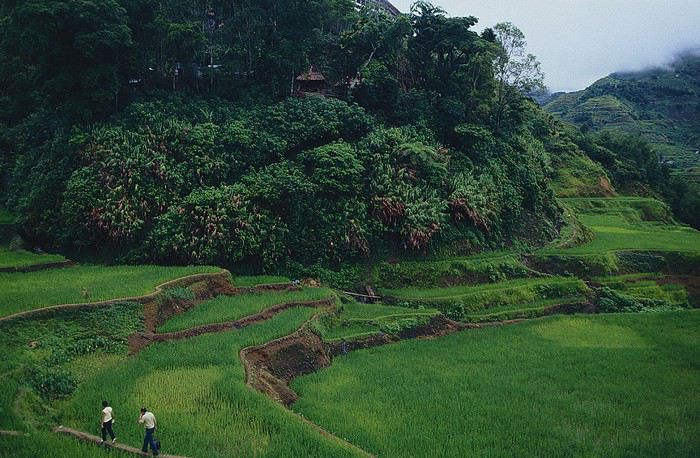
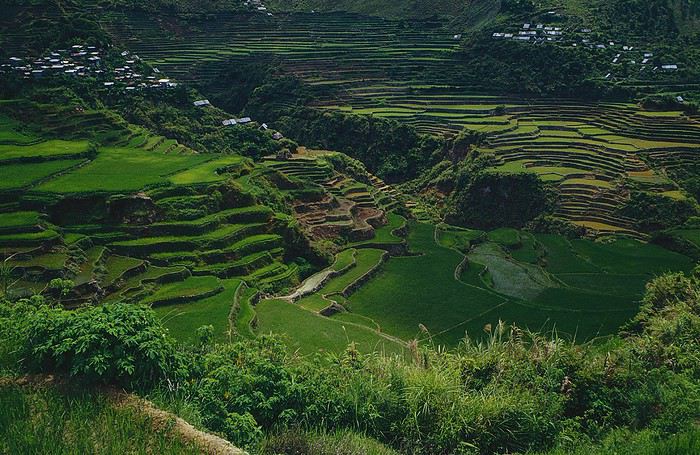
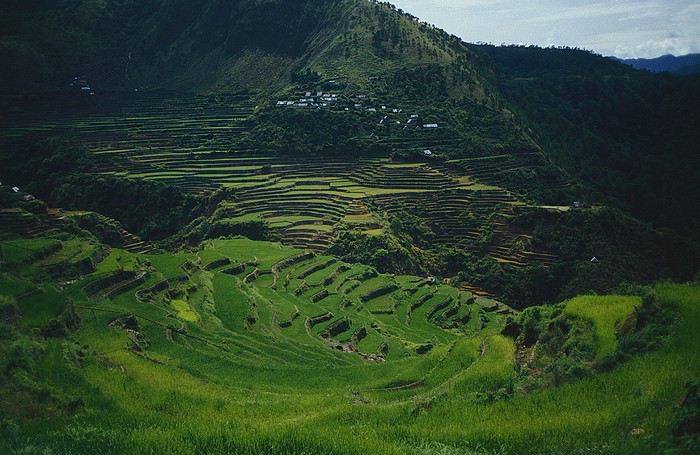
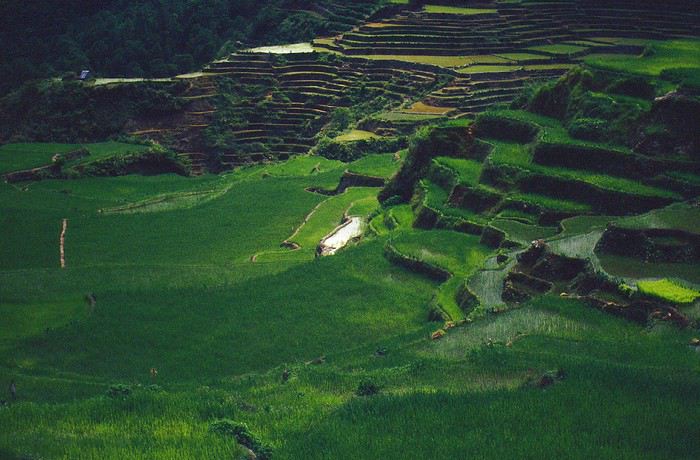
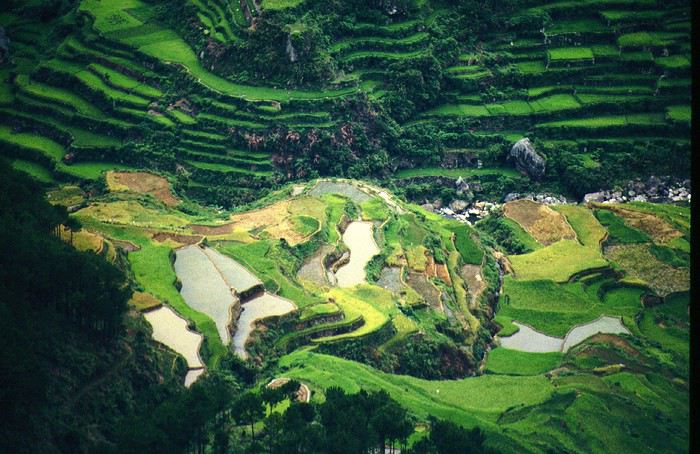
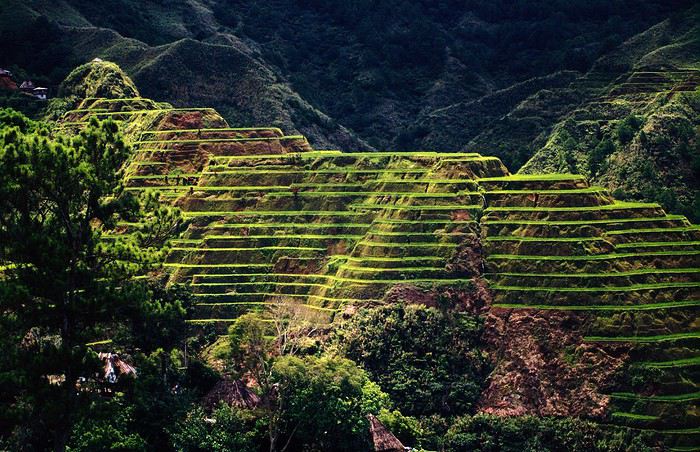
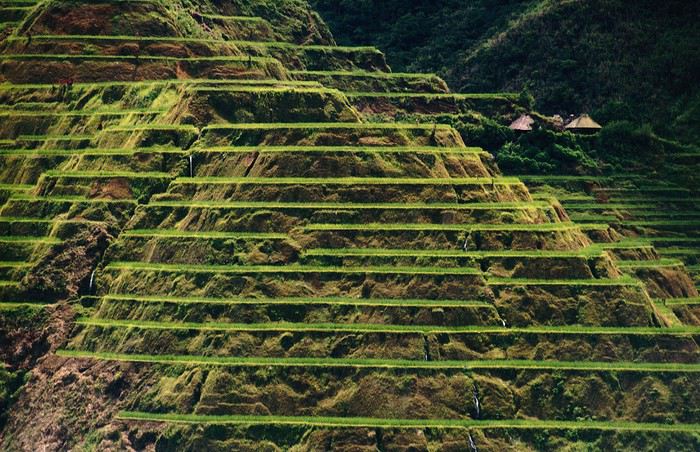
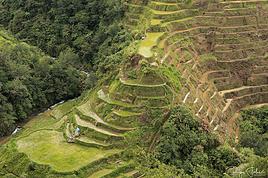
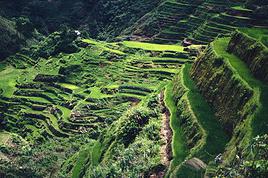
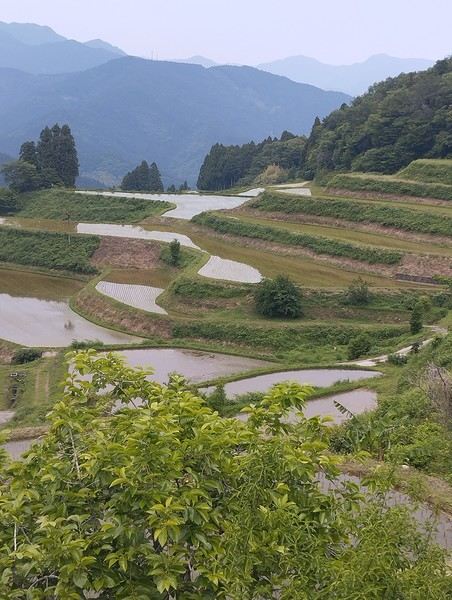
Rice terraces started to appear:
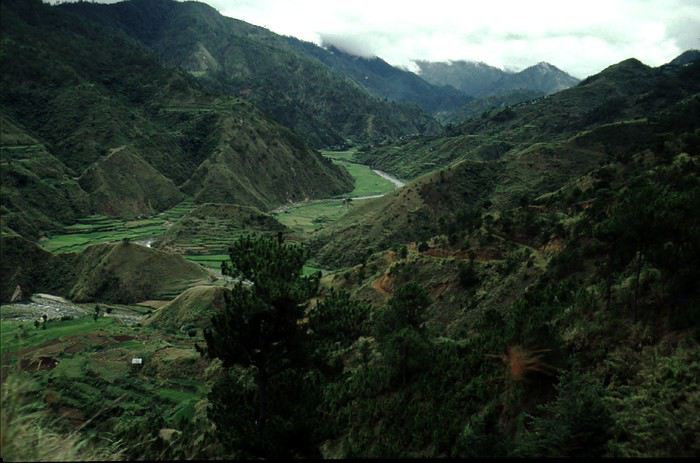
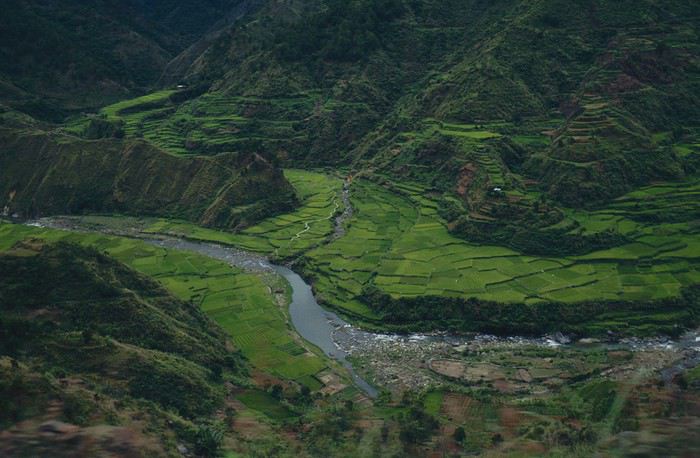
they took up more and more space along cliffs where we weren’t always reassured,
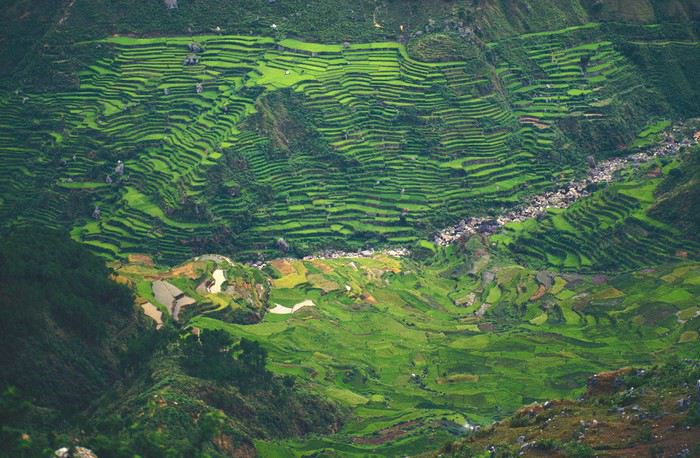
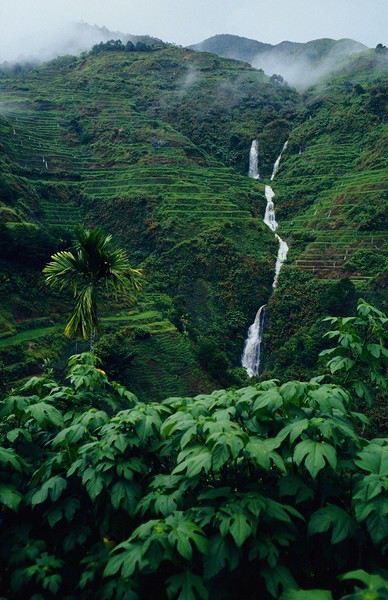
with lots of waterfalls (all that water had to go somewhere).
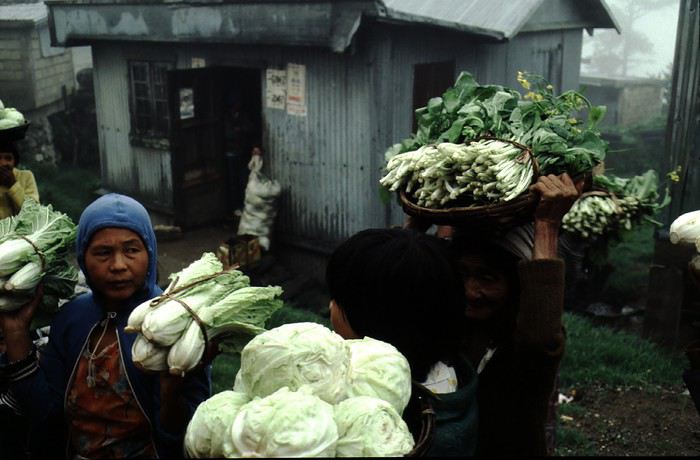
A few miserable villages stretched along the track, most often just a few houses balancing between the road and the drop. The bus stopped in every village—people got on or off and settled inside or on the roof. Street vendors offered their products to the bus passengers—a common sight in Asia, even today.
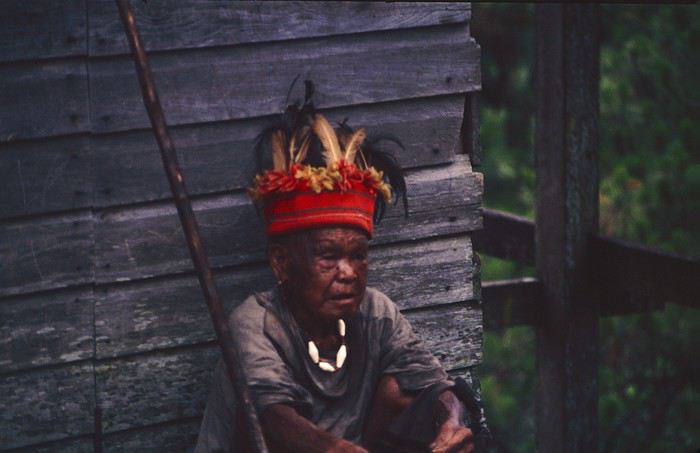
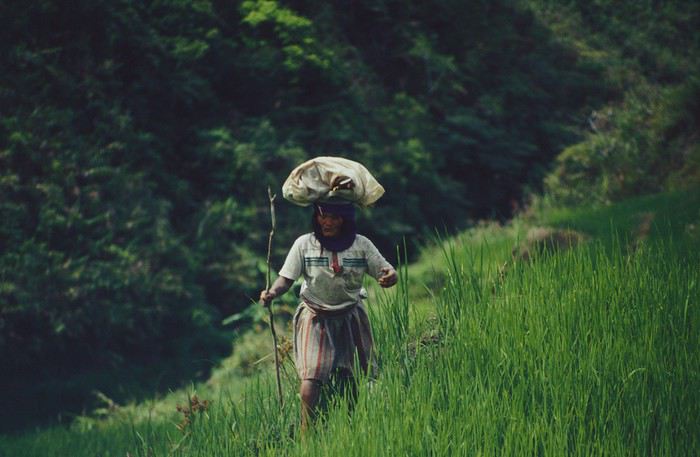
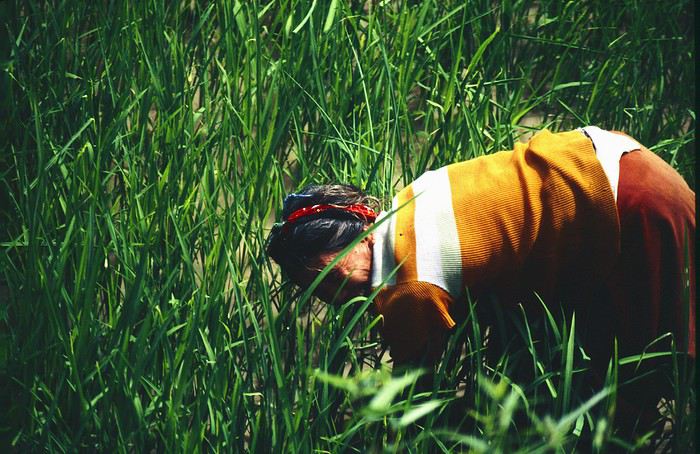
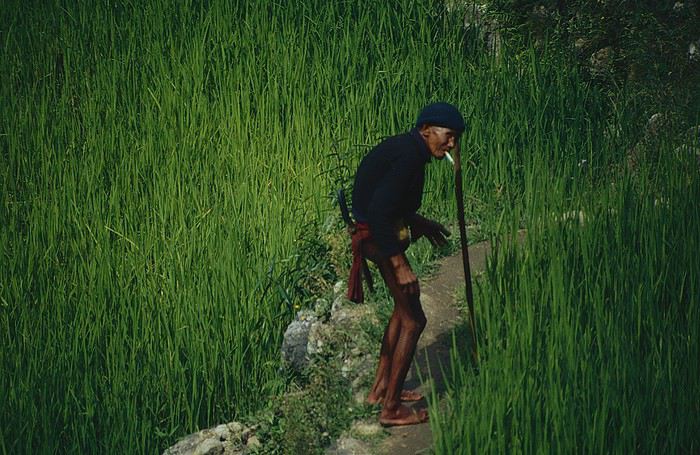
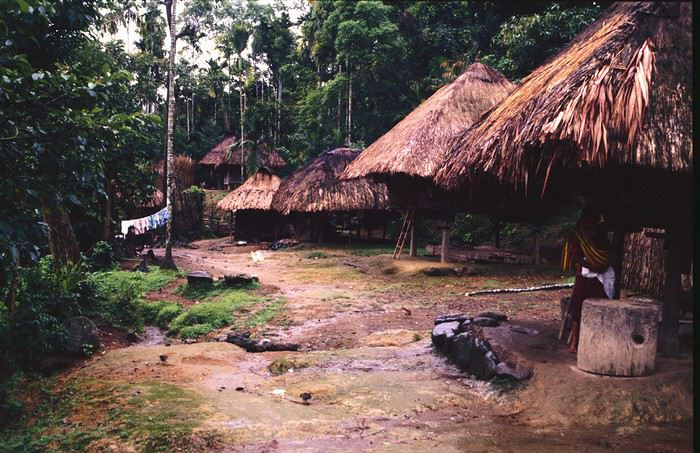
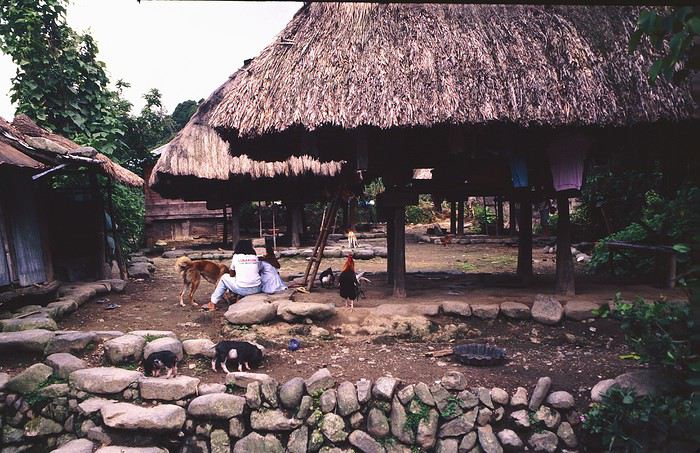
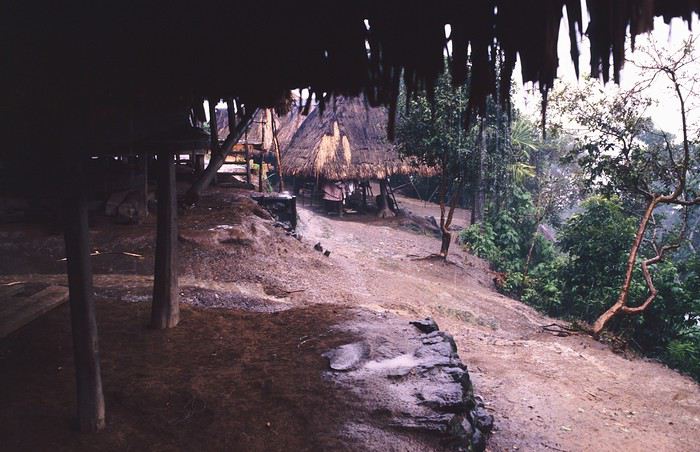
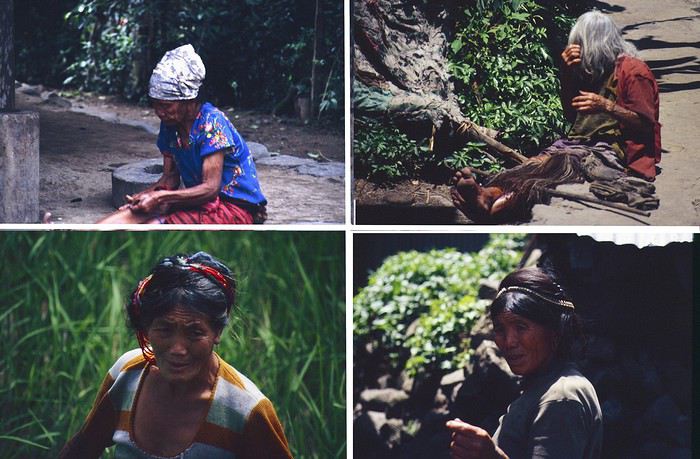
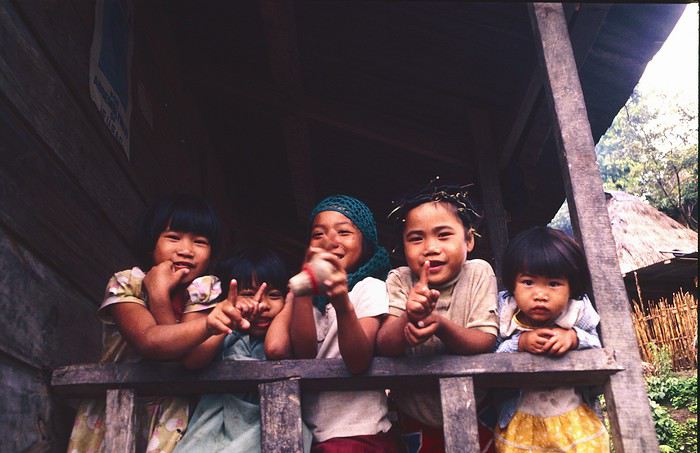
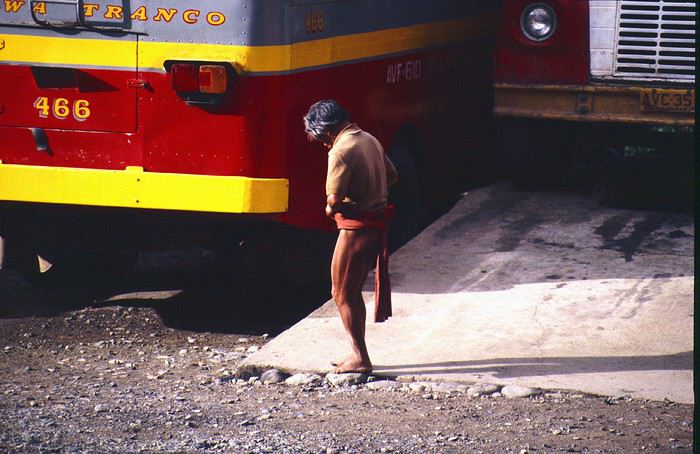
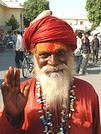
We were in another world—villagers were in loincloths, others had spears. The atmosphere was strange... but all good, we wanted exoticism, and we got it:
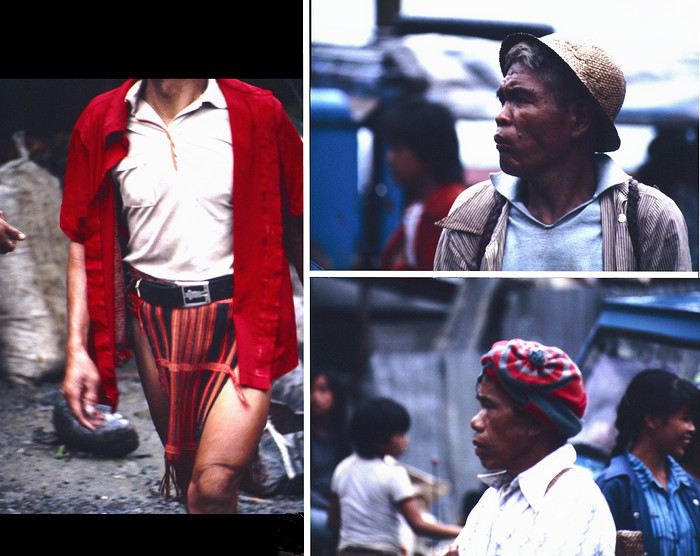
This so-called traditional outfit was everyday wear—it wasn’t for tourists since there weren’t any.









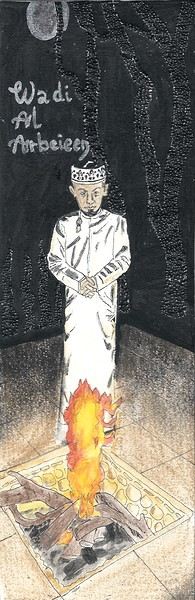
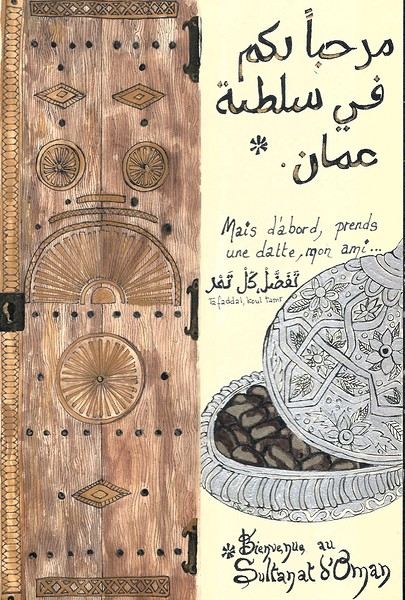 A droite, le "marqueur" de l'accueil, ces dattes qu'on vous offre partout en signe d'hospitalité. A gauche, un hommage à ces sublimes portes usées par les temps, qu'on admire un peu partout dans les quartiers anciens, y compris ceux qui sont abandonnés.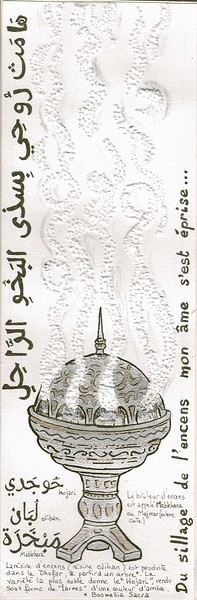
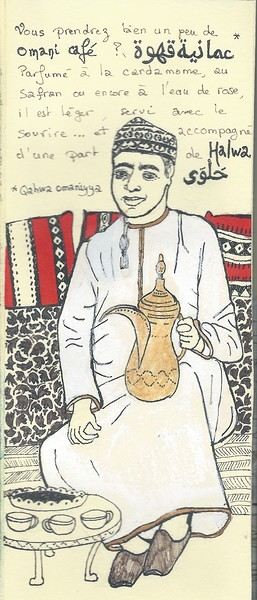 L'hospitalité vous conduira à accepter aussi souvent un petit café, un "omani café", très léger, parfumé subtilement avec de la cardamome, pourquoi pas un peu de safran, et éventuellement un peu d'eau de rose.
J'ai ici représenté un homme dans l'habit commun usuel de tous les omanais : la dishdasha, majoritairement blanche (en semaine, en journée, la couleur est davantage pour le soir ou le vendredi et le samedi). Même si l'on voit des hommes habillés à l'occidentale, ils sont très peu nombreux. La dishdasha blanche est vraiment l'habit commun partagé par tous les hommes. La dishdasha, qui n'a pas de capuche, se distingue par un petit pompon accroché au col, la furakha, qu'on imbibe de parfum. Et croyez moi, les omanais en abusent! "ça sent le pompon" est une expression qui est maintenant passée dans notre langage commun, à mon mari et moi.
Autre incontournable de la tenue masculine, la kuma, ce petit couvre-chef rond, la plupart du temps blanc rehaussé de motifs aux couleurs vives. Le keffieh est aussi porté (mais sans le cordon appelé agal dans les pays arabes), et il est plutôt arboré par ceux dont les racines sont dans le désert, de ce que j'en ai compris.
Et les femmes, me direz vous? Voilées, pour certaines en noir intégral (mais pas la burka, plutôt le chador + Abaya), du fait de l'influence de l'Arabie et des émirats arabes unis, alors que le vêtement traditionnel était auparavant plutôt une superposition de robes très colorées. La plupart des femmes que nous avons vues portaient plutôt une tenue neutre, un voile uni sur les cheveux, mais le visage découvert. Nous avons vu aussi beaucoup de saris et de voiles colorés, il ne faut pas oublier que 40% de la population est constituée d'immigrants indiens, népalais, bengalais, qui travaillent beaucoup dans le tourisme, l'hôtellerie et la restauration, les services, mais aussi tous les travaux ouvriers.
Je précise qu'en tant que touriste il n'y a aucune pression pour porter un voile, jamais de regards désapprobateurs d'aucune sorte. Bien sûr, on gardera pour la terrasse de l'hôtel les mini shorts, les décolletés plongeants, les épaules et ventres dénudés, mais j'ai envie de dire que c'est pareil pour les hommes et les femmes et que le soleil étant vif c'est aussi meilleur pour la peau.
Voici pour cette introduction ! Au prochain post, je vous parlerai de mon itinéraire et on pourra se lancer!
L'hospitalité vous conduira à accepter aussi souvent un petit café, un "omani café", très léger, parfumé subtilement avec de la cardamome, pourquoi pas un peu de safran, et éventuellement un peu d'eau de rose.
J'ai ici représenté un homme dans l'habit commun usuel de tous les omanais : la dishdasha, majoritairement blanche (en semaine, en journée, la couleur est davantage pour le soir ou le vendredi et le samedi). Même si l'on voit des hommes habillés à l'occidentale, ils sont très peu nombreux. La dishdasha blanche est vraiment l'habit commun partagé par tous les hommes. La dishdasha, qui n'a pas de capuche, se distingue par un petit pompon accroché au col, la furakha, qu'on imbibe de parfum. Et croyez moi, les omanais en abusent! "ça sent le pompon" est une expression qui est maintenant passée dans notre langage commun, à mon mari et moi.
Autre incontournable de la tenue masculine, la kuma, ce petit couvre-chef rond, la plupart du temps blanc rehaussé de motifs aux couleurs vives. Le keffieh est aussi porté (mais sans le cordon appelé agal dans les pays arabes), et il est plutôt arboré par ceux dont les racines sont dans le désert, de ce que j'en ai compris.
Et les femmes, me direz vous? Voilées, pour certaines en noir intégral (mais pas la burka, plutôt le chador + Abaya), du fait de l'influence de l'Arabie et des émirats arabes unis, alors que le vêtement traditionnel était auparavant plutôt une superposition de robes très colorées. La plupart des femmes que nous avons vues portaient plutôt une tenue neutre, un voile uni sur les cheveux, mais le visage découvert. Nous avons vu aussi beaucoup de saris et de voiles colorés, il ne faut pas oublier que 40% de la population est constituée d'immigrants indiens, népalais, bengalais, qui travaillent beaucoup dans le tourisme, l'hôtellerie et la restauration, les services, mais aussi tous les travaux ouvriers.
Je précise qu'en tant que touriste il n'y a aucune pression pour porter un voile, jamais de regards désapprobateurs d'aucune sorte. Bien sûr, on gardera pour la terrasse de l'hôtel les mini shorts, les décolletés plongeants, les épaules et ventres dénudés, mais j'ai envie de dire que c'est pareil pour les hommes et les femmes et que le soleil étant vif c'est aussi meilleur pour la peau.
Voici pour cette introduction ! Au prochain post, je vous parlerai de mon itinéraire et on pourra se lancer! Come along, I'm taking you to this country where it's so nice to wander and slow down...
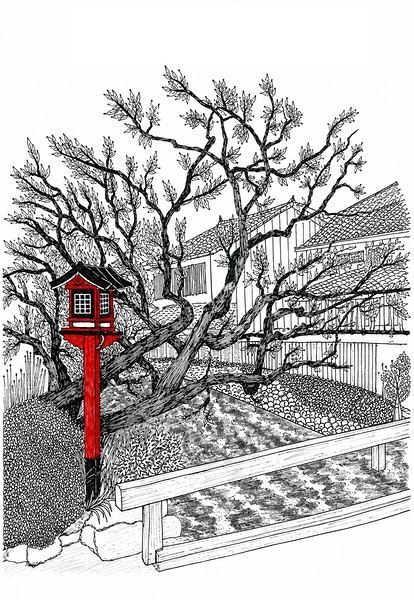 I’m inviting you on a stroll through my drawings—a completely subjective, far from exhaustive, and totally personal take, since it’s based on my own sketches. I put this travel journal together after returning in late 2024, mostly using felt-tip pens and pencils, with a few collages thrown in. I worked from our personal photos.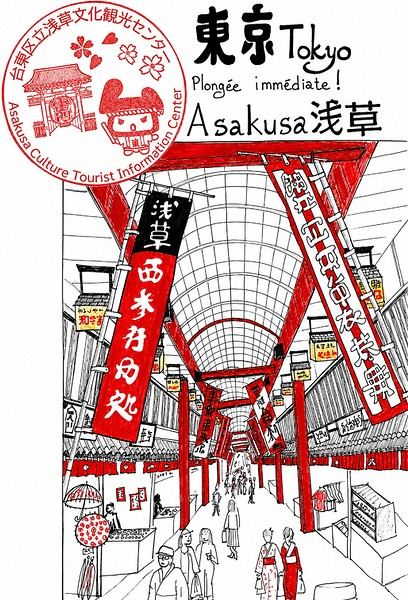
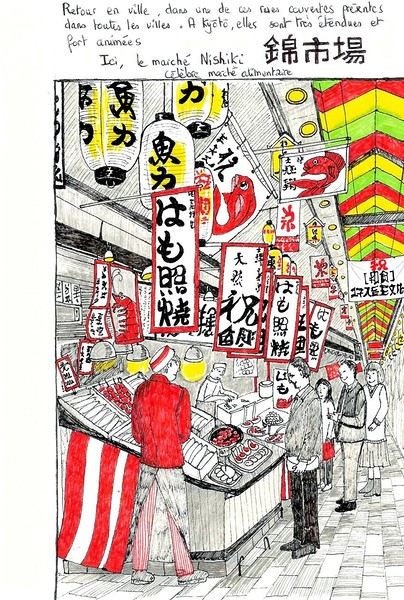
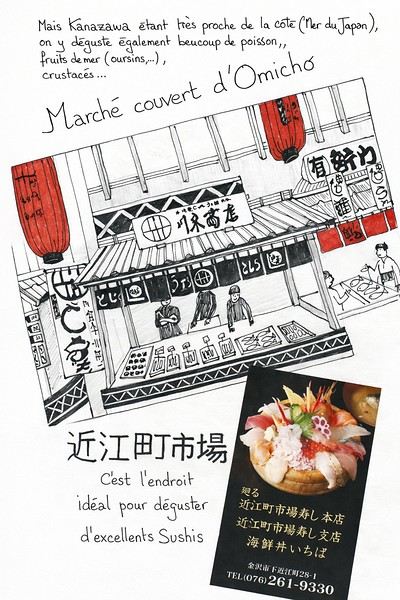 And in Kyoto, Nishiki Market:
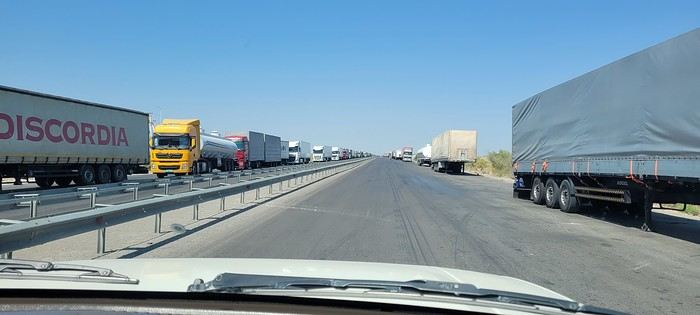
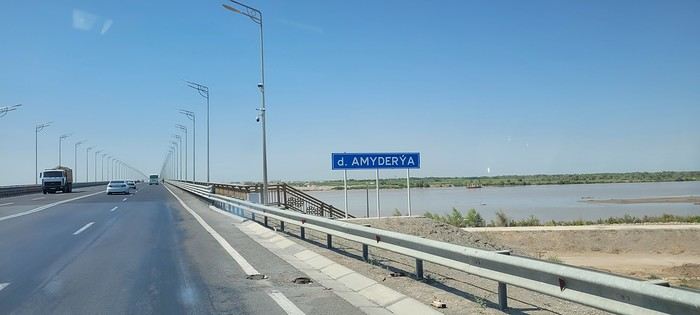
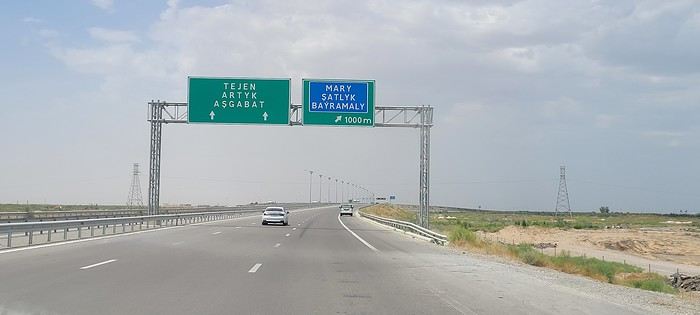
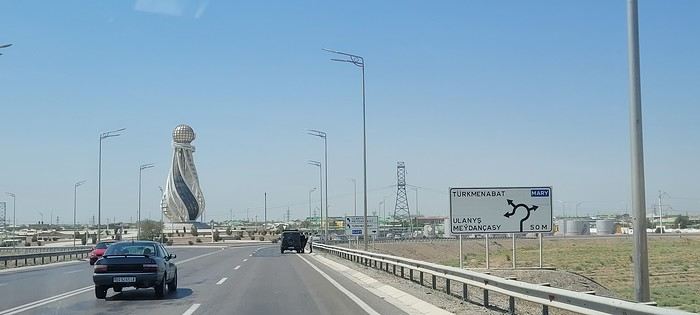
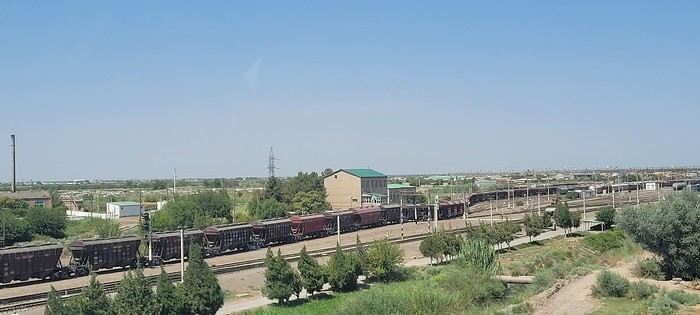
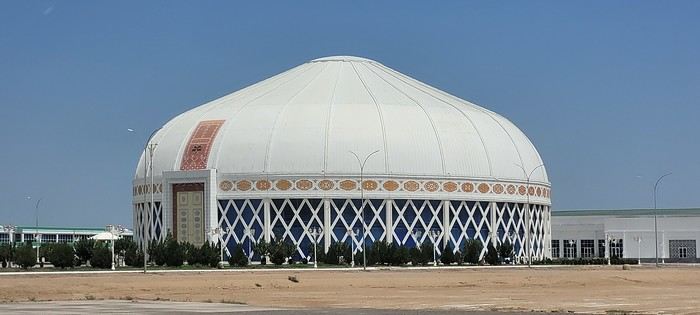
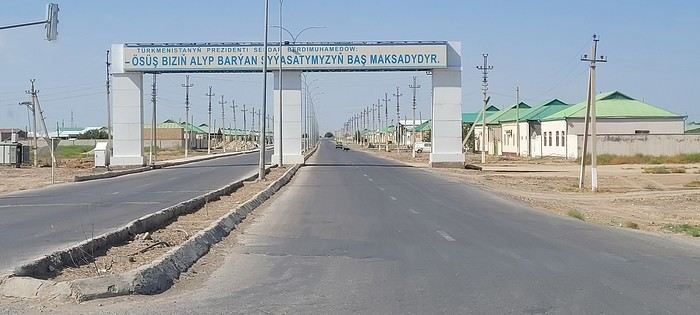
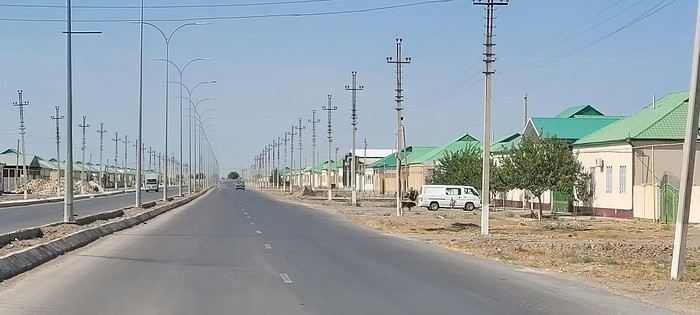 Les ronds-points sont particulièrement intéressants puisqu'on y retrouve des emblèmes de la culture turkmène, soit le chien, soit un tapis, soit le cheval Ahal Teke soit des symboles musulmans, même si la présence d'artefacts islamiques est assez réduite.
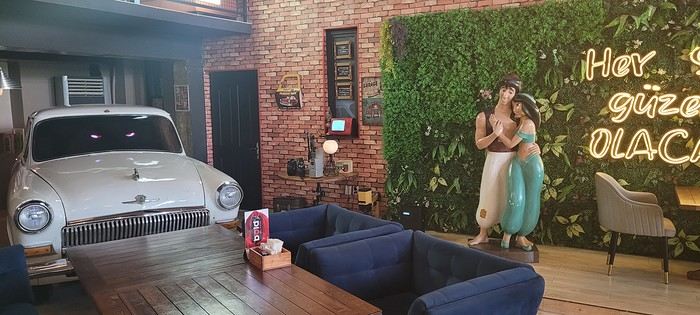

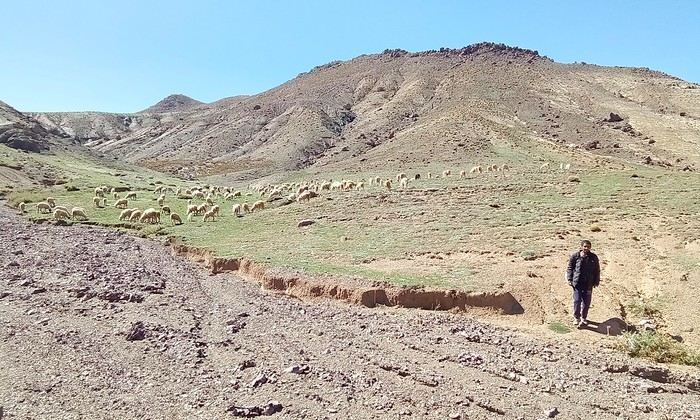
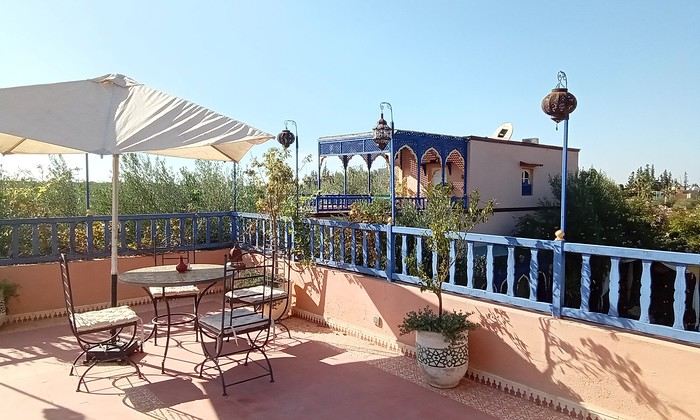
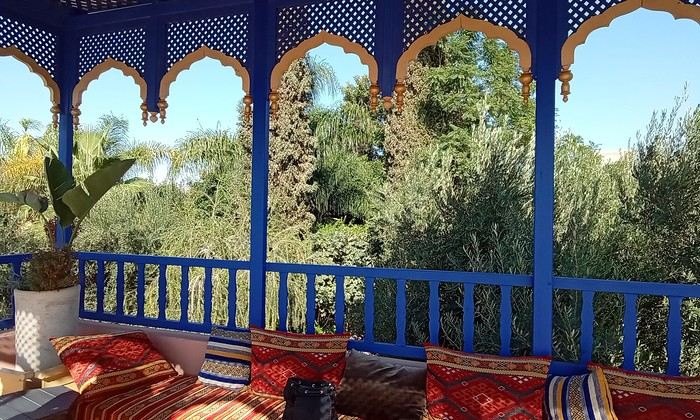 Last October, we landed in Marrakech to spend a few days with family exploring Morocco’s roads.
Transport: a rented Dacia.
Accommodations: small guesthouses.
Last October, we landed in Marrakech to spend a few days with family exploring Morocco’s roads.
Transport: a rented Dacia.
Accommodations: small guesthouses.
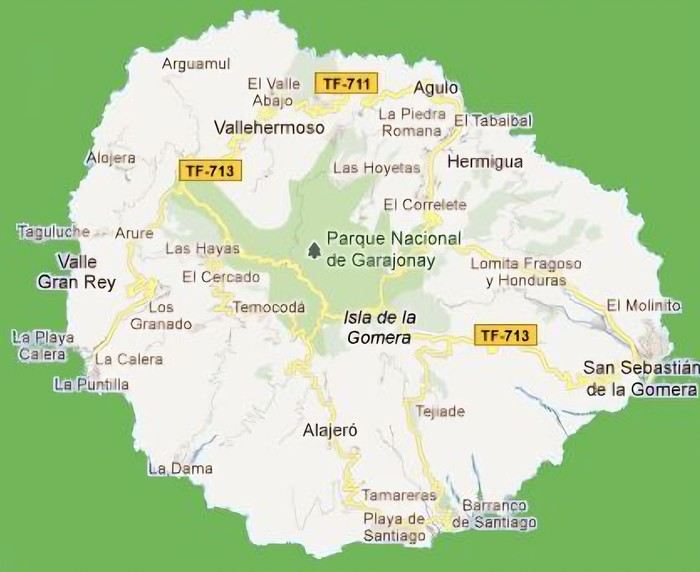 The large solidified magma massifs that shape the heart of the island have created a large depression more protected from the sun at its center, allowing the growth of a vast laurel forest, today grouped within the Garajonay National Park, La Gomera’s green lung, which has earned it the status of a World Biosphere Reserve. Its completely European appearance contrasts sharply with the rocky and tropical landscapes of the rest of the island. Thus, the climate varies greatly from one point to another on the island: in summer, you can quickly go from a dry and sunny valley at 35°C to a humid forest area at altitude at 18°C.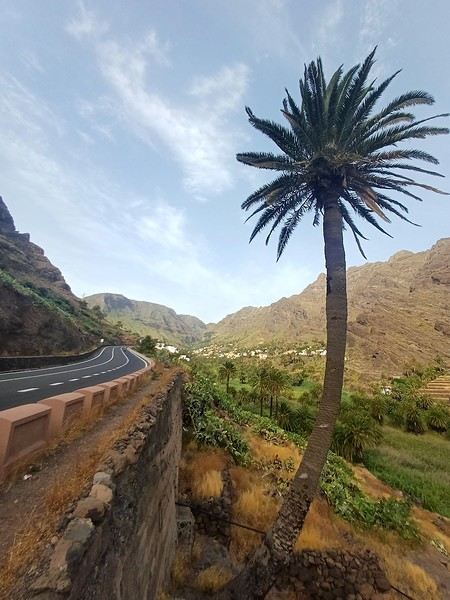
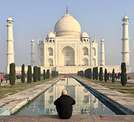
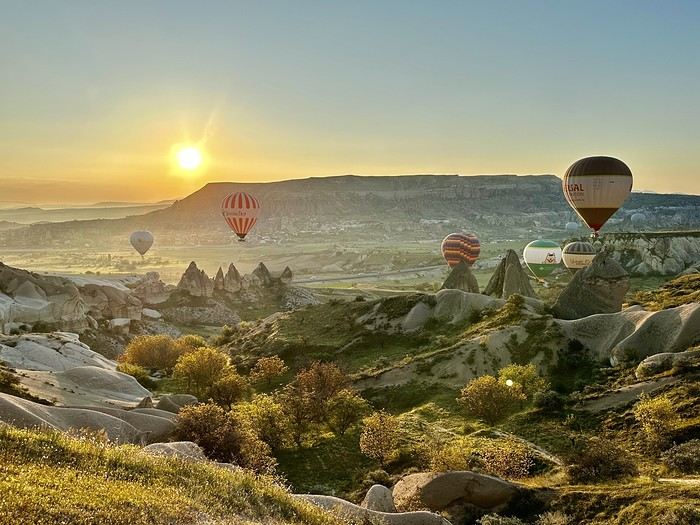 A little sneak peek?

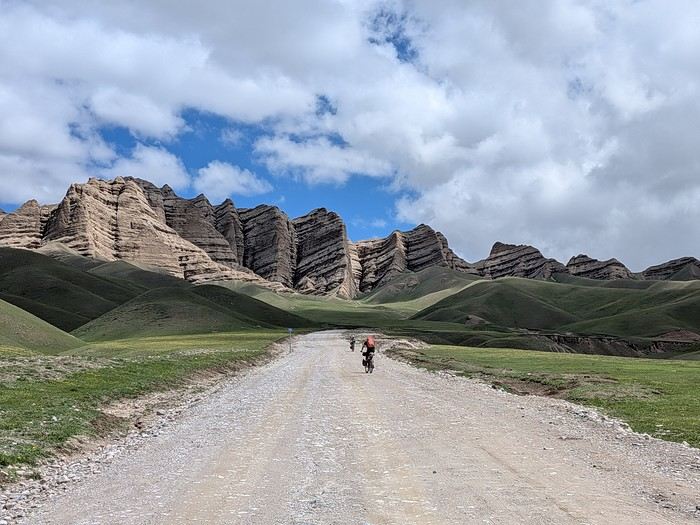
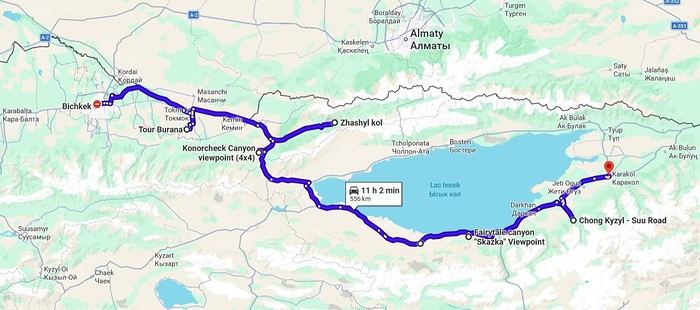
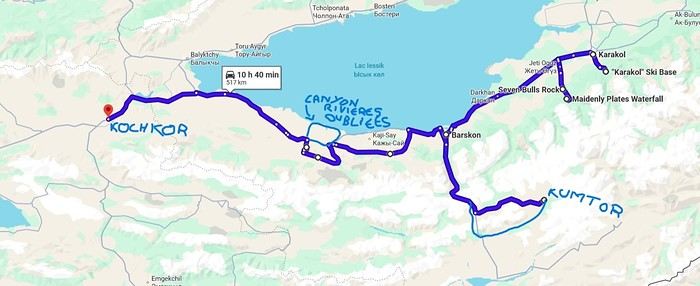
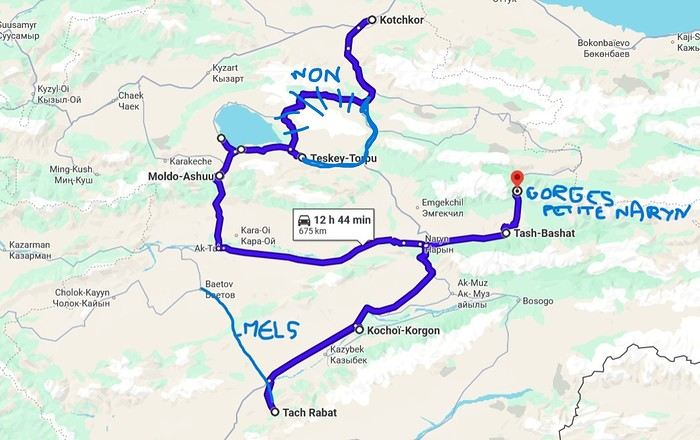

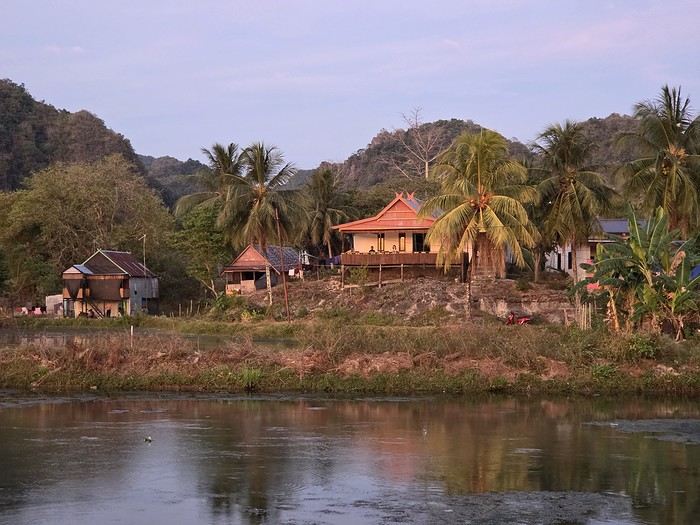
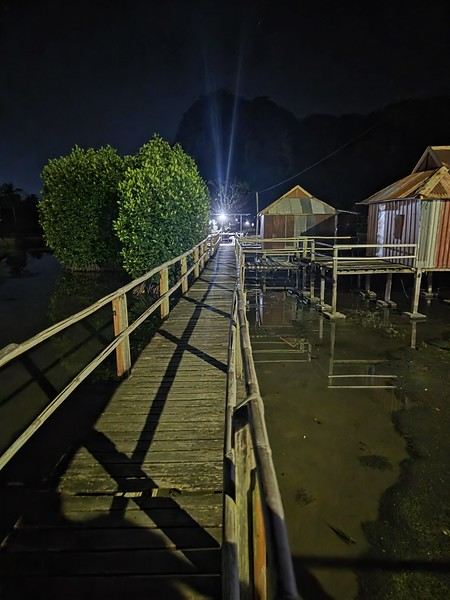
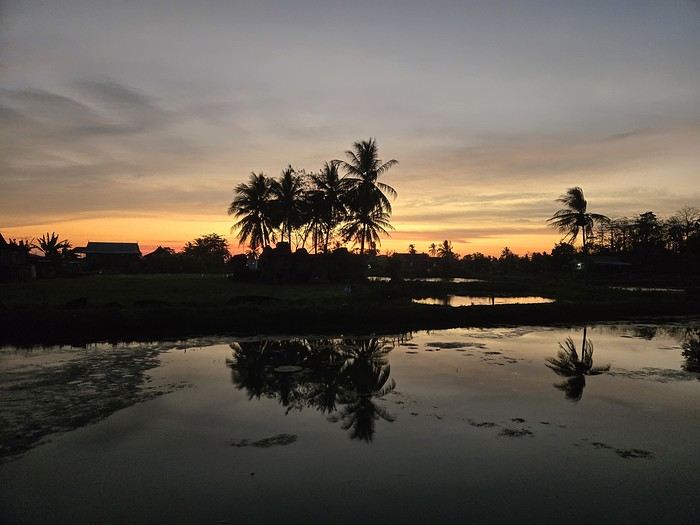
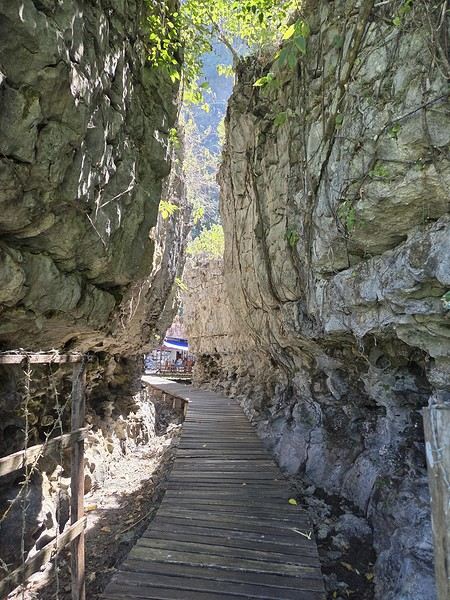
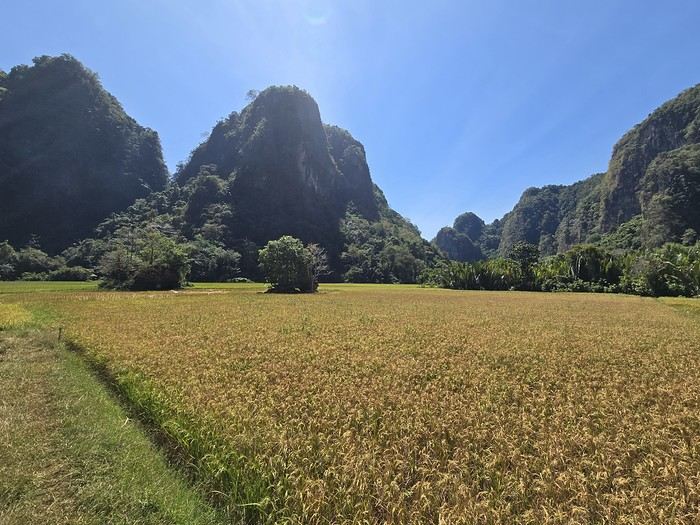
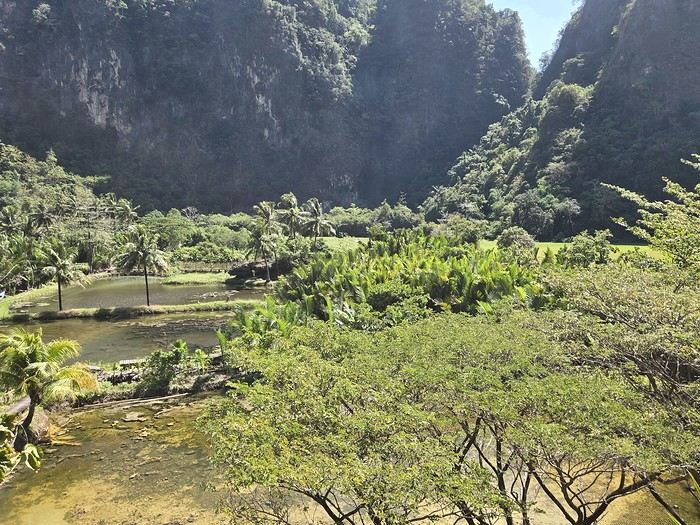
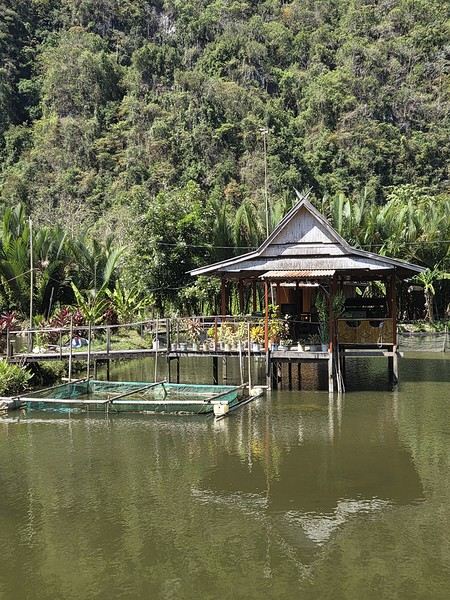
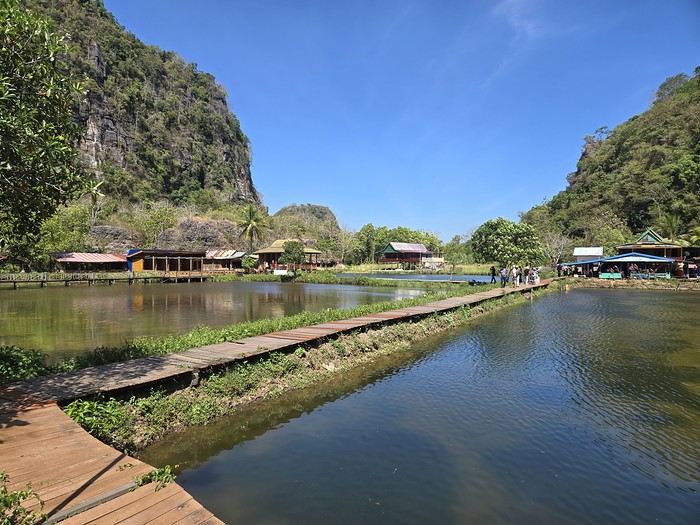
 The karst site:
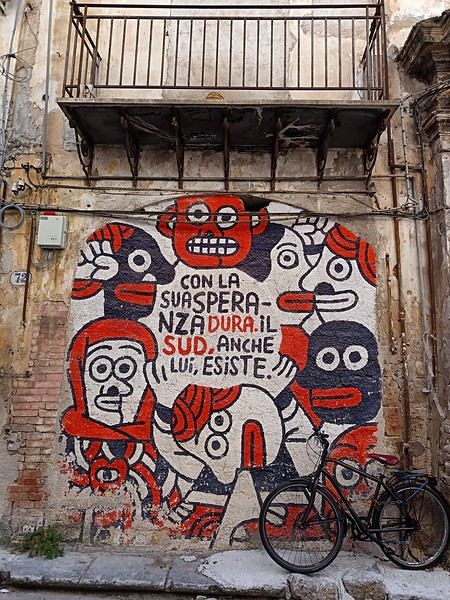 (In the heart of Albergheria, on a street every visitor walks down—lovely message from an unidentified artist)

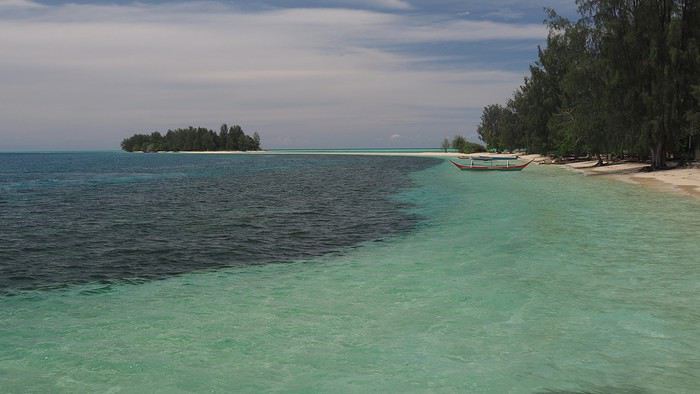
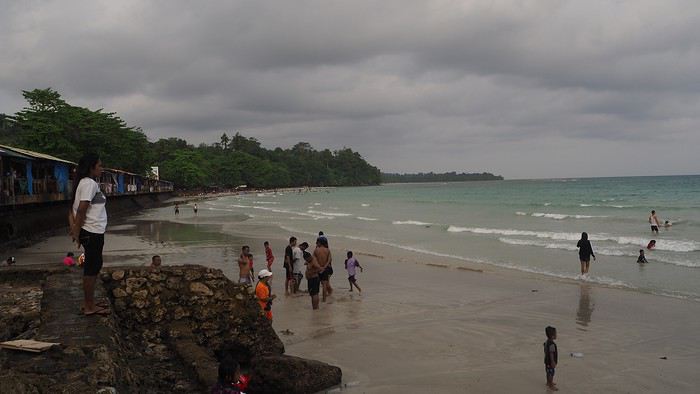
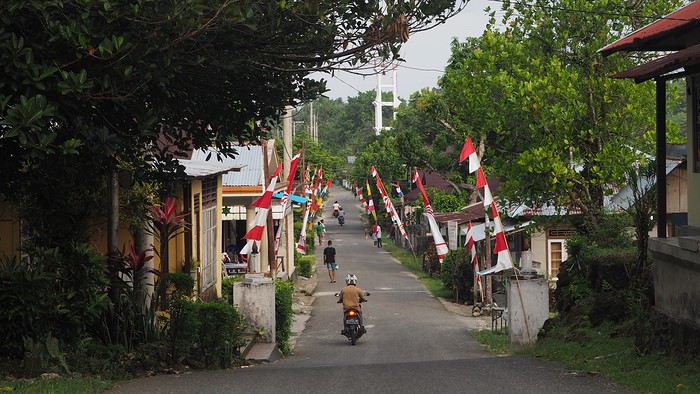
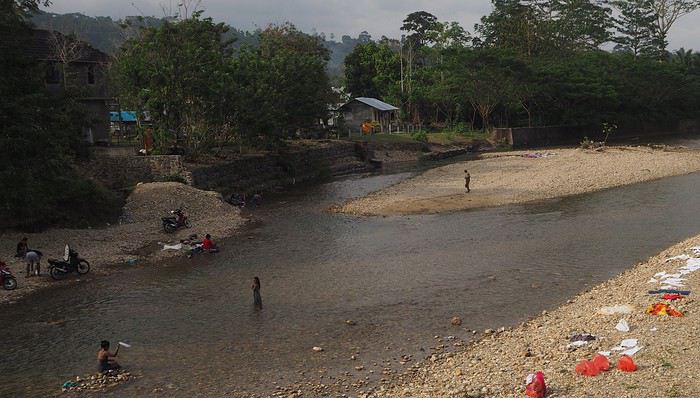 Laundry and trucks washed in the same stream.
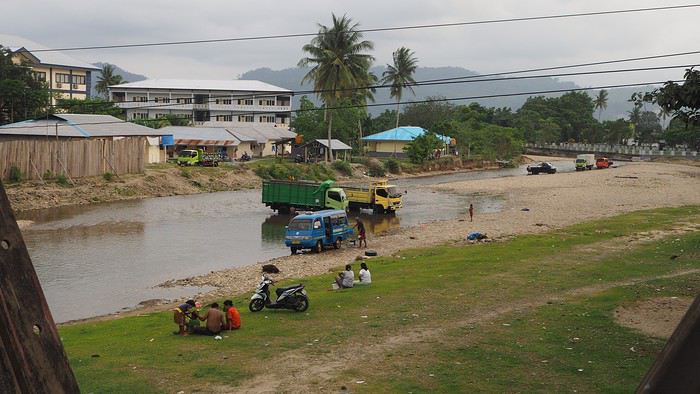
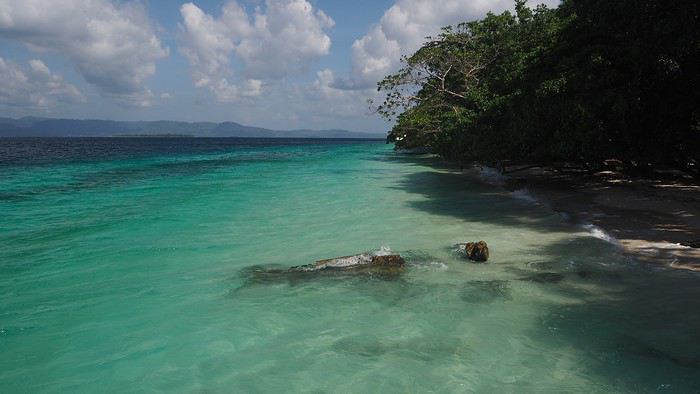
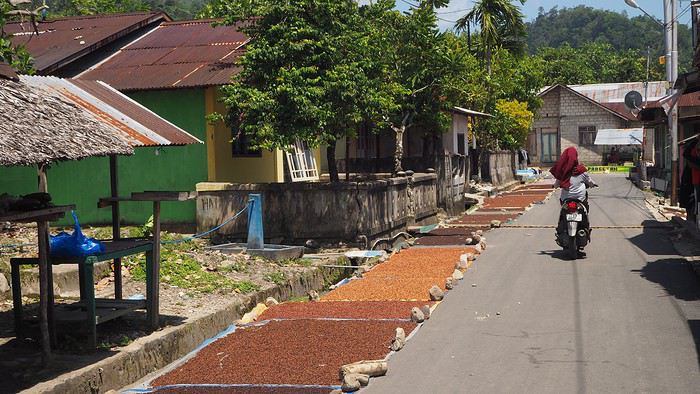
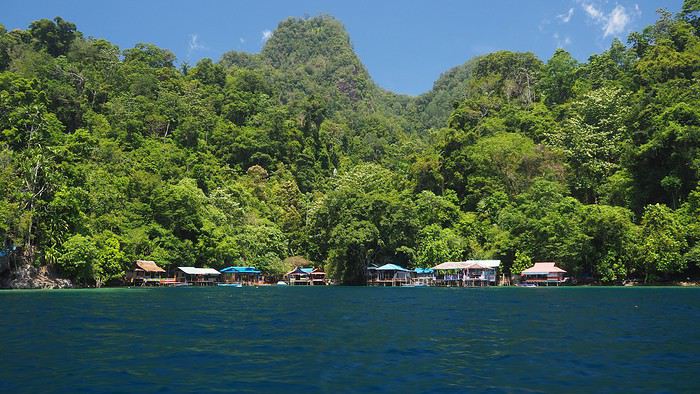 We’re greeted dozens of times with “Hello Mister”—a daily routine in the Moluccas. Every time we stop, we pose for photos to be saved on locals’ smartphones. They don’t see tourists often.