Results for "Philippines+itinéraire"
About 10,092 results.
More options
Many results are in French, the community’s main language. English translations are added over time.
Search results
Adventures of a Bygone Era: The Philippines in 1984
After several discussions on VF about travel journals from the Philippines, I decided to write this curiosity: a trip report from a journey made in 1984, when traveling to the Philippines was still an adventure.
A curiosity because writing a travel journal about a trip 35 years later isn’t common, but also (mostly?) because exploring the Philippines at that time had little in common with traveling there today.
Obviously, I’ve forgotten a number of facts, most of the details, but with the help of a few notes from that time and a stack of slides (yes, there was life before digital 😊), many memories came back and added to the highlights I’d never forgotten. The scanned slides aren’t always great quality, but there are still quite a few to brighten up this chatter. Back then, we didn’t snap photos like we do now—film was too expensive—so I don’t have pictures of every place we visited... too bad, comparing some of those spots to how they look today would’ve been interesting.
Why "Adventures"? Why call it "Adventures" in the Philippines in 1984, a word so often used for a simple exotic trip? - Because the lack of information (no *Guide du Routard*, no *Lonely Planet*, no *Michelin Guide*, nothing, and obviously no internet) gave this trip what’s at the heart of adventure: the unknown. - Because the political situation made the stay sometimes dangerous. - Because transportation conditions were always epic, often perilous. - Because the question of where we’d spend the night came up almost every evening. - And for... quite a few other reasons.
That said, we weren’t exactly explorers!
Why the Philippines? First of all, why go to the Philippines in 1984—a country not exactly set up for tourism and about which we knew very little? How could we get an idea of the beauty of the Philippines and its points of interest when we had no guides or photos?
The idea came to us from Thailand a year earlier, during our first long-haul trip. After touring the north of the country, we met a Frenchman living in Phuket, where there were only a few tourists in Patong, with just a few small hotels and guesthouses. Kata and Karon had no buildings or roads, Rawai only had three palm-thatched bungalows, including ours, and the other islands were unknown to tourists. There was plenty to discover, and we wanted to return to this beautiful country... but the Frenchman made us dream about the Philippines—a country to explore, with wild landscapes.
Long evenings of discussion over multiple Sprite-Mekong cocktails (what memories of those headaches!) finally convinced us we had to go to the Philippines.
Episode 0: Before Departure The decision was made: we’d go to the Philippines in May 1984. Our friends and family were surprised when we announced we were going on vacation to the Philippines (a bit like saying today we were going paddleboarding in the Kerguelen Islands 🤪).
These days, preparing for each of our trips takes long evenings of research, planning, and noting down good addresses... etc. But for the Philippines in 1984, preparation was quick: we had very little information about the country, we were leaving almost at random, and the discovery would only be more exciting.
We still had a few bits of info gathered here and there: the rice terraces in northern Luzon, volcanoes, Negros where we were supposed to visit an acquaintance, Cebu and its marine life (we ended up going elsewhere), and absolutely avoid Mindanao, which was practically at war with the regime. That was about it, but it was already a great itinerary.
Nothing was organized in advance; we’d see day by day. We had no idea about travel times or even the existence of transportation options. The main (and sometimes only) way to connect two islands was by overloaded, rusty ferry. Only the big cities had airports.
Let’s Go: Episode 1: Paris to Manila My travel journals always start after arriving at the airport—the Europe-to-“Other Continent” trip isn’t interesting—but the flight to the Philippines was already an adventure, so I’ll make an exception.
This was the era when only a few Asian airlines were on par with Western ones: Thai, Singapore Airlines, and Philippine Airlines. They had beautiful, brand-new planes, and to attract customers (almost exclusively “businessmen”) from the usual airlines (Air France, Lufthansa, British Airways), there was opulence on board: unlimited champagne, all sorts of cocktails... Compared to today’s long-haul flights, there was still one small difference: no personal screens, just one screen at the front of the cabin with one mandatory movie. And I don’t know why, but we only got James Bond films, both ways... that must’ve been the trend at the time.
The tourism boom to Southeast Asia hadn’t started yet, and the “Asian Tigers” weren’t a thing, so there weren’t many business trips. That meant long-haul flights made stops everywhere to fill the planes. Our Philippine Airlines Boeing 747 left London, picked us up in Paris, then stopped in Frankfurt to take on a few Germans. I don’t know why we then made a stop in Dubai—a totally exotic place at the time. There was nothing to do there... things have changed a lot since. It was a small town lost in the desert. The airport was tiny, with just one or two buildings and a supermarket. During the stopover, everyone had to get off the plane and walk to the supermarket. Photo and electronic equipment were dirt cheap—I guess that was the only reason for the stop. Maybe it was their first commercial move. Emirates didn’t exist yet, as I checked online, but anyway, the idea that such a remote place could have its own airline was unthinkable.
Online, I found this photo of Dubai Airport in 1980. Anyone who’s transited through today’s massive airport with its rows of A380s will appreciate it: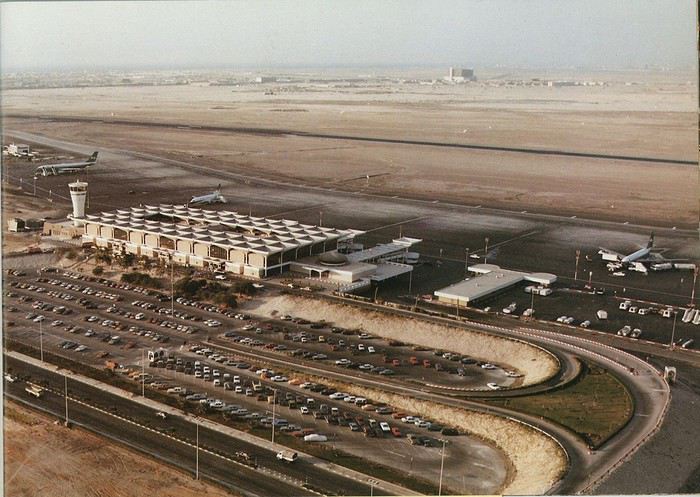
Next stop: New Delhi to drop off some Europeans and pick up a few Indians, and finally, the terminus: Manila. I don’t remember how long the trip took with its five stops—an unimaginable journey today. Despite all those stops to fill the plane, there was still enough space to stretch out on the four center seats of the 747, something that never happens these days despite all the flights in every direction.
So here we are, finally at Manila Airport around midnight.
Episode 1: Manila and Baguio To start, a quick note on the political and economic situation in the Philippines in 1984, which had consequences for us as tourists, as we’d soon realize upon arrival.
After several centuries of Spanish colonization, the Philippines became American at the start of the 20th century, then independent. In 1966, Marcos took power, and little by little, his regime sank into corruption and mismanagement, becoming a dictatorship with martial law, all for the benefit of his family and friends, who enriched themselves endlessly. The peak was the assassination of opposition leader Benigno Aquino in August 1983, which triggered harshly repressed protests. So we arrived a few months later in a very poor country, with omnipresent corruption and an extremely tense political situation, as we’d soon see for ourselves. Major protests took place in the main cities during our trip—I’ll come back to that. Two years later, Marcos fled to Hawaii after being forced out of power following rigged elections. This historical context explains a lot of the situations we found ourselves in over the following weeks.
Arriving in the middle of the night isn’t very cheerful. Manila was already a huge city with many slums, where you could find a few business hotels like the Hilton or Intercontinental—way out of our budget—and plenty of run-down hotels. Luckily, two Indians we’d chatted with on the plane offered to take us to their usual hotel. They came to Manila twice a year for business. We accepted their offer, relieved not to have to look for a place to stay in the middle of the night, figuring the address must be good since they came back every time... we were wrong 🙁
We left the airport and immediately got a taste of the local vibe when we got into the taxi: the police asked for our passports. We thought: what’s more normal than police in a dictatorship?
But that wasn’t it at all. Our two Indian friends explained that the police were noting our names along with the taxi number and time. Crime in Manila was so bad that the taxi driver would be held responsible if anything happened to us... welcome to the Philippines 😎 😎
Historically, the Philippines was a very violent country, where everything was settled with guns or machetes. Previous governments had banned carrying weapons, but Marcos later allowed the free sale and carrying of guns, and disputes were settled with pistols again (or worse, as we’d discover later). Since he’d released most of the criminals from prison to form a paramilitary militia at his service (I’ll talk about our encounter with these “heroes” later), it was pretty dangerous to go into many parts of Manila, where these “tonton macoutes” ruled.
We arrived at our hotel without incident... and then things started badly. The room was infested with big cockroaches—exactly what I hate most in those kinds of countries. No way to find another hotel at that hour. After the long flight, the urge to take a shower was so strong that we squeezed into the bathroom as best we could. After that, I don’t remember—I guess we must’ve fallen asleep exhausted under the sheets in the heat... air conditioning wasn’t widespread yet.
The next day, we just wanted to leave that dump as soon as possible. So we decided to head north right away, stopping in Baguio, and we’d visit Manila a bit on the way back.
When we stepped outside, we discovered a pretty run-down neighborhood with potholed streets. But we also discovered the jeepneys. They were everywhere, flooding the streets.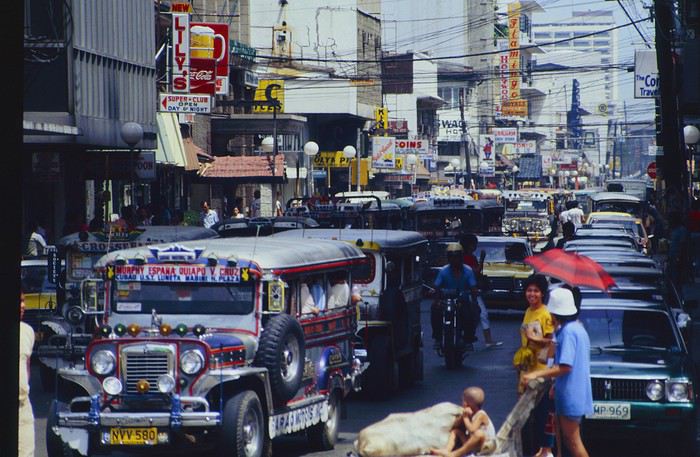
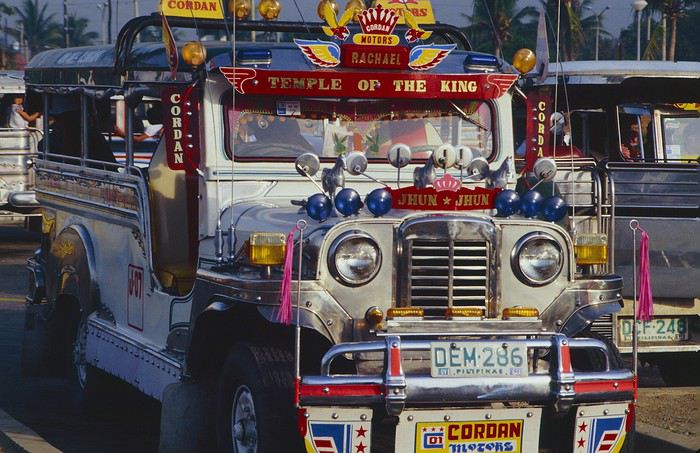
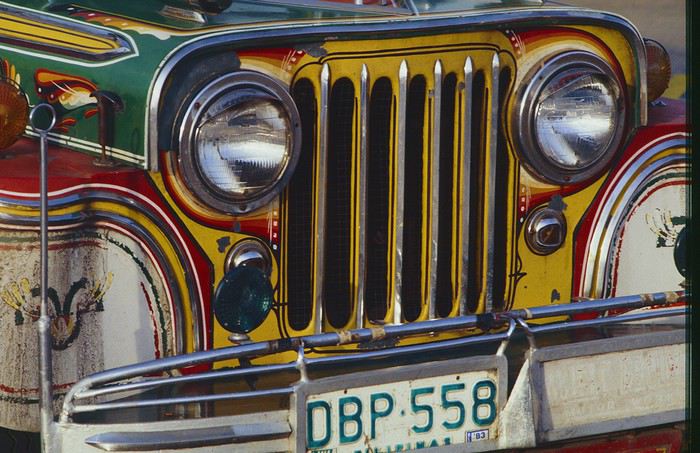
They had crazy sound systems, each one blasting louder than the last. The interiors were kitschy but fun. There weren’t many private cars—almost all transportation was by jeepney, with buses reserved for intercity trips.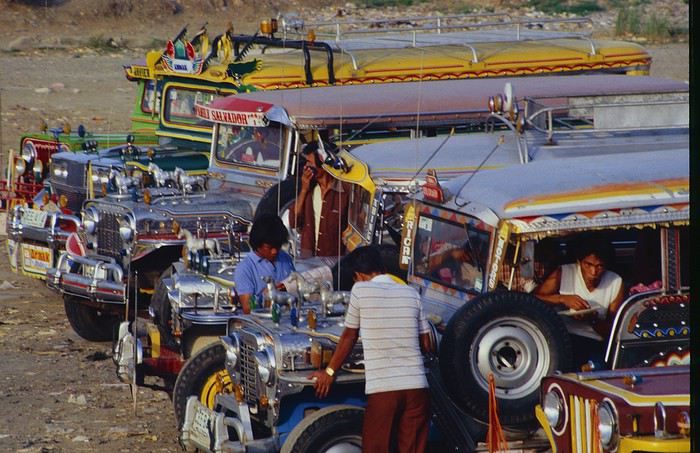
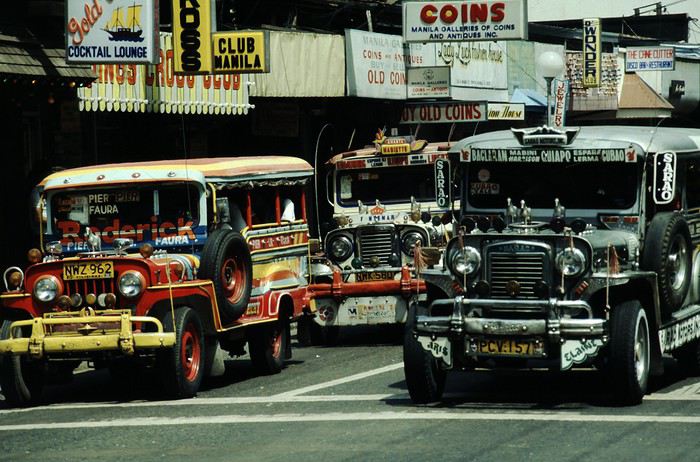
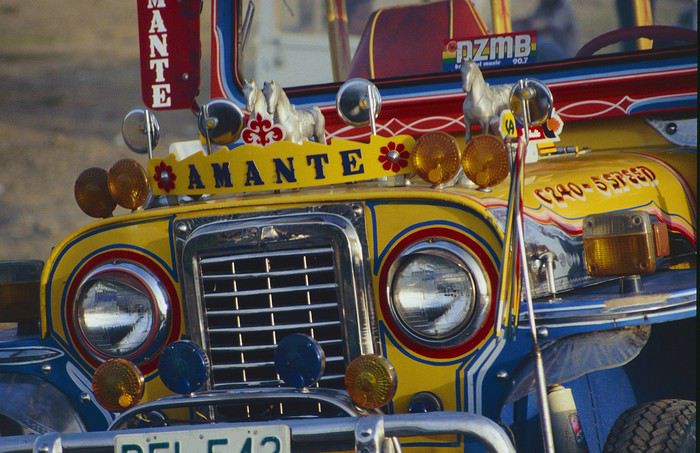
Before heading to the bus terminal for the north, somewhere on the outskirts of the city, we needed to exchange some money. I don’t remember how we ended up in a policeman’s jeep who offered his services: - Exchange money on the black market at a better rate than the banks. - Take us wherever we wanted, in this case, the bus terminal.
We accepted both offers (we’d still checked the official exchange rate from dollars to pesos). So we found ourselves in his jeep. After exchanging money, we left in his vehicle and stopped for gas. Without turning off the engine, he calmly smoked a cigarette while filling up. Since we were in a jeep with no doors or roof, we were ready to jump out if things went south, our travel bag in hand.
But we weren’t done with surprises yet. Once we left the small streets, we ended up in a neighborhood with wide avenues and not much traffic, which didn’t justify his incredible behavior. At every intersection, he made the sign of the cross, closed his eyes, and crossed without looking. I was more stunned than terrified! It wasn’t until we got out of the car later that I told Anne-Marie what had happened. I’d seen everything because the cop had put me in the front seat. Luckily, A-Marie hadn’t noticed anything from the back. Crossing Manila by trusting God rather than the rules of the road was ultimately effective. We were lucky—the trip was off to a good start. 🙂 🙂
We then passed through a neighborhood where slums stretched on for a while, and we left our policeman—friendly but a bit crazy—with relief.
A few hours by bus later, here we are in Baguio, cool in the mountains. My memories of Baguio are pretty fuzzy. I remember a small town. After some research while writing this journal, I found that the population was 120,000 in 1980. Given the population density in each home, that confirms my memory of a smallish town. Outside the “official” district with the president’s summer residence and government buildings, there were two or three paved streets with nice houses. The rest was very dirty and very poor, with lots of slums and dirt roads.
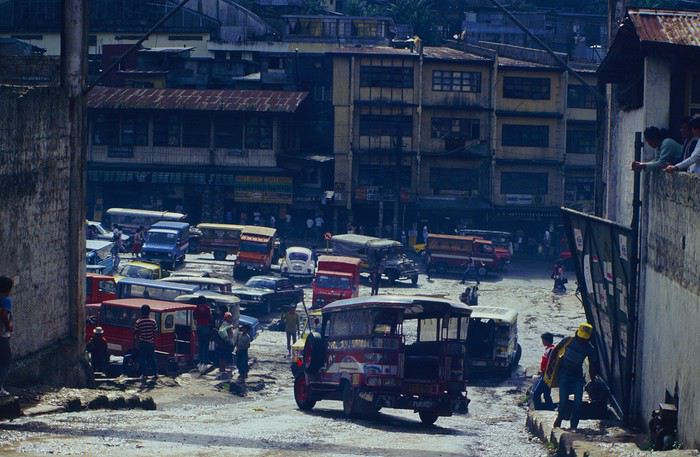
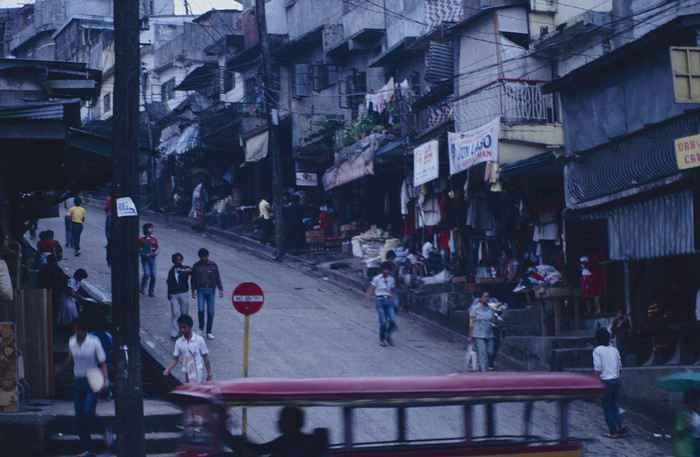
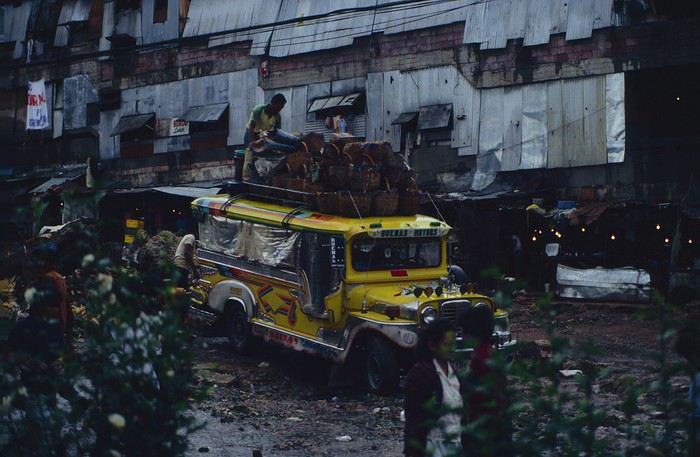
People we met on the street invited us to stay with them. These days, we wouldn’t just show up at strangers’ houses, which we should’ve done in Baguio—it would’ve saved us from an unimaginable and dangerous situation... which I won’t say anything about... !😊
The simple wooden house was on stilts at the edge of a hill with a view of the mountains. Since it was the start of the rainy season in a city that gets a lot of rain, we saw a lot of water. Our outings in town happened between downpours.
View from our lodging: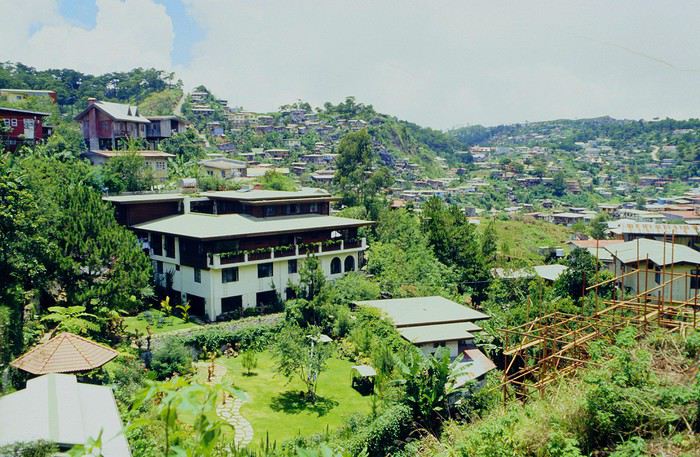
Episode 2: Baguio to Bontoc Aside from the situation briefly mentioned above, it was on the next leg to Bontoc that the adventure really began: an endless and dangerous road, a bus from another era, breathtaking landscapes, and surprising people.
We didn’t know the distance or how long it would take to get to Bontoc. When we arrived after about ten hours, we learned that Baguio to Bontoc was 140 km.
We got on a bus with wooden seats and settled in, two to a seat meant for two. As the bus filled up, passengers squeezed in three or four per seat, with chickens and baskets full of all sorts of things in the aisle. A little embarrassed, we didn’t know if we should squeeze in three on our seat. The seats were super tight (luckily, Filipinos are small), and I didn’t know where to put my legs given my height. I don’t remember if we stayed alone on our bench or if we ended up sharing with others.
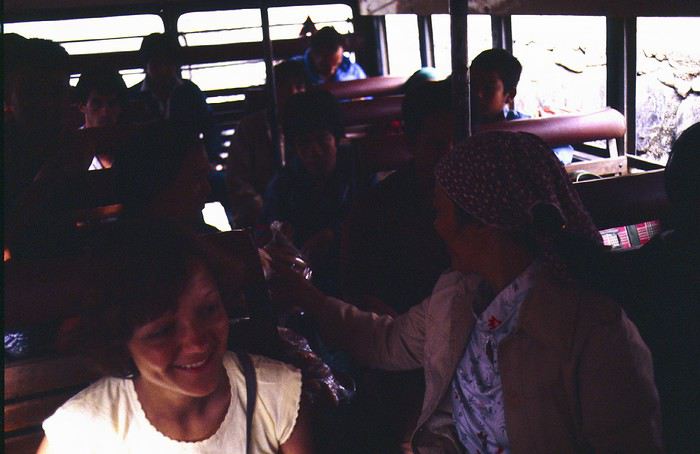
The “road” was a dirt track (or rather, a mud track) with endless turns. We held on as best we could to our slippery wooden seats—it was shaking in every direction. The woman behind us was carsick and throwing up... gross... but what were we doing there? Then we plunged into the Sierra Madre... just the name is dreamy!
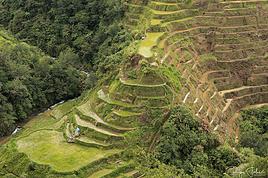
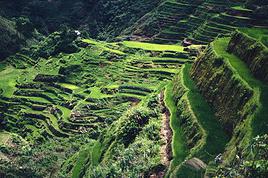
Rice terraces started to appear: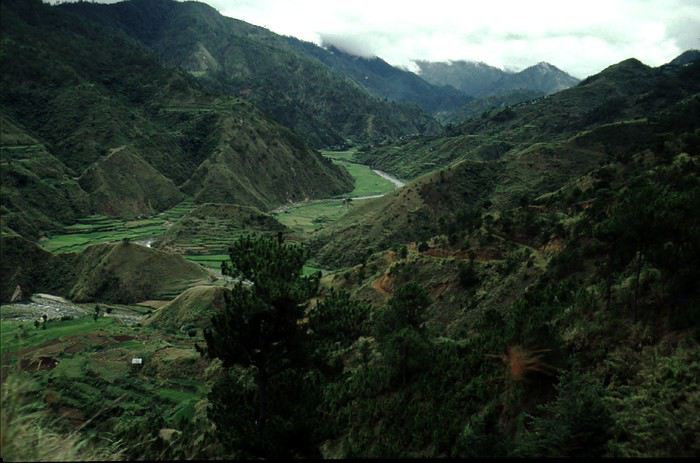
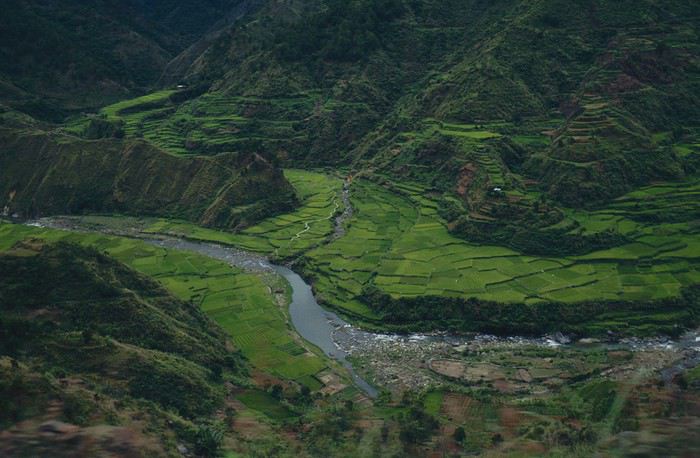
they took up more and more space along cliffs where we weren’t always reassured,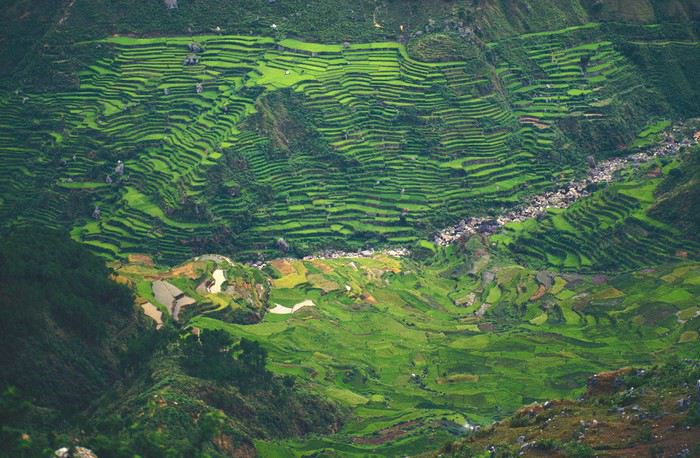
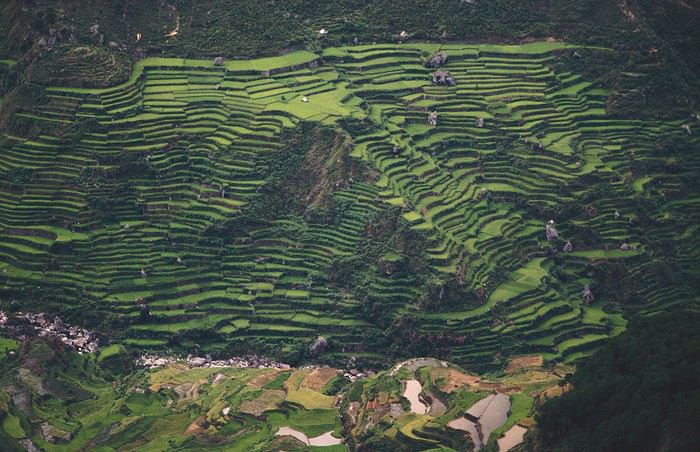
with lots of waterfalls (all that water had to go somewhere).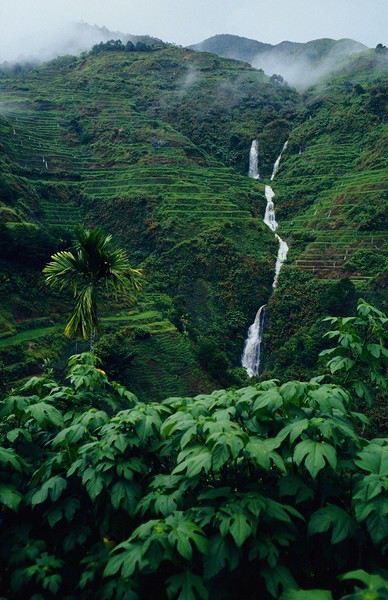
A few miserable villages stretched along the track, most often just a few houses balancing between the road and the drop. The bus stopped in every village—people got on or off and settled inside or on the roof. Street vendors offered their products to the bus passengers—a common sight in Asia, even today.
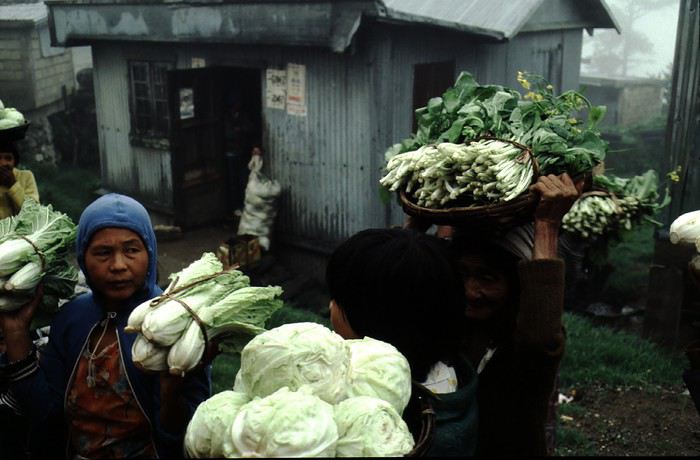
We were in another world—villagers were in loincloths, others had spears. The atmosphere was strange... but all good, we wanted exoticism, and we got it: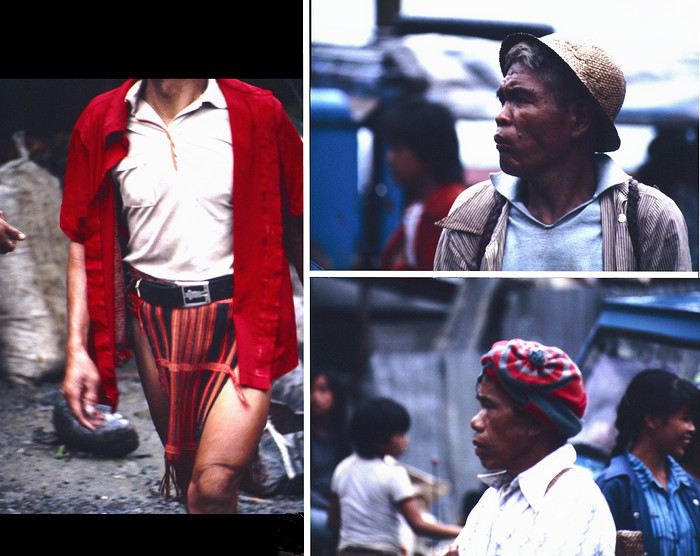
This so-called traditional outfit was everyday wear—it wasn’t for tourists since there weren’t any.
A curiosity because writing a travel journal about a trip 35 years later isn’t common, but also (mostly?) because exploring the Philippines at that time had little in common with traveling there today.
Obviously, I’ve forgotten a number of facts, most of the details, but with the help of a few notes from that time and a stack of slides (yes, there was life before digital 😊), many memories came back and added to the highlights I’d never forgotten. The scanned slides aren’t always great quality, but there are still quite a few to brighten up this chatter. Back then, we didn’t snap photos like we do now—film was too expensive—so I don’t have pictures of every place we visited... too bad, comparing some of those spots to how they look today would’ve been interesting.
Why "Adventures"? Why call it "Adventures" in the Philippines in 1984, a word so often used for a simple exotic trip? - Because the lack of information (no *Guide du Routard*, no *Lonely Planet*, no *Michelin Guide*, nothing, and obviously no internet) gave this trip what’s at the heart of adventure: the unknown. - Because the political situation made the stay sometimes dangerous. - Because transportation conditions were always epic, often perilous. - Because the question of where we’d spend the night came up almost every evening. - And for... quite a few other reasons.
That said, we weren’t exactly explorers!
Why the Philippines? First of all, why go to the Philippines in 1984—a country not exactly set up for tourism and about which we knew very little? How could we get an idea of the beauty of the Philippines and its points of interest when we had no guides or photos?
The idea came to us from Thailand a year earlier, during our first long-haul trip. After touring the north of the country, we met a Frenchman living in Phuket, where there were only a few tourists in Patong, with just a few small hotels and guesthouses. Kata and Karon had no buildings or roads, Rawai only had three palm-thatched bungalows, including ours, and the other islands were unknown to tourists. There was plenty to discover, and we wanted to return to this beautiful country... but the Frenchman made us dream about the Philippines—a country to explore, with wild landscapes.
Long evenings of discussion over multiple Sprite-Mekong cocktails (what memories of those headaches!) finally convinced us we had to go to the Philippines.
Episode 0: Before Departure The decision was made: we’d go to the Philippines in May 1984. Our friends and family were surprised when we announced we were going on vacation to the Philippines (a bit like saying today we were going paddleboarding in the Kerguelen Islands 🤪).
These days, preparing for each of our trips takes long evenings of research, planning, and noting down good addresses... etc. But for the Philippines in 1984, preparation was quick: we had very little information about the country, we were leaving almost at random, and the discovery would only be more exciting.
We still had a few bits of info gathered here and there: the rice terraces in northern Luzon, volcanoes, Negros where we were supposed to visit an acquaintance, Cebu and its marine life (we ended up going elsewhere), and absolutely avoid Mindanao, which was practically at war with the regime. That was about it, but it was already a great itinerary.
Nothing was organized in advance; we’d see day by day. We had no idea about travel times or even the existence of transportation options. The main (and sometimes only) way to connect two islands was by overloaded, rusty ferry. Only the big cities had airports.
Let’s Go: Episode 1: Paris to Manila My travel journals always start after arriving at the airport—the Europe-to-“Other Continent” trip isn’t interesting—but the flight to the Philippines was already an adventure, so I’ll make an exception.
This was the era when only a few Asian airlines were on par with Western ones: Thai, Singapore Airlines, and Philippine Airlines. They had beautiful, brand-new planes, and to attract customers (almost exclusively “businessmen”) from the usual airlines (Air France, Lufthansa, British Airways), there was opulence on board: unlimited champagne, all sorts of cocktails... Compared to today’s long-haul flights, there was still one small difference: no personal screens, just one screen at the front of the cabin with one mandatory movie. And I don’t know why, but we only got James Bond films, both ways... that must’ve been the trend at the time.
The tourism boom to Southeast Asia hadn’t started yet, and the “Asian Tigers” weren’t a thing, so there weren’t many business trips. That meant long-haul flights made stops everywhere to fill the planes. Our Philippine Airlines Boeing 747 left London, picked us up in Paris, then stopped in Frankfurt to take on a few Germans. I don’t know why we then made a stop in Dubai—a totally exotic place at the time. There was nothing to do there... things have changed a lot since. It was a small town lost in the desert. The airport was tiny, with just one or two buildings and a supermarket. During the stopover, everyone had to get off the plane and walk to the supermarket. Photo and electronic equipment were dirt cheap—I guess that was the only reason for the stop. Maybe it was their first commercial move. Emirates didn’t exist yet, as I checked online, but anyway, the idea that such a remote place could have its own airline was unthinkable.
Online, I found this photo of Dubai Airport in 1980. Anyone who’s transited through today’s massive airport with its rows of A380s will appreciate it:
Next stop: New Delhi to drop off some Europeans and pick up a few Indians, and finally, the terminus: Manila. I don’t remember how long the trip took with its five stops—an unimaginable journey today. Despite all those stops to fill the plane, there was still enough space to stretch out on the four center seats of the 747, something that never happens these days despite all the flights in every direction.
So here we are, finally at Manila Airport around midnight.
Episode 1: Manila and Baguio To start, a quick note on the political and economic situation in the Philippines in 1984, which had consequences for us as tourists, as we’d soon realize upon arrival.
After several centuries of Spanish colonization, the Philippines became American at the start of the 20th century, then independent. In 1966, Marcos took power, and little by little, his regime sank into corruption and mismanagement, becoming a dictatorship with martial law, all for the benefit of his family and friends, who enriched themselves endlessly. The peak was the assassination of opposition leader Benigno Aquino in August 1983, which triggered harshly repressed protests. So we arrived a few months later in a very poor country, with omnipresent corruption and an extremely tense political situation, as we’d soon see for ourselves. Major protests took place in the main cities during our trip—I’ll come back to that. Two years later, Marcos fled to Hawaii after being forced out of power following rigged elections. This historical context explains a lot of the situations we found ourselves in over the following weeks.
Arriving in the middle of the night isn’t very cheerful. Manila was already a huge city with many slums, where you could find a few business hotels like the Hilton or Intercontinental—way out of our budget—and plenty of run-down hotels. Luckily, two Indians we’d chatted with on the plane offered to take us to their usual hotel. They came to Manila twice a year for business. We accepted their offer, relieved not to have to look for a place to stay in the middle of the night, figuring the address must be good since they came back every time... we were wrong 🙁
We left the airport and immediately got a taste of the local vibe when we got into the taxi: the police asked for our passports. We thought: what’s more normal than police in a dictatorship?
But that wasn’t it at all. Our two Indian friends explained that the police were noting our names along with the taxi number and time. Crime in Manila was so bad that the taxi driver would be held responsible if anything happened to us... welcome to the Philippines 😎 😎
Historically, the Philippines was a very violent country, where everything was settled with guns or machetes. Previous governments had banned carrying weapons, but Marcos later allowed the free sale and carrying of guns, and disputes were settled with pistols again (or worse, as we’d discover later). Since he’d released most of the criminals from prison to form a paramilitary militia at his service (I’ll talk about our encounter with these “heroes” later), it was pretty dangerous to go into many parts of Manila, where these “tonton macoutes” ruled.
We arrived at our hotel without incident... and then things started badly. The room was infested with big cockroaches—exactly what I hate most in those kinds of countries. No way to find another hotel at that hour. After the long flight, the urge to take a shower was so strong that we squeezed into the bathroom as best we could. After that, I don’t remember—I guess we must’ve fallen asleep exhausted under the sheets in the heat... air conditioning wasn’t widespread yet.
The next day, we just wanted to leave that dump as soon as possible. So we decided to head north right away, stopping in Baguio, and we’d visit Manila a bit on the way back.
When we stepped outside, we discovered a pretty run-down neighborhood with potholed streets. But we also discovered the jeepneys. They were everywhere, flooding the streets.
They had crazy sound systems, each one blasting louder than the last. The interiors were kitschy but fun. There weren’t many private cars—almost all transportation was by jeepney, with buses reserved for intercity trips.
Before heading to the bus terminal for the north, somewhere on the outskirts of the city, we needed to exchange some money. I don’t remember how we ended up in a policeman’s jeep who offered his services: - Exchange money on the black market at a better rate than the banks. - Take us wherever we wanted, in this case, the bus terminal.
We accepted both offers (we’d still checked the official exchange rate from dollars to pesos). So we found ourselves in his jeep. After exchanging money, we left in his vehicle and stopped for gas. Without turning off the engine, he calmly smoked a cigarette while filling up. Since we were in a jeep with no doors or roof, we were ready to jump out if things went south, our travel bag in hand.
But we weren’t done with surprises yet. Once we left the small streets, we ended up in a neighborhood with wide avenues and not much traffic, which didn’t justify his incredible behavior. At every intersection, he made the sign of the cross, closed his eyes, and crossed without looking. I was more stunned than terrified! It wasn’t until we got out of the car later that I told Anne-Marie what had happened. I’d seen everything because the cop had put me in the front seat. Luckily, A-Marie hadn’t noticed anything from the back. Crossing Manila by trusting God rather than the rules of the road was ultimately effective. We were lucky—the trip was off to a good start. 🙂 🙂
We then passed through a neighborhood where slums stretched on for a while, and we left our policeman—friendly but a bit crazy—with relief.
A few hours by bus later, here we are in Baguio, cool in the mountains. My memories of Baguio are pretty fuzzy. I remember a small town. After some research while writing this journal, I found that the population was 120,000 in 1980. Given the population density in each home, that confirms my memory of a smallish town. Outside the “official” district with the president’s summer residence and government buildings, there were two or three paved streets with nice houses. The rest was very dirty and very poor, with lots of slums and dirt roads.
People we met on the street invited us to stay with them. These days, we wouldn’t just show up at strangers’ houses, which we should’ve done in Baguio—it would’ve saved us from an unimaginable and dangerous situation... which I won’t say anything about... !😊
The simple wooden house was on stilts at the edge of a hill with a view of the mountains. Since it was the start of the rainy season in a city that gets a lot of rain, we saw a lot of water. Our outings in town happened between downpours.
View from our lodging:
Episode 2: Baguio to Bontoc Aside from the situation briefly mentioned above, it was on the next leg to Bontoc that the adventure really began: an endless and dangerous road, a bus from another era, breathtaking landscapes, and surprising people.
We didn’t know the distance or how long it would take to get to Bontoc. When we arrived after about ten hours, we learned that Baguio to Bontoc was 140 km.
We got on a bus with wooden seats and settled in, two to a seat meant for two. As the bus filled up, passengers squeezed in three or four per seat, with chickens and baskets full of all sorts of things in the aisle. A little embarrassed, we didn’t know if we should squeeze in three on our seat. The seats were super tight (luckily, Filipinos are small), and I didn’t know where to put my legs given my height. I don’t remember if we stayed alone on our bench or if we ended up sharing with others.
The “road” was a dirt track (or rather, a mud track) with endless turns. We held on as best we could to our slippery wooden seats—it was shaking in every direction. The woman behind us was carsick and throwing up... gross... but what were we doing there? Then we plunged into the Sierra Madre... just the name is dreamy!
Rice terraces started to appear:
they took up more and more space along cliffs where we weren’t always reassured,
with lots of waterfalls (all that water had to go somewhere).
A few miserable villages stretched along the track, most often just a few houses balancing between the road and the drop. The bus stopped in every village—people got on or off and settled inside or on the roof. Street vendors offered their products to the bus passengers—a common sight in Asia, even today.
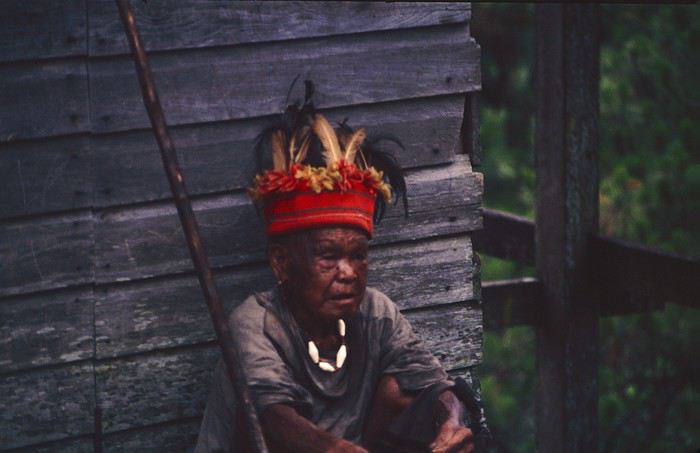
We were in another world—villagers were in loincloths, others had spears. The atmosphere was strange... but all good, we wanted exoticism, and we got it:
This so-called traditional outfit was everyday wear—it wasn’t for tourists since there weren’t any.
Formalités et visas pour les Philippines et l'Indonésie
Bonjour,
Je prévois de partir 3 mois aux Philippines en Septembre pour du tourisme et du surf puis rejoindre l'Indonésie pour 3 mois également.
Je me pose beaucoup de questions pour les visas et formalités administratives.
Quel visa choisir pour les Philippines ? Pour l'Indonésie ? Je me doute bien qu'il va falloir faire des renouvellements sur place...ou dois-je m'adresser ? aux ambassades ? Ailleurs ?
j'ai cru comprendre qu'il fallait imprimer ses billets d'avion pour les Philippines et présenter aux autorités des billets d'avion de Transite ou de sortie du Territoire ?
Je pense que je vais opter pour des billets multi destination... Est-ce une bonne idée ? J'ai prévu de faire Lyon/Manille début Septembre, puis Manille/Jakarta début Décembre et pour mon retour début Février 2021 Denpasar/Lyon ou Jakarta/Lyon.
Merci d'avance pour vos réponses amis voyageurs. Célina69
Je prévois de partir 3 mois aux Philippines en Septembre pour du tourisme et du surf puis rejoindre l'Indonésie pour 3 mois également.
Je me pose beaucoup de questions pour les visas et formalités administratives.
Quel visa choisir pour les Philippines ? Pour l'Indonésie ? Je me doute bien qu'il va falloir faire des renouvellements sur place...ou dois-je m'adresser ? aux ambassades ? Ailleurs ?
j'ai cru comprendre qu'il fallait imprimer ses billets d'avion pour les Philippines et présenter aux autorités des billets d'avion de Transite ou de sortie du Territoire ?
Je pense que je vais opter pour des billets multi destination... Est-ce une bonne idée ? J'ai prévu de faire Lyon/Manille début Septembre, puis Manille/Jakarta début Décembre et pour mon retour début Février 2021 Denpasar/Lyon ou Jakarta/Lyon.
Merci d'avance pour vos réponses amis voyageurs. Célina69
Interdiction d'entrée aux Philippines pour les vols en transit venant de Taïwan?
Bonjour à tous
Je viens de voir sur le site du ministères des affaires étrangères que l'entrée aux Philippines est interdit pour les personnes arrivant de vols, même en transit, de Taiwan (et également de Chine, Hong-Kong et Macau):
https://www.diplomatie.gouv.fr/fr/conseils-aux-voyageurs/conseils-par-pays-destination/philippines/#derniere
Je dois aller aux Philippines le mois prochain via Taiwan mais lorsque je regarde sur Fly tracker, je vois que mon vol (AF 8414) est bien maintenu ce jour (il est même dans les airs en ce moment)....
Quelqu'un a-t-il des informations sur le sujet? Mon voyage tombe-t-il à l'eau?
Merci d'avance pour votre aide.
Je viens de voir sur le site du ministères des affaires étrangères que l'entrée aux Philippines est interdit pour les personnes arrivant de vols, même en transit, de Taiwan (et également de Chine, Hong-Kong et Macau):
https://www.diplomatie.gouv.fr/fr/conseils-aux-voyageurs/conseils-par-pays-destination/philippines/#derniere
Je dois aller aux Philippines le mois prochain via Taiwan mais lorsque je regarde sur Fly tracker, je vois que mon vol (AF 8414) est bien maintenu ce jour (il est même dans les airs en ce moment)....
Quelqu'un a-t-il des informations sur le sujet? Mon voyage tombe-t-il à l'eau?
Merci d'avance pour votre aide.
Séjour avec une partie à Bohol et une partie à Panglao? (Philippines)
Bonjour,
Je suis en train d'organiser mon séjour sur bohol mais je suis un peu perdue..
Comme je veux faire les chocolate hills et aller voir les tarsiers, je comptais passer une partie du séjour du côté de loboc et après, passer 2-3 jours côté plage (près d'alona mais pas trop proche quand même).
Je m'interroge: est-ce que ça vaut la peine de scinder le séjour ? Je comptais profiter d'être du coté de loboc pour aller voir les lucioles, le coût à partir de Panglao m'a l'air très cher ( 50 euros/personne).. Est-ce que le tour sur la rivière en vaut la peine ? Certaines personnes avait l'air de trouver l'excursion trop courte .. Combien de temps, ça prend de Panglao jusqu'au Chocolate hills ?
J'avoue que j'ai un peu de mal à m'organiser.. Si quelqu'un pouvez me faire part de son expérience à Panglao..
Merci d'avance,
Je suis en train d'organiser mon séjour sur bohol mais je suis un peu perdue..
Comme je veux faire les chocolate hills et aller voir les tarsiers, je comptais passer une partie du séjour du côté de loboc et après, passer 2-3 jours côté plage (près d'alona mais pas trop proche quand même).
Je m'interroge: est-ce que ça vaut la peine de scinder le séjour ? Je comptais profiter d'être du coté de loboc pour aller voir les lucioles, le coût à partir de Panglao m'a l'air très cher ( 50 euros/personne).. Est-ce que le tour sur la rivière en vaut la peine ? Certaines personnes avait l'air de trouver l'excursion trop courte .. Combien de temps, ça prend de Panglao jusqu'au Chocolate hills ?
J'avoue que j'ai un peu de mal à m'organiser.. Si quelqu'un pouvez me faire part de son expérience à Panglao..
Merci d'avance,
Itinéraire 15 jours en Thaïlande fin janvier
Bonjour à tous ! Meilleurs voeux :)
Je pars avec ma compagne en Thaïlande fin janvier. J'ai déjà prévu un petit itinéraire mais j'ai un trou au milieu, que je ne sais pas par quoi occuper tant tout me semble attirant. En gros nous souhaiterions débuter notre séjour par quelques jours à Bangkok puis deux jours au Khao Yai.
La grande question que je me pose est ou aller entre le Khao Yai et le sud. Sachant que le 25 c'est le nouvel an Chinois (hôtels sans doute full dans pas mal de coins j'imagine). Du coup, soit on reste dans la région du centre, soit on monte au nord et puis avion vers le sud. Bref je suis un peu perdu, tout me semble attirant. On ne cherche rien en particulier si ce n'est découvrir du pays. 4 jours ce n'est pas tellement donc je préfèrerais éviter les gros trajets (de jour en tout cas).
Nous passerons la fin de notre séjour sur une île (avion? train de nuit? bus?). Probablement Koh Yao Noï sur les conseils d'un ami ou Koh Kood mais si vous avez d'autres propositions je suis partant :) Nous cherchons un endroit calme, sans prétention, sans fiesta avec une possibilité de sorties snorkeling de qualité.
Itinéraire idéal mais flexible
Di 19 : départ Bxl 10.05 Lu 20 : Bangkok Ma 21 : Bangkok Me 22 : Bangkok → Pak chong (Khao yai) Je 23 : Khao Yai Ve 24 :Pak Chong (Khao Yai) → ? Sa 25 : ?? ! Nouvel an chinois --> le fêter ou éviter la foule? Ma 28 : ?? Me 29 : ?? Je 30 : Koh Kut/Koh Yao Noi? Ve 31: Koh Kut/Koh Yao Noi? Sa 01 : Koh Kut/Koh Yao Noi? Di 02 : Koh Kut/Koh Yao Noi? Lu 03 : Koh Kut/Koh Yao Noi? Ma 04 : Bangkok Me 05 : départ 20.10 Je 06 : arrivée Bxl 6.50
PS : ce n'est pas mon premier voyage en Asie, j'ai été aux philippines, Inde, Laos, Cambodge Vietnam, Indonésie mais jamais visité la Thaïlande ! Du coup je suis ouvert à toutes vos propositions et conseils :)
Merci d'avance à toute la communauté !
Je pars avec ma compagne en Thaïlande fin janvier. J'ai déjà prévu un petit itinéraire mais j'ai un trou au milieu, que je ne sais pas par quoi occuper tant tout me semble attirant. En gros nous souhaiterions débuter notre séjour par quelques jours à Bangkok puis deux jours au Khao Yai.
La grande question que je me pose est ou aller entre le Khao Yai et le sud. Sachant que le 25 c'est le nouvel an Chinois (hôtels sans doute full dans pas mal de coins j'imagine). Du coup, soit on reste dans la région du centre, soit on monte au nord et puis avion vers le sud. Bref je suis un peu perdu, tout me semble attirant. On ne cherche rien en particulier si ce n'est découvrir du pays. 4 jours ce n'est pas tellement donc je préfèrerais éviter les gros trajets (de jour en tout cas).
Nous passerons la fin de notre séjour sur une île (avion? train de nuit? bus?). Probablement Koh Yao Noï sur les conseils d'un ami ou Koh Kood mais si vous avez d'autres propositions je suis partant :) Nous cherchons un endroit calme, sans prétention, sans fiesta avec une possibilité de sorties snorkeling de qualité.
Itinéraire idéal mais flexible
Di 19 : départ Bxl 10.05 Lu 20 : Bangkok Ma 21 : Bangkok Me 22 : Bangkok → Pak chong (Khao yai) Je 23 : Khao Yai Ve 24 :Pak Chong (Khao Yai) → ? Sa 25 : ?? ! Nouvel an chinois --> le fêter ou éviter la foule? Ma 28 : ?? Me 29 : ?? Je 30 : Koh Kut/Koh Yao Noi? Ve 31: Koh Kut/Koh Yao Noi? Sa 01 : Koh Kut/Koh Yao Noi? Di 02 : Koh Kut/Koh Yao Noi? Lu 03 : Koh Kut/Koh Yao Noi? Ma 04 : Bangkok Me 05 : départ 20.10 Je 06 : arrivée Bxl 6.50
PS : ce n'est pas mon premier voyage en Asie, j'ai été aux philippines, Inde, Laos, Cambodge Vietnam, Indonésie mais jamais visité la Thaïlande ! Du coup je suis ouvert à toutes vos propositions et conseils :)
Merci d'avance à toute la communauté !
Aide/choix de parcours 16 jours aux Philippines?
Bonjour à tous,
je sais qu' il y a déjà eu plusieurs Post' sur les Philippines, mais .... dur dur de trancher. ;-(
Sans entrer des les détails à 100% des villes, si vous deviez m'orienter, en sachant qu'il y a des choix à faire pour 16 JOURS sur place (on ne peut pas tout faire!), que me conseillez -vous ?
J'ai envie de voir les rizières de Luzon, mais, avec tous les temps de route, j'ai peur de ne pas pouvoir faire bcp d'iles ensuite !?
Doit-on impérativement voir qq rizières sur Luzon ?
Faire une boucle sur CEBU & alentours + boucle sur Palawan + Coron = laisse du temps pour Luzon !?? j'ai un gros doute! ;-(
Si je termine le séjour à Coron, pour revenir sur Manille, des avions existent, ou faut retourner à Puerto ?
Un grand merci par avance pour votre aide. ;)
MERCI.
;)
je sais qu' il y a déjà eu plusieurs Post' sur les Philippines, mais .... dur dur de trancher. ;-(
Sans entrer des les détails à 100% des villes, si vous deviez m'orienter, en sachant qu'il y a des choix à faire pour 16 JOURS sur place (on ne peut pas tout faire!), que me conseillez -vous ?
J'ai envie de voir les rizières de Luzon, mais, avec tous les temps de route, j'ai peur de ne pas pouvoir faire bcp d'iles ensuite !?
Doit-on impérativement voir qq rizières sur Luzon ?
Faire une boucle sur CEBU & alentours + boucle sur Palawan + Coron = laisse du temps pour Luzon !?? j'ai un gros doute! ;-(
Si je termine le séjour à Coron, pour revenir sur Manille, des avions existent, ou faut retourner à Puerto ?
Un grand merci par avance pour votre aide. ;)
MERCI.
;)
Vol Cebu - El Nido avec AirSWIFT et bagages
Bonjour,
Je viens de prendre un billet d'avion Cebu-El Nido.
Je rencontre deux soucis :
1) je n'ai pas reçu mes billets d'avion. Je n'ai reçu que la confirmation de paiement.
2)Je ne comprends rien pour les bagages. J'ai dû acheter 10kg pour 350PHP. J'en voulais 20 mais impossible. Si j'ai bien compris, on peut les acheter qu'après?
HELP!!!
Transfert aéroport de Manille terminal 3 à 4
Bonjour ,
J'ai besoin de votre aide, car mon vol international arrive à ninoy aquino terminal 3 à 12H50
et j'ai un vol air asia pour Cebu à 15H35 .
J'ai vu que les terminaux était a coté est ce jouable ?
merci pour votre aide .
Choisir entre l'Indonésie, les Philippines et le Sri Lanka
Bonjour à tous. Étant en préparation pour mon prochain séjour d'un mois en janvier prochain, 3 destinations m'attirent, mais j'hésite dans mon choix. Pour ceux qui ont fait les 3 destinations, quel sont les avantages et différences? Ce que je recherche c'est 1-le cout sur place (pension oblige),2- la sécurité 3- la gentillesse des gens et la richesse culturelle.
Je voyage sac à dos, en louant scooter ou transport en commun, et ne recherche pas le party mais bien la tranquilité et le quotidien des gens, de belles plages et paysages grandioses.
Voici ou j'en suis dans mes réflections: Indonésie et Phillipines= trop grand pour un mois (donc encore plus indécis sur l'itinéraire) Le Sri Lanka me rebute pour une seule raison , l'hygiène (mes craintes sont-elles fondées?). Par contre il semble facile de s'y déplacer et d'en faire le tour en un mois. Bref, après avoir consulter différents forum et m'etre procurer les guides de chaque destination mentionnée, le ressenti de personne y ayant séjourné ou qui y vivent m'éclairerais peut-etre. Merci de partager vos expériences.
Temps de trajet en bus entre Dumaguete et Bacolod
Bonjour à tous,
J'aimerais savoir combien de temps prend le bus CERES pour ce trajet.
Je n'arrive pas à le voir sur leur site...
Merci
🙂
🙂
Voyage de 15 jours aux Philippines avec 2 enfants 10 et 8 ans
Bonjour,
Nous partons aux Philippines et plus précisément à Cebu, du 14 février au 28 février 2020. Nous sommes 2 adultes et 2 enfants âges respectivement de 10 et 8 ans. C’est notre 1er voyage aux Philippines et nous aimerions visiter les Visayas ( Bohol, panglao, apo island, El Nido et autres). L’objectif de ce voyage est de découvrir la faune et la flore ainsi que les habitants et leur culture. Je vais réserver les logements mais je ne sais pas si le mieux c’est de partir directement après notre arrivée vers el Nido ou vers bohol? Pourriez-vous m’aider dans la mise en œuvre de notre voyage: les endroits à visiter, les plages, les animaux, les trajets entre les îles et les logements, car j’ai du mal à savoir le temps qu’il faut pour visiter et profiter des lieux ainsi que les trajets.
En vous remerciant par avance.
Quelle excursion choisir: Maligcong (à partir de Sagada) ou Hapao (à partir de Banaue)?
La question est dans le titre. Il s'agit de l'intérêt des payasages (en ayant fait déjà Banaue-Batad...).
Aussi: la facilité d'organiser le parcours sur une journée (correspondances des moyens de locomotion). Le prix aussi.
Merci pour les infos que vous voudriez me donner. Et autres conseils (ne figurant pas dans le LP).
Programme pour les Philippines
Bonjour,
Nous serons un peu plus de deux semaines aux Philippines en juillet prochain.
Nous comptons répartir ces deux semaines avec :
-6 nuits sur Bohol
-6 nuits sur Siquijor
-2 nuits sur Apo Island
-et le reste sur Dumaguete
Vos avis m'intéresse .
A u plaisir de vous lire.
cedric.
Vos avis m'intéresse .
A u plaisir de vous lire.
cedric.
Mon projet de visite des Philippines en 3 semaines
Bonjour
Nous pensons nous rendre aux Philippines du 9 au 30 mars prochain Nous atterrissons à Manille à 16h le 10 mars
Peut-on espérer arriver à prendre le bus de nuit pour nous rendre à Banaue ?
Notre parcours serait donc Manille / Banaue 1 jour repos et pour trouver un guide pour le trek de 3 jours dans les rizières ( vertes en cette période ? ) / retour en bus de nuit sur Manille arrivée donc le matin du 15 mars
Départ ds la journée en avion pour l’île de Coron : Réalisable ?
3 jours à Coron entre Island trip et découverte de l’Île en scooter
Le 19 vol pour Cebu ds la matinée pour 1 ou 2 jours
Puis départ pour Bohol ? Siquijor ? en ferry ?
Découverte de ces îles et vol retour vers Cebu pour vol international ou Manille car nous hésitons du coup à faire un vol aller/retour Nice/ Manille ou faire Nice / Manille à l'aller et Cebu / Nice pour le retour ...
Je sais que c'est un peu brouillon mais le truc c'est que nous n'avons pas envie de faire que de la plage d'où l'idée de Bohol
Merci pour vos idées et impressions Virginie
Nous pensons nous rendre aux Philippines du 9 au 30 mars prochain Nous atterrissons à Manille à 16h le 10 mars
Peut-on espérer arriver à prendre le bus de nuit pour nous rendre à Banaue ?
Notre parcours serait donc Manille / Banaue 1 jour repos et pour trouver un guide pour le trek de 3 jours dans les rizières ( vertes en cette période ? ) / retour en bus de nuit sur Manille arrivée donc le matin du 15 mars
Départ ds la journée en avion pour l’île de Coron : Réalisable ?
3 jours à Coron entre Island trip et découverte de l’Île en scooter
Le 19 vol pour Cebu ds la matinée pour 1 ou 2 jours
Puis départ pour Bohol ? Siquijor ? en ferry ?
Découverte de ces îles et vol retour vers Cebu pour vol international ou Manille car nous hésitons du coup à faire un vol aller/retour Nice/ Manille ou faire Nice / Manille à l'aller et Cebu / Nice pour le retour ...
Je sais que c'est un peu brouillon mais le truc c'est que nous n'avons pas envie de faire que de la plage d'où l'idée de Bohol
Merci pour vos idées et impressions Virginie
Rage, sangsues, et autres précautions à prendre aux Philippines (Mindoro et Tablas Island)
Bonjour à tous,
Nous partons 14 jours aux Philippines fin janvier en "sac à dos". Nous avons envie de combiner randonnées et apnée/plage et nous comptons faire Mindoro (Puerto galera), descendre jusqu'a Roxas pour traverser jusqu’à Tablas, Carabao, Romblon et Sibuyan.
J'ai entendu parler que la rage était assez présente dans les zones rurales .. est ce cas sur les iles de notre parcours ?
Mon autre question concerne les bestioles aquatiques principalement : Il y a-t-il des soucis pour les randos et les baignades dans les rivières et cascades (à Sibuyan notamment) ? Des sangues ?
Je ne suis pas particulièrement paniquée par ces questions, mais le mieux est de connaitre les risques pour ne pas faire de bêtises ^^
Merci d'avance !
Susie
Nous partons 14 jours aux Philippines fin janvier en "sac à dos". Nous avons envie de combiner randonnées et apnée/plage et nous comptons faire Mindoro (Puerto galera), descendre jusqu'a Roxas pour traverser jusqu’à Tablas, Carabao, Romblon et Sibuyan.
J'ai entendu parler que la rage était assez présente dans les zones rurales .. est ce cas sur les iles de notre parcours ?
Mon autre question concerne les bestioles aquatiques principalement : Il y a-t-il des soucis pour les randos et les baignades dans les rivières et cascades (à Sibuyan notamment) ? Des sangues ?
Je ne suis pas particulièrement paniquée par ces questions, mais le mieux est de connaitre les risques pour ne pas faire de bêtises ^^
Merci d'avance !
Susie
Trois semaines au coeur de la République des Philippines
Bonjour tout le monde,
Après plusieurs voyages en Asie, ce sera les Philippines début 2019. Mon amie et moi avons depuis longtemps envi de découvrir ce merveilleux pays. Nous allons partir un peu moins de 3 semaines. Nous allons faire Bordeaux Hong-Kong (car nous avons envi de faire une petite escale d'une nuit à la fin afin de découvrir cette ville), puis Hong Kong - Manille. je me tourne donc vers vous afin d'avoir vos avis sur ce petit planning prévisionnel que nous venons de faire.
Jour : Départ de Bordeaux Jour 1 : Arrivé à Hong Kong à 12h ; Puis vol pour Manille dans l'après-midi ; Puis bus de nuit en direction de Banaue Jour 2 : Repos à Banaue Jour 3 : Trek dans les rizières Jour 4 : Trek dans les rizières Jour 5 : Trek dans les rizières puis retour à Banaue et retour en bus de nuit à Manille Jour 6 : Avion dès le matin de Manille à El Nido puis repos à El Nido Jour 7 : Island trip autour de El Nido Jour 8 : Départ pour une expédition d'île en île de 3 jours en bateau afin de remonter jusqu'à Coron Jour 9 : Expédition d'île en île Jour 10 : Expédition d'île en île et arrivée en fin d'après-midi à Coron Jour 11 : Découverte de Coron en scooter Jour 12 : Island trip autour de Coron Jour 13 : Repos à Coron Jour 14 : Repos à Coron Jour 15 : Avion le matin de Coron à Cebu puis repos Jour 16 : Cebu (et alentours ?) Jour 17 : Cebu (et alentours ?) Jour 18 : Cebu (et alentours ?) Jour 19 : Départ avion Cebu - Manille dans la matinée, puis Manille - Hong Kong en début d'après-midi. Fin d'après-midi à Hong Kong et soirée à la découverte de la ville Jour 20 : Matinée balade de la ville puis avion retour en France à 13h35
Bien entendu, nous sommes preneur de tous vos conseils, avis, recommandations qui permettrons de rendre ce voyage inoubliable.
Excellente fin de journée,
Marie et François,
Après plusieurs voyages en Asie, ce sera les Philippines début 2019. Mon amie et moi avons depuis longtemps envi de découvrir ce merveilleux pays. Nous allons partir un peu moins de 3 semaines. Nous allons faire Bordeaux Hong-Kong (car nous avons envi de faire une petite escale d'une nuit à la fin afin de découvrir cette ville), puis Hong Kong - Manille. je me tourne donc vers vous afin d'avoir vos avis sur ce petit planning prévisionnel que nous venons de faire.
Jour : Départ de Bordeaux Jour 1 : Arrivé à Hong Kong à 12h ; Puis vol pour Manille dans l'après-midi ; Puis bus de nuit en direction de Banaue Jour 2 : Repos à Banaue Jour 3 : Trek dans les rizières Jour 4 : Trek dans les rizières Jour 5 : Trek dans les rizières puis retour à Banaue et retour en bus de nuit à Manille Jour 6 : Avion dès le matin de Manille à El Nido puis repos à El Nido Jour 7 : Island trip autour de El Nido Jour 8 : Départ pour une expédition d'île en île de 3 jours en bateau afin de remonter jusqu'à Coron Jour 9 : Expédition d'île en île Jour 10 : Expédition d'île en île et arrivée en fin d'après-midi à Coron Jour 11 : Découverte de Coron en scooter Jour 12 : Island trip autour de Coron Jour 13 : Repos à Coron Jour 14 : Repos à Coron Jour 15 : Avion le matin de Coron à Cebu puis repos Jour 16 : Cebu (et alentours ?) Jour 17 : Cebu (et alentours ?) Jour 18 : Cebu (et alentours ?) Jour 19 : Départ avion Cebu - Manille dans la matinée, puis Manille - Hong Kong en début d'après-midi. Fin d'après-midi à Hong Kong et soirée à la découverte de la ville Jour 20 : Matinée balade de la ville puis avion retour en France à 13h35
Bien entendu, nous sommes preneur de tous vos conseils, avis, recommandations qui permettrons de rendre ce voyage inoubliable.
Excellente fin de journée,
Marie et François,
Voyage un mois aux Philippines en octobre - novembre
Bonjour,
Ayant longuement hésité sur ma prochaine destination, j'ai pris un vol Paris/Singapour du 12/10 au 09/11/2018. De là, rayonner en Asie est beaucoup plus simple.
En recoupant les informations, j'ai ébauché un programme, et souhaitais avoir vos retour dessus svp :). Je précise que, dans l'idéal, je ne souhaite pas "rusher" et prendre le temps de me poser (ce sera relatif tant le pays semble grand, les transports longs et les choses à voir multiples). Je recherche un mélange entre nature, plongée, un peu de chill, et souhaite (dans la mesure du possible bien s$^ûr), privilégier les petites Guesthouses que les grands complexes, et, si possible, éviter de trop l'agitation et le tourisme de masse (comme tout le monde :)).
Ce qui donnerait, pour les "grosses" étapes:
12/10: Départ de Paris; 13/10: Arrivée à Singapour: Nuit sur place 14/10: Vol matinal pour Manille 5 jours: Nord du pays: Rizières et pourquoi pas arpenter le Pinatubo; 19/10: Vol pour Port Princesa (Palawan), voir El Nido, puis bouger sur Coron: semaine; 24/10: Vol pour Cebu/Visayas: Bohol, île de Malapuesca, île de Camiguin; 09/10: Vol Cebu ->Singapour
- Selon vous, celà vous semble t'il raisonnable? - Sinon, que suggéreriez vous?
Je vous remercie de m'avoir lu, et suis à l'écoute de tous vos conseils ou remarques :).
Bien à vous, nobles voyageurs
Ayant longuement hésité sur ma prochaine destination, j'ai pris un vol Paris/Singapour du 12/10 au 09/11/2018. De là, rayonner en Asie est beaucoup plus simple.
En recoupant les informations, j'ai ébauché un programme, et souhaitais avoir vos retour dessus svp :). Je précise que, dans l'idéal, je ne souhaite pas "rusher" et prendre le temps de me poser (ce sera relatif tant le pays semble grand, les transports longs et les choses à voir multiples). Je recherche un mélange entre nature, plongée, un peu de chill, et souhaite (dans la mesure du possible bien s$^ûr), privilégier les petites Guesthouses que les grands complexes, et, si possible, éviter de trop l'agitation et le tourisme de masse (comme tout le monde :)).
Ce qui donnerait, pour les "grosses" étapes:
12/10: Départ de Paris; 13/10: Arrivée à Singapour: Nuit sur place 14/10: Vol matinal pour Manille 5 jours: Nord du pays: Rizières et pourquoi pas arpenter le Pinatubo; 19/10: Vol pour Port Princesa (Palawan), voir El Nido, puis bouger sur Coron: semaine; 24/10: Vol pour Cebu/Visayas: Bohol, île de Malapuesca, île de Camiguin; 09/10: Vol Cebu ->Singapour
- Selon vous, celà vous semble t'il raisonnable? - Sinon, que suggéreriez vous?
Je vous remercie de m'avoir lu, et suis à l'écoute de tous vos conseils ou remarques :).
Bien à vous, nobles voyageurs
Trek autour de Banaue / Batad en solo (sans guide)
Bonjour à tous !
En avril 2019, je me rendrai 3 semaines aux Philippines où je souhaite bien évidemment suer à grosses gouttes dans les rizières du nord de l'île de Luzon. Je serai accompagné de mon frère sachant que nous avons tous les deux une bonne condition physique... et l'esprit aventurier.
C'est pour cette raison que nous souhaitons faire ce trek en solo, c'est-à-dire sans guide.
Voici le programme que j'ai élaboré et les questions que je me pose.
Jour 1 : Journée cool avant de marcher
Hapao hot springs Festival tribal de Banaue => 25 au 29 avril 2019 (j'ai calé mon planning par rapport aux dates de ce festival => Quelqu'un y a déjà participé ? Nuit à Banaue
Jour 2 : Banaue => Banaue view point (en tricycle) puis trailhead => Pula (3h de marche dans la forêt) => Cambulo (4h)
=> Là, j'hésite à m'arrêter pour dormir ici ou pousser jusqu'à Batad... Nuit à Cambulo ou Batad (dans les deux cas, avez-vous des adresses à me conseiller ?)
Jour 3 : Batad (3h de marche dans les rizières) => Cascade de Tappiyah (1h à partir du village de Batad, chemin montant jusqu’au promontoire à gauche du « Waterfall side lodge » et redescente des marches vers le creux des montagnes, puis 1h pour le retour à Batad) Nuit à Batad
Jour 4 : Awa View Deck (2h – 2h30 de marche l’aller simple à partir de Batad ; passage utilisé pour traverser entre les villages de Batad et Sitip Patpat, montée en continu jusqu’au plus haut point d’où l’on a une vue aérienne de l’amphithéâtre des terrasses de Batad. Bonne condition physique) => Bangaan (à 3h de Batad) => Retour tricycle ou jeepney Nuit dans le bus
Avez-vous d'autres suggestions ? Des choses à ajouter ? Suis-je trop ambitieux ? Existe-t-il une carte de la région pour ne pas se perdre ? Des indications pour se repérer ?
Merci d'avance, Franck
C'est pour cette raison que nous souhaitons faire ce trek en solo, c'est-à-dire sans guide.
Voici le programme que j'ai élaboré et les questions que je me pose.
Jour 1 : Journée cool avant de marcher
Hapao hot springs Festival tribal de Banaue => 25 au 29 avril 2019 (j'ai calé mon planning par rapport aux dates de ce festival => Quelqu'un y a déjà participé ? Nuit à Banaue
Jour 2 : Banaue => Banaue view point (en tricycle) puis trailhead => Pula (3h de marche dans la forêt) => Cambulo (4h)
=> Là, j'hésite à m'arrêter pour dormir ici ou pousser jusqu'à Batad... Nuit à Cambulo ou Batad (dans les deux cas, avez-vous des adresses à me conseiller ?)
Jour 3 : Batad (3h de marche dans les rizières) => Cascade de Tappiyah (1h à partir du village de Batad, chemin montant jusqu’au promontoire à gauche du « Waterfall side lodge » et redescente des marches vers le creux des montagnes, puis 1h pour le retour à Batad) Nuit à Batad
Jour 4 : Awa View Deck (2h – 2h30 de marche l’aller simple à partir de Batad ; passage utilisé pour traverser entre les villages de Batad et Sitip Patpat, montée en continu jusqu’au plus haut point d’où l’on a une vue aérienne de l’amphithéâtre des terrasses de Batad. Bonne condition physique) => Bangaan (à 3h de Batad) => Retour tricycle ou jeepney Nuit dans le bus
Avez-vous d'autres suggestions ? Des choses à ajouter ? Suis-je trop ambitieux ? Existe-t-il une carte de la région pour ne pas se perdre ? Des indications pour se repérer ?
Merci d'avance, Franck
Durée minimum aux Philippines
Bonjour à tous,
Je compte prendre mes billets pour le mois de mars prochainement.
Je pense rester15 jours sur place, pensez-vous que ce cela soit suffisant afin de faire une petite rando dans les rizières, profiter des beaux paysages et des magnifiques plages (plongés)...
Merci par avance :) Jamila
Je compte prendre mes billets pour le mois de mars prochainement.
Je pense rester15 jours sur place, pensez-vous que ce cela soit suffisant afin de faire une petite rando dans les rizières, profiter des beaux paysages et des magnifiques plages (plongés)...
Merci par avance :) Jamila
Voyage aux Philippines fin janvier - février
Bonjour à tous,
Dans le cadre de notre voyage de noces, nous aimerions séjourner 3 petites semaines (18/19 jours sur place) aux Philippines fin janvier prochain. Nous avons beaucoup bourlingué en Amérique du Sud et central et c'est la 1ere fois que nous aimerions nous rendre dans cette partie du monde.😉 . J'ai lu pas mal d'avis divers et variés sur ce forum mais j'ai du mal à nous situer par rapport aux endroits évoqués: > Nous ne sommes pas des plongeurs > Nous aimons decouvrir la culture locale (riziere..), > nous adorons les treks (volcans...) > nous aimerions passer qq jours jours sans une plage sympa avec quelques activités à faire (pas trop adeptes du farniente).
Bien sûr, si nous pouvions eviter les endroits ultra-touristiques, cela serait top😊!
Un grand merci à vous pour les quelques pistes dont vous pourriez nous faire part😏! Une très bonne journée à tous! Benoît
Dans le cadre de notre voyage de noces, nous aimerions séjourner 3 petites semaines (18/19 jours sur place) aux Philippines fin janvier prochain. Nous avons beaucoup bourlingué en Amérique du Sud et central et c'est la 1ere fois que nous aimerions nous rendre dans cette partie du monde.😉 . J'ai lu pas mal d'avis divers et variés sur ce forum mais j'ai du mal à nous situer par rapport aux endroits évoqués: > Nous ne sommes pas des plongeurs > Nous aimons decouvrir la culture locale (riziere..), > nous adorons les treks (volcans...) > nous aimerions passer qq jours jours sans une plage sympa avec quelques activités à faire (pas trop adeptes du farniente).
Bien sûr, si nous pouvions eviter les endroits ultra-touristiques, cela serait top😊!
Un grand merci à vous pour les quelques pistes dont vous pourriez nous faire part😏! Une très bonne journée à tous! Benoît