Results for "Singapour+itinéraire"
About 11,397 results.
More options
Many results are in French, the community’s main language. English translations are added over time.
Search results
Compagnies aériennes pour le vol Dubai-Ho Chi Minh ou Hanoi?
Bonjour a Tous,
Je recherche, la meilleure offre pour un vol pour ma Cherie et moi pour cet ete (juillet-Aout)
Dubai vers Ho Chi Minh ou Hanoi.
Si vous avez des noms de compagnies a me renseigner, ou des itineraires avec transferts etc...
Tout sera le bienvenu.
Grrrrrr que c est cher les departs de Dubai, et pourtant pas loin !!!!! Ah quand le Low Cost !!!!
🙂
Je recherche, la meilleure offre pour un vol pour ma Cherie et moi pour cet ete (juillet-Aout)
Dubai vers Ho Chi Minh ou Hanoi.
Si vous avez des noms de compagnies a me renseigner, ou des itineraires avec transferts etc...
Tout sera le bienvenu.
Grrrrrr que c est cher les departs de Dubai, et pourtant pas loin !!!!! Ah quand le Low Cost !!!!
🙂
Malaisie-Cambodge par la Thaïlande ou le Vietnam?
Bonjour à tous,
je planifie un voyage de 5 semaines (27 jours ) en Asie du sud-est, au mois je janvier. Après plusieurs recherches, j'en suis venu avec deux itinéraires possibles:
1er scenario--Arrivée à Hanoi, traverser le vietnam du nord au sud jusqu'à HCMC (en passant par Hue, Da Nang...) puis traverser au cambodge pour pnom penh et siem reap.
2e scenario--Arrivée à Singapour, la malaisie (Kuala lumpur, plongée sous-marine sur la cote Est) remonter vers Ko phi phi, phuket, koh taoh, pour finalement arriver à Bangkok.
Les billets d'avion sont sensiblement le même prix, avec des départs différents des arrivées.
Je suis à la recherche d'aventure, de dépaysement total, d'immersion culturelle etc...
Est-ce que quelqu'un pourrait m'aider en m'indiquant si il/elle juge les itinéraires réalisables, et lequel conseillerait t-il? Je sais que c'est bien subjectif, mais je voudrais bien aovir les impressions des gens qui y sont déja allés...
MERCI ÉNORMÉMENT!!!
Guigui
je planifie un voyage de 5 semaines (27 jours ) en Asie du sud-est, au mois je janvier. Après plusieurs recherches, j'en suis venu avec deux itinéraires possibles:
1er scenario--Arrivée à Hanoi, traverser le vietnam du nord au sud jusqu'à HCMC (en passant par Hue, Da Nang...) puis traverser au cambodge pour pnom penh et siem reap.
2e scenario--Arrivée à Singapour, la malaisie (Kuala lumpur, plongée sous-marine sur la cote Est) remonter vers Ko phi phi, phuket, koh taoh, pour finalement arriver à Bangkok.
Les billets d'avion sont sensiblement le même prix, avec des départs différents des arrivées.
Je suis à la recherche d'aventure, de dépaysement total, d'immersion culturelle etc...
Est-ce que quelqu'un pourrait m'aider en m'indiquant si il/elle juge les itinéraires réalisables, et lequel conseillerait t-il? Je sais que c'est bien subjectif, mais je voudrais bien aovir les impressions des gens qui y sont déja allés...
MERCI ÉNORMÉMENT!!!
Guigui
Article sur le siège 61
Un gentil article de Libé sur un site que j'aime bien et qui donne plein d'infos utiles sur les chemins de fer.
Marseil.
Aux quatre coins du monde depuis la place 61
Voyages. Succès du site, créé par un Britannique passionné du train, qui propose des itinéraires insolites. Par Frédérique ROUSSEL QUOTIDIEN : Samedi 9 septembre 2006 - 06:00
«L'Homme de la place 61» pourrait être un titre de film. C'est le nom d' n site Internet (The Man in Seat 61, www.seat61.com). Le nom de son aute r sonne comme celui d'un héros de roman anglais. Mark Smith est n fonctionnaire britannique qui préfère la place 61 dans l'Eurostar, en première (voitures 11, 7 ou 8). Elle donne à la fois sur fenêtre et couloir.
C'est là qu'il s'est assis quand il est parti de Londres pour la Tunisie, l'Italie, l'Albanie, Malte ou l'Ukraine. Cette place 61 inspire cet addict des rails qui a pris siège depuis au moins cinq ans sur la Toile pour montrer qu'on peut parcourir le monde seulement en train (et un peu en bateau, forcément).
Vocation. Cette révélation lui vient de sa vocation : il a dirigé le service relations clientèle de deux compagnies de chemins de fer, et travaille aujourd'hui au ministère des Transports britannique. Chaque matin, Mark Smith profite de son trajet du Buckinghamshire vers la City pour concocter des itinéraires sur son ordinateur portable. Comment aller de Bangkok à Singapour via Butterworth ou d'Oruro à Tupiza par le WaraWara...
Des inconditionnels des quatre coins de la planète apportent leur contribution à l'oeuvre de Mark Smith. Du coup, «l'Homme de la place 61» est devenu un guichet précieux pour préparer les parcours les plus insolites. On peut même y trouver des renseignements absents des sites officiels français, comme la photo des couchettes SNCF.
Rêve. Avion ou train ? Temps passé à avaler vite les distances ou qualité des heures passées à les parcourir ? «Lorsque vous arrivez quelque part en train, je suppose que c'est comme atteindre le sommet après avoir gravi la montagne. Si vous prenez un hélicoptère, ce n'est pas la même chose», estime Mark Smith, pour qui vivre un voyage civilisé romantique et excitant en train demeure possible au XXIe siècle.
Depuis deux ans, le fonctionnaire a vu une hausse de l'intérêt pour le train. Résultat : en juillet, 260 000 visiteurs se sont branchés sur son site. Celui-ci propose des pages par pays, et par thèmes, et les plus visitées sont celles consacrées aux destinations lointaines. L'homme de la place 61 a ce rêve : s'asseoir dans le train le plus haut du monde, au Tibet, qui culmine à 5 072 mètres d'altitude. En plein ciel.
http://www.liberation.fr/vous/203381.FR.php © Libération
Marseil.
Aux quatre coins du monde depuis la place 61
Voyages. Succès du site, créé par un Britannique passionné du train, qui propose des itinéraires insolites. Par Frédérique ROUSSEL QUOTIDIEN : Samedi 9 septembre 2006 - 06:00
«L'Homme de la place 61» pourrait être un titre de film. C'est le nom d' n site Internet (The Man in Seat 61, www.seat61.com). Le nom de son aute r sonne comme celui d'un héros de roman anglais. Mark Smith est n fonctionnaire britannique qui préfère la place 61 dans l'Eurostar, en première (voitures 11, 7 ou 8). Elle donne à la fois sur fenêtre et couloir.
C'est là qu'il s'est assis quand il est parti de Londres pour la Tunisie, l'Italie, l'Albanie, Malte ou l'Ukraine. Cette place 61 inspire cet addict des rails qui a pris siège depuis au moins cinq ans sur la Toile pour montrer qu'on peut parcourir le monde seulement en train (et un peu en bateau, forcément).
Vocation. Cette révélation lui vient de sa vocation : il a dirigé le service relations clientèle de deux compagnies de chemins de fer, et travaille aujourd'hui au ministère des Transports britannique. Chaque matin, Mark Smith profite de son trajet du Buckinghamshire vers la City pour concocter des itinéraires sur son ordinateur portable. Comment aller de Bangkok à Singapour via Butterworth ou d'Oruro à Tupiza par le WaraWara...
Des inconditionnels des quatre coins de la planète apportent leur contribution à l'oeuvre de Mark Smith. Du coup, «l'Homme de la place 61» est devenu un guichet précieux pour préparer les parcours les plus insolites. On peut même y trouver des renseignements absents des sites officiels français, comme la photo des couchettes SNCF.
Rêve. Avion ou train ? Temps passé à avaler vite les distances ou qualité des heures passées à les parcourir ? «Lorsque vous arrivez quelque part en train, je suppose que c'est comme atteindre le sommet après avoir gravi la montagne. Si vous prenez un hélicoptère, ce n'est pas la même chose», estime Mark Smith, pour qui vivre un voyage civilisé romantique et excitant en train demeure possible au XXIe siècle.
Depuis deux ans, le fonctionnaire a vu une hausse de l'intérêt pour le train. Résultat : en juillet, 260 000 visiteurs se sont branchés sur son site. Celui-ci propose des pages par pays, et par thèmes, et les plus visitées sont celles consacrées aux destinations lointaines. L'homme de la place 61 a ce rêve : s'asseoir dans le train le plus haut du monde, au Tibet, qui culmine à 5 072 mètres d'altitude. En plein ciel.
http://www.liberation.fr/vous/203381.FR.php © Libération
Issue with flights to Cambodia with a layover in Bangkok
we have flights with Swiss and Lufthansa for January; our flights are still in our booking file. But after reading that the Cambodian ambassador in Paris advised against transiting through Bangkok (which is our case), I reached out to the airlines to potentially change our ticket via Singapore. However, both companies have canceled all flights to Cambodia, regardless of the day or airport. We’ll have our contact on the ground call us on Monday to figure out what to do, especially since no insurance covers war, conflict, etc. If anyone else is in the same situation with an upcoming departure, we can exchange tips
Croisière sur le Costa Mediterranea, départ le 12 mars 2020
Bonjour à tous, dans 1 semaine nous devrions partir d'Orly pour la Réunion et embarquer sur le "Costa Méditérranéa" pour 30 jours; déjà Israël qui empêche les touristes même Français de descendre du bateau ou une " petite quarantaine" sur leur sol (12 jours) . Donc quel nouveau itinéraire ?
Mon agence et Costa ne peuvent à ce jour nous en dire plus ! !
Dans ce contexte de morosité et les risques de confinement, le moral est bas loin du plaisir de partir en vacances !
Si d'autres croisiéristes sont dans le même cas, je les remercie par avance de se manifester pour partager nos inquiétudes
Le 10 Avril, nous devrions arriver à Venise, pour reprendre l'avion pour rentrer en France ; mais à ce jour il y a le corinavirus !
Si d'autres croisiéristes sont dans le même cas, je les remercie par avance de se manifester pour partager nos inquiétudes
Le 10 Avril, nous devrions arriver à Venise, pour reprendre l'avion pour rentrer en France ; mais à ce jour il y a le corinavirus !
Croisière Océan Indien sur le Mediterranea janvier 2020
Bonjour,
voici le premier compte rendu concernant notre récente croisière en océan indien. D’autres suivront pour les différentes escales. Il concerne le Costa Mediterranea qui part pour la Chine mi 2021 hélas… C’est un petit bateau que nous apprécions car il est convivial et fait des itinéraires beaucoup plus intéressants…. Nous avons aimé :
Le circuit même si à l'unanimité notre groupe a préféré l'Asie. La gentillesse du personnel et des populations locales. L'ambiance à bord et les nombreux lieux avec musique, 7 quand même, dont en général 3 ou 4 en même temps, voire plus en soirée, où l'on peut bénéficier de musiques variées. On est loin de trouver ça sur certains gros bateaux récents comme les Meraviglia, Bellissima, Grandiosa de MSC par exemple. Les repas qui se sont améliorés après des premiers jours moyens.... Les escales longues. Les embarquements et débarquements très fluides. Les conférences intéressantes avant chaque escale. Le SPA (sauna hammam) gratuit. Pas de pression à l’achat ni pour les photos. Dépannage rapide et efficace pour les incidents en cabine.
Nous avons regretté :
1 seule pizza offerte (Costa Club) pour 2 semaines maintenant, et plus de beurre sur les tables. Je sais, les remarques vont pleuvoir concernant ces réflexions que l’on va qualifier de mesquinerie, MAIS ça fait partie hélas des petites mais réelles baisses de prestations depuis des années !!! L’obligation de quasi systématiquement quémander pour avoir pour 8 personnes 1 verre de cacahuètes à l’apéritif, Le nouveau Diario monochrome, tristounet qui ne comporte plus les informations intéressantes comme la météo et les distances parcourues, Les viennoiseries systématiquement surgelées. Plus de table dans la cabine. Le manque de renouvellement des spectacles, même si certains sont améliorés, 10 sur 14 assurés par la troupe du bateau. Un grand bravo pour la dynamique troupe folklorique de Maurice. La climatisation très fraiche, c’est une constante. Tout comme hélas les horaires mal commodes pour la cafétéria, avec entre autre la fermeture à 20 h 30 y compris pour les 3 soirs où nous étions à quai en escale ! Sur 4 compagnies essayées, je n’ai vu ça que chez Costa !!
La sonorisation très élevée 85 à 95 décibels avec des pointes dépassant les 100, au théâtre et dans certains bars/salons, voire photo ! Pour information, les décibels ne se mesurent pas en échelle arithmétique mais logarithmique, et 3 décibels en plus suffisent à doubler le bruit ressenti
Prochaine publication : île de la Réunion.
https://photos.app.goo.gl/cqKMbnZB3XNVEuLw9
voici le premier compte rendu concernant notre récente croisière en océan indien. D’autres suivront pour les différentes escales. Il concerne le Costa Mediterranea qui part pour la Chine mi 2021 hélas… C’est un petit bateau que nous apprécions car il est convivial et fait des itinéraires beaucoup plus intéressants…. Nous avons aimé :
Le circuit même si à l'unanimité notre groupe a préféré l'Asie. La gentillesse du personnel et des populations locales. L'ambiance à bord et les nombreux lieux avec musique, 7 quand même, dont en général 3 ou 4 en même temps, voire plus en soirée, où l'on peut bénéficier de musiques variées. On est loin de trouver ça sur certains gros bateaux récents comme les Meraviglia, Bellissima, Grandiosa de MSC par exemple. Les repas qui se sont améliorés après des premiers jours moyens.... Les escales longues. Les embarquements et débarquements très fluides. Les conférences intéressantes avant chaque escale. Le SPA (sauna hammam) gratuit. Pas de pression à l’achat ni pour les photos. Dépannage rapide et efficace pour les incidents en cabine.
Nous avons regretté :
1 seule pizza offerte (Costa Club) pour 2 semaines maintenant, et plus de beurre sur les tables. Je sais, les remarques vont pleuvoir concernant ces réflexions que l’on va qualifier de mesquinerie, MAIS ça fait partie hélas des petites mais réelles baisses de prestations depuis des années !!! L’obligation de quasi systématiquement quémander pour avoir pour 8 personnes 1 verre de cacahuètes à l’apéritif, Le nouveau Diario monochrome, tristounet qui ne comporte plus les informations intéressantes comme la météo et les distances parcourues, Les viennoiseries systématiquement surgelées. Plus de table dans la cabine. Le manque de renouvellement des spectacles, même si certains sont améliorés, 10 sur 14 assurés par la troupe du bateau. Un grand bravo pour la dynamique troupe folklorique de Maurice. La climatisation très fraiche, c’est une constante. Tout comme hélas les horaires mal commodes pour la cafétéria, avec entre autre la fermeture à 20 h 30 y compris pour les 3 soirs où nous étions à quai en escale ! Sur 4 compagnies essayées, je n’ai vu ça que chez Costa !!
La sonorisation très élevée 85 à 95 décibels avec des pointes dépassant les 100, au théâtre et dans certains bars/salons, voire photo ! Pour information, les décibels ne se mesurent pas en échelle arithmétique mais logarithmique, et 3 décibels en plus suffisent à doubler le bruit ressenti
Prochaine publication : île de la Réunion.
https://photos.app.goo.gl/cqKMbnZB3XNVEuLw9
Vol France - Malaisie et prix moyen des billets Genève - Kuala Lumpur
bonjour
nous allons partir 3 semaines en Malaisie au mois d'aout en famille avec deux enfants ( 5et 8 ans).
Nous voulons réserver nos billets d'avions mais cela fluctue sans arrêt 😕, qui peux me renseigner sur le prix moyen des billets Geneve / Kuala Lumpur !!! en ce moment ils y en a autour de 1800€ pour tous les 4 !!
merci de votre retour
marie
merci de votre retour
marie
Uganda: 20 days discovering authenticity
Preamble:
For summer 2019, the idea was to return to Africa. We had already been to Namibia in 2017 (+ a few days in Botswana and the end of the trip at Victoria Falls), which we loved, and a trip to Asia in 2018 (Borneo, Perhentian, and Singapore), a nature-focused trip but a bit disappointing due to environmental destruction. The desire to return to Africa was very strong. We wanted a change of scenery, nature, discoveries, to step out of our little comfort zone (a bit, anyway!) and experience travel differently. In short, we dreamed of authenticity, and we weren’t disappointed.
We traveled as a family of four with our daughters, aged 19 and 17. When the urge for Africa hit, Uganda quickly stood out, especially for the chance to see rare animals, particularly the famous mountain gorillas. When I looked into the budget, I was quickly disheartened. It’s really expensive. Too expensive… Then, after reading a few trip reports on "VoyageForum" (thanks Muriel J!), I decided to ask a local agency for a quote. The first contact was very friendly and responsive, and the initial offer for two weeks fit our budget :). A few images gathered from the internet (especially Sipi Falls) finally convinced us all. I asked for an adapted offer with a few more sites to extend the trip to three weeks and cover a fairly complete visit to the country (which, of course, increased the budget! To stay within an acceptable range, we prioritized activities over accommodations and regularly chose the cheapest options, with 2-3 nice lodges in between). It’s booked! We were in October 2018, and the first thing to do was reserve permits to see the gorillas and chimpanzees. Then, the agency took care of all the bookings except for the international flights, which we booked with Ethiopian Airlines. A few months of waiting to look forward to… and a little worry too! Two events didn’t reassure us: the kidnapping of an American tourist by four men at the DRC border and the Ebola outbreak in Congo, with confirmed cases in Uganda by mid-June…
Here we are in July, and departure is approaching. The suitcases are packed (warm clothes, long, short, dark, light, practical, sun, rain, hiking/trekking shoes, flip-flops—clothes for every situation! Don’t forget: headlamp (essential!), binoculars, cameras), and we’re ready.
One day before departure, our agency Mpolampola, through its manager Paul, informs us that he won’t be the one taking care of us during the trip but another guide named Moses. He has a big problem with a vehicle and can’t do otherwise. For us, as long as everything is okay, no worries, especially since I had read glowing reviews about Moses, who turned out to be a very pleasant guide, cautious (most important) on the road, clear about all the activities, and an expert on birds, his specialty. We briefly met Paul in the middle of the trip, who is also very friendly. In short, we 100% recommend this agency. Flights to Entebbe went smoothly; we arrived around 10:30 AM, filled out health forms (Ebola information signs everywhere), visas, baggage claim, and met Moses, who took us directly to the vehicle. It was in pretty good condition with huge tires (we’d understand why later!), but it had quite a few miles (400,000 on the odometer!). Just missing a seatbelt… Okay, it’s Africa!
Now, here’s our day-by-day itinerary, which I’ll summarize briefly with ratings for each activity: ****TOPISSIME (Amazing) ***Very good **Good *Meh
Day 1) Departure from the airport at 11:45 AM for some currency exchange. Stop along the way at the equator for a meal and souvenir photo! Arrival at Lake Mburo Park *** around 5:00 PM. Even before entering the park, we saw lots of antelopes, zebras, elks, etc.—it’s magnificent. On the way, we had already encountered many goats and cows, and we were impressed by their enormous horns. We enjoyed a nice game drive until about 7:00 PM, when we reached our lodge, one of the nicest of the trip, Eagle’s Nest ****, with a magnificent view, a tent with a nice bathroom/shower, and a very good meal.
Day 2) Departure at 7:00 AM for a game drive; we encountered many animals again, especially antelopes, zebras, and birds. There are no giraffes, lions, or cheetahs in this park. We didn’t get lucky enough to see a leopard… :-) Then, we continued to Lake Bunyonyi ***, where the road and views are very beautiful, but we were shocked to see locals (mostly women and children) breaking stones by hand on the mountainside in very precarious safety conditions. There are regularly dramatic accidents because, over time, entire sections detach and cause landslides. These stones are then used for road construction… Another world… This was the only place we saw this. Lake Bunyonyi is a nice stop (but less exotic in our opinion since we have many lakes back home too!). We took a boat to our accommodation, Byoona Amagara ***, which has a lot of charm. We stayed in huts called "geodomes," completely open to nature, so it was very cool at night. To reach the toilets located below, you had to be brave! The meal consisted of lake shrimp—good but a bit bland.
Day 3) After a good breakfast, departure at 9:00 AM to visit three islands. We took several nice walks with beautiful views of the lake and islands. A local meal was served on the last island. At 1:00 PM, we met Moses for the rest of the program and headed to Ruhija in Bwindi Forest****. The landscapes are breathtaking. After two hours of driving and many photo stops, we arrived at our accommodation near the trekking starting point, Ruhija Gorilla Friends Resort **. We stayed in a room instead of the initially planned tents, which was just as well because there was a lot of wind during the night. We still had time for an activity and decided to meet the Bwata pygmies despite the bad reviews in the guide… The first part of the visit was quite nice, with a visit to a school where the children gave us a very joyful welcome. We had a great time listening to them sing and dance! Then we met the Bwata pygmies who live on the edge of the forest. When Bwindi Forest was declared a national park, they had to leave their habitat because their activities weren’t compatible with nature and wildlife protection. We left on a somewhat sad note… The visit ended with a local doctor explaining different medicinal plants, and we watched the making of local beer from sorghum. Good meal. We had butterflies in our stomachs—tomorrow was a big day! I admit I was a bit stressed, not entirely confident in my physical abilities…
Day 4) After a short night due to excitement, breakfast, and departure at 7:30 AM. First, it started calmly with singing and dancing. Then, a 15-minute briefing and group assignments. No one asked if we had any physical problems or anything (when booking, I had inquired a bit, and they told me groups were assigned based on physical abilities). We were assigned to the Mukiza group. At first, I was pretty happy—it was a fairly large group with babies :). The ranger explained that for now, they didn’t know where the gorillas were… the trackers couldn’t find them… Oh… (that’s not a good sign!!!) We set off at a good pace, first on a reasonably sloped path. We were accompanied by a family of four Italians and five porters (four for us!). After an hour, the ranger stopped us and informed us they still couldn’t find them—they had fought with another group the day before and scattered throughout the forest, so they were very far away, and we needed to move faster… Hmm… we picked up the pace (we weren’t going slowly before!!!) and walked for another good hour—down, up, down again, up again, we kept going, but always more or less on paths. Then another stop. A 10-minute break waiting for news. The news wasn’t very precise, it seemed! The ranger decided to cut through the forest—machetes were used to clear the path. We descended unimaginable slopes, then climbed back up. Our stick kept getting stuck; luckily, our porter helped us, held our hands, and the terrain was vertical! An hour later, another stop: we heard gorilla cries (yay!!!). False hope—we waited again for news from the trackers, who informed our ranger that it was a non-habituated family, so we couldn’t see them. Cold shower—we had to go all the way back up and return to the starting point to maybe see another group. But time was running out… We arrived around 1:30 PM; all the other groups had already left long ago. Our guide was worried because we still had a long drive ahead. We quickly ate a banana, and off we went for another trek (I was exhausted!). Luckily, this group was close—about 45 minutes of steep descent (I was already thinking about the climb back and considering being adopted by a gorilla ). The forest was sublime, with magnificent tree ferns—the place was truly splendid. Finally, we were there. The porters stayed behind, we grabbed our cameras, and followed the ranger. The progress wasn’t easy, but suddenly, a female was in front of us, curled up in a little ball, eating—so cute. The emotion overwhelmed us. But she moved away—it’s hard to observe them; they move constantly, and the terrain is very steep and uneven. We saw a female descending from a tree with a baby on her back—too adorable. Then, here was the silverback, enormous, incredible, yet so calm and peaceful. He ate quietly and gave us a nice demonstration of nostril exploration! We could observe them for a good hour, but photographing them wasn’t easy because they kept moving, and we could barely stand! Toward the end, a large male (black back) suddenly stood up and decided to pass right where I was! I ended up in the bushes, and the male passed in front of me just a few centimeters away (he stepped on one of my daughters’ feet!) followed by the whole family. Just an exceptional moment. It was time to leave; we had to climb back up. I dreaded it because, I admit, I was exhausted. We finished the hike after 4:00 PM, exhausted but happy. The ranger gave us diplomas, and we didn’t linger because we still had a long drive—we needed to reach Ishasha before nightfall. Our guide was a bit stressed. If we were to do it again, we’d spend an extra night in Bwindi. However, it seems finishing so late is exceptional—it never happens, according to our guide! The road between Bwindi and Ishasha is sublime, with extraordinary landscapes, and despite the late hour, we regularly asked our guide to stop for photos. We arrived at Enjojo *** Lodge around 6:00 PM. The huts are located quite far from the reception and the bathrooms, a bit far from the huts, but otherwise, it was very nice.
Day 5) Departure at 8:00 AM after a good breakfast with the hope of seeing tree-climbing lions (no luck!). Overall, there weren’t many animals, and we arrived around 12:45 PM at our next stop, Parkview Safari Lodge ****, with a magnificent view, a beautiful family bungalow, and a good meal. We enjoyed a short relaxation by the lovely pool. At 4:00 PM, we left to see Kyambura Gorge *** and hike there. Unfortunately, this activity is no longer available, so we walked around the area—it was very beautiful. Back at the hotel, a little rest after the previous day wasn’t a bad idea! Reading, swimming, meals, and dances made the end of the day enjoyable.
Day 6) Departure at 6:30 AM—one of our daughters was sick (stomachache, cold sweats…). Safari in Queen Elizabeth ** (Kaseny Plains)—a bit disappointing. Stop by the salt lake with a nice view. A small market, but we weren’t thrilled by the crafts (overall, apart from some beautiful baskets/plates, there wasn’t much, and the wooden objects were, in our opinion, much less pretty than in Namibia). Then we took the crater road (27 km long) **** with magnificent landscapes. However, you absolutely must close the windows because it’s infested with tsetse flies. At noon, we arrived at Mweya, where we stayed in basic rooms, but the restaurant was well-placed with a beautiful view of the Kazinga Channel. At 2:00 PM, we enjoyed a magnificent cruise **** on the channel. Elephants, antelopes, crocodiles, hippos (including adorable babies), buffaloes, all kinds of birds. Wow!!! Two hours of pure bliss. Quiet end of the day playing cards with a view of the channel and elephants.
Day 7) Departure at 6:00 AM—still sick, we weren’t sure if it was due to the preventive treatment (Malarone) or something else… Another game drive in Queen Elizabeth (Kaseny Plains) and breakfast by the salt lake. Overall, we were a bit disappointed by this park. Then we took the road to Crater Lakes***, again with very beautiful landscapes. A hike of about an hour and a half allowed us to discover these beautiful crater lakes (the water mainly comes from the Rwenzoris). We crossed pretty villages and had nice encounters. End of the day at Tinka’s Home ****, with a family. We loved this place—very welcoming, where we took a cooking class with our hosts. A really great time. After the meal, we enjoyed African stories and dances. Really awesome.
Day 8) Departure at 7:30 AM for another highly anticipated discovery—the chimpanzees in Kibale Forest ****. We went to the meeting point and were split into groups of six, each with a guide. We saw three different groups, and for the last group, we followed a chimpanzee (slightly more comfortable running in the forest than we were!) that led us to the group. Their cries are very impressive, and we could observe them well, even though they were often high up in the trees. We were lucky enough to see two on the ground, very close to us. It was magnificent. End of the encounter and return to the starting point—it was noon. We went back to Tinka’s Home for the meal (delicious!). At 2:00 PM, we hiked in Bigodi Swamp ***, a marsh surrounded by beautiful vegetation, especially huge papyrus, and inhabited by many birds and monkeys. We saw, among others, black-and-white colobus monkeys, red colobus monkeys, and vervet monkeys. We also visited a basket-weaving workshop where we bought two beautiful baskets. Then a short stop in Fort Portal, where we stayed for two nights at Ruwenzori View Guesthouse ***, a nice place with a family room and very good communal meals.
Day 9) Departure at 8:00 AM for a hike in the Rwenzori****—it was a bit chaotic today. First, we had to exchange shillings because we wouldn’t have another chance in the following days. At the bank, employees went to get the bills by motorcycle from other buildings—it was quite surreal! And it took time! Then there was a misunderstanding between the organizer and me… I really wanted to see the region where chameleons are found in the Rwenzori—this region is south of the mountain range, and we were in the north! Anyway, the program included an ascent in the northern part with a positive elevation gain of over 1,500 meters… Talking to the guide scheduled for this hike (Noah), we explained that we really wanted to discover the vegetation and these famous chameleons, not necessarily achieve a physical feat… (we’d had enough!). The decision was made to go south, which meant quite a bit of driving. The hike was really enjoyable, with magnificent vegetation by the river. We saw three of the four chameleon species present, including the famous three-horned chameleon. The region is superb. We ended with a drink at Ruboni Camp, which has a magnificent view of the region (ideally, we should have stayed there). Two hours of driving to finish, and a good meal :).
Day 10) Departure at 8:00 AM—we had a long drive to Ziwa Rhino Ranch****. We passed through Hoima, had lunch in Masindi, and arrived in time for the rhino tracking walk. We could approach them closely on foot—it was impressive. We saw eight. Since we were staying on-site in the guesthouse **, we received precise safety instructions for moving between the rooms and the restaurant. And we quickly understood why!
Day 11) Departure at 6:00 AM for breakfast—surprise, in front of our room, several large rhinos were sleeping (we had also heard a lot of animal noises during the night—rhinos but also what seemed to be predators). So we had to take a detour to reach the restaurant! Second surprise—next to the restaurant, just three meters away at most, two mothers and their baby were also sleeping! Memorable! Then we had an appointment for the shoebill trek and canoe ride **** (package with the previous day’s walk). So there we were, in our boots, splashing through 30 cm of water in search of the shoebill (I really wanted to see one :))! It was really fun, and luck was on our side—a shoebill had just landed in the distance! We approached as best we could and observed it from afar. What a strange bird! There are very few left, and Uganda is one of the countries where the chances of seeing one are quite good. The tour continued with a canoe cruise where we saw a herd of cows (the famous ones with enormous horns) being swum as a dowry to the father of the future bride! A funny spectacle. This stop wasn’t the most anticipated, but we all thought it was really worth the detour. Road to Murchison Falls Park, and arrival around noon at Red Chili Rest Camp **, where we stayed for two nights (family banda). Good meal. Then a cruise to Murchison Falls*** where we disembarked and continued on foot. It was pretty. Back to Red Chili.
Day 12) This morning, early departure for a cruise in search of the shoebill*** (booked in case we didn’t see one at Ziwa). The landscapes were pretty, but there weren’t many birds in the end. We spotted the chosen one from afar after the first 10 minutes—so the suspense didn’t last long :-) It was a nice activity but quite long—5 hours. In the afternoon, safari in Murchison Park****—this park is sublime, the landscapes fabulous. Really one of our favorite parts of the trip. Lots of animals and even a leopard spotted with binoculars because it was far away! Night at Red Chili.
Day 13) Departure for the first morning ferry—it was drizzling, the sky was threatening at first, so the landscape was spectacular! Beautiful contrasts. In the middle of the morning, we were lucky to observe a whole group of lions, first from afar, then with a little patience, the whole group approached until they passed beside and in front of our vehicle. What emotion and excitement! We could then observe large groups of giraffes. They were magnificent. The morning was incredible. Then we headed to our lodge, Fort Murchison ****, and on the way, we saw a whole group of elephants—the view was magnificent. We had a very good meal and enjoyed the pool a bit. We also met Paul, the organizer of our trip. Very nice :). In the late afternoon, off for a short safari in the park. We slept in very well-equipped tents.
Day 14) Today, we had a long drive to Kidepo Park. It was raining, which didn’t help our guide—according to him, the tracks near Kidepo turn to mud with rain and become difficult to navigate. We saw, among other things, a bus in a bad situation in the ditch. Some sections were really tricky, and we were glad to have a driver. The end of the trip—the landscape was spectacular and original, and we saw some traditional villages. We arrived at Kidepo quite late. Short safari in the park before reaching the accommodation. We booked two simple bandas in the park camp**. It was clean but didn’t hold up well in the rain . The restaurant was very nice, though.
Day 15) The day was dedicated to discovering Kidepo Park **** where the landscapes were again superb. First encounter with a lioness resting on a rock. We saw other lions later and observed them for a long time. There were almost no other tourists in the park. Our daughter wasn’t feeling well, and by the time we arrived at the lodge, she had a temperature of 39.5°C (103.1°F)… A nap was necessary. In the late afternoon, we returned to the spot where we had seen the lions that morning, and they were still there—they weren’t happy because rain was threatening! It was a great photo opportunity. Then came the downpour, and our driver urged us to return quickly because the tracks were becoming impassable. Indeed, a jeep was in the ditch… The return was eventful, and several times we slid without being able to do anything… Wow, what a day!
Day 16) No safari this morning because of impassable tracks—the road to Kotido*** was longer than expected as we had to take a detour. The landscapes along the way were surprising. We finally arrived around 1:00 PM at the accommodation and left at 3:00 PM to visit the largest manyatta in East Africa with two translators. It was incredible—a very beautiful experience. The manyatta is immense and has 28,000 inhabitants. Night at Karamojaarts guesthouse*—very average meal.
Day 17) Departure for Moroto****—on the way, we saw many bird species. Moroto doesn’t look like other Ugandan cities. Life there seems very pleasant. We arrived at Kara-Tunga and had a bite to eat. At 4:00 PM, we left to visit a Karamojong village. We enjoyed beautiful dances and watched communal games—it was fun and so authentic. Then we headed to a kraal (where shepherds and herds are) to set up our camp. Moses had to get used to the idea of sleeping in the tribe in a tent! It was incredible to find ourselves in this universe. The place was beautiful, and we had a great time with the Karamojong. Some had never seen white people… had never been in a car… Their culture is incredible. During the evening, around the fire, to our guide’s dismay (a bird enthusiast), they grilled hornbills! On our side, we ate a meal prepared by Kara-Tunga for our sensitive stomachs! Night in a tent.
Day 18) Dawn wake-up in the fog—the atmosphere was quite strange. Our daughter was attacked by a cow—fortunately, more fear than harm, but she ended up with a lot of thorns in her buttocks and thighs ! Then we left for the Mount Elgon region, specifically Sipi Falls****. Lacam Lodge****, perched on the edge of the cliff with a direct view of one of the falls, was just magnificent. The view and landscapes were fabulous. Big favorite. We had dinner and then went for a hike to visit the three falls in the region, partly in the rain. The landscapes were breathtaking! Sunset at Lacam Lodge with the sun setting over the waterfall. We couldn’t get enough and stayed to admire until nightfall!
Day 19) Visit to coffee plantations*** where we were given all the useful explanations to understand the culture and the incredible work required for this product, which is ultimately not very glorified. The visit was very interesting, and we drank very good coffee with the owners. Last photos at Lacam Lodge, and then departure for Jinja, where we arrived in the middle of the afternoon. We took a small cruise to see the source of the Nile*. Very touristy and not at all to our taste… Then a meal at Jinja Base Camp** where we enjoyed guacamole. Our guide Moses left us because another group was waiting for him!
Day 20) Road to Kampala***, the market, the Gaddafi Mosque. Short but interesting visit. Last meal in Entebbe by Lake Victoria, where we almost felt like we were by the sea. Transfer to the airport and return to Switzerland…
Epilogue: All four of us were enchanted by this trip, which will undoubtedly remain one of the most beautiful we’ve ever taken. Talking about it gives me chills and brings tears to my eyes. It was simply a magnificent experience. However, I wouldn’t recommend this trip to everyone because you often have to overlook small inconveniences like toilets (the worst of my life) and certain comfort details that, for us, remain details but could be important to others.
Our favorites: - The gorilla trek - The cruise on Kazinga Channel - The Fort Portal region - The Rwenzori Mountains - The chimpanzee trek - Murchison Falls - Kidepo - Spending time with the Karamojong tribe - The Sipi Falls region - The accommodations: Eagle’s Nest, Byonna Amagara, Parkview Lodge, Tinka’s Home, Rwenzori Guesthouse, Fort Murchison, Night in the kraal, and Lacam Lodge
What we liked less: - Queen Elizabeth Park - Jinja - The accommodations: Ziwa Rhino Ranch, Karamojaarts Guesthouse
I’ll try to post some photos later. If you have any questions about a future trip, I’d be happy to answer them.
For summer 2019, the idea was to return to Africa. We had already been to Namibia in 2017 (+ a few days in Botswana and the end of the trip at Victoria Falls), which we loved, and a trip to Asia in 2018 (Borneo, Perhentian, and Singapore), a nature-focused trip but a bit disappointing due to environmental destruction. The desire to return to Africa was very strong. We wanted a change of scenery, nature, discoveries, to step out of our little comfort zone (a bit, anyway!) and experience travel differently. In short, we dreamed of authenticity, and we weren’t disappointed.
We traveled as a family of four with our daughters, aged 19 and 17. When the urge for Africa hit, Uganda quickly stood out, especially for the chance to see rare animals, particularly the famous mountain gorillas. When I looked into the budget, I was quickly disheartened. It’s really expensive. Too expensive… Then, after reading a few trip reports on "VoyageForum" (thanks Muriel J!), I decided to ask a local agency for a quote. The first contact was very friendly and responsive, and the initial offer for two weeks fit our budget :). A few images gathered from the internet (especially Sipi Falls) finally convinced us all. I asked for an adapted offer with a few more sites to extend the trip to three weeks and cover a fairly complete visit to the country (which, of course, increased the budget! To stay within an acceptable range, we prioritized activities over accommodations and regularly chose the cheapest options, with 2-3 nice lodges in between). It’s booked! We were in October 2018, and the first thing to do was reserve permits to see the gorillas and chimpanzees. Then, the agency took care of all the bookings except for the international flights, which we booked with Ethiopian Airlines. A few months of waiting to look forward to… and a little worry too! Two events didn’t reassure us: the kidnapping of an American tourist by four men at the DRC border and the Ebola outbreak in Congo, with confirmed cases in Uganda by mid-June…
Here we are in July, and departure is approaching. The suitcases are packed (warm clothes, long, short, dark, light, practical, sun, rain, hiking/trekking shoes, flip-flops—clothes for every situation! Don’t forget: headlamp (essential!), binoculars, cameras), and we’re ready.
One day before departure, our agency Mpolampola, through its manager Paul, informs us that he won’t be the one taking care of us during the trip but another guide named Moses. He has a big problem with a vehicle and can’t do otherwise. For us, as long as everything is okay, no worries, especially since I had read glowing reviews about Moses, who turned out to be a very pleasant guide, cautious (most important) on the road, clear about all the activities, and an expert on birds, his specialty. We briefly met Paul in the middle of the trip, who is also very friendly. In short, we 100% recommend this agency. Flights to Entebbe went smoothly; we arrived around 10:30 AM, filled out health forms (Ebola information signs everywhere), visas, baggage claim, and met Moses, who took us directly to the vehicle. It was in pretty good condition with huge tires (we’d understand why later!), but it had quite a few miles (400,000 on the odometer!). Just missing a seatbelt… Okay, it’s Africa!
Now, here’s our day-by-day itinerary, which I’ll summarize briefly with ratings for each activity: ****TOPISSIME (Amazing) ***Very good **Good *Meh
Day 1) Departure from the airport at 11:45 AM for some currency exchange. Stop along the way at the equator for a meal and souvenir photo! Arrival at Lake Mburo Park *** around 5:00 PM. Even before entering the park, we saw lots of antelopes, zebras, elks, etc.—it’s magnificent. On the way, we had already encountered many goats and cows, and we were impressed by their enormous horns. We enjoyed a nice game drive until about 7:00 PM, when we reached our lodge, one of the nicest of the trip, Eagle’s Nest ****, with a magnificent view, a tent with a nice bathroom/shower, and a very good meal.
Day 2) Departure at 7:00 AM for a game drive; we encountered many animals again, especially antelopes, zebras, and birds. There are no giraffes, lions, or cheetahs in this park. We didn’t get lucky enough to see a leopard… :-) Then, we continued to Lake Bunyonyi ***, where the road and views are very beautiful, but we were shocked to see locals (mostly women and children) breaking stones by hand on the mountainside in very precarious safety conditions. There are regularly dramatic accidents because, over time, entire sections detach and cause landslides. These stones are then used for road construction… Another world… This was the only place we saw this. Lake Bunyonyi is a nice stop (but less exotic in our opinion since we have many lakes back home too!). We took a boat to our accommodation, Byoona Amagara ***, which has a lot of charm. We stayed in huts called "geodomes," completely open to nature, so it was very cool at night. To reach the toilets located below, you had to be brave! The meal consisted of lake shrimp—good but a bit bland.
Day 3) After a good breakfast, departure at 9:00 AM to visit three islands. We took several nice walks with beautiful views of the lake and islands. A local meal was served on the last island. At 1:00 PM, we met Moses for the rest of the program and headed to Ruhija in Bwindi Forest****. The landscapes are breathtaking. After two hours of driving and many photo stops, we arrived at our accommodation near the trekking starting point, Ruhija Gorilla Friends Resort **. We stayed in a room instead of the initially planned tents, which was just as well because there was a lot of wind during the night. We still had time for an activity and decided to meet the Bwata pygmies despite the bad reviews in the guide… The first part of the visit was quite nice, with a visit to a school where the children gave us a very joyful welcome. We had a great time listening to them sing and dance! Then we met the Bwata pygmies who live on the edge of the forest. When Bwindi Forest was declared a national park, they had to leave their habitat because their activities weren’t compatible with nature and wildlife protection. We left on a somewhat sad note… The visit ended with a local doctor explaining different medicinal plants, and we watched the making of local beer from sorghum. Good meal. We had butterflies in our stomachs—tomorrow was a big day! I admit I was a bit stressed, not entirely confident in my physical abilities…
Day 4) After a short night due to excitement, breakfast, and departure at 7:30 AM. First, it started calmly with singing and dancing. Then, a 15-minute briefing and group assignments. No one asked if we had any physical problems or anything (when booking, I had inquired a bit, and they told me groups were assigned based on physical abilities). We were assigned to the Mukiza group. At first, I was pretty happy—it was a fairly large group with babies :). The ranger explained that for now, they didn’t know where the gorillas were… the trackers couldn’t find them… Oh… (that’s not a good sign!!!) We set off at a good pace, first on a reasonably sloped path. We were accompanied by a family of four Italians and five porters (four for us!). After an hour, the ranger stopped us and informed us they still couldn’t find them—they had fought with another group the day before and scattered throughout the forest, so they were very far away, and we needed to move faster… Hmm… we picked up the pace (we weren’t going slowly before!!!) and walked for another good hour—down, up, down again, up again, we kept going, but always more or less on paths. Then another stop. A 10-minute break waiting for news. The news wasn’t very precise, it seemed! The ranger decided to cut through the forest—machetes were used to clear the path. We descended unimaginable slopes, then climbed back up. Our stick kept getting stuck; luckily, our porter helped us, held our hands, and the terrain was vertical! An hour later, another stop: we heard gorilla cries (yay!!!). False hope—we waited again for news from the trackers, who informed our ranger that it was a non-habituated family, so we couldn’t see them. Cold shower—we had to go all the way back up and return to the starting point to maybe see another group. But time was running out… We arrived around 1:30 PM; all the other groups had already left long ago. Our guide was worried because we still had a long drive ahead. We quickly ate a banana, and off we went for another trek (I was exhausted!). Luckily, this group was close—about 45 minutes of steep descent (I was already thinking about the climb back and considering being adopted by a gorilla ). The forest was sublime, with magnificent tree ferns—the place was truly splendid. Finally, we were there. The porters stayed behind, we grabbed our cameras, and followed the ranger. The progress wasn’t easy, but suddenly, a female was in front of us, curled up in a little ball, eating—so cute. The emotion overwhelmed us. But she moved away—it’s hard to observe them; they move constantly, and the terrain is very steep and uneven. We saw a female descending from a tree with a baby on her back—too adorable. Then, here was the silverback, enormous, incredible, yet so calm and peaceful. He ate quietly and gave us a nice demonstration of nostril exploration! We could observe them for a good hour, but photographing them wasn’t easy because they kept moving, and we could barely stand! Toward the end, a large male (black back) suddenly stood up and decided to pass right where I was! I ended up in the bushes, and the male passed in front of me just a few centimeters away (he stepped on one of my daughters’ feet!) followed by the whole family. Just an exceptional moment. It was time to leave; we had to climb back up. I dreaded it because, I admit, I was exhausted. We finished the hike after 4:00 PM, exhausted but happy. The ranger gave us diplomas, and we didn’t linger because we still had a long drive—we needed to reach Ishasha before nightfall. Our guide was a bit stressed. If we were to do it again, we’d spend an extra night in Bwindi. However, it seems finishing so late is exceptional—it never happens, according to our guide! The road between Bwindi and Ishasha is sublime, with extraordinary landscapes, and despite the late hour, we regularly asked our guide to stop for photos. We arrived at Enjojo *** Lodge around 6:00 PM. The huts are located quite far from the reception and the bathrooms, a bit far from the huts, but otherwise, it was very nice.
Day 5) Departure at 8:00 AM after a good breakfast with the hope of seeing tree-climbing lions (no luck!). Overall, there weren’t many animals, and we arrived around 12:45 PM at our next stop, Parkview Safari Lodge ****, with a magnificent view, a beautiful family bungalow, and a good meal. We enjoyed a short relaxation by the lovely pool. At 4:00 PM, we left to see Kyambura Gorge *** and hike there. Unfortunately, this activity is no longer available, so we walked around the area—it was very beautiful. Back at the hotel, a little rest after the previous day wasn’t a bad idea! Reading, swimming, meals, and dances made the end of the day enjoyable.
Day 6) Departure at 6:30 AM—one of our daughters was sick (stomachache, cold sweats…). Safari in Queen Elizabeth ** (Kaseny Plains)—a bit disappointing. Stop by the salt lake with a nice view. A small market, but we weren’t thrilled by the crafts (overall, apart from some beautiful baskets/plates, there wasn’t much, and the wooden objects were, in our opinion, much less pretty than in Namibia). Then we took the crater road (27 km long) **** with magnificent landscapes. However, you absolutely must close the windows because it’s infested with tsetse flies. At noon, we arrived at Mweya, where we stayed in basic rooms, but the restaurant was well-placed with a beautiful view of the Kazinga Channel. At 2:00 PM, we enjoyed a magnificent cruise **** on the channel. Elephants, antelopes, crocodiles, hippos (including adorable babies), buffaloes, all kinds of birds. Wow!!! Two hours of pure bliss. Quiet end of the day playing cards with a view of the channel and elephants.
Day 7) Departure at 6:00 AM—still sick, we weren’t sure if it was due to the preventive treatment (Malarone) or something else… Another game drive in Queen Elizabeth (Kaseny Plains) and breakfast by the salt lake. Overall, we were a bit disappointed by this park. Then we took the road to Crater Lakes***, again with very beautiful landscapes. A hike of about an hour and a half allowed us to discover these beautiful crater lakes (the water mainly comes from the Rwenzoris). We crossed pretty villages and had nice encounters. End of the day at Tinka’s Home ****, with a family. We loved this place—very welcoming, where we took a cooking class with our hosts. A really great time. After the meal, we enjoyed African stories and dances. Really awesome.
Day 8) Departure at 7:30 AM for another highly anticipated discovery—the chimpanzees in Kibale Forest ****. We went to the meeting point and were split into groups of six, each with a guide. We saw three different groups, and for the last group, we followed a chimpanzee (slightly more comfortable running in the forest than we were!) that led us to the group. Their cries are very impressive, and we could observe them well, even though they were often high up in the trees. We were lucky enough to see two on the ground, very close to us. It was magnificent. End of the encounter and return to the starting point—it was noon. We went back to Tinka’s Home for the meal (delicious!). At 2:00 PM, we hiked in Bigodi Swamp ***, a marsh surrounded by beautiful vegetation, especially huge papyrus, and inhabited by many birds and monkeys. We saw, among others, black-and-white colobus monkeys, red colobus monkeys, and vervet monkeys. We also visited a basket-weaving workshop where we bought two beautiful baskets. Then a short stop in Fort Portal, where we stayed for two nights at Ruwenzori View Guesthouse ***, a nice place with a family room and very good communal meals.
Day 9) Departure at 8:00 AM for a hike in the Rwenzori****—it was a bit chaotic today. First, we had to exchange shillings because we wouldn’t have another chance in the following days. At the bank, employees went to get the bills by motorcycle from other buildings—it was quite surreal! And it took time! Then there was a misunderstanding between the organizer and me… I really wanted to see the region where chameleons are found in the Rwenzori—this region is south of the mountain range, and we were in the north! Anyway, the program included an ascent in the northern part with a positive elevation gain of over 1,500 meters… Talking to the guide scheduled for this hike (Noah), we explained that we really wanted to discover the vegetation and these famous chameleons, not necessarily achieve a physical feat… (we’d had enough!). The decision was made to go south, which meant quite a bit of driving. The hike was really enjoyable, with magnificent vegetation by the river. We saw three of the four chameleon species present, including the famous three-horned chameleon. The region is superb. We ended with a drink at Ruboni Camp, which has a magnificent view of the region (ideally, we should have stayed there). Two hours of driving to finish, and a good meal :).
Day 10) Departure at 8:00 AM—we had a long drive to Ziwa Rhino Ranch****. We passed through Hoima, had lunch in Masindi, and arrived in time for the rhino tracking walk. We could approach them closely on foot—it was impressive. We saw eight. Since we were staying on-site in the guesthouse **, we received precise safety instructions for moving between the rooms and the restaurant. And we quickly understood why!
Day 11) Departure at 6:00 AM for breakfast—surprise, in front of our room, several large rhinos were sleeping (we had also heard a lot of animal noises during the night—rhinos but also what seemed to be predators). So we had to take a detour to reach the restaurant! Second surprise—next to the restaurant, just three meters away at most, two mothers and their baby were also sleeping! Memorable! Then we had an appointment for the shoebill trek and canoe ride **** (package with the previous day’s walk). So there we were, in our boots, splashing through 30 cm of water in search of the shoebill (I really wanted to see one :))! It was really fun, and luck was on our side—a shoebill had just landed in the distance! We approached as best we could and observed it from afar. What a strange bird! There are very few left, and Uganda is one of the countries where the chances of seeing one are quite good. The tour continued with a canoe cruise where we saw a herd of cows (the famous ones with enormous horns) being swum as a dowry to the father of the future bride! A funny spectacle. This stop wasn’t the most anticipated, but we all thought it was really worth the detour. Road to Murchison Falls Park, and arrival around noon at Red Chili Rest Camp **, where we stayed for two nights (family banda). Good meal. Then a cruise to Murchison Falls*** where we disembarked and continued on foot. It was pretty. Back to Red Chili.
Day 12) This morning, early departure for a cruise in search of the shoebill*** (booked in case we didn’t see one at Ziwa). The landscapes were pretty, but there weren’t many birds in the end. We spotted the chosen one from afar after the first 10 minutes—so the suspense didn’t last long :-) It was a nice activity but quite long—5 hours. In the afternoon, safari in Murchison Park****—this park is sublime, the landscapes fabulous. Really one of our favorite parts of the trip. Lots of animals and even a leopard spotted with binoculars because it was far away! Night at Red Chili.
Day 13) Departure for the first morning ferry—it was drizzling, the sky was threatening at first, so the landscape was spectacular! Beautiful contrasts. In the middle of the morning, we were lucky to observe a whole group of lions, first from afar, then with a little patience, the whole group approached until they passed beside and in front of our vehicle. What emotion and excitement! We could then observe large groups of giraffes. They were magnificent. The morning was incredible. Then we headed to our lodge, Fort Murchison ****, and on the way, we saw a whole group of elephants—the view was magnificent. We had a very good meal and enjoyed the pool a bit. We also met Paul, the organizer of our trip. Very nice :). In the late afternoon, off for a short safari in the park. We slept in very well-equipped tents.
Day 14) Today, we had a long drive to Kidepo Park. It was raining, which didn’t help our guide—according to him, the tracks near Kidepo turn to mud with rain and become difficult to navigate. We saw, among other things, a bus in a bad situation in the ditch. Some sections were really tricky, and we were glad to have a driver. The end of the trip—the landscape was spectacular and original, and we saw some traditional villages. We arrived at Kidepo quite late. Short safari in the park before reaching the accommodation. We booked two simple bandas in the park camp**. It was clean but didn’t hold up well in the rain . The restaurant was very nice, though.
Day 15) The day was dedicated to discovering Kidepo Park **** where the landscapes were again superb. First encounter with a lioness resting on a rock. We saw other lions later and observed them for a long time. There were almost no other tourists in the park. Our daughter wasn’t feeling well, and by the time we arrived at the lodge, she had a temperature of 39.5°C (103.1°F)… A nap was necessary. In the late afternoon, we returned to the spot where we had seen the lions that morning, and they were still there—they weren’t happy because rain was threatening! It was a great photo opportunity. Then came the downpour, and our driver urged us to return quickly because the tracks were becoming impassable. Indeed, a jeep was in the ditch… The return was eventful, and several times we slid without being able to do anything… Wow, what a day!
Day 16) No safari this morning because of impassable tracks—the road to Kotido*** was longer than expected as we had to take a detour. The landscapes along the way were surprising. We finally arrived around 1:00 PM at the accommodation and left at 3:00 PM to visit the largest manyatta in East Africa with two translators. It was incredible—a very beautiful experience. The manyatta is immense and has 28,000 inhabitants. Night at Karamojaarts guesthouse*—very average meal.
Day 17) Departure for Moroto****—on the way, we saw many bird species. Moroto doesn’t look like other Ugandan cities. Life there seems very pleasant. We arrived at Kara-Tunga and had a bite to eat. At 4:00 PM, we left to visit a Karamojong village. We enjoyed beautiful dances and watched communal games—it was fun and so authentic. Then we headed to a kraal (where shepherds and herds are) to set up our camp. Moses had to get used to the idea of sleeping in the tribe in a tent! It was incredible to find ourselves in this universe. The place was beautiful, and we had a great time with the Karamojong. Some had never seen white people… had never been in a car… Their culture is incredible. During the evening, around the fire, to our guide’s dismay (a bird enthusiast), they grilled hornbills! On our side, we ate a meal prepared by Kara-Tunga for our sensitive stomachs! Night in a tent.
Day 18) Dawn wake-up in the fog—the atmosphere was quite strange. Our daughter was attacked by a cow—fortunately, more fear than harm, but she ended up with a lot of thorns in her buttocks and thighs ! Then we left for the Mount Elgon region, specifically Sipi Falls****. Lacam Lodge****, perched on the edge of the cliff with a direct view of one of the falls, was just magnificent. The view and landscapes were fabulous. Big favorite. We had dinner and then went for a hike to visit the three falls in the region, partly in the rain. The landscapes were breathtaking! Sunset at Lacam Lodge with the sun setting over the waterfall. We couldn’t get enough and stayed to admire until nightfall!
Day 19) Visit to coffee plantations*** where we were given all the useful explanations to understand the culture and the incredible work required for this product, which is ultimately not very glorified. The visit was very interesting, and we drank very good coffee with the owners. Last photos at Lacam Lodge, and then departure for Jinja, where we arrived in the middle of the afternoon. We took a small cruise to see the source of the Nile*. Very touristy and not at all to our taste… Then a meal at Jinja Base Camp** where we enjoyed guacamole. Our guide Moses left us because another group was waiting for him!
Day 20) Road to Kampala***, the market, the Gaddafi Mosque. Short but interesting visit. Last meal in Entebbe by Lake Victoria, where we almost felt like we were by the sea. Transfer to the airport and return to Switzerland…
Epilogue: All four of us were enchanted by this trip, which will undoubtedly remain one of the most beautiful we’ve ever taken. Talking about it gives me chills and brings tears to my eyes. It was simply a magnificent experience. However, I wouldn’t recommend this trip to everyone because you often have to overlook small inconveniences like toilets (the worst of my life) and certain comfort details that, for us, remain details but could be important to others.
Our favorites: - The gorilla trek - The cruise on Kazinga Channel - The Fort Portal region - The Rwenzori Mountains - The chimpanzee trek - Murchison Falls - Kidepo - Spending time with the Karamojong tribe - The Sipi Falls region - The accommodations: Eagle’s Nest, Byonna Amagara, Parkview Lodge, Tinka’s Home, Rwenzori Guesthouse, Fort Murchison, Night in the kraal, and Lacam Lodge
What we liked less: - Queen Elizabeth Park - Jinja - The accommodations: Ziwa Rhino Ranch, Karamojaarts Guesthouse
I’ll try to post some photos later. If you have any questions about a future trip, I’d be happy to answer them.
Quelle île choisir en Thaïlande pour le snorkeling début janvier?
Bonjour à tous,
Nous organisons un petit voyage en Asie du Sud est et nous arriverons en Thaïlande depuis la Malaisie début janvier.
Nous souhaiterions trouver une île propice à la pratique du snorkeling. En lisant les posts sur ce forum il semble que les destinations connues de style similan, ko phi phi, ko tao soient abîmées...
Auriez vous des conseils sur quelle destination privilégier, nous n'avons pas d'itinéraire imposé donc à priori on peut aller partout !
Merci !
Nous organisons un petit voyage en Asie du Sud est et nous arriverons en Thaïlande depuis la Malaisie début janvier.
Nous souhaiterions trouver une île propice à la pratique du snorkeling. En lisant les posts sur ce forum il semble que les destinations connues de style similan, ko phi phi, ko tao soient abîmées...
Auriez vous des conseils sur quelle destination privilégier, nous n'avons pas d'itinéraire imposé donc à priori on peut aller partout !
Merci !
Malaisie en famille pour 5 semaines et demie
Bonjour à tous.
Je me permet de déposer ce message sur ce forum car même si il existe pas mal de sujet similaire, notre projet de voyage de voyage est un peu plus long que la plupart de ceux que j'ai pu lire jusqu'a présent et je suis très curieux d'avoir vos avis sur notre parcours (encore un peu flou), et surtout d'avoir un peu d'aide de votre part pour peaufiner notre itinéraire.
Nous sommes une famille de 4 (2 adultes et 2 enfants de 5 et 9 ans). Nous partons en Malaisie le 16/07 et nous en repartirons le 21/08..... ca nous laisse un peu de temps pour bien visiter. A ce jour, nous avons prévu de parcourir la cote ouest de KL à langkawi durant les 15 premiers jours: KL : du 17 au 20 Ipoh : du 20 au 23 Penang : du 23 au 27 Langkawi : du 27 au 31
A ce stade, à force de lire les forums, j'ai quelques doutes sur le fait que rester 3j à Ipoh soit une bonne idée.....
Ensuite, nous devons aller sur les perhentians du 6 au 9/08.
Qu'est-ce que vous nous conseillez de faire durant ces 6j de battement entre les langkawi et Besut ?
Après les perhentians, on se disait qu'on pourrait redescendre tranquillement le long de la côte jusqu'a singapour pour y rester ensuite 3j avant de remonter jusqu'à Malacca pour finir à KL le 20/08 avant de reprendre l'avion. Est-ce une bonne idée selon vous ?
Mon autre interrogation concerne les moyens de transports. On se disait qu'on ferait local sur la première partie, entre KL et langkawi. Et éventuellement prendre une loc de voiture pour faire le reste, afin d'avoir un peu plus de liberté dans nos trajets. Et ce sera aussi probablement plus facile pour rejoindre la cote Est. Qu'en pensez vous ?
Dernière chose. Compte tenu des avis moyennement favorable sur les camerons highlands, je pense que l'on va zapper cette étape. Et je trouve également dommage de ne pas aller dans le Taman Negara, mais la aussi, les avis me laisse dubitatif et avec un enfant de 5 ans, je ne suis pas très chaud pour aller faire un trek de 2j dans la jungle. (Et pour une seule journée, est-ce que ca en vaut la peine ?)
Merci d'avance pour vos avis. J'espère que ce premier post ouvrira la discussion et nous permettra d'affiner notre périple.
Laurent
Je me permet de déposer ce message sur ce forum car même si il existe pas mal de sujet similaire, notre projet de voyage de voyage est un peu plus long que la plupart de ceux que j'ai pu lire jusqu'a présent et je suis très curieux d'avoir vos avis sur notre parcours (encore un peu flou), et surtout d'avoir un peu d'aide de votre part pour peaufiner notre itinéraire.
Nous sommes une famille de 4 (2 adultes et 2 enfants de 5 et 9 ans). Nous partons en Malaisie le 16/07 et nous en repartirons le 21/08..... ca nous laisse un peu de temps pour bien visiter. A ce jour, nous avons prévu de parcourir la cote ouest de KL à langkawi durant les 15 premiers jours: KL : du 17 au 20 Ipoh : du 20 au 23 Penang : du 23 au 27 Langkawi : du 27 au 31
A ce stade, à force de lire les forums, j'ai quelques doutes sur le fait que rester 3j à Ipoh soit une bonne idée.....
Ensuite, nous devons aller sur les perhentians du 6 au 9/08.
Qu'est-ce que vous nous conseillez de faire durant ces 6j de battement entre les langkawi et Besut ?
Après les perhentians, on se disait qu'on pourrait redescendre tranquillement le long de la côte jusqu'a singapour pour y rester ensuite 3j avant de remonter jusqu'à Malacca pour finir à KL le 20/08 avant de reprendre l'avion. Est-ce une bonne idée selon vous ?
Mon autre interrogation concerne les moyens de transports. On se disait qu'on ferait local sur la première partie, entre KL et langkawi. Et éventuellement prendre une loc de voiture pour faire le reste, afin d'avoir un peu plus de liberté dans nos trajets. Et ce sera aussi probablement plus facile pour rejoindre la cote Est. Qu'en pensez vous ?
Dernière chose. Compte tenu des avis moyennement favorable sur les camerons highlands, je pense que l'on va zapper cette étape. Et je trouve également dommage de ne pas aller dans le Taman Negara, mais la aussi, les avis me laisse dubitatif et avec un enfant de 5 ans, je ne suis pas très chaud pour aller faire un trek de 2j dans la jungle. (Et pour une seule journée, est-ce que ca en vaut la peine ?)
Merci d'avance pour vos avis. J'espère que ce premier post ouvrira la discussion et nous permettra d'affiner notre périple.
Laurent
Voyage à Bali avec 3 enfants (2, 6 et 10 ans) en août
Bonjour
Nous partons à Bali cet été en famille. Je souhaite avoir plusieurs infos :
- pour ceux qui partent à la même période que nous : avez-vous déjà acheté vos billets d'avion et si oui quelles compagnies et quel prix moyen avez vous payé ?
- quel est votre itinéraire pour 3 semaines sur place sachant que nous souhaitons faire des haltes d'au moins 3-4 jours et visiter les Gilis.
- Comment vous êtes-vous déplacez sur place car avec un enfant de 2 ans le scoot ne va pas être possible ?
- Quels vaccins avez-vous fait ou faites-vous ?
Je serais heureuse de partager avec vous.
Bonne journée
Angèle
Formalités pour voyage Thaïlande - Birmanie - Thaïlande
Bonjour la communauté,
voilà je ne trouve pas de réponse claire à ma demande sur les sites et j'aimerai votre avis. Je compte me rendre qques mois en asie dont la thailande
J'ai un vol Aller "Paris/Phuket, le retour à Singapour/Paris Arrivant donc à Phuket je fais le sud puis je remonte jusqu'à Sukhotai pour prendre un bus vers Rangoon (j'ai vu que c'était faisable ET autorisé) => sauf contraire, merci de m'en informer, mais en 2017 c'était OK. En terme de jours, je ne dépasserai pas 30 jours en thailande ! J'en serai donc à 15 jrs environs là
Je fais la birmanie donc... de rangoon à mandalay et je voudrai prendre un vol de Mandalay vers Chiang rai.
Il me reste bien 15 jrs à faire "sans visa" en thailande ou ils sont expirés ? Je suis complètement perdu.
Aurai-je le droit de finir mon tour de thialande et d'utiliser mes 15 jrs ? aurai-je l'obligation d'un visa touriste à faire/payer ? suis-je en légalité ?
Tout çà car les vols "entrée-sortie" vers la birmanie depuis la thailande sont trop cher c'est n'importe quoi du coup je voudrai en faire d 'un.
J'espère avoir été clair, si "non", merci de me le dire, je reformulerai.
Encore merci pour vos réponses, désolé pour ma demande un peu noob :x
cdt
Antoine, photographe et trekkeur
voilà je ne trouve pas de réponse claire à ma demande sur les sites et j'aimerai votre avis. Je compte me rendre qques mois en asie dont la thailande
J'ai un vol Aller "Paris/Phuket, le retour à Singapour/Paris Arrivant donc à Phuket je fais le sud puis je remonte jusqu'à Sukhotai pour prendre un bus vers Rangoon (j'ai vu que c'était faisable ET autorisé) => sauf contraire, merci de m'en informer, mais en 2017 c'était OK. En terme de jours, je ne dépasserai pas 30 jours en thailande ! J'en serai donc à 15 jrs environs là
Je fais la birmanie donc... de rangoon à mandalay et je voudrai prendre un vol de Mandalay vers Chiang rai.
Il me reste bien 15 jrs à faire "sans visa" en thailande ou ils sont expirés ? Je suis complètement perdu.
Aurai-je le droit de finir mon tour de thialande et d'utiliser mes 15 jrs ? aurai-je l'obligation d'un visa touriste à faire/payer ? suis-je en légalité ?
Tout çà car les vols "entrée-sortie" vers la birmanie depuis la thailande sont trop cher c'est n'importe quoi du coup je voudrai en faire d 'un.
J'espère avoir été clair, si "non", merci de me le dire, je reformulerai.
Encore merci pour vos réponses, désolé pour ma demande un peu noob :x
cdt
Antoine, photographe et trekkeur
Comment faire un "stopover" à Sydney
bonjour, je n'arrive pas à faire un stopover pour aller en australie à Sydney, quand je marque multidestinations, avec une escale de 3 à 4 jours à Singapour ou à hong-kong, le tarif du voyage augmente beaucoup alors que le vol avec juste une escale de 3 heures dans ces villes coute 500€ à 600 euros moins cher. Je pars de Bordeaux ou de Paris si il y a plus de choix.
Merci de m'aider
The Moluccas: Splendors (and Struggles) of an Archipelago Unknown to Tourists
Hello everyone!
This travel journal aims to help future travelers (well, I hope so!), since there’s so little information available about this remote archipelago. Big thanks to Lolodesiles and Ayis for answering my questions while I planned this trip!
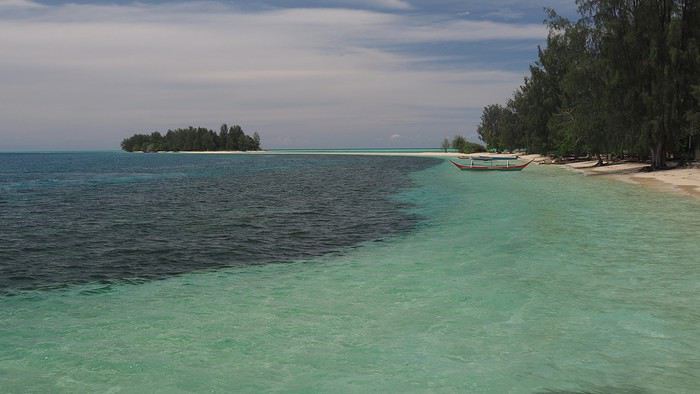
Context This is our fourth trip to Indonesia as a couple—after Java-Bali in 2011, Flores-Komodo in 2013, and Sulawesi in 2016—each time for three weeks. It’s also our tenth trip to Southeast Asia overall.
We’re traveling like we have in previous years: with a rough itinerary that often changes based on who we meet, tips from other travelers, how tired we are, or what we’re feeling in the moment. In the Moluccas, it’ll change constantly, mostly depending on transportation.
Our only accommodation booking: the first few nights in Ambon when we arrive.
Planned route (to be refined on the spot): Ambon - Banda Islands - Lease Islands - Ternate - Tidore - Halmahera (between Sofifi and Tobelo) - Morotai and the neighboring unnamed archipelago.
Flights: Lyon-Paris-Singapore on Air France (428 € round-trip), with good meals, champagne, and wine (we like our little comforts when going on vacation 😏). Then Singapore-Jakarta-Ambon on Air Asia and Garuda. Return flight: Ternate-Jakarta-Singapore on Lion Air, with a 3-day stopover in Singapore before heading home.
Episode 1: Ambon to Banda Our guesthouse, booked two days before departure, is 45 minutes from Ambon Airport, near Natsepa Beach (northeast of Leihitu). It’s a pretty average beach—quiet on weekdays but packed on Sundays (we saw the difference). It’s lined with warungs. This rainy day helps us readjust to the atmosphere of this country we love so much.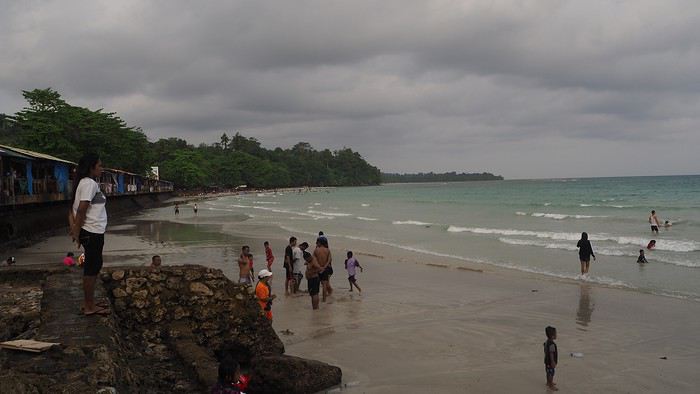
Our “Solim Guesthouse” is a lovely house with a living/dining room and garden, costing 15 € per night for two, including a hearty breakfast. Dinner is at Gaba Gaba, a great restaurant just a short walk away, right by the water, recommended by our host. Fun fact: it’s in the Lonely Planet, and it might be the only LP-listed spot in the Moluccas that actually matches the description (the others either don’t exist or have nothing to do with what’s advertised 😠).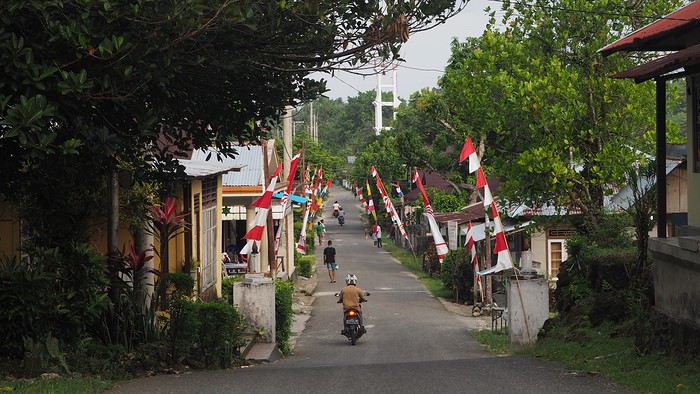
For the next two days, the super-friendly owner lends us his scooter. We set off to explore the coastal villages in northern Leihitu (the western part of Ambon Island, which has a weird shape).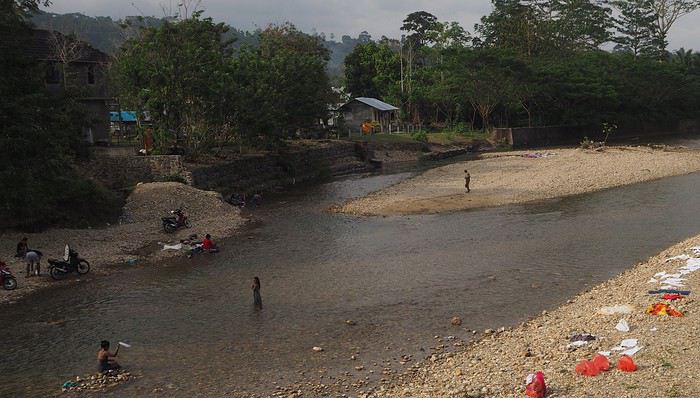 Laundry and trucks washed in the same stream.
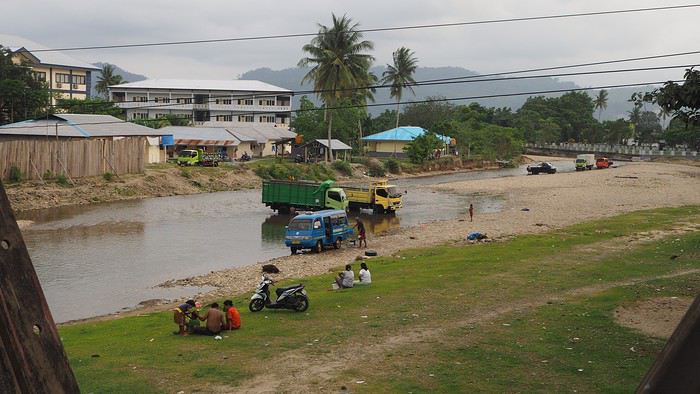
Liang Beach, described as the island’s most beautiful, is almost gone (climate change or something else?), but the colors are magical.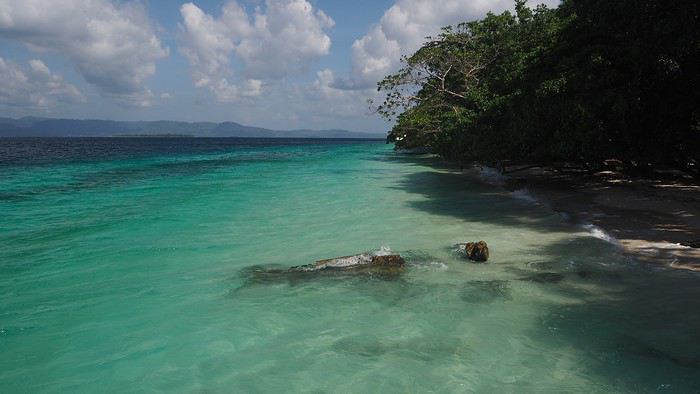
We continue 25 km toward a snorkeling spot our host recommended, taking a gorgeous, deserted little road through tiny villages in clove plantations (oh, those unforgettable scents!), stunning coves, and dense forest.
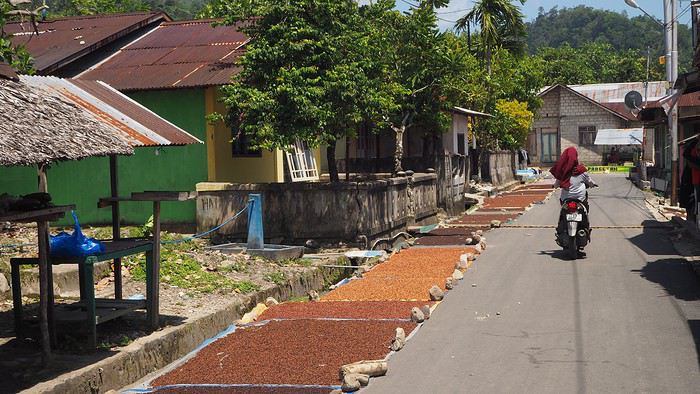
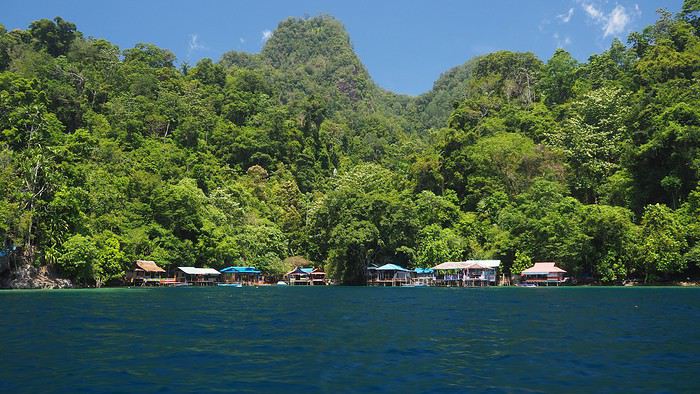 We’re greeted dozens of times with “Hello Mister”—a daily routine in the Moluccas. Every time we stop, we pose for photos to be saved on locals’ smartphones. They don’t see tourists often.
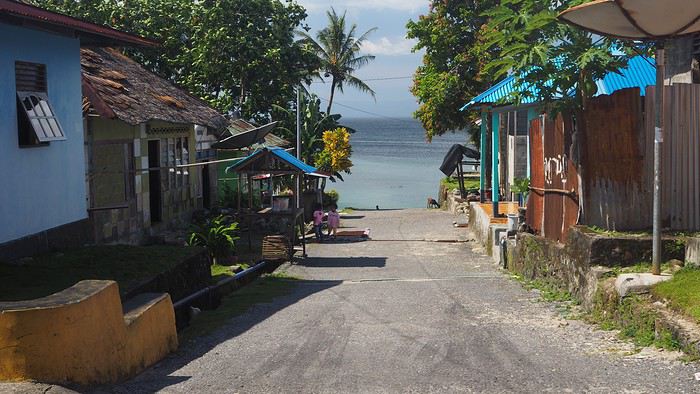
We ask for directions to the snorkeling spot (not easy—we only know basic Indonesian like *Selamat pagi*, *siang*, *sore*, and other polite phrases). Not many people know where it is (especially since we never know which village we’re in), but we eventually reach a small village that seems to be the right place. 🙂
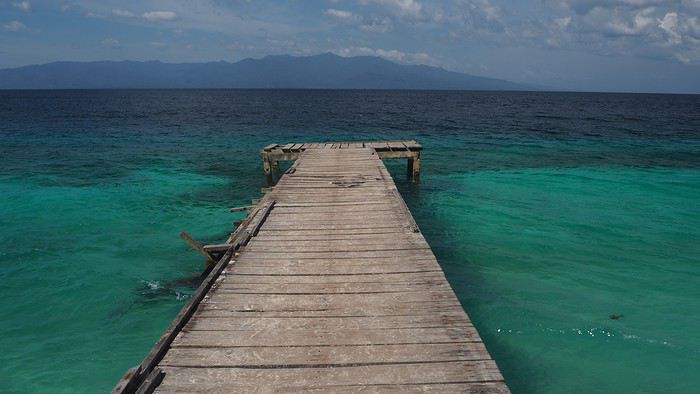
We ask a local to take us there by boat (it’s not reachable by land).
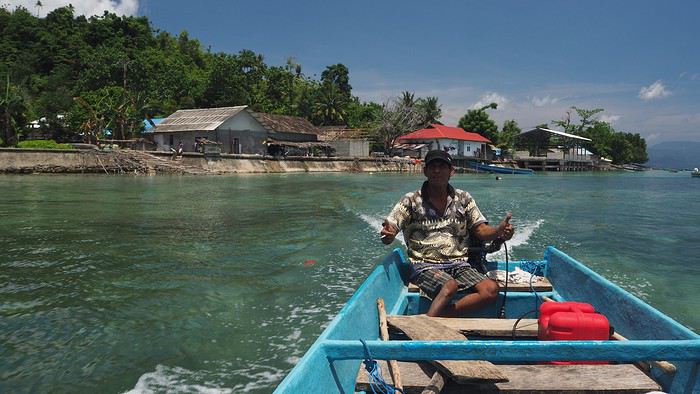
The spot is at most 100 meters long, but the coral is in good condition (apparently not dynamited by fishermen, unlike in other parts of this beautiful country where fishing methods are destructive and nature pays the price 😠). The fish are plentiful and diverse. It’s a great start before heading to Banda. We’re happy to have the place to ourselves… though we don’t yet realize we won’t see a single tourist for the rest of the trip!
After two days of rest, we head to Tulehu Port in the morning, aiming for the Banda Islands. We know the journey is often tricky: the Pelni ferry runs twice a month but doesn’t match our dates, the 10-seat Suzi Air plane is always full (you can’t book—you have to show up on Mondays and Fridays), and it’s often canceled due to weather. So we opt for the Tuesday speedboat (which also gets canceled if there are waves or wind), with the next one on Saturday. We’re used to Indonesian ports—crowded, rusty boats, no English speakers—but we still feel lost. When I ask about the speedboat to Bandaneira, people gesture wildly, someone takes me to the “harbor office,” then tells me there’s no boat, others try to sell me tickets, and some just say, “No boat.”
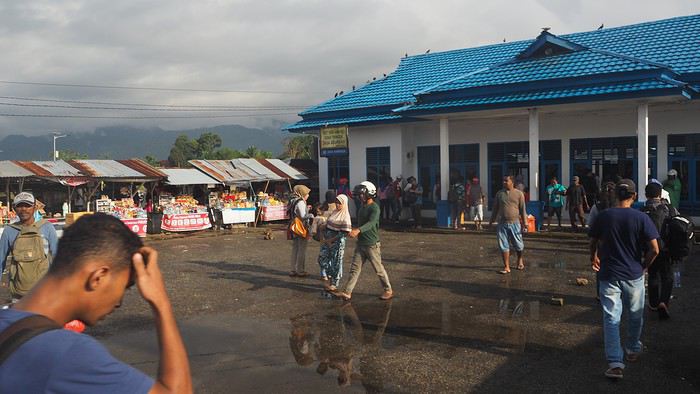
Luckily, an English-speaking local approaches us and confirms the speedboat is broken. The next one will be Saturday *if* it’s fixed—otherwise, even later. 🤪 😠 We’re crushed. We came here for the Banda Islands… 🙁 We decide waiting five days for a maybe-boat isn’t an option, so we decide to head straight to North Moluccas, which was planned for later. We’re so disappointed we don’t even want to stay in the area. The Lease Islands don’t appeal to us despite what we’ve read, and Seram would deserve its own trip with its remote mountain tribes. Huge disappointment—we’d been dreaming of Banda for months, with its incredible drop-offs like Bunaken, its islands covered in nutmeg trees, etc. I’d read that Banda is in the world’s top 5, alongside Bunaken (amazing—we went in 2016), Komodo (incredible—we went in 2013), Sipadan, and another spot I’ve forgotten.
We take a taxi back to Ambon (45 minutes) to a travel agency to buy plane tickets to Ternate. There’s a daily ATR72 flight at noon—perfect timing. Ambon is the capital of South Moluccas (or Central, depending on who you ask!) with 300,000 people. The city doesn’t seem unpleasant, but we don’t stop. On the plane, there are only about ten passengers for 72 seats. The flight attendants are stunning, as always with Wings Air—clearly, they’re hired for their looks. 😊
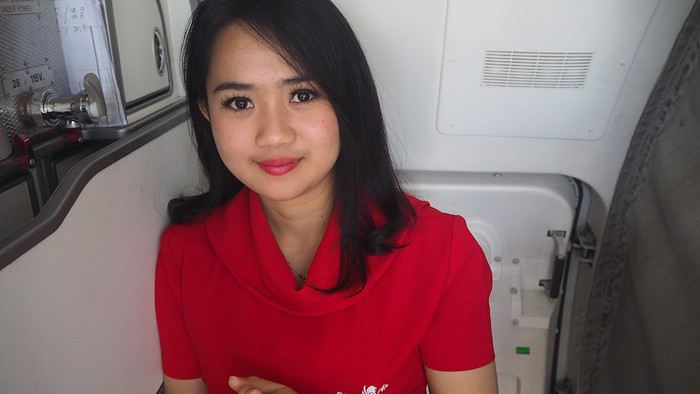
Stopover in Bacan—a runway in the middle of coconut trees serving a tiny town—then we fly over countless volcanoes, the last one towering over Ternate.
Next episode coming soon: Ternate.
This travel journal aims to help future travelers (well, I hope so!), since there’s so little information available about this remote archipelago. Big thanks to Lolodesiles and Ayis for answering my questions while I planned this trip!
Context This is our fourth trip to Indonesia as a couple—after Java-Bali in 2011, Flores-Komodo in 2013, and Sulawesi in 2016—each time for three weeks. It’s also our tenth trip to Southeast Asia overall.
We’re traveling like we have in previous years: with a rough itinerary that often changes based on who we meet, tips from other travelers, how tired we are, or what we’re feeling in the moment. In the Moluccas, it’ll change constantly, mostly depending on transportation.
Our only accommodation booking: the first few nights in Ambon when we arrive.
Planned route (to be refined on the spot): Ambon - Banda Islands - Lease Islands - Ternate - Tidore - Halmahera (between Sofifi and Tobelo) - Morotai and the neighboring unnamed archipelago.
Flights: Lyon-Paris-Singapore on Air France (428 € round-trip), with good meals, champagne, and wine (we like our little comforts when going on vacation 😏). Then Singapore-Jakarta-Ambon on Air Asia and Garuda. Return flight: Ternate-Jakarta-Singapore on Lion Air, with a 3-day stopover in Singapore before heading home.
Episode 1: Ambon to Banda Our guesthouse, booked two days before departure, is 45 minutes from Ambon Airport, near Natsepa Beach (northeast of Leihitu). It’s a pretty average beach—quiet on weekdays but packed on Sundays (we saw the difference). It’s lined with warungs. This rainy day helps us readjust to the atmosphere of this country we love so much.
Our “Solim Guesthouse” is a lovely house with a living/dining room and garden, costing 15 € per night for two, including a hearty breakfast. Dinner is at Gaba Gaba, a great restaurant just a short walk away, right by the water, recommended by our host. Fun fact: it’s in the Lonely Planet, and it might be the only LP-listed spot in the Moluccas that actually matches the description (the others either don’t exist or have nothing to do with what’s advertised 😠).
For the next two days, the super-friendly owner lends us his scooter. We set off to explore the coastal villages in northern Leihitu (the western part of Ambon Island, which has a weird shape).
Laundry and trucks washed in the same stream.
Liang Beach, described as the island’s most beautiful, is almost gone (climate change or something else?), but the colors are magical.
We continue 25 km toward a snorkeling spot our host recommended, taking a gorgeous, deserted little road through tiny villages in clove plantations (oh, those unforgettable scents!), stunning coves, and dense forest.
We’re greeted dozens of times with “Hello Mister”—a daily routine in the Moluccas. Every time we stop, we pose for photos to be saved on locals’ smartphones. They don’t see tourists often.We ask for directions to the snorkeling spot (not easy—we only know basic Indonesian like *Selamat pagi*, *siang*, *sore*, and other polite phrases). Not many people know where it is (especially since we never know which village we’re in), but we eventually reach a small village that seems to be the right place. 🙂
We ask a local to take us there by boat (it’s not reachable by land).
The spot is at most 100 meters long, but the coral is in good condition (apparently not dynamited by fishermen, unlike in other parts of this beautiful country where fishing methods are destructive and nature pays the price 😠). The fish are plentiful and diverse. It’s a great start before heading to Banda. We’re happy to have the place to ourselves… though we don’t yet realize we won’t see a single tourist for the rest of the trip!
After two days of rest, we head to Tulehu Port in the morning, aiming for the Banda Islands. We know the journey is often tricky: the Pelni ferry runs twice a month but doesn’t match our dates, the 10-seat Suzi Air plane is always full (you can’t book—you have to show up on Mondays and Fridays), and it’s often canceled due to weather. So we opt for the Tuesday speedboat (which also gets canceled if there are waves or wind), with the next one on Saturday. We’re used to Indonesian ports—crowded, rusty boats, no English speakers—but we still feel lost. When I ask about the speedboat to Bandaneira, people gesture wildly, someone takes me to the “harbor office,” then tells me there’s no boat, others try to sell me tickets, and some just say, “No boat.”
Luckily, an English-speaking local approaches us and confirms the speedboat is broken. The next one will be Saturday *if* it’s fixed—otherwise, even later. 🤪 😠 We’re crushed. We came here for the Banda Islands… 🙁 We decide waiting five days for a maybe-boat isn’t an option, so we decide to head straight to North Moluccas, which was planned for later. We’re so disappointed we don’t even want to stay in the area. The Lease Islands don’t appeal to us despite what we’ve read, and Seram would deserve its own trip with its remote mountain tribes. Huge disappointment—we’d been dreaming of Banda for months, with its incredible drop-offs like Bunaken, its islands covered in nutmeg trees, etc. I’d read that Banda is in the world’s top 5, alongside Bunaken (amazing—we went in 2016), Komodo (incredible—we went in 2013), Sipadan, and another spot I’ve forgotten.
We take a taxi back to Ambon (45 minutes) to a travel agency to buy plane tickets to Ternate. There’s a daily ATR72 flight at noon—perfect timing. Ambon is the capital of South Moluccas (or Central, depending on who you ask!) with 300,000 people. The city doesn’t seem unpleasant, but we don’t stop. On the plane, there are only about ten passengers for 72 seats. The flight attendants are stunning, as always with Wings Air—clearly, they’re hired for their looks. 😊
Stopover in Bacan—a runway in the middle of coconut trees serving a tiny town—then we fly over countless volcanoes, the last one towering over Ternate.
Next episode coming soon: Ternate.
De retour des Perhentian, île de Besar
Je ferai un compte rendu complet mais pour les pressés (qui partent bientôt?) je peux répondre aux questions pratiques et donner quelques bons plans.
Voyage avec bébé de 16 mois en Nouvelle-Zélande
Bonjour
Nous partons avec notre fille de 16 mois en NZ en novembre 2018. Nous avons déjà réservé l'avion (Arrivée à Auckland et on quittera la NZ de Christchurch le tout avec Singapour airlines) et nous avons aussi deja réservé un camping car. (Wildererness motorhomes)
Je serais preneuse de conseils pour le voyage en avion ! Ma fille a beaucoup d'énergie et je me demande comment va se passer le vol. Nous avons déja pris une fois l'avion pour Londres (donc pas très long) et ca s'est bien passé (pas de pleurs de douleur aux oreilles ou autres) Nous avons demandé un bassinet (on verra bien si elle rentre dedans !)
De plus je veux bien des conseils de "petites ballades" ou lieux a voir qui est possible et facile avec un bébé.
Merci d'avance pour vos réponses
Je serais preneuse de conseils pour le voyage en avion ! Ma fille a beaucoup d'énergie et je me demande comment va se passer le vol. Nous avons déja pris une fois l'avion pour Londres (donc pas très long) et ca s'est bien passé (pas de pleurs de douleur aux oreilles ou autres) Nous avons demandé un bassinet (on verra bien si elle rentre dedans !)
De plus je veux bien des conseils de "petites ballades" ou lieux a voir qui est possible et facile avec un bébé.
Merci d'avance pour vos réponses
Penang (Georgetown) au mois d'août?
Bonjour à tous,
Nous sommes un jeune couple et nous partons pour 2 semaines et demi en Malaisie du 23 août au 9 septembre. Je suis entrain de construire l'itinéraire mais j'ai un doute sur l'étape de Georgetown (Penang). J'ai lu que ce n'était pas vraiment la meilleure période en août à l'ouest de la péninsule mais en même temps je ne lis que du positif sur la ville de Georgetown... Mon dilemne est le suivant : est-ce que ça vaut le coup de consacrer 2 jours juste pour Georgetown ou est-ce préférable de me concentrer sur d'autres étapes ?
Pour info, voici ce que je prévois : Jour 1 : arrivée à KL et vol interne pour Penang Jour 2 : Penang Jours 3 et 4 : Cameron Highlands Jours 5, 6 et 7 : Taman Negara Jours 8, 9, 10 et 11 : Iles perhentian (pour plonger) Jours : 12, 13 et 14 : Kapas (pour plonger encore...) Jours 15 et 16 : Malacca Jours 17 et 18 : KL
Merci d'avance pour vos conseils !
Nous sommes un jeune couple et nous partons pour 2 semaines et demi en Malaisie du 23 août au 9 septembre. Je suis entrain de construire l'itinéraire mais j'ai un doute sur l'étape de Georgetown (Penang). J'ai lu que ce n'était pas vraiment la meilleure période en août à l'ouest de la péninsule mais en même temps je ne lis que du positif sur la ville de Georgetown... Mon dilemne est le suivant : est-ce que ça vaut le coup de consacrer 2 jours juste pour Georgetown ou est-ce préférable de me concentrer sur d'autres étapes ?
Pour info, voici ce que je prévois : Jour 1 : arrivée à KL et vol interne pour Penang Jour 2 : Penang Jours 3 et 4 : Cameron Highlands Jours 5, 6 et 7 : Taman Negara Jours 8, 9, 10 et 11 : Iles perhentian (pour plonger) Jours : 12, 13 et 14 : Kapas (pour plonger encore...) Jours 15 et 16 : Malacca Jours 17 et 18 : KL
Merci d'avance pour vos conseils !
Six jours dans le delta du Mékong avec visite de Xeo Quyt + vol intérieur
Bonjour,
Mon compagnon et moi partons pour quatre semaines au Vietnam cet été, je commence donc à réfléchir à notre itinéraire... Premier voyage en Asie pour nous, avec un impératif : voir enfin le mythique Mékong !! Nous aimerions y passer une semaine, histoire de vraiment en profiter, car nous aimons prendre notre temps. Idéalement, nous aimons passer deux nuits au même endroit pour vraiment nous poser et nous imprégner des lieux et de la vie locale. Voilà ce que nous avons pensé faire (c'est somme toute assez classique, je crois), je m'en remets à vous pour vos conseils... - Jour 1 : Trajet HCMV - Vinh Long. Un petit tour dans Vinh Long puis ferry vers An Binh. - Jour 2 : An Binh. - Jour 3 : Trajet vers Chau Doc, puis ballade dans la ville et visite d'un village Cham ? - Jour 4 : Visite du marché flottant de Chau Doc, puis mont Sam. - Jour 5 : Nous aimerions visiter la forêt de Xeo Quyt... Mon compagnon étant passionné d'histoire, et moi de nature, nous avons vraiment envie d'aller là-bas (un condensé des tunnels de Cu chi et de la réserve de Tra Su en somme 😛) mais je peine un peu à trouver des informations. Quelqu'un a-t-il un retour d'expérience sur cette visite ? Est-il facile d'y aller depuis Chau Doc ? Est-ce que cela nécessiterait de faire étape la nuit antérieure à Cao Lanh ? Serait-il plus judicieux de placer cette visite à un autre moment dans notre itinéraire dans le delta ? Nuit à Can Tho. - Jour 6 : Visite du marché flottant de Cai Rang, puis ballade dans Can Tho avant de prendre l'avion le soir vers Danang.
Est-ce un itinéraire trop chargé ?
Et une dernière petite question : est-il nécessaire de réserver les vols internes (ici Can Tho - Danang) longtemps à l'avance ? C'est également une des raisons pour lesquels je voudrais "boucler" notre itinéraire dans le delta, alors que le reste de notre voyage pourrait rester plus improvisé...
En vous remerciant ! 🙂
Mon compagnon et moi partons pour quatre semaines au Vietnam cet été, je commence donc à réfléchir à notre itinéraire... Premier voyage en Asie pour nous, avec un impératif : voir enfin le mythique Mékong !! Nous aimerions y passer une semaine, histoire de vraiment en profiter, car nous aimons prendre notre temps. Idéalement, nous aimons passer deux nuits au même endroit pour vraiment nous poser et nous imprégner des lieux et de la vie locale. Voilà ce que nous avons pensé faire (c'est somme toute assez classique, je crois), je m'en remets à vous pour vos conseils... - Jour 1 : Trajet HCMV - Vinh Long. Un petit tour dans Vinh Long puis ferry vers An Binh. - Jour 2 : An Binh. - Jour 3 : Trajet vers Chau Doc, puis ballade dans la ville et visite d'un village Cham ? - Jour 4 : Visite du marché flottant de Chau Doc, puis mont Sam. - Jour 5 : Nous aimerions visiter la forêt de Xeo Quyt... Mon compagnon étant passionné d'histoire, et moi de nature, nous avons vraiment envie d'aller là-bas (un condensé des tunnels de Cu chi et de la réserve de Tra Su en somme 😛) mais je peine un peu à trouver des informations. Quelqu'un a-t-il un retour d'expérience sur cette visite ? Est-il facile d'y aller depuis Chau Doc ? Est-ce que cela nécessiterait de faire étape la nuit antérieure à Cao Lanh ? Serait-il plus judicieux de placer cette visite à un autre moment dans notre itinéraire dans le delta ? Nuit à Can Tho. - Jour 6 : Visite du marché flottant de Cai Rang, puis ballade dans Can Tho avant de prendre l'avion le soir vers Danang.
Est-ce un itinéraire trop chargé ?
Et une dernière petite question : est-il nécessaire de réserver les vols internes (ici Can Tho - Danang) longtemps à l'avance ? C'est également une des raisons pour lesquels je voudrais "boucler" notre itinéraire dans le delta, alors que le reste de notre voyage pourrait rester plus improvisé...
En vous remerciant ! 🙂
L'Australie est immense et nous n'avons que 36 jours
Bonjour à toutes et tous
Nous partons pour un TDM en Septembre , en fait surtout l'Océanie le tour c'est pour le prix du billet !
Le voyage est bouclé (vols et voitures) pour chaque pays (Singapour, Australien Nouvelle Zélande, Polynésie.
Je viens donc à la pêche sur ce qu'il faut absolument voir/ faire aux endroits où nous passerons.
Merci d'avance à toutes et tous
Ah j'oubliais nous avons 70 et 66 ans sommes robustes mais oubliez les sauts à l'élastique et autres "folies" de jeunesse 😉
Voici le parcours australien,
Jour 1 - Lundi 24/09/18 : SIngapour Darwin (avion) - Jabiru Jour 2 - Mardi 25/09/18 : Ubirr - Jabiru Jour 3 - Mercredi 26/09/18 : Nourlangie - Kakadu National Park Jour 4 - Jeudi 27/09/18 : Yellow Water - Cooinda - Litchfield National Park - Batchelor Jour 5 - Vendredi 28/09/18 : Litchfield National Park - Batchelor Jour 6 - Samedi 29/09/18 : Litchfield National Park - Darwin - Cairns (avion) Jour 7 - Dimanche 30/09/18 : Cairns - Port Douglas Jour 8 - Lundi 01/10/18 : Port Douglas Jour 9 - Mardi 02/10/18 : Port Douglas - Cape Tribulation - Port Douglas Jour 10 - Mercredi 03/10/18 : Port Douglas - Yungaburra Jour 11 - Jeudi 04/10/18 : Yungaburra - Cairns Jour 12 - Vendredi 05/10/18 : Cairns - Ayers Rock (avion) Jour 13 - Samedi 06/10/18 : Ayers Rock - Kata Tjuta - Ayers Rock Jour 14 - Dimanche 07/10/18 : Ayers Rock - Cave Hill - Ayers Rock Jour 15 - Lundi 08/10/18 : Ayers Rock - Kings Canyon Jour 16 - Mardi 09/10/18 : Kings Canyon Jour 17 - Mercredi 10/10/18 : Kings Canyon - Glen Helen Jour 18 - Jeudi 11/10/18 : Glen Helen - Alice Springs Jour 19 - Vendredi 12/10/18 : Alice Springs - Adélaïde -(avion) Jour 20 - Samedi 13/10/18 : Adélaïde Jour 21 - Dimanche 14/10/18 : Adélaïde - Normanville Jour 22 - Lundi 15/10/18 : Adélaïde - Cape Jervis - Kangaroo Island - Seal Bay - Kingscote Jour 23 - Mardi 16/10/18 : Flinders Chase - Remarkable Rock - Flinders Chase - Kangaroo Island Jour 24 - Mercredi 17/10/18 : Penneshaw - Cape Jervis - Victor Harbor Jour 25 - Jeudi 18/10/18 : Victor Harbor - Halls Gap Jour 26 - Vendredi 19/10/18 : Grampians National Park - Halls Gap Jour 27 - Samedi 20/10/18 : Grampians National Park - Port Fairy Jour 28 - Dimanche 21/10/18 : Port Fairy - Great Ocean Road - Apollo Bay Jour 29 - Lundi 22/10/18 : Apollo Bay - Melbourne Jour 30 - Mardi 23/10/18 : Melbourne Jour 31 - Mercredi 24/10/18 : Melbourne - Sydney (avion) Jour 32 - Jeudi 25/10/18 : Sydney Jour 33 - Vendredi 26/10/18 : Sydney Jour 34 - Samedi 27/10/18 : Sydney - Blue Mountains - Sydney Jour 35 - Dimanche 28/10/18 : Sydney Jour 36 - Lundi 29/10/18 : Sydney puis départ pour Auckland
Jour 1 - Lundi 24/09/18 : SIngapour Darwin (avion) - Jabiru Jour 2 - Mardi 25/09/18 : Ubirr - Jabiru Jour 3 - Mercredi 26/09/18 : Nourlangie - Kakadu National Park Jour 4 - Jeudi 27/09/18 : Yellow Water - Cooinda - Litchfield National Park - Batchelor Jour 5 - Vendredi 28/09/18 : Litchfield National Park - Batchelor Jour 6 - Samedi 29/09/18 : Litchfield National Park - Darwin - Cairns (avion) Jour 7 - Dimanche 30/09/18 : Cairns - Port Douglas Jour 8 - Lundi 01/10/18 : Port Douglas Jour 9 - Mardi 02/10/18 : Port Douglas - Cape Tribulation - Port Douglas Jour 10 - Mercredi 03/10/18 : Port Douglas - Yungaburra Jour 11 - Jeudi 04/10/18 : Yungaburra - Cairns Jour 12 - Vendredi 05/10/18 : Cairns - Ayers Rock (avion) Jour 13 - Samedi 06/10/18 : Ayers Rock - Kata Tjuta - Ayers Rock Jour 14 - Dimanche 07/10/18 : Ayers Rock - Cave Hill - Ayers Rock Jour 15 - Lundi 08/10/18 : Ayers Rock - Kings Canyon Jour 16 - Mardi 09/10/18 : Kings Canyon Jour 17 - Mercredi 10/10/18 : Kings Canyon - Glen Helen Jour 18 - Jeudi 11/10/18 : Glen Helen - Alice Springs Jour 19 - Vendredi 12/10/18 : Alice Springs - Adélaïde -(avion) Jour 20 - Samedi 13/10/18 : Adélaïde Jour 21 - Dimanche 14/10/18 : Adélaïde - Normanville Jour 22 - Lundi 15/10/18 : Adélaïde - Cape Jervis - Kangaroo Island - Seal Bay - Kingscote Jour 23 - Mardi 16/10/18 : Flinders Chase - Remarkable Rock - Flinders Chase - Kangaroo Island Jour 24 - Mercredi 17/10/18 : Penneshaw - Cape Jervis - Victor Harbor Jour 25 - Jeudi 18/10/18 : Victor Harbor - Halls Gap Jour 26 - Vendredi 19/10/18 : Grampians National Park - Halls Gap Jour 27 - Samedi 20/10/18 : Grampians National Park - Port Fairy Jour 28 - Dimanche 21/10/18 : Port Fairy - Great Ocean Road - Apollo Bay Jour 29 - Lundi 22/10/18 : Apollo Bay - Melbourne Jour 30 - Mardi 23/10/18 : Melbourne Jour 31 - Mercredi 24/10/18 : Melbourne - Sydney (avion) Jour 32 - Jeudi 25/10/18 : Sydney Jour 33 - Vendredi 26/10/18 : Sydney Jour 34 - Samedi 27/10/18 : Sydney - Blue Mountains - Sydney Jour 35 - Dimanche 28/10/18 : Sydney Jour 36 - Lundi 29/10/18 : Sydney puis départ pour Auckland
Trois semaines à Sumatra
Bonjour,
Nous partons en Indonésie 20/08 au 12/09 pour une durée de 22 nuits, Notre choix s'est porté sur l'ile de Sumatra :) Nous arrivons à Singapour le 21/08 à 17h, j'ai trouvé un vol pour Medan le jour même avec un départ à 19h cela nous évite de passer une nuit à Singapour où bien je passe une nuit à Singapour et prend le vol le lendemain pour Padang ? cela me permettrait de faire le circuit en sens inverse mais je ne sait pas si cela à une grande importance ... Je pensait me concentrer uniquement sur le Nord de l'ile où il y a déjà pas mal de choses à voir mais l'ouest me tente également ... Ce que nous aimerions faire : REGION MEDAN : Ketambe : un trek de 2/3 nuits - 3 ou 4 nuits sur place Berastagi : peut-être pour le Gunung sibayak ? - 2 nuits sur place Le lac Toba : surtout pour l'ile de Samosir - 2 nuits sur place REGION PADANG : Vallée d'Harau Lac Maninjau (apparemment plus beau que le lac Toba ?) SNORKELING : J'hésite entre les iles banyaks (plus difficiles d'accès) où pulsa web ? Vos avis sont les bienvenues :) Merci à tous,
Nathalie
Nous partons en Indonésie 20/08 au 12/09 pour une durée de 22 nuits, Notre choix s'est porté sur l'ile de Sumatra :) Nous arrivons à Singapour le 21/08 à 17h, j'ai trouvé un vol pour Medan le jour même avec un départ à 19h cela nous évite de passer une nuit à Singapour où bien je passe une nuit à Singapour et prend le vol le lendemain pour Padang ? cela me permettrait de faire le circuit en sens inverse mais je ne sait pas si cela à une grande importance ... Je pensait me concentrer uniquement sur le Nord de l'ile où il y a déjà pas mal de choses à voir mais l'ouest me tente également ... Ce que nous aimerions faire : REGION MEDAN : Ketambe : un trek de 2/3 nuits - 3 ou 4 nuits sur place Berastagi : peut-être pour le Gunung sibayak ? - 2 nuits sur place Le lac Toba : surtout pour l'ile de Samosir - 2 nuits sur place REGION PADANG : Vallée d'Harau Lac Maninjau (apparemment plus beau que le lac Toba ?) SNORKELING : J'hésite entre les iles banyaks (plus difficiles d'accès) où pulsa web ? Vos avis sont les bienvenues :) Merci à tous,
Nathalie