Results for "Cap+Vert"
About 19,317 results.
More options
Many results are in French, the community’s main language. English translations are added over time.
Search results
Açores pour les randonneurs
Bonjour,
Compte-rendu pour ceux qui sont intéressés par l’archipel des Açores :
- Le 24/08/2013 à 7h55 départ d’Orly vers Lisbonne. Départ de Lisbonne vers Horta (île du Faial) prévu à 13h25. L’avion a eu 2 heures de retard, donc une journée de congés gâchée dans les transports. 🤪
A l’aéroport de Lisbonne, il ne faut pas se fier aux numéros des portes d’embarquement indiquées sur votre billet d’avion. Il est important de vérifier la porte d’embarquement sur les écrans d’information.
De l’aéroport de Horta (il est plutôt situé à Castelo Branco) à la praia do Almoxarife, j’ai pris un taxi 16 € pour la course.
Le camping d’Almoxarife est situé face à la plage. 5,4€/jour pour une personne et une petite tente.
La température de l’eau de la mer est agréable
Le Pico, à l’aube, vu depuis la plage d’Almoxarife.
L’église d’Almoxarife
Pour faire les courses, il y a une superette à 3 km environ du camping. En sortant du camping, il faut tourner à gauche, passer à côté de l’église et aller jusqu’au bar qui fait l’angle de la rue où vous marchez. Tourner à gauche, et monter la rue qui est en face.
Compte-rendu pour ceux qui sont intéressés par l’archipel des Açores :
- Le 24/08/2013 à 7h55 départ d’Orly vers Lisbonne. Départ de Lisbonne vers Horta (île du Faial) prévu à 13h25. L’avion a eu 2 heures de retard, donc une journée de congés gâchée dans les transports. 🤪
A l’aéroport de Lisbonne, il ne faut pas se fier aux numéros des portes d’embarquement indiquées sur votre billet d’avion. Il est important de vérifier la porte d’embarquement sur les écrans d’information.
De l’aéroport de Horta (il est plutôt situé à Castelo Branco) à la praia do Almoxarife, j’ai pris un taxi 16 € pour la course.
Le camping d’Almoxarife est situé face à la plage. 5,4€/jour pour une personne et une petite tente.
La température de l’eau de la mer est agréable
Le Pico, à l’aube, vu depuis la plage d’Almoxarife.
L’église d’Almoxarife
Pour faire les courses, il y a une superette à 3 km environ du camping. En sortant du camping, il faut tourner à gauche, passer à côté de l’église et aller jusqu’au bar qui fait l’angle de la rue où vous marchez. Tourner à gauche, et monter la rue qui est en face.
Concours du mois de février 2013: « Des terres cultivées à travers le monde »
Je vous propose comme thème pour ce mois de février 2013 :
« Des terres cultivées à travers le monde »
= Des fruits, des légumes, des fleurs, des céréales, du coton, du cacao, du tabac, chanvre ou cann… (à sucre ?), tout ce que les hommes (ou femmes, malheureusement parfois les enfants !) labourent, sèment, plantent ou récoltent
Les photos devront montrer ce travail de culture sous différentes formes, jardins, champs, terrasses, vergers, vignobles, rizières, etc……et inciter au voyage.
Ainsi, l’intervention humaine dans un cadre naturel devra être nettement visible, même s’il y a utilisation d’outils, machines ou animaux.
Ne seront pas retenues: Les photos de « produits » qui ne sont plus en terre : au restaurant, dans la cuisine, ceux bien rangés sur un étal d’un vendeur, les fruits de la mer, les images type « nature-morte le matériel agricole bien rangé dans hangar….
- Participation au concours : Ouvert à tous les membres de VF
Chaque participant peut poster jusqu’à 3 photos (vos plus belles évidemment), en les numérotant (photo1, photo2 et photo3), un commentaire libre est le bienvenu.
L’envoi des photos est ouvert du dimanche 03 février au mercredi 21 février à minuit.
- Les votes auront lieu à partir du jeudi 22 à 00h01 jusqu’au mardi 27 février à minuit.
Pour faciliter le « dépouillement », merci de bien préciser : le pseudo, le numéro de la photo et son classement. Ex : Photo n°1 = 3 pts. Photo n°2 = 2 pts. Photo n°3 = 1 pt
En cas d’égalité de points pour deux photos, la photo gagnante sera celle ayant obtenu le plus grand nombre de 1e places sur le podium ! L’heureux (se) gagnant(e) aura l’insigne honneur d’organiser le concours photo du mois de mars 2013. A défaut de manifestation du lauréat au 28 février, son (sa) dauphin(e) prendra sa place…….
Pour les discussions autour du thème, c’est ici : http://voyageforum.com/forum/discussion_autour_concours_mois_fevrier_2013_terres_cultivees_travers_monde_D5797661/
Pour le diaporama, c'est ici (Encore merci à Heriklès):
https://picasaweb.google.com/...&feat=directlink
= Des fruits, des légumes, des fleurs, des céréales, du coton, du cacao, du tabac, chanvre ou cann… (à sucre ?), tout ce que les hommes (ou femmes, malheureusement parfois les enfants !) labourent, sèment, plantent ou récoltent
Les photos devront montrer ce travail de culture sous différentes formes, jardins, champs, terrasses, vergers, vignobles, rizières, etc……et inciter au voyage.
Ainsi, l’intervention humaine dans un cadre naturel devra être nettement visible, même s’il y a utilisation d’outils, machines ou animaux.
Ne seront pas retenues: Les photos de « produits » qui ne sont plus en terre : au restaurant, dans la cuisine, ceux bien rangés sur un étal d’un vendeur, les fruits de la mer, les images type « nature-morte le matériel agricole bien rangé dans hangar….
- Participation au concours : Ouvert à tous les membres de VF
Chaque participant peut poster jusqu’à 3 photos (vos plus belles évidemment), en les numérotant (photo1, photo2 et photo3), un commentaire libre est le bienvenu.
L’envoi des photos est ouvert du dimanche 03 février au mercredi 21 février à minuit.
- Les votes auront lieu à partir du jeudi 22 à 00h01 jusqu’au mardi 27 février à minuit.
Pour faciliter le « dépouillement », merci de bien préciser : le pseudo, le numéro de la photo et son classement. Ex : Photo n°1 = 3 pts. Photo n°2 = 2 pts. Photo n°3 = 1 pt
En cas d’égalité de points pour deux photos, la photo gagnante sera celle ayant obtenu le plus grand nombre de 1e places sur le podium ! L’heureux (se) gagnant(e) aura l’insigne honneur d’organiser le concours photo du mois de mars 2013. A défaut de manifestation du lauréat au 28 février, son (sa) dauphin(e) prendra sa place…….
Pour les discussions autour du thème, c’est ici : http://voyageforum.com/forum/discussion_autour_concours_mois_fevrier_2013_terres_cultivees_travers_monde_D5797661/
Pour le diaporama, c'est ici (Encore merci à Heriklès):
https://picasaweb.google.com/...&feat=directlink
S'amuser à Madagascar
je souhaite partir a Madagascar en juillet.si j'ai bien compris il y a de superbe plage mais le soir que fait on ?car moi j'aime faire la fiesta .ou dois-je aller?MERCI DE ME REPONDRE
Voyage au Portugal à vélo en septembre / octobre
Salut tout le monde,
Nous aimerions avoir des infos sur les possibilités "vélo" du portugal.
Nous sommes entre 2 et 5 amis et nous comptons allons au portugal pour faire du vélo fin septembre / début octobre. Nous ne savons pas encore combien de temps, mais a priori entre 1 et 2 semaines.
1ere question : le lieu. Le sud, le nord, la frontière espagno-portugaise à l'Est : nous ne savons pas trop. Lequel offre les paysages les plus sympas ? Y-en-a-t-il un réservé aux grimpeurs hors-norme ? Est-ce que ça vaut le coup de longer le littoral (pas trop monotone ?) ?
2ème question : la période. Fin septembre, début octobre est-il un bon choix ? Y-fait-il encore beau et assez chaud ? Les paysages sont-ils encore sympas ?
3ème question : l'accès sans avion. De Paris, est-il jouable d'accéder à Lisbonne ou Porto sans prendre l'avion ? (volonté de ne pas utiliser l'avion) Sacrifices de journées en train ou en bus possibles, mais je me demande comment faire avec les vélos (que je pourrais démonter et mettre dans un sac) : quelqu'un l'a-t-il déjà fait ?
J'espère que vous pourrez nous aider à organiser un voyage qui, à ce que nous avons pu voir dans les différents forums, vaut le coup !
A bientôt
Julien
Nous aimerions avoir des infos sur les possibilités "vélo" du portugal.
Nous sommes entre 2 et 5 amis et nous comptons allons au portugal pour faire du vélo fin septembre / début octobre. Nous ne savons pas encore combien de temps, mais a priori entre 1 et 2 semaines.
1ere question : le lieu. Le sud, le nord, la frontière espagno-portugaise à l'Est : nous ne savons pas trop. Lequel offre les paysages les plus sympas ? Y-en-a-t-il un réservé aux grimpeurs hors-norme ? Est-ce que ça vaut le coup de longer le littoral (pas trop monotone ?) ?
2ème question : la période. Fin septembre, début octobre est-il un bon choix ? Y-fait-il encore beau et assez chaud ? Les paysages sont-ils encore sympas ?
3ème question : l'accès sans avion. De Paris, est-il jouable d'accéder à Lisbonne ou Porto sans prendre l'avion ? (volonté de ne pas utiliser l'avion) Sacrifices de journées en train ou en bus possibles, mais je me demande comment faire avec les vélos (que je pourrais démonter et mettre dans un sac) : quelqu'un l'a-t-il déjà fait ?
J'espère que vous pourrez nous aider à organiser un voyage qui, à ce que nous avons pu voir dans les différents forums, vaut le coup !
A bientôt
Julien
La grande traversée des montagnes Bleues (Livradois-Forez)
La grande traversée du Parc du Livradois-Forez(1)
L’axe Nord-Sud du Massif Forez et les Hautes Chaumes du Haut Forez peuvent être une excellente façon de débuter le parcours…
Vous laissez votre voiture et vous prenez le Train Express Régional en direction de Clermont-Ferrand- , pour gravir les premiers contreforts des Monts du Forez…
A Noirétable(800 mètres d’altitude) vous n’êtes plus qu’à 4 kms du fameux GR3 qui traverse du Nord au Sud le Parc du Livradois-Forez…
Ne pas oublier de faire des réserves d’eau et des provisions de bouche, vous ne trouverez plus de point de ravitaillement avant 28 kms…
Et là, le GR 3 une fois atteint, plus de goudron, plus de voitures, des mélèzes, des épicéas, des champs de myrtilles et de gentianes auxquels vous accéderez au fur et à mesure que vous prenez de l’altitude…
La crête des Monts du Forez a la particularité de vous permettre de découvrir en même temps le Puy de Sancy(à 170 kms) le Mont d’Or et le Puy de Dôme (à 120 kms)et, cerise sur le gâteau, le Mont Blanc et la chaîne des Alpes ( Bâle n’est qu’à 350 kms)…
Par temps clair, c’est un émerveillement…vous parvenez très vite sur les Hautes Chaumes, au milieu de troupeaux d’estive, et, à part quelques essaims sauvages égarés sur le parcours, deux ou trois randonneurs, une cavalière, vous avez l’impression d’être seul au monde…
L’impression est presque ‘aussi irréelle que dans le Parc du Vercors, avec un bon point, c’est que le parc du Livradois-Forez n’est pas encore ouvert au tourisme de masse…
C’est l’occasion de se ressourcer, même si vous êtes païen, à chaque calvaire croisé, à chaque crucifix égaré qui vous rappelle que vous êtes en terre romane...
L’axe Nord-Sud du Massif Forez et les Hautes Chaumes du Haut Forez peuvent être une excellente façon de débuter le parcours…
Vous laissez votre voiture et vous prenez le Train Express Régional en direction de Clermont-Ferrand- , pour gravir les premiers contreforts des Monts du Forez…
A Noirétable(800 mètres d’altitude) vous n’êtes plus qu’à 4 kms du fameux GR3 qui traverse du Nord au Sud le Parc du Livradois-Forez…
Ne pas oublier de faire des réserves d’eau et des provisions de bouche, vous ne trouverez plus de point de ravitaillement avant 28 kms…
Et là, le GR 3 une fois atteint, plus de goudron, plus de voitures, des mélèzes, des épicéas, des champs de myrtilles et de gentianes auxquels vous accéderez au fur et à mesure que vous prenez de l’altitude…
La crête des Monts du Forez a la particularité de vous permettre de découvrir en même temps le Puy de Sancy(à 170 kms) le Mont d’Or et le Puy de Dôme (à 120 kms)et, cerise sur le gâteau, le Mont Blanc et la chaîne des Alpes ( Bâle n’est qu’à 350 kms)…
Par temps clair, c’est un émerveillement…vous parvenez très vite sur les Hautes Chaumes, au milieu de troupeaux d’estive, et, à part quelques essaims sauvages égarés sur le parcours, deux ou trois randonneurs, une cavalière, vous avez l’impression d’être seul au monde…
L’impression est presque ‘aussi irréelle que dans le Parc du Vercors, avec un bon point, c’est que le parc du Livradois-Forez n’est pas encore ouvert au tourisme de masse…
C’est l’occasion de se ressourcer, même si vous êtes païen, à chaque calvaire croisé, à chaque crucifix égaré qui vous rappelle que vous êtes en terre romane...
Jeu des photos 57
salut a tous et à toutes cel faisait longtemps que j'étais pas venu et comme je vois que personne ne veut mettre de photo en voila une je vous demanderais seulement la ville
Naviguer avec son voilier en flotille, recherchons autres voiliers
Nous sommes basés au port de Canet en Roussillon , et naviguons sur unDUFOUR 405 .
Nous recherchons des voiliers pour naviguer sur le bassin méditéranneen .(BALEARES, CORSE et+++++++++++)car nous sommes des jeunes retraités
Abientôt
SUZY JACQUES😉
Les voitures de plus de cinq ans ne sont plus autorisées au Sénégal?
Bonjour:
j'ai lu que les voitures de + de 5 ans ne sont plus autorisées au sénégal et doivent être laissées à la frontière .
qui peut me le confirmer ? Merci .
Martinique: petites nouvelles du quotidien à partir du 1er mars 2010
Bonjour,
Afin de rassembler toutes les informations pouvant être utiles, à un instant T, à nos amies et amis de passage en Madinina, j'ouvre ce sujet. J'y mettrai, avec l'aide d'autres j'espère, les éléments variants pouvant interférer dans le bon vécu d'un voyage ou expliquant certaines situations ponctuelles. Lorsqu'il y aura des points communs avec la Guadeloupe, je le signalerai.
Bonne prochaine venue dans nos îles.
Afin de rassembler toutes les informations pouvant être utiles, à un instant T, à nos amies et amis de passage en Madinina, j'ouvre ce sujet. J'y mettrai, avec l'aide d'autres j'espère, les éléments variants pouvant interférer dans le bon vécu d'un voyage ou expliquant certaines situations ponctuelles. Lorsqu'il y aura des points communs avec la Guadeloupe, je le signalerai.
Bonne prochaine venue dans nos îles.
Planning a bike trip?
Who are you? Where are you from? Where are you going?
Like last year at this time, a post about bike travel ideas.
How many of us are preparing a trip planned for this year? Probably a lot.
What’s yours—the one you’ve been dying to do for so long, maybe too long? For us, it’s a modest PARIS-MARATHON by bike, followed by MARATHON-ATHENS on foot in June 2010. And you?
May the passion keep growing before, during, and after! Happy planning and safe travels to everyone.
Like last year at this time, a post about bike travel ideas.
How many of us are preparing a trip planned for this year? Probably a lot.
What’s yours—the one you’ve been dying to do for so long, maybe too long? For us, it’s a modest PARIS-MARATHON by bike, followed by MARATHON-ATHENS on foot in June 2010. And you?
May the passion keep growing before, during, and after! Happy planning and safe travels to everyone.
Aller à la Réunion en bateau-stop?
Salut à tous,
Je projette de partir bientôt à la Réunion mais ne désire pas prendre l'avion pour de nombreuses raisons : coût élevé, trop polluant, sans compter le fait que l'on passe au dessus d'une multitude de choses à découvrir.
J'ai une bonne expérience du stop en Europe, j'aime l'aventure et surtout j'ai le temps !
Ce qui m'intéresse surtout, ça serait des vécus de bateau-stoppeurs. Car si je projette de partir ainsi, il se pose de questions essentielles : _Opter pour le passage à l'ouest de l'Afrique ou par la Mer Rouge ? _Dans quel port partir ? En France, en Italie, en Espagne ...
Je préférerais en fait passer par l'Egypte que je traverserai en stop pour rejoindre une station balnéaire sur la Mer Rouge et ensuite trouver qqn qui m'emmènerait loin au sud en évitant toute la Corne africaine...
Quelqu'un peut-il m'éclairer ?
merci d'avance, sébastien
Ce qui m'intéresse surtout, ça serait des vécus de bateau-stoppeurs. Car si je projette de partir ainsi, il se pose de questions essentielles : _Opter pour le passage à l'ouest de l'Afrique ou par la Mer Rouge ? _Dans quel port partir ? En France, en Italie, en Espagne ...
Je préférerais en fait passer par l'Egypte que je traverserai en stop pour rejoindre une station balnéaire sur la Mer Rouge et ensuite trouver qqn qui m'emmènerait loin au sud en évitant toute la Corne africaine...
Quelqu'un peut-il m'éclairer ?
merci d'avance, sébastien
Qu'attendez-vous des croisières?
Bonjour,
je suis une passionnée des croisières, j'aime l'ambiance qui rêgne sur les bateaux, la fait de se réveiller chaque jour dans un port différent....
Je suis encore étudiante et en train d'élaborer ma thèse sur ce mode de voyages.
J'aimerais savoir ce que vous pensez des croisières, qu'est ce que vous attendez de ce type de voyage, quels services vous aimeriez voir en plus tel que des concerts, des services pour enfants...?
N'hésitez pas à me donner toutes les idées qui vous passe par la tête!!!!
Merci d'avance pour votre aide😉!
Merci d'avance pour votre aide😉!
Vos croisières?
Ce sujet pour que chacun fasse part des croisieres qu'il a dejà effectué ou bien réservé pour un proche avenir.
Le but etant de pouvoir echanger ses diverses impressions.
Pour nous:
Juillet 2001 (Mistral): Venise, mer, Athenes, Santorin e Mykonos, Rhodes, Corfou, Dubrovnik, Venise
Juillet 2003 (European star):Marseille, Genes, Naples, Messine, Tunis, Palma, Barcelone, Marseille
Fevrier 2005 (Costa europa):Savone, Barcelone, mer, Casablanca, Agadir, Arrecife, Tenerife, Funchal, mer, Malaga, mer, Savone
Juin 2006 (Costa magica):Copenhague, mer, Tallin, St-petersbourg, Helsinki, Stockholm, mer, Copenhague
Mars 2007(Costa concordia):Savone, mer, Katakolon, Athenes, Izmir, Rhodes, Limassol, Alexandrie, mer, mer, Civitavecchia, Savone
Juin 2008(Costa magica):Marseille, Savone, Naples, Palerme, Tunis, Palma, Barcelone, Marseille
Juin 2009(Costa luminosa):Amsterdam, mer, Flam, Andalsnes, mer, Honningsvag, Tromso, Gravdal, Trondheim, hellesylt geiranger, Bergen, mer, Amsterdam
Le but etant de pouvoir echanger ses diverses impressions.
Pour nous:
Juillet 2001 (Mistral): Venise, mer, Athenes, Santorin e Mykonos, Rhodes, Corfou, Dubrovnik, Venise
Juillet 2003 (European star):Marseille, Genes, Naples, Messine, Tunis, Palma, Barcelone, Marseille
Fevrier 2005 (Costa europa):Savone, Barcelone, mer, Casablanca, Agadir, Arrecife, Tenerife, Funchal, mer, Malaga, mer, Savone
Juin 2006 (Costa magica):Copenhague, mer, Tallin, St-petersbourg, Helsinki, Stockholm, mer, Copenhague
Mars 2007(Costa concordia):Savone, mer, Katakolon, Athenes, Izmir, Rhodes, Limassol, Alexandrie, mer, mer, Civitavecchia, Savone
Juin 2008(Costa magica):Marseille, Savone, Naples, Palerme, Tunis, Palma, Barcelone, Marseille
Juin 2009(Costa luminosa):Amsterdam, mer, Flam, Andalsnes, mer, Honningsvag, Tromso, Gravdal, Trondheim, hellesylt geiranger, Bergen, mer, Amsterdam
Étudiante cherche une mission en Afrique
Bonjour à tous!
Je suis étudiante en école d'ingénieur (1ère année). Dans le cadre de mes études, je pars au mois de mai à l'étranger pendant 4mois. J'aurai souhaité travailler en tant que bénévole dans un centre de soin, ou un orphelinat en Afrique. Je n'ai aucun diplôme (sauf bac scientifique), ni aucune qualification, mais ai toujours été attiré par le milieu social et médical. Ne sachant pas trop ou m'adresser, je lance ici une bouteille à la mer.
Je ne cherche pas une mission pour le moment, mais des bases sur lesquelles je pourrai m'appuyer dans ma recherche...
Merci d'avance
Merci d'avance
Randonnée à Madère
Bonjour,
Avec une amie, je partirai 15 jours fin avril pour faire de la randonnée à Madère;environ 12 à 15 km quotidiens.
Quelqun l' a déjà fait?
Comment est l'ìle;aussi grandiose qu'on le dit?
Merci pour vos réponses!😎
Avec une amie, je partirai 15 jours fin avril pour faire de la randonnée à Madère;environ 12 à 15 km quotidiens.
Quelqun l' a déjà fait?
Comment est l'ìle;aussi grandiose qu'on le dit?
Merci pour vos réponses!😎
Où partir dans les îles avec des bébés?
bonjour,
Je suis soulagée de voir qu'on peut envisager de voyager sans crainte avec des enfants, et sans se faire traiter de parents complètement tarés 😮!!!! nous nous marions en juin et nous avons décidé de partir avec nos jumelles au soleil, ce sera peut-être l'hiver prochain selon la destination choisie. Elles auront 12 mois le 14 aout, pour info, alors elles auront dans les 15 mois quand nous partirons, peut-être un peu moins, peut-être un peu plus......
J'aimerais savoir quelles sont les destinations les + recommandables au niveau des iles, point de vue confort, sanitaire etc....?
Mon homme espère une destination où il y aura aussi des choses à voir, visiter, des petites excursions, (même si nous, on peut pas l'acocmpagner)
merci 😉
Je suis soulagée de voir qu'on peut envisager de voyager sans crainte avec des enfants, et sans se faire traiter de parents complètement tarés 😮!!!! nous nous marions en juin et nous avons décidé de partir avec nos jumelles au soleil, ce sera peut-être l'hiver prochain selon la destination choisie. Elles auront 12 mois le 14 aout, pour info, alors elles auront dans les 15 mois quand nous partirons, peut-être un peu moins, peut-être un peu plus......
J'aimerais savoir quelles sont les destinations les + recommandables au niveau des iles, point de vue confort, sanitaire etc....?
Mon homme espère une destination où il y aura aussi des choses à voir, visiter, des petites excursions, (même si nous, on peut pas l'acocmpagner)
merci 😉
Megacom SIM card, how does it work?
Hi there,
I’ve never bought a SIM card abroad or even used prepaid cards in France...
So I’m wondering how it all works?
You buy a SIM card and pop it into your phone. Okay, so far so good... 😏
But after that?
I can’t find the price of prepaid cards or how they work with MegaCom.
If someone could give me a step-by-step guide... 😊
Thanks! 🙂
I’ve never bought a SIM card abroad or even used prepaid cards in France...
So I’m wondering how it all works?
You buy a SIM card and pop it into your phone. Okay, so far so good... 😏
But after that?
I can’t find the price of prepaid cards or how they work with MegaCom.
If someone could give me a step-by-step guide... 😊
Thanks! 🙂
June 2026 Theme Thread: Such a Beautiful Landscape
This is where we chat.
Africa: A Heartfelt Love for a Continent
“When the Whites came to Africa, we had the land and they had the Bible. They taught us to pray with our eyes closed: when we opened them, the Whites had the land and we had the Bible.” Jomo Kenyatta (p.7)
The Maggi cube, an unchallenged hegemony, and so much more
“The hopeless continent,” headlined The Economist, a British magazine, in July 2000 about Africa. Eleven years later, the same magazine headlined “Africa rising” instead. Images of Africa in the prosperous North constantly oscillate between apocalyptic scenarios and enthusiastic projections. A key issue with such images lies in the generalization they entail. If you look at the continent, considerable contrasts emerge depending on space and time. It’s no surprise that a region of the world encompassing such diverse ecological zones, maintaining such varied ties with other continents, comprising nearly fifty nation-states in sub-Saharan Africa alone, and characterized by a great diversity of languages, belief systems, and historical paths, doesn’t share a single destiny.
And yet, for many people outside Africa, as well as for many Africans, the continent constitutes a single entity, defined by criteria such as skin color, a colonial past, poverty, and the art of survival. Until now, these perspectives were generally accompanied by the idea that Africa had to—or should have—followed a single path together, sometimes called development, sometimes modernization, sometimes liberation, then a market economy. None of these paths delivered on their promises.
The two writers Alain Mabanckou and Abdourahman Waberi—one from Congo, the other raised in Djibouti, both long settled in France and now professors at renowned North American universities (Los Angeles, Washington)—have had enough of pessimistic scenarios: “We are aware that Africa is in the world and the world is in Africa. The same goes for all other continents, as our destinies are inextricably linked for better or worse. We refuse to see Africa as a reservoir of misfortunes or a continent cursed by atavistic misfortune and characterized by ethnic conflicts. [...] It’s this passionate flame we wanted to capture in a book [...] a kind of stroll through African cultures, without any demands, each letter of the alphabet leading us to a notion, a practice, a concept, a moment in history, literature, painting, politics, economics, cuisine, etc.” (p.10-11). Africa, they write, is on the verge of “imposing a signature, a style, a way of being in the world and in relation to the rest of the world.” (p.11) To put words to the continent’s diversity and dynamism, the two authors created a “rambling ABC,” a kind of portrait—or more precisely, a mythography—that lets you see and feel the pulse of a vast continent whose cultural power is unfolding before our eyes. Once marginalized or even mocked, the voice and importance of the Continent in global affairs are now undeniable” (p.11), containing over a hundred entries, mostly concise, written in a relaxed and casual style. The optimistic, even exuberant tone is set from the brief introduction. The duo of authors wants to “sing a love song to the cultures of our continent, to its inhabitants past and present, to its exceptional resources and its spectacular globalization despite a certain pollution that still clouds our skies due to the unmatched duration of dictatorships in some of our regions.” (p.12) In doing so, they don’t want to be too distracted by today’s Afewerki-Biya-Bongo-Déby & Co. ...
Of course, you’ll find tributes to great precursors like Frantz Fanon (“[...] it was a love story and admiration that wasn’t dimmed by the four decades separating his birth from ours. Let’s add that we were born while the native of Fort-de-France had left the world’s stage four years earlier, in the prime of life” p.141), Mongo Beti (“You must read and reread Mongo Beti, a genius who used his fame to support often just causes in Africa, like defending oppressed groups. His place is already in History. His oppressors, like the dictators Ahmadou Ahidjo and Paul Biya, can’t compete in the same category” p.64), the Malian Amadou Hampâté Bâ
(“Posterity remembers him mainly as an tireless defender of African cultures. His plea for the collection and preservation of traditional African knowledge remains a major event for all men and women of good will. One day in 1960, at the UNESCO podium, the native of Bandiagara sounded the alarm: ‘[...] Since we’ve admitted that the humanity of each people is the heritage of all humanity, if African traditions aren’t collected in time and written down, they’ll one day be missing from the universal archives of humanity.’” p.51),
Kwame Nkrumah, “one of the founders of Pan-Africanism, father of Ghana’s independence” (p.239), as well as the historian Cheikh Anta Diop, the writer, poet, and politician Aimé Césaire, and the economist and thinker Samir Amin, but also very warm tributes to certain contemporary African intellectuals like Souleymane Bachir Diagne and Achille Mbembe
(“A few years ago, in dominant economic circles, a rumor often resurfaced, usually disguised as a cold and scientifically proven analysis: Africa is useless. It’s a burden for the rest of the human community. With its 2% share in world trade, it would disappear from stock market radars without anyone noticing. So? Maybe it’ll be pulled up by other continents. Wanting to surpass itself is a crazy bet for Africans, they concluded. Arrogant or clueless, President Nicolas Sarkozy declared before an audience of students and teachers at Cheikh Anta Diop University in Dakar: ‘The African man hasn’t entered history enough [...] He only knows the eternal repetition of time marked by the endless repetition of the same gestures and words.’ That was in 2007. For decades, armed only with reason, an intellectual often steps up to debunk prejudices, lazy readings, and dishonest frameworks used as false fronts by those who, like Nicolas Sarkozy or former journalist Stephen Smith, out of ignorance, contempt, or condescension, distort African reality. This intellectual is none other than the historian and political scientist Achille Mbembe. This heir of Frantz Fanon, Amílcar Cabral, Jean-Marc Ela, and Fabien Eboussi-Boulaga was born in 1957 in Cameroon, in the Bassa region. Marked early by the upheavals of a fratricidal war, Achille Mbembe became the guardian of the memory of martyrs. After brilliant studies in Paris, he went on to teach at the best American universities, but the call of the Continent was stronger than anything else. In Dakar, he once directed CODESRIA (Council for the Development of Social Science Research in Africa) before joining the University of the Witwatersrand in Johannesburg, South Africa. Even though the author of *Critique of Black Reason* (Éditions La Découverte, 2015) spends a few months at Duke University in North Carolina, his observation post remains South Africa. From Johannesburg, Achille Mbembe scrutinizes Africa and the whole world. A lucid observer with an elegant and generous pen, Achille Mbembe knows how to blend big and small history: ‘I was born one day in July, as the month was drawing to a close. It was 1957, in that part of Africa recently named ‘Cameroon,’ a memory of the wonder that seized Portuguese sailors in the 15th century when, sailing up the river near Douala, they couldn’t help but note the presence of a multitude of crustaceans, and named it *Rio dos Camarões*, meaning ‘River of Shrimp.’ I grew up in the shadow of this nameless land, since, in a way, the name it bears is only the product of someone else’s astonishment: a lexical mistake, if you will.’ From this mistake or wound, he made leaven, a springboard to compose a rich work, recognized worldwide. To denounce barriers and barbarians too. But that’s not enough. Among his peers in circles of thought and action, Achille Mbembe passionately and consistently defends human dignity and the beauty of the world. In doing so, he fulfills the mission Frantz Fanon entrusted to him.” (p.227-229),
as well as entries dedicated to lesser-known artists and intellectuals, like the French journalist and activist Rokhaya Diallo, daughter of Senegalese and Gambian parents, or the Ethiopian filmmaker Haile Gerima, who has long lived in the United States. Other names from politics, sports, music, art, and literature: Kofi Annan, p.36; Barack Obama, p.243; Thomas Sankara, p.277; Ousmane Sow, p.285; Yambo Ouologuem, p.250; Léopold Sédar Senghor, p.282; Muhammad Ali, p.30; Nuruddin Farah, p.146; Salif Keita, p.203; Ahmadou Kourouma, p.206; Ngũgĩ wa Thiong’o, p.236; Winnie Mandela, p.224; Kylian Mbappé, p.226 ...
The authors, who resolutely commit to a “mythography” (p.11) of Africa, also pay special attention to local social movements, cultural events, and aspects of daily life. *Y’en a marre*, “which also meant ‘we’re fed up with sitting on our hands’” (p.320-321), emerged about a decade ago in Senegal as a citizen movement of peaceful resistance and symbolizes, the authors emphasize, the fact that African youth are increasingly fed up “with the political circus deployed in Africa since independence, as our parents would say, ‘since the White man left’...” (p.321). A full entry is dedicated to the Maggi bouillon cube, which has flooded African markets for about forty years and enjoys immense popularity (“It’s everywhere in Africa, from Dakar to Djibouti, and from Tangier to Cape Town. It’s in every pot, every stew. Little hands put it in every sauce, every local or adapted dish. An unchallenged hegemony! You’ll find it in diasporas too. The culinary strolls in Paris, in the [...] neighborhood” p.90). Critics blame it not only for impoverishing the aromatic diversity of local dishes but also for being harmful to health. And yet, “he poorest Africans, those who eat only once a day, a few spoonfuls of white beans and a ball of *foufou*, for example, are the most fervent users of the magic cube.” (p.92-93)
For *fonio*, “the new trendy cereal. [...] From the millet family, fonio is probably the oldest cereal cultivated in West Africa, and mainly in its sub-Saharan part, for millennia. [...] Easy to grow, water-efficient, fonio grows everywhere except on clay soils. Long neglected because it was considered the poor man’s crop, fonio is now a source of pride for the farmers who cultivate it and cherish it like the apple of their eye” (p.156-157), the authors immediately offer a detailed recipe, letting the reader know that “e can’t resist sharing this fonio with chicken recipe from Mali with you:
Ingredients: 1 chicken 3 large ripe red tomatoes 4 tbsp tomato paste 4 large onions 1 garlic clove 1/2 cup oil 2 Maggi cubes or salt 2 large carrots 1 turnip 1 large cabbage 2 large potatoes 1 celery stalk 1 packet pre-cooked fonio 4 okra (or okra powder) salt, pepper
Preparation: 1. Prepare the sauce: wash and cut the chicken. Peel the onions, garlic, and vegetables. 2. In a pot, fry the chicken pieces. 3. Dice the onions, tomatoes, carrots, and turnip very small and add them to the pot. 4. Add the tomato paste, salt, and pepper. 5. Simmer for 15 min, then add 2 L of water and the cooked chicken pieces. 6. Simmer for 30 min, then add the crushed garlic and celery, plus the cabbage cut into 4 and the potatoes cut in half. 7. Prepare the fonio: cover it with warm water, let it rest for 15 min, and cook it over low heat. 8. In a small pot, boil the okra and crush them. 9. Mix the crushed okra with the cooked fonio, then salt. Serve hot.” (p.158-159)
The comedy *Black Mic Mac*, released in French theaters in 1986 and addressing France’s increasingly restrictive immigration policy at the time, also gets an entry, as do *Tintin in the Congo*, the popular comic, and *Jip’s Café* (“[...] a little Africa in the heart of Paris, with passersby stopping to admire the ‘ambianceurs’ on the dance floor or attend the cultural events offered by the place” (p.194), an African establishment in Paris that Alain Mabanckou already immortalized in one of his novels.
The duo of authors also tackles thorny subjects like jihadism (p.119), the Rwandan genocide (p.272), the CFA franc (p.82), and dictatorship (p.110). While the two strike the right tone here, many entries leave a slightly bitter taste. Two examples: why doesn’t the text on Barack Obama mention the great disappointment of many people in Africa, who expected more from the African policy of the first U.S. president with African roots than just occasional warm words? Why do the comments on Winnie Mandela gloss over the fact that she was a highly controversial icon of the anti-apartheid movement due to her involvement in kidnappings, acts of torture, and murders of alleged apartheid collaborators? Instead, there’s a compassion that brings tears to the eyes: “She was often reduced to a secondary role, the wife of a great man” or “When victory came, she didn’t taste its fruits. Divorced, isolated. She would never be a ‘first lady’ in an evening gown, posing before a bed of chrysanthemums. They’d keep her far from the circles of power” (p.224-225). At this point, I would’ve liked the authors to take a slightly more critical stance...
That said, these “weaknesses” (if you can call them that) shouldn’t overshadow the book as a whole. It remains an informative, sometimes very entertaining, and often even original work in its own way.
Book information (the original French and the German translation):
Alain Mabanckou/Abdourahman Waberi. Dictionnaire enjoué des cultures africaines. Fayard, 2019. Alain Mabanckou/Abdourahman Waberi. Der Puls Afrikas. Eine Liebeserklärung von A bis Z. Reclam, 2022.
Hery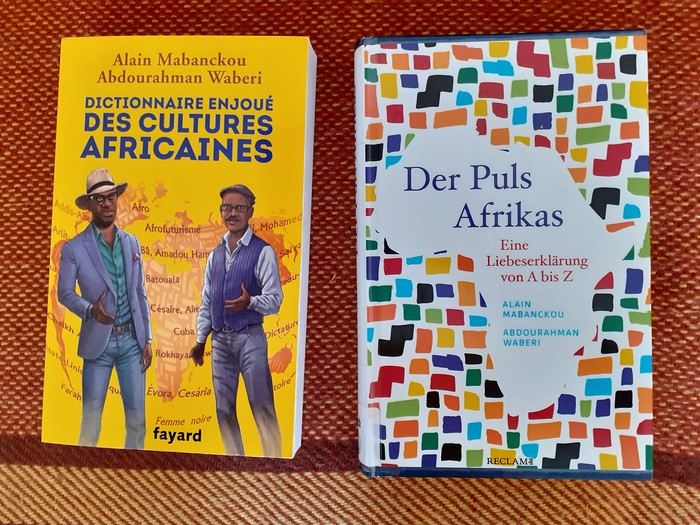
The Maggi cube, an unchallenged hegemony, and so much more
“The hopeless continent,” headlined The Economist, a British magazine, in July 2000 about Africa. Eleven years later, the same magazine headlined “Africa rising” instead. Images of Africa in the prosperous North constantly oscillate between apocalyptic scenarios and enthusiastic projections. A key issue with such images lies in the generalization they entail. If you look at the continent, considerable contrasts emerge depending on space and time. It’s no surprise that a region of the world encompassing such diverse ecological zones, maintaining such varied ties with other continents, comprising nearly fifty nation-states in sub-Saharan Africa alone, and characterized by a great diversity of languages, belief systems, and historical paths, doesn’t share a single destiny.
And yet, for many people outside Africa, as well as for many Africans, the continent constitutes a single entity, defined by criteria such as skin color, a colonial past, poverty, and the art of survival. Until now, these perspectives were generally accompanied by the idea that Africa had to—or should have—followed a single path together, sometimes called development, sometimes modernization, sometimes liberation, then a market economy. None of these paths delivered on their promises.
The two writers Alain Mabanckou and Abdourahman Waberi—one from Congo, the other raised in Djibouti, both long settled in France and now professors at renowned North American universities (Los Angeles, Washington)—have had enough of pessimistic scenarios: “We are aware that Africa is in the world and the world is in Africa. The same goes for all other continents, as our destinies are inextricably linked for better or worse. We refuse to see Africa as a reservoir of misfortunes or a continent cursed by atavistic misfortune and characterized by ethnic conflicts. [...] It’s this passionate flame we wanted to capture in a book [...] a kind of stroll through African cultures, without any demands, each letter of the alphabet leading us to a notion, a practice, a concept, a moment in history, literature, painting, politics, economics, cuisine, etc.” (p.10-11). Africa, they write, is on the verge of “imposing a signature, a style, a way of being in the world and in relation to the rest of the world.” (p.11) To put words to the continent’s diversity and dynamism, the two authors created a “rambling ABC,” a kind of portrait—or more precisely, a mythography—that lets you see and feel the pulse of a vast continent whose cultural power is unfolding before our eyes. Once marginalized or even mocked, the voice and importance of the Continent in global affairs are now undeniable” (p.11), containing over a hundred entries, mostly concise, written in a relaxed and casual style. The optimistic, even exuberant tone is set from the brief introduction. The duo of authors wants to “sing a love song to the cultures of our continent, to its inhabitants past and present, to its exceptional resources and its spectacular globalization despite a certain pollution that still clouds our skies due to the unmatched duration of dictatorships in some of our regions.” (p.12) In doing so, they don’t want to be too distracted by today’s Afewerki-Biya-Bongo-Déby & Co. ...
Of course, you’ll find tributes to great precursors like Frantz Fanon (“[...] it was a love story and admiration that wasn’t dimmed by the four decades separating his birth from ours. Let’s add that we were born while the native of Fort-de-France had left the world’s stage four years earlier, in the prime of life” p.141), Mongo Beti (“You must read and reread Mongo Beti, a genius who used his fame to support often just causes in Africa, like defending oppressed groups. His place is already in History. His oppressors, like the dictators Ahmadou Ahidjo and Paul Biya, can’t compete in the same category” p.64), the Malian Amadou Hampâté Bâ
(“Posterity remembers him mainly as an tireless defender of African cultures. His plea for the collection and preservation of traditional African knowledge remains a major event for all men and women of good will. One day in 1960, at the UNESCO podium, the native of Bandiagara sounded the alarm: ‘[...] Since we’ve admitted that the humanity of each people is the heritage of all humanity, if African traditions aren’t collected in time and written down, they’ll one day be missing from the universal archives of humanity.’” p.51),
Kwame Nkrumah, “one of the founders of Pan-Africanism, father of Ghana’s independence” (p.239), as well as the historian Cheikh Anta Diop, the writer, poet, and politician Aimé Césaire, and the economist and thinker Samir Amin, but also very warm tributes to certain contemporary African intellectuals like Souleymane Bachir Diagne and Achille Mbembe
(“A few years ago, in dominant economic circles, a rumor often resurfaced, usually disguised as a cold and scientifically proven analysis: Africa is useless. It’s a burden for the rest of the human community. With its 2% share in world trade, it would disappear from stock market radars without anyone noticing. So? Maybe it’ll be pulled up by other continents. Wanting to surpass itself is a crazy bet for Africans, they concluded. Arrogant or clueless, President Nicolas Sarkozy declared before an audience of students and teachers at Cheikh Anta Diop University in Dakar: ‘The African man hasn’t entered history enough [...] He only knows the eternal repetition of time marked by the endless repetition of the same gestures and words.’ That was in 2007. For decades, armed only with reason, an intellectual often steps up to debunk prejudices, lazy readings, and dishonest frameworks used as false fronts by those who, like Nicolas Sarkozy or former journalist Stephen Smith, out of ignorance, contempt, or condescension, distort African reality. This intellectual is none other than the historian and political scientist Achille Mbembe. This heir of Frantz Fanon, Amílcar Cabral, Jean-Marc Ela, and Fabien Eboussi-Boulaga was born in 1957 in Cameroon, in the Bassa region. Marked early by the upheavals of a fratricidal war, Achille Mbembe became the guardian of the memory of martyrs. After brilliant studies in Paris, he went on to teach at the best American universities, but the call of the Continent was stronger than anything else. In Dakar, he once directed CODESRIA (Council for the Development of Social Science Research in Africa) before joining the University of the Witwatersrand in Johannesburg, South Africa. Even though the author of *Critique of Black Reason* (Éditions La Découverte, 2015) spends a few months at Duke University in North Carolina, his observation post remains South Africa. From Johannesburg, Achille Mbembe scrutinizes Africa and the whole world. A lucid observer with an elegant and generous pen, Achille Mbembe knows how to blend big and small history: ‘I was born one day in July, as the month was drawing to a close. It was 1957, in that part of Africa recently named ‘Cameroon,’ a memory of the wonder that seized Portuguese sailors in the 15th century when, sailing up the river near Douala, they couldn’t help but note the presence of a multitude of crustaceans, and named it *Rio dos Camarões*, meaning ‘River of Shrimp.’ I grew up in the shadow of this nameless land, since, in a way, the name it bears is only the product of someone else’s astonishment: a lexical mistake, if you will.’ From this mistake or wound, he made leaven, a springboard to compose a rich work, recognized worldwide. To denounce barriers and barbarians too. But that’s not enough. Among his peers in circles of thought and action, Achille Mbembe passionately and consistently defends human dignity and the beauty of the world. In doing so, he fulfills the mission Frantz Fanon entrusted to him.” (p.227-229),
as well as entries dedicated to lesser-known artists and intellectuals, like the French journalist and activist Rokhaya Diallo, daughter of Senegalese and Gambian parents, or the Ethiopian filmmaker Haile Gerima, who has long lived in the United States. Other names from politics, sports, music, art, and literature: Kofi Annan, p.36; Barack Obama, p.243; Thomas Sankara, p.277; Ousmane Sow, p.285; Yambo Ouologuem, p.250; Léopold Sédar Senghor, p.282; Muhammad Ali, p.30; Nuruddin Farah, p.146; Salif Keita, p.203; Ahmadou Kourouma, p.206; Ngũgĩ wa Thiong’o, p.236; Winnie Mandela, p.224; Kylian Mbappé, p.226 ...
The authors, who resolutely commit to a “mythography” (p.11) of Africa, also pay special attention to local social movements, cultural events, and aspects of daily life. *Y’en a marre*, “which also meant ‘we’re fed up with sitting on our hands’” (p.320-321), emerged about a decade ago in Senegal as a citizen movement of peaceful resistance and symbolizes, the authors emphasize, the fact that African youth are increasingly fed up “with the political circus deployed in Africa since independence, as our parents would say, ‘since the White man left’...” (p.321). A full entry is dedicated to the Maggi bouillon cube, which has flooded African markets for about forty years and enjoys immense popularity (“It’s everywhere in Africa, from Dakar to Djibouti, and from Tangier to Cape Town. It’s in every pot, every stew. Little hands put it in every sauce, every local or adapted dish. An unchallenged hegemony! You’ll find it in diasporas too. The culinary strolls in Paris, in the [...] neighborhood” p.90). Critics blame it not only for impoverishing the aromatic diversity of local dishes but also for being harmful to health. And yet, “he poorest Africans, those who eat only once a day, a few spoonfuls of white beans and a ball of *foufou*, for example, are the most fervent users of the magic cube.” (p.92-93)
For *fonio*, “the new trendy cereal. [...] From the millet family, fonio is probably the oldest cereal cultivated in West Africa, and mainly in its sub-Saharan part, for millennia. [...] Easy to grow, water-efficient, fonio grows everywhere except on clay soils. Long neglected because it was considered the poor man’s crop, fonio is now a source of pride for the farmers who cultivate it and cherish it like the apple of their eye” (p.156-157), the authors immediately offer a detailed recipe, letting the reader know that “e can’t resist sharing this fonio with chicken recipe from Mali with you:
Ingredients: 1 chicken 3 large ripe red tomatoes 4 tbsp tomato paste 4 large onions 1 garlic clove 1/2 cup oil 2 Maggi cubes or salt 2 large carrots 1 turnip 1 large cabbage 2 large potatoes 1 celery stalk 1 packet pre-cooked fonio 4 okra (or okra powder) salt, pepper
Preparation: 1. Prepare the sauce: wash and cut the chicken. Peel the onions, garlic, and vegetables. 2. In a pot, fry the chicken pieces. 3. Dice the onions, tomatoes, carrots, and turnip very small and add them to the pot. 4. Add the tomato paste, salt, and pepper. 5. Simmer for 15 min, then add 2 L of water and the cooked chicken pieces. 6. Simmer for 30 min, then add the crushed garlic and celery, plus the cabbage cut into 4 and the potatoes cut in half. 7. Prepare the fonio: cover it with warm water, let it rest for 15 min, and cook it over low heat. 8. In a small pot, boil the okra and crush them. 9. Mix the crushed okra with the cooked fonio, then salt. Serve hot.” (p.158-159)
The comedy *Black Mic Mac*, released in French theaters in 1986 and addressing France’s increasingly restrictive immigration policy at the time, also gets an entry, as do *Tintin in the Congo*, the popular comic, and *Jip’s Café* (“[...] a little Africa in the heart of Paris, with passersby stopping to admire the ‘ambianceurs’ on the dance floor or attend the cultural events offered by the place” (p.194), an African establishment in Paris that Alain Mabanckou already immortalized in one of his novels.
The duo of authors also tackles thorny subjects like jihadism (p.119), the Rwandan genocide (p.272), the CFA franc (p.82), and dictatorship (p.110). While the two strike the right tone here, many entries leave a slightly bitter taste. Two examples: why doesn’t the text on Barack Obama mention the great disappointment of many people in Africa, who expected more from the African policy of the first U.S. president with African roots than just occasional warm words? Why do the comments on Winnie Mandela gloss over the fact that she was a highly controversial icon of the anti-apartheid movement due to her involvement in kidnappings, acts of torture, and murders of alleged apartheid collaborators? Instead, there’s a compassion that brings tears to the eyes: “She was often reduced to a secondary role, the wife of a great man” or “When victory came, she didn’t taste its fruits. Divorced, isolated. She would never be a ‘first lady’ in an evening gown, posing before a bed of chrysanthemums. They’d keep her far from the circles of power” (p.224-225). At this point, I would’ve liked the authors to take a slightly more critical stance...
That said, these “weaknesses” (if you can call them that) shouldn’t overshadow the book as a whole. It remains an informative, sometimes very entertaining, and often even original work in its own way.
Book information (the original French and the German translation):
Alain Mabanckou/Abdourahman Waberi. Dictionnaire enjoué des cultures africaines. Fayard, 2019. Alain Mabanckou/Abdourahman Waberi. Der Puls Afrikas. Eine Liebeserklärung von A bis Z. Reclam, 2022.
Hery
Staircases. Photo contest theme for May 2026.
Hello
This month’s photo contest theme for May 2026 is "Staircases"
Plural or singular? Does it really matter as long as you’re told you’ve gone up or down them well?
Anyway, it’s not that complicated, even though I’m sure some will manage to overcomplicate it—after all, why keep things simple when making them complicated is so much more fun (as an Indian proverb goes).
To participate: Submit your photos until Monday, May 25 at 11:59 PM You can post up to 3 photos, numbered and shared in separate messages, along with a short description of the location and the story behind it.
To vote: From Tuesday, May 26 at 12:01 AM until Saturday, May 30 at 11:59 PM After the deadline, it’s too late.
Please include the photo number, username, and the points awarded: Photo #1 = 3 pts Photo #2 = 2 pts Photo #3 = 1 pt
All VF members can vote (even those who didn’t submit photos). In case of a tie for first place, the winning photo will be the one with the most first-place votes, then second-place votes! The lucky winner will get to organize June 2026’s photo contest.
For discussions about the theme, click here: Discussion thread for May 2026’s theme: Staircases
This month’s photo contest theme for May 2026 is "Staircases"
Plural or singular? Does it really matter as long as you’re told you’ve gone up or down them well?
Anyway, it’s not that complicated, even though I’m sure some will manage to overcomplicate it—after all, why keep things simple when making them complicated is so much more fun (as an Indian proverb goes).
To participate: Submit your photos until Monday, May 25 at 11:59 PM You can post up to 3 photos, numbered and shared in separate messages, along with a short description of the location and the story behind it.
To vote: From Tuesday, May 26 at 12:01 AM until Saturday, May 30 at 11:59 PM After the deadline, it’s too late.
Please include the photo number, username, and the points awarded: Photo #1 = 3 pts Photo #2 = 2 pts Photo #3 = 1 pt
All VF members can vote (even those who didn’t submit photos). In case of a tie for first place, the winning photo will be the one with the most first-place votes, then second-place votes! The lucky winner will get to organize June 2026’s photo contest.
For discussions about the theme, click here: Discussion thread for May 2026’s theme: Staircases