Results for "Maurice+événement"
About 9,318 results.
More options
Many results are in French, the community’s main language. English translations are added over time.
Search results
Un bateau Costa à la dérive aux Seychelles!
http://www.lefigaro.fr/flash-actu/2012/02/27/97001-20120227FILWWW00497-un-navire-costa-a-la-derive-aux-seychelles.php
Suite à un incendie, un bateau Costa est à la dérive. C'est vraiment pas de chance pour Costa et les croisiéristes et cela va encore leur faire du tord je pense !
J'espère qu'il n'y a pas de victimes.
Suite à un incendie, un bateau Costa est à la dérive. C'est vraiment pas de chance pour Costa et les croisiéristes et cela va encore leur faire du tord je pense !
J'espère qu'il n'y a pas de victimes.
Air Madagascar sur la liste noire!
Je m'etais enfin décidée pour acheter mon billet d'avion avec Air madagascar après avoir calé mon itinéraire etc...
Sur govoyage : plus de vol avec Air Madagascar...pour apprendre que Air Madagascar vient de passer en liste noire de l'union européenne (catégorie E..."interdite ou à interdir" !)
résultat : je pense que je vais plutot prendre via Corsair ou AF pour y aller....
Ce qui me tracasse ce sont les vols interne : pas le choix : c'est Air Mada... et j'ai en tout 6 vols... Alors ma question est simple : est-ce que l'on risque vraiment pour sa sécurité ? Je ne voudrait pas que mes vacances tournent à l'horreur...
Merci pour votre retour d'expérience et vos conseils.
Ce qui me tracasse ce sont les vols interne : pas le choix : c'est Air Mada... et j'ai en tout 6 vols... Alors ma question est simple : est-ce que l'on risque vraiment pour sa sécurité ? Je ne voudrait pas que mes vacances tournent à l'horreur...
Merci pour votre retour d'expérience et vos conseils.
Baignade et visites en Guadeloupe fin mai?
Bonjour,
Je souhaiterais partir avec mon amie en Guadeloupe fin mai, mais ne connaissant pas du tout cette ile, je souhaiterais savoir quelques conseils.
Tout d'abord, le climat fin mai est il propice a la baignade et aux visites sur l'ile?
De plus, auriez vous un hotel a nous conseiller, recherchant le calme, la farniente et le dépaysement.
Enfin quelles sont les choses incontournables a visiter sur l'ile? Ne partant que 10 jours, malheureusement je crois qu'il va falloir aller a l'essentiel.
Merci par avance de vos réponses.
Merci par avance de vos réponses.
Voyage français en juillet 2011
Voyageurs, voyageuses,
Je m'adresse à vous pour avoir des infos, des conseils concernant notre French 'Tour 2011 qui se passera tout le mois de juillet. En effet, ma copine et moi avons comme projet de voyager à travers l'hexagone pour découvrir dans quel pays on vit !! Avant de passer à l'étape supérieur, a world tour...
Notre point de départ: Cergy dans le 95. Moyen de transport: On pense opter pour un kangoo aménagé "camping" ( couchette, réchaud, ... Budget : limité! Objectif: établir un road-book ou rally photo, faire des activités sportives, rencontrer des french trippeur et bronzer...aussi Timing : Minimum 1 mois ( juillet)
Comme on ne connait pas beaucoup la France ( surtout moi, belge et fier de l'être), on aimerait avoir des conseils sur des lieux à visiter, sur l'itinéraire à construire, des activités à faire, bref des bons plans !!!!
je vous remercie déja pour tout
Je m'adresse à vous pour avoir des infos, des conseils concernant notre French 'Tour 2011 qui se passera tout le mois de juillet. En effet, ma copine et moi avons comme projet de voyager à travers l'hexagone pour découvrir dans quel pays on vit !! Avant de passer à l'étape supérieur, a world tour...
Notre point de départ: Cergy dans le 95. Moyen de transport: On pense opter pour un kangoo aménagé "camping" ( couchette, réchaud, ... Budget : limité! Objectif: établir un road-book ou rally photo, faire des activités sportives, rencontrer des french trippeur et bronzer...aussi Timing : Minimum 1 mois ( juillet)
Comme on ne connait pas beaucoup la France ( surtout moi, belge et fier de l'être), on aimerait avoir des conseils sur des lieux à visiter, sur l'itinéraire à construire, des activités à faire, bref des bons plans !!!!
je vous remercie déja pour tout
Votre année 2010 en vols!
Bonjour à tous,
En lisant un post sur FT j'ai eu l'idée de créer ce topic, l'idée est simple, faire des statistisques sur nos vols en 2010 (nombre de vols, cies empruntés, vol plus long/plus court...) L'idée n'est evidement pas une competition, nous avons tous des ages, des moyens et des professions différentes.
Personellement je vais surtout m'aider d'openflight.51 vols54668km20 Aéroports différents11 Pays21 Avions (du Saab 2000 au A380)16 Compagnies aerienneVol le plus court: Tampere > Helsinki (142km)Vol le plus long: Maurice > Paris CDG (9447km)Top fréquence:6x LHR <-> CDG égalité NCE <-> ORY (4x NCE <-> CDG)19x au depart ou à l'arrivée de CDG (16x NCE)21x Air France (10x Lufthansa)12x A321 (7x A319, égalité A320)Que l'année 2011 nous apporte plein de vols 😇
En lisant un post sur FT j'ai eu l'idée de créer ce topic, l'idée est simple, faire des statistisques sur nos vols en 2010 (nombre de vols, cies empruntés, vol plus long/plus court...) L'idée n'est evidement pas une competition, nous avons tous des ages, des moyens et des professions différentes.
Personellement je vais surtout m'aider d'openflight.51 vols54668km20 Aéroports différents11 Pays21 Avions (du Saab 2000 au A380)16 Compagnies aerienneVol le plus court: Tampere > Helsinki (142km)Vol le plus long: Maurice > Paris CDG (9447km)Top fréquence:6x LHR <-> CDG égalité NCE <-> ORY (4x NCE <-> CDG)19x au depart ou à l'arrivée de CDG (16x NCE)21x Air France (10x Lufthansa)12x A321 (7x A319, égalité A320)Que l'année 2011 nous apporte plein de vols 😇
Quel pays de l'Europe de l'Est choisir pour quinze jours au mois d'août?
Bonjour,
à peine revenue et déjà repartie... Après nos moults périples aux 4 coins du globe, on se disait que l'on ferait bien une petite pause en Europe. Désormais obligés de poser nos congés en Juillet-Aout (arg) nous voici coincés dans le flot touristique.
En fait nous recherchons une destination qui répondrait aux critères suivants (pr aout 2011, rien ne presse, c'est juste une idée): - pas trop de touristes - pas trop cher sur place - on est bp plus nature que villes et farniente (on ne serait pas contre 2 jours à la plage pr cloturer le voyage ms pas une priorité) - 15 jours sur place - des transports en commun car nous ne louons jamais de voiture (question de budget et aussi de rencontres avec les gens) - du soleil car depuis que nous avons bougé de Toulouse à Lille ça nous manque un peu
Nous avons pensé aux Balkans qui nous semblent bien moins touristiques que Portugal, Andalousie ect...et j'ai déjà fait la Croatie. Nous pensons donc à la Slovénie, l'Albanie, la Bulgarie, la Roumanie, le Monténégro... Mais difficile de faire un choix, de connaitre la fréquentation touristique des différents pays, ect... Et sur certains de ces pays les retours semblent mitigés.
Je vous laisse donc donner votre avis éclairé.
Merci d'avance.
à peine revenue et déjà repartie... Après nos moults périples aux 4 coins du globe, on se disait que l'on ferait bien une petite pause en Europe. Désormais obligés de poser nos congés en Juillet-Aout (arg) nous voici coincés dans le flot touristique.
En fait nous recherchons une destination qui répondrait aux critères suivants (pr aout 2011, rien ne presse, c'est juste une idée): - pas trop de touristes - pas trop cher sur place - on est bp plus nature que villes et farniente (on ne serait pas contre 2 jours à la plage pr cloturer le voyage ms pas une priorité) - 15 jours sur place - des transports en commun car nous ne louons jamais de voiture (question de budget et aussi de rencontres avec les gens) - du soleil car depuis que nous avons bougé de Toulouse à Lille ça nous manque un peu
Nous avons pensé aux Balkans qui nous semblent bien moins touristiques que Portugal, Andalousie ect...et j'ai déjà fait la Croatie. Nous pensons donc à la Slovénie, l'Albanie, la Bulgarie, la Roumanie, le Monténégro... Mais difficile de faire un choix, de connaitre la fréquentation touristique des différents pays, ect... Et sur certains de ces pays les retours semblent mitigés.
Je vous laisse donc donner votre avis éclairé.
Merci d'avance.
Afrique du Sud: insécurité à Fernkloof Nature Reserve (Hermanus) (24 décembre 2009)
AFP
24/12/2009| Mise à jour : 12:16
Un couple de Canadiens a été attaqué, blessé au couteau et volé pendant une randonnée en Afrique du Sud, où le fort taux de criminalité inquiète à quelques mois de la Coupe du monde de football, rapporte le journal local Star Newspaper.
Martin Stern, 59 ans, et sa femme Janet, 57 ans, sont les quatrièmes victimes d'agression en deux mois dans la Réserve naturelle de Fernkloof à Hermanus, à une centaine de km du Cap, précise le journal.
Le couple, hospitalisé, a expliqué avoir croisé deux hommes avant d'entendre courir derrière eux. "La dernière chose dont nous nous souvenons c'est d'avoir reçu un coup de poignard dans le dos. J'ai reçu un coup de couteau dans les reins et Janet un coup au bras, puis ils nous ont jetés à terre", a raconté M. Stern. Tous leurs objets de valeur ont été dérobés.
Le gouvernement sud-africain tente de faire baisser le taux de criminalité avant la Coupe du monde de football en 2010. Des responsables politiques ont souhaité que les forces de l'ordre aient le droit de "tirer pour tuer". Le président Jacob Zuma est intervenu pour dire que la police n'avait pas l'autorisation de tuer mais qu'elle devrait avoir des armes plus puissantes.
Martin Stern, 59 ans, et sa femme Janet, 57 ans, sont les quatrièmes victimes d'agression en deux mois dans la Réserve naturelle de Fernkloof à Hermanus, à une centaine de km du Cap, précise le journal.
Le couple, hospitalisé, a expliqué avoir croisé deux hommes avant d'entendre courir derrière eux. "La dernière chose dont nous nous souvenons c'est d'avoir reçu un coup de poignard dans le dos. J'ai reçu un coup de couteau dans les reins et Janet un coup au bras, puis ils nous ont jetés à terre", a raconté M. Stern. Tous leurs objets de valeur ont été dérobés.
Le gouvernement sud-africain tente de faire baisser le taux de criminalité avant la Coupe du monde de football en 2010. Des responsables politiques ont souhaité que les forces de l'ordre aient le droit de "tirer pour tuer". Le président Jacob Zuma est intervenu pour dire que la police n'avait pas l'autorisation de tuer mais qu'elle devrait avoir des armes plus puissantes.
Villas "Le Village" à la Réunion
Bonsoir
Nous sommes en train de réserver via le TO les logements sur l'île de la Réunion
Dans un cas, ce qui était prévu n'est pas disponible et nous proposent une solution à l'entrée du cirque de Salazie, composée de 12 chambres appelée 'Le Village' mais que je ne trouve pas sur le net
Est-ce que quelqu'un connait et pourrait me donner des infos ?
Merci d'avance
Nous sommes en train de réserver via le TO les logements sur l'île de la Réunion
Dans un cas, ce qui était prévu n'est pas disponible et nous proposent une solution à l'entrée du cirque de Salazie, composée de 12 chambres appelée 'Le Village' mais que je ne trouve pas sur le net
Est-ce que quelqu'un connait et pourrait me donner des infos ?
Merci d'avance
Mouvements de revendications à la Réunion
à nos amis réunionnais : je dois partir à la réunion le 2 avril. pensez vous que les mouvements qui se mettent en place vont aller aussi loin que ceux de guadeloupe, avec blocage des routes, des stations services etc...?
en métropole, nous n'avons pas d'informations sur l'état d'esprit dans l'ile.
Retour de croisière Costa dans l'Océan Indien
Ayant deja été victime de COSTA CROISIERE en 2007 qui avait deja derogé lors d'une croisiere en mediterannée en n'allant plus en Lybie au dernier moment, je rentre ce jour d'une croisiere COSTA dans l'ocean indien comportant entre autre trois jours a Madagascar qui n'ont pas été honorés et remplacés a la sauvette par une solution qui a fait gagner de l'argent a COSTA laissant les passagers frustrés devant le fait accompli. En effet nous sommes partis le 29/01 alors que des evenements graves etaient annoncés a Madagascar depuis le 25/01; la croisiere s'est passée normalement jusqu'au jour ou le bateau a changer de cap nous annoncant que pour notre securité le sejour ne serait pas honorer dans ce pays au constat des risques encourus. Sur le fond cela est apparu logique mais sur la forme COSTA qui connaissait en amont la problematique devait annuler la croisiere ou en changer l'itineraire en ayant negocier ses prix a la baisse pour une prestation moins valorisante et moins couteuse en carburant . Desirant etre gagnant sur toute la ligne, COSTA au detriment de ses fideles clients a preferé fermer les yeux jusqu'a l'arrivée potentielle a Madagascar et a evoquer le "cas de force majeure" en changeant de route, gagnant ainsi plus de 10/100 de carburant empochant la totalité du cout de la croisiere et refusant de dedommager et de negocier avec ses clients une prestation qui ne correspondait plus a la vente effectuée. En periode normale cela s'appelle un abus de position dominante et un non respect de ses engagements, en perode de crise cela s'appelle un suicide commercial . en synthese je dirai attention a la "MAFIA COSTA" qu'il serait bon d'eviter rapidement et d'oublier dans sa liste de prestataire .
Escale de trois jours à Madagascar: danger?
BONJOUR à tous
on effectue une croisiere costa avec une escale de 3 jours a madagascar, Diego suarez, Nosy Be, et Tamatave, ce sera mi fevrier !
pensez vous qu'il y'a danger, ou problemes d'excursions?
est ce une raison d'annulation de voyage a votre avis?
merci
on effectue une croisiere costa avec une escale de 3 jours a madagascar, Diego suarez, Nosy Be, et Tamatave, ce sera mi fevrier !
pensez vous qu'il y'a danger, ou problemes d'excursions?
est ce une raison d'annulation de voyage a votre avis?
merci
Près de 1,700 policiers seront recrutés début 2009 au Cameroun
CAMEROUN - 4 décembre 2008 - APANEWS
Le Cameroun entend augmenter les effectifs de sa police dès l'année prochaine avec le recrutement de 1.690 agents dont 45 nouveaux commissaires de police, 115 officiers, 330 inspecteurs et 1200 gardiens de la paix, a appris APA auprès de la Délégation générale à la sûreté nationale (DGNS).
Les concours directs et spéciaux ouverts « sur autorisation du chef de l'Etat », se dérouleront entre février et avril 2009, a dit le patron de la police camerounaise Egard Alain Mebe Ngo'o.
Il a dit que cette initiative participe du « renforcement des effectifs pour lutter contre l'insécurité et entre en droite ligne des préoccupations des autorités camerounaises à assurer la sécurité des hommes et de leurs biens ».
Le recrutement des nouveaux éléments dans la police intervient dans un contexte marqué par la recrudescence du banditisme, aussi bien dans les zones urbaines que rurales.
Ces dernières semaines, la police camerounaise, en collaboration avec Interpol, a mis la main sur 35 véhicules de luxes volés en Europe et en Afrique, tandis que des trafiquants de tout ordre ont été mis hors d'état de nuire.
Les concours directs et spéciaux ouverts « sur autorisation du chef de l'Etat », se dérouleront entre février et avril 2009, a dit le patron de la police camerounaise Egard Alain Mebe Ngo'o.
Il a dit que cette initiative participe du « renforcement des effectifs pour lutter contre l'insécurité et entre en droite ligne des préoccupations des autorités camerounaises à assurer la sécurité des hommes et de leurs biens ».
Le recrutement des nouveaux éléments dans la police intervient dans un contexte marqué par la recrudescence du banditisme, aussi bien dans les zones urbaines que rurales.
Ces dernières semaines, la police camerounaise, en collaboration avec Interpol, a mis la main sur 35 véhicules de luxes volés en Europe et en Afrique, tandis que des trafiquants de tout ordre ont été mis hors d'état de nuire.
Tour de l'île de la Grande Comore: adresse de location de voiture?
J' ai l' intention d' aller faire un tour en Grande comores apres un séjour à Mada
Je voudrais louer une voiture pour faire le tour de l' ile
Quelqu' un pourrais peut être me donner une adresse de location de voiture Au plaisir de vs lire
Quelqu' un pourrais peut être me donner une adresse de location de voiture Au plaisir de vs lire
Séjour à Pattaya/Jomtien: contacts pour trouver une maison à louer
Salut tout le monde et en particulier les résidents francophones dans la région de PATTAYA
Séjour de 3 semaines prévu à JOMTIEN du 20/02 au 15/03/2008 cherche contact sur place durant cette période pour conseils et nous aider à trouver une maison à louer dans le but de venir nous installer en THAILANDE ( couple retraité ) courant 2008 ? si possible.
Ne répondez pas tous en même temps !! 😏
Merci d'avance
Maurice
Séjour de 3 semaines prévu à JOMTIEN du 20/02 au 15/03/2008 cherche contact sur place durant cette période pour conseils et nous aider à trouver une maison à louer dans le but de venir nous installer en THAILANDE ( couple retraité ) courant 2008 ? si possible.
Ne répondez pas tous en même temps !! 😏
Merci d'avance
Maurice
Achat d'un appareil photo numérique avec objectif
Bonjour à tous,
Mon Minolta étant hors service, j'aimerais faire l'achat d'un appareil photo numérique avec objectif, Je voyage pas mal et je voudrais un appareil simple en manip', léger à transporter. Que me conseillez vous? Merci de vos réponses
Mon Minolta étant hors service, j'aimerais faire l'achat d'un appareil photo numérique avec objectif, Je voyage pas mal et je voudrais un appareil simple en manip', léger à transporter. Que me conseillez vous? Merci de vos réponses
Que signifie ton pseudo?
En me balladant sur le site le coeur ouvert à l'inconnu, je découvre des pseudos magnifiques.
Pour certains j'en comprends la portée et le sens. POur d'autres pas du tout?
Peut être pourriez expliquer ici"le comment du pourquoi " du choix de votre pseudo. Une manière de dévoiler sous un jour nouveau....
Pour moi, c'est Ukrainski, avec ma singature Cyril, l'Ukrainski
3 raisons ont motivé ce choix: 1/ le manque d'imagination 2/ l'intérêt particulier que je porte à l'Ukraine 3/ un certain amusement à parodier l'ukrainien dans sa façon de composer les noms...
"N'y voyez pas un désir pervers "de moquerie"* mais le délire de l'artiste " - les bronzés * ajout personnel...
Au final, les gens comprennent directment qui je suis...
Pour certains j'en comprends la portée et le sens. POur d'autres pas du tout?
Peut être pourriez expliquer ici"le comment du pourquoi " du choix de votre pseudo. Une manière de dévoiler sous un jour nouveau....
Pour moi, c'est Ukrainski, avec ma singature Cyril, l'Ukrainski
3 raisons ont motivé ce choix: 1/ le manque d'imagination 2/ l'intérêt particulier que je porte à l'Ukraine 3/ un certain amusement à parodier l'ukrainien dans sa façon de composer les noms...
"N'y voyez pas un désir pervers "de moquerie"* mais le délire de l'artiste " - les bronzés * ajout personnel...
Au final, les gens comprennent directment qui je suis...
Africa: A Heartfelt Love for a Continent
“When the Whites came to Africa, we had the land and they had the Bible. They taught us to pray with our eyes closed: when we opened them, the Whites had the land and we had the Bible.” Jomo Kenyatta (p.7)
The Maggi cube, an unchallenged hegemony, and so much more
“The hopeless continent,” headlined The Economist, a British magazine, in July 2000 about Africa. Eleven years later, the same magazine headlined “Africa rising” instead. Images of Africa in the prosperous North constantly oscillate between apocalyptic scenarios and enthusiastic projections. A key issue with such images lies in the generalization they entail. If you look at the continent, considerable contrasts emerge depending on space and time. It’s no surprise that a region of the world encompassing such diverse ecological zones, maintaining such varied ties with other continents, comprising nearly fifty nation-states in sub-Saharan Africa alone, and characterized by a great diversity of languages, belief systems, and historical paths, doesn’t share a single destiny.
And yet, for many people outside Africa, as well as for many Africans, the continent constitutes a single entity, defined by criteria such as skin color, a colonial past, poverty, and the art of survival. Until now, these perspectives were generally accompanied by the idea that Africa had to—or should have—followed a single path together, sometimes called development, sometimes modernization, sometimes liberation, then a market economy. None of these paths delivered on their promises.
The two writers Alain Mabanckou and Abdourahman Waberi—one from Congo, the other raised in Djibouti, both long settled in France and now professors at renowned North American universities (Los Angeles, Washington)—have had enough of pessimistic scenarios: “We are aware that Africa is in the world and the world is in Africa. The same goes for all other continents, as our destinies are inextricably linked for better or worse. We refuse to see Africa as a reservoir of misfortunes or a continent cursed by atavistic misfortune and characterized by ethnic conflicts. [...] It’s this passionate flame we wanted to capture in a book [...] a kind of stroll through African cultures, without any demands, each letter of the alphabet leading us to a notion, a practice, a concept, a moment in history, literature, painting, politics, economics, cuisine, etc.” (p.10-11). Africa, they write, is on the verge of “imposing a signature, a style, a way of being in the world and in relation to the rest of the world.” (p.11) To put words to the continent’s diversity and dynamism, the two authors created a “rambling ABC,” a kind of portrait—or more precisely, a mythography—that lets you see and feel the pulse of a vast continent whose cultural power is unfolding before our eyes. Once marginalized or even mocked, the voice and importance of the Continent in global affairs are now undeniable” (p.11), containing over a hundred entries, mostly concise, written in a relaxed and casual style. The optimistic, even exuberant tone is set from the brief introduction. The duo of authors wants to “sing a love song to the cultures of our continent, to its inhabitants past and present, to its exceptional resources and its spectacular globalization despite a certain pollution that still clouds our skies due to the unmatched duration of dictatorships in some of our regions.” (p.12) In doing so, they don’t want to be too distracted by today’s Afewerki-Biya-Bongo-Déby & Co. ...
Of course, you’ll find tributes to great precursors like Frantz Fanon (“[...] it was a love story and admiration that wasn’t dimmed by the four decades separating his birth from ours. Let’s add that we were born while the native of Fort-de-France had left the world’s stage four years earlier, in the prime of life” p.141), Mongo Beti (“You must read and reread Mongo Beti, a genius who used his fame to support often just causes in Africa, like defending oppressed groups. His place is already in History. His oppressors, like the dictators Ahmadou Ahidjo and Paul Biya, can’t compete in the same category” p.64), the Malian Amadou Hampâté Bâ
(“Posterity remembers him mainly as an tireless defender of African cultures. His plea for the collection and preservation of traditional African knowledge remains a major event for all men and women of good will. One day in 1960, at the UNESCO podium, the native of Bandiagara sounded the alarm: ‘[...] Since we’ve admitted that the humanity of each people is the heritage of all humanity, if African traditions aren’t collected in time and written down, they’ll one day be missing from the universal archives of humanity.’” p.51),
Kwame Nkrumah, “one of the founders of Pan-Africanism, father of Ghana’s independence” (p.239), as well as the historian Cheikh Anta Diop, the writer, poet, and politician Aimé Césaire, and the economist and thinker Samir Amin, but also very warm tributes to certain contemporary African intellectuals like Souleymane Bachir Diagne and Achille Mbembe
(“A few years ago, in dominant economic circles, a rumor often resurfaced, usually disguised as a cold and scientifically proven analysis: Africa is useless. It’s a burden for the rest of the human community. With its 2% share in world trade, it would disappear from stock market radars without anyone noticing. So? Maybe it’ll be pulled up by other continents. Wanting to surpass itself is a crazy bet for Africans, they concluded. Arrogant or clueless, President Nicolas Sarkozy declared before an audience of students and teachers at Cheikh Anta Diop University in Dakar: ‘The African man hasn’t entered history enough [...] He only knows the eternal repetition of time marked by the endless repetition of the same gestures and words.’ That was in 2007. For decades, armed only with reason, an intellectual often steps up to debunk prejudices, lazy readings, and dishonest frameworks used as false fronts by those who, like Nicolas Sarkozy or former journalist Stephen Smith, out of ignorance, contempt, or condescension, distort African reality. This intellectual is none other than the historian and political scientist Achille Mbembe. This heir of Frantz Fanon, Amílcar Cabral, Jean-Marc Ela, and Fabien Eboussi-Boulaga was born in 1957 in Cameroon, in the Bassa region. Marked early by the upheavals of a fratricidal war, Achille Mbembe became the guardian of the memory of martyrs. After brilliant studies in Paris, he went on to teach at the best American universities, but the call of the Continent was stronger than anything else. In Dakar, he once directed CODESRIA (Council for the Development of Social Science Research in Africa) before joining the University of the Witwatersrand in Johannesburg, South Africa. Even though the author of *Critique of Black Reason* (Éditions La Découverte, 2015) spends a few months at Duke University in North Carolina, his observation post remains South Africa. From Johannesburg, Achille Mbembe scrutinizes Africa and the whole world. A lucid observer with an elegant and generous pen, Achille Mbembe knows how to blend big and small history: ‘I was born one day in July, as the month was drawing to a close. It was 1957, in that part of Africa recently named ‘Cameroon,’ a memory of the wonder that seized Portuguese sailors in the 15th century when, sailing up the river near Douala, they couldn’t help but note the presence of a multitude of crustaceans, and named it *Rio dos Camarões*, meaning ‘River of Shrimp.’ I grew up in the shadow of this nameless land, since, in a way, the name it bears is only the product of someone else’s astonishment: a lexical mistake, if you will.’ From this mistake or wound, he made leaven, a springboard to compose a rich work, recognized worldwide. To denounce barriers and barbarians too. But that’s not enough. Among his peers in circles of thought and action, Achille Mbembe passionately and consistently defends human dignity and the beauty of the world. In doing so, he fulfills the mission Frantz Fanon entrusted to him.” (p.227-229),
as well as entries dedicated to lesser-known artists and intellectuals, like the French journalist and activist Rokhaya Diallo, daughter of Senegalese and Gambian parents, or the Ethiopian filmmaker Haile Gerima, who has long lived in the United States. Other names from politics, sports, music, art, and literature: Kofi Annan, p.36; Barack Obama, p.243; Thomas Sankara, p.277; Ousmane Sow, p.285; Yambo Ouologuem, p.250; Léopold Sédar Senghor, p.282; Muhammad Ali, p.30; Nuruddin Farah, p.146; Salif Keita, p.203; Ahmadou Kourouma, p.206; Ngũgĩ wa Thiong’o, p.236; Winnie Mandela, p.224; Kylian Mbappé, p.226 ...
The authors, who resolutely commit to a “mythography” (p.11) of Africa, also pay special attention to local social movements, cultural events, and aspects of daily life. *Y’en a marre*, “which also meant ‘we’re fed up with sitting on our hands’” (p.320-321), emerged about a decade ago in Senegal as a citizen movement of peaceful resistance and symbolizes, the authors emphasize, the fact that African youth are increasingly fed up “with the political circus deployed in Africa since independence, as our parents would say, ‘since the White man left’...” (p.321). A full entry is dedicated to the Maggi bouillon cube, which has flooded African markets for about forty years and enjoys immense popularity (“It’s everywhere in Africa, from Dakar to Djibouti, and from Tangier to Cape Town. It’s in every pot, every stew. Little hands put it in every sauce, every local or adapted dish. An unchallenged hegemony! You’ll find it in diasporas too. The culinary strolls in Paris, in the [...] neighborhood” p.90). Critics blame it not only for impoverishing the aromatic diversity of local dishes but also for being harmful to health. And yet, “he poorest Africans, those who eat only once a day, a few spoonfuls of white beans and a ball of *foufou*, for example, are the most fervent users of the magic cube.” (p.92-93)
For *fonio*, “the new trendy cereal. [...] From the millet family, fonio is probably the oldest cereal cultivated in West Africa, and mainly in its sub-Saharan part, for millennia. [...] Easy to grow, water-efficient, fonio grows everywhere except on clay soils. Long neglected because it was considered the poor man’s crop, fonio is now a source of pride for the farmers who cultivate it and cherish it like the apple of their eye” (p.156-157), the authors immediately offer a detailed recipe, letting the reader know that “e can’t resist sharing this fonio with chicken recipe from Mali with you:
Ingredients: 1 chicken 3 large ripe red tomatoes 4 tbsp tomato paste 4 large onions 1 garlic clove 1/2 cup oil 2 Maggi cubes or salt 2 large carrots 1 turnip 1 large cabbage 2 large potatoes 1 celery stalk 1 packet pre-cooked fonio 4 okra (or okra powder) salt, pepper
Preparation: 1. Prepare the sauce: wash and cut the chicken. Peel the onions, garlic, and vegetables. 2. In a pot, fry the chicken pieces. 3. Dice the onions, tomatoes, carrots, and turnip very small and add them to the pot. 4. Add the tomato paste, salt, and pepper. 5. Simmer for 15 min, then add 2 L of water and the cooked chicken pieces. 6. Simmer for 30 min, then add the crushed garlic and celery, plus the cabbage cut into 4 and the potatoes cut in half. 7. Prepare the fonio: cover it with warm water, let it rest for 15 min, and cook it over low heat. 8. In a small pot, boil the okra and crush them. 9. Mix the crushed okra with the cooked fonio, then salt. Serve hot.” (p.158-159)
The comedy *Black Mic Mac*, released in French theaters in 1986 and addressing France’s increasingly restrictive immigration policy at the time, also gets an entry, as do *Tintin in the Congo*, the popular comic, and *Jip’s Café* (“[...] a little Africa in the heart of Paris, with passersby stopping to admire the ‘ambianceurs’ on the dance floor or attend the cultural events offered by the place” (p.194), an African establishment in Paris that Alain Mabanckou already immortalized in one of his novels.
The duo of authors also tackles thorny subjects like jihadism (p.119), the Rwandan genocide (p.272), the CFA franc (p.82), and dictatorship (p.110). While the two strike the right tone here, many entries leave a slightly bitter taste. Two examples: why doesn’t the text on Barack Obama mention the great disappointment of many people in Africa, who expected more from the African policy of the first U.S. president with African roots than just occasional warm words? Why do the comments on Winnie Mandela gloss over the fact that she was a highly controversial icon of the anti-apartheid movement due to her involvement in kidnappings, acts of torture, and murders of alleged apartheid collaborators? Instead, there’s a compassion that brings tears to the eyes: “She was often reduced to a secondary role, the wife of a great man” or “When victory came, she didn’t taste its fruits. Divorced, isolated. She would never be a ‘first lady’ in an evening gown, posing before a bed of chrysanthemums. They’d keep her far from the circles of power” (p.224-225). At this point, I would’ve liked the authors to take a slightly more critical stance...
That said, these “weaknesses” (if you can call them that) shouldn’t overshadow the book as a whole. It remains an informative, sometimes very entertaining, and often even original work in its own way.
Book information (the original French and the German translation):
Alain Mabanckou/Abdourahman Waberi. Dictionnaire enjoué des cultures africaines. Fayard, 2019. Alain Mabanckou/Abdourahman Waberi. Der Puls Afrikas. Eine Liebeserklärung von A bis Z. Reclam, 2022.
Hery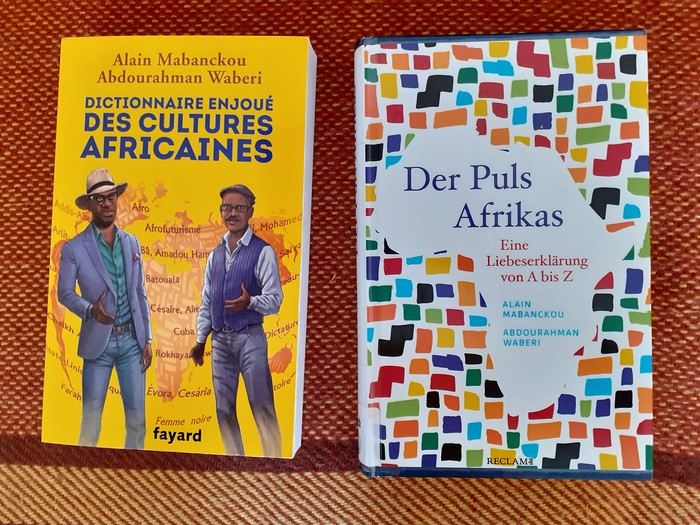
The Maggi cube, an unchallenged hegemony, and so much more
“The hopeless continent,” headlined The Economist, a British magazine, in July 2000 about Africa. Eleven years later, the same magazine headlined “Africa rising” instead. Images of Africa in the prosperous North constantly oscillate between apocalyptic scenarios and enthusiastic projections. A key issue with such images lies in the generalization they entail. If you look at the continent, considerable contrasts emerge depending on space and time. It’s no surprise that a region of the world encompassing such diverse ecological zones, maintaining such varied ties with other continents, comprising nearly fifty nation-states in sub-Saharan Africa alone, and characterized by a great diversity of languages, belief systems, and historical paths, doesn’t share a single destiny.
And yet, for many people outside Africa, as well as for many Africans, the continent constitutes a single entity, defined by criteria such as skin color, a colonial past, poverty, and the art of survival. Until now, these perspectives were generally accompanied by the idea that Africa had to—or should have—followed a single path together, sometimes called development, sometimes modernization, sometimes liberation, then a market economy. None of these paths delivered on their promises.
The two writers Alain Mabanckou and Abdourahman Waberi—one from Congo, the other raised in Djibouti, both long settled in France and now professors at renowned North American universities (Los Angeles, Washington)—have had enough of pessimistic scenarios: “We are aware that Africa is in the world and the world is in Africa. The same goes for all other continents, as our destinies are inextricably linked for better or worse. We refuse to see Africa as a reservoir of misfortunes or a continent cursed by atavistic misfortune and characterized by ethnic conflicts. [...] It’s this passionate flame we wanted to capture in a book [...] a kind of stroll through African cultures, without any demands, each letter of the alphabet leading us to a notion, a practice, a concept, a moment in history, literature, painting, politics, economics, cuisine, etc.” (p.10-11). Africa, they write, is on the verge of “imposing a signature, a style, a way of being in the world and in relation to the rest of the world.” (p.11) To put words to the continent’s diversity and dynamism, the two authors created a “rambling ABC,” a kind of portrait—or more precisely, a mythography—that lets you see and feel the pulse of a vast continent whose cultural power is unfolding before our eyes. Once marginalized or even mocked, the voice and importance of the Continent in global affairs are now undeniable” (p.11), containing over a hundred entries, mostly concise, written in a relaxed and casual style. The optimistic, even exuberant tone is set from the brief introduction. The duo of authors wants to “sing a love song to the cultures of our continent, to its inhabitants past and present, to its exceptional resources and its spectacular globalization despite a certain pollution that still clouds our skies due to the unmatched duration of dictatorships in some of our regions.” (p.12) In doing so, they don’t want to be too distracted by today’s Afewerki-Biya-Bongo-Déby & Co. ...
Of course, you’ll find tributes to great precursors like Frantz Fanon (“[...] it was a love story and admiration that wasn’t dimmed by the four decades separating his birth from ours. Let’s add that we were born while the native of Fort-de-France had left the world’s stage four years earlier, in the prime of life” p.141), Mongo Beti (“You must read and reread Mongo Beti, a genius who used his fame to support often just causes in Africa, like defending oppressed groups. His place is already in History. His oppressors, like the dictators Ahmadou Ahidjo and Paul Biya, can’t compete in the same category” p.64), the Malian Amadou Hampâté Bâ
(“Posterity remembers him mainly as an tireless defender of African cultures. His plea for the collection and preservation of traditional African knowledge remains a major event for all men and women of good will. One day in 1960, at the UNESCO podium, the native of Bandiagara sounded the alarm: ‘[...] Since we’ve admitted that the humanity of each people is the heritage of all humanity, if African traditions aren’t collected in time and written down, they’ll one day be missing from the universal archives of humanity.’” p.51),
Kwame Nkrumah, “one of the founders of Pan-Africanism, father of Ghana’s independence” (p.239), as well as the historian Cheikh Anta Diop, the writer, poet, and politician Aimé Césaire, and the economist and thinker Samir Amin, but also very warm tributes to certain contemporary African intellectuals like Souleymane Bachir Diagne and Achille Mbembe
(“A few years ago, in dominant economic circles, a rumor often resurfaced, usually disguised as a cold and scientifically proven analysis: Africa is useless. It’s a burden for the rest of the human community. With its 2% share in world trade, it would disappear from stock market radars without anyone noticing. So? Maybe it’ll be pulled up by other continents. Wanting to surpass itself is a crazy bet for Africans, they concluded. Arrogant or clueless, President Nicolas Sarkozy declared before an audience of students and teachers at Cheikh Anta Diop University in Dakar: ‘The African man hasn’t entered history enough [...] He only knows the eternal repetition of time marked by the endless repetition of the same gestures and words.’ That was in 2007. For decades, armed only with reason, an intellectual often steps up to debunk prejudices, lazy readings, and dishonest frameworks used as false fronts by those who, like Nicolas Sarkozy or former journalist Stephen Smith, out of ignorance, contempt, or condescension, distort African reality. This intellectual is none other than the historian and political scientist Achille Mbembe. This heir of Frantz Fanon, Amílcar Cabral, Jean-Marc Ela, and Fabien Eboussi-Boulaga was born in 1957 in Cameroon, in the Bassa region. Marked early by the upheavals of a fratricidal war, Achille Mbembe became the guardian of the memory of martyrs. After brilliant studies in Paris, he went on to teach at the best American universities, but the call of the Continent was stronger than anything else. In Dakar, he once directed CODESRIA (Council for the Development of Social Science Research in Africa) before joining the University of the Witwatersrand in Johannesburg, South Africa. Even though the author of *Critique of Black Reason* (Éditions La Découverte, 2015) spends a few months at Duke University in North Carolina, his observation post remains South Africa. From Johannesburg, Achille Mbembe scrutinizes Africa and the whole world. A lucid observer with an elegant and generous pen, Achille Mbembe knows how to blend big and small history: ‘I was born one day in July, as the month was drawing to a close. It was 1957, in that part of Africa recently named ‘Cameroon,’ a memory of the wonder that seized Portuguese sailors in the 15th century when, sailing up the river near Douala, they couldn’t help but note the presence of a multitude of crustaceans, and named it *Rio dos Camarões*, meaning ‘River of Shrimp.’ I grew up in the shadow of this nameless land, since, in a way, the name it bears is only the product of someone else’s astonishment: a lexical mistake, if you will.’ From this mistake or wound, he made leaven, a springboard to compose a rich work, recognized worldwide. To denounce barriers and barbarians too. But that’s not enough. Among his peers in circles of thought and action, Achille Mbembe passionately and consistently defends human dignity and the beauty of the world. In doing so, he fulfills the mission Frantz Fanon entrusted to him.” (p.227-229),
as well as entries dedicated to lesser-known artists and intellectuals, like the French journalist and activist Rokhaya Diallo, daughter of Senegalese and Gambian parents, or the Ethiopian filmmaker Haile Gerima, who has long lived in the United States. Other names from politics, sports, music, art, and literature: Kofi Annan, p.36; Barack Obama, p.243; Thomas Sankara, p.277; Ousmane Sow, p.285; Yambo Ouologuem, p.250; Léopold Sédar Senghor, p.282; Muhammad Ali, p.30; Nuruddin Farah, p.146; Salif Keita, p.203; Ahmadou Kourouma, p.206; Ngũgĩ wa Thiong’o, p.236; Winnie Mandela, p.224; Kylian Mbappé, p.226 ...
The authors, who resolutely commit to a “mythography” (p.11) of Africa, also pay special attention to local social movements, cultural events, and aspects of daily life. *Y’en a marre*, “which also meant ‘we’re fed up with sitting on our hands’” (p.320-321), emerged about a decade ago in Senegal as a citizen movement of peaceful resistance and symbolizes, the authors emphasize, the fact that African youth are increasingly fed up “with the political circus deployed in Africa since independence, as our parents would say, ‘since the White man left’...” (p.321). A full entry is dedicated to the Maggi bouillon cube, which has flooded African markets for about forty years and enjoys immense popularity (“It’s everywhere in Africa, from Dakar to Djibouti, and from Tangier to Cape Town. It’s in every pot, every stew. Little hands put it in every sauce, every local or adapted dish. An unchallenged hegemony! You’ll find it in diasporas too. The culinary strolls in Paris, in the [...] neighborhood” p.90). Critics blame it not only for impoverishing the aromatic diversity of local dishes but also for being harmful to health. And yet, “he poorest Africans, those who eat only once a day, a few spoonfuls of white beans and a ball of *foufou*, for example, are the most fervent users of the magic cube.” (p.92-93)
For *fonio*, “the new trendy cereal. [...] From the millet family, fonio is probably the oldest cereal cultivated in West Africa, and mainly in its sub-Saharan part, for millennia. [...] Easy to grow, water-efficient, fonio grows everywhere except on clay soils. Long neglected because it was considered the poor man’s crop, fonio is now a source of pride for the farmers who cultivate it and cherish it like the apple of their eye” (p.156-157), the authors immediately offer a detailed recipe, letting the reader know that “e can’t resist sharing this fonio with chicken recipe from Mali with you:
Ingredients: 1 chicken 3 large ripe red tomatoes 4 tbsp tomato paste 4 large onions 1 garlic clove 1/2 cup oil 2 Maggi cubes or salt 2 large carrots 1 turnip 1 large cabbage 2 large potatoes 1 celery stalk 1 packet pre-cooked fonio 4 okra (or okra powder) salt, pepper
Preparation: 1. Prepare the sauce: wash and cut the chicken. Peel the onions, garlic, and vegetables. 2. In a pot, fry the chicken pieces. 3. Dice the onions, tomatoes, carrots, and turnip very small and add them to the pot. 4. Add the tomato paste, salt, and pepper. 5. Simmer for 15 min, then add 2 L of water and the cooked chicken pieces. 6. Simmer for 30 min, then add the crushed garlic and celery, plus the cabbage cut into 4 and the potatoes cut in half. 7. Prepare the fonio: cover it with warm water, let it rest for 15 min, and cook it over low heat. 8. In a small pot, boil the okra and crush them. 9. Mix the crushed okra with the cooked fonio, then salt. Serve hot.” (p.158-159)
The comedy *Black Mic Mac*, released in French theaters in 1986 and addressing France’s increasingly restrictive immigration policy at the time, also gets an entry, as do *Tintin in the Congo*, the popular comic, and *Jip’s Café* (“[...] a little Africa in the heart of Paris, with passersby stopping to admire the ‘ambianceurs’ on the dance floor or attend the cultural events offered by the place” (p.194), an African establishment in Paris that Alain Mabanckou already immortalized in one of his novels.
The duo of authors also tackles thorny subjects like jihadism (p.119), the Rwandan genocide (p.272), the CFA franc (p.82), and dictatorship (p.110). While the two strike the right tone here, many entries leave a slightly bitter taste. Two examples: why doesn’t the text on Barack Obama mention the great disappointment of many people in Africa, who expected more from the African policy of the first U.S. president with African roots than just occasional warm words? Why do the comments on Winnie Mandela gloss over the fact that she was a highly controversial icon of the anti-apartheid movement due to her involvement in kidnappings, acts of torture, and murders of alleged apartheid collaborators? Instead, there’s a compassion that brings tears to the eyes: “She was often reduced to a secondary role, the wife of a great man” or “When victory came, she didn’t taste its fruits. Divorced, isolated. She would never be a ‘first lady’ in an evening gown, posing before a bed of chrysanthemums. They’d keep her far from the circles of power” (p.224-225). At this point, I would’ve liked the authors to take a slightly more critical stance...
That said, these “weaknesses” (if you can call them that) shouldn’t overshadow the book as a whole. It remains an informative, sometimes very entertaining, and often even original work in its own way.
Book information (the original French and the German translation):
Alain Mabanckou/Abdourahman Waberi. Dictionnaire enjoué des cultures africaines. Fayard, 2019. Alain Mabanckou/Abdourahman Waberi. Der Puls Afrikas. Eine Liebeserklärung von A bis Z. Reclam, 2022.
Hery
Mimi and Maumau, Martine and DD Return! Or the Denver-Denver Loop of the 4 Friends
Hello! 🙂
In 2017, struck by western addiction, our first road trip gave us an irresistible urge to return, which we did from September 2nd to 24th, 2019, on a loop from Denver to Denver via Yellowstone. The westernmost point of this journey, which took us through the geographical center of the USA, brought us within about a hundred kilometers of Moab, which had been the easternmost point of our last trip.
We’ve been back for over a month now, and I realize I’m starting to forget some details—it’s high time I started my travel journal before my brain turns into Swiss cheese and lets everything slip away. As I mentioned in my last story, it’ll take me quite a while to finish, so if any travelers have specific questions, don’t hesitate to message me privately. Once again, I’d like to thank everyone who helped me (and there were many!) prepare our road trip, with a special shout-out to Disneydiddl, Hiacinthe, and Titou (ladies first) as well as Fred and Itat, whom I bombarded with questions for months and who always kindly and patiently gave me tons of great tips. It’s thanks to all of you that this trip was such a success. I was a little worried I wouldn’t recapture the emotion and enthusiasm of our 2017 trip, but this one was just as "Wow" as the last.
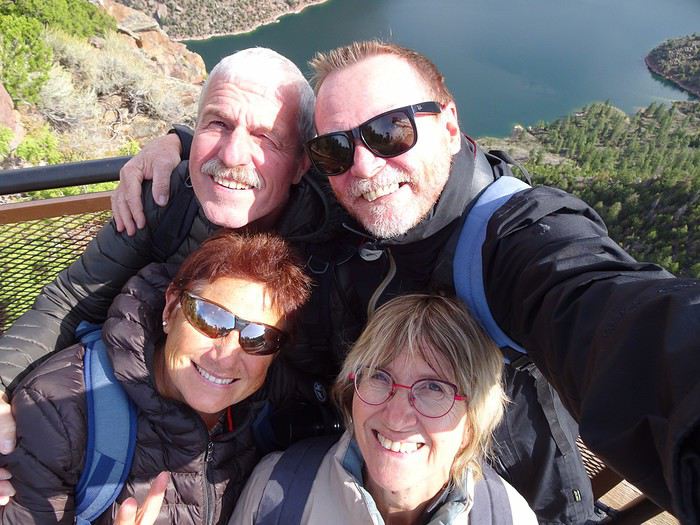
For those who don’t know us, let me introduce our little group. We’re four friends in our sixties (this time, everyone made it, which let us score some "senior" discounts...). We live in the Var region, have known each other for over 20 years, and this was our second trip together to this magical West.
Mimi (Michèle): always the smallest and the funniest. Thank goodness she was there to speak English! Maumau (Maurice): her husband, always with his white hair, his Gallic mustache, his humor, and his Southern accent. He drove every other day. DD (André): the one with the beard, with whom I celebrated our 41st wedding anniversary at Yellowstone. Our second driver appreciated having a peaceful mind since he’s been retired since July. Marcalamar (Martine): that’s me—still blonde with glasses, still talking a lot, and still terrified of messing up the organization of this trip despite all the hours spent on the forum.
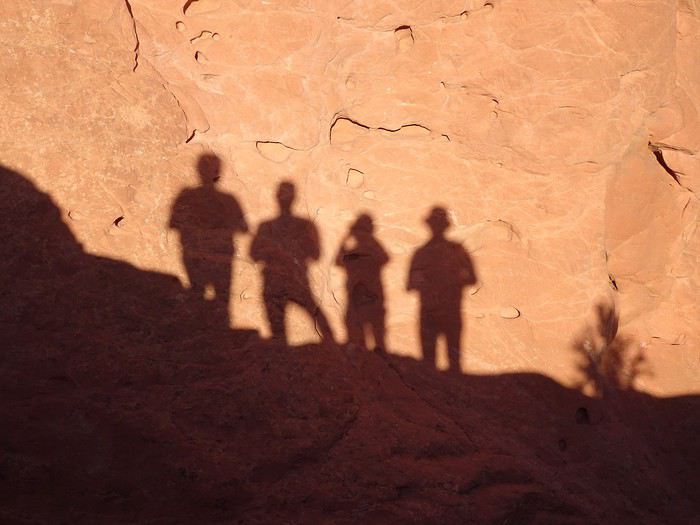 Recognize us? Ha ha ha!!!! No, just kidding!!!!
That’s us!!!
Recognize us? Ha ha ha!!!! No, just kidding!!!!
That’s us!!!
In 2017, struck by western addiction, our first road trip gave us an irresistible urge to return, which we did from September 2nd to 24th, 2019, on a loop from Denver to Denver via Yellowstone. The westernmost point of this journey, which took us through the geographical center of the USA, brought us within about a hundred kilometers of Moab, which had been the easternmost point of our last trip.
We’ve been back for over a month now, and I realize I’m starting to forget some details—it’s high time I started my travel journal before my brain turns into Swiss cheese and lets everything slip away. As I mentioned in my last story, it’ll take me quite a while to finish, so if any travelers have specific questions, don’t hesitate to message me privately. Once again, I’d like to thank everyone who helped me (and there were many!) prepare our road trip, with a special shout-out to Disneydiddl, Hiacinthe, and Titou (ladies first) as well as Fred and Itat, whom I bombarded with questions for months and who always kindly and patiently gave me tons of great tips. It’s thanks to all of you that this trip was such a success. I was a little worried I wouldn’t recapture the emotion and enthusiasm of our 2017 trip, but this one was just as "Wow" as the last.
For those who don’t know us, let me introduce our little group. We’re four friends in our sixties (this time, everyone made it, which let us score some "senior" discounts...). We live in the Var region, have known each other for over 20 years, and this was our second trip together to this magical West.
Mimi (Michèle): always the smallest and the funniest. Thank goodness she was there to speak English! Maumau (Maurice): her husband, always with his white hair, his Gallic mustache, his humor, and his Southern accent. He drove every other day. DD (André): the one with the beard, with whom I celebrated our 41st wedding anniversary at Yellowstone. Our second driver appreciated having a peaceful mind since he’s been retired since July. Marcalamar (Martine): that’s me—still blonde with glasses, still talking a lot, and still terrified of messing up the organization of this trip despite all the hours spent on the forum.
Recognize us? Ha ha ha!!!! No, just kidding!!!!
That’s us!!!Quelle destination choisir en été dans les Alpes avec des enfants?
Bonjour à tous, je vien ici pour avoir des avis. Je souhaite enmener ma femme et mes enfants dans les Alpes cet été du 10 août au 17 août. Je cherche une station ou il y a pas mal de chose pour enfant, piscine, jeux, animation... Et des lacs, rivières, cascade... Pour les balades. Mes enfants auront 3 ans et 11 ans. Merci pour votre aide, car il y a tellement de stations, que je suis perdu lol. Merci à vous.
Belles couleurs du Québec/Pow wow en Ontario/septembre-octobre 2014
Bonjour à tous !
C'est avec beaucoup de retard que je commence ce carnet (automne 2014 quand même !).
Je ne saurais citer tous ceux qui m'ont aidée à construire ce beau voyage, car j'aurais peur d'en oublier. Vous vous reconnaîtrez si vous me lisez.... Merci à vous tous !
Cette fois, c'est à quatre que nous voyagerons, puisqu'une de mes amies rêvait de découvrir le Québec, mais n'osait s'aventurer en "free lance". Et c'est ainsi que nous avons embarqué nos amis pour un magnifique road trip de 28 jours.
- Ce voyage s'est articulé autour de 3 impératifs :
1) Les Belles Couleurs d'automne au Québec (et plus particulièrement en Gaspésie),
2) Un pow wow en Ontario,
3) Les Chutes du Niagara.
Pari gagné, puisque tout était au rendez-vous... Encore que, les Chutes, elles ne risquaient pas de manquer le rendez-vous !😉
- Avion. La traversée de l'Atlantique s'est faite sur Air Canada, qui présentait à l'époque le meilleur tarif, et nous avons pu vérifier que leur classement de "Meilleure Compagnie d'Amérique" l'année précédente n'était pas usurpé.
- Logement. Le choix de l'hébergement s'est porté essentiellement sur des B&B.... Nous dirons ici "Couette et Café" pour rester dans l'ambiance. J'adore cette expression : pas vous ?
-Voiture. Il nous fallait une grande voiture pour tous nos bagages : ce sera une Town and Country flambant neuf louée via Authentic Canada (prix très intéressant) pour le compte de l’agence Avis.
Je vous aurais bien donné le chiffrage du voyage, mais nous avons été cambriolés cet automne… 🤪 Envolés les 2 ordis! Avec toutes mes données de voyage. 🙁 Pour les photos, heureusement qu’elles étaient sur un autre disque dur, sauf que…. en version brute uniquement, et je dois refaire tout le tri. Bref, des mois de préparation plus tard, de la version 1 à la version "x" (des tas😉), après avoir rajouté, supprimé, rajouté et supprimé encore, etc. etc., le programme s'est enfin imposé. En attendant le détail journalier, voici comment il s'est organisé : - Ontario (9 jours) - Chemin du Roy et Route du Fleuve (3 jours) - Gaspésie (9 jours) - Bas Saint-Laurent (2 jours 1/2) - Québec et Montréal (5 jours) Les étape journalières ont été modérées, la plus longue ne dépassant pas 350 km environ.
Je vous aurais bien donné le chiffrage du voyage, mais nous avons été cambriolés cet automne… 🤪 Envolés les 2 ordis! Avec toutes mes données de voyage. 🙁 Pour les photos, heureusement qu’elles étaient sur un autre disque dur, sauf que…. en version brute uniquement, et je dois refaire tout le tri. Bref, des mois de préparation plus tard, de la version 1 à la version "x" (des tas😉), après avoir rajouté, supprimé, rajouté et supprimé encore, etc. etc., le programme s'est enfin imposé. En attendant le détail journalier, voici comment il s'est organisé : - Ontario (9 jours) - Chemin du Roy et Route du Fleuve (3 jours) - Gaspésie (9 jours) - Bas Saint-Laurent (2 jours 1/2) - Québec et Montréal (5 jours) Les étape journalières ont été modérées, la plus longue ne dépassant pas 350 km environ.