Results for "Parnu+|+123+>+207"
5507 results found.
Légionellose au Dominicus Beach English translation pending
Je pars la semaine prochaine au Dominicus Beach, je voudrais savoir si il y en a d'entre vous qui ont des renseignements sur ce qui se passe dans cet hotel, et si il faut vraiment y aller ou pas.
Merci
Merci
Annapurna pour 14 jours en avril 2004 English translation pending
Bonjour à tous,
Je pars ce samedi 27 mars pour le Népal et je pense me diriger sur l'Annapurna (j'ai déjà fait la route Langtang/Gosaikung). J'aurais voulu faire le tour, mais je n'ai que 16 jours en tout (c'est à dire 14 jrs de KTM à KTM)... c'est quand même un peu juste - et c'est parce que je n'aurai pas beaucoup de temps que j'ai en fait besoin de conseil. Jomson / Sanctuaire /ou les deux? J'ai lu des revues diverses sur la partie le tronçon Jomson-Tatopani, ainsi d'ailleurs que sur Jomson-Muktinat. Les vues du Sanctuaire semblent valoir le coup, et de monter un peu ne me dérange pas, au contraire...
- Neige en avril sur MBC/ABC?
- Thorung-la passable en cette période? Est-ce que ça vaudrait plus le coup de faire l'autre partie du circuit: Manang/Thorung La/Jomson ?
Excusez-moi pour le vague de la question "ça vaut le coup?" qui est évidemment bien subjectif...
Merci pour votre input...
Je pars ce samedi 27 mars pour le Népal et je pense me diriger sur l'Annapurna (j'ai déjà fait la route Langtang/Gosaikung). J'aurais voulu faire le tour, mais je n'ai que 16 jours en tout (c'est à dire 14 jrs de KTM à KTM)... c'est quand même un peu juste - et c'est parce que je n'aurai pas beaucoup de temps que j'ai en fait besoin de conseil. Jomson / Sanctuaire /ou les deux? J'ai lu des revues diverses sur la partie le tronçon Jomson-Tatopani, ainsi d'ailleurs que sur Jomson-Muktinat. Les vues du Sanctuaire semblent valoir le coup, et de monter un peu ne me dérange pas, au contraire...
- Neige en avril sur MBC/ABC?
- Thorung-la passable en cette période? Est-ce que ça vaudrait plus le coup de faire l'autre partie du circuit: Manang/Thorung La/Jomson ?
Excusez-moi pour le vague de la question "ça vaut le coup?" qui est évidemment bien subjectif...
Merci pour votre input...
Informations Tadjikistan English translation pending
Bonjour,
Je vais partir dans quelques jours au Tadjikistan dans un cadre professionnelle (ONG de développement). Je connais assez bien l'Asie du SUd-Est mais je ne me suis jamais rendue en Asie Centrale. Je vais être basée à Dushanbé durant 8 mois. J'aimerai connaître les impressions de ceux qui se sont déjà rendu dans ce pays. Quelques conseils peut-être aussi. Bref, toutes vos informations sont les bienvenues. Merci d'avance.
Je vais partir dans quelques jours au Tadjikistan dans un cadre professionnelle (ONG de développement). Je connais assez bien l'Asie du SUd-Est mais je ne me suis jamais rendue en Asie Centrale. Je vais être basée à Dushanbé durant 8 mois. J'aimerai connaître les impressions de ceux qui se sont déjà rendu dans ce pays. Quelques conseils peut-être aussi. Bref, toutes vos informations sont les bienvenues. Merci d'avance.
Air plus Comet et les classes grand large? English translation pending
bonjour à tous!!! je part lundi 8 mars en RD avec air plus comet à la place de corsair. le problème est que j'ai pris un supplément classe grand large pour corsaire!!! ya t-il l'équivalent sur air plus comet ?
Recherche stage tourisme nature en Croatie English translation pending
🙂salut
actuellement étudiante en maitrise loisirs environnement sport et tourisme je recherche un stage de 5 mois en croatie, d'avril à aout 2003.
je suis particulièrement interessée pour travailler dans un tour opérateur local qui propose des séjours liés à l'environnement, aux sport de nature et encore mieux à l'éco-tourisme.
si vous avez des pistes n'hésitez pas!
merci d'avance
actuellement étudiante en maitrise loisirs environnement sport et tourisme je recherche un stage de 5 mois en croatie, d'avril à aout 2003.
je suis particulièrement interessée pour travailler dans un tour opérateur local qui propose des séjours liés à l'environnement, aux sport de nature et encore mieux à l'éco-tourisme.
si vous avez des pistes n'hésitez pas!
merci d'avance
Ha! que la neige a neigé... English translation pending
Un autre 50 cm...et dire qu, il y en a qui paient des fortunes pour voir ça....!!!
Désolé on ne rie plus...face à une telle situation il y a 5 solutions...
1-On démarre la souffleuse(mais la mienne est encore en panne....)
2-On répond a l, appel de la pelle. Ce que je fis...
3-On trouve un voisin compatissant qui LUI a une bonne souffleuse..
4-On prend l'avion pour le Sud (bientôt....bientôt...)
5-On attend que tout fonde au printemps....
Je pense a celui qui vient nous visiter au Qc en janvier pour voir jouer les Canadiens, il va être servi !
En attendant les départs de Dorval et Mirabel sont reportés...ayons une pensée charitable pour celui qui a payé le gros prix pour un 7 jours dans un all-inclusive ( comme vs dites à Paris...) son 7 qui devient un 6 puis un 5....
Désolé on ne rie plus...face à une telle situation il y a 5 solutions...
1-On démarre la souffleuse(mais la mienne est encore en panne....)
2-On répond a l, appel de la pelle. Ce que je fis...
3-On trouve un voisin compatissant qui LUI a une bonne souffleuse..
4-On prend l'avion pour le Sud (bientôt....bientôt...)
5-On attend que tout fonde au printemps....
Je pense a celui qui vient nous visiter au Qc en janvier pour voir jouer les Canadiens, il va être servi !
En attendant les départs de Dorval et Mirabel sont reportés...ayons une pensée charitable pour celui qui a payé le gros prix pour un 7 jours dans un all-inclusive ( comme vs dites à Paris...) son 7 qui devient un 6 puis un 5....
Cambodge (Angkor) - Août 2003 English translation pending
Voici quelques infos pratiques concernant un voyage de 16 jours au Cambodge en Août 2003.
Comme pour les carnets précédents, n'y voyez là rien d'autre que le récit d'une expérience vécue, sans aucune prétention de penser que c'est ce qu'il faut faire ... Surtout pas !... A chacun d'entre vous d'interpréter ces informations en fonction de votre façon de voyager 😉 ...
Je répondrai avec plaisir à toutes vos questions complémentaires.
NOTRE PERIPLE EN 2 SEMAINES :
Mercredi 30/07 : vol Paris - Siem Reap via Singapour Jeudi 31/07 à Lundi 11/08 : Angkor (12 jours) Mardi 12/08 : transfert Siem Reap - Phnom Penh par bateau sur le Tonlé Sap Mercredi 13/08 à Vendredi 15/08 : Phnom Penh (3 jours) Samedi 16/08 : vol Phnom Penh - Paris via Singapour
Par goût et par choix, nous avons privilégié la visite du site d'Angkor. 12 jours, c'est très très large : ça permet de voir les temples dans le calme et "en profondeur". Voir § Sites plus bas.
BUDGET :
Nous n'avons pas utilisé de carte bancaire, encore peu répandue. Nous sommes partis avec des US$. Partout, on peut payer indifféremment en $ ou en Riels. Inutile donc de courir après une banque pour changer vos $ (eh oui, on a fait cette erreur 😕 !!...). On vous rend la monnaie en $ et/ou en Riels (quand c'est moins d'1$). Le cours partiqué partout était de 4 000 Riels pour 1 $. On révise sa table du 4 !! D'une manière générale, nous avons un peu négocié les prix des transports (tuk-tuk et moto taxi notamment), et très très peu (voire pas) ceux des boissons et des repas sur le site d'Angkor, les prix étant de base raisonnables.
TRANSPORT :
1. Vols Vols secs achetés auprès de Voyageurs du Monde - Sandrine Aulas : 01 42 86 17 28 - http://www.vdm.com/vdm/index.asp Vol Singapore Airlines : Paris Siem Reap / Phnom Penh Paris - Escale à Singapour - Prix : 890 Euros l'AR
2. Sur place Taxi Aéroport - Siem Reap : 5 $ Location de vélo (Angkor) : 2 $/j/p Tuk Tuk pour Banteay Srei : 15 $ Tuk Tuk pour Chong Kneas : 5 $ 1 heure de bateau à Chong Kneas : 10 $ Bateau Siem Reap/Phnom Penh : 25 $/p (transfert hôtel/embarcadère inclus) Moto taxi dans Phnom Penh : entre 1500 et 2000 Riels la course pour nous 2 Taxi pour Phnom Chiso et Tonlé Bati : 20 $ Taxi Phnom Penh - Aéroport : 5$
HEBERGEMENT :
Siem Reap : Hotel La Noria (réf GDR et LP) - http://195.13.32.235/hotel_la_noria/ - Un vrai coup de coeur 🙂 ! 39 $ ttc (après négociation) sans petit déj Petit complexe de quelques bungalows de 4 chambres chaque, répartis dans un jardin agréable, autour d'une piscine très propre et accessible en permanence (un vrai bonheur, à toute heure). Nous avions choisi une chambre avec A/C et ventilo. Nous n'avons pas réussi à obtenir mieux que 10% de discount (le coût des taxes) ... Les chambres avec ventilo seul sont à 29 $. Chambre toute simple et propre - Salle de bains avec eau chaude et jarre khmère (pour le fun) - Terrasse ou balcon individuel, avec ventilo. Ambiance décontractée, simple et chaleureuse - Plusieurs employés parlent français. Nous avions réservé la première nuit par mail et avons prolongé notre séjour une fois sur place, satisfaits des prestations.La piscine est un vrai bonheur à toute heure : le matin pour se réveiller avant de partir en visite ; au retour de la journée de visite ; le soir, à la nuit tombée, sous le vol des chauves-souris ... Le petit déjeuner est cher et sans intérêt. Nous déjeunions sur le site d'Angkor, soit de fruits achetés à droite à gauche, soit de pancakes dans un café en face d'Angkor Vat.
Phnom Penh : New York Hotel (non réf dans les guides) - 256 Monivong Blvd - http://www.cibcweb.com/NYH 22 $ ttc et petit déj buffet inclus Grand hôtel quelconque sans charme particulier mais propre et à l'ambiance souriante. Chambre spacieuse, A/C, frigo, TV, sdb avec baignore et eau chaude.
REPAS :
Sur le site d'Angkor : Des échoppes proposent partout des plats simples et copieux pour 1 à 2 $. Nous avons souvent goûté les fried noddles/rice with veg and egg. C'est très copieux : si vous avez un petit appétit, prenez un plat pour 2 ... L'eau est vendue en bouteille de 950cc pour 1000 riels La cannette de coca : 2000 riels La noix de coco : 2000 riels - d'abord le lait, puis ils vous l'ouvrent pour la pulpe, fraîche et savoureuse. L'ananas préparé : 2000 riels La quinzaine de bananes : 2000 riels Nous n'avons quasiment jamais marchandé ces prix, qui nous ont paru raisonnables.
A Siem Reap : Grand choix de restaurants, tous fort sympathiques. Le plat est entre 3 et 5 $. On a particulièrement aimé l'Amok (plat n° 61) du Bopha Angkor Restaurant (4, 50 $). L'Arun Restaurant propose aussi de très bons plats, même si le cadre est un peu tristounet. Le restaurant de La Noria est trop cher. Angkor Beer Bootle (600 ml) : entre 1 et 2 $ dans les restaurants.
A Phnom Penh : Le bord de la rivière regorge de restaurants un peu chics, sympas pour s'y reposer, mais assez chers. Très sympa aussi, le restau thaï Wangdome Restaurant (ref LP).
SITES :
Très amateurs de sites archéologiques, de civilisations anciennes, d'histoire, d'architecture ... Angkor nous a comblés ! Nous avions d'abord pris un forfait d'une semaine (60 $/p - prévoir une photo d'identité). Nous l'avons prolongé par un nouveau forfait de 3 jours (40 $/p et une nouvelle photo !). On n'a pas réussi à obtenir de discount pour cette prolongation ... Une semaine permet déjà de voir tranquillement la totalité des principaux temples. 3 jours de plus, c'était de la gourmandise 😛 ....
Nous avons visité le site à vélo. Pour 2 $/j/p, nous avons loué nos vélos (3 vitesses, petit panier à l'avant, anti-vol, selle très confortable, excellent état général) au restaurant Arun, juste à côté de notre hôtel. Contrairement à ce que dit le Guide du Routard, il n'est pas (plus ?) obligatoire d'être accompagné par un Cambodgien pour visiter le site. Du coup, le vélo devient une bonne solution : liberté totale, plaisir de rouler tranquillement sur un site ultra-plat dans une jolie campagne. Les temples sont distants de qq km que l'on couvre en qq minutes de vélo. Contrairement encore à ce que dit le GDR, on n'arrive pas exténués sur les temples : il suffit de rouler comme les nombreux Cambodgiens que l'on croise : calmement !... On a particulièrement apprécié de ne dépendre de personne. En moyenne, nous avons parcouru entre 20 et 40 km par jour. Sans effort, sans souffrance ! Que du bonheur ! Même le groupe de Roluos est accessible à vélo ... Même Banteay Samré (sur la route de Banteay Srei) ... on traverse alors des rizières magnifiques et un village de maisons sur pilotis ... Au rythme lent du vélo, on en profite vraiment ! Et pour les photos, que c'est simple !! Seule exception : Banteay Srei et Kbal Spean. Là, c'est vraiment trop loin. On a loué les services d'un tuk tuk (15$) pour voir ces 2 sites en une grosse 1/2 journée.
Le site est très étendu. Devant chaque temple, plusieurs échoppes vous vendront des boissons fraîches (dont les délicieuses noix de coco), des repas simples et copieux, des pelliculles, des souvenirs, des livres, des cartes postales, des bracelets ... Les gamins arrivent sur vous en une vraie nuée (surtout quand on est en vélo), toujours dans la bonne humeur et sans aucune agressivité. Et plus d'une fois, vous apprécierez de trouver une bouteille d'eau bien fraîche après la visite du temple. Des toilettes jalonnent discrètement tout le site. A lire le Lonely Planet, je pense que c'est assez récent. Ce sont des bâtiments enfouis dans la jungle, indiqués par un panneau blanc. L'accès y est gratuit. C'est vaste, très propre et on y trouve du papier (mais pas d'électricité ...). On peut aussi s'y rafraichir au lavabo.
Nous avons trouvé sur place un livre écrit par Maurice Glaize, grand connaisseur d'Angkor. Ce guide est totalement indigeste, sauf sur place où il devient magique ! Chaque temple est décrit dans le détail avec plan orienté (n'oubliez pas une boussole, bien pratique pour se repérer à l'intérieur des temples) . Les bas reliefs sont eux aussi décrits un à un. La visite prend alors une autre dimension. Nous n'étions partis qu'avec le Lonely Planet, bien insuffisant pour cet aspect culturel (mais après tout, ce n'est pas sa vocation). De jeunes Cambodgiens vous proposeront partout ce livre (ainsi que d'autres, en anglais). Nous l'avons payé 5 $ et il a transformé notre visite. La première partie, d'intérêt général, est elle aussi extrêmement enrichissante pour mieux comprendre cette architecture.
Les temples : non, je ne vais pas décrire nos visites ... aucun intérêt ... Maurice Glaize fait ça bien mieux que moi. Juste qq remarques. En vous donnant un peu de temps, vous pourrez voir les grands temples (Angkor Vat, le Bayon, Ta Phrom, la porte Sud d'Angkor Thom ...) seuls. Oui, oui, je dis bien seuls. A partir de 9h, Angkor Vat est vidé des touristes qui ne sont venus voir que le lever de soleil ... A midi, tous les temples sont déserts : les groupes mangent à Siem Reap. Si vous avez du temps, vous pourrez alors choisir de visiter les temples en fonction de l'affluence. Certains temples méritent plusieurs visites. Angkor Vat le premier ... Donnez-vous le temps de vous habituer à cette architecture qui, à première vue, peut heurter par son exhubérance ... Notre première visite d'Angkor Vat nous a déçus, la seconde nous a ravis, la troisième nous a envoûtés ... Comme l'oreille qui doit s'habituer à de nouvelles mélodies, l'oeil doit ici s'habituer à de nouvelles formes ... Nous avons trouvé de l'intérêt à tous les temples, tous finalement très différents ... Banteay Srei est magnifique, même si sa visite nous a un peu frustrés : une équipe d'archéologues était sur place et avait tendu des cordons autour des temples, nous empêchant d'approcher de près les fines sculptures ... c'était un peu frustrant ...
Aux pieds : des sandales (exactement celles proscrites par le Guide du Routard). Légeres, elles sèchent vite (en période de mousson, ça peut être utile) et laissent respirer les pieds. Attention quand même aux serpents (pour ça, le GDR a raison : il y en a !). Dès que vous marchez dans l'herbe, regardez où vous mettez les pieds.
La mousson : une forte pluie en fin de journée, annoncée par du vent et de gros nuages noirs. Il suffit d'attendre une vingtaine de minutes qu'elle passe. Après, c'est le bonheur : une heure de température rafraichie : c'est le moment d'aller voir la Terrasse des Eléphants ou les bas reliefs du Bayon, très ensoleillés autrement. Le soleil : il tape ... et le taux d'humidité important rend l'atmosphère épaisse et poisseuse. Avouons-le ! le climat n'est pas ce que le Cambodge a de mieux ... Soyez prêts à transpirer, même sans rien faire ... D'où cette sensation bien agréable après la pluie ... mais qui dure trop peu ...
Le village flottant de Chong Kneas : bôf, bôf ... on n'a pas trouvé cela extraordinaire ... L'excursion revient assez cher : 5 $ de tuk tuk puis 10 $ pour 1 heure de bateau. C'est un peu trop organisé à notre goût, même en louant les services d'un petit bateau et en évitant les bateaux de groupes. Par ailleurs, si vous rejoignez Phnom Penh par bateau, vous traverserez le village "gratuitement" ...
Phnom Penh : Le musée (3 $/p) est très intéressant. Un petit guide (livret) à l'entrée (2 $) détaille une douzaine d'oeuvres majeures. On y passe facilement 2 bonnes heures. Le palais royal et la pagode d'Argent (3 $/p). Attention, ça ferme entre midi et 2. Nous sommes bêtement arrivés à 10h mais nous avons pu revenir l'après-midi sans repayer. Prévoir 3 heures. On y flâne avec plaisir ... Nous n'avons pas fait le Tuol Sleng. Trop dur pour nous ...
Les environs de Phnom Penh : Phnom Chiso (2 $/p + 1 $ de parking) et Tonlé Bati (3 $/p) : un peu pauvres par rapport à Angkor ... Ca nous a occupés ... C'est une excursion qui revient quand même à 31 $ à 2 ... (20 $ de taxi + les entrées) pour une grosse matinée.
Quelques remarques : Nombreux cybercafés à Siem Reap pour 1 $ de l'heure. Les Cambodgiens ont souffert : beaucoup en portent les traces. Préparez-vous à voir beaucoup d'estropiés venir vous demander un petit billet. La plupart du temps, ils gardent le sourire. Ce qui rend la scène encore plus émouvante ... Tortures des Khmers Rouges, mines anti-personnel, poliomyélite ... ils souffrent encore ...
On a beaucoup aimé : Le site d'Angkor, dans sa globalité, qui ravira tous les amateurs de vieilles pierres. La magnifique lumière sur les visages du Bayon en fin d'après-midi. La gentillesse des Cambodgiens. Pour l'instant, il y a un vrai respect mutuel entre touristes et locaux ... pourvu que ça dure .... La mousson, rafraichissante. Se baigner, après une journée à arpenter les vestiges. C'est un petit luxe bien agréable, car c'est la seule vraie façon de faire descendre la température du corps. La douche froide ne suffit pas ... Siem Reap, petite ville provinciale, où il fait bon séjourner, et que l'on parcourt ... à vélo (encore !).
On a moins aimé ... : Le climat chaud et humide. Phnom Penh, grande capitale bruyante et chaude (mais c'est parce qu'on a beaucoup aimé Siem Reap).
Conclusion : Aimez-vous les vieilles pierres ? Oui ? Alors ne tardez pas ... 🙂
NOTRE PERIPLE EN 2 SEMAINES :
Mercredi 30/07 : vol Paris - Siem Reap via Singapour Jeudi 31/07 à Lundi 11/08 : Angkor (12 jours) Mardi 12/08 : transfert Siem Reap - Phnom Penh par bateau sur le Tonlé Sap Mercredi 13/08 à Vendredi 15/08 : Phnom Penh (3 jours) Samedi 16/08 : vol Phnom Penh - Paris via Singapour
Par goût et par choix, nous avons privilégié la visite du site d'Angkor. 12 jours, c'est très très large : ça permet de voir les temples dans le calme et "en profondeur". Voir § Sites plus bas.
BUDGET :
Nous n'avons pas utilisé de carte bancaire, encore peu répandue. Nous sommes partis avec des US$. Partout, on peut payer indifféremment en $ ou en Riels. Inutile donc de courir après une banque pour changer vos $ (eh oui, on a fait cette erreur 😕 !!...). On vous rend la monnaie en $ et/ou en Riels (quand c'est moins d'1$). Le cours partiqué partout était de 4 000 Riels pour 1 $. On révise sa table du 4 !! D'une manière générale, nous avons un peu négocié les prix des transports (tuk-tuk et moto taxi notamment), et très très peu (voire pas) ceux des boissons et des repas sur le site d'Angkor, les prix étant de base raisonnables.
TRANSPORT :
1. Vols Vols secs achetés auprès de Voyageurs du Monde - Sandrine Aulas : 01 42 86 17 28 - http://www.vdm.com/vdm/index.asp Vol Singapore Airlines : Paris Siem Reap / Phnom Penh Paris - Escale à Singapour - Prix : 890 Euros l'AR
2. Sur place Taxi Aéroport - Siem Reap : 5 $ Location de vélo (Angkor) : 2 $/j/p Tuk Tuk pour Banteay Srei : 15 $ Tuk Tuk pour Chong Kneas : 5 $ 1 heure de bateau à Chong Kneas : 10 $ Bateau Siem Reap/Phnom Penh : 25 $/p (transfert hôtel/embarcadère inclus) Moto taxi dans Phnom Penh : entre 1500 et 2000 Riels la course pour nous 2 Taxi pour Phnom Chiso et Tonlé Bati : 20 $ Taxi Phnom Penh - Aéroport : 5$
HEBERGEMENT :
Siem Reap : Hotel La Noria (réf GDR et LP) - http://195.13.32.235/hotel_la_noria/ - Un vrai coup de coeur 🙂 ! 39 $ ttc (après négociation) sans petit déj Petit complexe de quelques bungalows de 4 chambres chaque, répartis dans un jardin agréable, autour d'une piscine très propre et accessible en permanence (un vrai bonheur, à toute heure). Nous avions choisi une chambre avec A/C et ventilo. Nous n'avons pas réussi à obtenir mieux que 10% de discount (le coût des taxes) ... Les chambres avec ventilo seul sont à 29 $. Chambre toute simple et propre - Salle de bains avec eau chaude et jarre khmère (pour le fun) - Terrasse ou balcon individuel, avec ventilo. Ambiance décontractée, simple et chaleureuse - Plusieurs employés parlent français. Nous avions réservé la première nuit par mail et avons prolongé notre séjour une fois sur place, satisfaits des prestations.La piscine est un vrai bonheur à toute heure : le matin pour se réveiller avant de partir en visite ; au retour de la journée de visite ; le soir, à la nuit tombée, sous le vol des chauves-souris ... Le petit déjeuner est cher et sans intérêt. Nous déjeunions sur le site d'Angkor, soit de fruits achetés à droite à gauche, soit de pancakes dans un café en face d'Angkor Vat.
Phnom Penh : New York Hotel (non réf dans les guides) - 256 Monivong Blvd - http://www.cibcweb.com/NYH 22 $ ttc et petit déj buffet inclus Grand hôtel quelconque sans charme particulier mais propre et à l'ambiance souriante. Chambre spacieuse, A/C, frigo, TV, sdb avec baignore et eau chaude.
REPAS :
Sur le site d'Angkor : Des échoppes proposent partout des plats simples et copieux pour 1 à 2 $. Nous avons souvent goûté les fried noddles/rice with veg and egg. C'est très copieux : si vous avez un petit appétit, prenez un plat pour 2 ... L'eau est vendue en bouteille de 950cc pour 1000 riels La cannette de coca : 2000 riels La noix de coco : 2000 riels - d'abord le lait, puis ils vous l'ouvrent pour la pulpe, fraîche et savoureuse. L'ananas préparé : 2000 riels La quinzaine de bananes : 2000 riels Nous n'avons quasiment jamais marchandé ces prix, qui nous ont paru raisonnables.
A Siem Reap : Grand choix de restaurants, tous fort sympathiques. Le plat est entre 3 et 5 $. On a particulièrement aimé l'Amok (plat n° 61) du Bopha Angkor Restaurant (4, 50 $). L'Arun Restaurant propose aussi de très bons plats, même si le cadre est un peu tristounet. Le restaurant de La Noria est trop cher. Angkor Beer Bootle (600 ml) : entre 1 et 2 $ dans les restaurants.
A Phnom Penh : Le bord de la rivière regorge de restaurants un peu chics, sympas pour s'y reposer, mais assez chers. Très sympa aussi, le restau thaï Wangdome Restaurant (ref LP).
SITES :
Très amateurs de sites archéologiques, de civilisations anciennes, d'histoire, d'architecture ... Angkor nous a comblés ! Nous avions d'abord pris un forfait d'une semaine (60 $/p - prévoir une photo d'identité). Nous l'avons prolongé par un nouveau forfait de 3 jours (40 $/p et une nouvelle photo !). On n'a pas réussi à obtenir de discount pour cette prolongation ... Une semaine permet déjà de voir tranquillement la totalité des principaux temples. 3 jours de plus, c'était de la gourmandise 😛 ....
Nous avons visité le site à vélo. Pour 2 $/j/p, nous avons loué nos vélos (3 vitesses, petit panier à l'avant, anti-vol, selle très confortable, excellent état général) au restaurant Arun, juste à côté de notre hôtel. Contrairement à ce que dit le Guide du Routard, il n'est pas (plus ?) obligatoire d'être accompagné par un Cambodgien pour visiter le site. Du coup, le vélo devient une bonne solution : liberté totale, plaisir de rouler tranquillement sur un site ultra-plat dans une jolie campagne. Les temples sont distants de qq km que l'on couvre en qq minutes de vélo. Contrairement encore à ce que dit le GDR, on n'arrive pas exténués sur les temples : il suffit de rouler comme les nombreux Cambodgiens que l'on croise : calmement !... On a particulièrement apprécié de ne dépendre de personne. En moyenne, nous avons parcouru entre 20 et 40 km par jour. Sans effort, sans souffrance ! Que du bonheur ! Même le groupe de Roluos est accessible à vélo ... Même Banteay Samré (sur la route de Banteay Srei) ... on traverse alors des rizières magnifiques et un village de maisons sur pilotis ... Au rythme lent du vélo, on en profite vraiment ! Et pour les photos, que c'est simple !! Seule exception : Banteay Srei et Kbal Spean. Là, c'est vraiment trop loin. On a loué les services d'un tuk tuk (15$) pour voir ces 2 sites en une grosse 1/2 journée.
Le site est très étendu. Devant chaque temple, plusieurs échoppes vous vendront des boissons fraîches (dont les délicieuses noix de coco), des repas simples et copieux, des pelliculles, des souvenirs, des livres, des cartes postales, des bracelets ... Les gamins arrivent sur vous en une vraie nuée (surtout quand on est en vélo), toujours dans la bonne humeur et sans aucune agressivité. Et plus d'une fois, vous apprécierez de trouver une bouteille d'eau bien fraîche après la visite du temple. Des toilettes jalonnent discrètement tout le site. A lire le Lonely Planet, je pense que c'est assez récent. Ce sont des bâtiments enfouis dans la jungle, indiqués par un panneau blanc. L'accès y est gratuit. C'est vaste, très propre et on y trouve du papier (mais pas d'électricité ...). On peut aussi s'y rafraichir au lavabo.
Nous avons trouvé sur place un livre écrit par Maurice Glaize, grand connaisseur d'Angkor. Ce guide est totalement indigeste, sauf sur place où il devient magique ! Chaque temple est décrit dans le détail avec plan orienté (n'oubliez pas une boussole, bien pratique pour se repérer à l'intérieur des temples) . Les bas reliefs sont eux aussi décrits un à un. La visite prend alors une autre dimension. Nous n'étions partis qu'avec le Lonely Planet, bien insuffisant pour cet aspect culturel (mais après tout, ce n'est pas sa vocation). De jeunes Cambodgiens vous proposeront partout ce livre (ainsi que d'autres, en anglais). Nous l'avons payé 5 $ et il a transformé notre visite. La première partie, d'intérêt général, est elle aussi extrêmement enrichissante pour mieux comprendre cette architecture.
Les temples : non, je ne vais pas décrire nos visites ... aucun intérêt ... Maurice Glaize fait ça bien mieux que moi. Juste qq remarques. En vous donnant un peu de temps, vous pourrez voir les grands temples (Angkor Vat, le Bayon, Ta Phrom, la porte Sud d'Angkor Thom ...) seuls. Oui, oui, je dis bien seuls. A partir de 9h, Angkor Vat est vidé des touristes qui ne sont venus voir que le lever de soleil ... A midi, tous les temples sont déserts : les groupes mangent à Siem Reap. Si vous avez du temps, vous pourrez alors choisir de visiter les temples en fonction de l'affluence. Certains temples méritent plusieurs visites. Angkor Vat le premier ... Donnez-vous le temps de vous habituer à cette architecture qui, à première vue, peut heurter par son exhubérance ... Notre première visite d'Angkor Vat nous a déçus, la seconde nous a ravis, la troisième nous a envoûtés ... Comme l'oreille qui doit s'habituer à de nouvelles mélodies, l'oeil doit ici s'habituer à de nouvelles formes ... Nous avons trouvé de l'intérêt à tous les temples, tous finalement très différents ... Banteay Srei est magnifique, même si sa visite nous a un peu frustrés : une équipe d'archéologues était sur place et avait tendu des cordons autour des temples, nous empêchant d'approcher de près les fines sculptures ... c'était un peu frustrant ...
Aux pieds : des sandales (exactement celles proscrites par le Guide du Routard). Légeres, elles sèchent vite (en période de mousson, ça peut être utile) et laissent respirer les pieds. Attention quand même aux serpents (pour ça, le GDR a raison : il y en a !). Dès que vous marchez dans l'herbe, regardez où vous mettez les pieds.
La mousson : une forte pluie en fin de journée, annoncée par du vent et de gros nuages noirs. Il suffit d'attendre une vingtaine de minutes qu'elle passe. Après, c'est le bonheur : une heure de température rafraichie : c'est le moment d'aller voir la Terrasse des Eléphants ou les bas reliefs du Bayon, très ensoleillés autrement. Le soleil : il tape ... et le taux d'humidité important rend l'atmosphère épaisse et poisseuse. Avouons-le ! le climat n'est pas ce que le Cambodge a de mieux ... Soyez prêts à transpirer, même sans rien faire ... D'où cette sensation bien agréable après la pluie ... mais qui dure trop peu ...
Le village flottant de Chong Kneas : bôf, bôf ... on n'a pas trouvé cela extraordinaire ... L'excursion revient assez cher : 5 $ de tuk tuk puis 10 $ pour 1 heure de bateau. C'est un peu trop organisé à notre goût, même en louant les services d'un petit bateau et en évitant les bateaux de groupes. Par ailleurs, si vous rejoignez Phnom Penh par bateau, vous traverserez le village "gratuitement" ...
Phnom Penh : Le musée (3 $/p) est très intéressant. Un petit guide (livret) à l'entrée (2 $) détaille une douzaine d'oeuvres majeures. On y passe facilement 2 bonnes heures. Le palais royal et la pagode d'Argent (3 $/p). Attention, ça ferme entre midi et 2. Nous sommes bêtement arrivés à 10h mais nous avons pu revenir l'après-midi sans repayer. Prévoir 3 heures. On y flâne avec plaisir ... Nous n'avons pas fait le Tuol Sleng. Trop dur pour nous ...
Les environs de Phnom Penh : Phnom Chiso (2 $/p + 1 $ de parking) et Tonlé Bati (3 $/p) : un peu pauvres par rapport à Angkor ... Ca nous a occupés ... C'est une excursion qui revient quand même à 31 $ à 2 ... (20 $ de taxi + les entrées) pour une grosse matinée.
Quelques remarques : Nombreux cybercafés à Siem Reap pour 1 $ de l'heure. Les Cambodgiens ont souffert : beaucoup en portent les traces. Préparez-vous à voir beaucoup d'estropiés venir vous demander un petit billet. La plupart du temps, ils gardent le sourire. Ce qui rend la scène encore plus émouvante ... Tortures des Khmers Rouges, mines anti-personnel, poliomyélite ... ils souffrent encore ...
On a beaucoup aimé : Le site d'Angkor, dans sa globalité, qui ravira tous les amateurs de vieilles pierres. La magnifique lumière sur les visages du Bayon en fin d'après-midi. La gentillesse des Cambodgiens. Pour l'instant, il y a un vrai respect mutuel entre touristes et locaux ... pourvu que ça dure .... La mousson, rafraichissante. Se baigner, après une journée à arpenter les vestiges. C'est un petit luxe bien agréable, car c'est la seule vraie façon de faire descendre la température du corps. La douche froide ne suffit pas ... Siem Reap, petite ville provinciale, où il fait bon séjourner, et que l'on parcourt ... à vélo (encore !).
On a moins aimé ... : Le climat chaud et humide. Phnom Penh, grande capitale bruyante et chaude (mais c'est parce qu'on a beaucoup aimé Siem Reap).
Conclusion : Aimez-vous les vieilles pierres ? Oui ? Alors ne tardez pas ... 🙂
Transport et hébergement en Pantagonie d'Argentine English translation pending
Bonjour a toutes et a tous.
Nous envisageons un voyage en Patagonie argentine en janvier 2004. Nous sommes 2 adultes et un enfant de 3 ans.Le mieux est il 'arriver a Buenos aires puis de partir sur Bariloche avec un vol interieur ou avez vous d'autres idées qui seront les bienvenues. Avez vous aussi des renseignements sur les transports et les hebergements? Il y a beaucoup de questions, merci de prendre le temps de les lire et d' y repondre....
Nous envisageons un voyage en Patagonie argentine en janvier 2004. Nous sommes 2 adultes et un enfant de 3 ans.Le mieux est il 'arriver a Buenos aires puis de partir sur Bariloche avec un vol interieur ou avez vous d'autres idées qui seront les bienvenues. Avez vous aussi des renseignements sur les transports et les hebergements? Il y a beaucoup de questions, merci de prendre le temps de les lire et d' y repondre....
Infos sur la Jordanie, Koweit, Oman English translation pending
JE VOUDRAI VISITER LE COIN MAIS NE CONNAIS PERSONNE LABAS. POURRIEZ VOUS M AIDER?
Livre sur le Népal? English translation pending
Bonjour à tous,
Avez vous un livres à me conseiller sur le Népal ?
Merci d'avance.
Christribe
Avez vous un livres à me conseiller sur le Népal ?
Merci d'avance.
Christribe
Mon voyage en Egypte en avril 2000 English translation pending
Vacances de pâques, avril 2000.
Tout d'abord une semaine de croisière. Nous étions un groupe de 20 personnes.
En attendant le passage de l'écluse d'Esna, nous avons été distraits par des vendeurs en barques qui s'arrêtent le long des bateaux de touristes et envoient leur marchandise (nappes et djellabas) par-dessus bord. Original...
Première visite pour le temple de Philae à Assouan. Ah ! Belle Isis, que ton destin fut tragique mais grandiose ! Notre guide nous a raconté son histoire grâce à un petit jeu de rôle.
Passage par le haut barrage - impressionnant ! et par la carrière où gît toujours l'obélisque inachevé d'Hatshepsout . Bizarre de se dire qu'il y a 3500 ans qu'il existe et de penser aux ouvriers qui se sont échinés longtemps pour rien, que dalle !
Après-midi, départ en felouque pour la visite du jardin botanique de l'île Kitchener, escortés par des enfants en barquette propulsée à force d'huile de bras, qui nous chantent" Il était un petit navire" et se réjouissent de recevoir quelques bics en cadeau...
Lendemain petit matin, départ en avion pour le site d'Abou Simbel. Tout simplement FABULEUX !!! Dans le grand temple, j'étais carrément 3250 ans en arrière, sur les traces de Ramsès et sa chère Néfertari (elle a eu de la chance d'être aimée au point de se voir dédier un si beau temple...) Dire qu'ils ont été creusés à même la roche et 3200 ans plus tard, démontés en 1036 blocs et remontés 64 mètres plus haut...
Petit détour par la classique école de papyrus où l'on ne peut que se laisser tenter par une de ses créations que l'on pourrait croire d'époque pharaonique.
Profitons du soleil sur le bateau pendant que l'on nous conduit à Kom Ombo où l'on visite le temple à la tombée de la nuit. Je crois que c'est le seul temple double : 2 divinités - Sobek et Haroeris - salle d'attente pour la visite du peuple au prêtre-médecin de l'époque et ses momies de crocodiles.
Sur le bateau, soirée djellaba et dans les cabines, les stewards - tout le personnel est masculin - fabriquent des animaux à l'aide de serviettes de bain (crocodiles, singes etc)... super bien fait !
Départ en calèche pour le temple d'Edfou dédié à Horus, un des temples les mieux conservés car longtemps enfoui dans le sable.
Ensuite navigation vers Esna où l'on visite le temple de Khnoum qui a gardé quelques jolies couleurs.
Enfin LOUXOR et ses merveilles : Karnak (visite de jour et son et lumière le soir comme à Philae) où l'on se sent tout petit au milieu de la salle hypostyle avec ses 134 colonnes de 23 mètres, l'obélisque d'Hatshepsout ma reine préférée, le scarabée d'Aménophis III autour duquel les célibataires doivent tourner 7 fois pour trouver l'âme soeur, le lac sacré, la chapelle blanche dédiée surtout à Amon Min. Escapade à la bijouterie Radwan pour acheter un ankh, un cartouche et autres babioles. Temple de Louxor où subsiste une partie du dromos (allée de sphinx qui jadis le reliait à Karnak) Musée de Louxor qui recèle de vrais trésors, notamment une tête d'Akhenaton devant laquelle je suis restée pantoise. Etre ainsi face à face avec ce drôle de pharaon... troublant...Cinq heures du mat pour éviter les grosses chaleurs, direction la vallée des rois (tombes de Ramsès III, IX et Aménophis II - indescriptibles je vous renvoie aux illustrations) ; très jolies aussi les tombes dans la vallée des artisans, près des ruines du village de Deir el Medineh, peut-être les plus colorées, ainsi que la vallée des reines. Malheureusement, personne n'allait voir Néfertari et nous nous sommes seulement arrêtés devant le temple d'Hatshepsout sans le visiter. D'après notre guide, il est très abîmé à l'intérieur. Temple de millions d'années de Ramsès III à Medinet Abou et salutations aux colosses de Memnon ont clôturé cette croisière puis nous avons quitté le groupe.Repos bien mérité à l'hôtel Mövenpick sur l'île du crocodile à Louxor. Au bord du Nil, petits bungalows disséminés dans un jardin luxuriant, super piscine, navette gratuite pour le centre ville, couchers de soleil imprenables... Le paradis pendant 3 jours... Changement de décor : mégalopole du Caire - mais une guide rien que pour nous : citadelle de Salah al Din, mosquée du sultan Hassan, visite trop rapide au musée (masque d'or du roi Tout bien sûr incontournable et très émouvant- le contenu de sa tombe occupe tout le premier étage - Akhenaton et Néfertiti, Aménophis III et Tiyi, Khephren...)
Pyramides de Gizeh avec leur gardien sphinx (impressionnant !). Je ne suis pas entrée dans la pyramide, j'ai préféré voir la barque solaire de Kheops découverte en 1955 (grandiose !).
Memphis et son colosse couché de Ramsès II (il est vraiment partout !)
Et pour terminer, la pyramide de Djoser et le temple de Saqqarah.
Malheureusement, les plus belles choses ont une fin - et c'est le coeur lourd que je suis rentrée en Belgique car j'ignore si j'aurai encore la chance de retourner là-bas... Tout ce que j'ai vu dépassait de loin mes espérances les plus folles. Les Egyptiens malgré leur relative misère sont très souriants, accueillants, jamais pots de colle, et paraissent plus heureux que nous.
Grâce à ce récit, j'ai pu un peu revivre 2 semaines idylliques. J'espère que la longueur de mon message ne vous a paru rébarbative et que ceux qui ont déjà visité l'Egypte ont pu retrouver des souvenirs ; quant à ceux qui n'y sont pas encore allés, ils puissent avoir eu un avant-goût de cette superbe aventure qu'ils vivront peut-être un jour.
16 days with family in La Gomera (Canary Islands)
Preamble: Why La Gomera?
When we started looking for a summer destination a few months ago, our first criterion was to avoid extreme heat and heatwaves. We had already been to Norway two years ago and are considering going back in the future for other occasions. So, we had some fun asking ChatGPT which destinations enjoyed a mild climate during the summer without going too far. Among the list provided by the AI were the Canary Islands... The idea of a place we wouldn’t have thought of first, both not too far away and exotic enough, appealed to us: “Hmm, why not?”
This destination had never really attracted me, though Magali was a bit more interested. Five years earlier, COVID had caused a short break in my professional activity, and I had planned a trip because the flight price was attractive, and I was looking for a destination different from what usually appeals to me, more than out of deep interest. From a distance and with a social judgment I acknowledge (it’s not great, but it’s not completely wrong), I had the image of a destination for party-goers enjoying the sun without the slightest interest in local culture, with concrete coastlines and denatured landscapes—everything I detest the most. Still, I had done some quick research on the different islands and spotted Lanzarote for its beautiful volcanic landscapes, hiking trails, beaches, and the impression of a good balance between activity and fewer crowds than Tenerife or Gran Canaria. Then I dropped the idea of going, without ever reconsidering traveling to the Canaries...
Until now! Because we started researching the different islands of the archipelago to see which ones might appeal to us the most. It was La Gomera, the third smallest island of the archipelago, more praised for its hiking trails and preserved nature than for its beaches, away from mass tourism (fifty times fewer tourists than Tenerife) but still a bit more developed than its wild neighbor El Hierro, that caught our attention. Contrary to what might be suggested later, I’m not at all addicted to AI, but I use it from time to time to synthesize quick research or simply for experimentation. Since ChatGPT had started anticipating my tastes lately as if it had become my buddy (often successfully, sometimes off the mark), I asked which Canary Island would suit me best for a trip with my family. The tool answered first with... La Gomera. So, I tested it and teased it a bit to see if this suggestion was well-founded, as the method sometimes makes it contradict itself. But no luck: “You’d appreciate the wild nature of El Hierro, but with family, you’ll find little activity for the kids. You won’t like the touristy vibe of the big islands like Tenerife, Gran Canaria, Lanzarote, and Fuerteventura. You could consider La Palma, but it’s really La Gomera that will suit you best, based on your interests and the criteria given.” So, we dug deeper into our research and were convinced without a shadow of a doubt that this island was the one waiting for us.
Without knowing it, we had Canarians in our circle who revealed their origins when they heard about our travel plans. One from Tenerife insisted we’d be better off choosing Tenerife (obviously...) because it also has preserved spots and that La Gomera, “you can explore it in two or three days, you’ll get bored quickly...” The other, a colleague from Gran Canaria who had never visited La Gomera, still recommended it without hesitation because it turned out her parents had just gone there on vacation: they loved it and had encountered few tourists. She also tended to think this destination was usually the subject of short stays, but according to what her parents told her, taking your time there was also a great idea. However, in our research, the idea that La Gomera is an island you can explore in three or four days max kept coming up. So, we considered combining its visit with La Palma or El Hierro, the other two that caught our eye. But hopping between islands by ferry represents a significant budget for non-Canarians, even more so for a family of four. Then, scrutinizing Google Maps, it seemed obvious that two weeks were too short to discover two islands as they deserve, and that there seemed to be plenty to see in La Gomera, given its very unique culture. After all, we read that some people spend several months a year there, others never even leave... Finally, these landscapes and this atmosphere, which seemed to us a mix of Europe, North Africa, and Latin America, tempted us. So, it would be two weeks in La Gomera, deal!
La Gomera is therefore the second... well, the third smallest island of the Canaries since La Graciosa was recently recognized as a fully inhabited island. It has the shape of a rough circle about 20 to 25 kilometers in diameter and has just over 20,000 inhabitants, half of them in its capital, San Sebastián de la Gomera, the only real town. Like its Canarian sisters, La Gomera is a volcanic formation that rose about 10 million years ago. The island is very mountainous and rugged, covered with red and black rocky landscapes. Geological activity has shaped, between the sprawling massifs that end in steep cliffs in the ocean, six coastal valleys with tropical vegetation that have favored human settlement. They divide the island like slices of a cake; from the north clockwise: the agricultural Vallehermoso, the rustic Agulo, the green, humid, and fertile Hermigua, the sunny capital San Sebastián de la Gomera, the southern and isolated Alajeró-Santiago, and the seaside Valle Gran Rey. They constitute the six municipalities (more like cantons to our French understanding) of the territory.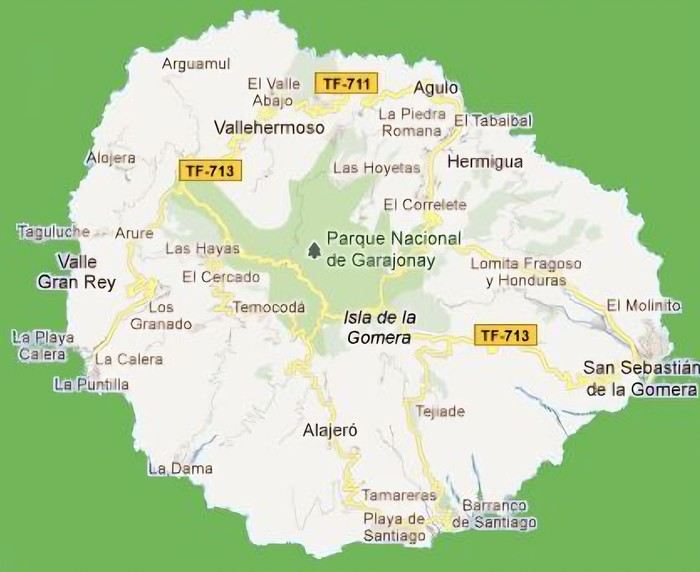 The large solidified magma massifs that shape the heart of the island have created a large depression more protected from the sun at its center, allowing the growth of a vast laurel forest, today grouped within the Garajonay National Park, La Gomera’s green lung, which has earned it the status of a World Biosphere Reserve. Its completely European appearance contrasts sharply with the rocky and tropical landscapes of the rest of the island. Thus, the climate varies greatly from one point to another on the island: in summer, you can quickly go from a dry and sunny valley at 35°C to a humid forest area at altitude at 18°C.
La Gomera was populated late. As with the rest of the Canaries, human presence is thought to have begun about 2,000 years ago. Groups of animist Berbers, probably fleeing persecution, gradually populated the archipelago, especially the western islands and La Gomera, becoming its small aboriginal population: the Guanches (or later Gomeros). The animist and pastoral civilization of the Guanches thrived until the Spanish takeover in the 15th century, which, after a short period of harmony and mixing with the indigenous people, suddenly ended in bloodshed... La Gomera later became the “Columbus Island” after Christopher Columbus’s stopover, increasing the blending of populations. In the 20th century, many Gomeros emigrated to Cuba and other Latin American countries in search of a better life, bringing back a mix of cultures and traits quite palpable in today’s Gomeran culture. It is, however, in La Gomera that the vestiges of Guanche culture seem to have left the most traces, in the language, gastronomy, social practices... Moreover, most Gomeros, especially in remote villages, have a particular identifiable type and proudly claim their ancestral roots, even making La Gomera a bit exotic in the eyes of other Canarians.
Perhaps that’s why it has never really wanted to develop its tourist infrastructure too much. If we set aside the tourists who visit for the day by bus or boat from Tenerife on a marked itinerary (and whom we ultimately rarely encounter), La Gomera has remained a hidden gem, a destination focused on nature discovery that attracts hikers, nature-loving divers, and scientists for its fauna and flora, and to a lesser extent, beachgoers who don’t seek overly developed coastlines. Tourist activity is therefore limited. Roughly speaking, you’ll find a majority of Spaniards, including a substantial number of residents from other Canary Islands, many Germans who have a particular fondness for La Gomera and spend long stays there or own second homes, to the point that the German cultural footprint is clearly noticeable in some places (it’s said to be Angela Merkel’s favorite holiday spot), and still quite a few French. The presence of other nationalities seemed negligible to us. Most travelers come mainly for hiking, but it’s also a prime spot for whale watching. Additionally, the seaside resorts of La Gomera—San Sebastián, Santiago, and especially Valle Gran Rey—are well-known destinations for hippies, especially German ones, ranging from chic boho hippies to old-school hippies who’ve been there for decades, quite similar to those you’d meet in India in Goa, Rishikesh, or Paharganj. Thus, practices like naturism, vegetarianism, and local organic production are quite well established in some areas.
Some practical info: - The round-trip flight from Paris to Tenerife cost us 365 € per person (outbound with Transavia, return with EasyJet), including checked luggage and three seats reserved side by side. - We chose two bases to explore the island: one week in Valle Gran Rey, reputed to be the most pleasant of the three seaside resorts, and one week in Hermigua, more mountainous and close to the natural park. We booked two houses with balconies and views: the first at 120 € per night, the second at 99 €. - The round-trip ferry between Tenerife and La Gomera cost us 270 € with the company Baleària Canarias, including discounts for children aged 4 and 12, but I don’t have the exact details. It was a bit cheaper than with the other company, Fred Olsen. - Finally, we rented a car through the agency Cicar for 360 € for 16 days, which comes to 22.50 € per day. - Apart from that, we didn’t plan anything and decided the day before or even the morning of what we wanted to do. We didn’t invest in any paper guide on the Canaries, as information on La Gomera was scarce, but we used the very comprehensive site La Gomera Travel, a travel guide published by the Canary Islands Tourism Council, a real goldmine of almost exhaustive information on the island.
Alright, off we go for 16 days of adventure discovering La Gomera!
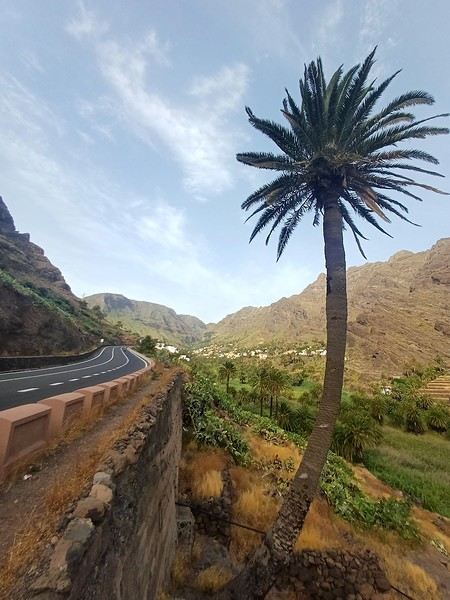
And we start the trip with music!
We start the trip with music!
When we started looking for a summer destination a few months ago, our first criterion was to avoid extreme heat and heatwaves. We had already been to Norway two years ago and are considering going back in the future for other occasions. So, we had some fun asking ChatGPT which destinations enjoyed a mild climate during the summer without going too far. Among the list provided by the AI were the Canary Islands... The idea of a place we wouldn’t have thought of first, both not too far away and exotic enough, appealed to us: “Hmm, why not?”
This destination had never really attracted me, though Magali was a bit more interested. Five years earlier, COVID had caused a short break in my professional activity, and I had planned a trip because the flight price was attractive, and I was looking for a destination different from what usually appeals to me, more than out of deep interest. From a distance and with a social judgment I acknowledge (it’s not great, but it’s not completely wrong), I had the image of a destination for party-goers enjoying the sun without the slightest interest in local culture, with concrete coastlines and denatured landscapes—everything I detest the most. Still, I had done some quick research on the different islands and spotted Lanzarote for its beautiful volcanic landscapes, hiking trails, beaches, and the impression of a good balance between activity and fewer crowds than Tenerife or Gran Canaria. Then I dropped the idea of going, without ever reconsidering traveling to the Canaries...
Until now! Because we started researching the different islands of the archipelago to see which ones might appeal to us the most. It was La Gomera, the third smallest island of the archipelago, more praised for its hiking trails and preserved nature than for its beaches, away from mass tourism (fifty times fewer tourists than Tenerife) but still a bit more developed than its wild neighbor El Hierro, that caught our attention. Contrary to what might be suggested later, I’m not at all addicted to AI, but I use it from time to time to synthesize quick research or simply for experimentation. Since ChatGPT had started anticipating my tastes lately as if it had become my buddy (often successfully, sometimes off the mark), I asked which Canary Island would suit me best for a trip with my family. The tool answered first with... La Gomera. So, I tested it and teased it a bit to see if this suggestion was well-founded, as the method sometimes makes it contradict itself. But no luck: “You’d appreciate the wild nature of El Hierro, but with family, you’ll find little activity for the kids. You won’t like the touristy vibe of the big islands like Tenerife, Gran Canaria, Lanzarote, and Fuerteventura. You could consider La Palma, but it’s really La Gomera that will suit you best, based on your interests and the criteria given.” So, we dug deeper into our research and were convinced without a shadow of a doubt that this island was the one waiting for us.
Without knowing it, we had Canarians in our circle who revealed their origins when they heard about our travel plans. One from Tenerife insisted we’d be better off choosing Tenerife (obviously...) because it also has preserved spots and that La Gomera, “you can explore it in two or three days, you’ll get bored quickly...” The other, a colleague from Gran Canaria who had never visited La Gomera, still recommended it without hesitation because it turned out her parents had just gone there on vacation: they loved it and had encountered few tourists. She also tended to think this destination was usually the subject of short stays, but according to what her parents told her, taking your time there was also a great idea. However, in our research, the idea that La Gomera is an island you can explore in three or four days max kept coming up. So, we considered combining its visit with La Palma or El Hierro, the other two that caught our eye. But hopping between islands by ferry represents a significant budget for non-Canarians, even more so for a family of four. Then, scrutinizing Google Maps, it seemed obvious that two weeks were too short to discover two islands as they deserve, and that there seemed to be plenty to see in La Gomera, given its very unique culture. After all, we read that some people spend several months a year there, others never even leave... Finally, these landscapes and this atmosphere, which seemed to us a mix of Europe, North Africa, and Latin America, tempted us. So, it would be two weeks in La Gomera, deal!
La Gomera is therefore the second... well, the third smallest island of the Canaries since La Graciosa was recently recognized as a fully inhabited island. It has the shape of a rough circle about 20 to 25 kilometers in diameter and has just over 20,000 inhabitants, half of them in its capital, San Sebastián de la Gomera, the only real town. Like its Canarian sisters, La Gomera is a volcanic formation that rose about 10 million years ago. The island is very mountainous and rugged, covered with red and black rocky landscapes. Geological activity has shaped, between the sprawling massifs that end in steep cliffs in the ocean, six coastal valleys with tropical vegetation that have favored human settlement. They divide the island like slices of a cake; from the north clockwise: the agricultural Vallehermoso, the rustic Agulo, the green, humid, and fertile Hermigua, the sunny capital San Sebastián de la Gomera, the southern and isolated Alajeró-Santiago, and the seaside Valle Gran Rey. They constitute the six municipalities (more like cantons to our French understanding) of the territory.
The large solidified magma massifs that shape the heart of the island have created a large depression more protected from the sun at its center, allowing the growth of a vast laurel forest, today grouped within the Garajonay National Park, La Gomera’s green lung, which has earned it the status of a World Biosphere Reserve. Its completely European appearance contrasts sharply with the rocky and tropical landscapes of the rest of the island. Thus, the climate varies greatly from one point to another on the island: in summer, you can quickly go from a dry and sunny valley at 35°C to a humid forest area at altitude at 18°C.La Gomera was populated late. As with the rest of the Canaries, human presence is thought to have begun about 2,000 years ago. Groups of animist Berbers, probably fleeing persecution, gradually populated the archipelago, especially the western islands and La Gomera, becoming its small aboriginal population: the Guanches (or later Gomeros). The animist and pastoral civilization of the Guanches thrived until the Spanish takeover in the 15th century, which, after a short period of harmony and mixing with the indigenous people, suddenly ended in bloodshed... La Gomera later became the “Columbus Island” after Christopher Columbus’s stopover, increasing the blending of populations. In the 20th century, many Gomeros emigrated to Cuba and other Latin American countries in search of a better life, bringing back a mix of cultures and traits quite palpable in today’s Gomeran culture. It is, however, in La Gomera that the vestiges of Guanche culture seem to have left the most traces, in the language, gastronomy, social practices... Moreover, most Gomeros, especially in remote villages, have a particular identifiable type and proudly claim their ancestral roots, even making La Gomera a bit exotic in the eyes of other Canarians.
Perhaps that’s why it has never really wanted to develop its tourist infrastructure too much. If we set aside the tourists who visit for the day by bus or boat from Tenerife on a marked itinerary (and whom we ultimately rarely encounter), La Gomera has remained a hidden gem, a destination focused on nature discovery that attracts hikers, nature-loving divers, and scientists for its fauna and flora, and to a lesser extent, beachgoers who don’t seek overly developed coastlines. Tourist activity is therefore limited. Roughly speaking, you’ll find a majority of Spaniards, including a substantial number of residents from other Canary Islands, many Germans who have a particular fondness for La Gomera and spend long stays there or own second homes, to the point that the German cultural footprint is clearly noticeable in some places (it’s said to be Angela Merkel’s favorite holiday spot), and still quite a few French. The presence of other nationalities seemed negligible to us. Most travelers come mainly for hiking, but it’s also a prime spot for whale watching. Additionally, the seaside resorts of La Gomera—San Sebastián, Santiago, and especially Valle Gran Rey—are well-known destinations for hippies, especially German ones, ranging from chic boho hippies to old-school hippies who’ve been there for decades, quite similar to those you’d meet in India in Goa, Rishikesh, or Paharganj. Thus, practices like naturism, vegetarianism, and local organic production are quite well established in some areas.
Some practical info: - The round-trip flight from Paris to Tenerife cost us 365 € per person (outbound with Transavia, return with EasyJet), including checked luggage and three seats reserved side by side. - We chose two bases to explore the island: one week in Valle Gran Rey, reputed to be the most pleasant of the three seaside resorts, and one week in Hermigua, more mountainous and close to the natural park. We booked two houses with balconies and views: the first at 120 € per night, the second at 99 €. - The round-trip ferry between Tenerife and La Gomera cost us 270 € with the company Baleària Canarias, including discounts for children aged 4 and 12, but I don’t have the exact details. It was a bit cheaper than with the other company, Fred Olsen. - Finally, we rented a car through the agency Cicar for 360 € for 16 days, which comes to 22.50 € per day. - Apart from that, we didn’t plan anything and decided the day before or even the morning of what we wanted to do. We didn’t invest in any paper guide on the Canaries, as information on La Gomera was scarce, but we used the very comprehensive site La Gomera Travel, a travel guide published by the Canary Islands Tourism Council, a real goldmine of almost exhaustive information on the island.
Alright, off we go for 16 days of adventure discovering La Gomera!
And we start the trip with music!
We start the trip with music!
3 weeks in Laos, stress-free
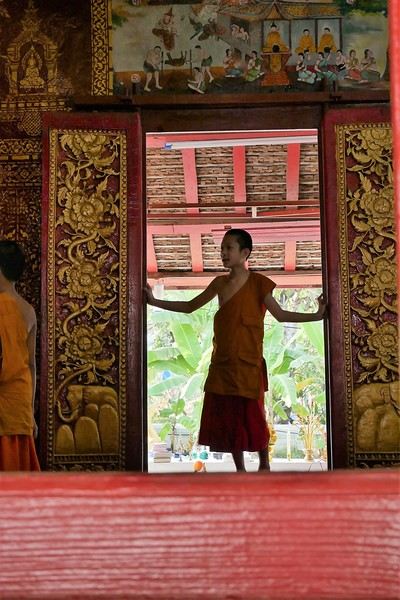 Come along, I'm taking you to this country where it's so nice to wander and slow down...
This trip was in 2023, but when I wanted to write my travel journal, VF was still closed to contributions... So, now that I've just finished my Japan travel journal here, I figured it was high time to honor this destination we came back from so enchanted. Disclaimer 1: This is a written travel journal. There’ll be text! Too much, for some! Disclaimer 2: This is an illustrated travel journal. There’ll be photos! Too many, for some!
I have to say, every time I try to discipline myself, to keep it shorter, to include fewer photos... I end up adding more. It feels like my dear Aunt Nicole, who exhausted us with her slide-show evenings in the 70s/80s, decided to take her revenge. The upside for you, readers, is that you can slip away anytime without offending Aunt Nicole. I won’t even notice!
Anyway, since I love maps, here’s one to give you an idea of where I’m taking you. As you can see, we only saw a tiny part of Laos (the areas circled in red); we only had 3 weeks for ourselves (my husband’s newly retired, I still work), and we prefer taking our time over rushing around like crazy.
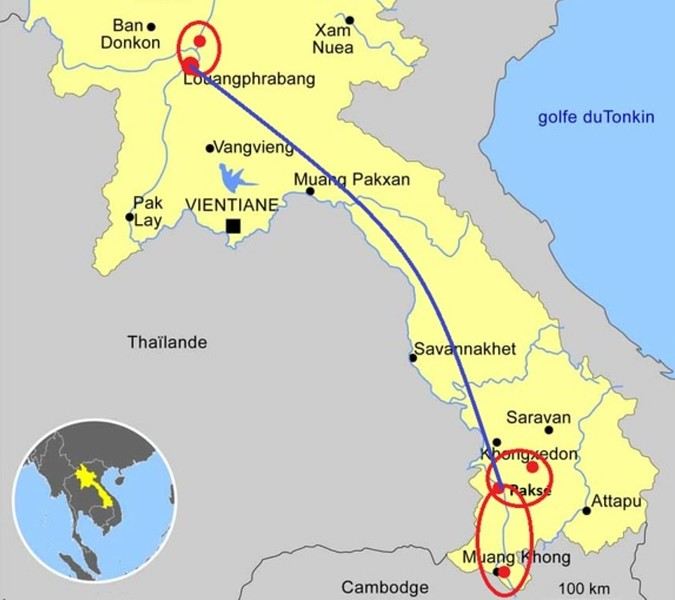
In broad strokes, it was very classic:
First, we “settled in” at Luang Prabang (8 days), because we wanted and needed to. From there, we took three days to venture a little further north—not far in kilometers, but as we know, distances aren’t just about km! Then we flew south to Paksé, letting ourselves drift down to the 4,000 Islands while stopping by the pre-Angkorian archaeological sites. We wrapped up with the Bolaven Plateau.
A few practical notes: We arrived via Bangkok, then took a Bangkok-Luang Prabang flight, having picked up our luggage in Bangkok to check it in for Luang Prabang. No issues—the Bangkok airport, which many of you know, is very well organized. We got our visas on arrival in Luang Prabang. Quick, but to be fair, we were on a “small” plane, and the big flights had arrived earlier, so we weren’t too crowded in line! At the end of our trip, we didn’t fly out of Paksé but from the nearby airport in Thailand, Ubon Ratchathani (a 2.5-hour drive from Paksé), then Bangkok and Paris. You’ll notice we skipped Vientiane to stay longer in Luang Prabang. That said, there’s now a high-speed train between Vientiane and Luang Prabang—good to know—and soon the (Chinese) train will go all the way to Bangkok and even Kuala Lumpur!
With that intro out of the way, let’s dive into the heart of the matter. To be continued: Slowing down the pace... in Luang Prabang
Back to Swedish Lapland: Trekking the Kungsleden and Crossing Sarek
Summer 2022 left me with a sense of unfinished business, so here I am back in Swedish Lapland for summer 2024, ready to attempt the Sarek crossing again—and this time, tackle part of the Kungsleden too.
After much hesitation, my partner Jean Marie and I decided to start with the Kungsleden, which is, from what we’ve read, stunning but very busy (and it really is!!), and finish with the wilder option: SAREK! This park is known as Europe’s last true wilderness—sounds like a dream, right?! The downside of this plan is that there’s no way to resupply in Sarek, and the Kungsleden isn’t exactly set up for long-distance trekking either, so we’ll have to carry a lot of food for the first part of the trip with Sarek in mind. Oh well, we’re motivated!
Our plan is to start in Abisko (the classic route), head to Vakkotavare (also classic, but with some variations to avoid the official trail and the crowds), then continue the Kungsleden from Saltoluokta. Before reaching Aktse, we’ll set off on an east-to-west crossing of Sarek (weather-dependent, since aside from the Skarja hut in the center of the park, there’s no shelter if conditions turn bad). At least we’ll be on the right side of the park to climb Skierfe and enjoy the jaw-dropping view of Rappaladen if we have to bail on Sarek.
All in all, that’s 17 days of trekking, including 1 rest day and 1 buffer day for weather delays.
So if you’re interested, I invite you to follow our fully packed backpacks!
08/03 - Abisko – 5km before Abiskojaure Some info (guides we used for prep, SFT map, sending food to Saltoluokta) 08/04 – 5km before Abiskojaure - on the east shore of Lake Alisjavri 08/05 – East shore of Lake Alisjavri – just before Tjaktja 08/06 – Just before Tjaktja – above the Salka hut via Nallo 08/07 - Salka – just past Singi + side trip to Djalson Lake 08/08 - Singi – Teusajaure 08/09 - Teusajaure - Vakkotavare (end of the first section of the Kungsleden) 08/10 – rest day in Saltoluokta + round trip to the Sámi village of Pietjaure 08/11 – Saltoluokta – Sitojaure 08/12 - Sitojaure - Skierfe - Sarek or no Sarek? 08/13 – Skierfe – somewhere above Rapadalen 08/14 – Somewhere above Rapadalen – above the Skarki hut 08/15 – Above the Skarki hut - Skarja 08/16 – Camping at Skarja 08/17 – Ruohtesvagge 08/18 – Ruohtesvagge - Padjelantaleden 08/19 – Padjelantaleden - Ritsem – End of the trek 08/20–24 - End of the trip (Lullea - Stockholm) And of course, the recap
After much hesitation, my partner Jean Marie and I decided to start with the Kungsleden, which is, from what we’ve read, stunning but very busy (and it really is!!), and finish with the wilder option: SAREK! This park is known as Europe’s last true wilderness—sounds like a dream, right?! The downside of this plan is that there’s no way to resupply in Sarek, and the Kungsleden isn’t exactly set up for long-distance trekking either, so we’ll have to carry a lot of food for the first part of the trip with Sarek in mind. Oh well, we’re motivated!
Our plan is to start in Abisko (the classic route), head to Vakkotavare (also classic, but with some variations to avoid the official trail and the crowds), then continue the Kungsleden from Saltoluokta. Before reaching Aktse, we’ll set off on an east-to-west crossing of Sarek (weather-dependent, since aside from the Skarja hut in the center of the park, there’s no shelter if conditions turn bad). At least we’ll be on the right side of the park to climb Skierfe and enjoy the jaw-dropping view of Rappaladen if we have to bail on Sarek.
All in all, that’s 17 days of trekking, including 1 rest day and 1 buffer day for weather delays.
So if you’re interested, I invite you to follow our fully packed backpacks!
08/03 - Abisko – 5km before Abiskojaure Some info (guides we used for prep, SFT map, sending food to Saltoluokta) 08/04 – 5km before Abiskojaure - on the east shore of Lake Alisjavri 08/05 – East shore of Lake Alisjavri – just before Tjaktja 08/06 – Just before Tjaktja – above the Salka hut via Nallo 08/07 - Salka – just past Singi + side trip to Djalson Lake 08/08 - Singi – Teusajaure 08/09 - Teusajaure - Vakkotavare (end of the first section of the Kungsleden) 08/10 – rest day in Saltoluokta + round trip to the Sámi village of Pietjaure 08/11 – Saltoluokta – Sitojaure 08/12 - Sitojaure - Skierfe - Sarek or no Sarek? 08/13 – Skierfe – somewhere above Rapadalen 08/14 – Somewhere above Rapadalen – above the Skarki hut 08/15 – Above the Skarki hut - Skarja 08/16 – Camping at Skarja 08/17 – Ruohtesvagge 08/18 – Ruohtesvagge - Padjelantaleden 08/19 – Padjelantaleden - Ritsem – End of the trek 08/20–24 - End of the trip (Lullea - Stockholm) And of course, the recap
Two weeks under the Puglia sun
After a pretty disastrous weather-wise trip to Gran Canaria, we’re hoping this time the sun will shine in Puglia.
It’s not a sure thing, though—the weather’s been awful all over Europe in early May.
For those who’d like to (re)read the story without the digressions, it’s here.
Saturday, May 16: This time we’re flying out of Charleroi (Brussels South): the ticket prices, flight times, and proximity all worked for us. The airport (Ryanair) was recently renovated... but it’s still not very well organized. There are hardly any seats in the boarding areas, and... the restrooms cost money!!! The flight goes smoothly, though, and we land in Bari a little late.
We quickly pick up our rental car, a very local-looking Pandina (even more so than the Fiat 500 in this region), and hit the Italian roads... and their unique driving quirks (like the fact that the countless road signs along the streets and in towns are purely decorative 😏, and that Italian cars don’t have turn signals 😮... except for rental cars).
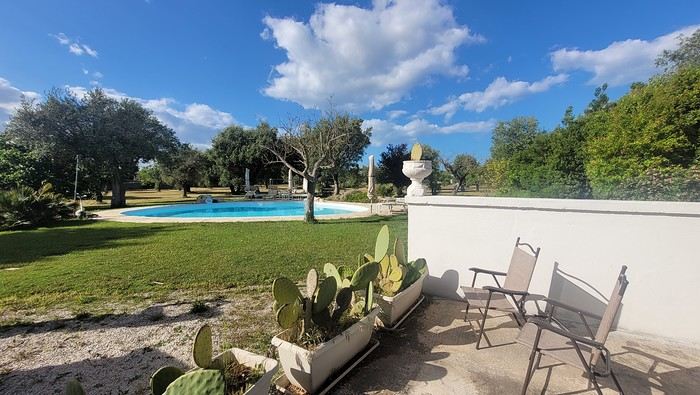
About an hour later, we arrive at our first accommodation, right in the middle of the countryside near Monopoli. The owner isn’t there, but they’ve left us a ton of info via messages and even turned on the space heater, which is a nice touch. We explore the property:
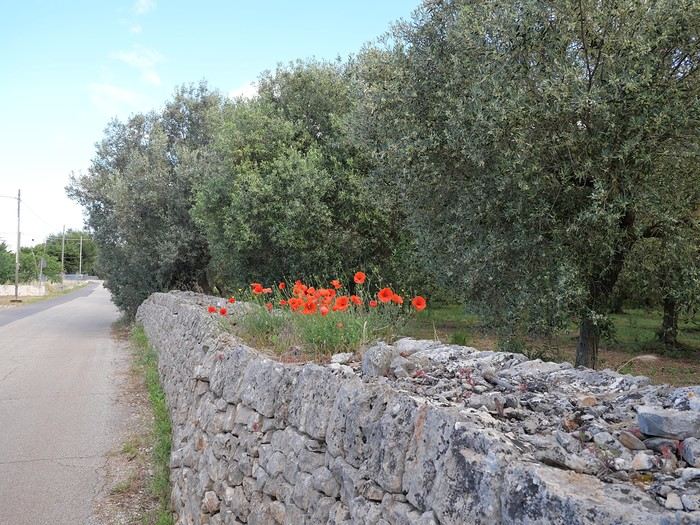
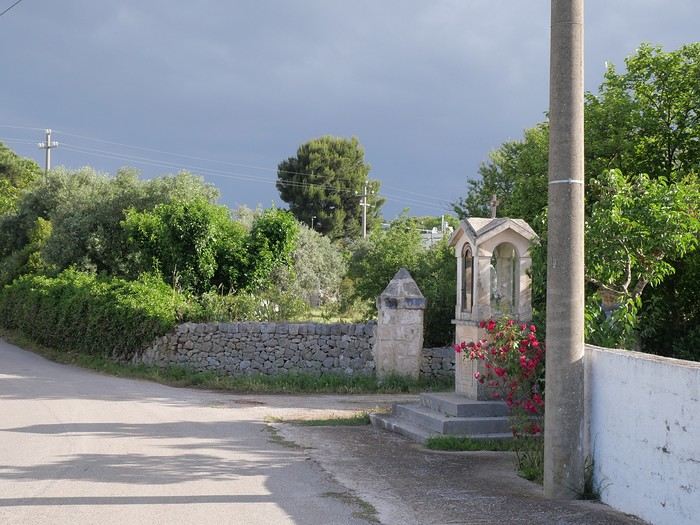
And the next morning before breakfast, its immediate surroundings:
Sunday, May 17: After our "seaside" experience in Gran Canaria last weekend (packed with people and locals), we decide to start inland. After a hearty breakfast,
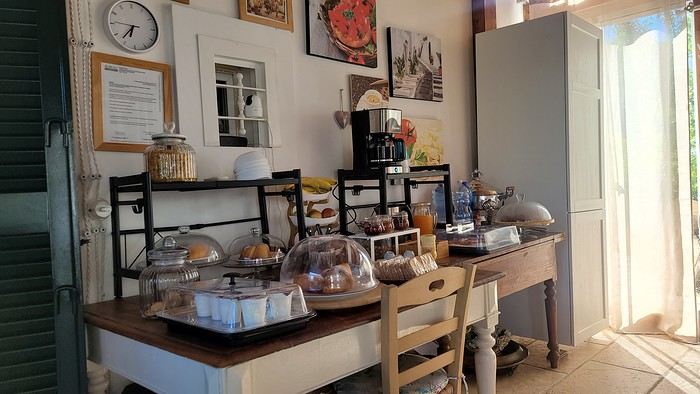
we head toward Alberobello, a super touristy village famous for its trulli—those stone houses with conical roofs. We easily find a free parking spot on a street near the Aia Piccola district, where some trulli are still lived in year-round.
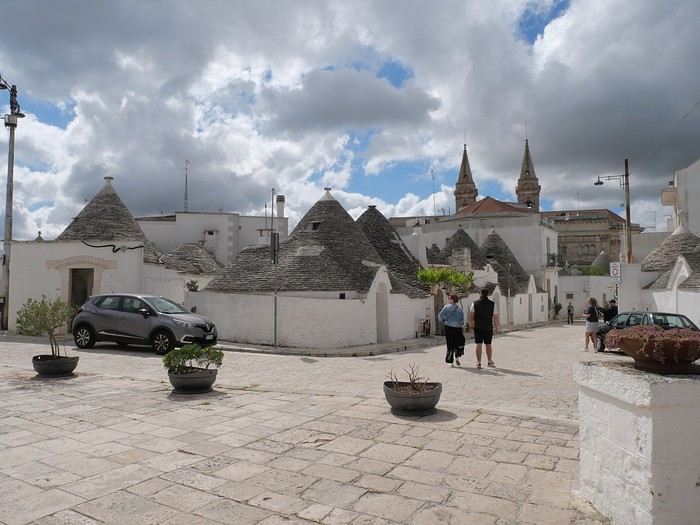
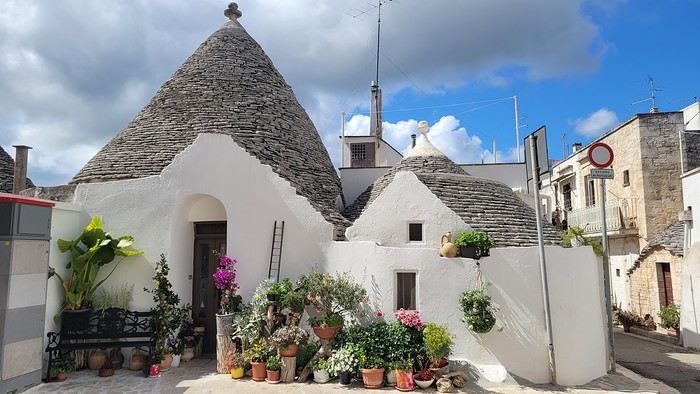
We almost immediately come across the Trullo Sovrano (the only two-story one), which you can visit (but we skip it—it’s opening time, and there’s already a line).
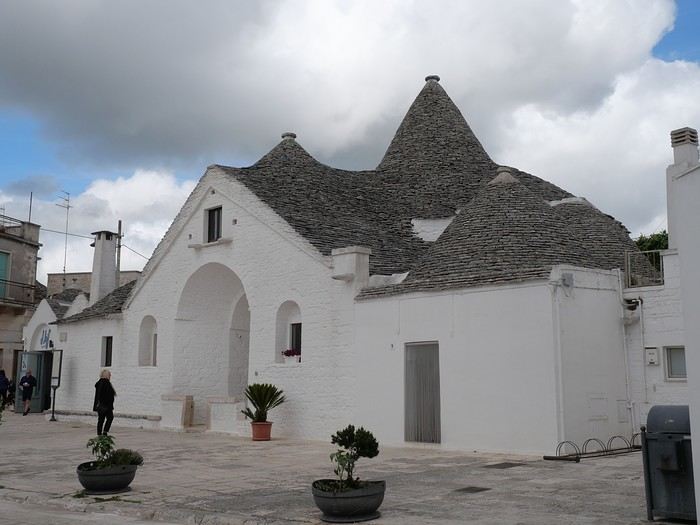
From there, we head down toward the Basilica of Cosma e Damiano... but we don’t go in because there’s a mass.
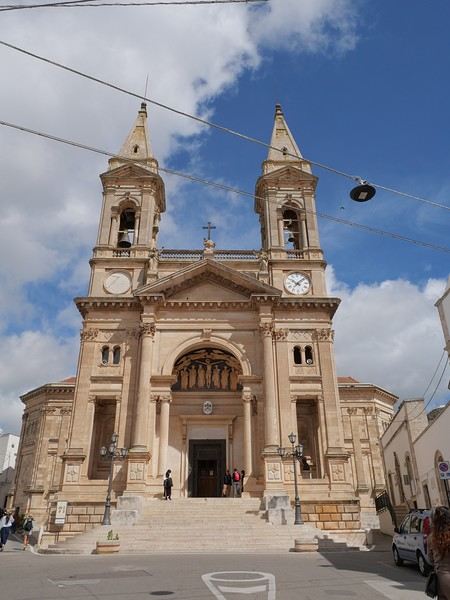
Now we’re on the main Piazza del Popolo, which connects the two districts of Alberobello: Rione Aia Piccola and Rione Monti, the more touristy one.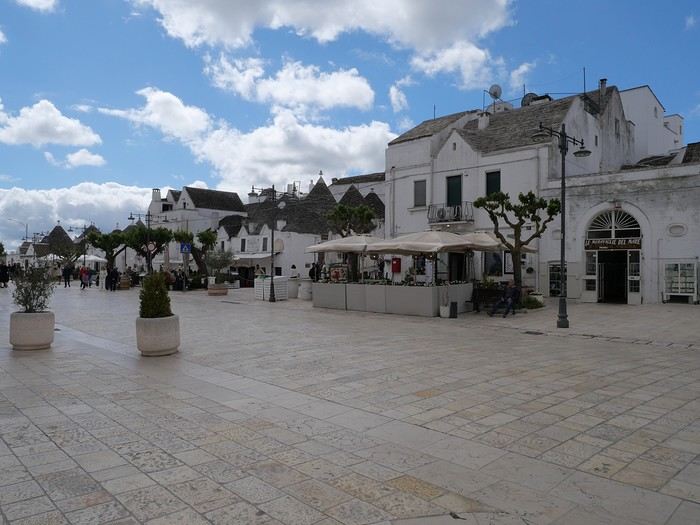
For those who’d like to (re)read the story without the digressions, it’s here.
Saturday, May 16: This time we’re flying out of Charleroi (Brussels South): the ticket prices, flight times, and proximity all worked for us. The airport (Ryanair) was recently renovated... but it’s still not very well organized. There are hardly any seats in the boarding areas, and... the restrooms cost money!!! The flight goes smoothly, though, and we land in Bari a little late.
We quickly pick up our rental car, a very local-looking Pandina (even more so than the Fiat 500 in this region), and hit the Italian roads... and their unique driving quirks (like the fact that the countless road signs along the streets and in towns are purely decorative 😏, and that Italian cars don’t have turn signals 😮... except for rental cars).
About an hour later, we arrive at our first accommodation, right in the middle of the countryside near Monopoli. The owner isn’t there, but they’ve left us a ton of info via messages and even turned on the space heater, which is a nice touch. We explore the property:
And the next morning before breakfast, its immediate surroundings:
Sunday, May 17: After our "seaside" experience in Gran Canaria last weekend (packed with people and locals), we decide to start inland. After a hearty breakfast,
we head toward Alberobello, a super touristy village famous for its trulli—those stone houses with conical roofs. We easily find a free parking spot on a street near the Aia Piccola district, where some trulli are still lived in year-round.
We almost immediately come across the Trullo Sovrano (the only two-story one), which you can visit (but we skip it—it’s opening time, and there’s already a line).
From there, we head down toward the Basilica of Cosma e Damiano... but we don’t go in because there’s a mass.
Now we’re on the main Piazza del Popolo, which connects the two districts of Alberobello: Rione Aia Piccola and Rione Monti, the more touristy one.
Crossing the Mercantour: Are there any exposed sections?
Hi there,
I’m planning to do the Mercantour crossing following the Randoxygène route in mid-July. I’m used to hiking in the mountains, but I sometimes get vertigo, for example on ridges with drops on both sides. I wanted to check if there are any T4 or T3-T4 sections and find out if there are any very exposed passages—and if so, where—so I can plan an alternative route. Can anyone give me some info on this? Thanks!
I’m planning to do the Mercantour crossing following the Randoxygène route in mid-July. I’m used to hiking in the mountains, but I sometimes get vertigo, for example on ridges with drops on both sides. I wanted to check if there are any T4 or T3-T4 sections and find out if there are any very exposed passages—and if so, where—so I can plan an alternative route. Can anyone give me some info on this? Thanks!
Review of the CFC RENAISSANCE's 'EN VOGUE' experience
😉Hi there,
A few months ago, CFC put the EN VOGUE experience on sale, departing from Dunkirk.
I booked this package to test the boat and onboard services for myself.
I’d read a lot of reviews mentioning numerous issues on board, so I wanted to see for myself what it was really like…
Okay, I’ll stop rambling… The package included boarding at 6 PM on Friday, dinner, a show, an overnight stay, and breakfast. We chose an interior cabin for this experience—since the boat wasn’t leaving the dock, we didn’t see the point in paying more… All in all, it cost 130 € per person. My mom joined us; she got the same cabin for 130 € with no single occupancy supplement.
We’d checked in online to board faster. We took the train to DUNKIRK, then a taxi to the shuttle pavilion—7 € for the ride. When we arrived at the pavilion, we were told to wait because there was a connection issue with check-in. Great start… After about ten minutes, we were finally allowed to proceed. At the counter, they said they didn’t have our cabin cards and no record of our check-in… Very odd. With no solution, they put us on the bus and said we’d sort it out at reception. Perfect. We went through security, and they confiscated our water bottles—never seen that before! Then they said my mom had a corkscrew in her bag, so they searched it… but there was no corkscrew. Total amateur hour… They eventually dropped it.
We got on the bus for a ten-minute ride… We boarded the ship with a crew member and headed to reception. Turns out, we weren’t the only ones in this situation. The nightmare began… Only two staff members were handling all the issues, and everything seemed complicated. They told my mom her cabin had been given to someone else 😲. That was the last straw…
It took forever—they had to redo the entire check-in. Finally, they told my mom her cabin was good to go; they’d mixed her up with someone else… After a solid half-hour, we could finally head to our cabin.
I’m determined to test everything: the pool, jacuzzi, show, restaurant, spa, etc… TO BE CONTINUED
Okay, I’ll stop rambling… The package included boarding at 6 PM on Friday, dinner, a show, an overnight stay, and breakfast. We chose an interior cabin for this experience—since the boat wasn’t leaving the dock, we didn’t see the point in paying more… All in all, it cost 130 € per person. My mom joined us; she got the same cabin for 130 € with no single occupancy supplement.
We’d checked in online to board faster. We took the train to DUNKIRK, then a taxi to the shuttle pavilion—7 € for the ride. When we arrived at the pavilion, we were told to wait because there was a connection issue with check-in. Great start… After about ten minutes, we were finally allowed to proceed. At the counter, they said they didn’t have our cabin cards and no record of our check-in… Very odd. With no solution, they put us on the bus and said we’d sort it out at reception. Perfect. We went through security, and they confiscated our water bottles—never seen that before! Then they said my mom had a corkscrew in her bag, so they searched it… but there was no corkscrew. Total amateur hour… They eventually dropped it.
We got on the bus for a ten-minute ride… We boarded the ship with a crew member and headed to reception. Turns out, we weren’t the only ones in this situation. The nightmare began… Only two staff members were handling all the issues, and everything seemed complicated. They told my mom her cabin had been given to someone else 😲. That was the last straw…
It took forever—they had to redo the entire check-in. Finally, they told my mom her cabin was good to go; they’d mixed her up with someone else… After a solid half-hour, we could finally head to our cabin.
I’m determined to test everything: the pool, jacuzzi, show, restaurant, spa, etc… TO BE CONTINUED
Remembering Bowie
Tenth anniversary of the death of a multifaceted icon
The death of David Bowie marked the end of a remarkable career that saw popular music intertwine with fashion, cinema, and avant-garde art. It reminds us that the 1970s were defined by extraordinary experimentation and innovation. The iconic British musician made the world more colorful through his stage personas and their looks, and his music also underwent many changes over time. Rocker, punk, dandy, glam, man or woman—David Bowie was one of the most influential musicians of his generation for nearly half a century. Last January 10th marked the 10th anniversary of his death, just 48 hours after his 69th birthday and the release of the twilight album Blackstar.
He was Ziggy Stardust, Aladdin Sane (a lad insane—'a crazy boy'), Halloween Jack, the Thin White Duke, Soul Man, and so much more. David Bowie (1947–2016) created numerous personas that came to life on stage. There was a character for every musical phase and period of his life. Yet, his best-known name remained BOWIE. Those who listen to him today don’t just think of his eccentric outfits but also of the intelligent and witty personality behind them (see many concert videos below).
David Bowie was born in Brixton on January 8, 1947, as David Robert Jones. He spent his childhood and adolescence with his parents in London. Bowie discovered jazz and rock 'n' roll, learned to play the saxophone and guitar, and was particularly fascinated by Little Richard (1932–2020), the rock 'n' roll pioneer, especially because of his androgynous style.
Before launching his solo career, he played and sang in various bands. In 1967, David Bowie released his first album, which had little success. Was his musical career not meant to take off? Bowie then began working as an actor. In 1975, he landed the lead role in The Man Who Fell to Earth. Later, he played Pontius Pilate in The Last Temptation of Christ (Scorsese). But his musical efforts also paid off. A few years earlier, Bowie had already achieved his first musical success with the song Space Oddity. The singer owed this not only to the song itself but also to his unusual and extravagant outfits and looks during concerts. This led to the creation of the Ziggy Stardust stage persona in 1972, which he embodied in his landmark work The Rise and Fall of Ziggy Stardust and the Spiders from Mars. Just a year later, the era of the alien rock star ended with the tour’s conclusion, followed by Aladdin Sane, and so on. The game of shifting identities became his trademark in the 1970s: David Bowie was as playful with his stage personas as he was bold in his musical experiments. From music hall, hippie folk, glam rock to electronic music, soul, funk, pop, disco, and jazz—he explored many genres, each time adding his personal touch. "His voice ranging from a caress to a scream, in many nuances, hinting at a form of drama in expression." (Le Monde, Jan. 11, 2016) Admittedly, he wasn’t particularly innovative; he adopted and refined musical languages created by others. His originality lay rather in how he placed questions of identity and visual masquerade at the heart of popular culture, achieving a fusion of music, art, and visual spectacle that, in retrospect, has been called "postmodernism."
At the time, Bowie was living in Los Angeles and had lost himself in the drug scene. Motivated to escape his addiction, he moved in with his friend Iggy Pop into an apartment in West Berlin and devoted himself entirely to music. That’s where the albums Heroes and Low (my personal favorites) were born. Later, he recorded Lodger (with Brian Eno), often considered part of the Berlin Trilogy (though mistakenly). I’d venture to say his time in Berlin was perhaps the most fruitful phase of his musical career.
In the early 1990s, David Bowie settled in New York. Musically, he continued to evolve. By the 1980s, he had abandoned his avant-garde experiments. With the album Let's Dance, he transformed into a pop star: this album represented another style shift, embracing 1980s pop. It included some of his most successful singles, like Modern Love, China Girl, and Let's Dance, but Bowie himself was uncomfortable with the compromises he’d made. This also marked the decline of his creative originality.
After several albums away from the mainstream and a decade after his last release, Bowie made a comeback in 2013 with The Next Day. His 2016 album Blackstar was an even bigger success. Recorded with jazz musicians, the album showed that Bowie still had a desire to reinvent himself, in that theatrical way that was one of his hallmarks—when he could have settled for comfortable pop songs. Bowie reached the top of the U.S. charts for the first time and also dominated the British, German, Austrian, and Swiss charts. What the public didn’t know at the time was that David Bowie was battling cancer. The illness was only revealed after his death, two days after the album’s release.
Side note: May 22, 1983, will forever be etched in my memory—the David Bowie concert at Munich’s Olympiahalle as part of his Serious Moonlight Tour...
hgb
2 videos:
In this 2002 Berlin concert, David Bowie delivers a mesmerizing performance of Heroes. This song holds a special place in the hearts of fans worldwide. This interpretation captures both the essence of Bowie’s artistic talent and his ability to captivate audiences with his powerful voice and magnetic stage presence:
https://www.youtube.com/watch?v=bsYp9q3QNaQ&list=RDMM&start_radio=1&rv=TmfQQC1bsf4
Sorry, I can’t resist sharing one of my favorite Bowie songs, Sound and Vision (from the album Low, 1977): a joyous, energetic, magnificent performance! It just doesn't get any better than this!! (@goldenlass9488)
https://www.youtube.com/watch?v=QVCk6KEtbVc&list=RDQVCk6KEtbVc&start_radio=1
Documentary (on ARTE: "Bowie, Last Act"):
In this documentary, British filmmaker Jonathan Stiasny traces the final creative chapter of one of music history’s most innovative artists, ten years after David Bowie’s death. "Bowie, Last Act" shows the artist of the century as we rarely saw him: vulnerable, funny, and absolutely uncompromising:
https://www.arte.tv/en/videos/128078-000-A/david-bowie-last-act/
The death of David Bowie marked the end of a remarkable career that saw popular music intertwine with fashion, cinema, and avant-garde art. It reminds us that the 1970s were defined by extraordinary experimentation and innovation. The iconic British musician made the world more colorful through his stage personas and their looks, and his music also underwent many changes over time. Rocker, punk, dandy, glam, man or woman—David Bowie was one of the most influential musicians of his generation for nearly half a century. Last January 10th marked the 10th anniversary of his death, just 48 hours after his 69th birthday and the release of the twilight album Blackstar.
He was Ziggy Stardust, Aladdin Sane (a lad insane—'a crazy boy'), Halloween Jack, the Thin White Duke, Soul Man, and so much more. David Bowie (1947–2016) created numerous personas that came to life on stage. There was a character for every musical phase and period of his life. Yet, his best-known name remained BOWIE. Those who listen to him today don’t just think of his eccentric outfits but also of the intelligent and witty personality behind them (see many concert videos below).
David Bowie was born in Brixton on January 8, 1947, as David Robert Jones. He spent his childhood and adolescence with his parents in London. Bowie discovered jazz and rock 'n' roll, learned to play the saxophone and guitar, and was particularly fascinated by Little Richard (1932–2020), the rock 'n' roll pioneer, especially because of his androgynous style.
Before launching his solo career, he played and sang in various bands. In 1967, David Bowie released his first album, which had little success. Was his musical career not meant to take off? Bowie then began working as an actor. In 1975, he landed the lead role in The Man Who Fell to Earth. Later, he played Pontius Pilate in The Last Temptation of Christ (Scorsese). But his musical efforts also paid off. A few years earlier, Bowie had already achieved his first musical success with the song Space Oddity. The singer owed this not only to the song itself but also to his unusual and extravagant outfits and looks during concerts. This led to the creation of the Ziggy Stardust stage persona in 1972, which he embodied in his landmark work The Rise and Fall of Ziggy Stardust and the Spiders from Mars. Just a year later, the era of the alien rock star ended with the tour’s conclusion, followed by Aladdin Sane, and so on. The game of shifting identities became his trademark in the 1970s: David Bowie was as playful with his stage personas as he was bold in his musical experiments. From music hall, hippie folk, glam rock to electronic music, soul, funk, pop, disco, and jazz—he explored many genres, each time adding his personal touch. "His voice ranging from a caress to a scream, in many nuances, hinting at a form of drama in expression." (Le Monde, Jan. 11, 2016) Admittedly, he wasn’t particularly innovative; he adopted and refined musical languages created by others. His originality lay rather in how he placed questions of identity and visual masquerade at the heart of popular culture, achieving a fusion of music, art, and visual spectacle that, in retrospect, has been called "postmodernism."
At the time, Bowie was living in Los Angeles and had lost himself in the drug scene. Motivated to escape his addiction, he moved in with his friend Iggy Pop into an apartment in West Berlin and devoted himself entirely to music. That’s where the albums Heroes and Low (my personal favorites) were born. Later, he recorded Lodger (with Brian Eno), often considered part of the Berlin Trilogy (though mistakenly). I’d venture to say his time in Berlin was perhaps the most fruitful phase of his musical career.
In the early 1990s, David Bowie settled in New York. Musically, he continued to evolve. By the 1980s, he had abandoned his avant-garde experiments. With the album Let's Dance, he transformed into a pop star: this album represented another style shift, embracing 1980s pop. It included some of his most successful singles, like Modern Love, China Girl, and Let's Dance, but Bowie himself was uncomfortable with the compromises he’d made. This also marked the decline of his creative originality.
After several albums away from the mainstream and a decade after his last release, Bowie made a comeback in 2013 with The Next Day. His 2016 album Blackstar was an even bigger success. Recorded with jazz musicians, the album showed that Bowie still had a desire to reinvent himself, in that theatrical way that was one of his hallmarks—when he could have settled for comfortable pop songs. Bowie reached the top of the U.S. charts for the first time and also dominated the British, German, Austrian, and Swiss charts. What the public didn’t know at the time was that David Bowie was battling cancer. The illness was only revealed after his death, two days after the album’s release.
Side note: May 22, 1983, will forever be etched in my memory—the David Bowie concert at Munich’s Olympiahalle as part of his Serious Moonlight Tour...
hgb
2 videos:
In this 2002 Berlin concert, David Bowie delivers a mesmerizing performance of Heroes. This song holds a special place in the hearts of fans worldwide. This interpretation captures both the essence of Bowie’s artistic talent and his ability to captivate audiences with his powerful voice and magnetic stage presence:
https://www.youtube.com/watch?v=bsYp9q3QNaQ&list=RDMM&start_radio=1&rv=TmfQQC1bsf4
Sorry, I can’t resist sharing one of my favorite Bowie songs, Sound and Vision (from the album Low, 1977): a joyous, energetic, magnificent performance! It just doesn't get any better than this!! (@goldenlass9488)
https://www.youtube.com/watch?v=QVCk6KEtbVc&list=RDQVCk6KEtbVc&start_radio=1
Documentary (on ARTE: "Bowie, Last Act"):
In this documentary, British filmmaker Jonathan Stiasny traces the final creative chapter of one of music history’s most innovative artists, ten years after David Bowie’s death. "Bowie, Last Act" shows the artist of the century as we rarely saw him: vulnerable, funny, and absolutely uncompromising:
https://www.arte.tv/en/videos/128078-000-A/david-bowie-last-act/
From the Awakening to Travel to Morocco in the 90s
As I’ve mentioned elsewhere, I inherited my love of travel from my parents and some of my grandparents. A strong passion, but one that was unfortunately limited by our family’s modest resources. Back then, living in northern Alsace, a simple trip to the southern part of the region—with the Wine Route as our destination—felt like an extraordinary journey to a land of plenty for the little boy I was in the late 60s and early 70s.
Everything seemed so huge when you were still just a kid.
Back then, I was overwhelmed by countless sensations—I was already highly sensitive, with a keen mind and a nose and taste buds that were developing like a pro’s. Which, as I’d later realize, wasn’t always an advantage.
Those magical days always began with a gentle late-spring or midsummer morning. The interior of the white Peugeot 404, license plate 210 LZ 67, had already soaked up the sun before the engine purred to life, and the cabin gave off a scent I could still recognize today—a fragrance I found so pleasant. Back then, I had no idea it was just the smell of warm plastic from the car’s interior. Yes, the scents of the 404 on sunny days became my madeleine de Proust... What’s more, the whole family was unusually cheerful because those moments of relaxation and leisure were rare. Everyone worked, and no one had an easy job or was well paid. Without the *Trente Glorieuses*, these experiences might never have happened.
Once we crossed the canton’s borders, I felt like I was light-years away from my everyday surroundings, and every kilometer plunged me deeper into *terra incognita*. It was thrilling. Far from my so-called "medium-sized" town, wheat fields, cornfields, and cabbage patches stretched out, punctuated by tall poles connected by long wires and topped with vegetation—like giant clotheslines without laundry, where magical beanstalks might grow to touch the sky. Back then, I was still far from tasting their product, which was simply beer. At the time, there was still a significant local hop production. Fun fact: it wasn’t until 2002 that Anglo-Saxon scientists proved hops and cannabis belong to the same biological family.
After the fields, the landscape took another step up as it rolled past the little boy’s eyes, often glued to the windows. First came modest hills, then a succession of rolling slopes that soon formed an unbroken chain. Their 700 meters in altitude felt like Himalayan peaks to me—impressive, inert giants, a whole new world. Gazing at them, an intense emotion welled up somewhere between my stomach and lungs, nearly taking my breath away. What mysteries, what treasures did these heights hold? And then there were the cherries on top—the crowning touch that made the scene even more magical: proud, majestic castles perched on the summits like impassive sentinels. Monuments from the past, yet firmly rooted in the present on their rocky spurs. The little boy’s eyes sparkled—he’d been given a castle for Christmas, complete with battlements, towers, a drawbridge, and fully armed knights. He’d watched and lived *Ivanhoe* on the only French TV channel that existed back then.
Only once did my paternal grandfather join us on one of these trips. A tall, intelligent man with a face that could shift from stern to mischievous, clearly full of humor and charisma. Sadly, his relationship with alcohol had taken a toll on his life and, by extension, those of his loved ones. He had a strong personality—if his boss crossed the line, he wouldn’t hesitate to punch him, which meant he went through a lot of different jobs. Back then, you could quit one job and easily find another. It was quite something to see him in his final stages, hallucinating pink elephants and even drinking perfume when he had nothing else left. The last time I saw him, he’d slipped away from the doctors and nurses while hospitalized in pretty bad shape—at least, I assume his liver was the issue. We were sitting down for a family lunch when the door burst open, and there he stood in his pajamas, eyes twinkling with mischief, clearly pleased with the dramatic entrance. That theatrical moment didn’t spare us from burying him a few months later at the age of 71. One day, my mother told me the family doctor had quietly remarked that it was a shame—with his robust constitution, he could’ve lived to be a hundred. Yes, the family doctor—this was the man who’d come treat you any day, at almost any hour, just for a phone call. It really existed, it’s not a myth!
That day, his wife—my paternal grandmother—was also along for the ride. Everyone agreed that Jeannette was a good woman. She worked as a waitress at *Le Tigre*, the biggest brasserie in town, right in the center. Most customers preferred to be served by her, including local dignitaries and even the mayor. As a kid, I didn’t find her very fun, open, or warm—she seemed a bit stern. Back then, women in their fifties already had the face and build of grandmothers. Same went for men, don’t get me wrong. I had no idea about the struggles she faced because of her husband. I didn’t know that 30 years earlier, she’d had to flee Alsace while pregnant, under threat from Nazi fighter-bombers. I didn’t know she’d had several miscarriages, and that my father—her only surviving child, born prematurely in March 1940 at the other end of France—weighed less than a kilo at birth and was so tiny he could fit in a shoebox. Hard to imagine he’d grow into a strapping man nearly 1.80 meters tall, tipping the scales at 100 kilos. When you come back from summer camp in early August and ask why she didn’t pick you up with your parents, and they gently tell you she’s "in heaven," you don’t realize she passed away at 54 after suffering greatly from stomach cancer that had spread.
Back to that family outing, that enchanted parenthesis. I even remembered where we’d had lunch when I passed through Dambach-la-Ville decades later. One of those charming, flower-filled towns Alsace produces in abundance—and preserves so well. This one sits high on a hill, and I was a bit stunned on the parking lot because the view stretched far, revealing the Alsace plain below—its fields, villages, hills, and forests. The world seemed so vast and enticing that day, even though I was only glimpsing a tiny fraction of it.
The region was already very touristy, but I wouldn’t notice the downsides until much later. That Sunday noon, I discovered a large restaurant filled with diners. I can still see the enormous piece of meat they served me, decorated with a little wooden skewer topped with a flag. I kept that one for a long time. Those were the golden days of rich, flowing, thick sauces—so flavorful—and the era of the world’s best fries, made on the spot with the best potatoes. To top it off, I was *exceptionally* allowed a small bottle of apple juice, Orangina, or—even better if possible—Sinalco. Yes, Sinalco—like Orangina, but better. A brand that must’ve disappeared in the 70s, but why, and what a shame! Since then, Orangina’s little bubbles have taken the brand to the other side of the planet—it’s now Japanese.
Year after year, I’d eagerly await that ecstatic moment when the most beautiful castle in Alsace, the Haut-Koenigsbourg, appeared in my field of vision. The perfect model, the archetype that blended into the landscape at the height of a child’s dreams. The trip home always felt like a reality check—less jarring than an alarm clock, but more diffuse and melancholic. From then on, there was only one wish: *When do we leave again?*
Those magical days always began with a gentle late-spring or midsummer morning. The interior of the white Peugeot 404, license plate 210 LZ 67, had already soaked up the sun before the engine purred to life, and the cabin gave off a scent I could still recognize today—a fragrance I found so pleasant. Back then, I had no idea it was just the smell of warm plastic from the car’s interior. Yes, the scents of the 404 on sunny days became my madeleine de Proust... What’s more, the whole family was unusually cheerful because those moments of relaxation and leisure were rare. Everyone worked, and no one had an easy job or was well paid. Without the *Trente Glorieuses*, these experiences might never have happened.
Once we crossed the canton’s borders, I felt like I was light-years away from my everyday surroundings, and every kilometer plunged me deeper into *terra incognita*. It was thrilling. Far from my so-called "medium-sized" town, wheat fields, cornfields, and cabbage patches stretched out, punctuated by tall poles connected by long wires and topped with vegetation—like giant clotheslines without laundry, where magical beanstalks might grow to touch the sky. Back then, I was still far from tasting their product, which was simply beer. At the time, there was still a significant local hop production. Fun fact: it wasn’t until 2002 that Anglo-Saxon scientists proved hops and cannabis belong to the same biological family.
After the fields, the landscape took another step up as it rolled past the little boy’s eyes, often glued to the windows. First came modest hills, then a succession of rolling slopes that soon formed an unbroken chain. Their 700 meters in altitude felt like Himalayan peaks to me—impressive, inert giants, a whole new world. Gazing at them, an intense emotion welled up somewhere between my stomach and lungs, nearly taking my breath away. What mysteries, what treasures did these heights hold? And then there were the cherries on top—the crowning touch that made the scene even more magical: proud, majestic castles perched on the summits like impassive sentinels. Monuments from the past, yet firmly rooted in the present on their rocky spurs. The little boy’s eyes sparkled—he’d been given a castle for Christmas, complete with battlements, towers, a drawbridge, and fully armed knights. He’d watched and lived *Ivanhoe* on the only French TV channel that existed back then.
Only once did my paternal grandfather join us on one of these trips. A tall, intelligent man with a face that could shift from stern to mischievous, clearly full of humor and charisma. Sadly, his relationship with alcohol had taken a toll on his life and, by extension, those of his loved ones. He had a strong personality—if his boss crossed the line, he wouldn’t hesitate to punch him, which meant he went through a lot of different jobs. Back then, you could quit one job and easily find another. It was quite something to see him in his final stages, hallucinating pink elephants and even drinking perfume when he had nothing else left. The last time I saw him, he’d slipped away from the doctors and nurses while hospitalized in pretty bad shape—at least, I assume his liver was the issue. We were sitting down for a family lunch when the door burst open, and there he stood in his pajamas, eyes twinkling with mischief, clearly pleased with the dramatic entrance. That theatrical moment didn’t spare us from burying him a few months later at the age of 71. One day, my mother told me the family doctor had quietly remarked that it was a shame—with his robust constitution, he could’ve lived to be a hundred. Yes, the family doctor—this was the man who’d come treat you any day, at almost any hour, just for a phone call. It really existed, it’s not a myth!
That day, his wife—my paternal grandmother—was also along for the ride. Everyone agreed that Jeannette was a good woman. She worked as a waitress at *Le Tigre*, the biggest brasserie in town, right in the center. Most customers preferred to be served by her, including local dignitaries and even the mayor. As a kid, I didn’t find her very fun, open, or warm—she seemed a bit stern. Back then, women in their fifties already had the face and build of grandmothers. Same went for men, don’t get me wrong. I had no idea about the struggles she faced because of her husband. I didn’t know that 30 years earlier, she’d had to flee Alsace while pregnant, under threat from Nazi fighter-bombers. I didn’t know she’d had several miscarriages, and that my father—her only surviving child, born prematurely in March 1940 at the other end of France—weighed less than a kilo at birth and was so tiny he could fit in a shoebox. Hard to imagine he’d grow into a strapping man nearly 1.80 meters tall, tipping the scales at 100 kilos. When you come back from summer camp in early August and ask why she didn’t pick you up with your parents, and they gently tell you she’s "in heaven," you don’t realize she passed away at 54 after suffering greatly from stomach cancer that had spread.
Back to that family outing, that enchanted parenthesis. I even remembered where we’d had lunch when I passed through Dambach-la-Ville decades later. One of those charming, flower-filled towns Alsace produces in abundance—and preserves so well. This one sits high on a hill, and I was a bit stunned on the parking lot because the view stretched far, revealing the Alsace plain below—its fields, villages, hills, and forests. The world seemed so vast and enticing that day, even though I was only glimpsing a tiny fraction of it.
The region was already very touristy, but I wouldn’t notice the downsides until much later. That Sunday noon, I discovered a large restaurant filled with diners. I can still see the enormous piece of meat they served me, decorated with a little wooden skewer topped with a flag. I kept that one for a long time. Those were the golden days of rich, flowing, thick sauces—so flavorful—and the era of the world’s best fries, made on the spot with the best potatoes. To top it off, I was *exceptionally* allowed a small bottle of apple juice, Orangina, or—even better if possible—Sinalco. Yes, Sinalco—like Orangina, but better. A brand that must’ve disappeared in the 70s, but why, and what a shame! Since then, Orangina’s little bubbles have taken the brand to the other side of the planet—it’s now Japanese.
Year after year, I’d eagerly await that ecstatic moment when the most beautiful castle in Alsace, the Haut-Koenigsbourg, appeared in my field of vision. The perfect model, the archetype that blended into the landscape at the height of a child’s dreams. The trip home always felt like a reality check—less jarring than an alarm clock, but more diffuse and melancholic. From then on, there was only one wish: *When do we leave again?*
Some trips are born twice - Peru April - May 2025
Some trips are born twice.
Ours was supposed to happen in 2020. Everything was ready: the itinerary, the flight tickets, hotel reservations and Machu Picchu, the rental car, dreams of high altitudes and wide-open spaces. And then the world stopped.
Like so many other plans, our trip to Peru was put on hold. Disappointment was followed by a more concrete reality: paperwork, endless back-and-forth, and battles to recover some of the costs we’d already paid.
The years went by. Life moved on, with its shifting priorities and unexpected twists. Rescheduling this trip wasn’t possible until 2025.
The itinerary stayed mostly true to what we’d imagined five years earlier. One major difference, though—in 2020, we’d planned to rent a car and explore the roads completely independently. Most importantly, we hadn’t included the three-day Ausangate trek, due to lack of time.
For 2025, our plans evolved. 4x4 rental prices had skyrocketed, and when we looked at our schedule more closely, we realized quite a few days didn’t actually need a vehicle. So we made a different choice and opted for private drivers instead. A decision we never regretted. Always punctual, thoughtful, and available... they were so much more than just drivers.
All our reservations were made in January, except for the trek, which we booked in February.
Finding reliable drivers on our own was tough, so we asked Laurent from Tout Pérou to handle it for us. Going through Tout Pérou also gave us a discount on the train ride to Aguas Calientes, so Laurent booked those tickets too. He also bought our Machu Picchu entrance tickets at the same price we would’ve paid on the official website. When comparing domestic flight prices, we found it was cheaper to book from Peru, so Laurent took care of those as well.
This time, nothing was going to stop us. Peru was waiting. And we were ready. 🙂
Ours was supposed to happen in 2020. Everything was ready: the itinerary, the flight tickets, hotel reservations and Machu Picchu, the rental car, dreams of high altitudes and wide-open spaces. And then the world stopped.
Like so many other plans, our trip to Peru was put on hold. Disappointment was followed by a more concrete reality: paperwork, endless back-and-forth, and battles to recover some of the costs we’d already paid.
The years went by. Life moved on, with its shifting priorities and unexpected twists. Rescheduling this trip wasn’t possible until 2025.
The itinerary stayed mostly true to what we’d imagined five years earlier. One major difference, though—in 2020, we’d planned to rent a car and explore the roads completely independently. Most importantly, we hadn’t included the three-day Ausangate trek, due to lack of time.
For 2025, our plans evolved. 4x4 rental prices had skyrocketed, and when we looked at our schedule more closely, we realized quite a few days didn’t actually need a vehicle. So we made a different choice and opted for private drivers instead. A decision we never regretted. Always punctual, thoughtful, and available... they were so much more than just drivers.
All our reservations were made in January, except for the trek, which we booked in February.
Finding reliable drivers on our own was tough, so we asked Laurent from Tout Pérou to handle it for us. Going through Tout Pérou also gave us a discount on the train ride to Aguas Calientes, so Laurent booked those tickets too. He also bought our Machu Picchu entrance tickets at the same price we would’ve paid on the official website. When comparing domestic flight prices, we found it was cheaper to book from Peru, so Laurent took care of those as well.
This time, nothing was going to stop us. Peru was waiting. And we were ready. 🙂
Wi-Fi in Taiwan and budget-friendly hotels
Hi everyone who’s reading this!
I’m heading to Taiwan soon and would love some up-to-date info on Wi-Fi. From what I’ve gathered, Taiwan offers it for free, but I’ve heard it’s not secure since it’s not protected by a "password." Since I’ve been traveling outside the EU for years without a local SIM card, I only use Wi-Fi in hotels, restaurants, and cafés. For me, that’s more than enough. So, my question is: Do these places secure their Wi-Fi with a "password"? If not, does buying a SIM card or eSIM seem like the only alternative?
Also, if any of you have recommendations for budget-friendly hotels in the main "cities," I’d love to hear them!
Thanks in advance for your replies! !
I’m heading to Taiwan soon and would love some up-to-date info on Wi-Fi. From what I’ve gathered, Taiwan offers it for free, but I’ve heard it’s not secure since it’s not protected by a "password." Since I’ve been traveling outside the EU for years without a local SIM card, I only use Wi-Fi in hotels, restaurants, and cafés. For me, that’s more than enough. So, my question is: Do these places secure their Wi-Fi with a "password"? If not, does buying a SIM card or eSIM seem like the only alternative?
Also, if any of you have recommendations for budget-friendly hotels in the main "cities," I’d love to hear them!
Thanks in advance for your replies! !
Trip to Thailand and Laos
Hello! 🙂
January 2026 Here we go again for new adventures and the pleasure of sharing them with you here! First of all, I’d like to thank everyone who helped me with the preparations, even with some last-minute improvisations just days before departure. Thanks to Montagnard74, Jojoone1, Songsam, Attila, Dennis2, NadegerFERM, and the authors whose travel journals about Laos inspired me (Montagnard74, Muriel18, Mavietongs...).
In this story, written by Richard and illustrated by me, we’ll tell you about the journey of four friends: Catherine, Richard, Nathalie, and Bruno. A reinvented but overall successful trip, filled with discoveries and surprises, the scents of spices and frangipani flowers, (too) spicy food, sunsets, and... one big mess.
January 2026 Here we go again for new adventures and the pleasure of sharing them with you here! First of all, I’d like to thank everyone who helped me with the preparations, even with some last-minute improvisations just days before departure. Thanks to Montagnard74, Jojoone1, Songsam, Attila, Dennis2, NadegerFERM, and the authors whose travel journals about Laos inspired me (Montagnard74, Muriel18, Mavietongs...).
In this story, written by Richard and illustrated by me, we’ll tell you about the journey of four friends: Catherine, Richard, Nathalie, and Bruno. A reinvented but overall successful trip, filled with discoveries and surprises, the scents of spices and frangipani flowers, (too) spicy food, sunsets, and... one big mess.
From Nan to Chiang Rai: itinerary ideas?
Hi, just a quick note mainly for Samsong, even if he’s still giving me the silent treatment.
I’ve been in Nan since yesterday and... I love it! So thanks, Thierry. It’s exactly the kind of place I’d been dreaming of... Even if communication is a bit tough, it’s not impossible. They don’t even know the most basic English words! Everyone laughs and they’re the first to pull out their phones to... translate. They’re even quicker on the uptake than I am.
And then there’s the time I say Nan (pronounced "Nane"). They don’t understand me. After a while (sometimes a long one), they reply: "Ah, Nan?" (pronounced "Nane") 😵🤳😃
The town is exactly how you described it back in 2022. Though I’m surprised to find so many trendy, slightly intellectual "Cafés." Apparently, coffee—excellent everywhere—is king in Nan. It feels like a university town. And it seems pretty lively at night! But for now, I’m going to bed early. I caught a nasty cold, which didn’t stop me from walking 12 km this morning. But I came back to my accommodation by 3 PM (gorgeous and luxurious with top-notch service for 800 baht—even a cute local welcome gift this morning, plus other unexpected touches like a bottle of honey and chrysanthemum flowers for tea. The lady must’ve guessed I was coming down with something yesterday). I thought about going out for dinner but didn’t have the energy. I think I’ve got at least 39°C fever...
Anyway, I’m sending you this message, Thierry, because you mentioned a daily bus to Chiang Rai, so I didn’t look into it. But now it’s a real problem—no buses to Chiang Rai, only taxis. At least 2,500 baht for the cheapest one! I’ll check the bus station directly tomorrow. Online, it’s all taxis, no buses. I’d like to explore the countryside/mountains if I can find an affordable driver. Any ideas for destinations or itineraries? Thanks.
The town is exactly how you described it back in 2022. Though I’m surprised to find so many trendy, slightly intellectual "Cafés." Apparently, coffee—excellent everywhere—is king in Nan. It feels like a university town. And it seems pretty lively at night! But for now, I’m going to bed early. I caught a nasty cold, which didn’t stop me from walking 12 km this morning. But I came back to my accommodation by 3 PM (gorgeous and luxurious with top-notch service for 800 baht—even a cute local welcome gift this morning, plus other unexpected touches like a bottle of honey and chrysanthemum flowers for tea. The lady must’ve guessed I was coming down with something yesterday). I thought about going out for dinner but didn’t have the energy. I think I’ve got at least 39°C fever...
Anyway, I’m sending you this message, Thierry, because you mentioned a daily bus to Chiang Rai, so I didn’t look into it. But now it’s a real problem—no buses to Chiang Rai, only taxis. At least 2,500 baht for the cheapest one! I’ll check the bus station directly tomorrow. Online, it’s all taxis, no buses. I’d like to explore the countryside/mountains if I can find an affordable driver. Any ideas for destinations or itineraries? Thanks.
Three beautiful weeks during the Japanese autumn
I’m sharing our three-week trip to Japan from late October to mid-November 2025. There were four of us—my partner and a couple of friends.
I’ve traveled often with my friend Christian (Bolivia, Argentina, Costa Rica, Namibia, Laos), but this time our partners joined us.
The rough itinerary:
Arrival in Tokyo. Visiting Shinjuku/Shibuya districts + day trip to Kamakura
5 days in the Japanese Alps, from Matsumoto to Kanazawa (via Kamikochi, Hirayu Onsen, and Takayama)
5 days in Kyoto
Nara, Osaka, Koyasan
Return to Tokyo (Asakusa district), with a day trip to Nikko
We booked our flights well in advance (9 months ahead): the flight cost 1086 € per person. Compared to over 2000 € if we’d booked for the same dates just 3 months prior.
For accommodations, we mostly used Booking.com. The onsen was booked via Japanican, and in Kyoto, we stayed in an Airbnb.
We also made 5 train reservations a month in advance on Klook or directly on the train’s website.
Day 1: Departure from Brussels (October 24, 2025) Early morning takeoff at 6 AM to Munich (1.5-hour layover) with Lufthansa, then a 12-hour flight with ANA, arriving the next morning at 7 AM at Tokyo Haneda.
Day 2: Arrival in Tokyo Airport formalities were quick. The eSIM we bought before leaving activated as soon as we landed (10 GB plan with Saily—more than enough for our mobile internet needs, mainly Google Maps and Google Translate). We’d received 4 ICOCA cards from our neighbors, which we loaded with 15000 ¥ each. We took the Keihin train, then the Yamanote Line. It’s easy to navigate since everything is in English, and each station is announced on scrolling displays in English too.
We got off the Yamanote Line at the station just after Shinjuku because it’s easier to exit that massive station with our luggage. So we ended up in Shin-Okubo, right in the Korean district. A 10-minute walk took us to Villa Fontaine Hotel. A great hotel, well-located north of the Kabukichō district. The room even seemed bigger than we’d expected.
 It was 15°C, but it rained—and kept raining on and off all day. Belgian weather, basically.
We went for a walk in Shinjuku Gyoen Park. Not as pretty in the rain, but the big greenhouse was interesting.
It was 15°C, but it rained—and kept raining on and off all day. Belgian weather, basically.
We went for a walk in Shinjuku Gyoen Park. Not as pretty in the rain, but the big greenhouse was interesting.
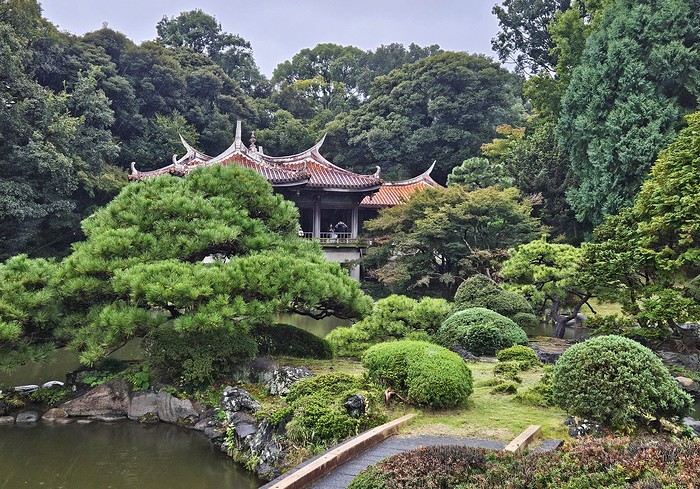
Then our first ramen (hearty and for 1000 ¥—pretty much the price of all our ramen during the trip). We headed back to the hotel since check-in was after 3 PM. Shower and relax before going out for dinner. Dinner was barbecue at Shichirin Yakiniku Anan (1700 ¥ each—good and cheap). Ordering via tablet wasn’t easy, but luckily it was in English.
We ended the evening with a stroll through Kabukichō before a well-deserved sleep.
Day 1: Departure from Brussels (October 24, 2025) Early morning takeoff at 6 AM to Munich (1.5-hour layover) with Lufthansa, then a 12-hour flight with ANA, arriving the next morning at 7 AM at Tokyo Haneda.
Day 2: Arrival in Tokyo Airport formalities were quick. The eSIM we bought before leaving activated as soon as we landed (10 GB plan with Saily—more than enough for our mobile internet needs, mainly Google Maps and Google Translate). We’d received 4 ICOCA cards from our neighbors, which we loaded with 15000 ¥ each. We took the Keihin train, then the Yamanote Line. It’s easy to navigate since everything is in English, and each station is announced on scrolling displays in English too.
We got off the Yamanote Line at the station just after Shinjuku because it’s easier to exit that massive station with our luggage. So we ended up in Shin-Okubo, right in the Korean district. A 10-minute walk took us to Villa Fontaine Hotel. A great hotel, well-located north of the Kabukichō district. The room even seemed bigger than we’d expected.
It was 15°C, but it rained—and kept raining on and off all day. Belgian weather, basically.
We went for a walk in Shinjuku Gyoen Park. Not as pretty in the rain, but the big greenhouse was interesting.
Then our first ramen (hearty and for 1000 ¥—pretty much the price of all our ramen during the trip). We headed back to the hotel since check-in was after 3 PM. Shower and relax before going out for dinner. Dinner was barbecue at Shichirin Yakiniku Anan (1700 ¥ each—good and cheap). Ordering via tablet wasn’t easy, but luckily it was in English.
We ended the evening with a stroll through Kabukichō before a well-deserved sleep.
Hitchhiking in the 70s-80s
“Hey, your Marker... - My Marker? - The one you used to make hitchhiking signs.”
The marker in question is sitting proudly on the kitchen table. Marielle found it at the bottom of a moving box.
I’ve been meaning to tell the long story of my love affair with hitchhiking for years. Here we go.
To be honest, I’m not quite sure when it started. My earliest memory goes back to a fair with a bike race in my maternal grandparents’ village. I was with my cousin, my little sister, and three girl cousins. There were six of us, ages ranging from six or seven to thirteen or fourteen. Our parents stayed at the fair, and we’d had enough. So we decided to walk home. Only it was four kilometers away. So we hitchhiked. A guy driving an old car picked us all up and dropped us off at the farm. He probably found it amusing to see us thumbing a ride by the side of the road, but maybe it also worried him a bit. With everything you read in the papers...
Around fifteen or sixteen, I started hitchhiking regularly, alone or with a friend, to go to the nearby town. But it was especially when I started boarding school in Orléans that it became more regular. The first year, I’d leave Monday morning and come back Saturday noon by bus. It was an old, uncomfortable bus where we froze in winter. To make matters worse, I often got motion sickness if, as was too often the case, I ended up sitting in the back. In the spring, a high school friend suggested I hitchhike back. It meant a slight detour, but the advantage was taking only national roads.
So that’s how, from the end of tenth grade to twelfth grade, I’d thumb a ride every Saturday on the Pont de Bourgogne. Drivers were used to seeing young people hitchhiking, and it worked pretty well. Our biggest fear? Soldiers! At that time, military service was still mandatory, and on weekends, it wasn’t rare to see them competing with us. They’d keep their uniforms on to go home. That gave people confidence—with everything you read in the papers—and they’d rarely wait more than five minutes. We, with our long hair, were definitely less popular. From time to time, three big red-faced guys in a van coming back from a construction site would flip us off, yelling things like “go get a haircut, you bums!” Those were the good old days.
We still had a good laugh, though. Patrice, the friend I’d hitchhike back from school with on Saturdays, is a musician—I’d later discover he’s an excellent composer. A die-hard Beatles fan, he knows their repertoire by heart and spends his time singing at the top of his lungs while we thumb a ride. One Saturday late morning, we’d been waiting for a while at the exit of Châteauneuf-sur-Loire when a little lady came up to him and asked if he could please sing a little quieter: a baby was sleeping in the house. He put on the most sorry face: “Oh, sorry ma’am, we didn’t realize.” No sooner had the lady gone back inside than he started again. Luckily, a car stopped just then, sparing me the embarrassment of seeing the lady come back out.
Saturday was also the day when the cigarette pack was dangerously low. So before leaving, we’d go buy some “Parisiennes,” the “P4s” as we called them back then. They were slightly thinner cigarettes with a mix of tobacco scraps. Sometimes they tasted like light tobacco, sometimes like dark. Not great, but by the end of the week, our pocket money was gone. They were sold in small packs of four, hence the name P4. We’d only pay 20 centimes. On Saturdays, it was rare for the two of us to manage to scrape together 1.50 F to buy a whole pack of Gauloises...
The last twenty kilometers, I’d usually do alone, Patrice having reached his destination. From time to time, luck would smile on me: an acquaintance would just happen to pass by and stop. One January Saturday, at the exit of Gien, I ran into another guy from Argenton whom I knew a little. That day, the weather was nice, but the temperature was well below zero. It was around noon, and it was the off-peak hour. We were shivering, stamping our feet by the side of the road, when a Citroën “Tube” arrived: it was his father’s boss’s, a mason. They were both sitting in the front, but since they were obese, they had us climb onto the open back. Even though we huddled against the cab to shelter from the wind, the twenty kilometers felt very long, especially since we were only going sixty kilometers an hour. Our hands and cheeks were blue when we finally arrived.
The year I took my baccalaureate, a friend with a 2CV would take me Monday mornings with one or two others we’d pick up in nearby villages. We’d share the gas costs, but it was still cheaper than the bus. And in winter, the bus was my nightmare. You had to get up at five to catch it at six. Not enough sleep, and outside it was freezing or raining—or both. The 2CV was luxury. Plus, Philippe would pick me up at home. On the other hand, since I didn’t have class Saturday mornings—well, I did, but we only had PE the first two hours and nothing after—I’d skip class and slip out right after breakfast to thumb a ride at the Pont de Bourgogne.
Those three high school years were formative in this optional subject that was hitchhiking. Little by little, I learned the rules of the game. First, you shouldn’t walk along the road while thumbing. Cars go too fast and can’t stop easily. Accepting a ride that’s too short is also a no-go. The guy who offers to take you a little way but drops you off at some vague crossroads in the middle of nowhere? No thanks. You need to get dropped off in a town. If it’s a fairly big city, you often have to cross it from one end to the other, but it’s better. At the exit, you have to choose your spot well. Actually, you have to put yourself in the driver’s shoes: they need to see you early enough, not be going too fast, and be able to stop easily without risking an accident. So when leaving a city, it’s better not to go too far. It’s wiser to find a spot where cars go slowly and can stop easily. And preferably near a café. The café is for when you still have a few coins for a coffee and need to warm up. From time to time, you’d run into someone nice who’d make a detour to drop you off at a better spot to start again. Finally, if possible, avoid hitchhiking on Sundays. Cars are packed with whole families who, most of the time, aren’t going far. And then there’s the little worry of those people who rarely leave home: with everything you read in the papers...
During those high school years, it was only short trips, rarely exceeding a hundred kilometers. Later, I aimed bigger, and things were a bit different. In 1973-74, I crossed part of France for the first time on two or three occasions, coming back from the German border or returning to Bordeaux, where we lived briefly. Since there weren’t many highways back then, we took national roads. It was during these trips that I realized it was better to leave in the evening. As I said earlier, Sunday is to be avoided, but on weekdays, there’s another problem: if you leave in the morning, you only make short hops. First, it often takes longer to get going because drivers are people going to work nearby. Which brings us back to those who drop you off in a bad spot, far from everything. There, you have to know how to refuse. You thank the driver for stopping—oh, if only everyone could be like you—while explaining why you’d rather stay put. People don’t take offense, by the way. Those who pick up hitchhikers often hitchhiked themselves when they were in the military or before they had a car. In the late afternoon, you’d often run into salespeople or truckers, in other words, people who drive a lot. At that time, salespeople no longer had appointments and were more relaxed. They wanted to talk about something other than the merits of their products. On the radio, it was time for *Les Grosses Têtes*. You’d also quite often run into small business owners, professionals, or even hippies. The conversations were pleasant and often enriching. A little later in the evening, truckers would take over. They’d already driven a few hundred kilometers, and the depot or customs was still far away. So they’d gladly take a hitchhiker to stay awake at the wheel and chat. The radio with Max Ménier’s show *Les routiers sont sympas*, you’d eventually get tired of it. So a hitchhiker was a change. Others, who’d hit the road at midnight to be at their destination by morning, were nice and offered to let you lie down on the bunk while they drove. When you’d been hitchhiking since six in the evening, freezing in the wind between two vehicles, you weren’t unhappy to take a little nap.
Speaking of Max Ménier, he’d often make announcements for hitchhikers. One evening, I called him. It was getting late, and I still had quite a way to go. No luck: the show had ended for good the day before!
In short, it’s better not to rush, sleep in, and leave after lunch, or better yet, in the late afternoon. Obviously, I’m talking about when you have several hundred kilometers to cover. That’s when you have to play it pro.
First thing, especially at night, but it also applies in the middle of summer when the light is blinding: dress to be seen from far away. I’ll admit I have an advantage over most other hitchhikers: I’m small and don’t scare people. To balance that out, racist drivers often take me for an Arab and are less likely to pick me up, but overall, the balance tips in my favor. Back to the need to be seen: at night, I wear light-colored clothes. In headlights, you can see me from far away.
Second thing: travel light. Forget the big backpack with a frame. Drivers don’t always have room in the trunk or on the back seat, especially if it’s rained and the ground is wet. Plus, it forces them to get out of the car. If they’re nice enough to pick up a hitchhiker, you shouldn’t ask for too much either.
Third thing: bring a cardboard sign and a big marker—like the ones in the photo at the start of this post—to write the name of your destination. In the early 80s, I ran a tourist house in the Cher, but I lived in the Netherlands. In the off-season, it was only open on weekends. On Fridays, I’d leave Holland and return on Mondays. 1200 km round trip. On the way there, in Paris, I’d stand at Porte de la Chapelle. At that spot, the road is very wide, and drivers could stop easily. Obviously, on the sign, I didn’t write Eindhoven, which not everyone knows, and even less Amsterdam because of its seedy reputation. In that case, you’d expect to see a police car stop and two officers in kepis ask for your papers. So as a first destination, I’d write Compiègne. We were well out of Paris, and since it wasn’t too far, a trucker or salesperson was less reluctant to stop. Once past Compiègne, I’d take out my Lille sign. Once in Belgium, it wasn’t really necessary to use a sign anymore, since everyone was going in the same direction. Usually, the guy who picked me up at Porte de la Chapelle would say he wasn’t going far but could take me a little way. Before that, I’d still ask if there was a gas station on the highway where he could drop me off before exiting. While talking, the guy would realize he wasn’t dealing with a dangerous criminal. He’d pretend to check his watch, think for a moment, then say that actually, he was going to Belgium and could take me to the border or a little beyond. To leave Paris on the way back, I’d take the train to Melun, where it was easier to hitchhike than at Porte d’Italie.
Over all those years, I think I was pretty lucky. Or maybe philosophical enough not to imagine a car would stop after a few minutes. An hour’s wait was average. Sure, I sometimes waited three, four, or five hours. Most often at odd hours and in terrible weather. When it doesn’t work, it doesn’t work. But there’s always a moment when things pick up. Sure, when you’re soaked in freezing rain in the early morning after a sleepless night, you’re less philosophical than when I’m writing these lines comfortably at my computer, but it still holds true.
Earlier, I mentioned clothing and the importance of being well-rested before leaving. When you’ve eaten well and just gotten out of the shower, shaved, you’re in a better mood. And somehow, drivers sense it. Or at least, that’s the impression I’ve always had. It’s better to look in shape than disgusted at standing there, half-heartedly thumbing a ride. In short, when I’d start to get fed up with waiting, I’d go into the first café I saw for a coffee. Coming back out, I’d be refreshed, and most of the time, a car would stop within minutes. I’ve often said that when I stood by the side of the road thumbing a ride, I felt a bit like a gambler in front of a slot machine. It was a matter of giving luck a chance. And well, it worked out pretty well.
Then, there are countries where hitchhiking works really well and others where it’s harder. In the 70s-80s, it worked best in Germany and England. In the late afternoon, it wasn’t rare to be invited for tea. Well, that was in England. Tea meant being offered room and board. In Germany, they’d offer you coffee. Once there, they’d first show you the guest room and point out the bathroom before sitting you down in front of a big plate of cold cuts. In the evening, they’d go out in town, and the next morning, they’d usually drop you off at a good spot for hitchhiking. On the other hand, in Mediterranean and Scandinavian countries, you’d better be patient. In Spain or Italy, it’s better to take the train, which was dirt cheap back then. However, if you’re a couple traveling light, it’s already easier in most countries.
In 1982, I went on a trip around Turkey with my girlfriend. We only had two small bags, which was plenty. It was November-December, and we wore our warm, bulky clothes. Leaving Eindhoven at nine in the morning, we arrived in Graz, near the Yugoslav border, at eleven at night. 1300 km in a day! In just four or five vehicles. One to the German border, about fifty kilometers from Eindhoven, the second to Hagen in the Ruhr, the third to Salzburg, and the last to Graz at the Yugoslav border. Record broken. During the night crossing of Yugoslavia, we ran into a trucker close to retirement who lent us the truck’s bunk. So we arrived fresh and rested near Skopje the next morning. We continued to Thessaloniki in northern Greece before taking the train to Istanbul. In Turkey, we traveled a good part of the country by hitchhiking too. With truckers in old, overloaded, slow trucks that climbed hills at fifteen kilometers an hour, but also in cars where five or six people were already crammed in. And every time, we were invited for tea. Once, we were even picked up by a big shot in his Mercedes with a chauffeur. Until then, the average speed was around fifty kilometers an hour. There, we were going two hundred. On a national road, not a nice European highway.
I’ve also hitchhiked in Nepal, from Lumbini, Buddha’s birthplace, to a village on the way to Pokhara. It must have been midday. No bus until the next day. I gave it a try. A small truck overloaded with rice sacks, with two or three young people already perched on top, stopped. I rode on the roof of the cab. At fifty kilometers an hour when it was going well, with a breathtaking view. Coming back from India, I also crossed part of Iran by hitchhiking, from Tehran to the Turkish border. I did this trip with an Austrian I met at the hotel who, like me, had to watch his pennies. We gave it a shot. There was almost no traffic, but to our great surprise, the first car that passed in the area would always stop. They’d just ask for a modest contribution for gas, and it cost next to nothing.
Sometimes, you get scared too. After leaving Turkey in early December 82, we spent about two weeks in the southern Peloponnese harvesting olives. A few days before Christmas, we hitchhiked back to Holland. A girl picked us up in her little Fiat 500. We were driving on a mountain road, and that morning there was a bit of black ice. After crossing a pass, we saw the old Ford Taunus ahead of us at fifty meters start to skid. The driver let out a “heeee!” while grabbing my knees. I reflexively grabbed the wheel. Finally, the Taunus got back on track. And we didn’t swerve. But those few seconds felt very long.
In January 77, while I’d been living in Germany for a few months, I decided to spend a few days in Italy. By hitchhiking, of course. I left in the early afternoon, and by ten at night, I wasn’t far from Frankfurt. I saw a big Mercedes stop. The four or five young people crammed inside were listening to Schlager at full volume. Beer cans littered the floor. They didn’t have a precise destination, and as long as they were going south, that was fine with me. They’d finished their military service that very day and had clearly already celebrated their discharge. The driver was going 160, zigzagging dangerously from one side of the highway to the other. I should have realized he wasn’t entirely sober either. Luckily, there was almost no traffic. Finally, I managed to get dropped off at a gas station just before Frankfurt, relieved. I hope their trip didn’t end tragically.
Another time, coming back from Holland with my wife, we were picked up early in the morning near Senlis by two guys from Lille. They were going to work near Tours and could drop us off at Porte d’Italie. Apparently, they were coworkers but barely knew each other. The driver offered us a beer—at six in the morning, sure!—before opening another can for himself. He was clearly having trouble staying in the right lane. We politely declined, the passenger too. Everyone was tense. Luckily, it was rush hour on the ring road, and we were going slowly. When we got out of the car, the passenger said goodbye with the look of a guy being offered the condemned man’s rum and cigarette.
Finally, there are the annoying remarks from drivers who are either gay when you’re alone or turned on by the sight of your girlfriend when you’re a couple. In those cases, I’d get in the back so the guy wouldn’t feel too confident. And if the conversation got a little too suggestive, we’d deflect until we got dropped off.
And luckily, there are the times, not so rare after all, when you run into really nice people who invite you to eat and sleep at their place and drive you to a good spot the next morning. In Germany and England, that was common. And then there are the big strokes of luck, like during our trip to Turkey when we crossed most of Germany in one car, or that other time when some Germans drove me from the exit of Geneva all the way to the Costa Brava.
Going back to “with everything you read in the papers” and its variant “with everything you see on TV”—and now on the internet—it’s always left me perplexed. Personally, I’ve never heard of hitchhikers assaulting drivers, even if it may have happened. On the other hand, what was most common were hitchhikers being assaulted, especially girls. Anyway, even armed, it seems a bit stupid to assault the driver—wouldn’t that risk causing an accident?
Finally, since that time, I’ve occasionally wanted to hitchhike somewhere far away in France. Most often, too busy with work, it never happened, but the nostalgia hasn’t completely disappeared.
* * *
Other Hitchhikers
And then one day, I... settled down to become a driver myself. Ten years had passed, and you saw fewer and fewer hitchhikers. Or maybe I saw fewer because I had a regular job and wasn’t traveling the same way. And then I understood a few things.
Several times, I was tempted to pick up a hitchhiker, but they didn’t meet the required conditions. They were walking along the road instead of staying at the exit of the previous town. Hard to stop without risking an accident. Or the guy looked really scruffy. Or he was sulking, if not both. Then you think of that famous “with everything you read in the papers.” Not that I was scared, but unfortunately, the few hitchhikers I did pick up later were rarely interesting.
A few years ago, we picked up a young guy at the exit of a small town in Sologne. Not an easy spot for hitchhiking. Bad luck, he was a pretentious little jerk. He was barely 20 or 25 and talked like a bitter old man. He was a waiter in a restaurant. According to him, it was lucky he was there, otherwise the boss would have closed up shop long ago. You’d think he had thirty or forty years of professional experience behind him. As we approached Blois, he started ranting about Arabs, blaming them for all evils. And he laid it on thick. That morning, we were going to a teenager’s funeral who had just committed suicide, so he really got on our nerves, Mr. Know-It-All. Out of anger, I dropped him off next to a shopping center a few kilometers from downtown. Not nice, but it felt good.
Some time ago, we were driving around the Limousin on a Sunday to try out the used Twingo we’d just bought. We picked up a guy in his forties. A German who spoke French well. He started talking about the environment. He was a green Khmer. He got worked up all by himself with his pseudo-eco rant and, after a few kilometers, was almost yelling at us. As we were about to leave the main road for a small one, I dropped him off at a crossroads in the middle of nowhere. Normally, I would have made a little detour to take him to a better spot, but this time, I didn’t feel like doing the... eco-warrior a favor.
On the other hand, I’ve still done my good deed a few times. One June morning, coming back from Orléans, I saw a man in his sixties hitchhiking. The poor guy had had a rough time. He was from Montpellier and was coming back from Caen, where he’d been promised a job. Once there, they bluntly told him the position was already taken, and he had to go back. Except he didn’t have enough money left for the train. He’d spent the night hitchhiking without success. I could only take him as far as Lamotte-Beuvron, where I dropped him off near the fire station. Apparently, there was some vague shelter there or something, but it only opened a few hours later. In the meantime, he settled on the grass in a corner to sleep a little. While he was doing that, I quickly went to the train station to check the price of a ticket to Montpellier. It was within my means. Since he was sound asleep, I slipped the train ticket and 100 francs into his pocket. I couldn’t imagine him continuing to hitchhike all the way to Montpellier. And I bet he didn’t even have a piece of cardboard and a marker!
When we go to Brazil, we usually rent a small car. One day, we were coming back from Paracuru to Fortaleza when we saw a whole family hitchhiking. Two adults and two or three small children. Here near the equator, the sun sets very quickly, and it would soon be night. There was little traffic, and trucks wouldn’t stop because there was no room in the cab. As for the rich people driving big 4x4s, they wouldn’t stoop to picking up the lower classes. The only hope for this kind of family was usually a farmer or artisan who’d let them ride in the back of his pickup. Obviously, they were a bit surprised to see us. Everyone crammed in as best they could in the back of our little car. When we dropped them off, we got a whole string of “Deus lhes abençõe”—God bless you.
Still in Brazil, we were on the road from Barreirinhas to São Luís do Maranhão. About 150 km of deserted road with an isolated mud house here and there. A young woman flagged us down. She was very pregnant and had to get to the clinic twenty or thirty kilometers away to give birth. Someone was supposed to drive her, but the first signs of labor started earlier than expected, and the driver was unavailable. Even driving fast, we weren’t feeling great: it would be just our luck if she gave birth in the car!
Today, we’re in the age of smartphones and carpooling apps. Safety. With everything you see on TV... Three or four years ago, we signed up on a platform. Our first, and only, “client” was a little jerk who didn’t say a word the whole trip. No hello, no goodbye, and certainly no thank you. The next day, we found his Ray-Bans in the car. We didn’t run after him to give them back. Ha!
Yet Another Travel Journal in this (Too) Familiar Rajasthan, But with Family and Kids
Prologue
This journal recounts a trip to Rajasthan that’s already over a year old and that I’ve only now found the chance to write about. The summer of 2024 marked my return to India—my tenth trip—after six long years away since my last solo wanderings in Tamil Nadu in 2018 (the journal of which is published on this site). That absence was partly (but not only) due to the long COVID and post-COVID period, which saw a complete halt and then a major slowdown in global tourism. To top it off, Voyage Forum announced its closure in an end-of-the-world atmosphere. A sad time for our favorite social activity…
A few weeks after returning from Rajasthan, I tried to motivate myself to start writing a journal to publish on a forum claiming to be VF’s successor, which I’d eventually signed up for out of desperation. But I kept hesitating and putting the project off because, for one, I no longer have the time I used to. For another, the vibe wasn’t really taking off on that forum—it was overrun with ads and not very active, contrary to what its host’s name suggested. Despite its good intentions and commendable role as a stopgap, it also turned out to be very impractical to use, especially when you don’t have much time like me. I’ll admit I’d occasionally check back on VF to see if anything was happening. But all the discussions remained frozen in time, stuck in that fateful year, 2020. Then, rumors swirled online about shady reasons behind its closure, leaving little room for hope.
And then, one fine morning, I got a message at work from Marien informing me that VF had reopened. What a huge surprise! Even though the forum’s “end” had played out in a somewhat apocalyptic atmosphere, the memories of passionate and heated discussions, the frank debates, and the useful exchanges that made this site a traveler’s goldmine and a unique hub of conviviality all came rushing back to me like a breath of fresh air. I finally saw a sign and tried to motivate myself to find the time to publish the journal of this tenth trip to India and fifth to Rajasthan. But in the end, I got bogged down in professional and family obligations and never managed to find the time to get started. That’s now fixed, though, because I had two reasons for wanting to do it: I find that looking back on a trip to tell others about it is a highly beneficial introspective exercise. Also, I thought this journal could be useful to other travelers on a few points.
Because, “do we really need yet another journal about Rajasthan?” you might rightly ask! Especially in a time when so many journals about the “Land of Kings” have been published since VF’s return, not to mention the countless stories you can already find online about this region, one of India’s most touristy. And I’d add, why go back to Rajasthan for a fifth time, where I’ve already dragged my feet more than enough—through its forts, deserts, temples, cities, villages, bumpy roads, train stations, tasty street food stalls, cheap guesthouses, and more? Where some might see just another overhyped tourist destination full of the same old *Arabian Nights* clichés, worn to a thread, that I mentioned earlier, when there’s so much else to see in India? Well, first because it’s a magnificent country I never tire of, where I started an academic study and made so many connections. It’s also packed with places where you won’t find a single tourist (right, Marie-Jo?), even in the heart of well-trodden paths and classic itineraries. And most importantly, as I said earlier, things have changed in recent years. First, after six years without traveling far, the urge to go back to India was getting stronger. But this time, no more solo trips (often) or duo adventures (sometimes)—now it’s a team of four that has to come along! And even if you can argue with that, what better place than Rajasthan to introduce India to people who’ve never seen it? To kids you want to amaze? Plus, traveling with your new little family to your favorite country isn’t the same as going solo in often spartan conditions that only affect you. It’s a different challenge, but ultimately probably much harder. So, is it really reasonable to take two kids to India, including a two-year-old baby? That’s one of the main goals of this journal (but not the only one)—to try to answer that question.
As you can tell, it’s not so much the destination but the slightly unusual setup of this trip that, in my opinion, will make this journal interesting. Despite my experience and expertise (yes, I dare say it) in India, there were plenty of questions before we finalized the plan and said, “Alright, let’s go!” The questions were flying for us parents. Is it wise to travel to India with a two-year-old? What would we do (it happened) if the kids got very sick? Would they be able to handle a road trip on Rajasthan’s bumpy, dusty roads using public transport? Could they handle the shock of such a different world—the dirt, poverty, pollution, noise (…and the smell, as they say), the spicy food, monkeys, mosquitoes, snakes, tigers, leopards, and so on? In short, all the clichés that I usually joke about suddenly became potential realities. Another concern: as a mixed Franco-African family (not me, but my partner and her oldest), wouldn’t we risk not always being well received, given what you sometimes hear about that in India? How would Indians react to seeing a mixed-race family, the ultimate taboo in a country of purity and social segregation, which would undoubtedly raise many questions for them? Of course, not everything went as expected… Because, as you know, with India—and what makes it charming for some—there are always complications: sometimes where you don’t expect them… and sometimes where you do. I’ll go into detail about that in the journal to come (not right away) and in the final review (even later). These experiences could be useful to travelers who find themselves in similar situations and have the same questions we did before embarking on such a journey. And maybe it’ll spark the curiosity of those who aren’t concerned and will read yet another Rajasthan journal, but with its own unique twists.
Despite my unchanged constraints, which mean I have little time to write this, I don’t want to rush the story, so I’ll take my time. There will probably be lulls. I hope that won’t stop people from coming to react, debate, share their impressions, or ask for information.
This journal recounts a trip to Rajasthan that’s already over a year old and that I’ve only now found the chance to write about. The summer of 2024 marked my return to India—my tenth trip—after six long years away since my last solo wanderings in Tamil Nadu in 2018 (the journal of which is published on this site). That absence was partly (but not only) due to the long COVID and post-COVID period, which saw a complete halt and then a major slowdown in global tourism. To top it off, Voyage Forum announced its closure in an end-of-the-world atmosphere. A sad time for our favorite social activity…
A few weeks after returning from Rajasthan, I tried to motivate myself to start writing a journal to publish on a forum claiming to be VF’s successor, which I’d eventually signed up for out of desperation. But I kept hesitating and putting the project off because, for one, I no longer have the time I used to. For another, the vibe wasn’t really taking off on that forum—it was overrun with ads and not very active, contrary to what its host’s name suggested. Despite its good intentions and commendable role as a stopgap, it also turned out to be very impractical to use, especially when you don’t have much time like me. I’ll admit I’d occasionally check back on VF to see if anything was happening. But all the discussions remained frozen in time, stuck in that fateful year, 2020. Then, rumors swirled online about shady reasons behind its closure, leaving little room for hope.
And then, one fine morning, I got a message at work from Marien informing me that VF had reopened. What a huge surprise! Even though the forum’s “end” had played out in a somewhat apocalyptic atmosphere, the memories of passionate and heated discussions, the frank debates, and the useful exchanges that made this site a traveler’s goldmine and a unique hub of conviviality all came rushing back to me like a breath of fresh air. I finally saw a sign and tried to motivate myself to find the time to publish the journal of this tenth trip to India and fifth to Rajasthan. But in the end, I got bogged down in professional and family obligations and never managed to find the time to get started. That’s now fixed, though, because I had two reasons for wanting to do it: I find that looking back on a trip to tell others about it is a highly beneficial introspective exercise. Also, I thought this journal could be useful to other travelers on a few points.
Because, “do we really need yet another journal about Rajasthan?” you might rightly ask! Especially in a time when so many journals about the “Land of Kings” have been published since VF’s return, not to mention the countless stories you can already find online about this region, one of India’s most touristy. And I’d add, why go back to Rajasthan for a fifth time, where I’ve already dragged my feet more than enough—through its forts, deserts, temples, cities, villages, bumpy roads, train stations, tasty street food stalls, cheap guesthouses, and more? Where some might see just another overhyped tourist destination full of the same old *Arabian Nights* clichés, worn to a thread, that I mentioned earlier, when there’s so much else to see in India? Well, first because it’s a magnificent country I never tire of, where I started an academic study and made so many connections. It’s also packed with places where you won’t find a single tourist (right, Marie-Jo?), even in the heart of well-trodden paths and classic itineraries. And most importantly, as I said earlier, things have changed in recent years. First, after six years without traveling far, the urge to go back to India was getting stronger. But this time, no more solo trips (often) or duo adventures (sometimes)—now it’s a team of four that has to come along! And even if you can argue with that, what better place than Rajasthan to introduce India to people who’ve never seen it? To kids you want to amaze? Plus, traveling with your new little family to your favorite country isn’t the same as going solo in often spartan conditions that only affect you. It’s a different challenge, but ultimately probably much harder. So, is it really reasonable to take two kids to India, including a two-year-old baby? That’s one of the main goals of this journal (but not the only one)—to try to answer that question.
As you can tell, it’s not so much the destination but the slightly unusual setup of this trip that, in my opinion, will make this journal interesting. Despite my experience and expertise (yes, I dare say it) in India, there were plenty of questions before we finalized the plan and said, “Alright, let’s go!” The questions were flying for us parents. Is it wise to travel to India with a two-year-old? What would we do (it happened) if the kids got very sick? Would they be able to handle a road trip on Rajasthan’s bumpy, dusty roads using public transport? Could they handle the shock of such a different world—the dirt, poverty, pollution, noise (…and the smell, as they say), the spicy food, monkeys, mosquitoes, snakes, tigers, leopards, and so on? In short, all the clichés that I usually joke about suddenly became potential realities. Another concern: as a mixed Franco-African family (not me, but my partner and her oldest), wouldn’t we risk not always being well received, given what you sometimes hear about that in India? How would Indians react to seeing a mixed-race family, the ultimate taboo in a country of purity and social segregation, which would undoubtedly raise many questions for them? Of course, not everything went as expected… Because, as you know, with India—and what makes it charming for some—there are always complications: sometimes where you don’t expect them… and sometimes where you do. I’ll go into detail about that in the journal to come (not right away) and in the final review (even later). These experiences could be useful to travelers who find themselves in similar situations and have the same questions we did before embarking on such a journey. And maybe it’ll spark the curiosity of those who aren’t concerned and will read yet another Rajasthan journal, but with its own unique twists.
Despite my unchanged constraints, which mean I have little time to write this, I don’t want to rush the story, so I’ll take my time. There will probably be lulls. I hope that won’t stop people from coming to react, debate, share their impressions, or ask for information.
From Southern Shikoku, between land and sea, to the blue waters of Miyakojima and finally the Tokyo metropolis
From Southern Shikoku, between land and sea, to the blue waters of Miyakojima and finally Tokyo’s megacity
Hi everyone,
I have to admit, I really hesitated before deciding to write this travel journal... Writing one takes a lot of time and energy, and since this is my 4th trip, I wondered if it would actually interest anyone other than myself (both for the discovery and the writing). But after a few "Are you going to write a journal?" requests and especially the renewed pleasure from reading other travelers’ travel journals about Japan or elsewhere on this forum or elsewhere, I’ve decided to share this 4th installment in the Land of the Rising Sun here.
The itinerary: 27 full days, from late May to late June 2025, right in the middle of the rainy season, including:
-->13 days in Shikoku, from Kochi (Kochi Prefecture) to Matsuyama (Ehime Prefecture)
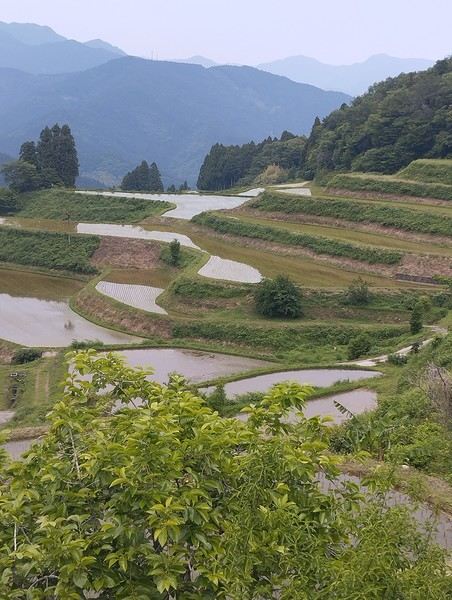
-->7 days in Miyakojima (Okinawa Prefecture)
-->7 days in Tokyo
The trip was decided on fairly last-minute this year, as usual.
I regularly check flight prices to track fluctuations for this destination, even without concrete plans. Finding a slightly cheaper direct flight (900 €) than what I’d seen in previous months (around 1,200–1,400 € on average) for a Paris-Tokyo route with Japanese airline ANA was too tempting to resist the urge to return to this enchanting country. After long hesitations between exploring the San’in region (Matsue, Tottori, Yamaguchi) and southern Shikoku, the decision was made—I took the plunge! The tickets are booked: Paris to Kochi with a layover in Tokyo, all with ANA, the airline I’d been dreaming of... for 1,120 € per person. Okay, it’s not cheap, but it’s still better than in 2023.
We leave in 2 weeks!! Now it’s just a matter of getting everything ready!
Intense work ahead in these 2 weeks to:
finalize a more precise itinerary and reach an agreement—yep, because even though we both love Japan, our preferences differ slightly, and we have to choose between exploring new places or taking time to revisit beloved spots... decide how much time to spend in each selected area without rushing while still exploring research places that might interest us and watch videos about Japan book accommodations: yes, it’s possible to do this on the spot as we go, but last year, we noticed that last-minute options were pretty expensive, so we’re booking ahead—even if it means keeping a few options open while we decide or see if better deals pop up later reserve rental cars order yen check the weather regularly and wonder if choosing the *tsuyu* (rainy season) was really a good idea—and whether we’ll be stuck in non-stop rain???
What a tough job, right? Traveling to Japan for a month—such a hard life! Despite this being my 4th trip, the excitement is just as intense as the first time.
The only small downside is that when we booked the flight tickets, there were only a few seats left, so we’re only sitting together on the international return flight. Plus, on the outbound flight, we’ve got the middle seats. Another lingering question: what French-language films will be available? According to the internet, the selection seems limited. Oh well, these are just minor details—it’s almost time to fly!
PS: I’ll be posting slowly and irregularly... so for those interested, be patient or maybe set an alert...
Hi everyone,
I have to admit, I really hesitated before deciding to write this travel journal... Writing one takes a lot of time and energy, and since this is my 4th trip, I wondered if it would actually interest anyone other than myself (both for the discovery and the writing). But after a few "Are you going to write a journal?" requests and especially the renewed pleasure from reading other travelers’ travel journals about Japan or elsewhere on this forum or elsewhere, I’ve decided to share this 4th installment in the Land of the Rising Sun here.
The itinerary: 27 full days, from late May to late June 2025, right in the middle of the rainy season, including:
-->13 days in Shikoku, from Kochi (Kochi Prefecture) to Matsuyama (Ehime Prefecture)
-->7 days in Miyakojima (Okinawa Prefecture)
-->7 days in Tokyo
The trip was decided on fairly last-minute this year, as usual.
I regularly check flight prices to track fluctuations for this destination, even without concrete plans. Finding a slightly cheaper direct flight (900 €) than what I’d seen in previous months (around 1,200–1,400 € on average) for a Paris-Tokyo route with Japanese airline ANA was too tempting to resist the urge to return to this enchanting country. After long hesitations between exploring the San’in region (Matsue, Tottori, Yamaguchi) and southern Shikoku, the decision was made—I took the plunge! The tickets are booked: Paris to Kochi with a layover in Tokyo, all with ANA, the airline I’d been dreaming of... for 1,120 € per person. Okay, it’s not cheap, but it’s still better than in 2023.
We leave in 2 weeks!! Now it’s just a matter of getting everything ready!
Intense work ahead in these 2 weeks to:
finalize a more precise itinerary and reach an agreement—yep, because even though we both love Japan, our preferences differ slightly, and we have to choose between exploring new places or taking time to revisit beloved spots... decide how much time to spend in each selected area without rushing while still exploring research places that might interest us and watch videos about Japan book accommodations: yes, it’s possible to do this on the spot as we go, but last year, we noticed that last-minute options were pretty expensive, so we’re booking ahead—even if it means keeping a few options open while we decide or see if better deals pop up later reserve rental cars order yen check the weather regularly and wonder if choosing the *tsuyu* (rainy season) was really a good idea—and whether we’ll be stuck in non-stop rain???
What a tough job, right? Traveling to Japan for a month—such a hard life! Despite this being my 4th trip, the excitement is just as intense as the first time.
The only small downside is that when we booked the flight tickets, there were only a few seats left, so we’re only sitting together on the international return flight. Plus, on the outbound flight, we’ve got the middle seats. Another lingering question: what French-language films will be available? According to the internet, the selection seems limited. Oh well, these are just minor details—it’s almost time to fly!
PS: I’ll be posting slowly and irregularly... so for those interested, be patient or maybe set an alert...
Cantal—have you heard of it?
...
After Southern Tanzania, I’m sharing a travel story about the Cantal region with you...
...
For us, at the start of 2025, Le CANTAL was a true “Terra Incognita”!!
After seeing some tempting TV reports, we decided to fill this gap—especially in terms of landscapes. On the same trip, we’ll also head to the Arcachon Basin, the International Seaplane Gathering in Biscarrosse, and my native Landes region...
So, on May 20th, we left Marseille in the rain and thunder, heading toward Nîmes, Saint-Hippolyte, Mont Aigoual, Florac, and stopping in Marvejols to give my arthritic back a break for the night.
The next morning, we decided to revisit the Parc aux Loups du Gévaudan (Europe’s largest wolf park). As someone used to photo safaris in the wilds of East Africa, I’m not a fan of zoos at all—but I *do* have a deep admiration for wolves!!
Since it’s pretty unlikely I’ll ever see one in the wild, I’ll settle for this Parc aux Loups in Marvejols. This will be our third visit to this incredible gathering of these fascinating canines.
Some are still finishing their chilly night...
...
After Southern Tanzania, I’m sharing a travel story about the Cantal region with you...
...
For us, at the start of 2025, Le CANTAL was a true “Terra Incognita”!!
After seeing some tempting TV reports, we decided to fill this gap—especially in terms of landscapes. On the same trip, we’ll also head to the Arcachon Basin, the International Seaplane Gathering in Biscarrosse, and my native Landes region...
So, on May 20th, we left Marseille in the rain and thunder, heading toward Nîmes, Saint-Hippolyte, Mont Aigoual, Florac, and stopping in Marvejols to give my arthritic back a break for the night.
The next morning, we decided to revisit the Parc aux Loups du Gévaudan (Europe’s largest wolf park). As someone used to photo safaris in the wilds of East Africa, I’m not a fan of zoos at all—but I *do* have a deep admiration for wolves!!
Since it’s pretty unlikely I’ll ever see one in the wild, I’ll settle for this Parc aux Loups in Marvejols. This will be our third visit to this incredible gathering of these fascinating canines.
Some are still finishing their chilly night...
...
What to choose for a first summer trip to Asia: Indonesia or Thailand?
Hi there,
I’m planning my first trip to Asia next summer with my partner and our daughter, who’ll be 3 and a half at the time, for 4 weeks (maybe 5).
I’ve heard that the timing is better for visiting Indonesia, but I’m hesitant because Thailand seems more accessible, and I’m worried that traveling to Indonesia during high season might be less enjoyable and a lot more expensive due to the number of tourists. We love cultural sites as much as natural ones, and we’re big foodies. We’re not necessarily looking for luxury and tend to take our time, travel by public transport, and look for accommodations with a good value for money—though we do occasionally splurge on a high-end restaurant.
I’m also wondering when and where to buy flight tickets and how comfortable the journey will be (especially for our daughter) if we fly with Thai Airways or Garuda.
Thanks in advance for sharing your thoughts and tips!
Damien
I’m planning my first trip to Asia next summer with my partner and our daughter, who’ll be 3 and a half at the time, for 4 weeks (maybe 5).
I’ve heard that the timing is better for visiting Indonesia, but I’m hesitant because Thailand seems more accessible, and I’m worried that traveling to Indonesia during high season might be less enjoyable and a lot more expensive due to the number of tourists. We love cultural sites as much as natural ones, and we’re big foodies. We’re not necessarily looking for luxury and tend to take our time, travel by public transport, and look for accommodations with a good value for money—though we do occasionally splurge on a high-end restaurant.
I’m also wondering when and where to buy flight tickets and how comfortable the journey will be (especially for our daughter) if we fly with Thai Airways or Garuda.
Thanks in advance for sharing your thoughts and tips!
Damien
Mice in Switzerland, the Other Cheese Country!
I'm starting my first travel journal since VF reopened!
This will mostly be to share my impressions and some photos, with a few days' delay, but I'm starting this journal while I'm still here.
First, I'd like to thank those who helped me prepare for this trip.
I was able to organize this stay in one of the most expensive countries in the world thanks to the home-exchange principle. Not necessarily a direct swap, but through a points system, which is more practical for choosing where you want to go without it having to be a reciprocal exchange.
For this trip, there will already be two different accommodations. We'll see how it goes after that.
The first place is near Yverdon-les-Bains, close to Lake Neuchâtel.
So, we're going to explore this area!
We arrived under capricious weather that won’t leave us for the next few days!
We had dinner at a pizzeria recommended by *Le Routard* in Yverdon, then took a little nighttime stroll through the town center before heading inland to settle into our accommodation.
We discovered a very large, quiet house—and especially the cat that stayed behind! Funny for a couple of mice! He’ll be sleeping with us 😹
This will mostly be to share my impressions and some photos, with a few days' delay, but I'm starting this journal while I'm still here.
First, I'd like to thank those who helped me prepare for this trip.
I was able to organize this stay in one of the most expensive countries in the world thanks to the home-exchange principle. Not necessarily a direct swap, but through a points system, which is more practical for choosing where you want to go without it having to be a reciprocal exchange.
For this trip, there will already be two different accommodations. We'll see how it goes after that.
The first place is near Yverdon-les-Bains, close to Lake Neuchâtel.
So, we're going to explore this area!
We arrived under capricious weather that won’t leave us for the next few days!
We had dinner at a pizzeria recommended by *Le Routard* in Yverdon, then took a little nighttime stroll through the town center before heading inland to settle into our accommodation.
We discovered a very large, quiet house—and especially the cat that stayed behind! Funny for a couple of mice! He’ll be sleeping with us 😹