Results for "Langue+Barbarie+|+99+>+78"
71228 results found.
J'AN HAIT MARE! English translation pending
Salut,
Loin de moi de vouloir jouer le vieux schnock (après tout, je n'ai que 32 ans) ou le prof de français, mais c'est plus fort que moi, quand un post est truffé de fautes d'orthographe ou de conjugaison, je décroche totalement. Je sais qu'une langue qui n'évolue pas est une langue qui se meurt, mais quand on en vient à ne même plus saisir le sens d'une phrase ou même d'un post entier, je trouve cela triste. Je me demande si certains se relisent avant d'envoyer leurs messages.
A mes yeux, l'écriture est un peu une image que l'on donne de soi-même, au même titre que son apparence physique. Les fautes d'orthographe et de conjugaison ne sont pas si dures à coriger avec un minimum de relecture et ce sont ainsi autant de tâches sur son image que l'on évite.
Privilègier le fond à la forme c'est bien, mais quand la forme devient repoussante... Comment donner envie ? Comment inspirer un minimum de crédit sur sa personne ?
Voilà, mes prochains posts seront moins pontifiants, c'est promis !
PS : Philobate, ce post ne t'es en aucun cas destiné !
Loin de moi de vouloir jouer le vieux schnock (après tout, je n'ai que 32 ans) ou le prof de français, mais c'est plus fort que moi, quand un post est truffé de fautes d'orthographe ou de conjugaison, je décroche totalement. Je sais qu'une langue qui n'évolue pas est une langue qui se meurt, mais quand on en vient à ne même plus saisir le sens d'une phrase ou même d'un post entier, je trouve cela triste. Je me demande si certains se relisent avant d'envoyer leurs messages.
A mes yeux, l'écriture est un peu une image que l'on donne de soi-même, au même titre que son apparence physique. Les fautes d'orthographe et de conjugaison ne sont pas si dures à coriger avec un minimum de relecture et ce sont ainsi autant de tâches sur son image que l'on évite.
Privilègier le fond à la forme c'est bien, mais quand la forme devient repoussante... Comment donner envie ? Comment inspirer un minimum de crédit sur sa personne ?
Voilà, mes prochains posts seront moins pontifiants, c'est promis !
PS : Philobate, ce post ne t'es en aucun cas destiné !
Conseils sur Thaïlande et Laos English translation pending
J'ai souvent voyagé en réservant à l'avance avec des agences local, que ce soit le séjour complet ou une partie seulement, et cela surtout pour la langue car je parle très peu anglais.
Et j'aimerai partir en Thailande, Laos et rejoindre Hanoi pandant la periode des fêtes de fin d'année, et là j'aimerai y aller tout seul sans agence.
Donc je me pose quelques questions, je dispose de 15 jours et pas un de plus.
je pensais d'abord réserver avant mon départ le train couchette Bangkok - Chiang Mai, puis le Slow boat Houeixai - Luang Prabang, ainsi que les vols Luang-Prabang - Vientian et Vientiane - Hanoi.
Ma questions est la suivante : pensez-vous qu'il est facile de rejoindre les differents point à date prévue, en voyagant par mes propres moyens ?
Merci d'avance de vos réponses et de vos conseils.
Et j'aimerai partir en Thailande, Laos et rejoindre Hanoi pandant la periode des fêtes de fin d'année, et là j'aimerai y aller tout seul sans agence.
Donc je me pose quelques questions, je dispose de 15 jours et pas un de plus.
je pensais d'abord réserver avant mon départ le train couchette Bangkok - Chiang Mai, puis le Slow boat Houeixai - Luang Prabang, ainsi que les vols Luang-Prabang - Vientian et Vientiane - Hanoi.
Ma questions est la suivante : pensez-vous qu'il est facile de rejoindre les differents point à date prévue, en voyagant par mes propres moyens ?
Merci d'avance de vos réponses et de vos conseils.
Retour du H10 Ocean bavaro (février 2004 ) English translation pending
🙂 😉 🙂
INFO DEPART AVION :
Compagnie STAR AIRLINE -> depart de ROISSY CDG pendant 9 h 00 climatisation a fond, il a fait super froid pendant tout le trajet pas de couverture.
(le + vol directe)
ARRIVER A PUNTA CANA : Changement radical de temparature surtout beaucoup d'humidité.
ARRIVER AU H10 OCEAN BAVARO langue - anglauis francais et espagnol donc on arrive toujours a ce faire comprendre> Accueil avec cocktail> on vous met un petit bracelet de couleur> port des bagages si vous le souhaite par un employé de l'hotel> découverte de la chambre avec 2 grand lit 2 places> changement de serviette + menage tous les jours> aclim dans les chambre + ventilateur> petit frigo avec boisson> tele....> et surtout tres calme
PLAGE : On vous donne egalement des carte pour avoir des serviette des plages propre tous les jours> chaise longue plage propre avec activité nautique + autre activité sur la plage voir meme a la piscine NB : la plage est nettoyé tous les jours
PISCINE : tres propre bar dans la piscine petit bassin pour enfant et bassin moyen de 1 m 40
EL CORTECITO petit village artisanale pres de l'hotel surtout toujours negocier les prix il vaut mieux payer en dollars ou en pesos on est perdant avec les euros.
ALIMENTATION PETIT DEJ -> tres bien une gamme de choix varier sucré ou salée DEJEUNER -> idem DINER -> possibilité de réserver dans différent resto avec reservation ou possibilité de diner dans le grand buffet.
POSTE MEDICAL ATTENTION tres cher la consultation est de 60 dollars
Vous avez la possibilité de faire des excursions. attention car elle ne sont pas tout interessante et assez chers.
J'ESPERE VOUS AVOIR DONNER ASSEZ D'INFO SI NECESSAIRE ENVOYER MOI UN MAIL JE VOIS REPONDRAIS
ARRIVER A PUNTA CANA : Changement radical de temparature surtout beaucoup d'humidité.
ARRIVER AU H10 OCEAN BAVARO langue - anglauis francais et espagnol donc on arrive toujours a ce faire comprendre> Accueil avec cocktail> on vous met un petit bracelet de couleur> port des bagages si vous le souhaite par un employé de l'hotel> découverte de la chambre avec 2 grand lit 2 places> changement de serviette + menage tous les jours> aclim dans les chambre + ventilateur> petit frigo avec boisson> tele....> et surtout tres calme
PLAGE : On vous donne egalement des carte pour avoir des serviette des plages propre tous les jours> chaise longue plage propre avec activité nautique + autre activité sur la plage voir meme a la piscine NB : la plage est nettoyé tous les jours
PISCINE : tres propre bar dans la piscine petit bassin pour enfant et bassin moyen de 1 m 40
EL CORTECITO petit village artisanale pres de l'hotel surtout toujours negocier les prix il vaut mieux payer en dollars ou en pesos on est perdant avec les euros.
ALIMENTATION PETIT DEJ -> tres bien une gamme de choix varier sucré ou salée DEJEUNER -> idem DINER -> possibilité de réserver dans différent resto avec reservation ou possibilité de diner dans le grand buffet.
POSTE MEDICAL ATTENTION tres cher la consultation est de 60 dollars
Vous avez la possibilité de faire des excursions. attention car elle ne sont pas tout interessante et assez chers.
J'ESPERE VOUS AVOIR DONNER ASSEZ D'INFO SI NECESSAIRE ENVOYER MOI UN MAIL JE VOIS REPONDRAIS
Visiter le Canada francophone English translation pending
salut tout le monde. nous sommes une famille de 4 personnes(avec deux enfants 7 etr 4 ans). nous envisageons d'aller passer nos vacances dans votre belle contrée qu'est le canada. nous residons dans le sud ouest de la france donc nous priviligions un cadre semi francophone car l'anglais n'est pas notre langue ni notre point fort. alors si vous avez des tuyaux sur des regions hotel(pourqoi pas travail) nous serions heureux de recevoir votre colloboration. en vous remerciant d'avance en esperant sur vos suggestions .a plus tard😉 ps ces vavances seraient aux environs de mi aout.
Partir sans bien maitriser l'anglais English translation pending
et oui, contrairement à tout mon entourage je n'ai pas eu la chance de poursuivre mes études au delà de la seconde .donc pour moi l'anglais c'est pas la super maitrise.justement l'année derniere j'ai eu l'occasion de me tester et de le pratiquer (heureusement j'étais avec une amie qui pratiquait la langue assez bien), résultat: au début j'ai ressentie une énorme frustration, surtout que j'adore les échanges, les relations humaines....de ce fait je me suis mise un gros coup de pied au c.... et me forcais à m'exprimer, à entrainer mon oreille et ne quittais plus mon dico....resultat à la fin de mon voyage j'ai vu les gros progres que j'avais fait.depuis que je suis rentrée en france j'ai un peu bossé mon anglais toute seule mais c'est pas facile, car j'ai l'impression de ne pas avancer et surtout je ne travaille pas l'orale donc mon oreille......j'ai trouvé un logiciel qui permet justement de travailler cela, je n'ai pas encore commencer..... tout ca pour vous demander:
y a t'il au moins quelqu'un dans le même cas que moi, qui pourrait me rassurer......😕, please......😉 ou dites moi vos avis......
j'attends vos avis merci béné
j'attends vos avis merci béné
Plongée sous marine et espagnol au Honduras English translation pending
Bonjour à tous!
Je suis une maniaque de plongée sous-marine. J'ai fait quelques pays : 4 fois Cuba, Panama et la Colombie (San Andrès). Je prévois partir 2 mois à l'automne 2004 au Honduras pour jumeler mes deux passions : la plongée sous-marine et l'acquisition d'une troisième langue : l'espagnole.
J'aimerais bien avoir des informations sur cette destination. Invitation également à tous les plongeurs à me donner des idées de voyages de plongée, car j'ai deux semaines à planifier pour le mois de mars.
Je suis une maniaque de plongée sous-marine. J'ai fait quelques pays : 4 fois Cuba, Panama et la Colombie (San Andrès). Je prévois partir 2 mois à l'automne 2004 au Honduras pour jumeler mes deux passions : la plongée sous-marine et l'acquisition d'une troisième langue : l'espagnole.
J'aimerais bien avoir des informations sur cette destination. Invitation également à tous les plongeurs à me donner des idées de voyages de plongée, car j'ai deux semaines à planifier pour le mois de mars.
Pourquoi pas l'Algérie! English translation pending
A tous !
Quelques lignes suite à un séjour fin octobre 2003 dans le Nord et un peu dans l'Est de l'Algérie avec un ami.
Tout d’abord, avant les impressions, quelques éléments descriptifs. Aucun de nous deux ne parlent malheureusement l’arabe ; je comprends simplement la langue kabyle (sans toujours comprendre ses images et sa poésie). Nous avons effectué le trajet Alger (nous avons logé chez l’habitant, de la famille), Petite Kabylie (logement dans un village kabyle, encore de la famille pour pouvoir dormir dans une authentique maison kabyle), Batna (pour visiter Timgad), Biskra (c’est déjà la région du palmier-datier pour les gourmands), El Oued (c’est au porte du grand Erg Oriental pour les amoureux du Sahara ou pour ceux qui ont lu Isabelle EBERHARDT) et Ghardaïa (région du M’zab située à 600 km d’Alger) en bus et en taxi collectif. Nos sources d’informations étaient une amie qui avait effectué un trajet similaire 10 ans avant nous avec une voiture personnelle, des Algériens habitant en France (avant d’y aller, j’avais déjà l’impression d’avoir voyagé !) et surtout les habitants sur place. Nous avons toujours trouvé une personne pour nous aider ou qui nous trouvait une personne pouvant le faire.
Le voyage n’a duré que malheureusement 15 jours. Même sur ce court trajet par rapport à l’étendue du pays, il est possible d’occuper plusieurs mois ! A aucun moment, nous nous sommes senti en insécurité et il est très facile de se déplacer même pendant la période du ramadan. Il est aussi très facile de faire des rencontres pour effectuer des échanges (on ne visite pas que des paysages !) : on respectera votre silence, mais si vous souhaitez communiquer, alors les débats sont ouverts. Les généralités ont souvent peu de sens. Cependant, même si je suis censé ne pas pouvoir être objectif à cause de mon histoire personnelle, je pense que les Algériens sont très accueillants, hospitaliers et n’hésitent pas à aider des inconnus. Ils ont beaucoup de respect pour les étrangers.
Ce séjour m’a convaincu que l’Algérie est un pays immense et propice pour les voyages. J’espère que certains d’entre vous se diront : « Tiens l’Algérie pourquoi pas ! Visiter le Nord, l’Est ou l’Ouest avant de faire un jour une méharée dans le Sahara, pourquoi pas ! ».
Merci à ceux qui me liront ! Bonne route à tous ! Que chacun suive son propre chemin !
Quelques lignes suite à un séjour fin octobre 2003 dans le Nord et un peu dans l'Est de l'Algérie avec un ami.
Tout d’abord, avant les impressions, quelques éléments descriptifs. Aucun de nous deux ne parlent malheureusement l’arabe ; je comprends simplement la langue kabyle (sans toujours comprendre ses images et sa poésie). Nous avons effectué le trajet Alger (nous avons logé chez l’habitant, de la famille), Petite Kabylie (logement dans un village kabyle, encore de la famille pour pouvoir dormir dans une authentique maison kabyle), Batna (pour visiter Timgad), Biskra (c’est déjà la région du palmier-datier pour les gourmands), El Oued (c’est au porte du grand Erg Oriental pour les amoureux du Sahara ou pour ceux qui ont lu Isabelle EBERHARDT) et Ghardaïa (région du M’zab située à 600 km d’Alger) en bus et en taxi collectif. Nos sources d’informations étaient une amie qui avait effectué un trajet similaire 10 ans avant nous avec une voiture personnelle, des Algériens habitant en France (avant d’y aller, j’avais déjà l’impression d’avoir voyagé !) et surtout les habitants sur place. Nous avons toujours trouvé une personne pour nous aider ou qui nous trouvait une personne pouvant le faire.
Le voyage n’a duré que malheureusement 15 jours. Même sur ce court trajet par rapport à l’étendue du pays, il est possible d’occuper plusieurs mois ! A aucun moment, nous nous sommes senti en insécurité et il est très facile de se déplacer même pendant la période du ramadan. Il est aussi très facile de faire des rencontres pour effectuer des échanges (on ne visite pas que des paysages !) : on respectera votre silence, mais si vous souhaitez communiquer, alors les débats sont ouverts. Les généralités ont souvent peu de sens. Cependant, même si je suis censé ne pas pouvoir être objectif à cause de mon histoire personnelle, je pense que les Algériens sont très accueillants, hospitaliers et n’hésitent pas à aider des inconnus. Ils ont beaucoup de respect pour les étrangers.
Ce séjour m’a convaincu que l’Algérie est un pays immense et propice pour les voyages. J’espère que certains d’entre vous se diront : « Tiens l’Algérie pourquoi pas ! Visiter le Nord, l’Est ou l’Ouest avant de faire un jour une méharée dans le Sahara, pourquoi pas ! ».
Merci à ceux qui me liront ! Bonne route à tous ! Que chacun suive son propre chemin !
Emmener des médicaments au Vietnam English translation pending
😉 coucou
fraichement arrivée, j'avais le projet de partir au vietnam en aout pendant 2 ou 3 semaines avec un convoi qui transporte des médicaments dans des régions reculés du pays, ce serait une bonne idée de vacance surtout que cela fais treize ans que je n'y suis pas retournée.
je n'ai aucune connaissance médicale mais je parle la langue
si vous pouvez m'aider, merci de me répondre
à bientot
fraichement arrivée, j'avais le projet de partir au vietnam en aout pendant 2 ou 3 semaines avec un convoi qui transporte des médicaments dans des régions reculés du pays, ce serait une bonne idée de vacance surtout que cela fais treize ans que je n'y suis pas retournée.
je n'ai aucune connaissance médicale mais je parle la langue
si vous pouvez m'aider, merci de me répondre
à bientot
Partir vivre en Australie English translation pending
je voudrai savoir comment faire pour aller en australie dans une famille d acceuille sans faire d etude .sa serai pour habiter .changer de vie quoi. je ne suis pas tres d ouer en langue.merci a toussi vous me repondè
Travailler en Tunsie. English translation pending
Salut tous le monde,
j'espere que quel qu'un poura m'aider. Comme le titre le dis je voudrais travailler en Tunisie. Etant fort en langue( allemand, neerlandais, anglais, francais et en extra le luxemburgois, je ne crois pas que cette langue me sera utile mais bon) Mon voudrais biens profiter de mon séjours pour apprendre l'arabe donc suis aussi prets a rester 2/3 ans en Tunisie. Ce que je cherche c'est du travaille dans le tourisme: chez un tours operator ou dans un hotel. Tous les bons tuyaux sont les biens venus.😉
Merci pour votre cooperation et a bientot.
Jack
j'espere que quel qu'un poura m'aider. Comme le titre le dis je voudrais travailler en Tunisie. Etant fort en langue( allemand, neerlandais, anglais, francais et en extra le luxemburgois, je ne crois pas que cette langue me sera utile mais bon) Mon voudrais biens profiter de mon séjours pour apprendre l'arabe donc suis aussi prets a rester 2/3 ans en Tunisie. Ce que je cherche c'est du travaille dans le tourisme: chez un tours operator ou dans un hotel. Tous les bons tuyaux sont les biens venus.😉
Merci pour votre cooperation et a bientot.
Jack
Poemes English translation pending
Un petit poeme de Jean Richepin qu'il m'a ete donne d'apprendre par coeur grace a l'adaptation musicale du Seul, de l'Unique: Georges Brassens.
Speciale dedicace aux personnes qui aiment la langue francaise comme j'ai pu le lire dans certains messages. Oiseaux de Passage
Oh vie heureuse des bourgeois, qu'avril bourgeonne ou que decembre gele, ils sont fiers et contents.
Ce pigeon est aime trois jours par sa pigeonne, ca lui suffit il sait que l'amour n'a qu'un temps.
Ce dindon a toujours beni sa destinee et quand vient le moment de mourrir il faut voir
cette jeune oie en pleure: c'est la que je suis nee, je meure pres de ma mere et j'ai fais mon devoir.
Elle a fait son devoir c'est a dire que oncque, elle n'eut de souhaits impossible. Elle n'eut
aucun reve de lune, aucun desir de joncque, l'emportant sans rameur sur un fleuve inconnu.
Et tous sont ainsi fait: vivre la meme vie, toujours, pour ses gens la cela n'est point hideux.
Ce canard n'a qu'un bec et n'eut jamais envie, ou de n'en plus avoir, ou bien d'en avoir deux.
Ils n 'ont aucun besoin de baisers sur les levres, et loin des songes vains, loins des soucis cuisants,
possedent pour tout coeur un viscere sans fievre, un coucou regulier et garantit dix ans.
Oh les gens biens heureux tout a coup dans l'espace, si haut qu'ils semblent aller, lentement un grand vol
en forme de triangle arrive, plane et passe. Ou vont-ils? Qui sont-ils? Comme ils sont loin du sol!
Regardez les passer, eux, ce sont les sauvages, ils vont ou leur desir le veut par dessus monts.
Et bois, et mers, et vents, et loin des esclavages, l'air qu'ils boivent ferait eclater vos poumons.
Regardez-les avant d'atteindre sa chimere, plus d'un l'aile rompue et du sang plein les yeux, mourra,
ces pauvres gens ont aussi femmes et meres et savent les aimer aussi bien que vous, mieux.
Pour choyer cette femme et nourrir cette mere, ils auraient pu devenir volaille comme vous.
Mais ils sont avant tout des fils de la chimere, des assoifes d'azur, des poetes, des fous.
Regardez les vieux coqs, jeune oie edifiante, rien de vous ne pourra monter aussi hauts qu'eux.
Et le peu qui viendra d'eux a vous c'est leur fiante. Les bourgeois sont troubles de voir passer les gueux...
Speciale dedicace aux personnes qui aiment la langue francaise comme j'ai pu le lire dans certains messages. Oiseaux de Passage
Oh vie heureuse des bourgeois, qu'avril bourgeonne ou que decembre gele, ils sont fiers et contents.
Ce pigeon est aime trois jours par sa pigeonne, ca lui suffit il sait que l'amour n'a qu'un temps.
Ce dindon a toujours beni sa destinee et quand vient le moment de mourrir il faut voir
cette jeune oie en pleure: c'est la que je suis nee, je meure pres de ma mere et j'ai fais mon devoir.
Elle a fait son devoir c'est a dire que oncque, elle n'eut de souhaits impossible. Elle n'eut
aucun reve de lune, aucun desir de joncque, l'emportant sans rameur sur un fleuve inconnu.
Et tous sont ainsi fait: vivre la meme vie, toujours, pour ses gens la cela n'est point hideux.
Ce canard n'a qu'un bec et n'eut jamais envie, ou de n'en plus avoir, ou bien d'en avoir deux.
Ils n 'ont aucun besoin de baisers sur les levres, et loin des songes vains, loins des soucis cuisants,
possedent pour tout coeur un viscere sans fievre, un coucou regulier et garantit dix ans.
Oh les gens biens heureux tout a coup dans l'espace, si haut qu'ils semblent aller, lentement un grand vol
en forme de triangle arrive, plane et passe. Ou vont-ils? Qui sont-ils? Comme ils sont loin du sol!
Regardez les passer, eux, ce sont les sauvages, ils vont ou leur desir le veut par dessus monts.
Et bois, et mers, et vents, et loin des esclavages, l'air qu'ils boivent ferait eclater vos poumons.
Regardez-les avant d'atteindre sa chimere, plus d'un l'aile rompue et du sang plein les yeux, mourra,
ces pauvres gens ont aussi femmes et meres et savent les aimer aussi bien que vous, mieux.
Pour choyer cette femme et nourrir cette mere, ils auraient pu devenir volaille comme vous.
Mais ils sont avant tout des fils de la chimere, des assoifes d'azur, des poetes, des fous.
Regardez les vieux coqs, jeune oie edifiante, rien de vous ne pourra monter aussi hauts qu'eux.
Et le peu qui viendra d'eux a vous c'est leur fiante. Les bourgeois sont troubles de voir passer les gueux...
Questions sur un éventuel voyage au Chili! English translation pending
Bonjour les aventuriers du bout du monde,
j'ai quelques questions concernant la preparation d'un eventuel voyage au Chili au mois de janvier 2004 pour 4 semaines. Merci pour vos reponses. Corinne
1- Est-il possible de partir au Chili sans un mot d'Espagnol? J'ai quelques reticences concernant la langue et le fait de ne pas pouvoir du tout communiquer avec les habitants.
2- Quelle est la securite d'un touriste au Chili? J'ai pas mal voyage en Asie (Thailande, Vietnam, Birmanie) et je dois avouer que je me suis toujours sentie en securite et que la culture boudhiste m'a enormement plu. Alors j'ai quelques difficultes a m'imaginer l'amerique latine.
3- Question budget, quels sont les couts de la vie? Encore une fois en Asie on peut vivre tres confortablement pour un tres bon rapport qualite prix
4- Possible de faire le Chili du Nord au Sud en 4 semaines ou bien est-ce totalement fou? Bien sur je souhaite egalement profiter de la vie et gens la-bas et ne pas changer tous les jours d'hotels et de lieux.
Merci encore pour vos reponses
Corinne
j'ai quelques questions concernant la preparation d'un eventuel voyage au Chili au mois de janvier 2004 pour 4 semaines. Merci pour vos reponses. Corinne
1- Est-il possible de partir au Chili sans un mot d'Espagnol? J'ai quelques reticences concernant la langue et le fait de ne pas pouvoir du tout communiquer avec les habitants.
2- Quelle est la securite d'un touriste au Chili? J'ai pas mal voyage en Asie (Thailande, Vietnam, Birmanie) et je dois avouer que je me suis toujours sentie en securite et que la culture boudhiste m'a enormement plu. Alors j'ai quelques difficultes a m'imaginer l'amerique latine.
3- Question budget, quels sont les couts de la vie? Encore une fois en Asie on peut vivre tres confortablement pour un tres bon rapport qualite prix
4- Possible de faire le Chili du Nord au Sud en 4 semaines ou bien est-ce totalement fou? Bien sur je souhaite egalement profiter de la vie et gens la-bas et ne pas changer tous les jours d'hotels et de lieux.
Merci encore pour vos reponses
Corinne
Cherche bénévolat en Inde au Rajasthan English translation pending
Bonjour,
Je souhaiterai faire du bénévolat en Inde, plus particulierement au Rajasthan. Ca m interesserai de donner des cours d'alphabétisation.
Pouvez-vous me renseigner?
Je souhaiterai faire du bénévolat en Inde, plus particulierement au Rajasthan. Ca m interesserai de donner des cours d'alphabétisation.
Pouvez-vous me renseigner?
Livre en espagnol English translation pending
Bonjour!
Je commence a prendre des cours d'espagnol afin de faire un voyage en Amérique Latine et je crois que lire dans cette langue m'aiderait beaucoup. Auriez-vous des auteurs ou des titres de livres en espagnol a me suggérer?
Merci
Je commence a prendre des cours d'espagnol afin de faire un voyage en Amérique Latine et je crois que lire dans cette langue m'aiderait beaucoup. Auriez-vous des auteurs ou des titres de livres en espagnol a me suggérer?
Merci
Immersion espagnole à Cuba English translation pending
Nous arrivons d'un merveilleux séjour en immersion espagnole à Cienfuegos, à l'hôtel Faro Luna. 🙂
Les cours se donnent tous les matins de 9 h à 12 h 15 avec une équipe de profeseurs cubains intéressants et intéressés à nous apprendre non seulement leur langue mais aussi leur culture, leur histoire et tout simplement la vie cubaine.En plus des cours, dans le programme d'immersion, il y a de nombreuses visites et activités guidées par la même équipe de professeurs. Les cours se donnent à l'extérieur avec vue sur la Mer des Caraibes. C'est toute une salle de classe!!😎
L'hôtel est petit et chaleureux et propice à ce genre d'activités. Nous avons adoré ce séjour qui nous a permis d'apprendre l'espagnol tout en étant en vacances au bord de la mer des Caraibes et nous espérons y retour l'an prochain ou le suivant. Pour information : www.culturecuba.com
Si quelqu'un a déjà fait ce genre de séjour, je serais heureuse de partager les bons souvenirs.
Les cours se donnent tous les matins de 9 h à 12 h 15 avec une équipe de profeseurs cubains intéressants et intéressés à nous apprendre non seulement leur langue mais aussi leur culture, leur histoire et tout simplement la vie cubaine.En plus des cours, dans le programme d'immersion, il y a de nombreuses visites et activités guidées par la même équipe de professeurs. Les cours se donnent à l'extérieur avec vue sur la Mer des Caraibes. C'est toute une salle de classe!!😎
L'hôtel est petit et chaleureux et propice à ce genre d'activités. Nous avons adoré ce séjour qui nous a permis d'apprendre l'espagnol tout en étant en vacances au bord de la mer des Caraibes et nous espérons y retour l'an prochain ou le suivant. Pour information : www.culturecuba.com
Si quelqu'un a déjà fait ce genre de séjour, je serais heureuse de partager les bons souvenirs.
Animateur cirque et environnement veut faire du bénévolat à l'étranger English translation pending
Bonjour,
je suis un animateur de 21 ans qui travail dans le parc regional du QUEYRAS dans les Hautes-Alpes . Je m'occupe des adultes et des enfants qui viennes visiter ce parc absolument fantastique.
J'aimerai me diversifier et apprendre une nouvelle langue ainsi qu'une culture differente de la mienne ( française).
Je sais que maintenant on recherche de plus en plus des professionnels mais un debutants aussi motivé que moi peut apprendre tres vite et faire aussi bien voir meme mieux..........
J'attend vos reponse et vos aide pour trouver les sites qui pourraient me renseigner sur le benevolat a l'etranger.
merci quentin
ps: symoens7@aol/com
je suis un animateur de 21 ans qui travail dans le parc regional du QUEYRAS dans les Hautes-Alpes . Je m'occupe des adultes et des enfants qui viennes visiter ce parc absolument fantastique.
J'aimerai me diversifier et apprendre une nouvelle langue ainsi qu'une culture differente de la mienne ( française).
Je sais que maintenant on recherche de plus en plus des professionnels mais un debutants aussi motivé que moi peut apprendre tres vite et faire aussi bien voir meme mieux..........
J'attend vos reponse et vos aide pour trouver les sites qui pourraient me renseigner sur le benevolat a l'etranger.
merci quentin
ps: symoens7@aol/com
Europcar Fraudulent Practices
AVOID. Liars.
When I arrived, the Europcar agent explained in English that, given my situation (delay at the airport, my reserved car had already left), he was making an "exception", that I’d be upgraded, and that I’d keep the same terms as my initial booking.
I repeated several times that I did NOT understand the language of the contract he was making me sign. He reassured me, saying everything was OK, that the amount requested was just a deposit, that I wouldn’t be charged, and that it matched the rental I’d already booked.
Result: nearly 650 € debited on top of the initial 124 € contract! As if I’d rent a car for nearly 800 € for 6 days!
To me, this agent clearly lied and manipulated me to get my signature on a contract I’d specifically said I didn’t understand.
And as if that weren’t enough, the car I was given was defective. I reported it during the rental and have the emails to prove it. Even today, no one can tell me if the vehicle was actually checked and repaired after I returned it. I even strongly suspect it was put back into circulation without the reported issues being properly addressed.
Scandalous practices. Be extremely careful about what you’re told verbally at Europcar and don’t sign anything without having everything translated.
When I arrived, the Europcar agent explained in English that, given my situation (delay at the airport, my reserved car had already left), he was making an "exception", that I’d be upgraded, and that I’d keep the same terms as my initial booking.
I repeated several times that I did NOT understand the language of the contract he was making me sign. He reassured me, saying everything was OK, that the amount requested was just a deposit, that I wouldn’t be charged, and that it matched the rental I’d already booked.
Result: nearly 650 € debited on top of the initial 124 € contract! As if I’d rent a car for nearly 800 € for 6 days!
To me, this agent clearly lied and manipulated me to get my signature on a contract I’d specifically said I didn’t understand.
And as if that weren’t enough, the car I was given was defective. I reported it during the rental and have the emails to prove it. Even today, no one can tell me if the vehicle was actually checked and repaired after I returned it. I even strongly suspect it was put back into circulation without the reported issues being properly addressed.
Scandalous practices. Be extremely careful about what you’re told verbally at Europcar and don’t sign anything without having everything translated.
Oman, at the edge of the sands and the horizon

If I close my eyes and think of the Sultanate of Oman, I first smell a light scent of incense, feel the warmth of a sunbeam on my skin, before sand slips through my fingers. I taste the sweetness of a date, a real candy, then the flavor of coffee with a hint of cardamom and rosewater... I hear the desert wind whistling in my ears, the distant call of a muezzin, then the murmur of water. I open my eyes to see smiles, welcoming gestures, a turquoise sea, rocks ranging from ochre to purple, deep wadis where torrents burst forth, orange dunes, white sandy beaches where tiny crabs scurry at full speed. I see incredible oases emerging between arid mountains. I see abandoned villages that I’d dream were full of life, imposing fortresses overlooking valleys, and lively souks where offers are delicate and negotiation is a mutual courtesy.
All that, and so much more.
This is what I tried to capture in my illustrated travel journal, which I’ll fill in here and there with photos. I drew this journal “cold,” after my return (actually, I made it this summer, while our trip was last winter). It’s a pretty special format—I bought it in Japan without really knowing what I’d do with it. Well, it found its purpose! Below is a photo of this accordion-style journal: here, it’s only partially open, because when fully unfolded, it’s 5 meters long!
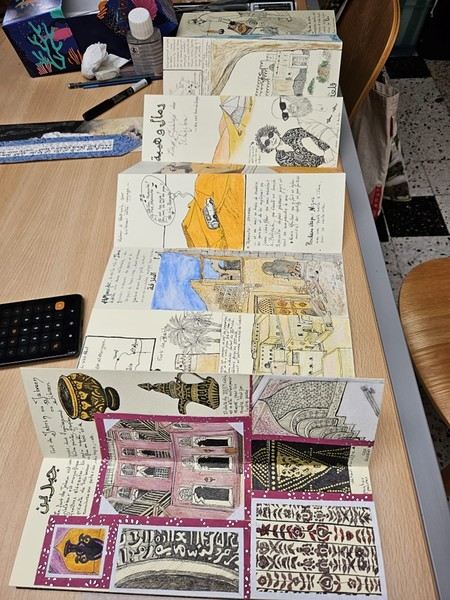
For drawing enthusiasts: The accordion format is both a constraint (each sheet is 9 cm x 27 cm) and a freedom (you can create a fresco). The paper is also a bit special: it doesn’t allow for fine lines, but it takes ink well (liner pen). However, everything has to be done almost in one go (with a very light pencil sketch) because it erases poorly. It absorbs too much water for coloring with markers or watercolors (unless you avoid soaking it), but it works well with oil pastels and their use with a brush and solvent. Since it’s yellowish, it allowed me to create contrasts even with white pastel.
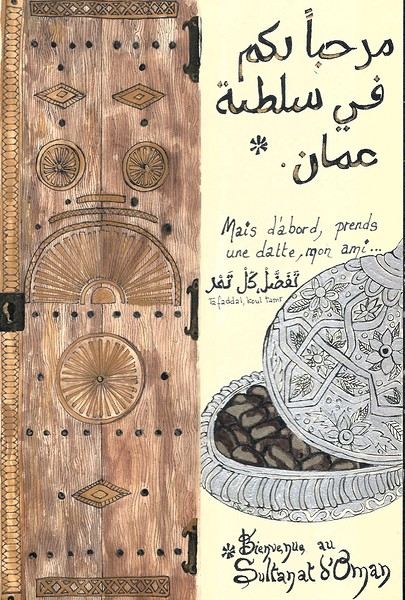 On the right, the "welcome marker"—those dates offered everywhere as a sign of hospitality. On the left, a tribute to those stunning doors worn by time, admired all over the old quarters, including the abandoned ones.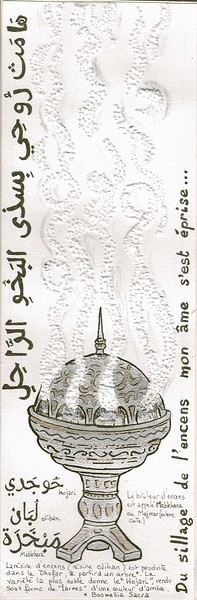
Oman is one of the world’s largest producers of frankincense resin. Incense burners are everywhere, from the simplest clay ones to the most precious handcrafted silver ones...
 Hospitality will often lead you to accept a small coffee, an "Omani coffee," very light, subtly flavored with cardamom, maybe a touch of saffron, and occasionally rosewater.
Here, I’ve depicted a man in the common everyday attire of Omanis: the dishdasha, mostly white (during the week and daytime; colors are more common in the evening or on Fridays and Saturdays). While you’ll see some men dressed in Western clothes, they’re very few. The white dishdasha is truly the shared attire of all men. The dishdasha, which has no hood, is distinguished by a small pom-pom attached to the collar, the furakha, which is soaked in perfume. And believe me, Omanis go overboard with it! "It smells like the pom-pom" is an expression that’s now part of our shared language, my husband and I.
Another must of men’s attire is the kuma, a small round head covering, usually white with brightly colored patterns. The keffiyeh is also worn (but without the cord called an agal in Arab countries), and it’s mostly worn by those with roots in the desert, from what I understood.
And what about the women, you might ask? Some are veiled, some in full black (but not a burka—more like a chador + abaya), due to the influence of Saudi Arabia and the United Arab Emirates, whereas the traditional outfit used to be a layering of very colorful dresses. Most of the women we saw wore neutral clothing, a plain veil over their hair, but with their faces uncovered. We also saw many saris and colorful veils—don’t forget that 40% of the population consists of Indian, Nepalese, and Bangladeshi immigrants, who work a lot in tourism, hospitality, restaurants, services, and construction.
Just to clarify, as a tourist, there’s no pressure to wear a veil, and never any disapproving looks. Of course, you’ll save the mini shorts, plunging necklines, bare shoulders, and midriffs for the hotel terrace—but I’d say that’s the same for men and women, and with the sun being strong, it’s better for your skin too.
Here’s the introduction! In the next post, I’ll tell you about my itinerary, and we can dive in!
Hospitality will often lead you to accept a small coffee, an "Omani coffee," very light, subtly flavored with cardamom, maybe a touch of saffron, and occasionally rosewater.
Here, I’ve depicted a man in the common everyday attire of Omanis: the dishdasha, mostly white (during the week and daytime; colors are more common in the evening or on Fridays and Saturdays). While you’ll see some men dressed in Western clothes, they’re very few. The white dishdasha is truly the shared attire of all men. The dishdasha, which has no hood, is distinguished by a small pom-pom attached to the collar, the furakha, which is soaked in perfume. And believe me, Omanis go overboard with it! "It smells like the pom-pom" is an expression that’s now part of our shared language, my husband and I.
Another must of men’s attire is the kuma, a small round head covering, usually white with brightly colored patterns. The keffiyeh is also worn (but without the cord called an agal in Arab countries), and it’s mostly worn by those with roots in the desert, from what I understood.
And what about the women, you might ask? Some are veiled, some in full black (but not a burka—more like a chador + abaya), due to the influence of Saudi Arabia and the United Arab Emirates, whereas the traditional outfit used to be a layering of very colorful dresses. Most of the women we saw wore neutral clothing, a plain veil over their hair, but with their faces uncovered. We also saw many saris and colorful veils—don’t forget that 40% of the population consists of Indian, Nepalese, and Bangladeshi immigrants, who work a lot in tourism, hospitality, restaurants, services, and construction.
Just to clarify, as a tourist, there’s no pressure to wear a veil, and never any disapproving looks. Of course, you’ll save the mini shorts, plunging necklines, bare shoulders, and midriffs for the hotel terrace—but I’d say that’s the same for men and women, and with the sun being strong, it’s better for your skin too.
Here’s the introduction! In the next post, I’ll tell you about my itinerary, and we can dive in!Megacom SIM card, how does it work?
Hi there,
I’ve never bought a SIM card abroad or even used prepaid cards in France...
So I’m wondering how it all works?
You buy a SIM card and pop it into your phone. Okay, so far so good... 😏
But after that?
I can’t find the price of prepaid cards or how they work with MegaCom.
If someone could give me a step-by-step guide... 😊
Thanks! 🙂
I’ve never bought a SIM card abroad or even used prepaid cards in France...
So I’m wondering how it all works?
You buy a SIM card and pop it into your phone. Okay, so far so good... 😏
But after that?
I can’t find the price of prepaid cards or how they work with MegaCom.
If someone could give me a step-by-step guide... 😊
Thanks! 🙂
Learning African Languages
"I created the African Languages Universe for a proud, playful, and accessible reclaiming of our languages in homes and imaginations, from ages 7 to 77" (Diaddou Cissé, founder of Univers des Langues Africaines)
A bridge between generations, continents, and languages
Since its beginnings, Univers des Langues Africaines, an independent publishing house, has had a simple yet powerful dream: to bring African languages to life in homes, schools, games, and everyday conversations. This dream grows with every word passed on, every language rediscovered, every child who speaks their first words in Soninke, Lingala, Bambara, Wolof, Pulaar...
Today, Univers des Langues Africaines has become:
an educational, accessible, and multilingual publishing house,
a brand committed to intergenerational transmission,
a lively, playful, and reality-connected learning space.
Children of the African diaspora, regardless of their level in Soninke, Wolof, Bambara, Lingala..., all face the same issue: the lack of books in their heritage languages tailored to them. Univers des Langues Africaines was born to fill this gap by offering simple and fun books and supporting them in learning African languages. Whether you're a minor, an adult beginner, a parent wanting to pass on their language to their child, or an African language enthusiast, Univers des Langues Africaines has a program suited to your needs!
At Univers des Langues Africaines, we offer:
conversation manuals or guides (Bambara, Lingala, Soninke, Wolof, Pulaar...); the books consist of lessons accessible to everyone, with exercises, reviews, and audio to easily speak the language.
games for children; tools adapted for kids to gently discover African languages.
online language courses, tailored for adults and children, interactive and immersive; they allow you to master an African language while discovering its cultural richness.
In short: manuals, games, and online courses—everything you need to learn (or relearn) an African language, at any age and at your own pace.
LAfrican languages deserve more than just a memory: they deserve to be lived, spoken, and loved.
A bridge between generations, continents, and languages
Since its beginnings, Univers des Langues Africaines, an independent publishing house, has had a simple yet powerful dream: to bring African languages to life in homes, schools, games, and everyday conversations. This dream grows with every word passed on, every language rediscovered, every child who speaks their first words in Soninke, Lingala, Bambara, Wolof, Pulaar...
Today, Univers des Langues Africaines has become:
an educational, accessible, and multilingual publishing house,
a brand committed to intergenerational transmission,
a lively, playful, and reality-connected learning space.
Children of the African diaspora, regardless of their level in Soninke, Wolof, Bambara, Lingala..., all face the same issue: the lack of books in their heritage languages tailored to them. Univers des Langues Africaines was born to fill this gap by offering simple and fun books and supporting them in learning African languages. Whether you're a minor, an adult beginner, a parent wanting to pass on their language to their child, or an African language enthusiast, Univers des Langues Africaines has a program suited to your needs!
At Univers des Langues Africaines, we offer:
conversation manuals or guides (Bambara, Lingala, Soninke, Wolof, Pulaar...); the books consist of lessons accessible to everyone, with exercises, reviews, and audio to easily speak the language.
games for children; tools adapted for kids to gently discover African languages.
online language courses, tailored for adults and children, interactive and immersive; they allow you to master an African language while discovering its cultural richness.
In short: manuals, games, and online courses—everything you need to learn (or relearn) an African language, at any age and at your own pace.
LAfrican languages deserve more than just a memory: they deserve to be lived, spoken, and loved.
Vehicle registered under one person and insurance under another for a trip to Asia
Hi there,
We’re planning a 4x4 trip from Belgium to Central Asia, passing through Georgia, Russia, Uzbekistan, Kazakhstan, and Kyrgyzstan.
For these countries, our national insurance obviously doesn’t cover the vehicle, so we’ll need to get local insurance.
Will it be a problem if the vehicle is registered under person A and the national insurance is under person B? Both A and B will be in the vehicle, and both will be listed as drivers on the insurance.
When we get the local insurance, if we again list A and B as drivers, does the order matter? Could we get stuck at the border for this reason?
Thanks for your help! :)
We’re planning a 4x4 trip from Belgium to Central Asia, passing through Georgia, Russia, Uzbekistan, Kazakhstan, and Kyrgyzstan.
For these countries, our national insurance obviously doesn’t cover the vehicle, so we’ll need to get local insurance.
Will it be a problem if the vehicle is registered under person A and the national insurance is under person B? Both A and B will be in the vehicle, and both will be listed as drivers on the insurance.
When we get the local insurance, if we again list A and B as drivers, does the order matter? Could we get stuck at the border for this reason?
Thanks for your help! :)
Can we go on a whale-watching excursion in April?
Hi everyone,
We’re heading to Québec for 4 days in Montréal and 4 days in Québec City from April 18 to April 22. I’ve been looking but can’t find any excursions—any tips for seeing belugas or other whales?
If it’s really off-season and impossible to find anything,
what else can we do in the area instead?
Thanks in advance!
Finding French-speaking guides in Indonesia
Hi everyone,
I’m planning a trip to Indonesia (Java and Bali) and I’d like to explore on my own, but I’m struggling to find contacts for French-speaking guides—not for a full tour, but for short visits ranging from a few hours to maybe 2-3 days. I checked GetYourGuide and Klook, which seem to fit my needs, but I don’t see any French-speaking guides. Where can I find French-speaking guides locally?
If anyone has any info or tips, I’d really appreciate it! Cheers
If anyone has any info or tips, I’d really appreciate it! Cheers
Visiting the GEM in Cairo – is the audio guide included?
With the admission price for the new Grand Egyptian Museum in Cairo, is an audio guide included, or can we get one as an extra? (I can’t find the info anywhere.)
Thanks
30 days, 3 provinces in this China that fascinates me...
We’ve just returned from a 30-day trip to China, 20 years after our last visit to this vast country.
What a transformation! So many new highways, high-speed trains, clean public restrooms, very comfortable and affordable hotels, and queues before boarding public transport… Has China really changed this much?
Language Technology has helped overcome—on a very small scale, of course—the language barrier thanks to translation apps on our phones. Unfortunately, very few Chinese people speak English, even in international hotels, which we find baffling, even frustrating, but that’s just how it is, and it’s up to us to adapt. It’s a shame, too, because no one makes an effort to communicate any other way than through their phone, which wasn’t the case when we were there 20 years ago. In restaurants, hotels, and some shops, they’ll show you a voice translation—usually in English—on a phone, and all you have to do is respond.
Payments We never withdrew cash in China. It’s possible to do so, but we never looked for an ATM. On the other hand, we tried to exchange 100 € as soon as we arrived in Xi’an, and it was a real ordeal. We had to do it at a specific bank, The Bank of China, and the administrative process took… an hour! So, no cash. Like everyone else, we used Alipay, one of the most popular online payment systems, and it’s super easy to use. WeChat also works well but is a bit more complicated to set up. It’s so convenient and used absolutely everywhere, even for purchases of 5 yuan, which is roughly the equivalent of about 55 euro cents. 10 yuan equals 1.22 €.
Phone As for the internet, I had installed a VPN before leaving—Let’s VPN—but it was completely useless since we had subscribed to an international plan with our carrier before the trip, which gave us 35 GB of data. No need to ask hotels for Wi-Fi; we only used roaming. It worked perfectly, no matter where we were. So, no VPN or SIM card for us.
TWO ESSENTIAL TOOLS FOR TRAVELING: your passport and your phone Traveling to China is much simpler than you might think. And let’s add that the Chinese, despite the language barrier, are very open and always ready to help.
The itinerary After carefully planning our route and considering the length of our stay (I had initially thought about applying for a visa longer than 30 days to stay for 6 weeks in China), we decided to take advantage of the recent option to stay for 30 days. Of course, we had to make some choices. I booked a one-way ticket from Paris to Xi’an and a return from Kunming to Paris once the itinerary was set: 9 days in northern Gansu 4 days in Hunan, specifically the well-known Zhangjiajie 15 days in Yunnan
Organization, transport, hotels This wasn’t a "backpacker" trip, as the hotels we booked were generally comfortable. I had arranged a car with a driver for the Yunnan portion through the Ciel Yunnan agency. Excellent choice—it allowed us to optimize our route. For the Gansu and Hunan portions, after much deliberation, we decided against hiring a driver. All our travel was by train and taxi. Taxis are available near train stations, airports, and some hotels in big cities. We also used "Didi," the Chinese equivalent of Uber. The app is available through Alipay. Getting around China by train is extremely easy. You just need to book your tickets on a travel site. I used trip.com and travelchina. Since we weren’t traveling during peak season, it was easy to get the tickets we wanted. You can buy train tickets up to 15 days before departure. You can book earlier, but there’s no guarantee you’ll get the time you want, especially during tourist seasons (usually the first week of October or May). Once at the station, you only need to show your passport, and you’ll need it again when leaving the station. Taxis are easy to find and not expensive. For day trips, we usually went through the hotel. Like everyone else, I had checked the prices of online tour agencies beforehand, and they were all overpriced. It’s better to wait until the last minute or, if possible, contact the hotel and ask them. I did this twice. We took domestic flights three times: Xi’an to Dunhuang Lanzhou to Changsha Changsha to Lijiang It’s best to buy flights shortly before departure, as prices are quite low then. There’s no point in booking months in advance. Often, flights only appear 2 months before departure. All hotel reservations were made on trip.com, except for three booked on Booking. Almost all exceeded our expectations in terms of comfort. Rooms were usually spacious, and new technology even makes its way into the rooms with "smart" toilets and automatic curtains… All for a very reasonable price.
The "attractions" That’s the term used on travel sites like trip.com for visits and activities, and it fits perfectly! Don’t expect to move freely around a natural tourist site. Cars aren’t allowed. The process is more or less the same everywhere: you arrive at the visitor center, pay the entrance fee, then, with your ticket or passport (always keep them on you!), you board a bus that takes you to the various viewpoints. The duration of the "tour" is usually indicated. It might seem confusing or even unnatural, but no one can avoid it unless you go to very remote, non-touristy places. Generally, the further west you go, the less this type of visit exists. The upside is that these places are better preserved since access is only by electric shuttle. On the downside, you sometimes have to deal with noisy tourist groups, their guides’ loudspeakers, and their non-stop chatter. But if you move a little further away, you’ll often find yourself alone.
Highlights of this trip:🙂 A 2-day escape to the Badan Jaran Desert—absolutely stunning. The colorful mountains near Zhangye. The Buddhist caves in Gansu. The breathtaking Hani and Yi rice terraces in Yuanyang. The architecture of the old towns, even if they sometimes feel a bit overdone. The warm welcome from the locals.
A little disappointed by: Zhangjiajie, despite its beauty. It was way too crowded, even though we were there in the off-season. And that’s nothing compared to the Stone Forest near Kunming… I also struggled with the food after a while. 😕
A few photos to come…
Language Technology has helped overcome—on a very small scale, of course—the language barrier thanks to translation apps on our phones. Unfortunately, very few Chinese people speak English, even in international hotels, which we find baffling, even frustrating, but that’s just how it is, and it’s up to us to adapt. It’s a shame, too, because no one makes an effort to communicate any other way than through their phone, which wasn’t the case when we were there 20 years ago. In restaurants, hotels, and some shops, they’ll show you a voice translation—usually in English—on a phone, and all you have to do is respond.
Payments We never withdrew cash in China. It’s possible to do so, but we never looked for an ATM. On the other hand, we tried to exchange 100 € as soon as we arrived in Xi’an, and it was a real ordeal. We had to do it at a specific bank, The Bank of China, and the administrative process took… an hour! So, no cash. Like everyone else, we used Alipay, one of the most popular online payment systems, and it’s super easy to use. WeChat also works well but is a bit more complicated to set up. It’s so convenient and used absolutely everywhere, even for purchases of 5 yuan, which is roughly the equivalent of about 55 euro cents. 10 yuan equals 1.22 €.
Phone As for the internet, I had installed a VPN before leaving—Let’s VPN—but it was completely useless since we had subscribed to an international plan with our carrier before the trip, which gave us 35 GB of data. No need to ask hotels for Wi-Fi; we only used roaming. It worked perfectly, no matter where we were. So, no VPN or SIM card for us.
TWO ESSENTIAL TOOLS FOR TRAVELING: your passport and your phone Traveling to China is much simpler than you might think. And let’s add that the Chinese, despite the language barrier, are very open and always ready to help.
The itinerary After carefully planning our route and considering the length of our stay (I had initially thought about applying for a visa longer than 30 days to stay for 6 weeks in China), we decided to take advantage of the recent option to stay for 30 days. Of course, we had to make some choices. I booked a one-way ticket from Paris to Xi’an and a return from Kunming to Paris once the itinerary was set: 9 days in northern Gansu 4 days in Hunan, specifically the well-known Zhangjiajie 15 days in Yunnan
Organization, transport, hotels This wasn’t a "backpacker" trip, as the hotels we booked were generally comfortable. I had arranged a car with a driver for the Yunnan portion through the Ciel Yunnan agency. Excellent choice—it allowed us to optimize our route. For the Gansu and Hunan portions, after much deliberation, we decided against hiring a driver. All our travel was by train and taxi. Taxis are available near train stations, airports, and some hotels in big cities. We also used "Didi," the Chinese equivalent of Uber. The app is available through Alipay. Getting around China by train is extremely easy. You just need to book your tickets on a travel site. I used trip.com and travelchina. Since we weren’t traveling during peak season, it was easy to get the tickets we wanted. You can buy train tickets up to 15 days before departure. You can book earlier, but there’s no guarantee you’ll get the time you want, especially during tourist seasons (usually the first week of October or May). Once at the station, you only need to show your passport, and you’ll need it again when leaving the station. Taxis are easy to find and not expensive. For day trips, we usually went through the hotel. Like everyone else, I had checked the prices of online tour agencies beforehand, and they were all overpriced. It’s better to wait until the last minute or, if possible, contact the hotel and ask them. I did this twice. We took domestic flights three times: Xi’an to Dunhuang Lanzhou to Changsha Changsha to Lijiang It’s best to buy flights shortly before departure, as prices are quite low then. There’s no point in booking months in advance. Often, flights only appear 2 months before departure. All hotel reservations were made on trip.com, except for three booked on Booking. Almost all exceeded our expectations in terms of comfort. Rooms were usually spacious, and new technology even makes its way into the rooms with "smart" toilets and automatic curtains… All for a very reasonable price.
The "attractions" That’s the term used on travel sites like trip.com for visits and activities, and it fits perfectly! Don’t expect to move freely around a natural tourist site. Cars aren’t allowed. The process is more or less the same everywhere: you arrive at the visitor center, pay the entrance fee, then, with your ticket or passport (always keep them on you!), you board a bus that takes you to the various viewpoints. The duration of the "tour" is usually indicated. It might seem confusing or even unnatural, but no one can avoid it unless you go to very remote, non-touristy places. Generally, the further west you go, the less this type of visit exists. The upside is that these places are better preserved since access is only by electric shuttle. On the downside, you sometimes have to deal with noisy tourist groups, their guides’ loudspeakers, and their non-stop chatter. But if you move a little further away, you’ll often find yourself alone.
Highlights of this trip:🙂 A 2-day escape to the Badan Jaran Desert—absolutely stunning. The colorful mountains near Zhangye. The Buddhist caves in Gansu. The breathtaking Hani and Yi rice terraces in Yuanyang. The architecture of the old towns, even if they sometimes feel a bit overdone. The warm welcome from the locals.
A little disappointed by: Zhangjiajie, despite its beauty. It was way too crowded, even though we were there in the off-season. And that’s nothing compared to the Stone Forest near Kunming… I also struggled with the food after a while. 😕
A few photos to come…
Trip Report: Silk Road Journey in China
Hi everyone,
This trip report covers a journey along the Silk Road in China (see detailed description below) undertaken in October 2025. The goal isn’t to recount the trip but to provide information that might help those who want to take a similar journey. Much of the information is valid for any trip to China.
Who we are: a retired couple, aged 63 and 65 (age gives discounts on entry to various sites and museums in China, which is why I won’t list prices here—I don’t know them, but you can easily find them online). We’re used to traveling independently. We speak English, which is the only foreign language spoken in China, though by very few people. I speak and read a little Chinese, which helped, but you can easily get by without it (without any English at all, I think it would be more difficult).
Period: We arrived just after "Golden Week," when all of China is on vacation, and after the summer, when schools are out, so we encountered very few tourists (99.99% of whom were Chinese). Our experience with booking visits in advance (which we didn’t need to do) isn’t representative for those who want to travel in the summer! The October-November period was perfect for our trip—it wasn’t too hot or too cold (one day of snow on the Tibetan Plateau), though it was only a few degrees on the Tibetan part, with altitudes between 2,000 and 3,000 meters. The trees were beautifully colored.
General remarks: Everyone we dealt with was very kind and perfectly honest. If you order a meal without really understanding what to do and the person modifies your order, trust them—the result is what you need. If a taxi driver signals that they’ll wait for you to finish your visit and pick you up afterward, trust them. It means there aren’t many taxis where you are, and it’ll be more convenient. For prices at street vendors, we always found the right ballpark, and sometimes they even added a little extra to please us. A taxi driver treated us to lunch, and an employee drove us back to the hotel after a visit because there were no taxis. If you struggle to buy a ticket online because there’s no counter, someone will come to help. People even spontaneously ask if everything’s okay and if you need anything.
Everywhere we went was very clean, including restrooms (trains, stations, hotels, museums, tourist sites) and streets. The old stereotypes about this no longer apply.
The trip can be challenging for those who have difficulty walking. The distances to cover on foot in stations, to access sites, and within the sites themselves can sometimes be really long.
We used the Lonely Planet guide in English (published at the end of August 2025) a little for preparation, but mostly relied on the internet.
Before leaving: No visa is needed for French citizens for stays under 30 days. You get a stamp on your passport upon arrival and departure, and the formalities themselves are very quick in both directions (excluding any potential queues). Just a photo and fingerprints upon arrival, and welcome to China’s facial recognition system.
Money: All your payments (see below) will go through your Visa card—there will be hundreds, including many payments of 20 cents to a few euros. So, you need an international option that allows unlimited card transactions. Since cash is rarely needed, the allowed number of ATM withdrawals can be low. We made 3 withdrawals totaling 800 € for a month and could have managed with just 2. The exchange rate charged on our Visa card was 12 € for 100 RMB (yuan).
Install the following apps on your smartphone before leaving (otherwise, you’ll only have access to the Chinese versions, if available): - Alipay, which is used to pay everywhere in China (details below). You need to link it to your credit card, then provide proof of identity by uploading a passport photo and completing a facial recognition session. Alipay gives access to Didi (China’s Uber), public transport (metro/bus), and can also translate phrases. - WeChat (Weixin in Chinese, pronounced *weishin*), which is also used for payments but also replaces WhatsApp. Unfortunately, to activate your account, you need someone who already has WeChat to sponsor you (preferably a Chinese person). We asked someone at our first accommodations to do this—no problem. By sharing your WeChat number with accommodations, they can send you messages that are automatically translated, and you can communicate with people thanks to the translation (translation to French is very poor; it’s much better in English, but unfortunately, WeChat detects your phone’s language). Alipay and WeChat are accepted almost everywhere, but some places only accept WeChat. - Amap, the international version of Baidu Maps, which replaces Google Maps (not at all up-to-date in China). The English names of hotels often have little to do with the Chinese names except for a phonetic resemblance. To find them on Amap, it’s best to copy the Chinese name found on your Trip reservation under "show address in Chinese." - A VPN. We had CyberGhost, which didn’t work, but according to other travelers, NordVPN and Windscribe do. Without a VPN, you can’t access Google services, on WhatsApp you can send and receive text but not photos, and you can’t send or receive emails on Gmail addresses. We managed without a VPN by using Firefox as a browser and Bing as a search engine. - Trip, for booking trains and accommodations, and buying some tickets. It’s the equivalent of Booking for accommodations, but Booking has very few listings in China, while Trip has hundreds in every city. Most hotels and trains are exchangeable and refundable until the day before, with no or minimal fees.
You don’t need contactless (NFC) payment on your phone. Either you scan a barcode and enter the amount to pay, or you display a barcode, and they scan it with a scanner, and the amount is deducted directly.
Upon arrival: - Buy a Chinese SIM card: 100 RMB for 300 GB of data and several hours of talk time (we didn’t use it). Set the Chinese number as a reference on Alipay, WeChat, and Amap. - Find someone to sponsor you on WeChat.
Transportation: - **Plane**: China Eastern, Paris-Canton then Canton-Urumqi on the way out, and Xian-Canton then Canton-Paris on the way back. International flights were smooth, but the schedules for the two domestic flights were changed. It was fine on the way out because we had some leeway, but on the way back, we were notified the morning of that our flight was canceled and replaced with one that didn’t allow for the connection. We called and changed to an earlier flight (I think we were lucky to find available seats). - **Train**: Most long distances were covered by high-speed trains (called D or G in China) at 240 or 300 km/h. Second class is perfect—just as comfortable and clean as our TGVs. The only advantage of first class is the wider seats for larger people, but the downside is that seats are often booked in advance and thus less available. You can book trains long in advance on Trip, but they only go on sale in China 15 days before departure, so that’s when you’ll know if you have a ticket. Initially, we booked first class, but there were no seats available on the day, so we ended up booking everything in second class, which was perfect. There’s no paper ticket—if you’ve bought one, you go to the station, show your passport, and enter. You do the same to access the platform 15 minutes before the train, and that’s it. Our train was canceled twice, but no problem—we went to the ticket counter, got a refund, and were offered a replacement. It didn’t delay us by more than an hour (maybe it would be harder in peak season). For prices, check Trip.com, but it’s significantly cheaper than in France. - **Bus**: We took the bus between Xining and Tongren, Tongren to Xiahe, and Hezuo to Lanzhou—about 3 hours each time for 200 km, 6 € per person, and departures were right on time. - **Taxi**: For trips between the station and hotel, or hotel and visits. If you take a Didi via the Alipay app, you activate your location, enter your destination, and it offers several taxis. You accept, and you get the car’s license plate and its real-time position on the map. When you get in, the driver often asks for the last four digits of your phone number to confirm. Otherwise, you go to the taxi stand outside the station. The price per kilometer is around 20 cents, so for a 30 km trip from the station to the hotel, you’ll pay about 6 €. We never tried to save more by taking local buses, but since the metro in Xian costs 25 cents per trip, it’s probably in the same ballpark. Amap provides public transport routes like Google Maps. - **Driver**: We hired a taxi/driver for the day several times for sightseeing. Prices ranged from 350 to 1,000 RMB (the most expensive was arranged through the Sofitel Xining concierge) for trips ranging from a few hours to a full day, sometimes covering over 300 km (see the detailed trip description).
Accommodations: All booked in advance on Trip, but several were changed during the trip. Off-season, there were no issues. We mostly stayed in upscale places, but in China, that means 50 to 60 € per night in the most central or convenient neighborhood. Note: Almost all hotels have a 5/5 rating on Trip, but it seems the Chinese avoid giving lower ratings to be polite. So, you have to read the comments to realize that in France, we might have given a 2 or 3!
Food: At the table, you’re served hot water or a hot infusion, presumably made with purified water. We never got sick from drinking it, but don’t drink tap water. Purified or mineral water is easy to find.
In restaurants, you can manage by pointing to the dish you want from another diner, on the wall where there are photos, or on the menu with pictures. The food in the region isn’t often spicy, and people usually ask or signal before adding the red spicy sauce, so you should be able to handle it if you don’t like chili at all.
The "fake old quarters" in several cities are great places to find all kinds of restaurants (see detailed trip below).
Like Google Maps, Amap can show you nearby restaurants.
Shopping: For dried fruits, buy them in Turfan—you won’t find the same variety and quality even in Xian. Generally, if you like something, buy it. If you wait, you might not find it outside the region where you are.
In Xian, there’s a "Tea City" where you can find all kinds of tea (from cheap to very expensive).
The trip in more detail: I won’t dwell on the beauty or interest of the sites here since that’s a matter of personal taste. However, I will do so for lesser-known places to give an idea to those who might be interested.
For many sites, there are shuttles (sometimes not included in the ticket price but costing around 1 €) that take you to the interesting spots. We always took them—it saves you from walking past countless shops or along uninteresting paths.
- **Urumqi**: We spent only one night there, arriving in the middle of the afternoon and leaving the next morning. We stayed at the Dana Hotel in the bazaar. Given the size of the city, it’s a good option because I don’t think there are many other interesting places. The bazaar is brand new and not at all "typical" (Turfan’s bazaar is infinitely more interesting), but the dining area is very nice.
- **Turfan**: Stayed at the New Dap Hostel, which was great. The neighborhood is nice, not far from the city, and easy to find food. The museum is closed until 2026 (Amap provides museum hours and closures). We took a day trip (for the two of us) with a driver to the Bezeklik Caves, Flaming Mountains, the abandoned city of Gaochang, the Tuyuk Village Museum, and the Emin Minaret for 500 RMB from 9 AM to 8 PM (arranged by the hostel). The landscape during the excursion was quite fabulous. We also visited the Karez Museum and the abandoned city of Jiaohe on our own the next day. At this time of year, the sun sets around 6 PM, and there’s often haze after 5 PM, so for Jiaohe, for example, which takes about 3 hours to visit, it’s best to be there by 1 or 2 PM at the latest.
The Dahua Market area is perfect for dried fruits (including the famous grapes), and you can eat there among locals in their traditional costumes. Next to it, there are buildings full of shops selling made-in-China items—it kept us busy for a good half-day, if not more.
- **Dunhuang**: Stayed in a guesthouse near the dunes—the city center isn’t far but seems quite artificial. Visited the dunes, with a ticket valid for 3 days. Lots of Chinese tourists—very typical and interesting from an ethnological perspective 😊. We got up early one morning to climb the highest dune, just beyond the one everyone goes to. It’s a bit long and tiring, but the view is worth it. Visited the Mogao Caves, buying the ticket on-site (no chance in season without booking in advance). We met two other French people and got a French-speaking guide (by pretending not to understand English). It was really worth it—a group of 4 instead of 20, and they took their time (2 hours) for the visit. We took a day trip to the Yulin Caves (2.5 hours by road and 160 km one way) with a driver for 350 RMB. We liked it a lot, but if the Mogao Caves are enough for you, it’s not very different.
- **Jiayuguan**: Stayed in a city-center hotel. Visited the Wei and Jin tombs (actually just one)—that’s where we were told the taxi should wait to take us back to the city. We went down into a crypt with lots of decorated bricks from the 3rd century. We really liked it, but it’s not as spectacular as the fort if you’re not a fan. Visited the Jiayuguan Fort and, with the same ticket, climbed a small section of the Great Wall 10 km away. Plan at least 3 good hours for all this—there’s plenty to see.
- **Zhangye**: Stayed at The Silk Road Travelers Hostel, rustic but very nice and organizes excursions. Visited the Danxia (colored mountains)—just as spectacular as the photos. You can easily spend 3 hours there, so plan to finish before sunset to avoid the haze (you can always stay longer for the sunset if the weather’s nice). The next day, visited the Mati Si Temple in the cliff. The 10,000 Buddha Caves are under renovation, but the setting and the main temple are well worth the visit (the paths through the cliff tunnels must be hellish in peak season). You can probably organize these two excursions yourself by asking any taxi driver. Also visited the Giant Buddha Temple in the city center—really worth it.
- **Xining**: Stayed in a city-center hotel. Visited the Tibetan Medicine Museum to see the world’s largest thangka (1 km long), made over 40 years by renowned artists. It’s absolutely magnificent, on par with the virtuosity (but over 1 km) of the thangkas painted by famous artists in Xiahe (see below). Hired a female taxi driver for the day to visit Kumbum Monastery (Ta’er Si in Chinese) and the Danxia area in Guide, 50 km beyond the monastery. It’s less spectacular than Zhangye’s Danxia, but we really liked it (including the journey’s landscape). The next day, visited the old Ming-era Qutan Monastery—no visitors, with beautiful murals (half under renovation). Accessible by train to Haidong or Ledu, then a taxi. Xining’s mosque is of no interest, but there’s a pedestrian street with food stalls nearby that’s very nice.
- **Tongren**: Stayed near the main monastery. Visited Longwu Monastery (several hours), with lots of nice shops along the street leading to it. Then visited Wutun Monastery, which is less lively but beautiful and close to thangka workshops. You can go in and watch the painters at work. For a thangka made by a renowned artist, count about a year of work for 1 m² and around 10,000 €.
- **Xiahe**: Stayed in a city-center hotel. Visited Labrang Monastery—very nice but not as much as Tongren’s because many halls were closed. I think it’s better to go in season and take an English-guided tour (but it’s still worth the trip, even off-season).
- **Langmusi**: Took a taxi, but you can also take a bus (though very early in the morning and longer). Particularly beautiful for us because we woke up to bright sunshine and 5 cm of snow everywhere. Visited the two temples (really nice) and did the classic hike in the gorges starting at the Fairy Cave. For those interested, we continued along the canyon path, and after the meadow where marmots are clearly visible in summer, we climbed toward a pass on the left at 3,800 meters. The view of Langmusi and, above all, the vast grasslands and distant mountains was fabulous (3 hours round trip from the temple). You could probably reach the 4,000-meter summit by continuing up the valley instead of turning left, but according to guides, it’s better to count 7 hours round trip (no technical difficulty). You can leave Langmusi by bus, but off-season, you first have to take a taxi to a stop outside the city and wait for the bus. We didn’t try and took a taxi to Hezuo instead.
Note on this region: A high-speed train is under construction from Xining to Langmusi and beyond (never seen such an impressive construction site!). When it’s operational (in one or two years, I think), access to the area will be revolutionized, and perhaps some of the charm will be lost.
- **Hezuo**: Stopped on the way from Langmusi to Lanzhou. Visited the Milarepa Pagoda, entirely destroyed during the Cultural Revolution and since rebuilt. We liked it since we were passing through, but it doesn’t necessarily justify a long detour.
- **Lanzhou**: Reached by one of the many buses from Hezuo. Stayed in the "fake old quarter," which is extremely pleasant, especially in the evening with restaurants, groups of Chinese women dancing to loud music, etc. Visited Bingling Si with a driver, 120 km away—the landscape and site are absolutely magnificent, with no one around at our time of year. Visited the Gansu Museum (where the famous Flying Horse is, but it’s a replica). We bought the ticket on entry, but in season, you probably need to book in advance.
- **Yinchuan**: Stayed in the city center. A city we discovered by chance in the Lonely Planet—worth it if you have time. On the way, we stopped for a few hours in Zhongwei, where there’s an incredible Taoist temple (I’ll let you be surprised). Visited the Western Xia tombs—we took the short option, which visits Tomb 3. We think the others are similar but less impressive. The surrounding landscape and site are quite spectacular. Visited the film sets (really fun if you like Chinese movies), the short but interesting Ningxia Museum, and finally the modern art museum. The architecture is avant-garde, and there are some beautiful works (we like it, but it’s far from the center—hire a driver who waits, or you might have to wait for an employee to offer a ride back).
- **Tianshui**: Stayed in the suburbs, but you should find a hotel near the "fake old quarter" between the Fu Xi Temples and the Taoist temple—it’s a very nice area, and the two temples (especially the Taoist one) are within walking distance. Visited the Maijishan Caves—the ticket includes the shuttle to get there. Took a taxi from Lanzhou for about 10 € in 45 minutes. We found these caves fabulous.
- **Xi’an**: Stayed 500 meters from the Bell Tower at Hantang Inn—very convenient. We’d been before, so we didn’t revisit the Terracotta Army. The calligraphy district is worth it, as is the Muslim Quarter, though it’s very touristy. The area indicated on the Lonely Planet’s walking tour near the old fruit and vegetable market isn’t very interesting. To buy tea, you can go to the Northwest International Tea City, with dozens of shops. We chose one at random, tasted, and bought various teas. There’s everything from cheap to extremely expensive, but you can find reasonable prices even in seemingly luxurious shops. Along the street north of this area, there are large stores with tons of Chinese goods selling dishes, wedding items, etc. We spent hours there. In the city center, there are only malls with more or less international brands.
- **Longmen Grottoes**: Visited as a round trip by high-speed train from Xian—1 hour 15 minutes to Longmen’s high-speed train station, and the site entrance is 15 minutes by taxi.
We didn’t go to Mount Hua Shan, but there’s a high-speed train station nearby, and there were people on the train who were clearly going there. So, you can probably do this excursion in a day from Xian as well.
Conclusion: We hope this report makes you want to go or helps you if you’re already planning to. If you have questions that you can’t find the answer to by searching properly online and we can answer, don’t hesitate.
This trip report covers a journey along the Silk Road in China (see detailed description below) undertaken in October 2025. The goal isn’t to recount the trip but to provide information that might help those who want to take a similar journey. Much of the information is valid for any trip to China.
Who we are: a retired couple, aged 63 and 65 (age gives discounts on entry to various sites and museums in China, which is why I won’t list prices here—I don’t know them, but you can easily find them online). We’re used to traveling independently. We speak English, which is the only foreign language spoken in China, though by very few people. I speak and read a little Chinese, which helped, but you can easily get by without it (without any English at all, I think it would be more difficult).
Period: We arrived just after "Golden Week," when all of China is on vacation, and after the summer, when schools are out, so we encountered very few tourists (99.99% of whom were Chinese). Our experience with booking visits in advance (which we didn’t need to do) isn’t representative for those who want to travel in the summer! The October-November period was perfect for our trip—it wasn’t too hot or too cold (one day of snow on the Tibetan Plateau), though it was only a few degrees on the Tibetan part, with altitudes between 2,000 and 3,000 meters. The trees were beautifully colored.
General remarks: Everyone we dealt with was very kind and perfectly honest. If you order a meal without really understanding what to do and the person modifies your order, trust them—the result is what you need. If a taxi driver signals that they’ll wait for you to finish your visit and pick you up afterward, trust them. It means there aren’t many taxis where you are, and it’ll be more convenient. For prices at street vendors, we always found the right ballpark, and sometimes they even added a little extra to please us. A taxi driver treated us to lunch, and an employee drove us back to the hotel after a visit because there were no taxis. If you struggle to buy a ticket online because there’s no counter, someone will come to help. People even spontaneously ask if everything’s okay and if you need anything.
Everywhere we went was very clean, including restrooms (trains, stations, hotels, museums, tourist sites) and streets. The old stereotypes about this no longer apply.
The trip can be challenging for those who have difficulty walking. The distances to cover on foot in stations, to access sites, and within the sites themselves can sometimes be really long.
We used the Lonely Planet guide in English (published at the end of August 2025) a little for preparation, but mostly relied on the internet.
Before leaving: No visa is needed for French citizens for stays under 30 days. You get a stamp on your passport upon arrival and departure, and the formalities themselves are very quick in both directions (excluding any potential queues). Just a photo and fingerprints upon arrival, and welcome to China’s facial recognition system.
Money: All your payments (see below) will go through your Visa card—there will be hundreds, including many payments of 20 cents to a few euros. So, you need an international option that allows unlimited card transactions. Since cash is rarely needed, the allowed number of ATM withdrawals can be low. We made 3 withdrawals totaling 800 € for a month and could have managed with just 2. The exchange rate charged on our Visa card was 12 € for 100 RMB (yuan).
Install the following apps on your smartphone before leaving (otherwise, you’ll only have access to the Chinese versions, if available): - Alipay, which is used to pay everywhere in China (details below). You need to link it to your credit card, then provide proof of identity by uploading a passport photo and completing a facial recognition session. Alipay gives access to Didi (China’s Uber), public transport (metro/bus), and can also translate phrases. - WeChat (Weixin in Chinese, pronounced *weishin*), which is also used for payments but also replaces WhatsApp. Unfortunately, to activate your account, you need someone who already has WeChat to sponsor you (preferably a Chinese person). We asked someone at our first accommodations to do this—no problem. By sharing your WeChat number with accommodations, they can send you messages that are automatically translated, and you can communicate with people thanks to the translation (translation to French is very poor; it’s much better in English, but unfortunately, WeChat detects your phone’s language). Alipay and WeChat are accepted almost everywhere, but some places only accept WeChat. - Amap, the international version of Baidu Maps, which replaces Google Maps (not at all up-to-date in China). The English names of hotels often have little to do with the Chinese names except for a phonetic resemblance. To find them on Amap, it’s best to copy the Chinese name found on your Trip reservation under "show address in Chinese." - A VPN. We had CyberGhost, which didn’t work, but according to other travelers, NordVPN and Windscribe do. Without a VPN, you can’t access Google services, on WhatsApp you can send and receive text but not photos, and you can’t send or receive emails on Gmail addresses. We managed without a VPN by using Firefox as a browser and Bing as a search engine. - Trip, for booking trains and accommodations, and buying some tickets. It’s the equivalent of Booking for accommodations, but Booking has very few listings in China, while Trip has hundreds in every city. Most hotels and trains are exchangeable and refundable until the day before, with no or minimal fees.
You don’t need contactless (NFC) payment on your phone. Either you scan a barcode and enter the amount to pay, or you display a barcode, and they scan it with a scanner, and the amount is deducted directly.
Upon arrival: - Buy a Chinese SIM card: 100 RMB for 300 GB of data and several hours of talk time (we didn’t use it). Set the Chinese number as a reference on Alipay, WeChat, and Amap. - Find someone to sponsor you on WeChat.
Transportation: - **Plane**: China Eastern, Paris-Canton then Canton-Urumqi on the way out, and Xian-Canton then Canton-Paris on the way back. International flights were smooth, but the schedules for the two domestic flights were changed. It was fine on the way out because we had some leeway, but on the way back, we were notified the morning of that our flight was canceled and replaced with one that didn’t allow for the connection. We called and changed to an earlier flight (I think we were lucky to find available seats). - **Train**: Most long distances were covered by high-speed trains (called D or G in China) at 240 or 300 km/h. Second class is perfect—just as comfortable and clean as our TGVs. The only advantage of first class is the wider seats for larger people, but the downside is that seats are often booked in advance and thus less available. You can book trains long in advance on Trip, but they only go on sale in China 15 days before departure, so that’s when you’ll know if you have a ticket. Initially, we booked first class, but there were no seats available on the day, so we ended up booking everything in second class, which was perfect. There’s no paper ticket—if you’ve bought one, you go to the station, show your passport, and enter. You do the same to access the platform 15 minutes before the train, and that’s it. Our train was canceled twice, but no problem—we went to the ticket counter, got a refund, and were offered a replacement. It didn’t delay us by more than an hour (maybe it would be harder in peak season). For prices, check Trip.com, but it’s significantly cheaper than in France. - **Bus**: We took the bus between Xining and Tongren, Tongren to Xiahe, and Hezuo to Lanzhou—about 3 hours each time for 200 km, 6 € per person, and departures were right on time. - **Taxi**: For trips between the station and hotel, or hotel and visits. If you take a Didi via the Alipay app, you activate your location, enter your destination, and it offers several taxis. You accept, and you get the car’s license plate and its real-time position on the map. When you get in, the driver often asks for the last four digits of your phone number to confirm. Otherwise, you go to the taxi stand outside the station. The price per kilometer is around 20 cents, so for a 30 km trip from the station to the hotel, you’ll pay about 6 €. We never tried to save more by taking local buses, but since the metro in Xian costs 25 cents per trip, it’s probably in the same ballpark. Amap provides public transport routes like Google Maps. - **Driver**: We hired a taxi/driver for the day several times for sightseeing. Prices ranged from 350 to 1,000 RMB (the most expensive was arranged through the Sofitel Xining concierge) for trips ranging from a few hours to a full day, sometimes covering over 300 km (see the detailed trip description).
Accommodations: All booked in advance on Trip, but several were changed during the trip. Off-season, there were no issues. We mostly stayed in upscale places, but in China, that means 50 to 60 € per night in the most central or convenient neighborhood. Note: Almost all hotels have a 5/5 rating on Trip, but it seems the Chinese avoid giving lower ratings to be polite. So, you have to read the comments to realize that in France, we might have given a 2 or 3!
Food: At the table, you’re served hot water or a hot infusion, presumably made with purified water. We never got sick from drinking it, but don’t drink tap water. Purified or mineral water is easy to find.
In restaurants, you can manage by pointing to the dish you want from another diner, on the wall where there are photos, or on the menu with pictures. The food in the region isn’t often spicy, and people usually ask or signal before adding the red spicy sauce, so you should be able to handle it if you don’t like chili at all.
The "fake old quarters" in several cities are great places to find all kinds of restaurants (see detailed trip below).
Like Google Maps, Amap can show you nearby restaurants.
Shopping: For dried fruits, buy them in Turfan—you won’t find the same variety and quality even in Xian. Generally, if you like something, buy it. If you wait, you might not find it outside the region where you are.
In Xian, there’s a "Tea City" where you can find all kinds of tea (from cheap to very expensive).
The trip in more detail: I won’t dwell on the beauty or interest of the sites here since that’s a matter of personal taste. However, I will do so for lesser-known places to give an idea to those who might be interested.
For many sites, there are shuttles (sometimes not included in the ticket price but costing around 1 €) that take you to the interesting spots. We always took them—it saves you from walking past countless shops or along uninteresting paths.
- **Urumqi**: We spent only one night there, arriving in the middle of the afternoon and leaving the next morning. We stayed at the Dana Hotel in the bazaar. Given the size of the city, it’s a good option because I don’t think there are many other interesting places. The bazaar is brand new and not at all "typical" (Turfan’s bazaar is infinitely more interesting), but the dining area is very nice.
- **Turfan**: Stayed at the New Dap Hostel, which was great. The neighborhood is nice, not far from the city, and easy to find food. The museum is closed until 2026 (Amap provides museum hours and closures). We took a day trip (for the two of us) with a driver to the Bezeklik Caves, Flaming Mountains, the abandoned city of Gaochang, the Tuyuk Village Museum, and the Emin Minaret for 500 RMB from 9 AM to 8 PM (arranged by the hostel). The landscape during the excursion was quite fabulous. We also visited the Karez Museum and the abandoned city of Jiaohe on our own the next day. At this time of year, the sun sets around 6 PM, and there’s often haze after 5 PM, so for Jiaohe, for example, which takes about 3 hours to visit, it’s best to be there by 1 or 2 PM at the latest.
The Dahua Market area is perfect for dried fruits (including the famous grapes), and you can eat there among locals in their traditional costumes. Next to it, there are buildings full of shops selling made-in-China items—it kept us busy for a good half-day, if not more.
- **Dunhuang**: Stayed in a guesthouse near the dunes—the city center isn’t far but seems quite artificial. Visited the dunes, with a ticket valid for 3 days. Lots of Chinese tourists—very typical and interesting from an ethnological perspective 😊. We got up early one morning to climb the highest dune, just beyond the one everyone goes to. It’s a bit long and tiring, but the view is worth it. Visited the Mogao Caves, buying the ticket on-site (no chance in season without booking in advance). We met two other French people and got a French-speaking guide (by pretending not to understand English). It was really worth it—a group of 4 instead of 20, and they took their time (2 hours) for the visit. We took a day trip to the Yulin Caves (2.5 hours by road and 160 km one way) with a driver for 350 RMB. We liked it a lot, but if the Mogao Caves are enough for you, it’s not very different.
- **Jiayuguan**: Stayed in a city-center hotel. Visited the Wei and Jin tombs (actually just one)—that’s where we were told the taxi should wait to take us back to the city. We went down into a crypt with lots of decorated bricks from the 3rd century. We really liked it, but it’s not as spectacular as the fort if you’re not a fan. Visited the Jiayuguan Fort and, with the same ticket, climbed a small section of the Great Wall 10 km away. Plan at least 3 good hours for all this—there’s plenty to see.
- **Zhangye**: Stayed at The Silk Road Travelers Hostel, rustic but very nice and organizes excursions. Visited the Danxia (colored mountains)—just as spectacular as the photos. You can easily spend 3 hours there, so plan to finish before sunset to avoid the haze (you can always stay longer for the sunset if the weather’s nice). The next day, visited the Mati Si Temple in the cliff. The 10,000 Buddha Caves are under renovation, but the setting and the main temple are well worth the visit (the paths through the cliff tunnels must be hellish in peak season). You can probably organize these two excursions yourself by asking any taxi driver. Also visited the Giant Buddha Temple in the city center—really worth it.
- **Xining**: Stayed in a city-center hotel. Visited the Tibetan Medicine Museum to see the world’s largest thangka (1 km long), made over 40 years by renowned artists. It’s absolutely magnificent, on par with the virtuosity (but over 1 km) of the thangkas painted by famous artists in Xiahe (see below). Hired a female taxi driver for the day to visit Kumbum Monastery (Ta’er Si in Chinese) and the Danxia area in Guide, 50 km beyond the monastery. It’s less spectacular than Zhangye’s Danxia, but we really liked it (including the journey’s landscape). The next day, visited the old Ming-era Qutan Monastery—no visitors, with beautiful murals (half under renovation). Accessible by train to Haidong or Ledu, then a taxi. Xining’s mosque is of no interest, but there’s a pedestrian street with food stalls nearby that’s very nice.
- **Tongren**: Stayed near the main monastery. Visited Longwu Monastery (several hours), with lots of nice shops along the street leading to it. Then visited Wutun Monastery, which is less lively but beautiful and close to thangka workshops. You can go in and watch the painters at work. For a thangka made by a renowned artist, count about a year of work for 1 m² and around 10,000 €.
- **Xiahe**: Stayed in a city-center hotel. Visited Labrang Monastery—very nice but not as much as Tongren’s because many halls were closed. I think it’s better to go in season and take an English-guided tour (but it’s still worth the trip, even off-season).
- **Langmusi**: Took a taxi, but you can also take a bus (though very early in the morning and longer). Particularly beautiful for us because we woke up to bright sunshine and 5 cm of snow everywhere. Visited the two temples (really nice) and did the classic hike in the gorges starting at the Fairy Cave. For those interested, we continued along the canyon path, and after the meadow where marmots are clearly visible in summer, we climbed toward a pass on the left at 3,800 meters. The view of Langmusi and, above all, the vast grasslands and distant mountains was fabulous (3 hours round trip from the temple). You could probably reach the 4,000-meter summit by continuing up the valley instead of turning left, but according to guides, it’s better to count 7 hours round trip (no technical difficulty). You can leave Langmusi by bus, but off-season, you first have to take a taxi to a stop outside the city and wait for the bus. We didn’t try and took a taxi to Hezuo instead.
Note on this region: A high-speed train is under construction from Xining to Langmusi and beyond (never seen such an impressive construction site!). When it’s operational (in one or two years, I think), access to the area will be revolutionized, and perhaps some of the charm will be lost.
- **Hezuo**: Stopped on the way from Langmusi to Lanzhou. Visited the Milarepa Pagoda, entirely destroyed during the Cultural Revolution and since rebuilt. We liked it since we were passing through, but it doesn’t necessarily justify a long detour.
- **Lanzhou**: Reached by one of the many buses from Hezuo. Stayed in the "fake old quarter," which is extremely pleasant, especially in the evening with restaurants, groups of Chinese women dancing to loud music, etc. Visited Bingling Si with a driver, 120 km away—the landscape and site are absolutely magnificent, with no one around at our time of year. Visited the Gansu Museum (where the famous Flying Horse is, but it’s a replica). We bought the ticket on entry, but in season, you probably need to book in advance.
- **Yinchuan**: Stayed in the city center. A city we discovered by chance in the Lonely Planet—worth it if you have time. On the way, we stopped for a few hours in Zhongwei, where there’s an incredible Taoist temple (I’ll let you be surprised). Visited the Western Xia tombs—we took the short option, which visits Tomb 3. We think the others are similar but less impressive. The surrounding landscape and site are quite spectacular. Visited the film sets (really fun if you like Chinese movies), the short but interesting Ningxia Museum, and finally the modern art museum. The architecture is avant-garde, and there are some beautiful works (we like it, but it’s far from the center—hire a driver who waits, or you might have to wait for an employee to offer a ride back).
- **Tianshui**: Stayed in the suburbs, but you should find a hotel near the "fake old quarter" between the Fu Xi Temples and the Taoist temple—it’s a very nice area, and the two temples (especially the Taoist one) are within walking distance. Visited the Maijishan Caves—the ticket includes the shuttle to get there. Took a taxi from Lanzhou for about 10 € in 45 minutes. We found these caves fabulous.
- **Xi’an**: Stayed 500 meters from the Bell Tower at Hantang Inn—very convenient. We’d been before, so we didn’t revisit the Terracotta Army. The calligraphy district is worth it, as is the Muslim Quarter, though it’s very touristy. The area indicated on the Lonely Planet’s walking tour near the old fruit and vegetable market isn’t very interesting. To buy tea, you can go to the Northwest International Tea City, with dozens of shops. We chose one at random, tasted, and bought various teas. There’s everything from cheap to extremely expensive, but you can find reasonable prices even in seemingly luxurious shops. Along the street north of this area, there are large stores with tons of Chinese goods selling dishes, wedding items, etc. We spent hours there. In the city center, there are only malls with more or less international brands.
- **Longmen Grottoes**: Visited as a round trip by high-speed train from Xian—1 hour 15 minutes to Longmen’s high-speed train station, and the site entrance is 15 minutes by taxi.
We didn’t go to Mount Hua Shan, but there’s a high-speed train station nearby, and there were people on the train who were clearly going there. So, you can probably do this excursion in a day from Xian as well.
Conclusion: We hope this report makes you want to go or helps you if you’re already planning to. If you have questions that you can’t find the answer to by searching properly online and we can answer, don’t hesitate.
Back from Havana and the surrounding area
Hi everyone,
I’ve just returned from Havana after an 18-day stay from October 8th to 26th.
From Montreal, you have to go through Varadero Airport. I now break up the airport-to-Havana transfer with a SUPER pleasant stopover halfway, in the historic village of Hershey (Camilo Cienfuegos). Quebecer Anne-Marie has renovated a century-old house there, and every stay of mine feels like a peaceful oasis. Amazing food, a pool, impeccable hospitality—I highly recommend it! Casa Cub'Anita.
Life for Cubans remains just as tough, made even harder right now by tropical viruses spread by mosquitoes. It’s absolutely essential to protect yourself properly. That said, the purchasing power of foreign currency hasn’t changed much, despite skyrocketing inflation. As of today, the US dollar exchanges for nearly 500 pesos on the "informal market."
This was my first time staying in Vieja, in the non-touristy part. I discovered some great little restaurants run by the younger generation. Affordable, excellent food, and remarkably friendly service: El Chanchulero (it was about time I checked it out—unbeatable value for money!), El Café, Jibaro...
Cubans are still as warm and welcoming as ever—bicitaxis, servers, markets. Speaking the language is a huge plus.
Essentials to download from abroad before you leave: the maps.me offline maps app, and the La Nave taxi/motorcycle taxi app, which is super efficient for getting around the capital.
Sending my best to all my friends in Oriente as the hurricane passes, especially to Baracoa. I’m planning to visit this winter.
Cheers!
renaldito
I’ve just returned from Havana after an 18-day stay from October 8th to 26th.
From Montreal, you have to go through Varadero Airport. I now break up the airport-to-Havana transfer with a SUPER pleasant stopover halfway, in the historic village of Hershey (Camilo Cienfuegos). Quebecer Anne-Marie has renovated a century-old house there, and every stay of mine feels like a peaceful oasis. Amazing food, a pool, impeccable hospitality—I highly recommend it! Casa Cub'Anita.
Life for Cubans remains just as tough, made even harder right now by tropical viruses spread by mosquitoes. It’s absolutely essential to protect yourself properly. That said, the purchasing power of foreign currency hasn’t changed much, despite skyrocketing inflation. As of today, the US dollar exchanges for nearly 500 pesos on the "informal market."
This was my first time staying in Vieja, in the non-touristy part. I discovered some great little restaurants run by the younger generation. Affordable, excellent food, and remarkably friendly service: El Chanchulero (it was about time I checked it out—unbeatable value for money!), El Café, Jibaro...
Cubans are still as warm and welcoming as ever—bicitaxis, servers, markets. Speaking the language is a huge plus.
Essentials to download from abroad before you leave: the maps.me offline maps app, and the La Nave taxi/motorcycle taxi app, which is super efficient for getting around the capital.
Sending my best to all my friends in Oriente as the hurricane passes, especially to Baracoa. I’m planning to visit this winter.
Cheers!
renaldito
Question about the Bangkok-Vientiane train
Hi there,
I need to take a sleeper train from Bangkok to Vientiane in January. I found some ticket options on 12Go Asia, but booking doesn’t seem possible at the moment. I’ve tried simulations for several dates, but no luck. I’m wondering if it’s already fully booked, if they’ve stopped selling tickets… yet 12Go still features it every day 😕
Has anyone else run into this issue? Can I find tickets on another site? (I tried Baolau, but no sleepers left for January 8th.)
Thanks!
I need to take a sleeper train from Bangkok to Vientiane in January. I found some ticket options on 12Go Asia, but booking doesn’t seem possible at the moment. I’ve tried simulations for several dates, but no luck. I’m wondering if it’s already fully booked, if they’ve stopped selling tickets… yet 12Go still features it every day 😕
Has anyone else run into this issue? Can I find tickets on another site? (I tried Baolau, but no sleepers left for January 8th.)
Thanks!
60-Day Visa for Indonesia
Hello,
We’re planning to travel to Indonesia (Sulawesi with family) next July and August for a stay longer than a month (about 6 weeks).
I’ve seen that it’s possible to get a 60-day visa before departure, but I’ve also read about people having a lot of trouble getting it (some even didn’t manage and had to leave without it).
We absolutely need to have these 4 visas BEFORE leaving because once we’re in Sulawesi, I’m not sure we’ll be able to go to an embassy to request a visa extension after 30 days.
In short, how can we **100% guarantee** that we’ll get our 4 60-day visas before our trip this summer?
Thanks for your valuable tips!
Elodie
In short, how can we **100% guarantee** that we’ll get our 4 60-day visas before our trip this summer?
Thanks for your valuable tips!
Elodie
Planning a trip to Crete at Christmas: weather, sights, and restaurant openings
Hello,
We’re planning a trip to Crete for Christmas week 2025 and would love advice from travelers who’ve visited the island in winter. What should we expect in terms of weather? Which sights are best to prioritize—or avoid? Is it easy to find restaurants open? Obviously, we’re not expecting to hit the beach 😉 or do long hikes. We love traveling at a relaxed pace, soaking up the local atmosphere without covering too many kilometers by car.
Thanks in advance to anyone who can share tips!
Best regards,