Results for "Morondava+|+122+>+63"
1071 results found.
La brousse de Mangily à Madagascar English translation pending
bonjour tous
je vais pour la 1er fois à madagascar dans la brousse de mangily. Est ce que quelqu'un peut me renseigner sur ce village?
je vais pour la 1er fois à madagascar dans la brousse de mangily. Est ce que quelqu'un peut me renseigner sur ce village?
De retour de Madagascar English translation pending
Nous rentrons enchantés de 3, 5 semaines à Mada pour un trajet classique Tana-Tulear (avec le détour par Manakara en train) + 2 jours à Perinet chez les Indris pour finir.
A votre disposition pour quelques infos fraiches.
'Lut
Lo
A votre disposition pour quelques infos fraiches.
'Lut
Lo
Infos Tsingy de Bamahara et... English translation pending
😉 bonjour,
Infos pour les routards à destination de Madagascar : Tsingy de Bemaraha, les villages Mangily (Ifaty) fin mai 2003 et Tana.
Taux de change 1€=7200 fmg au 2 juin 2003, il y aura la dévaluation de la monnaie et changement de billet dans les mois qui suivent.
De Tana vers le parc national des Tsingy de Bemaraha : De aéroport Ivato faites vous déposer à gare routière d’Anosibe (au nord de Tana), prix du taxi entre 40000 et 50000 fmg (moi j’ai payé 40000 fmg) ou partager les frais avec d’autres routards, départ tous les jours de Tana vers Morondava à 14h (horaire de départ est flexible et seyez mora mora !) tarif 100000 fmg et arrivé à Morondava le lendemain vers 6h50 du matin. Un conseil réserver votre place à l’avance si cela est possible, les meilleures places sont soient à côté de chauffeur côté fenêtre soient le rangé derrière le chauffeur plus d’espace pour les pieds. Une fois vous êtes à la gare routière de Morondava faites vous déposer par un taxi pour 5000 fmg à la gare routière au centre ville à côté du Menabe hôtel à destination de Belo-sur-Tsiribihina, là vous avez droit au 404 bâché avec deux rangés de siège en bois l’un en face de l’autre et vous êtes serré comme des sardines en boîte, 98 km, 4h de route, tarif 25000 fmg…mais en prime au quart du chemin préparez vos appareils photos car vous avez l’allée des Baobabs ! Tarif taxi de Morondava a/r pour la visite l’allée des Baobabs est de 80000 fmg, et d’après mes renseignements la forêt, les tombeaux, le parc… ne valent le coût pour la visite. Si vous souhaitiez de louer un 4x4 avec chauffeur de Morondava vers Bekopaka cela vous coûtera entre 2 millions à 2, 8 millions fmg pour 2 à 3 jours. Bref, après 4h de trajets vous êtes arrivé à l’embarcadère du village de St-Mary, la traversée dure 35’ et coûte 5000 fmg. Arrivé à l’embarcadère de Belo-sur-Tsiribihina entre 13h et 14h et vous êtes à 1 km du centre ville. Il est trop tard de prendre un taxi brousse pour continuer le chemin, une nuit de repos bien mérité s’impose, a moins que vous avez louer un 4x4 depuis Morondava… Bon il faut le dire un seul hôtel valable à Belo-sur-Tsiribihina est certainement l’hôtel du Menabe (ou Le grand hôtel pour les locaux) tenu par un natif grec marié avec une malgache, (une pensée amicale à eux), douche à l’intérieur, ventilateur, moustiquaire, très propre et vue sur le fleuve Tsiribihina et la ville ! Et il n’y a plus de musique en face pendant le WE depuis un an et demi ! Le guide est comme d’habitude tjs en retard pour la mise à jour et on ne peut plus camper derrière l’hôtel ! 70000 fmg une chambre pour deux ou 80000 fmg chambre familiale. Demander à voir les statuts, les photos, les peintures malgaches de 60 ans voir plus !
Taxi brousse de Belo-sur-Tsiribihina vers Andimaka ou Bekopaka(Tsingy) : Depuis le 24 mai 2003 vous avez un taxi brousse (sté Acoli c’est un karane) qui relie Belo-sur-Tsiribihina vers Bekopaka (Tsingy), tarif jusqu’au Andimaka 25000 fmg et jusqu’au Bekopaka 50000 fmg. Compter au moins 10h de trajet jusqu’au Bekopaka, bcp de poussière et ça secoue pas mal ! En cas où pas taxi brousse s’arrête à Andimaka, là c’est la galère ! soit faire les 23 km à pied ou louer une charrette à zébu jusqu’à Bekopaka entre 120 et 150000 fmg, 6h de route après vous jurez plus jamais la charrette !!!! Conseil faites la provision d’eau, de bière ou de vivre depuis Belo (5000 fmg la bouteille eau vive) sinon vous risquez de payer le double à Bekopaka, et dès fois il n’y a plus d’eau à acheter ! Emportez des micropurs en cas où… Je suppose que vous avez pu prendre le taxi brousse d’Acoli conduit par son fils Chaïne jusqu’au Bekopaka l’embarcadère de la rivière Manambolo, à l’heure actuel le bac ne fonctionne pas car il y a un trou… La traversée en pirogue coûte 2500 fmg/per et dure 15’. Enfin vous êtes au parc national des Tsingy de Bemaraha et le bureau de l’ANGAP se trouve à côté de l’embarcadère. Vous avez le choix de camper pour 10000 fmg/j au bord de la rivière de Manambolo ou de dormir Chez Ibrahim pour 45000 fmg/j mais il se trouve à 2, 5 km de l’embarcadère ! dur dur ! Vous pouvez louer un porteur pour 15000 à 25000 fmg (porteur de bagages et pas vous !) ou louer une charrette. Pour les riches le relais Tsingy est ouvert pour au minimum 250000 fmg/j et obligation de prendre les repas sur place !!!! Le repas Chez Ibrahim coûte 40000 fmg !!! et les boissons…je vous ai déjà prévenu !!! Vu l’état de la chambre, la douche avec un seau d’eau et surtout le wc avec le trou creusé et l’odeur pour 45000 fmg la nuit c’est du vol ! Bref, de toute façon vous avez pas de choix… Tarif parc national : Droit d’entrée pour 3 jours 50000 fmg, Grands Tsingy : Guide obligatoire 100000 fmg/j, assister au couché ou levé du soleil 120000 fmg, la distance totale à parcourir à pied départ Chez Ibrahim et retour Chez Ibrahim 45 km, vous avez égalemant le choix de louer une charrette pour 150000 fmg a/r. Penser à emmener au minimum 3 litres d’eau et à manger car il n’y a rien une fois vous êtes là bas, porteur de 15000 à 25000 fmg/j ; meilleure solution est de camper une nuit à 2 km de l’entrée des grands Tsingy dans un emplacement prévu pour et entamer la visite tôt le matin pour assister au levé du soleil. Circuit combiné petits Tsingy (4h de marche) + les georges Manambolo (2h de pirogue) : 165000 fmg. J’ai surpris d’entendre certains visiteurs dire que ça vaut pas le coût de visiter les petits Tsingy ! Ils répètent bêtement d’après le livre … mais il n’y rien avoir avec les Grands et ce n’est pas le même parcours, ce n’est pas le même paysage !!!! Moi, je l’ai fait des deux ! Par contre si vous n’avez pas le temps de visiter les deux, privilégié les grands Tsingy mais c’est vraiment dommage ! vous mettez des jours pour venir jusqu’ici et …. ! Tsingy un pur chef-d’œuvre de la nature, une merveille ! Pour repartir pour Morondava soit taxi brousse, soit la charrette ou à pieds jusqu’à Andimaka 23 km ! Quant à moi j’ai pu trouvé une place dans une 4X4 loué par un belge nommé jacques G jusqu’au Morondava et une autre 4X4 d’un vazaha résident à Tana nommé JC B (une pensée amicale à eux et merci). Une nuit à Morondava est presque obligatoire pour continuer votre chemin, le Trecigogne est fermé pour travaux (50000 fmg/nuit) pour l’hôtel similaire j’ai dormi Chez Bougainvilliers bord de la mer et j’ai le droit tout l’hôtel à moi tout seul ! Pour info le vol intérieur avec Air Mad de Morondava-Tuléar 101€ et par de liaison routière vers Belo-sur-mer piste encore inondée fin mai/03. Je continuais mon chemin jusqu’au Ansirabe avec le 4x4 de JC qui remontait à vide jusqu’au Tana, une fois à Ansirabe taxi brousse vers Tuléar, j’ai payé 125000 fmg ! en principe c’est 60000 fmg tarif malgache, départ tous les jours à partir de 17 ou 18 h et arrivée à Tuléar vers midi le lendemain (entre 18 et 20 h de trajet). A savoir pour le retour de Tuléar vers Tana il y a dès fois des 4X4 qui remontaient à vide, se renseigner dans la même gare routière (en principe même tarif que le taxi brousse 100000 et 115000 fmg). Taxi brousse de Tuléar vers Tana se fait tous les jours dès 6h du matin tarif 115000 fmg et arrivé à Tana vers 5h du matin le lendemain.
Tuléar vers Ifaty les villages Mangily : Taxi vers la gare routère pour Ifaty 5000 fmg ou en pousse-pousse 3000 fmg. Taxi brousse camion de Tuléar vers Mangily 10000 fmg, 23 km, 2h30 de transport ou en 1h30 avec le taxi brousse 4X4 mais il n’y en a pas tout le temps.
Les villages Mangily (Ifaty) : Chez micheline bungalows-paillottes 25000 fmg/j pas d’électricité et en retrait de la plage. Préférer Chez Alex bungalows-paillottes 35000 fmg bord de la plage, avec électricité de 18h-00h, toilettes et wc propres et discothèque le WE.
Tananarive : (tarif juin 2003) Déplacement avec le taxi dans la ville entre 2000 et 5000 fmg dans la journée, 10000 fmg le soir ou la nuit, de Tana vers aéroport 50000 fmg. Forfait taxi A/R de Tana/marché artisanat/ Croc Farm/Aéroport et une petite course dans la ville compter 150000 fmg.
Hôtel Lambert entre 60000 et 70000 fmg douche à l’intérieure avec eau chaude, préférer 70000 fmg au 1ère étage plus propre et avec vue sur la ville. S’il vous reste de l’argent je vous propose l’hôtel Le Sakamanga entre 132000 et 165000 fmg la nuit, c’est joli et très propre, il faut réserver longtemps à l’avance et c’est tjs complet, un bon restau surtout le filet de zébu avec les légumes grillés au sauce poivre vert, j’ai encore le goût dans la bouche (pour 37000 fmg) !!! Une assiette de foie gras à 27000 fmg il paraît que c’est bon.
Bonne route à tous les routards et un mot pour finir que j’aime Madagascar !
Infos pour les routards à destination de Madagascar : Tsingy de Bemaraha, les villages Mangily (Ifaty) fin mai 2003 et Tana.
Taux de change 1€=7200 fmg au 2 juin 2003, il y aura la dévaluation de la monnaie et changement de billet dans les mois qui suivent.
De Tana vers le parc national des Tsingy de Bemaraha : De aéroport Ivato faites vous déposer à gare routière d’Anosibe (au nord de Tana), prix du taxi entre 40000 et 50000 fmg (moi j’ai payé 40000 fmg) ou partager les frais avec d’autres routards, départ tous les jours de Tana vers Morondava à 14h (horaire de départ est flexible et seyez mora mora !) tarif 100000 fmg et arrivé à Morondava le lendemain vers 6h50 du matin. Un conseil réserver votre place à l’avance si cela est possible, les meilleures places sont soient à côté de chauffeur côté fenêtre soient le rangé derrière le chauffeur plus d’espace pour les pieds. Une fois vous êtes à la gare routière de Morondava faites vous déposer par un taxi pour 5000 fmg à la gare routière au centre ville à côté du Menabe hôtel à destination de Belo-sur-Tsiribihina, là vous avez droit au 404 bâché avec deux rangés de siège en bois l’un en face de l’autre et vous êtes serré comme des sardines en boîte, 98 km, 4h de route, tarif 25000 fmg…mais en prime au quart du chemin préparez vos appareils photos car vous avez l’allée des Baobabs ! Tarif taxi de Morondava a/r pour la visite l’allée des Baobabs est de 80000 fmg, et d’après mes renseignements la forêt, les tombeaux, le parc… ne valent le coût pour la visite. Si vous souhaitiez de louer un 4x4 avec chauffeur de Morondava vers Bekopaka cela vous coûtera entre 2 millions à 2, 8 millions fmg pour 2 à 3 jours. Bref, après 4h de trajets vous êtes arrivé à l’embarcadère du village de St-Mary, la traversée dure 35’ et coûte 5000 fmg. Arrivé à l’embarcadère de Belo-sur-Tsiribihina entre 13h et 14h et vous êtes à 1 km du centre ville. Il est trop tard de prendre un taxi brousse pour continuer le chemin, une nuit de repos bien mérité s’impose, a moins que vous avez louer un 4x4 depuis Morondava… Bon il faut le dire un seul hôtel valable à Belo-sur-Tsiribihina est certainement l’hôtel du Menabe (ou Le grand hôtel pour les locaux) tenu par un natif grec marié avec une malgache, (une pensée amicale à eux), douche à l’intérieur, ventilateur, moustiquaire, très propre et vue sur le fleuve Tsiribihina et la ville ! Et il n’y a plus de musique en face pendant le WE depuis un an et demi ! Le guide est comme d’habitude tjs en retard pour la mise à jour et on ne peut plus camper derrière l’hôtel ! 70000 fmg une chambre pour deux ou 80000 fmg chambre familiale. Demander à voir les statuts, les photos, les peintures malgaches de 60 ans voir plus !
Taxi brousse de Belo-sur-Tsiribihina vers Andimaka ou Bekopaka(Tsingy) : Depuis le 24 mai 2003 vous avez un taxi brousse (sté Acoli c’est un karane) qui relie Belo-sur-Tsiribihina vers Bekopaka (Tsingy), tarif jusqu’au Andimaka 25000 fmg et jusqu’au Bekopaka 50000 fmg. Compter au moins 10h de trajet jusqu’au Bekopaka, bcp de poussière et ça secoue pas mal ! En cas où pas taxi brousse s’arrête à Andimaka, là c’est la galère ! soit faire les 23 km à pied ou louer une charrette à zébu jusqu’à Bekopaka entre 120 et 150000 fmg, 6h de route après vous jurez plus jamais la charrette !!!! Conseil faites la provision d’eau, de bière ou de vivre depuis Belo (5000 fmg la bouteille eau vive) sinon vous risquez de payer le double à Bekopaka, et dès fois il n’y a plus d’eau à acheter ! Emportez des micropurs en cas où… Je suppose que vous avez pu prendre le taxi brousse d’Acoli conduit par son fils Chaïne jusqu’au Bekopaka l’embarcadère de la rivière Manambolo, à l’heure actuel le bac ne fonctionne pas car il y a un trou… La traversée en pirogue coûte 2500 fmg/per et dure 15’. Enfin vous êtes au parc national des Tsingy de Bemaraha et le bureau de l’ANGAP se trouve à côté de l’embarcadère. Vous avez le choix de camper pour 10000 fmg/j au bord de la rivière de Manambolo ou de dormir Chez Ibrahim pour 45000 fmg/j mais il se trouve à 2, 5 km de l’embarcadère ! dur dur ! Vous pouvez louer un porteur pour 15000 à 25000 fmg (porteur de bagages et pas vous !) ou louer une charrette. Pour les riches le relais Tsingy est ouvert pour au minimum 250000 fmg/j et obligation de prendre les repas sur place !!!! Le repas Chez Ibrahim coûte 40000 fmg !!! et les boissons…je vous ai déjà prévenu !!! Vu l’état de la chambre, la douche avec un seau d’eau et surtout le wc avec le trou creusé et l’odeur pour 45000 fmg la nuit c’est du vol ! Bref, de toute façon vous avez pas de choix… Tarif parc national : Droit d’entrée pour 3 jours 50000 fmg, Grands Tsingy : Guide obligatoire 100000 fmg/j, assister au couché ou levé du soleil 120000 fmg, la distance totale à parcourir à pied départ Chez Ibrahim et retour Chez Ibrahim 45 km, vous avez égalemant le choix de louer une charrette pour 150000 fmg a/r. Penser à emmener au minimum 3 litres d’eau et à manger car il n’y a rien une fois vous êtes là bas, porteur de 15000 à 25000 fmg/j ; meilleure solution est de camper une nuit à 2 km de l’entrée des grands Tsingy dans un emplacement prévu pour et entamer la visite tôt le matin pour assister au levé du soleil. Circuit combiné petits Tsingy (4h de marche) + les georges Manambolo (2h de pirogue) : 165000 fmg. J’ai surpris d’entendre certains visiteurs dire que ça vaut pas le coût de visiter les petits Tsingy ! Ils répètent bêtement d’après le livre … mais il n’y rien avoir avec les Grands et ce n’est pas le même parcours, ce n’est pas le même paysage !!!! Moi, je l’ai fait des deux ! Par contre si vous n’avez pas le temps de visiter les deux, privilégié les grands Tsingy mais c’est vraiment dommage ! vous mettez des jours pour venir jusqu’ici et …. ! Tsingy un pur chef-d’œuvre de la nature, une merveille ! Pour repartir pour Morondava soit taxi brousse, soit la charrette ou à pieds jusqu’à Andimaka 23 km ! Quant à moi j’ai pu trouvé une place dans une 4X4 loué par un belge nommé jacques G jusqu’au Morondava et une autre 4X4 d’un vazaha résident à Tana nommé JC B (une pensée amicale à eux et merci). Une nuit à Morondava est presque obligatoire pour continuer votre chemin, le Trecigogne est fermé pour travaux (50000 fmg/nuit) pour l’hôtel similaire j’ai dormi Chez Bougainvilliers bord de la mer et j’ai le droit tout l’hôtel à moi tout seul ! Pour info le vol intérieur avec Air Mad de Morondava-Tuléar 101€ et par de liaison routière vers Belo-sur-mer piste encore inondée fin mai/03. Je continuais mon chemin jusqu’au Ansirabe avec le 4x4 de JC qui remontait à vide jusqu’au Tana, une fois à Ansirabe taxi brousse vers Tuléar, j’ai payé 125000 fmg ! en principe c’est 60000 fmg tarif malgache, départ tous les jours à partir de 17 ou 18 h et arrivée à Tuléar vers midi le lendemain (entre 18 et 20 h de trajet). A savoir pour le retour de Tuléar vers Tana il y a dès fois des 4X4 qui remontaient à vide, se renseigner dans la même gare routière (en principe même tarif que le taxi brousse 100000 et 115000 fmg). Taxi brousse de Tuléar vers Tana se fait tous les jours dès 6h du matin tarif 115000 fmg et arrivé à Tana vers 5h du matin le lendemain.
Tuléar vers Ifaty les villages Mangily : Taxi vers la gare routère pour Ifaty 5000 fmg ou en pousse-pousse 3000 fmg. Taxi brousse camion de Tuléar vers Mangily 10000 fmg, 23 km, 2h30 de transport ou en 1h30 avec le taxi brousse 4X4 mais il n’y en a pas tout le temps.
Les villages Mangily (Ifaty) : Chez micheline bungalows-paillottes 25000 fmg/j pas d’électricité et en retrait de la plage. Préférer Chez Alex bungalows-paillottes 35000 fmg bord de la plage, avec électricité de 18h-00h, toilettes et wc propres et discothèque le WE.
Tananarive : (tarif juin 2003) Déplacement avec le taxi dans la ville entre 2000 et 5000 fmg dans la journée, 10000 fmg le soir ou la nuit, de Tana vers aéroport 50000 fmg. Forfait taxi A/R de Tana/marché artisanat/ Croc Farm/Aéroport et une petite course dans la ville compter 150000 fmg.
Hôtel Lambert entre 60000 et 70000 fmg douche à l’intérieure avec eau chaude, préférer 70000 fmg au 1ère étage plus propre et avec vue sur la ville. S’il vous reste de l’argent je vous propose l’hôtel Le Sakamanga entre 132000 et 165000 fmg la nuit, c’est joli et très propre, il faut réserver longtemps à l’avance et c’est tjs complet, un bon restau surtout le filet de zébu avec les légumes grillés au sauce poivre vert, j’ai encore le goût dans la bouche (pour 37000 fmg) !!! Une assiette de foie gras à 27000 fmg il paraît que c’est bon.
Bonne route à tous les routards et un mot pour finir que j’aime Madagascar !
Armed attack on foreign tourists at Tsingy de Bemaraha National Park, western Madagascar
Hello,
A white rental Toyota Land Cruiser 4x4 carrying foreign tourists was attacked at the entrance of Tsingy de Bemaraha National Park in the village of Bekopaka, western Madagascar, yesterday. So far, there’s been no response from the central government to curb these repeated armed attacks—usually between Malagasy people, but this time targeting foreign tourists.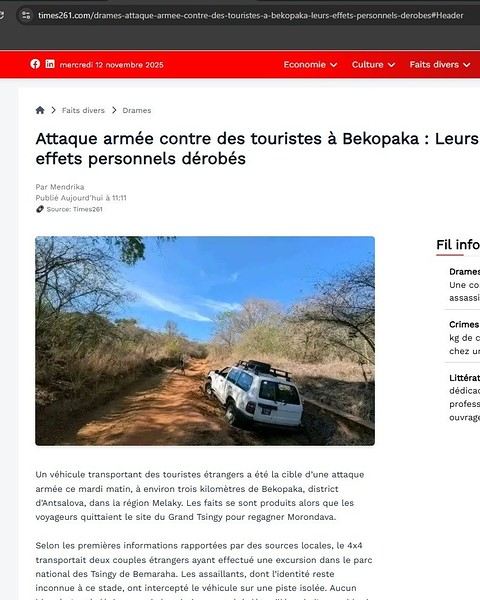
A white rental Toyota Land Cruiser 4x4 carrying foreign tourists was attacked at the entrance of Tsingy de Bemaraha National Park in the village of Bekopaka, western Madagascar, yesterday. So far, there’s been no response from the central government to curb these repeated armed attacks—usually between Malagasy people, but this time targeting foreign tourists.
Madagascar - June 2025
Five years of an unintended break... The closure of VF, COVID... What a joy to rediscover the pleasure of sharing!
I’ve stayed true to my habits: the following account is a collection of practical tips rather than a travel journal...
Madagascar is as big as France and Belgium combined. In three weeks, choices have to be made! It was the Great Tsingy that inspired our trip. We decided to focus on the southwest and the RN7. We skipped the Deep South and the North. Oh well...
OUR ITINERARY IN 3 WEEKS:
Fri 6 June – Direct AF flight to Tana – Flight arrives at 10:30 PM – Tana Sat – Antsirabe Sun – Miandrivazo Mon – Drive to the Masiakampy pier – Descent of the Tsiribihina River by pirogue - Bivouac Tue – Descent of the Tsiribihina River by pirogue - Bivouac Wed – Descent of the Tsiribihina River by pirogue – Bekopaka Thu – Pirogue on the Manambolo River and Small Tsingy of Bemaraha – Bekopaka Fri – Great Tsingy of Bemaraha – Bekopaka Sat – Avenue of the Baobabs – Morondava Sun – Belo sur Mer Mon – Free day – Belo sur Mer Tue – Manja Wed – Andavadoaka Thu – Free day – Andavadoaka Fri – Salary Lagoon – Mangily Sat – Ranohira Sun – Isalo National Park - Ranohira Mon – Anja Reserve - Ambalavao - Fianarantsoa Tue – FCE train canceled – Visit to a Tanala village - Manakara Wed – Pirogue on the Pangalanes Canal – Ranomafana Thu – Ranomafana NP – Ranomafana Fri – Ambositra – Antsirabe Sat 28 June – AF flight to Paris – Flight departs at 11:55 PM
TRIP ORGANIZATION: I prepared my trip using the usual guides (LP and Rough Guide), the internet, and the Freytag & Berndt map (1:1,000,000). I’m old-school—I still love visualizing my route on a paper map, even though in Madagascar, it’s misleading because some National Roads are only national in name!...
The agency: Since we couldn’t deal directly with a driver-guide (we lacked reliable info to take the plunge), we went through an agency to organize the logistics of our trip. We didn’t feel like using bush taxis (not enough time) or driving a 4x4 ourselves (neither the skills nor the boldness). The French agency connected us with a local agency, to whom I sent my detailed itinerary by email. A few exchanges via email and WhatsApp calls allowed us to finalize everything quickly after some adjustments. As you’ve gathered... we multiplied the commissions, which inflated the budget. That said, in the end, we were thrilled with our decision and our choice. Our trip was booked by the end of 2024, and reservations were made immediately. No bad surprises: the bookings in the planned hotels were honored, often with one of the best rooms. On our last day in Tana, before departure, we were lucky enough to meet the director I’d been communicating with, who helped build and validate our circuit. A very warm debriefing.
The driver-guide: The agency assigned us Faly, 33, a driver-guide for over 10 years. He stayed with us from start to finish: he picked us up at the airport on arrival and dropped us off 23 days later. A very experienced driver (which is important here), an open and cultured guide, reliable, punctual, and a great companion. And a provider of good advice throughout the trip. We made the most of the long stretches on dirt roads or highways to listen to him talk about daily life, rituals, wildlife, and flora... No time wasted! With a great playlist in the background, we combined business with pleasure! Faly’s accommodation and meals were included (quite often, hotels offer free lodging and meals to driver-guides who bring clients), as was the fuel. That didn’t stop us from inviting Faly to share a beer or our evening meal sometimes. He didn’t always accept, wanting to let us "enjoy our romantic evenings," as he put it. Present without being intrusive! Faly is fully capable of organizing a tailor-made trip directly. I recommend him without any hesitation—we were delighted with his service. I’ll gladly share his contact details via PM to anyone who asks.
Local guides: It’s the national guide’s prerogative to choose the local guides (mandatory in the parks). Thanks to his experience, Faly always booked us amazing, competent, and interesting local guides.
Hotels: I told the agency I wanted charming, comfortable accommodations, without falling into flashy luxury. We loved all the hotels (except the Hôtel Kanto in Manja). The rooms, mostly bungalows, were always spacious and clean. Unfortunately, I can’t give the prices—I didn’t get the details. Breakfast is always included, usually fresh and hearty. Very often, a small bottle of water is provided in the room.
Tana Hôtel Les 3 Métis Power cuts are common (!) in Tana. Bring a headlamp.
Antsirabe Ecolodge – Les chambres du voyageur Maybe our favorite! A few bungalows, beautifully arranged in a splendid tropical garden. The dog Kodak welcomes us warmly.
Miandrivazo Hôtel Princesse Tsiribihina Magnificent view of the valley.
Bekopaka Hôtel Orchidée du Bemaraha 2 (yes, 2) beautiful pools, a large open common room.
Morondava Hôtel Baobab Café Brand new or at least, according to Faly, just renovated. Very comfortable but without much charm (international style).
Belo sur Mer Ecolodge du Menabe The bungalows, all made of wood, bamboo, and thatch, are set on the beach. Very spacious and fully equipped! Large open-air restaurant by the sea. No hot water from the tap—it’s available in plastic bottles heated by the sun in front of each bungalow. Actually, we never used it... Another very, very beautiful spot.
Manja Hôtel Kanto The only hotel on this leg of the journey, so no choice. The owner knows it and, as a result, doesn’t bother. It’s a real dive! Tiny, dark room, a sordid bathroom with only a trickle of water—we skipped the shower! Clean sheets, though. Obviously, no Wi-Fi. The only place where I didn’t leave a tip. We were well warned about the discomfort of this stop, both by the agency and Faly. We weren’t surprised, and it even became a running joke during the trip. On the other hand, we found a nice little market in town.
Andavadoaka Manga Lodge What bliss! Especially after the horrible Hôtel Kanto. A paradise-like spot, overlooking three beautiful deserted white-sand beaches. Meals are served on the terrace facing the sea. Stunning sunset. We loved spending a day lounging here! We were the only guests and were pampered.
Mangily (Ifaty) Mangily is the "suburb" of Ifaty. Hôtel Vovo Telo A large beachfront bungalow complex. More touristy but pleasant—we spent a lovely evening there with our feet in the sand.
Ranohira Le Relais de la Reine A splendid resort built by a Frenchman, at the foot of the rocks, very well integrated into the environment. Beautiful marked trail starting from the garden.
Fianarantsoa Villa Sylvestre Contrary to what its name suggests, it’s a hotel right in the city center. Quite decent, though.
Manakara Parthenay Club Pretty bungalows in a large garden by the sea, but swimming isn’t safe—the water is too dangerous and rough.
Ranomafana Hôtel Thermal Very spacious rooms.
Meals: Not all our meals were included. It’s really not expensive. 1 meat or fish dish: around 35,000 Ar 1 full menu (starter, main, dessert): around 70,000 Ar 1 large THB beer (65 cl): between 8,000 and 12,000 Ar 1 piña colada: 15,000 Ar 1 flavored rum: 6,000 Ar (sometimes free) 1 glass of baobab juice (!): 5,000 Ar
We always ate very well. Rice is everywhere, served in large quantities. Zebu meat is quite good if not overcooked. Personally, I prefer fish, and I feasted: grouper, captain, crab, small lobsters...
We happily discovered baobab juice (especially in Belo, on the west coast). And of course, flavored rums!
We bought 2 packs of 6 bottles of mineral water at Carrefour (!) (about 5,000 Ar per large bottle) at the start of our trip. That was enough, especially since we often got water in the bungalows.
We had a few picnics included in our trip. Instead of picking up the hotel’s lunchbox, Faly prepared delicious, fresh, and varied picnics for us: tuna pasta salad, fried rice with eggs, grilled vegetables, and avocado...
An exceptional address not to miss: Mad Zébu – Belo sur Tsiribihina A highly reputed restaurant, a favorite of LP and Rough Guide, and rightly so! Gourmet cuisine, refined and elegant. Barely more expensive than elsewhere, and it’s worth it. We stopped there on our way up to Bekopaka and the Tsingy NP. Fully booked! So Faly reserved for our return, three days later. We’re still thanking him! What a treat!
THE BUDGET: Ariary exchange rate: 5,000 Ar = 1 €
Pre-trip expenses: Direct Air France flights: 930 € per person round trip Cost of the circuit with the agency: 2,880 € per person
The visa: Issued on arrival, very quickly. 35 € per person for a stay under 30 days. Super simple. Super fast.
On-site expenses: As soon as we arrived at the airport (it was nearly midnight), Faly advised us to exchange our euros for all our needs. There are few opportunities on our route to find an ATM or an open bank with a good rate. To be more comfortable, he took us to a small office under military protection just outside the airport. I exchanged 1,200 € (I had asked the agency for advice on the amount to bring) at a rate of 4,750 Ar and became a millionaire. Faly recounted all the stacks. That covered all our expenses (meals, drinks, tips) without ever feeling deprived. Personal purchases were made at the end of the trip. Convenient—it served as an adjustment variable. We spent our last million (200 €) on marquetry and vanilla. Tip: We asked for 200,000 Ar in 5,000 Ar bills for tips. That wasn’t too much—I even ran short of small bills in the last two days.
Tips: Madagascar is a poor country where every service deserves a small reward. While not mandatory, it’s customary. But no one ever demanded or expected it openly. On the contrary, I sometimes had to remind a porter to give them my small bill. We never carried our luggage—porters were always present when the car arrived or waiting at our door to watch for our departure. I gave each of them 5,000 Ar. In restaurants, I rounded up to the nearest ten and left the change. Local guides also expect a tip: I gave around 20,000 Ar per day for the two of us. Finally, the national guide also expects a gratuity. I had read online to budget 5 € per day per person. I added more since we were so happy with his services. The tip was given at the end of the trip, in euros, outside the budget.
Total budget all included (excluding personal purchases): 8,690 € Clearly, Madagascar is a country where life isn’t expensive, but travel costs add up quickly due to the need to rent a 4x4 with a driver.
HIGHLIGHTS:
· The dirt roads Yes, I’m listing them among the highlights! We loved those long hours spent driving at 20 km/h on rocky, muddy, white, red, or gray sand tracks... surrounded by tropical vegetation, palm trees, pandanus, mango trees... The experiences were sometimes thrilling: crossing a river on a ferry (just planks of wood fixed on two motorized pirogues side by side) or crossing a river without a ferry, with just a kid running ahead of the 4x4 to show the way; soft sand where the 4x4 easily gets stuck... The tracks are quite narrow, and crossing paths with a bush taxi, a zebu cart, or a herd of goats is always epic. So many beautiful images, so many beautiful photos! Much more beautiful than on asphalt. So yes, we loved those long stretches on dirt roads. For us, it was clearly part of the journey. Faly was particularly careful, and the 4x4 was comfortable. No injuries, no fatigue, even after 7 or 8 hours on rough tracks. The national roads (including the famous RN7) are badly damaged by cyclones, huge trucks, and lack of maintenance. Potholes have turned into ostrich nests, and we didn’t drive much faster than on the dirt roads.
· The landscapes, villages, encounters... We crossed a variety of stunning landscapes: mountains with slopes covered in terraced crops, rice fields from apple green to emerald green, sugarcane fields, then tropical forests, baobab forests (they deserve a special paragraph below), traveler’s tree forests. And then coastlines with white sand dunes against a backdrop of blue hues!... Magical! We also passed through many villages with houses whose architecture varied by region. The Betsileo houses display beautiful decorative brick reliefs. On the west coast, the houses are more precarious, made of bamboo with palm-thatched roofs. In the Highlands region, we found solid houses with pastel plaster. Each region has its own landscape, crops, habitat, and clothing. Zebu carts are often the only means of transport in remote villages. We saw them very frequently. Again, the cart’s decoration depends on the region. And then, we met many villagers coming out of the bush and walking to the next market, carrying their crops on their heads or shoulders. More beautiful photos!
· The descent of the Tsiribihina River We boarded around 9 AM in a long pirogue with Gana, the local guide, and two pirogue men. So, five of us. The pirogue is long but narrow, about 65 cm wide. We sat one behind the other at the front on seats padded with what would become our mattresses during the bivouacs. We only took the bare essentials for two nights. A little goodbye to Faly, whom we’d see again in three days! Don’t forget us! The river is silty—meaning orange, opaque but clean. We glided along silently. Gana showed us the trees, birds, crocodiles (we saw five—apparently, we were lucky). The pirogue men rowed to get us as close as possible to these crocs sunbathing on the roots of big trees. Yeah, right!... as soon as we got too close, *splash*, they disappeared into the water. We marveled at the mini rice fields lining the river. Every tiny plot, no matter how small, is cultivated. Above them, banana fields. And on the water, a whole life of fishermen and villagers living with and from the river. Gana warned us we’d eat on the pirogue because the journey was long. So, I expected chips... But no—fried rice and zebu steak, cooked right in the pirogue!! Incredible! In the middle of the afternoon, we reached a small beach where we disembarked. Gana led us about a hundred meters to a sublime waterfall. We were alone there. We had time to swim. We’d brought our swimsuits and a towel (bought at the Carrefour in Antsirabe on Faly’s wise advice!). This swim in this paradise-like spot remains one of our best memories. We found our pirogue again and set off until our first bivouac. We’d sailed for 7 hours today. The tents were set up on a wide beach, without a single tree. A moment of solitude... Uh, where can we go to the bathroom?... Especially since it was a full moon, so we felt like we were in the spotlight. Anyway... we did as everyone else—walked away, dug a hole, and the others turned their backs. A hearty meal on the beach before a comfortable and silent night. The next day, same program, with slightly different landscapes. The gorges widened, the trees were different. But still many colorful birds. Again, we ate on the pirogue: grilled chicken and vegetables. 9 hours of sailing. A similar bivouac. This time, we got it. On the third day, we finished the descent with 5 hours of sailing. So, 7 hours, 9 hours, 5 hours... doing nothing. It might sound boring... but it wasn’t. Like the dirt roads, these were contemplative moments. It glides, it’s calm, relaxing, and there’s a lot of life on this river, animal and human. Contemplation. Suspended time. On arrival, we disembarked at a sort of joyful, bustling river port. Of course, Faly was already there to pick us up.
· The Tsingy de Bemaraha NP (Small and Great) I have vertigo. During my research, several agencies advised me against visiting the Great Tsingy. "Stick to the Small ones," they said. Grrr, no, not what I wanted—we’ve dreamed of this for years! The agency we chose also warned me but didn’t discourage me. So we started with the Small Tsingy, quite close to Bekopaka, guided by Alisha. This forest of sharp limestone rocks is impressive. No vertigo issues here. The day was completed with a short pirogue ride on the Manambolo River and a visit to two caves with pretty formations. The next day, Faly and Alisha drove us to the Great Tsingy (a good hour on a terrible track). Arriving at the park entrance, Alisha equipped us with harnesses, carabiners, and gave us some safety instructions. Faly was also equipped. Wait? He’s coming with us? I quickly understood he was there for me—if I got stuck, he could go back with me, and Philippe could continue with Alisha. A wise precaution that delighted and reassured me. In the end, it was unnecessary since the famous bridge crossing was fully secured by the harness and carabiners. 18 meters on planks, one by one, it didn’t sway too much—I walked looking straight ahead, not a glance down. I even managed to smile in the middle of the crossing—I have a photo to prove it! I was overjoyed! The circuit in the Great Tsingy is a loop, so we didn’t have to cross the bridge again. We climbed to viewpoints offering breathtaking panoramic views. It’s extraordinary, unique, incredible. All this to say that if you have vertigo, don’t hesitate! It’s doable! It’s completely safe and really worth pushing your limits a bit! For those who’ve done treetop adventure courses, it’s similar. Also, no need to be a great athlete—just a bit of agility to climb a few ladders and high steps. Don’t censor yourself! I even had a small regret—the loop was a bit short (about 2 hours). I would’ve liked to continue or even redo it, with less apprehension. Tip: Do the Small Tsingy before the Great ones, or not at all. And if you can only do one, do the Great ones without hesitation.
· Canoeing in the Belo mangrove The Belo sur Mer ecolodge lends small individual canoes for free to go to the mangrove. We left at high tide, paddled for about twenty minutes to reach a fairly sparse forest where we could easily venture in. Very shallow water, crystal clear—we could see the roots of all these trees, schools of tiny fish... It was quite surprising. Until then, I only knew impenetrable, tangled mangroves. Here, nothing like that—we walked through an aquatic forest. We loved this adventure so much we left a bit late. The tide had gone out, and we had to carry our canoes for the last few meters... Of course, the staff came to help (probably laughing silently!). The lodge owners gave all the necessary explanations and lent a waterproof bag for the phone (because yes, it’s worth taking photos!). A very useful precaution—the canoes are small, low in the water, and paddling quickly soaks you. Again, this isn’t just for Tony Estanguet! It didn’t cause us any problems, not even sore muscles the next day. A great experience. It’ll take about 2 hours.
· Isalo NP Big surprise when we saw this huge rocky massif appear on the RN7! A massif of colored sandstone, carved with crevasses giving it a ruined look. Le Relais de la Reine is a little gem cleverly nestled in the heart of these rocks. A small marked trail starts from the garden. We picked up the description at reception and set off. Without a guide, alone following the markers, it took us 2 hours to complete this magnificent little trail, giving us a first glimpse of the massif before the hike the next day. And we enjoyed being completely alone for this walk. It’s free, easy, and well-signposted. Don’t miss it. In the evening, Faly took us to the so-called Isalo Window site—a hole in a wall through which we could see the sunset. We met all the tourists in the area here. We weren’t blown away by the show... The next day, we left early to reach the start of the hike. We met Zozoly at the guides’ office in the small town of Ranohira. During this hike, we climbed through the rocks to a viewpoint offering stunning 360° views of the massif. Then we reached a site called the "natural pool," breathtakingly beautiful, especially since we were alone again. A sort of oasis, a cascading waterfall, palm trees and tree ferns, fine sand, all nestled at the bottom of a small canyon. Paradise-like. We resisted swimming, but it was really tempting. A long walk on the plateaus then led us to a well-equipped picnic site where a local team prepared grills. Concrete tables were tiered in a spacious, shady clearing where a whole family of ring-tailed lemurs frolicked. They knew the tourists’ habits and tried to snatch food. Playful and not very shy, they amused us with their antics! We had to resist not luring them with a piece of banana!! Thousands of photos!! After the meal, we set off again with Zozoly for another landscape. This time, we were by a small river at the bottom of a canyon with high walls covered in vegetation. The trail was narrow and slippery, on a ledge of the wall. We progressed carefully. No danger, though. We first reached the Blue Pool, which only turns blue in photos (surprise!), then the Black Pool fed by a shower of waterfalls. Two magnificent spots that showed us a completely different aspect of the massif.
· Anja Reserve This ficus forest is home to many groups of lemurs. Used to humans, whom they don’t fear, they move around us, ignoring us completely. It’s almost annoying... The best place on our trip to see lemurs.
· The FCE train To the great regret of Manakara’s inhabitants, the FCE train hasn’t reached here for over a year and a half. As a result, there are far fewer tourists—the train was part of the experience. We drove there and didn’t regret coming to this port on the east coast.
· Visit to a Tanala village This visit wasn’t part of our program—it was added by the agency to compensate for the train not running. Which was the case. Not big fans of this kind of visit, where we feel like we’re at a zoo, voyeuristic, lacking authenticity, we followed the local guide with some skepticism and exchanged dubious looks. And yet... the guide’s explanations about village life and the warm, smiling welcome from the villagers charmed us and dispelled all our concerns. We learned a lot, met smiling families, and were able to enter these beautiful bamboo houses. A very pleasant surprise, rich in lessons.
· The Pangalanes Canal Arriving in Manakara, we crossed a bridge overlooking the Pangalanes Canal. A cry of surprise: the water is turquoise! We took a short pirogue ride with a team of three pirogue men and Joël, a local guide who explained the drama caused by the train’s halt. We stopped in a fishing village where Joël bought fish for the barbecue. We ended up on a beach where the team prepared the meal while we went to watch the fishermen return on the nearby beach. We admired the fishermen’s dexterity in untangling their nets, sorting their fish, cleaning their gear. On our return, we found a small table set up on the beach, in the shade of palm trees and casuarinas. Lobsters, captain fish, grilled vegetables, sautéed potatoes. A real feast (included in the trip cost).
· Ranomafana NP A 4-5 hour hike (some climbing) in a dense secondary forest to look for lemurs. As usual, we were accompanied by a local guide who, while waiting to find our furry friends, gave us lots of info on the vegetation, birds, and Tanala ethnic rituals. In the forest, we met 4 or 5 trackers, armed with radios to alert guides of their findings. In the end, we saw several lemurs of different types. Quite far, quite high... A nice complement to our lemur encounters in Isalo. Here, it rains 200 days a year. We started the hike in thick fog, but the forest’s density protected us from the humidity. Be careful—it can be a bit frustrating to see the lemurs so far away, so high. Nothing like the Anja Reserve or Isalo NP. Here, what’s fun is the hunt.
· The baobabs We were captivated by these kings of the forest, noble, imposing, majestic. We spotted them from very far away, towering over the rest of the vegetation. Alone, in small groups, or in forests, our trip allowed us to see hundreds of them! Mainly on the west coast. All different—bald, hairy, shaggy, short and stout, tall and thin, like Laurel and Hardy. Philippe took to naming them. Respectfully!
OUR FAVORITES: · The variety of landscapes. · The Tsingy NP.
OUR DISAPPOINTMENTS: · The Avenue of the Baobabs, very overrated and the only place where we saw crowds. We saw many other "forests" of baobabs that were much more impressive. · It’s hard to approach the population calmly as swarms of children run up as soon as we arrive, asking for sweets. Without any aggression, their smiles and laughter quickly made us forget this small inconvenience. We never gave out candy, clothes, or money. We left pens at a school and clothes with Faly.
IF WE WERE TO DO IT AGAIN: · Same period, same duration, same pace, same itinerary, but if we were to do it again today, I’d go through Faly directly! · Maybe we should’ve stayed in Ambalavao instead of Fianarantsoa. · Plan a longer loop in the Great Tsingy—it felt a bit too short.
MISCELLANEOUS: The welcome: ‘Samala Vazaha,’ there are many, many kids, sometimes overwhelming, never aggressive. We were impressed by the villagers’ smiles and good humor, towards us or even among themselves—laughter was everywhere. Safety: No problems. Out of (excessive?) caution, we spread all our money across several bags that we padlocked whenever we left the hotel. Bribes: We were stopped several times on the road by police or gendarmes. They checked our papers, sometimes our passports. Faly was perfectly in order. No discussion, no bribes, a cordial greeting from the officers. However, several times we found ourselves at small "tolls" on the tracks for villagers who had leveled the road or filled a hole, or for the young guy who ran through the river to show the way... Faly complied without discussion: every service deserves a small bill. Language: French is still widely spoken. Credit card: Unused. Cash: You need it! The climate at this time: Ideal—blue skies, sunshine, and mild temperatures (20-25°C) throughout our trip. Temperatures started to drop by our departure—winter was setting in. Clothing: T-shirt or polo and a vest sometimes in the evening, sandals on our feet, hiking shoes for all the hikes. Tip: We left a bag in the car (completely safe) with things we didn’t need daily and dirty laundry. The two bags to take out at each stop were much lighter. Before leaving, we left several polos and T-shirts with Faly, which, once washed, will make a few people happy. Tourist crowds at this time: Low—we were sometimes the only guests at the hotel. Faly explained that at the Isalo picnic site, in high season, you have to queue for a table, whereas we had our pick. Photos: Lots! Too many! That’s the problem with digital—we take so many! Health issues: Nothing serious, just the usual mild traveler’s diarrhea. Mosquitoes: They’re voracious. We took anti-malaria treatment. I’m still not sure if it was the right thing to do... I’m always very skeptical about such precautions. Internet: Free Wi-Fi at the lodges’ reception (except at Hôtel Kanto!), sometimes (rarely) in the bungalows. Phone: We didn’t try to get a local SIM card—the evening Wi-Fi was enough for us to make calls and send messages via WhatsApp. Make sure to turn off mobile data and switch to airplane mode (I activated it a bit late—received calls, spam ones at that, were charged...). Electricity: French plugs. Personal purchases: Beautiful wooden objects (sculptures and marquetry) or zebu horn items in Ambositra. 1 kg of vanilla (400,000 Ar – 80 € per kg) in Tana.
IN CONCLUSION: A trip of contemplation. A pause for admiration, as our local guide in Isalo NP said. Nothing else to do but walk, look, and enjoy. Here, there are no old stones, no museums—it’s a trip where nature reigns supreme. And what nature!
I’ve stayed true to my habits: the following account is a collection of practical tips rather than a travel journal...
Madagascar is as big as France and Belgium combined. In three weeks, choices have to be made! It was the Great Tsingy that inspired our trip. We decided to focus on the southwest and the RN7. We skipped the Deep South and the North. Oh well...
OUR ITINERARY IN 3 WEEKS:
Fri 6 June – Direct AF flight to Tana – Flight arrives at 10:30 PM – Tana Sat – Antsirabe Sun – Miandrivazo Mon – Drive to the Masiakampy pier – Descent of the Tsiribihina River by pirogue - Bivouac Tue – Descent of the Tsiribihina River by pirogue - Bivouac Wed – Descent of the Tsiribihina River by pirogue – Bekopaka Thu – Pirogue on the Manambolo River and Small Tsingy of Bemaraha – Bekopaka Fri – Great Tsingy of Bemaraha – Bekopaka Sat – Avenue of the Baobabs – Morondava Sun – Belo sur Mer Mon – Free day – Belo sur Mer Tue – Manja Wed – Andavadoaka Thu – Free day – Andavadoaka Fri – Salary Lagoon – Mangily Sat – Ranohira Sun – Isalo National Park - Ranohira Mon – Anja Reserve - Ambalavao - Fianarantsoa Tue – FCE train canceled – Visit to a Tanala village - Manakara Wed – Pirogue on the Pangalanes Canal – Ranomafana Thu – Ranomafana NP – Ranomafana Fri – Ambositra – Antsirabe Sat 28 June – AF flight to Paris – Flight departs at 11:55 PM
TRIP ORGANIZATION: I prepared my trip using the usual guides (LP and Rough Guide), the internet, and the Freytag & Berndt map (1:1,000,000). I’m old-school—I still love visualizing my route on a paper map, even though in Madagascar, it’s misleading because some National Roads are only national in name!...
The agency: Since we couldn’t deal directly with a driver-guide (we lacked reliable info to take the plunge), we went through an agency to organize the logistics of our trip. We didn’t feel like using bush taxis (not enough time) or driving a 4x4 ourselves (neither the skills nor the boldness). The French agency connected us with a local agency, to whom I sent my detailed itinerary by email. A few exchanges via email and WhatsApp calls allowed us to finalize everything quickly after some adjustments. As you’ve gathered... we multiplied the commissions, which inflated the budget. That said, in the end, we were thrilled with our decision and our choice. Our trip was booked by the end of 2024, and reservations were made immediately. No bad surprises: the bookings in the planned hotels were honored, often with one of the best rooms. On our last day in Tana, before departure, we were lucky enough to meet the director I’d been communicating with, who helped build and validate our circuit. A very warm debriefing.
The driver-guide: The agency assigned us Faly, 33, a driver-guide for over 10 years. He stayed with us from start to finish: he picked us up at the airport on arrival and dropped us off 23 days later. A very experienced driver (which is important here), an open and cultured guide, reliable, punctual, and a great companion. And a provider of good advice throughout the trip. We made the most of the long stretches on dirt roads or highways to listen to him talk about daily life, rituals, wildlife, and flora... No time wasted! With a great playlist in the background, we combined business with pleasure! Faly’s accommodation and meals were included (quite often, hotels offer free lodging and meals to driver-guides who bring clients), as was the fuel. That didn’t stop us from inviting Faly to share a beer or our evening meal sometimes. He didn’t always accept, wanting to let us "enjoy our romantic evenings," as he put it. Present without being intrusive! Faly is fully capable of organizing a tailor-made trip directly. I recommend him without any hesitation—we were delighted with his service. I’ll gladly share his contact details via PM to anyone who asks.
Local guides: It’s the national guide’s prerogative to choose the local guides (mandatory in the parks). Thanks to his experience, Faly always booked us amazing, competent, and interesting local guides.
Hotels: I told the agency I wanted charming, comfortable accommodations, without falling into flashy luxury. We loved all the hotels (except the Hôtel Kanto in Manja). The rooms, mostly bungalows, were always spacious and clean. Unfortunately, I can’t give the prices—I didn’t get the details. Breakfast is always included, usually fresh and hearty. Very often, a small bottle of water is provided in the room.
Tana Hôtel Les 3 Métis Power cuts are common (!) in Tana. Bring a headlamp.
Antsirabe Ecolodge – Les chambres du voyageur Maybe our favorite! A few bungalows, beautifully arranged in a splendid tropical garden. The dog Kodak welcomes us warmly.
Miandrivazo Hôtel Princesse Tsiribihina Magnificent view of the valley.
Bekopaka Hôtel Orchidée du Bemaraha 2 (yes, 2) beautiful pools, a large open common room.
Morondava Hôtel Baobab Café Brand new or at least, according to Faly, just renovated. Very comfortable but without much charm (international style).
Belo sur Mer Ecolodge du Menabe The bungalows, all made of wood, bamboo, and thatch, are set on the beach. Very spacious and fully equipped! Large open-air restaurant by the sea. No hot water from the tap—it’s available in plastic bottles heated by the sun in front of each bungalow. Actually, we never used it... Another very, very beautiful spot.
Manja Hôtel Kanto The only hotel on this leg of the journey, so no choice. The owner knows it and, as a result, doesn’t bother. It’s a real dive! Tiny, dark room, a sordid bathroom with only a trickle of water—we skipped the shower! Clean sheets, though. Obviously, no Wi-Fi. The only place where I didn’t leave a tip. We were well warned about the discomfort of this stop, both by the agency and Faly. We weren’t surprised, and it even became a running joke during the trip. On the other hand, we found a nice little market in town.
Andavadoaka Manga Lodge What bliss! Especially after the horrible Hôtel Kanto. A paradise-like spot, overlooking three beautiful deserted white-sand beaches. Meals are served on the terrace facing the sea. Stunning sunset. We loved spending a day lounging here! We were the only guests and were pampered.
Mangily (Ifaty) Mangily is the "suburb" of Ifaty. Hôtel Vovo Telo A large beachfront bungalow complex. More touristy but pleasant—we spent a lovely evening there with our feet in the sand.
Ranohira Le Relais de la Reine A splendid resort built by a Frenchman, at the foot of the rocks, very well integrated into the environment. Beautiful marked trail starting from the garden.
Fianarantsoa Villa Sylvestre Contrary to what its name suggests, it’s a hotel right in the city center. Quite decent, though.
Manakara Parthenay Club Pretty bungalows in a large garden by the sea, but swimming isn’t safe—the water is too dangerous and rough.
Ranomafana Hôtel Thermal Very spacious rooms.
Meals: Not all our meals were included. It’s really not expensive. 1 meat or fish dish: around 35,000 Ar 1 full menu (starter, main, dessert): around 70,000 Ar 1 large THB beer (65 cl): between 8,000 and 12,000 Ar 1 piña colada: 15,000 Ar 1 flavored rum: 6,000 Ar (sometimes free) 1 glass of baobab juice (!): 5,000 Ar
We always ate very well. Rice is everywhere, served in large quantities. Zebu meat is quite good if not overcooked. Personally, I prefer fish, and I feasted: grouper, captain, crab, small lobsters...
We happily discovered baobab juice (especially in Belo, on the west coast). And of course, flavored rums!
We bought 2 packs of 6 bottles of mineral water at Carrefour (!) (about 5,000 Ar per large bottle) at the start of our trip. That was enough, especially since we often got water in the bungalows.
We had a few picnics included in our trip. Instead of picking up the hotel’s lunchbox, Faly prepared delicious, fresh, and varied picnics for us: tuna pasta salad, fried rice with eggs, grilled vegetables, and avocado...
An exceptional address not to miss: Mad Zébu – Belo sur Tsiribihina A highly reputed restaurant, a favorite of LP and Rough Guide, and rightly so! Gourmet cuisine, refined and elegant. Barely more expensive than elsewhere, and it’s worth it. We stopped there on our way up to Bekopaka and the Tsingy NP. Fully booked! So Faly reserved for our return, three days later. We’re still thanking him! What a treat!
THE BUDGET: Ariary exchange rate: 5,000 Ar = 1 €
Pre-trip expenses: Direct Air France flights: 930 € per person round trip Cost of the circuit with the agency: 2,880 € per person
The visa: Issued on arrival, very quickly. 35 € per person for a stay under 30 days. Super simple. Super fast.
On-site expenses: As soon as we arrived at the airport (it was nearly midnight), Faly advised us to exchange our euros for all our needs. There are few opportunities on our route to find an ATM or an open bank with a good rate. To be more comfortable, he took us to a small office under military protection just outside the airport. I exchanged 1,200 € (I had asked the agency for advice on the amount to bring) at a rate of 4,750 Ar and became a millionaire. Faly recounted all the stacks. That covered all our expenses (meals, drinks, tips) without ever feeling deprived. Personal purchases were made at the end of the trip. Convenient—it served as an adjustment variable. We spent our last million (200 €) on marquetry and vanilla. Tip: We asked for 200,000 Ar in 5,000 Ar bills for tips. That wasn’t too much—I even ran short of small bills in the last two days.
Tips: Madagascar is a poor country where every service deserves a small reward. While not mandatory, it’s customary. But no one ever demanded or expected it openly. On the contrary, I sometimes had to remind a porter to give them my small bill. We never carried our luggage—porters were always present when the car arrived or waiting at our door to watch for our departure. I gave each of them 5,000 Ar. In restaurants, I rounded up to the nearest ten and left the change. Local guides also expect a tip: I gave around 20,000 Ar per day for the two of us. Finally, the national guide also expects a gratuity. I had read online to budget 5 € per day per person. I added more since we were so happy with his services. The tip was given at the end of the trip, in euros, outside the budget.
Total budget all included (excluding personal purchases): 8,690 € Clearly, Madagascar is a country where life isn’t expensive, but travel costs add up quickly due to the need to rent a 4x4 with a driver.
HIGHLIGHTS:
· The dirt roads Yes, I’m listing them among the highlights! We loved those long hours spent driving at 20 km/h on rocky, muddy, white, red, or gray sand tracks... surrounded by tropical vegetation, palm trees, pandanus, mango trees... The experiences were sometimes thrilling: crossing a river on a ferry (just planks of wood fixed on two motorized pirogues side by side) or crossing a river without a ferry, with just a kid running ahead of the 4x4 to show the way; soft sand where the 4x4 easily gets stuck... The tracks are quite narrow, and crossing paths with a bush taxi, a zebu cart, or a herd of goats is always epic. So many beautiful images, so many beautiful photos! Much more beautiful than on asphalt. So yes, we loved those long stretches on dirt roads. For us, it was clearly part of the journey. Faly was particularly careful, and the 4x4 was comfortable. No injuries, no fatigue, even after 7 or 8 hours on rough tracks. The national roads (including the famous RN7) are badly damaged by cyclones, huge trucks, and lack of maintenance. Potholes have turned into ostrich nests, and we didn’t drive much faster than on the dirt roads.
· The landscapes, villages, encounters... We crossed a variety of stunning landscapes: mountains with slopes covered in terraced crops, rice fields from apple green to emerald green, sugarcane fields, then tropical forests, baobab forests (they deserve a special paragraph below), traveler’s tree forests. And then coastlines with white sand dunes against a backdrop of blue hues!... Magical! We also passed through many villages with houses whose architecture varied by region. The Betsileo houses display beautiful decorative brick reliefs. On the west coast, the houses are more precarious, made of bamboo with palm-thatched roofs. In the Highlands region, we found solid houses with pastel plaster. Each region has its own landscape, crops, habitat, and clothing. Zebu carts are often the only means of transport in remote villages. We saw them very frequently. Again, the cart’s decoration depends on the region. And then, we met many villagers coming out of the bush and walking to the next market, carrying their crops on their heads or shoulders. More beautiful photos!
· The descent of the Tsiribihina River We boarded around 9 AM in a long pirogue with Gana, the local guide, and two pirogue men. So, five of us. The pirogue is long but narrow, about 65 cm wide. We sat one behind the other at the front on seats padded with what would become our mattresses during the bivouacs. We only took the bare essentials for two nights. A little goodbye to Faly, whom we’d see again in three days! Don’t forget us! The river is silty—meaning orange, opaque but clean. We glided along silently. Gana showed us the trees, birds, crocodiles (we saw five—apparently, we were lucky). The pirogue men rowed to get us as close as possible to these crocs sunbathing on the roots of big trees. Yeah, right!... as soon as we got too close, *splash*, they disappeared into the water. We marveled at the mini rice fields lining the river. Every tiny plot, no matter how small, is cultivated. Above them, banana fields. And on the water, a whole life of fishermen and villagers living with and from the river. Gana warned us we’d eat on the pirogue because the journey was long. So, I expected chips... But no—fried rice and zebu steak, cooked right in the pirogue!! Incredible! In the middle of the afternoon, we reached a small beach where we disembarked. Gana led us about a hundred meters to a sublime waterfall. We were alone there. We had time to swim. We’d brought our swimsuits and a towel (bought at the Carrefour in Antsirabe on Faly’s wise advice!). This swim in this paradise-like spot remains one of our best memories. We found our pirogue again and set off until our first bivouac. We’d sailed for 7 hours today. The tents were set up on a wide beach, without a single tree. A moment of solitude... Uh, where can we go to the bathroom?... Especially since it was a full moon, so we felt like we were in the spotlight. Anyway... we did as everyone else—walked away, dug a hole, and the others turned their backs. A hearty meal on the beach before a comfortable and silent night. The next day, same program, with slightly different landscapes. The gorges widened, the trees were different. But still many colorful birds. Again, we ate on the pirogue: grilled chicken and vegetables. 9 hours of sailing. A similar bivouac. This time, we got it. On the third day, we finished the descent with 5 hours of sailing. So, 7 hours, 9 hours, 5 hours... doing nothing. It might sound boring... but it wasn’t. Like the dirt roads, these were contemplative moments. It glides, it’s calm, relaxing, and there’s a lot of life on this river, animal and human. Contemplation. Suspended time. On arrival, we disembarked at a sort of joyful, bustling river port. Of course, Faly was already there to pick us up.
· The Tsingy de Bemaraha NP (Small and Great) I have vertigo. During my research, several agencies advised me against visiting the Great Tsingy. "Stick to the Small ones," they said. Grrr, no, not what I wanted—we’ve dreamed of this for years! The agency we chose also warned me but didn’t discourage me. So we started with the Small Tsingy, quite close to Bekopaka, guided by Alisha. This forest of sharp limestone rocks is impressive. No vertigo issues here. The day was completed with a short pirogue ride on the Manambolo River and a visit to two caves with pretty formations. The next day, Faly and Alisha drove us to the Great Tsingy (a good hour on a terrible track). Arriving at the park entrance, Alisha equipped us with harnesses, carabiners, and gave us some safety instructions. Faly was also equipped. Wait? He’s coming with us? I quickly understood he was there for me—if I got stuck, he could go back with me, and Philippe could continue with Alisha. A wise precaution that delighted and reassured me. In the end, it was unnecessary since the famous bridge crossing was fully secured by the harness and carabiners. 18 meters on planks, one by one, it didn’t sway too much—I walked looking straight ahead, not a glance down. I even managed to smile in the middle of the crossing—I have a photo to prove it! I was overjoyed! The circuit in the Great Tsingy is a loop, so we didn’t have to cross the bridge again. We climbed to viewpoints offering breathtaking panoramic views. It’s extraordinary, unique, incredible. All this to say that if you have vertigo, don’t hesitate! It’s doable! It’s completely safe and really worth pushing your limits a bit! For those who’ve done treetop adventure courses, it’s similar. Also, no need to be a great athlete—just a bit of agility to climb a few ladders and high steps. Don’t censor yourself! I even had a small regret—the loop was a bit short (about 2 hours). I would’ve liked to continue or even redo it, with less apprehension. Tip: Do the Small Tsingy before the Great ones, or not at all. And if you can only do one, do the Great ones without hesitation.
· Canoeing in the Belo mangrove The Belo sur Mer ecolodge lends small individual canoes for free to go to the mangrove. We left at high tide, paddled for about twenty minutes to reach a fairly sparse forest where we could easily venture in. Very shallow water, crystal clear—we could see the roots of all these trees, schools of tiny fish... It was quite surprising. Until then, I only knew impenetrable, tangled mangroves. Here, nothing like that—we walked through an aquatic forest. We loved this adventure so much we left a bit late. The tide had gone out, and we had to carry our canoes for the last few meters... Of course, the staff came to help (probably laughing silently!). The lodge owners gave all the necessary explanations and lent a waterproof bag for the phone (because yes, it’s worth taking photos!). A very useful precaution—the canoes are small, low in the water, and paddling quickly soaks you. Again, this isn’t just for Tony Estanguet! It didn’t cause us any problems, not even sore muscles the next day. A great experience. It’ll take about 2 hours.
· Isalo NP Big surprise when we saw this huge rocky massif appear on the RN7! A massif of colored sandstone, carved with crevasses giving it a ruined look. Le Relais de la Reine is a little gem cleverly nestled in the heart of these rocks. A small marked trail starts from the garden. We picked up the description at reception and set off. Without a guide, alone following the markers, it took us 2 hours to complete this magnificent little trail, giving us a first glimpse of the massif before the hike the next day. And we enjoyed being completely alone for this walk. It’s free, easy, and well-signposted. Don’t miss it. In the evening, Faly took us to the so-called Isalo Window site—a hole in a wall through which we could see the sunset. We met all the tourists in the area here. We weren’t blown away by the show... The next day, we left early to reach the start of the hike. We met Zozoly at the guides’ office in the small town of Ranohira. During this hike, we climbed through the rocks to a viewpoint offering stunning 360° views of the massif. Then we reached a site called the "natural pool," breathtakingly beautiful, especially since we were alone again. A sort of oasis, a cascading waterfall, palm trees and tree ferns, fine sand, all nestled at the bottom of a small canyon. Paradise-like. We resisted swimming, but it was really tempting. A long walk on the plateaus then led us to a well-equipped picnic site where a local team prepared grills. Concrete tables were tiered in a spacious, shady clearing where a whole family of ring-tailed lemurs frolicked. They knew the tourists’ habits and tried to snatch food. Playful and not very shy, they amused us with their antics! We had to resist not luring them with a piece of banana!! Thousands of photos!! After the meal, we set off again with Zozoly for another landscape. This time, we were by a small river at the bottom of a canyon with high walls covered in vegetation. The trail was narrow and slippery, on a ledge of the wall. We progressed carefully. No danger, though. We first reached the Blue Pool, which only turns blue in photos (surprise!), then the Black Pool fed by a shower of waterfalls. Two magnificent spots that showed us a completely different aspect of the massif.
· Anja Reserve This ficus forest is home to many groups of lemurs. Used to humans, whom they don’t fear, they move around us, ignoring us completely. It’s almost annoying... The best place on our trip to see lemurs.
· The FCE train To the great regret of Manakara’s inhabitants, the FCE train hasn’t reached here for over a year and a half. As a result, there are far fewer tourists—the train was part of the experience. We drove there and didn’t regret coming to this port on the east coast.
· Visit to a Tanala village This visit wasn’t part of our program—it was added by the agency to compensate for the train not running. Which was the case. Not big fans of this kind of visit, where we feel like we’re at a zoo, voyeuristic, lacking authenticity, we followed the local guide with some skepticism and exchanged dubious looks. And yet... the guide’s explanations about village life and the warm, smiling welcome from the villagers charmed us and dispelled all our concerns. We learned a lot, met smiling families, and were able to enter these beautiful bamboo houses. A very pleasant surprise, rich in lessons.
· The Pangalanes Canal Arriving in Manakara, we crossed a bridge overlooking the Pangalanes Canal. A cry of surprise: the water is turquoise! We took a short pirogue ride with a team of three pirogue men and Joël, a local guide who explained the drama caused by the train’s halt. We stopped in a fishing village where Joël bought fish for the barbecue. We ended up on a beach where the team prepared the meal while we went to watch the fishermen return on the nearby beach. We admired the fishermen’s dexterity in untangling their nets, sorting their fish, cleaning their gear. On our return, we found a small table set up on the beach, in the shade of palm trees and casuarinas. Lobsters, captain fish, grilled vegetables, sautéed potatoes. A real feast (included in the trip cost).
· Ranomafana NP A 4-5 hour hike (some climbing) in a dense secondary forest to look for lemurs. As usual, we were accompanied by a local guide who, while waiting to find our furry friends, gave us lots of info on the vegetation, birds, and Tanala ethnic rituals. In the forest, we met 4 or 5 trackers, armed with radios to alert guides of their findings. In the end, we saw several lemurs of different types. Quite far, quite high... A nice complement to our lemur encounters in Isalo. Here, it rains 200 days a year. We started the hike in thick fog, but the forest’s density protected us from the humidity. Be careful—it can be a bit frustrating to see the lemurs so far away, so high. Nothing like the Anja Reserve or Isalo NP. Here, what’s fun is the hunt.
· The baobabs We were captivated by these kings of the forest, noble, imposing, majestic. We spotted them from very far away, towering over the rest of the vegetation. Alone, in small groups, or in forests, our trip allowed us to see hundreds of them! Mainly on the west coast. All different—bald, hairy, shaggy, short and stout, tall and thin, like Laurel and Hardy. Philippe took to naming them. Respectfully!
OUR FAVORITES: · The variety of landscapes. · The Tsingy NP.
OUR DISAPPOINTMENTS: · The Avenue of the Baobabs, very overrated and the only place where we saw crowds. We saw many other "forests" of baobabs that were much more impressive. · It’s hard to approach the population calmly as swarms of children run up as soon as we arrive, asking for sweets. Without any aggression, their smiles and laughter quickly made us forget this small inconvenience. We never gave out candy, clothes, or money. We left pens at a school and clothes with Faly.
IF WE WERE TO DO IT AGAIN: · Same period, same duration, same pace, same itinerary, but if we were to do it again today, I’d go through Faly directly! · Maybe we should’ve stayed in Ambalavao instead of Fianarantsoa. · Plan a longer loop in the Great Tsingy—it felt a bit too short.
MISCELLANEOUS: The welcome: ‘Samala Vazaha,’ there are many, many kids, sometimes overwhelming, never aggressive. We were impressed by the villagers’ smiles and good humor, towards us or even among themselves—laughter was everywhere. Safety: No problems. Out of (excessive?) caution, we spread all our money across several bags that we padlocked whenever we left the hotel. Bribes: We were stopped several times on the road by police or gendarmes. They checked our papers, sometimes our passports. Faly was perfectly in order. No discussion, no bribes, a cordial greeting from the officers. However, several times we found ourselves at small "tolls" on the tracks for villagers who had leveled the road or filled a hole, or for the young guy who ran through the river to show the way... Faly complied without discussion: every service deserves a small bill. Language: French is still widely spoken. Credit card: Unused. Cash: You need it! The climate at this time: Ideal—blue skies, sunshine, and mild temperatures (20-25°C) throughout our trip. Temperatures started to drop by our departure—winter was setting in. Clothing: T-shirt or polo and a vest sometimes in the evening, sandals on our feet, hiking shoes for all the hikes. Tip: We left a bag in the car (completely safe) with things we didn’t need daily and dirty laundry. The two bags to take out at each stop were much lighter. Before leaving, we left several polos and T-shirts with Faly, which, once washed, will make a few people happy. Tourist crowds at this time: Low—we were sometimes the only guests at the hotel. Faly explained that at the Isalo picnic site, in high season, you have to queue for a table, whereas we had our pick. Photos: Lots! Too many! That’s the problem with digital—we take so many! Health issues: Nothing serious, just the usual mild traveler’s diarrhea. Mosquitoes: They’re voracious. We took anti-malaria treatment. I’m still not sure if it was the right thing to do... I’m always very skeptical about such precautions. Internet: Free Wi-Fi at the lodges’ reception (except at Hôtel Kanto!), sometimes (rarely) in the bungalows. Phone: We didn’t try to get a local SIM card—the evening Wi-Fi was enough for us to make calls and send messages via WhatsApp. Make sure to turn off mobile data and switch to airplane mode (I activated it a bit late—received calls, spam ones at that, were charged...). Electricity: French plugs. Personal purchases: Beautiful wooden objects (sculptures and marquetry) or zebu horn items in Ambositra. 1 kg of vanilla (400,000 Ar – 80 € per kg) in Tana.
IN CONCLUSION: A trip of contemplation. A pause for admiration, as our local guide in Isalo NP said. Nothing else to do but walk, look, and enjoy. Here, there are no old stones, no museums—it’s a trip where nature reigns supreme. And what nature!
Looking for advice and opinions on a 5-week itinerary in Madagascar
Hi everyone! I’ve put together an itinerary for Madagascar and would love to get your feedback if you can help—thanks!
December 6–9: Antananarivo 3 nights, sightseeing Andasibe-Mantadia National Park Rova of Antananarivo (Ambohimanga Fort) Lemurs’ Park
December 9–11: Fianarantsoa, 2 nights Ranomafana National Park
Ambalavao, December 11–13, 2 nights Andringitra National Park
December 13–15: Ranohira or Ilakaka, 2 nights Monkey Canyon visit Isalo National Park
December 15–18: Tulear, 3 nights Reniala Reserve visit Beach time, possible diving Antsokay Arboretum Ifaty Forest
December 18–19: Full day—take a flight to the capital and stay overnight Then on December 19, take the bus to Morondava
December 19–23: Morondava, 4 nights Kirindy Mitea National Park Avenue of the Baobabs Tsingy de Bemaraha National Park
12:30-hour bus ride from Morondava to the capital
Antananarivo, December 23–24 11:30-hour trip from the capital to Mahajanga
Mahajanga/Majunga, December 24–27, 3 nights Ankarafantsika National Park visit
Ambanja District, 3 nights December 27–30 Tsaratanana Nature Reserve visit Maromokotro trek
Nosy Be Island, December 30–January 7, 2026, 8 nights diving, beach time, relaxation, walks, hiking, snorkeling
Antsiranana, January 7–11, 4 nights Ambavanibe Bay visit Montagne d’Ambre National Park
Return to the capital for a flight home or a 28-hour bus ride
1 or 2 nights in Antananarivo depending on the return trip
January 13: Departure for France Arrival in Paris, France the next day
December 6–9: Antananarivo 3 nights, sightseeing Andasibe-Mantadia National Park Rova of Antananarivo (Ambohimanga Fort) Lemurs’ Park
December 9–11: Fianarantsoa, 2 nights Ranomafana National Park
Ambalavao, December 11–13, 2 nights Andringitra National Park
December 13–15: Ranohira or Ilakaka, 2 nights Monkey Canyon visit Isalo National Park
December 15–18: Tulear, 3 nights Reniala Reserve visit Beach time, possible diving Antsokay Arboretum Ifaty Forest
December 18–19: Full day—take a flight to the capital and stay overnight Then on December 19, take the bus to Morondava
December 19–23: Morondava, 4 nights Kirindy Mitea National Park Avenue of the Baobabs Tsingy de Bemaraha National Park
12:30-hour bus ride from Morondava to the capital
Antananarivo, December 23–24 11:30-hour trip from the capital to Mahajanga
Mahajanga/Majunga, December 24–27, 3 nights Ankarafantsika National Park visit
Ambanja District, 3 nights December 27–30 Tsaratanana Nature Reserve visit Maromokotro trek
Nosy Be Island, December 30–January 7, 2026, 8 nights diving, beach time, relaxation, walks, hiking, snorkeling
Antsiranana, January 7–11, 4 nights Ambavanibe Bay visit Montagne d’Ambre National Park
Return to the capital for a flight home or a 28-hour bus ride
1 or 2 nights in Antananarivo depending on the return trip
January 13: Departure for France Arrival in Paris, France the next day
25 days solo motorcycle loop in Madagascar (South)
Hi there,
I spent 25 days in October 2023 in Madagascar on a motorcycle, solo. Covered 3,000 km with no prior planning. And with no real motorcycle experience. However, it’s crucial to find a reliable person for motorcycle rental. Mine wasn’t extremely well-maintained, and I had quite a few issues.
Here’s an overview of the itinerary, including descending the Tsiribihina River by pirogue, the Tsingy, heading down to Tuléar, and back up the RN7 (Isalo, Tsarasoa Valley, Lake Sahambavy, etc.).
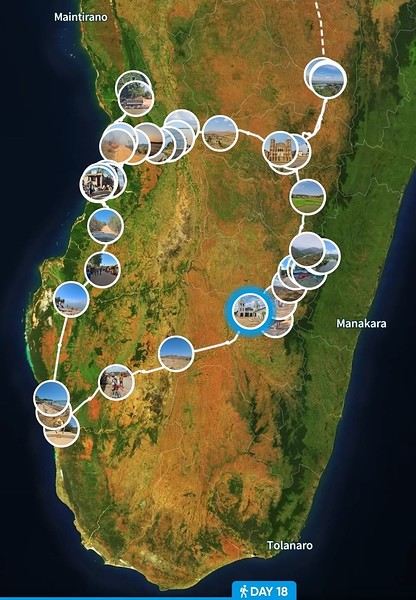
It was an incredible life and travel experience. A fabulous country, breathtaking landscapes, and a smiling population despite the hardships of life.
If I can answer any questions, don’t hesitate!
It was an incredible life and travel experience. A fabulous country, breathtaking landscapes, and a smiling population despite the hardships of life.
If I can answer any questions, don’t hesitate!
What itinerary for three weeks in Madagascar this summer?
Hi there,
I’m planning a 22-day trip to Madagascar this July.
And I could really use some advice 😊
Here’s what I’m sure about: Spending a few days in Nosy Be so my daughter can complete her Open Water certification—so I’m thinking 4 or 5 days there. I think Diego Suarez, Montagne d’Ambre, and Ankarana would suit what we like to do and have the advantage of being close to Nosy Be.
Now, the parts I’m unsure about, especially because of travel times:
My daughters really want to see whales. Is it possible around Nosy Be, or is Sainte Marie *the* must-visit spot? And what’s the weather like at that time of year? If we choose Sainte Marie, maybe do the Pangalanes Canal? Or is the route from Diego to Sainte Marie via the Vanilla Road a must-do?
Another option could be exploring the east with the Tsiribihina River and the Avenue of the Baobabs in Morondava.
Thanks in advance for your tips!
And I could really use some advice 😊
Here’s what I’m sure about: Spending a few days in Nosy Be so my daughter can complete her Open Water certification—so I’m thinking 4 or 5 days there. I think Diego Suarez, Montagne d’Ambre, and Ankarana would suit what we like to do and have the advantage of being close to Nosy Be.
Now, the parts I’m unsure about, especially because of travel times:
My daughters really want to see whales. Is it possible around Nosy Be, or is Sainte Marie *the* must-visit spot? And what’s the weather like at that time of year? If we choose Sainte Marie, maybe do the Pangalanes Canal? Or is the route from Diego to Sainte Marie via the Vanilla Road a must-do?
Another option could be exploring the east with the Tsiribihina River and the Avenue of the Baobabs in Morondava.
Thanks in advance for your tips!
3-Week Road Trip in Madagascar
Hello,
We’re arriving in Tana, the capital, by plane on the morning of May 22nd after an overnight flight.
Does any forum member know this Malagasy driver-guide: Haja Rasolondraibe?
The itinerary below might change or evolve—23 days might not be enough.
We’ll visit the central region (the highlands: Antsirabe, Atoetra and a Zafimaniry village, Lake Andrianina) and the unmissable west (Kirindy, the Avenue of the Baobabs, the Tsingy de Bamaraha, and a fishing village). Then back to Tana.
After that, we’ll head east of Tana to Ambohimanga, Andasibe, near Tamatave, Ankanin'ny, Mahambo, and Île Sainte-Marie if time allows. Not sure yet. Then back to Tana.
This driver-guide with a 4x4 charges 70 € per day, including food and accommodation. Excluding fuel.
If any members can recommend other driver-guides with a 4x4 and more reliable vehicles in good condition (since we don’t want to travel at night), I’d be interested.
Thanks in advance.
evad.tebo
Parcours en self-drive à Madagascar, plongée et hébergements English translation pending
Hello tous,
Nous sommes en train de plancher sur un tour à Madagascar (au lieu du Zimbabwe initialement prévu) en août 2020.
Voici en gros ce que j'ai prévu, avez-vous des remarques, conseils et idée d'hébergements sur ce parcours ? Je voudrais aussi faire une ou deux plongée + voir les baleines, quel endroit, sur mon parcours, vous parait le mieux indiqué ? J'ai fait des recherches il y a Atimoo, comme club de plongée, qui parait bien. Mais d'un autre côté j'avais l'impression que les fonds marins sont plus beaux vers Andavadoaka
v Jour 1: Arrivée Antananarivo v Jour 2: Antananarivo - Antsirabe v Jour 3: Antsirabe – Miandrivazo v Jour 4: Miandrivazo – Tsiribihina en chaland v Jour 5: Suite v Jour 6: Fin descente et transfert Bekopaka J'avais initialement pensé à la descente de la Manambolo, mais ça semble plus compliqué v Jour 7: Tsingy v Jour 8: Bekopaka – Morondava v Jour 9 : Morondava – Belo sur mer v Jour 10:Belo sur mer – Manja (ou dans le coin) v Jour 11: Manja -Morombe v Jour 12: Morombe–Andavadoaka - plongée ? v Jour 13 :Andavadoaka – Salary - plongée ? v Jour 14: Salary - Mangily Ifaty - plongée ? Peut-être jouable en 2 jours pour avoir une journée de plus pour la plongée ? v Jour 15: Mangily Ifaty -journée pleine v Jour 16:Ifaty-Tuléar – Ranohira v Jour 17: Visite du parc national de l’Isalo v Jour 18: Ranohira – Anja - Ambalavao v Jour 19: Ambalavao – Fianarantsoa v Jour 20: Fianarantsoa – Manakara (en train) v Jour 21: Le canal de Pangalane v Jour 22: Manakara – Ranomafana v Jour 23 : Visite du parc national de Ranomafana v Jour 24: Ranomafana – Ambositra v Jour 25 :Ambositra – Antsirabe v Jour 26 : Antsirabe - nécessite une journée pleine ou on peut aller directement à Tana ? v Jour 27 : Antsirabe- Antananarivo v Jour 28 : Transfert aéroport
Voili voilou 😛
Merciii d'avance 🙂
Max / Jef
Nous sommes en train de plancher sur un tour à Madagascar (au lieu du Zimbabwe initialement prévu) en août 2020.
Voici en gros ce que j'ai prévu, avez-vous des remarques, conseils et idée d'hébergements sur ce parcours ? Je voudrais aussi faire une ou deux plongée + voir les baleines, quel endroit, sur mon parcours, vous parait le mieux indiqué ? J'ai fait des recherches il y a Atimoo, comme club de plongée, qui parait bien. Mais d'un autre côté j'avais l'impression que les fonds marins sont plus beaux vers Andavadoaka
v Jour 1: Arrivée Antananarivo v Jour 2: Antananarivo - Antsirabe v Jour 3: Antsirabe – Miandrivazo v Jour 4: Miandrivazo – Tsiribihina en chaland v Jour 5: Suite v Jour 6: Fin descente et transfert Bekopaka J'avais initialement pensé à la descente de la Manambolo, mais ça semble plus compliqué v Jour 7: Tsingy v Jour 8: Bekopaka – Morondava v Jour 9 : Morondava – Belo sur mer v Jour 10:Belo sur mer – Manja (ou dans le coin) v Jour 11: Manja -Morombe v Jour 12: Morombe–Andavadoaka - plongée ? v Jour 13 :Andavadoaka – Salary - plongée ? v Jour 14: Salary - Mangily Ifaty - plongée ? Peut-être jouable en 2 jours pour avoir une journée de plus pour la plongée ? v Jour 15: Mangily Ifaty -journée pleine v Jour 16:Ifaty-Tuléar – Ranohira v Jour 17: Visite du parc national de l’Isalo v Jour 18: Ranohira – Anja - Ambalavao v Jour 19: Ambalavao – Fianarantsoa v Jour 20: Fianarantsoa – Manakara (en train) v Jour 21: Le canal de Pangalane v Jour 22: Manakara – Ranomafana v Jour 23 : Visite du parc national de Ranomafana v Jour 24: Ranomafana – Ambositra v Jour 25 :Ambositra – Antsirabe v Jour 26 : Antsirabe - nécessite une journée pleine ou on peut aller directement à Tana ? v Jour 27 : Antsirabe- Antananarivo v Jour 28 : Transfert aéroport
Voili voilou 😛
Merciii d'avance 🙂
Max / Jef
Four-week 4x4 trip around Madagascar
TRAVEL JOURNAL MADAGASCAR OCTOBER 2019
First of all, a big thank you to all the VoyageForum contributors who helped us plan our itinerary.
Introduction: There are three of us—a couple and a friend—all retired, aged 70. We spent four weeks in Madagascar, our first trip there, accompanied by a guide and a 4x4 driver-mechanic. We decided on the trip in June, and the process of requesting quotes, planning the itinerary, buying flight tickets, and applying for visas was quick. We finalized everything by the end of June.
Vehicle: The car was a Nissan Patrol, not new but well-maintained, and it served us perfectly. We had a few minor repairs—wheel bearings to change, a broken bull bar, and two flat tires throughout the trip. There was no air conditioning, so we drove with the windows open, which meant a bit of dust. In full sun, temperatures could reach 37/38°C.
Itinerary: The route started in Antananarivo upon arrival from the Air France flight from Roissy to Ivato and ended four weeks later at the same airport, passing through Antsirabe, Miandrivazo, the Tsiribihina River descent, Belo sur Tsiribihina, the Tsingy de Bemahara, the Avenue of the Baobabs, Morondava, Belo sur Mer, Morombe, Salary, Ifaty–Tulear, Ranohira, Fianarantsoa, the FCE train, Manakara, the Pangalanes Canal, Ranomafana, the Anja Reserve, and Ambositra.
Our local agency: The trip was organized with the help and logistical support of a local agency based in Antsirabe—a small, efficient, and enthusiastic team run by Élodie and her guide Manantsoa. If you'd like their contact details, feel free to message me directly. We have nothing but praise for them!
The roads: Travel was by 4x4 on rough, uneven tracks. We didn’t plan long stages to spare our backs, averaging a maximum of 5 to 6 hours per day. As for the RN7, the island’s most touristy road, there were no major issues. The Fianarantsoa Côte Est (FCE) train: This is the only train connecting Fianarantsoa to Manakara on the east coast. Taking it is an epic adventure—it takes an average of 17/18 hours to cover the 165 km between the two cities, passing through 17 stations, countless tunnels, and bridges. We left at 7 AM and arrived around 1:30 AM, but it was a direct way to connect with the local population at every stop. Even though we were comfortably seated in first class, we got a small glimpse of the harsh living conditions of the locals. One striking detail: on the last 80 km before Manakara, there wasn’t a single light—it was pitch black!
The Tsiribihina River descent: You can choose between a motorized barge or a rowed pirogue, depending on your comfort level. We opted for the motorized barge with a crew that included our guide, the captain, two sailors, and a cook. There was an upper deck for sunbathing and relaxing, and we slept in tents set up by the crew. The toilets were dry, and we showered with cold water from a waterfall—no complaints! The pirogue is more basic. It’s a slow, timeless journey along the river, with stunning landscapes, friendly locals, and diverse wildlife—lemurs, herons, birds of prey, kingfishers, and more.
Safety: The main safety concern on the roads is classic prevention—no flashy jewelry or visible valuables. In high-risk areas, vehicles travel in convoys escorted by the army, police, or gendarmerie. Elsewhere, our guide and driver handled "difficulties" like local "tolls," river crossings, and ferries with resourcefulness and calm. We never felt in danger during the four weeks, though we avoided driving or walking at night.
Accommodation: We chose mid-range hotels, always with private bathrooms and showers in the room. Sometimes there was no hot water, and water pressure was inconsistent, but that was city-wide, so we understood. In more touristy areas, the hotels were slightly better, though there’s still a long way to go to meet our standards! For the Tsiribihina descent, the crew set up a protected area for toilets and cold showers. We could even shower under the waterfall in the morning—cold and invigorating, but amazing!
Food: We ate well, whether it was European or Malagasy cuisine. The food was tasty and plentiful. The staple is rice—when imported from China or Myanmar, the quality isn’t always consistent. It’s served with everything. Zebu (beef) is good, and pork is less common but decent. Poultry isn’t raised in battery farms like at home; it’s free-range, tasty, but a bit tough. There’s a variety of vegetables, though we missed fresh fruit—it wasn’t the right season. Bananas and pineapples were abundant, with a few mangoes and oranges. On the coast, seafood was a treat—fish, shellfish, crabs, lobsters, sea cicadas, oysters, and more. Near Antananarivo, there’s a town called Behenjy specializing in foie gras, though in the heat, it’s not ideal for tasting. For local "hotely" restaurants (serving Malagasy food), it’s best to ask your guide to pick the best ones. As for tap water and raw vegetables, forget about them during your stay! We preferred to dine at the hotel to avoid nighttime outings, except in rare cases where a quality restaurant was nearby.
The people: It’s an understatement to say that Madagascar suffers from endemic poverty. In the cities, homeless people—men, women, children, even newborns—sleep on the streets or in makeshift shelters. The villages we passed through weren’t much better, and the remote ones we didn’t see are likely even worse. People lack everything—running water, electricity, schools, infrastructure—especially in the southern villages. Yet the land and rice fields seem to yield abundant harvests, and in desert areas, zebu farming is a way of life. The sea provides its riches—fish, lobsters, octopus, crabs, and more. Given the lack of education and income, begging is everywhere, a bit persistent but never aggressive. Bring as many things to give away as you can, and leave with empty hands—or rather, suitcases full of souvenirs! Let’s pay tribute to NGOs and religious institutions doing incredible work. On a personal level, we can only reflect, feel a bit of outrage, and act against this injustice. The Malagasy people don’t deserve this level of poverty. They’re also very religious—Catholic, Protestant, Adventist, Seventh-day Adventist, Jehovah’s Witness churches, and more, flourish across the island. In short, the people are welcoming, resigned, but so endearing and friendly!
Landscapes: The Tsingy, baobabs of all shapes and sizes—big, small, round, slender—the pristine beaches and Polynesian-like lagoons with deep blue waters between Tulear and Morombe, the rocks of the Isalo Massif reminiscent of the Wild West, the primary forests of Ranomafana, the red laterite landscapes of the Highlands dotted with villages, terraced rice fields, sunrises and sunsets on the east and west coasts, the views from the FCE train, the tranquility of the Pangalanes Canal (a bit like Kerala), the Vezo villages (nomads of the sea), the lagoon dotted with colorful square sails of Vezo fishermen—it’s all fantastic and varied!
Local transport: Overloaded bush taxis or trucks, zebu carts, rickshaws, tuk-tuks, and even carts pulled by people—it’s even more shocking!
Wildlife: The stars: - Lemurs—diurnal and nocturnal—there are so many to see, and you can spend hours watching them! - Chameleons—all shapes, sizes, and colors!
Climate: During our four weeks in September and October 2019 (we’d only been back for three days), we had just one day of rain. It was warm and pleasant everywhere during the trip. A light sweater for the evenings and waterproof clothing for rainy days are a good idea. Don’t forget sunglasses, swimsuits, sunscreen, mosquito repellent, malaria prophylaxis, flip-flops, hiking shoes for the parks, and all the usual essentials—nothing out of the ordinary!
Expenses: For half-board (breakfast and dinner), including transport (fuel), guide and driver, park entry fees, and local park guides, the cost was 2300 € per person for the four weeks. On top of that, you’ll need to add flight tickets, drinks, and lunch (around 5–10 € depending on your choices), as well as tips and personal expenses.
In short, we came back CHARMED.
Our thanks to ÉLODIE and MANANTSOA, as well as the drivers PAPOOSE and ROBERT.
First of all, a big thank you to all the VoyageForum contributors who helped us plan our itinerary.
Introduction: There are three of us—a couple and a friend—all retired, aged 70. We spent four weeks in Madagascar, our first trip there, accompanied by a guide and a 4x4 driver-mechanic. We decided on the trip in June, and the process of requesting quotes, planning the itinerary, buying flight tickets, and applying for visas was quick. We finalized everything by the end of June.
Vehicle: The car was a Nissan Patrol, not new but well-maintained, and it served us perfectly. We had a few minor repairs—wheel bearings to change, a broken bull bar, and two flat tires throughout the trip. There was no air conditioning, so we drove with the windows open, which meant a bit of dust. In full sun, temperatures could reach 37/38°C.
Itinerary: The route started in Antananarivo upon arrival from the Air France flight from Roissy to Ivato and ended four weeks later at the same airport, passing through Antsirabe, Miandrivazo, the Tsiribihina River descent, Belo sur Tsiribihina, the Tsingy de Bemahara, the Avenue of the Baobabs, Morondava, Belo sur Mer, Morombe, Salary, Ifaty–Tulear, Ranohira, Fianarantsoa, the FCE train, Manakara, the Pangalanes Canal, Ranomafana, the Anja Reserve, and Ambositra.
Our local agency: The trip was organized with the help and logistical support of a local agency based in Antsirabe—a small, efficient, and enthusiastic team run by Élodie and her guide Manantsoa. If you'd like their contact details, feel free to message me directly. We have nothing but praise for them!
The roads: Travel was by 4x4 on rough, uneven tracks. We didn’t plan long stages to spare our backs, averaging a maximum of 5 to 6 hours per day. As for the RN7, the island’s most touristy road, there were no major issues. The Fianarantsoa Côte Est (FCE) train: This is the only train connecting Fianarantsoa to Manakara on the east coast. Taking it is an epic adventure—it takes an average of 17/18 hours to cover the 165 km between the two cities, passing through 17 stations, countless tunnels, and bridges. We left at 7 AM and arrived around 1:30 AM, but it was a direct way to connect with the local population at every stop. Even though we were comfortably seated in first class, we got a small glimpse of the harsh living conditions of the locals. One striking detail: on the last 80 km before Manakara, there wasn’t a single light—it was pitch black!
The Tsiribihina River descent: You can choose between a motorized barge or a rowed pirogue, depending on your comfort level. We opted for the motorized barge with a crew that included our guide, the captain, two sailors, and a cook. There was an upper deck for sunbathing and relaxing, and we slept in tents set up by the crew. The toilets were dry, and we showered with cold water from a waterfall—no complaints! The pirogue is more basic. It’s a slow, timeless journey along the river, with stunning landscapes, friendly locals, and diverse wildlife—lemurs, herons, birds of prey, kingfishers, and more.
Safety: The main safety concern on the roads is classic prevention—no flashy jewelry or visible valuables. In high-risk areas, vehicles travel in convoys escorted by the army, police, or gendarmerie. Elsewhere, our guide and driver handled "difficulties" like local "tolls," river crossings, and ferries with resourcefulness and calm. We never felt in danger during the four weeks, though we avoided driving or walking at night.
Accommodation: We chose mid-range hotels, always with private bathrooms and showers in the room. Sometimes there was no hot water, and water pressure was inconsistent, but that was city-wide, so we understood. In more touristy areas, the hotels were slightly better, though there’s still a long way to go to meet our standards! For the Tsiribihina descent, the crew set up a protected area for toilets and cold showers. We could even shower under the waterfall in the morning—cold and invigorating, but amazing!
Food: We ate well, whether it was European or Malagasy cuisine. The food was tasty and plentiful. The staple is rice—when imported from China or Myanmar, the quality isn’t always consistent. It’s served with everything. Zebu (beef) is good, and pork is less common but decent. Poultry isn’t raised in battery farms like at home; it’s free-range, tasty, but a bit tough. There’s a variety of vegetables, though we missed fresh fruit—it wasn’t the right season. Bananas and pineapples were abundant, with a few mangoes and oranges. On the coast, seafood was a treat—fish, shellfish, crabs, lobsters, sea cicadas, oysters, and more. Near Antananarivo, there’s a town called Behenjy specializing in foie gras, though in the heat, it’s not ideal for tasting. For local "hotely" restaurants (serving Malagasy food), it’s best to ask your guide to pick the best ones. As for tap water and raw vegetables, forget about them during your stay! We preferred to dine at the hotel to avoid nighttime outings, except in rare cases where a quality restaurant was nearby.
The people: It’s an understatement to say that Madagascar suffers from endemic poverty. In the cities, homeless people—men, women, children, even newborns—sleep on the streets or in makeshift shelters. The villages we passed through weren’t much better, and the remote ones we didn’t see are likely even worse. People lack everything—running water, electricity, schools, infrastructure—especially in the southern villages. Yet the land and rice fields seem to yield abundant harvests, and in desert areas, zebu farming is a way of life. The sea provides its riches—fish, lobsters, octopus, crabs, and more. Given the lack of education and income, begging is everywhere, a bit persistent but never aggressive. Bring as many things to give away as you can, and leave with empty hands—or rather, suitcases full of souvenirs! Let’s pay tribute to NGOs and religious institutions doing incredible work. On a personal level, we can only reflect, feel a bit of outrage, and act against this injustice. The Malagasy people don’t deserve this level of poverty. They’re also very religious—Catholic, Protestant, Adventist, Seventh-day Adventist, Jehovah’s Witness churches, and more, flourish across the island. In short, the people are welcoming, resigned, but so endearing and friendly!
Landscapes: The Tsingy, baobabs of all shapes and sizes—big, small, round, slender—the pristine beaches and Polynesian-like lagoons with deep blue waters between Tulear and Morombe, the rocks of the Isalo Massif reminiscent of the Wild West, the primary forests of Ranomafana, the red laterite landscapes of the Highlands dotted with villages, terraced rice fields, sunrises and sunsets on the east and west coasts, the views from the FCE train, the tranquility of the Pangalanes Canal (a bit like Kerala), the Vezo villages (nomads of the sea), the lagoon dotted with colorful square sails of Vezo fishermen—it’s all fantastic and varied!
Local transport: Overloaded bush taxis or trucks, zebu carts, rickshaws, tuk-tuks, and even carts pulled by people—it’s even more shocking!
Wildlife: The stars: - Lemurs—diurnal and nocturnal—there are so many to see, and you can spend hours watching them! - Chameleons—all shapes, sizes, and colors!
Climate: During our four weeks in September and October 2019 (we’d only been back for three days), we had just one day of rain. It was warm and pleasant everywhere during the trip. A light sweater for the evenings and waterproof clothing for rainy days are a good idea. Don’t forget sunglasses, swimsuits, sunscreen, mosquito repellent, malaria prophylaxis, flip-flops, hiking shoes for the parks, and all the usual essentials—nothing out of the ordinary!
Expenses: For half-board (breakfast and dinner), including transport (fuel), guide and driver, park entry fees, and local park guides, the cost was 2300 € per person for the four weeks. On top of that, you’ll need to add flight tickets, drinks, and lunch (around 5–10 € depending on your choices), as well as tips and personal expenses.
In short, we came back CHARMED.
Our thanks to ÉLODIE and MANANTSOA, as well as the drivers PAPOOSE and ROBERT.
Novembre ou mai pour le sud-ouest de Madagascar et les "îles du nord"? English translation pending
bonjour
Mon mari et moi prévoyons 3 semaines à Madagascar avec une boucle de 15 jours dans le sud ouest et le centre puis une semaine dans une ou deux iles du nord pas trop touristiques.
- d'aprés vos expériences, qu'est ce qui est préférable pour le climat, la beauté de la nature, l'état des routes , novembre ou mai?
- quelles iles choisir pour qques jours de repos dans le nord, hormis Nosy bé qui semble trés touristique?
merci d'avance pour vos conseils
Itinéraire 3 semaines à Madagascar en juillet English translation pending
Bonjour à tous,
Nous partons 3 semaines en juillet avec notre fille de 8 ans et nous avons commencé à préparer notre itinéraire. J aimerais avoir votre avis sur celui-ci en sachant que nous aimons être indépendants mais que nous envisageons de prendre s il le faut un chauffeur :
Tana-morondave-tulear par la piste côtière-stop à ifaty et anakao-parc isalo-ambalavoa-ambositra-andsirabe-andasibe-tana.
Est ce possible sur 3 semaines ?
Merci à vous
Un mois à Madagascar English translation pending
Bonjour,
On est 2 gars de 60ans. On part pour 28 jours, on a l'intention de louer un véhicule avec chauffeur sur la période allant du 1 septembre au 28 septembre.
On espère avoir intégré les contraintes de temps liées au déplacement. On ne souhaite pas dormir sous la tente, d'où des trecks à la journée.
Bienvenus pour toute vos observations, mais on aimerait garder cette impression de boucle.
Notre circuit : Antananarivo 1 nuit Antsirabe 1 nuit Ambositra 3 nuits pour 2 randos d'Antroeta à Sakaido puis autre rando d'Antroeta à Andraitokanara Ranomafana 2 nuits avec réserve Talatakely et le circuit Vatoharanana Manakara 3 nuits pour le canal des Pagalones sur une journée et prendre le train tôt le matin Fionarantsa 1 nuit Ambalavao 3 nuits pour découverte de l'Andrinjita avec des treck à la journée comme l'ascension du pic Boby, circuit Imarivolanita, itinéraires vers le Caméléon Ranohira 4 jours pour l'Isalo avec des trecks à la journée comme circuits des crêtes, canyon des Makis, piscine naturelle Tulear 1 nuit Ankasy 4 nuits Route par la côte pour Andavadoaka, Mirimbe, Manja 1 nuit Belo sur Mer, allée des baobab, Morondava 1 nuit Belo sur Tsiribihina, Bekopaka 3 nuits pour le parc national des Tsiguy, petit Tsiguy et grand Tsiguy avec circuit Ranotsara Antananarive
Merci
Notre circuit : Antananarivo 1 nuit Antsirabe 1 nuit Ambositra 3 nuits pour 2 randos d'Antroeta à Sakaido puis autre rando d'Antroeta à Andraitokanara Ranomafana 2 nuits avec réserve Talatakely et le circuit Vatoharanana Manakara 3 nuits pour le canal des Pagalones sur une journée et prendre le train tôt le matin Fionarantsa 1 nuit Ambalavao 3 nuits pour découverte de l'Andrinjita avec des treck à la journée comme l'ascension du pic Boby, circuit Imarivolanita, itinéraires vers le Caméléon Ranohira 4 jours pour l'Isalo avec des trecks à la journée comme circuits des crêtes, canyon des Makis, piscine naturelle Tulear 1 nuit Ankasy 4 nuits Route par la côte pour Andavadoaka, Mirimbe, Manja 1 nuit Belo sur Mer, allée des baobab, Morondava 1 nuit Belo sur Tsiribihina, Bekopaka 3 nuits pour le parc national des Tsiguy, petit Tsiguy et grand Tsiguy avec circuit Ranotsara Antananarive
Merci
Organiser un voyage à Madagascar English translation pending
Bonjour à tous
Je désire organiser un petit voyage de 2 semaines a Madagascar fin avril début mai 2019.
Je cherche des conseils et circuits à faire. Je serai seul et aime l'aventure.
J'ai une passion : la détection ( pièces anciennes) et recherche de minéraux.
Merci d'avance pour votre aide
François
Itinéraire à Madagascar pour voyage seule English translation pending
Bonjour,
Je pars près de deux mois et je n'ai pas eu le temps de me préparer du tout. Avez vous des suggestions d'itinéraires. Des trucs à ne pas manquer (mis à part l'allée des baobabs). Je voyage seule et je n'aime pas avoir à me presser...
Merci!
Je pars près de deux mois et je n'ai pas eu le temps de me préparer du tout. Avez vous des suggestions d'itinéraires. Des trucs à ne pas manquer (mis à part l'allée des baobabs). Je voyage seule et je n'aime pas avoir à me presser...
Merci!
Trois semaines à Madagascar en novembre - décembre: que voir? English translation pending
Bonjour,
abituellement j'aime bien me faire ma propre idée et mes recherches mais là il y a tellement de paramètres à prendre en compte pour visiter cette île qui à l'air formidable que je m'en remets aux habitués du forum.
Je souhaite partir trois semaines en fin d'année et je souhaite vos avis pour savoir que voir et faire dans ce laps de temps sur les régions du centre est (Bemaraha) et du nord (Nosy Be).
Entre ces deux régions j'imagine qu'il faudra prendre l'avion, mais pour le reste ce sera probablement du transport terrestre mais si possible assez safe vu que je voyagerai seul.
Je sais que ma demande est très vague mais j'ai l'impression qu'il faudrait minimum 2 mois pour ces deux régions! :)
Encore un retour sain et sauf de Madagascar, pourquoi moi? English translation pending
Retour de 3 mois à Mada ,4500kms parcourus pour la éniéme fois depuis 11ans et encore vivant 😎😎😎.Personne ne veut me voler , m'attaquer, m'arnaquer que doit je faire ???
Je viens de voyager seul , en taxi brousse , pirogue, scooter, boutre, marche, cyclo pousse, etc...
Ah si :un trou m'a agressé et a fait plonger ma jambe droite et l'a endommagé pour 3 semaines.
Méfiez vous des trottoirs .😏
Cordialement
Descente du fleuve Manambolo (Madagascar) English translation pending
Bonjour à tous,
J’ai le projet de faire la descente de la Manambolo en mai 2018 avec 1 ami
Ces dernières années, on nous l’a déconseillé pour des raisons de sécurité :il fallait être accompagné par des gendarmes malgaches ou faire partie d’un gros tour opérateur !
Je pense avoir compris à travers mes lectures du forum qu’il faut arriver par taxi-brousse ou 4X4 jusqu’à Belobaka en passant par Tsiroanomandidy. Puis c’est à pied pour rejoindre Ankava lieu de l’embarcation
Merci de rectifier si je me trompe
Je souhaiterai que certains d’entre vous puissent me renseigner sur les guides à contacter pour faire cette partie à pied puis la descente en canoé : je pense qu’il faut que l’on soit accompagné : guide, porteur, piroguier…
2 ème question une fois arrivé à Bekopaka comment organiser notre retour sur Morondava ou sur Miandrivaza ? faut-il le prévoir ou peut-on espérer trouver un véhicule à compléter pour ce retour…
Merci de vos infos
Bien à vous
Jack
Tour de Madagascar en quad English translation pending
je désire faire le tour de Madagascar en suivant au plus près les côte et par la piste
certains d'entre vous ont ils un recul la dessus ?
En matériel quad
en expérience madagascar
en etc
Voyage à Madagascar en janvier: sud ou nord? English translation pending
Bonjour,
Nous partons à Madagascar dans 8 jours et à cause des récents dégâts causés par le cyclone Ava, je ne sais plus quoi faire... Nous comptons passer qq jours à Tana et consacrer 10 jours pour un voyage en province en 4x4.
Le plan à l'origine était d'aller vers Nosy Be, Diego, faire la mer d'Emeraude, les 3 baies et les Tsingy rouges. Mais apparemment la route pour aller à Diego est coupée donc il reste la possibilité d'aller à Majunga (que je voulais éviter car je connais déjà) et de faire quand même Nosy Be.
Du coup, j'ai commencé à préparé un autre itinéraire sur la RN7 pour faire le parc de l'Isalo, Tuléar, Ifaty-Manguily-Salary mais il paraît que la route est également coupée :'( Si nous voulons partir vers le sud-ouest, la seule solution que je vois serait de partir à Morondava et de rejoindre la zone de Morombe, ce qui devrait en théorie nous permettre de redescendre vers le lagon mais je ne sais pas comment.
J'ai besoin de conseils car ça nous tient à coeur de faire du snorkelling/plongée mais d'un côté j'ai lu et entendu des choses très moches à propos de Nosy Be et de l'autre, je ne sais pas si l'itinéraire Morondava/Morombe est faisable.
Merci
Nous partons à Madagascar dans 8 jours et à cause des récents dégâts causés par le cyclone Ava, je ne sais plus quoi faire... Nous comptons passer qq jours à Tana et consacrer 10 jours pour un voyage en province en 4x4.
Le plan à l'origine était d'aller vers Nosy Be, Diego, faire la mer d'Emeraude, les 3 baies et les Tsingy rouges. Mais apparemment la route pour aller à Diego est coupée donc il reste la possibilité d'aller à Majunga (que je voulais éviter car je connais déjà) et de faire quand même Nosy Be.
Du coup, j'ai commencé à préparé un autre itinéraire sur la RN7 pour faire le parc de l'Isalo, Tuléar, Ifaty-Manguily-Salary mais il paraît que la route est également coupée :'( Si nous voulons partir vers le sud-ouest, la seule solution que je vois serait de partir à Morondava et de rejoindre la zone de Morombe, ce qui devrait en théorie nous permettre de redescendre vers le lagon mais je ne sais pas comment.
J'ai besoin de conseils car ça nous tient à coeur de faire du snorkelling/plongée mais d'un côté j'ai lu et entendu des choses très moches à propos de Nosy Be et de l'autre, je ne sais pas si l'itinéraire Morondava/Morombe est faisable.
Merci
Location de 4x4 Tuléar - Morombe English translation pending
Salut a tous!!
je me permets de lancer un nouveau post car ceux que je trouve son vieux, ou alors dans l'autre sens du parcours que j'aurais aimer faire...
je vous explique, on voudrais retourner a Mada en mars, cette fois ci vers Toliara, habitant a la Reunion j'ai trouver de vols direct A/R, du coup j'aurais aimer visiter certeins endroits
je cherche donc des gens qui ont pu visiter ces endroits il a peu, savoir le temps de parcours et les moyens de le faire, puis avoir une idee aussi des budgets si 4x4 lors de notre premier voyage on a fais que du taxi b, la on a que un mois, et on aurais aimer se poser plusieurs jours dans le endroit et non pas passer les journes dans les transport on a jamais louer 4x4 lavas donc j'ai aucune idee des prix.. ce que j'aurais aimer faire, Tulear aller vers Ifaty, puis remonter vers Morombe j'ai trouver peu de post dans ce sens la revenir vers le bas puis aller a Anakao avant rentrer
je suis preneusse des bons spots que vous voudrez bien me conseiller aux alentours de Tulear,
j'ai lue que on peut le faire en pirogue mais dans l'autre sens, alors je sais pas si ce posible de remonter au lieu de descendre...et si oui combien temps peut prendre un tel parcours on a des amis a Morondava, j'aurais aimer les voire mais sachant que le retour se fera de Tulear sa me parais super loin pour un voyage d'un mois... bref je suis preneusse de toutes idees, conseils ou bons plans
:)
merci a tous d'avance
Velouma
;)
je me permets de lancer un nouveau post car ceux que je trouve son vieux, ou alors dans l'autre sens du parcours que j'aurais aimer faire...
je vous explique, on voudrais retourner a Mada en mars, cette fois ci vers Toliara, habitant a la Reunion j'ai trouver de vols direct A/R, du coup j'aurais aimer visiter certeins endroits
je cherche donc des gens qui ont pu visiter ces endroits il a peu, savoir le temps de parcours et les moyens de le faire, puis avoir une idee aussi des budgets si 4x4 lors de notre premier voyage on a fais que du taxi b, la on a que un mois, et on aurais aimer se poser plusieurs jours dans le endroit et non pas passer les journes dans les transport on a jamais louer 4x4 lavas donc j'ai aucune idee des prix.. ce que j'aurais aimer faire, Tulear aller vers Ifaty, puis remonter vers Morombe j'ai trouver peu de post dans ce sens la revenir vers le bas puis aller a Anakao avant rentrer
je suis preneusse des bons spots que vous voudrez bien me conseiller aux alentours de Tulear,
j'ai lue que on peut le faire en pirogue mais dans l'autre sens, alors je sais pas si ce posible de remonter au lieu de descendre...et si oui combien temps peut prendre un tel parcours on a des amis a Morondava, j'aurais aimer les voire mais sachant que le retour se fera de Tulear sa me parais super loin pour un voyage d'un mois... bref je suis preneusse de toutes idees, conseils ou bons plans
:)
merci a tous d'avance
Velouma
;)
Itinéraire pour 26 jours à Madagascar English translation pending
bonjour,
nous sommes un couple qui partons 25 jours en septembre avec un budget de 30E/J/pers
nous avons les grandes lignes de notre trajet et avons besoin de vos conseils éclairés et récents 😉 j'ai lu pas mal de post et glané pas mal d'infos, mais quelques intérogations démeurent ! je vous joint notre ébauche de parcours ci-dessous.
surtout pour la partie RN7, nous aimerions l'isalo mais je pense que nous n'avons pas assez de temps...du coup pourquoi pas pays zafimaniry ( combien de temps pour y aller de tana, mieux vaut une escale a Ambositra ou ça passe ? et combien de temps à passer au pays zafimaniry ? ) voir parc ranomafana ( même intérogations pour la durée du trajet de tana et le temps a y passer...) a moins que l'ont puissent faire les deux mais bon....
pour rallier Morondava, mieux vaut partir d'Ambositra ou d'Antsirabe ? les trajets représentent une grosse partie du temps sur place, des tuyaux pour ne pas en perdre de trop . j'ai entendu parler de cotisse ( qui apparement sont assez fiable ) pour Morondava- tana , font-ils d'autres liaisons ? une voiture privée sur la RN7 serait peut-être plus approprié vu le délai, quitte a faire les grandes liaisons via cotisse ou autre...
conseils sur les hébergements et autres sont les bienvenus !
merci
J1 : tana préparatifs J2 : tana - Tamatave J3 : Tamatave-sainte marie J4-5-6-7 : sainte marie J8-9 : l'ile aux nattes J 10 : Sainte-Marie - Tamatave J11 : Tamatave-Tana J12-13-14-15 : RN7 J16 : RN7 - Morondava J17 : Morondava - Bebopaka J 18-19-20 : tsingy, gorges manambolo J21 : bebopaka-morondava J22 : Morondava J23 : Morondava - Tana J24 : lac natsy, chute de la lilly J25: parc nat Andasibe J26 : Départ
nous sommes un couple qui partons 25 jours en septembre avec un budget de 30E/J/pers
nous avons les grandes lignes de notre trajet et avons besoin de vos conseils éclairés et récents 😉 j'ai lu pas mal de post et glané pas mal d'infos, mais quelques intérogations démeurent ! je vous joint notre ébauche de parcours ci-dessous.
surtout pour la partie RN7, nous aimerions l'isalo mais je pense que nous n'avons pas assez de temps...du coup pourquoi pas pays zafimaniry ( combien de temps pour y aller de tana, mieux vaut une escale a Ambositra ou ça passe ? et combien de temps à passer au pays zafimaniry ? ) voir parc ranomafana ( même intérogations pour la durée du trajet de tana et le temps a y passer...) a moins que l'ont puissent faire les deux mais bon....
pour rallier Morondava, mieux vaut partir d'Ambositra ou d'Antsirabe ? les trajets représentent une grosse partie du temps sur place, des tuyaux pour ne pas en perdre de trop . j'ai entendu parler de cotisse ( qui apparement sont assez fiable ) pour Morondava- tana , font-ils d'autres liaisons ? une voiture privée sur la RN7 serait peut-être plus approprié vu le délai, quitte a faire les grandes liaisons via cotisse ou autre...
conseils sur les hébergements et autres sont les bienvenus !
merci
J1 : tana préparatifs J2 : tana - Tamatave J3 : Tamatave-sainte marie J4-5-6-7 : sainte marie J8-9 : l'ile aux nattes J 10 : Sainte-Marie - Tamatave J11 : Tamatave-Tana J12-13-14-15 : RN7 J16 : RN7 - Morondava J17 : Morondava - Bebopaka J 18-19-20 : tsingy, gorges manambolo J21 : bebopaka-morondava J22 : Morondava J23 : Morondava - Tana J24 : lac natsy, chute de la lilly J25: parc nat Andasibe J26 : Départ
Un mois en solo à Madagascar, sans trop de randonnée, ni trop de plage English translation pending
Bonsoir à tous,
Je pense partir à la dernière minute pour 30 jours à Madagascar, du 29 mai au 26 juin. Je voyagerai en solo (avec les règles de sécurité d'usage; j'aurai néanmoins mon appareil photo réflex), pour la toute première fois en Afrique (mais j'ai bien l'habitude en Asie, ainsi qu'en Amérique du Sud). Le petit problème que je rencontre est que j'ai eu un accident de rando au Laos il y a 6 mois et que ma cheville n'est pas encore 100% stable suite à l'opération. Je ne peux donc pas faire de randonnée à dénivelé ou sol trop instable, mais je suis capable de marcher pendant 5-6h d'affilée sur un sentier.
Souhaitant que ce voyage soit un voyage de découverte de la faune et de la flore malgré tout, connaissez-vous des parcs qui correspondraient à ces critères, me permettant ainsi d'approcher lémuriens, caméléons etc ?
Je compte utiliser les transports locaux et voyager à petit budget. Je commence à peine à me renseigner et pour l'instant, j'ai noté les lieux suivants que je souhaiterais visiter :
- Maroantsetra pour faire par exemple un peu de snorkelling (?) - 3 ou 4 jours sur l'île Sainte Marie - trajet en train de Fianarantsoa à Manakara (j'adore prendre le train !) et petit tour sur le canal des pangalanes - allée des baobabs (Morondava)
Auriez-vous d'autres suggestions que je puisse intégrer à la boucle ? Je vais essayer de ne pas trop charger mon séjour pour éviter une nouvelle blessure, mais je suis normalement assez hypéractive en voyage et pas trop du genre farniente. Voyager différemment, c'est également un challenge intéressant !
Merci pour toutes vos informations ! Sophie
Je pense partir à la dernière minute pour 30 jours à Madagascar, du 29 mai au 26 juin. Je voyagerai en solo (avec les règles de sécurité d'usage; j'aurai néanmoins mon appareil photo réflex), pour la toute première fois en Afrique (mais j'ai bien l'habitude en Asie, ainsi qu'en Amérique du Sud). Le petit problème que je rencontre est que j'ai eu un accident de rando au Laos il y a 6 mois et que ma cheville n'est pas encore 100% stable suite à l'opération. Je ne peux donc pas faire de randonnée à dénivelé ou sol trop instable, mais je suis capable de marcher pendant 5-6h d'affilée sur un sentier.
Souhaitant que ce voyage soit un voyage de découverte de la faune et de la flore malgré tout, connaissez-vous des parcs qui correspondraient à ces critères, me permettant ainsi d'approcher lémuriens, caméléons etc ?
Je compte utiliser les transports locaux et voyager à petit budget. Je commence à peine à me renseigner et pour l'instant, j'ai noté les lieux suivants que je souhaiterais visiter :
- Maroantsetra pour faire par exemple un peu de snorkelling (?) - 3 ou 4 jours sur l'île Sainte Marie - trajet en train de Fianarantsoa à Manakara (j'adore prendre le train !) et petit tour sur le canal des pangalanes - allée des baobabs (Morondava)
Auriez-vous d'autres suggestions que je puisse intégrer à la boucle ? Je vais essayer de ne pas trop charger mon séjour pour éviter une nouvelle blessure, mais je suis normalement assez hypéractive en voyage et pas trop du genre farniente. Voyager différemment, c'est également un challenge intéressant !
Merci pour toutes vos informations ! Sophie
5 jours à Madagascar English translation pending
Bonjour!
Je suis actuellement à Antananarivo professionnellement au Sommet de la Francophonie. J'ai pris 5 jours de congé pour découvrir un peu Mada sous un autre angle et connaître la culture locale. Je sais que 5 jours c'est court mais je n'ai pas plus de temps dispo. Je pense prendre un véhicule avec chauffeur. Que me conseillez-vous, sachant que je veux sortir de la grande ville? J'ai repéré une agence de location dans le Guide petit futé, location Parany à Tana. On me demande de payer la moitié maintenant et le reste en débutant le parcours. Ça me semble légitime mais on me fait tellement de mises en garde ici à Tana que j'ai du mal à tirer le vrai du faux. J'aimerais voir des baobabs aux environs de Morondava mais est-ce raisonnable de faire 10 heures de route pour m'y rendre?
J'attends vos conseils.
Merci à l'avance!
Je suis actuellement à Antananarivo professionnellement au Sommet de la Francophonie. J'ai pris 5 jours de congé pour découvrir un peu Mada sous un autre angle et connaître la culture locale. Je sais que 5 jours c'est court mais je n'ai pas plus de temps dispo. Je pense prendre un véhicule avec chauffeur. Que me conseillez-vous, sachant que je veux sortir de la grande ville? J'ai repéré une agence de location dans le Guide petit futé, location Parany à Tana. On me demande de payer la moitié maintenant et le reste en débutant le parcours. Ça me semble légitime mais on me fait tellement de mises en garde ici à Tana que j'ai du mal à tirer le vrai du faux. J'aimerais voir des baobabs aux environs de Morondava mais est-ce raisonnable de faire 10 heures de route pour m'y rendre?
J'attends vos conseils.
Merci à l'avance!
Madagascar: comment contacter une compagnie de taxi brousse depuis la France? English translation pending
Bonjour,
La question est dans le titre.
Je souhaite réserver un voyage entre Tana et Monrodava en octobre 2016.
J'ai vu que la Compagnie Sonatra Plus a ouvert une ligne avec des véhicules qui paraissent en bon état.
Sur le site web, il n'y a que le n° de téléphone, pas de mail. Je les ai contacté par leur Page Facebook mais pas de réponse.
Quelqu'un a-t-il une solution ?
Merci d'avance
Madagascar est-il vraiment si physique? English translation pending
Bonsoir,
J'espère que vous pouvez m'aider...
Après avoir pris billet d'avion pour mi-mai pour un séjour de 20 jrs et lu ici et là pour préparer le voyage, je me rends compte que le parc Tsingy semble être très très sportif. Le seul sport que je pratique est la natation et la marche alors là pas du tout! Je précise que je marche comme une tortue et pourtant je voudrais visiter les Tsingy. Qui a visité les Tsingy avec des conditions physiques pas très en forme?
Je profite de ce post pour vous avoir votre avis/commentaires sur mon itinéraire. Je précise que j'aime les beaux paysages et le snorkelling. Je voyage seule sans location de 4x4 individuelle mais espère joindre un groupe sur place pr les parcs.
1. Tana-Miandrivazo pour la pirogue sur Tsiribihana: 1 jr 2. De Miandrivazo, peut-on rejoindre les Tsingy et espérer joindre un groupe ou faut-il obligatoirement que j'aille à Morondava? 3. Morondava : baobabs + Tsingy 2/3 jrs Cette partie est mon plus gros appréhension. Est-il possible de se baser à un seul endroit et effectuer ces 3 activités?
4. Morondava - Antsirabe : 1 Jr 5. Antsirabe - Ambositra : 2 jr 6. Ambositra - Manakara. Le guide conseille le train (très lent). Peut-on se rendre en bus et le paysage en vaut-il la peine ou il vaut mieux le faire par le train? 7. Parc Isalo: est-ce aussi très physique comme les Tsingy? 8. Anakao. La mer est-elle très agitée en cette période d'année (mi-mai à fin mai)? Y a t-il un peu de chance de voir les baleines?
Y a t-il des choses qu'il ne faut absolument pas que je rate? Est-ce mon itinéraire semble trop ambitieux/pas assez?
Merci mille fois amis voyageurs
J'espère que vous pouvez m'aider...
Après avoir pris billet d'avion pour mi-mai pour un séjour de 20 jrs et lu ici et là pour préparer le voyage, je me rends compte que le parc Tsingy semble être très très sportif. Le seul sport que je pratique est la natation et la marche alors là pas du tout! Je précise que je marche comme une tortue et pourtant je voudrais visiter les Tsingy. Qui a visité les Tsingy avec des conditions physiques pas très en forme?
Je profite de ce post pour vous avoir votre avis/commentaires sur mon itinéraire. Je précise que j'aime les beaux paysages et le snorkelling. Je voyage seule sans location de 4x4 individuelle mais espère joindre un groupe sur place pr les parcs.
1. Tana-Miandrivazo pour la pirogue sur Tsiribihana: 1 jr 2. De Miandrivazo, peut-on rejoindre les Tsingy et espérer joindre un groupe ou faut-il obligatoirement que j'aille à Morondava? 3. Morondava : baobabs + Tsingy 2/3 jrs Cette partie est mon plus gros appréhension. Est-il possible de se baser à un seul endroit et effectuer ces 3 activités?
4. Morondava - Antsirabe : 1 Jr 5. Antsirabe - Ambositra : 2 jr 6. Ambositra - Manakara. Le guide conseille le train (très lent). Peut-on se rendre en bus et le paysage en vaut-il la peine ou il vaut mieux le faire par le train? 7. Parc Isalo: est-ce aussi très physique comme les Tsingy? 8. Anakao. La mer est-elle très agitée en cette période d'année (mi-mai à fin mai)? Y a t-il un peu de chance de voir les baleines?
Y a t-il des choses qu'il ne faut absolument pas que je rate? Est-ce mon itinéraire semble trop ambitieux/pas assez?
Merci mille fois amis voyageurs
Tsingys de Bemaraha English translation pending
Bonjour,
Nous partons pour la première fois à Madagascar début Avril et aimerions vraiment visiter les Tsingys de Bemaraha. Nous voudrions savoir si le parc sera déjà ouvert à cette période (1ere semaine d'Avril) ? Nous avons lu pas mal d'informations contradictoires à ce sujet. Par ailleurs, est ce qu'il vaut mieux prendre un chauffeur depuis Morondova ou est ce qu'on y accéder par taxi-brousse ? Un guide est il obligatoire pour la visite des tsingys ou peut on les parcourir seuls ?
Merci d'avance pour votre aide :)
Nous partons pour la première fois à Madagascar début Avril et aimerions vraiment visiter les Tsingys de Bemaraha. Nous voudrions savoir si le parc sera déjà ouvert à cette période (1ere semaine d'Avril) ? Nous avons lu pas mal d'informations contradictoires à ce sujet. Par ailleurs, est ce qu'il vaut mieux prendre un chauffeur depuis Morondova ou est ce qu'on y accéder par taxi-brousse ? Un guide est il obligatoire pour la visite des tsingys ou peut on les parcourir seuls ?
Merci d'avance pour votre aide :)
Belo sur Tsiribihina - Morondova en 4 x 4 English translation pending
Bonjour,
En ayant loué un taxi pour un tour à Madagascar, nous voudrions faire le trajet Belo sur Tsiribihina - Morondova en 4 x 4...
La route a emprunter c'est bien la rn8 ? combien de temps cela prends ? y a t il des hebergeement sur la route, notamment aux alentour de l'allée des baobabs ?
Merci de vos réponses :)
En ayant loué un taxi pour un tour à Madagascar, nous voudrions faire le trajet Belo sur Tsiribihina - Morondova en 4 x 4...
La route a emprunter c'est bien la rn8 ? combien de temps cela prends ? y a t il des hebergeement sur la route, notamment aux alentour de l'allée des baobabs ?
Merci de vos réponses :)
2 mois à Antsirabe dès octobre English translation pending
Bonjour,
Je rejoins une ONG à Antsirabe du 12 Octobre au 10 Décembre 2015. À moins d'un mois du départ j'aurais souhaité avoir quelques conseils. Ce qu'il y a visiter, des infos sur les modes de vie, la sécurité, les animations, ce qu'il faut que j'apporte avec moi... Bref, je n'ai pas de questions précises mais je souhaite en savoir un peu plus sur cette ville dans laquelle je vivrai pendant deux mois.
Merci d'avance !
Morgane
Je rejoins une ONG à Antsirabe du 12 Octobre au 10 Décembre 2015. À moins d'un mois du départ j'aurais souhaité avoir quelques conseils. Ce qu'il y a visiter, des infos sur les modes de vie, la sécurité, les animations, ce qu'il faut que j'apporte avec moi... Bref, je n'ai pas de questions précises mais je souhaite en savoir un peu plus sur cette ville dans laquelle je vivrai pendant deux mois.
Merci d'avance !
Morgane