Results for "Balé+|+121+>+52"
2130 results found.
Compagnie aérienne économique pour vol Paris-Istanbul? English translation pending
Ben voilà... tout est dans le titre ! Connaissez-vous une compagnie pas chère qui fasse la liaison Paris-Istanbul ?
Merci 🙂
Dimanche 8 janvier à Buenos Aires English translation pending
Les Portenos ont deserte BA pour aller prendre le frais a Mar del Plata.
On va chez Rodolphe puis on mange ensemble a l Hypopotamoa San Telmo: C est
le tres vieux quartier de BALe resto est typique du coin: vieux miroirs,
vieilles affiches, ventilateurs Elite, crochets au plafond, jambons
suspendus a la mode espagnole, mais recouverts de toile...Aperitivo Campari
en deco et une affiche du Festival de Cannes sur le film Bugsy Malone, ainsi
qu une autre La Maestra enamorada( la professeur amoureuse).: tout un
programme... On est en plein dans le vieux BA, on sent l emmigrant
ici...Mais on se reserve une visite du quartier plus approfondie pour demain
et on file dans un autre quartier plus anime:Abasto.
Nous visitons un enorme grand Magasin qui s apelle COTO, juste pour se rendre
compte des produits consommes, en fait beaucoup de marques comme Danone
fabriquent en Argentine des produits pour les argentins qu on ne trouve pas
en France et surtout a des prix defiant toute concurrence... puis nous
visitons un centre commercial juste en face . Ce centre est en fait les
anciennes halles qui ont ete transformees...Alors la tenez vous bien, dans
des volumes enormes se trouvent 12 salles de cinema, des cafes, et des
etages entiers pour des jeux pour les enfants et pour les adultes, tout ca
dans un brouhaha, 10.000 que dis je 20.000 personnes doivent etre la: ici
une grande barque oscille d avant en arriere en montant jusqu au plafond
emportant ses passagers dans un haut le coeur rigolard, la bas, un manege
tournant deplace l air environnant et fait une sorte de mouvement oscillant
en meme temps...les petits guides par leurs parents pechent a la ligne des
grenouilles en plastique qui ouvrent leur gueules en faisant "croi croi", la
gueule s ouvre puis se referme aussitot emprisonnant(ou pas) le chiffon
pendu au bout de la ligne...La tete me tourne, Je vais au cafe des cinemas
prendre une glace en regardant l affiche animee du"Monde de Narnia" sur un
ecran geant. On rentre a l Hotel
Indemnisations suite à une annulation de vol pour cause de grève English translation pending
D'après la réglementation on peut obtenir un dédommagement en plus du remboursement du billet pour l'annulation d'un vol. J'ai eu un vol Bâle/Paris annulé à cause des greves du 04 Avril en France (mon vol a été annulé la veille du 04 avril). D'après ce que je lis de la réglementation Européenne en cas d'annulation de vol apparament on ne peut obtenir d'indemnisations en plus du remboursement du billet en cas de grêve (mais le vol à été annulé en prévision de la grève la veille et non pas le jour même de la grève).
Es ce vraiment le cas ou puis je réclamer auprès de la compagnie une indemnisation en plus de mon remboursement de billet (en passant diminuer de frais de remboursement)?
Easyjet sort de l'Europe English translation pending
La Cie low cost britannique Easyjet va ouvir ses 1ers vols hors Europe vers de Maroc (Marrakech) et la Turquie (Istambul aéroport Sabiha Gokcen sur partie asiatique de la ville)
Ce sont majoritairement des vols au départ de Londres mais aussi un vol vers Istambul au depart de Bale/Mulhouse
pour plus d'infos (jours, prix, ....) a lire
http://www.easyjet.com/FR/Actualite/easyjet_vole_desormais_en_dehors_del_europe.html
Location de véhicule à l'aéroport de Lisbonne et hôtel proche aéroport English translation pending
salut à tous..
fin mars 2006 je pars au portugal avec un bout de ma famille pour un mariage dans notre famille tout au nord, à la frontière espagnole!!
Nous avons pris le vol sur Lisbonne avec easyjet au départ de Bale..
bref.. nous devons louer une voiture (nous sommes 6 au total) pour remonter dans le nord.
donc pensez vous que c'est nécessaire de réserver une véhicule depuis la france ou en arrivant sur place le jour meme (à 18h40) on peut facilement trouver un véhicule pour 6 personnes (type Espace ou Zafira) ?
d'autre part, nous arrivons à 18h40 un vendredi soir, et notre mariage est le lendemain en début d'après midi tout au nord (environ 6 à 7 heures de route)
on aimerait trouver un hotel à coté de lisbonne pour passer la nuit tranquille, et partir le samedi au petit matin.
des idées d'hotels à coté de l'aéropot pour éviter d'aller au centre de Lisbonne ??
merci à tous pour vos réponses...
fin mars 2006 je pars au portugal avec un bout de ma famille pour un mariage dans notre famille tout au nord, à la frontière espagnole!!
Nous avons pris le vol sur Lisbonne avec easyjet au départ de Bale..
bref.. nous devons louer une voiture (nous sommes 6 au total) pour remonter dans le nord.
donc pensez vous que c'est nécessaire de réserver une véhicule depuis la france ou en arrivant sur place le jour meme (à 18h40) on peut facilement trouver un véhicule pour 6 personnes (type Espace ou Zafira) ?
d'autre part, nous arrivons à 18h40 un vendredi soir, et notre mariage est le lendemain en début d'après midi tout au nord (environ 6 à 7 heures de route)
on aimerait trouver un hotel à coté de lisbonne pour passer la nuit tranquille, et partir le samedi au petit matin.
des idées d'hotels à coté de l'aéropot pour éviter d'aller au centre de Lisbonne ??
merci à tous pour vos réponses...
Carte européenne des pistes cyclables? English translation pending
bonjour a tous, 😊
voila je suis nouveau sur ce forum et je souhaiterais d'ici quelques semaines, partir de strasbourg pour aller a bale a velo, en passant par l'allemagne en suivant soit une piste cyclabe, soit en suivant le RHIN, j'aimeris savoir, ou je pourrais trouver une carte européene des pistes cyclabes?🙂🙂
voila je suis nouveau sur ce forum et je souhaiterais d'ici quelques semaines, partir de strasbourg pour aller a bale a velo, en passant par l'allemagne en suivant soit une piste cyclabe, soit en suivant le RHIN, j'aimeris savoir, ou je pourrais trouver une carte européene des pistes cyclabes?🙂🙂
Conseils route Belgique-Ancona (Italie) English translation pending
Salut à toutes et tous,
Je dois me rendre en famille début juillet à Ancona (Italie) par la route.
Que me conseillez-vous ?
Alternative 1: Luxembourg France (Strasbourg) Allemagne Suisse(via Bâle) Italie (via Milan)Alternative 2: Luxembourg Allemagne (via Stuttgart et Ulm) Autriche (via Innsbruckà Italie (via Bolsano et Veronne)Alternative 3: Vous connaissez peut-être un autre itinéraire....Mes impératifs sont le plus rapide et ou le plus d'autoroutes possible (ben oui, avec des petits enfants...)
Merci d'avance pour vos judicieux conseils
Jex
Je dois me rendre en famille début juillet à Ancona (Italie) par la route.
Que me conseillez-vous ?
Alternative 1: Luxembourg France (Strasbourg) Allemagne Suisse(via Bâle) Italie (via Milan)Alternative 2: Luxembourg Allemagne (via Stuttgart et Ulm) Autriche (via Innsbruckà Italie (via Bolsano et Veronne)Alternative 3: Vous connaissez peut-être un autre itinéraire....Mes impératifs sont le plus rapide et ou le plus d'autoroutes possible (ben oui, avec des petits enfants...)
Merci d'avance pour vos judicieux conseils
Jex
Besoin d'aide pour mon itinéraire en France English translation pending
Bonjour,
Notre famille prévoyons aller en Europe (17 jours)à l'été prochain. Nous sommes en attente de propositions d'échange de maison mais sinon nous avions prévu l'itinéraire suivant: France(côte d'azur, Annecy) - Suisse (Lausanne, Bâle) - France (Colmar, Strasbourg) - Allemagne (Heidelberg, Cologne, Duisburg) puis Bruxelle. Avec ce trajet nous voulions répondre aux goûts de tous les membres de la famille: Mer pour notre fils, Château pour notre fille, vignobles pour M et architecture pour Mme... et toute notre famille voulons aller rendre visite à des amis à Duisburg en Allemagne. OUf!!! 😕
Est-ce réaliste? Que proposeriez-vous à une famille un peu anxieuse de tout voir???!!!!.... Est-ce mieux (distance, temps et $$$$) de faire les trajets en voitures ou en train. Si vous connaissez des endroits Super à visiter dans ces régions svp nous les indiquer.
Merci pour vos précieux conseils.
Notre famille prévoyons aller en Europe (17 jours)à l'été prochain. Nous sommes en attente de propositions d'échange de maison mais sinon nous avions prévu l'itinéraire suivant: France(côte d'azur, Annecy) - Suisse (Lausanne, Bâle) - France (Colmar, Strasbourg) - Allemagne (Heidelberg, Cologne, Duisburg) puis Bruxelle. Avec ce trajet nous voulions répondre aux goûts de tous les membres de la famille: Mer pour notre fils, Château pour notre fille, vignobles pour M et architecture pour Mme... et toute notre famille voulons aller rendre visite à des amis à Duisburg en Allemagne. OUf!!! 😕
Est-ce réaliste? Que proposeriez-vous à une famille un peu anxieuse de tout voir???!!!!.... Est-ce mieux (distance, temps et $$$$) de faire les trajets en voitures ou en train. Si vous connaissez des endroits Super à visiter dans ces régions svp nous les indiquer.
Merci pour vos précieux conseils.
Patagonia November/January 2026 - Hikes & Treks
Hi there,
I’m heading to Patagonia from mid-November to mid-January. I’m looking for travel buddies who are used to backpacking in a simple, go-with-the-flow way: long hikes, treks, and of course some sightseeing.
From Buenos Aires down to Ushuaia, then back up to Santiago de Chile.
On a budget-friendly basis with youth hostels, camping, maybe some bivouacking, and occasionally a bit of comfort too.
The cost of living is high, both in Argentina and Chile: you’ll need to plan for a significant budget for two months.
I’m bringing my small tent, sleeping mat, and sleeping bag—all weighing just 2 kg—and a minimalist backpack for more freedom.
My flights depart from Basel; I live in Belfort.
I’m 57, passionate about mountain sports, and I also love cycling around the world.
Looking forward to sharing this trip!
Christine
Where to spend 3 nights between Innsbruck and Paris?
Hi there,
I’d love your input, please. Here’s my itinerary: We’re leaving from Quebec for Rome – 4 nights Vienna – 9 nights Hallstatt – 2 nights Salzburg – 4 nights Innsbruck – 4 nights That leaves 3 nights to place somewhere between Innsbruck and Paris, ideally with a direct connection (I’ve looked but can’t find anything—I’m hoping you can help me out ). We’ll be returning to Quebec from Paris.
It could be a seaside spot to relax after what I’m sure will be an amazing trip, but that’s not a must. We also love beautiful cities and small villages.
Looking forward to your suggestions for these last 3 nights—thanks in advance! Have a great evening, Phantoma
I’d love your input, please. Here’s my itinerary: We’re leaving from Quebec for Rome – 4 nights Vienna – 9 nights Hallstatt – 2 nights Salzburg – 4 nights Innsbruck – 4 nights That leaves 3 nights to place somewhere between Innsbruck and Paris, ideally with a direct connection (I’ve looked but can’t find anything—I’m hoping you can help me out ). We’ll be returning to Quebec from Paris.
It could be a seaside spot to relax after what I’m sure will be an amazing trip, but that’s not a must. We also love beautiful cities and small villages.
Looking forward to your suggestions for these last 3 nights—thanks in advance! Have a great evening, Phantoma
Your thoughts on a trip to Croatia
Hi there,
We were planning to spend a month in June exploring Croatia (Istria for 1 week, Plitvice Park, Zadar, Split, the islands, Dubrovnik…) and Montenegro, and we’ve already made good progress on our plans. But after reading the forum, we got a bit worried—there are so many negative reviews. Apparently, tourism has exploded, and Croatians are getting more and more fed up (which we totally get), becoming aggressive and disrespectful. The euro has sent prices skyrocketing, and scams of all kinds are popping up—even car vandalism is being mentioned!!
Here’s what we had in mind: Day 1: Our trip was supposed to start from Nice by car, with a stop in Verona to arrive in Croatia the next day. Days 2–6: First possible detour to visit Postojna Cave in Slovenia (or later from Rijeka... but I’ve heard border crossings can be super long!!!) and a 5-night stay in Rovinj (visiting Rovinj, Bale, Poreč, Grožnjan, and other small villages, Pula, maybe Cape Kamenjak, relaxing on beaches, possibly Cres Island). - Days 7–8: Head toward Rijeka and Plitvice Lakes National Park via the coastal road; 2 nights outside the park (given the prices!!!) and visit the park the next day. Do we need to book park entry way in advance for June? - Days 9–11 or 12: Leave for Zadar for 4 nights—one island (Dugi Otok, Pašman Island, Kornati Islands National Park, Silba, Molat, Olib, Premuda, Sakarun Bay, Veli Žal Beach, Iž Island, Ugljan Island), explore the city, and check out the surroundings. - Days 13–15: Head to Split, visit Šibenik, Split, and Trogir. - Days 16–17: Hvar Island. - Days 18–21 or 22: Head to Dubrovnik, explore the city, cross over to Korčula, Prapatno port at the start of the Pelješac Peninsula, via Ston, Mljet Island (Konavle and Cavtat port?).
- Then return to Split to catch the ferry to Ancona or head to Montenegro for 5–7 days.
If you’ve visited Croatia since 2023 (when it joined the Schengen Zone), we’d love to hear your thoughts on traveling there in June. Françoise
Here’s what we had in mind: Day 1: Our trip was supposed to start from Nice by car, with a stop in Verona to arrive in Croatia the next day. Days 2–6: First possible detour to visit Postojna Cave in Slovenia (or later from Rijeka... but I’ve heard border crossings can be super long!!!) and a 5-night stay in Rovinj (visiting Rovinj, Bale, Poreč, Grožnjan, and other small villages, Pula, maybe Cape Kamenjak, relaxing on beaches, possibly Cres Island). - Days 7–8: Head toward Rijeka and Plitvice Lakes National Park via the coastal road; 2 nights outside the park (given the prices!!!) and visit the park the next day. Do we need to book park entry way in advance for June? - Days 9–11 or 12: Leave for Zadar for 4 nights—one island (Dugi Otok, Pašman Island, Kornati Islands National Park, Silba, Molat, Olib, Premuda, Sakarun Bay, Veli Žal Beach, Iž Island, Ugljan Island), explore the city, and check out the surroundings. - Days 13–15: Head to Split, visit Šibenik, Split, and Trogir. - Days 16–17: Hvar Island. - Days 18–21 or 22: Head to Dubrovnik, explore the city, cross over to Korčula, Prapatno port at the start of the Pelješac Peninsula, via Ston, Mljet Island (Konavle and Cavtat port?).
- Then return to Split to catch the ferry to Ancona or head to Montenegro for 5–7 days.
If you’ve visited Croatia since 2023 (when it joined the Schengen Zone), we’d love to hear your thoughts on traveling there in June. Françoise
10 European Carnivals You Shouldn't Miss in 2025 (Venice Excluded)
Europe is packed with spectacular carnivals where traditions and festivities blend in vibrant, colorful parades. In 2025, several must-see events will draw visitors, including:
1. Cologne Carnival (Karneval) in Germany 2. Menton Lemon Festival (Fête du Citron) in France 3. Santa Cruz de Tenerife Carnival in the Canary Islands 4. Binche Carnival in Belgium 5. Nice Carnival in France 6. Cádiz Carnival in Spain 7. Basel Carnival (Fasnacht) in Switzerland 8. Dunkirk Carnival in France 9. Rijeka Carnival in Croatia 10. London Carnival in the UK
A great opportunity to discover unique celebrations without heading to Venice, which is already well-known to the general public. See the slideshow
1. Cologne Carnival (Karneval) in Germany 2. Menton Lemon Festival (Fête du Citron) in France 3. Santa Cruz de Tenerife Carnival in the Canary Islands 4. Binche Carnival in Belgium 5. Nice Carnival in France 6. Cádiz Carnival in Spain 7. Basel Carnival (Fasnacht) in Switzerland 8. Dunkirk Carnival in France 9. Rijeka Carnival in Croatia 10. London Carnival in the UK
A great opportunity to discover unique celebrations without heading to Venice, which is already well-known to the general public. See the slideshow
Texas, Louisiana, and a Touch of Florida
After five trips to the American West, we had planned to switch countries and continents to visit Turkey. However, by the time we made up our minds, flight ticket prices had nearly doubled, reaching 400 € for a round-trip ticket. A bit disappointed, I started looking at transatlantic flight prices and stumbled upon discounted tickets from Basel-Mulhouse to Dallas—at the same price as our tickets to Turkey!
No hesitation needed; we bought the five tickets for a total of 1,860 € excluding baggage!
From Fort Worth Airport, we had two options: - Head west on a loop through Texas, New Mexico, and southern Colorado - Head east to change the scenery and explore East Texas, Louisiana, with a possible detour into Florida.
The latter option won unanimously, so here we are, off to discover new states, mainly Louisiana and Texas.
One of the main post-COVID challenges is finding a reasonably priced car rental. After an initial booking around 1,300 €, we kept an eye on prices a few weeks before departure and managed to snag a better deal at around 900 € for a comfortable sedan.
Yes, this summer will also be a first: no 4x4, no camping, and plenty of restaurants!
As always, I’ve planned a packed itinerary, ready to adjust on the go. A few weeks before departure, we learned we’d be at full capacity—our eldest son, Maxime, got his first-year med school results. By finishing as a top admit, he avoided the mandatory July-August internship that would’ve kept him from joining us. Instead, he wrapped up his internship at the last minute the night before our big departure.
We’ll get to savor these special moments together.
The itinerary: Day 1 - 07/15: Fort Worth Day 2: Dallas Day 3: Jefferson - Caddo Lake Day 4: Black Bayou Lake - Natchez - Stanton Hall and Rosalie Mansion Day 5: St. Francisville - Rosedown Plantation - Cat Island Wildlife Refuge Day 6: Mobile - USS Alabama Battleship Memorial Park Day 7 - 8: Pensacola Beach Day 9: Bellingrath Gardens - New Orleans Day 10 - 11: New Orleans Day 12: Plantation Route Day 13: Jungle Gardens - Tabasco Factory - Vermilionville - Lake Martin Day 14: Baton Rouge - USS Kidd Day 15: Houma - Cajun Man's Swamp Tour Day 16: Galveston, Texas Day 17: Space Center Houston - Painted Churches Day 18: San Antonio Day 19: Texas Hill Country Day 20: Texas Hill Country and evening in San Antonio Day 21: Austin and Waco
Day 0 - 07/14: The departure timing isn’t exactly relaxing. On Thursday late afternoon, we hit the road to Alsace, aiming to drop off our two cockers with family before reaching the airport at 2 AM for a 3-hour power nap. Not exactly fresh, we arrive at the terminal looking for a British Airways counter. None in sight, so we try our luck at a United Airlines counter—who knows, maybe it’ll work out. And bingo! The agent checks us in. We didn’t quite understand why, but maybe there’s some agreement between airlines. For the first time, we’re traveling without checked baggage, so no extra fees. Not a huge feat, given the scorching temperatures awaiting us!
The connecting flight to London goes smoothly.
During the layover, liquid checks get stricter—now requiring small bottles to be in a pre-approved clear bag, with only one bag allowed per passenger. Normally, no big deal, but between deodorant, sunscreen, after-sun lotion, hand sanitizer, contact lens solution, etc., we spend 20 minutes optimizing the arrangement! When we finally succeed, one of the security staff bursts out laughing and congratulates us!
With our stomachs growling, we grab an American breakfast before browsing the airport shops.
We then discover our plane for the long-haul flight and are thrilled to see it’s an A380—a first for Laetitia, though the rest of the family experienced it during our winter getaway. Still just as impressive!
With a hint of uncertainty, we take off for the States—my third trip in barely 12 months. This time, no endless badlands, canyons, slot canyons, hoodoos, or brain rocks, but a journey through five states (Texas, Louisiana, a quick stop in Mississippi, Alabama, and the northwest tip of Florida), where we hope to soak up a unique vibe... with a packed schedule of diverse visits.
Arrival at Fort Worth Airport and customs go smoothly. Since we have no checked baggage, we’re first in line at the Dollar counter. In just 3 minutes, the formalities are done. We decline the Toll Pass, which I don’t think we’ll need based on my "calculations," and head to the Dollar parking lot, where an employee tells us we can pick any car we want!
There are about thirty cars waiting. Too many choices!
After last year’s mishap in Oakland, where our 4x4’s trunk was broken into, we’re looking for a sedan to hide our luggage this time. Unfortunately, there are none—only SUVs. We finally settle on a comfortable 7-seater Ford SUV with a massive trunk when set up for five.
On the road from Fort Worth to Dallas, we accidentally take a toll highway without realizing until it’s too late to exit. Let’s hope Dollar doesn’t charge us a week’s worth of their pricey Toll Pass for a $2 toll. We’ll see... In the meantime, Maxime sets up Google Maps to avoid toll roads.
Since it’s not too late, we stop by the nearest Walmart for groceries before checking into our hotel room for three nights in East Dallas suburb.
No hesitation needed; we bought the five tickets for a total of 1,860 € excluding baggage!
From Fort Worth Airport, we had two options: - Head west on a loop through Texas, New Mexico, and southern Colorado - Head east to change the scenery and explore East Texas, Louisiana, with a possible detour into Florida.
The latter option won unanimously, so here we are, off to discover new states, mainly Louisiana and Texas.
One of the main post-COVID challenges is finding a reasonably priced car rental. After an initial booking around 1,300 €, we kept an eye on prices a few weeks before departure and managed to snag a better deal at around 900 € for a comfortable sedan.
Yes, this summer will also be a first: no 4x4, no camping, and plenty of restaurants!
As always, I’ve planned a packed itinerary, ready to adjust on the go. A few weeks before departure, we learned we’d be at full capacity—our eldest son, Maxime, got his first-year med school results. By finishing as a top admit, he avoided the mandatory July-August internship that would’ve kept him from joining us. Instead, he wrapped up his internship at the last minute the night before our big departure.
We’ll get to savor these special moments together.
The itinerary: Day 1 - 07/15: Fort Worth Day 2: Dallas Day 3: Jefferson - Caddo Lake Day 4: Black Bayou Lake - Natchez - Stanton Hall and Rosalie Mansion Day 5: St. Francisville - Rosedown Plantation - Cat Island Wildlife Refuge Day 6: Mobile - USS Alabama Battleship Memorial Park Day 7 - 8: Pensacola Beach Day 9: Bellingrath Gardens - New Orleans Day 10 - 11: New Orleans Day 12: Plantation Route Day 13: Jungle Gardens - Tabasco Factory - Vermilionville - Lake Martin Day 14: Baton Rouge - USS Kidd Day 15: Houma - Cajun Man's Swamp Tour Day 16: Galveston, Texas Day 17: Space Center Houston - Painted Churches Day 18: San Antonio Day 19: Texas Hill Country Day 20: Texas Hill Country and evening in San Antonio Day 21: Austin and Waco
Day 0 - 07/14: The departure timing isn’t exactly relaxing. On Thursday late afternoon, we hit the road to Alsace, aiming to drop off our two cockers with family before reaching the airport at 2 AM for a 3-hour power nap. Not exactly fresh, we arrive at the terminal looking for a British Airways counter. None in sight, so we try our luck at a United Airlines counter—who knows, maybe it’ll work out. And bingo! The agent checks us in. We didn’t quite understand why, but maybe there’s some agreement between airlines. For the first time, we’re traveling without checked baggage, so no extra fees. Not a huge feat, given the scorching temperatures awaiting us!
The connecting flight to London goes smoothly.
During the layover, liquid checks get stricter—now requiring small bottles to be in a pre-approved clear bag, with only one bag allowed per passenger. Normally, no big deal, but between deodorant, sunscreen, after-sun lotion, hand sanitizer, contact lens solution, etc., we spend 20 minutes optimizing the arrangement! When we finally succeed, one of the security staff bursts out laughing and congratulates us!
With our stomachs growling, we grab an American breakfast before browsing the airport shops.
We then discover our plane for the long-haul flight and are thrilled to see it’s an A380—a first for Laetitia, though the rest of the family experienced it during our winter getaway. Still just as impressive!
With a hint of uncertainty, we take off for the States—my third trip in barely 12 months. This time, no endless badlands, canyons, slot canyons, hoodoos, or brain rocks, but a journey through five states (Texas, Louisiana, a quick stop in Mississippi, Alabama, and the northwest tip of Florida), where we hope to soak up a unique vibe... with a packed schedule of diverse visits.
Arrival at Fort Worth Airport and customs go smoothly. Since we have no checked baggage, we’re first in line at the Dollar counter. In just 3 minutes, the formalities are done. We decline the Toll Pass, which I don’t think we’ll need based on my "calculations," and head to the Dollar parking lot, where an employee tells us we can pick any car we want!
There are about thirty cars waiting. Too many choices!
After last year’s mishap in Oakland, where our 4x4’s trunk was broken into, we’re looking for a sedan to hide our luggage this time. Unfortunately, there are none—only SUVs. We finally settle on a comfortable 7-seater Ford SUV with a massive trunk when set up for five.
On the road from Fort Worth to Dallas, we accidentally take a toll highway without realizing until it’s too late to exit. Let’s hope Dollar doesn’t charge us a week’s worth of their pricey Toll Pass for a $2 toll. We’ll see... In the meantime, Maxime sets up Google Maps to avoid toll roads.
Since it’s not too late, we stop by the nearest Walmart for groceries before checking into our hotel room for three nights in East Dallas suburb.
14-Day Trip Report to Milos and Kimolos in September-October 2021
14-Day Trip Report to Milos and Kimolos in September-October 2021
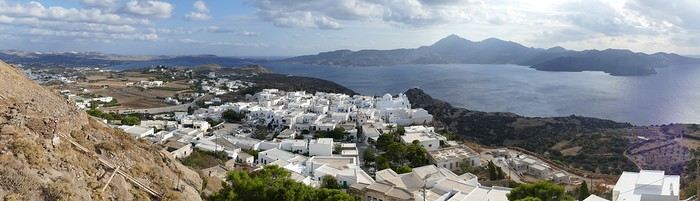
The village of Plaka in Milos
It was with great pleasure that we finally reconnected with our old habits as inveterate travelers! Greece, and more specifically the Greek islands, was the natural choice for us. After having already visited many Greek islands during around 18 trips, we decided to revisit islands we had seen over 40 years ago, like Milos, where our memories were extremely hazy. Our route was well-planned and familiar: a low-cost flight from Basel-Mulhouse to Athens, then a traditional ferry from Piraeus to Milos. Taking a speedboat, which is faster, would have forced us to spend a night in Piraeus. Plus, we felt that the traditional ferry was part of the journey, and with good weather, spending eight hours on deck wasn’t unpleasant at all. Watching the docking maneuvers with the comings and goings of trucks and cars, observing the passengers, reading a book, or admiring the scenery—all of that is part of the travel experience. Milos Island: Accommodation in Adamas We arrived quite late, around 11 PM, in Adamas, the port of Milos. No worries—the friendly couple managing the apartment was waiting for us, and it was just a 10-minute walk from the port. The first two days were spent unwinding, with swimming at the nearby beach, strolling through Adamas, and relaxing.
Discovering Plaka On the third day, we took the path along the small beach west of town toward a French military cemetery! A historical reminder of our presence here during the Crimean War, among others. The path climbs toward a beacon perched on top of a hill before disappearing into the scrubland. We returned to Adamas for lunch on our terrace.
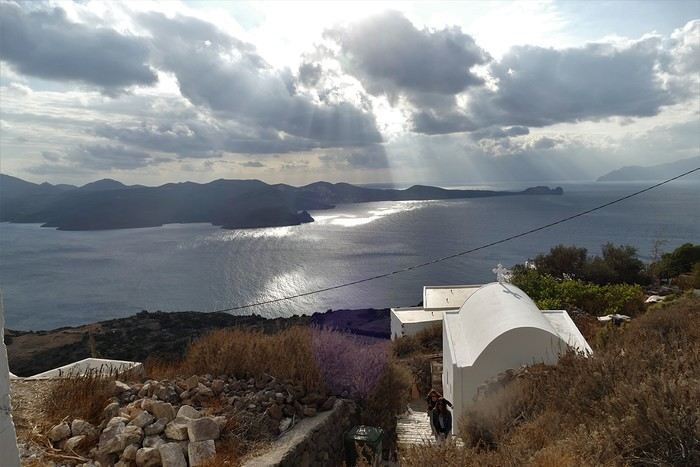
In the afternoon, we visited the hilltop village of Plaka by bus from Adamas. Plaka is the original old town, dominated by a church and, even higher up, the ruins of the Kastro. The view is magnificent. We stopped at a pastry shop in the village to enjoy excellent orange cakes and baklavas. Back in Adamas, we checked out car rental agencies to be more mobile, though the bus network seemed quite extensive. It costs around 40 € per day, plus 8 € if you want to significantly reduce the deductible. Port of Klima.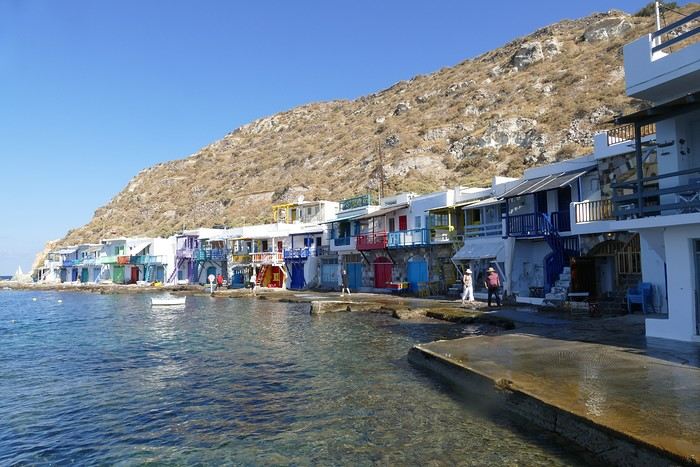
Yesterday’s weather was quite mixed with lots of clouds, but today the sun is shining again. We drove to the small port of Klima, famous for its boat garages called "sirmatas." It’s true that in the morning sun, these boat garages carved into the volcanic tuff are beautifully lit, turning the village into a colorful mosaic. Above the village, a path climbs directly to the magnificent Roman theater overlooking the surroundings and the sea.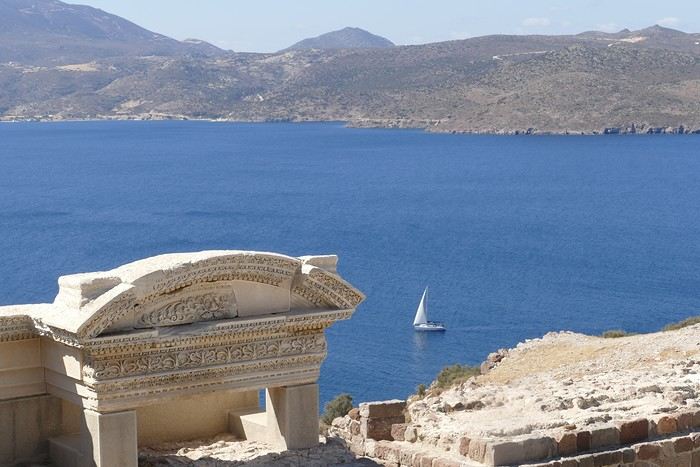 Following the well-marked path, we reached the road leading 200 meters down to the catacombs. It’s an impressive complex of 3rd and 4th-century catacombs, though only a small part is open to visitors—it’s still very moving. In the mid-afternoon, we got back in the car to visit the tiny ports of Firopotamos and Mandraki, which also have their colorful sirmatas. We took the opportunity to swim at the small beach in Mandraki, where the water was warm and calm.
Mandraki Port. We had a decent dinner at a seaside restaurant in Adamas, though you have to be selective—we had a bad experience at Kynigos on the second night!
Moving to Polonia in Eastern Milos, Sarakiniko Site
Following the well-marked path, we reached the road leading 200 meters down to the catacombs. It’s an impressive complex of 3rd and 4th-century catacombs, though only a small part is open to visitors—it’s still very moving. In the mid-afternoon, we got back in the car to visit the tiny ports of Firopotamos and Mandraki, which also have their colorful sirmatas. We took the opportunity to swim at the small beach in Mandraki, where the water was warm and calm.
Mandraki Port. We had a decent dinner at a seaside restaurant in Adamas, though you have to be selective—we had a bad experience at Kynigos on the second night!
Moving to Polonia in Eastern Milos, Sarakiniko Site
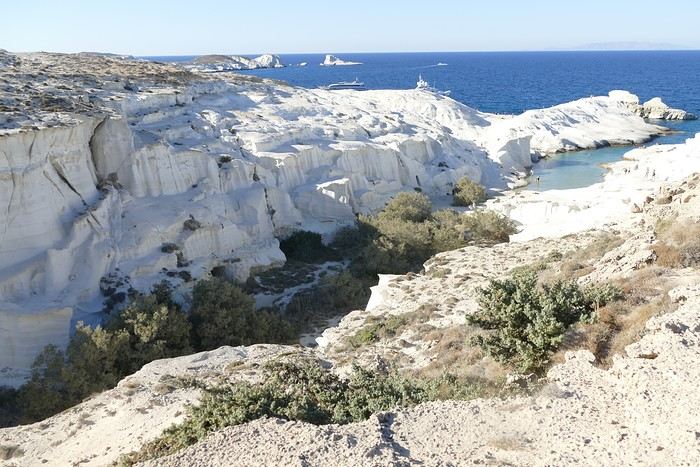
The Sarakiniko site We left Adamas for a second stay on Milos, this time in Polonia. The rental Panda was packed with the four of us and our luggage! Our apartment was in a beautiful house surrounded by a grove, so our lovely terrace was well-shaded. Luckily, there was a small beach nearby, and we went for a swim right away. Apart from us, there were only three other swimmers—definitely the end of the season!
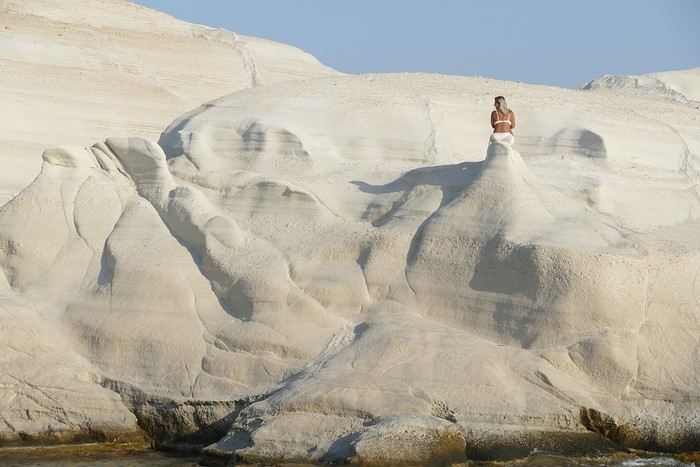
"Fairy chimney"! In the afternoon, we visited the famous Sarakiniko site, Milos’ emblematic spot. Judging by the number of cars in the parking lot, we wouldn’t be alone. As we approached, we heard an indefinable rock/punk/metal music: some young people had brought a sound system and a foghorn and were having fun diving off a fairly high cliff to impress the crowd. It definitely spoiled the visit. Most spots were taken by couples busy taking selfies, so getting photos of the site without tourists was impossible. Still, the site is magnificent, with its white cliffs looking like they’re covered in whipped cream! The sun was still very bright, reflecting strongly off the cliffs, making photography difficult due to the excessive brightness. We had a fish dinner in Polonia at the Enalion restaurant: while the octopus and squid were good, the fish soup tasted more like vegetable soup with a few fish crumbs—too bad.
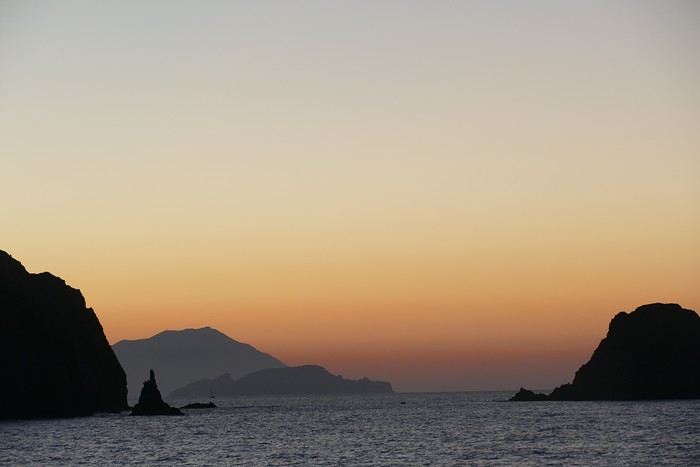
Sunset in Polonia
Ports of Papafranga and Mytikos We continued our exploration of Milos with the Papafranga gorge, a narrow and deep gorge that opens to the sea, where the water is a stunning color. Access via an unstable and dangerous path is prohibited, but that didn’t stop a couple of tourists in flip-flops from venturing in!!! We then swam in the tiny, calm, and sheltered cove of the small port of Mytikos. We returned to Polonia for lunch at Alkis: excellent moussaka. In the late afternoon, Pat and I went out to take some photos just before sunset near the Agios Nikolaos chapel, the beacon, and the new Petakoudia neighborhood next to Polonia to the north.
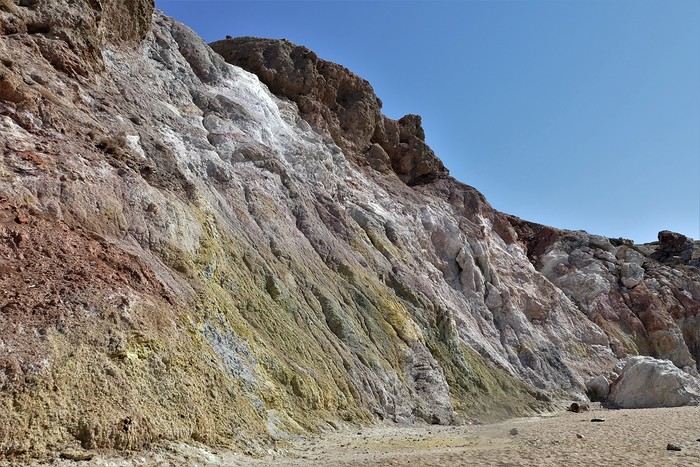
Paleochori Beach
Toward the Multicolored Beach of Paleochori Another sunny day: we still had to discover Paleochori Beach in the south of the island. It was 10:30 AM, and the beach was almost deserted! The water was pleasant, though a bit chilly when we first entered. The beach is bordered by a cliff that, in some places, displays a beautiful multicolored palette. We returned to Polonia in the late afternoon, and Pat and I headed toward Vouddhia Beach south of Polonia—bad choice. The beach is surrounded by a huge mining site served by a dusty road where lines of trucks loaded with ore cross paths. It’s the other side of the coin, and Greece still has progress to make in this area. Dinner at Alki’s was just as good as always. Return to the Sarakiniko Site Early this morning, Pat and I went back to the Sarakiniko site, hoping to take photos in better conditions. While there were fewer people, the parking lot was still full because sunrise is a must in Milos. Still, the conditions were good, and the sunrise spectators left quickly once the sun had risen above the horizon. During the day, an increasingly strong wind cooled the atmosphere, making swimming less enjoyable. Departure for Kimolos Island We changed islands and left Milos for Kimolos, a nearby island—just a 30-minute trip from Polonia’s port. Our apartment was at the entrance of the hilltop village. It’s a village with typical Cycladic architecture, featuring the remains of an old kastro, a few old churches, and windmill towers perched on the hill. We dined in a tiny tavern where the small outdoor tables were squeezed against the walls to let passersby through! As soon as the sun disappeared, it got cold, especially because of the wind. Ports of Kara and Goupa This morning, we explored the small hamlets of Kara and Goupa by Rema Beach, east of the main port. There, we found the sirmatas again—those boat garages partly carved into the volcanic tuff. The path winds between several sirmatas before climbing back up to the Praça road to return to the apartment.
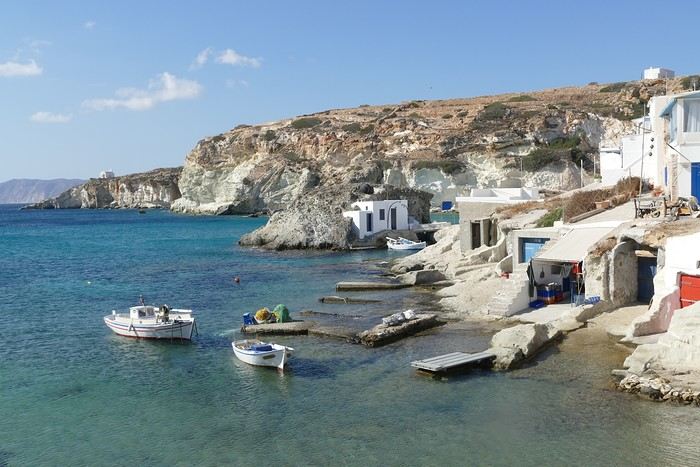
Ports of Kara and Goupa
In the afternoon, we strolled through town, and Pat and I climbed the hill overlooking the village to get a closer look at the few more or less ruined windmills dotting the ridge. Only one mill still had its complete mechanism in place under the roof; the others were empty. The view over the village, port, and sea was beautiful. That evening, we tried another restaurant in the village center, Kali Kardia Bohoris, which was well-frequented by locals, and we didn’t regret it: delicious food, efficient and friendly service, and reasonable prices.
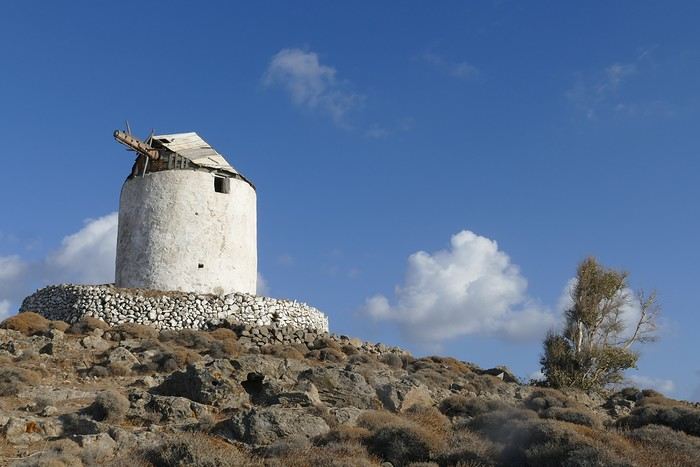
The Kastro Mill
Toward Aliki Beach We walked to Aliki Beach, west of the main village. It’s a large sandy beach shaded by tamarisk trees, but the strong wind prevented us from enjoying it. In the afternoon, I set off on a hike toward the fairy chimney at Skiadi (1.5 hours one way). The paths were very well-marked with signs indicating the trail number and the time to reach the destination. The countryside was beautiful but very dry at this time of year, and as always in Greece, many white chapels dotted the landscape. The numerous dry stone walls testify to the immense labor done by the island’s inhabitants over the centuries! For our last day in Kimolos, we decided to visit the beautiful Praça Beach, one of the most beautiful according to the guides! To get there, we took a path through the interior before joining the paved road near a large dump overflowing with various waste. It’s the flip side of the scenery, and Greece still has progress to make in this area. In the end, Praça Beach left us underwhelmed. The environment, marred by mining operations, detracts from the charm of the beautiful sandy beach. End of the Trip, Return to Piraeus and France And that’s it—we took the Zanteferries ferry back to Piraeus, arriving after a calm and sunny 10-hour journey. We had dinner at Souvlaki Street on the port and spent a good night at the Faros I Hotel in Piraeus—a great spot, close to the port, very clean, and reasonably priced. We flew from Athens to Basel-Mulhouse EuroAirport without any issues. N.B. Budget: around 1850 € all included for 14 days per couple The photo album is available by clicking this link: https://photos.app.goo.gl/wRpxRipg4erpzGj99
The village of Plaka in Milos
It was with great pleasure that we finally reconnected with our old habits as inveterate travelers! Greece, and more specifically the Greek islands, was the natural choice for us. After having already visited many Greek islands during around 18 trips, we decided to revisit islands we had seen over 40 years ago, like Milos, where our memories were extremely hazy. Our route was well-planned and familiar: a low-cost flight from Basel-Mulhouse to Athens, then a traditional ferry from Piraeus to Milos. Taking a speedboat, which is faster, would have forced us to spend a night in Piraeus. Plus, we felt that the traditional ferry was part of the journey, and with good weather, spending eight hours on deck wasn’t unpleasant at all. Watching the docking maneuvers with the comings and goings of trucks and cars, observing the passengers, reading a book, or admiring the scenery—all of that is part of the travel experience. Milos Island: Accommodation in Adamas We arrived quite late, around 11 PM, in Adamas, the port of Milos. No worries—the friendly couple managing the apartment was waiting for us, and it was just a 10-minute walk from the port. The first two days were spent unwinding, with swimming at the nearby beach, strolling through Adamas, and relaxing.
Discovering Plaka On the third day, we took the path along the small beach west of town toward a French military cemetery! A historical reminder of our presence here during the Crimean War, among others. The path climbs toward a beacon perched on top of a hill before disappearing into the scrubland. We returned to Adamas for lunch on our terrace.
In the afternoon, we visited the hilltop village of Plaka by bus from Adamas. Plaka is the original old town, dominated by a church and, even higher up, the ruins of the Kastro. The view is magnificent. We stopped at a pastry shop in the village to enjoy excellent orange cakes and baklavas. Back in Adamas, we checked out car rental agencies to be more mobile, though the bus network seemed quite extensive. It costs around 40 € per day, plus 8 € if you want to significantly reduce the deductible. Port of Klima.
Yesterday’s weather was quite mixed with lots of clouds, but today the sun is shining again. We drove to the small port of Klima, famous for its boat garages called "sirmatas." It’s true that in the morning sun, these boat garages carved into the volcanic tuff are beautifully lit, turning the village into a colorful mosaic. Above the village, a path climbs directly to the magnificent Roman theater overlooking the surroundings and the sea.
Following the well-marked path, we reached the road leading 200 meters down to the catacombs. It’s an impressive complex of 3rd and 4th-century catacombs, though only a small part is open to visitors—it’s still very moving. In the mid-afternoon, we got back in the car to visit the tiny ports of Firopotamos and Mandraki, which also have their colorful sirmatas. We took the opportunity to swim at the small beach in Mandraki, where the water was warm and calm.
Mandraki Port. We had a decent dinner at a seaside restaurant in Adamas, though you have to be selective—we had a bad experience at Kynigos on the second night!
Moving to Polonia in Eastern Milos, Sarakiniko SiteThe Sarakiniko site We left Adamas for a second stay on Milos, this time in Polonia. The rental Panda was packed with the four of us and our luggage! Our apartment was in a beautiful house surrounded by a grove, so our lovely terrace was well-shaded. Luckily, there was a small beach nearby, and we went for a swim right away. Apart from us, there were only three other swimmers—definitely the end of the season!
"Fairy chimney"! In the afternoon, we visited the famous Sarakiniko site, Milos’ emblematic spot. Judging by the number of cars in the parking lot, we wouldn’t be alone. As we approached, we heard an indefinable rock/punk/metal music: some young people had brought a sound system and a foghorn and were having fun diving off a fairly high cliff to impress the crowd. It definitely spoiled the visit. Most spots were taken by couples busy taking selfies, so getting photos of the site without tourists was impossible. Still, the site is magnificent, with its white cliffs looking like they’re covered in whipped cream! The sun was still very bright, reflecting strongly off the cliffs, making photography difficult due to the excessive brightness. We had a fish dinner in Polonia at the Enalion restaurant: while the octopus and squid were good, the fish soup tasted more like vegetable soup with a few fish crumbs—too bad.
Sunset in Polonia
Ports of Papafranga and Mytikos We continued our exploration of Milos with the Papafranga gorge, a narrow and deep gorge that opens to the sea, where the water is a stunning color. Access via an unstable and dangerous path is prohibited, but that didn’t stop a couple of tourists in flip-flops from venturing in!!! We then swam in the tiny, calm, and sheltered cove of the small port of Mytikos. We returned to Polonia for lunch at Alkis: excellent moussaka. In the late afternoon, Pat and I went out to take some photos just before sunset near the Agios Nikolaos chapel, the beacon, and the new Petakoudia neighborhood next to Polonia to the north.
Paleochori Beach
Toward the Multicolored Beach of Paleochori Another sunny day: we still had to discover Paleochori Beach in the south of the island. It was 10:30 AM, and the beach was almost deserted! The water was pleasant, though a bit chilly when we first entered. The beach is bordered by a cliff that, in some places, displays a beautiful multicolored palette. We returned to Polonia in the late afternoon, and Pat and I headed toward Vouddhia Beach south of Polonia—bad choice. The beach is surrounded by a huge mining site served by a dusty road where lines of trucks loaded with ore cross paths. It’s the other side of the coin, and Greece still has progress to make in this area. Dinner at Alki’s was just as good as always. Return to the Sarakiniko Site Early this morning, Pat and I went back to the Sarakiniko site, hoping to take photos in better conditions. While there were fewer people, the parking lot was still full because sunrise is a must in Milos. Still, the conditions were good, and the sunrise spectators left quickly once the sun had risen above the horizon. During the day, an increasingly strong wind cooled the atmosphere, making swimming less enjoyable. Departure for Kimolos Island We changed islands and left Milos for Kimolos, a nearby island—just a 30-minute trip from Polonia’s port. Our apartment was at the entrance of the hilltop village. It’s a village with typical Cycladic architecture, featuring the remains of an old kastro, a few old churches, and windmill towers perched on the hill. We dined in a tiny tavern where the small outdoor tables were squeezed against the walls to let passersby through! As soon as the sun disappeared, it got cold, especially because of the wind. Ports of Kara and Goupa This morning, we explored the small hamlets of Kara and Goupa by Rema Beach, east of the main port. There, we found the sirmatas again—those boat garages partly carved into the volcanic tuff. The path winds between several sirmatas before climbing back up to the Praça road to return to the apartment.
Ports of Kara and Goupa
In the afternoon, we strolled through town, and Pat and I climbed the hill overlooking the village to get a closer look at the few more or less ruined windmills dotting the ridge. Only one mill still had its complete mechanism in place under the roof; the others were empty. The view over the village, port, and sea was beautiful. That evening, we tried another restaurant in the village center, Kali Kardia Bohoris, which was well-frequented by locals, and we didn’t regret it: delicious food, efficient and friendly service, and reasonable prices.
The Kastro Mill
Toward Aliki Beach We walked to Aliki Beach, west of the main village. It’s a large sandy beach shaded by tamarisk trees, but the strong wind prevented us from enjoying it. In the afternoon, I set off on a hike toward the fairy chimney at Skiadi (1.5 hours one way). The paths were very well-marked with signs indicating the trail number and the time to reach the destination. The countryside was beautiful but very dry at this time of year, and as always in Greece, many white chapels dotted the landscape. The numerous dry stone walls testify to the immense labor done by the island’s inhabitants over the centuries! For our last day in Kimolos, we decided to visit the beautiful Praça Beach, one of the most beautiful according to the guides! To get there, we took a path through the interior before joining the paved road near a large dump overflowing with various waste. It’s the flip side of the scenery, and Greece still has progress to make in this area. In the end, Praça Beach left us underwhelmed. The environment, marred by mining operations, detracts from the charm of the beautiful sandy beach. End of the Trip, Return to Piraeus and France And that’s it—we took the Zanteferries ferry back to Piraeus, arriving after a calm and sunny 10-hour journey. We had dinner at Souvlaki Street on the port and spent a good night at the Faros I Hotel in Piraeus—a great spot, close to the port, very clean, and reasonably priced. We flew from Athens to Basel-Mulhouse EuroAirport without any issues. N.B. Budget: around 1850 € all included for 14 days per couple The photo album is available by clicking this link: https://photos.app.goo.gl/wRpxRipg4erpzGj99
Eastern Crete in September 2024
Travel journal in Eastern Crete from September 8th to 29th, 2024
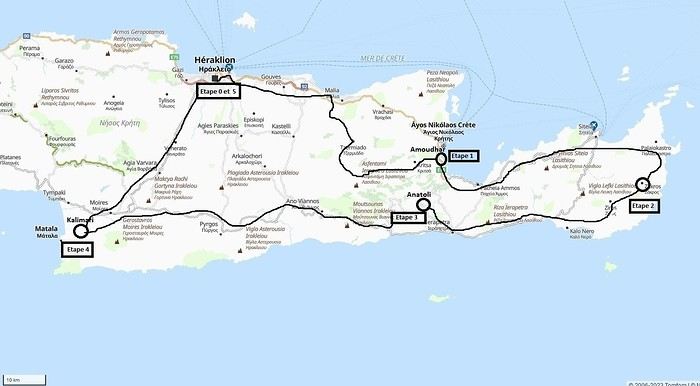 Our 21-day itinerary
Sunday, 08/09: Once again—and this is the eighth time—we’re setting off, the four of us: Patrick, Michelle, Jacques, and Monique, for the Greek islands. This time, we’ve chosen Crete. No need to wake up at 3 or 4 a.m. to reach Basel-Mulhouse Airport at dawn to catch the first flight to Greece at 6 a.m.! Given the prohibitive prices charged by EasyJet, we found flights that were half the price from Zurich Airport, which is accessible in 3 hours by train from Colmar. Pierre-Paul drives all four of us to Colmar train station, where we take the train to Basel and then, 20 minutes later, the direct train to Zurich Airport. After wandering around the airport, we go for a coffee at 6 € each! We’re in Switzerland, after all. The other dining areas all have vending machines for selecting and paying for meals—soon, there won’t be anyone left to serve you! After a short wait, we take off at 7:45 p.m. (20 minutes late) in an Aegean Airbus A321. Free in-flight meal service isn’t bad either! We land in Heraklion around 11:15 p.m. We pick up our rental car (a red Seat Ibiza) at the airport and head straight to our apartment, located 2 km from the city center. Thanks to the GPS, we find it quickly. It’s a beautiful, fully renovated apartment with all the comforts and well-equipped. On the table, there’s wine, bottles of water, jam, coffee, etc. Given the late hour, we won’t stay up long.
Monday, 09/09: To enhance our breakfast, Michelle and Monique set off to find a bakery nearby. They return with croissants and donuts—yum... Then we head to the west coast. The highway follows the coastline, but we prefer taking the old road to Malia, our first stop. We visit the major archaeological site of this Minoan city under the hot sun. The site covers a vast area, but the ruins aren’t very evocative except for a few beautiful amphorae scattered around. The explanations in a small house at the entrance are interesting and help us better understand the organization of the ancient city with its different districts. From there, we head toward the nearby mountains to see the thousand-year-old plane tree in the village of Krasi. We take the opportunity to enjoy an excellent lunch of moussaka and delicious gemista at the Krassopsychia taverna in the village center. Pleasant surprise: the prices are still reasonable, with a bill of 70 € for four, including wine and water. The friendly tradition of complimentary dessert and glasses of raki continues—great! We’ve set the bar high right away! Let’s hope the rest lives up to it! On the way back toward the Lassithi Plateau, we stop at the Kardiotisa Monastery perched high on the mountain to enjoy a magnificent view of the entire region. Just a little further, we arrive at the Lassithi Plateau: the presence of small windmills used to pump water from the ground is the typical feature of this plateau. We complete a full loop around the plateau, passing by numerous orchards and vegetable gardens that occupy the entire space. At the end of the plateau, we once again cross mountain passes via winding roads that bring us near Agios Nikolaos. Our apartment is located about ten kilometers further south in Amoudhara. The owner, who was notified, waits for us and shows us her superb apartment, whose large terrace overlooks the entire Mirabello Bay. She then gives us valuable information about the different beaches in the area. Dinner will be frugal, given our hearty lunch in Krasi!
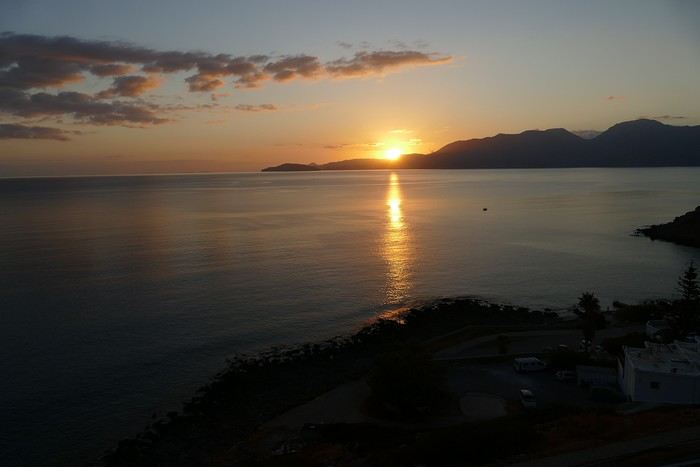 Sunset over Mirabello Bay
Tuesday, 10/09: A bit of a gray sky when we wake up around 8 a.m., but the sun will soon triumph over the scattered clouds. For our first swim, we opt for Voulisma Beach, even though our host warned us it was a bit “crowdy.” That’s understandable given the beautiful emerald color of the sea and the lovely curve of the beach. To avoid the big crowds, we move toward the eastern part of the beach, accessible via a steep staircase. The water is very warm, and this first dip is very pleasant. Before returning to the apartment, we stop at the bakery to buy spinach pies, essential ingredients to accompany our Greek salad for lunch. Of course, everything will be washed down with ouzo, which will remain our favorite drink for the next three weeks—but in moderation!!! A nap is in order after all that effort. In the late afternoon, we drive to Agios Nikolaos, the main seaside resort in Crete. We’re not too enthusiastic about visiting this mass-tourism resort, but the center of Agios, concentrated around the small inner harbor, is pleasant to see despite the plethora of shops and restaurants. We dine a little outside the harbor in the shaded courtyard of the Avli taverna: the oven-baked lamb, squid with spinach, and cuttlefish ink orzo pasta are all highly appreciated. We still stay under a 75 € bill for four.
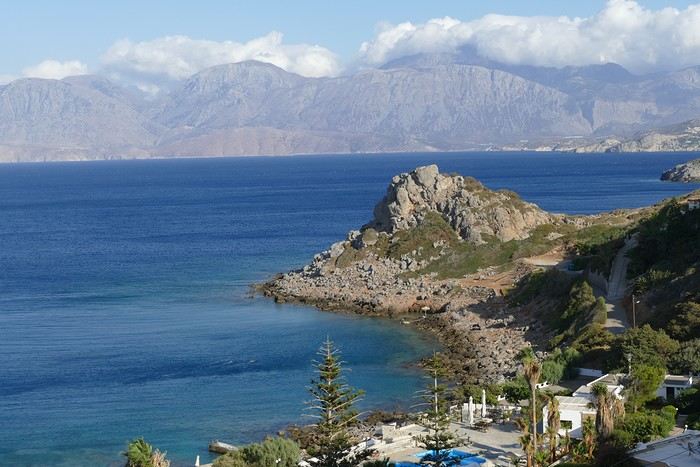 Mirabello Bay seen from our terrace
Wednesday, 11/09: At 8 a.m., the terrace is already bathed in sunlight, and it’s already quite hot. The small parasol barely gives us enough shade, but we’re not complaining! For our second swim, we head to a tiny beach recommended by our host, just 3 minutes by car from our place. The path leading to it is very discreet, and we don’t find it right away! It’s a small sandy cove with a few welcome tamarisk trees for shade. When we arrive, there are two swimmers, and there won’t be more than five or six in the morning. After lunch and a nap, we head to the beautiful village of Kritsa, just a few kilometers away. It’s too late to visit the beautiful church of Kera Panagia, which is already closed. We settle for the exterior, which is worth a look. The weather is clouding over, and big clouds are gathering. Upon arriving in Kritsa, a heavy shower forces us to take shelter in the Platanos taverna in the village center, and since it’s nearly 7 p.m., we decide to stay and dine there. Good choice—excellent meze: croquettes and stuffed zucchini flowers, gigantes beans, grilled tomatoes and feta, and pancetta as the main dish. The rain stops just as we decide to head back.
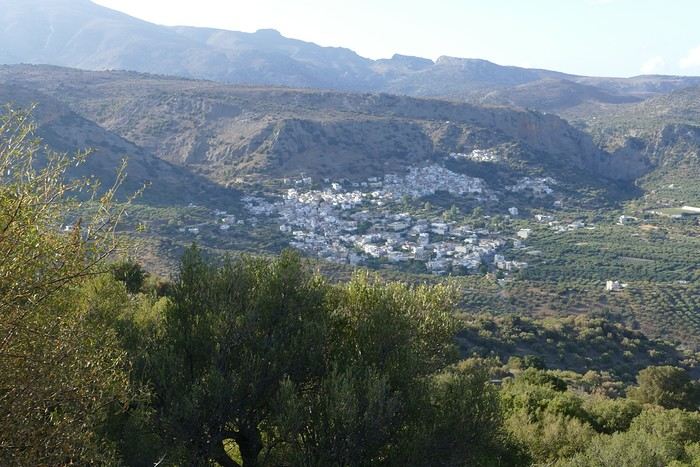 Village of Kritsa
Thursday, 12/09: Our terrace faces east, so we get to watch the sunrise around 7 a.m.—it’s truly a beautiful sight we never tire of. Around 9 a.m., we head to the village of Plaka, where boats depart for the island of Spinalonga, located north of Agios Nikolaos. We board the first boat, which sets sail at 10 a.m., and we’re not alone—the boat is practically full. After 10 minutes, we land on the island at the same time as several other boats from Elounda or Agios. Needless to say, there are already quite a few people walking through the streets of the leper village. The visit remains interesting and moving as we read the explanatory panels recounting the island’s history under Byzantine and then Turkish rule, followed by its transformation into a leper colony. As soon as we climb toward the top of the island via more or less maintained paths, there’s almost no one left. The 360° view from up there is stunning.
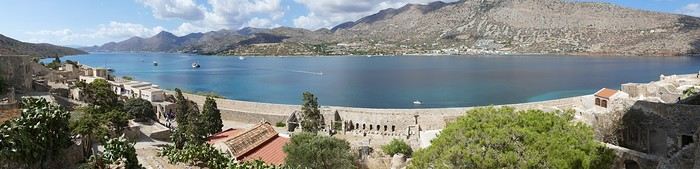
Spinalonga Island
The heat is now unbearable, and we can’t wait to get back home to have lunch on our terrace and rest. In the late afternoon, we go grocery shopping at the AB supermarket at the entrance of Agios. We had spotted another nice restaurant in our guide, but unfortunately, there’s a different one at the indicated location that doesn’t inspire us. So, we return to the Avli taverna for another dinner just as good as the first.
Friday, 13/09: We repeat yesterday’s successful program: a swim in our little cove, lunch on the terrace, a nap, and then, in the late afternoon, we discover another nearby village, Kroustas, nestled in the olive groves near Kritsa. Much less touristy than Kritsa, it’s mostly inhabited by locals, especially the elderly who are enjoying the cool air on their chairs—if you can call it cool given the still-high temperatures in the late afternoon! We then return to visit Kritsa, which we hadn’t been able to explore due to the rain. Dinner at a taverna in the village center at a very reasonable price.
Saturday, 14/09: Today, we move to our new base further east. We start with a high viewpoint at the Faneromeni Monastery, which overlooks Mirabello Bay. The monastery itself is of little interest as it’s under renovation with excessive concrete work. We continue to the village of Kavoussi to see another exceptional tree after a few kilometers on a dusty, bumpy track. It’s an olive tree said to be about 3,200 years old—impressive, and the countryside is very beautiful. It’s time to find a place for lunch. We find one in the charming little port of Mohlos, where a few tavernas surround a very nice small beach. Our choice falls on the Bogazzi taverna, where we enjoy fried fish. To reach our new base in Zakros, we still have to drive through the mountains before reaching Sitia, Paleokastro, and finally Zakros. The region is beautiful, with olive groves and rows of wind turbines taking advantage of the strong wind near the northern tip of the island. In Zakros, we’re greeted by our very friendly host. Here too, we have all the comforts and a beautiful terrace overlooking the village. The apartment has reversible air conditioners, but the overly simple instructions leave us puzzled. Thinking we’ve set it correctly, we realize a little too late that it’s blowing hot air over 30°C! After numerous attempts and testing several confusing programs, we finally succeed! Dinner on our new terrace.
Sunday, 15/09: This morning, we get up early to hike in the “Gorge of the Dead” while it’s still cool. The sky is blue as usual! We park in the nearest parking lot and start our descent via a beautiful path winding through the olive groves. A little further on, the landscape opens up, and the path, now a stony trail, begins the descent to the dry riverbed. On either side of the riverbed rise beautiful reddish cliffs.
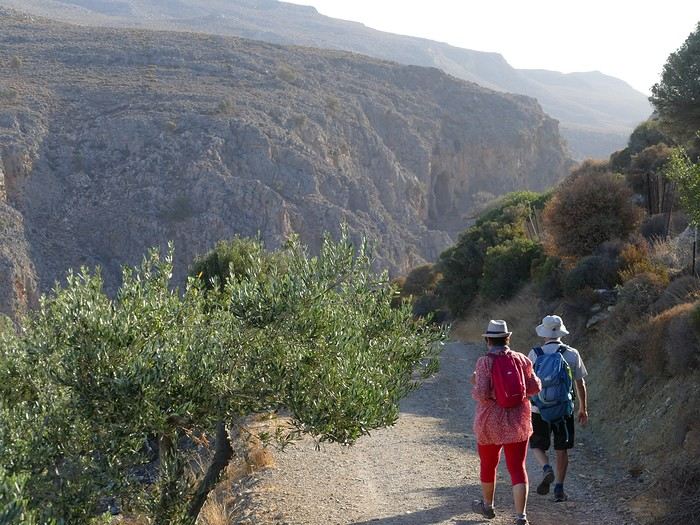
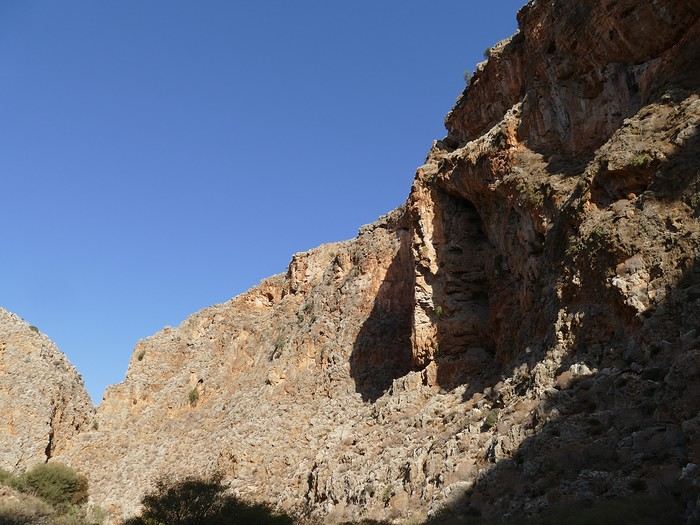
Gorge of the Dead
The trail winds its way through this narrow gorge with difficulty. It was in the many caves visible halfway up the slope that the Minoans buried their dead, hence the name “Gorge of the Dead.” The gorge opens onto a beautiful small pebble beach. A swim is welcome after this hike that made us sweat. The hike took us 1 hour and 25 minutes, and a little less on the way back. Meanwhile, Monique did some shopping and prepared an excellent lunch. In the late afternoon, we go down to dine at Platanakis, a taverna in the small village of Kato Zakros.
Monday, 16/09: This morning, we explore the northern part of the east coast near Palekastro. We start with a dip at the beautiful Hionia Beach near Palekastro. The water is still just as nice, but a light breeze is blowing—not enough to spoil our fun! Seeing all the wind turbines lining the ridges, it’s no surprise.
 Grocery shopping in Palekastro and return to Zakros. A little rain in the late afternoon and an excellent dinner at Iannis Mitsakakis’ Taverna in Adravastis. These are the kind of small tavernas we love—unpretentious, a few tables on a terrace, a warm welcome, a short menu guaranteeing freshness, tasty dishes prepared by the server’s mom, and a light bill. What more could you ask for!
Tuesday, 17/09: We head back toward Palekastro to do some shopping, but it’s also the road to the Toplou Monastery. There, we see a collection of magnificent icons dating from the 15th to the 20th century. We can also admire drawings of Orthodox religious architecture. We continue toward the Mavros Akrotiri headland to enjoy the view of the sea and rocky capes. On the way back to our place, we make a small detour to see the famous Vai palm grove. Meh... As for Vai Beach, it’s filled with paid umbrellas and sunbeds, and there are so many people that we flee. Plus, having to pay for parking is another reason to snub this trendy beach. We prefer our Hionia Beach, which we already appreciated the other day. In the late afternoon, Pat and I start the trail that begins at Kato Zakros Beach heading south. The poorly marked path crosses a plateau of sharp limestone. The paint and cairn markings are no longer very visible, and with dusk approaching, we turn back toward Kato Zakros. Dinner at the Platanakis taverna—less good than last time.
Wednesday, 18/09: To avoid the scorching sun, Pat, Mimi, and I get up earlier than usual to hike the Hohlakies Gorge. At this early hour, the sky is quite cloudy, and it’s drizzling. When we arrive in the village of Hohlakies, we park in front of a small chapel, the start of the hike. The sky is now completely clear. The trail starts among the olive groves, then after passing through a gate, we descend into the gorge filled with large rocks. We’re alone in the world, and the landscape is magnificent. A few wild goats clinging to the cliff watch us from above. After 1 hour and 15 minutes, we emerge onto the wonderful Karoumès Beach. A pleasant swim, then back to civilization! A walk in the late afternoon in Zakros to discover the beautiful springs route. Dinner in Adravastis.
Thursday, 19/09: Another move: Before heading to our next stop, we make a detour to see the beautiful Keratokampos Beach and can’t resist a swim in the still-warm, clear water. We continue our journey via Ziros, then reach the south coast and have lunch at the Stephi taverna in Ferma—excellent meal! The south coast is quite urbanized and has much less charm than the east coast we’ve just left! The numerous plastic greenhouses are partly to blame. We stop for groceries in Ierapetra. Around 3 p.m., we arrive at our destination in the small perched village of Anatoli. Our lodging is at the top of the village, and from the path leading to it, we have a magnificent view of the coastal plain, unfortunately overloaded with plastic greenhouses. It reminds us of the landscapes of El Ejido in Andalusia.
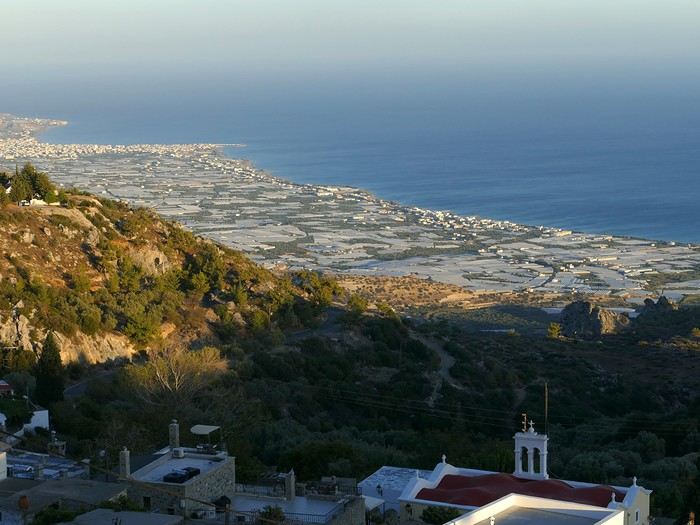 View of the Ierapetra coast from Anatoli
Friday, 20/09: A walk and discovery of the hamlet of Anatoli. There are few services—a tiny grocery store, a taverna, and that’s it. Fortunately, the traveling baker arrives and honks. We take the opportunity to buy fresh bread. Leaving the village, we take a path that should lead us to the hamlet of Drygies. The landscape is beautiful. We walk through a lovely pine forest before arriving at the hamlet. The path continues to a taverna that’s closed today, with a superb terrace overlooking the coast. Luckily, the owner arrives and informs us that the taverna will be open next Sunday and that we can enjoy barbecued meat. Noted! We head back to Anatoli via the small paved road with, fortunately, very limited traffic. Lunch on our terrace, then a dip in our private pool! The water is noticeably cooler than at the beach. Dinner at the village taverna: there’s only one menu—meze starters, souvlaki, water, wine, and bread—all for 35 €! We think we’re dreaming—was there a mistake? No.
Saturday, 21/09: We discover the beach of the village of Myrtos, a small seaside resort that’s quite touristy but on a human scale. We swim in the western part of the beach, and once again, we’re alone in the water. The best part: warm water and tamarisk trees for welcome shade. There’s even a shower to rinse off! In the late afternoon, Pat and I decide to go for a hike in the Selakano pine forest. To get there, we take a narrow, winding, and poorly paved road after the village of Christos. Plus, at this altitude, we encounter clouds clinging to the mountain, so it’s drizzling, and visibility is reduced. We decide to turn back and return to Anatoli. As compensation, we take the path that passes in front of the lodging and leads us to the Timios Stavros chapel, which crowns the summit of the nearby mountain. We arrive at the summit just in time for the sunset at 7 p.m. Breathtaking 360° panorama and magnificent colors!
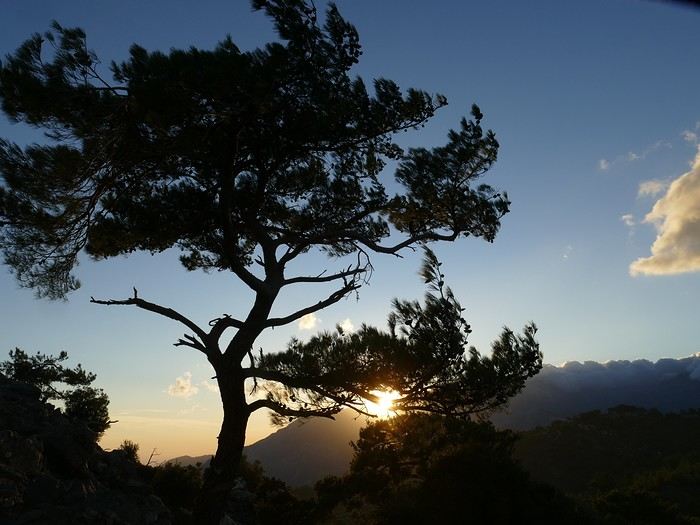 Sunset from Anatoli
Sunday, 22/09: This morning, Pat, Mimi, and I go for a hike in the Sarakina Gorge, located about 12 km from Anatoli via a beautiful road winding through irrigated olive groves. We park in the small parking lot before the trail. At the start, the path follows a levada (small irrigation canal) and quickly enters a very narrow gorge flanked by high cliffs. The riverbed is cluttered with huge rocks blocking the passage. No matter—in the technical sections, ropes or ladders allow us to overcome these obstacles with a bit of skill. You can imagine how quickly the riverbed must rise during a storm, given the narrowness of the gorge!
We progress slowly through this magnificent and impressive rocky chaos. At the exit of the gorge, we take another return path that partly follows the paved road. Back in Anatoli, we go to lunch at the Drygies taverna. We sit at the edge of the terrace under a huge tree that covers almost the entire terrace and order grilled lamb dishes prepared according to the ancient “antikristo” method.
Monday, 23/09: Departure for our last stop before Heraklion. We thought about swimming at Tertsa Beach, but it turns out to be less pleasant than expected, with pebbles and an uneven rocky plateau. So, we return to Myrtos Beach, which we know well and suits us perfectly. We head west, leaving the coast a bit. Around 3:30 p.m., we arrive at our destination in the village of Kamilari, near the famous Matala spot. We’ve rented a beautiful, modern, well-equipped apartment with a lovely shaded terrace. The owner is very friendly and explains everything necessary for a good stay. We explore the quite touristy village with its few tavernas, all full of tourists, mostly Germans.
Tuesday, 24/09: Visit to the village of Sivas, well restored thanks to the Germans, who have invested a lot here. We take the opportunity to scout out “friendly” tavernas, then go for a swim at Kalamaki Beach. Apart from a small sandy access, you have to enter the water via a chaotic limestone plateau—proof of this is that Monique trips slightly when entering the water. A group of very unfriendly German women blocks the sandy passage and doesn’t hesitate to push swimmers they deem too close. Back home, lunch, and a nap. In the late afternoon, we drive to visit the nearby Phaistos site. We benefit from very beautiful lighting. From the elevated site, we overlook the Messara Plain with a beautiful view of the olive grove checkerboards highlighted by the late afternoon sun. The site itself is quite vast, but to appreciate it, it’s better to read the explanatory panels placed throughout the different quarters. At this hour, the site is almost empty, and the beautiful light adds charm to the visit.
Wednesday, 25/09: Departure for the village of Matala, which doesn’t interest us in itself, having been there during the “hippie” era in 1976. However, going to Red Beach, only accessible by taking a path overlooking this area, appeals to us much more. We park in the large parking lot just outside the village and start our climb, which brings us to a pass from where we can admire this beautiful red-sand beach framed by beautiful cliffs plunging into the sea. The weather is magnificent, and at this early hour, there aren’t many people yet. We swim in the free part located near the cliff on the right when arriving at the beach. The sea is like glass, warm, and without a single ripple—a real treat! After half an hour, we turn back, and now there are many people rushing on this path, not at all made for feet in sandals or flip-flops, yet many vacationers venture out like this! Matala lives up to its image—a trendy place, full of shops, bars, and restaurants. You could be in any seaside resort with a standard global urbanism, lacking particular charm. Back home. In the late afternoon, a walk through the olive groves surrounding Kamilari, then dinner at Evangelina’s, who runs the Minoan Parassies taverna in the middle of the olive groves. Evangelina is quite a character: we came to reserve a table for 8 p.m. when it was only 7 p.m., but since we lingered near her restaurant, she prepares a table for us and urges us to sit down! And there she takes our order, and a little later, the meze arrive, followed by the main dishes. We finish this good dinner with several generous glasses of raki, accompanied by Evangelina’s encouragements, repeating “poya poya bravo bravo” in a loop. We’re in great shape too, by the way! We return in the middle of the night, on foot, fortunately, with the path vaguely lit by our phones...
Thursday, 26/09: This morning, we discover a new beach, Kommos Beach, not far from Kamilari either. It’s a long sandy beach, a small part of which is dedicated to paid umbrellas and sunbeds, and the rest is free. We spot a tamarisk tree to take shelter from the still-hot sun, and once again, we enjoy clear, warm water. The few swimmers spread out easily over nearly 500 meters of beach. In the late afternoon, Pat and I go to admire the sunset from the hill near our lodging. The hill, covered with olive trees, is threatened by a planned housing development of large cubic villas—trends dictate. Concrete never stops...
Friday, 27/09: We thought about leaving the car at the Odiyitria Monastery, the end of the paved road, but since the track descending to the cave remains drivable, we park 3 km further at the junction of the track leading to Kali Limenes Beach. We still have to walk for half an hour on a less drivable track, and then we’re at the entrance of the Farango Gorge. It’s a beautiful, easy hike since we follow the dry pebble riverbed. Before arriving at the beach, there’s a very beautiful small chapel sheltered under a large cliff, beautifully lit at this early hour.
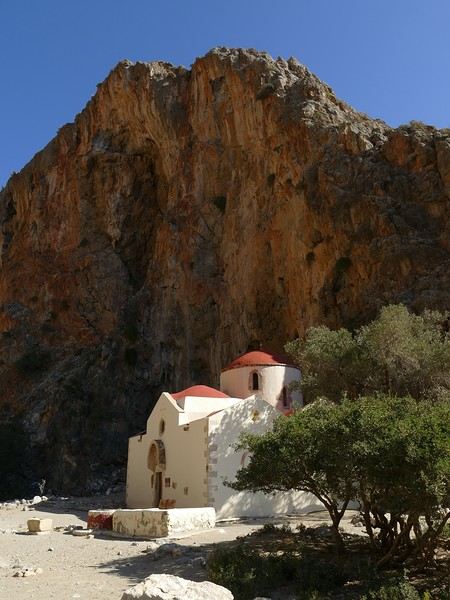
Agio Farango Chapel
A few climbers are scaling the cliff, and about ten swimmers are enjoying the sea. Return to the car under the hot sun. In the late afternoon, we all return to visit the interesting Odiyitria Monastery. Last swim at Kommos Beach and an excellent dinner at the Sigelakis taverna in Sivas.
Saturday, 28/09: There’s an end-of-vacation atmosphere... We pack our bags and head north. A short stop to see the village of Vorri, and a little over an hour later, we arrive in the big city of Heraklion. Since it’s too early to check into the apartment, we park in the city center to visit the famous archaeological museum. It’s indeed a must-see highlight of our stay in Crete. All four of us are amazed by the quantity and quality of the objects presented from the Minoan civilization. After more than 2 hours, we come out without having seen everything, but we’re a bit overwhelmed by all these wonders. Lunch at a nice little taverna very close to the Titus Church. We go to take possession of our apartment—the same as on the way there, still just as satisfying. In the late afternoon, I go alone for a walk in the historic district of the city, passing by the Morosini Fountain, which is bustling with people—some seated at café terraces, others standing and chatting. There’s a lively atmosphere here. A little further on are the Venetian loggia and the Agios Titos Church. I walk down to the old Venetian port to stroll along the jetty and admire the fortifications under beautiful late-afternoon lighting, then return to the apartment. Dinner near our place at Kiriakis, a “chic” restaurant but with very reasonable prices and excellent cuisine.
Sunday, 29/09: Wake-up at 3:30 a.m., quick coffee, and drive to the nearby airport. We leave the car in the parking lot. Already a lot of people at this early hour. Since we don’t have checked luggage, we go straight to security, which goes fairly quickly, then it’s waiting time and takeoff on time in an Airbus A321 for a 45-minute flight to Athens. We take off again in another Airbus A321 with a 50-minute delay to arrive in Zurich at 11:10 a.m. local time. Then we have to take the train to Basel and then the one to Colmar. With fewer Sunday services, we won’t arrive in Colmar until around 4 p.m.
Conclusion All four of us returned very satisfied with this stay in Crete for several reasons: - We found superb beaches with clear, warm water and often very few vacationers. - The few hikes we did were magnificent, especially those where the trails went through gorges leading to deserted beaches. - We greatly appreciated Cretan gastronomy—there were so few disappointments that we can count them on one hand. - All the accommodations we booked turned out to be superb, with the icing on the cake being the very friendly welcome from our hosts. - Generally, contacts with Cretans were always very warm despite the language barrier—we speak a little Greek. - We also appreciated the diversity of landscapes in this eastern part of Crete, with plateaus and mountains with splendid rugged reliefs.
Note: The photo album is available by clicking on this link: https://photos.app.goo.gl/hfdjQndA5eXkL5k7 Captions are only visible per photo by clicking on the circled “i” in the top right. Budget: approximately 3,300 € per couple for 21 days, including train and flights Budget details per couple: - Flight Zurich-Heraklion: 440 € - Trains Colmar-Basel-Zurich round trip for 4: 442.40 € (221 € per couple) - Accommodation: 2,431 € / 21 = 115.80 € per night for 4 (1,216 € per couple) - Car rental for 21 days: 684 € + 145 € fuel (1,150 km) (414 € per couple) - Restaurants, food, etc.: 1,009 €
Our 21-day itinerarySunday, 08/09: Once again—and this is the eighth time—we’re setting off, the four of us: Patrick, Michelle, Jacques, and Monique, for the Greek islands. This time, we’ve chosen Crete. No need to wake up at 3 or 4 a.m. to reach Basel-Mulhouse Airport at dawn to catch the first flight to Greece at 6 a.m.! Given the prohibitive prices charged by EasyJet, we found flights that were half the price from Zurich Airport, which is accessible in 3 hours by train from Colmar. Pierre-Paul drives all four of us to Colmar train station, where we take the train to Basel and then, 20 minutes later, the direct train to Zurich Airport. After wandering around the airport, we go for a coffee at 6 € each! We’re in Switzerland, after all. The other dining areas all have vending machines for selecting and paying for meals—soon, there won’t be anyone left to serve you! After a short wait, we take off at 7:45 p.m. (20 minutes late) in an Aegean Airbus A321. Free in-flight meal service isn’t bad either! We land in Heraklion around 11:15 p.m. We pick up our rental car (a red Seat Ibiza) at the airport and head straight to our apartment, located 2 km from the city center. Thanks to the GPS, we find it quickly. It’s a beautiful, fully renovated apartment with all the comforts and well-equipped. On the table, there’s wine, bottles of water, jam, coffee, etc. Given the late hour, we won’t stay up long.
Monday, 09/09: To enhance our breakfast, Michelle and Monique set off to find a bakery nearby. They return with croissants and donuts—yum... Then we head to the west coast. The highway follows the coastline, but we prefer taking the old road to Malia, our first stop. We visit the major archaeological site of this Minoan city under the hot sun. The site covers a vast area, but the ruins aren’t very evocative except for a few beautiful amphorae scattered around. The explanations in a small house at the entrance are interesting and help us better understand the organization of the ancient city with its different districts. From there, we head toward the nearby mountains to see the thousand-year-old plane tree in the village of Krasi. We take the opportunity to enjoy an excellent lunch of moussaka and delicious gemista at the Krassopsychia taverna in the village center. Pleasant surprise: the prices are still reasonable, with a bill of 70 € for four, including wine and water. The friendly tradition of complimentary dessert and glasses of raki continues—great! We’ve set the bar high right away! Let’s hope the rest lives up to it! On the way back toward the Lassithi Plateau, we stop at the Kardiotisa Monastery perched high on the mountain to enjoy a magnificent view of the entire region. Just a little further, we arrive at the Lassithi Plateau: the presence of small windmills used to pump water from the ground is the typical feature of this plateau. We complete a full loop around the plateau, passing by numerous orchards and vegetable gardens that occupy the entire space. At the end of the plateau, we once again cross mountain passes via winding roads that bring us near Agios Nikolaos. Our apartment is located about ten kilometers further south in Amoudhara. The owner, who was notified, waits for us and shows us her superb apartment, whose large terrace overlooks the entire Mirabello Bay. She then gives us valuable information about the different beaches in the area. Dinner will be frugal, given our hearty lunch in Krasi!
Sunset over Mirabello BayTuesday, 10/09: A bit of a gray sky when we wake up around 8 a.m., but the sun will soon triumph over the scattered clouds. For our first swim, we opt for Voulisma Beach, even though our host warned us it was a bit “crowdy.” That’s understandable given the beautiful emerald color of the sea and the lovely curve of the beach. To avoid the big crowds, we move toward the eastern part of the beach, accessible via a steep staircase. The water is very warm, and this first dip is very pleasant. Before returning to the apartment, we stop at the bakery to buy spinach pies, essential ingredients to accompany our Greek salad for lunch. Of course, everything will be washed down with ouzo, which will remain our favorite drink for the next three weeks—but in moderation!!! A nap is in order after all that effort. In the late afternoon, we drive to Agios Nikolaos, the main seaside resort in Crete. We’re not too enthusiastic about visiting this mass-tourism resort, but the center of Agios, concentrated around the small inner harbor, is pleasant to see despite the plethora of shops and restaurants. We dine a little outside the harbor in the shaded courtyard of the Avli taverna: the oven-baked lamb, squid with spinach, and cuttlefish ink orzo pasta are all highly appreciated. We still stay under a 75 € bill for four.
Mirabello Bay seen from our terraceWednesday, 11/09: At 8 a.m., the terrace is already bathed in sunlight, and it’s already quite hot. The small parasol barely gives us enough shade, but we’re not complaining! For our second swim, we head to a tiny beach recommended by our host, just 3 minutes by car from our place. The path leading to it is very discreet, and we don’t find it right away! It’s a small sandy cove with a few welcome tamarisk trees for shade. When we arrive, there are two swimmers, and there won’t be more than five or six in the morning. After lunch and a nap, we head to the beautiful village of Kritsa, just a few kilometers away. It’s too late to visit the beautiful church of Kera Panagia, which is already closed. We settle for the exterior, which is worth a look. The weather is clouding over, and big clouds are gathering. Upon arriving in Kritsa, a heavy shower forces us to take shelter in the Platanos taverna in the village center, and since it’s nearly 7 p.m., we decide to stay and dine there. Good choice—excellent meze: croquettes and stuffed zucchini flowers, gigantes beans, grilled tomatoes and feta, and pancetta as the main dish. The rain stops just as we decide to head back.
Village of KritsaThursday, 12/09: Our terrace faces east, so we get to watch the sunrise around 7 a.m.—it’s truly a beautiful sight we never tire of. Around 9 a.m., we head to the village of Plaka, where boats depart for the island of Spinalonga, located north of Agios Nikolaos. We board the first boat, which sets sail at 10 a.m., and we’re not alone—the boat is practically full. After 10 minutes, we land on the island at the same time as several other boats from Elounda or Agios. Needless to say, there are already quite a few people walking through the streets of the leper village. The visit remains interesting and moving as we read the explanatory panels recounting the island’s history under Byzantine and then Turkish rule, followed by its transformation into a leper colony. As soon as we climb toward the top of the island via more or less maintained paths, there’s almost no one left. The 360° view from up there is stunning.
Spinalonga Island
The heat is now unbearable, and we can’t wait to get back home to have lunch on our terrace and rest. In the late afternoon, we go grocery shopping at the AB supermarket at the entrance of Agios. We had spotted another nice restaurant in our guide, but unfortunately, there’s a different one at the indicated location that doesn’t inspire us. So, we return to the Avli taverna for another dinner just as good as the first.
Friday, 13/09: We repeat yesterday’s successful program: a swim in our little cove, lunch on the terrace, a nap, and then, in the late afternoon, we discover another nearby village, Kroustas, nestled in the olive groves near Kritsa. Much less touristy than Kritsa, it’s mostly inhabited by locals, especially the elderly who are enjoying the cool air on their chairs—if you can call it cool given the still-high temperatures in the late afternoon! We then return to visit Kritsa, which we hadn’t been able to explore due to the rain. Dinner at a taverna in the village center at a very reasonable price.
Saturday, 14/09: Today, we move to our new base further east. We start with a high viewpoint at the Faneromeni Monastery, which overlooks Mirabello Bay. The monastery itself is of little interest as it’s under renovation with excessive concrete work. We continue to the village of Kavoussi to see another exceptional tree after a few kilometers on a dusty, bumpy track. It’s an olive tree said to be about 3,200 years old—impressive, and the countryside is very beautiful. It’s time to find a place for lunch. We find one in the charming little port of Mohlos, where a few tavernas surround a very nice small beach. Our choice falls on the Bogazzi taverna, where we enjoy fried fish. To reach our new base in Zakros, we still have to drive through the mountains before reaching Sitia, Paleokastro, and finally Zakros. The region is beautiful, with olive groves and rows of wind turbines taking advantage of the strong wind near the northern tip of the island. In Zakros, we’re greeted by our very friendly host. Here too, we have all the comforts and a beautiful terrace overlooking the village. The apartment has reversible air conditioners, but the overly simple instructions leave us puzzled. Thinking we’ve set it correctly, we realize a little too late that it’s blowing hot air over 30°C! After numerous attempts and testing several confusing programs, we finally succeed! Dinner on our new terrace.
Sunday, 15/09: This morning, we get up early to hike in the “Gorge of the Dead” while it’s still cool. The sky is blue as usual! We park in the nearest parking lot and start our descent via a beautiful path winding through the olive groves. A little further on, the landscape opens up, and the path, now a stony trail, begins the descent to the dry riverbed. On either side of the riverbed rise beautiful reddish cliffs.
Gorge of the Dead
The trail winds its way through this narrow gorge with difficulty. It was in the many caves visible halfway up the slope that the Minoans buried their dead, hence the name “Gorge of the Dead.” The gorge opens onto a beautiful small pebble beach. A swim is welcome after this hike that made us sweat. The hike took us 1 hour and 25 minutes, and a little less on the way back. Meanwhile, Monique did some shopping and prepared an excellent lunch. In the late afternoon, we go down to dine at Platanakis, a taverna in the small village of Kato Zakros.
Monday, 16/09: This morning, we explore the northern part of the east coast near Palekastro. We start with a dip at the beautiful Hionia Beach near Palekastro. The water is still just as nice, but a light breeze is blowing—not enough to spoil our fun! Seeing all the wind turbines lining the ridges, it’s no surprise.
Grocery shopping in Palekastro and return to Zakros. A little rain in the late afternoon and an excellent dinner at Iannis Mitsakakis’ Taverna in Adravastis. These are the kind of small tavernas we love—unpretentious, a few tables on a terrace, a warm welcome, a short menu guaranteeing freshness, tasty dishes prepared by the server’s mom, and a light bill. What more could you ask for!Tuesday, 17/09: We head back toward Palekastro to do some shopping, but it’s also the road to the Toplou Monastery. There, we see a collection of magnificent icons dating from the 15th to the 20th century. We can also admire drawings of Orthodox religious architecture. We continue toward the Mavros Akrotiri headland to enjoy the view of the sea and rocky capes. On the way back to our place, we make a small detour to see the famous Vai palm grove. Meh... As for Vai Beach, it’s filled with paid umbrellas and sunbeds, and there are so many people that we flee. Plus, having to pay for parking is another reason to snub this trendy beach. We prefer our Hionia Beach, which we already appreciated the other day. In the late afternoon, Pat and I start the trail that begins at Kato Zakros Beach heading south. The poorly marked path crosses a plateau of sharp limestone. The paint and cairn markings are no longer very visible, and with dusk approaching, we turn back toward Kato Zakros. Dinner at the Platanakis taverna—less good than last time.
Wednesday, 18/09: To avoid the scorching sun, Pat, Mimi, and I get up earlier than usual to hike the Hohlakies Gorge. At this early hour, the sky is quite cloudy, and it’s drizzling. When we arrive in the village of Hohlakies, we park in front of a small chapel, the start of the hike. The sky is now completely clear. The trail starts among the olive groves, then after passing through a gate, we descend into the gorge filled with large rocks. We’re alone in the world, and the landscape is magnificent. A few wild goats clinging to the cliff watch us from above. After 1 hour and 15 minutes, we emerge onto the wonderful Karoumès Beach. A pleasant swim, then back to civilization! A walk in the late afternoon in Zakros to discover the beautiful springs route. Dinner in Adravastis.
Thursday, 19/09: Another move: Before heading to our next stop, we make a detour to see the beautiful Keratokampos Beach and can’t resist a swim in the still-warm, clear water. We continue our journey via Ziros, then reach the south coast and have lunch at the Stephi taverna in Ferma—excellent meal! The south coast is quite urbanized and has much less charm than the east coast we’ve just left! The numerous plastic greenhouses are partly to blame. We stop for groceries in Ierapetra. Around 3 p.m., we arrive at our destination in the small perched village of Anatoli. Our lodging is at the top of the village, and from the path leading to it, we have a magnificent view of the coastal plain, unfortunately overloaded with plastic greenhouses. It reminds us of the landscapes of El Ejido in Andalusia.
View of the Ierapetra coast from AnatoliFriday, 20/09: A walk and discovery of the hamlet of Anatoli. There are few services—a tiny grocery store, a taverna, and that’s it. Fortunately, the traveling baker arrives and honks. We take the opportunity to buy fresh bread. Leaving the village, we take a path that should lead us to the hamlet of Drygies. The landscape is beautiful. We walk through a lovely pine forest before arriving at the hamlet. The path continues to a taverna that’s closed today, with a superb terrace overlooking the coast. Luckily, the owner arrives and informs us that the taverna will be open next Sunday and that we can enjoy barbecued meat. Noted! We head back to Anatoli via the small paved road with, fortunately, very limited traffic. Lunch on our terrace, then a dip in our private pool! The water is noticeably cooler than at the beach. Dinner at the village taverna: there’s only one menu—meze starters, souvlaki, water, wine, and bread—all for 35 €! We think we’re dreaming—was there a mistake? No.
Saturday, 21/09: We discover the beach of the village of Myrtos, a small seaside resort that’s quite touristy but on a human scale. We swim in the western part of the beach, and once again, we’re alone in the water. The best part: warm water and tamarisk trees for welcome shade. There’s even a shower to rinse off! In the late afternoon, Pat and I decide to go for a hike in the Selakano pine forest. To get there, we take a narrow, winding, and poorly paved road after the village of Christos. Plus, at this altitude, we encounter clouds clinging to the mountain, so it’s drizzling, and visibility is reduced. We decide to turn back and return to Anatoli. As compensation, we take the path that passes in front of the lodging and leads us to the Timios Stavros chapel, which crowns the summit of the nearby mountain. We arrive at the summit just in time for the sunset at 7 p.m. Breathtaking 360° panorama and magnificent colors!
Sunset from AnatoliSunday, 22/09: This morning, Pat, Mimi, and I go for a hike in the Sarakina Gorge, located about 12 km from Anatoli via a beautiful road winding through irrigated olive groves. We park in the small parking lot before the trail. At the start, the path follows a levada (small irrigation canal) and quickly enters a very narrow gorge flanked by high cliffs. The riverbed is cluttered with huge rocks blocking the passage. No matter—in the technical sections, ropes or ladders allow us to overcome these obstacles with a bit of skill. You can imagine how quickly the riverbed must rise during a storm, given the narrowness of the gorge!
We progress slowly through this magnificent and impressive rocky chaos. At the exit of the gorge, we take another return path that partly follows the paved road. Back in Anatoli, we go to lunch at the Drygies taverna. We sit at the edge of the terrace under a huge tree that covers almost the entire terrace and order grilled lamb dishes prepared according to the ancient “antikristo” method.
Monday, 23/09: Departure for our last stop before Heraklion. We thought about swimming at Tertsa Beach, but it turns out to be less pleasant than expected, with pebbles and an uneven rocky plateau. So, we return to Myrtos Beach, which we know well and suits us perfectly. We head west, leaving the coast a bit. Around 3:30 p.m., we arrive at our destination in the village of Kamilari, near the famous Matala spot. We’ve rented a beautiful, modern, well-equipped apartment with a lovely shaded terrace. The owner is very friendly and explains everything necessary for a good stay. We explore the quite touristy village with its few tavernas, all full of tourists, mostly Germans.
Tuesday, 24/09: Visit to the village of Sivas, well restored thanks to the Germans, who have invested a lot here. We take the opportunity to scout out “friendly” tavernas, then go for a swim at Kalamaki Beach. Apart from a small sandy access, you have to enter the water via a chaotic limestone plateau—proof of this is that Monique trips slightly when entering the water. A group of very unfriendly German women blocks the sandy passage and doesn’t hesitate to push swimmers they deem too close. Back home, lunch, and a nap. In the late afternoon, we drive to visit the nearby Phaistos site. We benefit from very beautiful lighting. From the elevated site, we overlook the Messara Plain with a beautiful view of the olive grove checkerboards highlighted by the late afternoon sun. The site itself is quite vast, but to appreciate it, it’s better to read the explanatory panels placed throughout the different quarters. At this hour, the site is almost empty, and the beautiful light adds charm to the visit.
Wednesday, 25/09: Departure for the village of Matala, which doesn’t interest us in itself, having been there during the “hippie” era in 1976. However, going to Red Beach, only accessible by taking a path overlooking this area, appeals to us much more. We park in the large parking lot just outside the village and start our climb, which brings us to a pass from where we can admire this beautiful red-sand beach framed by beautiful cliffs plunging into the sea. The weather is magnificent, and at this early hour, there aren’t many people yet. We swim in the free part located near the cliff on the right when arriving at the beach. The sea is like glass, warm, and without a single ripple—a real treat! After half an hour, we turn back, and now there are many people rushing on this path, not at all made for feet in sandals or flip-flops, yet many vacationers venture out like this! Matala lives up to its image—a trendy place, full of shops, bars, and restaurants. You could be in any seaside resort with a standard global urbanism, lacking particular charm. Back home. In the late afternoon, a walk through the olive groves surrounding Kamilari, then dinner at Evangelina’s, who runs the Minoan Parassies taverna in the middle of the olive groves. Evangelina is quite a character: we came to reserve a table for 8 p.m. when it was only 7 p.m., but since we lingered near her restaurant, she prepares a table for us and urges us to sit down! And there she takes our order, and a little later, the meze arrive, followed by the main dishes. We finish this good dinner with several generous glasses of raki, accompanied by Evangelina’s encouragements, repeating “poya poya bravo bravo” in a loop. We’re in great shape too, by the way! We return in the middle of the night, on foot, fortunately, with the path vaguely lit by our phones...
Thursday, 26/09: This morning, we discover a new beach, Kommos Beach, not far from Kamilari either. It’s a long sandy beach, a small part of which is dedicated to paid umbrellas and sunbeds, and the rest is free. We spot a tamarisk tree to take shelter from the still-hot sun, and once again, we enjoy clear, warm water. The few swimmers spread out easily over nearly 500 meters of beach. In the late afternoon, Pat and I go to admire the sunset from the hill near our lodging. The hill, covered with olive trees, is threatened by a planned housing development of large cubic villas—trends dictate. Concrete never stops...
Friday, 27/09: We thought about leaving the car at the Odiyitria Monastery, the end of the paved road, but since the track descending to the cave remains drivable, we park 3 km further at the junction of the track leading to Kali Limenes Beach. We still have to walk for half an hour on a less drivable track, and then we’re at the entrance of the Farango Gorge. It’s a beautiful, easy hike since we follow the dry pebble riverbed. Before arriving at the beach, there’s a very beautiful small chapel sheltered under a large cliff, beautifully lit at this early hour.
Agio Farango Chapel
A few climbers are scaling the cliff, and about ten swimmers are enjoying the sea. Return to the car under the hot sun. In the late afternoon, we all return to visit the interesting Odiyitria Monastery. Last swim at Kommos Beach and an excellent dinner at the Sigelakis taverna in Sivas.
Saturday, 28/09: There’s an end-of-vacation atmosphere... We pack our bags and head north. A short stop to see the village of Vorri, and a little over an hour later, we arrive in the big city of Heraklion. Since it’s too early to check into the apartment, we park in the city center to visit the famous archaeological museum. It’s indeed a must-see highlight of our stay in Crete. All four of us are amazed by the quantity and quality of the objects presented from the Minoan civilization. After more than 2 hours, we come out without having seen everything, but we’re a bit overwhelmed by all these wonders. Lunch at a nice little taverna very close to the Titus Church. We go to take possession of our apartment—the same as on the way there, still just as satisfying. In the late afternoon, I go alone for a walk in the historic district of the city, passing by the Morosini Fountain, which is bustling with people—some seated at café terraces, others standing and chatting. There’s a lively atmosphere here. A little further on are the Venetian loggia and the Agios Titos Church. I walk down to the old Venetian port to stroll along the jetty and admire the fortifications under beautiful late-afternoon lighting, then return to the apartment. Dinner near our place at Kiriakis, a “chic” restaurant but with very reasonable prices and excellent cuisine.
Sunday, 29/09: Wake-up at 3:30 a.m., quick coffee, and drive to the nearby airport. We leave the car in the parking lot. Already a lot of people at this early hour. Since we don’t have checked luggage, we go straight to security, which goes fairly quickly, then it’s waiting time and takeoff on time in an Airbus A321 for a 45-minute flight to Athens. We take off again in another Airbus A321 with a 50-minute delay to arrive in Zurich at 11:10 a.m. local time. Then we have to take the train to Basel and then the one to Colmar. With fewer Sunday services, we won’t arrive in Colmar until around 4 p.m.
Conclusion All four of us returned very satisfied with this stay in Crete for several reasons: - We found superb beaches with clear, warm water and often very few vacationers. - The few hikes we did were magnificent, especially those where the trails went through gorges leading to deserted beaches. - We greatly appreciated Cretan gastronomy—there were so few disappointments that we can count them on one hand. - All the accommodations we booked turned out to be superb, with the icing on the cake being the very friendly welcome from our hosts. - Generally, contacts with Cretans were always very warm despite the language barrier—we speak a little Greek. - We also appreciated the diversity of landscapes in this eastern part of Crete, with plateaus and mountains with splendid rugged reliefs.
Note: The photo album is available by clicking on this link: https://photos.app.goo.gl/hfdjQndA5eXkL5k7 Captions are only visible per photo by clicking on the circled “i” in the top right. Budget: approximately 3,300 € per couple for 21 days, including train and flights Budget details per couple: - Flight Zurich-Heraklion: 440 € - Trains Colmar-Basel-Zurich round trip for 4: 442.40 € (221 € per couple) - Accommodation: 2,431 € / 21 = 115.80 € per night for 4 (1,216 € per couple) - Car rental for 21 days: 684 € + 145 € fuel (1,150 km) (414 € per couple) - Restaurants, food, etc.: 1,009 €
Payer une contravention de stationnement à Porto English translation pending
Bonjour à tous.
En visitant PORTO je me suis fait verbaliser pour stationnement ( délai dépassé), de retour en France j'ai souhaité payer par virement bancaire et sur l'avis j'ai le site telpark avec un numéro qui quand je le renseigne sur le site ne correspond à rien, et en dessous on me signal que je dois payer via multibanco avec une référence.
Auriez-vous une solution à me proposer afin de régulariser ma situation?
Merci d'avance.
En visitant PORTO je me suis fait verbaliser pour stationnement ( délai dépassé), de retour en France j'ai souhaité payer par virement bancaire et sur l'avis j'ai le site telpark avec un numéro qui quand je le renseigne sur le site ne correspond à rien, et en dessous on me signal que je dois payer via multibanco avec une référence.
Auriez-vous une solution à me proposer afin de régulariser ma situation?
Merci d'avance.
Dormir dans l'aéroport de Genève English translation pending
Bonjour, quelqu'un aurait-il déjà dormi dans l'enceinte de l'aéroport de Genève ? J'ai un vol très tôt ce serai l'option la plus économique et simple pour moi. Il ferme la nuit mais peut-être peut on rester dedans ?
Merci
Les tours du monde peuvent aussi être gastronomiques avec la découverte de produits English translation pending
Mulhouse Parc des Expositions :
Les tours du monde peuvent aussi être gastronomiques
Les Bahamas et
avec la découverte de produits régionaux venus de toute la planète.
Tout au long des trois jours de FestiVitas, une quinzaine de conférences dédiées à l'Afrique sont inscrites au programme.
Au-delà de ce continent, ce sont des offices du tourisme du monde entier (et particulièrement d'Asie et d'Amérique du Sud) qui seront à Mulhouse, pour permettre d'effectuer un tour du monde en quelques heures.
On notera la présence, pour la première fois, des offices du tourisme des Bahamas et des Seychelles et d'un coup de projecteur sur les destinations (Valence, Zadar...) desservies depuis quelques mois par les vols en partance de l'EuroAirport de Bâle Mulhouse.
Le tourisme de proximité n'est pas oublié avec 70 exposants présentant des idées de sorties régionales.
La pêche à l'honneur
Le salon se présente aussi par une déclinaison d'activités. Une quinzaine d'exposants permettront de découvrir des sports d'extérieur comme le canoë-kayak, le parachutisme, la voile etc. On annonce aussi un mur d'escalade et un practice de golf.
La grosse nouveauté, toutefois, sera la réalisation d'un espace de 1 000 m 2 entièrement consacré à la pêche de loisirs avec une trentaine d'exposants, des simulateurs de pêche, des bassins avec des poissons et diverses expositions et animations.
Bière et vins en vedette
Côté gastronomie, c'est la bière qui sera à l'honneur cette année. La brasserie de Lutterbach créera une bière spéciale (on l'annonce ambrée et au goût d'agrumes) pour le salon. L'offre de vins a été renforcée avec une cinquantaine d'exposants et des nouveautés venues du Roussillon, du Bordelais et du Languedoc. Plusieurs sommeliers seront présents, dont Frédéric Voné qui proposera des ateliers du goût. Des apéritifs commentés autour du champagne (sur réservation) sont aussi au programme.
Restaurants gastronomiques
Les deux pôles de FestiVitas se retrouvent aussi lorsque la gastronomie permet de voyager. La présentation de spécialités culinaires éthiopiennes et sénégalaises est attendue, ainsi que des produits typiques d'Italie, de Grèce ou de Belgique.
Deux restaurants gastronomiques proposeront leurs menus tout au long de FestiVitas qui, pour cette nouvelle édition, voit une nouveauté avec l'ouverture d'un bar à vins et tapas.
Ph.P. Parc des expositions, 120, rue Lefebvre, Mulhouse. Salon FestiVitas : vendredi 31 janvier et samedi 1 er février, de 10 h à 20 h (fermeture voyages à 20 h, fermeture secteur vins et saveurs à 21 h).Dimanche 2 février, accès de 10 h à 17 h 30 (fermeture de tous les secteurs à 18 h 30).Tarif : 6 € (comprenant un verre de dégustation), gratuit pour les moins de 15 ans.
Les tours du monde peuvent aussi être gastronomiques
Les Bahamas et
avec la découverte de produits régionaux venus de toute la planète.
Tout au long des trois jours de FestiVitas, une quinzaine de conférences dédiées à l'Afrique sont inscrites au programme.
Au-delà de ce continent, ce sont des offices du tourisme du monde entier (et particulièrement d'Asie et d'Amérique du Sud) qui seront à Mulhouse, pour permettre d'effectuer un tour du monde en quelques heures.
On notera la présence, pour la première fois, des offices du tourisme des Bahamas et des Seychelles et d'un coup de projecteur sur les destinations (Valence, Zadar...) desservies depuis quelques mois par les vols en partance de l'EuroAirport de Bâle Mulhouse.
Le tourisme de proximité n'est pas oublié avec 70 exposants présentant des idées de sorties régionales.
La pêche à l'honneur
Le salon se présente aussi par une déclinaison d'activités. Une quinzaine d'exposants permettront de découvrir des sports d'extérieur comme le canoë-kayak, le parachutisme, la voile etc. On annonce aussi un mur d'escalade et un practice de golf.
La grosse nouveauté, toutefois, sera la réalisation d'un espace de 1 000 m 2 entièrement consacré à la pêche de loisirs avec une trentaine d'exposants, des simulateurs de pêche, des bassins avec des poissons et diverses expositions et animations.
Bière et vins en vedette
Côté gastronomie, c'est la bière qui sera à l'honneur cette année. La brasserie de Lutterbach créera une bière spéciale (on l'annonce ambrée et au goût d'agrumes) pour le salon. L'offre de vins a été renforcée avec une cinquantaine d'exposants et des nouveautés venues du Roussillon, du Bordelais et du Languedoc. Plusieurs sommeliers seront présents, dont Frédéric Voné qui proposera des ateliers du goût. Des apéritifs commentés autour du champagne (sur réservation) sont aussi au programme.
Restaurants gastronomiques
Les deux pôles de FestiVitas se retrouvent aussi lorsque la gastronomie permet de voyager. La présentation de spécialités culinaires éthiopiennes et sénégalaises est attendue, ainsi que des produits typiques d'Italie, de Grèce ou de Belgique.
Deux restaurants gastronomiques proposeront leurs menus tout au long de FestiVitas qui, pour cette nouvelle édition, voit une nouveauté avec l'ouverture d'un bar à vins et tapas.
Ph.P. Parc des expositions, 120, rue Lefebvre, Mulhouse. Salon FestiVitas : vendredi 31 janvier et samedi 1 er février, de 10 h à 20 h (fermeture voyages à 20 h, fermeture secteur vins et saveurs à 21 h).Dimanche 2 février, accès de 10 h à 17 h 30 (fermeture de tous les secteurs à 18 h 30).Tarif : 6 € (comprenant un verre de dégustation), gratuit pour les moins de 15 ans.
La péninsule du Yucatan en trois semaines: un voyage inoubliable! English translation pending
Après des mois de repérage sur internet, beaucoup d'infos piochées sur ce forum entre autres, il me parait normal de faire un retour sur notre magnifique voyage ici.
Je vais donc tenter de retranscrire ce que nous avons vécu en y ajoutant nos bonnes adresses et des réponses aux questions que je me suis posées en préparant.
C'est mon premier carnet alors soyez indulgents 😉.
Notre voyage s'est déroulé du 20 décembre au 10 janvier, en famille, avec 2 filles de 12 et 13 ans 1/2. Nous avions déjà voyagé loin (Guadeloupe, Martinique...), mais c'était la première fois dans un pays non francophone.
Il était important pour nous de pouvoir nous exprimer un minimum dans la langue du pays. Aucun de nous n'ayant appris l'espagnol à l'école, nous avons opté pour un apprentissage des bases via une application : Mondly Spanish. Nous nous y sommes pris 11 mois à l'avance et je dois avouer que même si nous n'étions pas tout à fait au point, cela nous a bien aidé !
Concernant les vols, nous nous y sommes pris 1 an à l'avance et avons trouvé le meilleur prix (730€/personne) en partant de Bâle-Mulhouse et en passant par Air France. A l'aller nous avons eu 2 escales (Paris et Mexico) et au retour 1 seule escale à Paris. Tout s'est parfaitement bien enchainé et nous n'avons pas du tout eu besoin de nous soucier de nos bagages, on les a déposées à Bâle et récupérées à Cancun (et inversement pour le retour).
Concernant le change, nous avions prévu des espèces que nous avons changées en partie à l'aéroport de Mexico (1€ = 20,40 pesos) et pour l'autre partie dans une petite guitoune à Tulum (le long de la grande avenue, à côté d'une station service - 1€ = 20,20 pesos). Le reste de l'argent dont nous avions besoin a été retiré dans des distributeurs (à Campêche aucun soucis et à Valladolid plus compliqué...3 distributeurs pour réussir à avoir le montant que nous voulions - et donc 3 x des frais de banque en France !).
Voilà pour les bases, maintenant place au voyage !
Je vais donc tenter de retranscrire ce que nous avons vécu en y ajoutant nos bonnes adresses et des réponses aux questions que je me suis posées en préparant.
C'est mon premier carnet alors soyez indulgents 😉.
Notre voyage s'est déroulé du 20 décembre au 10 janvier, en famille, avec 2 filles de 12 et 13 ans 1/2. Nous avions déjà voyagé loin (Guadeloupe, Martinique...), mais c'était la première fois dans un pays non francophone.
Il était important pour nous de pouvoir nous exprimer un minimum dans la langue du pays. Aucun de nous n'ayant appris l'espagnol à l'école, nous avons opté pour un apprentissage des bases via une application : Mondly Spanish. Nous nous y sommes pris 11 mois à l'avance et je dois avouer que même si nous n'étions pas tout à fait au point, cela nous a bien aidé !
Concernant les vols, nous nous y sommes pris 1 an à l'avance et avons trouvé le meilleur prix (730€/personne) en partant de Bâle-Mulhouse et en passant par Air France. A l'aller nous avons eu 2 escales (Paris et Mexico) et au retour 1 seule escale à Paris. Tout s'est parfaitement bien enchainé et nous n'avons pas du tout eu besoin de nous soucier de nos bagages, on les a déposées à Bâle et récupérées à Cancun (et inversement pour le retour).
Concernant le change, nous avions prévu des espèces que nous avons changées en partie à l'aéroport de Mexico (1€ = 20,40 pesos) et pour l'autre partie dans une petite guitoune à Tulum (le long de la grande avenue, à côté d'une station service - 1€ = 20,20 pesos). Le reste de l'argent dont nous avions besoin a été retiré dans des distributeurs (à Campêche aucun soucis et à Valladolid plus compliqué...3 distributeurs pour réussir à avoir le montant que nous voulions - et donc 3 x des frais de banque en France !).
Voilà pour les bases, maintenant place au voyage !
Voyage en train de Paris ou Bruxelles à Bergen English translation pending
Bonjour
Comment se rendre de Paris ou de Bruxelles à Bergen en train (je ne peux pas prendre l'avion) le plus rapidement possible avec le moins de changements
Merci
Le Sud-ouest éthiopien et pluies en juillet-août English translation pending
Bonjour
j'ai le choix entre le sud-ouest éthiopien ( vallée de l'omo et autre) mi juillet-mi août 2020 ou à une autre saison, à partir de 2021 (retraite oblige!😉)
qu'en pensez-vous, car j'ai lu ici ou là qu'il pleut moins dans le sud à cette saison.
merci pour vos réponses.
Voyager depuis la France en train ou bateau pour la Scandinavie English translation pending
Bonjour,
Je prépare toujours mon voyage pour Mars 2020. L'idée serait de faire la Suède et une partie de la Norvège. Etant phobique de l'avion, je recherche une alternative possible et j'ai vu le pass Interrail qui permet de voyager en Europe .
J'aurais souhaiter avoir des avis de personnes qui l'ont pris OU qui ont tout simplement voyager qu'en train/bateaux. L'itinéraire (flexible ) serait ça: Départ Bordeaux- Stockholm, Kiruna et Narvik (Norvège).
Je vous remercie beaucoup.
Je prépare toujours mon voyage pour Mars 2020. L'idée serait de faire la Suède et une partie de la Norvège. Etant phobique de l'avion, je recherche une alternative possible et j'ai vu le pass Interrail qui permet de voyager en Europe .
J'aurais souhaiter avoir des avis de personnes qui l'ont pris OU qui ont tout simplement voyager qu'en train/bateaux. L'itinéraire (flexible ) serait ça: Départ Bordeaux- Stockholm, Kiruna et Narvik (Norvège).
Je vous remercie beaucoup.
Questions sur vols pour la Guadeloupe avec acheminement English translation pending
Bonjour,
Avec ma famille nous avons prévu de partir en avril pendant les vacances de Pâques du 9 au 18-19 mais je ne sais pas encore avec quelle compagnie. Que ce soit avec Air Caraïbes ou Air France les bagages en soute sont soit pour personne soit pour tout le monde du coup je pensais faire 2 réservations car on aurait besoin que de 2 valises en soute je pense. Nous serons 5. Est-ce que nous pourrons quand même être assis à côté? Et je me demande si je réserve un vol d’acheminement depuis la Suisse depuis Bâle-Mulhouse ou Genève est-ce qu’il peut y avoir un risque que la compagnie change ses horaires? Avec les risques de réserver en 2 parties différentes par moi-même j’hésite à réserver plutôt sur Air France mais il me semble que c’est plus cher on tourne actuellement autour des 900 euros A/R avec une escale de 1h15 à Orly au retour est-ce que cela suffit à votre avis ? Merci pour votre aide et bonne soirée.
Avec ma famille nous avons prévu de partir en avril pendant les vacances de Pâques du 9 au 18-19 mais je ne sais pas encore avec quelle compagnie. Que ce soit avec Air Caraïbes ou Air France les bagages en soute sont soit pour personne soit pour tout le monde du coup je pensais faire 2 réservations car on aurait besoin que de 2 valises en soute je pense. Nous serons 5. Est-ce que nous pourrons quand même être assis à côté? Et je me demande si je réserve un vol d’acheminement depuis la Suisse depuis Bâle-Mulhouse ou Genève est-ce qu’il peut y avoir un risque que la compagnie change ses horaires? Avec les risques de réserver en 2 parties différentes par moi-même j’hésite à réserver plutôt sur Air France mais il me semble que c’est plus cher on tourne actuellement autour des 900 euros A/R avec une escale de 1h15 à Orly au retour est-ce que cela suffit à votre avis ? Merci pour votre aide et bonne soirée.
Voyage en Éthiopie pour visiter Lalibella et Axoum (avec une personne âgée) English translation pending
Bonjour ,
Ma question est simple , pensez-vous que c'est faisable et raisonnable d'emmener en Ethiopie une personne âgée ( 80 ans). Elle est encore en.tres bonne forme. Ça serait pour visiter Lalibella et axoum.
Merci pour vos avis et conseils
Petit retour d'un voyage de presque 3 semaines en Islande English translation pending
Bonjour,
Il me sera impossible de réaliser un carnet de voyage sur notre périple en Islande, mais je souhaite ici, faire un petit récapitulatif de notre voyage. J’ai eu beaucoup de mal à trouver toutes les informations que j’aurais aimé trouver avant de partir, et j’espère ainsi, pouvoir répondre à certaines interrogations. Voici donc un post regroupant des infos, un peu en vrac, qui peuvent peut-être vous intéresser.
Voyage de 18 jours : du 12 au 29 Août en famille (2 adultes et 2 ados de 14 et 16 ans). Tour classique sur la circulaire + Myvatn + Askja + Landmannalaugar.
Guides utilisés : Guide Rother des randonnées : 16,50€ Une carte ITMB d’Islande waterproof : 11€ (les stations essence y figurent, et cela nous a bien été utile un jour !) Lonely planet surtout pour se documenter sur le pays, l’histoire : 22,50€
Vol : Coût total pour le vol : 1 140€ Nous sommes partis de Bâle-Mulhouse avec Easyjet. Coût : 285€ par personne (avec 3 bagages en soute)
Voiture : Coût total pour la voiture : 3 299€ Loueur : Mycar.is. : Landcruiser version GX récent (20 000 km) et propre. Pas d’agence à l’aéroport mais une navette est venue nous chercher (1 navette par heure) et nous a emmenés au bureau situé dans un hôtel (Eldey Airport Hotel) à 10-15 min de l’aéroport. Il s’agit d’une petite agence locale, très réactive par mail. Aucune mauvaise surprise. Prix pour la location : 2 657€ Carburant : 594€ Diverses dépenses (nettoyage véhicule, péage, parking) : 47€
Assurances incluses dans la location :
· l’assurance au tiers : cette assurance est systématiquement incluse dans le prix de votre location · l’assurance contre les collisions (CDW ou ETC) Elle couvre les dommages excédant les 175 000 ISK. Donc on est responsable des dégâts à hauteur de ce montant · l’assurance contre le vol (TP) : elle diminue la part personnelle en cas de vol · l’assurance anti-gravier (GP) : elle couvre les dégâts infligés aux phares, au pare-brise et au véhicule quand des graviers, pierres ou cailloux sont projetés sur celle-ci par une autre voiture
Assurances non incluses dans la location :
· l’assurance contre le sable et les cendre (SADW) : a prendre si la météo annonce des tempêtes · l’assurance totale contre les collisions (ETDC / SCDW). Elle rabaisse la couverture aux dommages excédant les 75 000 ISK. Elles ne couvrent pas les dommages d’infiltration · A savoir : même avec toutes les assurances, le bas de caisse n’est pas assuré
Attention : certaines cartes premium excluent l’assurance des 4x4. Bien regarder dans vos conditions d’assurance si vous êtes protégés par votre carte ou pas, et sinon, voir l’intérêt de prendre une assurance complémentaire. Pour notre part, la Visa Infinite couvre bien les 4x4 (mais pas les camping-cars).
Méthode utilisée pour construire le circuit : J’ai eu beaucoup de mal à construire ce roadtrip. Les noms des endroits ne sont pas facilement mémorisables, et en plus, il y a des lettres qui ne figurent pas dans notre alphabet et que j’ai eu du mal à « traduire » ! Pour savoir combien de temps passer aux différents endroits, j’ai listé ce que nous avions à y faire, à y voir et les temps de trajet : - Concernant le sens dans lequel faire le roadtrip : nous avons choisi le sens anti-horaires pour 3 raisons : w J’avais espéré qu’il y ait monde de monde à la fin de notre parcours puisque nous y sommes arrivés fin Août : je ne sais pas s’il y en avait moins, mais il y en avait beaucoup, beaucoup plus que ce que je m’étais imaginé. w J’avais lu que le Sud était très spectaculaire, et que commencer le trip par le Sud pouvait rendre le reste du voyage plus fade. w Comme notre voyage se déroulait jusqu’au 29/08, les nuits commençaient à se raccourcir, et ce, plus dans le Nord que dans le Sud.
- Concernant les randos : J’ai retenu les rando du guide Rother figurant dans le Top 11 sauf Skogar – Fimmvörduhals (rando n°1 dans le guide édité en 2018 - trop difficile) et Thingvellir (rando n° 59 – elle m’a parue pas très intéressante selon plusieurs avis trouvés sur Internet). Lorsque le temps (météo et durée) l’a permis, nous en avons fait plus.
- Nous avons sélectionné en famille les activités à réserver, et donc les durées correspondantes. Coût total des activités : 1 302€ * Piscines islandaises classiques (Snaefellsbaer - Akureyri - Egilsstadir - Selfoss) : 84€ * Krauna Geothermal Bath à Reykholt : 88€ * Whale watching à Hjalteyri : 203€ * Myvatn Nature Bath : 95€ * Kayak à Jökursarlon : 262€ * Rando sur Falljökull glacier (durée : 5h30) : 484€ * Musée Lava center à Hvolsvollur : 53€ * Musée Perlan à Reyjkavik : 33€ (mais l’hôtesse s'est trompée lors de la vente des billets, cela aurait dû etre plus onéreux)
- Concernant les cascades : J’ai trouvé différentes listes des (10 ? 15 ?) plus belles et j’ai sélectionnées celles qui étaient sur le parcours. Pour celles qui nécessitaient un détour, j’ai consulté les avis, les photos sur Tripadvisor afin savoir si on jugeait nécessaire de faire le détour ou pas (propre à chacun). Par ailleurs, d’autres proches de lieux où nous allions se sont rajoutées.
- Concernant les hot spots et les piscines : J’ai utilisé les liens suivant pour les sélectionner : hotpoticeland.com/ www.islandenpoche.net/sources.html
- Pour les temps de trajet, j’ai utilisé googlemaps qui s’est avéré fiable SAUF pour les pistes. Pour les pistes, je me suis plutôt fiée aux retours des forumeurs.
- Une fois ce travail finalisé (qui m’a paru long), la trame de notre circuit était bouclée. Il a été aménagé au fil des mois précédant le voyage, au fur et à mesure des infos glanées sur Internet et sur ce forum tellement riche. J’ai alors enfin pu chercher les hébergements.
Hébergement : Coût moyen par nuit : 244€ - Coût total : 4 148€ Nous n’avons pas fait de camping, donc hébergement uniquement en dur : guesthouse, appartement, cabane ou maison.
Nous avons utilisé plusieurs sources pour choisir l’hébergement, sachant qu’aucune n’est complète : Tripadvisor – Googlemaps (possible de trouver des hébergements en faisant une recherche avec nom de l’endroit + hotels) - Hotels.com – Booking - AirBnB - Bungalo.com Une fois l’hébergement choisi, nous avons utilisé ces sites pour effectuer les réservations : hotels.com – booking – AirBnB – en direct (via le site Internet ou le compte Facebook de l’hébergement).
Cela vaut le coup de chercher car le même hébergement est à des tarifs complètement différents d’un site à l’autre.
Dans ce post, je mettrai des courts avis sur les hébergements ou restaurants. Certains de mes avis sont plus détaillés sont sur Tripadvisor, sous le pseudo PatVosges.
Courses alimentaires : Nous avons essentiellement fait nos courses dans des supermarchés discount : Bonus, Kronan et Netto. Il est possible de se ravitailler dans des stations essence, mais le prix y est plus élevé, et le choix très restreint. Attention : bien prévoir où faire ses courses car selon son trip, il est possible de passer 4 jours sans voir l’ombre d’un supermarché. Nous avons fait nos courses dans ces villes : Akranes – Borgarnes – Akureyri – Egilsstadir – Hofn – Selfoss - Hvolsvollur Concernant l’achat de bière, il est possible d’acheter de la bière peu alcoolisée dans les supermarchés. Pour une bière normalement alcoolisée, le mieux est de faire le stock au duty free, à l’arrivée. La bière étant taxée à 30%, cela fait une belle différence de tarif.
GPS utilisés sur place : Nous en avons utilisé plusieurs car certaines destinations étaient introuvables sur Here we go, mais l’étaient sur Waze… l’inverse aussi. Nous avons donc jonglé avec 3 applications. Here We go (télécharger la carte d’Islande au préalable) - Waze – Plan
Applications utilisées sur place : - yr et vedur pour la météo : permet parfois d’adapter le programme du jour suivant selon la météo. - alertes routes : safetravel.is : à regarder chaque jour car les conditions de circulation et de visite évoluent vite, même en été - services urgence : 112 Iceland - XE Currency : pour convertir les isk en € - GPXViewer : permet de charger les traces GPS des randos figurant dans le guide Rother. En page 13 du guide, figurent le nom d’utilisateur et mot de passe qui permet de télécharger ces traces sur le site internet Rother.de. Franchement utile car certaines randos ne sont pas très bien balisées. De plus, le site permet de télécharger un pdf avec les coordonnées GPS des points de départ de toutes les randos. Aide : Ce qui est noté N63.529735 W19.512200 sur le pdf doit être enregistré 63.529735, -19.512200 sur Herewego. Utiliser GPXViewer une fois avoir atteint le point de départ de la rando uniquement.
Divers : Quelques code promo sont disponibles là (notamment pour le Myvatn Bath, le whale watching… ) : issuu.com/...?e=19439808/68155996
Voyage de 18 jours : du 12 au 29 Août en famille (2 adultes et 2 ados de 14 et 16 ans). Tour classique sur la circulaire + Myvatn + Askja + Landmannalaugar.
Guides utilisés : Guide Rother des randonnées : 16,50€ Une carte ITMB d’Islande waterproof : 11€ (les stations essence y figurent, et cela nous a bien été utile un jour !) Lonely planet surtout pour se documenter sur le pays, l’histoire : 22,50€
Vol : Coût total pour le vol : 1 140€ Nous sommes partis de Bâle-Mulhouse avec Easyjet. Coût : 285€ par personne (avec 3 bagages en soute)
Voiture : Coût total pour la voiture : 3 299€ Loueur : Mycar.is. : Landcruiser version GX récent (20 000 km) et propre. Pas d’agence à l’aéroport mais une navette est venue nous chercher (1 navette par heure) et nous a emmenés au bureau situé dans un hôtel (Eldey Airport Hotel) à 10-15 min de l’aéroport. Il s’agit d’une petite agence locale, très réactive par mail. Aucune mauvaise surprise. Prix pour la location : 2 657€ Carburant : 594€ Diverses dépenses (nettoyage véhicule, péage, parking) : 47€
Assurances incluses dans la location :
· l’assurance au tiers : cette assurance est systématiquement incluse dans le prix de votre location · l’assurance contre les collisions (CDW ou ETC) Elle couvre les dommages excédant les 175 000 ISK. Donc on est responsable des dégâts à hauteur de ce montant · l’assurance contre le vol (TP) : elle diminue la part personnelle en cas de vol · l’assurance anti-gravier (GP) : elle couvre les dégâts infligés aux phares, au pare-brise et au véhicule quand des graviers, pierres ou cailloux sont projetés sur celle-ci par une autre voiture
Assurances non incluses dans la location :
· l’assurance contre le sable et les cendre (SADW) : a prendre si la météo annonce des tempêtes · l’assurance totale contre les collisions (ETDC / SCDW). Elle rabaisse la couverture aux dommages excédant les 75 000 ISK. Elles ne couvrent pas les dommages d’infiltration · A savoir : même avec toutes les assurances, le bas de caisse n’est pas assuré
Attention : certaines cartes premium excluent l’assurance des 4x4. Bien regarder dans vos conditions d’assurance si vous êtes protégés par votre carte ou pas, et sinon, voir l’intérêt de prendre une assurance complémentaire. Pour notre part, la Visa Infinite couvre bien les 4x4 (mais pas les camping-cars).
Méthode utilisée pour construire le circuit : J’ai eu beaucoup de mal à construire ce roadtrip. Les noms des endroits ne sont pas facilement mémorisables, et en plus, il y a des lettres qui ne figurent pas dans notre alphabet et que j’ai eu du mal à « traduire » ! Pour savoir combien de temps passer aux différents endroits, j’ai listé ce que nous avions à y faire, à y voir et les temps de trajet : - Concernant le sens dans lequel faire le roadtrip : nous avons choisi le sens anti-horaires pour 3 raisons : w J’avais espéré qu’il y ait monde de monde à la fin de notre parcours puisque nous y sommes arrivés fin Août : je ne sais pas s’il y en avait moins, mais il y en avait beaucoup, beaucoup plus que ce que je m’étais imaginé. w J’avais lu que le Sud était très spectaculaire, et que commencer le trip par le Sud pouvait rendre le reste du voyage plus fade. w Comme notre voyage se déroulait jusqu’au 29/08, les nuits commençaient à se raccourcir, et ce, plus dans le Nord que dans le Sud.
- Concernant les randos : J’ai retenu les rando du guide Rother figurant dans le Top 11 sauf Skogar – Fimmvörduhals (rando n°1 dans le guide édité en 2018 - trop difficile) et Thingvellir (rando n° 59 – elle m’a parue pas très intéressante selon plusieurs avis trouvés sur Internet). Lorsque le temps (météo et durée) l’a permis, nous en avons fait plus.
- Nous avons sélectionné en famille les activités à réserver, et donc les durées correspondantes. Coût total des activités : 1 302€ * Piscines islandaises classiques (Snaefellsbaer - Akureyri - Egilsstadir - Selfoss) : 84€ * Krauna Geothermal Bath à Reykholt : 88€ * Whale watching à Hjalteyri : 203€ * Myvatn Nature Bath : 95€ * Kayak à Jökursarlon : 262€ * Rando sur Falljökull glacier (durée : 5h30) : 484€ * Musée Lava center à Hvolsvollur : 53€ * Musée Perlan à Reyjkavik : 33€ (mais l’hôtesse s'est trompée lors de la vente des billets, cela aurait dû etre plus onéreux)
- Concernant les cascades : J’ai trouvé différentes listes des (10 ? 15 ?) plus belles et j’ai sélectionnées celles qui étaient sur le parcours. Pour celles qui nécessitaient un détour, j’ai consulté les avis, les photos sur Tripadvisor afin savoir si on jugeait nécessaire de faire le détour ou pas (propre à chacun). Par ailleurs, d’autres proches de lieux où nous allions se sont rajoutées.
- Concernant les hot spots et les piscines : J’ai utilisé les liens suivant pour les sélectionner : hotpoticeland.com/ www.islandenpoche.net/sources.html
- Pour les temps de trajet, j’ai utilisé googlemaps qui s’est avéré fiable SAUF pour les pistes. Pour les pistes, je me suis plutôt fiée aux retours des forumeurs.
- Une fois ce travail finalisé (qui m’a paru long), la trame de notre circuit était bouclée. Il a été aménagé au fil des mois précédant le voyage, au fur et à mesure des infos glanées sur Internet et sur ce forum tellement riche. J’ai alors enfin pu chercher les hébergements.
Hébergement : Coût moyen par nuit : 244€ - Coût total : 4 148€ Nous n’avons pas fait de camping, donc hébergement uniquement en dur : guesthouse, appartement, cabane ou maison.
Nous avons utilisé plusieurs sources pour choisir l’hébergement, sachant qu’aucune n’est complète : Tripadvisor – Googlemaps (possible de trouver des hébergements en faisant une recherche avec nom de l’endroit + hotels) - Hotels.com – Booking - AirBnB - Bungalo.com Une fois l’hébergement choisi, nous avons utilisé ces sites pour effectuer les réservations : hotels.com – booking – AirBnB – en direct (via le site Internet ou le compte Facebook de l’hébergement).
Cela vaut le coup de chercher car le même hébergement est à des tarifs complètement différents d’un site à l’autre.
Dans ce post, je mettrai des courts avis sur les hébergements ou restaurants. Certains de mes avis sont plus détaillés sont sur Tripadvisor, sous le pseudo PatVosges.
Courses alimentaires : Nous avons essentiellement fait nos courses dans des supermarchés discount : Bonus, Kronan et Netto. Il est possible de se ravitailler dans des stations essence, mais le prix y est plus élevé, et le choix très restreint. Attention : bien prévoir où faire ses courses car selon son trip, il est possible de passer 4 jours sans voir l’ombre d’un supermarché. Nous avons fait nos courses dans ces villes : Akranes – Borgarnes – Akureyri – Egilsstadir – Hofn – Selfoss - Hvolsvollur Concernant l’achat de bière, il est possible d’acheter de la bière peu alcoolisée dans les supermarchés. Pour une bière normalement alcoolisée, le mieux est de faire le stock au duty free, à l’arrivée. La bière étant taxée à 30%, cela fait une belle différence de tarif.
GPS utilisés sur place : Nous en avons utilisé plusieurs car certaines destinations étaient introuvables sur Here we go, mais l’étaient sur Waze… l’inverse aussi. Nous avons donc jonglé avec 3 applications. Here We go (télécharger la carte d’Islande au préalable) - Waze – Plan
Applications utilisées sur place : - yr et vedur pour la météo : permet parfois d’adapter le programme du jour suivant selon la météo. - alertes routes : safetravel.is : à regarder chaque jour car les conditions de circulation et de visite évoluent vite, même en été - services urgence : 112 Iceland - XE Currency : pour convertir les isk en € - GPXViewer : permet de charger les traces GPS des randos figurant dans le guide Rother. En page 13 du guide, figurent le nom d’utilisateur et mot de passe qui permet de télécharger ces traces sur le site internet Rother.de. Franchement utile car certaines randos ne sont pas très bien balisées. De plus, le site permet de télécharger un pdf avec les coordonnées GPS des points de départ de toutes les randos. Aide : Ce qui est noté N63.529735 W19.512200 sur le pdf doit être enregistré 63.529735, -19.512200 sur Herewego. Utiliser GPXViewer une fois avoir atteint le point de départ de la rando uniquement.
Divers : Quelques code promo sont disponibles là (notamment pour le Myvatn Bath, le whale watching… ) : issuu.com/...?e=19439808/68155996
Itinéraire Toulouse - Istanbul à vélo English translation pending
Bonjour à tous !
Désireux de rejoindre Istanbul à vélo depuis Toulouse, je recherche des partages d'expérience afin d'envisager un itinéraire.
Je serai heureux de connaitre les itinéraires de celles et ceux qui ont pédalé vers la Turquie.
Bonne journée à tous.
Jean Jacques.
Tunnel du Saint-Gothard le 23 août et trafic English translation pending
Bonjour à tous !
Je poste mon premier message sur ce forum car j'ai besoin de conseils !
Nous sommes un petit groupe à partir en camionnette de Strasbourg jusqu'à Livourne où nous devons prendre le ferry à 8h le samedi 24 Août au matin (et donc y être 2h avant).
L'itinéraire le plus logique nous fait passer par le tunnel du Saint Gothard (vers 23h le vendredi 23/08) et j'angoisse au niveau du traffic car si nous ratons le ferry nos vacances risquent d'être gâchées...
Quelqu'un aurait un retour d'expérience à me faire sur le traffic à cette période ? Nous avons prévu de regarder le traffic en temps réel, mais en cas de soucis, avons-nous une alternative qui ne nous ferait par perdre trop de temps?
Merci d'avance !!
Je poste mon premier message sur ce forum car j'ai besoin de conseils !
Nous sommes un petit groupe à partir en camionnette de Strasbourg jusqu'à Livourne où nous devons prendre le ferry à 8h le samedi 24 Août au matin (et donc y être 2h avant).
L'itinéraire le plus logique nous fait passer par le tunnel du Saint Gothard (vers 23h le vendredi 23/08) et j'angoisse au niveau du traffic car si nous ratons le ferry nos vacances risquent d'être gâchées...
Quelqu'un aurait un retour d'expérience à me faire sur le traffic à cette période ? Nous avons prévu de regarder le traffic en temps réel, mais en cas de soucis, avons-nous une alternative qui ne nous ferait par perdre trop de temps?
Merci d'avance !!
Départ de Belgique vers Croatie: cols, tunnel, vignette.... English translation pending
Bonjour,
Nous devions partir en road trip en juin mais l’aménagement de notre camionnette pour le rendre vivable à duré plus longtemps que prévu car nous avons dû nous contenter d'un H1/L1 pour raison financière et nos obligations d’installation pour ma santé a rendu l'installation difficile, étant en fauteuil roulant et soufrant énormément du dos et des jambes, j'ai besoin d'un lit confortable où je peux mettre mon dos au repos complet plusieurs fois par jour ( donc sommier à latte et gros matelas) mais il fallait garder la place pour mon fauteuil électrique très encombrant+mon fauteuil manuel ( pliable)+mes deux béquilles ! Nous y sommes enfin arrivé et on prends le départ la dernière semaine d'aout ! Et voici mon problème où j'ai besoin de votre aide : je démarre de Belgique destination première : la Croatie;
1) je peux descendre la France, jusque Albertville, contourner le Lac du Mont Cenis et passer en Italie pour rejoindre Turin, traverser le haut de l'Italie jusque Trieste et ensuite la Croatie
2) descendre la France jusque Dijon, puis passer par le tunnel du Mont Blanc, direction Milan puis le haut Italie, Trieste, Croatie
3)un petit bout de France, traverser la Suisse en hauteur : Bâle, Lucerne, passer par Lugano, entrer en Italie par Come, le nord Italie vers Trieste et la Croatie
4)un bout de France, traverser la Suisse Berne, Montreux, Martigny , le Col du Grand St Bernard ou le tunnel du même nom , le haut de l'Italie, Trieste, Croatie
5) un petit bout de France, contourner la Suisse par l'Allemagne, un bout de l'Autriche puis l'Italie, Trieste et Croatie
Touts ces itinéraires comportent ou des vignettes, ou des tunnels ou des cols Comment rejoindre la Croatie à moindre frais ? quelqu'un a-t-il déjà fait un de ces trajets ? Mon but n'étant ni l'Italie, ni la Croatie, je ne fais que les traverser afin de rejoindre Le Montenegro et en faire le tour complet, peu importe où je vais passer pour arriver en Croatie, je recherche donc le trajet le plus économique !
merci beaucoup pour votre aide
2) descendre la France jusque Dijon, puis passer par le tunnel du Mont Blanc, direction Milan puis le haut Italie, Trieste, Croatie
3)un petit bout de France, traverser la Suisse en hauteur : Bâle, Lucerne, passer par Lugano, entrer en Italie par Come, le nord Italie vers Trieste et la Croatie
4)un bout de France, traverser la Suisse Berne, Montreux, Martigny , le Col du Grand St Bernard ou le tunnel du même nom , le haut de l'Italie, Trieste, Croatie
5) un petit bout de France, contourner la Suisse par l'Allemagne, un bout de l'Autriche puis l'Italie, Trieste et Croatie
Touts ces itinéraires comportent ou des vignettes, ou des tunnels ou des cols Comment rejoindre la Croatie à moindre frais ? quelqu'un a-t-il déjà fait un de ces trajets ? Mon but n'étant ni l'Italie, ni la Croatie, je ne fais que les traverser afin de rejoindre Le Montenegro et en faire le tour complet, peu importe où je vais passer pour arriver en Croatie, je recherche donc le trajet le plus économique !
merci beaucoup pour votre aide
Compagnie aérienne Paris - Antalya English translation pending
Bonjour
Je recherche une compagnie aérienne pour aller à Antalya.
Est-ce que Paris - Antalya en vol direct existe ??!
Je ne trouve que de très longues escales !
Merci bien.
Je recherche une compagnie aérienne pour aller à Antalya.
Est-ce que Paris - Antalya en vol direct existe ??!
Je ne trouve que de très longues escales !
Merci bien.
Bus vers Sheikh Hussein (Éthiopie) English translation pending
Hello !
J'aimerais aller à Sheikh Hussein. Est-ce que quelqu'un connait le meilleur itinéraire pour s'y rendre ? Je pensais faire Addis Abeba - Shashamane, Shashamane - Goba, Goba - Sheikh Hussein. Je me demandais qu'elle était la distance et les conditions de transports en bus entre Goba et Sheikh Hussein. Et les facilités sur place, hotel/pension etc.
Merci de me partager votre expérience.
J'aimerais aller à Sheikh Hussein. Est-ce que quelqu'un connait le meilleur itinéraire pour s'y rendre ? Je pensais faire Addis Abeba - Shashamane, Shashamane - Goba, Goba - Sheikh Hussein. Je me demandais qu'elle était la distance et les conditions de transports en bus entre Goba et Sheikh Hussein. Et les facilités sur place, hotel/pension etc.
Merci de me partager votre expérience.