Results for "Mongu+|+121+>+89"
1250 results found.
Où danser la salsa et merengue à Punta Cana? English translation pending
Bonjour,
je me rendrai à punta cana fin février 2006 comme je ne souhaite pas faire que de la plage, je souhaiterais savoir quelle discothèque permet de danser serieusement la salsa (ainsi que le merengue et bachata) à punta cana et environs Comme je pars seul, je suis disposé à servir de cavalier à toute dame ou demoiselle qui souhaiterais s'initier à la salsa ou simplement danser pour le plaisir
A+
je me rendrai à punta cana fin février 2006 comme je ne souhaite pas faire que de la plage, je souhaiterais savoir quelle discothèque permet de danser serieusement la salsa (ainsi que le merengue et bachata) à punta cana et environs Comme je pars seul, je suis disposé à servir de cavalier à toute dame ou demoiselle qui souhaiterais s'initier à la salsa ou simplement danser pour le plaisir
A+
Retour du Gran Flamanco Bavaro (13 au 27/11/05) English translation pending
Bonjour à tous,
Je reviens d'un voyage formidable, un séjour qui me laisse plein de souvenir dans la tête et sur mon appareil photo et vidéo biensûr.
J'était au flamenco bavaro du 13 au 27/11/05 et c'était la première fois que je me rendais en rép dom.
c'était super, les gens sont super gentil, les spectacles sont très beaux aussi (très professionnel à mon goût) la nourriture très correcte et les gens d'une gentillesse que je pense difficile à égaler ailleurs.
si vous avez des questions je me ferais un plaisir de vous répondre.
A bientôt.
si vous avez des questions je me ferais un plaisir de vous répondre.
A bientôt.
Randonnée pédestre sur Kengtung (Birmanie) English translation pending
bonjour a tous.Je serais en Birmanie du 7 janvier au 29 fevrier.Pour la 4eme fois.Si quelqu un connait un bon guide pour des treks.Est il possible de partir en rando de plusieurs jours dans les tribus autour de Kengtung?.Merci d avance et bon voyage a tous.Patrice
République Dominicaine by night English translation pending
Je souaiterais connaittre les meilleurs coins sur l'ile pour s'éclater le soir, point de vu musique, danse, ambiance, rencontre féminine, alcool.......😉
Hôtel Vina Wyndham Puerto Plata English translation pending
Bonjour!!! esce qu il y a des gens qui sont aller il y a pas longtemps a viva windham???
j'aimerais acheter ce voyage de derniere minute je partirais la semaine prochaine! je voudrais savoir si la plage est de sable blanc et l eau turquoise, si tu manges bien et si la ville est proximité. Merci!!
Hôtel Vitalis Garden Club (ex Hacienda Garden) à Puerto Plata English translation pending
hello! qui peut me donner des informations sur cet hotel qui s'est bien fait critiqué. J'ai l'opportunité d'y aller et de payer un last minute.. mais franchement si c'est pour tomber sur un hotel minable et m'emmer.. pendant une semaine non merci :)))
Merci a vous les amis voyageurs!
Nico😉
Nico😉
Bonnes adresses à Hong Kong? English translation pending
🙂 Bonjour à tous et a toutes !!!!!!!!!!!!!!!!!!🙂🙂
Je pars a hong kong du 6/11 eu 15/11 et j aurais aimé savoir si l'un d'entre vous n'avait pas quelques adresses à me filer:
Resto, Bar, Boite, Monument ou endroit à visiter, et bien entendu shopping en tout genre.
Par avance merci.
Adresse de tailleur à Bangkok English translation pending
Bonjour, je cherche l'adresse d'un bon tailleur à Bangkok (pour homme et pour femme) ainsi que l'adresse d'un restaurant où les serveurs sont en rollers tellement le resto est immense... Merci
Où danser latino à Punta Cana? English translation pending
Coucou,
je veux danser pur latino, bachata, merengue, salsa, raggaeton etc...
Je pars la semaine prochaine à Santo Domingo pour le festival annuel de Merengue et j'enchaîne avec un séjour à la plage à Punta Cana.
Quelle est la meillleure discotèque de Punta Cana ( latino) ?
Merci d'avance
a+
Jamili
je veux danser pur latino, bachata, merengue, salsa, raggaeton etc...
Je pars la semaine prochaine à Santo Domingo pour le festival annuel de Merengue et j'enchaîne avec un séjour à la plage à Punta Cana.
Quelle est la meillleure discotèque de Punta Cana ( latino) ?
Merci d'avance
a+
Jamili
Où loger à Kowloon (Hong Kong) English translation pending
Bonjour,
Je vais faire un transit de 2 nuits-3 jours à Hong Kong et on me propose le Novotel Century à Wan Chai. J'ai cru comprendre qu'il serait + sympa de loger à Kowloon pour pouvoir se balader le soir à pied sans être trop loin d'un minimum d'activité et ne pas se retrouver dans un quartier d'affaires désert !
Si je pouvais déjà valider le quartier, je pourrais choisir ensuite un hôtel dans une liste au plus près de vore conseil.
Merci d'avance
J-Luc
Je vais faire un transit de 2 nuits-3 jours à Hong Kong et on me propose le Novotel Century à Wan Chai. J'ai cru comprendre qu'il serait + sympa de loger à Kowloon pour pouvoir se balader le soir à pied sans être trop loin d'un minimum d'activité et ne pas se retrouver dans un quartier d'affaires désert !
Si je pouvais déjà valider le quartier, je pourrais choisir ensuite un hôtel dans une liste au plus près de vore conseil.
Merci d'avance
J-Luc
Moto dans le nord du Vietnam English translation pending
L'on m'a dit que l'on pouvait faire un tour de 4 jours en moto (plus ou moins organisé) dans le nord du vietnam, en visitant rizières et minorités ethniques, sans que ce soit touristiques... connaissez vous ? avez vous des infos ?
Festival de salsa-juillet-Gers (prés de Toulouse) English translation pending
Pour les amoureux de Salsa et autres rytmes endiablés, un petit festival (tout de même le plus grand d'Europe) a lieu chaque été depuis 12 ans à Vic Fezensac (Gers - 32 - prés de Toulouse) .
La programmation vient de sortir... n'hésitez pas à consulter le site de l'association : www.tempolatino.fr
Sont à l'affiche : son reinas et orquestra de la luz mangu et jonhny pacheco grupo caribe et the big 3 palladium orchestra banda de santiago et Raul Paz (avec un hommage à compay segundo) Le festival dure 4 jours ... et c'est une merveille !
Mueve la cinturita ...
Primicita
La programmation vient de sortir... n'hésitez pas à consulter le site de l'association : www.tempolatino.fr
Sont à l'affiche : son reinas et orquestra de la luz mangu et jonhny pacheco grupo caribe et the big 3 palladium orchestra banda de santiago et Raul Paz (avec un hommage à compay segundo) Le festival dure 4 jours ... et c'est une merveille !
Mueve la cinturita ...
Primicita
Trajet Shanghai - Hong Kong à petit prix English translation pending
Bonjour,
Je suis à Shanghai et je cherche un moyen pas cher de rejoindre HK dans les prochaines semaines
J’ai entendu parlé d’un train jusqu’à Shenzhen puis un metro (ou un bateau) jusqu’à HK.
Quelqu’un peut-il m’aider ? (prix, …)
Merci d’avance,
Pierre
Je suis à Shanghai et je cherche un moyen pas cher de rejoindre HK dans les prochaines semaines
J’ai entendu parlé d’un train jusqu’à Shenzhen puis un metro (ou un bateau) jusqu’à HK.
Quelqu’un peut-il m’aider ? (prix, …)
Merci d’avance,
Pierre
Recherche infos Nagaland (Inde) English translation pending
Bien le bonjour... 🙂
Je suis en train d'effectuer un travail sur Nagaland et leur culture. Mais je viens de tomber sur ce forum magnifique et je remarque qu'apparement bon nombres de voyageurs s'y retrouvent. N'ayant put avoir la chance d'aller au Nagaland, ni même en Inde et encore moins au Myanmar (en fait, je ne suis jamais sortit de l'Europe, honte à moi 😊 !). J'épluches bouquins, films et autres documents, mais je crois qu'il serait bien plus intérréssant d'avoir des avis, des commentaires, des anecdotes etc... de personne ayant eu un contact, ou des infos, de près ou de loin avec le Nagaland.
Je vous remerçie d'avance braves gens et au plaisir...
PS: au passage, voici mon mail --> Naev_@hotmail.com
Je suis en train d'effectuer un travail sur Nagaland et leur culture. Mais je viens de tomber sur ce forum magnifique et je remarque qu'apparement bon nombres de voyageurs s'y retrouvent. N'ayant put avoir la chance d'aller au Nagaland, ni même en Inde et encore moins au Myanmar (en fait, je ne suis jamais sortit de l'Europe, honte à moi 😊 !). J'épluches bouquins, films et autres documents, mais je crois qu'il serait bien plus intérréssant d'avoir des avis, des commentaires, des anecdotes etc... de personne ayant eu un contact, ou des infos, de près ou de loin avec le Nagaland.
Je vous remerçie d'avance braves gens et au plaisir...
PS: au passage, voici mon mail --> Naev_@hotmail.com
Faire la fête en République Dominicaine English translation pending
Bonjour à tous,
Je suis sur le point de partir en République Dominicaine avec un copain et j'aimerais savoir quels sont les hôtels ou les clubs possibles pour des personnes qui, comme nous, VEULENT FAIRE LA FETE JUSQU'AU BOUT DE LA NUIT.😉
Pour info, à 2h du mat' on commence tous juste à s'échauffer donc les discos qui ferment à cette heure-ci sont considérés comme inexistantes... 🙁
Bref, nous sommes à la recherche de bons plans comme des boîtes hors des complèxes mais à proximité qui répondent à nos critères.
Merci d'avance.
M. Badiss
Je suis sur le point de partir en République Dominicaine avec un copain et j'aimerais savoir quels sont les hôtels ou les clubs possibles pour des personnes qui, comme nous, VEULENT FAIRE LA FETE JUSQU'AU BOUT DE LA NUIT.😉
Pour info, à 2h du mat' on commence tous juste à s'échauffer donc les discos qui ferment à cette heure-ci sont considérés comme inexistantes... 🙁
Bref, nous sommes à la recherche de bons plans comme des boîtes hors des complèxes mais à proximité qui répondent à nos critères.
Merci d'avance.
M. Badiss
Hôtel Flamenco, Casa del mar ou Bavaro occidental allegro? English translation pending
Bonjour à tous,
1 agence de voyage me propose l'un de ces 3 hotels ?
Qqun les connait-il ? (j'ai fait des recherches sur le site mais je n'ai pas trouvé bcp d'infos).
Y en a-t-il un qu'il faut éviter à tt prix ?
Merci pour vos renseignements.
Nicolas
P.S. : Le casa del mar se trouve à Bayahibé, les 2 autres à Punta Cana.
1 agence de voyage me propose l'un de ces 3 hotels ?
Qqun les connait-il ? (j'ai fait des recherches sur le site mais je n'ai pas trouvé bcp d'infos).
Y en a-t-il un qu'il faut éviter à tt prix ?
Merci pour vos renseignements.
Nicolas
P.S. : Le casa del mar se trouve à Bayahibé, les 2 autres à Punta Cana.
Africa: A Heartfelt Love for a Continent
“When the Whites came to Africa, we had the land and they had the Bible. They taught us to pray with our eyes closed: when we opened them, the Whites had the land and we had the Bible.” Jomo Kenyatta (p.7)
The Maggi cube, an unchallenged hegemony, and so much more
“The hopeless continent,” headlined The Economist, a British magazine, in July 2000 about Africa. Eleven years later, the same magazine headlined “Africa rising” instead. Images of Africa in the prosperous North constantly oscillate between apocalyptic scenarios and enthusiastic projections. A key issue with such images lies in the generalization they entail. If you look at the continent, considerable contrasts emerge depending on space and time. It’s no surprise that a region of the world encompassing such diverse ecological zones, maintaining such varied ties with other continents, comprising nearly fifty nation-states in sub-Saharan Africa alone, and characterized by a great diversity of languages, belief systems, and historical paths, doesn’t share a single destiny.
And yet, for many people outside Africa, as well as for many Africans, the continent constitutes a single entity, defined by criteria such as skin color, a colonial past, poverty, and the art of survival. Until now, these perspectives were generally accompanied by the idea that Africa had to—or should have—followed a single path together, sometimes called development, sometimes modernization, sometimes liberation, then a market economy. None of these paths delivered on their promises.
The two writers Alain Mabanckou and Abdourahman Waberi—one from Congo, the other raised in Djibouti, both long settled in France and now professors at renowned North American universities (Los Angeles, Washington)—have had enough of pessimistic scenarios: “We are aware that Africa is in the world and the world is in Africa. The same goes for all other continents, as our destinies are inextricably linked for better or worse. We refuse to see Africa as a reservoir of misfortunes or a continent cursed by atavistic misfortune and characterized by ethnic conflicts. [...] It’s this passionate flame we wanted to capture in a book [...] a kind of stroll through African cultures, without any demands, each letter of the alphabet leading us to a notion, a practice, a concept, a moment in history, literature, painting, politics, economics, cuisine, etc.” (p.10-11). Africa, they write, is on the verge of “imposing a signature, a style, a way of being in the world and in relation to the rest of the world.” (p.11) To put words to the continent’s diversity and dynamism, the two authors created a “rambling ABC,” a kind of portrait—or more precisely, a mythography—that lets you see and feel the pulse of a vast continent whose cultural power is unfolding before our eyes. Once marginalized or even mocked, the voice and importance of the Continent in global affairs are now undeniable” (p.11), containing over a hundred entries, mostly concise, written in a relaxed and casual style. The optimistic, even exuberant tone is set from the brief introduction. The duo of authors wants to “sing a love song to the cultures of our continent, to its inhabitants past and present, to its exceptional resources and its spectacular globalization despite a certain pollution that still clouds our skies due to the unmatched duration of dictatorships in some of our regions.” (p.12) In doing so, they don’t want to be too distracted by today’s Afewerki-Biya-Bongo-Déby & Co. ...
Of course, you’ll find tributes to great precursors like Frantz Fanon (“[...] it was a love story and admiration that wasn’t dimmed by the four decades separating his birth from ours. Let’s add that we were born while the native of Fort-de-France had left the world’s stage four years earlier, in the prime of life” p.141), Mongo Beti (“You must read and reread Mongo Beti, a genius who used his fame to support often just causes in Africa, like defending oppressed groups. His place is already in History. His oppressors, like the dictators Ahmadou Ahidjo and Paul Biya, can’t compete in the same category” p.64), the Malian Amadou Hampâté Bâ
(“Posterity remembers him mainly as an tireless defender of African cultures. His plea for the collection and preservation of traditional African knowledge remains a major event for all men and women of good will. One day in 1960, at the UNESCO podium, the native of Bandiagara sounded the alarm: ‘[...] Since we’ve admitted that the humanity of each people is the heritage of all humanity, if African traditions aren’t collected in time and written down, they’ll one day be missing from the universal archives of humanity.’” p.51),
Kwame Nkrumah, “one of the founders of Pan-Africanism, father of Ghana’s independence” (p.239), as well as the historian Cheikh Anta Diop, the writer, poet, and politician Aimé Césaire, and the economist and thinker Samir Amin, but also very warm tributes to certain contemporary African intellectuals like Souleymane Bachir Diagne and Achille Mbembe
(“A few years ago, in dominant economic circles, a rumor often resurfaced, usually disguised as a cold and scientifically proven analysis: Africa is useless. It’s a burden for the rest of the human community. With its 2% share in world trade, it would disappear from stock market radars without anyone noticing. So? Maybe it’ll be pulled up by other continents. Wanting to surpass itself is a crazy bet for Africans, they concluded. Arrogant or clueless, President Nicolas Sarkozy declared before an audience of students and teachers at Cheikh Anta Diop University in Dakar: ‘The African man hasn’t entered history enough [...] He only knows the eternal repetition of time marked by the endless repetition of the same gestures and words.’ That was in 2007. For decades, armed only with reason, an intellectual often steps up to debunk prejudices, lazy readings, and dishonest frameworks used as false fronts by those who, like Nicolas Sarkozy or former journalist Stephen Smith, out of ignorance, contempt, or condescension, distort African reality. This intellectual is none other than the historian and political scientist Achille Mbembe. This heir of Frantz Fanon, Amílcar Cabral, Jean-Marc Ela, and Fabien Eboussi-Boulaga was born in 1957 in Cameroon, in the Bassa region. Marked early by the upheavals of a fratricidal war, Achille Mbembe became the guardian of the memory of martyrs. After brilliant studies in Paris, he went on to teach at the best American universities, but the call of the Continent was stronger than anything else. In Dakar, he once directed CODESRIA (Council for the Development of Social Science Research in Africa) before joining the University of the Witwatersrand in Johannesburg, South Africa. Even though the author of *Critique of Black Reason* (Éditions La Découverte, 2015) spends a few months at Duke University in North Carolina, his observation post remains South Africa. From Johannesburg, Achille Mbembe scrutinizes Africa and the whole world. A lucid observer with an elegant and generous pen, Achille Mbembe knows how to blend big and small history: ‘I was born one day in July, as the month was drawing to a close. It was 1957, in that part of Africa recently named ‘Cameroon,’ a memory of the wonder that seized Portuguese sailors in the 15th century when, sailing up the river near Douala, they couldn’t help but note the presence of a multitude of crustaceans, and named it *Rio dos Camarões*, meaning ‘River of Shrimp.’ I grew up in the shadow of this nameless land, since, in a way, the name it bears is only the product of someone else’s astonishment: a lexical mistake, if you will.’ From this mistake or wound, he made leaven, a springboard to compose a rich work, recognized worldwide. To denounce barriers and barbarians too. But that’s not enough. Among his peers in circles of thought and action, Achille Mbembe passionately and consistently defends human dignity and the beauty of the world. In doing so, he fulfills the mission Frantz Fanon entrusted to him.” (p.227-229),
as well as entries dedicated to lesser-known artists and intellectuals, like the French journalist and activist Rokhaya Diallo, daughter of Senegalese and Gambian parents, or the Ethiopian filmmaker Haile Gerima, who has long lived in the United States. Other names from politics, sports, music, art, and literature: Kofi Annan, p.36; Barack Obama, p.243; Thomas Sankara, p.277; Ousmane Sow, p.285; Yambo Ouologuem, p.250; Léopold Sédar Senghor, p.282; Muhammad Ali, p.30; Nuruddin Farah, p.146; Salif Keita, p.203; Ahmadou Kourouma, p.206; Ngũgĩ wa Thiong’o, p.236; Winnie Mandela, p.224; Kylian Mbappé, p.226 ...
The authors, who resolutely commit to a “mythography” (p.11) of Africa, also pay special attention to local social movements, cultural events, and aspects of daily life. *Y’en a marre*, “which also meant ‘we’re fed up with sitting on our hands’” (p.320-321), emerged about a decade ago in Senegal as a citizen movement of peaceful resistance and symbolizes, the authors emphasize, the fact that African youth are increasingly fed up “with the political circus deployed in Africa since independence, as our parents would say, ‘since the White man left’...” (p.321). A full entry is dedicated to the Maggi bouillon cube, which has flooded African markets for about forty years and enjoys immense popularity (“It’s everywhere in Africa, from Dakar to Djibouti, and from Tangier to Cape Town. It’s in every pot, every stew. Little hands put it in every sauce, every local or adapted dish. An unchallenged hegemony! You’ll find it in diasporas too. The culinary strolls in Paris, in the [...] neighborhood” p.90). Critics blame it not only for impoverishing the aromatic diversity of local dishes but also for being harmful to health. And yet, “he poorest Africans, those who eat only once a day, a few spoonfuls of white beans and a ball of *foufou*, for example, are the most fervent users of the magic cube.” (p.92-93)
For *fonio*, “the new trendy cereal. [...] From the millet family, fonio is probably the oldest cereal cultivated in West Africa, and mainly in its sub-Saharan part, for millennia. [...] Easy to grow, water-efficient, fonio grows everywhere except on clay soils. Long neglected because it was considered the poor man’s crop, fonio is now a source of pride for the farmers who cultivate it and cherish it like the apple of their eye” (p.156-157), the authors immediately offer a detailed recipe, letting the reader know that “e can’t resist sharing this fonio with chicken recipe from Mali with you:
Ingredients: 1 chicken 3 large ripe red tomatoes 4 tbsp tomato paste 4 large onions 1 garlic clove 1/2 cup oil 2 Maggi cubes or salt 2 large carrots 1 turnip 1 large cabbage 2 large potatoes 1 celery stalk 1 packet pre-cooked fonio 4 okra (or okra powder) salt, pepper
Preparation: 1. Prepare the sauce: wash and cut the chicken. Peel the onions, garlic, and vegetables. 2. In a pot, fry the chicken pieces. 3. Dice the onions, tomatoes, carrots, and turnip very small and add them to the pot. 4. Add the tomato paste, salt, and pepper. 5. Simmer for 15 min, then add 2 L of water and the cooked chicken pieces. 6. Simmer for 30 min, then add the crushed garlic and celery, plus the cabbage cut into 4 and the potatoes cut in half. 7. Prepare the fonio: cover it with warm water, let it rest for 15 min, and cook it over low heat. 8. In a small pot, boil the okra and crush them. 9. Mix the crushed okra with the cooked fonio, then salt. Serve hot.” (p.158-159)
The comedy *Black Mic Mac*, released in French theaters in 1986 and addressing France’s increasingly restrictive immigration policy at the time, also gets an entry, as do *Tintin in the Congo*, the popular comic, and *Jip’s Café* (“[...] a little Africa in the heart of Paris, with passersby stopping to admire the ‘ambianceurs’ on the dance floor or attend the cultural events offered by the place” (p.194), an African establishment in Paris that Alain Mabanckou already immortalized in one of his novels.
The duo of authors also tackles thorny subjects like jihadism (p.119), the Rwandan genocide (p.272), the CFA franc (p.82), and dictatorship (p.110). While the two strike the right tone here, many entries leave a slightly bitter taste. Two examples: why doesn’t the text on Barack Obama mention the great disappointment of many people in Africa, who expected more from the African policy of the first U.S. president with African roots than just occasional warm words? Why do the comments on Winnie Mandela gloss over the fact that she was a highly controversial icon of the anti-apartheid movement due to her involvement in kidnappings, acts of torture, and murders of alleged apartheid collaborators? Instead, there’s a compassion that brings tears to the eyes: “She was often reduced to a secondary role, the wife of a great man” or “When victory came, she didn’t taste its fruits. Divorced, isolated. She would never be a ‘first lady’ in an evening gown, posing before a bed of chrysanthemums. They’d keep her far from the circles of power” (p.224-225). At this point, I would’ve liked the authors to take a slightly more critical stance...
That said, these “weaknesses” (if you can call them that) shouldn’t overshadow the book as a whole. It remains an informative, sometimes very entertaining, and often even original work in its own way.
Book information (the original French and the German translation):
Alain Mabanckou/Abdourahman Waberi. Dictionnaire enjoué des cultures africaines. Fayard, 2019. Alain Mabanckou/Abdourahman Waberi. Der Puls Afrikas. Eine Liebeserklärung von A bis Z. Reclam, 2022.
Hery
The Maggi cube, an unchallenged hegemony, and so much more
“The hopeless continent,” headlined The Economist, a British magazine, in July 2000 about Africa. Eleven years later, the same magazine headlined “Africa rising” instead. Images of Africa in the prosperous North constantly oscillate between apocalyptic scenarios and enthusiastic projections. A key issue with such images lies in the generalization they entail. If you look at the continent, considerable contrasts emerge depending on space and time. It’s no surprise that a region of the world encompassing such diverse ecological zones, maintaining such varied ties with other continents, comprising nearly fifty nation-states in sub-Saharan Africa alone, and characterized by a great diversity of languages, belief systems, and historical paths, doesn’t share a single destiny.
And yet, for many people outside Africa, as well as for many Africans, the continent constitutes a single entity, defined by criteria such as skin color, a colonial past, poverty, and the art of survival. Until now, these perspectives were generally accompanied by the idea that Africa had to—or should have—followed a single path together, sometimes called development, sometimes modernization, sometimes liberation, then a market economy. None of these paths delivered on their promises.
The two writers Alain Mabanckou and Abdourahman Waberi—one from Congo, the other raised in Djibouti, both long settled in France and now professors at renowned North American universities (Los Angeles, Washington)—have had enough of pessimistic scenarios: “We are aware that Africa is in the world and the world is in Africa. The same goes for all other continents, as our destinies are inextricably linked for better or worse. We refuse to see Africa as a reservoir of misfortunes or a continent cursed by atavistic misfortune and characterized by ethnic conflicts. [...] It’s this passionate flame we wanted to capture in a book [...] a kind of stroll through African cultures, without any demands, each letter of the alphabet leading us to a notion, a practice, a concept, a moment in history, literature, painting, politics, economics, cuisine, etc.” (p.10-11). Africa, they write, is on the verge of “imposing a signature, a style, a way of being in the world and in relation to the rest of the world.” (p.11) To put words to the continent’s diversity and dynamism, the two authors created a “rambling ABC,” a kind of portrait—or more precisely, a mythography—that lets you see and feel the pulse of a vast continent whose cultural power is unfolding before our eyes. Once marginalized or even mocked, the voice and importance of the Continent in global affairs are now undeniable” (p.11), containing over a hundred entries, mostly concise, written in a relaxed and casual style. The optimistic, even exuberant tone is set from the brief introduction. The duo of authors wants to “sing a love song to the cultures of our continent, to its inhabitants past and present, to its exceptional resources and its spectacular globalization despite a certain pollution that still clouds our skies due to the unmatched duration of dictatorships in some of our regions.” (p.12) In doing so, they don’t want to be too distracted by today’s Afewerki-Biya-Bongo-Déby & Co. ...
Of course, you’ll find tributes to great precursors like Frantz Fanon (“[...] it was a love story and admiration that wasn’t dimmed by the four decades separating his birth from ours. Let’s add that we were born while the native of Fort-de-France had left the world’s stage four years earlier, in the prime of life” p.141), Mongo Beti (“You must read and reread Mongo Beti, a genius who used his fame to support often just causes in Africa, like defending oppressed groups. His place is already in History. His oppressors, like the dictators Ahmadou Ahidjo and Paul Biya, can’t compete in the same category” p.64), the Malian Amadou Hampâté Bâ
(“Posterity remembers him mainly as an tireless defender of African cultures. His plea for the collection and preservation of traditional African knowledge remains a major event for all men and women of good will. One day in 1960, at the UNESCO podium, the native of Bandiagara sounded the alarm: ‘[...] Since we’ve admitted that the humanity of each people is the heritage of all humanity, if African traditions aren’t collected in time and written down, they’ll one day be missing from the universal archives of humanity.’” p.51),
Kwame Nkrumah, “one of the founders of Pan-Africanism, father of Ghana’s independence” (p.239), as well as the historian Cheikh Anta Diop, the writer, poet, and politician Aimé Césaire, and the economist and thinker Samir Amin, but also very warm tributes to certain contemporary African intellectuals like Souleymane Bachir Diagne and Achille Mbembe
(“A few years ago, in dominant economic circles, a rumor often resurfaced, usually disguised as a cold and scientifically proven analysis: Africa is useless. It’s a burden for the rest of the human community. With its 2% share in world trade, it would disappear from stock market radars without anyone noticing. So? Maybe it’ll be pulled up by other continents. Wanting to surpass itself is a crazy bet for Africans, they concluded. Arrogant or clueless, President Nicolas Sarkozy declared before an audience of students and teachers at Cheikh Anta Diop University in Dakar: ‘The African man hasn’t entered history enough [...] He only knows the eternal repetition of time marked by the endless repetition of the same gestures and words.’ That was in 2007. For decades, armed only with reason, an intellectual often steps up to debunk prejudices, lazy readings, and dishonest frameworks used as false fronts by those who, like Nicolas Sarkozy or former journalist Stephen Smith, out of ignorance, contempt, or condescension, distort African reality. This intellectual is none other than the historian and political scientist Achille Mbembe. This heir of Frantz Fanon, Amílcar Cabral, Jean-Marc Ela, and Fabien Eboussi-Boulaga was born in 1957 in Cameroon, in the Bassa region. Marked early by the upheavals of a fratricidal war, Achille Mbembe became the guardian of the memory of martyrs. After brilliant studies in Paris, he went on to teach at the best American universities, but the call of the Continent was stronger than anything else. In Dakar, he once directed CODESRIA (Council for the Development of Social Science Research in Africa) before joining the University of the Witwatersrand in Johannesburg, South Africa. Even though the author of *Critique of Black Reason* (Éditions La Découverte, 2015) spends a few months at Duke University in North Carolina, his observation post remains South Africa. From Johannesburg, Achille Mbembe scrutinizes Africa and the whole world. A lucid observer with an elegant and generous pen, Achille Mbembe knows how to blend big and small history: ‘I was born one day in July, as the month was drawing to a close. It was 1957, in that part of Africa recently named ‘Cameroon,’ a memory of the wonder that seized Portuguese sailors in the 15th century when, sailing up the river near Douala, they couldn’t help but note the presence of a multitude of crustaceans, and named it *Rio dos Camarões*, meaning ‘River of Shrimp.’ I grew up in the shadow of this nameless land, since, in a way, the name it bears is only the product of someone else’s astonishment: a lexical mistake, if you will.’ From this mistake or wound, he made leaven, a springboard to compose a rich work, recognized worldwide. To denounce barriers and barbarians too. But that’s not enough. Among his peers in circles of thought and action, Achille Mbembe passionately and consistently defends human dignity and the beauty of the world. In doing so, he fulfills the mission Frantz Fanon entrusted to him.” (p.227-229),
as well as entries dedicated to lesser-known artists and intellectuals, like the French journalist and activist Rokhaya Diallo, daughter of Senegalese and Gambian parents, or the Ethiopian filmmaker Haile Gerima, who has long lived in the United States. Other names from politics, sports, music, art, and literature: Kofi Annan, p.36; Barack Obama, p.243; Thomas Sankara, p.277; Ousmane Sow, p.285; Yambo Ouologuem, p.250; Léopold Sédar Senghor, p.282; Muhammad Ali, p.30; Nuruddin Farah, p.146; Salif Keita, p.203; Ahmadou Kourouma, p.206; Ngũgĩ wa Thiong’o, p.236; Winnie Mandela, p.224; Kylian Mbappé, p.226 ...
The authors, who resolutely commit to a “mythography” (p.11) of Africa, also pay special attention to local social movements, cultural events, and aspects of daily life. *Y’en a marre*, “which also meant ‘we’re fed up with sitting on our hands’” (p.320-321), emerged about a decade ago in Senegal as a citizen movement of peaceful resistance and symbolizes, the authors emphasize, the fact that African youth are increasingly fed up “with the political circus deployed in Africa since independence, as our parents would say, ‘since the White man left’...” (p.321). A full entry is dedicated to the Maggi bouillon cube, which has flooded African markets for about forty years and enjoys immense popularity (“It’s everywhere in Africa, from Dakar to Djibouti, and from Tangier to Cape Town. It’s in every pot, every stew. Little hands put it in every sauce, every local or adapted dish. An unchallenged hegemony! You’ll find it in diasporas too. The culinary strolls in Paris, in the [...] neighborhood” p.90). Critics blame it not only for impoverishing the aromatic diversity of local dishes but also for being harmful to health. And yet, “he poorest Africans, those who eat only once a day, a few spoonfuls of white beans and a ball of *foufou*, for example, are the most fervent users of the magic cube.” (p.92-93)
For *fonio*, “the new trendy cereal. [...] From the millet family, fonio is probably the oldest cereal cultivated in West Africa, and mainly in its sub-Saharan part, for millennia. [...] Easy to grow, water-efficient, fonio grows everywhere except on clay soils. Long neglected because it was considered the poor man’s crop, fonio is now a source of pride for the farmers who cultivate it and cherish it like the apple of their eye” (p.156-157), the authors immediately offer a detailed recipe, letting the reader know that “e can’t resist sharing this fonio with chicken recipe from Mali with you:
Ingredients: 1 chicken 3 large ripe red tomatoes 4 tbsp tomato paste 4 large onions 1 garlic clove 1/2 cup oil 2 Maggi cubes or salt 2 large carrots 1 turnip 1 large cabbage 2 large potatoes 1 celery stalk 1 packet pre-cooked fonio 4 okra (or okra powder) salt, pepper
Preparation: 1. Prepare the sauce: wash and cut the chicken. Peel the onions, garlic, and vegetables. 2. In a pot, fry the chicken pieces. 3. Dice the onions, tomatoes, carrots, and turnip very small and add them to the pot. 4. Add the tomato paste, salt, and pepper. 5. Simmer for 15 min, then add 2 L of water and the cooked chicken pieces. 6. Simmer for 30 min, then add the crushed garlic and celery, plus the cabbage cut into 4 and the potatoes cut in half. 7. Prepare the fonio: cover it with warm water, let it rest for 15 min, and cook it over low heat. 8. In a small pot, boil the okra and crush them. 9. Mix the crushed okra with the cooked fonio, then salt. Serve hot.” (p.158-159)
The comedy *Black Mic Mac*, released in French theaters in 1986 and addressing France’s increasingly restrictive immigration policy at the time, also gets an entry, as do *Tintin in the Congo*, the popular comic, and *Jip’s Café* (“[...] a little Africa in the heart of Paris, with passersby stopping to admire the ‘ambianceurs’ on the dance floor or attend the cultural events offered by the place” (p.194), an African establishment in Paris that Alain Mabanckou already immortalized in one of his novels.
The duo of authors also tackles thorny subjects like jihadism (p.119), the Rwandan genocide (p.272), the CFA franc (p.82), and dictatorship (p.110). While the two strike the right tone here, many entries leave a slightly bitter taste. Two examples: why doesn’t the text on Barack Obama mention the great disappointment of many people in Africa, who expected more from the African policy of the first U.S. president with African roots than just occasional warm words? Why do the comments on Winnie Mandela gloss over the fact that she was a highly controversial icon of the anti-apartheid movement due to her involvement in kidnappings, acts of torture, and murders of alleged apartheid collaborators? Instead, there’s a compassion that brings tears to the eyes: “She was often reduced to a secondary role, the wife of a great man” or “When victory came, she didn’t taste its fruits. Divorced, isolated. She would never be a ‘first lady’ in an evening gown, posing before a bed of chrysanthemums. They’d keep her far from the circles of power” (p.224-225). At this point, I would’ve liked the authors to take a slightly more critical stance...
That said, these “weaknesses” (if you can call them that) shouldn’t overshadow the book as a whole. It remains an informative, sometimes very entertaining, and often even original work in its own way.
Book information (the original French and the German translation):
Alain Mabanckou/Abdourahman Waberi. Dictionnaire enjoué des cultures africaines. Fayard, 2019. Alain Mabanckou/Abdourahman Waberi. Der Puls Afrikas. Eine Liebeserklärung von A bis Z. Reclam, 2022.
Hery
Hiking from Orléans to Tours: GR 3 or GR 655?
Hi there,
I’m planning a 6-day trip from Orléans to Tours.
There are very few detailed maps to figure out the main stages and what you’ll find along the way. Even though I’ve downloaded the Miam Miam Dodo app, it’s pretty tedious (everything is split into small map sections).
I’ve settled on the first leg: Orléans to Meung-sur-Loire, about 18 km. For the next one, I’m hesitating because I’d like to do around 20–25 km, but I see Beaugency is only about 10 km away, and Mer is almost 30 km. So, I’m stuck.
On top of that, I’m torn between taking the GR 3 route or the GR 655 (south).
If any of you know the area or have already done this hike/pilgrimage, I’d love to hear your tips for this section that goes through Blois and ends in Tours.
For the last legs, I’ve planned Blois -> ? Chaumont (no accommodations) -> Amboise -> Tours, knowing the final stage is about 30 km.
Thanks in advance for your help! 😉
Thanks in advance for your help! 😉
3 weeks in Colombia (August 2023)
Why Colombia?
It's quite simple. For the past few years, my daughter has been living with a Colombian from Bogotá. The idea was to discover his country, meet his family, and do part of the trip all four of us together.
We’re heading out first as scouts, then they’ll join us to continue the journey.
The itinerary was shared in another post—now it’s time for the impressions.
No photos, as for me, it’s video and nothing more!
Day 1: The big departure What was planned: A flight from Lyon Saint-Exupéry late morning heading to Frankfurt. Two hours of waiting in Frankfurt (just enough time to eat a pretzel!!) and then off to Bogotá for an arrival around 7 PM local time. I hadn’t done the Check-Mig (to be done 72 hours before the flight). I did it on my phone, giving a fake arrival date in Colombia, and the attendant told me there wouldn’t be any issues in Bogotá. Actually, two hours of delay at departure in Lyon because a sick passenger was on the plane—they had to evacuate him, and the ambulance that was supposed to be there didn’t have permission to come near the plane. Ah, French administrative formalities!!!!! Flight to Frankfurt with Lufthansa went smoothly. A sprint through the airport—very well organized. Connection secured, so we boarded the plane, and two hours later than scheduled, we took off for an 11-hour flight! Arrival in Bogotá, and the immigration process took over an hour and a half because of the crowds. However, no issues with the Check-Mig—they barely glanced at it. Our daughter’s father-in-law ended up waiting over 3 hours at the airport because of this!!! Surprise: No luggage. Luckily, we had packed essentials in our carry-ons! Quick administrative paperwork, and Lufthansa informed me our bags would be on the next flight, so no big deal. Off to our hotel in La Candelaria and a good night’s rest.
The plus: We’re in Bogotá! The minus: Flight delays are becoming more and more common.
Day 1: The big departure What was planned: A flight from Lyon Saint-Exupéry late morning heading to Frankfurt. Two hours of waiting in Frankfurt (just enough time to eat a pretzel!!) and then off to Bogotá for an arrival around 7 PM local time. I hadn’t done the Check-Mig (to be done 72 hours before the flight). I did it on my phone, giving a fake arrival date in Colombia, and the attendant told me there wouldn’t be any issues in Bogotá. Actually, two hours of delay at departure in Lyon because a sick passenger was on the plane—they had to evacuate him, and the ambulance that was supposed to be there didn’t have permission to come near the plane. Ah, French administrative formalities!!!!! Flight to Frankfurt with Lufthansa went smoothly. A sprint through the airport—very well organized. Connection secured, so we boarded the plane, and two hours later than scheduled, we took off for an 11-hour flight! Arrival in Bogotá, and the immigration process took over an hour and a half because of the crowds. However, no issues with the Check-Mig—they barely glanced at it. Our daughter’s father-in-law ended up waiting over 3 hours at the airport because of this!!! Surprise: No luggage. Luckily, we had packed essentials in our carry-ons! Quick administrative paperwork, and Lufthansa informed me our bags would be on the next flight, so no big deal. Off to our hotel in La Candelaria and a good night’s rest.
The plus: We’re in Bogotá! The minus: Flight delays are becoming more and more common.
Ha Giang and Dong Van in Vietnam
Back from Dong Van
Big plus: a brand-new highway between Hanoi airport and Tuyen Quang, halfway between Hanoi and Ha Giang. The speed limit is usually 50 km/h, but it still saves time.
In Ha Giang, the Truong Xuan Hotel (Ha Giang Resort) has gone downhill. Stay at the gorgeous guesthouse (varnished wooden bungalows with panoramic terrace and excellent meals) run by Mr. WIN (03 64 86 67 66) in Thôn Tha village, 5 kilometers before Ha Giang. If it's full, try next door at Mr. Cay’s place—also bungalows, but with a less stunning view: 09 79 76 94 67.
Dong Van has become so popular that there are now over 200 hotels and guesthouses (only one existed 5 years ago). I stayed at my usual spot, the Hoang Ngoc, which now has an elevator, but it’s gotten expensive (450,000 VND). Instead, check out one of the two 2-star hotels across the street.
On the other hand, dining options have really improved. The excellent Green Karst (one of the servers, Mr. Hung, is also a French-speaking guide) has two locations—one on the main street and another a bit uphill to the left. Go to the latter.
I revisited Lung Cu, still just as spectacular. There are now small electric trains that take you up to the viewpoint (30,000 VND per person round trip). The Hmong King’s Palace in Sa Phin is still standing strong. Small shops to the left of the staircase—the closest one is run by a descendant of the king, actually a traditional costume chief.
There’s a lovely guesthouse at the top of Ma Pi Leng, run by a super-friendly Hmong guy in a beret (a French legacy) who speaks decent French. The terrace overlooks the Nho Qué River canyon. 250,000 VND for two, breakfast included (dinner is 200,000 VND).
In Ha Giang, the Truong Xuan Hotel (Ha Giang Resort) has gone downhill. Stay at the gorgeous guesthouse (varnished wooden bungalows with panoramic terrace and excellent meals) run by Mr. WIN (03 64 86 67 66) in Thôn Tha village, 5 kilometers before Ha Giang. If it's full, try next door at Mr. Cay’s place—also bungalows, but with a less stunning view: 09 79 76 94 67.
Dong Van has become so popular that there are now over 200 hotels and guesthouses (only one existed 5 years ago). I stayed at my usual spot, the Hoang Ngoc, which now has an elevator, but it’s gotten expensive (450,000 VND). Instead, check out one of the two 2-star hotels across the street.
On the other hand, dining options have really improved. The excellent Green Karst (one of the servers, Mr. Hung, is also a French-speaking guide) has two locations—one on the main street and another a bit uphill to the left. Go to the latter.
I revisited Lung Cu, still just as spectacular. There are now small electric trains that take you up to the viewpoint (30,000 VND per person round trip). The Hmong King’s Palace in Sa Phin is still standing strong. Small shops to the left of the staircase—the closest one is run by a descendant of the king, actually a traditional costume chief.
There’s a lovely guesthouse at the top of Ma Pi Leng, run by a super-friendly Hmong guy in a beret (a French legacy) who speaks decent French. The terrace overlooks the Nho Qué River canyon. 250,000 VND for two, breakfast included (dinner is 200,000 VND).
Les plus beaux endroits et itinéraires du Vercors English translation pending
Bonjour, je souhaite passer 5 à 7 jours en autonomie dans le Vercors et j'aurais voulu savoir quels sont les plus beaux itinéraires dans la région, dans le sens nord sud ou inversement, je serai en autonomie complète, merci d'avance si vous avez des pistes.
Intérêt du Vietnam English translation pending
Je vous donne mon avis sincère de voyageur sur le Vietnam sachant que j'ai voyagé là-bas en février et que je ne suis pas allé au nord de Hanoï ni au sud de Nha Trang.
Pour juger un voyage, j'ai l'habitude de séparer l'aspect pratique d'un côté et l'intérêt des sites de l'autre.
Du côté « pratique », le Vietnam obtient un 19/20. Je n'entre pas dans le détail mais il est incroyablement facile et bon marché de voyager dans ce pays. Et avec des standards occidentaux voire meilleurs. Enormément de moyens de transport, hôtels d'excellente qualité et vraiment pas chers...
Entre l'aspect pratique et l'intérêt des sites, je mets la cuisine et le climat. Je ne vais pas écrire des lignes sur la cuisine qui fait tout simplement partie des tops mondiaux. Juste 2 bémols : les prix sont très élevés dans les restaus raffinés par rapport aux prix du pays. Et contrairement à la Chine, on peut tomber sur des restaus où on se moque des touristes. Résultat : un repas perdu alors que chaque repas peut se transformer en souvenir de rêve au Vietnam. Donc attention. Les guides touristiques écrits sont ici très utiles.
On est averti qu'au Vietnam le temps peu être gris. Et selon les sources, on peut reprendre espoir et se dire que finalement cette saison n'a pas l'air si mal. Pour ma part, je n'ai peut-être pas eu de chance mais alors j'en ai eu beaucoup dans les nombreux autres pays où je suis allé. Le ciel est souvent gris. Au nord, ça peut même être une attraction pour curieux de voir cette grisaille prête à vous tomber sur la tête. D'autre part, j'ai rarement vu une telle fraîcheur à une telle lattitude.
Les gens sont très sympas. Certains parlent anglais et il est très intéressant d'échanger avec les vietnamiens mais il faut savoir qu'ils ont un caractère trempé dans l'acier...
Les sites sont d'un intérêt limité. Le pays est surpeuplé et avide de développement. L'aspect traditionnel et religieux est quasi absent notamment par rapport à la Thaïlande. La nature est très très abîmée. Quand vous lisez les guides, vous vous dîtes que vous allez vous régaler à explorer les côtes ou qu'il y a des animaux à voir. C'est le problèmes des guides écrits qui ne comparent pas les pays entre eux. Ils vont utiliser les même adjectifs pour un pays moyen et pour les plus beaux pays. Oui, il y a des pays beaucoup mieux que d'autres ! En fait les côtes vietnamiennes ne sont pas terribles. Selon un guide les îles Cham sont un « époustouflant archipel ». Peut-être que si le Vietnam était le seul pays sur terre ce serait vrai mais il n'en est rien et il y a beaucoup mieux ailleurs. Les grottes de Phong Nha ouvertes au grand public sont d'un intérêt très limité et les autres sont vraiment très très chères d'accès et nécessitent souvent des réservations.
Mon but n'est pas de dénigrer le Vietnam mais d'éclairer les voyageurs car les guides ne le font pas. Je pense que le Vietnam est un pays idéal pour un retraité ou pour vivre quelques mois. Par contre si vous souhaitez découvrir ce qu'il y a de mieux en Asie du sud-est et que vous n'avez que quelques semaines par an, ne commencez pas par le Vietnam.
Pour juger un voyage, j'ai l'habitude de séparer l'aspect pratique d'un côté et l'intérêt des sites de l'autre.
Du côté « pratique », le Vietnam obtient un 19/20. Je n'entre pas dans le détail mais il est incroyablement facile et bon marché de voyager dans ce pays. Et avec des standards occidentaux voire meilleurs. Enormément de moyens de transport, hôtels d'excellente qualité et vraiment pas chers...
Entre l'aspect pratique et l'intérêt des sites, je mets la cuisine et le climat. Je ne vais pas écrire des lignes sur la cuisine qui fait tout simplement partie des tops mondiaux. Juste 2 bémols : les prix sont très élevés dans les restaus raffinés par rapport aux prix du pays. Et contrairement à la Chine, on peut tomber sur des restaus où on se moque des touristes. Résultat : un repas perdu alors que chaque repas peut se transformer en souvenir de rêve au Vietnam. Donc attention. Les guides touristiques écrits sont ici très utiles.
On est averti qu'au Vietnam le temps peu être gris. Et selon les sources, on peut reprendre espoir et se dire que finalement cette saison n'a pas l'air si mal. Pour ma part, je n'ai peut-être pas eu de chance mais alors j'en ai eu beaucoup dans les nombreux autres pays où je suis allé. Le ciel est souvent gris. Au nord, ça peut même être une attraction pour curieux de voir cette grisaille prête à vous tomber sur la tête. D'autre part, j'ai rarement vu une telle fraîcheur à une telle lattitude.
Les gens sont très sympas. Certains parlent anglais et il est très intéressant d'échanger avec les vietnamiens mais il faut savoir qu'ils ont un caractère trempé dans l'acier...
Les sites sont d'un intérêt limité. Le pays est surpeuplé et avide de développement. L'aspect traditionnel et religieux est quasi absent notamment par rapport à la Thaïlande. La nature est très très abîmée. Quand vous lisez les guides, vous vous dîtes que vous allez vous régaler à explorer les côtes ou qu'il y a des animaux à voir. C'est le problèmes des guides écrits qui ne comparent pas les pays entre eux. Ils vont utiliser les même adjectifs pour un pays moyen et pour les plus beaux pays. Oui, il y a des pays beaucoup mieux que d'autres ! En fait les côtes vietnamiennes ne sont pas terribles. Selon un guide les îles Cham sont un « époustouflant archipel ». Peut-être que si le Vietnam était le seul pays sur terre ce serait vrai mais il n'en est rien et il y a beaucoup mieux ailleurs. Les grottes de Phong Nha ouvertes au grand public sont d'un intérêt très limité et les autres sont vraiment très très chères d'accès et nécessitent souvent des réservations.
Mon but n'est pas de dénigrer le Vietnam mais d'éclairer les voyageurs car les guides ne le font pas. Je pense que le Vietnam est un pays idéal pour un retraité ou pour vivre quelques mois. Par contre si vous souhaitez découvrir ce qu'il y a de mieux en Asie du sud-est et que vous n'avez que quelques semaines par an, ne commencez pas par le Vietnam.
Excursion à la baie d'Halong et voir les rizières en terrasse (Vietnam) English translation pending
Bonjour,
En juillet 2020, nous partons à Ho Chi Minh pour le travail. Ensuite, nous comptons nous rendre à Hanoi d'où nous reprenons le vol international. Nous quitterons Ho Chi Minh ville an avion le samedi matin (ou vendredi soir) pour arriver à Hanoi d'où nous repartirons le mercredi soir. Nous avons dans l'idée de faire une excursion à la baie de Halong durant une journée et voudrions également voir des rizières en terrasse et se balader dedans. Pensez-vous qu'il est possible et raisonnable de faire ce programme en si peu de temps? Nous n'avons pas encore réservé notre vol intérieur donc nous pouvons aussi atterir à un autre endroit plus proche d'une rizière pour n'avoir qu'un trajet vers Hanoï à faire. Quel itinéraire proposeriez vous ? Quel est le moyen de transport à privilégier sachant que nous voyagerons à deux femmes et que nous sommes non-conductrices, tenant compte que ce sera la saison des pluies? A Ho Chi Minh nous avons deux week-ends de libre, nous en consacrerons un pour le delta du Mekong et n'avons encore rien de prévu pour l'autre, y aurait-il des rizières en terrasse dans la région?
Merci d'avance à ceux qui prendront le temps de nous aider.
En juillet 2020, nous partons à Ho Chi Minh pour le travail. Ensuite, nous comptons nous rendre à Hanoi d'où nous reprenons le vol international. Nous quitterons Ho Chi Minh ville an avion le samedi matin (ou vendredi soir) pour arriver à Hanoi d'où nous repartirons le mercredi soir. Nous avons dans l'idée de faire une excursion à la baie de Halong durant une journée et voudrions également voir des rizières en terrasse et se balader dedans. Pensez-vous qu'il est possible et raisonnable de faire ce programme en si peu de temps? Nous n'avons pas encore réservé notre vol intérieur donc nous pouvons aussi atterir à un autre endroit plus proche d'une rizière pour n'avoir qu'un trajet vers Hanoï à faire. Quel itinéraire proposeriez vous ? Quel est le moyen de transport à privilégier sachant que nous voyagerons à deux femmes et que nous sommes non-conductrices, tenant compte que ce sera la saison des pluies? A Ho Chi Minh nous avons deux week-ends de libre, nous en consacrerons un pour le delta du Mekong et n'avons encore rien de prévu pour l'autre, y aurait-il des rizières en terrasse dans la région?
Merci d'avance à ceux qui prendront le temps de nous aider.
Région de Sapa et Mu Cang Chai en scooter English translation pending
Bonjour, du 25 mars au 11 avril prochain, nous serons au Vietnam et nous aimerions obtenir des opinions concernant un itinéraire de scooter que nous aimerions faire dans le nord du Vietnam.
29 mars, Arrivée Sapa et réservation de scooters ou motos - 125 cc. Locateurs suggérés ???? 30 '' , Route Sapa vers Than Uyen, 98 km. Hébergement suggérés ??? 31 '' , Route Than Uyen vers Mu Cang Chaï, 62 km. 1 avril, Rte de retour Mu C. Chaï vers Huyen Than Uyen, 85 à 90 km Hébergement suggérés ??? 2 '' , Rte de retour vers Sapa, autobus avant 16h45 vers Hanoï.
Est-ce que quelqu'un sait si un locateur de Sapa permettrait de louer à Sapa, mais laisser la moto aux environs de Mu Cang Chaï, ou plus au sud, car notre objectif final est un retour à Hanoï.
Nous tenons à mentionner que nous avons bien remarqué qu'il y a Than Uyen, et Uyen Than Uyen. Merci à ceux qui consacreront du temps à notre demande !
- 3 québécois avec habilités de motos, dont 2 qui quitteront l'Amérique pour une première fois !!!
29 mars, Arrivée Sapa et réservation de scooters ou motos - 125 cc. Locateurs suggérés ???? 30 '' , Route Sapa vers Than Uyen, 98 km. Hébergement suggérés ??? 31 '' , Route Than Uyen vers Mu Cang Chaï, 62 km. 1 avril, Rte de retour Mu C. Chaï vers Huyen Than Uyen, 85 à 90 km Hébergement suggérés ??? 2 '' , Rte de retour vers Sapa, autobus avant 16h45 vers Hanoï.
Est-ce que quelqu'un sait si un locateur de Sapa permettrait de louer à Sapa, mais laisser la moto aux environs de Mu Cang Chaï, ou plus au sud, car notre objectif final est un retour à Hanoï.
Nous tenons à mentionner que nous avons bien remarqué qu'il y a Than Uyen, et Uyen Than Uyen. Merci à ceux qui consacreront du temps à notre demande !
- 3 québécois avec habilités de motos, dont 2 qui quitteront l'Amérique pour une première fois !!!
De Angkor à Hong Kong, le grand écart asiatique English translation pending
Hello tout le monde !
Bon, celà fait deux mois que nous sommes rentrés, deux mois que je vis avec des souvenirs pleins la tête, deux mois que je me dis qu'il faudrait tout raconter, car comme souvent j'ai puisé énormément d'infos sur VF pour préparer ce voyage 🙂
Alors aller à Angkor était pour moi un rêve depuis de longues années. Un mythe, assez obsédant. On devait y aller en 2009, mais madame est tombée enceinte, puis une seconde fois, et on a repoussé jusqu'à ce que les loulous soient suffisamment grands pour faire cette découverte en autonomie, à notre rythme (on avait fait la Malaisie l'an passé, et celà c'était déjà très bien passé). Et puis cette année, j'ai eu 40 ans, alors quoi de meilleur cadeaux que de réaliser un rêve 😉
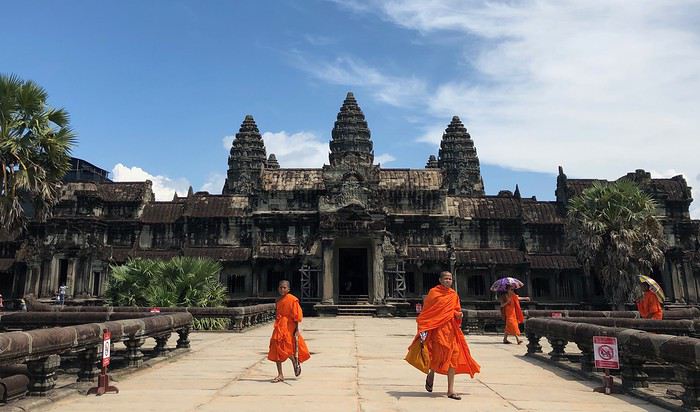
Décision fut prise en Avril pour un voyage aux vacances de la Toussaint (on part toujours à cette époque, que je trouve totalement déprimante sur Paris😕). Le programme : Angkor, puis du balnéaire/plongée. Après avoir étudié les billets d'avion, un voyage Paris-Siem Reap puis Phuket-Paris se faisait bien avec Cathay Pacific, donc via Hong-Kong. Donc on s'est dit : quitte à passer à Hong-Kong, autant y rester un peu pour découvrir cette ville qui nous faisait fantasmer.😊
Donc le programme fut le suivant : Départ le 19 octobre, escale à Hong-Kong et arrivée à Siem Reap le 20 au matin du 20 au 23 : découverte de Angkor le 24 : un petit vol Air Asia pour Phuket d'où nous sommes restés 5 jours à Khao Lak (j'en parlerai assez peu ici ; le but pour moi était de plonger sur un site mythique, Richelieu Rock, pendant que la famille prenait du bon temps) Retour le 30 vers Hong-Kong où nous sommes restés 3 jours, jusqu'au décollage pour Paris le 01/11 au soir. Arrivée à Paris le 2 novembre, juste avant la rentrée
Concernant les logements, voyageant avec enfants (6/9 ans), on a 2 principes simples : - on réserve tout à l'avance - grosse priorité mise sur la qualité du logement, avec piscine obligatoire et 2 espaces de couchage
- Pour Siem Reap, on cherchait un petit hotel de charme, bien situé mais au calme Une petite étude de marché via booking et tripadvisor nous a conduit à Eureka Villas. Superbe, tout petit boutique hotel, dans une petite rue au calme, très cosy, 5 minutes de tuk-tuk de Pub Street, quelques restos/gargottes à côté, piscine mignonnette. Je recommande absolument. - Pour Khao Lak, ce fut le Ramada Resort. Bon, c'est très bien, tout neuf et propret, mais assez décevant, impersonnel, plage pas terrible. Mais tous les restos de Bang Niang à 5 minutes à pied - Enfin, à Hong-Kong, le Royal Plaza. Excellent, très bien situé à Mong Kok, mais piscine un peu froide
Pour l'aérien : - Cathay Pacific, topissime. Très confortable, PNC prévenants, toujours qqch à grignoter (je revois mon fils manger des nouilles au milieu de la nuit😛). Bien mieux que Qatar Airways, pris pour nos 3 précédents voyages, où j'ai toujours trouvé celà très impersonnel. - Les liaisons régionales ont été faites avec Cathay Dragon. Rien de spécial à dire, si ce n'est que l'on a eu 2 heures de retard pour le Phuket-Hong-Kong. Mais organisation top à l'arrivée, tous les voyageurs en correspondance étaient attendus à la porte - Un vol Siem-Reap-Phuket par Air Asia qui a décollé avec.... 20 minutes d'avance !!🙂 (je précise celà pour toutes les mauvaises langues qui critiquent les retards, soi-disant, de Air Asia...)
Allez, je vous emmène 😉
Bon, celà fait deux mois que nous sommes rentrés, deux mois que je vis avec des souvenirs pleins la tête, deux mois que je me dis qu'il faudrait tout raconter, car comme souvent j'ai puisé énormément d'infos sur VF pour préparer ce voyage 🙂
Alors aller à Angkor était pour moi un rêve depuis de longues années. Un mythe, assez obsédant. On devait y aller en 2009, mais madame est tombée enceinte, puis une seconde fois, et on a repoussé jusqu'à ce que les loulous soient suffisamment grands pour faire cette découverte en autonomie, à notre rythme (on avait fait la Malaisie l'an passé, et celà c'était déjà très bien passé). Et puis cette année, j'ai eu 40 ans, alors quoi de meilleur cadeaux que de réaliser un rêve 😉
Décision fut prise en Avril pour un voyage aux vacances de la Toussaint (on part toujours à cette époque, que je trouve totalement déprimante sur Paris😕). Le programme : Angkor, puis du balnéaire/plongée. Après avoir étudié les billets d'avion, un voyage Paris-Siem Reap puis Phuket-Paris se faisait bien avec Cathay Pacific, donc via Hong-Kong. Donc on s'est dit : quitte à passer à Hong-Kong, autant y rester un peu pour découvrir cette ville qui nous faisait fantasmer.😊
Donc le programme fut le suivant : Départ le 19 octobre, escale à Hong-Kong et arrivée à Siem Reap le 20 au matin du 20 au 23 : découverte de Angkor le 24 : un petit vol Air Asia pour Phuket d'où nous sommes restés 5 jours à Khao Lak (j'en parlerai assez peu ici ; le but pour moi était de plonger sur un site mythique, Richelieu Rock, pendant que la famille prenait du bon temps) Retour le 30 vers Hong-Kong où nous sommes restés 3 jours, jusqu'au décollage pour Paris le 01/11 au soir. Arrivée à Paris le 2 novembre, juste avant la rentrée
Concernant les logements, voyageant avec enfants (6/9 ans), on a 2 principes simples : - on réserve tout à l'avance - grosse priorité mise sur la qualité du logement, avec piscine obligatoire et 2 espaces de couchage
- Pour Siem Reap, on cherchait un petit hotel de charme, bien situé mais au calme Une petite étude de marché via booking et tripadvisor nous a conduit à Eureka Villas. Superbe, tout petit boutique hotel, dans une petite rue au calme, très cosy, 5 minutes de tuk-tuk de Pub Street, quelques restos/gargottes à côté, piscine mignonnette. Je recommande absolument. - Pour Khao Lak, ce fut le Ramada Resort. Bon, c'est très bien, tout neuf et propret, mais assez décevant, impersonnel, plage pas terrible. Mais tous les restos de Bang Niang à 5 minutes à pied - Enfin, à Hong-Kong, le Royal Plaza. Excellent, très bien situé à Mong Kok, mais piscine un peu froide
Pour l'aérien : - Cathay Pacific, topissime. Très confortable, PNC prévenants, toujours qqch à grignoter (je revois mon fils manger des nouilles au milieu de la nuit😛). Bien mieux que Qatar Airways, pris pour nos 3 précédents voyages, où j'ai toujours trouvé celà très impersonnel. - Les liaisons régionales ont été faites avec Cathay Dragon. Rien de spécial à dire, si ce n'est que l'on a eu 2 heures de retard pour le Phuket-Hong-Kong. Mais organisation top à l'arrivée, tous les voyageurs en correspondance étaient attendus à la porte - Un vol Siem-Reap-Phuket par Air Asia qui a décollé avec.... 20 minutes d'avance !!🙂 (je précise celà pour toutes les mauvaises langues qui critiquent les retards, soi-disant, de Air Asia...)
Allez, je vous emmène 😉
Sécurité à Hong Kong et messagerie en Chine English translation pending
Bonjour à tous,
Mon fils compte se rendre à Hong Kong et ensuite aller en Chine. Je voudrais vous demander si la situation à Hong Kong n'est pas un peu risquée, avec tout ce qu'on entend. Et pour la Chine, est-ce qu'il pourra facilement utiliser sa messagerie (il a un compte gmail).
Merci de vos réponses,
Momo
Mon fils compte se rendre à Hong Kong et ensuite aller en Chine. Je voudrais vous demander si la situation à Hong Kong n'est pas un peu risquée, avec tout ce qu'on entend. Et pour la Chine, est-ce qu'il pourra facilement utiliser sa messagerie (il a un compte gmail).
Merci de vos réponses,
Momo
Traversée de la Réunion à pied, refuges d'étapes et GR English translation pending
Bonjour,
J’ai comme projet de faire la traversée de la Réunion à pied , n’ayant pas encore pris le topo guide je me tourne vers vous en attendant !
Ma première question concerne la période , est-ce que mi Mai est une bonne période ?
est il nécessaire de réserver les refuges, ?
Si oui,
y’a t’il un moyen de faire une réservation groupé payable en une fois sur un sîte ?
Ou faut-il les réserver un à un ? Je pensais faire le GR évidemment mais y’a t’il des variantes à ne pas louper ?
Et éventuellement une proposition d’étapes à raison d’environ 6h de marche
Bon je m’arrête là ! Par avance je vous remercie pour vos différents conseils Bernard
y’a t’il un moyen de faire une réservation groupé payable en une fois sur un sîte ?
Ou faut-il les réserver un à un ? Je pensais faire le GR évidemment mais y’a t’il des variantes à ne pas louper ?
Et éventuellement une proposition d’étapes à raison d’environ 6h de marche
Bon je m’arrête là ! Par avance je vous remercie pour vos différents conseils Bernard
Quels pass pour le trek du camp de base de l'Everest? English translation pending
Bonjour à tous!
C'est décidé, je vais passer les fetes de fin d'année au Nepal! J'en suis donc à la préparation d'un trek que je ferais avec mon compagnon, sans guide ni porteur. Nous arrivons à Kathmandu le 23 décembre et souhaiterions prendre un vol pour Lukla le 24. Notre vol de retour de Katmanthu est le 10 janvier. Du coup je compte environ 14 jours pleins pour faire ce trek. (Pour avoir de la marge au retour si jamais le vol Lukla-Kathmandu est annulé).
Le soucis est que plus je passe de temps sur internet, plus je deviens indécise sur le trajet à effectuer...🤪 Faire l'EBC? Faire les 3 pass? Faire un mix des 2? Gokyo? Alors pour le coup je compte sur vos retours d'experience pour me faire une idée... j'ai besoin de vos avis, coups de coeur, impressions totalement subjectives, ou conseils tout à fait importants!
Qu'avez vous pensé des different pass? Vaut-il le coup d'aller jusqu'au camp de base? La vue du Kala Patthar est-elle aussi belle que ce que j'imagine? Le kongma La est-il le plus beau des 3 pass? Pour aller à Gokyo vaut-il mieux passer par Thame ou bien Phortse? Est-ce que vous me conseillez de faire une journée "d'acclimatation" à Chukhung Ri?......?
Un grand merci d'avance pour vos retours!!
C'est décidé, je vais passer les fetes de fin d'année au Nepal! J'en suis donc à la préparation d'un trek que je ferais avec mon compagnon, sans guide ni porteur. Nous arrivons à Kathmandu le 23 décembre et souhaiterions prendre un vol pour Lukla le 24. Notre vol de retour de Katmanthu est le 10 janvier. Du coup je compte environ 14 jours pleins pour faire ce trek. (Pour avoir de la marge au retour si jamais le vol Lukla-Kathmandu est annulé).
Le soucis est que plus je passe de temps sur internet, plus je deviens indécise sur le trajet à effectuer...🤪 Faire l'EBC? Faire les 3 pass? Faire un mix des 2? Gokyo? Alors pour le coup je compte sur vos retours d'experience pour me faire une idée... j'ai besoin de vos avis, coups de coeur, impressions totalement subjectives, ou conseils tout à fait importants!
Qu'avez vous pensé des different pass? Vaut-il le coup d'aller jusqu'au camp de base? La vue du Kala Patthar est-elle aussi belle que ce que j'imagine? Le kongma La est-il le plus beau des 3 pass? Pour aller à Gokyo vaut-il mieux passer par Thame ou bien Phortse? Est-ce que vous me conseillez de faire une journée "d'acclimatation" à Chukhung Ri?......?
Un grand merci d'avance pour vos retours!!
Avis sur itinéraire de 3 semaines au Vietnam en novembre-décembre English translation pending
Bonjour à tous,
2 amis et moi même partons au Vietnam du 22 novembre au 13 décembre 2019, c'est notre 1er voyage dans ce beau pays et il faut essayer de contenter tout le monde.Nous souhaitons faire un voyage en itinérance et éviter au maximum les touristes (même si je sais qu'on en rencontrera forcément). Je recherche des suggestions sur l'itinéraire, les modes de transport que nous avons projeté. L'itinéraire que nous souhaitons faire est le suivant : 1/ Arrivé à hanoi le 23/11 et visite du 23 PM au 24/11 soir 2/ Départ en bus 10h30 le 25/11pour visiter la baie de Lan Ha via Cat Ba(bus-mini bus et ferry) 25-27/11 : Baie de Lan Ha (nuit sur une jonque) 27/11 soir : départ de Cat Ba pour Sapa (nous hésitons a faire la province Ha giang mais il faut compter 5 jrs) , visite des villages ethnique et le 01/12 : marché de Bac Ha (nous ommes à la recherche d'un guide francophone pour visiter ces villages et dormir chez l'habitant). 01/12 soir : Départ de Lao Cai jusqu'à Ninh Binh et visite de la Baie d'Along terrestre du 02/12 au 04/12 04/12 soir :train jusqu'à Hué arrivée le 05/12 visite de la ville 06/12 Départ de Hué pour Hoi An (du 06/12 au 07/12 visite de Hoi an) 08/12 matin : Départ de Da nang en avion pour Can Tho et visite avec guide du delta du 08 au 11/12 11/12 soir retour sur HCMV et visite de la ville le 12/12 13/12 : Départ pour la France Qu'en pensez vous? Nous souhaitons vraiment faire la visite des villages ethniques, de la baie d'along terrestre et du delta du Mékong (Hanoi-Baie d'Along-Province de Sapa-Baie d'along terrestre-Hué-Hoi An-Delta du Mkg-HCMV). Pouvez vous nous donner des noms de guide, nous dire quls types de transport est le mieux de telle ville à telle ville etc.. Merci d'avance. Valouh33
2 amis et moi même partons au Vietnam du 22 novembre au 13 décembre 2019, c'est notre 1er voyage dans ce beau pays et il faut essayer de contenter tout le monde.Nous souhaitons faire un voyage en itinérance et éviter au maximum les touristes (même si je sais qu'on en rencontrera forcément). Je recherche des suggestions sur l'itinéraire, les modes de transport que nous avons projeté. L'itinéraire que nous souhaitons faire est le suivant : 1/ Arrivé à hanoi le 23/11 et visite du 23 PM au 24/11 soir 2/ Départ en bus 10h30 le 25/11pour visiter la baie de Lan Ha via Cat Ba(bus-mini bus et ferry) 25-27/11 : Baie de Lan Ha (nuit sur une jonque) 27/11 soir : départ de Cat Ba pour Sapa (nous hésitons a faire la province Ha giang mais il faut compter 5 jrs) , visite des villages ethnique et le 01/12 : marché de Bac Ha (nous ommes à la recherche d'un guide francophone pour visiter ces villages et dormir chez l'habitant). 01/12 soir : Départ de Lao Cai jusqu'à Ninh Binh et visite de la Baie d'Along terrestre du 02/12 au 04/12 04/12 soir :train jusqu'à Hué arrivée le 05/12 visite de la ville 06/12 Départ de Hué pour Hoi An (du 06/12 au 07/12 visite de Hoi an) 08/12 matin : Départ de Da nang en avion pour Can Tho et visite avec guide du delta du 08 au 11/12 11/12 soir retour sur HCMV et visite de la ville le 12/12 13/12 : Départ pour la France Qu'en pensez vous? Nous souhaitons vraiment faire la visite des villages ethniques, de la baie d'along terrestre et du delta du Mékong (Hanoi-Baie d'Along-Province de Sapa-Baie d'along terrestre-Hué-Hoi An-Delta du Mkg-HCMV). Pouvez vous nous donner des noms de guide, nous dire quls types de transport est le mieux de telle ville à telle ville etc.. Merci d'avance. Valouh33
Lodges entre Thame et Gokyo (trek au Népal) English translation pending
Salut ,
Y a t il des lodges entre Thame et Gokyo, en dehors de Lumde?
Ceci afin de rallonger les 2 premières ėtapes et de diminuer celle du Renjo La?
Merci pour vos infos.
Fred