Results for ""décalage+horaire""
6358 results found.
Visiter Paris et Rome English translation pending
Je désire faire un voyage en Europe (Paris et Rome) au printemps (avril-mai). Comme c'est mon premier véritable voyage dans un autre continent, j'ai besoin d'aide. Je cherche à savoir:
Quoi visiter dans chacune des destinations si j'aime à voir des endroits ou des monuments historiques, tels le Coliseum à Rome, les égoûts de Paris... etc
Aurais-je assez d'une semaine par ville pour voir le principal des attractions touristiques?
Où me loger si je désire avoir une chambre avec dînette?
Quel moyen de transport utiliser une fois sur place, si les endroits à visiter sont éloignés l'un de l'autre?
À qui m'adresser pour me guider dans mes visites touristiques si je ne veux pas faire affaires avec les hôtels qui sont toujours là pour vous arnaquer?
Quel est la meilleure période pour partir si je veux profiter de bons prix d'avion?
Quel hôtel choisir?
Aidez-moi...
Quoi visiter dans chacune des destinations si j'aime à voir des endroits ou des monuments historiques, tels le Coliseum à Rome, les égoûts de Paris... etc
Aurais-je assez d'une semaine par ville pour voir le principal des attractions touristiques?
Où me loger si je désire avoir une chambre avec dînette?
Quel moyen de transport utiliser une fois sur place, si les endroits à visiter sont éloignés l'un de l'autre?
À qui m'adresser pour me guider dans mes visites touristiques si je ne veux pas faire affaires avec les hôtels qui sont toujours là pour vous arnaquer?
Quel est la meilleure période pour partir si je veux profiter de bons prix d'avion?
Quel hôtel choisir?
Aidez-moi...
Nécessaire Thaïlande et moustiquaire English translation pending
Coucou!
Je pars en thailande avec une amie dans 10 jours, et je me pose qqes questions encore: que faut-il absolument emmener avec soi (outre les medicaments anti-palu, anti-diahree et autres rejouissances classiques)? Et niveau bricolage mac-giver: ficelle, ciseau, bougie... mais encore?😮
ENfin, la question: emmener une moustiquaire et anti moustique ok, mais comment installer la moustiquaire? Accrochee au plafond je pense, et ensuite? La laisser tomber sur le lit, la coincer sous le matelas aussi?? Questions qui peuvent paraitre evidentes, mais je n'en ai jamais utilisée!!! Merci pour vos reponses et tout autre conseil utile niveau sante! (on pense faire bkk, puis iles du SE et SO).😉
A bientot
Elo
Je pars en thailande avec une amie dans 10 jours, et je me pose qqes questions encore: que faut-il absolument emmener avec soi (outre les medicaments anti-palu, anti-diahree et autres rejouissances classiques)? Et niveau bricolage mac-giver: ficelle, ciseau, bougie... mais encore?😮
ENfin, la question: emmener une moustiquaire et anti moustique ok, mais comment installer la moustiquaire? Accrochee au plafond je pense, et ensuite? La laisser tomber sur le lit, la coincer sous le matelas aussi?? Questions qui peuvent paraitre evidentes, mais je n'en ai jamais utilisée!!! Merci pour vos reponses et tout autre conseil utile niveau sante! (on pense faire bkk, puis iles du SE et SO).😉
A bientot
Elo
Ouragan Jeanne? English translation pending
Bonjour,
Je viens de consulter les images satelites en temps réel sur la RD et je suis trés inquiète. Jeanne est en train de frapper de plein fouet la baie de samana !😕 les vents sont plus faibles que pour yvan mais il risque quand même d'y avoir des dégâts. Espérons que ceux-ci ne soient que matériels.
Quelqu'un sait-il comment ça se passe après le passage d'un ouragan ? est-ce que les séjours sont systématiquement annulés ?
Que se passe-t'il en cas d'annulation ? est-ce qu'on nous propose une autre destination aux mêmes dates et au même prix ?😕
Merci d'avance
Je viens de consulter les images satelites en temps réel sur la RD et je suis trés inquiète. Jeanne est en train de frapper de plein fouet la baie de samana !😕 les vents sont plus faibles que pour yvan mais il risque quand même d'y avoir des dégâts. Espérons que ceux-ci ne soient que matériels.
Quelqu'un sait-il comment ça se passe après le passage d'un ouragan ? est-ce que les séjours sont systématiquement annulés ?
Que se passe-t'il en cas d'annulation ? est-ce qu'on nous propose une autre destination aux mêmes dates et au même prix ?😕
Merci d'avance
Le TDM, oui mais dans quel sens? English translation pending
Hello à tous!
Je constate que la plupart des voyageurs qui partent en TDM commencent très souvent par le continent Américain comme première destination puis continuent vers l'Océanie, l'Asie ...etc. Mais en passant par l'ouest, il me semble qu'on perd un jour de sa vie, non??? C'est plutôt mieux de commencer par l'Asie je crois!
Qu'en pensez vous?
Je constate que la plupart des voyageurs qui partent en TDM commencent très souvent par le continent Américain comme première destination puis continuent vers l'Océanie, l'Asie ...etc. Mais en passant par l'ouest, il me semble qu'on perd un jour de sa vie, non??? C'est plutôt mieux de commencer par l'Asie je crois!
Qu'en pensez vous?
Quelques peurs d'avant le départ pour les États-Unis English translation pending
Bonjour a tous,
Voila d'ici quelques semaines je vais aller au Nouveau Mexique, dans la ville de Taos et de Santa Fe. Je vais y rester de septembre a mars 2004.
J'ai pas mal de peur en fait. Pas peur de la vie là-bas, mais de l'avion ... je fais paris-londres-chicago-albuquerque ... plus de 18 heures d'avion .. Au secours !!!!! J'ai jamais pris l'avion en plus ... Lol !!
Enfin j'aimerai savoir comment se passe l'arrivée a la douane américaine ? J'ai un visa B2 donc touristique pour 6 mois. Je vais aller principalement vivre chez des amis franco-américains. Quels sortes de question je vais avoir ? J'ai 21 ans donc j'ai un peu "afraid" ... Mon niveau d'anglaus est juste bon pour tenir une simple conversation...
La douane me hante .. lol ... En fait j'ai entendu dire que pas mal de fille ( de mon age ) se font renvoyer at home because la douane pense qu'elle fraude et veulent être fille au pair, ou travailler au black .. Mais moi pas mon cas. Ceci dit mes amis ont des enfants de bases ages ! Donc plus d'ennui pour moi ? J'ai eu mon visa a l'ambassade sans pb ... du moment qu'on a eu un visa pas de soucis, non ?
Pouvez vous me dire comment s'est passé votre passage a la douane au states ?
Autre question, au niveau du permis de conduire ? Doit on repasser le permis sur place comme on me l'a dit ? on m'a dit que meme en tant que touriste je peut passer le permis au NM ? It is right ?
Thanks you very very much !!
Voila d'ici quelques semaines je vais aller au Nouveau Mexique, dans la ville de Taos et de Santa Fe. Je vais y rester de septembre a mars 2004.
J'ai pas mal de peur en fait. Pas peur de la vie là-bas, mais de l'avion ... je fais paris-londres-chicago-albuquerque ... plus de 18 heures d'avion .. Au secours !!!!! J'ai jamais pris l'avion en plus ... Lol !!
Enfin j'aimerai savoir comment se passe l'arrivée a la douane américaine ? J'ai un visa B2 donc touristique pour 6 mois. Je vais aller principalement vivre chez des amis franco-américains. Quels sortes de question je vais avoir ? J'ai 21 ans donc j'ai un peu "afraid" ... Mon niveau d'anglaus est juste bon pour tenir une simple conversation...
La douane me hante .. lol ... En fait j'ai entendu dire que pas mal de fille ( de mon age ) se font renvoyer at home because la douane pense qu'elle fraude et veulent être fille au pair, ou travailler au black .. Mais moi pas mon cas. Ceci dit mes amis ont des enfants de bases ages ! Donc plus d'ennui pour moi ? J'ai eu mon visa a l'ambassade sans pb ... du moment qu'on a eu un visa pas de soucis, non ?
Pouvez vous me dire comment s'est passé votre passage a la douane au states ?
Autre question, au niveau du permis de conduire ? Doit on repasser le permis sur place comme on me l'a dit ? on m'a dit que meme en tant que touriste je peut passer le permis au NM ? It is right ?
Thanks you very very much !!
Avez-vous déjà voyagé avec Budget Voyage en Egypte...ou ailleurs? English translation pending
Bonjour,
Nous souhaitons partir en Egypte en septembre et pour l'instant notre choix s'est porté sur un combiné de chez Budget Voyages : une semaine de croisière avce visites, 3 jours à Hurghada et 4 jours au Caire. Nous sommes déjà partis en circuit avec Travelprice et Promovacances dont nous aons été très satisfait mais nous aimerions avoir des infos sur Budget Voyages. Etes-vous déjà partis avec eux ? Cela s'est-il bien passé ? Merci pour vos infos.
Laetitia
Nous souhaitons partir en Egypte en septembre et pour l'instant notre choix s'est porté sur un combiné de chez Budget Voyages : une semaine de croisière avce visites, 3 jours à Hurghada et 4 jours au Caire. Nous sommes déjà partis en circuit avec Travelprice et Promovacances dont nous aons été très satisfait mais nous aimerions avoir des infos sur Budget Voyages. Etes-vous déjà partis avec eux ? Cela s'est-il bien passé ? Merci pour vos infos.
Laetitia
Nourriture à éviter en Thailande? English translation pending
Bonjour, pour ceux qui ont une expérience de la Thailande, doit on faire attention à certains aliments comme la salade, les fruits ou carrément les kiosques au bord de la rue. Bien sûr l'eau en bouteille est necessaire mais si nous devons éviter l'eau courante comment peut-on manger de la salade ou fruit qui pousse avec cette même eau? Dans plusieurs pays tout çà est à éviter mais je n'ai rien lu sur la Thailande. Merci
Coût de la vie et logement en Nouvelle-Zélande English translation pending
Bonjour,
Je pars avec mon colocataire en nouvelle zélande le 19 juillet, nous louons un camping car pour 18 jours. Nous souhiatons faire les deux îles, par contre j'aurais aimer avoir des infos budgétaires sur la vie en Nouvelle Zélande, entre le prix de l'essence, de la nourriture et des activités à faire là bas.
Nous avons déjà des infos mais rien ne vaut les dires de personnes qui sont allées sur ces terres. Si vous pouvez me répondre sur ces poitns, et me dire s'il est facile en camping car d'accéder à tous les sites et de faire du camping facilement. J'ia vu sur ce forum que quelqu'un donnait l'adresse d'un site pour les vidanges, c'est bien ce genre d'informations, j'ai vu sur un site qu'une carte travel card pass donnait droit à des réductions sur les transports, les location, les activités, les resto etc... quelqu'un peut m'en dire +
Par avance merci beaucoup
Je pars avec mon colocataire en nouvelle zélande le 19 juillet, nous louons un camping car pour 18 jours. Nous souhiatons faire les deux îles, par contre j'aurais aimer avoir des infos budgétaires sur la vie en Nouvelle Zélande, entre le prix de l'essence, de la nourriture et des activités à faire là bas.
Nous avons déjà des infos mais rien ne vaut les dires de personnes qui sont allées sur ces terres. Si vous pouvez me répondre sur ces poitns, et me dire s'il est facile en camping car d'accéder à tous les sites et de faire du camping facilement. J'ia vu sur ce forum que quelqu'un donnait l'adresse d'un site pour les vidanges, c'est bien ce genre d'informations, j'ai vu sur un site qu'une carte travel card pass donnait droit à des réductions sur les transports, les location, les activités, les resto etc... quelqu'un peut m'en dire +
Par avance merci beaucoup
Voyage USA avec jumeaux... English translation pending
Coucou tout le monde, je compte partir aux USA au mois de novembre avec mes 2 jujus qui auront 22 mois à cette époque. Je suis à l'affut de toute astuce et/ou témoignage concernant le voyage en avion avec des enfants de cet âge. Merci à tous ! 😉
Retour de l'hôtel Tropical Goleta à Cabarete English translation pending
... et je deprime 😕
salut tt le monde,
je rentre de rep dom où j'étais partie via lastminute du 3 au 11 mai... j'étais à l'hotel tropical goleta à Cabarete (pres de puerto plata) en "all inclusive"
je vais pas raconter tt mon voyage mais en résumé : vols : via air caraibe - impeccable aucun retard, service à bord cool.. 8h20 de vol hotel : c pas le grand complexe super chicos mais bon moi jai préféré... petit hotel sympa (petite piscine) avec terrasse ou balcon à chaque chambre... chambre assez spacieuse.. 1, 5 kms du centre ville, mais navette gratuite plusieurs fois par jour et sinon guagua ou moto pas cher - animations (un peu nazes...) le soir à l'hotel jusqu'à 23h et apres on sortait sur cabarete (pas mal de bars donnant sur la plage avec musique) bouff et boissons : tt inclus (meme les alcools non locaux) et à volonté !!! le personnel de l'hotel etait tres sympa... varié, vraiment bien ville de cabarete : se resume à une rue principale avec commerces des 2 cotés et bars et restos sur la plage.. la plage est tres sympa, c pas du sable blanc comme ds le sud de l'ile, mais c tres beau... l'eau est a 26 degres excusions : NE SURTT PAS EN PRENDRE avec le tour operateur (là cetait MAXI).. en ville vs trouverez les memes 2 fois moins cheres temps : genial... à part 2 averses un peu fortes mais qui nont pas duré, 30 degres ts les jours et soleil (ne faites pas comme moi, n'emmenez pas de pulls !!!) svt le matin c un peu couvert mais ca ne dure pas monnaie : pesos dominicains, en gros 1 euro = 50 pesos, et 1 dollar = 43 pesos, je vous recommande d'amener des USD et de les changer en ville (javais emmener 100 USD et jen ramene, car les souvenirs là bas ne coutent rien ..) clopes : acheter les sur place et pas à l'aéroport ! 1 cartouche de malboro c 300 pesos soit environ 6 euros !
infos techniques : courant 110 V adaptateur à prevoir... anti moustique et creme solaire puissante
sinon les dominicains st tres gentils, tres accueillants... un peu chiants parfois car ils veulent vous vendre un bijou, vous faire une tresse etc...mais ils n'insistent pas trop si vs leur dites non..
a savoir sur place vous pouvez profitez de tte la chaine des hotels tropical ; il y en a un notamment en plein centre avec une super grande piscine, et vous pouvez manger la bas le midi (c 1 4 etoiles)
voilà qques infos, en conclusion je dirai : jai adoré!!! le retour est difficile et pas sulement a cause du decalage horaire !
si vous avez besoin d'infos je suis à votre disposition : sandlamour@club-internet.fr
@ +
sandrine, degoutée d'etre rentrée !
salut tt le monde,
je rentre de rep dom où j'étais partie via lastminute du 3 au 11 mai... j'étais à l'hotel tropical goleta à Cabarete (pres de puerto plata) en "all inclusive"
je vais pas raconter tt mon voyage mais en résumé : vols : via air caraibe - impeccable aucun retard, service à bord cool.. 8h20 de vol hotel : c pas le grand complexe super chicos mais bon moi jai préféré... petit hotel sympa (petite piscine) avec terrasse ou balcon à chaque chambre... chambre assez spacieuse.. 1, 5 kms du centre ville, mais navette gratuite plusieurs fois par jour et sinon guagua ou moto pas cher - animations (un peu nazes...) le soir à l'hotel jusqu'à 23h et apres on sortait sur cabarete (pas mal de bars donnant sur la plage avec musique) bouff et boissons : tt inclus (meme les alcools non locaux) et à volonté !!! le personnel de l'hotel etait tres sympa... varié, vraiment bien ville de cabarete : se resume à une rue principale avec commerces des 2 cotés et bars et restos sur la plage.. la plage est tres sympa, c pas du sable blanc comme ds le sud de l'ile, mais c tres beau... l'eau est a 26 degres excusions : NE SURTT PAS EN PRENDRE avec le tour operateur (là cetait MAXI).. en ville vs trouverez les memes 2 fois moins cheres temps : genial... à part 2 averses un peu fortes mais qui nont pas duré, 30 degres ts les jours et soleil (ne faites pas comme moi, n'emmenez pas de pulls !!!) svt le matin c un peu couvert mais ca ne dure pas monnaie : pesos dominicains, en gros 1 euro = 50 pesos, et 1 dollar = 43 pesos, je vous recommande d'amener des USD et de les changer en ville (javais emmener 100 USD et jen ramene, car les souvenirs là bas ne coutent rien ..) clopes : acheter les sur place et pas à l'aéroport ! 1 cartouche de malboro c 300 pesos soit environ 6 euros !
infos techniques : courant 110 V adaptateur à prevoir... anti moustique et creme solaire puissante
sinon les dominicains st tres gentils, tres accueillants... un peu chiants parfois car ils veulent vous vendre un bijou, vous faire une tresse etc...mais ils n'insistent pas trop si vs leur dites non..
a savoir sur place vous pouvez profitez de tte la chaine des hotels tropical ; il y en a un notamment en plein centre avec une super grande piscine, et vous pouvez manger la bas le midi (c 1 4 etoiles)
voilà qques infos, en conclusion je dirai : jai adoré!!! le retour est difficile et pas sulement a cause du decalage horaire !
si vous avez besoin d'infos je suis à votre disposition : sandlamour@club-internet.fr
@ +
sandrine, degoutée d'etre rentrée !
Le retour... English translation pending
Ca y est, je me lance, après plusieurs mois sur ce forum, et du bonheur à chaque nouvelle lecture... je lance un nouveau sujet: le retour.
Comment se passent générallement vos retours de voyage? Gros blues, envie de repartir, incompréhension de notre société, de notre entourage😕??? Et que faites-vous pour vous soigner?😉
Ou au contraire, plaisir de retrouver son petit monde...???
Retour du Gran flamenco Punta Cana English translation pending
Nous avons passé une semaine (fin mars 2004) au flamenco de punta cana, et après avoir pioché mille renseignements sur le forum, je souhaite donner quelques infos (dont certaines que je n'avais pas réussi à trouver, et d'autres que je résume).
Arrivée à l'hôtel : accueil rapide avec cocktail (et c'est parti!), puis petite voiture jusqu'à la chambre avec porteur pour les bagages, rien à redire!
Situation : l'hôtel est au milieu de plusieurs hôtels (ils sont tous cote à cote sur la playa bavaro), mais on peut se promener librement sur la plage devant tous les hôtels (seuls les locaux sont "interdits", donc pas de problème de vente, ...) Sur la plage, vers la droite à 10 minutes à pied: boutiques (change, souvenirs, ...) et une fabrique de cigare (on peut rentrer pour visiter, ...) et une Superette avec les vrais prix d'affichés (au prix pour les dominicains, donc le moins cher du coin!). (Demandez le taux de change du magasin si vous voulez payer en dollar, car ils en profitent, s'il est trop bas, allez en face dans le bureau de change, puis faites vos courses!) A la sortie de l'hôtel, place avec des boutiques souvenirs, bars, ... internet à 2$ la demi heure
Dans la chambre : un fer à repasser et une petite table à repasser, un sèche cheveux, Un frigo, rempli tous les jours avec pepsi, zup, bière presidente, et eau, un TV : nombreuses chaînes langues américaines et espagnoles + TV5, un coffre fort : prendre la clé à l'accueil : coût 15$ pour la semaine, un ventilo au plafond, efficace et silencieux, une clim. réglable, un peu trop bruyante pour dormir avec malheureusement, mais les nuits n'étaient pas trop chaudes les prises électriques sont au format américain, l'hôtel ne fourni pas les adaptateurs, le coût est modeste et permet de recharger sans problème caméscope, ap photo numérique
Certains ont effectivement eu des problèmes d'eau dans la chambre quand il pleut : ils étaient au dernier étage. (donc demandez à ne pas être au dernier pour être sur de ne pas avoir d'inondations!)
Téléphone : tri bande 1900 obligatoire, mon Bouygues passait très bien à l'hôtel. Conseil : vu le prix des communications appels reçus comme émis (1.15€ les 30 secondes en émis, et 0, 50€/ 30 secondes en reçus chez Bouygues), j'utilisais les sms pour donner et recevoir des nouvelles : coût 0, 30€ l'émission et réception gratuite (coût habituel pour l'envoyeur). Cela permet de donner des nouvelles pour pas cher! Attention aussi, l'appel du répondeur est considéré par les opérateurs comme un appel normal.
L’eau est servie partout en bouteille (plage, resto, ...). En règle générale, les produits (boire et manger) sont des produits de marque.
Time-sharing : Présent dans l'hôtel, un "non merci" poli et c'est fini, pas de harcèlement
Photos de l'hôtel (conforme au site et à la chambre standard que nous avons eue) : http://www.occidental-hoteles.com/visitaVirtual/vv_flamencopuntacana/panorama01_ing.html
Réservation de la chambre : j'avais demandé avant le départ à mon agence sans succès, puis par email, sans réponse... J'ai donc téléphoné à l'hôtel, qui m'a passé le centre de réservation, qui m'a demandé d'envoyé un fax... et ce fut bon: chambre dans bâtiment 13 avec vue sur mer! Donc, une seule solution : coup de tel + fax ou juste le fax qui doit suffire, cela ne coûte pas cher et c'est plus sympa!) (Tel: 00 1 809 687 5747 Fax: 00 1 809 687 1381)
l'argent : Change a l'hôtel euro en pesos ou dollar en pesos (1$ = 42 pesos au 31/3/4 a l'hôtel), change dans des petits bureaux de change plus intéressant. Les commerçants acceptent les $, mais rendent souvent la monnaie en pesos. Je n'avais pas d'euros, donc je ne sais pas les taux.
Concernant la plage (de l'hôtel), celle-ci est calme du coté gauche de l'hôtel (en regardant la mer), le coté droit regroupant les activités (bbq, aérobic, ...) le tout en musique. Il est marqué qu'il est interdit de réserver sa place sur la plage en y plaçant les serviettes, mais tout le monde le fait, et nous l'avons fait aussi sans problème: Comme nous avions conservé un peu le décalage horaire, nous nous levions à 6h30 pour le petit dej servi a partir de 7 heures. Et lorsque nous sortions de la chambre à 7h, nous allions en premier poser nos serviettes sous le parasol de notre choix, au bord de la mer. Nous allions à la plage vers 9h, et nous laissions nos serviettes le midi, et quand nous allions nous promener. Personne ne touche à votre place, c'est parfait. Les serviettes sont prêtées par l'hôtel, et changées quand on veut. Le premier jour, il faut aller à partir de 9h à droite de la plage, dans la cabane qui s'occupe des planches à voiles, ... On signe un papier, et nous voila avec les serviettes.
Voila, j'espère en avoir aidé quelques uns, je ne donne pas d'avis (volontairement) sur la nourriture, ... cela étant trop subjectif à mon avis, mais nous avons passé de très bonnes vacances, dans un hôtel agréable, avec du personnel agréable. Je pense qu'il y a toujours à dire, mais ne jouez pas trop les difficiles, vous êtes en vacances! 🙂
Forums : http://voyageforum.com/voyage/F2/
Je me tiens à votre dispositions pour d'autres renseignements : Tooom@free.fr
Arrivée à l'hôtel : accueil rapide avec cocktail (et c'est parti!), puis petite voiture jusqu'à la chambre avec porteur pour les bagages, rien à redire!
Situation : l'hôtel est au milieu de plusieurs hôtels (ils sont tous cote à cote sur la playa bavaro), mais on peut se promener librement sur la plage devant tous les hôtels (seuls les locaux sont "interdits", donc pas de problème de vente, ...) Sur la plage, vers la droite à 10 minutes à pied: boutiques (change, souvenirs, ...) et une fabrique de cigare (on peut rentrer pour visiter, ...) et une Superette avec les vrais prix d'affichés (au prix pour les dominicains, donc le moins cher du coin!). (Demandez le taux de change du magasin si vous voulez payer en dollar, car ils en profitent, s'il est trop bas, allez en face dans le bureau de change, puis faites vos courses!) A la sortie de l'hôtel, place avec des boutiques souvenirs, bars, ... internet à 2$ la demi heure
Dans la chambre : un fer à repasser et une petite table à repasser, un sèche cheveux, Un frigo, rempli tous les jours avec pepsi, zup, bière presidente, et eau, un TV : nombreuses chaînes langues américaines et espagnoles + TV5, un coffre fort : prendre la clé à l'accueil : coût 15$ pour la semaine, un ventilo au plafond, efficace et silencieux, une clim. réglable, un peu trop bruyante pour dormir avec malheureusement, mais les nuits n'étaient pas trop chaudes les prises électriques sont au format américain, l'hôtel ne fourni pas les adaptateurs, le coût est modeste et permet de recharger sans problème caméscope, ap photo numérique
Certains ont effectivement eu des problèmes d'eau dans la chambre quand il pleut : ils étaient au dernier étage. (donc demandez à ne pas être au dernier pour être sur de ne pas avoir d'inondations!)
Téléphone : tri bande 1900 obligatoire, mon Bouygues passait très bien à l'hôtel. Conseil : vu le prix des communications appels reçus comme émis (1.15€ les 30 secondes en émis, et 0, 50€/ 30 secondes en reçus chez Bouygues), j'utilisais les sms pour donner et recevoir des nouvelles : coût 0, 30€ l'émission et réception gratuite (coût habituel pour l'envoyeur). Cela permet de donner des nouvelles pour pas cher! Attention aussi, l'appel du répondeur est considéré par les opérateurs comme un appel normal.
L’eau est servie partout en bouteille (plage, resto, ...). En règle générale, les produits (boire et manger) sont des produits de marque.
Time-sharing : Présent dans l'hôtel, un "non merci" poli et c'est fini, pas de harcèlement
Photos de l'hôtel (conforme au site et à la chambre standard que nous avons eue) : http://www.occidental-hoteles.com/visitaVirtual/vv_flamencopuntacana/panorama01_ing.html
Réservation de la chambre : j'avais demandé avant le départ à mon agence sans succès, puis par email, sans réponse... J'ai donc téléphoné à l'hôtel, qui m'a passé le centre de réservation, qui m'a demandé d'envoyé un fax... et ce fut bon: chambre dans bâtiment 13 avec vue sur mer! Donc, une seule solution : coup de tel + fax ou juste le fax qui doit suffire, cela ne coûte pas cher et c'est plus sympa!) (Tel: 00 1 809 687 5747 Fax: 00 1 809 687 1381)
l'argent : Change a l'hôtel euro en pesos ou dollar en pesos (1$ = 42 pesos au 31/3/4 a l'hôtel), change dans des petits bureaux de change plus intéressant. Les commerçants acceptent les $, mais rendent souvent la monnaie en pesos. Je n'avais pas d'euros, donc je ne sais pas les taux.
Concernant la plage (de l'hôtel), celle-ci est calme du coté gauche de l'hôtel (en regardant la mer), le coté droit regroupant les activités (bbq, aérobic, ...) le tout en musique. Il est marqué qu'il est interdit de réserver sa place sur la plage en y plaçant les serviettes, mais tout le monde le fait, et nous l'avons fait aussi sans problème: Comme nous avions conservé un peu le décalage horaire, nous nous levions à 6h30 pour le petit dej servi a partir de 7 heures. Et lorsque nous sortions de la chambre à 7h, nous allions en premier poser nos serviettes sous le parasol de notre choix, au bord de la mer. Nous allions à la plage vers 9h, et nous laissions nos serviettes le midi, et quand nous allions nous promener. Personne ne touche à votre place, c'est parfait. Les serviettes sont prêtées par l'hôtel, et changées quand on veut. Le premier jour, il faut aller à partir de 9h à droite de la plage, dans la cabane qui s'occupe des planches à voiles, ... On signe un papier, et nous voila avec les serviettes.
Voila, j'espère en avoir aidé quelques uns, je ne donne pas d'avis (volontairement) sur la nourriture, ... cela étant trop subjectif à mon avis, mais nous avons passé de très bonnes vacances, dans un hôtel agréable, avec du personnel agréable. Je pense qu'il y a toujours à dire, mais ne jouez pas trop les difficiles, vous êtes en vacances! 🙂
Forums : http://voyageforum.com/voyage/F2/
Je me tiens à votre dispositions pour d'autres renseignements : Tooom@free.fr
Reef playacar ou Riu playacar? English translation pending
😎 Salut à tous, un dilemne se pose à moi.
Sur la riviera maya que choisir entre le reef playacar et le riu playacar?
En attente de réponses avec impatience.
Sur la riviera maya que choisir entre le reef playacar et le riu playacar?
En attente de réponses avec impatience.
Climat, voiture et budget en France English translation pending
Bonjour, je vais faire un voyage en france au mois de mai pendant 25 jours, j'aimerais connaître le climat à cette période de l'année, est-ce très achalandée ? De plus, nous allons nous louer une voiture et nous ne savons pas combien kilométres environ nous devons planifier faire. De plus on m'a dit qu'il y avait des postes de péage sur les autoroutes, combien ça coûte ?
Prix approximatif à prévoir si nous comptons manger économiquement et dormir dans les auberges de jeunesse, qq fois faire du camping, pour une personne,
Merci
Prix approximatif à prévoir si nous comptons manger économiquement et dormir dans les auberges de jeunesse, qq fois faire du camping, pour une personne,
Merci
La République Dominicaine avec un bébé English translation pending
salut,
je pars en RP au mois de mars et j'hésite à prendre ma fille de 19 mois avec moi car j'ai peur qu'elle soit malade pendant cette semaine de vacances.
De plus si certaines personnes pouvaient me conseiller sur les visites à faire là bas😉.
merci
je pars en RP au mois de mars et j'hésite à prendre ma fille de 19 mois avec moi car j'ai peur qu'elle soit malade pendant cette semaine de vacances.
De plus si certaines personnes pouvaient me conseiller sur les visites à faire là bas😉.
merci
Voyager à plus de soixante ans au Vietnam English translation pending
J'aimerais persuader mes parents qui ont environ 65 ans de partir en voyage avec nous et leurs petits enfants au Vietnam cette été
ils sont plutôt très actifs, ma mère est en parfaite santé, mon père se "fatigue" vite et craint la chaleur (mais il ne tient pas en place )
nous comptons faire le vietnam du nord au sud en 3 semaines pour eux (ensuite nous pensons rester seuls encore 1 mois)
ils n'ont jamais fait de voyages aussi loin, je pense qu'ils craignent pour la durée du vol, la chaleur etc .......
pensez vous que cela soit possible ??
quelles precautions à prendre ??
Virginie
ils sont plutôt très actifs, ma mère est en parfaite santé, mon père se "fatigue" vite et craint la chaleur (mais il ne tient pas en place )
nous comptons faire le vietnam du nord au sud en 3 semaines pour eux (ensuite nous pensons rester seuls encore 1 mois)
ils n'ont jamais fait de voyages aussi loin, je pense qu'ils craignent pour la durée du vol, la chaleur etc .......
pensez vous que cela soit possible ??
quelles precautions à prendre ??
Virginie
Voyager en individuel au Tibet? English translation pending
Salut à tous, 🙂
Je pars tout le mois d'octobre au Népal avec le grand espoir de pouvoir visiter quelques villes du Tibet. J'ai récemment lu que les frontières touristiques seraient devenues plus accessibles, qu'il n'est donc plus nécessaire de voyager en groupe pour s'y rendre.
Quelqu'un sait-il quelque chose à ce sujet?
Amitiés,
Marie
Je pars tout le mois d'octobre au Népal avec le grand espoir de pouvoir visiter quelques villes du Tibet. J'ai récemment lu que les frontières touristiques seraient devenues plus accessibles, qu'il n'est donc plus nécessaire de voyager en groupe pour s'y rendre.
Quelqu'un sait-il quelque chose à ce sujet?
Amitiés,
Marie
La vérité sur le Dominican Bay! English translation pending
🏴☠️AU SECOURS!! INFO OU INTOX ?? entre les infos de voyageurs mécontents ou ravis, les commentaires des T.O. et des agences!! on ne sait plus à qui se vouer!!! Nous on doit aller au dominican BAy pendant 15 jours! alors j'aimerai bien avoir l'avis objectif de voyageurs (faites qu'il soit ravis!!!) sur cet Hotel!!
MERCI D'AVANCE!!!!!!!!
MERCI D'AVANCE!!!!!!!!
Budget, transport, itinéraire en Chine English translation pending
je pars le 13/12/2002 pour 4 semaines en chine avec mon Ami et cherche des infos pour un voyage qui pars de Pékin via Xian puis le Yanzi et qui se termine dans le Yunan pour un départ de Hong Kong le 13/01/2003 via Paris
Est-ce que quelqu'un a déjà fait un tel périple à cette saison ? Quel temps allons nous trouver? Que mettre dans la valise?
Est-il facile de voyager en train à travers le pays, car c'est ce que nous comptons faire ? Quel budget devons nous prévoir sur place ?
Bon j'arrête mes questions et attend de vous lire avec impatience
Danimac
Est-ce que quelqu'un a déjà fait un tel périple à cette saison ? Quel temps allons nous trouver? Que mettre dans la valise?
Est-il facile de voyager en train à travers le pays, car c'est ce que nous comptons faire ? Quel budget devons nous prévoir sur place ?
Bon j'arrête mes questions et attend de vous lire avec impatience
Danimac
Peru: A Childhood Dream Finally Fulfilled
Preamble
I could have titled my travel journal like Carmen: "Some trips are born twice." Indeed, we had considered this destination back in February 2020. However, an honest tour operator advised us against traveling at that time due to the climate. So, we gave up and opted for Guatemala instead (see "On the Mayan Lands" on this site).
So, why this title? When I was in primary school, over 65 years ago, the illustrations in my history books (Machu Picchu) and geography books (Lake Titicaca) made me dream, and those images stayed in my mind. It took until 2026 to finally make this dream come true!
We prepared our trip with Tout Pérou, a French-speaking "agency." Everything was handled via email and WhatsApp exchanges with our contact: Laurent, who was both competent, friendly, and full of good advice. For 200 €, Tout Pérou provided us with drivers and guides whenever we wanted, helped us buy our domestic flights (cheaper when purchased in Peru), booked shuttles between airports and hotels, and got us a discount on the train ride to Aguas Calientes, as well as on the buses between Chivay and Puno and between Puno and Cusco. In short, Laurent took care of all the logistics and the Machu Picchu tickets. It was up to us to book our hotels. Tout Pérou provided a list, but we weren’t obliged to follow it. Another advantage of the package: we didn’t have to pay in advance; we paid the service providers directly day by day.
We didn’t meet Laurent in person because he was on vacation in Europe. Before his departure, he gave us a briefing, provided a summary table with the entire program, the service providers, their phone numbers, their fees, the schedules, and gave us plenty of advice (money, exchange, safety, etc.). After returning at the end of our stay, he kept checking in on us.
Lastly, we had also gathered information from Arnaud Lagadec, who runs a hotel in Cusco and offers tours of the region. He gave us a lot of useful information. Another contact: Thomas Montaigne, very friendly, who runs an agency in Arequipa (Agence Pérou Exclusif).
Day 1 – Paris to Lima
Foreword I’ll share our trip without any pretension—I don’t have the talent of some contributors on this forum—and I’ll illustrate it with a few photos (taken with an ordinary smartphone). My comments are personal and only reflect my own views. So, please be kind! Feel free to comment on my story as you like, but let’s avoid pointless debates.
Even though we live in the south of the Paris region, true to our habits when the flight is in the morning, we chose to spend the night before our departure in a hotel near CDG and parked our car in a parking lot in Garches. This way, we avoid the stress that often comes with traveling around Paris (accidents, roadworks, traffic jams, etc.).
Check-in and border control went smoothly on that Sunday morning. Our Air France flight was uneventful. In Lima, border control took a particularly long time, and for the first time, we didn’t get an entry visa stamped in our passports.
As planned, a driver took us to the Miraflores district, where our hotel was located. We were surprised by the numerous signs about possible tsunamis, having forgotten that Peru is prone to such events and regularly experiences earthquakes. We’d see the consequences of these during our journey.
Exhausted from the early wake-up, the 13-hour flight, and the 7-hour time difference, we had dinner at the hotel before a restful night.
Note that this day was Peru’s presidential election day. As a result, we weren’t served beer—the sale of alcohol was banned that Sunday.
I could have titled my travel journal like Carmen: "Some trips are born twice." Indeed, we had considered this destination back in February 2020. However, an honest tour operator advised us against traveling at that time due to the climate. So, we gave up and opted for Guatemala instead (see "On the Mayan Lands" on this site).
So, why this title? When I was in primary school, over 65 years ago, the illustrations in my history books (Machu Picchu) and geography books (Lake Titicaca) made me dream, and those images stayed in my mind. It took until 2026 to finally make this dream come true!
We prepared our trip with Tout Pérou, a French-speaking "agency." Everything was handled via email and WhatsApp exchanges with our contact: Laurent, who was both competent, friendly, and full of good advice. For 200 €, Tout Pérou provided us with drivers and guides whenever we wanted, helped us buy our domestic flights (cheaper when purchased in Peru), booked shuttles between airports and hotels, and got us a discount on the train ride to Aguas Calientes, as well as on the buses between Chivay and Puno and between Puno and Cusco. In short, Laurent took care of all the logistics and the Machu Picchu tickets. It was up to us to book our hotels. Tout Pérou provided a list, but we weren’t obliged to follow it. Another advantage of the package: we didn’t have to pay in advance; we paid the service providers directly day by day.
We didn’t meet Laurent in person because he was on vacation in Europe. Before his departure, he gave us a briefing, provided a summary table with the entire program, the service providers, their phone numbers, their fees, the schedules, and gave us plenty of advice (money, exchange, safety, etc.). After returning at the end of our stay, he kept checking in on us.
Lastly, we had also gathered information from Arnaud Lagadec, who runs a hotel in Cusco and offers tours of the region. He gave us a lot of useful information. Another contact: Thomas Montaigne, very friendly, who runs an agency in Arequipa (Agence Pérou Exclusif).
Day 1 – Paris to Lima
Foreword I’ll share our trip without any pretension—I don’t have the talent of some contributors on this forum—and I’ll illustrate it with a few photos (taken with an ordinary smartphone). My comments are personal and only reflect my own views. So, please be kind! Feel free to comment on my story as you like, but let’s avoid pointless debates.
Even though we live in the south of the Paris region, true to our habits when the flight is in the morning, we chose to spend the night before our departure in a hotel near CDG and parked our car in a parking lot in Garches. This way, we avoid the stress that often comes with traveling around Paris (accidents, roadworks, traffic jams, etc.).
Check-in and border control went smoothly on that Sunday morning. Our Air France flight was uneventful. In Lima, border control took a particularly long time, and for the first time, we didn’t get an entry visa stamped in our passports.
As planned, a driver took us to the Miraflores district, where our hotel was located. We were surprised by the numerous signs about possible tsunamis, having forgotten that Peru is prone to such events and regularly experiences earthquakes. We’d see the consequences of these during our journey.
Exhausted from the early wake-up, the 13-hour flight, and the 7-hour time difference, we had dinner at the hotel before a restful night.
Note that this day was Peru’s presidential election day. As a result, we weren’t served beer—the sale of alcohol was banned that Sunday.
Travel Journal - 28 Days in China in August 2026
Hi everyone,
I’m sharing a little recap of this new 4-week trip to China—nothing fancy, just my experience.
We’re taking advantage of the extended visa exemption to return to China for the 4th time. I loved last summer’s trip so much that I’m a bit worried about being disappointed this year. Plus, I’ve had a few hiccups before this departure: my WeChat account got blocked, and I couldn’t recover it (luckily, Alipay still works fine); I couldn’t verify my 12306 account for weeks; Trip.com failed to book our second train; and I’ve got an injury that’ll slow me down during the trip... Ugh, I hate starting a trip with these kinds of issues. Then, oh surprise! Just before leaving, my 12306 account got verified! Super easy to use from that point on—I could book a few train tickets without fees.
We’re sticking with Free’s e-SIMs, which work great in China.
August 2–3
Anyway, on the morning of August 2nd, we took the RER to CDG. As usual, we couldn’t check in online. It’s always a bit frustrating, especially since we didn’t have any checked luggage. We flew with Air China. We arrived at the check-in counter at 9:50 AM, 2 hours and 40 minutes before the flight. The line for our check-in stretched 300 meters across the airport in both directions. What a joke!! We spent 1 hour and 45 minutes in that line just to reach the counter and get our boarding passes. By then, it was 11:35 AM, and boarding had already started at 11:20 AM. The screens showed a 25-minute walk to our gate—on the other side of the airport, of course—plus we had to go through passport control and security... Long story short, the plane didn’t leave without us 🙂 We boarded among the last passengers, and we took off at 12:30 PM. We’d flown Air China four times before, but this time, it felt *really* low-cost. The check-in chaos, the cramped seats (12 seats per row), no music by artists known outside China, mediocre food, and a boarding area at Beijing Airport with only 10 seats—worthy of Ryanair or EasyJet. And yet, the price was sky-high. Again, D.’s vacation requests were denied outside of July and August, so we’re traveling from August 2nd to 30th. We couldn’t have picked a worse time for inflated prices, and with the situation in Iran, we got hit with a 390 € fuel surcharge. I’ve never paid so much for flights—I felt like I’d bought business class, but nope, far from it!!
We landed in Beijing around 4:15 AM. It was 28°C with thick fog. We drove and drove and drove for 20 minutes, as usual in Beijing. Then we went through a first check, a second check, a third check, and waited for our connecting flight at 6:40 AM. A small Airbus A320, but way more space than in the Boeing 777 from the first flight. We landed in Kunming, Yunnan, around 10:15 AM in the rain.
We headed to the subway. You can’t pay at the machines with Alipay here either, so we set up the transport QR code directly in Alipay to scan at the subway gates. The process is a bit long the first time if you haven’t entered your info before, but once it’s done, it’s *so* much easier! We took Line 6 to the terminus for 6 yuan each.
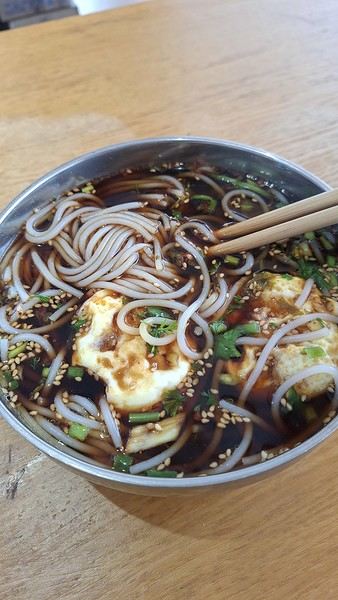
We’d booked a hotel nearby, on the 16th floor. It’s actually studios on different floors of a huge residential building. The view’s pretty nice from here. We settled in quickly—back to those wooden beds, or rather, mattresses as hard as wood, which we *hadn’t* missed... Then we went out for our first bowl of noodles of the trip and wandered through the shopping streets of the old town.
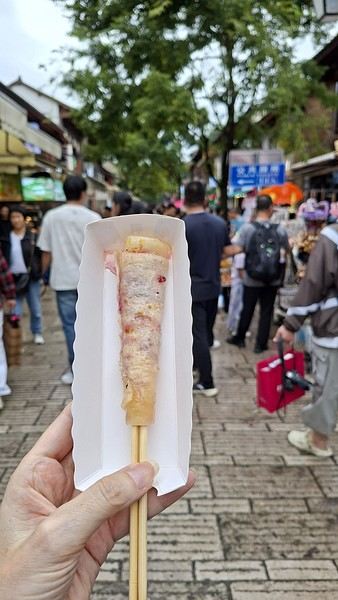
It was crowded, and the weather was cool—around 19–20°C. We tried a local specialty: milk skin, thick, dried, then grilled with rose jam. Yeah... we won’t be having that again. The taste and texture of the milk skin... no thanks.
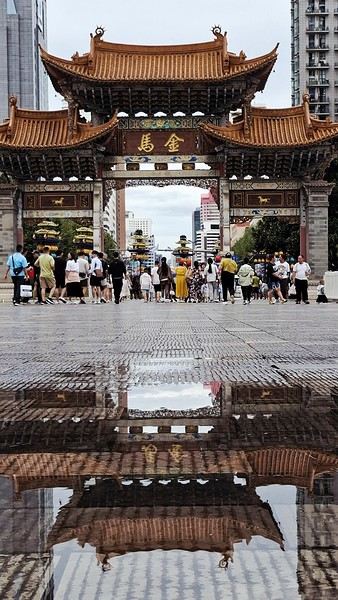
We saw a lot of wild mushroom hotpot too. It’s on our list for later. We also passed through the Jinma and Biji gates, where I played with reflections in puddles. I *love* doing that 🙂
At the end of the day, we headed to a temple advertised as open 24/7 on Amap. Of course, when we got there, it was closed. We’ll go back tomorrow. That was the first of many disappointments with Amap this trip—I hadn’t had that issue on previous visits.
We were exhausted after that sleepless flight. Night was falling, and we decided to grab a quick bite without much appetite. We shared a delicious vegetable fried rice for 12 yuan—we even left half of it. The portions are *huge*.
After a couple of small purchases, we headed back at 9 PM, wiped out, after walking 17 km between the airports and these first steps in Kunming. I expected to see quite a few Western travelers here, but we didn’t spot a single one. Instead, we met lots of curious Chinese people, many of them super friendly and helpful—almost *too* eager, like when they’d run to serve us as fast as possible. It’s a bit much, but it’s great to be back!
I’m sharing a little recap of this new 4-week trip to China—nothing fancy, just my experience.
We’re taking advantage of the extended visa exemption to return to China for the 4th time. I loved last summer’s trip so much that I’m a bit worried about being disappointed this year. Plus, I’ve had a few hiccups before this departure: my WeChat account got blocked, and I couldn’t recover it (luckily, Alipay still works fine); I couldn’t verify my 12306 account for weeks; Trip.com failed to book our second train; and I’ve got an injury that’ll slow me down during the trip... Ugh, I hate starting a trip with these kinds of issues. Then, oh surprise! Just before leaving, my 12306 account got verified! Super easy to use from that point on—I could book a few train tickets without fees.
We’re sticking with Free’s e-SIMs, which work great in China.
August 2–3
Anyway, on the morning of August 2nd, we took the RER to CDG. As usual, we couldn’t check in online. It’s always a bit frustrating, especially since we didn’t have any checked luggage. We flew with Air China. We arrived at the check-in counter at 9:50 AM, 2 hours and 40 minutes before the flight. The line for our check-in stretched 300 meters across the airport in both directions. What a joke!! We spent 1 hour and 45 minutes in that line just to reach the counter and get our boarding passes. By then, it was 11:35 AM, and boarding had already started at 11:20 AM. The screens showed a 25-minute walk to our gate—on the other side of the airport, of course—plus we had to go through passport control and security... Long story short, the plane didn’t leave without us 🙂 We boarded among the last passengers, and we took off at 12:30 PM. We’d flown Air China four times before, but this time, it felt *really* low-cost. The check-in chaos, the cramped seats (12 seats per row), no music by artists known outside China, mediocre food, and a boarding area at Beijing Airport with only 10 seats—worthy of Ryanair or EasyJet. And yet, the price was sky-high. Again, D.’s vacation requests were denied outside of July and August, so we’re traveling from August 2nd to 30th. We couldn’t have picked a worse time for inflated prices, and with the situation in Iran, we got hit with a 390 € fuel surcharge. I’ve never paid so much for flights—I felt like I’d bought business class, but nope, far from it!!
We landed in Beijing around 4:15 AM. It was 28°C with thick fog. We drove and drove and drove for 20 minutes, as usual in Beijing. Then we went through a first check, a second check, a third check, and waited for our connecting flight at 6:40 AM. A small Airbus A320, but way more space than in the Boeing 777 from the first flight. We landed in Kunming, Yunnan, around 10:15 AM in the rain.
We headed to the subway. You can’t pay at the machines with Alipay here either, so we set up the transport QR code directly in Alipay to scan at the subway gates. The process is a bit long the first time if you haven’t entered your info before, but once it’s done, it’s *so* much easier! We took Line 6 to the terminus for 6 yuan each.
We’d booked a hotel nearby, on the 16th floor. It’s actually studios on different floors of a huge residential building. The view’s pretty nice from here. We settled in quickly—back to those wooden beds, or rather, mattresses as hard as wood, which we *hadn’t* missed... Then we went out for our first bowl of noodles of the trip and wandered through the shopping streets of the old town.
It was crowded, and the weather was cool—around 19–20°C. We tried a local specialty: milk skin, thick, dried, then grilled with rose jam. Yeah... we won’t be having that again. The taste and texture of the milk skin... no thanks.
We saw a lot of wild mushroom hotpot too. It’s on our list for later. We also passed through the Jinma and Biji gates, where I played with reflections in puddles. I *love* doing that 🙂
At the end of the day, we headed to a temple advertised as open 24/7 on Amap. Of course, when we got there, it was closed. We’ll go back tomorrow. That was the first of many disappointments with Amap this trip—I hadn’t had that issue on previous visits.
We were exhausted after that sleepless flight. Night was falling, and we decided to grab a quick bite without much appetite. We shared a delicious vegetable fried rice for 12 yuan—we even left half of it. The portions are *huge*.
After a couple of small purchases, we headed back at 9 PM, wiped out, after walking 17 km between the airports and these first steps in Kunming. I expected to see quite a few Western travelers here, but we didn’t spot a single one. Instead, we met lots of curious Chinese people, many of them super friendly and helpful—almost *too* eager, like when they’d run to serve us as fast as possible. It’s a bit much, but it’s great to be back!
Africa: A Heartfelt Love for a Continent
“When the Whites came to Africa, we had the land and they had the Bible. They taught us to pray with our eyes closed: when we opened them, the Whites had the land and we had the Bible.” Jomo Kenyatta (p.7)
The Maggi cube, an unchallenged hegemony, and so much more
“The hopeless continent,” headlined The Economist, a British magazine, in July 2000 about Africa. Eleven years later, the same magazine headlined “Africa rising” instead. Images of Africa in the prosperous North constantly oscillate between apocalyptic scenarios and enthusiastic projections. A key issue with such images lies in the generalization they entail. If you look at the continent, considerable contrasts emerge depending on space and time. It’s no surprise that a region of the world encompassing such diverse ecological zones, maintaining such varied ties with other continents, comprising nearly fifty nation-states in sub-Saharan Africa alone, and characterized by a great diversity of languages, belief systems, and historical paths, doesn’t share a single destiny.
And yet, for many people outside Africa, as well as for many Africans, the continent constitutes a single entity, defined by criteria such as skin color, a colonial past, poverty, and the art of survival. Until now, these perspectives were generally accompanied by the idea that Africa had to—or should have—followed a single path together, sometimes called development, sometimes modernization, sometimes liberation, then a market economy. None of these paths delivered on their promises.
The two writers Alain Mabanckou and Abdourahman Waberi—one from Congo, the other raised in Djibouti, both long settled in France and now professors at renowned North American universities (Los Angeles, Washington)—have had enough of pessimistic scenarios: “We are aware that Africa is in the world and the world is in Africa. The same goes for all other continents, as our destinies are inextricably linked for better or worse. We refuse to see Africa as a reservoir of misfortunes or a continent cursed by atavistic misfortune and characterized by ethnic conflicts. [...] It’s this passionate flame we wanted to capture in a book [...] a kind of stroll through African cultures, without any demands, each letter of the alphabet leading us to a notion, a practice, a concept, a moment in history, literature, painting, politics, economics, cuisine, etc.” (p.10-11). Africa, they write, is on the verge of “imposing a signature, a style, a way of being in the world and in relation to the rest of the world.” (p.11) To put words to the continent’s diversity and dynamism, the two authors created a “rambling ABC,” a kind of portrait—or more precisely, a mythography—that lets you see and feel the pulse of a vast continent whose cultural power is unfolding before our eyes. Once marginalized or even mocked, the voice and importance of the Continent in global affairs are now undeniable” (p.11), containing over a hundred entries, mostly concise, written in a relaxed and casual style. The optimistic, even exuberant tone is set from the brief introduction. The duo of authors wants to “sing a love song to the cultures of our continent, to its inhabitants past and present, to its exceptional resources and its spectacular globalization despite a certain pollution that still clouds our skies due to the unmatched duration of dictatorships in some of our regions.” (p.12) In doing so, they don’t want to be too distracted by today’s Afewerki-Biya-Bongo-Déby & Co. ...
Of course, you’ll find tributes to great precursors like Frantz Fanon (“[...] it was a love story and admiration that wasn’t dimmed by the four decades separating his birth from ours. Let’s add that we were born while the native of Fort-de-France had left the world’s stage four years earlier, in the prime of life” p.141), Mongo Beti (“You must read and reread Mongo Beti, a genius who used his fame to support often just causes in Africa, like defending oppressed groups. His place is already in History. His oppressors, like the dictators Ahmadou Ahidjo and Paul Biya, can’t compete in the same category” p.64), the Malian Amadou Hampâté Bâ
(“Posterity remembers him mainly as an tireless defender of African cultures. His plea for the collection and preservation of traditional African knowledge remains a major event for all men and women of good will. One day in 1960, at the UNESCO podium, the native of Bandiagara sounded the alarm: ‘[...] Since we’ve admitted that the humanity of each people is the heritage of all humanity, if African traditions aren’t collected in time and written down, they’ll one day be missing from the universal archives of humanity.’” p.51),
Kwame Nkrumah, “one of the founders of Pan-Africanism, father of Ghana’s independence” (p.239), as well as the historian Cheikh Anta Diop, the writer, poet, and politician Aimé Césaire, and the economist and thinker Samir Amin, but also very warm tributes to certain contemporary African intellectuals like Souleymane Bachir Diagne and Achille Mbembe
(“A few years ago, in dominant economic circles, a rumor often resurfaced, usually disguised as a cold and scientifically proven analysis: Africa is useless. It’s a burden for the rest of the human community. With its 2% share in world trade, it would disappear from stock market radars without anyone noticing. So? Maybe it’ll be pulled up by other continents. Wanting to surpass itself is a crazy bet for Africans, they concluded. Arrogant or clueless, President Nicolas Sarkozy declared before an audience of students and teachers at Cheikh Anta Diop University in Dakar: ‘The African man hasn’t entered history enough [...] He only knows the eternal repetition of time marked by the endless repetition of the same gestures and words.’ That was in 2007. For decades, armed only with reason, an intellectual often steps up to debunk prejudices, lazy readings, and dishonest frameworks used as false fronts by those who, like Nicolas Sarkozy or former journalist Stephen Smith, out of ignorance, contempt, or condescension, distort African reality. This intellectual is none other than the historian and political scientist Achille Mbembe. This heir of Frantz Fanon, Amílcar Cabral, Jean-Marc Ela, and Fabien Eboussi-Boulaga was born in 1957 in Cameroon, in the Bassa region. Marked early by the upheavals of a fratricidal war, Achille Mbembe became the guardian of the memory of martyrs. After brilliant studies in Paris, he went on to teach at the best American universities, but the call of the Continent was stronger than anything else. In Dakar, he once directed CODESRIA (Council for the Development of Social Science Research in Africa) before joining the University of the Witwatersrand in Johannesburg, South Africa. Even though the author of *Critique of Black Reason* (Éditions La Découverte, 2015) spends a few months at Duke University in North Carolina, his observation post remains South Africa. From Johannesburg, Achille Mbembe scrutinizes Africa and the whole world. A lucid observer with an elegant and generous pen, Achille Mbembe knows how to blend big and small history: ‘I was born one day in July, as the month was drawing to a close. It was 1957, in that part of Africa recently named ‘Cameroon,’ a memory of the wonder that seized Portuguese sailors in the 15th century when, sailing up the river near Douala, they couldn’t help but note the presence of a multitude of crustaceans, and named it *Rio dos Camarões*, meaning ‘River of Shrimp.’ I grew up in the shadow of this nameless land, since, in a way, the name it bears is only the product of someone else’s astonishment: a lexical mistake, if you will.’ From this mistake or wound, he made leaven, a springboard to compose a rich work, recognized worldwide. To denounce barriers and barbarians too. But that’s not enough. Among his peers in circles of thought and action, Achille Mbembe passionately and consistently defends human dignity and the beauty of the world. In doing so, he fulfills the mission Frantz Fanon entrusted to him.” (p.227-229),
as well as entries dedicated to lesser-known artists and intellectuals, like the French journalist and activist Rokhaya Diallo, daughter of Senegalese and Gambian parents, or the Ethiopian filmmaker Haile Gerima, who has long lived in the United States. Other names from politics, sports, music, art, and literature: Kofi Annan, p.36; Barack Obama, p.243; Thomas Sankara, p.277; Ousmane Sow, p.285; Yambo Ouologuem, p.250; Léopold Sédar Senghor, p.282; Muhammad Ali, p.30; Nuruddin Farah, p.146; Salif Keita, p.203; Ahmadou Kourouma, p.206; Ngũgĩ wa Thiong’o, p.236; Winnie Mandela, p.224; Kylian Mbappé, p.226 ...
The authors, who resolutely commit to a “mythography” (p.11) of Africa, also pay special attention to local social movements, cultural events, and aspects of daily life. *Y’en a marre*, “which also meant ‘we’re fed up with sitting on our hands’” (p.320-321), emerged about a decade ago in Senegal as a citizen movement of peaceful resistance and symbolizes, the authors emphasize, the fact that African youth are increasingly fed up “with the political circus deployed in Africa since independence, as our parents would say, ‘since the White man left’...” (p.321). A full entry is dedicated to the Maggi bouillon cube, which has flooded African markets for about forty years and enjoys immense popularity (“It’s everywhere in Africa, from Dakar to Djibouti, and from Tangier to Cape Town. It’s in every pot, every stew. Little hands put it in every sauce, every local or adapted dish. An unchallenged hegemony! You’ll find it in diasporas too. The culinary strolls in Paris, in the [...] neighborhood” p.90). Critics blame it not only for impoverishing the aromatic diversity of local dishes but also for being harmful to health. And yet, “he poorest Africans, those who eat only once a day, a few spoonfuls of white beans and a ball of *foufou*, for example, are the most fervent users of the magic cube.” (p.92-93)
For *fonio*, “the new trendy cereal. [...] From the millet family, fonio is probably the oldest cereal cultivated in West Africa, and mainly in its sub-Saharan part, for millennia. [...] Easy to grow, water-efficient, fonio grows everywhere except on clay soils. Long neglected because it was considered the poor man’s crop, fonio is now a source of pride for the farmers who cultivate it and cherish it like the apple of their eye” (p.156-157), the authors immediately offer a detailed recipe, letting the reader know that “e can’t resist sharing this fonio with chicken recipe from Mali with you:
Ingredients: 1 chicken 3 large ripe red tomatoes 4 tbsp tomato paste 4 large onions 1 garlic clove 1/2 cup oil 2 Maggi cubes or salt 2 large carrots 1 turnip 1 large cabbage 2 large potatoes 1 celery stalk 1 packet pre-cooked fonio 4 okra (or okra powder) salt, pepper
Preparation: 1. Prepare the sauce: wash and cut the chicken. Peel the onions, garlic, and vegetables. 2. In a pot, fry the chicken pieces. 3. Dice the onions, tomatoes, carrots, and turnip very small and add them to the pot. 4. Add the tomato paste, salt, and pepper. 5. Simmer for 15 min, then add 2 L of water and the cooked chicken pieces. 6. Simmer for 30 min, then add the crushed garlic and celery, plus the cabbage cut into 4 and the potatoes cut in half. 7. Prepare the fonio: cover it with warm water, let it rest for 15 min, and cook it over low heat. 8. In a small pot, boil the okra and crush them. 9. Mix the crushed okra with the cooked fonio, then salt. Serve hot.” (p.158-159)
The comedy *Black Mic Mac*, released in French theaters in 1986 and addressing France’s increasingly restrictive immigration policy at the time, also gets an entry, as do *Tintin in the Congo*, the popular comic, and *Jip’s Café* (“[...] a little Africa in the heart of Paris, with passersby stopping to admire the ‘ambianceurs’ on the dance floor or attend the cultural events offered by the place” (p.194), an African establishment in Paris that Alain Mabanckou already immortalized in one of his novels.
The duo of authors also tackles thorny subjects like jihadism (p.119), the Rwandan genocide (p.272), the CFA franc (p.82), and dictatorship (p.110). While the two strike the right tone here, many entries leave a slightly bitter taste. Two examples: why doesn’t the text on Barack Obama mention the great disappointment of many people in Africa, who expected more from the African policy of the first U.S. president with African roots than just occasional warm words? Why do the comments on Winnie Mandela gloss over the fact that she was a highly controversial icon of the anti-apartheid movement due to her involvement in kidnappings, acts of torture, and murders of alleged apartheid collaborators? Instead, there’s a compassion that brings tears to the eyes: “She was often reduced to a secondary role, the wife of a great man” or “When victory came, she didn’t taste its fruits. Divorced, isolated. She would never be a ‘first lady’ in an evening gown, posing before a bed of chrysanthemums. They’d keep her far from the circles of power” (p.224-225). At this point, I would’ve liked the authors to take a slightly more critical stance...
That said, these “weaknesses” (if you can call them that) shouldn’t overshadow the book as a whole. It remains an informative, sometimes very entertaining, and often even original work in its own way.
Book information (the original French and the German translation):
Alain Mabanckou/Abdourahman Waberi. Dictionnaire enjoué des cultures africaines. Fayard, 2019. Alain Mabanckou/Abdourahman Waberi. Der Puls Afrikas. Eine Liebeserklärung von A bis Z. Reclam, 2022.
Hery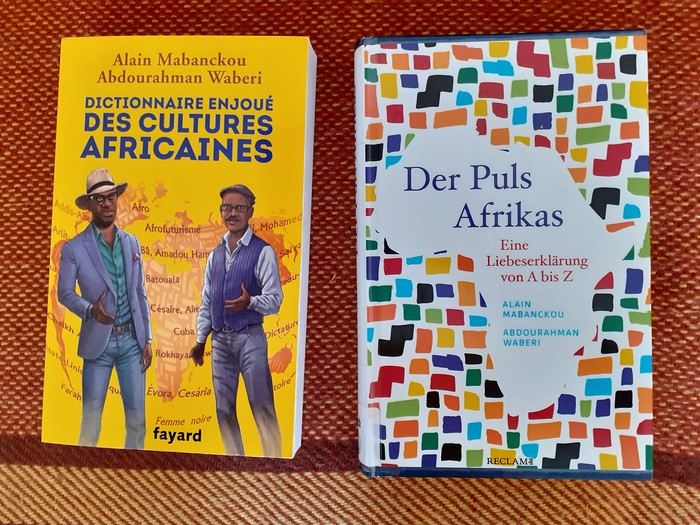
The Maggi cube, an unchallenged hegemony, and so much more
“The hopeless continent,” headlined The Economist, a British magazine, in July 2000 about Africa. Eleven years later, the same magazine headlined “Africa rising” instead. Images of Africa in the prosperous North constantly oscillate between apocalyptic scenarios and enthusiastic projections. A key issue with such images lies in the generalization they entail. If you look at the continent, considerable contrasts emerge depending on space and time. It’s no surprise that a region of the world encompassing such diverse ecological zones, maintaining such varied ties with other continents, comprising nearly fifty nation-states in sub-Saharan Africa alone, and characterized by a great diversity of languages, belief systems, and historical paths, doesn’t share a single destiny.
And yet, for many people outside Africa, as well as for many Africans, the continent constitutes a single entity, defined by criteria such as skin color, a colonial past, poverty, and the art of survival. Until now, these perspectives were generally accompanied by the idea that Africa had to—or should have—followed a single path together, sometimes called development, sometimes modernization, sometimes liberation, then a market economy. None of these paths delivered on their promises.
The two writers Alain Mabanckou and Abdourahman Waberi—one from Congo, the other raised in Djibouti, both long settled in France and now professors at renowned North American universities (Los Angeles, Washington)—have had enough of pessimistic scenarios: “We are aware that Africa is in the world and the world is in Africa. The same goes for all other continents, as our destinies are inextricably linked for better or worse. We refuse to see Africa as a reservoir of misfortunes or a continent cursed by atavistic misfortune and characterized by ethnic conflicts. [...] It’s this passionate flame we wanted to capture in a book [...] a kind of stroll through African cultures, without any demands, each letter of the alphabet leading us to a notion, a practice, a concept, a moment in history, literature, painting, politics, economics, cuisine, etc.” (p.10-11). Africa, they write, is on the verge of “imposing a signature, a style, a way of being in the world and in relation to the rest of the world.” (p.11) To put words to the continent’s diversity and dynamism, the two authors created a “rambling ABC,” a kind of portrait—or more precisely, a mythography—that lets you see and feel the pulse of a vast continent whose cultural power is unfolding before our eyes. Once marginalized or even mocked, the voice and importance of the Continent in global affairs are now undeniable” (p.11), containing over a hundred entries, mostly concise, written in a relaxed and casual style. The optimistic, even exuberant tone is set from the brief introduction. The duo of authors wants to “sing a love song to the cultures of our continent, to its inhabitants past and present, to its exceptional resources and its spectacular globalization despite a certain pollution that still clouds our skies due to the unmatched duration of dictatorships in some of our regions.” (p.12) In doing so, they don’t want to be too distracted by today’s Afewerki-Biya-Bongo-Déby & Co. ...
Of course, you’ll find tributes to great precursors like Frantz Fanon (“[...] it was a love story and admiration that wasn’t dimmed by the four decades separating his birth from ours. Let’s add that we were born while the native of Fort-de-France had left the world’s stage four years earlier, in the prime of life” p.141), Mongo Beti (“You must read and reread Mongo Beti, a genius who used his fame to support often just causes in Africa, like defending oppressed groups. His place is already in History. His oppressors, like the dictators Ahmadou Ahidjo and Paul Biya, can’t compete in the same category” p.64), the Malian Amadou Hampâté Bâ
(“Posterity remembers him mainly as an tireless defender of African cultures. His plea for the collection and preservation of traditional African knowledge remains a major event for all men and women of good will. One day in 1960, at the UNESCO podium, the native of Bandiagara sounded the alarm: ‘[...] Since we’ve admitted that the humanity of each people is the heritage of all humanity, if African traditions aren’t collected in time and written down, they’ll one day be missing from the universal archives of humanity.’” p.51),
Kwame Nkrumah, “one of the founders of Pan-Africanism, father of Ghana’s independence” (p.239), as well as the historian Cheikh Anta Diop, the writer, poet, and politician Aimé Césaire, and the economist and thinker Samir Amin, but also very warm tributes to certain contemporary African intellectuals like Souleymane Bachir Diagne and Achille Mbembe
(“A few years ago, in dominant economic circles, a rumor often resurfaced, usually disguised as a cold and scientifically proven analysis: Africa is useless. It’s a burden for the rest of the human community. With its 2% share in world trade, it would disappear from stock market radars without anyone noticing. So? Maybe it’ll be pulled up by other continents. Wanting to surpass itself is a crazy bet for Africans, they concluded. Arrogant or clueless, President Nicolas Sarkozy declared before an audience of students and teachers at Cheikh Anta Diop University in Dakar: ‘The African man hasn’t entered history enough [...] He only knows the eternal repetition of time marked by the endless repetition of the same gestures and words.’ That was in 2007. For decades, armed only with reason, an intellectual often steps up to debunk prejudices, lazy readings, and dishonest frameworks used as false fronts by those who, like Nicolas Sarkozy or former journalist Stephen Smith, out of ignorance, contempt, or condescension, distort African reality. This intellectual is none other than the historian and political scientist Achille Mbembe. This heir of Frantz Fanon, Amílcar Cabral, Jean-Marc Ela, and Fabien Eboussi-Boulaga was born in 1957 in Cameroon, in the Bassa region. Marked early by the upheavals of a fratricidal war, Achille Mbembe became the guardian of the memory of martyrs. After brilliant studies in Paris, he went on to teach at the best American universities, but the call of the Continent was stronger than anything else. In Dakar, he once directed CODESRIA (Council for the Development of Social Science Research in Africa) before joining the University of the Witwatersrand in Johannesburg, South Africa. Even though the author of *Critique of Black Reason* (Éditions La Découverte, 2015) spends a few months at Duke University in North Carolina, his observation post remains South Africa. From Johannesburg, Achille Mbembe scrutinizes Africa and the whole world. A lucid observer with an elegant and generous pen, Achille Mbembe knows how to blend big and small history: ‘I was born one day in July, as the month was drawing to a close. It was 1957, in that part of Africa recently named ‘Cameroon,’ a memory of the wonder that seized Portuguese sailors in the 15th century when, sailing up the river near Douala, they couldn’t help but note the presence of a multitude of crustaceans, and named it *Rio dos Camarões*, meaning ‘River of Shrimp.’ I grew up in the shadow of this nameless land, since, in a way, the name it bears is only the product of someone else’s astonishment: a lexical mistake, if you will.’ From this mistake or wound, he made leaven, a springboard to compose a rich work, recognized worldwide. To denounce barriers and barbarians too. But that’s not enough. Among his peers in circles of thought and action, Achille Mbembe passionately and consistently defends human dignity and the beauty of the world. In doing so, he fulfills the mission Frantz Fanon entrusted to him.” (p.227-229),
as well as entries dedicated to lesser-known artists and intellectuals, like the French journalist and activist Rokhaya Diallo, daughter of Senegalese and Gambian parents, or the Ethiopian filmmaker Haile Gerima, who has long lived in the United States. Other names from politics, sports, music, art, and literature: Kofi Annan, p.36; Barack Obama, p.243; Thomas Sankara, p.277; Ousmane Sow, p.285; Yambo Ouologuem, p.250; Léopold Sédar Senghor, p.282; Muhammad Ali, p.30; Nuruddin Farah, p.146; Salif Keita, p.203; Ahmadou Kourouma, p.206; Ngũgĩ wa Thiong’o, p.236; Winnie Mandela, p.224; Kylian Mbappé, p.226 ...
The authors, who resolutely commit to a “mythography” (p.11) of Africa, also pay special attention to local social movements, cultural events, and aspects of daily life. *Y’en a marre*, “which also meant ‘we’re fed up with sitting on our hands’” (p.320-321), emerged about a decade ago in Senegal as a citizen movement of peaceful resistance and symbolizes, the authors emphasize, the fact that African youth are increasingly fed up “with the political circus deployed in Africa since independence, as our parents would say, ‘since the White man left’...” (p.321). A full entry is dedicated to the Maggi bouillon cube, which has flooded African markets for about forty years and enjoys immense popularity (“It’s everywhere in Africa, from Dakar to Djibouti, and from Tangier to Cape Town. It’s in every pot, every stew. Little hands put it in every sauce, every local or adapted dish. An unchallenged hegemony! You’ll find it in diasporas too. The culinary strolls in Paris, in the [...] neighborhood” p.90). Critics blame it not only for impoverishing the aromatic diversity of local dishes but also for being harmful to health. And yet, “he poorest Africans, those who eat only once a day, a few spoonfuls of white beans and a ball of *foufou*, for example, are the most fervent users of the magic cube.” (p.92-93)
For *fonio*, “the new trendy cereal. [...] From the millet family, fonio is probably the oldest cereal cultivated in West Africa, and mainly in its sub-Saharan part, for millennia. [...] Easy to grow, water-efficient, fonio grows everywhere except on clay soils. Long neglected because it was considered the poor man’s crop, fonio is now a source of pride for the farmers who cultivate it and cherish it like the apple of their eye” (p.156-157), the authors immediately offer a detailed recipe, letting the reader know that “e can’t resist sharing this fonio with chicken recipe from Mali with you:
Ingredients: 1 chicken 3 large ripe red tomatoes 4 tbsp tomato paste 4 large onions 1 garlic clove 1/2 cup oil 2 Maggi cubes or salt 2 large carrots 1 turnip 1 large cabbage 2 large potatoes 1 celery stalk 1 packet pre-cooked fonio 4 okra (or okra powder) salt, pepper
Preparation: 1. Prepare the sauce: wash and cut the chicken. Peel the onions, garlic, and vegetables. 2. In a pot, fry the chicken pieces. 3. Dice the onions, tomatoes, carrots, and turnip very small and add them to the pot. 4. Add the tomato paste, salt, and pepper. 5. Simmer for 15 min, then add 2 L of water and the cooked chicken pieces. 6. Simmer for 30 min, then add the crushed garlic and celery, plus the cabbage cut into 4 and the potatoes cut in half. 7. Prepare the fonio: cover it with warm water, let it rest for 15 min, and cook it over low heat. 8. In a small pot, boil the okra and crush them. 9. Mix the crushed okra with the cooked fonio, then salt. Serve hot.” (p.158-159)
The comedy *Black Mic Mac*, released in French theaters in 1986 and addressing France’s increasingly restrictive immigration policy at the time, also gets an entry, as do *Tintin in the Congo*, the popular comic, and *Jip’s Café* (“[...] a little Africa in the heart of Paris, with passersby stopping to admire the ‘ambianceurs’ on the dance floor or attend the cultural events offered by the place” (p.194), an African establishment in Paris that Alain Mabanckou already immortalized in one of his novels.
The duo of authors also tackles thorny subjects like jihadism (p.119), the Rwandan genocide (p.272), the CFA franc (p.82), and dictatorship (p.110). While the two strike the right tone here, many entries leave a slightly bitter taste. Two examples: why doesn’t the text on Barack Obama mention the great disappointment of many people in Africa, who expected more from the African policy of the first U.S. president with African roots than just occasional warm words? Why do the comments on Winnie Mandela gloss over the fact that she was a highly controversial icon of the anti-apartheid movement due to her involvement in kidnappings, acts of torture, and murders of alleged apartheid collaborators? Instead, there’s a compassion that brings tears to the eyes: “She was often reduced to a secondary role, the wife of a great man” or “When victory came, she didn’t taste its fruits. Divorced, isolated. She would never be a ‘first lady’ in an evening gown, posing before a bed of chrysanthemums. They’d keep her far from the circles of power” (p.224-225). At this point, I would’ve liked the authors to take a slightly more critical stance...
That said, these “weaknesses” (if you can call them that) shouldn’t overshadow the book as a whole. It remains an informative, sometimes very entertaining, and often even original work in its own way.
Book information (the original French and the German translation):
Alain Mabanckou/Abdourahman Waberi. Dictionnaire enjoué des cultures africaines. Fayard, 2019. Alain Mabanckou/Abdourahman Waberi. Der Puls Afrikas. Eine Liebeserklärung von A bis Z. Reclam, 2022.
Hery
Best destinations for a first solo trip?
Hi there! I’m in the middle of planning my first solo trip (as a woman). Do you have any ideal destinations with activities like hiking, diving, sightseeing, and easy ways to meet locals—all on a small budget?
I’d love to hear from anyone who’s had this experience before! :)
I’d love to hear from anyone who’s had this experience before! :)
Off on an adventure in Sri Lanka
Day 1 – December 6
Our decision is our decision. And it’s firm and final. Next winter, our plane will spread its great wings toward the island of Ceylon! "Wait a minute... Ceylon... Ceylon... that name rings a bell, but I can’t quite place it on the globe Grandma gave me for Christmas! Ceylon... Oh right, I’ve got it: Ceylon is the name of my tea!" Exactly. But the name on your pretty tea box is also the one used until 1972 for this island nation, a speck on the Indian Ocean at the southern tip of the Indian subcontinent: Sri Lanka!
For this new adventure, I’m exceptionally leaving my Flo behind, cowardly replaced by a double dose of testosterone. To write the book of this journey with me, I’m bringing along my brother, who’s used to this kind of thing, and... a guest star: My model of resilience. My dad! All aboard! Or rather, all aboard our tuk-tuk! Yes, you read that right: A real tuk-tuk, a little colorful rolling box that putters along at two miles an hour. The idea? Well, Sri Lanka and its winding roads overlooking the vastness of lush nature are tailor-made for this kind of vehicle. And since it’s one of only two countries in the world that allow foreigners to rent and drive these mini speedsters, we’ll be crisscrossing the island in our two-square-meter rolling box. Plus, adopting this mode of transport is a surefire way to connect directly with the locals, who’ll surely be curious to see a foreigner driving their iconic vehicle. Not to mention the... let’s say... spicy anecdotes it might generate. I mean, heading into a subtropical zone with my jet-black dad and his unpredictable digestive flora while deliberately choosing the tuk-tuk as our *only* means of transport? That’s the winning combo for an unforgettable adventure! "More seriously, Dad, Sullivan, I’m already loving the idea of living this adventure together, the three of us—brothers and father..."
So, does the intro to this new adventure get your salivary glands going? Yes? Too bad. Because unfortunately, the program handed out by the lady at the entrance has been slightly... let’s say *crumpled*. Some might even say "scrunched up and nearly tossed in the trash." First, six days ago, as the countdown echoed in us like a call to adventure, Cyclone Ditwah grabbed Sri Lanka, played with it like a rag doll, and left it battered on the ground. The toll is devastating: over a thousand dead, thousands of homes wiped out by relentless rains, roads and railways swallowed by massive mudslides. A country wounded once again, after the civil war, the 2004 tsunami, and the post-Covid economic crisis.
But as if this weather disaster wasn’t enough to shake our unbreakable adventurer spirit, fate decided to mess with us further by cutting our trio down to two. The victim? My brother, violently turned away because of a simple date on his passport that didn’t match the border officials’ expectations. Return to sender!
So now it’s just the two of us allowed to board the Qatar Airways Airbus A380 for this trip. If he were here, Denis Brognart would say, "And in the end, only one remains!" Except I know you’ll be with us, following our adventures! Right?
Our decision is our decision. And it’s firm and final. Next winter, our plane will spread its great wings toward the island of Ceylon! "Wait a minute... Ceylon... Ceylon... that name rings a bell, but I can’t quite place it on the globe Grandma gave me for Christmas! Ceylon... Oh right, I’ve got it: Ceylon is the name of my tea!" Exactly. But the name on your pretty tea box is also the one used until 1972 for this island nation, a speck on the Indian Ocean at the southern tip of the Indian subcontinent: Sri Lanka!
For this new adventure, I’m exceptionally leaving my Flo behind, cowardly replaced by a double dose of testosterone. To write the book of this journey with me, I’m bringing along my brother, who’s used to this kind of thing, and... a guest star: My model of resilience. My dad! All aboard! Or rather, all aboard our tuk-tuk! Yes, you read that right: A real tuk-tuk, a little colorful rolling box that putters along at two miles an hour. The idea? Well, Sri Lanka and its winding roads overlooking the vastness of lush nature are tailor-made for this kind of vehicle. And since it’s one of only two countries in the world that allow foreigners to rent and drive these mini speedsters, we’ll be crisscrossing the island in our two-square-meter rolling box. Plus, adopting this mode of transport is a surefire way to connect directly with the locals, who’ll surely be curious to see a foreigner driving their iconic vehicle. Not to mention the... let’s say... spicy anecdotes it might generate. I mean, heading into a subtropical zone with my jet-black dad and his unpredictable digestive flora while deliberately choosing the tuk-tuk as our *only* means of transport? That’s the winning combo for an unforgettable adventure! "More seriously, Dad, Sullivan, I’m already loving the idea of living this adventure together, the three of us—brothers and father..."
So, does the intro to this new adventure get your salivary glands going? Yes? Too bad. Because unfortunately, the program handed out by the lady at the entrance has been slightly... let’s say *crumpled*. Some might even say "scrunched up and nearly tossed in the trash." First, six days ago, as the countdown echoed in us like a call to adventure, Cyclone Ditwah grabbed Sri Lanka, played with it like a rag doll, and left it battered on the ground. The toll is devastating: over a thousand dead, thousands of homes wiped out by relentless rains, roads and railways swallowed by massive mudslides. A country wounded once again, after the civil war, the 2004 tsunami, and the post-Covid economic crisis.
But as if this weather disaster wasn’t enough to shake our unbreakable adventurer spirit, fate decided to mess with us further by cutting our trio down to two. The victim? My brother, violently turned away because of a simple date on his passport that didn’t match the border officials’ expectations. Return to sender!
So now it’s just the two of us allowed to board the Qatar Airways Airbus A380 for this trip. If he were here, Denis Brognart would say, "And in the end, only one remains!" Except I know you’ll be with us, following our adventures! Right?
A Bold Combo: Southern Peru, Bolivia, and Northern Chile
Hello everyone,
For our latest 3-week family trip (yes, the kids are growing up, and two of them are about to enter the working world), we’re heading to South America! For our first time on this continent, I had planned a classic 3-week loop in Peru.
But since we won’t be returning to this part of the world anytime soon, I thought: why not follow in the footsteps of Franck, aka Bibouns51, who, in 18 days, didn’t just stick to Peru but also added two of the planet’s most stunning landscapes to his itinerary... the Salar de Uyuni in Bolivia and its neighbor, the fabulous Atacama Desert in northern Chile !!
So, I set about the tricky task of limiting the regions we’d visit in Peru to those we considered must-sees, to avoid rushing too much. The visit schedules were optimized, including several comfortable overnight buses that have the huge advantage of letting us hop between regions.
So, we’re off on a somewhat adventurous trip with three domestic flights (two on the first day and one on the last), two overnight buses for quick hops, several car rentals, the services of a few drivers to make the trip more comfortable, and even a tour operator for crossing the Salar...
Our main concern is altitude sickness, and we’re bringing Diamox, aspirin, etc., just in case.
Our second worry before departure was not even getting off the ground... Yes, for once, we’re leaving from France—Marseille, to be exact. The week before our departure, with the surprise air traffic controllers’ strike, I remembered why we usually prefer to leave from abroad, like Turin or Barcelona... In the end, it wasn’t the air traffic controllers who made us nervous but the early July wildfires that paralyzed the airport a few days before our departure. Fortunately, the fires were quickly brought under control, and on the big day, everything was smooth sailing!
Detailed itinerary (which changed on Day 1 due to departure hiccups): Day 0: Flight Marseille - Madrid - Lima PERU Theoretical and abandoned Day 1: Flight Lima - Cuzco and visit Cuzco (Puka Pukara, Tambomachay, Cristo Blanco Observatory, Sacsayhuaman sunset) - Night in Cuzco Day 2: Taxi -> Chinchero - Moray - Maras Salt Mines - Ollantaytambo - Train to Aguas Calientes Day 3: Machu Picchu - Return train to Ollantaytambo Day 4: 2-day taxi -> Pisac - Tipon - Andahuaylillas - Huaro - Night in San Pedro Day 5: Palcoyo - Checacupe - Vinicunca - Return and night in Cuzco Day 6: Day in Cuzco (catch-up on Sacsayhuaman, San Blas district, Temple of the Sun) - Overnight bus to Arequipa Day 7: Rental car -> On the road to Colca Canyon, night in Cabanaconde Day 8: Descent to the bottom of Colca Canyon, night at Oasis Sangalle Day 9: Ascent from the canyon - Maca - Chivay - Return and night in Arequipa Day 10: Visit Arequipa (Santa Catalina Convent, La Recoleta Church and Monastery, La Compañía Church, Cathedral) - Overnight bus to Puno Day 11: Lake Titicaca - Night in Puno BOLIVIA Day 12: Shared taxi -> Road to La Paz, visit downtown La Paz - Night 1 in La Paz Day 13: Moon Valley and Las Animas Valley - Night 2 in La Paz Day 14: Day in La Paz - Night 3 in La Paz Day 15: Flight to Uyuni - Day 1 of Salar de Uyuni tour - Night at the edge of the Salar Day 16: Crossing the Lipez region and lagoons - Night near Laguna Colorada Day 17: Sol de Mañana CHILE Day 17 cont.: Pre-booked transfer to SPDA - 4x4 rental - Pukara de Quitor - Stargazing tour - Night 1 in SPDA Day 18: Death Valley and Moon Valley - Night 2 in SPDA Day 19: Miscanti and Miniques Lagoons, Salar de Aguas Calientes and its Piedra Roja, Tebenquiche Lagoon and Quebrada del Diablo - Night 3 in SPDA Day 20: Rainbow Valley and swim in the Puritama River - Night 4 in SPDA Day 21: Tebenquiche Lagoon - Bus to Calama - Flight to Santiago Day 22: Return Santiago - Madrid - Marseille
Day 0 - 11/07: Destination Lima
Our first flight from Marseille went smoothly to our Iberia layover in Madrid.
In Madrid, just after getting off the plane around 8 PM, and as we were walking through the terminal, we got a rude awakening!!
We saw the word "Cancelled" next to our flight number on the display boards. Thinking it must be a glitch, we checked another screen, but the system was stubborn, and the same dreaded word appeared !
So, we headed to the Iberia counter, where an agent confirmed that our Friday evening flight was canceled and rescheduled for the next morning. The reason? A breakdown and no replacement plane, even though we were in Madrid, Iberia’s home base!
To make matters worse, I remembered our super-tight schedule, planned to the minute, with no buffer day in Lima. Since I’m a bit phobic of megacities and hadn’t found anything appealing in the Peruvian capital in our guidebooks, we’d planned to leave Lima as soon as possible for Cusco, the heart of the Sacred Valley, to spend our first day there.
Bad idea, because we already knew the 4-hour buffer wouldn’t be enough, and we’d miss the domestic flight, which was, of course, non-refundable and non-changeable. So, we had to call LATAM from Madrid to find another flight for Saturday evening and negotiate a rate to recover some of our initial outlay.
After an hour on the phone with customer service, several endless holds, and three failed attempts to dictate our credit card number over the phone to a Spaniard speaking English with a thick accent, we finally managed to confirm the transaction, securing our new flight tickets for a moderate extra cost of just 150 € total.
At first, we were pretty bummed about losing a day and incurring extra fees to reschedule the domestic flight, but then, when we learned from an Iberia customer service rep that we’d receive the max compensation of 600 € per traveler, we even ended up grinning... because 3000 € in refunds for only losing the first day in Cusco? We’d sign up for that 10 times over!!
Iberia then took care of us, putting us up in a hotel where we had dinner before a short 5-hour night and an early morning departure. I took the opportunity to improvise a quick day of sightseeing in Lima, focusing on the Barranco and Miraflores districts.
For our latest 3-week family trip (yes, the kids are growing up, and two of them are about to enter the working world), we’re heading to South America! For our first time on this continent, I had planned a classic 3-week loop in Peru.
But since we won’t be returning to this part of the world anytime soon, I thought: why not follow in the footsteps of Franck, aka Bibouns51, who, in 18 days, didn’t just stick to Peru but also added two of the planet’s most stunning landscapes to his itinerary... the Salar de Uyuni in Bolivia and its neighbor, the fabulous Atacama Desert in northern Chile !!
So, I set about the tricky task of limiting the regions we’d visit in Peru to those we considered must-sees, to avoid rushing too much. The visit schedules were optimized, including several comfortable overnight buses that have the huge advantage of letting us hop between regions.
So, we’re off on a somewhat adventurous trip with three domestic flights (two on the first day and one on the last), two overnight buses for quick hops, several car rentals, the services of a few drivers to make the trip more comfortable, and even a tour operator for crossing the Salar...
Our main concern is altitude sickness, and we’re bringing Diamox, aspirin, etc., just in case.
Our second worry before departure was not even getting off the ground... Yes, for once, we’re leaving from France—Marseille, to be exact. The week before our departure, with the surprise air traffic controllers’ strike, I remembered why we usually prefer to leave from abroad, like Turin or Barcelona... In the end, it wasn’t the air traffic controllers who made us nervous but the early July wildfires that paralyzed the airport a few days before our departure. Fortunately, the fires were quickly brought under control, and on the big day, everything was smooth sailing!
Detailed itinerary (which changed on Day 1 due to departure hiccups): Day 0: Flight Marseille - Madrid - Lima PERU Theoretical and abandoned Day 1: Flight Lima - Cuzco and visit Cuzco (Puka Pukara, Tambomachay, Cristo Blanco Observatory, Sacsayhuaman sunset) - Night in Cuzco Day 2: Taxi -> Chinchero - Moray - Maras Salt Mines - Ollantaytambo - Train to Aguas Calientes Day 3: Machu Picchu - Return train to Ollantaytambo Day 4: 2-day taxi -> Pisac - Tipon - Andahuaylillas - Huaro - Night in San Pedro Day 5: Palcoyo - Checacupe - Vinicunca - Return and night in Cuzco Day 6: Day in Cuzco (catch-up on Sacsayhuaman, San Blas district, Temple of the Sun) - Overnight bus to Arequipa Day 7: Rental car -> On the road to Colca Canyon, night in Cabanaconde Day 8: Descent to the bottom of Colca Canyon, night at Oasis Sangalle Day 9: Ascent from the canyon - Maca - Chivay - Return and night in Arequipa Day 10: Visit Arequipa (Santa Catalina Convent, La Recoleta Church and Monastery, La Compañía Church, Cathedral) - Overnight bus to Puno Day 11: Lake Titicaca - Night in Puno BOLIVIA Day 12: Shared taxi -> Road to La Paz, visit downtown La Paz - Night 1 in La Paz Day 13: Moon Valley and Las Animas Valley - Night 2 in La Paz Day 14: Day in La Paz - Night 3 in La Paz Day 15: Flight to Uyuni - Day 1 of Salar de Uyuni tour - Night at the edge of the Salar Day 16: Crossing the Lipez region and lagoons - Night near Laguna Colorada Day 17: Sol de Mañana CHILE Day 17 cont.: Pre-booked transfer to SPDA - 4x4 rental - Pukara de Quitor - Stargazing tour - Night 1 in SPDA Day 18: Death Valley and Moon Valley - Night 2 in SPDA Day 19: Miscanti and Miniques Lagoons, Salar de Aguas Calientes and its Piedra Roja, Tebenquiche Lagoon and Quebrada del Diablo - Night 3 in SPDA Day 20: Rainbow Valley and swim in the Puritama River - Night 4 in SPDA Day 21: Tebenquiche Lagoon - Bus to Calama - Flight to Santiago Day 22: Return Santiago - Madrid - Marseille
Day 0 - 11/07: Destination Lima
Our first flight from Marseille went smoothly to our Iberia layover in Madrid.
In Madrid, just after getting off the plane around 8 PM, and as we were walking through the terminal, we got a rude awakening!!
We saw the word "Cancelled" next to our flight number on the display boards. Thinking it must be a glitch, we checked another screen, but the system was stubborn, and the same dreaded word appeared !
So, we headed to the Iberia counter, where an agent confirmed that our Friday evening flight was canceled and rescheduled for the next morning. The reason? A breakdown and no replacement plane, even though we were in Madrid, Iberia’s home base!
To make matters worse, I remembered our super-tight schedule, planned to the minute, with no buffer day in Lima. Since I’m a bit phobic of megacities and hadn’t found anything appealing in the Peruvian capital in our guidebooks, we’d planned to leave Lima as soon as possible for Cusco, the heart of the Sacred Valley, to spend our first day there.
Bad idea, because we already knew the 4-hour buffer wouldn’t be enough, and we’d miss the domestic flight, which was, of course, non-refundable and non-changeable. So, we had to call LATAM from Madrid to find another flight for Saturday evening and negotiate a rate to recover some of our initial outlay.
After an hour on the phone with customer service, several endless holds, and three failed attempts to dictate our credit card number over the phone to a Spaniard speaking English with a thick accent, we finally managed to confirm the transaction, securing our new flight tickets for a moderate extra cost of just 150 € total.
At first, we were pretty bummed about losing a day and incurring extra fees to reschedule the domestic flight, but then, when we learned from an Iberia customer service rep that we’d receive the max compensation of 600 € per traveler, we even ended up grinning... because 3000 € in refunds for only losing the first day in Cusco? We’d sign up for that 10 times over!!
Iberia then took care of us, putting us up in a hotel where we had dinner before a short 5-hour night and an early morning departure. I took the opportunity to improvise a quick day of sightseeing in Lima, focusing on the Barranco and Miraflores districts.
Tunisian Impressions (Live)
Hi there,
I arrived in Tunisia this afternoon for a full 14-day stay.
I took a direct Tunisair flight from Nice, which departed about thirty minutes late (that’s nothing compared to the "nightmares" I’ve had on some of my recent trips).
The flight lasts around 1 hour and 20 minutes, and a small snack was served on board (a sort of quiche with chickpea purée, a small bread roll, a portion of cheese like La Vache qui rit, and a small chocolate cake). It’s worth mentioning because it’s becoming increasingly rare on short flights. I was seated between two Tunisian gentlemen who gave me some great tips for my trip, especially about negotiating prices. One of them is a former cameraman for France Télévisions, very cultured and well-traveled—his daughter is a journalist at France Télévisions (I found some of her articles online). In short, the flight was very pleasant and quick.

I’m staying at the Hôtel Royal Victoria. I booked it yesterday afternoon by email without providing my credit card number. The room costs 241 TND (71 €) with breakfast included. It has heating, a small fridge, a safe, a hairdryer, Wi-Fi, and a TV with international channels. There’s a police van permanently parked in the square where the hotel is located.
This hotel is housed in the former British consulate and later embassy. It has a lot of charm with its painted wood ceilings and doors, and its bathroom covered in ceramic tiles. The tiny elevator is from another era. The main advantage of the hotel is its location between the medina and Avenue Bourguiba. Nearby, there’s the Magasin Général, where you can find groceries and some typical products like rose water, geranium water, and tons of halwa (a customer kindly explained how to eat it and which is the best).
After nightfall, I took a short stroll down Avenue Bourguiba. There weren’t many people around—it’s windy and cold.
I’ve already noticed the warm welcome from Tunisians. The supermarket cashier welcomed me to Tunisia, and a gentleman I asked for directions to the Magasin Général (I was about to climb stairs leading to a mosque!) insisted on inviting me for coffee, but I declined.
The rest of my itinerary will depend on the weather. If it doesn’t rain tomorrow, I might visit Carthage since the Bardo Museum is closed on Mondays, as are the museums in Sidi Bou Said.
TO BE CONTINUED...


I arrived in Tunisia this afternoon for a full 14-day stay.
I took a direct Tunisair flight from Nice, which departed about thirty minutes late (that’s nothing compared to the "nightmares" I’ve had on some of my recent trips).
The flight lasts around 1 hour and 20 minutes, and a small snack was served on board (a sort of quiche with chickpea purée, a small bread roll, a portion of cheese like La Vache qui rit, and a small chocolate cake). It’s worth mentioning because it’s becoming increasingly rare on short flights. I was seated between two Tunisian gentlemen who gave me some great tips for my trip, especially about negotiating prices. One of them is a former cameraman for France Télévisions, very cultured and well-traveled—his daughter is a journalist at France Télévisions (I found some of her articles online). In short, the flight was very pleasant and quick.
I’m staying at the Hôtel Royal Victoria. I booked it yesterday afternoon by email without providing my credit card number. The room costs 241 TND (71 €) with breakfast included. It has heating, a small fridge, a safe, a hairdryer, Wi-Fi, and a TV with international channels. There’s a police van permanently parked in the square where the hotel is located.
This hotel is housed in the former British consulate and later embassy. It has a lot of charm with its painted wood ceilings and doors, and its bathroom covered in ceramic tiles. The tiny elevator is from another era. The main advantage of the hotel is its location between the medina and Avenue Bourguiba. Nearby, there’s the Magasin Général, where you can find groceries and some typical products like rose water, geranium water, and tons of halwa (a customer kindly explained how to eat it and which is the best).
After nightfall, I took a short stroll down Avenue Bourguiba. There weren’t many people around—it’s windy and cold.
I’ve already noticed the warm welcome from Tunisians. The supermarket cashier welcomed me to Tunisia, and a gentleman I asked for directions to the Magasin Général (I was about to climb stairs leading to a mosque!) insisted on inviting me for coffee, but I declined.
The rest of my itinerary will depend on the weather. If it doesn’t rain tomorrow, I might visit Carthage since the Bardo Museum is closed on Mondays, as are the museums in Sidi Bou Said.
TO BE CONTINUED...
Booking transport and accommodations in the Cyclades for May
HELLO!
For a trip to the Cyclades in early May (1st–18th), we’re planning to visit Naxos, Amorgos, and finish on Paros to catch a flight back to Athens.
I was wondering if we need to book the ferries now or if we can wait a bit... also, for car rental, can we book on the spot?
For accommodations, our bookings are done except for Paros... any suggestions for good value-for-money options?
Also, any other tips about our route or anything else would be super welcome!!!
Thanks in advance from Quebec! 🙂
Christine
For a trip to the Cyclades in early May (1st–18th), we’re planning to visit Naxos, Amorgos, and finish on Paros to catch a flight back to Athens.
I was wondering if we need to book the ferries now or if we can wait a bit... also, for car rental, can we book on the spot?
For accommodations, our bookings are done except for Paros... any suggestions for good value-for-money options?
Also, any other tips about our route or anything else would be super welcome!!!
Thanks in advance from Quebec! 🙂
Christine
2-week itinerary for Indonesia with kids
Hi everyone,
We’re planning to visit a small part of Indonesia in October 2026 with our kids (8 years old).
Ideally, do you think it’s possible to visit Kinabatangan (3 days), Yogyakarta or Borobudur, and finish with some beginner snorkeling on the Gili Islands in 2 weeks?
Thanks for your valuable feedback! 😊
Is it possible to add a flight ticket for a baby who hasn't been born yet?
Hello,
We’re planning to fly from Paris to Bangkok at the end of June with my wife, our daughter, and the baby who’ll be 4 months old by then.
The baby won’t be born for another 2 months, and I was wondering if it’s possible to book the 3 flight tickets now and add the baby after the birth? I read that a ticket isn’t necessary for babies.
Can you confirm this for me?
Is there a risk that in 2 months they’ll tell me the flight is full and we can’t add our baby?
Finally, is it possible to reserve a seat in the first row (where there’s the most space) right now?
Thanks so much for your help
"Tropical Odyssey" CFC Renaissance – November 1st to 22nd, 2025
We’ve just returned from a cruise that my wife and I will remember—unfortunately, not in a good way.
There’s so much to say that I’ll proceed chapter by chapter.
Pre-Cruise
On January 24th, 2025, I booked through a supposedly attentive cruise agent the repositioning cruise of the CFC Renaissance to the French West Indies, initially departing from Le Havre, then from Dunkirk, on November 1st, 2025.
The return flight was included in the price of this trip.
From January, right after booking, this adventure got off to a bad start.
Used to major cruise lines, I asked my agent to reserve a table for 4 at the "Vatel" restaurant for the second seating, and to link this reservation to the cabin of friends traveling with us. First brush-off: "Ask the maître d’ at the restaurant entrance on the first night."
"To govern is to foresee, and to foresee nothing is to head for disaster," as Émile de Girardin said.
Following this maxim, in February, I started looking for transportation to Le Havre, which was initially the departure port. Then, I asked the travel agent which airport the return flight would land at. I knew flights from Pointe-à-Pitre to Paris served both main Parisian airports. Here, I found myself like a ping-pong ball between the cruise agent and CFC: The cruise agent said, "Ask CFC," and CFC replied, "No, your agent is your intermediary—ask them." It went back and forth like that. Impossible to pre-book the flight that would take us back to our final destination. During the summer, we learned that the departure port was no longer Le Havre but Dunkirk. We canceled our transfers to Le Havre but, of course, lost the cost of the reservations. Meanwhile, we purchased our "Beverage" package—we chose the "Fraîcheur" option, which included all non-alcoholic cocktails, canned sodas, fruit juices, bottled water, and regular coffees. This detail is important for the rest of the story. Every month, I followed up to find out the return airport. Nothing until October 28th (3 days before departure), when CFC finally informed me it was Orly, along with the flight number and time. Of course, on top of booking at full price, I had to arrange my final transfer home. Since I had very little time before the return flight, I had to book an Uber in a rush for the Orly/CDG transfer. Right after, we were told that our first stop in Lisbon—the most anticipated for many cruisers—had been canceled due to a strike at the port of Lisbon and replaced with Vigo, Spain. A completely unremarkable stop—nothing outstanding. As you can see, the prelude was already problematic, yet we’re far from reaching the peak of our disappointments. .......... to be continued soon.
"To govern is to foresee, and to foresee nothing is to head for disaster," as Émile de Girardin said.
Following this maxim, in February, I started looking for transportation to Le Havre, which was initially the departure port. Then, I asked the travel agent which airport the return flight would land at. I knew flights from Pointe-à-Pitre to Paris served both main Parisian airports. Here, I found myself like a ping-pong ball between the cruise agent and CFC: The cruise agent said, "Ask CFC," and CFC replied, "No, your agent is your intermediary—ask them." It went back and forth like that. Impossible to pre-book the flight that would take us back to our final destination. During the summer, we learned that the departure port was no longer Le Havre but Dunkirk. We canceled our transfers to Le Havre but, of course, lost the cost of the reservations. Meanwhile, we purchased our "Beverage" package—we chose the "Fraîcheur" option, which included all non-alcoholic cocktails, canned sodas, fruit juices, bottled water, and regular coffees. This detail is important for the rest of the story. Every month, I followed up to find out the return airport. Nothing until October 28th (3 days before departure), when CFC finally informed me it was Orly, along with the flight number and time. Of course, on top of booking at full price, I had to arrange my final transfer home. Since I had very little time before the return flight, I had to book an Uber in a rush for the Orly/CDG transfer. Right after, we were told that our first stop in Lisbon—the most anticipated for many cruisers—had been canceled due to a strike at the port of Lisbon and replaced with Vigo, Spain. A completely unremarkable stop—nothing outstanding. As you can see, the prelude was already problematic, yet we’re far from reaching the peak of our disappointments. .......... to be continued soon.