Results for "Parc+Frontenac+|+128"
63746 results found.
Rencontre le 15 août 2005 en Auvergne English translation pending
Salut à tous.
Pourquoi pas une rencontre à la cambroussse ?
Je suis dans le Parc du Livradois Forez, près d'Ambert (une heure de Clermont et deux de Lyon) et serais prêt à préparer une rencontre de Vfistes, en camping à la ferme, avec ce qu'il faut comme produits du terroir pour agrémenter des ballades et des feux de camp.
Pour que je puisse organiser quelque chose, le week end du 15 aout m'arrangerait (je bosse jusque là, et ensuite aussi)
C'est ouvert bien sur à tous, ainsi qu'aux idées que vous pourriez amener.
A très vite
Traversée du "Lago Pehoe" en ferry (Chili) English translation pending
Bonjour,
nous partons en octobre pour quelques semaines au Chili et sommes en train d'organiser quelques treks dans le parc Torres del Paine. Nous recherchons désespérement, et sans succès jusqu'à maintenant, les horaires (dans les deux sens) du ferry qui assure la traversée du "Lago Pehoe".
Quelqu'un peut-il nous aider?
Merci d'avance,
nous partons en octobre pour quelques semaines au Chili et sommes en train d'organiser quelques treks dans le parc Torres del Paine. Nous recherchons désespérement, et sans succès jusqu'à maintenant, les horaires (dans les deux sens) du ferry qui assure la traversée du "Lago Pehoe".
Quelqu'un peut-il nous aider?
Merci d'avance,
montana, Idaho English translation pending
Bonjour,
nous allons passer 1 journée à Calgary, puis nous aimerions nous rendre du coté des Etas Unis voir le parc de Yellowstone. Ensuite, nous voulons nous rendre à Seattle pour reprendre peu après notre avion à Vancouver.
Nous disposons d'une grosse dizaine de jours pour cela. Qu'y a t'il à voir dans le Montana et l'Idao ? A priori, la vie est moins chère du coté américain. Pouvez vous nous le confirmer ?
nous allons passer 1 journée à Calgary, puis nous aimerions nous rendre du coté des Etas Unis voir le parc de Yellowstone. Ensuite, nous voulons nous rendre à Seattle pour reprendre peu après notre avion à Vancouver.
Nous disposons d'une grosse dizaine de jours pour cela. Qu'y a t'il à voir dans le Montana et l'Idao ? A priori, la vie est moins chère du coté américain. Pouvez vous nous le confirmer ?
Frontière Bolivie=>Chili au niveau du PN Lauca English translation pending
Salut
Je devrais prochainement aller en Bolivie et j'aimerai aller faire un tour dans le parc Lauca au Chili.
Je m'interroge donc sur la logistique du point de vue du change et du ravitaillement en nourriture. > je doute que mes euros/dollards/bolivianos soient acceptés au Chili, donc où vais je pouvoir me procurer des Pesos (devrais je aller jusqu'à Arica avant de revenir sur mes pas) ? > où vais je pouvoir me ravitailler en nourriture sachant que la douane chilienne confisque la nourriture...
Si vous avez des infos (j'ai eu vent d'une possibilité d'obtenir des pesos au poste frontière ...), je suis preneur.
Merci d'avance A+😏
Je devrais prochainement aller en Bolivie et j'aimerai aller faire un tour dans le parc Lauca au Chili.
Je m'interroge donc sur la logistique du point de vue du change et du ravitaillement en nourriture. > je doute que mes euros/dollards/bolivianos soient acceptés au Chili, donc où vais je pouvoir me procurer des Pesos (devrais je aller jusqu'à Arica avant de revenir sur mes pas) ? > où vais je pouvoir me ravitailler en nourriture sachant que la douane chilienne confisque la nourriture...
Si vous avez des infos (j'ai eu vent d'une possibilité d'obtenir des pesos au poste frontière ...), je suis preneur.
Merci d'avance A+😏
Hôtels pres de Yellowstone? English translation pending
Bonjour,
avez-vous des adresses d'hôtels sympas (et pas chers, hé-hé ...) près du parc de Yellowstone pour le mois septembre 2005
Merci d'avance
avez-vous des adresses d'hôtels sympas (et pas chers, hé-hé ...) près du parc de Yellowstone pour le mois septembre 2005
Merci d'avance
Le Gabon et la Lopé English translation pending
Bonjour. J'envisage un voyage au Gabon en juillet ou août, avec notamment quelques jours dans le parc de la Lopé. Quelles impressions en gardez vous? Beaucoup de rencontres avec la faune?
Retour du Benin-Togo English translation pending
salut
je reviens d un voyage de 1 mois dans ces trois pays
infos pratiques sur kpalime et region (togo)
parc penjari la plus belle reserve animaliere de l afrique de l ouest(1961)
lac togo +togoville
ouidha et grand popo(bennin)
abomey
posez sos questions
salut
je reviens d un voyage de 1 mois dans ces trois pays
infos pratiques sur kpalime et region (togo)
parc penjari la plus belle reserve animaliere de l afrique de l ouest(1961)
lac togo +togoville
ouidha et grand popo(bennin)
abomey
posez sos questions
salut
Location de voiture en Croatie English translation pending
salut,
nous partons à 2 le 10 sept en Croatie. Nous souhaitons faire Dubrovnic, split, parc de plitvice, hvar, brac, korcula, mljet et retour Dubrovnic en 15 j. on utilisera le bus et ferry ou bien nous pensons louer une voiture sur place. savez-vous ce qui est plus facile et si les locations sont à des prix raisonnables (avec assurance) et est-ce pratique pour prendre les ferries. faut-il un permis internationnal?
nous partons à 2 le 10 sept en Croatie. Nous souhaitons faire Dubrovnic, split, parc de plitvice, hvar, brac, korcula, mljet et retour Dubrovnic en 15 j. on utilisera le bus et ferry ou bien nous pensons louer une voiture sur place. savez-vous ce qui est plus facile et si les locations sont à des prix raisonnables (avec assurance) et est-ce pratique pour prendre les ferries. faut-il un permis internationnal?
Trek en Malaisie English translation pending
Je projette un voyage en Malaisie où nous aimerions faire un peu de trekking.
J'ai repéré plusieurs zones de trek : le parc national de Kinabalu avec possibilité de faire l'ascension du Mont Kinabalu en 2 ou 3 jours je crois ; le parc Tamam Negara le parc Endau Rompin
Avez-vous des informations, des filons, une expérience de trek en Malaisie et/ou dans les zones que j'ai précitées ?
Merci pour votre aide 😉
Greg
J'ai repéré plusieurs zones de trek : le parc national de Kinabalu avec possibilité de faire l'ascension du Mont Kinabalu en 2 ou 3 jours je crois ; le parc Tamam Negara le parc Endau Rompin
Avez-vous des informations, des filons, une expérience de trek en Malaisie et/ou dans les zones que j'ai précitées ?
Merci pour votre aide 😉
Greg
Hébergement au mont Kinabalu (Malaisie) English translation pending
Nous cherchons une adresse (sympa, calme, pas trop chère, etc) pour rester quelques jours dans le parc national de Kinabalu ?
quel matériel faut-il prévoir pour l'ascension du mont Kinabalu (les refuges sont-ils équipés de couvertures et sac de couchages) ?
Merci
Chili en automne English translation pending
Bonjour,
Je pars au Chili en automne pour un mois . Ayant planifié de faire la Patagonie/Terre de feu + parc Torres del Paine + Nord (Atacama), j’hésite entre visiter une autre région du Chili (Chiloé, régions des lacs, …) ou faire une incursion en Argentine (Parc national des glaciers) . Faites-moi part de vos expériences pour m’aider dans ce choix SVP Ushuaia vaut-il le détour ? Y-a-t’il des volcans en activité qui vaillent vraiment la peine d’être visités (et pas trop touristiques)?Merci d'avance 😉
Je pars au Chili en automne pour un mois . Ayant planifié de faire la Patagonie/Terre de feu + parc Torres del Paine + Nord (Atacama), j’hésite entre visiter une autre région du Chili (Chiloé, régions des lacs, …) ou faire une incursion en Argentine (Parc national des glaciers) . Faites-moi part de vos expériences pour m’aider dans ce choix SVP Ushuaia vaut-il le détour ? Y-a-t’il des volcans en activité qui vaillent vraiment la peine d’être visités (et pas trop touristiques)?Merci d'avance 😉
France: réduction du prix de stationnement dans un aéroport? English translation pending
je cherche le moyen de stationner un véhicule pendant la durée d'un voyage sur un parc de stationnement de l'aeroport sans payer plein tarif(avec réduction) je sais que cela existe;qui peut me donner un conseil?😛
Péninsule d'Osa au Costa Rica English translation pending
Bonjour
Je souhaite me rendre sur la Péninsule d'Osa 4 jrs pour faire Isla del Cano, le Parc Corcovado....
Mais je ne sais pas ce qui est le point de chute le + sympa et le + joli : Bahia Drake, Carate, Matapolo, Puerto Jimenez?
Votre avis m'intéresse, de même que vos bons plans.
Merci à tous
Je souhaite me rendre sur la Péninsule d'Osa 4 jrs pour faire Isla del Cano, le Parc Corcovado....
Mais je ne sais pas ce qui est le point de chute le + sympa et le + joli : Bahia Drake, Carate, Matapolo, Puerto Jimenez?
Votre avis m'intéresse, de même que vos bons plans.
Merci à tous
Kootenay Park en Colombie Britannique English translation pending
Je cherche à savoir s'il existe des lodges ou hotels entre Marble Canyon au nord du parc et Kootenay Crossing au centre du parc.Il y a le Kootenay Park Lodge à Crossing ou j'ai adressé un mail, mais je cherche toutes autres adresses si vous en connaissez, merci par avance 😉Je compte faire du backpack dans ce parc en aout et avoir un point de chute pour mes bagages🙂.
Trek au Népal English translation pending
Bonjouuurrr!!!
Je pars pour le Népal Courant Septembre 2004 et compte faire un trek et un parc. Mais quel trek et quel parc ????
Je n'ai pas l'habitude des longs treks mais j'ai une excellente forme physique et je compte m'entrainer encore d'ici septembre !! Mais est ce le tour de l'annapurna demande encore plus que tous ca ou faut il que je me rabatte sur le sanctuaire de l' Annapurna ou le trek de Jomson?
Pour le parc d'après ce que j'ai deja lu sur le site, il semblerait que le Royal Bardia NP soit moins touristique que le chitwan et tt aussi beau voir plus sauvage pour certain d'entre vous. Etes vous tous ok sur ce point et il y a t il des remarques que vous souhaitez faire?
Mais ds quel ordre faire ces deux chose la ?? Sachant que j'arriverais mi-septembre et que la mousson n'est pas fini! Et que si je fais le parc apres le trek je risque de ne pas l'apprecier comme il le faudrait !! Si par votre experience vous pouviez m'aider a planifier mon séjour ca me soulagerais ennormement !!!
Enfin, combien de semianes me conseilleriez vous pour ce sejour comprennant le trek et le parc?
Merci à tous!
Christophe
Je pars pour le Népal Courant Septembre 2004 et compte faire un trek et un parc. Mais quel trek et quel parc ????
Je n'ai pas l'habitude des longs treks mais j'ai une excellente forme physique et je compte m'entrainer encore d'ici septembre !! Mais est ce le tour de l'annapurna demande encore plus que tous ca ou faut il que je me rabatte sur le sanctuaire de l' Annapurna ou le trek de Jomson?
Pour le parc d'après ce que j'ai deja lu sur le site, il semblerait que le Royal Bardia NP soit moins touristique que le chitwan et tt aussi beau voir plus sauvage pour certain d'entre vous. Etes vous tous ok sur ce point et il y a t il des remarques que vous souhaitez faire?
Mais ds quel ordre faire ces deux chose la ?? Sachant que j'arriverais mi-septembre et que la mousson n'est pas fini! Et que si je fais le parc apres le trek je risque de ne pas l'apprecier comme il le faudrait !! Si par votre experience vous pouviez m'aider a planifier mon séjour ca me soulagerais ennormement !!!
Enfin, combien de semianes me conseilleriez vous pour ce sejour comprennant le trek et le parc?
Merci à tous!
Christophe
Voiture ou 4x4 au Costa Rica? English translation pending
Nous allons au costa rica en fevrier et nous visiterons le volcan arenal, le parc manuel antonio, samara dans le guanacaste, et monteverde. Doit-on louer une auto ou un 4x4. Nous pensions prendre une auto parce que moins cher mais il y a des personnes qui disent que ca prends un 4x4 absolument.
Merci de votre aide, Denis
Merci de votre aide, Denis
Travailler en Océanie avec les animaux English translation pending
😉 Bonjour,
Je viens de terminer mes études en environnement (Bac +5) et je souhaiterais partir quelques temps dans une réserve ou un grand parc pour m'occuper d'animaux ou participer à leur observation. Passioné par tout ce qui concerne les animaux ainsi que leurs environnements, j'ai acquis de nombreuses connaissances tout au long de mes études mais aussi par moi-même.
Pouvez-vous me donner des contacts dans des ONG ou des parcs et reserves? Quelqu'un a t-il vécu une experience similaire? Ou encore quelqu'un a t-il une mission à me proposer?
Merci.
Je viens de terminer mes études en environnement (Bac +5) et je souhaiterais partir quelques temps dans une réserve ou un grand parc pour m'occuper d'animaux ou participer à leur observation. Passioné par tout ce qui concerne les animaux ainsi que leurs environnements, j'ai acquis de nombreuses connaissances tout au long de mes études mais aussi par moi-même.
Pouvez-vous me donner des contacts dans des ONG ou des parcs et reserves? Quelqu'un a t-il vécu une experience similaire? Ou encore quelqu'un a t-il une mission à me proposer?
Merci.
Parcs nationaux Népal English translation pending
bonjour a tous
je suis actuellement au nepal, et je voudrais aller faire un tour vers les parc nationaux....histoire de claquer une bise aux rhino, tigre et autres crocodiles et oiseaux magnifiques....
mais je suis assez indecis...le chitwan semble le plus beau mais aussi beaucoup trop touristique, et assez peu de chance de voir un tigre....et le bardia semble un peu difficile d'acces, et peu fourni en rhino....mais beaucoup plus sauvage et donc plus vrai!
si certains ont des experiences sympathique ou des conseil a me fournir, ils sont les bienvenue ...!
bye et merci
je suis actuellement au nepal, et je voudrais aller faire un tour vers les parc nationaux....histoire de claquer une bise aux rhino, tigre et autres crocodiles et oiseaux magnifiques....
mais je suis assez indecis...le chitwan semble le plus beau mais aussi beaucoup trop touristique, et assez peu de chance de voir un tigre....et le bardia semble un peu difficile d'acces, et peu fourni en rhino....mais beaucoup plus sauvage et donc plus vrai!
si certains ont des experiences sympathique ou des conseil a me fournir, ils sont les bienvenue ...!
bye et merci
Visiter l'Afrique du Sud fin mars English translation pending
🙂bonjour.Nous comptons nous rendre en afrique du sud fin mars 2003.:cicuit le cap-durban-swaziland-parc kruger-drakensberg avec extension zimbabwé(chutes de Victoria).
Y a t-il quelqu'un qui ait une expérience de ce pays et qui pourrait me donner des tuyaux pratiques pour que le voyages se passe bien?
merçi
Y a t-il quelqu'un qui ait une expérience de ce pays et qui pourrait me donner des tuyaux pratiques pour que le voyages se passe bien?
merçi
Where to go wild camping on the Tour du Mont Lozère?
Spots where we could pitch the tent near a stream
Vilanculos-Beira route: road conditions or possible public transport?
Hi there, we’ll be in Mozambique in early December 2026 and we’d like to travel from Vilanculos to Beira by car or bus to reach Beira airport. After that, we’re planning to visit Gorongosa National Park before flying back to France from Beira. From what we’ve heard, the road to Beira is tricky, especially at this time of year (start of the rainy season). Could anyone share their thoughts or suggest a solution? Thanks so much for your help!
Anne
Flights to Maumere or Ende from Bali Denpasar
Hi everyone,
I’m currently working on a 30-day itinerary for May/June 2027.
10 days in eastern Java (Malang, Bromo, waterfalls, Meru Beriti Park, Banyuwangi, and Ijen), a short transit in Ubud for a few days, then Flores before heading back to Jakarta.
We’ll spend 15 days in Flores (the classic route: Moni, Bajawa, Riung, Ruteng, ending in Labuan Bajo).
I’d love some firsthand feedback on flights to Maumere or Ende from Bali Denpasar. I know there are no direct routes and that you have to connect through Labuan Bajo or Timor (I think), which isn’t an issue in itself.
But I’ve read here and there that flights to these destinations can be delayed—or worse, canceled—and that it’s better to fly in and out of Labuan Bajo, which isn’t exactly ideal...
Thanks for any tips or experiences you can share!
Which direction should I take for my 3-month Brazil itinerary?
Hi there, I’ll be in Brazil from December 10th to the end of February.
I’ve sketched out a rough itinerary but I’m not sure how to arrange it—considering the climate, year-end holidays, and Carnival.
Basically, I’m thinking of the Amazon, the Northeast coast with Lençóis Maranhenses National Park (but skipping Chapada Diamantina),
Ouro Preto, Paraty, and Ilha Grande—but no Rio visit.
Is this doable in 3 months?
Which direction should I take for this itinerary?
Thanks in advance!
Route from Katse Dam to Sehlathebe
Hi there,
I’m heading to Lesotho in a few days and I’m struggling to find info on the best route between Katse Dam and Sehlathebe National Park. There’s a fairly "direct" route from Thaba Tseka, but the roads seem rough, and we’re not exactly 4x4 pros. Anyone have any tips to share? Thanks!
Planning King Canyon and Sequoia National Park
Hi everyone! 🙂
Just a quick question about King Canyon and Sequoia National Park.
Before our night in Miramonte, we plan to visit King Canyon. The next stop will be two nights in Three Rivers to explore Sequoia National Park. I wanted to go all the way to Roaring River Falls on the King Canyon Scenic Byway and then turn back to head to Miramonte. Since we’re coming from Oakhurst, Google Maps says it’s 300 km and 5 hours of driving. Since we also want to hike to see the sequoias (Big Stump Area and Grand Grove) before tackling the King Canyon Scenic Byway, the timing’s going to be tight. How far do you recommend going before turning back to miss as few points of interest as possible on the King Canyon Scenic Byway? Thanks for your advice, and have a great evening!
Marcalamar 🙂
Korgaljyn (Kazakhstan): guided tour for bird photography
Hi there,
I’d like to spend 2–3 days in the Korgaljyn area in May to photograph flamingos and other birds.
I’ll be in Astana and I’m looking for a tour that includes accommodation so I can stay for 2 days.
I’ve found the buses from Astana and info about the park’s facilities, but no accommodation or guided outings.
Has anyone done this?
Thanks for your help
Budapest in a day: your thoughts on my itinerary
Hi everyone,
I’m just passing through the city very quickly (one afternoon, one night, one morning) and I’d love to see as many must-see spots as possible. I’ve put together a little itinerary—let me know what you think!
Visit to Varosliget Park Heroes’ Square Quick stop in the southern part of Margitsziget (for the photo with the Budapest sign!!!) Gül Baba Mausoleum and Rose Garden Fisherman’s Bastion Church of the Assumption of Our Lady of Budavár Tóth Árpád stny promenade Budavar Palace Freedom Square Parliament
This is just a first draft. I still have a few months to tweak it.
Thanks!
Stéphane.
I’m just passing through the city very quickly (one afternoon, one night, one morning) and I’d love to see as many must-see spots as possible. I’ve put together a little itinerary—let me know what you think!
Visit to Varosliget Park Heroes’ Square Quick stop in the southern part of Margitsziget (for the photo with the Budapest sign!!!) Gül Baba Mausoleum and Rose Garden Fisherman’s Bastion Church of the Assumption of Our Lady of Budavár Tóth Árpád stny promenade Budavar Palace Freedom Square Parliament
This is just a first draft. I still have a few months to tweak it.
Thanks!
Stéphane.
A Brief A to Z of Peru
Foreword
This text has been proofread many times.
Sorry if some points in this A to Z have already been covered on this forum.
Text and drawings by the author.
Peru is still a very vast country, with so much to see, and obviously this text can't list all the attractions of the country.
*Abiseo (River) A national park that's very hard to access and doesn’t seem open to visitors. Includes the Gran Pajaten site (see below). Personally, it really sparks my imagination (not visited personally)
*Aguas Calientes the town next to Machu Picchu, more precisely below the archaeological site. As far as I know, you can only get there by train. Reminds me of the market where stalls line both sides of the tracks near Bangkok. I love it
*Altiplano: somewhere the "heart" of the Andes. I was able to trek across it on foot, starting from Caracollo in Bolivia, and of course, it’s vast plains to explore. This is where people live in a very rural way. Andean populations are quite austere compared to those in the lowlands or on the coast. You really have to appreciate the harshness of life to live there. Life is anything but superficial. I set a compass heading and found myself walking west toward the expanse of water near a place called La Joya. For pitching the tent, the nights were still chilly
*Canyon del Colca One of the deepest canyons in the world. Personally, I hiked down and back up on foot. The toughest stretch I’ve ever covered in my life.
*Ceviche More or less the national dish. A marinade of fish, shellfish, and lime. But you can find it in some restaurants in Europe, France, and certainly in Belgium or Switzerland. In the small restaurants of Pisco, you can eat excellent ceviche
*Cerro Sechín: Mostly bas-reliefs. A site little known to travelers in the Casma province. The first vestiges of a pre-Inca civilization with iconography similar to that of Chavín (not visited personally)
*Chan Chan A large city of the Chimú civilization and relatively vast to visit. You can see adobe walls with bas-reliefs. Visit from Trujillo, take a colectivo. Plan for the whole day
*Charango: a small guitar widely used in Andean music
*Chauchilla A necropolis near Nazca where you can see mummies exposed on the ground. YouTubers can do paranormal experiments there. And for anyone wondering about the fate of the soul and body after death, here’s the answer: the body remains after death. You can imagine your own flesh and body exposed to the winds of the Pampa and before eternity... (not visited personally)
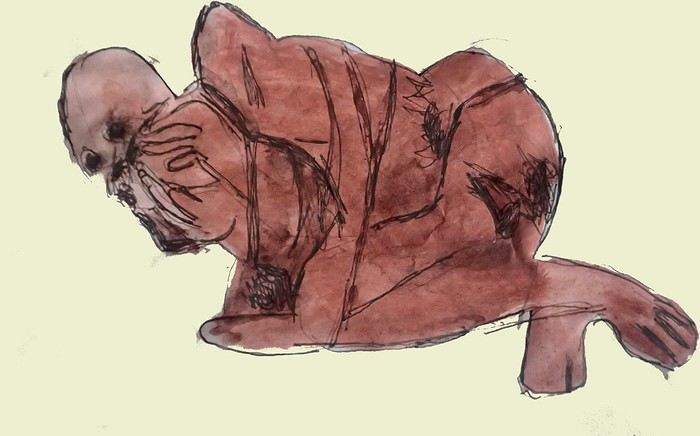
*Chavín de Huántar (Lanzón) The site’s appeal lies in its mountainous surroundings, the Lanzón stela, and the sculpted heads on the façades. What few people know is that the Chavín civilization began its expansion centuries before the Incas. Unfortunately, you can’t get too close to see the Lanzón—the day I was there, it was protected by grilles. To get there: minibus from Huaraz or trek from Olleros. Then cross a high pass (over 5,000m). If you do it solo on foot, be careful—the path isn’t obvious from Olleros
*Chullpa: funerary tower, notably at Sillustani in the Lake Titicaca region
*Chimú: pre-Inca civilization whose center was Chan Chan.
*Chola/Cholitas (Bolivia): typical clothing style of women from the Andean plateaus
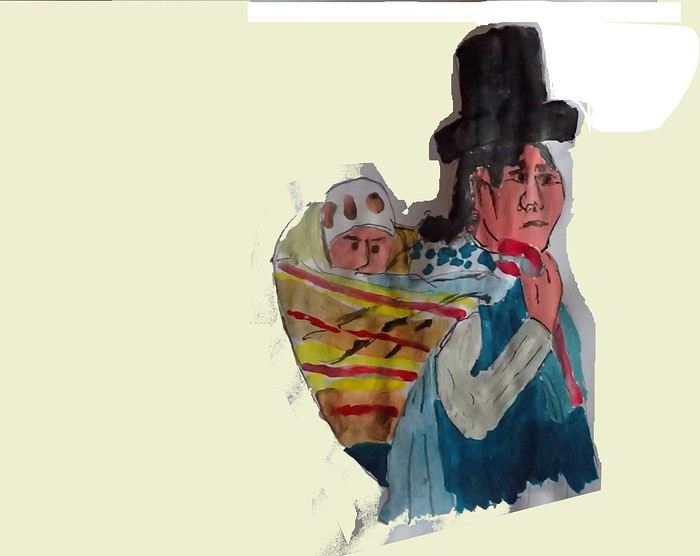
*Chompa: pronounce it *Chompaaa!* A common term for a wool sweater with vicuña patterns, often knitted from alpaca wool. If you dress like this, it’s a bit kitschy around the edges
*Cuy That one isn’t a guinea pig like in Guyana but an actual guinea pig. During a trip to Peru, I was hiking near a village north of Quillabamba (the terminus of the train line that passes through Aguas Calientes), and I was invited to stay in a house. The family raised a few of these pets. Apparently, the locals eat them. Since I’m not much of a meat-eater, it doesn’t really tempt me. How about you?
*Pacific Coast or how to talk about a place you haven’t visited? Except for the coast near Pisco and San Andrés, I haven’t visited any coastal cities. But that doesn’t mean these places lack interest or poetry. For fans of clichéd images, pelicans, seabirds, and fishing boats appear by the sea.
*Gran Pajaten: also closed to the public. Features anthropomorphic bas-reliefs. (not visited personally)
*Huaca. Visit the Huaca del Sol and Huaca de la Luna, especially near Trujillo. However, you can skip them—Chan Chan is still more interesting. Don’t forget to spend time visiting Chan Chan
*Huacachina A small oasis in the desert near Ica. Yes, we’re talking about an oasis because for those who’ve never traveled to Peru, the coastal strip along the Pacific is almost entirely desert, from north to south. Peru is territorially made up of three different regions: the desert coast, the Altiplano stretching north to south with mountain ranges (the Cordilleras), and the Amazon basin to the east. (not visited personally)
*Inca Kola It’s neither Coca-Cola nor Pepsi but a unique cola with a slightly orange color. Tastes like bubble gum
*Intiwatana: a carved rock shaped like a parallelepiped. Is it a sundial?
*Ballestas Islands: a highlight in Peru, though very touristy. You can only get there by boat from the port of San Andrés, a few kilometers from Pisco. It’s a surreal place to me—actually islets with cavities where sea lions and fur seals live. Since it’s a protected area, you’re not allowed to disembark. Guano is harvested there, which can be used as fertilizer.
*Kuelap: a fortress built by the Chachapoyas people. Rarely visited by travelers. (not visited personally)
*Larco Museum: an iconic museum in Lima with a large collection of pieces from archaeological and pre-Columbian sites. From what I remember, it has many pieces from the Moche civilization. As for the Moche statuettes, the prudish might look away. Probably a veneration of the god Priapus without knowing it.
*Nazca Lines Discovered by German archaeologist Maria Reiche, they stretch for kilometers. The designs in the desert around Nazca depict animals and cabalistic signs. The question I ask myself is why the creators of these lines represented a monkey and a hummingbird—species endemic to the tropical forest, not the desert plains around Nazca.
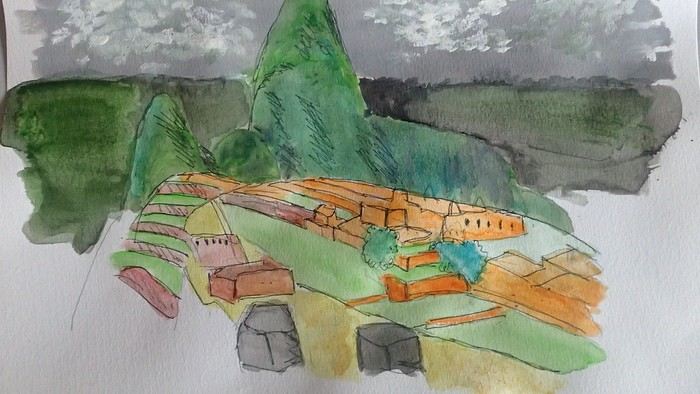
*Machu Picchu: means "old mountain" in Quechua. There’s also Wayna Picchu. The ruins of the site emerge from a sort of small plateau above Aguas Calientes. When the mist rises above the site and the bend of the Urubamba River, it’s truly magical... Also the starting point of the Inca Trail.
*Coca tea A decoction/infusion of the coca plant, meant to ease altitude sickness or *soroche*
*Chullo A rough translation would be a Peruvian wool hat.
*Moche: a civilization established in the Moche Valley, hence the term *Mochica*. What characterizes this civilization are the distinctive clay pieces representing faces and erotic statuettes
*Papa a la Huancaína A local potato dish
*Pisac: a typical market near Cusco
*Pisco Sour: perhaps the Peruvian equivalent of the *caipirinha* you drink in Brazil.
*Puya Raimondii A Bromeliaceae that still looks like a cactus, endemic to the Altiplano
*Quechua The language spoken by the indigenous people of the high plateaus (as well as Aymara in Bolivia)
*Quipu A knotted string used for counting. Widely used by the Inca administration.
*Sacsayhuamán (Q’enqo, Inca Bath) From Cusco’s Plaza de Armas, take the streets that climb above the city. Sacsayhuamán is called a fortress and is made up of large stone blocks. You wonder how the Incas could cut such huge blocks to assemble them—just like some streets in Cusco. The Q’enqo block is enigmatic; no one really knows what it represents.
*Savia Andina An Andean folk group.
*Tambo (=> Ollantaytambo) The Inca emperor (Atahualpa, Manco Capac) had the mission of controlling a vast empire. An empire that was still very extensive. Hence the importance of these *tambos* or relay stations. Napoleon created the civil code; the Incas invented the *tambos* and *quipus*.
*Tawantinsuyu: the Inca Empire
*Tinku: a warrior dance practiced mainly in Bolivia
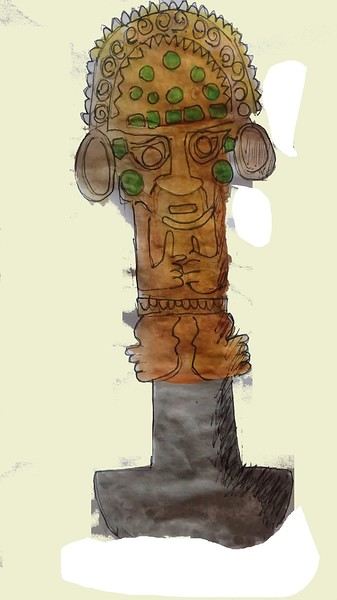
*Golden Tumi: a sacrificial weapon. Often featured in Peru travel guides. See illustration
*Terra X: a documentary series from the German TV channel that aired on Arte. Some episodes focused on pre-Inca and Inca Peru. I must have some old recording tapes. In memory of Gottfried Kirchner as a source of inspiration.
*Uros: I checked—it actually refers to the people who live on these floating islands. Even if it’s touristy, it’s a must-visit because it’s incredible how people can live on islets made from nothing. Take the boat from Puno
*Vicuña, llama, guanaco: camelids characteristic of the Altiplano
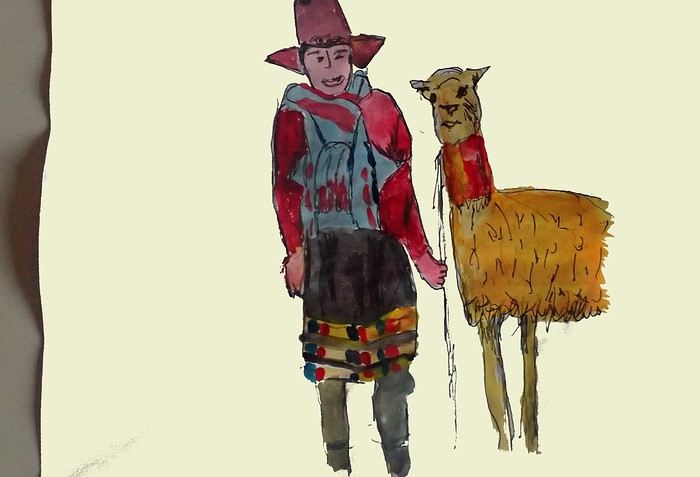
*Wayna Picchu The young Picchu mountain. In the first minutes of *Aguirre, the Wrath of God*, you see Klaus Kinski—well, Aguirre—making his way along the Inca Trail. Werner Herzog must have broken his back filming those sequences.
*Zampoña: pan flute
Peru is still a very vast country, with so much to see, and obviously this text can't list all the attractions of the country.
*Abiseo (River) A national park that's very hard to access and doesn’t seem open to visitors. Includes the Gran Pajaten site (see below). Personally, it really sparks my imagination (not visited personally)
*Aguas Calientes the town next to Machu Picchu, more precisely below the archaeological site. As far as I know, you can only get there by train. Reminds me of the market where stalls line both sides of the tracks near Bangkok. I love it
*Altiplano: somewhere the "heart" of the Andes. I was able to trek across it on foot, starting from Caracollo in Bolivia, and of course, it’s vast plains to explore. This is where people live in a very rural way. Andean populations are quite austere compared to those in the lowlands or on the coast. You really have to appreciate the harshness of life to live there. Life is anything but superficial. I set a compass heading and found myself walking west toward the expanse of water near a place called La Joya. For pitching the tent, the nights were still chilly
*Canyon del Colca One of the deepest canyons in the world. Personally, I hiked down and back up on foot. The toughest stretch I’ve ever covered in my life.
*Ceviche More or less the national dish. A marinade of fish, shellfish, and lime. But you can find it in some restaurants in Europe, France, and certainly in Belgium or Switzerland. In the small restaurants of Pisco, you can eat excellent ceviche
*Cerro Sechín: Mostly bas-reliefs. A site little known to travelers in the Casma province. The first vestiges of a pre-Inca civilization with iconography similar to that of Chavín (not visited personally)
*Chan Chan A large city of the Chimú civilization and relatively vast to visit. You can see adobe walls with bas-reliefs. Visit from Trujillo, take a colectivo. Plan for the whole day
*Charango: a small guitar widely used in Andean music
*Chauchilla A necropolis near Nazca where you can see mummies exposed on the ground. YouTubers can do paranormal experiments there. And for anyone wondering about the fate of the soul and body after death, here’s the answer: the body remains after death. You can imagine your own flesh and body exposed to the winds of the Pampa and before eternity... (not visited personally)
*Chavín de Huántar (Lanzón) The site’s appeal lies in its mountainous surroundings, the Lanzón stela, and the sculpted heads on the façades. What few people know is that the Chavín civilization began its expansion centuries before the Incas. Unfortunately, you can’t get too close to see the Lanzón—the day I was there, it was protected by grilles. To get there: minibus from Huaraz or trek from Olleros. Then cross a high pass (over 5,000m). If you do it solo on foot, be careful—the path isn’t obvious from Olleros
*Chullpa: funerary tower, notably at Sillustani in the Lake Titicaca region
*Chimú: pre-Inca civilization whose center was Chan Chan.
*Chola/Cholitas (Bolivia): typical clothing style of women from the Andean plateaus
*Chompa: pronounce it *Chompaaa!* A common term for a wool sweater with vicuña patterns, often knitted from alpaca wool. If you dress like this, it’s a bit kitschy around the edges
*Cuy That one isn’t a guinea pig like in Guyana but an actual guinea pig. During a trip to Peru, I was hiking near a village north of Quillabamba (the terminus of the train line that passes through Aguas Calientes), and I was invited to stay in a house. The family raised a few of these pets. Apparently, the locals eat them. Since I’m not much of a meat-eater, it doesn’t really tempt me. How about you?
*Pacific Coast or how to talk about a place you haven’t visited? Except for the coast near Pisco and San Andrés, I haven’t visited any coastal cities. But that doesn’t mean these places lack interest or poetry. For fans of clichéd images, pelicans, seabirds, and fishing boats appear by the sea.
*Gran Pajaten: also closed to the public. Features anthropomorphic bas-reliefs. (not visited personally)
*Huaca. Visit the Huaca del Sol and Huaca de la Luna, especially near Trujillo. However, you can skip them—Chan Chan is still more interesting. Don’t forget to spend time visiting Chan Chan
*Huacachina A small oasis in the desert near Ica. Yes, we’re talking about an oasis because for those who’ve never traveled to Peru, the coastal strip along the Pacific is almost entirely desert, from north to south. Peru is territorially made up of three different regions: the desert coast, the Altiplano stretching north to south with mountain ranges (the Cordilleras), and the Amazon basin to the east. (not visited personally)
*Inca Kola It’s neither Coca-Cola nor Pepsi but a unique cola with a slightly orange color. Tastes like bubble gum
*Intiwatana: a carved rock shaped like a parallelepiped. Is it a sundial?
*Ballestas Islands: a highlight in Peru, though very touristy. You can only get there by boat from the port of San Andrés, a few kilometers from Pisco. It’s a surreal place to me—actually islets with cavities where sea lions and fur seals live. Since it’s a protected area, you’re not allowed to disembark. Guano is harvested there, which can be used as fertilizer.
*Kuelap: a fortress built by the Chachapoyas people. Rarely visited by travelers. (not visited personally)
*Larco Museum: an iconic museum in Lima with a large collection of pieces from archaeological and pre-Columbian sites. From what I remember, it has many pieces from the Moche civilization. As for the Moche statuettes, the prudish might look away. Probably a veneration of the god Priapus without knowing it.
*Nazca Lines Discovered by German archaeologist Maria Reiche, they stretch for kilometers. The designs in the desert around Nazca depict animals and cabalistic signs. The question I ask myself is why the creators of these lines represented a monkey and a hummingbird—species endemic to the tropical forest, not the desert plains around Nazca.
*Machu Picchu: means "old mountain" in Quechua. There’s also Wayna Picchu. The ruins of the site emerge from a sort of small plateau above Aguas Calientes. When the mist rises above the site and the bend of the Urubamba River, it’s truly magical... Also the starting point of the Inca Trail.
*Coca tea A decoction/infusion of the coca plant, meant to ease altitude sickness or *soroche*
*Chullo A rough translation would be a Peruvian wool hat.
*Moche: a civilization established in the Moche Valley, hence the term *Mochica*. What characterizes this civilization are the distinctive clay pieces representing faces and erotic statuettes
*Papa a la Huancaína A local potato dish
*Pisac: a typical market near Cusco
*Pisco Sour: perhaps the Peruvian equivalent of the *caipirinha* you drink in Brazil.
*Puya Raimondii A Bromeliaceae that still looks like a cactus, endemic to the Altiplano
*Quechua The language spoken by the indigenous people of the high plateaus (as well as Aymara in Bolivia)
*Quipu A knotted string used for counting. Widely used by the Inca administration.
*Sacsayhuamán (Q’enqo, Inca Bath) From Cusco’s Plaza de Armas, take the streets that climb above the city. Sacsayhuamán is called a fortress and is made up of large stone blocks. You wonder how the Incas could cut such huge blocks to assemble them—just like some streets in Cusco. The Q’enqo block is enigmatic; no one really knows what it represents.
*Savia Andina An Andean folk group.
*Tambo (=> Ollantaytambo) The Inca emperor (Atahualpa, Manco Capac) had the mission of controlling a vast empire. An empire that was still very extensive. Hence the importance of these *tambos* or relay stations. Napoleon created the civil code; the Incas invented the *tambos* and *quipus*.
*Tawantinsuyu: the Inca Empire
*Tinku: a warrior dance practiced mainly in Bolivia
*Golden Tumi: a sacrificial weapon. Often featured in Peru travel guides. See illustration
*Terra X: a documentary series from the German TV channel that aired on Arte. Some episodes focused on pre-Inca and Inca Peru. I must have some old recording tapes. In memory of Gottfried Kirchner as a source of inspiration.
*Uros: I checked—it actually refers to the people who live on these floating islands. Even if it’s touristy, it’s a must-visit because it’s incredible how people can live on islets made from nothing. Take the boat from Puno
*Vicuña, llama, guanaco: camelids characteristic of the Altiplano
*Wayna Picchu The young Picchu mountain. In the first minutes of *Aguirre, the Wrath of God*, you see Klaus Kinski—well, Aguirre—making his way along the Inca Trail. Werner Herzog must have broken his back filming those sequences.
*Zampoña: pan flute
Local trekking agencies in Peru and Bolivia
We're planning to trek in Peru and Bolivia and would love to find some local agencies.
If you know any, could you share details on prices and, of course, the names of the agencies?
Which trek would you recommend?
Elocine
Bus or taxis to get to the Three Pools site
We’ll be in Dahab again this October—we’ve been going since 1979—to freedive. In 2025, to our surprise, access to the Blue Hole is now paid: on top of the 10 € taxi fare, you have to pay $10 per person to enter the park. So we’re heading outside Dahab to the Three Pools site by bike, rented locally. Is there a bus that goes there, or shared taxis, instead of the tourist taxis? And where can we catch them? We’ve seen big buses full of local families on the site, but we don’t know where to find them. Thanks in advance!