Results for "Pointe+Torche+|+127"
126017 results found.
Review of an Aegean Sea cruise on Ponant's Bougainville from November 1-8, 2025
Hello everyone,
If you'd like, I invite you to join me for a week-long cruise to northern Greece, visiting ports that are often less crowded with cruise ships.
Itinerary: Athens, Skiathos, Volos, Thessaloniki, Kavala, Limnos, Hydra, Athens
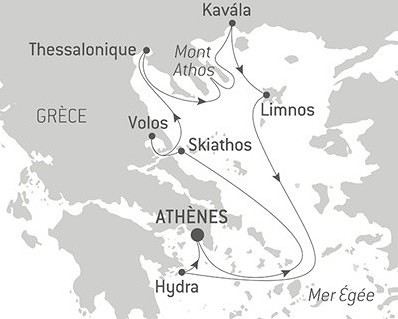
If you'd like, I invite you to join me for a week-long cruise to northern Greece, visiting ports that are often less crowded with cruise ships.
Itinerary: Athens, Skiathos, Volos, Thessaloniki, Kavala, Limnos, Hydra, Athens
What payment method should I use in Egyptian hotels?
I’ve read everything and its opposite in travel guides and online. It seems that hotel owners—and the government—require tourists to pay in foreign currency rather than the local one (pounds). This is a huge problem for me since I’ll be in Egypt for 3 months. I can’t exactly walk around with thousands of dollars on me (I’m from Quebec). I could pay with a credit card—easier—but I think there’s an extra fee. Is that really the case? But what do I do if a small-town hotel doesn’t accept credit cards??? I thought about using a WISE debit card, but again, what if the place doesn’t have a payment terminal??? Can I hope that some establishments in less touristy areas might accept payment in pounds? And most importantly: does the same issue apply to paying for entry to archaeological sites??? A big thank you for your insights—I’m totally in the DARK here!!!
Marc Lamarre
Marc Lamarre
Exploring Senja Island and the Lofoten Archipelago
Hi everyone,
We traveled to Norway in the summer of 2025, from July 17 to 29, to visit Senja Island and the Lofoten archipelago with a rental car. The common thread of these twelve days was clearly hiking, along with a few visits and experiences, and nights spent in a tent or in the car (which made it possible). We chose Narvik Airport for both arrival and departure for several complementary reasons: the desire to visit nearby Senja Island, slightly more affordable airfare, and finally, the rental price of the vehicle—especially the car model we were looking for. We only made one reservation, for the first campsite, as sleeping in a tent made things much easier. But we had the whole structure of the trip planned, a flexible outline that could adapt to the weather conditions we’d encounter. Senja Island isn’t part of the Lofoten archipelago, and during the early stages of planning this trip, we hadn’t planned to visit it. But its relative proximity to Narvik Airport and, above all, its unique geography definitely made us change our minds. We arrived in Evenes, where Narvik Airport is located, nearly 60 km from the city itself. Our first stop was 40 km further in Bjerkvik on the way to Senja, where there’s a Rema 1000 (a very common supermarket chain in Norway). We needed to buy some food and a gas cartridge for our stove. I’d emailed the store manager beforehand, who told me they didn’t sell them but that the two gas stations in the village were likely to have some in stock.
It was only at the Esso station that I found what I needed, but unfortunately, only one cartridge. Luckily, we quickly realized that most campsites (like in Iceland) have a shared kitchen with hotplates. That single small cartridge was just enough for the few nights we spent outside of campsites... We got our first taste of Norway’s characteristic landscapes: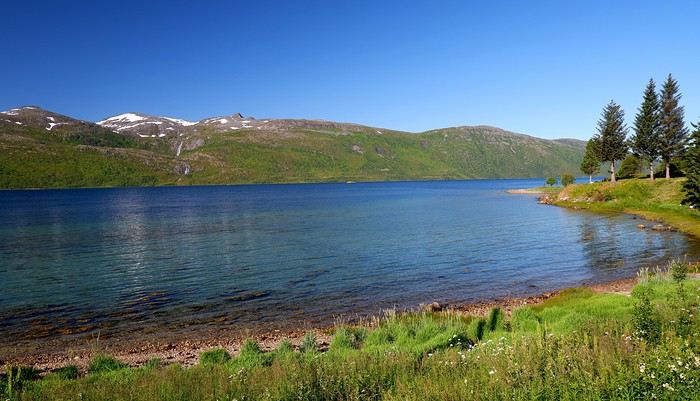
When we arrived at the Senja campsite, it was already 9:30 PM. A sign announced it was full, but luckily, I’d booked it 10 days earlier. By 10:30 PM, as we settled in to eat, it was still broad daylight, and the thermometer read 25°C—despite being at a latitude of 69° North! We went to bed around midnight, exhausted but under the light of a sun that was still very much present. Thanks to Earth’s tilted axis. We’d anticipated this by buying opaque sleep masks because, yes, at this time of year, it’s daylight all the time.
Friday, July 18:
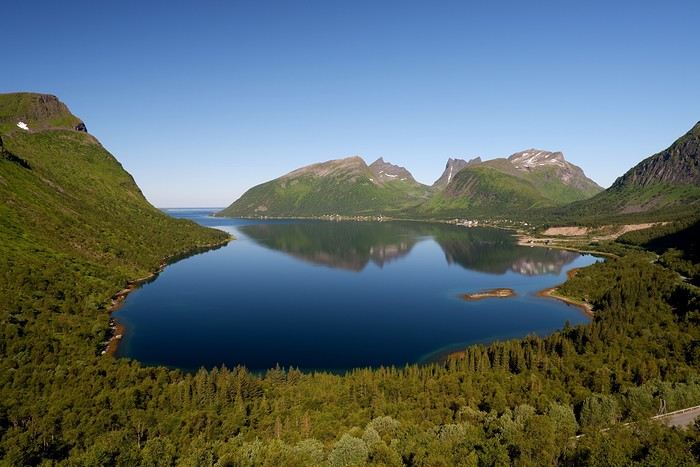
Today, we planned two hikes on the island and a few stops along the way. The map clearly shows that the deepest fjords are in the north and west. Due to time and accessibility, we focused on the northern part of the island. Our first stop was at the viewing platform in Bergbotn:
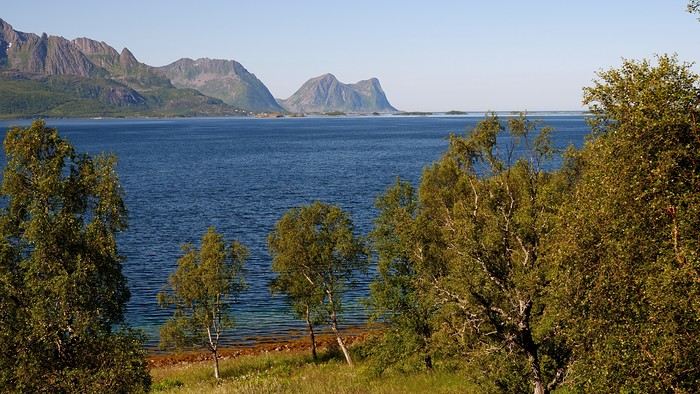
Then we headed toward Skaland, the starting point for our first hike. Along the way, we found plenty of reasons to stop—especially since, on this first day of travel, our thirst for Nordic landscapes was far from quenched.
The town of Skaland is very practical: free parking, picnic tables for after the hike, and a Joker convenience store right next door. Our goal was the summit of Husfjellet: 670 m of elevation gain, between 8 and 9 km in length, and an estimated 4 hours and 30 minutes.
This hike offers two major viewpoints. The first overlooks the Bergsoyan islands to the west:
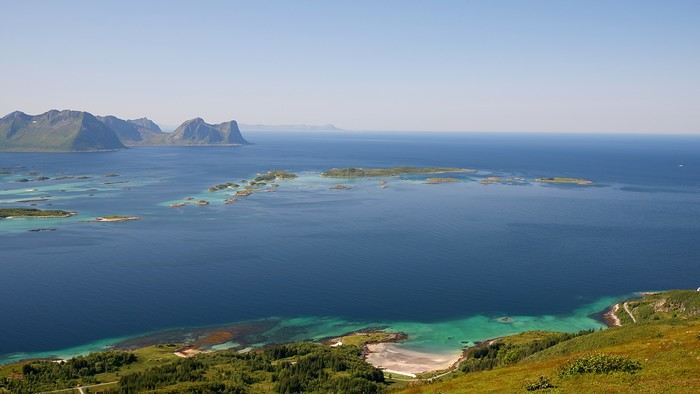
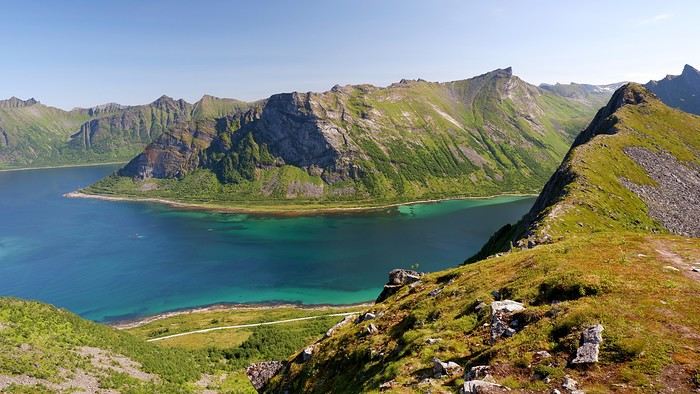
At the summit, the view shifts to the Steinfjorden fjord:
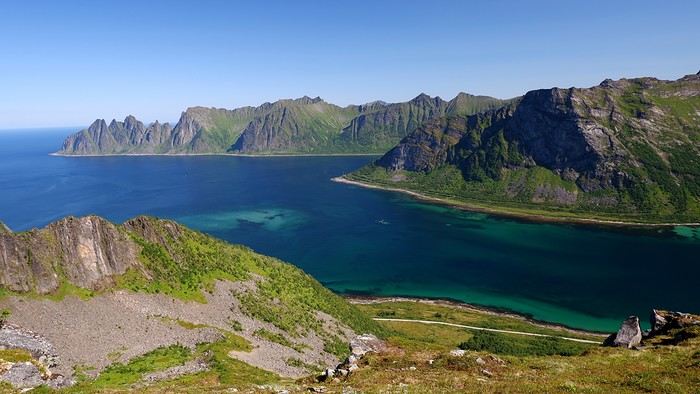
You can even clearly see the "Devil’s Teeth," which we’d see from below later:
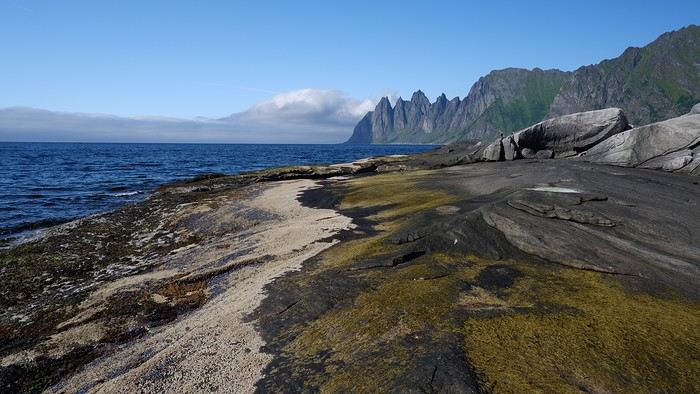
In total, the hike took us 4 hours and 30 minutes, including all the breaks. We treated ourselves to an ice cream in Skaland to recharge for the next hike. We hit the road again and stopped at Tungeneset to get a closer look at the Devil’s Teeth:
We continued to Fjordgard, the starting point for our second hike. Fjordgard isn’t very welcoming. There was a time when you could park right at the start of the hike up Mount Segla. Now, everything’s blocked off, and locals have even taken to blocking all possible parking spots nearby. You now have to park outside the town at a paid parking lot (90 NOK for 3 hours), adding an extra 2 km (round trip) of walking. Still, that was just a minor inconvenience because the hike that followed quickly made us forget all about it. The hike is fairly short (2 hours) but still has 520 m of elevation gain. This hike was a stark contrast to the first. This morning, we had sweeping views of the vast landscape. Here, Mount Segla, perched on the edge of the cliff, dominates the foreground:
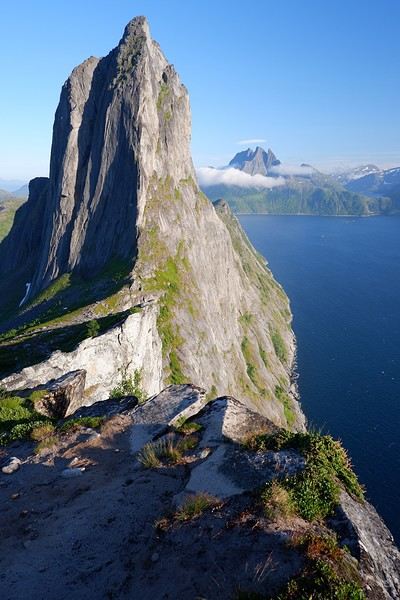
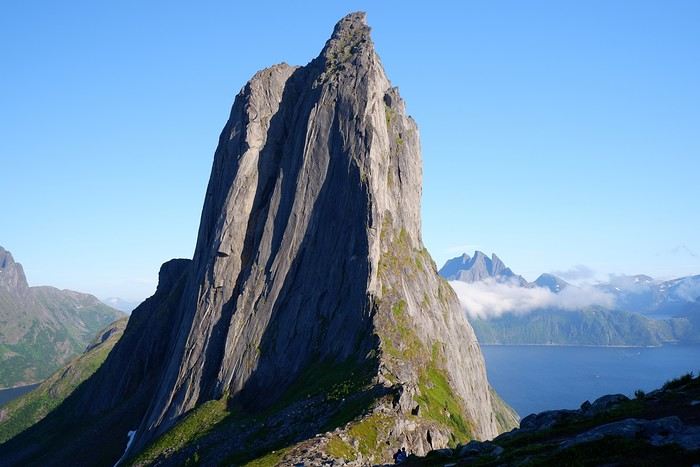
For those prone to vertigo, it might be best to stay at the foot of the mountain, as the trail climbs right along the cliff edge. And from that point on, you quickly understand what verticality really means...
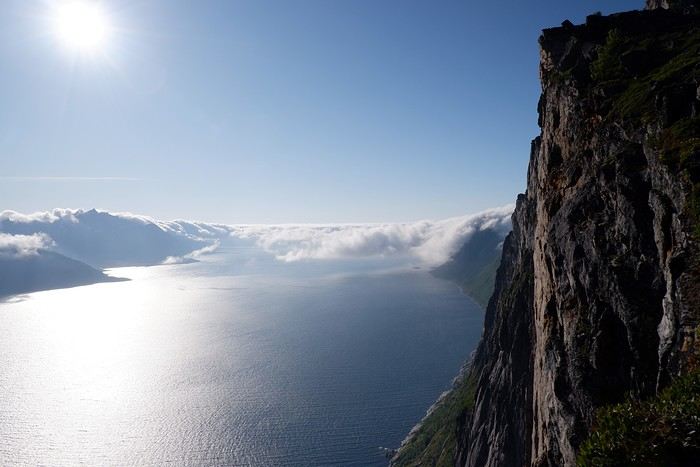
In total, we took 2 hours and 50 minutes, including breaks and the extra walk to the parking lot. The day was already well underway, and with 1,200 m of cumulative elevation gain, it was time to find a spot to eat and sleep. Since we hadn’t made any reservations, we’d planned to bivouac for the night. We weren’t too picky—just practical—so we decided to sleep in the car at the parking lot for tomorrow morning’s hike, just 5 km from Fjordgard.
We traveled to Norway in the summer of 2025, from July 17 to 29, to visit Senja Island and the Lofoten archipelago with a rental car. The common thread of these twelve days was clearly hiking, along with a few visits and experiences, and nights spent in a tent or in the car (which made it possible). We chose Narvik Airport for both arrival and departure for several complementary reasons: the desire to visit nearby Senja Island, slightly more affordable airfare, and finally, the rental price of the vehicle—especially the car model we were looking for. We only made one reservation, for the first campsite, as sleeping in a tent made things much easier. But we had the whole structure of the trip planned, a flexible outline that could adapt to the weather conditions we’d encounter. Senja Island isn’t part of the Lofoten archipelago, and during the early stages of planning this trip, we hadn’t planned to visit it. But its relative proximity to Narvik Airport and, above all, its unique geography definitely made us change our minds. We arrived in Evenes, where Narvik Airport is located, nearly 60 km from the city itself. Our first stop was 40 km further in Bjerkvik on the way to Senja, where there’s a Rema 1000 (a very common supermarket chain in Norway). We needed to buy some food and a gas cartridge for our stove. I’d emailed the store manager beforehand, who told me they didn’t sell them but that the two gas stations in the village were likely to have some in stock.
It was only at the Esso station that I found what I needed, but unfortunately, only one cartridge. Luckily, we quickly realized that most campsites (like in Iceland) have a shared kitchen with hotplates. That single small cartridge was just enough for the few nights we spent outside of campsites... We got our first taste of Norway’s characteristic landscapes:
When we arrived at the Senja campsite, it was already 9:30 PM. A sign announced it was full, but luckily, I’d booked it 10 days earlier. By 10:30 PM, as we settled in to eat, it was still broad daylight, and the thermometer read 25°C—despite being at a latitude of 69° North! We went to bed around midnight, exhausted but under the light of a sun that was still very much present. Thanks to Earth’s tilted axis. We’d anticipated this by buying opaque sleep masks because, yes, at this time of year, it’s daylight all the time.
Friday, July 18:
Today, we planned two hikes on the island and a few stops along the way. The map clearly shows that the deepest fjords are in the north and west. Due to time and accessibility, we focused on the northern part of the island. Our first stop was at the viewing platform in Bergbotn:
Then we headed toward Skaland, the starting point for our first hike. Along the way, we found plenty of reasons to stop—especially since, on this first day of travel, our thirst for Nordic landscapes was far from quenched.
The town of Skaland is very practical: free parking, picnic tables for after the hike, and a Joker convenience store right next door. Our goal was the summit of Husfjellet: 670 m of elevation gain, between 8 and 9 km in length, and an estimated 4 hours and 30 minutes.
This hike offers two major viewpoints. The first overlooks the Bergsoyan islands to the west:
At the summit, the view shifts to the Steinfjorden fjord:
You can even clearly see the "Devil’s Teeth," which we’d see from below later:
In total, the hike took us 4 hours and 30 minutes, including all the breaks. We treated ourselves to an ice cream in Skaland to recharge for the next hike. We hit the road again and stopped at Tungeneset to get a closer look at the Devil’s Teeth:
We continued to Fjordgard, the starting point for our second hike. Fjordgard isn’t very welcoming. There was a time when you could park right at the start of the hike up Mount Segla. Now, everything’s blocked off, and locals have even taken to blocking all possible parking spots nearby. You now have to park outside the town at a paid parking lot (90 NOK for 3 hours), adding an extra 2 km (round trip) of walking. Still, that was just a minor inconvenience because the hike that followed quickly made us forget all about it. The hike is fairly short (2 hours) but still has 520 m of elevation gain. This hike was a stark contrast to the first. This morning, we had sweeping views of the vast landscape. Here, Mount Segla, perched on the edge of the cliff, dominates the foreground:
For those prone to vertigo, it might be best to stay at the foot of the mountain, as the trail climbs right along the cliff edge. And from that point on, you quickly understand what verticality really means...
In total, we took 2 hours and 50 minutes, including breaks and the extra walk to the parking lot. The day was already well underway, and with 1,200 m of cumulative elevation gain, it was time to find a spot to eat and sleep. Since we hadn’t made any reservations, we’d planned to bivouac for the night. We weren’t too picky—just practical—so we decided to sleep in the car at the parking lot for tomorrow morning’s hike, just 5 km from Fjordgard.
Discussion Closure
Hi, I started a thread about Afghanistan.
Out of 4 pages, more than half had nothing to do with the country/topic. The mods closed the thread—why not ban off-topic members and clean it up instead? Instead of closing a thread that had 2 REALLY interesting videos! Because in my thread, there will be more videos to come...
If you close it as soon as a few members go off-topic, letting some former prostitute who’s never set foot in the country tell a guy who spent 10 days there what’s true or not about Afghanistan...
If all the anti-Taliban folks tell you *Le Figaro* or others do a better job than this YouTuber... LOL Journalists often haven’t even been there—they just copy each other or write articles via ChatGPT... *Le Figaro*, for example, gets millions in subsidies to churn out garbage... And now this young guy deserves to be silenced?
Reopen the thread and clean it up! Thanks
Out of 4 pages, more than half had nothing to do with the country/topic. The mods closed the thread—why not ban off-topic members and clean it up instead? Instead of closing a thread that had 2 REALLY interesting videos! Because in my thread, there will be more videos to come...
If you close it as soon as a few members go off-topic, letting some former prostitute who’s never set foot in the country tell a guy who spent 10 days there what’s true or not about Afghanistan...
If all the anti-Taliban folks tell you *Le Figaro* or others do a better job than this YouTuber... LOL Journalists often haven’t even been there—they just copy each other or write articles via ChatGPT... *Le Figaro*, for example, gets millions in subsidies to churn out garbage... And now this young guy deserves to be silenced?
Reopen the thread and clean it up! Thanks
Preparing for a trip to Sri Lanka
Hi everyone.
The tickets for SRI LANKA are booked—arriving in COLOMBO on 12/21 and returning from the same place on 01/17. I’ve read here and there that it’ll be high season, but we don’t have a choice, so we’ll make do...
My first question is obviously about the itinerary: Most of the ones I’ve seen go clockwise, and I’m wondering if I should do it the other way: - To avoid the cultural triangle between Christmas and New Year’s - To start with a bit of rest (we’re really wiped out) Does that make sense?
My second question is about the time allocated to each stop, which you’ll find below. Is it balanced? Too much here and not enough there?
My third question will be about Jaffna: yes or no? How long is the trip from Anuradhapura? Where can I fit in the 3 days needed?
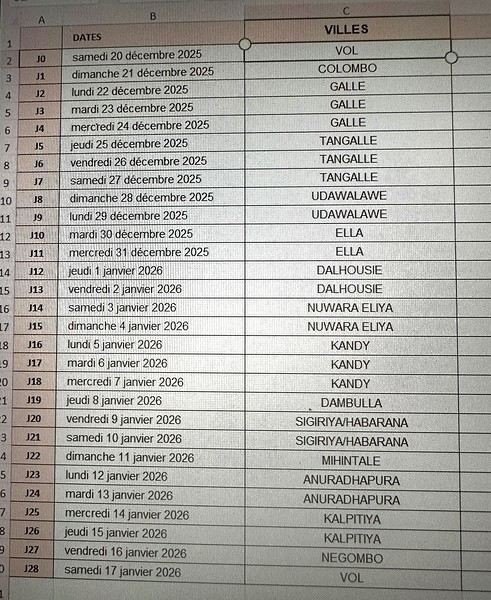
Thanks for your replies. A few details: ultra-independent travelers, using public transport, hikers, minimum 2 nights per accommodation. First time in Sri Lanka! !
The tickets for SRI LANKA are booked—arriving in COLOMBO on 12/21 and returning from the same place on 01/17. I’ve read here and there that it’ll be high season, but we don’t have a choice, so we’ll make do...
My first question is obviously about the itinerary: Most of the ones I’ve seen go clockwise, and I’m wondering if I should do it the other way: - To avoid the cultural triangle between Christmas and New Year’s - To start with a bit of rest (we’re really wiped out) Does that make sense?
My second question is about the time allocated to each stop, which you’ll find below. Is it balanced? Too much here and not enough there?
My third question will be about Jaffna: yes or no? How long is the trip from Anuradhapura? Where can I fit in the 3 days needed?
Thanks for your replies. A few details: ultra-independent travelers, using public transport, hikers, minimum 2 nights per accommodation. First time in Sri Lanka! !
Trip to Israel / Holy Land in 2022
For once, given the destination, the author can’t set aside their religious beliefs, which inevitably shape this kind of journey.
The Trip
Early in the morning at Orly Airport, in the departure lounge for Tel Aviv, a group of about forty young men arrives, all looking identical! The same neatly trimmed beards, the same identical haircuts, the same outfits with a touch of whimsy… The effect of seeing these forty “clones” is striking and raises questions! Why such perfect uniformity among this group of guys? Do they belong to the same family, sports club, cultural association, or religious group? A mystery! At the same time, the waiting area fills up with men who are more expected, given our destination: they wear large felt hats and dress in black suits with white shirts—Hassidim? The ones I’ve glimpsed fleetingly in Paris or New York, who have always been a mystery to me. More discreet-looking women accompany them.
I’m already in Israel without even setting foot there! Plus, I witness the preparations for an improvised show.
The “clones” start a flash mob at seven in the morning in a Paris airport departure lounge! Some pull out musical instruments, others begin singing and dancing. A music with strange, unfamiliar sounds enchants the waiting passengers.
The flight crew finally arrives, cutting through the flash mob, bringing us back to the reality of the moment: waiting to take off soon for this so troubling and mysterious Middle East. We go through passport control, presenting our faces to the scanners that operate the exit gate. The group of “identical” young men gets held up by the system: logically, a scanner let the first one through but blocked the second because of his perfect resemblance to the first. To the machine, the same person shouldn’t be able to cross the border twice? But eventually, the whole group makes it through the glass doors, leaving the Republic behind. My simplistic explanation is left looking ridiculous.
At every new destination, I ask myself countless questions, revealing a certain anxiety tied to the unknown: fear of attacks (one just happened at a bus station in Jerusalem), possible police pressure, unexpected events. Israel isn’t known for being a relaxing destination. In reality, if I did face a serious difficulty in this country, it wasn’t one I had anticipated—and it wasn’t particularly tied to Israel!
I take my seat by the window, which is already occupied by a little girl. Her father, a Hassidic man, politely asks if I’d be willing to give up my seat for his daughter. I tell him I’d be happy to make her happy. Seeing me masked, he asks if I’d like him and his daughter to wear masks too. In response, I take off my mask so as not to impose any constraints on them and wish them a good flight.
It was the first time I’d approached and spoken to a Hassidic man. He didn’t speak the way I might have expected after watching *Rabbi Jacob* with Louis de Funès; he spoke perfectly without an accent, just like you and me! Beware of stereotypes! Throughout the flight, I sneak glances at my strange neighbor: he prayed silently without stopping for a minute. His daughter, as good as gold, never interrupted him. He used several religious accessories during his three-hour continuous prayer: a kippa, a prayer shawl, and a rosary?… I left that plane deeply impressed, me, who has a very distant relationship with my Creator and only prays now and then.
The Trip
Early in the morning at Orly Airport, in the departure lounge for Tel Aviv, a group of about forty young men arrives, all looking identical! The same neatly trimmed beards, the same identical haircuts, the same outfits with a touch of whimsy… The effect of seeing these forty “clones” is striking and raises questions! Why such perfect uniformity among this group of guys? Do they belong to the same family, sports club, cultural association, or religious group? A mystery! At the same time, the waiting area fills up with men who are more expected, given our destination: they wear large felt hats and dress in black suits with white shirts—Hassidim? The ones I’ve glimpsed fleetingly in Paris or New York, who have always been a mystery to me. More discreet-looking women accompany them.
I’m already in Israel without even setting foot there! Plus, I witness the preparations for an improvised show.
The “clones” start a flash mob at seven in the morning in a Paris airport departure lounge! Some pull out musical instruments, others begin singing and dancing. A music with strange, unfamiliar sounds enchants the waiting passengers.
The flight crew finally arrives, cutting through the flash mob, bringing us back to the reality of the moment: waiting to take off soon for this so troubling and mysterious Middle East. We go through passport control, presenting our faces to the scanners that operate the exit gate. The group of “identical” young men gets held up by the system: logically, a scanner let the first one through but blocked the second because of his perfect resemblance to the first. To the machine, the same person shouldn’t be able to cross the border twice? But eventually, the whole group makes it through the glass doors, leaving the Republic behind. My simplistic explanation is left looking ridiculous.
At every new destination, I ask myself countless questions, revealing a certain anxiety tied to the unknown: fear of attacks (one just happened at a bus station in Jerusalem), possible police pressure, unexpected events. Israel isn’t known for being a relaxing destination. In reality, if I did face a serious difficulty in this country, it wasn’t one I had anticipated—and it wasn’t particularly tied to Israel!
I take my seat by the window, which is already occupied by a little girl. Her father, a Hassidic man, politely asks if I’d be willing to give up my seat for his daughter. I tell him I’d be happy to make her happy. Seeing me masked, he asks if I’d like him and his daughter to wear masks too. In response, I take off my mask so as not to impose any constraints on them and wish them a good flight.
It was the first time I’d approached and spoken to a Hassidic man. He didn’t speak the way I might have expected after watching *Rabbi Jacob* with Louis de Funès; he spoke perfectly without an accent, just like you and me! Beware of stereotypes! Throughout the flight, I sneak glances at my strange neighbor: he prayed silently without stopping for a minute. His daughter, as good as gold, never interrupted him. He used several religious accessories during his three-hour continuous prayer: a kippa, a prayer shawl, and a rosary?… I left that plane deeply impressed, me, who has a very distant relationship with my Creator and only prays now and then.
Visiting the pyramids
Hi, how’s the visit to the pyramids going? Do we buy tickets on the spot? Is the distance to cover significant? How do you get around—on foot? Are there shuttles? Thanks
Preparing for Quebec: 1 month with the family
Hello everyone,
We’ve decided to head to Quebec next year—it’s been a dream for the whole family (after watching so many travel shows and the like...). There’ll be five of us: 2 adults, 2 teens (16 and 13), and a child (8 years old). We’re all pretty good walkers, though maybe the teens a little less so—it’s just that age, you know? 😊 That said, they’ve got no problem doing 15 km hikes, just not every single day.
We’re planning to go from July 23 to August 14, arriving and departing from Montreal, so almost 3 weeks. I’ve started looking into logistics and accommodation prices, but before I dive into bookings, I’d love some advice on the itinerary. I’ve read a few threads here and there. Our idea is to visit between 3 and 5 different places over the 3 weeks, so that means the same number of accommodations. The goal is to optimize travel as much as possible—I’ve realized that getting around can take a long time. I think the first two days will be in Montreal to adjust to the time difference, and the last two in Quebec City, though that’s not set in stone.
Anyway, I’m not really sure about the route. I’ve got time to plan everything, but I know the longer we wait, the more expensive and scarce accommodations will get. Same goes for budget—we’ve set aside a mid-range budget, flights included: 3k per person (1k for the flight). So if you’ve got any great tips or advice, we’re all ears!
I was thinking of going up the St. Lawrence River, but I’m not sure how long that takes or where to stop. Maybe there are other places worth visiting farther away...
Anyway, thanks for reading this far! If you’ve got any questions, don’t hesitate.
Thanks, everyone.
We’re planning to go from July 23 to August 14, arriving and departing from Montreal, so almost 3 weeks. I’ve started looking into logistics and accommodation prices, but before I dive into bookings, I’d love some advice on the itinerary. I’ve read a few threads here and there. Our idea is to visit between 3 and 5 different places over the 3 weeks, so that means the same number of accommodations. The goal is to optimize travel as much as possible—I’ve realized that getting around can take a long time. I think the first two days will be in Montreal to adjust to the time difference, and the last two in Quebec City, though that’s not set in stone.
Anyway, I’m not really sure about the route. I’ve got time to plan everything, but I know the longer we wait, the more expensive and scarce accommodations will get. Same goes for budget—we’ve set aside a mid-range budget, flights included: 3k per person (1k for the flight). So if you’ve got any great tips or advice, we’re all ears!
I was thinking of going up the St. Lawrence River, but I’m not sure how long that takes or where to stop. Maybe there are other places worth visiting farther away...
Anyway, thanks for reading this far! If you’ve got any questions, don’t hesitate.
Thanks, everyone.
From Yosemite to the Canadian Rockies: Questions for Our Road Trip
Hi everyone!
Let me introduce us quickly—I’m Matteo (21, originally from Paris, but I’ve been living near the Pyrenees and the Alps for the past 3 years), and my girlfriend Justine (21, grew up in the Alps). We’re starting to get really fed up with being cooped up and sitting in chairs (yep, we’re studying physics and geography at the École Normale Supérieure in Lyon). So, we’re taking a gap year to make a slightly crazy project happen: hitting the road, meeting people, and most importantly—climbing, skiing, and exploring the mountains!
We’ve always been into the mountains: •🧗♂️ 6c-7a/b sport climbing, 6b trad •❄️ Skiing and ice climbing (grade 4/5) •🏔️ Alpine climbing in the Alps (Chamonix, Écrins…) and the Pyrenees—I’m training to become a High Mountain Guide
Our project in a nutshell: •Buying a van (or 4x4) converted in British Columbia around September/October 2025. Ideally, we’d go straight to the US to buy the vehicle there (but reselling might be easier if we buy in Canada). •Heading down to the US to climb at legendary spots like Yosemite, Tuolumne (if it’s too hot), Indian Creek, Moab, and Joshua Tree. •Heading back up to the Canadian Rockies around December for skiing, ice climbing, and winter alpine climbing (might be easier to buy skis there). •Selling the vehicle in Canada at the end of the trip (we need to be back in France by early March 2026 because Justine is preparing for the AMM). I’ve already been to the Rockies, but I want to go back in winter for ice climbing. It’ll probably be too cold to sleep in the van, so we’re hoping to find a small cabin, lodge, or chalet (ideally alone or shared to cut costs). Otherwise, we could work for a month or two at a hostel or something to get free accommodation and earn money to rent a place another month just for climbing. •Visa-wise: we’re hoping to get our Working Holiday Visa (WHV) (still waiting for a response) so we can work there during the trip. For the US, we’ll stay as tourists (no work visa—too complicated and expensive). Any feedback on the WHV or differences from a regular work visa would be great. •With our savings (we’re working in mountain huts this summer), we should be able to buy the van. For daily expenses, I’m hoping to tutor online (math and physics). We live pretty simply and resourcefully: we plan to sleep mostly in the van, cook for ourselves, wash in rivers, and make the most of free nature spots. We’re super motivated, pretty well-rounded when it comes to mountain sports, and we’re not afraid to live simply for a year (we’ve got other projects too: biking to Greece with our climbing gear, a trip to Patagonia for alpine climbing).
Questions and advice: Of course, a road trip like this raises a lot of practical questions. This is our first time embarking on an adventure of this scale, so we’d love to hear your experiences and tips. If any of you have done a long van trip in North America or a WHV in Canada, your insights would be incredibly helpful! Here are some of the questions we’ve got: How do we buy (and later sell) a converted van in British Columbia? We’ll probably land in Vancouver. Is it better to look for a vehicle on online classifieds, Facebook groups, or used car dealerships? Are there any pitfalls to avoid when buying? And for selling it a year later, any tips to make it go smoothly (best time to sell, paperwork, etc.)? What budget should we plan for van life in North America and Canada? If you’ve got any info or feedback on the cost of living in a van in Canada/the US, we’d love to hear it. We’re thinking about expenses like gas (a big one, I imagine!), van maintenance, car insurance, possible tolls, campgrounds or paid spots, etc. We’d like to get an idea of a daily or monthly budget so we’re not too tight. In France, we never stay at campgrounds—we prefer being alone or going where we want. Is that possible in the US and Canada? Any tips for saving money (free camping spots, useful apps…) would be great! Visas, borders, and paperwork: We’re hoping to get a WHV for Canada, but in the US, we’ll be on a tourist visa (90 days max with ESTA, I think). Has anyone combined a WHV in Canada with a trip to the US on the same trip? Anything we should know about crossing the border in a van (insurance, customs, how long we’re allowed in the US, etc.)? We want to avoid any administrative hassles, so any advice on this would be super helpful. Route and seasonality for climbing and skiing: We’re thinking of starting climbing in the US around fall 2025 (probably September/October). Is that the right season for Yosemite, Indian Creek, and Moab? Any must-see spots along the way? For winter, we’re aiming for December to March in the Canadian Rockies (Banff, Jasper, Golden…) for skiing and ice climbing. Any tips on ice climbs or major backcountry skiing spots? We’ve got all our climbing, skiing, and alpine gear—should we bring it all or buy some stuff there? Is the “Wilderness Season Pass” for winter in the Rockies worth it? We came across this pass that offers 7 months of unlimited nights in HI mountain hostels in the Rockies. Has anyone here tried it? Are the dorms usually crowded? Working on the road: To fund the trip, we’re planning to work a bit along the way. Any tips for finding work in Canada while traveling (peak seasons at ski resorts, WWOOFing, odd jobs…)? That’s it for our (many) questions 😅! If you’ve done a similar trip—or even just parts of it (van life, climbing tour, winter in Canada…)—we’d love to hear your experiences, or even if you’re in the area and want to share a few days of climbing. All your contacts, advice, and tips will be a huge help.
Thanks in advance! We can’t wait to read your replies and refine our project with your help.
Matteo & Justine
PS: I’m looking for a summer job from August to September, preferably in a mountain hut (extra help, replacements, etc.). If you’ve got any contacts, don’t hesitate! I’ve also posted on another forum about this with my CV and cover letter (DEMANDE dxsdxsdsxdsx - Forum de www.refuges.info).
Let me introduce us quickly—I’m Matteo (21, originally from Paris, but I’ve been living near the Pyrenees and the Alps for the past 3 years), and my girlfriend Justine (21, grew up in the Alps). We’re starting to get really fed up with being cooped up and sitting in chairs (yep, we’re studying physics and geography at the École Normale Supérieure in Lyon). So, we’re taking a gap year to make a slightly crazy project happen: hitting the road, meeting people, and most importantly—climbing, skiing, and exploring the mountains!
We’ve always been into the mountains: •🧗♂️ 6c-7a/b sport climbing, 6b trad •❄️ Skiing and ice climbing (grade 4/5) •🏔️ Alpine climbing in the Alps (Chamonix, Écrins…) and the Pyrenees—I’m training to become a High Mountain Guide
Our project in a nutshell: •Buying a van (or 4x4) converted in British Columbia around September/October 2025. Ideally, we’d go straight to the US to buy the vehicle there (but reselling might be easier if we buy in Canada). •Heading down to the US to climb at legendary spots like Yosemite, Tuolumne (if it’s too hot), Indian Creek, Moab, and Joshua Tree. •Heading back up to the Canadian Rockies around December for skiing, ice climbing, and winter alpine climbing (might be easier to buy skis there). •Selling the vehicle in Canada at the end of the trip (we need to be back in France by early March 2026 because Justine is preparing for the AMM). I’ve already been to the Rockies, but I want to go back in winter for ice climbing. It’ll probably be too cold to sleep in the van, so we’re hoping to find a small cabin, lodge, or chalet (ideally alone or shared to cut costs). Otherwise, we could work for a month or two at a hostel or something to get free accommodation and earn money to rent a place another month just for climbing. •Visa-wise: we’re hoping to get our Working Holiday Visa (WHV) (still waiting for a response) so we can work there during the trip. For the US, we’ll stay as tourists (no work visa—too complicated and expensive). Any feedback on the WHV or differences from a regular work visa would be great. •With our savings (we’re working in mountain huts this summer), we should be able to buy the van. For daily expenses, I’m hoping to tutor online (math and physics). We live pretty simply and resourcefully: we plan to sleep mostly in the van, cook for ourselves, wash in rivers, and make the most of free nature spots. We’re super motivated, pretty well-rounded when it comes to mountain sports, and we’re not afraid to live simply for a year (we’ve got other projects too: biking to Greece with our climbing gear, a trip to Patagonia for alpine climbing).
Questions and advice: Of course, a road trip like this raises a lot of practical questions. This is our first time embarking on an adventure of this scale, so we’d love to hear your experiences and tips. If any of you have done a long van trip in North America or a WHV in Canada, your insights would be incredibly helpful! Here are some of the questions we’ve got: How do we buy (and later sell) a converted van in British Columbia? We’ll probably land in Vancouver. Is it better to look for a vehicle on online classifieds, Facebook groups, or used car dealerships? Are there any pitfalls to avoid when buying? And for selling it a year later, any tips to make it go smoothly (best time to sell, paperwork, etc.)? What budget should we plan for van life in North America and Canada? If you’ve got any info or feedback on the cost of living in a van in Canada/the US, we’d love to hear it. We’re thinking about expenses like gas (a big one, I imagine!), van maintenance, car insurance, possible tolls, campgrounds or paid spots, etc. We’d like to get an idea of a daily or monthly budget so we’re not too tight. In France, we never stay at campgrounds—we prefer being alone or going where we want. Is that possible in the US and Canada? Any tips for saving money (free camping spots, useful apps…) would be great! Visas, borders, and paperwork: We’re hoping to get a WHV for Canada, but in the US, we’ll be on a tourist visa (90 days max with ESTA, I think). Has anyone combined a WHV in Canada with a trip to the US on the same trip? Anything we should know about crossing the border in a van (insurance, customs, how long we’re allowed in the US, etc.)? We want to avoid any administrative hassles, so any advice on this would be super helpful. Route and seasonality for climbing and skiing: We’re thinking of starting climbing in the US around fall 2025 (probably September/October). Is that the right season for Yosemite, Indian Creek, and Moab? Any must-see spots along the way? For winter, we’re aiming for December to March in the Canadian Rockies (Banff, Jasper, Golden…) for skiing and ice climbing. Any tips on ice climbs or major backcountry skiing spots? We’ve got all our climbing, skiing, and alpine gear—should we bring it all or buy some stuff there? Is the “Wilderness Season Pass” for winter in the Rockies worth it? We came across this pass that offers 7 months of unlimited nights in HI mountain hostels in the Rockies. Has anyone here tried it? Are the dorms usually crowded? Working on the road: To fund the trip, we’re planning to work a bit along the way. Any tips for finding work in Canada while traveling (peak seasons at ski resorts, WWOOFing, odd jobs…)? That’s it for our (many) questions 😅! If you’ve done a similar trip—or even just parts of it (van life, climbing tour, winter in Canada…)—we’d love to hear your experiences, or even if you’re in the area and want to share a few days of climbing. All your contacts, advice, and tips will be a huge help.
Thanks in advance! We can’t wait to read your replies and refine our project with your help.
Matteo & Justine
PS: I’m looking for a summer job from August to September, preferably in a mountain hut (extra help, replacements, etc.). If you’ve got any contacts, don’t hesitate! I’ve also posted on another forum about this with my CV and cover letter (DEMANDE dxsdxsdsxdsx - Forum de www.refuges.info).
Aloha State: Hawaii February 2025
Alright, I'm diving into this Hawaiian travel journal!
I hope lots of you will follow along because the destination is absolutely charming. 🙂
Just a heads-up—I might take a while to finish it.
The trip took place from February 20th to March 3rd, 2025 (11 days total, with 9 days on-site). It was a trip with my friend Christelle, with whom I’ve already traveled to Iceland and Morocco in recent years. We’re totally on the same wavelength, with the same expectations and desires, which makes things a lot easier (and, as a bonus, it helps cut down the final bill). Being the generous soul I am, I asked Christelle which country she wanted to visit. Her answer: Asia, since I’ve never been, or Namibia... Hawaii is basically the same thing, right?!! All thanks to the search comparator—I stumbled upon round-trip tickets from Paris to Honolulu for 580 € per person during school holidays, with a layover in Canada (I don’t get to choose my vacation dates). We jumped on it on August 28th (didn’t take much convincing). For info, I always check flight tickets during the last week of August or the first half of September because there are always amazing deals.
Nine days on-site is short, so we had to make some tough choices for the islands we’d visit (I’m only listing the main ones): - Oahu: the most urbanized but also home to Honolulu, Pearl Harbor, and some stunning beaches.
Kauai: the Garden Isle. It’s the island from *Jurassic Park*, with lush vegetation—so it’s pretty rainy. Big Island: volcanoes, volcanoes, and more, but also things like night snorkeling with manta rays. Maui: very touristy, with a magnificent volcano, the Road to Hana, and the ultimate spot for whale watching (and we were there right in the middle of whale season).
We limited ourselves to two islands to avoid rushing, and in the end, we picked Kauai (non-negotiable) and Oahu (which saved us an extra domestic flight and, since we were there in winter, let us experience the BIG WAVES on the North Shore). We would’ve loved to visit Big Island, but we’d already seen volcanoes in Iceland, and the island is huge—we just didn’t have enough time. Maui was recently hit by a major wildfire and is also the most expensive island (along with Kauai). We were really hoping to see humpback whales (my favorite animal) on both Oahu and Kauai. Hawaii is far, and it’s worth the effort. The journey went smoothly. I took a 40-minute bus ride and a 1h32 RER trip just to get to Roissy, then a 9h15 flight to Calgary, with a two-hour layover before a 6h45 flight to Honolulu. 11 hours of time difference, arriving at 10 PM local time. And you know what? (spoiler alert) I’d do it a thousand times if I got the chance.
Alright, let’s go—here we go!
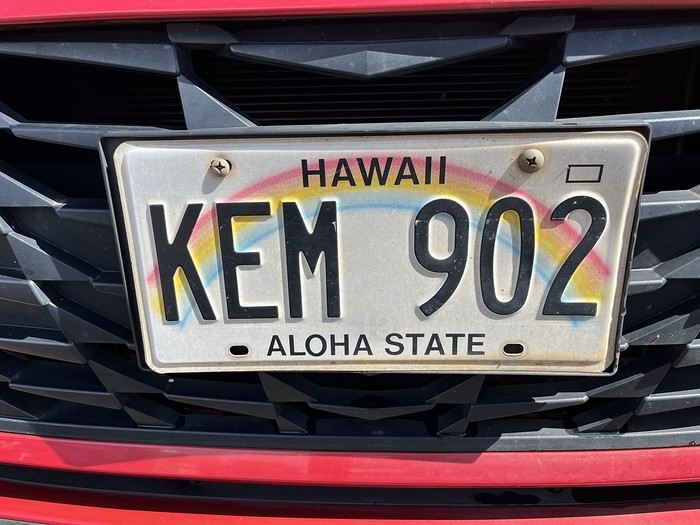
The trip took place from February 20th to March 3rd, 2025 (11 days total, with 9 days on-site). It was a trip with my friend Christelle, with whom I’ve already traveled to Iceland and Morocco in recent years. We’re totally on the same wavelength, with the same expectations and desires, which makes things a lot easier (and, as a bonus, it helps cut down the final bill). Being the generous soul I am, I asked Christelle which country she wanted to visit. Her answer: Asia, since I’ve never been, or Namibia... Hawaii is basically the same thing, right?!! All thanks to the search comparator—I stumbled upon round-trip tickets from Paris to Honolulu for 580 € per person during school holidays, with a layover in Canada (I don’t get to choose my vacation dates). We jumped on it on August 28th (didn’t take much convincing). For info, I always check flight tickets during the last week of August or the first half of September because there are always amazing deals.
Nine days on-site is short, so we had to make some tough choices for the islands we’d visit (I’m only listing the main ones): - Oahu: the most urbanized but also home to Honolulu, Pearl Harbor, and some stunning beaches.
Kauai: the Garden Isle. It’s the island from *Jurassic Park*, with lush vegetation—so it’s pretty rainy. Big Island: volcanoes, volcanoes, and more, but also things like night snorkeling with manta rays. Maui: very touristy, with a magnificent volcano, the Road to Hana, and the ultimate spot for whale watching (and we were there right in the middle of whale season).
We limited ourselves to two islands to avoid rushing, and in the end, we picked Kauai (non-negotiable) and Oahu (which saved us an extra domestic flight and, since we were there in winter, let us experience the BIG WAVES on the North Shore). We would’ve loved to visit Big Island, but we’d already seen volcanoes in Iceland, and the island is huge—we just didn’t have enough time. Maui was recently hit by a major wildfire and is also the most expensive island (along with Kauai). We were really hoping to see humpback whales (my favorite animal) on both Oahu and Kauai. Hawaii is far, and it’s worth the effort. The journey went smoothly. I took a 40-minute bus ride and a 1h32 RER trip just to get to Roissy, then a 9h15 flight to Calgary, with a two-hour layover before a 6h45 flight to Honolulu. 11 hours of time difference, arriving at 10 PM local time. And you know what? (spoiler alert) I’d do it a thousand times if I got the chance.
Alright, let’s go—here we go!
François Boucher
Dear members of VoyageForum,
It is with deep sadness that we share the news of the passing of François Boucher, the founder of VoyageForum.
We will remember his passion for travel, but most of all, the pride he took in this forum, which has become indispensable among travelers. While there may have been heated debates, we ask that you show respect for him.
François was still very active on the forum, especially in the technical development section. VoyageForum was his life’s work. He worked passionately to update the site and make up for the 4 years of closure due to the pandemic.
Today, VoyageForum has also lost its developer.
That’s why we’re reaching out to this community to continue François’s legacy. If there are any former or current developers among you who know PERL and would be willing to help, your support would be greatly appreciated.
Thank you for your loyalty.
Let’s keep this forum alive in his memory.
It is with deep sadness that we share the news of the passing of François Boucher, the founder of VoyageForum.
We will remember his passion for travel, but most of all, the pride he took in this forum, which has become indispensable among travelers. While there may have been heated debates, we ask that you show respect for him.
François was still very active on the forum, especially in the technical development section. VoyageForum was his life’s work. He worked passionately to update the site and make up for the 4 years of closure due to the pandemic.
Today, VoyageForum has also lost its developer.
That’s why we’re reaching out to this community to continue François’s legacy. If there are any former or current developers among you who know PERL and would be willing to help, your support would be greatly appreciated.
Thank you for your loyalty.
Let’s keep this forum alive in his memory.
From Delhi to Agra and the extraordinary stay in Chhattisgarh
My train to Mathura is at 2 PM, and we’ll arrive an hour late—all good. I booked a hotel on booking, but unfortunately, it’s really far from the ghats. Walking there is out of the question—what a shame.
The hotel itself is fine, and there are several restaurants right across the street, which will be handy for dinner. This won’t be an exception, though—starting at 10 PM, they must wake up because I can hear them talking loudly, and music is playing along. My room faces the entrance, so it’s going to be tough. At midnight, I ask them to lower the volume, but they don’t listen. By 1 AM, I lose my temper, and this time, everything stops. Finally, I can get some sleep—until 4 AM, when they start up again for a little while before quiet returns until 6 AM. But when do they sleep? The noise never seems to bother them—it’s unbelievable, and I’m finding it harder and harder to tolerate. It makes a huge difference.
The next morning, as I leave, they tell me they’ll give me another room for the following night. Oh, two nights like that wouldn’t be possible—I’m exhausted.
I head out to explore the ghats and take a rickshaw, which I share with a family, to Vrindavan, a city of temples dedicated to Krishna. I visit several while wandering through the lively streets, surrounded by a crowd of devotees. By 1 PM, I’m near the Bankey Bihari Temple, but I can’t go in—it just closed. Nearby, there are restaurants, so I take the opportunity to grab my usual aloo paratha with a lassi.

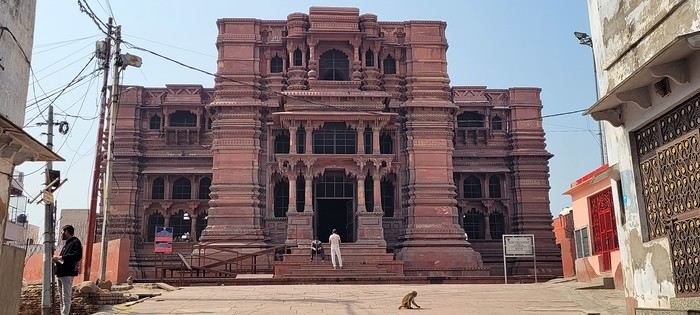
The work women do here is incredibly hard, and their pay must be miserable.

I want to leave Vrindavan for Govardhan. Two young guys on a motorcycle in front of the temple approach me, and the driver offers to take me part of the way. I’m pretty skeptical, but he insists, and I eventually agree. I didn’t fully understand what was happening. Once on the bike, his friend hops on too, and suddenly I’m sandwiched between them for a multi-kilometer ride—*travel Indian-style*. We quickly drop off the friend, and I breathe easier for the rest of the trip. At an intersection, he stops—Govardhan is straight ahead, but to get to his village, he needs to turn right. We wait for the bus for a few minutes, and he flags it down so I can hop on and continue my journey. What an adventure.
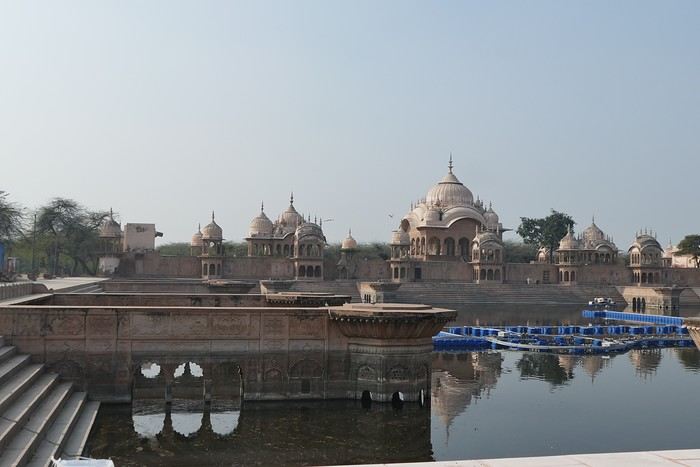
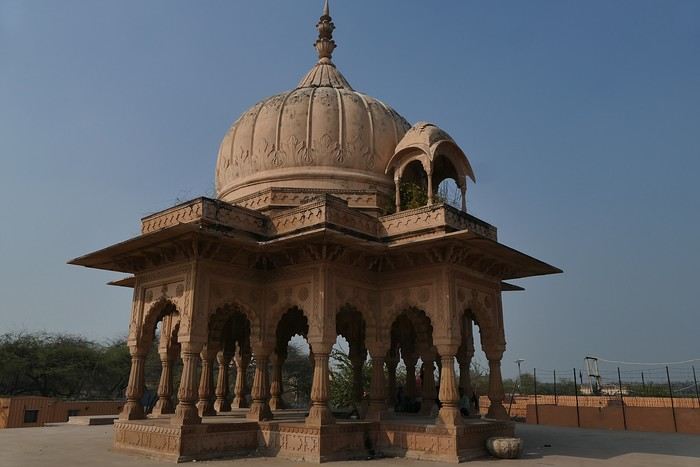
the neighbor with its beautiful dome.
The work women do here is incredibly hard, and their pay must be miserable.
I want to leave Vrindavan for Govardhan. Two young guys on a motorcycle in front of the temple approach me, and the driver offers to take me part of the way. I’m pretty skeptical, but he insists, and I eventually agree. I didn’t fully understand what was happening. Once on the bike, his friend hops on too, and suddenly I’m sandwiched between them for a multi-kilometer ride—*travel Indian-style*. We quickly drop off the friend, and I breathe easier for the rest of the trip. At an intersection, he stops—Govardhan is straight ahead, but to get to his village, he needs to turn right. We wait for the bus for a few minutes, and he flags it down so I can hop on and continue my journey. What an adventure.
the neighbor with its beautiful dome.
World Cliffs Discussion: January 2025 Contest
So, to start the year off right (Happy New Year!),
This is where we can discuss January’s theme.
With 20,000 km of French coastline (there’s a catch ;)), our beautiful country should be well represented!
Dig out those hard drives! Bruno
Dig out those hard drives! Bruno
Kyushu between Fukuoka and Nagasaki in autumn 2024 (Japan)
Fellow travelers,
Don’t they say "never two without three"? It seems so. Here I am again on the forum to share—and let’s be honest, indulge a bit of selfish pleasure—by recounting the story of this third installment in the Land of the Rising Sun.
Where? It’s all in the title. On the island of Kyushu in southern Japan, more precisely in the northwest between Fukuoka and Nagasaki. I hope to take you along with me for 19 nights and 18 full days this autumn of 2024. On the itinerary: gastronomy, crafts, festivals, waterfalls, encounters, and leisurely strolls in all simplicity.
A last-minute flight booked just 7 days before departure, and the route evolved regularly based on whims and accommodation availability, eventually settling on this:
- 5 nights in Fukuoka: Fukuoka city, Ukiha, Itoshima, Dazaifu, Yanagawa - 4 nights in Hasami, Nagasaki Prefecture: Okawachiyama, Arita, Takeo, Kashima, Yobuko, Karatsu, Kabeshima - 6 nights in Nagasaki: Ureshino, Higashi-Sonogi, Nagasaki city, Unzen, Sotome - 4 nights in Fukuoka: Karatsu, Fukuoka city
Most of the trip was done by car for practical reasons—easier access to certain places and freedom of movement—but also for the sheer joy of it. Despite slow traffic at times, driving in rural Japan is a delight.
If the program interests you, see you soon for the start of the journey.
Don’t they say "never two without three"? It seems so. Here I am again on the forum to share—and let’s be honest, indulge a bit of selfish pleasure—by recounting the story of this third installment in the Land of the Rising Sun.
Where? It’s all in the title. On the island of Kyushu in southern Japan, more precisely in the northwest between Fukuoka and Nagasaki. I hope to take you along with me for 19 nights and 18 full days this autumn of 2024. On the itinerary: gastronomy, crafts, festivals, waterfalls, encounters, and leisurely strolls in all simplicity.
A last-minute flight booked just 7 days before departure, and the route evolved regularly based on whims and accommodation availability, eventually settling on this:
- 5 nights in Fukuoka: Fukuoka city, Ukiha, Itoshima, Dazaifu, Yanagawa - 4 nights in Hasami, Nagasaki Prefecture: Okawachiyama, Arita, Takeo, Kashima, Yobuko, Karatsu, Kabeshima - 6 nights in Nagasaki: Ureshino, Higashi-Sonogi, Nagasaki city, Unzen, Sotome - 4 nights in Fukuoka: Karatsu, Fukuoka city
Most of the trip was done by car for practical reasons—easier access to certain places and freedom of movement—but also for the sheer joy of it. Despite slow traffic at times, driving in rural Japan is a delight.
If the program interests you, see you soon for the start of the journey.
Alleppey - Dental Tourism - Testimonial (India)
Given the extreme difficulty of getting a dentist appointment in my area (Lot/Aveyron—even traveling 2 hours each way by train to Toulouse, even with the dentist I’ve been a client of for years in my small town of Capdenac)—and considering the cost of dental implants in France, I decided to get a full dental overhaul during my annual stay of several months in Kerala (I’ve been spending time in Alleppey from late October to late March for several years now).
My Indian friends in Alleppey recommended a private dental clinic (I was pleasantly surprised that this clinic was qualified to place implants, as I thought I’d have to make multiple trips to Ernakulam/Cochin—60 km each way on a road that’s pretty rough right now due to massive construction stretching for dozens of kilometers). Results of the check-up on November 5, 2024: - 1 canine and an adjacent premolar slightly chipped at the top → need root canal treatment before covering them with a crown - 1 molar next to those two teeth already had a root canal → also needs a crown - 1 other canine broken deep down → needs to be extracted and replaced with an implant - 4 molars completely extracted years ago → 4 dental implants.
Here are the procedures I’ve already had (from November 5 to 22, 2024): - First session: initial assessment by the lead dentist (multiple X-rays displayed on a large screen, which he used to explain what he could do and what he recommended. For each implant, he showed me the required bone depth, and since I have very strong jaws, he remarked that I was an ideal candidate for implants). A dental assistant then outlined the proposed treatment timeline and the cost of each major procedure on a piece of paper (I took a photo of the notes so I wouldn’t lose track of the details). - Second session: placement of dental implants on the 4 molars in about an hour and a half (under local anesthesia—long but not painful at all during the procedure, though I had a bad headache all day afterward and a dull but manageable ache for a few days. Medication to take for 5 days, including an antibiotic. Obviously, no chewing hard foods for a while—soup, mashed potatoes, rice, yogurt for two days, then gradually more varied meals). Stitches for the gums around the 4 molars. - Third session: root canal treatment for a canine and a premolar (very long but absolutely painless under local anesthesia) + extraction of the deeply broken canine (a bit painful despite the anesthesia, but bearable—the lead dentist had to apply force and try three times. An assistant held my head from behind, but it was more unsettling than painful). - Fourth session: preparation of the canine, premolar, and adjacent molar for two crowns and a bridge. Removal of stitches around the 4 implants already placed. - Fifth session: impressions for the 2 crowns and bridge - Sixth session: placement of the 2 crowns and bridge - Seventh session scheduled for December 6: placement of a 5th implant where the canine was extracted - Late February: placement of the 5 crowns on the 5 implants
Meanwhile, my 85-year-old mother had a loose tooth extracted that had been bothering her since mid-September 2024 (her French dentist wouldn’t give her an appointment before January 2025, and she even traveled to a dentist in Toulouse who ultimately refused to extract it, even though the tooth was barely holding on and I’d sent the list of medications she takes in advance. My mother was furious about the wasted trip, and so was I, though I tried to stay calm!). At the Alleppey dental clinic, the assistants reviewed her medication list, looked them up online to identify them, and weren’t concerned. Another dentist extracted her tooth (under local anesthesia, of course) in barely 30 seconds. My mother immediately trusted them and decided on the spot to get a full lower denture. It was delivered to her definitively on Friday, November 22 (I think it took 4 or 5 sessions total). After two days of use, she’s happy with it and has a follow-up appointment next week for a check-up and adjustments if needed (though major modifications aren’t possible after the teeth are fixed to the denture). The session where the young dentist shaped the denture in real time was impressively precise and professional (the base had already been made from an impression, and the dentist added at least ten layers of softened paste with a flame, testing each addition in her mouth. Each time, he asked her to move her tongue from cheek to cheek, stick out her tongue, talk for 15 seconds, and swallow to ensure the denture wasn’t uncomfortable—about 45 minutes total).
Ballpark costs of the procedures: - Tooth extraction: around 2000 ₹ - Root canal treatment: around 5000 ₹ - Ceramic crown placement: around 15,000 ₹ - Titanium implant placement (made by Nobel Biocare): around 35,000 ₹ (Total for implant + tooth: around 50,000 ₹) - Lower denture fabrication: just under 20,000 ₹. Three material options—my mother chose the best for a rigid denture. She didn’t want to get 2 implants to secure it better (she didn’t feel the need with her old, very worn denture).
General impressions: This dental clinic is very well-regarded in Alleppey (according to all my Indian friends). There are two operating chairs on the ground floor and at least four on the first floor. The lead dentist (quite young) owns the clinic and handles the most delicate procedures (like implants) while occasionally overseeing work done by colleagues (after another dentist performed the root canal on my two teeth, he not only visually inspected it but also gave it a final touch with the drill). How many dentists handle more routine procedures? I’m not sure, but they’re all fairly young—men and a few young women. There are also many assistants: some prepare tools or operate the saliva suction, while others, more qualified, process images (X-rays or scans) on screen and explain things to me using those images. Others spent ten minutes briefing my mother in the waiting room on how to use and care for her new denture. During more delicate procedures, the operating dentist is assisted by two others. Two receptionists handle payments and appointments at the front desk. The welcome is always efficient and attentive, thanks to the dental assistants who guide us and provide explanations (the two receptionists don’t speak English). Appointments are always quick, even though the clinic seems busy (the waiting room is often full of Indian clients, though patients rarely come alone—they’re usually accompanied by a family member who stays close during the procedure). All the dentists speak English (since my mother doesn’t, I sat near the operating chair during each session to translate). So far, no complaints—I’m looking forward to March 2025 for the final result after the 5 teeth are placed on my 5 implants (the two crowns and bridge already fitted are perfect for me). 🙂
My Indian friends in Alleppey recommended a private dental clinic (I was pleasantly surprised that this clinic was qualified to place implants, as I thought I’d have to make multiple trips to Ernakulam/Cochin—60 km each way on a road that’s pretty rough right now due to massive construction stretching for dozens of kilometers). Results of the check-up on November 5, 2024: - 1 canine and an adjacent premolar slightly chipped at the top → need root canal treatment before covering them with a crown - 1 molar next to those two teeth already had a root canal → also needs a crown - 1 other canine broken deep down → needs to be extracted and replaced with an implant - 4 molars completely extracted years ago → 4 dental implants.
Here are the procedures I’ve already had (from November 5 to 22, 2024): - First session: initial assessment by the lead dentist (multiple X-rays displayed on a large screen, which he used to explain what he could do and what he recommended. For each implant, he showed me the required bone depth, and since I have very strong jaws, he remarked that I was an ideal candidate for implants). A dental assistant then outlined the proposed treatment timeline and the cost of each major procedure on a piece of paper (I took a photo of the notes so I wouldn’t lose track of the details). - Second session: placement of dental implants on the 4 molars in about an hour and a half (under local anesthesia—long but not painful at all during the procedure, though I had a bad headache all day afterward and a dull but manageable ache for a few days. Medication to take for 5 days, including an antibiotic. Obviously, no chewing hard foods for a while—soup, mashed potatoes, rice, yogurt for two days, then gradually more varied meals). Stitches for the gums around the 4 molars. - Third session: root canal treatment for a canine and a premolar (very long but absolutely painless under local anesthesia) + extraction of the deeply broken canine (a bit painful despite the anesthesia, but bearable—the lead dentist had to apply force and try three times. An assistant held my head from behind, but it was more unsettling than painful). - Fourth session: preparation of the canine, premolar, and adjacent molar for two crowns and a bridge. Removal of stitches around the 4 implants already placed. - Fifth session: impressions for the 2 crowns and bridge - Sixth session: placement of the 2 crowns and bridge - Seventh session scheduled for December 6: placement of a 5th implant where the canine was extracted - Late February: placement of the 5 crowns on the 5 implants
Meanwhile, my 85-year-old mother had a loose tooth extracted that had been bothering her since mid-September 2024 (her French dentist wouldn’t give her an appointment before January 2025, and she even traveled to a dentist in Toulouse who ultimately refused to extract it, even though the tooth was barely holding on and I’d sent the list of medications she takes in advance. My mother was furious about the wasted trip, and so was I, though I tried to stay calm!). At the Alleppey dental clinic, the assistants reviewed her medication list, looked them up online to identify them, and weren’t concerned. Another dentist extracted her tooth (under local anesthesia, of course) in barely 30 seconds. My mother immediately trusted them and decided on the spot to get a full lower denture. It was delivered to her definitively on Friday, November 22 (I think it took 4 or 5 sessions total). After two days of use, she’s happy with it and has a follow-up appointment next week for a check-up and adjustments if needed (though major modifications aren’t possible after the teeth are fixed to the denture). The session where the young dentist shaped the denture in real time was impressively precise and professional (the base had already been made from an impression, and the dentist added at least ten layers of softened paste with a flame, testing each addition in her mouth. Each time, he asked her to move her tongue from cheek to cheek, stick out her tongue, talk for 15 seconds, and swallow to ensure the denture wasn’t uncomfortable—about 45 minutes total).
Ballpark costs of the procedures: - Tooth extraction: around 2000 ₹ - Root canal treatment: around 5000 ₹ - Ceramic crown placement: around 15,000 ₹ - Titanium implant placement (made by Nobel Biocare): around 35,000 ₹ (Total for implant + tooth: around 50,000 ₹) - Lower denture fabrication: just under 20,000 ₹. Three material options—my mother chose the best for a rigid denture. She didn’t want to get 2 implants to secure it better (she didn’t feel the need with her old, very worn denture).
General impressions: This dental clinic is very well-regarded in Alleppey (according to all my Indian friends). There are two operating chairs on the ground floor and at least four on the first floor. The lead dentist (quite young) owns the clinic and handles the most delicate procedures (like implants) while occasionally overseeing work done by colleagues (after another dentist performed the root canal on my two teeth, he not only visually inspected it but also gave it a final touch with the drill). How many dentists handle more routine procedures? I’m not sure, but they’re all fairly young—men and a few young women. There are also many assistants: some prepare tools or operate the saliva suction, while others, more qualified, process images (X-rays or scans) on screen and explain things to me using those images. Others spent ten minutes briefing my mother in the waiting room on how to use and care for her new denture. During more delicate procedures, the operating dentist is assisted by two others. Two receptionists handle payments and appointments at the front desk. The welcome is always efficient and attentive, thanks to the dental assistants who guide us and provide explanations (the two receptionists don’t speak English). Appointments are always quick, even though the clinic seems busy (the waiting room is often full of Indian clients, though patients rarely come alone—they’re usually accompanied by a family member who stays close during the procedure). All the dentists speak English (since my mother doesn’t, I sat near the operating chair during each session to translate). So far, no complaints—I’m looking forward to March 2025 for the final result after the 5 teeth are placed on my 5 implants (the two crowns and bridge already fitted are perfect for me). 🙂
Various ideas to revive/improve the site
Hello,
After 20 years of operation and a 4-year hiatus, we were happy to rediscover this forum following its acquisition by Myatlas.
At the very beginning of the adventure, there was a section allowing members to share their ideas—good or bad, feasible or not—with the team in charge to help perfect the forum.
So, to help VoyageForum regain its momentum and adapt to new audiences and a new environment, why not put our heads together and suggest some improvement ideas in this thread?
I’ll get the ball rolling!
Travel journals are limited to 300 photos because photo storage is expensive. This limitation is completely understandable, and Myatlas found a solution by offering a paid subscription for those who wanted to exceed the free photo limit. Maybe this approach could be adapted here? Limiting without offering an alternative is a reason members leave.
After 20 years of operation and a 4-year hiatus, we were happy to rediscover this forum following its acquisition by Myatlas.
At the very beginning of the adventure, there was a section allowing members to share their ideas—good or bad, feasible or not—with the team in charge to help perfect the forum.
So, to help VoyageForum regain its momentum and adapt to new audiences and a new environment, why not put our heads together and suggest some improvement ideas in this thread?
I’ll get the ball rolling!
Travel journals are limited to 300 photos because photo storage is expensive. This limitation is completely understandable, and Myatlas found a solution by offering a paid subscription for those who wanted to exceed the free photo limit. Maybe this approach could be adapted here? Limiting without offering an alternative is a reason members leave.
Do you think India has changed over the last 15 years?
Hello,
There’s a big debate among travelers who are attached to India and have been visiting often, regularly, for 15 years or more.
I’ve experienced it—and still do—in every sense of the word, first as a tourist, then from the inside by living there for 12 years. I feel it has changed a lot and continues to change at a dizzying pace, year after year, almost month after month.
It all depends on how you see it, how you visit it, where you stay, etc... North or south, and so on...
The debate is open—no animosity or arguments if opinions differ. Just your own take, your personal experiences, your travel conditions, what you’ve noticed and still notice today... Let’s try to be objective, if possible, though it’s a tough exercise.
Your thoughts on IndiGo airline
Hi there,
Have you ever traveled with this airline? It seems like they have a real monopoly on some destinations and are also much cheaper.
Thank youuuu.
Have you ever traveled with this airline? It seems like they have a real monopoly on some destinations and are also much cheaper.
Thank youuuu.
Editing our posts and blocking members in discussions we've started
Hello!
I’m a former VF lover (and, incidentally, an explorer of my Atlas 😊) and I’m genuinely thrilled the forum is reopening, but I have two little questions.
Over the past four years, I’ve put together a few travel journals that I’d love to share, but there are two things that bother me: - How can I edit my post after a few hours? (Because sometimes I need to correct mistakes even two days later.)
- At the end of VF’s previous run, there were a few members who were really unpleasant and enjoyed derailing certain discussions. As a result, I know several people who stopped coming to VF because of that. So, for MY travel journals, I’d really like to keep the vibe positive and kind. Is there any way to set something up so the person who starts a discussion can block them?
Thanks, and long live VF!
Over the past four years, I’ve put together a few travel journals that I’d love to share, but there are two things that bother me: - How can I edit my post after a few hours? (Because sometimes I need to correct mistakes even two days later.)
- At the end of VF’s previous run, there were a few members who were really unpleasant and enjoyed derailing certain discussions. As a result, I know several people who stopped coming to VF because of that. So, for MY travel journals, I’d really like to keep the vibe positive and kind. Is there any way to set something up so the person who starts a discussion can block them?
Thanks, and long live VF!
Hébergements et déplacements en Ouganda English translation pending
Bonjour à tous,
D'ici quelques mois je compte partir voyager en Afrique de l'Est en commençant par l'Ouganda. Je pense plutôt aller me perdre sur des petites routes, dans les campagnes et les villages mais je ne sais absolument pas s'il est facile de trouver des hébergements dans ces endroits. J'hésite à embarquer une tente au cas où je ne trouve aucun endroit où dormir. Pensez-vous que ça vaut la peine ? J'aimerai beaucoup faire ce voyage en moto. Savez-vous s'il est facile d'en acheter une ? La police n'est pas trop emmerdante sur ça lorsqu'elle croise des étrangers ?
Merci d'avance pour vos réponses.
D'ici quelques mois je compte partir voyager en Afrique de l'Est en commençant par l'Ouganda. Je pense plutôt aller me perdre sur des petites routes, dans les campagnes et les villages mais je ne sais absolument pas s'il est facile de trouver des hébergements dans ces endroits. J'hésite à embarquer une tente au cas où je ne trouve aucun endroit où dormir. Pensez-vous que ça vaut la peine ? J'aimerai beaucoup faire ce voyage en moto. Savez-vous s'il est facile d'en acheter une ? La police n'est pas trop emmerdante sur ça lorsqu'elle croise des étrangers ?
Merci d'avance pour vos réponses.
Plus de 60% des loueurs de voitures au Maroc pourraient déposer le bilan English translation pending
Selon Mohamed Alami, président de l’Association des loueurs d’automobiles sans chauffeur au Maroc (ALASCAM), « plus de 60% des agences de location de voitures vont déposer leur bilan et presque 90% sont en cessation de paiement. C’est-à-dire qu’elles ont arrêté de payer leurs fournisseurs, les organismes de crédits et les banques. De même, plus de 6 000 dossiers sont devant les tribunaux et le processus de récupération des voitures par les sociétés de financement est en cours », indique Aujourdhui le Maroc.
https://aujourdhui.ma/automobile/covid-19-les-agences-de-location-de-voitures-au-fond-du-gouffre
https://www.bladi.net/maroc-les-agences-de-location-de-voitures-broient-du-noir,72964.html
https://aujourdhui.ma/automobile/covid-19-les-agences-de-location-de-voitures-au-fond-du-gouffre
https://www.bladi.net/maroc-les-agences-de-location-de-voitures-broient-du-noir,72964.html
Choix de cadre acier cause douleur aux cervicales (à vélo) English translation pending
Bonjour,
Lors de mes recherches sur le net je suis tombé plusieurs fois sur ce forum donc je me suis dit que ce serait intéressant d'y demander de bons conseils.
Après 3 années à partir en vacances avec nos Peugeot ns pliant et la volonté d'utiliser le moins possible la voiture nous avons décidé d'investir dans des vélos un peux plus sérieux, histoire d'aller encore plus loin avec plus d'efficacité !
Je trouve en occaz un ktm pour ma femme, cadre alu roues de 700 et fourche télescopique avec tous les œillets qui vont bien pour recevoir de l'équipement plus tard. Pour moi je trouve un bmc alpen challenge à 40mn de chez moi à un bon prix et sur place je succombe à cette beauté. Frein à disque hydraulique, cadre alu, roue 700, Shimano 105.... Bref une belle bête !
Sauf que finalement c'est un bout de bois et qu'après chaque sortie je ressent des douleurs aux cervicales. J'ai joué sur tout ce que j'ai pu pour m'y faire, raccourcie la potence avec un angle plus grand, ajouté des cornes, joué sur différents réglages de selle mais rien n'y fait. J'en conclue donc que le soucis ne vient peut être pas de la position plutôt sportive sur ce vélo mais bien le retour des chocs dans directement dans mes cervicales !
Nous envisageons de faire une partie de la Loire à vélo l'année prochaine et je ne me voit pas partir avec le bmc.
Maintenant ce que j'en pense : à 43 ans j'ai été un peu prétentieux de prendre ce type de vélo hyper urbain pour finalement faire un peu de chemin.
Maintenant les solutions et c'est là que j'ai besoin de vos conseils : soit je revend le bmc et je me retrouve un vélo moins typé sportif, soit je trouve un kit cadre et je dépouille le bmc qui est bien équipé.
Cahier des charges : pour une utilisation mixte chemin + ou- roulant/ petite route à 20km/h maxi. En priorité je veux du confort, de bons freins car j'ai ma petite derrière moi, de quoi poser des sacoches avant par la suite, et un budget plutôt serré (disons 300/400e pour un kit cadre que je retrouverai en partie en revendant le bmc) ou 600/700e pour un vélo complet.
Voilà vous savez tout, j'attends vos avis et vos expériences pour m'aider dans mes choix.... Merci !
Roadtrip côte ouest des USA English translation pending
Hello à vous tous cher Voyagiste, me voilà en prévision d'un voyage sur la COTES OUEST DES USA en Juillet 2021.
Je suis en fauteuil roulant électrique (j'aurais 31 ans à la période du séjour) et je part avec ma mère (qui aura elle 59 ans).
Je vous présente un première idée du Road Trip.
Je voudrais avoir vos avis concernant le temps de trajet, l'itinéraire, et si vous aviez des recommandations aux niveaux des hôtels (accessible bien entendu), des sociétés de location de véhicule accessible !
Arrivée à Los Angeles : Dodo sur place !
Lendemain : Départ direction Parc national de Joshua Tree (yucca à gogoooooo) (Los Angeles à Parc national de Joshua Tree = 2H10)
Dodo vers Needles (Parc national de Joshua Tree à Needles = 2H10)
Direction Grand Canyon (Needles à Grand Canyon Village = 3H45)
Dodo sur place
Visite du Grand Canyon (hélicoptères ?)
Dodo sur place
Direction Monument Valley (Grand Canyon Village à Monument Valley = 4H30)
Dodo sur place
Découverte des lieux plus plus plus
Direction Antelope Canyon – Upper (Monument Valley à Antelope Canyon = 1H50)
Visite du lieu
Direction Page (Antelope Canyon à Page 15 minutes)
Dodo sur place
Visite du lac Powel + barrage
Direction Las Vegas (Page à Las Vegas = 4H30)
Dodo sur place
Aller voir : ATM aquarium télé. (3451 W Martin Ave C, Las Vegas)
Visite de Las Vegas
Dodo sur place
Visite de Las Vegas
Dodo sur place
Direction San Francisco
Las Vegas à Death Valley à Olancha = 4H00
Dodo sur place
Olancha à Lee Vining à Traversée du parc de Yosemite à Groveland = 4H40
Dodo sur place
Groveland à San Francisco = 3H00
Visite de San Francisco
Dodo sur place
Visite de San Francisco
Dodo sur place
Visite de San Francisco
Dodo sur place
Visite de San Francisco
Dodo sur place
Visite de San Francisco
Dodo sur place
Direction San Simeon par la Pacific Coast Highway, également appelée Highway 1.
Bixby Creek Bridge (gros pont en arche), on y passe dessus par la route Cabrillo Hwy. (Depuis San Francisco 2H30)
McWay Waterfall (chute d’eau / cascade dans l’océan pacifique) accès PMR ! (Depuis San Francisco 3H00)
Friends Of The Elephant Seal (éléphants de mer) route Cabrillo Hwy, parking gratuit. (Plaza del Cavalier, 250 San Simeon Ave Suite 3B, San Simeon). (Depuis San Francisco 4H30)
Dodo sur place
Direction Sequoia National Park's Tunnel Log (tunnel à travers un séquoia) / (Crescent Meadow Rd, Sequoia National Park)
General Sherman (plus grand séquoia) / (route – 198 - General Hwy) (San Simeon à Sequoia = 3H50)
Dodo sur place
Direction Los Angeles (Sequoia à Los Angeles = 4H20)
Visite de Los Angeles
Dodo sur place
Visite de Los Angeles
Dodo sur place
Visite de Los Angeles
Dodo sur place
Visite de Los Angeles
Dodo sur place
Visite de Los Angeles
Dodo sur place
Visite de Los Angeles
Dodo sur place
à Départ France !!!
Je vous remercie pour vos conseil / suggestions ! Voyagement vôtre.
Je suis en fauteuil roulant électrique (j'aurais 31 ans à la période du séjour) et je part avec ma mère (qui aura elle 59 ans).
Je vous présente un première idée du Road Trip.
Je voudrais avoir vos avis concernant le temps de trajet, l'itinéraire, et si vous aviez des recommandations aux niveaux des hôtels (accessible bien entendu), des sociétés de location de véhicule accessible !
Arrivée à Los Angeles : Dodo sur place !
Lendemain : Départ direction Parc national de Joshua Tree (yucca à gogoooooo) (Los Angeles à Parc national de Joshua Tree = 2H10)
Dodo vers Needles (Parc national de Joshua Tree à Needles = 2H10)
Direction Grand Canyon (Needles à Grand Canyon Village = 3H45)
Dodo sur place
Visite du Grand Canyon (hélicoptères ?)
Dodo sur place
Direction Monument Valley (Grand Canyon Village à Monument Valley = 4H30)
Dodo sur place
Découverte des lieux plus plus plus
Direction Antelope Canyon – Upper (Monument Valley à Antelope Canyon = 1H50)
Visite du lieu
Direction Page (Antelope Canyon à Page 15 minutes)
Dodo sur place
Visite du lac Powel + barrage
Direction Las Vegas (Page à Las Vegas = 4H30)
Dodo sur place
Aller voir : ATM aquarium télé. (3451 W Martin Ave C, Las Vegas)
Visite de Las Vegas
Dodo sur place
Visite de Las Vegas
Dodo sur place
Direction San Francisco
Las Vegas à Death Valley à Olancha = 4H00
Dodo sur place
Olancha à Lee Vining à Traversée du parc de Yosemite à Groveland = 4H40
Dodo sur place
Groveland à San Francisco = 3H00
Visite de San Francisco
Dodo sur place
Visite de San Francisco
Dodo sur place
Visite de San Francisco
Dodo sur place
Visite de San Francisco
Dodo sur place
Visite de San Francisco
Dodo sur place
Direction San Simeon par la Pacific Coast Highway, également appelée Highway 1.
Bixby Creek Bridge (gros pont en arche), on y passe dessus par la route Cabrillo Hwy. (Depuis San Francisco 2H30)
McWay Waterfall (chute d’eau / cascade dans l’océan pacifique) accès PMR ! (Depuis San Francisco 3H00)
Friends Of The Elephant Seal (éléphants de mer) route Cabrillo Hwy, parking gratuit. (Plaza del Cavalier, 250 San Simeon Ave Suite 3B, San Simeon). (Depuis San Francisco 4H30)
Dodo sur place
Direction Sequoia National Park's Tunnel Log (tunnel à travers un séquoia) / (Crescent Meadow Rd, Sequoia National Park)
General Sherman (plus grand séquoia) / (route – 198 - General Hwy) (San Simeon à Sequoia = 3H50)
Dodo sur place
Direction Los Angeles (Sequoia à Los Angeles = 4H20)
Visite de Los Angeles
Dodo sur place
Visite de Los Angeles
Dodo sur place
Visite de Los Angeles
Dodo sur place
Visite de Los Angeles
Dodo sur place
Visite de Los Angeles
Dodo sur place
Visite de Los Angeles
Dodo sur place
à Départ France !!!
Je vous remercie pour vos conseil / suggestions ! Voyagement vôtre.
"On ne risque pas de se tromper si on ne sait pas où on va" English translation pending
Cette réplique d'Eric Caravaca dans le film "C'est quoi la vie" vous inspire t-elle ?
Karl
Karl
Problème cintre (à vélo) English translation pending
bonjour, je fais appel une fois de plus à vos compétences et conseils. je viens de partir 2 semaines avec le vélo ci dessous (Focus Mares) et j'ai eu les mains, la gauche notamment avec d'abord des "fourmis" puis paralysie, plus de sensibilité, plus de force. je précise aussi qu'ayant de petites mains le passage des vitesses n'est pas évident. je souhaiterais, si c'est possible remplacer par un cintre plat recourbé avec bar ends. je suppose que ce sera couteux mais ce vélo est neuf et par ailleurs fonctionne très bien. je n'ai pas souvenir d'avoir eu ce pb avec mon ancien vtc. merci d'avance pour votre avis. cdt
Discussion au sujet du concours photo de juin 2020: "Multicolore" English translation pending
Hello,
C'est ici qu'on en parle.
Philippe
C'est ici qu'on en parle.
Philippe
Dans quel pays aimeriez-vous vous expatrier? English translation pending
Je saisis au vol cette remarque d'Attila (que je partage!)
Franchement, je serais le gouvernement, je demanderais l'asile en ...?... et dirais aux français, démerdez vous.
et cette autre :
On fait le coucou dans les discussions mais jamais on n'en entame une...
pour proposer un nouveau post sur un mode très différent de voyager.
Où aimeriez-vous partir vivre?
Bien sûr vous choisissez votre pays ou région d'accueil, on part du principe que ce n'est pas une obligation que l'on vous fait.
Et vous avez besoin de vous éloigner momentanément de votre lieu de vie habituel, pour quelque raison que ce soit.
Quels seraient les atouts locaux importants pour vous de cette nouvelle installation : population, climat, paysages, archéologie, autres .... ?
Franchement, je serais le gouvernement, je demanderais l'asile en ...?... et dirais aux français, démerdez vous.
et cette autre :
On fait le coucou dans les discussions mais jamais on n'en entame une...
pour proposer un nouveau post sur un mode très différent de voyager.
Où aimeriez-vous partir vivre?
Bien sûr vous choisissez votre pays ou région d'accueil, on part du principe que ce n'est pas une obligation que l'on vous fait.
Et vous avez besoin de vous éloigner momentanément de votre lieu de vie habituel, pour quelque raison que ce soit.
Quels seraient les atouts locaux importants pour vous de cette nouvelle installation : population, climat, paysages, archéologie, autres .... ?
Itinéraire en self-drive Rwanda - Ouganda English translation pending
Bonjour,
Je prépare un voyage au Rwanda/Ouganda en 2021, certainement en self drive pour la partie rwandaise et avec un chauffeur pour la partie ougandaise. Je prévois de 15 à 17 nuits sur place.
J'aime les animaux bien sur mais encore plus les paysages et la vie quotidienne. Je voudrais néanmoins voir les gorilles et les lions arboricoles. Le bec en sabot et les rhinos aussi mais cela me semble compliqué.
J'ai demandé à deux agences des itinéraires, j'ai estimé via google nombre d'heures à passer sur la route.
Agence 1 : (15 nuits) - 31.5 h de route
Kigali - Forêt de Nyungwe - Lac Kivu ( trail) - Parc des Volcans- Forêt de Bwindi - Ishasha - Queen Elizabeth Nord - Hoima - Murchisson Falls - Entebbe
Agence 2 : (16 nuits) - 27 h de route
Entebbe - Forêt de Kibale - Queen Elisabeth Nord -Forêt de Bwindi - Forêt de Mgahinga - Lac Kivu (trail) - Forêt de Nyungwe - Kigali.
Le premier itinéraire me permet de voir le plus de choses mais ressemble à un marathon Le second un peu moins, mais peut être trop de forêts : redondant ?
J'ai essayé de simplifier :
Mon projet : - 21 h de route
Kigali (1 nuit) - Forêt de Nyungwe (3 nuits) - Lac Kivu (3 ou 4 nuits) (trail) - Forêt de Bwindi (3 nuits) - Ishasha ( 2 nuits) - Kigali (2 nuits)
J'ai plusieurs questions :
- Kibale et Mgahinga apportent ils un plus (surtout en terme de paysage) à Nyungwe et Bwindi ou j'ai raison de privilégier ces 2 parcs en y restant un peu plus longtemps ?
- Ishasha (2 nuits) se suffit il à lui même ou il est préférable d'aller passer aussi deux jours dans le nord du parc Queen Elizabeth me permettant en plus de faire du bateau sur le canal de Kazinga ?
- Je peux rajouter une étape le long de mon dernier itinéraire (Butare, parc des volcans, lacs jumeaux du nord du Rwanda ... ou autre) ?
- Question que j'ai déjà posé sur un autre fil, La meilleure période : Janvier ou Juillet ?
Rien n'est figé, n'hésitez pas à me proposer un meilleur itinéraire.
Grand merci d'avance à vous. Bonne journée Franck
Je prépare un voyage au Rwanda/Ouganda en 2021, certainement en self drive pour la partie rwandaise et avec un chauffeur pour la partie ougandaise. Je prévois de 15 à 17 nuits sur place.
J'aime les animaux bien sur mais encore plus les paysages et la vie quotidienne. Je voudrais néanmoins voir les gorilles et les lions arboricoles. Le bec en sabot et les rhinos aussi mais cela me semble compliqué.
J'ai demandé à deux agences des itinéraires, j'ai estimé via google nombre d'heures à passer sur la route.
Agence 1 : (15 nuits) - 31.5 h de route
Kigali - Forêt de Nyungwe - Lac Kivu ( trail) - Parc des Volcans- Forêt de Bwindi - Ishasha - Queen Elizabeth Nord - Hoima - Murchisson Falls - Entebbe
Agence 2 : (16 nuits) - 27 h de route
Entebbe - Forêt de Kibale - Queen Elisabeth Nord -Forêt de Bwindi - Forêt de Mgahinga - Lac Kivu (trail) - Forêt de Nyungwe - Kigali.
Le premier itinéraire me permet de voir le plus de choses mais ressemble à un marathon Le second un peu moins, mais peut être trop de forêts : redondant ?
J'ai essayé de simplifier :
Mon projet : - 21 h de route
Kigali (1 nuit) - Forêt de Nyungwe (3 nuits) - Lac Kivu (3 ou 4 nuits) (trail) - Forêt de Bwindi (3 nuits) - Ishasha ( 2 nuits) - Kigali (2 nuits)
J'ai plusieurs questions :
- Kibale et Mgahinga apportent ils un plus (surtout en terme de paysage) à Nyungwe et Bwindi ou j'ai raison de privilégier ces 2 parcs en y restant un peu plus longtemps ?
- Ishasha (2 nuits) se suffit il à lui même ou il est préférable d'aller passer aussi deux jours dans le nord du parc Queen Elizabeth me permettant en plus de faire du bateau sur le canal de Kazinga ?
- Je peux rajouter une étape le long de mon dernier itinéraire (Butare, parc des volcans, lacs jumeaux du nord du Rwanda ... ou autre) ?
- Question que j'ai déjà posé sur un autre fil, La meilleure période : Janvier ou Juillet ?
Rien n'est figé, n'hésitez pas à me proposer un meilleur itinéraire.
Grand merci d'avance à vous. Bonne journée Franck
Quinze jours au Soudan en février 2020 English translation pending
Bonjour 😏
Le temps du confinement me permet de me mettre à jour dans mes carnets de voyage.
Une nouvelle aventure. Je pars avec Justine, une ancienne élève qui a 28 ans. Son premier voyage à part des hôtels club..
La location de voiture sans chauffeur est impossible au Soudan. J’ai décidé de louer une voiture avec chauffeur. Je suis donc passé par une agence, 90 euros par jour pour voiture, pétrole, chauffeur (son logement et sa nourriture comprise). Aucune autre prestation.
Je ne voulais pas me contenter du Nord et des sites archéologiques, circuit classique que font les quelques touristes qui vont au Soudan et mais partir vers le sud, dans le Kordofan pour aller dans les nubas mountains. Dans cette partie du soudan, il y a eu pendant des années, une guerre intense avec le gouvernement central. Le mouvement de rébellion existe toujours, le SPLM. L’armée de ce mouvement est toujours en place. Elle réclame un égal développement pour cette partie du territoire dans lequel il n’y a aucun investissement. Dans cette région, le peuple Nuba comprend une mosaïque de tribus. Je voulais aller dans cette région et avait construit un itinéraire que l’agence avait accepté. Hélas, je n’ai pas pu faire tout ce que je voulais car il fallait des autorisations du SPLM que nous n’avons pas eu. 10 jours avant de partir, toujours pas de certitude de pouvoir faire la boucle prévue. Alors que j’avais dit que je ne voulais pas de guide, l’agence m’a parlé d’un gars, dit guide, natif de cette région. Je l’ai contacté directement et nous nous sommes mis d’accord sur sa prestation ! Sur la route, pour les arrêts dans les villages, il n’était pas indispensable, car je n’ai aucun souci pour aller à la rencontre de la population. C’est souvent moi qui disais, on s’arrête là et là… Mais il avait pris des contacts avec les autorités locales. Cela nous a permis de vivre dans un village, impossible sans lui.
1èr partie du voyage : LE KORDOFAN ET LE PAYS NUBAS, au sud de Khartoum
Cela a été le must de notre voyage pour les contacts avec la population. Je voyage beaucoup mais je n’avais pas vécu cela depuis longtemps. Partout l’accueil a été extraordinaire et jamais on ne nous a demandé quoique ce soit.
1er jour KHARTOUN/DILLING
Longue route puisque nous sommes partis à 7 h et arrivés à 17 h 30, mais avec plusieurs arrêts ! En voici quelques uns.
Marché des chameaux "El molih camel market". Le grand marché est le samedi, nous y passons un lundi… Pas beaucoup d’effervescence mais pour notre premier marché de chameaux, on apprécie !
Arrêt dans un village de la tribu Ahamada. Excellent accueil. Nous sommes accueillis dans 3 maisons. Une des familles était très chaleureuse. Nous étions au début du voyage, je ne maîtrisais pas la suite de la journée. Mais à refaire, j’aurais accepté leur invitation de partager un moment ensemble.
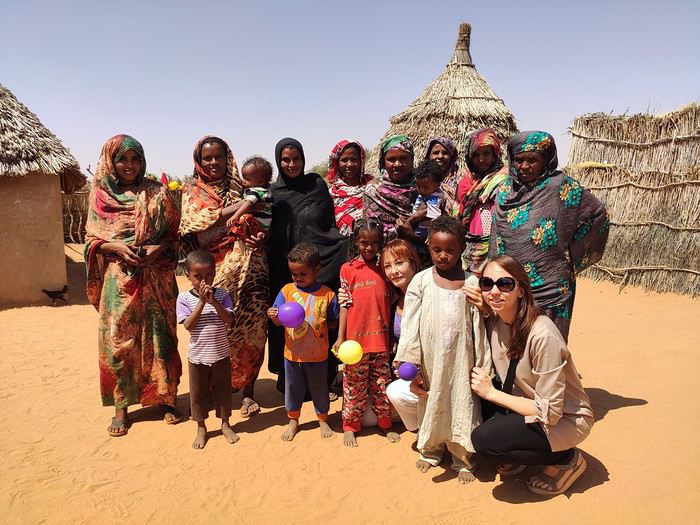
Arrêt à ville de Barra. Nous sommes en début d’après-midi. Notre premier marché. Le souk est animé. Les gens sont étonnés de voir des « blancs » et nous regardaient avec de grands yeux.
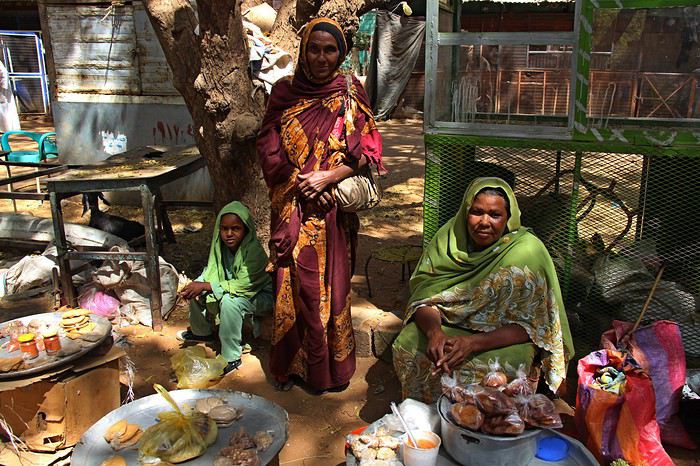
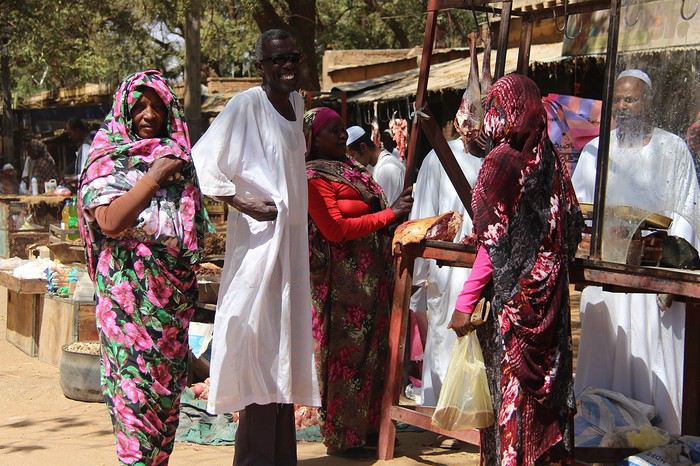
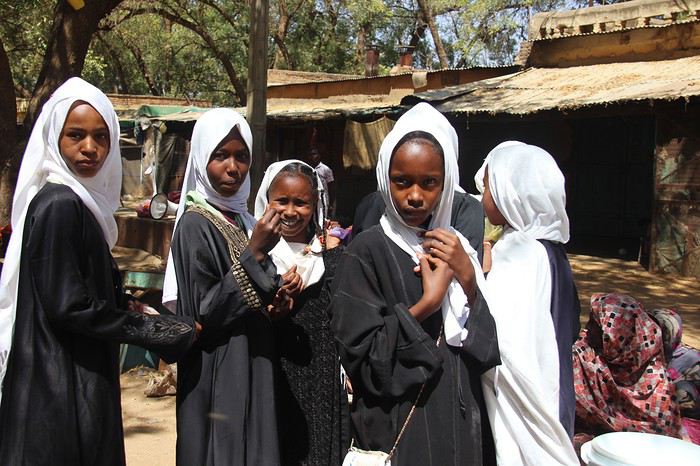
Puis arrêt dans un autre village. A nouveau un très bon accueil.
Bien sûr, il faut prendre son temps pour créer le contact
Ce qui m’a passionné sur cette route macadamisée, en très bon état, un peu monotone car les paysages sont plats, pas vraiment jolis, ce sont les camions, avec leur hauteur de marchandises. C’est vraiment très impressionnant. Je vous livre quelques spécimens.
Le temps du confinement me permet de me mettre à jour dans mes carnets de voyage.
Une nouvelle aventure. Je pars avec Justine, une ancienne élève qui a 28 ans. Son premier voyage à part des hôtels club..
La location de voiture sans chauffeur est impossible au Soudan. J’ai décidé de louer une voiture avec chauffeur. Je suis donc passé par une agence, 90 euros par jour pour voiture, pétrole, chauffeur (son logement et sa nourriture comprise). Aucune autre prestation.
Je ne voulais pas me contenter du Nord et des sites archéologiques, circuit classique que font les quelques touristes qui vont au Soudan et mais partir vers le sud, dans le Kordofan pour aller dans les nubas mountains. Dans cette partie du soudan, il y a eu pendant des années, une guerre intense avec le gouvernement central. Le mouvement de rébellion existe toujours, le SPLM. L’armée de ce mouvement est toujours en place. Elle réclame un égal développement pour cette partie du territoire dans lequel il n’y a aucun investissement. Dans cette région, le peuple Nuba comprend une mosaïque de tribus. Je voulais aller dans cette région et avait construit un itinéraire que l’agence avait accepté. Hélas, je n’ai pas pu faire tout ce que je voulais car il fallait des autorisations du SPLM que nous n’avons pas eu. 10 jours avant de partir, toujours pas de certitude de pouvoir faire la boucle prévue. Alors que j’avais dit que je ne voulais pas de guide, l’agence m’a parlé d’un gars, dit guide, natif de cette région. Je l’ai contacté directement et nous nous sommes mis d’accord sur sa prestation ! Sur la route, pour les arrêts dans les villages, il n’était pas indispensable, car je n’ai aucun souci pour aller à la rencontre de la population. C’est souvent moi qui disais, on s’arrête là et là… Mais il avait pris des contacts avec les autorités locales. Cela nous a permis de vivre dans un village, impossible sans lui.
1èr partie du voyage : LE KORDOFAN ET LE PAYS NUBAS, au sud de Khartoum
Cela a été le must de notre voyage pour les contacts avec la population. Je voyage beaucoup mais je n’avais pas vécu cela depuis longtemps. Partout l’accueil a été extraordinaire et jamais on ne nous a demandé quoique ce soit.
1er jour KHARTOUN/DILLING
Longue route puisque nous sommes partis à 7 h et arrivés à 17 h 30, mais avec plusieurs arrêts ! En voici quelques uns.
Marché des chameaux "El molih camel market". Le grand marché est le samedi, nous y passons un lundi… Pas beaucoup d’effervescence mais pour notre premier marché de chameaux, on apprécie !
Arrêt dans un village de la tribu Ahamada. Excellent accueil. Nous sommes accueillis dans 3 maisons. Une des familles était très chaleureuse. Nous étions au début du voyage, je ne maîtrisais pas la suite de la journée. Mais à refaire, j’aurais accepté leur invitation de partager un moment ensemble.
Arrêt à ville de Barra. Nous sommes en début d’après-midi. Notre premier marché. Le souk est animé. Les gens sont étonnés de voir des « blancs » et nous regardaient avec de grands yeux.
Puis arrêt dans un autre village. A nouveau un très bon accueil.
Bien sûr, il faut prendre son temps pour créer le contact
Ce qui m’a passionné sur cette route macadamisée, en très bon état, un peu monotone car les paysages sont plats, pas vraiment jolis, ce sont les camions, avec leur hauteur de marchandises. C’est vraiment très impressionnant. Je vous livre quelques spécimens.
Dérailleur Shimano XT 3x9 sur vélo Ridgeback Panorama English translation pending
J'ai des soucis avec mon dérailleur avant, et malgré mes tentatives de réglages, rien n'y fait. J'ai porté à 2 reprises mon vélo chez un pro, mais l'amélioration reste provisoire et les soucis reviennent rapidement : Difficultés ou impossibilité à passer le grand plateau, ou le petit (ça varie), bruits parasites, sensation que rien n'est fluide. J'ai changé la chaîne, sans résultat. Jamais auparavant un dérailleur avant ne m'avait posé le moindre problème.
Mon vélo est un ridgeback panorama 2019, équipé en shimano XT à l'arrière et Sora à l'avant.
J'en suis à me demander si les 2 modèles AV AR sont bien compatibles...
En désespoir de cause, j'envisage de changer la configuration à l'avant, et de tout mettre en XT pour une meilleure cohérence. Le problème est que XT ne semble pas ou plus exister en 3X9...
Avez-vous une info là-dessus ?
Avez-vous une info là-dessus ?