Results for "Vieille+ville+Dubrovnik+|+123+>+204"
46028 results found.
Les plus belles Eglises et Cathédrales! English translation pending
... Puisque les sondages sont à la mode sur VF, je me lance !!!
Quels sont vos plus beaux souvenirs d' Eglises ou de Cathédrales de par le monde. Les Mosquées, Synagogues et Temples, sont bienvenues aussi of course !!!
Pour moi, la plus petite et la plus secrète : En plein coeur du Begijnhof à Amsterdam, l'Eglise catholique clandestine, installée dans 2 résidences privées. Elle abrita des reliques du Miracle d'Amsterdam.
Nawal auréolée .
.
Quels sont vos plus beaux souvenirs d' Eglises ou de Cathédrales de par le monde. Les Mosquées, Synagogues et Temples, sont bienvenues aussi of course !!!
Pour moi, la plus petite et la plus secrète : En plein coeur du Begijnhof à Amsterdam, l'Eglise catholique clandestine, installée dans 2 résidences privées. Elle abrita des reliques du Miracle d'Amsterdam.
Nawal auréolée
.Pampelune ou Bilbao en Espagne? English translation pending
Bonjour,
Nous voulons passer le we de la Pentecôte en Espagne, pas trop trop loin de la frontière (habitant Bordeaux). Que nous conseillez vous ? On a pensé à Pampelune ou Bilbao. Est ce que ce sont de jolies villes ? Qu'y a t il à voir ? Avez vous des bons plans pour le logement (auberge de jeunesse, campings ou autres) ?
Merci pour toutes vos réponses
Marie
Nous voulons passer le we de la Pentecôte en Espagne, pas trop trop loin de la frontière (habitant Bordeaux). Que nous conseillez vous ? On a pensé à Pampelune ou Bilbao. Est ce que ce sont de jolies villes ? Qu'y a t il à voir ? Avez vous des bons plans pour le logement (auberge de jeunesse, campings ou autres) ?
Merci pour toutes vos réponses
Marie
Besoin d'infos Écosse English translation pending
Salut à vous tous!🙂
Je suis à le recherche d'informations sur l'écosse. J'ai besoin d'en savoir plus sur Édimbourg, car j'ai l'intention d'y habiter pendant 3 mois à partir de septembre 2004. Je finirai mon voyage dans les autres pays d'Europe en décembre. Pour ce qui est de l'écosse, j'aimerais savoir si certains d'entre vous connaissent des endroits où je pourrais travailler; j'aimerais en savoir plus sur le niveau de vie à Edimbourg, est ce abordable d'y habiter? Si vous connaissez des lieux à visiter, des conseils a me donner, des choses a faire et ne pas faire la bas...Bref, j'ai besoin de tous les renseignements possibles, que ce soit sur les moyens de transport, les auberges jeunesse etc... Si vous avez également des renseignements qui pourraient me dire quels sont les pays les plus accessibles financièrement pour un voyageur comme moi avec un petit budget entre l'allemagne, la france, l'italie, l'autriche et l'espagne
Je peux vous etre utile si vous avez be soin de renseignements sur l'ouest canadien
Merci a ceux qui me repondront et qui me liront
Je suis à le recherche d'informations sur l'écosse. J'ai besoin d'en savoir plus sur Édimbourg, car j'ai l'intention d'y habiter pendant 3 mois à partir de septembre 2004. Je finirai mon voyage dans les autres pays d'Europe en décembre. Pour ce qui est de l'écosse, j'aimerais savoir si certains d'entre vous connaissent des endroits où je pourrais travailler; j'aimerais en savoir plus sur le niveau de vie à Edimbourg, est ce abordable d'y habiter? Si vous connaissez des lieux à visiter, des conseils a me donner, des choses a faire et ne pas faire la bas...Bref, j'ai besoin de tous les renseignements possibles, que ce soit sur les moyens de transport, les auberges jeunesse etc... Si vous avez également des renseignements qui pourraient me dire quels sont les pays les plus accessibles financièrement pour un voyageur comme moi avec un petit budget entre l'allemagne, la france, l'italie, l'autriche et l'espagne
Je peux vous etre utile si vous avez be soin de renseignements sur l'ouest canadien
Merci a ceux qui me repondront et qui me liront
Retour de Prague en Répubique Tchèque English translation pending
Salut 😉
Bonjour à tous!
Je suis rentrée hier de Prague. Je vous livre donc mes impressions...
Nous avons logé à l'hotel Kampa. Hotel 4 étoiles (je me serais bien contentée d'une auberge de jeunnesse. Mais bon...). L'hotel est très bien situé, central... à quelques mètres du pont Saint-Charles. Peut être (surement!) qu'une auberge de jeunnesse aurait été plus "vivante", dynamique!Ce que je trouve dommage, c'est qu'avec le français, on ne va nulle part. Si on n'a pas quelques notions d'anglaius, on est perdu!!! C'est fou! Même dans les restos, rares sont les menus en français. Tout est en tchèques, allemand et anglais.
J'y suis allée hors saison et malgré ça, c'est plein de touristes: des petits vieux qui se croient tout permis, et des jeunes en voyage scolaire qui se foutent pas mal de ces visites! Je ne vous conseille pas de vous y rendre en pleine saison!
C'est étrange mais il est très difficile, voire impossible, de trouver un snack pour manger un dago sur le chemin. La ville est pleine de resto à des prix très raisonnable. Le service y est, en général, assez expéditif.
Je conseillerai de vous rendre à Prague avec un guide (un bouquin). La ville est un véritable musé à elle toute seule. Chaque maison a une histoire, une architecture particulière...
Il est possible de tout faire à pied car tout est concentré et l'orientation y ets très aisée. Le Lonely Planet est très bien fait. Je ne connais pas le Routard! La ville est très belle. Le pont Saint Charles, le quartier juif, la place de la vieille ville, le chateau... Ce que je regrette, c'est de ne pas avoir vu un spectacle de marrionnette.
Même si mon impression semble quelque peu négative, je me suis bien amusée à Prague. Ville magnifique mais ces 4 jours auront été fatiguants!!!
Bon voyage à tous...
Marie.
Voici des conseils sur Amsterdam au Pays-Bas English translation pending
Bonjour a tous!
Voici quelques conseils a propos d'Amsterdam: Evitez de venir a Amsterdam pendant les week-ends, les jours feries et manifestations importantes.En effet, les hotels fixent leurs prix en fonction de l'affluence touristique.Le prix d'une chambre pendant la semaine peut pour doubler le week-end!🤪 Le mieux est de reserver a l'avance, arriver un samedi soir sans reservation peut s'averer une vraie galere! Venez en train ou en avion!Les voitures ne sont pas les bienvenues a amsterdam, tout est payant, entre 30 et 40 euros la journee pour le stationnement et si vous ne payer pas, on vous mettre directement un sabot!
J'espere que ces petits conseils vous permettront d'economiser temps et argent!
Pour un bon plan de reservation d'hotel a Amsterdam, j'ai un bon site internet que j'ai mis dans la rubrique annonces publicitaire(reserver une chambre a Amsterdam) conformement au reglement du forum.
En tout cas, Amsterdam est une ville magnifique, qui a beaucoup de charme, je ne peux que vous la recommander dans l'ititneraire de vos prochains voyages!
Voici quelques conseils a propos d'Amsterdam: Evitez de venir a Amsterdam pendant les week-ends, les jours feries et manifestations importantes.En effet, les hotels fixent leurs prix en fonction de l'affluence touristique.Le prix d'une chambre pendant la semaine peut pour doubler le week-end!🤪 Le mieux est de reserver a l'avance, arriver un samedi soir sans reservation peut s'averer une vraie galere! Venez en train ou en avion!Les voitures ne sont pas les bienvenues a amsterdam, tout est payant, entre 30 et 40 euros la journee pour le stationnement et si vous ne payer pas, on vous mettre directement un sabot!
J'espere que ces petits conseils vous permettront d'economiser temps et argent!
Pour un bon plan de reservation d'hotel a Amsterdam, j'ai un bon site internet que j'ai mis dans la rubrique annonces publicitaire(reserver une chambre a Amsterdam) conformement au reglement du forum.
En tout cas, Amsterdam est une ville magnifique, qui a beaucoup de charme, je ne peux que vous la recommander dans l'ititneraire de vos prochains voyages!
Travailler 2 mois en Bulgarie English translation pending
bonjour,
je pars 2 mois en bulgarie pour travailler, je cheche toute sorte d'info sur le pays( coutume, lieux à pas rater ect...) merci d'avance
je pars 2 mois en bulgarie pour travailler, je cheche toute sorte d'info sur le pays( coutume, lieux à pas rater ect...) merci d'avance
Conseils sur hôtel à Panama city English translation pending
Bonjour,
Pourriez vous me conseiller un hotel à moins de 40 dollars dans un quartier sûr de jour comme de nuit à Panama city. Je pars à la fin du mois pour une quinzaine de jours et suis également preneur de toutes informations utiles pour visiter ce pays en bus ou autres transports collectifs...
Merci
Pourriez vous me conseiller un hotel à moins de 40 dollars dans un quartier sûr de jour comme de nuit à Panama city. Je pars à la fin du mois pour une quinzaine de jours et suis également preneur de toutes informations utiles pour visiter ce pays en bus ou autres transports collectifs...
Merci
Qui connaît Mexico? English translation pending
Bonjour à tous🙂,
Est ce que quelqu'un à des infos sur un endroit sympa pour dormir à Mexico😎? Les quartiers à eviter et ceux à ne pas manquer  ??Par avance un grand MERCI😏
Sonia
Est ce que quelqu'un
à des infos sur un endroit sympa pour dormir à Mexico😎? Les quartiers à eviter et ceux à ne pas manquer ??Par avance un grand MERCI😏Sonia
Inde du Nord (Rajasthan) - Novembre 2000 English translation pending
Voici quelques infos pratiques concernant un voyage de 4 semaines au Rajasthan en Novembre 2000 (ça date un peu ...). Voyage en couple, en individuel et en itinérant. Sauf pour les hôtels, les prix indiqués sont toujours par personne.
Je répondrai avec plaisir à toutes vos questions complémentaires.
NOTRE PERIPLE EN 4 SEMAINES : (nous avons couvert ce programme sans jamais courir)
Mer 1er/11/2000 : vol Paris --> New Dehli (avion - 3 900 F l'A/R) - Nuit à New Dehli Jeu : New Dehli (prise de contact - résa du train Shatabdi Express pour Agra - Main Bazar) - Nuit à New Dehli Ven : Train pour Agra (2h - 10$ - voir § transport) - Fathepur Skiri (1h de bus = 17 Rs) - Taj Mahal (gratuit le vendredi - profitons-en !) au coucher du soleil - Nuit à Agra Sam : Taj Mahal - Tombeau d'Akbar à Sikandara - Fort Rouge - Journée coûteuse mais inoubliable - Nuit à Agra Dim : Bus pour Jaipur (5h - 117 Rs) - Palais des Vents (Hawa Mahal) - Nuit à Jaipur Lun : Rickshaw à la journée (300 Rs) pour les environs de Jaipur : Cénotaphes de Gaïtor - Amber Palace - Fort de Jaigarh - Temple de Shiromani - Nuit à Jaipur Mar : Jaipur : City Palace - Observatoire - Nuit à Jaipur Mer : Bus pour Ajmer (3h - 66 Rs) - Bus pour Pushkar (1/2 h - 7 Rs) - Foire de Puskar - Nuit à Pushkar Jeu : Pushkar : la foire et la ville - Nuit à Pushkar Ven : Bus pour Udaipur (7h30- 150 Rs) - Nuit à Udaipur Sam : Udaipur : City Palace - Marché tibétain - Nuit à Udaipur Dim : Bus A/R pour Chittorgarh (2X 2h - 45 Rs par voyage) - Nuit à Udaipur Lun : En voiture avec chauffeur (3, 75 Rs/km - je n'ai pas noté le coût total ... dommage ...- voir § transport) : Ranakpur - Kumbhalgarh - Eklingji - Nuit à Udaipur Mar : Bus pour Abu Road (6h - 62 Rs) - Bus pour Mount Abu (1h - 13 Rs) - nuit à Mount Abu Mer : Mount Abu : temples jaïns de Delwara - Nuit à Mount Abu Jeu : Bus pour Jodhpur (6h30 - 130 Rs) - Nuit à Jodhpur Ven : Jodhpur : Fort Mehrangarh - Clock Tower - Marché - Nuit à Jodhpur Sam : En jeep (1/2 journée - 400 Rs - voir § transport) : villages bishnois - Nuit à Jodhpur Dim : Bus pour Jaisalmer (5h prévues - 7h30 avec la panne ... - 100 Rs) - Nuit à Jaisalmer Lun : Jaisalmer : Citadelle - Ville haute - Temples jaïns - Ville basse - Havelis - Nuit à Jaisalmer Mar : En jeep (1/2 journée - 750 Rs - voir § transport) - Safari dans le désert : Cénotaphes - temples jaïns, village médiéval - Dunes de Khuri et tour à dos de chameau ... - Nuit à Jaisalmer Mer : Bus pour Bikaner (10h - 150 Rs) - Beaux paysages en route - Nuit à Bikaner Jeu : Bus A/R pour Deshnoke (2X1h - 13 Rs par voyage) - Bikaner : Junagarth Fort - Vieille ville - Temples jaïns - Nuit à Bikaner Ven : En voiture privée (nous profitons d'une opportunité - 4h - voir § transport) pour Mandawa - Nuit à Mandawa Sam : En jeep (1/2 journée - 300 Rs) : Shekhawati - Nuit à Mandawa Dim : Jeep-taxi pour Junjunhu (1h - 10 Rs) - Bus pour Dehli (6h - 100 Rs) - Nuit à New Dehli Lun : New Dehli : Tombeaux de Nizamuddin - Nuit à New Dehli Mar 28/11/2000 : Avion pour Paris ....... les meilleures choses ont une fin .......
BUDGET :
L'Euro n'était pas encore d'actualité. En Novembre 2000, 1F = 6 Roupies ; 10 Rs = 1, 74 F Niveau de vie très peu élevé.
TRANSPORT :
1. Vols Billets achetés auprès de Voyageurs du Monde (Jagmohan SHARMA 01.42.86.17.33) : http://www.vdm.com/vdm/index.asp - 3, 5 mois à l'avance. Vol Air France/Air India - direct - arrivée à New Dehli à 23h - Prix : 3900 F l'AR
2. Sur place New Dehli - Agra : train Shatabdi Express - 10$ via une agence locale - Je pense qu'on s'est fait arnaquer 😕 comme des bleus ! Quand on a demandé au rickshaw de nous déposer à la gare, il a pretexté qu'il n'y avait plus de train pour Agra et nous a déposé dans une agence qui nous a vendu un billet de train pour le surlendemain ... Soyez plus méfiants que nous ....😉 Départ à 6h00 - durée : 2 heures -
Pour tout le reste, nous avons privilégié le bus au train ... sans vraiment de raison, ça s'est fait comme ça ... Les bus sont fréquents, facile d'utilisation, et partent à l'heure. Deluxe (siège individuel) ou express (banquette), nous avons toujours voyagé assis - confort simple - Nous achetions nos billets le jour même, au guichet ou directement dans le bus. Les trajets sont longs et épuisants mais donnent l'occasion d'approcher les locaux, de s'arrêter dans les villages de campagne, de manger au coin d'une route ... Ces transferts restent parmi mes plus forts souvenirs 🙂 ! Pour les grands transferts, il est prudent d'y consacrer la journée sans espérer visiter quoi que ce soit à l'arrivée. Nous avons souffert de 2 pannes : tout le monde descend sur le bas côté et attend le prochain bus qui ne tarde généralement pas à arriver ... seul ennui : on est alors 2 fois plus nombreux dans le même espace 🤪 !!
Autour d'Udaipur : location d'une voiture avec chauffeur - Ambassador non A/C pour 1 journée, négociée à 3, 75 Rs/km - apporte souplesse et confort lors de l'excursion : possibilité de s'arrêter en pleine campagne pour faire des photos notamment ...
Jeep avec chauffeur : villages bishnois - 1/2 journée - Agence Poly Travel à Jodhpur - 400 Rs / p
Jeep avec chauffeur : safari dans le désert aux environs de Jaisalmer -1/2 journée + camel ride - Agence Satyam Tours - 750 Rs / p
Voiture privée ... le transfert Bikaner-Mandawa s'est fait avec un Indien qui rentrait à Dehli et nous a proposé de nous déposer, pour le prix du bus ....
Rickshaws : de 10 à 40 Rs la course.
HEBERGEMENT :
Les prix indiqués sont par nuit (pour nous 2), généralement hors petit déjeuner. A la descente du bus, des auto rickshaws attendent le touriste. Ils sont nombreux, les touristes rares .... d'où une certaine frénésie ... Il vaut donc mieux savoir où l'on veut aller avant d'arriver et réclamer fermement d'y être emmenés même si le rickshaw wallah vous assure que c'est fermé, que c'est trop cher, qu'il connait qqchose de mieux .... Cela dit, la fermeté et la gentillesse paient : il n'y a jamais d'embrouille après s'être mis d'accord (sur la destination et le prix).
Nous recherchons toujours des hôtels de petite taille, typique, avec du charme ; à défaut, on veut au minimum avoir des sanitaires privés, draps et couvertures (nous voyageons sans sac de couchage). Nous n'avons jamais eu de problèmes pour trouver. Généralement, on faisait notre sélection dans le bus avant d'arriver (Lonely Planet et Guide du Routard).
New Dehli : nuit du 1er nov réservée auprès de Voyageurs du Monde : Connaught Palace - 820 F - Petit déj buffet inclus - Super mais ... cher.
nuit du 2 : Sun Star Residency - 2400 Rs (CB) - un certain charme mais bruyant et sentant la fumée (dans les rideaux ou par le clim ...?)
nuit des 26 et 27 : Hotel Marina (ref LP et GR) - 3100 Rs (CB) - sur Connaught Circus - simple - petit dej inclus - bonne adresse -
Agra : Hotel Atithi (ref LP) - 2000 Rs (CB) - bien situé à 1km du Taj - chambre spacieuse mais sanitaires très vieillots - bonne adresse
Jaipur : Hotel Meghniwas (ref LP et GR) - 1100 Rs (CB) - calme, jardin, piscine propre - loin de la ville - sans charme - sombre
Pushkar : JP's Village Resort (ref LP) - 117 $ (n'accepte pas la CB) - réservé par mail depuis la France - Une véritable arnaque !!! Très loin du centre (et pas de rickshaw - taxi obligatoire qui réclame 100 Rs !!) - pas du tout au niveau du prix ! piscine boueuse impratiquable (à mon avis depuis des années, vu son état !) - sanitaires privés très sommaires - volonté de décoration typique mais effet raté - A FUIR 😠 !!! Cela dit, attention en période de foire, il vaut mieux réserver. Mais pas chez JP !
Udaipur : Hotel Caravanserai (ref LP) - 800 Rs (n'accepte pas la CB) - très bien situé - superbe vue sur le lac - propre et spacieux - accueil convivial - une EXCELLENTE ADRESSE 🙂. Notre meilleur rapport qualité/prix.
Mount Abu : Hotel Hilltone (ref LP) - 1675 Rs (CB) - calme, sympa - chambre très agréable et bon restau - vraie belle piscine
Jodhpur : Ajit Bhawan (ref LP et GR) - 3000 Rs (CB) - le COUP de COEUR 🙂🙂 du voyage - superbe grande chambre, décorée avec soin et originalité, salle de bain impeccable - grand jardin - piscine avec noria et arcades - beaucoup de charme - petit dej buffet à 200 Rs
Jaisalmer : Rang Mahal (ref LP) - 2900 Rs (CB) - manque d'ambiance - moderne et froid - à l'écart de la ville - belle piscine -
Bikaner : Hotel Sagar (ref LP et GR) - 1200 Rs (CB) - patron charmant et restau EXCELLENT mais chambre décrépie ...
Mandawa : The Desert Resort (ref LP et GR) - 3000 Rs (CB) - superbe complexe 🙂 de petits bungalows en terre battue - propre, soigné, bien entretenu et décoré avec beaucoup de goût - au milieu du désert, calme - excentré -
REPAS :
dans la rue : 1 coca = 10 Rs - 1 l d'eau (Bisleri) = 13 Rs ; 2 litres = 17 Rs - 1 samossa = 3 Rs - 1 kg de bananes = 10 à 12 Rs (1 Rs la banane) - 1 lassi au Lassiwala de Jaipur (ref GR) : 10 Rs le petit, 20 le grand ! délicieux et inouliable !
au restau : 1 chapati = 3 Rs - 1 nan = 10 Rs - 1 dal fry = 25 Rs - 1 plain rice = 18 Rs - 1 repas (1 plat + 1 raïta + 1 nan + 1 coca et du riz bien sûr) = moins de 90 Rs, 40 à 45 Rs pour 1 repas végétarien - 1 repas dans un restau "chic" = envciron 250 Rs
SITES :
Fathepur Skiri - Mosquée : gratuite - Palais : 10$ - superbe site où nous avons passé plus de 3 heures - belle couleur rouge
Agra - Taj Mahal (gratuit le vendredi sinon 20$, évidemment c'est très cher mais ça les mérite) - y aller tôt pour profiter du site à la fraîche et au calme -à partir de 8h30, beaucoup de touristes indiens - les saris colorés ressortent sur le marbre blanc - effet superbe ! nous y avons passé 5 heures.
Agra - Fort Rouge (10$) Grandiose - 1 après-midi pour Sikandara et Fort Rouge
Sikandara - Tombeau d'Akbar (5$) - Belles mosaïques -
Jaipur - Hawa Mahal (2Rs + 30/app photos) - nous retrouvons des prix raisonnables - l'appareil photo est toujours taxé (20 à 30 Rs généralement), le caméscope également (100 Rs généralement) - très beau palais qui se visite assez rapidement.
Gaïtor - Cénotaphes (10 Rs/app ph) - Superbement sculptés - visite à ne pas rater !
Jaipur - Amber Palace (50 Rs + 25/app ph) - Vieillit : la pierre noircit - après les merveilles précédentes, on est un peu déçu par ce palais
Fort de Jaigarh (20 Rs + 20/app ph) - peu d'intérêt ...
Jaipur - Shiromani Temple - à côté de l'Amber Palace - Superbe temple hindou qui nous a beaucoup plu (d'autant que c'était le premier que l'on voyait).
Pushkar : foire bruyante, poussiéreuse, colorée et chaleureuse. Beaucoup de touristes. Beaucoup d'Indiens aussi et beaucoup de chameaux - Amateurs de photos, c'est le lieu idéal pour les portraits ! Les turbans sont colorés, les visages tanés et expressifs, l'environnement est magnifique ... - Par ailleurs, en dehors de la foire, la ville aussi vaut la visite : ville sainte près d'un lac très agréable où il fait bon flâner - Ghats (escaliers descendant vers l'eau) impressionnants (photo interdite). C'est une journée hors du temps ...
Udaipur - City Palace (40 Rs + 75 Rs/app ph) - ràs -
Chittorgarh : nous avons fait cette excursion en bus dans la journée. Nous sommes partis à 6h00. Arrivés à Chittorgarh à 8h00 - Rickshaw pour la visite complète négocié à 150 Rs - 4 heures de visite (+ 50 Rs l'entrée du site) - Vestiges extraordinaires - sculptures très fines - temples superbes - un des plus beaux sites du voyage.
Ranakpur (40 Rs/app ph) - Extraordinaire ! A ne surtout pas rater - Temples jaïns - Forêt de piliers de marbre blanc finement ciselé.
Kumbhalgarh : 36 km de remparts à travers les monts Arawelli - Après Ranakpur, on passe de la finesse au gigantisme ! Ranakpur et Kumbhalgarh justifient une petite journée depuis Udaipur.
Eklingji : temple en activité près d'Udaipur - bôf ... on peut s'en passer ....
Mount Abu : petite ville autour d'un lac - ambiance quasi balnéaire ... - Temples de Delwara : gratuit, photo interdite - plus petit que Ranakpur mais d'une plus grande finesse encore.
Jodhpur - Fort Mehrangarh (50 Rs + 50 Rs/App ph) : absolument superbe, domine la ville bleue de Jodhpur - le plus beau palais qu'on ait vu, agréablement transformé en musée.
Jodhpur - le marché : authentique, peu de touristes, haut en couleurs et vivant.
Environs de Jodhpur - villages bishnois : visite sympa (1 après midi) d'une communauté végétarienne qui respecte 29 principes (dont celui de respecter encore plus qu'ailleurs les animaux) - Intéressant certes, mais rien de vraiment différent de ce que l'on voit en prenant le bus tous les 2-3 jours .... A mon avis, cette excursion s'adresse davantage aux tours organisés qui n'approchent pas la campagne autrement ... Pour ceux qui ont des contraintes de temps ou de budget, je conseille l'impasse ....
Jaisalmer : ma ville préférée, calme, paisible, aux couleurs chaudes et douces du désert, propre, moins polluée que d'autres ... Temples jaïns coincés dans la ville. Jolis mais après Ranakpur et Mount Abu, on devient exigeant ... Jolies havelis (anciennes maisons de riches marchands, aux balcons ciselés et aux façades couvertes de décorations peintes)
Jaisalmer : safari dans le désert - Vraiment sympa, le désert est magnifique, les sites visités sont intéressants (surtout de par leur situation) - Le tour à dos de chameau nous a bien amusés ... bon, d'accord, c'est un peu tourisitique ... On avait chacun son chameau et son guide (sur le chameau), ce qui a permis un peu d'allure (amis cavaliers, c'est le moment de montrer que vous avez de l'assiette !) et même de faire la course !! On termine cette balade aux dunes de Khuri pour y attendre le coucher de soleil ... On n'y est pas seuls .... Un après-midi agréable et ludique. On a décliné le diner foklorique avec danses et musiques indiennes (ça nous a paru trop touristique et d'une qualité moyenne). Nous avons préféré retourner diner au restaurant très agréable The Trio de Jaisalmer.
Environs de Bikaner - temple de Deshnoke où les rats sont vénérés (phobiques, abstenez-vous !). Comme tous les temples, celui-ci se visite pieds nus ... pensez donc à apporter une paire de chaussettes si vous redoutez de voir les rats vous grimper sur les orteils ... ils sont hardis ! Ce temple n'a d'intérêt que ces rats. Si vous les supportez, c'est incroyable et ça mérite les 2 heures de bus ! Cette excursion prend 1 matinée.
Bikaner - Fort Junagarth (50 Rs) : bonne surprise à l'intérieur, plafond de bois sculpté, murs peints. Ambiance chaude. Belles havelis en ville
Mandawa : petit village du Shekhawati, pas de rickshaws ... à visiter à pied (1/2 journée) pour ses havelis
Shekhawati : Fort-hôtel de Mukundgarh (50 Rs) : on paie -cher, en plus !- pour visiter un hôtel totalement décrépi sans aucun intérêt ! Dundlod Castle (10 Rs), pas mal - Nawalgarh et ses havelis - Cette matinée de visite, qui nécessite la location d'une jeep, n'est pas indispensable ... on peut se contenter de la visite de Mandawa, par soi-même, ce que nous avons fait l'après-midi. Le Shekhawati présente un visage de l'Inde moins touristique, désertique, rural et rustique. Chameaux et ânes omniprésents, pas de voiture, routes en terre battue parfois complètement ensablées ...
New Dehli : la fin proche du voyage, une bonne turista pour moi, la pluie, la fatigue après 1 mois de pérégrinations et le prix exhorbitant des monuments de New Dehli nous ont amenés à limiter nos visites ... Tombeaux de Nizamuddin (je n'ai plus le prix), pieds nus sous la pluie, drôle d'ambiance ...
Quelques remarques :
Les Indiens ont le sens du service ... rémunéré. Tout est sujet à pourboire. Il faut donc avoir en permanence dans sa poche quelques roupies à distribuer ... il faut comprendre et accepter ce principe pour bien le vivre.
A propos des ennuis de santé : rien de méchant. Seule précaution à laquelle on ne déroge jamais : l'eau en bouteille. Pour le reste, on ne s'est privé de rien ... mais progressivement ... ni de se laver les dents à l'eau du robinet, ni des fruits, ni des glaçons, ni de manger n'importe quoi n'importe où ... Un Coca (potion magique du voyageur) par jour pour désinfecter. Cela dit, nous n'y avons pas échappé : Philippe a eu un petit coup de fatigue au milieu du voyage et j'ai eu une bonne tourista à la fin. Ercefuryl et Imodium ont tout réglé aussitôt.
Transports locaux ou voiture avec chauffeur ? : nous avions beaucoup hésité lors de la préparation du voyage, pour finalement choisir les transports locaux. Sur place, nous avons utilisé une voiture avec chauffeur pour une excursion. Certes, c'est plus confortable, plus souple, plus facile, ... mais ce n'est plus le même voyage. On devient spectateur, alors qu'en bus, on partage, on fait partie de la pièce ... Je ne regrette vraiment pas mon choix. Les souvenirs rapportés valent bien un peu d'inconfort.
Le climat en Novembre était ensoleillé, chaud sans être caniculaire, sec. Un peu plus frais en fin de mois. L'équivalent chez nous d'un 15 Août - 15 Septembre (quand la saison est belle !).
Pour nous aider dans notre voyage, nous avions 3 guides. Pour assurer la logistique : Guide du Routard et Lonely Planet (sur place, nous avons, cette fois, préféré le GR) ; pour les commentaires plus culturels sur les sites, le Guide Bleu. Nécessaire et suffisant.
On a beaucoup aimé : 🙂
Les balades en ville sont assez fatigantes en raison des longues distances, de la chaleur, des rickshaws qui raccolent, de la pollution, du bruit ...Néanmoins, le spectacle de la rue est inoubliable et en fait oublier toutes ces difficultés ! Jaisalmer et Jodhpur sont les villes les plus agréables.
Les voyages en bus qui nous permettaient, le temps d'un transfert, de partager totalement la vie des locaux.
La gentillesse des Indiens, leur sourire, la variété des couleurs des saris, tous plus beaux et plus éclatants les uns que les autres, les photos faciles ... Les Indiens et les Indiennes adorent se faire photographier. Nous n'avons essuyé aucun refus et n'avons jamais eu à payer la photo (pratique que, par principe, je refuse). Quelques-uns nous ont demandé de leur envoyer la photo, ce qu'on a fait bien volontiers !...
Les vaches dans les rues et d'une façon générale, le respect des Indiens envers les animaux.
La nourriture, végétarienne la plupart du temps, variée, épicée sans être trop pimentée.
Au niveau des sites, les temples jaïns de Ranakpur et Mount Abu ont eu ma préférence ... Le Taj Mahal est hors compétition.
On a moins aimé ... : 😕
La nuée de rabatteurs en rickshaws qui vous assaille à l'arrivée du bus (parfois après 10 h de voyage) ... cela dit, il y a de l'effervescence mais jamais d'agressivité.
En ville, les rickshaws raccolent énormément et resteront à vos côtés si vous avez décidé de vous balader à pied dans la ville ... jusqu'à ce que vous cédiez ... Ca rend les balades parfois lourdes ...
Les Sikhs (on les reconnait facilement à leur turban savamment enroulé). Les seuls à ne pas sourire ...
Après les monuments spectaculaires du sud, nous avons été un peu déçus par les havélis du Shekhawati. Mais ça, c'est affaire de goût ...
Conclusion : 🙂🙂🙂
L'Inde est un merveilleux voyage qui mérite, peut-être plus que tout autre, qu'on lui consacre du temps. Le temps de perdre ses repères d'Occidentaux, le temps d'en trouver d'autres, le temps de se laisser imprégner des ambiances, le temps de voyager en individuel ....Le voyage organisé n'apporte absolument pas la même vision du pays que le voyage individuel. Ici, le partage, ou tout au moins l'approche du mode de vie local est tout aussi (certains diraient même plus) important que l'aspect culturel, lui même très riche. Je suis venue en Inde pour voir des temples, j'ai maintenant envie d'y retourner pour retrouver les Indiens !
Même si l'Inde a depuis toujours fait partie de nos rêves de voyage, nous avons attendu d'être prêts et aguerris avant de l'entreprendre ... C'est un voyage fort où l'on perd totalement ses marques. On y côtoie une misère qu'il faut être prêt à supporter ...
C'est, à ce jour, le voyage qui m'a le plus marquée, qui m'a laissé le plus grand nombre d'impressions fortes. J'y retournerai. 🙂
NOTRE PERIPLE EN 4 SEMAINES : (nous avons couvert ce programme sans jamais courir)
Mer 1er/11/2000 : vol Paris --> New Dehli (avion - 3 900 F l'A/R) - Nuit à New Dehli Jeu : New Dehli (prise de contact - résa du train Shatabdi Express pour Agra - Main Bazar) - Nuit à New Dehli Ven : Train pour Agra (2h - 10$ - voir § transport) - Fathepur Skiri (1h de bus = 17 Rs) - Taj Mahal (gratuit le vendredi - profitons-en !) au coucher du soleil - Nuit à Agra Sam : Taj Mahal - Tombeau d'Akbar à Sikandara - Fort Rouge - Journée coûteuse mais inoubliable - Nuit à Agra Dim : Bus pour Jaipur (5h - 117 Rs) - Palais des Vents (Hawa Mahal) - Nuit à Jaipur Lun : Rickshaw à la journée (300 Rs) pour les environs de Jaipur : Cénotaphes de Gaïtor - Amber Palace - Fort de Jaigarh - Temple de Shiromani - Nuit à Jaipur Mar : Jaipur : City Palace - Observatoire - Nuit à Jaipur Mer : Bus pour Ajmer (3h - 66 Rs) - Bus pour Pushkar (1/2 h - 7 Rs) - Foire de Puskar - Nuit à Pushkar Jeu : Pushkar : la foire et la ville - Nuit à Pushkar Ven : Bus pour Udaipur (7h30- 150 Rs) - Nuit à Udaipur Sam : Udaipur : City Palace - Marché tibétain - Nuit à Udaipur Dim : Bus A/R pour Chittorgarh (2X 2h - 45 Rs par voyage) - Nuit à Udaipur Lun : En voiture avec chauffeur (3, 75 Rs/km - je n'ai pas noté le coût total ... dommage ...- voir § transport) : Ranakpur - Kumbhalgarh - Eklingji - Nuit à Udaipur Mar : Bus pour Abu Road (6h - 62 Rs) - Bus pour Mount Abu (1h - 13 Rs) - nuit à Mount Abu Mer : Mount Abu : temples jaïns de Delwara - Nuit à Mount Abu Jeu : Bus pour Jodhpur (6h30 - 130 Rs) - Nuit à Jodhpur Ven : Jodhpur : Fort Mehrangarh - Clock Tower - Marché - Nuit à Jodhpur Sam : En jeep (1/2 journée - 400 Rs - voir § transport) : villages bishnois - Nuit à Jodhpur Dim : Bus pour Jaisalmer (5h prévues - 7h30 avec la panne ... - 100 Rs) - Nuit à Jaisalmer Lun : Jaisalmer : Citadelle - Ville haute - Temples jaïns - Ville basse - Havelis - Nuit à Jaisalmer Mar : En jeep (1/2 journée - 750 Rs - voir § transport) - Safari dans le désert : Cénotaphes - temples jaïns, village médiéval - Dunes de Khuri et tour à dos de chameau ... - Nuit à Jaisalmer Mer : Bus pour Bikaner (10h - 150 Rs) - Beaux paysages en route - Nuit à Bikaner Jeu : Bus A/R pour Deshnoke (2X1h - 13 Rs par voyage) - Bikaner : Junagarth Fort - Vieille ville - Temples jaïns - Nuit à Bikaner Ven : En voiture privée (nous profitons d'une opportunité - 4h - voir § transport) pour Mandawa - Nuit à Mandawa Sam : En jeep (1/2 journée - 300 Rs) : Shekhawati - Nuit à Mandawa Dim : Jeep-taxi pour Junjunhu (1h - 10 Rs) - Bus pour Dehli (6h - 100 Rs) - Nuit à New Dehli Lun : New Dehli : Tombeaux de Nizamuddin - Nuit à New Dehli Mar 28/11/2000 : Avion pour Paris ....... les meilleures choses ont une fin .......
BUDGET :
L'Euro n'était pas encore d'actualité. En Novembre 2000, 1F = 6 Roupies ; 10 Rs = 1, 74 F Niveau de vie très peu élevé.
TRANSPORT :
1. Vols Billets achetés auprès de Voyageurs du Monde (Jagmohan SHARMA 01.42.86.17.33) : http://www.vdm.com/vdm/index.asp - 3, 5 mois à l'avance. Vol Air France/Air India - direct - arrivée à New Dehli à 23h - Prix : 3900 F l'AR
2. Sur place New Dehli - Agra : train Shatabdi Express - 10$ via une agence locale - Je pense qu'on s'est fait arnaquer 😕 comme des bleus ! Quand on a demandé au rickshaw de nous déposer à la gare, il a pretexté qu'il n'y avait plus de train pour Agra et nous a déposé dans une agence qui nous a vendu un billet de train pour le surlendemain ... Soyez plus méfiants que nous ....😉 Départ à 6h00 - durée : 2 heures -
Pour tout le reste, nous avons privilégié le bus au train ... sans vraiment de raison, ça s'est fait comme ça ... Les bus sont fréquents, facile d'utilisation, et partent à l'heure. Deluxe (siège individuel) ou express (banquette), nous avons toujours voyagé assis - confort simple - Nous achetions nos billets le jour même, au guichet ou directement dans le bus. Les trajets sont longs et épuisants mais donnent l'occasion d'approcher les locaux, de s'arrêter dans les villages de campagne, de manger au coin d'une route ... Ces transferts restent parmi mes plus forts souvenirs 🙂 ! Pour les grands transferts, il est prudent d'y consacrer la journée sans espérer visiter quoi que ce soit à l'arrivée. Nous avons souffert de 2 pannes : tout le monde descend sur le bas côté et attend le prochain bus qui ne tarde généralement pas à arriver ... seul ennui : on est alors 2 fois plus nombreux dans le même espace 🤪 !!
Autour d'Udaipur : location d'une voiture avec chauffeur - Ambassador non A/C pour 1 journée, négociée à 3, 75 Rs/km - apporte souplesse et confort lors de l'excursion : possibilité de s'arrêter en pleine campagne pour faire des photos notamment ...
Jeep avec chauffeur : villages bishnois - 1/2 journée - Agence Poly Travel à Jodhpur - 400 Rs / p
Jeep avec chauffeur : safari dans le désert aux environs de Jaisalmer -1/2 journée + camel ride - Agence Satyam Tours - 750 Rs / p
Voiture privée ... le transfert Bikaner-Mandawa s'est fait avec un Indien qui rentrait à Dehli et nous a proposé de nous déposer, pour le prix du bus ....
Rickshaws : de 10 à 40 Rs la course.
HEBERGEMENT :
Les prix indiqués sont par nuit (pour nous 2), généralement hors petit déjeuner. A la descente du bus, des auto rickshaws attendent le touriste. Ils sont nombreux, les touristes rares .... d'où une certaine frénésie ... Il vaut donc mieux savoir où l'on veut aller avant d'arriver et réclamer fermement d'y être emmenés même si le rickshaw wallah vous assure que c'est fermé, que c'est trop cher, qu'il connait qqchose de mieux .... Cela dit, la fermeté et la gentillesse paient : il n'y a jamais d'embrouille après s'être mis d'accord (sur la destination et le prix).
Nous recherchons toujours des hôtels de petite taille, typique, avec du charme ; à défaut, on veut au minimum avoir des sanitaires privés, draps et couvertures (nous voyageons sans sac de couchage). Nous n'avons jamais eu de problèmes pour trouver. Généralement, on faisait notre sélection dans le bus avant d'arriver (Lonely Planet et Guide du Routard).
New Dehli : nuit du 1er nov réservée auprès de Voyageurs du Monde : Connaught Palace - 820 F - Petit déj buffet inclus - Super mais ... cher.
nuit du 2 : Sun Star Residency - 2400 Rs (CB) - un certain charme mais bruyant et sentant la fumée (dans les rideaux ou par le clim ...?)
nuit des 26 et 27 : Hotel Marina (ref LP et GR) - 3100 Rs (CB) - sur Connaught Circus - simple - petit dej inclus - bonne adresse -
Agra : Hotel Atithi (ref LP) - 2000 Rs (CB) - bien situé à 1km du Taj - chambre spacieuse mais sanitaires très vieillots - bonne adresse
Jaipur : Hotel Meghniwas (ref LP et GR) - 1100 Rs (CB) - calme, jardin, piscine propre - loin de la ville - sans charme - sombre
Pushkar : JP's Village Resort (ref LP) - 117 $ (n'accepte pas la CB) - réservé par mail depuis la France - Une véritable arnaque !!! Très loin du centre (et pas de rickshaw - taxi obligatoire qui réclame 100 Rs !!) - pas du tout au niveau du prix ! piscine boueuse impratiquable (à mon avis depuis des années, vu son état !) - sanitaires privés très sommaires - volonté de décoration typique mais effet raté - A FUIR
😠 !!! Cela dit, attention en période de foire, il vaut mieux réserver. Mais pas chez JP ! Udaipur : Hotel Caravanserai (ref LP) - 800 Rs (n'accepte pas la CB) - très bien situé - superbe vue sur le lac - propre et spacieux - accueil convivial - une EXCELLENTE ADRESSE 🙂. Notre meilleur rapport qualité/prix.
Mount Abu : Hotel Hilltone (ref LP) - 1675 Rs (CB) - calme, sympa - chambre très agréable et bon restau - vraie belle piscine
Jodhpur : Ajit Bhawan (ref LP et GR) - 3000 Rs (CB) - le COUP de COEUR 🙂🙂 du voyage - superbe grande chambre, décorée avec soin et originalité, salle de bain impeccable - grand jardin - piscine avec noria et arcades - beaucoup de charme - petit dej buffet à 200 Rs
Jaisalmer : Rang Mahal (ref LP) - 2900 Rs (CB) - manque d'ambiance - moderne et froid - à l'écart de la ville - belle piscine -
Bikaner : Hotel Sagar (ref LP et GR) - 1200 Rs (CB) - patron charmant et restau EXCELLENT mais chambre décrépie ...
Mandawa : The Desert Resort (ref LP et GR) - 3000 Rs (CB) - superbe complexe 🙂 de petits bungalows en terre battue - propre, soigné, bien entretenu et décoré avec beaucoup de goût - au milieu du désert, calme - excentré -
REPAS :
dans la rue : 1 coca = 10 Rs - 1 l d'eau (Bisleri) = 13 Rs ; 2 litres = 17 Rs - 1 samossa = 3 Rs - 1 kg de bananes = 10 à 12 Rs (1 Rs la banane) - 1 lassi au Lassiwala de Jaipur (ref GR) : 10 Rs le petit, 20 le grand ! délicieux et inouliable !
au restau : 1 chapati = 3 Rs - 1 nan = 10 Rs - 1 dal fry = 25 Rs - 1 plain rice = 18 Rs - 1 repas (1 plat + 1 raïta + 1 nan + 1 coca et du riz bien sûr) = moins de 90 Rs, 40 à 45 Rs pour 1 repas végétarien - 1 repas dans un restau "chic" = envciron 250 Rs
SITES :
Fathepur Skiri - Mosquée : gratuite - Palais : 10$ - superbe site où nous avons passé plus de 3 heures - belle couleur rouge
Agra - Taj Mahal (gratuit le vendredi sinon 20$, évidemment c'est très cher mais ça les mérite) - y aller tôt pour profiter du site à la fraîche et au calme -à partir de 8h30, beaucoup de touristes indiens - les saris colorés ressortent sur le marbre blanc - effet superbe ! nous y avons passé 5 heures.
Agra - Fort Rouge (10$) Grandiose - 1 après-midi pour Sikandara et Fort Rouge
Sikandara - Tombeau d'Akbar (5$) - Belles mosaïques -
Jaipur - Hawa Mahal (2Rs + 30/app photos) - nous retrouvons des prix raisonnables - l'appareil photo est toujours taxé (20 à 30 Rs généralement), le caméscope également (100 Rs généralement) - très beau palais qui se visite assez rapidement.
Gaïtor - Cénotaphes (10 Rs/app ph) - Superbement sculptés - visite à ne pas rater !
Jaipur - Amber Palace (50 Rs + 25/app ph) - Vieillit : la pierre noircit - après les merveilles précédentes, on est un peu déçu par ce palais
Fort de Jaigarh (20 Rs + 20/app ph) - peu d'intérêt ...
Jaipur - Shiromani Temple - à côté de l'Amber Palace - Superbe temple hindou qui nous a beaucoup plu (d'autant que c'était le premier que l'on voyait).
Pushkar : foire bruyante, poussiéreuse, colorée et chaleureuse. Beaucoup de touristes. Beaucoup d'Indiens aussi et beaucoup de chameaux - Amateurs de photos, c'est le lieu idéal pour les portraits ! Les turbans sont colorés, les visages tanés et expressifs, l'environnement est magnifique ... - Par ailleurs, en dehors de la foire, la ville aussi vaut la visite : ville sainte près d'un lac très agréable où il fait bon flâner - Ghats (escaliers descendant vers l'eau) impressionnants (photo interdite). C'est une journée hors du temps ...
Udaipur - City Palace (40 Rs + 75 Rs/app ph) - ràs -
Chittorgarh : nous avons fait cette excursion en bus dans la journée. Nous sommes partis à 6h00. Arrivés à Chittorgarh à 8h00 - Rickshaw pour la visite complète négocié à 150 Rs - 4 heures de visite (+ 50 Rs l'entrée du site) - Vestiges extraordinaires - sculptures très fines - temples superbes - un des plus beaux sites du voyage.
Ranakpur (40 Rs/app ph) - Extraordinaire ! A ne surtout pas rater - Temples jaïns - Forêt de piliers de marbre blanc finement ciselé.
Kumbhalgarh : 36 km de remparts à travers les monts Arawelli - Après Ranakpur, on passe de la finesse au gigantisme ! Ranakpur et Kumbhalgarh justifient une petite journée depuis Udaipur.
Eklingji : temple en activité près d'Udaipur - bôf ... on peut s'en passer ....
Mount Abu : petite ville autour d'un lac - ambiance quasi balnéaire ... - Temples de Delwara : gratuit, photo interdite - plus petit que Ranakpur mais d'une plus grande finesse encore.
Jodhpur - Fort Mehrangarh (50 Rs + 50 Rs/App ph) : absolument superbe, domine la ville bleue de Jodhpur - le plus beau palais qu'on ait vu, agréablement transformé en musée.
Jodhpur - le marché : authentique, peu de touristes, haut en couleurs et vivant.
Environs de Jodhpur - villages bishnois : visite sympa (1 après midi) d'une communauté végétarienne qui respecte 29 principes (dont celui de respecter encore plus qu'ailleurs les animaux) - Intéressant certes, mais rien de vraiment différent de ce que l'on voit en prenant le bus tous les 2-3 jours .... A mon avis, cette excursion s'adresse davantage aux tours organisés qui n'approchent pas la campagne autrement ... Pour ceux qui ont des contraintes de temps ou de budget, je conseille l'impasse ....
Jaisalmer : ma ville préférée, calme, paisible, aux couleurs chaudes et douces du désert, propre, moins polluée que d'autres ... Temples jaïns coincés dans la ville. Jolis mais après Ranakpur et Mount Abu, on devient exigeant ... Jolies havelis (anciennes maisons de riches marchands, aux balcons ciselés et aux façades couvertes de décorations peintes)
Jaisalmer : safari dans le désert - Vraiment sympa, le désert est magnifique, les sites visités sont intéressants (surtout de par leur situation) - Le tour à dos de chameau nous a bien amusés ... bon, d'accord, c'est un peu tourisitique ... On avait chacun son chameau et son guide (sur le chameau), ce qui a permis un peu d'allure (amis cavaliers, c'est le moment de montrer que vous avez de l'assiette !) et même de faire la course !! On termine cette balade aux dunes de Khuri pour y attendre le coucher de soleil ... On n'y est pas seuls .... Un après-midi agréable et ludique. On a décliné le diner foklorique avec danses et musiques indiennes (ça nous a paru trop touristique et d'une qualité moyenne). Nous avons préféré retourner diner au restaurant très agréable The Trio de Jaisalmer.
Environs de Bikaner - temple de Deshnoke où les rats sont vénérés (phobiques, abstenez-vous !). Comme tous les temples, celui-ci se visite pieds nus ... pensez donc à apporter une paire de chaussettes si vous redoutez de voir les rats vous grimper sur les orteils ... ils sont hardis ! Ce temple n'a d'intérêt que ces rats. Si vous les supportez, c'est incroyable et ça mérite les 2 heures de bus ! Cette excursion prend 1 matinée.
Bikaner - Fort Junagarth (50 Rs) : bonne surprise à l'intérieur, plafond de bois sculpté, murs peints. Ambiance chaude. Belles havelis en ville
Mandawa : petit village du Shekhawati, pas de rickshaws ... à visiter à pied (1/2 journée) pour ses havelis
Shekhawati : Fort-hôtel de Mukundgarh (50 Rs) : on paie -cher, en plus !- pour visiter un hôtel totalement décrépi sans aucun intérêt ! Dundlod Castle (10 Rs), pas mal - Nawalgarh et ses havelis - Cette matinée de visite, qui nécessite la location d'une jeep, n'est pas indispensable ... on peut se contenter de la visite de Mandawa, par soi-même, ce que nous avons fait l'après-midi. Le Shekhawati présente un visage de l'Inde moins touristique, désertique, rural et rustique. Chameaux et ânes omniprésents, pas de voiture, routes en terre battue parfois complètement ensablées ...
New Dehli : la fin proche du voyage, une bonne turista pour moi, la pluie, la fatigue après 1 mois de pérégrinations et le prix exhorbitant des monuments de New Dehli nous ont amenés à limiter nos visites ... Tombeaux de Nizamuddin (je n'ai plus le prix), pieds nus sous la pluie, drôle d'ambiance ...
Quelques remarques :
Les Indiens ont le sens du service ... rémunéré. Tout est sujet à pourboire. Il faut donc avoir en permanence dans sa poche quelques roupies à distribuer ... il faut comprendre et accepter ce principe pour bien le vivre.
A propos des ennuis de santé : rien de méchant. Seule précaution à laquelle on ne déroge jamais : l'eau en bouteille. Pour le reste, on ne s'est privé de rien ... mais progressivement ... ni de se laver les dents à l'eau du robinet, ni des fruits, ni des glaçons, ni de manger n'importe quoi n'importe où ... Un Coca (potion magique du voyageur) par jour pour désinfecter. Cela dit, nous n'y avons pas échappé : Philippe a eu un petit coup de fatigue au milieu du voyage et j'ai eu une bonne tourista à la fin. Ercefuryl et Imodium ont tout réglé aussitôt.
Transports locaux ou voiture avec chauffeur ? : nous avions beaucoup hésité lors de la préparation du voyage, pour finalement choisir les transports locaux. Sur place, nous avons utilisé une voiture avec chauffeur pour une excursion. Certes, c'est plus confortable, plus souple, plus facile, ... mais ce n'est plus le même voyage. On devient spectateur, alors qu'en bus, on partage, on fait partie de la pièce ... Je ne regrette vraiment pas mon choix. Les souvenirs rapportés valent bien un peu d'inconfort.
Le climat en Novembre était ensoleillé, chaud sans être caniculaire, sec. Un peu plus frais en fin de mois. L'équivalent chez nous d'un 15 Août - 15 Septembre (quand la saison est belle !).
Pour nous aider dans notre voyage, nous avions 3 guides. Pour assurer la logistique : Guide du Routard et Lonely Planet (sur place, nous avons, cette fois, préféré le GR) ; pour les commentaires plus culturels sur les sites, le Guide Bleu. Nécessaire et suffisant.
On a beaucoup aimé : 🙂
Les balades en ville sont assez fatigantes en raison des longues distances, de la chaleur, des rickshaws qui raccolent, de la pollution, du bruit ...Néanmoins, le spectacle de la rue est inoubliable et en fait oublier toutes ces difficultés ! Jaisalmer et Jodhpur sont les villes les plus agréables.
Les voyages en bus qui nous permettaient, le temps d'un transfert, de partager totalement la vie des locaux.
La gentillesse des Indiens, leur sourire, la variété des couleurs des saris, tous plus beaux et plus éclatants les uns que les autres, les photos faciles ... Les Indiens et les Indiennes adorent se faire photographier. Nous n'avons essuyé aucun refus et n'avons jamais eu à payer la photo (pratique que, par principe, je refuse). Quelques-uns nous ont demandé de leur envoyer la photo, ce qu'on a fait bien volontiers !...
Les vaches dans les rues et d'une façon générale, le respect des Indiens envers les animaux.
La nourriture, végétarienne la plupart du temps, variée, épicée sans être trop pimentée.
Au niveau des sites, les temples jaïns de Ranakpur et Mount Abu ont eu ma préférence ... Le Taj Mahal est hors compétition.
On a moins aimé ... : 😕
La nuée de rabatteurs en rickshaws qui vous assaille à l'arrivée du bus (parfois après 10 h de voyage) ... cela dit, il y a de l'effervescence mais jamais d'agressivité.
En ville, les rickshaws raccolent énormément et resteront à vos côtés si vous avez décidé de vous balader à pied dans la ville ... jusqu'à ce que vous cédiez ... Ca rend les balades parfois lourdes ...
Les Sikhs (on les reconnait facilement à leur turban savamment enroulé). Les seuls à ne pas sourire ...
Après les monuments spectaculaires du sud, nous avons été un peu déçus par les havélis du Shekhawati. Mais ça, c'est affaire de goût ...
Conclusion : 🙂🙂🙂
L'Inde est un merveilleux voyage qui mérite, peut-être plus que tout autre, qu'on lui consacre du temps. Le temps de perdre ses repères d'Occidentaux, le temps d'en trouver d'autres, le temps de se laisser imprégner des ambiances, le temps de voyager en individuel ....Le voyage organisé n'apporte absolument pas la même vision du pays que le voyage individuel. Ici, le partage, ou tout au moins l'approche du mode de vie local est tout aussi (certains diraient même plus) important que l'aspect culturel, lui même très riche. Je suis venue en Inde pour voir des temples, j'ai maintenant envie d'y retourner pour retrouver les Indiens !
Même si l'Inde a depuis toujours fait partie de nos rêves de voyage, nous avons attendu d'être prêts et aguerris avant de l'entreprendre ... C'est un voyage fort où l'on perd totalement ses marques. On y côtoie une misère qu'il faut être prêt à supporter ...
C'est, à ce jour, le voyage qui m'a le plus marquée, qui m'a laissé le plus grand nombre d'impressions fortes. J'y retournerai. 🙂
Hôtel Palmariva club coralia (Marrakech) English translation pending
🙁 Bonjour à tous!!!!
Suite à mon premier message je n'ai eu aucune réponse jusqu'à présent....( je désespère 😕)
N'y a-t-il personne qui puisse me donner des infos sur Marrakech et sur cet hôtel en particulier, Palmariva club coralia.J'attends vos réponses avec impatience.
Merci beaucoup et à très vite!!!!
Suite à mon premier message je n'ai eu aucune réponse jusqu'à présent....( je désespère 😕)
N'y a-t-il personne qui puisse me donner des infos sur Marrakech et sur cet hôtel en particulier, Palmariva club coralia.J'attends vos réponses avec impatience.
Merci beaucoup et à très vite!!!!
Hôtel Dominican Bay English translation pending
Quelqu 'un a t -il un avis sur l'hotel Dominican Bay à Boca Chica ?
Quels sont les coins sympas à voir dans les environs ? Merci d'avance pour vos réponses .😏
Quels sont les coins sympas à voir dans les environs ? Merci d'avance pour vos réponses .😏
Itinéraire en Ecosse? English translation pending
Vla, je projette ptet bin d'aller en Ecosse ces prochains jours (dc très bientot) et la, j'ai pas vraiment d'itinéraire...j'aimerais bien flaner un peu par-ci par-là et la découverte, d'abord Edimbourg, avez-vous des suggestions, endroits sympas puis après, pensez-vous que les autres villes écossaises en vaut le détour? (je sais que oui, mais je pose qd meme la question!) Après, j'aimerais me perdre un peu entre les collines du Highlands et ptet aussi vers l'ile Skye ainsi que (si mon médiocre budget me le permet) aller vers la région d'Orkney. Avez-vous des iles en particulier à me conseiller...j'cherche pas le truc monstre connu mais simplement la beauté et les merveilles de ce pays....y'a'til un bon moyen pour voyager a travers le pays? train, bus, ..? pi ah oui: Vu mon super-budget, si vous avez des recommendations pour des auberges de jeunesse, backpackers, ce serait vraiment le bienvenu! Si aussi vous avez des infos, anecdotes, bref... n'hésitez pas.... Merci d'avance! et bonne appétit car moi, j'ai faim! tcho!
Kashmir and Jammu: What are your visit recommendations?
Hi everyone,
I’ll be landing in Srinagar on October 23rd. I’ve decided to visit this region of India that I haven’t explored yet to discover new landscapes and, especially, their crafts. I don’t have anything planned so far. I’ll be staying for about two weeks before heading back to Pushkar. I’d love any tips you can share—small towns or villages to visit, ideas for affordable and authentic accommodations, workshops to check out, and so on. I’m open to all your suggestions! I might head toward Jammu, where a host has offered to put me up for a few days. Thanks in advance, and take care!
I’ll be landing in Srinagar on October 23rd. I’ve decided to visit this region of India that I haven’t explored yet to discover new landscapes and, especially, their crafts. I don’t have anything planned so far. I’ll be staying for about two weeks before heading back to Pushkar. I’d love any tips you can share—small towns or villages to visit, ideas for affordable and authentic accommodations, workshops to check out, and so on. I’m open to all your suggestions! I might head toward Jammu, where a host has offered to put me up for a few days. Thanks in advance, and take care!
3 weeks in Laos, stress-free
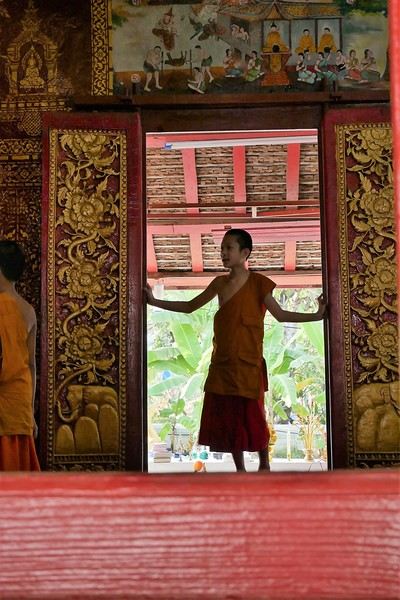 Come along, I'm taking you to this country where it's so nice to wander and slow down...
This trip was in 2023, but when I wanted to write my travel journal, VF was still closed to contributions... So, now that I've just finished my Japan travel journal here, I figured it was high time to honor this destination we came back from so enchanted. Disclaimer 1: This is a written travel journal. There’ll be text! Too much, for some! Disclaimer 2: This is an illustrated travel journal. There’ll be photos! Too many, for some!
I have to say, every time I try to discipline myself, to keep it shorter, to include fewer photos... I end up adding more. It feels like my dear Aunt Nicole, who exhausted us with her slide-show evenings in the 70s/80s, decided to take her revenge. The upside for you, readers, is that you can slip away anytime without offending Aunt Nicole. I won’t even notice!
Anyway, since I love maps, here’s one to give you an idea of where I’m taking you. As you can see, we only saw a tiny part of Laos (the areas circled in red); we only had 3 weeks for ourselves (my husband’s newly retired, I still work), and we prefer taking our time over rushing around like crazy.
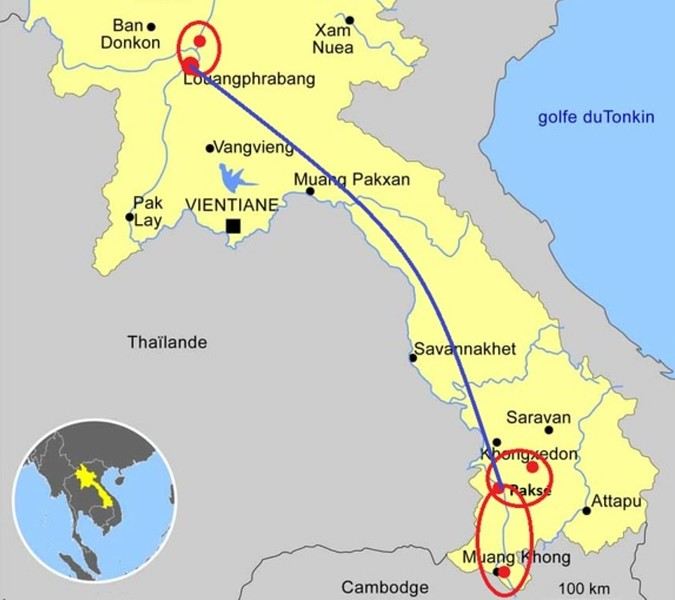
In broad strokes, it was very classic:
First, we “settled in” at Luang Prabang (8 days), because we wanted and needed to. From there, we took three days to venture a little further north—not far in kilometers, but as we know, distances aren’t just about km! Then we flew south to Paksé, letting ourselves drift down to the 4,000 Islands while stopping by the pre-Angkorian archaeological sites. We wrapped up with the Bolaven Plateau.
A few practical notes: We arrived via Bangkok, then took a Bangkok-Luang Prabang flight, having picked up our luggage in Bangkok to check it in for Luang Prabang. No issues—the Bangkok airport, which many of you know, is very well organized. We got our visas on arrival in Luang Prabang. Quick, but to be fair, we were on a “small” plane, and the big flights had arrived earlier, so we weren’t too crowded in line! At the end of our trip, we didn’t fly out of Paksé but from the nearby airport in Thailand, Ubon Ratchathani (a 2.5-hour drive from Paksé), then Bangkok and Paris. You’ll notice we skipped Vientiane to stay longer in Luang Prabang. That said, there’s now a high-speed train between Vientiane and Luang Prabang—good to know—and soon the (Chinese) train will go all the way to Bangkok and even Kuala Lumpur!
With that intro out of the way, let’s dive into the heart of the matter. To be continued: Slowing down the pace... in Luang Prabang
Tips for traveling on a budget in Albania?
Hi everyone,
We’re a young couple planning our first trip to Albania from June 23, 2026, to July 2, 2026. We have a pretty tight budget and want to make the most of this amazing country without breaking the bank.
We’re looking for all the advice you can give to help us plan our stay:
* What are the must-see places to visit? * Which cities or villages are really worth the detour? * What natural sites, hikes, canyons, springs, or viewpoints do you recommend? * Do you know of any free, uncrowded, or particularly beautiful beaches? * Where can we responsibly observe or swim with sea turtles? * What are the most beautiful beaches on the Albanian Riviera that are accessible on a small budget? * What budget-friendly accommodations (hotels, hostels, homestays, campgrounds) do you recommend? * What are the best ways to get around between different regions at a low cost? * Do you know of any reliable and affordable agencies for renting a vehicle (car, scooter, or motorcycle)? What are the average rates at the end of June, and which rental companies do you recommend or advise against? * Is it better to rent a vehicle right when we arrive or stick to local buses and minibuses to keep costs down? * Which restaurants or local specialties offer the best value for money? * Are there any free or low-cost activities we shouldn’t miss? * Which places do you think are overrated or can be skipped when you’re short on time and money? * What practical tips would you have wished you knew before your first trip to Albania?
We’d also love any 10-day itineraries that you particularly enjoyed, along with your budget estimates for accommodation, meals, and transportation.
We’re open to off-the-beaten-path spots and local tips. If you have any secret addresses, hidden beaches, favorite accommodations, or mistakes to avoid, we’d love to hear about them! 😊
We’re a young couple planning our first trip to Albania from June 23, 2026, to July 2, 2026. We have a pretty tight budget and want to make the most of this amazing country without breaking the bank.
We’re looking for all the advice you can give to help us plan our stay:
* What are the must-see places to visit? * Which cities or villages are really worth the detour? * What natural sites, hikes, canyons, springs, or viewpoints do you recommend? * Do you know of any free, uncrowded, or particularly beautiful beaches? * Where can we responsibly observe or swim with sea turtles? * What are the most beautiful beaches on the Albanian Riviera that are accessible on a small budget? * What budget-friendly accommodations (hotels, hostels, homestays, campgrounds) do you recommend? * What are the best ways to get around between different regions at a low cost? * Do you know of any reliable and affordable agencies for renting a vehicle (car, scooter, or motorcycle)? What are the average rates at the end of June, and which rental companies do you recommend or advise against? * Is it better to rent a vehicle right when we arrive or stick to local buses and minibuses to keep costs down? * Which restaurants or local specialties offer the best value for money? * Are there any free or low-cost activities we shouldn’t miss? * Which places do you think are overrated or can be skipped when you’re short on time and money? * What practical tips would you have wished you knew before your first trip to Albania?
We’d also love any 10-day itineraries that you particularly enjoyed, along with your budget estimates for accommodation, meals, and transportation.
We’re open to off-the-beaten-path spots and local tips. If you have any secret addresses, hidden beaches, favorite accommodations, or mistakes to avoid, we’d love to hear about them! 😊
Ideas for a one-week Andalusia itinerary
Hi everyone,
I’m sharing my draft itinerary with you because I just booked our flight tickets, and I feel like it’s quite late in the season. So, I’d like to be sure about my stops before reserving the hotels. I’ll be traveling alone with my two adult children. We want to prioritize outdoor walks, avoid too many indoor visits (both for budget and preference), and not spend too much time on the road.
D1: Arrival at 9 AM in Malaga, day in Malaga and overnight stay D2: Head straight to Nerja (1-hour drive) and spend the night there D3: Head straight to Granada (1.5-hour drive), spend the day and night there D4: Granada. Visit the Alhambra (Nasrid Palaces tour at 5 PM) and spend the night D5: Head to Ronda (2.5-hour drive) and spend the night D6: White Villages and overnight in Ronda D7: Head straight to the Costa del Sol (e.g., Estepona), spend the day and night there D8: Return to Malaga to catch our flight
There you go! This itinerary takes into account that we’d like to do a circuit starting from Seville in a few years. That said, it’d be a shame to miss something doable from Malaga.
Questions: Since the Alhambra visit is only at 5 PM, and we’d already have the day to explore Granada, would arriving the day before be a mistake? Or should we skip this day and dedicate it elsewhere (Costa del Sol? Head toward Tabernas?)? The old town appeals to me, but maybe the Sacromonte neighborhood isn’t essential... Same question for Ronda: should we dedicate a full day to it, or combine Ronda and the White Villages in one day? Note that we love wandering around villages outside, so that might answer my question! :)
Final question: Is it better to rent the car at Malaga Airport or in the city? If we rent at the airport, we’d need a hotel with parking, which doesn’t seem easy. Or stay outside the city and park for free near the center if possible? I’ve read comments about taking a taxi to Malaga and then picking up the rental car at the airport the next morning. The taxi would really need to be affordable...
Thanks so much for your feedback and suggestions for visits during this little circuit. Have a great day, everyone! Christine
D1: Arrival at 9 AM in Malaga, day in Malaga and overnight stay D2: Head straight to Nerja (1-hour drive) and spend the night there D3: Head straight to Granada (1.5-hour drive), spend the day and night there D4: Granada. Visit the Alhambra (Nasrid Palaces tour at 5 PM) and spend the night D5: Head to Ronda (2.5-hour drive) and spend the night D6: White Villages and overnight in Ronda D7: Head straight to the Costa del Sol (e.g., Estepona), spend the day and night there D8: Return to Malaga to catch our flight
There you go! This itinerary takes into account that we’d like to do a circuit starting from Seville in a few years. That said, it’d be a shame to miss something doable from Malaga.
Questions: Since the Alhambra visit is only at 5 PM, and we’d already have the day to explore Granada, would arriving the day before be a mistake? Or should we skip this day and dedicate it elsewhere (Costa del Sol? Head toward Tabernas?)? The old town appeals to me, but maybe the Sacromonte neighborhood isn’t essential... Same question for Ronda: should we dedicate a full day to it, or combine Ronda and the White Villages in one day? Note that we love wandering around villages outside, so that might answer my question! :)
Final question: Is it better to rent the car at Malaga Airport or in the city? If we rent at the airport, we’d need a hotel with parking, which doesn’t seem easy. Or stay outside the city and park for free near the center if possible? I’ve read comments about taking a taxi to Malaga and then picking up the rental car at the airport the next morning. The taxi would really need to be affordable...
Thanks so much for your feedback and suggestions for visits during this little circuit. Have a great day, everyone! Christine
Havana, Cuba / January 2026
I got into music with the will
To light up many hearths like Che could do,
To circulate ideas, to advance utopia
Alternating barricades, sharp thought, and poetry.
Mc Solaar, Guérilla
Subscribing without a fight to the slightest line of my itinerary sometimes feels like an illusion. Because there are countries where, despite the fever and enthusiasm, despite the triumphant revolution, certain elements block my path. And if I had planned, for F. and me, a beautiful ascent up Tabouret Hill (Loma del Taburete, 453m), it was without accounting for vegetation as dense as it was thorny, which barred our way after just a few quarters of an hour of walking. Exhausted, I had to face the facts: we wouldn’t go any further. I needed to come up with some kind of Plan B.
But what is this country, an unwitting laboratory of the worst that white civilization has done during its reign? What is this magnificent place—yet another—entrusted to the care of oblivion, just 150 km from the land of freedom? According to Donald Trump, a country supporting terrorism; according to the locals, the vast battlefield of 20th-century ideologies; according to the average tourist, a hot country, a beautiful country, a country where the last illusions of a lost paradise are dying.
On the other side of Havana Bay, we love that statue of Christ blessing the city. There’s something gentle, soothing, in that patriarchal gesture. You’d almost be tempted to forget that at the dawn of the 16th century, those who claimed to represent the Church had no scruples about eradicating the Ciboney and Taíno populations. Worse, you’ll find magnificent this cathedral dedicated to the Virgin Mary, right in the heart of the old city. Under the guise of a civilizing necessity, Havana became, like so many other places, the gilded seat of European pretensions, at the expense of local populations doomed to extermination, then enslaved populations—more or less indigenous—who, you can imagine, didn’t often set foot in this holy place.
Lost in my thoughts, I try to push through this tangled vegetation. Nature reclaims its rights; nature abhors a vacuum. Yes, the well-trodden path of revolution couldn’t stay free of weeds! The road is buried. We give up and turn back, until that fork I’d noted before leaving, which would let us reach the top of the hill by skirting its northern slope.
So the white man arrives, settles, and gets rid of everything that bothers him. He has two unstoppable forces at his disposal: gunpowder and the spiritual certainty of being on the side of an all-powerful god. While the first gives him an unmatched material advantage over his new enemy, the second lets him use the first without feeling too guilty. That’s the magic of this supreme Church: it condemns all forms of pleasure—calling them impurity—while promoting plunder and crime under the cover of evangelization.
Walking through the city, you find a bit of Algiers, except that here, the decay is almost irreversible. You feel the splendor of the past, a disconcerting image of all vanity, from an era when men knew how to build beauty—especially if they didn’t have to share it. We’ll debate the benefits of colonialism for a long time, while glossing over the fact that those benefits often stopped at the city limits, limits all too obvious to the indigenous people. Havana isn’t just one or a few buildings; it’s an impressive collection of works of art built one after another, in what I think was a spirit of healthy competition. Yes, you find Algiers in this exuberance. As if these distant cities were the receptacle of everything that was best in the lands of origin. Atlantes and lintels, golds, blues, ogives, and monumental windows—exceptional architecture in an exceptional place.
Some streets are clean, swept with care; others are not, scattered here and there with potholes filled with water. A rather persistent smell of urine invades us regularly. We move on. And we look up: Havana is visited with your nose in the air. Because the beauty is truly up there, on those magnificent balconies and terracotta arches. Also because it’s not impossible that a piece of that balcony might suddenly detach, hurling our ends into an overseas tragedy we’d rather avoid. On the ground, here and there, rubble. Inexorably, this city is returning to dust.
My Plan B turns out to be no more successful than the first attempt. After a cheerful progression of a few hundred meters, same outcome, same struggle—the vegetation opposes any revolution: impossible to go around the hill! Once again, we have to turn back. We’ll try Plan C. I reassure myself by convincing myself to stay in the logic of this country: Cuba has been searching for itself for five centuries.
Coffee, tobacco, and sugarcane—the green gold of the colonies—so that money could flow and Europe could enjoy itself. Cuba’s history isn’t original. In reality, all the hot lands at these latitudes suffer the same fate: to serve the white man. While waiting for the awakening of consciences, UN Resolution 1514 and more or less affirmed revolutionary desires. Except that—and this reflection is just my own—if the awakening of consciences and the revolutionary will don’t play into what Resolution 1514 hides, there’s a good chance the said state will become a pariah. Those who don’t follow the American doctrine risk a lot; those who decide to follow Moscow risk everything. Independence was only the barely discreet instrument of American views. Patrice Lumumba will gladly enlighten us on the subject.
Turning back is good. Setting up Plan C is better. I won’t deviate from my goal: we will reach the top of Tabouret, whatever the cost! Near a small country road, I hesitate to change the program. Time is ticking—is it really reasonable to attempt the ascent? Then a tricycle taxi appears, a kind of tuk-tuk powered by an electric moped. I take it as a sign from fate, and we board for the starting point of Plan C.
In Cuba, even before Resolution 1514, independence was assured by a pawn of the United States, Fulgencio Batista. There’s no need to go over the whole history here; we’ll just remember that if you know how to give without counting to your former masters, you can enjoy a facade of freedom. Fidel Castro, on the other hand, didn’t know how to give. It never even occurred to him. That’s why the United States harbors such terrible hatred for this rebellious state, opposed to capitalist values and political prostitution. From there to slowly killing its people for nearly seventy years, one can legitimately cry injustice. But there are other priorities. Oh yes! Greenland...
Do Cubans eat their fill? Does seeing overweight people mean opulence? Food grows, no doubt about it. The soil is fertile, the climate favorable. No, what shocks here is the absolute precarity, the feeling of a people living in survival mode, and the decay of both goods and hope. Where to go? What’s the point? The stubbornness of the United States in wanting to impose its views on the Cuban government is felt much more by an overwhelmed people than by those few elites—caricatures of communism—who instill their vision of happiness with a crowbar. The embargo imposed in 1960; the false-flag attacks—American planes flying the colors of the Cuban revolution during the Bay of Pigs invasion in 1961—the exasperation of placing Cuba on the list of countries supporting terrorism. More recently, Donald Trump decided to heavily tax countries supplying Cuba with fuel. The last time I saw such long lines near gas stations was during my first trip to Romania... in 1991. It’s not for me to judge whether Raúl and his clique are playing fair by thumbing their noses at the West. I don’t hold the ins and outs of this war of egos that keeps the world’s great powers awake. I only caught a glimpse of the poverty of an island in 2026, while we in Europe are buried under an avalanche of the useless and superficial.
At the start of the San Juan baths, we find the trailhead. It climbs steeply. But the weather is relatively mild, thanks to a cold wave hitting higher up in the United States. Dallas is under snow; we’re walking in 16°C, a stroke of luck. We climb over rocks, under fairly decent vegetation, sometimes low but passable. And we succeed in the ascent in an hour. Up there, the top of the hill is somewhat maintained, at a minimum, but maintained, as if to honor Che through an awful monument erected in his glory—a stubborn specimen from those years when good taste was inversely proportional to the delusional ideas of those being honored. Birds of prey (raptors?) circle overhead; the monument is dying, crumbling, falling into ruin. *Hasta siempre*—forever—will be for the words. Nature, erosion, life itself will have the last word over all revolutions.
Back at the foot of the hill, just before a memorable swim, we talk with a family living there in miserable shacks whose stability wasn’t unlike that of the Leaning Tower of Pisa. The grandmother holds an animal, a rodent, by its feet. The grandfather has just killed it; she’s plucking its fur. A few steps away, water boils in a pot. She plunges the beast into the container. Tonight, the family will eat ragondin stew. Further on, another shack where, in a disorder rivaling the filth, a mother breastfeeds while sitting on the edge of a bed. Then, on the way down, we’ll meet a middle-aged man carrying a large jerrycan of water on his shoulder. Are these people happy here, far from the cities and their stakes? Is it too much to ask that they at least have access to electricity, running water, and decent, safe housing?
Outside the old city, Havana reveals wide avenues serving imposing institutions here and there. But whether in the colorful alleys of the old town or on the majestic and austere Plaza de la Revolución, the same feeling moves me: sadness. Seeing that only chaos has come from ideas crushes me. We praise, we sing the revolution—above all, we impose it in people’s minds as a necessity, when it’s nothing of the sort. Revolution is just the fruit of a few tortured minds who, once in power, do nothing better than all those before them. Enjoy power. Impose their views. It’s just a matter of color. Fidel saw red and knew how to persuade—or silence forever—his many detractors. The West sees everything in white, through the prism of human rights, and also knows how to persuade and silence its slightest detractors forever.
Paradoxically, Cuba survives largely thanks to tourism, a key element—let’s not be afraid to say it—of capitalism. And when a few players pick up the crumbs from transactions, the lion’s share and the foreign currency go to the government. So we won’t go to Varadero, the high place of relaxation overrun by Canadians. Instead, we’ll limit ourselves to crossing the ocean 30 minutes from the capital, at Santa María del Mar, to get an idea of cheaper tourism and to splash around for a few minutes in turquoise water invaded by sargassum. At the heart of the tourist season, we’ll meet few people. Like Havana, and according to its inhabitants, the high season is rather dead. But we won’t have come for nothing: we particularly love this return where, feverish, the taxi driver pushes his Moskvitch 2140 to the max on the highway, singing karaoke versions of hits at the top of his lungs from an onboard DVD player. East/West, the culture clash with a hint of Latino.
It’s time to leave this country of resourcefulness where extremes are very present. We’re leaving a 5-star hotel in front of yet another crumbling building. We’ve known restaurants at 40,000 pesos while in the street people eat for 400. We’ve seen those countless cars from another era and another culture—Pontiac, Lada, Chevrolet, Moskvitch—being overtaken by gleaming Mercedes and other Porsche Cayennes, the prerogative—if it still needed to be demonstrated—of the newly rich in search of recognition. Boarding the plane, we also understand that we’re not just traveling with tourists: there’s undoubtedly a rich and prosperous diaspora, just as there are relatively wealthy Cubans—well, wealthy enough to travel comfortably in the front of the aircraft. Meanwhile, on all the country’s roads, other Cubans try hitchhiking, their wives and children perched on a suitcase by the roadside. The father holds out his arm and holds a few bills in his hand like a card game. Where are they going? Who will pick them up?
Behind me, the gold of the Capitol. I’m told this gold comes from Russia. Like Marx and Lenin’s smoky theories? Like Stalin’s subtle and delicate paternalism? Let’s bet that, like the other buildings crumbling around it, the Capitol will also collapse one day, to avenge the Indians who perished from the diseases and guns of the whites, to avenge the Africans who obliterated their lives so Europeans could enjoy themselves, finally, to avenge all this abandoned people, left to the arbitrariness of democratic or non-democratic elections.
A sign in the street: We understand history. This is the revolution! We understand history. That’s the revolution.
No comment.
Subscribing without a fight to the slightest line of my itinerary sometimes feels like an illusion. Because there are countries where, despite the fever and enthusiasm, despite the triumphant revolution, certain elements block my path. And if I had planned, for F. and me, a beautiful ascent up Tabouret Hill (Loma del Taburete, 453m), it was without accounting for vegetation as dense as it was thorny, which barred our way after just a few quarters of an hour of walking. Exhausted, I had to face the facts: we wouldn’t go any further. I needed to come up with some kind of Plan B.
But what is this country, an unwitting laboratory of the worst that white civilization has done during its reign? What is this magnificent place—yet another—entrusted to the care of oblivion, just 150 km from the land of freedom? According to Donald Trump, a country supporting terrorism; according to the locals, the vast battlefield of 20th-century ideologies; according to the average tourist, a hot country, a beautiful country, a country where the last illusions of a lost paradise are dying.
On the other side of Havana Bay, we love that statue of Christ blessing the city. There’s something gentle, soothing, in that patriarchal gesture. You’d almost be tempted to forget that at the dawn of the 16th century, those who claimed to represent the Church had no scruples about eradicating the Ciboney and Taíno populations. Worse, you’ll find magnificent this cathedral dedicated to the Virgin Mary, right in the heart of the old city. Under the guise of a civilizing necessity, Havana became, like so many other places, the gilded seat of European pretensions, at the expense of local populations doomed to extermination, then enslaved populations—more or less indigenous—who, you can imagine, didn’t often set foot in this holy place.
Lost in my thoughts, I try to push through this tangled vegetation. Nature reclaims its rights; nature abhors a vacuum. Yes, the well-trodden path of revolution couldn’t stay free of weeds! The road is buried. We give up and turn back, until that fork I’d noted before leaving, which would let us reach the top of the hill by skirting its northern slope.
So the white man arrives, settles, and gets rid of everything that bothers him. He has two unstoppable forces at his disposal: gunpowder and the spiritual certainty of being on the side of an all-powerful god. While the first gives him an unmatched material advantage over his new enemy, the second lets him use the first without feeling too guilty. That’s the magic of this supreme Church: it condemns all forms of pleasure—calling them impurity—while promoting plunder and crime under the cover of evangelization.
Walking through the city, you find a bit of Algiers, except that here, the decay is almost irreversible. You feel the splendor of the past, a disconcerting image of all vanity, from an era when men knew how to build beauty—especially if they didn’t have to share it. We’ll debate the benefits of colonialism for a long time, while glossing over the fact that those benefits often stopped at the city limits, limits all too obvious to the indigenous people. Havana isn’t just one or a few buildings; it’s an impressive collection of works of art built one after another, in what I think was a spirit of healthy competition. Yes, you find Algiers in this exuberance. As if these distant cities were the receptacle of everything that was best in the lands of origin. Atlantes and lintels, golds, blues, ogives, and monumental windows—exceptional architecture in an exceptional place.
Some streets are clean, swept with care; others are not, scattered here and there with potholes filled with water. A rather persistent smell of urine invades us regularly. We move on. And we look up: Havana is visited with your nose in the air. Because the beauty is truly up there, on those magnificent balconies and terracotta arches. Also because it’s not impossible that a piece of that balcony might suddenly detach, hurling our ends into an overseas tragedy we’d rather avoid. On the ground, here and there, rubble. Inexorably, this city is returning to dust.
My Plan B turns out to be no more successful than the first attempt. After a cheerful progression of a few hundred meters, same outcome, same struggle—the vegetation opposes any revolution: impossible to go around the hill! Once again, we have to turn back. We’ll try Plan C. I reassure myself by convincing myself to stay in the logic of this country: Cuba has been searching for itself for five centuries.
Coffee, tobacco, and sugarcane—the green gold of the colonies—so that money could flow and Europe could enjoy itself. Cuba’s history isn’t original. In reality, all the hot lands at these latitudes suffer the same fate: to serve the white man. While waiting for the awakening of consciences, UN Resolution 1514 and more or less affirmed revolutionary desires. Except that—and this reflection is just my own—if the awakening of consciences and the revolutionary will don’t play into what Resolution 1514 hides, there’s a good chance the said state will become a pariah. Those who don’t follow the American doctrine risk a lot; those who decide to follow Moscow risk everything. Independence was only the barely discreet instrument of American views. Patrice Lumumba will gladly enlighten us on the subject.
Turning back is good. Setting up Plan C is better. I won’t deviate from my goal: we will reach the top of Tabouret, whatever the cost! Near a small country road, I hesitate to change the program. Time is ticking—is it really reasonable to attempt the ascent? Then a tricycle taxi appears, a kind of tuk-tuk powered by an electric moped. I take it as a sign from fate, and we board for the starting point of Plan C.
In Cuba, even before Resolution 1514, independence was assured by a pawn of the United States, Fulgencio Batista. There’s no need to go over the whole history here; we’ll just remember that if you know how to give without counting to your former masters, you can enjoy a facade of freedom. Fidel Castro, on the other hand, didn’t know how to give. It never even occurred to him. That’s why the United States harbors such terrible hatred for this rebellious state, opposed to capitalist values and political prostitution. From there to slowly killing its people for nearly seventy years, one can legitimately cry injustice. But there are other priorities. Oh yes! Greenland...
Do Cubans eat their fill? Does seeing overweight people mean opulence? Food grows, no doubt about it. The soil is fertile, the climate favorable. No, what shocks here is the absolute precarity, the feeling of a people living in survival mode, and the decay of both goods and hope. Where to go? What’s the point? The stubbornness of the United States in wanting to impose its views on the Cuban government is felt much more by an overwhelmed people than by those few elites—caricatures of communism—who instill their vision of happiness with a crowbar. The embargo imposed in 1960; the false-flag attacks—American planes flying the colors of the Cuban revolution during the Bay of Pigs invasion in 1961—the exasperation of placing Cuba on the list of countries supporting terrorism. More recently, Donald Trump decided to heavily tax countries supplying Cuba with fuel. The last time I saw such long lines near gas stations was during my first trip to Romania... in 1991. It’s not for me to judge whether Raúl and his clique are playing fair by thumbing their noses at the West. I don’t hold the ins and outs of this war of egos that keeps the world’s great powers awake. I only caught a glimpse of the poverty of an island in 2026, while we in Europe are buried under an avalanche of the useless and superficial.
At the start of the San Juan baths, we find the trailhead. It climbs steeply. But the weather is relatively mild, thanks to a cold wave hitting higher up in the United States. Dallas is under snow; we’re walking in 16°C, a stroke of luck. We climb over rocks, under fairly decent vegetation, sometimes low but passable. And we succeed in the ascent in an hour. Up there, the top of the hill is somewhat maintained, at a minimum, but maintained, as if to honor Che through an awful monument erected in his glory—a stubborn specimen from those years when good taste was inversely proportional to the delusional ideas of those being honored. Birds of prey (raptors?) circle overhead; the monument is dying, crumbling, falling into ruin. *Hasta siempre*—forever—will be for the words. Nature, erosion, life itself will have the last word over all revolutions.
Back at the foot of the hill, just before a memorable swim, we talk with a family living there in miserable shacks whose stability wasn’t unlike that of the Leaning Tower of Pisa. The grandmother holds an animal, a rodent, by its feet. The grandfather has just killed it; she’s plucking its fur. A few steps away, water boils in a pot. She plunges the beast into the container. Tonight, the family will eat ragondin stew. Further on, another shack where, in a disorder rivaling the filth, a mother breastfeeds while sitting on the edge of a bed. Then, on the way down, we’ll meet a middle-aged man carrying a large jerrycan of water on his shoulder. Are these people happy here, far from the cities and their stakes? Is it too much to ask that they at least have access to electricity, running water, and decent, safe housing?
Outside the old city, Havana reveals wide avenues serving imposing institutions here and there. But whether in the colorful alleys of the old town or on the majestic and austere Plaza de la Revolución, the same feeling moves me: sadness. Seeing that only chaos has come from ideas crushes me. We praise, we sing the revolution—above all, we impose it in people’s minds as a necessity, when it’s nothing of the sort. Revolution is just the fruit of a few tortured minds who, once in power, do nothing better than all those before them. Enjoy power. Impose their views. It’s just a matter of color. Fidel saw red and knew how to persuade—or silence forever—his many detractors. The West sees everything in white, through the prism of human rights, and also knows how to persuade and silence its slightest detractors forever.
Paradoxically, Cuba survives largely thanks to tourism, a key element—let’s not be afraid to say it—of capitalism. And when a few players pick up the crumbs from transactions, the lion’s share and the foreign currency go to the government. So we won’t go to Varadero, the high place of relaxation overrun by Canadians. Instead, we’ll limit ourselves to crossing the ocean 30 minutes from the capital, at Santa María del Mar, to get an idea of cheaper tourism and to splash around for a few minutes in turquoise water invaded by sargassum. At the heart of the tourist season, we’ll meet few people. Like Havana, and according to its inhabitants, the high season is rather dead. But we won’t have come for nothing: we particularly love this return where, feverish, the taxi driver pushes his Moskvitch 2140 to the max on the highway, singing karaoke versions of hits at the top of his lungs from an onboard DVD player. East/West, the culture clash with a hint of Latino.
It’s time to leave this country of resourcefulness where extremes are very present. We’re leaving a 5-star hotel in front of yet another crumbling building. We’ve known restaurants at 40,000 pesos while in the street people eat for 400. We’ve seen those countless cars from another era and another culture—Pontiac, Lada, Chevrolet, Moskvitch—being overtaken by gleaming Mercedes and other Porsche Cayennes, the prerogative—if it still needed to be demonstrated—of the newly rich in search of recognition. Boarding the plane, we also understand that we’re not just traveling with tourists: there’s undoubtedly a rich and prosperous diaspora, just as there are relatively wealthy Cubans—well, wealthy enough to travel comfortably in the front of the aircraft. Meanwhile, on all the country’s roads, other Cubans try hitchhiking, their wives and children perched on a suitcase by the roadside. The father holds out his arm and holds a few bills in his hand like a card game. Where are they going? Who will pick them up?
Behind me, the gold of the Capitol. I’m told this gold comes from Russia. Like Marx and Lenin’s smoky theories? Like Stalin’s subtle and delicate paternalism? Let’s bet that, like the other buildings crumbling around it, the Capitol will also collapse one day, to avenge the Indians who perished from the diseases and guns of the whites, to avenge the Africans who obliterated their lives so Europeans could enjoy themselves, finally, to avenge all this abandoned people, left to the arbitrariness of democratic or non-democratic elections.
A sign in the street: We understand history. This is the revolution! We understand history. That’s the revolution.
No comment.
Nepal Feedback
NAMASTE NEPAL! PRACTICAL INFO AND EXPERIENCE FEEDBACK
Stay from March 25 to April 16, 2025
· Flight tickets Air India (via Delhi) (via Skyscanner) = 1130 € per person · Planned budget (and respected without too many restrictions and while buying a few small gifts) = 2000 € for the stay for two. Buses, taxis, and entrance fees to various sites represent a budget to consider. Meals are cheap. Drinks like beer/Coke, however, are not cheap and cost the equivalent of a meal. · Exchange rate of the rupee during our stay = 0.0064 € (the exchange rate is almost identical everywhere, including at the airport). · At the airport, purchase of two SIM cards (phone) = 1000 NPR x 2 for 28 days. · Kathmandu: we had booked the hotel upon arrival: Kathmandu Boutique Hotel (+977 015 357 446 – email: booking@kathmanduboutiquehotel.com), very well located in a quiet alley off the street, south of Thamel, a 10-minute walk from Durbar Square. A hotel like Nepal knows how to do, where tall people will have to duck. Night + breakfast = 18 € for two. Very warm welcome, great location, excellent value for money. · Bhaktapur: we had also booked a hotel for the end of our stay because the chance of the year 2025 made the Nepali New Year and Bisket Jatra particularly festive in Bhaktapur: Manju Baha Hotel School (+977 976 7234014 – email: manjubahahotel@gmail.com) located in an old monastery. "A social enterprise transforming an old monastery into a charming hotel, offering professional hospitality training to underprivileged Nepali youth." Night + breakfast = 32 € for two. Beautifully decorated room. Very warm welcome. Don’t miss the Changunarayan site (near Bhaktapur), it’s amazing. And if you’re lucky enough to be in Bhaktapur in mid-April for 3 days, there’s the Bisket Jatra festivities (Newari festival), joyful, noisy, fun, and wild… · Pokhara (hotel recommended by the Kathmandu hotel): Hotel Green Tara, Lakeside, 10th street, set back, quiet (Tel. +977 61 462698 – email: greentara_67@hotmail.com) · Trek permit (Lower Mustang, no need for an agency or guide, permits checked at Ghasa and Jomsom) = 2000 NPR per person (2 ID photos) · Bus Kathmandu/Pokhara and return = 2000 NPR per person · Bus Pokhara/Jomsom, 2 one-way tickets = 2800 NPR. · Taxi: negotiation with a driver we recommend, Vicky (+977 984 075 599). You explain what you want, negotiate the price, and he waits for you during the visit. Very charming, we used him several times. For example: departure from our hotel at 10 AM -> Boudhanath/Pashupatinath/Patan return at 5 PM to the hotel = 6500 NPR – Swayambhunath (round trip) = 1200 NPR · Site prices: https://ntb.gov.np/plan-your-trip/before-you-come/heritage-site-entry-fees o Visitor Pass for Kathmandu Durbar Square (for the duration of the stay, show your visa) = 1000 NPR per person (1 ID photo) o Bhaktapur Durbar Square (old town) = 1800 NPR per person o Patan = 1000 NPR per person o Swayambhu Stupa = 200 NPR per person o Boudha Stupa = 200 NPR per person o Pashupatinath Temple = 1000 NPR per person (interesting to take a guide) o Changunarayan Temple (6 km north of Bhaktapur) = 400 NPR per person o Mountain Museum in Pokhara = 750 NPR per person · E-cigarettes: e-cigarettes are banned in India and confiscated whether they’re in carry-on or checked luggage. On the way there, we had kept them in our carry-on, they were confiscated in Delhi. On the way back, learning from our previous experience, we put them in our checked luggage. Someone came to get us to take them out of our bags and confiscate them… You can find e-cigarettes and products in Kathmandu.
* * *
I’m 74 years old. I went to Nepal in 1982, 1983, and the last time in 1986. I wanted to introduce this beautiful and endearing country to my husband, and it was… now or never. So we decided it was now.
I knew the trek starting from Pokhara: Naudanda/Birethanti/Ghorepani/Tatopani/Kalopani. There was no way I was going to do that trek, especially the 1000-meter staircase to reach Ghorepani… You have to stay humble with age.
Back then, the road didn’t exist. I didn’t consider, with the construction of this road (NH48) along the western bank of the Kali Gandaki, doing a trek along a windy and dusty road. Was there an alternative hiking trail on the eastern bank? No one answered my question on VoyageForum, so I did my research online. And I found this site: "Andrées de Ruiter and Prem Rai - Trekking the Annapurna Circuit, including the new NATT trails that avoid the road - A guide to one of the most beautiful trekking regions in Nepal and the world (2011) - NATT = New Annapurna Trekking Trail".
Phew! A solution was emerging. This circuit from 2011 wasn’t fully marked. The idea was to go from Jomsom to Tatopani, so we needed to make sure the path was well-marked all the way, which we did, and the path exists, marked in red and white!
So, with the walking times information, we built our 8-day circuit:
· Jomsom/Thinigaon · Thinigaon/Chimang · Chimang/Saura · Saura/Kokhetanti · Rest day or, if in good shape: loop to Sekong Lake · Kokhetanti/Jhipra Deurali · Jhipra Deurali/Kopchepani · Kopchepani/Tatopani
It’s a senior trek, after all. So the walking times noted on the sites indicated 3 hours or even 4 hours for the two longest stages. That pace suited us fine.
On March 29, we left Kathmandu (1400m), after visiting the must-see sites, by bus to Pokhara: 200 km and 8.5 hours on a chaotic road under construction. I had a memory of Pokhara where it was the first city where you could see the Himalayan range, especially Machhapuchhare. But the pollution is such, the dust raised by traffic and construction, that no horizon is visible except the first hills around Pokhara.
We stayed 24 hours in Pokhara (820m), and on March 31, we left our luggage at the hotel and set off with our lightest backpacks: change of clothes, toiletries, first aid kit, anti-chafing cream, water bottle, sleeping bag liner, and light shoes for the stages.
We took the bus to Jomsom: 160 km/7.5 hours including stops for bathroom breaks, tea, and lunch. The road is nothing but a chaos of potholes, landslides, construction, dust, rebuilding, and mudslides. In Ghasa, the bus stops, and we’re told we’re at a checkpoint and that the two foreigners in the bus, my husband and I, need to have our permits checked, which takes a few minutes. The driving is rock-and-roll, surprising, and courteous. The drivers have their codes, and on these improbable roads, they’re virtuosos.
We could have chosen the plane, but several reasons dissuaded us: if there’s too much wind, the planes don’t take off; personally, I wasn’t reassured about landing in Jomsom, and this transport has a cost.
We arrived around 2 PM in Jomsom (2720m), and despite the early wake-up, the nearly 8 hours on the bus, and the altitude, we decided to head straight to Thinigaon (2840m). At the Jomsom checkpoint, they told us it was a 30-minute walk. Great! Except we took an hour and a half on an uphill road, bent over to fight a strong wind. But the Himalayan range is there! The Dhaulagiri, the Nilgiri, the Annapurnas as a reward.
In Thinigaon, we found a room at the "Nilgiri View Hotel" run by a didi (big sister in Nepali). From the lodge’s roof, she proudly showed us the different peaks surrounding the village and told us, worried, that it hadn’t snowed here for 3 years. She said there are very few tourists, that the season is rather in September/October/November. It seems there’s not a soul in this village, yet mules pass through the narrow street paved with large flat stones, their bells ringing. We dine at 6 PM and go to bed… Room = 1200 NPR and dinner, breakfast, and drinks = 2560 NPR.
On April 1, we set off at 9 AM, not for Chimang as planned but for Marpha! The didi from the Thinigaon lodge had said it was a 3-hour walk. The first part of this stage is attractive, the mountains are magnificent and imposing, the landscape is superb, there’s no one around, a feeling of being "alone in the world." We follow Dhumbra Tal, this small green lake. The path is a rocky track that climbs steeply. Then, around a hill, we start the big descent that joins the Kali Gandaki. We face the wind head-on, and the violent gusts take our breath away, throw us off balance, and envelop us in dust. We see the road on the other side of the Kali Gandaki. We arrive in the village of Chhairo at 2 PM, completely exhausted and with blistered feet, after 5 hours of walking instead of the planned 3.5 hours.
We’re welcomed by the village nurse, who tells us there’s a lodge in the village. Chhairo is a Tibetan village, a 20-minute walk from Marpha (according to the locals, multiply by 2 or even 3 for us…). We’re going to revise our trek plan and, first of all, spend the night in Chhairo.
The lodge is quite pleasant, and Karma, the hostess, is very friendly. She asks about our plans and suggests we stay in Chhairo the next day, from where we can visit Marpha and also Chimang, a 1-hour walk away, in light mode, meaning without backpacks. She invites us to participate in a village ceremony the next evening.
We immediately accept the proposal, as our feet need rest and the welcome is so warm… Dinner and bed!
We reworked our trek plan, which was too ambitious for our untrained bodies and, let’s face it… no longer in our first youth. In the initial plan, we thought there wouldn’t be too much elevation gain following the Kali Gandaki, but checking the map, we realize there might be significant elevation changes between Sauru and Sirkung. So we plan:
· Tomorrow: visit Marpha (2670m) and Chimang (2744m) · April 3: bus from Chhairo (2700m) to Kalopani (2530m) and continue on foot to Ghasa (2010m) · April 4: Ghasa/Pairataplo (1940m) · April 5: Pairatapla/Gadpar (1580m) · April 6: Gadpar/Narchyang (1510m) · April 7: Narchyang/Tatopani (1190m) · April 8: return to Pokhara.
Normally, it’s all downhill…
April 2, a rest day then… We set off in the morning to explore Marpha. We have to take a temporary bridge because the suspension bridge is closed due to road construction. We join the road and arrive in Marpha, a village famous for its apple orchards, brandy, cider, and apple juice production. This village is magnificent with its stone houses and monastery clinging to the hillside. The road construction spared it. There are people, but very few Western tourists.
We have lunch in Marpha and go back through Chhairo to take the path to Chimang. We cross a fragrant pine forest and find the rocky path; the landscape is splendid. We walk quietly, passing peaceful buffaloes and cows, and arrive at the foot of a stone staircase… 275 steps (which we counted on the way back) leading us to the village of Chimang. Chimang is an isolated Newari village that seems a bit desolate. Despite the slopes, there are crops on every little bit of land. Thankfully, we changed our initial program because there’s no lodge in this village, contrary to what we saw on a map… We wander through the village, which seems very deserted, have coffee in a house from another world, and then head back to Chhairo.
A rest day? = 5 hours of walking!!
Dinner and village ceremony. From what we understand, this ceremony is in honor of the Dalai Lama. Men, women, and children in traditional costumes gather twice a month; they dance, make, and offer small sweet cakes with Tibetan tea (made from tea, yak butter—often rancid—water, and salt). Surprising for first-timers…
Around 10 PM, we leave the ceremony; tomorrow morning, we need to be on the roadside by 7 AM to catch the bus to Kalopani…
This village of Chhairo is very pleasant and welcoming, no tourists, just two motorcyclists who arrived in the evening, one of whom participated in the ceremony and discreetly poured his Tibetan tea outside.
Lodge: "Norsang Tibetan Guesthouse and Restaurant". Total bill for 2 nights, 2 dinners, 2 breakfasts, and drinks = 8000 NPR.
April 3: bus from Chhairo to Kalopani, about 1.5 hours for the 20 km (200 NPR per person). We descend on the right bank of the Kali Gandaki. We find the red and white markings to resume the trek toward Ghasa. We’re in a fragrant pine forest, the Dhaulagiri on one side and the Annapurnas on the other, magnificent, and the path is pleasant and easy. We get a bit lost in this forest, always looking for the markings. Near Lete, two trekkers pass us, and we meet them again a little further on with two very young children, to whom we give the 2 hard-boiled eggs I didn’t eat this morning. They accepted them without hesitation.
We arrive in a village and ask for directions to Ghasa. The young girls point the way. But we come across a forest being logged, trees cut in all directions. We turn back and ask for confirmation. They confirm… But the two young girls catch up with us and clear the way. We have to step over, go around, and cross the felled trees, with no indication at all. Through this pick-up sticks of felled trees, the girls lead us to the top of a stone staircase, indicating that was the path. It’s the only place where we saw rhododendrons in bloom.
We descend the staircase. At the bottom, to the left, there’s a bridge to go toward Choyo, and to the right, a path to Ghasa. We take the right path and join the road. We should normally find the red and white markings, but we don’t… So we continue on the western bank road of the Kali Gandaki.
A little before the village of Misi, we see fumaroles on the opposite bank that seem to come from the ground. We don’t understand. We stopped to eat in the village of Misi (noodle soup = 600 NPR), but it’s hard to communicate with the elderly people running the guesthouse.
We continued on the road, not finding the marked path parallel to the road. Landslides, both on the left and right banks, seem to have taken over the marked routes. It’s a place where the Kali Gandaki gorge narrows, and on the opposite bank, the mountain smokes more and more, and we now hear the crackling of fire. Across from us, the mountain is burning… Our initial plan had us passing on that burning bank right now…
We arrive in Ghasa at 3:30 PM, a 6.5-hour stage but with a 1-hour stop at noon. We’re at the "Florida Guesthouse and Restaurant." From our room, we see the mountain smoking on the other side of the river, and at night, we see the flames. In this village, posters show Himalayan eagles and vultures that seem to be protected species. Indeed, we saw (and heard) 3 eagles circling today.
April 4 – Today, heading to Pairothapla or Kopchepani depending on our feet, accommodation options, and simply our desires.
No more smoke on the mountain this morning. It’s chilly, 7:45 AM, the sky is clear, just a smell of smoke outside.
Price of the lodge = 1000 NPR for the night + 3580 NPR for meals.
We cross Ghasa, which stretches over more than a kilometer. We have a drink at the last guesthouse in the village, and the didi, when she learns our destination, tells us to be careful because the villages we’re going to aren’t safe. Should we distribute our rupees in different pockets? Nah, we kept going.
At the exit of Ghasa, we find the red and white markings and take the suspension bridge to cross the boiling waters of the Kali Gandaki. The passage is impressive because the river is tumultuous. Lots of climbs and even more descents. We’re back on the eastern bank. It’s hot! On the narrow path, we meet a group of buffaloes. Who has the right of way? We decide to stick as close as possible to the rock wall and move forward calmly. The buffaloes look at us, chewing placidly, with no intention of jumping on us. Phew!
After a 5-hour stage (including stops), we arrive in Pairothapla, with hot feet and firm thighs, and decide we won’t go any further. It’s a good thing because there’s a lodge, the most basic so far, but with a great welcome. We have a meal and a short nap. The buffaloes we met on the way belong to this house. They come to drink at the fountain by the path.
Our host, very pleasant, doesn’t know what to do to please us and is very attentive. He wants to chat. He has two children, a 4-year-old girl and a 7-year-old boy. Where do they go to school? Do they go? He tells us that the fires in the mountain are caused by people, but for what reason? We won’t find out, but it’s illegal. From here, we can still see smoke rising in the distance. The wife is a bit less friendly. Corn kernels dry on a woven straw mat on the ground, and the mom sorts them.
From where we are, we overlook the valley and see the road under construction winding along the mountainside on the other bank.
Dinner on the terrace of the house overlooking the path, windbreaker and fleece on: dal bhat chicken for me and chicken curry for my husband: "organic" products, at least local production. There are small vegetable gardens everywhere with all sorts of vegetables.
April 5 – While we’re having breakfast on the terrace of our lodge, 5 porters, straps on their foreheads, heavily loaded, pass by on the path. A few minutes later, a group of 9 people appears. It must be said that since the beginning of our journey, we’ve met very few hikers. Two backpackers in Chhairo, the two hikers near Lete, two female hikers passed us before Pairothapla, a solo female hiker passed us…
The lodge in Pairothapla is called "Bimala Lodge & Thakali Kitchen" – Price for night + 4 meals + 2 breakfasts = 3000 NPR.
The descent toward the Kali Gandaki involves climbs whose steps we didn’t count. Clearly, the landslides on the mountain cause changes to the official ACAP trek marked in red and white, and the marking updates can’t keep up with the pace of these landslides. It’s almost always by chance that we find the markings. Fortunately, we can follow the power line that guides us somewhat.
Drink stop in Kopchepani, the legs are fine, but the feet don’t like being tightly enclosed. A group of trekkers with porters passes on the path. We met buffaloes that we kindly let pass; the path was wide enough, but it was a staircase going up, and we didn’t want to take any risks.
Across, a view of the magnificent Rupse Waterfall on the other bank of the Kali Gandaki, at the bottom, lots of vehicles and people.
Arrival in Gadpar after crossing a rather unwelcoming small village and cultivated gardens between dry stone walls, each better built than the last.
First lodge spotted, first lodge adopted to answer the call of our feet, and a very warm welcome from the owner. Since we hadn’t eaten at noon, we had Tibetan bread/jam. 6-hour stage including 1 hour of stops. Night + dinner + breakfast + drinks = 5060 NPR
April 6 – Today, heading to Narchyang.
For several days, we’ve seen banana trees with their bunches of fruit and even a prickly pear with large fruits ripening.
This stage is quite peaceful and pleasant. We take a suspension bridge to cross a tributary of the Kali Gandaki. While we’re resting for a moment before crossing the bridge, a couple of porters, a man and a woman, arrive and start across the bridge with their wood load in a basket held by a strap on their forehead, making them bend. We set off too… lighter than them.
On the other side of the bridge… a stone staircase, and it climbs steeply. The porter couple didn’t take this staircase; they went right on the path.
At the top of the staircase, we arrive in Narchyang after a 4-hour stage. A magnificent waterfall overlooks the village. We get lost in this fairly large village looking for a lodge. After wandering around for a while, we ask for directions, and an 84-year-old man takes us through the whole village and accompanies us to a very nice lodge run by a woman.
We chat with our hostess, who asks where we’re from and where we’re going. We explain that we want to reach Tatopani the next day and then return to Pokhara. She tells us there are 4x4s going directly to Pokhara and that it would probably be easier than taking a bus that might be full in Tatopani. After a quick consultation, we decide to return to Pokhara the next day by 4x4. She finds us a 4x4 with 2 seats left, departure at 8 AM – 5 hours on the road and 1500 NPR per person. A charming didi who does everything to be pleasant and helpful.
Narchyang community lodge = night + snacks + dinner + breakfast = 3000 NPR.
There you go, our trek ends tomorrow. Many necessary changes and adaptations to our initial trek, but no regrets, it was superb and a great experience that, for my part, I won’t be able to repeat. Always this encounter with the endearing, welcoming, curious, and very kind Nepali people. It was now or never, and we did it!
* * *
In conclusion, 3 full weeks in Nepal is a duration that allows visiting Kathmandu, Patan, and Bhaktapur, enjoying the various sites, and soaking in the atmosphere and urban Nepali life.
The trek, even revised and corrected, allowed us to get close to the impressive Annapurna and Dhaulagiri peaks. One or two acclimatization days might be necessary to get the body in tune with this magical and extraordinary land.
Stay from March 25 to April 16, 2025
· Flight tickets Air India (via Delhi) (via Skyscanner) = 1130 € per person · Planned budget (and respected without too many restrictions and while buying a few small gifts) = 2000 € for the stay for two. Buses, taxis, and entrance fees to various sites represent a budget to consider. Meals are cheap. Drinks like beer/Coke, however, are not cheap and cost the equivalent of a meal. · Exchange rate of the rupee during our stay = 0.0064 € (the exchange rate is almost identical everywhere, including at the airport). · At the airport, purchase of two SIM cards (phone) = 1000 NPR x 2 for 28 days. · Kathmandu: we had booked the hotel upon arrival: Kathmandu Boutique Hotel (+977 015 357 446 – email: booking@kathmanduboutiquehotel.com), very well located in a quiet alley off the street, south of Thamel, a 10-minute walk from Durbar Square. A hotel like Nepal knows how to do, where tall people will have to duck. Night + breakfast = 18 € for two. Very warm welcome, great location, excellent value for money. · Bhaktapur: we had also booked a hotel for the end of our stay because the chance of the year 2025 made the Nepali New Year and Bisket Jatra particularly festive in Bhaktapur: Manju Baha Hotel School (+977 976 7234014 – email: manjubahahotel@gmail.com) located in an old monastery. "A social enterprise transforming an old monastery into a charming hotel, offering professional hospitality training to underprivileged Nepali youth." Night + breakfast = 32 € for two. Beautifully decorated room. Very warm welcome. Don’t miss the Changunarayan site (near Bhaktapur), it’s amazing. And if you’re lucky enough to be in Bhaktapur in mid-April for 3 days, there’s the Bisket Jatra festivities (Newari festival), joyful, noisy, fun, and wild… · Pokhara (hotel recommended by the Kathmandu hotel): Hotel Green Tara, Lakeside, 10th street, set back, quiet (Tel. +977 61 462698 – email: greentara_67@hotmail.com) · Trek permit (Lower Mustang, no need for an agency or guide, permits checked at Ghasa and Jomsom) = 2000 NPR per person (2 ID photos) · Bus Kathmandu/Pokhara and return = 2000 NPR per person · Bus Pokhara/Jomsom, 2 one-way tickets = 2800 NPR. · Taxi: negotiation with a driver we recommend, Vicky (+977 984 075 599). You explain what you want, negotiate the price, and he waits for you during the visit. Very charming, we used him several times. For example: departure from our hotel at 10 AM -> Boudhanath/Pashupatinath/Patan return at 5 PM to the hotel = 6500 NPR – Swayambhunath (round trip) = 1200 NPR · Site prices: https://ntb.gov.np/plan-your-trip/before-you-come/heritage-site-entry-fees o Visitor Pass for Kathmandu Durbar Square (for the duration of the stay, show your visa) = 1000 NPR per person (1 ID photo) o Bhaktapur Durbar Square (old town) = 1800 NPR per person o Patan = 1000 NPR per person o Swayambhu Stupa = 200 NPR per person o Boudha Stupa = 200 NPR per person o Pashupatinath Temple = 1000 NPR per person (interesting to take a guide) o Changunarayan Temple (6 km north of Bhaktapur) = 400 NPR per person o Mountain Museum in Pokhara = 750 NPR per person · E-cigarettes: e-cigarettes are banned in India and confiscated whether they’re in carry-on or checked luggage. On the way there, we had kept them in our carry-on, they were confiscated in Delhi. On the way back, learning from our previous experience, we put them in our checked luggage. Someone came to get us to take them out of our bags and confiscate them… You can find e-cigarettes and products in Kathmandu.
* * *
I’m 74 years old. I went to Nepal in 1982, 1983, and the last time in 1986. I wanted to introduce this beautiful and endearing country to my husband, and it was… now or never. So we decided it was now.
I knew the trek starting from Pokhara: Naudanda/Birethanti/Ghorepani/Tatopani/Kalopani. There was no way I was going to do that trek, especially the 1000-meter staircase to reach Ghorepani… You have to stay humble with age.
Back then, the road didn’t exist. I didn’t consider, with the construction of this road (NH48) along the western bank of the Kali Gandaki, doing a trek along a windy and dusty road. Was there an alternative hiking trail on the eastern bank? No one answered my question on VoyageForum, so I did my research online. And I found this site: "Andrées de Ruiter and Prem Rai - Trekking the Annapurna Circuit, including the new NATT trails that avoid the road - A guide to one of the most beautiful trekking regions in Nepal and the world (2011) - NATT = New Annapurna Trekking Trail".
Phew! A solution was emerging. This circuit from 2011 wasn’t fully marked. The idea was to go from Jomsom to Tatopani, so we needed to make sure the path was well-marked all the way, which we did, and the path exists, marked in red and white!
So, with the walking times information, we built our 8-day circuit:
· Jomsom/Thinigaon · Thinigaon/Chimang · Chimang/Saura · Saura/Kokhetanti · Rest day or, if in good shape: loop to Sekong Lake · Kokhetanti/Jhipra Deurali · Jhipra Deurali/Kopchepani · Kopchepani/Tatopani
It’s a senior trek, after all. So the walking times noted on the sites indicated 3 hours or even 4 hours for the two longest stages. That pace suited us fine.
On March 29, we left Kathmandu (1400m), after visiting the must-see sites, by bus to Pokhara: 200 km and 8.5 hours on a chaotic road under construction. I had a memory of Pokhara where it was the first city where you could see the Himalayan range, especially Machhapuchhare. But the pollution is such, the dust raised by traffic and construction, that no horizon is visible except the first hills around Pokhara.
We stayed 24 hours in Pokhara (820m), and on March 31, we left our luggage at the hotel and set off with our lightest backpacks: change of clothes, toiletries, first aid kit, anti-chafing cream, water bottle, sleeping bag liner, and light shoes for the stages.
We took the bus to Jomsom: 160 km/7.5 hours including stops for bathroom breaks, tea, and lunch. The road is nothing but a chaos of potholes, landslides, construction, dust, rebuilding, and mudslides. In Ghasa, the bus stops, and we’re told we’re at a checkpoint and that the two foreigners in the bus, my husband and I, need to have our permits checked, which takes a few minutes. The driving is rock-and-roll, surprising, and courteous. The drivers have their codes, and on these improbable roads, they’re virtuosos.
We could have chosen the plane, but several reasons dissuaded us: if there’s too much wind, the planes don’t take off; personally, I wasn’t reassured about landing in Jomsom, and this transport has a cost.
We arrived around 2 PM in Jomsom (2720m), and despite the early wake-up, the nearly 8 hours on the bus, and the altitude, we decided to head straight to Thinigaon (2840m). At the Jomsom checkpoint, they told us it was a 30-minute walk. Great! Except we took an hour and a half on an uphill road, bent over to fight a strong wind. But the Himalayan range is there! The Dhaulagiri, the Nilgiri, the Annapurnas as a reward.
In Thinigaon, we found a room at the "Nilgiri View Hotel" run by a didi (big sister in Nepali). From the lodge’s roof, she proudly showed us the different peaks surrounding the village and told us, worried, that it hadn’t snowed here for 3 years. She said there are very few tourists, that the season is rather in September/October/November. It seems there’s not a soul in this village, yet mules pass through the narrow street paved with large flat stones, their bells ringing. We dine at 6 PM and go to bed… Room = 1200 NPR and dinner, breakfast, and drinks = 2560 NPR.
On April 1, we set off at 9 AM, not for Chimang as planned but for Marpha! The didi from the Thinigaon lodge had said it was a 3-hour walk. The first part of this stage is attractive, the mountains are magnificent and imposing, the landscape is superb, there’s no one around, a feeling of being "alone in the world." We follow Dhumbra Tal, this small green lake. The path is a rocky track that climbs steeply. Then, around a hill, we start the big descent that joins the Kali Gandaki. We face the wind head-on, and the violent gusts take our breath away, throw us off balance, and envelop us in dust. We see the road on the other side of the Kali Gandaki. We arrive in the village of Chhairo at 2 PM, completely exhausted and with blistered feet, after 5 hours of walking instead of the planned 3.5 hours.
We’re welcomed by the village nurse, who tells us there’s a lodge in the village. Chhairo is a Tibetan village, a 20-minute walk from Marpha (according to the locals, multiply by 2 or even 3 for us…). We’re going to revise our trek plan and, first of all, spend the night in Chhairo.
The lodge is quite pleasant, and Karma, the hostess, is very friendly. She asks about our plans and suggests we stay in Chhairo the next day, from where we can visit Marpha and also Chimang, a 1-hour walk away, in light mode, meaning without backpacks. She invites us to participate in a village ceremony the next evening.
We immediately accept the proposal, as our feet need rest and the welcome is so warm… Dinner and bed!
We reworked our trek plan, which was too ambitious for our untrained bodies and, let’s face it… no longer in our first youth. In the initial plan, we thought there wouldn’t be too much elevation gain following the Kali Gandaki, but checking the map, we realize there might be significant elevation changes between Sauru and Sirkung. So we plan:
· Tomorrow: visit Marpha (2670m) and Chimang (2744m) · April 3: bus from Chhairo (2700m) to Kalopani (2530m) and continue on foot to Ghasa (2010m) · April 4: Ghasa/Pairataplo (1940m) · April 5: Pairatapla/Gadpar (1580m) · April 6: Gadpar/Narchyang (1510m) · April 7: Narchyang/Tatopani (1190m) · April 8: return to Pokhara.
Normally, it’s all downhill…
April 2, a rest day then… We set off in the morning to explore Marpha. We have to take a temporary bridge because the suspension bridge is closed due to road construction. We join the road and arrive in Marpha, a village famous for its apple orchards, brandy, cider, and apple juice production. This village is magnificent with its stone houses and monastery clinging to the hillside. The road construction spared it. There are people, but very few Western tourists.
We have lunch in Marpha and go back through Chhairo to take the path to Chimang. We cross a fragrant pine forest and find the rocky path; the landscape is splendid. We walk quietly, passing peaceful buffaloes and cows, and arrive at the foot of a stone staircase… 275 steps (which we counted on the way back) leading us to the village of Chimang. Chimang is an isolated Newari village that seems a bit desolate. Despite the slopes, there are crops on every little bit of land. Thankfully, we changed our initial program because there’s no lodge in this village, contrary to what we saw on a map… We wander through the village, which seems very deserted, have coffee in a house from another world, and then head back to Chhairo.
A rest day? = 5 hours of walking!!
Dinner and village ceremony. From what we understand, this ceremony is in honor of the Dalai Lama. Men, women, and children in traditional costumes gather twice a month; they dance, make, and offer small sweet cakes with Tibetan tea (made from tea, yak butter—often rancid—water, and salt). Surprising for first-timers…
Around 10 PM, we leave the ceremony; tomorrow morning, we need to be on the roadside by 7 AM to catch the bus to Kalopani…
This village of Chhairo is very pleasant and welcoming, no tourists, just two motorcyclists who arrived in the evening, one of whom participated in the ceremony and discreetly poured his Tibetan tea outside.
Lodge: "Norsang Tibetan Guesthouse and Restaurant". Total bill for 2 nights, 2 dinners, 2 breakfasts, and drinks = 8000 NPR.
April 3: bus from Chhairo to Kalopani, about 1.5 hours for the 20 km (200 NPR per person). We descend on the right bank of the Kali Gandaki. We find the red and white markings to resume the trek toward Ghasa. We’re in a fragrant pine forest, the Dhaulagiri on one side and the Annapurnas on the other, magnificent, and the path is pleasant and easy. We get a bit lost in this forest, always looking for the markings. Near Lete, two trekkers pass us, and we meet them again a little further on with two very young children, to whom we give the 2 hard-boiled eggs I didn’t eat this morning. They accepted them without hesitation.
We arrive in a village and ask for directions to Ghasa. The young girls point the way. But we come across a forest being logged, trees cut in all directions. We turn back and ask for confirmation. They confirm… But the two young girls catch up with us and clear the way. We have to step over, go around, and cross the felled trees, with no indication at all. Through this pick-up sticks of felled trees, the girls lead us to the top of a stone staircase, indicating that was the path. It’s the only place where we saw rhododendrons in bloom.
We descend the staircase. At the bottom, to the left, there’s a bridge to go toward Choyo, and to the right, a path to Ghasa. We take the right path and join the road. We should normally find the red and white markings, but we don’t… So we continue on the western bank road of the Kali Gandaki.
A little before the village of Misi, we see fumaroles on the opposite bank that seem to come from the ground. We don’t understand. We stopped to eat in the village of Misi (noodle soup = 600 NPR), but it’s hard to communicate with the elderly people running the guesthouse.
We continued on the road, not finding the marked path parallel to the road. Landslides, both on the left and right banks, seem to have taken over the marked routes. It’s a place where the Kali Gandaki gorge narrows, and on the opposite bank, the mountain smokes more and more, and we now hear the crackling of fire. Across from us, the mountain is burning… Our initial plan had us passing on that burning bank right now…
We arrive in Ghasa at 3:30 PM, a 6.5-hour stage but with a 1-hour stop at noon. We’re at the "Florida Guesthouse and Restaurant." From our room, we see the mountain smoking on the other side of the river, and at night, we see the flames. In this village, posters show Himalayan eagles and vultures that seem to be protected species. Indeed, we saw (and heard) 3 eagles circling today.
April 4 – Today, heading to Pairothapla or Kopchepani depending on our feet, accommodation options, and simply our desires.
No more smoke on the mountain this morning. It’s chilly, 7:45 AM, the sky is clear, just a smell of smoke outside.
Price of the lodge = 1000 NPR for the night + 3580 NPR for meals.
We cross Ghasa, which stretches over more than a kilometer. We have a drink at the last guesthouse in the village, and the didi, when she learns our destination, tells us to be careful because the villages we’re going to aren’t safe. Should we distribute our rupees in different pockets? Nah, we kept going.
At the exit of Ghasa, we find the red and white markings and take the suspension bridge to cross the boiling waters of the Kali Gandaki. The passage is impressive because the river is tumultuous. Lots of climbs and even more descents. We’re back on the eastern bank. It’s hot! On the narrow path, we meet a group of buffaloes. Who has the right of way? We decide to stick as close as possible to the rock wall and move forward calmly. The buffaloes look at us, chewing placidly, with no intention of jumping on us. Phew!
After a 5-hour stage (including stops), we arrive in Pairothapla, with hot feet and firm thighs, and decide we won’t go any further. It’s a good thing because there’s a lodge, the most basic so far, but with a great welcome. We have a meal and a short nap. The buffaloes we met on the way belong to this house. They come to drink at the fountain by the path.
Our host, very pleasant, doesn’t know what to do to please us and is very attentive. He wants to chat. He has two children, a 4-year-old girl and a 7-year-old boy. Where do they go to school? Do they go? He tells us that the fires in the mountain are caused by people, but for what reason? We won’t find out, but it’s illegal. From here, we can still see smoke rising in the distance. The wife is a bit less friendly. Corn kernels dry on a woven straw mat on the ground, and the mom sorts them.
From where we are, we overlook the valley and see the road under construction winding along the mountainside on the other bank.
Dinner on the terrace of the house overlooking the path, windbreaker and fleece on: dal bhat chicken for me and chicken curry for my husband: "organic" products, at least local production. There are small vegetable gardens everywhere with all sorts of vegetables.
April 5 – While we’re having breakfast on the terrace of our lodge, 5 porters, straps on their foreheads, heavily loaded, pass by on the path. A few minutes later, a group of 9 people appears. It must be said that since the beginning of our journey, we’ve met very few hikers. Two backpackers in Chhairo, the two hikers near Lete, two female hikers passed us before Pairothapla, a solo female hiker passed us…
The lodge in Pairothapla is called "Bimala Lodge & Thakali Kitchen" – Price for night + 4 meals + 2 breakfasts = 3000 NPR.
The descent toward the Kali Gandaki involves climbs whose steps we didn’t count. Clearly, the landslides on the mountain cause changes to the official ACAP trek marked in red and white, and the marking updates can’t keep up with the pace of these landslides. It’s almost always by chance that we find the markings. Fortunately, we can follow the power line that guides us somewhat.
Drink stop in Kopchepani, the legs are fine, but the feet don’t like being tightly enclosed. A group of trekkers with porters passes on the path. We met buffaloes that we kindly let pass; the path was wide enough, but it was a staircase going up, and we didn’t want to take any risks.
Across, a view of the magnificent Rupse Waterfall on the other bank of the Kali Gandaki, at the bottom, lots of vehicles and people.
Arrival in Gadpar after crossing a rather unwelcoming small village and cultivated gardens between dry stone walls, each better built than the last.
First lodge spotted, first lodge adopted to answer the call of our feet, and a very warm welcome from the owner. Since we hadn’t eaten at noon, we had Tibetan bread/jam. 6-hour stage including 1 hour of stops. Night + dinner + breakfast + drinks = 5060 NPR
April 6 – Today, heading to Narchyang.
For several days, we’ve seen banana trees with their bunches of fruit and even a prickly pear with large fruits ripening.
This stage is quite peaceful and pleasant. We take a suspension bridge to cross a tributary of the Kali Gandaki. While we’re resting for a moment before crossing the bridge, a couple of porters, a man and a woman, arrive and start across the bridge with their wood load in a basket held by a strap on their forehead, making them bend. We set off too… lighter than them.
On the other side of the bridge… a stone staircase, and it climbs steeply. The porter couple didn’t take this staircase; they went right on the path.
At the top of the staircase, we arrive in Narchyang after a 4-hour stage. A magnificent waterfall overlooks the village. We get lost in this fairly large village looking for a lodge. After wandering around for a while, we ask for directions, and an 84-year-old man takes us through the whole village and accompanies us to a very nice lodge run by a woman.
We chat with our hostess, who asks where we’re from and where we’re going. We explain that we want to reach Tatopani the next day and then return to Pokhara. She tells us there are 4x4s going directly to Pokhara and that it would probably be easier than taking a bus that might be full in Tatopani. After a quick consultation, we decide to return to Pokhara the next day by 4x4. She finds us a 4x4 with 2 seats left, departure at 8 AM – 5 hours on the road and 1500 NPR per person. A charming didi who does everything to be pleasant and helpful.
Narchyang community lodge = night + snacks + dinner + breakfast = 3000 NPR.
There you go, our trek ends tomorrow. Many necessary changes and adaptations to our initial trek, but no regrets, it was superb and a great experience that, for my part, I won’t be able to repeat. Always this encounter with the endearing, welcoming, curious, and very kind Nepali people. It was now or never, and we did it!
* * *
In conclusion, 3 full weeks in Nepal is a duration that allows visiting Kathmandu, Patan, and Bhaktapur, enjoying the various sites, and soaking in the atmosphere and urban Nepali life.
The trek, even revised and corrected, allowed us to get close to the impressive Annapurna and Dhaulagiri peaks. One or two acclimatization days might be necessary to get the body in tune with this magical and extraordinary land.
Review of an Aegean Sea cruise on Ponant's Bougainville from November 1-8, 2025
Hello everyone,
If you'd like, I invite you to join me for a week-long cruise to northern Greece, visiting ports that are often less crowded with cruise ships.
Itinerary: Athens, Skiathos, Volos, Thessaloniki, Kavala, Limnos, Hydra, Athens
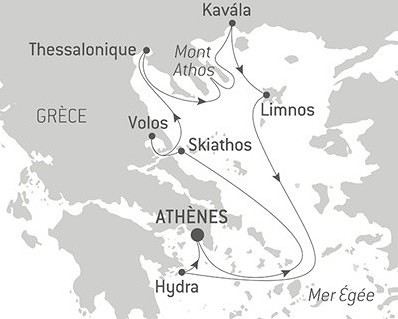
If you'd like, I invite you to join me for a week-long cruise to northern Greece, visiting ports that are often less crowded with cruise ships.
Itinerary: Athens, Skiathos, Volos, Thessaloniki, Kavala, Limnos, Hydra, Athens
Is Zanzibar worth visiting?
Hi everyone, I’m planning a two-week trip to Tanzania at the end of December and beginning of January, including 3 or 4 days in Zanzibar. But after reading some posts about the island, I’m wondering if it’s really worth it.
Are the beaches on the mainland just as idyllic as Zanzibar’s? I’ve also seen there are other islands, like Mafia Island, which is less touristy.
Another question: for my arrival, I don’t want to stay in Dar es Salaam, as big cities don’t really appeal to me. Would Bagamoyo be a good base, or would you recommend somewhere else?
To give you more details, I’m not traveling with a tour operator—I’m more of a backpacker and prefer local transport.
Thanks for your advice!
Are the beaches on the mainland just as idyllic as Zanzibar’s? I’ve also seen there are other islands, like Mafia Island, which is less touristy.
Another question: for my arrival, I don’t want to stay in Dar es Salaam, as big cities don’t really appeal to me. Would Bagamoyo be a good base, or would you recommend somewhere else?
To give you more details, I’m not traveling with a tour operator—I’m more of a backpacker and prefer local transport.
Thanks for your advice!
Feedback on Vietnam itinerary in December
Hello everyone,
We’re heading to Vietnam for 14 nights over the Christmas holidays as a family of four—I haven’t booked anything yet.
I’d love your insights on Halong Bay (or Lan Ha Bay).
We’re torn between going or not and spending an extra night in Ninh Binh (or somewhere else you’d recommend! Somewhere with a more picturesque vibe) given the late-December weather and cost (which agency do you recommend?). The upside might be that we’ll be there during the low season, so maybe fewer tourists? (Even though it’d be New Year’s Eve night.)
Here’s our itinerary:
Arrival in Ho Chi Minh City around 1 p.m.
2nd night in HCMC (no time for the Mekong Delta ☹️)
Flight to Da Nang
3 nights in Hoi An
Bus to Hue, 1 night in Hue
City visit, overnight train to Ninh Binh
2 or 3 nights in Ninh Binh?
Halong Bay or Lan Ha Bay?
2 nights in Hanoi
Departure
Thank you so much in advance for your invaluable tips!
Feedback on Sri Lanka itinerary
Hi again,
I’m adding more details to my info request. Here are two proposed itineraries. We’re hesitating:
Colombo - Unawatuna 2 days - Sinharaja 1 day - Bandarawela 2 days - Kandy 3 days - Dambulla 2 days - Wilpattu Park 1 day - Kalpitiya 3 days - Negombo 1 day
What should we change or add a day for to include Jaffna?
Or: Negombo 1 day - Anuradhapura 2 days - Jaffna 2 days - Sigiriya 2 days - Dambulla 1 day - Kandy 2 days - Ella 1 day - Galle 3 days For your advice. Is it better to finish in Galle or Kalpitiya? Thanks in advance! Nicole
Or: Negombo 1 day - Anuradhapura 2 days - Jaffna 2 days - Sigiriya 2 days - Dambulla 1 day - Kandy 2 days - Ella 1 day - Galle 3 days For your advice. Is it better to finish in Galle or Kalpitiya? Thanks in advance! Nicole
Two-week family trip to Colombia in August with 8-year-olds
Hi everyone,
I’d like to share my family trip to Colombia with kids aged 8. After spending hours browsing the forum and only having two weeks there, we decided to focus on two regions: the Coffee Zone for one week and the Caribbean coast for another. We traveled from August 8 to 23.
Day 1 – First stop: Bogotá
We arrived in Bogotá in the evening on an Air France flight—nothing to complain about, decent service, comfortable, and on time. However, the first night was a miss. We’d booked a hotel near the airport (Abitel Prime) for convenience, but the soundproofing was almost nonexistent; we heard planes as if we were on the runway. Luckily, exhaustion helped us sleep well anyway.
Day 2 – Off to the Coffee Zone and Salento
The next morning, we headed to the airport for a domestic flight to Pereira with LATAM. No issues: punctual and efficient, and in 30 minutes, we landed in Pereira. The landing already set a different mood: lush valleys, endless plantations, and humid air. We picked up our rental car from Localiza. Unfortunately, the experience wasn’t smooth—the paperwork took forever, and the wait tested our patience. Finally free, we hit the road to Salento, one of Quindío’s gems. We arrived in the late afternoon and discovered a colorful village bustling with artisan shops and cafés. Our first stroll helped us soak in the atmosphere before dinner at Bambú restaurant—a great surprise with careful cooking and local flavors. We spent the night at Casa Serafín, a charming little hotel, nicely decorated and well-located… but unfortunately very noisy.
Day 3 – The magic of Cocora Valley
This was one of the trip’s highlights. We set off early for Cocora Valley, famous for its giant wax palms, Colombia’s emblem. We chose the 12 km loop recommended by the *Routard*. The landscapes were spectacular: towering palms, rivers, suspension bridges. It felt like walking through a postcard. The weather was perfect. That evening, we dined at Barnabé restaurant—pleasant setting, decent food, but the bill was a bit steep for what it was. Back to Casa Serafín.
Day 4 – Coffee and panoramic views
The plan was a visit to Finca El Ocaso. For 1.5 hours, we followed a passionate guide who explained the entire coffee process, from harvest to cup. Very educational, accessible for both kids and adults, all in a stunning setting. The tour was in English for us, and we translated for our kids, who aren’t bilingual yet. In the afternoon, we climbed to Salento’s viewpoint. The valley view was superb. That evening, we ate at Veggie Garden, a simple and pleasant spot that was a nice change from the heavier meals of previous days.
Day 5 – Horseback ride to Santa Rita Waterfall
We booked a horseback ride with Cocora Magic. It was a real success: calm horses, a beautiful trail, mountain and meadow landscapes, and finally the refreshing and wild Santa Rita Waterfall. Without a doubt, one of the best moments of our time in the region. We even got a bonus ride up a 300-meter hill. We then headed to Filandia, less known than Salento but just as charming. We spent the late afternoon enjoying the pool at MuchoSur Filandia. The hotel is beautiful, in an idyllic setting. However, we also had soundproofing issues and could hear our neighbors.
Day 6 – Rainy detour through Filandia and Manizales
Rain caught up with us in the early morning: torrents of water made it impossible to go out. We stayed at the hotel, reading quietly. By noon, the rain let up: a quick walk in Filandia, a quick lunch, then off to Manizales. We chose to stay at El Otoño hot springs. Great choice: as soon as we arrived, we plunged into the hot pools, perfect after hours on the road.
Day 7 – Hiking and hot springs
In the morning, we hiked the Camino de Super Coco (found somewhat randomly on Google). A pleasant trail with mountain views and a peaceful atmosphere. The afternoon was spent in the hotel’s thermal pools, with a short marked hike down to the river. Dinner on-site at the hot springs’ restaurant. A simple but very relaxing day.
Day 8 – Rain, jacuzzi, and games
We continued to Finca Los Alpes. The rain greeted us again, but this time it turned into an asset: nothing like a steaming jacuzzi with a view of the misty mountains. The kids enjoyed the facilities too: mini-golf, ping-pong, billiards. Dinner and night at the hotel, cozy vibes.
Day 9 – Off to the Caribbean coast
Back to the airport to return the car (still a bit long). Flight to Cartagena with Avianca: punctual and comfortable. Upon arrival, we picked up another car and headed straight to the Hyatt Regency, a modern hotel with a pool. That evening, we dined at the hotel—practical after a travel day.
Day 10 – Colonial Cartagena
We set off to explore Cartagena’s old town. It was enchanting: colorful facades, flowered balconies, colonial charm—just magical. However, the heat was stifling and very humid. Afternoon relaxation by the pool. Dinner at Gestlani, a good restaurant in town.
Day 11 – Road to Barú
A hearty breakfast, then one last swim in the pool before heading to Barú. We checked into Las Islas Hotel. The setting was enchanting: wooden cabins nestled in the vegetation, a private beach, turquoise sea, impeccable service. Dinner at the hotel’s restaurant.
Day 12 – Beach and relaxation
A full beach day in Barú. Warm water, white sand, coconut trees, peace and quiet. A real postcard scene with iguanas and birds.
Day 13 – On to Santa Marta
Another morning at the beach before hitting the road to Santa Marta. The drive was a bit long (6 hours), especially with traffic jams in Barranquilla. It was the longest car ride of the trip. We spent the night at Villa María Tayrona, a beautiful place near the park.
Day 14 – Tayrona Park
We left early for Tayrona Park. We entered through **El Zaino**, parked the car, and set off on a hike to La Piscina (about 2 hours). We stopped along the way at Playa Arenilla, a stunning little beach, to rest. Lunch on-site, a swim, then back by 4 PM. The hike was a bit tiring, but the nature was spectacular: dense jungle, the sound of waves, and even a monkey encounter along the way. Evening and dinner at the hotel.
Day 15 – Last swim and return flight to Bogotá
Our last morning was split between the pool and the beach (the hotel has direct access via a 7-minute trail through vegetation and flowers)—hard to leave this paradise. We drove to Santa Marta’s airport to return the car, then flew back to Bogotá. We spent the night at Casa Dann Carlton, a comfortable hotel. We simply ordered room service, arriving too late to go out.
Day 16 – Bogotá and the end of the trip
Our last day in Colombia. After a good breakfast, we explored La Candelaria. Its cobbled streets and colorful houses were worth the visit. We visited the Botero Museum (free) and the Gold Museum, both fascinating. Back to the airport for our 11:55 PM Air France flight.
That’s a wrap on a varied trip—lush mountains, colorful villages, dream beaches, and tropical jungle. The pace was pretty relaxed, well-suited for our kids. They absolutely loved the trip to Colombia. Driving in Colombia was very easy, and we didn’t regret renting a car at all—it gave us more freedom to get around.
If I were to do it again, here’s what I’d change: - I’d spend less time in the Coffee Zone to stay a bit longer on the Caribbean coast, which was more relaxing for the kids. Or I’d head to Medellín, but I didn’t think the city was very kid-friendly. - Bogotá is a city that deserves a day’s visit, but it’s not a must-see. Maybe I’d have taken the KLM flight from Cartagena to Amsterdam instead.
If you have any questions, don’t hesitate!
Antoine
I’d like to share my family trip to Colombia with kids aged 8. After spending hours browsing the forum and only having two weeks there, we decided to focus on two regions: the Coffee Zone for one week and the Caribbean coast for another. We traveled from August 8 to 23.
Day 1 – First stop: Bogotá
We arrived in Bogotá in the evening on an Air France flight—nothing to complain about, decent service, comfortable, and on time. However, the first night was a miss. We’d booked a hotel near the airport (Abitel Prime) for convenience, but the soundproofing was almost nonexistent; we heard planes as if we were on the runway. Luckily, exhaustion helped us sleep well anyway.
Day 2 – Off to the Coffee Zone and Salento
The next morning, we headed to the airport for a domestic flight to Pereira with LATAM. No issues: punctual and efficient, and in 30 minutes, we landed in Pereira. The landing already set a different mood: lush valleys, endless plantations, and humid air. We picked up our rental car from Localiza. Unfortunately, the experience wasn’t smooth—the paperwork took forever, and the wait tested our patience. Finally free, we hit the road to Salento, one of Quindío’s gems. We arrived in the late afternoon and discovered a colorful village bustling with artisan shops and cafés. Our first stroll helped us soak in the atmosphere before dinner at Bambú restaurant—a great surprise with careful cooking and local flavors. We spent the night at Casa Serafín, a charming little hotel, nicely decorated and well-located… but unfortunately very noisy.
Day 3 – The magic of Cocora Valley
This was one of the trip’s highlights. We set off early for Cocora Valley, famous for its giant wax palms, Colombia’s emblem. We chose the 12 km loop recommended by the *Routard*. The landscapes were spectacular: towering palms, rivers, suspension bridges. It felt like walking through a postcard. The weather was perfect. That evening, we dined at Barnabé restaurant—pleasant setting, decent food, but the bill was a bit steep for what it was. Back to Casa Serafín.
Day 4 – Coffee and panoramic views
The plan was a visit to Finca El Ocaso. For 1.5 hours, we followed a passionate guide who explained the entire coffee process, from harvest to cup. Very educational, accessible for both kids and adults, all in a stunning setting. The tour was in English for us, and we translated for our kids, who aren’t bilingual yet. In the afternoon, we climbed to Salento’s viewpoint. The valley view was superb. That evening, we ate at Veggie Garden, a simple and pleasant spot that was a nice change from the heavier meals of previous days.
Day 5 – Horseback ride to Santa Rita Waterfall
We booked a horseback ride with Cocora Magic. It was a real success: calm horses, a beautiful trail, mountain and meadow landscapes, and finally the refreshing and wild Santa Rita Waterfall. Without a doubt, one of the best moments of our time in the region. We even got a bonus ride up a 300-meter hill. We then headed to Filandia, less known than Salento but just as charming. We spent the late afternoon enjoying the pool at MuchoSur Filandia. The hotel is beautiful, in an idyllic setting. However, we also had soundproofing issues and could hear our neighbors.
Day 6 – Rainy detour through Filandia and Manizales
Rain caught up with us in the early morning: torrents of water made it impossible to go out. We stayed at the hotel, reading quietly. By noon, the rain let up: a quick walk in Filandia, a quick lunch, then off to Manizales. We chose to stay at El Otoño hot springs. Great choice: as soon as we arrived, we plunged into the hot pools, perfect after hours on the road.
Day 7 – Hiking and hot springs
In the morning, we hiked the Camino de Super Coco (found somewhat randomly on Google). A pleasant trail with mountain views and a peaceful atmosphere. The afternoon was spent in the hotel’s thermal pools, with a short marked hike down to the river. Dinner on-site at the hot springs’ restaurant. A simple but very relaxing day.
Day 8 – Rain, jacuzzi, and games
We continued to Finca Los Alpes. The rain greeted us again, but this time it turned into an asset: nothing like a steaming jacuzzi with a view of the misty mountains. The kids enjoyed the facilities too: mini-golf, ping-pong, billiards. Dinner and night at the hotel, cozy vibes.
Day 9 – Off to the Caribbean coast
Back to the airport to return the car (still a bit long). Flight to Cartagena with Avianca: punctual and comfortable. Upon arrival, we picked up another car and headed straight to the Hyatt Regency, a modern hotel with a pool. That evening, we dined at the hotel—practical after a travel day.
Day 10 – Colonial Cartagena
We set off to explore Cartagena’s old town. It was enchanting: colorful facades, flowered balconies, colonial charm—just magical. However, the heat was stifling and very humid. Afternoon relaxation by the pool. Dinner at Gestlani, a good restaurant in town.
Day 11 – Road to Barú
A hearty breakfast, then one last swim in the pool before heading to Barú. We checked into Las Islas Hotel. The setting was enchanting: wooden cabins nestled in the vegetation, a private beach, turquoise sea, impeccable service. Dinner at the hotel’s restaurant.
Day 12 – Beach and relaxation
A full beach day in Barú. Warm water, white sand, coconut trees, peace and quiet. A real postcard scene with iguanas and birds.
Day 13 – On to Santa Marta
Another morning at the beach before hitting the road to Santa Marta. The drive was a bit long (6 hours), especially with traffic jams in Barranquilla. It was the longest car ride of the trip. We spent the night at Villa María Tayrona, a beautiful place near the park.
Day 14 – Tayrona Park
We left early for Tayrona Park. We entered through **El Zaino**, parked the car, and set off on a hike to La Piscina (about 2 hours). We stopped along the way at Playa Arenilla, a stunning little beach, to rest. Lunch on-site, a swim, then back by 4 PM. The hike was a bit tiring, but the nature was spectacular: dense jungle, the sound of waves, and even a monkey encounter along the way. Evening and dinner at the hotel.
Day 15 – Last swim and return flight to Bogotá
Our last morning was split between the pool and the beach (the hotel has direct access via a 7-minute trail through vegetation and flowers)—hard to leave this paradise. We drove to Santa Marta’s airport to return the car, then flew back to Bogotá. We spent the night at Casa Dann Carlton, a comfortable hotel. We simply ordered room service, arriving too late to go out.
Day 16 – Bogotá and the end of the trip
Our last day in Colombia. After a good breakfast, we explored La Candelaria. Its cobbled streets and colorful houses were worth the visit. We visited the Botero Museum (free) and the Gold Museum, both fascinating. Back to the airport for our 11:55 PM Air France flight.
That’s a wrap on a varied trip—lush mountains, colorful villages, dream beaches, and tropical jungle. The pace was pretty relaxed, well-suited for our kids. They absolutely loved the trip to Colombia. Driving in Colombia was very easy, and we didn’t regret renting a car at all—it gave us more freedom to get around.
If I were to do it again, here’s what I’d change: - I’d spend less time in the Coffee Zone to stay a bit longer on the Caribbean coast, which was more relaxing for the kids. Or I’d head to Medellín, but I didn’t think the city was very kid-friendly. - Bogotá is a city that deserves a day’s visit, but it’s not a must-see. Maybe I’d have taken the KLM flight from Cartagena to Amsterdam instead.
If you have any questions, don’t hesitate!
Antoine
Slovak travel journal
Hello and welcome aboard this travel journal.
We’re heading to Slovakia together!
 Why this country?
After visiting Hungary, Slovenia, Romania, and Poland in recent years, I’ve fallen in love with Eastern European countries. I adore the Slavic soul, its Austro-Hungarian villages, the gentle landscapes, the Carpathian Mountains, and that slightly mysterious atmosphere.
Slovakia evokes a certain imagination with its deep forests, medieval castles, and cobbled villages.
After seeing photos of the High Tatras—especially Lake Štrbské Pleso and Spiš Castle—I thought, "Let’s do it! We’re going!"
So, will Slovakia live up to what I imagine?
We’ll find out together.
We decided to travel as a group of six (five adults and a six-year-old child), by car (we needed two).
Here’s the day-by-day itinerary for this family trip, which started with a 3-day stay in Vienna (see the dedicated travel journal):
Why this country?
After visiting Hungary, Slovenia, Romania, and Poland in recent years, I’ve fallen in love with Eastern European countries. I adore the Slavic soul, its Austro-Hungarian villages, the gentle landscapes, the Carpathian Mountains, and that slightly mysterious atmosphere.
Slovakia evokes a certain imagination with its deep forests, medieval castles, and cobbled villages.
After seeing photos of the High Tatras—especially Lake Štrbské Pleso and Spiš Castle—I thought, "Let’s do it! We’re going!"
So, will Slovakia live up to what I imagine?
We’ll find out together.
We decided to travel as a group of six (five adults and a six-year-old child), by car (we needed two).
Here’s the day-by-day itinerary for this family trip, which started with a 3-day stay in Vienna (see the dedicated travel journal):
The itinerary: Day 1: Drive from Vienna to Banská Štiavnica and visit the town, then drive to Handlová Day 2: Bojnice Castle, the village of Čičmany, and a walk in the treetops at Bojnice, return to Handlová Day 3: Depart for Orava, visit Orava Castle and the Orava Skansen, drive to Veľký Slavkov Day 4: Visit Slovak Paradise—its gorges, lakes, and ice cave—overnight in Veľký Slavkov Day 5: Visit Bardejov, the "Death Road," wooden churches, and Ľubovňa Castle, overnight in Veľký Slavkov Day 6: Walks and hikes in the High Tatras, Lake Štrbské Pleso, Solisko summit, treetop walk in Ždiar, overnight in Veľký Slavkov Day 7: Drive to Košice, visit Spiš Castle, Tokaj wine route in Veľká Trňa, overnight in Košice Day 8: Visit Košice, overnight in Košice Day 9: Drive to Bratislava, stop at the Aragonite Cave in the Slovak Karst, overnight in Bratislava Day 10: Visit Bratislava, overnight stay Day 11 and 12: Return to France
Budget: I’m giving prices for 2 adults / 1 child. Slovakia is more expensive than it seems, and some expenses shouldn’t be underestimated. Transportation: Tolls and gas from France: 500 € round trip Slovak vignette for one month: 17.10 € Gas is fixed at 1.49 € per liter (E10) Parking at sites (all paid by the day, even in the most remote villages, even if you stay for just an hour). Payment is often required in cash upon arrival: total 63 € We didn’t pay at Spiš (we arrived before the cashier) or Ľubovňa (we arrived after the cashier left). Parking at Orava Village was free. In Košice and Bratislava, we parked for free at our accommodations. Public transport in Bratislava and Košice: 1-1.2 € for a bus ticket. Vending machines are available at some stops; otherwise, buy via SMS (Slovak phones only) or official sales points.
Accommodation: We mostly chose houses so we could cook ourselves and save on food. I’ve rated our satisfaction with these accommodations from 1 to 5 stars. Padua: DC Hotel: 1 night, 77 € ***** Handlová: Chata Remata: 2 nights, 120 € ***** Veľký Slavkov: Aplend: 4 nights, 220 € ** Košice: Luxury Old Town Loft 320m²: 2 nights, 120 € ***** Bratislava: Hotel Viktor: 2 nights, 138 € *** Brescia: Hotel Antica Fonte: 1 night, 82 € ***** Total: 757 €
Food: Groceries at Lidl for 5 meals for 3: 100 € (really cheap) Restaurants: 10-15 € per dish, ice cream 1-2.4 € per scoop, crêpes 8-12 €, a glass of wine 6-10 €... total: 500 €
Visits: There are discounts for seniors and children, which is great. We spent nearly 600 € in total, which is a lot. However, it’s a cultural destination with many castles, museums, caves, wine cellars, and nature activities: cable cars, canopy walks, paid hikes (Slovak Paradise gorges)... In the end, this trip to Slovakia cost nearly 2500 € for 3. We also need to add the Vienna portion to that. Now, here’s the day-by-day account of this beautiful journey.
Why this country?
After visiting Hungary, Slovenia, Romania, and Poland in recent years, I’ve fallen in love with Eastern European countries. I adore the Slavic soul, its Austro-Hungarian villages, the gentle landscapes, the Carpathian Mountains, and that slightly mysterious atmosphere.
Slovakia evokes a certain imagination with its deep forests, medieval castles, and cobbled villages.
After seeing photos of the High Tatras—especially Lake Štrbské Pleso and Spiš Castle—I thought, "Let’s do it! We’re going!"
So, will Slovakia live up to what I imagine?
We’ll find out together.
We decided to travel as a group of six (five adults and a six-year-old child), by car (we needed two).
Here’s the day-by-day itinerary for this family trip, which started with a 3-day stay in Vienna (see the dedicated travel journal):
The itinerary: Day 1: Drive from Vienna to Banská Štiavnica and visit the town, then drive to Handlová Day 2: Bojnice Castle, the village of Čičmany, and a walk in the treetops at Bojnice, return to Handlová Day 3: Depart for Orava, visit Orava Castle and the Orava Skansen, drive to Veľký Slavkov Day 4: Visit Slovak Paradise—its gorges, lakes, and ice cave—overnight in Veľký Slavkov Day 5: Visit Bardejov, the "Death Road," wooden churches, and Ľubovňa Castle, overnight in Veľký Slavkov Day 6: Walks and hikes in the High Tatras, Lake Štrbské Pleso, Solisko summit, treetop walk in Ždiar, overnight in Veľký Slavkov Day 7: Drive to Košice, visit Spiš Castle, Tokaj wine route in Veľká Trňa, overnight in Košice Day 8: Visit Košice, overnight in Košice Day 9: Drive to Bratislava, stop at the Aragonite Cave in the Slovak Karst, overnight in Bratislava Day 10: Visit Bratislava, overnight stay Day 11 and 12: Return to France
Budget: I’m giving prices for 2 adults / 1 child. Slovakia is more expensive than it seems, and some expenses shouldn’t be underestimated. Transportation: Tolls and gas from France: 500 € round trip Slovak vignette for one month: 17.10 € Gas is fixed at 1.49 € per liter (E10) Parking at sites (all paid by the day, even in the most remote villages, even if you stay for just an hour). Payment is often required in cash upon arrival: total 63 € We didn’t pay at Spiš (we arrived before the cashier) or Ľubovňa (we arrived after the cashier left). Parking at Orava Village was free. In Košice and Bratislava, we parked for free at our accommodations. Public transport in Bratislava and Košice: 1-1.2 € for a bus ticket. Vending machines are available at some stops; otherwise, buy via SMS (Slovak phones only) or official sales points.
Accommodation: We mostly chose houses so we could cook ourselves and save on food. I’ve rated our satisfaction with these accommodations from 1 to 5 stars. Padua: DC Hotel: 1 night, 77 € ***** Handlová: Chata Remata: 2 nights, 120 € ***** Veľký Slavkov: Aplend: 4 nights, 220 € ** Košice: Luxury Old Town Loft 320m²: 2 nights, 120 € ***** Bratislava: Hotel Viktor: 2 nights, 138 € *** Brescia: Hotel Antica Fonte: 1 night, 82 € ***** Total: 757 €
Food: Groceries at Lidl for 5 meals for 3: 100 € (really cheap) Restaurants: 10-15 € per dish, ice cream 1-2.4 € per scoop, crêpes 8-12 €, a glass of wine 6-10 €... total: 500 €
Visits: There are discounts for seniors and children, which is great. We spent nearly 600 € in total, which is a lot. However, it’s a cultural destination with many castles, museums, caves, wine cellars, and nature activities: cable cars, canopy walks, paid hikes (Slovak Paradise gorges)... In the end, this trip to Slovakia cost nearly 2500 € for 3. We also need to add the Vienna portion to that. Now, here’s the day-by-day account of this beautiful journey.
Mice in Switzerland, the Other Cheese Country!
I'm starting my first travel journal since VF reopened!
This will mostly be to share my impressions and some photos, with a few days' delay, but I'm starting this journal while I'm still here.
First, I'd like to thank those who helped me prepare for this trip.
I was able to organize this stay in one of the most expensive countries in the world thanks to the home-exchange principle. Not necessarily a direct swap, but through a points system, which is more practical for choosing where you want to go without it having to be a reciprocal exchange.
For this trip, there will already be two different accommodations. We'll see how it goes after that.
The first place is near Yverdon-les-Bains, close to Lake Neuchâtel.
So, we're going to explore this area!
We arrived under capricious weather that won’t leave us for the next few days!
We had dinner at a pizzeria recommended by *Le Routard* in Yverdon, then took a little nighttime stroll through the town center before heading inland to settle into our accommodation.
We discovered a very large, quiet house—and especially the cat that stayed behind! Funny for a couple of mice! He’ll be sleeping with us 😹
This will mostly be to share my impressions and some photos, with a few days' delay, but I'm starting this journal while I'm still here.
First, I'd like to thank those who helped me prepare for this trip.
I was able to organize this stay in one of the most expensive countries in the world thanks to the home-exchange principle. Not necessarily a direct swap, but through a points system, which is more practical for choosing where you want to go without it having to be a reciprocal exchange.
For this trip, there will already be two different accommodations. We'll see how it goes after that.
The first place is near Yverdon-les-Bains, close to Lake Neuchâtel.
So, we're going to explore this area!
We arrived under capricious weather that won’t leave us for the next few days!
We had dinner at a pizzeria recommended by *Le Routard* in Yverdon, then took a little nighttime stroll through the town center before heading inland to settle into our accommodation.
We discovered a very large, quiet house—and especially the cat that stayed behind! Funny for a couple of mice! He’ll be sleeping with us 😹
From Delhi to Agra and the extraordinary stay in Chhattisgarh
My train to Mathura is at 2 PM, and we’ll arrive an hour late—all good. I booked a hotel on booking, but unfortunately, it’s really far from the ghats. Walking there is out of the question—what a shame.
The hotel itself is fine, and there are several restaurants right across the street, which will be handy for dinner. This won’t be an exception, though—starting at 10 PM, they must wake up because I can hear them talking loudly, and music is playing along. My room faces the entrance, so it’s going to be tough. At midnight, I ask them to lower the volume, but they don’t listen. By 1 AM, I lose my temper, and this time, everything stops. Finally, I can get some sleep—until 4 AM, when they start up again for a little while before quiet returns until 6 AM. But when do they sleep? The noise never seems to bother them—it’s unbelievable, and I’m finding it harder and harder to tolerate. It makes a huge difference.
The next morning, as I leave, they tell me they’ll give me another room for the following night. Oh, two nights like that wouldn’t be possible—I’m exhausted.
I head out to explore the ghats and take a rickshaw, which I share with a family, to Vrindavan, a city of temples dedicated to Krishna. I visit several while wandering through the lively streets, surrounded by a crowd of devotees. By 1 PM, I’m near the Bankey Bihari Temple, but I can’t go in—it just closed. Nearby, there are restaurants, so I take the opportunity to grab my usual aloo paratha with a lassi.

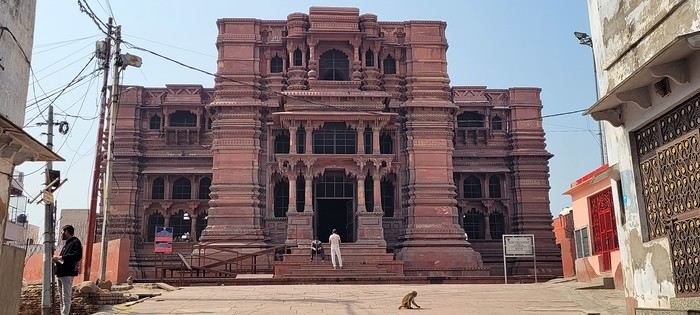
The work women do here is incredibly hard, and their pay must be miserable.

I want to leave Vrindavan for Govardhan. Two young guys on a motorcycle in front of the temple approach me, and the driver offers to take me part of the way. I’m pretty skeptical, but he insists, and I eventually agree. I didn’t fully understand what was happening. Once on the bike, his friend hops on too, and suddenly I’m sandwiched between them for a multi-kilometer ride—*travel Indian-style*. We quickly drop off the friend, and I breathe easier for the rest of the trip. At an intersection, he stops—Govardhan is straight ahead, but to get to his village, he needs to turn right. We wait for the bus for a few minutes, and he flags it down so I can hop on and continue my journey. What an adventure.
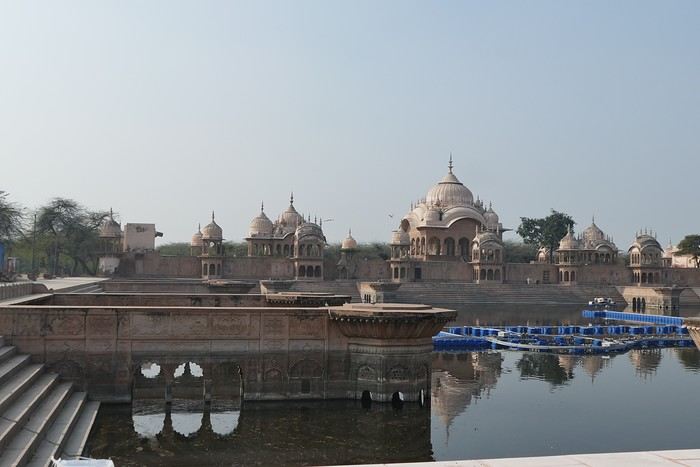
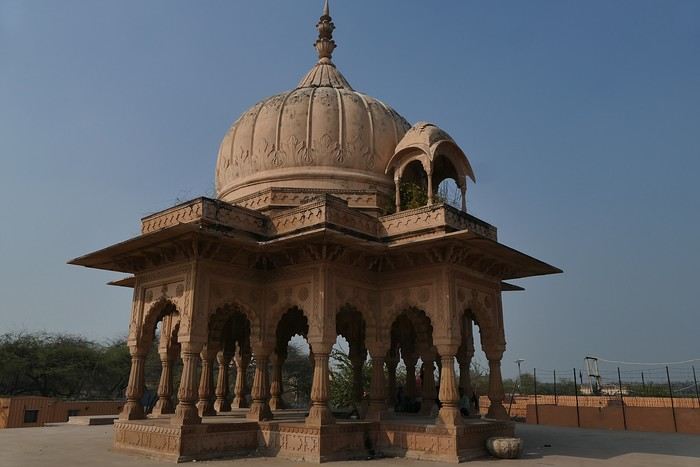
the neighbor with its beautiful dome.
The work women do here is incredibly hard, and their pay must be miserable.
I want to leave Vrindavan for Govardhan. Two young guys on a motorcycle in front of the temple approach me, and the driver offers to take me part of the way. I’m pretty skeptical, but he insists, and I eventually agree. I didn’t fully understand what was happening. Once on the bike, his friend hops on too, and suddenly I’m sandwiched between them for a multi-kilometer ride—*travel Indian-style*. We quickly drop off the friend, and I breathe easier for the rest of the trip. At an intersection, he stops—Govardhan is straight ahead, but to get to his village, he needs to turn right. We wait for the bus for a few minutes, and he flags it down so I can hop on and continue my journey. What an adventure.
the neighbor with its beautiful dome.
Uzbek notes
The Afrosiyob races through a premature twilight, lashed by a blizzard of thick snow. In the endless gray, a monumental industrial complex occasionally emerges, ghostly. Here and there, in the middle of nowhere, a human silhouette appears (a soldier?), standing motionless by the tracks. On the screen mounted in the middle of the ceiling, a dashing Bollywood cat in vibrant colors writhes in all directions, throwing smoldering glances at a dancer on the verge of fainting. A server moves down the central aisle, offering crepes for sale—ones I suspect are stuffed with ground beef. I’m in Central Asia, in Uzbekistan, somewhere between Bukhara and Samarkand.
I chose the title "notes"—scattered thoughts, rough drafts. I’m not sure what I’ll write, but one thing’s certain: this won’t be a linear travel journal.
And a photo... there must be a photo, so here:
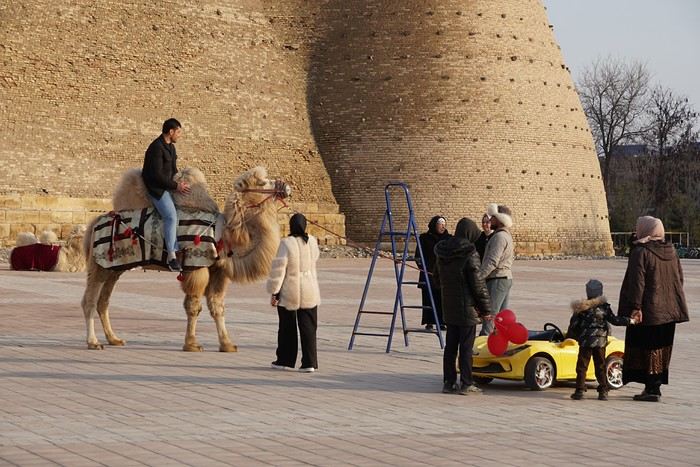
Local tourists between a Bactrian camel and an electric car, in front of ancient walls—it’ll do.
I chose the title "notes"—scattered thoughts, rough drafts. I’m not sure what I’ll write, but one thing’s certain: this won’t be a linear travel journal.
And a photo... there must be a photo, so here:
Local tourists between a Bactrian camel and an electric car, in front of ancient walls—it’ll do.
Cécile, from Big Sur to Sausalito
After our first trip discovering the American West with our teens, Cécile asked me to go back for a romantic getaway to this wonderful destination. Whatever my wife wants, so here we are on a plane in September 2022, heading to San Francisco. Since we’d already visited the main parks two years earlier, this time we took the scenic route:
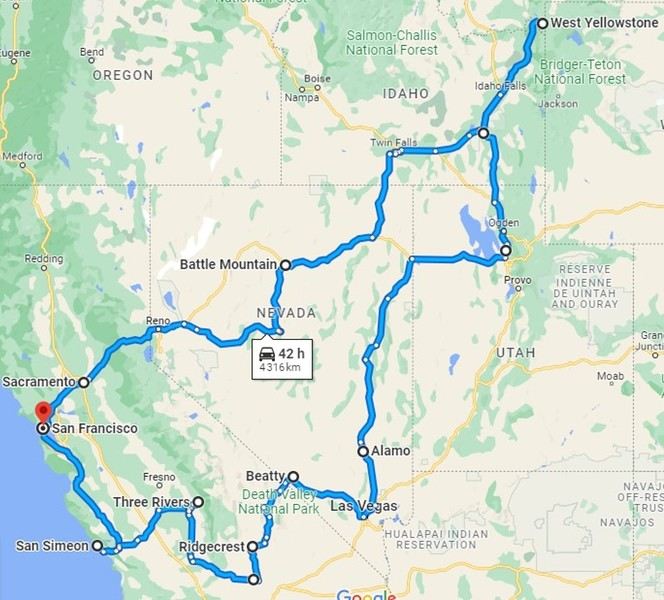
We arrived late in the evening, spent a short night at the hotel, and picked up our rental car to hit Highway 1 and the Pacific coast. The sky was gray, foggy, and a bit disappointing for now.
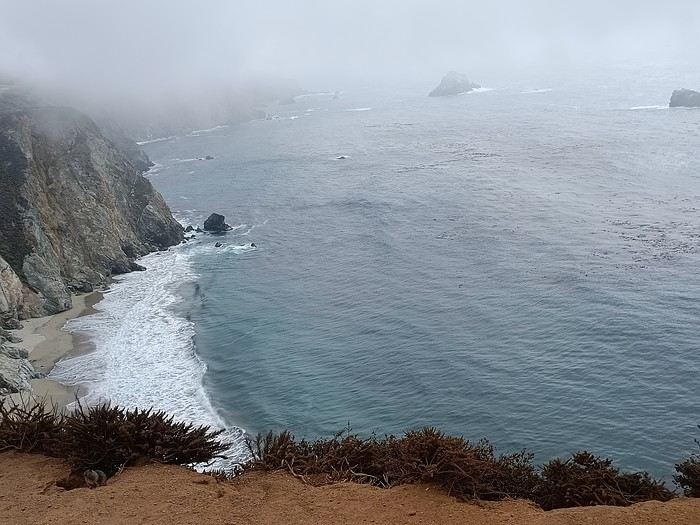
As Brittany lovers, we know coastal weather can change quickly... but no! Bixby Bridge was just a quick view from the car, and it was only 11°C outside.
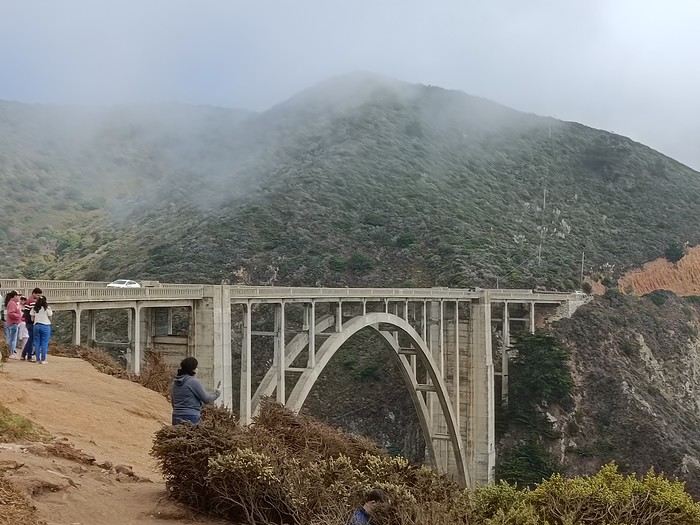
We had a quick picnic on the spot, quickly bothered by the local wildlife.
And then—miracle! This charming animal made the wind shift and brought us sunshine. So this coast is absolutely worth the trip—it’s just stunning.
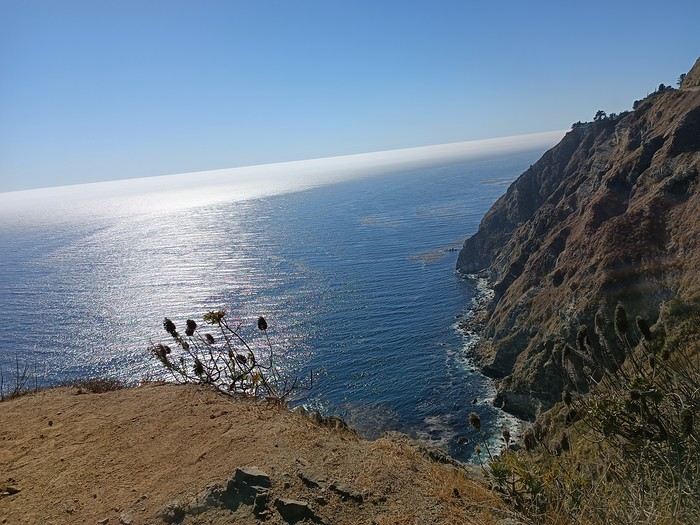
Only the sound of the wind and the seals’ calls disturbed the tranquility of the moment.
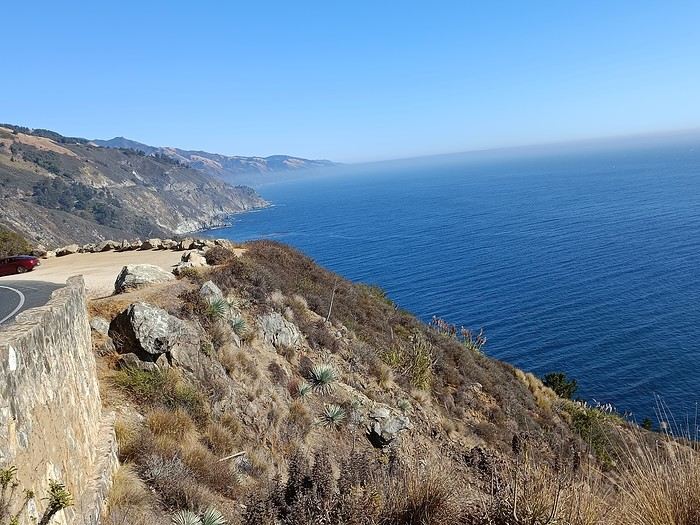
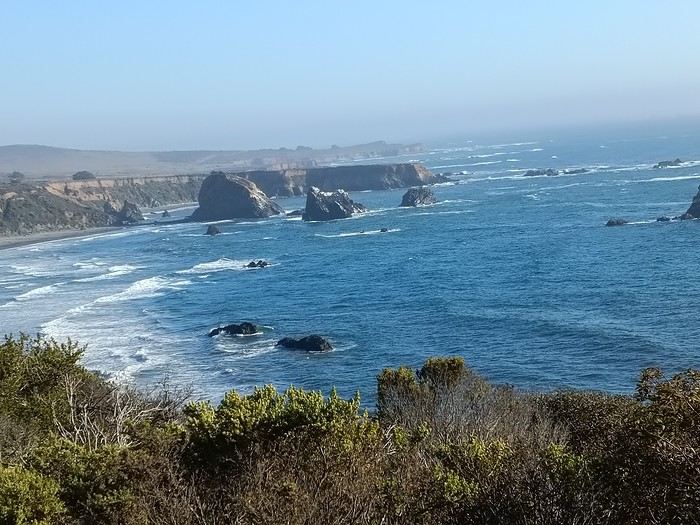
But even the best things come to an end, and we turned inland toward the sequoias. We drove through a long plain with fruit trees, vineyards, and endless straight roads.
First night at the hotel, tired but happy! !
We arrived late in the evening, spent a short night at the hotel, and picked up our rental car to hit Highway 1 and the Pacific coast. The sky was gray, foggy, and a bit disappointing for now.
As Brittany lovers, we know coastal weather can change quickly... but no! Bixby Bridge was just a quick view from the car, and it was only 11°C outside.
We had a quick picnic on the spot, quickly bothered by the local wildlife.
And then—miracle! This charming animal made the wind shift and brought us sunshine. So this coast is absolutely worth the trip—it’s just stunning.
Only the sound of the wind and the seals’ calls disturbed the tranquility of the moment.
But even the best things come to an end, and we turned inland toward the sequoias. We drove through a long plain with fruit trees, vineyards, and endless straight roads.
First night at the hotel, tired but happy! !
Oman for backpackers: trip report
So happy to be back with you all that I’m rushing to share my trip report!
We chose to stay exactly 14 days to avoid paying for a visa. As a result, we didn’t have time to explore the south—we’ll be back because Oman is a great destination in January. Temperatures were a perfect 25–27°C during the day. No rain for us, but it can happen.
We bought the *Évasion Oman* guidebook. We started with the Jebels (the mountains), abandoned villages, then the desert, wadis along the coast, and finished in the capital. For us, it was easier to go from cold (2,000 meters, after all) to hot before returning to our freezing Normandy in January.
The people were incredibly welcoming and lovely. We camped in natural camping areas where you can make a fire (free, no facilities or water). Easy to find—just search "camping" on Google Maps (an essential app). We traveled as a group of five and rented a 4x4 seven-seater from Europcar before leaving (price included our insurance): 800 euros for 14 days. Essential for getting everywhere, as there are lots of dirt tracks. We brought our camping gear from France since the baggage allowance is 30 kg. Oh, and also two liters of rum and a box of white wine—also essential.
Food was tricky if you don’t like spicy dishes or just chicken. You have to eat at international restaurants, which cost about the same as back home. We’d packed vacuum-sealed meat for the first three days and a few cans. For beaches, stick to the ones marked on Google for swimming—otherwise, they can be dirty and full of oil.
We arrived at 6:30 AM, bought a SIM card (make sure to remove yours before arriving and tape it to the back of your phone), exchanged money (not great rates at the airport—better in malls or souks; no exchanges in banks), and picked up the car. Then we headed to a Carrefour supermarket, but it was closed. We drove to Jebel Al Akhdar, the Sayq Plateau, where we found markets along the way. There are also bazaar shops where you can get gas bottles—they’re everywhere in mid-sized towns. There are even hypermarkets.
We hiked the well-marked old Sayq trail (red and white markings). Our return was improvised. We camped on the plateau and got cold—bring 0°C sleeping bags! The next day, we visited the abandoned villages of Wadi Bani Habib: juniper forests, canyon viewpoints. Then Birkat Al Maws on the way down—a beautiful palm grove. Next, Nizwa Hotel. The beds were really hard there—ask to see the rooms and test the beds before booking. There’s always availability, with prices starting at 35 euros for two.
On the third day, we went to Jebel Shams. Hiked along the canyon starting from Ghul, then descended. Camped on the road to Balha Fortress, which we visited the next morning (stunning!). Then we explored Nizwa before heading to the Wahiba Desert. Camped along the way, then drove to our accommodation: two days in the desert. We found the Thousand Nights Camp 40% cheaper a month before. Note: you have to leave by 1 PM in a convoy to reach the hotel.
On the sixth day, we hiked in the desert on our own because the activity prices were outrageous.
On the seventh day, we headed to a wadi, Bani Khalid, then to Sur, a seaside hotel. We booked just one room for five of us—hotel apartments are huge, and since we had our camping mattresses, it wasn’t a problem to set up in the living room. There’s even a kitchen. In cities, camping spots are poorly located—near intersections, etc.
Beach time and sightseeing on the eighth day, then we drove to the white sand beach in Fins, where we stayed for two nights (we left the tents set up but empty). This was our favorite campsite—go all the way to the end of the road, there’s a small cove and a stunning spot.
On the ninth day, we visited Wadi Shab and the Salma Plateau to find the tombs. The hike up from Fins was way too long—probably better to take the route suggested in the guidebook for a round trip. Meh, no one really enjoyed it.
On the tenth day, we went to Wadi Al Arbiyyin and drove to Seeb Al Mouj to book a diving trip. Stayed at Al Ferdous Hotel Apartments until the end—well-located for visiting Muscat and a great value. Just make sure to check the room first, as some beds are very hard and others aren’t.
Eleventh day: diving and beach time.
Twelfth day: visited the Grand Mosque (unlucky—first day it became paid, and not just a little: 8 OMR). Then explored the old city.
Thirteenth day: the Grand Opera and beach at The Village, where we found a great pizzeria: pizzawifi.com.
Fourteenth day: And that’s it—back home, thrilled to have discovered this magical country. We’ll be back!
We bought the *Évasion Oman* guidebook. We started with the Jebels (the mountains), abandoned villages, then the desert, wadis along the coast, and finished in the capital. For us, it was easier to go from cold (2,000 meters, after all) to hot before returning to our freezing Normandy in January.
The people were incredibly welcoming and lovely. We camped in natural camping areas where you can make a fire (free, no facilities or water). Easy to find—just search "camping" on Google Maps (an essential app). We traveled as a group of five and rented a 4x4 seven-seater from Europcar before leaving (price included our insurance): 800 euros for 14 days. Essential for getting everywhere, as there are lots of dirt tracks. We brought our camping gear from France since the baggage allowance is 30 kg. Oh, and also two liters of rum and a box of white wine—also essential.
Food was tricky if you don’t like spicy dishes or just chicken. You have to eat at international restaurants, which cost about the same as back home. We’d packed vacuum-sealed meat for the first three days and a few cans. For beaches, stick to the ones marked on Google for swimming—otherwise, they can be dirty and full of oil.
We arrived at 6:30 AM, bought a SIM card (make sure to remove yours before arriving and tape it to the back of your phone), exchanged money (not great rates at the airport—better in malls or souks; no exchanges in banks), and picked up the car. Then we headed to a Carrefour supermarket, but it was closed. We drove to Jebel Al Akhdar, the Sayq Plateau, where we found markets along the way. There are also bazaar shops where you can get gas bottles—they’re everywhere in mid-sized towns. There are even hypermarkets.
We hiked the well-marked old Sayq trail (red and white markings). Our return was improvised. We camped on the plateau and got cold—bring 0°C sleeping bags! The next day, we visited the abandoned villages of Wadi Bani Habib: juniper forests, canyon viewpoints. Then Birkat Al Maws on the way down—a beautiful palm grove. Next, Nizwa Hotel. The beds were really hard there—ask to see the rooms and test the beds before booking. There’s always availability, with prices starting at 35 euros for two.
On the third day, we went to Jebel Shams. Hiked along the canyon starting from Ghul, then descended. Camped on the road to Balha Fortress, which we visited the next morning (stunning!). Then we explored Nizwa before heading to the Wahiba Desert. Camped along the way, then drove to our accommodation: two days in the desert. We found the Thousand Nights Camp 40% cheaper a month before. Note: you have to leave by 1 PM in a convoy to reach the hotel.
On the sixth day, we hiked in the desert on our own because the activity prices were outrageous.
On the seventh day, we headed to a wadi, Bani Khalid, then to Sur, a seaside hotel. We booked just one room for five of us—hotel apartments are huge, and since we had our camping mattresses, it wasn’t a problem to set up in the living room. There’s even a kitchen. In cities, camping spots are poorly located—near intersections, etc.
Beach time and sightseeing on the eighth day, then we drove to the white sand beach in Fins, where we stayed for two nights (we left the tents set up but empty). This was our favorite campsite—go all the way to the end of the road, there’s a small cove and a stunning spot.
On the ninth day, we visited Wadi Shab and the Salma Plateau to find the tombs. The hike up from Fins was way too long—probably better to take the route suggested in the guidebook for a round trip. Meh, no one really enjoyed it.
On the tenth day, we went to Wadi Al Arbiyyin and drove to Seeb Al Mouj to book a diving trip. Stayed at Al Ferdous Hotel Apartments until the end—well-located for visiting Muscat and a great value. Just make sure to check the room first, as some beds are very hard and others aren’t.
Eleventh day: diving and beach time.
Twelfth day: visited the Grand Mosque (unlucky—first day it became paid, and not just a little: 8 OMR). Then explored the old city.
Thirteenth day: the Grand Opera and beach at The Village, where we found a great pizzeria: pizzawifi.com.
Fourteenth day: And that’s it—back home, thrilled to have discovered this magical country. We’ll be back!
Crossing the Salma Plateau by 4x4
Hi there,
I’ll be in Oman in early March 2025. I’ve rented a 4x4 to reach the Oman Sea coast from Ibra. I’ve seen two options on Oman Off Road:
The OOR 30 route via Wadi Kabbah, Wadi Bani Jabir to Qalhat.
Combine the OOR 30 and OOR 28 routes via the Salma Plateau to Tiwi or Fins.
Can anyone advise me on the current condition of the tracks? For option 2, is it better to head down to Tiwi or Fins? Can this trip be done in one day? Thanks in advance to those who can share some great tips!
Best regards.
The OOR 30 route via Wadi Kabbah, Wadi Bani Jabir to Qalhat.
Combine the OOR 30 and OOR 28 routes via the Salma Plateau to Tiwi or Fins.
Can anyone advise me on the current condition of the tracks? For option 2, is it better to head down to Tiwi or Fins? Can this trip be done in one day? Thanks in advance to those who can share some great tips!
Best regards.