Uzbek notes
FR

Translated into English.

Original post
UN
The Afrosiyob races through a premature twilight, lashed by a blizzard of thick snow. In the endless gray, a monumental industrial complex occasionally emerges, ghostly. Here and there, in the middle of nowhere, a human silhouette appears (a soldier?), standing motionless by the tracks. On the screen mounted in the middle of the ceiling, a dashing Bollywood cat in vibrant colors writhes in all directions, throwing smoldering glances at a dancer on the verge of fainting. A server moves down the central aisle, offering crepes for sale—ones I suspect are stuffed with ground beef. I’m in Central Asia, in Uzbekistan, somewhere between Bukhara and Samarkand.

I chose the title "notes"—scattered thoughts, rough drafts. I’m not sure what I’ll write, but one thing’s certain: this won’t be a linear travel journal.

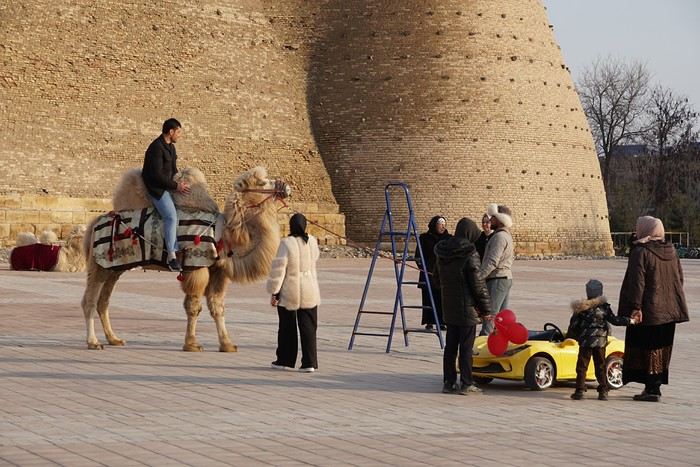
And a photo... there must be a photo, so here:


Local tourists between a Bactrian camel and an electric car, in front of ancient walls—it’ll do.
CO Corinnette69 Regular ·
Lovely post...can't wait to be there! By the way, could I ask if you’ve been to the Ferghana Valley?
UN UnaMilanese Veteran ·
The Bactrian camel, since I’m mentioning it... these days it goes by the nickname Damas, and there’s even a deluxe version. Like its famous predecessor, you’ll often see it moving in caravans, one behind the other. It travels from city to city and can officially carry up to 7 people—which is already a lot given the size and volume of the average Uzbek in such a small space—but recently, police stopped one and pulled out 15 people. How they all fit is a total mystery. It’s always white, just like roughly 80% of local cars. I was told this monochrome choice is because it gets *really* hot in the summer. Originally a Daewoo, it’s now a Chevrolet, just like the overwhelming majority of cars on the road. Apparently, this is due to import duties—100% on imported vehicles—while Chevrolet manufactures locally. Otherwise, you’ll find some weird brands, like "Make your dream real," and the dream is *huge*, built like an SUV.

The Damas is super maneuverable and weaves well through roundabouts with 4 lanes where right-of-way isn’t always clear ("move over, I’m coming through?"). It probably handles the potholes pretty well too, since they’re everywhere once you leave the main roads. Maybe it’s meant for Ok Yol ("white road," meaning smooth sailing).


UN UnaMilanese Veteran ·
Salam alekum Corinne (with the right hand on the heart),

No, I didn’t go to the Ferghana Valley. That’ll give me a reason to come back and wander around Tashkent more, since my first impression was a bit rushed (one day at the start, but jet-lagged from the overnight trip, and one day on the way back) and left me wanting more.

When are you leaving?

My hunger... and the size of Uzbeks, wrestling champions.

Gastronomic note—meaty, *super* meaty. You eat well, really well. The cuisine is delicious, packed with flavors where the taste of coriander almost always stands out. But there’s meat *everywhere*. In the soups, which come in a huge variety, meat appears as meatballs flirting with quail eggs in [*chi*] with cabbage, in the universal [*mastava*], which they’ll tell you is a rice soup but from which bones rise toward the sky, and in [*bortsch*]. The only safe bet is lentil soup—temporarily. Because after the soup, your choices are meat, meat, or—well—meat. Oh, the sizzling cast-iron dish where onions and beef strips crackle in oil! The *plov*, pilaf, a delight where every city has its own specialty—rice, carrots, and meat. Sometimes raisins and chickpeas too. The most diet-friendly option is [*shashlik*], the skewer, sold individually and served only with onion slices. A bit of a surprise for non-Russian speakers since foreigner menus are in Russian, with Cyrillic script to make it even trickier. Oh, this one’s chicken, oh, this one’s liver, etc. A quick snack? Chips—meat-flavored, of course. And if you beg for [*boiled o fried vegetables*], it’s no use. Either no one understands English (which happens often), or they just don’t have that *amazing* dish on the menu. The salads look incredibly tempting, and the one time we gave in, they were a perfect balance of flavors—and *brutally* laxative. Next time? Pack a Swiss Army knife to peel apples, because... bananas only go so far.


DO Dolma Globetrotter ·
It hardly matters how the days unfold—what I love so much about these notes, shaped by your memories and desires, is how they weave and sketch things out in such beautiful writing...
PO Pondy Veteran ·
On board your Uzbek TGV, you’re already sharing the first highlights of your trip, and you keep going in no particular order, just as the mood takes you. That’s what I love. So go for it—but not as fast as the afrosylob, take it slow. It’s better for savoring…
UN UnaMilanese Veteran ·
Salam alekoum Dolma and Dom (with the right hand over the heart, head slightly bowed, lips hinting at a smile).

You’re kind enough to visit, and I offer you a pomegranate juice. A deep red juice, an explosion of dozens of seeds under the press. A juice that’s hard to say is truly good. Sweetness mingles with bitterness, the sugary with the astringent, but it’s so fresh, so smooth, so light that it’s a delight—a digestive lifeline in a sea of fatty meats. Going to the market to get some became a must in every city, and the hotel room fridge was always stocked with this precious elixir throughout the trip.

A few words about bread... Every city has its own, varying in size, thickness, and maybe taste—I’m not a huge fan. Each baker stamps it with a metal seal in a unique design. At every train station, just before boarding, stalls display it, and it seems customary to buy some to bring to hosts, or perhaps to carry the spirit of the roots you’re leaving behind.


UN UnaMilanese Veteran ·
The knife, the folding Laguiole that Grandpa always kept in the bottom of his trouser pocket, wasn’t in the suitcase ready to peel Uzbek apples because packing for this trip turned into quite the puzzle over a few weeks. Samarkand: minimum 2°C, maximum 15°C—okay, a light puffer jacket, a fleece, a few long-sleeve tees, sneakers. Samarkand: minimum -13°C, maximum 1°C. Oh, right, so a big puffer jacket that covers your thighs, a thick wool turtleneck sweater, winter hiking socks, and heavy boots. Weeks of baffling, unpredictable weather whiplash. The day before departure, I was ready for anything, had thought of everything, packed everything, and was sitting on the suitcase, which stubbornly refused to close despite my weight. *Who can do more can do less*, Grandpa used to say, so I opted for the deep freeze.

It was cold—very cold. The cold and its beauty, the snow. Patches of pristine, powdery snow dot the Kyzylkum, the red desert. It clings to the shadows of the brown citadel walls of Khorezm, helped by the icy wind. In the deserted, shivering streets of Khiva, I unconsciously adopt Paul Atreides’ gait as he walks the sands of Arrakis without alerting the giant, hairy-beaked worms (*Dune* on the Istanbul-Tashkent flight, flying over the Black Sea and then the Caspian). Brooms and shovels are busy clearing courtyards, esplanades, and gateways. The Pamir, the Pamir Mountains! Vast, gleaming white, drunk on space and light—blinding joy, captured through the windows of the Cobalt as it struggles up the slope before gliding down to Shahrisabz.

PE Perju Globetrotter ·
Good evening, nice return trip... but the Pamir range is still quite far from Shahrisabz, about 500–600 km further east. In the end, with this cold... the fatty meat might not have been such a bad idea... 😏
AT Attila Globetrotter ·
Your first bread is pretty weird. A half-baked, saggy kouglof...

I leave it for the camels and grab one of the last skewers instead.

Maybe a dash of vodka to wash it all down and warm the throat...
UN UnaMilanese Veteran ·
Good evening Jean Pierre.

But the Pamir range is still quite far from Shahrisabz, about 500/600 km further east.

It was M., an Uzbek citizen, who said it!

"In Samarkand, the mountains are the Pamir, and in Tashkent, the Tien Shan."

Are we dealing with a clear case of fraudulent appropriation of mountain ranges here?

I had a meet-up with the Oxus, and, being monogamous at heart, I hadn’t paid any attention to other geographical features. The Pamir was a lovely surprise.

After all, with this cold... the fatty meat wasn’t entirely useless...

Over 15 days, the fat in the dish didn’t have time to turn into body fat. It just really tired out our livers.

Catherine
UN UnaMilanese Veteran ·
Hi Agnes.

Your first bread is pretty weird. A half-baked, flat kouglof...

I’ll leave it for the camels and grab one of the last skewers instead.

Maybe a dash of vodka to wash it all down and warm the throat...

A gas outage?


Catherine
TA Tatra Globetrotter ·
Hi Catherine,

I see the local white Chevrolets (95% of them) piqued your curiosity. If I was that bored in Tashkent, I think their uniformity had a lot to do with it—I love vehicles, they’re one of the things I find fascinating, a country’s identity through its palette. And there, honestly, what a snooze. I ended up chasing after the Chinese electric novelties, which were plentiful, just to entertain myself on the streets. And a Renault 25.
As for salads, since you mentioned them too—how can I put this? I’ve never eaten so badly in my life as in Uzbekistan. The salads are super sour, and the vegetables taste like pickles. In Uzbekistan, Kazakhstan, and Kyrgyzstan, my go-to is chicken shashliks—they’re a lifesaver.

Michel
UN UnaMilanese Veteran ·
Hi Michel,

And outside Tashkent? Here and there, you come across some really old Ladas, other clearly vintage cars whose brand I couldn’t catch, and big, sturdy trucks—those with a prominent front and large round headlights.

I had to look up what "pickles" were—*sottaceti*, in other words. I don’t know, I only tried a mixed salad once, which had a strange but appealing harmony of flavors (beets, potatoes, celery, and there was something else, including cilantro). I was pleasantly surprised by the tastes, though it wasn’t exactly suited to my small Milanese stomach, spoiled by healthy food (it was a shock ).

How do you eat chicken drumstick shashlik without a knife, since that utensil isn’t on the tables?

Catherine

PS: Uzbek or Uzbeke? A sudden spelling doubt...
TA Tatra Globetrotter ·
Good evening Catherine,

Well, of course I saw a few Volgas, a few Moskvitches, and some of those faded little gems I like. But very few. I find more of what I’m looking for in Kazakhstan, and this white uniformity puts me off Turkmenistan for good.

How do you eat shashlik made with chicken drumsticks without a knife, since that utensil is unknown at the table?

A good shashlik isn’t made with drumsticks—or if it is, they’re deboned. But I’ve never used a knife to eat shashlik anyway.

PS: Uzbek or Ouzbek? A sudden spelling doubt...

Ouzbek, I think. But more and more, I just shorten it to UZ, KZ, KG... That word wasn’t made to be transcribed into French.

Michel
UN UnaMilanese Veteran ·
I think I'm definitely going to take a trip to Ashgabat. 😉

M., who has a geographical dispute with that Mr. Perju...

A bit of pragmatism for those passing through who want concrete details: organizational notes, expense report. 13 days, the heavy artillery of Central Asia’s must-see tourist highway: one and a half nights in Tashkent, 2 in Khiva, 2 in Bukhara, 3 in Samarkand, and 2 nights back in Tashkent. Hotels in Uzbekistan: Arkanchi, Merhob, Ideal, reOuzbékistan. I planned the whole trip last summer in a somewhat distracted way (it’s Iran that really draws me). Since it was complicated back then to book internal transport and hotels so far in advance, and I didn’t feel like dealing with it later, I contacted three local agencies that advertised tailor-made services. They sent me quotes with up to a 40% price difference. Some added services I didn’t need (like meeting a typical family or a local dance show). In the end, I went with Turkestan Travel—responsive, precise, and turned out to be completely reliable. All hotels, all internal transport, all transfers between train stations/airports and hotels, all dinners (paid with the agency’s credit card), the excursion to Shahrisabz, the one to the Khorezm fortresses, and a different guide in each city who spoke our language: 1,450 € per person. Plus 700 € per person for the TK flight with a layover in IST, plus 250 € per person for meals, pomegranate juice, and tips. Total: 2,400 € per person.

This kind of travel package was a first for me, and it has two big advantages. No matter what time you arrive, you don’t feel like a farmer’s chick being hounded (taxi, taxi, taxi—taxi, taxi, taxi...) at the airport or train station exit. And honestly, arriving at odd hours in rough weather, it’s really comfortable to have someone grab your suitcase, open the car door, and drive you smoothly to your destination. But above all, the guides—F, M, N, and S. Two men and two women, four Uzbek lives, four perspectives on a country.

TA Tatra Globetrotter ·
Good evening Catherine,

I understand what you're saying, and it sounds like you're discovering this, but without using an agency's services, I usually have a driver waiting for me. It's actually quite funny because I'm often, honestly, way at the front of the plane, and since I don’t have any checked luggage, I zoom out like a rocket while the driver still thinks he has plenty of time—or isn’t even there yet. It’s definitely nice. I use Yandex Go for those countries, and sometimes I try without having anything else planned, but without speaking Russian, it’s still a bit hit-or-miss. You stayed at the Uzbekistan Hotel, right? Could you tell us about it? It’s totally my style, but for some reason I don’t remember, I made a different choice.

Michel
UN UnaMilanese Veteran ·
The black Hyundai van with tinted windows that just crawled (a bed! quick!) across the utterly empty, wide roads of the Uzbek capital at 4 a.m. stops under the hotel awning. Everything is dark; it seems deserted. Past the two doors with darkened glass, a vast hall, azure and gold, harking back to the days when Clavijo brought gifts from the King of Spain to Timur. To the right, a bar with such dim lighting you can’t see a thing; to the left, the same. A few late-night or early-rising guests are at the counter. The key in exchange for a passport, returned immediately. Room 1603, sixth floor. In the elevator, there’s time to see the ad for the 17th-floor restaurant and another for an Honor smartphone. A parquet-floored lobby with neon lights, then a narrow hallway with burgundy-red carpet featuring Persian medallions and yellowish tapestry. The room is spacious—easily 25 m², if not more. Two large yellow damask armchairs, a big coffee table, a king-size bed with a queen-size duvet. Two picture windows open onto loggias overlooking the city; the bank buildings flash garishly in the silent darkness. The bathroom is original, vintage 1970s. It’s hot, very hot—a temperamental, spluttering AC blows dry air.

9:45 a.m., the last possible quarter-hour for breakfast. The bar to the left of the entrance doubles as a breakfast room. A long central buffet with international offerings: scrambled eggs (yuck!), fruit salad, Barbie-pink sausages, fruit in syrup, dried fruit, meats in sauce, rice, multi-tiered pastries with sponge cake and cream, pickles... You serve yourself and... start the search for a place to sit, because given the size of the building, there definitely aren’t enough round tables with six chairs for every room to have its own. So, do you sit with the Indians in flip-flops? Or the Chinese? Maybe the Russians? Or some... indefinable group?

Back from sightseeing, a bit groggy. Being somewhere so different overnight is intoxicating. F. goes up to the top floor to reserve dinner for tonight, since tomorrow we’re up at 4 a.m. to catch the flight to Urgench and don’t want to go out again. He’s taking his time. A. suggests joining him, but all four elevators are out of service. **. F. comes down on foot—good enough for tonight. So? **. It’s getting dicey; it’s increasingly clear that this repeated ** is a generic figure with no basis in reality. A little climb? Sure. Turns out it’s more interesting than rewatching the Honor ad. Every floor has an economic activity on the landing—a travel agency, an IT office, an event planning agency, a beauty salon. Every three floors, a net is stretched across the stairwell in case a guest gets tired of life.

The top-floor restaurant smells of synthetic perfume that assaults the nostrils. At the adjacent bar, like something off a ferry, a few travelers chat with a beer in hand and Tashkent at their feet.

I really liked it. 🙂
UN UnaMilanese Veteran ·
F. wears a light black jet beard, impeccably trimmed, following the curve of his jaw and chin. He speaks our language a bit hesitantly—he’s been a guide for only a short time and used to work in a big restaurant in the city. His parents were children when Tashkent collapsed on April 24, 1966, at 5:23 AM, and they were far away, in Bukhara.

He recites facts about old Tashkent, its adobe walls, its mosques, and madrasas. He gets animated when he returns to telling us about the Khrushchev-era buildings—too small, poorly made. He adapts to our every whim, spoils us, fronts us money so A. can buy the little square velvet blue hat she’s been eyeing, and so I can get a SIM card for my smartphone (Honor, of course!) since I’d only given a blank stare to the multitude of stands offering them at the airport and the ATMs cluttering the lobby of the Uzbekistan Hotel. He lives far but still within the city. He talks easily about inflation racing as fast as the Afrosiyob, speaks too quickly about Uzbek democracy—just reciting.

He devours a gargantuan amount of plov in late February and won’t touch a thing at the start of March. Ramadan has begun.

UN UnaMilanese Veteran ·
N. is a businesswoman, flawless. A cream puffer jacket matching her shoes, a beanie to go with crocheted gloves, Prada sunglasses. In her WhatsApp profile picture, she’s sailing on an Italian lake, all smiles. N. is tension and struggle. She won’t be the housekeeper for her husband and father of her two children, from whom she divorced despite the weight of society. A woman with two kids, not a widow, struggles to find a new man. Too bad—she works hard, has given her sons a big house and English lessons. N. is more Khorezmian than Uzbek, more Al-Khorezmi than Tamerlane. Uzbekistan isn’t a democracy. N. is contained rebellion. N. dreams of Naples but has doubts about getting her visa. She ditches us in Boston; the driver will take us back. She’s got business with her bank.

S. shouldn’t have been our guide. The program listed V., his wife, Russian, who was in bed with a bad fever. He, too, had a fever three years ago—-17°C outside, 15 days in the hospital gasping for air, with a panoramic view of the cemetery. Covid. He smiles all the time. He tells us about the exhaustion of shuttling full tour buses for seven months on a route so packed that even the numerous hotels couldn’t accommodate the guides. He laughs about the 90-year-old summer tourist who convinced the group to wake up at dawn to enjoy the cool and beat everyone to the punch. He still wonders how on earth he managed to get a cotton swab stuck in his ear in the middle of the night, which sent him running to find a doctor. He pokes fun at the principles that say you should only exchange money in banks, not on the street, and the hours of queuing that entails when you’re in a group of 50. He’s carefree and philosophical. F., the day after the Zelensky-Trump interview that’s making European leaders clench their jaws, he quips, mischievous, **

M. is serious. She’s working on a PhD. She’d decided not to become a doctor like her parents because she didn’t want to study for so long. She tried teaching but quickly grew disgusted—parents of little geniuses are unbearable. She prefers taking care of foreign adults who are in awe of her country. She pities the Russian tourists we come across, who can’t go anywhere. She explains that everything we see is thanks to Russian archaeologists who restored buildings in very poor condition at the beginning of the last century. She points out that all these beautifully maintained parks we notice are a legacy of the communist era, when citizens volunteered their time to make their shared living spaces pleasant. That’s fading, she says—young people don’t feel concerned and won’t participate unless they’re paid. The most popular names for newborns today are Mohamed and Aisha. A hint of disappointment.

Similar discussions

You might also like