Results for "restaurant+|+4+>+129"
54764 results found.
BERLIN on our own
Berlin in May is really nice.
Day 1: Flight from Orly to Berlin. We had a bit of a struggle finding the train or RER to get to "Mitte". The Berliners were quite helpful in trying to guide us. Settled into our hotel, we took some time to explore the northern part of "Mitte". Dinner at a pizzeria and off to bed.
Day 2: A 3-hour guided tour of Berlin East’s must-see spots. Great idea—it helped us plan the rest of our stay. After a quick lunch at a kebab place, we set off on foot to check out the graffitied Berlin Wall, including the Swiss Army Knife mural. We stopped by some cool bars along the way (we love walking). Back by metro—we’re starting to figure out how it works. Dinner near our hotel at a Chinese restaurant.
Day 3: We visited the Jewish quarter, walked to Charlottenburg, and then headed to the Memorial Museum, a must-see. Grabbed a snack with a slightly spicy Berlin sausage and made our way to the Jewish Museum. Since we’re not Jewish, we didn’t fully grasp its content, despite the richness of the exhibits. Walked back and had dinner at a traditional restaurant.
Day 4: Back in 1968, as a high school student, I stayed with a German family to improve my German—which I’ve since forgotten. I wanted to revisit Kurfürstendamm, but it was a mistake. This West Berlin neighborhood, with its bars, nightclubs, and luxury shops, has lost all its charm. It’s now just a residential area. We headed back through one of Berlin’s many beautiful parks.
Day 5: Our last day included a visit to Charlottenburg Palace—a mini Versailles—and a stroll around the Reichstag. The cherry on top of this trip was getting to visit the dome. Luckily, I’d read that you need to book in advance to access it. Three weeks before our departure, I logged on and—surprise—I got two spots for the day before we left at 6:30 PM. I confirmed right away. It’s true that on-site, buses drop off tourists who could crowd the dome, so booking early is *totally* worth it.
Day 6: Heading home. If we’d gotten a 72-hour metro pass, we could’ve saved a day. Sure, we walked a lot, but like in Paris, being outside lets you appreciate the city’s architecture even more.
Day 1: Flight from Orly to Berlin. We had a bit of a struggle finding the train or RER to get to "Mitte". The Berliners were quite helpful in trying to guide us. Settled into our hotel, we took some time to explore the northern part of "Mitte". Dinner at a pizzeria and off to bed.
Day 2: A 3-hour guided tour of Berlin East’s must-see spots. Great idea—it helped us plan the rest of our stay. After a quick lunch at a kebab place, we set off on foot to check out the graffitied Berlin Wall, including the Swiss Army Knife mural. We stopped by some cool bars along the way (we love walking). Back by metro—we’re starting to figure out how it works. Dinner near our hotel at a Chinese restaurant.
Day 3: We visited the Jewish quarter, walked to Charlottenburg, and then headed to the Memorial Museum, a must-see. Grabbed a snack with a slightly spicy Berlin sausage and made our way to the Jewish Museum. Since we’re not Jewish, we didn’t fully grasp its content, despite the richness of the exhibits. Walked back and had dinner at a traditional restaurant.
Day 4: Back in 1968, as a high school student, I stayed with a German family to improve my German—which I’ve since forgotten. I wanted to revisit Kurfürstendamm, but it was a mistake. This West Berlin neighborhood, with its bars, nightclubs, and luxury shops, has lost all its charm. It’s now just a residential area. We headed back through one of Berlin’s many beautiful parks.
Day 5: Our last day included a visit to Charlottenburg Palace—a mini Versailles—and a stroll around the Reichstag. The cherry on top of this trip was getting to visit the dome. Luckily, I’d read that you need to book in advance to access it. Three weeks before our departure, I logged on and—surprise—I got two spots for the day before we left at 6:30 PM. I confirmed right away. It’s true that on-site, buses drop off tourists who could crowd the dome, so booking early is *totally* worth it.
Day 6: Heading home. If we’d gotten a 72-hour metro pass, we could’ve saved a day. Sure, we walked a lot, but like in Paris, being outside lets you appreciate the city’s architecture even more.
How to choose your accommodation in South African national parks
Hi there,
It’s not always easy to pick where to stay in national parks... like Kruger, for example.
Below is an attempt to decode the different types and options...
Remember, to book in a national park, you do it through the Sanparks website, except in KwaZulu-Natal (KZN Wildlife).
Choosing the type of camp that suits you: · Main Rest Camps, Satellite Camps, Bushveld Camps, Overnight Hides, Bush Lodges, Camp Site, Luxury Lodges Main Rest Camps These camps are usually quite large, even very large, like Skukuza. They have a fence! You can move around freely inside these camps at night with a torch. Staff are available, and there are security guards. Shops are more or less well-stocked but have the basics. You’ll find souvenir shops, restaurants, bars, and most often a pool. Depending on your choice, there are camping spots, chalets, huts, etc., with varying levels of comfort. Shared kitchens, shared bathrooms, or private facilities in each accommodation (see below). This isn’t the "wild" version but rather the more luxurious and secure option. Bushveld Camps Smaller and more intimate, with some amenities, but no restaurants or shops. Check if there’s a fence. Satellite Camps Always close to the main camps (more or less). As a rule, you check in at the main camp. Comfort level is lower than the options above. Check if there’s a fence. Camp Site + Overnight Hide The wildest level. That says it all. Bush Lodges + Luxury Lodges Bush lodges: exclusive environment. Since I haven’t tried them, I can’t give any tips. Luxury lodges: well, the name says it all. This is Kruger’s version of a private game reserve lodge. Game drives with a ranger in an open vehicle. Accommodation ranges from luxurious to very luxurious. Meals and lodging are of the same standard. But even so, the game drive rules are the same. Sure, you get exclusive access to a small area, but you can’t leave the marked trails, and normally, the return time to camp is exactly the same. The rule actually says that exceptionally, if there’s a great opportunity within x meters, they *might* go off-trail. First case in the far south: a very flexible ranger and an amazing game drive. Second case: a mediocre ranger and a boring game drive. Note that some may only offer lodging. Personally, I think the added value can be excessively expensive. Choosing your accommodation within a camp. This depends on the camp. Below is an attempt to decode. Camp site: just a spot, that’s it. Access to facilities like toilets, shared kitchen, etc. Huts: basic amenities, usually just a fan. Safari tent: the name says it all. It’s already set up. Bungalow: well, it’s a bungalow, and a guest house is a bungalow for a group. Decoding: AC = air conditioning. Fan = fan. Private or shared toilets. Private or shared bathroom. Equipped kitchen or shared. Terrace. Perimeter or not. View or not. First 2–5 letters — the type of accommodation.
CK = Campsite EH/EA/EB = Hut (AC, so air-conditioned) ES = Hut (fan only) CTT/ST= Safari Tent LBVST = Safari Tent with bush view LRVST = Safari Tent with river view BD/BA = Bungalow with private (and equipped) kitchen BG/BE = Bungalow with shared kitchen F, G or CO = Guesthouse or Cottages (more than one bedroom)
Number after the letters — number of beds 2, 3, 4, or 6 beds. The base price is for 2 people. There’s an extra charge for each additional person. The last letter, if present, indicates a particular feature.
U = Perimeter — close to the camp’s edge V = Perimeter + view (e.g., river) Z = For disabled access L = Large spot (camping) D = DSTV (television) E = Enclosed veranda
Example: BD3U = 3 people, private kitchen (and bathroom/toilet), perimeter with view.
Choosing the type of camp that suits you: · Main Rest Camps, Satellite Camps, Bushveld Camps, Overnight Hides, Bush Lodges, Camp Site, Luxury Lodges Main Rest Camps These camps are usually quite large, even very large, like Skukuza. They have a fence! You can move around freely inside these camps at night with a torch. Staff are available, and there are security guards. Shops are more or less well-stocked but have the basics. You’ll find souvenir shops, restaurants, bars, and most often a pool. Depending on your choice, there are camping spots, chalets, huts, etc., with varying levels of comfort. Shared kitchens, shared bathrooms, or private facilities in each accommodation (see below). This isn’t the "wild" version but rather the more luxurious and secure option. Bushveld Camps Smaller and more intimate, with some amenities, but no restaurants or shops. Check if there’s a fence. Satellite Camps Always close to the main camps (more or less). As a rule, you check in at the main camp. Comfort level is lower than the options above. Check if there’s a fence. Camp Site + Overnight Hide The wildest level. That says it all. Bush Lodges + Luxury Lodges Bush lodges: exclusive environment. Since I haven’t tried them, I can’t give any tips. Luxury lodges: well, the name says it all. This is Kruger’s version of a private game reserve lodge. Game drives with a ranger in an open vehicle. Accommodation ranges from luxurious to very luxurious. Meals and lodging are of the same standard. But even so, the game drive rules are the same. Sure, you get exclusive access to a small area, but you can’t leave the marked trails, and normally, the return time to camp is exactly the same. The rule actually says that exceptionally, if there’s a great opportunity within x meters, they *might* go off-trail. First case in the far south: a very flexible ranger and an amazing game drive. Second case: a mediocre ranger and a boring game drive. Note that some may only offer lodging. Personally, I think the added value can be excessively expensive. Choosing your accommodation within a camp. This depends on the camp. Below is an attempt to decode. Camp site: just a spot, that’s it. Access to facilities like toilets, shared kitchen, etc. Huts: basic amenities, usually just a fan. Safari tent: the name says it all. It’s already set up. Bungalow: well, it’s a bungalow, and a guest house is a bungalow for a group. Decoding: AC = air conditioning. Fan = fan. Private or shared toilets. Private or shared bathroom. Equipped kitchen or shared. Terrace. Perimeter or not. View or not. First 2–5 letters — the type of accommodation.
CK = Campsite EH/EA/EB = Hut (AC, so air-conditioned) ES = Hut (fan only) CTT/ST= Safari Tent LBVST = Safari Tent with bush view LRVST = Safari Tent with river view BD/BA = Bungalow with private (and equipped) kitchen BG/BE = Bungalow with shared kitchen F, G or CO = Guesthouse or Cottages (more than one bedroom)
Number after the letters — number of beds 2, 3, 4, or 6 beds. The base price is for 2 people. There’s an extra charge for each additional person. The last letter, if present, indicates a particular feature.
U = Perimeter — close to the camp’s edge V = Perimeter + view (e.g., river) Z = For disabled access L = Large spot (camping) D = DSTV (television) E = Enclosed veranda
Example: BD3U = 3 people, private kitchen (and bathroom/toilet), perimeter with view.
What are your best foodie spots in Montreal?
Hi everyone,
I’m heading back to Montreal in early November after several years away. I’m so excited! I won’t be staying long, but I’ll have time to wander and explore.
I’d love to get your recommendations for great things to eat—restaurants, bakeries, all kinds of food. I’m open to all your suggestions and addresses. I’ll definitely hit up the market. And eat bagels, of course.
I’ll probably stay in the Quartier des Spectacles, but I’ll definitely be getting around the city.
Thanks in advance!
I’m heading back to Montreal in early November after several years away. I’m so excited! I won’t be staying long, but I’ll have time to wander and explore.
I’d love to get your recommendations for great things to eat—restaurants, bakeries, all kinds of food. I’m open to all your suggestions and addresses. I’ll definitely hit up the market. And eat bagels, of course.
I’ll probably stay in the Quartier des Spectacles, but I’ll definitely be getting around the city.
Thanks in advance!
A few-day itinerary in Kyoto
Hi there,
I’ve got a few questions about Kyoto for our trip in early November (we’re staying 5 days):
1) Is it worth spending a day in Kurama/Kibune from Kyoto? Has anyone tried the onsen in Kurama?
2) Visiting Fushimi Inari for sunset and wandering around in the evening—good idea?
3) Going to the Gion Corner show in Kyoto?
4) Skipping the more touristy temples in Kyoto (Golden Temple, Silver Temple) to see less crowded ones like Shinshogokuraku-ji and Tofuku-ji?
5) Any recommendations for a kaiseki dinner (under 10,000 yen)?
Thanks!
Tips for a stay in Nashik: accommodations and great deals
Hi everyone,
I’m planning my next trip to India, and my first stop will be the city of Nashik. I’d like to stay there for 3 nights, maybe even 4, to really soak up the atmosphere. Could anyone recommend where to stay and also suggest some good hotels at reasonable prices?
Thanks in advance!
Charlie
I’m planning my next trip to India, and my first stop will be the city of Nashik. I’d like to stay there for 3 nights, maybe even 4, to really soak up the atmosphere. Could anyone recommend where to stay and also suggest some good hotels at reasonable prices?
Thanks in advance!
Charlie
Questions for a family road trip in a camper van in Quebec
Hi there,
We’re planning a 3-week camper van road trip in August 2026 with our two kids (5 years old and 14 months).
I’m looking for feedback from families who’ve explored Quebec in a camper van—specifically, whether it’s more budget-friendly than renting a car/hotel/restaurants.
The itinerary is still being planned, but it’ll likely follow the classic loop: Montreal / Mauricie / Quebec City / Tadoussac / Saguenay / Lac Saint-Jean / Gaspésie / Montreal.
With the camper van, I’ve got a few questions:
Can you rent a camper van and pick it up/drop it off in Montreal? What budget should we set aside for renting the RV + campsites? Are there free spots where we can sleep in the camper van? Without using official campsites. Are there other rental companies besides the two main ones (Canadream and Cruise America)?
Thanks so much for your replies—they’ll really help us make a decision. Azurplage
Can you rent a camper van and pick it up/drop it off in Montreal? What budget should we set aside for renting the RV + campsites? Are there free spots where we can sleep in the camper van? Without using official campsites. Are there other rental companies besides the two main ones (Canadream and Cruise America)?
Thanks so much for your replies—they’ll really help us make a decision. Azurplage
6-Day Itinerary with 3 Teens – First Trip to Florida
Hi everyone,
This summer, from June 29 to July 5, we’re heading to Florida for a week. We’ll start with Miami Beach on the first day. We have two older teens (22 and 17) and our 25-year-old daughter. It’s our first visit to Florida!
I’d love your thoughts on whether I should add or remove any stops. I put this together based on your travel journals...
- **Day 0** – Arrival Saturday, June 28, 2025, evening at Miami Airport + picking up the rental car - **Day 1 / Sun, June 29, 2025**: Morning bike ride to explore Miami Beach, and one night in Miami Beach - **Day 2 / Mon, June 30, 2025**: OCEAN DRIVE, afternoon at South Beach - **Day 3 / Tue, July 1, 2025**: Morning walk in LITTLE HAVANA/Cuban Quarter + afternoon at Crandon Beach - **Day 4 / Wed, July 2, 2025**: Depart for KEY WEST (3.5-hour drive) – stop in Islamorada. Afternoon visit to Old Town and Hemingway Home - **Day 5 / Thu, July 3, 2025**: Morning at Mallory Square – afternoon return toward Miami + one night in Homestead - **Day 6 / Fri, July 4, 2025**: Visit Everglades Alligator Farms and Flamingo - **Day 7 / Sat, July 5, 2025**: Return to Miami Airport
What do you think?
Thanks for your feedback! I’ll also check out your travel journals for more ideas. I’m all ears for great tips if you’ve booked through Booking or Airbnb!
This summer, from June 29 to July 5, we’re heading to Florida for a week. We’ll start with Miami Beach on the first day. We have two older teens (22 and 17) and our 25-year-old daughter. It’s our first visit to Florida!
I’d love your thoughts on whether I should add or remove any stops. I put this together based on your travel journals...
- **Day 0** – Arrival Saturday, June 28, 2025, evening at Miami Airport + picking up the rental car - **Day 1 / Sun, June 29, 2025**: Morning bike ride to explore Miami Beach, and one night in Miami Beach - **Day 2 / Mon, June 30, 2025**: OCEAN DRIVE, afternoon at South Beach - **Day 3 / Tue, July 1, 2025**: Morning walk in LITTLE HAVANA/Cuban Quarter + afternoon at Crandon Beach - **Day 4 / Wed, July 2, 2025**: Depart for KEY WEST (3.5-hour drive) – stop in Islamorada. Afternoon visit to Old Town and Hemingway Home - **Day 5 / Thu, July 3, 2025**: Morning at Mallory Square – afternoon return toward Miami + one night in Homestead - **Day 6 / Fri, July 4, 2025**: Visit Everglades Alligator Farms and Flamingo - **Day 7 / Sat, July 5, 2025**: Return to Miami Airport
What do you think?
Thanks for your feedback! I’ll also check out your travel journals for more ideas. I’m all ears for great tips if you’ve booked through Booking or Airbnb!
Cost of living in New York
Hi everyone,
I’ve traveled to New York quite a bit, but not in about 10 years. All my colleagues who’ve been recently tell me that the cost of living has become outrageous.
What’s the situation really like?
For hotels, I checked the usual sites, and it does seem a bit expensive but not unaffordable—if you avoid the various "peak" periods (and there are a lot of them...).
Anyway, the prices seem roughly on par with Paris, at least for accommodation in Manhattan.
But what I’ve heard is that restaurants are almost unaffordable for "regular" budgets.
By unaffordable, I mean around $50 per person (as soon as you want a drink with your meal).
Thanks to any forum members who’ve been recently for shedding some light on this.
Long live VoyageForum.
Recommendations for Austria Itinerary Using Public Transport
Hi there,
We’re planning our itinerary for a month in September 2025 and would love your input, please.
We’re starting from Montreal, arriving in: Paris – 2 nights (already visited, just going back to see Notre-Dame again, 🫠) Ljubljana – 4 nights (we’ll explore the surrounding area, Bled +++) Vienna – 10 nights (we’ll visit nearby spots) Hallstatt – 2 nights Salzburg – 4 nights Innsbruck – 4 nights Barcelona – 4 nights on the way back to Montreal (the flight ticket was cheaper than returning from Vienna, plus it lets us visit another city 🙃😎)
We’ll be traveling by public transport 😎
Any relevant tips—activities, accommodations, or other info—would be greatly appreciated!
Thanks in advance
We’re starting from Montreal, arriving in: Paris – 2 nights (already visited, just going back to see Notre-Dame again, 🫠) Ljubljana – 4 nights (we’ll explore the surrounding area, Bled +++) Vienna – 10 nights (we’ll visit nearby spots) Hallstatt – 2 nights Salzburg – 4 nights Innsbruck – 4 nights Barcelona – 4 nights on the way back to Montreal (the flight ticket was cheaper than returning from Vienna, plus it lets us visit another city 🙃😎)
We’ll be traveling by public transport 😎
Any relevant tips—activities, accommodations, or other info—would be greatly appreciated!
Thanks in advance
Discovering South India: Tamil Nadu and Kerala
Hello everyone!
We're off! After exploring the north, the four friends have now discovered the south. We’re excited to share this new travel journal, dedicated to our little group and our strong friendship, written by Richard and illustrated with Kate’s photos. I’ll chime in from time to time with practical tips.
First of all, a big thank you to everyone on VoyageForum who helped us plan this trip. It would’ve been quite different if we’d just relied on guidebooks.
The itinerary lasted just over 3 weeks: Mahabalipuram, Pondicherry, Thanjavur, the Chettinad region, Madurai, Munnar, Munroe Island, Cochin, and Chennai. We traveled by train, taxi, and private car with a driver, took a domestic flight, and stayed in guesthouses, Airbnb apartments, and hotels. For each of us, including flights, the total budget barely reached 2000 €, and we didn’t hold back—knowing we avoid resorts and love street food and small Indian restaurants.
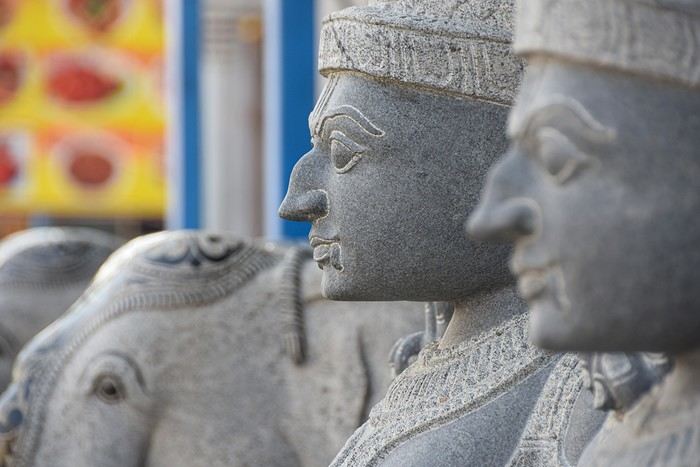
We're off! After exploring the north, the four friends have now discovered the south. We’re excited to share this new travel journal, dedicated to our little group and our strong friendship, written by Richard and illustrated with Kate’s photos. I’ll chime in from time to time with practical tips.
First of all, a big thank you to everyone on VoyageForum who helped us plan this trip. It would’ve been quite different if we’d just relied on guidebooks.
The itinerary lasted just over 3 weeks: Mahabalipuram, Pondicherry, Thanjavur, the Chettinad region, Madurai, Munnar, Munroe Island, Cochin, and Chennai. We traveled by train, taxi, and private car with a driver, took a domestic flight, and stayed in guesthouses, Airbnb apartments, and hotels. For each of us, including flights, the total budget barely reached 2000 €, and we didn’t hold back—knowing we avoid resorts and love street food and small Indian restaurants.
Oman for backpackers: trip report
So happy to be back with you all that I’m rushing to share my trip report!
We chose to stay exactly 14 days to avoid paying for a visa. As a result, we didn’t have time to explore the south—we’ll be back because Oman is a great destination in January. Temperatures were a perfect 25–27°C during the day. No rain for us, but it can happen.
We bought the *Évasion Oman* guidebook. We started with the Jebels (the mountains), abandoned villages, then the desert, wadis along the coast, and finished in the capital. For us, it was easier to go from cold (2,000 meters, after all) to hot before returning to our freezing Normandy in January.
The people were incredibly welcoming and lovely. We camped in natural camping areas where you can make a fire (free, no facilities or water). Easy to find—just search "camping" on Google Maps (an essential app). We traveled as a group of five and rented a 4x4 seven-seater from Europcar before leaving (price included our insurance): 800 euros for 14 days. Essential for getting everywhere, as there are lots of dirt tracks. We brought our camping gear from France since the baggage allowance is 30 kg. Oh, and also two liters of rum and a box of white wine—also essential.
Food was tricky if you don’t like spicy dishes or just chicken. You have to eat at international restaurants, which cost about the same as back home. We’d packed vacuum-sealed meat for the first three days and a few cans. For beaches, stick to the ones marked on Google for swimming—otherwise, they can be dirty and full of oil.
We arrived at 6:30 AM, bought a SIM card (make sure to remove yours before arriving and tape it to the back of your phone), exchanged money (not great rates at the airport—better in malls or souks; no exchanges in banks), and picked up the car. Then we headed to a Carrefour supermarket, but it was closed. We drove to Jebel Al Akhdar, the Sayq Plateau, where we found markets along the way. There are also bazaar shops where you can get gas bottles—they’re everywhere in mid-sized towns. There are even hypermarkets.
We hiked the well-marked old Sayq trail (red and white markings). Our return was improvised. We camped on the plateau and got cold—bring 0°C sleeping bags! The next day, we visited the abandoned villages of Wadi Bani Habib: juniper forests, canyon viewpoints. Then Birkat Al Maws on the way down—a beautiful palm grove. Next, Nizwa Hotel. The beds were really hard there—ask to see the rooms and test the beds before booking. There’s always availability, with prices starting at 35 euros for two.
On the third day, we went to Jebel Shams. Hiked along the canyon starting from Ghul, then descended. Camped on the road to Balha Fortress, which we visited the next morning (stunning!). Then we explored Nizwa before heading to the Wahiba Desert. Camped along the way, then drove to our accommodation: two days in the desert. We found the Thousand Nights Camp 40% cheaper a month before. Note: you have to leave by 1 PM in a convoy to reach the hotel.
On the sixth day, we hiked in the desert on our own because the activity prices were outrageous.
On the seventh day, we headed to a wadi, Bani Khalid, then to Sur, a seaside hotel. We booked just one room for five of us—hotel apartments are huge, and since we had our camping mattresses, it wasn’t a problem to set up in the living room. There’s even a kitchen. In cities, camping spots are poorly located—near intersections, etc.
Beach time and sightseeing on the eighth day, then we drove to the white sand beach in Fins, where we stayed for two nights (we left the tents set up but empty). This was our favorite campsite—go all the way to the end of the road, there’s a small cove and a stunning spot.
On the ninth day, we visited Wadi Shab and the Salma Plateau to find the tombs. The hike up from Fins was way too long—probably better to take the route suggested in the guidebook for a round trip. Meh, no one really enjoyed it.
On the tenth day, we went to Wadi Al Arbiyyin and drove to Seeb Al Mouj to book a diving trip. Stayed at Al Ferdous Hotel Apartments until the end—well-located for visiting Muscat and a great value. Just make sure to check the room first, as some beds are very hard and others aren’t.
Eleventh day: diving and beach time.
Twelfth day: visited the Grand Mosque (unlucky—first day it became paid, and not just a little: 8 OMR). Then explored the old city.
Thirteenth day: the Grand Opera and beach at The Village, where we found a great pizzeria: pizzawifi.com.
Fourteenth day: And that’s it—back home, thrilled to have discovered this magical country. We’ll be back!
We bought the *Évasion Oman* guidebook. We started with the Jebels (the mountains), abandoned villages, then the desert, wadis along the coast, and finished in the capital. For us, it was easier to go from cold (2,000 meters, after all) to hot before returning to our freezing Normandy in January.
The people were incredibly welcoming and lovely. We camped in natural camping areas where you can make a fire (free, no facilities or water). Easy to find—just search "camping" on Google Maps (an essential app). We traveled as a group of five and rented a 4x4 seven-seater from Europcar before leaving (price included our insurance): 800 euros for 14 days. Essential for getting everywhere, as there are lots of dirt tracks. We brought our camping gear from France since the baggage allowance is 30 kg. Oh, and also two liters of rum and a box of white wine—also essential.
Food was tricky if you don’t like spicy dishes or just chicken. You have to eat at international restaurants, which cost about the same as back home. We’d packed vacuum-sealed meat for the first three days and a few cans. For beaches, stick to the ones marked on Google for swimming—otherwise, they can be dirty and full of oil.
We arrived at 6:30 AM, bought a SIM card (make sure to remove yours before arriving and tape it to the back of your phone), exchanged money (not great rates at the airport—better in malls or souks; no exchanges in banks), and picked up the car. Then we headed to a Carrefour supermarket, but it was closed. We drove to Jebel Al Akhdar, the Sayq Plateau, where we found markets along the way. There are also bazaar shops where you can get gas bottles—they’re everywhere in mid-sized towns. There are even hypermarkets.
We hiked the well-marked old Sayq trail (red and white markings). Our return was improvised. We camped on the plateau and got cold—bring 0°C sleeping bags! The next day, we visited the abandoned villages of Wadi Bani Habib: juniper forests, canyon viewpoints. Then Birkat Al Maws on the way down—a beautiful palm grove. Next, Nizwa Hotel. The beds were really hard there—ask to see the rooms and test the beds before booking. There’s always availability, with prices starting at 35 euros for two.
On the third day, we went to Jebel Shams. Hiked along the canyon starting from Ghul, then descended. Camped on the road to Balha Fortress, which we visited the next morning (stunning!). Then we explored Nizwa before heading to the Wahiba Desert. Camped along the way, then drove to our accommodation: two days in the desert. We found the Thousand Nights Camp 40% cheaper a month before. Note: you have to leave by 1 PM in a convoy to reach the hotel.
On the sixth day, we hiked in the desert on our own because the activity prices were outrageous.
On the seventh day, we headed to a wadi, Bani Khalid, then to Sur, a seaside hotel. We booked just one room for five of us—hotel apartments are huge, and since we had our camping mattresses, it wasn’t a problem to set up in the living room. There’s even a kitchen. In cities, camping spots are poorly located—near intersections, etc.
Beach time and sightseeing on the eighth day, then we drove to the white sand beach in Fins, where we stayed for two nights (we left the tents set up but empty). This was our favorite campsite—go all the way to the end of the road, there’s a small cove and a stunning spot.
On the ninth day, we visited Wadi Shab and the Salma Plateau to find the tombs. The hike up from Fins was way too long—probably better to take the route suggested in the guidebook for a round trip. Meh, no one really enjoyed it.
On the tenth day, we went to Wadi Al Arbiyyin and drove to Seeb Al Mouj to book a diving trip. Stayed at Al Ferdous Hotel Apartments until the end—well-located for visiting Muscat and a great value. Just make sure to check the room first, as some beds are very hard and others aren’t.
Eleventh day: diving and beach time.
Twelfth day: visited the Grand Mosque (unlucky—first day it became paid, and not just a little: 8 OMR). Then explored the old city.
Thirteenth day: the Grand Opera and beach at The Village, where we found a great pizzeria: pizzawifi.com.
Fourteenth day: And that’s it—back home, thrilled to have discovered this magical country. We’ll be back!
Accommodation near the beach in Koh Samui
Hi there, We're thinking of spending 3 weeks in Koh Samui at the start of 2026. Where can we find accommodation close to a pretty beach that's not too touristy but not isolated either, near a small town or village? We've already been to Surin Beach on Phuket Island. We really liked that spot, but we've heard Koh Samui is great too. Thanks for your tips!
Hotels in Venice near St. Mark’s Square
Hello!
What a pleasure to be back on Voyage Forum!
We’ll be in Venice from March 20th to 24th, and I’m looking (for two couples) for a hotel close to St. Mark’s Square—my husband can’t walk long distances. For four nights with breakfast, our budget is around 1,400 € per couple. To avoid too much walking for him, I’d also prefer a hotel where we could potentially eat dinner in the evenings.
If anyone has any recommendations, thank you in advance to those who reply!
Sharing our 3-week experience in Brazil
Hello,
We’re a couple in our sixties and we’ve just spent 22 days in Brazil, from October 29th to November 21st.
We flew from Marseille via Lisbon—outbound to Rio, and back from Recife.
Our itinerary:
4 days in Rio
4 days on Ilha Grande
2 days in Paraty
4 days in Salvador
4 days on Boïpeba
4 days in Olinda
The transfer between Boïpeba and Recife took us 2 days—boats, taxis, and a flight.
We stayed in Airbnbs except in Paraty, where we were in a pousada, and during the Boïpeba–Recife transfer, when we booked a hotel near the airport.
Our flights were with Gol and Azul.
Transfers from Rio were arranged through Paraty Tour.
In Rio, we used a local agency to visit Corcovado and Sugarloaf Mountain.
Happy to answer any questions! Marc
Happy to answer any questions! Marc
Review of my visit to Angkor
SIEM REAP
You can now rent scooters just about everywhere in Siem Reap, but at rip-off prices—$15–18 a day instead of $5–10 like everywhere else in Indochina. The best options are tuk-tuks or, even better, electric bikes ($12, but with a 50 km range, so they won’t let you go to Banteay Srei or the River of a Thousand Lingas in the Kulen Massif, which are too far). **WARNING:** Wear a helmet, or they *will* catch you. Scooters are banned from going from SR to the stunning temple of Koh Ker in the northeast and continuing to Battambang; no idea why!
My favorite little hotel in Siem Reap? The Neth Socheata, tucked in an alley off Thnou St near the market—lovely rooms, and the owner speaks great English. Then there’s the Ivy Guesthouse with its little garden, but it’s “always full,” according to the owner. For something upscale but still affordable, a fantastic spot is the Pavillon Indochine, tucked away on a quiet side street on the way to the airport—elegant, with incredible attention to decor, a terrace restaurant, garden, pool, etc. Everything you’d want for $70 including breakfast. I also spotted a hostel for backpackers, the Angkor Thom Hostel, with small 6-bed dorms for $4 with a fan or $6 with AC (18 Wat Bo St).
Food-wise, it’s all amazing! Pub Street has turned into a noise nightmare, with speakers blasting what’s supposed to be music but is just *boom, boom, boom, boom, boom*—run away, even though the pizzas at the Italian place Il Forno are really good. The famous and excellent Tigre de Papier has changed its name to Paper Tiger and is still just as good (lunch only, though, because across the street there’s a huge bar blasting *boom boom boom*, so you won’t be able to hear each other during dinner). On the other hand, the Italian-Cambodian El Toro on Pub Street is perfect, with fantastic pizzas and divine lasagna (go to the first-floor dining room—there’s a big bar across the street blasting *boom boom boom*, but at least you can still talk). Due to the lack of customers during COVID, all the French restaurants—Barrio (three times alas!), Les Deux Sœurs, Le Bel Air, and Le Mozart—have closed. The only one left is L’Olivier, which is pricey. I also discovered a great Moroccan restaurant (though run by a Sudanese man and his French wife), Le Tajine, on Strung Thmei St, 09 68 89 78 27. **WARNING:** For tagines and couscous, you need to order at least in the morning; wine and beer are fine. To get there, turn at the corner of the Cineplex behind the big market at the start of Sivatha Boulevard.
I finally went to the Khmer dance show. Beautiful dancers and dances, but **EAT BEFORE OR AFTER**—the meal is so awful that most Westerners leave it on their plates.
THE ANGKOR TEMPLES Use the excellent *Routard Cambodia* guide. Just a few tips: - Start with the pre-Angkorian Roluos group, 15 km before Siem Reap on the road to PP—it’s the “ancestor” of the temples.
- To avoid the big crowds at Angkor Wat, Bayon, and Ta Prohm, go between noon and 2 PM when everyone’s having lunch. - Speaking of lunch, the crowds flock to the hundred or so mediocre food stalls on the left side of Angkor Wat. Instead, head to Angkor Thom after the stunning Pre Rup temples, all the way to the small Sras Srang basin. Along the basin, there are several restaurants with terraces offering first-floor views of the water, and no crowds. Afterward, cross to the other side of the basin—you’ll end up in the countryside with charming villages where locals seem to live as they did during the temples’ golden age (at its peak, the population was estimated at 600,000–800,000, making it the largest city in the world. The theory for the abandonment is water shortages caused by overpopulation).
- I climbed Phnom Bakheng for the famous sunset, but the crowd was so ridiculous that instead of seeing the temple at sunset, you just see the heads and shoulders around you.
- There are tons of small temples that most people skip, and they’re missing out. My favorites: Thommanon, Neak Pean, Ta Som, and especially Pre Rup, an amazing brick complex with 14 towers.
**Big disappointment:** You can no longer climb to the first floor of Bayon, where you used to stand magically among the giant head statues. So, admire the beautiful bas-reliefs on the outside, but there’s no point going inside—you’ll just see a dark, square corridor with nothing interesting.
ANGKOR FURTHER AFIELD The wonderful Banteay Srei temple. A gem! I couldn’t find the bas-relief stolen by Malraux in the 1920s (fun fact: what he was doing in Indochina—stealing a bas-relief to sell for a fortune in France to cover his massive gambling debts on the stock market, where he ruined his very wealthy American wife—was an open secret. But the French authorities in Saigon, who hated him for his leftist views, decided to let him do it and catch him red-handed, which worked perfectly. He avoided jail only because all the leftist intellectuals in Saint-Germain, Sartre, Beauvoir, and co. cried scandal—though the real scandal was the looting).
30 km of excellent paved road further north, a great spot: the Kulen Massif and the River of a Thousand Lingas (at one point, you’ll come to a T-junction—turn left). Along the road at the foot of the massif, on your right, there’s a great restaurant, Bourey Sovann (where the food is excellent). The trail to the river starts just before it on the left. **Warning:** There are two sites for the River of a Thousand Lingas. One is accessible via a private road, so there’s a $20 toll, and you need to arrive before 11 AM because the road is narrow and traffic flows downhill after that. You’ll end up in a site full of shops, snack stalls, and two good restaurants, including one by a beautiful waterfall. However, the thousand lingas aren’t as spectacular there.
Banteay Srei + the River of a Thousand Lingas makes for a fantastic day. **WARNING:** You used to be able to go to the river and waterfall by scooter or tuk-tuk, but it’s now forbidden. So **go by taxi**—otherwise, you’ll be hiking 12 km round trip up a steep trail.
If you leave Siem Reap early, you can even add Beng Mealea temple on the way back, making a triangular route: SR-BS-Khulen-BM-SR (or the reverse).
If you have time, visit Banteay Samré temple, 10 km west of the Angkor Thom complex. A lovely site with very few visitors.
I’ve never been to the famous Preah Khan on a hill overlooking Thailand. There’s a big dispute between the two countries—the Thais insist the temple belongs to them because the entrance is in their country. There have been serious clashes in the recent past, and landmines are still abundant off the marked paths. They even claim the entire Siem Reap province is theirs and should be returned, arguing it was Thai in the past. It takes two days (6–7 hours each way), with an overnight stay in the nearby village (small hotels and one luxury option with a garden and pool, but it’s expensive).
TONLE SAP People talk about “floating villages,” but that’s a big mistake—these are actually villages of astonishing stilt houses, 4 meters high or more, due to the lake’s major floods. The most famous is Chong Khneas, which I skipped because it’s packed with tourists. Instead, I really liked Kampong Phluk, which is much quieter. To get there, continue on the road past the Roluos group until you reach a parking lot with pirogues lined up. They’ll take you down the river, stop at this amazing village for a walk, and then take you to the Tonle Sap, a true inland sea. At one point, you’ll pass through a flooded forest that you can explore by small boat. At the junction of the river and the Tonle Sap, and on the lake itself, there are floating restaurants where the food is great. Note that in the dry season, you can reach the village by scooter.
BACK TO PHNOM PENH AND ON TO SOUTHERN VIETNAM Since I’d planned at least 15 days in the Mekong Delta between Chau Doc and Saigon, I skipped Battambang, etc. With no desire to endure the dusty road from SR to PP again, I simply loaded my bike onto a bus with the great company Rith Monty (book at their office in SR on the small square at the start of Sivatha Boulevard—$10 for the bike and $6 for me), also known as Paramount. Their buses stop on 136 St right in the middle of PP. I’ll also mention the excellent Giant Ibis, with big modern buses that always leave on time—unlike the others.
I spent the night in PP, and the next morning took the fast boat from PP to Chau Doc with Hang Chau Tourist (buying the ticket the day before is recommended—$25—either at your hotel or the port, and they’ll pick you up at your hotel by tuk-tuk to take you to the port). Departure from PP at noon, arrival in Chau Doc around 4 PM. The boat is great—comfortable and fast. A crew member takes your passports for Cambodian exit formalities, and you handle Vietnamese immigration yourself—it all takes 15–20 minutes. The route isn’t on the Mekong but on the Bassac River to the border, then a wide north-south canal to Chau Doc (the arrival is really nice). In the Chau Doc-PP direction, the boat leaves Chau Doc at 7:30 AM.
My favorite little hotel in Siem Reap? The Neth Socheata, tucked in an alley off Thnou St near the market—lovely rooms, and the owner speaks great English. Then there’s the Ivy Guesthouse with its little garden, but it’s “always full,” according to the owner. For something upscale but still affordable, a fantastic spot is the Pavillon Indochine, tucked away on a quiet side street on the way to the airport—elegant, with incredible attention to decor, a terrace restaurant, garden, pool, etc. Everything you’d want for $70 including breakfast. I also spotted a hostel for backpackers, the Angkor Thom Hostel, with small 6-bed dorms for $4 with a fan or $6 with AC (18 Wat Bo St).
Food-wise, it’s all amazing! Pub Street has turned into a noise nightmare, with speakers blasting what’s supposed to be music but is just *boom, boom, boom, boom, boom*—run away, even though the pizzas at the Italian place Il Forno are really good. The famous and excellent Tigre de Papier has changed its name to Paper Tiger and is still just as good (lunch only, though, because across the street there’s a huge bar blasting *boom boom boom*, so you won’t be able to hear each other during dinner). On the other hand, the Italian-Cambodian El Toro on Pub Street is perfect, with fantastic pizzas and divine lasagna (go to the first-floor dining room—there’s a big bar across the street blasting *boom boom boom*, but at least you can still talk). Due to the lack of customers during COVID, all the French restaurants—Barrio (three times alas!), Les Deux Sœurs, Le Bel Air, and Le Mozart—have closed. The only one left is L’Olivier, which is pricey. I also discovered a great Moroccan restaurant (though run by a Sudanese man and his French wife), Le Tajine, on Strung Thmei St, 09 68 89 78 27. **WARNING:** For tagines and couscous, you need to order at least in the morning; wine and beer are fine. To get there, turn at the corner of the Cineplex behind the big market at the start of Sivatha Boulevard.
I finally went to the Khmer dance show. Beautiful dancers and dances, but **EAT BEFORE OR AFTER**—the meal is so awful that most Westerners leave it on their plates.
THE ANGKOR TEMPLES Use the excellent *Routard Cambodia* guide. Just a few tips: - Start with the pre-Angkorian Roluos group, 15 km before Siem Reap on the road to PP—it’s the “ancestor” of the temples.
- To avoid the big crowds at Angkor Wat, Bayon, and Ta Prohm, go between noon and 2 PM when everyone’s having lunch. - Speaking of lunch, the crowds flock to the hundred or so mediocre food stalls on the left side of Angkor Wat. Instead, head to Angkor Thom after the stunning Pre Rup temples, all the way to the small Sras Srang basin. Along the basin, there are several restaurants with terraces offering first-floor views of the water, and no crowds. Afterward, cross to the other side of the basin—you’ll end up in the countryside with charming villages where locals seem to live as they did during the temples’ golden age (at its peak, the population was estimated at 600,000–800,000, making it the largest city in the world. The theory for the abandonment is water shortages caused by overpopulation).
- I climbed Phnom Bakheng for the famous sunset, but the crowd was so ridiculous that instead of seeing the temple at sunset, you just see the heads and shoulders around you.
- There are tons of small temples that most people skip, and they’re missing out. My favorites: Thommanon, Neak Pean, Ta Som, and especially Pre Rup, an amazing brick complex with 14 towers.
**Big disappointment:** You can no longer climb to the first floor of Bayon, where you used to stand magically among the giant head statues. So, admire the beautiful bas-reliefs on the outside, but there’s no point going inside—you’ll just see a dark, square corridor with nothing interesting.
ANGKOR FURTHER AFIELD The wonderful Banteay Srei temple. A gem! I couldn’t find the bas-relief stolen by Malraux in the 1920s (fun fact: what he was doing in Indochina—stealing a bas-relief to sell for a fortune in France to cover his massive gambling debts on the stock market, where he ruined his very wealthy American wife—was an open secret. But the French authorities in Saigon, who hated him for his leftist views, decided to let him do it and catch him red-handed, which worked perfectly. He avoided jail only because all the leftist intellectuals in Saint-Germain, Sartre, Beauvoir, and co. cried scandal—though the real scandal was the looting).
30 km of excellent paved road further north, a great spot: the Kulen Massif and the River of a Thousand Lingas (at one point, you’ll come to a T-junction—turn left). Along the road at the foot of the massif, on your right, there’s a great restaurant, Bourey Sovann (where the food is excellent). The trail to the river starts just before it on the left. **Warning:** There are two sites for the River of a Thousand Lingas. One is accessible via a private road, so there’s a $20 toll, and you need to arrive before 11 AM because the road is narrow and traffic flows downhill after that. You’ll end up in a site full of shops, snack stalls, and two good restaurants, including one by a beautiful waterfall. However, the thousand lingas aren’t as spectacular there.
Banteay Srei + the River of a Thousand Lingas makes for a fantastic day. **WARNING:** You used to be able to go to the river and waterfall by scooter or tuk-tuk, but it’s now forbidden. So **go by taxi**—otherwise, you’ll be hiking 12 km round trip up a steep trail.
If you leave Siem Reap early, you can even add Beng Mealea temple on the way back, making a triangular route: SR-BS-Khulen-BM-SR (or the reverse).
If you have time, visit Banteay Samré temple, 10 km west of the Angkor Thom complex. A lovely site with very few visitors.
I’ve never been to the famous Preah Khan on a hill overlooking Thailand. There’s a big dispute between the two countries—the Thais insist the temple belongs to them because the entrance is in their country. There have been serious clashes in the recent past, and landmines are still abundant off the marked paths. They even claim the entire Siem Reap province is theirs and should be returned, arguing it was Thai in the past. It takes two days (6–7 hours each way), with an overnight stay in the nearby village (small hotels and one luxury option with a garden and pool, but it’s expensive).
TONLE SAP People talk about “floating villages,” but that’s a big mistake—these are actually villages of astonishing stilt houses, 4 meters high or more, due to the lake’s major floods. The most famous is Chong Khneas, which I skipped because it’s packed with tourists. Instead, I really liked Kampong Phluk, which is much quieter. To get there, continue on the road past the Roluos group until you reach a parking lot with pirogues lined up. They’ll take you down the river, stop at this amazing village for a walk, and then take you to the Tonle Sap, a true inland sea. At one point, you’ll pass through a flooded forest that you can explore by small boat. At the junction of the river and the Tonle Sap, and on the lake itself, there are floating restaurants where the food is great. Note that in the dry season, you can reach the village by scooter.
BACK TO PHNOM PENH AND ON TO SOUTHERN VIETNAM Since I’d planned at least 15 days in the Mekong Delta between Chau Doc and Saigon, I skipped Battambang, etc. With no desire to endure the dusty road from SR to PP again, I simply loaded my bike onto a bus with the great company Rith Monty (book at their office in SR on the small square at the start of Sivatha Boulevard—$10 for the bike and $6 for me), also known as Paramount. Their buses stop on 136 St right in the middle of PP. I’ll also mention the excellent Giant Ibis, with big modern buses that always leave on time—unlike the others.
I spent the night in PP, and the next morning took the fast boat from PP to Chau Doc with Hang Chau Tourist (buying the ticket the day before is recommended—$25—either at your hotel or the port, and they’ll pick you up at your hotel by tuk-tuk to take you to the port). Departure from PP at noon, arrival in Chau Doc around 4 PM. The boat is great—comfortable and fast. A crew member takes your passports for Cambodian exit formalities, and you handle Vietnamese immigration yourself—it all takes 15–20 minutes. The route isn’t on the Mekong but on the Bassac River to the border, then a wide north-south canal to Chau Doc (the arrival is really nice). In the Chau Doc-PP direction, the boat leaves Chau Doc at 7:30 AM.
21-Day Trip to La Gomera and La Palma
Travel Journal: 21 Days in La Gomera and La Palma
From February 6 to February 26, 2024
Tuesday, February 6 We left around 9 AM with our car, along with Pierre-Paul and Patricia, heading to the Bluepark parking lot in Bartenheim. As expected, we were awaited and left promptly for EuroAirport Basel. Took off at 12:25 PM for a 4-hour-15-minute flight under excellent conditions. Beautiful arrival in Tenerife with Teide in sight under a clear blue sky. Fifteen minutes later, we waited for bus No. 40 to Los Cristianos with quite a few other tourists, but we managed to find four seats. From the bus station, it was a 20-minute walk to our hotel. We checked into a lovely apartment for the four of us, complete with all the comforts. Outside, it was quite warm—at least 25°C! After dropping off our luggage, we went for a stroll. The immediate surroundings of the hotel held no interest for us: a modern, concrete area filled with hotels, bars, tourist agencies, and unappealing restaurants all offering the same bland international cuisine. Pat went to cool off at the pool, unfortunately overrun by loud, drunk English tourists. I took a walk to the paseo maritimo that leads to the port, skirting the seafront. The promenade was pleasant, but it could have been any seaside resort in the world—same old scene: a succession of bars with blaring music where many elderly people sipped cold beers waiting for the sunset, the backdrop a wall of resort-style hotels resembling rabbit hutches! Upon reaching the port, I scouted the route we’d take the next day to the Fred Olsen ferry. Back at the apartment, in the early evening, we looked for a non-touristy restaurant for dinner. Monique stopped a woman to ask her opinion! In this area, she told us, there’s no restaurant that serves Canarian or Spanish cuisine! The only place with decent restaurants is at the port. Off we went to the port, where we sat down at Al Bordo restaurant and ordered a seafood paella for four. Excellent, and at a very reasonable price (36 € for two). We returned to the hotel along the seafront.
Wednesday, February 7
Woke up at 6 AM. Had breakfast in the apartment with what we’d bought the day before at a supermarket. It was still dark when we left on foot toward the port, walking along the calm seafront at this early hour. Forty minutes later, we arrived and waited 10 minutes before the ferry docked. At 9:30 AM, we left the port of Los Cristianos for a 50-minute crossing on a calm sea under a beautiful blue sky. There were quite a few people on this large ferry, but many had no luggage, meaning they were visiting La Gomera for the day and would take the ferry back in the evening. Upon disembarking, we went straight to our rental car agency to pick up the car we’d booked online a few months earlier. It was a nice Peugeot 2008, spacious enough for the four of us and our luggage. We immediately took the beautiful road from San Sebastián that climbs directly into the mountains toward our rental in Vallehermoso. The road was in perfect condition—it seemed brand new, like all the others we’d take on this island later. This side of the island is very arid with little vegetation, and the terrain is particularly rugged, as it is throughout the island. We stopped at our first miradors, which would be followed by many more throughout our Canarian trip. Our first visit was to the small village of Agulo, perched on a promontory above the sea and at the foot of a high cliff. The village features typical Canarian houses with windows flush with the façade and black volcanic stone masonry on white or reddish-brown walls. The first recommended restaurant was already booked for a group, so we settled for the shaded terrace of the excellent El Alameda bar-restaurant. From Agulo, you can access the Abrante viewpoint via a winding road, where the view of Agulo, 600 meters below, is exceptional. A glass ledge over the void lets you test your fear of heights!
We drove to Vallehermoso to do our grocery shopping at the supermarket—a habit that would continue until the end of the trip. Our little house, "Casa rural El Encatadora," is located in a beautiful flower-filled valley a few kilometers west of Vallehermoso. Each of us had a bedroom with an en-suite bathroom, plus a living room, kitchen, and a small terrace overlooking the quiet street at the valley’s end, which didn’t bother us at all.
Thursday, February 8 The good weather seemed to follow us since our arrival in the Canary Islands. This morning, we took the road—still as beautiful and new—toward Arure, high up to the west. The landscape was magnificent, with breathtaking glimpses of the sea far below. In Arure, we parked in front of Conchita’s bar, where a hike (Rother No. 30) starts toward two viewpoints: Alojera, which we reached after 45 minutes on a lovely path. Monique, tired from the first steep climb, stopped at the first viewpoint and hitchhiked back to Arure. Meanwhile, we continued toward the second viewpoint, Los Barranquillos, where the view of the surroundings was partially hidden by misty clouds rising from the sea. The entire mountain is sculpted by ancient, endless terraces climbing until the slope becomes too steep for construction—visible traces of the hard work of past inhabitants trying to survive in a harsh environment. We had a decent lunch at La Conchita bar, then drove to the small seaside town of Puerto la Caleta, sheltered by an immense cliff plunging into the sea. Black sand beach, rough sea—despite our encouragement, Pat didn’t dare to swim! As for the old village of Caleta, it’s perched on the mountainside, and visiting it requires climbing steep, stair-filled alleys to discover a few traditional houses. Back at the casa, dinner in, and card games...
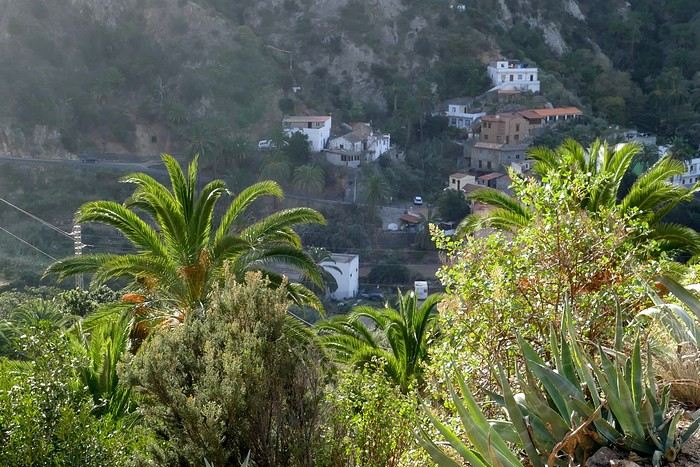 Vallehermoso
Friday, February 9 This morning, the sky was overcast, and the peaks around us were shrouded in clouds. We took the same road as yesterday to hike Las Creces. Quickly gaining altitude, we entered a thick fog—visibility was very limited. We stopped at the Las Creces parking lot; visibility improved, and the sun wasn’t far off. The hike is entirely within a beautiful laurel forest, with the sun playing hide-and-seek, but it wasn’t cold despite the altitude. After finishing the loop trail, we decided to picnic—not there, as it was too chilly—but on Vallehermoso’s beach, where we found a nice picnic area sheltered by large black rocks. A short digestive walk on the surrounding hill to admire the little beach from above. Back in Vallehermoso, we did some grocery shopping, then tried to return to the casa—only to find ourselves locked out because we’d left the key in the lock inside! After several attempts and with the help of Yéli, a relative of the owner we called for help, we were finally able to get back in!
Saturday, February 10
It rained last night, and the sky remained overcast. Monique decided to rest this morning. PP, Pat, and I set off on the hike that starts from the house toward the Marichal reservoir. The sun wasn’t far off, and by 11 AM, it was fully out. The pleasant hike passed by many flower-filled gardens and orchards—orange, lemon, and mandarin trees in fruit. The path climbed gently toward the reservoir, where the view of the Cano rock dominating the landscape was magnificent. The last part of the climb was a bit tough, overgrown with lush vegetation, and the trail was slippery from last night’s rain. We descended via a different, much more pleasant path and returned to the casa just in time for lunch, prepared by Monique. This valley is rich with its many farmers and market gardeners who’ve cultivated the entire valley, taking advantage of the water flowing down from the mountain, captured upstream and redistributed through countless pipes snaking along the paths. Numerous tanks also store water during dry periods. The houses are scattered across both sides of the valley, and these colorful little homes add a beautiful touch to the landscape. The many palm trees give this valley a distinctly tropical feel—you could almost imagine yourself in the Caribbean. Add to that some salsa music drifting from a hut where farmers were working, and the picture is complete. A well-chilled beer apéro capped off a lovely morning. The afternoon was dedicated to rest, relaxation, reading, and games.
Sunday, February 11 The blue sky returned, though a few clouds still capped the highest peaks. Today, we visited Garajonay National Park, which covers the highest central mountains. Up there, we were above the clouds, and the panoramas from the various viewpoints were stunning: first, Cherelepin, accessible from the Laguna Grande parking lot, then Alto de Garajonay, offering an exceptional view of Teide—over 3,000 meters high—emerging from the clouds on Tenerife, far in the distance. We continued to the Los Roques viewpoints, then stopped for lunch at the Degollada de Peraza restaurant, where the view of the barranco was impressive. We descended toward San Sebastián and checked into our new lodging, La Cabezada, located in the countryside about 3 km above San Sebastián. It’s a small apartment adjacent to the owner’s, with a lovely terrace overlooking the surrounding mountains and surrounded by a beautiful garden. Apéro, then dinner on our beautiful terrace.
Monday, February 12 This morning, we went down to visit San Sebastián de La Gomera: its old tower, main street with some beautiful traditional houses, and the Church of the Assumption. Back at the casa for lunch. In the afternoon, Pat, PP, and I set off on the short hike from San Sebastián beach to La Guancha beach. We drove down and parked on the beach. The path climbs along the hill overlooking San Sebastián, passes by the tall Christ statue dominating the landscape, and roughly follows the coast down to the isolated Guancha beach. A beautiful hike under a hot sun, and a swim was welcome, even if the beach and sea access weren’t very comfortable due to large pebbles and quickly deepening water. Apart from two nudist bathers, there was no one on this beach. We returned the same way.
Tuesday, February 13 Rest day. We went down to town to stroll and do some shopping. I took the opportunity to visit the parador, beautifully situated above the city in a lovely garden overlooking the port and town. Together, we went for a cuba libre at the "Cuba Libre" bar, then had lunch at Breñusca (mediocre paella!). Back at the casa, then we went back down to town to see a carnival parade, a "passacalles," which actually passed an hour earlier than scheduled. Oh well.
Wednesday, February 14 Each to their own program this morning. Pat went swimming at San Sebastián beach, Monique rested at the casa, and PP and I set off on the hike from Playa de Avalos to the Ermita de Guadalupe on Playa del Cangrejo. It wasn’t easy to find the right road or the parking spot, but we managed. The path seemed to have suffered landslides, according to a sign at the trailhead! We decided to check it out, ready to turn back if it seemed too dangerous. In the end, apart from one or two slightly tricky spots where we had to climb a pile of rocks, the trail remained passable, though a bit vertigo-inducing in places. The narrow path clings to very vertical cliffs nearly 300 meters above sea level! But what a magnificent view. At one point, the trail runs alongside a wall of basaltic pipes. We returned via the drivable track that parallels the trail a bit lower. Back at the house for lunch. In the late afternoon, we returned to town to attend the "Entierro de las Sardinas" (Burial of the Sardine), which closes the Canarian carnival festivities. While waiting, we strolled through the parador’s gardens and had mojitos in town. Around 9 PM, we heard the noise and cries of the mourners. The procession advanced, led by a large papier-mâché sardine on a float, surrounded by wailing mourners. The procession headed toward the sea, where the sardine was burned, and a mini fireworks display ended the procession. It was all very good-natured, and everyone had fun. We ended the evening with dinner at a good fish restaurant, El Pajar.
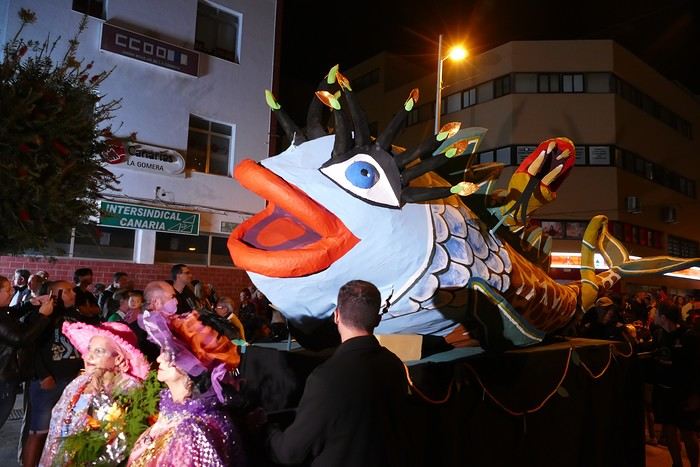 Entierro de la Sardina in San Sebastián de La Gomera
Thursday, February 15
Woke up at 5:15 AM. The only suitable ferry was at 7 AM, which would get us to La Palma by late morning rather than evening. We packed our bags, had breakfast, then headed to the port, left our rental car, and boarded the ferry to Tenerife, from where we’d continue to La Palma. Calm sea, beautiful sun—by 10:30 AM, we disembarked in La Palma. We picked up our car and immediately headed to our new apartment in Breña Alta. It’s a large apartment with a superb terrace facing the sea, fully equipped and very comfortable. The hosts recommended Casa Goyo restaurant, near the airport and close to us. It’s a restaurant with many small rooms, some of which can be reserved for families. The fish-based cuisine (chipirones, pulpo) was excellent, hearty, and reasonably priced. Since it’s in the airport’s flight path, we occasionally heard planes landing. Quick and efficient service. Afterward, we visited Santa Cruz de La Palma, which reminded us of the historic quarters of La Orotava in Tenerife or the capital of Gran Canaria.
Friday, February 16
Beautiful weather, blue sky. We headed to the San Bartolo viewpoint toward the northeast coast, then to the lovely village of San Andrés, which we explored. From there, we walked along the shore to the natural pools of Charco Azul, where we swam in the cool but "swimmable" sea. Back in San Andrés for lunch at the "San Andrés" restaurant on the beautiful church square. Very good fish-based meal. We got back in the car and continued along the north coast to the port of Espindola and the natural pools of Fajana near the Cumplida lighthouse. A fairly strong wind whipped up beautiful waves crashing onto the rocky coast in bursts of foam. Back in Santa Cruz, we stopped at the Mercadona supermarket to buy fresh shrimp for dinner.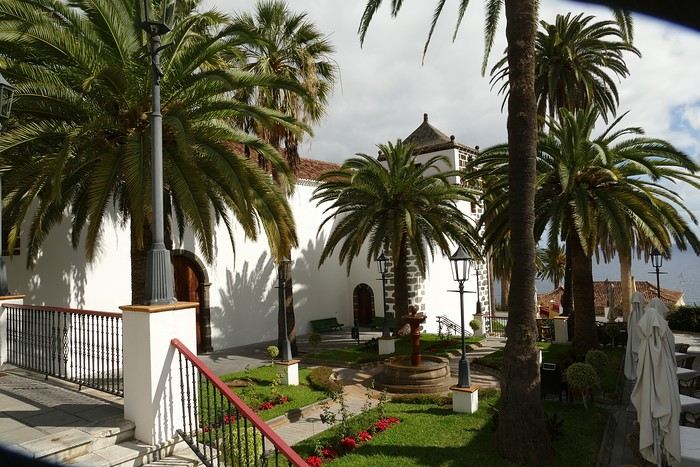 San Andrés
Saturday, February 17
Uniform blue sky, even on the heights. We took the beautiful road that winds up to the summit of the Caldera de Taburiente. Several viewpoints offer 360° views of the entire island and beyond: you can make out La Gomera, El Hierro, and, of course, Tenerife with the perfect triangle of Teide. We parked at the Los Andes viewpoint parking lot and started our hike to Pico de la Cruz along a trail following the ridge, offering superb views into the caldera. We got back in the car and passed by the Roque de los Muchachos astronomical complex, composed of numerous observatories, some with very aesthetic mirror telescopes. We hiked from the Roque de los Muchachos parking lot to the various viewpoints, always as impressive. Picnic on site, then back to Santa Cruz. We stopped by our car dealer because the oil warning light came on—better safe than sorry. The representative reassured us but preferred to give us a Fiat Cross SUV instead.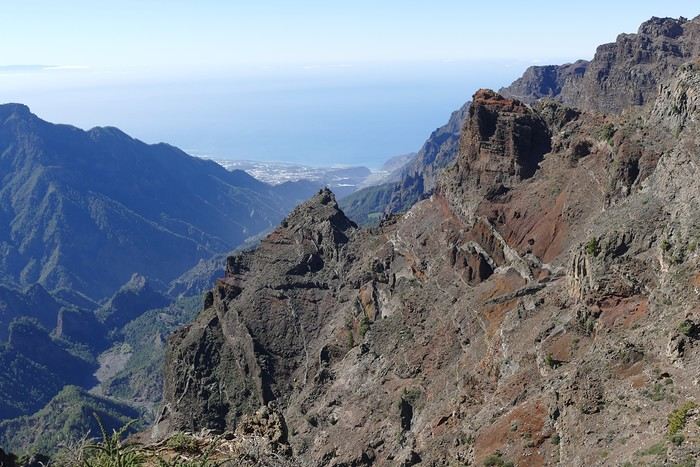 The Caldera de Taburiente
Sunday, February 18 The weather was a bit mixed, with cloudy patches. We set off to hike the Barranco de la Cuba de Galga. Unfortunately, the Los Tilos trail had been closed for several months due to a major landslide. The parking lot by the road was already quite full, and indeed, we crossed paths with many hikers along the way—it’s an easy hike with little elevation gain, which is rare here in La Palma! The beautiful path winds through a very narrow, deep gorge covered in lush tropical vegetation—you’d think you were in a Southeast Asian forest, especially with the humidity in the gorge bringing out earthy and floral scents. Halfway through, Monique turned back while the rest of us continued to the Cuba de Galga. A light drizzle accompanied us on the return. For lunch, we went to Chipi Chipi restaurant in the heights of Santa Cruz. The cool air forced us to leave the lovely terrace for the slightly noisy dining room. The meal was very good and hearty. Afternoon spent resting at our house.
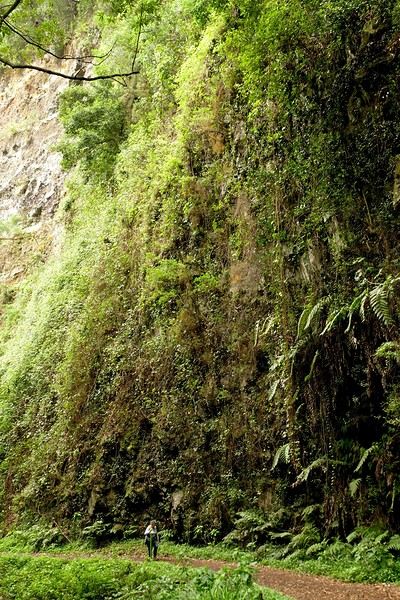 La Cuba de la Galga
Monday, February 19 A few clouds still clung to the nearby mountain peaks. We headed south to Los Canarios. We stopped in front of the small San Antonio Abad church, where a path leads to the viewpoint in 15 minutes. Then we visited the San Antonio Volcano Interpretation Center and climbed to the viewpoint via the trail along the crater’s edge, offering a plunging view into the crater. Then PP, Pat, and I headed toward the Teneguía volcano but turned back given the remaining distance and the intense heat bearing down on us! Plus, the landscape was rather arid and not very interesting. We got back in the car and drove down to the salt flats at the island’s southern tip. The ocean crashes here in large waves, exploding against the volcanic rocks and feeding a "blowhole" carved into the rock. We stopped for drinks at the salt flats restaurant, then headed home.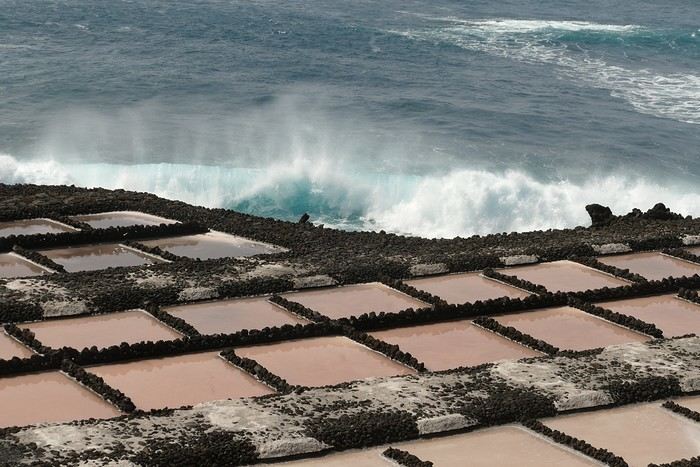 The salt flats in Fuencaliente
Tuesday, February 20 Beautiful weather with a few clouds clinging to the mountains, as usual. A relaxed morning since my parking reservation at La Cumbrecita didn’t start until 1 PM. It takes about 30 minutes from Santa Cruz to reach the valley floor via a beautiful but narrow road toward the end, though there’s very little traffic. Meanwhile, the clouds had disappeared, and the view from the La Cumbrecita viewpoint was superb. We recognized Pico de la Cruz in the distance, where we’d been a few days earlier. We then took the path leading to the Las Chozas viewpoint through a magnificent Canarian pine forest. We picnicked on site, then took the path to the Los Roques viewpoint. We returned the same way since the direct route was closed for construction. Back in Santa Cruz, we visited the Sanctuary of Las Nieves, with its beautiful golden Baroque altar.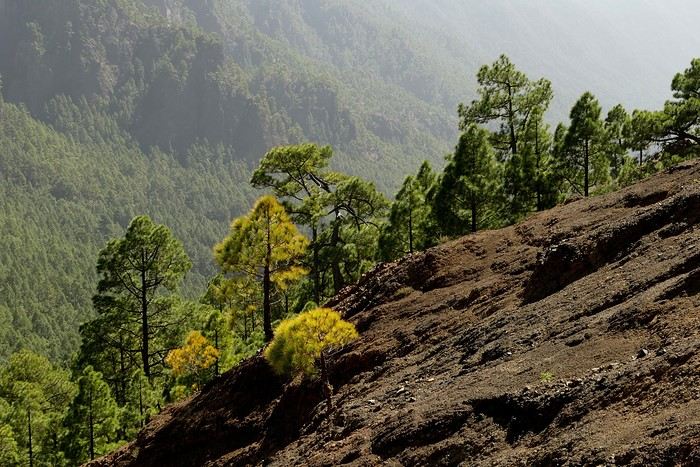 Hike from La Cumbrecita
Wednesday, February 21 After packing our things and loading the car, we left Santa Cruz under a very blue sky for Los Llanos de Aridane, where we stopped to visit this lovely town. The Church of Nuestra Señora de los Remedios has a beautiful coffered ceiling and an original papier-mâché Christ statue from the 16th century. Around it, colorful old Canarian houses brighten the streets of the town center. We took the opportunity to stroll, do some shopping, and finally sat down at La Pergola restaurant for a mediocre lunch. We got back in the car to check into our new house in Arecida. On the way, we stopped at the Mirador del Time, which once again offered an impressive panorama, allowing us—for the first time—to see the damage caused by the Tajogaite volcano eruption in 2021. You can clearly see the still-smoking crater and the large black lava flow covering the landscape down to the sea. We really liked our new accommodation: a local house that’s been renovated on the heights of Arecida, not far from the Canarian pine forest. From several terraces, we have a 360° view of the sea and mountains. We even have a private pool! There are two beautiful, brand-new bedrooms, each with its own bathroom—the best. Plus, we’re on the GR 131 trail that runs along the Barranco de las Angustias toward the northeast.
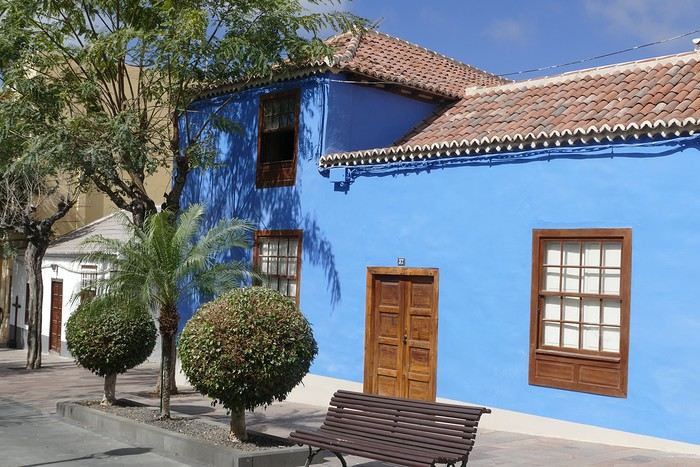 Los Llanos de Aridane
Thursday, February 22 Once again, beautiful weather greeted us when we woke up. We started the GR 131 with the goal of reaching the Torre del Time viewpoint—about 400 meters of elevation gain. The path, quite steep at first, winds through a superb Canarian pine forest. A few viewpoints let you appreciate the sheer drop of the Barranco de las Angustias—watch out for vertigo! At the Torre del Time viewpoint, there’s a nearly 1,000-meter vertical drop. We returned via another path, the PLP1, which meanders first through this beautiful forest, then along lovely flower-filled gardens adjacent to beautiful properties that cascade from the forest down to the road serving these neighborhoods. This afternoon, we tried to get closer to the area devastated by the 2021 lava flows. Several roads are still closed or reserved for residents, while others—brand new—have been rebuilt to open up this densely populated and cultivated region. In some places, the lava flow slightly diverted, sparing some properties that logically should have disappeared. Now, they’re encircled by a massive cooled lava field. In other spots, twisted and charred metal scraps or greenhouse remains protrude from the lava—all that’s left of the former banana plantations. A little higher up, you can see the slightly smoking crater of Tajogaite, responsible for this disaster. Back to Casa Barreros.
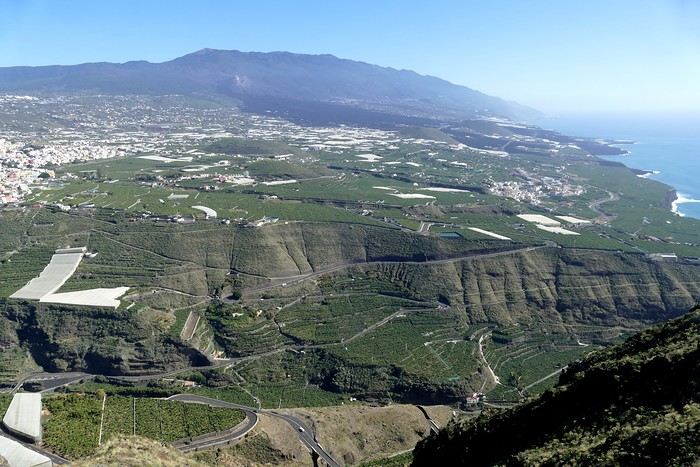 View of Los Llanos and, in the background, the 2021 lava flow
Friday, February 23
Though the sky was still blue, the temperature had dropped due to a chilly wind. By midday, it still rose to 22°C. Today, we headed north, specifically to the town of Tijarafe, where a very narrow road descends to the small port, Porís de Candelaria. The 3.7-kilometer road drops 700 meters in elevation, with gradients up to 30%—it was going to be intense! Indeed, the descent was scary, with the void right next to the very narrow road where passing was impossible except at a few rare spots. Everything went well—there was little traffic at this early hour. From the parking lot at the bottom, a path leads to Porís de Candelaria. It’s surprising to see this small fishing hamlet nestled in the shelter of an immense cave opening onto the sea, which was quite rough today. The sun, at this time of year, would appear late in the cave, which remained in shadow for much of the day. We returned via the same road, strolled through the small town of Puntagorda, and had lunch at El Jardín de los Naranjos restaurant—excellent meal.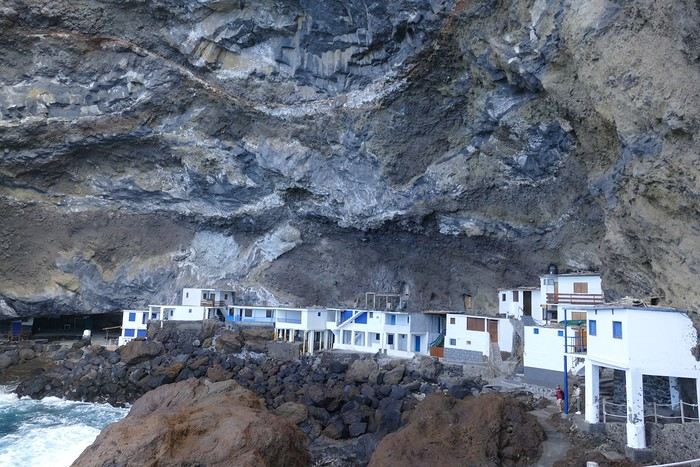 Fishing hamlet of Candelaria
Saturday, February 24 The air was still cool, but the sun was beautiful. While Monique stayed home to rest, the three of us headed to the village of Las Tricias to hike the Buracas Caves trail. We left the car parked on the LP1 road and took the small paved road down to the sign marking the trail’s start. The signage for all the trails we took here, as in La Gomera, was very well done. The path descended steadily, then more steeply toward the caves where the island’s first inhabitants lived—some petroglyphs are still visible in certain caves. The path then climbed back up, passing magnificent dragon trees and more or less elaborate huts occupied by Germans who’ve lived here for many years. Back at Casa Barreros for some rest.
Sunday, February 25 The weather once again blessed us with a beautiful day. This morning, we visited the local produce market held on weekends in Puntagorda. You’ll find agricultural products, crafts, and food to keep you going. A little further on, there’s a glass viewpoint overlooking the barranco plunging toward the sea, with a view of the thrill-seekers trying the zip line right next to it. Lunch at Naranjos—definitely a good spot—with their shrimp and spice tagliatelle. Back home for an afternoon of relaxation.
Monday, February 26 We left Arecida under a cloudy sky. Driving up from Los Llanos de Aridane toward the east, an enormous cascade of clouds poured from the mountain peaks into the Los Llanos plain—very impressive. Arriving in Santa Cruz, we went for a stroll, did some last-minute shopping, then had a final good-quality paella at La Chalana on the paseo maritimo. We left the car in the parking lot and took the 5 PM Olsen ferry to Tenerife on a slightly choppy sea, but the ferry didn’t rock too much. Arriving at 7:15 PM, we dropped off our things near the port in our reserved apartment and went for dinner at Abordo—rubbery chipirones. A digestive stroll among the ever-increasing number of tourists in Los Cristianos—restaurants were packed to the brim, the season is in full swing here. Gone is the calm of La Gomera and La Palma, and the laid-back tourism of German hikers among whom a few French were hiding!
Tuesday, February 27 To make our homemade breakfast more enjoyable, we went to buy pastries at the local bakery, then took one last walk on the paseo along the beaches, mingling with the many mobility scooters driven by elderly or disabled people, joggers, and tourists. Last apéro near the bus station, then off to the airport. After a smooth 4-hour-30-minute flight, we arrived in Basel-Mulhouse at 10:20 PM.
THE END
Conclusion A fantastic trip to two islands with magnificent and diverse nature, where landscapes range from desert-like to tropical depending on exposure to winds and clouds. Thanks to the many beautiful viewpoints, you can truly appreciate these exceptionally dynamic reliefs. A hiker’s paradise, the trails are all very well marked, though the choice of easy or moderate paths for "casual walkers" is quite limited. Another notable advantage, in our opinion, is that these islands are very lightly developed—you’ll hardly see any of those ugly hotel blocks that spoil the landscapes of some other Canary Islands. It’s true that the beaches on these two islands don’t meet traditional international tourism criteria: they’re small, with black sand, and often difficult to access. Special mention for the quality of the road network (except for a few small local roads), which seems brand new, well-paved, and well-signposted. We also enjoyed exceptional weather for February, with fewer than three days of gray or rainy weather out of 21.
Almost all the accommodations we chose met or exceeded our expectations, often at reasonable prices: an average of 98 € per night for an apartment or house with two bedrooms for four people.
All photos can be viewed by clicking this link: https://photos.app.goo.gl/G44pPk4g9PW1rNzg8
Tuesday, February 6 We left around 9 AM with our car, along with Pierre-Paul and Patricia, heading to the Bluepark parking lot in Bartenheim. As expected, we were awaited and left promptly for EuroAirport Basel. Took off at 12:25 PM for a 4-hour-15-minute flight under excellent conditions. Beautiful arrival in Tenerife with Teide in sight under a clear blue sky. Fifteen minutes later, we waited for bus No. 40 to Los Cristianos with quite a few other tourists, but we managed to find four seats. From the bus station, it was a 20-minute walk to our hotel. We checked into a lovely apartment for the four of us, complete with all the comforts. Outside, it was quite warm—at least 25°C! After dropping off our luggage, we went for a stroll. The immediate surroundings of the hotel held no interest for us: a modern, concrete area filled with hotels, bars, tourist agencies, and unappealing restaurants all offering the same bland international cuisine. Pat went to cool off at the pool, unfortunately overrun by loud, drunk English tourists. I took a walk to the paseo maritimo that leads to the port, skirting the seafront. The promenade was pleasant, but it could have been any seaside resort in the world—same old scene: a succession of bars with blaring music where many elderly people sipped cold beers waiting for the sunset, the backdrop a wall of resort-style hotels resembling rabbit hutches! Upon reaching the port, I scouted the route we’d take the next day to the Fred Olsen ferry. Back at the apartment, in the early evening, we looked for a non-touristy restaurant for dinner. Monique stopped a woman to ask her opinion! In this area, she told us, there’s no restaurant that serves Canarian or Spanish cuisine! The only place with decent restaurants is at the port. Off we went to the port, where we sat down at Al Bordo restaurant and ordered a seafood paella for four. Excellent, and at a very reasonable price (36 € for two). We returned to the hotel along the seafront.
Wednesday, February 7
Woke up at 6 AM. Had breakfast in the apartment with what we’d bought the day before at a supermarket. It was still dark when we left on foot toward the port, walking along the calm seafront at this early hour. Forty minutes later, we arrived and waited 10 minutes before the ferry docked. At 9:30 AM, we left the port of Los Cristianos for a 50-minute crossing on a calm sea under a beautiful blue sky. There were quite a few people on this large ferry, but many had no luggage, meaning they were visiting La Gomera for the day and would take the ferry back in the evening. Upon disembarking, we went straight to our rental car agency to pick up the car we’d booked online a few months earlier. It was a nice Peugeot 2008, spacious enough for the four of us and our luggage. We immediately took the beautiful road from San Sebastián that climbs directly into the mountains toward our rental in Vallehermoso. The road was in perfect condition—it seemed brand new, like all the others we’d take on this island later. This side of the island is very arid with little vegetation, and the terrain is particularly rugged, as it is throughout the island. We stopped at our first miradors, which would be followed by many more throughout our Canarian trip. Our first visit was to the small village of Agulo, perched on a promontory above the sea and at the foot of a high cliff. The village features typical Canarian houses with windows flush with the façade and black volcanic stone masonry on white or reddish-brown walls. The first recommended restaurant was already booked for a group, so we settled for the shaded terrace of the excellent El Alameda bar-restaurant. From Agulo, you can access the Abrante viewpoint via a winding road, where the view of Agulo, 600 meters below, is exceptional. A glass ledge over the void lets you test your fear of heights!
We drove to Vallehermoso to do our grocery shopping at the supermarket—a habit that would continue until the end of the trip. Our little house, "Casa rural El Encatadora," is located in a beautiful flower-filled valley a few kilometers west of Vallehermoso. Each of us had a bedroom with an en-suite bathroom, plus a living room, kitchen, and a small terrace overlooking the quiet street at the valley’s end, which didn’t bother us at all.
Thursday, February 8 The good weather seemed to follow us since our arrival in the Canary Islands. This morning, we took the road—still as beautiful and new—toward Arure, high up to the west. The landscape was magnificent, with breathtaking glimpses of the sea far below. In Arure, we parked in front of Conchita’s bar, where a hike (Rother No. 30) starts toward two viewpoints: Alojera, which we reached after 45 minutes on a lovely path. Monique, tired from the first steep climb, stopped at the first viewpoint and hitchhiked back to Arure. Meanwhile, we continued toward the second viewpoint, Los Barranquillos, where the view of the surroundings was partially hidden by misty clouds rising from the sea. The entire mountain is sculpted by ancient, endless terraces climbing until the slope becomes too steep for construction—visible traces of the hard work of past inhabitants trying to survive in a harsh environment. We had a decent lunch at La Conchita bar, then drove to the small seaside town of Puerto la Caleta, sheltered by an immense cliff plunging into the sea. Black sand beach, rough sea—despite our encouragement, Pat didn’t dare to swim! As for the old village of Caleta, it’s perched on the mountainside, and visiting it requires climbing steep, stair-filled alleys to discover a few traditional houses. Back at the casa, dinner in, and card games...
VallehermosoFriday, February 9 This morning, the sky was overcast, and the peaks around us were shrouded in clouds. We took the same road as yesterday to hike Las Creces. Quickly gaining altitude, we entered a thick fog—visibility was very limited. We stopped at the Las Creces parking lot; visibility improved, and the sun wasn’t far off. The hike is entirely within a beautiful laurel forest, with the sun playing hide-and-seek, but it wasn’t cold despite the altitude. After finishing the loop trail, we decided to picnic—not there, as it was too chilly—but on Vallehermoso’s beach, where we found a nice picnic area sheltered by large black rocks. A short digestive walk on the surrounding hill to admire the little beach from above. Back in Vallehermoso, we did some grocery shopping, then tried to return to the casa—only to find ourselves locked out because we’d left the key in the lock inside! After several attempts and with the help of Yéli, a relative of the owner we called for help, we were finally able to get back in!
Saturday, February 10
It rained last night, and the sky remained overcast. Monique decided to rest this morning. PP, Pat, and I set off on the hike that starts from the house toward the Marichal reservoir. The sun wasn’t far off, and by 11 AM, it was fully out. The pleasant hike passed by many flower-filled gardens and orchards—orange, lemon, and mandarin trees in fruit. The path climbed gently toward the reservoir, where the view of the Cano rock dominating the landscape was magnificent. The last part of the climb was a bit tough, overgrown with lush vegetation, and the trail was slippery from last night’s rain. We descended via a different, much more pleasant path and returned to the casa just in time for lunch, prepared by Monique. This valley is rich with its many farmers and market gardeners who’ve cultivated the entire valley, taking advantage of the water flowing down from the mountain, captured upstream and redistributed through countless pipes snaking along the paths. Numerous tanks also store water during dry periods. The houses are scattered across both sides of the valley, and these colorful little homes add a beautiful touch to the landscape. The many palm trees give this valley a distinctly tropical feel—you could almost imagine yourself in the Caribbean. Add to that some salsa music drifting from a hut where farmers were working, and the picture is complete. A well-chilled beer apéro capped off a lovely morning. The afternoon was dedicated to rest, relaxation, reading, and games.
Sunday, February 11 The blue sky returned, though a few clouds still capped the highest peaks. Today, we visited Garajonay National Park, which covers the highest central mountains. Up there, we were above the clouds, and the panoramas from the various viewpoints were stunning: first, Cherelepin, accessible from the Laguna Grande parking lot, then Alto de Garajonay, offering an exceptional view of Teide—over 3,000 meters high—emerging from the clouds on Tenerife, far in the distance. We continued to the Los Roques viewpoints, then stopped for lunch at the Degollada de Peraza restaurant, where the view of the barranco was impressive. We descended toward San Sebastián and checked into our new lodging, La Cabezada, located in the countryside about 3 km above San Sebastián. It’s a small apartment adjacent to the owner’s, with a lovely terrace overlooking the surrounding mountains and surrounded by a beautiful garden. Apéro, then dinner on our beautiful terrace.
Monday, February 12 This morning, we went down to visit San Sebastián de La Gomera: its old tower, main street with some beautiful traditional houses, and the Church of the Assumption. Back at the casa for lunch. In the afternoon, Pat, PP, and I set off on the short hike from San Sebastián beach to La Guancha beach. We drove down and parked on the beach. The path climbs along the hill overlooking San Sebastián, passes by the tall Christ statue dominating the landscape, and roughly follows the coast down to the isolated Guancha beach. A beautiful hike under a hot sun, and a swim was welcome, even if the beach and sea access weren’t very comfortable due to large pebbles and quickly deepening water. Apart from two nudist bathers, there was no one on this beach. We returned the same way.
Tuesday, February 13 Rest day. We went down to town to stroll and do some shopping. I took the opportunity to visit the parador, beautifully situated above the city in a lovely garden overlooking the port and town. Together, we went for a cuba libre at the "Cuba Libre" bar, then had lunch at Breñusca (mediocre paella!). Back at the casa, then we went back down to town to see a carnival parade, a "passacalles," which actually passed an hour earlier than scheduled. Oh well.
Wednesday, February 14 Each to their own program this morning. Pat went swimming at San Sebastián beach, Monique rested at the casa, and PP and I set off on the hike from Playa de Avalos to the Ermita de Guadalupe on Playa del Cangrejo. It wasn’t easy to find the right road or the parking spot, but we managed. The path seemed to have suffered landslides, according to a sign at the trailhead! We decided to check it out, ready to turn back if it seemed too dangerous. In the end, apart from one or two slightly tricky spots where we had to climb a pile of rocks, the trail remained passable, though a bit vertigo-inducing in places. The narrow path clings to very vertical cliffs nearly 300 meters above sea level! But what a magnificent view. At one point, the trail runs alongside a wall of basaltic pipes. We returned via the drivable track that parallels the trail a bit lower. Back at the house for lunch. In the late afternoon, we returned to town to attend the "Entierro de las Sardinas" (Burial of the Sardine), which closes the Canarian carnival festivities. While waiting, we strolled through the parador’s gardens and had mojitos in town. Around 9 PM, we heard the noise and cries of the mourners. The procession advanced, led by a large papier-mâché sardine on a float, surrounded by wailing mourners. The procession headed toward the sea, where the sardine was burned, and a mini fireworks display ended the procession. It was all very good-natured, and everyone had fun. We ended the evening with dinner at a good fish restaurant, El Pajar.
Entierro de la Sardina in San Sebastián de La GomeraThursday, February 15
Woke up at 5:15 AM. The only suitable ferry was at 7 AM, which would get us to La Palma by late morning rather than evening. We packed our bags, had breakfast, then headed to the port, left our rental car, and boarded the ferry to Tenerife, from where we’d continue to La Palma. Calm sea, beautiful sun—by 10:30 AM, we disembarked in La Palma. We picked up our car and immediately headed to our new apartment in Breña Alta. It’s a large apartment with a superb terrace facing the sea, fully equipped and very comfortable. The hosts recommended Casa Goyo restaurant, near the airport and close to us. It’s a restaurant with many small rooms, some of which can be reserved for families. The fish-based cuisine (chipirones, pulpo) was excellent, hearty, and reasonably priced. Since it’s in the airport’s flight path, we occasionally heard planes landing. Quick and efficient service. Afterward, we visited Santa Cruz de La Palma, which reminded us of the historic quarters of La Orotava in Tenerife or the capital of Gran Canaria.
Friday, February 16
Beautiful weather, blue sky. We headed to the San Bartolo viewpoint toward the northeast coast, then to the lovely village of San Andrés, which we explored. From there, we walked along the shore to the natural pools of Charco Azul, where we swam in the cool but "swimmable" sea. Back in San Andrés for lunch at the "San Andrés" restaurant on the beautiful church square. Very good fish-based meal. We got back in the car and continued along the north coast to the port of Espindola and the natural pools of Fajana near the Cumplida lighthouse. A fairly strong wind whipped up beautiful waves crashing onto the rocky coast in bursts of foam. Back in Santa Cruz, we stopped at the Mercadona supermarket to buy fresh shrimp for dinner.
San AndrésSaturday, February 17
Uniform blue sky, even on the heights. We took the beautiful road that winds up to the summit of the Caldera de Taburiente. Several viewpoints offer 360° views of the entire island and beyond: you can make out La Gomera, El Hierro, and, of course, Tenerife with the perfect triangle of Teide. We parked at the Los Andes viewpoint parking lot and started our hike to Pico de la Cruz along a trail following the ridge, offering superb views into the caldera. We got back in the car and passed by the Roque de los Muchachos astronomical complex, composed of numerous observatories, some with very aesthetic mirror telescopes. We hiked from the Roque de los Muchachos parking lot to the various viewpoints, always as impressive. Picnic on site, then back to Santa Cruz. We stopped by our car dealer because the oil warning light came on—better safe than sorry. The representative reassured us but preferred to give us a Fiat Cross SUV instead.
The Caldera de TaburienteSunday, February 18 The weather was a bit mixed, with cloudy patches. We set off to hike the Barranco de la Cuba de Galga. Unfortunately, the Los Tilos trail had been closed for several months due to a major landslide. The parking lot by the road was already quite full, and indeed, we crossed paths with many hikers along the way—it’s an easy hike with little elevation gain, which is rare here in La Palma! The beautiful path winds through a very narrow, deep gorge covered in lush tropical vegetation—you’d think you were in a Southeast Asian forest, especially with the humidity in the gorge bringing out earthy and floral scents. Halfway through, Monique turned back while the rest of us continued to the Cuba de Galga. A light drizzle accompanied us on the return. For lunch, we went to Chipi Chipi restaurant in the heights of Santa Cruz. The cool air forced us to leave the lovely terrace for the slightly noisy dining room. The meal was very good and hearty. Afternoon spent resting at our house.
La Cuba de la GalgaMonday, February 19 A few clouds still clung to the nearby mountain peaks. We headed south to Los Canarios. We stopped in front of the small San Antonio Abad church, where a path leads to the viewpoint in 15 minutes. Then we visited the San Antonio Volcano Interpretation Center and climbed to the viewpoint via the trail along the crater’s edge, offering a plunging view into the crater. Then PP, Pat, and I headed toward the Teneguía volcano but turned back given the remaining distance and the intense heat bearing down on us! Plus, the landscape was rather arid and not very interesting. We got back in the car and drove down to the salt flats at the island’s southern tip. The ocean crashes here in large waves, exploding against the volcanic rocks and feeding a "blowhole" carved into the rock. We stopped for drinks at the salt flats restaurant, then headed home.
The salt flats in FuencalienteTuesday, February 20 Beautiful weather with a few clouds clinging to the mountains, as usual. A relaxed morning since my parking reservation at La Cumbrecita didn’t start until 1 PM. It takes about 30 minutes from Santa Cruz to reach the valley floor via a beautiful but narrow road toward the end, though there’s very little traffic. Meanwhile, the clouds had disappeared, and the view from the La Cumbrecita viewpoint was superb. We recognized Pico de la Cruz in the distance, where we’d been a few days earlier. We then took the path leading to the Las Chozas viewpoint through a magnificent Canarian pine forest. We picnicked on site, then took the path to the Los Roques viewpoint. We returned the same way since the direct route was closed for construction. Back in Santa Cruz, we visited the Sanctuary of Las Nieves, with its beautiful golden Baroque altar.
Hike from La CumbrecitaWednesday, February 21 After packing our things and loading the car, we left Santa Cruz under a very blue sky for Los Llanos de Aridane, where we stopped to visit this lovely town. The Church of Nuestra Señora de los Remedios has a beautiful coffered ceiling and an original papier-mâché Christ statue from the 16th century. Around it, colorful old Canarian houses brighten the streets of the town center. We took the opportunity to stroll, do some shopping, and finally sat down at La Pergola restaurant for a mediocre lunch. We got back in the car to check into our new house in Arecida. On the way, we stopped at the Mirador del Time, which once again offered an impressive panorama, allowing us—for the first time—to see the damage caused by the Tajogaite volcano eruption in 2021. You can clearly see the still-smoking crater and the large black lava flow covering the landscape down to the sea. We really liked our new accommodation: a local house that’s been renovated on the heights of Arecida, not far from the Canarian pine forest. From several terraces, we have a 360° view of the sea and mountains. We even have a private pool! There are two beautiful, brand-new bedrooms, each with its own bathroom—the best. Plus, we’re on the GR 131 trail that runs along the Barranco de las Angustias toward the northeast.
Los Llanos de AridaneThursday, February 22 Once again, beautiful weather greeted us when we woke up. We started the GR 131 with the goal of reaching the Torre del Time viewpoint—about 400 meters of elevation gain. The path, quite steep at first, winds through a superb Canarian pine forest. A few viewpoints let you appreciate the sheer drop of the Barranco de las Angustias—watch out for vertigo! At the Torre del Time viewpoint, there’s a nearly 1,000-meter vertical drop. We returned via another path, the PLP1, which meanders first through this beautiful forest, then along lovely flower-filled gardens adjacent to beautiful properties that cascade from the forest down to the road serving these neighborhoods. This afternoon, we tried to get closer to the area devastated by the 2021 lava flows. Several roads are still closed or reserved for residents, while others—brand new—have been rebuilt to open up this densely populated and cultivated region. In some places, the lava flow slightly diverted, sparing some properties that logically should have disappeared. Now, they’re encircled by a massive cooled lava field. In other spots, twisted and charred metal scraps or greenhouse remains protrude from the lava—all that’s left of the former banana plantations. A little higher up, you can see the slightly smoking crater of Tajogaite, responsible for this disaster. Back to Casa Barreros.
View of Los Llanos and, in the background, the 2021 lava flowFriday, February 23
Though the sky was still blue, the temperature had dropped due to a chilly wind. By midday, it still rose to 22°C. Today, we headed north, specifically to the town of Tijarafe, where a very narrow road descends to the small port, Porís de Candelaria. The 3.7-kilometer road drops 700 meters in elevation, with gradients up to 30%—it was going to be intense! Indeed, the descent was scary, with the void right next to the very narrow road where passing was impossible except at a few rare spots. Everything went well—there was little traffic at this early hour. From the parking lot at the bottom, a path leads to Porís de Candelaria. It’s surprising to see this small fishing hamlet nestled in the shelter of an immense cave opening onto the sea, which was quite rough today. The sun, at this time of year, would appear late in the cave, which remained in shadow for much of the day. We returned via the same road, strolled through the small town of Puntagorda, and had lunch at El Jardín de los Naranjos restaurant—excellent meal.
Fishing hamlet of CandelariaSaturday, February 24 The air was still cool, but the sun was beautiful. While Monique stayed home to rest, the three of us headed to the village of Las Tricias to hike the Buracas Caves trail. We left the car parked on the LP1 road and took the small paved road down to the sign marking the trail’s start. The signage for all the trails we took here, as in La Gomera, was very well done. The path descended steadily, then more steeply toward the caves where the island’s first inhabitants lived—some petroglyphs are still visible in certain caves. The path then climbed back up, passing magnificent dragon trees and more or less elaborate huts occupied by Germans who’ve lived here for many years. Back at Casa Barreros for some rest.
Sunday, February 25 The weather once again blessed us with a beautiful day. This morning, we visited the local produce market held on weekends in Puntagorda. You’ll find agricultural products, crafts, and food to keep you going. A little further on, there’s a glass viewpoint overlooking the barranco plunging toward the sea, with a view of the thrill-seekers trying the zip line right next to it. Lunch at Naranjos—definitely a good spot—with their shrimp and spice tagliatelle. Back home for an afternoon of relaxation.
Monday, February 26 We left Arecida under a cloudy sky. Driving up from Los Llanos de Aridane toward the east, an enormous cascade of clouds poured from the mountain peaks into the Los Llanos plain—very impressive. Arriving in Santa Cruz, we went for a stroll, did some last-minute shopping, then had a final good-quality paella at La Chalana on the paseo maritimo. We left the car in the parking lot and took the 5 PM Olsen ferry to Tenerife on a slightly choppy sea, but the ferry didn’t rock too much. Arriving at 7:15 PM, we dropped off our things near the port in our reserved apartment and went for dinner at Abordo—rubbery chipirones. A digestive stroll among the ever-increasing number of tourists in Los Cristianos—restaurants were packed to the brim, the season is in full swing here. Gone is the calm of La Gomera and La Palma, and the laid-back tourism of German hikers among whom a few French were hiding!
Tuesday, February 27 To make our homemade breakfast more enjoyable, we went to buy pastries at the local bakery, then took one last walk on the paseo along the beaches, mingling with the many mobility scooters driven by elderly or disabled people, joggers, and tourists. Last apéro near the bus station, then off to the airport. After a smooth 4-hour-30-minute flight, we arrived in Basel-Mulhouse at 10:20 PM.
THE END
Conclusion A fantastic trip to two islands with magnificent and diverse nature, where landscapes range from desert-like to tropical depending on exposure to winds and clouds. Thanks to the many beautiful viewpoints, you can truly appreciate these exceptionally dynamic reliefs. A hiker’s paradise, the trails are all very well marked, though the choice of easy or moderate paths for "casual walkers" is quite limited. Another notable advantage, in our opinion, is that these islands are very lightly developed—you’ll hardly see any of those ugly hotel blocks that spoil the landscapes of some other Canary Islands. It’s true that the beaches on these two islands don’t meet traditional international tourism criteria: they’re small, with black sand, and often difficult to access. Special mention for the quality of the road network (except for a few small local roads), which seems brand new, well-paved, and well-signposted. We also enjoyed exceptional weather for February, with fewer than three days of gray or rainy weather out of 21.
Almost all the accommodations we chose met or exceeded our expectations, often at reasonable prices: an average of 98 € per night for an apartment or house with two bedrooms for four people.
All photos can be viewed by clicking this link: https://photos.app.goo.gl/G44pPk4g9PW1rNzg8
Average cost for a trip from north to south in Chile and Argentina
Hello,
After putting off my trip to Chile (and Argentina) for several years (protests plus Covid 19/20/21...), I’d love to know what the average cost is now for a journey from north to south? (Public transport and "ordinary" hotels) If you have any recent info, thanks for taking the time to reply...
😉 Best regards,
Cruzo.
After putting off my trip to Chile (and Argentina) for several years (protests plus Covid 19/20/21...), I’d love to know what the average cost is now for a journey from north to south? (Public transport and "ordinary" hotels) If you have any recent info, thanks for taking the time to reply...
😉 Best regards,
Cruzo.
Naples, à moitié déçu... English translation pending
Bonjour à tous,
Me voilà revenu de Naples. Je ne savais pas où partager mon ressenti, les forums de Tripadvisor et du Routard semblent morts. J'espère qu'ici j'aurais des retours.
Grand amoureux de l'Italie, et surtout grand lecteur, je me suis rendu cette année à Naples pour la première fois. Autant vous dire que de Stendhal, à Goethe, en passant par Lamartine, Dumas ou plus récemment Jean-Noël Schifano, Naples me faisait "littéralement" rêver.
En ce qui me concerne, je suis un jeune qui tend vers la trentaine. Je parle encore mal l'italien, mais suffisamment assez pour maintenir de petites discussions, manger au restaurant, commander, ou comprendre ce qu'on me dit.
J'ai longtemps hésité avant d'aller à Naples avec tout ce qu'on pouvait lire sur Internet et dans les guides. Je ne suis pas du genre à m'habiller touriste. J'aime les beaux vêtements, même à l'étranger. Et emporter mon appareil photo ne me rassurait guère.
Arrivé sur place je me suis rendu compte que sur ce point tout était faux. Les jeunes napolitains aiment d'autant plus les beaux vêtements. Je n'ai pas compté le nombre de Balenciaga aux pieds des jeunes filles du Quartier Espagnol. Naples n'est pas plus, ni moins dangereuse que Paris. J'y rentrai tard le soir (avant minuit tout de même) entre les courses nocturnes de scooters sans que je sois embêté. J'ai néanmoins trouvé le centre historique et les alentours de la gare un peu plus suspects le soir. Certainement car ce sont des passages touristiques dans lesquels il est plus facile d'y repérer le touriste
Sur la question de l'insalubrité, même constat que le point précédent. Les Quartiers Espagnols et Rione Sanità sont étonnement propres comparés au centre historique, aux alentours de la gare, ou encore du Longomare qui pour le coup était vraiment sale. Mais ayant voyagé dans d'autres pays, ce n'est pas ce qui a retenu mon attention. De toute façon, j'étais prévenu. A titre de comparaison, Rome est une réelle déchetterie ! J'ai visité des capitales pauvres, et pourtant impeccables. Mais ce n'est pas le sujet
Nous arrivons aux points qui m'ont déçus. Mes amis m'ont vendu Naples comme "la ville la plus chaleureuse d'Italie" dans laquelle "Je me ferai des amis". J'ai personnellement jamais été aussi mal accueilli dans cette ville. Je pensais qu'après un confinement qui a fait du mal à l'Italie, et qu'en l'absence de plus de la moitié des touristes extra-européens, ils seraient "heureux" de me recevoir au restaurant. Pourtant, à chaque fois j'avais l'impression de déranger. On me poussait vers la sortie alors que le restaurant était vide à 12h, on ne faisait pas l'effort de me parler ni de me comprendre. J'étais souvent servi en dernier après les locaux
De même, en ce qui concerne l'amabilité générale, c'est l'unique ville d'Italie où je n'ai rencontré personne. J'ai été perdu une fois au début de mon voyage, j'ai du demander 5 fois avant que quelqu'un m'indique le chemin. Par chance, c'était une française expatriée ! Les autres se détournaient, et pourtant je demandais en Italien.
J'ai longtemps rêvé de Naples, d'y rencontrer ses gens, de pratiquer mon italien, de partager un café, de parler à un pêcheur, de faire le tour de la ville avec un local. Et me voilà rentré bredouille
J'ai certainement généralisé, mais sur toutes les villes que j'ai visité, c'est la première fois que ça m'arrive. J'aimerais y retourner néanmoins, j'ai beaucoup aimé l’atmosphère, les paysages, et surtout essayer de rencontrer 1 ou 2 napolitains. Je ne sais pas s'il existe des associations de bénévolat ou des choses similaires où je pourrai rencontrer du monde, je vais essayer de me renseigner
Que pensez-vous des napolitains, pour ceux qui y sont allés ? Peut-être que des gens y vivent ? Ou mieux, des napolitains seraient présents sur ce forum ?
Peut être que je n'ai juste pas eu de chance cette fois-ci, mais le ressenti était général, l'ambiance était "froide"...
Me voilà revenu de Naples. Je ne savais pas où partager mon ressenti, les forums de Tripadvisor et du Routard semblent morts. J'espère qu'ici j'aurais des retours.
Grand amoureux de l'Italie, et surtout grand lecteur, je me suis rendu cette année à Naples pour la première fois. Autant vous dire que de Stendhal, à Goethe, en passant par Lamartine, Dumas ou plus récemment Jean-Noël Schifano, Naples me faisait "littéralement" rêver.
En ce qui me concerne, je suis un jeune qui tend vers la trentaine. Je parle encore mal l'italien, mais suffisamment assez pour maintenir de petites discussions, manger au restaurant, commander, ou comprendre ce qu'on me dit.
J'ai longtemps hésité avant d'aller à Naples avec tout ce qu'on pouvait lire sur Internet et dans les guides. Je ne suis pas du genre à m'habiller touriste. J'aime les beaux vêtements, même à l'étranger. Et emporter mon appareil photo ne me rassurait guère.
Arrivé sur place je me suis rendu compte que sur ce point tout était faux. Les jeunes napolitains aiment d'autant plus les beaux vêtements. Je n'ai pas compté le nombre de Balenciaga aux pieds des jeunes filles du Quartier Espagnol. Naples n'est pas plus, ni moins dangereuse que Paris. J'y rentrai tard le soir (avant minuit tout de même) entre les courses nocturnes de scooters sans que je sois embêté. J'ai néanmoins trouvé le centre historique et les alentours de la gare un peu plus suspects le soir. Certainement car ce sont des passages touristiques dans lesquels il est plus facile d'y repérer le touriste
Sur la question de l'insalubrité, même constat que le point précédent. Les Quartiers Espagnols et Rione Sanità sont étonnement propres comparés au centre historique, aux alentours de la gare, ou encore du Longomare qui pour le coup était vraiment sale. Mais ayant voyagé dans d'autres pays, ce n'est pas ce qui a retenu mon attention. De toute façon, j'étais prévenu. A titre de comparaison, Rome est une réelle déchetterie ! J'ai visité des capitales pauvres, et pourtant impeccables. Mais ce n'est pas le sujet
Nous arrivons aux points qui m'ont déçus. Mes amis m'ont vendu Naples comme "la ville la plus chaleureuse d'Italie" dans laquelle "Je me ferai des amis". J'ai personnellement jamais été aussi mal accueilli dans cette ville. Je pensais qu'après un confinement qui a fait du mal à l'Italie, et qu'en l'absence de plus de la moitié des touristes extra-européens, ils seraient "heureux" de me recevoir au restaurant. Pourtant, à chaque fois j'avais l'impression de déranger. On me poussait vers la sortie alors que le restaurant était vide à 12h, on ne faisait pas l'effort de me parler ni de me comprendre. J'étais souvent servi en dernier après les locaux
De même, en ce qui concerne l'amabilité générale, c'est l'unique ville d'Italie où je n'ai rencontré personne. J'ai été perdu une fois au début de mon voyage, j'ai du demander 5 fois avant que quelqu'un m'indique le chemin. Par chance, c'était une française expatriée ! Les autres se détournaient, et pourtant je demandais en Italien.
J'ai longtemps rêvé de Naples, d'y rencontrer ses gens, de pratiquer mon italien, de partager un café, de parler à un pêcheur, de faire le tour de la ville avec un local. Et me voilà rentré bredouille
J'ai certainement généralisé, mais sur toutes les villes que j'ai visité, c'est la première fois que ça m'arrive. J'aimerais y retourner néanmoins, j'ai beaucoup aimé l’atmosphère, les paysages, et surtout essayer de rencontrer 1 ou 2 napolitains. Je ne sais pas s'il existe des associations de bénévolat ou des choses similaires où je pourrai rencontrer du monde, je vais essayer de me renseigner
Que pensez-vous des napolitains, pour ceux qui y sont allés ? Peut-être que des gens y vivent ? Ou mieux, des napolitains seraient présents sur ce forum ?
Peut être que je n'ai juste pas eu de chance cette fois-ci, mais le ressenti était général, l'ambiance était "froide"...
Visiter Porto et sa région English translation pending
Habituée aux voyages en Asie et à donner des conseils sur ce forum ....cette fois ci....je pars au Portugal 3 semaines mi septembre. Je n’irai pas à Lisbonne que j’ai déjà visité.
Je commence par Porto : combien de jours mon conseillez vous d’y rester ? Après dans cette région que visiter en priorité ?
Je repartirai le 13 octobre de Faro
Quel stop me conseillez-vous entre les 2 ? Je souhaite faire des stops de 4-5 jours pour prendre le temps de ne rien faire aussi.....
Niveau crise sanitaire j’ai vu que pour l’instant aucune mesure particulière était mise en place pour rentrer dans le pays mais sur place dois-je savoir des choses ?
Merci pour vos informations et conseils 😎
Comment organiser son voyage dans l'Ouest américain quand on est "débutant"? English translation pending
Bonjour,
Je me présente je m'appelle Florence, j'ai 25 ans, et depuis toujours je rêve de partir aux États Unis. Nous allons donc réaliser mon rêve avec mon compagnon, si tout se passe bien, d'ici 2 ans.
Jusqu'ici, je projetais d'utiliser un site spécialisé comme Marco Vasco, pour cela j'avais calculer une moyenne de 5000 € par personne (pour absolument tout, les trajets, location de véhicule, activités, restaurants, et cadeaux). Pour deux nous disposons donc de 10.000 €, pour 17 jours sur la côte Ouest. On m'a dit que cela faisait beaucoup et que nous pouvions nous en sortir pour moins cher si l'on faisait notre propre organisation à nous.
Seulement voilà, je ne suis jamais sortie de la France, mon chéri si mais très peu.
Donc, on se demande comment organiser notre voyage de A à Z.
J'aurai donc de multiples questions et si quelqu'un aurait la gentillesse de m'aider ce serait superbe !
Déjà, j'ai un gros livre le routard sur les Etats Unis, j’attends de finir de le lire pour noter ce que nous souhaitons à tout prix voir ou visiter avant de tracer un itinéraire.
Dans la formule que je devais choisir à la base, nous devions faire Los Angeles, Las Vegas, San Francisco. Entre cela il y avait le Grand Canyon, Death Valley, la route 66, les casinos, etc....Pour vous donner une idée 🙂
Donc voici les questions que je me pose, déjà, que faut t'il réserver en premier (hôtels, avion ?) et combien de temps à l'avance ? Pour la location de la voiture, comment cela fonctionne t'il ? Car je sais que dans notre formule, nous avions une voiture que l'on prenait à Los Angeles, et que l'on rendait à San Francisco. Mais une réservation de nous même, je ne sais pas du tout comment ça se passe 🤪
Le mieux est t'il de louer un camping car ou une voiture et des hôtels à côté ?
Ya t'il des choses importantes à savoir ? Je sais déjà qu'il faut remplir le formulaire ESTA, donner un pourboire à chaque repas, mais j'imagine qu'il y a encore plein d'autres choses à savoir.
Donc tout vos conseils, je prend !
En vous remerciant 🙂
Je me présente je m'appelle Florence, j'ai 25 ans, et depuis toujours je rêve de partir aux États Unis. Nous allons donc réaliser mon rêve avec mon compagnon, si tout se passe bien, d'ici 2 ans.
Jusqu'ici, je projetais d'utiliser un site spécialisé comme Marco Vasco, pour cela j'avais calculer une moyenne de 5000 € par personne (pour absolument tout, les trajets, location de véhicule, activités, restaurants, et cadeaux). Pour deux nous disposons donc de 10.000 €, pour 17 jours sur la côte Ouest. On m'a dit que cela faisait beaucoup et que nous pouvions nous en sortir pour moins cher si l'on faisait notre propre organisation à nous.
Seulement voilà, je ne suis jamais sortie de la France, mon chéri si mais très peu.
Donc, on se demande comment organiser notre voyage de A à Z.
J'aurai donc de multiples questions et si quelqu'un aurait la gentillesse de m'aider ce serait superbe !
Déjà, j'ai un gros livre le routard sur les Etats Unis, j’attends de finir de le lire pour noter ce que nous souhaitons à tout prix voir ou visiter avant de tracer un itinéraire.
Dans la formule que je devais choisir à la base, nous devions faire Los Angeles, Las Vegas, San Francisco. Entre cela il y avait le Grand Canyon, Death Valley, la route 66, les casinos, etc....Pour vous donner une idée 🙂
Donc voici les questions que je me pose, déjà, que faut t'il réserver en premier (hôtels, avion ?) et combien de temps à l'avance ? Pour la location de la voiture, comment cela fonctionne t'il ? Car je sais que dans notre formule, nous avions une voiture que l'on prenait à Los Angeles, et que l'on rendait à San Francisco. Mais une réservation de nous même, je ne sais pas du tout comment ça se passe 🤪
Le mieux est t'il de louer un camping car ou une voiture et des hôtels à côté ?
Ya t'il des choses importantes à savoir ? Je sais déjà qu'il faut remplir le formulaire ESTA, donner un pourboire à chaque repas, mais j'imagine qu'il y a encore plein d'autres choses à savoir.
Donc tout vos conseils, je prend !
En vous remerciant 🙂
Passer 4 jours à Terrasini ou Castellamare? (Italie) English translation pending
Bonjour,
Je vais passer 3 semaines en Italie à partir de vendredi, dont 1 semaine à Noto et 2 en itinérance sur la côte ouest et la côté nord. J'hésite entre passer 4 jours à Castellamare ou à Terassini.
Un avis sur ces villes et le choix à faire?
Merci,
Bonne soirée
Gazpacho ou Salmorejo? English translation pending
Après l'âpre débat "Paella, avec ou sans chorizo ?", je vous propose de disserter sur le thème de "Gazpacho ou Salmorejo ?".
Suggestion de Hannnnah qui voulait torpiller le post Paella... 🤪
N.B.: On évitera de de divaguer vers des choses baptisées "gaspacho", genre "revisité", du type "gaspacho de courgette"...
Le gazpacho connaît une grande notoriété, assez récente d'ailleurs, au point de se retrouver en "briques" dans les supermarchés (alors "Gaspacho", avec S).
Le salmorejo est beaucoup moins connu, sans doute parce que ce mot est imprononçable par un non-hispanophone, au même titre que, par exemple, relojería...
Le gazpacho, comme la paella, peut être fait de multiples façons. Lorsqu'on circule en Espagne, on ne déguste jamais deux fois le même, d'un restaurant à l'autre. Les composants varient, la texture varie, du plus fluide au plus épais, avec ou sans "garniture". Toujours délicieux.
Pour le salmorejo, en revanche, il n'y a qu'une seule recette, et la voici, en copié/collé sur le post suivant.
N.B.: On évitera de de divaguer vers des choses baptisées "gaspacho", genre "revisité", du type "gaspacho de courgette"...
Le gazpacho connaît une grande notoriété, assez récente d'ailleurs, au point de se retrouver en "briques" dans les supermarchés (alors "Gaspacho", avec S).
Le salmorejo est beaucoup moins connu, sans doute parce que ce mot est imprononçable par un non-hispanophone, au même titre que, par exemple, relojería...
Le gazpacho, comme la paella, peut être fait de multiples façons. Lorsqu'on circule en Espagne, on ne déguste jamais deux fois le même, d'un restaurant à l'autre. Les composants varient, la texture varie, du plus fluide au plus épais, avec ou sans "garniture". Toujours délicieux.
Pour le salmorejo, en revanche, il n'y a qu'une seule recette, et la voici, en copié/collé sur le post suivant.
Gorges de la Zrmanja et Novigradsko more avec 1 ado et 1 bébé d'un an (Croatie) English translation pending
Bonjour,
Je suis entrain d'improviser un tour de 5 jours entre Crikvenica et Split avec 1 ado et 1 bébé d'un an et demi qui n'aime pas la voiture.
J'ai parcouru le forum et pense donc passer par le lac de Novigrad et les gorges de la Zrmanja en suivant l'itinéraire gentiment proposé.
Ma question : comme nous aurons déjà fait 2h de voiture pour y arriver, les enfants n'auront que faire d'admirer de beaux paysages par la fenêtre. Plus qu'un road trip, le but est surtout de pouvoir faire l'une ou l'autre balade et se baigner.
J'ai déjà noté le restaurant recommandé et j'ai vu qu'il se trouve proche de chutes d'eau.
Quels sont les autres endroits le long du circuit qui méritent de descendre de voiture pour un plongeon ou une boucle de balade ?
Je pensais terminer la journée à Nin, y dormir, et faire un tour rapide à Zadar avant de descendre vers les environs de Sibenik (plan A). Est-ce que ça vaut la peine de passer la fin de la journée (coucher de soleil ?) et le la soirée à Nin ou si on n'y fait pas une journée de plage autant aller directement à Zadar et repartir directement le matin (plan B) ou encore de rester dormir près du lac et de passer par Zadar le matin en allant à Sibenik (plan C)? Merci d'avance pour ces précieuses informations.
Je pensais terminer la journée à Nin, y dormir, et faire un tour rapide à Zadar avant de descendre vers les environs de Sibenik (plan A). Est-ce que ça vaut la peine de passer la fin de la journée (coucher de soleil ?) et le la soirée à Nin ou si on n'y fait pas une journée de plage autant aller directement à Zadar et repartir directement le matin (plan B) ou encore de rester dormir près du lac et de passer par Zadar le matin en allant à Sibenik (plan C)? Merci d'avance pour ces précieuses informations.
Visites et hébergements à Prague English translation pending
Bonjour, normalement je devais aller à bran en Roumanie seul mais mon amie veut qu’on aille à Prague 2 nuits ou 3 nuits j’aimerai savoir y’a t’il une rue ou un boulevard ou quartier où tout est rassemblé pour visiter les principaux et on cherche un hôtel sympa avec une terrasse pour le petit-déjeuner toujours très central et bien sûr les cafés et les restaurants centraux aussi merci
Où loger dans les Pouilles? English translation pending
Bonjour,
Nous partons très bientôt dans les Pouilles, et nous n'avons toujours rien réservé. Nous aimons loger en hôtel, nous avons deux enfants. Mais les hôtels sont hors de prix! Avez-vous des bons plans? D'avance merci!
Nous partons très bientôt dans les Pouilles, et nous n'avons toujours rien réservé. Nous aimons loger en hôtel, nous avons deux enfants. Mais les hôtels sont hors de prix! Avez-vous des bons plans? D'avance merci!
Votre avis sur notre itinéraire en voiture en Croatie English translation pending
Bonjour,
nous (2 adultes sans enfants) avons renoncé à prendre l'avion cet été et nous nous disons que cela serait peut-être le bon moment pour partir en voiture en Croatie (il y aura peut-être moins de monde, en tout cas pas de bateaux de croisière). J'ai bien parcouru le forum (notamment les messages du membre Blagajcity) et j'ai ébauché un itinéraire pour 23 jours (12 juillet - 5 août) au total dans le pays, merci de me donner votre avis, si vous pensez qu'il est cohérent et faisable ainsi.
J1 : arrivée de Venise, nuit à Rovinj J2 : visite de Porec, nuit à Rovinj
J3-4 : 2 nuits à Pula, visite de Pula et environs
J5-6 : 2 nuits à Krk, visite de Krk et balade dans l’île (aller à Krk via Cres ou en faisant un arrêt à Opatija ?)
J7 : route jusqu’à Plitvice en passant par Senj J8 : grande randonnée à Plitvice, nuit à Plitvice
J9 : retour via la côte (Karlobag), nuit vers Obrovacs (ou ailleurs dans le coin ?) J10 : petit roadtrip autour de la Zrmanja (restaurant Slapovi Zrmanje et sa chute d'eau), nuit à Solin J11 : visite de Split, nuit à Solin
J12 : départ pour Korcula en ferry, nuit à Korcula J13 : visite et balade sur l’île, nuit à Korcula
J14 : visite de Ston, nuit à Dubrovnik J15 : visite de Dubrovnik, nuit à Dubrovnik
J16-18 : 3 nuits à Kotor, visite des bouches
J19 : trajet pour Omis, nuit à Omis
J20 : visite de Trogir et Sibenic, nuit à Sibenic (Zablace) J21 : parc Krka, nuit à Sibenic J22 : excursion aux îles Kornati, nuit à Sibenic
J23 : remontée, 1 nuit étape à Rijeka J24 : 1 nuit étape à Vérone
Je n'ai pas inséré Mljet car je me demande s'il n'y a pas déjà beaucoup...
Merci pour vos commentaires !
J1 : arrivée de Venise, nuit à Rovinj J2 : visite de Porec, nuit à Rovinj
J3-4 : 2 nuits à Pula, visite de Pula et environs
J5-6 : 2 nuits à Krk, visite de Krk et balade dans l’île (aller à Krk via Cres ou en faisant un arrêt à Opatija ?)
J7 : route jusqu’à Plitvice en passant par Senj J8 : grande randonnée à Plitvice, nuit à Plitvice
J9 : retour via la côte (Karlobag), nuit vers Obrovacs (ou ailleurs dans le coin ?) J10 : petit roadtrip autour de la Zrmanja (restaurant Slapovi Zrmanje et sa chute d'eau), nuit à Solin J11 : visite de Split, nuit à Solin
J12 : départ pour Korcula en ferry, nuit à Korcula J13 : visite et balade sur l’île, nuit à Korcula
J14 : visite de Ston, nuit à Dubrovnik J15 : visite de Dubrovnik, nuit à Dubrovnik
J16-18 : 3 nuits à Kotor, visite des bouches
J19 : trajet pour Omis, nuit à Omis
J20 : visite de Trogir et Sibenic, nuit à Sibenic (Zablace) J21 : parc Krka, nuit à Sibenic J22 : excursion aux îles Kornati, nuit à Sibenic
J23 : remontée, 1 nuit étape à Rijeka J24 : 1 nuit étape à Vérone
Je n'ai pas inséré Mljet car je me demande s'il n'y a pas déjà beaucoup...
Merci pour vos commentaires !
Tibet en individuel sac à dos en 1998, randos, autostop... English translation pending
LHASSA
Le 31 mars 1998 je prends l'avion de Chengdu, j'ai acheté le vol avec le permis à une agence locale. L'avion part à 7 heures, je vois le Gongga Shan, ensuite couvert. A l'aéroport, on ne perd pas de temps, aucun contrôle, un minibus neuf nous emmène à Lhassa, Le trajet est déjà long, sur une bonne route le long du fleuve, dans une large vallée, les montagnes sont saupoudrées d'un peu de neige fraiche. Je discute avec Didier, un Français qui prend quelques jours de vacances de son job à Shanghai et nous prenons ensemble une chambre à l'hôtel Yak, très bien, avec un balcon. Lhassa ressemble en grande partie aux villes chinoises, mais ici nous sejournons dans les quartiers tibétains. Il fait froid, surtout le vent, et on ressent l'altitude. Nous trouvons le Tashi, le restaurant Népalais simple qui sert de quartier général aux backpackers étrangers avec un menu à l'avenant, bon on y mange très moyennement. Après une ou deux heures de repos, nous faisons un tour de l'énorme marche du Barkhor, Parmi les étals, de grandes mottes de beurre ! Beaucoup de Tibétains sont habillés de manière traditionnelle. Le soir nous dinons dans un restaurant tibétain peu touristique.
1/4 Nous allons visiter le Jokhang, on brule de l'encens à l'entrée, les pèlerins se prosternent sur le ventre. A l'intérieur il faut suivre le flot en sens impose pour entrer dans les petites chapelles, on monte aussi sur le toit. Didier loue un velo, je vais au Potala avec son dédale d'immenses salles, on ne se bouscule pas, quelques visiteurs tibétains. Je retrouve Didier à la sortie et nous dejeunons de thukpa et de the au beurre salé dans une petite échoppe, entourés de mendiants. Je continue un tour à pied dans le coin, un petit temple sympa, les chortens et les fresques sur les rochers derrière, puis je continue dans le Lhasa moderne et ses supermarchés.
On n'a pas le droit de visiter tout le Tibet par soi même, le soir je discute au Tashi avec d'autres voyageurs pour un tour organisé a Samye, mais cela coute cher, nous devrions être 6 pour remplir le 4x4, et finalement cela ne se fera pas. Je vais plutôt voyager seul aux endroits qui sont autorisés.
SERA
2/4 Nous allons à la boulangerie et achetons un picnic. A 10 heures 30 nous prenons le minibus numéro 5 pour le monastère de Sera, avec les pèlerins tibétains, on fait ensemble le tour des principaux halls et chapelles, il y a des moines et de l'activité. Puis nous profitons du plein air, nous trompons dur à flanc de coteau au dessus du monastère jusqu'à un autre petit ou nous sommes bien accueillis. Nous jouissons d'une belle vue sur Lhassa et ses énormes banlieues modernes. Nous voulons assister a la séance de débats des moines, mais cela nous est interdit. Après cela, nous revenons crevés. Nous dinons au Third Eye d'un très bon repas népalais, le service a été lent.
GANDEN
3/4 Je me lève à 6 heures, je sors dans le noir et le froid dans la ville endormie pour attraper l'unique bus de pèlerins qui va au monastère de Ganden, avec ses sièges très serres et tous remplis. La bonne route se transforme en piste et cela se termine par 20 ou 30 lacets. Je suis venu seul, je suis les tibétains à l'intérieur, les moines sont sympas, dans une salle ils prient et dans une autre ils chantent. Plusieurs grands bâtiments ont été reconstruits récemment dans un style ancien, je visite l'imprimerie des prières. A l'extérieur, je fais le tour de la kora, très tranquille. Je monte ensuite un chemin vers un petit sommet avec un peu de neige, pour mon picnic. Belle vue sur la vallée avec ses hameaux, les champs bruns, les troupeaux de yaks. Le bus revient à 1 heure, je suis assommé par l'altitude.
4/4 Didier retourne a Shanghai, du coup je change de logement pour un hôtel moins cher, le Kirey, des rangées de chambres simples sur plusieurs étages autour d'une cour, avec des sanitaires communs. La chambre est propre et tranquille, et je rencontre Michel, un Français qui séjourne souvent au Tibet, on discutera beaucoup et il va me conseiller utilement. J'ai attrapé un rhume, je me repose, je me ballade aussi dans le vieux quartier jusqu'au Jokhang et la mosquée. Le restaurant Tashi, possède une copie du meilleur guide du Tibet, le très épais 'Tibet a pilgrimage guide' de V.Chan, qui couvre des endroits peu connus, décrit des randonnées avec des cartes schématiques, je l'étudie pour préparer la suite du voyage. Le soir je trouve dans le quartier un excellent petit restaurant sichuanais avec un menu en Anglais, le Yuyi, qui sert d'énormes portions.
DREPUNG
5/4 J'ai un problème dans le haut du dos et je ne me sens pas assez en forme pour déjà commencer des excursions aventureuses loin de Lhassa. Je vais juste en minibus au monastère de Drepung, j'en fais le tour, y compris les bâtiments en ruine à l'arrière, je me promène le long d'un ruisseau et monte à flanc de coteau jusqu'au petit temple de Gephel Ritro, aussi des etables ici. Je reçois du the tibétain et du pain. Le temps change vite entre soleil, greles, et nuages esthétiques.
TSURPHU
6/4 Je continue ma tournée des monastères. Tôt le matin, je vais prendre le bus des pèlerins pour Tsurphu, déjà plus éloigné au bout d'une piste affreuse dans une vallée scénique, villages, paysans savourant leur champ avec des yaks. Je suis mal assis à l'arrière et très secoué, il y a un seul autre touriste. Tsurphu est un grand monastère, en travaux, avec beaucoup de jeunes moines, et domine la vallée. Les pèlerins viennent ici pour la bénédiction à 12 heures de la réincarnation d'un lama très vénéré, le Karmapa, un enfant de 12 ans , mais je n'y vais pas. Je préfère faire la kora et aller manger mon picnic dans la montagne, j'ai pris l'habitude d'acheter des pains ronds chez un boulanger musulman.
15 jours en Slovénie English translation pending
Hello à tous,
Voici le retour de mon voyage en Slovénie à l’été 2017. J’avais, deux ans auparavant, rencontré des backpackers en Croatie qui étaient passé(e)s par là et m’avaient vivement conseillé cette destination. Pour la plupart des carnets postés, la Slovénie est une étape, où on ne reste pas longtemps. C'est dommage car, même si le pays est petit, il a un charme certain et les activités, principalement "nature", ne manquent pas.
Je conseille http://slovenie-secrete.fr/ et https://www.slovenia.info/ pour préparer son voyage. En guide « papier », j’avais le Eyewitness Travel, l’équivalent anglophone du guide Voir de Hachette.
Type de voyage : budget réduit - backpack - femme seule Quand : du 6 au 21 juillet 2017 Billets d’avion BRU-ZAG : €90 avec Brussels Airlines + €15 de bus Zagreb-Ljubljana (2 heures). C’était l’option la moins chère vu la période. Budget logement : €351 (auberges de jeunesse et autres hostels, chambre partagée de max 4 personnes) Déplacements : environ €80 et uniquement en transports en commun. Les bus sont fréquents et le réseau étendu. Coût de la vie : Un sandwich me revenait à moins de €1 en achetant pain et fromage au supermarché, €4 le ćevapi, €1 le café, … J’ai tout de même pas mal cuisiné, surtout à Bled où les restaurants sont envahis et aussi chers qu’ici.
Itinéraire : Jeudi 06/07 : Arrivée à Ljubljana Vendredi 07/07 : Visite de Ljubljana (vieille ville, château, Tivoli) Samedi 08/07 : Excursion à Škofja Loka, nuit à Ljubljana Dimanche 09/07 : Excursion à Postojna et Predjama, nuit à Ljubljana Lundi 10/07 : Excursion à Maribor + Celje, nuit à Ljubljana Mardi 11/07 : Départ pour Bled + visite sous la pluie, nuit à Bled Mercredi 12/07 : Tour du lac, rando vers différents point de vue, nuit à Bled Jeudi 13/07 : Vintgar Gorge + visite du château, nuit à Bled Vendredi 14/07 : Rando du côté du lac de Bohinj, chute de Slavica, nuit à Bled Samedi 15/07 : Départ pour Koper + visite Dimanche 16/07 : Visite de Piran, nuit à Koper Lundi 17/07 : Excursion aux grottes de Škocjan, nuit à Koper Mardi 18/07 : Excursion à Trieste, nuit à Koper Mercredi 19/07 : Départ pour Zagreb (via Pula) Jeudi 20/07 : visites de musées (art contemporain, des relations brisées, d’art naïf), nuit à Zagreb Vendredi 21/07 : Retour sur Bruxelles
Si c’était à refaire : - Je zapperais Maribor et Celje. Faire les deux, en train, en une journée, ça ne valait pas le coup. Je n’ai rien eu le temps de visiter à Maribor et en plus, il pleuvait… - J’enlèverais Trieste, qui n’était ni prévu ni indispensable, mais j’avais envie d’un vrai carbonara sans crème et d’un tiramisu… J’ai poussé toutefois jusqu’au château de Miramare, ancienne demeure de la Princesse Charlotte de Belgique. - Du coup, je passerais plus de temps du côté du lac de Bohinj, plus sauvage que le lac de Bled et plus propice à la randonnée. - Et je tenterais peut-être bien l’ascension du Triglav, point culminant des alpes juliennes (2864m). Toutefois, l’aventure semble assez difficile, il est conseillé d’avoir un guide et de loger dans les refuges sur place ce qui plombe le budget. - J’aurais aimé visité les salines de Piran, les dernières salines de l'Adriatique. Eloignées du centre, je n’ai malheureusement pas trouvé comment m’y rendre, faute de préparation. - Ne voulant pas repasser par la gare de Ljubljana pour rejoindre Zagreb depuis Koper, j’ai pris un bus direct qui longeait la côte jusque Pula et remontait ensuite par Rijeka. Mauvaise idée, le bus avait du retard et ça m’a pris 7 heures au total…
En vrac : - En superficie, le territoire Slovène fait les deux tiers de la Belgique pour 5 fois moins d’habitants. On ne se marche pas dessus, mais il y a tout de même beaucoup de touristes. Genre, des bateaux de croisière débarquent à Koper... - Le pays est super vert, mais ne vous méprenez pas, ça veut surtout dire qu’il y pleut beaucoup donc n’oubliez pas votre imperméable. J’ai eu 3 jours de pluie sur 15 et des températures aux alentours des 30 degrés. - Il y a des trains, mais ils sont peu fréquents et lents. Préférez donc les bus. - Les centres historiques sont piétons et relativement éloignés des nouveaux centres urbains. - Ljubljana est petite, mais super agréable surtout le long de la rivière Ljubljanica. Il y a pas mal de bâtiments art-nouveau très intéressants dans le centre. - Il existe un ticket combiné bus aller-retour depuis Ljubljana + grotte de Postojna + château de Predjama qui coute €28. Les grottes sont bof mais le château, à visiter avec l’audioguide, est vraiment super chouette. Pour €6 de plus, on peut également parcourir les caves avec un guide. Possibilité de têtes à têtes avec des chauves-souris et des parois trop basses (casque et lampe de poche fournis à l’entrée). - Côté grottes, je conseille fortement celle de Škojcan. La claque ! La grande salle fait 120 mètres sous plafond, on emprunte un pont à 60 mètres au-dessus du lit de la rivière, elle est immense et juste splendide. Photos malheureusement interdites… Depuis la gare de train/bus de Divača, suivez le trail balisé de 3km plutôt que de prendre une navette pour avoir une vue magnifique sur une immense doline (grotte effondrée) surplombée par une église. D'ailleurs le mot doline est d'origine slovène. - Non prévue au programme, la petite ville médiévale de Škofja Loka, très calme et toute mignonne. Le bureau du tourisme (la librairie sur la place centrale) propose une carte avec une balade qui fait le tour des points d’intérêts. - Le paysage de Bled est super connu et est aussi magnifique en vrai qu’en photo. Le tour du lac fait environ 8 km, on en fait le tour en 2 heures… sauf si on s’arrête aux différents espaces de détentes aménagés : plages, bars-terrasses, loueurs de barque, pédalos, kayak ou de stand up paddle, … Il y a pas mal de chemin de randonnée qui grimpe dans les montagnes alentours pour de superbes vues sur le lac. - Toujours à Bled, pour se rendre sur l’ile au milieu du lac, vous pouvez prendre un petit bateau (€15 l’aller-retour pour 30 minutes sur place, aouch !) ou y aller par vos propres moyens (nage, kayak, etc…). Attention toutefois, vous ne pourrez bien évidemment pas rentrer dans l’église en maillot de bain. - Spécialité locale de Bled, le kremšnita : pâte feuilletée, crème à l’œuf et crème chantilly. De préférence après la baignade. - A Koper, arrêtez-vous chez Dehar, une boulangerie/biscuiterie sur la place principale. Les sablés sont à tomber ! - J’adore Zagreb et je n’avais pas pu faire les musées de la ville lors de mon passage en 2015 (j’y étais un lundi…). Du coup, vu que le vol était moins cher vers Zagreb que vers Ljubljana, j’en ai profité pour refaire le tour de cette ville bien agréable. En images :
Ljubljana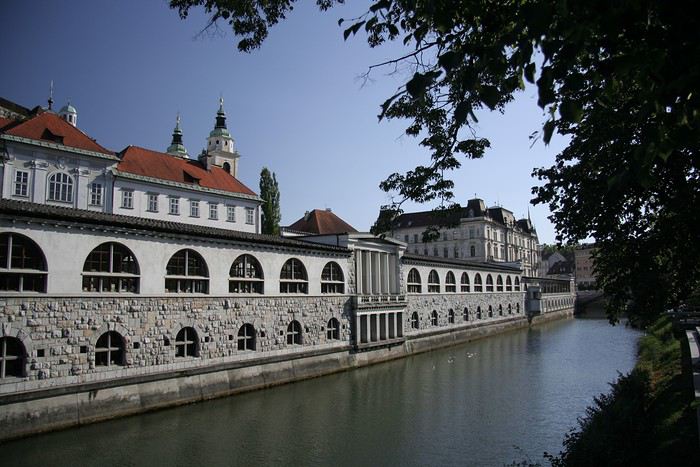
Ljubljana (Metelkova Mesto - quartier des artistes)
Škofja Loka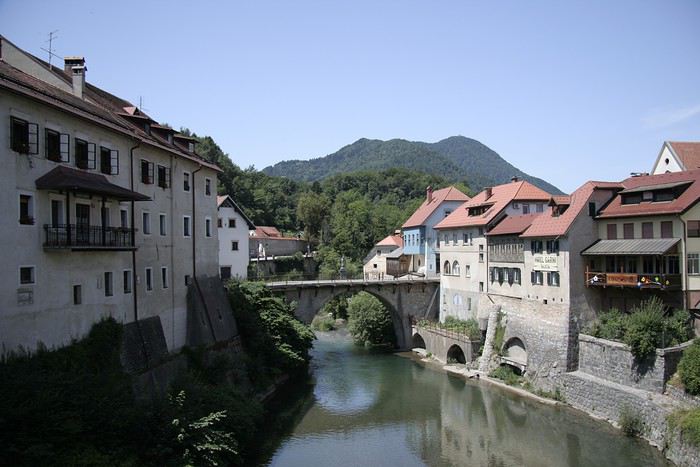
Predjama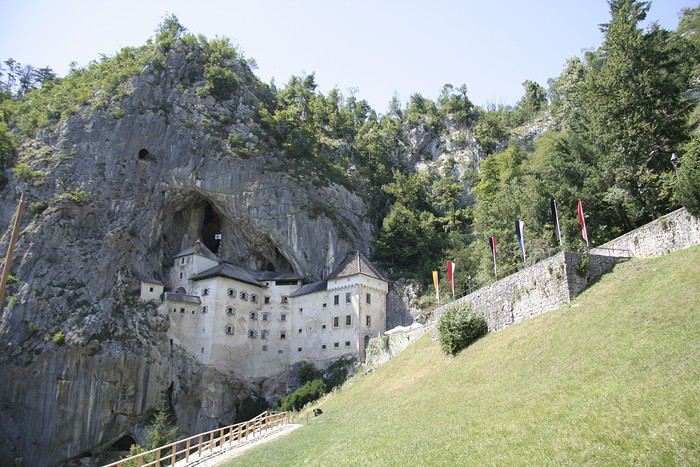
Lac de Bled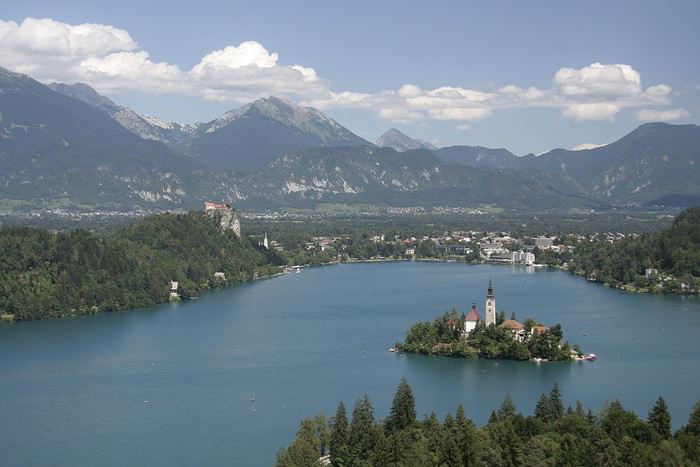
Chute Slavica - Bohinj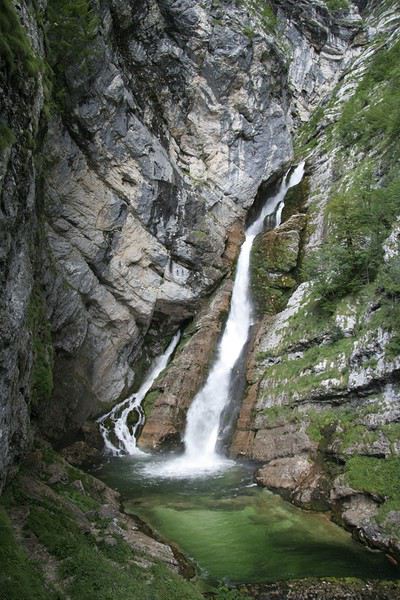
Piran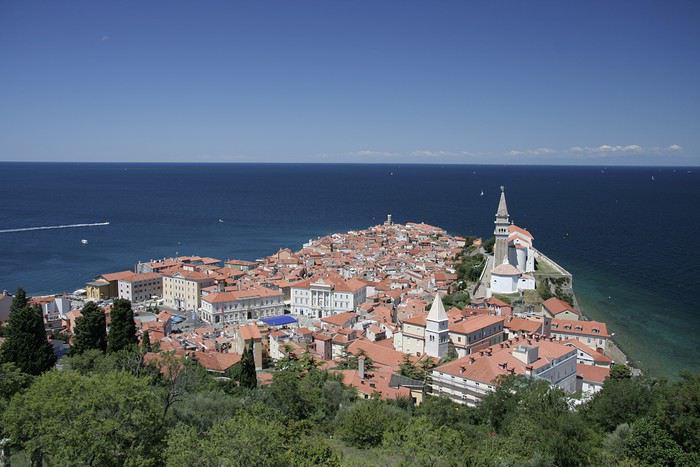
Škocjan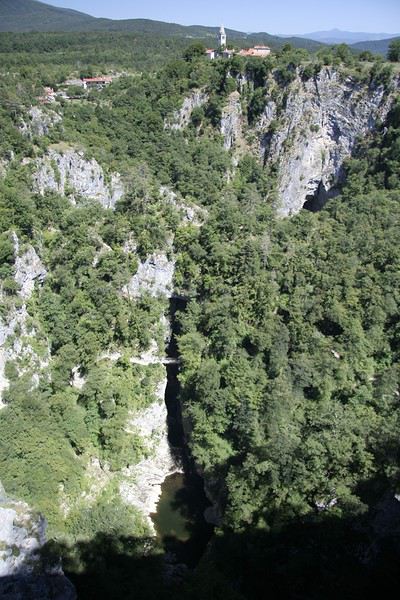
Voici le retour de mon voyage en Slovénie à l’été 2017. J’avais, deux ans auparavant, rencontré des backpackers en Croatie qui étaient passé(e)s par là et m’avaient vivement conseillé cette destination. Pour la plupart des carnets postés, la Slovénie est une étape, où on ne reste pas longtemps. C'est dommage car, même si le pays est petit, il a un charme certain et les activités, principalement "nature", ne manquent pas.
Je conseille http://slovenie-secrete.fr/ et https://www.slovenia.info/ pour préparer son voyage. En guide « papier », j’avais le Eyewitness Travel, l’équivalent anglophone du guide Voir de Hachette.
Type de voyage : budget réduit - backpack - femme seule Quand : du 6 au 21 juillet 2017 Billets d’avion BRU-ZAG : €90 avec Brussels Airlines + €15 de bus Zagreb-Ljubljana (2 heures). C’était l’option la moins chère vu la période. Budget logement : €351 (auberges de jeunesse et autres hostels, chambre partagée de max 4 personnes) Déplacements : environ €80 et uniquement en transports en commun. Les bus sont fréquents et le réseau étendu. Coût de la vie : Un sandwich me revenait à moins de €1 en achetant pain et fromage au supermarché, €4 le ćevapi, €1 le café, … J’ai tout de même pas mal cuisiné, surtout à Bled où les restaurants sont envahis et aussi chers qu’ici.
Itinéraire : Jeudi 06/07 : Arrivée à Ljubljana Vendredi 07/07 : Visite de Ljubljana (vieille ville, château, Tivoli) Samedi 08/07 : Excursion à Škofja Loka, nuit à Ljubljana Dimanche 09/07 : Excursion à Postojna et Predjama, nuit à Ljubljana Lundi 10/07 : Excursion à Maribor + Celje, nuit à Ljubljana Mardi 11/07 : Départ pour Bled + visite sous la pluie, nuit à Bled Mercredi 12/07 : Tour du lac, rando vers différents point de vue, nuit à Bled Jeudi 13/07 : Vintgar Gorge + visite du château, nuit à Bled Vendredi 14/07 : Rando du côté du lac de Bohinj, chute de Slavica, nuit à Bled Samedi 15/07 : Départ pour Koper + visite Dimanche 16/07 : Visite de Piran, nuit à Koper Lundi 17/07 : Excursion aux grottes de Škocjan, nuit à Koper Mardi 18/07 : Excursion à Trieste, nuit à Koper Mercredi 19/07 : Départ pour Zagreb (via Pula) Jeudi 20/07 : visites de musées (art contemporain, des relations brisées, d’art naïf), nuit à Zagreb Vendredi 21/07 : Retour sur Bruxelles
Si c’était à refaire : - Je zapperais Maribor et Celje. Faire les deux, en train, en une journée, ça ne valait pas le coup. Je n’ai rien eu le temps de visiter à Maribor et en plus, il pleuvait… - J’enlèverais Trieste, qui n’était ni prévu ni indispensable, mais j’avais envie d’un vrai carbonara sans crème et d’un tiramisu… J’ai poussé toutefois jusqu’au château de Miramare, ancienne demeure de la Princesse Charlotte de Belgique. - Du coup, je passerais plus de temps du côté du lac de Bohinj, plus sauvage que le lac de Bled et plus propice à la randonnée. - Et je tenterais peut-être bien l’ascension du Triglav, point culminant des alpes juliennes (2864m). Toutefois, l’aventure semble assez difficile, il est conseillé d’avoir un guide et de loger dans les refuges sur place ce qui plombe le budget. - J’aurais aimé visité les salines de Piran, les dernières salines de l'Adriatique. Eloignées du centre, je n’ai malheureusement pas trouvé comment m’y rendre, faute de préparation. - Ne voulant pas repasser par la gare de Ljubljana pour rejoindre Zagreb depuis Koper, j’ai pris un bus direct qui longeait la côte jusque Pula et remontait ensuite par Rijeka. Mauvaise idée, le bus avait du retard et ça m’a pris 7 heures au total…
En vrac : - En superficie, le territoire Slovène fait les deux tiers de la Belgique pour 5 fois moins d’habitants. On ne se marche pas dessus, mais il y a tout de même beaucoup de touristes. Genre, des bateaux de croisière débarquent à Koper... - Le pays est super vert, mais ne vous méprenez pas, ça veut surtout dire qu’il y pleut beaucoup donc n’oubliez pas votre imperméable. J’ai eu 3 jours de pluie sur 15 et des températures aux alentours des 30 degrés. - Il y a des trains, mais ils sont peu fréquents et lents. Préférez donc les bus. - Les centres historiques sont piétons et relativement éloignés des nouveaux centres urbains. - Ljubljana est petite, mais super agréable surtout le long de la rivière Ljubljanica. Il y a pas mal de bâtiments art-nouveau très intéressants dans le centre. - Il existe un ticket combiné bus aller-retour depuis Ljubljana + grotte de Postojna + château de Predjama qui coute €28. Les grottes sont bof mais le château, à visiter avec l’audioguide, est vraiment super chouette. Pour €6 de plus, on peut également parcourir les caves avec un guide. Possibilité de têtes à têtes avec des chauves-souris et des parois trop basses (casque et lampe de poche fournis à l’entrée). - Côté grottes, je conseille fortement celle de Škojcan. La claque ! La grande salle fait 120 mètres sous plafond, on emprunte un pont à 60 mètres au-dessus du lit de la rivière, elle est immense et juste splendide. Photos malheureusement interdites… Depuis la gare de train/bus de Divača, suivez le trail balisé de 3km plutôt que de prendre une navette pour avoir une vue magnifique sur une immense doline (grotte effondrée) surplombée par une église. D'ailleurs le mot doline est d'origine slovène. - Non prévue au programme, la petite ville médiévale de Škofja Loka, très calme et toute mignonne. Le bureau du tourisme (la librairie sur la place centrale) propose une carte avec une balade qui fait le tour des points d’intérêts. - Le paysage de Bled est super connu et est aussi magnifique en vrai qu’en photo. Le tour du lac fait environ 8 km, on en fait le tour en 2 heures… sauf si on s’arrête aux différents espaces de détentes aménagés : plages, bars-terrasses, loueurs de barque, pédalos, kayak ou de stand up paddle, … Il y a pas mal de chemin de randonnée qui grimpe dans les montagnes alentours pour de superbes vues sur le lac. - Toujours à Bled, pour se rendre sur l’ile au milieu du lac, vous pouvez prendre un petit bateau (€15 l’aller-retour pour 30 minutes sur place, aouch !) ou y aller par vos propres moyens (nage, kayak, etc…). Attention toutefois, vous ne pourrez bien évidemment pas rentrer dans l’église en maillot de bain. - Spécialité locale de Bled, le kremšnita : pâte feuilletée, crème à l’œuf et crème chantilly. De préférence après la baignade. - A Koper, arrêtez-vous chez Dehar, une boulangerie/biscuiterie sur la place principale. Les sablés sont à tomber ! - J’adore Zagreb et je n’avais pas pu faire les musées de la ville lors de mon passage en 2015 (j’y étais un lundi…). Du coup, vu que le vol était moins cher vers Zagreb que vers Ljubljana, j’en ai profité pour refaire le tour de cette ville bien agréable. En images :
Ljubljana
Ljubljana (Metelkova Mesto - quartier des artistes)
Škofja Loka
Predjama
Lac de Bled
Chute Slavica - Bohinj
Piran
Škocjan
Budapest when you're young
Hey everyone, I went to Budapest in 2019 and I’m here to help with what you need to know if you're young, on a tight budget, and want to party while sightseeing.
Preparing your trip 1/ Accommodation
There were four of us, and we booked a pretty comfortable place in the center of Buda (on a well-known online booking site). We stayed in the Jewish Quarter, which is pretty lively (ruin bars, fast food, etc.).
I recommend booking in advance—we did it 6 months ahead.
So, we paid 300 € for 4 nights.
My tip: don’t stay in hotels—try to live in the city to experience life to the fullest.
2/ Currency exchange
I don’t need to tell you not to exchange money at the airport... My friend exchanged 300 € into forints (1 € = 365 forints) and only got the equivalent of 250 € in forints—so 50 € in fees! My advice: exchange just 20-30 € at the airport for the taxi to the center. After that, I recommend exchange bureaus or the small machines on the street—they scam you less than the airport.
3/ Phone plan
Check with your carrier to see if your plan works outside France and what the terms are.
4/ Banking
Call your bank to let them know you’re traveling and might use your card. Otherwise, they might think it’s fraud and block your account (it’s silly, but it can happen).
5/ Flight ticket
Same as accommodation—book in advance to pay less. I got mine for 80 € round-trip.
Once you're there If you’re staying less than a week, all of this should be more than enough.
1/ What to visit
The historic sites, of course—the Parliament, the palace, the synagogue (20 € entry), and a little walk along the Danube. The must-do for me was the Budapest Thermal Baths (20 € for the day). !!! Important !!! It’s better to go in the morning to make the most of the day. Don’t fall for overpriced private bath or massage offers.
2/ What to eat
Honestly, finding a traditional restaurant in the center is pretty tough—there are some, but I didn’t try them. Generally, it’s cheaper, but fast food is about the same price as in France. Except maybe kebabs (4 €).
3/ Nightlife
If you have a French ID, you can get into most places—sometimes they don’t even check your age. I really felt like it was a free pass to everything! But I wouldn’t be honest if I said we didn’t get turned away from one club (too fancy for us). We skipped the dress shoes and suits, haha.
The must-do for me is the RUIN BARS (probably my biggest highlight of the trip). I loved the affordable beer and food, lots of young people, lots of energy, and, well, lots of hangovers.
For clubs, I’ve got two to recommend—one is a must (I don’t remember the name, but it’s an open-air club in Budapest). Great vibe, Prague-style, and alcohol.
Alcohol is expensive! !!! Important !!! Service fees on bottles—the menu doesn’t show it, but add 30% to every bottle you order. Also, service fees in restaurants.
The second club is Peach and Cream. If you like electro and R&B, this is for you. Pretty mixed crowd, nice waitresses. I recommend it!
A week is enough.
What you need to know
Prices
Cigarettes: 4-5 € a pack (you’ve got to like the taste) Beer: 3 € (a pint) Groceries (supermarket): same as France Club entry: 8-10 € (try to get in with a bottle directly from the bouncers if you speak a little English) Fast food: 5-6 € Taxi: 15-20 € total for airport-to-center transport (about 30 minutes)
Mistakes to avoid
-Toilets are almost always pay-to-use (200-300 ft). You can tip extra if you want.
-French people don’t have the best reputation.
-Tipping is different from France, but it’s better to do it—1-2 € is enough. -Don’t throw trash on the ground, especially cigarette butts (it’s really frowned upon)—the city is super clean.
-Hungarians aren’t very welcoming—I’d even say tourists bother them, even though it’s us who bring them money. I had a problem in a fast-food place with a Hungarian who supposedly thought I wanted an 8,000-forint burger! I obviously refused and stood my ground. Make sure you’re understood, even if you have to repeat yourself and look like an idiot.
Our neighbors knocked on our door 3 times in 5 days (okay, we asked for it), but they like their peace and quiet.
We got insulted ("fucking tourist") a few times—again, we asked for it, coming back from a club at 6 AM, and I’ll spare you the details.
For the rest, just follow basic manners, and you’ll fit right in. The city is pretty safe (police presence).
Other things about the trip
The city is absolutely stunning!
The nightlife is really great there (I’m sad to hear that French music there is limited to Aya Nakamura and Maître Gims).
You’ll meet lots of nationalities if you’re sociable (for me: Americans, Brits, Germans, Saudis, Poles, and, of course, Hungarians).
As for French "hunters," in Hungary, if you’ve got a decent look, you won’t have trouble, but I challenge anyone to bring girls back to their place, haha. By the way, I’ve never seen so many beautiful girls in one city—this Eastern European stereotype holds 100% true. French girls better watch out, haha.
Budget-wise, without depriving myself of anything (bottles in clubs, cigarettes, food), I spent a total of 600 €.
Hope this helps for your trip—I’ve condensed it a bit (since a week is short), but the budget is reasonable. Sorry for the spelling mistakes—I’m really bad at that, haha.
See you soon—I’m off to Prague this summer.
Preparing your trip 1/ Accommodation
There were four of us, and we booked a pretty comfortable place in the center of Buda (on a well-known online booking site). We stayed in the Jewish Quarter, which is pretty lively (ruin bars, fast food, etc.).
I recommend booking in advance—we did it 6 months ahead.
So, we paid 300 € for 4 nights.
My tip: don’t stay in hotels—try to live in the city to experience life to the fullest.
2/ Currency exchange
I don’t need to tell you not to exchange money at the airport... My friend exchanged 300 € into forints (1 € = 365 forints) and only got the equivalent of 250 € in forints—so 50 € in fees! My advice: exchange just 20-30 € at the airport for the taxi to the center. After that, I recommend exchange bureaus or the small machines on the street—they scam you less than the airport.
3/ Phone plan
Check with your carrier to see if your plan works outside France and what the terms are.
4/ Banking
Call your bank to let them know you’re traveling and might use your card. Otherwise, they might think it’s fraud and block your account (it’s silly, but it can happen).
5/ Flight ticket
Same as accommodation—book in advance to pay less. I got mine for 80 € round-trip.
Once you're there If you’re staying less than a week, all of this should be more than enough.
1/ What to visit
The historic sites, of course—the Parliament, the palace, the synagogue (20 € entry), and a little walk along the Danube. The must-do for me was the Budapest Thermal Baths (20 € for the day). !!! Important !!! It’s better to go in the morning to make the most of the day. Don’t fall for overpriced private bath or massage offers.
2/ What to eat
Honestly, finding a traditional restaurant in the center is pretty tough—there are some, but I didn’t try them. Generally, it’s cheaper, but fast food is about the same price as in France. Except maybe kebabs (4 €).
3/ Nightlife
If you have a French ID, you can get into most places—sometimes they don’t even check your age. I really felt like it was a free pass to everything! But I wouldn’t be honest if I said we didn’t get turned away from one club (too fancy for us). We skipped the dress shoes and suits, haha.
The must-do for me is the RUIN BARS (probably my biggest highlight of the trip). I loved the affordable beer and food, lots of young people, lots of energy, and, well, lots of hangovers.
For clubs, I’ve got two to recommend—one is a must (I don’t remember the name, but it’s an open-air club in Budapest). Great vibe, Prague-style, and alcohol.
Alcohol is expensive! !!! Important !!! Service fees on bottles—the menu doesn’t show it, but add 30% to every bottle you order. Also, service fees in restaurants.
The second club is Peach and Cream. If you like electro and R&B, this is for you. Pretty mixed crowd, nice waitresses. I recommend it!
A week is enough.
What you need to know
Prices
Cigarettes: 4-5 € a pack (you’ve got to like the taste) Beer: 3 € (a pint) Groceries (supermarket): same as France Club entry: 8-10 € (try to get in with a bottle directly from the bouncers if you speak a little English) Fast food: 5-6 € Taxi: 15-20 € total for airport-to-center transport (about 30 minutes)
Mistakes to avoid
-Toilets are almost always pay-to-use (200-300 ft). You can tip extra if you want.
-French people don’t have the best reputation.
-Tipping is different from France, but it’s better to do it—1-2 € is enough. -Don’t throw trash on the ground, especially cigarette butts (it’s really frowned upon)—the city is super clean.
-Hungarians aren’t very welcoming—I’d even say tourists bother them, even though it’s us who bring them money. I had a problem in a fast-food place with a Hungarian who supposedly thought I wanted an 8,000-forint burger! I obviously refused and stood my ground. Make sure you’re understood, even if you have to repeat yourself and look like an idiot.
Our neighbors knocked on our door 3 times in 5 days (okay, we asked for it), but they like their peace and quiet.
We got insulted ("fucking tourist") a few times—again, we asked for it, coming back from a club at 6 AM, and I’ll spare you the details.
For the rest, just follow basic manners, and you’ll fit right in. The city is pretty safe (police presence).
Other things about the trip
The city is absolutely stunning!
The nightlife is really great there (I’m sad to hear that French music there is limited to Aya Nakamura and Maître Gims).
You’ll meet lots of nationalities if you’re sociable (for me: Americans, Brits, Germans, Saudis, Poles, and, of course, Hungarians).
As for French "hunters," in Hungary, if you’ve got a decent look, you won’t have trouble, but I challenge anyone to bring girls back to their place, haha. By the way, I’ve never seen so many beautiful girls in one city—this Eastern European stereotype holds 100% true. French girls better watch out, haha.
Budget-wise, without depriving myself of anything (bottles in clubs, cigarettes, food), I spent a total of 600 €.
Hope this helps for your trip—I’ve condensed it a bit (since a week is short), but the budget is reasonable. Sorry for the spelling mistakes—I’m really bad at that, haha.
See you soon—I’m off to Prague this summer.
Bateau Costa Victoria classe Pearl Diamante English translation pending
J’embarque le 29/02 a bombay sur le victoria , je ne connais pas ce bateau , merci d’avance pour tout renseignements sur ce navire, mon niveau est diamante.