Results for "LAN+ou+LATAM+|+55"
37350 results found.
Aller de l'Inde au Népal? English translation pending
Salut.
Je suis en vacances un mois de Mi octobre à mi novembre. J’hésite entre 2 destinations : Inde-Népal ou Amérique du sud (je n’ai pas acheté mon billet d’avion).🤪
Au sujet de l’Inde je suis plus inquiète. Il semblerai que ce soit une destination pour « routard expérimenté », ce que je ne suis absolument pas, de plus je voyage toute seule. Autre difficulté mon anglais est presque nul. Arrivée à Delhi je désire aller de suite au Népal (passionnée de montagne, alpinisme…)et m’arrêter en Inde au retour suivant le temps restant et les envies.
Questions :
- Mon projet est-il réalisable ? en 1 mois ?
- Comment relié Delhi au Népal?
- Prendre un train en Inde est-il si difficile lorsqu’on a pas l’habitude du pays et une grande expérience du voyage? Y a-t-il un moyen pour réserver à l'avance… ?
- Au sujet des visas comment faire ? Visa pour l’inde et visa pour le Népal ?
J’ai encore beaucoup de questions en réserve.
Il faut que je me décide rapidement afin d'acheter mon billet d’avion.
Merci pour les réponses 😛
A+
Franç
Je suis en vacances un mois de Mi octobre à mi novembre. J’hésite entre 2 destinations : Inde-Népal ou Amérique du sud (je n’ai pas acheté mon billet d’avion).🤪
Au sujet de l’Inde je suis plus inquiète. Il semblerai que ce soit une destination pour « routard expérimenté », ce que je ne suis absolument pas, de plus je voyage toute seule. Autre difficulté mon anglais est presque nul. Arrivée à Delhi je désire aller de suite au Népal (passionnée de montagne, alpinisme…)et m’arrêter en Inde au retour suivant le temps restant et les envies.
Questions :
- Mon projet est-il réalisable ? en 1 mois ?
- Comment relié Delhi au Népal?
- Prendre un train en Inde est-il si difficile lorsqu’on a pas l’habitude du pays et une grande expérience du voyage? Y a-t-il un moyen pour réserver à l'avance… ?
- Au sujet des visas comment faire ? Visa pour l’inde et visa pour le Népal ?
J’ai encore beaucoup de questions en réserve.
Il faut que je me décide rapidement afin d'acheter mon billet d’avion.
Merci pour les réponses 😛
A+
Franç
Sumatra ou Sulawesi en Indonésie? English translation pending
Hello !
Mon agence de voyage m'a déconseillé Sumatra dans le cadre d'un voyage en Indonesie et me conseille plutôt Sulawesi et le pays Toraja... J'avais vu des images de Sumatra, les paysages me paraissaient superbes (lac Toba, pays Minangkabau, Gunung Leuser National Park, Pulau Samosir ...). Qu'en pensez-vous ?
Merci !
Mon agence de voyage m'a déconseillé Sumatra dans le cadre d'un voyage en Indonesie et me conseille plutôt Sulawesi et le pays Toraja... J'avais vu des images de Sumatra, les paysages me paraissaient superbes (lac Toba, pays Minangkabau, Gunung Leuser National Park, Pulau Samosir ...). Qu'en pensez-vous ?
Merci !
Holguin ou Varadero? English translation pending
Bonjour!
J'ai à choisir entre Holguin et Varadero pour un voyage dans quelques semaines. Comme je voyage avec quelqu'un qui est très difficile en matière de nourriture (ça se limite pas mal à boeuf, pizza, hot dog, hamburger), est-ce qu'il y en aurait parmi vous qui pourrait me suggérer des hôtels? Est-ce que Varadero est mieux que Holguin ou non?
Merci!🙂
J'ai à choisir entre Holguin et Varadero pour un voyage dans quelques semaines. Comme je voyage avec quelqu'un qui est très difficile en matière de nourriture (ça se limite pas mal à boeuf, pizza, hot dog, hamburger), est-ce qu'il y en aurait parmi vous qui pourrait me suggérer des hôtels? Est-ce que Varadero est mieux que Holguin ou non?
Merci!🙂
Sacoches ou remorque pour la côte landaise (France)? English translation pending
Je pars deux semaines sur la cote landaise, cruel dilemme je n’arrive pas à choisir entre les sacoches ou la remorque. Pour transporter mes affaires. Merci de votre aide....
L'encéphalite japonaise pour l'Asie Sud-Est? English translation pending
Bonjour,
j'aimerai savoir si les vaccins contre la rage et l'ancéphalite japonaise sont nécessaires pour les pays suivants: thailande, cambodge et vietnam. Notre voyage aura lieu au mois d'août/septembre et nous souhaitons nous rendre aussi bien dans les grandes villes que dans les petits villages de campagne...
Merci pour votre réponse 😉
j'aimerai savoir si les vaccins contre la rage et l'ancéphalite japonaise sont nécessaires pour les pays suivants: thailande, cambodge et vietnam. Notre voyage aura lieu au mois d'août/septembre et nous souhaitons nous rendre aussi bien dans les grandes villes que dans les petits villages de campagne...
Merci pour votre réponse 😉
Hong Kong - Où graver un CD de ses photos? English translation pending
Salut a tous,
On arrive a HongKong le 18/03/2004 et repart le 22/03/2004. On veut faire graver nos photos sur un CD (comme on l'a fait a Beijing). Qqun connaitrait-il un coin a HongKong ou l'on pourrait faire ca. Merci d'avance.
Marie et Christophe
On arrive a HongKong le 18/03/2004 et repart le 22/03/2004. On veut faire graver nos photos sur un CD (comme on l'a fait a Beijing). Qqun connaitrait-il un coin a HongKong ou l'on pourrait faire ca. Merci d'avance.
Marie et Christophe
Bavaro Pincess ou Caribe Club Princess ou Palladium? English translation pending
Bonjour, j'ai découvert ce site recemment et il est génial. J'ai un grand besoin de votre aide afin de bien choisir mon hotel. Voici mes questions: nous allons partir 2 semaines (le 30 avril) a Punta Cana.
1. L'hotel Bavaro Princess All Suite Resort nous intéresses, cependant la formule VIP est 250$ de plus par personne (trop cher pour nos moyens), nous avons donc peur de nous retrouver dans de vieilles chambres et aussi d'obtenir un moins bon service en général si nous ne prenons pas l'option VIP. Quelqun peut-il nous éclairer????
2. Nous pouvons séjourner a l'hotel Caribe Club Princess pour 300$ de moins que celui nommé ci-haut. que pensez-vous de cet hotel?
3. Dans mes recherches je comprend que Nolitour vend l'hotel Fiesta Palace et Air transat Le Palladium (regroupant 2 ou 3 hotels), si on achète le Palladium (qui est moins cher que le Palace) les chambres sont-elles bien???
Comme ce sont nos seules vacances de l'année il est important pour nous de séjourner dans un bel hotel, acceuillant, propre, bonne bouffe. Nous y resterons 2 semaines, de là l'importance de la chambre.
Merci d'avance de prendre du temps pour me répondre
Tricia
1. L'hotel Bavaro Princess All Suite Resort nous intéresses, cependant la formule VIP est 250$ de plus par personne (trop cher pour nos moyens), nous avons donc peur de nous retrouver dans de vieilles chambres et aussi d'obtenir un moins bon service en général si nous ne prenons pas l'option VIP. Quelqun peut-il nous éclairer????
2. Nous pouvons séjourner a l'hotel Caribe Club Princess pour 300$ de moins que celui nommé ci-haut. que pensez-vous de cet hotel?
3. Dans mes recherches je comprend que Nolitour vend l'hotel Fiesta Palace et Air transat Le Palladium (regroupant 2 ou 3 hotels), si on achète le Palladium (qui est moins cher que le Palace) les chambres sont-elles bien???
Comme ce sont nos seules vacances de l'année il est important pour nous de séjourner dans un bel hotel, acceuillant, propre, bonne bouffe. Nous y resterons 2 semaines, de là l'importance de la chambre.
Merci d'avance de prendre du temps pour me répondre
Tricia
L'endroit le plus merveilleux? English translation pending
Bonjour a tous!
Nous sommes un jeune couple qui aimerait aller à cuba en juin seulement il y a tellement d'hotels et de lieux différent ...lequel choisir??Nous nous en remettons à votre experience et a vos souvenirs pour nous aider à choisir si vous le souhaitez!! Sachant que nous desirons all inclusive, un plage de sable blanc avec une eau turquoise( à se propos est il mieux d'aller coté atlantique ou caraibe?), de l'animation a l'hotel en soirée assez tranquille le coin, on veut vraiment se reposer, les boite de nuit le soir ne sont pas indispensable pour nous mais il faudrait pouvoir faire des excusrions passionantes ...exigents nous?? Merci pour votre aide!😉
Nous sommes un jeune couple qui aimerait aller à cuba en juin seulement il y a tellement d'hotels et de lieux différent ...lequel choisir??Nous nous en remettons à votre experience et a vos souvenirs pour nous aider à choisir si vous le souhaitez!! Sachant que nous desirons all inclusive, un plage de sable blanc avec une eau turquoise( à se propos est il mieux d'aller coté atlantique ou caraibe?), de l'animation a l'hotel en soirée assez tranquille le coin, on veut vraiment se reposer, les boite de nuit le soir ne sont pas indispensable pour nous mais il faudrait pouvoir faire des excusrions passionantes ...exigents nous?? Merci pour votre aide!😉
Cayo coco ou Varadero English translation pending
Allo a tous!
Petite question, moi et ma copine on veut partir en avril a cuba! Par contre nous hesitons entre varadero et cayo coco. L'an passee nous avons visitez le iberostar bella costa a varadero on a bien aimer. Voici notre dilemme nous pensions aller au tryp cayo coco, mais on hesite de peur que soit plate en soiree par raport au spectacle et a la discotheque. Appel a tous, pourriez-vous me donner votre avis sur le tryp(est-il en renovation) ou connaissez vous mieux encore comme endroit a varadero.
Merci🙂
Eriq riq
Petite question, moi et ma copine on veut partir en avril a cuba! Par contre nous hesitons entre varadero et cayo coco. L'an passee nous avons visitez le iberostar bella costa a varadero on a bien aimer. Voici notre dilemme nous pensions aller au tryp cayo coco, mais on hesite de peur que soit plate en soiree par raport au spectacle et a la discotheque. Appel a tous, pourriez-vous me donner votre avis sur le tryp(est-il en renovation) ou connaissez vous mieux encore comme endroit a varadero.
Merci🙂
Eriq riq
Où partir dans les îles avec des bébés? English translation pending
bonjour,
Je suis soulagée de voir qu'on peut envisager de voyager sans crainte avec des enfants, et sans se faire traiter de parents complètement tarés 😮!!!! nous nous marions en juin et nous avons décidé de partir avec nos jumelles au soleil, ce sera peut-être l'hiver prochain selon la destination choisie. Elles auront 12 mois le 14 aout, pour info, alors elles auront dans les 15 mois quand nous partirons, peut-être un peu moins, peut-être un peu plus......
J'aimerais savoir quelles sont les destinations les + recommandables au niveau des iles, point de vue confort, sanitaire etc....?
Mon homme espère une destination où il y aura aussi des choses à voir, visiter, des petites excursions, (même si nous, on peut pas l'acocmpagner)
merci 😉
Je suis soulagée de voir qu'on peut envisager de voyager sans crainte avec des enfants, et sans se faire traiter de parents complètement tarés 😮!!!! nous nous marions en juin et nous avons décidé de partir avec nos jumelles au soleil, ce sera peut-être l'hiver prochain selon la destination choisie. Elles auront 12 mois le 14 aout, pour info, alors elles auront dans les 15 mois quand nous partirons, peut-être un peu moins, peut-être un peu plus......
J'aimerais savoir quelles sont les destinations les + recommandables au niveau des iles, point de vue confort, sanitaire etc....?
Mon homme espère une destination où il y aura aussi des choses à voir, visiter, des petites excursions, (même si nous, on peut pas l'acocmpagner)
merci 😉
Où laisser les biens personnels à Bangkok? English translation pending
Bonjour,
Je vais en Thailande de la mi-février à la mi-mars, j'aimerais bien ne pas trainer quelques objet inutile dont mes billets de retours mais surtout mes vètements adaptés aux hivers québecois.
Je sais qu'il y a les coffres des aéroports qui sont disponibles mais je crois qu'ils sont aussi dispendieux. Je ne sais pas si certain d'entre vous ont une solution de rechange plus abordable du genre: un hotel avec se service ou tout autre idée fiable à Bkk.
Deplus lors de mes voyages, j'ai l'habitude de trainer des objets peux dispendieux au Canada mais qui sont difficilement accessible dans le pays hôte ensuite je les distribut gracieusement aux habitants peu fortuné. Pouvez vous m'éclairer sur les besoins des populations locales, j'ai entendu parler de chaussure en Inde mais est-ce aussi vrai pour la Thailande?
Merci
Frédéric
Je vais en Thailande de la mi-février à la mi-mars, j'aimerais bien ne pas trainer quelques objet inutile dont mes billets de retours mais surtout mes vètements adaptés aux hivers québecois.
Je sais qu'il y a les coffres des aéroports qui sont disponibles mais je crois qu'ils sont aussi dispendieux. Je ne sais pas si certain d'entre vous ont une solution de rechange plus abordable du genre: un hotel avec se service ou tout autre idée fiable à Bkk.
Deplus lors de mes voyages, j'ai l'habitude de trainer des objets peux dispendieux au Canada mais qui sont difficilement accessible dans le pays hôte ensuite je les distribut gracieusement aux habitants peu fortuné. Pouvez vous m'éclairer sur les besoins des populations locales, j'ai entendu parler de chaussure en Inde mais est-ce aussi vrai pour la Thailande?
Merci
Frédéric
Le Sol ou Melia à Cayo guillermo? English translation pending
j aurais besoin d aide je veut partir pour cayo guillermo mais j hesite entre le sol et le melia vos suggestions svp.
Où passer ma lune de miel? English translation pending
Bonjour à tous,
Je prépare mon mariage pour juillet 2004 et j'ai besoin d'idées originales pour ma lune de miel. Nous avons à disposition max 3 semaines 🙁!!!
J'attends avec impatiences vos idées...
Merci 😄
Je prépare mon mariage pour juillet 2004 et j'ai besoin d'idées originales pour ma lune de miel. Nous avons à disposition max 3 semaines 🙁!!!
J'attends avec impatiences vos idées...
Merci 😄
Glasgow et bons plans en Écosse English translation pending
bonjour,
je recherche des infos sur GLASGOW ou l'écosse en générale pour y passer le premier de l'an . Si quelqu'un peut me renseigner sur l'hébergement et lemoyen le moins cher pour y aller, merci d'avance
je recherche des infos sur GLASGOW ou l'écosse en générale pour y passer le premier de l'an . Si quelqu'un peut me renseigner sur l'hébergement et lemoyen le moins cher pour y aller, merci d'avance
Oiseaux sur le site de l'hôtel Canoa Coral? English translation pending
Bonojur,
J'aimerais savoir s'il y a des oiseaux chanteurs et/ou exotiques sur le site de l'hotel canoa coral. 😉
Merci à l'avance
J'aimerais savoir s'il y a des oiseaux chanteurs et/ou exotiques sur le site de l'hotel canoa coral. 😉
Merci à l'avance
Viva Dominicus ou Coral Canoa? English translation pending
Bonjour à tous,
Nous comptons partir en République Dominicaine à Bayahibe : connaissez vous le Viva Dominicus Palace et le Coral Canoa ?
Entre les 2 notre coeur balance. D'après l'agence de voyage le Viva est très bruyant et plein d'Italiens ! Elle nous conseille l'Iberostar Hacienda Dominicus...
Que faire ?
Bisous à tous
Ilian
Nous comptons partir en République Dominicaine à Bayahibe : connaissez vous le Viva Dominicus Palace et le Coral Canoa ?
Entre les 2 notre coeur balance. D'après l'agence de voyage le Viva est très bruyant et plein d'Italiens ! Elle nous conseille l'Iberostar Hacienda Dominicus...
Que faire ?
Bisous à tous
Ilian
Sol ou Mélia à Cayo Guillermo? English translation pending
Bonjour je pars en fin octobre à Cayo Guillermo et je pars seule j'ai 24 ans et je voulais savoir si c'est une bonne destination pour me relaxer et aussi me faire des amis et quel hotel choisir entre le Sol Club et le Mélia.... En tout cas quels sont vos commentaires sur ces hotels.. je n'ai pas de critère présci.. je sais que la plage est belle partout.. mais je voudrais savoir p-e côté classe d'âge et puis animation et activité et bouffe.. merci...😛
Africa: A Heartfelt Love for a Continent
“When the Whites came to Africa, we had the land and they had the Bible. They taught us to pray with our eyes closed: when we opened them, the Whites had the land and we had the Bible.” Jomo Kenyatta (p.7)
The Maggi cube, an unchallenged hegemony, and so much more
“The hopeless continent,” headlined The Economist, a British magazine, in July 2000 about Africa. Eleven years later, the same magazine headlined “Africa rising” instead. Images of Africa in the prosperous North constantly oscillate between apocalyptic scenarios and enthusiastic projections. A key issue with such images lies in the generalization they entail. If you look at the continent, considerable contrasts emerge depending on space and time. It’s no surprise that a region of the world encompassing such diverse ecological zones, maintaining such varied ties with other continents, comprising nearly fifty nation-states in sub-Saharan Africa alone, and characterized by a great diversity of languages, belief systems, and historical paths, doesn’t share a single destiny.
And yet, for many people outside Africa, as well as for many Africans, the continent constitutes a single entity, defined by criteria such as skin color, a colonial past, poverty, and the art of survival. Until now, these perspectives were generally accompanied by the idea that Africa had to—or should have—followed a single path together, sometimes called development, sometimes modernization, sometimes liberation, then a market economy. None of these paths delivered on their promises.
The two writers Alain Mabanckou and Abdourahman Waberi—one from Congo, the other raised in Djibouti, both long settled in France and now professors at renowned North American universities (Los Angeles, Washington)—have had enough of pessimistic scenarios: “We are aware that Africa is in the world and the world is in Africa. The same goes for all other continents, as our destinies are inextricably linked for better or worse. We refuse to see Africa as a reservoir of misfortunes or a continent cursed by atavistic misfortune and characterized by ethnic conflicts. [...] It’s this passionate flame we wanted to capture in a book [...] a kind of stroll through African cultures, without any demands, each letter of the alphabet leading us to a notion, a practice, a concept, a moment in history, literature, painting, politics, economics, cuisine, etc.” (p.10-11). Africa, they write, is on the verge of “imposing a signature, a style, a way of being in the world and in relation to the rest of the world.” (p.11) To put words to the continent’s diversity and dynamism, the two authors created a “rambling ABC,” a kind of portrait—or more precisely, a mythography—that lets you see and feel the pulse of a vast continent whose cultural power is unfolding before our eyes. Once marginalized or even mocked, the voice and importance of the Continent in global affairs are now undeniable” (p.11), containing over a hundred entries, mostly concise, written in a relaxed and casual style. The optimistic, even exuberant tone is set from the brief introduction. The duo of authors wants to “sing a love song to the cultures of our continent, to its inhabitants past and present, to its exceptional resources and its spectacular globalization despite a certain pollution that still clouds our skies due to the unmatched duration of dictatorships in some of our regions.” (p.12) In doing so, they don’t want to be too distracted by today’s Afewerki-Biya-Bongo-Déby & Co. ...
Of course, you’ll find tributes to great precursors like Frantz Fanon (“[...] it was a love story and admiration that wasn’t dimmed by the four decades separating his birth from ours. Let’s add that we were born while the native of Fort-de-France had left the world’s stage four years earlier, in the prime of life” p.141), Mongo Beti (“You must read and reread Mongo Beti, a genius who used his fame to support often just causes in Africa, like defending oppressed groups. His place is already in History. His oppressors, like the dictators Ahmadou Ahidjo and Paul Biya, can’t compete in the same category” p.64), the Malian Amadou Hampâté Bâ
(“Posterity remembers him mainly as an tireless defender of African cultures. His plea for the collection and preservation of traditional African knowledge remains a major event for all men and women of good will. One day in 1960, at the UNESCO podium, the native of Bandiagara sounded the alarm: ‘[...] Since we’ve admitted that the humanity of each people is the heritage of all humanity, if African traditions aren’t collected in time and written down, they’ll one day be missing from the universal archives of humanity.’” p.51),
Kwame Nkrumah, “one of the founders of Pan-Africanism, father of Ghana’s independence” (p.239), as well as the historian Cheikh Anta Diop, the writer, poet, and politician Aimé Césaire, and the economist and thinker Samir Amin, but also very warm tributes to certain contemporary African intellectuals like Souleymane Bachir Diagne and Achille Mbembe
(“A few years ago, in dominant economic circles, a rumor often resurfaced, usually disguised as a cold and scientifically proven analysis: Africa is useless. It’s a burden for the rest of the human community. With its 2% share in world trade, it would disappear from stock market radars without anyone noticing. So? Maybe it’ll be pulled up by other continents. Wanting to surpass itself is a crazy bet for Africans, they concluded. Arrogant or clueless, President Nicolas Sarkozy declared before an audience of students and teachers at Cheikh Anta Diop University in Dakar: ‘The African man hasn’t entered history enough [...] He only knows the eternal repetition of time marked by the endless repetition of the same gestures and words.’ That was in 2007. For decades, armed only with reason, an intellectual often steps up to debunk prejudices, lazy readings, and dishonest frameworks used as false fronts by those who, like Nicolas Sarkozy or former journalist Stephen Smith, out of ignorance, contempt, or condescension, distort African reality. This intellectual is none other than the historian and political scientist Achille Mbembe. This heir of Frantz Fanon, Amílcar Cabral, Jean-Marc Ela, and Fabien Eboussi-Boulaga was born in 1957 in Cameroon, in the Bassa region. Marked early by the upheavals of a fratricidal war, Achille Mbembe became the guardian of the memory of martyrs. After brilliant studies in Paris, he went on to teach at the best American universities, but the call of the Continent was stronger than anything else. In Dakar, he once directed CODESRIA (Council for the Development of Social Science Research in Africa) before joining the University of the Witwatersrand in Johannesburg, South Africa. Even though the author of *Critique of Black Reason* (Éditions La Découverte, 2015) spends a few months at Duke University in North Carolina, his observation post remains South Africa. From Johannesburg, Achille Mbembe scrutinizes Africa and the whole world. A lucid observer with an elegant and generous pen, Achille Mbembe knows how to blend big and small history: ‘I was born one day in July, as the month was drawing to a close. It was 1957, in that part of Africa recently named ‘Cameroon,’ a memory of the wonder that seized Portuguese sailors in the 15th century when, sailing up the river near Douala, they couldn’t help but note the presence of a multitude of crustaceans, and named it *Rio dos Camarões*, meaning ‘River of Shrimp.’ I grew up in the shadow of this nameless land, since, in a way, the name it bears is only the product of someone else’s astonishment: a lexical mistake, if you will.’ From this mistake or wound, he made leaven, a springboard to compose a rich work, recognized worldwide. To denounce barriers and barbarians too. But that’s not enough. Among his peers in circles of thought and action, Achille Mbembe passionately and consistently defends human dignity and the beauty of the world. In doing so, he fulfills the mission Frantz Fanon entrusted to him.” (p.227-229),
as well as entries dedicated to lesser-known artists and intellectuals, like the French journalist and activist Rokhaya Diallo, daughter of Senegalese and Gambian parents, or the Ethiopian filmmaker Haile Gerima, who has long lived in the United States. Other names from politics, sports, music, art, and literature: Kofi Annan, p.36; Barack Obama, p.243; Thomas Sankara, p.277; Ousmane Sow, p.285; Yambo Ouologuem, p.250; Léopold Sédar Senghor, p.282; Muhammad Ali, p.30; Nuruddin Farah, p.146; Salif Keita, p.203; Ahmadou Kourouma, p.206; Ngũgĩ wa Thiong’o, p.236; Winnie Mandela, p.224; Kylian Mbappé, p.226 ...
The authors, who resolutely commit to a “mythography” (p.11) of Africa, also pay special attention to local social movements, cultural events, and aspects of daily life. *Y’en a marre*, “which also meant ‘we’re fed up with sitting on our hands’” (p.320-321), emerged about a decade ago in Senegal as a citizen movement of peaceful resistance and symbolizes, the authors emphasize, the fact that African youth are increasingly fed up “with the political circus deployed in Africa since independence, as our parents would say, ‘since the White man left’...” (p.321). A full entry is dedicated to the Maggi bouillon cube, which has flooded African markets for about forty years and enjoys immense popularity (“It’s everywhere in Africa, from Dakar to Djibouti, and from Tangier to Cape Town. It’s in every pot, every stew. Little hands put it in every sauce, every local or adapted dish. An unchallenged hegemony! You’ll find it in diasporas too. The culinary strolls in Paris, in the [...] neighborhood” p.90). Critics blame it not only for impoverishing the aromatic diversity of local dishes but also for being harmful to health. And yet, “he poorest Africans, those who eat only once a day, a few spoonfuls of white beans and a ball of *foufou*, for example, are the most fervent users of the magic cube.” (p.92-93)
For *fonio*, “the new trendy cereal. [...] From the millet family, fonio is probably the oldest cereal cultivated in West Africa, and mainly in its sub-Saharan part, for millennia. [...] Easy to grow, water-efficient, fonio grows everywhere except on clay soils. Long neglected because it was considered the poor man’s crop, fonio is now a source of pride for the farmers who cultivate it and cherish it like the apple of their eye” (p.156-157), the authors immediately offer a detailed recipe, letting the reader know that “e can’t resist sharing this fonio with chicken recipe from Mali with you:
Ingredients: 1 chicken 3 large ripe red tomatoes 4 tbsp tomato paste 4 large onions 1 garlic clove 1/2 cup oil 2 Maggi cubes or salt 2 large carrots 1 turnip 1 large cabbage 2 large potatoes 1 celery stalk 1 packet pre-cooked fonio 4 okra (or okra powder) salt, pepper
Preparation: 1. Prepare the sauce: wash and cut the chicken. Peel the onions, garlic, and vegetables. 2. In a pot, fry the chicken pieces. 3. Dice the onions, tomatoes, carrots, and turnip very small and add them to the pot. 4. Add the tomato paste, salt, and pepper. 5. Simmer for 15 min, then add 2 L of water and the cooked chicken pieces. 6. Simmer for 30 min, then add the crushed garlic and celery, plus the cabbage cut into 4 and the potatoes cut in half. 7. Prepare the fonio: cover it with warm water, let it rest for 15 min, and cook it over low heat. 8. In a small pot, boil the okra and crush them. 9. Mix the crushed okra with the cooked fonio, then salt. Serve hot.” (p.158-159)
The comedy *Black Mic Mac*, released in French theaters in 1986 and addressing France’s increasingly restrictive immigration policy at the time, also gets an entry, as do *Tintin in the Congo*, the popular comic, and *Jip’s Café* (“[...] a little Africa in the heart of Paris, with passersby stopping to admire the ‘ambianceurs’ on the dance floor or attend the cultural events offered by the place” (p.194), an African establishment in Paris that Alain Mabanckou already immortalized in one of his novels.
The duo of authors also tackles thorny subjects like jihadism (p.119), the Rwandan genocide (p.272), the CFA franc (p.82), and dictatorship (p.110). While the two strike the right tone here, many entries leave a slightly bitter taste. Two examples: why doesn’t the text on Barack Obama mention the great disappointment of many people in Africa, who expected more from the African policy of the first U.S. president with African roots than just occasional warm words? Why do the comments on Winnie Mandela gloss over the fact that she was a highly controversial icon of the anti-apartheid movement due to her involvement in kidnappings, acts of torture, and murders of alleged apartheid collaborators? Instead, there’s a compassion that brings tears to the eyes: “She was often reduced to a secondary role, the wife of a great man” or “When victory came, she didn’t taste its fruits. Divorced, isolated. She would never be a ‘first lady’ in an evening gown, posing before a bed of chrysanthemums. They’d keep her far from the circles of power” (p.224-225). At this point, I would’ve liked the authors to take a slightly more critical stance...
That said, these “weaknesses” (if you can call them that) shouldn’t overshadow the book as a whole. It remains an informative, sometimes very entertaining, and often even original work in its own way.
Book information (the original French and the German translation):
Alain Mabanckou/Abdourahman Waberi. Dictionnaire enjoué des cultures africaines. Fayard, 2019. Alain Mabanckou/Abdourahman Waberi. Der Puls Afrikas. Eine Liebeserklärung von A bis Z. Reclam, 2022.
Hery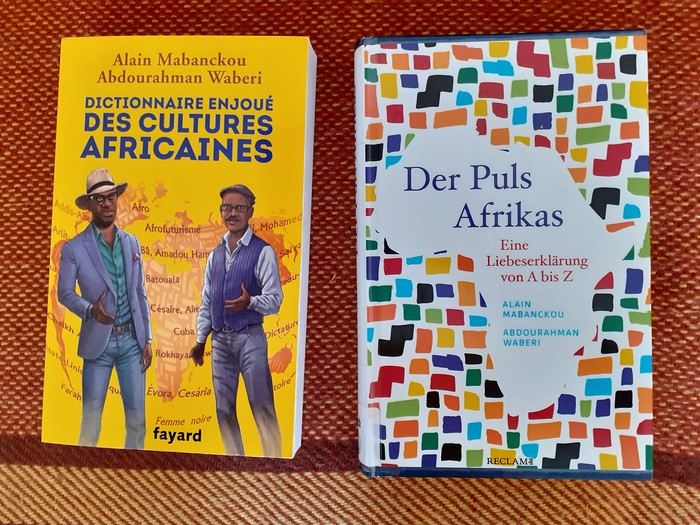
The Maggi cube, an unchallenged hegemony, and so much more
“The hopeless continent,” headlined The Economist, a British magazine, in July 2000 about Africa. Eleven years later, the same magazine headlined “Africa rising” instead. Images of Africa in the prosperous North constantly oscillate between apocalyptic scenarios and enthusiastic projections. A key issue with such images lies in the generalization they entail. If you look at the continent, considerable contrasts emerge depending on space and time. It’s no surprise that a region of the world encompassing such diverse ecological zones, maintaining such varied ties with other continents, comprising nearly fifty nation-states in sub-Saharan Africa alone, and characterized by a great diversity of languages, belief systems, and historical paths, doesn’t share a single destiny.
And yet, for many people outside Africa, as well as for many Africans, the continent constitutes a single entity, defined by criteria such as skin color, a colonial past, poverty, and the art of survival. Until now, these perspectives were generally accompanied by the idea that Africa had to—or should have—followed a single path together, sometimes called development, sometimes modernization, sometimes liberation, then a market economy. None of these paths delivered on their promises.
The two writers Alain Mabanckou and Abdourahman Waberi—one from Congo, the other raised in Djibouti, both long settled in France and now professors at renowned North American universities (Los Angeles, Washington)—have had enough of pessimistic scenarios: “We are aware that Africa is in the world and the world is in Africa. The same goes for all other continents, as our destinies are inextricably linked for better or worse. We refuse to see Africa as a reservoir of misfortunes or a continent cursed by atavistic misfortune and characterized by ethnic conflicts. [...] It’s this passionate flame we wanted to capture in a book [...] a kind of stroll through African cultures, without any demands, each letter of the alphabet leading us to a notion, a practice, a concept, a moment in history, literature, painting, politics, economics, cuisine, etc.” (p.10-11). Africa, they write, is on the verge of “imposing a signature, a style, a way of being in the world and in relation to the rest of the world.” (p.11) To put words to the continent’s diversity and dynamism, the two authors created a “rambling ABC,” a kind of portrait—or more precisely, a mythography—that lets you see and feel the pulse of a vast continent whose cultural power is unfolding before our eyes. Once marginalized or even mocked, the voice and importance of the Continent in global affairs are now undeniable” (p.11), containing over a hundred entries, mostly concise, written in a relaxed and casual style. The optimistic, even exuberant tone is set from the brief introduction. The duo of authors wants to “sing a love song to the cultures of our continent, to its inhabitants past and present, to its exceptional resources and its spectacular globalization despite a certain pollution that still clouds our skies due to the unmatched duration of dictatorships in some of our regions.” (p.12) In doing so, they don’t want to be too distracted by today’s Afewerki-Biya-Bongo-Déby & Co. ...
Of course, you’ll find tributes to great precursors like Frantz Fanon (“[...] it was a love story and admiration that wasn’t dimmed by the four decades separating his birth from ours. Let’s add that we were born while the native of Fort-de-France had left the world’s stage four years earlier, in the prime of life” p.141), Mongo Beti (“You must read and reread Mongo Beti, a genius who used his fame to support often just causes in Africa, like defending oppressed groups. His place is already in History. His oppressors, like the dictators Ahmadou Ahidjo and Paul Biya, can’t compete in the same category” p.64), the Malian Amadou Hampâté Bâ
(“Posterity remembers him mainly as an tireless defender of African cultures. His plea for the collection and preservation of traditional African knowledge remains a major event for all men and women of good will. One day in 1960, at the UNESCO podium, the native of Bandiagara sounded the alarm: ‘[...] Since we’ve admitted that the humanity of each people is the heritage of all humanity, if African traditions aren’t collected in time and written down, they’ll one day be missing from the universal archives of humanity.’” p.51),
Kwame Nkrumah, “one of the founders of Pan-Africanism, father of Ghana’s independence” (p.239), as well as the historian Cheikh Anta Diop, the writer, poet, and politician Aimé Césaire, and the economist and thinker Samir Amin, but also very warm tributes to certain contemporary African intellectuals like Souleymane Bachir Diagne and Achille Mbembe
(“A few years ago, in dominant economic circles, a rumor often resurfaced, usually disguised as a cold and scientifically proven analysis: Africa is useless. It’s a burden for the rest of the human community. With its 2% share in world trade, it would disappear from stock market radars without anyone noticing. So? Maybe it’ll be pulled up by other continents. Wanting to surpass itself is a crazy bet for Africans, they concluded. Arrogant or clueless, President Nicolas Sarkozy declared before an audience of students and teachers at Cheikh Anta Diop University in Dakar: ‘The African man hasn’t entered history enough [...] He only knows the eternal repetition of time marked by the endless repetition of the same gestures and words.’ That was in 2007. For decades, armed only with reason, an intellectual often steps up to debunk prejudices, lazy readings, and dishonest frameworks used as false fronts by those who, like Nicolas Sarkozy or former journalist Stephen Smith, out of ignorance, contempt, or condescension, distort African reality. This intellectual is none other than the historian and political scientist Achille Mbembe. This heir of Frantz Fanon, Amílcar Cabral, Jean-Marc Ela, and Fabien Eboussi-Boulaga was born in 1957 in Cameroon, in the Bassa region. Marked early by the upheavals of a fratricidal war, Achille Mbembe became the guardian of the memory of martyrs. After brilliant studies in Paris, he went on to teach at the best American universities, but the call of the Continent was stronger than anything else. In Dakar, he once directed CODESRIA (Council for the Development of Social Science Research in Africa) before joining the University of the Witwatersrand in Johannesburg, South Africa. Even though the author of *Critique of Black Reason* (Éditions La Découverte, 2015) spends a few months at Duke University in North Carolina, his observation post remains South Africa. From Johannesburg, Achille Mbembe scrutinizes Africa and the whole world. A lucid observer with an elegant and generous pen, Achille Mbembe knows how to blend big and small history: ‘I was born one day in July, as the month was drawing to a close. It was 1957, in that part of Africa recently named ‘Cameroon,’ a memory of the wonder that seized Portuguese sailors in the 15th century when, sailing up the river near Douala, they couldn’t help but note the presence of a multitude of crustaceans, and named it *Rio dos Camarões*, meaning ‘River of Shrimp.’ I grew up in the shadow of this nameless land, since, in a way, the name it bears is only the product of someone else’s astonishment: a lexical mistake, if you will.’ From this mistake or wound, he made leaven, a springboard to compose a rich work, recognized worldwide. To denounce barriers and barbarians too. But that’s not enough. Among his peers in circles of thought and action, Achille Mbembe passionately and consistently defends human dignity and the beauty of the world. In doing so, he fulfills the mission Frantz Fanon entrusted to him.” (p.227-229),
as well as entries dedicated to lesser-known artists and intellectuals, like the French journalist and activist Rokhaya Diallo, daughter of Senegalese and Gambian parents, or the Ethiopian filmmaker Haile Gerima, who has long lived in the United States. Other names from politics, sports, music, art, and literature: Kofi Annan, p.36; Barack Obama, p.243; Thomas Sankara, p.277; Ousmane Sow, p.285; Yambo Ouologuem, p.250; Léopold Sédar Senghor, p.282; Muhammad Ali, p.30; Nuruddin Farah, p.146; Salif Keita, p.203; Ahmadou Kourouma, p.206; Ngũgĩ wa Thiong’o, p.236; Winnie Mandela, p.224; Kylian Mbappé, p.226 ...
The authors, who resolutely commit to a “mythography” (p.11) of Africa, also pay special attention to local social movements, cultural events, and aspects of daily life. *Y’en a marre*, “which also meant ‘we’re fed up with sitting on our hands’” (p.320-321), emerged about a decade ago in Senegal as a citizen movement of peaceful resistance and symbolizes, the authors emphasize, the fact that African youth are increasingly fed up “with the political circus deployed in Africa since independence, as our parents would say, ‘since the White man left’...” (p.321). A full entry is dedicated to the Maggi bouillon cube, which has flooded African markets for about forty years and enjoys immense popularity (“It’s everywhere in Africa, from Dakar to Djibouti, and from Tangier to Cape Town. It’s in every pot, every stew. Little hands put it in every sauce, every local or adapted dish. An unchallenged hegemony! You’ll find it in diasporas too. The culinary strolls in Paris, in the [...] neighborhood” p.90). Critics blame it not only for impoverishing the aromatic diversity of local dishes but also for being harmful to health. And yet, “he poorest Africans, those who eat only once a day, a few spoonfuls of white beans and a ball of *foufou*, for example, are the most fervent users of the magic cube.” (p.92-93)
For *fonio*, “the new trendy cereal. [...] From the millet family, fonio is probably the oldest cereal cultivated in West Africa, and mainly in its sub-Saharan part, for millennia. [...] Easy to grow, water-efficient, fonio grows everywhere except on clay soils. Long neglected because it was considered the poor man’s crop, fonio is now a source of pride for the farmers who cultivate it and cherish it like the apple of their eye” (p.156-157), the authors immediately offer a detailed recipe, letting the reader know that “e can’t resist sharing this fonio with chicken recipe from Mali with you:
Ingredients: 1 chicken 3 large ripe red tomatoes 4 tbsp tomato paste 4 large onions 1 garlic clove 1/2 cup oil 2 Maggi cubes or salt 2 large carrots 1 turnip 1 large cabbage 2 large potatoes 1 celery stalk 1 packet pre-cooked fonio 4 okra (or okra powder) salt, pepper
Preparation: 1. Prepare the sauce: wash and cut the chicken. Peel the onions, garlic, and vegetables. 2. In a pot, fry the chicken pieces. 3. Dice the onions, tomatoes, carrots, and turnip very small and add them to the pot. 4. Add the tomato paste, salt, and pepper. 5. Simmer for 15 min, then add 2 L of water and the cooked chicken pieces. 6. Simmer for 30 min, then add the crushed garlic and celery, plus the cabbage cut into 4 and the potatoes cut in half. 7. Prepare the fonio: cover it with warm water, let it rest for 15 min, and cook it over low heat. 8. In a small pot, boil the okra and crush them. 9. Mix the crushed okra with the cooked fonio, then salt. Serve hot.” (p.158-159)
The comedy *Black Mic Mac*, released in French theaters in 1986 and addressing France’s increasingly restrictive immigration policy at the time, also gets an entry, as do *Tintin in the Congo*, the popular comic, and *Jip’s Café* (“[...] a little Africa in the heart of Paris, with passersby stopping to admire the ‘ambianceurs’ on the dance floor or attend the cultural events offered by the place” (p.194), an African establishment in Paris that Alain Mabanckou already immortalized in one of his novels.
The duo of authors also tackles thorny subjects like jihadism (p.119), the Rwandan genocide (p.272), the CFA franc (p.82), and dictatorship (p.110). While the two strike the right tone here, many entries leave a slightly bitter taste. Two examples: why doesn’t the text on Barack Obama mention the great disappointment of many people in Africa, who expected more from the African policy of the first U.S. president with African roots than just occasional warm words? Why do the comments on Winnie Mandela gloss over the fact that she was a highly controversial icon of the anti-apartheid movement due to her involvement in kidnappings, acts of torture, and murders of alleged apartheid collaborators? Instead, there’s a compassion that brings tears to the eyes: “She was often reduced to a secondary role, the wife of a great man” or “When victory came, she didn’t taste its fruits. Divorced, isolated. She would never be a ‘first lady’ in an evening gown, posing before a bed of chrysanthemums. They’d keep her far from the circles of power” (p.224-225). At this point, I would’ve liked the authors to take a slightly more critical stance...
That said, these “weaknesses” (if you can call them that) shouldn’t overshadow the book as a whole. It remains an informative, sometimes very entertaining, and often even original work in its own way.
Book information (the original French and the German translation):
Alain Mabanckou/Abdourahman Waberi. Dictionnaire enjoué des cultures africaines. Fayard, 2019. Alain Mabanckou/Abdourahman Waberi. Der Puls Afrikas. Eine Liebeserklärung von A bis Z. Reclam, 2022.
Hery
Feedback on 6-day Alicante itinerary
Hi everyone!
I’m planning a little trip in October and wanted to share where I’m at with my preparations.
We’re heading to Alicante from October 18th to 23rd and will be staying on C/ Bailén. (We won’t have a car.) We’ve decided to buy a bus and tram card with 20 trips for the two of us to start. Depending on the weather, here’s what we’ve planned: a visit to Alicante including the covered market, the bullring (?), Santa Cruz…
La Illeta del Banyets,
Lucentum,
the MARQ museum,
ELCHE,
Tabarca Island,
Villajoyosa,
Villena Castle,
Orihuela (if we have time).
Any thoughts? Anything that doesn’t seem worth it? I’m bringing my snorkel mask and a wetsuit just in case.
I remember a bit of Spanish—just *unas pocas palabras*—but otherwise, I get by in English. I’m bringing some euros in small bills. I don’t eat gluten, lactose, legumes, or rice—not allergic, but I feel sick if I eat them. If there are any dishes you’d recommend trying (I’ve heard about *patatas bravas*, and there must be seafood and octopus), or anything for my husband, who can eat everything.
We’re hoping to find a holiday vibe with some atmosphere, even though we’ll be there at the end of October.
I remember a bit of Spanish—just *unas pocas palabras*—but otherwise, I get by in English. I’m bringing some euros in small bills. I don’t eat gluten, lactose, legumes, or rice—not allergic, but I feel sick if I eat them. If there are any dishes you’d recommend trying (I’ve heard about *patatas bravas*, and there must be seafood and octopus), or anything for my husband, who can eat everything.
We’re hoping to find a holiday vibe with some atmosphere, even though we’ll be there at the end of October.
Ways to get the e-Visa for Madagascar
Hi everyone,
I’m planning my trip to Madagascar for the fall and starting to think about getting my visa. After reading through different posts, I’m a bit unsure about the best way to go about it. Is it better to apply for an e-visa (and if so, which official website?) or just queue up on arrival? It seems there are "unofficial"—and therefore fraudulent—sites out there, and that you’ll have to queue either way (which I’m not thrilled about since I’m arriving at 11 PM). What do you think?
The Extraordinary Painted Houses Village of Tam Thanh near Hoi An
Not sure if I’ve already posted this, so here it is again!
https://hiddenhoian.com/travel/tam-thanh-mural-village/
Imagine a peaceful coastal fishing village completely transformed by artists who worked their magic on the walls of 100 residential houses. That’s the remarkable story of the Tam Thanh mural village in Quang Nam province. Once similar to many other coastal villages in the area, it now firmly stands out on the tourist map for day trips from Hoi An. In the summer of 2016, Tam Thanh was selected by a joint Korean-Vietnamese project called “Art For A Better Community.” The village was chosen to be their blank canvas, inspired by the success of mural villages in Korea. The project aimed to make Tam Thanh the first painted village of its kind in Vietnam. The team included five Korean artists and seven Vietnamese artists, along with local volunteers. Their goal was to show Vietnamese people that art could be part of everyday life, no matter their place in society. The effort began with about three weeks of wall washing, followed by painting the walls of over 100 residents’ homes. The project was a success, and the village came alive with the paintings. The entire village is now a breathtaking gallery just waiting to be explored. The murals capture the life and soul of the village, from young children playing to fishermen in the ocean. A mix of fantastic pieces offers stunning backdrops for photos. The painted art around the town hasn’t just had a visual impact—it’s also had a social one. The village was chosen not only for the layout of the houses but also to contribute to economic development opportunities in Tam Thanh. Tourists now visit the once-overlooked village, creating more income for locals and making it a successful “art for a cause” project. For example, one entrepreneurial resident who owned a small local café invested 000,000 VND (390 USD) in a sugarcane press a week before the paintings were completed. Sugarcane juice vendors then multiplied with the growth of tourism (5,000 VND - 0.20 USD). Walking down the village’s single street, it’s common to find locals selling refreshments and handmade crafts. In one house in particular, a tailor and his family are painted on an outer wall with incredible detail. The family started selling tote bags decorated by their young daughter. The price for the bags is 100,000 VND (4 USD). If you’re looking for a way to support the village’s economy, this is it. Since there’s no middleman here, you can be sure your money goes directly to the community. You can have lunch at a house with a terrace right by the beach at the edge of the village.
How to Get There Route No. 1: Cross the large Cua Đai bridge. Once you’ve crossed it, continue toward Duong 129/Duong Ven Bien. Stay on this road for 33 kilometers. Upside: this route has light traffic, no traffic lights, and no trucks or buses. It’s a great direct route to the village but offers little to see along the way. You’ll eventually reach a crossroads. Turn right toward Tam Ky town, while the left will take you toward the Tam Thanh mural village. Stay on Route 608 as it turns twice before reaching a bridge. Cross the bridge, and you’ll arrive at Thanh Nien Road. Finally, turn right to reach the village. This route takes about an hour. Use your best judgment. For reference, it costs about 5,000 VND (0.20 USD) to park a motorbike.
Route #2: Cross the large Cua Đai bridge. Once you’ve crossed it, continue toward Duong 129/Duong Ven Bien. Stay on this road for 12 kilometers, then turn left onto Route 613, where you’ll continue for 1.5 kilometers until you reach Thanh Nien Road. Finally, turn right and drive 23 kilometers to the painted village. For most of the trip, taking Thanh Nien Road will take you through a much more local part of the region. The journey takes about an hour and a half.
https://hiddenhoian.com/travel/tam-thanh-mural-village/
Imagine a peaceful coastal fishing village completely transformed by artists who worked their magic on the walls of 100 residential houses. That’s the remarkable story of the Tam Thanh mural village in Quang Nam province. Once similar to many other coastal villages in the area, it now firmly stands out on the tourist map for day trips from Hoi An. In the summer of 2016, Tam Thanh was selected by a joint Korean-Vietnamese project called “Art For A Better Community.” The village was chosen to be their blank canvas, inspired by the success of mural villages in Korea. The project aimed to make Tam Thanh the first painted village of its kind in Vietnam. The team included five Korean artists and seven Vietnamese artists, along with local volunteers. Their goal was to show Vietnamese people that art could be part of everyday life, no matter their place in society. The effort began with about three weeks of wall washing, followed by painting the walls of over 100 residents’ homes. The project was a success, and the village came alive with the paintings. The entire village is now a breathtaking gallery just waiting to be explored. The murals capture the life and soul of the village, from young children playing to fishermen in the ocean. A mix of fantastic pieces offers stunning backdrops for photos. The painted art around the town hasn’t just had a visual impact—it’s also had a social one. The village was chosen not only for the layout of the houses but also to contribute to economic development opportunities in Tam Thanh. Tourists now visit the once-overlooked village, creating more income for locals and making it a successful “art for a cause” project. For example, one entrepreneurial resident who owned a small local café invested 000,000 VND (390 USD) in a sugarcane press a week before the paintings were completed. Sugarcane juice vendors then multiplied with the growth of tourism (5,000 VND - 0.20 USD). Walking down the village’s single street, it’s common to find locals selling refreshments and handmade crafts. In one house in particular, a tailor and his family are painted on an outer wall with incredible detail. The family started selling tote bags decorated by their young daughter. The price for the bags is 100,000 VND (4 USD). If you’re looking for a way to support the village’s economy, this is it. Since there’s no middleman here, you can be sure your money goes directly to the community. You can have lunch at a house with a terrace right by the beach at the edge of the village.
How to Get There Route No. 1: Cross the large Cua Đai bridge. Once you’ve crossed it, continue toward Duong 129/Duong Ven Bien. Stay on this road for 33 kilometers. Upside: this route has light traffic, no traffic lights, and no trucks or buses. It’s a great direct route to the village but offers little to see along the way. You’ll eventually reach a crossroads. Turn right toward Tam Ky town, while the left will take you toward the Tam Thanh mural village. Stay on Route 608 as it turns twice before reaching a bridge. Cross the bridge, and you’ll arrive at Thanh Nien Road. Finally, turn right to reach the village. This route takes about an hour. Use your best judgment. For reference, it costs about 5,000 VND (0.20 USD) to park a motorbike.
Route #2: Cross the large Cua Đai bridge. Once you’ve crossed it, continue toward Duong 129/Duong Ven Bien. Stay on this road for 12 kilometers, then turn left onto Route 613, where you’ll continue for 1.5 kilometers until you reach Thanh Nien Road. Finally, turn right and drive 23 kilometers to the painted village. For most of the trip, taking Thanh Nien Road will take you through a much more local part of the region. The journey takes about an hour and a half.
Where to travel in Southeast Asia with a 5-month-old baby?
hi,
I had planned to take a gap year with my 4-year-old daughter starting this fall. A happy but unplanned event is changing the plans: a new baby arriving in just a few days.
So now I’ll be waiting until she’s 5 MONTHS old. Which countries would you recommend for traveling in Southeast Asia where I’d have adequate healthcare infrastructure in case of any issues?
What travel insurance do you suggest?
What itineraries have you done?
thanks
Ladakh: Is it possible to sleep near Hanle? (India)
Hi everyone,
I’ve browsed this forum a lot about Ladakh and haven’t found answers to my questions... so here’s my post.
I’m heading there next July with a friend for a solid ten days of cycling (no e-bikes) in Ladakh. The flight to Leh is booked for both of us and our bikes.
I’ve got my route planned out pretty precisely; the main goal is to climb Umling La, which is currently the world’s highest motorable road at 5,798 m. We’re also planning to tackle 3 or 4 other passes over 5,000 m, including Photila, just next door at a little over 5,500 m.
I’ve read accounts from Europeans saying it’s impossible for foreigners to spend a night in Hanle... that the closest accommodation to the Chinese border would be in Nyoma. What do you think about that?
Also, some say the road between Hanle and Chushul (the one via Tsaga) is off-limits to non-Indians... Is the parallel route, the one via Mahé and Kaksang La (5,400 m), open to foreigners?
Is the road along Pangong Lake (the one through Merak and Man) also off-limits to foreigners?
Thanks for your feedback!
I’ve read accounts from Europeans saying it’s impossible for foreigners to spend a night in Hanle... that the closest accommodation to the Chinese border would be in Nyoma. What do you think about that?
Also, some say the road between Hanle and Chushul (the one via Tsaga) is off-limits to non-Indians... Is the parallel route, the one via Mahé and Kaksang La (5,400 m), open to foreigners?
Is the road along Pangong Lake (the one through Merak and Man) also off-limits to foreigners?
Thanks for your feedback!
Art Nouveau Around the World - Discussion
This is where we chat, not on the contest thread
L'ouverture des frontières canadiennes pour les Français, c'est quand? English translation pending
Bonjour,
quelqu'un à l'info? Il semble que possible qu'au 31 juillet alors que la Fance accepte les canadiens en France 😠
À voir ou faire à Moustier en famille (deux enfants 3 et 7 ans) English translation pending
Bonjour, Nous partons la semaine prochaine à Moustier ste Marie, avec nos deux enfants 3 et 7 ans. Nous restons que 4 jours pleins et ayons peur de rater les indispensables. Que nous conseillez vous de voir/faire en priorité accessible avec nos enfants.
Voir les gorges du Verdon oui mais Ou exactement sans galérer avec les petits ?
L'hiver au pays des merveilles (Maroc) English translation pending
Bonjour,
Je crains que le forum ne soit morose dans les mois à venir , alors pourquoi ne pas faire un nouveau carnet de voyage . J'ai eu la chance de rentrer du Maroc 2 jours avant la suspension des vols et me retrouve donc, comme vous sans doute , en mode confinement total, chez moi, en Basse-Bretagne , avec quelques centaines de photos de mon dernier séjour à sélectionner, recadrer, retravailler .... On s'occupe comme on peut, alors pourquoi ne pas en faire profiter les Forumeurs ?
Je suis resté au Maroc un mois et j'avais organisé un circuit de 10 nuits / 11 jours pour ma plus jeune fille ( 17 ans ) , mon épouse et la grand- mère, ma chère belle-mère, Mina . Ça correspond aux vacances de février en France .
J'avais donc prévu un voyage " simple" sur le papier, mais qui chaque jour et comme toujours allait nous réserver son lot de découvertes, d'émerveillements, de rencontres, de surprises ....
Au programme :
- Départ de Rabat - 2 nuits à Ouarzazate - 2 nuits à N'kob - 2 nuits à Foum Zguid, avec une longue journée 4X4 au plus profond du désert - 4 nuits à Icht / Borj Biramane et retour sur Rabat
Je vais donc essayer d'éviter des redites avec mes précédents carnets, mais le Maroc a tant de richesses à montrer.....
Rabat est une de mes balades urbaines préférées au Maroc . Je découvre toujours de nouveaux endroits, de jolis détails, des points de vue .... Je vais donc m'y balader avec toujours un plaisir renouvelé
Ma première surprise se passe en médina où je découvre avec étonnement que les autorités ont fait le ménage . Tout ce qui encombrait les rues ( déballages sauvages, marchands de tortues et autres lézards, empiétements sur les trottoirs, la rue , etc.... ) a disparu . Plus rien . Même les commerces " en dur " sont "rentrés dans leurs murs" : plus rien sur la voie publique, pas même une chaise.... Une première au Maroc ?
Si le résultat est plutôt agréable dans la rue des consuls ( rue de l'artisanat ) et la rue Souika ( commerces vestimentaires surtout ) , le boulevard Mohamed V, où régnaient les petits restaurants et gargotes , est désormais mort . Ils ont perdu la quasi-totalité de leur ancienne surface commerciale et ne peuvent plus accueillir que quelques clients à la fois . La rue est tuée et il ne me reste plus qu'à chercher un autre endroit où casser la croûte dans la ville . Ce qui est bénéfique dans une rue ( on peut enfin flâner tranquillement ) est catastrophique dans l'autre ( le commerce est mort et le charme est parti ) . A suivre ....
Bon. C'est comme çà . Ici, dans la rue Souika ( à l'heure de la prière ) . Il y a même des poubelles en plastique positionnées dans la rue !
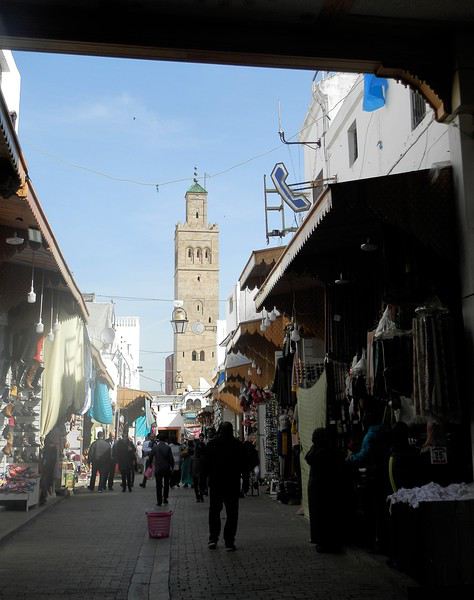
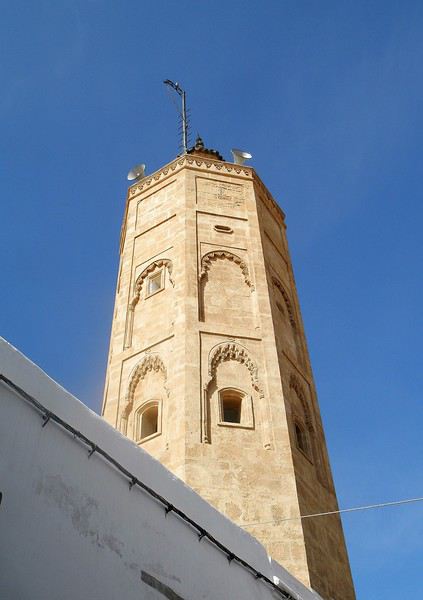
Une autre artère de la médina est la rue Sidi Fatah . Elle donne sur la rue Souika . Une magnifique mosquée y a été restaurée . Si j'en crois mon plan, il s'agit de la mosquée Moulay El Mekki . La porte principale est couverte et on trouve sur chacun des côtés 2 très belles portes ( 4 au total ) . Le minaret octogonal est remarquable . L'ensemble est complété par plusieurs marabout et un peu plus loin se trouve une importante zaouia . C'est vraiment très joli .
L'entrée principale est somptueuse . Le grand art de la peinture sur bois.
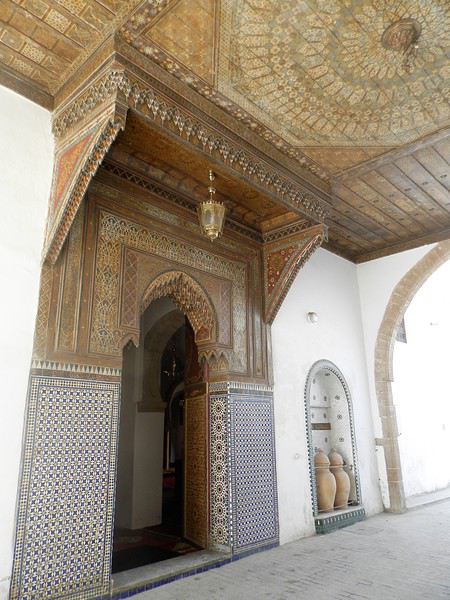
Quelques portes latérales
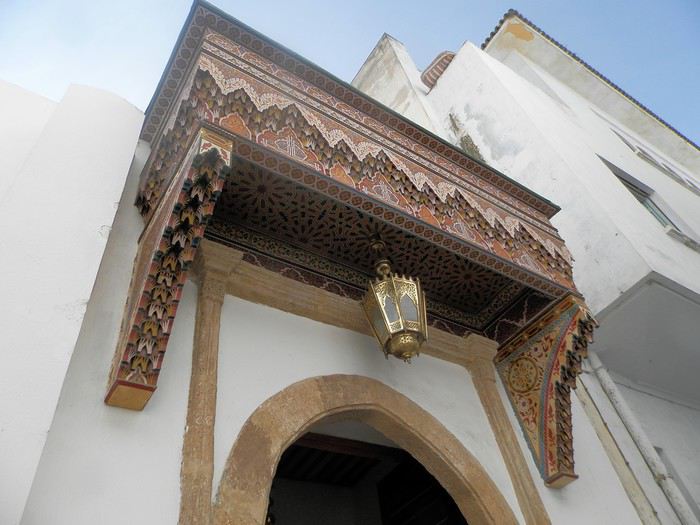
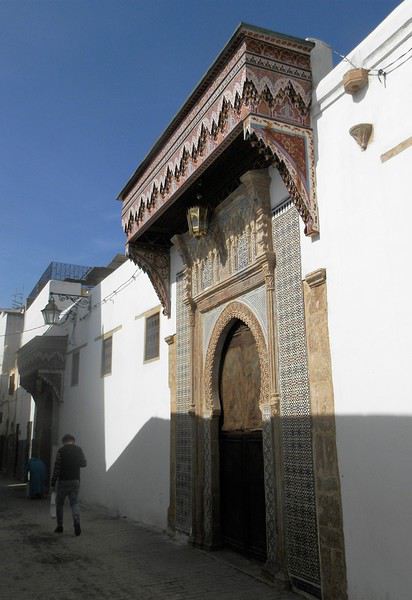
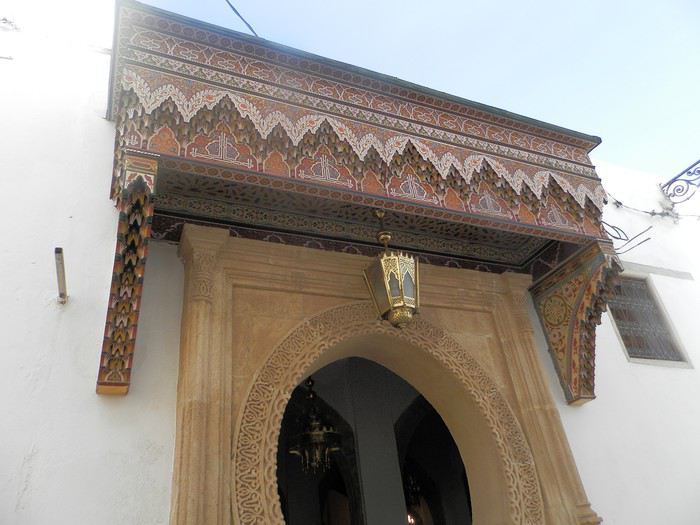
C'est vraiment très agréable de se balader sur la côte atlantique en cette saison ( mi-février ) . Il fait entre 18 et 22 degrés . Temps lumineux . Je n'aurai d'ailleurs pas de pluie pendant un mois ( après avoir eu de la pluie à peu près tous les jours les 5 derniers mois ) : que du bonheur donc ....
Le minaret octogonal
et la rue Sidi Fatah
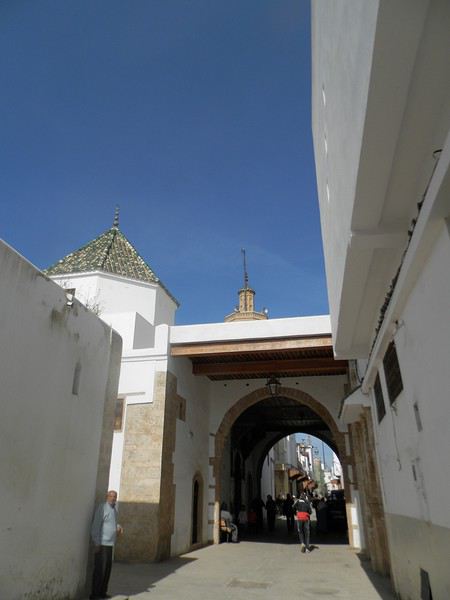
La rénovation des monuments de la médina est presque terminée . La rue des consuls reprend vie, même si les nombreux fondouks de cette rue sont toujours en travaux . J'ai hâte de les revoir . Je déambule dans les ruelles tranquilles , toujours à l’affût de ces détails qui en font le charme .
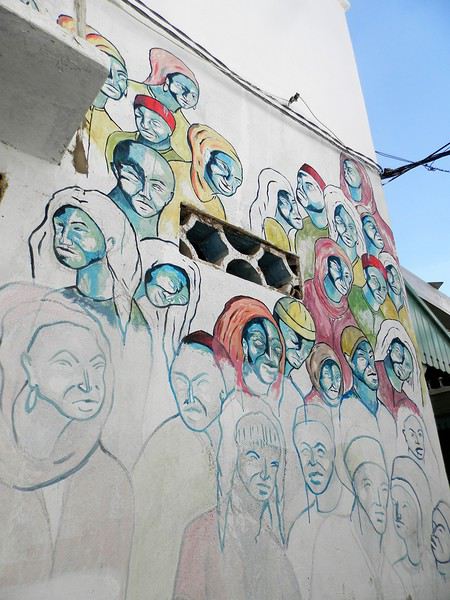
Une belle oeuvre de street-art accroche mon œil ....
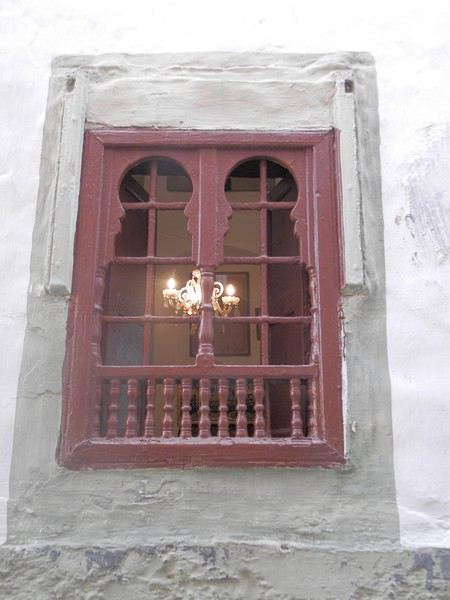
et cette fenêtre a un charme fou .
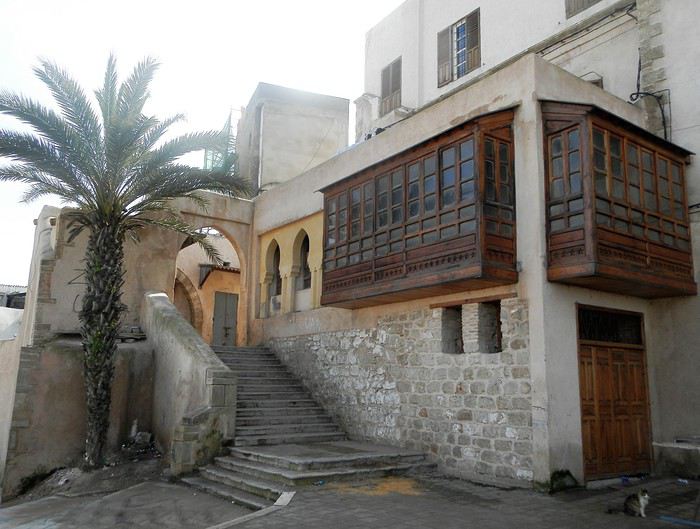
Cette fois , mes pas me portent vers les quais ( on pourrait presque dire le port ) de Rabat . Je quitte la médina par un jolie porte : l'ensemble , également restauré, est charmant . J'arrive directement sur l'Oued Bou Regreg .
Au cœur de la capitale subsiste un coin " pêche " . Un petit navire est devenu un restaurant-Lounge , plutôt luxueux ( menu à 790 dirhams pour 2 en cette Saint Valentin ) .
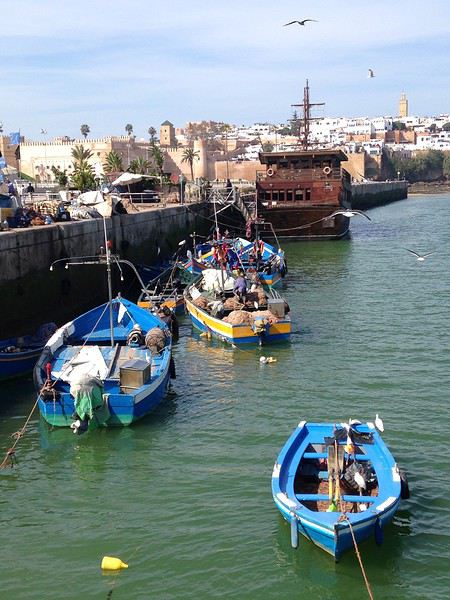
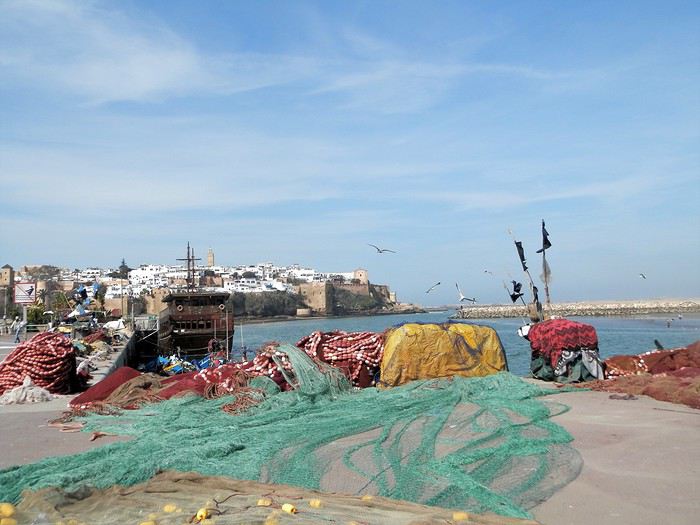
Rabat se donne des airs de petite Essaouira avec ses mouettes, ses bateaux, sa médina au fond, ses filets de pêche .... Le même site à l'horizontale .
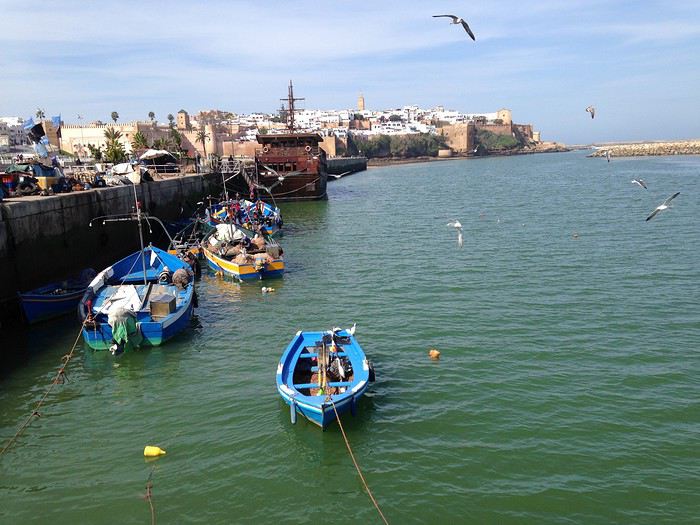
Au fond, Les Oudayas
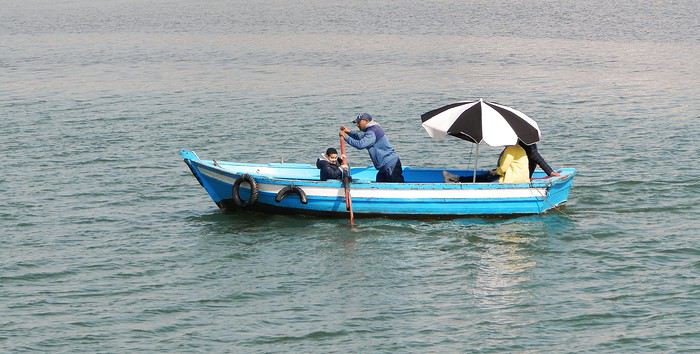
Un " pêche promenade ", me passe sous le nez . C'est mignon . On a envie de le faire la prochaine fois . Il y avait une activité de passeurs entre Rabat et Salé . Mais avec les ponts, le tramway, ..... Certains se sont adaptés , même si çà se fait toujours, plutôt en été ( la plage de Salé est toute proche ) .
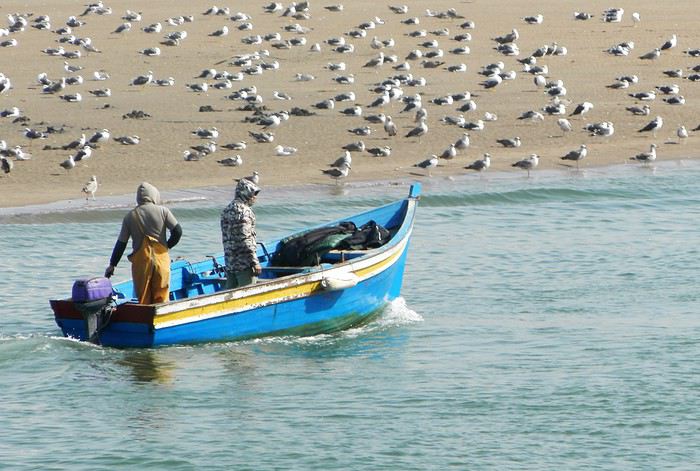
Quelques barques rentrent , les unes après les autres et s'amarrent au ponton, côté Salé . Surement les lointains descendants des redoutables corsaires de Salé . Leur univers a été " explosé" ces dernières années avec l'immense projet d'aménagement de l'oued Bou Regreg . Il leur reste un petit ponton , ..... et juste après, on a construit une grande marina pour accueillir les nouveaux jouets de l'aristocratie locale .
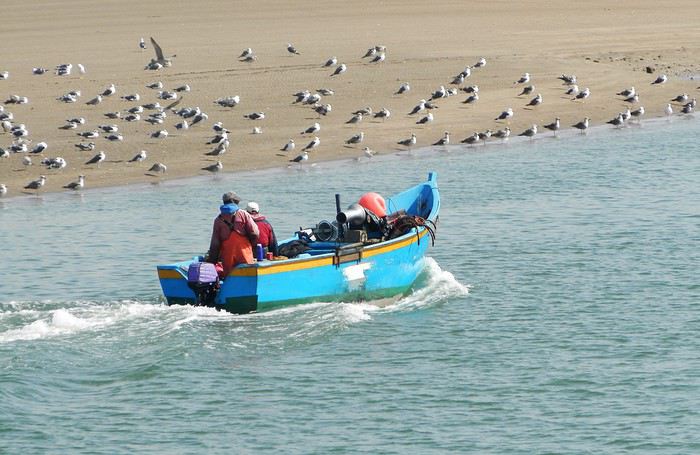
et une autre
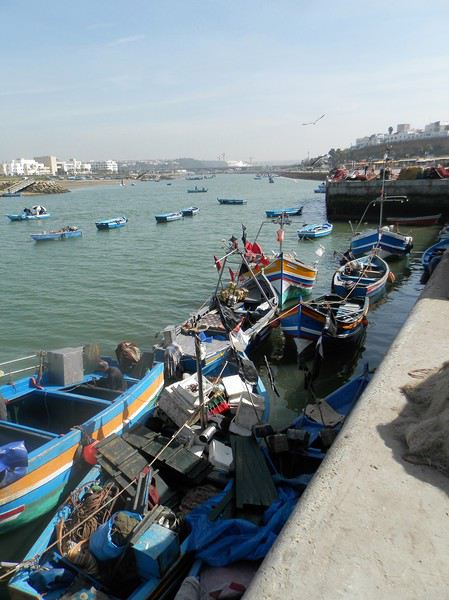
Tout ceci fait un curieux mélange entre une architecture ancestrale et la plus grande modernité ....
Ci-après, à gauche, le médina sur sa falaise, au fond le toit blanc du nouveau " Grand Théâtre de Rabat ), à côté duquel commence à sortir la future tour Mohamed VI qui sera la plus haute d' Afrique , et à droite la marina côté Salé .
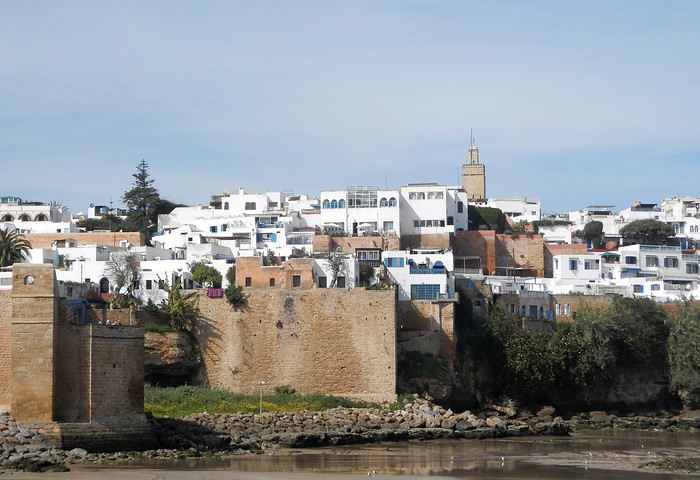
Mais la Kasbah veille toujours sur la capitale
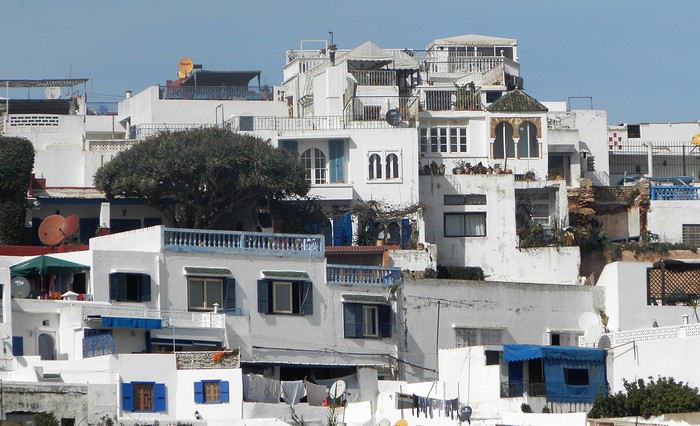
Un dernier regard ...
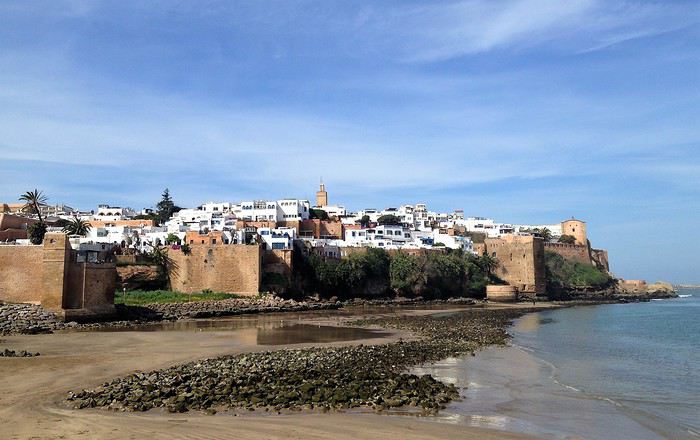
Voila pour ce nouveau coup de projecteur sur la capitale . Faites le détour et surprenez- vous
Demain, j'enfourche ma bonne Dacia Sandero et nous partons à l'assaut de l'Atlas .
Je crains que le forum ne soit morose dans les mois à venir , alors pourquoi ne pas faire un nouveau carnet de voyage . J'ai eu la chance de rentrer du Maroc 2 jours avant la suspension des vols et me retrouve donc, comme vous sans doute , en mode confinement total, chez moi, en Basse-Bretagne , avec quelques centaines de photos de mon dernier séjour à sélectionner, recadrer, retravailler .... On s'occupe comme on peut, alors pourquoi ne pas en faire profiter les Forumeurs ?
Je suis resté au Maroc un mois et j'avais organisé un circuit de 10 nuits / 11 jours pour ma plus jeune fille ( 17 ans ) , mon épouse et la grand- mère, ma chère belle-mère, Mina . Ça correspond aux vacances de février en France .
J'avais donc prévu un voyage " simple" sur le papier, mais qui chaque jour et comme toujours allait nous réserver son lot de découvertes, d'émerveillements, de rencontres, de surprises ....
Au programme :
- Départ de Rabat - 2 nuits à Ouarzazate - 2 nuits à N'kob - 2 nuits à Foum Zguid, avec une longue journée 4X4 au plus profond du désert - 4 nuits à Icht / Borj Biramane et retour sur Rabat
Je vais donc essayer d'éviter des redites avec mes précédents carnets, mais le Maroc a tant de richesses à montrer.....
Rabat est une de mes balades urbaines préférées au Maroc . Je découvre toujours de nouveaux endroits, de jolis détails, des points de vue .... Je vais donc m'y balader avec toujours un plaisir renouvelé
Ma première surprise se passe en médina où je découvre avec étonnement que les autorités ont fait le ménage . Tout ce qui encombrait les rues ( déballages sauvages, marchands de tortues et autres lézards, empiétements sur les trottoirs, la rue , etc.... ) a disparu . Plus rien . Même les commerces " en dur " sont "rentrés dans leurs murs" : plus rien sur la voie publique, pas même une chaise.... Une première au Maroc ?
Si le résultat est plutôt agréable dans la rue des consuls ( rue de l'artisanat ) et la rue Souika ( commerces vestimentaires surtout ) , le boulevard Mohamed V, où régnaient les petits restaurants et gargotes , est désormais mort . Ils ont perdu la quasi-totalité de leur ancienne surface commerciale et ne peuvent plus accueillir que quelques clients à la fois . La rue est tuée et il ne me reste plus qu'à chercher un autre endroit où casser la croûte dans la ville . Ce qui est bénéfique dans une rue ( on peut enfin flâner tranquillement ) est catastrophique dans l'autre ( le commerce est mort et le charme est parti ) . A suivre ....
Bon. C'est comme çà . Ici, dans la rue Souika ( à l'heure de la prière ) . Il y a même des poubelles en plastique positionnées dans la rue !
Une autre artère de la médina est la rue Sidi Fatah . Elle donne sur la rue Souika . Une magnifique mosquée y a été restaurée . Si j'en crois mon plan, il s'agit de la mosquée Moulay El Mekki . La porte principale est couverte et on trouve sur chacun des côtés 2 très belles portes ( 4 au total ) . Le minaret octogonal est remarquable . L'ensemble est complété par plusieurs marabout et un peu plus loin se trouve une importante zaouia . C'est vraiment très joli .
L'entrée principale est somptueuse . Le grand art de la peinture sur bois.
Quelques portes latérales
C'est vraiment très agréable de se balader sur la côte atlantique en cette saison ( mi-février ) . Il fait entre 18 et 22 degrés . Temps lumineux . Je n'aurai d'ailleurs pas de pluie pendant un mois ( après avoir eu de la pluie à peu près tous les jours les 5 derniers mois ) : que du bonheur donc ....
Le minaret octogonal
et la rue Sidi Fatah
La rénovation des monuments de la médina est presque terminée . La rue des consuls reprend vie, même si les nombreux fondouks de cette rue sont toujours en travaux . J'ai hâte de les revoir . Je déambule dans les ruelles tranquilles , toujours à l’affût de ces détails qui en font le charme .
Une belle oeuvre de street-art accroche mon œil ....
et cette fenêtre a un charme fou .
Cette fois , mes pas me portent vers les quais ( on pourrait presque dire le port ) de Rabat . Je quitte la médina par un jolie porte : l'ensemble , également restauré, est charmant . J'arrive directement sur l'Oued Bou Regreg .
Au cœur de la capitale subsiste un coin " pêche " . Un petit navire est devenu un restaurant-Lounge , plutôt luxueux ( menu à 790 dirhams pour 2 en cette Saint Valentin ) .
Rabat se donne des airs de petite Essaouira avec ses mouettes, ses bateaux, sa médina au fond, ses filets de pêche .... Le même site à l'horizontale .
Au fond, Les Oudayas
Un " pêche promenade ", me passe sous le nez . C'est mignon . On a envie de le faire la prochaine fois . Il y avait une activité de passeurs entre Rabat et Salé . Mais avec les ponts, le tramway, ..... Certains se sont adaptés , même si çà se fait toujours, plutôt en été ( la plage de Salé est toute proche ) .
Quelques barques rentrent , les unes après les autres et s'amarrent au ponton, côté Salé . Surement les lointains descendants des redoutables corsaires de Salé . Leur univers a été " explosé" ces dernières années avec l'immense projet d'aménagement de l'oued Bou Regreg . Il leur reste un petit ponton , ..... et juste après, on a construit une grande marina pour accueillir les nouveaux jouets de l'aristocratie locale .
et une autre
Tout ceci fait un curieux mélange entre une architecture ancestrale et la plus grande modernité ....
Ci-après, à gauche, le médina sur sa falaise, au fond le toit blanc du nouveau " Grand Théâtre de Rabat ), à côté duquel commence à sortir la future tour Mohamed VI qui sera la plus haute d' Afrique , et à droite la marina côté Salé .
Mais la Kasbah veille toujours sur la capitale
Un dernier regard ...
Voila pour ce nouveau coup de projecteur sur la capitale . Faites le détour et surprenez- vous
Demain, j'enfourche ma bonne Dacia Sandero et nous partons à l'assaut de l'Atlas .
Le Japon suspend l'exemption de visa accordée au français English translation pending
sur site MAE
A compter du 21 mars : • Un visa est nécessaire pour tout ressortissant français qui souhaite entrer au Japon pour un court séjour. L’exemption de visa en vigueur jusqu’à cette date, permettant aux titulaires d’un passeport français de séjourner au Japon pendant 90 jours, ne s’applique plus, jusqu’à nouvel ordre. Un visa peut être demandé auprès des représentations diplomatiques et consulaires japonaises.
A compter du 21 mars : • Un visa est nécessaire pour tout ressortissant français qui souhaite entrer au Japon pour un court séjour. L’exemption de visa en vigueur jusqu’à cette date, permettant aux titulaires d’un passeport français de séjourner au Japon pendant 90 jours, ne s’applique plus, jusqu’à nouvel ordre. Un visa peut être demandé auprès des représentations diplomatiques et consulaires japonaises.
Réserver son chauffeur avant ou sur place pour le Rajasthan? English translation pending
Bonjour,
Je pars dans 1 mois au Rajasthan, nous avons opté pour un circuit que nous avons organisé nous-même. Ma question est :
Quel est le plus intéressant niveau tarif : - Réserver à l'avance une voiture avec chauffeur pour toute la durée du circuit ? J'ai vu des tarifs de 350 à 550 € pour 12 jours sur différents forums... 🤪 - Ou bien réserver directement à l'hôtel pour le lendemain ?
Merci.
Je pars dans 1 mois au Rajasthan, nous avons opté pour un circuit que nous avons organisé nous-même. Ma question est :
Quel est le plus intéressant niveau tarif : - Réserver à l'avance une voiture avec chauffeur pour toute la durée du circuit ? J'ai vu des tarifs de 350 à 550 € pour 12 jours sur différents forums... 🤪 - Ou bien réserver directement à l'hôtel pour le lendemain ?
Merci.
Où aller en août 2020, Thaïlande, Cambodge, Vietnam...? English translation pending
Bonjour à tous,
je souhaite organiser des vacances avec mon épouse en août 2020.
Nous ne pouvons partir qu'à cette période là et ce n'est pas la meilleure il parait.
Nous sommes déjà partis en août en Martinique et à Cancun, il y a eu très peu de pluie. Mais comme c'est un autre coin du monde… on ne sait pas
On recherche des vacances en Asie car c'est moins cher qu'en France et en Europe. Nous n'aimons pas l'Europe et nous partons souvent aux usa mais l'été prochain nous aurons un budget plus serré.
Nous recherchons le coté plages, mer chaude et visites.
Que nous recommandez-vous ?
Merci beaucoup
je souhaite organiser des vacances avec mon épouse en août 2020.
Nous ne pouvons partir qu'à cette période là et ce n'est pas la meilleure il parait.
Nous sommes déjà partis en août en Martinique et à Cancun, il y a eu très peu de pluie. Mais comme c'est un autre coin du monde… on ne sait pas
On recherche des vacances en Asie car c'est moins cher qu'en France et en Europe. Nous n'aimons pas l'Europe et nous partons souvent aux usa mais l'été prochain nous aurons un budget plus serré.
Nous recherchons le coté plages, mer chaude et visites.
Que nous recommandez-vous ?
Merci beaucoup