Results for "Palma+|+9+>+261"
10665 results found.
Qui connait l'hôtel le Hammamet? English translation pending
Est-ce qu'il y a quelqu'un sur ce forum qui a déjà séjourné à cette hôtel Tunisienne. Un agent de voyage Québecois me propose cette hébergement et j'aimerais avoir vos commentaires sur la bouffe/les chambres/ l'accueil etc.....
Merci!
Merci!
Quelle région et quel hôtel en RD? English translation pending
🤪🤪😉bonjour à tous
besoin de conseils
nous projetons de partir une semaine en RD (2 adultes et une fille de 6 ans)EN DECEMBRE 2003
nous désirons un club au bord d'une vraie plage naturelle, nourriture fraiche et variée, chambres propres, bon accueil, etc ...hotel en tout point correct donc
pas trop loin de l'aéroport pour réduire le transfert cause enfant mais néanmoins assez proche d'une petite ville animée pour sorties nocturnes (sans prendre transport, genre vardero à cuba)
budget ??
vers quelle région se diriger:punta, boca ou autre ??
avec le nombre de critiques positives ou négatives sur l'ensemble des complexes hoteliers nous ne savons plus lequel choisir
merci d'avance pour tous vos conseils et bon tuyaux de tout aodre(rapport complet et assuré au retour)
je suis déja allé avaradero pour ceux qui sont intéréssés
pascalcouturier@aol.com
pascalcouturier2003@yahoo.fr
besoin de conseils
nous projetons de partir une semaine en RD (2 adultes et une fille de 6 ans)EN DECEMBRE 2003
nous désirons un club au bord d'une vraie plage naturelle, nourriture fraiche et variée, chambres propres, bon accueil, etc ...hotel en tout point correct donc
pas trop loin de l'aéroport pour réduire le transfert cause enfant mais néanmoins assez proche d'une petite ville animée pour sorties nocturnes (sans prendre transport, genre vardero à cuba)
budget ??
vers quelle région se diriger:punta, boca ou autre ??
avec le nombre de critiques positives ou négatives sur l'ensemble des complexes hoteliers nous ne savons plus lequel choisir
merci d'avance pour tous vos conseils et bon tuyaux de tout aodre(rapport complet et assuré au retour)
je suis déja allé avaradero pour ceux qui sont intéréssés
pascalcouturier@aol.com
pascalcouturier2003@yahoo.fr
Chanson thème de l'Iberostar Hacienda Dominicus à Bayahibe English translation pending
Je voudrais savoir si quelqu'un connait la chanson theme de l'Iberostar Hacienda Dominicus a Bayahibe?
J'y vais cette autaumne et je voulais la downloader sur kasaa .
Merci a vous Jessy😉
J'y vais cette autaumne et je voulais la downloader sur kasaa .
Merci a vous Jessy😉
Cherche hôtel 4 1/2 ou 5 * près de la Havane English translation pending
😎Bonjour,
Je veux planifier un nouveau voyage a Cuba le plus près possible de La Havane, soit Varadero ou autres. Nous aimerions une plage superbe hôtel 4 1/2 ou 5 ***** Nous voudrions partir pour 2 semaines et voulons des infos pour les excursions autre que le catamaran.
Merci de me répondre rapidement.
Je veux planifier un nouveau voyage a Cuba le plus près possible de La Havane, soit Varadero ou autres. Nous aimerions une plage superbe hôtel 4 1/2 ou 5 ***** Nous voudrions partir pour 2 semaines et voulons des infos pour les excursions autre que le catamaran.
Merci de me répondre rapidement.
Off on a winter adventure in the American West!
Day 1 – February 14
We all have two lives. And the second one kicks off the day you realize you only have one, with the determination to spend the time you have left on what truly adds sparkle to your life, Kevin! I like to elegantly introduce a trip with a philosophical quote. First, it gives you the illusion that I’m some kind of deep thinker, and second, it lets me fill up the first few lines of my blank page when I don’t know how to tell you I’m diving back into what really lights up my life: another adventure beyond the horizon! And nearly every other year, like a toxic relationship, my horizon tends to take shape in Uncle Sam’s backyard. And this, despite his cousin Donald calling the shots. Speaking of which, it was partly that impulsive guy who pushed us to be just as impulsive and snag our four flight tickets at a ridiculously low price—a direct result of foreign tourism taking a hit from BetaMax’s repeated antics... Four tickets? Who are the other lucky ones? In this case, our lucky ones are actually lucky ladies: My Flo, always up for exploring the world with me on foot, camelback, or scooter, is obviously in on the fun. The other two seats went to our daughters, Sasha and Luna, both thrilled to be part of this new American adventure...
But what’s the American West like in February?... A gamble. Let’s call it Russian roulette since we’re not landing during peak weather season. That’s why we encouraged our transportation and accommodation to get cozy and produce a little camper van, so we can stay ultra-flexible in the face of any weather tantrums. We’ll be roaming in Kara the van with the motto "Follow the sun!" Bad weather? We bolt. Snow? We speed up. Sunny? We act like it was the plan all along and soak it up.
"Okay, but why keep coming back to the same corner of the globe? After ten American adventures, you must be tired of seeing the same things, right?" But I’m not crazy, you know!... The American West is like making love to your gorgeous wife over and over, always enjoying it just as much. And contrary to what you might think, the American West isn’t just the Grand Canyon, Monument Valley, Las Vegas, and Bryce Canyon. Proof is, after ten trips to the U.S., my retinas are still untouched by three-quarters of the places I scribbled on a napkin for this adventure... Oh, and add to that my wife, who I’ve easily converted to my religion, and boom... relapse is even easier! Because yes, we’ve landed in Los Angeles after a sunny flight over Greenland, still under Danish flag for now. And we’re already heading east through the XXL traffic of L.A.’s eight-lane highways, eager to dive into our first discoveries. But first, night is taking over the sky, and second, we’ve been officially awake for 24 hours, so I suggest wrapping up this intro. I’ll tell you more tomorrow morning. Sound good?

We all have two lives. And the second one kicks off the day you realize you only have one, with the determination to spend the time you have left on what truly adds sparkle to your life, Kevin! I like to elegantly introduce a trip with a philosophical quote. First, it gives you the illusion that I’m some kind of deep thinker, and second, it lets me fill up the first few lines of my blank page when I don’t know how to tell you I’m diving back into what really lights up my life: another adventure beyond the horizon! And nearly every other year, like a toxic relationship, my horizon tends to take shape in Uncle Sam’s backyard. And this, despite his cousin Donald calling the shots. Speaking of which, it was partly that impulsive guy who pushed us to be just as impulsive and snag our four flight tickets at a ridiculously low price—a direct result of foreign tourism taking a hit from BetaMax’s repeated antics... Four tickets? Who are the other lucky ones? In this case, our lucky ones are actually lucky ladies: My Flo, always up for exploring the world with me on foot, camelback, or scooter, is obviously in on the fun. The other two seats went to our daughters, Sasha and Luna, both thrilled to be part of this new American adventure...
But what’s the American West like in February?... A gamble. Let’s call it Russian roulette since we’re not landing during peak weather season. That’s why we encouraged our transportation and accommodation to get cozy and produce a little camper van, so we can stay ultra-flexible in the face of any weather tantrums. We’ll be roaming in Kara the van with the motto "Follow the sun!" Bad weather? We bolt. Snow? We speed up. Sunny? We act like it was the plan all along and soak it up.
"Okay, but why keep coming back to the same corner of the globe? After ten American adventures, you must be tired of seeing the same things, right?" But I’m not crazy, you know!... The American West is like making love to your gorgeous wife over and over, always enjoying it just as much. And contrary to what you might think, the American West isn’t just the Grand Canyon, Monument Valley, Las Vegas, and Bryce Canyon. Proof is, after ten trips to the U.S., my retinas are still untouched by three-quarters of the places I scribbled on a napkin for this adventure... Oh, and add to that my wife, who I’ve easily converted to my religion, and boom... relapse is even easier! Because yes, we’ve landed in Los Angeles after a sunny flight over Greenland, still under Danish flag for now. And we’re already heading east through the XXL traffic of L.A.’s eight-lane highways, eager to dive into our first discoveries. But first, night is taking over the sky, and second, we’ve been officially awake for 24 hours, so I suggest wrapping up this intro. I’ll tell you more tomorrow morning. Sound good?
How much time should we plan for a visit to Lisbon in autumn?
Hi everyone
We’re thinking of a getaway to Lisbon in October—how much time should we plan? Any great tips or must-see spots?
Thanks!
We’re thinking of a getaway to Lisbon in October—how much time should we plan? Any great tips or must-see spots?
Thanks!
Boat from Bali Padangbai to Lombok Senggigi
Hi there,
We're planning our trip to Indonesia and want to take the boat to get from Bali (Padangbai) to Lombok (Senggigi).
We found a ticket via the 12go.asia website with EKAJAYA Fast Company.
From what I understand, the baggage weight limit is 20 kg per person for the boat. However, we’ll have 2 checked suitcases (from our flight) that should weigh around 30 kg since that’s the max allowed due to our diving gear, etc.
Do they actually weigh the luggage?
What happens if our bags exceed the weight limit? Extra charge?
Have any of you dealt with this situation before?
2-week itinerary for Indonesia with kids
Hi everyone,
We’re planning to visit a small part of Indonesia in October 2026 with our kids (8 years old).
Ideally, do you think it’s possible to visit Kinabatangan (3 days), Yogyakarta or Borobudur, and finish with some beginner snorkeling on the Gili Islands in 2 weeks?
Thanks for your valuable feedback! 😊
World Gardens and Parks – November 2025 Photo Contest
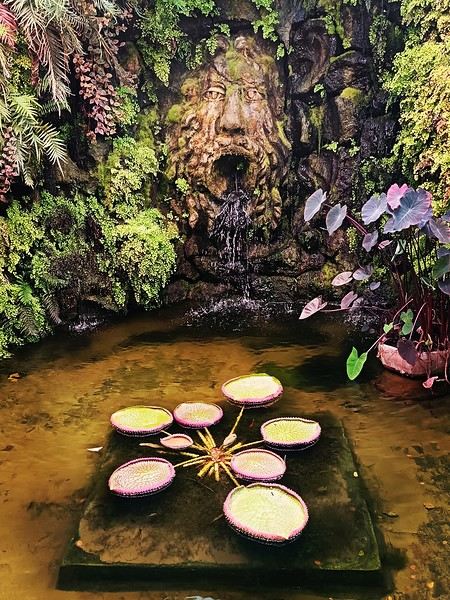
Good evening everyone,
So, it’s settled—the first idea (this book about the lush garden of a New York state parsonage, "this garden obsessed with the love this man had for his late wife." Reverend Cheney musically noting all the birdsongs, the water droplets in the watering can, the wind rushing through cloaks at the end of the 19th century) will be the theme.
Garden: A plot of land, usually enclosed, attached or not to a dwelling, planted with useful or ornamental vegetation.
So, private gardens, vegetable patches, herb gardens, botanical gardens, winter gardens with their lush greenhouses, the "hortus conclusus" of cloisters evoking the Garden of Eden, public gardens, and their extension into parks are all welcome. I’m sure I’ve forgotten some...
Photos can be posted until Monday, November 24 at midnight, following the usual rules: one per message, numbered from 1 to 3, with the location of the shot and, if you’d like, a few details.
Voting, where you explicitly assign 3 to 1 points to your top 3 photos, will take place from Tuesday, November 25 at 12:01 AM until Sunday, November 30 at midnight. The results will be announced on December 1.
Your turn! 😉
Catherine
PS: This thread is reserved for contest photos. For all other photos and conversations under the trees by the fountains, it’s here.
Where to stay on Gran Canaria to explore the island?
Hi there,
I’m planning a trip from Gran Canaria to El Hierro to Tenerife at the end of winter.
My current dilemma is where to book accommodations on Gran Canaria.
We’re planning to stay 7 nights on the island, and our goal is to hike, drive along small roads, discover a few villages, and admire some beaches (just for the views, not for swimming!).
Since the island is quite rugged, the journeys can be long even if the distances are short. I’d like to avoid driving 2 hours every morning and evening to reach the area we want to explore...
I’m thinking of splitting the 7 nights into 4 somewhere and 3 elsewhere.
But where? It seems the center and the northwest might be the best options.
Any advice, given that I’m mainly looking for peace and quiet, a beautiful view, a secluded spot, or a quiet village?
Thanks! :)
I’m planning a trip from Gran Canaria to El Hierro to Tenerife at the end of winter.
My current dilemma is where to book accommodations on Gran Canaria.
We’re planning to stay 7 nights on the island, and our goal is to hike, drive along small roads, discover a few villages, and admire some beaches (just for the views, not for swimming!).
Since the island is quite rugged, the journeys can be long even if the distances are short. I’d like to avoid driving 2 hours every morning and evening to reach the area we want to explore...
I’m thinking of splitting the 7 nights into 4 somewhere and 3 elsewhere.
But where? It seems the center and the northwest might be the best options.
Any advice, given that I’m mainly looking for peace and quiet, a beautiful view, a secluded spot, or a quiet village?
Thanks! :)
My TOP 3 countries visited
Hi everyone,
I feel like I’ve been lucky enough over the past few years to travel—a lot of that’s thanks to retirement... (see my profile!)
So, aside from my beautiful country, France, here’s my totally subjective top 3:
1 – Antarctica
2 – Greenland
3 – Yellowstone Park
Of course, this is just my opinion—human, architectural, cultural, and gastronomic treasures are everywhere on our unique planet, Earth. Have a great day, everyone!
Of course, this is just my opinion—human, architectural, cultural, and gastronomic treasures are everywhere on our unique planet, Earth. Have a great day, everyone!
Join me in discovering Gran Canaria
Introduction
We stayed on the island of Gran Canaria during the first three months of 2024. It’s the third Canary Island we’ve visited, after Tenerife and Lanzarote.
We rented an apartment in Temisas. By staying in the same place for such a long period, the total price dropped by 50%.
We also rented a vehicle to make getting around the island easier.
Why the Canary Islands, and Gran Canaria in particular? For its pleasant climate, the nature and diversity of its landscapes, the charming villages, and especially the beauty of its many beaches.
In this travel journal, you’ll find a list of the many activities we did during our stay to explore the different attractions of this island.
These attractions are categorized to make it easier to find what interests you.
Videos are included throughout the summary. Click on the image to start the video.
To jump to a specific post, here are the relevant links:
HIKES:
Roque Nublo Maspalomas Dunes - Part 1 Maspalomas Dunes - Part 2 Los Azulejos de Veneguera Barranco de Las Vacas Ventana del Bentayga (Arco del Aserrador) Caves of the King Ventana de Morro (Ventana de la Ganifa) The Dog of Bentayga Cave of the Four Doors Ventana del Nublo Artenera - Caves of Acusa Seca Temisas - El Gigante Cave Fortress of Ansite Puerto de Las Nieves - Roque de Las Nieves Temisas - Cuevas de la Audiencia Roque Bentayga Guayadeque Ravine (Guayadeque Hermitage) Guayadeque Ravine (Cueva de Bartalo) El Zumacal - Barranco Tauco Casablanca Dam (Los Dolores Dam) Ayagaures - La Angostura Dam & Gambuesa Dam Santa Brígida - Alonso Ravine & Centennial Dragon Tree Pino Santo Hike in the Azuaje Ravine Gáldar - Red Lands of Samarrita Tejeda - Charco de La Paloma Bandama Boiler (Camino Borde de Caldera Bandama) Teror - Alamo Ravine Trail – SL-4 Telde - Calasio Caves Special Natural Reserve of Los Tilos de Moya Los Azulejos - Charco de Las Aneas Fataga Ravine Arinaga Military Battery Trail Maspalomas - Las Fuentes and del Canizo Ravines Mogán - Tauro Mountain Trail Tamabada - Llanos de La Mimbre & Sobre la Cueva Viewpoints Trail Hike to the Coronadero Arch via Barranco Hondo Barranco de Silva - Hike to the Jerez Caves Gáldar - Samson Cave - La Atalaya Peak Agaete - Roque Guayedra and Guayedra Ravine Artenara - Caballero Caves Arucas - Bufadero Salt Flats Barranco de Pino Gordo - Natural Pools Telde - Los Cernícalos Ravine Las Cruces - Toba Caves & Picón Puerto de Las Nieves - Moro Cave Agüimes - Morros de Ávila Caves Juncalillo del Sur - Laguna & Salinas de Abajo Caves of Camino de San Felipe Cruz de Tejeda, Cruz Chico and Degollada Viewpoint Hike on the Patalavaca Circuit Motor Grande - Puerto Rico Arch El Montañón - Los Hornos Dam Seafront Walk - Amadores Beach – Puerto Rico Beach Las Niñas Dam El Hornillo - Omega & Omicron Caves Arteara Necropolis Mogán - El Mulato Dam Las Garzas - El Regante Dam La Plata Route - Cho Flores Dam & El Charco Hondo Vega de Acusa - La Candelaria Dam Candelaria Hermitage – Acusa Seca Viewpoint Valsequillo de Gran Canaria – Roque La Vela Ayagaures Dam – GC-602 Lomo del Palo - Monte Pavón Trail Lugar La Laguna - Levada Fataga Dam & Ravine
BEACHES:
Mogán Beach Taurito Beach Tauro Beach Amadores Beach Puerto Rico Beach Anfi del Mar Beach Patalavaca Beach Meloneras Beach Maspalomas Beach English Beach (Playa del Inglés) Las Burras Beach San Agustin Beach Las Alcaravaneras Beach Las Canteras Beach (La Cicer) Las Canteras Beach (La Puntilla) Las Canteras Beach (Santa Catalina) Aquamarina Beach El Agujero - Bocabarranco Beach Hoya Del Pozo Beach Hoya Del Pozo Beach - Lizard with amputated tail El Cabron Beach Ojos de Garza Beach El Burrero Beach
NATURAL POOLS:
Charco Azul - El Risco Agaete Salt Flats Charco de Los Espejos - Sardina del Norte Natural Pools of Punta de Gáldar Snorkeling in the natural pool of Punta de Gáldar Natural Pool La Furnia o El Clavo - Gáldar Natural Pool of Los Dos Roques Emiliano Natural Pool - El Agujero Natural Pool of El Agujero Natural Pools of Roque Prieto Natural Pool El Altillo Los Charcones de Bañaderos – Arucas Natural Pools of El Charco de Las Palomas – Arucas Natural Pools of La Laja - Las Palmas de Gran Canaria Cueva de la Reina Mora - La Garita Natural Pools of Castillo del Romeral
TOWNS:
Center
Santa Brigida Vega de San Mateo Tejeda Artenara Vallesco Teror
Southwest
Santa Lucia de Tirajana Fataga San Bartolomé de Tirajana Puerto de Mogán La Aldea de San Nicolas
North
Arucas Firgas Moya Santa Maria de Guia Gáldar Agaete Puerto de Las Nieves
East
Vegueta - Las Palmas de Gran Canaria Triana - Las Palmas de Gran Canaria Ciudad Jardin - Las Palmas de Gran Canaria Canteras - Las Palmas de Gran Canaria Telde Valsequillo de Gran Canaria Ingenio Agüimes Temisas
VIEWPOINTS:
GC-60 Route (or nearby) GC-210 Route (or nearby) GC-210 Route between the tunnel and La Aldea de San Nicolás GC-215 & GC-65 Routes (or nearby) GC-200 Route (or nearby) GC-130 Route (or nearby) & GC-605 GC-70 Route (or nearby) & GC-21 Sheep herd on GC-70 Route GC-150, GC-240, GC-305, GC-350 & GC-301 Routes GC-606, GC-295, GC-231 and GC-41 Routes (or nearby) Viewpoints – GC-1 Route (or nearby) Viewpoints - Las Palmas de Gran Canaria Viewpoints - GC-2, GC-21, GC-15, GC-216 and GC-132 Routes (or nearby) Viewpoints - GC-503 & GC-217 Routes Viewpoints - GC-604, GC-505, GC-132, GC-42 and GC-802 Routes
MISCELLANEOUS:
San Rafael Aqueduct - Telde Abandoned San Rafael Estate - La Higuera Cenobio de Valerón La Cesta - Tejeda Puerto de la Aldea Scenic Route GC-671 to El Espinillo Scenic Route GC-607 to El Chorrillo The Galdar Cube (Santiago Quarry) Scenic Route GC-504 to Ayagaures Abandoned seaside resort in the Azuaje Ravine El Bufadero de La Garita – Telde GC-505 Route Abandoned Finca Las Haciendas (Los Mocanes) – Las Vegas de Valsequillo Ruins of San Juan Battery - Las Palmas de Gran Canaria Viera y Clavijo Canarian Botanical Garden - Las Palmas de Gran Canaria Tenefé Salt Flats Los Pérez, Lugarejos & Las Hoyas Dams Monte Pavón, Gran Canaria’s little Ireland Valleseco Lagoon Recreational Area Climbing - Fataga Ravine Surfing – El Agujero El Cairete Restaurant - Carrizal de Tejeda Paragliding flight observation - Los Giles La Cuevita Ayagaures Restaurant Statues and Murals - Cruce de Arinaga Aviation Monument (Las Majoreras) & Murals – Carrizal Artistic recycling by Antonio Peñita - Ojos de Garza Rainbows
We stayed on the island of Gran Canaria during the first three months of 2024. It’s the third Canary Island we’ve visited, after Tenerife and Lanzarote.
We rented an apartment in Temisas. By staying in the same place for such a long period, the total price dropped by 50%.
We also rented a vehicle to make getting around the island easier.
Why the Canary Islands, and Gran Canaria in particular? For its pleasant climate, the nature and diversity of its landscapes, the charming villages, and especially the beauty of its many beaches.
In this travel journal, you’ll find a list of the many activities we did during our stay to explore the different attractions of this island.
These attractions are categorized to make it easier to find what interests you.
Videos are included throughout the summary. Click on the image to start the video.
To jump to a specific post, here are the relevant links:
HIKES:
Roque Nublo Maspalomas Dunes - Part 1 Maspalomas Dunes - Part 2 Los Azulejos de Veneguera Barranco de Las Vacas Ventana del Bentayga (Arco del Aserrador) Caves of the King Ventana de Morro (Ventana de la Ganifa) The Dog of Bentayga Cave of the Four Doors Ventana del Nublo Artenera - Caves of Acusa Seca Temisas - El Gigante Cave Fortress of Ansite Puerto de Las Nieves - Roque de Las Nieves Temisas - Cuevas de la Audiencia Roque Bentayga Guayadeque Ravine (Guayadeque Hermitage) Guayadeque Ravine (Cueva de Bartalo) El Zumacal - Barranco Tauco Casablanca Dam (Los Dolores Dam) Ayagaures - La Angostura Dam & Gambuesa Dam Santa Brígida - Alonso Ravine & Centennial Dragon Tree Pino Santo Hike in the Azuaje Ravine Gáldar - Red Lands of Samarrita Tejeda - Charco de La Paloma Bandama Boiler (Camino Borde de Caldera Bandama) Teror - Alamo Ravine Trail – SL-4 Telde - Calasio Caves Special Natural Reserve of Los Tilos de Moya Los Azulejos - Charco de Las Aneas Fataga Ravine Arinaga Military Battery Trail Maspalomas - Las Fuentes and del Canizo Ravines Mogán - Tauro Mountain Trail Tamabada - Llanos de La Mimbre & Sobre la Cueva Viewpoints Trail Hike to the Coronadero Arch via Barranco Hondo Barranco de Silva - Hike to the Jerez Caves Gáldar - Samson Cave - La Atalaya Peak Agaete - Roque Guayedra and Guayedra Ravine Artenara - Caballero Caves Arucas - Bufadero Salt Flats Barranco de Pino Gordo - Natural Pools Telde - Los Cernícalos Ravine Las Cruces - Toba Caves & Picón Puerto de Las Nieves - Moro Cave Agüimes - Morros de Ávila Caves Juncalillo del Sur - Laguna & Salinas de Abajo Caves of Camino de San Felipe Cruz de Tejeda, Cruz Chico and Degollada Viewpoint Hike on the Patalavaca Circuit Motor Grande - Puerto Rico Arch El Montañón - Los Hornos Dam Seafront Walk - Amadores Beach – Puerto Rico Beach Las Niñas Dam El Hornillo - Omega & Omicron Caves Arteara Necropolis Mogán - El Mulato Dam Las Garzas - El Regante Dam La Plata Route - Cho Flores Dam & El Charco Hondo Vega de Acusa - La Candelaria Dam Candelaria Hermitage – Acusa Seca Viewpoint Valsequillo de Gran Canaria – Roque La Vela Ayagaures Dam – GC-602 Lomo del Palo - Monte Pavón Trail Lugar La Laguna - Levada Fataga Dam & Ravine
BEACHES:
Mogán Beach Taurito Beach Tauro Beach Amadores Beach Puerto Rico Beach Anfi del Mar Beach Patalavaca Beach Meloneras Beach Maspalomas Beach English Beach (Playa del Inglés) Las Burras Beach San Agustin Beach Las Alcaravaneras Beach Las Canteras Beach (La Cicer) Las Canteras Beach (La Puntilla) Las Canteras Beach (Santa Catalina) Aquamarina Beach El Agujero - Bocabarranco Beach Hoya Del Pozo Beach Hoya Del Pozo Beach - Lizard with amputated tail El Cabron Beach Ojos de Garza Beach El Burrero Beach
NATURAL POOLS:
Charco Azul - El Risco Agaete Salt Flats Charco de Los Espejos - Sardina del Norte Natural Pools of Punta de Gáldar Snorkeling in the natural pool of Punta de Gáldar Natural Pool La Furnia o El Clavo - Gáldar Natural Pool of Los Dos Roques Emiliano Natural Pool - El Agujero Natural Pool of El Agujero Natural Pools of Roque Prieto Natural Pool El Altillo Los Charcones de Bañaderos – Arucas Natural Pools of El Charco de Las Palomas – Arucas Natural Pools of La Laja - Las Palmas de Gran Canaria Cueva de la Reina Mora - La Garita Natural Pools of Castillo del Romeral
TOWNS:
Center
Santa Brigida Vega de San Mateo Tejeda Artenara Vallesco Teror
Southwest
Santa Lucia de Tirajana Fataga San Bartolomé de Tirajana Puerto de Mogán La Aldea de San Nicolas
North
Arucas Firgas Moya Santa Maria de Guia Gáldar Agaete Puerto de Las Nieves
East
Vegueta - Las Palmas de Gran Canaria Triana - Las Palmas de Gran Canaria Ciudad Jardin - Las Palmas de Gran Canaria Canteras - Las Palmas de Gran Canaria Telde Valsequillo de Gran Canaria Ingenio Agüimes Temisas
VIEWPOINTS:
GC-60 Route (or nearby) GC-210 Route (or nearby) GC-210 Route between the tunnel and La Aldea de San Nicolás GC-215 & GC-65 Routes (or nearby) GC-200 Route (or nearby) GC-130 Route (or nearby) & GC-605 GC-70 Route (or nearby) & GC-21 Sheep herd on GC-70 Route GC-150, GC-240, GC-305, GC-350 & GC-301 Routes GC-606, GC-295, GC-231 and GC-41 Routes (or nearby) Viewpoints – GC-1 Route (or nearby) Viewpoints - Las Palmas de Gran Canaria Viewpoints - GC-2, GC-21, GC-15, GC-216 and GC-132 Routes (or nearby) Viewpoints - GC-503 & GC-217 Routes Viewpoints - GC-604, GC-505, GC-132, GC-42 and GC-802 Routes
MISCELLANEOUS:
San Rafael Aqueduct - Telde Abandoned San Rafael Estate - La Higuera Cenobio de Valerón La Cesta - Tejeda Puerto de la Aldea Scenic Route GC-671 to El Espinillo Scenic Route GC-607 to El Chorrillo The Galdar Cube (Santiago Quarry) Scenic Route GC-504 to Ayagaures Abandoned seaside resort in the Azuaje Ravine El Bufadero de La Garita – Telde GC-505 Route Abandoned Finca Las Haciendas (Los Mocanes) – Las Vegas de Valsequillo Ruins of San Juan Battery - Las Palmas de Gran Canaria Viera y Clavijo Canarian Botanical Garden - Las Palmas de Gran Canaria Tenefé Salt Flats Los Pérez, Lugarejos & Las Hoyas Dams Monte Pavón, Gran Canaria’s little Ireland Valleseco Lagoon Recreational Area Climbing - Fataga Ravine Surfing – El Agujero El Cairete Restaurant - Carrizal de Tejeda Paragliding flight observation - Los Giles La Cuevita Ayagaures Restaurant Statues and Murals - Cruce de Arinaga Aviation Monument (Las Majoreras) & Murals – Carrizal Artistic recycling by Antonio Peñita - Ojos de Garza Rainbows
Come discover the island of Aruba in the Caribbean
Aruba is a small island in the Dutch Caribbean located off the coast of Venezuela. It’s part of the ABC islands (Aruba, Bonaire, Curaçao).
After visiting the island of Curaçao a few years earlier, we decided to explore Aruba in November 2023.
We stayed for three weeks in an Airbnb-style accommodation and rented a vehicle for the entire period to visit the various tourist attractions on the island.
These are listed below.
You’ll find several supermarkets (Carrefour, Super Food, Jumbo, etc.) as well as a wide variety of restaurants.
*****
Note:
Please be aware that since July 2024, Aruba has implemented a $20 sustainable development tax for visitors arriving by air.
This tax is payable via the online ED Card platform during the ED card application process to enter Aruba.
I invite you to continue reading this travel journal and watch the videos that will help you discover this sunny destination.
*****
Videos are embedded throughout the summary. Click on the image to start the video.
To jump to a specific post, here are the relevant links:
Noord - California Lighthouse Noord - Bubali Bird Sanctuary Paradera - Casibari Rock Formations Santa Cruz - Ayo Rock Formations Bushiribana - New Natural Pool (Cave Pool) Noord - Bushiribana Gold Mill Ruins Santa Cruz - Natural Bridge Oranjestad - Hooiberg San Nicolas - Seroe Colorado Natural Bridge Spanish Lagoon Mangrove Trail Shoco Habitat - Spanish Lagoon Oranjestad - Balashi Gold Mill Ruins San Nicolas - Lourdes Grotto Arikok National Park - Daimari Beach, Boka Keto Beach (Moro), Conchi Natural Pool Arikok National Park - Boca Prins Beach Arikok National Park - Fontein Cave Arikok National Park – Quadirikiri Cave Arikok National Park – Hike to Sero Arikok Oranjestad & Noord - Walking tour San Nicolas and its murals San Nicolas and its mosaic street benches The famous seafood restaurant Zeerover Noord - Snorkeling around the Baboo shipwreck Noord - Arashi Beach Noord - Boca Catalina Beach Noord - Boca Catalina Beach - Snorkeling Noord - Snorkeling at Tres Tapi - Turtle and Ray Noord - Snorkeling at Malmok Beach - Flying gurnards Noord - Hadicurari Beach (Fishermen's Huts) Noord - Palm Beach Noord - Eagle Beach Noord – Manchebo Beach Oranjestad - Divi Beach Oranjestad - Druif Beach Oranjestad - Surfside Beach Pos Chiquito - Mangel Halto Beach Savaneta - Santo Largo Beach Savaneta - Battata Beach San Nicolas - Rodgers Beach San Nicolas - Baby Beach San Nicolas - Baby Beach - Snorkeling San Nicolas - Bachelor’s Beach (Boca Tabla) San Nicolas - Boca Grandi Beach San Nicolas - Colorado Point - Snorkeling at Bachelors Beach San Nicolas - Grapefield Beach Hike - Blackstone Beach via Natural Bridge Noord - Wariruri Beach
After visiting the island of Curaçao a few years earlier, we decided to explore Aruba in November 2023.
We stayed for three weeks in an Airbnb-style accommodation and rented a vehicle for the entire period to visit the various tourist attractions on the island.
These are listed below.
You’ll find several supermarkets (Carrefour, Super Food, Jumbo, etc.) as well as a wide variety of restaurants.
*****
Note:
Please be aware that since July 2024, Aruba has implemented a $20 sustainable development tax for visitors arriving by air.
This tax is payable via the online ED Card platform during the ED card application process to enter Aruba.
I invite you to continue reading this travel journal and watch the videos that will help you discover this sunny destination.
*****
Videos are embedded throughout the summary. Click on the image to start the video.
To jump to a specific post, here are the relevant links:
Noord - California Lighthouse Noord - Bubali Bird Sanctuary Paradera - Casibari Rock Formations Santa Cruz - Ayo Rock Formations Bushiribana - New Natural Pool (Cave Pool) Noord - Bushiribana Gold Mill Ruins Santa Cruz - Natural Bridge Oranjestad - Hooiberg San Nicolas - Seroe Colorado Natural Bridge Spanish Lagoon Mangrove Trail Shoco Habitat - Spanish Lagoon Oranjestad - Balashi Gold Mill Ruins San Nicolas - Lourdes Grotto Arikok National Park - Daimari Beach, Boka Keto Beach (Moro), Conchi Natural Pool Arikok National Park - Boca Prins Beach Arikok National Park - Fontein Cave Arikok National Park – Quadirikiri Cave Arikok National Park – Hike to Sero Arikok Oranjestad & Noord - Walking tour San Nicolas and its murals San Nicolas and its mosaic street benches The famous seafood restaurant Zeerover Noord - Snorkeling around the Baboo shipwreck Noord - Arashi Beach Noord - Boca Catalina Beach Noord - Boca Catalina Beach - Snorkeling Noord - Snorkeling at Tres Tapi - Turtle and Ray Noord - Snorkeling at Malmok Beach - Flying gurnards Noord - Hadicurari Beach (Fishermen's Huts) Noord - Palm Beach Noord - Eagle Beach Noord – Manchebo Beach Oranjestad - Divi Beach Oranjestad - Druif Beach Oranjestad - Surfside Beach Pos Chiquito - Mangel Halto Beach Savaneta - Santo Largo Beach Savaneta - Battata Beach San Nicolas - Rodgers Beach San Nicolas - Baby Beach San Nicolas - Baby Beach - Snorkeling San Nicolas - Bachelor’s Beach (Boca Tabla) San Nicolas - Boca Grandi Beach San Nicolas - Colorado Point - Snorkeling at Bachelors Beach San Nicolas - Grapefield Beach Hike - Blackstone Beach via Natural Bridge Noord - Wariruri Beach
Best destination for relaxation and family: Mauritius / Cuba / Dominican Republic?
Hi everyone, okay, here’s the scoop: I’ve been dealing with a pretty serious illness, but I’m determined to recover by the end of this year. I want to take my partner and my two little ones (7 and 4 years old) for a ten-day vacation in February 2026 or April 2026. The goal? To help them forget this tough year—let’s be honest—and give us all (and yes, I deserve it too 😉) some fantastic holidays.
Considering the budget for round-trip flights, cost of living on-site (hotel with pool and beach, all-inclusive or half-board meals), and food quality, which would you choose between Mauritius, Cuba, or the Dominican Republic? Heads up—I’ve been a globetrotter in another life, and all-inclusive hotels aren’t usually my thing, but this time, it’s different: I need REST and a family-friendly vacation. Of course, we’ll still do some excursions and sightseeing, so the scenery matters, but I’m really looking for the best value for money between flights, hotels, and a change of scenery :) Is Cuba too Americanized / full of junk food in the hotels?
Any family-focused travel agencies you’d recommend?
Thanks for sharing your experiences—I know this is a long message, but hopefully, it’ll keep the advice focused 😎 And thanks for this forum 😇
Considering the budget for round-trip flights, cost of living on-site (hotel with pool and beach, all-inclusive or half-board meals), and food quality, which would you choose between Mauritius, Cuba, or the Dominican Republic? Heads up—I’ve been a globetrotter in another life, and all-inclusive hotels aren’t usually my thing, but this time, it’s different: I need REST and a family-friendly vacation. Of course, we’ll still do some excursions and sightseeing, so the scenery matters, but I’m really looking for the best value for money between flights, hotels, and a change of scenery :) Is Cuba too Americanized / full of junk food in the hotels?
Any family-focused travel agencies you’d recommend?
Thanks for sharing your experiences—I know this is a long message, but hopefully, it’ll keep the advice focused 😎 And thanks for this forum 😇
Cécile from the Salton Sea to Alcatraz
And off we go again for what’s certainly our last trip to the American West... After the disaster of September 2022, the diabetes flare-up, and the pulmonary embolism, we’re spending ten days in the spots we missed and some unlikely places.
After flying over Scotland, still English,
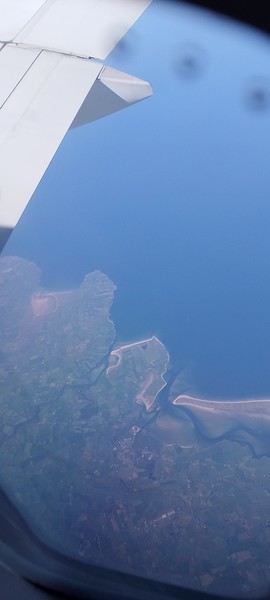 Greenland, still Danish,

And Lake Huron, still half Canadian,
 We land early in Detroit... a nightmare of an airport. A long, dreadful baggage check process, but we still make it to gate A10 just in the nick of time—only for disaster to strike!
My passport has my first and last name, my boarding pass has my first and last name, BUT not on Delta’s computer—so we’re denied boarding!
We head to the Air France-Delta-KLM desk, where an employee listens to us sympathetically. He books us two seats on an 8:30 AM flight to SF...
Then passes us off to two colleagues who offer us a night in a hotel... and send a message to the baggage service to keep our checked luggage safe...
In the end, we go to bed earlier, wake up earlier, but since we’ll still get some sleep on the plane, we might be able to look back on this whole mess with a smile... well, we hope so, anyway.
10:17 PM in Detroit—time to sleep. Our clean clothes and toiletries are in the plane.
We’ll bounce back!!;
We land early in Detroit... a nightmare of an airport. A long, dreadful baggage check process, but we still make it to gate A10 just in the nick of time—only for disaster to strike!
My passport has my first and last name, my boarding pass has my first and last name, BUT not on Delta’s computer—so we’re denied boarding!
We head to the Air France-Delta-KLM desk, where an employee listens to us sympathetically. He books us two seats on an 8:30 AM flight to SF...
Then passes us off to two colleagues who offer us a night in a hotel... and send a message to the baggage service to keep our checked luggage safe...
In the end, we go to bed earlier, wake up earlier, but since we’ll still get some sleep on the plane, we might be able to look back on this whole mess with a smile... well, we hope so, anyway.
10:17 PM in Detroit—time to sleep. Our clean clothes and toiletries are in the plane.
We’ll bounce back!!;
Greenland, still Danish,And Lake Huron, still half Canadian,
We land early in Detroit... a nightmare of an airport. A long, dreadful baggage check process, but we still make it to gate A10 just in the nick of time—only for disaster to strike!
My passport has my first and last name, my boarding pass has my first and last name, BUT not on Delta’s computer—so we’re denied boarding!
We head to the Air France-Delta-KLM desk, where an employee listens to us sympathetically. He books us two seats on an 8:30 AM flight to SF...
Then passes us off to two colleagues who offer us a night in a hotel... and send a message to the baggage service to keep our checked luggage safe...
In the end, we go to bed earlier, wake up earlier, but since we’ll still get some sleep on the plane, we might be able to look back on this whole mess with a smile... well, we hope so, anyway.
10:17 PM in Detroit—time to sleep. Our clean clothes and toiletries are in the plane.
We’ll bounce back!!;Which direction to travel the Australian East Coast based on climate and swimming spots?
Hi there,
My wife, our 3-year-old son, and I are planning a trip along Australia’s East Coast, leaving in early October and returning in mid-November. The plan is to do a 4-week road trip in a campervan, then settle down for about ten days.
The question I’m asking myself is: which way should we go? From Sydney to Cairns or the other way around? Despite all the documentation I’ve read, I’m still struggling to decide the best direction based on the climate at that time and swimming conditions.
Up north, the weather will be warmer, and the water too, unlike the south. However, in the north, there are swimming restrictions, especially because of jellyfish, whereas in the south, there seems to be less danger (apart from sharks, maybe). Are there many protected beaches in the north where we can swim safely? Also, I should consider that in the south, the Great Barrier Reef no longer protects the beaches, so I imagine there are fewer calm spots for swimming?
I’d love any tips or advice you can share, and thanks in advance!
A dad keen to make this trip a success
My wife, our 3-year-old son, and I are planning a trip along Australia’s East Coast, leaving in early October and returning in mid-November. The plan is to do a 4-week road trip in a campervan, then settle down for about ten days.
The question I’m asking myself is: which way should we go? From Sydney to Cairns or the other way around? Despite all the documentation I’ve read, I’m still struggling to decide the best direction based on the climate at that time and swimming conditions.
Up north, the weather will be warmer, and the water too, unlike the south. However, in the north, there are swimming restrictions, especially because of jellyfish, whereas in the south, there seems to be less danger (apart from sharks, maybe). Are there many protected beaches in the north where we can swim safely? Also, I should consider that in the south, the Great Barrier Reef no longer protects the beaches, so I imagine there are fewer calm spots for swimming?
I’d love any tips or advice you can share, and thanks in advance!
A dad keen to make this trip a success
Warm January in Kerala (and a bit of Karnataka)
Hi everyone,
We're back in India for the 7th time (for the other trips, check here:
https://www.unendroitoualler.fr/asie/) ... But this time, no more exploring or trekking! With age, we're just spending a quiet month in southern India, a country we particularly love...
Our journey starts in Kovalam, then Monroe Island, Varkala, Kochi, Kannur, Udupi, and finally, as in recent years, Gokarna.
No problem getting around—there’s the train all along the coast...
Night in Trivandrum
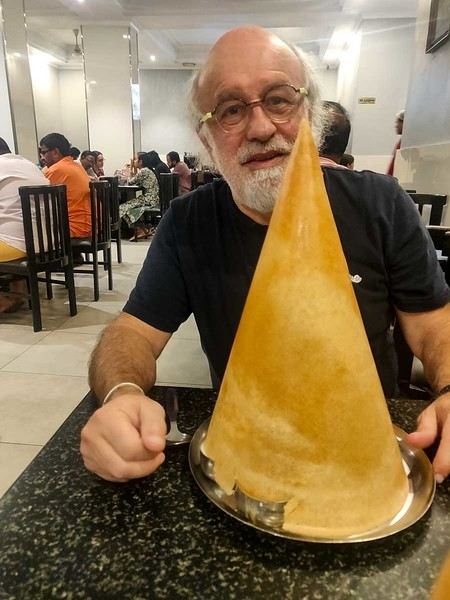
Prepaid taxi to the « Safire Residency », where we stayed last year. This hotel is still just as nice and welcoming (980 INR). Then, dinner at the restaurant « Ariya Niwas » where we enjoyed those delicious dosas again! (We missed them!)
Night in Trivandrum
Prepaid taxi to the « Safire Residency », where we stayed last year. This hotel is still just as nice and welcoming (980 INR). Then, dinner at the restaurant « Ariya Niwas » where we enjoyed those delicious dosas again! (We missed them!)
Budget hotel in New Delhi
Hi everyone,
I’m not sure if this is a good idea... but I’m throwing a message in a bottle out there again...
I’m looking for a hotel in New Delhi for the end of the month (just one night—for a layover). I’m wary of scams on the usual sites. You find all sorts of prices and huge discounts... but reviews on other platforms scream "scam" about those same hotels. Not that I’m not up for adventure, but if I can avoid making an avoidable mistake, I’d rather learn and discover with kind people than through unscrupulous tourist touts. At the same time, maybe this’ll be helpful to others too.
Is a budget of 40 € (+/-) doable? 50 € (+/-)? Does that sound reasonable? What do you think? Your experiences would really help me out. Thanks, friends.
Looking forward to reading your replies.
Warm regards to all
I’m not sure if this is a good idea... but I’m throwing a message in a bottle out there again...
I’m looking for a hotel in New Delhi for the end of the month (just one night—for a layover). I’m wary of scams on the usual sites. You find all sorts of prices and huge discounts... but reviews on other platforms scream "scam" about those same hotels. Not that I’m not up for adventure, but if I can avoid making an avoidable mistake, I’d rather learn and discover with kind people than through unscrupulous tourist touts. At the same time, maybe this’ll be helpful to others too.
Is a budget of 40 € (+/-) doable? 50 € (+/-)? Does that sound reasonable? What do you think? Your experiences would really help me out. Thanks, friends.
Looking forward to reading your replies.
Warm regards to all
Which itinerary to choose for 15 days in the American West
Hi everyone!
First time for me in the States from March 24 to April 7, 2025—only 15 days, so choices have to be made. I want to explore part of the West, but obviously planning the route is the trickiest part, so here’s what I’ve come up with and where I have doubts:
-Leaving Paris for LA
1 or 2 nights to visit
-Heading to Vegas, where one couple would go by motorcycle (they’re fans and want the thrill of Route 66) and another by plane (I won’t linger here either—1 or 2 days max!)
Then, Lake Powell, Monument Valley, Grand Canyon, all by rental car for everyone, so the motorcycle gets returned in Vegas.
Now here’s where it gets tricky: either I continue the road trip through the big parks to finish in San Francisco (but it doesn’t seem like the best time—might be too cold), or I head down to San Diego for the return flight. But which itinerary? Kingman, Joshua Tree, Palm Springs, and San Diego—does that make sense? Is it better to go back to Vegas to take a plane or drive the whole way?
So many questions—your help and advice would be super welcome! Thanks in advance, Anne from Périgord Noir
Now here’s where it gets tricky: either I continue the road trip through the big parks to finish in San Francisco (but it doesn’t seem like the best time—might be too cold), or I head down to San Diego for the return flight. But which itinerary? Kingman, Joshua Tree, Palm Springs, and San Diego—does that make sense? Is it better to go back to Vegas to take a plane or drive the whole way?
So many questions—your help and advice would be super welcome! Thanks in advance, Anne from Périgord Noir
Has anyone done the Canary Islands and Madeira with Costa?
Hi there,
Has anyone taken a cruise to the Canary Islands and Madeira with Costa?
Thanks for your replies!
Jibé
Voyage en famille aux Amériques English translation pending
Bonjour à tous,
Avec mon épouse et mes 3 garçons nous envisageons un très long voyage aux Amériques. Notre objectif est d'arriver au canada et de descendre jusqu'au sud sud. Pour cela et pour l'instant nous envisageons de descendre en hymer S660 de 84. Pour ceux qui ont déjà passé ces frontières, quels sont les problèmes que nous pouvons rencontrer au douanes. Par exemple, les permis de conduire B (francais et international) sont ils ok pour conduire des cc la bas? Le poids du véhicule est il problématiques (risque de surcharge).
Une autre option que nous envisageons est d'acheter un CC la bas directement. Mais j'ai peur que les problèmes de frontières soient plus importantes avec un CC canadien en amérique du sud.
Avez vous des expériences à partager ? Tous vos conseils sont les bienvenues.
Avec mon épouse et mes 3 garçons nous envisageons un très long voyage aux Amériques. Notre objectif est d'arriver au canada et de descendre jusqu'au sud sud. Pour cela et pour l'instant nous envisageons de descendre en hymer S660 de 84. Pour ceux qui ont déjà passé ces frontières, quels sont les problèmes que nous pouvons rencontrer au douanes. Par exemple, les permis de conduire B (francais et international) sont ils ok pour conduire des cc la bas? Le poids du véhicule est il problématiques (risque de surcharge).
Une autre option que nous envisageons est d'acheter un CC la bas directement. Mais j'ai peur que les problèmes de frontières soient plus importantes avec un CC canadien en amérique du sud.
Avez vous des expériences à partager ? Tous vos conseils sont les bienvenues.
Cartographie des régions moustiquogènes du Canada English translation pending
Cartographie des régions moustiquogènes au Canada?
A quelques amis qui ne connaissent du Canada que quelques grandes villes et qui m’interrogeaient sur la question des moustiques (y-a-t-il une carte des moustiques? etc...) j’ai apporté la réponse suivante
Non il n’y a pas de cartes des moustiques mais ... ...comme partout ailleurs, au Canada les moustiques aiment les zones humides or le Canada détient quelque chose comme un quart des zones humides de la planète soit environ 14 % de la surface du Pays et près de 1,3 million de kilomètres carrés. …ce qui constitue évidemment un énorme potentiel moustiques
La carte des zones humides de l’Atlas du Canada est donc ce qui se rapproche le plus d’une ‘’carte des moustiques’’
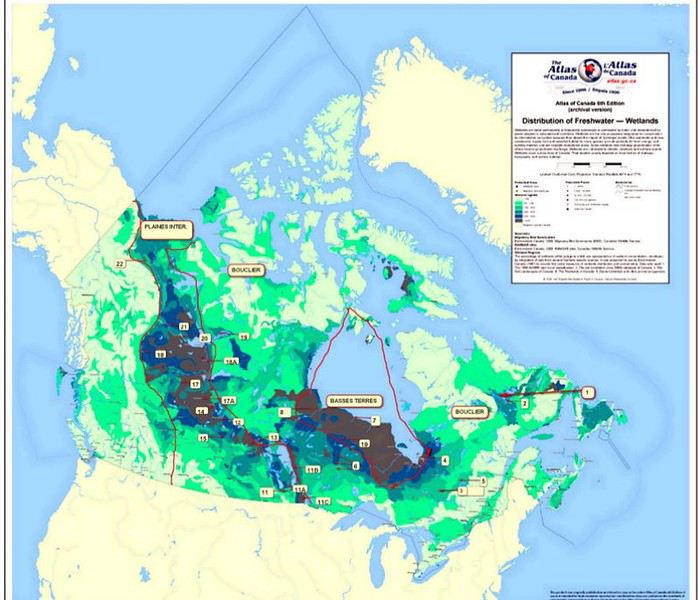
Ce document reconnaît 6 principaux degrés croissants de zônes humides: blanc verdâtre, vert tendre, vert moyen, vert sombre, bleu et bistre. Dans le blanc verdâtre on a moins de 5% de zônes humides. Dans le bistre: on a plus de 65% de zônes humides
ce n’est pas compliqué de l’interpréter…plus la couleur est foncée (du blanc verdâtre au bistre) plus on est haut dans l’échelle moustiques et on voit bien la corrélation qui existe entre les couleurs foncées Les Terres Basses de la Baie d’ Hudson ainsi que les Plaines Intérieures
J’y ai indexé ( de 1 à 22) les principaux secteurs qui ont fait l’objet dans le passé ( XIXème, XXème siècle, ) ou dans les années plus récentes de récits, de témoignages sur les attaques épiques de moustiques...Des récit souvent de personnalités.
Si l’on s’en tient aux itinéraires touristiques habituels tels que les villes, le lac Saint Jean, les Parcs des Rocheuses…. on aura normalement pas d’horribles histoires de moustiques à raconter à son retour de vacances .
Par contre si l’on veut vivre la vraie Aventure canadienne, le grand voyage en canoe qui séduit de plus en plus et qui concerne souvent les zones ‘’moustiquogènes’’ il faut bien se préparer.
Pour un aperçu ouvrir : ‘’ Témoignages ‘’ ….. c’est un peu lourd !
https://docs.google.com/document/d/e/2PACX-1vQUGIZ-d2unnPr1ogdhN457eGa4Aknh8pFWAFB0IivgL05VUAvR-MXDZqjRDCL22YKXp28__3KHAa3w/pub
à disposition pour commentaires éventuels...
A quelques amis qui ne connaissent du Canada que quelques grandes villes et qui m’interrogeaient sur la question des moustiques (y-a-t-il une carte des moustiques? etc...) j’ai apporté la réponse suivante
Non il n’y a pas de cartes des moustiques mais ... ...comme partout ailleurs, au Canada les moustiques aiment les zones humides or le Canada détient quelque chose comme un quart des zones humides de la planète soit environ 14 % de la surface du Pays et près de 1,3 million de kilomètres carrés. …ce qui constitue évidemment un énorme potentiel moustiques
La carte des zones humides de l’Atlas du Canada est donc ce qui se rapproche le plus d’une ‘’carte des moustiques’’
Ce document reconnaît 6 principaux degrés croissants de zônes humides: blanc verdâtre, vert tendre, vert moyen, vert sombre, bleu et bistre. Dans le blanc verdâtre on a moins de 5% de zônes humides. Dans le bistre: on a plus de 65% de zônes humides
ce n’est pas compliqué de l’interpréter…plus la couleur est foncée (du blanc verdâtre au bistre) plus on est haut dans l’échelle moustiques et on voit bien la corrélation qui existe entre les couleurs foncées Les Terres Basses de la Baie d’ Hudson ainsi que les Plaines Intérieures
J’y ai indexé ( de 1 à 22) les principaux secteurs qui ont fait l’objet dans le passé ( XIXème, XXème siècle, ) ou dans les années plus récentes de récits, de témoignages sur les attaques épiques de moustiques...Des récit souvent de personnalités.
Si l’on s’en tient aux itinéraires touristiques habituels tels que les villes, le lac Saint Jean, les Parcs des Rocheuses…. on aura normalement pas d’horribles histoires de moustiques à raconter à son retour de vacances .
Par contre si l’on veut vivre la vraie Aventure canadienne, le grand voyage en canoe qui séduit de plus en plus et qui concerne souvent les zones ‘’moustiquogènes’’ il faut bien se préparer.
Pour un aperçu ouvrir : ‘’ Témoignages ‘’ ….. c’est un peu lourd !
https://docs.google.com/document/d/e/2PACX-1vQUGIZ-d2unnPr1ogdhN457eGa4Aknh8pFWAFB0IivgL05VUAvR-MXDZqjRDCL22YKXp28__3KHAa3w/pub
à disposition pour commentaires éventuels...
Petit tour dans le Péloponnèse English translation pending
Tous nos séjours en Grèce nous ont enchantées alors, après un séjour en Crète, à Rhodes, à Zakynthos et en Grèce centrale, pourquoi pas un tour du Péloponnèse?
Nous avons quelques hésitations quant à la chaleur possible (notamment pour les randonnées) mais finalement, hop! la réservation des billets d'avion est faite fin janvier: ce sera un départ de Bruxelles (avec Brussels airlines) le 05/07 à 7h30. Puis arrive le (la) Covid avec son lot d'incertitudes: partira? Partira pas? Partira? Partira pas? Faut-il tout annuler, reporter? Au mois de juin les règles d'ouverture des frontières changent en permanence mais il arrive un moment où il faut bien se décider car certains hébergements ne sont plus annulables. Les frontières de la Grèce doivent théoriquement ouvrir totalement le 1er juillet (sous réserve de...) on doit partir le 5 ...alors, c'est décidé, on part! ...enfin, si tout se passe comme prévu!
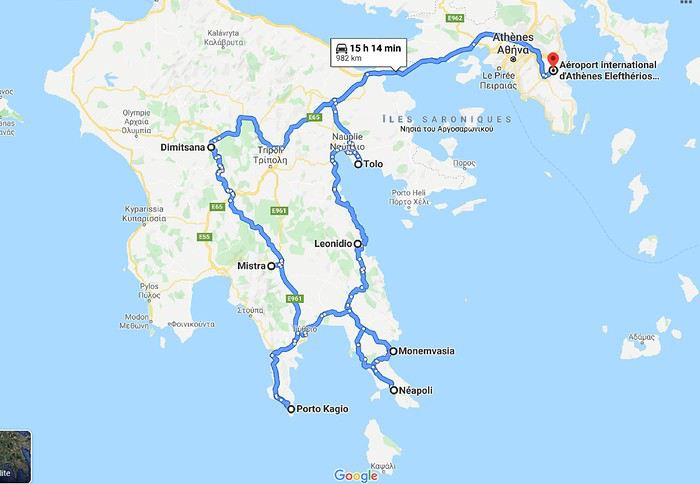
L'ouest du Péloponnèse ne m'inspire pas plus que ça. Par contre Cythère me tente bien, alors voilà à quoi ressemblera notre circuit (on prendra le bateau pour Cythère à Neapoli):
 Muriel
Nous avons quelques hésitations quant à la chaleur possible (notamment pour les randonnées) mais finalement, hop! la réservation des billets d'avion est faite fin janvier: ce sera un départ de Bruxelles (avec Brussels airlines) le 05/07 à 7h30. Puis arrive le (la) Covid avec son lot d'incertitudes: partira? Partira pas? Partira? Partira pas? Faut-il tout annuler, reporter? Au mois de juin les règles d'ouverture des frontières changent en permanence mais il arrive un moment où il faut bien se décider car certains hébergements ne sont plus annulables. Les frontières de la Grèce doivent théoriquement ouvrir totalement le 1er juillet (sous réserve de...) on doit partir le 5 ...alors, c'est décidé, on part! ...enfin, si tout se passe comme prévu!
L'ouest du Péloponnèse ne m'inspire pas plus que ça. Par contre Cythère me tente bien, alors voilà à quoi ressemblera notre circuit (on prendra le bateau pour Cythère à Neapoli):
MurielRenseignements pour road trip dans l'Ouest américain en août 2022 English translation pending
Hello Tout le monde !
Je suis en trés large avance certes. Nous envisageons un road trip (Août 2022) dans l'Ouest pour nos ... ans de mariage.
Los Angéles, le Grand Canyon, Monument Valley, Las Végas, Séquoia Park, Yosémite Park, SF et retour LA.
Bref, nous en sommes aux balbutiements.
Ce qui m’inquiète, c'est la foule. Y a t-il vraiment du monde dans l'Ouest au mois d’août ?
Merci de vos lumiéres.
Cdt.
Je suis en trés large avance certes. Nous envisageons un road trip (Août 2022) dans l'Ouest pour nos ... ans de mariage.
Los Angéles, le Grand Canyon, Monument Valley, Las Végas, Séquoia Park, Yosémite Park, SF et retour LA.
Bref, nous en sommes aux balbutiements.
Ce qui m’inquiète, c'est la foule. Y a t-il vraiment du monde dans l'Ouest au mois d’août ?
Merci de vos lumiéres.
Cdt.
Road trip dans l'Ouest américain pour Noël 2021 English translation pending
Bonjour à tous!!!
J'aurais besoin de votre aide et de vos avis éclairés!!! Voilà pour les 18 ans de notre fils nous souhaitons faire un grand voyage : un road trip dans l'ouest américain!!! J'ai commencé à faire une première ébauche de circuit, en sachant que nous partirons du 18 décembre 2021 au 02 janvier 2022. Etape 1 : Arrivée à Los Angeles. 2 nuits sur place. Etape 2 : Joshua tree park. 1 nuit dans les alentours Etape 3 : Grand canyon. 2 nuits Etape 4 : Las Vegas. 1 nuit Etape 5 : Reno. 1 nuit Etape 6 : Vallée de Napa. 1 nuit Etape 7 : San Francisco. 2 nuits Etape 8: San Luis Obispo. 1 nuit Etape 9 : retour à Los Angeles
Je voulais savoir si ce circuit est réalisable et surtout pour les dates que nous avons choisi!!!
Merci beaucoup pour votre aide!!!🙂
J'aurais besoin de votre aide et de vos avis éclairés!!! Voilà pour les 18 ans de notre fils nous souhaitons faire un grand voyage : un road trip dans l'ouest américain!!! J'ai commencé à faire une première ébauche de circuit, en sachant que nous partirons du 18 décembre 2021 au 02 janvier 2022. Etape 1 : Arrivée à Los Angeles. 2 nuits sur place. Etape 2 : Joshua tree park. 1 nuit dans les alentours Etape 3 : Grand canyon. 2 nuits Etape 4 : Las Vegas. 1 nuit Etape 5 : Reno. 1 nuit Etape 6 : Vallée de Napa. 1 nuit Etape 7 : San Francisco. 2 nuits Etape 8: San Luis Obispo. 1 nuit Etape 9 : retour à Los Angeles
Je voulais savoir si ce circuit est réalisable et surtout pour les dates que nous avons choisi!!!
Merci beaucoup pour votre aide!!!🙂
Adventures of a Bygone Era: The Philippines in 1984
After several discussions on VF about travel journals from the Philippines, I decided to write this curiosity: a trip report from a journey made in 1984, when traveling to the Philippines was still an adventure.
A curiosity because writing a travel journal about a trip 35 years later isn’t common, but also (mostly?) because exploring the Philippines at that time had little in common with traveling there today.
Obviously, I’ve forgotten a number of facts, most of the details, but with the help of a few notes from that time and a stack of slides (yes, there was life before digital 😊), many memories came back and added to the highlights I’d never forgotten. The scanned slides aren’t always great quality, but there are still quite a few to brighten up this chatter. Back then, we didn’t snap photos like we do now—film was too expensive—so I don’t have pictures of every place we visited... too bad, comparing some of those spots to how they look today would’ve been interesting.
Why "Adventures"? Why call it "Adventures" in the Philippines in 1984, a word so often used for a simple exotic trip? - Because the lack of information (no *Guide du Routard*, no *Lonely Planet*, no *Michelin Guide*, nothing, and obviously no internet) gave this trip what’s at the heart of adventure: the unknown. - Because the political situation made the stay sometimes dangerous. - Because transportation conditions were always epic, often perilous. - Because the question of where we’d spend the night came up almost every evening. - And for... quite a few other reasons.
That said, we weren’t exactly explorers!
Why the Philippines? First of all, why go to the Philippines in 1984—a country not exactly set up for tourism and about which we knew very little? How could we get an idea of the beauty of the Philippines and its points of interest when we had no guides or photos?
The idea came to us from Thailand a year earlier, during our first long-haul trip. After touring the north of the country, we met a Frenchman living in Phuket, where there were only a few tourists in Patong, with just a few small hotels and guesthouses. Kata and Karon had no buildings or roads, Rawai only had three palm-thatched bungalows, including ours, and the other islands were unknown to tourists. There was plenty to discover, and we wanted to return to this beautiful country... but the Frenchman made us dream about the Philippines—a country to explore, with wild landscapes.
Long evenings of discussion over multiple Sprite-Mekong cocktails (what memories of those headaches!) finally convinced us we had to go to the Philippines.
Episode 0: Before Departure The decision was made: we’d go to the Philippines in May 1984. Our friends and family were surprised when we announced we were going on vacation to the Philippines (a bit like saying today we were going paddleboarding in the Kerguelen Islands 🤪).
These days, preparing for each of our trips takes long evenings of research, planning, and noting down good addresses... etc. But for the Philippines in 1984, preparation was quick: we had very little information about the country, we were leaving almost at random, and the discovery would only be more exciting.
We still had a few bits of info gathered here and there: the rice terraces in northern Luzon, volcanoes, Negros where we were supposed to visit an acquaintance, Cebu and its marine life (we ended up going elsewhere), and absolutely avoid Mindanao, which was practically at war with the regime. That was about it, but it was already a great itinerary.
Nothing was organized in advance; we’d see day by day. We had no idea about travel times or even the existence of transportation options. The main (and sometimes only) way to connect two islands was by overloaded, rusty ferry. Only the big cities had airports.
Let’s Go: Episode 1: Paris to Manila My travel journals always start after arriving at the airport—the Europe-to-“Other Continent” trip isn’t interesting—but the flight to the Philippines was already an adventure, so I’ll make an exception.
This was the era when only a few Asian airlines were on par with Western ones: Thai, Singapore Airlines, and Philippine Airlines. They had beautiful, brand-new planes, and to attract customers (almost exclusively “businessmen”) from the usual airlines (Air France, Lufthansa, British Airways), there was opulence on board: unlimited champagne, all sorts of cocktails... Compared to today’s long-haul flights, there was still one small difference: no personal screens, just one screen at the front of the cabin with one mandatory movie. And I don’t know why, but we only got James Bond films, both ways... that must’ve been the trend at the time.
The tourism boom to Southeast Asia hadn’t started yet, and the “Asian Tigers” weren’t a thing, so there weren’t many business trips. That meant long-haul flights made stops everywhere to fill the planes. Our Philippine Airlines Boeing 747 left London, picked us up in Paris, then stopped in Frankfurt to take on a few Germans. I don’t know why we then made a stop in Dubai—a totally exotic place at the time. There was nothing to do there... things have changed a lot since. It was a small town lost in the desert. The airport was tiny, with just one or two buildings and a supermarket. During the stopover, everyone had to get off the plane and walk to the supermarket. Photo and electronic equipment were dirt cheap—I guess that was the only reason for the stop. Maybe it was their first commercial move. Emirates didn’t exist yet, as I checked online, but anyway, the idea that such a remote place could have its own airline was unthinkable.
Online, I found this photo of Dubai Airport in 1980. Anyone who’s transited through today’s massive airport with its rows of A380s will appreciate it: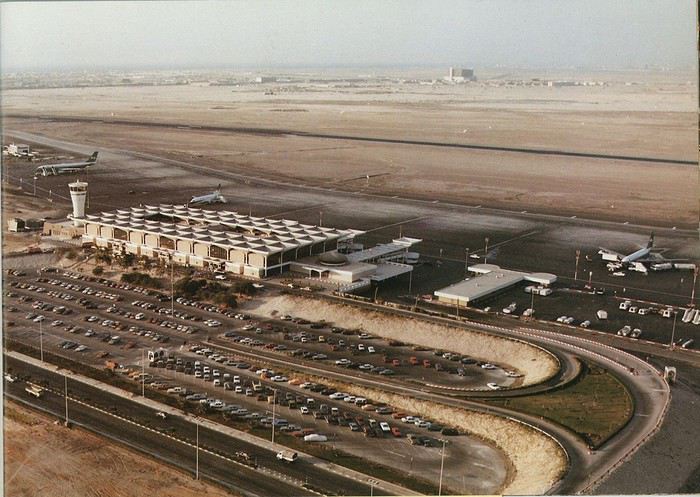
Next stop: New Delhi to drop off some Europeans and pick up a few Indians, and finally, the terminus: Manila. I don’t remember how long the trip took with its five stops—an unimaginable journey today. Despite all those stops to fill the plane, there was still enough space to stretch out on the four center seats of the 747, something that never happens these days despite all the flights in every direction.
So here we are, finally at Manila Airport around midnight.
Episode 1: Manila and Baguio To start, a quick note on the political and economic situation in the Philippines in 1984, which had consequences for us as tourists, as we’d soon realize upon arrival.
After several centuries of Spanish colonization, the Philippines became American at the start of the 20th century, then independent. In 1966, Marcos took power, and little by little, his regime sank into corruption and mismanagement, becoming a dictatorship with martial law, all for the benefit of his family and friends, who enriched themselves endlessly. The peak was the assassination of opposition leader Benigno Aquino in August 1983, which triggered harshly repressed protests. So we arrived a few months later in a very poor country, with omnipresent corruption and an extremely tense political situation, as we’d soon see for ourselves. Major protests took place in the main cities during our trip—I’ll come back to that. Two years later, Marcos fled to Hawaii after being forced out of power following rigged elections. This historical context explains a lot of the situations we found ourselves in over the following weeks.
Arriving in the middle of the night isn’t very cheerful. Manila was already a huge city with many slums, where you could find a few business hotels like the Hilton or Intercontinental—way out of our budget—and plenty of run-down hotels. Luckily, two Indians we’d chatted with on the plane offered to take us to their usual hotel. They came to Manila twice a year for business. We accepted their offer, relieved not to have to look for a place to stay in the middle of the night, figuring the address must be good since they came back every time... we were wrong 🙁
We left the airport and immediately got a taste of the local vibe when we got into the taxi: the police asked for our passports. We thought: what’s more normal than police in a dictatorship?
But that wasn’t it at all. Our two Indian friends explained that the police were noting our names along with the taxi number and time. Crime in Manila was so bad that the taxi driver would be held responsible if anything happened to us... welcome to the Philippines 😎 😎
Historically, the Philippines was a very violent country, where everything was settled with guns or machetes. Previous governments had banned carrying weapons, but Marcos later allowed the free sale and carrying of guns, and disputes were settled with pistols again (or worse, as we’d discover later). Since he’d released most of the criminals from prison to form a paramilitary militia at his service (I’ll talk about our encounter with these “heroes” later), it was pretty dangerous to go into many parts of Manila, where these “tonton macoutes” ruled.
We arrived at our hotel without incident... and then things started badly. The room was infested with big cockroaches—exactly what I hate most in those kinds of countries. No way to find another hotel at that hour. After the long flight, the urge to take a shower was so strong that we squeezed into the bathroom as best we could. After that, I don’t remember—I guess we must’ve fallen asleep exhausted under the sheets in the heat... air conditioning wasn’t widespread yet.
The next day, we just wanted to leave that dump as soon as possible. So we decided to head north right away, stopping in Baguio, and we’d visit Manila a bit on the way back.
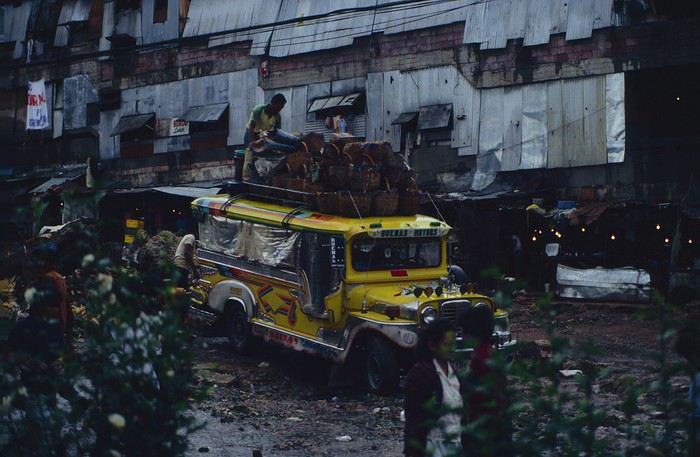
When we stepped outside, we discovered a pretty run-down neighborhood with potholed streets. But we also discovered the jeepneys. They were everywhere, flooding the streets.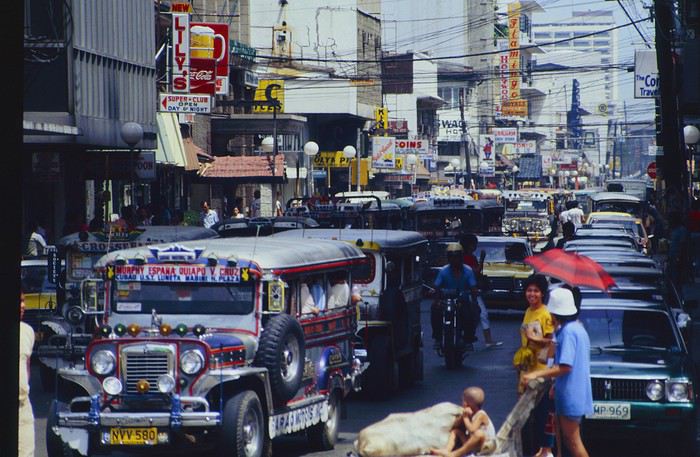
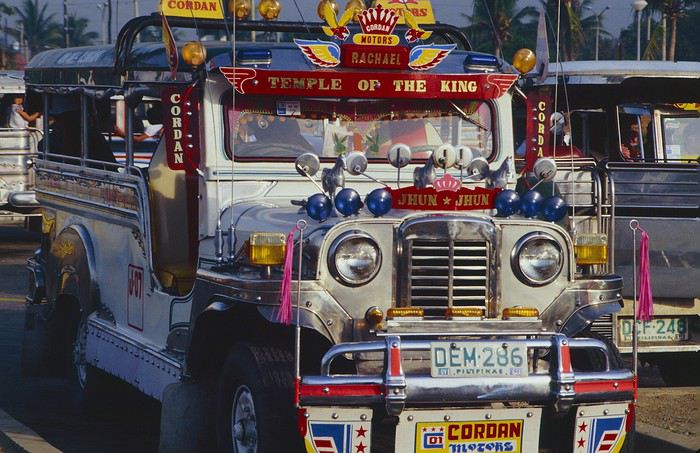
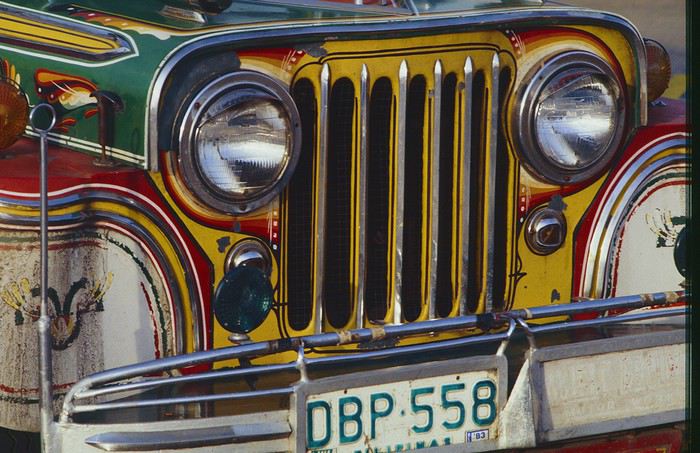
They had crazy sound systems, each one blasting louder than the last. The interiors were kitschy but fun. There weren’t many private cars—almost all transportation was by jeepney, with buses reserved for intercity trips.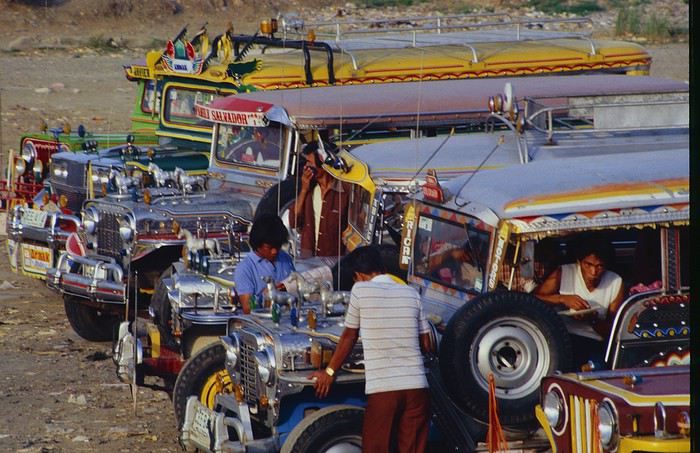
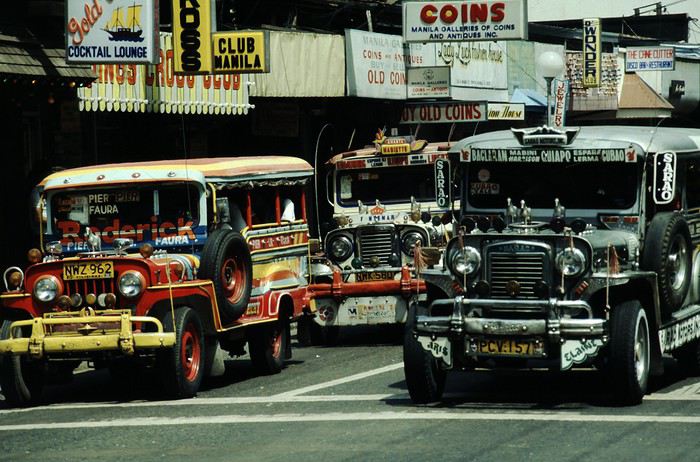
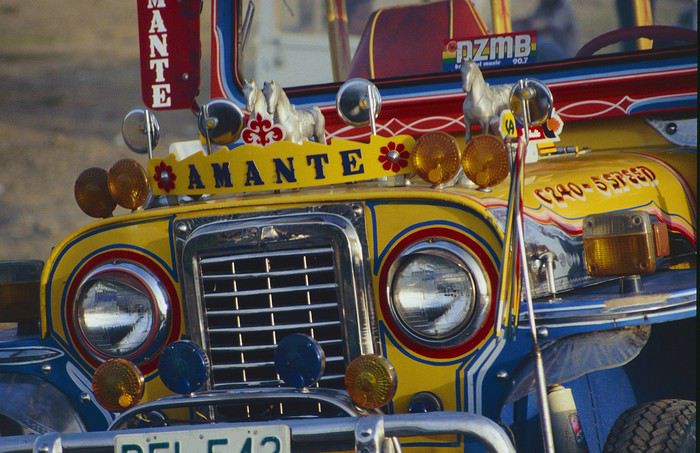
Before heading to the bus terminal for the north, somewhere on the outskirts of the city, we needed to exchange some money. I don’t remember how we ended up in a policeman’s jeep who offered his services: - Exchange money on the black market at a better rate than the banks. - Take us wherever we wanted, in this case, the bus terminal.
We accepted both offers (we’d still checked the official exchange rate from dollars to pesos). So we found ourselves in his jeep. After exchanging money, we left in his vehicle and stopped for gas. Without turning off the engine, he calmly smoked a cigarette while filling up. Since we were in a jeep with no doors or roof, we were ready to jump out if things went south, our travel bag in hand.
But we weren’t done with surprises yet. Once we left the small streets, we ended up in a neighborhood with wide avenues and not much traffic, which didn’t justify his incredible behavior. At every intersection, he made the sign of the cross, closed his eyes, and crossed without looking. I was more stunned than terrified! It wasn’t until we got out of the car later that I told Anne-Marie what had happened. I’d seen everything because the cop had put me in the front seat. Luckily, A-Marie hadn’t noticed anything from the back. Crossing Manila by trusting God rather than the rules of the road was ultimately effective. We were lucky—the trip was off to a good start. 🙂 🙂
We then passed through a neighborhood where slums stretched on for a while, and we left our policeman—friendly but a bit crazy—with relief.
A few hours by bus later, here we are in Baguio, cool in the mountains. My memories of Baguio are pretty fuzzy. I remember a small town. After some research while writing this journal, I found that the population was 120,000 in 1980. Given the population density in each home, that confirms my memory of a smallish town. Outside the “official” district with the president’s summer residence and government buildings, there were two or three paved streets with nice houses. The rest was very dirty and very poor, with lots of slums and dirt roads.
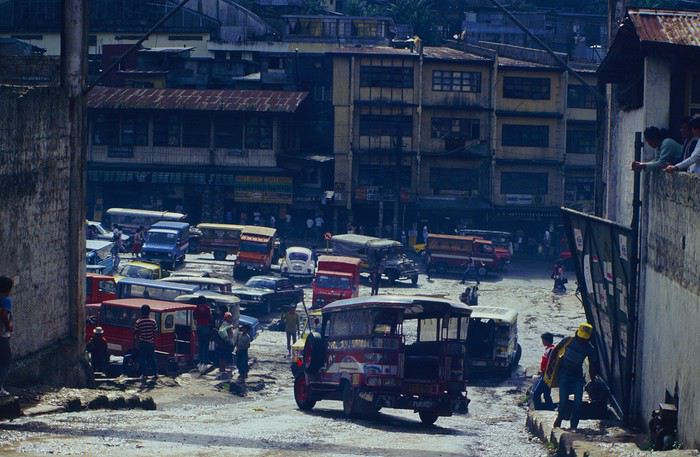
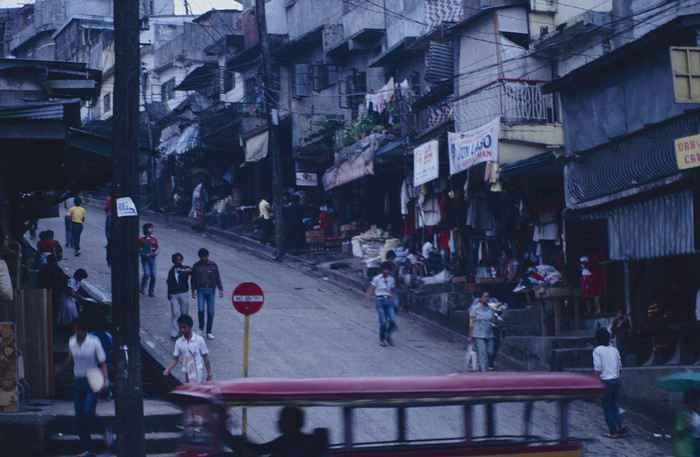
People we met on the street invited us to stay with them. These days, we wouldn’t just show up at strangers’ houses, which we should’ve done in Baguio—it would’ve saved us from an unimaginable and dangerous situation... which I won’t say anything about... !😊
The simple wooden house was on stilts at the edge of a hill with a view of the mountains. Since it was the start of the rainy season in a city that gets a lot of rain, we saw a lot of water. Our outings in town happened between downpours.
View from our lodging: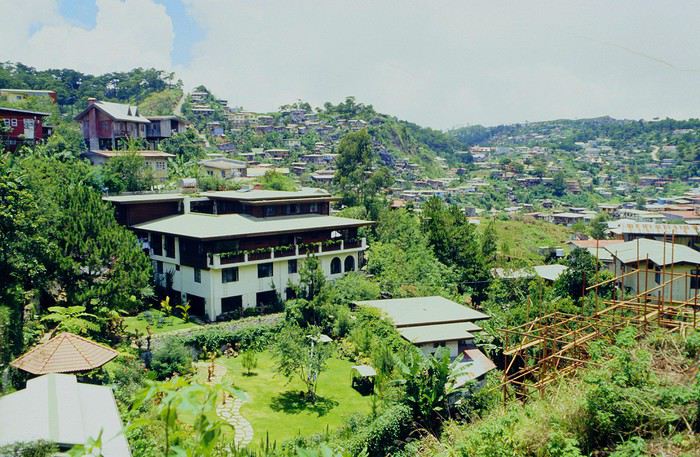
Episode 2: Baguio to Bontoc Aside from the situation briefly mentioned above, it was on the next leg to Bontoc that the adventure really began: an endless and dangerous road, a bus from another era, breathtaking landscapes, and surprising people.
We didn’t know the distance or how long it would take to get to Bontoc. When we arrived after about ten hours, we learned that Baguio to Bontoc was 140 km.
We got on a bus with wooden seats and settled in, two to a seat meant for two. As the bus filled up, passengers squeezed in three or four per seat, with chickens and baskets full of all sorts of things in the aisle. A little embarrassed, we didn’t know if we should squeeze in three on our seat. The seats were super tight (luckily, Filipinos are small), and I didn’t know where to put my legs given my height. I don’t remember if we stayed alone on our bench or if we ended up sharing with others.
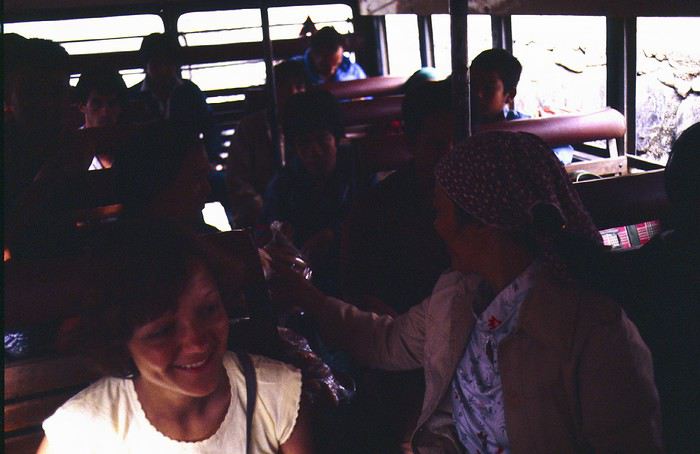
The “road” was a dirt track (or rather, a mud track) with endless turns. We held on as best we could to our slippery wooden seats—it was shaking in every direction. The woman behind us was carsick and throwing up... gross... but what were we doing there? Then we plunged into the Sierra Madre... just the name is dreamy!
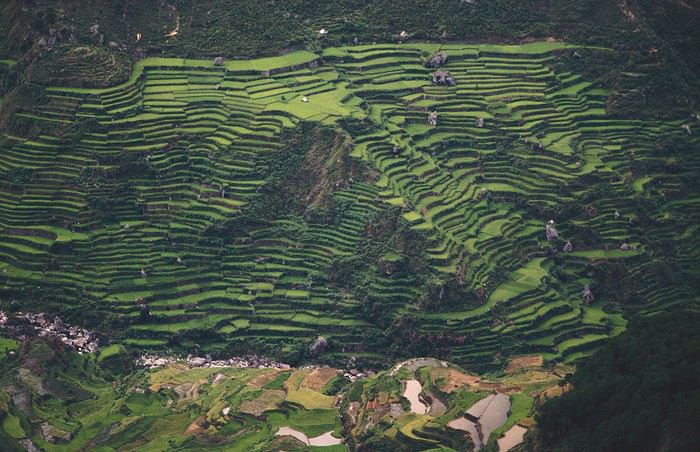
Rice terraces started to appear: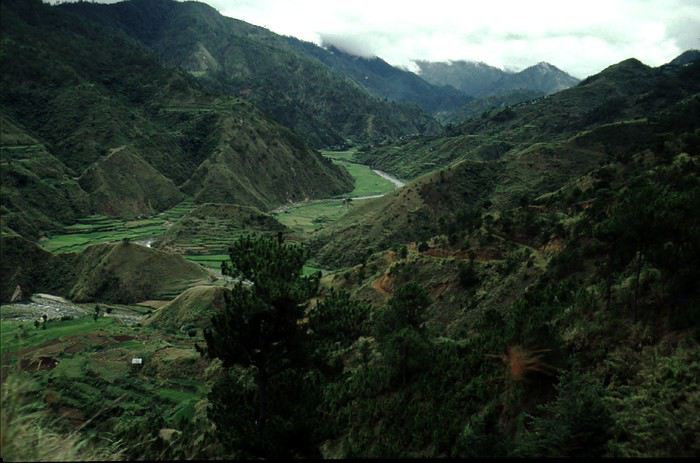
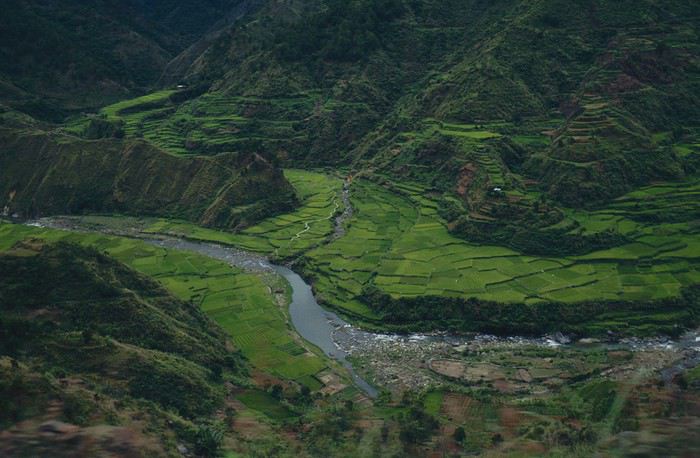
they took up more and more space along cliffs where we weren’t always reassured,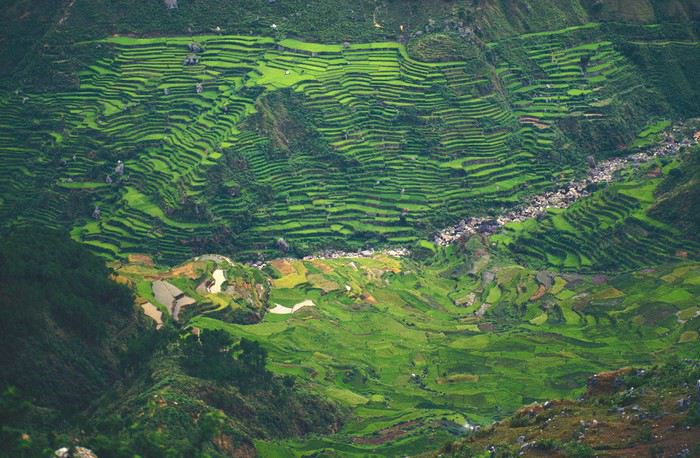
with lots of waterfalls (all that water had to go somewhere).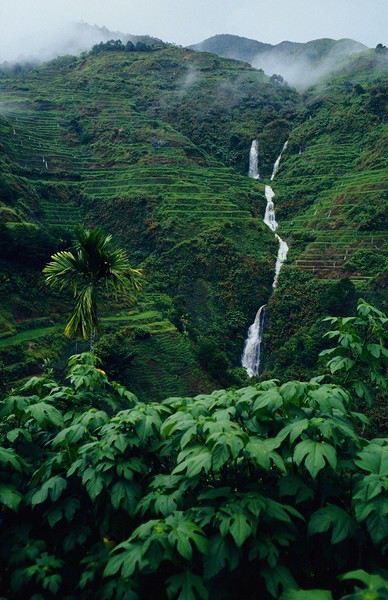
A few miserable villages stretched along the track, most often just a few houses balancing between the road and the drop. The bus stopped in every village—people got on or off and settled inside or on the roof. Street vendors offered their products to the bus passengers—a common sight in Asia, even today.
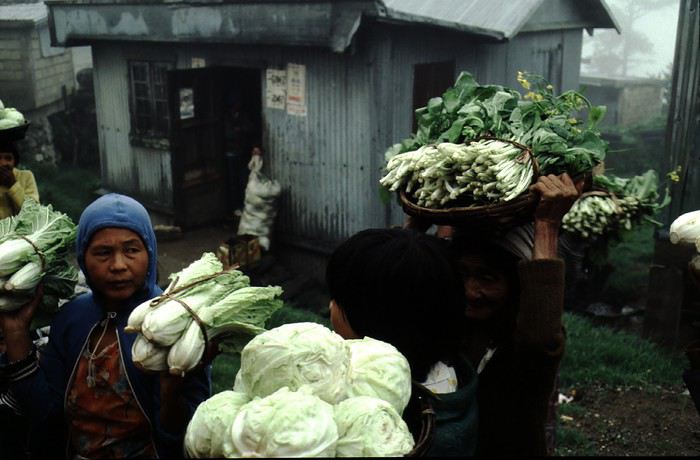
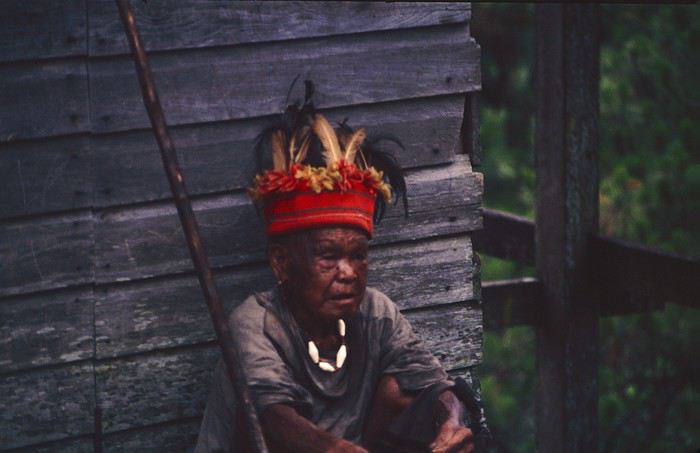
We were in another world—villagers were in loincloths, others had spears. The atmosphere was strange... but all good, we wanted exoticism, and we got it: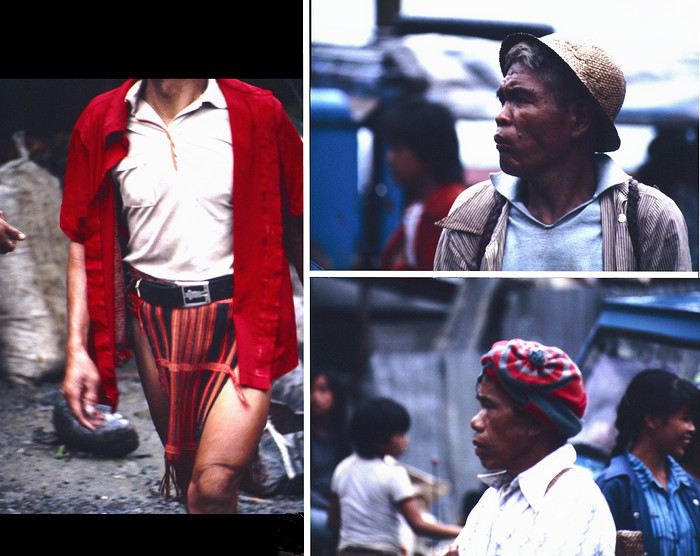
This so-called traditional outfit was everyday wear—it wasn’t for tourists since there weren’t any.
A curiosity because writing a travel journal about a trip 35 years later isn’t common, but also (mostly?) because exploring the Philippines at that time had little in common with traveling there today.
Obviously, I’ve forgotten a number of facts, most of the details, but with the help of a few notes from that time and a stack of slides (yes, there was life before digital 😊), many memories came back and added to the highlights I’d never forgotten. The scanned slides aren’t always great quality, but there are still quite a few to brighten up this chatter. Back then, we didn’t snap photos like we do now—film was too expensive—so I don’t have pictures of every place we visited... too bad, comparing some of those spots to how they look today would’ve been interesting.
Why "Adventures"? Why call it "Adventures" in the Philippines in 1984, a word so often used for a simple exotic trip? - Because the lack of information (no *Guide du Routard*, no *Lonely Planet*, no *Michelin Guide*, nothing, and obviously no internet) gave this trip what’s at the heart of adventure: the unknown. - Because the political situation made the stay sometimes dangerous. - Because transportation conditions were always epic, often perilous. - Because the question of where we’d spend the night came up almost every evening. - And for... quite a few other reasons.
That said, we weren’t exactly explorers!
Why the Philippines? First of all, why go to the Philippines in 1984—a country not exactly set up for tourism and about which we knew very little? How could we get an idea of the beauty of the Philippines and its points of interest when we had no guides or photos?
The idea came to us from Thailand a year earlier, during our first long-haul trip. After touring the north of the country, we met a Frenchman living in Phuket, where there were only a few tourists in Patong, with just a few small hotels and guesthouses. Kata and Karon had no buildings or roads, Rawai only had three palm-thatched bungalows, including ours, and the other islands were unknown to tourists. There was plenty to discover, and we wanted to return to this beautiful country... but the Frenchman made us dream about the Philippines—a country to explore, with wild landscapes.
Long evenings of discussion over multiple Sprite-Mekong cocktails (what memories of those headaches!) finally convinced us we had to go to the Philippines.
Episode 0: Before Departure The decision was made: we’d go to the Philippines in May 1984. Our friends and family were surprised when we announced we were going on vacation to the Philippines (a bit like saying today we were going paddleboarding in the Kerguelen Islands 🤪).
These days, preparing for each of our trips takes long evenings of research, planning, and noting down good addresses... etc. But for the Philippines in 1984, preparation was quick: we had very little information about the country, we were leaving almost at random, and the discovery would only be more exciting.
We still had a few bits of info gathered here and there: the rice terraces in northern Luzon, volcanoes, Negros where we were supposed to visit an acquaintance, Cebu and its marine life (we ended up going elsewhere), and absolutely avoid Mindanao, which was practically at war with the regime. That was about it, but it was already a great itinerary.
Nothing was organized in advance; we’d see day by day. We had no idea about travel times or even the existence of transportation options. The main (and sometimes only) way to connect two islands was by overloaded, rusty ferry. Only the big cities had airports.
Let’s Go: Episode 1: Paris to Manila My travel journals always start after arriving at the airport—the Europe-to-“Other Continent” trip isn’t interesting—but the flight to the Philippines was already an adventure, so I’ll make an exception.
This was the era when only a few Asian airlines were on par with Western ones: Thai, Singapore Airlines, and Philippine Airlines. They had beautiful, brand-new planes, and to attract customers (almost exclusively “businessmen”) from the usual airlines (Air France, Lufthansa, British Airways), there was opulence on board: unlimited champagne, all sorts of cocktails... Compared to today’s long-haul flights, there was still one small difference: no personal screens, just one screen at the front of the cabin with one mandatory movie. And I don’t know why, but we only got James Bond films, both ways... that must’ve been the trend at the time.
The tourism boom to Southeast Asia hadn’t started yet, and the “Asian Tigers” weren’t a thing, so there weren’t many business trips. That meant long-haul flights made stops everywhere to fill the planes. Our Philippine Airlines Boeing 747 left London, picked us up in Paris, then stopped in Frankfurt to take on a few Germans. I don’t know why we then made a stop in Dubai—a totally exotic place at the time. There was nothing to do there... things have changed a lot since. It was a small town lost in the desert. The airport was tiny, with just one or two buildings and a supermarket. During the stopover, everyone had to get off the plane and walk to the supermarket. Photo and electronic equipment were dirt cheap—I guess that was the only reason for the stop. Maybe it was their first commercial move. Emirates didn’t exist yet, as I checked online, but anyway, the idea that such a remote place could have its own airline was unthinkable.
Online, I found this photo of Dubai Airport in 1980. Anyone who’s transited through today’s massive airport with its rows of A380s will appreciate it:
Next stop: New Delhi to drop off some Europeans and pick up a few Indians, and finally, the terminus: Manila. I don’t remember how long the trip took with its five stops—an unimaginable journey today. Despite all those stops to fill the plane, there was still enough space to stretch out on the four center seats of the 747, something that never happens these days despite all the flights in every direction.
So here we are, finally at Manila Airport around midnight.
Episode 1: Manila and Baguio To start, a quick note on the political and economic situation in the Philippines in 1984, which had consequences for us as tourists, as we’d soon realize upon arrival.
After several centuries of Spanish colonization, the Philippines became American at the start of the 20th century, then independent. In 1966, Marcos took power, and little by little, his regime sank into corruption and mismanagement, becoming a dictatorship with martial law, all for the benefit of his family and friends, who enriched themselves endlessly. The peak was the assassination of opposition leader Benigno Aquino in August 1983, which triggered harshly repressed protests. So we arrived a few months later in a very poor country, with omnipresent corruption and an extremely tense political situation, as we’d soon see for ourselves. Major protests took place in the main cities during our trip—I’ll come back to that. Two years later, Marcos fled to Hawaii after being forced out of power following rigged elections. This historical context explains a lot of the situations we found ourselves in over the following weeks.
Arriving in the middle of the night isn’t very cheerful. Manila was already a huge city with many slums, where you could find a few business hotels like the Hilton or Intercontinental—way out of our budget—and plenty of run-down hotels. Luckily, two Indians we’d chatted with on the plane offered to take us to their usual hotel. They came to Manila twice a year for business. We accepted their offer, relieved not to have to look for a place to stay in the middle of the night, figuring the address must be good since they came back every time... we were wrong 🙁
We left the airport and immediately got a taste of the local vibe when we got into the taxi: the police asked for our passports. We thought: what’s more normal than police in a dictatorship?
But that wasn’t it at all. Our two Indian friends explained that the police were noting our names along with the taxi number and time. Crime in Manila was so bad that the taxi driver would be held responsible if anything happened to us... welcome to the Philippines 😎 😎
Historically, the Philippines was a very violent country, where everything was settled with guns or machetes. Previous governments had banned carrying weapons, but Marcos later allowed the free sale and carrying of guns, and disputes were settled with pistols again (or worse, as we’d discover later). Since he’d released most of the criminals from prison to form a paramilitary militia at his service (I’ll talk about our encounter with these “heroes” later), it was pretty dangerous to go into many parts of Manila, where these “tonton macoutes” ruled.
We arrived at our hotel without incident... and then things started badly. The room was infested with big cockroaches—exactly what I hate most in those kinds of countries. No way to find another hotel at that hour. After the long flight, the urge to take a shower was so strong that we squeezed into the bathroom as best we could. After that, I don’t remember—I guess we must’ve fallen asleep exhausted under the sheets in the heat... air conditioning wasn’t widespread yet.
The next day, we just wanted to leave that dump as soon as possible. So we decided to head north right away, stopping in Baguio, and we’d visit Manila a bit on the way back.
When we stepped outside, we discovered a pretty run-down neighborhood with potholed streets. But we also discovered the jeepneys. They were everywhere, flooding the streets.
They had crazy sound systems, each one blasting louder than the last. The interiors were kitschy but fun. There weren’t many private cars—almost all transportation was by jeepney, with buses reserved for intercity trips.
Before heading to the bus terminal for the north, somewhere on the outskirts of the city, we needed to exchange some money. I don’t remember how we ended up in a policeman’s jeep who offered his services: - Exchange money on the black market at a better rate than the banks. - Take us wherever we wanted, in this case, the bus terminal.
We accepted both offers (we’d still checked the official exchange rate from dollars to pesos). So we found ourselves in his jeep. After exchanging money, we left in his vehicle and stopped for gas. Without turning off the engine, he calmly smoked a cigarette while filling up. Since we were in a jeep with no doors or roof, we were ready to jump out if things went south, our travel bag in hand.
But we weren’t done with surprises yet. Once we left the small streets, we ended up in a neighborhood with wide avenues and not much traffic, which didn’t justify his incredible behavior. At every intersection, he made the sign of the cross, closed his eyes, and crossed without looking. I was more stunned than terrified! It wasn’t until we got out of the car later that I told Anne-Marie what had happened. I’d seen everything because the cop had put me in the front seat. Luckily, A-Marie hadn’t noticed anything from the back. Crossing Manila by trusting God rather than the rules of the road was ultimately effective. We were lucky—the trip was off to a good start. 🙂 🙂
We then passed through a neighborhood where slums stretched on for a while, and we left our policeman—friendly but a bit crazy—with relief.
A few hours by bus later, here we are in Baguio, cool in the mountains. My memories of Baguio are pretty fuzzy. I remember a small town. After some research while writing this journal, I found that the population was 120,000 in 1980. Given the population density in each home, that confirms my memory of a smallish town. Outside the “official” district with the president’s summer residence and government buildings, there were two or three paved streets with nice houses. The rest was very dirty and very poor, with lots of slums and dirt roads.
People we met on the street invited us to stay with them. These days, we wouldn’t just show up at strangers’ houses, which we should’ve done in Baguio—it would’ve saved us from an unimaginable and dangerous situation... which I won’t say anything about... !😊
The simple wooden house was on stilts at the edge of a hill with a view of the mountains. Since it was the start of the rainy season in a city that gets a lot of rain, we saw a lot of water. Our outings in town happened between downpours.
View from our lodging:
Episode 2: Baguio to Bontoc Aside from the situation briefly mentioned above, it was on the next leg to Bontoc that the adventure really began: an endless and dangerous road, a bus from another era, breathtaking landscapes, and surprising people.
We didn’t know the distance or how long it would take to get to Bontoc. When we arrived after about ten hours, we learned that Baguio to Bontoc was 140 km.
We got on a bus with wooden seats and settled in, two to a seat meant for two. As the bus filled up, passengers squeezed in three or four per seat, with chickens and baskets full of all sorts of things in the aisle. A little embarrassed, we didn’t know if we should squeeze in three on our seat. The seats were super tight (luckily, Filipinos are small), and I didn’t know where to put my legs given my height. I don’t remember if we stayed alone on our bench or if we ended up sharing with others.
The “road” was a dirt track (or rather, a mud track) with endless turns. We held on as best we could to our slippery wooden seats—it was shaking in every direction. The woman behind us was carsick and throwing up... gross... but what were we doing there? Then we plunged into the Sierra Madre... just the name is dreamy!
Rice terraces started to appear:
they took up more and more space along cliffs where we weren’t always reassured,
with lots of waterfalls (all that water had to go somewhere).
A few miserable villages stretched along the track, most often just a few houses balancing between the road and the drop. The bus stopped in every village—people got on or off and settled inside or on the roof. Street vendors offered their products to the bus passengers—a common sight in Asia, even today.
We were in another world—villagers were in loincloths, others had spears. The atmosphere was strange... but all good, we wanted exoticism, and we got it:
This so-called traditional outfit was everyday wear—it wasn’t for tourists since there weren’t any.
Délais pour un Esta après déjà un refus de visa et d'Esta English translation pending
J’ai besoin d’aide et d’avis s’il vous plais.
J’ai fais une demande de visa B2 en novembre pour 4 mois à Los Angeles. Il a été refusé et c’est ma faute.. j’avais pas très bien préparé mon rendez vous, j’avais pas les documents pour appuyer mon dossier et à vrai dire j’ignorais totalement que c’était aussi compliqué pour une demande de visa.
Par la site j’ai fais une demande d’ESTA pour partir seulement 90 jours du coup (puisque j’avais déjà pris mes billets, réservation d’appartement ect...) qui m’a aussi été refusé puisque j’ai répondu “oui” à la question “avez vous déjà eu un refus de visa?”.
J’ai donc refais une demande de visa pour partir 4 mois, mon rendez vous est le 7 mai prochain..
je suis en train de me poser une question ? Si mon visa est encore une fois refusé, je suis bloqué d’états unis pendant combien de temps ? 1 an ? Quand est ce que je pourrais refaire une demande d’ESTA pour partir ne serait-ce que quelques jours ? J’ai entendu dire qu’on été bloqué de voyage aux US pendant 1 an lorsqu’on avait un refus de visa + esta. Merci de m’aider un maximum s’il vous plaît! Merci
Planifier un premier voyage aux États-Unis English translation pending
Bonjour a tous, je tiens a vous annoncer que je suis nouveau sur ce forum...
Je me présente rapidement, je m'appelle Jordan, j'ai 22 ans et je vis chez mes parents..
Si je poste aujourd'hui c'est parce que j'aimerai faire un petit voyage aux Etats-Unis..
Seulement j'aimerai planifier ça au mieux histoire de faire les choses bien car je n'ai jamais voyagé seul..
Je suis attiré par l'Ouest américain et mon but n'est pas de passer mes journées dans un hôtel..
Que me conseillez-vous ? Quelle seraient la meilleure option pour moi ? De plus je me débrouille assez bien en anglais !
L'Uruguay, pourquoi pas? English translation pending
Si vous cherchez l’aventure, le dépaysement total, les paysages extraordinaires, la rando, ce n’est pas en Uruguay qu’il faut aller. Je le savais avant de partir.
Simplement l’envie de découvrir un autre pays, un autre mode de vie. Trouver de la chaleur et du soleil pour les vacances de Noël, passer des vacances cool !
Côté paysage c’est un paysage de campagne comme on peut en trouver en France. Le pays est plat, vraiment plat ! Et pas de dépaysement avec la population : c’est un peuple issu de l’émigration européenne. Dans les faciès et les tenues, aucun étonnement, on pourrait se croire en Europe. (Sauf pour le maillot de bain string, c’est comme au Brésil !)
Dans un premier temps, je dois avouer, j’ai eu un peu peur. Où trouver mon contentement dans un environnement qui ne semblait pas vraiment différent de mon quotidien. Mais si je fais maintenant le bilan, je suis très contente d’y être allée.
Voyage de 12 nuits sur place, location de voiture, et c’est parti….
Un petit récit, quelques photos pour illustrer et quelques infos pratiques pour ceux qui décideraient d'y aller ! Au fait, ce n’est pas une destination économique, à peu près les mêmes prix qu’en France !
COLONIA DEL SACRAMENTO (2 nuits)
Petite déception en arrivant en fin de journée : peu d’animation dans la vielle ville, la population ne semble plus vivre dans cette partie de la ville. Il y a beaucoup de restaurants et d’hôtels et pourtant, vraiment peu de monde dans les rues. Une grosse surprise pour moi qui m’attendait (en fonction de ce que j’avais lu) à y voir beaucoup de touristes. Et pourtant, nous étions en période de fêtes. D’un côté, je suis super contente d’éviter la foule de touristes, mais en même temps, pas de population locale, cela fait un peu triste. Par contre, le soir, avec les éclairages, la vielle ville est superbe. zut, je n'ai pas de photos 😠
Le lendemain, belle découverte sous le soleil. Nous avons été charmés par toutes ces rues bordées de magnifiques platanes, par les rues pavées avec ses vieilles maisons, vieilles voitures, tags. C’est calme, pas de circulation.
Comparé à Paraty au Brésil près de Rio, rien à voir avec le tourisme de masse et toutes ces conséquences. Nous avons arpenté plusieurs fois la vieille ville et à chaque fois de nouvelles surprises. L’après-midi, nous avons marché sur les plages aux alentours. Rien d’exceptionnel car on est dans le delta du rio de la Plata et l’eau est marron. Mais de la belle végétation par endroit. Ce n’est pas désagréable. Bilan : je pensais trouver une ville remplie de touristes : non, il y en a un peu mais aucune gêne. Bonne entrée en matière dans le pays et nous avons beaucoup apprécié cette première étape.
MERCEDES (1 nuit)
Je ne voulais pas me contenter de la côte sud et je voulais faire une incursion au centre du pays. Nous remontons donc le long du rio Negro.
Quelques arrêts sur la route à Réal de San Carlos, avec les restes d’un complexe touristique du début du XXième siècle. Des bâtiments encore en très bon état avec arène, hôtel, casino… On y trouve une plage plus grande que celles de Colonia. Arrêt à CONCHILLAS, petit village construit par les anglais avec des maisons typiques de l’époque et quelques bâtiments. Bon, on passait à côté. Pas désagréable.
Carmello : 3 étoiles dans le petit futé. Ben…. Je ne sais pas mais pour moi, rien à voir.
Plage de la agraciada : aucun intérêt
Mercedes : je dirais bof bof. Je pense que le problème vient du fait que c’était le jour de Noël, personne dans la ville, tout était fermé donc difficile d’apprécier une ville dans ces conditions.
Départ 10 h, arrivée 16 h, avec tous les arrêts. Journée sans intérêt. Paysage de campagne, monotone et rien de typique.
Bon, j’ai bien peur que vous ne continuiez pas à lire mon carnet de voyage. Pas eu l’envie de prendre des photos ce jour-là. Mais si si, accrochez-vous !
SAN GREGORIO DE PALANCO (1 nuit)
Départ 11 h, arrivée 16 h. on se dirige vers le centre du pays. Pluie torrentielle toute la route. Difficile d’apprécier un paysage ! En résumé : c’est plat, soit des plantations d’arbres, soit des champs céréaliers. De la piste, quelques haciendas. Mais on a vu personne, peu de voiture. A priori, ce n’est pas le moment du travail aux champs. Je pensais voir des troupeaux d’animaux, des gauchos. Rien. Mais nous sommes le surlendemain de Noël, c’est peut-être la raison ?
Arrivée à San Gregorio à 16 h, heure où tout est fermé et personnes dans les rues.
On s’est pris au jeu du principal centre d’intérêt de cette ville : LE STREET ART. Nous partons à la recherche des peintures murales éparpillées dans la ville. Un plan très bien fait permet de déambuler et les retrouver. L’occasion de marcher à travers les habitations et se retrouver dans un monde rural. Très diffèrent de notre approche à Colonia del Sacramento. Le niveau de vie semble ici très bas.
Notre déambulation nous amène en fin de journée à la belle plage de San Grégorio. Il est 18 H 30 et comme partout en Uruguay, c’est l’heure où tout le monde sort pour terminer la journée. Les couleurs sont belles. Grand malecom pour se promener, agréable.
A suivre....
Côté paysage c’est un paysage de campagne comme on peut en trouver en France. Le pays est plat, vraiment plat ! Et pas de dépaysement avec la population : c’est un peuple issu de l’émigration européenne. Dans les faciès et les tenues, aucun étonnement, on pourrait se croire en Europe. (Sauf pour le maillot de bain string, c’est comme au Brésil !)
Dans un premier temps, je dois avouer, j’ai eu un peu peur. Où trouver mon contentement dans un environnement qui ne semblait pas vraiment différent de mon quotidien. Mais si je fais maintenant le bilan, je suis très contente d’y être allée.
Voyage de 12 nuits sur place, location de voiture, et c’est parti….
Un petit récit, quelques photos pour illustrer et quelques infos pratiques pour ceux qui décideraient d'y aller ! Au fait, ce n’est pas une destination économique, à peu près les mêmes prix qu’en France !
COLONIA DEL SACRAMENTO (2 nuits)
Petite déception en arrivant en fin de journée : peu d’animation dans la vielle ville, la population ne semble plus vivre dans cette partie de la ville. Il y a beaucoup de restaurants et d’hôtels et pourtant, vraiment peu de monde dans les rues. Une grosse surprise pour moi qui m’attendait (en fonction de ce que j’avais lu) à y voir beaucoup de touristes. Et pourtant, nous étions en période de fêtes. D’un côté, je suis super contente d’éviter la foule de touristes, mais en même temps, pas de population locale, cela fait un peu triste. Par contre, le soir, avec les éclairages, la vielle ville est superbe. zut, je n'ai pas de photos 😠
Le lendemain, belle découverte sous le soleil. Nous avons été charmés par toutes ces rues bordées de magnifiques platanes, par les rues pavées avec ses vieilles maisons, vieilles voitures, tags. C’est calme, pas de circulation.
Comparé à Paraty au Brésil près de Rio, rien à voir avec le tourisme de masse et toutes ces conséquences. Nous avons arpenté plusieurs fois la vieille ville et à chaque fois de nouvelles surprises. L’après-midi, nous avons marché sur les plages aux alentours. Rien d’exceptionnel car on est dans le delta du rio de la Plata et l’eau est marron. Mais de la belle végétation par endroit. Ce n’est pas désagréable. Bilan : je pensais trouver une ville remplie de touristes : non, il y en a un peu mais aucune gêne. Bonne entrée en matière dans le pays et nous avons beaucoup apprécié cette première étape.
MERCEDES (1 nuit)
Je ne voulais pas me contenter de la côte sud et je voulais faire une incursion au centre du pays. Nous remontons donc le long du rio Negro.
Quelques arrêts sur la route à Réal de San Carlos, avec les restes d’un complexe touristique du début du XXième siècle. Des bâtiments encore en très bon état avec arène, hôtel, casino… On y trouve une plage plus grande que celles de Colonia. Arrêt à CONCHILLAS, petit village construit par les anglais avec des maisons typiques de l’époque et quelques bâtiments. Bon, on passait à côté. Pas désagréable.
Carmello : 3 étoiles dans le petit futé. Ben…. Je ne sais pas mais pour moi, rien à voir.
Plage de la agraciada : aucun intérêt
Mercedes : je dirais bof bof. Je pense que le problème vient du fait que c’était le jour de Noël, personne dans la ville, tout était fermé donc difficile d’apprécier une ville dans ces conditions.
Départ 10 h, arrivée 16 h, avec tous les arrêts. Journée sans intérêt. Paysage de campagne, monotone et rien de typique.
Bon, j’ai bien peur que vous ne continuiez pas à lire mon carnet de voyage. Pas eu l’envie de prendre des photos ce jour-là. Mais si si, accrochez-vous !
SAN GREGORIO DE PALANCO (1 nuit)
Départ 11 h, arrivée 16 h. on se dirige vers le centre du pays. Pluie torrentielle toute la route. Difficile d’apprécier un paysage ! En résumé : c’est plat, soit des plantations d’arbres, soit des champs céréaliers. De la piste, quelques haciendas. Mais on a vu personne, peu de voiture. A priori, ce n’est pas le moment du travail aux champs. Je pensais voir des troupeaux d’animaux, des gauchos. Rien. Mais nous sommes le surlendemain de Noël, c’est peut-être la raison ?
Arrivée à San Gregorio à 16 h, heure où tout est fermé et personnes dans les rues.
On s’est pris au jeu du principal centre d’intérêt de cette ville : LE STREET ART. Nous partons à la recherche des peintures murales éparpillées dans la ville. Un plan très bien fait permet de déambuler et les retrouver. L’occasion de marcher à travers les habitations et se retrouver dans un monde rural. Très diffèrent de notre approche à Colonia del Sacramento. Le niveau de vie semble ici très bas.
Notre déambulation nous amène en fin de journée à la belle plage de San Grégorio. Il est 18 H 30 et comme partout en Uruguay, c’est l’heure où tout le monde sort pour terminer la journée. Les couleurs sont belles. Grand malecom pour se promener, agréable.
A suivre....
Voyage en Floride 15 jours avec bébé et excursions sur la Gold Coast English translation pending
Allo,
On s'en va deux semaines fin mars - début avril dans le sud de la Floride, côté Atlantique. Premier voyage pour bébé de 17 mois mais, si autrefois on avait tendance à faire mille étapes pour voir tout un pays, cette fois-ci c'est déplacements minimum et gros farniente car couple fatigué et bébé n.2 en route..... alors on prend ça trèèèès relaxe.
Les hébergements sont fixés, donc ça ressemble à ça : - arrivée à l'aéroport de Fort Lauderdale et déplacement direct vers Delray Beach où on a trouvé une petite maison pour 5 jours - ensuite Singer Island un peu plus haut (en fait Riviera Beach de son vrai nom, mais sur l'île) pour 3 nuits - puis retour à la même maison de Delray - puis 3 dernières nuits à Fort Lauderdale et vol tôt le dernier jour, donc un gros 2 jours pleins sur place pour visiter la ville. On sera dans le quartier Victoria Park, à une demi-heure de marche de Las Olas.
On n'a pas de véhicule pour la durée du séjour, on pensait louer à la journée lorsque envie d'excursion.
Justement : Avez-vous des suggestions de sorties dans ce coin-ci, qui pourraient partiellement intéresser bébé tout en étant le fun pour les parents ? Je pensais aux jardins japonais de Murakami, et au Butterfly Wonderland. Et peut-être un autre truc un peu plus à l'intérieur des terres. Sinon depuis FLL, une sortie d'une journée à Miami pour la plage art décor, Little Havana? Avez-vous des suggestions pour meubler 2,5j à FLL une fois qu'on a fait le Riverwalk et la plage?
Pour chacune des trois villes où on passe, si vous avez des recommandations de resto, de sorties, de visites moins connue mais sympa (y'a pratiquement rien dans aucun guide...), on est preneurs de tout !
Merci :)
On s'en va deux semaines fin mars - début avril dans le sud de la Floride, côté Atlantique. Premier voyage pour bébé de 17 mois mais, si autrefois on avait tendance à faire mille étapes pour voir tout un pays, cette fois-ci c'est déplacements minimum et gros farniente car couple fatigué et bébé n.2 en route..... alors on prend ça trèèèès relaxe.
Les hébergements sont fixés, donc ça ressemble à ça : - arrivée à l'aéroport de Fort Lauderdale et déplacement direct vers Delray Beach où on a trouvé une petite maison pour 5 jours - ensuite Singer Island un peu plus haut (en fait Riviera Beach de son vrai nom, mais sur l'île) pour 3 nuits - puis retour à la même maison de Delray - puis 3 dernières nuits à Fort Lauderdale et vol tôt le dernier jour, donc un gros 2 jours pleins sur place pour visiter la ville. On sera dans le quartier Victoria Park, à une demi-heure de marche de Las Olas.
On n'a pas de véhicule pour la durée du séjour, on pensait louer à la journée lorsque envie d'excursion.
Justement : Avez-vous des suggestions de sorties dans ce coin-ci, qui pourraient partiellement intéresser bébé tout en étant le fun pour les parents ? Je pensais aux jardins japonais de Murakami, et au Butterfly Wonderland. Et peut-être un autre truc un peu plus à l'intérieur des terres. Sinon depuis FLL, une sortie d'une journée à Miami pour la plage art décor, Little Havana? Avez-vous des suggestions pour meubler 2,5j à FLL une fois qu'on a fait le Riverwalk et la plage?
Pour chacune des trois villes où on passe, si vous avez des recommandations de resto, de sorties, de visites moins connue mais sympa (y'a pratiquement rien dans aucun guide...), on est preneurs de tout !
Merci :)