Results for "voiture+ou+taxi+|+50+>+141"
127131 results found.
Trajet Casablanca-Essaouira avec bébé English translation pending
Bonjour à tous, nous partons autour du 20 janv au Maroc, profitant de promo ns arriverons a Casblanca ms le but serait d'aller à Essaouira, nous sommes 2 adultes et notre fille de 14 mois, quel est le meilleur moyen de se rendre à Essaouira meme si il faut faire une halte qque part?
Merci d'avance à tous pr vos conseils
Ad
Visite de Chichen Itza et Coba au Mexique English translation pending
Bonjour,
Je me rends à playa del carmen au Mexique du 30 nov au 14déc. Etant donné que je reste assez longtps, je souhaiterais visiter Chichen Itza, et eventuellement Coba.
Etant donné que Chichen Itza est loin, je me demandais s'il est simple de s'y rendre par soi-même (en bus) et ou s'il mieux de prendre une excursion. Pour les autres visites (Tulum, Xacret etc.) je prendrai le bus car on m'a dit que c'était simple de trouver soi-même et surtout, c'est visiblement beaucoup moins cher. Est-il par ailleurs possible de monter sur quelques pyramides? Enfin, est-il possible de s'acheter sur place des choses à manger (sandwiches par ex.), au cas où je m'y rendrais hors excursion?
Mêmes questions pour Coba: est-ce loin de playa del Carmen? Facile de s'y rendre seuls en transports en commun? Pensez-vous que cela soit faisable de visiter Coba et Tulum le même jour? Si oui, dans quel ordre? (par rapport aux horaires de colectivos et la fréquentation des lieux). Je crois que c'est dans la même zone géographique; de plus, comme Tulum se visite rapidement, je pourrais peut être en profiter pour faire les deux le même jour?
Merci pour vos conseils.
Diacalimero
Je me rends à playa del carmen au Mexique du 30 nov au 14déc. Etant donné que je reste assez longtps, je souhaiterais visiter Chichen Itza, et eventuellement Coba.
Etant donné que Chichen Itza est loin, je me demandais s'il est simple de s'y rendre par soi-même (en bus) et ou s'il mieux de prendre une excursion. Pour les autres visites (Tulum, Xacret etc.) je prendrai le bus car on m'a dit que c'était simple de trouver soi-même et surtout, c'est visiblement beaucoup moins cher. Est-il par ailleurs possible de monter sur quelques pyramides? Enfin, est-il possible de s'acheter sur place des choses à manger (sandwiches par ex.), au cas où je m'y rendrais hors excursion?
Mêmes questions pour Coba: est-ce loin de playa del Carmen? Facile de s'y rendre seuls en transports en commun? Pensez-vous que cela soit faisable de visiter Coba et Tulum le même jour? Si oui, dans quel ordre? (par rapport aux horaires de colectivos et la fréquentation des lieux). Je crois que c'est dans la même zone géographique; de plus, comme Tulum se visite rapidement, je pourrais peut être en profiter pour faire les deux le même jour?
Merci pour vos conseils.
Diacalimero
Visites à cinquante kilomètres autour de Yangon? English translation pending
Qu'est -ce qu'il y a d'intéressant à voir dans un rayon d'une cinquantaine de kilomètres autour de Yangon ?
Voyage en Thaïlande avec des adolescents English translation pending
NOUS AIMERIONS ALLER EN THAILANDE POUR 1 MOIS EN JUILLET 2007. NOS ENFANTS ONT 16 14 ET 10 ANS. NOUS AIMERIONS VISITER LES GRANDES VILLES ET CERTAINS PETITS VILLAGES. c<EST UNE PREMIERE EN ASIE. NOTRE BUDGET EST DE 10, 000$. aURIEZ-VOUS DES ID/ES POUR LES HOTELS, TRAIN, AVION, ETC...
MERCI
Thaïlande-Vietnam en février-mars 2008 English translation pending
Bonjour,
Nous voudrions partir enfin en Asie, mais nous ne savons pas comment faire ni que choisir.😕
Cette destination sera notre premier long courrier dans une région du globe aussi dépaysante Comme nous ne pouvons pas partir financièrement tous les ans aussi loin et aussi longtemps (pour un période de 20 jours environ), ntre budget seras environ de 4500 euros pour nous trois.
Nous souhaitons allier visites, gastronomie et plage en fait de séjour pour se reposer tout de même un peu.🙂
Jusqu'à présent nous sommes partir dans le bassin méditéranéen (Tunisie, Créte, Maroc, et avec la puce Grèce et Egypte) seul ou avec notre fille elle aura 31 mois lors de notre prochain voyage. Et toujour en club pour le prix moddique hébergement et vol, mais sur place location de voiture ou transport en commun pour rayonner dans la région de notre hotel voir même escapade de quelques jours à l'autre bout du pays.
J'oubliais à cette période quel temps fait il dans ces régions et y a t'il des contre indications en cas de grosseses car nous souhaitons avoir une second enfant🙂
Merci de votre aide
Nous voudrions partir enfin en Asie, mais nous ne savons pas comment faire ni que choisir.😕
Cette destination sera notre premier long courrier dans une région du globe aussi dépaysante Comme nous ne pouvons pas partir financièrement tous les ans aussi loin et aussi longtemps (pour un période de 20 jours environ), ntre budget seras environ de 4500 euros pour nous trois.
Nous souhaitons allier visites, gastronomie et plage en fait de séjour pour se reposer tout de même un peu.🙂
Jusqu'à présent nous sommes partir dans le bassin méditéranéen (Tunisie, Créte, Maroc, et avec la puce Grèce et Egypte) seul ou avec notre fille elle aura 31 mois lors de notre prochain voyage. Et toujour en club pour le prix moddique hébergement et vol, mais sur place location de voiture ou transport en commun pour rayonner dans la région de notre hotel voir même escapade de quelques jours à l'autre bout du pays.
J'oubliais à cette période quel temps fait il dans ces régions et y a t'il des contre indications en cas de grosseses car nous souhaitons avoir une second enfant🙂
Merci de votre aide
Parc de Batang Ai à Bornéo English translation pending
Bonjour, je suis toujours en train d'organiser mon voyage à Bornéo (sarawak) j'aimerai savoir pourquoi personne ne parle du parc de Batang ai (repris dans tous les circuits)......N'y aurait'il rien d'intéressant à voir?...... Merci pour vos réponses. Amitiés
Excursions à Skanes en Tunisie English translation pending
Bj, je part pour skanes eu tunisie le 12/08/06 et j'aimerai savoir si ce serait possible de faire une petite journée en jeep ds le désert et /ou une promenade en chameau?
Et quelle est la qualité de ces excursions?
Et pour savoir si en soirée il y a des choses à faire.
Merçi!!!!!!
Votre préférence entre Cuba et le Mexique? English translation pending
Bonjour je projette d'aller une semaine en septembre a Cuba ou au Mexique.
Totalement différent je suppose. J'aimerais recueillir quelques avis, les points forts de l'un et de l'autre.
Si je réserve en agence je suppose qu'au Mexique je serai soit a Cancun soit a Playa del carmen qui doivent etre fort touristique... ?
Ai je plus de chance de rencontrer des autochtones a Cuba qu'au Mexique ??
Quel est le climat a cette période la ?
Merci de me faire part de votre vécu
Totalement différent je suppose. J'aimerais recueillir quelques avis, les points forts de l'un et de l'autre.
Si je réserve en agence je suppose qu'au Mexique je serai soit a Cancun soit a Playa del carmen qui doivent etre fort touristique... ?
Ai je plus de chance de rencontrer des autochtones a Cuba qu'au Mexique ??
Quel est le climat a cette période la ?
Merci de me faire part de votre vécu
Obtention des visas Jordanie-Jérusalem-Egypte? English translation pending
Bonjour à tous.
En dépit de recherches sur ce site, je n'ai malheureusement pas trouvé l'info que je cherche. Je suis ûr que quelqu'un pourra me répondre sachant que d'autres ont déjà vécu l'expérience que je voudrais faire.
J1) e compte me rendre en Jordanie (atterrissage à Amman) où je compte recevoir mon visa à l'aéroport d'Amman
2) De Amman, avant de commencer ma visite de la Jordanie, je compte me rendre pour quelques jours à Jérusalem puis revenir à Amman.
Première question : comment me rendre de Amman à Jérusalem et éviter le visa israélien ? Apparemment, ce serait possible via le King Hussein Bridge pour éviter ensuite de redemander un visa d'entrée en Jordanie. Est-ce exact ? Si oui, comment faire et comment me rendre de Amman à Jerusalem ?
3) Après Jérusalem, je compte rentrer en Jordanie pour visiter le pays du Nord au Sud et prendre à Aqaba le bateau pour l'Egypte.
Deuxième question : puis-je recevoir mon visa pour l'Egypte au port d'arrivée de Nuweiba en Egypte ?
4) A Nuweiba, je prends le bus pour le Caire et visite l'Egypte pour ensuite revenir à Nuweiba et reprendre le bateau pour Aqaba.
Troisième question : puis-je recevoir un nouveau visa d'entrée pour la Jordanie au port d'Aqaba ?
D'avance merci de votre aide.
En dépit de recherches sur ce site, je n'ai malheureusement pas trouvé l'info que je cherche. Je suis ûr que quelqu'un pourra me répondre sachant que d'autres ont déjà vécu l'expérience que je voudrais faire.
J1) e compte me rendre en Jordanie (atterrissage à Amman) où je compte recevoir mon visa à l'aéroport d'Amman
2) De Amman, avant de commencer ma visite de la Jordanie, je compte me rendre pour quelques jours à Jérusalem puis revenir à Amman.
Première question : comment me rendre de Amman à Jérusalem et éviter le visa israélien ? Apparemment, ce serait possible via le King Hussein Bridge pour éviter ensuite de redemander un visa d'entrée en Jordanie. Est-ce exact ? Si oui, comment faire et comment me rendre de Amman à Jerusalem ?
3) Après Jérusalem, je compte rentrer en Jordanie pour visiter le pays du Nord au Sud et prendre à Aqaba le bateau pour l'Egypte.
Deuxième question : puis-je recevoir mon visa pour l'Egypte au port d'arrivée de Nuweiba en Egypte ?
4) A Nuweiba, je prends le bus pour le Caire et visite l'Egypte pour ensuite revenir à Nuweiba et reprendre le bateau pour Aqaba.
Troisième question : puis-je recevoir un nouveau visa d'entrée pour la Jordanie au port d'Aqaba ?
D'avance merci de votre aide.
Moscou, ville dangereuse? English translation pending
bonjour,
Je prévois d'aller à moscou cet été, mais j'ai entendu dire par plusieurs personnes que Moscou était une ville dangereuse (problèmes avec les taxis, les policiers, ...). J'ai fait une recherche sur internet afin de voir si un quelconque témoignage corroborait cette info, mais je n'ai rien trouvé. Quelqu'un a-t-il des infos sur le sujet ?
Je prévois d'aller à moscou cet été, mais j'ai entendu dire par plusieurs personnes que Moscou était une ville dangereuse (problèmes avec les taxis, les policiers, ...). J'ai fait une recherche sur internet afin de voir si un quelconque témoignage corroborait cette info, mais je n'ai rien trouvé. Quelqu'un a-t-il des infos sur le sujet ?
Dépenses à Maurice English translation pending
bonjour à tous, spécialeùment les mauricien(ne)s;
je voudrai offrir à ma futur femme des vacances de rêve, mais il y a un hic c'est que je ne connais pas le tarifs et les bons plans, j'ai entendu dire que il y a des bungalows qui fournissent tout comme rechaud et autres ustensil de cuisine, car mon budget est très limite🙁.
si vous avez des bonnes adresse et autre veuillez me les transmettres
merci d'avance
Ramiaraka, tuléar madagascar
je voudrai offrir à ma futur femme des vacances de rêve, mais il y a un hic c'est que je ne connais pas le tarifs et les bons plans, j'ai entendu dire que il y a des bungalows qui fournissent tout comme rechaud et autres ustensil de cuisine, car mon budget est très limite🙁.
si vous avez des bonnes adresse et autre veuillez me les transmettres
merci d'avance
Ramiaraka, tuléar madagascar
Copan aux Honduras vaut-il le détour? English translation pending
bonjour
j'aimerai faire un grand tour (guatemala-belize-yucatan-tikal-antigua); tout ça en un mois.
Je voudrais savoir si en allant à livingston ça vaut le coup de faire un détour par Copan... et si oui, où dormir dans les environs?
merci beaucoup
Mae
j'aimerai faire un grand tour (guatemala-belize-yucatan-tikal-antigua); tout ça en un mois.
Je voudrais savoir si en allant à livingston ça vaut le coup de faire un détour par Copan... et si oui, où dormir dans les environs?
merci beaucoup
Mae
Transport, accommodation, and great spots for a month in Cambodia
Hello!
We’re heading to Cambodia for a month in March. We’re planning to visit Phnom Penh, Battambang, Siem Reap, the Angkor temples, Kompong Luong, then head down to Kampot, Kep, and finish our trip on the islands of Koh Rong. Has anyone done this trip recently?
Any great spots to recommend? Neighborhoods to stay in Phnom Penh (lively but not too touristy)?
Tips for getting around between the major cities—bus, train, boat, motorbike?
Thanks for all the advice!
Fabienne
Which island(s) should we prioritize for 4 weeks in Indonesia?
Hi everyone,
As part of a four-month world trip with our kids (ages 6, 12, and 13), we’ll be spending four weeks in Indonesia. Choosing destinations is so tough because everything is just so appealing! We’ll be spending some time on Java and will likely make a "quick trip" to Borneo for the orangutan reserve. We also want to experience Bali’s culture and the small islands of the Lesser Sundas, with their incredible marine life... but which ones should we prioritize? For a few days of diving and relaxation, do you think we should go for Nusa Penida, the Gili Islands, or Moyo Island? Is Sumbawa complicated to explore? Is it worth taking the time to visit? Can it be crossed by car to then reach Komodo National Park? Anyway, any advice would be greatly appreciated. Our goal is to avoid overly touristy spots (but not places that feel too unsafe with the kids), to discover local culture and villages, and to be amazed both underwater and above. Thanks so much for your help!
As part of a four-month world trip with our kids (ages 6, 12, and 13), we’ll be spending four weeks in Indonesia. Choosing destinations is so tough because everything is just so appealing! We’ll be spending some time on Java and will likely make a "quick trip" to Borneo for the orangutan reserve. We also want to experience Bali’s culture and the small islands of the Lesser Sundas, with their incredible marine life... but which ones should we prioritize? For a few days of diving and relaxation, do you think we should go for Nusa Penida, the Gili Islands, or Moyo Island? Is Sumbawa complicated to explore? Is it worth taking the time to visit? Can it be crossed by car to then reach Komodo National Park? Anyway, any advice would be greatly appreciated. Our goal is to avoid overly touristy spots (but not places that feel too unsafe with the kids), to discover local culture and villages, and to be amazed both underwater and above. Thanks so much for your help!
18 days in Cape Verde in January 2025
Hello,
We’ve just returned (2 senior couples) from 18 days in Cape Verde (21/01 to 7/02) that we really enjoyed. The temperature was great—20° to 27°—admittedly a bit windy at times, but the friendliness of the Cape Verdeans made up for it.
Paris Orly, direct flight with Transavia (cheap if you book in advance). We landed in São Vicente, with a 12 € city transfer. We had a fantastic 2-bedroom apartment in downtown Mindelo—Av. Fernando Ferreira Fortes, "Casa So Morabeza"—for 58 € per night. The owner lives in France and communicates instantly via WhatsApp.
We spent 2 days exploring the (beautiful) city of Mindelo and its port activity, plus a private taxi tour of the island (6000 CVE for the day).
Then we took the Armas ferry (recommended company—1500 CVE) to Santo Antão.
From there, a collectivo (450 CVE per person) took us to Ribeira Grande, a central base for hikes.
We stayed in a brand-new, modern, and well-equipped 2-bedroom apartment—*Apartamentos Modernos*—for 6770 CVE per night, staying 6 nights. I highly recommend it for its location in town and proximity to *aluguers* and *collectivos* for hiking.
The hikes were stunning:
- The coastal trail from Fontainhas to Cruzinha (taxi for 1500 CVE)
- The route from Corda to Coculi (taxi for 2000 CVE + 100 CVE per person for the return)
- The trail from Cova to Cidade de Pombas (taxi for 2000 CVE + 100 CVE per person for the return)
- The hike from Miradouro to Ribeira Grande (taxi for 2000 CVE)
- The coastal road from Ribeira Grande to Ponta do Sol (visit and lunch at *Mini Familiar* in the city center—excellent and affordable) for the round trip.
Ribeira Grande has plenty of restaurants, but avoid *5 de Julho*—it’s loud and slow.
We loved: *Bellcanto*, *Cantinho da Amizade*, and *Boca-Fina Churrasqueria*.
Meals with drinks cost around 800–1000 CVE.
Back to São Vicente by ferry (1500 CVE), then an airport transfer (12 €) and a flight (99 €) to Santiago’s Praia. The airport-to-city transfer was 15 €.
We stayed at *Kelly’s* in Plato, Praia, which was disappointing—not ideal for two couples—but well-located.
One day was spent visiting the massive *Suspicia* market, then a collectivo to Cidade Velha (2 x 200 CVE round trip per person). We hiked up to the fort, explored *Rua Banana*, and had lunch at *Praça do Mar* by the beach.
We rented a car for 6 days (29000 CVE) from *Slimpycar* in Praia.
On Saturday, we visited the huge *Assomada* market—don’t miss it!—then hiked to *Boa Entrada* and *Poilon*, the largest and most impressive tree we’ve ever seen.
We stayed for 2 nights (138 €) in a beautiful valley in *Picos*—a spacious, lovely house with 2 bedrooms, 2 bathrooms, and a large living area, surrounded by nature and animals.
Lina, the charming neighbor, prepared dinner (8.50 €) and breakfast (4.50 €) for us.
Next, we headed to *Tarrafal*, stopping to visit the concentration camp (500 CVE)—a must-see—before arriving.
We spent 3 nights (184 €) in a fantastic house called *"Maison Familiale"*—huge, with 3 bedrooms, 2 bathrooms, 2 kitchens, 5 toilets, and a large terrace with sea views. It was absolutely stunning and very close to the beach and numerous restaurants.
We did a beautiful 3.8 km hike to the *Farol da Ponta Preta* lighthouse.
Tarrafal’s beach is lively and pleasant, with bars, restaurants, and even acrobats!
We also explored *Ribeira da Prata* to see the *Piscina Natural de Cuba* (not easy to find).
We loved discovering isolated villages like *Ponta Furna*, *Ponta Labrão*, and *Fazenda*.
For food, I recommend *Mira Mar* at *Mama’s*.
On the way back to Praia, we took the east coast route via *Calheta de São Miguel*, *Pedra Badejo*, and *Praia Baixo*—nothing extraordinary, just a rugged, wild coastline with beaches that seemed a bit tricky to access.
Our last evening in Praia was nice. The seaside esplanade was lively, and many Cape Verdeans were swimming at *Prainha* beach, which seemed very accessible and safe.
If you’d like more info—addresses, etc.—feel free to message me privately. I’ll respond.
Jacquesler.
A la découverte du Japon, de Tokyo à l'archipel des Ryukyu (Okinawa) English translation pending
Bonjour à tous,
Rentrée il y a déjà un mois d'un merveilleux voyage au Japon, je me lance aujourd'hui à écrire mon premier essai de carnet de voyage. Il s'agit là de bien sûr, remercier tous les contributeurs de ce forum avec lesquels j'ai échangé ou simplement lu au travers de leurs carnets de voyage et questionnements, mais aussi de partager mon voyage qui fut en un mot "génialissime". Pourquoi? car, ce séjour fût un enchantement et comme nombre d'entre vous, je fais désormais partie de la catégorie des gens qui souhaitent avoir la chance d'y retourner un jour.
Pour commencer, voici les éléments contextuels du voyage:
Origine du projet de voyage: Mon compagnon rêvait depuis longtemps de découvrir le Japon. Pour ma part, je ne saurai expliquer pourquoi mais cela m'intéressait oui mais sans plus et peut être après être allés dans d'autres pays avant. Originaire des îles, j'ai un faible pour les plages paradisiaques...Et c'est au salon du tourisme que j'ai découvert par hasard que le Japon en possédait et ce fût un déclic pour moi car je me suis dit ce pays remplit tous nos critères de voyage... hormis le budget... mais bon ça y'est c'était décidé le Japon serait le pays pour lequel on accepte de casser la tirelire, une sorte de voyage de noces sans mariage 😉. Ce fût également le déclic pour mes beaux-parents. Étions tous plutôt libres en termes de disponibilité, nous nous sommes décidés mi-mai, un tour sur internet juste pour regarder les prix d'un billet d'avion histoire de voir.... et voilà les billets internationaux étaient achetés avec un départ prévu 4 mois et demi plus tard, fin septembre.
Typologie: Voyage de tourisme loisirs et familial, parents et enfants adultes (30 et 65 ans) Durée: 5 semaines et demi, 38 jours/37 nuits Période: l'automne au japon, de fin septembre à début novembre 2019 Organisation: par moi-même avec guides papier, sites internet d'échange et de partage (voyageforum, kanpai) et divers blogs de voyage. Aucun guide sur place.
Modes de transports utilisés: A pied, métro, bus, voiture en location, avion Type d'hébergements: guesthouse, hôtels de chaînes, ryokan, auberges de jeunesse, Budget global: environ 24 500 euros pour 4 personnes adultes Activités: spirituelles (temples, sanctuaires), gastronomiques, nature( jardins, balades), sports aquatiques (rafting, snorkelling) , détente (onsen, plage) Lieux visités:
Tokyo (ueno, tsukiji, ginza, marunouchi, asakusa), Kyoto (gare, château, marché nishiki, arashiyama, gion, fushimi inari), Miyakojima, Shikoku (Takamatsu, Kotohira, Vallée de l'iya, Tokushima), Yakushima, Kyushu (Kagoshima, Chiran, Ibusuki, Takachiho, Kumamoto) , Tokyo (shinjuku, shibuya)
Pour Shikoku, Yakushima et Kyushu, il vous faut aller sur un 2éme carnet. Le site a limité le nombre de photos, j'ai donc dû créer un 2éme carnet intitulé "Escapade japonaise à Shikoku, Kyushu, Yakushima et Tokyo".
Détails du budget:
Les déplacements:
Vols internationaux: 800 euros/ personne en A/R Paris Tokyo avec une courte escale (1h30/2h) à Helsinki en Finlande avec la JAL Vols internes (5): 700 euros/personne avec différents compagnies ANA, JAL et Jetcost 1 bus de nuit Tokyo-Kyoto en confort, 58 euros/ personne avec willer express 4 locations de voiture (miyakojima, shikoku, yakushima, kyushu): 1 300 euros au total pour 3 semaines, soit 13 euros/ jour/ personne
Les hébergements:
7500 euros pour 4 personnes pour 36 nuits soit environ 104 euros/couple ou 52 euros/ personne sachant que dans ce prix étaient inclus 14 petits-déjeuners, et 4 dîners kaiseiki, avec comme critère de recherche impératif 2 chambres séparées pour chaque couple, situation géographique de l'hébergement plutôt centrale et choix de toilettes privatives le plus souvent
Le reste: alimentation, sorties, essence, péage, et achats personnels
environ 2 600 euros/ personne soit environ 69 euros/ jour/ personne
Rentrée il y a déjà un mois d'un merveilleux voyage au Japon, je me lance aujourd'hui à écrire mon premier essai de carnet de voyage. Il s'agit là de bien sûr, remercier tous les contributeurs de ce forum avec lesquels j'ai échangé ou simplement lu au travers de leurs carnets de voyage et questionnements, mais aussi de partager mon voyage qui fut en un mot "génialissime". Pourquoi? car, ce séjour fût un enchantement et comme nombre d'entre vous, je fais désormais partie de la catégorie des gens qui souhaitent avoir la chance d'y retourner un jour.
Pour commencer, voici les éléments contextuels du voyage:
Origine du projet de voyage: Mon compagnon rêvait depuis longtemps de découvrir le Japon. Pour ma part, je ne saurai expliquer pourquoi mais cela m'intéressait oui mais sans plus et peut être après être allés dans d'autres pays avant. Originaire des îles, j'ai un faible pour les plages paradisiaques...Et c'est au salon du tourisme que j'ai découvert par hasard que le Japon en possédait et ce fût un déclic pour moi car je me suis dit ce pays remplit tous nos critères de voyage... hormis le budget... mais bon ça y'est c'était décidé le Japon serait le pays pour lequel on accepte de casser la tirelire, une sorte de voyage de noces sans mariage 😉. Ce fût également le déclic pour mes beaux-parents. Étions tous plutôt libres en termes de disponibilité, nous nous sommes décidés mi-mai, un tour sur internet juste pour regarder les prix d'un billet d'avion histoire de voir.... et voilà les billets internationaux étaient achetés avec un départ prévu 4 mois et demi plus tard, fin septembre.
Typologie: Voyage de tourisme loisirs et familial, parents et enfants adultes (30 et 65 ans) Durée: 5 semaines et demi, 38 jours/37 nuits Période: l'automne au japon, de fin septembre à début novembre 2019 Organisation: par moi-même avec guides papier, sites internet d'échange et de partage (voyageforum, kanpai) et divers blogs de voyage. Aucun guide sur place.
Modes de transports utilisés: A pied, métro, bus, voiture en location, avion Type d'hébergements: guesthouse, hôtels de chaînes, ryokan, auberges de jeunesse, Budget global: environ 24 500 euros pour 4 personnes adultes Activités: spirituelles (temples, sanctuaires), gastronomiques, nature( jardins, balades), sports aquatiques (rafting, snorkelling) , détente (onsen, plage) Lieux visités:
Tokyo (ueno, tsukiji, ginza, marunouchi, asakusa), Kyoto (gare, château, marché nishiki, arashiyama, gion, fushimi inari), Miyakojima, Shikoku (Takamatsu, Kotohira, Vallée de l'iya, Tokushima), Yakushima, Kyushu (Kagoshima, Chiran, Ibusuki, Takachiho, Kumamoto) , Tokyo (shinjuku, shibuya)
Pour Shikoku, Yakushima et Kyushu, il vous faut aller sur un 2éme carnet. Le site a limité le nombre de photos, j'ai donc dû créer un 2éme carnet intitulé "Escapade japonaise à Shikoku, Kyushu, Yakushima et Tokyo".
Détails du budget:
Les déplacements:
Vols internationaux: 800 euros/ personne en A/R Paris Tokyo avec une courte escale (1h30/2h) à Helsinki en Finlande avec la JAL Vols internes (5): 700 euros/personne avec différents compagnies ANA, JAL et Jetcost 1 bus de nuit Tokyo-Kyoto en confort, 58 euros/ personne avec willer express 4 locations de voiture (miyakojima, shikoku, yakushima, kyushu): 1 300 euros au total pour 3 semaines, soit 13 euros/ jour/ personne
Les hébergements:
7500 euros pour 4 personnes pour 36 nuits soit environ 104 euros/couple ou 52 euros/ personne sachant que dans ce prix étaient inclus 14 petits-déjeuners, et 4 dîners kaiseiki, avec comme critère de recherche impératif 2 chambres séparées pour chaque couple, situation géographique de l'hébergement plutôt centrale et choix de toilettes privatives le plus souvent
Le reste: alimentation, sorties, essence, péage, et achats personnels
environ 2 600 euros/ personne soit environ 69 euros/ jour/ personne
État d'urgence à Santiago (Chili) English translation pending
Bonjour,
Une hausse des tarifs de transport en début du mois a provoqué de nombreuses manifestations plus ou moins spontanées dans le métro de Santiago.
Le phénomène a pris de l'ampleur et des pillages de grandes surfaces ont maintenant eu lieu aussi.
L'État d'Urgence a été déclaré, pour le moment, UNIQUEMENT EN CE QUI CONCERNE LA RÉGION MÉTROPOLITAINE, càd Santiago et les environs immédiats.
Mais. des manifestations ont actuellement lieu dans d'autres villes du Chili et la situation pourrait empirer encore.
La situation s'est fort dégradée ces dernières heures.
Restez particulièrement attentifs.
Bonne chance.
Thierry
Une hausse des tarifs de transport en début du mois a provoqué de nombreuses manifestations plus ou moins spontanées dans le métro de Santiago.
Le phénomène a pris de l'ampleur et des pillages de grandes surfaces ont maintenant eu lieu aussi.
L'État d'Urgence a été déclaré, pour le moment, UNIQUEMENT EN CE QUI CONCERNE LA RÉGION MÉTROPOLITAINE, càd Santiago et les environs immédiats.
Mais. des manifestations ont actuellement lieu dans d'autres villes du Chili et la situation pourrait empirer encore.
La situation s'est fort dégradée ces dernières heures.
Restez particulièrement attentifs.
Bonne chance.
Thierry
Chumphon, mon petit coin de paradis (vidéo) English translation pending
Hello,
Je vous propose cette vidéo de 5 minutes, un récapitulatif de ces 2 dernières années à Chumphon où j'ai pu explorer un peu plus profondement le district. Ce n'est pas facile de condenser, j'ai fait au mieux en espérant que ce ne soit pas trop barbant.. Franchement, sans chauvinisme, la région est super belle, je vous invite à la visiter si vous ne l'avez pas déjà fait.
Si vous voulez en savoir plus, vous pouvez, pour plus de détails, visiter mon site ici http://www.phil-a-phuket.com/chumphon.html .
Philippe
https://vimeo.com/342230849
Je vous propose cette vidéo de 5 minutes, un récapitulatif de ces 2 dernières années à Chumphon où j'ai pu explorer un peu plus profondement le district. Ce n'est pas facile de condenser, j'ai fait au mieux en espérant que ce ne soit pas trop barbant.. Franchement, sans chauvinisme, la région est super belle, je vous invite à la visiter si vous ne l'avez pas déjà fait.
Si vous voulez en savoir plus, vous pouvez, pour plus de détails, visiter mon site ici http://www.phil-a-phuket.com/chumphon.html .
Philippe
https://vimeo.com/342230849
Croisière et escales Singapour - Malaisie - Cambodge - Thaïlande English translation pending
Croisiere singapour/malaisie/cambodge/thailande
Je voudrai savoir si on peux trouver des guides a la descente du bateau parlant francais lors des escales
Merci de vos reponse
Finley
Voyage une semaine en Roumanie en juillet English translation pending
Bonjour,
M'étant laissé tenté par une offre Wizzair pour la Roumanie et des discussions avec des personnes originaires de ce pays au travail, j'ai donc mes billets pour Sibiu au mois de juillet pour une semaine. Atterrissant à 00h30 j'aurai 7 jours quasi pleins (le vol retour est en fin d'après-midi/début de soirée). Je connais assez peu les pays de l'Est si ce n'est une semaine à Gdansk en Pologne et Prague. Je me tourne donc vers vous. J'ai en effet plusieurs questions...
J'atterri donc la nuit à 00h30 en Roumanie je compte dormir sur Sibiu pour le peu qui nous reste de sommeil, j'imagine que c'est la meilleure solution ? Prendre un taxi en arrivant j'imagine ? Quel est le prix du taxi en Roumanie et au niveau de la sécurité/arnaque qu'en est-il ? J'imagine que c'est comme dans tous les pays, faire attention et prendre les taxis officiels. Arrivant la nuit, je me méfie un peu plus surtout dans un pays qu'on ne connaît pas (mais ça aurait pu être le cas pour un autre pays que la Roumanie). Concernant le parcours, je suis dans le flou. Les château, des ballades en forêts, flâner dans de jolies villes, bien manger, vers quoi se diriger comme itinéraire ? Ma première idée était de loger sur Brasov. J'aime bien rester au même hôtel pour éviter de bouger tous les deux jours et pour prendre mes repères. Prendre les 6 nuits à Brasov est une bonne idée ou beaucoup trop long ? Faut-il louer une voiture ou on peut se débrouiller pour se déplacer ? Bus, Trains et éventuellement taxis si ce n'est pas trop cher ? Concernant la location de voiture, une petite voiture (par exemple la dernière C3) suffit ? J'apprécie de pouvoir me déplacer à ma guise et s'arrêter là où on veut sans avoir de contraintes. Bucarest est il une étape obligatoire ? Si oui une journée depuis Brasov (3 heures de route ?) est-ce suffisant ? Il faut mieux dormir sur place une ou deux nuits ? Pas indispensable Bucarest ? Qu'en est-il au niveau de la sécurité et des arnaques en général ? On entend beaucoup de choses mais les retours des personnes roumaines que je connais et ce que je lis sur internet ne vont pas du tout dans ce sens là, ce qui est tant mieux et m'étonne guerre. Il n'y a qu'à voir pour le Mexique par exemple où j'ai été très agréablement surpris à ce niveau là. Pour les hôtels je table sur 30/35€ la nuit pour deux dans l'idéal donc si vous avez des adresses je suis preneur même si avec Booking c'est assez facile.
Bref, je suis preneur de toutes vos idées, bons plans, expériences, adresses, conseils, itinéraires. Je suis assez ouvert. Je reviendrai également vers vous si j'ai d'autres questions ! 😉
M'étant laissé tenté par une offre Wizzair pour la Roumanie et des discussions avec des personnes originaires de ce pays au travail, j'ai donc mes billets pour Sibiu au mois de juillet pour une semaine. Atterrissant à 00h30 j'aurai 7 jours quasi pleins (le vol retour est en fin d'après-midi/début de soirée). Je connais assez peu les pays de l'Est si ce n'est une semaine à Gdansk en Pologne et Prague. Je me tourne donc vers vous. J'ai en effet plusieurs questions...
J'atterri donc la nuit à 00h30 en Roumanie je compte dormir sur Sibiu pour le peu qui nous reste de sommeil, j'imagine que c'est la meilleure solution ? Prendre un taxi en arrivant j'imagine ? Quel est le prix du taxi en Roumanie et au niveau de la sécurité/arnaque qu'en est-il ? J'imagine que c'est comme dans tous les pays, faire attention et prendre les taxis officiels. Arrivant la nuit, je me méfie un peu plus surtout dans un pays qu'on ne connaît pas (mais ça aurait pu être le cas pour un autre pays que la Roumanie). Concernant le parcours, je suis dans le flou. Les château, des ballades en forêts, flâner dans de jolies villes, bien manger, vers quoi se diriger comme itinéraire ? Ma première idée était de loger sur Brasov. J'aime bien rester au même hôtel pour éviter de bouger tous les deux jours et pour prendre mes repères. Prendre les 6 nuits à Brasov est une bonne idée ou beaucoup trop long ? Faut-il louer une voiture ou on peut se débrouiller pour se déplacer ? Bus, Trains et éventuellement taxis si ce n'est pas trop cher ? Concernant la location de voiture, une petite voiture (par exemple la dernière C3) suffit ? J'apprécie de pouvoir me déplacer à ma guise et s'arrêter là où on veut sans avoir de contraintes. Bucarest est il une étape obligatoire ? Si oui une journée depuis Brasov (3 heures de route ?) est-ce suffisant ? Il faut mieux dormir sur place une ou deux nuits ? Pas indispensable Bucarest ? Qu'en est-il au niveau de la sécurité et des arnaques en général ? On entend beaucoup de choses mais les retours des personnes roumaines que je connais et ce que je lis sur internet ne vont pas du tout dans ce sens là, ce qui est tant mieux et m'étonne guerre. Il n'y a qu'à voir pour le Mexique par exemple où j'ai été très agréablement surpris à ce niveau là. Pour les hôtels je table sur 30/35€ la nuit pour deux dans l'idéal donc si vous avez des adresses je suis preneur même si avec Booking c'est assez facile.
Bref, je suis preneur de toutes vos idées, bons plans, expériences, adresses, conseils, itinéraires. Je suis assez ouvert. Je reviendrai également vers vous si j'ai d'autres questions ! 😉
Retour expérience: transport Le Caire - Louxor - Assouan - Abu Simbel English translation pending
Bonjour à toutes et tous,
De retour de 10 jours sur la route la plus fameuse de l'Egypte ancienne, je vous donne ici quelques indications sur mon voyage "pas cher", en espérant que ça aidera celles et ceux qui feront ce voyage dans les prochains mois !
J'ai effectué tous les trajets aller en train et de jour, et je suis rentrée en avion via Nile Air.
Pour les trains, prendre soit les express soit les spanish, les express sont plus confortables. Si vous êtes précautionneux, il vous faudra réserver le Caire - Louxor sur une borne automatique à la gare du Caire deux jours avant pour être sûr d'avoir une place. Sinon, vous pouvez monter dans le train directement, et payer le contrôleur une fois embarqué(e). Vous aurez peut-être à bouger deux trois fois de place si le train est annoncé complet avant de pouvoir vous asseoir définitivement.
Le Caire - Louxor : nombreux trains, express à 8h, 12h et en train couchette (22h je crois) 200 livres égyptiennes (10 euros) l'aller Louxor - Assouan : quatre ou cinq fois par jour, avant 9h ou après 17h 120 livres égyptiennes l'aller (6 euros)
Pour voir les horaires des trains : https://enr.gov.eg/ticketing/public/login.jsf Et ce blog est bien fait sur les déplacements par train : https://www.seat61.com/Egypt.htm#How%20to%20book
Assouan - Louxor : des microbus quatre cinq fois par jour depuis la gare routière d'Assouan, qui partent dès 8h Pour celles et ceux qui voudraient visiter le site tôt, pour la chaleur, ce sera en microbus ou voiture privée. Les hôtels ( des plus cheaps aux plus chers) organisent ça, et sinon nous on est passés par Aswan Individual, 120 dollars l'aller retour en microbus 10 personnes, avec départ à 4h du mat pour arrivée sur site à 7h30 et redépart quand vous voulez en fait. Y a qu'à trouver des compagnons de route ! http://www.aswan-individual.com/html/abu_simble.html
Sinon il y a quelques années, j'étais allée à Assouan depuis Le Caire en bus, ce sera par ici, pour ceux qui ne craignent pas les voyages menés sans restriction de vitesse et avec deux arrêts pipi sur 12h de trajet : https://go-bus.com/ar J'avais trouvé ça correct, et pas passé un mauvais moment, à part ma vessie, et c'est imbattable question finances.
Question transport sur place
Louxor : ferry à 1 livre entre les deux rives Un microbus de la gare vous dépose à Karnak pour une livre Le reste se fait très bien à pattes Sur la rive de la vallée des rois, entre le ferry et les sites, microbus à une livre ou taxi ou tuk tuk à 10 / 20 livres, selon vos capacités de négociation. A pied c'est courageux ( une bonne heure je pense).
Assouan : pas de ferry entre la ville et Gheirb Suhel, contrairement à ce qu'en disent les guides et les rumeurs des uns et des autres, mais un embarcadère dédié à ce trajet, face à Egyptair. Un ferry pour aller à Elephantine. Pour aller à Philae, il y a vingt minutes de marche entre la billetterie et l'endroit où trouver des microbus. Bref, contrairement à ce que disent les guides de voyage, ça se fait absolument sans taxi ou agence de voyage. Les gens sur place trouveront toujours une solution pour vous acheminer d'un point à l'autre, en tuk tuk, taxi, ou charrette si nécessaire Comme partout, négociation indispensable !
J'espère que ça aidera quelqu'un ici, et n'hésitez pas si vous avez des questions !
De retour de 10 jours sur la route la plus fameuse de l'Egypte ancienne, je vous donne ici quelques indications sur mon voyage "pas cher", en espérant que ça aidera celles et ceux qui feront ce voyage dans les prochains mois !
J'ai effectué tous les trajets aller en train et de jour, et je suis rentrée en avion via Nile Air.
Pour les trains, prendre soit les express soit les spanish, les express sont plus confortables. Si vous êtes précautionneux, il vous faudra réserver le Caire - Louxor sur une borne automatique à la gare du Caire deux jours avant pour être sûr d'avoir une place. Sinon, vous pouvez monter dans le train directement, et payer le contrôleur une fois embarqué(e). Vous aurez peut-être à bouger deux trois fois de place si le train est annoncé complet avant de pouvoir vous asseoir définitivement.
Le Caire - Louxor : nombreux trains, express à 8h, 12h et en train couchette (22h je crois) 200 livres égyptiennes (10 euros) l'aller Louxor - Assouan : quatre ou cinq fois par jour, avant 9h ou après 17h 120 livres égyptiennes l'aller (6 euros)
Pour voir les horaires des trains : https://enr.gov.eg/ticketing/public/login.jsf Et ce blog est bien fait sur les déplacements par train : https://www.seat61.com/Egypt.htm#How%20to%20book
Assouan - Louxor : des microbus quatre cinq fois par jour depuis la gare routière d'Assouan, qui partent dès 8h Pour celles et ceux qui voudraient visiter le site tôt, pour la chaleur, ce sera en microbus ou voiture privée. Les hôtels ( des plus cheaps aux plus chers) organisent ça, et sinon nous on est passés par Aswan Individual, 120 dollars l'aller retour en microbus 10 personnes, avec départ à 4h du mat pour arrivée sur site à 7h30 et redépart quand vous voulez en fait. Y a qu'à trouver des compagnons de route ! http://www.aswan-individual.com/html/abu_simble.html
Sinon il y a quelques années, j'étais allée à Assouan depuis Le Caire en bus, ce sera par ici, pour ceux qui ne craignent pas les voyages menés sans restriction de vitesse et avec deux arrêts pipi sur 12h de trajet : https://go-bus.com/ar J'avais trouvé ça correct, et pas passé un mauvais moment, à part ma vessie, et c'est imbattable question finances.
Question transport sur place
Louxor : ferry à 1 livre entre les deux rives Un microbus de la gare vous dépose à Karnak pour une livre Le reste se fait très bien à pattes Sur la rive de la vallée des rois, entre le ferry et les sites, microbus à une livre ou taxi ou tuk tuk à 10 / 20 livres, selon vos capacités de négociation. A pied c'est courageux ( une bonne heure je pense).
Assouan : pas de ferry entre la ville et Gheirb Suhel, contrairement à ce qu'en disent les guides et les rumeurs des uns et des autres, mais un embarcadère dédié à ce trajet, face à Egyptair. Un ferry pour aller à Elephantine. Pour aller à Philae, il y a vingt minutes de marche entre la billetterie et l'endroit où trouver des microbus. Bref, contrairement à ce que disent les guides de voyage, ça se fait absolument sans taxi ou agence de voyage. Les gens sur place trouveront toujours une solution pour vous acheminer d'un point à l'autre, en tuk tuk, taxi, ou charrette si nécessaire Comme partout, négociation indispensable !
J'espère que ça aidera quelqu'un ici, et n'hésitez pas si vous avez des questions !
Voyage golf dans la région de Hua Hin English translation pending
Bonjour à toutes et tous
et surtout belle année 2018
Nous partons en couple pour la thailande le 15 fevrier et rentrons le 26 fevrier
C’est la 1 ere fois que nous allons dans ce pays
nous sommes golfeurs et avons decidé d’aaler jouer dans la region de Hua hin.
Nous voulions aller des notre arrivée 9h 15 aller à amphawa, marchés flottants, dormir 2 nuits sur place.
Puis partir pour Hua hin.
Qu’en pensez vous cela est uregent
Je dois booker aujourd’hui
Merciiii
Anyta
Anyta
Randonnée au Ladakh English translation pending
Bonjour,
Nous préparons un voyage au Ladakh en partant de Leh, avec un guide. Nous sommes à la phase 1 de la préparation.
Connaissez vous la meilleurs période, quel tour à faire, durée minimum?
Je précise que nous sommes de bon marcheur, en montagne on a l'habitude d'aller dans les alpes mais sur gr, 3 ou 4 chaussures mais pas escalade ni glacier.
Merci à vous.
Guide francophone à Bangkok English translation pending
Bonjour,
Je dois aller en Thaïlande avec ma fille de 20 ans l'année prochaine en février.
Pourrie- vous me conseiller un guide local parlant français afin de faire quelques excursions hors de Bangkok (Ayuthaya, marché flottant d'Amphaya et région de Kanchanaburi)
Merci
Cathy
Voyage à Puerto Plata: choses à voir absolument English translation pending
Bonjour à tous, nous serons à Puerto Plata au Grand Paradise à partir du 18 mars et nous aimerions avoir des suggestions de choses à voir absolument à part la Playa Dorada que nous irons sans faute.. y a t'il des québécois qui seront dans ce coin-là? Merci à l'avancepour vos infos très utiles.. ;)
Retour de croisière à Cuba avec le MSC Opera English translation pending
Besoin de renseignement sur cette croisière . Je suis a votre disposion :guide a cuba ? déroulement croisière ?
La Havane - Baracoa en bus Viazul English translation pending
Bonjou,
Je pars à Cuba pour la première fois (nous sommes 2) au mois de Mars pour 22 jours. Après avoir pas mal lu sur Cuba que ce soit sur des forums ou sur mon guide du Routard, j'ai vraiment envie de ne pas rater Baracoa.
Mon idée est donc d'arrivée sur la Havane et y passer 3 nuits afin de nous reposer un peu après le voyage Bruxelles - Cuba. Après ces 3 nuits je pensais prendre le bus pour Baracoa qui me semble est quand même un long trajet et par la suite revenir sur l'ouest en remontant étape par étape.
J'ai donc lu que certains ont fait ce trajet en Bus avec Viazul.
Est-ce que les horaires sont fiables et le bus est-il confortable? Et surtout faut-il réserver les tickets à l'avance sur le site de Via Azul?
Merci d'avance pour toutes réponses reçues.
Luis
Itinéraire 15 jours au Maroc English translation pending
Bonsoir,
Nous avons l'intention cet été d'aller au Maroc avec ma fille qui aura 22 ans. Elle veut Voir - des paysages - de l'eau - rivières ou cascades- la mer sans forcement jouer à l'escalope - des montagnes + ifrane - le desert!!!!!!!! - les villes Marakeck, Ouarzazate, Casa, Rabat/Salé, Meknes, Fes, .. - manger dans des boui-bouis en médina ... ma fille est végétarienne mais on devrait trouver - Aller chez le coiffeur en médina..... se faire des trucs de filles ....mais en fin de voyage
Arrivée casa ou rabat- mais je sais que casa est plus pratique - je pensais un retour le 11 aout
Marrakech direct en train de jour pour profiter du paysage sinon on dors sur place et on profite de la soirée 1 jour et demi voir 2 jours - jardin majorelle et visite de la ville - pas de courses ouarzazate 1 journée et retour sur marrakech on aimerait repartir de nuit en direction de Fes(en train)
FES - Volubilis, Moulay Yacoub ou sidi Harazem, Ifrane + amis+medina Meknes : visite + famille+médina Casablanca : visite +medina - mosquée car non musulmanes c'est la seule que l'on peut visiter Rabat - visite + famille+médina.. mais j'aimerais passer le 10 Aout à salé afin d' y fêter mon demi siècle
Voila mais là je ne sais plus faire pour m'organiser afin de ne pas décevoir ma fille pour son premier voyage au Maroc ..... Ma fille est organisée, elle bouge et en un jour dans une ville d'Europe elle profite au max
A préciser j'ai oublié la langue et je pense que nous bougerons sac au dos ..plus pratique.
merci de votre lecture et conseils ps : pour la location de voiture elle aura 2 ans et demi de permis .. peut-elle conduire car elle est vraiment chiante quand je suis au volant !
Bien à vous
A
Nous avons l'intention cet été d'aller au Maroc avec ma fille qui aura 22 ans. Elle veut Voir - des paysages - de l'eau - rivières ou cascades- la mer sans forcement jouer à l'escalope - des montagnes + ifrane - le desert!!!!!!!! - les villes Marakeck, Ouarzazate, Casa, Rabat/Salé, Meknes, Fes, .. - manger dans des boui-bouis en médina ... ma fille est végétarienne mais on devrait trouver - Aller chez le coiffeur en médina..... se faire des trucs de filles ....mais en fin de voyage
Arrivée casa ou rabat- mais je sais que casa est plus pratique - je pensais un retour le 11 aout
Marrakech direct en train de jour pour profiter du paysage sinon on dors sur place et on profite de la soirée 1 jour et demi voir 2 jours - jardin majorelle et visite de la ville - pas de courses ouarzazate 1 journée et retour sur marrakech on aimerait repartir de nuit en direction de Fes(en train)
FES - Volubilis, Moulay Yacoub ou sidi Harazem, Ifrane + amis+medina Meknes : visite + famille+médina Casablanca : visite +medina - mosquée car non musulmanes c'est la seule que l'on peut visiter Rabat - visite + famille+médina.. mais j'aimerais passer le 10 Aout à salé afin d' y fêter mon demi siècle
Voila mais là je ne sais plus faire pour m'organiser afin de ne pas décevoir ma fille pour son premier voyage au Maroc ..... Ma fille est organisée, elle bouge et en un jour dans une ville d'Europe elle profite au max
A préciser j'ai oublié la langue et je pense que nous bougerons sac au dos ..plus pratique.
merci de votre lecture et conseils ps : pour la location de voiture elle aura 2 ans et demi de permis .. peut-elle conduire car elle est vraiment chiante quand je suis au volant !
Bien à vous
A
De l'aéroport de Mandalay au centre-ville English translation pending
Bonjour,
Arrivant en Juillet prochain à Mandalay par un vol du soir (18h30), quel est le meilleur moyen de joindre le centre ville ? Peut-on trouver facilement un pick-up à cette ci (nous serons 6 personnes)
Merci de votre réponse.
8-Day Trip to the Marquesas Islands from Papeete
This trip is a more budget-friendly—and shorter—alternative to the 14-day Aranui 5 cruise, which includes a few days at sea and a detour to Bora Bora in the Leeward Islands on the way back. The advantage of the cruise is that it lets you see and visit (though far too quickly) the two islands of Tahuata and Fatu Hiva, which don’t have airports. By plane, you’ll only be able to land on 4 of the 6 islands. However, Tahuata is accessible from Hiva Oa via a day trip (or two-day trip) shuttle. Plan for two extra days in your total time dedicated to the Marquesas Islands (called *Fenua Enata* in Marquesan language).
Our itinerary is perfect for those who aren’t excited by cruises and prefer to get closer to the local communities. This 9-day trip cost us around 2500 € all-inclusive. For a 14-day cruise on the Aranui, expect to pay 2300 € per person for a basic cabin for four, or 3800 € per person for a superior double cabin.
Air Tahiti offers a 4-island Marquesas Pass (Nuku Hiva, Ua Pou, Ua Huka, and Hiva Oa) for 86,000 XPF (about 700 €). The journey is made on an ATR 72 from Tahiti to Nuku Hiva or Hiva Oa, and on a 19-seat Twin Otter between the islands (often only 13 or 15 seats are available due to cargo, so book well in advance). We’re traveling as a couple. We booked our family-run guesthouse stays at the Tourism Fair in early February, where you can meet the owners and make your choice. Stays are almost always half-board or breakfast-only. Transfers are usually included, but you can always book a car or taxi.
**NUKU HIVA**
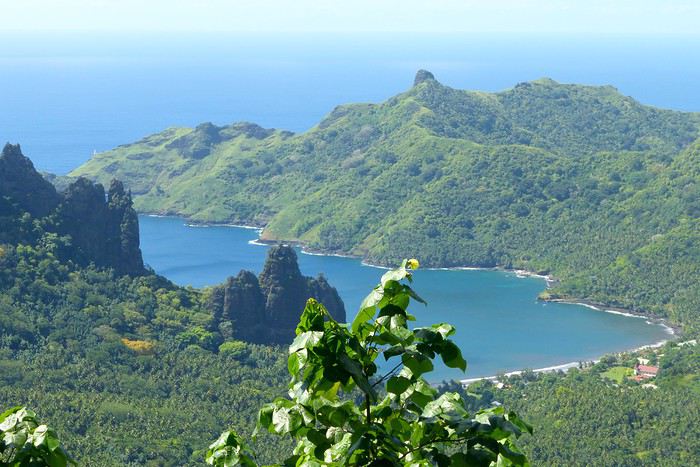
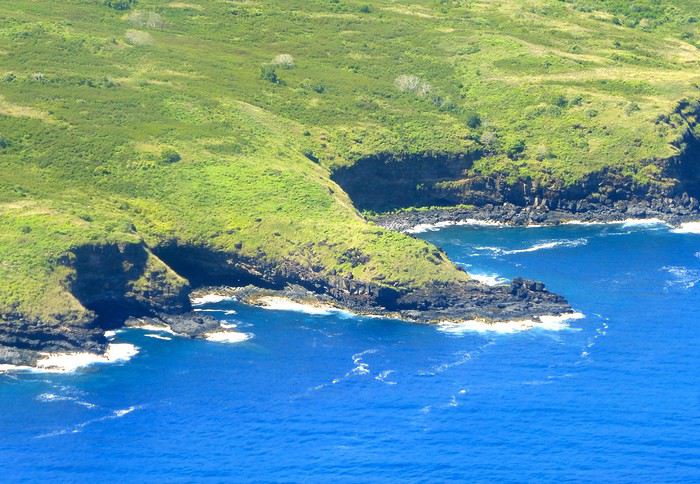
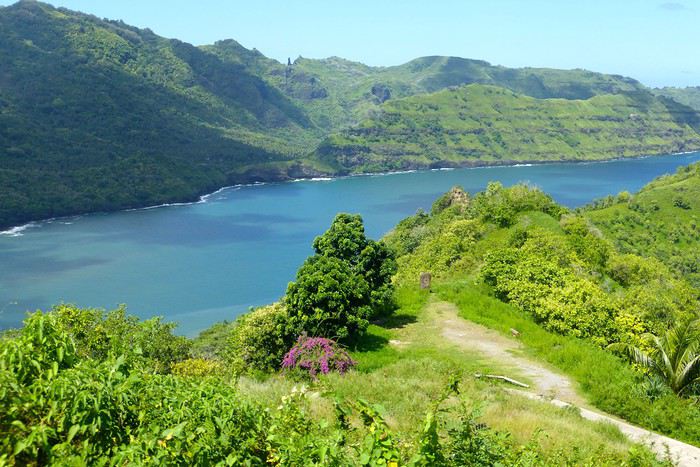
**A LITTLE GEOGRAPHY** Nuku Hiva (NH) is located about 1,500 km from Tahiti, in the north of French Polynesia. At 387 km², it’s the second-largest island in French Polynesia after Tahiti. It was formed by incredible volcanic phenomena and cataclysms between 1 and 6 million years ago, which lifted the island thousands of meters above the sea. Even after millennia of slow erosion, collapses, and settling, NH remains the most majestic of the Marquesas, with its sheer cliffs, deep valleys featuring immense waterfalls, and black walls that were once the inner walls of enormous volcanoes.
**A LITTLE HISTORY** The first contact between NH’s inhabitants and Europeans was in 1595 with Spanish navigators who only stayed briefly. It wasn’t until the late 18th century that Europeans arrived in greater numbers on NH (and the other Marquesas Islands), disrupting a very fragile social and cultural balance. It’s believed that nearly 100,000 people lived on Nuku Hiva at that time—a population decimated over the decades by epidemics, diseases brought by Europeans, and alcohol used for barter. The disastrous result: by the 1930s, only 2,500 people remained, having largely lost their identity and living in poverty. Today, the island has about 2,600 inhabitants spread across several villages, with Taiohae as the main one.
**NUKU HIVA IN LITERATURE**
1 / One of the famous writers who visited NH and stayed there was Herman Melville, who arrived in July 1842, the author of *Moby Dick*. The island had just come under French protectorate. Seduced by the enchanting *vahinés* and dazzled by his paradisiacal vision of the place, Melville deserted his ship. He ended up a prisoner of a local tribe, the Taipi, in Taipivai, where he stayed for a month and a half until an Australian ship captain secured his release in exchange for a musket and a roll of cotton fabric! Melville wrote a novel about this tumultuous episode in his life, considered a classic of travel literature. The book, *Typee: A Peep at Polynesian Life*, published in 1846 in the United States, was a huge success.
2 / Another famous Scottish writer, Robert Louis Stevenson, arrived in NH aboard a yacht that anchored in Anaho Bay, the island’s most beautiful, in July 1888. Stevenson was already known for two magnificent novels that marked their era: *Treasure Island* and *Dr. Jekyll & Mr. Hyde*. Stevenson, too, was captivated by the island’s natural beauty, though he also noted the devastating decline in identity, socio-cultural life, and physical health of a population ravaged by disease and alcohol. His account of his stay, *In the South Seas: An Account of Experiences and Observations in the Marquesas, Paumotus, and Gilbert Islands During Two Cruises on the Yacht Casco (1888) and the Schooner Equator (1889)*, was published in 1896 in New York, four years after his death in Apia, Western Samoa, where he had settled. It was also published in London in 1900.
3 / In August 1903, Victor Segalen, a French naval doctor, ethnologist, and archaeologist, landed in NH from the ship *La Durance*, sent to Polynesia to recover the possessions of the painter Paul Gauguin, who had died in April of that year. He, too, was enthralled by the Marquesas but lamented the loss of identity, dignity, and pride of the Māori, alienated by a Christianization that destroyed their culture and customs, denied their gods, and erased their past. He wrote about his experience, doubts, and fears in *Les Immémoriaux*.
4 / In December 1907, Jack London arrived in NH aboard the sailboat *Stark*, following in the footsteps of his illustrious predecessor, Herman Melville. London was in poor physical condition, exhausted from his relentless travels that had taken him from the Klondike in Canada to Japan, Australia, and London in Europe. He was appalled and shocked by Nuku Hiva’s degraded health situation: where Melville had encountered over 2,000 vigorous and healthy Marquesan warriors, London found only 12 suffering from various diseases—the rest had been wiped out by tuberculosis! His approach remained humanistic, and he maintained a sharp geopolitical awareness of these traditional Polynesian cultures, weakened by the inexorable advance of modernity in the early 20th century. He continued his journey to the Tuamotu Islands and Tahiti, publishing *Martin Eden*, the moving account of his initiatory voyage in the South Pacific, in 1911.
5 / Finally, Alain Gerbault, a writer, linguist, ethnologist, and tireless traveler, arrived in the Marquesas via the Panama Canal in December 1933. He was completely exhausted after an endless crossing on a small sailboat, the *Firecrest*. Enthralled by his stay in the Marquesas, he continued to the Tuamotu Islands in 1934, then Tahiti in 1935. Gerbault fought for the preservation of traditions, as well as the songs and dances banned by the Churches and the French Administration (these bans lasted over 50 years, mind you...!!!). Bora Bora remained his favorite island. A staunch Pétainist during World War II, he was forced to flee Bora Bora for Samoa, then Tonga, and finally Timor, a half-Portuguese island and thus neutral during the war. His travel accounts, *In Pursuit of the Sun: Logbook from New York to Tahiti* and *A Paradise Is Dying*, were published in the late 1940s. He died in Timor in 1941, and his ashes were repatriated to Bora Bora.
Back to our trip and stay.
**Day 1: April 27**
Departure from Papeete at 6:30 AM—we had to wake up two hours earlier and reach the airport in the dark. Takeoff at dawn, good weather en route, flight duration: 4 hours.
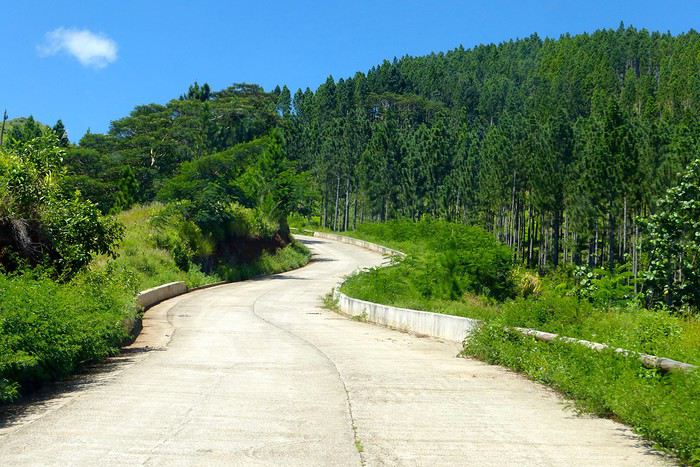
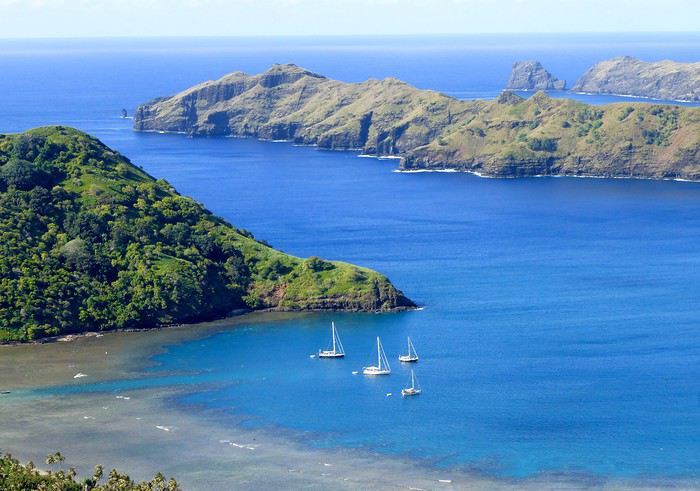
Arrival around 10:30 AM in Nuku Hiva, the first stop of this trip. We booked two nights in half-board at Pension Koku’u, transfers included. Maybe not such a great idea, those included transfers, especially on this unique island where the airport is located on *Terre Déserte*, on the other side of the mountain, opposite and about 45 km from the main village of Taiohae. They’re charged at a steep price. Expect 6,000 XPF round-trip by taxi, but 15,000 XPF charged by guesthouses or hotels. The difference is notable. It wasn’t the best idea, but we can’t go back. Even for residents like us who know how to travel in Polynesia, the Air Tahiti employee who sold me the Pass couldn’t give any useful advice about the stay itself—probably because he’d never been to the Marquesas. It’s really annoying! In short, the good idea to remember is renting a car (like a Suzuki) to be free to manage your time and stop at leisure. The road signage is a bit basic, but you’ll manage just fine. Our host Alvane waits for us—without a sign (sic!)—and after searching for each other for 5 minutes, we’re off on a journey of over an hour (with photo stops) in a Land Rover with smooth tires (luckily, it’s not raining!). The recently paved and marked mountain road is impeccable. No time to catch our breath at the guesthouse; we leave immediately (not a great idea after waking up at dawn plus 4 hours on a plane) for a half-day hike that was also included in the prepaid stay. A sandwich was provided (really pathetic for the physical effort required), we have water, and we fill a few bottles at the spring near the ceremonial site of Taipivai, our first stop. Then the hike begins in the Hanaheu Valley, descending toward Anaho Bay and its namesake beach. A magnificent and wild spot, a few sailboats anchored, we swim—the water is really warm, over 30°C at the shore. That warm is rare and not necessarily pleasant. We then have to climb a very steep slope; this hike is actually quite tough. The air is still, humid, and stifling under the foliage, there’s a bit of mud, and tiny ants (which don’t bite, I’ll have you know), locally called *fofolles*, running over shoes, ankles, and calves. Not very pleasant...! On top of that, there are mosquitoes to protect against! In hindsight, it seems wise to bring energy bars from Papeete if you plan to hike on the afternoon of your arrival day. We weren’t careful... Result: a moment of weakness for me and a hyperventilation attack climbing back up from Anaho Bay!!! We return to the guesthouse at night. There we find Claudine and her four children—Marquesan-style atmosphere, friendly and casual. We share family life. Very simple room with a bathroom, no mosquitoes, we can sleep with the window open, but the night will be noisy, as is often the case in Polynesia. Roosters are everywhere and don’t sleep, dogs bark or whine. So we end up waking up early... like everyone else.
**Day 2: April 28**
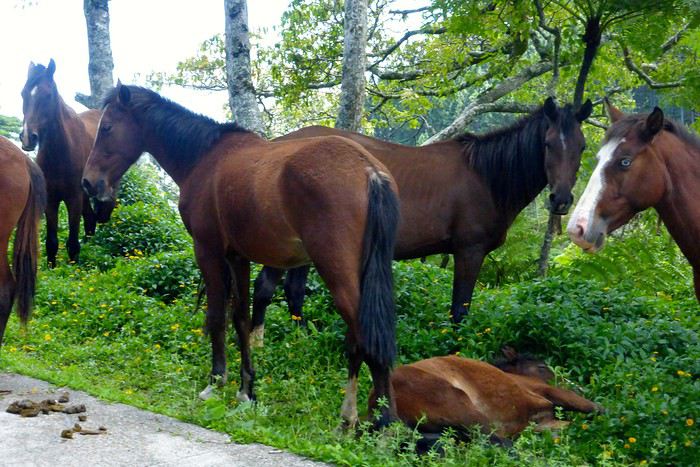
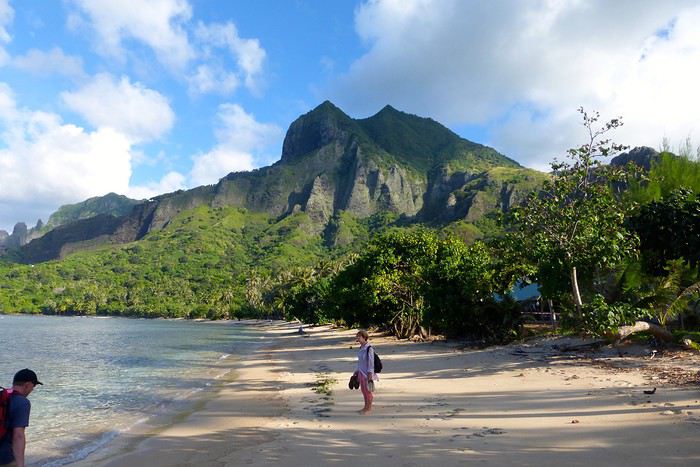
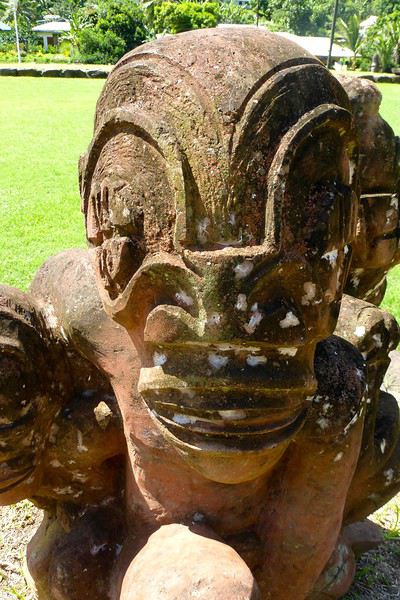
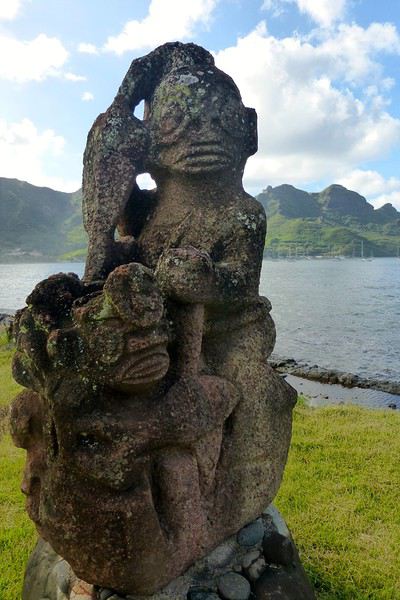
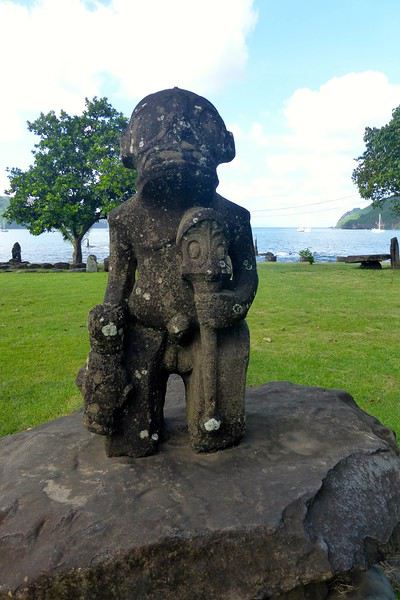
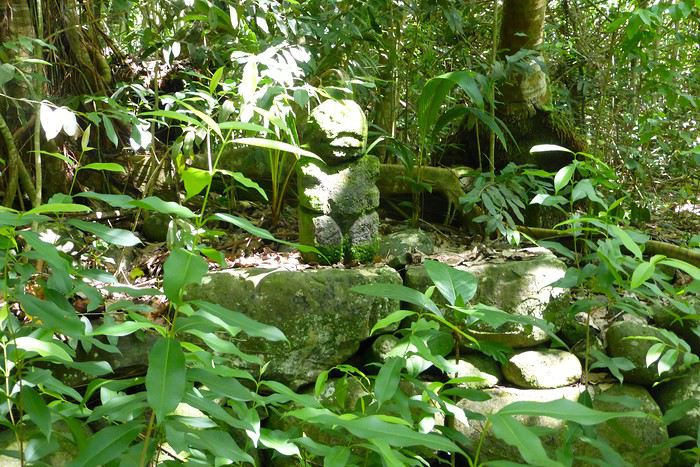
We booked a full-day excursion with Thierry: it starts with a 45-minute boat ride to reach Hakatea Beach, hidden in a small secret bay like many along Nuku Hiva’s coasts. From there, the hike lasts all day—11 km round-trip on flat but also rugged terrain (ancient paved and elevated paths over 1,000 years old)—and river crossings. Bring the right shoes (like plastic Crocs with high socks—not very stylish but practical). We cross the former village of Hakaui, walk along the foundations of dwellings, and there are still weathered tikis in the lush vegetation. The ultimate goal of this hike is to reach the tall Vaipo waterfall. The place is magical, with openings in the vegetation and immense trees allowing photos of the treetops and caves where funeral canoes containing the bones of chiefs or great warriors were once placed. We return the same way to the beach and take another boat ride to reach Taihoae’s port. Back at the guesthouse after a glimpse of Taihoae’s waterfront.
**UA POU**
**Day 3: April 29**
Back to the airport in the late morning for the second flight of the trip to Ua Pou. 20-minute crossing in a Twin Otter (18 seats but only 13 occupied due to cargo between the islands). Beautiful weather, blue sea, nice photos to take upon departure from NH and arrival in UP. We’re greeted by Jérôme, a former military man turned tourism professional, who runs Pension Pukue’e with his wife Elisa, a native of UP. We’re in for two exceptional days. The guesthouse is comfortable, Jérôme and Elisa are very professional and pleasant. Jérôme is also a professional hiker, and Elisa is an excellent cook. We leave quickly for a half-day excursion to Hohoi, after a stop at the archaeological, cultural, and religious site of Maui’a, the Tavaka tribe’s territory. Jérôme is there to explain how Marquesan society functioned at the time and the events that took place on a site still largely buried under vegetation. Then we visit a flower-stone sculptor he knows—the only place in the Marquesas where you’ll find these stones. They’re collected in the river flowing into the sea at Hohoi, sometimes on the beach itself. Back to the guesthouse.
**Day 4: April 30**
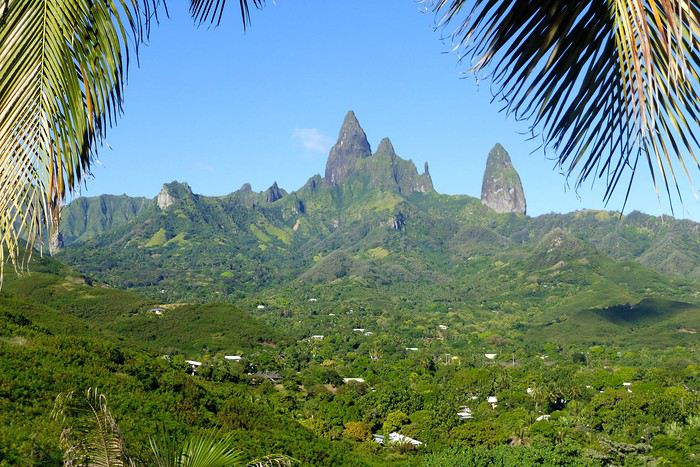
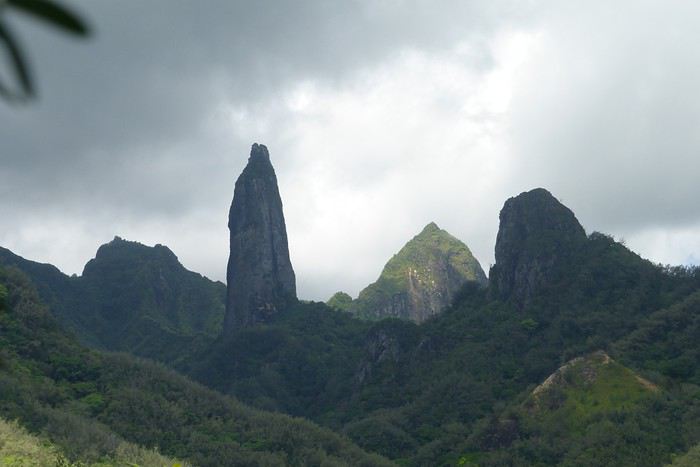
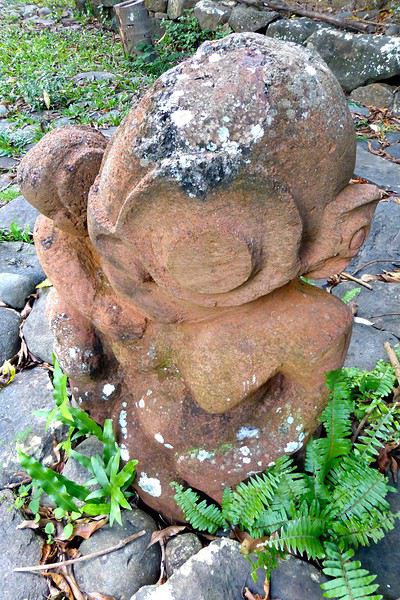
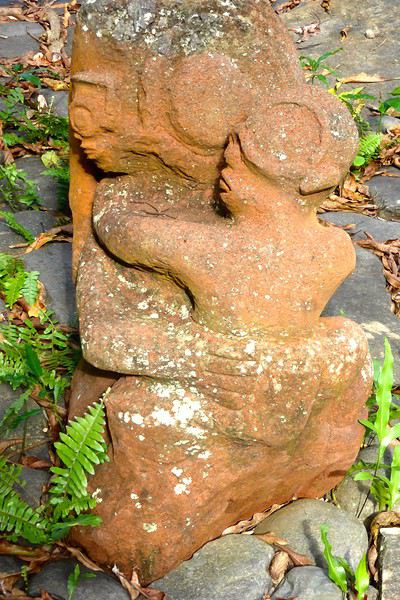
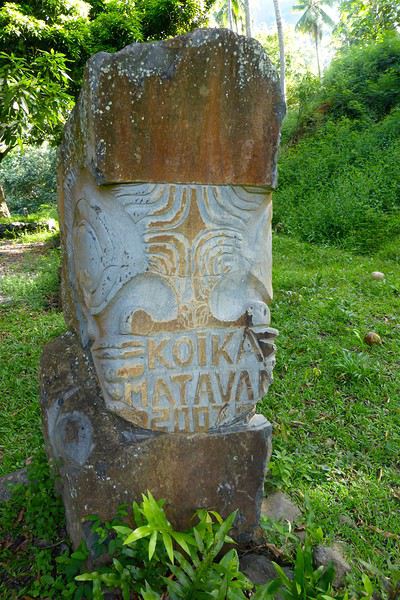
A nature hike in the mountains—moderately difficult—toward the Vaiea waterfall is on our program for a good 4 hours. It’s hot, there are mosquitoes, and the dip in the pool under the waterfall (24°C water) is a rare pleasure. Lunch at a friend of Jérôme’s, a former chef for French minister François Fillon, who prepares delicious food. Elisa picks us up by car to return to the guesthouse. Ua Pou is a beautiful and elegant island with its sharp peaks and wild nature. Our favorite, thanks to Jérôme and his wife.
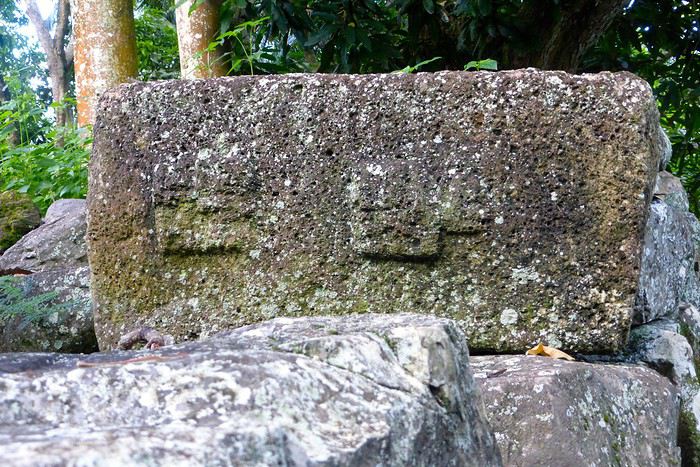
**UA HUKA**
**Day 4: May 1**
Departure for Ua Huka, the smallest inhabited island in the northern group of the Marquesas, located about 1,300 km northeast of Tahiti. Landing is at the oldest airfield in the Marquesas, built in 1972, between the villages of Vaipaee and Hane. Ua Huka has about 680 inhabitants, according to the last census, spread across 3 villages (since the 1870s): Vaipaee, Hane, and Hokatu. The island peaks at Mount Hitikau at only 884 meters. Its origin: a Hawaiian-type shield volcano that—over a few million years—collapsed to become a caldera (or elliptical depression) in which two small volcanoes appeared, the craters of Tahoatikiau and Teepoepo, now part of the Vaikivi Park. The island is rugged and wild, lower than the others, so less cloud-covered and drier. The bays are jagged, the coastline in ochre tones above the intense blue of the sea, and the beaches are constantly disturbed by the powerful surf. The village of Hokatu is only a few kilometers away (just 14 km of road on the island), but Maurice, our host, drives slowly, and it takes time to go up and down. The road is entirely paved or concreted, which isn’t the case on Ua Pou, for example. The guesthouse is disappointing, perched above the village and thus isolated. Beautiful view of the famous Hane motu and the sparkling sea under the bright sun. Apart from that, there are mosquitoes and cockroaches, the bungalow isn’t clean. Meals are taken with Maurice and Delphine in the village—fine dining isn’t on the menu! Ouch!!! We didn’t luck out...
**Day 5: May 2**
Early in the morning, after breakfast, Delphine takes us to the craft center, which turns out to be a letdown—the items for sale are, in my opinion, crude and poorly carved. Nothing like what’s offered at the Marquesas Fair, held twice a year in Papeete, where you can admire and buy small wonders: wood carvings, flower stone, and coral. Delphine is disappointed we’re not interested, and it shows... She’s a bit sulky! These are items meant for Aranui cruise passengers who land on Ua Huka once every two weeks... Solo travelers like us don’t seem to interest her much. The rest of the day—spent with Maurice—is dedicated to visiting cultural centers and small museums, like the Sea Museum in Hane with its ancient canoes, the municipal archaeological museum on the Te Tumu site above the airfield, the petroglyph house near Hokatu Beach, and finally the Papuakeikaraa arboretum, which gathers endemic plants from all over Polynesia and an impressive citrus collection. No excursion planned to Vaikivi Park, toward the previously mentioned craters that recall the island’s volcanic past. Also missing are the viewpoints, the unique endemic vegetation, and especially the petroglyphs. Too bad... at that price!!! Still, in the evening, we go fishing—with sandwiches and drinks in coolers—with other villagers from the dock at the end of the paved road. It’s cool, windy, no mosquitoes, lots of fish caught, and a great atmosphere. Plus, magnificently starry skies.
Ua Huka is one of the rare islands not invaded by the black rat, which has preserved its birdlife, particularly the ultramarine lorikeet (or *pihiti* in Marquesan), which feeds almost exclusively on flower nectar (banana, coconut, hibiscus, mango, guava trees). A dog imported from New Zealand has been specially trained to detect rats: it inspects cargo unloaded from boats and the docks.
I recommend spending two full days on the island—one for visiting the various museums, the other for hiking in the island’s center park, where the archaeological sites are in their raw state: foundations of agricultural terrace walls, gathering places (or *tohua*), dwelling pavements (or *paepae*), sacred sites (or *me’ae* in Marquesan, *marae* in Tahitian) with their tikis and petroglyphs.
To finish, a bit of info on the island’s name, tied to Marquesan oral culture: according to the legend of the creation of the six Marquesas Islands, Ua Huka is the one that puts the finishing touch on the construction of the god Oatea’s house, each island having a defined architectural function. Ua Huka represents the hole (*ua*) where the god deposits what’s left (*huka* in Marquesan) of the unused materials during construction.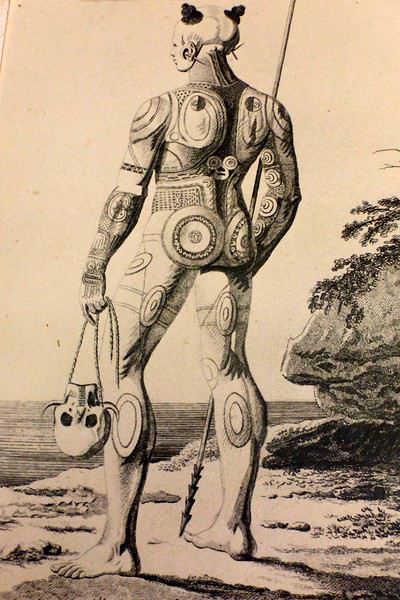
**HIVA OA**
**Day 6: May 3**
Departure in the late morning for Hiva Oa. Maurice—who had other things to do—dropped us off at the airfield 3 hours early... so this stop is a bit of a flop, even if we decided to stay positive! Hiva Oa is the third-largest island in French Polynesia after Tahiti and Nuku Hiva, and before Raiatea in the Leeward Islands. The island is beautiful, lush, verdant, and jagged. The mountains soar into the sky, the sea views are grand, the light is sublime—we’re lucky. Beautiful weather. Tania from Pension Kanahau waits for us at the airport. We’re in for two wonderful days with her. Tania is welcoming, smiling, and dynamic. What a pleasure to be with her, at her place—she cooks divinely and serves the best tuna in the world (the Big Eye reserved for the Japanese) and croquettes made with lobster, shrimp, and crab with breadfruit cubes, for example. Comfortable bungalow, no mosquitoes at night, we can sleep with the window open. It’s fantastic! After settling in, Tania takes us to town in Atuona, a pleasant and well-laid-out little village. We start with lunch—a delicious raw fish in coconut milk—then continue with the must-see attractions: the Catholic cemetery where Paul Gauguin and Jacques Brel’s graves are, overlooking the town; the abandoned Protestant cemetery, reclaimed by the bush, with impressive Marquesan warrior tombs made of huge coral slabs and adorned with a tiki head (harder to find, as no one goes there... ask for directions!); the craft center; the Gauguin Museum (and the Jacques Brel Museum); and the waterfront. While we stroll peacefully, Tania organizes an excursion for the next day, May 4, a full day with Pifa O’Connor, a 36-year-old who knows his island inside out, is passionate about local history, and with whom we’ll hit it off.
**Day 7: May 4**
Pifa arrives at 8 AM sharp at the guesthouse, and we immediately buy sandwiches and water at a small supermarket in Atuona. First, we make a brief stop by the roadside at an unmarked spot, from which we descend a small path through dense vegetation leading to the famous smiling tiki—the only one of its kind in the Marquesas and Polynesia. The place is improbable, the tiki isn’t huge, but it’s beautiful and impressive. Then we’re off on the road that, dizzyingly, runs along and overlooks the island’s northern coast, at the edge of the ancient volcano. Few vehicles pass, the road—now a rocky track—is full of potholes, and we proceed slowly. (Note that this road has been fully paved since 2018.) The panoramas are majestic, with every shade of green against the blue sea. We stop again at the top of a cliff adorned with a huge stone, the *sacrifice stone*, from which young virgin girls were once thrown into the sea to appease angry gods. Another pause for lunch this time, at a small restaurant near the exceptional archaeological site of Puamau. We’ll experience the highlights of this trip during this excursion with our guide, Pifa, who spares no explanations. We discover, on a vast esplanade, the ceremonial complexes of Ta’a Oa and Meae Te I’Ipona, the latter featuring superb tikis, particularly the reclining tiki—or *Maki Taua Pepe*—representing Motherhood, a woman giving birth in a squatting position, as was often the case in many civilizations. Also notable is the *Takaii*, the largest tiki recorded in Polynesia to date. There’s also a huge stone with a now-blunt edge, on which the circumcision of chiefs’ and notables’ pre-adolescent sons was performed. A tough ordeal! But that’s not all! It seems there are more on the mountainside rising steeply behind the archaeological site—overturned tikis, platforms, and, apparently, a giant tiki at the top, which must have fallen but was visible from afar on the sea 30 or 40 years ago, according to the island’s elders. This meeting, worship, and living place—it was actually a small town—is immense. Thousands of people once lived in this part of the island. The site—a religious, social, and cultural sanctuary—would be the size of the largest Mayan sites in Yucatán, but the few concerned owners—two or three families who own the mountainside—don’t want to hear about intensive clearing or tree cutting for now. UNESCO rightly asks for some compliance efforts to grant special treatment to Hiva Oa in particular and the Marquesas in general. We’re not there yet, unfortunately, due to insurmountable local rigidities! This kind of attitude is quite typical in Polynesia: people are afraid to uncover *marae* buried under vegetation—they’re taboo and sometimes said to emit negative and deadly waves, so it’s better not to disturb or anger the ancient spirits or gods who might take revenge. The old religion is never far away in Polynesia, despite the successes of the missionaries.
We return to the guesthouse in the late afternoon. Last night in the Marquesas with Tania, who prepares a fine and delicious meal. Note that dinner costs 2,500 XPF per person.
**Day 8: May 5**
We take the plane as planned, via Nuku Hiva (short stopover). Arrival on time in Papeete.
May this travel journal inspire many of you to visit the Marquesas one day. It’s far, it’s expensive, it’s the trip of a lifetime—it’s unforgettable and unmissable.
Our itinerary is perfect for those who aren’t excited by cruises and prefer to get closer to the local communities. This 9-day trip cost us around 2500 € all-inclusive. For a 14-day cruise on the Aranui, expect to pay 2300 € per person for a basic cabin for four, or 3800 € per person for a superior double cabin.
Air Tahiti offers a 4-island Marquesas Pass (Nuku Hiva, Ua Pou, Ua Huka, and Hiva Oa) for 86,000 XPF (about 700 €). The journey is made on an ATR 72 from Tahiti to Nuku Hiva or Hiva Oa, and on a 19-seat Twin Otter between the islands (often only 13 or 15 seats are available due to cargo, so book well in advance). We’re traveling as a couple. We booked our family-run guesthouse stays at the Tourism Fair in early February, where you can meet the owners and make your choice. Stays are almost always half-board or breakfast-only. Transfers are usually included, but you can always book a car or taxi.
**NUKU HIVA**
**A LITTLE GEOGRAPHY** Nuku Hiva (NH) is located about 1,500 km from Tahiti, in the north of French Polynesia. At 387 km², it’s the second-largest island in French Polynesia after Tahiti. It was formed by incredible volcanic phenomena and cataclysms between 1 and 6 million years ago, which lifted the island thousands of meters above the sea. Even after millennia of slow erosion, collapses, and settling, NH remains the most majestic of the Marquesas, with its sheer cliffs, deep valleys featuring immense waterfalls, and black walls that were once the inner walls of enormous volcanoes.
**A LITTLE HISTORY** The first contact between NH’s inhabitants and Europeans was in 1595 with Spanish navigators who only stayed briefly. It wasn’t until the late 18th century that Europeans arrived in greater numbers on NH (and the other Marquesas Islands), disrupting a very fragile social and cultural balance. It’s believed that nearly 100,000 people lived on Nuku Hiva at that time—a population decimated over the decades by epidemics, diseases brought by Europeans, and alcohol used for barter. The disastrous result: by the 1930s, only 2,500 people remained, having largely lost their identity and living in poverty. Today, the island has about 2,600 inhabitants spread across several villages, with Taiohae as the main one.
**NUKU HIVA IN LITERATURE**
1 / One of the famous writers who visited NH and stayed there was Herman Melville, who arrived in July 1842, the author of *Moby Dick*. The island had just come under French protectorate. Seduced by the enchanting *vahinés* and dazzled by his paradisiacal vision of the place, Melville deserted his ship. He ended up a prisoner of a local tribe, the Taipi, in Taipivai, where he stayed for a month and a half until an Australian ship captain secured his release in exchange for a musket and a roll of cotton fabric! Melville wrote a novel about this tumultuous episode in his life, considered a classic of travel literature. The book, *Typee: A Peep at Polynesian Life*, published in 1846 in the United States, was a huge success.
2 / Another famous Scottish writer, Robert Louis Stevenson, arrived in NH aboard a yacht that anchored in Anaho Bay, the island’s most beautiful, in July 1888. Stevenson was already known for two magnificent novels that marked their era: *Treasure Island* and *Dr. Jekyll & Mr. Hyde*. Stevenson, too, was captivated by the island’s natural beauty, though he also noted the devastating decline in identity, socio-cultural life, and physical health of a population ravaged by disease and alcohol. His account of his stay, *In the South Seas: An Account of Experiences and Observations in the Marquesas, Paumotus, and Gilbert Islands During Two Cruises on the Yacht Casco (1888) and the Schooner Equator (1889)*, was published in 1896 in New York, four years after his death in Apia, Western Samoa, where he had settled. It was also published in London in 1900.
3 / In August 1903, Victor Segalen, a French naval doctor, ethnologist, and archaeologist, landed in NH from the ship *La Durance*, sent to Polynesia to recover the possessions of the painter Paul Gauguin, who had died in April of that year. He, too, was enthralled by the Marquesas but lamented the loss of identity, dignity, and pride of the Māori, alienated by a Christianization that destroyed their culture and customs, denied their gods, and erased their past. He wrote about his experience, doubts, and fears in *Les Immémoriaux*.
4 / In December 1907, Jack London arrived in NH aboard the sailboat *Stark*, following in the footsteps of his illustrious predecessor, Herman Melville. London was in poor physical condition, exhausted from his relentless travels that had taken him from the Klondike in Canada to Japan, Australia, and London in Europe. He was appalled and shocked by Nuku Hiva’s degraded health situation: where Melville had encountered over 2,000 vigorous and healthy Marquesan warriors, London found only 12 suffering from various diseases—the rest had been wiped out by tuberculosis! His approach remained humanistic, and he maintained a sharp geopolitical awareness of these traditional Polynesian cultures, weakened by the inexorable advance of modernity in the early 20th century. He continued his journey to the Tuamotu Islands and Tahiti, publishing *Martin Eden*, the moving account of his initiatory voyage in the South Pacific, in 1911.
5 / Finally, Alain Gerbault, a writer, linguist, ethnologist, and tireless traveler, arrived in the Marquesas via the Panama Canal in December 1933. He was completely exhausted after an endless crossing on a small sailboat, the *Firecrest*. Enthralled by his stay in the Marquesas, he continued to the Tuamotu Islands in 1934, then Tahiti in 1935. Gerbault fought for the preservation of traditions, as well as the songs and dances banned by the Churches and the French Administration (these bans lasted over 50 years, mind you...!!!). Bora Bora remained his favorite island. A staunch Pétainist during World War II, he was forced to flee Bora Bora for Samoa, then Tonga, and finally Timor, a half-Portuguese island and thus neutral during the war. His travel accounts, *In Pursuit of the Sun: Logbook from New York to Tahiti* and *A Paradise Is Dying*, were published in the late 1940s. He died in Timor in 1941, and his ashes were repatriated to Bora Bora.
Back to our trip and stay.
**Day 1: April 27**
Departure from Papeete at 6:30 AM—we had to wake up two hours earlier and reach the airport in the dark. Takeoff at dawn, good weather en route, flight duration: 4 hours.
Arrival around 10:30 AM in Nuku Hiva, the first stop of this trip. We booked two nights in half-board at Pension Koku’u, transfers included. Maybe not such a great idea, those included transfers, especially on this unique island where the airport is located on *Terre Déserte*, on the other side of the mountain, opposite and about 45 km from the main village of Taiohae. They’re charged at a steep price. Expect 6,000 XPF round-trip by taxi, but 15,000 XPF charged by guesthouses or hotels. The difference is notable. It wasn’t the best idea, but we can’t go back. Even for residents like us who know how to travel in Polynesia, the Air Tahiti employee who sold me the Pass couldn’t give any useful advice about the stay itself—probably because he’d never been to the Marquesas. It’s really annoying! In short, the good idea to remember is renting a car (like a Suzuki) to be free to manage your time and stop at leisure. The road signage is a bit basic, but you’ll manage just fine. Our host Alvane waits for us—without a sign (sic!)—and after searching for each other for 5 minutes, we’re off on a journey of over an hour (with photo stops) in a Land Rover with smooth tires (luckily, it’s not raining!). The recently paved and marked mountain road is impeccable. No time to catch our breath at the guesthouse; we leave immediately (not a great idea after waking up at dawn plus 4 hours on a plane) for a half-day hike that was also included in the prepaid stay. A sandwich was provided (really pathetic for the physical effort required), we have water, and we fill a few bottles at the spring near the ceremonial site of Taipivai, our first stop. Then the hike begins in the Hanaheu Valley, descending toward Anaho Bay and its namesake beach. A magnificent and wild spot, a few sailboats anchored, we swim—the water is really warm, over 30°C at the shore. That warm is rare and not necessarily pleasant. We then have to climb a very steep slope; this hike is actually quite tough. The air is still, humid, and stifling under the foliage, there’s a bit of mud, and tiny ants (which don’t bite, I’ll have you know), locally called *fofolles*, running over shoes, ankles, and calves. Not very pleasant...! On top of that, there are mosquitoes to protect against! In hindsight, it seems wise to bring energy bars from Papeete if you plan to hike on the afternoon of your arrival day. We weren’t careful... Result: a moment of weakness for me and a hyperventilation attack climbing back up from Anaho Bay!!! We return to the guesthouse at night. There we find Claudine and her four children—Marquesan-style atmosphere, friendly and casual. We share family life. Very simple room with a bathroom, no mosquitoes, we can sleep with the window open, but the night will be noisy, as is often the case in Polynesia. Roosters are everywhere and don’t sleep, dogs bark or whine. So we end up waking up early... like everyone else.
**Day 2: April 28**
We booked a full-day excursion with Thierry: it starts with a 45-minute boat ride to reach Hakatea Beach, hidden in a small secret bay like many along Nuku Hiva’s coasts. From there, the hike lasts all day—11 km round-trip on flat but also rugged terrain (ancient paved and elevated paths over 1,000 years old)—and river crossings. Bring the right shoes (like plastic Crocs with high socks—not very stylish but practical). We cross the former village of Hakaui, walk along the foundations of dwellings, and there are still weathered tikis in the lush vegetation. The ultimate goal of this hike is to reach the tall Vaipo waterfall. The place is magical, with openings in the vegetation and immense trees allowing photos of the treetops and caves where funeral canoes containing the bones of chiefs or great warriors were once placed. We return the same way to the beach and take another boat ride to reach Taihoae’s port. Back at the guesthouse after a glimpse of Taihoae’s waterfront.
**UA POU**
**Day 3: April 29**
Back to the airport in the late morning for the second flight of the trip to Ua Pou. 20-minute crossing in a Twin Otter (18 seats but only 13 occupied due to cargo between the islands). Beautiful weather, blue sea, nice photos to take upon departure from NH and arrival in UP. We’re greeted by Jérôme, a former military man turned tourism professional, who runs Pension Pukue’e with his wife Elisa, a native of UP. We’re in for two exceptional days. The guesthouse is comfortable, Jérôme and Elisa are very professional and pleasant. Jérôme is also a professional hiker, and Elisa is an excellent cook. We leave quickly for a half-day excursion to Hohoi, after a stop at the archaeological, cultural, and religious site of Maui’a, the Tavaka tribe’s territory. Jérôme is there to explain how Marquesan society functioned at the time and the events that took place on a site still largely buried under vegetation. Then we visit a flower-stone sculptor he knows—the only place in the Marquesas where you’ll find these stones. They’re collected in the river flowing into the sea at Hohoi, sometimes on the beach itself. Back to the guesthouse.
**Day 4: April 30**
A nature hike in the mountains—moderately difficult—toward the Vaiea waterfall is on our program for a good 4 hours. It’s hot, there are mosquitoes, and the dip in the pool under the waterfall (24°C water) is a rare pleasure. Lunch at a friend of Jérôme’s, a former chef for French minister François Fillon, who prepares delicious food. Elisa picks us up by car to return to the guesthouse. Ua Pou is a beautiful and elegant island with its sharp peaks and wild nature. Our favorite, thanks to Jérôme and his wife.
**UA HUKA**
**Day 4: May 1**
Departure for Ua Huka, the smallest inhabited island in the northern group of the Marquesas, located about 1,300 km northeast of Tahiti. Landing is at the oldest airfield in the Marquesas, built in 1972, between the villages of Vaipaee and Hane. Ua Huka has about 680 inhabitants, according to the last census, spread across 3 villages (since the 1870s): Vaipaee, Hane, and Hokatu. The island peaks at Mount Hitikau at only 884 meters. Its origin: a Hawaiian-type shield volcano that—over a few million years—collapsed to become a caldera (or elliptical depression) in which two small volcanoes appeared, the craters of Tahoatikiau and Teepoepo, now part of the Vaikivi Park. The island is rugged and wild, lower than the others, so less cloud-covered and drier. The bays are jagged, the coastline in ochre tones above the intense blue of the sea, and the beaches are constantly disturbed by the powerful surf. The village of Hokatu is only a few kilometers away (just 14 km of road on the island), but Maurice, our host, drives slowly, and it takes time to go up and down. The road is entirely paved or concreted, which isn’t the case on Ua Pou, for example. The guesthouse is disappointing, perched above the village and thus isolated. Beautiful view of the famous Hane motu and the sparkling sea under the bright sun. Apart from that, there are mosquitoes and cockroaches, the bungalow isn’t clean. Meals are taken with Maurice and Delphine in the village—fine dining isn’t on the menu! Ouch!!! We didn’t luck out...
**Day 5: May 2**
Early in the morning, after breakfast, Delphine takes us to the craft center, which turns out to be a letdown—the items for sale are, in my opinion, crude and poorly carved. Nothing like what’s offered at the Marquesas Fair, held twice a year in Papeete, where you can admire and buy small wonders: wood carvings, flower stone, and coral. Delphine is disappointed we’re not interested, and it shows... She’s a bit sulky! These are items meant for Aranui cruise passengers who land on Ua Huka once every two weeks... Solo travelers like us don’t seem to interest her much. The rest of the day—spent with Maurice—is dedicated to visiting cultural centers and small museums, like the Sea Museum in Hane with its ancient canoes, the municipal archaeological museum on the Te Tumu site above the airfield, the petroglyph house near Hokatu Beach, and finally the Papuakeikaraa arboretum, which gathers endemic plants from all over Polynesia and an impressive citrus collection. No excursion planned to Vaikivi Park, toward the previously mentioned craters that recall the island’s volcanic past. Also missing are the viewpoints, the unique endemic vegetation, and especially the petroglyphs. Too bad... at that price!!! Still, in the evening, we go fishing—with sandwiches and drinks in coolers—with other villagers from the dock at the end of the paved road. It’s cool, windy, no mosquitoes, lots of fish caught, and a great atmosphere. Plus, magnificently starry skies.
Ua Huka is one of the rare islands not invaded by the black rat, which has preserved its birdlife, particularly the ultramarine lorikeet (or *pihiti* in Marquesan), which feeds almost exclusively on flower nectar (banana, coconut, hibiscus, mango, guava trees). A dog imported from New Zealand has been specially trained to detect rats: it inspects cargo unloaded from boats and the docks.
I recommend spending two full days on the island—one for visiting the various museums, the other for hiking in the island’s center park, where the archaeological sites are in their raw state: foundations of agricultural terrace walls, gathering places (or *tohua*), dwelling pavements (or *paepae*), sacred sites (or *me’ae* in Marquesan, *marae* in Tahitian) with their tikis and petroglyphs.
To finish, a bit of info on the island’s name, tied to Marquesan oral culture: according to the legend of the creation of the six Marquesas Islands, Ua Huka is the one that puts the finishing touch on the construction of the god Oatea’s house, each island having a defined architectural function. Ua Huka represents the hole (*ua*) where the god deposits what’s left (*huka* in Marquesan) of the unused materials during construction.
**HIVA OA**
**Day 6: May 3**
Departure in the late morning for Hiva Oa. Maurice—who had other things to do—dropped us off at the airfield 3 hours early... so this stop is a bit of a flop, even if we decided to stay positive! Hiva Oa is the third-largest island in French Polynesia after Tahiti and Nuku Hiva, and before Raiatea in the Leeward Islands. The island is beautiful, lush, verdant, and jagged. The mountains soar into the sky, the sea views are grand, the light is sublime—we’re lucky. Beautiful weather. Tania from Pension Kanahau waits for us at the airport. We’re in for two wonderful days with her. Tania is welcoming, smiling, and dynamic. What a pleasure to be with her, at her place—she cooks divinely and serves the best tuna in the world (the Big Eye reserved for the Japanese) and croquettes made with lobster, shrimp, and crab with breadfruit cubes, for example. Comfortable bungalow, no mosquitoes at night, we can sleep with the window open. It’s fantastic! After settling in, Tania takes us to town in Atuona, a pleasant and well-laid-out little village. We start with lunch—a delicious raw fish in coconut milk—then continue with the must-see attractions: the Catholic cemetery where Paul Gauguin and Jacques Brel’s graves are, overlooking the town; the abandoned Protestant cemetery, reclaimed by the bush, with impressive Marquesan warrior tombs made of huge coral slabs and adorned with a tiki head (harder to find, as no one goes there... ask for directions!); the craft center; the Gauguin Museum (and the Jacques Brel Museum); and the waterfront. While we stroll peacefully, Tania organizes an excursion for the next day, May 4, a full day with Pifa O’Connor, a 36-year-old who knows his island inside out, is passionate about local history, and with whom we’ll hit it off.
**Day 7: May 4**
Pifa arrives at 8 AM sharp at the guesthouse, and we immediately buy sandwiches and water at a small supermarket in Atuona. First, we make a brief stop by the roadside at an unmarked spot, from which we descend a small path through dense vegetation leading to the famous smiling tiki—the only one of its kind in the Marquesas and Polynesia. The place is improbable, the tiki isn’t huge, but it’s beautiful and impressive. Then we’re off on the road that, dizzyingly, runs along and overlooks the island’s northern coast, at the edge of the ancient volcano. Few vehicles pass, the road—now a rocky track—is full of potholes, and we proceed slowly. (Note that this road has been fully paved since 2018.) The panoramas are majestic, with every shade of green against the blue sea. We stop again at the top of a cliff adorned with a huge stone, the *sacrifice stone*, from which young virgin girls were once thrown into the sea to appease angry gods. Another pause for lunch this time, at a small restaurant near the exceptional archaeological site of Puamau. We’ll experience the highlights of this trip during this excursion with our guide, Pifa, who spares no explanations. We discover, on a vast esplanade, the ceremonial complexes of Ta’a Oa and Meae Te I’Ipona, the latter featuring superb tikis, particularly the reclining tiki—or *Maki Taua Pepe*—representing Motherhood, a woman giving birth in a squatting position, as was often the case in many civilizations. Also notable is the *Takaii*, the largest tiki recorded in Polynesia to date. There’s also a huge stone with a now-blunt edge, on which the circumcision of chiefs’ and notables’ pre-adolescent sons was performed. A tough ordeal! But that’s not all! It seems there are more on the mountainside rising steeply behind the archaeological site—overturned tikis, platforms, and, apparently, a giant tiki at the top, which must have fallen but was visible from afar on the sea 30 or 40 years ago, according to the island’s elders. This meeting, worship, and living place—it was actually a small town—is immense. Thousands of people once lived in this part of the island. The site—a religious, social, and cultural sanctuary—would be the size of the largest Mayan sites in Yucatán, but the few concerned owners—two or three families who own the mountainside—don’t want to hear about intensive clearing or tree cutting for now. UNESCO rightly asks for some compliance efforts to grant special treatment to Hiva Oa in particular and the Marquesas in general. We’re not there yet, unfortunately, due to insurmountable local rigidities! This kind of attitude is quite typical in Polynesia: people are afraid to uncover *marae* buried under vegetation—they’re taboo and sometimes said to emit negative and deadly waves, so it’s better not to disturb or anger the ancient spirits or gods who might take revenge. The old religion is never far away in Polynesia, despite the successes of the missionaries.
We return to the guesthouse in the late afternoon. Last night in the Marquesas with Tania, who prepares a fine and delicious meal. Note that dinner costs 2,500 XPF per person.
**Day 8: May 5**
We take the plane as planned, via Nuku Hiva (short stopover). Arrival on time in Papeete.
May this travel journal inspire many of you to visit the Marquesas one day. It’s far, it’s expensive, it’s the trip of a lifetime—it’s unforgettable and unmissable.