Results for "Île-Rousse+|+127"
90348 results found.
Switzerland-Paris walking route
Hi,
I’m planning the Switzerland-Paris hike for 2026. If any of you know a route where I can stay with locals or in other lodging (no camping), I’d really appreciate your tips.
Thanks!
M Brunner
Exploring Senja Island and the Lofoten Archipelago
Hi everyone,
We traveled to Norway in the summer of 2025, from July 17 to 29, to visit Senja Island and the Lofoten archipelago with a rental car. The common thread of these twelve days was clearly hiking, along with a few visits and experiences, and nights spent in a tent or in the car (which made it possible). We chose Narvik Airport for both arrival and departure for several complementary reasons: the desire to visit nearby Senja Island, slightly more affordable airfare, and finally, the rental price of the vehicle—especially the car model we were looking for. We only made one reservation, for the first campsite, as sleeping in a tent made things much easier. But we had the whole structure of the trip planned, a flexible outline that could adapt to the weather conditions we’d encounter. Senja Island isn’t part of the Lofoten archipelago, and during the early stages of planning this trip, we hadn’t planned to visit it. But its relative proximity to Narvik Airport and, above all, its unique geography definitely made us change our minds. We arrived in Evenes, where Narvik Airport is located, nearly 60 km from the city itself. Our first stop was 40 km further in Bjerkvik on the way to Senja, where there’s a Rema 1000 (a very common supermarket chain in Norway). We needed to buy some food and a gas cartridge for our stove. I’d emailed the store manager beforehand, who told me they didn’t sell them but that the two gas stations in the village were likely to have some in stock.
It was only at the Esso station that I found what I needed, but unfortunately, only one cartridge. Luckily, we quickly realized that most campsites (like in Iceland) have a shared kitchen with hotplates. That single small cartridge was just enough for the few nights we spent outside of campsites... We got our first taste of Norway’s characteristic landscapes: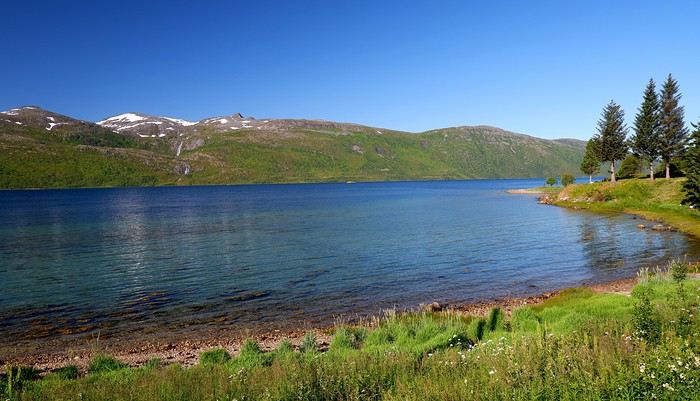
When we arrived at the Senja campsite, it was already 9:30 PM. A sign announced it was full, but luckily, I’d booked it 10 days earlier. By 10:30 PM, as we settled in to eat, it was still broad daylight, and the thermometer read 25°C—despite being at a latitude of 69° North! We went to bed around midnight, exhausted but under the light of a sun that was still very much present. Thanks to Earth’s tilted axis. We’d anticipated this by buying opaque sleep masks because, yes, at this time of year, it’s daylight all the time.
Friday, July 18:
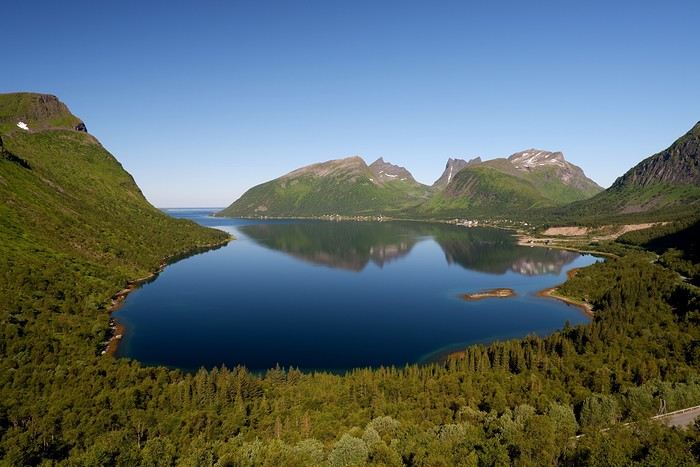
Today, we planned two hikes on the island and a few stops along the way. The map clearly shows that the deepest fjords are in the north and west. Due to time and accessibility, we focused on the northern part of the island. Our first stop was at the viewing platform in Bergbotn:
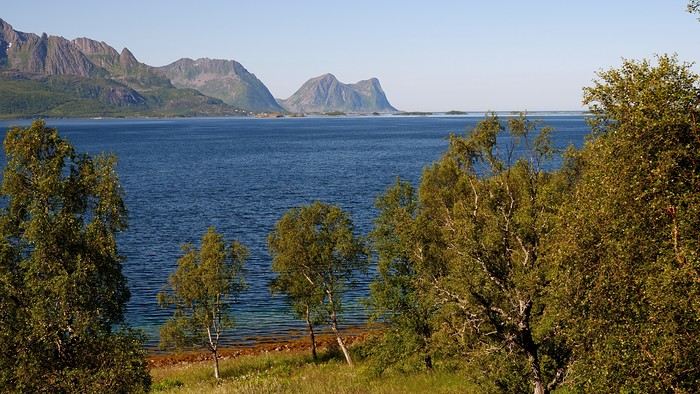
Then we headed toward Skaland, the starting point for our first hike. Along the way, we found plenty of reasons to stop—especially since, on this first day of travel, our thirst for Nordic landscapes was far from quenched.
The town of Skaland is very practical: free parking, picnic tables for after the hike, and a Joker convenience store right next door. Our goal was the summit of Husfjellet: 670 m of elevation gain, between 8 and 9 km in length, and an estimated 4 hours and 30 minutes.
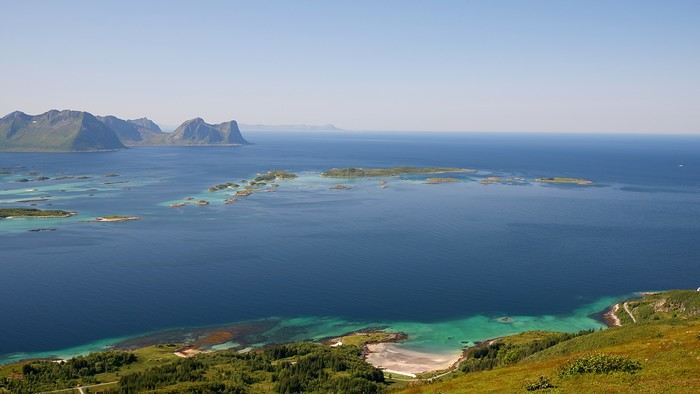
This hike offers two major viewpoints. The first overlooks the Bergsoyan islands to the west:
At the summit, the view shifts to the Steinfjorden fjord:
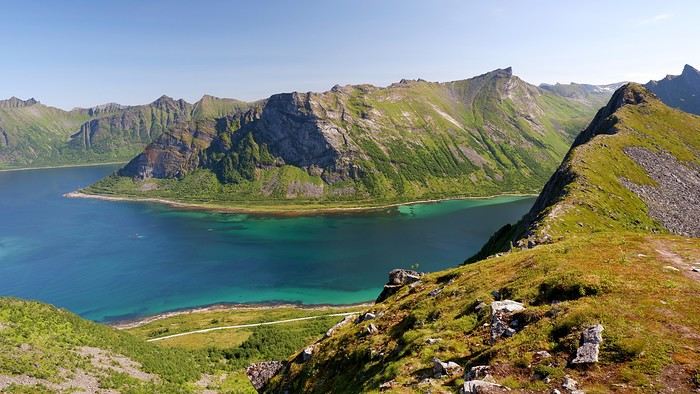
You can even clearly see the "Devil’s Teeth," which we’d see from below later:
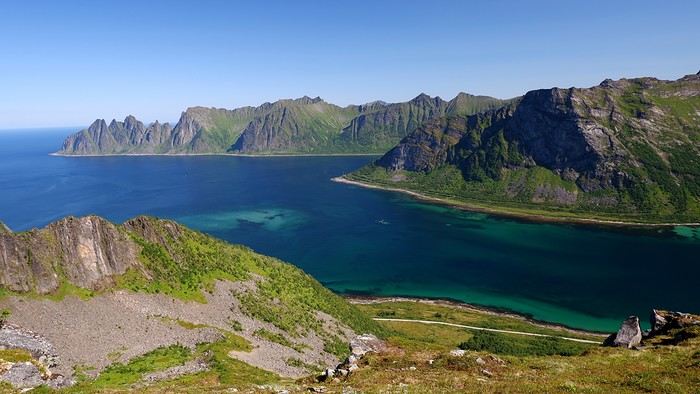
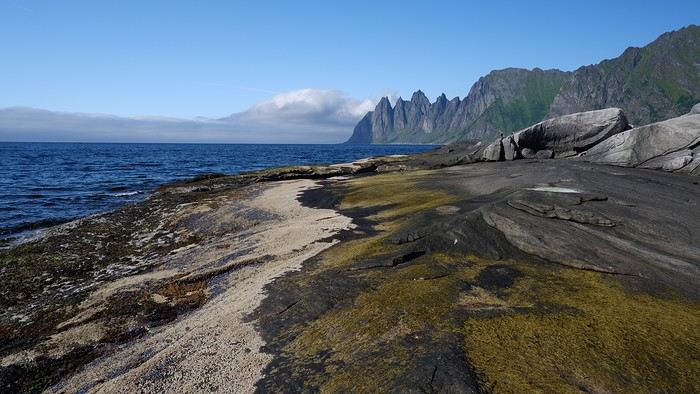
In total, the hike took us 4 hours and 30 minutes, including all the breaks. We treated ourselves to an ice cream in Skaland to recharge for the next hike. We hit the road again and stopped at Tungeneset to get a closer look at the Devil’s Teeth:
We continued to Fjordgard, the starting point for our second hike. Fjordgard isn’t very welcoming. There was a time when you could park right at the start of the hike up Mount Segla. Now, everything’s blocked off, and locals have even taken to blocking all possible parking spots nearby. You now have to park outside the town at a paid parking lot (90 NOK for 3 hours), adding an extra 2 km (round trip) of walking. Still, that was just a minor inconvenience because the hike that followed quickly made us forget all about it. The hike is fairly short (2 hours) but still has 520 m of elevation gain. This hike was a stark contrast to the first. This morning, we had sweeping views of the vast landscape. Here, Mount Segla, perched on the edge of the cliff, dominates the foreground:
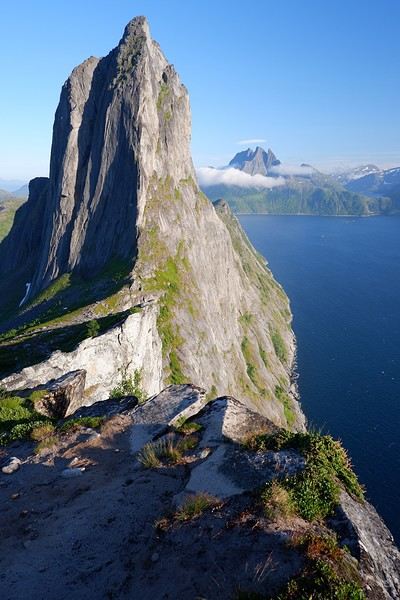
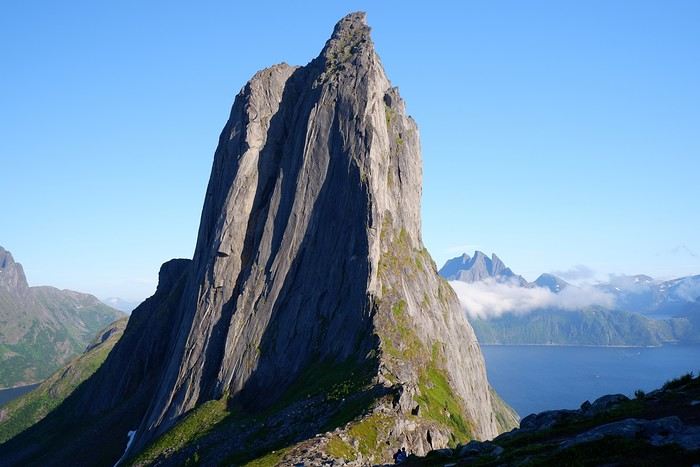
For those prone to vertigo, it might be best to stay at the foot of the mountain, as the trail climbs right along the cliff edge. And from that point on, you quickly understand what verticality really means...
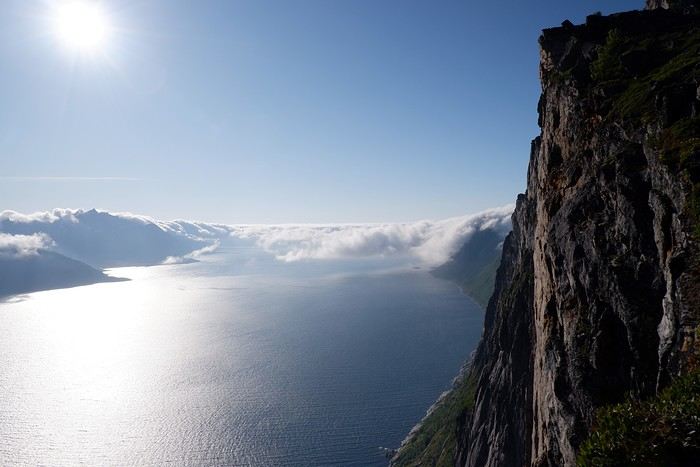
In total, we took 2 hours and 50 minutes, including breaks and the extra walk to the parking lot. The day was already well underway, and with 1,200 m of cumulative elevation gain, it was time to find a spot to eat and sleep. Since we hadn’t made any reservations, we’d planned to bivouac for the night. We weren’t too picky—just practical—so we decided to sleep in the car at the parking lot for tomorrow morning’s hike, just 5 km from Fjordgard.
We traveled to Norway in the summer of 2025, from July 17 to 29, to visit Senja Island and the Lofoten archipelago with a rental car. The common thread of these twelve days was clearly hiking, along with a few visits and experiences, and nights spent in a tent or in the car (which made it possible). We chose Narvik Airport for both arrival and departure for several complementary reasons: the desire to visit nearby Senja Island, slightly more affordable airfare, and finally, the rental price of the vehicle—especially the car model we were looking for. We only made one reservation, for the first campsite, as sleeping in a tent made things much easier. But we had the whole structure of the trip planned, a flexible outline that could adapt to the weather conditions we’d encounter. Senja Island isn’t part of the Lofoten archipelago, and during the early stages of planning this trip, we hadn’t planned to visit it. But its relative proximity to Narvik Airport and, above all, its unique geography definitely made us change our minds. We arrived in Evenes, where Narvik Airport is located, nearly 60 km from the city itself. Our first stop was 40 km further in Bjerkvik on the way to Senja, where there’s a Rema 1000 (a very common supermarket chain in Norway). We needed to buy some food and a gas cartridge for our stove. I’d emailed the store manager beforehand, who told me they didn’t sell them but that the two gas stations in the village were likely to have some in stock.
It was only at the Esso station that I found what I needed, but unfortunately, only one cartridge. Luckily, we quickly realized that most campsites (like in Iceland) have a shared kitchen with hotplates. That single small cartridge was just enough for the few nights we spent outside of campsites... We got our first taste of Norway’s characteristic landscapes:
When we arrived at the Senja campsite, it was already 9:30 PM. A sign announced it was full, but luckily, I’d booked it 10 days earlier. By 10:30 PM, as we settled in to eat, it was still broad daylight, and the thermometer read 25°C—despite being at a latitude of 69° North! We went to bed around midnight, exhausted but under the light of a sun that was still very much present. Thanks to Earth’s tilted axis. We’d anticipated this by buying opaque sleep masks because, yes, at this time of year, it’s daylight all the time.
Friday, July 18:
Today, we planned two hikes on the island and a few stops along the way. The map clearly shows that the deepest fjords are in the north and west. Due to time and accessibility, we focused on the northern part of the island. Our first stop was at the viewing platform in Bergbotn:
Then we headed toward Skaland, the starting point for our first hike. Along the way, we found plenty of reasons to stop—especially since, on this first day of travel, our thirst for Nordic landscapes was far from quenched.
The town of Skaland is very practical: free parking, picnic tables for after the hike, and a Joker convenience store right next door. Our goal was the summit of Husfjellet: 670 m of elevation gain, between 8 and 9 km in length, and an estimated 4 hours and 30 minutes.
This hike offers two major viewpoints. The first overlooks the Bergsoyan islands to the west:
At the summit, the view shifts to the Steinfjorden fjord:
You can even clearly see the "Devil’s Teeth," which we’d see from below later:
In total, the hike took us 4 hours and 30 minutes, including all the breaks. We treated ourselves to an ice cream in Skaland to recharge for the next hike. We hit the road again and stopped at Tungeneset to get a closer look at the Devil’s Teeth:
We continued to Fjordgard, the starting point for our second hike. Fjordgard isn’t very welcoming. There was a time when you could park right at the start of the hike up Mount Segla. Now, everything’s blocked off, and locals have even taken to blocking all possible parking spots nearby. You now have to park outside the town at a paid parking lot (90 NOK for 3 hours), adding an extra 2 km (round trip) of walking. Still, that was just a minor inconvenience because the hike that followed quickly made us forget all about it. The hike is fairly short (2 hours) but still has 520 m of elevation gain. This hike was a stark contrast to the first. This morning, we had sweeping views of the vast landscape. Here, Mount Segla, perched on the edge of the cliff, dominates the foreground:
For those prone to vertigo, it might be best to stay at the foot of the mountain, as the trail climbs right along the cliff edge. And from that point on, you quickly understand what verticality really means...
In total, we took 2 hours and 50 minutes, including breaks and the extra walk to the parking lot. The day was already well underway, and with 1,200 m of cumulative elevation gain, it was time to find a spot to eat and sleep. Since we hadn’t made any reservations, we’d planned to bivouac for the night. We weren’t too picky—just practical—so we decided to sleep in the car at the parking lot for tomorrow morning’s hike, just 5 km from Fjordgard.
Where to stay on Gran Canaria to explore the island?
Hi there,
I’m planning a trip from Gran Canaria to El Hierro to Tenerife at the end of winter.
My current dilemma is where to book accommodations on Gran Canaria.
We’re planning to stay 7 nights on the island, and our goal is to hike, drive along small roads, discover a few villages, and admire some beaches (just for the views, not for swimming!).
Since the island is quite rugged, the journeys can be long even if the distances are short. I’d like to avoid driving 2 hours every morning and evening to reach the area we want to explore...
I’m thinking of splitting the 7 nights into 4 somewhere and 3 elsewhere.
But where? It seems the center and the northwest might be the best options.
Any advice, given that I’m mainly looking for peace and quiet, a beautiful view, a secluded spot, or a quiet village?
Thanks! :)
I’m planning a trip from Gran Canaria to El Hierro to Tenerife at the end of winter.
My current dilemma is where to book accommodations on Gran Canaria.
We’re planning to stay 7 nights on the island, and our goal is to hike, drive along small roads, discover a few villages, and admire some beaches (just for the views, not for swimming!).
Since the island is quite rugged, the journeys can be long even if the distances are short. I’d like to avoid driving 2 hours every morning and evening to reach the area we want to explore...
I’m thinking of splitting the 7 nights into 4 somewhere and 3 elsewhere.
But where? It seems the center and the northwest might be the best options.
Any advice, given that I’m mainly looking for peace and quiet, a beautiful view, a secluded spot, or a quiet village?
Thanks! :)
Lake Bourget: The Parachuting Nightmare
If you're walking around the southern part of Lake Bourget, you can't escape the noise from a parachuting club's planes. A group of climate skeptics actually takes off in small, very noisy aircraft every 15 minutes over a Natura 2000 classified area. They don’t seem to face any restrictions—neither for noise nor for greenhouse gas emissions. They occupy the airspace without paying fuel taxes or providing carbon compensation to local municipalities or environmental preservation associations, apparently. It sounds surreal, but it’s very real in such an important location.
Lake Bourget and nature reserve
A really nice nature walk at the entrance to the lake in the Natura 2000-listed nature reserve. It’s a great opportunity to see lots of bird species, plants, and the famous European pond turtle, as well as some beautiful medieval architecture remnants with Thomas II’s castle. The walk is slightly spoiled by the noise from the Savoie parachute club’s planes, which take off every fifteen minutes and dump fuel on the site non-stop, even after nightfall.
Looking for a nice island off the beaten path for diving
Hi everyone!
I’ve been in Malaysia for a month now and still have two more to go. I started traveling with friends, but I’ll be solo for the next month and a half.
We did a pretty classic route: Perhentians, Cameron Highlands (which I found pointless), Tioman, and Kinabatangan in Borneo. Now I’m thinking of heading to Redang Island—Langkawi is also an option, but it doesn’t appeal to me as much. Any feedback on these two spots?
Especially Redang?
Any thoughts on the diving there?
So far, I haven’t had much luck with diving—at the Perhentians, it was pretty disastrous with water at 31°C 😵😫
I’d love to find a nice island where I can meet people (locals and travelers) because going from a group of six to solo at the end is going to feel weird.
So I’m open to all tips and opinions. Also, I’d love to hear about Langkawi, and if anyone knows of an island that’s a bit more off the beaten path, that’d be amazing. Thanks in advance, and happy travels to you all!
Which other island to visit with Luzon and Bohol?
Hi there,
I’m planning a trip to the Philippines in January or February 2026.
On top of visiting Luzon, I’m thinking of going to one or two other islands, but I’m hesitating—which one(s)?
I’d like to do some snorkeling, enjoy a beautiful beach, and explore the interior of Bohol.
Which island(s) can you recommend?
Thanks in advance for your help!
ceinture
Bike rental on Porquerolles Island + visiting Bormes-les-Mimosas/Le Lavandou
Hi everyone,
We’re heading to Hyères starting on 05/11/2025 and want to explore Porquerolles Island by bike. Is it better to book a bike in advance, or can we just rent one once we’re on the island? We’re not sure if tourist season will have started yet.
Also, are there any bike rental shops you’d recommend? Or any spots on the island or in Hyères town that we shouldn’t miss?
We’d also like to visit either Bormes-les-Mimosas or Le Lavandou—any thoughts on which one you’d recommend?
Thanks for your tips! Yves
We’d also like to visit either Bormes-les-Mimosas or Le Lavandou—any thoughts on which one you’d recommend?
Thanks for your tips! Yves
Taxis on Java Island
Hi there, we’ve planned our itinerary, but how does it work on the ground for getting a taxi? For example, we want to go to Borobudur Temple for sunrise—how do we get a taxi that early? Same question for other cities—is there a website to contact a taxi? We don’t want organized tours. We’re used to renting a car, but we’re a bit lost here... Thanks so much for your help!
Photographic Discovery of Vancouver Island
Let’s catch up with a new travel journal from July 2024—only 6 months late, no biggie!
We’ll be talking about this gorgeous island, its tail end, wildlife (old habits die hard), and the sheer joy of it all 🙂
We’ll be talking about this gorgeous island, its tail end, wildlife (old habits die hard), and the sheer joy of it all 🙂
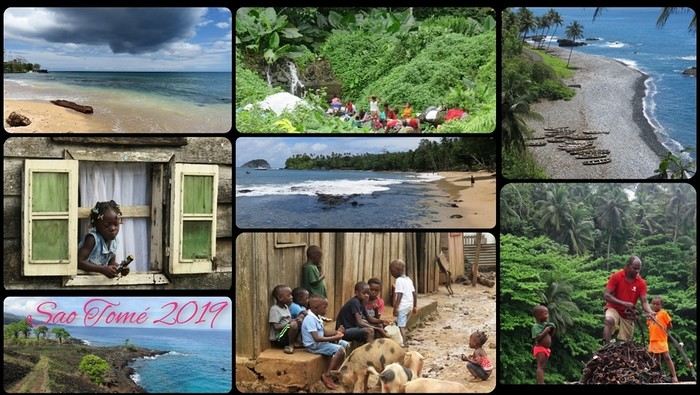
Sao Tomé, the forgotten island
Hey there, it's me again—back with my usual travel journal share for our loved ones, from our 15-day trip in October 2019.
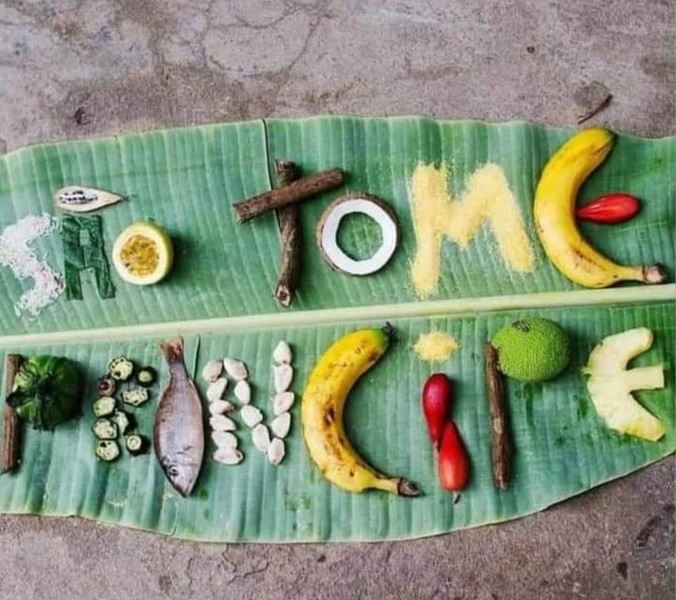
"Ah, here it is at last—that sweet scent of elsewhere so dear to Cricri and Lulu’s noses, that mix of apprehension and desire when facing the unknown.
We’re really diving into the unknown this time, taking you to the island of SAO TOMÉ... also known as the island: *‘Wait, what did you say?’* 😄. Because apparently, no one’s heard of Sao Tomé—except our Portuguese friends.
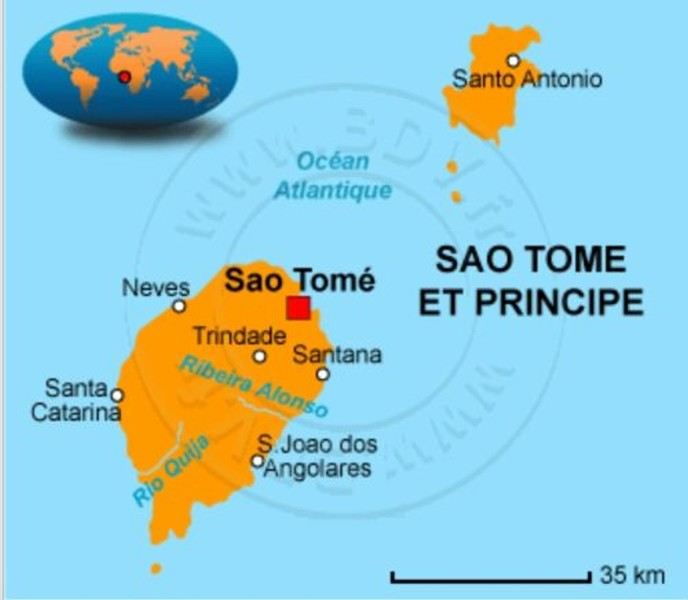
It’s an archipelago of three islands smack in the middle of the world, right on the equator, off the coast of Gabon.
No, these aren’t the sun-soaked, Polynesian lagoon islands. Here, *‘it rains, it pours...’* pretty much all the time, it seems.
There’s not much to *‘see’* in the traditional tourist sense—EXCEPT for stunning landscapes, lush vegetation, a few beaches with golden or black sand, colonial buildings still in their original state, a single main road, and plenty of *‘tracks’* that are more or less drivable. All this surrounded by an African population that speaks Portuguese and is known for its warm welcome.
Well, that should be enough for our happiness—and hopefully yours too! 😊
Ready for landing?
"Ah, here it is at last—that sweet scent of elsewhere so dear to Cricri and Lulu’s noses, that mix of apprehension and desire when facing the unknown.
We’re really diving into the unknown this time, taking you to the island of SAO TOMÉ... also known as the island: *‘Wait, what did you say?’* 😄. Because apparently, no one’s heard of Sao Tomé—except our Portuguese friends.
It’s an archipelago of three islands smack in the middle of the world, right on the equator, off the coast of Gabon.
No, these aren’t the sun-soaked, Polynesian lagoon islands. Here, *‘it rains, it pours...’* pretty much all the time, it seems.
There’s not much to *‘see’* in the traditional tourist sense—EXCEPT for stunning landscapes, lush vegetation, a few beaches with golden or black sand, colonial buildings still in their original state, a single main road, and plenty of *‘tracks’* that are more or less drivable. All this surrounded by an African population that speaks Portuguese and is known for its warm welcome.
Well, that should be enough for our happiness—and hopefully yours too! 😊
Ready for landing?
Have you considered Reunion Island as a destination?
Reunion Island, a French island located in the Indian Ocean, is characterized by remarkable geographical and cultural diversity. This island offers an immersive experience that harmoniously blends wild nature and human heritage, between active volcanoes, mountainous cirques, impressive waterfalls, and charming villages. This report explores the must-see spots, from the lunar landscapes of Piton de la Fournaise to the mountainous trails of the Mafate cirque, not forgetting the natural pools and tropical gardens. Each section highlights a distinct aspect of this vibrant island, supported by geological and historical information, as well as accounts from those who have visited.
Piton de la Fournaise, which reaches a height of 2,632 meters, is one of the most active volcanoes on our planet. Its frequent eruptions constantly shape the landscape, offering a natural spectacle where burning lava meets the ocean. The trail leading to the Dolomieu crater, though difficult to access, is open to hikers and rewards them with a panorama of vast expanses of solidified lava and volcanic gas emissions. It’s usually best to visit at this time of day to avoid clouds and enjoy the low light that enhances the lunar reliefs.
Volcanic activity has also given rise to unique structures, such as the lava tunnels of Grand Brûlé, where tourists can walk along cooled lava flows. For geology enthusiasts, the site of Cassé de la Rivière de l'Est reveals incredible basaltic organ pipes, testifying to ancient eruptions.
Despite its inactivity, Piton des Neiges (3,071 m) remains the island’s highest peak. Its ascent, via the GR R2 trail, passes through virgin forests before reaching rocky landscapes where sunrise offers a 360° panoramic view of the three cirques. This extinct volcano symbolizes Reunion Island’s geological history, characterized by successive collapses that gave birth to the surrounding cirques.
A UNESCO World Heritage site, the Salazie cirque charms with its lush greenery and hamlets clinging to cliffs. Hell-Bourg, listed among France’s most beautiful villages, delights with its brightly colored Creole houses and picturesque cobblestone streets. The trek to Voile de la Mariée, a famous waterfall, winds through bamboo groves and natural pools perfect for a swim.
Mafate, a preserved haven of tranquility, is accessible only on foot or by helicopter. Places like La Nouvelle or Marla, small villages called "îlets," offer a glimpse into traditional life on Reunion Island. The GR R1 trail, which circles Piton des Neiges, immerses hikers in breathtaking landscapes, alternating between rocky ridges and narrow valleys.
Known for its lentils and wines, Cilaos combines culinary delights with stunning scenery. The healing properties of the thermal springs at Bras-Rouge are highlighted by the trails leading to them, which also offer panoramas like the Col du Taïbit, a privileged access point to Mafate.
This unique spot features pebble beaches, waterfalls by the sea, and a palm forest. Picnickers enjoy its peaceful atmosphere, while local fishermen maintain ancient traditions. Nearby, the Garden of Perfumes and Spices cultivates vanilla, cloves, and turmeric, offering an olfactory experience at the heart of Reunionese agriculture.
Bassin Boeuf, famous for its turquoise waters, is a popular swimming spot, framed by volcanic formations. Further south, the Langevin River creates a series of waterfalls and natural pools, including the famous Trou de Fer, a 300-meter-deep canyon where water cascades in a shimmering curtain.
The island’s capital blends colonial heritage with modernity. The Léon Dierx Museum showcases modern art, while the Grand Marché draws visitors with its spices and local crafts. The Barachois promenade, along the sea, evokes the city’s maritime past with its 18th-century cannons.
The Domaine de Villèle, once a colonial plantation, now houses a museum dedicated to the history of slavery and a geranium distillery. The Chapelle Pointue, with its neo-Gothic style, offers a striking contrast to the brightly colored Tamil temples surrounding it.
The GR R1 and R2 trails are popular with experienced hikers, but more accessible routes like the Piton Maido (2,200 m) are suitable for beginners. The latter offers an unparalleled view of the Mafate cirque at dawn.
The coast of Saint-Gilles offers activities like diving, surfing, and paddleboarding, while ULM flights provide an impressive aerial view of Piton de la Fournaise.
Reunion Island presents itself as a microcosm where every landscape tells a story—geological, cultural, or human. Between the fury of volcanoes and the calm of cirques, between the bustle of markets and the tranquility of natural pools, this destination offers a diverse experience. Travelers are encouraged to mix their activities: morning hikes, cultural visits during the day, and moments of relaxation at dusk. Preserving these wonders relies on responsible tourism, respectful of fragile ecosystems and local communities.
Piton de la Fournaise, which reaches a height of 2,632 meters, is one of the most active volcanoes on our planet. Its frequent eruptions constantly shape the landscape, offering a natural spectacle where burning lava meets the ocean. The trail leading to the Dolomieu crater, though difficult to access, is open to hikers and rewards them with a panorama of vast expanses of solidified lava and volcanic gas emissions. It’s usually best to visit at this time of day to avoid clouds and enjoy the low light that enhances the lunar reliefs.
Volcanic activity has also given rise to unique structures, such as the lava tunnels of Grand Brûlé, where tourists can walk along cooled lava flows. For geology enthusiasts, the site of Cassé de la Rivière de l'Est reveals incredible basaltic organ pipes, testifying to ancient eruptions.
Despite its inactivity, Piton des Neiges (3,071 m) remains the island’s highest peak. Its ascent, via the GR R2 trail, passes through virgin forests before reaching rocky landscapes where sunrise offers a 360° panoramic view of the three cirques. This extinct volcano symbolizes Reunion Island’s geological history, characterized by successive collapses that gave birth to the surrounding cirques.
A UNESCO World Heritage site, the Salazie cirque charms with its lush greenery and hamlets clinging to cliffs. Hell-Bourg, listed among France’s most beautiful villages, delights with its brightly colored Creole houses and picturesque cobblestone streets. The trek to Voile de la Mariée, a famous waterfall, winds through bamboo groves and natural pools perfect for a swim.
Mafate, a preserved haven of tranquility, is accessible only on foot or by helicopter. Places like La Nouvelle or Marla, small villages called "îlets," offer a glimpse into traditional life on Reunion Island. The GR R1 trail, which circles Piton des Neiges, immerses hikers in breathtaking landscapes, alternating between rocky ridges and narrow valleys.
Known for its lentils and wines, Cilaos combines culinary delights with stunning scenery. The healing properties of the thermal springs at Bras-Rouge are highlighted by the trails leading to them, which also offer panoramas like the Col du Taïbit, a privileged access point to Mafate.
This unique spot features pebble beaches, waterfalls by the sea, and a palm forest. Picnickers enjoy its peaceful atmosphere, while local fishermen maintain ancient traditions. Nearby, the Garden of Perfumes and Spices cultivates vanilla, cloves, and turmeric, offering an olfactory experience at the heart of Reunionese agriculture.
Bassin Boeuf, famous for its turquoise waters, is a popular swimming spot, framed by volcanic formations. Further south, the Langevin River creates a series of waterfalls and natural pools, including the famous Trou de Fer, a 300-meter-deep canyon where water cascades in a shimmering curtain.
The island’s capital blends colonial heritage with modernity. The Léon Dierx Museum showcases modern art, while the Grand Marché draws visitors with its spices and local crafts. The Barachois promenade, along the sea, evokes the city’s maritime past with its 18th-century cannons.
The Domaine de Villèle, once a colonial plantation, now houses a museum dedicated to the history of slavery and a geranium distillery. The Chapelle Pointue, with its neo-Gothic style, offers a striking contrast to the brightly colored Tamil temples surrounding it.
The GR R1 and R2 trails are popular with experienced hikers, but more accessible routes like the Piton Maido (2,200 m) are suitable for beginners. The latter offers an unparalleled view of the Mafate cirque at dawn.
The coast of Saint-Gilles offers activities like diving, surfing, and paddleboarding, while ULM flights provide an impressive aerial view of Piton de la Fournaise.
Reunion Island presents itself as a microcosm where every landscape tells a story—geological, cultural, or human. Between the fury of volcanoes and the calm of cirques, between the bustle of markets and the tranquility of natural pools, this destination offers a diverse experience. Travelers are encouraged to mix their activities: morning hikes, cultural visits during the day, and moments of relaxation at dusk. Preserving these wonders relies on responsible tourism, respectful of fragile ecosystems and local communities.
Bali or Mauritius in September?
Hi everyone,
I’m happy to be back on the forum, and to be honest, I’ve missed being able to share with this amazing community 😛
I’m starting to plan a trip for September 2025 with my wife. I’d love to discover Mauritius, and I’ve begun reading the forum posts.
Can you tell me if September is a good time to visit Mauritius?
I’ll admit we’re still hesitating—our ideas are Mauritius or Bali.
We’re in our sixties, not high-level athletes, but we travel quite a bit. We don’t like changing hotels every day; instead, we prefer to explore around a central base. If we need to move to better enjoy the trip, no more than twice, I think.
So, I’m looking for a good compromise for accommodation. I’m also looking for a guide to get an idea of pricing and options, but most of all, I’d love to hear from people who’ve already stayed there during this period and get tips on finding places to stay.
Thanks for your help—I’ll now go read the various posts about Mauritius 😉
I’m starting to plan a trip for September 2025 with my wife. I’d love to discover Mauritius, and I’ve begun reading the forum posts.
Can you tell me if September is a good time to visit Mauritius?
I’ll admit we’re still hesitating—our ideas are Mauritius or Bali.
We’re in our sixties, not high-level athletes, but we travel quite a bit. We don’t like changing hotels every day; instead, we prefer to explore around a central base. If we need to move to better enjoy the trip, no more than twice, I think.
So, I’m looking for a good compromise for accommodation. I’m also looking for a guide to get an idea of pricing and options, but most of all, I’d love to hear from people who’ve already stayed there during this period and get tips on finding places to stay.
Thanks for your help—I’ll now go read the various posts about Mauritius 😉
Lofoten or Faroe Islands in October?
Hi there,
I’m posting this because I can’t decide.
We’d like to travel in mid-October to explore a Nordic destination.
We’ll have 6 full days on-site. I’m torn between the Faroe Islands and Lofoten... What about the weather and the cost of accommodation?
My budget is a maximum of 120 € per night. I don’t want to rush but take the time to explore just one part of these islands and avoid running around too much.
The Faroe Islands might be pricier and less lively.
Lofoten requires more flight connections...
In terms of landscapes and 6-day hikes, could you share your feedback?
My request is a bit vague.
Thanks for reading!
Penelope
My request is a bit vague.
Thanks for reading!
Penelope
Philippines - Indonesia - Sumatra - Moluccas Islands Trip December 2024
Hi there!
Looking to head off by the end of this year, no later than between December 10th and 15th, for the Philippines.
Any recommendations for regions like the Batanes Islands and Mindanao, away from mass tourism and off the beaten path?
Plan: Beaches, snorkeling, diving, hiking, and visiting the most interesting sites depending on each person’s preferences (I’m not really into old stones but more about nature, jungle, flora, and fauna).
When? Between December 10th and 15th, but no later than December 15th–17th.
Where? Northern Philippines, starting with a few days of beach and relaxation to recharge after the bad weather and winter in France. Then, off to trek in northern Luzon with its stunning rice terraces, followed by the Batanes Islands, which are the epitome of off-the-beaten-path destinations. After that, we’d head down to the Balicas Islands, where you can swim with turtles and where tourism is minimal due to very limited hotel infrastructure (accommodation is in tents by the sea). Next up: the island of Mindanao.
Depending on time and everyone’s interests, we could continue to Sumatra and then the Moluccas Islands, which, unlike the rest of Indonesia, are much less affected by the monsoon.
With whom?
Someone who’s already traveled and hiked beyond just their imagination and dreams . Independent and resourceful (I’m looking for a travel partner, not a tourist to guide). Good-humored and adaptable. Loving adventure and eager to explore off the beaten path.
I’ve traveled a lot and I’m a fan of the unexpected (go where the wind takes you).
If you see yourself in these few lines, it would be a great pleasure to share this new adventure with you for a few days or weeks.... This is just a rough plan I’m proposing, and it can be adjusted based on everyone’s preferences.
Plan: Beaches, snorkeling, diving, hiking, and visiting the most interesting sites depending on each person’s preferences (I’m not really into old stones but more about nature, jungle, flora, and fauna).
When? Between December 10th and 15th, but no later than December 15th–17th.
Where? Northern Philippines, starting with a few days of beach and relaxation to recharge after the bad weather and winter in France. Then, off to trek in northern Luzon with its stunning rice terraces, followed by the Batanes Islands, which are the epitome of off-the-beaten-path destinations. After that, we’d head down to the Balicas Islands, where you can swim with turtles and where tourism is minimal due to very limited hotel infrastructure (accommodation is in tents by the sea). Next up: the island of Mindanao.
Depending on time and everyone’s interests, we could continue to Sumatra and then the Moluccas Islands, which, unlike the rest of Indonesia, are much less affected by the monsoon.
With whom?
Someone who’s already traveled and hiked beyond just their imagination and dreams . Independent and resourceful (I’m looking for a travel partner, not a tourist to guide). Good-humored and adaptable. Loving adventure and eager to explore off the beaten path.
I’ve traveled a lot and I’m a fan of the unexpected (go where the wind takes you).
If you see yourself in these few lines, it would be a great pleasure to share this new adventure with you for a few days or weeks.... This is just a rough plan I’m proposing, and it can be adjusted based on everyone’s preferences.
Traveling with Iberia Airlines
Hi everyone,
I’m leaving this Saturday the 30th with Iberia, and they’re not responding to emails or picking up the phone 😐. So I’m trying here with my three questions:
1 - On the way there, I’d like to check a pack of water (Vittel 1.5L x6 bottles) in my hold luggage since it’s not allowed in the cabin. I’d like to know if this is allowed or if there are any restrictions in the hold as well (aside from the maximum weight of the luggage, of course)?
2 - I have a disability, and my health hasn’t been improving, so I’ve needed a cane to get around for a while now. At the airport, they’ll put me in a wheelchair with special assistance (I’m used to it). I’ve brought a folding cane for the trip—am I allowed to have it in my carry-on luggage? (It’s a basic walking cane that folds, no fancy handle that unscrews with a sword inside or anything like that). The wheelchair is great, but before the flight, I’d like to stretch my legs a bit .
(The question might seem silly, but I’ve had some weird surprises at airport security before—a glass knick-knack that confused them for a while, even though it was just a small glass rose under a dome, or another time, my empty hair spray bottle caused a lot of hesitation.)
3 - I never received an invoice for my Iberia flights (booked in February), and I’ll need it (since a small part might be reimbursed by my works council). I’ve checked my Iberia personal space, but there’s no invoice anywhere. Do you know how I can get it? (Given that they don’t respond to emails—or if they do, it’s off-topic—and they don’t answer the phone.)
Thanks so much for your help!
I’m leaving this Saturday the 30th with Iberia, and they’re not responding to emails or picking up the phone 😐. So I’m trying here with my three questions:
1 - On the way there, I’d like to check a pack of water (Vittel 1.5L x6 bottles) in my hold luggage since it’s not allowed in the cabin. I’d like to know if this is allowed or if there are any restrictions in the hold as well (aside from the maximum weight of the luggage, of course)?
2 - I have a disability, and my health hasn’t been improving, so I’ve needed a cane to get around for a while now. At the airport, they’ll put me in a wheelchair with special assistance (I’m used to it). I’ve brought a folding cane for the trip—am I allowed to have it in my carry-on luggage? (It’s a basic walking cane that folds, no fancy handle that unscrews with a sword inside or anything like that). The wheelchair is great, but before the flight, I’d like to stretch my legs a bit .
(The question might seem silly, but I’ve had some weird surprises at airport security before—a glass knick-knack that confused them for a while, even though it was just a small glass rose under a dome, or another time, my empty hair spray bottle caused a lot of hesitation.)
3 - I never received an invoice for my Iberia flights (booked in February), and I’ll need it (since a small part might be reimbursed by my works council). I’ve checked my Iberia personal space, but there’s no invoice anywhere. Do you know how I can get it? (Given that they don’t respond to emails—or if they do, it’s off-topic—and they don’t answer the phone.)
Thanks so much for your help!
What to do on Easter Island?
Hi everyone,
We’re heading to Easter Island in January for 8 days.
We’d love any tips—
-bike or scooter rental?
-hikes on foot
-activities like kayaking or snorkeling
-must-visit spots
Thanks so much in advance!
5 days on Easter Island
Easter Island, located between Tahiti and Chile, fascinated me with its volcanic landscapes and legendary Moai statues, erected by the first Polynesian inhabitants to honor their ancestors. Mysterious and iconic, this isolated land intrigues with its history and the enigmas that researchers and explorers are still trying to unravel.
To help you prepare for your trip, here’s my five-day itinerary. I was able to explore major sites while leaving room for some free and adventurous moments. Here’s the program I followed:
Day 1: Discovering Hanga Roa and nearby moais
For my arrival, I started slowly by visiting the village of Hanga Roa. I took the time to stroll around, check out some local shops, and especially admire the first moais accessible for free, to ease into the island’s fascinating history.
Day 2: The must-see sites with a guide (Vaihu, Te Pito Kura, Anakena, Tongariki, Rano Raraku)
The second day was dedicated to the highlights. With a guide, I explored the island’s iconic sites, including the imposing aligned moais of Tongariki and the ancient "statue factory" of Rano Raraku. This intense day helped me understand more about the island’s culture and mysterious history, especially with the paradise-like beach of Anakena at the end of the day.
Day 3: Historical sites and museum (Orongo, Rano Kau, Puna Pau, Akivi)
On the third day, I continued with a guided morning, particularly at the ceremonial village of Orongo, perched atop Rano Kau. After visiting Puna Pau and Akivi, I spent the afternoon at the museum to deepen my knowledge of the Rapa Nui civilization.
Day 4: Bike ride in nature
Craving freedom, I devoted this day to a bike ride along the coastline and through the island’s natural spots. It was the perfect opportunity to explore at my own pace and stop at secret coves, enjoying the tranquility of the landscapes.
Day 5: Hike to the summit of Terevaka
For my last day, I set off on a hike to the summit of Terevaka, the island’s highest point. From there, the 360° view of the island and the ocean is breathtaking and gave me a memorable souvenir of this trip.
This five-day stay was a real journey through time, landscapes, and the mysteries of Easter Island!
If you want more details on my favorite spots, accommodation ideas, or practical tips, you can check out my article: https://un-tour-dans-le-sac.fr/ile-de-paques-5-jours/
Itinéraire sur l'île de Kyushu (Japon) English translation pending
Bonjour,
Je prépare un voyage à Kyushu du 24/03 au 08/04 inclus.
Voici une ébauche de mon itinéraire, j' aimerais avoir vos avis sur celui çi. Arrivée le 25/03 à Fukuoka 3nuits Départ le 28 pour Yanagawa, kurume, yame 3nuits Départ le 31 pour Kumamoto 2nuits Départ le 02 pour Kagoshima 2nuits Retour le 04 à Fukuoka 4nuits (Visite de Beppu, Usiki, Itoshi, Hoshino et Kitakyushu)
Pensez-vous qu'il soit possible de tout visiter? Je ne sais pas trop comment organiser mon itinéraire par rapport aux distances des villes. Mes centres d'intêrets sont la visites de temples, les toris sur la mer, les rizières , les plantations de thé, être proche des habitants, la nature...
Je cherche aussi un ryokan assez sympa mais pas hors de prix mais je ne sais pas dans quel endroit il vaut mieux le prendre.
Merci pour votre aide qui me sera bien précieuse😉 Françou
Voici une ébauche de mon itinéraire, j' aimerais avoir vos avis sur celui çi. Arrivée le 25/03 à Fukuoka 3nuits Départ le 28 pour Yanagawa, kurume, yame 3nuits Départ le 31 pour Kumamoto 2nuits Départ le 02 pour Kagoshima 2nuits Retour le 04 à Fukuoka 4nuits (Visite de Beppu, Usiki, Itoshi, Hoshino et Kitakyushu)
Pensez-vous qu'il soit possible de tout visiter? Je ne sais pas trop comment organiser mon itinéraire par rapport aux distances des villes. Mes centres d'intêrets sont la visites de temples, les toris sur la mer, les rizières , les plantations de thé, être proche des habitants, la nature...
Je cherche aussi un ryokan assez sympa mais pas hors de prix mais je ne sais pas dans quel endroit il vaut mieux le prendre.
Merci pour votre aide qui me sera bien précieuse😉 Françou
Marée noire sur l'île Maurice English translation pending
Comme si il n'y avait pas assez de mauvaises nouvelles en ce moment.
https://www.google.com/amp/s/www.lci.fr/amp/international/ocean-indien-ce-qu-il-faut-savoir-sur-la-maree-noire-a-l-ile-maurice-cause-par-cargo-wakashio-2161236.html
https://www.google.com/amp/s/www.lci.fr/amp/international/ocean-indien-ce-qu-il-faut-savoir-sur-la-maree-noire-a-l-ile-maurice-cause-par-cargo-wakashio-2161236.html
Que choisir entre l'île de Paros ou celle de Naxos? English translation pending
Bonjour.
Nous partons mi septembre en Grèce pour 2 semaines et demi. Nous atterrissons à Athènes et repartirons de santorin.
Nous allons donc visiter Athènes puis partir vers les Cyclades. Nous avions choisi initialement de faire milos Paros naxos et santorin.
Mais voilà, nous avons un bébé qui aura 9 mois en septembre et le rythme sera trop soutenu alors on va retirer une île.
Nous aimerions garder Milos car elle semble différentes des autres îles, et santorin car nous repartirons de la bas. Mais alors vaut il mieux aller à Paros ou naxos?
Nous aimons nous balader dans les petits villages, se baigner dans de très belle plage, pas faire trop de route non plus.
Que nous conseillez vous avec un bébé?
Merci beaucoup
Court séjour à l'île d'Oléron English translation pending
Bonjour,
Nous partons 4 jours à l'île d'Oléron avec une ado de 15 ans.
Qui peut nous conseiller sur les visites à faire. Nous logerons près de la Cotinière.
Merci d'avance pour vos conseils.
CDT
Chantal
Vélo à l'île d'Orléans avec mon garçon de 6 ans English translation pending
Bonjour,
Je compte passer 2 ou 3 jours à Québec avec mon garçon de 6 ans et j'ai pensé aller faire un tour à l'île d'Orléans.
J'ai pensé louer des vélos et faire un des circuits, mais est-ce qu'il y en a un qui serait adapté pour un jeune enfant? Je ne suis pas très chaud à l'idée de faire di vélo sur l'accotement des routes avec un enfant de 6 ans.
Je suis aussi preneur pour toutes les idées de trucs à faire ou voir avec mon p'tit bonhomme! :)
Merci!
Je compte passer 2 ou 3 jours à Québec avec mon garçon de 6 ans et j'ai pensé aller faire un tour à l'île d'Orléans.
J'ai pensé louer des vélos et faire un des circuits, mais est-ce qu'il y en a un qui serait adapté pour un jeune enfant? Je ne suis pas très chaud à l'idée de faire di vélo sur l'accotement des routes avec un enfant de 6 ans.
Je suis aussi preneur pour toutes les idées de trucs à faire ou voir avec mon p'tit bonhomme! :)
Merci!
Voyage sur une île grecque en août en couple avec un enfant English translation pending
Bonjour
Peut être a t on déjà répondu à la demande ci après, et je vous prie de m'en excuser.
Je souhaite me rendre vers le 20 aout en Grèce par avion depuis Marseille pour une semaine voire 10 jours avec Madame et notre garçon de 9 ans :
- quelle ile privilégier pour le calme (un peu optimiste je sais en cette période- j'ai déjà exclu Mikonos et probablement Santorin..)
- quelques visites pour un pèlerinage historique sur les traces d'Aristote et Platon
- de bons petits plats grecs et les boissons locales...
J'ajoute que je ne cherche pas impérativement les petits prix.. (la vie est trop courte..faut en profiter...) et que dans tous les cas ma destination est également fonction des liaisons aériennes entre Marseille et l'ile choisie.
Merci d'avance
Cordialement
Nacer
Séjour à l'île Rodrigues et prix du vol depuis Paris English translation pending
bonjour,
En octobre 2021, je compte aller sur l'île Rodrigues pendant 3 semaines. je ne parvenais pas à me décider sur quelle île aller en Polynésie et deux camarades m'ont incité à aller à Rodrigues.
J'ai trouvé un hébergement, un bungalow situé à Graviers, dans l'est de Rodrigues là où se trouvent les plus belles plages.
En demi pension, l'hébergement est à 50 euros/jour.
J'ai fait une simulation avec air mauritus (je ne sais pas si la compagnie va pouvoir se relever) pour Paris-Rodrigues. Le vol coûte environ 1200 euros A/R. Cela vous semble t-il correct ?
Merci pour vos contributions.
En octobre 2021, je compte aller sur l'île Rodrigues pendant 3 semaines. je ne parvenais pas à me décider sur quelle île aller en Polynésie et deux camarades m'ont incité à aller à Rodrigues.
J'ai trouvé un hébergement, un bungalow situé à Graviers, dans l'est de Rodrigues là où se trouvent les plus belles plages.
En demi pension, l'hébergement est à 50 euros/jour.
J'ai fait une simulation avec air mauritus (je ne sais pas si la compagnie va pouvoir se relever) pour Paris-Rodrigues. Le vol coûte environ 1200 euros A/R. Cela vous semble t-il correct ?
Merci pour vos contributions.
Naoussa (île de Paros) avec hébergement pour 8 jours en juin 2020 English translation pending
Bonjour,
Sous réserve que les choses restent en l'état, je pars pour PAROS à Naoussa pour 8 jours le 16 juin. Auriez-vous un Hébergement sympa à budget modéré pour une personne?
Merci à vous et faites attention à vous. François
Sous réserve que les choses restent en l'état, je pars pour PAROS à Naoussa pour 8 jours le 16 juin. Auriez-vous un Hébergement sympa à budget modéré pour une personne?
Merci à vous et faites attention à vous. François
Vol Figari-Paris CDG annulé en mai? English translation pending
Bonjour
j'ai réservé un vol EasyJet - via BDV - Figari Paris CDG pour le 29/05/2020.
En appelant l'aéroport de Figari j'ai appris que - suite Covid19 - tous les vols EasyJet au départ (ou à l'arrivée) de Figari sont annulés en Mai.
BDV dit ne pas avoir reçu d'annulation officielle de EasyJet et considère que ce vol est maintenu - donc refuse de me rembourser si j'annule…
Quelqu'un peut-il me dire si ce vol est maintenu ou pas
Merci
Recherche nom d'une île au sud de Biak (Indonésie) English translation pending
Quelqu'un est-il connaisseurs des îles aux sud de Biak ? J'y étais en 2012 mais je suis confus pour le nom de l'île parce qu'il semble y avoir deux "Wundi island", un au nord de l'île de Biak et l'autre où je suis allé au sud, mais quand je regarde sur google map y-a rien d'indiqué pour celui du sud, alors est-ce qu'ils ont changé de nom où quoi ? A la place c'est marqué "Mios Woendi" (???) Erreur où quoi ?
Merci de l'aide.
Camping sauvage sur une île inhabité en Asie English translation pending
Bonjour à tous, après de nombreuses recherches au sujet du "camping sauvage sur ile inhabité en Asie", je me retrouve a poser ma question sur ce forum car très peu d'informations ou même de retours d’expériences sont disponible sur internet.
J'ai pour projet de partir 3 semaines avec un groupe d'ami sur une Île inhabité au mois de SEPTEMBRE 2020. Idéalement vis à vis de la saison, l’Indonésie, la Malaisie, les philippines paraissent être les endroits idéaux (saison & nombre d'île confondu).
Si je devais résumer vulgairement notre projet, il s’agirait de nous faire déposer en bateau sur une île inhabité avec nos ressources (eau, nourriture, tente & équipement indispensable a la survie) pour 3 semaines d'aventure, puis a la fin de cette période, le bateau reviendrait nous chercher pour nous ramener à la civilisation. C'est un rêves d'enfance que nous souhaitons réaliser ensemble en étant totalement conscient de la difficulté de ce projet un peu fou. Nous ne sommes pas débutant dans le domaine & la galère est notre recherche commune hihi.
Nos questions sont les suivantes : Est-il possible de faire du camping sauvage sur ces îles inhabités ? La population/gouvernement est-elle/il contre ce type de voyageur ? Quels sont les législations ? ...
Bien évidement si vous avez des retours d’expérience dans d'autres pays ou autres, si vous connaissez des personnes qui pourraient potentiellement nous renseigner ou même des liens que j'aurais loupé a ce sujet, merci de me les renseigner. Ca serait une aide précieuse dans l'organisation de notre périple.
J’espère avoir été clair dans mes propos. Dans l’espoir d'avoir des réponses. Merci à tous
J'ai pour projet de partir 3 semaines avec un groupe d'ami sur une Île inhabité au mois de SEPTEMBRE 2020. Idéalement vis à vis de la saison, l’Indonésie, la Malaisie, les philippines paraissent être les endroits idéaux (saison & nombre d'île confondu).
Si je devais résumer vulgairement notre projet, il s’agirait de nous faire déposer en bateau sur une île inhabité avec nos ressources (eau, nourriture, tente & équipement indispensable a la survie) pour 3 semaines d'aventure, puis a la fin de cette période, le bateau reviendrait nous chercher pour nous ramener à la civilisation. C'est un rêves d'enfance que nous souhaitons réaliser ensemble en étant totalement conscient de la difficulté de ce projet un peu fou. Nous ne sommes pas débutant dans le domaine & la galère est notre recherche commune hihi.
Nos questions sont les suivantes : Est-il possible de faire du camping sauvage sur ces îles inhabités ? La population/gouvernement est-elle/il contre ce type de voyageur ? Quels sont les législations ? ...
Bien évidement si vous avez des retours d’expérience dans d'autres pays ou autres, si vous connaissez des personnes qui pourraient potentiellement nous renseigner ou même des liens que j'aurais loupé a ce sujet, merci de me les renseigner. Ca serait une aide précieuse dans l'organisation de notre périple.
J’espère avoir été clair dans mes propos. Dans l’espoir d'avoir des réponses. Merci à tous
Changement d'horaire pour un vol Paris - Zurich English translation pending
Bonjour à tous,
j'ai un vol prévu le 25 , et hier soir, Lufthansa vient de m'avancer mon 1er vol Paris zurich (je suis censé allé en Thailande, enfin en tout cas c'était prévu lorsque j'ai réservé y'a plus de 3 mois) de 5 heures (au lieu de 15h05 , c'est devenu 9h55 ce qui ne m'arrange plus du tout , n'étant pas de Paris.
Quels sont mes droits? je dois accepter ?ou j'ai droit à un dédommagement ? je parle dans l'optique que je n'annule pas le vol.
j'ai un peu vu par hasard ce changement, je n'ai rien recu par mail et samedi matin les horaires étaient toujours pareil.
Je pose la question parce que c'est totalement impossible de joindre la compagnie, ce que je peux comprendre vu la situation...
Merci.
j'ai un vol prévu le 25 , et hier soir, Lufthansa vient de m'avancer mon 1er vol Paris zurich (je suis censé allé en Thailande, enfin en tout cas c'était prévu lorsque j'ai réservé y'a plus de 3 mois) de 5 heures (au lieu de 15h05 , c'est devenu 9h55 ce qui ne m'arrange plus du tout , n'étant pas de Paris.
Quels sont mes droits? je dois accepter ?ou j'ai droit à un dédommagement ? je parle dans l'optique que je n'annule pas le vol.
j'ai un peu vu par hasard ce changement, je n'ai rien recu par mail et samedi matin les horaires étaient toujours pareil.
Je pose la question parce que c'est totalement impossible de joindre la compagnie, ce que je peux comprendre vu la situation...
Merci.