Results for "Bergues+|+127"
1684 results found.
Voyage aux origines du monde... Là où tout a commencé! English translation pending
Il y a de nombreuses années déjà, je me faufilais au travers de la minuscule lucarne de paix qu’entrouvrait un pays mystérieux et inaccessible. Mystérieux il le restera longtemps encore, inaccessible malheureusement aussi … Je vous compte ici cette formidable épopée au royaume de Gilgamesh et des temps immémoriaux qui ont précédé son règne …
Beub
Beub
Thailande Bangkok et environs + Bungalows Kho Samui English translation pending
Je prépare mon voyage. Je n'ai que 2 semaines. En atterrissant à Bangkok je pensais visitez un peu les environs (genre jusque Sukhotai) et puis déscendre vers Koh Samui pour les plages...
J'aimerais avoir des avis sur quoi voir dans la région de BKK..
Je cherche surtout un conseil pour l'hébergement à Kho Samui.. je rève d'un bungalow sur la plage.. pas cher.. le rêve quoi!
Je suis impatiente de lire vos idées et conseils
J'aimerais avoir des avis sur quoi voir dans la région de BKK..
Je cherche surtout un conseil pour l'hébergement à Kho Samui.. je rève d'un bungalow sur la plage.. pas cher.. le rêve quoi!
Je suis impatiente de lire vos idées et conseils
Trek en Bolivie English translation pending
Bonjour,
nous réfléchissons à partir en Bolivie l'été prochain, pour aller voir les grands-parents de mon mari qui habitent à La Paz. On voudrait en profiter pour faire un trek au moins, mais c'est quand même assez cher pour nous, surtout que le billet d'avion n'est déjà pas donné...
Est-ce que vous savez s'il est possible de randonner seuls, genre sur le chemin de l'inca qui doit descendre vers coroico si je ne confonds pas tout, ou d'autres, en gros ce sont des vrais chemins? Je ne pense pas que ce soit fléché comme en France, mais il existe des cartes? En gros sans être un pro des treks on peut se débrouiller ou il faut vraiment partir avec une agence?
Merci d'avance
Sophie
nous réfléchissons à partir en Bolivie l'été prochain, pour aller voir les grands-parents de mon mari qui habitent à La Paz. On voudrait en profiter pour faire un trek au moins, mais c'est quand même assez cher pour nous, surtout que le billet d'avion n'est déjà pas donné...
Est-ce que vous savez s'il est possible de randonner seuls, genre sur le chemin de l'inca qui doit descendre vers coroico si je ne confonds pas tout, ou d'autres, en gros ce sont des vrais chemins? Je ne pense pas que ce soit fléché comme en France, mais il existe des cartes? En gros sans être un pro des treks on peut se débrouiller ou il faut vraiment partir avec une agence?
Merci d'avance
Sophie
Egypte en famille et en organisé English translation pending
Bonjour,
Pour les VFistes qui peuvent être intéressés par un compte rendu plus descriptif, voici le mien sur notre récent voyage en Egypte. C'est un résumé car il y aurait tant à dire sur les émotions ressenties, etc. Enfin, c'est un début ! Bonne lecture. VOYAGE EN EGYPTE
Huit mois avant que ne débute notre voyage en Egypte, nous l’avions entamé et c’est le propre de tout voyage d’être effectué avant ! Nous avons lu, écouté des vidéos, échangé sur les forums, rêvé de ce pays bien lointain. Les enfants, de vraies éponges, avaient tout ingurgité ce qu’ils pouvaient de renseignements et l’un en avait fait même un travail scolaire. Nous étions donc prêts le 27 avril quand nous sommes partis de la maison à destination de Montréal. Pour nous qui demeurons à Sept-Îles sur la Côte-Nord, l’Egypte était encore plus loin que pour la plupart des gens qui faisaient partie de notre groupe : 47 québécois et 38 français qui nous rejoignaient le premier mai à Paris. C’était notre premier voyage en groupe organisé et les enfants étaient les seuls de leur âge car ils n’étaient pas en vacances scolaires : mais manquer deux semaines d’école au profit d’un voyage aussi riche en histoire n’était pas un problème !
En fait, pour financer ce voyage (2 adultes et 3 enfants âgés de 15 – une fille, 13 et 10 ans – deux garçons), il nous a fallu économiser quelques années et les cadeaux d’anniversaires et du Temps des Fêtes se sont résumés à des sacs à dos, valises, bouteilles isolantes, chapeaux, etc. Se priver de sorties, de vêtements neufs ou de gadgets n’a pas été très difficile pour nous puisque nous devinions que ce voyage ferait partie d’un album de famille particulier. C’était assez spécial de nous voir la famille de cinq au milieu de gens soit fortunés, soit âgés, soit retraités mais toujours ou presque en couples. L’un d’eux croyait même que nous ne faisions pas partie du groupe au départ et que nous profitions du transport pour nous rendre ailleurs. À son étonnement, le couple nous a qualifié de courageux en cours de route. Mais ce n’était pas du courage qu’il nous fallait, c’était de la détermination et nous l’avions. En fait, bien mieux que d’autres compagnons de voyage, nous avons entièrement fait toutes les excursions et ce, même atteints par la fameuse tourista. Les enfants ont un pouvoir de récupération assez grand et le plus jeune qui a été épargné par la tourista, la malédiction de Touthankamon, nous a appris à mieux surveiller notre alimentation. En fait, il n’ingurgitait que riz, viande et jus frais. S’il est vrai que nous ne goûtions pas toujours à ce que nous offrait le pays, après le premier coup de semonce de tourista, nous avons compris qu’il valait mieux se tenir loin de certains aliments nouveaux ou traîtres. Quoiqu’il en soit, la nourriture égyptienne (du moins ce qu’on nous a servi) ne nous est pas apparue très variée. Le sel, élément indispensable pour retenir l’eau dont notre corps avait besoin, était généreusement saupoudré sur tout ce que nous mangions. À vrai dire, les trois P (pain, pâtes, poulet) sont répandus. Puis, le riz et les légumes apprêtés de quelques façons ainsi que des fruits tels que dattes, melon d’eau (nous l’avons évité après la tourista) et oranges (délicieuses !) ont fait partie de notre quotidien. Quelques desserts assez bons d’ailleurs nous ont ravis (charmants petits beignets aux pommes). Par contre, le vin nous a déçus et nous l’évitions autant que possible.
Notre voyage se résume en une croisière de 7 jours sur le Nil et un séjour de quelques jours au Caire. La navigation sur le fleuve est très plaisante sauf lorsqu’on s’approche de zones où les cheminées déferlent des nuages noirs aux odeurs incroyablement mauvaises. Outre cette pollution, nous découvrons des berges habitées par plusieurs paysans, la Haute-Egypte étant plus agricole. Même si la navigation est tout de même assez courte, il m’en reste un beau souvenir. Nous naviguons sur le M/S Nile Elite Cruises qui a remplacé à brûle-pourpoint un bateau neuf qui nous avait été promis mais qui a été retenu à son port de départ. Bien que plusieurs du groupe se soient objectés, cela ne nous a que quelque peu dérangés. L’important en voyage n’est-il pas d’avoir un lit pour dormir, une table pour manger, un endroit pour se laver ? Les enfants, quant à eux, estimaient être sur un bateau de luxe et s’en réjouissaient. Il faut penser toutefois que les critères de propreté, de confort et de luxe ne sont pas les mêmes dans tous les pays. Tant que les enfants étaient bien, nous étions bien et leur inculquer certaines valeurs de tolérance faisait partie de notre objectif de vacances familiales !
L’un des désagréments de notre voyage, outre l’acharnement des vendeurs à nous passer leur camelote – c’en était quasiment de l’agressivité à quelques occasions – dommage qu’ils comprennent peu le marketing, l’un des désagréments, écris-je, a été l’heure tardive des vols qui entraînait par conséquent la prise des repas à des heures où le plus jeune de notre famille aurait dormi depuis belle lurette. Encore là, les enfants ont été très patients, plus que certains adultes je dirais. J’en tire une leçon de grande tolérance et de compréhension de l’influence qu’a l’adrénaline sur notre comportement. Nous avions tellement hâte de découvrir ce pays que les embêtements nous parurent futiles.
Nous n’avons pas été déçus par la beauté des temples et des sites historiques et ce même si la manne touristique était assez importante en cette saison printanière. Il a fait très chaud et le mercure tournait autour du 35 degrés Celsius et atteignait parfois le 50 degrés au soleil. L’eau que nous buvions (plus de 1, 5 litres par jour et par personne) s’imbibait en nous de telle sorte que nous allions peu à la toilette. Les enfants ont grandement apprécié leur eau fraîche contenue dans des contenants isolants. Quant aux parents, même si l’eau était tiède, elle était appréciée.
La Vallée des rois et des reines fut notre premier arrêt. Découvrir trois tombeaux en admirant les hiéroglyphes aux couleurs à demi conservées a été un moment magique. Malgré la chaleur qui régnait tant à l’intérieur qu’à l’extérieur, nous avons apprécié mais avons regretté ne pas avoir chacun notre bouteille d’eau cette journée-là. Les deux petites que nous avions ont été vite ingurgitées dans nos cinq palais. L’inconscience des premiers jours… Par contre, j’avais emporté une bouteille de brumisateur qui s’est avérée un vrai cadeau du ciel pour tout le monde !
Le lendemain, place au Temple de Karnak et à celui de Louxor. Gigantesques, ils nous ont dévoilé des pans d’histoire grâce à notre guide Fatoun, excellente conteuse. En soirée, évidemment c’est la soirée orientale ou costumée où notre groupe de franco-québécois a eu beaucoup de plaisir à danser et s’amuser. Bien sûr, il n’est pas nécessaire d’y participer mais les enfants étaient heureux de s’y intégrer et nous aussi finalement. Pour quelques livres égyptiennes, nous avons acheté les costumes (loués au même prix) et utiliserons les djellabas pour relaxer à la maison.
Le 4 mai, nous découvrons Assouan et le jardin Kitchener situé sur l’île Éléphantine. La saison étant, il y avait peu de fleurs mais tout de même beaucoup de verdure et d’intéressants paysages. La promenade en felouque s’avère un épisode très agréable de détente et les petites vagues qui font tanguer la felouque nous plaisent même si elles font peur à certaines dames. Les garçons se sont amusés que le capitaine leur donne la barre pour un moment. En soirée, c’est le spectacle sons et lumières au Temple de Philae. Un spectacle où s’entasse des centaines de touristes mais qui me laisse sur ma faim finalement. J’apprécierai de beaucoup, par la suite, le spectacle sons et lumières aux Pyramides du Caire.
Sitôt levés, nous partons pour l’obélisque inachevé et la carrière de granit. Dans mon esprit, tout était loin des villes mais ce n’est pas le cas. Le barrage d’Assouan est impressionnant par sa longueur mais non par sa hauteur. Visite courte de 15 minutes qui nous laisse sur notre appétit encore une fois. Puis, on se fait aller le portefeuille dans ce qu’on appelle un institut de papyrus. Nous, on dépense peu car il faut bien penser à encadrer ces papyrus au retour et c’est pas donné. Mais certains sortent de là avec de grands cylindres ! C’est cette journée et la suivante que fait rage le plus la tourista dans notre famille.
6 mai : départ dans la nuit pour le site d’Abou Simbel. Plusieurs heures pour aller, autant pour revenir. Est-ce que cela vaut la peine ? Bien sûr tant qu’à moi qui suis habituée à faire bien des kilomètres par année. Et même pour ceux qui sortent peu, c’est un site absolument magnifique. La traversée du désert est magique mais malheureusement, nous n’avons pas droit au lever du soleil qui dit-on est extraordinaire. Par contre, on a eu droit à un autobus qui a cassé sa transmission en plein désert à 6 heures du matin ! Heureusement que nous étions en convoi et que les deux autres autobus de notre grossiste ont pu nous prendre à bord. Quoiqu’il en soit, nous avons découvert la fraîcheur du désert.
Puis, nous avons ensuite naviguer vers Edfou pour y découvrir son temple à l’issue d’une promenade en calèche. Edfou m’est apparu très bien conservé et ses faucons au revêtement si lisse resteront dans ma mémoire. Nous revenons ensuite vers Louxor et passons la journée à naviguer tout en profitant de la piscine et du pont supérieur. Depuis les débuts, nous lions connaissance avec les gens du groupe même si certains s’isolent en petits groupes hermétiques, nous optons pour faire connaissance. Pas évident toutefois de changer de sièges à la salle à manger car à cinq personnes, nous dérangeons les petites habitudes de certains. Enfin, nous ne sommes pas trop malheureux d’avoir opté pour un voyage de groupe puisqu’un premier voyage en terre égyptienne nous aurait semblé difficile pour des non initiés. Quoique l’empressement des vendeurs est peut-être plus irritant devant des groupes, je ne sais trop. En soirée, nous repasserons l’écluse d’Esna.
8 mai : je me vois offrir un tour de calèche à Louxor par une québécoise; tour offert en option en guise de compensation pour le bateau que nous n’avons pas eu. À cinq personnes, nous n’avons pas acheté d’options et je suis donc très contente d’hériter du tour d’un autre d’autant plus que c’est l’un des moments les plus riches et les plus colorés de mon voyage. Découvrir les souks de Louxor, les visages des gens qui vont et viennent, c’est assez particulier. Là, j’y découvre la couleur puisque l’Egypte m’apparaît tout de même un pays où les maisons présentent des couleurs neutres, grises ou beiges. Je verrai parfois du rose mais sans plus, dommage ! Le lendemain, le Caire ne me réjouit pas plus de ce côté d’autant plus que le bleu du ciel a perdu son nom à cause de la pollution. Double dommage !
Pour une première matinée au Caire, tout un programme nous attend avec la visite des Pyramides et du Sphynx. Même si on les a vus maintes fois dans les bouquins ou à la télévision, rien ne remplace le sentiment que l’on a à leurs pieds. C’est géant et là, il n’y a pas un vendeur qui viendra m’épuiser; je suis déterminée à garder les yeux bien ouverts pour m’imprégner du spectacle. Nous n’allons pas à l’intérieur des pyramides, tous les billets sont vendus et la guide nous convainc qu’il y a peu d’intérêt à y pénétrer. Par contre, tour de chameau pour les intéressés et ma fille s’y plaira d’autant plus que l’animal ira au galop. Puis, nous dînons dans un resto égyptien et franchement, c’est très bon même si c’est encore du poulet comme plat principal. En après-midi, nous profitons de l’immense piscine de l’hôtel Cataracte Pyramide.
Le lendemain, petite tempête de sable (qui ressemble à un brouillard) et visite de La Citadelle suivie de celle des souks où les enfants demeurent à bord de l’autobus avec la guide. Mon mari et moi étions habillés en vêtements de couleur beige d’apparence militaire. À notre grand étonnement, nous n’avons guère été sollicités dans les souks et nous avons compris un peu plus tard pourquoi. Nous ressemblions tellement à des policiers… Chère police, si présente et elle-même sollicitante. Partout où nous étions, elle y était ! Rassurant certes mais encadrant tout de même. L’après-midi fait place à la visite du Musée Egyptien et notre guide nous fait découvrir les principales pièces du Musée. Un beau moment mais trop court cependant pour nous. En soirée, le sons et lumières nous ravit. Ce fut une très belle journée, l’une des plus belles de notre voyage.
11 mai : dernière journée en Egypte où la découverte du quartier copte se fait en matinée avec les églises suspendues ainsi que celles de St-Serge et de St-Georges. Une fois de plus, nous dînons dans un restaurant égyptien et c’est très savoureux du moins à cet endroit (à Sakkara). En après-midi, nous serons à Memphis après avoir vu la pyramide de Sakkara. Enfin, pour la dernière soirée, notre organisateur, qui voyage avec nous (premier circuit en terre égyptienne), nous offre un souper et soirée au resto El Zeba. Soirée très animée avec spectacle, danseurs mais la fatigue et le besoin de sommeil nous rappellent à l’ordre et nous quittons avant la fin. Il est tout de même minuit et le lever est prévu dans trois heures pour le retour vers Paris.
Je garde donc de notre voyage un séjour agréable, la visite de sites magnifiques faite cependant à un rythme assez soutenu et dans une chaleur parfois écrasante. Je garde aussi le souvenir de visages affables et souriants des égyptiens. Et même si je me rappellerai longtemps de leur sollicitation, je me dis que nous avons effleuré ce pays en y voyant par contre la majorité de ses beautés. Je garde le souvenir du regard de mes enfants devant chaque découverte et j’en oublie la fatigue accumulée et le cri des ventres affamés par quelques heures de retard. Je me rappellerai longtemps que ma fille m’ait dit tant sur la Seine à Paris qu’à Abou Simbel et devant les Pyramides que c’était le plus beau jour de sa vie. Cela m’a fait quelque peu oublié les frais encourus… Mais n’est-ce pas là le plus important : se priver de quelques nouvelles fringues, de sorties au resto ou au cinéma, du dernier Playstation pour s’offrir un tel voyage ? Il me semble que depuis notre retour, le plus jeune de la famille s’exprime un peu plus sur différents sujets et regimbe moins lorsqu’il a un aliment qu’il n’aime pas dans son assiette. Si c’est le prix à payer pour ouvrir encore plus les horizons de mes amours, je suis prête à faire encore quelques sacrifices. Prochaine destination : celle de notre prochain rêve !
Pour les VFistes qui peuvent être intéressés par un compte rendu plus descriptif, voici le mien sur notre récent voyage en Egypte. C'est un résumé car il y aurait tant à dire sur les émotions ressenties, etc. Enfin, c'est un début ! Bonne lecture. VOYAGE EN EGYPTE
Huit mois avant que ne débute notre voyage en Egypte, nous l’avions entamé et c’est le propre de tout voyage d’être effectué avant ! Nous avons lu, écouté des vidéos, échangé sur les forums, rêvé de ce pays bien lointain. Les enfants, de vraies éponges, avaient tout ingurgité ce qu’ils pouvaient de renseignements et l’un en avait fait même un travail scolaire. Nous étions donc prêts le 27 avril quand nous sommes partis de la maison à destination de Montréal. Pour nous qui demeurons à Sept-Îles sur la Côte-Nord, l’Egypte était encore plus loin que pour la plupart des gens qui faisaient partie de notre groupe : 47 québécois et 38 français qui nous rejoignaient le premier mai à Paris. C’était notre premier voyage en groupe organisé et les enfants étaient les seuls de leur âge car ils n’étaient pas en vacances scolaires : mais manquer deux semaines d’école au profit d’un voyage aussi riche en histoire n’était pas un problème !
En fait, pour financer ce voyage (2 adultes et 3 enfants âgés de 15 – une fille, 13 et 10 ans – deux garçons), il nous a fallu économiser quelques années et les cadeaux d’anniversaires et du Temps des Fêtes se sont résumés à des sacs à dos, valises, bouteilles isolantes, chapeaux, etc. Se priver de sorties, de vêtements neufs ou de gadgets n’a pas été très difficile pour nous puisque nous devinions que ce voyage ferait partie d’un album de famille particulier. C’était assez spécial de nous voir la famille de cinq au milieu de gens soit fortunés, soit âgés, soit retraités mais toujours ou presque en couples. L’un d’eux croyait même que nous ne faisions pas partie du groupe au départ et que nous profitions du transport pour nous rendre ailleurs. À son étonnement, le couple nous a qualifié de courageux en cours de route. Mais ce n’était pas du courage qu’il nous fallait, c’était de la détermination et nous l’avions. En fait, bien mieux que d’autres compagnons de voyage, nous avons entièrement fait toutes les excursions et ce, même atteints par la fameuse tourista. Les enfants ont un pouvoir de récupération assez grand et le plus jeune qui a été épargné par la tourista, la malédiction de Touthankamon, nous a appris à mieux surveiller notre alimentation. En fait, il n’ingurgitait que riz, viande et jus frais. S’il est vrai que nous ne goûtions pas toujours à ce que nous offrait le pays, après le premier coup de semonce de tourista, nous avons compris qu’il valait mieux se tenir loin de certains aliments nouveaux ou traîtres. Quoiqu’il en soit, la nourriture égyptienne (du moins ce qu’on nous a servi) ne nous est pas apparue très variée. Le sel, élément indispensable pour retenir l’eau dont notre corps avait besoin, était généreusement saupoudré sur tout ce que nous mangions. À vrai dire, les trois P (pain, pâtes, poulet) sont répandus. Puis, le riz et les légumes apprêtés de quelques façons ainsi que des fruits tels que dattes, melon d’eau (nous l’avons évité après la tourista) et oranges (délicieuses !) ont fait partie de notre quotidien. Quelques desserts assez bons d’ailleurs nous ont ravis (charmants petits beignets aux pommes). Par contre, le vin nous a déçus et nous l’évitions autant que possible.
Notre voyage se résume en une croisière de 7 jours sur le Nil et un séjour de quelques jours au Caire. La navigation sur le fleuve est très plaisante sauf lorsqu’on s’approche de zones où les cheminées déferlent des nuages noirs aux odeurs incroyablement mauvaises. Outre cette pollution, nous découvrons des berges habitées par plusieurs paysans, la Haute-Egypte étant plus agricole. Même si la navigation est tout de même assez courte, il m’en reste un beau souvenir. Nous naviguons sur le M/S Nile Elite Cruises qui a remplacé à brûle-pourpoint un bateau neuf qui nous avait été promis mais qui a été retenu à son port de départ. Bien que plusieurs du groupe se soient objectés, cela ne nous a que quelque peu dérangés. L’important en voyage n’est-il pas d’avoir un lit pour dormir, une table pour manger, un endroit pour se laver ? Les enfants, quant à eux, estimaient être sur un bateau de luxe et s’en réjouissaient. Il faut penser toutefois que les critères de propreté, de confort et de luxe ne sont pas les mêmes dans tous les pays. Tant que les enfants étaient bien, nous étions bien et leur inculquer certaines valeurs de tolérance faisait partie de notre objectif de vacances familiales !
L’un des désagréments de notre voyage, outre l’acharnement des vendeurs à nous passer leur camelote – c’en était quasiment de l’agressivité à quelques occasions – dommage qu’ils comprennent peu le marketing, l’un des désagréments, écris-je, a été l’heure tardive des vols qui entraînait par conséquent la prise des repas à des heures où le plus jeune de notre famille aurait dormi depuis belle lurette. Encore là, les enfants ont été très patients, plus que certains adultes je dirais. J’en tire une leçon de grande tolérance et de compréhension de l’influence qu’a l’adrénaline sur notre comportement. Nous avions tellement hâte de découvrir ce pays que les embêtements nous parurent futiles.
Nous n’avons pas été déçus par la beauté des temples et des sites historiques et ce même si la manne touristique était assez importante en cette saison printanière. Il a fait très chaud et le mercure tournait autour du 35 degrés Celsius et atteignait parfois le 50 degrés au soleil. L’eau que nous buvions (plus de 1, 5 litres par jour et par personne) s’imbibait en nous de telle sorte que nous allions peu à la toilette. Les enfants ont grandement apprécié leur eau fraîche contenue dans des contenants isolants. Quant aux parents, même si l’eau était tiède, elle était appréciée.
La Vallée des rois et des reines fut notre premier arrêt. Découvrir trois tombeaux en admirant les hiéroglyphes aux couleurs à demi conservées a été un moment magique. Malgré la chaleur qui régnait tant à l’intérieur qu’à l’extérieur, nous avons apprécié mais avons regretté ne pas avoir chacun notre bouteille d’eau cette journée-là. Les deux petites que nous avions ont été vite ingurgitées dans nos cinq palais. L’inconscience des premiers jours… Par contre, j’avais emporté une bouteille de brumisateur qui s’est avérée un vrai cadeau du ciel pour tout le monde !
Le lendemain, place au Temple de Karnak et à celui de Louxor. Gigantesques, ils nous ont dévoilé des pans d’histoire grâce à notre guide Fatoun, excellente conteuse. En soirée, évidemment c’est la soirée orientale ou costumée où notre groupe de franco-québécois a eu beaucoup de plaisir à danser et s’amuser. Bien sûr, il n’est pas nécessaire d’y participer mais les enfants étaient heureux de s’y intégrer et nous aussi finalement. Pour quelques livres égyptiennes, nous avons acheté les costumes (loués au même prix) et utiliserons les djellabas pour relaxer à la maison.
Le 4 mai, nous découvrons Assouan et le jardin Kitchener situé sur l’île Éléphantine. La saison étant, il y avait peu de fleurs mais tout de même beaucoup de verdure et d’intéressants paysages. La promenade en felouque s’avère un épisode très agréable de détente et les petites vagues qui font tanguer la felouque nous plaisent même si elles font peur à certaines dames. Les garçons se sont amusés que le capitaine leur donne la barre pour un moment. En soirée, c’est le spectacle sons et lumières au Temple de Philae. Un spectacle où s’entasse des centaines de touristes mais qui me laisse sur ma faim finalement. J’apprécierai de beaucoup, par la suite, le spectacle sons et lumières aux Pyramides du Caire.
Sitôt levés, nous partons pour l’obélisque inachevé et la carrière de granit. Dans mon esprit, tout était loin des villes mais ce n’est pas le cas. Le barrage d’Assouan est impressionnant par sa longueur mais non par sa hauteur. Visite courte de 15 minutes qui nous laisse sur notre appétit encore une fois. Puis, on se fait aller le portefeuille dans ce qu’on appelle un institut de papyrus. Nous, on dépense peu car il faut bien penser à encadrer ces papyrus au retour et c’est pas donné. Mais certains sortent de là avec de grands cylindres ! C’est cette journée et la suivante que fait rage le plus la tourista dans notre famille.
6 mai : départ dans la nuit pour le site d’Abou Simbel. Plusieurs heures pour aller, autant pour revenir. Est-ce que cela vaut la peine ? Bien sûr tant qu’à moi qui suis habituée à faire bien des kilomètres par année. Et même pour ceux qui sortent peu, c’est un site absolument magnifique. La traversée du désert est magique mais malheureusement, nous n’avons pas droit au lever du soleil qui dit-on est extraordinaire. Par contre, on a eu droit à un autobus qui a cassé sa transmission en plein désert à 6 heures du matin ! Heureusement que nous étions en convoi et que les deux autres autobus de notre grossiste ont pu nous prendre à bord. Quoiqu’il en soit, nous avons découvert la fraîcheur du désert.
Puis, nous avons ensuite naviguer vers Edfou pour y découvrir son temple à l’issue d’une promenade en calèche. Edfou m’est apparu très bien conservé et ses faucons au revêtement si lisse resteront dans ma mémoire. Nous revenons ensuite vers Louxor et passons la journée à naviguer tout en profitant de la piscine et du pont supérieur. Depuis les débuts, nous lions connaissance avec les gens du groupe même si certains s’isolent en petits groupes hermétiques, nous optons pour faire connaissance. Pas évident toutefois de changer de sièges à la salle à manger car à cinq personnes, nous dérangeons les petites habitudes de certains. Enfin, nous ne sommes pas trop malheureux d’avoir opté pour un voyage de groupe puisqu’un premier voyage en terre égyptienne nous aurait semblé difficile pour des non initiés. Quoique l’empressement des vendeurs est peut-être plus irritant devant des groupes, je ne sais trop. En soirée, nous repasserons l’écluse d’Esna.
8 mai : je me vois offrir un tour de calèche à Louxor par une québécoise; tour offert en option en guise de compensation pour le bateau que nous n’avons pas eu. À cinq personnes, nous n’avons pas acheté d’options et je suis donc très contente d’hériter du tour d’un autre d’autant plus que c’est l’un des moments les plus riches et les plus colorés de mon voyage. Découvrir les souks de Louxor, les visages des gens qui vont et viennent, c’est assez particulier. Là, j’y découvre la couleur puisque l’Egypte m’apparaît tout de même un pays où les maisons présentent des couleurs neutres, grises ou beiges. Je verrai parfois du rose mais sans plus, dommage ! Le lendemain, le Caire ne me réjouit pas plus de ce côté d’autant plus que le bleu du ciel a perdu son nom à cause de la pollution. Double dommage !
Pour une première matinée au Caire, tout un programme nous attend avec la visite des Pyramides et du Sphynx. Même si on les a vus maintes fois dans les bouquins ou à la télévision, rien ne remplace le sentiment que l’on a à leurs pieds. C’est géant et là, il n’y a pas un vendeur qui viendra m’épuiser; je suis déterminée à garder les yeux bien ouverts pour m’imprégner du spectacle. Nous n’allons pas à l’intérieur des pyramides, tous les billets sont vendus et la guide nous convainc qu’il y a peu d’intérêt à y pénétrer. Par contre, tour de chameau pour les intéressés et ma fille s’y plaira d’autant plus que l’animal ira au galop. Puis, nous dînons dans un resto égyptien et franchement, c’est très bon même si c’est encore du poulet comme plat principal. En après-midi, nous profitons de l’immense piscine de l’hôtel Cataracte Pyramide.
Le lendemain, petite tempête de sable (qui ressemble à un brouillard) et visite de La Citadelle suivie de celle des souks où les enfants demeurent à bord de l’autobus avec la guide. Mon mari et moi étions habillés en vêtements de couleur beige d’apparence militaire. À notre grand étonnement, nous n’avons guère été sollicités dans les souks et nous avons compris un peu plus tard pourquoi. Nous ressemblions tellement à des policiers… Chère police, si présente et elle-même sollicitante. Partout où nous étions, elle y était ! Rassurant certes mais encadrant tout de même. L’après-midi fait place à la visite du Musée Egyptien et notre guide nous fait découvrir les principales pièces du Musée. Un beau moment mais trop court cependant pour nous. En soirée, le sons et lumières nous ravit. Ce fut une très belle journée, l’une des plus belles de notre voyage.
11 mai : dernière journée en Egypte où la découverte du quartier copte se fait en matinée avec les églises suspendues ainsi que celles de St-Serge et de St-Georges. Une fois de plus, nous dînons dans un restaurant égyptien et c’est très savoureux du moins à cet endroit (à Sakkara). En après-midi, nous serons à Memphis après avoir vu la pyramide de Sakkara. Enfin, pour la dernière soirée, notre organisateur, qui voyage avec nous (premier circuit en terre égyptienne), nous offre un souper et soirée au resto El Zeba. Soirée très animée avec spectacle, danseurs mais la fatigue et le besoin de sommeil nous rappellent à l’ordre et nous quittons avant la fin. Il est tout de même minuit et le lever est prévu dans trois heures pour le retour vers Paris.
Je garde donc de notre voyage un séjour agréable, la visite de sites magnifiques faite cependant à un rythme assez soutenu et dans une chaleur parfois écrasante. Je garde aussi le souvenir de visages affables et souriants des égyptiens. Et même si je me rappellerai longtemps de leur sollicitation, je me dis que nous avons effleuré ce pays en y voyant par contre la majorité de ses beautés. Je garde le souvenir du regard de mes enfants devant chaque découverte et j’en oublie la fatigue accumulée et le cri des ventres affamés par quelques heures de retard. Je me rappellerai longtemps que ma fille m’ait dit tant sur la Seine à Paris qu’à Abou Simbel et devant les Pyramides que c’était le plus beau jour de sa vie. Cela m’a fait quelque peu oublié les frais encourus… Mais n’est-ce pas là le plus important : se priver de quelques nouvelles fringues, de sorties au resto ou au cinéma, du dernier Playstation pour s’offrir un tel voyage ? Il me semble que depuis notre retour, le plus jeune de la famille s’exprime un peu plus sur différents sujets et regimbe moins lorsqu’il a un aliment qu’il n’aime pas dans son assiette. Si c’est le prix à payer pour ouvrir encore plus les horizons de mes amours, je suis prête à faire encore quelques sacrifices. Prochaine destination : celle de notre prochain rêve !
Navigation sur le Niger English translation pending
Je pars cet été au Mali et je me demandais si c'était possible et pas trop dangereux de rejoindre tombouctou en bateau depuis Bamako.
Est il possible de rejoindre le burkina par gao ou faut il redescendre sur Bamako et rester sur les grands axes?
Tous les bons plans m'intéresse
Est il possible de rejoindre le burkina par gao ou faut il redescendre sur Bamako et rester sur les grands axes?
Tous les bons plans m'intéresse
Bourses pour jeunes voyageurs? English translation pending
Hello tous,
Je sait qu'il existe des bourses pour les jeunes aventurier et voyageurs, bon y'en a pleins dans mes bouquins, mais je tente ma chance avant de les relire tous, est ce que vous en connaisser, et si oui des infos sur les organisme et tous et tous ..., allez soyer cool, les garder pas pour vous on partage ???
A titre d'exemple y'as une bourse IGN, mais je trouve pas trop d'infos ...
@ plus avec toutes vos super infos ...
Philo
Je sait qu'il existe des bourses pour les jeunes aventurier et voyageurs, bon y'en a pleins dans mes bouquins, mais je tente ma chance avant de les relire tous, est ce que vous en connaisser, et si oui des infos sur les organisme et tous et tous ..., allez soyer cool, les garder pas pour vous on partage ???
A titre d'exemple y'as une bourse IGN, mais je trouve pas trop d'infos ...
@ plus avec toutes vos super infos ...
Philo
Devises, transports, logement au Cambodge English translation pending
bonjour à tous
j'espère aller au cambodge cet été (juillet-août) et ne connais pas encore ce pays.
je suis à la recherche de tout info (vol, hébergement, lieux, etc) pour mettre en place ce voyage de 3 semaines environ.
qq questions pratiques: les euros sont-ils utilisés couramment tout comme au vietnam? la demande de visa en france est-elle longue? les déplacements sur place sont-ils aisés?
merci de vos lumières!
à bientôt
agnès
j'espère aller au cambodge cet été (juillet-août) et ne connais pas encore ce pays.
je suis à la recherche de tout info (vol, hébergement, lieux, etc) pour mettre en place ce voyage de 3 semaines environ.
qq questions pratiques: les euros sont-ils utilisés couramment tout comme au vietnam? la demande de visa en france est-elle longue? les déplacements sur place sont-ils aisés?
merci de vos lumières!
à bientôt
agnès
Laos: Houeisay - Luang Prabang par la route? English translation pending
Je cherche des infos sur le trajet Houeisay - Luang Prabang via Louang Namtha et Oudom Sai par la route.
Durée nécessaire, liaison entre les villes (bus, taxi, tuk-tuk, pick-up ....ect..), intéret (plutot que par le Mekong)
Si quelqu'un à déjà fait l'expérience merci de me donner des info
Durée nécessaire, liaison entre les villes (bus, taxi, tuk-tuk, pick-up ....ect..), intéret (plutot que par le Mekong)
Si quelqu'un à déjà fait l'expérience merci de me donner des info
France – Liban en voiture (été 2003) English translation pending
France – Liban (2003)
Cette année j’étais motivé ! J’étais motivé pour partir au Tibet… oui mais voilà, un impondérable : le SRASM. Sous ces quelques lettres anodines se cache une nouvelle maladie pulmonaire qui fit quelques centaines de morts en Asie, et qui, surtout, fut très médiatisé… Jusque là, rien de suffisamment alarmant pour me faire changer de projet. Mais c’est sous la pression de mes proches et surtout la fermeture temporaire d’une frontière qui me décida à mettre un terme a ce fabuleux voyage.C’est alors, qu’un petit mois avant mon future départ, JiJoe, un amis, me fait une proposition qui ne peut se refuser : partir de France au Liban en voiture. Pour le parcours, j’eu tous loisir de faire gambader mon imagination le temps de se mettre d’accord sur les grandes lignes : France – Italie – Slovénie – Croatie – Monténégro – Kosovo – Serbie – Bulgarie – Turquie – Syrie – Liban et un retour plus rapide par la Grèce.
10 Juillet 2003 C’est comme cela que je me retrouve dans une Twingo rose en direction de Lyon où l’on s’arrêtera quelques jours pour penser à tous ce que l’on aurait oublié et surtout se refroidir dans une piscine avant un été qui promet d’être chaud : la météo annonce déjà 38°C dans toute la région !
Lundi 14 Nous quittons Lyon un beau matin autours des 6h30, direction Genève. C’était prévue, nous ne visiterions pas l’Italie : après le tunnel du mont blanc les villes s’enchaînes, Milan où l’on prend à penne le temps de se restaurer et Venise dont nous verrons que le périphérique…Vers 17h nous entrons sur les verdoyante terre de Slovénie. Et là, lassé des autoroutes et désireux de découvrir le paysage, nous nous dirigeons vers la capitale Lubjana à travers la montagne et sur des routes pas indiqué sur notre atlas routier… On est joueur en cette fin de journée ! Après 15 km de virage incessant, nous passons au travers d’un village nommé Logatec et à proximité d’un sapin démunie de toutes ses branches à la base. Bref, on veut savoir se que c’est exactement et on s’arrête.Après une visite des environs, on rencontre un vieux qui nous parle dans sa langue, le slovène… La voisine nous traduit quelques minutes puis nous invites chez elle : on discute un peut, et à cause de notre pauvre anglais, on confond le tilleul avec cet arbre que l’on à vue dans le village. A partir de là débute un gros malentendu qui ne sera élucidé que le soir dans la tente en écrivant ces lignes. Eux parlant des tilleuls et nous de ces sortes de sapins, on apprendra quand même que les tilleuls sont le symbole du pays depuis le passage de Napoléon.On plante notre tente à coté d’une chapelle et de ce fameux arbre !
Mardi 15 On part pour lubjana : la capital. Une petite balade dans les rues s’impose, une église par ci, un château par là. Puis, sous les conseils de la voisine du vieux de Logatec, nous partons en début d’après-midi pour Bled et un parc naturel non loin de là : un haut lieu touristique de Slovénie.Et en effet, le cadre est tous simplement magnifique. Nous en profitons pour faire un petit plongeon dans cette eau si claire. Visiblement c’est interdit, mais personne n’ose venir nous chercher au beau milieu du lac. Le soir, nous nous imprégnons de cette ambiance de vacance qui règne sur les berges avant de s’endormir dans la voiture.
Mercredi 16 Le matin nous prenons tous notre temps pour la visite du château surplombant le lac. Nous rejoignons un second lac à une heure de route d’ici pour prendre du bon temps à flémarder sur ses berges. L’eau est toujours aussi claire et rafraîchissante (Il fait extrêmement chaud). On tente ensuite de manger pour 365 tolar : c’est ce qu’il nous reste et ça fait environs 1.5€. En fait je me trompe sur les prix et nous lâchons encore quelques euro.Vers 17h, nous nous décidons enfin pour partir vers Postojna à travers la montagne… Et là, ce qui devais être un agréable raccourci et malgré notre sens aigu de l’orientation, se transforme en une rallonge incroyable dans un dédale de chemin pour le moins pittoresques. Le soleil disparue derrière les monts et la faim venant, nous terminons notre folle course à environ 1300m d’altitude sur un chemin de terre où nous pouvons enfin demander notre chemin : tous rentre dans l’ordre. Avec un tel retard, plus question de dormir en Croatie ce soir, on stop donc à Postojna où l’on dépense nos quelques Tolar en bière. Cela nous permet de rencontrer des habitués qui nous explique à grand renfort de dessin la signification des fameux sapins rencontrés deux jours plus tôt. A priori, ils sont typiques de la région, (quelques villages) et sont mis ici pour la fêtes nationale du 24 juin. En outre, ils nous déconseillent le camping sauvage à cause des petits grizzlys du coin. De toute façon, il est bien trop tard pour trouver un camping, le montage de la tente se fera donc de nuit et sauvage.
Jeudi 17 Au réveil, un paysans passant ;-) se met à nous parler dans une langue incompréhensible pendant quelques minutes pour finir par glisser le mot bien compris de nos deux campeurs : police. Sans changer nos plans, nous quittons la Slovénie en fin de matinée pour faire halte à Rijeka en Croatie. C’est une ville sans grand intérêt à nos yeux. On galère un peut pour ce garer, on mange une pizza pour notre premier restaurant du voyage avant de déambuler une heure ou deux et remplir quelques formalités : argent, timbre, Email.Nous poursuivons donc notre route le long de la cote adriatique, les rumeurs avaient raison : c’est magnifique ! On plante notre tente dans un des nombreux campings coincés entre la montagne, la route et la mer. L’eau (salé cette fois) est limpide, le soleil tape toujours aussi fort et nous nous exerçons quelques peut au diabolo et à l’art de la jonglerie.En résumé, nous passons une fin de journée tranquille et bien agréable.
Vendredi 18 La nuit à été tourmenté par de violents vents qui arrachèrent la première toile mal fixé de notre tente : réveil vers 5h. Après un petit déjeuné sous de nouvelles bourrasques entre un muret et la voiture (abri totalement inefficace), nous continuerons la descente de la cote adriatique entamée la veille. C’est à ce moment que l’on eu une idée absolument génial : plutôt que de suivre cette belle route bien droite, dirigeons nous vers Vire, ce petit village indiqué sur notre carte dans l’espoir de trouver une communauté de pêcheur jusqu'à présent absent du littoral. Très mal indiqué, Vire se situe sur une pointe voisine d’une pointe touristique et n’est desservie que par une unique petite route. Ca parait bien partis, mais l’aventure coupe cours : après 35km d’une route tortueuse, nous découvrons avec horreur un village vacance en pleine construction et déjà habité… Les rues ne sont pas terminées, entre deux chantiers une décharge utilisée pour brûler tout les immondices, sans oublier l’usine de béton érigé là pour l’occasion. Même les plages sont couvertes de gravas et autres déchets de chantier : malgré la chaleur toujours aussi étouffante, nous nous privons de notre baignade ! Ce serait quand même mentir par omission que de passer sous silence Nin, le charmant village touristique non loin de là.Le soir, dans un coin un peut à l’écart pour planter notre tente, deux policiers interrompent notre dîné et nous invite à rejoindre notre camping… Nous reprenons dons la route à la tombé de la nuit pour la passer sur un parking de Zadar. On en profite pour visiter cette très jolie ville et très animé en ce vendredi soir. Nous nous faisons littéralement attaquer par une nuées de moustiques pendant la nuit : dans la voiture on en recense une bonne vingtaine au levé du jours ! Mais il y en avait sûrement plus car nous en tuerons jusqu’au lendemain soir !
Samedi 19 Après une nouvelle visite de Zadar de jour cette fois-ci, notre descente de la cote se poursuit tranquillement au rythme effréné des baignades tri quotidiennes. De l’avis du narrateur (oui oui, c’est moi J ), Split est une ville à ne pas manquer : toute une partie de la ville voie ses maisons et ruelles enchevêtré avec les vestiges d’un palais romain. Tout comme les belles croates, cela donne à ses quartiers un charme indéfinissable. De plus, les terrasses des cafés et une scène de pleine air laissent penser que les vendredis soir doivent être animées. Oui mais voilà, on est samedi et ici les week-ends sembles correctement respectés et c’est tout à leur honneurs.Nous faisons donc encore quelques kilomètres afin de trouvé un paisible village ou quelconque havre de paix susceptible d’accueillir notre Twingo et leurs passagers pour la nuit. Et on trouve notre bonheur sur une plage privé avec douche et parking, que demander de mieux !
Dimanche 20 Après ce camping improvisé où nous avons tous deux passé une excellente nuit, nous mettons le cas sur la ville mythique de Dubrovnik. Par chance, nous trouvons un parking gratuit pour la journée ainsi que la nuit non loin du centre culturel. Dubrovnik est une vielle ville toute neuve ! Je m’explique, c’est une ville historique qui à subit de grand dommage lors de la dernière guerre et qui a été entièrement rénové pour le plus grand bonheur des nombreux touristes. En une journée, nous croisons plus de Français que depuis tous le début du voyage. Comme beaucoup de ville extrêmement touristique, nous en prenons plein les yeux et puis… c’est tous. Pas de rencontre si ce n’est une petite discussion avec un barman. (L’avantage c’est tous le monde parle anglais) Nous finissons la journée dans la mer avant d’errer de nuit dans les rues pour finalement assister à un concert de jazz en sirotant quelques bières locales pour dilapider notre monnaie.
Lundi 21 Nouvelle semaine, nouveau pays ! Nous faisons nos adieux à la Croatie et sa belle ville pour s’enfoncer dans les terres. La Yougoslavie c’est visiblement éteinte depuis le début de l’année laissant place au derniers pays qui la composait : La république du Monténégro et de Serbie. Le Kosovo quand à lui est toujours sous contrôle des Nations Unis mais fait partie de la serbie. (Ca, c’est la version que l’on a compris)Afin de rentrer dans les terres, il nous faut trouver un col que l’on pourra traverser. Celui que nous choisissons n’est pas si haut que cela, il ne fait que 1006m. Mais les milles mètres de déniveler se transforme en un enchaînement de lacet interminable se terminant tous de même au beau milieu de magnifique paysage du terroir Yougoslave. Ou plutôt Monténégrin devrais je dire… Nous en profitons égoïstement, et c’est bien dommage.Nous passons la nuit à Podgoritsa où un jeune parlant quelques mots d’anglais (c’est rare en cette contré) commence par nous dire qu’il n’y à rien à faire et rien à visiter ici ! Sans nous décourager nous trouvons un cybercafé sans Internet, deux distributeurs de billets en panne, une poste sans téléphone qui marche ni timbre et même la carte de téléphone acheté le matin se révèle être une carte pour téléphone portable ! On accuse un peut le coup, mais après une petite pause bien mérité nous finissons par trouver des timbres (toujours inutilisé à se jour faute de carte postale) et surtout un téléphone. Je remercie au passage mes prof. d’allemand qui ont tous de même réussi à m’inculquer les bases.

Mardi 22

Il n’y à donc pas grand-chose à visité ici ? Nos difficultés de communication et surtout notre longue route encore à parcourir nous décident à traverser la Yougoslavie rapidement : 400km dans la journée devrais nous permettre de découvrir une autre ville. C’était sans compter sur les limitations de vitesses ainsi que le piteux états des routes : il nous faudra donc dix heures, sans compter les arrêts, pour les parcourir. Nous traverserons quatre postes de douanes plus un autre contrôle dans la journée qui seras la plus épuisante du voyage.Toujours à travers les mêmes magnifiques paysages nous traversons un pays en pleine reconstruction : le Kosovo. Nous prenons même un raccourci pour le plaisir des yeux… mais un 4*4 aurait sans doute été préférable pour ce col de 12km non goudronné ! On ne s’attendait pas à ce qu’une piste soit indiquée sur notre carte.Au terme de cette journée pour le moins aventureuse : ce sont les journées où l’on se retrouve au sommet d’un col dans un dédale de piste non indiqué sur notre carte avec un soleil de plomb pour toute boussole… Nous arrivons finalement dans la ville de Nis vers 18h00 où nous avons à penne le temps de traverser un parc au milieu de remparts. Après avoir fait la connaissance de trois Françaises/Yougoslaves nous expliquant un certain nombre de chose et d’état de fait, nous partons en quête de nourriture. Ici, il faut payer en dinar (non non, on a pas quitter la Yougoslavie :-). Il est trop tard pour faire changer quelques-uns de nos euros et notre carte visa n’est acceptée nulle part.On s’endort donc le ventre vide et mort de fatigue. Bref, après une excellente journée.
Cette année j’étais motivé ! J’étais motivé pour partir au Tibet… oui mais voilà, un impondérable : le SRASM. Sous ces quelques lettres anodines se cache une nouvelle maladie pulmonaire qui fit quelques centaines de morts en Asie, et qui, surtout, fut très médiatisé… Jusque là, rien de suffisamment alarmant pour me faire changer de projet. Mais c’est sous la pression de mes proches et surtout la fermeture temporaire d’une frontière qui me décida à mettre un terme a ce fabuleux voyage.C’est alors, qu’un petit mois avant mon future départ, JiJoe, un amis, me fait une proposition qui ne peut se refuser : partir de France au Liban en voiture. Pour le parcours, j’eu tous loisir de faire gambader mon imagination le temps de se mettre d’accord sur les grandes lignes : France – Italie – Slovénie – Croatie – Monténégro – Kosovo – Serbie – Bulgarie – Turquie – Syrie – Liban et un retour plus rapide par la Grèce.
10 Juillet 2003 C’est comme cela que je me retrouve dans une Twingo rose en direction de Lyon où l’on s’arrêtera quelques jours pour penser à tous ce que l’on aurait oublié et surtout se refroidir dans une piscine avant un été qui promet d’être chaud : la météo annonce déjà 38°C dans toute la région !
Lundi 14
Mardi 15
Mercredi 16 Le matin nous prenons tous notre temps pour la visite du château surplombant le lac. Nous rejoignons un second lac à une heure de route d’ici pour prendre du bon temps à flémarder sur ses berges. L’eau est toujours aussi claire et rafraîchissante (Il fait extrêmement chaud). On tente ensuite de manger pour 365 tolar : c’est ce qu’il nous reste et ça fait environs 1.5€. En fait je me trompe sur les prix et nous lâchons encore quelques euro.Vers 17h, nous nous décidons enfin pour partir vers Postojna à travers la montagne… Et là, ce qui devais être un agréable raccourci et malgré notre sens aigu de l’orientation, se transforme en une rallonge incroyable dans un dédale de chemin pour le moins pittoresques. Le soleil disparue derrière les monts et la faim venant, nous terminons notre folle course à environ 1300m d’altitude sur un chemin de terre où nous pouvons enfin demander notre chemin : tous rentre dans l’ordre. Avec un tel retard, plus question de dormir en Croatie ce soir, on stop donc à Postojna où l’on dépense nos quelques Tolar en bière. Cela nous permet de rencontrer des habitués qui nous explique à grand renfort de dessin la signification des fameux sapins rencontrés deux jours plus tôt. A priori, ils sont typiques de la région, (quelques villages) et sont mis ici pour la fêtes nationale du 24 juin. En outre, ils nous déconseillent le camping sauvage à cause des petits grizzlys du coin. De toute façon, il est bien trop tard pour trouver un camping, le montage de la tente se fera donc de nuit et sauvage.
Jeudi 17
Vendredi 18
Samedi 19
Dimanche 20 Après ce camping improvisé où nous avons tous deux passé une excellente nuit, nous mettons le cas sur la ville mythique de Dubrovnik. Par chance, nous trouvons un parking gratuit pour la journée ainsi que la nuit non loin du centre culturel. Dubrovnik est une vielle ville toute neuve ! Je m’explique, c’est une ville historique qui à subit de grand dommage lors de la dernière guerre et qui a été entièrement rénové pour le plus grand bonheur des nombreux touristes. En une journée, nous croisons plus de Français que depuis tous le début du voyage. Comme beaucoup de ville extrêmement touristique, nous en prenons plein les yeux et puis… c’est tous. Pas de rencontre si ce n’est une petite discussion avec un barman. (L’avantage c’est tous le monde parle anglais) Nous finissons la journée dans la mer avant d’errer de nuit dans les rues pour finalement assister à un concert de jazz en sirotant quelques bières locales pour dilapider notre monnaie.
Lundi 21
Mardi 22
Il n’y à donc pas grand-chose à visité ici ? Nos difficultés de communication et surtout notre longue route encore à parcourir nous décident à traverser la Yougoslavie rapidement : 400km dans la journée devrais nous permettre de découvrir une autre ville. C’était sans compter sur les limitations de vitesses ainsi que le piteux états des routes : il nous faudra donc dix heures, sans compter les arrêts, pour les parcourir. Nous traverserons quatre postes de douanes plus un autre contrôle dans la journée qui seras la plus épuisante du voyage.Toujours à travers les mêmes magnifiques paysages nous traversons un pays en pleine reconstruction : le Kosovo. Nous prenons même un raccourci pour le plaisir des yeux… mais un 4*4 aurait sans doute été préférable pour ce col de 12km non goudronné ! On ne s’attendait pas à ce qu’une piste soit indiquée sur notre carte.Au terme de cette journée pour le moins aventureuse : ce sont les journées où l’on se retrouve au sommet d’un col dans un dédale de piste non indiqué sur notre carte avec un soleil de plomb pour toute boussole… Nous arrivons finalement dans la ville de Nis vers 18h00 où nous avons à penne le temps de traverser un parc au milieu de remparts. Après avoir fait la connaissance de trois Françaises/Yougoslaves nous expliquant un certain nombre de chose et d’état de fait, nous partons en quête de nourriture. Ici, il faut payer en dinar (non non, on a pas quitter la Yougoslavie :-). Il est trop tard pour faire changer quelques-uns de nos euros et notre carte visa n’est acceptée nulle part.On s’endort donc le ventre vide et mort de fatigue. Bref, après une excellente journée.
Ladakh, vallée de l'indus English translation pending
bonjour,
J'ai une irrésistible envie d'aller visiter le Ladakh en juillet (population tibétaine, paysage, monastéres, boudhisme...) mais je ne suis absolument pas certaine de supporter le passage de cols au delà de 4000 m (expérience au Népal où l'arrivée au monastére de Mutkinath a été laborieuse question souffle).
J'ai lu sur un forum qu'il est possible de réaliser un trek de manière autonome dans la vallée de l'Indus. (pas de porteur et présence de lodges).
Ce trek permettrait à la fois de découvrir le mode de vie des ladakhis par la traversée de villages, de visiter des monastères ... avec en arriére plan ce fabuleux paysage de montagne du "petit Tibet".
Quelqu'un pourrait il me renseigner ? je ne trouve aucune information sur cette possibilité !
Merci pour vos réponses, je tiens vraiment à visiter cette région de l'Inde... avant peut-être de rejoindre GOA en fin de séjour (Région que je ne connais absolument pas et dont je crains le climat en juillet ! ) histoire de me reposer sur les plages ... ensoleillées ?!? 🤪
J'ai une irrésistible envie d'aller visiter le Ladakh en juillet (population tibétaine, paysage, monastéres, boudhisme...) mais je ne suis absolument pas certaine de supporter le passage de cols au delà de 4000 m (expérience au Népal où l'arrivée au monastére de Mutkinath a été laborieuse question souffle).
J'ai lu sur un forum qu'il est possible de réaliser un trek de manière autonome dans la vallée de l'Indus. (pas de porteur et présence de lodges).
Ce trek permettrait à la fois de découvrir le mode de vie des ladakhis par la traversée de villages, de visiter des monastères ... avec en arriére plan ce fabuleux paysage de montagne du "petit Tibet".
Quelqu'un pourrait il me renseigner ? je ne trouve aucune information sur cette possibilité !
Merci pour vos réponses, je tiens vraiment à visiter cette région de l'Inde... avant peut-être de rejoindre GOA en fin de séjour (Région que je ne connais absolument pas et dont je crains le climat en juillet ! ) histoire de me reposer sur les plages ... ensoleillées ?!? 🤪
Volontaire pour des actions au Népal English translation pending
Bonjour
Je recherche actuellement des contact au Nepal pour présenter mon volontariat. Je désire partir DE mai à aout 2003.
Connaissez vous des gens qui seraient capables de me renseigner.
Depuis quelques semaines, je recherche sur Internet en envoyant des mails, mais cela ne porte pas vraiment ses fruits.
Si vous avez des conseils de recherche, je serai ravi de les avoir
Merci
Je recherche actuellement des contact au Nepal pour présenter mon volontariat. Je désire partir DE mai à aout 2003.
Connaissez vous des gens qui seraient capables de me renseigner.
Depuis quelques semaines, je recherche sur Internet en envoyant des mails, mais cela ne porte pas vraiment ses fruits.
Si vous avez des conseils de recherche, je serai ravi de les avoir
Merci
Itinéraire 2 semaines au Costa Rica English translation pending
Bonjour,
Qui peut me suggèrer un itinéraire de 2 semaines (mer, plage, excursion tropical) au Costa Rica? Nous pensons louer un 4X4.
Merci beaucoup!
Qui peut me suggèrer un itinéraire de 2 semaines (mer, plage, excursion tropical) au Costa Rica? Nous pensons louer un 4X4.
Merci beaucoup!
3 weeks in Laos, stress-free
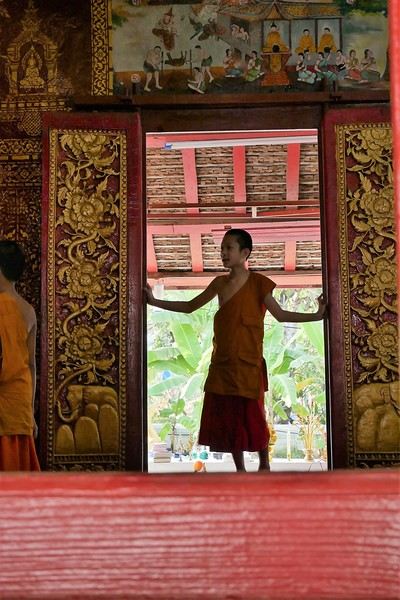 Come along, I'm taking you to this country where it's so nice to wander and slow down...
This trip was in 2023, but when I wanted to write my travel journal, VF was still closed to contributions... So, now that I've just finished my Japan travel journal here, I figured it was high time to honor this destination we came back from so enchanted. Disclaimer 1: This is a written travel journal. There’ll be text! Too much, for some! Disclaimer 2: This is an illustrated travel journal. There’ll be photos! Too many, for some!
I have to say, every time I try to discipline myself, to keep it shorter, to include fewer photos... I end up adding more. It feels like my dear Aunt Nicole, who exhausted us with her slide-show evenings in the 70s/80s, decided to take her revenge. The upside for you, readers, is that you can slip away anytime without offending Aunt Nicole. I won’t even notice!
Anyway, since I love maps, here’s one to give you an idea of where I’m taking you. As you can see, we only saw a tiny part of Laos (the areas circled in red); we only had 3 weeks for ourselves (my husband’s newly retired, I still work), and we prefer taking our time over rushing around like crazy.
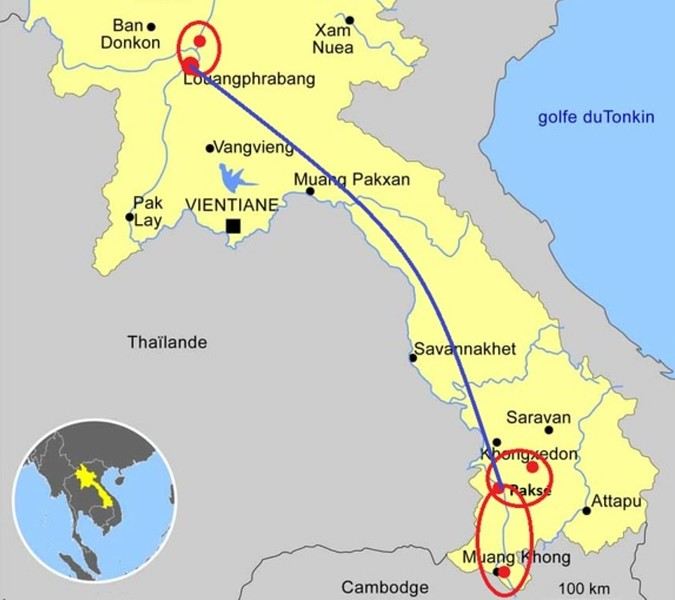
In broad strokes, it was very classic:
First, we “settled in” at Luang Prabang (8 days), because we wanted and needed to. From there, we took three days to venture a little further north—not far in kilometers, but as we know, distances aren’t just about km! Then we flew south to Paksé, letting ourselves drift down to the 4,000 Islands while stopping by the pre-Angkorian archaeological sites. We wrapped up with the Bolaven Plateau.
A few practical notes: We arrived via Bangkok, then took a Bangkok-Luang Prabang flight, having picked up our luggage in Bangkok to check it in for Luang Prabang. No issues—the Bangkok airport, which many of you know, is very well organized. We got our visas on arrival in Luang Prabang. Quick, but to be fair, we were on a “small” plane, and the big flights had arrived earlier, so we weren’t too crowded in line! At the end of our trip, we didn’t fly out of Paksé but from the nearby airport in Thailand, Ubon Ratchathani (a 2.5-hour drive from Paksé), then Bangkok and Paris. You’ll notice we skipped Vientiane to stay longer in Luang Prabang. That said, there’s now a high-speed train between Vientiane and Luang Prabang—good to know—and soon the (Chinese) train will go all the way to Bangkok and even Kuala Lumpur!
With that intro out of the way, let’s dive into the heart of the matter. To be continued: Slowing down the pace... in Luang Prabang
Trip to Thailand and Laos
Hello! 🙂
January 2026 Here we go again for new adventures and the pleasure of sharing them with you here! First of all, I’d like to thank everyone who helped me with the preparations, even with some last-minute improvisations just days before departure. Thanks to Montagnard74, Jojoone1, Songsam, Attila, Dennis2, NadegerFERM, and the authors whose travel journals about Laos inspired me (Montagnard74, Muriel18, Mavietongs...).
In this story, written by Richard and illustrated by me, we’ll tell you about the journey of four friends: Catherine, Richard, Nathalie, and Bruno. A reinvented but overall successful trip, filled with discoveries and surprises, the scents of spices and frangipani flowers, (too) spicy food, sunsets, and... one big mess.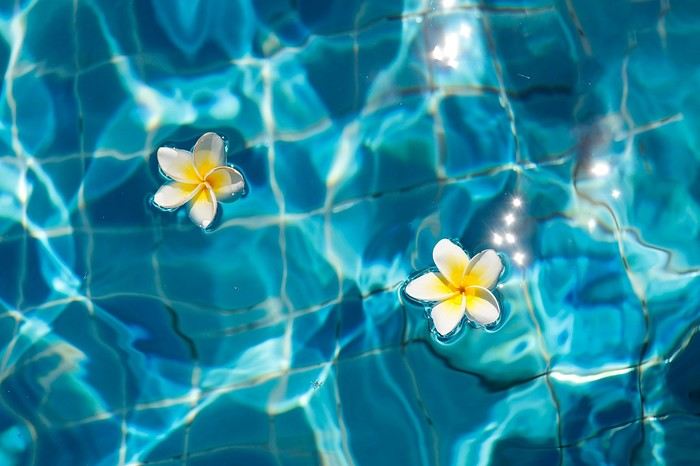
January 2026 Here we go again for new adventures and the pleasure of sharing them with you here! First of all, I’d like to thank everyone who helped me with the preparations, even with some last-minute improvisations just days before departure. Thanks to Montagnard74, Jojoone1, Songsam, Attila, Dennis2, NadegerFERM, and the authors whose travel journals about Laos inspired me (Montagnard74, Muriel18, Mavietongs...).
In this story, written by Richard and illustrated by me, we’ll tell you about the journey of four friends: Catherine, Richard, Nathalie, and Bruno. A reinvented but overall successful trip, filled with discoveries and surprises, the scents of spices and frangipani flowers, (too) spicy food, sunsets, and... one big mess.
In the midst of Kenya's wildlife, October 2025
Hello everyone,
After sharing some safari photos from southern Tanzania, I’d like to show you those from our latest safari in Kenya in October 2025.
First, I’d like to thank Sylvie56, whose previous travel journals about this country inspired our trip choices. Thanks also for the info you sent us via PM. THANK YOU!
The following account is from a simple wildlife enthusiast. You won’t find anything here but images of landscapes, mammals, and birds. The stated purpose of this trip was purely and solely wildlife-focused. (It was in no way a discovery of the country or its people).
This stay/safari began (and ended) in Nairobi, with flights between France and Kenya operated by Qatar Airways departing from Nice.
Over two weeks, we first visited the reserves of Tsavo West and Tsavo East, then after a long road trip, the two reserves of Buffalo Springs and Samburu.
= Please wait until the end of the journal to ask any specific questions (or send them via PM) to keep the story flowing without interruptions or off-topic comments.
Thanks for your understanding.
...
Previous Kenya safari trip in 2017, here:
http://www.image-nature.com/forum/viewtopic.php?f=162&t=61119
...
After sharing some safari photos from southern Tanzania, I’d like to show you those from our latest safari in Kenya in October 2025.
First, I’d like to thank Sylvie56, whose previous travel journals about this country inspired our trip choices. Thanks also for the info you sent us via PM. THANK YOU!
The following account is from a simple wildlife enthusiast. You won’t find anything here but images of landscapes, mammals, and birds. The stated purpose of this trip was purely and solely wildlife-focused. (It was in no way a discovery of the country or its people).
This stay/safari began (and ended) in Nairobi, with flights between France and Kenya operated by Qatar Airways departing from Nice.
Over two weeks, we first visited the reserves of Tsavo West and Tsavo East, then after a long road trip, the two reserves of Buffalo Springs and Samburu.
= Please wait until the end of the journal to ask any specific questions (or send them via PM) to keep the story flowing without interruptions or off-topic comments.
Thanks for your understanding.
...
Previous Kenya safari trip in 2017, here:
http://www.image-nature.com/forum/viewtopic.php?f=162&t=61119
...
7-week trip feedback: Rajasthan and Varanasi, October-November-December 2025
We traveled as a couple from October 20 to December 11, 2025, for our second trip to India and our first time in Rajasthan, plus Mathura and Agra, which are in Uttar Pradesh but right on the border, and a 4-day flight hop to Varanasi.
Here’s a non-detailed trip report—just to share some info we found useful for other travelers, along with a few places and addresses we particularly enjoyed.
First off, a big thank you to (I’m using usernames) Aleph240758, Solene40, Montagnard74, and Pagaljavab, who took the time to reply to me. Some of them even take the time to create detailed and illustrated travel stories. Since I only started planning the trip in mid-August, I didn’t have much time and used the trip reports on VoyageForum to build our itinerary.
One more note: everyone travels differently and has their own preferences... so I’ll just share our personal feelings, which are obviously subjective.
We bought a physical SIM card upon arriving at the airport. The Airtel stand only offers one package for 500 rupees (just under 5 €) for 28 days, with 1.5 GB of data, unlimited national SMS, and calls—more than enough. Contrary to what we’d read, we asked for activation at the counter, and it was active within 10 minutes. The SIM worked well everywhere. Watch out—like in all airports, there’s a tendency to take advantage of tourists. The Airtel counter offers to exchange money directly, and we saw people paying 20 € for the SIM.
Since we arrived at night, the metro wasn’t running anymore. Plus, if you don’t know the city, we’d recommend taking a prepaid taxi—the price is fixed, and the driver knows the destination. Be careful: the prepaid taxi counter is on the right as you exit the hall, with large fixed signs above. Many counters put out a card on the desk saying "prepaid taxi," and even the Airtel stand tries to offer supposedly prepaid taxis, which is completely false. The price they ask for could be double or triple.
Here’s an app that was super useful for us In most big cities, we used "Rapido," an Indian app like Uber, to book auto-rickshaws (you can also book motorbikes or cars). You need a local phone number for this. The big advantage? The price is fixed, though you can still leave a tip. It tracks your ride, and most importantly, the destination is entered—way more practical than hailing an auto-rickshaw on the street, where the driver says "yes, yes," gives a price, and then doesn’t know where to go once you’re on the way. No need to enter a credit card. There’s also OlaCabs, which is similar, but we couldn’t get it to work.
For transportation between stops, we used government buses (RSRTC, blue buses), sometimes taxis via apps or by asking the guesthouse for visits and hard-to-reach places. This choice was really personal and made on the spot. - **Pros:** Buses leave almost every 30 minutes everywhere, giving you a lot of freedom. Every time we left from the bus station (bus stand), we had seats. Several times, we even got to sit in the driver’s cabin! The trip takes longer than a taxi, but not *that* much longer. The price is ridiculously low—1.30 € for 100 km for men, 70 cents for women. The bus stations are in the city centers, unlike many private bus companies. We met some great people. - **Cons:** It’s not exactly clean, and you’re obviously not in the comfort of a taxi. It’s not door-to-door service, so you need to travel light. You can’t stop along the way. If you need to catch the bus mid-route, it’s usually full, and you’ll have to elbow your way in without hesitation. For a short trip, I think hiring a taxi for the whole stay makes sense. Like I said, there’s no one-size-fits-all choice, but there’s no need to be apprehensive about taking public buses.
Here’s our route map, showing the number of nights spent at each stop. Compared to our initial plan, we slept one night in Barmer instead of two because we had time to visit the market in the afternoon, saw the Kiradu site the next morning, and didn’t see the point in staying longer.
We cut two of the six nights in Shekhawati. After our flight to Varanasi was canceled, we had to stay in Delhi, which actually turned out well—it let us arrive in Varanasi earlier and more rested.
The timing worked well for us, with longer stops in Bundi and Udaipur.
Compared to our initial plan, we slept one night in Barmer instead of two because we had time to visit the market in the afternoon, saw the Kiradu site the next morning, and didn’t see the point in staying longer.
We cut two of the six nights in Shekhawati. After our flight to Varanasi was canceled, we had to stay in Delhi, which actually turned out well—it let us arrive in Varanasi earlier and more rested.
The timing worked well for us, with longer stops in Bundi and Udaipur.
I won’t go into detail about each stop here, but I’d be happy to answer any questions. The accommodations and restaurants mentioned are the ones that had that little something extra, and the hearts (❤️❤️❤️) mark the sites we particularly loved.
Tijana Fort Palace - Accommodation and recovery from the trip
Alwar - Palace with museum - Moosi Maharani Ki Chhatri - Large reservoir
Bharatpur Accommodation: Iora Guesthouse, 14 €/night without breakfast—great value, cheap, good meals, close to the reserve Morning at Keoladeo Reserve by bike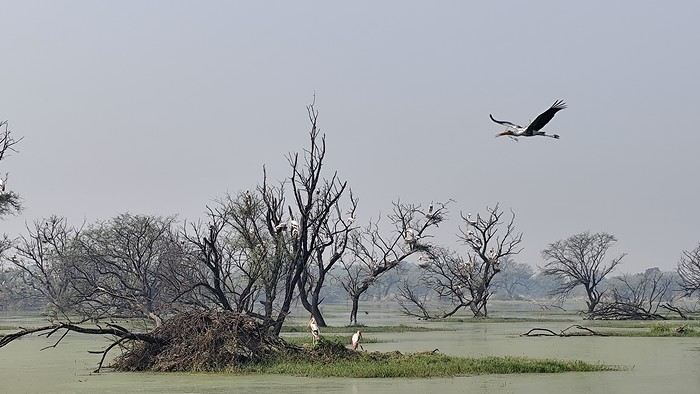
Mathura - Ghats (Yamuna Ghats, Vishram Ghat) to visit in the evening - Market (Chattu Bazar) - Hindu temple Shri Dwarkadheesh dedicated to Krishna - Vrindavan temple Banke Bihari, ❤️❤️❤️ a very important temple with incredible religious fervor - Vrindavan Hindu temple Balaram ISKCON
Agra Accommodation: Shivalayaa - The Divine Abode, 16 €/night with breakfast on Booking—welcoming, clean, close to the Taj Mahal - Mausoleum of Akbar the Great (in Sikandra) ❤️❤️❤️ - Mausoleum of Itimad-ud-Daulah (mini Taj) ❤️❤️❤️ - Visit the Taj early in the morning (closed on Fridays) ❤️❤️❤️ - Agra Fort ❤️❤️❤️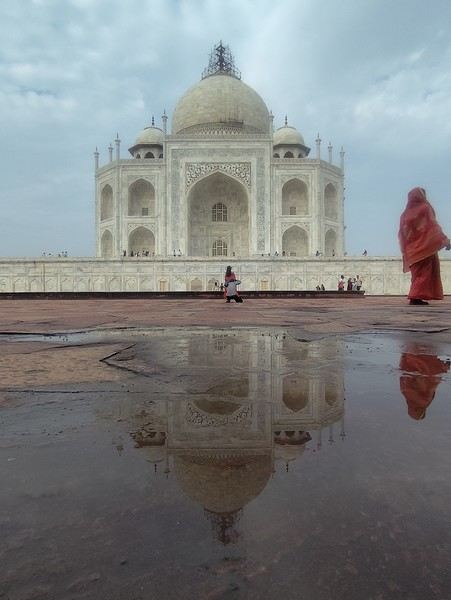
Dholpur - Machkund Temple with its water body - Clock Tower Ghanta Ghar - Royal stepwell Dhaulpur Bavdi
Karauli - City Palace, private visit with a guard ❤️❤️❤️ - Shri Madan Mohan Temple for the puja starting at 5:30 PM ❤️❤️❤️ - Wandering the streets We loved this stop, which is off the main tourist trail, for its pleasant atmosphere
Bhandarej This is a stop as a starting point to visit the Chand Baori stepwell in Abhaneri ❤️❤️❤️ Accommodation: Bhadrawati Palace, 53 €/night with breakfast in Bhandarej—nice, an old palace, warm welcome, booked via Hotels.com We were the only guests and had dinner with the current manager, the grandson of the Maharaja. There’s a pretty stepwell in the village, and we visited a tiny neighborhood temple where we were invited to join in the singing and dancing. Walking through the market was really enjoyable because of the kindness of the locals, who aren’t used to tourism ❤️❤️❤️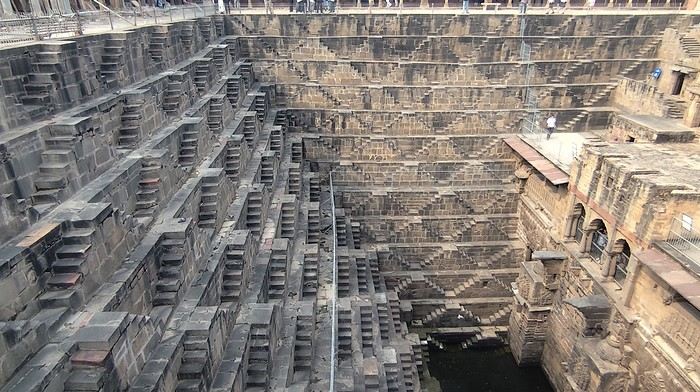
Jaipur - Hawa Mahal (Palace of Winds) - Jal Mahal - Gaitore Ki Chhatriyan ❤️❤️❤️ - Amber Fort ❤️❤️❤️ - Panna Meena Ka Kund stepwell - Galta Ji Temple (Monkey Temple) ❤️❤️❤️ - Bagru, 33 km away: visit to a fabric printing workshop with block prints (I’d noted some addresses on Google Maps). The first workshop wasn’t very welcoming and had no workers because of the humid weather. We were lucky to find another, more welcoming workshop. When the sun came out, the three female workers arrived and started their work—it was a great visit ❤️❤️❤️.
Bundi Accommodation: Hotel Bundi Inn, 25 €/night with breakfast—lovely room in a haveli, good meals with a rooftop view of the fort - Garh Palace Don’t miss: at the exit of the palace, to the left, you can access a beautiful garden with a pool and, at the back, a large hall called Chitrashala ❤️❤️❤️ - Raniji Ki Baori ❤️❤️❤️ - Nahar Dhunk Ki Baori - Chaurasi Khambun Ki Chhatri (cenotaph with 84 pillars) - Ksar Bagh, an interesting set of royal cenotaphs at the end of Jait Sagar Lake. On the other hand, we could’ve skipped Sukh Mahal and its museum. Bundi is still pleasant but is no longer a secret spot.
We bought a physical SIM card upon arriving at the airport. The Airtel stand only offers one package for 500 rupees (just under 5 €) for 28 days, with 1.5 GB of data, unlimited national SMS, and calls—more than enough. Contrary to what we’d read, we asked for activation at the counter, and it was active within 10 minutes. The SIM worked well everywhere. Watch out—like in all airports, there’s a tendency to take advantage of tourists. The Airtel counter offers to exchange money directly, and we saw people paying 20 € for the SIM.
Since we arrived at night, the metro wasn’t running anymore. Plus, if you don’t know the city, we’d recommend taking a prepaid taxi—the price is fixed, and the driver knows the destination. Be careful: the prepaid taxi counter is on the right as you exit the hall, with large fixed signs above. Many counters put out a card on the desk saying "prepaid taxi," and even the Airtel stand tries to offer supposedly prepaid taxis, which is completely false. The price they ask for could be double or triple.
Here’s an app that was super useful for us In most big cities, we used "Rapido," an Indian app like Uber, to book auto-rickshaws (you can also book motorbikes or cars). You need a local phone number for this. The big advantage? The price is fixed, though you can still leave a tip. It tracks your ride, and most importantly, the destination is entered—way more practical than hailing an auto-rickshaw on the street, where the driver says "yes, yes," gives a price, and then doesn’t know where to go once you’re on the way. No need to enter a credit card. There’s also OlaCabs, which is similar, but we couldn’t get it to work.
For transportation between stops, we used government buses (RSRTC, blue buses), sometimes taxis via apps or by asking the guesthouse for visits and hard-to-reach places. This choice was really personal and made on the spot. - **Pros:** Buses leave almost every 30 minutes everywhere, giving you a lot of freedom. Every time we left from the bus station (bus stand), we had seats. Several times, we even got to sit in the driver’s cabin! The trip takes longer than a taxi, but not *that* much longer. The price is ridiculously low—1.30 € for 100 km for men, 70 cents for women. The bus stations are in the city centers, unlike many private bus companies. We met some great people. - **Cons:** It’s not exactly clean, and you’re obviously not in the comfort of a taxi. It’s not door-to-door service, so you need to travel light. You can’t stop along the way. If you need to catch the bus mid-route, it’s usually full, and you’ll have to elbow your way in without hesitation. For a short trip, I think hiring a taxi for the whole stay makes sense. Like I said, there’s no one-size-fits-all choice, but there’s no need to be apprehensive about taking public buses.
Here’s our route map, showing the number of nights spent at each stop.
Compared to our initial plan, we slept one night in Barmer instead of two because we had time to visit the market in the afternoon, saw the Kiradu site the next morning, and didn’t see the point in staying longer.
We cut two of the six nights in Shekhawati. After our flight to Varanasi was canceled, we had to stay in Delhi, which actually turned out well—it let us arrive in Varanasi earlier and more rested.
The timing worked well for us, with longer stops in Bundi and Udaipur.I won’t go into detail about each stop here, but I’d be happy to answer any questions. The accommodations and restaurants mentioned are the ones that had that little something extra, and the hearts (❤️❤️❤️) mark the sites we particularly loved.
Tijana Fort Palace - Accommodation and recovery from the trip
Alwar - Palace with museum - Moosi Maharani Ki Chhatri - Large reservoir
Bharatpur Accommodation: Iora Guesthouse, 14 €/night without breakfast—great value, cheap, good meals, close to the reserve Morning at Keoladeo Reserve by bike
Mathura - Ghats (Yamuna Ghats, Vishram Ghat) to visit in the evening - Market (Chattu Bazar) - Hindu temple Shri Dwarkadheesh dedicated to Krishna - Vrindavan temple Banke Bihari, ❤️❤️❤️ a very important temple with incredible religious fervor - Vrindavan Hindu temple Balaram ISKCON
Agra Accommodation: Shivalayaa - The Divine Abode, 16 €/night with breakfast on Booking—welcoming, clean, close to the Taj Mahal - Mausoleum of Akbar the Great (in Sikandra) ❤️❤️❤️ - Mausoleum of Itimad-ud-Daulah (mini Taj) ❤️❤️❤️ - Visit the Taj early in the morning (closed on Fridays) ❤️❤️❤️ - Agra Fort ❤️❤️❤️
Dholpur - Machkund Temple with its water body - Clock Tower Ghanta Ghar - Royal stepwell Dhaulpur Bavdi
Karauli - City Palace, private visit with a guard ❤️❤️❤️ - Shri Madan Mohan Temple for the puja starting at 5:30 PM ❤️❤️❤️ - Wandering the streets We loved this stop, which is off the main tourist trail, for its pleasant atmosphere
Bhandarej This is a stop as a starting point to visit the Chand Baori stepwell in Abhaneri ❤️❤️❤️ Accommodation: Bhadrawati Palace, 53 €/night with breakfast in Bhandarej—nice, an old palace, warm welcome, booked via Hotels.com We were the only guests and had dinner with the current manager, the grandson of the Maharaja. There’s a pretty stepwell in the village, and we visited a tiny neighborhood temple where we were invited to join in the singing and dancing. Walking through the market was really enjoyable because of the kindness of the locals, who aren’t used to tourism ❤️❤️❤️
Jaipur - Hawa Mahal (Palace of Winds) - Jal Mahal - Gaitore Ki Chhatriyan ❤️❤️❤️ - Amber Fort ❤️❤️❤️ - Panna Meena Ka Kund stepwell - Galta Ji Temple (Monkey Temple) ❤️❤️❤️ - Bagru, 33 km away: visit to a fabric printing workshop with block prints (I’d noted some addresses on Google Maps). The first workshop wasn’t very welcoming and had no workers because of the humid weather. We were lucky to find another, more welcoming workshop. When the sun came out, the three female workers arrived and started their work—it was a great visit ❤️❤️❤️.
Bundi Accommodation: Hotel Bundi Inn, 25 €/night with breakfast—lovely room in a haveli, good meals with a rooftop view of the fort - Garh Palace Don’t miss: at the exit of the palace, to the left, you can access a beautiful garden with a pool and, at the back, a large hall called Chitrashala ❤️❤️❤️ - Raniji Ki Baori ❤️❤️❤️ - Nahar Dhunk Ki Baori - Chaurasi Khambun Ki Chhatri (cenotaph with 84 pillars) - Ksar Bagh, an interesting set of royal cenotaphs at the end of Jait Sagar Lake. On the other hand, we could’ve skipped Sukh Mahal and its museum. Bundi is still pleasant but is no longer a secret spot.
Your recommendations for Bangkok lovers
Hello everyone! :)
Our next trip to Thailand is coming up, and we just can't wait! We talk, eat, drink, and dream Thailand 😏
Our itinerary is mostly set, and we’ve found quite a few new things to explore, but I’d still love to hear your recommendations for Bangkok. Just so you know: we love this city, and every time we visit, we spend several days there without ever feeling like we’ve seen it all. So this year, we’re staying for 8 days! Here’s what we have planned this year: * Exploring Nonthaburi * A day trip to Nakhon Pathom (to test out our basic Thai skills 😛) * Khlong Lat Mayom floating market (we went 10 years ago—it’s probably changed a lot!) * The Erawan Museum (we visited Muang Boran on our last trip) * Finally taking the time to check out Wat Phra Sri Maha Mariamman and Wat Yannawa (we’ve planned to go several times but never made it—are they worth a visit?)
This is what we’ve picked so far, but I’d love to hear about the favorite spots and recommendations from travelers who, like us, adore Bangkok.
Thanks in advance for your help!
Laetitia and Benjamin.
Our next trip to Thailand is coming up, and we just can't wait! We talk, eat, drink, and dream Thailand 😏
Our itinerary is mostly set, and we’ve found quite a few new things to explore, but I’d still love to hear your recommendations for Bangkok. Just so you know: we love this city, and every time we visit, we spend several days there without ever feeling like we’ve seen it all. So this year, we’re staying for 8 days! Here’s what we have planned this year: * Exploring Nonthaburi * A day trip to Nakhon Pathom (to test out our basic Thai skills 😛) * Khlong Lat Mayom floating market (we went 10 years ago—it’s probably changed a lot!) * The Erawan Museum (we visited Muang Boran on our last trip) * Finally taking the time to check out Wat Phra Sri Maha Mariamman and Wat Yannawa (we’ve planned to go several times but never made it—are they worth a visit?)
This is what we’ve picked so far, but I’d love to hear about the favorite spots and recommendations from travelers who, like us, adore Bangkok.
Thanks in advance for your help!
Laetitia and Benjamin.
Cantal—have you heard of it?
...
After Southern Tanzania, I’m sharing a travel story about the Cantal region with you...
...
For us, at the start of 2025, Le CANTAL was a true “Terra Incognita”!!
After seeing some tempting TV reports, we decided to fill this gap—especially in terms of landscapes. On the same trip, we’ll also head to the Arcachon Basin, the International Seaplane Gathering in Biscarrosse, and my native Landes region...
So, on May 20th, we left Marseille in the rain and thunder, heading toward Nîmes, Saint-Hippolyte, Mont Aigoual, Florac, and stopping in Marvejols to give my arthritic back a break for the night.
The next morning, we decided to revisit the Parc aux Loups du Gévaudan (Europe’s largest wolf park). As someone used to photo safaris in the wilds of East Africa, I’m not a fan of zoos at all—but I *do* have a deep admiration for wolves!!
Since it’s pretty unlikely I’ll ever see one in the wild, I’ll settle for this Parc aux Loups in Marvejols. This will be our third visit to this incredible gathering of these fascinating canines.
Some are still finishing their chilly night...
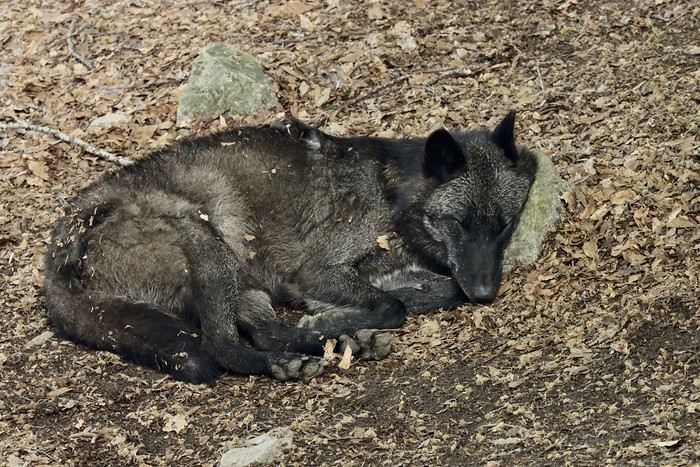
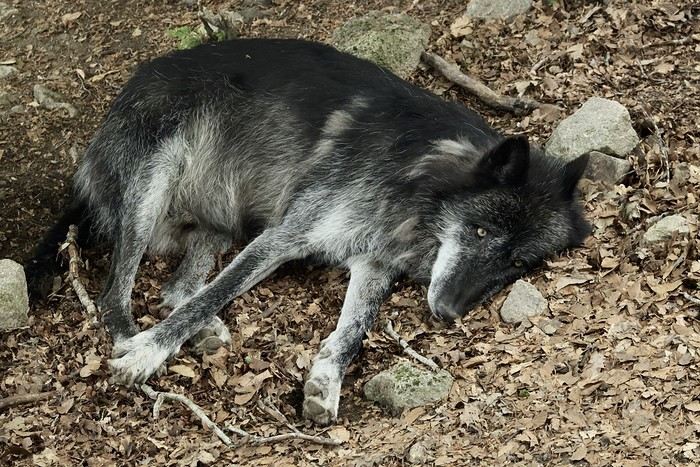
...
After Southern Tanzania, I’m sharing a travel story about the Cantal region with you...
...
For us, at the start of 2025, Le CANTAL was a true “Terra Incognita”!!
After seeing some tempting TV reports, we decided to fill this gap—especially in terms of landscapes. On the same trip, we’ll also head to the Arcachon Basin, the International Seaplane Gathering in Biscarrosse, and my native Landes region...
So, on May 20th, we left Marseille in the rain and thunder, heading toward Nîmes, Saint-Hippolyte, Mont Aigoual, Florac, and stopping in Marvejols to give my arthritic back a break for the night.
The next morning, we decided to revisit the Parc aux Loups du Gévaudan (Europe’s largest wolf park). As someone used to photo safaris in the wilds of East Africa, I’m not a fan of zoos at all—but I *do* have a deep admiration for wolves!!
Since it’s pretty unlikely I’ll ever see one in the wild, I’ll settle for this Parc aux Loups in Marvejols. This will be our third visit to this incredible gathering of these fascinating canines.
Some are still finishing their chilly night...
...
Review of a Norway cruise on the Emerald Princess in June 2025 (1)
Hello everyone,
I’ve wanted to take this Norway cruise for a very long time. The first time I booked it was in July 2020 with Azamara. Unfortunately, it was canceled, as everyone remembers. When I tried to book it again, the prices (already a bit high with Azamara) had simply doubled. So, since then, I’ve been keeping an eye out every year for any opportunities...
The last time we sailed with Princess was eleven years ago, and things didn’t go very well. I came back pretty unhappy with their service and quite disappointed. Despite the $600 they gave me as credit for a future cruise, I’d never set foot on one of their ships again.
But this time, the opportunity arose—a fantastic itinerary with lots of stops, a reasonable price for 16 nights (I’ll share the details in the conclusion), and a ship that’s not too big, so to speak, with only 3,000 passengers. I’m not expecting much from the cruise line this time and am boarding the ship with low expectations beyond the itinerary.
Princess has introduced an app to download before the cruise. It’s essential because online check-in is no longer available, and the agency doesn’t send a travel journal. Everything is done through the app. After completing the check-in on the app, we only know that we’ll need to pick up our key, the Medallion, at embarkation by following the blue line in the terminal and presenting our passport.
Up until our departure, the weather forecast for the coming week in Norway is disastrous—rain, rain, and more rain. It was pretty much the same two years ago before our Iceland cruise, and in the end, the weather turned out fine.
If you’re ready to embark on the Emerald Princess to discover this beautiful cruise and the stunning landscapes of Norway, let’s go!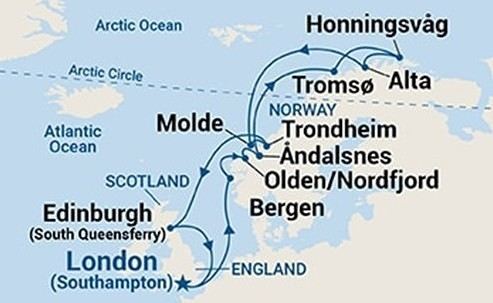
Southampton - Sea day - Bergen - Olden - Åndalsnes - Sea day - Tromsø - Honningsvåg (North Cape) - Alta - Sea day - Molde - Trondheim - Two sea days - Edinburgh - Sea day - Southampton
I’ve wanted to take this Norway cruise for a very long time. The first time I booked it was in July 2020 with Azamara. Unfortunately, it was canceled, as everyone remembers. When I tried to book it again, the prices (already a bit high with Azamara) had simply doubled. So, since then, I’ve been keeping an eye out every year for any opportunities...
The last time we sailed with Princess was eleven years ago, and things didn’t go very well. I came back pretty unhappy with their service and quite disappointed. Despite the $600 they gave me as credit for a future cruise, I’d never set foot on one of their ships again.
But this time, the opportunity arose—a fantastic itinerary with lots of stops, a reasonable price for 16 nights (I’ll share the details in the conclusion), and a ship that’s not too big, so to speak, with only 3,000 passengers. I’m not expecting much from the cruise line this time and am boarding the ship with low expectations beyond the itinerary.
Princess has introduced an app to download before the cruise. It’s essential because online check-in is no longer available, and the agency doesn’t send a travel journal. Everything is done through the app. After completing the check-in on the app, we only know that we’ll need to pick up our key, the Medallion, at embarkation by following the blue line in the terminal and presenting our passport.
Up until our departure, the weather forecast for the coming week in Norway is disastrous—rain, rain, and more rain. It was pretty much the same two years ago before our Iceland cruise, and in the end, the weather turned out fine.
If you’re ready to embark on the Emerald Princess to discover this beautiful cruise and the stunning landscapes of Norway, let’s go!
Southampton - Sea day - Bergen - Olden - Åndalsnes - Sea day - Tromsø - Honningsvåg (North Cape) - Alta - Sea day - Molde - Trondheim - Two sea days - Edinburgh - Sea day - Southampton
Croatia, Montenegro – two victims of overtourism?
Mid-June, two Auvergnats on the starting blocks—off we go to the former Yugoslavia!
We’d already explored some nooks and crannies of northern Croatia back in 2019, so we’re keeping the momentum going by planning a trip to the south of the country and then Montenegro.
On the way back, we’ll drift into Bosnia-Herzegovina just to mix things up a bit!
We’re a little unsure about what to expect in terms of tourist crowds.
Dubrovnik has a reputation for being the hardest-hit city by overtourism, and Kotor and the whole Dalmatian coast aren’t exactly empty...
Luckily, most European countries haven’t started school holidays yet, and some measures seem to have been put in place to limit the flow (like restrictions on the number of cruise ships allowed to dock at the same time).
Maybe we’ll manage to escape the promised hell?
For now, we’re slamming the doors of the Scirocco and heading off to our first stop: northern Italy!
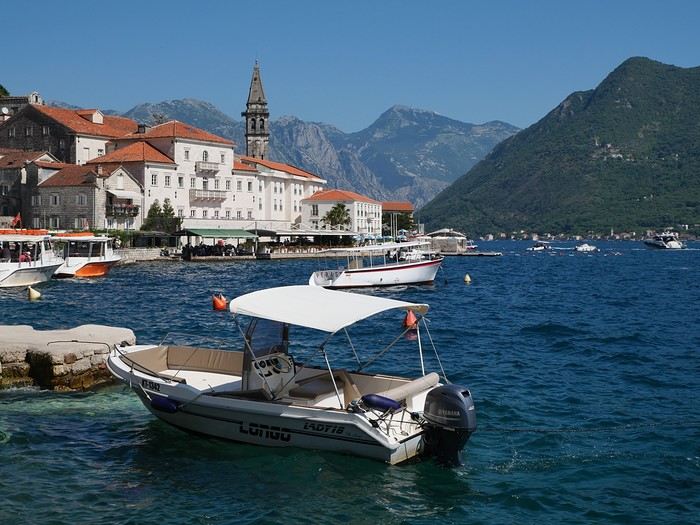
On the way back, we’ll drift into Bosnia-Herzegovina just to mix things up a bit!
We’re a little unsure about what to expect in terms of tourist crowds.
Dubrovnik has a reputation for being the hardest-hit city by overtourism, and Kotor and the whole Dalmatian coast aren’t exactly empty...
Luckily, most European countries haven’t started school holidays yet, and some measures seem to have been put in place to limit the flow (like restrictions on the number of cruise ships allowed to dock at the same time).
Maybe we’ll manage to escape the promised hell?
For now, we’re slamming the doors of the Scirocco and heading off to our first stop: northern Italy!
Kattegat Tour and Norway’s Majestic Fjords – 32 Days (Denmark, Sweden, Norway)
Kattegat isn’t just the name of the village in the TV series *Vikings*—it’s also the stretch of water separating Denmark from Sweden... the sea, basically! And further north, you’ve got Norway and its fjords!
Originally, I’d planned to just do a loop around Kattegat, with the *Under* restaurant in Lindesnes as our anniversary treat... but along the way, we thought, why not "push" a little further north, keeping an eye on the budget since we’d chosen to travel by car in June 2025 through Scandinavia.
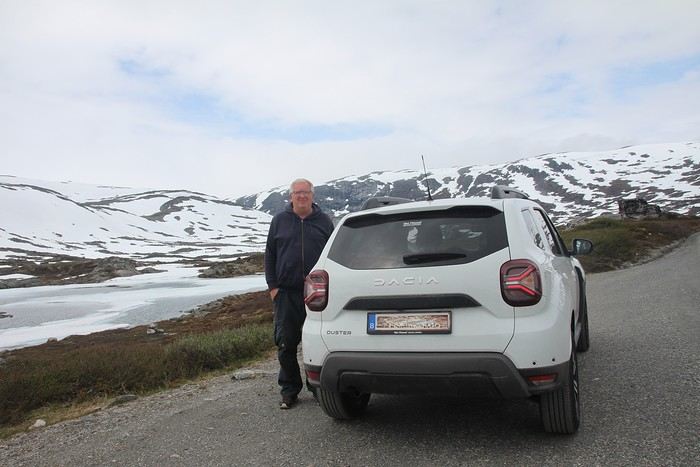
Why by car when most travelers opt for a camper van, while others prefer the comfort of cruises? Well, because we don’t own a camper van, renting one is pricey, and then you’ve got to add fuel costs (those things guzzle gas!), ferry fees, and other "tolls." All things considered, we went for mostly rentals—especially since there were four of us at the start of the trip. We spent the first week in Denmark with our daughter and son-in-law. Then they flew back to Belgium, and we continued our adventure as a couple. For accommodation, we mainly booked Airbnb apartments, which helped keep costs down and, most importantly, let us prepare our own meals (diet, diet!). In this travel journal, you’ll discover (or rediscover, for those who followed my older ones) our unbridled love for theme parks, museums, unique experiences, and—especially in Denmark—Legos! Unfortunately, we didn’t do any hikes this year because the unpredictable weather had made the trails slippery, and since I’d already taken three tumbles during the trip, I didn’t want to risk another! In the end, we traveled for 32 days, covered 6,200 km, and most importantly, discovered the charming country of Denmark, marveled at Norway’s breathtaking fjords—all without suffering the heatwave that hit France and Belgium that June! If you’ve got any questions, don’t hesitate to ask!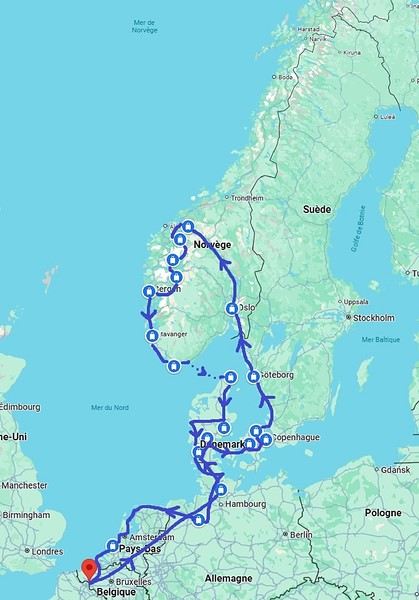
Why by car when most travelers opt for a camper van, while others prefer the comfort of cruises? Well, because we don’t own a camper van, renting one is pricey, and then you’ve got to add fuel costs (those things guzzle gas!), ferry fees, and other "tolls." All things considered, we went for mostly rentals—especially since there were four of us at the start of the trip. We spent the first week in Denmark with our daughter and son-in-law. Then they flew back to Belgium, and we continued our adventure as a couple. For accommodation, we mainly booked Airbnb apartments, which helped keep costs down and, most importantly, let us prepare our own meals (diet, diet!). In this travel journal, you’ll discover (or rediscover, for those who followed my older ones) our unbridled love for theme parks, museums, unique experiences, and—especially in Denmark—Legos! Unfortunately, we didn’t do any hikes this year because the unpredictable weather had made the trails slippery, and since I’d already taken three tumbles during the trip, I didn’t want to risk another! In the end, we traveled for 32 days, covered 6,200 km, and most importantly, discovered the charming country of Denmark, marveled at Norway’s breathtaking fjords—all without suffering the heatwave that hit France and Belgium that June! If you’ve got any questions, don’t hesitate to ask!
Wood in all its forms – July 2025 photography contest
Hi everyone,
This month’s contest theme is WOOD. Wood as a plant material—roots, trunks, branches that make up a tree. Dead or alive, splinters and knots. Sawdust too. Firewood, from the woodshed to the hearth. Wood as a crafting material and all the things it can become: from a spoon to a violin, a boat to a stave church, and so much more—way too long to list! 😉
Technical details:
1. Each of you can post up to 3 photos. One photo per message, numbered 1 to 3. Along with the shot, feel free to share a few written details—location, context, anecdote, or photography technique. Photos can be submitted until Tuesday, July 22 at midnight, Milan time.
2. Voting will take place from Wednesday, July 23 at 00:00 until Tuesday, July 29 at midnight. All forum members can vote for their 3 favorite photos, listing the photographer’s name and the photo number in order of preference: 3 points for first place, 2 for second, and 1 for third.
3. Results will be announced on Wednesday, July 30 during the day. In case of a tie, the number of first-place votes will decide. Photos already featured on a podium are not eligible to compete.
The winner will have the special privilege of organizing August’s contest.
This thread is reserved for contest photos. For other wood-themed photos and general discussions, head here.

Alright, your turn! 😛
Catherine
This month’s contest theme is WOOD. Wood as a plant material—roots, trunks, branches that make up a tree. Dead or alive, splinters and knots. Sawdust too. Firewood, from the woodshed to the hearth. Wood as a crafting material and all the things it can become: from a spoon to a violin, a boat to a stave church, and so much more—way too long to list! 😉
Technical details:
1. Each of you can post up to 3 photos. One photo per message, numbered 1 to 3. Along with the shot, feel free to share a few written details—location, context, anecdote, or photography technique. Photos can be submitted until Tuesday, July 22 at midnight, Milan time.
2. Voting will take place from Wednesday, July 23 at 00:00 until Tuesday, July 29 at midnight. All forum members can vote for their 3 favorite photos, listing the photographer’s name and the photo number in order of preference: 3 points for first place, 2 for second, and 1 for third.
3. Results will be announced on Wednesday, July 30 during the day. In case of a tie, the number of first-place votes will decide. Photos already featured on a podium are not eligible to compete.
The winner will have the special privilege of organizing August’s contest.
This thread is reserved for contest photos. For other wood-themed photos and general discussions, head here.
Alright, your turn! 😛
Catherine
Second trip to Iceland
We stayed in Iceland from August 27 to September 13, 2023. Actually, this was our second trip to the island.
During our first visit, we rented a camper van from Snail Motorhome Rental, a family-run business that provided outstanding service.
Unfortunately, we discovered that this company no longer exists.
So, we rented a camper van through a third party, specifically via the Nordic Travel Group website.
We chose City Car Rental, located near Keflavik Airport, because the rental cost was really appealing.
Apart from the quality of the sleeping bags and the size of the pillows we rented, our experience with this company was very positive.
We noticed a significant increase in tourism since our last trip in 2015.
Several sites have been redeveloped, and parking is now paid in many places.
Accommodations have multiplied, not only near major cities but also in remote areas.
One notable advantage, however, was discovering the wide variety of food products available in supermarkets. In 2015, the selection was very limited.
I invite you to continue reading this travel journal and watch the videos that will let you explore this destination, which has everything to charm outdoor enthusiasts.
Videos are embedded throughout the summary. Click on the image to start the video.
To jump to a specific post, here are the relevant links:
Hlauptungufoss, Midfoss and Bruarfoss Geysir, Blesi and Strokkur Gullfoss Brúarhlöð Canyon Faxafoss Kiðjabergsvöllur – Belvedere Kerið Crater Reykjadalur Valley – Hike to the hot springs Seljalandsfoss Gljúfrabúi Waterfall Seljavallalaug – One of Iceland’s oldest geothermal pools Skógafoss – Fimmvörðuháls hiking trail (partial) Kvernufoss Plane wreck at Solheimasandur Dyrhólaey Peninsula Reynisfjara Beach – Puffins and seals Vík í Mýrdal Fjaðrárgljúfur Canyon Skaftafell National Park – Svartifoss, Magnusarfoss & Hundafoss Svínafellsjökull Glacier Hofskirkja Church Fjallsárlón Glacial Lagoon (West) Fjallsárlón Glacial Lagoon (East) Jökulsárlón Glacial Lagoon Litlanefsfoss and Hengifoss Rjúkandi (Rjúkandafoss) Stuðlagil Canyon Selfoss and Dettifoss Krafla – Viti Crater Lake Krafla – Leirhnjúkur Lava Field Hverir Geothermal Site (Námafjall) Hverir – Hverarönd Geothermal Site – Blue Lagoon Grjótagjá – Hot Spring Cave Stóragjá – Hot Spring Cave Goðafoss Akureyri Zipline Hofsós – Pool by the Skagafjörður Fjord Víðimýrarkirkja Church Hvítserkur Rock – The Troll of Northwest Iceland Gislahellir (Gisli's Cave) Dynjandi (Fjallfoss) – One of Iceland’s most beautiful waterfalls Hellulaug (Natural hot spring pool) Stykkishólmur – Stykkishólmshöfn Port Kirkjufell & Kirkjufellsfoss Ólafsvík – Bugsfoss Lóndrangar Basalt Columns Arnarstapi Ytri-Tunga Farm – Seal watching Deildartunguhver Hot Spring Hraunfossar & Barnafoss Exploring Reykjavik Reykjavik – Whale Safari – Whale watching Raufarholshellir Lava Tunnel Gígvatnsvatn Lake (Green Lake/Graenevatn) Seltún Geothermal Site (Krýsuvík) Kleifarvatn Lake Blue Lagoon Thermal Spa Gunnuhver Geothermal Site Reykjanes Peninsula – Reykjanesviti Lighthouse Reykjanes Peninsula – Valahnúkamöl – Reykjanestá Ægissíðufoss Super Jeep excursion to Landmannalaugar Hiking in Landmannalaugar Scenery along the way
During our first visit, we rented a camper van from Snail Motorhome Rental, a family-run business that provided outstanding service.
Unfortunately, we discovered that this company no longer exists.
So, we rented a camper van through a third party, specifically via the Nordic Travel Group website.
We chose City Car Rental, located near Keflavik Airport, because the rental cost was really appealing.
Apart from the quality of the sleeping bags and the size of the pillows we rented, our experience with this company was very positive.
We noticed a significant increase in tourism since our last trip in 2015.
Several sites have been redeveloped, and parking is now paid in many places.
Accommodations have multiplied, not only near major cities but also in remote areas.
One notable advantage, however, was discovering the wide variety of food products available in supermarkets. In 2015, the selection was very limited.
I invite you to continue reading this travel journal and watch the videos that will let you explore this destination, which has everything to charm outdoor enthusiasts.
Videos are embedded throughout the summary. Click on the image to start the video.
To jump to a specific post, here are the relevant links:
Hlauptungufoss, Midfoss and Bruarfoss Geysir, Blesi and Strokkur Gullfoss Brúarhlöð Canyon Faxafoss Kiðjabergsvöllur – Belvedere Kerið Crater Reykjadalur Valley – Hike to the hot springs Seljalandsfoss Gljúfrabúi Waterfall Seljavallalaug – One of Iceland’s oldest geothermal pools Skógafoss – Fimmvörðuháls hiking trail (partial) Kvernufoss Plane wreck at Solheimasandur Dyrhólaey Peninsula Reynisfjara Beach – Puffins and seals Vík í Mýrdal Fjaðrárgljúfur Canyon Skaftafell National Park – Svartifoss, Magnusarfoss & Hundafoss Svínafellsjökull Glacier Hofskirkja Church Fjallsárlón Glacial Lagoon (West) Fjallsárlón Glacial Lagoon (East) Jökulsárlón Glacial Lagoon Litlanefsfoss and Hengifoss Rjúkandi (Rjúkandafoss) Stuðlagil Canyon Selfoss and Dettifoss Krafla – Viti Crater Lake Krafla – Leirhnjúkur Lava Field Hverir Geothermal Site (Námafjall) Hverir – Hverarönd Geothermal Site – Blue Lagoon Grjótagjá – Hot Spring Cave Stóragjá – Hot Spring Cave Goðafoss Akureyri Zipline Hofsós – Pool by the Skagafjörður Fjord Víðimýrarkirkja Church Hvítserkur Rock – The Troll of Northwest Iceland Gislahellir (Gisli's Cave) Dynjandi (Fjallfoss) – One of Iceland’s most beautiful waterfalls Hellulaug (Natural hot spring pool) Stykkishólmur – Stykkishólmshöfn Port Kirkjufell & Kirkjufellsfoss Ólafsvík – Bugsfoss Lóndrangar Basalt Columns Arnarstapi Ytri-Tunga Farm – Seal watching Deildartunguhver Hot Spring Hraunfossar & Barnafoss Exploring Reykjavik Reykjavik – Whale Safari – Whale watching Raufarholshellir Lava Tunnel Gígvatnsvatn Lake (Green Lake/Graenevatn) Seltún Geothermal Site (Krýsuvík) Kleifarvatn Lake Blue Lagoon Thermal Spa Gunnuhver Geothermal Site Reykjanes Peninsula – Reykjanesviti Lighthouse Reykjanes Peninsula – Valahnúkamöl – Reykjanestá Ægissíðufoss Super Jeep excursion to Landmannalaugar Hiking in Landmannalaugar Scenery along the way
15 days in Texas in October 2022
Ah! This trip to Texas, postponed so many times because of Covid. I wanted to discover this state, but not in the summer due to the temperatures.
I’ll try to dig into my memories since I didn’t take any notes.
Day 1: Departure
Early morning flight from Lyon to Frankfurt (I often fly with Lufthansa). We only have a 50-minute layover, but I trust German organization—it’s not just talk, since it took us only 30 minutes to get to the boarding gate. Arriving in Houston, we’re excited because it’s been 3 years since we last visited the USA, and we’ve missed it.
Everything goes smoothly with the formalities and the car rental, so 1.5 hours after landing, I park near Sam Houston Park to start our discovery. The park is pretty, clean, and has the unique feature of housing some well-preserved Victorian houses. The sun is shining, and it’s always fun to see old wooden houses surrounded by gleaming skyscrapers. A quick drive to the Rothko Chapel, which is dedicated to all faiths. There are also modern artworks in an annex building and outside. Then we head to Pasadena to reach our hotel and go to bed since we’ve been awake for a while!
Hotel: A classic Days Inn. It’s standard, but the beds are comfortable, and it’s a quiet place. The + of the day: We're back in the USA The -: Nothing
Day 2: NASA and then Galveston
Of course, we wake up super early. A quick trip to the nearby Walmart for the usual small purchases. Surprise—I can’t buy a bottle of California white wine because in Texas, there are set hours for buying alcohol. Talk about a bummer for my apéro! Next, we head to Kemah, a small, hyper-touristy port where everything is kitschy but clean and nice. It’s a bit overdone, but since NASA doesn’t open until 10 AM and it’s still early, we might as well enjoy the good weather in a pleasant spot.
We arrive at the NASA Houston center without any issues. It’s smaller than the one in Florida and organized a bit differently. There are trains that take passengers to the different sites, but you need to get tickets (included in the price), and once you’ve finished visiting one site, you have to return to the center to get a ticket for another. Not very practical.
We choose to visit the training center and the rockets, skipping the control room, which, based on the photos, looks like the one at Cape Canaveral. The training center is a cool place because it’s still in use. Engineers are working on machines and computers. We don’t see any astronauts training, but we see the space chair, the shuttle’s robotic arm, and lots of gadgets—this hangar is like Gyro Gearloose’s or Doc’s domain!
Next, we head to the rocket hangar, featuring the Saturn V, the same one as at Cape Canaveral. Finally, we wrap up our tour by returning to the center, where a Boeing 747 with a shuttle attached to its back dominates the outside. We can visit the shuttle, and we don’t miss the chance.
A few exhibits inside complete the experience and satisfy our thirst for knowledge. I love the space exploration era, and gotta say, the Americans do it right. Then we drive to Galveston, about 100 km away. Why Galveston? It’s by the sea, so swimming in late October isn’t unpleasant, and there’s a neighborhood called East End Historic District filled with stunning Victorian houses, each more beautiful than the last. Plus, it’s Halloween season, so the decorations are over the top! They really go all out!
Madame takes a swim, but I find the water too cold for my taste. Apéro (they didn’t trick me twice—I had time to go back to another Walmart!) Dinner + bedtime
Hotel: A classic Quality Inn. No issues. The +: NASA, even if it’s smaller than Cape Canaveral The -: I would’ve preferred the water in the Gulf of Mexico to be a bit warmer
Day 1: Departure
Early morning flight from Lyon to Frankfurt (I often fly with Lufthansa). We only have a 50-minute layover, but I trust German organization—it’s not just talk, since it took us only 30 minutes to get to the boarding gate. Arriving in Houston, we’re excited because it’s been 3 years since we last visited the USA, and we’ve missed it.
Everything goes smoothly with the formalities and the car rental, so 1.5 hours after landing, I park near Sam Houston Park to start our discovery. The park is pretty, clean, and has the unique feature of housing some well-preserved Victorian houses. The sun is shining, and it’s always fun to see old wooden houses surrounded by gleaming skyscrapers. A quick drive to the Rothko Chapel, which is dedicated to all faiths. There are also modern artworks in an annex building and outside. Then we head to Pasadena to reach our hotel and go to bed since we’ve been awake for a while!
Hotel: A classic Days Inn. It’s standard, but the beds are comfortable, and it’s a quiet place. The + of the day: We're back in the USA The -: Nothing
Day 2: NASA and then Galveston
Of course, we wake up super early. A quick trip to the nearby Walmart for the usual small purchases. Surprise—I can’t buy a bottle of California white wine because in Texas, there are set hours for buying alcohol. Talk about a bummer for my apéro! Next, we head to Kemah, a small, hyper-touristy port where everything is kitschy but clean and nice. It’s a bit overdone, but since NASA doesn’t open until 10 AM and it’s still early, we might as well enjoy the good weather in a pleasant spot.
We arrive at the NASA Houston center without any issues. It’s smaller than the one in Florida and organized a bit differently. There are trains that take passengers to the different sites, but you need to get tickets (included in the price), and once you’ve finished visiting one site, you have to return to the center to get a ticket for another. Not very practical.
We choose to visit the training center and the rockets, skipping the control room, which, based on the photos, looks like the one at Cape Canaveral. The training center is a cool place because it’s still in use. Engineers are working on machines and computers. We don’t see any astronauts training, but we see the space chair, the shuttle’s robotic arm, and lots of gadgets—this hangar is like Gyro Gearloose’s or Doc’s domain!
Next, we head to the rocket hangar, featuring the Saturn V, the same one as at Cape Canaveral. Finally, we wrap up our tour by returning to the center, where a Boeing 747 with a shuttle attached to its back dominates the outside. We can visit the shuttle, and we don’t miss the chance.
A few exhibits inside complete the experience and satisfy our thirst for knowledge. I love the space exploration era, and gotta say, the Americans do it right. Then we drive to Galveston, about 100 km away. Why Galveston? It’s by the sea, so swimming in late October isn’t unpleasant, and there’s a neighborhood called East End Historic District filled with stunning Victorian houses, each more beautiful than the last. Plus, it’s Halloween season, so the decorations are over the top! They really go all out!
Madame takes a swim, but I find the water too cold for my taste. Apéro (they didn’t trick me twice—I had time to go back to another Walmart!) Dinner + bedtime
Hotel: A classic Quality Inn. No issues. The +: NASA, even if it’s smaller than Cape Canaveral The -: I would’ve preferred the water in the Gulf of Mexico to be a bit warmer
Zambia in Summer 2024 – Self-Drive Trip
Well, here we go,
despite the lack of info on Zambia, I managed to pull off this pretty special trip.
I’d posted asking for tips but got very few replies. So I leaned heavily on Giradhino’s travel journal to plan the route.
The context: After visiting Kenya, then Namibia, then Botswana, I wanted to see another Southern African country—hence Zambia. This time, we’re two couples: us (of course) and our friends we’ve traveled with to the last two countries mentioned. The idea was to do a self-drive trip, picking up a 4x4 at the airport and figuring it out as we went.
We rented our fully equipped vehicle from Hemingways, an agency in Livingstone. Great agency (really), I’ll talk more about them later. It came with rooftop tents and all the gear for cooking and everything... However, our goal was to sleep in lodges and only use the tents as a last resort. Mission accomplished—we never even unfolded the tents. Guess we’re getting old 🙂
The route (summary): Lusaka - Kasanka NP - Bangweulu NP - Mutinondo - Kapishya - North Luangwa - South Luangwa and back to Lusaka.
That said, let’s hit the road for this travel journal of a pretty lively trip. Reminder: I’m more of a filmmaker, so I’ve got tons of footage but very few photos. The ones I have were taken on my phone, so they’re not great quality. My wife’s the one who handles that side of things.
Day 1:
At 9 a.m. sharp (or close enough), we leave the Lyon area, heading to Paris CDG. Our flight’s at 9:30 p.m., but it’s a busy Saturday with holiday traffic, so we play it safe to avoid jams—especially since the Olympics (hosted in Paris, in case you didn’t know) are causing extra traffic issues.
We’re relaxed and happy to be on our way. The drive goes smoothly. We take the eastern route around Paris to reach a hotel with parking at a better price than the airport lots. We leave the car there, and a shuttle takes us to Terminal 2. Bad luck—we’re actually flying from Terminal 1! The transfer between terminals is quick, though, so no stress.
After the usual formalities (with Rwandair), we end up in the Duty Free.
A rare rant-free moment: Usually, I let off steam in my travel journals now and then, but this time it’s the opposite. I had a terrible memory of CDG and had been avoiding it for years. But this time—Olympics effect? A big change? What a pleasant surprise! The staff were plentiful and super friendly at every pre-flight step, making everything easier. Comfortable seats for waiting to board. Well done, CDG!
We buy Ricard, Jack Daniel’s, and Get 27 to handle any situation that might come up. We board on time, and that’s when our adventures with Rwandair really begin. Yep, the first hiccup!
We’d booked our tickets back in October and (since we don’t hold back!) had paid extra for preferred seats on all our flights. Since October, we’d received emails about schedule changes—just a few minutes here and there. Unfortunately, we never got an email saying that *on top of* the schedule change, the plane’s configuration had also changed. So when we boarded with our seats (all four of us together at row 25), we were furious to see that the preferred seats were now row 23. We’d been *completely* scammed. We’d paid extra to end up in seats we’d been trying to avoid! You could say Rwandair double-dipped on the same seats. What a rip-off! We tried to negotiate an upgrade, but the flight was full. So our flight to Kigali started with a real sense of anger.
The +: We’re on our way The -: Rwandair
The context: After visiting Kenya, then Namibia, then Botswana, I wanted to see another Southern African country—hence Zambia. This time, we’re two couples: us (of course) and our friends we’ve traveled with to the last two countries mentioned. The idea was to do a self-drive trip, picking up a 4x4 at the airport and figuring it out as we went.
We rented our fully equipped vehicle from Hemingways, an agency in Livingstone. Great agency (really), I’ll talk more about them later. It came with rooftop tents and all the gear for cooking and everything... However, our goal was to sleep in lodges and only use the tents as a last resort. Mission accomplished—we never even unfolded the tents. Guess we’re getting old 🙂
The route (summary): Lusaka - Kasanka NP - Bangweulu NP - Mutinondo - Kapishya - North Luangwa - South Luangwa and back to Lusaka.
That said, let’s hit the road for this travel journal of a pretty lively trip. Reminder: I’m more of a filmmaker, so I’ve got tons of footage but very few photos. The ones I have were taken on my phone, so they’re not great quality. My wife’s the one who handles that side of things.
Day 1:
At 9 a.m. sharp (or close enough), we leave the Lyon area, heading to Paris CDG. Our flight’s at 9:30 p.m., but it’s a busy Saturday with holiday traffic, so we play it safe to avoid jams—especially since the Olympics (hosted in Paris, in case you didn’t know) are causing extra traffic issues.
We’re relaxed and happy to be on our way. The drive goes smoothly. We take the eastern route around Paris to reach a hotel with parking at a better price than the airport lots. We leave the car there, and a shuttle takes us to Terminal 2. Bad luck—we’re actually flying from Terminal 1! The transfer between terminals is quick, though, so no stress.
After the usual formalities (with Rwandair), we end up in the Duty Free.
A rare rant-free moment: Usually, I let off steam in my travel journals now and then, but this time it’s the opposite. I had a terrible memory of CDG and had been avoiding it for years. But this time—Olympics effect? A big change? What a pleasant surprise! The staff were plentiful and super friendly at every pre-flight step, making everything easier. Comfortable seats for waiting to board. Well done, CDG!
We buy Ricard, Jack Daniel’s, and Get 27 to handle any situation that might come up. We board on time, and that’s when our adventures with Rwandair really begin. Yep, the first hiccup!
We’d booked our tickets back in October and (since we don’t hold back!) had paid extra for preferred seats on all our flights. Since October, we’d received emails about schedule changes—just a few minutes here and there. Unfortunately, we never got an email saying that *on top of* the schedule change, the plane’s configuration had also changed. So when we boarded with our seats (all four of us together at row 25), we were furious to see that the preferred seats were now row 23. We’d been *completely* scammed. We’d paid extra to end up in seats we’d been trying to avoid! You could say Rwandair double-dipped on the same seats. What a rip-off! We tried to negotiate an upgrade, but the flight was full. So our flight to Kigali started with a real sense of anger.
The +: We’re on our way The -: Rwandair
Discovering Assam and Nagaland 2025
Before I begin, I’d like to thank Michèle Buisson and her "Misha’s travel journals," which really helped me plan this trip. It’s tough to find information about this part of India, which is quite different from the "more traditional India." I’m so grateful to her for introducing me to a family who hosted me for 4 nights and 3 days. I can’t wait to return the favor and welcome you all to my place in early July!
Thursday, March 20th. The alarm goes off super early, but I’m already awake—I was too worried I’d sleep through it. I leave the house at 4:00 AM. The rain has stopped, and at this hour, there aren’t many trucks on the road. I arrive at Barcelona Airport easily by 6:20 AM, let the valet know I’m there, and he quickly picks up my car. This time, I’m flying with Etihad Airways again. I booked the ticket during my trip to Cambodia: Barcelona/Kolkata, Delhi/Barcelona for 567 €. At that price, I didn’t hesitate for long—I knew I had to take it. And I’m glad I did because, by the time I returned, the price had gone up to 700 €. I can already hear the reactions: "Wow, how’d you get a ticket for that price? What site did you use? You’re amazing, MarieJo!" One thing’s for sure—I’m really happy with this deal. The flights from Barcelona to Abu Dhabi and Abu Dhabi to Kolkata go smoothly, and we arrive on time at 2:55 AM. There aren’t many people at immigration, so I get through quickly. My luggage isn’t on the carousel yet. After collecting my bag, I check in for my next flight with IndiGo, a 5:40 AM flight to Guwahati, arriving at 7:00 AM. I’m starting to feel pretty tired, so I take a taxi from the airport to Gruham Sojourn Homestay. The house is upstairs, and the neighborhood seems quiet, with restaurants lining the street. The room won’t be ready until 10:00 AM, so I rest on the bench in the meantime. Once in the room, I take a shower—it really helps me feel refreshed. I need to exchange some euros, so I look up a nearby exchange bureau on Google and head out to find it. I locate it easily, and the staff are super friendly. I get a great rate (1 € = 90 INR). I wander around the neighborhood. The train station isn’t far, and small markets line the streets. I head back to my area, walking along the main avenue. About 500 meters from my street, I discover a museum. The visit is fascinating—I see the famous Majuli masks, among other things.

I’m not far from the Brahmaputra River, and the temptation to visit is too strong to resist. I’d hoped to find a promenade along the river, but that doesn’t exist here. I walk back calmly and notice several restaurants in my street. On the doorstep of my accommodation, I spot a pastry shop with cakes that look more like the ones we have in France than the typical ones here in India. A visit is a must, and I’m not disappointed!
Tonight, I’m dining at a restaurant in the street. The menu is a bit disappointing—burgers, pizzas, pasta—nothing very Indian. So, I’ll go with tomato pasta.
Thursday, March 20th. The alarm goes off super early, but I’m already awake—I was too worried I’d sleep through it. I leave the house at 4:00 AM. The rain has stopped, and at this hour, there aren’t many trucks on the road. I arrive at Barcelona Airport easily by 6:20 AM, let the valet know I’m there, and he quickly picks up my car. This time, I’m flying with Etihad Airways again. I booked the ticket during my trip to Cambodia: Barcelona/Kolkata, Delhi/Barcelona for 567 €. At that price, I didn’t hesitate for long—I knew I had to take it. And I’m glad I did because, by the time I returned, the price had gone up to 700 €. I can already hear the reactions: "Wow, how’d you get a ticket for that price? What site did you use? You’re amazing, MarieJo!" One thing’s for sure—I’m really happy with this deal. The flights from Barcelona to Abu Dhabi and Abu Dhabi to Kolkata go smoothly, and we arrive on time at 2:55 AM. There aren’t many people at immigration, so I get through quickly. My luggage isn’t on the carousel yet. After collecting my bag, I check in for my next flight with IndiGo, a 5:40 AM flight to Guwahati, arriving at 7:00 AM. I’m starting to feel pretty tired, so I take a taxi from the airport to Gruham Sojourn Homestay. The house is upstairs, and the neighborhood seems quiet, with restaurants lining the street. The room won’t be ready until 10:00 AM, so I rest on the bench in the meantime. Once in the room, I take a shower—it really helps me feel refreshed. I need to exchange some euros, so I look up a nearby exchange bureau on Google and head out to find it. I locate it easily, and the staff are super friendly. I get a great rate (1 € = 90 INR). I wander around the neighborhood. The train station isn’t far, and small markets line the streets. I head back to my area, walking along the main avenue. About 500 meters from my street, I discover a museum. The visit is fascinating—I see the famous Majuli masks, among other things.
I’m not far from the Brahmaputra River, and the temptation to visit is too strong to resist. I’d hoped to find a promenade along the river, but that doesn’t exist here. I walk back calmly and notice several restaurants in my street. On the doorstep of my accommodation, I spot a pastry shop with cakes that look more like the ones we have in France than the typical ones here in India. A visit is a must, and I’m not disappointed!
Tonight, I’m dining at a restaurant in the street. The menu is a bit disappointing—burgers, pizzas, pasta—nothing very Indian. So, I’ll go with tomato pasta.
Egypt trip review - April 2025
We just got back from a trip to Egypt: 2 days in Cairo, then a week on the Nile with a cruise through a tour operator.
An incredible discovery of the Pyramids of Cairo—such an emotional moment! Then a wonderful stroll along the Nile, where we leisurely soaked in the "life" along this river.
An exceptional guide who transported us back less than 4,000–5,000 years BC...
But here’s the thing—because there’s often a "BUT"—the flip side is discovering a *very* polluted country! Even on the Nile, the number of boats is staggering (I went barefoot on the boat one day, and by the end of the day, my feet were black with soot?).
In Cairo, with nearly 20 million inhabitants, there’s trash everywhere (except around the airport and villa areas). We even saw a dead cow with stray dogs eating its "innards"—but no one seemed bothered! By the way, there are *tons* of wild dogs in Egypt and very few... cats!
One day after our arrival, we had to pay our entry visa to the guide on the bus—and *only* in cash? 95 EUROS???? A disgrace, since the visa price is $25 (as stated on the visa stamp)... Someone needs to explain where that money goes???
The excursions (optional ones) are *five times* more expensive than the posted rates for tourists. There are two prices: one for Egyptians (which makes sense, given an average salary of 360 euros/month). On top of that, the cruise manager asked us to pay half in cash and half by card (we refused and paid everything in cash). First time I’ve ever seen that payment method for excursions—where *does* the money go?...
During a stop in Aswan, we wanted to visit the Nubian Museum (amazing!). We took a carriage, and before leaving, we agreed on a round-trip price of 20 euros for 4 people to take us to the museum. It was all good with the driver—who called himself "Michel" and his poor horse, Rambo. On the way back, of course, he caused a scene, demanding *much* more... We refused and gave him the 20 euros we’d agreed on. But then, as if by chance, this same carriage driver stopped for a man who asked us to exchange two 20-euro bills and 10 one-euro coins for a 50-euro bill. I pulled out my 50-euro note while talking to Michel, and the other guy claimed I’d given him a 10-euro bill?? He handed me the bill—so you get the scam!
So, be *very* careful with carriage drivers and their "colleagues"!
Drinks on board are outrageously priced—a simple beer (Stella) costs 5 euros, and the wine is undrinkable...
Tips are expected in euros—they won’t accept Egyptian pounds... and of course, you’re constantly harassed to exchange 5-euro or 10-euro bills, or even more! They end up with tons of coins, so we did it at first, but after a while, it’s just not possible—they insist way too much!
I’ll stop here—it’s already quite long. So, a mixed-feelings trip overall...
philippe
philippe
St. Lucia and iSimangaliso: Stories from Different Trips
Hello there,

As mentioned in the title, this is a travel journal focused on St. Lucia and iSimangaliso ("this place is miraculous" in Zulu) over various trips spanning about twenty years.
The Elephant Coast stretches from Hluhluwe Umfolozi, through St. Lucia and iSimangaliso, all the way to the Mozambique border near Kosi Bay and Tembe. This region was conquered by the Zulus (for context, in the 19th century, the Zulus were just one Bantu group among many—it was a local Napoleon, Shaka, who was both cruel and inventive, conquering and subjugating all other groups to form the Zulu nation). The Tonga were the big losers in this area, and a certain "animosity" is still very noticeable... With our two guides (one Zulu and the other Tonga), we ran into some Tonga folks—definitely not a warm atmosphere. The Tonga were pushed back into the marshes. Fish traps are their main source of wealth. (iSimangaliso is a lagoon and marshland area with several interconnected lakes—it used to be called Vetland Park, and for good reason.) So, lakes, fishing with fish traps...
Traditionally done with raffia boats
Made from forest raffia
Where we spotted a particularly rare and endemic bird (whose name I can’t remember... and I can’t be bothered to dig through my notes)
 Here, those are eagles
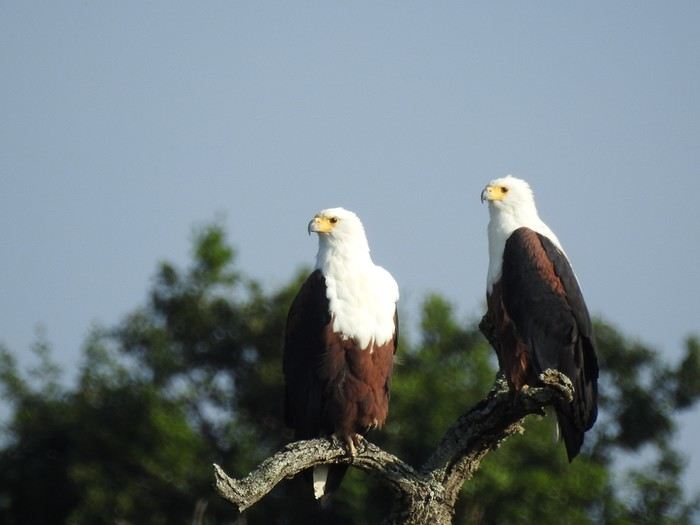
And they’re pretty brave because... they’re not far away...
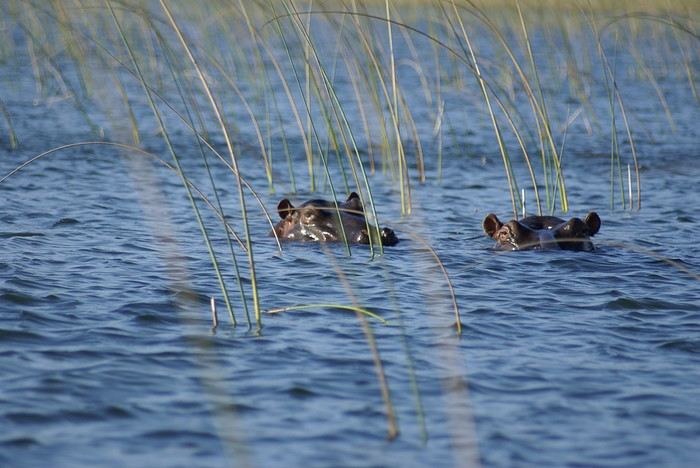
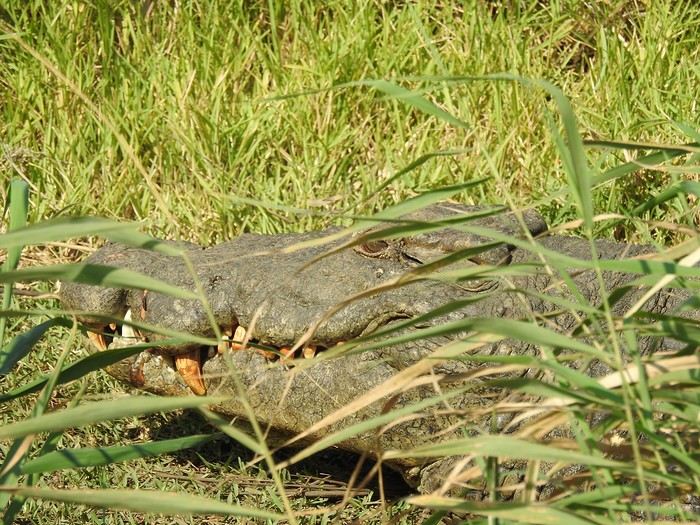
Yet we still swim there... with supervision...
So, between St. Lucia and Mozambique, you’ll find marshes, lagoons, lakes, and coastline, with our Tonga friends, Zulu friends, and—just a bit further up—the Tembe... and their king. (I’m showing off a bit because I got to see a king up close, ate in the same room as him, and even talked to him!)
Originally, the Boers tried to farm there... including sugarcane...
But... between the hippos, snakes, crocs, and malaria-carrying mosquitoes... They lost count of the deaths and disappearances.
The story goes that when Madiba (Mandela) came to power, he passed through the area and convinced them to turn it into a natural space that would attract tourists—and that’s when the big change happened.
And it’s pretty incredible to see how this place has evolved, going from extreme poverty to a certain level of gentrification... How this once "chaotic" area saw shops, roads, and housing spring up (I’m mainly talking about Mtubatuba, the nearby Black town). In fact, in St. Lucia now, the homes that aren’t tourist accommodations can be counted on one hand.
St. Lucia has become a "seaside resort"... very busy during school holidays and certain weekends, increasingly cosmopolitan (20 years ago, speaking French was exotic—now it’s completely ordinary).
As mentioned in the title, this is a travel journal focused on St. Lucia and iSimangaliso ("this place is miraculous" in Zulu) over various trips spanning about twenty years.
The Elephant Coast stretches from Hluhluwe Umfolozi, through St. Lucia and iSimangaliso, all the way to the Mozambique border near Kosi Bay and Tembe. This region was conquered by the Zulus (for context, in the 19th century, the Zulus were just one Bantu group among many—it was a local Napoleon, Shaka, who was both cruel and inventive, conquering and subjugating all other groups to form the Zulu nation). The Tonga were the big losers in this area, and a certain "animosity" is still very noticeable... With our two guides (one Zulu and the other Tonga), we ran into some Tonga folks—definitely not a warm atmosphere. The Tonga were pushed back into the marshes. Fish traps are their main source of wealth. (iSimangaliso is a lagoon and marshland area with several interconnected lakes—it used to be called Vetland Park, and for good reason.) So, lakes, fishing with fish traps...
Traditionally done with raffia boats
Made from forest raffia
Where we spotted a particularly rare and endemic bird (whose name I can’t remember... and I can’t be bothered to dig through my notes)
Here, those are eagles
And they’re pretty brave because... they’re not far away...
Yet we still swim there... with supervision...
So, between St. Lucia and Mozambique, you’ll find marshes, lagoons, lakes, and coastline, with our Tonga friends, Zulu friends, and—just a bit further up—the Tembe... and their king. (I’m showing off a bit because I got to see a king up close, ate in the same room as him, and even talked to him!)
Originally, the Boers tried to farm there... including sugarcane...
But... between the hippos, snakes, crocs, and malaria-carrying mosquitoes... They lost count of the deaths and disappearances.
The story goes that when Madiba (Mandela) came to power, he passed through the area and convinced them to turn it into a natural space that would attract tourists—and that’s when the big change happened.
And it’s pretty incredible to see how this place has evolved, going from extreme poverty to a certain level of gentrification... How this once "chaotic" area saw shops, roads, and housing spring up (I’m mainly talking about Mtubatuba, the nearby Black town). In fact, in St. Lucia now, the homes that aren’t tourist accommodations can be counted on one hand.
St. Lucia has become a "seaside resort"... very busy during school holidays and certain weekends, increasingly cosmopolitan (20 years ago, speaking French was exotic—now it’s completely ordinary).
A month in Cambodia in November 2024
Here we go!!!
I left home at 4 AM on October 31st and headed to Barcelona. Driving through Barcelona on the ring road stresses me out a bit, but at 6 AM the traffic is smooth, and I arrive at the airport without any issues. I call the valet, who quickly comes to pick up my car. He takes photos of it from all angles before letting me go.
Baggage check-in hasn’t started yet, and there are already several of us waiting.
Once free, everything happens very quickly. The flight to Abu Dhabi is on time and goes smoothly. I’ve never had any problems with this airline, which I’ve been using for several years.
The flight to Bangkok arrives at 7 AM as scheduled. This is my first time in Thailand and Bangkok. I’m used to traveling in India, and I notice that everything here is well organized—the customs process is quick, and the luggage is already on the carousel.
I booked a taxi on Booking. All I have to do is find the right exit and door based on the agency’s instructions. A large sign with the names of people who booked is posted on a wall. A hostess greets me and calls the taxi, which arrives 5 minutes later. I booked one night at the Lost Inn BKK hotel in the Phra Nakhon district, and we arrive at 9 AM. The welcome isn’t warm, and I have to wait until noon, sitting on a chair, before I can check into my room. I’m exhausted, and sleeping sitting up isn’t ideal. Noon finally arrives—the room is small but clean, which is fine for one night. I quickly take a shower to wake up because I plan to spend the afternoon visiting the Grand Palace. First, I need to exchange some money, and the banks are all close together on the same street, which is very convenient. When I enter one, a hostess gives me a ticket and invites me to sit down. There are about twenty counters, and I wait quietly until my number is called. The exchange is quick, so I can head out to find the Royal Palace. It’s actually very easy, and the walk is pleasant.
Entry to the Royal Palace (500 baht).
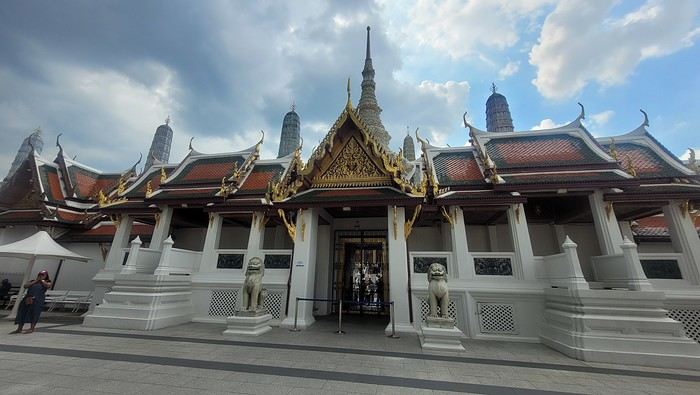
It’s magnificent and grand, and there are quite a few of us visiting. The sky is gray, it’s very humid, and a shower interrupts the visit. It’s a vast complex of temples and palaces. The buildings are colorful and sparkling, with a great sense of serenity (without the tourists, of course). I quietly enjoy the place and try to take photos without tourists, which isn’t easy.
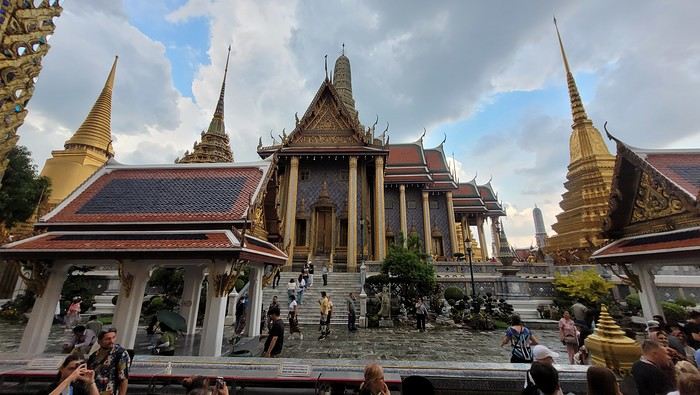
Very close to the Grand Palace is Wat Pho, one of the oldest Buddhist temples in the capital.
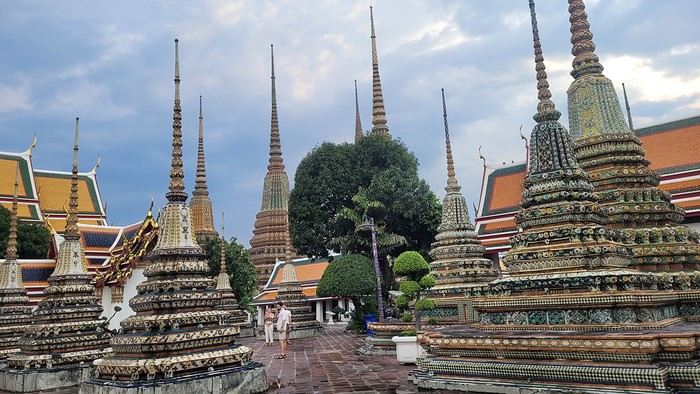
It’s very famous for its 46-meter-long reclining Buddha statue.
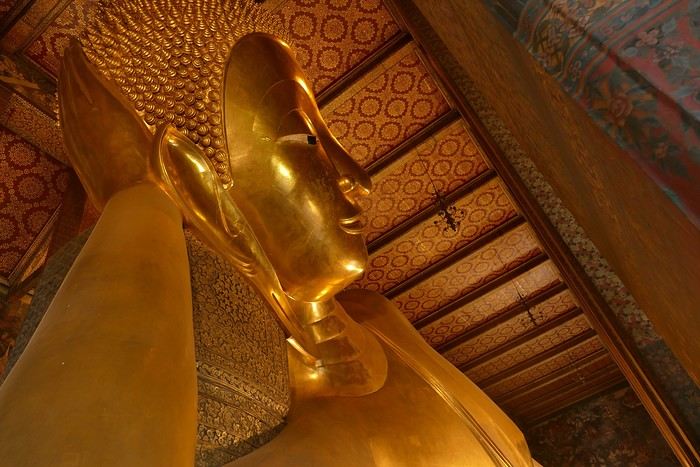
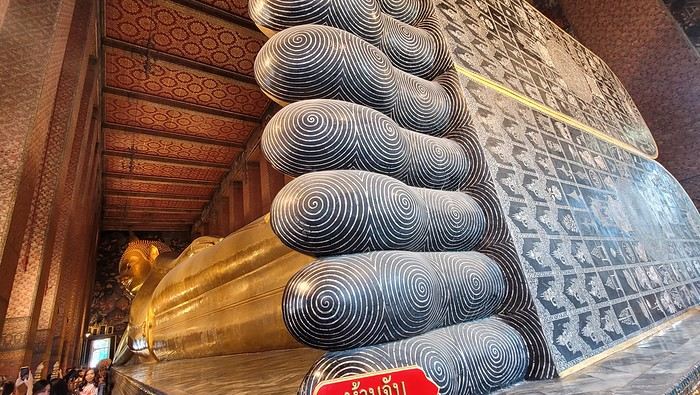
Walking around the temple, you can see different representations of Buddha, all covered in gold leaf.
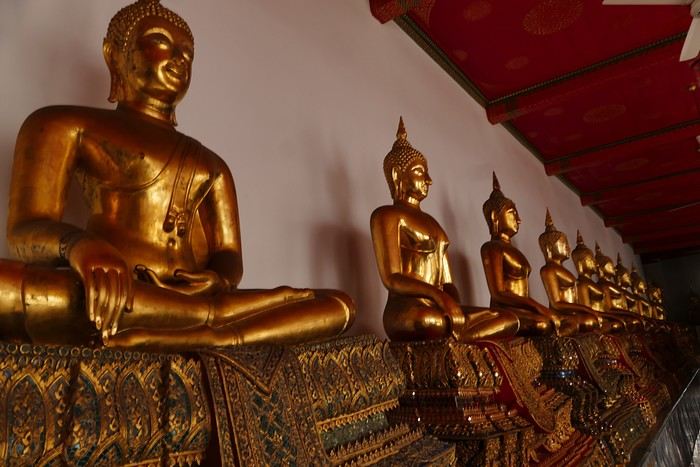
Inside the temple, on one side, monks recite their prayers, while the other side is reserved for tourists who come to meditate in silence.
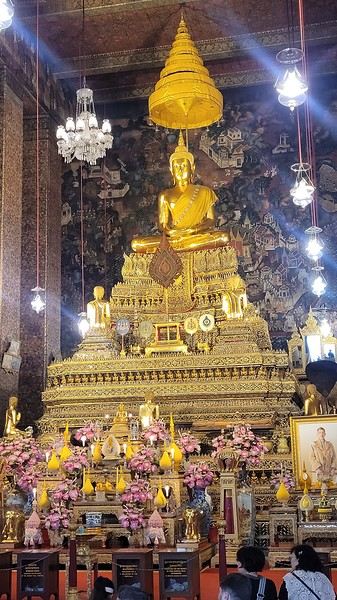
Before returning to the hotel, I have dinner at an Indian restaurant. I go to bed early because tomorrow’s wake-up call will be very early again.
Saturday, November 2nd Wake-up at 4 AM, departure from the hotel at 4:30 AM. The taxi I booked via Booking is waiting for me and takes me to the airport. The trip is fairly quick—he takes small roads, and at this hour, there’s no traffic.
The flight to Phnom Penh is on time. Before boarding, I realize I left my fleece jacket on the carousel, but it’s too late to go back for it.
The flight goes well, and customs is quick.
At the exit, I take a tuk-tuk to Julieka’s GH near the museum. The welcome is friendly. I won’t be able to check into my room until noon, so I take the opportunity to exchange some euros on the market street. The street is lined with restaurants, and I’ll have my first meal there.
The museum is right across the street, so I don’t waste any time visiting it.
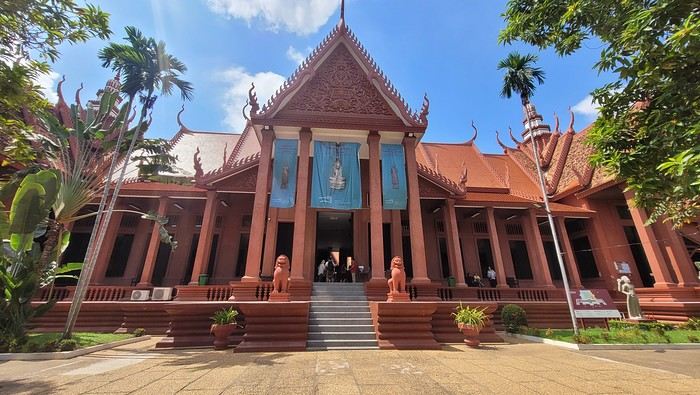
The representations of Hindu deities are very different from those in India, and I don’t recognize them. Many beautiful Buddhas are on display.
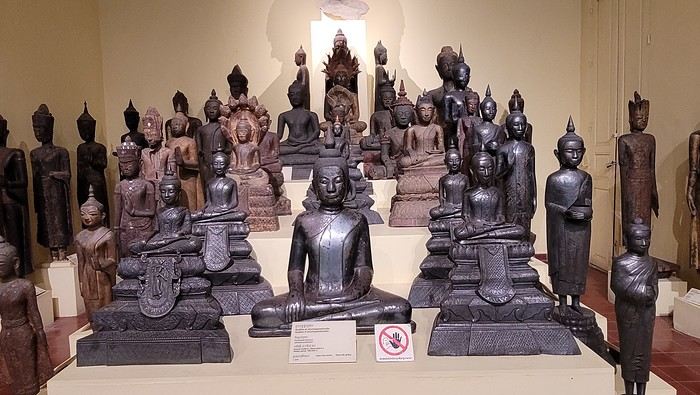
The museum is very pleasant, and there aren’t too many people, which is a plus.
At the exit, I return to the GH, settle into my room—which is decent and clean.
The Royal Palace is 1 km away. I walk along a garden, and at the end of the street is the Tonlé Sap, but I turn right. I arrive at a large esplanade and see the buildings with tiered roofs and glazed tiles. The entrance to the palace is a little further away.
At the entrance, I notice there isn’t the same crowd as at the one in BKK.
Khmer architecture is magnificent. The complex consists of gardens, palaces, pagodas with golden roofs, and slender spires.
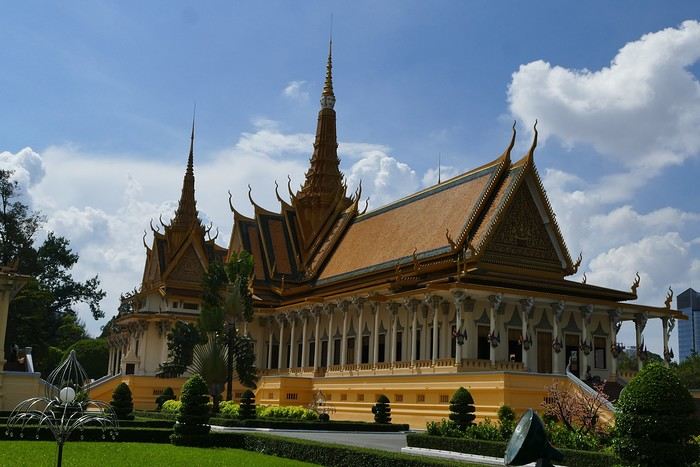
The Silver Pagoda houses the small Emerald Buddha, which is actually made of jade. The silver flooring is covered with carpets. Photos are not allowed.
The walls surrounding the pagoda are covered with frescoes depicting scenes from the Ramayana.
Baggage check-in hasn’t started yet, and there are already several of us waiting.
Once free, everything happens very quickly. The flight to Abu Dhabi is on time and goes smoothly. I’ve never had any problems with this airline, which I’ve been using for several years.
The flight to Bangkok arrives at 7 AM as scheduled. This is my first time in Thailand and Bangkok. I’m used to traveling in India, and I notice that everything here is well organized—the customs process is quick, and the luggage is already on the carousel.
I booked a taxi on Booking. All I have to do is find the right exit and door based on the agency’s instructions. A large sign with the names of people who booked is posted on a wall. A hostess greets me and calls the taxi, which arrives 5 minutes later. I booked one night at the Lost Inn BKK hotel in the Phra Nakhon district, and we arrive at 9 AM. The welcome isn’t warm, and I have to wait until noon, sitting on a chair, before I can check into my room. I’m exhausted, and sleeping sitting up isn’t ideal. Noon finally arrives—the room is small but clean, which is fine for one night. I quickly take a shower to wake up because I plan to spend the afternoon visiting the Grand Palace. First, I need to exchange some money, and the banks are all close together on the same street, which is very convenient. When I enter one, a hostess gives me a ticket and invites me to sit down. There are about twenty counters, and I wait quietly until my number is called. The exchange is quick, so I can head out to find the Royal Palace. It’s actually very easy, and the walk is pleasant.
Entry to the Royal Palace (500 baht).
It’s magnificent and grand, and there are quite a few of us visiting. The sky is gray, it’s very humid, and a shower interrupts the visit. It’s a vast complex of temples and palaces. The buildings are colorful and sparkling, with a great sense of serenity (without the tourists, of course). I quietly enjoy the place and try to take photos without tourists, which isn’t easy.
Very close to the Grand Palace is Wat Pho, one of the oldest Buddhist temples in the capital.
It’s very famous for its 46-meter-long reclining Buddha statue.
Walking around the temple, you can see different representations of Buddha, all covered in gold leaf.
Inside the temple, on one side, monks recite their prayers, while the other side is reserved for tourists who come to meditate in silence.
Before returning to the hotel, I have dinner at an Indian restaurant. I go to bed early because tomorrow’s wake-up call will be very early again.
Saturday, November 2nd Wake-up at 4 AM, departure from the hotel at 4:30 AM. The taxi I booked via Booking is waiting for me and takes me to the airport. The trip is fairly quick—he takes small roads, and at this hour, there’s no traffic.
The flight to Phnom Penh is on time. Before boarding, I realize I left my fleece jacket on the carousel, but it’s too late to go back for it.
The flight goes well, and customs is quick.
At the exit, I take a tuk-tuk to Julieka’s GH near the museum. The welcome is friendly. I won’t be able to check into my room until noon, so I take the opportunity to exchange some euros on the market street. The street is lined with restaurants, and I’ll have my first meal there.
The museum is right across the street, so I don’t waste any time visiting it.
The representations of Hindu deities are very different from those in India, and I don’t recognize them. Many beautiful Buddhas are on display.
The museum is very pleasant, and there aren’t too many people, which is a plus.
At the exit, I return to the GH, settle into my room—which is decent and clean.
The Royal Palace is 1 km away. I walk along a garden, and at the end of the street is the Tonlé Sap, but I turn right. I arrive at a large esplanade and see the buildings with tiered roofs and glazed tiles. The entrance to the palace is a little further away.
At the entrance, I notice there isn’t the same crowd as at the one in BKK.
Khmer architecture is magnificent. The complex consists of gardens, palaces, pagodas with golden roofs, and slender spires.
The Silver Pagoda houses the small Emerald Buddha, which is actually made of jade. The silver flooring is covered with carpets. Photos are not allowed.
The walls surrounding the pagoda are covered with frescoes depicting scenes from the Ramayana.
A Turquoise Dream Come True in Uzbekistan - 2022
We took this trip from September 12 to October 7, 2022. I didn’t post this travel journal earlier in Voyage Forum because the site wasn’t back up yet (and also because I was short on time).
Then, at the end of 2024, I made a promise to a friend: to publish my travel journal on VF. So here it is!
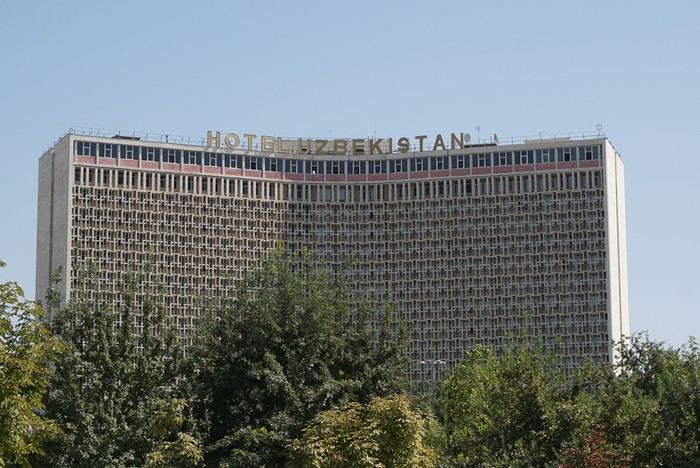 We took off from Paris in the late afternoon on September 12 and arrived in Tashkent around 7:15 AM on the 13th.
This trip was the result of long contemplation and preparation (it was originally planned for the year of the lockdown (2020) and was prepared with the help and advice of Nasrullo Jumanov from Turquoise Travel.
Stages and Itinerary
Stage 1: Tashkent - September 13 and 14
Stage 2: Ferghana Valley – September 15 to 17
Stage 3: Nukus and Moynaq - September 18 and 19
Stage 4: Mysterious Khiva - September 20 to 22
Stage 5: Holy Bukhara - September 23 to 26
Stage 6: Asraf - September 27 and 28
Stage 7: Mythical Samarkand - September 29 to October 2
Stage 8: Tersak (via Shakhrisabz and Urgut) – October 3 and 4
Stage 9: Samarkand – October 5 and 6
Stage 10: Tashkent/Istanbul/Paris – October 6 and 7
Stage 1: Tashkent
September 13
At the airport exit, we were greeted by the owner of our B&B (B&B Gulnara).
Today was all about recovery and our first steps in the capital. Our first currency exchange made us feel like sudden millionaires.
Our first stroll down the avenue leading to Chorsu Market introduced us to the fact that 80 to 90% of the cars here are white Chevrolets.
A walk under the arcades facing Chorsu: hardware stores, cabinetmakers, lute makers (one of them gave me a little concert/demo of a few string instruments).
We took off from Paris in the late afternoon on September 12 and arrived in Tashkent around 7:15 AM on the 13th.
This trip was the result of long contemplation and preparation (it was originally planned for the year of the lockdown (2020) and was prepared with the help and advice of Nasrullo Jumanov from Turquoise Travel.
Stages and Itinerary
Stage 1: Tashkent - September 13 and 14
Stage 2: Ferghana Valley – September 15 to 17
Stage 3: Nukus and Moynaq - September 18 and 19
Stage 4: Mysterious Khiva - September 20 to 22
Stage 5: Holy Bukhara - September 23 to 26
Stage 6: Asraf - September 27 and 28
Stage 7: Mythical Samarkand - September 29 to October 2
Stage 8: Tersak (via Shakhrisabz and Urgut) – October 3 and 4
Stage 9: Samarkand – October 5 and 6
Stage 10: Tashkent/Istanbul/Paris – October 6 and 7
Stage 1: Tashkent
September 13
At the airport exit, we were greeted by the owner of our B&B (B&B Gulnara).
Today was all about recovery and our first steps in the capital. Our first currency exchange made us feel like sudden millionaires.
Our first stroll down the avenue leading to Chorsu Market introduced us to the fact that 80 to 90% of the cars here are white Chevrolets.
A walk under the arcades facing Chorsu: hardware stores, cabinetmakers, lute makers (one of them gave me a little concert/demo of a few string instruments).
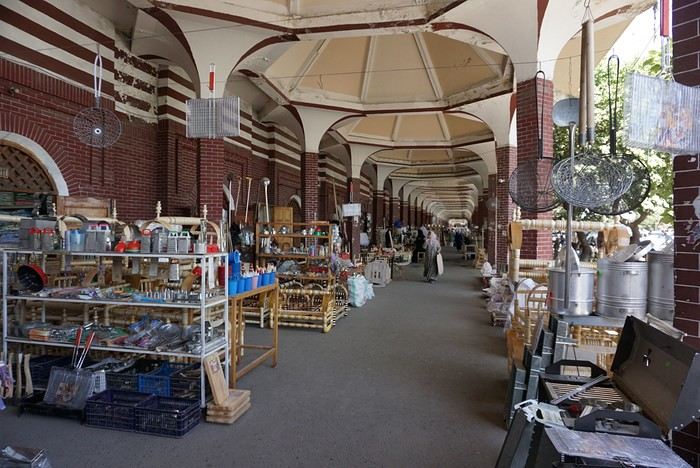
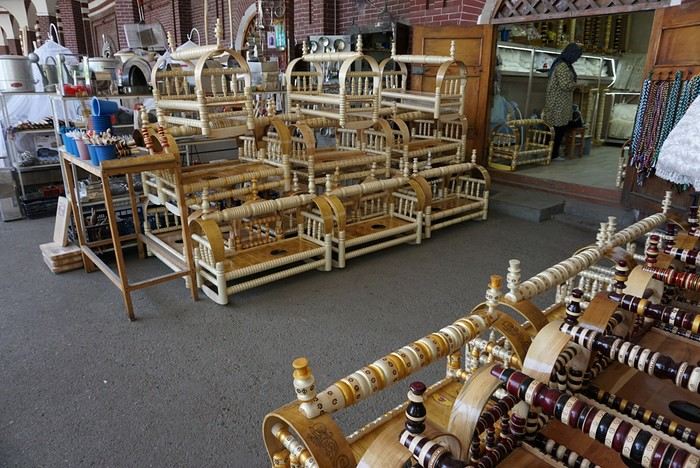
As we entered the market, many vendors called out to us, including this florist who asked where we were from: ‘France? Ah! Macron! PSG!’ He then recited a list of players from the Parisian team as well as past (Platini, Zidane, etc.) and current (Giroud, Griezmann, Mbappé, etc.) French national team players. Since we’re more into rugby (we live near Toulouse), he knew more players than I did!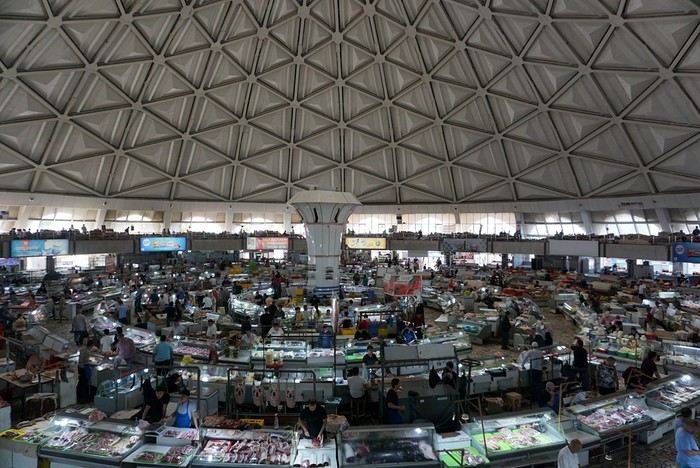
The market sprawls outside around the large circular, multi-story hall. We bought some grapes and bottles of freshly squeezed pomegranate juice for just a few sums. This evening, we had a meet-up with Nasrullo. The reunion was very warm: we’d been exchanging messages for over two years, and I’d been ‘torturing’ him with changes to our itinerary and trip duration. We were finally eager to meet, and honestly, I wasn’t disappointed—in fact, it was the opposite. Nasrullo was very attentive throughout our trip and always made sure, even from a distance (and most often from a distance!), that everything went smoothly. His goal was for us to leave delighted with our trip and, why not, indirectly become ambassadors for this destination. September 14 Breakfast with Nasrullo, then we set off with him by taxi to explore some of the capital’s sites.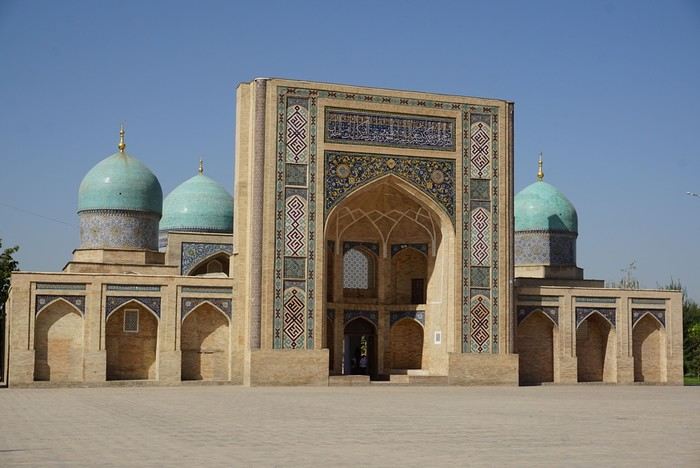
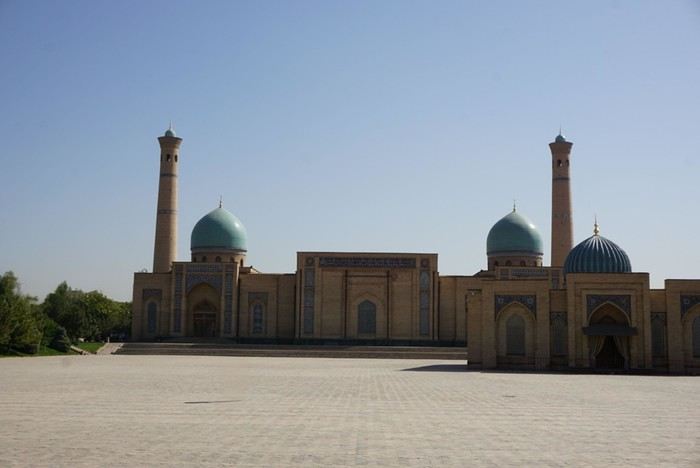
We started by visiting the Khazrati Imam complex, which includes the mausoleum of Kaffal Shashi, the Barak Khan and Muyi Muborak madrasas, and the great Khazrati Imam Mosque with its immense prayer hall.
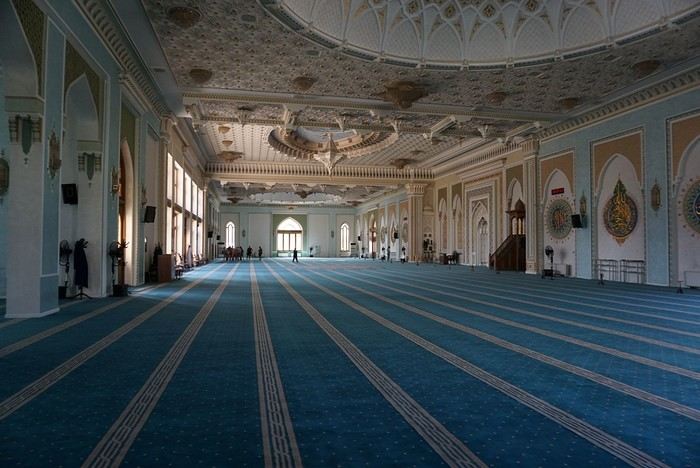
In the Muyi Muborak madrasa, now a museum, you can see the oldest Quran in the world. It was written by three religious scholars, including the secretary of the Prophet Muhammad, on large ‘pages’ made of antelope skin. Next, we explored Soviet-era Tashkent, discovering its parks, canals, and squares: Independence Square with its storks and phoenixes, Amir Temur Square with its large statue and, in the background, the massive Soviet-era hotel that has become one of Tashkent’s iconic buildings. Nasrullo took us through Broadway Boulevard and along what he calls ‘Tashkent’s Montmartre’… Well, it’s far, very far from Montmartre (in every sense of the word!). Then we took the metro to Chorsu station. Rush hour is pretty much the same everywhere in the metro… When we arrived at Chorsu, it was time to say goodbye. Nasrullo had to head back to Samarkand. Before leaving, he recommended some chaikhanas at the end of the galleries facing the market. We ate there for just a few euros (2 or 3 € for two people). After eating, we headed back to our room to cool off (our B&B is about a 10-minute walk away).
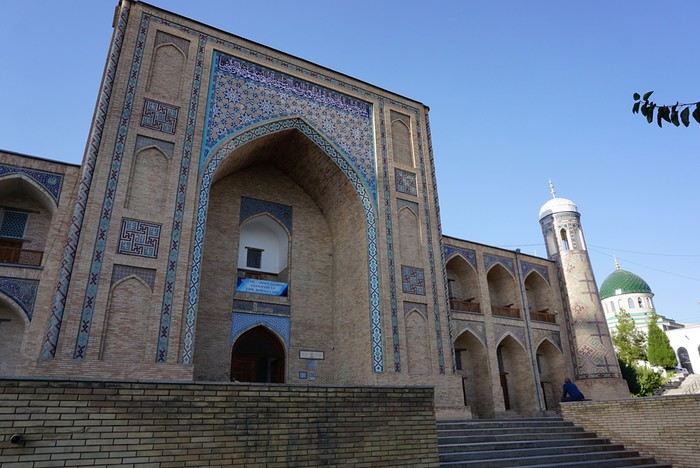
Around 4 PM, we set off to visit the Kokeldash Madrasa, which is still active. On the way, we stopped to watch some bread vendors and take a few photos. We were hesitating about buying some for our evening picnic when a young woman approached us. In perfect English, she asked: ‘Are you looking for something? Do you want to buy bread? Which one? How much?’ She then spoke to one of the vendors and negotiated the price. ‘Do you want one?’ And she took two. She paid directly. I took out my wallet to reimburse her, but she refused. It’s on the house! Then the vendor asked where we were from. And off we went again: Macron, PSG, football players… We’ll have to get used to it. The young woman smiled at the questions and comments, barely gave us time to thank her, and left as quickly as she had approached us.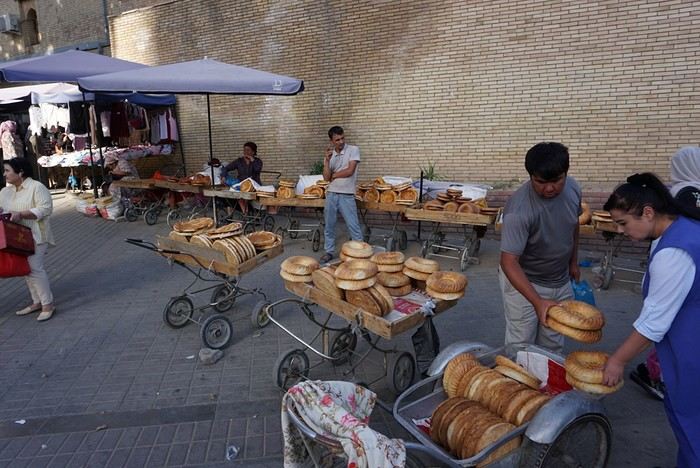
We continued our walk. Visited the madrasa. Then we crossed the boulevard to see the Tashkent Circus. I would’ve loved to go in and visit, but the ticket seller wouldn’t hear of it. We carried on around what should’ve been a park with old-fashioned rides and attractions. All we found was a construction site. Oh well! Back at our hotel, a message from Nasrullo was waiting for us. He had managed to change our train ticket for the next day. Instead of taking the 6:00 AM train, we’d take the 8:00 AM one. And instead of second class, we’d be in first class! Great! This evening, we had a picnic at one of the breakfast tables in the B&B courtyard. Under a shelter, the owner and his family were celebrating a birthday. The owner started by offering us some tea. Then they brought us some fruit (watermelon and melon). Finally, after the song, candles, and cake cutting, they brought us two generous slices of that beautiful birthday cake. Delicious!
We took off from Paris in the late afternoon on September 12 and arrived in Tashkent around 7:15 AM on the 13th.
This trip was the result of long contemplation and preparation (it was originally planned for the year of the lockdown (2020) and was prepared with the help and advice of Nasrullo Jumanov from Turquoise Travel.
Stages and Itinerary
Stage 1: Tashkent - September 13 and 14
Stage 2: Ferghana Valley – September 15 to 17
Stage 3: Nukus and Moynaq - September 18 and 19
Stage 4: Mysterious Khiva - September 20 to 22
Stage 5: Holy Bukhara - September 23 to 26
Stage 6: Asraf - September 27 and 28
Stage 7: Mythical Samarkand - September 29 to October 2
Stage 8: Tersak (via Shakhrisabz and Urgut) – October 3 and 4
Stage 9: Samarkand – October 5 and 6
Stage 10: Tashkent/Istanbul/Paris – October 6 and 7
Stage 1: Tashkent
September 13
At the airport exit, we were greeted by the owner of our B&B (B&B Gulnara).
Today was all about recovery and our first steps in the capital. Our first currency exchange made us feel like sudden millionaires.
Our first stroll down the avenue leading to Chorsu Market introduced us to the fact that 80 to 90% of the cars here are white Chevrolets.
A walk under the arcades facing Chorsu: hardware stores, cabinetmakers, lute makers (one of them gave me a little concert/demo of a few string instruments).As we entered the market, many vendors called out to us, including this florist who asked where we were from: ‘France? Ah! Macron! PSG!’ He then recited a list of players from the Parisian team as well as past (Platini, Zidane, etc.) and current (Giroud, Griezmann, Mbappé, etc.) French national team players. Since we’re more into rugby (we live near Toulouse), he knew more players than I did!
The market sprawls outside around the large circular, multi-story hall. We bought some grapes and bottles of freshly squeezed pomegranate juice for just a few sums. This evening, we had a meet-up with Nasrullo. The reunion was very warm: we’d been exchanging messages for over two years, and I’d been ‘torturing’ him with changes to our itinerary and trip duration. We were finally eager to meet, and honestly, I wasn’t disappointed—in fact, it was the opposite. Nasrullo was very attentive throughout our trip and always made sure, even from a distance (and most often from a distance!), that everything went smoothly. His goal was for us to leave delighted with our trip and, why not, indirectly become ambassadors for this destination. September 14 Breakfast with Nasrullo, then we set off with him by taxi to explore some of the capital’s sites.
We started by visiting the Khazrati Imam complex, which includes the mausoleum of Kaffal Shashi, the Barak Khan and Muyi Muborak madrasas, and the great Khazrati Imam Mosque with its immense prayer hall.
In the Muyi Muborak madrasa, now a museum, you can see the oldest Quran in the world. It was written by three religious scholars, including the secretary of the Prophet Muhammad, on large ‘pages’ made of antelope skin. Next, we explored Soviet-era Tashkent, discovering its parks, canals, and squares: Independence Square with its storks and phoenixes, Amir Temur Square with its large statue and, in the background, the massive Soviet-era hotel that has become one of Tashkent’s iconic buildings. Nasrullo took us through Broadway Boulevard and along what he calls ‘Tashkent’s Montmartre’… Well, it’s far, very far from Montmartre (in every sense of the word!). Then we took the metro to Chorsu station. Rush hour is pretty much the same everywhere in the metro… When we arrived at Chorsu, it was time to say goodbye. Nasrullo had to head back to Samarkand. Before leaving, he recommended some chaikhanas at the end of the galleries facing the market. We ate there for just a few euros (2 or 3 € for two people). After eating, we headed back to our room to cool off (our B&B is about a 10-minute walk away).
Around 4 PM, we set off to visit the Kokeldash Madrasa, which is still active. On the way, we stopped to watch some bread vendors and take a few photos. We were hesitating about buying some for our evening picnic when a young woman approached us. In perfect English, she asked: ‘Are you looking for something? Do you want to buy bread? Which one? How much?’ She then spoke to one of the vendors and negotiated the price. ‘Do you want one?’ And she took two. She paid directly. I took out my wallet to reimburse her, but she refused. It’s on the house! Then the vendor asked where we were from. And off we went again: Macron, PSG, football players… We’ll have to get used to it. The young woman smiled at the questions and comments, barely gave us time to thank her, and left as quickly as she had approached us.
We continued our walk. Visited the madrasa. Then we crossed the boulevard to see the Tashkent Circus. I would’ve loved to go in and visit, but the ticket seller wouldn’t hear of it. We carried on around what should’ve been a park with old-fashioned rides and attractions. All we found was a construction site. Oh well! Back at our hotel, a message from Nasrullo was waiting for us. He had managed to change our train ticket for the next day. Instead of taking the 6:00 AM train, we’d take the 8:00 AM one. And instead of second class, we’d be in first class! Great! This evening, we had a picnic at one of the breakfast tables in the B&B courtyard. Under a shelter, the owner and his family were celebrating a birthday. The owner started by offering us some tea. Then they brought us some fruit (watermelon and melon). Finally, after the song, candles, and cake cutting, they brought us two generous slices of that beautiful birthday cake. Delicious!