Results for "Four+Corners+|+3+>+99"
3228 results found.
Mise en construction mutualisée de 3 bus aménagés (dossier homologation DRIRE ok) prêts pour été 2005 English translation pending
il m'est venu une idée...
le dossier pour mon bus ayant reçu toutes les autorisations necessaires a sa mise en construction, je me suis dit que si plusieurs etait lancés en fabrication en méme temps, les couts seraient limités (achats des équipements en gros, modification des carrosseries en serie, menuiseries en serie, etc). plusieurs vehicules identique au mien etant disponibles (j'ai trouvé un nid!) au meme endroit, les travaux pourraient commencer rapidement, ce qui assure d'en profiter dès cet été!
voici le descriptif du projet ayant reçu l'accord des mines :
12 m de long 2, 5 m de large chassis daf MK 205 de 280 cv turbo-diesel 6 vitesses carrosserie HEULIEZ environ 400 000 KM (conçu pour faire 1 000 000 km) 8 places assises + chauffeur 6 couchages:1 de 2 places permanent (chambre1)2 de 1 place supperposés permanents (chambre2)2 de 1 place modulaires (salon avant)
soute de rangement avec rampe moto a l'arriere du bus4 m² au sol environ (2, 4 m de large-1, 6 m de prof. sur toute la hauteur)
entierement recarrossé par professionnel:ajout d'une porte chauffeuroccultation tole des vitrages inutiles(flancs plats)cloison de séparation soute/partie habitable renforcéeattelage pour remorque 3, 5 tpeinture complète et déco type Winnebago (couleur au choix)
salon avant en 2 demi fers a cheval, table en 2 parties modulaires
cuisine en L, refrigérateur, congélateur, four micro-ondes grill
salle d'eau avec douche 80x60 cm et lavabo + rangements
cabinet WC avec lave-mains séparé de la salle d'eau
nombreux rangements et placards (penderies, tiroirs, etc)
sur le plan technique:
400 litres d'eau propre 300 d'eau usées chaudiere pour eau chaude et chauffage sur reservoir gasoil groupe electrogene 200 ampères de batteries 12 V climatisation en option gaz cuisson sur reservoir gpl spécifique (pas de bouteilles de gaz, le plein se fait a la station service en meme temps que le gasoil) ecran télé 17" et antenne satelite douche exterieure (eau chaude et froide) store etc...
cout global (achat vehicule, revision mecanique et freinage, transformation, aménagement et équipements + homologation), pret a prendre la routeenviron 40 000 ? par bus(soit le prix d'un petit integral VL d'occasion deja pas mal usé)
pour tous renseignements, n'hesitez pas a prendre contact. plus on est de fous, comme dit l'autre...
que les interessés se fassent connaitre.
au vu du nombre de visites sur l'autre sujet de discussion que j'ai lancé(construire un camping car dans un bus car ou camion), il doit bien y avoir quelques personnes aussi remuées que moi que ça interesse sur ce forum!
PATRICK26
PS: je m'occupe de mettre rapidement en ligne des photos et des plans a l'adresse suivante: http://www.geyserconcept.com/projet-bus
le dossier pour mon bus ayant reçu toutes les autorisations necessaires a sa mise en construction, je me suis dit que si plusieurs etait lancés en fabrication en méme temps, les couts seraient limités (achats des équipements en gros, modification des carrosseries en serie, menuiseries en serie, etc). plusieurs vehicules identique au mien etant disponibles (j'ai trouvé un nid!) au meme endroit, les travaux pourraient commencer rapidement, ce qui assure d'en profiter dès cet été!
voici le descriptif du projet ayant reçu l'accord des mines :
12 m de long 2, 5 m de large chassis daf MK 205 de 280 cv turbo-diesel 6 vitesses carrosserie HEULIEZ environ 400 000 KM (conçu pour faire 1 000 000 km) 8 places assises + chauffeur 6 couchages:1 de 2 places permanent (chambre1)2 de 1 place supperposés permanents (chambre2)2 de 1 place modulaires (salon avant)
soute de rangement avec rampe moto a l'arriere du bus4 m² au sol environ (2, 4 m de large-1, 6 m de prof. sur toute la hauteur)
entierement recarrossé par professionnel:ajout d'une porte chauffeuroccultation tole des vitrages inutiles(flancs plats)cloison de séparation soute/partie habitable renforcéeattelage pour remorque 3, 5 tpeinture complète et déco type Winnebago (couleur au choix)
salon avant en 2 demi fers a cheval, table en 2 parties modulaires
cuisine en L, refrigérateur, congélateur, four micro-ondes grill
salle d'eau avec douche 80x60 cm et lavabo + rangements
cabinet WC avec lave-mains séparé de la salle d'eau
nombreux rangements et placards (penderies, tiroirs, etc)
sur le plan technique:
400 litres d'eau propre 300 d'eau usées chaudiere pour eau chaude et chauffage sur reservoir gasoil groupe electrogene 200 ampères de batteries 12 V climatisation en option gaz cuisson sur reservoir gpl spécifique (pas de bouteilles de gaz, le plein se fait a la station service en meme temps que le gasoil) ecran télé 17" et antenne satelite douche exterieure (eau chaude et froide) store etc...
cout global (achat vehicule, revision mecanique et freinage, transformation, aménagement et équipements + homologation), pret a prendre la routeenviron 40 000 ? par bus(soit le prix d'un petit integral VL d'occasion deja pas mal usé)
pour tous renseignements, n'hesitez pas a prendre contact. plus on est de fous, comme dit l'autre...
que les interessés se fassent connaitre.
au vu du nombre de visites sur l'autre sujet de discussion que j'ai lancé(construire un camping car dans un bus car ou camion), il doit bien y avoir quelques personnes aussi remuées que moi que ça interesse sur ce forum!
PATRICK26
PS: je m'occupe de mettre rapidement en ligne des photos et des plans a l'adresse suivante: http://www.geyserconcept.com/projet-bus
Porc à l'Orange English translation pending
Je vous livre une recette sucré-salé sympathique.. je ne sais pas de quel pays ça vient par contre.. mais ca serait dommage de s'en priver...
Porc à l’Orange,
Préparation : 6 mn
Temps de cuisson : 1h45
Pour 4 personnes :
40 ml d’huile
du porc pour 4 pers
Sel poivre
2 cuil à café de gingembre frais, râpé
250 ml de jus d’orange
1 cuil à soupe de zeste d’orange, râpé
1 cuil à soupe de Miel
3 cuil à café de farine mélangée à 1 cuil à café d’eau
2 cuil à café de ciboulette hachée
1. Préchauffer le four à 180°C. Dans une cocotte, chauffer l’huile. Dorer le porc à feu vif 2 mn des 2 cotés.
Saler et poivrer. Egoutter sur du papier absorbant.
2. Mélanger gingembre, jus et zeste d’orange et le miel. Verser sur le porc. Couvrir et cuire au four 1h30.
3. Incorporer la farine en remuant. Poursuivre la cuisson 5 mn.
Garnir de ciboulette.
A mon humble avis le Porc peut se remplacer par du poulet ou autre...
Bon App'
Porc à l’Orange,
Préparation : 6 mn
Temps de cuisson : 1h45
Pour 4 personnes :
40 ml d’huile
du porc pour 4 pers
Sel poivre
2 cuil à café de gingembre frais, râpé
250 ml de jus d’orange
1 cuil à soupe de zeste d’orange, râpé
1 cuil à soupe de Miel
3 cuil à café de farine mélangée à 1 cuil à café d’eau
2 cuil à café de ciboulette hachée
1. Préchauffer le four à 180°C. Dans une cocotte, chauffer l’huile. Dorer le porc à feu vif 2 mn des 2 cotés.
Saler et poivrer. Egoutter sur du papier absorbant.
2. Mélanger gingembre, jus et zeste d’orange et le miel. Verser sur le porc. Couvrir et cuire au four 1h30.
3. Incorporer la farine en remuant. Poursuivre la cuisson 5 mn.
Garnir de ciboulette.
A mon humble avis le Porc peut se remplacer par du poulet ou autre...
Bon App'
Cherche hôtels raffinés à Bangkok, Samui ou autre English translation pending
à la recherche de belles adresses de lieux DESIGN (style thai ou tres sobre et raffiné) pour se reposer et profiter du temps à libre à visiter et decouvrir la thailande.
Bungalows, hotels
ainsi que des lieux à ne pas louper sur Bkk et samui, le nord de la thailande peut etre envisagé.
Joa
ainsi que des lieux à ne pas louper sur Bkk et samui, le nord de la thailande peut etre envisagé.
Joa
Hôtel traditionnel à Istanbul English translation pending
Bonjour,
Je voudrais me rendre avec ma copine à Istanbul courrant septembre (vol sec + on choisit tout d'ici ou sur place). Je ne trouve pas exactement l'hotel de ses rêves. Je ne vois que des hotels de moyenne facture (sans charme fou) ou bien des grandes tours de verre ***** aux halls aseptisés.
Alors que moi, je trouverais sympa de profiter d'un hotel avec un cachet oriental très marqué, quelquechose avec le charme folklorique de la tradition, une atmosphere un peu XIX°s. Vous voyez ?
Quelqu'un peut-il m'aider? merci !!!!!
Je voudrais me rendre avec ma copine à Istanbul courrant septembre (vol sec + on choisit tout d'ici ou sur place). Je ne trouve pas exactement l'hotel de ses rêves. Je ne vois que des hotels de moyenne facture (sans charme fou) ou bien des grandes tours de verre ***** aux halls aseptisés.
Alors que moi, je trouverais sympa de profiter d'un hotel avec un cachet oriental très marqué, quelquechose avec le charme folklorique de la tradition, une atmosphere un peu XIX°s. Vous voyez ?
Quelqu'un peut-il m'aider? merci !!!!!
Festivals en Inde? English translation pending
Pour ceux qui aiment les danses, j'ai trouvé un chouette site: http://www.narthaki.com/
Le 10 avril, je serai à Shimoga... 🙂
"April 10, 2004 Shimoga, Karnataka
Uday Kumar Shetty and Soumya Uday Kumar of Kalatheera conduct a whole night dance and music festival TUNGA MAHOTSAV, from Dusk to Dawn on the banks of river Tunga at Shimoga district, Thirthahalli Taluk every year. This year it will be on 10th of April. "
😎
Si quelqu'un à des dates de festivals de musiques, danses, ou autres, avec infos exact siouplaît (pas évident à trouver😕)
Welcome!!! 🙂
Quel hôtel Iberostar? English translation pending
😉 Salut à tous,
En consultant le catalogue de la chaîne d'hôtel ibersostar, 2 hôtels ont retenu mon attention en République Dom. Iberostar hacienda dominicus Iberostar dominicana
Nous avons une fille de 12 ans et je ne voudrais pas qu'en choissisant un hôtel où il y a peu d'enfants elle ne puisse pas se faire de copine.
Je sais que quelque soit l'iberostar la nourriture est excellente mais est-ce quelqu'un peut me donner son avis sur ces deux hôtels afin de me guider dans mon choix.
J'ai pu lire au hasard de quelque discussion de la région du hacienda était plus jolie ??
Bref toute info est la bienvenue
Merci
🙂🙂🙂
En consultant le catalogue de la chaîne d'hôtel ibersostar, 2 hôtels ont retenu mon attention en République Dom. Iberostar hacienda dominicus Iberostar dominicana
Nous avons une fille de 12 ans et je ne voudrais pas qu'en choissisant un hôtel où il y a peu d'enfants elle ne puisse pas se faire de copine.
Je sais que quelque soit l'iberostar la nourriture est excellente mais est-ce quelqu'un peut me donner son avis sur ces deux hôtels afin de me guider dans mon choix.
J'ai pu lire au hasard de quelque discussion de la région du hacienda était plus jolie ??
Bref toute info est la bienvenue
Merci
🙂🙂🙂
Cuisine locale et visites à Nice (France) English translation pending
BONJOUR! JE SERAI À NICE EN AVRIL PROCHAIN ET J'AIMERAIS CONNAITRE LES ENDROITS QU'IL FAUT ABSOLUEMENT VISITER ET PAS NÉCESSAIREMENT TOURISTIQUE DISONS DES ENDROITS INUSITÉS OU SPÉCIALS . AUSSI COMME JE SUIS CUISINIER, JE VOUDRAIS CONNAITRE LES BONS ENDROITS OU JE POURRAIS SAVOURER LA CUISINE LOCALE, LES BONNES PATISSERIES...AVIS AUX NICOIS !
MERCI!
MERCI!
Objectof Zenitar 16mm f 2.8 English translation pending
Salut !!🙂
Qui connait ou utilise des objectif Russe Zenitar ?? Et plus precisement le Grand angle 16mm en focale 2.8-22 ...
Ca a l'air super allechant quand on compare son prix (a peine plus de 150 euros ports compris sur le net) a celui d'un objectif de "marque" ...... dont je n'ose meme pas dire les prix🤪
Donc ! est ce LA bonne oportunité pour les fauchés d'avoir qd meme un grand angle ds le four tout ????
merci pr les comments !
inextremis
Qui connait ou utilise des objectif Russe Zenitar ?? Et plus precisement le Grand angle 16mm en focale 2.8-22 ...
Ca a l'air super allechant quand on compare son prix (a peine plus de 150 euros ports compris sur le net) a celui d'un objectif de "marque" ...... dont je n'ose meme pas dire les prix🤪
Donc ! est ce LA bonne oportunité pour les fauchés d'avoir qd meme un grand angle ds le four tout ????
merci pr les comments !
inextremis
Japan in August: Is it really a bad time?
Hey everyone,
Next year, we’re celebrating 20 years of marriage (and travel 🙂), and we’re looking for something new, pretty legendary, and something the teens will enjoy too.
The family council has settled on Japan for now. And it’d have to be a summer trip—no choice there.
The catch: I keep reading that August isn’t the right season for southern Japan. It’s hot, humid, and there’s a risk of typhoons… Okay, but what does that *actually* mean in practice? Are there any travelers who’ve been there during this time? Is it *that* unbearable? We’re pretty familiar with Southeast Asia—last year, we dealt with scorching heat in Vietnam and insane humidity, plus a typhoon we experienced from a distance, and visiting Angkor in the blazing sun. Is it worse than that?
Thanks for your feedback 😉
Next year, we’re celebrating 20 years of marriage (and travel 🙂), and we’re looking for something new, pretty legendary, and something the teens will enjoy too.
The family council has settled on Japan for now. And it’d have to be a summer trip—no choice there.
The catch: I keep reading that August isn’t the right season for southern Japan. It’s hot, humid, and there’s a risk of typhoons… Okay, but what does that *actually* mean in practice? Are there any travelers who’ve been there during this time? Is it *that* unbearable? We’re pretty familiar with Southeast Asia—last year, we dealt with scorching heat in Vietnam and insane humidity, plus a typhoon we experienced from a distance, and visiting Angkor in the blazing sun. Is it worse than that?
Thanks for your feedback 😉
"Glory": an Animal Farm for Zimbabwe—and the world
"400 pages of verbal pyrotechnics and animal magic" — The Times
"Bulawayo leans into exaggeration and irony to tell hard truths. *Glory* is jam-packed with comedy and farce, poking fun at an autocratic regime while illustrating the absurdity and surreal nature of a police state." — The Guardian
The cruelty and savagery of Zimbabwe’s (and Africa’s in general) "powerful animals"
Zimbabwean author NoViolet Bulawayo has written a novel that illustrates better than any documentary the complexity of colonial legacy. In doing so, she revisits George Orwell’s Animal Farm. Her novel *Glory* is a political satire about Zimbabwe—and it’s brimming with humor.
For thirty years, Zimbabwe has been stagnating under Robert Mugabe’s presidency. Human rights violations, corruption, and international sanctions have kept the population mired in poverty and oppression, while the regime exploits the meager earnings of the economy. As the 2017 elections approach, a power struggle erupts over the succession of the very elderly Father of the Nation (Mugabe). On the streets, people hope for long-awaited reforms; the people feel their moment has come.
And indeed, the army ousts Mugabe and his wife—"with her Gucci heels" (p.32)—who was positioning herself for the presidency. Hopes are dashed, however. The generals install former vice-president Emmerson Mnangagwa in power; the regime merely changes faces, but the problems remain the same.
In the novel, the country is called "Jidada, with a -da and another -da" (p.1); there’s no mistaking that this fictional state is Zimbabwe.
For *Glory*, her second novel, NoViolet Bulawayo invents a whole series of codes whose strength lies precisely in how easy they are to decipher. Like George Orwell’s Animal Farm, the characters populating Bulawayo’s universe aren’t humans but horses, goats, or crocodiles with all-too-human traits. Mugabe and Mnangagwa are horses, the spiritual leader is a pig, the soldiers are all bloodthirsty dogs, while the populace consists of goats, chickens, donkeys, and cats. The shift to the animal world serves only to better grasp the laws of despotism—and to ridicule real-life models. On one hand, the animals are humanized: they tweet, torture, travel in private jets. On the other, their greed, stupidity, and brutality stem from their animal nature.
It’s the old trick of fable: dressing men in animal disguises to make them easier to recognize. That’s how Orwell, in Animal Farm, traced how the promise of liberation from the Russian Revolution turned into Stalinist terror. In his 1945 fable, George Orwell describes how the animals of a farm drive out their farmer to organize the exploitation themselves, collectively. For a time, they truly taste freedom, but a clique of pigs ends up taking control. The central figures of the Soviet story—Stalin, Trotsky, Molotov—were easily recognizable.
Yet Bulawayo departs sharply from Orwell. She’s less concerned with precision and the force of argument than with satirical exaggeration. The deposed president is a senile old man who believes he can control even the sun’s course. The new stallion in power is a greedy debaucher. His soldiers sniff respectfully at his tail and backside.
In Bulawayo’s *Glory*, things are more complicated, but her novel also tells of a failed, incomplete liberation. In the author’s Animal Farm, Jidada, the colonial exploiters are followed by new forms of oppression. Because the former liberators become tyrants themselves. And because global power dynamics persist in neocolonial structures.
Wouldn’t that be enough to fuel a deeply depressing narrative? No—Bulawayo turns it into a blazing satire, full of wit and uncompromising criticism of power, a thread running through contemporary (not just) Zimbabwean history. The old warhorses in NoViolet Bulawayo’s Jidada, who continue to act as pack leaders, are easily recognizable as caricatures of the longtime dictator Robert Mugabe and his successor, current president Emmerson Mnangagwa.
The plot kicks off in high gear with independence day festivities. From the crack of dawn, everyone waits on Jidada Square for the Old Horse, the Father of the Nation and former liberator, whose reign "was nearing all of—not one, not two, not three, but four solid decades" (p.1). Everywhere, the colors of the Jidada Party shine; everywhere, true supporters cheer. Even the scorching sun plays its part: "At this point the sun, upon seeing arrive the leader who was decreed by God himself to rule and rule and keep ruling, a leader who'd in turn decreed the very sun to head his cheerleading squad, took a deep, deep breath and thoroughly blazed to impress" (p.2).
Finally, the Old Horse’s luxury carriage approaches "with the slowness of a hearse" (p.2), and "hoping to catch a glimpse of the legendary Father of the Nation," which causes "the animals fell over themselves like intoxicated frogs" (p.2). The sovereign’s speech is delayed a moment longer: "what I really want is a nap," groans the Old Horse as he takes his seat with such care "like his backside was made of expensive porcelain" (p.6).
Meanwhile, Bulawayo parades his entourage: the president’s wife (who earns her doctorate at Jidada University faster than "you could say diss, for dissertation. Tholukuthi it was as easy as ordering from a KFC drive-through, or perhaps even easier being that it was cheaper than KFC; it in fact cost her nothing and the degree actually came with a zero-calorie Diet Coke and a purple straw" (p.41), and she’s now known as Dr Sweet Mother. The cabinet includes "the Minister of the Revolution, the Minister of Corruption, the Minister of Order, the Minister of Things, the Minister of Nothing, the Minister of Propaganda, the Minister of Homophobic Affairs, the Minister of Disinformation and the Minister of Looting" (p.9). And of course the vice-president, who will soon become interim president when the Old Horse finally kicks the bucket—and then settle in as the new long-term president, who in the novel is called Tuvius Delight Shasha, or "Tuvy" for short (p.253), none other than Emmerson Mnangagwa. It’s him Bulawayo reserves her most merciless character description for.
"New Dispensation" (p.109) is Tuvy’s slogan for Jidada, and he loves repeating it so much he even named his parrot after it ("So inspired was Tuvy by the realisation that he rechristened his new pet parrot with the name New Dispensation—tholukuthi the bird having been acquired explicitly for the purposes of tweeting eulogies and accordingly glorifying the Saviour throughout the airs and skies of the nation. Tuvy then went on to hire a lecturer in English from the University of Jidada to teach New Dispensation to say the phrase 'New Dispensation'" p.110). But Tuvy’s Zimbabwe remains a nation without free, fair, and credible elections ("#freefairncredibleelection" p.161), and the promised equal treatment applies only insofar as Zimbabweans now queue up without discrimination in endless lines—and everyone is as poor as the next in the "queuenation" (p.283). Except for the powerful. They can "yes, tholukuthi, her immeasurable riches theirs to take. And take they did—
just take—take—take—take—take—take—take—take—take—take—take—take—take—take—take—take—take—take—take—take—take—take—take—take—take—take—take" (p.249-250).
In short: Bulawayo brilliantly depicts how former independence fighters become exploiters themselves. And how the country threatens to suffocate under the weight of corruption and repression. But she also literally stages the polyphony with which the people oppose imposed obedience to the official line.
Controversial online discussions keep interrupting the narrative—dialogues and social threads (see photo below) that Bulawayo masterfully integrates. From a literary standpoint, it’s a brilliant idea. And it shows, above all, that the author’s sympathy—so likeable—goes to all those who refuse to let their dream of true freedom be stolen, not even by the corrupt elites of their own country.
In the book’s acknowledgments, the first tribute goes to "The Jidadas of the world, clamouring for freedom on many fronts—A luta continua." (p.401) This reflects the realization that, not only in Jidada-Zimbabwe but in many other corners of the world, the end of colonial domination is still far from meaning the freedom hoped for by the vast majority of people. But it also means, more broadly, that this freedom must be won "on many fronts" (see above), both domestically and geopolitically.
That’s precisely what *Glory* so vividly highlights: how complex the project behind the term "postcolonialism" really is. With *Glory*, Bulawayo also delivers a scathing critique of the persistence of colonial mindsets in the West.
In the novel, the murder of George Floyd, racist police violence, and white-supremacist ideology in Trump’s United States perfectly illustrate the persistence of racism. It’s especially in the final chapters that Bulawayo lets Jidada’s inhabitants explicitly and unflinchingly criticize a neocolonial world order:
"It was not lost on us how the West, which loved to 'save' Africa and announce every action to the whole world, did so with one limb while manipulating, looting and fleecing us with the rest of its limbs so that more money in fact poured out of the continent than trickled in." (p.376)
"It was no mistake that multinational corporations yearly reaped and shipped colossal profits from Africa back to their countries as had been the case during colonial times. Even the sticks and stones would tell you that the African earth at any given time howled and shook and heaved from the extraction of its precious minerals that rarely benefited its own miserable children." (p.376)
"(...) we vowed to wage yet another war for Africa's second Liberation from neocolonial oppression. From exploitation. From plunder. From Western dominion. From indignity. From Abuse. We wanted real freedom. We wanted greedy, thieving paws off our wealth. We wanted Justice. We wanted a new world; we wanted a brand-new world so much we didn't sleep a wink that night." (p.377)
The Jidadas of this world must fight two enemies: Western neocolonialism and the autocratic instrumentalization of that argument; the persistence of Western racism and the populist appropriation of that humiliation by tyrants from their own ranks. Neither of these obstacles to freedom diminishes the historical and current guilt of the other. But the path to postcolonial liberation must overcome all these forms of oppression. After all, the colonizers didn’t bequeath democracies to formerly dominated nations, but instability and the principles of oppression and exploitation—which the so-called liberators have also internalized. Yet the fact that a satirical novel can capture the complexity of historical relationships while remaining, despite all the darkness of the subject, hilarious—well, that’s truly astonishing.
Finally, *Glory* ties into a major trauma in Zimbabwe’s post-independence history: the so-called Gukurahundi massacres. Between 1983 and 1987, tens of thousands of civilians were murdered by Mugabe’s bloody henchmen, most of them Ndebele. The State Security Minister and head of secret services at the time? You guessed it—Emmerson Mnangagwa.
When *Glory* turns to the massacres, the novel’s tone shifts completely. The story is now told through the narrative of the goat called Destiny, who, like NoViolet Bulawayo herself, left her home country at 18 for the United States and only returned after 13 years. In the book, the city of Bulawayo becomes a village where Destiny retraces her family’s history—and learns that part of it was also brutally murdered during the massacres.
The abuse of power and life under a dictatorship, dispossession, and a fiercely proud awareness of the psychological wounds and emotional vulnerability of a uprooted and disenfranchised people who had to forge a new language—a new set of names—to express their lived experiences are at the heart of this wonderful Zimbabwean author’s literary work, NoViolet Bulawayo. Shortly after her studies, she was already writing short stories about postcolonial power dynamics in Africa. But her playful, masterful, and often unconventional approach to language also plays a key role in her work. With virtuosity, she shifts from cynical images of power-obsessed elites to compassionate descriptions of the people’s suffering, ending with a hopeful sermon on courage—the courage to break free from fear and thus gain the strength for change ("And every one of them understood that whatever they heard within those hearts was the new national anthem, tholukuthi an anthem that spoke of the kind of glory that burns eternal and glows with living light." p.400). This novel is a genuine pleasure to read. And it’s exceptional. Good, African...
Book info (original English and German translation):
NoViolet Bulawayo. Glory. Chatto & Windus, 2022. NoViolet Bulawayo. Glory. Suhrkamp, 2023.
Hery
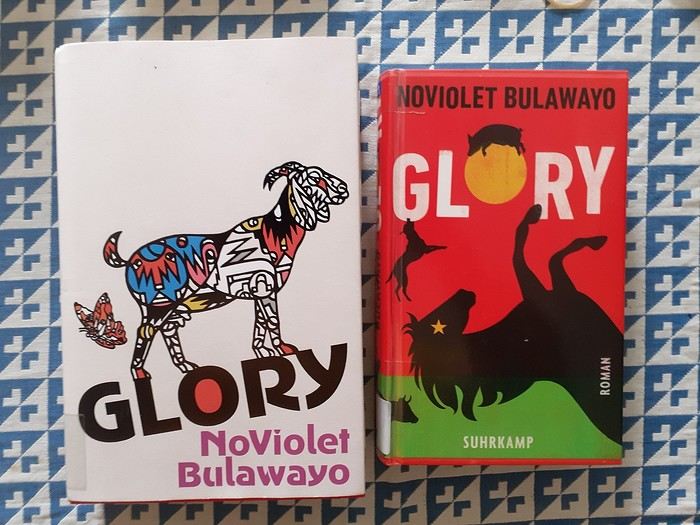 The books (in English, in German)
 Author NoViolet Bulawayo, Zimbabwe
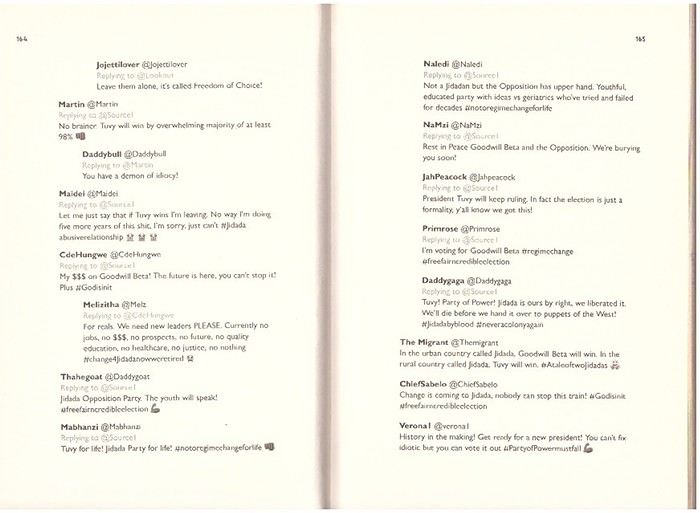 Threads (p.164-165)
"Bulawayo leans into exaggeration and irony to tell hard truths. *Glory* is jam-packed with comedy and farce, poking fun at an autocratic regime while illustrating the absurdity and surreal nature of a police state." — The Guardian
The cruelty and savagery of Zimbabwe’s (and Africa’s in general) "powerful animals"
Zimbabwean author NoViolet Bulawayo has written a novel that illustrates better than any documentary the complexity of colonial legacy. In doing so, she revisits George Orwell’s Animal Farm. Her novel *Glory* is a political satire about Zimbabwe—and it’s brimming with humor.
For thirty years, Zimbabwe has been stagnating under Robert Mugabe’s presidency. Human rights violations, corruption, and international sanctions have kept the population mired in poverty and oppression, while the regime exploits the meager earnings of the economy. As the 2017 elections approach, a power struggle erupts over the succession of the very elderly Father of the Nation (Mugabe). On the streets, people hope for long-awaited reforms; the people feel their moment has come.
And indeed, the army ousts Mugabe and his wife—"with her Gucci heels" (p.32)—who was positioning herself for the presidency. Hopes are dashed, however. The generals install former vice-president Emmerson Mnangagwa in power; the regime merely changes faces, but the problems remain the same.
In the novel, the country is called "Jidada, with a -da and another -da" (p.1); there’s no mistaking that this fictional state is Zimbabwe.
For *Glory*, her second novel, NoViolet Bulawayo invents a whole series of codes whose strength lies precisely in how easy they are to decipher. Like George Orwell’s Animal Farm, the characters populating Bulawayo’s universe aren’t humans but horses, goats, or crocodiles with all-too-human traits. Mugabe and Mnangagwa are horses, the spiritual leader is a pig, the soldiers are all bloodthirsty dogs, while the populace consists of goats, chickens, donkeys, and cats. The shift to the animal world serves only to better grasp the laws of despotism—and to ridicule real-life models. On one hand, the animals are humanized: they tweet, torture, travel in private jets. On the other, their greed, stupidity, and brutality stem from their animal nature.
It’s the old trick of fable: dressing men in animal disguises to make them easier to recognize. That’s how Orwell, in Animal Farm, traced how the promise of liberation from the Russian Revolution turned into Stalinist terror. In his 1945 fable, George Orwell describes how the animals of a farm drive out their farmer to organize the exploitation themselves, collectively. For a time, they truly taste freedom, but a clique of pigs ends up taking control. The central figures of the Soviet story—Stalin, Trotsky, Molotov—were easily recognizable.
Yet Bulawayo departs sharply from Orwell. She’s less concerned with precision and the force of argument than with satirical exaggeration. The deposed president is a senile old man who believes he can control even the sun’s course. The new stallion in power is a greedy debaucher. His soldiers sniff respectfully at his tail and backside.
In Bulawayo’s *Glory*, things are more complicated, but her novel also tells of a failed, incomplete liberation. In the author’s Animal Farm, Jidada, the colonial exploiters are followed by new forms of oppression. Because the former liberators become tyrants themselves. And because global power dynamics persist in neocolonial structures.
Wouldn’t that be enough to fuel a deeply depressing narrative? No—Bulawayo turns it into a blazing satire, full of wit and uncompromising criticism of power, a thread running through contemporary (not just) Zimbabwean history. The old warhorses in NoViolet Bulawayo’s Jidada, who continue to act as pack leaders, are easily recognizable as caricatures of the longtime dictator Robert Mugabe and his successor, current president Emmerson Mnangagwa.
The plot kicks off in high gear with independence day festivities. From the crack of dawn, everyone waits on Jidada Square for the Old Horse, the Father of the Nation and former liberator, whose reign "was nearing all of—not one, not two, not three, but four solid decades" (p.1). Everywhere, the colors of the Jidada Party shine; everywhere, true supporters cheer. Even the scorching sun plays its part: "At this point the sun, upon seeing arrive the leader who was decreed by God himself to rule and rule and keep ruling, a leader who'd in turn decreed the very sun to head his cheerleading squad, took a deep, deep breath and thoroughly blazed to impress" (p.2).
Finally, the Old Horse’s luxury carriage approaches "with the slowness of a hearse" (p.2), and "hoping to catch a glimpse of the legendary Father of the Nation," which causes "the animals fell over themselves like intoxicated frogs" (p.2). The sovereign’s speech is delayed a moment longer: "what I really want is a nap," groans the Old Horse as he takes his seat with such care "like his backside was made of expensive porcelain" (p.6).
Meanwhile, Bulawayo parades his entourage: the president’s wife (who earns her doctorate at Jidada University faster than "you could say diss, for dissertation. Tholukuthi it was as easy as ordering from a KFC drive-through, or perhaps even easier being that it was cheaper than KFC; it in fact cost her nothing and the degree actually came with a zero-calorie Diet Coke and a purple straw" (p.41), and she’s now known as Dr Sweet Mother. The cabinet includes "the Minister of the Revolution, the Minister of Corruption, the Minister of Order, the Minister of Things, the Minister of Nothing, the Minister of Propaganda, the Minister of Homophobic Affairs, the Minister of Disinformation and the Minister of Looting" (p.9). And of course the vice-president, who will soon become interim president when the Old Horse finally kicks the bucket—and then settle in as the new long-term president, who in the novel is called Tuvius Delight Shasha, or "Tuvy" for short (p.253), none other than Emmerson Mnangagwa. It’s him Bulawayo reserves her most merciless character description for.
"New Dispensation" (p.109) is Tuvy’s slogan for Jidada, and he loves repeating it so much he even named his parrot after it ("So inspired was Tuvy by the realisation that he rechristened his new pet parrot with the name New Dispensation—tholukuthi the bird having been acquired explicitly for the purposes of tweeting eulogies and accordingly glorifying the Saviour throughout the airs and skies of the nation. Tuvy then went on to hire a lecturer in English from the University of Jidada to teach New Dispensation to say the phrase 'New Dispensation'" p.110). But Tuvy’s Zimbabwe remains a nation without free, fair, and credible elections ("#freefairncredibleelection" p.161), and the promised equal treatment applies only insofar as Zimbabweans now queue up without discrimination in endless lines—and everyone is as poor as the next in the "queuenation" (p.283). Except for the powerful. They can "yes, tholukuthi, her immeasurable riches theirs to take. And take they did—
just take—take—take—take—take—take—take—take—take—take—take—take—take—take—take—take—take—take—take—take—take—take—take—take—take—take—take" (p.249-250).
In short: Bulawayo brilliantly depicts how former independence fighters become exploiters themselves. And how the country threatens to suffocate under the weight of corruption and repression. But she also literally stages the polyphony with which the people oppose imposed obedience to the official line.
Controversial online discussions keep interrupting the narrative—dialogues and social threads (see photo below) that Bulawayo masterfully integrates. From a literary standpoint, it’s a brilliant idea. And it shows, above all, that the author’s sympathy—so likeable—goes to all those who refuse to let their dream of true freedom be stolen, not even by the corrupt elites of their own country.
In the book’s acknowledgments, the first tribute goes to "The Jidadas of the world, clamouring for freedom on many fronts—A luta continua." (p.401) This reflects the realization that, not only in Jidada-Zimbabwe but in many other corners of the world, the end of colonial domination is still far from meaning the freedom hoped for by the vast majority of people. But it also means, more broadly, that this freedom must be won "on many fronts" (see above), both domestically and geopolitically.
That’s precisely what *Glory* so vividly highlights: how complex the project behind the term "postcolonialism" really is. With *Glory*, Bulawayo also delivers a scathing critique of the persistence of colonial mindsets in the West.
In the novel, the murder of George Floyd, racist police violence, and white-supremacist ideology in Trump’s United States perfectly illustrate the persistence of racism. It’s especially in the final chapters that Bulawayo lets Jidada’s inhabitants explicitly and unflinchingly criticize a neocolonial world order:
"It was not lost on us how the West, which loved to 'save' Africa and announce every action to the whole world, did so with one limb while manipulating, looting and fleecing us with the rest of its limbs so that more money in fact poured out of the continent than trickled in." (p.376)
"It was no mistake that multinational corporations yearly reaped and shipped colossal profits from Africa back to their countries as had been the case during colonial times. Even the sticks and stones would tell you that the African earth at any given time howled and shook and heaved from the extraction of its precious minerals that rarely benefited its own miserable children." (p.376)
"(...) we vowed to wage yet another war for Africa's second Liberation from neocolonial oppression. From exploitation. From plunder. From Western dominion. From indignity. From Abuse. We wanted real freedom. We wanted greedy, thieving paws off our wealth. We wanted Justice. We wanted a new world; we wanted a brand-new world so much we didn't sleep a wink that night." (p.377)
The Jidadas of this world must fight two enemies: Western neocolonialism and the autocratic instrumentalization of that argument; the persistence of Western racism and the populist appropriation of that humiliation by tyrants from their own ranks. Neither of these obstacles to freedom diminishes the historical and current guilt of the other. But the path to postcolonial liberation must overcome all these forms of oppression. After all, the colonizers didn’t bequeath democracies to formerly dominated nations, but instability and the principles of oppression and exploitation—which the so-called liberators have also internalized. Yet the fact that a satirical novel can capture the complexity of historical relationships while remaining, despite all the darkness of the subject, hilarious—well, that’s truly astonishing.
Finally, *Glory* ties into a major trauma in Zimbabwe’s post-independence history: the so-called Gukurahundi massacres. Between 1983 and 1987, tens of thousands of civilians were murdered by Mugabe’s bloody henchmen, most of them Ndebele. The State Security Minister and head of secret services at the time? You guessed it—Emmerson Mnangagwa.
When *Glory* turns to the massacres, the novel’s tone shifts completely. The story is now told through the narrative of the goat called Destiny, who, like NoViolet Bulawayo herself, left her home country at 18 for the United States and only returned after 13 years. In the book, the city of Bulawayo becomes a village where Destiny retraces her family’s history—and learns that part of it was also brutally murdered during the massacres.
The abuse of power and life under a dictatorship, dispossession, and a fiercely proud awareness of the psychological wounds and emotional vulnerability of a uprooted and disenfranchised people who had to forge a new language—a new set of names—to express their lived experiences are at the heart of this wonderful Zimbabwean author’s literary work, NoViolet Bulawayo. Shortly after her studies, she was already writing short stories about postcolonial power dynamics in Africa. But her playful, masterful, and often unconventional approach to language also plays a key role in her work. With virtuosity, she shifts from cynical images of power-obsessed elites to compassionate descriptions of the people’s suffering, ending with a hopeful sermon on courage—the courage to break free from fear and thus gain the strength for change ("And every one of them understood that whatever they heard within those hearts was the new national anthem, tholukuthi an anthem that spoke of the kind of glory that burns eternal and glows with living light." p.400). This novel is a genuine pleasure to read. And it’s exceptional. Good, African...
Book info (original English and German translation):
NoViolet Bulawayo. Glory. Chatto & Windus, 2022. NoViolet Bulawayo. Glory. Suhrkamp, 2023.
Hery
The books (in English, in German)
Author NoViolet Bulawayo, Zimbabwe
Threads (p.164-165)Feedback on a 3-week summer itinerary in Quebec
Hi everyone,
We’re planning our first trip to Quebec for early July 2026. There’ll be 2 adults and 2 teens (17 and 14 years old). For now, we’re thinking of renting an RV in Montreal for this loop.
Here’s a first draft of our route, based on itineraries I’ve seen on the forum. The times below are the useful time spent at each stop, not including driving. Does the order make sense? It has us crossing the river twice. Are the lengths of the stops reasonable? We like to take our time and not spend too much time on the road. Finally, any other suggestions for places to add or swap out?
Arrival and half a day in Montreal Pick up RV the next day Mauricie National Park: 2.5 days Quebec City: 2 days Jacques Cartier National Park: 2.5 days Saguenay Fjord–Tadoussac: 2.5 days, then crossing Bic Park: 2.5 days, then crossing back Charlevoix: 3.5 days Montreal: 2 days, then return to France
Thanks so much in advance for any help you can give us!
GabRaph
We’re planning our first trip to Quebec for early July 2026. There’ll be 2 adults and 2 teens (17 and 14 years old). For now, we’re thinking of renting an RV in Montreal for this loop.
Here’s a first draft of our route, based on itineraries I’ve seen on the forum. The times below are the useful time spent at each stop, not including driving. Does the order make sense? It has us crossing the river twice. Are the lengths of the stops reasonable? We like to take our time and not spend too much time on the road. Finally, any other suggestions for places to add or swap out?
Arrival and half a day in Montreal Pick up RV the next day Mauricie National Park: 2.5 days Quebec City: 2 days Jacques Cartier National Park: 2.5 days Saguenay Fjord–Tadoussac: 2.5 days, then crossing Bic Park: 2.5 days, then crossing back Charlevoix: 3.5 days Montreal: 2 days, then return to France
Thanks so much in advance for any help you can give us!
GabRaph
New Navi Mumbai International Airport
India inaugurates the new Navi Mumbai International Airport and the final phase of Mumbai’s Metro Line 3—a major turning point for the country’s infrastructure.
Mumbai, India’s economic capital, is entering a new era of modernization. The Indian government has officially inaugurated the Navi Mumbai International Airport, one of the country’s most ambitious infrastructure projects, along with the final phase of Metro Line 3, a key axis to ease congestion in the megacity.
The Navi Mumbai International Airport (NMIA), located about 35 km from the city center, aims to eventually handle up to 60 million passengers per year. Built to reduce pressure on the already saturated Chhatrapati Shivaji Maharaj Airport, it features ultra-modern facilities, sustainable design, and cutting-edge technologies for air traffic management and energy efficiency.
At the same time, the completion of Mumbai’s Metro Line 3, connecting Colaba to Bandra-SEEPZ, marks a major advancement in urban mobility. This 33.5 km underground section will significantly reduce travel time and congestion in a city known for its chronic traffic jams.
These two projects reflect the Indian government’s commitment to transforming Mumbai into a global hub, combining connectivity, sustainability, and economic development.
The Navi Mumbai International Airport (NMIA), a project two decades in the making, has finally come to fruition. Phase one of the airport was inaugurated Wednesday by Prime Minister Narendra Modi, in the presence of Chief Minister Devendra Fadnavis and Deputy Chief Ministers Eknath Shinde and Ajit Pawar. Although the first phase, which includes Terminal 1 and Runway 1 with 10 bus gates and 29 aero bridges, has been inaugurated, flight operations will not begin immediately.
"Post-inauguration, the airport will be handed over to the Central Industrial Security Force (CISF) for a security sweep, which could take 30 to 45 days. We also need to mobilize customs and immigration teams and complete end-to-end testing, which is a 45-60-day process," said Arun Bansal, CEO of Adani Airports Holdings Ltd, developer and operator of the NMIA, during a press briefing at the NMIA premises Monday. Even though an exact date hasn’t been announced, NMIA CEO Captain B V J K Sharma and Bansal said commercial flights are expected to begin in December 2025. Plans of major carriers Three major airlines—Air India, Akasa Air, and IndiGo—have already signed on to shift part of their operations to NMIA. Last month, Air India announced plans to start with 20 daily departures (40 air traffic movements) through Air India Express, connecting 15 Indian cities in the first phase. By mid-2026, it aims to scale up to 55 daily departures, including up to five international flights. IndiGo, which made its announcement in May, plans to operate 18 daily flights to more than 15 cities from the first day of commercial operations and intends to expand to 140 daily flights—30 of which will be international—within 18 months. In June, Akasa Air said it will start with 15 daily domestic flights, scaling up to over 300 domestic and 50 international flights a week within a few months. When asked which airline will operate the first flight, Bansal said, "We want all three airlines to be there on Day 1. It depends on who has the earliest slot that day, and the destination choice lies entirely with the airlines." Operations to begin with 12-hour window In the first month, flights will operate between 8 am and 8 pm, with the 12-hour window likely to be extended as operations stabilize. Although NMIA’s full capacity is 40 air traffic movements (ATMs) per hour, the initial phase will handle 10 ATMs—allowing 10 aircraft to land or take off every hour. Airlines are expected to announce routes and ticket sales soon. Touted as an international aviation hub, NMIA positions Mumbai alongside global twin-airport cities such as London, Dubai, and New York, and plans to launch both domestic and international operations from Day 1. Concession for international carriers When asked if international carriers will be given any concessions, Bansal said, "For international airlines, we will not charge them parking fees for the first year." The duo added that NMIA aims to reclaim Mumbai’s rightful place on the global aviation map. "For a decade… travelers didn’t have a choice—airlines couldn’t get additional slots (at the Mumbai airport), so traffic shifted to Delhi. We are course-correcting that with NMIA. It won’t happen overnight, but over the next five–seven years, you’ll see the change," said Bansal. He noted that Mumbai currently lacks direct flights to major destinations in Europe and the U.S., something NMIA hopes to change. "If you see east-to-west flights, Mumbai is a natural stop," added Sharma. As reported earlier, NMIA will eventually feature four terminals and two parallel runways, with a total capacity to handle up to 90 million passengers per annum (MPPA), compared to 20 MPPA in the first phase. In the long term, the airport aims to serve as a key transfer hub between the East and the West, enabling passengers from Southeast Asia to connect seamlessly to Europe and North America.
The Navi Mumbai International Airport (NMIA), a project two decades in the making, has finally come to fruition. Phase one of the airport was inaugurated Wednesday by Prime Minister Narendra Modi, in the presence of Chief Minister Devendra Fadnavis and Deputy Chief Ministers Eknath Shinde and Ajit Pawar. Although the first phase, which includes Terminal 1 and Runway 1 with 10 bus gates and 29 aero bridges, has been inaugurated, flight operations will not begin immediately.
"Post-inauguration, the airport will be handed over to the Central Industrial Security Force (CISF) for a security sweep, which could take 30 to 45 days. We also need to mobilize customs and immigration teams and complete end-to-end testing, which is a 45-60-day process," said Arun Bansal, CEO of Adani Airports Holdings Ltd, developer and operator of the NMIA, during a press briefing at the NMIA premises Monday. Even though an exact date hasn’t been announced, NMIA CEO Captain B V J K Sharma and Bansal said commercial flights are expected to begin in December 2025. Plans of major carriers Three major airlines—Air India, Akasa Air, and IndiGo—have already signed on to shift part of their operations to NMIA. Last month, Air India announced plans to start with 20 daily departures (40 air traffic movements) through Air India Express, connecting 15 Indian cities in the first phase. By mid-2026, it aims to scale up to 55 daily departures, including up to five international flights. IndiGo, which made its announcement in May, plans to operate 18 daily flights to more than 15 cities from the first day of commercial operations and intends to expand to 140 daily flights—30 of which will be international—within 18 months. In June, Akasa Air said it will start with 15 daily domestic flights, scaling up to over 300 domestic and 50 international flights a week within a few months. When asked which airline will operate the first flight, Bansal said, "We want all three airlines to be there on Day 1. It depends on who has the earliest slot that day, and the destination choice lies entirely with the airlines." Operations to begin with 12-hour window In the first month, flights will operate between 8 am and 8 pm, with the 12-hour window likely to be extended as operations stabilize. Although NMIA’s full capacity is 40 air traffic movements (ATMs) per hour, the initial phase will handle 10 ATMs—allowing 10 aircraft to land or take off every hour. Airlines are expected to announce routes and ticket sales soon. Touted as an international aviation hub, NMIA positions Mumbai alongside global twin-airport cities such as London, Dubai, and New York, and plans to launch both domestic and international operations from Day 1. Concession for international carriers When asked if international carriers will be given any concessions, Bansal said, "For international airlines, we will not charge them parking fees for the first year." The duo added that NMIA aims to reclaim Mumbai’s rightful place on the global aviation map. "For a decade… travelers didn’t have a choice—airlines couldn’t get additional slots (at the Mumbai airport), so traffic shifted to Delhi. We are course-correcting that with NMIA. It won’t happen overnight, but over the next five–seven years, you’ll see the change," said Bansal. He noted that Mumbai currently lacks direct flights to major destinations in Europe and the U.S., something NMIA hopes to change. "If you see east-to-west flights, Mumbai is a natural stop," added Sharma. As reported earlier, NMIA will eventually feature four terminals and two parallel runways, with a total capacity to handle up to 90 million passengers per annum (MPPA), compared to 20 MPPA in the first phase. In the long term, the airport aims to serve as a key transfer hub between the East and the West, enabling passengers from Southeast Asia to connect seamlessly to Europe and North America.
Travelers Are No Longer Privileged Customers
Hi everyone,
Accepting the rules everywhere has become the norm, and customer service keeps getting worse and worse.
Who’s to blame? All those who comply without a fuss, even though you’re paying full price everywhere. What used to be normal (good service) has now become the exception.
Example: Hotels and their overly strict rules (rules that, personally, I successfully bend almost every time) 😄.
We pay for a room for 24 hours, not 12-15 hours.
How many times have I arrived at my hotel around noon after exhausting flights, asked for my reserved room, and been told that rooms are only available from 3 or 4 PM? Unacceptable (especially since we often have to check out by 10-11 AM—just as unacceptable).
“Miss, I’m really tired from my trip. Could you make a small effort? I’m sure several rooms are ready by now.”
The response? “It’s the rule. Come back at 4 PM.” 😒
Of course, I get that the front-desk clerk is just blindly following orders (or overdoing it).
I stay calm and ask her to fetch her supervisor (who shows up right away, probably afraid of a scene). I explain with my best "puppy-dog eyes," and—bingo—10 minutes later, I’ve got my room (I’ll spare you the comments from my fellow travelers calling me a rude, uneducated nightmare).
I’m thrilled because they’ll be waiting around for 4 hours 😏.
It’s the same everywhere—restaurants (especially in France), where you arrive at 9:05 PM and are told they’re no longer serving because the chef has finished and turned off the ovens. (Do you really need an oven and 2 hours to make an English breakfast or a cheese platter with good wine?) And then some restaurant owners complain about not meeting their targets—pfft. The list goes on, and I don’t have all the complaints about service providers fresh in my mind (feel free to add yours if you agree). Otherwise, keep bowing your heads—I won’t change the world, but I’ll never accept being told I’m too demanding. It’s the people who let things slide (the majority) who have no standards left, to the detriment of service quality for everyone 😏.
National parks in the American West in July: crowds and heat
Hi everyone,
I’m planning a road trip along the American West Coast in July 25 and, of course, I’d love to visit the parks east of Las Vegas. The crowds—but especially the heat—are making me second-guess whether it’s a good idea (the parks). I’d really appreciate your (honest!) feedback from those who’ve been there. Is the experience ruined? Maybe it’s manageable (early morning visits)? I have no doubt the scenery will be breathtaking, but does the context let you fully enjoy it? Thanks so much in advance for sharing your thoughts!
Route 66: Is it better to do it in an SUV or a camper van?
Hi everyone,
We’re planning a road trip on Route 66 in 2027 with our two kids, who’ll be 7 and 4 years old.
My husband would prefer to do it in an SUV, while I’d rather go in a camper van.
What are the pros and cons of each option?
Thanks for your input!
We’re planning a road trip on Route 66 in 2027 with our two kids, who’ll be 7 and 4 years old.
My husband would prefer to do it in an SUV, while I’d rather go in a camper van.
What are the pros and cons of each option?
Thanks for your input!
Quick feedback on our trip to Nepal, Rajasthan, South India, and the Andaman Islands
Our trip through Nepal, Rajasthan, South India, and the Andaman Islands.
Dates: October 26 to January 14, 2025
Departure from Geneva to Kathmandu.
NEPAL, one month. 2 days of exploring between Kathmandu and Patan. 14 days of trekking from Kathmandu to Langtang, passing by sacred lakes. Trek with a French-speaking guide and 2 porters from the local French-speaking tour operator "NEPAL VOYAGE." Ended with a helicopter ride due to a wrist fracture on black ice at 3,900m. 3 days in the hospital in Kathmandu. Continued the trip in Nepal with a self-guided stay in Bhaktapur and Pokhara. Returned to Kathmandu by plane, then flew to Delhi.
RAJASTHAN. 18 days touring Rajasthan with a French-speaking driver "RAVINDRA MENA." Highlights: Bikaner, Jaisalmer, Jodhpur*, Ranakpur*, Udaipur*, Bundi, Pushkar*, Jaipur, Agra, Jaipur (Top spots marked with *). Flight from Jaipur to Kochi.
KERALA. Kochi, 3 nights—disappointing, but the Backwaters to the north by scooter were stunning and not touristy. Kochi to Varkala by Uber with a Canadian couple. Varkala, 4 nights—great for relaxing, but scooter rentals weren’t available, which was a shame. Varkala to Munroe Island by train. 2 nights in Monroe. Munroe Island to Kumilly. 2 nights on Christmas Day—meh, not much to do since all the park excursions were booked by Indian tourists. Kumilly to Munnar by local taxi, negotiated the day before. Munnar—processions, tea fields, and *so* many Indian tourists during this period that it was impossible to find scooters to rent.
TAMIL NADU Crossed Tamil Nadu from Munnar to Auroville in 3 days, stopping at the extraordinary Tamil temples of Madurai, Trichy, Thanjavur, Darasuram, Chidambaram, and others. With the lunar conjunction, pilgrimages, and year-end holidays, there were *tons* of pilgrims! Auroville to Pondicherry by scooter, then a tuk-tuk for New Year’s Eve—still *so* crowded! Pondicherry to Mahabalipuram by local bus. Mahabalipuram, 2 nights—nice and chill. Mahabalipuram to Chennai by Uber.
ANDAMAN ISLANDS Chennai to Port Blair by flight, Andaman Islands. Port Blair, 2 nights—almost too much! Speedboat to Havelock, 4 nights—still lots of Indian tourism. Couldn’t go snorkeling with a dive operator or rent gear. Luckily, we managed to buy some and do it ourselves. Speedboat to Neil Island, 3 days, 2 nights—too short, but excellent snorkeling from "Elephant, Four Wise Men." Phew, no biting flies, and we weren’t eaten by crocodiles. Back to Port Blair, then Delhi, one night, and return to Geneva.
Our impressions of India. Rajasthan and Tamil Nadu—we eventually got tired of palaces and temples. It’s always complicated and exhausting to get around on foot in the cities. During the year-end period from mid-December to mid-January, *so* many tourists! The Andaman Islands were a bit disappointing—too short, and for snorkeling, Indonesia is easier and less expensive.
Our photos========================= Trip summary NEPAL AND INDIA (140 photos) https://photos.app.goo.gl/NVY4qaLcArvXzUx58
All photos from the Nepal trek (81 photos) https://photos.app.goo.gl/pXkG3JaFyJg93k1s8
All photos NEPAL After the trek and Christine’s accident (87 photos) https://photos.app.goo.gl/UgbNWb6oAibif3837
All photos RAJASTHAN (tough to narrow down! 230 photos) https://photos.app.goo.gl/GghreEkzhZoq6Rcw7
All photos SOUTH INDIA KERALA, Tamil Nadu, Andaman (200 photos) https://photos.app.goo.gl/DYnp2JLyLR2UCM3R6
NEPAL, one month. 2 days of exploring between Kathmandu and Patan. 14 days of trekking from Kathmandu to Langtang, passing by sacred lakes. Trek with a French-speaking guide and 2 porters from the local French-speaking tour operator "NEPAL VOYAGE." Ended with a helicopter ride due to a wrist fracture on black ice at 3,900m. 3 days in the hospital in Kathmandu. Continued the trip in Nepal with a self-guided stay in Bhaktapur and Pokhara. Returned to Kathmandu by plane, then flew to Delhi.
RAJASTHAN. 18 days touring Rajasthan with a French-speaking driver "RAVINDRA MENA." Highlights: Bikaner, Jaisalmer, Jodhpur*, Ranakpur*, Udaipur*, Bundi, Pushkar*, Jaipur, Agra, Jaipur (Top spots marked with *). Flight from Jaipur to Kochi.
KERALA. Kochi, 3 nights—disappointing, but the Backwaters to the north by scooter were stunning and not touristy. Kochi to Varkala by Uber with a Canadian couple. Varkala, 4 nights—great for relaxing, but scooter rentals weren’t available, which was a shame. Varkala to Munroe Island by train. 2 nights in Monroe. Munroe Island to Kumilly. 2 nights on Christmas Day—meh, not much to do since all the park excursions were booked by Indian tourists. Kumilly to Munnar by local taxi, negotiated the day before. Munnar—processions, tea fields, and *so* many Indian tourists during this period that it was impossible to find scooters to rent.
TAMIL NADU Crossed Tamil Nadu from Munnar to Auroville in 3 days, stopping at the extraordinary Tamil temples of Madurai, Trichy, Thanjavur, Darasuram, Chidambaram, and others. With the lunar conjunction, pilgrimages, and year-end holidays, there were *tons* of pilgrims! Auroville to Pondicherry by scooter, then a tuk-tuk for New Year’s Eve—still *so* crowded! Pondicherry to Mahabalipuram by local bus. Mahabalipuram, 2 nights—nice and chill. Mahabalipuram to Chennai by Uber.
ANDAMAN ISLANDS Chennai to Port Blair by flight, Andaman Islands. Port Blair, 2 nights—almost too much! Speedboat to Havelock, 4 nights—still lots of Indian tourism. Couldn’t go snorkeling with a dive operator or rent gear. Luckily, we managed to buy some and do it ourselves. Speedboat to Neil Island, 3 days, 2 nights—too short, but excellent snorkeling from "Elephant, Four Wise Men." Phew, no biting flies, and we weren’t eaten by crocodiles. Back to Port Blair, then Delhi, one night, and return to Geneva.
Our impressions of India. Rajasthan and Tamil Nadu—we eventually got tired of palaces and temples. It’s always complicated and exhausting to get around on foot in the cities. During the year-end period from mid-December to mid-January, *so* many tourists! The Andaman Islands were a bit disappointing—too short, and for snorkeling, Indonesia is easier and less expensive.
Our photos========================= Trip summary NEPAL AND INDIA (140 photos) https://photos.app.goo.gl/NVY4qaLcArvXzUx58
All photos from the Nepal trek (81 photos) https://photos.app.goo.gl/pXkG3JaFyJg93k1s8
All photos NEPAL After the trek and Christine’s accident (87 photos) https://photos.app.goo.gl/UgbNWb6oAibif3837
All photos RAJASTHAN (tough to narrow down! 230 photos) https://photos.app.goo.gl/GghreEkzhZoq6Rcw7
All photos SOUTH INDIA KERALA, Tamil Nadu, Andaman (200 photos) https://photos.app.goo.gl/DYnp2JLyLR2UCM3R6
Eastern Crete in September 2024
Travel journal in Eastern Crete from September 8th to 29th, 2024
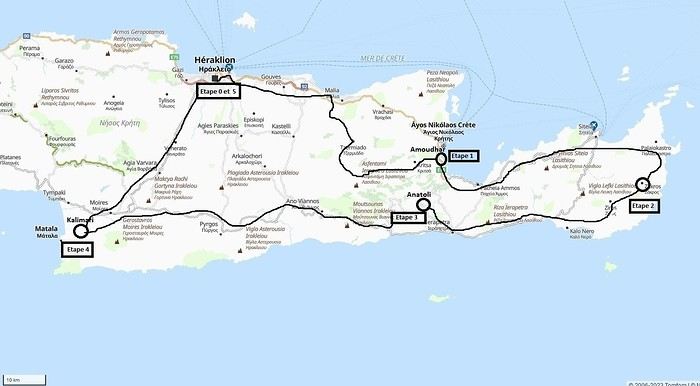 Our 21-day itinerary
Sunday, 08/09: Once again—and this is the eighth time—we’re setting off, the four of us: Patrick, Michelle, Jacques, and Monique, for the Greek islands. This time, we’ve chosen Crete. No need to wake up at 3 or 4 a.m. to reach Basel-Mulhouse Airport at dawn to catch the first flight to Greece at 6 a.m.! Given the prohibitive prices charged by EasyJet, we found flights that were half the price from Zurich Airport, which is accessible in 3 hours by train from Colmar. Pierre-Paul drives all four of us to Colmar train station, where we take the train to Basel and then, 20 minutes later, the direct train to Zurich Airport. After wandering around the airport, we go for a coffee at 6 € each! We’re in Switzerland, after all. The other dining areas all have vending machines for selecting and paying for meals—soon, there won’t be anyone left to serve you! After a short wait, we take off at 7:45 p.m. (20 minutes late) in an Aegean Airbus A321. Free in-flight meal service isn’t bad either! We land in Heraklion around 11:15 p.m. We pick up our rental car (a red Seat Ibiza) at the airport and head straight to our apartment, located 2 km from the city center. Thanks to the GPS, we find it quickly. It’s a beautiful, fully renovated apartment with all the comforts and well-equipped. On the table, there’s wine, bottles of water, jam, coffee, etc. Given the late hour, we won’t stay up long.
Monday, 09/09: To enhance our breakfast, Michelle and Monique set off to find a bakery nearby. They return with croissants and donuts—yum... Then we head to the west coast. The highway follows the coastline, but we prefer taking the old road to Malia, our first stop. We visit the major archaeological site of this Minoan city under the hot sun. The site covers a vast area, but the ruins aren’t very evocative except for a few beautiful amphorae scattered around. The explanations in a small house at the entrance are interesting and help us better understand the organization of the ancient city with its different districts. From there, we head toward the nearby mountains to see the thousand-year-old plane tree in the village of Krasi. We take the opportunity to enjoy an excellent lunch of moussaka and delicious gemista at the Krassopsychia taverna in the village center. Pleasant surprise: the prices are still reasonable, with a bill of 70 € for four, including wine and water. The friendly tradition of complimentary dessert and glasses of raki continues—great! We’ve set the bar high right away! Let’s hope the rest lives up to it! On the way back toward the Lassithi Plateau, we stop at the Kardiotisa Monastery perched high on the mountain to enjoy a magnificent view of the entire region. Just a little further, we arrive at the Lassithi Plateau: the presence of small windmills used to pump water from the ground is the typical feature of this plateau. We complete a full loop around the plateau, passing by numerous orchards and vegetable gardens that occupy the entire space. At the end of the plateau, we once again cross mountain passes via winding roads that bring us near Agios Nikolaos. Our apartment is located about ten kilometers further south in Amoudhara. The owner, who was notified, waits for us and shows us her superb apartment, whose large terrace overlooks the entire Mirabello Bay. She then gives us valuable information about the different beaches in the area. Dinner will be frugal, given our hearty lunch in Krasi!
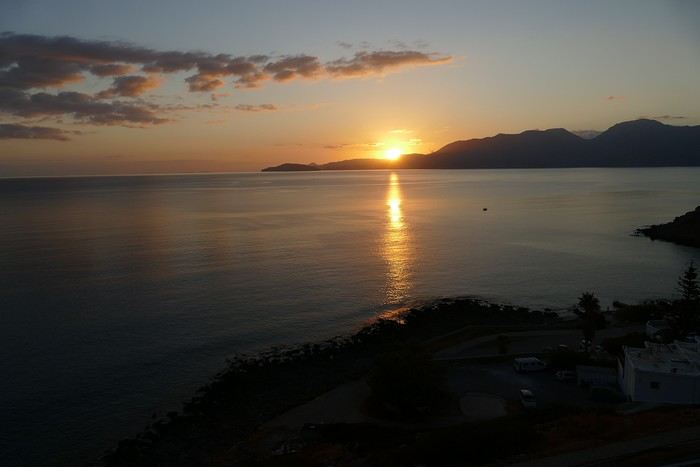 Sunset over Mirabello Bay
Tuesday, 10/09: A bit of a gray sky when we wake up around 8 a.m., but the sun will soon triumph over the scattered clouds. For our first swim, we opt for Voulisma Beach, even though our host warned us it was a bit “crowdy.” That’s understandable given the beautiful emerald color of the sea and the lovely curve of the beach. To avoid the big crowds, we move toward the eastern part of the beach, accessible via a steep staircase. The water is very warm, and this first dip is very pleasant. Before returning to the apartment, we stop at the bakery to buy spinach pies, essential ingredients to accompany our Greek salad for lunch. Of course, everything will be washed down with ouzo, which will remain our favorite drink for the next three weeks—but in moderation!!! A nap is in order after all that effort. In the late afternoon, we drive to Agios Nikolaos, the main seaside resort in Crete. We’re not too enthusiastic about visiting this mass-tourism resort, but the center of Agios, concentrated around the small inner harbor, is pleasant to see despite the plethora of shops and restaurants. We dine a little outside the harbor in the shaded courtyard of the Avli taverna: the oven-baked lamb, squid with spinach, and cuttlefish ink orzo pasta are all highly appreciated. We still stay under a 75 € bill for four.
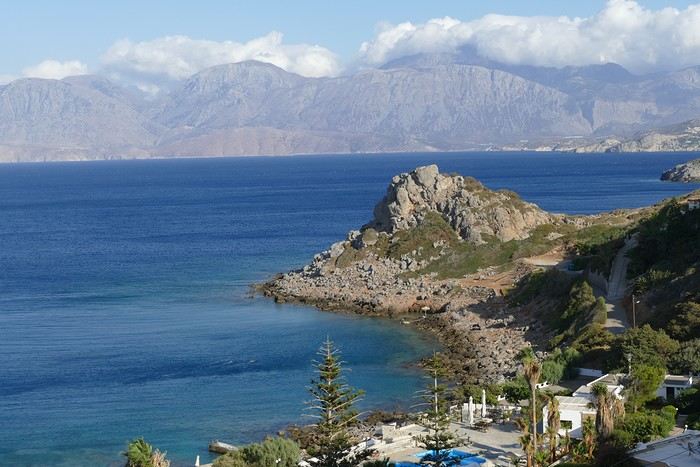 Mirabello Bay seen from our terrace
Wednesday, 11/09: At 8 a.m., the terrace is already bathed in sunlight, and it’s already quite hot. The small parasol barely gives us enough shade, but we’re not complaining! For our second swim, we head to a tiny beach recommended by our host, just 3 minutes by car from our place. The path leading to it is very discreet, and we don’t find it right away! It’s a small sandy cove with a few welcome tamarisk trees for shade. When we arrive, there are two swimmers, and there won’t be more than five or six in the morning. After lunch and a nap, we head to the beautiful village of Kritsa, just a few kilometers away. It’s too late to visit the beautiful church of Kera Panagia, which is already closed. We settle for the exterior, which is worth a look. The weather is clouding over, and big clouds are gathering. Upon arriving in Kritsa, a heavy shower forces us to take shelter in the Platanos taverna in the village center, and since it’s nearly 7 p.m., we decide to stay and dine there. Good choice—excellent meze: croquettes and stuffed zucchini flowers, gigantes beans, grilled tomatoes and feta, and pancetta as the main dish. The rain stops just as we decide to head back.
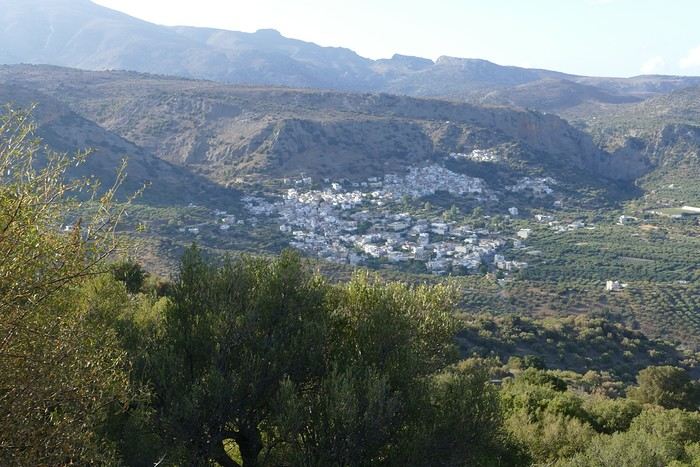 Village of Kritsa
Thursday, 12/09: Our terrace faces east, so we get to watch the sunrise around 7 a.m.—it’s truly a beautiful sight we never tire of. Around 9 a.m., we head to the village of Plaka, where boats depart for the island of Spinalonga, located north of Agios Nikolaos. We board the first boat, which sets sail at 10 a.m., and we’re not alone—the boat is practically full. After 10 minutes, we land on the island at the same time as several other boats from Elounda or Agios. Needless to say, there are already quite a few people walking through the streets of the leper village. The visit remains interesting and moving as we read the explanatory panels recounting the island’s history under Byzantine and then Turkish rule, followed by its transformation into a leper colony. As soon as we climb toward the top of the island via more or less maintained paths, there’s almost no one left. The 360° view from up there is stunning.
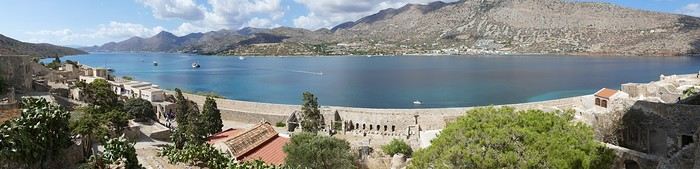
Spinalonga Island
The heat is now unbearable, and we can’t wait to get back home to have lunch on our terrace and rest. In the late afternoon, we go grocery shopping at the AB supermarket at the entrance of Agios. We had spotted another nice restaurant in our guide, but unfortunately, there’s a different one at the indicated location that doesn’t inspire us. So, we return to the Avli taverna for another dinner just as good as the first.
Friday, 13/09: We repeat yesterday’s successful program: a swim in our little cove, lunch on the terrace, a nap, and then, in the late afternoon, we discover another nearby village, Kroustas, nestled in the olive groves near Kritsa. Much less touristy than Kritsa, it’s mostly inhabited by locals, especially the elderly who are enjoying the cool air on their chairs—if you can call it cool given the still-high temperatures in the late afternoon! We then return to visit Kritsa, which we hadn’t been able to explore due to the rain. Dinner at a taverna in the village center at a very reasonable price.
Saturday, 14/09: Today, we move to our new base further east. We start with a high viewpoint at the Faneromeni Monastery, which overlooks Mirabello Bay. The monastery itself is of little interest as it’s under renovation with excessive concrete work. We continue to the village of Kavoussi to see another exceptional tree after a few kilometers on a dusty, bumpy track. It’s an olive tree said to be about 3,200 years old—impressive, and the countryside is very beautiful. It’s time to find a place for lunch. We find one in the charming little port of Mohlos, where a few tavernas surround a very nice small beach. Our choice falls on the Bogazzi taverna, where we enjoy fried fish. To reach our new base in Zakros, we still have to drive through the mountains before reaching Sitia, Paleokastro, and finally Zakros. The region is beautiful, with olive groves and rows of wind turbines taking advantage of the strong wind near the northern tip of the island. In Zakros, we’re greeted by our very friendly host. Here too, we have all the comforts and a beautiful terrace overlooking the village. The apartment has reversible air conditioners, but the overly simple instructions leave us puzzled. Thinking we’ve set it correctly, we realize a little too late that it’s blowing hot air over 30°C! After numerous attempts and testing several confusing programs, we finally succeed! Dinner on our new terrace.
Sunday, 15/09: This morning, we get up early to hike in the “Gorge of the Dead” while it’s still cool. The sky is blue as usual! We park in the nearest parking lot and start our descent via a beautiful path winding through the olive groves. A little further on, the landscape opens up, and the path, now a stony trail, begins the descent to the dry riverbed. On either side of the riverbed rise beautiful reddish cliffs.
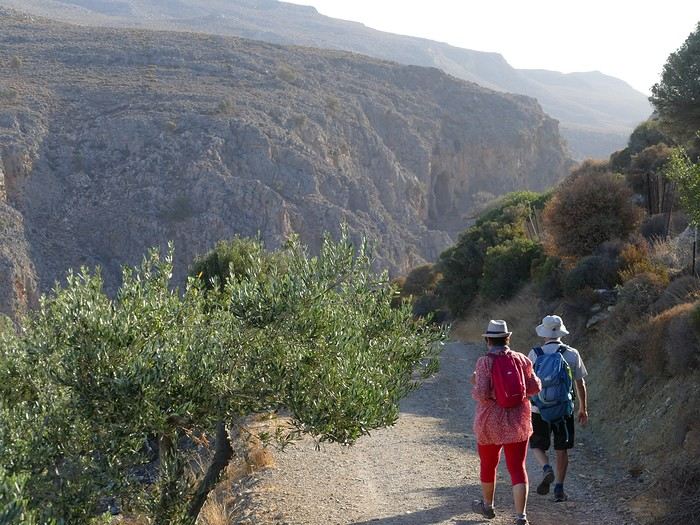
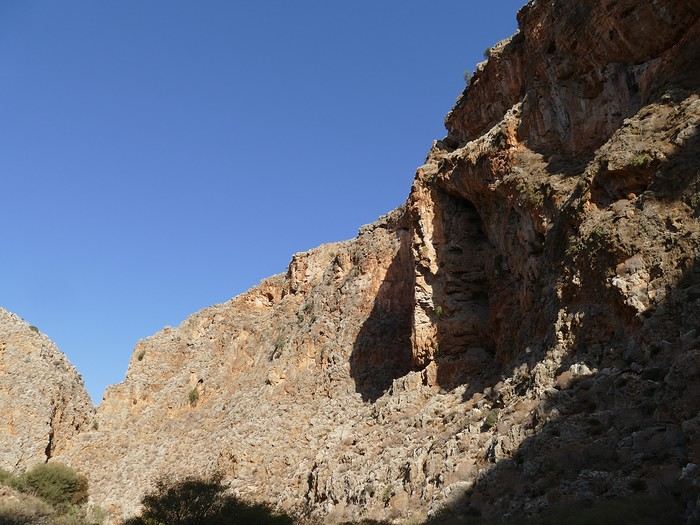
Gorge of the Dead
The trail winds its way through this narrow gorge with difficulty. It was in the many caves visible halfway up the slope that the Minoans buried their dead, hence the name “Gorge of the Dead.” The gorge opens onto a beautiful small pebble beach. A swim is welcome after this hike that made us sweat. The hike took us 1 hour and 25 minutes, and a little less on the way back. Meanwhile, Monique did some shopping and prepared an excellent lunch. In the late afternoon, we go down to dine at Platanakis, a taverna in the small village of Kato Zakros.
Monday, 16/09: This morning, we explore the northern part of the east coast near Palekastro. We start with a dip at the beautiful Hionia Beach near Palekastro. The water is still just as nice, but a light breeze is blowing—not enough to spoil our fun! Seeing all the wind turbines lining the ridges, it’s no surprise.
 Grocery shopping in Palekastro and return to Zakros. A little rain in the late afternoon and an excellent dinner at Iannis Mitsakakis’ Taverna in Adravastis. These are the kind of small tavernas we love—unpretentious, a few tables on a terrace, a warm welcome, a short menu guaranteeing freshness, tasty dishes prepared by the server’s mom, and a light bill. What more could you ask for!
Tuesday, 17/09: We head back toward Palekastro to do some shopping, but it’s also the road to the Toplou Monastery. There, we see a collection of magnificent icons dating from the 15th to the 20th century. We can also admire drawings of Orthodox religious architecture. We continue toward the Mavros Akrotiri headland to enjoy the view of the sea and rocky capes. On the way back to our place, we make a small detour to see the famous Vai palm grove. Meh... As for Vai Beach, it’s filled with paid umbrellas and sunbeds, and there are so many people that we flee. Plus, having to pay for parking is another reason to snub this trendy beach. We prefer our Hionia Beach, which we already appreciated the other day. In the late afternoon, Pat and I start the trail that begins at Kato Zakros Beach heading south. The poorly marked path crosses a plateau of sharp limestone. The paint and cairn markings are no longer very visible, and with dusk approaching, we turn back toward Kato Zakros. Dinner at the Platanakis taverna—less good than last time.
Wednesday, 18/09: To avoid the scorching sun, Pat, Mimi, and I get up earlier than usual to hike the Hohlakies Gorge. At this early hour, the sky is quite cloudy, and it’s drizzling. When we arrive in the village of Hohlakies, we park in front of a small chapel, the start of the hike. The sky is now completely clear. The trail starts among the olive groves, then after passing through a gate, we descend into the gorge filled with large rocks. We’re alone in the world, and the landscape is magnificent. A few wild goats clinging to the cliff watch us from above. After 1 hour and 15 minutes, we emerge onto the wonderful Karoumès Beach. A pleasant swim, then back to civilization! A walk in the late afternoon in Zakros to discover the beautiful springs route. Dinner in Adravastis.
Thursday, 19/09: Another move: Before heading to our next stop, we make a detour to see the beautiful Keratokampos Beach and can’t resist a swim in the still-warm, clear water. We continue our journey via Ziros, then reach the south coast and have lunch at the Stephi taverna in Ferma—excellent meal! The south coast is quite urbanized and has much less charm than the east coast we’ve just left! The numerous plastic greenhouses are partly to blame. We stop for groceries in Ierapetra. Around 3 p.m., we arrive at our destination in the small perched village of Anatoli. Our lodging is at the top of the village, and from the path leading to it, we have a magnificent view of the coastal plain, unfortunately overloaded with plastic greenhouses. It reminds us of the landscapes of El Ejido in Andalusia.
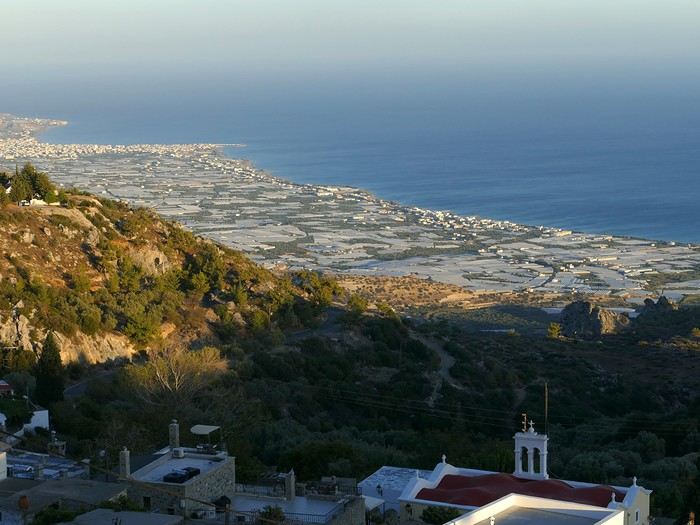 View of the Ierapetra coast from Anatoli
Friday, 20/09: A walk and discovery of the hamlet of Anatoli. There are few services—a tiny grocery store, a taverna, and that’s it. Fortunately, the traveling baker arrives and honks. We take the opportunity to buy fresh bread. Leaving the village, we take a path that should lead us to the hamlet of Drygies. The landscape is beautiful. We walk through a lovely pine forest before arriving at the hamlet. The path continues to a taverna that’s closed today, with a superb terrace overlooking the coast. Luckily, the owner arrives and informs us that the taverna will be open next Sunday and that we can enjoy barbecued meat. Noted! We head back to Anatoli via the small paved road with, fortunately, very limited traffic. Lunch on our terrace, then a dip in our private pool! The water is noticeably cooler than at the beach. Dinner at the village taverna: there’s only one menu—meze starters, souvlaki, water, wine, and bread—all for 35 €! We think we’re dreaming—was there a mistake? No.
Saturday, 21/09: We discover the beach of the village of Myrtos, a small seaside resort that’s quite touristy but on a human scale. We swim in the western part of the beach, and once again, we’re alone in the water. The best part: warm water and tamarisk trees for welcome shade. There’s even a shower to rinse off! In the late afternoon, Pat and I decide to go for a hike in the Selakano pine forest. To get there, we take a narrow, winding, and poorly paved road after the village of Christos. Plus, at this altitude, we encounter clouds clinging to the mountain, so it’s drizzling, and visibility is reduced. We decide to turn back and return to Anatoli. As compensation, we take the path that passes in front of the lodging and leads us to the Timios Stavros chapel, which crowns the summit of the nearby mountain. We arrive at the summit just in time for the sunset at 7 p.m. Breathtaking 360° panorama and magnificent colors!
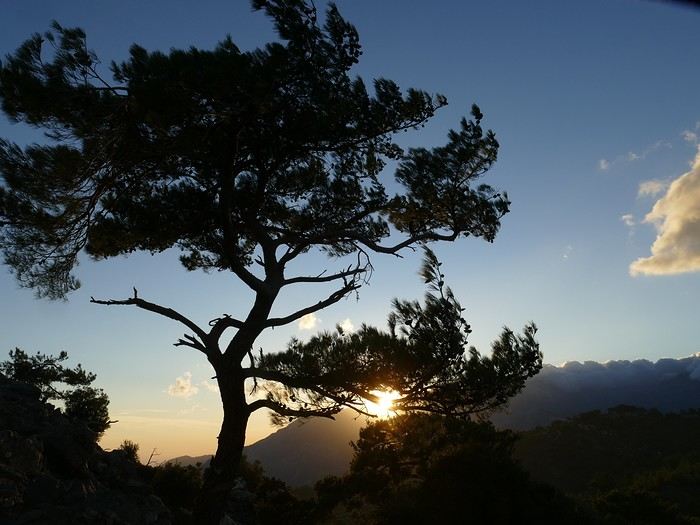 Sunset from Anatoli
Sunday, 22/09: This morning, Pat, Mimi, and I go for a hike in the Sarakina Gorge, located about 12 km from Anatoli via a beautiful road winding through irrigated olive groves. We park in the small parking lot before the trail. At the start, the path follows a levada (small irrigation canal) and quickly enters a very narrow gorge flanked by high cliffs. The riverbed is cluttered with huge rocks blocking the passage. No matter—in the technical sections, ropes or ladders allow us to overcome these obstacles with a bit of skill. You can imagine how quickly the riverbed must rise during a storm, given the narrowness of the gorge!
We progress slowly through this magnificent and impressive rocky chaos. At the exit of the gorge, we take another return path that partly follows the paved road. Back in Anatoli, we go to lunch at the Drygies taverna. We sit at the edge of the terrace under a huge tree that covers almost the entire terrace and order grilled lamb dishes prepared according to the ancient “antikristo” method.
Monday, 23/09: Departure for our last stop before Heraklion. We thought about swimming at Tertsa Beach, but it turns out to be less pleasant than expected, with pebbles and an uneven rocky plateau. So, we return to Myrtos Beach, which we know well and suits us perfectly. We head west, leaving the coast a bit. Around 3:30 p.m., we arrive at our destination in the village of Kamilari, near the famous Matala spot. We’ve rented a beautiful, modern, well-equipped apartment with a lovely shaded terrace. The owner is very friendly and explains everything necessary for a good stay. We explore the quite touristy village with its few tavernas, all full of tourists, mostly Germans.
Tuesday, 24/09: Visit to the village of Sivas, well restored thanks to the Germans, who have invested a lot here. We take the opportunity to scout out “friendly” tavernas, then go for a swim at Kalamaki Beach. Apart from a small sandy access, you have to enter the water via a chaotic limestone plateau—proof of this is that Monique trips slightly when entering the water. A group of very unfriendly German women blocks the sandy passage and doesn’t hesitate to push swimmers they deem too close. Back home, lunch, and a nap. In the late afternoon, we drive to visit the nearby Phaistos site. We benefit from very beautiful lighting. From the elevated site, we overlook the Messara Plain with a beautiful view of the olive grove checkerboards highlighted by the late afternoon sun. The site itself is quite vast, but to appreciate it, it’s better to read the explanatory panels placed throughout the different quarters. At this hour, the site is almost empty, and the beautiful light adds charm to the visit.
Wednesday, 25/09: Departure for the village of Matala, which doesn’t interest us in itself, having been there during the “hippie” era in 1976. However, going to Red Beach, only accessible by taking a path overlooking this area, appeals to us much more. We park in the large parking lot just outside the village and start our climb, which brings us to a pass from where we can admire this beautiful red-sand beach framed by beautiful cliffs plunging into the sea. The weather is magnificent, and at this early hour, there aren’t many people yet. We swim in the free part located near the cliff on the right when arriving at the beach. The sea is like glass, warm, and without a single ripple—a real treat! After half an hour, we turn back, and now there are many people rushing on this path, not at all made for feet in sandals or flip-flops, yet many vacationers venture out like this! Matala lives up to its image—a trendy place, full of shops, bars, and restaurants. You could be in any seaside resort with a standard global urbanism, lacking particular charm. Back home. In the late afternoon, a walk through the olive groves surrounding Kamilari, then dinner at Evangelina’s, who runs the Minoan Parassies taverna in the middle of the olive groves. Evangelina is quite a character: we came to reserve a table for 8 p.m. when it was only 7 p.m., but since we lingered near her restaurant, she prepares a table for us and urges us to sit down! And there she takes our order, and a little later, the meze arrive, followed by the main dishes. We finish this good dinner with several generous glasses of raki, accompanied by Evangelina’s encouragements, repeating “poya poya bravo bravo” in a loop. We’re in great shape too, by the way! We return in the middle of the night, on foot, fortunately, with the path vaguely lit by our phones...
Thursday, 26/09: This morning, we discover a new beach, Kommos Beach, not far from Kamilari either. It’s a long sandy beach, a small part of which is dedicated to paid umbrellas and sunbeds, and the rest is free. We spot a tamarisk tree to take shelter from the still-hot sun, and once again, we enjoy clear, warm water. The few swimmers spread out easily over nearly 500 meters of beach. In the late afternoon, Pat and I go to admire the sunset from the hill near our lodging. The hill, covered with olive trees, is threatened by a planned housing development of large cubic villas—trends dictate. Concrete never stops...
Friday, 27/09: We thought about leaving the car at the Odiyitria Monastery, the end of the paved road, but since the track descending to the cave remains drivable, we park 3 km further at the junction of the track leading to Kali Limenes Beach. We still have to walk for half an hour on a less drivable track, and then we’re at the entrance of the Farango Gorge. It’s a beautiful, easy hike since we follow the dry pebble riverbed. Before arriving at the beach, there’s a very beautiful small chapel sheltered under a large cliff, beautifully lit at this early hour.
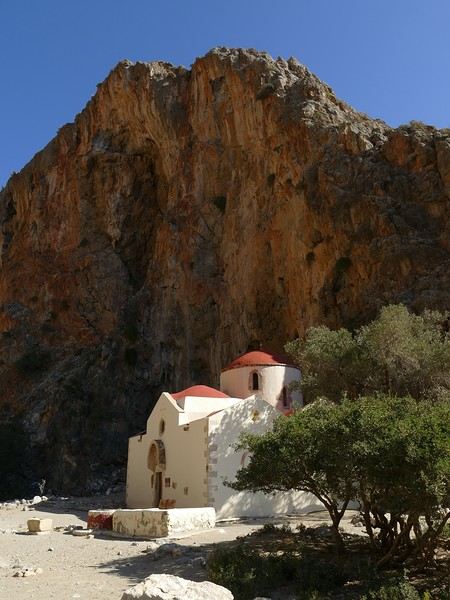
Agio Farango Chapel
A few climbers are scaling the cliff, and about ten swimmers are enjoying the sea. Return to the car under the hot sun. In the late afternoon, we all return to visit the interesting Odiyitria Monastery. Last swim at Kommos Beach and an excellent dinner at the Sigelakis taverna in Sivas.
Saturday, 28/09: There’s an end-of-vacation atmosphere... We pack our bags and head north. A short stop to see the village of Vorri, and a little over an hour later, we arrive in the big city of Heraklion. Since it’s too early to check into the apartment, we park in the city center to visit the famous archaeological museum. It’s indeed a must-see highlight of our stay in Crete. All four of us are amazed by the quantity and quality of the objects presented from the Minoan civilization. After more than 2 hours, we come out without having seen everything, but we’re a bit overwhelmed by all these wonders. Lunch at a nice little taverna very close to the Titus Church. We go to take possession of our apartment—the same as on the way there, still just as satisfying. In the late afternoon, I go alone for a walk in the historic district of the city, passing by the Morosini Fountain, which is bustling with people—some seated at café terraces, others standing and chatting. There’s a lively atmosphere here. A little further on are the Venetian loggia and the Agios Titos Church. I walk down to the old Venetian port to stroll along the jetty and admire the fortifications under beautiful late-afternoon lighting, then return to the apartment. Dinner near our place at Kiriakis, a “chic” restaurant but with very reasonable prices and excellent cuisine.
Sunday, 29/09: Wake-up at 3:30 a.m., quick coffee, and drive to the nearby airport. We leave the car in the parking lot. Already a lot of people at this early hour. Since we don’t have checked luggage, we go straight to security, which goes fairly quickly, then it’s waiting time and takeoff on time in an Airbus A321 for a 45-minute flight to Athens. We take off again in another Airbus A321 with a 50-minute delay to arrive in Zurich at 11:10 a.m. local time. Then we have to take the train to Basel and then the one to Colmar. With fewer Sunday services, we won’t arrive in Colmar until around 4 p.m.
Conclusion All four of us returned very satisfied with this stay in Crete for several reasons: - We found superb beaches with clear, warm water and often very few vacationers. - The few hikes we did were magnificent, especially those where the trails went through gorges leading to deserted beaches. - We greatly appreciated Cretan gastronomy—there were so few disappointments that we can count them on one hand. - All the accommodations we booked turned out to be superb, with the icing on the cake being the very friendly welcome from our hosts. - Generally, contacts with Cretans were always very warm despite the language barrier—we speak a little Greek. - We also appreciated the diversity of landscapes in this eastern part of Crete, with plateaus and mountains with splendid rugged reliefs.
Note: The photo album is available by clicking on this link: https://photos.app.goo.gl/hfdjQndA5eXkL5k7 Captions are only visible per photo by clicking on the circled “i” in the top right. Budget: approximately 3,300 € per couple for 21 days, including train and flights Budget details per couple: - Flight Zurich-Heraklion: 440 € - Trains Colmar-Basel-Zurich round trip for 4: 442.40 € (221 € per couple) - Accommodation: 2,431 € / 21 = 115.80 € per night for 4 (1,216 € per couple) - Car rental for 21 days: 684 € + 145 € fuel (1,150 km) (414 € per couple) - Restaurants, food, etc.: 1,009 €
Our 21-day itinerarySunday, 08/09: Once again—and this is the eighth time—we’re setting off, the four of us: Patrick, Michelle, Jacques, and Monique, for the Greek islands. This time, we’ve chosen Crete. No need to wake up at 3 or 4 a.m. to reach Basel-Mulhouse Airport at dawn to catch the first flight to Greece at 6 a.m.! Given the prohibitive prices charged by EasyJet, we found flights that were half the price from Zurich Airport, which is accessible in 3 hours by train from Colmar. Pierre-Paul drives all four of us to Colmar train station, where we take the train to Basel and then, 20 minutes later, the direct train to Zurich Airport. After wandering around the airport, we go for a coffee at 6 € each! We’re in Switzerland, after all. The other dining areas all have vending machines for selecting and paying for meals—soon, there won’t be anyone left to serve you! After a short wait, we take off at 7:45 p.m. (20 minutes late) in an Aegean Airbus A321. Free in-flight meal service isn’t bad either! We land in Heraklion around 11:15 p.m. We pick up our rental car (a red Seat Ibiza) at the airport and head straight to our apartment, located 2 km from the city center. Thanks to the GPS, we find it quickly. It’s a beautiful, fully renovated apartment with all the comforts and well-equipped. On the table, there’s wine, bottles of water, jam, coffee, etc. Given the late hour, we won’t stay up long.
Monday, 09/09: To enhance our breakfast, Michelle and Monique set off to find a bakery nearby. They return with croissants and donuts—yum... Then we head to the west coast. The highway follows the coastline, but we prefer taking the old road to Malia, our first stop. We visit the major archaeological site of this Minoan city under the hot sun. The site covers a vast area, but the ruins aren’t very evocative except for a few beautiful amphorae scattered around. The explanations in a small house at the entrance are interesting and help us better understand the organization of the ancient city with its different districts. From there, we head toward the nearby mountains to see the thousand-year-old plane tree in the village of Krasi. We take the opportunity to enjoy an excellent lunch of moussaka and delicious gemista at the Krassopsychia taverna in the village center. Pleasant surprise: the prices are still reasonable, with a bill of 70 € for four, including wine and water. The friendly tradition of complimentary dessert and glasses of raki continues—great! We’ve set the bar high right away! Let’s hope the rest lives up to it! On the way back toward the Lassithi Plateau, we stop at the Kardiotisa Monastery perched high on the mountain to enjoy a magnificent view of the entire region. Just a little further, we arrive at the Lassithi Plateau: the presence of small windmills used to pump water from the ground is the typical feature of this plateau. We complete a full loop around the plateau, passing by numerous orchards and vegetable gardens that occupy the entire space. At the end of the plateau, we once again cross mountain passes via winding roads that bring us near Agios Nikolaos. Our apartment is located about ten kilometers further south in Amoudhara. The owner, who was notified, waits for us and shows us her superb apartment, whose large terrace overlooks the entire Mirabello Bay. She then gives us valuable information about the different beaches in the area. Dinner will be frugal, given our hearty lunch in Krasi!
Sunset over Mirabello BayTuesday, 10/09: A bit of a gray sky when we wake up around 8 a.m., but the sun will soon triumph over the scattered clouds. For our first swim, we opt for Voulisma Beach, even though our host warned us it was a bit “crowdy.” That’s understandable given the beautiful emerald color of the sea and the lovely curve of the beach. To avoid the big crowds, we move toward the eastern part of the beach, accessible via a steep staircase. The water is very warm, and this first dip is very pleasant. Before returning to the apartment, we stop at the bakery to buy spinach pies, essential ingredients to accompany our Greek salad for lunch. Of course, everything will be washed down with ouzo, which will remain our favorite drink for the next three weeks—but in moderation!!! A nap is in order after all that effort. In the late afternoon, we drive to Agios Nikolaos, the main seaside resort in Crete. We’re not too enthusiastic about visiting this mass-tourism resort, but the center of Agios, concentrated around the small inner harbor, is pleasant to see despite the plethora of shops and restaurants. We dine a little outside the harbor in the shaded courtyard of the Avli taverna: the oven-baked lamb, squid with spinach, and cuttlefish ink orzo pasta are all highly appreciated. We still stay under a 75 € bill for four.
Mirabello Bay seen from our terraceWednesday, 11/09: At 8 a.m., the terrace is already bathed in sunlight, and it’s already quite hot. The small parasol barely gives us enough shade, but we’re not complaining! For our second swim, we head to a tiny beach recommended by our host, just 3 minutes by car from our place. The path leading to it is very discreet, and we don’t find it right away! It’s a small sandy cove with a few welcome tamarisk trees for shade. When we arrive, there are two swimmers, and there won’t be more than five or six in the morning. After lunch and a nap, we head to the beautiful village of Kritsa, just a few kilometers away. It’s too late to visit the beautiful church of Kera Panagia, which is already closed. We settle for the exterior, which is worth a look. The weather is clouding over, and big clouds are gathering. Upon arriving in Kritsa, a heavy shower forces us to take shelter in the Platanos taverna in the village center, and since it’s nearly 7 p.m., we decide to stay and dine there. Good choice—excellent meze: croquettes and stuffed zucchini flowers, gigantes beans, grilled tomatoes and feta, and pancetta as the main dish. The rain stops just as we decide to head back.
Village of KritsaThursday, 12/09: Our terrace faces east, so we get to watch the sunrise around 7 a.m.—it’s truly a beautiful sight we never tire of. Around 9 a.m., we head to the village of Plaka, where boats depart for the island of Spinalonga, located north of Agios Nikolaos. We board the first boat, which sets sail at 10 a.m., and we’re not alone—the boat is practically full. After 10 minutes, we land on the island at the same time as several other boats from Elounda or Agios. Needless to say, there are already quite a few people walking through the streets of the leper village. The visit remains interesting and moving as we read the explanatory panels recounting the island’s history under Byzantine and then Turkish rule, followed by its transformation into a leper colony. As soon as we climb toward the top of the island via more or less maintained paths, there’s almost no one left. The 360° view from up there is stunning.
Spinalonga Island
The heat is now unbearable, and we can’t wait to get back home to have lunch on our terrace and rest. In the late afternoon, we go grocery shopping at the AB supermarket at the entrance of Agios. We had spotted another nice restaurant in our guide, but unfortunately, there’s a different one at the indicated location that doesn’t inspire us. So, we return to the Avli taverna for another dinner just as good as the first.
Friday, 13/09: We repeat yesterday’s successful program: a swim in our little cove, lunch on the terrace, a nap, and then, in the late afternoon, we discover another nearby village, Kroustas, nestled in the olive groves near Kritsa. Much less touristy than Kritsa, it’s mostly inhabited by locals, especially the elderly who are enjoying the cool air on their chairs—if you can call it cool given the still-high temperatures in the late afternoon! We then return to visit Kritsa, which we hadn’t been able to explore due to the rain. Dinner at a taverna in the village center at a very reasonable price.
Saturday, 14/09: Today, we move to our new base further east. We start with a high viewpoint at the Faneromeni Monastery, which overlooks Mirabello Bay. The monastery itself is of little interest as it’s under renovation with excessive concrete work. We continue to the village of Kavoussi to see another exceptional tree after a few kilometers on a dusty, bumpy track. It’s an olive tree said to be about 3,200 years old—impressive, and the countryside is very beautiful. It’s time to find a place for lunch. We find one in the charming little port of Mohlos, where a few tavernas surround a very nice small beach. Our choice falls on the Bogazzi taverna, where we enjoy fried fish. To reach our new base in Zakros, we still have to drive through the mountains before reaching Sitia, Paleokastro, and finally Zakros. The region is beautiful, with olive groves and rows of wind turbines taking advantage of the strong wind near the northern tip of the island. In Zakros, we’re greeted by our very friendly host. Here too, we have all the comforts and a beautiful terrace overlooking the village. The apartment has reversible air conditioners, but the overly simple instructions leave us puzzled. Thinking we’ve set it correctly, we realize a little too late that it’s blowing hot air over 30°C! After numerous attempts and testing several confusing programs, we finally succeed! Dinner on our new terrace.
Sunday, 15/09: This morning, we get up early to hike in the “Gorge of the Dead” while it’s still cool. The sky is blue as usual! We park in the nearest parking lot and start our descent via a beautiful path winding through the olive groves. A little further on, the landscape opens up, and the path, now a stony trail, begins the descent to the dry riverbed. On either side of the riverbed rise beautiful reddish cliffs.
Gorge of the Dead
The trail winds its way through this narrow gorge with difficulty. It was in the many caves visible halfway up the slope that the Minoans buried their dead, hence the name “Gorge of the Dead.” The gorge opens onto a beautiful small pebble beach. A swim is welcome after this hike that made us sweat. The hike took us 1 hour and 25 minutes, and a little less on the way back. Meanwhile, Monique did some shopping and prepared an excellent lunch. In the late afternoon, we go down to dine at Platanakis, a taverna in the small village of Kato Zakros.
Monday, 16/09: This morning, we explore the northern part of the east coast near Palekastro. We start with a dip at the beautiful Hionia Beach near Palekastro. The water is still just as nice, but a light breeze is blowing—not enough to spoil our fun! Seeing all the wind turbines lining the ridges, it’s no surprise.
Grocery shopping in Palekastro and return to Zakros. A little rain in the late afternoon and an excellent dinner at Iannis Mitsakakis’ Taverna in Adravastis. These are the kind of small tavernas we love—unpretentious, a few tables on a terrace, a warm welcome, a short menu guaranteeing freshness, tasty dishes prepared by the server’s mom, and a light bill. What more could you ask for!Tuesday, 17/09: We head back toward Palekastro to do some shopping, but it’s also the road to the Toplou Monastery. There, we see a collection of magnificent icons dating from the 15th to the 20th century. We can also admire drawings of Orthodox religious architecture. We continue toward the Mavros Akrotiri headland to enjoy the view of the sea and rocky capes. On the way back to our place, we make a small detour to see the famous Vai palm grove. Meh... As for Vai Beach, it’s filled with paid umbrellas and sunbeds, and there are so many people that we flee. Plus, having to pay for parking is another reason to snub this trendy beach. We prefer our Hionia Beach, which we already appreciated the other day. In the late afternoon, Pat and I start the trail that begins at Kato Zakros Beach heading south. The poorly marked path crosses a plateau of sharp limestone. The paint and cairn markings are no longer very visible, and with dusk approaching, we turn back toward Kato Zakros. Dinner at the Platanakis taverna—less good than last time.
Wednesday, 18/09: To avoid the scorching sun, Pat, Mimi, and I get up earlier than usual to hike the Hohlakies Gorge. At this early hour, the sky is quite cloudy, and it’s drizzling. When we arrive in the village of Hohlakies, we park in front of a small chapel, the start of the hike. The sky is now completely clear. The trail starts among the olive groves, then after passing through a gate, we descend into the gorge filled with large rocks. We’re alone in the world, and the landscape is magnificent. A few wild goats clinging to the cliff watch us from above. After 1 hour and 15 minutes, we emerge onto the wonderful Karoumès Beach. A pleasant swim, then back to civilization! A walk in the late afternoon in Zakros to discover the beautiful springs route. Dinner in Adravastis.
Thursday, 19/09: Another move: Before heading to our next stop, we make a detour to see the beautiful Keratokampos Beach and can’t resist a swim in the still-warm, clear water. We continue our journey via Ziros, then reach the south coast and have lunch at the Stephi taverna in Ferma—excellent meal! The south coast is quite urbanized and has much less charm than the east coast we’ve just left! The numerous plastic greenhouses are partly to blame. We stop for groceries in Ierapetra. Around 3 p.m., we arrive at our destination in the small perched village of Anatoli. Our lodging is at the top of the village, and from the path leading to it, we have a magnificent view of the coastal plain, unfortunately overloaded with plastic greenhouses. It reminds us of the landscapes of El Ejido in Andalusia.
View of the Ierapetra coast from AnatoliFriday, 20/09: A walk and discovery of the hamlet of Anatoli. There are few services—a tiny grocery store, a taverna, and that’s it. Fortunately, the traveling baker arrives and honks. We take the opportunity to buy fresh bread. Leaving the village, we take a path that should lead us to the hamlet of Drygies. The landscape is beautiful. We walk through a lovely pine forest before arriving at the hamlet. The path continues to a taverna that’s closed today, with a superb terrace overlooking the coast. Luckily, the owner arrives and informs us that the taverna will be open next Sunday and that we can enjoy barbecued meat. Noted! We head back to Anatoli via the small paved road with, fortunately, very limited traffic. Lunch on our terrace, then a dip in our private pool! The water is noticeably cooler than at the beach. Dinner at the village taverna: there’s only one menu—meze starters, souvlaki, water, wine, and bread—all for 35 €! We think we’re dreaming—was there a mistake? No.
Saturday, 21/09: We discover the beach of the village of Myrtos, a small seaside resort that’s quite touristy but on a human scale. We swim in the western part of the beach, and once again, we’re alone in the water. The best part: warm water and tamarisk trees for welcome shade. There’s even a shower to rinse off! In the late afternoon, Pat and I decide to go for a hike in the Selakano pine forest. To get there, we take a narrow, winding, and poorly paved road after the village of Christos. Plus, at this altitude, we encounter clouds clinging to the mountain, so it’s drizzling, and visibility is reduced. We decide to turn back and return to Anatoli. As compensation, we take the path that passes in front of the lodging and leads us to the Timios Stavros chapel, which crowns the summit of the nearby mountain. We arrive at the summit just in time for the sunset at 7 p.m. Breathtaking 360° panorama and magnificent colors!
Sunset from AnatoliSunday, 22/09: This morning, Pat, Mimi, and I go for a hike in the Sarakina Gorge, located about 12 km from Anatoli via a beautiful road winding through irrigated olive groves. We park in the small parking lot before the trail. At the start, the path follows a levada (small irrigation canal) and quickly enters a very narrow gorge flanked by high cliffs. The riverbed is cluttered with huge rocks blocking the passage. No matter—in the technical sections, ropes or ladders allow us to overcome these obstacles with a bit of skill. You can imagine how quickly the riverbed must rise during a storm, given the narrowness of the gorge!
We progress slowly through this magnificent and impressive rocky chaos. At the exit of the gorge, we take another return path that partly follows the paved road. Back in Anatoli, we go to lunch at the Drygies taverna. We sit at the edge of the terrace under a huge tree that covers almost the entire terrace and order grilled lamb dishes prepared according to the ancient “antikristo” method.
Monday, 23/09: Departure for our last stop before Heraklion. We thought about swimming at Tertsa Beach, but it turns out to be less pleasant than expected, with pebbles and an uneven rocky plateau. So, we return to Myrtos Beach, which we know well and suits us perfectly. We head west, leaving the coast a bit. Around 3:30 p.m., we arrive at our destination in the village of Kamilari, near the famous Matala spot. We’ve rented a beautiful, modern, well-equipped apartment with a lovely shaded terrace. The owner is very friendly and explains everything necessary for a good stay. We explore the quite touristy village with its few tavernas, all full of tourists, mostly Germans.
Tuesday, 24/09: Visit to the village of Sivas, well restored thanks to the Germans, who have invested a lot here. We take the opportunity to scout out “friendly” tavernas, then go for a swim at Kalamaki Beach. Apart from a small sandy access, you have to enter the water via a chaotic limestone plateau—proof of this is that Monique trips slightly when entering the water. A group of very unfriendly German women blocks the sandy passage and doesn’t hesitate to push swimmers they deem too close. Back home, lunch, and a nap. In the late afternoon, we drive to visit the nearby Phaistos site. We benefit from very beautiful lighting. From the elevated site, we overlook the Messara Plain with a beautiful view of the olive grove checkerboards highlighted by the late afternoon sun. The site itself is quite vast, but to appreciate it, it’s better to read the explanatory panels placed throughout the different quarters. At this hour, the site is almost empty, and the beautiful light adds charm to the visit.
Wednesday, 25/09: Departure for the village of Matala, which doesn’t interest us in itself, having been there during the “hippie” era in 1976. However, going to Red Beach, only accessible by taking a path overlooking this area, appeals to us much more. We park in the large parking lot just outside the village and start our climb, which brings us to a pass from where we can admire this beautiful red-sand beach framed by beautiful cliffs plunging into the sea. The weather is magnificent, and at this early hour, there aren’t many people yet. We swim in the free part located near the cliff on the right when arriving at the beach. The sea is like glass, warm, and without a single ripple—a real treat! After half an hour, we turn back, and now there are many people rushing on this path, not at all made for feet in sandals or flip-flops, yet many vacationers venture out like this! Matala lives up to its image—a trendy place, full of shops, bars, and restaurants. You could be in any seaside resort with a standard global urbanism, lacking particular charm. Back home. In the late afternoon, a walk through the olive groves surrounding Kamilari, then dinner at Evangelina’s, who runs the Minoan Parassies taverna in the middle of the olive groves. Evangelina is quite a character: we came to reserve a table for 8 p.m. when it was only 7 p.m., but since we lingered near her restaurant, she prepares a table for us and urges us to sit down! And there she takes our order, and a little later, the meze arrive, followed by the main dishes. We finish this good dinner with several generous glasses of raki, accompanied by Evangelina’s encouragements, repeating “poya poya bravo bravo” in a loop. We’re in great shape too, by the way! We return in the middle of the night, on foot, fortunately, with the path vaguely lit by our phones...
Thursday, 26/09: This morning, we discover a new beach, Kommos Beach, not far from Kamilari either. It’s a long sandy beach, a small part of which is dedicated to paid umbrellas and sunbeds, and the rest is free. We spot a tamarisk tree to take shelter from the still-hot sun, and once again, we enjoy clear, warm water. The few swimmers spread out easily over nearly 500 meters of beach. In the late afternoon, Pat and I go to admire the sunset from the hill near our lodging. The hill, covered with olive trees, is threatened by a planned housing development of large cubic villas—trends dictate. Concrete never stops...
Friday, 27/09: We thought about leaving the car at the Odiyitria Monastery, the end of the paved road, but since the track descending to the cave remains drivable, we park 3 km further at the junction of the track leading to Kali Limenes Beach. We still have to walk for half an hour on a less drivable track, and then we’re at the entrance of the Farango Gorge. It’s a beautiful, easy hike since we follow the dry pebble riverbed. Before arriving at the beach, there’s a very beautiful small chapel sheltered under a large cliff, beautifully lit at this early hour.
Agio Farango Chapel
A few climbers are scaling the cliff, and about ten swimmers are enjoying the sea. Return to the car under the hot sun. In the late afternoon, we all return to visit the interesting Odiyitria Monastery. Last swim at Kommos Beach and an excellent dinner at the Sigelakis taverna in Sivas.
Saturday, 28/09: There’s an end-of-vacation atmosphere... We pack our bags and head north. A short stop to see the village of Vorri, and a little over an hour later, we arrive in the big city of Heraklion. Since it’s too early to check into the apartment, we park in the city center to visit the famous archaeological museum. It’s indeed a must-see highlight of our stay in Crete. All four of us are amazed by the quantity and quality of the objects presented from the Minoan civilization. After more than 2 hours, we come out without having seen everything, but we’re a bit overwhelmed by all these wonders. Lunch at a nice little taverna very close to the Titus Church. We go to take possession of our apartment—the same as on the way there, still just as satisfying. In the late afternoon, I go alone for a walk in the historic district of the city, passing by the Morosini Fountain, which is bustling with people—some seated at café terraces, others standing and chatting. There’s a lively atmosphere here. A little further on are the Venetian loggia and the Agios Titos Church. I walk down to the old Venetian port to stroll along the jetty and admire the fortifications under beautiful late-afternoon lighting, then return to the apartment. Dinner near our place at Kiriakis, a “chic” restaurant but with very reasonable prices and excellent cuisine.
Sunday, 29/09: Wake-up at 3:30 a.m., quick coffee, and drive to the nearby airport. We leave the car in the parking lot. Already a lot of people at this early hour. Since we don’t have checked luggage, we go straight to security, which goes fairly quickly, then it’s waiting time and takeoff on time in an Airbus A321 for a 45-minute flight to Athens. We take off again in another Airbus A321 with a 50-minute delay to arrive in Zurich at 11:10 a.m. local time. Then we have to take the train to Basel and then the one to Colmar. With fewer Sunday services, we won’t arrive in Colmar until around 4 p.m.
Conclusion All four of us returned very satisfied with this stay in Crete for several reasons: - We found superb beaches with clear, warm water and often very few vacationers. - The few hikes we did were magnificent, especially those where the trails went through gorges leading to deserted beaches. - We greatly appreciated Cretan gastronomy—there were so few disappointments that we can count them on one hand. - All the accommodations we booked turned out to be superb, with the icing on the cake being the very friendly welcome from our hosts. - Generally, contacts with Cretans were always very warm despite the language barrier—we speak a little Greek. - We also appreciated the diversity of landscapes in this eastern part of Crete, with plateaus and mountains with splendid rugged reliefs.
Note: The photo album is available by clicking on this link: https://photos.app.goo.gl/hfdjQndA5eXkL5k7 Captions are only visible per photo by clicking on the circled “i” in the top right. Budget: approximately 3,300 € per couple for 21 days, including train and flights Budget details per couple: - Flight Zurich-Heraklion: 440 € - Trains Colmar-Basel-Zurich round trip for 4: 442.40 € (221 € per couple) - Accommodation: 2,431 € / 21 = 115.80 € per night for 4 (1,216 € per couple) - Car rental for 21 days: 684 € + 145 € fuel (1,150 km) (414 € per couple) - Restaurants, food, etc.: 1,009 €
Découvrir la Pologne, oui, sans hésitation English translation pending
A force d'entendre toutes sortes de choses bizarres à propos de la Pologne, j'ai eu envie d'écrire un petit mot.
Je ne comprends pas pourquoi la Pologne a une image toute noire et arriérée dans la tête de beaucoup de Français. Je ne comprends pas pourquoi certain·e·s font plus de 2 500 km pour aller seulement à Auschwitz. Je ne comprends pas pourquoi on valorise celui-celle qui part en Espagne et on s'interroge sur la santé mentale de celui-celle qui va passer un moment de vacances en Pologne.
Bon, d'accord, la situation politique n'est pas idéale mais il faut aller s'asseoir sur un banc public qui diffuse du Chopin à Varsovie, se plonger dans la vie de Copernic à Torun... et, surtout, surtout, rencontrer les Polonais d'aujourd'hui. Aspects pratiques : le coût de la vie quotidienne est très avantageux pour les Français ;) et oui, oui, la frontière est ouverte, sans contraintes particulières https://reopen.europa.eu/fr/map/POL
Je ne cherche pas à faire la promotion du tourisme en Pologne, mais après y être retourné l'année dernière, je tente de modifier un peu des représentations qui me paraissent datées et injustes. Je ne veux pas allonger trop ce premier message. D'autres personnes viendront peut-être le compléter...
Je ne comprends pas pourquoi la Pologne a une image toute noire et arriérée dans la tête de beaucoup de Français. Je ne comprends pas pourquoi certain·e·s font plus de 2 500 km pour aller seulement à Auschwitz. Je ne comprends pas pourquoi on valorise celui-celle qui part en Espagne et on s'interroge sur la santé mentale de celui-celle qui va passer un moment de vacances en Pologne.
Bon, d'accord, la situation politique n'est pas idéale mais il faut aller s'asseoir sur un banc public qui diffuse du Chopin à Varsovie, se plonger dans la vie de Copernic à Torun... et, surtout, surtout, rencontrer les Polonais d'aujourd'hui. Aspects pratiques : le coût de la vie quotidienne est très avantageux pour les Français ;) et oui, oui, la frontière est ouverte, sans contraintes particulières https://reopen.europa.eu/fr/map/POL
Je ne cherche pas à faire la promotion du tourisme en Pologne, mais après y être retourné l'année dernière, je tente de modifier un peu des représentations qui me paraissent datées et injustes. Je ne veux pas allonger trop ce premier message. D'autres personnes viendront peut-être le compléter...
Pourquoi utilise-t-on le mot "grotte" au pluriel alors que c'est une erreur de formulation? English translation pending
Bonjour
Je poste la même question sur le forum du Routard , car il m'a mis la puce à l'oreille, mais je pose aussi la question ici, car jai bon espoir d'avoir des réponses avisées... avisées et bienveillantes, car le sujet est anodin.
Voilà En introduction à la page du forum concurrent consacrée à la Dordogne et au Perigord, je vois qu'il est écrit:
"Se rendre aux grottes de Lascaux, "
Aux grottes au pluriel. Or, il n'y a qu'UNE grotte à Lascaux , plus 2 fac-similé et une expo itinérante. Mais UNE seule vraie grotte.
C'est très courant, je ne sais pas pourquoi, mais les gens mettent systématiquement le mot "grotte" au pluriel.
Habitant en Dordogne, j'entends souvent: "Les" grottes de Lascaux, "Les" grottes de Rouffignac, "les" grotte de Pech Merle dans le Lot"... alors qu'à chaque fois, il n'y en a qu'une . Vous pouvez vérifier... Même pour LA grotte de Lascaux. Voyez sur internet, sur Wikipedia, les offices du tourisme concernés, etc.
Pourquoi cet emploi du pluriel? Mystère....
Personnellement, je ne connais qu'un seul cas de 2 grottes regroupées, au Pays Basque: les grottes d'Isturitz et Oxocelhaya.
Peut-être qu'il y en a d'autres ailleurs, mais je ne les connais pas.
Mais...Pas Lascaux...
Si quelqu'un a une théorie et peut m'éclairer sur cette étrangeté... merci d'avance...
Florence
Le système de loterie pour Coyote Buttes et Paria Canyon déménage English translation pending
Depuis aujourd'hui 1er juin, toutes les demandes de permis pour Coyote Buttes et Paria Canyon Overnight (1er octobre et plus) se font sur =AT1E9R1LRHXQCkQaLAwZ7Dw5CDOs490g4-d1WQJCs4oXEtIJcknKsj0INVafRIQgW_Q69aXyRy4h_sCYjz_zPUAVKENI0QGZNTZywrH-Ndlclhqp53RZIwH68qn5xVoKmQTBbA3c_C4EUnEHnzH6gRFTV_uCj9xCOnLKLfGAH7xEJXnUnQpfFw"]Recreation.gov et non plus sur le site du BLM.
9$ la loterie pour CBN, possible de désigner un titulaire suppléant en cas d'empêchement (désignation par mail avec délai de 72h pour l'acceptation par la personne). =AT1E9R1LRHXQCkQaLAwZ7Dw5CDOs490g4-d1WQJCs4oXEtIJcknKsj0INVafRIQgW_Q69aXyRy4h_sCYjz_zPUAVKENI0QGZNTZywrH-Ndlclhqp53RZIwH68qn5xVoKmQTBbA3c_C4EUnEHnzH6gRFTV_uCj9xCOnLKLfGAH7xEJXnUnQpfFw"]https://www.recreation.gov/permits/274309?q=Coyote%20Buttes%20North%20(The%20Wave)
9$ la loterie pour CBN, possible de désigner un titulaire suppléant en cas d'empêchement (désignation par mail avec délai de 72h pour l'acceptation par la personne). =AT1E9R1LRHXQCkQaLAwZ7Dw5CDOs490g4-d1WQJCs4oXEtIJcknKsj0INVafRIQgW_Q69aXyRy4h_sCYjz_zPUAVKENI0QGZNTZywrH-Ndlclhqp53RZIwH68qn5xVoKmQTBbA3c_C4EUnEHnzH6gRFTV_uCj9xCOnLKLfGAH7xEJXnUnQpfFw"]https://www.recreation.gov/permits/274309?q=Coyote%20Buttes%20North%20(The%20Wave)
À la recherche des aurores boréales (Norvège) English translation pending
Depuis quelque temps avec ma femme, nous caressions le projet de retourner voir des aurores boréales. Nous en avions déjà vu lors de nos deux derniers voyages hivernaux en Islande mais l‘envie d’en revoir nous poussait à repartir.
Nous aurions voulu partir en hiver mais cela nous aurait obligés à coucher à l’hôtel, ce qui aurait lourdement grevé notre budget.
La période favorable pour voir des aurores boréales en Scandinavie s’étalant de septembre à mars, nous décidons de partir en septembre car cela nous permettra de coucher dans le lit aménagé à l’arrière de notre Land Rover Defender.
Samedi 15 septembre 2019
Le plein est fait. Le Land est bourré de provisions (cela fera autant de moins à acheter sur place) . Direction la Norvège. Départ vers 15h. Ce soir, nous ferons une étape dans le Nord pour passer voir notre fille. 100 km après notre départ de la région parisienne, le moteur du Land se met soudainement en mode dégradé. Nous plafonnons à 80 km/h. L’idée que notre voyage s’arrête là nous effleure l’esprit. On s’arrête sur le bas-côté pendant 10 mn et ouf, le moteur se remet à fonctionner normalement. On repart comme si de rien n’était. Nous n’empruntons pas les autoroutes payantes car nous ne sommes pas pressés. Arrivée dans le Nord vers 19h.
Dimanche 15 septembre 2019
Après une bonne nuit, nous partons en fin de matinée et traversons la Belgique via Charleroi et Liège. Puis nous passons en Allemagne via Aix-la-Chapelle, Duisbourg, Munster, Brême et Hambourg. Nous dormons sur une aire d’autoroute au nord d’Hambourg. Nous avons parcouru 1.000 km depuis Paris.
Lundi 16 septembre 2019
Prix du gazole sur l’autoroute allemande : 1,32 €/l Sur l’autoroute, le Land fait encore des siennes. Le moteur se remet en mode dégradé. On applique la même méthode que précédemment, à savoir, arrêt de 10 mn et ça repart normalement. Il ne faudrait pas que cela se reproduise trop souvent.
Nous franchissons la frontière danoise et arrivons au port d’Hirshals au nord du Danemark en début d’après-midi. Le vent d’ouest souffle en tempête. Cela promet pour la traversée vers la Norvège. Prix du gazole : 11,49 DNK (1,52 €) N’ayant pas réservé la traversée, nous nous rendons au bureau de Fjord Line. Prix annoncés : 205 € pour le jour même et 405 € pour le lendemain !
Nous cherchons un passage meilleur marché sur internet et réservons un billet pour Kristiansand chez Colour Line à 145 € pour le lendemain à 12h15.
Nous allons au camping d’Hirtshals en bordure de mer. La mer est démontée et il y a des wind surfers et des kite surfers qui en profitent. Particularité de cette plage, les autos peuvent y rouler.
Prix du camping 173 DNK (23 €). Bien équipé avec cuisine comprenant four, micro ondes et feux à gaz douche chaude payante avec carte. Emplacements sur pelouse délimités par des haies qui protègent du vent. Ce camping ferme fin septembre.
Mardi 17 septembre 2019
Nous embarquons sur le bateau de Colour Line à 12h15 . Heureusement, le vent s'est calmé. Nous débarquons au sud de la Norvège à Kristiansand à 15h30. Il fait un temps magnifique. Nous allons au centre ville pour retirer de l’argent au distributeur (pas beaucoup de distributeurs de billets en ville, il faut un peu chercher).
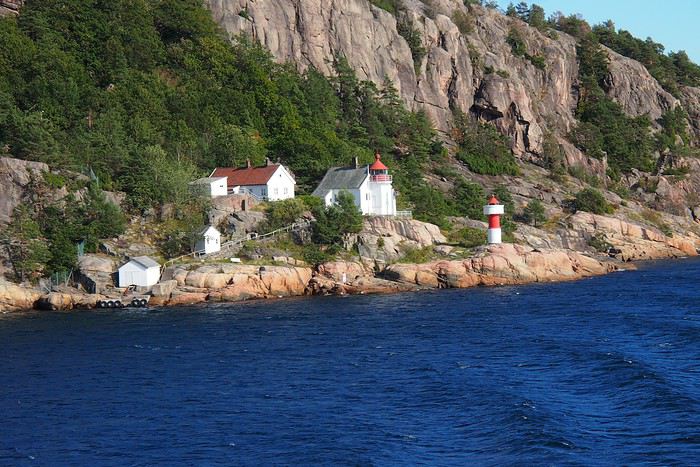
Nous prenons la direction de Lindesnes au sud-ouest de Kristiansand. Nous dormons sur le parking du phare de Lindesnes où le camping est autorisé moyennant 100 NOK (10 €). Cet endroit est le point le plus au sud de la Norvège. Beau temps mais très venté. Nous avons parcouru 1600 km depuis notre départ.
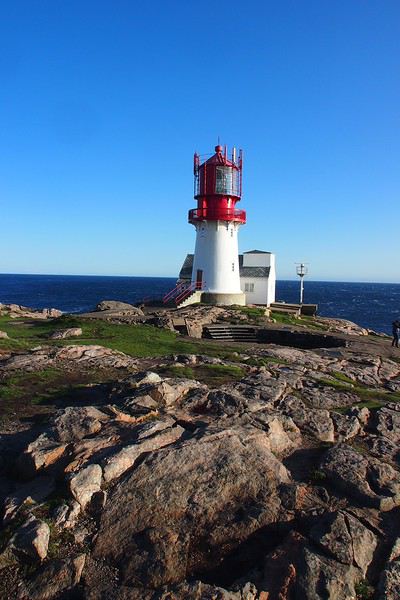
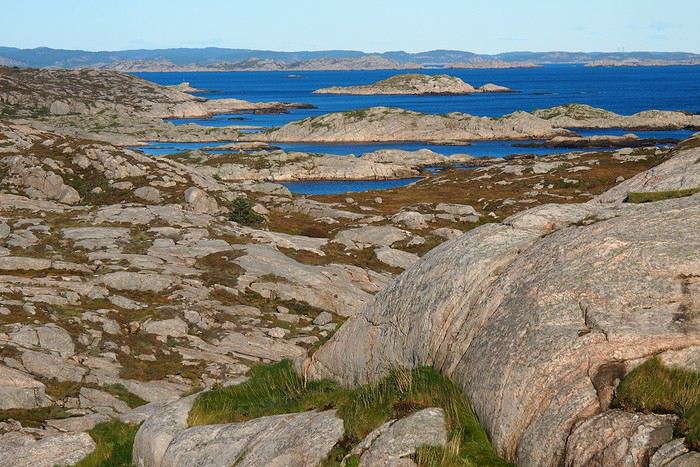
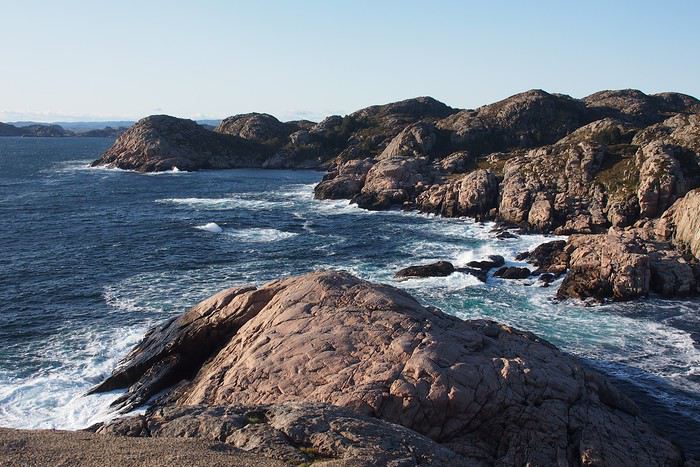
Mercredi 18 septembre 2019
Ce matin, nous suivons la côte sud en passant par Flekkefjord, Egersund jusqu’à Sandnes. Nous empruntons notre premier ferry à Lauvik pour franchir le Hosfjorden. Prix : 119 NOK
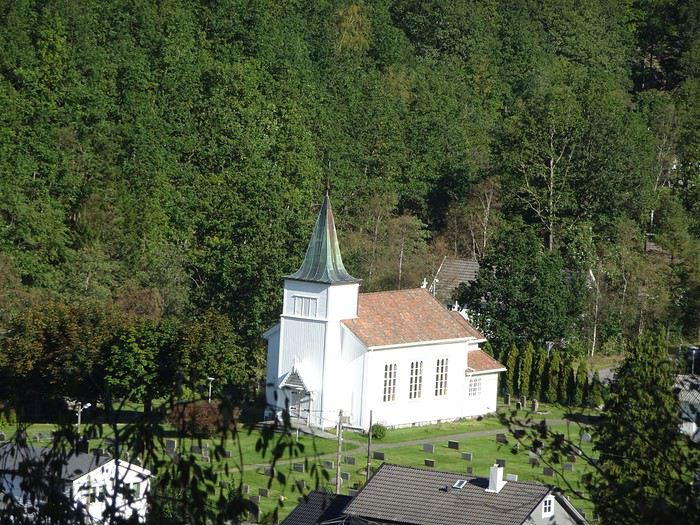
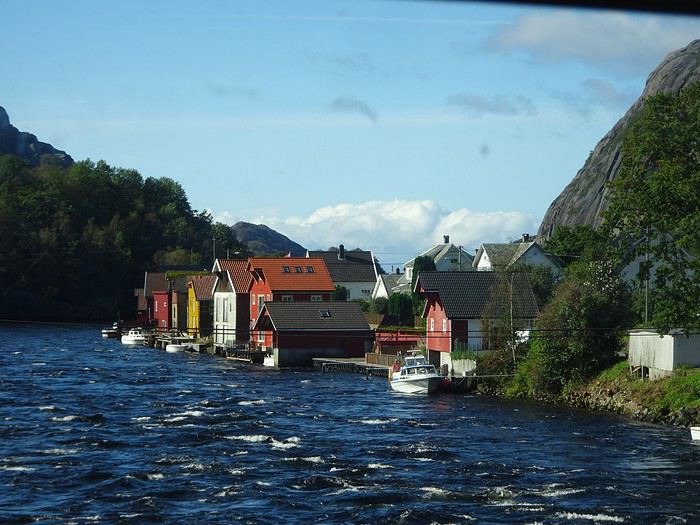
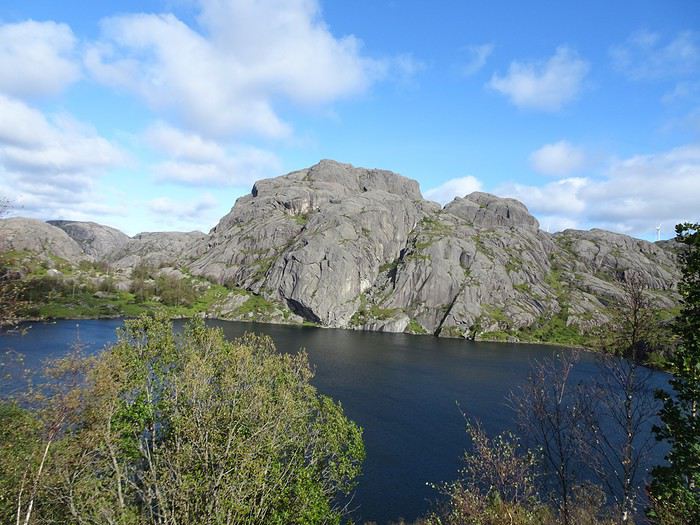
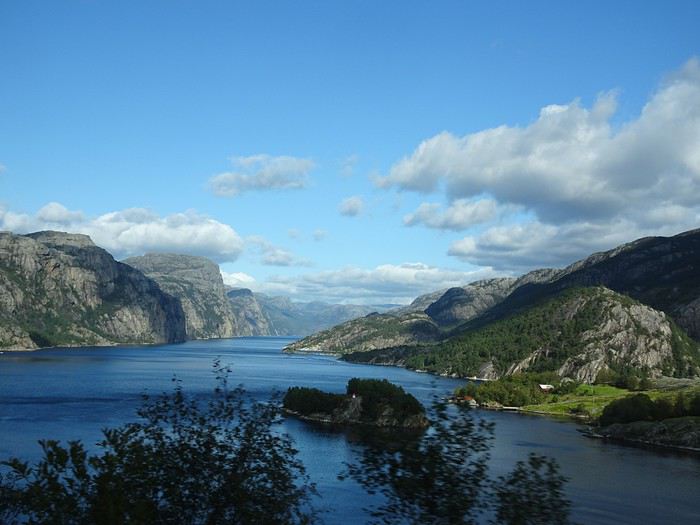
Nous sommes surpris par le grand nombre de véhicules électriques qui circulent en Norvège dont un bon nombre de Tesla. Il y a des bornes de recharge un peu partout, dans les stations service bien sûr mais aussi devant des hôtels, sur des parkings municipaux. La Norvège a une avance phénoménale dans ce domaine sur notre pays.
Il y a également un certain nombre de routes à péage qui ne sont pas des autoroutes notamment à l’approche des villes. Ce péage se fait en passant sous un portique automatique. Pour les véhicules étrangers, il paraît que nous recevons la facture à domicile mais au moment où je rédige ce carnet soit 6 mois après notre voyage, toujours pas de nouvelles.
Nous nous rendons sur le parking du Prekestolen où le prix de 250 NOK nous dissuade de nous arrêter. Nous y sommes déjà allés une trentaine d’années en arrière et nous n’avons pas de regret de ne pas y retourner . Nous cherchons un endroit pour bivouaquer mais dans cette zone très touristique, impossible de trouver un endroit .Nous poursuivons sur la route 13 vers le nord et nous arrêtons au camping de Vatne prix : 20 €. Comme toujours, camping super équipé avec cuisine et douche chauffées. Aujourd’hui étape de 290 km.
Samedi 15 septembre 2019
Le plein est fait. Le Land est bourré de provisions (cela fera autant de moins à acheter sur place) . Direction la Norvège. Départ vers 15h. Ce soir, nous ferons une étape dans le Nord pour passer voir notre fille. 100 km après notre départ de la région parisienne, le moteur du Land se met soudainement en mode dégradé. Nous plafonnons à 80 km/h. L’idée que notre voyage s’arrête là nous effleure l’esprit. On s’arrête sur le bas-côté pendant 10 mn et ouf, le moteur se remet à fonctionner normalement. On repart comme si de rien n’était. Nous n’empruntons pas les autoroutes payantes car nous ne sommes pas pressés. Arrivée dans le Nord vers 19h.
Dimanche 15 septembre 2019
Après une bonne nuit, nous partons en fin de matinée et traversons la Belgique via Charleroi et Liège. Puis nous passons en Allemagne via Aix-la-Chapelle, Duisbourg, Munster, Brême et Hambourg. Nous dormons sur une aire d’autoroute au nord d’Hambourg. Nous avons parcouru 1.000 km depuis Paris.
Lundi 16 septembre 2019
Prix du gazole sur l’autoroute allemande : 1,32 €/l Sur l’autoroute, le Land fait encore des siennes. Le moteur se remet en mode dégradé. On applique la même méthode que précédemment, à savoir, arrêt de 10 mn et ça repart normalement. Il ne faudrait pas que cela se reproduise trop souvent.
Nous franchissons la frontière danoise et arrivons au port d’Hirshals au nord du Danemark en début d’après-midi. Le vent d’ouest souffle en tempête. Cela promet pour la traversée vers la Norvège. Prix du gazole : 11,49 DNK (1,52 €) N’ayant pas réservé la traversée, nous nous rendons au bureau de Fjord Line. Prix annoncés : 205 € pour le jour même et 405 € pour le lendemain !
Nous cherchons un passage meilleur marché sur internet et réservons un billet pour Kristiansand chez Colour Line à 145 € pour le lendemain à 12h15.
Nous allons au camping d’Hirtshals en bordure de mer. La mer est démontée et il y a des wind surfers et des kite surfers qui en profitent. Particularité de cette plage, les autos peuvent y rouler.
Prix du camping 173 DNK (23 €). Bien équipé avec cuisine comprenant four, micro ondes et feux à gaz douche chaude payante avec carte. Emplacements sur pelouse délimités par des haies qui protègent du vent. Ce camping ferme fin septembre.
Mardi 17 septembre 2019
Nous embarquons sur le bateau de Colour Line à 12h15 . Heureusement, le vent s'est calmé. Nous débarquons au sud de la Norvège à Kristiansand à 15h30. Il fait un temps magnifique. Nous allons au centre ville pour retirer de l’argent au distributeur (pas beaucoup de distributeurs de billets en ville, il faut un peu chercher).
Nous prenons la direction de Lindesnes au sud-ouest de Kristiansand. Nous dormons sur le parking du phare de Lindesnes où le camping est autorisé moyennant 100 NOK (10 €). Cet endroit est le point le plus au sud de la Norvège. Beau temps mais très venté. Nous avons parcouru 1600 km depuis notre départ.
Mercredi 18 septembre 2019
Ce matin, nous suivons la côte sud en passant par Flekkefjord, Egersund jusqu’à Sandnes. Nous empruntons notre premier ferry à Lauvik pour franchir le Hosfjorden. Prix : 119 NOK
Nous sommes surpris par le grand nombre de véhicules électriques qui circulent en Norvège dont un bon nombre de Tesla. Il y a des bornes de recharge un peu partout, dans les stations service bien sûr mais aussi devant des hôtels, sur des parkings municipaux. La Norvège a une avance phénoménale dans ce domaine sur notre pays.
Il y a également un certain nombre de routes à péage qui ne sont pas des autoroutes notamment à l’approche des villes. Ce péage se fait en passant sous un portique automatique. Pour les véhicules étrangers, il paraît que nous recevons la facture à domicile mais au moment où je rédige ce carnet soit 6 mois après notre voyage, toujours pas de nouvelles.
Nous nous rendons sur le parking du Prekestolen où le prix de 250 NOK nous dissuade de nous arrêter. Nous y sommes déjà allés une trentaine d’années en arrière et nous n’avons pas de regret de ne pas y retourner . Nous cherchons un endroit pour bivouaquer mais dans cette zone très touristique, impossible de trouver un endroit .Nous poursuivons sur la route 13 vers le nord et nous arrêtons au camping de Vatne prix : 20 €. Comme toujours, camping super équipé avec cuisine et douche chauffées. Aujourd’hui étape de 290 km.
Pourquoi se priver de voyage? English translation pending
En ces temps de confinement, contrairement à d'autres, j'ai pris la décision de partir en voyage demain pour 15 jours.
Voici mon circuit:
- 3 jours dans le couloir pour commencer
- 3 jours dans la chambre
- 2 jours dans la salle de bain
- 1 jour dans les WC
- 2 jours dans la cuisine
- 4 jours dans le salon pour terminer en beauté
Ça va être un dépaysement total garanti ! 😉
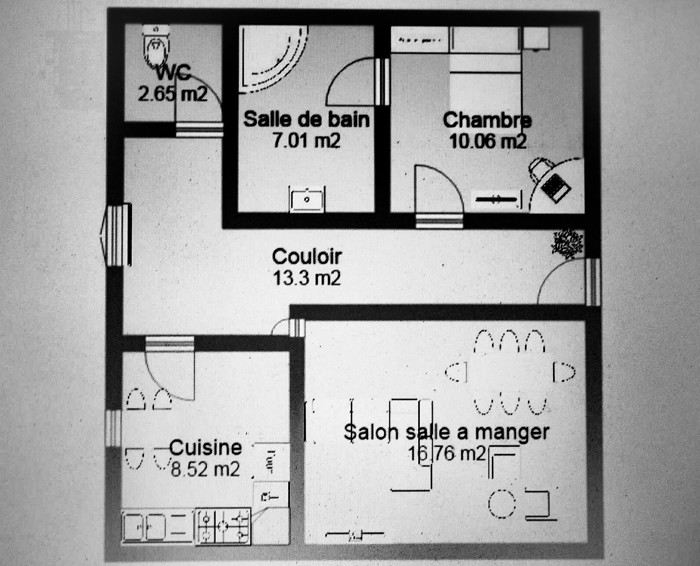
Faut bien plaisanter un peu, sinon on va devenir fou à rester enfermer chez-soi.
Faut bien plaisanter un peu, sinon on va devenir fou à rester enfermer chez-soi.
Programme en camping et motel et lieux à voir dans l'Ouest américain English translation pending
Bonjour tout le monde,
nous partons cette été (aout et septembre) pendant trois semaine dans l'ouest americain, et nous avions besoin de votre avis sur le programme sachant que nous voulons voir un maximum de choses. Nous comptons rouler le matin, et profiter la journée le soir sur le site
J0 : Nous arrivons un samedi à 17h à L.A. J1 : L.A. J2 : L.A. puis départ le midi pour Laughlin J3 : Départ le matin pour Grand Canyon + journée et nuit sur place J4 : Départ le matin pour Monument Valley + journée et nuit sur place J5 : Départ le matin pour Page + journée et nuit sur place J6 : Page J7 : Départ le matin pour Bryce Canyon + journée et nuit sur place J8 : Départ le matin pour Zion + journée et nuit sur place J9 : Départ le matin pour Las Vegas + journée et nuit sur place J10 : Las Vegas J11 : Départ pour Death Valley + journée et nuit sur place J12 : Départ le matin pour Mammoth Lake + journée et nuit sur place J13 : Départ le matin pour Yosemite + journée et nuit sur place J14 : Yosemite J15 : Départ le matin pour San Francisco J16 : San Francisco J17 : San Francisco J18 : Départ le matin pour Route 1 (nuit à Monterey) J19 : Route 1 (nuit à Pismo) J20 : Route 1 (nuit à Santa Barbara) J21 : L.A. puis retour en France le soir. Est ce qu'on a oublié des lieux à voir? est ce qu'il y a des corrections à apporter? Nous comptons dormir en camping et motel
Merci pour votre retour.
nous partons cette été (aout et septembre) pendant trois semaine dans l'ouest americain, et nous avions besoin de votre avis sur le programme sachant que nous voulons voir un maximum de choses. Nous comptons rouler le matin, et profiter la journée le soir sur le site
J0 : Nous arrivons un samedi à 17h à L.A. J1 : L.A. J2 : L.A. puis départ le midi pour Laughlin J3 : Départ le matin pour Grand Canyon + journée et nuit sur place J4 : Départ le matin pour Monument Valley + journée et nuit sur place J5 : Départ le matin pour Page + journée et nuit sur place J6 : Page J7 : Départ le matin pour Bryce Canyon + journée et nuit sur place J8 : Départ le matin pour Zion + journée et nuit sur place J9 : Départ le matin pour Las Vegas + journée et nuit sur place J10 : Las Vegas J11 : Départ pour Death Valley + journée et nuit sur place J12 : Départ le matin pour Mammoth Lake + journée et nuit sur place J13 : Départ le matin pour Yosemite + journée et nuit sur place J14 : Yosemite J15 : Départ le matin pour San Francisco J16 : San Francisco J17 : San Francisco J18 : Départ le matin pour Route 1 (nuit à Monterey) J19 : Route 1 (nuit à Pismo) J20 : Route 1 (nuit à Santa Barbara) J21 : L.A. puis retour en France le soir. Est ce qu'on a oublié des lieux à voir? est ce qu'il y a des corrections à apporter? Nous comptons dormir en camping et motel
Merci pour votre retour.
Passage de la frontière Chypre - Chypre nord (formalités) English translation pending
Bonjour
nous avons prévu de louer une voiture au départ de Nicosie pour aller côté grec puis remonter vers le monastère St André côté turc et restituer le véhicule à Nicosie.
Ma question est relative au passage de la frontière dans les 2 sens.
Peut-on franchir le passage facilement et faut-il prévoir d'avoir un tampon sur feuille volante lors de l'arrivée à ERCAN afin d'éviter les tracasseries lors du passage ? Merci de votre contribution.
Itinéraire le plus pratique possible de presque 2 semaines pour le Japon English translation pending
Bonjour, je pars au Japon du 6 au 18 avril et j’aimerais avoir l’itinéraire le plus pratique possible, pourrais-je avoir votre avis sur le miens ? (en ne comptant pas le premier et le dernier jour) :
Jour 1 Sumo Nakamise street sweets sensoji Pont azuma bashi Tokyo skytree Diner wagyu Parc ueno + Étang de Shinobazu + Musée National de Tokyo + Hanazonoinari Shrine / nezu Shibuya ou shinjuku Souper
Jour 2 Shinjuku Goyen Chidorigafuchi Tokyo métropolitain building Tokyo station (acheter billet Tokyo-Kyoto) Dîner Shibuya crossing Starbucks Shibuya hirake Shibuya parco Shibuya stream Hachiko Souper starbucks reserve roastery tokyo Saigoyama park/meguro river
Jour 3 Roppongi (hills observatory+musée mori+musee national art center) Diner Odaiba(teamlab borderless + starbucks+ Observatory Sphere+Odaiba Kaihin-Kōen(view rainbow bridge)+Palette Town Ferris Wheel Souper
Jour 4 Tsukiji Hamarikyu garden Tokyo tower/one piece Dîner Akihabara Kanda myojin, kurikoan, don quijote Asakusa Souper
Jour 5 sumida aquarium The Sumida Hokusai Museum + musée edo tokyo Diner Ginza Souper
Jour 6 Harajuku meiji-jingu + daiso + nubian + Takeshita dori Diner Omotesando Sky Circus Sunshine 60 Observatory Départ à Kyoto
Jour 7 Fushimi-Inari-Taisha Tofoku ji Sanjusangendo Temple Kiyomizu-dera Sannen zaka Kodai ji Parc Maruyama Diner Heian shrine Ninjo jo Silver pavillon Philosopher's Path Yasaka temple remplir GOSHUINCHÔ Souper
Jour 8 Bamboo grove Tenryu-ji Temple Monkey park Dîner To-ji Chion-in Temple Jingu michi Nanzen ji Kyoto tower Toit kyoto station
Jour 9 Nishiki Market Kyoto gosho Daitoku ji Kinkaku-ji temple Philosopher's Path Dîner ryoanji temple Ninna ji Teramachi & Shinkyogoku Shopping Streets Pontocho
Jour 10 Nara
Jour 11 Osaka castle Sakuranomiya Osaka mint Dîner Shitenno ji Ishinji Harukas 300 Observastion Deck Tempozan wheel Aquarium kaiyukan Chocolate laboratory Namba kurumon market Dotonbori Souper
Jour 1 Sumo Nakamise street sweets sensoji Pont azuma bashi Tokyo skytree Diner wagyu Parc ueno + Étang de Shinobazu + Musée National de Tokyo + Hanazonoinari Shrine / nezu Shibuya ou shinjuku Souper
Jour 2 Shinjuku Goyen Chidorigafuchi Tokyo métropolitain building Tokyo station (acheter billet Tokyo-Kyoto) Dîner Shibuya crossing Starbucks Shibuya hirake Shibuya parco Shibuya stream Hachiko Souper starbucks reserve roastery tokyo Saigoyama park/meguro river
Jour 3 Roppongi (hills observatory+musée mori+musee national art center) Diner Odaiba(teamlab borderless + starbucks+ Observatory Sphere+Odaiba Kaihin-Kōen(view rainbow bridge)+Palette Town Ferris Wheel Souper
Jour 4 Tsukiji Hamarikyu garden Tokyo tower/one piece Dîner Akihabara Kanda myojin, kurikoan, don quijote Asakusa Souper
Jour 5 sumida aquarium The Sumida Hokusai Museum + musée edo tokyo Diner Ginza Souper
Jour 6 Harajuku meiji-jingu + daiso + nubian + Takeshita dori Diner Omotesando Sky Circus Sunshine 60 Observatory Départ à Kyoto
Jour 7 Fushimi-Inari-Taisha Tofoku ji Sanjusangendo Temple Kiyomizu-dera Sannen zaka Kodai ji Parc Maruyama Diner Heian shrine Ninjo jo Silver pavillon Philosopher's Path Yasaka temple remplir GOSHUINCHÔ Souper
Jour 8 Bamboo grove Tenryu-ji Temple Monkey park Dîner To-ji Chion-in Temple Jingu michi Nanzen ji Kyoto tower Toit kyoto station
Jour 9 Nishiki Market Kyoto gosho Daitoku ji Kinkaku-ji temple Philosopher's Path Dîner ryoanji temple Ninna ji Teramachi & Shinkyogoku Shopping Streets Pontocho
Jour 10 Nara
Jour 11 Osaka castle Sakuranomiya Osaka mint Dîner Shitenno ji Ishinji Harukas 300 Observastion Deck Tempozan wheel Aquarium kaiyukan Chocolate laboratory Namba kurumon market Dotonbori Souper
Retour d'une semaine à Malte en hiver English translation pending
Bonjour,
Je prends tellement de plaisir à lire les carnets postés au retour de différentes destinations que j'essaie à mon tour d'un faire un, très modestement, vraiment sans aucune prétention, juste l'envie de partager mes ressentis sur cette courte découverte de Malte en cette fin janvier 2020.
Jour 1 5h45, lever très matinal, un brouillard à couper au couteau. La grève ne semble pas avoir trop d'impact sur la circulation des RER aujourd'hui mais on préfère assurer le coup. 6h44, RER A à quai, on enchaine avec le RER B et à 8h on est au terminal 2D de Charles de Gaulle. Notre vol Air Malta, en code share avec Air France, KLM et Delta, est prévu à 10h20. Passage très rapide au scanner et on va se poser tout seuls en salle d'embarquement dans des fauteuils confortables. On est seuls, c'est bien la première fois. Faut dire qu'il n'y a que deux salles d'embarquement me semble-t-il à cet endroit, et on n'attend pas dans la nôtre mais dans celle d'à coté, déserte. 9h45, début de l'embarquement. On prend le bus et on attend sur les pistes. Le ménage n'est pas terminé dans l'avion. On attend. Il y a toute sorte d'engins roulants autour de notre avion, des palettes, des colis, des bagages, des chariots... jamais vu autant de bordel autour d'un avion pret à partir ! On s'installe enfin, à l'avant de l'avion, et j'observe toute cette animation à l'extérieur.
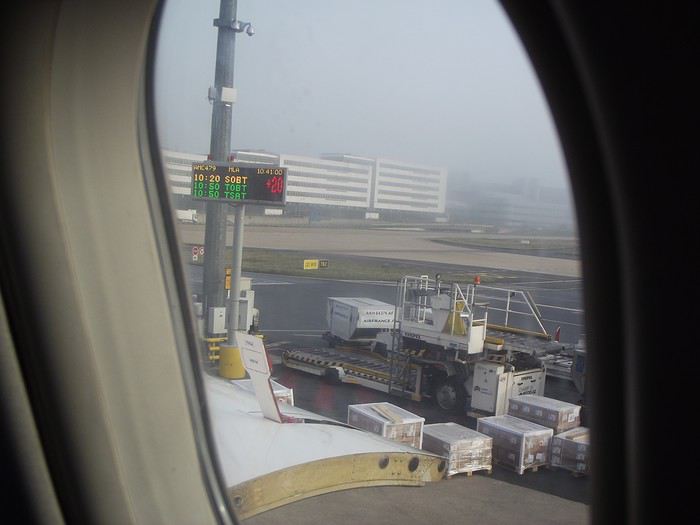
Un panneau affiche notre heure de départ et un décompte en minutes : - 3 mn. Hum, ça charge encore des palettes, des sacs postaux, des colis Fedex, ça m'étonnerait qu'on soit prêt dans 3 minutes ! Le temps passe... +12 mn, +28 mn, +61 mn. Ah, ça y est, on repousse, on roule et... on s'arrête 5 mn, 18 mn, 40 mn... là c'est bon, on roule, on décolle, il est midi passé.
14h33, on se pose à Malte, 17°, nuageux. On achète directement une carte de transport pour la semaine à 21 €, la Tallinja card explore unlimited travel 7 days, sinon c'est 1,50 € le trajet en bus en hiver, 2 € en été.

On sort de l'aéroport et on trouve l'arrêt du bus X4 juste devant. Prochain passage à 15h09, soit dans 6 minutes, puis un bus toutes les demi heures en gros. On descend au terminus à la Valette, au niveau de la fontaine au triton.
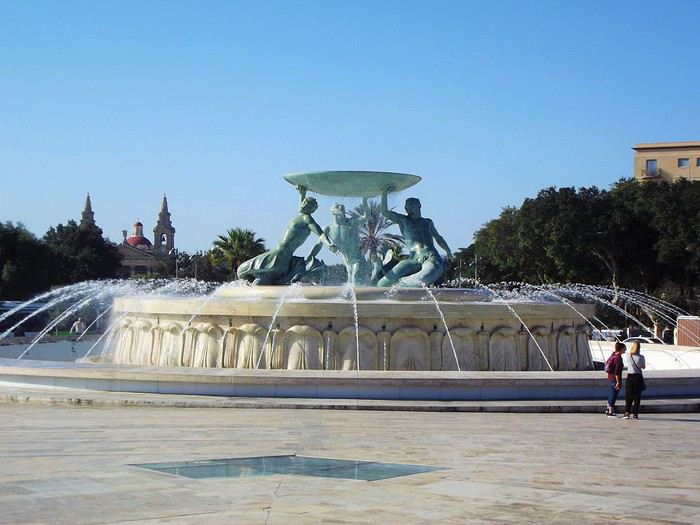
Notre hotel est à 600 mètres. On s'avance par le "city gate" dans les rues piétonnes de la Valette, c'est trop beau, tout en pierre et en dénivelé. J'adore 🙂
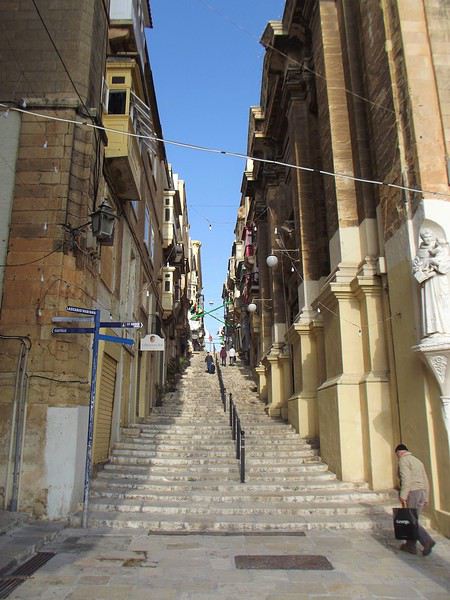
On continue dans la rue commerçante, on passe devant la co-cathédrale St John, on descend des marches et voila notre hotel au bout de la ruelle, le Grand Harbour hotel, juste en face des trois cités.
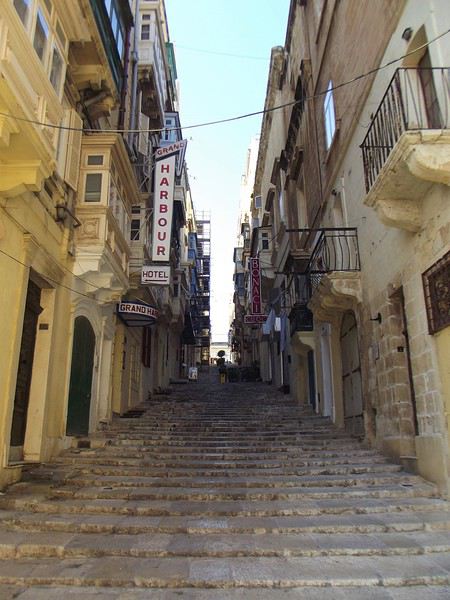
Check-in rapide, on pose nos affaires, on prend un petit thé vite fait et on ressort. On goute des spécialités locales : pour aujourd'hui une sorte de gros chausson aux pois pour l'un, au thon/épinards pour l'autre. 1,50 € chacun, ça nous cale bien et il nous fallait bien ça vu qu'on a fait l'impasse sur le déjeuner. Puis on arpente la rue commerçante et les ruelles perpendiculaires, on fait les boutiques, on regarde les menus des restos. Premier constat : c'est pas cher ! on est en période de soldes et les prix sont bien inférieurs à ceux de Paris. Dans les restos, pareil, les plats sont moins chers qu'à Paris. Arrive 19h, on s'installe en terrasse et on commande des mojitos et finalement des pizzas. Les terrasses c'est sympa, mais à 21h on se caille sévère (pas de brasero ni de plaid) et on rentre se réchauffer à l'hotel.
Je prends tellement de plaisir à lire les carnets postés au retour de différentes destinations que j'essaie à mon tour d'un faire un, très modestement, vraiment sans aucune prétention, juste l'envie de partager mes ressentis sur cette courte découverte de Malte en cette fin janvier 2020.
Jour 1 5h45, lever très matinal, un brouillard à couper au couteau. La grève ne semble pas avoir trop d'impact sur la circulation des RER aujourd'hui mais on préfère assurer le coup. 6h44, RER A à quai, on enchaine avec le RER B et à 8h on est au terminal 2D de Charles de Gaulle. Notre vol Air Malta, en code share avec Air France, KLM et Delta, est prévu à 10h20. Passage très rapide au scanner et on va se poser tout seuls en salle d'embarquement dans des fauteuils confortables. On est seuls, c'est bien la première fois. Faut dire qu'il n'y a que deux salles d'embarquement me semble-t-il à cet endroit, et on n'attend pas dans la nôtre mais dans celle d'à coté, déserte. 9h45, début de l'embarquement. On prend le bus et on attend sur les pistes. Le ménage n'est pas terminé dans l'avion. On attend. Il y a toute sorte d'engins roulants autour de notre avion, des palettes, des colis, des bagages, des chariots... jamais vu autant de bordel autour d'un avion pret à partir ! On s'installe enfin, à l'avant de l'avion, et j'observe toute cette animation à l'extérieur.
Un panneau affiche notre heure de départ et un décompte en minutes : - 3 mn. Hum, ça charge encore des palettes, des sacs postaux, des colis Fedex, ça m'étonnerait qu'on soit prêt dans 3 minutes ! Le temps passe... +12 mn, +28 mn, +61 mn. Ah, ça y est, on repousse, on roule et... on s'arrête 5 mn, 18 mn, 40 mn... là c'est bon, on roule, on décolle, il est midi passé.
14h33, on se pose à Malte, 17°, nuageux. On achète directement une carte de transport pour la semaine à 21 €, la Tallinja card explore unlimited travel 7 days, sinon c'est 1,50 € le trajet en bus en hiver, 2 € en été.
On sort de l'aéroport et on trouve l'arrêt du bus X4 juste devant. Prochain passage à 15h09, soit dans 6 minutes, puis un bus toutes les demi heures en gros. On descend au terminus à la Valette, au niveau de la fontaine au triton.
Notre hotel est à 600 mètres. On s'avance par le "city gate" dans les rues piétonnes de la Valette, c'est trop beau, tout en pierre et en dénivelé. J'adore 🙂
On continue dans la rue commerçante, on passe devant la co-cathédrale St John, on descend des marches et voila notre hotel au bout de la ruelle, le Grand Harbour hotel, juste en face des trois cités.
Check-in rapide, on pose nos affaires, on prend un petit thé vite fait et on ressort. On goute des spécialités locales : pour aujourd'hui une sorte de gros chausson aux pois pour l'un, au thon/épinards pour l'autre. 1,50 € chacun, ça nous cale bien et il nous fallait bien ça vu qu'on a fait l'impasse sur le déjeuner. Puis on arpente la rue commerçante et les ruelles perpendiculaires, on fait les boutiques, on regarde les menus des restos. Premier constat : c'est pas cher ! on est en période de soldes et les prix sont bien inférieurs à ceux de Paris. Dans les restos, pareil, les plats sont moins chers qu'à Paris. Arrive 19h, on s'installe en terrasse et on commande des mojitos et finalement des pizzas. Les terrasses c'est sympa, mais à 21h on se caille sévère (pas de brasero ni de plaid) et on rentre se réchauffer à l'hotel.
Annulation gratuite pour TOUS les vols Air China English translation pending
Voici la note de Air China datée d'hier...
020-01-28 Notes sur les ajustements aux règles de remboursement gratuit des billets d'avion Air China Share Chers passagers, Dans le souci de mettre en application les exigences de l'administration de l'aviation civile de Chine et de poursuivre l'effort commun de prévention et de contrôle de la pneumonie causée par le nouveau coronavirus, Air China a apporté les modifications suivantes aux règles de remboursement gratuit afin d'aider les passagers à mieux planifier leurs voyages :
I.Billets éligibles Tous les billets dont le numéro commence par « 999 » (y compris les billets échangés contre des points de fidélité) achetés avant 0h00 le 28 janvier 2020 pour des vols exploités par Air China ou des vols en partage de code codés CA dont la date de voyage est postérieure au 1er janvier 2020 (inclus). II.Règles de traitement des billets 1. Les billets sont valables un an à compter de la date d'émission. Tous les billets éligibles selon la définition ci-dessus peuvent être remboursés gratuitement pendant la période de validité d'un an, à condition que le remboursement soit demandé avant le départ du vol. Nous prions les passagers de bien vouloir faire leurs demandes de remboursement en dehors des périodes de pointe. 2. Les passagers peuvent demander un remboursement via les circuits d'origine où ils ont acheté leurs billets. Les billets achetés via le site Web d'Air China, l'application ou l'applet WeChat peuvent être directement remboursés dans la commande d'origine. 3. Air China surveillera de près les évolutions de l'épidémie et procédera en temps voulu à des modifications de vols. Pour utiliser au mieux la capacité de transport pendant le Nouvel An chinois, nous prions les passagers de demander leurs remboursements avant le départ du vol. Si vous avez décidé d'annuler votre voyage, veuillez annuler votre siège dès que possible via les circuits d'enregistrement d'origine afin d'éviter de gaspiller des ressources et de garantir que des sièges soient disponibles pour les autres passagers devant voyager. 4. Les règles prennent effet immédiatement et remplacent les notes précédentes sur le remboursement gratuit des billets d'avion Air China. La sécurité des passagers a toujours été la priorité absolue d'Air China et nous répondrons rapidement aux exigences des autorités et fournirons des services et une assistance aux passagers dans les délais les plus brefs. Nous vous remercions de votre coopération et de votre soutien. Ligne d'assistance Air China 24 h sur 24 : +86-10-955583
Donc, arrêtez de stresser pour rien, vous serez tous remboursés.
"😎😎"
https://www.airchina.fr/FR/FR/info/news/
020-01-28 Notes sur les ajustements aux règles de remboursement gratuit des billets d'avion Air China Share Chers passagers, Dans le souci de mettre en application les exigences de l'administration de l'aviation civile de Chine et de poursuivre l'effort commun de prévention et de contrôle de la pneumonie causée par le nouveau coronavirus, Air China a apporté les modifications suivantes aux règles de remboursement gratuit afin d'aider les passagers à mieux planifier leurs voyages :
I.Billets éligibles Tous les billets dont le numéro commence par « 999 » (y compris les billets échangés contre des points de fidélité) achetés avant 0h00 le 28 janvier 2020 pour des vols exploités par Air China ou des vols en partage de code codés CA dont la date de voyage est postérieure au 1er janvier 2020 (inclus). II.Règles de traitement des billets 1. Les billets sont valables un an à compter de la date d'émission. Tous les billets éligibles selon la définition ci-dessus peuvent être remboursés gratuitement pendant la période de validité d'un an, à condition que le remboursement soit demandé avant le départ du vol. Nous prions les passagers de bien vouloir faire leurs demandes de remboursement en dehors des périodes de pointe. 2. Les passagers peuvent demander un remboursement via les circuits d'origine où ils ont acheté leurs billets. Les billets achetés via le site Web d'Air China, l'application ou l'applet WeChat peuvent être directement remboursés dans la commande d'origine. 3. Air China surveillera de près les évolutions de l'épidémie et procédera en temps voulu à des modifications de vols. Pour utiliser au mieux la capacité de transport pendant le Nouvel An chinois, nous prions les passagers de demander leurs remboursements avant le départ du vol. Si vous avez décidé d'annuler votre voyage, veuillez annuler votre siège dès que possible via les circuits d'enregistrement d'origine afin d'éviter de gaspiller des ressources et de garantir que des sièges soient disponibles pour les autres passagers devant voyager. 4. Les règles prennent effet immédiatement et remplacent les notes précédentes sur le remboursement gratuit des billets d'avion Air China. La sécurité des passagers a toujours été la priorité absolue d'Air China et nous répondrons rapidement aux exigences des autorités et fournirons des services et une assistance aux passagers dans les délais les plus brefs. Nous vous remercions de votre coopération et de votre soutien. Ligne d'assistance Air China 24 h sur 24 : +86-10-955583
Donc, arrêtez de stresser pour rien, vous serez tous remboursés.
"😎😎"
https://www.airchina.fr/FR/FR/info/news/
Excursion d'un jour à La Réunion English translation pending
Bonjour,
J'y vais prochainement pendant 2 jours, j'aurais besoin d'un conseil.
J'ai réservé un vol en hélico le 2ème jour : piton Maïdo, cirques de Cilaos, Mafate et Salazie, canyon Trou de Fer, piton de la fournaise.
Le premier jour, comme on ne peut pas tout voir et que je pars du port à 25 km de st Denis, j'hésite entre visiter
le sud : Saint Philippe, Grand Brûlé, piton de la fournaise, tunnels de lave, cap Méchant le nord : St Denis, cirque de Salazie, voile de la Mariée, Hell Bourg
si l'un de vous y est déjà allé ... Merci
le sud : Saint Philippe, Grand Brûlé, piton de la fournaise, tunnels de lave, cap Méchant le nord : St Denis, cirque de Salazie, voile de la Mariée, Hell Bourg
si l'un de vous y est déjà allé ... Merci
Bike trip and camping in Denmark in summer (cities and regions)
Hello,
This is still just a plan: My wife and I are considering a bike trip in Denmark.
The timeframe would be July 2020, for a solid three weeks. We’d prefer to do a loop to avoid seeing the same landscapes and cities. We also camp.
We have our own well-equipped bikes and a single-wheel "Bob" trailer.
We’ll likely start and finish in Copenhagen, covering 40 to 60 km per day while leaving time to explore the cities and regions.
Through word of mouth, we know Denmark is another cycling country, so we won’t have any trouble finding bike paths.
However, when it comes to documents, we’re a bit lost. Since we don’t know the country at all, we’re not sure what’s most interesting to see and travel through.
We have the double-sided *Dänemark* map at 1:150,000 from Freytag & Berndt. It shows bike routes and campgrounds (which is great!), but it’s not very practical for biking.
Our experience in the Netherlands with "road" maps that quickly fell apart in the rain showed us the limits of those documents...
Are there more practical resources? Like a bike guide similar to what we have in France or for European bike routes?
Is there a system for identifying bike route numbers like in Holland?
And of course, we’d love any practical tips—cost of living, campground prices, hospitality (which I’m sure is excellent), weather quirks, coastal areas, wind (memories of the Netherlands!!!), and, of course, your personal favorites...
Thanks in advance to all contributors;
Pierre and Dominique from Lorient
New York pour une semaine et hôtels à Manhattan English translation pending
bonjour à tous ;
je me ballade sur le forum car je cherche à faire un voyage à new York fin mars, debut avril 2020 avec ma meilleure amie. nous avions 47 et 58 ans ( 2 jeunes femmes quoi😉) nous sommes assez sportives, nous avions un budget de 1000 euros par personne pour 1 semaine . connaissez vous des hôtels non loin de Manhattan?
j'avoue que nous aimons un minimum de confort et de propreté de l'hôtel surtout que dans nos journées on aura fait les 1000 et 1 pas. sinon un RbnB ou chez l'habitant, pourquoi pas mais je n'ai jamais fait ce style de voyage. nous faisons rarement des voyages lointains et pour préparer ce petit voyage, Jai besoin de votre aide..
qui peut nous donner des filons? des sorties le soir pour prendre un verre? quels sont les endroits qui craignent? les endroits proche de Manhattan à découvrir? le cout de la vie sauf si vous êtes un crack de trouver un all inclus (au moins le petit déjeuner c'est le meilleur moment pour nous avant la découverte)
Jai hâte de vous lire, l temps passe vite et je serais ravie de pourvoir proposer à mon amie la destination CEST UNE SURPRISE😊
je me suis donc permise de bous laisser ce post, merci de m'avoir lu, à très vite!
je me ballade sur le forum car je cherche à faire un voyage à new York fin mars, debut avril 2020 avec ma meilleure amie. nous avions 47 et 58 ans ( 2 jeunes femmes quoi😉) nous sommes assez sportives, nous avions un budget de 1000 euros par personne pour 1 semaine . connaissez vous des hôtels non loin de Manhattan?
j'avoue que nous aimons un minimum de confort et de propreté de l'hôtel surtout que dans nos journées on aura fait les 1000 et 1 pas. sinon un RbnB ou chez l'habitant, pourquoi pas mais je n'ai jamais fait ce style de voyage. nous faisons rarement des voyages lointains et pour préparer ce petit voyage, Jai besoin de votre aide..
qui peut nous donner des filons? des sorties le soir pour prendre un verre? quels sont les endroits qui craignent? les endroits proche de Manhattan à découvrir? le cout de la vie sauf si vous êtes un crack de trouver un all inclus (au moins le petit déjeuner c'est le meilleur moment pour nous avant la découverte)
Jai hâte de vous lire, l temps passe vite et je serais ravie de pourvoir proposer à mon amie la destination CEST UNE SURPRISE😊
je me suis donc permise de bous laisser ce post, merci de m'avoir lu, à très vite!