Results for "Champaner+|+7+>+8"
4487 results found.
Retour du H10 English translation pending
C'était magnifique. Je crois avoir passer les plus belles vacances mer soleil.
Cet hotel<est tous simplment génial : propre, le personnel est sympa, la bouffe est cool, la plage y'a pas de nom bref le top.
J'ai encore mon petit bracelet violet au bras et je pense le garder encore quelques jours😛
Nous avons voyagé aller et retour avec Comet air plus et aucun soucis.
J'ai pris une tonne de photos de l'hotel et je vais mettre en place dans les jours qui suivent un site internet sur l'hotel pour aider ceux et celles qui hésitet encore.
En tous cas nous retournerons en republique dominicaine.
Je reste à la dispo de ceux qui ont des questions.
Pixele2000@yahoo.fr
Cet hotel<est tous simplment génial : propre, le personnel est sympa, la bouffe est cool, la plage y'a pas de nom bref le top.
J'ai encore mon petit bracelet violet au bras et je pense le garder encore quelques jours😛
Nous avons voyagé aller et retour avec Comet air plus et aucun soucis.
J'ai pris une tonne de photos de l'hotel et je vais mettre en place dans les jours qui suivent un site internet sur l'hotel pour aider ceux et celles qui hésitet encore.
En tous cas nous retournerons en republique dominicaine.
Je reste à la dispo de ceux qui ont des questions.
Pixele2000@yahoo.fr
Mariage dans le sud English translation pending
😏Bonjour,
Pouvez-vous me conseiller pour un mariage dans le sud, c'est-a-dire les Antilles. Cancun ou Jamaique.
Merci, voyageuses
Pouvez-vous me conseiller pour un mariage dans le sud, c'est-a-dire les Antilles. Cancun ou Jamaique.
Merci, voyageuses
Star airlines classe Galaxie? English translation pending
apres longue reflexion, mon voyagiste ma vendu la classe galaxi de la star airlines en lieu et placee de la bataillaire amelioré de la classe alize de chez air france.aucun site web de star airlines.
qui a déja voyagé en classe galaxie et est telle une petite classe affaire oubien une fois de plus une betaille amelioré!.
merci de vos réactions si vous avez deja voyagé en classe galaxie!
qui a déja voyagé en classe galaxie et est telle une petite classe affaire oubien une fois de plus une betaille amelioré!.
merci de vos réactions si vous avez deja voyagé en classe galaxie!
Paradisus ou autre Punta Cana English translation pending
Bonjour j'aimerais savoir ce que vous pensez de l'hôtel Paradisus de Punta Cana ?🙂 Je part pour la république Dominicaine le 3 Janvier 2004 et j'aimerais savoir à quoi m'en tenir pour l'hôtel...Je tiens à avoir quelque chose de propre et avec des activités pour tout les goûts... Pouvez vous me donnez vos impression sur cette hôtel ou peux-être m'en conseiller une meilleur...
Merci !😄
Merci !😄
Vendanges en France - septembre English translation pending
Bonjour,
Je ferai un voyage de 3 mois cet automne. Départ prévu 30 août, retour au début décembre.
J'aimerais possiblement débuter mon voyage en faisant les vendanges quelque part en France. J'aimerais obtenir toute information pertinente afin de m'aider dans ce projet. Par exemple, est-ce mieux de trouver un vignoble avant d'arriver? Où chercher? Y a-t-il une bonne demande?
Si je prévois faire les vendanges au début septembre, quelles régions sont recommandées?
Vous avez déjà fait les vendanges : des commentaires, impressions, suggestions?
Merci à l'avance!!!! 🙂
Je ferai un voyage de 3 mois cet automne. Départ prévu 30 août, retour au début décembre.
J'aimerais possiblement débuter mon voyage en faisant les vendanges quelque part en France. J'aimerais obtenir toute information pertinente afin de m'aider dans ce projet. Par exemple, est-ce mieux de trouver un vignoble avant d'arriver? Où chercher? Y a-t-il une bonne demande?
Si je prévois faire les vendanges au début septembre, quelles régions sont recommandées?
Vous avez déjà fait les vendanges : des commentaires, impressions, suggestions?
Merci à l'avance!!!! 🙂
Review of my trip to Mongolia with guide Hacha
Hi everyone!
I wanted to share my experience from the trip I had this summer in Mongolia, in case it helps anyone get their bearings—I also relied a lot on forums myself.
We went as a couple with a French-speaking guide, Hacha, for a 17-day trek through the steppes and the Gobi Desert.
The experience was amazing—the landscapes are truly diverse and stunning. We started with a quick visit to Ulaanbaatar, then headed into the steppes for half the trip, including the Orkhon Valley, before moving on to the desert, which isn’t just sand but has incredibly varied scenery.
We traveled with Hacha, who has been a guide for 27 years and knows Mongolia inside out. She was accompanied by her daughter (with our consent). Hacha teaches French the rest of the year and speaks it perfectly. Her kindness and humor were much appreciated, and she’s become a friend. She prepared delicious homemade meals throughout the trip, adapted to European tastes since she’s used to it. We also had a driver who was really friendly and professional.
I injured myself on the way there with a sprained ankle, and Hacha immediately adjusted the pace and some activities to accommodate my injury, as well as booking more comfortable lodgings for the first few nights. She didn’t tell us it cost her extra, and we only found out later—we chose to pay a supplement, but she never asked for anything. Hacha was very fair with money, and her rates seem a bit lower than what we’d found elsewhere. She also tailors the program to the budget we gave her, and we had the option to adjust accommodations to fit our budget.
As for lodging, we stayed in tourist yurt camps (more comfortable with restaurants, showers, etc.), guest yurts, nights with nomadic families, and a few nights in tents. Our most memorable experience was two nights with nomads who welcomed us warmly, even though it was only the second time they’d hosted tourists. They shared their traditions with us, and the location was beautiful—right by a lake.
Hacha also adapted to our last-minute requests. For example, I mentioned wanting to see a shaman, which was tricky since it wasn’t planned in advance (my fault for not bringing it up earlier), but she used her contacts to see if there was a possibility. Unfortunately, no shamans were available, but we spontaneously stopped by the family of a young shaman during one of our trips. She wasn’t there, but we got to hear her parents’ stories and ask questions about the rituals to become a shaman and their experiences. It was a rare and unique moment I won’t forget!
We’ll definitely return to Mongolia as a family to explore less touristy regions (though we weren’t really bothered by tourism), as Hacha offers other off-the-beaten-path itineraries, including one that visits a turquoise lake surrounded by sand dunes—which sounds incredible, according to her.
I highly recommend Mongolia to anyone looking for an authentic trip that pushes you slightly out of your comfort zone while still feeling safe and enjoying breathtakingly diverse landscapes. And I 100% recommend Hacha—she created a personalized trip based on our requests and adapted to our needs and wishes on the spot!
I wanted to share my experience from the trip I had this summer in Mongolia, in case it helps anyone get their bearings—I also relied a lot on forums myself.
We went as a couple with a French-speaking guide, Hacha, for a 17-day trek through the steppes and the Gobi Desert.
The experience was amazing—the landscapes are truly diverse and stunning. We started with a quick visit to Ulaanbaatar, then headed into the steppes for half the trip, including the Orkhon Valley, before moving on to the desert, which isn’t just sand but has incredibly varied scenery.
We traveled with Hacha, who has been a guide for 27 years and knows Mongolia inside out. She was accompanied by her daughter (with our consent). Hacha teaches French the rest of the year and speaks it perfectly. Her kindness and humor were much appreciated, and she’s become a friend. She prepared delicious homemade meals throughout the trip, adapted to European tastes since she’s used to it. We also had a driver who was really friendly and professional.
I injured myself on the way there with a sprained ankle, and Hacha immediately adjusted the pace and some activities to accommodate my injury, as well as booking more comfortable lodgings for the first few nights. She didn’t tell us it cost her extra, and we only found out later—we chose to pay a supplement, but she never asked for anything. Hacha was very fair with money, and her rates seem a bit lower than what we’d found elsewhere. She also tailors the program to the budget we gave her, and we had the option to adjust accommodations to fit our budget.
As for lodging, we stayed in tourist yurt camps (more comfortable with restaurants, showers, etc.), guest yurts, nights with nomadic families, and a few nights in tents. Our most memorable experience was two nights with nomads who welcomed us warmly, even though it was only the second time they’d hosted tourists. They shared their traditions with us, and the location was beautiful—right by a lake.
Hacha also adapted to our last-minute requests. For example, I mentioned wanting to see a shaman, which was tricky since it wasn’t planned in advance (my fault for not bringing it up earlier), but she used her contacts to see if there was a possibility. Unfortunately, no shamans were available, but we spontaneously stopped by the family of a young shaman during one of our trips. She wasn’t there, but we got to hear her parents’ stories and ask questions about the rituals to become a shaman and their experiences. It was a rare and unique moment I won’t forget!
We’ll definitely return to Mongolia as a family to explore less touristy regions (though we weren’t really bothered by tourism), as Hacha offers other off-the-beaten-path itineraries, including one that visits a turquoise lake surrounded by sand dunes—which sounds incredible, according to her.
I highly recommend Mongolia to anyone looking for an authentic trip that pushes you slightly out of your comfort zone while still feeling safe and enjoying breathtakingly diverse landscapes. And I 100% recommend Hacha—she created a personalized trip based on our requests and adapted to our needs and wishes on the spot!
Costa Rica: The dry season isn't what it used to be!
Introduction:
For years, I’ve heard about Costa Rica, which seems like a country "made for me"—nature, not cities.
I almost went in 2019, but a family issue made me cancel.
Initially, I wanted to spend at least three weeks there, planning to go in our summer despite it being the rainy season. Then I realized what I wanted to do could fit into two weeks, so I ended up going in February.
Plus, January’s weather was so awful that some sunshine should do me good.
I found a flight at a decent price, but with two downsides.
The first is that it leaves from Paris CDG, and the second is that it’s with Air France—a airline I’d sworn off after my misadventures with them back in 2008. We’ll see how it goes!
Review of an expedition cruise to the Seychelles with Ponant from January 25 to February 2, 2026
Hi everyone,
It was totally by chance that I found this cruise while chatting with Alfred in November 2024. It wasn’t planned, but the price was attractive—one of those "great deals" from Ponant that I love and that don’t exist anymore. Since everyone’s wondering, here’s the answer without waiting for the end of the story: after my various loyalty discounts, I paid **3,250 € per person** for 8 nights/9 days on the expedition cruise *The Essentials of the Seychelles*.
Expedition cruises are by far our favorites. The outings are done by Zodiac with the ship’s naturalist guides, everything’s included, and there’s no need to add any excursions or prepare anything.
We’re liking long flights less and less, so to break up the trip, we decided to stop over in Doha for four days on the way there and one day on the way back.
I’m happy to share the good and not-so-good moments, the great surprises, and the disappointments of this trip with you.
It was totally by chance that I found this cruise while chatting with Alfred in November 2024. It wasn’t planned, but the price was attractive—one of those "great deals" from Ponant that I love and that don’t exist anymore. Since everyone’s wondering, here’s the answer without waiting for the end of the story: after my various loyalty discounts, I paid **3,250 € per person** for 8 nights/9 days on the expedition cruise *The Essentials of the Seychelles*.
Expedition cruises are by far our favorites. The outings are done by Zodiac with the ship’s naturalist guides, everything’s included, and there’s no need to add any excursions or prepare anything.
We’re liking long flights less and less, so to break up the trip, we decided to stop over in Doha for four days on the way there and one day on the way back.
I’m happy to share the good and not-so-good moments, the great surprises, and the disappointments of this trip with you.
Feedback on 15-day family trip to Colombia
Hi everyone, it’s been a while since I last posted!
First time in South America for me, my wife, and our 7-year-old son. I’ve put together this itinerary and would love to hear your thoughts:
Bogotá 28/07 – 30/07: Arrival. Which neighborhood and outings would you recommend? Flight to
2 Filandia 30/07 – 03/08: (255 €). Waterfalls and horseback riding, Cocora Valley, Hiking, Nearby villages. Flight to 3 Tayrona 03/08 – 07/08: Hotel La Casablanca
Hike with Tierra Nevada and the Kogui village (any feedback?). Return by inner tube for the little one. Short night hike. Second hike to La Piscina, etc., return by 🐎.
4 Cartagena 07/08 – 10/08: Air-conditioned bus. Staying in Getsemaní? Mangroves & the Castle, exploring the city.
5 Bogotá 10/08 – 12/08
Feel free to share your feedback! Have a great day!
Seb
First time in South America for me, my wife, and our 7-year-old son. I’ve put together this itinerary and would love to hear your thoughts:
Bogotá 28/07 – 30/07: Arrival. Which neighborhood and outings would you recommend? Flight to
2 Filandia 30/07 – 03/08: (255 €). Waterfalls and horseback riding, Cocora Valley, Hiking, Nearby villages. Flight to 3 Tayrona 03/08 – 07/08: Hotel La Casablanca
Hike with Tierra Nevada and the Kogui village (any feedback?). Return by inner tube for the little one. Short night hike. Second hike to La Piscina, etc., return by 🐎.
4 Cartagena 07/08 – 10/08: Air-conditioned bus. Staying in Getsemaní? Mangroves & the Castle, exploring the city.
5 Bogotá 10/08 – 12/08
Feel free to share your feedback! Have a great day!
Seb
Review of an Aegean Sea cruise on Ponant's Bougainville from November 1-8, 2025
Hello everyone,
If you'd like, I invite you to join me for a week-long cruise to northern Greece, visiting ports that are often less crowded with cruise ships.
Itinerary: Athens, Skiathos, Volos, Thessaloniki, Kavala, Limnos, Hydra, Athens
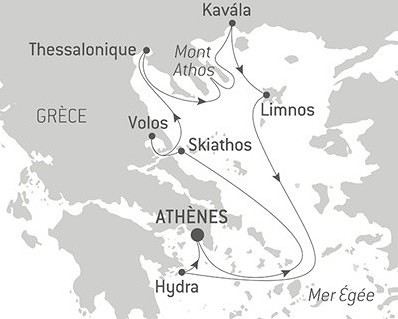
If you'd like, I invite you to join me for a week-long cruise to northern Greece, visiting ports that are often less crowded with cruise ships.
Itinerary: Athens, Skiathos, Volos, Thessaloniki, Kavala, Limnos, Hydra, Athens
Switzerland-Paris walking route
Hi,
I’m planning the Switzerland-Paris hike for 2026. If any of you know a route where I can stay with locals or in other lodging (no camping), I’d really appreciate your tips.
Thanks!
M Brunner
Transatlantic Cruise Review: Oceania Rio to Santa Cruz de Tenerife
Hello everyone!
Booked the cruise a year in advance for a departure from Rio on April 5th.
Air France flight to Rio on April 3rd, arriving at the Windsor Plaza hotel, very well located just 300 meters from Copacabana Beach, with a pool on the 15th floor offering a view of Rio.
The next morning, a behind-the-scenes visit to Rio’s Carnival—there were still some floats not yet dismantled and a little samba session. At noon, lunch on Copacabana Beach, which was deserted due to rain and gray skies all day.
Saturday, April 5th, boarding the *Marina*—still raining :( To get around Rio, we used Uber, which was really cheap—5 euros for a 15-minute ride, while taxis cost double... Arrived at the cruise terminal, boarding was very quick as usual with Oceania. The cabins would be ready around 3 PM, with luggage at the cabin door. We had booked an inside cabin. Despite numerous offers from Oceania to upgrade (with a supplement, of course), we stuck with our first choice. It’s worth noting that at least 200 cabins remained unoccupied—about 800 passengers for this transatlantic crossing... Last September, since the cruise wasn’t filling up well, Oceania lowered the price by 1,000 euros per person for an inside cabin—a great deal for us, as they adjusted the rate downward when we asked.
For this cruise, weekends and drinks at the table were included—champagne, wine, beer...—plus an onboard credit that’s now only for excursions (before, it was more flexible—another downgrade, lol).
Headed to the Terrace Café for our first meal, and what a surprise when we saw the changes... No more staff mixing your chosen salad, and way fewer options: big bowls of salad, trays of potato salad, beets, lentils—I don’t remember seeing that before—thin slices of cold cuts and cheese. On the meat side, not much choice and lower quality. Desserts also had fewer options. Well, we’ll make up for it at Jacques on the first night ;) The menu hasn’t changed much—it’s still top-notch. The seasoning is average, but it’s a safe bet.
A little note on the 15-day cruise: we ate at 11 different restaurants—3 at Jacques, 3 at Polo Grill, 3 at Toscana, and 2 at Red Ginger. Not bad for two weeks ;) A French officer invited us to Toscana, which was really nice of her. Polo Grill is still amazing—I’d rank it second after Jacques, with Toscana third and Red Ginger last. I think since the ship wasn’t full, it was easier to get into these restaurants ;)
The staff was, as always, excellent. There were 3 French employees on the *Marina*: 1 waiter at Jacques, 1 manager at Wave, and 1 officer in the offices.
In the afternoon, Tea Time had way fewer pastry choices than before... Cost-cutting seems to be happening at every level. We met people who used to stay in Penthouse Suites—before, they got a bottle of champagne in their suite every night, but since January, it’s been Prosecco instead... Just a small example of Oceania’s cost reductions. At the Terrace Café in the evening, there was no more lobster on this cruise :(
Still, the value for money on this cruise was excellent given the price we paid per person. This transatlantic crossing had 4 stops in Brazil, 1 in the Cape Verde Islands, then Dakar in Senegal, and ended in the Canary Islands.
Mich74
Saturday, April 5th, boarding the *Marina*—still raining :( To get around Rio, we used Uber, which was really cheap—5 euros for a 15-minute ride, while taxis cost double... Arrived at the cruise terminal, boarding was very quick as usual with Oceania. The cabins would be ready around 3 PM, with luggage at the cabin door. We had booked an inside cabin. Despite numerous offers from Oceania to upgrade (with a supplement, of course), we stuck with our first choice. It’s worth noting that at least 200 cabins remained unoccupied—about 800 passengers for this transatlantic crossing... Last September, since the cruise wasn’t filling up well, Oceania lowered the price by 1,000 euros per person for an inside cabin—a great deal for us, as they adjusted the rate downward when we asked.
For this cruise, weekends and drinks at the table were included—champagne, wine, beer...—plus an onboard credit that’s now only for excursions (before, it was more flexible—another downgrade, lol).
Headed to the Terrace Café for our first meal, and what a surprise when we saw the changes... No more staff mixing your chosen salad, and way fewer options: big bowls of salad, trays of potato salad, beets, lentils—I don’t remember seeing that before—thin slices of cold cuts and cheese. On the meat side, not much choice and lower quality. Desserts also had fewer options. Well, we’ll make up for it at Jacques on the first night ;) The menu hasn’t changed much—it’s still top-notch. The seasoning is average, but it’s a safe bet.
A little note on the 15-day cruise: we ate at 11 different restaurants—3 at Jacques, 3 at Polo Grill, 3 at Toscana, and 2 at Red Ginger. Not bad for two weeks ;) A French officer invited us to Toscana, which was really nice of her. Polo Grill is still amazing—I’d rank it second after Jacques, with Toscana third and Red Ginger last. I think since the ship wasn’t full, it was easier to get into these restaurants ;)
The staff was, as always, excellent. There were 3 French employees on the *Marina*: 1 waiter at Jacques, 1 manager at Wave, and 1 officer in the offices.
In the afternoon, Tea Time had way fewer pastry choices than before... Cost-cutting seems to be happening at every level. We met people who used to stay in Penthouse Suites—before, they got a bottle of champagne in their suite every night, but since January, it’s been Prosecco instead... Just a small example of Oceania’s cost reductions. At the Terrace Café in the evening, there was no more lobster on this cruise :(
Still, the value for money on this cruise was excellent given the price we paid per person. This transatlantic crossing had 4 stops in Brazil, 1 in the Cape Verde Islands, then Dakar in Senegal, and ended in the Canary Islands.
Mich74
Local transport Marrakech - Ait Bou Oulli
Hi there,
I’m planning to cross the Atlas M’Goun-Toubkal range at the end of March and I’m looking for info on how to get to Ait Bou Oulli from Marrakech via Demnate.
Can anyone tell me if there’s a direct bus to Demnate and then a minibus (once it’s full) to Ait Bou Oulli? Is it doable in a day by bus or even a shared taxi?
Thanks in advance
Thanks in advance
Quick summary of our cruise from Jan 25 to Feb 2 on Celebrity Equinox in the Caribbean
This isn’t a full review but a quick summary, since I’m short on time and won’t be able to do a proper one.
Our cruise started in Port Canaveral (Orlando), and there are no longer direct flights from Paris. So, we had to take a connecting flight with British Airways (code-share with American Airlines):
Paris / Miami / Orlando and the return Orlando / Philadelphia / Paris.
Three days before departure, I went on British Airways’ website to check in and buy exit-row seats so my wife could stretch her legs. That’s when I saw that one leg of the return flight (Philadelphia / Paris) had been canceled.
I called the airline, and they confirmed the flight was indeed canceled, and the agency I bought the ticket from had been informed back in September. But the agency never told me—or just forgot. So, I called GO Voyages, and it was the same old story: blah, blah, blah...
They offered me a flight with two connections, the last one in London (with an airport change at my expense—about 80 €). I refused because I’d bought a ticket with only one connection, and on top of that, there were taxi costs for the airport change.
After some back-and-forth, GO offered to refund the ticket—but in a month. So, I ended up buying two last-minute tickets at my own expense while waiting for the refund.
Never again with GO for flights—their customer service is terrible, and everything is outsourced....
The cruise I was disappointed with this cruise.
Isa was right—the service at Celebrity has really gone downhill.
The buffet was fine—everything was fresh and varied. But in the restaurants (especially the main one), the dishes were really basic (as the Canadians say) and simple (nothing like Princess).
The ship showed signs of wear and was even dirty in some places. I had to ask for our cabin to be redone when we arrived because the bathroom didn’t seem very clean.
The "Elite Club" perks are fading fast—so much so that you don’t even feel like going (just a glass of sparkling wine and some mediocre appetizers). You have to fight to get another drink if you don’t like that sparkling wine...
Before, in Concierge Class, the bottle of sparkling wine was in a champagne bucket on the coffee table with ice. Now it’s just in the fridge.
The appetizers served in the cabin around 5 PM weren’t appetizing at all. The list goes on...
Luckily, I didn’t pay much for this cruise, or I would’ve really regretted it.
The ports of call (Key West, Nassau, Puerto Plata)
I’ve already stopped at these places before, so it was just beach time and sightseeing...
Still, I had a great week under the Caribbean sun, and it was a nice break.
I’d only cruise with Celebrity again if the price was right or there was a big promo.
See you soon for more adventures! Alfred
Our cruise started in Port Canaveral (Orlando), and there are no longer direct flights from Paris. So, we had to take a connecting flight with British Airways (code-share with American Airlines):
Paris / Miami / Orlando and the return Orlando / Philadelphia / Paris.
Three days before departure, I went on British Airways’ website to check in and buy exit-row seats so my wife could stretch her legs. That’s when I saw that one leg of the return flight (Philadelphia / Paris) had been canceled.
I called the airline, and they confirmed the flight was indeed canceled, and the agency I bought the ticket from had been informed back in September. But the agency never told me—or just forgot. So, I called GO Voyages, and it was the same old story: blah, blah, blah...
They offered me a flight with two connections, the last one in London (with an airport change at my expense—about 80 €). I refused because I’d bought a ticket with only one connection, and on top of that, there were taxi costs for the airport change.
After some back-and-forth, GO offered to refund the ticket—but in a month. So, I ended up buying two last-minute tickets at my own expense while waiting for the refund.
Never again with GO for flights—their customer service is terrible, and everything is outsourced....
The cruise I was disappointed with this cruise.
Isa was right—the service at Celebrity has really gone downhill.
The buffet was fine—everything was fresh and varied. But in the restaurants (especially the main one), the dishes were really basic (as the Canadians say) and simple (nothing like Princess).
The ship showed signs of wear and was even dirty in some places. I had to ask for our cabin to be redone when we arrived because the bathroom didn’t seem very clean.
The "Elite Club" perks are fading fast—so much so that you don’t even feel like going (just a glass of sparkling wine and some mediocre appetizers). You have to fight to get another drink if you don’t like that sparkling wine...
Before, in Concierge Class, the bottle of sparkling wine was in a champagne bucket on the coffee table with ice. Now it’s just in the fridge.
The appetizers served in the cabin around 5 PM weren’t appetizing at all. The list goes on...
Luckily, I didn’t pay much for this cruise, or I would’ve really regretted it.
The ports of call (Key West, Nassau, Puerto Plata)
I’ve already stopped at these places before, so it was just beach time and sightseeing...
Still, I had a great week under the Caribbean sun, and it was a nice break.
I’d only cruise with Celebrity again if the price was right or there was a big promo.
See you soon for more adventures! Alfred
Trip to the Drakensberg in South Africa
So, on these rainy days, I’m finally getting around to writing a little travel journal about the Drakensberg.
The Dragon Mountains, known as uKhahlamba in Zulu and Maluti in Sotho or Tswana.
Roughly speaking, we can break it down into: * The far north in the Free State at Golden Gate NP (managed by Sanparks, while the rest is run by KZN Wildlife). * Royal Natal National Park with the Amphitheatre, Sentinel Peak, and its famous "hike" (which I won’t talk about since I’ve never been there—it’s still on my to-do list!). * Cathedral Peak and Didima * Monk's Cowl * Giant's Castle * Hihghmoor and Kamberg * Sani Pass (which I haven’t visited in ages and won’t cover here).
Highlands Mountain Retreat is the place to stay in Golden Gate if you can snag it. When the weather’s nice, the view is absolutely incredible—probably the most beautiful I’ve ever seen in South Africa!
Just a heads-up: it’s stunning but high up and cold, even *very* cold. The bungalows are cozy, and the little road leading there is charming. The park offers hikes ranging from easy to tough, but be warned—the maps are... not very clear or reliable, and we ended up on an endless, exhausting trek. There are plenty of animals (mostly antelopes, so not super diverse in terms of wildlife), hikes as mentioned... game drives on a paved road, and various walks. You feel remote but aren’t *that* far from civilization.

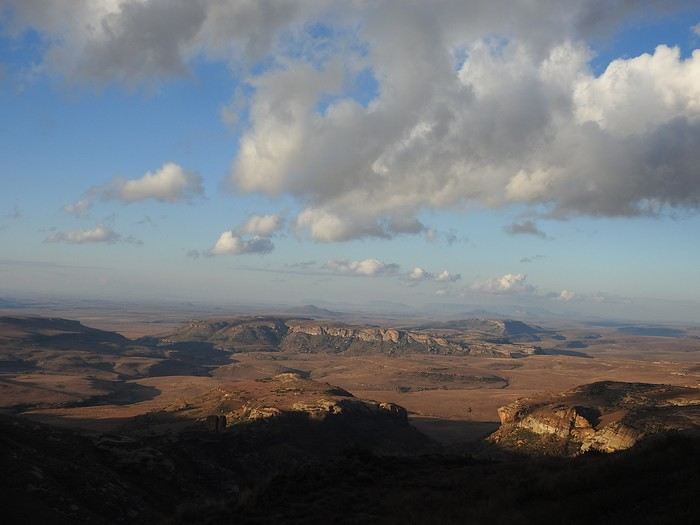
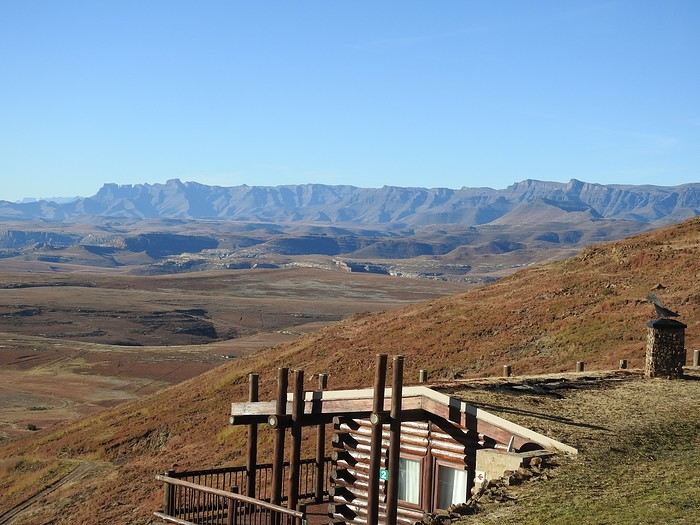
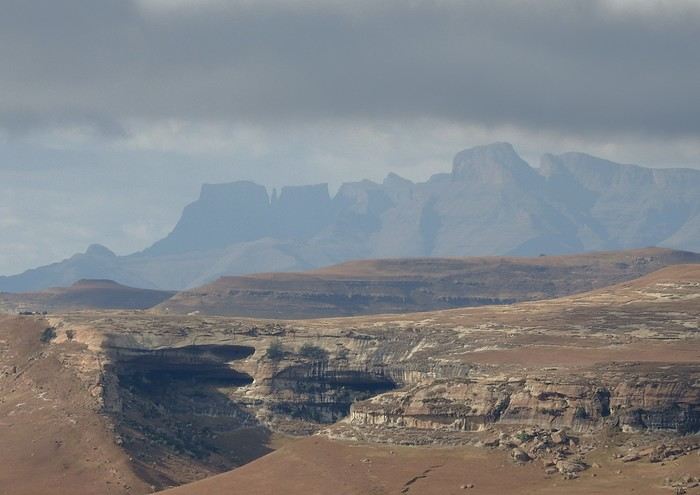



The Dragon Mountains, known as uKhahlamba in Zulu and Maluti in Sotho or Tswana.
Roughly speaking, we can break it down into: * The far north in the Free State at Golden Gate NP (managed by Sanparks, while the rest is run by KZN Wildlife). * Royal Natal National Park with the Amphitheatre, Sentinel Peak, and its famous "hike" (which I won’t talk about since I’ve never been there—it’s still on my to-do list!). * Cathedral Peak and Didima * Monk's Cowl * Giant's Castle * Hihghmoor and Kamberg * Sani Pass (which I haven’t visited in ages and won’t cover here).
Highlands Mountain Retreat is the place to stay in Golden Gate if you can snag it. When the weather’s nice, the view is absolutely incredible—probably the most beautiful I’ve ever seen in South Africa!
Just a heads-up: it’s stunning but high up and cold, even *very* cold. The bungalows are cozy, and the little road leading there is charming. The park offers hikes ranging from easy to tough, but be warned—the maps are... not very clear or reliable, and we ended up on an endless, exhausting trek. There are plenty of animals (mostly antelopes, so not super diverse in terms of wildlife), hikes as mentioned... game drives on a paved road, and various walks. You feel remote but aren’t *that* far from civilization.
Accommodations in the Drakensberg
Hi there,
We’re heading to South Africa for 17 days at the end of July/beginning of August with our two kids.
We’re planning 4 days in the Drakensberg: 2 days at Royal Natal and two more to do the Sani Pass (but going through a local agency at Sani Lodge).
We’ve rented a Toyota Corolla. Is that enough?
Also, do you have any suggestions for accommodations in the area? Or other ideas for those 4 days?
Thanks so much for your tips!
Happy holidays! !
Vols pour nulle part et "staycation" English translation pending
Bonjour à tous et à toutes,
J'ai entendu sur RFI ce matin un reportage sur les vols pour nulle part... Cela m'a intriguée bien sûr et j'ai cru à une blague puis j'ai réalisé que ce n'en était pas une : https://www.rfi.fr/fr/asie-pacifique/20200914-singapour-vols-vers-nulle-part-sauver-le-secteur-aérien
En gros, il s'agit de monter à bord d'un avion et de faire un petit tour de quelques heures afin de profiter des avantages d'un tel type de transport (vue, service à bord...) avant de revenir à son point de départ.
L'article de RFI parle d'une compagnie singapourienne, celui-ci d'une compagnie taïwanaise : https://www.lunion.fr/id180981/article/2020-08-05/taiwan-une-compagnie-aerienne-propose-des-vols-vers-nulle-part
Ces initiatives rejoignent le concept de staycation - mot-valise composé de stay (« rester ») et de vacation (« vacances ») - pour lequel j'ajoute un lien où vous trouverez différentes et nombreuses façons de voyager en restant chez vous : https://mediatheques.grandorlyseinebievre.fr/default/lart-de-voyager-sans-bouger.aspx?_lg=fr-FR
Ma question est simple : vous faut-il absolument partir sur la route pour éprouver le voyage ou est-ce que certaines des propositions ci-dessus vous conviennent, et lesquelles ?
J'ai entendu sur RFI ce matin un reportage sur les vols pour nulle part... Cela m'a intriguée bien sûr et j'ai cru à une blague puis j'ai réalisé que ce n'en était pas une : https://www.rfi.fr/fr/asie-pacifique/20200914-singapour-vols-vers-nulle-part-sauver-le-secteur-aérien
En gros, il s'agit de monter à bord d'un avion et de faire un petit tour de quelques heures afin de profiter des avantages d'un tel type de transport (vue, service à bord...) avant de revenir à son point de départ.
L'article de RFI parle d'une compagnie singapourienne, celui-ci d'une compagnie taïwanaise : https://www.lunion.fr/id180981/article/2020-08-05/taiwan-une-compagnie-aerienne-propose-des-vols-vers-nulle-part
Ces initiatives rejoignent le concept de staycation - mot-valise composé de stay (« rester ») et de vacation (« vacances ») - pour lequel j'ajoute un lien où vous trouverez différentes et nombreuses façons de voyager en restant chez vous : https://mediatheques.grandorlyseinebievre.fr/default/lart-de-voyager-sans-bouger.aspx?_lg=fr-FR
Ma question est simple : vous faut-il absolument partir sur la route pour éprouver le voyage ou est-ce que certaines des propositions ci-dessus vous conviennent, et lesquelles ?
Flânerie le long de la rivière Luangwa English translation pending
Bonjour à toutes et tous,
En avril dernier, à la suite de Régis puis de Claire, nous avions partagé sur ce forum notre pérégrination atypique au Kenya dans la réserve du Masaï-Mara. A l'issue de ce récit, nous avions imaginé repartir soit en randonnée sur les plus hautes terres d'Ethiopie (une dizaine de jours dans les montagnes du Simien lors d'un long séjour en 2009), soit de suivre le cours tranquille de la rivière Luangwa, dans sa partie sud (deux semaines à cheval sur octobre et novembre 2019). Dans le but d'animer les colonnes désertées de Voyage Forum en raison d'une sournoise pandémie, nous avons choisi l'Afrique Australe, précisant que ce texte, destiné à notre entourage ne correspond pas tout à fait à l'esprit "Carnets de Voyages" du site, vous nous en excuserez. Comme la précédente, cette escapade est l'une des rares que nous ayons réalisée avec une agence : y prendrait-on goût ou vieillirait-on ? Pour agrémenter ses longues pages d'écriture (une trentaine pour la partie South Luangwa N P et une dizaine pour la visite de Mosi-oa-Tunya et alentours), Yolande a sélectionné les photos les plus représentatives de cette vadrouille zambienne, dont cette magnifique panthère, rencontrée dès notre entrée dans le sanctuaire.
En route pour le rêve, seule frontière encore ouverte. Bien amicalement. Jety 34.
Impossible de joindre la photo (au secours !), ci-joint le message de VF (??????)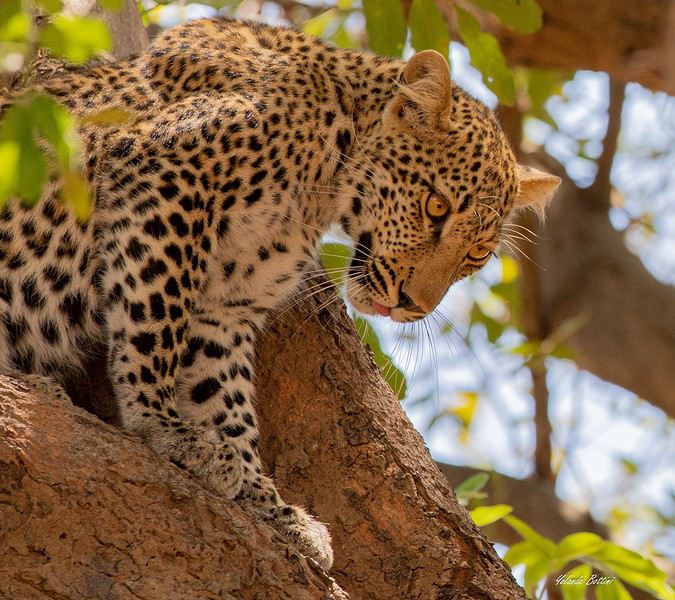
En avril dernier, à la suite de Régis puis de Claire, nous avions partagé sur ce forum notre pérégrination atypique au Kenya dans la réserve du Masaï-Mara. A l'issue de ce récit, nous avions imaginé repartir soit en randonnée sur les plus hautes terres d'Ethiopie (une dizaine de jours dans les montagnes du Simien lors d'un long séjour en 2009), soit de suivre le cours tranquille de la rivière Luangwa, dans sa partie sud (deux semaines à cheval sur octobre et novembre 2019). Dans le but d'animer les colonnes désertées de Voyage Forum en raison d'une sournoise pandémie, nous avons choisi l'Afrique Australe, précisant que ce texte, destiné à notre entourage ne correspond pas tout à fait à l'esprit "Carnets de Voyages" du site, vous nous en excuserez. Comme la précédente, cette escapade est l'une des rares que nous ayons réalisée avec une agence : y prendrait-on goût ou vieillirait-on ? Pour agrémenter ses longues pages d'écriture (une trentaine pour la partie South Luangwa N P et une dizaine pour la visite de Mosi-oa-Tunya et alentours), Yolande a sélectionné les photos les plus représentatives de cette vadrouille zambienne, dont cette magnifique panthère, rencontrée dès notre entrée dans le sanctuaire.
En route pour le rêve, seule frontière encore ouverte. Bien amicalement. Jety 34.
Impossible de joindre la photo (au secours !), ci-joint le message de VF (??????)
Croisière Divina et forfait boisson Easy MSC English translation pending
Bonjour à tous , je suis nouveau ici , j'ai déja passer pas mal de temps sur ce forum en tant que anonyme mais la j'ai decider de m'inscrire car je ne trouve pas réponse à ma question.
J'ai reserver une croisiere en mediterranee du 08 novembre au 15 novembre avec la compagnie msc croisiere sur le bateau divina.
J'ai opter pour le forfait boisson easy ( 29e) et je me pose la question si il ne serait pas plus judicieux de prendre le forfait aux dessus car j'ai entendu dire que celui a 29e était très restreint , mais ma question est: avec le forfait boisson aux dessus a 39e ou bien celui a 55e y'a t'il dautre avantages comme par exemple plus de restaurant sans avoir a payer de suppléments. par exemple? merci à vous et n'hesitez pas si vous avez des conseils car se sera ma premiere croisiere
J'ai reserver une croisiere en mediterranee du 08 novembre au 15 novembre avec la compagnie msc croisiere sur le bateau divina.
J'ai opter pour le forfait boisson easy ( 29e) et je me pose la question si il ne serait pas plus judicieux de prendre le forfait aux dessus car j'ai entendu dire que celui a 29e était très restreint , mais ma question est: avec le forfait boisson aux dessus a 39e ou bien celui a 55e y'a t'il dautre avantages comme par exemple plus de restaurant sans avoir a payer de suppléments. par exemple? merci à vous et n'hesitez pas si vous avez des conseils car se sera ma premiere croisiere
Qantas va proposer des "rotations touristiques au dessus de l'Antarctique" English translation pending
Bonjour
Plus de voyageurs en international alors Qantas décollera en novembre pour des rotations touristique au dessus de l’Antarctique pour 12h 13 h de vols premier prix 730 euros en éco pour un siège au dessus de l'aile 🙁 4875 euros pour les meilleures places en affaire . vol en B787 dreamliner . avis aux amateurs lol
source air journal
Mich74
Pour les amateurs des randonnées, admirer la piste vers la grotte Win-Timdouine aux milles merveilles English translation pending
Salut toute l'équipe voyageforum.com
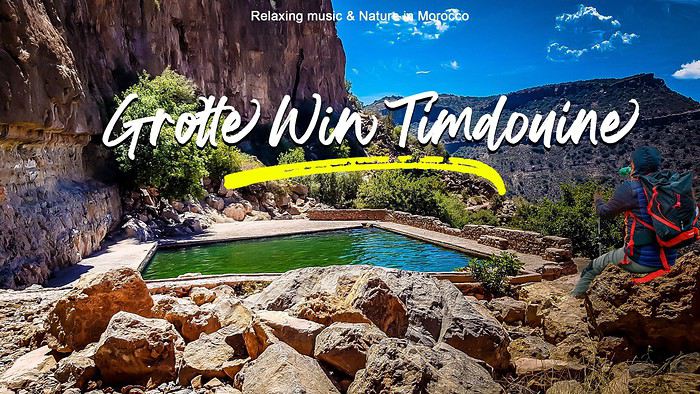
Pour les amateurs des randonnées , admirer la piste vers la grotte Win-Timdouine aux milles merveilles
 https://www.youtube.com/watch?v=aTjEYJ96N2A
https://www.youtube.com/watch?v=aTjEYJ96N2ADiscussion autour du concours de juillet 2020: Verticale(s) English translation pending
Pour discuter autour du concours de juillet 2020, Verticale(s), ça se passe ici.
La crème miracle c'est vraiment le pied? English translation pending
Bonjour,
Comme beaucoup ici mon passeport restera donc dans son tiroir cet été. Mon vélo, lui, restera dans le garage et c'est en France, et à pied, que je vais voyager. Départ de Calais dans la semaine prochaine. L'idée est de rejoindre Hendaye, en 3 mois environ. J'ai déjà traversé la France en marchant il y a une dizaine d'années ( de Saint-Malo à Menton ). Je crois que j'ai réuni tout mon matériel ( je vais bivouaquer le plus clair du temps, donc le sac sera plutôt lourd ). Je vais étrenner mes Meindl en cuir toutes neuves pour l'occasion, donc je prends des kilomètres de sparadrap pour éteindre mes ampoules 🙂. Par contre je me demandais s'il existait une crème qui détend muscles et/ou tendons en fin d'étape ? Quotidiennement je pédale beaucoup mais je n'ai pas beaucoup marché ces derniers temps et j'ai peur des jambes-piquets du petit matin, surtout au début...
L.
Comme beaucoup ici mon passeport restera donc dans son tiroir cet été. Mon vélo, lui, restera dans le garage et c'est en France, et à pied, que je vais voyager. Départ de Calais dans la semaine prochaine. L'idée est de rejoindre Hendaye, en 3 mois environ. J'ai déjà traversé la France en marchant il y a une dizaine d'années ( de Saint-Malo à Menton ). Je crois que j'ai réuni tout mon matériel ( je vais bivouaquer le plus clair du temps, donc le sac sera plutôt lourd ). Je vais étrenner mes Meindl en cuir toutes neuves pour l'occasion, donc je prends des kilomètres de sparadrap pour éteindre mes ampoules 🙂. Par contre je me demandais s'il existait une crème qui détend muscles et/ou tendons en fin d'étape ? Quotidiennement je pédale beaucoup mais je n'ai pas beaucoup marché ces derniers temps et j'ai peur des jambes-piquets du petit matin, surtout au début...
L.
La crise de l’aviation va faire exploser le prix des billets d'avion? English translation pending
La crise de l’aviation va faire
exploser le prix des billets
les pistes explorées
pour convaincre les voyageurs sont diverses.
Mais il est déjà certain qu’elles vont
renchérir le prix des billets d’avion.
Certaines compagnies à bas prix ont déjà
fait faillite, et la pression sur les voyages low
● Prendre l’avion sera plus cher, et surtout
plus compliqué. Les compagnies cherchent
la parade.
Les mois qui viennent seront très compliquéspour l’aviation civile. Car il s’agit avant tout de regagner la confiance des usagers, tout en répondant aux nouvelles normes de sécurité sanitaire. Diminution des sièges en cabine, obligation de porter le masque, contrôle des températures est particulièrement forte. Certains prédisent carrément le retour à des prix que l’on connaissait avant les années 90. Et pour cette année, il faudrait s’attendre à une augmentation moyenne de près de 50%
Les mois qui viennent seront très compliquéspour l’aviation civile. Car il s’agit avant tout de regagner la confiance des usagers, tout en répondant aux nouvelles normes de sécurité sanitaire. Diminution des sièges en cabine, obligation de porter le masque, contrôle des températures est particulièrement forte. Certains prédisent carrément le retour à des prix que l’on connaissait avant les années 90. Et pour cette année, il faudrait s’attendre à une augmentation moyenne de près de 50%
Adventures of a Bygone Era: The Philippines in 1984
After several discussions on VF about travel journals from the Philippines, I decided to write this curiosity: a trip report from a journey made in 1984, when traveling to the Philippines was still an adventure.
A curiosity because writing a travel journal about a trip 35 years later isn’t common, but also (mostly?) because exploring the Philippines at that time had little in common with traveling there today.
Obviously, I’ve forgotten a number of facts, most of the details, but with the help of a few notes from that time and a stack of slides (yes, there was life before digital 😊), many memories came back and added to the highlights I’d never forgotten. The scanned slides aren’t always great quality, but there are still quite a few to brighten up this chatter. Back then, we didn’t snap photos like we do now—film was too expensive—so I don’t have pictures of every place we visited... too bad, comparing some of those spots to how they look today would’ve been interesting.
Why "Adventures"? Why call it "Adventures" in the Philippines in 1984, a word so often used for a simple exotic trip? - Because the lack of information (no *Guide du Routard*, no *Lonely Planet*, no *Michelin Guide*, nothing, and obviously no internet) gave this trip what’s at the heart of adventure: the unknown. - Because the political situation made the stay sometimes dangerous. - Because transportation conditions were always epic, often perilous. - Because the question of where we’d spend the night came up almost every evening. - And for... quite a few other reasons.
That said, we weren’t exactly explorers!
Why the Philippines? First of all, why go to the Philippines in 1984—a country not exactly set up for tourism and about which we knew very little? How could we get an idea of the beauty of the Philippines and its points of interest when we had no guides or photos?
The idea came to us from Thailand a year earlier, during our first long-haul trip. After touring the north of the country, we met a Frenchman living in Phuket, where there were only a few tourists in Patong, with just a few small hotels and guesthouses. Kata and Karon had no buildings or roads, Rawai only had three palm-thatched bungalows, including ours, and the other islands were unknown to tourists. There was plenty to discover, and we wanted to return to this beautiful country... but the Frenchman made us dream about the Philippines—a country to explore, with wild landscapes.
Long evenings of discussion over multiple Sprite-Mekong cocktails (what memories of those headaches!) finally convinced us we had to go to the Philippines.
Episode 0: Before Departure The decision was made: we’d go to the Philippines in May 1984. Our friends and family were surprised when we announced we were going on vacation to the Philippines (a bit like saying today we were going paddleboarding in the Kerguelen Islands 🤪).
These days, preparing for each of our trips takes long evenings of research, planning, and noting down good addresses... etc. But for the Philippines in 1984, preparation was quick: we had very little information about the country, we were leaving almost at random, and the discovery would only be more exciting.
We still had a few bits of info gathered here and there: the rice terraces in northern Luzon, volcanoes, Negros where we were supposed to visit an acquaintance, Cebu and its marine life (we ended up going elsewhere), and absolutely avoid Mindanao, which was practically at war with the regime. That was about it, but it was already a great itinerary.
Nothing was organized in advance; we’d see day by day. We had no idea about travel times or even the existence of transportation options. The main (and sometimes only) way to connect two islands was by overloaded, rusty ferry. Only the big cities had airports.
Let’s Go: Episode 1: Paris to Manila My travel journals always start after arriving at the airport—the Europe-to-“Other Continent” trip isn’t interesting—but the flight to the Philippines was already an adventure, so I’ll make an exception.
This was the era when only a few Asian airlines were on par with Western ones: Thai, Singapore Airlines, and Philippine Airlines. They had beautiful, brand-new planes, and to attract customers (almost exclusively “businessmen”) from the usual airlines (Air France, Lufthansa, British Airways), there was opulence on board: unlimited champagne, all sorts of cocktails... Compared to today’s long-haul flights, there was still one small difference: no personal screens, just one screen at the front of the cabin with one mandatory movie. And I don’t know why, but we only got James Bond films, both ways... that must’ve been the trend at the time.
The tourism boom to Southeast Asia hadn’t started yet, and the “Asian Tigers” weren’t a thing, so there weren’t many business trips. That meant long-haul flights made stops everywhere to fill the planes. Our Philippine Airlines Boeing 747 left London, picked us up in Paris, then stopped in Frankfurt to take on a few Germans. I don’t know why we then made a stop in Dubai—a totally exotic place at the time. There was nothing to do there... things have changed a lot since. It was a small town lost in the desert. The airport was tiny, with just one or two buildings and a supermarket. During the stopover, everyone had to get off the plane and walk to the supermarket. Photo and electronic equipment were dirt cheap—I guess that was the only reason for the stop. Maybe it was their first commercial move. Emirates didn’t exist yet, as I checked online, but anyway, the idea that such a remote place could have its own airline was unthinkable.
Online, I found this photo of Dubai Airport in 1980. Anyone who’s transited through today’s massive airport with its rows of A380s will appreciate it: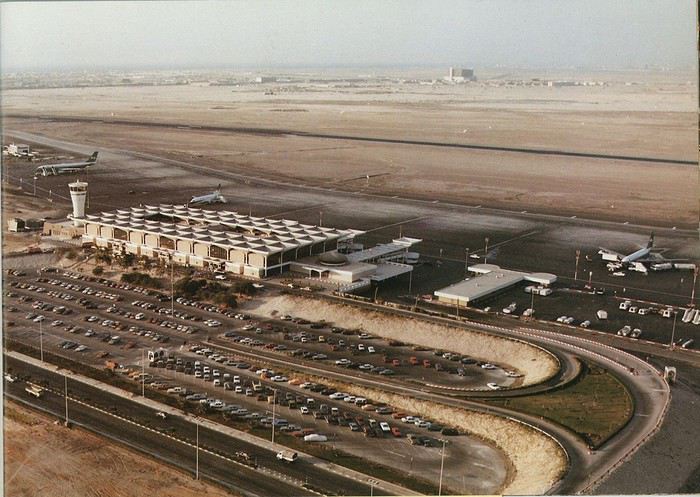
Next stop: New Delhi to drop off some Europeans and pick up a few Indians, and finally, the terminus: Manila. I don’t remember how long the trip took with its five stops—an unimaginable journey today. Despite all those stops to fill the plane, there was still enough space to stretch out on the four center seats of the 747, something that never happens these days despite all the flights in every direction.
So here we are, finally at Manila Airport around midnight.
Episode 1: Manila and Baguio To start, a quick note on the political and economic situation in the Philippines in 1984, which had consequences for us as tourists, as we’d soon realize upon arrival.
After several centuries of Spanish colonization, the Philippines became American at the start of the 20th century, then independent. In 1966, Marcos took power, and little by little, his regime sank into corruption and mismanagement, becoming a dictatorship with martial law, all for the benefit of his family and friends, who enriched themselves endlessly. The peak was the assassination of opposition leader Benigno Aquino in August 1983, which triggered harshly repressed protests. So we arrived a few months later in a very poor country, with omnipresent corruption and an extremely tense political situation, as we’d soon see for ourselves. Major protests took place in the main cities during our trip—I’ll come back to that. Two years later, Marcos fled to Hawaii after being forced out of power following rigged elections. This historical context explains a lot of the situations we found ourselves in over the following weeks.
Arriving in the middle of the night isn’t very cheerful. Manila was already a huge city with many slums, where you could find a few business hotels like the Hilton or Intercontinental—way out of our budget—and plenty of run-down hotels. Luckily, two Indians we’d chatted with on the plane offered to take us to their usual hotel. They came to Manila twice a year for business. We accepted their offer, relieved not to have to look for a place to stay in the middle of the night, figuring the address must be good since they came back every time... we were wrong 🙁
We left the airport and immediately got a taste of the local vibe when we got into the taxi: the police asked for our passports. We thought: what’s more normal than police in a dictatorship?
But that wasn’t it at all. Our two Indian friends explained that the police were noting our names along with the taxi number and time. Crime in Manila was so bad that the taxi driver would be held responsible if anything happened to us... welcome to the Philippines 😎 😎
Historically, the Philippines was a very violent country, where everything was settled with guns or machetes. Previous governments had banned carrying weapons, but Marcos later allowed the free sale and carrying of guns, and disputes were settled with pistols again (or worse, as we’d discover later). Since he’d released most of the criminals from prison to form a paramilitary militia at his service (I’ll talk about our encounter with these “heroes” later), it was pretty dangerous to go into many parts of Manila, where these “tonton macoutes” ruled.
We arrived at our hotel without incident... and then things started badly. The room was infested with big cockroaches—exactly what I hate most in those kinds of countries. No way to find another hotel at that hour. After the long flight, the urge to take a shower was so strong that we squeezed into the bathroom as best we could. After that, I don’t remember—I guess we must’ve fallen asleep exhausted under the sheets in the heat... air conditioning wasn’t widespread yet.
The next day, we just wanted to leave that dump as soon as possible. So we decided to head north right away, stopping in Baguio, and we’d visit Manila a bit on the way back.
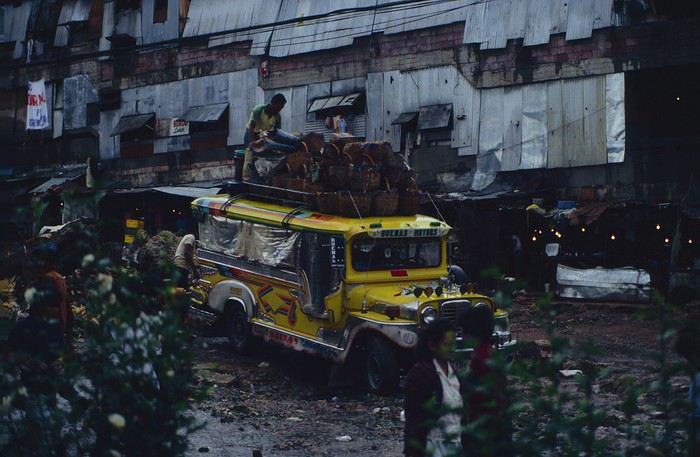
When we stepped outside, we discovered a pretty run-down neighborhood with potholed streets. But we also discovered the jeepneys. They were everywhere, flooding the streets.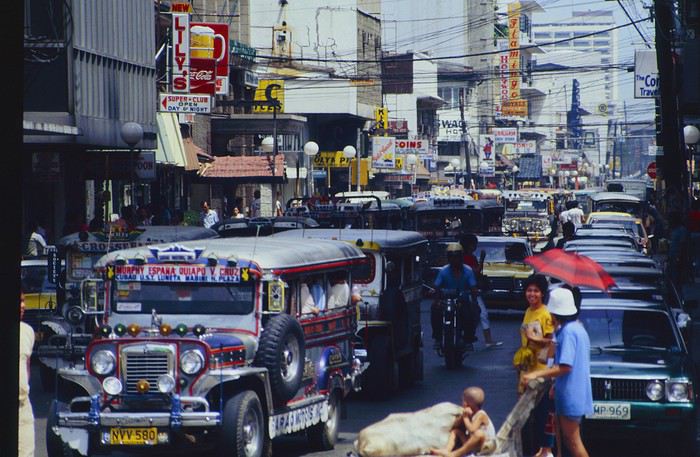
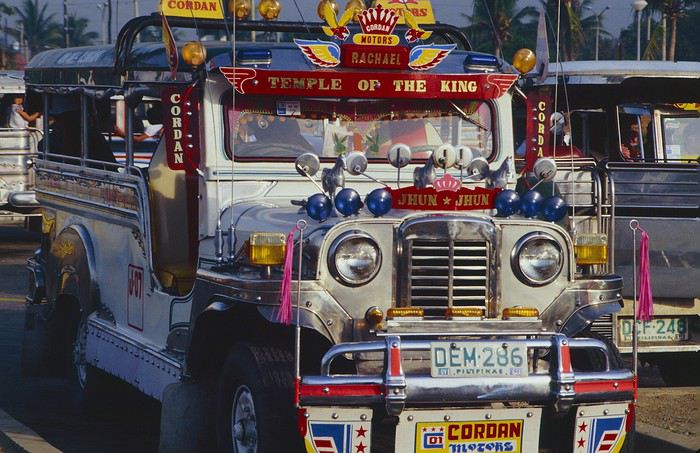
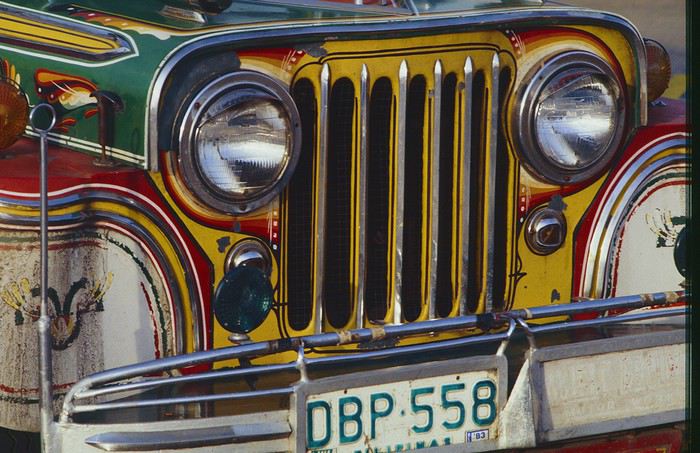
They had crazy sound systems, each one blasting louder than the last. The interiors were kitschy but fun. There weren’t many private cars—almost all transportation was by jeepney, with buses reserved for intercity trips.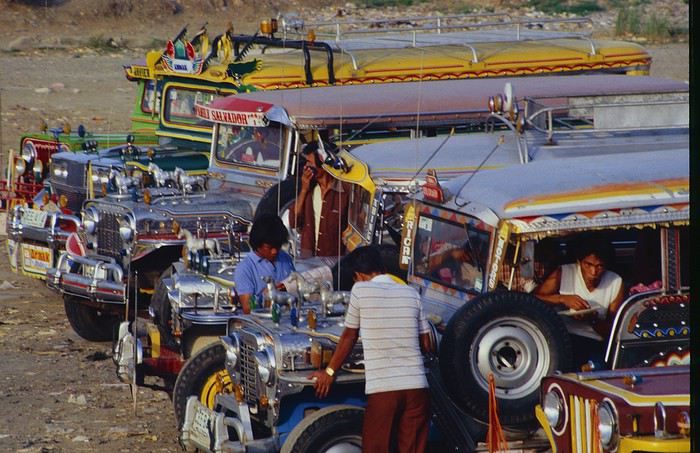
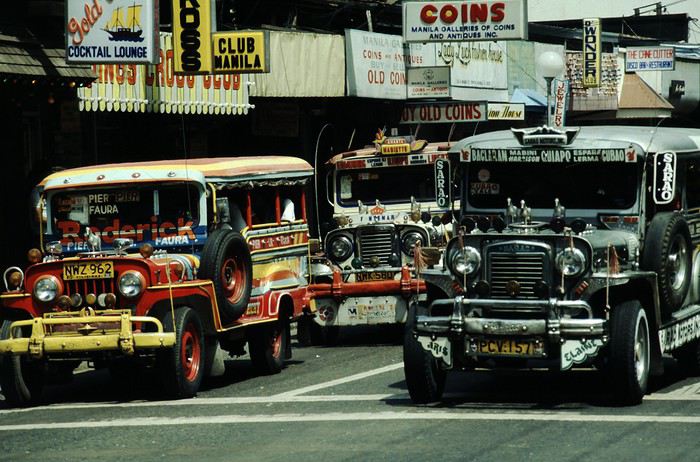
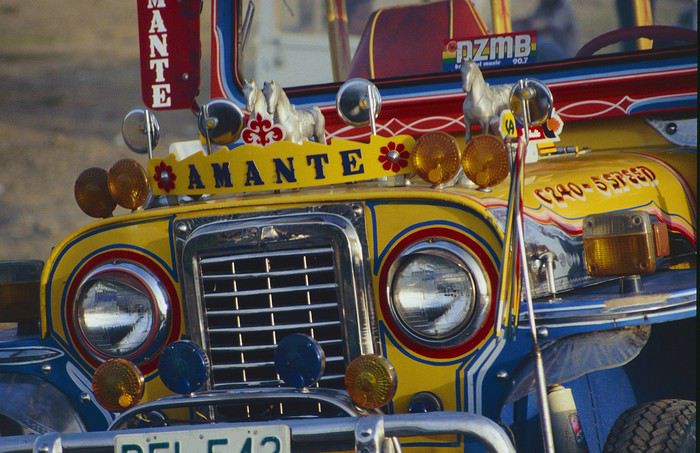
Before heading to the bus terminal for the north, somewhere on the outskirts of the city, we needed to exchange some money. I don’t remember how we ended up in a policeman’s jeep who offered his services: - Exchange money on the black market at a better rate than the banks. - Take us wherever we wanted, in this case, the bus terminal.
We accepted both offers (we’d still checked the official exchange rate from dollars to pesos). So we found ourselves in his jeep. After exchanging money, we left in his vehicle and stopped for gas. Without turning off the engine, he calmly smoked a cigarette while filling up. Since we were in a jeep with no doors or roof, we were ready to jump out if things went south, our travel bag in hand.
But we weren’t done with surprises yet. Once we left the small streets, we ended up in a neighborhood with wide avenues and not much traffic, which didn’t justify his incredible behavior. At every intersection, he made the sign of the cross, closed his eyes, and crossed without looking. I was more stunned than terrified! It wasn’t until we got out of the car later that I told Anne-Marie what had happened. I’d seen everything because the cop had put me in the front seat. Luckily, A-Marie hadn’t noticed anything from the back. Crossing Manila by trusting God rather than the rules of the road was ultimately effective. We were lucky—the trip was off to a good start. 🙂 🙂
We then passed through a neighborhood where slums stretched on for a while, and we left our policeman—friendly but a bit crazy—with relief.
A few hours by bus later, here we are in Baguio, cool in the mountains. My memories of Baguio are pretty fuzzy. I remember a small town. After some research while writing this journal, I found that the population was 120,000 in 1980. Given the population density in each home, that confirms my memory of a smallish town. Outside the “official” district with the president’s summer residence and government buildings, there were two or three paved streets with nice houses. The rest was very dirty and very poor, with lots of slums and dirt roads.
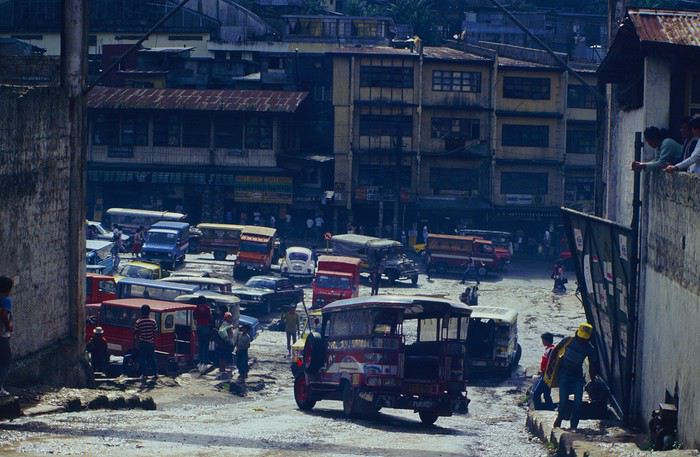
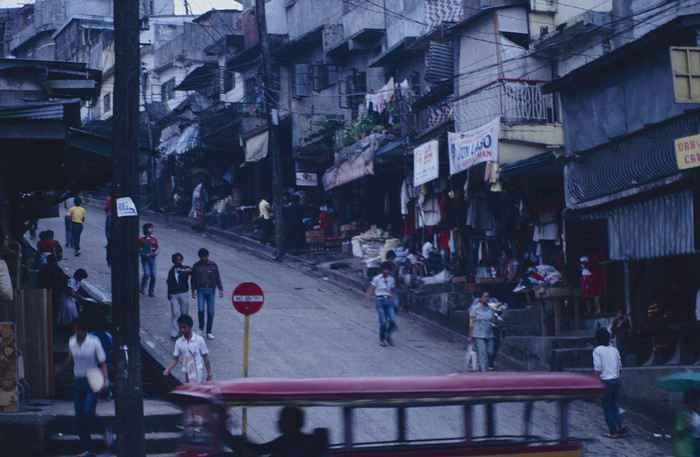
People we met on the street invited us to stay with them. These days, we wouldn’t just show up at strangers’ houses, which we should’ve done in Baguio—it would’ve saved us from an unimaginable and dangerous situation... which I won’t say anything about... !😊
The simple wooden house was on stilts at the edge of a hill with a view of the mountains. Since it was the start of the rainy season in a city that gets a lot of rain, we saw a lot of water. Our outings in town happened between downpours.
View from our lodging: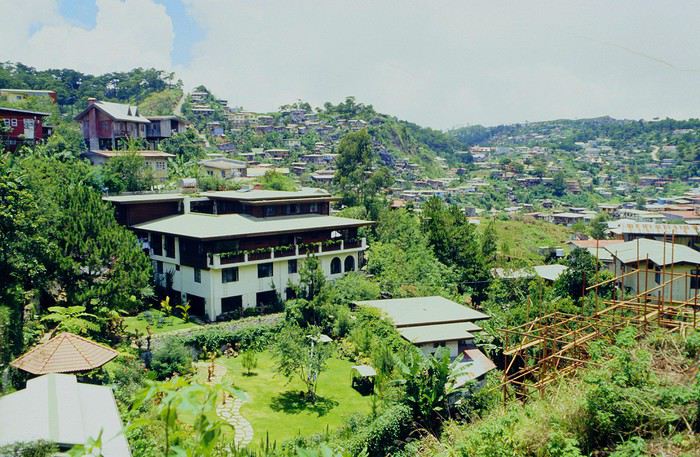
Episode 2: Baguio to Bontoc Aside from the situation briefly mentioned above, it was on the next leg to Bontoc that the adventure really began: an endless and dangerous road, a bus from another era, breathtaking landscapes, and surprising people.
We didn’t know the distance or how long it would take to get to Bontoc. When we arrived after about ten hours, we learned that Baguio to Bontoc was 140 km.
We got on a bus with wooden seats and settled in, two to a seat meant for two. As the bus filled up, passengers squeezed in three or four per seat, with chickens and baskets full of all sorts of things in the aisle. A little embarrassed, we didn’t know if we should squeeze in three on our seat. The seats were super tight (luckily, Filipinos are small), and I didn’t know where to put my legs given my height. I don’t remember if we stayed alone on our bench or if we ended up sharing with others.
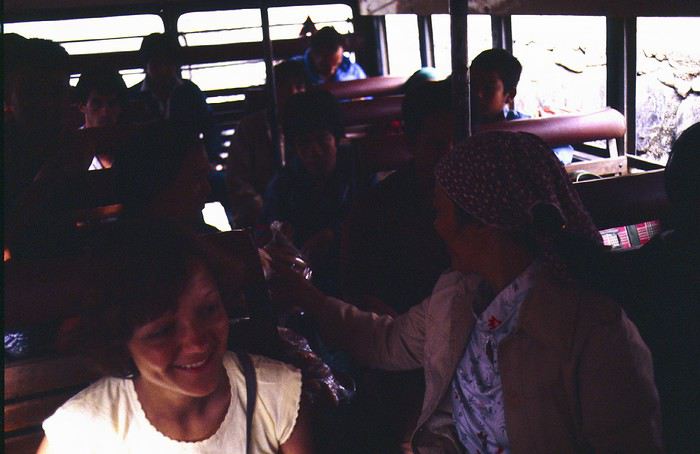
The “road” was a dirt track (or rather, a mud track) with endless turns. We held on as best we could to our slippery wooden seats—it was shaking in every direction. The woman behind us was carsick and throwing up... gross... but what were we doing there? Then we plunged into the Sierra Madre... just the name is dreamy!
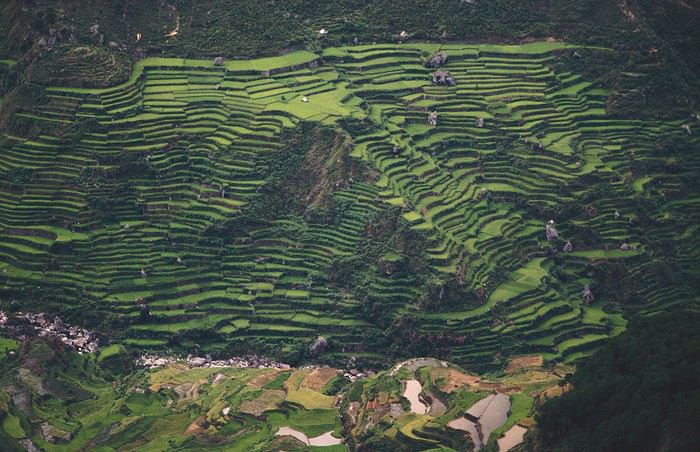
Rice terraces started to appear: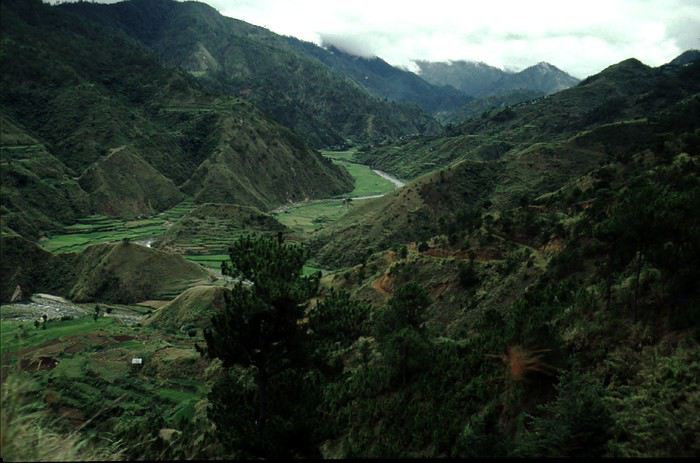
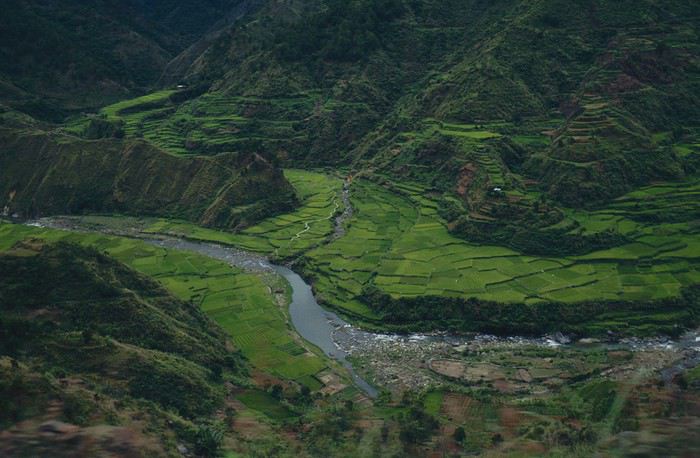
they took up more and more space along cliffs where we weren’t always reassured,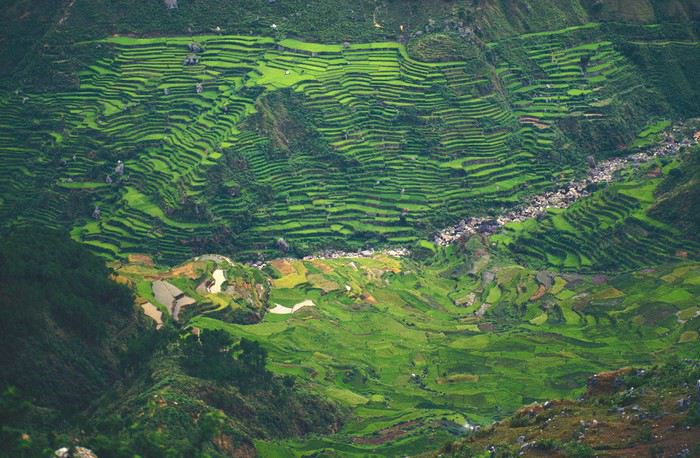
with lots of waterfalls (all that water had to go somewhere).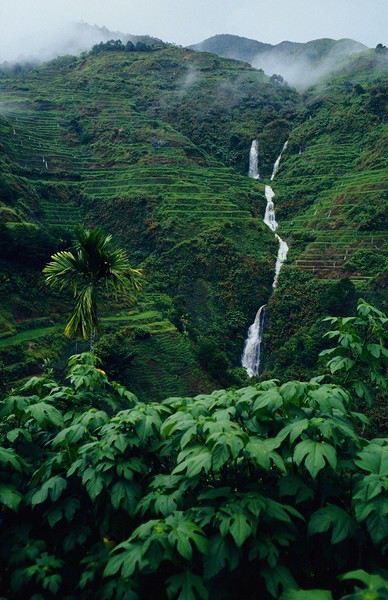
A few miserable villages stretched along the track, most often just a few houses balancing between the road and the drop. The bus stopped in every village—people got on or off and settled inside or on the roof. Street vendors offered their products to the bus passengers—a common sight in Asia, even today.
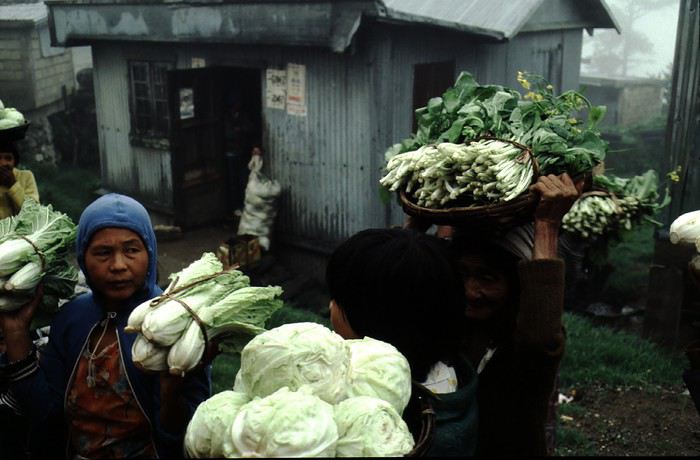
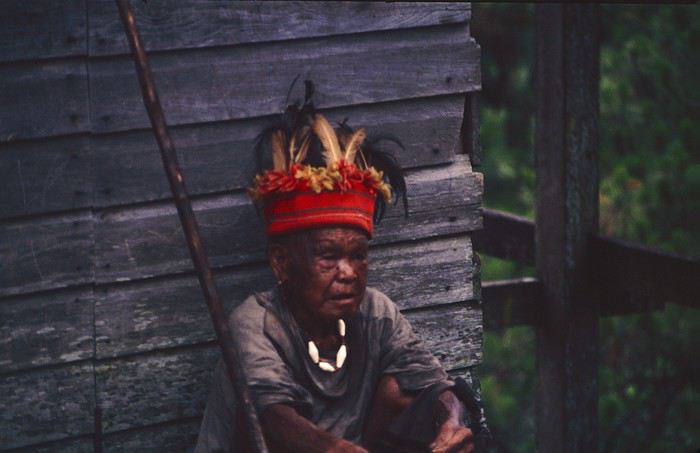
We were in another world—villagers were in loincloths, others had spears. The atmosphere was strange... but all good, we wanted exoticism, and we got it: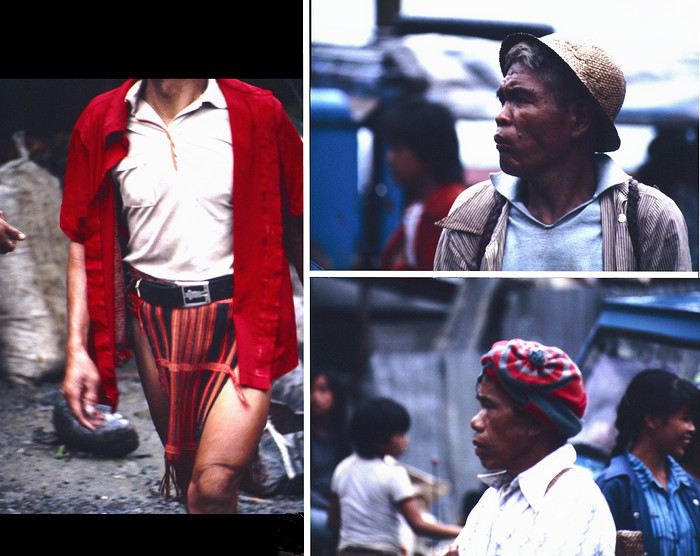
This so-called traditional outfit was everyday wear—it wasn’t for tourists since there weren’t any.
A curiosity because writing a travel journal about a trip 35 years later isn’t common, but also (mostly?) because exploring the Philippines at that time had little in common with traveling there today.
Obviously, I’ve forgotten a number of facts, most of the details, but with the help of a few notes from that time and a stack of slides (yes, there was life before digital 😊), many memories came back and added to the highlights I’d never forgotten. The scanned slides aren’t always great quality, but there are still quite a few to brighten up this chatter. Back then, we didn’t snap photos like we do now—film was too expensive—so I don’t have pictures of every place we visited... too bad, comparing some of those spots to how they look today would’ve been interesting.
Why "Adventures"? Why call it "Adventures" in the Philippines in 1984, a word so often used for a simple exotic trip? - Because the lack of information (no *Guide du Routard*, no *Lonely Planet*, no *Michelin Guide*, nothing, and obviously no internet) gave this trip what’s at the heart of adventure: the unknown. - Because the political situation made the stay sometimes dangerous. - Because transportation conditions were always epic, often perilous. - Because the question of where we’d spend the night came up almost every evening. - And for... quite a few other reasons.
That said, we weren’t exactly explorers!
Why the Philippines? First of all, why go to the Philippines in 1984—a country not exactly set up for tourism and about which we knew very little? How could we get an idea of the beauty of the Philippines and its points of interest when we had no guides or photos?
The idea came to us from Thailand a year earlier, during our first long-haul trip. After touring the north of the country, we met a Frenchman living in Phuket, where there were only a few tourists in Patong, with just a few small hotels and guesthouses. Kata and Karon had no buildings or roads, Rawai only had three palm-thatched bungalows, including ours, and the other islands were unknown to tourists. There was plenty to discover, and we wanted to return to this beautiful country... but the Frenchman made us dream about the Philippines—a country to explore, with wild landscapes.
Long evenings of discussion over multiple Sprite-Mekong cocktails (what memories of those headaches!) finally convinced us we had to go to the Philippines.
Episode 0: Before Departure The decision was made: we’d go to the Philippines in May 1984. Our friends and family were surprised when we announced we were going on vacation to the Philippines (a bit like saying today we were going paddleboarding in the Kerguelen Islands 🤪).
These days, preparing for each of our trips takes long evenings of research, planning, and noting down good addresses... etc. But for the Philippines in 1984, preparation was quick: we had very little information about the country, we were leaving almost at random, and the discovery would only be more exciting.
We still had a few bits of info gathered here and there: the rice terraces in northern Luzon, volcanoes, Negros where we were supposed to visit an acquaintance, Cebu and its marine life (we ended up going elsewhere), and absolutely avoid Mindanao, which was practically at war with the regime. That was about it, but it was already a great itinerary.
Nothing was organized in advance; we’d see day by day. We had no idea about travel times or even the existence of transportation options. The main (and sometimes only) way to connect two islands was by overloaded, rusty ferry. Only the big cities had airports.
Let’s Go: Episode 1: Paris to Manila My travel journals always start after arriving at the airport—the Europe-to-“Other Continent” trip isn’t interesting—but the flight to the Philippines was already an adventure, so I’ll make an exception.
This was the era when only a few Asian airlines were on par with Western ones: Thai, Singapore Airlines, and Philippine Airlines. They had beautiful, brand-new planes, and to attract customers (almost exclusively “businessmen”) from the usual airlines (Air France, Lufthansa, British Airways), there was opulence on board: unlimited champagne, all sorts of cocktails... Compared to today’s long-haul flights, there was still one small difference: no personal screens, just one screen at the front of the cabin with one mandatory movie. And I don’t know why, but we only got James Bond films, both ways... that must’ve been the trend at the time.
The tourism boom to Southeast Asia hadn’t started yet, and the “Asian Tigers” weren’t a thing, so there weren’t many business trips. That meant long-haul flights made stops everywhere to fill the planes. Our Philippine Airlines Boeing 747 left London, picked us up in Paris, then stopped in Frankfurt to take on a few Germans. I don’t know why we then made a stop in Dubai—a totally exotic place at the time. There was nothing to do there... things have changed a lot since. It was a small town lost in the desert. The airport was tiny, with just one or two buildings and a supermarket. During the stopover, everyone had to get off the plane and walk to the supermarket. Photo and electronic equipment were dirt cheap—I guess that was the only reason for the stop. Maybe it was their first commercial move. Emirates didn’t exist yet, as I checked online, but anyway, the idea that such a remote place could have its own airline was unthinkable.
Online, I found this photo of Dubai Airport in 1980. Anyone who’s transited through today’s massive airport with its rows of A380s will appreciate it:
Next stop: New Delhi to drop off some Europeans and pick up a few Indians, and finally, the terminus: Manila. I don’t remember how long the trip took with its five stops—an unimaginable journey today. Despite all those stops to fill the plane, there was still enough space to stretch out on the four center seats of the 747, something that never happens these days despite all the flights in every direction.
So here we are, finally at Manila Airport around midnight.
Episode 1: Manila and Baguio To start, a quick note on the political and economic situation in the Philippines in 1984, which had consequences for us as tourists, as we’d soon realize upon arrival.
After several centuries of Spanish colonization, the Philippines became American at the start of the 20th century, then independent. In 1966, Marcos took power, and little by little, his regime sank into corruption and mismanagement, becoming a dictatorship with martial law, all for the benefit of his family and friends, who enriched themselves endlessly. The peak was the assassination of opposition leader Benigno Aquino in August 1983, which triggered harshly repressed protests. So we arrived a few months later in a very poor country, with omnipresent corruption and an extremely tense political situation, as we’d soon see for ourselves. Major protests took place in the main cities during our trip—I’ll come back to that. Two years later, Marcos fled to Hawaii after being forced out of power following rigged elections. This historical context explains a lot of the situations we found ourselves in over the following weeks.
Arriving in the middle of the night isn’t very cheerful. Manila was already a huge city with many slums, where you could find a few business hotels like the Hilton or Intercontinental—way out of our budget—and plenty of run-down hotels. Luckily, two Indians we’d chatted with on the plane offered to take us to their usual hotel. They came to Manila twice a year for business. We accepted their offer, relieved not to have to look for a place to stay in the middle of the night, figuring the address must be good since they came back every time... we were wrong 🙁
We left the airport and immediately got a taste of the local vibe when we got into the taxi: the police asked for our passports. We thought: what’s more normal than police in a dictatorship?
But that wasn’t it at all. Our two Indian friends explained that the police were noting our names along with the taxi number and time. Crime in Manila was so bad that the taxi driver would be held responsible if anything happened to us... welcome to the Philippines 😎 😎
Historically, the Philippines was a very violent country, where everything was settled with guns or machetes. Previous governments had banned carrying weapons, but Marcos later allowed the free sale and carrying of guns, and disputes were settled with pistols again (or worse, as we’d discover later). Since he’d released most of the criminals from prison to form a paramilitary militia at his service (I’ll talk about our encounter with these “heroes” later), it was pretty dangerous to go into many parts of Manila, where these “tonton macoutes” ruled.
We arrived at our hotel without incident... and then things started badly. The room was infested with big cockroaches—exactly what I hate most in those kinds of countries. No way to find another hotel at that hour. After the long flight, the urge to take a shower was so strong that we squeezed into the bathroom as best we could. After that, I don’t remember—I guess we must’ve fallen asleep exhausted under the sheets in the heat... air conditioning wasn’t widespread yet.
The next day, we just wanted to leave that dump as soon as possible. So we decided to head north right away, stopping in Baguio, and we’d visit Manila a bit on the way back.
When we stepped outside, we discovered a pretty run-down neighborhood with potholed streets. But we also discovered the jeepneys. They were everywhere, flooding the streets.
They had crazy sound systems, each one blasting louder than the last. The interiors were kitschy but fun. There weren’t many private cars—almost all transportation was by jeepney, with buses reserved for intercity trips.
Before heading to the bus terminal for the north, somewhere on the outskirts of the city, we needed to exchange some money. I don’t remember how we ended up in a policeman’s jeep who offered his services: - Exchange money on the black market at a better rate than the banks. - Take us wherever we wanted, in this case, the bus terminal.
We accepted both offers (we’d still checked the official exchange rate from dollars to pesos). So we found ourselves in his jeep. After exchanging money, we left in his vehicle and stopped for gas. Without turning off the engine, he calmly smoked a cigarette while filling up. Since we were in a jeep with no doors or roof, we were ready to jump out if things went south, our travel bag in hand.
But we weren’t done with surprises yet. Once we left the small streets, we ended up in a neighborhood with wide avenues and not much traffic, which didn’t justify his incredible behavior. At every intersection, he made the sign of the cross, closed his eyes, and crossed without looking. I was more stunned than terrified! It wasn’t until we got out of the car later that I told Anne-Marie what had happened. I’d seen everything because the cop had put me in the front seat. Luckily, A-Marie hadn’t noticed anything from the back. Crossing Manila by trusting God rather than the rules of the road was ultimately effective. We were lucky—the trip was off to a good start. 🙂 🙂
We then passed through a neighborhood where slums stretched on for a while, and we left our policeman—friendly but a bit crazy—with relief.
A few hours by bus later, here we are in Baguio, cool in the mountains. My memories of Baguio are pretty fuzzy. I remember a small town. After some research while writing this journal, I found that the population was 120,000 in 1980. Given the population density in each home, that confirms my memory of a smallish town. Outside the “official” district with the president’s summer residence and government buildings, there were two or three paved streets with nice houses. The rest was very dirty and very poor, with lots of slums and dirt roads.
People we met on the street invited us to stay with them. These days, we wouldn’t just show up at strangers’ houses, which we should’ve done in Baguio—it would’ve saved us from an unimaginable and dangerous situation... which I won’t say anything about... !😊
The simple wooden house was on stilts at the edge of a hill with a view of the mountains. Since it was the start of the rainy season in a city that gets a lot of rain, we saw a lot of water. Our outings in town happened between downpours.
View from our lodging:
Episode 2: Baguio to Bontoc Aside from the situation briefly mentioned above, it was on the next leg to Bontoc that the adventure really began: an endless and dangerous road, a bus from another era, breathtaking landscapes, and surprising people.
We didn’t know the distance or how long it would take to get to Bontoc. When we arrived after about ten hours, we learned that Baguio to Bontoc was 140 km.
We got on a bus with wooden seats and settled in, two to a seat meant for two. As the bus filled up, passengers squeezed in three or four per seat, with chickens and baskets full of all sorts of things in the aisle. A little embarrassed, we didn’t know if we should squeeze in three on our seat. The seats were super tight (luckily, Filipinos are small), and I didn’t know where to put my legs given my height. I don’t remember if we stayed alone on our bench or if we ended up sharing with others.
The “road” was a dirt track (or rather, a mud track) with endless turns. We held on as best we could to our slippery wooden seats—it was shaking in every direction. The woman behind us was carsick and throwing up... gross... but what were we doing there? Then we plunged into the Sierra Madre... just the name is dreamy!
Rice terraces started to appear:
they took up more and more space along cliffs where we weren’t always reassured,
with lots of waterfalls (all that water had to go somewhere).
A few miserable villages stretched along the track, most often just a few houses balancing between the road and the drop. The bus stopped in every village—people got on or off and settled inside or on the roof. Street vendors offered their products to the bus passengers—a common sight in Asia, even today.
We were in another world—villagers were in loincloths, others had spears. The atmosphere was strange... but all good, we wanted exoticism, and we got it:
This so-called traditional outfit was everyday wear—it wasn’t for tourists since there weren’t any.
Visas pour l'Inde suspendus pour les ressortissants de France, Espagne et Allemagne English translation pending
Tout est dans le titre...Je suis 🏴☠️ !
la mauvaise nouvelle ici
Problèmes récents à la frontière gréco-turque English translation pending
Bonjour,
Nous sommes actuellement à l'est de la Grèce en route pour l'Iran et les "stan" en CC. Considérant les problèmes récents à la frontière greco-turque, nous hésitons à nous engager vers la frontière sud par laquelle nous souhaitions passer.
Malgré nos recherches sur internet, nous ne trouvons pas d'informations et ne savons pas s'il est possible de passer sans trop de risques.
Est ce que certains d'entre vous sont dans ce cas où ont plus d'informations à ce sujet ?
Merci 😊
Transport pour aller de la Guadeloupe à la Dominique English translation pending
Bonjour
Nous partons à la Guadeloupe prochainement et nous avons entendu parler de l'île de Dominique qui serait très jolie également. J'aurais plusieurs questions donc à vous poser. Comment se rendre de la Guadeloupe à la Dominique ? Cette île est elle vraiment belle ? Et où se loger sur place ? Faut il louer une voiture ? Merci beaucoup pour votre aide
Les tours du monde peuvent aussi être gastronomiques avec la découverte de produits English translation pending
Mulhouse Parc des Expositions :
Les tours du monde peuvent aussi être gastronomiques
Les Bahamas et
avec la découverte de produits régionaux venus de toute la planète.
Tout au long des trois jours de FestiVitas, une quinzaine de conférences dédiées à l'Afrique sont inscrites au programme.
Au-delà de ce continent, ce sont des offices du tourisme du monde entier (et particulièrement d'Asie et d'Amérique du Sud) qui seront à Mulhouse, pour permettre d'effectuer un tour du monde en quelques heures.
On notera la présence, pour la première fois, des offices du tourisme des Bahamas et des Seychelles et d'un coup de projecteur sur les destinations (Valence, Zadar...) desservies depuis quelques mois par les vols en partance de l'EuroAirport de Bâle Mulhouse.
Le tourisme de proximité n'est pas oublié avec 70 exposants présentant des idées de sorties régionales.
La pêche à l'honneur
Le salon se présente aussi par une déclinaison d'activités. Une quinzaine d'exposants permettront de découvrir des sports d'extérieur comme le canoë-kayak, le parachutisme, la voile etc. On annonce aussi un mur d'escalade et un practice de golf.
La grosse nouveauté, toutefois, sera la réalisation d'un espace de 1 000 m 2 entièrement consacré à la pêche de loisirs avec une trentaine d'exposants, des simulateurs de pêche, des bassins avec des poissons et diverses expositions et animations.
Bière et vins en vedette
Côté gastronomie, c'est la bière qui sera à l'honneur cette année. La brasserie de Lutterbach créera une bière spéciale (on l'annonce ambrée et au goût d'agrumes) pour le salon. L'offre de vins a été renforcée avec une cinquantaine d'exposants et des nouveautés venues du Roussillon, du Bordelais et du Languedoc. Plusieurs sommeliers seront présents, dont Frédéric Voné qui proposera des ateliers du goût. Des apéritifs commentés autour du champagne (sur réservation) sont aussi au programme.
Restaurants gastronomiques
Les deux pôles de FestiVitas se retrouvent aussi lorsque la gastronomie permet de voyager. La présentation de spécialités culinaires éthiopiennes et sénégalaises est attendue, ainsi que des produits typiques d'Italie, de Grèce ou de Belgique.
Deux restaurants gastronomiques proposeront leurs menus tout au long de FestiVitas qui, pour cette nouvelle édition, voit une nouveauté avec l'ouverture d'un bar à vins et tapas.
Ph.P. Parc des expositions, 120, rue Lefebvre, Mulhouse. Salon FestiVitas : vendredi 31 janvier et samedi 1 er février, de 10 h à 20 h (fermeture voyages à 20 h, fermeture secteur vins et saveurs à 21 h).Dimanche 2 février, accès de 10 h à 17 h 30 (fermeture de tous les secteurs à 18 h 30).Tarif : 6 € (comprenant un verre de dégustation), gratuit pour les moins de 15 ans.
Les tours du monde peuvent aussi être gastronomiques
Les Bahamas et
avec la découverte de produits régionaux venus de toute la planète.
Tout au long des trois jours de FestiVitas, une quinzaine de conférences dédiées à l'Afrique sont inscrites au programme.
Au-delà de ce continent, ce sont des offices du tourisme du monde entier (et particulièrement d'Asie et d'Amérique du Sud) qui seront à Mulhouse, pour permettre d'effectuer un tour du monde en quelques heures.
On notera la présence, pour la première fois, des offices du tourisme des Bahamas et des Seychelles et d'un coup de projecteur sur les destinations (Valence, Zadar...) desservies depuis quelques mois par les vols en partance de l'EuroAirport de Bâle Mulhouse.
Le tourisme de proximité n'est pas oublié avec 70 exposants présentant des idées de sorties régionales.
La pêche à l'honneur
Le salon se présente aussi par une déclinaison d'activités. Une quinzaine d'exposants permettront de découvrir des sports d'extérieur comme le canoë-kayak, le parachutisme, la voile etc. On annonce aussi un mur d'escalade et un practice de golf.
La grosse nouveauté, toutefois, sera la réalisation d'un espace de 1 000 m 2 entièrement consacré à la pêche de loisirs avec une trentaine d'exposants, des simulateurs de pêche, des bassins avec des poissons et diverses expositions et animations.
Bière et vins en vedette
Côté gastronomie, c'est la bière qui sera à l'honneur cette année. La brasserie de Lutterbach créera une bière spéciale (on l'annonce ambrée et au goût d'agrumes) pour le salon. L'offre de vins a été renforcée avec une cinquantaine d'exposants et des nouveautés venues du Roussillon, du Bordelais et du Languedoc. Plusieurs sommeliers seront présents, dont Frédéric Voné qui proposera des ateliers du goût. Des apéritifs commentés autour du champagne (sur réservation) sont aussi au programme.
Restaurants gastronomiques
Les deux pôles de FestiVitas se retrouvent aussi lorsque la gastronomie permet de voyager. La présentation de spécialités culinaires éthiopiennes et sénégalaises est attendue, ainsi que des produits typiques d'Italie, de Grèce ou de Belgique.
Deux restaurants gastronomiques proposeront leurs menus tout au long de FestiVitas qui, pour cette nouvelle édition, voit une nouveauté avec l'ouverture d'un bar à vins et tapas.
Ph.P. Parc des expositions, 120, rue Lefebvre, Mulhouse. Salon FestiVitas : vendredi 31 janvier et samedi 1 er février, de 10 h à 20 h (fermeture voyages à 20 h, fermeture secteur vins et saveurs à 21 h).Dimanche 2 février, accès de 10 h à 17 h 30 (fermeture de tous les secteurs à 18 h 30).Tarif : 6 € (comprenant un verre de dégustation), gratuit pour les moins de 15 ans.
Retour sur première croisière Costa Smeralda au départ de Savone le 21 décembre 2019 English translation pending
Bonjour à tous et bonne année.
Voici quelque infos sur la 1ere croisière du Smeralda départ de Savone le 21 déc 2019 (nous avons eu la chance de ne pas partir de Marseille ..)
Les points positifs : le navire est magnifique design italien très réussi , sobre, moderne et chic tant à l'intérieur qu'à l'extérieur. de nombreux bars tous différents "tranquilles" , ambiances musicales variées . Sur les ponts de nombreux endroits sympa, sièges confortables (mais non mis en place une bonne partie de la croisière , heureusement que nous avons fait le tour le premier jour lors de l'embarquement ! ) .Tables et chaise extérieures de différents style avec lumière intégrée , changements de niveaux ...
Fausses jardinières sur les ponts très jolies mais attention si vous avez une cabine terrasse pont 8 vous êtes en "direct sur le pont et donc au passage..
Le restau des suites , rien à dire sur la qualité des repas c'était bon.
Points négatifs : les spectacles du soir au théâtre et au Colosseo sont programmés à 20h15 ou 20h30 donc qq soit votre heure de diner vous manquez soit le début soit la fin. Après s'en être plaints la réponse fût: vous pouvez les revoir à la télé et ils repasseront dans la semaine mais au même créneau horaire ! De plus que ce soit au Colesseo ou au théâtre très peu de place permettent une bonne visibilité ( pour Costa ce n'est pas grave si l'on voit mal puisqu'il y a des écrans partout ! Moins de groupes de musiciens mais avec le nouveau concept nous avons droit aux groupes "virtuels " au Colesseo même pour danser .
Comme d'autres personnes nous avons regretté le manque de nappes aux restaurants y compris au Panorama ( réservé aux suites ).Choquant également que verres et couverts non utilisés par les convives précédents restent sur la table et que l'on se contente de rajouter ce qu'il manque (comment la table est elle nettoyée ? ).
attention avec un forfait connaisseur (intenditore ) il vaut mieux l'être car à 3 reprises nous avons commandé du champagne (Noël oblige ) et on nous a servi Spumanti , Prosecco ou autre , on ne voit pas les bouteilles les verres arrivant pleins. le changement s'est fait sans pb.
Un point positif le restaurant Panorama est en horaires libres de 19h à 21h .
Dans les suites il y a toujours le mini bar qui ne contient que cannettes de bière et sodas. Pas de corbeille de snacks .
Les suites arrières sont de véritables petits T2 avec immense balcon double (coté "chambre"et coté "salon" ) mais pas de chaise longue.
Coté pratique: la SDB elle aussi très design ( douche immense à jets multiples ) , doubles vasques WC indépendant mais à l'utilisation pas de rangement ( les étagères sous les lavabos étant occupées par les piles de serviettes) la nuit de la tempête nous avons couru derrière tout ! Pas de tiroirs pour les vêtements. Une grande penderie qui ferme à l'entrée et 2 penderies "ouvertes" coté chambre.
En cours de croisières on peut voir les dépenses sur les bornes mais pas le total et on ne peut rien imprimer il faut l'appli Costa mais elle ne marchait pas .
Pour les 10% premium on ne peut plus le faire sur les bornes, il faut soit le faire avant le départ soit faire la queue au Costa Club.
Il n'y a pas de réunion d'info pour le débarquement il faut regarder sur la télé mais pas de chance cela ne marchait pas .Pas de pb pour nous , c'est toujours pareil , mais pour ceux qui faisait une croisière la première fois beaucoup de stress.
En conclusion circuit sympa mais pour le bateau pour nous vraiment trop grand et design superbe pour les photos mais pas très fonctionnel et dommage pour les spectacles nous préférons le contact avec les artistes plutôt que le virtuel .
Si certains ont d'autres questions n'hésitez pas.