Results for "Boulder+|+3+>+99"
1889 results found.
Déplacements sur les routes népalaises English translation pending
Salut, Je prepare un voyage au Nepal l'année prochaine. C'est ma première fois au Nepal et je voudrais faire un tour du pays par la route et peut être faire un trekking court, de 4-5 jours. Je partirai pour les longues trekkings une prochaine fois...
Ce que je voudrais savoir c'est quel est le meilleur moyen pour se déplacer: bus, avion, taxi... par example pour le traject Ktm - Pokhara - Nepalganj...
Puis, j'ai vu beaucoup de discussions à propos de la securité dans ce moment compliqué et je suis un peu hesitant car je voudrais y aller sans être encadré par une agence de voyages mais ce que j'ai lu semble le deconseiller... Nous sommes un groupe de huit amis et sur la route je ne pense pas que une agece soit necessaire, à moins question securité à cause de probables rencontres avec les maoistes...
Est ce que quelqu'un a une experience recente sur la route ? vous pensez que c'est prudent ? Car pour les trekkings c'est logique d'avoir un guide mais pour une voyage par route ça ne me semble pas pratique...
Finalment, quels sont les zones de conflit à eviter ?
Merci beaucoup pour votre aide, je n'ai pas beaucoup d'experience dans cette region...
Miguel (genève)
Ce que je voudrais savoir c'est quel est le meilleur moyen pour se déplacer: bus, avion, taxi... par example pour le traject Ktm - Pokhara - Nepalganj...
Puis, j'ai vu beaucoup de discussions à propos de la securité dans ce moment compliqué et je suis un peu hesitant car je voudrais y aller sans être encadré par une agence de voyages mais ce que j'ai lu semble le deconseiller... Nous sommes un groupe de huit amis et sur la route je ne pense pas que une agece soit necessaire, à moins question securité à cause de probables rencontres avec les maoistes...
Est ce que quelqu'un a une experience recente sur la route ? vous pensez que c'est prudent ? Car pour les trekkings c'est logique d'avoir un guide mais pour une voyage par route ça ne me semble pas pratique...
Finalment, quels sont les zones de conflit à eviter ?
Merci beaucoup pour votre aide, je n'ai pas beaucoup d'experience dans cette region...
Miguel (genève)
Venise revisitée... English translation pending
Venise revisitée … la semaine dernière. Trois jours de rêve éveillé dans la plus belle ville du monde. Ce n’était pas la première fois, mais l’émotion était intacte !
Que de beauté, que de trésors rassemblés dans cette lagune du fond de l’Adriatique, sur ces quelques îles plates que rien ne semblait destiner à devenir un lieu-phare de l’humanité. Partout, sur les quais, les places et le long des canaux, tout témoigne de l’histoire extraordinaire de « La Sérénissime », dont les marchands ont eu le génie d’ouvrir les routes maritimes de l’Orient et de mettre en contact les deux mondes connus de leur temps.
Plusieurs grands chantiers de restauration sont à présent terminés. Nous sommes tombés en arrêt devant l’extraordinaire cathédrale Saint Marc qui symbolise à elle seule la Venise ouverte sur l’Orient, étonnant mélange architectural qui réunit dans un même décor les Indes, la Turquie et la Chrétienté. Restaurée avec un soin méticuleux, elle resplendit de couleurs et de fastes. Les plus belles mosaïques byzantines sont là, bien plus belles encore et mieux mises en valeur que celles de Sainte Sophie d’Istanbul !
Bien installés sur le pont extérieur à l’avant d’un vaporetto, nous avons parcouru le Grand Canal le long duquel des dizaines de palais ont retrouvé leur splendeur d’antan. A l’abri des façades ouvragées de dentelles de marbre, on découvre les salons d’apparat où les marchands négociaient les pierres fines, les tissus précieux et les épices rapportés d’expéditions lointaines pour être proposés aux acheteurs venus de toute l’Europe.
Au Palais des Doges dont la restauration est également terminée, toutes les salles sont désormais ouvertes à la visite. On reste stupéfait devant les escaliers en marqueterie de marbres rares, les salles gigantesques croulant sous les ors et entièrement tapissées d'œuvres majeures du Tintoret, de Titien et de Véron��se. Devant les énormes mappemondes de cuir, on se dit que c'est là que se décidaient les stratégies commerciales qui faisaient la puissance de la République de Venise dans le monde de l’époque. Là aussi qu’étaient reçus les princes et souverains étrangers, d’Orient comme d’Occident … Tel le roi de France, Henri III, qui eut le choc de sa vie en découvrant ce palais au bord de l’eau, dépourvu de toute installation défensive et dont le faste inouï devait lui faire paraître bien terne son château du Louvre ! Et quelle ne fut pas sa surprise quand il apprit que le Doge de la République de Venise tenait son pouvoir des marchands. Des marchands qui pouvaient le révoquer et même le condamner à mort en cas de manquement à sa mission : derrière l’apparence d’un souverain, il y avait un chef d’entreprise qui devait rendre des comptes à un conseil d’administration !
En « traghetto » (gondole collective), nous avons traversé le Grand Canal entre San Marco et la Dogana di Mare, pour le plaisir de la balade nautique mais aussi pour aller admirer, dans l’église Santa Maria della Salute, les subtils jeux de lumière, de couleurs et de mouvements que le Tintoret a su si bien maîtriser dans « Les noces de Cana ».
Place Saint Marc, assurément une des plus belles places du monde, les pigeons sont toujours au rendez-vous, se précipitant par grappes sur les épaules des touristes qui viennent d’acheter leur sachet de graines. A la terrasse du mythique café Florian, les musiciens en queue de pie de l’orchestre jouent toujours Liszt, Strauss et Offenbach. En fin d’après-midi, il ne faut pas bouder son plaisir de s’y faire servir un somptueux cappuccino sur un petit plateau d’argent, ou un verre de vin blanc de Vénétie accompagné de son ramequin d’olives … et de le siroter dans cette atmosphère magique comme l’ont fait à cette même terrasse (excusez du peu !), Montesquieu, Balzac, Stendhal, Maupassant, Musset, D’Annunzio, Goethe, Byron, Proust, et tant d’autres … en fait, la plupart des grands écrivains, artistes et compositeurs des trois siècles passés !
Trois jours de rêve, donc, mais aussi trois jours rassurants quand on voit Venise être l’objet de tant de soins pour préserver son patrimoine inestimable et le léguer aux générations futures. Même le théâtre de La Fenice (« le Phénix), détruit par un incendie en 1996, renaît de ses cendres après huit ans de travaux méticuleux qui ont rendu au plus célèbre opéra du monde son aspect originel.
Le jour de notre départ, nous sommes allés faire un tour sur l'île de Burano, à une heure de bateau de Venise, dans le Nord de la lagune. Burano (ne pas confondre avec Murano, très touristique et célèbre pour les verres) est une petite île de pêcheurs et de dentellières, un vrai décor de contes et légendes, aux maisons très colorées. Sur le trajet du « motoscafo » entre le Lido et Burano, on aperçoit les travaux pharaoniques entrepris sous l’égide de l’Unesco pour protéger la lagune par un système de digues mobiles, afin de limiter les effets des hautes eaux qui menacent de plus en plus souvent Venise.
En conclusion, on va dire : « C’était bien … Il faudra qu'on y revienne encore … »
Quelques indications pratiques …
Voici quelques éléments qui nous ont permis de profiter pleinement de Venise, à notre manière. C’est tout à fait subjectif, mais cela pourra peut-être rendre service à certains …
Avant toute chose, Venise, ce n’est que hors saison, et hors week-ends qu’on peut l’apprécier. Rançon de la gloire, Venise « La Sérénissime » ne l’est plus du tout et se trouve littéralement envahie de touristes de juin à fin septembre et en février pour le Carnaval. Il faut également éviter à tout prix les week-ends, et cela toute l’année.
La base de tout bon plan vénitien est donc d’y passer entre deux et quatre jours, entre un lundi et un jeudi, et hors saison. Nos trois jours les 27, 28 et 29 septembre ont été parfaits : temps estival, fréquentation très modérée (aucune queue nulle part … !) et bon accueil partout.
A l’arrivée à Venise par l’autoroute, transfert par ferry sur l’île du Lido. Le ferry part du parking de Tronchetto, à la fin de la digue qui conduit à Venise. Un départ toutes les 30 à 50 min. selon le moment de la journée. Tarif 32 euros pour la voiture et le conducteur + 6 euros par passager en plus du conducteur. Durée de la traversée 30 min. Une mini-croisière très agréable qui constitue par la même occasion une magnifique introduction à Venise, puisque le ferry longe les quais et passe devant la place Saint Marc avant de couper à travers la lagune vers le Lido.
Cette solution permet d’éviter de laisser la voiture sur les immenses parkings de Mestre ou de l’entrée de Venise. Elle permet aussi d’avoir accès à des hôtels dont le rapport qualité-prix est bien meilleur que ceux de Venise même. Nous avions réservé par internet (http://fr.venere.com ). Hôtel Rigel (3*), 110 euros/nuit la chambre double p.déj. (pantagruélique) inclus + facilités de parking (dans Venise même, un standard identique coûte environ le double, parfois plus). Hôtel calme, jardin ombragé, salons, chambre spacieuse, très bon confort, à 200 m. de la Piazzale S.M. Elisabetta où se situe le terminal des Vaporetti.
Le Lido est une base idéale pour visiter Venise et les îles de la lagune. Du terminal de la Piazzale S.M. Elisabetta, les vaporetti pour Venise sont quasi permanents, 24 h sur 24. Forfait vaporetto illimité 3 jours = 22 euros, incluant tous les transports intra-Venise (Grand Canal, etc …) et les trajets plus lointains vers les îles de Murano, Burano, Torcello, etc … A prendre absolument, car bien plus avantageux que les billets à l’unité (il existe aussi un forfait 1 jour à 10, 5 euros). La traversée en vaporetto pour aller à Venise (Place Saint Marc) dure 15 minutes et est un enchantement à elle seule … C’est presque trop court, on ne s’en lasse pas ! Notre conseil : la première fois, plutôt que de rester dans le vaporetto jusqu’à l’arrêt San Zacharia (> place Saint Marc), descendre un ou deux arrêts avant (arrêt Arsenale à 500 m ou arrêt Giardini à 1 km) et finir à pied le long du quai. C’est une belle balade qui permet de se mettre dans l’ambiance, pour ceux qui peuvent prendre leur temps …
Dans le centre de Venise qui est pourtant hyper-touristique et où les hôtels sont très chers, nous avons été surpris par les prix très modérés de la restauration (restos simples, ça va de soi, car il y a aussi bien sûr du très luxueux-très cher !). Pannini et gros sandwiches aux produits locaux à 3 ou 4 euros dans les rues, nombreux petits restos en terrasses sur les placettes avec très bons plats de pâtes à 5, 8 euros (oui !), pizzas à 8 euros, bouteille de très bon Valpolicella servie à 12 euros … Etonnant, non ? (Rosticceria San Bartolomeo, sur la jolie placette du même nom, à quelques mètres du pont du Rialto). Partout, excellent accueil, sans doute facilité par le "hors saison-hors week-end" ...
Pour les visites, il existe tout un ensemble de « pass », plus avantageux; bien sûr, que d’acheter les billets sur chaque site. Ces cartes s’achètent sur l’un des sites visités (tarif égal ou à peine supérieur au prix d'un seul site) et sont valables plusieurs jours.
Arrivederci Venezia la bella ! … Ritorneremo !
Que de beauté, que de trésors rassemblés dans cette lagune du fond de l’Adriatique, sur ces quelques îles plates que rien ne semblait destiner à devenir un lieu-phare de l’humanité. Partout, sur les quais, les places et le long des canaux, tout témoigne de l’histoire extraordinaire de « La Sérénissime », dont les marchands ont eu le génie d’ouvrir les routes maritimes de l’Orient et de mettre en contact les deux mondes connus de leur temps.
Plusieurs grands chantiers de restauration sont à présent terminés. Nous sommes tombés en arrêt devant l’extraordinaire cathédrale Saint Marc qui symbolise à elle seule la Venise ouverte sur l’Orient, étonnant mélange architectural qui réunit dans un même décor les Indes, la Turquie et la Chrétienté. Restaurée avec un soin méticuleux, elle resplendit de couleurs et de fastes. Les plus belles mosaïques byzantines sont là, bien plus belles encore et mieux mises en valeur que celles de Sainte Sophie d’Istanbul !
Bien installés sur le pont extérieur à l’avant d’un vaporetto, nous avons parcouru le Grand Canal le long duquel des dizaines de palais ont retrouvé leur splendeur d’antan. A l’abri des façades ouvragées de dentelles de marbre, on découvre les salons d’apparat où les marchands négociaient les pierres fines, les tissus précieux et les épices rapportés d’expéditions lointaines pour être proposés aux acheteurs venus de toute l’Europe.
Au Palais des Doges dont la restauration est également terminée, toutes les salles sont désormais ouvertes à la visite. On reste stupéfait devant les escaliers en marqueterie de marbres rares, les salles gigantesques croulant sous les ors et entièrement tapissées d'œuvres majeures du Tintoret, de Titien et de Véron��se. Devant les énormes mappemondes de cuir, on se dit que c'est là que se décidaient les stratégies commerciales qui faisaient la puissance de la République de Venise dans le monde de l’époque. Là aussi qu’étaient reçus les princes et souverains étrangers, d’Orient comme d’Occident … Tel le roi de France, Henri III, qui eut le choc de sa vie en découvrant ce palais au bord de l’eau, dépourvu de toute installation défensive et dont le faste inouï devait lui faire paraître bien terne son château du Louvre ! Et quelle ne fut pas sa surprise quand il apprit que le Doge de la République de Venise tenait son pouvoir des marchands. Des marchands qui pouvaient le révoquer et même le condamner à mort en cas de manquement à sa mission : derrière l’apparence d’un souverain, il y avait un chef d’entreprise qui devait rendre des comptes à un conseil d’administration !
En « traghetto » (gondole collective), nous avons traversé le Grand Canal entre San Marco et la Dogana di Mare, pour le plaisir de la balade nautique mais aussi pour aller admirer, dans l’église Santa Maria della Salute, les subtils jeux de lumière, de couleurs et de mouvements que le Tintoret a su si bien maîtriser dans « Les noces de Cana ».
Place Saint Marc, assurément une des plus belles places du monde, les pigeons sont toujours au rendez-vous, se précipitant par grappes sur les épaules des touristes qui viennent d’acheter leur sachet de graines. A la terrasse du mythique café Florian, les musiciens en queue de pie de l’orchestre jouent toujours Liszt, Strauss et Offenbach. En fin d’après-midi, il ne faut pas bouder son plaisir de s’y faire servir un somptueux cappuccino sur un petit plateau d’argent, ou un verre de vin blanc de Vénétie accompagné de son ramequin d’olives … et de le siroter dans cette atmosphère magique comme l’ont fait à cette même terrasse (excusez du peu !), Montesquieu, Balzac, Stendhal, Maupassant, Musset, D’Annunzio, Goethe, Byron, Proust, et tant d’autres … en fait, la plupart des grands écrivains, artistes et compositeurs des trois siècles passés !
Trois jours de rêve, donc, mais aussi trois jours rassurants quand on voit Venise être l’objet de tant de soins pour préserver son patrimoine inestimable et le léguer aux générations futures. Même le théâtre de La Fenice (« le Phénix), détruit par un incendie en 1996, renaît de ses cendres après huit ans de travaux méticuleux qui ont rendu au plus célèbre opéra du monde son aspect originel.
Le jour de notre départ, nous sommes allés faire un tour sur l'île de Burano, à une heure de bateau de Venise, dans le Nord de la lagune. Burano (ne pas confondre avec Murano, très touristique et célèbre pour les verres) est une petite île de pêcheurs et de dentellières, un vrai décor de contes et légendes, aux maisons très colorées. Sur le trajet du « motoscafo » entre le Lido et Burano, on aperçoit les travaux pharaoniques entrepris sous l’égide de l’Unesco pour protéger la lagune par un système de digues mobiles, afin de limiter les effets des hautes eaux qui menacent de plus en plus souvent Venise.
En conclusion, on va dire : « C’était bien … Il faudra qu'on y revienne encore … »
Quelques indications pratiques …
Voici quelques éléments qui nous ont permis de profiter pleinement de Venise, à notre manière. C’est tout à fait subjectif, mais cela pourra peut-être rendre service à certains …
Avant toute chose, Venise, ce n’est que hors saison, et hors week-ends qu’on peut l’apprécier. Rançon de la gloire, Venise « La Sérénissime » ne l’est plus du tout et se trouve littéralement envahie de touristes de juin à fin septembre et en février pour le Carnaval. Il faut également éviter à tout prix les week-ends, et cela toute l’année.
La base de tout bon plan vénitien est donc d’y passer entre deux et quatre jours, entre un lundi et un jeudi, et hors saison. Nos trois jours les 27, 28 et 29 septembre ont été parfaits : temps estival, fréquentation très modérée (aucune queue nulle part … !) et bon accueil partout.
A l’arrivée à Venise par l’autoroute, transfert par ferry sur l’île du Lido. Le ferry part du parking de Tronchetto, à la fin de la digue qui conduit à Venise. Un départ toutes les 30 à 50 min. selon le moment de la journée. Tarif 32 euros pour la voiture et le conducteur + 6 euros par passager en plus du conducteur. Durée de la traversée 30 min. Une mini-croisière très agréable qui constitue par la même occasion une magnifique introduction à Venise, puisque le ferry longe les quais et passe devant la place Saint Marc avant de couper à travers la lagune vers le Lido.
Cette solution permet d’éviter de laisser la voiture sur les immenses parkings de Mestre ou de l’entrée de Venise. Elle permet aussi d’avoir accès à des hôtels dont le rapport qualité-prix est bien meilleur que ceux de Venise même. Nous avions réservé par internet (http://fr.venere.com ). Hôtel Rigel (3*), 110 euros/nuit la chambre double p.déj. (pantagruélique) inclus + facilités de parking (dans Venise même, un standard identique coûte environ le double, parfois plus). Hôtel calme, jardin ombragé, salons, chambre spacieuse, très bon confort, à 200 m. de la Piazzale S.M. Elisabetta où se situe le terminal des Vaporetti.
Le Lido est une base idéale pour visiter Venise et les îles de la lagune. Du terminal de la Piazzale S.M. Elisabetta, les vaporetti pour Venise sont quasi permanents, 24 h sur 24. Forfait vaporetto illimité 3 jours = 22 euros, incluant tous les transports intra-Venise (Grand Canal, etc …) et les trajets plus lointains vers les îles de Murano, Burano, Torcello, etc … A prendre absolument, car bien plus avantageux que les billets à l’unité (il existe aussi un forfait 1 jour à 10, 5 euros). La traversée en vaporetto pour aller à Venise (Place Saint Marc) dure 15 minutes et est un enchantement à elle seule … C’est presque trop court, on ne s’en lasse pas ! Notre conseil : la première fois, plutôt que de rester dans le vaporetto jusqu’à l’arrêt San Zacharia (> place Saint Marc), descendre un ou deux arrêts avant (arrêt Arsenale à 500 m ou arrêt Giardini à 1 km) et finir à pied le long du quai. C’est une belle balade qui permet de se mettre dans l’ambiance, pour ceux qui peuvent prendre leur temps …
Dans le centre de Venise qui est pourtant hyper-touristique et où les hôtels sont très chers, nous avons été surpris par les prix très modérés de la restauration (restos simples, ça va de soi, car il y a aussi bien sûr du très luxueux-très cher !). Pannini et gros sandwiches aux produits locaux à 3 ou 4 euros dans les rues, nombreux petits restos en terrasses sur les placettes avec très bons plats de pâtes à 5, 8 euros (oui !), pizzas à 8 euros, bouteille de très bon Valpolicella servie à 12 euros … Etonnant, non ? (Rosticceria San Bartolomeo, sur la jolie placette du même nom, à quelques mètres du pont du Rialto). Partout, excellent accueil, sans doute facilité par le "hors saison-hors week-end" ...
Pour les visites, il existe tout un ensemble de « pass », plus avantageux; bien sûr, que d’acheter les billets sur chaque site. Ces cartes s’achètent sur l’un des sites visités (tarif égal ou à peine supérieur au prix d'un seul site) et sont valables plusieurs jours.
Arrivederci Venezia la bella ! … Ritorneremo !
Affluence début décembre à Punta Cana? English translation pending
Bonjour,
je souhaite savoir si il y a beaucoup de monde les deux premières semaines de décembre à punta cana ?
chez nouvelles frontières, y'a déjà plus de place pour les vols le 3/12 dans les deux classes. ça me parait dingue quand même.
merci si vous avez une idée.
et puis si vous pouvez me conseiller un hotel, j'hésitais entre le grand flamenco et la barcelo bavaro caribe.
merci fred
chez nouvelles frontières, y'a déjà plus de place pour les vols le 3/12 dans les deux classes. ça me parait dingue quand même.
merci si vous avez une idée.
et puis si vous pouvez me conseiller un hotel, j'hésitais entre le grand flamenco et la barcelo bavaro caribe.
merci fred
Billet "Prime Fréquence Plus" avec plusieurs arrêts? English translation pending
Pouvez-vous me dire si lors de la réservation d'un billet prime ( France - USA ; par exemple ), un ou plusieurs stops sont autorisés ?
Plus précisément, est-il possible en échange de 50 000 miles, peut-on, par exemple, obtenir un CDG - IAD - JFK à l'aller, et un JFK - BOS - CDG au retour ?
Merci de vos réponses.
Afrique du Sud en juillet English translation pending
Bonjour à tous 😛,
Je suis à la recherche d'info concernant l'Afrique du sud et plus particuliérement sur Johannesbourg et le Cap.
En effet nous décollons ma copine et moi le 13 juillet et je voulai avoir des conseils sur la vie en général, sur les sites à visiter, sur les vols interieurs, sur la location de voiture ect ...
Le mois de juillet étant l'hiver en afrique du sud, pouvez-vous m'indiquer le climat qu'il fait en général à cette période?
Merci de vos réponses 😎
Je suis à la recherche d'info concernant l'Afrique du sud et plus particuliérement sur Johannesbourg et le Cap.
En effet nous décollons ma copine et moi le 13 juillet et je voulai avoir des conseils sur la vie en général, sur les sites à visiter, sur les vols interieurs, sur la location de voiture ect ...
Le mois de juillet étant l'hiver en afrique du sud, pouvez-vous m'indiquer le climat qu'il fait en général à cette période?
Merci de vos réponses 😎
Réunion: climat English translation pending
Bonjour à tous,
Je dois partir cet été à la réunion (entre juin et septembre....sais pas trop encore) pour boulot++++ et tourisme++.
Ma première question concerne le temps qu'il fait pendant cette periode. J'ai vu sur le forum que quelqu'un (j'sais plus qui😊) avait bien détaillé le climat à Maurice.
Merci pour vos réponses.
Je dois partir cet été à la réunion (entre juin et septembre....sais pas trop encore) pour boulot++++ et tourisme++.
Ma première question concerne le temps qu'il fait pendant cette periode. J'ai vu sur le forum que quelqu'un (j'sais plus qui😊) avait bien détaillé le climat à Maurice.
Merci pour vos réponses.
Continuez de venir en Inde English translation pending
Nos amis indiens sont tres inquiets.
Non seulement la cote du Golfe du Bengale a ete rudement touchee par le Tsunami mais nous apprenons que beaucoup de touristes hesitent a venir en Inde du Sud.
Nous voyagons actuellement dans cette region. Nous avons eu la chance de quitter Pondichery quelques heures avant la vague pour poursuivre notre voyage dans le Tamil Nadu et le Kerala. Tout se passe bien ici et d`apres nos contacts indiens, il ne devrait pas y avoir de problemes sur la cote ouest ( Cochin...).
Il faut evidemment penser aux sinistres mais ne pas oublier que la vie continue en Inde et que l`activite touristique fait vivre beaucoup de gens ici.
Le pays reste tres beau et tres accueillant.
Continuez de venir en Inde
Non seulement la cote du Golfe du Bengale a ete rudement touchee par le Tsunami mais nous apprenons que beaucoup de touristes hesitent a venir en Inde du Sud.
Nous voyagons actuellement dans cette region. Nous avons eu la chance de quitter Pondichery quelques heures avant la vague pour poursuivre notre voyage dans le Tamil Nadu et le Kerala. Tout se passe bien ici et d`apres nos contacts indiens, il ne devrait pas y avoir de problemes sur la cote ouest ( Cochin...).
Il faut evidemment penser aux sinistres mais ne pas oublier que la vie continue en Inde et que l`activite touristique fait vivre beaucoup de gens ici.
Le pays reste tres beau et tres accueillant.
Continuez de venir en Inde
Les iles du sud de la Thaïlande English translation pending
Bonjour,
Je cherche des personnes pouvant me renseigner sur les iles de koh samui, koh pa ngan et koh tao.
Laquelle des trois iles est la mieux ???
Merci
Je cherche des personnes pouvant me renseigner sur les iles de koh samui, koh pa ngan et koh tao.
Laquelle des trois iles est la mieux ???
Merci
Photos du Zango (Paris) - 24 juin 2004 English translation pending
Scandale !!!!!!!!!!!🤪 😊 😛
J'apprends de plusieurs sources sûres (non je ne dénoncerai pas mes sources), que des photos du Zango, circulent en privé sous les manteaux !!!!!!!!!!!!!!!!!
Dénoncez-vous, où alors faites nous partager vos délits😛😉.
Bye. Nawal l'impatiente.
J'apprends de plusieurs sources sûres (non je ne dénoncerai pas mes sources), que des photos du Zango, circulent en privé sous les manteaux !!!!!!!!!!!!!!!!!
Dénoncez-vous, où alors faites nous partager vos délits😛😉.
Bye. Nawal l'impatiente.
Côte est de l'Australie English translation pending
j'ai deux semaines seulement pour partir en Australie, je veux aller sur la côte est.
Que me proposez-vous, d'aller à Cairns et passer du bon temps aux alentours, mais m'y rendre en avion aller-retour.
Prendre une auto et me rendre à brisbane et économiser un billet d'avion, mais j'ai entendu dire qu'à Brisbane c'est moins hot.
Notre but, la nature, le tropical et la mer et ses coraux.
Départ fin juillet. A partir de Sydney.😕
Que me proposez-vous, d'aller à Cairns et passer du bon temps aux alentours, mais m'y rendre en avion aller-retour.
Prendre une auto et me rendre à brisbane et économiser un billet d'avion, mais j'ai entendu dire qu'à Brisbane c'est moins hot.
Notre but, la nature, le tropical et la mer et ses coraux.
Départ fin juillet. A partir de Sydney.😕
Cherche fournisseur de connexion internet pour l'étranger English translation pending
salut a tous
j'aimerais savoir kel organisme de connexion pour internet dois je prendre pour que celui marche un peu partout car je pars en austrlaie mais pour l'instant j'aimerais kil marche en france et aussi en angleterre, franchement je ny connais rien en connexion donc aidez moi, on ma parler de FREE mais peut etre que ca ne marche pas partout
bref si possible de m'eclairez
a+
stef
j'aimerais savoir kel organisme de connexion pour internet dois je prendre pour que celui marche un peu partout car je pars en austrlaie mais pour l'instant j'aimerais kil marche en france et aussi en angleterre, franchement je ny connais rien en connexion donc aidez moi, on ma parler de FREE mais peut etre que ca ne marche pas partout
bref si possible de m'eclairez
a+
stef
A la conquête de Kuala Lumpur English translation pending
C'est une petite histoire authentique, un peu dans la même veine que "les petites galères de voyage dont nous rigolons volontiers aujourd'hui", initié par José.
J'étais à K.L depuis une semaine déjà et je ne me lassais pas de battre le pavé dans ses quartiers chinois et indien et de découvrir chacune de ses multiples facettes. Je la trouvais fascinante et, contrairement à ses bruyantes voisines, cette capitale n'était pas surpeuplée et n'étouffait pas sous le béton et la pollution. Je ne comprenais pas d'ailleurs pourquoi les routards faisaient si peu de cas de cette ville harmonieuse et cosmopolite, la considérant seulement comme une étape obligée après les randonnées aux Cameron Highlands et avant le farnienté aux Perentian Islands. La Malaisie ne se résume pas aux Perentian tout de même! Ce jour là, j'étais monté aux Twin Towers, assimilées par les uns à un pied de nez adressé à l'Empire State Building, par d'autres à un signe éclatant de la modernité du pays, par d'autres encore à l'oeuvre d'un chef d'état mégalo comme on en trouve dans tous les pays. Bah! Je ne savais pas trop quoi en penser. J'étais ensuite descendu à Little India pour me sustenter, avant de partager l'après-midi entre le National Art Gallery et le fameux Central Market.
En début de soirée, douché, rasé de près, avec le sentiment agréable d'une journée bien remplie, j'avais pris la direction de Chinatown, savourant à l'avance ce repas gargantuesque que je m'étais programmé sur une terrasse de ce quartier haut en couleur. C'est devant un arrêt de bus que je l'aperçus. La taille svelte, élégante et avec un mélange de je ne sais quoi d'effronterie et de douceur, elle me décocha une oeillade appuyée. Il n'est pas coutume chez les routards (et VF l'illustre bien) de s'épancher sur leurs rencontres charnelles. Le routard n'est pourtant pas asexué, que je sache. Le routard séducteur existe. Ainsi, un voyageur, croisé un jour, me confiait avec un zest de lubricité dans les yeux, que " quand on voyage en toute liberté, on n'a que "ça" à faire...". Un autre, plus méchant, me lançait carrément: " Je ne comprends pas ceux qui voyagent avec leur femme; c'est comme aller au restaurant avec son sandwich". (!!!)
Bref, en apercevant cette malaisienne toute de jeunesse et de beauté, ma décision était prise. Elle dînerait avec moi. Je lui tins en anglais à peu près ce discours: " Comme tu es belle, ma brune, le teint brun est le joyau de la beauté et l'âme de la légèreté! M'attendais-tu par hasard? " Doha (c'était son nom et 25 printemps étaient son âge) ne répondit pas immédiatement, se contentant d'accentuer son sourire délicieux qui me transportait d'aise. Elle me fit comprendre ensuite que les bus, il y en avait treize à la douzaine et qu'elle n'avait aucune urgence. Notre choix se porta sur une gargote chinoise à la façade colorée et c'est Doha qui, sitôt installée et avec beaucoup d'entrain, fit les commandes à un serveur placide. Elle montra la même énergie, à la limite de la voracité, en dégustant à pleines dents son chicken rice. Nous parlâmes de tout et de rien. Au moment d'entamer le dessert, Doha évoqua sa famille. Mais elle ne parlait d'elle-même qu'avec parcimonie. Le dessert englouti, elle s'excusa, s'éclipsa et revint quelques instants plus tard, maquillée et droite dans ses chaussures. Elle se rassit, s'éclaircit la voix et me lança:
" Dis moi, n'as-tu rien noté de spécial chez moi? A part ta beauté et ton solide appétit, ma foi, non, repartis-je presqu'instinctivement. Vraiment? Regarde moi plus attentivement", fit-elle en me fixant de ses yeux écarquillés.
Au moment où elle achevait sa phrase, je reçus un coup magistral, je fus frappé de stupeur! Ce nez épais, cette ossature ample du visage, cette bouche et ces joues fardées à outrance, cette dentition...ce n'est pas possible! C'est un homme!!! Enfin...un jeune homme, mais un homme quand même! Je restai bouche bée, interdit, puis j'éclatai de rire. "L'autre" m'accompagna dans mon rire, non sans une certaine appréhension dans les yeux. J'appris dans la foulée que la semaine précédente, c'est un robuste moustachu en provenance d'Oman qui eut l'honneur d'avoir Doha à sa table et qu'il envoya tout bouler (la table et ce qu'il y avait au-dessus) lorsqu'il sut qui était Doha. Doha était maintenant tout silence et semblait attendre une espèce de verdict de ma part. Je m'empressai de "la" rassurer. Non, je n'étais pas faché. La situation était d'une telle cocasserie; on ne pouvait qu'en rire. Nous ne pûmes faire autrement que devenir les meilleurs amis du monde. En nous voyant nous diriger vers un bar pour déguster une bière, des jeunes dans la rue entonnèrent: "Oh! My love, my Daaaaaaaaaaaaaaaarling....."
Quand j'y repense... Rio, Nice, Hamburg, toutes ces villes "chaudes" visitées et revisitées sans intercepter la moindre grimace d'un travelo. Il m'a fallu la K.L musulmane et feutrée pour me faire avoir comme un bénêt.
Khaldoun
J'étais à K.L depuis une semaine déjà et je ne me lassais pas de battre le pavé dans ses quartiers chinois et indien et de découvrir chacune de ses multiples facettes. Je la trouvais fascinante et, contrairement à ses bruyantes voisines, cette capitale n'était pas surpeuplée et n'étouffait pas sous le béton et la pollution. Je ne comprenais pas d'ailleurs pourquoi les routards faisaient si peu de cas de cette ville harmonieuse et cosmopolite, la considérant seulement comme une étape obligée après les randonnées aux Cameron Highlands et avant le farnienté aux Perentian Islands. La Malaisie ne se résume pas aux Perentian tout de même! Ce jour là, j'étais monté aux Twin Towers, assimilées par les uns à un pied de nez adressé à l'Empire State Building, par d'autres à un signe éclatant de la modernité du pays, par d'autres encore à l'oeuvre d'un chef d'état mégalo comme on en trouve dans tous les pays. Bah! Je ne savais pas trop quoi en penser. J'étais ensuite descendu à Little India pour me sustenter, avant de partager l'après-midi entre le National Art Gallery et le fameux Central Market.
En début de soirée, douché, rasé de près, avec le sentiment agréable d'une journée bien remplie, j'avais pris la direction de Chinatown, savourant à l'avance ce repas gargantuesque que je m'étais programmé sur une terrasse de ce quartier haut en couleur. C'est devant un arrêt de bus que je l'aperçus. La taille svelte, élégante et avec un mélange de je ne sais quoi d'effronterie et de douceur, elle me décocha une oeillade appuyée. Il n'est pas coutume chez les routards (et VF l'illustre bien) de s'épancher sur leurs rencontres charnelles. Le routard n'est pourtant pas asexué, que je sache. Le routard séducteur existe. Ainsi, un voyageur, croisé un jour, me confiait avec un zest de lubricité dans les yeux, que " quand on voyage en toute liberté, on n'a que "ça" à faire...". Un autre, plus méchant, me lançait carrément: " Je ne comprends pas ceux qui voyagent avec leur femme; c'est comme aller au restaurant avec son sandwich". (!!!)
Bref, en apercevant cette malaisienne toute de jeunesse et de beauté, ma décision était prise. Elle dînerait avec moi. Je lui tins en anglais à peu près ce discours: " Comme tu es belle, ma brune, le teint brun est le joyau de la beauté et l'âme de la légèreté! M'attendais-tu par hasard? " Doha (c'était son nom et 25 printemps étaient son âge) ne répondit pas immédiatement, se contentant d'accentuer son sourire délicieux qui me transportait d'aise. Elle me fit comprendre ensuite que les bus, il y en avait treize à la douzaine et qu'elle n'avait aucune urgence. Notre choix se porta sur une gargote chinoise à la façade colorée et c'est Doha qui, sitôt installée et avec beaucoup d'entrain, fit les commandes à un serveur placide. Elle montra la même énergie, à la limite de la voracité, en dégustant à pleines dents son chicken rice. Nous parlâmes de tout et de rien. Au moment d'entamer le dessert, Doha évoqua sa famille. Mais elle ne parlait d'elle-même qu'avec parcimonie. Le dessert englouti, elle s'excusa, s'éclipsa et revint quelques instants plus tard, maquillée et droite dans ses chaussures. Elle se rassit, s'éclaircit la voix et me lança:
" Dis moi, n'as-tu rien noté de spécial chez moi? A part ta beauté et ton solide appétit, ma foi, non, repartis-je presqu'instinctivement. Vraiment? Regarde moi plus attentivement", fit-elle en me fixant de ses yeux écarquillés.
Au moment où elle achevait sa phrase, je reçus un coup magistral, je fus frappé de stupeur! Ce nez épais, cette ossature ample du visage, cette bouche et ces joues fardées à outrance, cette dentition...ce n'est pas possible! C'est un homme!!! Enfin...un jeune homme, mais un homme quand même! Je restai bouche bée, interdit, puis j'éclatai de rire. "L'autre" m'accompagna dans mon rire, non sans une certaine appréhension dans les yeux. J'appris dans la foulée que la semaine précédente, c'est un robuste moustachu en provenance d'Oman qui eut l'honneur d'avoir Doha à sa table et qu'il envoya tout bouler (la table et ce qu'il y avait au-dessus) lorsqu'il sut qui était Doha. Doha était maintenant tout silence et semblait attendre une espèce de verdict de ma part. Je m'empressai de "la" rassurer. Non, je n'étais pas faché. La situation était d'une telle cocasserie; on ne pouvait qu'en rire. Nous ne pûmes faire autrement que devenir les meilleurs amis du monde. En nous voyant nous diriger vers un bar pour déguster une bière, des jeunes dans la rue entonnèrent: "Oh! My love, my Daaaaaaaaaaaaaaaarling....."
Quand j'y repense... Rio, Nice, Hamburg, toutes ces villes "chaudes" visitées et revisitées sans intercepter la moindre grimace d'un travelo. Il m'a fallu la K.L musulmane et feutrée pour me faire avoir comme un bénêt.
Khaldoun
Conseils sur Tazmamart, Bir Jdid ou Palais Galoui de Marrakech (Maroc) English translation pending
Bonjour à tous,
Je pars l'été prochain au Maroc pour 2 ou 3 semaines.
J'aimerai discuter avec quelqu'un qui connait vraiment bien ce pays, car je souhaite visiter des lieux bien précis, tels que Tazmamart, Bir Jdid ou le palais du glaoui de Marrakech, mais je suis un peu limitée niveau géographie.
Quelqu'un pourrait-il m'aider ?
Merci
Je pars l'été prochain au Maroc pour 2 ou 3 semaines.
J'aimerai discuter avec quelqu'un qui connait vraiment bien ce pays, car je souhaite visiter des lieux bien précis, tels que Tazmamart, Bir Jdid ou le palais du glaoui de Marrakech, mais je suis un peu limitée niveau géographie.
Quelqu'un pourrait-il m'aider ?
Merci
Le pain... au quotidien. English translation pending
Dans l’Atlas il y a ces randonnées solitaires, avec mon mulet pour seul compagnon, porteur et ambulance si besoin. Des moments bien en face de moi, et c’est bon car je le veux ainsi, quoiqu’il arrive, même si là-bas il est difficile de faire admettre (comprendre) cette recherche de solitude aux membres d’une société qui a fait de l’ entraide, du partage et de l’hospitalité, valeur et conscience commune. Refuser respectueusement l’offre de gîte et couvert à un hôte n’est pas chose aisée dans une langue étrangère ; que dire alors de la confusion au matin suivant quand celui-ci débarque à votre emplacement de bivouac avec une ou deux galettes de pain encore tièdes. On accepte alors avec gêne et grand sourire aghrom n’ouabrid, ce pain pour le chemin qu’il reste à parcourir.
Au-delà de cette hospitalité passagère, toujours noblement et simplement offerte, il peut y avoir la naissance d’une amitié profonde et l’immersion totale dans une famille d’accueil. Dans la vallée d’Anergui j’ai joui de ce privilège. Dans ce climat de confiance mutuelle la jeune fille ne se cache plus mais sourit, l’enfant redevient espiègle, l’homme raconte l’histoire de sa tribu, le vieillard se souvient, les portes de la djemàa et de la cuisine s’ouvrent sur l’âme berbère.
Il m’est bien difficile de qualifier par un mot juste la qualité et le bonheur inhérents à ces tranches de vie. Ce sont quelques-une d’entre elles que j’ai le plaisir de partager sur ce forum et peut-être en partager de nouvelles avec certain(e)s d’entre vous.
Le pain … au quotidien.
Il a neigé dans la nuit. Les nuages ont avalé le sommet de Mourik et les crêtes environnantes. Un silence exceptionnel pèse sur les champs vidés de la trépidation habituelle des fins de matinée . Cela accentue la mélancolie qui se dégage des Ayt Boulmane en cette fin d’hiver. Trop légèrement vêtu pour affronter la fraîcheur ambiante, j’abrège ma ballade matinale et quotidienne dans les cultures.
Au retour je passe devant la petite cuisine collective posée entre les quelques maisons qui forment le clan des Ayt Boulmane à l’extrémité sud de la vallée.
J’y suis installé dans une chambre indépendante au milieu d’une demi-douzaine de familles ; je devrais dire dans l’intimité d’une famille, tant sont liés par le sang la plupart des individus de ce clan. Une cohabitation de quatre générations, sans heurts apparents, si ce n’est quelques escarmouches entre grands-mères et petites-filles qui finissent souvent par le déclenchement de l’hilarité générale.
Les parfums et la chaleur qui s’e dégagent de la petite cuisine me ramènent à mon enfance quand j’étais en vacances chez ma tante en Espagne et que je l’accompagnais au four communal pour la cuisson du pain de la semaine. Fadma me propose la chaleur du foyer, un verre de thé et Aghrom.
J’accepte volontiers l’invitation. Peu de roumis sont autorisées à partager la cuisine avec les femmes berbères en l’absence des hommes de la famille. Ce sont des moments singuliers qu’il ne faut pas bouder.
Aghrom c’est le pain quotidien au sens propre du terme. C’est la vie du paysan, du labour à la galette. C’est la préparation culinaire la plus élémentaire. La base de toute alimentation aussi, traduite par chaque invitation à manger … «trempe le pain » .
Elles sont quatre ce matin dans la cuisine enfumée : Saadiya et Fadma, deux perles adolescentes du voisinage déjà promises pour les mariages d’automne, grand-mère Rabgha et une autre Fadma, la deuxième jeune femme de Bassou, redescendue avant hier de sa bergerie de Kousser.
Je m’assois par terre contre un des piliers qui soutient la toiture; mais les aises de l’invité doivent toujours être ménagées, aussitôt Fadma s’empresse de me présenter le coussin fait d’un morceau de sac de farine et rempli de paille qui l’isolait de la terre battue. Je refuse poliment la proposition. Fadma fait mine de se rasseoir mais, sans que je comprenne les propos, l’intervention péremptoire de grand-mère Rabgha me conduit à accepter l’offre. Visiblement rassurée, l’aïeule écarte quelques braises, les glisse sous la bouilloire et commence la préparation d’une deuxième théière.
Fadma reprend la cuisson. Aghrom n’tafant, une galette d’orge sans levain, que j'apprécie particulièrement, cuit directement dans un poêlon chauffé à la flamme en dehors du four. Le four est un simple morceau de tonneau recouvert de terre au fond de la pièce. Saadiya y termine la cuisson de son dernier pain. Elle finit son verre de thé dans le traditionnel claquement de langue qui marque la satisfaction, expose une dernière fois la croûte aux flammes du foyer, retire le pain en soufflant pour en chasser les cendres et partage la moitié entre tous les présents avant d’envelopper le reste avec les autres dans le tissage en laine qui les gardera tièdes pour le repas. Elle quitte l’espace enfumé en priant Dieu de pouvoir recommencer demain.
La place est libre. C’est au tour de Fadma n’Bassou. Elle réactive le foyer, y pose la tôle de cuisson, sort et aplatit sur un torchon une des boules de pâte qui reposent dans une peau de chèvre enfarinée. D’un geste de virtuose elle transfère la galette du torchon sur la tôle chauffée à vif. Rituel d’une vie entière, gestes mille fois répétés, avec art, inéluctable quotidien pour la femme berbère. Elle la retournera, quatre ou cinq fois, sans se brûler …
Saadiya est revenue avec deux belles poignées de noix. La résistance des coques n’a pas fait long feu sous le caillou manié de mains de maître. Les fruits non plus sous les dents des convives, sauf pour la grand-mère qui éclate rire et me montre du doigt sa grande bouche édentée quand je lui présente l’assiette que vient de me tendre Aïcha.
Brahim, le cousin de Saadiya est passé avec un bol de beurre fondu ; délicate attention pour les filles car il a semblé étonné de me voir en leur présence. Mais peut-être était-ce, comment le savoir, pour une discrète surveillance des femmes en compagnie du roumi. Il le niera quand Saadiya, sans se démonter et en provoquant l’hilarité générale, l’invite à se rendre plus utile en allant chercher du bois. Il y est allé. Je l’ai accompagné sentant sa gène et pour profiter du calme qui règne dans les champs et préserve l’intimité nécessaire à un petit besoin personnel.
Nous avons ramené quatre beaux morceaux de genévrier de la réserve familiale qu’il a ensuite débité à grands coups de hache. Les femmes profiteront finalement de sa présence et de sa connaissance du français pour me poser des tas de questions sur « l’autre monde ».
La théière est vide et les pains dorés à souhait. Entre bavardages, rires et verres de thé, le temps s’est écoulé sans que personne y prenne garde. Fadma s’en aperçoit, donne une galette à la grand-mère et ramasse prestement un paquet par terre. Elle le fixe sur son dos en l’enveloppant dans un grand drap. Alors seulement je réalise que c’est son bébé qui dormait non loin du foyer. Rabgha remplit son brasero. D’autres activités les attendent comme la préparation du repas, la recherche du bois de cuisson, l’eau à la source. Il y a peu de place pour la détente dans les matinées des femmes berbères.
Tout ce petit monde quitte la cuisine, sauf Brahim qui attend que la place se vide pour me demander une cigarette. Il ne veut pas que sa grand-mère sache qu’il fume. Quand il sera marié elle l’acceptera me dit-il, la résignation dans les yeux.
Il prépare une nouvelle théière, je sors calepin et crayon.
L’affectivité partagée est dans l’air.
D’ailleurs, dans ces montagnes je vis le partage quotidiennement .
Il est valeur commune.
Au-delà de cette hospitalité passagère, toujours noblement et simplement offerte, il peut y avoir la naissance d’une amitié profonde et l’immersion totale dans une famille d’accueil. Dans la vallée d’Anergui j’ai joui de ce privilège. Dans ce climat de confiance mutuelle la jeune fille ne se cache plus mais sourit, l’enfant redevient espiègle, l’homme raconte l’histoire de sa tribu, le vieillard se souvient, les portes de la djemàa et de la cuisine s’ouvrent sur l’âme berbère.
Il m’est bien difficile de qualifier par un mot juste la qualité et le bonheur inhérents à ces tranches de vie. Ce sont quelques-une d’entre elles que j’ai le plaisir de partager sur ce forum et peut-être en partager de nouvelles avec certain(e)s d’entre vous.
Le pain … au quotidien.
Il a neigé dans la nuit. Les nuages ont avalé le sommet de Mourik et les crêtes environnantes. Un silence exceptionnel pèse sur les champs vidés de la trépidation habituelle des fins de matinée . Cela accentue la mélancolie qui se dégage des Ayt Boulmane en cette fin d’hiver. Trop légèrement vêtu pour affronter la fraîcheur ambiante, j’abrège ma ballade matinale et quotidienne dans les cultures.
Au retour je passe devant la petite cuisine collective posée entre les quelques maisons qui forment le clan des Ayt Boulmane à l’extrémité sud de la vallée.
J’y suis installé dans une chambre indépendante au milieu d’une demi-douzaine de familles ; je devrais dire dans l’intimité d’une famille, tant sont liés par le sang la plupart des individus de ce clan. Une cohabitation de quatre générations, sans heurts apparents, si ce n’est quelques escarmouches entre grands-mères et petites-filles qui finissent souvent par le déclenchement de l’hilarité générale.
Les parfums et la chaleur qui s’e dégagent de la petite cuisine me ramènent à mon enfance quand j’étais en vacances chez ma tante en Espagne et que je l’accompagnais au four communal pour la cuisson du pain de la semaine. Fadma me propose la chaleur du foyer, un verre de thé et Aghrom.
J’accepte volontiers l’invitation. Peu de roumis sont autorisées à partager la cuisine avec les femmes berbères en l’absence des hommes de la famille. Ce sont des moments singuliers qu’il ne faut pas bouder.
Aghrom c’est le pain quotidien au sens propre du terme. C’est la vie du paysan, du labour à la galette. C’est la préparation culinaire la plus élémentaire. La base de toute alimentation aussi, traduite par chaque invitation à manger … «trempe le pain » .
Elles sont quatre ce matin dans la cuisine enfumée : Saadiya et Fadma, deux perles adolescentes du voisinage déjà promises pour les mariages d’automne, grand-mère Rabgha et une autre Fadma, la deuxième jeune femme de Bassou, redescendue avant hier de sa bergerie de Kousser.
Je m’assois par terre contre un des piliers qui soutient la toiture; mais les aises de l’invité doivent toujours être ménagées, aussitôt Fadma s’empresse de me présenter le coussin fait d’un morceau de sac de farine et rempli de paille qui l’isolait de la terre battue. Je refuse poliment la proposition. Fadma fait mine de se rasseoir mais, sans que je comprenne les propos, l’intervention péremptoire de grand-mère Rabgha me conduit à accepter l’offre. Visiblement rassurée, l’aïeule écarte quelques braises, les glisse sous la bouilloire et commence la préparation d’une deuxième théière.
Fadma reprend la cuisson. Aghrom n’tafant, une galette d’orge sans levain, que j'apprécie particulièrement, cuit directement dans un poêlon chauffé à la flamme en dehors du four. Le four est un simple morceau de tonneau recouvert de terre au fond de la pièce. Saadiya y termine la cuisson de son dernier pain. Elle finit son verre de thé dans le traditionnel claquement de langue qui marque la satisfaction, expose une dernière fois la croûte aux flammes du foyer, retire le pain en soufflant pour en chasser les cendres et partage la moitié entre tous les présents avant d’envelopper le reste avec les autres dans le tissage en laine qui les gardera tièdes pour le repas. Elle quitte l’espace enfumé en priant Dieu de pouvoir recommencer demain.
La place est libre. C’est au tour de Fadma n’Bassou. Elle réactive le foyer, y pose la tôle de cuisson, sort et aplatit sur un torchon une des boules de pâte qui reposent dans une peau de chèvre enfarinée. D’un geste de virtuose elle transfère la galette du torchon sur la tôle chauffée à vif. Rituel d’une vie entière, gestes mille fois répétés, avec art, inéluctable quotidien pour la femme berbère. Elle la retournera, quatre ou cinq fois, sans se brûler …
Saadiya est revenue avec deux belles poignées de noix. La résistance des coques n’a pas fait long feu sous le caillou manié de mains de maître. Les fruits non plus sous les dents des convives, sauf pour la grand-mère qui éclate rire et me montre du doigt sa grande bouche édentée quand je lui présente l’assiette que vient de me tendre Aïcha.
Brahim, le cousin de Saadiya est passé avec un bol de beurre fondu ; délicate attention pour les filles car il a semblé étonné de me voir en leur présence. Mais peut-être était-ce, comment le savoir, pour une discrète surveillance des femmes en compagnie du roumi. Il le niera quand Saadiya, sans se démonter et en provoquant l’hilarité générale, l’invite à se rendre plus utile en allant chercher du bois. Il y est allé. Je l’ai accompagné sentant sa gène et pour profiter du calme qui règne dans les champs et préserve l’intimité nécessaire à un petit besoin personnel.
Nous avons ramené quatre beaux morceaux de genévrier de la réserve familiale qu’il a ensuite débité à grands coups de hache. Les femmes profiteront finalement de sa présence et de sa connaissance du français pour me poser des tas de questions sur « l’autre monde ».
La théière est vide et les pains dorés à souhait. Entre bavardages, rires et verres de thé, le temps s’est écoulé sans que personne y prenne garde. Fadma s’en aperçoit, donne une galette à la grand-mère et ramasse prestement un paquet par terre. Elle le fixe sur son dos en l’enveloppant dans un grand drap. Alors seulement je réalise que c’est son bébé qui dormait non loin du foyer. Rabgha remplit son brasero. D’autres activités les attendent comme la préparation du repas, la recherche du bois de cuisson, l’eau à la source. Il y a peu de place pour la détente dans les matinées des femmes berbères.
Tout ce petit monde quitte la cuisine, sauf Brahim qui attend que la place se vide pour me demander une cigarette. Il ne veut pas que sa grand-mère sache qu’il fume. Quand il sera marié elle l’acceptera me dit-il, la résignation dans les yeux.
Il prépare une nouvelle théière, je sors calepin et crayon.
L’affectivité partagée est dans l’air.
D’ailleurs, dans ces montagnes je vis le partage quotidiennement .
Il est valeur commune.
Help with 3-week South Africa itinerary with kids (9 and 12) summer 2026
Hi everyone,
I’ve read the forum a lot and found a wealth of information. I’ve tried to compile all of it into our itinerary and would love your feedback to finalize the bookings (we’re planning this *very* last-minute).
Here’s what we’re thinking of doing: 22 July: arrival in Johannesburg Night of 22–23: Johannesburg Nights of 23–26: Marloth Park (with Kruger visits on the 24th, 25th, and a crossing visit on the 26th) Nights of 26–28: Graskop (visiting the canyon and Panorama Road on the 27th and 28th) Nights of 28–30: Hoedspruit (visiting the central area of Kruger on the 29th?) Nights of 30 July–1 August: Balule Park (private reserve with safari) Nights of 1–5 August: flight from Hoedspruit to Cape Town, then 2 days in Cape Town, 1 day on the peninsula, and 2 days for wine (just the route) or something else based on your advice (we don’t know where to stay—whether to stay all 5 nights in Cape Town and where in the city, or do 2 nights in Cape Town and 3 nights nearby—but where?) Night of 5–6 August: Kelders for penguins and whales Nights of 6–8 August: Tsitsikamma (what is there to do/see?) Nights of 8–10 August: Addo Park on the 9th 10 August: flight from Port Elizabeth to Johannesburg and back home
What do you think? Is there a lot of driving time?
We’d really appreciate your comments and suggestions. Thanks!
Nadia
I’ve read the forum a lot and found a wealth of information. I’ve tried to compile all of it into our itinerary and would love your feedback to finalize the bookings (we’re planning this *very* last-minute).
Here’s what we’re thinking of doing: 22 July: arrival in Johannesburg Night of 22–23: Johannesburg Nights of 23–26: Marloth Park (with Kruger visits on the 24th, 25th, and a crossing visit on the 26th) Nights of 26–28: Graskop (visiting the canyon and Panorama Road on the 27th and 28th) Nights of 28–30: Hoedspruit (visiting the central area of Kruger on the 29th?) Nights of 30 July–1 August: Balule Park (private reserve with safari) Nights of 1–5 August: flight from Hoedspruit to Cape Town, then 2 days in Cape Town, 1 day on the peninsula, and 2 days for wine (just the route) or something else based on your advice (we don’t know where to stay—whether to stay all 5 nights in Cape Town and where in the city, or do 2 nights in Cape Town and 3 nights nearby—but where?) Night of 5–6 August: Kelders for penguins and whales Nights of 6–8 August: Tsitsikamma (what is there to do/see?) Nights of 8–10 August: Addo Park on the 9th 10 August: flight from Port Elizabeth to Johannesburg and back home
What do you think? Is there a lot of driving time?
We’d really appreciate your comments and suggestions. Thanks!
Nadia
Bad Experience in Dali
Hi,
July 2026: I’m writing to you from Dali.
First, I got scammed on Booking—AI-retouched photos. No tourists at this hotel (Yishanju Designer Hotel), and the reality was horrible: dirty, with a disgusting breakfast. It’s better to use Trip.com here.
Next, the old town was an infernal cacophony, packed with tourists who shoved past without a care. Some vendors harassed you to buy things. All the stalls sold the same cheap plastic junk or other uninteresting stuff. The beautiful scenery was ruined by vendors lining 100% of the alleys. Impossible to walk, crushing heat, nothing good to eat except fresh fruit. Horrible experience.
Day 2: We went to Cangshan Mountain by cable car—the ride was short and nothing spectacular. We were at 2,600 m.
My plan was to see Erhai Lake. Unfortunately, I followed the advice of an AI chatbot: take the boat at Langkan Dock. The Didi dropped us off in the nearest area, which was full of charming little alleys but packed with Chinese tourists. The three-wheeled yellow cabs zoomed through the narrow streets, forcing you to hug the walls, on top of the scooters and other pedestrians to deal with. Crossing the neighborhood was hellish and suffocating. Once out, we hit the "corniche," which was also packed with Chinese tourists. The lake’s edge was all pebbles, and everyone was standing around taking photos. I was with my 5-year-old son. I would’ve liked to sit down and let him play with stones by the water, but it was clear we didn’t belong. They were even shoving each other for a shot! There were no boats in sight. In short, we’d had enough, and there was nothing interesting there either.
On the way back, we had to cross that maze again under the scorching sun. My son was braver than me—I even had a little dizzy spell from all the chaos. Add to that Dali’s altitude (2,200 m), so altitude insomnia, fatigue, and vulnerability during the day...
The restaurants weren’t inviting—the staff served sticky rice in a little bucket. The dishes were wrapped, and you had to figure it out yourself. After that, they ignored you completely, even if you were the only tourist.
On the 3rd day, it was time to leave for Shaxi. I hope to see beautiful villages. But honestly, I’m exhausted by this atmosphere where everything is complicated, communication is never smooth, noise is everywhere, and the behavior of some Chinese people is abusive...
Silver lining: not a drop of rain in 4 days and blue skies.
I couldn’t visit the villages in southern Yunnan because of rain and storms there... But I was expecting to see a few more tourists.
I couldn’t visit the villages in southern Yunnan because of rain and storms there... But I was expecting to see a few more tourists.
Feedback on Cape Town to Johannesburg itinerary (2nd trip) in 3 weeks
Hello everyone!
It's been a year since I've been longing for South Africa. Our first trip in August 2025 amazed us, and—rarely—it was a unanimous hit with our little family! We were touched to the core, and from the moment we got home, we couldn’t stop talking about going back. 😄
I’d like to take this opportunity to thank everyone who gave me advice on the itinerary for that first trip (Johannesburg loop: Blyde, Kruger, Eswatini, St. Lucia, Durban, Drakensberg)! Thanks to you, our trip went like a dream!
Since then, I haven’t stopped reading articles and discussions on VoyageForum to keep my head in South Africa a little longer!
So, we finally caved and just booked our tickets for January 2027 (from the 3rd to the 26th), with a plan to do a road trip from Cape Town to Johannesburg in about 3 weeks.
I’ve got a rough itinerary that seems great based on what I’ve read on various forums, but there are still some uncertain points, and that’s where I could use your advice.
3/01: Arrival in Johannesburg at 11:45 PM 4/01: Flight to Cape Town, pick up rental car. Afternoon sightseeing 5,6,7/01: Cape Town to visit the big classics in the area (any tips for finding accommodation: which neighborhood, a specific place?) 8/01: Overnight stop before Oudtshoorn—but where??? (Is it essential, or is the CT-Oudtshoorn drive manageable? If so, I’d gain a day in Oudtshoorn. Google Maps shows over 5 hours of driving...) 9,10/01: Oudtshoorn (or would 3 nights be better to really enjoy the area?) 11,12/01: Knysna, Plettenberg Bay (to have time for hiking—if you’ve got hiking tips, I’m all ears!) 13,14/01: Tsitsikamma (still to have time for hiking—who knows the must-do hikes in the area? But maybe 4 nights in the Knysna-Tsitsikamma area is too much—I’m not sure) 16,17/01: Addo Elephant (I’m torn between 3 nights at Addo or 3 nights at Mountain Zebra. Based on travel journals, especially Michel’s on MZ, I’ve scheduled 3 nights at MZ 😄...) 18,19,20/01: Mountain Zebra NP 21/01: Camdeboo NP (because it looks so beautiful!) 22/01: Overnight stop (where?) before wrapping up the trip with either 2 or 3 nights at Golden Gate NP or the Lesotho option, which appeals to me, but I don’t know if it’s doable in 3 days to be back in Johannesburg by the afternoon of the 26th.
That’s my trip idea for now... I’m eagerly waiting for your advice, ideas, and comments... Can’t wait to be back there again!
3/01: Arrival in Johannesburg at 11:45 PM 4/01: Flight to Cape Town, pick up rental car. Afternoon sightseeing 5,6,7/01: Cape Town to visit the big classics in the area (any tips for finding accommodation: which neighborhood, a specific place?) 8/01: Overnight stop before Oudtshoorn—but where??? (Is it essential, or is the CT-Oudtshoorn drive manageable? If so, I’d gain a day in Oudtshoorn. Google Maps shows over 5 hours of driving...) 9,10/01: Oudtshoorn (or would 3 nights be better to really enjoy the area?) 11,12/01: Knysna, Plettenberg Bay (to have time for hiking—if you’ve got hiking tips, I’m all ears!) 13,14/01: Tsitsikamma (still to have time for hiking—who knows the must-do hikes in the area? But maybe 4 nights in the Knysna-Tsitsikamma area is too much—I’m not sure) 16,17/01: Addo Elephant (I’m torn between 3 nights at Addo or 3 nights at Mountain Zebra. Based on travel journals, especially Michel’s on MZ, I’ve scheduled 3 nights at MZ 😄...) 18,19,20/01: Mountain Zebra NP 21/01: Camdeboo NP (because it looks so beautiful!) 22/01: Overnight stop (where?) before wrapping up the trip with either 2 or 3 nights at Golden Gate NP or the Lesotho option, which appeals to me, but I don’t know if it’s doable in 3 days to be back in Johannesburg by the afternoon of the 26th.
That’s my trip idea for now... I’m eagerly waiting for your advice, ideas, and comments... Can’t wait to be back there again!
Off on a winter adventure in the American West!
Day 1 – February 14
We all have two lives. And the second one kicks off the day you realize you only have one, with the determination to spend the time you have left on what truly adds sparkle to your life, Kevin! I like to elegantly introduce a trip with a philosophical quote. First, it gives you the illusion that I’m some kind of deep thinker, and second, it lets me fill up the first few lines of my blank page when I don’t know how to tell you I’m diving back into what really lights up my life: another adventure beyond the horizon! And nearly every other year, like a toxic relationship, my horizon tends to take shape in Uncle Sam’s backyard. And this, despite his cousin Donald calling the shots. Speaking of which, it was partly that impulsive guy who pushed us to be just as impulsive and snag our four flight tickets at a ridiculously low price—a direct result of foreign tourism taking a hit from BetaMax’s repeated antics... Four tickets? Who are the other lucky ones? In this case, our lucky ones are actually lucky ladies: My Flo, always up for exploring the world with me on foot, camelback, or scooter, is obviously in on the fun. The other two seats went to our daughters, Sasha and Luna, both thrilled to be part of this new American adventure...
But what’s the American West like in February?... A gamble. Let’s call it Russian roulette since we’re not landing during peak weather season. That’s why we encouraged our transportation and accommodation to get cozy and produce a little camper van, so we can stay ultra-flexible in the face of any weather tantrums. We’ll be roaming in Kara the van with the motto "Follow the sun!" Bad weather? We bolt. Snow? We speed up. Sunny? We act like it was the plan all along and soak it up.
"Okay, but why keep coming back to the same corner of the globe? After ten American adventures, you must be tired of seeing the same things, right?" But I’m not crazy, you know!... The American West is like making love to your gorgeous wife over and over, always enjoying it just as much. And contrary to what you might think, the American West isn’t just the Grand Canyon, Monument Valley, Las Vegas, and Bryce Canyon. Proof is, after ten trips to the U.S., my retinas are still untouched by three-quarters of the places I scribbled on a napkin for this adventure... Oh, and add to that my wife, who I’ve easily converted to my religion, and boom... relapse is even easier! Because yes, we’ve landed in Los Angeles after a sunny flight over Greenland, still under Danish flag for now. And we’re already heading east through the XXL traffic of L.A.’s eight-lane highways, eager to dive into our first discoveries. But first, night is taking over the sky, and second, we’ve been officially awake for 24 hours, so I suggest wrapping up this intro. I’ll tell you more tomorrow morning. Sound good?

We all have two lives. And the second one kicks off the day you realize you only have one, with the determination to spend the time you have left on what truly adds sparkle to your life, Kevin! I like to elegantly introduce a trip with a philosophical quote. First, it gives you the illusion that I’m some kind of deep thinker, and second, it lets me fill up the first few lines of my blank page when I don’t know how to tell you I’m diving back into what really lights up my life: another adventure beyond the horizon! And nearly every other year, like a toxic relationship, my horizon tends to take shape in Uncle Sam’s backyard. And this, despite his cousin Donald calling the shots. Speaking of which, it was partly that impulsive guy who pushed us to be just as impulsive and snag our four flight tickets at a ridiculously low price—a direct result of foreign tourism taking a hit from BetaMax’s repeated antics... Four tickets? Who are the other lucky ones? In this case, our lucky ones are actually lucky ladies: My Flo, always up for exploring the world with me on foot, camelback, or scooter, is obviously in on the fun. The other two seats went to our daughters, Sasha and Luna, both thrilled to be part of this new American adventure...
But what’s the American West like in February?... A gamble. Let’s call it Russian roulette since we’re not landing during peak weather season. That’s why we encouraged our transportation and accommodation to get cozy and produce a little camper van, so we can stay ultra-flexible in the face of any weather tantrums. We’ll be roaming in Kara the van with the motto "Follow the sun!" Bad weather? We bolt. Snow? We speed up. Sunny? We act like it was the plan all along and soak it up.
"Okay, but why keep coming back to the same corner of the globe? After ten American adventures, you must be tired of seeing the same things, right?" But I’m not crazy, you know!... The American West is like making love to your gorgeous wife over and over, always enjoying it just as much. And contrary to what you might think, the American West isn’t just the Grand Canyon, Monument Valley, Las Vegas, and Bryce Canyon. Proof is, after ten trips to the U.S., my retinas are still untouched by three-quarters of the places I scribbled on a napkin for this adventure... Oh, and add to that my wife, who I’ve easily converted to my religion, and boom... relapse is even easier! Because yes, we’ve landed in Los Angeles after a sunny flight over Greenland, still under Danish flag for now. And we’re already heading east through the XXL traffic of L.A.’s eight-lane highways, eager to dive into our first discoveries. But first, night is taking over the sky, and second, we’ve been officially awake for 24 hours, so I suggest wrapping up this intro. I’ll tell you more tomorrow morning. Sound good?
First draft of South Africa itinerary
Hi,
I’m starting to plan a great trip for the last three weeks of January 2027 (my first time in South Africa).
After spending a few hours (!) browsing this forum, here’s a rough first draft of my itinerary:
D0 Arrival at JNB D1, D2 Blyde River Canyon D3, D4, D5, D6, D7: Kruger D8, D9, D10: St Lucia and surrounding area D11, D12, D13, D14: Drakensberg + Lesotho
D15 A very long driving day to the south (hope the AC doesn’t break down!)
D16, D17, D18, D19 southwest coast (so far I’ve noted Oudtshoorn, Robberg Nature Reserve, Wilderness NP, De Hoop Reserve, and a bit of the wine route) D20, D21 Cape Town (peninsula and a bit of the city) + domestic flight and return flight (departure from JNB at 11 PM)
A few questions before refining this: - Do you see any major issues with this itinerary?
- We don’t have a choice on dates, and personally, I prefer green landscapes to desert ones anyway, but do you really see far fewer animals in January than in the dry season? Five days in Kruger should give us enough time to spot plenty of different animals despite the tall grass, right? As for the heat, we’re from Réunion, so we’re relatively used to it, even though I know it’s not the same type of heat.
- Can I trust the distances and driving times given by Google Maps?
- Picking up the vehicle in Johannesburg and dropping it off in Cape Town: how much might that cost us? I’m thinking it probably won’t be worse (in terms of time or money, since there are five of us—2 adults + 3 kids) than going back to Joburg after Lesotho, taking a flight to Cape Town, and renting another vehicle... but maybe I’m wrong.
- Finally, wouldn’t it be better to focus on just one of the two regions (either the northeast or Cape Town and the south coast)? If it were up to me, I’d stick to the first part and extend a few stops... but not everyone agrees! And we’re thinking that since it’ll be really hot, a second part of the trip that’s a bit """cooler""" would be welcome.
Thanks for your help
D0 Arrival at JNB D1, D2 Blyde River Canyon D3, D4, D5, D6, D7: Kruger D8, D9, D10: St Lucia and surrounding area D11, D12, D13, D14: Drakensberg + Lesotho
D15 A very long driving day to the south (hope the AC doesn’t break down!)
D16, D17, D18, D19 southwest coast (so far I’ve noted Oudtshoorn, Robberg Nature Reserve, Wilderness NP, De Hoop Reserve, and a bit of the wine route) D20, D21 Cape Town (peninsula and a bit of the city) + domestic flight and return flight (departure from JNB at 11 PM)
A few questions before refining this: - Do you see any major issues with this itinerary?
- We don’t have a choice on dates, and personally, I prefer green landscapes to desert ones anyway, but do you really see far fewer animals in January than in the dry season? Five days in Kruger should give us enough time to spot plenty of different animals despite the tall grass, right? As for the heat, we’re from Réunion, so we’re relatively used to it, even though I know it’s not the same type of heat.
- Can I trust the distances and driving times given by Google Maps?
- Picking up the vehicle in Johannesburg and dropping it off in Cape Town: how much might that cost us? I’m thinking it probably won’t be worse (in terms of time or money, since there are five of us—2 adults + 3 kids) than going back to Joburg after Lesotho, taking a flight to Cape Town, and renting another vehicle... but maybe I’m wrong.
- Finally, wouldn’t it be better to focus on just one of the two regions (either the northeast or Cape Town and the south coast)? If it were up to me, I’d stick to the first part and extend a few stops... but not everyone agrees! And we’re thinking that since it’ll be really hot, a second part of the trip that’s a bit """cooler""" would be welcome.
Thanks for your help
30 days, 3 provinces in this China that fascinates me...
We’ve just returned from a 30-day trip to China, 20 years after our last visit to this vast country.
What a transformation! So many new highways, high-speed trains, clean public restrooms, very comfortable and affordable hotels, and queues before boarding public transport… Has China really changed this much?
Language Technology has helped overcome—on a very small scale, of course—the language barrier thanks to translation apps on our phones. Unfortunately, very few Chinese people speak English, even in international hotels, which we find baffling, even frustrating, but that’s just how it is, and it’s up to us to adapt. It’s a shame, too, because no one makes an effort to communicate any other way than through their phone, which wasn’t the case when we were there 20 years ago. In restaurants, hotels, and some shops, they’ll show you a voice translation—usually in English—on a phone, and all you have to do is respond.
Payments We never withdrew cash in China. It’s possible to do so, but we never looked for an ATM. On the other hand, we tried to exchange 100 € as soon as we arrived in Xi’an, and it was a real ordeal. We had to do it at a specific bank, The Bank of China, and the administrative process took… an hour! So, no cash. Like everyone else, we used Alipay, one of the most popular online payment systems, and it’s super easy to use. WeChat also works well but is a bit more complicated to set up. It’s so convenient and used absolutely everywhere, even for purchases of 5 yuan, which is roughly the equivalent of about 55 euro cents. 10 yuan equals 1.22 €.
Phone As for the internet, I had installed a VPN before leaving—Let’s VPN—but it was completely useless since we had subscribed to an international plan with our carrier before the trip, which gave us 35 GB of data. No need to ask hotels for Wi-Fi; we only used roaming. It worked perfectly, no matter where we were. So, no VPN or SIM card for us.
TWO ESSENTIAL TOOLS FOR TRAVELING: your passport and your phone Traveling to China is much simpler than you might think. And let’s add that the Chinese, despite the language barrier, are very open and always ready to help.
The itinerary After carefully planning our route and considering the length of our stay (I had initially thought about applying for a visa longer than 30 days to stay for 6 weeks in China), we decided to take advantage of the recent option to stay for 30 days. Of course, we had to make some choices. I booked a one-way ticket from Paris to Xi’an and a return from Kunming to Paris once the itinerary was set: 9 days in northern Gansu 4 days in Hunan, specifically the well-known Zhangjiajie 15 days in Yunnan
Organization, transport, hotels This wasn’t a "backpacker" trip, as the hotels we booked were generally comfortable. I had arranged a car with a driver for the Yunnan portion through the Ciel Yunnan agency. Excellent choice—it allowed us to optimize our route. For the Gansu and Hunan portions, after much deliberation, we decided against hiring a driver. All our travel was by train and taxi. Taxis are available near train stations, airports, and some hotels in big cities. We also used "Didi," the Chinese equivalent of Uber. The app is available through Alipay. Getting around China by train is extremely easy. You just need to book your tickets on a travel site. I used trip.com and travelchina. Since we weren’t traveling during peak season, it was easy to get the tickets we wanted. You can buy train tickets up to 15 days before departure. You can book earlier, but there’s no guarantee you’ll get the time you want, especially during tourist seasons (usually the first week of October or May). Once at the station, you only need to show your passport, and you’ll need it again when leaving the station. Taxis are easy to find and not expensive. For day trips, we usually went through the hotel. Like everyone else, I had checked the prices of online tour agencies beforehand, and they were all overpriced. It’s better to wait until the last minute or, if possible, contact the hotel and ask them. I did this twice. We took domestic flights three times: Xi’an to Dunhuang Lanzhou to Changsha Changsha to Lijiang It’s best to buy flights shortly before departure, as prices are quite low then. There’s no point in booking months in advance. Often, flights only appear 2 months before departure. All hotel reservations were made on trip.com, except for three booked on Booking. Almost all exceeded our expectations in terms of comfort. Rooms were usually spacious, and new technology even makes its way into the rooms with "smart" toilets and automatic curtains… All for a very reasonable price.
The "attractions" That’s the term used on travel sites like trip.com for visits and activities, and it fits perfectly! Don’t expect to move freely around a natural tourist site. Cars aren’t allowed. The process is more or less the same everywhere: you arrive at the visitor center, pay the entrance fee, then, with your ticket or passport (always keep them on you!), you board a bus that takes you to the various viewpoints. The duration of the "tour" is usually indicated. It might seem confusing or even unnatural, but no one can avoid it unless you go to very remote, non-touristy places. Generally, the further west you go, the less this type of visit exists. The upside is that these places are better preserved since access is only by electric shuttle. On the downside, you sometimes have to deal with noisy tourist groups, their guides’ loudspeakers, and their non-stop chatter. But if you move a little further away, you’ll often find yourself alone.
Highlights of this trip:🙂 A 2-day escape to the Badan Jaran Desert—absolutely stunning. The colorful mountains near Zhangye. The Buddhist caves in Gansu. The breathtaking Hani and Yi rice terraces in Yuanyang. The architecture of the old towns, even if they sometimes feel a bit overdone. The warm welcome from the locals.
A little disappointed by: Zhangjiajie, despite its beauty. It was way too crowded, even though we were there in the off-season. And that’s nothing compared to the Stone Forest near Kunming… I also struggled with the food after a while. 😕
A few photos to come…
Language Technology has helped overcome—on a very small scale, of course—the language barrier thanks to translation apps on our phones. Unfortunately, very few Chinese people speak English, even in international hotels, which we find baffling, even frustrating, but that’s just how it is, and it’s up to us to adapt. It’s a shame, too, because no one makes an effort to communicate any other way than through their phone, which wasn’t the case when we were there 20 years ago. In restaurants, hotels, and some shops, they’ll show you a voice translation—usually in English—on a phone, and all you have to do is respond.
Payments We never withdrew cash in China. It’s possible to do so, but we never looked for an ATM. On the other hand, we tried to exchange 100 € as soon as we arrived in Xi’an, and it was a real ordeal. We had to do it at a specific bank, The Bank of China, and the administrative process took… an hour! So, no cash. Like everyone else, we used Alipay, one of the most popular online payment systems, and it’s super easy to use. WeChat also works well but is a bit more complicated to set up. It’s so convenient and used absolutely everywhere, even for purchases of 5 yuan, which is roughly the equivalent of about 55 euro cents. 10 yuan equals 1.22 €.
Phone As for the internet, I had installed a VPN before leaving—Let’s VPN—but it was completely useless since we had subscribed to an international plan with our carrier before the trip, which gave us 35 GB of data. No need to ask hotels for Wi-Fi; we only used roaming. It worked perfectly, no matter where we were. So, no VPN or SIM card for us.
TWO ESSENTIAL TOOLS FOR TRAVELING: your passport and your phone Traveling to China is much simpler than you might think. And let’s add that the Chinese, despite the language barrier, are very open and always ready to help.
The itinerary After carefully planning our route and considering the length of our stay (I had initially thought about applying for a visa longer than 30 days to stay for 6 weeks in China), we decided to take advantage of the recent option to stay for 30 days. Of course, we had to make some choices. I booked a one-way ticket from Paris to Xi’an and a return from Kunming to Paris once the itinerary was set: 9 days in northern Gansu 4 days in Hunan, specifically the well-known Zhangjiajie 15 days in Yunnan
Organization, transport, hotels This wasn’t a "backpacker" trip, as the hotels we booked were generally comfortable. I had arranged a car with a driver for the Yunnan portion through the Ciel Yunnan agency. Excellent choice—it allowed us to optimize our route. For the Gansu and Hunan portions, after much deliberation, we decided against hiring a driver. All our travel was by train and taxi. Taxis are available near train stations, airports, and some hotels in big cities. We also used "Didi," the Chinese equivalent of Uber. The app is available through Alipay. Getting around China by train is extremely easy. You just need to book your tickets on a travel site. I used trip.com and travelchina. Since we weren’t traveling during peak season, it was easy to get the tickets we wanted. You can buy train tickets up to 15 days before departure. You can book earlier, but there’s no guarantee you’ll get the time you want, especially during tourist seasons (usually the first week of October or May). Once at the station, you only need to show your passport, and you’ll need it again when leaving the station. Taxis are easy to find and not expensive. For day trips, we usually went through the hotel. Like everyone else, I had checked the prices of online tour agencies beforehand, and they were all overpriced. It’s better to wait until the last minute or, if possible, contact the hotel and ask them. I did this twice. We took domestic flights three times: Xi’an to Dunhuang Lanzhou to Changsha Changsha to Lijiang It’s best to buy flights shortly before departure, as prices are quite low then. There’s no point in booking months in advance. Often, flights only appear 2 months before departure. All hotel reservations were made on trip.com, except for three booked on Booking. Almost all exceeded our expectations in terms of comfort. Rooms were usually spacious, and new technology even makes its way into the rooms with "smart" toilets and automatic curtains… All for a very reasonable price.
The "attractions" That’s the term used on travel sites like trip.com for visits and activities, and it fits perfectly! Don’t expect to move freely around a natural tourist site. Cars aren’t allowed. The process is more or less the same everywhere: you arrive at the visitor center, pay the entrance fee, then, with your ticket or passport (always keep them on you!), you board a bus that takes you to the various viewpoints. The duration of the "tour" is usually indicated. It might seem confusing or even unnatural, but no one can avoid it unless you go to very remote, non-touristy places. Generally, the further west you go, the less this type of visit exists. The upside is that these places are better preserved since access is only by electric shuttle. On the downside, you sometimes have to deal with noisy tourist groups, their guides’ loudspeakers, and their non-stop chatter. But if you move a little further away, you’ll often find yourself alone.
Highlights of this trip:🙂 A 2-day escape to the Badan Jaran Desert—absolutely stunning. The colorful mountains near Zhangye. The Buddhist caves in Gansu. The breathtaking Hani and Yi rice terraces in Yuanyang. The architecture of the old towns, even if they sometimes feel a bit overdone. The warm welcome from the locals.
A little disappointed by: Zhangjiajie, despite its beauty. It was way too crowded, even though we were there in the off-season. And that’s nothing compared to the Stone Forest near Kunming… I also struggled with the food after a while. 😕
A few photos to come…
Tips and addresses for backpackers traveling from Tanzania to South Africa
Since Voyage Forum is restarting after a few years of hiatus, I couldn’t find any recent info about my trip between late November 2024 and January 20, 2025, going from DAR ES SALAAM to the Cape Town area via ZAMBIA and BOTSWANA.
I’m really happy the site is back up, but I’ve noticed more and more people planning their trips down to the day, mentioning what they’ve scheduled and asking for technical advice for their 4x4 routes.
That’s not how I travel at all—I prefer to leave a lot to the unexpected, like public transport (and the weather) and the people you meet along the way.
The tips I’m sharing below come from the current situation, the randomness that makes unplanned trips special, and the strong connections you can make when you take your time without knowing what tomorrow will bring.
😏 TANZANIA: I had booked a TAZARA train ticket via WhatsApp before leaving to go from DAR ES SALAAM to MBEYA near the Zambian border. I’d contacted the station manager in Dar at +255 713 413 141, who kindly confirmed my reservation. Unfortunately, the train was out of service for an indefinite period, so I had to take the bus from the new Mwenge bus station on the city’s outskirts (allow extra time to get there—traffic is heavy). There’s no longer a direct train to ZAMBIA. You have to get off at MBEYA, then take a bus to the TUNDUMA border (2 hours to the bus station, then a 2 km taxi ride to the border). Crossing is easy—visa is free, no no-man’s-land, and you arrive directly in NAKONDE, Zambia. Exchange money on the Zambian side, but don’t change with the first person you see—check the rate first. I preferred to stop for the night in IRINGA since I took the bus at 4 PM. I arrived at 2 AM at Georges’ place, who picked me up directly from the bus station (several km from town). I’d booked the accommodation via Booking under Travellers Backpackers and Free City Tours. Georges and his employee were extremely helpful—they organized my bus trip to MBEYA the next day (bought the ticket and dropped me off, no commission). The place is decent, clean, and comfortable (10 € per night). Georges also organizes tours and safaris in the area (+255 679 529 700 direct). In MBEYA, I stayed at Karibuni Center Hotel (a quiet evangelical convent, very friendly and open to everyone, 13 € per night with breakfast). You can eat at a restaurant across the street. The rooms are clean and quiet (contact +255 754 510 174). To head to Lake MALAWI or the tea fields in TUKUYU, it’s best to take a moto-taxi from MBEYA to the Uyole junction. From there, you’ll find minibuses heading south frequently—change buses in TUKUYU (the tea fields are 4-5 km away).
😏 ZAMBIA: In NAKONDE, I highly recommend Izukanji Lodge—very quiet and clean, 2 km from the station (take a moto-taxi). The main building’s rooms are pricier than the annex across the street (where the restaurant and pool are). The rooms are just as clean and quiet but only 10 €, breakfast included. Contact the manager directly on WhatsApp at +260 979 649 452. If it’s full, try Divine Guest House (+260 973 127 816). The train isn’t always on time—if you catch it on the scheduled day, consider yourself lucky. The stationmaster, Mr. Chulu, is lovely. Contact him on WhatsApp at +260 777 550 302 for real-time updates. First-class berths are great (4 per compartment), 15 € one-way to KAPIRI MPOSHI. There always seems to be space. Book two berths if you want extra comfort. No need to bring food—the dining car serves decent meals, and there’s a bar. In KAPIRI MPOSHI, I stayed at Kapiri Council Lodge, 2 km from the train station. It’s okay, but there are often power outages in the evening, which means no water either. You’ll have to wait until 8 PM. Breakfast is very basic. For LUSAKA, there are plenty of buses in the morning from the downtown bus station (2-3 hours). The best companies are Power Tools (yellow buses) or UBZ if you can find it (the best in Zambia—Western comfort). In LUSAKA, use Yango taxis (download the app—it’s like Uber in Zambia, very affordable). I stayed at Natwange (Hostelworld chain), reachable at +260 966 303 816. It’s a beautiful, quiet place 3-4 km from downtown, very shady, with a pool. The rooms are clean and comfortable, and the food is excellent (great salads). The staff is super friendly, as they are everywhere in the country. There’s also a mini-supermarket nearby with everything, including takeout meals. Book your bus ticket to LIVINGSTONE at least the day before (UBZ). The trip is pleasant. In LIVINGSTONE, many backpackers stay at Jolly Boys—it’s a nice place to relax by the pool with a beer at the end of the day, but it’s mostly a party hostel for young people doing rafting or canyoning on the Zambezi (pricier than elsewhere). For those who prefer peace and quiet, I highly recommend Likute Guest House on the same street, right near Jolly Boys. The rooms are decent for 10 €, breakfast included (same price as a dorm at JB). You can order dinner in advance. The staff is friendly. Great value at Da Canton restaurant on the main road (pizza, pasta, meat, salads, etc.). The Livingstone Museum is worth a visit if you have time. At the bottom of Kapondo Street, you can take a shared taxi to Victoria Falls or even to KAZUNGULA at the Botswana border (cheap—the taxi leaves when full). People short on time often compare the views of Victoria Falls from the Zambian side (20 $) and the Zimbabwean side (30 $). Honestly, they’re very different, and it’s worth seeing the falls from Zimbabwe even if it’s pricier (visa required, easy to get at the border—everything is done on foot). Cross the bridge where you can bungee jump. Take your time at the falls—it’s truly stunning. You can visit Zimbabwe for half a day and stay in Zambia (cheaper, since everything in Zimbabwe is paid in dollars). There’s more water on the Zimbabwean side, but the Zambian side is beautiful too.
😏 BOTSWANA: Crossing the border at KAZUNGULA from Zambia is quick and easy (brand-new bridge over the Zambezi). Visa is free. Don’t exchange money at the border. There’s a shopping center 1 km away (Choppies store) with an ATM (no commission). I hitched a ride with tourists to the bank since they had a car. In the shopping center parking lot, you can easily find a shared taxi to KASANE. In the area, you can get around easily by shared taxi (just give the name of your guesthouse, and the drivers will tell you which vehicle to take). The fare is fixed (0.50 €). I stayed at Elephant Trail GH and Backpackers—a great spot where you can stay in a 4-bed dorm for 10 €. There are also huts for two in the garden (clean and comfortable) with a pool. You can order dinner (great food) or cook your own meals. The place is quiet and friendly (they organize safaris with early-morning pickups for Chobe and evening boat trips in the Kwando marshes to see animals). I preferred flying (Air Botswana) with a friend to MAUN (55 €) instead of taking an 8-10 hour bus (tickets can be bought directly at the airport). In MAUN, I stayed at Jayla Homestay with Mapula (+267 71 658 737)—a wonderful, kind woman always ready to help. The homestay is in a beautiful family home 3-4 km from downtown, past the Kwanokeng gas station. It’s easy to get there by shared taxi from the downtown taxi stand near Shoprite. Mapula cooks refined, varied meals on request. She also organizes safaris in the OKAVANGO with morning pickups from the guesthouse (picnic included) at a great price. Her rooms are comfortable and very clean (microwave, coffee/tea, and kettle available). The day trip by canoe in the OKAVANGO marshes is a must. However, we saw very few animals because the rainy season had started (zebras, giraffes, buffaloes, hippos). The atmosphere, serenity, and changing light throughout the day were remarkable. Direct flight from MAUN to CAPE TOWN with Airlink for 280 € on December 24.
😏 SOUTH AFRICA: In Cape Town, I stayed at Sunflower Stop Backpackers in the Green Point neighborhood—very quiet and safe. This hostel is perfect for meeting travelers of all ages. Everything is nearby (supermarkets, bars, restaurants, the sea, the park, tourist areas, the stadium, Sea Point, and the Waterfront). I spent 13 days in Cape Town and always found something to do—this city is so pleasant to live in, welcoming, and packed with sports and cultural activities. Don’t miss the Minstrel Carnival in early January if you’re in the area. Kalk Bay beach (with its colorful beach huts) is worth the detour on the way to SIMON’S TOWN and Boulders Beach. Stop for lunch at Salt in FISH HOEK—the homemade ravioli and fish are amazing. Everything is excellent there. At Boulders Beach, when you arrive at the main beach after the entrance gate, don’t hesitate to wade into the water up to your waist if the tide is high and head straight past the northern end of the beach—the penguins are farther out. Beautiful beach and sunset at Scarborough Beach. I took the 8-day Bazbus pass (134 €) for the Garden Route and stopped in STELLENBOSCH on the last day of my loop back to Cape Town. This lets you extend the trip to 10 days if you stay 2 nights in STELLENBOSCH, since it’s easy and cheap to get back to Cape Town with an Uber. I really liked this Bazbus option—it’s convenient because they drop you off and pick you up directly at your chosen hostel or hotel. I loved HERMANUS, even though I didn’t see any whales. The atmosphere is very British and classy. The coastline is beautiful and rugged. Don’t miss the walk to Mosselberg, which overlooks the entire bay. MOSSEL BAY is more working-class and run-down—nothing particularly interesting, in my opinion. In WILDERNESS, try to stay at Beach House Backpackers Lodge. The sea view is stunning, even from the dorm. In KNYSNA, Thesen Island is overrated—it’s full of soulless new buildings. Prefer Leisure Island, which is just as busy with wealthy owners but nice for walks and swimming. Head to The Heads to wander the coastal trails with incredible views of the bay. Don’t hesitate to explore the heart of the artistic Concordia neighborhood (Rastafarian) to Judah Square on your own. The locals are warm and laid-back. No need to go through a tour operator. Anchorage restaurant is excellent for refined dishes and a great variety of food. In STELLENBOSCH, I stayed at Just a Bed (booked for one person on Booking). Don’t hesitate to contact the owner—she has several rooms in her guesthouse. The place is cozy and charming. The town is pleasant but feels disconnected from the surrounding population. You can walk to the Lanzerac vineyard, but don’t miss Boschendal a few kilometers away on the way to FRANSCHHOEK. People talk a lot about safety in South Africa, but as long as you respect the local norms, everything goes smoothly—the people are really welcoming, no matter their social background.
😏 TANZANIA: I had booked a TAZARA train ticket via WhatsApp before leaving to go from DAR ES SALAAM to MBEYA near the Zambian border. I’d contacted the station manager in Dar at +255 713 413 141, who kindly confirmed my reservation. Unfortunately, the train was out of service for an indefinite period, so I had to take the bus from the new Mwenge bus station on the city’s outskirts (allow extra time to get there—traffic is heavy). There’s no longer a direct train to ZAMBIA. You have to get off at MBEYA, then take a bus to the TUNDUMA border (2 hours to the bus station, then a 2 km taxi ride to the border). Crossing is easy—visa is free, no no-man’s-land, and you arrive directly in NAKONDE, Zambia. Exchange money on the Zambian side, but don’t change with the first person you see—check the rate first. I preferred to stop for the night in IRINGA since I took the bus at 4 PM. I arrived at 2 AM at Georges’ place, who picked me up directly from the bus station (several km from town). I’d booked the accommodation via Booking under Travellers Backpackers and Free City Tours. Georges and his employee were extremely helpful—they organized my bus trip to MBEYA the next day (bought the ticket and dropped me off, no commission). The place is decent, clean, and comfortable (10 € per night). Georges also organizes tours and safaris in the area (+255 679 529 700 direct). In MBEYA, I stayed at Karibuni Center Hotel (a quiet evangelical convent, very friendly and open to everyone, 13 € per night with breakfast). You can eat at a restaurant across the street. The rooms are clean and quiet (contact +255 754 510 174). To head to Lake MALAWI or the tea fields in TUKUYU, it’s best to take a moto-taxi from MBEYA to the Uyole junction. From there, you’ll find minibuses heading south frequently—change buses in TUKUYU (the tea fields are 4-5 km away).
😏 ZAMBIA: In NAKONDE, I highly recommend Izukanji Lodge—very quiet and clean, 2 km from the station (take a moto-taxi). The main building’s rooms are pricier than the annex across the street (where the restaurant and pool are). The rooms are just as clean and quiet but only 10 €, breakfast included. Contact the manager directly on WhatsApp at +260 979 649 452. If it’s full, try Divine Guest House (+260 973 127 816). The train isn’t always on time—if you catch it on the scheduled day, consider yourself lucky. The stationmaster, Mr. Chulu, is lovely. Contact him on WhatsApp at +260 777 550 302 for real-time updates. First-class berths are great (4 per compartment), 15 € one-way to KAPIRI MPOSHI. There always seems to be space. Book two berths if you want extra comfort. No need to bring food—the dining car serves decent meals, and there’s a bar. In KAPIRI MPOSHI, I stayed at Kapiri Council Lodge, 2 km from the train station. It’s okay, but there are often power outages in the evening, which means no water either. You’ll have to wait until 8 PM. Breakfast is very basic. For LUSAKA, there are plenty of buses in the morning from the downtown bus station (2-3 hours). The best companies are Power Tools (yellow buses) or UBZ if you can find it (the best in Zambia—Western comfort). In LUSAKA, use Yango taxis (download the app—it’s like Uber in Zambia, very affordable). I stayed at Natwange (Hostelworld chain), reachable at +260 966 303 816. It’s a beautiful, quiet place 3-4 km from downtown, very shady, with a pool. The rooms are clean and comfortable, and the food is excellent (great salads). The staff is super friendly, as they are everywhere in the country. There’s also a mini-supermarket nearby with everything, including takeout meals. Book your bus ticket to LIVINGSTONE at least the day before (UBZ). The trip is pleasant. In LIVINGSTONE, many backpackers stay at Jolly Boys—it’s a nice place to relax by the pool with a beer at the end of the day, but it’s mostly a party hostel for young people doing rafting or canyoning on the Zambezi (pricier than elsewhere). For those who prefer peace and quiet, I highly recommend Likute Guest House on the same street, right near Jolly Boys. The rooms are decent for 10 €, breakfast included (same price as a dorm at JB). You can order dinner in advance. The staff is friendly. Great value at Da Canton restaurant on the main road (pizza, pasta, meat, salads, etc.). The Livingstone Museum is worth a visit if you have time. At the bottom of Kapondo Street, you can take a shared taxi to Victoria Falls or even to KAZUNGULA at the Botswana border (cheap—the taxi leaves when full). People short on time often compare the views of Victoria Falls from the Zambian side (20 $) and the Zimbabwean side (30 $). Honestly, they’re very different, and it’s worth seeing the falls from Zimbabwe even if it’s pricier (visa required, easy to get at the border—everything is done on foot). Cross the bridge where you can bungee jump. Take your time at the falls—it’s truly stunning. You can visit Zimbabwe for half a day and stay in Zambia (cheaper, since everything in Zimbabwe is paid in dollars). There’s more water on the Zimbabwean side, but the Zambian side is beautiful too.
😏 BOTSWANA: Crossing the border at KAZUNGULA from Zambia is quick and easy (brand-new bridge over the Zambezi). Visa is free. Don’t exchange money at the border. There’s a shopping center 1 km away (Choppies store) with an ATM (no commission). I hitched a ride with tourists to the bank since they had a car. In the shopping center parking lot, you can easily find a shared taxi to KASANE. In the area, you can get around easily by shared taxi (just give the name of your guesthouse, and the drivers will tell you which vehicle to take). The fare is fixed (0.50 €). I stayed at Elephant Trail GH and Backpackers—a great spot where you can stay in a 4-bed dorm for 10 €. There are also huts for two in the garden (clean and comfortable) with a pool. You can order dinner (great food) or cook your own meals. The place is quiet and friendly (they organize safaris with early-morning pickups for Chobe and evening boat trips in the Kwando marshes to see animals). I preferred flying (Air Botswana) with a friend to MAUN (55 €) instead of taking an 8-10 hour bus (tickets can be bought directly at the airport). In MAUN, I stayed at Jayla Homestay with Mapula (+267 71 658 737)—a wonderful, kind woman always ready to help. The homestay is in a beautiful family home 3-4 km from downtown, past the Kwanokeng gas station. It’s easy to get there by shared taxi from the downtown taxi stand near Shoprite. Mapula cooks refined, varied meals on request. She also organizes safaris in the OKAVANGO with morning pickups from the guesthouse (picnic included) at a great price. Her rooms are comfortable and very clean (microwave, coffee/tea, and kettle available). The day trip by canoe in the OKAVANGO marshes is a must. However, we saw very few animals because the rainy season had started (zebras, giraffes, buffaloes, hippos). The atmosphere, serenity, and changing light throughout the day were remarkable. Direct flight from MAUN to CAPE TOWN with Airlink for 280 € on December 24.
😏 SOUTH AFRICA: In Cape Town, I stayed at Sunflower Stop Backpackers in the Green Point neighborhood—very quiet and safe. This hostel is perfect for meeting travelers of all ages. Everything is nearby (supermarkets, bars, restaurants, the sea, the park, tourist areas, the stadium, Sea Point, and the Waterfront). I spent 13 days in Cape Town and always found something to do—this city is so pleasant to live in, welcoming, and packed with sports and cultural activities. Don’t miss the Minstrel Carnival in early January if you’re in the area. Kalk Bay beach (with its colorful beach huts) is worth the detour on the way to SIMON’S TOWN and Boulders Beach. Stop for lunch at Salt in FISH HOEK—the homemade ravioli and fish are amazing. Everything is excellent there. At Boulders Beach, when you arrive at the main beach after the entrance gate, don’t hesitate to wade into the water up to your waist if the tide is high and head straight past the northern end of the beach—the penguins are farther out. Beautiful beach and sunset at Scarborough Beach. I took the 8-day Bazbus pass (134 €) for the Garden Route and stopped in STELLENBOSCH on the last day of my loop back to Cape Town. This lets you extend the trip to 10 days if you stay 2 nights in STELLENBOSCH, since it’s easy and cheap to get back to Cape Town with an Uber. I really liked this Bazbus option—it’s convenient because they drop you off and pick you up directly at your chosen hostel or hotel. I loved HERMANUS, even though I didn’t see any whales. The atmosphere is very British and classy. The coastline is beautiful and rugged. Don’t miss the walk to Mosselberg, which overlooks the entire bay. MOSSEL BAY is more working-class and run-down—nothing particularly interesting, in my opinion. In WILDERNESS, try to stay at Beach House Backpackers Lodge. The sea view is stunning, even from the dorm. In KNYSNA, Thesen Island is overrated—it’s full of soulless new buildings. Prefer Leisure Island, which is just as busy with wealthy owners but nice for walks and swimming. Head to The Heads to wander the coastal trails with incredible views of the bay. Don’t hesitate to explore the heart of the artistic Concordia neighborhood (Rastafarian) to Judah Square on your own. The locals are warm and laid-back. No need to go through a tour operator. Anchorage restaurant is excellent for refined dishes and a great variety of food. In STELLENBOSCH, I stayed at Just a Bed (booked for one person on Booking). Don’t hesitate to contact the owner—she has several rooms in her guesthouse. The place is cozy and charming. The town is pleasant but feels disconnected from the surrounding population. You can walk to the Lanzerac vineyard, but don’t miss Boschendal a few kilometers away on the way to FRANSCHHOEK. People talk a lot about safety in South Africa, but as long as you respect the local norms, everything goes smoothly—the people are really welcoming, no matter their social background.
Feedback on our 15-day self-drive trip in South Africa
Hi there
We’re planning to do this route as a self-drive trip. There’ll be six of us, so with a large car—is the drive between Durban and Johannesburg manageable? Thanks for your feedback! Day 2: Cape Town Day 3: Cape of Good Hope Day 4: Hermanus, Cape Agulhas Day 5: Wine Route Day 6: Cape Town → Durban (flight) → St. Lucia Day 7: St. Lucia Day 8: Hluhluwe Day 9: Mlilwane Day 10: Sabi Sand Day 11: Sabi Sand Day 12: Kruger Day 13: Panoramic Route Day 14: Balule → Johannesburg
We’re planning to do this route as a self-drive trip. There’ll be six of us, so with a large car—is the drive between Durban and Johannesburg manageable? Thanks for your feedback! Day 2: Cape Town Day 3: Cape of Good Hope Day 4: Hermanus, Cape Agulhas Day 5: Wine Route Day 6: Cape Town → Durban (flight) → St. Lucia Day 7: St. Lucia Day 8: Hluhluwe Day 9: Mlilwane Day 10: Sabi Sand Day 11: Sabi Sand Day 12: Kruger Day 13: Panoramic Route Day 14: Balule → Johannesburg
Trip to Yunnan, China in November 2025
Hi there, I’m planning a two-week trip to Yunnan in November. The ideal setup would be renting a car for four people and choosing accommodation from the amazing range of affordable hotels. If anyone has tips or is interested...
Skyscrapers, Markets, Ice Cubes, Tourism, and Waterfalls... Thailand's Excesses
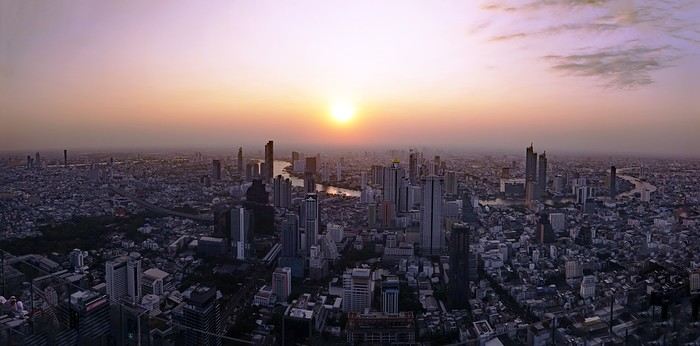
A somewhat lengthy title... I could have simply written: from Bangkok to Chiang Rai, via Chiang Mai, since that was my route. But when poets embellish our travel journals with their verbal flourishes, you’ve got to try not to be too ordinary.
Skyscrapers of excess? You’ll have gathered that from the photo illustrating this journal—though it might change as the trip goes on.
The excess of markets—not so much in their size, though... Chatuchak... But in their sheer number. Day markets, night markets, floating markets, fresh produce markets, fish markets, meat markets, spice markets, fabric markets... and even... amulet markets... For luck, good fortune, protection. Not to mention, sadly, the market for girls—and boys, incidentally. I’ve even heard they’re displayed in windows. I’ve heard about that one, like you have, but I didn’t set foot in it, so I can’t say anything about it. Some even claim there’s a black-market trade in children. Disgusting! It reminded me of the book *The Parcel* by Anosh Irani, which I recommended in another journal. The story is set in India, but I’ve been told it exists in Thailand too. So, the "famous Thai markets" we’re bombarded with in paper and online guides—sure, they amazed me in the first few days, and I don’t regret visiting them. But no matter how big they were, I quickly got my fill since you saw the same things at every stall...
I had a market overdose.
Excess of tourism? I should say *tourists*, since I saw them literally swarming in the streets and those famous markets. I’d forgotten about them. I’d lost the habit, living in an Indian city for so long...
Waterfalls are a bit like markets. At this time of year, they’re not particularly spectacular, but they’re everywhere. There are the ones everyone goes to see. For example, Erawan, which I decided to skip even though it was in my original itinerary—I guessed it’d be a nightmare with the selfie circus. On the other hand, you come across them all over the place, hidden in the mountains and forests, not listed in any guide. Not to mention the ones you can find in temples or even private homes... Yes, really! Thais love waterfalls, so they install them in their gardens—and I even saw one in the middle of the city, right on the street! Sometimes they’re tiny, but very photogenic.
But what do ice cubes have to do with this? Why the excess of ice cubes? Not only are they everywhere by the ton, but they put them in *everything* you drink. You’d think they’d even put them in soup! And it’s not just one or two ice cubes—no! They fill the container to the brim, whatever it is, then pour the liquid on top to fill the gaps. They’ll make you an excellent coffee right in front of you, piping hot, then—bam! An avalanche of ice cubes in the glass. Okay, I’m exaggerating a little. They *do* sometimes ask if you prefer your coffee—or tea—hot. Everything edible, and especially everything drinkable, is refrigerated: vegetables, fruit, hot drinks (I mean, drinks that are *usually* hot), but meat and fish are left out in the open. They just wave a little whisk to shoo away the flies when they get too eager. Mind you, I never put fruit, cheese, eggs, or water in the fridge in France, but I do in India. And I refrigerate meat and fish too... Though sometimes one of those little flies sneaks into the fridge...
You won’t find practical or technical details in this journal, like addresses or prices. Others do that better than me. You also won’t find the names of obscure or unknown places I discovered, or directions to get there.
I don’t really feel like recounting what I saw day by day, following my schedule and route. There might be flashbacks, projections into the future. It’ll depend on my memories, what I felt, what I hated, what comes back to me—and maybe your questions and our exchanges. And for those who’ve never read me before, you’ll have to get used to my parentheses and digressions, maybe on a completely different subject, as my thoughts wander. Stories within stories. There’ll also be long, endless sentences—but still punctuated, so you can follow along. Though I used to curse Proust and his sentences that started on one page and ended on the next, sometimes even further. I’d have to reread them twenty times to follow and understand what he was saying. I hated Proust. But hey, I was 20. Maybe I’d like him now?
See? The digressions are starting already. Forgive me.
You’ll find few photos here. First, the number is limited, and second, photos aren’t the main purpose of either VF or a travel journal. They’re too often used to mask the poverty of the text. And, sorry to say it, but so many of them are just plain ugly! If you really want to see photos, I’ll share some links where you can browse them at your leisure
Two Quebecers Attempting Mount Meru
In 2015, for my 50th birthday, my daughter and I went to Kenya and Tanzania for a safari. Ten years later, for my 60th, a new African adventure: returning to Tanzania, this time to attempt the ascent of Mount Meru.
After watching documentaries and films about Everest climbers, I’ve always been drawn to the idea of experiencing something like that. I’m impressed by those who risk their lives just to chase their dreams and push their limits (my partner would say they’re crazy). I’ve never pretended I could climb the roof of the world. My sights were set on Kilimanjaro instead. But when my daughter planned our adventure, she lowered my ambitions by a few meters by choosing Meru—and I get it. We’re both very active, but we’re not seasoned athletes. And our mountains in Quebec, as beautiful as they are, don’t offer the chance to climb very high to test our endurance against the lack of oxygen.
So, to prepare physically, I worked my 60-year-old legs daily by walking and climbing small hills near home. As for altitude sickness, I’ll have to trust my system and my old lungs, but it still stresses me out. The departure is approaching, and there’s no turning back—I tell myself that at worst, I’ll have tried.
February 2nd, departure day. We leave Montreal on an Air France flight as scheduled. Luckily, because we were worried, our flight times were delayed, and our layover at CDG will be tight. After a 6.5-hour flight to Paris, no messing around—we have just enough time to sit for about thirty minutes before boarding another 8.5-hour flight to Zanzibar, still with Air France. In Zanzibar, we stay on the plane while pale-faced passengers disembark, replaced by sun-kissed travelers (it’s sunny and warm in Zanzibar). We then take a short flight to Kilimanjaro Airport, our final destination. Exhausted but happy to step off the big metal bird, a driver from the agency we chose (Soaring Flamingo) waits to take us to our hotel, the Tulia in Arusha. It’s 2 AM when we finally collapse onto the mattress. Tomorrow, we’ll spend the day recovering from the sleepless flight, relaxing by a murky pool in a beautiful flower-filled courtyard, surrounded by palm trees and the everyday sounds of Africa. At that moment, I feel privileged to share this experience with my daughter, and I think about the mountain that awaits us.
To be continued...
After watching documentaries and films about Everest climbers, I’ve always been drawn to the idea of experiencing something like that. I’m impressed by those who risk their lives just to chase their dreams and push their limits (my partner would say they’re crazy). I’ve never pretended I could climb the roof of the world. My sights were set on Kilimanjaro instead. But when my daughter planned our adventure, she lowered my ambitions by a few meters by choosing Meru—and I get it. We’re both very active, but we’re not seasoned athletes. And our mountains in Quebec, as beautiful as they are, don’t offer the chance to climb very high to test our endurance against the lack of oxygen.
So, to prepare physically, I worked my 60-year-old legs daily by walking and climbing small hills near home. As for altitude sickness, I’ll have to trust my system and my old lungs, but it still stresses me out. The departure is approaching, and there’s no turning back—I tell myself that at worst, I’ll have tried.
February 2nd, departure day. We leave Montreal on an Air France flight as scheduled. Luckily, because we were worried, our flight times were delayed, and our layover at CDG will be tight. After a 6.5-hour flight to Paris, no messing around—we have just enough time to sit for about thirty minutes before boarding another 8.5-hour flight to Zanzibar, still with Air France. In Zanzibar, we stay on the plane while pale-faced passengers disembark, replaced by sun-kissed travelers (it’s sunny and warm in Zanzibar). We then take a short flight to Kilimanjaro Airport, our final destination. Exhausted but happy to step off the big metal bird, a driver from the agency we chose (Soaring Flamingo) waits to take us to our hotel, the Tulia in Arusha. It’s 2 AM when we finally collapse onto the mattress. Tomorrow, we’ll spend the day recovering from the sleepless flight, relaxing by a murky pool in a beautiful flower-filled courtyard, surrounded by palm trees and the everyday sounds of Africa. At that moment, I feel privileged to share this experience with my daughter, and I think about the mountain that awaits us.
To be continued...
Italy, My Stress Reliever
It was the start of winter; I was freezing, and the mood wasn’t exactly joyful—Ukraine, 49.3...
So I self-medicated: a week in Italy to hear laughter and that melodic language, and of course, to immerse myself in beauty for a while.
I was looking for a destination: Florence. The choice was biased because I wanted to revisit *Primavera* and *The Birth of Venus*.
Then came the choice of airline: Vueling flies directly to Florence, but you’ve got to know how to handle Vueling—sometimes you make it to your destination, sometimes you’re left at the gate. It’s not expensive, but that’s about all it’s worth. Best to know their rules of the game. Plus, Vueling leaves from Orly, which is super easy to get to by metro.
The gods were with me that day—Vueling actually got me to Florence. On arrival, the temperature was better than forecast, and I knew the days were slightly longer in Italy (and shorter in Stockholm). And the Italian language was floating in the air...
I took the new tram that takes you to the heart of the city, near the great "cheesecake" that’s said to mark the superiority of the Renaissance over Europe’s sublime Gothic cathedrals. I walked around the big pastry and turned onto *my* street, Via dei Servi. Along the way, I stewed over my guilt for not admiring the sublime *Duomo*; I hoped no police had detected my rebellious, deviant mindset.
I’d chosen a hotel on the stunning Piazza della Santissima Annunziata—I’ll even share its name, that’s the VF spirit: it’s the Hotel Due Fontane.
And that’s the real point of this post: until Easter, you can treat yourself to a room in a very charming hotel for around 60 €, breakfast buffet included! To do this, book on Booking.com and make it clear you’ll return the next day with a new reservation at that price. You’ll have left your things in the luggage room to move into a new room in the evening. I didn’t have to play that game since the reception gave me a long-term stay at a reduced rate.
The next day, the kind barista drew a perfect, beautiful flower on my cappuccino. That man was the smile and good cheer of Italy.
Florence had more to offer, and this time I wasn’t being picky like I was with the big white pastry: I had a date with *Primavera* and Venus. Off to the Uffizi; the weather was decent, much warmer than Paris, and the girls were laughing.
Arriving at the Uffizi: had I bought a skip-the-line ticket? What for? I walked in subito and even got the winter discount rate. You’ll agree that when visiting a museum, it doesn’t matter if it’s hot or not. When I got to Botticelli’s room, I love being alone—I have the illusion of owning two of the most beautiful paintings in the world. There was one tourist there that day. We admired *Primavera* and *The Birth of Venus* without getting in each other’s way; those young women painted so long ago show such beauty and radiate such elegance, especially in their faces.
I hesitated about going to the Accademia, but David is worth a revisit. If a skip-the-line ticket is ever needed, it’s here. But no! I walked in subito! Usually, women don’t openly show their attraction, but you might hear "He’s cute" about a man. Around David, it’s amusing to see they’re not immune to the sight.
Off to the Medici Chapels; entrance subita. I felt humbled by the princes’ munificence and the master’s works.
Then it was time for a stroll—maybe a Mannerist painting at Santa Felicita (oh, miracle, it was open), or playing the game of comparing the two crucifixes, including Donatello’s, sipping a Spritz in a little bar with a view of the Ponte Vecchio, wandering Via Roma in the evening among the cheerful crowd and shops decked out for Christmas. Seeing the Church of Santa Maria del Carmine for its frescoes and the Italian Pantheon at Santa Croce (Napoleon’s first girlfriend is buried there). Italy, land of frescoes!
Every evening, until I exhausted my pasta card, I enjoyed spaghetti on *my* Via dei Servi.
The point of this post: you can visit Florence at a very low cost, without impossible queues, and without tourist pressure, in reasonably warm weather until Easter. In May, the Due Fontane charges 220 to 250 €! For the rest, I may have rambled a bit. PS: Vueling stranded me on the way back; my punishment was staying an extra day in this incredibly welcoming city.
The point of this post: you can visit Florence at a very low cost, without impossible queues, and without tourist pressure, in reasonably warm weather until Easter. In May, the Due Fontane charges 220 to 250 €! For the rest, I may have rambled a bit. PS: Vueling stranded me on the way back; my punishment was staying an extra day in this incredibly welcoming city.
Discovering South India: Tamil Nadu and Kerala
Hello everyone!
We're off! After exploring the north, the four friends have now discovered the south. We’re excited to share this new travel journal, dedicated to our little group and our strong friendship, written by Richard and illustrated with Kate’s photos. I’ll chime in from time to time with practical tips.
First of all, a big thank you to everyone on VoyageForum who helped us plan this trip. It would’ve been quite different if we’d just relied on guidebooks.
The itinerary lasted just over 3 weeks: Mahabalipuram, Pondicherry, Thanjavur, the Chettinad region, Madurai, Munnar, Munroe Island, Cochin, and Chennai. We traveled by train, taxi, and private car with a driver, took a domestic flight, and stayed in guesthouses, Airbnb apartments, and hotels. For each of us, including flights, the total budget barely reached 2000 €, and we didn’t hold back—knowing we avoid resorts and love street food and small Indian restaurants.
We're off! After exploring the north, the four friends have now discovered the south. We’re excited to share this new travel journal, dedicated to our little group and our strong friendship, written by Richard and illustrated with Kate’s photos. I’ll chime in from time to time with practical tips.
First of all, a big thank you to everyone on VoyageForum who helped us plan this trip. It would’ve been quite different if we’d just relied on guidebooks.
The itinerary lasted just over 3 weeks: Mahabalipuram, Pondicherry, Thanjavur, the Chettinad region, Madurai, Munnar, Munroe Island, Cochin, and Chennai. We traveled by train, taxi, and private car with a driver, took a domestic flight, and stayed in guesthouses, Airbnb apartments, and hotels. For each of us, including flights, the total budget barely reached 2000 €, and we didn’t hold back—knowing we avoid resorts and love street food and small Indian restaurants.
Three weeks in Quebec at the start of summer 2018, on a "semi-organized" trip
I’ve been putting off posting my Quebec travel experience for a long time. Two years later, I’ve finally decided to share it. The memories are still vivid. I hope this gives you the urge to visit this beautiful region, which I literally fell in love with.
We’re traveling as four adults: my brother Guy, my sister-in-law Martine, my friend Pascal, and myself (Christian).
We entrusted the flight, hotel, and car reservations to the travel agency Amplitudes in Toulouse. Planning the day-to-day activities was up to us. We scheduled a few must-see visits, but for the rest, we’d figure it out on the spot.
Our itinerary: Quebec City / Rimouski / Carleton-sur-Mer / Percé / Sainte-Anne-des-Monts / Matane / Tadoussac / Sainte-Rose-du-Nord / Chambord / Saint-Alexis-des-Monts / Montreal
06/25 Here we are at Roissy Charles de Gaulle for the usual pre-flight formalities. Everything goes smoothly and quickly. The hardest part is waiting for takeoff. After an uneventful flight on an Air Canada Boeing 777-300ER, we land at Montréal-Pierre Elliott Trudeau Airport (YUL) in the early afternoon.
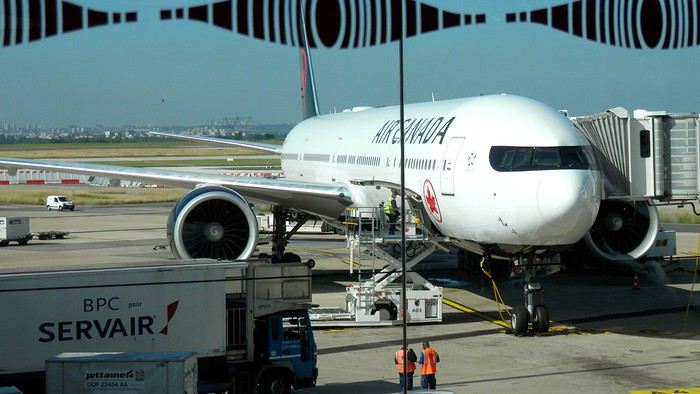
At customs, a surprise—no grumpy officer, but a smiling customs agent who jokingly asks me to name three tourist spots in Quebec, or else he won’t let me in. I pass the test easily and enter Quebec!
We head to the Alamo counter at Trudeau Airport to pick up our car: a Ford Escape with only 300 kilometers on the odometer.
We decided to head straight to Quebec City, saving Montreal for the end of the trip. Pascal takes the wheel and gets on the Trans-Canada Highway E20 for a 255 km drive, taking about 2 hours and 45 minutes. With the time difference, we’re already feeling hungry, so we stop for our first poutine at a highway restaurant.
When we arrive in Quebec City, we go straight to the Clarendon Hotel, located right in the heart of Old Quebec. We’ll be staying there for three nights. Tonight, no restaurant—just a short walk around the hotel before bed. We discover a square with pretty colored water fountains near the city hall.
 It’s only 9 PM, but our body clocks say it’s 3 AM.
We’re traveling as four adults: my brother Guy, my sister-in-law Martine, my friend Pascal, and myself (Christian).
We entrusted the flight, hotel, and car reservations to the travel agency Amplitudes in Toulouse. Planning the day-to-day activities was up to us. We scheduled a few must-see visits, but for the rest, we’d figure it out on the spot.
Our itinerary: Quebec City / Rimouski / Carleton-sur-Mer / Percé / Sainte-Anne-des-Monts / Matane / Tadoussac / Sainte-Rose-du-Nord / Chambord / Saint-Alexis-des-Monts / Montreal
06/25 Here we are at Roissy Charles de Gaulle for the usual pre-flight formalities. Everything goes smoothly and quickly. The hardest part is waiting for takeoff. After an uneventful flight on an Air Canada Boeing 777-300ER, we land at Montréal-Pierre Elliott Trudeau Airport (YUL) in the early afternoon.
At customs, a surprise—no grumpy officer, but a smiling customs agent who jokingly asks me to name three tourist spots in Quebec, or else he won’t let me in. I pass the test easily and enter Quebec!
We head to the Alamo counter at Trudeau Airport to pick up our car: a Ford Escape with only 300 kilometers on the odometer.
We decided to head straight to Quebec City, saving Montreal for the end of the trip. Pascal takes the wheel and gets on the Trans-Canada Highway E20 for a 255 km drive, taking about 2 hours and 45 minutes. With the time difference, we’re already feeling hungry, so we stop for our first poutine at a highway restaurant.
When we arrive in Quebec City, we go straight to the Clarendon Hotel, located right in the heart of Old Quebec. We’ll be staying there for three nights. Tonight, no restaurant—just a short walk around the hotel before bed. We discover a square with pretty colored water fountains near the city hall.
It’s only 9 PM, but our body clocks say it’s 3 AM.Redécouvrir la Corse, un vrai plaisir English translation pending
Après un départ manqué pour la Louisiane et deux mois de confinement, on avait comme beaucoup envie de changer d'air (encore que Hyères soit une ville extrêmement agréable, surtout quand la fréquentation reste modérée).
Début juin, il y avait peu d'opportunités d'évasion, sauf un tour en Corse qui paraissait une bonne solution. Mais c'était sans compter sur les atermoiements de l’exécutif Corse, avec la demande d'un passeport sanitaire (mais quel type de passeport, quels tests, quand, comment?) et le mutisme du gouvernement sur le même sujet.
Finalement, nous avons choisi de partir quand même le 22 juin, avec transport, hôtels, location tous annulables sans frais sous 48 h et, progressivement, les obstacles au départ ont été levés.
Malgré tout, petit suspense à l'embarquement à Toulon le 22 au soir : y aurait t'il un nouveau rebondissement dans la gestion Corse de l'épidémie ?
Finalement, tout se passe en douceur : accueil beaucoup moins stressé que d'habitude, que ce soit sur le port même, à l'embarquement, où souvent les garagistes de Corsica Ferries sont plutôt sur les dents, et également sur le bateau où le personnel est beaucoup plus aimable que d'habitude (facile diront les habitués de la traversée).
A bord, beaucoup moins de monde, port généralisé du masque, sauf quelques jeunes adultes qui s'estiment au dessus de ça.
On quitte le port de Toulon au soleil couchant, en saluant à tribord les fermes aquacoles des Tamaris
 , puis les deux vieux bateaux de la Marine qui finissent leur carrière comme brise lames à la Seyne
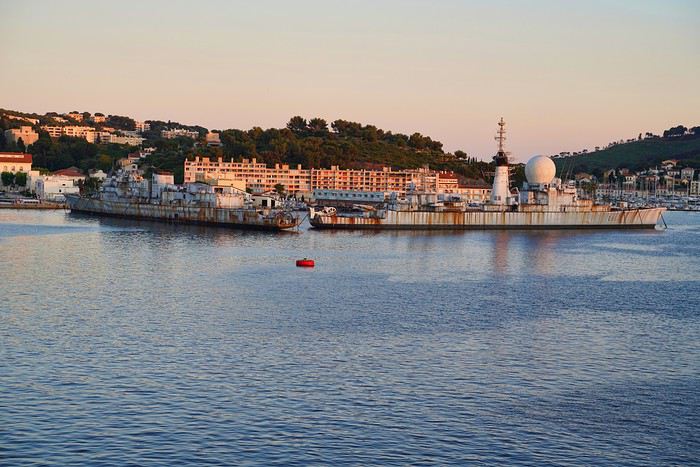 et on admire le départ toujours acrobatique du pilote
 - Sommeil tranquille dans une cabine où personne n'a pris la peine de remplir les distributeurs de savon du lavabo et de la douche. Ce sera donc une toilette de chat.
On vire les Sanguinaires à 7 h du matin, par grand beau temps et mer plate,
- Sommeil tranquille dans une cabine où personne n'a pris la peine de remplir les distributeurs de savon du lavabo et de la douche. Ce sera donc une toilette de chat.
On vire les Sanguinaires à 7 h du matin, par grand beau temps et mer plate,
 pour accoster comme prévu à Ajaccio à 7 h 30.
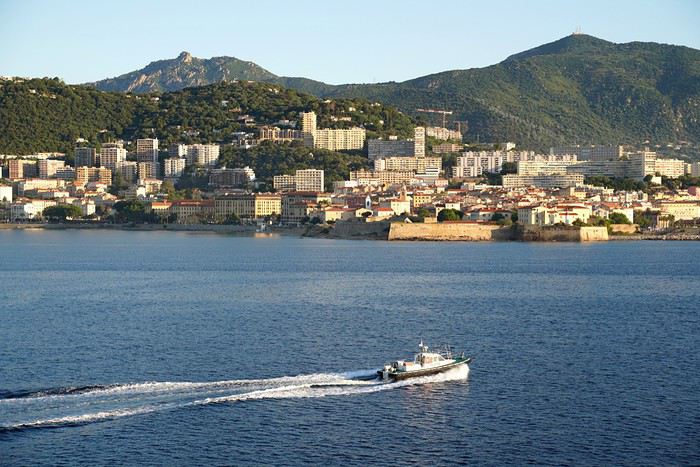 A 8 h, on met l'autoradio sur radio Corsica, ce qui nous met tout de suite dans l'ambiance (Non, rien de rien d'Edith Piaf chanté en Corse, ça vaut le déplacement!) et on roule tranquillement en direction de la Parata, avec très peu de trafic, pas de bus touristiques et sans l'affreux petit train sur pneus qui bloque habituellement la circulation.
Arrivé au parking de la Parata, les navettes électriques ne fonctionnent pas encore, on continue donc à pied vers la pointe, en admirant les Iles sanguinaires qui se reflètent dans l'eau lisse.
A 8 h, on met l'autoradio sur radio Corsica, ce qui nous met tout de suite dans l'ambiance (Non, rien de rien d'Edith Piaf chanté en Corse, ça vaut le déplacement!) et on roule tranquillement en direction de la Parata, avec très peu de trafic, pas de bus touristiques et sans l'affreux petit train sur pneus qui bloque habituellement la circulation.
Arrivé au parking de la Parata, les navettes électriques ne fonctionnent pas encore, on continue donc à pied vers la pointe, en admirant les Iles sanguinaires qui se reflètent dans l'eau lisse.
Après notre tour de la pointe, c'est l'heure du café, mais la brasserie est fermée, nous repartons vers Ajaccio et prenons notre café à Marinella, le petit bar de plage sympa à coté de l'ancienne propriété de Tino Rossi et de là embrayons direction Cargese avec quelques embouteillages pour quitter Ajaccio. A Cargese, nous saluons comme il se doit les deux églises jumelles, l'orthodoxe d'un coté, la catholique en face et nous descendons jusqu'au port qui visiblement tourne au ralenti. Nous déjeunons fort agréablement a U Rasaghiu. Dans le temps, nous avions l'habitude d'y aller souvent le soir, le patron laissait tomber le service pour pousser la chanson pour ses clients pinzutti, dont nous étions et nous ne nous lassions pas d'écouter la Boudeuse et la Vieille Guitare. L'établissement a été fort joliment modernisé, l'accueil et la cuisine y sont toujours excellents, mais la maison attend qu'il y ait plus de clients pour rentabiliser ses soirées Chansons Corses, ainsi va la vie.
Nous nous dirigeons ensuite vers Porto Ota en traversant au ralenti la zone des calanques de Piana, en profitant de la faible circulation pour nous arrêter sur les petites aires de stationnement et admirer le paysage, superbe sous le bel éclairage que nous avons la chance d'avoir aujourd'hui.
Dans le temps, nous avions l'habitude d'y aller souvent le soir, le patron laissait tomber le service pour pousser la chanson pour ses clients pinzutti, dont nous étions et nous ne nous lassions pas d'écouter la Boudeuse et la Vieille Guitare. L'établissement a été fort joliment modernisé, l'accueil et la cuisine y sont toujours excellents, mais la maison attend qu'il y ait plus de clients pour rentabiliser ses soirées Chansons Corses, ainsi va la vie.
Nous nous dirigeons ensuite vers Porto Ota en traversant au ralenti la zone des calanques de Piana, en profitant de la faible circulation pour nous arrêter sur les petites aires de stationnement et admirer le paysage, superbe sous le bel éclairage que nous avons la chance d'avoir aujourd'hui.
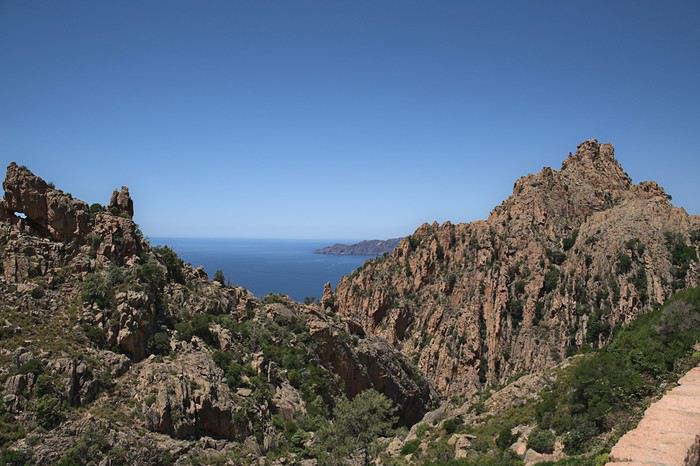
A suivre....
, puis les deux vieux bateaux de la Marine qui finissent leur carrière comme brise lames à la Seyne
et on admire le départ toujours acrobatique du pilote
- Sommeil tranquille dans une cabine où personne n'a pris la peine de remplir les distributeurs de savon du lavabo et de la douche. Ce sera donc une toilette de chat.
On vire les Sanguinaires à 7 h du matin, par grand beau temps et mer plate,
pour accoster comme prévu à Ajaccio à 7 h 30.
A 8 h, on met l'autoradio sur radio Corsica, ce qui nous met tout de suite dans l'ambiance (Non, rien de rien d'Edith Piaf chanté en Corse, ça vaut le déplacement!) et on roule tranquillement en direction de la Parata, avec très peu de trafic, pas de bus touristiques et sans l'affreux petit train sur pneus qui bloque habituellement la circulation.
Arrivé au parking de la Parata, les navettes électriques ne fonctionnent pas encore, on continue donc à pied vers la pointe, en admirant les Iles sanguinaires qui se reflètent dans l'eau lisse.
Après notre tour de la pointe, c'est l'heure du café, mais la brasserie est fermée, nous repartons vers Ajaccio et prenons notre café à Marinella, le petit bar de plage sympa à coté de l'ancienne propriété de Tino Rossi et de là embrayons direction Cargese avec quelques embouteillages pour quitter Ajaccio. A Cargese, nous saluons comme il se doit les deux églises jumelles, l'orthodoxe d'un coté, la catholique en face et nous descendons jusqu'au port qui visiblement tourne au ralenti. Nous déjeunons fort agréablement a U Rasaghiu.
Dans le temps, nous avions l'habitude d'y aller souvent le soir, le patron laissait tomber le service pour pousser la chanson pour ses clients pinzutti, dont nous étions et nous ne nous lassions pas d'écouter la Boudeuse et la Vieille Guitare. L'établissement a été fort joliment modernisé, l'accueil et la cuisine y sont toujours excellents, mais la maison attend qu'il y ait plus de clients pour rentabiliser ses soirées Chansons Corses, ainsi va la vie.
Nous nous dirigeons ensuite vers Porto Ota en traversant au ralenti la zone des calanques de Piana, en profitant de la faible circulation pour nous arrêter sur les petites aires de stationnement et admirer le paysage, superbe sous le bel éclairage que nous avons la chance d'avoir aujourd'hui.
A suivre....
Promenades au Rwanda English translation pending
C'est un voyage qui date un peu, mais il se trouve que les circonstances de la vie m'offrent du temps libre... L'occasion de replonger dans mes souvenirs et partager un voyage qui reste probablement d’actualité même si nous habitons un monde qui change de plus en plus vite...
dimanche 4 juin 2017 Mulhouse-Kigali
Le décollage approche, il faut choisir son Macron, heu, je voulais dire, son livre, pardon. Bon, dans la France du mois de juin 2017, cela revient strictement au même…
09:30 embarquement 11:20 Départ Basel Turkish Airlines (TK1924) 3 heures de vol 15:20 Arrivée Istanbul (heure locale) Changement d'Avion 18:35 TK 569 Turkich Airline
durée 6h30
00:05 Arrivée: Kigali (KGL), Kigali, Rwanda
Je précise que le mobile de ce voyage est que ma sœur vit à Kigali depuis quelques années. Son mari travaille "dans la diplomatie". Nous sommes attendus à l’aéroport par un chauffeur de l’ambassade. Ma soeur nous avait dit qu’ils seraient au lit, que la maison était ouverte et des infos pour retrouver sans aide notre chambre. Ceux qui connaissent mon célèbre sens de l’orientation ont déjà deviné que je suis allé me vautrer directement dans la chambre de nos hôtes…
lundi 5 juin 2017
Kigali C’est le lendemain qu’on a vraiment réalisé qu’on était en Afrique...
Bon, mais faut manger…On part faire des courses en ville, excellent moyen de prendre la température de l’endroit…Avec ma soeur, c’est tout de suite magouilles et compagnies…Elle me fait changer ma bonne vieille puce Bouygues contre une puce MTN locale. Elle alpague ensuite un gamin dans la rue qui tape sur mon clavier des suites de chiffres cabalistiques pour m’ouvrir les chemins d’une 3g low cost…
Comme souvent dans les pays qui se sont déversés dans le courant consumériste trop vite, les villes sont un gigantesque foutoir où l’architecture s’inspire beaucoup des gâteaux à la meringue, on côtoie le pire et le meilleur, un flot d’humains qui se débattent pour survivre, des raz de marée de véhicules, gigantesques 4*4 en concurrence avec des myriades de deux roues hétéroclites…C’est une ambiance, à l’africaine, des sonos déversent de la rumba congolaise, des types jouent au tam-tam…
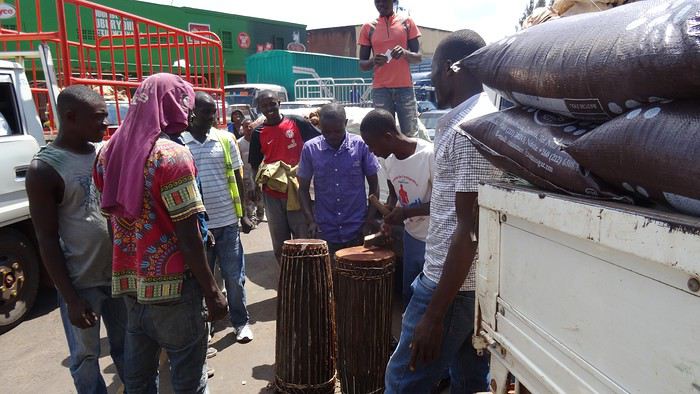
Partout des portefaix s’activent avec des montagnes posées sur la tête…
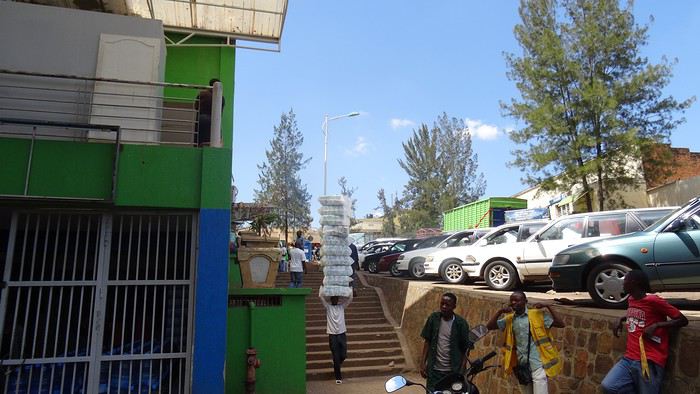
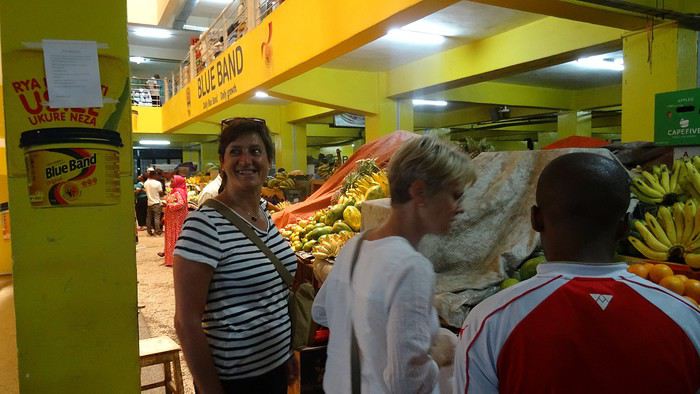
On arrive au marché. Ma sœur y est en territoire connu, négocie, interpelle
dimanche 4 juin 2017 Mulhouse-Kigali
Le décollage approche, il faut choisir son Macron, heu, je voulais dire, son livre, pardon. Bon, dans la France du mois de juin 2017, cela revient strictement au même…
09:30 embarquement 11:20 Départ Basel Turkish Airlines (TK1924) 3 heures de vol 15:20 Arrivée Istanbul (heure locale) Changement d'Avion 18:35 TK 569 Turkich Airline
durée 6h30
00:05 Arrivée: Kigali (KGL), Kigali, Rwanda
Je précise que le mobile de ce voyage est que ma sœur vit à Kigali depuis quelques années. Son mari travaille "dans la diplomatie". Nous sommes attendus à l’aéroport par un chauffeur de l’ambassade. Ma soeur nous avait dit qu’ils seraient au lit, que la maison était ouverte et des infos pour retrouver sans aide notre chambre. Ceux qui connaissent mon célèbre sens de l’orientation ont déjà deviné que je suis allé me vautrer directement dans la chambre de nos hôtes…
lundi 5 juin 2017
Kigali C’est le lendemain qu’on a vraiment réalisé qu’on était en Afrique...
Bon, mais faut manger…On part faire des courses en ville, excellent moyen de prendre la température de l’endroit…Avec ma soeur, c’est tout de suite magouilles et compagnies…Elle me fait changer ma bonne vieille puce Bouygues contre une puce MTN locale. Elle alpague ensuite un gamin dans la rue qui tape sur mon clavier des suites de chiffres cabalistiques pour m’ouvrir les chemins d’une 3g low cost…
Comme souvent dans les pays qui se sont déversés dans le courant consumériste trop vite, les villes sont un gigantesque foutoir où l’architecture s’inspire beaucoup des gâteaux à la meringue, on côtoie le pire et le meilleur, un flot d’humains qui se débattent pour survivre, des raz de marée de véhicules, gigantesques 4*4 en concurrence avec des myriades de deux roues hétéroclites…C’est une ambiance, à l’africaine, des sonos déversent de la rumba congolaise, des types jouent au tam-tam…
Partout des portefaix s’activent avec des montagnes posées sur la tête…
On arrive au marché. Ma sœur y est en territoire connu, négocie, interpelle