Results for "Murailles+Constantinople+|+123+>+233"
4051 results found.
Itinéraire en Chine English translation pending
Bonjour à tous, 🙂
Nous aurions besoin de vos conseils pour notre premier voyage en Chine: nous avons 2 possibilités:
Soit:
* Chine du nord: Pékin, Chengde, Datong, Taiyuan, Pingyao, Xian, Nankin, Shanghaï, Suzhou, Wuxi
* Chine du Sud et Nord du Vietnam: Kunming, Guiyang, Kaili, Nanning, Hoa Binh, Moc Chau, Son La, Dicn Phu, Lai Chau, Sapa, Lao Cai...Hanoï.
Qu'en pensez- vous? Nous partirions en octobre ou novembre...
Nous attendons avec impatience vos conseils, expériences...😉
D'avance, merci!
Nous aurions besoin de vos conseils pour notre premier voyage en Chine: nous avons 2 possibilités:
Soit:
* Chine du nord: Pékin, Chengde, Datong, Taiyuan, Pingyao, Xian, Nankin, Shanghaï, Suzhou, Wuxi
* Chine du Sud et Nord du Vietnam: Kunming, Guiyang, Kaili, Nanning, Hoa Binh, Moc Chau, Son La, Dicn Phu, Lai Chau, Sapa, Lao Cai...Hanoï.
Qu'en pensez- vous? Nous partirions en octobre ou novembre...
Nous attendons avec impatience vos conseils, expériences...😉
D'avance, merci!
étudier à l'étranger English translation pending
j voudrais juste passer un coucou aux etudiants a l etranger... c est genial mais terriblement frustrant!!
J aimerai barouder tout le temps et aimerai aller par tout en Asie... mais je peux POoo 🏴☠️
la chine c est trop grand😕 C POo juste!!
Je suis d accord avec vous qui allez me dire "quelle chance tu as..." c est vrai.. mais quand on baroude des qu on peux et que la ca se resume a un WE ou une semaine en faisant un trait sur les classes... POOo cool!!😕
bref... ne desesperons pas!😇
ya plein de truc a faire et a voir et ya toujours moyen de ce faire plaiz!!😎
et vous a l etranger vous en pensez quoi!!!???😉
En fait c est une liberte trop bien... mais pas comme le voyage. j ai vite tendance a oublier dailleurs que je dois etudier des matieres aussi passionnantes que le systeme bancaire chinois... la compta... la finance...😠 🙁 Moi j etudie quand je suis pas en cours
la liberte la nature la resistance physique
surtout l interculturelle et le relationnel le language des yeux et du sourrire; du rire aussi j ai pris un dominante transport locale et histoire de la guerre des tours operateurs!!😉
et vous!!🙂🙂
J aimerai barouder tout le temps et aimerai aller par tout en Asie... mais je peux POoo 🏴☠️
la chine c est trop grand😕 C POo juste!!
Je suis d accord avec vous qui allez me dire "quelle chance tu as..." c est vrai.. mais quand on baroude des qu on peux et que la ca se resume a un WE ou une semaine en faisant un trait sur les classes... POOo cool!!😕
bref... ne desesperons pas!😇
ya plein de truc a faire et a voir et ya toujours moyen de ce faire plaiz!!😎
et vous a l etranger vous en pensez quoi!!!???😉
En fait c est une liberte trop bien... mais pas comme le voyage. j ai vite tendance a oublier dailleurs que je dois etudier des matieres aussi passionnantes que le systeme bancaire chinois... la compta... la finance...😠 🙁 Moi j etudie quand je suis pas en cours
la liberte la nature la resistance physique
surtout l interculturelle et le relationnel le language des yeux et du sourrire; du rire aussi j ai pris un dominante transport locale et histoire de la guerre des tours operateurs!!😉
et vous!!🙂🙂
Visite du temple Abu Simbel English translation pending
Bonjour je pars la semaine prochaine pour une croisière en Egypte. La visite du temple d'Abu Simbel n'est pas comprise dans le prix. Cette visite est de 76 E environ. Est ce que cela vaut vraiment le coup de le faire car je trouve cela un peu elevé. En même temps je ne veux rien louper! Quelqu'un pourrait il me conseiller? Si je prends le risque de faire cette visite par mes propres moyens est ce que je ne risque rien au niveau de la logistique. Si je reviens trop tard et que le bateau repars sans moi... voilà mes craintes!
Merci de vos conseils.
Merci de vos conseils.
circuit routard en Chine English translation pending
😏 Salut à tous !!!
c'est trop bien ce forum j'ai trouvé plein d'info mais il me manque encore qqls réponses 😊
Alors je fais un bref petit récapitulatif :
Cet été avec quelques amis nous voulons faire un circuit organisé par nous même un peu du type routard. Ce circuit va durer à peu près un mois.
J'aimerais savoir si notre parcours est faisable en un mois? Si nous ne ratons pas des sites importants?
Si il est préférable de prendre l'avion ou le train pour aller d'une ville à l'autre?
J'aimerais aussi savoir si vous connaissez des agences de voyage spécialisées dasn des billet pas trop cher de préfèrence pour la Chine? On hésite aussi entre partir au départ de Paris vers Hongkong ou vers pekin
En tout cas voici un échantillon de notre programme MERCI à TOUS pour vos REPONSES Jour 1 : Paris – Hong Kong Jour 2 : Hong KongQue faire : Passage au "Pic Victoria" et ses villas, au petit port de pêche "d'Aberdeen", à "Repulse Bay" et sa plage de sable blanc, à "Deep water bay", au village "Stanley" Jour 3 : Hong Kong – Shenzen Jour 4 : Shenzen – Guangzhou (Canton)Comment s’y rendre : Train (2h)
Que faire : promenade dans les ruelles de l'île de Shamian et visite du marché de Qingping, ainsi que de la maison de la famille Chen, du "temple des 6 banyans" et du "palais Shentangsun" Jour 5 : Guangzhou – Beijing (Pékin)Comment s’y rendre : Train (24h) Que faire : contempler les paysages à travers les vitres du train Jour 6 : Beijing (Pékin)Que faire : Place Tian An Men, la Cité Interdite Jour 7 : Beijing (Pékin)Que faire : Tombeaux des empereurs Ming, le Temple du Ciel Jour 8 : Beijing (Pékin)Que faire : Excursion à la muraille de Chine. On va essayer de faire une belle randonnée d’une journée dans des coins peu visités et offrant de superbes vues. On essayera de voir un magnifique couché de soleil (selon les conditions météo ...) Jour 9 : Beijing (Pékin)Que faire : le palais d’été, le quartier des Hutong Jour 9 (soir si possible) : Beijing - XianComment s’y rendre : départ en Train (14h) Jour 10 : XianQue faire : Visite de Xian, vieille ville de l'époque Tang où subsistent de nombreux vestiges du passé : les tours de la Cloche et du Tambour, la Grande Mosquée parmi les mieux conservées de Chine, la Grande Pagode de l'Oie Sauvage construite en 648. Jour 11 : XianQue faire : Bingmayong (armée des soldats en terre cuite) et ses sites aux alentours. Jour 12 : Xian – Hua ShanComment s’y rendre : Train (2-3h) plus minibus ou taxi pour rejoindre la montagne
Que faire : Randonnée d’une journée à Hua Shan, l’une des 5 montagnes sacrées de la Chine. On va essayer d’aller au sommet et de voir une vue encore époustouflante (on en voit pendant toute la randonnée) et un coucher de soleil comme il se doit.
La suite : SichuanJiuzhaigou, une réserve naturelle au coeur d’un paysage alpin magnifique, ponctuée de lacs aux couleurs étincelantes Chengdu, pour ses ruelles, ses maisons de thé, son opéra et les pandas géants L’Emei Shan, l’une des 4 montagnes du bouddhisme, parsemée de monastères et de chemins de randonnée La statue du Grand Bouddha (Da Fo), la plus grande du genre au monde (71 m), qui domine majestueusement la ville de Leshan YunnanHutiao Xia (gorge du saut du tigre), une excursion parmi des cascades et des falaises spectaculaires Lijiang, un extraordinaire aperçu de la culture et de l’histoire naxi Dali, l’une des haltes les plus délassantes de Chine, dans un paysage de montagne et proche d’un lac superbe, l’Erhai Hu Kunming, une ville moderne, sa cuisine succulente et ses sites intéressants Hanoi et Baie d’Ha Long (VIETNAM) Retour en Chine vers Macao Retour vers PARIS
c'est trop bien ce forum j'ai trouvé plein d'info mais il me manque encore qqls réponses 😊
Alors je fais un bref petit récapitulatif :
Cet été avec quelques amis nous voulons faire un circuit organisé par nous même un peu du type routard. Ce circuit va durer à peu près un mois.
J'aimerais savoir si notre parcours est faisable en un mois? Si nous ne ratons pas des sites importants?
Si il est préférable de prendre l'avion ou le train pour aller d'une ville à l'autre?
J'aimerais aussi savoir si vous connaissez des agences de voyage spécialisées dasn des billet pas trop cher de préfèrence pour la Chine? On hésite aussi entre partir au départ de Paris vers Hongkong ou vers pekin
En tout cas voici un échantillon de notre programme MERCI à TOUS pour vos REPONSES Jour 1 : Paris – Hong Kong Jour 2 : Hong KongQue faire : Passage au "Pic Victoria" et ses villas, au petit port de pêche "d'Aberdeen", à "Repulse Bay" et sa plage de sable blanc, à "Deep water bay", au village "Stanley" Jour 3 : Hong Kong – Shenzen Jour 4 : Shenzen – Guangzhou (Canton)Comment s’y rendre : Train (2h)
Que faire : promenade dans les ruelles de l'île de Shamian et visite du marché de Qingping, ainsi que de la maison de la famille Chen, du "temple des 6 banyans" et du "palais Shentangsun" Jour 5 : Guangzhou – Beijing (Pékin)Comment s’y rendre : Train (24h) Que faire : contempler les paysages à travers les vitres du train Jour 6 : Beijing (Pékin)Que faire : Place Tian An Men, la Cité Interdite Jour 7 : Beijing (Pékin)Que faire : Tombeaux des empereurs Ming, le Temple du Ciel Jour 8 : Beijing (Pékin)Que faire : Excursion à la muraille de Chine. On va essayer de faire une belle randonnée d’une journée dans des coins peu visités et offrant de superbes vues. On essayera de voir un magnifique couché de soleil (selon les conditions météo ...) Jour 9 : Beijing (Pékin)Que faire : le palais d’été, le quartier des Hutong Jour 9 (soir si possible) : Beijing - XianComment s’y rendre : départ en Train (14h) Jour 10 : XianQue faire : Visite de Xian, vieille ville de l'époque Tang où subsistent de nombreux vestiges du passé : les tours de la Cloche et du Tambour, la Grande Mosquée parmi les mieux conservées de Chine, la Grande Pagode de l'Oie Sauvage construite en 648. Jour 11 : XianQue faire : Bingmayong (armée des soldats en terre cuite) et ses sites aux alentours. Jour 12 : Xian – Hua ShanComment s’y rendre : Train (2-3h) plus minibus ou taxi pour rejoindre la montagne
Que faire : Randonnée d’une journée à Hua Shan, l’une des 5 montagnes sacrées de la Chine. On va essayer d’aller au sommet et de voir une vue encore époustouflante (on en voit pendant toute la randonnée) et un coucher de soleil comme il se doit.
La suite : SichuanJiuzhaigou, une réserve naturelle au coeur d’un paysage alpin magnifique, ponctuée de lacs aux couleurs étincelantes Chengdu, pour ses ruelles, ses maisons de thé, son opéra et les pandas géants L’Emei Shan, l’une des 4 montagnes du bouddhisme, parsemée de monastères et de chemins de randonnée La statue du Grand Bouddha (Da Fo), la plus grande du genre au monde (71 m), qui domine majestueusement la ville de Leshan YunnanHutiao Xia (gorge du saut du tigre), une excursion parmi des cascades et des falaises spectaculaires Lijiang, un extraordinaire aperçu de la culture et de l’histoire naxi Dali, l’une des haltes les plus délassantes de Chine, dans un paysage de montagne et proche d’un lac superbe, l’Erhai Hu Kunming, une ville moderne, sa cuisine succulente et ses sites intéressants Hanoi et Baie d’Ha Long (VIETNAM) Retour en Chine vers Macao Retour vers PARIS
îles kornati Croatie English translation pending
Bonjour,
Les îles Kornati, vous connaissez, c'est magnifique. On peut y trouver un logement pour passer des vacances tranquille, loin de l'agitation, des routes, usines, loin du monde, dans des maisons de berger.
Voivi ce qu'en adit Alexis BERNIER dans libé.
"« Du ciel, on dirait des jouets abandonnés par le fils capricieux d'un géant. De la mer, ce sont des seins ronds qui sortent de l'eau, des oeufs aux plats grillés par le soleil ou des serpentins ocres tachés pistache. Les géologues et autres cartographes en ont comptabilisé cent quarante. Cent quarante îles, îlots et gros rochers irréguliers qui jaillissent de l'Adriatique en formations anarchiques sur 300 km² et 35 km à la ronde. Voilà l'archipel des Kornati, fierté de la jeune Croatie, au large de la touristique côte dalmate (…). Une jolie anomalie méditerranéenne. Dans les guides, on vous explique que chacune de ces îles perdues «correspond au sommet d'une montagne de la dernière ère glaciaire». Plus poétique, l'iconoclaste George Bernard Shaw a écrit, pour une fois sans ironie : «Le dernier jour de la création, Dieu voulut couronner son Œuvre, c'est pourquoi il créa les îles Kornati avec des larmes, des étoiles et du souffle. (…)
A une heure de bateau de Murter, à mi-chemin de Split et de Zadar, Kornat, la plus grande et la plus haute (237 mètres) des trois îles principales (au côté de Zut et Sit), a cédé son nom à l'archipel. Elle est devenue un parc national, une réserve englobant le chapelet des quatre-vingt-huit îles flottant à ses côtés. Des pins, des cailloux, des figuiers sauvages ou des oliviers. Certaines sont recouvertes d'un touffu maquis, d'autres sont nues. Un désert de pierres claires souvent zébré d'un sinueux réseau de murets. Un inextricable labyrinthe minéral artificiel. Par quelle folie orgueilleuse les hommes d'ici se sont-ils épuisés à dresser une telle muraille de Chine à flanc de colline ? Est-ce pour délimiter de minuscules parcelles renfermant à peine deux ou trois oliviers noueux ? Ou pour piéger quelques maigres troupeaux d'ovins ? Mais les ânes et les moutons, qui vivent ici en liberté, n'ont pas l'air de s'être laissé enfermer depuis des siècles. »
Séjour Beijing/environs de 9 jours - Des conseils? English translation pending
Bonjour,
J'ai la chance d'aller à Beijing quelques jours en mai prochain dans le cadre de mon travail. Je peux prolonger le séjour de 8-9 jours pour des vacances, et je me réjouis de découvrir la ville !!!
Quelques questions:
1) Cela vaut-il le coup de rester 9 jours à Beijing ? Beaucoup m'ont dit que 2-3 jours suffisent, et que Beijing n'est pas une ville où il fait bon flâner... J'aime me ballader, visiter les monuments, les musées éventuellement, crapahuter à gauche et à droite, voir les incontournables, mais aussi les endroits un peu typiques et pas trop touristiques... Vais-je trouver le temps long à Beijing ??
2) Si vous pensez qu'il vaut mieux quitter la mégapole après 3 jours, où me conseilleriez-vous d'aller pour les 5-6 jours restant ? Quels sont les endroits à voir tout en restant raisonnable vu le peu de temps à disposition ?
3) Quel hébergement à Beijing ? J'ai rangé le sac à dos à la cave il y a quelques années, je préfère les hôtels "de charme" (plutôt propres, sûrs et avec du cachet !) ... Des possibilités à Beijing ou ailleurs ?
Bon, cela fait pas mal de quesitons, mais je suis sûre que vous avez aussi pas mal de conseils en réserve, alors à vos claviers !!
Merci d'avance,
Anahé
J'ai la chance d'aller à Beijing quelques jours en mai prochain dans le cadre de mon travail. Je peux prolonger le séjour de 8-9 jours pour des vacances, et je me réjouis de découvrir la ville !!!
Quelques questions:
1) Cela vaut-il le coup de rester 9 jours à Beijing ? Beaucoup m'ont dit que 2-3 jours suffisent, et que Beijing n'est pas une ville où il fait bon flâner... J'aime me ballader, visiter les monuments, les musées éventuellement, crapahuter à gauche et à droite, voir les incontournables, mais aussi les endroits un peu typiques et pas trop touristiques... Vais-je trouver le temps long à Beijing ??
2) Si vous pensez qu'il vaut mieux quitter la mégapole après 3 jours, où me conseilleriez-vous d'aller pour les 5-6 jours restant ? Quels sont les endroits à voir tout en restant raisonnable vu le peu de temps à disposition ?
3) Quel hébergement à Beijing ? J'ai rangé le sac à dos à la cave il y a quelques années, je préfère les hôtels "de charme" (plutôt propres, sûrs et avec du cachet !) ... Des possibilités à Beijing ou ailleurs ?
Bon, cela fait pas mal de quesitons, mais je suis sûre que vous avez aussi pas mal de conseils en réserve, alors à vos claviers !!
Merci d'avance,
Anahé
Visite de Pékin English translation pending
bonjour a tous je pars sur un coup de tete a pekin du 18 mars au 4 avril j'en revais depuis longtemps .
j'aimerais avoir quelque infos sur la ville j'y vais en routard avec un petit budget
Couleur de peau en Chine English translation pending
Je compte partir cet été, en Chine, faire un voyage de deux mois et j'ai entendu dire qu'il pouvait y avoir un certain racisme envers les africains. Je sais que ca n'est pas le monopole de ce pays, mais je me demande dans quelle mesure ce racisme se manifeste. Si quelqu'un ou quelqu'une avait une expérience significative à me décrire ca m'intéresserait beaucoup.
Merci d'avance pour vos réponses éventuelles et ne voyez dans ma question aucune paranoia particulière mais simplement une volonté de connaître les expériences des autres pour préparer note voyage.
Vendre ses photos? English translation pending
Bonjour à tous,
je me demandais si certains d'entre vous avaient déjà vendu leurs photos à des magazines ?
Si oui, à qui, comment ça se passe, combien on peut espérer vendre une photo ???
je me demandais si certains d'entre vous avaient déjà vendu leurs photos à des magazines ?
Si oui, à qui, comment ça se passe, combien on peut espérer vendre une photo ???
Magazines de voyage English translation pending
Salut à tous,
Quels bons magazines de voyage ou de découverte connaissez-vous en dehors de Geo, National Geographic etc. ?
Merci d'avance
Quels bons magazines de voyage ou de découverte connaissez-vous en dehors de Geo, National Geographic etc. ?
Merci d'avance
Où dormir à Pékin? English translation pending
Bonjour,
Je suis actuellement étudiant à Qingdao, dans la province du Shandong, cela fait 2 mois que je suis arrivé en Chine, et je n'ai toujours pas eu la chance de découvrir pékin. Je compte y aller vers le 5 janvier. Connaissez vous des hotels très bon marché en cette période?
Et surtout ne fais il pas trop froid en ce moment? Ici à Qingdao, il fait -5 et je trouve ça assez froid 😎
Bon merci d'avance et bonne journée à tous
Je suis actuellement étudiant à Qingdao, dans la province du Shandong, cela fait 2 mois que je suis arrivé en Chine, et je n'ai toujours pas eu la chance de découvrir pékin. Je compte y aller vers le 5 janvier. Connaissez vous des hotels très bon marché en cette période?
Et surtout ne fais il pas trop froid en ce moment? Ici à Qingdao, il fait -5 et je trouve ça assez froid 😎
Bon merci d'avance et bonne journée à tous
Train en Chine English translation pending
Salut!!
Préparant en ce moment un voyage en Chine et Mongolie, j'aimerais avoir quelques infos sur les trains.
1: Pékin-Xian d'un coup c'est possible?? si oui, quel est environ le prix (en aout), est ce que ça vaut le coup de le faire par étape (pour 3 semaines en chine)??
2: généralement, est ce que faut réserver ses billets à l'avance??
3: combien coûte environ un shangai- hong kong direct le plus rapide possible
4: pour pékin-ulan bator par le transsib, faut réserver en avance??
MERCI!!
Préparant en ce moment un voyage en Chine et Mongolie, j'aimerais avoir quelques infos sur les trains.
1: Pékin-Xian d'un coup c'est possible?? si oui, quel est environ le prix (en aout), est ce que ça vaut le coup de le faire par étape (pour 3 semaines en chine)??
2: généralement, est ce que faut réserver ses billets à l'avance??
3: combien coûte environ un shangai- hong kong direct le plus rapide possible
4: pour pékin-ulan bator par le transsib, faut réserver en avance??
MERCI!!
Partir en Chine mais quand? English translation pending
kikoo :)
Je voudrai partir en Chine entre juin et septembre 2005 avec mon ami, on voudrai donc savoir quelle est la periode ideale pour partir 2/3 semaine en sachant qu'on voudrait absolument eviter les hordes de touristes chinois en vacances ( pas de tranquillité et prix des hotels plus chèrs )!
Donc quelqu'un a une idée des periodes de vacances /forte affluence touristique des chinois en chine 😛 ? C'est plutôt en septembre que juillet/aout comme nous non ?
Merci beaucoup :)
Je voudrai partir en Chine entre juin et septembre 2005 avec mon ami, on voudrai donc savoir quelle est la periode ideale pour partir 2/3 semaine en sachant qu'on voudrait absolument eviter les hordes de touristes chinois en vacances ( pas de tranquillité et prix des hotels plus chèrs )!
Donc quelqu'un a une idée des periodes de vacances /forte affluence touristique des chinois en chine 😛 ? C'est plutôt en septembre que juillet/aout comme nous non ?
Merci beaucoup :)
Bons plans en Chine en janv.-fev. English translation pending
salut a tous,
pour un voyage a travers la chine mi-janvier mi-février, je souhaiterai un max. d'infos sur ... TOUT.
Conseils sur circuit de deux semaines en Chine English translation pending
Je veux découvrir la Chine en faisant d'abord un court voyage de 2 semaines.
Pouvez-vous me dire quel circuit je devrais faire et quelles sont les saisons favorables, qui dépendent des régions j'imagine, vue la taille du pays.
Quels sont les tours operators organisant des vistes sérieuses en petits groupes ?
Merci de vos infos
Pouvez-vous me dire quel circuit je devrais faire et quelles sont les saisons favorables, qui dépendent des régions j'imagine, vue la taille du pays.
Quels sont les tours operators organisant des vistes sérieuses en petits groupes ?
Merci de vos infos
Népal: Où y a t il moins de Maos? English translation pending
Bonjour,
je pars au Népal en octobre et novembre, et j'envisage de faire mes treks sans guide.
Quelqu'un sait il dans quelles régions on rencontre le moins de maoistes ? Certains parlent du Langtang, mais comme c'est une région moins touristique, je ne sais pas si c'est très cohérent.
Merci de votre réponse
a bientôt
je pars au Népal en octobre et novembre, et j'envisage de faire mes treks sans guide.
Quelqu'un sait il dans quelles régions on rencontre le moins de maoistes ? Certains parlent du Langtang, mais comme c'est une région moins touristique, je ne sais pas si c'est très cohérent.
Merci de votre réponse
a bientôt
Se deplacer à Shanghai English translation pending
B'jour,
J'ai entendu parler d'un pass ( enfin ce serait plutot une carte de transport rechargeable ) pour le bus, le metro -et meme le taxi je crois -, à Shanghai ?Alors ai- je revé ? Info ou intox ? Rien trouvé sur le web à ce sujet jusqu'ici ....
J'ai entendu parler d'un pass ( enfin ce serait plutot une carte de transport rechargeable ) pour le bus, le metro -et meme le taxi je crois -, à Shanghai ?Alors ai- je revé ? Info ou intox ? Rien trouvé sur le web à ce sujet jusqu'ici ....
Strasbourg - Pékin en train English translation pending
Salut à tous et toutes,
Cher petit yack de Mongolie, voici pourquoi j'écris sur cet immaculé forum...Ayant écoulé mon stock de surprise dans l'ensemble des pays de l'ex-yougoslavie, je m'attaque à l'Asie. Après un voyage de 10 jours à Pékin en février dernier...j'y retourne mais en train cette fois!!
Petit voyage de 10 jours, tu reviens sur les rotules mais heureux de ce souvenir impérissable!
Voici mon plan de route:
A) Les trajets (distances, arrêts, et tout le bazard)
1) Strasbourg - Moscou
http://reiseauskunft.bahn.de/bin/query.exe/fn?ld=43&seqnr=6&ident=07.022107212.1080662428&guiVCtrl_connection_detailsOut_setStatus_C1-0_allHalts=yes&OK#cis_C1-0 (ces liens sont vers la meilleure base de donnée des trains du continent europe+ asie+moyen orient, la DeutschBahn www.bahn.de, vous verrez, c'est hallucinant!!!)
C'est à dire 2 jours ou plus exactement 39h et 31mn pour aller à Moscou, ces durées sont aproximatives, et pris à des dates hasardeuses, mais ça ne doit pas varier beaucoup plus!
2) Moscou pékin:
http://reiseauskunft.bahn.de/bin/query.exe/fn?ld=43&seqnr=2&ident=nm.06490151.1080662201&guiVCtrl_connection_detailsOut_setStatus_C0-0_allHalts=yes&OK#cis_C0-0 (ces liens sont vers la meilleure base de donnée des trains du continent europe+ asie+moyen orient, la DeutschBahn www.bahn.de, vous verrez, c'est hallucinant!!!)
Ca c'est la version train classique rapide (131h et 34mn de train, ce sont surtout les 34mn qui sont importantes)... mais cher visiteur jette un petit coup d'oeil et tu verra que ya des arrêts sympas!! Et il passe par Ulan bator en plus pour les amoureux de la Mongolie intérieure...
3) Pékin ville
2 jours à Pékin dans un bon hôtel avec une bonne douche, et un bon lit et peut-être (si tu es chanceux petit scorpion farcie) une masseuse.....ahhhhhhhhrrrgggg!!
Profites-en pour visiter, faire la muraille de Chine et la cité interdite, tu es maintenant près à prendre l'avion pour rentrer à ta maison plein de photos et de souvenirs.
Coût: 38€/Nuit et 7.5€/j pour manger
4) Pékin -Strasbourg (by plane)
Eh oui, je pense qu'après 8 jours de train, t'en à peut-être relativement marrre, et l'avion qui te tend les bras avec ses hotesses plus charmantes les unes que les autres, oui, laisse toi tenter petit scarabée, tu es faible...bref, environ 400€ en allez simple (non modifiable, non remboursable, J-30, - 25ans, tempo 5 en septembre, bref des conditions simples à réaliser, )
Ah oui, bah ça dure 9h le vol Pekin-paris, et après 4h30 de train pour strasbourg!
B) Les tarifs (parce qu'il faur en parler, eh oui, ya rien de gratos, face de nem!!)
1) De strasbourg à Moscou
????? Je ne sais pas mais ce doit être aux alentours de 180€ aller simple//
SVP Confirmez Moi ou infirmez moi (en plus j'aime ça )
2) De moscou à Pékin
Moscou - Irkoutsk - Pékin
Tarif 1ère classe : 430€ Tarif 2ème classe : 296€
Départ de Moscou le vendredi à 20h25 Arrivée à Pékin le jeudi suivant à 05h30
Moscou - Irkoutsk - Oulan Bator - Pékin
Tarif 1ère classe : 454€ Tarif 2ème classe : 300€
Départ de Moscou le mardi à 23h30 Arrivée à Pékin le lundi suivant à 15h30
Trajet avec arrêt
Moscou - Irkoutsk - Oulan Bator
Tarif 1ère classe : 395€ Tarif 2ème classe : 285€
Arrêt à Irkoutsk, voir les combinaisons possibles selon les trains Trajet avec arrêt
Moscou - Irkoutsk - Oulan Bator - Pékin
Tarif 1ère classe : 552€ Tarif 2ème classe : 422€
Arrêt à Irkoutsk et Oulan Bator, voir les combinaisons possibles selon les trains
Saint Petersbourg - Moscou
Tarif 1ère classe : 120€ Tarif 2ème classe : 67€
Départs quotidien à 16h00, 22h25, 23h00, 23h55 et 23h59. La durée du trajet est de 8h, sauf le train de 16h30 où la durée est de 6h)
3) Bah faut bien manger boire et visater (se faire faire des visas)
a) Les visas (sans visas t'y arrive pas!)
Visas : Chine : 20€ Mongolie : 38€ (50USD) Russie : 60€ (78USD)Pour la Russie, il faut une lettre d'invitation, cherchez sur Google, ya plein de techniques.). Pour la Mongolie, c'est à récupérer avant ou a régler sur place, la Chine, c'est ambassade directe, et la russie...aussi!! Tous les visas sont d'une validité de 1 mois (1 E/S).
b) La bouffe (sans la bouffe tu deviens ouf!)
Ces pays ne sont pas réputés pour être cher, en plus avec le mal de train, et l'alcool ingurgité (je plaisante, enfin à moitié ), ca devrait pas couté très cher! Il faut compter environ 7.50€ par jour et par personne ( et on est large).
c) La boisson (sans boisson, il meurt le poisson)
Nous tous cher amis poissons avons besoin de boire, voilà pourquoi je vous conseil fortement de gouter les boissons fermentés des pays ou le soleil se couche (à moins de 1g/L il se couche toujours à l'est!!). Alors disons pour l'eau plus les spécialités locales 2€ par jour et par personne (on devient large)
d) Les souvenirs
Pour ma part, j'ai décidé de rentrer en Avion sur Strasbourg (rentrée scolaire oblige), donc je suis limité à 20kg; Un seul conseil cependant, évitez les objets foireux, la drogue, les vraies antiquités (sans autorisation gouvernementales), etc...parce que dans ces pays, quand tu vas au gnouf, tu as le temps d'apprendre la langue en général (regarde Bertrand Canta pas si loin de nous), alors un comportement citoyen et intelligent, ça coûte rien!!
Bref pour les souvenirs, ça te reviens toujours à 150€ en général, pour les frangines, les parents, la mémé, ect...
e) BILAN DE L'OPERATION
Pour la modique somme de:
Visas : 118€ Bouffe:75€ Boisson:20€ Train+avion:880€ Hotel : 76€ Souvenirs:150€ __
1319€ TTC (lol) tu te fais un voyage de rêve ou tu as traversé quasiment 1/4 de la circonférence de la terre (40.000km)....Des milliers de photos (vive l'appareil numérique et les memories cards!), et des potes pour la vie (si tu pars avec eux)... Bref une tranche de vie de 10 jours dont on se souvient 80 ans (le ration est pas mal non??)
Tout ceux qui peuvent me confirmer le prix entre strasbourg et Moscou sont les biens venus et si ya des modifications à mes calculs, je les attends avec grand plasir...a très bientot
Merci
G. FOUCAUD
Cher petit yack de Mongolie, voici pourquoi j'écris sur cet immaculé forum...Ayant écoulé mon stock de surprise dans l'ensemble des pays de l'ex-yougoslavie, je m'attaque à l'Asie. Après un voyage de 10 jours à Pékin en février dernier...j'y retourne mais en train cette fois!!
Petit voyage de 10 jours, tu reviens sur les rotules mais heureux de ce souvenir impérissable!
Voici mon plan de route:
A) Les trajets (distances, arrêts, et tout le bazard)
1) Strasbourg - Moscou
http://reiseauskunft.bahn.de/bin/query.exe/fn?ld=43&seqnr=6&ident=07.022107212.1080662428&guiVCtrl_connection_detailsOut_setStatus_C1-0_allHalts=yes&OK#cis_C1-0 (ces liens sont vers la meilleure base de donnée des trains du continent europe+ asie+moyen orient, la DeutschBahn www.bahn.de, vous verrez, c'est hallucinant!!!)
C'est à dire 2 jours ou plus exactement 39h et 31mn pour aller à Moscou, ces durées sont aproximatives, et pris à des dates hasardeuses, mais ça ne doit pas varier beaucoup plus!
2) Moscou pékin:
http://reiseauskunft.bahn.de/bin/query.exe/fn?ld=43&seqnr=2&ident=nm.06490151.1080662201&guiVCtrl_connection_detailsOut_setStatus_C0-0_allHalts=yes&OK#cis_C0-0 (ces liens sont vers la meilleure base de donnée des trains du continent europe+ asie+moyen orient, la DeutschBahn www.bahn.de, vous verrez, c'est hallucinant!!!)
Ca c'est la version train classique rapide (131h et 34mn de train, ce sont surtout les 34mn qui sont importantes)... mais cher visiteur jette un petit coup d'oeil et tu verra que ya des arrêts sympas!! Et il passe par Ulan bator en plus pour les amoureux de la Mongolie intérieure...
3) Pékin ville
2 jours à Pékin dans un bon hôtel avec une bonne douche, et un bon lit et peut-être (si tu es chanceux petit scorpion farcie) une masseuse.....ahhhhhhhhrrrgggg!!
Profites-en pour visiter, faire la muraille de Chine et la cité interdite, tu es maintenant près à prendre l'avion pour rentrer à ta maison plein de photos et de souvenirs.
Coût: 38€/Nuit et 7.5€/j pour manger
4) Pékin -Strasbourg (by plane)
Eh oui, je pense qu'après 8 jours de train, t'en à peut-être relativement marrre, et l'avion qui te tend les bras avec ses hotesses plus charmantes les unes que les autres, oui, laisse toi tenter petit scarabée, tu es faible...bref, environ 400€ en allez simple (non modifiable, non remboursable, J-30, - 25ans, tempo 5 en septembre, bref des conditions simples à réaliser, )
Ah oui, bah ça dure 9h le vol Pekin-paris, et après 4h30 de train pour strasbourg!
B) Les tarifs (parce qu'il faur en parler, eh oui, ya rien de gratos, face de nem!!)
1) De strasbourg à Moscou
????? Je ne sais pas mais ce doit être aux alentours de 180€ aller simple//
SVP Confirmez Moi ou infirmez moi (en plus j'aime ça )
2) De moscou à Pékin
Moscou - Irkoutsk - Pékin
Tarif 1ère classe : 430€ Tarif 2ème classe : 296€
Départ de Moscou le vendredi à 20h25 Arrivée à Pékin le jeudi suivant à 05h30
Moscou - Irkoutsk - Oulan Bator - Pékin
Tarif 1ère classe : 454€ Tarif 2ème classe : 300€
Départ de Moscou le mardi à 23h30 Arrivée à Pékin le lundi suivant à 15h30
Trajet avec arrêt
Moscou - Irkoutsk - Oulan Bator
Tarif 1ère classe : 395€ Tarif 2ème classe : 285€
Arrêt à Irkoutsk, voir les combinaisons possibles selon les trains Trajet avec arrêt
Moscou - Irkoutsk - Oulan Bator - Pékin
Tarif 1ère classe : 552€ Tarif 2ème classe : 422€
Arrêt à Irkoutsk et Oulan Bator, voir les combinaisons possibles selon les trains
Saint Petersbourg - Moscou
Tarif 1ère classe : 120€ Tarif 2ème classe : 67€
Départs quotidien à 16h00, 22h25, 23h00, 23h55 et 23h59. La durée du trajet est de 8h, sauf le train de 16h30 où la durée est de 6h)
3) Bah faut bien manger boire et visater (se faire faire des visas)
a) Les visas (sans visas t'y arrive pas!)
Visas : Chine : 20€ Mongolie : 38€ (50USD) Russie : 60€ (78USD)Pour la Russie, il faut une lettre d'invitation, cherchez sur Google, ya plein de techniques.). Pour la Mongolie, c'est à récupérer avant ou a régler sur place, la Chine, c'est ambassade directe, et la russie...aussi!! Tous les visas sont d'une validité de 1 mois (1 E/S).
b) La bouffe (sans la bouffe tu deviens ouf!)
Ces pays ne sont pas réputés pour être cher, en plus avec le mal de train, et l'alcool ingurgité (je plaisante, enfin à moitié ), ca devrait pas couté très cher! Il faut compter environ 7.50€ par jour et par personne ( et on est large).
c) La boisson (sans boisson, il meurt le poisson)
Nous tous cher amis poissons avons besoin de boire, voilà pourquoi je vous conseil fortement de gouter les boissons fermentés des pays ou le soleil se couche (à moins de 1g/L il se couche toujours à l'est!!). Alors disons pour l'eau plus les spécialités locales 2€ par jour et par personne (on devient large)
d) Les souvenirs
Pour ma part, j'ai décidé de rentrer en Avion sur Strasbourg (rentrée scolaire oblige), donc je suis limité à 20kg; Un seul conseil cependant, évitez les objets foireux, la drogue, les vraies antiquités (sans autorisation gouvernementales), etc...parce que dans ces pays, quand tu vas au gnouf, tu as le temps d'apprendre la langue en général (regarde Bertrand Canta pas si loin de nous), alors un comportement citoyen et intelligent, ça coûte rien!!
Bref pour les souvenirs, ça te reviens toujours à 150€ en général, pour les frangines, les parents, la mémé, ect...
e) BILAN DE L'OPERATION
Pour la modique somme de:
Visas : 118€ Bouffe:75€ Boisson:20€ Train+avion:880€ Hotel : 76€ Souvenirs:150€ __
1319€ TTC (lol) tu te fais un voyage de rêve ou tu as traversé quasiment 1/4 de la circonférence de la terre (40.000km)....Des milliers de photos (vive l'appareil numérique et les memories cards!), et des potes pour la vie (si tu pars avec eux)... Bref une tranche de vie de 10 jours dont on se souvient 80 ans (le ration est pas mal non??)
Tout ceux qui peuvent me confirmer le prix entre strasbourg et Moscou sont les biens venus et si ya des modifications à mes calculs, je les attends avec grand plasir...a très bientot
Merci
G. FOUCAUD
Chine-France à velo2 (réponse a JREMI) English translation pending
jremi: je ne peut te repondre dans ma propre section de discussion (peut etre parceque je suis en Chine)j'espere que ca marchera en ouvrant une autre .
J'aime l'Aventure, depuis un grand nombre d'annees, mes parents mon beaucoup aide.
Mais tu as toujours quelque chose qui interesse quelqun et en general les gens aime aider un jeune qui decouvre leur pays par ses propre moyen.
A Pekin par exemple il est tres facile de donner des cour de langues (il sont desespere) et la vie est incroyablement bon marche, au Canada j'ai offert mon aide a l'ecole ou j'apprenais l'anglais (4 mois) en echange de cours moins cher et j'habitais avec deux filles dans un petit studio . Pour mon retour en france mes economie devraient faire l'affaire (300e par moi), quelques magasins de Nice qui me connaissent (la roue libre et Jogger pour la pub) mon offert du materiel en echange de quelques photos et Luftansa devrait remboursser mon billet retour. De plus des que tu sort d'Europe la vie devient bon marche (pour un francais), mon confort est secondaire, je privilegie la culture .
J'ai trop de potes qui a mon age son d'un conservatisme extraordinaire, l'un d'eux est meme marie 1 enfant ! Demande au premier venu ce qu'il veut faire dans la vie, il y a de forte chance qu'il te reponde : "gagner de l'argent ou rencontrer l'amour". Je prefere decouvrir et vivre ce que je pense etre le mieu en ce moment . Je hais le mot "ROUTINE"ou "SECURITE" il est tellement facile d'emputer sa liberte en leurs noms, pour se proteger de surprises qui le plus souvent etaient bonnes .
Au sujet de ta derniere question, je ne suis pas un expere de la muraille de Chine, je crois que quelqu'un la faite a pied, mais a velo cela me semble peu realisable :elle est compose de plusieurs sections distinctes et eloignees qui sont pour la plus part en tres mauvaise etat.la structure est un escalier montant et descendant pas etudie pour une roue.
Enfin je te conseil de te rensegner plus en details.
"QUAND DEUX CHEMINS S'OFFRENT A TOI, CHOISIS TOUJOURS LE PLUS DIFFICILE ". films HIMALAYA ENFANCE D'UN CHEF .
A Pekin par exemple il est tres facile de donner des cour de langues (il sont desespere) et la vie est incroyablement bon marche, au Canada j'ai offert mon aide a l'ecole ou j'apprenais l'anglais (4 mois) en echange de cours moins cher et j'habitais avec deux filles dans un petit studio . Pour mon retour en france mes economie devraient faire l'affaire (300e par moi), quelques magasins de Nice qui me connaissent (la roue libre et Jogger pour la pub) mon offert du materiel en echange de quelques photos et Luftansa devrait remboursser mon billet retour. De plus des que tu sort d'Europe la vie devient bon marche (pour un francais), mon confort est secondaire, je privilegie la culture .
J'ai trop de potes qui a mon age son d'un conservatisme extraordinaire, l'un d'eux est meme marie 1 enfant ! Demande au premier venu ce qu'il veut faire dans la vie, il y a de forte chance qu'il te reponde : "gagner de l'argent ou rencontrer l'amour". Je prefere decouvrir et vivre ce que je pense etre le mieu en ce moment . Je hais le mot "ROUTINE"ou "SECURITE" il est tellement facile d'emputer sa liberte en leurs noms, pour se proteger de surprises qui le plus souvent etaient bonnes .
Au sujet de ta derniere question, je ne suis pas un expere de la muraille de Chine, je crois que quelqu'un la faite a pied, mais a velo cela me semble peu realisable :elle est compose de plusieurs sections distinctes et eloignees qui sont pour la plus part en tres mauvaise etat.la structure est un escalier montant et descendant pas etudie pour une roue.
Enfin je te conseil de te rensegner plus en details.
"QUAND DEUX CHEMINS S'OFFRENT A TOI, CHOISIS TOUJOURS LE PLUS DIFFICILE ". films HIMALAYA ENFANCE D'UN CHEF .
5 years on the road by motorcycle
Hello everyone! ✌️
I just realized I’ve been registered on VoyageForum since... March 28, 2012 😊. Yet, I’ve barely participated until now.
August 1, 2026, will mark a somewhat special milestone: 5 years on the road.
We left Switzerland on August 1, 2021 with a simple idea: let chance decide our direction. We placed a bottle of wine on a world map, spun it... and it chose our first destination.
A year later, when we arrived in Morocco, we faced a new choice: continue toward Africa or head to Asia. This time, a tarot card game made the decision. Since then, we’ve tried to keep this journey as open to the unexpected as possible.
Today, that adds up to about 120,000 km, 46 countries, and over 1,800 days on the road—mostly by motorcycle, but also by sailboat, train, bus, hitchhiking, or on foot when adventure calls.
Our guiding thread isn’t just the motorcycle, but service exchanges. Instead of simply passing through countries, we try to stop regularly to lend a hand to the people we meet. So far, that’s about 600 days of volunteering.
Over the years, we’ve:
renovated a house in Croatia made earth bricks in the Moroccan desert helped sail a boat through the Greek islands looked after houses, dogs, horses, a camel... and lots of other animals worked at a street art festival in Morocco created videos for local associations and projects worked the grape harvest on the Tibetan plateau been accredited as "media" for the World Nomad Games in Central Asia
Some of the moments that have stuck with us the most include six months in China, a night spent on the Great Wall, the Pamir Highway, the Silk Road, three months in Taiwan, and the incredible encounters in the mountains of Central Asia.
We travel on Falkor, our lucky dragon—a 2014 BMW F800GS that’s been with us since the start and is starting to have some great stories of its own.
While we share our adventure on Instagram, Polarsteps, and YouTube, that’s not why we’re here. The forum’s rules about promotion are clear, and I totally get them. If I’m finally taking the time to write, it’s mostly because after five years on the road, I thought our experience might be useful to other travelers.
Happy to chat about:
preparing for a long motorcycle trip visas and borders the Silk Road and Central Asia riding in China (with or without a motorcycle) volunteering and service exchanges while traveling gear, daily life on the road... or just the unexpected moments that make long-term travel so special
Looking forward to swapping stories and hearing about your adventures too! 😊 Greetings from Thailand, and happy to chat! ✌️
Vincent, Nathalia & Falkor
I just realized I’ve been registered on VoyageForum since... March 28, 2012 😊. Yet, I’ve barely participated until now.
August 1, 2026, will mark a somewhat special milestone: 5 years on the road.
We left Switzerland on August 1, 2021 with a simple idea: let chance decide our direction. We placed a bottle of wine on a world map, spun it... and it chose our first destination.
A year later, when we arrived in Morocco, we faced a new choice: continue toward Africa or head to Asia. This time, a tarot card game made the decision. Since then, we’ve tried to keep this journey as open to the unexpected as possible.
Today, that adds up to about 120,000 km, 46 countries, and over 1,800 days on the road—mostly by motorcycle, but also by sailboat, train, bus, hitchhiking, or on foot when adventure calls.
Our guiding thread isn’t just the motorcycle, but service exchanges. Instead of simply passing through countries, we try to stop regularly to lend a hand to the people we meet. So far, that’s about 600 days of volunteering.
Over the years, we’ve:
renovated a house in Croatia made earth bricks in the Moroccan desert helped sail a boat through the Greek islands looked after houses, dogs, horses, a camel... and lots of other animals worked at a street art festival in Morocco created videos for local associations and projects worked the grape harvest on the Tibetan plateau been accredited as "media" for the World Nomad Games in Central Asia
Some of the moments that have stuck with us the most include six months in China, a night spent on the Great Wall, the Pamir Highway, the Silk Road, three months in Taiwan, and the incredible encounters in the mountains of Central Asia.
We travel on Falkor, our lucky dragon—a 2014 BMW F800GS that’s been with us since the start and is starting to have some great stories of its own.
While we share our adventure on Instagram, Polarsteps, and YouTube, that’s not why we’re here. The forum’s rules about promotion are clear, and I totally get them. If I’m finally taking the time to write, it’s mostly because after five years on the road, I thought our experience might be useful to other travelers.
Happy to chat about:
preparing for a long motorcycle trip visas and borders the Silk Road and Central Asia riding in China (with or without a motorcycle) volunteering and service exchanges while traveling gear, daily life on the road... or just the unexpected moments that make long-term travel so special
Looking forward to swapping stories and hearing about your adventures too! 😊 Greetings from Thailand, and happy to chat! ✌️
Vincent, Nathalia & Falkor
7-week trip feedback: Rajasthan and Varanasi, October-November-December 2025
We traveled as a couple from October 20 to December 11, 2025, for our second trip to India and our first time in Rajasthan, plus Mathura and Agra, which are in Uttar Pradesh but right on the border, and a 4-day flight hop to Varanasi.
Here’s a non-detailed trip report—just to share some info we found useful for other travelers, along with a few places and addresses we particularly enjoyed.
First off, a big thank you to (I’m using usernames) Aleph240758, Solene40, Montagnard74, and Pagaljavab, who took the time to reply to me. Some of them even take the time to create detailed and illustrated travel stories. Since I only started planning the trip in mid-August, I didn’t have much time and used the trip reports on VoyageForum to build our itinerary.
One more note: everyone travels differently and has their own preferences... so I’ll just share our personal feelings, which are obviously subjective.
We bought a physical SIM card upon arriving at the airport. The Airtel stand only offers one package for 500 rupees (just under 5 €) for 28 days, with 1.5 GB of data, unlimited national SMS, and calls—more than enough. Contrary to what we’d read, we asked for activation at the counter, and it was active within 10 minutes. The SIM worked well everywhere. Watch out—like in all airports, there’s a tendency to take advantage of tourists. The Airtel counter offers to exchange money directly, and we saw people paying 20 € for the SIM.
Since we arrived at night, the metro wasn’t running anymore. Plus, if you don’t know the city, we’d recommend taking a prepaid taxi—the price is fixed, and the driver knows the destination. Be careful: the prepaid taxi counter is on the right as you exit the hall, with large fixed signs above. Many counters put out a card on the desk saying "prepaid taxi," and even the Airtel stand tries to offer supposedly prepaid taxis, which is completely false. The price they ask for could be double or triple.
Here’s an app that was super useful for us In most big cities, we used "Rapido," an Indian app like Uber, to book auto-rickshaws (you can also book motorbikes or cars). You need a local phone number for this. The big advantage? The price is fixed, though you can still leave a tip. It tracks your ride, and most importantly, the destination is entered—way more practical than hailing an auto-rickshaw on the street, where the driver says "yes, yes," gives a price, and then doesn’t know where to go once you’re on the way. No need to enter a credit card. There’s also OlaCabs, which is similar, but we couldn’t get it to work.
For transportation between stops, we used government buses (RSRTC, blue buses), sometimes taxis via apps or by asking the guesthouse for visits and hard-to-reach places. This choice was really personal and made on the spot. - **Pros:** Buses leave almost every 30 minutes everywhere, giving you a lot of freedom. Every time we left from the bus station (bus stand), we had seats. Several times, we even got to sit in the driver’s cabin! The trip takes longer than a taxi, but not *that* much longer. The price is ridiculously low—1.30 € for 100 km for men, 70 cents for women. The bus stations are in the city centers, unlike many private bus companies. We met some great people. - **Cons:** It’s not exactly clean, and you’re obviously not in the comfort of a taxi. It’s not door-to-door service, so you need to travel light. You can’t stop along the way. If you need to catch the bus mid-route, it’s usually full, and you’ll have to elbow your way in without hesitation. For a short trip, I think hiring a taxi for the whole stay makes sense. Like I said, there’s no one-size-fits-all choice, but there’s no need to be apprehensive about taking public buses.
Here’s our route map, showing the number of nights spent at each stop. Compared to our initial plan, we slept one night in Barmer instead of two because we had time to visit the market in the afternoon, saw the Kiradu site the next morning, and didn’t see the point in staying longer.
We cut two of the six nights in Shekhawati. After our flight to Varanasi was canceled, we had to stay in Delhi, which actually turned out well—it let us arrive in Varanasi earlier and more rested.
The timing worked well for us, with longer stops in Bundi and Udaipur.
Compared to our initial plan, we slept one night in Barmer instead of two because we had time to visit the market in the afternoon, saw the Kiradu site the next morning, and didn’t see the point in staying longer.
We cut two of the six nights in Shekhawati. After our flight to Varanasi was canceled, we had to stay in Delhi, which actually turned out well—it let us arrive in Varanasi earlier and more rested.
The timing worked well for us, with longer stops in Bundi and Udaipur.
I won’t go into detail about each stop here, but I’d be happy to answer any questions. The accommodations and restaurants mentioned are the ones that had that little something extra, and the hearts (❤️❤️❤️) mark the sites we particularly loved.
Tijana Fort Palace - Accommodation and recovery from the trip
Alwar - Palace with museum - Moosi Maharani Ki Chhatri - Large reservoir
Bharatpur Accommodation: Iora Guesthouse, 14 €/night without breakfast—great value, cheap, good meals, close to the reserve Morning at Keoladeo Reserve by bike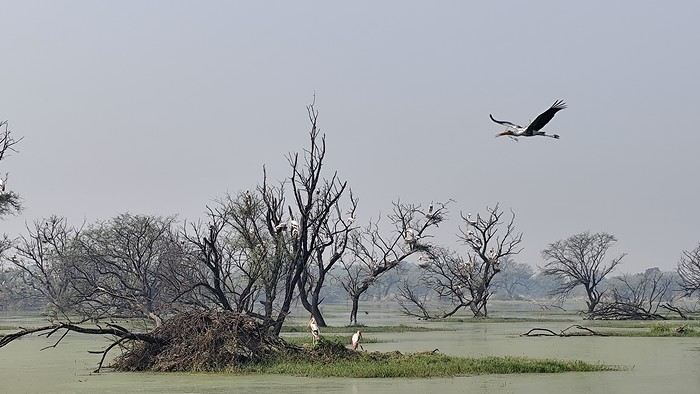
Mathura - Ghats (Yamuna Ghats, Vishram Ghat) to visit in the evening - Market (Chattu Bazar) - Hindu temple Shri Dwarkadheesh dedicated to Krishna - Vrindavan temple Banke Bihari, ❤️❤️❤️ a very important temple with incredible religious fervor - Vrindavan Hindu temple Balaram ISKCON
Agra Accommodation: Shivalayaa - The Divine Abode, 16 €/night with breakfast on Booking—welcoming, clean, close to the Taj Mahal - Mausoleum of Akbar the Great (in Sikandra) ❤️❤️❤️ - Mausoleum of Itimad-ud-Daulah (mini Taj) ❤️❤️❤️ - Visit the Taj early in the morning (closed on Fridays) ❤️❤️❤️ - Agra Fort ❤️❤️❤️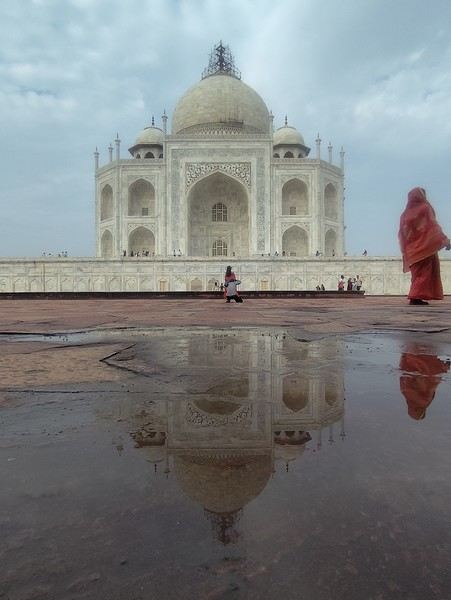
Dholpur - Machkund Temple with its water body - Clock Tower Ghanta Ghar - Royal stepwell Dhaulpur Bavdi
Karauli - City Palace, private visit with a guard ❤️❤️❤️ - Shri Madan Mohan Temple for the puja starting at 5:30 PM ❤️❤️❤️ - Wandering the streets We loved this stop, which is off the main tourist trail, for its pleasant atmosphere
Bhandarej This is a stop as a starting point to visit the Chand Baori stepwell in Abhaneri ❤️❤️❤️ Accommodation: Bhadrawati Palace, 53 €/night with breakfast in Bhandarej—nice, an old palace, warm welcome, booked via Hotels.com We were the only guests and had dinner with the current manager, the grandson of the Maharaja. There’s a pretty stepwell in the village, and we visited a tiny neighborhood temple where we were invited to join in the singing and dancing. Walking through the market was really enjoyable because of the kindness of the locals, who aren’t used to tourism ❤️❤️❤️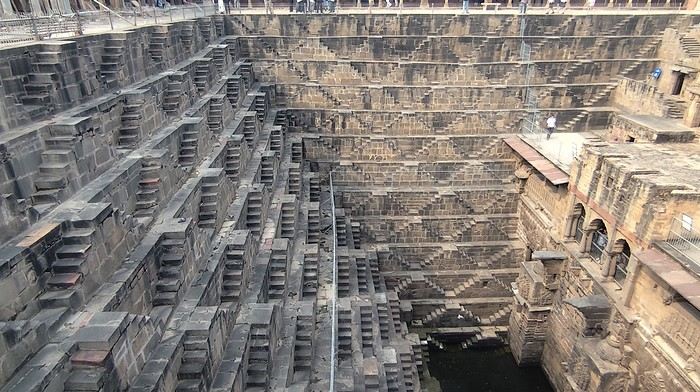
Jaipur - Hawa Mahal (Palace of Winds) - Jal Mahal - Gaitore Ki Chhatriyan ❤️❤️❤️ - Amber Fort ❤️❤️❤️ - Panna Meena Ka Kund stepwell - Galta Ji Temple (Monkey Temple) ❤️❤️❤️ - Bagru, 33 km away: visit to a fabric printing workshop with block prints (I’d noted some addresses on Google Maps). The first workshop wasn’t very welcoming and had no workers because of the humid weather. We were lucky to find another, more welcoming workshop. When the sun came out, the three female workers arrived and started their work—it was a great visit ❤️❤️❤️.
Bundi Accommodation: Hotel Bundi Inn, 25 €/night with breakfast—lovely room in a haveli, good meals with a rooftop view of the fort - Garh Palace Don’t miss: at the exit of the palace, to the left, you can access a beautiful garden with a pool and, at the back, a large hall called Chitrashala ❤️❤️❤️ - Raniji Ki Baori ❤️❤️❤️ - Nahar Dhunk Ki Baori - Chaurasi Khambun Ki Chhatri (cenotaph with 84 pillars) - Ksar Bagh, an interesting set of royal cenotaphs at the end of Jait Sagar Lake. On the other hand, we could’ve skipped Sukh Mahal and its museum. Bundi is still pleasant but is no longer a secret spot.
We bought a physical SIM card upon arriving at the airport. The Airtel stand only offers one package for 500 rupees (just under 5 €) for 28 days, with 1.5 GB of data, unlimited national SMS, and calls—more than enough. Contrary to what we’d read, we asked for activation at the counter, and it was active within 10 minutes. The SIM worked well everywhere. Watch out—like in all airports, there’s a tendency to take advantage of tourists. The Airtel counter offers to exchange money directly, and we saw people paying 20 € for the SIM.
Since we arrived at night, the metro wasn’t running anymore. Plus, if you don’t know the city, we’d recommend taking a prepaid taxi—the price is fixed, and the driver knows the destination. Be careful: the prepaid taxi counter is on the right as you exit the hall, with large fixed signs above. Many counters put out a card on the desk saying "prepaid taxi," and even the Airtel stand tries to offer supposedly prepaid taxis, which is completely false. The price they ask for could be double or triple.
Here’s an app that was super useful for us In most big cities, we used "Rapido," an Indian app like Uber, to book auto-rickshaws (you can also book motorbikes or cars). You need a local phone number for this. The big advantage? The price is fixed, though you can still leave a tip. It tracks your ride, and most importantly, the destination is entered—way more practical than hailing an auto-rickshaw on the street, where the driver says "yes, yes," gives a price, and then doesn’t know where to go once you’re on the way. No need to enter a credit card. There’s also OlaCabs, which is similar, but we couldn’t get it to work.
For transportation between stops, we used government buses (RSRTC, blue buses), sometimes taxis via apps or by asking the guesthouse for visits and hard-to-reach places. This choice was really personal and made on the spot. - **Pros:** Buses leave almost every 30 minutes everywhere, giving you a lot of freedom. Every time we left from the bus station (bus stand), we had seats. Several times, we even got to sit in the driver’s cabin! The trip takes longer than a taxi, but not *that* much longer. The price is ridiculously low—1.30 € for 100 km for men, 70 cents for women. The bus stations are in the city centers, unlike many private bus companies. We met some great people. - **Cons:** It’s not exactly clean, and you’re obviously not in the comfort of a taxi. It’s not door-to-door service, so you need to travel light. You can’t stop along the way. If you need to catch the bus mid-route, it’s usually full, and you’ll have to elbow your way in without hesitation. For a short trip, I think hiring a taxi for the whole stay makes sense. Like I said, there’s no one-size-fits-all choice, but there’s no need to be apprehensive about taking public buses.
Here’s our route map, showing the number of nights spent at each stop.
Compared to our initial plan, we slept one night in Barmer instead of two because we had time to visit the market in the afternoon, saw the Kiradu site the next morning, and didn’t see the point in staying longer.
We cut two of the six nights in Shekhawati. After our flight to Varanasi was canceled, we had to stay in Delhi, which actually turned out well—it let us arrive in Varanasi earlier and more rested.
The timing worked well for us, with longer stops in Bundi and Udaipur.I won’t go into detail about each stop here, but I’d be happy to answer any questions. The accommodations and restaurants mentioned are the ones that had that little something extra, and the hearts (❤️❤️❤️) mark the sites we particularly loved.
Tijana Fort Palace - Accommodation and recovery from the trip
Alwar - Palace with museum - Moosi Maharani Ki Chhatri - Large reservoir
Bharatpur Accommodation: Iora Guesthouse, 14 €/night without breakfast—great value, cheap, good meals, close to the reserve Morning at Keoladeo Reserve by bike
Mathura - Ghats (Yamuna Ghats, Vishram Ghat) to visit in the evening - Market (Chattu Bazar) - Hindu temple Shri Dwarkadheesh dedicated to Krishna - Vrindavan temple Banke Bihari, ❤️❤️❤️ a very important temple with incredible religious fervor - Vrindavan Hindu temple Balaram ISKCON
Agra Accommodation: Shivalayaa - The Divine Abode, 16 €/night with breakfast on Booking—welcoming, clean, close to the Taj Mahal - Mausoleum of Akbar the Great (in Sikandra) ❤️❤️❤️ - Mausoleum of Itimad-ud-Daulah (mini Taj) ❤️❤️❤️ - Visit the Taj early in the morning (closed on Fridays) ❤️❤️❤️ - Agra Fort ❤️❤️❤️
Dholpur - Machkund Temple with its water body - Clock Tower Ghanta Ghar - Royal stepwell Dhaulpur Bavdi
Karauli - City Palace, private visit with a guard ❤️❤️❤️ - Shri Madan Mohan Temple for the puja starting at 5:30 PM ❤️❤️❤️ - Wandering the streets We loved this stop, which is off the main tourist trail, for its pleasant atmosphere
Bhandarej This is a stop as a starting point to visit the Chand Baori stepwell in Abhaneri ❤️❤️❤️ Accommodation: Bhadrawati Palace, 53 €/night with breakfast in Bhandarej—nice, an old palace, warm welcome, booked via Hotels.com We were the only guests and had dinner with the current manager, the grandson of the Maharaja. There’s a pretty stepwell in the village, and we visited a tiny neighborhood temple where we were invited to join in the singing and dancing. Walking through the market was really enjoyable because of the kindness of the locals, who aren’t used to tourism ❤️❤️❤️
Jaipur - Hawa Mahal (Palace of Winds) - Jal Mahal - Gaitore Ki Chhatriyan ❤️❤️❤️ - Amber Fort ❤️❤️❤️ - Panna Meena Ka Kund stepwell - Galta Ji Temple (Monkey Temple) ❤️❤️❤️ - Bagru, 33 km away: visit to a fabric printing workshop with block prints (I’d noted some addresses on Google Maps). The first workshop wasn’t very welcoming and had no workers because of the humid weather. We were lucky to find another, more welcoming workshop. When the sun came out, the three female workers arrived and started their work—it was a great visit ❤️❤️❤️.
Bundi Accommodation: Hotel Bundi Inn, 25 €/night with breakfast—lovely room in a haveli, good meals with a rooftop view of the fort - Garh Palace Don’t miss: at the exit of the palace, to the left, you can access a beautiful garden with a pool and, at the back, a large hall called Chitrashala ❤️❤️❤️ - Raniji Ki Baori ❤️❤️❤️ - Nahar Dhunk Ki Baori - Chaurasi Khambun Ki Chhatri (cenotaph with 84 pillars) - Ksar Bagh, an interesting set of royal cenotaphs at the end of Jait Sagar Lake. On the other hand, we could’ve skipped Sukh Mahal and its museum. Bundi is still pleasant but is no longer a secret spot.
Trip Report: Silk Road Journey in China
Hi everyone,
This trip report covers a journey along the Silk Road in China (see detailed description below) undertaken in October 2025. The goal isn’t to recount the trip but to provide information that might help those who want to take a similar journey. Much of the information is valid for any trip to China.
Who we are: a retired couple, aged 63 and 65 (age gives discounts on entry to various sites and museums in China, which is why I won’t list prices here—I don’t know them, but you can easily find them online). We’re used to traveling independently. We speak English, which is the only foreign language spoken in China, though by very few people. I speak and read a little Chinese, which helped, but you can easily get by without it (without any English at all, I think it would be more difficult).
Period: We arrived just after "Golden Week," when all of China is on vacation, and after the summer, when schools are out, so we encountered very few tourists (99.99% of whom were Chinese). Our experience with booking visits in advance (which we didn’t need to do) isn’t representative for those who want to travel in the summer! The October-November period was perfect for our trip—it wasn’t too hot or too cold (one day of snow on the Tibetan Plateau), though it was only a few degrees on the Tibetan part, with altitudes between 2,000 and 3,000 meters. The trees were beautifully colored.
General remarks: Everyone we dealt with was very kind and perfectly honest. If you order a meal without really understanding what to do and the person modifies your order, trust them—the result is what you need. If a taxi driver signals that they’ll wait for you to finish your visit and pick you up afterward, trust them. It means there aren’t many taxis where you are, and it’ll be more convenient. For prices at street vendors, we always found the right ballpark, and sometimes they even added a little extra to please us. A taxi driver treated us to lunch, and an employee drove us back to the hotel after a visit because there were no taxis. If you struggle to buy a ticket online because there’s no counter, someone will come to help. People even spontaneously ask if everything’s okay and if you need anything.
Everywhere we went was very clean, including restrooms (trains, stations, hotels, museums, tourist sites) and streets. The old stereotypes about this no longer apply.
The trip can be challenging for those who have difficulty walking. The distances to cover on foot in stations, to access sites, and within the sites themselves can sometimes be really long.
We used the Lonely Planet guide in English (published at the end of August 2025) a little for preparation, but mostly relied on the internet.
Before leaving: No visa is needed for French citizens for stays under 30 days. You get a stamp on your passport upon arrival and departure, and the formalities themselves are very quick in both directions (excluding any potential queues). Just a photo and fingerprints upon arrival, and welcome to China’s facial recognition system.
Money: All your payments (see below) will go through your Visa card—there will be hundreds, including many payments of 20 cents to a few euros. So, you need an international option that allows unlimited card transactions. Since cash is rarely needed, the allowed number of ATM withdrawals can be low. We made 3 withdrawals totaling 800 € for a month and could have managed with just 2. The exchange rate charged on our Visa card was 12 € for 100 RMB (yuan).
Install the following apps on your smartphone before leaving (otherwise, you’ll only have access to the Chinese versions, if available): - Alipay, which is used to pay everywhere in China (details below). You need to link it to your credit card, then provide proof of identity by uploading a passport photo and completing a facial recognition session. Alipay gives access to Didi (China’s Uber), public transport (metro/bus), and can also translate phrases. - WeChat (Weixin in Chinese, pronounced *weishin*), which is also used for payments but also replaces WhatsApp. Unfortunately, to activate your account, you need someone who already has WeChat to sponsor you (preferably a Chinese person). We asked someone at our first accommodations to do this—no problem. By sharing your WeChat number with accommodations, they can send you messages that are automatically translated, and you can communicate with people thanks to the translation (translation to French is very poor; it’s much better in English, but unfortunately, WeChat detects your phone’s language). Alipay and WeChat are accepted almost everywhere, but some places only accept WeChat. - Amap, the international version of Baidu Maps, which replaces Google Maps (not at all up-to-date in China). The English names of hotels often have little to do with the Chinese names except for a phonetic resemblance. To find them on Amap, it’s best to copy the Chinese name found on your Trip reservation under "show address in Chinese." - A VPN. We had CyberGhost, which didn’t work, but according to other travelers, NordVPN and Windscribe do. Without a VPN, you can’t access Google services, on WhatsApp you can send and receive text but not photos, and you can’t send or receive emails on Gmail addresses. We managed without a VPN by using Firefox as a browser and Bing as a search engine. - Trip, for booking trains and accommodations, and buying some tickets. It’s the equivalent of Booking for accommodations, but Booking has very few listings in China, while Trip has hundreds in every city. Most hotels and trains are exchangeable and refundable until the day before, with no or minimal fees.
You don’t need contactless (NFC) payment on your phone. Either you scan a barcode and enter the amount to pay, or you display a barcode, and they scan it with a scanner, and the amount is deducted directly.
Upon arrival: - Buy a Chinese SIM card: 100 RMB for 300 GB of data and several hours of talk time (we didn’t use it). Set the Chinese number as a reference on Alipay, WeChat, and Amap. - Find someone to sponsor you on WeChat.
Transportation: - **Plane**: China Eastern, Paris-Canton then Canton-Urumqi on the way out, and Xian-Canton then Canton-Paris on the way back. International flights were smooth, but the schedules for the two domestic flights were changed. It was fine on the way out because we had some leeway, but on the way back, we were notified the morning of that our flight was canceled and replaced with one that didn’t allow for the connection. We called and changed to an earlier flight (I think we were lucky to find available seats). - **Train**: Most long distances were covered by high-speed trains (called D or G in China) at 240 or 300 km/h. Second class is perfect—just as comfortable and clean as our TGVs. The only advantage of first class is the wider seats for larger people, but the downside is that seats are often booked in advance and thus less available. You can book trains long in advance on Trip, but they only go on sale in China 15 days before departure, so that’s when you’ll know if you have a ticket. Initially, we booked first class, but there were no seats available on the day, so we ended up booking everything in second class, which was perfect. There’s no paper ticket—if you’ve bought one, you go to the station, show your passport, and enter. You do the same to access the platform 15 minutes before the train, and that’s it. Our train was canceled twice, but no problem—we went to the ticket counter, got a refund, and were offered a replacement. It didn’t delay us by more than an hour (maybe it would be harder in peak season). For prices, check Trip.com, but it’s significantly cheaper than in France. - **Bus**: We took the bus between Xining and Tongren, Tongren to Xiahe, and Hezuo to Lanzhou—about 3 hours each time for 200 km, 6 € per person, and departures were right on time. - **Taxi**: For trips between the station and hotel, or hotel and visits. If you take a Didi via the Alipay app, you activate your location, enter your destination, and it offers several taxis. You accept, and you get the car’s license plate and its real-time position on the map. When you get in, the driver often asks for the last four digits of your phone number to confirm. Otherwise, you go to the taxi stand outside the station. The price per kilometer is around 20 cents, so for a 30 km trip from the station to the hotel, you’ll pay about 6 €. We never tried to save more by taking local buses, but since the metro in Xian costs 25 cents per trip, it’s probably in the same ballpark. Amap provides public transport routes like Google Maps. - **Driver**: We hired a taxi/driver for the day several times for sightseeing. Prices ranged from 350 to 1,000 RMB (the most expensive was arranged through the Sofitel Xining concierge) for trips ranging from a few hours to a full day, sometimes covering over 300 km (see the detailed trip description).
Accommodations: All booked in advance on Trip, but several were changed during the trip. Off-season, there were no issues. We mostly stayed in upscale places, but in China, that means 50 to 60 € per night in the most central or convenient neighborhood. Note: Almost all hotels have a 5/5 rating on Trip, but it seems the Chinese avoid giving lower ratings to be polite. So, you have to read the comments to realize that in France, we might have given a 2 or 3!
Food: At the table, you’re served hot water or a hot infusion, presumably made with purified water. We never got sick from drinking it, but don’t drink tap water. Purified or mineral water is easy to find.
In restaurants, you can manage by pointing to the dish you want from another diner, on the wall where there are photos, or on the menu with pictures. The food in the region isn’t often spicy, and people usually ask or signal before adding the red spicy sauce, so you should be able to handle it if you don’t like chili at all.
The "fake old quarters" in several cities are great places to find all kinds of restaurants (see detailed trip below).
Like Google Maps, Amap can show you nearby restaurants.
Shopping: For dried fruits, buy them in Turfan—you won’t find the same variety and quality even in Xian. Generally, if you like something, buy it. If you wait, you might not find it outside the region where you are.
In Xian, there’s a "Tea City" where you can find all kinds of tea (from cheap to very expensive).
The trip in more detail: I won’t dwell on the beauty or interest of the sites here since that’s a matter of personal taste. However, I will do so for lesser-known places to give an idea to those who might be interested.
For many sites, there are shuttles (sometimes not included in the ticket price but costing around 1 €) that take you to the interesting spots. We always took them—it saves you from walking past countless shops or along uninteresting paths.
- **Urumqi**: We spent only one night there, arriving in the middle of the afternoon and leaving the next morning. We stayed at the Dana Hotel in the bazaar. Given the size of the city, it’s a good option because I don’t think there are many other interesting places. The bazaar is brand new and not at all "typical" (Turfan’s bazaar is infinitely more interesting), but the dining area is very nice.
- **Turfan**: Stayed at the New Dap Hostel, which was great. The neighborhood is nice, not far from the city, and easy to find food. The museum is closed until 2026 (Amap provides museum hours and closures). We took a day trip (for the two of us) with a driver to the Bezeklik Caves, Flaming Mountains, the abandoned city of Gaochang, the Tuyuk Village Museum, and the Emin Minaret for 500 RMB from 9 AM to 8 PM (arranged by the hostel). The landscape during the excursion was quite fabulous. We also visited the Karez Museum and the abandoned city of Jiaohe on our own the next day. At this time of year, the sun sets around 6 PM, and there’s often haze after 5 PM, so for Jiaohe, for example, which takes about 3 hours to visit, it’s best to be there by 1 or 2 PM at the latest.
The Dahua Market area is perfect for dried fruits (including the famous grapes), and you can eat there among locals in their traditional costumes. Next to it, there are buildings full of shops selling made-in-China items—it kept us busy for a good half-day, if not more.
- **Dunhuang**: Stayed in a guesthouse near the dunes—the city center isn’t far but seems quite artificial. Visited the dunes, with a ticket valid for 3 days. Lots of Chinese tourists—very typical and interesting from an ethnological perspective 😊. We got up early one morning to climb the highest dune, just beyond the one everyone goes to. It’s a bit long and tiring, but the view is worth it. Visited the Mogao Caves, buying the ticket on-site (no chance in season without booking in advance). We met two other French people and got a French-speaking guide (by pretending not to understand English). It was really worth it—a group of 4 instead of 20, and they took their time (2 hours) for the visit. We took a day trip to the Yulin Caves (2.5 hours by road and 160 km one way) with a driver for 350 RMB. We liked it a lot, but if the Mogao Caves are enough for you, it’s not very different.
- **Jiayuguan**: Stayed in a city-center hotel. Visited the Wei and Jin tombs (actually just one)—that’s where we were told the taxi should wait to take us back to the city. We went down into a crypt with lots of decorated bricks from the 3rd century. We really liked it, but it’s not as spectacular as the fort if you’re not a fan. Visited the Jiayuguan Fort and, with the same ticket, climbed a small section of the Great Wall 10 km away. Plan at least 3 good hours for all this—there’s plenty to see.
- **Zhangye**: Stayed at The Silk Road Travelers Hostel, rustic but very nice and organizes excursions. Visited the Danxia (colored mountains)—just as spectacular as the photos. You can easily spend 3 hours there, so plan to finish before sunset to avoid the haze (you can always stay longer for the sunset if the weather’s nice). The next day, visited the Mati Si Temple in the cliff. The 10,000 Buddha Caves are under renovation, but the setting and the main temple are well worth the visit (the paths through the cliff tunnels must be hellish in peak season). You can probably organize these two excursions yourself by asking any taxi driver. Also visited the Giant Buddha Temple in the city center—really worth it.
- **Xining**: Stayed in a city-center hotel. Visited the Tibetan Medicine Museum to see the world’s largest thangka (1 km long), made over 40 years by renowned artists. It’s absolutely magnificent, on par with the virtuosity (but over 1 km) of the thangkas painted by famous artists in Xiahe (see below). Hired a female taxi driver for the day to visit Kumbum Monastery (Ta’er Si in Chinese) and the Danxia area in Guide, 50 km beyond the monastery. It’s less spectacular than Zhangye’s Danxia, but we really liked it (including the journey’s landscape). The next day, visited the old Ming-era Qutan Monastery—no visitors, with beautiful murals (half under renovation). Accessible by train to Haidong or Ledu, then a taxi. Xining’s mosque is of no interest, but there’s a pedestrian street with food stalls nearby that’s very nice.
- **Tongren**: Stayed near the main monastery. Visited Longwu Monastery (several hours), with lots of nice shops along the street leading to it. Then visited Wutun Monastery, which is less lively but beautiful and close to thangka workshops. You can go in and watch the painters at work. For a thangka made by a renowned artist, count about a year of work for 1 m² and around 10,000 €.
- **Xiahe**: Stayed in a city-center hotel. Visited Labrang Monastery—very nice but not as much as Tongren’s because many halls were closed. I think it’s better to go in season and take an English-guided tour (but it’s still worth the trip, even off-season).
- **Langmusi**: Took a taxi, but you can also take a bus (though very early in the morning and longer). Particularly beautiful for us because we woke up to bright sunshine and 5 cm of snow everywhere. Visited the two temples (really nice) and did the classic hike in the gorges starting at the Fairy Cave. For those interested, we continued along the canyon path, and after the meadow where marmots are clearly visible in summer, we climbed toward a pass on the left at 3,800 meters. The view of Langmusi and, above all, the vast grasslands and distant mountains was fabulous (3 hours round trip from the temple). You could probably reach the 4,000-meter summit by continuing up the valley instead of turning left, but according to guides, it’s better to count 7 hours round trip (no technical difficulty). You can leave Langmusi by bus, but off-season, you first have to take a taxi to a stop outside the city and wait for the bus. We didn’t try and took a taxi to Hezuo instead.
Note on this region: A high-speed train is under construction from Xining to Langmusi and beyond (never seen such an impressive construction site!). When it’s operational (in one or two years, I think), access to the area will be revolutionized, and perhaps some of the charm will be lost.
- **Hezuo**: Stopped on the way from Langmusi to Lanzhou. Visited the Milarepa Pagoda, entirely destroyed during the Cultural Revolution and since rebuilt. We liked it since we were passing through, but it doesn’t necessarily justify a long detour.
- **Lanzhou**: Reached by one of the many buses from Hezuo. Stayed in the "fake old quarter," which is extremely pleasant, especially in the evening with restaurants, groups of Chinese women dancing to loud music, etc. Visited Bingling Si with a driver, 120 km away—the landscape and site are absolutely magnificent, with no one around at our time of year. Visited the Gansu Museum (where the famous Flying Horse is, but it’s a replica). We bought the ticket on entry, but in season, you probably need to book in advance.
- **Yinchuan**: Stayed in the city center. A city we discovered by chance in the Lonely Planet—worth it if you have time. On the way, we stopped for a few hours in Zhongwei, where there’s an incredible Taoist temple (I’ll let you be surprised). Visited the Western Xia tombs—we took the short option, which visits Tomb 3. We think the others are similar but less impressive. The surrounding landscape and site are quite spectacular. Visited the film sets (really fun if you like Chinese movies), the short but interesting Ningxia Museum, and finally the modern art museum. The architecture is avant-garde, and there are some beautiful works (we like it, but it’s far from the center—hire a driver who waits, or you might have to wait for an employee to offer a ride back).
- **Tianshui**: Stayed in the suburbs, but you should find a hotel near the "fake old quarter" between the Fu Xi Temples and the Taoist temple—it’s a very nice area, and the two temples (especially the Taoist one) are within walking distance. Visited the Maijishan Caves—the ticket includes the shuttle to get there. Took a taxi from Lanzhou for about 10 € in 45 minutes. We found these caves fabulous.
- **Xi’an**: Stayed 500 meters from the Bell Tower at Hantang Inn—very convenient. We’d been before, so we didn’t revisit the Terracotta Army. The calligraphy district is worth it, as is the Muslim Quarter, though it’s very touristy. The area indicated on the Lonely Planet’s walking tour near the old fruit and vegetable market isn’t very interesting. To buy tea, you can go to the Northwest International Tea City, with dozens of shops. We chose one at random, tasted, and bought various teas. There’s everything from cheap to extremely expensive, but you can find reasonable prices even in seemingly luxurious shops. Along the street north of this area, there are large stores with tons of Chinese goods selling dishes, wedding items, etc. We spent hours there. In the city center, there are only malls with more or less international brands.
- **Longmen Grottoes**: Visited as a round trip by high-speed train from Xian—1 hour 15 minutes to Longmen’s high-speed train station, and the site entrance is 15 minutes by taxi.
We didn’t go to Mount Hua Shan, but there’s a high-speed train station nearby, and there were people on the train who were clearly going there. So, you can probably do this excursion in a day from Xian as well.
Conclusion: We hope this report makes you want to go or helps you if you’re already planning to. If you have questions that you can’t find the answer to by searching properly online and we can answer, don’t hesitate.
This trip report covers a journey along the Silk Road in China (see detailed description below) undertaken in October 2025. The goal isn’t to recount the trip but to provide information that might help those who want to take a similar journey. Much of the information is valid for any trip to China.
Who we are: a retired couple, aged 63 and 65 (age gives discounts on entry to various sites and museums in China, which is why I won’t list prices here—I don’t know them, but you can easily find them online). We’re used to traveling independently. We speak English, which is the only foreign language spoken in China, though by very few people. I speak and read a little Chinese, which helped, but you can easily get by without it (without any English at all, I think it would be more difficult).
Period: We arrived just after "Golden Week," when all of China is on vacation, and after the summer, when schools are out, so we encountered very few tourists (99.99% of whom were Chinese). Our experience with booking visits in advance (which we didn’t need to do) isn’t representative for those who want to travel in the summer! The October-November period was perfect for our trip—it wasn’t too hot or too cold (one day of snow on the Tibetan Plateau), though it was only a few degrees on the Tibetan part, with altitudes between 2,000 and 3,000 meters. The trees were beautifully colored.
General remarks: Everyone we dealt with was very kind and perfectly honest. If you order a meal without really understanding what to do and the person modifies your order, trust them—the result is what you need. If a taxi driver signals that they’ll wait for you to finish your visit and pick you up afterward, trust them. It means there aren’t many taxis where you are, and it’ll be more convenient. For prices at street vendors, we always found the right ballpark, and sometimes they even added a little extra to please us. A taxi driver treated us to lunch, and an employee drove us back to the hotel after a visit because there were no taxis. If you struggle to buy a ticket online because there’s no counter, someone will come to help. People even spontaneously ask if everything’s okay and if you need anything.
Everywhere we went was very clean, including restrooms (trains, stations, hotels, museums, tourist sites) and streets. The old stereotypes about this no longer apply.
The trip can be challenging for those who have difficulty walking. The distances to cover on foot in stations, to access sites, and within the sites themselves can sometimes be really long.
We used the Lonely Planet guide in English (published at the end of August 2025) a little for preparation, but mostly relied on the internet.
Before leaving: No visa is needed for French citizens for stays under 30 days. You get a stamp on your passport upon arrival and departure, and the formalities themselves are very quick in both directions (excluding any potential queues). Just a photo and fingerprints upon arrival, and welcome to China’s facial recognition system.
Money: All your payments (see below) will go through your Visa card—there will be hundreds, including many payments of 20 cents to a few euros. So, you need an international option that allows unlimited card transactions. Since cash is rarely needed, the allowed number of ATM withdrawals can be low. We made 3 withdrawals totaling 800 € for a month and could have managed with just 2. The exchange rate charged on our Visa card was 12 € for 100 RMB (yuan).
Install the following apps on your smartphone before leaving (otherwise, you’ll only have access to the Chinese versions, if available): - Alipay, which is used to pay everywhere in China (details below). You need to link it to your credit card, then provide proof of identity by uploading a passport photo and completing a facial recognition session. Alipay gives access to Didi (China’s Uber), public transport (metro/bus), and can also translate phrases. - WeChat (Weixin in Chinese, pronounced *weishin*), which is also used for payments but also replaces WhatsApp. Unfortunately, to activate your account, you need someone who already has WeChat to sponsor you (preferably a Chinese person). We asked someone at our first accommodations to do this—no problem. By sharing your WeChat number with accommodations, they can send you messages that are automatically translated, and you can communicate with people thanks to the translation (translation to French is very poor; it’s much better in English, but unfortunately, WeChat detects your phone’s language). Alipay and WeChat are accepted almost everywhere, but some places only accept WeChat. - Amap, the international version of Baidu Maps, which replaces Google Maps (not at all up-to-date in China). The English names of hotels often have little to do with the Chinese names except for a phonetic resemblance. To find them on Amap, it’s best to copy the Chinese name found on your Trip reservation under "show address in Chinese." - A VPN. We had CyberGhost, which didn’t work, but according to other travelers, NordVPN and Windscribe do. Without a VPN, you can’t access Google services, on WhatsApp you can send and receive text but not photos, and you can’t send or receive emails on Gmail addresses. We managed without a VPN by using Firefox as a browser and Bing as a search engine. - Trip, for booking trains and accommodations, and buying some tickets. It’s the equivalent of Booking for accommodations, but Booking has very few listings in China, while Trip has hundreds in every city. Most hotels and trains are exchangeable and refundable until the day before, with no or minimal fees.
You don’t need contactless (NFC) payment on your phone. Either you scan a barcode and enter the amount to pay, or you display a barcode, and they scan it with a scanner, and the amount is deducted directly.
Upon arrival: - Buy a Chinese SIM card: 100 RMB for 300 GB of data and several hours of talk time (we didn’t use it). Set the Chinese number as a reference on Alipay, WeChat, and Amap. - Find someone to sponsor you on WeChat.
Transportation: - **Plane**: China Eastern, Paris-Canton then Canton-Urumqi on the way out, and Xian-Canton then Canton-Paris on the way back. International flights were smooth, but the schedules for the two domestic flights were changed. It was fine on the way out because we had some leeway, but on the way back, we were notified the morning of that our flight was canceled and replaced with one that didn’t allow for the connection. We called and changed to an earlier flight (I think we were lucky to find available seats). - **Train**: Most long distances were covered by high-speed trains (called D or G in China) at 240 or 300 km/h. Second class is perfect—just as comfortable and clean as our TGVs. The only advantage of first class is the wider seats for larger people, but the downside is that seats are often booked in advance and thus less available. You can book trains long in advance on Trip, but they only go on sale in China 15 days before departure, so that’s when you’ll know if you have a ticket. Initially, we booked first class, but there were no seats available on the day, so we ended up booking everything in second class, which was perfect. There’s no paper ticket—if you’ve bought one, you go to the station, show your passport, and enter. You do the same to access the platform 15 minutes before the train, and that’s it. Our train was canceled twice, but no problem—we went to the ticket counter, got a refund, and were offered a replacement. It didn’t delay us by more than an hour (maybe it would be harder in peak season). For prices, check Trip.com, but it’s significantly cheaper than in France. - **Bus**: We took the bus between Xining and Tongren, Tongren to Xiahe, and Hezuo to Lanzhou—about 3 hours each time for 200 km, 6 € per person, and departures were right on time. - **Taxi**: For trips between the station and hotel, or hotel and visits. If you take a Didi via the Alipay app, you activate your location, enter your destination, and it offers several taxis. You accept, and you get the car’s license plate and its real-time position on the map. When you get in, the driver often asks for the last four digits of your phone number to confirm. Otherwise, you go to the taxi stand outside the station. The price per kilometer is around 20 cents, so for a 30 km trip from the station to the hotel, you’ll pay about 6 €. We never tried to save more by taking local buses, but since the metro in Xian costs 25 cents per trip, it’s probably in the same ballpark. Amap provides public transport routes like Google Maps. - **Driver**: We hired a taxi/driver for the day several times for sightseeing. Prices ranged from 350 to 1,000 RMB (the most expensive was arranged through the Sofitel Xining concierge) for trips ranging from a few hours to a full day, sometimes covering over 300 km (see the detailed trip description).
Accommodations: All booked in advance on Trip, but several were changed during the trip. Off-season, there were no issues. We mostly stayed in upscale places, but in China, that means 50 to 60 € per night in the most central or convenient neighborhood. Note: Almost all hotels have a 5/5 rating on Trip, but it seems the Chinese avoid giving lower ratings to be polite. So, you have to read the comments to realize that in France, we might have given a 2 or 3!
Food: At the table, you’re served hot water or a hot infusion, presumably made with purified water. We never got sick from drinking it, but don’t drink tap water. Purified or mineral water is easy to find.
In restaurants, you can manage by pointing to the dish you want from another diner, on the wall where there are photos, or on the menu with pictures. The food in the region isn’t often spicy, and people usually ask or signal before adding the red spicy sauce, so you should be able to handle it if you don’t like chili at all.
The "fake old quarters" in several cities are great places to find all kinds of restaurants (see detailed trip below).
Like Google Maps, Amap can show you nearby restaurants.
Shopping: For dried fruits, buy them in Turfan—you won’t find the same variety and quality even in Xian. Generally, if you like something, buy it. If you wait, you might not find it outside the region where you are.
In Xian, there’s a "Tea City" where you can find all kinds of tea (from cheap to very expensive).
The trip in more detail: I won’t dwell on the beauty or interest of the sites here since that’s a matter of personal taste. However, I will do so for lesser-known places to give an idea to those who might be interested.
For many sites, there are shuttles (sometimes not included in the ticket price but costing around 1 €) that take you to the interesting spots. We always took them—it saves you from walking past countless shops or along uninteresting paths.
- **Urumqi**: We spent only one night there, arriving in the middle of the afternoon and leaving the next morning. We stayed at the Dana Hotel in the bazaar. Given the size of the city, it’s a good option because I don’t think there are many other interesting places. The bazaar is brand new and not at all "typical" (Turfan’s bazaar is infinitely more interesting), but the dining area is very nice.
- **Turfan**: Stayed at the New Dap Hostel, which was great. The neighborhood is nice, not far from the city, and easy to find food. The museum is closed until 2026 (Amap provides museum hours and closures). We took a day trip (for the two of us) with a driver to the Bezeklik Caves, Flaming Mountains, the abandoned city of Gaochang, the Tuyuk Village Museum, and the Emin Minaret for 500 RMB from 9 AM to 8 PM (arranged by the hostel). The landscape during the excursion was quite fabulous. We also visited the Karez Museum and the abandoned city of Jiaohe on our own the next day. At this time of year, the sun sets around 6 PM, and there’s often haze after 5 PM, so for Jiaohe, for example, which takes about 3 hours to visit, it’s best to be there by 1 or 2 PM at the latest.
The Dahua Market area is perfect for dried fruits (including the famous grapes), and you can eat there among locals in their traditional costumes. Next to it, there are buildings full of shops selling made-in-China items—it kept us busy for a good half-day, if not more.
- **Dunhuang**: Stayed in a guesthouse near the dunes—the city center isn’t far but seems quite artificial. Visited the dunes, with a ticket valid for 3 days. Lots of Chinese tourists—very typical and interesting from an ethnological perspective 😊. We got up early one morning to climb the highest dune, just beyond the one everyone goes to. It’s a bit long and tiring, but the view is worth it. Visited the Mogao Caves, buying the ticket on-site (no chance in season without booking in advance). We met two other French people and got a French-speaking guide (by pretending not to understand English). It was really worth it—a group of 4 instead of 20, and they took their time (2 hours) for the visit. We took a day trip to the Yulin Caves (2.5 hours by road and 160 km one way) with a driver for 350 RMB. We liked it a lot, but if the Mogao Caves are enough for you, it’s not very different.
- **Jiayuguan**: Stayed in a city-center hotel. Visited the Wei and Jin tombs (actually just one)—that’s where we were told the taxi should wait to take us back to the city. We went down into a crypt with lots of decorated bricks from the 3rd century. We really liked it, but it’s not as spectacular as the fort if you’re not a fan. Visited the Jiayuguan Fort and, with the same ticket, climbed a small section of the Great Wall 10 km away. Plan at least 3 good hours for all this—there’s plenty to see.
- **Zhangye**: Stayed at The Silk Road Travelers Hostel, rustic but very nice and organizes excursions. Visited the Danxia (colored mountains)—just as spectacular as the photos. You can easily spend 3 hours there, so plan to finish before sunset to avoid the haze (you can always stay longer for the sunset if the weather’s nice). The next day, visited the Mati Si Temple in the cliff. The 10,000 Buddha Caves are under renovation, but the setting and the main temple are well worth the visit (the paths through the cliff tunnels must be hellish in peak season). You can probably organize these two excursions yourself by asking any taxi driver. Also visited the Giant Buddha Temple in the city center—really worth it.
- **Xining**: Stayed in a city-center hotel. Visited the Tibetan Medicine Museum to see the world’s largest thangka (1 km long), made over 40 years by renowned artists. It’s absolutely magnificent, on par with the virtuosity (but over 1 km) of the thangkas painted by famous artists in Xiahe (see below). Hired a female taxi driver for the day to visit Kumbum Monastery (Ta’er Si in Chinese) and the Danxia area in Guide, 50 km beyond the monastery. It’s less spectacular than Zhangye’s Danxia, but we really liked it (including the journey’s landscape). The next day, visited the old Ming-era Qutan Monastery—no visitors, with beautiful murals (half under renovation). Accessible by train to Haidong or Ledu, then a taxi. Xining’s mosque is of no interest, but there’s a pedestrian street with food stalls nearby that’s very nice.
- **Tongren**: Stayed near the main monastery. Visited Longwu Monastery (several hours), with lots of nice shops along the street leading to it. Then visited Wutun Monastery, which is less lively but beautiful and close to thangka workshops. You can go in and watch the painters at work. For a thangka made by a renowned artist, count about a year of work for 1 m² and around 10,000 €.
- **Xiahe**: Stayed in a city-center hotel. Visited Labrang Monastery—very nice but not as much as Tongren’s because many halls were closed. I think it’s better to go in season and take an English-guided tour (but it’s still worth the trip, even off-season).
- **Langmusi**: Took a taxi, but you can also take a bus (though very early in the morning and longer). Particularly beautiful for us because we woke up to bright sunshine and 5 cm of snow everywhere. Visited the two temples (really nice) and did the classic hike in the gorges starting at the Fairy Cave. For those interested, we continued along the canyon path, and after the meadow where marmots are clearly visible in summer, we climbed toward a pass on the left at 3,800 meters. The view of Langmusi and, above all, the vast grasslands and distant mountains was fabulous (3 hours round trip from the temple). You could probably reach the 4,000-meter summit by continuing up the valley instead of turning left, but according to guides, it’s better to count 7 hours round trip (no technical difficulty). You can leave Langmusi by bus, but off-season, you first have to take a taxi to a stop outside the city and wait for the bus. We didn’t try and took a taxi to Hezuo instead.
Note on this region: A high-speed train is under construction from Xining to Langmusi and beyond (never seen such an impressive construction site!). When it’s operational (in one or two years, I think), access to the area will be revolutionized, and perhaps some of the charm will be lost.
- **Hezuo**: Stopped on the way from Langmusi to Lanzhou. Visited the Milarepa Pagoda, entirely destroyed during the Cultural Revolution and since rebuilt. We liked it since we were passing through, but it doesn’t necessarily justify a long detour.
- **Lanzhou**: Reached by one of the many buses from Hezuo. Stayed in the "fake old quarter," which is extremely pleasant, especially in the evening with restaurants, groups of Chinese women dancing to loud music, etc. Visited Bingling Si with a driver, 120 km away—the landscape and site are absolutely magnificent, with no one around at our time of year. Visited the Gansu Museum (where the famous Flying Horse is, but it’s a replica). We bought the ticket on entry, but in season, you probably need to book in advance.
- **Yinchuan**: Stayed in the city center. A city we discovered by chance in the Lonely Planet—worth it if you have time. On the way, we stopped for a few hours in Zhongwei, where there’s an incredible Taoist temple (I’ll let you be surprised). Visited the Western Xia tombs—we took the short option, which visits Tomb 3. We think the others are similar but less impressive. The surrounding landscape and site are quite spectacular. Visited the film sets (really fun if you like Chinese movies), the short but interesting Ningxia Museum, and finally the modern art museum. The architecture is avant-garde, and there are some beautiful works (we like it, but it’s far from the center—hire a driver who waits, or you might have to wait for an employee to offer a ride back).
- **Tianshui**: Stayed in the suburbs, but you should find a hotel near the "fake old quarter" between the Fu Xi Temples and the Taoist temple—it’s a very nice area, and the two temples (especially the Taoist one) are within walking distance. Visited the Maijishan Caves—the ticket includes the shuttle to get there. Took a taxi from Lanzhou for about 10 € in 45 minutes. We found these caves fabulous.
- **Xi’an**: Stayed 500 meters from the Bell Tower at Hantang Inn—very convenient. We’d been before, so we didn’t revisit the Terracotta Army. The calligraphy district is worth it, as is the Muslim Quarter, though it’s very touristy. The area indicated on the Lonely Planet’s walking tour near the old fruit and vegetable market isn’t very interesting. To buy tea, you can go to the Northwest International Tea City, with dozens of shops. We chose one at random, tasted, and bought various teas. There’s everything from cheap to extremely expensive, but you can find reasonable prices even in seemingly luxurious shops. Along the street north of this area, there are large stores with tons of Chinese goods selling dishes, wedding items, etc. We spent hours there. In the city center, there are only malls with more or less international brands.
- **Longmen Grottoes**: Visited as a round trip by high-speed train from Xian—1 hour 15 minutes to Longmen’s high-speed train station, and the site entrance is 15 minutes by taxi.
We didn’t go to Mount Hua Shan, but there’s a high-speed train station nearby, and there were people on the train who were clearly going there. So, you can probably do this excursion in a day from Xian as well.
Conclusion: We hope this report makes you want to go or helps you if you’re already planning to. If you have questions that you can’t find the answer to by searching properly online and we can answer, don’t hesitate.
Travel Journal - 28 Days in China in August 2025
Hi everyone! I’m sharing a modest travel journal from my trip to China in August 2025.
There wasn’t much room for improvisation on this trip—everything was planned in advance. Since August is peak season, I decided to book train tickets early, and once that was set, I reserved all the accommodations too. I got everything on Trip.com.
I bought the flight tickets back in March from Hainan Airlines. They were super expensive, but with these travel dates, I couldn’t exactly dream of a bargain!
I picked up e-SIMs valid for a month from Free just before departure: 10 € for the e-SIM + 19.90 € for a one-month plan with 35 GB of data abroad.
No need for a VPN with these e-SIMs, but D. still got one—a multi-device plan for 5 € with a discount from Let’s VPN, valid for a month. It was for evenings at the hotel on Wi-Fi to avoid burning through the 35 GB with video.
I downloaded Alipay, WeChat, Amap (Baidu Maps), and Trip.com. We also have Google Translate and Maps.me—absolute must-haves.
We’re ready to go!
I’ve been waiting for this day for nearly 15 years!! I travel a lot, but this one—this is MY TRIP 🙂 It’s been postponed so many times: because I wanted to do it with the right person, because I have a Turkish stamp in my passport and heard they don’t issue visas with that, because of COVID... and then China introduced a 30-day visa exemption, and that was the green light! Ugh, they forced us to take our vacation in August this year—far from ideal—but no more delays. Saturday, August 2, 2025: it’s finally the big day!
Days 1 and 2: We got dropped off at Charles de Gaulle at 9:30 AM. I supposedly checked in online, but only for the first flight and without getting the boarding pass... Might as well scrap online check-in in that case. So, we spent over an hour in line at the counter to get them. We didn’t have any checked luggage—just our backpacks as carry-ons—so this was a step we’d never had to deal with before, but whatever, it’s done. No wait at passport control, 5 minutes through security, a quick walk around the terminal, 10 minutes in the boarding area, and it was already time to board. Departure around 12:45 PM, arrival in Chongqing at 4:50 AM. We had a few hours of layover before our next flight. Went through immigration, connecting flight control, and security. Pro tip: check your next flight’s boarding gate right after immigration. We never saw it displayed again anywhere in the terminal.
The Free e-SIMs work—phew!
Took off at 9:30 AM, arrived in Guangzhou (Canton) at 11:20 AM in the rain. I love how Chongqing is translated as "Tchoung King" on the screens in the plane—very French!
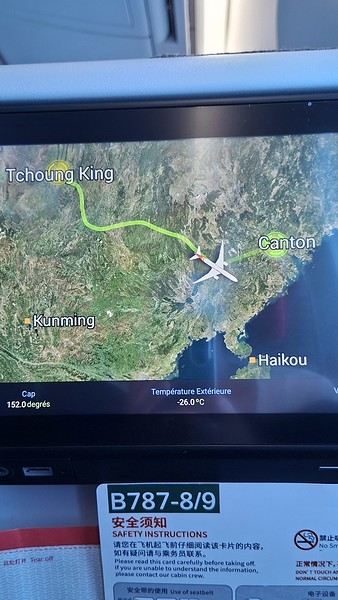
During my first two trips to China, we paid for everything in cash, but this time, we’re going all-in on Alipay and WeChat. I still brought the leftover change from previous trips—it might come in handy. At the metro station, they showed us a QR code to buy tickets via WeChat. There were probably machines and even a ticket counter, but we didn’t see them, and buying via WeChat was pretty simple. 8 yuan to Changshu Lu, which is 22 stops. So far, so good. Then, we had to find the hotel, which wasn’t on Google Maps, Maps.me, or Amap... Easy 😎! We found it without too much hassle, though. Dropped off our stuff and went out to eat. 55 yuan for two claypots with fish/eel, rice, cabbage, and purple eggplant. When we left, it was pouring. We grabbed our umbrellas and set off to explore the neighborhood: Enning Road (we’ll come back later to check out a specific spot), Shangxiajiu (the pedestrian shopping street), Baohua Road... The area is pretty diverse—one street to the next, it’s like stepping into a different world.

There weren’t many people around, probably because of the rain. We grabbed a quick street food dinner and went to bed—we were exhausted. We struggled to stay awake until 11 PM to adjust to the time change as quickly as possible. There’s a 6-hour time difference.
There wasn’t much room for improvisation on this trip—everything was planned in advance. Since August is peak season, I decided to book train tickets early, and once that was set, I reserved all the accommodations too. I got everything on Trip.com.
I bought the flight tickets back in March from Hainan Airlines. They were super expensive, but with these travel dates, I couldn’t exactly dream of a bargain!
I picked up e-SIMs valid for a month from Free just before departure: 10 € for the e-SIM + 19.90 € for a one-month plan with 35 GB of data abroad.
No need for a VPN with these e-SIMs, but D. still got one—a multi-device plan for 5 € with a discount from Let’s VPN, valid for a month. It was for evenings at the hotel on Wi-Fi to avoid burning through the 35 GB with video.
I downloaded Alipay, WeChat, Amap (Baidu Maps), and Trip.com. We also have Google Translate and Maps.me—absolute must-haves.
We’re ready to go!
I’ve been waiting for this day for nearly 15 years!! I travel a lot, but this one—this is MY TRIP 🙂 It’s been postponed so many times: because I wanted to do it with the right person, because I have a Turkish stamp in my passport and heard they don’t issue visas with that, because of COVID... and then China introduced a 30-day visa exemption, and that was the green light! Ugh, they forced us to take our vacation in August this year—far from ideal—but no more delays. Saturday, August 2, 2025: it’s finally the big day!
Days 1 and 2: We got dropped off at Charles de Gaulle at 9:30 AM. I supposedly checked in online, but only for the first flight and without getting the boarding pass... Might as well scrap online check-in in that case. So, we spent over an hour in line at the counter to get them. We didn’t have any checked luggage—just our backpacks as carry-ons—so this was a step we’d never had to deal with before, but whatever, it’s done. No wait at passport control, 5 minutes through security, a quick walk around the terminal, 10 minutes in the boarding area, and it was already time to board. Departure around 12:45 PM, arrival in Chongqing at 4:50 AM. We had a few hours of layover before our next flight. Went through immigration, connecting flight control, and security. Pro tip: check your next flight’s boarding gate right after immigration. We never saw it displayed again anywhere in the terminal.
The Free e-SIMs work—phew!
Took off at 9:30 AM, arrived in Guangzhou (Canton) at 11:20 AM in the rain. I love how Chongqing is translated as "Tchoung King" on the screens in the plane—very French!
During my first two trips to China, we paid for everything in cash, but this time, we’re going all-in on Alipay and WeChat. I still brought the leftover change from previous trips—it might come in handy. At the metro station, they showed us a QR code to buy tickets via WeChat. There were probably machines and even a ticket counter, but we didn’t see them, and buying via WeChat was pretty simple. 8 yuan to Changshu Lu, which is 22 stops. So far, so good. Then, we had to find the hotel, which wasn’t on Google Maps, Maps.me, or Amap... Easy 😎! We found it without too much hassle, though. Dropped off our stuff and went out to eat. 55 yuan for two claypots with fish/eel, rice, cabbage, and purple eggplant. When we left, it was pouring. We grabbed our umbrellas and set off to explore the neighborhood: Enning Road (we’ll come back later to check out a specific spot), Shangxiajiu (the pedestrian shopping street), Baohua Road... The area is pretty diverse—one street to the next, it’s like stepping into a different world.
There weren’t many people around, probably because of the rain. We grabbed a quick street food dinner and went to bed—we were exhausted. We struggled to stay awake until 11 PM to adjust to the time change as quickly as possible. There’s a 6-hour time difference.
Another side of my trip to Thailand: Villages, nature, countryside, mountains...
February 9th is a pivotal day during my trip to Thailand. Up until this date, my focus had been on cities, temples, and other urban landmarks. Starting February 10th, I’ll finally leave the city behind for the outskirts—one town, one life, farther from tourism, more real, more authentic... Then comes the bucolic surroundings of Chiang Mai, nature, the countryside, the mountains.
This morning, I head to visit the ethnographic museum. I’d been told about another one, but it’s permanently closed. I wonder if it’s the same one that might have changed its name and location.
I thoroughly enjoy visiting this museum. At first, I’m a bit annoyed because the place is packed with noisy school groups blocking the display cases without even showing the slightest interest. But soon, their chaperones manage to lead them into another room, giving me some peace. They maintain this distance throughout the tour, allowing me to explore the museum in complete tranquility. I really appreciate their tact.
I’m amazed by the absolutely stunning fabric displays and the countless everyday objects, especially the very old pottery. There’s so much beautiful basketry and intricately carved wood. The statues are also incredible... After seeing all of them, I no longer feel like buying any from the shops.
On my way back, not far from my hotel, I discover a rather unique place that only serves one drink, which they’ve made their specialty: egg coffee! A pretty surprising novelty. I have to try it.

At the bottom of the cup, they pour a layer of milk, topped with a layer of liquid coffee, followed by a layer of egg yolk, and finally a top layer that turns out to be a mix of coffee and cocoa powder. It’s a cold drink that, in the end, doesn’t have much flavor, and the price is pretty steep for such a small cup. You’re paying for the exclusivity!
Later in the day, I venture once again into small alleys, something I love doing when exploring a new city—no specific goal, just wandering east of the city, outside the walls.

I encounter very few tourists there and discover unsuspected little shops overflowing with lovely items, much cheaper than what you find in the heart of the tourist district. Then I wander through the floors of Warorot Market. I discover another kind of temple there: the temple of good deals. I love finding clothes that are really original for locals, not the flood of shirts and pants that tourists love but no Thai would ever buy, which invade the shops in the "Historic Square." I stop in my tracks in front of a stall with beautiful shirts featuring stunning geometric patterns in elegant color combinations and very short sleeves. Hmm, these would be perfect for showing off my biceps, one of which is adorned with the magnificent Ganesh tattoo I got last year in Bali. "When you’ve got nice things, you’ve got to show them off!" he said. 😜🙏💪 I pick out two for 380 baht and negotiate them down to 300. But the seller won’t go any lower. I understand I’ve reached the limit of her commercial possibilities. Just as I’m leaving the shop, happy with my purchase, my ever-helpful inner voice, Petite Voix, suggests: - You didn’t try them on because you were too lazy to take off the one you’re wearing and also because of the sweat, but you could just put one on over the one you’re wearing. It’s light enough that it won’t bother you.
I go back to the two sellers, who burst out laughing when I ask to try them on. - Oh no, it’s way too small for you! It’s a women’s shirt! - But they don’t look particularly feminine in style! And I chose XXL... I put the shirt on, and of course, it won’t close. Then I notice the buttons are on the wrong side. That’s why the sleeves seemed so short!!! They put the shirts back on the rack and refund me without any fuss, commenting amid total hilarity: - Well, thank goodness you tried it on just as you were leaving the shop!
Since I don’t want to walk too much before tomorrow’s first Big Outing with the driver, I end my stroll with a visit to two very pretty temples recommended by Joël.

I’d rather not post more temple photos. But these ones smell like village and countryside...


I’ve never seen anything like Wat Ket Karam, so extravagant...


And I end my day with two other lesser-known temples: Wat Noung Kham, simple and finally free of gold and glitter,

and Wat Dap Phai, where an intimate ceremony is taking place at the end of the day.
This morning, I head to visit the ethnographic museum. I’d been told about another one, but it’s permanently closed. I wonder if it’s the same one that might have changed its name and location.
I thoroughly enjoy visiting this museum. At first, I’m a bit annoyed because the place is packed with noisy school groups blocking the display cases without even showing the slightest interest. But soon, their chaperones manage to lead them into another room, giving me some peace. They maintain this distance throughout the tour, allowing me to explore the museum in complete tranquility. I really appreciate their tact.
I’m amazed by the absolutely stunning fabric displays and the countless everyday objects, especially the very old pottery. There’s so much beautiful basketry and intricately carved wood. The statues are also incredible... After seeing all of them, I no longer feel like buying any from the shops.
On my way back, not far from my hotel, I discover a rather unique place that only serves one drink, which they’ve made their specialty: egg coffee! A pretty surprising novelty. I have to try it.
At the bottom of the cup, they pour a layer of milk, topped with a layer of liquid coffee, followed by a layer of egg yolk, and finally a top layer that turns out to be a mix of coffee and cocoa powder. It’s a cold drink that, in the end, doesn’t have much flavor, and the price is pretty steep for such a small cup. You’re paying for the exclusivity!
Later in the day, I venture once again into small alleys, something I love doing when exploring a new city—no specific goal, just wandering east of the city, outside the walls.
I encounter very few tourists there and discover unsuspected little shops overflowing with lovely items, much cheaper than what you find in the heart of the tourist district. Then I wander through the floors of Warorot Market. I discover another kind of temple there: the temple of good deals. I love finding clothes that are really original for locals, not the flood of shirts and pants that tourists love but no Thai would ever buy, which invade the shops in the "Historic Square." I stop in my tracks in front of a stall with beautiful shirts featuring stunning geometric patterns in elegant color combinations and very short sleeves. Hmm, these would be perfect for showing off my biceps, one of which is adorned with the magnificent Ganesh tattoo I got last year in Bali. "When you’ve got nice things, you’ve got to show them off!" he said. 😜🙏💪 I pick out two for 380 baht and negotiate them down to 300. But the seller won’t go any lower. I understand I’ve reached the limit of her commercial possibilities. Just as I’m leaving the shop, happy with my purchase, my ever-helpful inner voice, Petite Voix, suggests: - You didn’t try them on because you were too lazy to take off the one you’re wearing and also because of the sweat, but you could just put one on over the one you’re wearing. It’s light enough that it won’t bother you.
I go back to the two sellers, who burst out laughing when I ask to try them on. - Oh no, it’s way too small for you! It’s a women’s shirt! - But they don’t look particularly feminine in style! And I chose XXL... I put the shirt on, and of course, it won’t close. Then I notice the buttons are on the wrong side. That’s why the sleeves seemed so short!!! They put the shirts back on the rack and refund me without any fuss, commenting amid total hilarity: - Well, thank goodness you tried it on just as you were leaving the shop!
Since I don’t want to walk too much before tomorrow’s first Big Outing with the driver, I end my stroll with a visit to two very pretty temples recommended by Joël.
I’d rather not post more temple photos. But these ones smell like village and countryside...
I’ve never seen anything like Wat Ket Karam, so extravagant...
And I end my day with two other lesser-known temples: Wat Noung Kham, simple and finally free of gold and glitter,
and Wat Dap Phai, where an intimate ceremony is taking place at the end of the day.
What are the criteria that make you choose one destination over another?
Hi there,
The title might be a bit long, but I hope it’s completely understandable!
When it comes to choosing your next trip, what tips the scales in favor of Eritrea over Ibiza?
Why pick Canada over French Polynesia?
The price? A magazine or TV report, a travel journal, an Instagram ad? Ease of travel? Minimal time difference? The country that has the most in common with all the trip participants? Activities? Relaxation? The desire to push your limits?
A photo?
What else, I wonder...
Personally, I often prioritize simple destinations (no administrative hassles), where I’m not at risk (nothing extraordinary like getting kidnapped by Daesh or ending up in a jail cell because the current geopolitics aren’t favorable to my passport, etc.), and where I can drive.
Wide-open natural spaces are more my thing than urban anthills.
Finally, I try not to spend three days on a plane to reach my destination, and I aim for a maximum budget of 3500 € (for 3 weeks) in comfortable conditions—that means charming hotels, good meals, etc.
What about you?🙂
The title might be a bit long, but I hope it’s completely understandable!
When it comes to choosing your next trip, what tips the scales in favor of Eritrea over Ibiza?
Why pick Canada over French Polynesia?
The price? A magazine or TV report, a travel journal, an Instagram ad? Ease of travel? Minimal time difference? The country that has the most in common with all the trip participants? Activities? Relaxation? The desire to push your limits?
A photo?
What else, I wonder...
Personally, I often prioritize simple destinations (no administrative hassles), where I’m not at risk (nothing extraordinary like getting kidnapped by Daesh or ending up in a jail cell because the current geopolitics aren’t favorable to my passport, etc.), and where I can drive.
Wide-open natural spaces are more my thing than urban anthills.
Finally, I try not to spend three days on a plane to reach my destination, and I aim for a maximum budget of 3500 € (for 3 weeks) in comfortable conditions—that means charming hotels, good meals, etc.
What about you?🙂
Family road trip in the Balkans for 16/17 nights
Hi there,
I’m planning a family road trip (with young kids) next August in Montenegro, Bosnia, and Dubrovnik. Not sure if it’s doable to combine all three in 16/17 nights.
Here’s my first draft itinerary:
Day 1: Arrival in Dubrovnik. Head to Mostar (Blagaj village, Kravica waterfalls, Počitelj) in Bosnia. 3 nights. 2h35 drive Day 4: Head to Sarajevo (city), stopping by Jablanica Lake for 2 nights. 2h00 drive. Unsure if we should go all the way to the capital. Day 6: Head to Durmitor National Park (Zabljak) for 3 nights (hike, Durmitor Ring, Tara Canyon, Black Lake). 4h00 drive (anything worth seeing along the way?) Day 9: Head to the Bay of Kotor (between Kotor and Budva) for 4 nights. 3h00 drive. Day 13: Morning departure for Mljet Island (Croatia) for 3 nights. 5h00 drive (via Trebinje in Bosnia). Day 16: Head back to Dubrovnik (city + Lokrum Island) for 1/2 nights. Day 17/18: Return flight
What do you think?
Day 1: Arrival in Dubrovnik. Head to Mostar (Blagaj village, Kravica waterfalls, Počitelj) in Bosnia. 3 nights. 2h35 drive Day 4: Head to Sarajevo (city), stopping by Jablanica Lake for 2 nights. 2h00 drive. Unsure if we should go all the way to the capital. Day 6: Head to Durmitor National Park (Zabljak) for 3 nights (hike, Durmitor Ring, Tara Canyon, Black Lake). 4h00 drive (anything worth seeing along the way?) Day 9: Head to the Bay of Kotor (between Kotor and Budva) for 4 nights. 3h00 drive. Day 13: Morning departure for Mljet Island (Croatia) for 3 nights. 5h00 drive (via Trebinje in Bosnia). Day 16: Head back to Dubrovnik (city + Lokrum Island) for 1/2 nights. Day 17/18: Return flight
What do you think?
A lovely wander at the mercy of the wind in this amazing Rajasthan
Hey there, forum friends 😉
Some of you have mentioned missing the activity on this Indian "page," so let’s try to liven things up a bit—with joy and good vibes (mandatory with me 😜). Plus, it’ll make Jojoone happy 😊.
As big lovers of India—we’ve been six times—my co-traveler husband and I decided to explore Rajasthan this time around. The reason we waited so long to come here? We were dreading the tourist crowds in this state. But thanks to the timing (late March to early April 2024, which is starting to get pretty hot) and Aleph’s great tips, we were *very* far from mass tourism.
We spent three weeks getting around on our own for transport: mostly taxis and trains.
And I’ll admit, we had a rather "Arabian Nights" experience, far from the "real" India (Marien, if you’re reading this 😉). So this travel journal makes no claims other than to share what we saw, experienced, and felt—with all our ignorance about this country (which I’m fully aware of).
But fair warning: I go overboard with emojis, and this journal is super casual because it’s the one I share, almost in "live" mode, with our loved ones.
So, if you’re here, consider yourself almost part of the family 😄.
See you soon and....
Some of you have mentioned missing the activity on this Indian "page," so let’s try to liven things up a bit—with joy and good vibes (mandatory with me 😜). Plus, it’ll make Jojoone happy 😊.
As big lovers of India—we’ve been six times—my co-traveler husband and I decided to explore Rajasthan this time around. The reason we waited so long to come here? We were dreading the tourist crowds in this state. But thanks to the timing (late March to early April 2024, which is starting to get pretty hot) and Aleph’s great tips, we were *very* far from mass tourism.
We spent three weeks getting around on our own for transport: mostly taxis and trains.
And I’ll admit, we had a rather "Arabian Nights" experience, far from the "real" India (Marien, if you’re reading this 😉). So this travel journal makes no claims other than to share what we saw, experienced, and felt—with all our ignorance about this country (which I’m fully aware of).
But fair warning: I go overboard with emojis, and this journal is super casual because it’s the one I share, almost in "live" mode, with our loved ones.
So, if you’re here, consider yourself almost part of the family 😄.
See you soon and....
Tuscany: Arezzo province and the Siena area
So happy the forum reopened last October!!!
I’ve started reading again (posts, travel journals) and chiming in on a few discussions. Now I’m stepping it up by writing a new travel journal—I’ve already posted a few between 2018 and 2020.
My latest trip was to Italy from August 27 to September 26, 2024. As the title says, it was a wander through Tuscany in parts of the region that aren’t the most visited. No Firenze-Siena-Pisa trilogy, no San Gimignano; there’ll be a quick detour into Siena, but I’ll skip the best-known sights. That choice, plus traveling in September, should help dodge overtourism. It worked out—crowds were light, sometimes very light, the whole way. Here’s the practical rundown: - a long trip outside peak season (ah, retirees!) - solo camping (caravan) - a mix of activities (hiking, mountain biking, sightseeing) in places that aren’t always packed with tourists. Still, I don’t feel like I ended up in some hidden-away spots. Not sure if this will draw any readers.
DAY 1: Tuesday, August 27, 2024 The heat was intense on the drive in across the plain; two big storms—more rain and hail than lightning and thunder—threw the weather off, the first near Imola, the second on the four-lane road up the Savio valley. I left the Cesena-Roma four-lane at the Verghereto exit and climbed up to Balze (1,100 meters). The campsite is even higher (1,200 meters), in the forest near the source of the Tevere (Tiber). Staying up here will cut down on driving for the first part of the trip: a route through the Appennino (Apennines) on the border between Toscana and Emilia-Romagna. The temperature was surprisingly mild for the altitude, the air thick with moisture by late afternoon. I drove back down from the campsite to Balze (2 km on the road) to grab groceries (it’s doable) and scout tomorrow’s hike. .
The endpoint of the planned hike is just a few meters from this sign (the trail crosses this road about 3 km from Balze). I realized Balze and the source of the Tevere (Tiber) are actually in Emilia-Romagna, not Toscana. I always thought the Tevere (Tiber), which flows toward Roma (Tyrrhenian side), started in Toscana! I’ll come back to this quirk in Day 3’s write-up.
My latest trip was to Italy from August 27 to September 26, 2024. As the title says, it was a wander through Tuscany in parts of the region that aren’t the most visited. No Firenze-Siena-Pisa trilogy, no San Gimignano; there’ll be a quick detour into Siena, but I’ll skip the best-known sights. That choice, plus traveling in September, should help dodge overtourism. It worked out—crowds were light, sometimes very light, the whole way. Here’s the practical rundown: - a long trip outside peak season (ah, retirees!) - solo camping (caravan) - a mix of activities (hiking, mountain biking, sightseeing) in places that aren’t always packed with tourists. Still, I don’t feel like I ended up in some hidden-away spots. Not sure if this will draw any readers.
DAY 1: Tuesday, August 27, 2024 The heat was intense on the drive in across the plain; two big storms—more rain and hail than lightning and thunder—threw the weather off, the first near Imola, the second on the four-lane road up the Savio valley. I left the Cesena-Roma four-lane at the Verghereto exit and climbed up to Balze (1,100 meters). The campsite is even higher (1,200 meters), in the forest near the source of the Tevere (Tiber). Staying up here will cut down on driving for the first part of the trip: a route through the Appennino (Apennines) on the border between Toscana and Emilia-Romagna. The temperature was surprisingly mild for the altitude, the air thick with moisture by late afternoon. I drove back down from the campsite to Balze (2 km on the road) to grab groceries (it’s doable) and scout tomorrow’s hike. .
The endpoint of the planned hike is just a few meters from this sign (the trail crosses this road about 3 km from Balze). I realized Balze and the source of the Tevere (Tiber) are actually in Emilia-Romagna, not Toscana. I always thought the Tevere (Tiber), which flows toward Roma (Tyrrhenian side), started in Toscana! I’ll come back to this quirk in Day 3’s write-up.
Petit tour dans le Péloponnèse English translation pending
Tous nos séjours en Grèce nous ont enchantées alors, après un séjour en Crète, à Rhodes, à Zakynthos et en Grèce centrale, pourquoi pas un tour du Péloponnèse?
Nous avons quelques hésitations quant à la chaleur possible (notamment pour les randonnées) mais finalement, hop! la réservation des billets d'avion est faite fin janvier: ce sera un départ de Bruxelles (avec Brussels airlines) le 05/07 à 7h30. Puis arrive le (la) Covid avec son lot d'incertitudes: partira? Partira pas? Partira? Partira pas? Faut-il tout annuler, reporter? Au mois de juin les règles d'ouverture des frontières changent en permanence mais il arrive un moment où il faut bien se décider car certains hébergements ne sont plus annulables. Les frontières de la Grèce doivent théoriquement ouvrir totalement le 1er juillet (sous réserve de...) on doit partir le 5 ...alors, c'est décidé, on part! ...enfin, si tout se passe comme prévu!
L'ouest du Péloponnèse ne m'inspire pas plus que ça. Par contre Cythère me tente bien, alors voilà à quoi ressemblera notre circuit (on prendra le bateau pour Cythère à Neapoli):
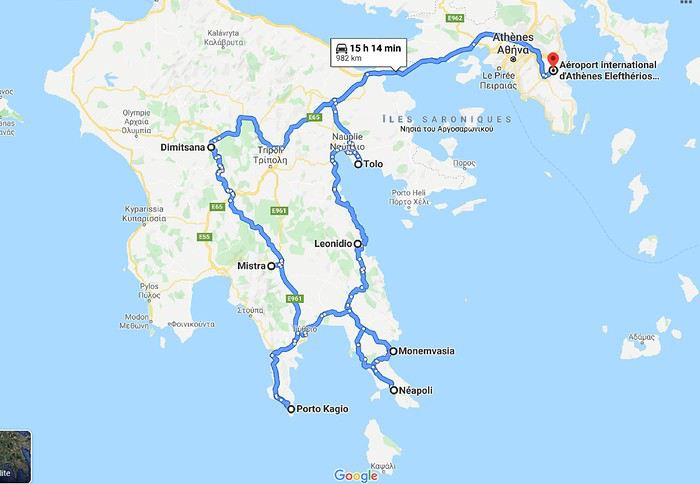 Muriel
Nous avons quelques hésitations quant à la chaleur possible (notamment pour les randonnées) mais finalement, hop! la réservation des billets d'avion est faite fin janvier: ce sera un départ de Bruxelles (avec Brussels airlines) le 05/07 à 7h30. Puis arrive le (la) Covid avec son lot d'incertitudes: partira? Partira pas? Partira? Partira pas? Faut-il tout annuler, reporter? Au mois de juin les règles d'ouverture des frontières changent en permanence mais il arrive un moment où il faut bien se décider car certains hébergements ne sont plus annulables. Les frontières de la Grèce doivent théoriquement ouvrir totalement le 1er juillet (sous réserve de...) on doit partir le 5 ...alors, c'est décidé, on part! ...enfin, si tout se passe comme prévu!
L'ouest du Péloponnèse ne m'inspire pas plus que ça. Par contre Cythère me tente bien, alors voilà à quoi ressemblera notre circuit (on prendra le bateau pour Cythère à Neapoli):
MurielVous interdisez-vous de voyager dans certains pays pour des raisons morales ou politiques? English translation pending
Hallo les voyageurs !
J'ai une question pour vous qui vous baladez de par le vaste monde.
Est-ce que vous prenez en considération le régime politique d'un pays lorsque vous choisissez une destination ? En d'autres termes, est-ce que vous décidez de ne pas vous rendre dans certains pays pour ne pas légitimer en quelque sorte le régime en place ?
Dans le LP sur la Birmanie, ils posent la question : "should you go there ?" et ensuite ils essaient de peser le pour et le contre dans un passage dédié. Faites-vous de même ?
Par exemple, iriez-vous en Corée du Nord, en Chine, en Biélorussie ou en Iran pour ne citer que quelques charmants pays amis des droits de l'Homme ? Si oui, vous sentez-vous le besoin de vous justifier, et comment ? Sinon, quels sont vos raisons qui vous font reculer ?
J'ai parlé de morale dans mon titre, est-ce que ce terme vous semble approprié ?
A vous lire,
Claude
J'ai une question pour vous qui vous baladez de par le vaste monde.
Est-ce que vous prenez en considération le régime politique d'un pays lorsque vous choisissez une destination ? En d'autres termes, est-ce que vous décidez de ne pas vous rendre dans certains pays pour ne pas légitimer en quelque sorte le régime en place ?
Dans le LP sur la Birmanie, ils posent la question : "should you go there ?" et ensuite ils essaient de peser le pour et le contre dans un passage dédié. Faites-vous de même ?
Par exemple, iriez-vous en Corée du Nord, en Chine, en Biélorussie ou en Iran pour ne citer que quelques charmants pays amis des droits de l'Homme ? Si oui, vous sentez-vous le besoin de vous justifier, et comment ? Sinon, quels sont vos raisons qui vous font reculer ?
J'ai parlé de morale dans mon titre, est-ce que ce terme vous semble approprié ?
A vous lire,
Claude