Results for "Barre+Monts+ou+Fromentine+|+127"
12227 results found.
Vélo et chien... English translation pending
bonjour a tous
je fais pas mal de vtt et je suis confronte à un petit souci dans ma campagne qui commence à m'exaspérer : j'en ai marre de me faire courser par des chiens !!! bon d'accord ca me fait faire quelques sprints mais il va bien arriver un jour ou je vais perdre...
je n'ai pas tres envie de perdre une partie de mes mollets (d'acier...)
j'ai entendu parler d'un boitier anti-chien qui envoit des ultras sons.
est ce vraiment efficace et sans danger pour le chien ?
ou puis je acheter cet appareil ?
bonne route a tous
Des avis sur lastminute.com English translation pending
Bonjour,
Je souhaite reserver un week end a londres sur lastminute.com, j'ai trouvée une offre qui me parais tres interessante : eurostar aller/retour + 2 nuits d'hotel 3* avec petits dejeuner dans la city de Londres pour 188 euros par pers. 😎
Mais je n'ose pas encore reserver car cela ne me parait pas cher, j'ai peur de me faire avoir en passant par une agence en ligne. 😕
S'il y en a parmis vous qui sont parti avec cette agence, donner moi votre avis. 😉
Merci d'avance
Je souhaite reserver un week end a londres sur lastminute.com, j'ai trouvée une offre qui me parais tres interessante : eurostar aller/retour + 2 nuits d'hotel 3* avec petits dejeuner dans la city de Londres pour 188 euros par pers. 😎
Mais je n'ose pas encore reserver car cela ne me parait pas cher, j'ai peur de me faire avoir en passant par une agence en ligne. 😕
S'il y en a parmis vous qui sont parti avec cette agence, donner moi votre avis. 😉
Merci d'avance
France: rencontre à Strasbourg le 1er septembre 2004 English translation pending
Hello
Voilà j'ai une horrible réunion de boulot les 2 & 3 septembre à Strasbourg... J'ai fait tout ce que j'ai pu pour me défiler, mais mon patron a sorti l'artillerie lourde en mettant sur la balance mon mois de vacances qu'il "m'accorde exceptionnellement chaque hiver à la place du mois d'août", alors évidemment la balance elle a fait "chbing"... 😕 (je parle pas fort pour pas qu'il entende, c'est pour çà j'utilise la police de caractères 8)
DOnc, histoire de me motiver à bosser le lendemain et de rendre ce voyage + alléchant, je propose une rencontre entre les membres Strasbourgeois (n'est ce pas trekkeurbeub?😉) le
 mercredi 1er septembre à partir de 20h.
Par contre faut déterminer un lieu sympa, je connais pas Strasbourg (il parait que c'est beau, mais l'info vient de mon patron, alors je me méfie...). De plus, il me semble que la méthode Lyonnaise (ou méthode Pimpelune) reste la meilleure: pique-nique dans l'herbe où chacun amène une spécialité étrangère de préférence... à moins que la créativité strasbourgeoise soit encore + débordante qu'à Lyon!
Qu'en pensez vous? Qui pourrait venir me soutenir psychologiquement ce soir là 😏?
Je précise que je fais Lyon-Strasbourg en voiture le 01/09 après midi + le 3/9 au soir - covoiturage possible, attention c'est une AX un peu tape-cul genre taxi-brousse ... Ah ben on peut pas voyager souvent et se payer une Limousine quand même !😛
a+
PS: AU fait, y a t'il une auberge de Jeunesse ou un truc de ce genre à côté de l'Université de Strasbourg 1 ? merci!!
Voilà j'ai une horrible réunion de boulot
les 2 & 3 septembre à Strasbourg... J'ai fait tout ce que j'ai pu pour me défiler, mais mon patron a sorti l'artillerie lourde en mettant sur la balance mon mois de vacances qu'il "m'accorde exceptionnellement chaque hiver à la place du mois d'août", alors évidemment la balance elle a fait "chbing"... 😕 (je parle pas fort pour pas qu'il entende, c'est pour çà j'utilise la police de caractères 8)DOnc, histoire de me motiver à bosser le lendemain et de rendre ce voyage + alléchant, je propose une rencontre entre les membres Strasbourgeois (n'est ce pas trekkeurbeub?😉) le
mercredi 1er septembre à partir de 20h. Par contre faut déterminer un lieu sympa, je connais pas Strasbourg (il parait que c'est beau, mais l'info vient de mon patron, alors je me méfie...). De plus, il me semble que la méthode Lyonnaise (ou méthode Pimpelune) reste la meilleure: pique-nique dans l'herbe où chacun amène une spécialité étrangère de préférence... à moins que la créativité strasbourgeoise soit encore + débordante qu'à Lyon!
Qu'en pensez vous? Qui pourrait venir me soutenir psychologiquement ce soir là 😏?
Je précise que je fais Lyon-Strasbourg en voiture le 01/09 après midi + le 3/9 au soir - covoiturage possible, attention c'est une AX un peu tape-cul genre taxi-brousse
... Ah ben on peut pas voyager souvent et se payer une Limousine quand même !😛a+
PS: AU fait, y a t'il une auberge de Jeunesse ou un truc de ce genre à côté de l'Université de Strasbourg 1 ? merci!!
Enquête fiabilité mécanique d'un toyota liteace diesel English translation pending
Dans mon cas un Toyota Liteace Diesel 1987 de achete en 1998 15.000 FF a 190.000 km et qui a maintenant 320.000 km. La seule panne mecanique que j'ai eu a ete un contacteur de demarreur (450 FF de reparation). Quelles sont vos experiences, vos connaissances, les reputations de fiabilite mecanique?
La Russie vue du ciel! English translation pending
Alors voila, j'ai un rêve c'est de piloter, j'ai un autre rêve c'est d'aller en Russie alors je me suis dis pourquoi pas concilier les deux ! Mais je suis encore trop jeune, je suis élève pilote sur HR200 (pour ce qui connaissent...) je compte avoir mon brevet de base et ma licence de pilote dans les deux prochaines années et j'aurai aimé savoir quels sont les coins de Russie les plus interessants vus du ciel ? Quelle est la réglementation aéronautique russe en cas de survol du territoire par des étrangers ? Quels visa etc faut il ? Y-a-t-il des licence russe à passer pour voler en Russie ? Est-ce que l'on peut utiliser un appareil immatriculé en France ? La radio se fait bien en anglais ou le mieux c'est que j'essaie en russe ?
Enfin bref, j'ai plein beaucoup de questions 😛
Alors si un pilote passe par là et qu'il a 5 minutes...🙂
Enfin bref, j'ai plein beaucoup de questions 😛
Alors si un pilote passe par là et qu'il a 5 minutes...🙂
Shanti India... Mon 1er voyage... English translation pending
Mombaï, le 22 novembre
05 h 30 du mat’.
La première bouffée d’air, dès que les portes de l’avion se sont ouvertes, sentait… Je ne sais pas très bien quoi mais ça sentait ! Parfois bon, parfois mauvais. Les odeurs d’encens ou d’épices sont très agréables, seulement parfois elles se mélangent aux odeurs de j'sais pas quoi mais des odeurs bien moins agréable que le jasmin... Dans un état d’épuisement total, je suis dans le bus qui se dirige vers le centre ville. On traverse des bidonvilles, les vieilles baraques de bois partout, une crasse et une poussière incroyable, et puis des indiennes en saris ! Qu’est ce qu’elles sont belles et élégantes… Je flashe au maximum sur les couleurs, rose vif, rouge vermillon, bleu roi ou vert, nous sommes toujours si gris en Europe à côté… Dans le bus, je fais la connaissance de Luc, un belge de Ciney (bourgade célèbre pour sa bière !) chouette, ce n’est pas son premier voyage en Inde, nous passons la journée ensemble et il m’aide pour l’achat d’un ticket de train qui part le soir même pour Hospet, près d’Hampi dont j’ai entendu beaucoup de bien. Après qu’il ait déposé son sac à son hôtel, nous sommes partis visiter la ville, la fameuse «Gateway Of India», les rues pleines de monde, des mendiants partout, et les autres qui passent indiffèrent... Le look des gens est incroyable… Ce n’est que mon premier jour et je n’arrête pas d’écarquiller les yeux! Nous mangeons d’un simple mais bon p’tit plat, et je me retrouve déjà dans le train. Les couchettes sont déjà installées, deux autres touristes voyageurs au-dessus de moi se sont réveillés, je m’installe en faisant le moins de bruit possible, mais je ne m’endors pas facilement… Au matin je descends à Guntakal, et je reprends un autre train pour Hospet. Je papote avec une anglaise qui retourne demain chez elle, la pauvre, quelle horrible météo en Angleterre… La gare grouille encore de monde. Je m’achète un chaï, le thé indien aux épices, mon premier chaï est un délice, j’aime beaucoup 🙂 J’observe les coolies, ils font partie de l’image classique de l’Inde, ne portant qu’un pagne, maigres mais superbes, ils représentent toute la misère et la pauvreté du sous continent.
Encore quelques heures de train, et j’arrive enfin à Hospet. Je prends un rickshaw, ces taxis à trois roues comme les tuk tuk thaïlandais, et me voilà à Hampi.
"Hello postcards? Books? Hello Guest House?" me demandent les gosses... Je traverse le village, et me dirige vers la rivière, passe à côté d’un grand temple ressemblant à ceux que j’ai vu dans des livres de photos d’Inde, des statues de la mythologie Hindoue sculptées sur toutes les parois, les femmes en saris multicolores, des mômes sales et des hommes habillés un peu à l’européenne y entrent et sortent. Les rues sont en terre battue, la vie à l’air bien calme ici… Comme me l’avait conseillé l’Anglaise rencontrée à la gare, je vais chercher un guest house de l’autre côté de la rivière. J’attends la drôle de petite barque ronde en bambou, elle ne m’a pas l’air très solide et surtout pas très étanche… Mais ça à l’air d’aller! Les orteils sont bien un rien mouillés, je tiens mon sac sur mes genoux, accroupie, comme la dizaine d’autre personne dans la barque. Une fois cette traversée effectuée, je prends le petit chemin de gauche, à travers la campagne extraordinairement belle… Je croise une magnifique indienne vendant des pommes qu’elle porte dans un panier d’osier sur sa tête. "Namasté" me dit-elle, je ne résiste pas et lui en achète une. Sous le ciel bleu, sur ce chemin de terre rouge, mon sac est léger sur le dos. Je croque à pleine dent dans cette succulente pomme, je profite de tous mes sens de cet instant… Je suis heureuse comme un poisson dans l’eau. Après avoir visité quelques guest houses, je choisis le mignon "Roots n’Rock". La région d'Hampi est entouré de gros ou gigantesques rochers, c'est super joli. Au "Roots n’ Rock" je demande une chambre, et avant que je ne m’installe, comme la pièce n’était pas très clean, je dois attendre un moment qu’on la nettoie… Alors je prends une douche, bois un "mango lassi", boisson lactée à base de mangue, et papote avec d’autres voyageurs… Quand on vient m’annoncer que c’est prêt, je vois les murs recouverts de brun… Et voilà qu’on me dit que ça écarte les mouches… Après quelques secondes, je comprends que c’est de la bouse de vache!!! Comme mon budget ne me permet pas un hôtel à étoiles (d’ailleurs il n’y en a pas dans ce bled), je paie 10 jours 7 $, et installe mes affaires en prenant bien soin de ne pas toucher les murs encore frais de leur "peinture" locale… Une vache pointe son museau par la fenêtre toujours ouverte "Bonjour sacrée vache, si tu veux te lacher n'hésites pas...🤪"
25/11 Hier soir j’ai trouvé que les insectes faisaient un boucan d’enfer dans ma chambre, mais ce matin, j’ai trouvé trois grosses grenouilles ou crapauds, je ne suis pas experte en batracien, dont un juste à côté de mon oreiller !!! P’tit dèj’ pancake, café et salade de fruits du coin, c’est à dire banane, mangue et ananas et je m’en vais au village… Reprends le petit chemin de terre rouge bordé de palmiers de toutes sortes, la barque trop marante, et me voilà dans la rue principale. Installée à la terrasse d’un bui bui, je commande un lassi spécial, et rêve devant la vie de ce village… J’adoooore regarder la vie très colorée des indiens… Les rickshaws jaunes et noirs, les bus brinque ballants couverts de déités peintes à la main de couleurs vives, les gens vivant comme dans un autre siècle, les singes partout courant de toit en toit, les vaches se baladant comme de rien n’était, les enfants n’arrêtent pas de demander des "school pen", les mendiants n’arrêtent pas de mendier, et les vendeurs de toutes sortes d’essayer de vendre. "Banana? Good Banana!"
Je rencontre deux Français arrivant directement de Manali, petite ville tout au nord de l’Inde, quel bien fou de parler à nouveau sa langue maternelle… Ils cherchent un sympa guest house au calme, alors je leurs conseille là où je suis. On mange un thali, papotons encore et nous dirigeons vers la rivière. On s’est payé de ces fous rires dans la barque, et comme c’est contagieux, tous les passagers nous ont imités, ne comprenant rien au français, mais le rire de Françoise est décidément trop cocasse. Le lendemain, je me décide d’aller voir les temples parsemés dans la campagne avoisinante, une joli chemin rocailleux mène au « Vittala Temple » datant du début du 16ème siècle. Ce temple est le plus important et le mieux conservé, de plus ses colonnes merveilleusement sculptées sont creuses et chacune d’elles émet une note ! Dans la cour où je suis, se trouve le petit temple en forme de char, très connu et très photographié. Je prends des heures pour écrire car cet endroit, ce temple, est tellement beau que je relève tout le temps la tête pour rêver devant ces beautés… J’attends que le ciel se dégage pour prendre des photos, guettant chaque rayon de soleil… Je m’extasie en observant la nature, j’écoute les cris d’oiseaux parfois très étranges, et suis transportée dans un monde si serein et si relax par un vol de perroquet passant à quelques mètres au-dessus de ma tête. Je reste là à rêver pendant des heures et des heures… …/… Je suis revenue au village avec trois Italiens avec qui j’avais papoté un moment au temple, et c’est tant mieux, car à ce qu’il paraît, en fin de journée les chemins ne sont pas très surs pour une voyageuse solo. 28/11 La saison touristique commence petit à petit, de plus en plus de voyageurs arrivent des quatre coins du monde, et Hampi est un passage obligé dans cette partie de l’Inde. Beaucoup de voyageurs ont toujours un instrument de musique avec eux, un bel israélien joue de la guitare, un charmant italien ne quitte jamais son didgeridoo, et Olivier, le copain de Françoise joue des petites percussions. L’ambiance est souvent très très chouette. Les shiloms tournent, j’observe toujours les beautés de la nature, les papillons multicolores, les oiseaux jaunes et verts à taches blanches et aux longs becs, une grande abeille jaune et noire au corps très mince. L’espèce de gros choucas fait un boucan d’enfer pendant de longues minutes, il s’est installé dans le palmier où j’ai attaché mon hamac, dans lequel j’écris. Je ne l’oublie jamais sous les tropiques, je le trouve trop indispensable! Mais quand même après avoir "bien" déjeuné, j’ai loué un vélo, et suis partie me faire des muscles et perdre des kilos sur les chemins d’Hampi.
Il fait super chaud et humide, la mousson n’est pas encore terminée, mais c’est un endroit tellement superbe, on trouve de grosses statues de Ganesh ou de Shiva au croisement d’un petit chemin, ou des adorables petits temples au milieu de bananeraies ou palmeraies, vraiment splendides comme moments. Un petit écureuil crie comme un fou, peut être crie-t-il après sa dulcinée ? Les oiseaux chantent à cœur joie, époustouflants de beautés. J’observe ce que je pense être un pivert, ensuite mon regard s’arrête sur des petits perroquets, et sur d’autres sublimes oiseaux dont je n’ai pas la moindre idée du nom. L’écureuil n’a pas bougé, moi non plus d’ailleurs, j’écoute le vent frapper les feuilles de bananiers les unes contre les autres. Le ciel est tout bleu avec quelques tous petits nuages, et je suis installée à l’ombre, sur des grosses pierres de ce petit temple tout perdu. J’ai quasi fini ma bouteille d’eau, je vais devoir penser à bouger…../...
La première bouffée d’air, dès que les portes de l’avion se sont ouvertes, sentait… Je ne sais pas très bien quoi mais ça sentait ! Parfois bon, parfois mauvais. Les odeurs d’encens ou d’épices sont très agréables, seulement parfois elles se mélangent aux odeurs de j'sais pas quoi mais des odeurs bien moins agréable que le jasmin... Dans un état d’épuisement total, je suis dans le bus qui se dirige vers le centre ville. On traverse des bidonvilles, les vieilles baraques de bois partout, une crasse et une poussière incroyable, et puis des indiennes en saris ! Qu’est ce qu’elles sont belles et élégantes… Je flashe au maximum sur les couleurs, rose vif, rouge vermillon, bleu roi ou vert, nous sommes toujours si gris en Europe à côté… Dans le bus, je fais la connaissance de Luc, un belge de Ciney (bourgade célèbre pour sa bière !) chouette, ce n’est pas son premier voyage en Inde, nous passons la journée ensemble et il m’aide pour l’achat d’un ticket de train qui part le soir même pour Hospet, près d’Hampi dont j’ai entendu beaucoup de bien. Après qu’il ait déposé son sac à son hôtel, nous sommes partis visiter la ville, la fameuse «Gateway Of India», les rues pleines de monde, des mendiants partout, et les autres qui passent indiffèrent... Le look des gens est incroyable… Ce n’est que mon premier jour et je n’arrête pas d’écarquiller les yeux! Nous mangeons d’un simple mais bon p’tit plat, et je me retrouve déjà dans le train. Les couchettes sont déjà installées, deux autres touristes voyageurs au-dessus de moi se sont réveillés, je m’installe en faisant le moins de bruit possible, mais je ne m’endors pas facilement… Au matin je descends à Guntakal, et je reprends un autre train pour Hospet. Je papote avec une anglaise qui retourne demain chez elle, la pauvre, quelle horrible météo en Angleterre… La gare grouille encore de monde. Je m’achète un chaï, le thé indien aux épices, mon premier chaï est un délice, j’aime beaucoup 🙂 J’observe les coolies, ils font partie de l’image classique de l’Inde, ne portant qu’un pagne, maigres mais superbes, ils représentent toute la misère et la pauvreté du sous continent.
Encore quelques heures de train, et j’arrive enfin à Hospet. Je prends un rickshaw, ces taxis à trois roues comme les tuk tuk thaïlandais, et me voilà à Hampi.
"Hello postcards? Books? Hello Guest House?" me demandent les gosses... Je traverse le village, et me dirige vers la rivière, passe à côté d’un grand temple ressemblant à ceux que j’ai vu dans des livres de photos d’Inde, des statues de la mythologie Hindoue sculptées sur toutes les parois, les femmes en saris multicolores, des mômes sales et des hommes habillés un peu à l’européenne y entrent et sortent. Les rues sont en terre battue, la vie à l’air bien calme ici… Comme me l’avait conseillé l’Anglaise rencontrée à la gare, je vais chercher un guest house de l’autre côté de la rivière. J’attends la drôle de petite barque ronde en bambou, elle ne m’a pas l’air très solide et surtout pas très étanche… Mais ça à l’air d’aller! Les orteils sont bien un rien mouillés, je tiens mon sac sur mes genoux, accroupie, comme la dizaine d’autre personne dans la barque. Une fois cette traversée effectuée, je prends le petit chemin de gauche, à travers la campagne extraordinairement belle… Je croise une magnifique indienne vendant des pommes qu’elle porte dans un panier d’osier sur sa tête. "Namasté" me dit-elle, je ne résiste pas et lui en achète une. Sous le ciel bleu, sur ce chemin de terre rouge, mon sac est léger sur le dos. Je croque à pleine dent dans cette succulente pomme, je profite de tous mes sens de cet instant… Je suis heureuse comme un poisson dans l’eau. Après avoir visité quelques guest houses, je choisis le mignon "Roots n’Rock". La région d'Hampi est entouré de gros ou gigantesques rochers, c'est super joli. Au "Roots n’ Rock" je demande une chambre, et avant que je ne m’installe, comme la pièce n’était pas très clean, je dois attendre un moment qu’on la nettoie… Alors je prends une douche, bois un "mango lassi", boisson lactée à base de mangue, et papote avec d’autres voyageurs… Quand on vient m’annoncer que c’est prêt, je vois les murs recouverts de brun… Et voilà qu’on me dit que ça écarte les mouches… Après quelques secondes, je comprends que c’est de la bouse de vache!!! Comme mon budget ne me permet pas un hôtel à étoiles (d’ailleurs il n’y en a pas dans ce bled), je paie 10 jours 7 $, et installe mes affaires en prenant bien soin de ne pas toucher les murs encore frais de leur "peinture" locale… Une vache pointe son museau par la fenêtre toujours ouverte "Bonjour sacrée vache, si tu veux te lacher n'hésites pas...🤪"
25/11 Hier soir j’ai trouvé que les insectes faisaient un boucan d’enfer dans ma chambre, mais ce matin, j’ai trouvé trois grosses grenouilles ou crapauds, je ne suis pas experte en batracien, dont un juste à côté de mon oreiller !!! P’tit dèj’ pancake, café et salade de fruits du coin, c’est à dire banane, mangue et ananas et je m’en vais au village… Reprends le petit chemin de terre rouge bordé de palmiers de toutes sortes, la barque trop marante, et me voilà dans la rue principale. Installée à la terrasse d’un bui bui, je commande un lassi spécial, et rêve devant la vie de ce village… J’adoooore regarder la vie très colorée des indiens… Les rickshaws jaunes et noirs, les bus brinque ballants couverts de déités peintes à la main de couleurs vives, les gens vivant comme dans un autre siècle, les singes partout courant de toit en toit, les vaches se baladant comme de rien n’était, les enfants n’arrêtent pas de demander des "school pen", les mendiants n’arrêtent pas de mendier, et les vendeurs de toutes sortes d’essayer de vendre. "Banana? Good Banana!"
Je rencontre deux Français arrivant directement de Manali, petite ville tout au nord de l’Inde, quel bien fou de parler à nouveau sa langue maternelle… Ils cherchent un sympa guest house au calme, alors je leurs conseille là où je suis. On mange un thali, papotons encore et nous dirigeons vers la rivière. On s’est payé de ces fous rires dans la barque, et comme c’est contagieux, tous les passagers nous ont imités, ne comprenant rien au français, mais le rire de Françoise est décidément trop cocasse. Le lendemain, je me décide d’aller voir les temples parsemés dans la campagne avoisinante, une joli chemin rocailleux mène au « Vittala Temple » datant du début du 16ème siècle. Ce temple est le plus important et le mieux conservé, de plus ses colonnes merveilleusement sculptées sont creuses et chacune d’elles émet une note ! Dans la cour où je suis, se trouve le petit temple en forme de char, très connu et très photographié. Je prends des heures pour écrire car cet endroit, ce temple, est tellement beau que je relève tout le temps la tête pour rêver devant ces beautés… J’attends que le ciel se dégage pour prendre des photos, guettant chaque rayon de soleil… Je m’extasie en observant la nature, j’écoute les cris d’oiseaux parfois très étranges, et suis transportée dans un monde si serein et si relax par un vol de perroquet passant à quelques mètres au-dessus de ma tête. Je reste là à rêver pendant des heures et des heures… …/… Je suis revenue au village avec trois Italiens avec qui j’avais papoté un moment au temple, et c’est tant mieux, car à ce qu’il paraît, en fin de journée les chemins ne sont pas très surs pour une voyageuse solo. 28/11 La saison touristique commence petit à petit, de plus en plus de voyageurs arrivent des quatre coins du monde, et Hampi est un passage obligé dans cette partie de l’Inde. Beaucoup de voyageurs ont toujours un instrument de musique avec eux, un bel israélien joue de la guitare, un charmant italien ne quitte jamais son didgeridoo, et Olivier, le copain de Françoise joue des petites percussions. L’ambiance est souvent très très chouette. Les shiloms tournent, j’observe toujours les beautés de la nature, les papillons multicolores, les oiseaux jaunes et verts à taches blanches et aux longs becs, une grande abeille jaune et noire au corps très mince. L’espèce de gros choucas fait un boucan d’enfer pendant de longues minutes, il s’est installé dans le palmier où j’ai attaché mon hamac, dans lequel j’écris. Je ne l’oublie jamais sous les tropiques, je le trouve trop indispensable! Mais quand même après avoir "bien" déjeuné, j’ai loué un vélo, et suis partie me faire des muscles et perdre des kilos sur les chemins d’Hampi.
Il fait super chaud et humide, la mousson n’est pas encore terminée, mais c’est un endroit tellement superbe, on trouve de grosses statues de Ganesh ou de Shiva au croisement d’un petit chemin, ou des adorables petits temples au milieu de bananeraies ou palmeraies, vraiment splendides comme moments. Un petit écureuil crie comme un fou, peut être crie-t-il après sa dulcinée ? Les oiseaux chantent à cœur joie, époustouflants de beautés. J’observe ce que je pense être un pivert, ensuite mon regard s’arrête sur des petits perroquets, et sur d’autres sublimes oiseaux dont je n’ai pas la moindre idée du nom. L’écureuil n’a pas bougé, moi non plus d’ailleurs, j’écoute le vent frapper les feuilles de bananiers les unes contre les autres. Le ciel est tout bleu avec quelques tous petits nuages, et je suis installée à l’ombre, sur des grosses pierres de ce petit temple tout perdu. J’ai quasi fini ma bouteille d’eau, je vais devoir penser à bouger…../...
Les photos de la soirée VF Lyon du 10 juin 2004 English translation pending
Salut tout le monde
Bon ben juste pour dire que plusieurs forumiens avaient leur appareil photo, j'ai pensé que les photographes pourraient faire leur reportage dans cette discussion (ce sera + facile à François d'en parler avec ce nouveau sujet plutot que d'ajouter les photos à la queue des 80 réponses du message de Pimpelune, non?).
La soirée était géniale, très enrichissante, très chaude aussi (je parle de la météo), nous étions environ 25 (et pourtant y avait pas mal d'absents!), chacun avait amené une spécialité (salade Tahitienne, salade Norvégienne, riz Cantonais, sushis, tarte au thon, tarte à la tartiflette, mousse au chocolat, brownies maison, j'en oublie et pourtant j'ai TOUT testé!!).
On a tous été d'accord pour faire d'ici quelques temps une soirée VF Lyon n°4 ! 🙂🙂 Merci Pimpelune l'organisatrice !! 🙂🙂
Bon y a encore plein de choses à dire, alors je laisse la parole aux 25 forumiens d'hier soir pour compléter ce que j'ai dit, si possible en images!!) 🙂
Bon ben juste pour dire que plusieurs forumiens avaient leur appareil photo, j'ai pensé que les photographes pourraient faire leur reportage dans cette discussion (ce sera + facile à François d'en parler avec ce nouveau sujet plutot que d'ajouter les photos à la queue des 80 réponses du message de Pimpelune, non?).
La soirée était géniale, très enrichissante, très chaude aussi (je parle de la météo), nous étions environ 25 (et pourtant y avait pas mal d'absents!), chacun avait amené une spécialité (salade Tahitienne, salade Norvégienne, riz Cantonais, sushis, tarte au thon, tarte à la tartiflette, mousse au chocolat, brownies maison, j'en oublie et pourtant j'ai TOUT testé!!
).On a tous été d'accord pour faire d'ici quelques temps une soirée VF Lyon n°4 ! 🙂🙂 Merci Pimpelune l'organisatrice !! 🙂🙂
Bon y a encore plein de choses à dire, alors je laisse la parole aux 25 forumiens d'hier soir pour compléter ce que j'ai dit, si possible en images!!) 🙂
Trouve-t-on des gens parlant français en Thaïlande? English translation pending
Trouves t'on facillement en thailande des gens qui parle le français ?
Je pense surtout aux agences et à toute les personnes qui proposent des circuits ou dans les hôtels et les restaurants ?
Je pense surtout aux agences et à toute les personnes qui proposent des circuits ou dans les hôtels et les restaurants ?
Parc du Pantanal et Parc de la Chapada Diamantina (Brésil) English translation pending
🙂Bonjour à tous,
Je prepare actuellement un voyage au Brésil en Juillet.😇
Quelqun'un pourrait il me donner des infos sur le parc du Pantanal et le parc de la Chapada diamantina😎. Je recherche également un endroit sympa où dormir à Rio ( type pas cher et sympa !!! )🤪.
Je recherche également le témoignage de personnes qui auraient déjà routardé au Brésil .
Merci pour vos témoignage et vos meileurs souvenirs du Bresil.
Je prepare actuellement un voyage au Brésil en Juillet.😇
Quelqun'un pourrait il me donner des infos sur le parc du Pantanal et le parc de la Chapada diamantina😎. Je recherche également un endroit sympa où dormir à Rio ( type pas cher et sympa !!! )🤪.
Je recherche également le témoignage de personnes qui auraient déjà routardé au Brésil .
Merci pour vos témoignage et vos meileurs souvenirs du Bresil.
Comment faites-vous pour vivre et voyager? English translation pending
🤪 Bonjour à toutes et à tous !!!!
Si jai décidé de démarrer une nouvelle discussion, c'est parce que j'ai un gros problème existenciel !
Je m'explique :
Cela fait maintenant 1 ou 2 mois que je suis menbre de ce forum et je suis devenu complètement accro : je reste des heures devant mon poste (d'ailleurs je pense que ça ne plairait pas trop à mon patron !!!) en train de lire les discussions sur n'importe quel thème, regarder les profils de chaque membre, ... et tout me fait rêver, chaque destination me donne envie d'y aller ...
Mais je me pose quand même une petite question ... 😕 COMMENT FAITES VOUS ?????? Bon, c'est vrai je n'ai que 23 ans, mais en regardant certains profils (agatha), je me rends compte que certaines personnes de mon âge ont déjà fait pas mal de voyages ... Et puis même les personnes plus âgées (30, 40 ou 50 ans), je me demande comment vous faîtes pour pouvoir partir autant. c'ets vrai vous devez avoir un boulot qui ne vous donne pas forcément la possibilité de partir 1 ou 2 mois en voyage. Et puis si vous avez des enfants, comment faîtes vous pour "bourlinguer"avec des gosses. Et au niveau financier ... Là aussi ça me fait peur. Je sais qu'en cherchant bien on peut se débrouiller pour partir pas cher (j'ai fait un week-end à Londres où le vol m'a couté pour 2 personnes 300 F aller -retour), mais si on sort un peu de l'Union Europééne, alors là, il faut aligner la monnaie. Mais bon, je me dis que si on n'a vraiment envie de partir il faut économiser et c'est tout ... En fait, je crois qu'il me faudrait plusieurs vies : - 1 vie pour avoir une super carrière profesionnelle : j'ai envie de faire pleins de choses, traviller dans une agence de voyage, dans la presse, la communication, la déco, ... - 1 vie pour m'occuper de mes futurs enfants : je veux 4 enfants, donc je pense que ça m'occupera pendant au moins toute une vie non ?!? - et bien-sur, 1 vie pour voyager : je voudrais vivre un peu dans chaque pays pour avoir le temps de découvrir chaque culture, chaque coutume, chaque religion, ... 🤪 Vous vous rendez bien compte vous aussi que je ne pourrais pas faire tout ça en 1 seule vie !!! En fait, si j'ai décidé d'écrire ce message, c'est surtout pour vous remercier, vous tous qui me font tant rêver dans ce forum avec vos multiples expériences autour du monde. 🙂 Merci et à très beintôt. Mumu
Si jai décidé de démarrer une nouvelle discussion, c'est parce que j'ai un gros problème existenciel !
Je m'explique :
Cela fait maintenant 1 ou 2 mois que je suis menbre de ce forum et je suis devenu complètement accro : je reste des heures devant mon poste (d'ailleurs je pense que ça ne plairait pas trop à mon patron !!!) en train de lire les discussions sur n'importe quel thème, regarder les profils de chaque membre, ... et tout me fait rêver, chaque destination me donne envie d'y aller ...
Mais je me pose quand même une petite question ... 😕 COMMENT FAITES VOUS ?????? Bon, c'est vrai je n'ai que 23 ans, mais en regardant certains profils (agatha), je me rends compte que certaines personnes de mon âge ont déjà fait pas mal de voyages ... Et puis même les personnes plus âgées (30, 40 ou 50 ans), je me demande comment vous faîtes pour pouvoir partir autant. c'ets vrai vous devez avoir un boulot qui ne vous donne pas forcément la possibilité de partir 1 ou 2 mois en voyage. Et puis si vous avez des enfants, comment faîtes vous pour "bourlinguer"avec des gosses. Et au niveau financier ... Là aussi ça me fait peur. Je sais qu'en cherchant bien on peut se débrouiller pour partir pas cher (j'ai fait un week-end à Londres où le vol m'a couté pour 2 personnes 300 F aller -retour), mais si on sort un peu de l'Union Europééne, alors là, il faut aligner la monnaie. Mais bon, je me dis que si on n'a vraiment envie de partir il faut économiser et c'est tout ... En fait, je crois qu'il me faudrait plusieurs vies : - 1 vie pour avoir une super carrière profesionnelle : j'ai envie de faire pleins de choses, traviller dans une agence de voyage, dans la presse, la communication, la déco, ... - 1 vie pour m'occuper de mes futurs enfants : je veux 4 enfants, donc je pense que ça m'occupera pendant au moins toute une vie non ?!? - et bien-sur, 1 vie pour voyager : je voudrais vivre un peu dans chaque pays pour avoir le temps de découvrir chaque culture, chaque coutume, chaque religion, ... 🤪 Vous vous rendez bien compte vous aussi que je ne pourrais pas faire tout ça en 1 seule vie !!! En fait, si j'ai décidé d'écrire ce message, c'est surtout pour vous remercier, vous tous qui me font tant rêver dans ce forum avec vos multiples expériences autour du monde. 🙂 Merci et à très beintôt. Mumu
Discussion: Bridges of the World July 2026
This is where you can chat about bridges... let’s get the conversation started! 😊
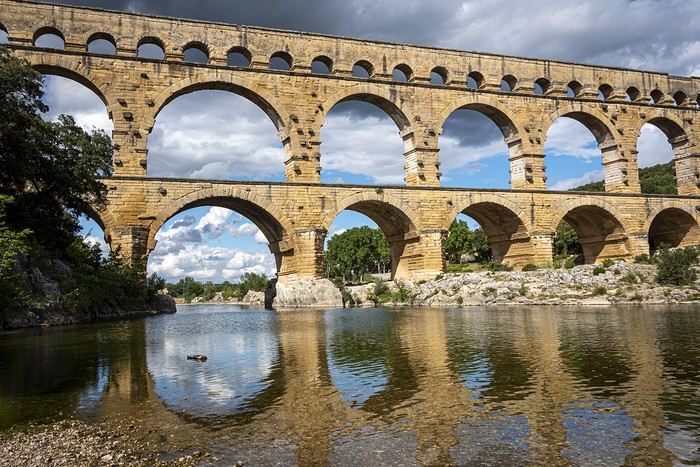
Storm in the Canary Islands
15 days across Gran Canaria, El Hierro, and a dash of Tenerife under the storm Thérèse!
The planned itinerary will be slightly disrupted...
(The version without discussions is here)
The planned itinerary will be slightly disrupted...
(The version without discussions is here)
What mental and physical preparation for a humanitarian trek to Everest Base Camp?
Hi everyone!
New to this forum, I’m planning a pretty big project for 2028. I’m heading to Nepal to do a trek from Kathmandu all the way to Everest Base Camp (a cool 5,300 m 😄). This trek is a bit special because even though I’ll be part of a group, I’m going solo (so far, no problem—I’m used to it). But it’s my first real trek, and it’s also a humanitarian one: once I reach base camp, I’ll stay an extra week to help clean up the waste left by tens of thousands of climbers! Since I’m originally from South America, from two countries that share the Andes, I have a deep respect for mountains—they fascinate me. So Everest… it’s kind of the trip of a lifetime!
So, a little question for those who’ve done treks to Everest before… any tips for good mental preparation (I’m already working on the physical side)?
Thanks in advance for your advice! 🙂
New to this forum, I’m planning a pretty big project for 2028. I’m heading to Nepal to do a trek from Kathmandu all the way to Everest Base Camp (a cool 5,300 m 😄). This trek is a bit special because even though I’ll be part of a group, I’m going solo (so far, no problem—I’m used to it). But it’s my first real trek, and it’s also a humanitarian one: once I reach base camp, I’ll stay an extra week to help clean up the waste left by tens of thousands of climbers! Since I’m originally from South America, from two countries that share the Andes, I have a deep respect for mountains—they fascinate me. So Everest… it’s kind of the trip of a lifetime!
So, a little question for those who’ve done treks to Everest before… any tips for good mental preparation (I’m already working on the physical side)?
Thanks in advance for your advice! 🙂
Practical aspects spring 2026: border to Murmansk, to Pskov, SIM cards, internet.
I took a few days to get some fresh air outside the Schengen-NATO prison. Between March 18, 2026, and March 25, 2026, as shown by the passport stamps:
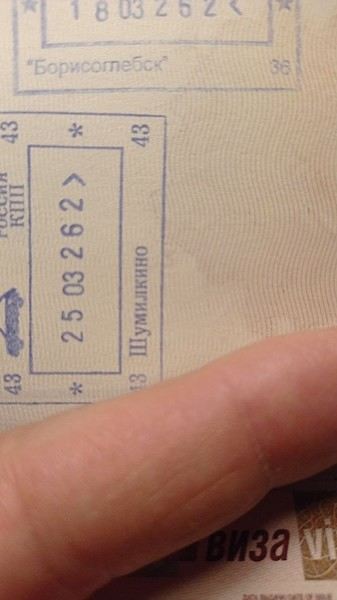
Borisoglebsk is the Russian border checkpoint after Kirkenes, on the road to Murmansk.
Kirkenes is a tiny town with a correspondingly small airport. Nothing has changed there: the minibuses to Murmansk wait on the right as you exit the airport. They’re synchronized with the two daily flights from Oslo—the SAS around 11:00 AM and Norwegian around 11:30 AM. They stop in Kirkenes at the corner of the Scandic for an hour, where other passengers can board, then head straight to the nearby border.
This is the least hassle Frontex/Schengen border. The Norwegian agent quickly scans your passport, and that’s it. No customs, since Norway is Schengen but not in the EU. On the Russian side, there’s a passport check and a quick customs inspection. All in all, crossing both the Norwegian and Russian checkpoints takes about 15 minutes.
A paper visa is required; e-visas aren’t accepted.
Two companies run the route: Avto Ekspress and Borodin: https://ae51.ru/routes/kirkenes-murmansk/ https://borodinbus.com/
The one-way fare is 5,500 ₽. You can either buy it online in rubles with a MIR card or make a formal reservation and pay in NOK cash to the driver. I took Borodin, and the price in NOK was much more expensive than in ₽.
=========================
On March 25, I left from Pskov via the Estonian border post at Luhaama. I spent three days in Murmansk, flew to St. Petersburg (SPB), stayed there for two days, then took an evening train to Pskov.
Since the end of February—and reportedly until the end of May—the Estonians have restricted the opening hours of the two border crossings near Pskov: Koidula (Pechory on the Russian side) and Luhaama (Izborsk on the Russian side). They’re closed at night between 7:00 PM and 7:00 AM. Right now, there’s a bus from Pskov at 7:00 AM to the border. It drops you off at the end of the road where truckers—many Kazakh and Serbian—are parked on the side. You finish the rest on foot to the barrier, where there’s a quick initial check for Ukrainian stamps in passports. Then you walk to the customs building, followed by passport control at the kiosk for motorists. After that, it’s a 500-meter walk to the Estonian checkpoint. At the moment, things seem calmer. Passport control is quick. The usual silly questions in English: "Where were you? Where are you going?" I just gave my most clueless smile: "Sorry, I don’t understand." Yeah, right—I don’t speak English, especially not at an Estonian border with a French passport. If they’re in a mood, though... A very quick bag inspection. Once you exit the Estonian post, walk to the bus stop sign by the road where another coach takes you to Riga.
The catch: in my case, last Wednesday, there were two passengers (Russians) with old Ukrainian stamps in their passports. The bus from the Estonian post to Riga was supposed to leave around 9:30 AM. We ended up leaving around noon after the two were grilled by the FSB. Since it was a weekday outside of holidays, the bus was half-empty. The fuller the bus and the more people with Ukrainian stamps, the worse the nightmare. Don’t book a same-day flight from Riga. I had a flight at 6:00 PM, so it worked out.
=============
The Kirkenes-Murmansk route is still clearly the easiest and fastest. But it’s not the most convenient since it’s way up north.
Next, I’d say the Gdansk-Kaliningrad route in the middle of the week. Avoid weekends and holiday departures/returns.
Avoid the Narva-Ivangorod route during Christmas, Easter, May 9, and *all* summer.
==============
About flights from Murmansk to St. Petersburg: prices are good. I bought my ticket the day before departure on Rossiya for 7,500 ₽, including 10 kg of luggage + a handbag.
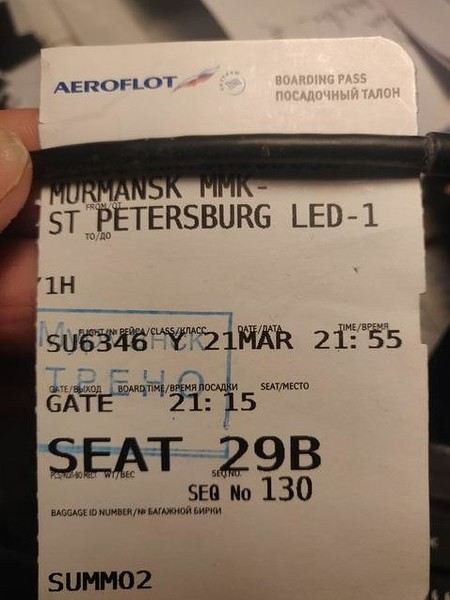
It’s the tail end of the northern lights season, and there were still crowds of Chinese tourists.
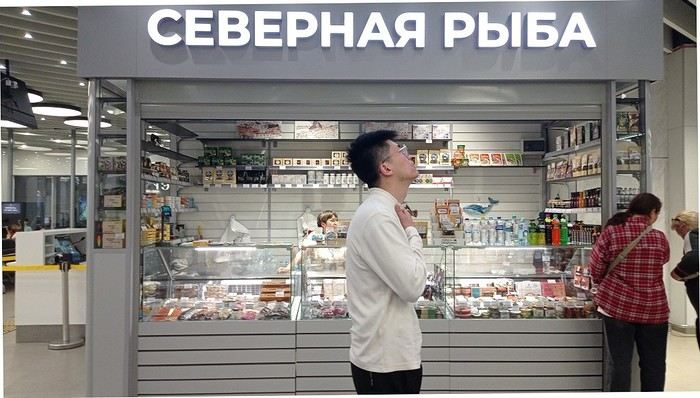
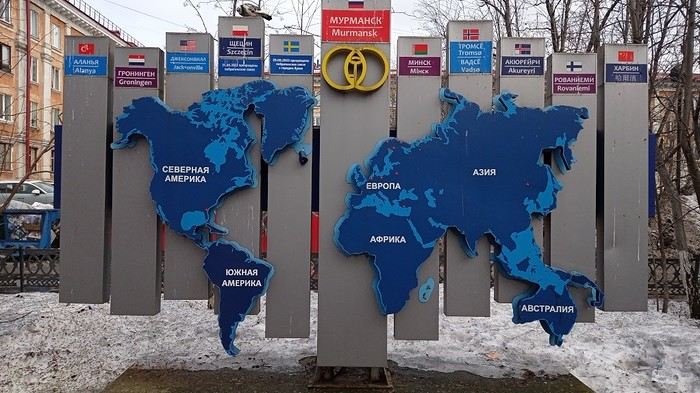
By the way, Murmansk is twinned with Harbin:
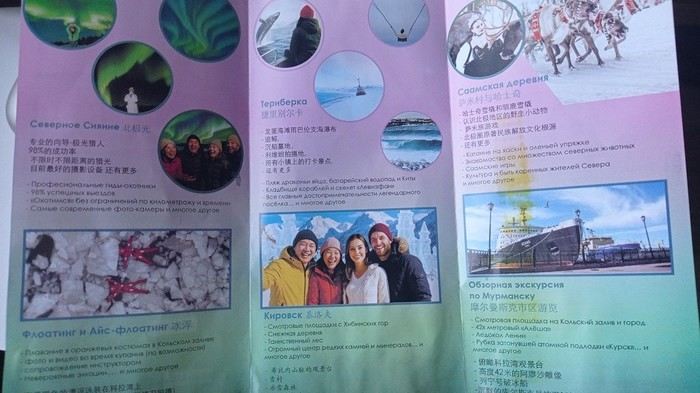
Chinese tourists are the largest foreign group, followed by Indians, then a mix of others from the Far East, Turks, Arabs, etc. Brochures are bilingual—Russian and Chinese:
============================
But let’s talk practical stuff. --
My domestic SIM card was restricted for SMS and internet for 24 hours. After that, if you want to keep using SMS, don’t turn off your phone—restarting triggers another 24-hour purgatory.
My Russian SIM cards (Megafon, MTS, Beeline) were activated as soon as I logged into their respective apps with my credentials.
Internet --
Telegram is heavily slowed down by authorities. To use it, you need to connect through proxy servers, which you load into the latest version of the app. Traffic is then rerouted internally within Telegram to servers outside Russia (Germany, Poland, Sweden, etc.). You can find these proxies on various channels. One is ChatVPN—check their website too.
For general internet use, like browsing the web, VPNs that work right now use the VLESS protocol. You can find several on Telegram by searching "VPN." A few free days, then payment in rubles or crypto.
Rozkomnadzor’s team are experts at this, so things can change. It’s a constant cat-and-mouse game.
Pskov is a special case. The city is near Estonia and has a large military base. Depending on NATO drone swarms launched from the Baltics, Wi-Fi can be completely suspended except for the most essential mobile apps. The drone swarms use the 4G network, and the powerful electronic jamming and drone suppression systems cause periods without Wi-Fi—including in hotels. Wired connections aren’t affected.
Borisoglebsk is the Russian border checkpoint after Kirkenes, on the road to Murmansk.
Kirkenes is a tiny town with a correspondingly small airport. Nothing has changed there: the minibuses to Murmansk wait on the right as you exit the airport. They’re synchronized with the two daily flights from Oslo—the SAS around 11:00 AM and Norwegian around 11:30 AM. They stop in Kirkenes at the corner of the Scandic for an hour, where other passengers can board, then head straight to the nearby border.
This is the least hassle Frontex/Schengen border. The Norwegian agent quickly scans your passport, and that’s it. No customs, since Norway is Schengen but not in the EU. On the Russian side, there’s a passport check and a quick customs inspection. All in all, crossing both the Norwegian and Russian checkpoints takes about 15 minutes.
A paper visa is required; e-visas aren’t accepted.
Two companies run the route: Avto Ekspress and Borodin: https://ae51.ru/routes/kirkenes-murmansk/ https://borodinbus.com/
The one-way fare is 5,500 ₽. You can either buy it online in rubles with a MIR card or make a formal reservation and pay in NOK cash to the driver. I took Borodin, and the price in NOK was much more expensive than in ₽.
=========================
On March 25, I left from Pskov via the Estonian border post at Luhaama. I spent three days in Murmansk, flew to St. Petersburg (SPB), stayed there for two days, then took an evening train to Pskov.
Since the end of February—and reportedly until the end of May—the Estonians have restricted the opening hours of the two border crossings near Pskov: Koidula (Pechory on the Russian side) and Luhaama (Izborsk on the Russian side). They’re closed at night between 7:00 PM and 7:00 AM. Right now, there’s a bus from Pskov at 7:00 AM to the border. It drops you off at the end of the road where truckers—many Kazakh and Serbian—are parked on the side. You finish the rest on foot to the barrier, where there’s a quick initial check for Ukrainian stamps in passports. Then you walk to the customs building, followed by passport control at the kiosk for motorists. After that, it’s a 500-meter walk to the Estonian checkpoint. At the moment, things seem calmer. Passport control is quick. The usual silly questions in English: "Where were you? Where are you going?" I just gave my most clueless smile: "Sorry, I don’t understand." Yeah, right—I don’t speak English, especially not at an Estonian border with a French passport. If they’re in a mood, though... A very quick bag inspection. Once you exit the Estonian post, walk to the bus stop sign by the road where another coach takes you to Riga.
The catch: in my case, last Wednesday, there were two passengers (Russians) with old Ukrainian stamps in their passports. The bus from the Estonian post to Riga was supposed to leave around 9:30 AM. We ended up leaving around noon after the two were grilled by the FSB. Since it was a weekday outside of holidays, the bus was half-empty. The fuller the bus and the more people with Ukrainian stamps, the worse the nightmare. Don’t book a same-day flight from Riga. I had a flight at 6:00 PM, so it worked out.
=============
The Kirkenes-Murmansk route is still clearly the easiest and fastest. But it’s not the most convenient since it’s way up north.
Next, I’d say the Gdansk-Kaliningrad route in the middle of the week. Avoid weekends and holiday departures/returns.
Avoid the Narva-Ivangorod route during Christmas, Easter, May 9, and *all* summer.
==============
About flights from Murmansk to St. Petersburg: prices are good. I bought my ticket the day before departure on Rossiya for 7,500 ₽, including 10 kg of luggage + a handbag.
It’s the tail end of the northern lights season, and there were still crowds of Chinese tourists.
By the way, Murmansk is twinned with Harbin:
Chinese tourists are the largest foreign group, followed by Indians, then a mix of others from the Far East, Turks, Arabs, etc. Brochures are bilingual—Russian and Chinese:
============================
But let’s talk practical stuff. --
My domestic SIM card was restricted for SMS and internet for 24 hours. After that, if you want to keep using SMS, don’t turn off your phone—restarting triggers another 24-hour purgatory.
My Russian SIM cards (Megafon, MTS, Beeline) were activated as soon as I logged into their respective apps with my credentials.
Internet --
Telegram is heavily slowed down by authorities. To use it, you need to connect through proxy servers, which you load into the latest version of the app. Traffic is then rerouted internally within Telegram to servers outside Russia (Germany, Poland, Sweden, etc.). You can find these proxies on various channels. One is ChatVPN—check their website too.
For general internet use, like browsing the web, VPNs that work right now use the VLESS protocol. You can find several on Telegram by searching "VPN." A few free days, then payment in rubles or crypto.
Rozkomnadzor’s team are experts at this, so things can change. It’s a constant cat-and-mouse game.
Pskov is a special case. The city is near Estonia and has a large military base. Depending on NATO drone swarms launched from the Baltics, Wi-Fi can be completely suspended except for the most essential mobile apps. The drone swarms use the 4G network, and the powerful electronic jamming and drone suppression systems cause periods without Wi-Fi—including in hotels. Wired connections aren’t affected.
Costa Rica: The dry season isn't what it used to be!
Introduction:
For years, I’ve heard about Costa Rica, which seems like a country "made for me"—nature, not cities.
I almost went in 2019, but a family issue made me cancel.
Initially, I wanted to spend at least three weeks there, planning to go in our summer despite it being the rainy season. Then I realized what I wanted to do could fit into two weeks, so I ended up going in February.
Plus, January’s weather was so awful that some sunshine should do me good.
I found a flight at a decent price, but with two downsides.
The first is that it leaves from Paris CDG, and the second is that it’s with Air France—a airline I’d sworn off after my misadventures with them back in 2008. We’ll see how it goes!
Tunisian Impressions (Live)
Hi there,
I arrived in Tunisia this afternoon for a full 14-day stay.
I took a direct Tunisair flight from Nice, which departed about thirty minutes late (that’s nothing compared to the "nightmares" I’ve had on some of my recent trips).
The flight lasts around 1 hour and 20 minutes, and a small snack was served on board (a sort of quiche with chickpea purée, a small bread roll, a portion of cheese like La Vache qui rit, and a small chocolate cake). It’s worth mentioning because it’s becoming increasingly rare on short flights. I was seated between two Tunisian gentlemen who gave me some great tips for my trip, especially about negotiating prices. One of them is a former cameraman for France Télévisions, very cultured and well-traveled—his daughter is a journalist at France Télévisions (I found some of her articles online). In short, the flight was very pleasant and quick.

I’m staying at the Hôtel Royal Victoria. I booked it yesterday afternoon by email without providing my credit card number. The room costs 241 TND (71 €) with breakfast included. It has heating, a small fridge, a safe, a hairdryer, Wi-Fi, and a TV with international channels. There’s a police van permanently parked in the square where the hotel is located.
This hotel is housed in the former British consulate and later embassy. It has a lot of charm with its painted wood ceilings and doors, and its bathroom covered in ceramic tiles. The tiny elevator is from another era. The main advantage of the hotel is its location between the medina and Avenue Bourguiba. Nearby, there’s the Magasin Général, where you can find groceries and some typical products like rose water, geranium water, and tons of halwa (a customer kindly explained how to eat it and which is the best).
After nightfall, I took a short stroll down Avenue Bourguiba. There weren’t many people around—it’s windy and cold.
I’ve already noticed the warm welcome from Tunisians. The supermarket cashier welcomed me to Tunisia, and a gentleman I asked for directions to the Magasin Général (I was about to climb stairs leading to a mosque!) insisted on inviting me for coffee, but I declined.
The rest of my itinerary will depend on the weather. If it doesn’t rain tomorrow, I might visit Carthage since the Bardo Museum is closed on Mondays, as are the museums in Sidi Bou Said.
TO BE CONTINUED...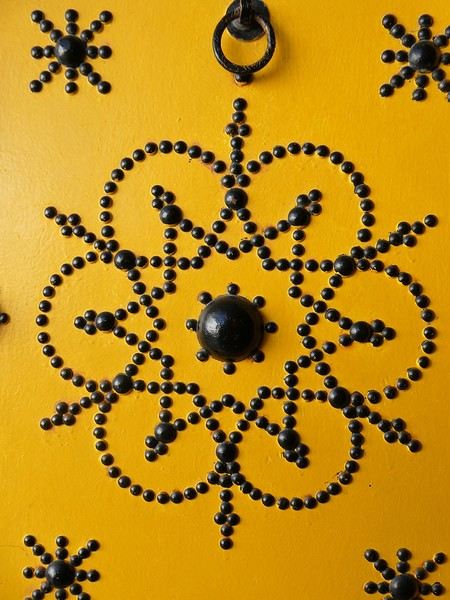


I arrived in Tunisia this afternoon for a full 14-day stay.
I took a direct Tunisair flight from Nice, which departed about thirty minutes late (that’s nothing compared to the "nightmares" I’ve had on some of my recent trips).
The flight lasts around 1 hour and 20 minutes, and a small snack was served on board (a sort of quiche with chickpea purée, a small bread roll, a portion of cheese like La Vache qui rit, and a small chocolate cake). It’s worth mentioning because it’s becoming increasingly rare on short flights. I was seated between two Tunisian gentlemen who gave me some great tips for my trip, especially about negotiating prices. One of them is a former cameraman for France Télévisions, very cultured and well-traveled—his daughter is a journalist at France Télévisions (I found some of her articles online). In short, the flight was very pleasant and quick.
I’m staying at the Hôtel Royal Victoria. I booked it yesterday afternoon by email without providing my credit card number. The room costs 241 TND (71 €) with breakfast included. It has heating, a small fridge, a safe, a hairdryer, Wi-Fi, and a TV with international channels. There’s a police van permanently parked in the square where the hotel is located.
This hotel is housed in the former British consulate and later embassy. It has a lot of charm with its painted wood ceilings and doors, and its bathroom covered in ceramic tiles. The tiny elevator is from another era. The main advantage of the hotel is its location between the medina and Avenue Bourguiba. Nearby, there’s the Magasin Général, where you can find groceries and some typical products like rose water, geranium water, and tons of halwa (a customer kindly explained how to eat it and which is the best).
After nightfall, I took a short stroll down Avenue Bourguiba. There weren’t many people around—it’s windy and cold.
I’ve already noticed the warm welcome from Tunisians. The supermarket cashier welcomed me to Tunisia, and a gentleman I asked for directions to the Magasin Général (I was about to climb stairs leading to a mosque!) insisted on inviting me for coffee, but I declined.
The rest of my itinerary will depend on the weather. If it doesn’t rain tomorrow, I might visit Carthage since the Bardo Museum is closed on Mondays, as are the museums in Sidi Bou Said.
TO BE CONTINUED...
Trip Report: Silk Road Journey in China
Hi everyone,
This trip report covers a journey along the Silk Road in China (see detailed description below) undertaken in October 2025. The goal isn’t to recount the trip but to provide information that might help those who want to take a similar journey. Much of the information is valid for any trip to China.
Who we are: a retired couple, aged 63 and 65 (age gives discounts on entry to various sites and museums in China, which is why I won’t list prices here—I don’t know them, but you can easily find them online). We’re used to traveling independently. We speak English, which is the only foreign language spoken in China, though by very few people. I speak and read a little Chinese, which helped, but you can easily get by without it (without any English at all, I think it would be more difficult).
Period: We arrived just after "Golden Week," when all of China is on vacation, and after the summer, when schools are out, so we encountered very few tourists (99.99% of whom were Chinese). Our experience with booking visits in advance (which we didn’t need to do) isn’t representative for those who want to travel in the summer! The October-November period was perfect for our trip—it wasn’t too hot or too cold (one day of snow on the Tibetan Plateau), though it was only a few degrees on the Tibetan part, with altitudes between 2,000 and 3,000 meters. The trees were beautifully colored.
General remarks: Everyone we dealt with was very kind and perfectly honest. If you order a meal without really understanding what to do and the person modifies your order, trust them—the result is what you need. If a taxi driver signals that they’ll wait for you to finish your visit and pick you up afterward, trust them. It means there aren’t many taxis where you are, and it’ll be more convenient. For prices at street vendors, we always found the right ballpark, and sometimes they even added a little extra to please us. A taxi driver treated us to lunch, and an employee drove us back to the hotel after a visit because there were no taxis. If you struggle to buy a ticket online because there’s no counter, someone will come to help. People even spontaneously ask if everything’s okay and if you need anything.
Everywhere we went was very clean, including restrooms (trains, stations, hotels, museums, tourist sites) and streets. The old stereotypes about this no longer apply.
The trip can be challenging for those who have difficulty walking. The distances to cover on foot in stations, to access sites, and within the sites themselves can sometimes be really long.
We used the Lonely Planet guide in English (published at the end of August 2025) a little for preparation, but mostly relied on the internet.
Before leaving: No visa is needed for French citizens for stays under 30 days. You get a stamp on your passport upon arrival and departure, and the formalities themselves are very quick in both directions (excluding any potential queues). Just a photo and fingerprints upon arrival, and welcome to China’s facial recognition system.
Money: All your payments (see below) will go through your Visa card—there will be hundreds, including many payments of 20 cents to a few euros. So, you need an international option that allows unlimited card transactions. Since cash is rarely needed, the allowed number of ATM withdrawals can be low. We made 3 withdrawals totaling 800 € for a month and could have managed with just 2. The exchange rate charged on our Visa card was 12 € for 100 RMB (yuan).
Install the following apps on your smartphone before leaving (otherwise, you’ll only have access to the Chinese versions, if available): - Alipay, which is used to pay everywhere in China (details below). You need to link it to your credit card, then provide proof of identity by uploading a passport photo and completing a facial recognition session. Alipay gives access to Didi (China’s Uber), public transport (metro/bus), and can also translate phrases. - WeChat (Weixin in Chinese, pronounced *weishin*), which is also used for payments but also replaces WhatsApp. Unfortunately, to activate your account, you need someone who already has WeChat to sponsor you (preferably a Chinese person). We asked someone at our first accommodations to do this—no problem. By sharing your WeChat number with accommodations, they can send you messages that are automatically translated, and you can communicate with people thanks to the translation (translation to French is very poor; it’s much better in English, but unfortunately, WeChat detects your phone’s language). Alipay and WeChat are accepted almost everywhere, but some places only accept WeChat. - Amap, the international version of Baidu Maps, which replaces Google Maps (not at all up-to-date in China). The English names of hotels often have little to do with the Chinese names except for a phonetic resemblance. To find them on Amap, it’s best to copy the Chinese name found on your Trip reservation under "show address in Chinese." - A VPN. We had CyberGhost, which didn’t work, but according to other travelers, NordVPN and Windscribe do. Without a VPN, you can’t access Google services, on WhatsApp you can send and receive text but not photos, and you can’t send or receive emails on Gmail addresses. We managed without a VPN by using Firefox as a browser and Bing as a search engine. - Trip, for booking trains and accommodations, and buying some tickets. It’s the equivalent of Booking for accommodations, but Booking has very few listings in China, while Trip has hundreds in every city. Most hotels and trains are exchangeable and refundable until the day before, with no or minimal fees.
You don’t need contactless (NFC) payment on your phone. Either you scan a barcode and enter the amount to pay, or you display a barcode, and they scan it with a scanner, and the amount is deducted directly.
Upon arrival: - Buy a Chinese SIM card: 100 RMB for 300 GB of data and several hours of talk time (we didn’t use it). Set the Chinese number as a reference on Alipay, WeChat, and Amap. - Find someone to sponsor you on WeChat.
Transportation: - **Plane**: China Eastern, Paris-Canton then Canton-Urumqi on the way out, and Xian-Canton then Canton-Paris on the way back. International flights were smooth, but the schedules for the two domestic flights were changed. It was fine on the way out because we had some leeway, but on the way back, we were notified the morning of that our flight was canceled and replaced with one that didn’t allow for the connection. We called and changed to an earlier flight (I think we were lucky to find available seats). - **Train**: Most long distances were covered by high-speed trains (called D or G in China) at 240 or 300 km/h. Second class is perfect—just as comfortable and clean as our TGVs. The only advantage of first class is the wider seats for larger people, but the downside is that seats are often booked in advance and thus less available. You can book trains long in advance on Trip, but they only go on sale in China 15 days before departure, so that’s when you’ll know if you have a ticket. Initially, we booked first class, but there were no seats available on the day, so we ended up booking everything in second class, which was perfect. There’s no paper ticket—if you’ve bought one, you go to the station, show your passport, and enter. You do the same to access the platform 15 minutes before the train, and that’s it. Our train was canceled twice, but no problem—we went to the ticket counter, got a refund, and were offered a replacement. It didn’t delay us by more than an hour (maybe it would be harder in peak season). For prices, check Trip.com, but it’s significantly cheaper than in France. - **Bus**: We took the bus between Xining and Tongren, Tongren to Xiahe, and Hezuo to Lanzhou—about 3 hours each time for 200 km, 6 € per person, and departures were right on time. - **Taxi**: For trips between the station and hotel, or hotel and visits. If you take a Didi via the Alipay app, you activate your location, enter your destination, and it offers several taxis. You accept, and you get the car’s license plate and its real-time position on the map. When you get in, the driver often asks for the last four digits of your phone number to confirm. Otherwise, you go to the taxi stand outside the station. The price per kilometer is around 20 cents, so for a 30 km trip from the station to the hotel, you’ll pay about 6 €. We never tried to save more by taking local buses, but since the metro in Xian costs 25 cents per trip, it’s probably in the same ballpark. Amap provides public transport routes like Google Maps. - **Driver**: We hired a taxi/driver for the day several times for sightseeing. Prices ranged from 350 to 1,000 RMB (the most expensive was arranged through the Sofitel Xining concierge) for trips ranging from a few hours to a full day, sometimes covering over 300 km (see the detailed trip description).
Accommodations: All booked in advance on Trip, but several were changed during the trip. Off-season, there were no issues. We mostly stayed in upscale places, but in China, that means 50 to 60 € per night in the most central or convenient neighborhood. Note: Almost all hotels have a 5/5 rating on Trip, but it seems the Chinese avoid giving lower ratings to be polite. So, you have to read the comments to realize that in France, we might have given a 2 or 3!
Food: At the table, you’re served hot water or a hot infusion, presumably made with purified water. We never got sick from drinking it, but don’t drink tap water. Purified or mineral water is easy to find.
In restaurants, you can manage by pointing to the dish you want from another diner, on the wall where there are photos, or on the menu with pictures. The food in the region isn’t often spicy, and people usually ask or signal before adding the red spicy sauce, so you should be able to handle it if you don’t like chili at all.
The "fake old quarters" in several cities are great places to find all kinds of restaurants (see detailed trip below).
Like Google Maps, Amap can show you nearby restaurants.
Shopping: For dried fruits, buy them in Turfan—you won’t find the same variety and quality even in Xian. Generally, if you like something, buy it. If you wait, you might not find it outside the region where you are.
In Xian, there’s a "Tea City" where you can find all kinds of tea (from cheap to very expensive).
The trip in more detail: I won’t dwell on the beauty or interest of the sites here since that’s a matter of personal taste. However, I will do so for lesser-known places to give an idea to those who might be interested.
For many sites, there are shuttles (sometimes not included in the ticket price but costing around 1 €) that take you to the interesting spots. We always took them—it saves you from walking past countless shops or along uninteresting paths.
- **Urumqi**: We spent only one night there, arriving in the middle of the afternoon and leaving the next morning. We stayed at the Dana Hotel in the bazaar. Given the size of the city, it’s a good option because I don’t think there are many other interesting places. The bazaar is brand new and not at all "typical" (Turfan’s bazaar is infinitely more interesting), but the dining area is very nice.
- **Turfan**: Stayed at the New Dap Hostel, which was great. The neighborhood is nice, not far from the city, and easy to find food. The museum is closed until 2026 (Amap provides museum hours and closures). We took a day trip (for the two of us) with a driver to the Bezeklik Caves, Flaming Mountains, the abandoned city of Gaochang, the Tuyuk Village Museum, and the Emin Minaret for 500 RMB from 9 AM to 8 PM (arranged by the hostel). The landscape during the excursion was quite fabulous. We also visited the Karez Museum and the abandoned city of Jiaohe on our own the next day. At this time of year, the sun sets around 6 PM, and there’s often haze after 5 PM, so for Jiaohe, for example, which takes about 3 hours to visit, it’s best to be there by 1 or 2 PM at the latest.
The Dahua Market area is perfect for dried fruits (including the famous grapes), and you can eat there among locals in their traditional costumes. Next to it, there are buildings full of shops selling made-in-China items—it kept us busy for a good half-day, if not more.
- **Dunhuang**: Stayed in a guesthouse near the dunes—the city center isn’t far but seems quite artificial. Visited the dunes, with a ticket valid for 3 days. Lots of Chinese tourists—very typical and interesting from an ethnological perspective 😊. We got up early one morning to climb the highest dune, just beyond the one everyone goes to. It’s a bit long and tiring, but the view is worth it. Visited the Mogao Caves, buying the ticket on-site (no chance in season without booking in advance). We met two other French people and got a French-speaking guide (by pretending not to understand English). It was really worth it—a group of 4 instead of 20, and they took their time (2 hours) for the visit. We took a day trip to the Yulin Caves (2.5 hours by road and 160 km one way) with a driver for 350 RMB. We liked it a lot, but if the Mogao Caves are enough for you, it’s not very different.
- **Jiayuguan**: Stayed in a city-center hotel. Visited the Wei and Jin tombs (actually just one)—that’s where we were told the taxi should wait to take us back to the city. We went down into a crypt with lots of decorated bricks from the 3rd century. We really liked it, but it’s not as spectacular as the fort if you’re not a fan. Visited the Jiayuguan Fort and, with the same ticket, climbed a small section of the Great Wall 10 km away. Plan at least 3 good hours for all this—there’s plenty to see.
- **Zhangye**: Stayed at The Silk Road Travelers Hostel, rustic but very nice and organizes excursions. Visited the Danxia (colored mountains)—just as spectacular as the photos. You can easily spend 3 hours there, so plan to finish before sunset to avoid the haze (you can always stay longer for the sunset if the weather’s nice). The next day, visited the Mati Si Temple in the cliff. The 10,000 Buddha Caves are under renovation, but the setting and the main temple are well worth the visit (the paths through the cliff tunnels must be hellish in peak season). You can probably organize these two excursions yourself by asking any taxi driver. Also visited the Giant Buddha Temple in the city center—really worth it.
- **Xining**: Stayed in a city-center hotel. Visited the Tibetan Medicine Museum to see the world’s largest thangka (1 km long), made over 40 years by renowned artists. It’s absolutely magnificent, on par with the virtuosity (but over 1 km) of the thangkas painted by famous artists in Xiahe (see below). Hired a female taxi driver for the day to visit Kumbum Monastery (Ta’er Si in Chinese) and the Danxia area in Guide, 50 km beyond the monastery. It’s less spectacular than Zhangye’s Danxia, but we really liked it (including the journey’s landscape). The next day, visited the old Ming-era Qutan Monastery—no visitors, with beautiful murals (half under renovation). Accessible by train to Haidong or Ledu, then a taxi. Xining’s mosque is of no interest, but there’s a pedestrian street with food stalls nearby that’s very nice.
- **Tongren**: Stayed near the main monastery. Visited Longwu Monastery (several hours), with lots of nice shops along the street leading to it. Then visited Wutun Monastery, which is less lively but beautiful and close to thangka workshops. You can go in and watch the painters at work. For a thangka made by a renowned artist, count about a year of work for 1 m² and around 10,000 €.
- **Xiahe**: Stayed in a city-center hotel. Visited Labrang Monastery—very nice but not as much as Tongren’s because many halls were closed. I think it’s better to go in season and take an English-guided tour (but it’s still worth the trip, even off-season).
- **Langmusi**: Took a taxi, but you can also take a bus (though very early in the morning and longer). Particularly beautiful for us because we woke up to bright sunshine and 5 cm of snow everywhere. Visited the two temples (really nice) and did the classic hike in the gorges starting at the Fairy Cave. For those interested, we continued along the canyon path, and after the meadow where marmots are clearly visible in summer, we climbed toward a pass on the left at 3,800 meters. The view of Langmusi and, above all, the vast grasslands and distant mountains was fabulous (3 hours round trip from the temple). You could probably reach the 4,000-meter summit by continuing up the valley instead of turning left, but according to guides, it’s better to count 7 hours round trip (no technical difficulty). You can leave Langmusi by bus, but off-season, you first have to take a taxi to a stop outside the city and wait for the bus. We didn’t try and took a taxi to Hezuo instead.
Note on this region: A high-speed train is under construction from Xining to Langmusi and beyond (never seen such an impressive construction site!). When it’s operational (in one or two years, I think), access to the area will be revolutionized, and perhaps some of the charm will be lost.
- **Hezuo**: Stopped on the way from Langmusi to Lanzhou. Visited the Milarepa Pagoda, entirely destroyed during the Cultural Revolution and since rebuilt. We liked it since we were passing through, but it doesn’t necessarily justify a long detour.
- **Lanzhou**: Reached by one of the many buses from Hezuo. Stayed in the "fake old quarter," which is extremely pleasant, especially in the evening with restaurants, groups of Chinese women dancing to loud music, etc. Visited Bingling Si with a driver, 120 km away—the landscape and site are absolutely magnificent, with no one around at our time of year. Visited the Gansu Museum (where the famous Flying Horse is, but it’s a replica). We bought the ticket on entry, but in season, you probably need to book in advance.
- **Yinchuan**: Stayed in the city center. A city we discovered by chance in the Lonely Planet—worth it if you have time. On the way, we stopped for a few hours in Zhongwei, where there’s an incredible Taoist temple (I’ll let you be surprised). Visited the Western Xia tombs—we took the short option, which visits Tomb 3. We think the others are similar but less impressive. The surrounding landscape and site are quite spectacular. Visited the film sets (really fun if you like Chinese movies), the short but interesting Ningxia Museum, and finally the modern art museum. The architecture is avant-garde, and there are some beautiful works (we like it, but it’s far from the center—hire a driver who waits, or you might have to wait for an employee to offer a ride back).
- **Tianshui**: Stayed in the suburbs, but you should find a hotel near the "fake old quarter" between the Fu Xi Temples and the Taoist temple—it’s a very nice area, and the two temples (especially the Taoist one) are within walking distance. Visited the Maijishan Caves—the ticket includes the shuttle to get there. Took a taxi from Lanzhou for about 10 € in 45 minutes. We found these caves fabulous.
- **Xi’an**: Stayed 500 meters from the Bell Tower at Hantang Inn—very convenient. We’d been before, so we didn’t revisit the Terracotta Army. The calligraphy district is worth it, as is the Muslim Quarter, though it’s very touristy. The area indicated on the Lonely Planet’s walking tour near the old fruit and vegetable market isn’t very interesting. To buy tea, you can go to the Northwest International Tea City, with dozens of shops. We chose one at random, tasted, and bought various teas. There’s everything from cheap to extremely expensive, but you can find reasonable prices even in seemingly luxurious shops. Along the street north of this area, there are large stores with tons of Chinese goods selling dishes, wedding items, etc. We spent hours there. In the city center, there are only malls with more or less international brands.
- **Longmen Grottoes**: Visited as a round trip by high-speed train from Xian—1 hour 15 minutes to Longmen’s high-speed train station, and the site entrance is 15 minutes by taxi.
We didn’t go to Mount Hua Shan, but there’s a high-speed train station nearby, and there were people on the train who were clearly going there. So, you can probably do this excursion in a day from Xian as well.
Conclusion: We hope this report makes you want to go or helps you if you’re already planning to. If you have questions that you can’t find the answer to by searching properly online and we can answer, don’t hesitate.
This trip report covers a journey along the Silk Road in China (see detailed description below) undertaken in October 2025. The goal isn’t to recount the trip but to provide information that might help those who want to take a similar journey. Much of the information is valid for any trip to China.
Who we are: a retired couple, aged 63 and 65 (age gives discounts on entry to various sites and museums in China, which is why I won’t list prices here—I don’t know them, but you can easily find them online). We’re used to traveling independently. We speak English, which is the only foreign language spoken in China, though by very few people. I speak and read a little Chinese, which helped, but you can easily get by without it (without any English at all, I think it would be more difficult).
Period: We arrived just after "Golden Week," when all of China is on vacation, and after the summer, when schools are out, so we encountered very few tourists (99.99% of whom were Chinese). Our experience with booking visits in advance (which we didn’t need to do) isn’t representative for those who want to travel in the summer! The October-November period was perfect for our trip—it wasn’t too hot or too cold (one day of snow on the Tibetan Plateau), though it was only a few degrees on the Tibetan part, with altitudes between 2,000 and 3,000 meters. The trees were beautifully colored.
General remarks: Everyone we dealt with was very kind and perfectly honest. If you order a meal without really understanding what to do and the person modifies your order, trust them—the result is what you need. If a taxi driver signals that they’ll wait for you to finish your visit and pick you up afterward, trust them. It means there aren’t many taxis where you are, and it’ll be more convenient. For prices at street vendors, we always found the right ballpark, and sometimes they even added a little extra to please us. A taxi driver treated us to lunch, and an employee drove us back to the hotel after a visit because there were no taxis. If you struggle to buy a ticket online because there’s no counter, someone will come to help. People even spontaneously ask if everything’s okay and if you need anything.
Everywhere we went was very clean, including restrooms (trains, stations, hotels, museums, tourist sites) and streets. The old stereotypes about this no longer apply.
The trip can be challenging for those who have difficulty walking. The distances to cover on foot in stations, to access sites, and within the sites themselves can sometimes be really long.
We used the Lonely Planet guide in English (published at the end of August 2025) a little for preparation, but mostly relied on the internet.
Before leaving: No visa is needed for French citizens for stays under 30 days. You get a stamp on your passport upon arrival and departure, and the formalities themselves are very quick in both directions (excluding any potential queues). Just a photo and fingerprints upon arrival, and welcome to China’s facial recognition system.
Money: All your payments (see below) will go through your Visa card—there will be hundreds, including many payments of 20 cents to a few euros. So, you need an international option that allows unlimited card transactions. Since cash is rarely needed, the allowed number of ATM withdrawals can be low. We made 3 withdrawals totaling 800 € for a month and could have managed with just 2. The exchange rate charged on our Visa card was 12 € for 100 RMB (yuan).
Install the following apps on your smartphone before leaving (otherwise, you’ll only have access to the Chinese versions, if available): - Alipay, which is used to pay everywhere in China (details below). You need to link it to your credit card, then provide proof of identity by uploading a passport photo and completing a facial recognition session. Alipay gives access to Didi (China’s Uber), public transport (metro/bus), and can also translate phrases. - WeChat (Weixin in Chinese, pronounced *weishin*), which is also used for payments but also replaces WhatsApp. Unfortunately, to activate your account, you need someone who already has WeChat to sponsor you (preferably a Chinese person). We asked someone at our first accommodations to do this—no problem. By sharing your WeChat number with accommodations, they can send you messages that are automatically translated, and you can communicate with people thanks to the translation (translation to French is very poor; it’s much better in English, but unfortunately, WeChat detects your phone’s language). Alipay and WeChat are accepted almost everywhere, but some places only accept WeChat. - Amap, the international version of Baidu Maps, which replaces Google Maps (not at all up-to-date in China). The English names of hotels often have little to do with the Chinese names except for a phonetic resemblance. To find them on Amap, it’s best to copy the Chinese name found on your Trip reservation under "show address in Chinese." - A VPN. We had CyberGhost, which didn’t work, but according to other travelers, NordVPN and Windscribe do. Without a VPN, you can’t access Google services, on WhatsApp you can send and receive text but not photos, and you can’t send or receive emails on Gmail addresses. We managed without a VPN by using Firefox as a browser and Bing as a search engine. - Trip, for booking trains and accommodations, and buying some tickets. It’s the equivalent of Booking for accommodations, but Booking has very few listings in China, while Trip has hundreds in every city. Most hotels and trains are exchangeable and refundable until the day before, with no or minimal fees.
You don’t need contactless (NFC) payment on your phone. Either you scan a barcode and enter the amount to pay, or you display a barcode, and they scan it with a scanner, and the amount is deducted directly.
Upon arrival: - Buy a Chinese SIM card: 100 RMB for 300 GB of data and several hours of talk time (we didn’t use it). Set the Chinese number as a reference on Alipay, WeChat, and Amap. - Find someone to sponsor you on WeChat.
Transportation: - **Plane**: China Eastern, Paris-Canton then Canton-Urumqi on the way out, and Xian-Canton then Canton-Paris on the way back. International flights were smooth, but the schedules for the two domestic flights were changed. It was fine on the way out because we had some leeway, but on the way back, we were notified the morning of that our flight was canceled and replaced with one that didn’t allow for the connection. We called and changed to an earlier flight (I think we were lucky to find available seats). - **Train**: Most long distances were covered by high-speed trains (called D or G in China) at 240 or 300 km/h. Second class is perfect—just as comfortable and clean as our TGVs. The only advantage of first class is the wider seats for larger people, but the downside is that seats are often booked in advance and thus less available. You can book trains long in advance on Trip, but they only go on sale in China 15 days before departure, so that’s when you’ll know if you have a ticket. Initially, we booked first class, but there were no seats available on the day, so we ended up booking everything in second class, which was perfect. There’s no paper ticket—if you’ve bought one, you go to the station, show your passport, and enter. You do the same to access the platform 15 minutes before the train, and that’s it. Our train was canceled twice, but no problem—we went to the ticket counter, got a refund, and were offered a replacement. It didn’t delay us by more than an hour (maybe it would be harder in peak season). For prices, check Trip.com, but it’s significantly cheaper than in France. - **Bus**: We took the bus between Xining and Tongren, Tongren to Xiahe, and Hezuo to Lanzhou—about 3 hours each time for 200 km, 6 € per person, and departures were right on time. - **Taxi**: For trips between the station and hotel, or hotel and visits. If you take a Didi via the Alipay app, you activate your location, enter your destination, and it offers several taxis. You accept, and you get the car’s license plate and its real-time position on the map. When you get in, the driver often asks for the last four digits of your phone number to confirm. Otherwise, you go to the taxi stand outside the station. The price per kilometer is around 20 cents, so for a 30 km trip from the station to the hotel, you’ll pay about 6 €. We never tried to save more by taking local buses, but since the metro in Xian costs 25 cents per trip, it’s probably in the same ballpark. Amap provides public transport routes like Google Maps. - **Driver**: We hired a taxi/driver for the day several times for sightseeing. Prices ranged from 350 to 1,000 RMB (the most expensive was arranged through the Sofitel Xining concierge) for trips ranging from a few hours to a full day, sometimes covering over 300 km (see the detailed trip description).
Accommodations: All booked in advance on Trip, but several were changed during the trip. Off-season, there were no issues. We mostly stayed in upscale places, but in China, that means 50 to 60 € per night in the most central or convenient neighborhood. Note: Almost all hotels have a 5/5 rating on Trip, but it seems the Chinese avoid giving lower ratings to be polite. So, you have to read the comments to realize that in France, we might have given a 2 or 3!
Food: At the table, you’re served hot water or a hot infusion, presumably made with purified water. We never got sick from drinking it, but don’t drink tap water. Purified or mineral water is easy to find.
In restaurants, you can manage by pointing to the dish you want from another diner, on the wall where there are photos, or on the menu with pictures. The food in the region isn’t often spicy, and people usually ask or signal before adding the red spicy sauce, so you should be able to handle it if you don’t like chili at all.
The "fake old quarters" in several cities are great places to find all kinds of restaurants (see detailed trip below).
Like Google Maps, Amap can show you nearby restaurants.
Shopping: For dried fruits, buy them in Turfan—you won’t find the same variety and quality even in Xian. Generally, if you like something, buy it. If you wait, you might not find it outside the region where you are.
In Xian, there’s a "Tea City" where you can find all kinds of tea (from cheap to very expensive).
The trip in more detail: I won’t dwell on the beauty or interest of the sites here since that’s a matter of personal taste. However, I will do so for lesser-known places to give an idea to those who might be interested.
For many sites, there are shuttles (sometimes not included in the ticket price but costing around 1 €) that take you to the interesting spots. We always took them—it saves you from walking past countless shops or along uninteresting paths.
- **Urumqi**: We spent only one night there, arriving in the middle of the afternoon and leaving the next morning. We stayed at the Dana Hotel in the bazaar. Given the size of the city, it’s a good option because I don’t think there are many other interesting places. The bazaar is brand new and not at all "typical" (Turfan’s bazaar is infinitely more interesting), but the dining area is very nice.
- **Turfan**: Stayed at the New Dap Hostel, which was great. The neighborhood is nice, not far from the city, and easy to find food. The museum is closed until 2026 (Amap provides museum hours and closures). We took a day trip (for the two of us) with a driver to the Bezeklik Caves, Flaming Mountains, the abandoned city of Gaochang, the Tuyuk Village Museum, and the Emin Minaret for 500 RMB from 9 AM to 8 PM (arranged by the hostel). The landscape during the excursion was quite fabulous. We also visited the Karez Museum and the abandoned city of Jiaohe on our own the next day. At this time of year, the sun sets around 6 PM, and there’s often haze after 5 PM, so for Jiaohe, for example, which takes about 3 hours to visit, it’s best to be there by 1 or 2 PM at the latest.
The Dahua Market area is perfect for dried fruits (including the famous grapes), and you can eat there among locals in their traditional costumes. Next to it, there are buildings full of shops selling made-in-China items—it kept us busy for a good half-day, if not more.
- **Dunhuang**: Stayed in a guesthouse near the dunes—the city center isn’t far but seems quite artificial. Visited the dunes, with a ticket valid for 3 days. Lots of Chinese tourists—very typical and interesting from an ethnological perspective 😊. We got up early one morning to climb the highest dune, just beyond the one everyone goes to. It’s a bit long and tiring, but the view is worth it. Visited the Mogao Caves, buying the ticket on-site (no chance in season without booking in advance). We met two other French people and got a French-speaking guide (by pretending not to understand English). It was really worth it—a group of 4 instead of 20, and they took their time (2 hours) for the visit. We took a day trip to the Yulin Caves (2.5 hours by road and 160 km one way) with a driver for 350 RMB. We liked it a lot, but if the Mogao Caves are enough for you, it’s not very different.
- **Jiayuguan**: Stayed in a city-center hotel. Visited the Wei and Jin tombs (actually just one)—that’s where we were told the taxi should wait to take us back to the city. We went down into a crypt with lots of decorated bricks from the 3rd century. We really liked it, but it’s not as spectacular as the fort if you’re not a fan. Visited the Jiayuguan Fort and, with the same ticket, climbed a small section of the Great Wall 10 km away. Plan at least 3 good hours for all this—there’s plenty to see.
- **Zhangye**: Stayed at The Silk Road Travelers Hostel, rustic but very nice and organizes excursions. Visited the Danxia (colored mountains)—just as spectacular as the photos. You can easily spend 3 hours there, so plan to finish before sunset to avoid the haze (you can always stay longer for the sunset if the weather’s nice). The next day, visited the Mati Si Temple in the cliff. The 10,000 Buddha Caves are under renovation, but the setting and the main temple are well worth the visit (the paths through the cliff tunnels must be hellish in peak season). You can probably organize these two excursions yourself by asking any taxi driver. Also visited the Giant Buddha Temple in the city center—really worth it.
- **Xining**: Stayed in a city-center hotel. Visited the Tibetan Medicine Museum to see the world’s largest thangka (1 km long), made over 40 years by renowned artists. It’s absolutely magnificent, on par with the virtuosity (but over 1 km) of the thangkas painted by famous artists in Xiahe (see below). Hired a female taxi driver for the day to visit Kumbum Monastery (Ta’er Si in Chinese) and the Danxia area in Guide, 50 km beyond the monastery. It’s less spectacular than Zhangye’s Danxia, but we really liked it (including the journey’s landscape). The next day, visited the old Ming-era Qutan Monastery—no visitors, with beautiful murals (half under renovation). Accessible by train to Haidong or Ledu, then a taxi. Xining’s mosque is of no interest, but there’s a pedestrian street with food stalls nearby that’s very nice.
- **Tongren**: Stayed near the main monastery. Visited Longwu Monastery (several hours), with lots of nice shops along the street leading to it. Then visited Wutun Monastery, which is less lively but beautiful and close to thangka workshops. You can go in and watch the painters at work. For a thangka made by a renowned artist, count about a year of work for 1 m² and around 10,000 €.
- **Xiahe**: Stayed in a city-center hotel. Visited Labrang Monastery—very nice but not as much as Tongren’s because many halls were closed. I think it’s better to go in season and take an English-guided tour (but it’s still worth the trip, even off-season).
- **Langmusi**: Took a taxi, but you can also take a bus (though very early in the morning and longer). Particularly beautiful for us because we woke up to bright sunshine and 5 cm of snow everywhere. Visited the two temples (really nice) and did the classic hike in the gorges starting at the Fairy Cave. For those interested, we continued along the canyon path, and after the meadow where marmots are clearly visible in summer, we climbed toward a pass on the left at 3,800 meters. The view of Langmusi and, above all, the vast grasslands and distant mountains was fabulous (3 hours round trip from the temple). You could probably reach the 4,000-meter summit by continuing up the valley instead of turning left, but according to guides, it’s better to count 7 hours round trip (no technical difficulty). You can leave Langmusi by bus, but off-season, you first have to take a taxi to a stop outside the city and wait for the bus. We didn’t try and took a taxi to Hezuo instead.
Note on this region: A high-speed train is under construction from Xining to Langmusi and beyond (never seen such an impressive construction site!). When it’s operational (in one or two years, I think), access to the area will be revolutionized, and perhaps some of the charm will be lost.
- **Hezuo**: Stopped on the way from Langmusi to Lanzhou. Visited the Milarepa Pagoda, entirely destroyed during the Cultural Revolution and since rebuilt. We liked it since we were passing through, but it doesn’t necessarily justify a long detour.
- **Lanzhou**: Reached by one of the many buses from Hezuo. Stayed in the "fake old quarter," which is extremely pleasant, especially in the evening with restaurants, groups of Chinese women dancing to loud music, etc. Visited Bingling Si with a driver, 120 km away—the landscape and site are absolutely magnificent, with no one around at our time of year. Visited the Gansu Museum (where the famous Flying Horse is, but it’s a replica). We bought the ticket on entry, but in season, you probably need to book in advance.
- **Yinchuan**: Stayed in the city center. A city we discovered by chance in the Lonely Planet—worth it if you have time. On the way, we stopped for a few hours in Zhongwei, where there’s an incredible Taoist temple (I’ll let you be surprised). Visited the Western Xia tombs—we took the short option, which visits Tomb 3. We think the others are similar but less impressive. The surrounding landscape and site are quite spectacular. Visited the film sets (really fun if you like Chinese movies), the short but interesting Ningxia Museum, and finally the modern art museum. The architecture is avant-garde, and there are some beautiful works (we like it, but it’s far from the center—hire a driver who waits, or you might have to wait for an employee to offer a ride back).
- **Tianshui**: Stayed in the suburbs, but you should find a hotel near the "fake old quarter" between the Fu Xi Temples and the Taoist temple—it’s a very nice area, and the two temples (especially the Taoist one) are within walking distance. Visited the Maijishan Caves—the ticket includes the shuttle to get there. Took a taxi from Lanzhou for about 10 € in 45 minutes. We found these caves fabulous.
- **Xi’an**: Stayed 500 meters from the Bell Tower at Hantang Inn—very convenient. We’d been before, so we didn’t revisit the Terracotta Army. The calligraphy district is worth it, as is the Muslim Quarter, though it’s very touristy. The area indicated on the Lonely Planet’s walking tour near the old fruit and vegetable market isn’t very interesting. To buy tea, you can go to the Northwest International Tea City, with dozens of shops. We chose one at random, tasted, and bought various teas. There’s everything from cheap to extremely expensive, but you can find reasonable prices even in seemingly luxurious shops. Along the street north of this area, there are large stores with tons of Chinese goods selling dishes, wedding items, etc. We spent hours there. In the city center, there are only malls with more or less international brands.
- **Longmen Grottoes**: Visited as a round trip by high-speed train from Xian—1 hour 15 minutes to Longmen’s high-speed train station, and the site entrance is 15 minutes by taxi.
We didn’t go to Mount Hua Shan, but there’s a high-speed train station nearby, and there were people on the train who were clearly going there. So, you can probably do this excursion in a day from Xian as well.
Conclusion: We hope this report makes you want to go or helps you if you’re already planning to. If you have questions that you can’t find the answer to by searching properly online and we can answer, don’t hesitate.
Mauritian Ti' Punch
The recipe for the cocktail: endless beaches, a dazzling palette of colors, some breathtaking hikes, and excellent cuisine...
For the tasting, follow along in the pages of this travel journal! 😉
Don’t forget your hiking shoes, a swimsuit, sunscreen, but also a sweater, your driver’s license, and your credit card...
Just over 11 hours of flight, and we’ll be setting foot on Mauritian soil!
For the tasting, follow along in the pages of this travel journal! 😉
Don’t forget your hiking shoes, a swimsuit, sunscreen, but also a sweater, your driver’s license, and your credit card...
Just over 11 hours of flight, and we’ll be setting foot on Mauritian soil!
Hitchhiking in the 70s-80s
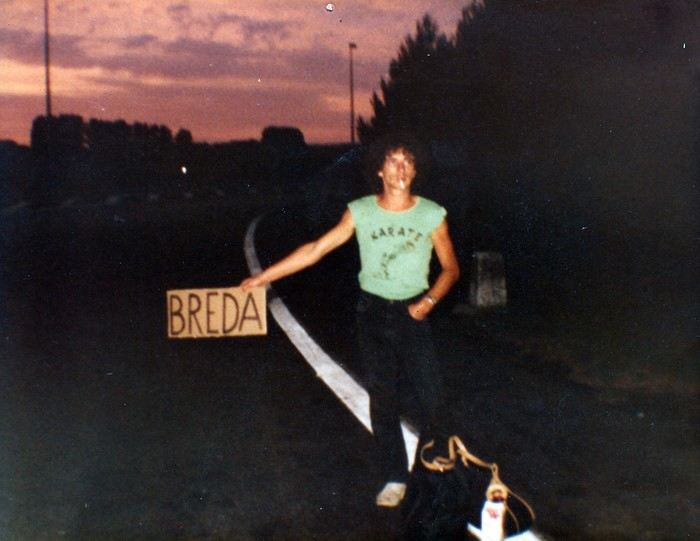
“Hey, your Marker... - My Marker? - The one you used to make hitchhiking signs.”
The marker in question is sitting proudly on the kitchen table. Marielle found it at the bottom of a moving box.
I’ve been meaning to tell the long story of my love affair with hitchhiking for years. Here we go.
To be honest, I’m not quite sure when it started. My earliest memory goes back to a fair with a bike race in my maternal grandparents’ village. I was with my cousin, my little sister, and three girl cousins. There were six of us, ages ranging from six or seven to thirteen or fourteen. Our parents stayed at the fair, and we’d had enough. So we decided to walk home. Only it was four kilometers away. So we hitchhiked. A guy driving an old car picked us all up and dropped us off at the farm. He probably found it amusing to see us thumbing a ride by the side of the road, but maybe it also worried him a bit. With everything you read in the papers...
Around fifteen or sixteen, I started hitchhiking regularly, alone or with a friend, to go to the nearby town. But it was especially when I started boarding school in Orléans that it became more regular. The first year, I’d leave Monday morning and come back Saturday noon by bus. It was an old, uncomfortable bus where we froze in winter. To make matters worse, I often got motion sickness if, as was too often the case, I ended up sitting in the back. In the spring, a high school friend suggested I hitchhike back. It meant a slight detour, but the advantage was taking only national roads.
So that’s how, from the end of tenth grade to twelfth grade, I’d thumb a ride every Saturday on the Pont de Bourgogne. Drivers were used to seeing young people hitchhiking, and it worked pretty well. Our biggest fear? Soldiers! At that time, military service was still mandatory, and on weekends, it wasn’t rare to see them competing with us. They’d keep their uniforms on to go home. That gave people confidence—with everything you read in the papers—and they’d rarely wait more than five minutes. We, with our long hair, were definitely less popular. From time to time, three big red-faced guys in a van coming back from a construction site would flip us off, yelling things like “go get a haircut, you bums!” Those were the good old days.
We still had a good laugh, though. Patrice, the friend I’d hitchhike back from school with on Saturdays, is a musician—I’d later discover he’s an excellent composer. A die-hard Beatles fan, he knows their repertoire by heart and spends his time singing at the top of his lungs while we thumb a ride. One Saturday late morning, we’d been waiting for a while at the exit of Châteauneuf-sur-Loire when a little lady came up to him and asked if he could please sing a little quieter: a baby was sleeping in the house. He put on the most sorry face: “Oh, sorry ma’am, we didn’t realize.” No sooner had the lady gone back inside than he started again. Luckily, a car stopped just then, sparing me the embarrassment of seeing the lady come back out.
Saturday was also the day when the cigarette pack was dangerously low. So before leaving, we’d go buy some “Parisiennes,” the “P4s” as we called them back then. They were slightly thinner cigarettes with a mix of tobacco scraps. Sometimes they tasted like light tobacco, sometimes like dark. Not great, but by the end of the week, our pocket money was gone. They were sold in small packs of four, hence the name P4. We’d only pay 20 centimes. On Saturdays, it was rare for the two of us to manage to scrape together 1.50 F to buy a whole pack of Gauloises...
The last twenty kilometers, I’d usually do alone, Patrice having reached his destination. From time to time, luck would smile on me: an acquaintance would just happen to pass by and stop. One January Saturday, at the exit of Gien, I ran into another guy from Argenton whom I knew a little. That day, the weather was nice, but the temperature was well below zero. It was around noon, and it was the off-peak hour. We were shivering, stamping our feet by the side of the road, when a Citroën “Tube” arrived: it was his father’s boss’s, a mason. They were both sitting in the front, but since they were obese, they had us climb onto the open back. Even though we huddled against the cab to shelter from the wind, the twenty kilometers felt very long, especially since we were only going sixty kilometers an hour. Our hands and cheeks were blue when we finally arrived.
The year I took my baccalaureate, a friend with a 2CV would take me Monday mornings with one or two others we’d pick up in nearby villages. We’d share the gas costs, but it was still cheaper than the bus. And in winter, the bus was my nightmare. You had to get up at five to catch it at six. Not enough sleep, and outside it was freezing or raining—or both. The 2CV was luxury. Plus, Philippe would pick me up at home. On the other hand, since I didn’t have class Saturday mornings—well, I did, but we only had PE the first two hours and nothing after—I’d skip class and slip out right after breakfast to thumb a ride at the Pont de Bourgogne.
Those three high school years were formative in this optional subject that was hitchhiking. Little by little, I learned the rules of the game. First, you shouldn’t walk along the road while thumbing. Cars go too fast and can’t stop easily. Accepting a ride that’s too short is also a no-go. The guy who offers to take you a little way but drops you off at some vague crossroads in the middle of nowhere? No thanks. You need to get dropped off in a town. If it’s a fairly big city, you often have to cross it from one end to the other, but it’s better. At the exit, you have to choose your spot well. Actually, you have to put yourself in the driver’s shoes: they need to see you early enough, not be going too fast, and be able to stop easily without risking an accident. So when leaving a city, it’s better not to go too far. It’s wiser to find a spot where cars go slowly and can stop easily. And preferably near a café. The café is for when you still have a few coins for a coffee and need to warm up. From time to time, you’d run into someone nice who’d make a detour to drop you off at a better spot to start again. Finally, if possible, avoid hitchhiking on Sundays. Cars are packed with whole families who, most of the time, aren’t going far. And then there’s the little worry of those people who rarely leave home: with everything you read in the papers...
During those high school years, it was only short trips, rarely exceeding a hundred kilometers. Later, I aimed bigger, and things were a bit different. In 1973-74, I crossed part of France for the first time on two or three occasions, coming back from the German border or returning to Bordeaux, where we lived briefly. Since there weren’t many highways back then, we took national roads. It was during these trips that I realized it was better to leave in the evening. As I said earlier, Sunday is to be avoided, but on weekdays, there’s another problem: if you leave in the morning, you only make short hops. First, it often takes longer to get going because drivers are people going to work nearby. Which brings us back to those who drop you off in a bad spot, far from everything. There, you have to know how to refuse. You thank the driver for stopping—oh, if only everyone could be like you—while explaining why you’d rather stay put. People don’t take offense, by the way. Those who pick up hitchhikers often hitchhiked themselves when they were in the military or before they had a car. In the late afternoon, you’d often run into salespeople or truckers, in other words, people who drive a lot. At that time, salespeople no longer had appointments and were more relaxed. They wanted to talk about something other than the merits of their products. On the radio, it was time for *Les Grosses Têtes*. You’d also quite often run into small business owners, professionals, or even hippies. The conversations were pleasant and often enriching. A little later in the evening, truckers would take over. They’d already driven a few hundred kilometers, and the depot or customs was still far away. So they’d gladly take a hitchhiker to stay awake at the wheel and chat. The radio with Max Ménier’s show *Les routiers sont sympas*, you’d eventually get tired of it. So a hitchhiker was a change. Others, who’d hit the road at midnight to be at their destination by morning, were nice and offered to let you lie down on the bunk while they drove. When you’d been hitchhiking since six in the evening, freezing in the wind between two vehicles, you weren’t unhappy to take a little nap.
Speaking of Max Ménier, he’d often make announcements for hitchhikers. One evening, I called him. It was getting late, and I still had quite a way to go. No luck: the show had ended for good the day before!
In short, it’s better not to rush, sleep in, and leave after lunch, or better yet, in the late afternoon. Obviously, I’m talking about when you have several hundred kilometers to cover. That’s when you have to play it pro.
First thing, especially at night, but it also applies in the middle of summer when the light is blinding: dress to be seen from far away. I’ll admit I have an advantage over most other hitchhikers: I’m small and don’t scare people. To balance that out, racist drivers often take me for an Arab and are less likely to pick me up, but overall, the balance tips in my favor. Back to the need to be seen: at night, I wear light-colored clothes. In headlights, you can see me from far away.
Second thing: travel light. Forget the big backpack with a frame. Drivers don’t always have room in the trunk or on the back seat, especially if it’s rained and the ground is wet. Plus, it forces them to get out of the car. If they’re nice enough to pick up a hitchhiker, you shouldn’t ask for too much either.
Third thing: bring a cardboard sign and a big marker—like the ones in the photo at the start of this post—to write the name of your destination. In the early 80s, I ran a tourist house in the Cher, but I lived in the Netherlands. In the off-season, it was only open on weekends. On Fridays, I’d leave Holland and return on Mondays. 1200 km round trip. On the way there, in Paris, I’d stand at Porte de la Chapelle. At that spot, the road is very wide, and drivers could stop easily. Obviously, on the sign, I didn’t write Eindhoven, which not everyone knows, and even less Amsterdam because of its seedy reputation. In that case, you’d expect to see a police car stop and two officers in kepis ask for your papers. So as a first destination, I’d write Compiègne. We were well out of Paris, and since it wasn’t too far, a trucker or salesperson was less reluctant to stop. Once past Compiègne, I’d take out my Lille sign. Once in Belgium, it wasn’t really necessary to use a sign anymore, since everyone was going in the same direction. Usually, the guy who picked me up at Porte de la Chapelle would say he wasn’t going far but could take me a little way. Before that, I’d still ask if there was a gas station on the highway where he could drop me off before exiting. While talking, the guy would realize he wasn’t dealing with a dangerous criminal. He’d pretend to check his watch, think for a moment, then say that actually, he was going to Belgium and could take me to the border or a little beyond. To leave Paris on the way back, I’d take the train to Melun, where it was easier to hitchhike than at Porte d’Italie.
Over all those years, I think I was pretty lucky. Or maybe philosophical enough not to imagine a car would stop after a few minutes. An hour’s wait was average. Sure, I sometimes waited three, four, or five hours. Most often at odd hours and in terrible weather. When it doesn’t work, it doesn’t work. But there’s always a moment when things pick up. Sure, when you’re soaked in freezing rain in the early morning after a sleepless night, you’re less philosophical than when I’m writing these lines comfortably at my computer, but it still holds true.
Earlier, I mentioned clothing and the importance of being well-rested before leaving. When you’ve eaten well and just gotten out of the shower, shaved, you’re in a better mood. And somehow, drivers sense it. Or at least, that’s the impression I’ve always had. It’s better to look in shape than disgusted at standing there, half-heartedly thumbing a ride. In short, when I’d start to get fed up with waiting, I’d go into the first café I saw for a coffee. Coming back out, I’d be refreshed, and most of the time, a car would stop within minutes. I’ve often said that when I stood by the side of the road thumbing a ride, I felt a bit like a gambler in front of a slot machine. It was a matter of giving luck a chance. And well, it worked out pretty well.
Then, there are countries where hitchhiking works really well and others where it’s harder. In the 70s-80s, it worked best in Germany and England. In the late afternoon, it wasn’t rare to be invited for tea. Well, that was in England. Tea meant being offered room and board. In Germany, they’d offer you coffee. Once there, they’d first show you the guest room and point out the bathroom before sitting you down in front of a big plate of cold cuts. In the evening, they’d go out in town, and the next morning, they’d usually drop you off at a good spot for hitchhiking. On the other hand, in Mediterranean and Scandinavian countries, you’d better be patient. In Spain or Italy, it’s better to take the train, which was dirt cheap back then. However, if you’re a couple traveling light, it’s already easier in most countries.
In 1982, I went on a trip around Turkey with my girlfriend. We only had two small bags, which was plenty. It was November-December, and we wore our warm, bulky clothes. Leaving Eindhoven at nine in the morning, we arrived in Graz, near the Yugoslav border, at eleven at night. 1300 km in a day! In just four or five vehicles. One to the German border, about fifty kilometers from Eindhoven, the second to Hagen in the Ruhr, the third to Salzburg, and the last to Graz at the Yugoslav border. Record broken. During the night crossing of Yugoslavia, we ran into a trucker close to retirement who lent us the truck’s bunk. So we arrived fresh and rested near Skopje the next morning. We continued to Thessaloniki in northern Greece before taking the train to Istanbul. In Turkey, we traveled a good part of the country by hitchhiking too. With truckers in old, overloaded, slow trucks that climbed hills at fifteen kilometers an hour, but also in cars where five or six people were already crammed in. And every time, we were invited for tea. Once, we were even picked up by a big shot in his Mercedes with a chauffeur. Until then, the average speed was around fifty kilometers an hour. There, we were going two hundred. On a national road, not a nice European highway.
I’ve also hitchhiked in Nepal, from Lumbini, Buddha’s birthplace, to a village on the way to Pokhara. It must have been midday. No bus until the next day. I gave it a try. A small truck overloaded with rice sacks, with two or three young people already perched on top, stopped. I rode on the roof of the cab. At fifty kilometers an hour when it was going well, with a breathtaking view. Coming back from India, I also crossed part of Iran by hitchhiking, from Tehran to the Turkish border. I did this trip with an Austrian I met at the hotel who, like me, had to watch his pennies. We gave it a shot. There was almost no traffic, but to our great surprise, the first car that passed in the area would always stop. They’d just ask for a modest contribution for gas, and it cost next to nothing.
Sometimes, you get scared too. After leaving Turkey in early December 82, we spent about two weeks in the southern Peloponnese harvesting olives. A few days before Christmas, we hitchhiked back to Holland. A girl picked us up in her little Fiat 500. We were driving on a mountain road, and that morning there was a bit of black ice. After crossing a pass, we saw the old Ford Taunus ahead of us at fifty meters start to skid. The driver let out a “heeee!” while grabbing my knees. I reflexively grabbed the wheel. Finally, the Taunus got back on track. And we didn’t swerve. But those few seconds felt very long.
In January 77, while I’d been living in Germany for a few months, I decided to spend a few days in Italy. By hitchhiking, of course. I left in the early afternoon, and by ten at night, I wasn’t far from Frankfurt. I saw a big Mercedes stop. The four or five young people crammed inside were listening to Schlager at full volume. Beer cans littered the floor. They didn’t have a precise destination, and as long as they were going south, that was fine with me. They’d finished their military service that very day and had clearly already celebrated their discharge. The driver was going 160, zigzagging dangerously from one side of the highway to the other. I should have realized he wasn’t entirely sober either. Luckily, there was almost no traffic. Finally, I managed to get dropped off at a gas station just before Frankfurt, relieved. I hope their trip didn’t end tragically.
Another time, coming back from Holland with my wife, we were picked up early in the morning near Senlis by two guys from Lille. They were going to work near Tours and could drop us off at Porte d’Italie. Apparently, they were coworkers but barely knew each other. The driver offered us a beer—at six in the morning, sure!—before opening another can for himself. He was clearly having trouble staying in the right lane. We politely declined, the passenger too. Everyone was tense. Luckily, it was rush hour on the ring road, and we were going slowly. When we got out of the car, the passenger said goodbye with the look of a guy being offered the condemned man’s rum and cigarette.
Finally, there are the annoying remarks from drivers who are either gay when you’re alone or turned on by the sight of your girlfriend when you’re a couple. In those cases, I’d get in the back so the guy wouldn’t feel too confident. And if the conversation got a little too suggestive, we’d deflect until we got dropped off.
And luckily, there are the times, not so rare after all, when you run into really nice people who invite you to eat and sleep at their place and drive you to a good spot the next morning. In Germany and England, that was common. And then there are the big strokes of luck, like during our trip to Turkey when we crossed most of Germany in one car, or that other time when some Germans drove me from the exit of Geneva all the way to the Costa Brava.
Going back to “with everything you read in the papers” and its variant “with everything you see on TV”—and now on the internet—it’s always left me perplexed. Personally, I’ve never heard of hitchhikers assaulting drivers, even if it may have happened. On the other hand, what was most common were hitchhikers being assaulted, especially girls. Anyway, even armed, it seems a bit stupid to assault the driver—wouldn’t that risk causing an accident?
Finally, since that time, I’ve occasionally wanted to hitchhike somewhere far away in France. Most often, too busy with work, it never happened, but the nostalgia hasn’t completely disappeared.
* * *
Other Hitchhikers
And then one day, I... settled down to become a driver myself. Ten years had passed, and you saw fewer and fewer hitchhikers. Or maybe I saw fewer because I had a regular job and wasn’t traveling the same way. And then I understood a few things.
Several times, I was tempted to pick up a hitchhiker, but they didn’t meet the required conditions. They were walking along the road instead of staying at the exit of the previous town. Hard to stop without risking an accident. Or the guy looked really scruffy. Or he was sulking, if not both. Then you think of that famous “with everything you read in the papers.” Not that I was scared, but unfortunately, the few hitchhikers I did pick up later were rarely interesting.
A few years ago, we picked up a young guy at the exit of a small town in Sologne. Not an easy spot for hitchhiking. Bad luck, he was a pretentious little jerk. He was barely 20 or 25 and talked like a bitter old man. He was a waiter in a restaurant. According to him, it was lucky he was there, otherwise the boss would have closed up shop long ago. You’d think he had thirty or forty years of professional experience behind him. As we approached Blois, he started ranting about Arabs, blaming them for all evils. And he laid it on thick. That morning, we were going to a teenager’s funeral who had just committed suicide, so he really got on our nerves, Mr. Know-It-All. Out of anger, I dropped him off next to a shopping center a few kilometers from downtown. Not nice, but it felt good.
Some time ago, we were driving around the Limousin on a Sunday to try out the used Twingo we’d just bought. We picked up a guy in his forties. A German who spoke French well. He started talking about the environment. He was a green Khmer. He got worked up all by himself with his pseudo-eco rant and, after a few kilometers, was almost yelling at us. As we were about to leave the main road for a small one, I dropped him off at a crossroads in the middle of nowhere. Normally, I would have made a little detour to take him to a better spot, but this time, I didn’t feel like doing the... eco-warrior a favor.
On the other hand, I’ve still done my good deed a few times. One June morning, coming back from Orléans, I saw a man in his sixties hitchhiking. The poor guy had had a rough time. He was from Montpellier and was coming back from Caen, where he’d been promised a job. Once there, they bluntly told him the position was already taken, and he had to go back. Except he didn’t have enough money left for the train. He’d spent the night hitchhiking without success. I could only take him as far as Lamotte-Beuvron, where I dropped him off near the fire station. Apparently, there was some vague shelter there or something, but it only opened a few hours later. In the meantime, he settled on the grass in a corner to sleep a little. While he was doing that, I quickly went to the train station to check the price of a ticket to Montpellier. It was within my means. Since he was sound asleep, I slipped the train ticket and 100 francs into his pocket. I couldn’t imagine him continuing to hitchhike all the way to Montpellier. And I bet he didn’t even have a piece of cardboard and a marker!
When we go to Brazil, we usually rent a small car. One day, we were coming back from Paracuru to Fortaleza when we saw a whole family hitchhiking. Two adults and two or three small children. Here near the equator, the sun sets very quickly, and it would soon be night. There was little traffic, and trucks wouldn’t stop because there was no room in the cab. As for the rich people driving big 4x4s, they wouldn’t stoop to picking up the lower classes. The only hope for this kind of family was usually a farmer or artisan who’d let them ride in the back of his pickup. Obviously, they were a bit surprised to see us. Everyone crammed in as best they could in the back of our little car. When we dropped them off, we got a whole string of “Deus lhes abençõe”—God bless you.
Still in Brazil, we were on the road from Barreirinhas to São Luís do Maranhão. About 150 km of deserted road with an isolated mud house here and there. A young woman flagged us down. She was very pregnant and had to get to the clinic twenty or thirty kilometers away to give birth. Someone was supposed to drive her, but the first signs of labor started earlier than expected, and the driver was unavailable. Even driving fast, we weren’t feeling great: it would be just our luck if she gave birth in the car!
Today, we’re in the age of smartphones and carpooling apps. Safety. With everything you see on TV... Three or four years ago, we signed up on a platform. Our first, and only, “client” was a little jerk who didn’t say a word the whole trip. No hello, no goodbye, and certainly no thank you. The next day, we found his Ray-Bans in the car. We didn’t run after him to give them back. Ha!
Travel Journal - 28 Days in China in August 2025
Hi everyone! I’m sharing a modest travel journal from my trip to China in August 2025.
There wasn’t much room for improvisation on this trip—everything was planned in advance. Since August is peak season, I decided to book train tickets early, and once that was set, I reserved all the accommodations too. I got everything on Trip.com.
I bought the flight tickets back in March from Hainan Airlines. They were super expensive, but with these travel dates, I couldn’t exactly dream of a bargain!
I picked up e-SIMs valid for a month from Free just before departure: 10 € for the e-SIM + 19.90 € for a one-month plan with 35 GB of data abroad.
No need for a VPN with these e-SIMs, but D. still got one—a multi-device plan for 5 € with a discount from Let’s VPN, valid for a month. It was for evenings at the hotel on Wi-Fi to avoid burning through the 35 GB with video.
I downloaded Alipay, WeChat, Amap (Baidu Maps), and Trip.com. We also have Google Translate and Maps.me—absolute must-haves.
We’re ready to go!
I’ve been waiting for this day for nearly 15 years!! I travel a lot, but this one—this is MY TRIP 🙂 It’s been postponed so many times: because I wanted to do it with the right person, because I have a Turkish stamp in my passport and heard they don’t issue visas with that, because of COVID... and then China introduced a 30-day visa exemption, and that was the green light! Ugh, they forced us to take our vacation in August this year—far from ideal—but no more delays. Saturday, August 2, 2025: it’s finally the big day!
Days 1 and 2: We got dropped off at Charles de Gaulle at 9:30 AM. I supposedly checked in online, but only for the first flight and without getting the boarding pass... Might as well scrap online check-in in that case. So, we spent over an hour in line at the counter to get them. We didn’t have any checked luggage—just our backpacks as carry-ons—so this was a step we’d never had to deal with before, but whatever, it’s done. No wait at passport control, 5 minutes through security, a quick walk around the terminal, 10 minutes in the boarding area, and it was already time to board. Departure around 12:45 PM, arrival in Chongqing at 4:50 AM. We had a few hours of layover before our next flight. Went through immigration, connecting flight control, and security. Pro tip: check your next flight’s boarding gate right after immigration. We never saw it displayed again anywhere in the terminal.
The Free e-SIMs work—phew!
Took off at 9:30 AM, arrived in Guangzhou (Canton) at 11:20 AM in the rain. I love how Chongqing is translated as "Tchoung King" on the screens in the plane—very French!
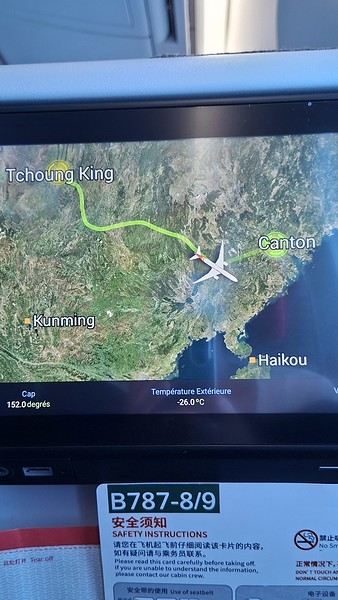
During my first two trips to China, we paid for everything in cash, but this time, we’re going all-in on Alipay and WeChat. I still brought the leftover change from previous trips—it might come in handy. At the metro station, they showed us a QR code to buy tickets via WeChat. There were probably machines and even a ticket counter, but we didn’t see them, and buying via WeChat was pretty simple. 8 yuan to Changshu Lu, which is 22 stops. So far, so good. Then, we had to find the hotel, which wasn’t on Google Maps, Maps.me, or Amap... Easy 😎! We found it without too much hassle, though. Dropped off our stuff and went out to eat. 55 yuan for two claypots with fish/eel, rice, cabbage, and purple eggplant. When we left, it was pouring. We grabbed our umbrellas and set off to explore the neighborhood: Enning Road (we’ll come back later to check out a specific spot), Shangxiajiu (the pedestrian shopping street), Baohua Road... The area is pretty diverse—one street to the next, it’s like stepping into a different world.

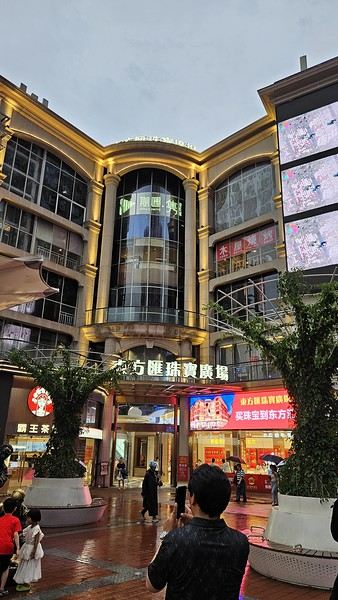
There weren’t many people around, probably because of the rain. We grabbed a quick street food dinner and went to bed—we were exhausted. We struggled to stay awake until 11 PM to adjust to the time change as quickly as possible. There’s a 6-hour time difference.
There wasn’t much room for improvisation on this trip—everything was planned in advance. Since August is peak season, I decided to book train tickets early, and once that was set, I reserved all the accommodations too. I got everything on Trip.com.
I bought the flight tickets back in March from Hainan Airlines. They were super expensive, but with these travel dates, I couldn’t exactly dream of a bargain!
I picked up e-SIMs valid for a month from Free just before departure: 10 € for the e-SIM + 19.90 € for a one-month plan with 35 GB of data abroad.
No need for a VPN with these e-SIMs, but D. still got one—a multi-device plan for 5 € with a discount from Let’s VPN, valid for a month. It was for evenings at the hotel on Wi-Fi to avoid burning through the 35 GB with video.
I downloaded Alipay, WeChat, Amap (Baidu Maps), and Trip.com. We also have Google Translate and Maps.me—absolute must-haves.
We’re ready to go!
I’ve been waiting for this day for nearly 15 years!! I travel a lot, but this one—this is MY TRIP 🙂 It’s been postponed so many times: because I wanted to do it with the right person, because I have a Turkish stamp in my passport and heard they don’t issue visas with that, because of COVID... and then China introduced a 30-day visa exemption, and that was the green light! Ugh, they forced us to take our vacation in August this year—far from ideal—but no more delays. Saturday, August 2, 2025: it’s finally the big day!
Days 1 and 2: We got dropped off at Charles de Gaulle at 9:30 AM. I supposedly checked in online, but only for the first flight and without getting the boarding pass... Might as well scrap online check-in in that case. So, we spent over an hour in line at the counter to get them. We didn’t have any checked luggage—just our backpacks as carry-ons—so this was a step we’d never had to deal with before, but whatever, it’s done. No wait at passport control, 5 minutes through security, a quick walk around the terminal, 10 minutes in the boarding area, and it was already time to board. Departure around 12:45 PM, arrival in Chongqing at 4:50 AM. We had a few hours of layover before our next flight. Went through immigration, connecting flight control, and security. Pro tip: check your next flight’s boarding gate right after immigration. We never saw it displayed again anywhere in the terminal.
The Free e-SIMs work—phew!
Took off at 9:30 AM, arrived in Guangzhou (Canton) at 11:20 AM in the rain. I love how Chongqing is translated as "Tchoung King" on the screens in the plane—very French!
During my first two trips to China, we paid for everything in cash, but this time, we’re going all-in on Alipay and WeChat. I still brought the leftover change from previous trips—it might come in handy. At the metro station, they showed us a QR code to buy tickets via WeChat. There were probably machines and even a ticket counter, but we didn’t see them, and buying via WeChat was pretty simple. 8 yuan to Changshu Lu, which is 22 stops. So far, so good. Then, we had to find the hotel, which wasn’t on Google Maps, Maps.me, or Amap... Easy 😎! We found it without too much hassle, though. Dropped off our stuff and went out to eat. 55 yuan for two claypots with fish/eel, rice, cabbage, and purple eggplant. When we left, it was pouring. We grabbed our umbrellas and set off to explore the neighborhood: Enning Road (we’ll come back later to check out a specific spot), Shangxiajiu (the pedestrian shopping street), Baohua Road... The area is pretty diverse—one street to the next, it’s like stepping into a different world.
There weren’t many people around, probably because of the rain. We grabbed a quick street food dinner and went to bed—we were exhausted. We struggled to stay awake until 11 PM to adjust to the time change as quickly as possible. There’s a 6-hour time difference.
Trip report: Our South Africa journey in July
Hi there,
We’re back from our 3-week trip to South Africa in July. It was a family trip with our four grown-up kids (ages 18 to 25).
First off, I’d like to thank everyone on this forum for their great tips—they really helped us plan this trip!
The trip: We spent 15 days between Port Elizabeth and Cape Town, then a week around Kruger (including Blyde River Canyon). We found South Africans to be welcoming and always ready to help. We never felt unsafe (just followed basic safety rules). The police are very visible, especially on the roads.
Logistics: We’d booked our accommodations in advance but made a few changes on the spot based on how we felt at the time. We rented two vehicles from Firefly (Hertz). No complaints—recent cars, quick returns, and the deposit wasn’t charged. We’d gotten our international driver’s permits... which stayed in France! Luckily, no one asked for them. Driving on the left wasn’t an issue (it wasn’t our first time). The roads we took were in good, even great, condition. Only a few tracks to lodges or parks were rough and required extra caution. Lots of pedestrians on the sides of roads, even highways. And plenty of very slow trucks. But they pull over to let you pass. It’s also common for cars to cross into the opposite lane to overtake, even with white lines. We took two domestic flights: one early in the morning (Johannesburg to Port Elizabeth) and one in the late afternoon (Cape Town to Johannesburg) to save time.
We had some highlights and a few disappointments—all part of the journey! More details coming soon.
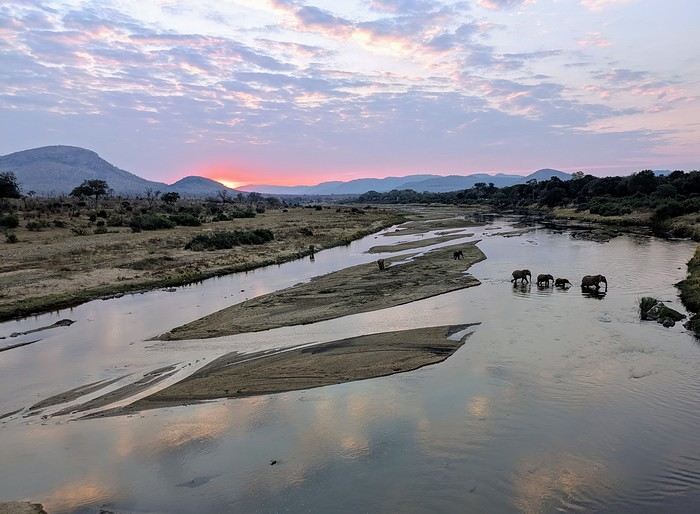
We’re back from our 3-week trip to South Africa in July. It was a family trip with our four grown-up kids (ages 18 to 25).
First off, I’d like to thank everyone on this forum for their great tips—they really helped us plan this trip!
The trip: We spent 15 days between Port Elizabeth and Cape Town, then a week around Kruger (including Blyde River Canyon). We found South Africans to be welcoming and always ready to help. We never felt unsafe (just followed basic safety rules). The police are very visible, especially on the roads.
Logistics: We’d booked our accommodations in advance but made a few changes on the spot based on how we felt at the time. We rented two vehicles from Firefly (Hertz). No complaints—recent cars, quick returns, and the deposit wasn’t charged. We’d gotten our international driver’s permits... which stayed in France! Luckily, no one asked for them. Driving on the left wasn’t an issue (it wasn’t our first time). The roads we took were in good, even great, condition. Only a few tracks to lodges or parks were rough and required extra caution. Lots of pedestrians on the sides of roads, even highways. And plenty of very slow trucks. But they pull over to let you pass. It’s also common for cars to cross into the opposite lane to overtake, even with white lines. We took two domestic flights: one early in the morning (Johannesburg to Port Elizabeth) and one in the late afternoon (Cape Town to Johannesburg) to save time.
We had some highlights and a few disappointments—all part of the journey! More details coming soon.
Swedish Lapland - Padjelantaledden solo trek
A travel journal—it’s been a while!
I must say, my personal situation has "changed a bit" since my last journals (my 3 kids are grown up + a divorce finalized in early 2021). So, no more long-haul family trips; now I’m focusing on multi-day hikes for my vacations. I found a hiking buddy in 2021 to join me on the Laugavegur trek in Iceland, but this year, no one was available.
That’s how the idea of a solo trek in Lapland took root—a region I’ve been dreaming about ever since I read Marie Lefevre’s 2012 journal on the topic.
Marie, who I hiked with for the first time in 2015 during my very first multi-day trek, and whom I can never thank enough for sharing her knowledge and saving me so much time.
To build my confidence for this solo trek, I hiked around Cantal in May (okay, I’m capable of spending nights alone in the middle of nowhere without being overly terrified) and camped in the Mercantour in July, where a massive storm made me realize I still had room for improvement in managing wet conditions...
After some research, I bought 2 Nylofume bags—large, ultra-lightweight ones to protect my gear in my backpack—and a set of 4 Aloksak bags in different sizes for my passport, camera, battery, etc. (and I’m so glad I did!!)
Well, I think I’m all set...
My 16/08 - Day 1 - Ritsem – Gisuris (well, almost) Wed 17/08 – Day 2 - Partly in the tent + minimal progress toward Gisuris Thu 18/08 – Day 3 - Gisuris – Laddejakha (23 km) Fri 19/08 – Day 4 – Laddejakha – Arasluokta (13 km) Sat 20/08 - Day 5 - Arasluokta – Staloluokta (12 km) Sun 21/08 – Day 6 - Staloluokta – Duottar (18 km) Mon 22/08 Day 7 - Duottar – Dareluoppal (10 km) Sammarlappa (15.3 km) Tue 23/08 - Day 8 - Sammarlappa – Tarrekaise (12 km) + halfway to Tarrekaise-Nunjes (approx. 3 km) Wed 24/08 – Day 9 – Finish Tarrekaise-Nunjes (approx. 4 km) Kvikkjokk (12.6 km) Thu 25/08 and Fri 26/08 – Around Kvikkjokk Food and gear summary
I must say, my personal situation has "changed a bit" since my last journals (my 3 kids are grown up + a divorce finalized in early 2021). So, no more long-haul family trips; now I’m focusing on multi-day hikes for my vacations. I found a hiking buddy in 2021 to join me on the Laugavegur trek in Iceland, but this year, no one was available.
That’s how the idea of a solo trek in Lapland took root—a region I’ve been dreaming about ever since I read Marie Lefevre’s 2012 journal on the topic.
Marie, who I hiked with for the first time in 2015 during my very first multi-day trek, and whom I can never thank enough for sharing her knowledge and saving me so much time.
To build my confidence for this solo trek, I hiked around Cantal in May (okay, I’m capable of spending nights alone in the middle of nowhere without being overly terrified) and camped in the Mercantour in July, where a massive storm made me realize I still had room for improvement in managing wet conditions...
After some research, I bought 2 Nylofume bags—large, ultra-lightweight ones to protect my gear in my backpack—and a set of 4 Aloksak bags in different sizes for my passport, camera, battery, etc. (and I’m so glad I did!!)
Well, I think I’m all set...
My 16/08 - Day 1 - Ritsem – Gisuris (well, almost) Wed 17/08 – Day 2 - Partly in the tent + minimal progress toward Gisuris Thu 18/08 – Day 3 - Gisuris – Laddejakha (23 km) Fri 19/08 – Day 4 – Laddejakha – Arasluokta (13 km) Sat 20/08 - Day 5 - Arasluokta – Staloluokta (12 km) Sun 21/08 – Day 6 - Staloluokta – Duottar (18 km) Mon 22/08 Day 7 - Duottar – Dareluoppal (10 km) Sammarlappa (15.3 km) Tue 23/08 - Day 8 - Sammarlappa – Tarrekaise (12 km) + halfway to Tarrekaise-Nunjes (approx. 3 km) Wed 24/08 – Day 9 – Finish Tarrekaise-Nunjes (approx. 4 km) Kvikkjokk (12.6 km) Thu 25/08 and Fri 26/08 – Around Kvikkjokk Food and gear summary
What are the criteria that make you choose one destination over another?
Hi there,
The title might be a bit long, but I hope it’s completely understandable!
When it comes to choosing your next trip, what tips the scales in favor of Eritrea over Ibiza?
Why pick Canada over French Polynesia?
The price? A magazine or TV report, a travel journal, an Instagram ad? Ease of travel? Minimal time difference? The country that has the most in common with all the trip participants? Activities? Relaxation? The desire to push your limits?
A photo?
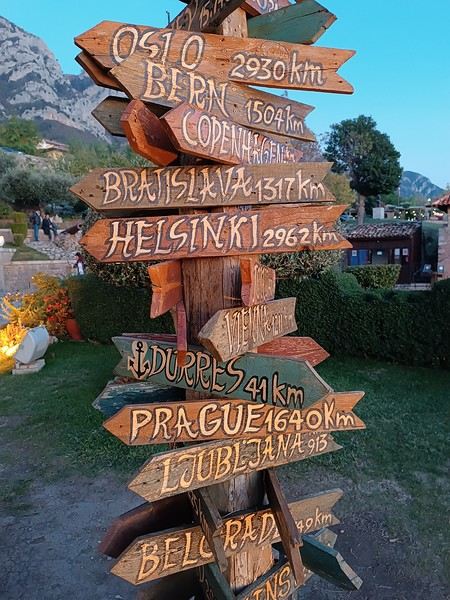
What else, I wonder...
Personally, I often prioritize simple destinations (no administrative hassles), where I’m not at risk (nothing extraordinary like getting kidnapped by Daesh or ending up in a jail cell because the current geopolitics aren’t favorable to my passport, etc.), and where I can drive.
Wide-open natural spaces are more my thing than urban anthills.
Finally, I try not to spend three days on a plane to reach my destination, and I aim for a maximum budget of 3500 € (for 3 weeks) in comfortable conditions—that means charming hotels, good meals, etc.
What about you?🙂
The title might be a bit long, but I hope it’s completely understandable!
When it comes to choosing your next trip, what tips the scales in favor of Eritrea over Ibiza?
Why pick Canada over French Polynesia?
The price? A magazine or TV report, a travel journal, an Instagram ad? Ease of travel? Minimal time difference? The country that has the most in common with all the trip participants? Activities? Relaxation? The desire to push your limits?
A photo?
What else, I wonder...
Personally, I often prioritize simple destinations (no administrative hassles), where I’m not at risk (nothing extraordinary like getting kidnapped by Daesh or ending up in a jail cell because the current geopolitics aren’t favorable to my passport, etc.), and where I can drive.
Wide-open natural spaces are more my thing than urban anthills.
Finally, I try not to spend three days on a plane to reach my destination, and I aim for a maximum budget of 3500 € (for 3 weeks) in comfortable conditions—that means charming hotels, good meals, etc.
What about you?🙂
All Over Thailand
You can post your personal photos in the following thread: https://voyageforum.com/forum/quelque-part-en-thailande-d10655574/
This travel journal is therefore intended solely for my photos, to present a consistent style. All the shots were taken with a simple Samsung Galaxy smartphone and with whatever was at hand.
All stays combined, I’ve spent the equivalent of three years at most in Thailand, and I’m not a big expert on the country. However, after many trips, lots of reading on VoyageForum and other sites, and conversations with many locals as well as expats, my view of the country is becoming clearer, though it’s constantly evolving. You never stop discovering and learning.
I guess I wanted to piece together a puzzle, mainly for those who want to get an idea of the country here and for those who miss it. I don’t know if this minimalist sharing will interest anyone, but it’ll do me good to put it together. After so many months without traveling and then these other long months with VF closed, there’s plenty of material available.
There’ll be a mix of places, periods, and subjects, but it might well be intentional.
I suspect many Thais have dogs because they make excellent guards for the home. Nothing better to deter burglars or to signal the presence of a snake. You’ll often see Thais tapping the top of their dog’s head, but don’t be fooled: it’s a sign of affection from them. Judging by the dogs’ reactions, they’re used to it.
Thailand is one of the countries on the planet where rabies is still present, so keep that in mind. It’s not just bites that can be dangerous, so don’t let just any dog lick you. Especially on a wound, of course. Even though dogs often fear humans—this dangerous and unpredictable predator—we still need to stay cautious. Be careful when walking into alleys because the dog will defend its master’s big property, be careful at night, and be careful when they’re in packs. It sometimes crosses our minds that Thailand isn’t really made for walking around, and dogs are one of the reasons. That said, it’s not uncommon to see them chasing bikes or scooters. Cars, though, are much rarer—they’re too big.
It seems Thais prefer to give their dogs freedom by not locking them behind gates. Though sometimes the gate is closed, the little side door is wide open. Oh, and sometimes there’s no gate in front of the property, or it’s been broken for years.
You’ll often see dogs sleeping on the side of the road, sometimes right on the road. When you arrive, they move aside nonchalantly—or not at all. It’s less funny when they suddenly appear from thick vegetation, which reminds visitors not to drive too fast. As a result, you’ll notice that dogs with injuries or missing legs aren’t that rare.
Since they believe in reincarnation and respect for all forms of life, they don’t chase dog packs away too much, and they don’t sterilize them enough. Seeing a small pack roaming freely in the countryside, you might think it’s best not to cross paths with them at the edge of a field. A darker side of this is that euthanasia isn’t often practiced. Twice, we saw dogs at temples on the brink of death, enduring terrible suffering. No one did anything about it. The image (and the smell) of one of them, dying and emitting the stench of death, still comes back to me sometimes.
Some of you may have seen the YouTube vlog of a French woman living in Phuket who was given a little pig by her Thai friends. The well-fed animal quickly became a happy, enormous beast with its own garden. Yet, it didn’t take long for it to fall seriously ill and become incurable. In her video, the French woman described how difficult it was to find a vet willing to perform euthanasia.
You’ll often see bowls by the side of the road. Thais leave food and water in them for stray cats and dogs. Overall, they have a big heart for animals.
If you ever pop into a shopping mall, you might see people pushing their small dogs in strollers. It’s not a gimmick—it’s just that these strollers are provided for customers to put their pets in, otherwise you can’t bring them inside. It looks a bit odd when you expect to see a baby.
This travel journal is therefore intended solely for my photos, to present a consistent style. All the shots were taken with a simple Samsung Galaxy smartphone and with whatever was at hand.
All stays combined, I’ve spent the equivalent of three years at most in Thailand, and I’m not a big expert on the country. However, after many trips, lots of reading on VoyageForum and other sites, and conversations with many locals as well as expats, my view of the country is becoming clearer, though it’s constantly evolving. You never stop discovering and learning.
I guess I wanted to piece together a puzzle, mainly for those who want to get an idea of the country here and for those who miss it. I don’t know if this minimalist sharing will interest anyone, but it’ll do me good to put it together. After so many months without traveling and then these other long months with VF closed, there’s plenty of material available.
There’ll be a mix of places, periods, and subjects, but it might well be intentional.
I suspect many Thais have dogs because they make excellent guards for the home. Nothing better to deter burglars or to signal the presence of a snake. You’ll often see Thais tapping the top of their dog’s head, but don’t be fooled: it’s a sign of affection from them. Judging by the dogs’ reactions, they’re used to it.
Thailand is one of the countries on the planet where rabies is still present, so keep that in mind. It’s not just bites that can be dangerous, so don’t let just any dog lick you. Especially on a wound, of course. Even though dogs often fear humans—this dangerous and unpredictable predator—we still need to stay cautious. Be careful when walking into alleys because the dog will defend its master’s big property, be careful at night, and be careful when they’re in packs. It sometimes crosses our minds that Thailand isn’t really made for walking around, and dogs are one of the reasons. That said, it’s not uncommon to see them chasing bikes or scooters. Cars, though, are much rarer—they’re too big.
It seems Thais prefer to give their dogs freedom by not locking them behind gates. Though sometimes the gate is closed, the little side door is wide open. Oh, and sometimes there’s no gate in front of the property, or it’s been broken for years.
You’ll often see dogs sleeping on the side of the road, sometimes right on the road. When you arrive, they move aside nonchalantly—or not at all. It’s less funny when they suddenly appear from thick vegetation, which reminds visitors not to drive too fast. As a result, you’ll notice that dogs with injuries or missing legs aren’t that rare.
Since they believe in reincarnation and respect for all forms of life, they don’t chase dog packs away too much, and they don’t sterilize them enough. Seeing a small pack roaming freely in the countryside, you might think it’s best not to cross paths with them at the edge of a field. A darker side of this is that euthanasia isn’t often practiced. Twice, we saw dogs at temples on the brink of death, enduring terrible suffering. No one did anything about it. The image (and the smell) of one of them, dying and emitting the stench of death, still comes back to me sometimes.
Some of you may have seen the YouTube vlog of a French woman living in Phuket who was given a little pig by her Thai friends. The well-fed animal quickly became a happy, enormous beast with its own garden. Yet, it didn’t take long for it to fall seriously ill and become incurable. In her video, the French woman described how difficult it was to find a vet willing to perform euthanasia.
You’ll often see bowls by the side of the road. Thais leave food and water in them for stray cats and dogs. Overall, they have a big heart for animals.
If you ever pop into a shopping mall, you might see people pushing their small dogs in strollers. It’s not a gimmick—it’s just that these strollers are provided for customers to put their pets in, otherwise you can’t bring them inside. It looks a bit odd when you expect to see a baby.
Embracing Dawn: December 2024 Photo Contest
Hi everyone,
After my narrow victory over Herodotos (just one point ahead—I had a close call, even in December in the northern hemisphere!), I’m now honored to organize the next contest, the one for the closing year, whose results will be announced on the first day of the coming year. Out of affection for the poet with wind in his soles, who dreamed of ivory and setting sail, again and again, even in his final hours, I borrow the theme from the first line of a poem dear to me: I embraced the summer dawn.
So, as the year draws to a close, the theme will be: embracing dawn.
The verb here is just as important as the noun. More than just a subject about sunrises or that magical half-hour of pink light before the sun appears (a photographer’s nightmare: either I crank up the ISO and deal with noise, or I lug around a tripod, and say goodbye to spontaneity like a beggar on marble quays), this is about those happy little mornings—the thrill of joy in the soft light of the first hours, whether it’s a landscape, a person, an animal, a plant, architecture, or whatever else. What’s certain is that it makes you want to smile at the day breaking. Even if you go back to bed afterward.
Technical details (shamelessly borrowed from Ragamuffin, thanks!):
Participation Each VF member can submit up to 3 photos, until Wednesday, 12/25 at 11:59 PM, Milan time. Each photo must be posted in a separate message, with its number (1, 2, or 3). Don’t forget to add a little explanation (comment, location, etc.).
Voting: Each VF member can vote for the 3 photos they consider the best, based on their own criteria and the theme.
Voting will take place from Thursday, 12/26 to Tuesday, 12/31 at 11:59 PM, Milan time.
Selected photos will be ranked in order of preference: - 1st photo: 3 points - 2nd photo: 2 points - 3rd photo: 1 point
The winner is the author of the photo with the most points.
Results will be published on 01/01 (if I’m in any state to do so). In case of a tie, the number of first-place votes will decide. The winner will have the honor of organizing December’s contest.
For discussion, it’s here.
That’s all! Let’s welcome Dawn with rosy fingers, dressed in saffron...
Catherine
After my narrow victory over Herodotos (just one point ahead—I had a close call, even in December in the northern hemisphere!), I’m now honored to organize the next contest, the one for the closing year, whose results will be announced on the first day of the coming year. Out of affection for the poet with wind in his soles, who dreamed of ivory and setting sail, again and again, even in his final hours, I borrow the theme from the first line of a poem dear to me: I embraced the summer dawn.
So, as the year draws to a close, the theme will be: embracing dawn.
The verb here is just as important as the noun. More than just a subject about sunrises or that magical half-hour of pink light before the sun appears (a photographer’s nightmare: either I crank up the ISO and deal with noise, or I lug around a tripod, and say goodbye to spontaneity like a beggar on marble quays), this is about those happy little mornings—the thrill of joy in the soft light of the first hours, whether it’s a landscape, a person, an animal, a plant, architecture, or whatever else. What’s certain is that it makes you want to smile at the day breaking. Even if you go back to bed afterward.
Technical details (shamelessly borrowed from Ragamuffin, thanks!):
Participation Each VF member can submit up to 3 photos, until Wednesday, 12/25 at 11:59 PM, Milan time. Each photo must be posted in a separate message, with its number (1, 2, or 3). Don’t forget to add a little explanation (comment, location, etc.).
Voting: Each VF member can vote for the 3 photos they consider the best, based on their own criteria and the theme.
Voting will take place from Thursday, 12/26 to Tuesday, 12/31 at 11:59 PM, Milan time.
Selected photos will be ranked in order of preference: - 1st photo: 3 points - 2nd photo: 2 points - 3rd photo: 1 point
The winner is the author of the photo with the most points.
Results will be published on 01/01 (if I’m in any state to do so). In case of a tie, the number of first-place votes will decide. The winner will have the honor of organizing December’s contest.
For discussion, it’s here.
That’s all! Let’s welcome Dawn with rosy fingers, dressed in saffron...
Catherine
Three weeks in Norway (July 2022): fantastic memories despite the rain
Our trip to Norway was two years ago already, but I thought it might still be of interest—and it’ll let me relive it a bit by proxy.
Before booking our flight tickets, we debated the route: should we prioritize the north with the Lofoten and Senja islands, or the south with its countless fjords? I was tempted to stay in the south—the country is so vast, and the drive north is long... but my husband really didn’t want to miss the Lofoten. In the end, we figured that since Norway is known for being expensive, we might only visit once (funny how we said the same thing before our first trip to the American West, and look how that turned out 😎), so we didn’t want to skip anything. That meant a 2–3 day drive up north. With 22 days on the ground, it was doable. Especially since, as usual, we skip big cities and gave Oslo a pass.
Practical details: - Flight tickets: 1195 € for 4 with Air France (Paris–Oslo outbound, Tromsø–Bergen–Paris return) - Car rental: 2020 € for 21 days (including the outrageous drop-off fee between Oslo and Tromsø—about 1000 €) - Tolls and ferries: 250 € for the portion billed directly by the rental company. Some ferries required advance booking and payment at the time of reservation—I’ll note their prices as I go through the story. - Hotels: 4135 €, averaging 188 € per night. We blew past our usual budgets from trips to the U.S., but oh well... - Food: 1570 €, averaging 71 € per day for 4 in a country where everything’s expensive... How’d we manage? We rarely ate out, mostly grocery shopped, and even packed half a suitcase with non-perishables: pasta, rice, a few cans, and even some cured sausage! We also stayed 3 nights at Clarion Collection hotels, where an evening buffet was included in the room rate.
Before booking our flight tickets, we debated the route: should we prioritize the north with the Lofoten and Senja islands, or the south with its countless fjords? I was tempted to stay in the south—the country is so vast, and the drive north is long... but my husband really didn’t want to miss the Lofoten. In the end, we figured that since Norway is known for being expensive, we might only visit once (funny how we said the same thing before our first trip to the American West, and look how that turned out 😎), so we didn’t want to skip anything. That meant a 2–3 day drive up north. With 22 days on the ground, it was doable. Especially since, as usual, we skip big cities and gave Oslo a pass.
Practical details: - Flight tickets: 1195 € for 4 with Air France (Paris–Oslo outbound, Tromsø–Bergen–Paris return) - Car rental: 2020 € for 21 days (including the outrageous drop-off fee between Oslo and Tromsø—about 1000 €) - Tolls and ferries: 250 € for the portion billed directly by the rental company. Some ferries required advance booking and payment at the time of reservation—I’ll note their prices as I go through the story. - Hotels: 4135 €, averaging 188 € per night. We blew past our usual budgets from trips to the U.S., but oh well... - Food: 1570 €, averaging 71 € per day for 4 in a country where everything’s expensive... How’d we manage? We rarely ate out, mostly grocery shopped, and even packed half a suitcase with non-perishables: pasta, rice, a few cans, and even some cured sausage! We also stayed 3 nights at Clarion Collection hotels, where an evening buffet was included in the room rate.
16 days in Peru in August 2023
Hi everyone,
The years go by and Machu Picchu has been on our "to-do list" for a few decades now...
But Peru is, fortunately, so much more than this legendary site...
We went as a couple for a 15-day trip. For the first time, we delegated the logistics to a local agency (Paprika in Arequipa). This agency offers "classic" small-group tours and the option to do it privately, which we chose.
No complaints—they were perfect for organizing transportation, hotels, and French-speaking guides.
The "classic" southern Peru loop is: Lima, Paracas, Nazca, Arequipa, Colca, Titicaca, Cusco, Sacred Valley, Cusco. Nothing very original... but why get creative when there’s already so much beauty to discover?
We opted for a shorter loop, skipping Paracas/Nazca because the small planes in Nazca weren’t a unanimous hit, and it saved us dozens of hours on the bus. But we added a stop at Palccoyo (the rainbow mountains) between Titicaca and Cusco.
It might seem like a shame, but we don’t regret it at all.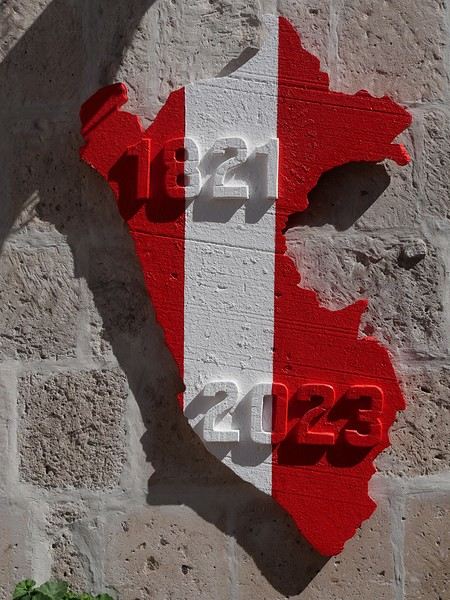
We went as a couple for a 15-day trip. For the first time, we delegated the logistics to a local agency (Paprika in Arequipa). This agency offers "classic" small-group tours and the option to do it privately, which we chose.
No complaints—they were perfect for organizing transportation, hotels, and French-speaking guides.
The "classic" southern Peru loop is: Lima, Paracas, Nazca, Arequipa, Colca, Titicaca, Cusco, Sacred Valley, Cusco. Nothing very original... but why get creative when there’s already so much beauty to discover?
We opted for a shorter loop, skipping Paracas/Nazca because the small planes in Nazca weren’t a unanimous hit, and it saved us dozens of hours on the bus. But we added a stop at Palccoyo (the rainbow mountains) between Titicaca and Cusco.
It might seem like a shame, but we don’t regret it at all.
Review of a Mediterranean cruise on the Splendida and 24 hours in Venice – October 2024
Hi everyone,
What a joy to be back here and pick up where we left off after all these months of hiatus.
I hope you’ll enjoy the story of this little trip around the Eastern Mediterranean. This cruise was the perfect way to satisfy our longing to return to Greece and Istanbul. The end of the season, until late November, is the best time to visit the Mediterranean in my opinion—when climate disruptions don’t get in the way.
Departing from Trieste, our stops were Katakolon, Piraeus, Kusadasi, Istanbul, Corfu, and Bari, before returning to Trieste and then Venice, where we planned a very short 24-hour stay.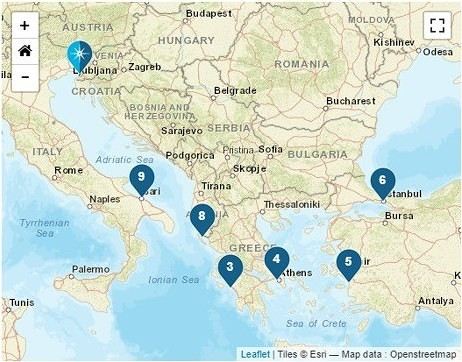
We left home at 6:15 AM—our first cruise departure since moving to Normandy. What I miss most about living in the Gard is how close we were to Marseille Airport. No more hopping over to Marignane in an hour; now we have to plan for a three-hour trip to CDG, even under the best conditions on an early Sunday morning.
It was impossible to book a hotel night before our flight because, starting in April, the Ibis was priced at 450 € per night, and the Mercure was flirting with 800 €—breakfast not included, of course. 😏
I had a feeling there must’ve been a conference or something going on… Turns out, it was just the auto show. They simply adjusted the room prices to match the cost of the cars. 😛
Our flight took us to Venice, where we caught a FlixBus to Trieste. We arrived at Trieste’s train station in the afternoon and walked to our hotel in the city center.
After treating ourselves to an amazing pizza at a restaurant (Di Napoli Maestri Pizzaioli, Via Armando Diaz 10) for a very reasonable price, we enjoyed the mild evening temperature while exploring the stunning buildings of this charming city by night. These magnificent structures are a testament to the city’s past. Trieste became Austrian in 1382 due to its complicated relationship with Venice, and it wasn’t until 1918, at the end of World War I, that it became Italian again. The city’s lighting beautifully highlights the architecture of the buildings.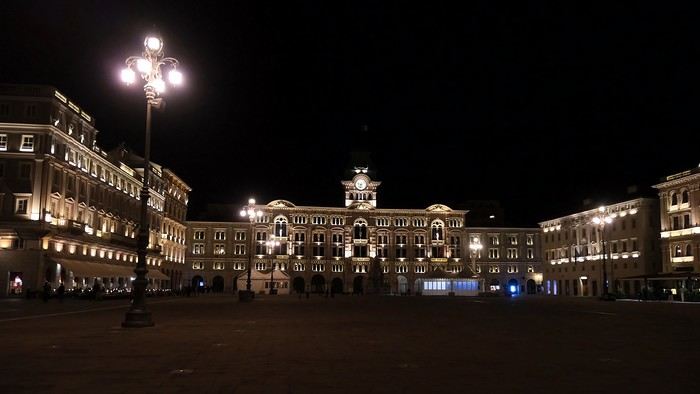
The terraces were lively, and the atmosphere was so warm and inviting that we wanted to stay out even longer.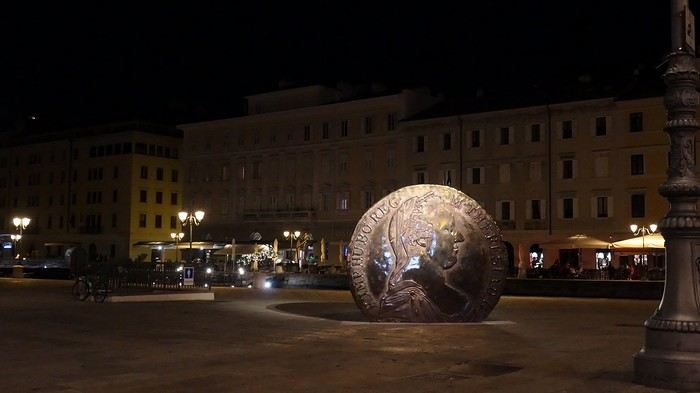
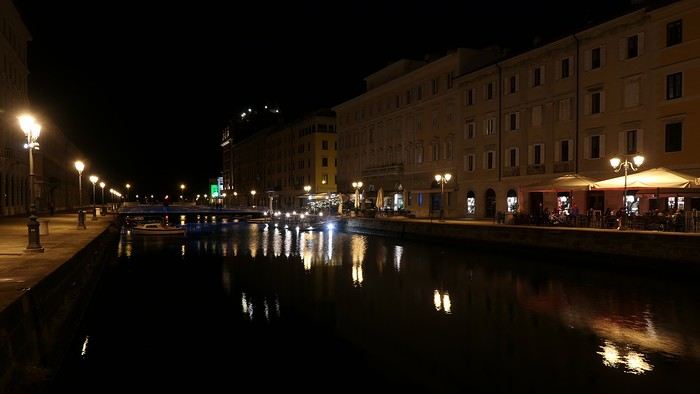
But we’d been up since 4 AM, so we were happy to retreat to the quiet of our hotel, located in the pedestrian center just a few steps from the port (Urban Hotel Design—highly recommended).
More to come soon.
What a joy to be back here and pick up where we left off after all these months of hiatus.
I hope you’ll enjoy the story of this little trip around the Eastern Mediterranean. This cruise was the perfect way to satisfy our longing to return to Greece and Istanbul. The end of the season, until late November, is the best time to visit the Mediterranean in my opinion—when climate disruptions don’t get in the way.
Departing from Trieste, our stops were Katakolon, Piraeus, Kusadasi, Istanbul, Corfu, and Bari, before returning to Trieste and then Venice, where we planned a very short 24-hour stay.
We left home at 6:15 AM—our first cruise departure since moving to Normandy. What I miss most about living in the Gard is how close we were to Marseille Airport. No more hopping over to Marignane in an hour; now we have to plan for a three-hour trip to CDG, even under the best conditions on an early Sunday morning.
It was impossible to book a hotel night before our flight because, starting in April, the Ibis was priced at 450 € per night, and the Mercure was flirting with 800 €—breakfast not included, of course. 😏
I had a feeling there must’ve been a conference or something going on… Turns out, it was just the auto show. They simply adjusted the room prices to match the cost of the cars. 😛
Our flight took us to Venice, where we caught a FlixBus to Trieste. We arrived at Trieste’s train station in the afternoon and walked to our hotel in the city center.
After treating ourselves to an amazing pizza at a restaurant (Di Napoli Maestri Pizzaioli, Via Armando Diaz 10) for a very reasonable price, we enjoyed the mild evening temperature while exploring the stunning buildings of this charming city by night. These magnificent structures are a testament to the city’s past. Trieste became Austrian in 1382 due to its complicated relationship with Venice, and it wasn’t until 1918, at the end of World War I, that it became Italian again. The city’s lighting beautifully highlights the architecture of the buildings.
The terraces were lively, and the atmosphere was so warm and inviting that we wanted to stay out even longer.
But we’d been up since 4 AM, so we were happy to retreat to the quiet of our hotel, located in the pedestrian center just a few steps from the port (Urban Hotel Design—highly recommended).
More to come soon.
L'alimentation idéale en voyage à vélo English translation pending
Je suis a la recherche de menus idéal pour avoir une alimentation équilibré en voyage a vélo qui pourrai donner assez d'énergie pour la journée et éviter les carences et autres fringales . Merci pour vos idées .
Majorque, rien que pour vos yeux English translation pending
Salut à tous,
Dimanche pluvieux, rentrée dans 2 jours, des masques partout, bref ambiance sinistrose à fond😕... alors je me suis dit qu'il est tant de me replonger dans les photos de Majorque et de vous en faire profiter afin d'égayer (je l'espère) les jours à venir 🙂
Majorque... Franchement cette destination ne m'a jamais fait rêver. Les Baléares, dans mon imaginaire personnel, c'était un peu les vacances Fram pas chères, de la bidasse au bord de la plage et train de siroter des mauvais cocktails, et de la jeunesse encannaillée en boite de nuit au son des boum boum boum...
Cet été, on projetait d'aller en Sicile. Nous c'est Papa, Maman, notre p'tit gars de 10 ans, et notre princesse de 6 ans. Et j'étais plus particulièrement motivé par les îles éoliennes, qui est un des must de la plongée méditerranéenne (ah oui, je suis plongeur, alors c'est toujours un critère obligé de nos destinations de vacances 😎) avec des décors volcaniques qui semblaient magiques. Mais pour différentes raisons, celà ne s'est pas fait. Alors quand ma femme, ayant vu le blog d'une instagrameuse, m'a parlé de Majorque à la place des Eoliennes, j'ai plutôt bondi... Elle a insisté, j'ai cédé, on a acheté le Lonely Planet, et j'ai commencé, toujours peu motivé, à le feuilleter... Et là, ce que je lisais n'était pas du tout en phase avec l'image d'Epinal que j'en avais... Majorque était décrit comme un écrin naturel, à base de criques turquoises, montagnes plongeant dans la mer, petits villages, plantations d'agrumes... Et de très beau coin à plongée, notamment pas mal de grottes autour du Cap de Formentor. Destination parfaite pour allier plaisir des enfants et des parents 🙂 Alors j'ai dit banco !
Un chaine montagneuse (Sierra de Tramontana) couvre la cote Ouest de l'île et se termine par le Cap de Formentor, avec nombreuses criques, parfois sauvages, un peu partout. Le Nord est formé de 2 grandes baies (celles de Pollenca et Alcudia). L'Est est très bétonné ; de belles criques mais pas vraiment sauvages. Le Sud c'est essentiellement la baie de Palma où s'entassent les jeunes anglais et allemands venus ce retourner la tête... Pas grand chose à voir au centre.
Alors on a préparé celà gentiment. Etant donné que nous ciblions la découverte du Nord et de l'Ouest de l'île , on a ciblé un logement dans la région de Sa Pobla, proche de la baie de Pollenca. Billets Transavia en poche en février pour un départ en Juillet, réservation d'une villa par Air b'n'b, il n'y avait plus qu'à... Et la Covid est arrivé🏴☠️. On n'a rien annulé, on a a serré les fesses, et finalement on est passé entre les gouttes. Nos vols ont été maintenus aux dates et horaires prévus.
La dernière chose à faire était la réservation de la voiture de location, faite au dernier moment. Oubliez les prestataires institutionnels, il y a une multitude d'agences locales à l'aéroport de Majorque. On est passé par Wiber, RAS
Et ces deux semaines furent incroyables. Un vrai choc, je ne m'attendais pas à une telle beauté à 1h30 de vol de Paris 😛
Je vais vous raconter, et surtout vous montrer tout celà, tranquillement 😉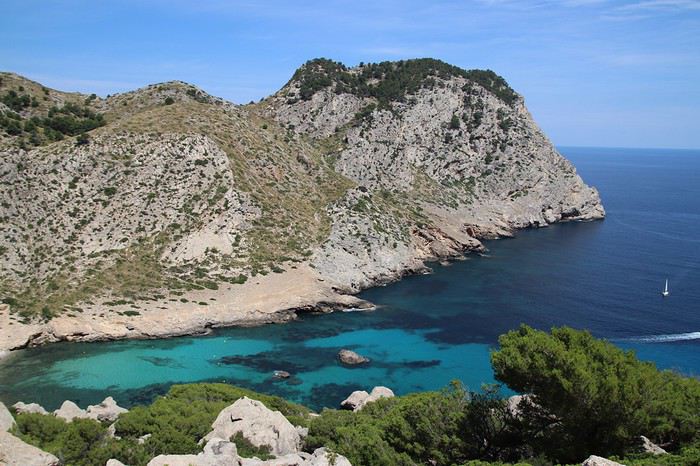
Dimanche pluvieux, rentrée dans 2 jours, des masques partout, bref ambiance sinistrose à fond😕... alors je me suis dit qu'il est tant de me replonger dans les photos de Majorque et de vous en faire profiter afin d'égayer (je l'espère) les jours à venir 🙂
Majorque... Franchement cette destination ne m'a jamais fait rêver. Les Baléares, dans mon imaginaire personnel, c'était un peu les vacances Fram pas chères, de la bidasse au bord de la plage et train de siroter des mauvais cocktails, et de la jeunesse encannaillée en boite de nuit au son des boum boum boum...
Cet été, on projetait d'aller en Sicile. Nous c'est Papa, Maman, notre p'tit gars de 10 ans, et notre princesse de 6 ans. Et j'étais plus particulièrement motivé par les îles éoliennes, qui est un des must de la plongée méditerranéenne (ah oui, je suis plongeur, alors c'est toujours un critère obligé de nos destinations de vacances 😎) avec des décors volcaniques qui semblaient magiques. Mais pour différentes raisons, celà ne s'est pas fait. Alors quand ma femme, ayant vu le blog d'une instagrameuse, m'a parlé de Majorque à la place des Eoliennes, j'ai plutôt bondi... Elle a insisté, j'ai cédé, on a acheté le Lonely Planet, et j'ai commencé, toujours peu motivé, à le feuilleter... Et là, ce que je lisais n'était pas du tout en phase avec l'image d'Epinal que j'en avais... Majorque était décrit comme un écrin naturel, à base de criques turquoises, montagnes plongeant dans la mer, petits villages, plantations d'agrumes... Et de très beau coin à plongée, notamment pas mal de grottes autour du Cap de Formentor. Destination parfaite pour allier plaisir des enfants et des parents 🙂 Alors j'ai dit banco !
Un chaine montagneuse (Sierra de Tramontana) couvre la cote Ouest de l'île et se termine par le Cap de Formentor, avec nombreuses criques, parfois sauvages, un peu partout. Le Nord est formé de 2 grandes baies (celles de Pollenca et Alcudia). L'Est est très bétonné ; de belles criques mais pas vraiment sauvages. Le Sud c'est essentiellement la baie de Palma où s'entassent les jeunes anglais et allemands venus ce retourner la tête... Pas grand chose à voir au centre.
Alors on a préparé celà gentiment. Etant donné que nous ciblions la découverte du Nord et de l'Ouest de l'île , on a ciblé un logement dans la région de Sa Pobla, proche de la baie de Pollenca. Billets Transavia en poche en février pour un départ en Juillet, réservation d'une villa par Air b'n'b, il n'y avait plus qu'à... Et la Covid est arrivé🏴☠️. On n'a rien annulé, on a a serré les fesses, et finalement on est passé entre les gouttes. Nos vols ont été maintenus aux dates et horaires prévus.
La dernière chose à faire était la réservation de la voiture de location, faite au dernier moment. Oubliez les prestataires institutionnels, il y a une multitude d'agences locales à l'aéroport de Majorque. On est passé par Wiber, RAS
Et ces deux semaines furent incroyables. Un vrai choc, je ne m'attendais pas à une telle beauté à 1h30 de vol de Paris 😛
Je vais vous raconter, et surtout vous montrer tout celà, tranquillement 😉