Results for "Rance+|+127"
8174 results found.
Il était une fois... la Laponie English translation pending
Car il est de ces voyages qui ... bouleversent ...
Parce que bien trop d’étoiles ont été offertes à mon regard que pour pouvoir les y loger toutes … Parce que tant de jolis diamants tellement purs m’ont été montrés, dans des écrins tout aussi magnifiques … Je vous en envoie, des fragments, des étincelles, des poussières d’étoiles … avec une plume trempée dans l’encrier de la beauté pure … pour que vous hébergiez ces petites perles en surplus qui méritent tout sauf d’être oubliées … Récit d’un rêve éveillé à jamais vivant au fond de mes yeux émerveillés …
Au départ, une idée, lancée comme cela un jour tout gris d’hiver tout froid. Au départ, beaucoup d’imagination, d’espoirs, de rêves. Au départ quelques petites bulles toutes fraîches, toutes vierges dans nos ptites têtes. Sans doute un peu trop d’optimisme pour tout esprit bien rangé. Sans doute un peu trop d’audace pour nos cœurs peu habitués. Sans doute … Mais à trop prévoir, anticiper, imaginer, on se retrouve bien souvent le cœur un peu déçu … On a peut-être envisagé l’impossible, mais à atteindre la lune, on s’est retrouvés le cœur à jamais différent, léger, souriant, aérien, le regard étoilé, pétillant et chantant …
Quelques jours à peine ont suffi à mûrir quelque peu l’idée. Non à grand recours de programmes savants ou de planification exempte du moindre défaut. Juste l’heureuse rencontre de nos ptites bulles isolées, le partage de nos rêves parallèles …
Quelques journées plus tard à peine, pendant que le jour entamait lentement sa victoire quotidienne sur la nuit, cinq silhouettes encore tout ensommeillées filaient dans un taxi tout silencieux. Après quelques heures, un grand avion coupait le ciel, tout alourdi de nos ptites têtes pleines de rêves et d’espoirs. Nous c’est une jolie ptite macédoine internationale : Hélène (France), Coen (Hollande), Nico (Espagne), Luca (Italie) et moi …
L’avion atterrit dans le cercle polaire, à Kiruna. Lieu des extrêmes, d’abord géographiques … Kiruna, c’est la principale « ville » de Lappland, à quelques 1700 kilomètres de Lund, quelques 3000 kilomètres de Bruxelles … Lieu des extrêmes de températures aussi : soleil de minuit de mai à août, jusque –30°C dans les profondeurs de l’hiver.
L’avion atterrit et débutent quatre journées si jolies. Quatre journées tout d’abord magnifiées par la splendeur des paysages.
Car entre Kiruna et Narvik (Norvège), un immense lac, Torne Träsk, se déployant sur près de 80 kilomètres de long, quelques 15 kilomètres de large, longeant tour à tour forêts et montagnes … Lac entièrement gelé, sur plus d’un mètre d’épaisseur … De temps à autres, deux ptites âmes perdues au milieu de ce vide si joli, de temps à autre deux ptits cœurs battants sur cette immensité ; ils sont pêcheurs … et en communion si parfaite avec cet environnement si joli, ils pratiquent leur sport favori.
Entre Kiruna et Narvik, une seule route, esseulée et désertée, fendant un ciel épuré par l’absence humaine et des étendues si vastes que, bien au-delà de s’y perdre, on ne peut que s’y retrouver …
Car entre Kiruna et Narvik, sur les bords du Torne Träsk, Abisko, petit village qui, malgré ses … 180 âmes … se trouve sur toutes les cartes suédoies. 180 habitants, oui mais … oui mais … deux gares 🙂!
A Abisko, un canyon. Et dans le canyon, une chute d’eau, totalement gelée, figée … A Abisko toujours, un point de départ pour une piste de trekking mondialement connue, Kungsleden, la Piste Royale. A quelque distance de là, le sommet suédois, Kebnekaïse, dominant le pays du haut de ses 2111 mètres … Grâce à lui, un horizon toujours découpé, superbement sculpté dans ces impressionnantes montagnes …
Car en Norvège, dans les alentours de Narvik, des fjords, des fjords superbes. Certes pas les plus impressionnants du pays, mais il n’a jamais fallu de superlatifs pour trouver son bonheur … A chaque détour de la petite et unique route, un nouveau trésor, un nouveau cadeau de la nature. Tellement d’images adorables gravées dans ma ptite tête, si difficiles à transcrire, en plus sous le risque de les décolorer. Fermez les yeux quelques secondes (après avoir lu cette ligne, ce sera plus facile 🙂), et imaginez … Imaginez, au loin, des montagnes parfois si escarpées, comme pressées de rejoindre la mer, mer toute limpide qui se faufile entre ces falaises … montagnes parfois plus lentes, plus lisses, plus douces. Au pied des montagnes, ou de l’autre côté du bras de mer, parsemez de ptites forêts toutes mignonnes et si fières, fières sans doute d’être les seules sources de couleur des alentours … Saupoudrez, sans lésiner sur les quantités, d’une couche de neige blanche et pure, intouchée. Entre la mer et le ciel, rajoutez toute la beauté et la grandeur du silence, beaucoup beaucoup de silence, sauf peut-être la musique d’un ptit ruisseau chantant sa victoire sur le froid et le gel et contant les secrets des paysages traversés …
Fjords, un jour je vous reviendrai. Majesté et beauté à couper le souffle. Mais pas au sens fort du terme … pas à donner des coups, à choquer … Juste à faire taire. Car devant de telles cartes postales animées, rien de telle que la grandeur du silence pour les apprécier à leur juste valeur. Sérénité d’un paysage silencieux et grandiose … calme d’une nature pure et magnifique.
Quatre journées rendues impressionnantes par l’immensité du silence … amplifié par le froid et par la blancheur tellement pure des paysages environnants. Pas du silence qui effraie, non, de celui qui magnifie, qui embellit, qui soutient, qui apaise. De ces silences qui nous font nous sentir petits, tellement tellement petits.
Pour explorer ces paysages de rêve, on expérimente un moyen de locomotion local, le traîneau à chien. Petit aperçu de cette jolie journée. 9h. Un taxi nous mène au point de rendez-vous. Il roule, roule, roule … sentiers de plus en plus petits, enneigés, isolés … jusqu’à nous débarquer, au milieu de nulle part. D’humain, rien que nous cinq, une caravane et une trentaine de chiens. Pas un bruit pas une âme … rien. En fait non, tout : rien que la beauté du silence l’immensité du vide, la grandeur de l’espace … impressionnant ! Voici que nous rejoignent nos compagnons d’aventure. Notre guide, étrange Monsieur qui terminaient toutes ses phrases par l’inévitable « So it is ! », comme si notre épopée était inéluctable 😉 nous explique les règles du jeu. Puis commence l’attelage des chiens. La tension monte parmi les bêtes … les chiens s’excitent, aboient, sautent … Le signal de départ est donné ; les traîneaux se mettent en route, tirés par des chiens débordant d’énergie. Les jolis paysages se succèdent … d’abord le rien, le vide blanc … puis la forêt … un ruisseau … un lac gelé sur plus d’un mètre d’épaisseur. Il fait froid, si froid … Le froid pénètre dans nos corps inhabitués et les ralentit ; les fige … Les chiens fatiguent un peu, on s’arrête. Les bêtes sont attachées et nourries. A pied, on rejoint un lieu pittoresque bien joli. Pendant que se prépare notre repas, promenade dans les alentours. Traversée de forêt … et puis, et puis … vision magique. Le ciel se dégage, prélude à son déploiement dans sa splendide immensité bleue. Cette perle de lumière éclaire alors un tableau magique, une petite rivière s’écoulant dans une plaine toute enneigée … à l’horizon, de jolies montagnes … Et ce chant si joli de cette rivière si esseulée …
Anciens combattants du Collège St Pierre, vous pourrez illustrer ce tableau par la citation mainte et mainte fois lue pendant les heures d’ennui passées dans l’auditorium de notre chère école (pardonnez ma mémoire si elle est défaillante … elle n’est que visuelle) :
« Il y a de la musique dans le murmure du roseau Il y a de la musique dans le bourdonnement du ruisseau Il y a de la musique en toutes choses, Si les hommes pouvaient l’entendre … Leur terre n’est qu’un écho des astres »
Lord Byron, Don Juan, XIII
Magnifique. Magique … Retour à la base où nous attend un repas revigorant : renne fumé, champignons, pâtes … Nous voilà déjà repartis, les chiens nous ramènent à quelque civilisation. Le soleil se couche et achève une bien jolie journéee. Il brille … comme nos regards ravis.
Près de Kiruna se trouve le village de Jukkasjärvi et son célèbre Hôtel de Glace. Ouvert aux touristes en journée, aux courageux volontaires et intrépides durant la nuit, l’hôtel, entièrement bâti de glace, renferme d’abord un nombre impressionnant de chambres. Chacune est sculptée par un artiste différent, par un regard, un toucher, une technique unique. De la pièce robot-écho à celle de la fertilité, de celle des vagues à celle africaine … chaque chambre est un bijou d’imagination, de sculpture, de lumière … Outre les chambres, on s’extasie également sur le lustre en glace, déguste un cocktail dans un verre en glace, accoudés à « l’Absolute Ice Bar ». A l’extérieur, un joli théâtre de glace, une église de glace … un couple en sort d’ailleurs … juste marié 🙂
Tant tant tant de perles en si peu de journées à peine … Un élément manque pourtant encore à mon histoire, une vision magique et irréelle … Pour vous esquissez son décor, il me faut d’abord vous conter le mode d’emploi d’une activité suédoise bien souvent pratiquée … le sauna 😉 Un vrai sauna, parole de suédois, commence par … ben le sauna lui-même 🙂 Un ptit quart d’heure à faire grimper le thermomètre et à se sentir tout purifié de l’intérieur, tout vidé … Ensuite, histoire d’activer la circulation sanguine, il faut un ptit choc thermique. Dans la plupart des cas, ce sera la douche glacée, mais si d’autres moyens sont à disposition, on retardera d’une étape le réveil du corps endormi. Quand on en a l’occasion, on enchaînera d’abord par un Hot Tub (ou Tab ou Tab ou Tob ou Top, on n’a jamais vraiment su 🙂) … bain chauffant … en plein air (environ –15 ce soir là). Ensuite vient alors le réveil thermique : roulade dans la neige … Et juste avant que les pieds ne deviennent irréversiblement insensibles 😉 retour dans le Hot Tub. À ce moment-là, histoire de consoler le corps de cette épreuve et l’esprit de sa décision qu’il avait cru sage 😛 il est d’usage d’avaler une ptite gorgée de la substance alcoolisée de son choix … Et puis, on recommence. Et ce processus est supposé (parole de suédois toujours) se faire dans son plus simple appareil …
Voici donc le cadre … Vous y rajoutez quelques personnes bien sympathiques et un ptit cottage adorable, et je pense que vous en aurez les éléments essentiels.
Samedi 8 mars, environ 23h. Nous voici en plein dans notre apprentissage du vrai sauna laponien (non, lapolinaire, c’est décidément plus joli 🙂), à l’étape du bain chaud extérieur. Et c’est là que soudain, on se retrouve spectateurs d’une pièce de théâtre magique, au cœur d’un spectacle de lumière époustouflant. Le ciel se déchire … non … non … rien de violent. Le ciel s’entrouve. Les nuages s’écartent pour laisser place à un arc-en-ciel vert pâle qui sort des entrailles du ciel et se montre à nos regards éblouis. Il tremble, s’allonge un peu, puis s’évapore, se dissout dans un ciel sans doute un peu trop ennuagé. A peine le temps de nous remettre de nos émotions que d’autres lumières un peu divines, un peu étranges, un peu incomprises, iréelles se présentent. Tour à tour un peu bleues, un peu jaunes, parfois s’intensifiant parfois si fugitives, si furtives, elles dansent dans le ciel ennuagé, comme un rideau sous le vent …
En s’offrant à nos ptites âmes perdues dans un bain chaud au milieu d’un village de 180 habitants, isolé quelque par dans le cercle polaire, la majestueuse aurore boréale concrétise un des derniers espoirs qui nous restaient encore, un des derniers rêves dont on n’osait plus trop parler. Le spectacle est magique … les spectateurs un peu abasourdis, mais tellement ravis …
C’est ici que s’achève mon épopée magique … Enfin non, pas tout à fait … il y a encore la splendide Stockholm sur le chemin du retour. Je vous la conterai la prochaine fois, promis.
Si vous entendez parler d’un silhouette sur un vélo bleu tout rouillé, arpentant les ruelles de Lund avec un sourire béat, sur les lèvres, mais également dans le cœur et dans le regard … ne lui en tenez par rigueur … Je suis revenue amoureuse, amoureuse de la vie recolorée et de sa vitalité, regonflée d’énergie et d’envie de croquer cette vie à pleines dents.
Parce que bien trop d’étoiles ont été offertes à mon regard que pour pouvoir les y loger toutes … Parce que tant de jolis diamants tellement purs m’ont été montrés, dans des écrins tout aussi magnifiques … Je vous en envoie, des fragments, des étincelles, des poussières d’étoiles … avec une plume trempée dans l’encrier de la beauté pure … pour que vous hébergiez ces petites perles en surplus qui méritent tout sauf d’être oubliées … Récit d’un rêve éveillé à jamais vivant au fond de mes yeux émerveillés …
Au départ, une idée, lancée comme cela un jour tout gris d’hiver tout froid. Au départ, beaucoup d’imagination, d’espoirs, de rêves. Au départ quelques petites bulles toutes fraîches, toutes vierges dans nos ptites têtes. Sans doute un peu trop d’optimisme pour tout esprit bien rangé. Sans doute un peu trop d’audace pour nos cœurs peu habitués. Sans doute … Mais à trop prévoir, anticiper, imaginer, on se retrouve bien souvent le cœur un peu déçu … On a peut-être envisagé l’impossible, mais à atteindre la lune, on s’est retrouvés le cœur à jamais différent, léger, souriant, aérien, le regard étoilé, pétillant et chantant …
Quelques jours à peine ont suffi à mûrir quelque peu l’idée. Non à grand recours de programmes savants ou de planification exempte du moindre défaut. Juste l’heureuse rencontre de nos ptites bulles isolées, le partage de nos rêves parallèles …
Quelques journées plus tard à peine, pendant que le jour entamait lentement sa victoire quotidienne sur la nuit, cinq silhouettes encore tout ensommeillées filaient dans un taxi tout silencieux. Après quelques heures, un grand avion coupait le ciel, tout alourdi de nos ptites têtes pleines de rêves et d’espoirs. Nous c’est une jolie ptite macédoine internationale : Hélène (France), Coen (Hollande), Nico (Espagne), Luca (Italie) et moi …
L’avion atterrit dans le cercle polaire, à Kiruna. Lieu des extrêmes, d’abord géographiques … Kiruna, c’est la principale « ville » de Lappland, à quelques 1700 kilomètres de Lund, quelques 3000 kilomètres de Bruxelles … Lieu des extrêmes de températures aussi : soleil de minuit de mai à août, jusque –30°C dans les profondeurs de l’hiver.
L’avion atterrit et débutent quatre journées si jolies. Quatre journées tout d’abord magnifiées par la splendeur des paysages.
Car entre Kiruna et Narvik (Norvège), un immense lac, Torne Träsk, se déployant sur près de 80 kilomètres de long, quelques 15 kilomètres de large, longeant tour à tour forêts et montagnes … Lac entièrement gelé, sur plus d’un mètre d’épaisseur … De temps à autres, deux ptites âmes perdues au milieu de ce vide si joli, de temps à autre deux ptits cœurs battants sur cette immensité ; ils sont pêcheurs … et en communion si parfaite avec cet environnement si joli, ils pratiquent leur sport favori.
Entre Kiruna et Narvik, une seule route, esseulée et désertée, fendant un ciel épuré par l’absence humaine et des étendues si vastes que, bien au-delà de s’y perdre, on ne peut que s’y retrouver …
Car entre Kiruna et Narvik, sur les bords du Torne Träsk, Abisko, petit village qui, malgré ses … 180 âmes … se trouve sur toutes les cartes suédoies. 180 habitants, oui mais … oui mais … deux gares 🙂!
A Abisko, un canyon. Et dans le canyon, une chute d’eau, totalement gelée, figée … A Abisko toujours, un point de départ pour une piste de trekking mondialement connue, Kungsleden, la Piste Royale. A quelque distance de là, le sommet suédois, Kebnekaïse, dominant le pays du haut de ses 2111 mètres … Grâce à lui, un horizon toujours découpé, superbement sculpté dans ces impressionnantes montagnes …
Car en Norvège, dans les alentours de Narvik, des fjords, des fjords superbes. Certes pas les plus impressionnants du pays, mais il n’a jamais fallu de superlatifs pour trouver son bonheur … A chaque détour de la petite et unique route, un nouveau trésor, un nouveau cadeau de la nature. Tellement d’images adorables gravées dans ma ptite tête, si difficiles à transcrire, en plus sous le risque de les décolorer. Fermez les yeux quelques secondes (après avoir lu cette ligne, ce sera plus facile 🙂), et imaginez … Imaginez, au loin, des montagnes parfois si escarpées, comme pressées de rejoindre la mer, mer toute limpide qui se faufile entre ces falaises … montagnes parfois plus lentes, plus lisses, plus douces. Au pied des montagnes, ou de l’autre côté du bras de mer, parsemez de ptites forêts toutes mignonnes et si fières, fières sans doute d’être les seules sources de couleur des alentours … Saupoudrez, sans lésiner sur les quantités, d’une couche de neige blanche et pure, intouchée. Entre la mer et le ciel, rajoutez toute la beauté et la grandeur du silence, beaucoup beaucoup de silence, sauf peut-être la musique d’un ptit ruisseau chantant sa victoire sur le froid et le gel et contant les secrets des paysages traversés …
Fjords, un jour je vous reviendrai. Majesté et beauté à couper le souffle. Mais pas au sens fort du terme … pas à donner des coups, à choquer … Juste à faire taire. Car devant de telles cartes postales animées, rien de telle que la grandeur du silence pour les apprécier à leur juste valeur. Sérénité d’un paysage silencieux et grandiose … calme d’une nature pure et magnifique.
Quatre journées rendues impressionnantes par l’immensité du silence … amplifié par le froid et par la blancheur tellement pure des paysages environnants. Pas du silence qui effraie, non, de celui qui magnifie, qui embellit, qui soutient, qui apaise. De ces silences qui nous font nous sentir petits, tellement tellement petits.
Pour explorer ces paysages de rêve, on expérimente un moyen de locomotion local, le traîneau à chien. Petit aperçu de cette jolie journée. 9h. Un taxi nous mène au point de rendez-vous. Il roule, roule, roule … sentiers de plus en plus petits, enneigés, isolés … jusqu’à nous débarquer, au milieu de nulle part. D’humain, rien que nous cinq, une caravane et une trentaine de chiens. Pas un bruit pas une âme … rien. En fait non, tout : rien que la beauté du silence l’immensité du vide, la grandeur de l’espace … impressionnant ! Voici que nous rejoignent nos compagnons d’aventure. Notre guide, étrange Monsieur qui terminaient toutes ses phrases par l’inévitable « So it is ! », comme si notre épopée était inéluctable 😉 nous explique les règles du jeu. Puis commence l’attelage des chiens. La tension monte parmi les bêtes … les chiens s’excitent, aboient, sautent … Le signal de départ est donné ; les traîneaux se mettent en route, tirés par des chiens débordant d’énergie. Les jolis paysages se succèdent … d’abord le rien, le vide blanc … puis la forêt … un ruisseau … un lac gelé sur plus d’un mètre d’épaisseur. Il fait froid, si froid … Le froid pénètre dans nos corps inhabitués et les ralentit ; les fige … Les chiens fatiguent un peu, on s’arrête. Les bêtes sont attachées et nourries. A pied, on rejoint un lieu pittoresque bien joli. Pendant que se prépare notre repas, promenade dans les alentours. Traversée de forêt … et puis, et puis … vision magique. Le ciel se dégage, prélude à son déploiement dans sa splendide immensité bleue. Cette perle de lumière éclaire alors un tableau magique, une petite rivière s’écoulant dans une plaine toute enneigée … à l’horizon, de jolies montagnes … Et ce chant si joli de cette rivière si esseulée …
Anciens combattants du Collège St Pierre, vous pourrez illustrer ce tableau par la citation mainte et mainte fois lue pendant les heures d’ennui passées dans l’auditorium de notre chère école (pardonnez ma mémoire si elle est défaillante … elle n’est que visuelle) :
« Il y a de la musique dans le murmure du roseau Il y a de la musique dans le bourdonnement du ruisseau Il y a de la musique en toutes choses, Si les hommes pouvaient l’entendre … Leur terre n’est qu’un écho des astres »
Lord Byron, Don Juan, XIII
Magnifique. Magique … Retour à la base où nous attend un repas revigorant : renne fumé, champignons, pâtes … Nous voilà déjà repartis, les chiens nous ramènent à quelque civilisation. Le soleil se couche et achève une bien jolie journéee. Il brille … comme nos regards ravis.
Près de Kiruna se trouve le village de Jukkasjärvi et son célèbre Hôtel de Glace. Ouvert aux touristes en journée, aux courageux volontaires et intrépides durant la nuit, l’hôtel, entièrement bâti de glace, renferme d’abord un nombre impressionnant de chambres. Chacune est sculptée par un artiste différent, par un regard, un toucher, une technique unique. De la pièce robot-écho à celle de la fertilité, de celle des vagues à celle africaine … chaque chambre est un bijou d’imagination, de sculpture, de lumière … Outre les chambres, on s’extasie également sur le lustre en glace, déguste un cocktail dans un verre en glace, accoudés à « l’Absolute Ice Bar ». A l’extérieur, un joli théâtre de glace, une église de glace … un couple en sort d’ailleurs … juste marié 🙂
Tant tant tant de perles en si peu de journées à peine … Un élément manque pourtant encore à mon histoire, une vision magique et irréelle … Pour vous esquissez son décor, il me faut d’abord vous conter le mode d’emploi d’une activité suédoise bien souvent pratiquée … le sauna 😉 Un vrai sauna, parole de suédois, commence par … ben le sauna lui-même 🙂 Un ptit quart d’heure à faire grimper le thermomètre et à se sentir tout purifié de l’intérieur, tout vidé … Ensuite, histoire d’activer la circulation sanguine, il faut un ptit choc thermique. Dans la plupart des cas, ce sera la douche glacée, mais si d’autres moyens sont à disposition, on retardera d’une étape le réveil du corps endormi. Quand on en a l’occasion, on enchaînera d’abord par un Hot Tub (ou Tab ou Tab ou Tob ou Top, on n’a jamais vraiment su 🙂) … bain chauffant … en plein air (environ –15 ce soir là). Ensuite vient alors le réveil thermique : roulade dans la neige … Et juste avant que les pieds ne deviennent irréversiblement insensibles 😉 retour dans le Hot Tub. À ce moment-là, histoire de consoler le corps de cette épreuve et l’esprit de sa décision qu’il avait cru sage 😛 il est d’usage d’avaler une ptite gorgée de la substance alcoolisée de son choix … Et puis, on recommence. Et ce processus est supposé (parole de suédois toujours) se faire dans son plus simple appareil …
Voici donc le cadre … Vous y rajoutez quelques personnes bien sympathiques et un ptit cottage adorable, et je pense que vous en aurez les éléments essentiels.
Samedi 8 mars, environ 23h. Nous voici en plein dans notre apprentissage du vrai sauna laponien (non, lapolinaire, c’est décidément plus joli 🙂), à l’étape du bain chaud extérieur. Et c’est là que soudain, on se retrouve spectateurs d’une pièce de théâtre magique, au cœur d’un spectacle de lumière époustouflant. Le ciel se déchire … non … non … rien de violent. Le ciel s’entrouve. Les nuages s’écartent pour laisser place à un arc-en-ciel vert pâle qui sort des entrailles du ciel et se montre à nos regards éblouis. Il tremble, s’allonge un peu, puis s’évapore, se dissout dans un ciel sans doute un peu trop ennuagé. A peine le temps de nous remettre de nos émotions que d’autres lumières un peu divines, un peu étranges, un peu incomprises, iréelles se présentent. Tour à tour un peu bleues, un peu jaunes, parfois s’intensifiant parfois si fugitives, si furtives, elles dansent dans le ciel ennuagé, comme un rideau sous le vent …
En s’offrant à nos ptites âmes perdues dans un bain chaud au milieu d’un village de 180 habitants, isolé quelque par dans le cercle polaire, la majestueuse aurore boréale concrétise un des derniers espoirs qui nous restaient encore, un des derniers rêves dont on n’osait plus trop parler. Le spectacle est magique … les spectateurs un peu abasourdis, mais tellement ravis …
C’est ici que s’achève mon épopée magique … Enfin non, pas tout à fait … il y a encore la splendide Stockholm sur le chemin du retour. Je vous la conterai la prochaine fois, promis.
Si vous entendez parler d’un silhouette sur un vélo bleu tout rouillé, arpentant les ruelles de Lund avec un sourire béat, sur les lèvres, mais également dans le cœur et dans le regard … ne lui en tenez par rigueur … Je suis revenue amoureuse, amoureuse de la vie recolorée et de sa vitalité, regonflée d’énergie et d’envie de croquer cette vie à pleines dents.
Guest house sur Kao San à Bangkok English translation pending
Bonjour,
1°- La question a sans doute déjà été posée : quelqu’un pourrait-il me conseiller un hôtel ou une ghest house sympa (pas trop crade ni trop bruyant !) sur Bangkok. Je pensais au quartier de Kao San, notamment pour des questions de commodité. Pensez-vous qu’il soit nécessaire de réserver avant ? Nous arrivons à Bangkok en fin de soirée et je flippe déjà d'avance.
2°- Connaissez-vous le discovery Airpass de Bangkok Airways ? Faut-il l'acheter dans une agence de voyages sur place ou à Paris même ?
Merci à tous de vos réponses !!!
1°- La question a sans doute déjà été posée : quelqu’un pourrait-il me conseiller un hôtel ou une ghest house sympa (pas trop crade ni trop bruyant !) sur Bangkok. Je pensais au quartier de Kao San, notamment pour des questions de commodité. Pensez-vous qu’il soit nécessaire de réserver avant ? Nous arrivons à Bangkok en fin de soirée et je flippe déjà d'avance.
2°- Connaissez-vous le discovery Airpass de Bangkok Airways ? Faut-il l'acheter dans une agence de voyages sur place ou à Paris même ?
Merci à tous de vos réponses !!!
Cherche peinture camping car Autostar English translation pending
Je suis à la recherche de la référence de la peinture grise utilisée pour peindre le bas de caisse des camping car Autostar
J'envisage de l'acherter sous la forme d'une bombe aérosol.
Si quelqu'un peut me tuyauter...

Madagascar - film photo: quelle sensibilité? English translation pending
Salut,
Je profite pour remercier tous les gens qui m'ont apporté des conseils dans ce forum (en particulier Steph13).
Départ pour Tana dans une semaine pour une classique déscente Tana - Tuléar + le petit tour en train vers la côte Est en 3 semaines & demi (1ere fois à Madagascar...On essaiera autre chose la prochaine fois !)
J'ai une dernière question: quelles péloches acheter. J'ai un "Compact Reflex" (l'olympus IS, a priori le seul de cette race, que je conseille : 28-110 Reflex & pas 3 tonnes de matos à porter) & j'hésite comme d'habitude entre le 100 & le 200ASA.
A votre avis ??
Merci d'avance
Je profite pour remercier tous les gens qui m'ont apporté des conseils dans ce forum (en particulier Steph13).
Départ pour Tana dans une semaine pour une classique déscente Tana - Tuléar + le petit tour en train vers la côte Est en 3 semaines & demi (1ere fois à Madagascar...On essaiera autre chose la prochaine fois !)
J'ai une dernière question: quelles péloches acheter. J'ai un "Compact Reflex" (l'olympus IS, a priori le seul de cette race, que je conseille : 28-110 Reflex & pas 3 tonnes de matos à porter) & j'hésite comme d'habitude entre le 100 & le 200ASA.
A votre avis ??
Merci d'avance
Appareil photo numérique et précaution contre l'humidité English translation pending
Bonjour,
Quelles sont les précautions à prendre avec un appareil photo numérique dans les pays tropicaux (humidité, climatisation)
Merci.
Quelles sont les précautions à prendre avec un appareil photo numérique dans les pays tropicaux (humidité, climatisation)
Merci.
Vêtements qui chiffonnent... English translation pending
Bonjour.
Comme vous le savez certainement, les T-shirts repassés ne chiffonnent pas lorsqu'ils sont roulés en les tendant, et cela prend moins de place dans les valises.
Maintenant, petite question: Comment éviter que des vêtements en soie naturelle ne ressemblent à des haillons lorsqu'ils ont séjournés dans une valise ?
Merci de vos conseils.
Comme vous le savez certainement, les T-shirts repassés ne chiffonnent pas lorsqu'ils sont roulés en les tendant, et cela prend moins de place dans les valises.
Maintenant, petite question: Comment éviter que des vêtements en soie naturelle ne ressemblent à des haillons lorsqu'ils ont séjournés dans une valise ?
Merci de vos conseils.
Questions aux voyageurs/ses en solo English translation pending
Sans y participer, j'ai beaucoup lu ce forum ainsi que quelques autres. Enrichissant et.. questionnant 🤪
Voyageuse en individuel (c'est-à-dire hors circuits organisés) mais toujours à deux depuis longtemps, je suis tentée par le voyage en solo puisque je dispose de plus de temps (et d'envie) que les personnes qui pourraient m'accompagner. Seulement... je suis loin d'être une aventurière. D'où mon cheptel de questions: Avez-vous des angoisses vraiment fortes avant de partir, une fois sur place? Quelles sont vos peurs en général? Que craignez-vous le plus une fois seul(e) dans un pays inconnu? Ou êtes vous au contraires de ces "chanceux" qui savent juguler leurs angoisses, leurs appréhensions, qui en font une force (je vois pas comment mais bon... :-) )? Avez-vous suffisamment confiance en vous-même pour être quasi certain de vous tirer de toutes les situations une fois loin? Ou vous n'y pensez même pas? Ou c'est ça qui vous booste, le plaisir de se surpasser? Bref, si vous étiez un(e) mega angoissé(e) totalement névrotique (bon, j'arrête, ça va faire beaucoup :-) au départ, comment avez-vous réussi à passer outre? En fait, je suis surtout curieuse d'entendre des ex angoissés, ou des encore angoissés. Si vous êtes de la race des vrais aventuriers qui savent contrôler leurs peurs, ne répondez pas, je vous déteste 😄 (mais vous pouvez quand même donner vos recettes, on ne sait jamais, des fois qu'elles servent à de vrais terrifiés ;-)
Voyageuse en individuel (c'est-à-dire hors circuits organisés) mais toujours à deux depuis longtemps, je suis tentée par le voyage en solo puisque je dispose de plus de temps (et d'envie) que les personnes qui pourraient m'accompagner. Seulement... je suis loin d'être une aventurière. D'où mon cheptel de questions: Avez-vous des angoisses vraiment fortes avant de partir, une fois sur place? Quelles sont vos peurs en général? Que craignez-vous le plus une fois seul(e) dans un pays inconnu? Ou êtes vous au contraires de ces "chanceux" qui savent juguler leurs angoisses, leurs appréhensions, qui en font une force (je vois pas comment mais bon... :-) )? Avez-vous suffisamment confiance en vous-même pour être quasi certain de vous tirer de toutes les situations une fois loin? Ou vous n'y pensez même pas? Ou c'est ça qui vous booste, le plaisir de se surpasser? Bref, si vous étiez un(e) mega angoissé(e) totalement névrotique (bon, j'arrête, ça va faire beaucoup :-) au départ, comment avez-vous réussi à passer outre? En fait, je suis surtout curieuse d'entendre des ex angoissés, ou des encore angoissés. Si vous êtes de la race des vrais aventuriers qui savent contrôler leurs peurs, ne répondez pas, je vous déteste 😄 (mais vous pouvez quand même donner vos recettes, on ne sait jamais, des fois qu'elles servent à de vrais terrifiés ;-)
Guest house à Bangkok et chutes d'eau à Chiang Mai? English translation pending
Bonjour,
Mon amie et moi-même préparons notre voyage pour le mois de mars, malgré deux mois de lecture des forums et sites, quelques questions restent en suspend… Peut-être pourriez vous y répondre ?
Nous passons quelques jours à Chiang Maï, nous aimerions voir une belle chute d’eau. J’en ai trouvé quelques-unes unes sur les sites mais laquelle choisir ? de Huai Kaeo, de Mae Klang Waterfall, Le Parc National de Doi Inthanon, Les chutes de Mae Ya, Les chutes de Mae sa. Si quelqu’un connaît et peut nous conseiller ce serait génial !
Je voudrais réserver au moins la première nuit à Bangkok, car on arrive vers 5h du matin, heure locale, et à mon avis nous ne seront pas très en forme pour faire le tour des guesthouses. Je me serais bien fiée uniquement au guide du routard, le problème c’est qu’il y a des contradictions entre ses infos et les infos que j’ai pu lire sur forum et carnet de route… Tel par exemple le Prasuri GH à KSR qui a l’air d’être bien au vu de certains voyageurs, mais dit « pas propre » dans le guide. J’en viens à ma question :
Avez vous des commentaires sur ces quelques GH à Bangkok ? Prasuri GH Ranee’s GH D&D inn Et le 238 GH dans le quartier chinois.
Nous aimerions à la fin de « notre aventure !! » passer quelques jours à Phuket, là on aimerait justement un peu plus de confort pour se reposer avant le retour. Quelqu’un aurait-il un hôtel à nous conseiller (avec piscine se serait bien !), pas trop « immeuble béton », dans les environs de 1500-2000 Baths la nuit ?
Autre question, pour les vols interne, est-il préférable de les réserver d’ici, ou ce ne serait pas encore trop tard de là-bas, l’avantage étant de ne pas être bloquée par une réservation si imprévu... Des bonnes adresses d'agence sur Bangkok et Chiang Mai?
Merci d’avance pour vos infos !
Mon amie et moi-même préparons notre voyage pour le mois de mars, malgré deux mois de lecture des forums et sites, quelques questions restent en suspend… Peut-être pourriez vous y répondre ?
Nous passons quelques jours à Chiang Maï, nous aimerions voir une belle chute d’eau. J’en ai trouvé quelques-unes unes sur les sites mais laquelle choisir ? de Huai Kaeo, de Mae Klang Waterfall, Le Parc National de Doi Inthanon, Les chutes de Mae Ya, Les chutes de Mae sa. Si quelqu’un connaît et peut nous conseiller ce serait génial !
Je voudrais réserver au moins la première nuit à Bangkok, car on arrive vers 5h du matin, heure locale, et à mon avis nous ne seront pas très en forme pour faire le tour des guesthouses. Je me serais bien fiée uniquement au guide du routard, le problème c’est qu’il y a des contradictions entre ses infos et les infos que j’ai pu lire sur forum et carnet de route… Tel par exemple le Prasuri GH à KSR qui a l’air d’être bien au vu de certains voyageurs, mais dit « pas propre » dans le guide. J’en viens à ma question :
Avez vous des commentaires sur ces quelques GH à Bangkok ? Prasuri GH Ranee’s GH D&D inn Et le 238 GH dans le quartier chinois.
Nous aimerions à la fin de « notre aventure !! » passer quelques jours à Phuket, là on aimerait justement un peu plus de confort pour se reposer avant le retour. Quelqu’un aurait-il un hôtel à nous conseiller (avec piscine se serait bien !), pas trop « immeuble béton », dans les environs de 1500-2000 Baths la nuit ?
Autre question, pour les vols interne, est-il préférable de les réserver d’ici, ou ce ne serait pas encore trop tard de là-bas, l’avantage étant de ne pas être bloquée par une réservation si imprévu... Des bonnes adresses d'agence sur Bangkok et Chiang Mai?
Merci d’avance pour vos infos !
Excursion Bavaro Runnes Safarie Aventure English translation pending
😊je vais à punta cana du 15 février au 29
j'ai entendu parlé d'une excursion Bavaro Runners Safarie Aventure. y-t-il quelqu'un qui connaît çà.
commentaires plus prix si possible
à bientôt
j'ai entendu parlé d'une excursion Bavaro Runners Safarie Aventure. y-t-il quelqu'un qui connaît çà.
commentaires plus prix si possible
à bientôt
Conseils pour 7 filles en Inde English translation pending
Nous sommes un groupe de 7filles on est assez jeune (entre 17 et 18ans).Nous partons en Inde pendant 1 moi(mi juillet mi aout)cette été dans le Kerala pres de Triandrum.
On part dans une association pour s'occuper d'enfants pandant 3 semaines et nous partons visité la region pendant une semaine.
Si queleque personnes pourrait me donner quelques conseils, des choses à visiter leur impression, les choses à faire et à ne pas faire, les consignes, temps, conditions de vie..............car en plus nous preparons des dossiers qui doivent etre assez precis.
merci bcp
j'attends avec impression vos impressions sur la region!!!merci
On part dans une association pour s'occuper d'enfants pandant 3 semaines et nous partons visité la region pendant une semaine.
Si queleque personnes pourrait me donner quelques conseils, des choses à visiter leur impression, les choses à faire et à ne pas faire, les consignes, temps, conditions de vie..............car en plus nous preparons des dossiers qui doivent etre assez precis.
merci bcp
j'attends avec impression vos impressions sur la region!!!merci
Superclub Breezes Punta Cana English translation pending
Bonjour,
nous partons au superclub breezes de punta cana du 4 au 18 janvier et nous aimerions savoir si certain d'entre vous avez des excursions à nous proposer et aussi des endroits pour les acheter. Si vous avez tout autre commentaire sur l'endroit, sur l'hotel ou meme si vous séjournerer en même temps que nous la-bas, un message sera le bienvenue!
Excursions sur l'Ile Margarita au Vénézuela? English translation pending
Excursion à faire sur l'île Margarita 😉 Qu' a t-il à faire?
Climat au Kérala en août? (Inde) English translation pending
Je souhaite partir au kerala en aout mais j'ai lu que c'était l'époque de la mousson. Est-ce si pluvieux que ça?
Sinon, je m'orienterai bien vers la thailande, qu'en pensez vous?
Sinon, je m'orienterai bien vers la thailande, qu'en pensez vous?
Infos Tsingy de Bamahara et... English translation pending
😉 bonjour,
Infos pour les routards à destination de Madagascar : Tsingy de Bemaraha, les villages Mangily (Ifaty) fin mai 2003 et Tana.
Taux de change 1€=7200 fmg au 2 juin 2003, il y aura la dévaluation de la monnaie et changement de billet dans les mois qui suivent.
De Tana vers le parc national des Tsingy de Bemaraha : De aéroport Ivato faites vous déposer à gare routière d’Anosibe (au nord de Tana), prix du taxi entre 40000 et 50000 fmg (moi j’ai payé 40000 fmg) ou partager les frais avec d’autres routards, départ tous les jours de Tana vers Morondava à 14h (horaire de départ est flexible et seyez mora mora !) tarif 100000 fmg et arrivé à Morondava le lendemain vers 6h50 du matin. Un conseil réserver votre place à l’avance si cela est possible, les meilleures places sont soient à côté de chauffeur côté fenêtre soient le rangé derrière le chauffeur plus d’espace pour les pieds. Une fois vous êtes à la gare routière de Morondava faites vous déposer par un taxi pour 5000 fmg à la gare routière au centre ville à côté du Menabe hôtel à destination de Belo-sur-Tsiribihina, là vous avez droit au 404 bâché avec deux rangés de siège en bois l’un en face de l’autre et vous êtes serré comme des sardines en boîte, 98 km, 4h de route, tarif 25000 fmg…mais en prime au quart du chemin préparez vos appareils photos car vous avez l’allée des Baobabs ! Tarif taxi de Morondava a/r pour la visite l’allée des Baobabs est de 80000 fmg, et d’après mes renseignements la forêt, les tombeaux, le parc… ne valent le coût pour la visite. Si vous souhaitiez de louer un 4x4 avec chauffeur de Morondava vers Bekopaka cela vous coûtera entre 2 millions à 2, 8 millions fmg pour 2 à 3 jours. Bref, après 4h de trajets vous êtes arrivé à l’embarcadère du village de St-Mary, la traversée dure 35’ et coûte 5000 fmg. Arrivé à l’embarcadère de Belo-sur-Tsiribihina entre 13h et 14h et vous êtes à 1 km du centre ville. Il est trop tard de prendre un taxi brousse pour continuer le chemin, une nuit de repos bien mérité s’impose, a moins que vous avez louer un 4x4 depuis Morondava… Bon il faut le dire un seul hôtel valable à Belo-sur-Tsiribihina est certainement l’hôtel du Menabe (ou Le grand hôtel pour les locaux) tenu par un natif grec marié avec une malgache, (une pensée amicale à eux), douche à l’intérieur, ventilateur, moustiquaire, très propre et vue sur le fleuve Tsiribihina et la ville ! Et il n’y a plus de musique en face pendant le WE depuis un an et demi ! Le guide est comme d’habitude tjs en retard pour la mise à jour et on ne peut plus camper derrière l’hôtel ! 70000 fmg une chambre pour deux ou 80000 fmg chambre familiale. Demander à voir les statuts, les photos, les peintures malgaches de 60 ans voir plus !
Taxi brousse de Belo-sur-Tsiribihina vers Andimaka ou Bekopaka(Tsingy) : Depuis le 24 mai 2003 vous avez un taxi brousse (sté Acoli c’est un karane) qui relie Belo-sur-Tsiribihina vers Bekopaka (Tsingy), tarif jusqu’au Andimaka 25000 fmg et jusqu’au Bekopaka 50000 fmg. Compter au moins 10h de trajet jusqu’au Bekopaka, bcp de poussière et ça secoue pas mal ! En cas où pas taxi brousse s’arrête à Andimaka, là c’est la galère ! soit faire les 23 km à pied ou louer une charrette à zébu jusqu’à Bekopaka entre 120 et 150000 fmg, 6h de route après vous jurez plus jamais la charrette !!!! Conseil faites la provision d’eau, de bière ou de vivre depuis Belo (5000 fmg la bouteille eau vive) sinon vous risquez de payer le double à Bekopaka, et dès fois il n’y a plus d’eau à acheter ! Emportez des micropurs en cas où… Je suppose que vous avez pu prendre le taxi brousse d’Acoli conduit par son fils Chaïne jusqu’au Bekopaka l’embarcadère de la rivière Manambolo, à l’heure actuel le bac ne fonctionne pas car il y a un trou… La traversée en pirogue coûte 2500 fmg/per et dure 15’. Enfin vous êtes au parc national des Tsingy de Bemaraha et le bureau de l’ANGAP se trouve à côté de l’embarcadère. Vous avez le choix de camper pour 10000 fmg/j au bord de la rivière de Manambolo ou de dormir Chez Ibrahim pour 45000 fmg/j mais il se trouve à 2, 5 km de l’embarcadère ! dur dur ! Vous pouvez louer un porteur pour 15000 à 25000 fmg (porteur de bagages et pas vous !) ou louer une charrette. Pour les riches le relais Tsingy est ouvert pour au minimum 250000 fmg/j et obligation de prendre les repas sur place !!!! Le repas Chez Ibrahim coûte 40000 fmg !!! et les boissons…je vous ai déjà prévenu !!! Vu l’état de la chambre, la douche avec un seau d’eau et surtout le wc avec le trou creusé et l’odeur pour 45000 fmg la nuit c’est du vol ! Bref, de toute façon vous avez pas de choix… Tarif parc national : Droit d’entrée pour 3 jours 50000 fmg, Grands Tsingy : Guide obligatoire 100000 fmg/j, assister au couché ou levé du soleil 120000 fmg, la distance totale à parcourir à pied départ Chez Ibrahim et retour Chez Ibrahim 45 km, vous avez égalemant le choix de louer une charrette pour 150000 fmg a/r. Penser à emmener au minimum 3 litres d’eau et à manger car il n’y a rien une fois vous êtes là bas, porteur de 15000 à 25000 fmg/j ; meilleure solution est de camper une nuit à 2 km de l’entrée des grands Tsingy dans un emplacement prévu pour et entamer la visite tôt le matin pour assister au levé du soleil. Circuit combiné petits Tsingy (4h de marche) + les georges Manambolo (2h de pirogue) : 165000 fmg. J’ai surpris d’entendre certains visiteurs dire que ça vaut pas le coût de visiter les petits Tsingy ! Ils répètent bêtement d’après le livre … mais il n’y rien avoir avec les Grands et ce n’est pas le même parcours, ce n’est pas le même paysage !!!! Moi, je l’ai fait des deux ! Par contre si vous n’avez pas le temps de visiter les deux, privilégié les grands Tsingy mais c’est vraiment dommage ! vous mettez des jours pour venir jusqu’ici et …. ! Tsingy un pur chef-d’œuvre de la nature, une merveille ! Pour repartir pour Morondava soit taxi brousse, soit la charrette ou à pieds jusqu’à Andimaka 23 km ! Quant à moi j’ai pu trouvé une place dans une 4X4 loué par un belge nommé jacques G jusqu’au Morondava et une autre 4X4 d’un vazaha résident à Tana nommé JC B (une pensée amicale à eux et merci). Une nuit à Morondava est presque obligatoire pour continuer votre chemin, le Trecigogne est fermé pour travaux (50000 fmg/nuit) pour l’hôtel similaire j’ai dormi Chez Bougainvilliers bord de la mer et j’ai le droit tout l’hôtel à moi tout seul ! Pour info le vol intérieur avec Air Mad de Morondava-Tuléar 101€ et par de liaison routière vers Belo-sur-mer piste encore inondée fin mai/03. Je continuais mon chemin jusqu’au Ansirabe avec le 4x4 de JC qui remontait à vide jusqu’au Tana, une fois à Ansirabe taxi brousse vers Tuléar, j’ai payé 125000 fmg ! en principe c’est 60000 fmg tarif malgache, départ tous les jours à partir de 17 ou 18 h et arrivée à Tuléar vers midi le lendemain (entre 18 et 20 h de trajet). A savoir pour le retour de Tuléar vers Tana il y a dès fois des 4X4 qui remontaient à vide, se renseigner dans la même gare routière (en principe même tarif que le taxi brousse 100000 et 115000 fmg). Taxi brousse de Tuléar vers Tana se fait tous les jours dès 6h du matin tarif 115000 fmg et arrivé à Tana vers 5h du matin le lendemain.
Tuléar vers Ifaty les villages Mangily : Taxi vers la gare routère pour Ifaty 5000 fmg ou en pousse-pousse 3000 fmg. Taxi brousse camion de Tuléar vers Mangily 10000 fmg, 23 km, 2h30 de transport ou en 1h30 avec le taxi brousse 4X4 mais il n’y en a pas tout le temps.
Les villages Mangily (Ifaty) : Chez micheline bungalows-paillottes 25000 fmg/j pas d’électricité et en retrait de la plage. Préférer Chez Alex bungalows-paillottes 35000 fmg bord de la plage, avec électricité de 18h-00h, toilettes et wc propres et discothèque le WE.
Tananarive : (tarif juin 2003) Déplacement avec le taxi dans la ville entre 2000 et 5000 fmg dans la journée, 10000 fmg le soir ou la nuit, de Tana vers aéroport 50000 fmg. Forfait taxi A/R de Tana/marché artisanat/ Croc Farm/Aéroport et une petite course dans la ville compter 150000 fmg.
Hôtel Lambert entre 60000 et 70000 fmg douche à l’intérieure avec eau chaude, préférer 70000 fmg au 1ère étage plus propre et avec vue sur la ville. S’il vous reste de l’argent je vous propose l’hôtel Le Sakamanga entre 132000 et 165000 fmg la nuit, c’est joli et très propre, il faut réserver longtemps à l’avance et c’est tjs complet, un bon restau surtout le filet de zébu avec les légumes grillés au sauce poivre vert, j’ai encore le goût dans la bouche (pour 37000 fmg) !!! Une assiette de foie gras à 27000 fmg il paraît que c’est bon.
Bonne route à tous les routards et un mot pour finir que j’aime Madagascar !
Infos pour les routards à destination de Madagascar : Tsingy de Bemaraha, les villages Mangily (Ifaty) fin mai 2003 et Tana.
Taux de change 1€=7200 fmg au 2 juin 2003, il y aura la dévaluation de la monnaie et changement de billet dans les mois qui suivent.
De Tana vers le parc national des Tsingy de Bemaraha : De aéroport Ivato faites vous déposer à gare routière d’Anosibe (au nord de Tana), prix du taxi entre 40000 et 50000 fmg (moi j’ai payé 40000 fmg) ou partager les frais avec d’autres routards, départ tous les jours de Tana vers Morondava à 14h (horaire de départ est flexible et seyez mora mora !) tarif 100000 fmg et arrivé à Morondava le lendemain vers 6h50 du matin. Un conseil réserver votre place à l’avance si cela est possible, les meilleures places sont soient à côté de chauffeur côté fenêtre soient le rangé derrière le chauffeur plus d’espace pour les pieds. Une fois vous êtes à la gare routière de Morondava faites vous déposer par un taxi pour 5000 fmg à la gare routière au centre ville à côté du Menabe hôtel à destination de Belo-sur-Tsiribihina, là vous avez droit au 404 bâché avec deux rangés de siège en bois l’un en face de l’autre et vous êtes serré comme des sardines en boîte, 98 km, 4h de route, tarif 25000 fmg…mais en prime au quart du chemin préparez vos appareils photos car vous avez l’allée des Baobabs ! Tarif taxi de Morondava a/r pour la visite l’allée des Baobabs est de 80000 fmg, et d’après mes renseignements la forêt, les tombeaux, le parc… ne valent le coût pour la visite. Si vous souhaitiez de louer un 4x4 avec chauffeur de Morondava vers Bekopaka cela vous coûtera entre 2 millions à 2, 8 millions fmg pour 2 à 3 jours. Bref, après 4h de trajets vous êtes arrivé à l’embarcadère du village de St-Mary, la traversée dure 35’ et coûte 5000 fmg. Arrivé à l’embarcadère de Belo-sur-Tsiribihina entre 13h et 14h et vous êtes à 1 km du centre ville. Il est trop tard de prendre un taxi brousse pour continuer le chemin, une nuit de repos bien mérité s’impose, a moins que vous avez louer un 4x4 depuis Morondava… Bon il faut le dire un seul hôtel valable à Belo-sur-Tsiribihina est certainement l’hôtel du Menabe (ou Le grand hôtel pour les locaux) tenu par un natif grec marié avec une malgache, (une pensée amicale à eux), douche à l’intérieur, ventilateur, moustiquaire, très propre et vue sur le fleuve Tsiribihina et la ville ! Et il n’y a plus de musique en face pendant le WE depuis un an et demi ! Le guide est comme d’habitude tjs en retard pour la mise à jour et on ne peut plus camper derrière l’hôtel ! 70000 fmg une chambre pour deux ou 80000 fmg chambre familiale. Demander à voir les statuts, les photos, les peintures malgaches de 60 ans voir plus !
Taxi brousse de Belo-sur-Tsiribihina vers Andimaka ou Bekopaka(Tsingy) : Depuis le 24 mai 2003 vous avez un taxi brousse (sté Acoli c’est un karane) qui relie Belo-sur-Tsiribihina vers Bekopaka (Tsingy), tarif jusqu’au Andimaka 25000 fmg et jusqu’au Bekopaka 50000 fmg. Compter au moins 10h de trajet jusqu’au Bekopaka, bcp de poussière et ça secoue pas mal ! En cas où pas taxi brousse s’arrête à Andimaka, là c’est la galère ! soit faire les 23 km à pied ou louer une charrette à zébu jusqu’à Bekopaka entre 120 et 150000 fmg, 6h de route après vous jurez plus jamais la charrette !!!! Conseil faites la provision d’eau, de bière ou de vivre depuis Belo (5000 fmg la bouteille eau vive) sinon vous risquez de payer le double à Bekopaka, et dès fois il n’y a plus d’eau à acheter ! Emportez des micropurs en cas où… Je suppose que vous avez pu prendre le taxi brousse d’Acoli conduit par son fils Chaïne jusqu’au Bekopaka l’embarcadère de la rivière Manambolo, à l’heure actuel le bac ne fonctionne pas car il y a un trou… La traversée en pirogue coûte 2500 fmg/per et dure 15’. Enfin vous êtes au parc national des Tsingy de Bemaraha et le bureau de l’ANGAP se trouve à côté de l’embarcadère. Vous avez le choix de camper pour 10000 fmg/j au bord de la rivière de Manambolo ou de dormir Chez Ibrahim pour 45000 fmg/j mais il se trouve à 2, 5 km de l’embarcadère ! dur dur ! Vous pouvez louer un porteur pour 15000 à 25000 fmg (porteur de bagages et pas vous !) ou louer une charrette. Pour les riches le relais Tsingy est ouvert pour au minimum 250000 fmg/j et obligation de prendre les repas sur place !!!! Le repas Chez Ibrahim coûte 40000 fmg !!! et les boissons…je vous ai déjà prévenu !!! Vu l’état de la chambre, la douche avec un seau d’eau et surtout le wc avec le trou creusé et l’odeur pour 45000 fmg la nuit c’est du vol ! Bref, de toute façon vous avez pas de choix… Tarif parc national : Droit d’entrée pour 3 jours 50000 fmg, Grands Tsingy : Guide obligatoire 100000 fmg/j, assister au couché ou levé du soleil 120000 fmg, la distance totale à parcourir à pied départ Chez Ibrahim et retour Chez Ibrahim 45 km, vous avez égalemant le choix de louer une charrette pour 150000 fmg a/r. Penser à emmener au minimum 3 litres d’eau et à manger car il n’y a rien une fois vous êtes là bas, porteur de 15000 à 25000 fmg/j ; meilleure solution est de camper une nuit à 2 km de l’entrée des grands Tsingy dans un emplacement prévu pour et entamer la visite tôt le matin pour assister au levé du soleil. Circuit combiné petits Tsingy (4h de marche) + les georges Manambolo (2h de pirogue) : 165000 fmg. J’ai surpris d’entendre certains visiteurs dire que ça vaut pas le coût de visiter les petits Tsingy ! Ils répètent bêtement d’après le livre … mais il n’y rien avoir avec les Grands et ce n’est pas le même parcours, ce n’est pas le même paysage !!!! Moi, je l’ai fait des deux ! Par contre si vous n’avez pas le temps de visiter les deux, privilégié les grands Tsingy mais c’est vraiment dommage ! vous mettez des jours pour venir jusqu’ici et …. ! Tsingy un pur chef-d’œuvre de la nature, une merveille ! Pour repartir pour Morondava soit taxi brousse, soit la charrette ou à pieds jusqu’à Andimaka 23 km ! Quant à moi j’ai pu trouvé une place dans une 4X4 loué par un belge nommé jacques G jusqu’au Morondava et une autre 4X4 d’un vazaha résident à Tana nommé JC B (une pensée amicale à eux et merci). Une nuit à Morondava est presque obligatoire pour continuer votre chemin, le Trecigogne est fermé pour travaux (50000 fmg/nuit) pour l’hôtel similaire j’ai dormi Chez Bougainvilliers bord de la mer et j’ai le droit tout l’hôtel à moi tout seul ! Pour info le vol intérieur avec Air Mad de Morondava-Tuléar 101€ et par de liaison routière vers Belo-sur-mer piste encore inondée fin mai/03. Je continuais mon chemin jusqu’au Ansirabe avec le 4x4 de JC qui remontait à vide jusqu’au Tana, une fois à Ansirabe taxi brousse vers Tuléar, j’ai payé 125000 fmg ! en principe c’est 60000 fmg tarif malgache, départ tous les jours à partir de 17 ou 18 h et arrivée à Tuléar vers midi le lendemain (entre 18 et 20 h de trajet). A savoir pour le retour de Tuléar vers Tana il y a dès fois des 4X4 qui remontaient à vide, se renseigner dans la même gare routière (en principe même tarif que le taxi brousse 100000 et 115000 fmg). Taxi brousse de Tuléar vers Tana se fait tous les jours dès 6h du matin tarif 115000 fmg et arrivé à Tana vers 5h du matin le lendemain.
Tuléar vers Ifaty les villages Mangily : Taxi vers la gare routère pour Ifaty 5000 fmg ou en pousse-pousse 3000 fmg. Taxi brousse camion de Tuléar vers Mangily 10000 fmg, 23 km, 2h30 de transport ou en 1h30 avec le taxi brousse 4X4 mais il n’y en a pas tout le temps.
Les villages Mangily (Ifaty) : Chez micheline bungalows-paillottes 25000 fmg/j pas d’électricité et en retrait de la plage. Préférer Chez Alex bungalows-paillottes 35000 fmg bord de la plage, avec électricité de 18h-00h, toilettes et wc propres et discothèque le WE.
Tananarive : (tarif juin 2003) Déplacement avec le taxi dans la ville entre 2000 et 5000 fmg dans la journée, 10000 fmg le soir ou la nuit, de Tana vers aéroport 50000 fmg. Forfait taxi A/R de Tana/marché artisanat/ Croc Farm/Aéroport et une petite course dans la ville compter 150000 fmg.
Hôtel Lambert entre 60000 et 70000 fmg douche à l’intérieure avec eau chaude, préférer 70000 fmg au 1ère étage plus propre et avec vue sur la ville. S’il vous reste de l’argent je vous propose l’hôtel Le Sakamanga entre 132000 et 165000 fmg la nuit, c’est joli et très propre, il faut réserver longtemps à l’avance et c’est tjs complet, un bon restau surtout le filet de zébu avec les légumes grillés au sauce poivre vert, j’ai encore le goût dans la bouche (pour 37000 fmg) !!! Une assiette de foie gras à 27000 fmg il paraît que c’est bon.
Bonne route à tous les routards et un mot pour finir que j’aime Madagascar !
Private transfer company between central and northern Thailand
Hi there,
Does anyone know of a private transfer or taxi company that organizes transfers from the Sukhothai area to Chiang Mai? Our routes are Sukhothai-Lampang, Lampang-Chom Thong, and Chom Thong-Chiang Mai. My searches on Google Maps, 12Go, and others haven’t turned up much...
For our Bangkok-Sukhothai trips, I use a company I’ve already tried, but they don’t have a fleet available from Sukhothai and have to go through third-party companies—which, understandably, take their commission. This nearly doubles the prices...
There are four of us, and we’re not traveling light, so a minibus isn’t an option. ;-)
Thanks for your tips! DrSnuggle
Does anyone know of a private transfer or taxi company that organizes transfers from the Sukhothai area to Chiang Mai? Our routes are Sukhothai-Lampang, Lampang-Chom Thong, and Chom Thong-Chiang Mai. My searches on Google Maps, 12Go, and others haven’t turned up much...
For our Bangkok-Sukhothai trips, I use a company I’ve already tried, but they don’t have a fleet available from Sukhothai and have to go through third-party companies—which, understandably, take their commission. This nearly doubles the prices...
There are four of us, and we’re not traveling light, so a minibus isn’t an option. ;-)
Thanks for your tips! DrSnuggle
A whimsical taste of coming back!
I left my heart’s country eight days ago and returned to my adopted one—or was it the other way around? Scotland-Morvan, Morvan-Scotland, I’m not quite sure anymore.
After a quarter without dragging my slippers around here, even though I’d loudly declared I had no interest left in this site, here I am again!
My imagination never stays fallow for long. Just enough time for my inner land to rest. It gets overgrown with fresh nettles, the kind you can pick without getting stung. Then, it’s time to till the fragrant earth and let the story grow.
I hesitated over where to set this story. Maybe the Highlands, maybe the Hebrides, maybe the Orkney Islands, maybe the Shetland Islands. All of Scotland is myth—easy to embroider. But in the end, no. I’d almost be too afraid to bare my soul.
The story will take place at home. Simple, practical.
1)
This morning, I was up well before dawn, feeling a bit grumpy, but nothing a bowl of coffee won’t fix. I love my bowl, and no one dares take it. It’s porcelain, edged with intertwined blue flowers. On the bottom, it says "Revol." The factory has existed long before the Revolution. It was my great-grandmother’s bowl. She drank roasted barley from it during the war, then her Leroux chicory.
Last year, a little guy dropped it. My bowl broke into three pieces. A black anger vibrated deep inside me. The little boy was so upset, on the verge of tears. How could I scold him!
I picked up the three pieces and took Little Boy in my arms. His hair smelled of the light, sweet sweat of toddlers. A gentle hug that healed—his budding sorrow and my anger—everything vanished, and time carried on.
Today, my bowl is even prettier. Man fixed it using the traditional kintsugi technique, except he didn’t use gold powder or lacquer but superglue, and he delicately painted the cracks with woad blue. And my bowl is even more beautiful now.
I’m lingering, I can tell—it’s just that a story wraps itself in life, and life can’t be told in the snap of a finger. Life is long. Like in architecture, you start with a rough sketch, called a "sous-cul" (the initial pencil drawing), then you make a tracing, which is the work itself, the one you later carefully roll up in a wooden tube. Life is like that: you erase, you start over, you use the nub of the pencil until it’s tiny, but you keep going—dreaming, loving.
"Living is a full-time occupation, a unique adventure. Always a surprise and a wonder, which sometimes turns into astonishment. And, from time to time, happiness."*
Alright, enough digressing—this introduction is definitely too long. Tomorrow, I’ll get to the heart of the matter. (I hate that expression; it feels like I’m cutting into someone’s skin.)
*Jean d’Ormesson
2)
After a quarter without dragging my slippers around here, even though I’d loudly declared I had no interest left in this site, here I am again!
My imagination never stays fallow for long. Just enough time for my inner land to rest. It gets overgrown with fresh nettles, the kind you can pick without getting stung. Then, it’s time to till the fragrant earth and let the story grow.
I hesitated over where to set this story. Maybe the Highlands, maybe the Hebrides, maybe the Orkney Islands, maybe the Shetland Islands. All of Scotland is myth—easy to embroider. But in the end, no. I’d almost be too afraid to bare my soul.
The story will take place at home. Simple, practical.
1)
This morning, I was up well before dawn, feeling a bit grumpy, but nothing a bowl of coffee won’t fix. I love my bowl, and no one dares take it. It’s porcelain, edged with intertwined blue flowers. On the bottom, it says "Revol." The factory has existed long before the Revolution. It was my great-grandmother’s bowl. She drank roasted barley from it during the war, then her Leroux chicory.
Last year, a little guy dropped it. My bowl broke into three pieces. A black anger vibrated deep inside me. The little boy was so upset, on the verge of tears. How could I scold him!
I picked up the three pieces and took Little Boy in my arms. His hair smelled of the light, sweet sweat of toddlers. A gentle hug that healed—his budding sorrow and my anger—everything vanished, and time carried on.
Today, my bowl is even prettier. Man fixed it using the traditional kintsugi technique, except he didn’t use gold powder or lacquer but superglue, and he delicately painted the cracks with woad blue. And my bowl is even more beautiful now.
I’m lingering, I can tell—it’s just that a story wraps itself in life, and life can’t be told in the snap of a finger. Life is long. Like in architecture, you start with a rough sketch, called a "sous-cul" (the initial pencil drawing), then you make a tracing, which is the work itself, the one you later carefully roll up in a wooden tube. Life is like that: you erase, you start over, you use the nub of the pencil until it’s tiny, but you keep going—dreaming, loving.
"Living is a full-time occupation, a unique adventure. Always a surprise and a wonder, which sometimes turns into astonishment. And, from time to time, happiness."*
Alright, enough digressing—this introduction is definitely too long. Tomorrow, I’ll get to the heart of the matter. (I hate that expression; it feels like I’m cutting into someone’s skin.)
*Jean d’Ormesson
2)
Mamoudzou, Mayotte - December 2025
There exists a rare land where life expresses itself, a land where everything is destroyed, patched up, where everything is dirty and faded, yet paradoxically, each passing day is synonymous with light and joy. Seen from the sea, magnified by its translucent waters, the island is splendid; seen from inland, ochre and green dress a landscape one would wish to be pristine. As you approach the coast with the tides, countless boat wrecks never finish dying; returning from a hike, you know you’re nearing the city by the increasingly obvious proliferation of all kinds of trash. Overflowing the towns, makeshift homes made of corrugated iron stand here and there, wherever the eye lands; from a height, looking toward the horizon, you find the calm blue of the ocean and the beauty of infinity.
But where does all this corrugated iron come from? Blue, gray, red, or black, you find it pretty much everywhere—except, of course, on the island’s heights, where the heat is such that all life seems impossible. Yet, a few kilometers from the capital, more than an hour’s walk away, the corrugated iron is very much there, omnipresent, guaranteeing a land registry as hypothetical for us Europeans as it is very real for those who live there, far from civilization and comfort. I keep climbing. I’m precisely looking to meet these people who live on very little, if not nothing.
- Jéjé Mogné (Hello, sir in Shimahorais)! Where do you get water here, in this place? How do you drink, irrigate your plants?
- I wait for the rain. We have tanks that fill up well with each rainfall. But right now, it’s not raining much.
At the top of the next hill, lost in the bushes, it’s easier for me to guess the distant city, Mamoudzou, than the rest of the path, a remnant of a magnificent GR called the Island Tour, abandoned for the most part, sometimes maintained between two lost hamlets. The city, the pulse, water. Below, the ocean, running water, drinking water—despite regular interruptions; here, up high, an hour and a half’s walk away, tanks, arbitrariness. On other slopes, however, during another hike, I saw the water supply network, made of sturdy pipes tangled in the earth, right there by the path. It seems there are places where water climbs. Others not. Each to their own karma. In 2025. In a French department.
A path of misfortune, lost and regained, thanks to a sign, an inscription, or the compass’s directions. No one walks here anymore, except those who live here or come to harvest their crops. I remember that breathtaking hike in 2013, when I connected Bandrélé to Mamoudzou, passing by the peaks of Bénara (660m) and Bépilipili (643m), barely pausing at Tsararano and Vahibé: 34 km of intense effort on a rollercoaster path, along a trail that was still discernible. Today, it’s as if everything had disappeared. By also destroying the paths and vegetation, Chido* broke the last momentum of these cautious hikers: insecurity has made its way across the archipelago, and Sunday strolls are no longer the norm. Me, I keep going. I will have walked here and there during these three weeks to get an idea of the places, the people, the landscapes, and the superhuman effort required to move forward in over 40°C. To tell the truth, during my last hike, I cut my plans short and let myself be carried by a group of young people heading back to the city. The path is now just an inextricable network of small trails, the specter of Providence** comes to mind. True wisdom is knowing when to give up. I leave.
* A cyclone named "desire" (in Shona), which ravaged the island of Mayotte on December 14, 2024. ** June 2023, a very poorly prepared hike on Providence Island (Caribbean) from which I miraculously escaped.
On Petite-Terre, Marie takes me to visit some locals, white people who have lived there for a long time and make a living from their art; jewelry for her, all kinds of objects for him. We love this little shop, this oasis amid the chaos that embodies Dostoevsky’s phrase: "Beauty will save the world." It’s clean and tidy, beautiful, well-kept. Invariably, the question of insecurity resurfaces in the middle of the conversation. The woman says:
- I know someone who slipped in their bathtub. Still, I keep taking baths…
So, is this insecurity a myth or reality? I hear stories that are often true but sometimes seemingly exaggerated through the lens of misunderstanding and one-upmanship. Like that of this midwife assaulted one evening (it gets dark early) on her way home from work. Sometimes she was attacked on the path, dragged by the hair for several meters, sometimes she made it home, but it was her roommate who let the two men in. One version talks about a snatched phone and gratuitous violence, another about violence outright. In short, one thing is certain: walking around at night flaunting your phone isn’t a good idea, no more in Mamoudzou than in the rough neighborhoods of Nantes. Also, I played it safe: nothing flashy, nothing bling-bling, and always something to give if needed. I was never approached. It’s not easy to get a sense of the realities, between the hazy reports from journalists sensationalizing everything and the real lives of real people. But I know I can’t rely on these few ideas I’ve formed: I’m nobody, and above all, I don’t live here. What I do know, however, is that since my last visit to the island in 2017, over 80,000 babies have been born, and tens of thousands of immigrants have reached the archipelago’s shores. What’s also obvious is that poverty, hunger, and—let’s say it—indignity foster delinquency and insecurity. So, without taking journalists’ alarmist speeches at face value, we’ll try to keep in mind that a young person rendered orphaned by circumstances (parents expelled), poor and often hungry, involved more or less against their will in village wars and fueled by synthetic drugs*, will readily turn to violence when they truly have nothing to lose. We can trace the origin of this despair to the fact that in Mayotte, those without legal existence have virtually no hope of accessing anything.
* "Chimique" is a series of synthetic cannabinoids
Meanwhile, in the evening, it’s good to go home before the time of stone-throwing. From time to time, along the roads, gangs throw stones at vehicles and school buses, but mostly at police cars—almost all the white Dusters on the island! In front of the Mamoudzou police station, all parked vehicles—mostly Dusters—bear the scars of these attacks. Maybe it’s only at night that gangs unleash and all the burglaries happen? I saw nothing, heard nothing. I lived three weeks in a sort of bunker with no real access to outside light, protected by a fake wooden door doubled with a real metal door, both locked at all times. You don’t tempt fate. You endure it differently.
Today, extraordinarily, it’s raining. Yet, it’s the rainy season! But with my karma helping (what selfishness to want to walk dry when so many souls live off the rain) or is it climate change? The rain only falls once I’ve put on my horrible green pajamas. In front of the board outlining the program, I’m told that out of the six scheduled C-sections today (sic), they’ll probably only do two, maybe three. Because it’s raining. And when it rains, people don’t move around. Not for lack of will. Rather, for lack of means. And that ties into those sad days when the police patrol around the hospital: patients don’t come. They’ll come back tomorrow. To compensate, I’m happy at the thought of tackling the abscess program, but the sterilization unit is acting up and blocking the instrument trays. When it’s not the rain, it’s the unions. And when both finally quiet down, there’s always someone to find fault with the order of operations. You have to imagine an operating room where the question of urgency reigns supreme. Here, no surgery is scheduled more than 24 hours in advance—only emergencies, nothing but emergencies. So, following that reasonable adage that what’s done is no longer to be done, it’s sheer madness when the rain meets the interests of Force Ouvrière and the bad will of some combines with the laziness of others. To tell the truth, I’ve never seen so much energy expended to… do nothing. Hallucinating. But who am I, a small-time striver, an islander in my spare time, a temporary worker at the end of the world? I came, I saw, I was disappointed? Not really. Here again, I can’t judge a system in so little time. I can barely utter a few bitter words in front of obvious facts. But nothing will take away my joy of being here for three weeks. Here, they heal with somewhat outdated but still functional means. You do what you can with what you have, 8,000 km from the Métropole. Yes, the operating room doors hesitate, and the operating tables stutter, but in this blessed period, we lack neither medicines nor supplies. So we examine, anesthetize, and repair, far more undocumented people than French—if I may play with somewhat borderline statistics here; we deliver babies, dress wounds, and relieve pain in this hospital at the end of the world where neither white women nor Mahorais women would ever consider giving birth or getting treated.
What’s the solution? The obstetrician talks to the woman during a C-section under spinal anesthesia:
- Bouéni! (Madame, in Shimahorais) You need to think about tubal ligation. This is your fourth C-section. Your uterus is like tissue paper. Your next pregnancy will be very risky.
No answer. Culture. It’s all about culture. The funniest thing is that France also gets bogged down with the idea of other cultures’… cultures. The woman in question arrived illegally a few years ago to give birth to her first child. Since then, rejecting the very idea of contraception—her husband, for his part, will invoke God or Allah to refuse a vasectomy—she comes back every 12-14 months. And the obstetrician explains to me how his idea of making information about permanent contraception mandatory was deemed racist by associations. It’s always the same story. I suggest to the associations that they take charge of all these extra births, not only the medical costs but also the entire education, not just financial, of all these children doomed to live a life of misery on this forsaken archipelago. The probability that one of these offspring will emerge as a gifted, sensitive, and fiercely happy individual must truly be weighed against the degradation and abandonment that will invariably afflict the thousands of others living around him. In reality, simply mentioning a very real danger to the mother should be enough to impose sterilization. But we are a country whose greatness of soul is measured by the number of heads cut off to uphold the famous rights of man... Already a proponent at home of ending family allowances after the third child—you can’t subscribe to a certain idea of society and, at the same time, accept that tens of thousands of children are sacrificed on the altar of thoughtlessness and financial interest*—I will weakly advocate here for a controlled right to have children. Well, what will they say about me when I express the idea of imposing sterilization on women in irregular situations after the birth of their third child? National solidarity funds the noblest ideals? In Mayotte? Let’s be serious. It’s so much easier to hide behind the inalienable right of women to control their bodies than to acknowledge one’s own powerlessness to assume the consequences of such a policy. Because after 18 years of struggles as a second-class citizen, the young stateless person will have no choice but to live in hiding: faced with the impossibility of claiming birthright citizenship**, they will be deportable. In Mayotte, there aren’t enough schools, not enough housing, not enough projects for youth, not enough jobs, not enough money, not enough future… In Mayotte, an average of 5 children are born per woman. In reality, we never ask about the right of children to control their own lives.
* Single parent with 4 children: RSA at 1937 € + family allowances… ** Law of May 12, 2025 aiming to strengthen the conditions for accessing French nationality in Mayotte.
I live in the city in a clean apartment where air conditioning eases my aches and sweat, and where water flows abundantly, thanks to huge tanks that fill up between water cuts. On the hills of Koungou, I was struck by this image: there, women (a matriarchal society?) do the dishes in a miserable stream. Upstream of the same stream, the same image as downstream: disgusting water with bits of foam floating on it. A little further, however, there are taps with running water that children play with. Strange. In any case, water is a question. They tell me it’s drinkable; I doubt it. A system that’s regularly cut doesn’t seem reliable to me. In any case, I can’t help but think of the Canary Islands and their chronic water shortage, especially in Lanzarote. Without entering the debate on desalination plants—I’m quite ignorant about environmental repercussions—I’ll just say that in the Canary Islands, you can buy 8 L jugs of purified water for less than 2 €. Here, in Mayotte, the price of water—as is the price of gasoline—is the same everywhere: 0.65 € for a bottle of Cristaline (1 €/L)*. While I was walking up there with a couple of farmers shuttling between two remote spots, I know I hit the mark by offering them one of my two bottles I’d brought for the occasion.
* At home, we find Cristaline at 1.14 € for a 9 L pack, i.e., 0.13 € per liter.
Outside, everything is broken, abandoned, old, worn, torn, faded, heavy, dirty, forsaken. But life goes on. And that’s fascinating. At home, at 5:45 PM, people close their shutters and watch cable TV, sometimes late into the night, emptying the streets of any salutary clamor, unwittingly extinguishing the necessary pulse of life. At home, we die of boredom. In Mamoudzou, between two dying trash cans, metal frames laid on the ground are covered by the elements of a broken garden set. A bare concrete staircase, without railings, provides access to the upper floor of a dwelling. On the steps, you can read: Private space - Please take your trash with you. Metal rods protrude from the said dwelling. On the ground, it’s a festival of screws and nails… A cat passes by. It doesn’t look great. A madwoman crosses the street dancing. A slightly hurried driver brakes. A six- or seven-year-old boy comes out in his underwear from his low house made of corrugated iron. He smiles. He’s having fun doing acrobatic figures over an old mattress on the sidewalk. Forward roll, backward roll. You wonder if he eats enough. Different culture. Different customs.
I will remember for a long time this blinding morning light, a raw, vital, striking light. I almost forgot where I came from, the grayness and boredom of that continental European country where nothing really happens anymore. Here, I could join Camus, contemplating these people placed halfway between misery and the sun, resigned for the most part and, for the other part, not too unhappy with their lot. But the Mahorais discourse is unanimous: "France really screwed us over!" Today, more than half of the island’s inhabitants are undocumented; a tremendous amount of energy is spent expelling 20,000 to 25,000 of them each year; colossal sums are swallowed up to care for all these people, and the island is drifting. I talk with some gendarmes. One of them tells me:
- They intercept one kwassa* out of three… Can you explain to me why they can’t catch everyone? It’s 2025! Can’t they put the necessary boats in place?
Clearly, and this is also my opinion, this whole mess serves interests beyond us. For who can believe for a second that this glaring incompetence isn’t orchestrated? Shared interests between secret France and the Union of the Comoros? A desire to bring insecurity to its peak, either by the Comoros to eventually take back control of Mayotte, or by our own government, in a deliberate effort to see all the white people leave the archipelago and let the Mahorais fend for themselves? At one point, I’m even told about an extraordinary deposit beneath Mayotte’s soil, a promise of infinite wealth**. Not to infringe on human rights, to do some cleaning from time to time, to calm things down to avoid implosion, while waiting to go after this providential bounty? Decidedly, Mayotte hasn’t said its last word!
*What’s paradoxical is that in the early 2010s, to revive traditional fishing activity, the UN financed in Anjouan the construction of a factory to produce these light boats, 7-10m long and 1m wide, which largely served the interests of smugglers. This skiff owes its name to a Congolese dance known for being as rhythmic as it is jerky, much like the navigation experience offered during a crossing to Mayotte. ** A 2025 study revealed the existence of a gigantic magmatic reservoir located 23km beneath the archipelago. If the Icelandic experiment succeeds (Project KMT, see here), Mayotte will then possess almost unlimited energy.
Hell on earth. Paradise at sea. The world’s largest lagoon offering spectacular marine depths, Mayotte’s coral reef suffers less from the abundance of tourists* than from tropical storms**. So, let’s admit that Mayotte is best appreciated when approached from the lagoon. The heights are for old hands like me. The sea spray is rather for the snobs who shun the sun god Ra, risking too much exposure and ending up on sick leave for sunstroke! But I’m not exclusive: I twice don my snob attire and head out to tackle the waves, the seabeds, and the elusive. Because yes, underwater, we leave our landlubber reflexes behind, and flying over corals and other magnificent drop-offs, it’s as if we’re soaring, keeping in memory only what our eyes can store. Multicolored, even phosphorescent fish, sharks, rays, the immensity of the blue, and then, there, dolphins, just a few meters from me, underwater. Incredible.
* 70,000 tourists annually, mostly affinity tourism (links with family or an expatriate). ** Present almost at the water’s surface, the reefs were largely destroyed by Chido.
Paradise at sea? When you think that Mayotte comes from the Arabic Jazirat al Mawet—literally, Island of Death—because of its double coral barrier where many skiffs have run aground and continue to do so… Paradise. Eldorado. The Comoros now face an unprecedented influx of immigrants from the African Great Lakes. And Mayotte, for its part, continues to attract relentlessly, thanks to the evolution of the law*. In reality, whether hidden interests exist or not, France remains bound hand and foot by international, European, and French rules: it can’t do much. Barely has it boarded a kwassa when the one who flees by swimming cries attempted murder; barely has one been sent back to the Comoros when an association will look into their detention conditions and find a loophole; barely has one told a bouéni how her next pregnancy could be fatal when so-called human voices cry scandal.
* Regarding the Métropole, the rights of squatters and other bad payers against the notion of private property, legally violated in favor of the right to housing… ** You can read about France being condemned for its illegal practices of expelling Comorian minors. Inhumane treatment, arbitrary detention, collective expulsion.
Everyone forms their own idea of justice, and no one can claim a monopoly on good thinking. So, as long as I treat without prejudice, as long as my hands are sincerely guided by the love I bear for our humanity, I’ll allow myself to think what I think, understanding that I’m rather open to dialogue and that my opinions evolve with time and events. Today, Mayotte represents for me the failure of a model, a European one in this case, where opulence quickly meets its limits. For it’s not wrong to think that our society can’t share more than it produces, nor is it wrong to think that every human being has a right to their share of the pie; in Mayotte, you’ll find the proven result of our civilization: it doesn’t work. Exclusively financed by the right, the ideas of the left jam in Mayotte more than anywhere else: national solidarity coupled with a sense of guilt creates chaos. Political courage, or true social justice, would be to offer a future to those who have no choice—the one who’s already here, the child to be born—not to offer a present to those who can choose or to whom one can give keys to understanding—the woman of childbearing age, the candidate for exile. Ultimately, the Comoros’ coup d’état over France comes at the cost of many innocent victims, starting with the children*.
* Tens of thousands of deaths by drowning between Anjouan and Mayotte, tens of thousands of children left to fend for themselves and doomed to a non-existent future.
On the evening of the 31st, I go for my usual run and notice near a roundabout a fool in rags pedaling the wrong way. A police car passes by: the guy gets stopped. A rather quick identity check. The guy is taken away. Would he still be among us if he had ridden the right way? In the evening, the line is long in front of the club near the dock. Me, I’m just passing by, greeting my friends of the season, much more inclined to savor rest than to exhaust myself on an overheated dance floor. There, a man, thirty or forty years old, clearly in a world of his own, is searching the trash for something to eat. He’s barefoot. I console myself by thinking that at least he won’t die of cold. Out of ten children born in Mayotte, I can reasonably think that only one will be able to afford an existence that minimally meets any of our criteria.
It’s time to go home. After sweating and thinking so much about this gem of the Mozambique Channel, I spend peaceful hours by the pool at a hotel next to the airport. We checked out at 8 AM, and the flight is at 7 PM. The perfect opportunity to slack off and chat a bit more. I’m happy to get to know one of the co-pilots of tonight’s flight, staying at this hotel, while one of my flight attendant friends from this airline had already recommended me to the crew. But it’s not the captain’s day, who’s in a rather gloomy mood. I’ll travel in the back, up to the vertical of Cairo. Midnight has just struck; it’s January 2nd, my name day. Concerned about solving an unsolvable problem with a passenger, the crew asks me to give up my exit row seat and takes me to the front for the last four hours of the flight. In the end, the captain gave in? I laugh to myself: if there’s one thing I mustn’t forget, it’s that God never abandons me!
But where does all this corrugated iron come from? Blue, gray, red, or black, you find it pretty much everywhere—except, of course, on the island’s heights, where the heat is such that all life seems impossible. Yet, a few kilometers from the capital, more than an hour’s walk away, the corrugated iron is very much there, omnipresent, guaranteeing a land registry as hypothetical for us Europeans as it is very real for those who live there, far from civilization and comfort. I keep climbing. I’m precisely looking to meet these people who live on very little, if not nothing.
- Jéjé Mogné (Hello, sir in Shimahorais)! Where do you get water here, in this place? How do you drink, irrigate your plants?
- I wait for the rain. We have tanks that fill up well with each rainfall. But right now, it’s not raining much.
At the top of the next hill, lost in the bushes, it’s easier for me to guess the distant city, Mamoudzou, than the rest of the path, a remnant of a magnificent GR called the Island Tour, abandoned for the most part, sometimes maintained between two lost hamlets. The city, the pulse, water. Below, the ocean, running water, drinking water—despite regular interruptions; here, up high, an hour and a half’s walk away, tanks, arbitrariness. On other slopes, however, during another hike, I saw the water supply network, made of sturdy pipes tangled in the earth, right there by the path. It seems there are places where water climbs. Others not. Each to their own karma. In 2025. In a French department.
A path of misfortune, lost and regained, thanks to a sign, an inscription, or the compass’s directions. No one walks here anymore, except those who live here or come to harvest their crops. I remember that breathtaking hike in 2013, when I connected Bandrélé to Mamoudzou, passing by the peaks of Bénara (660m) and Bépilipili (643m), barely pausing at Tsararano and Vahibé: 34 km of intense effort on a rollercoaster path, along a trail that was still discernible. Today, it’s as if everything had disappeared. By also destroying the paths and vegetation, Chido* broke the last momentum of these cautious hikers: insecurity has made its way across the archipelago, and Sunday strolls are no longer the norm. Me, I keep going. I will have walked here and there during these three weeks to get an idea of the places, the people, the landscapes, and the superhuman effort required to move forward in over 40°C. To tell the truth, during my last hike, I cut my plans short and let myself be carried by a group of young people heading back to the city. The path is now just an inextricable network of small trails, the specter of Providence** comes to mind. True wisdom is knowing when to give up. I leave.
* A cyclone named "desire" (in Shona), which ravaged the island of Mayotte on December 14, 2024. ** June 2023, a very poorly prepared hike on Providence Island (Caribbean) from which I miraculously escaped.
On Petite-Terre, Marie takes me to visit some locals, white people who have lived there for a long time and make a living from their art; jewelry for her, all kinds of objects for him. We love this little shop, this oasis amid the chaos that embodies Dostoevsky’s phrase: "Beauty will save the world." It’s clean and tidy, beautiful, well-kept. Invariably, the question of insecurity resurfaces in the middle of the conversation. The woman says:
- I know someone who slipped in their bathtub. Still, I keep taking baths…
So, is this insecurity a myth or reality? I hear stories that are often true but sometimes seemingly exaggerated through the lens of misunderstanding and one-upmanship. Like that of this midwife assaulted one evening (it gets dark early) on her way home from work. Sometimes she was attacked on the path, dragged by the hair for several meters, sometimes she made it home, but it was her roommate who let the two men in. One version talks about a snatched phone and gratuitous violence, another about violence outright. In short, one thing is certain: walking around at night flaunting your phone isn’t a good idea, no more in Mamoudzou than in the rough neighborhoods of Nantes. Also, I played it safe: nothing flashy, nothing bling-bling, and always something to give if needed. I was never approached. It’s not easy to get a sense of the realities, between the hazy reports from journalists sensationalizing everything and the real lives of real people. But I know I can’t rely on these few ideas I’ve formed: I’m nobody, and above all, I don’t live here. What I do know, however, is that since my last visit to the island in 2017, over 80,000 babies have been born, and tens of thousands of immigrants have reached the archipelago’s shores. What’s also obvious is that poverty, hunger, and—let’s say it—indignity foster delinquency and insecurity. So, without taking journalists’ alarmist speeches at face value, we’ll try to keep in mind that a young person rendered orphaned by circumstances (parents expelled), poor and often hungry, involved more or less against their will in village wars and fueled by synthetic drugs*, will readily turn to violence when they truly have nothing to lose. We can trace the origin of this despair to the fact that in Mayotte, those without legal existence have virtually no hope of accessing anything.
* "Chimique" is a series of synthetic cannabinoids
Meanwhile, in the evening, it’s good to go home before the time of stone-throwing. From time to time, along the roads, gangs throw stones at vehicles and school buses, but mostly at police cars—almost all the white Dusters on the island! In front of the Mamoudzou police station, all parked vehicles—mostly Dusters—bear the scars of these attacks. Maybe it’s only at night that gangs unleash and all the burglaries happen? I saw nothing, heard nothing. I lived three weeks in a sort of bunker with no real access to outside light, protected by a fake wooden door doubled with a real metal door, both locked at all times. You don’t tempt fate. You endure it differently.
Today, extraordinarily, it’s raining. Yet, it’s the rainy season! But with my karma helping (what selfishness to want to walk dry when so many souls live off the rain) or is it climate change? The rain only falls once I’ve put on my horrible green pajamas. In front of the board outlining the program, I’m told that out of the six scheduled C-sections today (sic), they’ll probably only do two, maybe three. Because it’s raining. And when it rains, people don’t move around. Not for lack of will. Rather, for lack of means. And that ties into those sad days when the police patrol around the hospital: patients don’t come. They’ll come back tomorrow. To compensate, I’m happy at the thought of tackling the abscess program, but the sterilization unit is acting up and blocking the instrument trays. When it’s not the rain, it’s the unions. And when both finally quiet down, there’s always someone to find fault with the order of operations. You have to imagine an operating room where the question of urgency reigns supreme. Here, no surgery is scheduled more than 24 hours in advance—only emergencies, nothing but emergencies. So, following that reasonable adage that what’s done is no longer to be done, it’s sheer madness when the rain meets the interests of Force Ouvrière and the bad will of some combines with the laziness of others. To tell the truth, I’ve never seen so much energy expended to… do nothing. Hallucinating. But who am I, a small-time striver, an islander in my spare time, a temporary worker at the end of the world? I came, I saw, I was disappointed? Not really. Here again, I can’t judge a system in so little time. I can barely utter a few bitter words in front of obvious facts. But nothing will take away my joy of being here for three weeks. Here, they heal with somewhat outdated but still functional means. You do what you can with what you have, 8,000 km from the Métropole. Yes, the operating room doors hesitate, and the operating tables stutter, but in this blessed period, we lack neither medicines nor supplies. So we examine, anesthetize, and repair, far more undocumented people than French—if I may play with somewhat borderline statistics here; we deliver babies, dress wounds, and relieve pain in this hospital at the end of the world where neither white women nor Mahorais women would ever consider giving birth or getting treated.
What’s the solution? The obstetrician talks to the woman during a C-section under spinal anesthesia:
- Bouéni! (Madame, in Shimahorais) You need to think about tubal ligation. This is your fourth C-section. Your uterus is like tissue paper. Your next pregnancy will be very risky.
No answer. Culture. It’s all about culture. The funniest thing is that France also gets bogged down with the idea of other cultures’… cultures. The woman in question arrived illegally a few years ago to give birth to her first child. Since then, rejecting the very idea of contraception—her husband, for his part, will invoke God or Allah to refuse a vasectomy—she comes back every 12-14 months. And the obstetrician explains to me how his idea of making information about permanent contraception mandatory was deemed racist by associations. It’s always the same story. I suggest to the associations that they take charge of all these extra births, not only the medical costs but also the entire education, not just financial, of all these children doomed to live a life of misery on this forsaken archipelago. The probability that one of these offspring will emerge as a gifted, sensitive, and fiercely happy individual must truly be weighed against the degradation and abandonment that will invariably afflict the thousands of others living around him. In reality, simply mentioning a very real danger to the mother should be enough to impose sterilization. But we are a country whose greatness of soul is measured by the number of heads cut off to uphold the famous rights of man... Already a proponent at home of ending family allowances after the third child—you can’t subscribe to a certain idea of society and, at the same time, accept that tens of thousands of children are sacrificed on the altar of thoughtlessness and financial interest*—I will weakly advocate here for a controlled right to have children. Well, what will they say about me when I express the idea of imposing sterilization on women in irregular situations after the birth of their third child? National solidarity funds the noblest ideals? In Mayotte? Let’s be serious. It’s so much easier to hide behind the inalienable right of women to control their bodies than to acknowledge one’s own powerlessness to assume the consequences of such a policy. Because after 18 years of struggles as a second-class citizen, the young stateless person will have no choice but to live in hiding: faced with the impossibility of claiming birthright citizenship**, they will be deportable. In Mayotte, there aren’t enough schools, not enough housing, not enough projects for youth, not enough jobs, not enough money, not enough future… In Mayotte, an average of 5 children are born per woman. In reality, we never ask about the right of children to control their own lives.
* Single parent with 4 children: RSA at 1937 € + family allowances… ** Law of May 12, 2025 aiming to strengthen the conditions for accessing French nationality in Mayotte.
I live in the city in a clean apartment where air conditioning eases my aches and sweat, and where water flows abundantly, thanks to huge tanks that fill up between water cuts. On the hills of Koungou, I was struck by this image: there, women (a matriarchal society?) do the dishes in a miserable stream. Upstream of the same stream, the same image as downstream: disgusting water with bits of foam floating on it. A little further, however, there are taps with running water that children play with. Strange. In any case, water is a question. They tell me it’s drinkable; I doubt it. A system that’s regularly cut doesn’t seem reliable to me. In any case, I can’t help but think of the Canary Islands and their chronic water shortage, especially in Lanzarote. Without entering the debate on desalination plants—I’m quite ignorant about environmental repercussions—I’ll just say that in the Canary Islands, you can buy 8 L jugs of purified water for less than 2 €. Here, in Mayotte, the price of water—as is the price of gasoline—is the same everywhere: 0.65 € for a bottle of Cristaline (1 €/L)*. While I was walking up there with a couple of farmers shuttling between two remote spots, I know I hit the mark by offering them one of my two bottles I’d brought for the occasion.
* At home, we find Cristaline at 1.14 € for a 9 L pack, i.e., 0.13 € per liter.
Outside, everything is broken, abandoned, old, worn, torn, faded, heavy, dirty, forsaken. But life goes on. And that’s fascinating. At home, at 5:45 PM, people close their shutters and watch cable TV, sometimes late into the night, emptying the streets of any salutary clamor, unwittingly extinguishing the necessary pulse of life. At home, we die of boredom. In Mamoudzou, between two dying trash cans, metal frames laid on the ground are covered by the elements of a broken garden set. A bare concrete staircase, without railings, provides access to the upper floor of a dwelling. On the steps, you can read: Private space - Please take your trash with you. Metal rods protrude from the said dwelling. On the ground, it’s a festival of screws and nails… A cat passes by. It doesn’t look great. A madwoman crosses the street dancing. A slightly hurried driver brakes. A six- or seven-year-old boy comes out in his underwear from his low house made of corrugated iron. He smiles. He’s having fun doing acrobatic figures over an old mattress on the sidewalk. Forward roll, backward roll. You wonder if he eats enough. Different culture. Different customs.
I will remember for a long time this blinding morning light, a raw, vital, striking light. I almost forgot where I came from, the grayness and boredom of that continental European country where nothing really happens anymore. Here, I could join Camus, contemplating these people placed halfway between misery and the sun, resigned for the most part and, for the other part, not too unhappy with their lot. But the Mahorais discourse is unanimous: "France really screwed us over!" Today, more than half of the island’s inhabitants are undocumented; a tremendous amount of energy is spent expelling 20,000 to 25,000 of them each year; colossal sums are swallowed up to care for all these people, and the island is drifting. I talk with some gendarmes. One of them tells me:
- They intercept one kwassa* out of three… Can you explain to me why they can’t catch everyone? It’s 2025! Can’t they put the necessary boats in place?
Clearly, and this is also my opinion, this whole mess serves interests beyond us. For who can believe for a second that this glaring incompetence isn’t orchestrated? Shared interests between secret France and the Union of the Comoros? A desire to bring insecurity to its peak, either by the Comoros to eventually take back control of Mayotte, or by our own government, in a deliberate effort to see all the white people leave the archipelago and let the Mahorais fend for themselves? At one point, I’m even told about an extraordinary deposit beneath Mayotte’s soil, a promise of infinite wealth**. Not to infringe on human rights, to do some cleaning from time to time, to calm things down to avoid implosion, while waiting to go after this providential bounty? Decidedly, Mayotte hasn’t said its last word!
*What’s paradoxical is that in the early 2010s, to revive traditional fishing activity, the UN financed in Anjouan the construction of a factory to produce these light boats, 7-10m long and 1m wide, which largely served the interests of smugglers. This skiff owes its name to a Congolese dance known for being as rhythmic as it is jerky, much like the navigation experience offered during a crossing to Mayotte. ** A 2025 study revealed the existence of a gigantic magmatic reservoir located 23km beneath the archipelago. If the Icelandic experiment succeeds (Project KMT, see here), Mayotte will then possess almost unlimited energy.
Hell on earth. Paradise at sea. The world’s largest lagoon offering spectacular marine depths, Mayotte’s coral reef suffers less from the abundance of tourists* than from tropical storms**. So, let’s admit that Mayotte is best appreciated when approached from the lagoon. The heights are for old hands like me. The sea spray is rather for the snobs who shun the sun god Ra, risking too much exposure and ending up on sick leave for sunstroke! But I’m not exclusive: I twice don my snob attire and head out to tackle the waves, the seabeds, and the elusive. Because yes, underwater, we leave our landlubber reflexes behind, and flying over corals and other magnificent drop-offs, it’s as if we’re soaring, keeping in memory only what our eyes can store. Multicolored, even phosphorescent fish, sharks, rays, the immensity of the blue, and then, there, dolphins, just a few meters from me, underwater. Incredible.
* 70,000 tourists annually, mostly affinity tourism (links with family or an expatriate). ** Present almost at the water’s surface, the reefs were largely destroyed by Chido.
Paradise at sea? When you think that Mayotte comes from the Arabic Jazirat al Mawet—literally, Island of Death—because of its double coral barrier where many skiffs have run aground and continue to do so… Paradise. Eldorado. The Comoros now face an unprecedented influx of immigrants from the African Great Lakes. And Mayotte, for its part, continues to attract relentlessly, thanks to the evolution of the law*. In reality, whether hidden interests exist or not, France remains bound hand and foot by international, European, and French rules: it can’t do much. Barely has it boarded a kwassa when the one who flees by swimming cries attempted murder; barely has one been sent back to the Comoros when an association will look into their detention conditions and find a loophole; barely has one told a bouéni how her next pregnancy could be fatal when so-called human voices cry scandal.
* Regarding the Métropole, the rights of squatters and other bad payers against the notion of private property, legally violated in favor of the right to housing… ** You can read about France being condemned for its illegal practices of expelling Comorian minors. Inhumane treatment, arbitrary detention, collective expulsion.
Everyone forms their own idea of justice, and no one can claim a monopoly on good thinking. So, as long as I treat without prejudice, as long as my hands are sincerely guided by the love I bear for our humanity, I’ll allow myself to think what I think, understanding that I’m rather open to dialogue and that my opinions evolve with time and events. Today, Mayotte represents for me the failure of a model, a European one in this case, where opulence quickly meets its limits. For it’s not wrong to think that our society can’t share more than it produces, nor is it wrong to think that every human being has a right to their share of the pie; in Mayotte, you’ll find the proven result of our civilization: it doesn’t work. Exclusively financed by the right, the ideas of the left jam in Mayotte more than anywhere else: national solidarity coupled with a sense of guilt creates chaos. Political courage, or true social justice, would be to offer a future to those who have no choice—the one who’s already here, the child to be born—not to offer a present to those who can choose or to whom one can give keys to understanding—the woman of childbearing age, the candidate for exile. Ultimately, the Comoros’ coup d’état over France comes at the cost of many innocent victims, starting with the children*.
* Tens of thousands of deaths by drowning between Anjouan and Mayotte, tens of thousands of children left to fend for themselves and doomed to a non-existent future.
On the evening of the 31st, I go for my usual run and notice near a roundabout a fool in rags pedaling the wrong way. A police car passes by: the guy gets stopped. A rather quick identity check. The guy is taken away. Would he still be among us if he had ridden the right way? In the evening, the line is long in front of the club near the dock. Me, I’m just passing by, greeting my friends of the season, much more inclined to savor rest than to exhaust myself on an overheated dance floor. There, a man, thirty or forty years old, clearly in a world of his own, is searching the trash for something to eat. He’s barefoot. I console myself by thinking that at least he won’t die of cold. Out of ten children born in Mayotte, I can reasonably think that only one will be able to afford an existence that minimally meets any of our criteria.
It’s time to go home. After sweating and thinking so much about this gem of the Mozambique Channel, I spend peaceful hours by the pool at a hotel next to the airport. We checked out at 8 AM, and the flight is at 7 PM. The perfect opportunity to slack off and chat a bit more. I’m happy to get to know one of the co-pilots of tonight’s flight, staying at this hotel, while one of my flight attendant friends from this airline had already recommended me to the crew. But it’s not the captain’s day, who’s in a rather gloomy mood. I’ll travel in the back, up to the vertical of Cairo. Midnight has just struck; it’s January 2nd, my name day. Concerned about solving an unsolvable problem with a passenger, the crew asks me to give up my exit row seat and takes me to the front for the last four hours of the flight. In the end, the captain gave in? I laugh to myself: if there’s one thing I mustn’t forget, it’s that God never abandons me!
Sri Lankan French-speaking guide.
Hi everyone,
I wanted to share our travel experience with a Sri Lankan French-speaking guide.
This is Mr. Deen, a guide who speaks French as well as you and me. He studied French at the University of Rouen and knows every corner of his island. He specializes in the country's history, botany, and gemology, a field in which he earned his degree in Paris. What a pleasure to discover Sri Lanka this way, thanks to Deen!
We traveled as a couple with our four older children (ages 15 to 19). We had decided to explore this country with a lot of uncertainties, worried it might not appeal to everyone... Deen was a wonderful guide. From our arrival at the airport, he knew just what to say, and throughout our trip—which we largely planned on the spot with him—he found the perfect pace to satisfy everyone.
He showed us the essentials but also the details of daily life, knowing when to stop by the roadside to introduce us to fruits, a lime factory, must-see temples, and charming little temples where no one goes, a kindergarten... not to mention the best tips for attending the Kandy Perahera or the more intimate one in Dondra, as well as the train to Ella.
We also really loved some of the hotels: a few kilometers from Dambulla, the Boulder Range (tip: the early morning birdwatching walk and a beer at sunset on the lake dam), and in Ella, the Ambiente, with a breathtaking view.
We also won’t forget our driver Jonny, whose kindness was both efficient and reassuring, nor Agnès, Deen’s wife, who was so pleasant.
It was a wonderful and unforgettable trip, and the last few days in Tangalle at FrenchRésidence were very comforting, in a warm and family-like atmosphere. We won’t soon forget such an experience. Sandrine and Philipe.
Highly recommended without hesitation.
I wanted to share our travel experience with a Sri Lankan French-speaking guide.
This is Mr. Deen, a guide who speaks French as well as you and me. He studied French at the University of Rouen and knows every corner of his island. He specializes in the country's history, botany, and gemology, a field in which he earned his degree in Paris. What a pleasure to discover Sri Lanka this way, thanks to Deen!
We traveled as a couple with our four older children (ages 15 to 19). We had decided to explore this country with a lot of uncertainties, worried it might not appeal to everyone... Deen was a wonderful guide. From our arrival at the airport, he knew just what to say, and throughout our trip—which we largely planned on the spot with him—he found the perfect pace to satisfy everyone.
He showed us the essentials but also the details of daily life, knowing when to stop by the roadside to introduce us to fruits, a lime factory, must-see temples, and charming little temples where no one goes, a kindergarten... not to mention the best tips for attending the Kandy Perahera or the more intimate one in Dondra, as well as the train to Ella.
We also really loved some of the hotels: a few kilometers from Dambulla, the Boulder Range (tip: the early morning birdwatching walk and a beer at sunset on the lake dam), and in Ella, the Ambiente, with a breathtaking view.
We also won’t forget our driver Jonny, whose kindness was both efficient and reassuring, nor Agnès, Deen’s wife, who was so pleasant.
It was a wonderful and unforgettable trip, and the last few days in Tangalle at FrenchRésidence were very comforting, in a warm and family-like atmosphere. We won’t soon forget such an experience. Sandrine and Philipe.
Highly recommended without hesitation.
Martine from DD in Arizona and New Mexico
Good evening everyone! 🙂
We’re back from our September 2025 road trip, this time to explore Arizona and New Mexico, and it’s time for me to start my travel journal—especially since everything’s already booked for another trip in September 2026 (to California), and I need to get started on the planning.
I was a little worried this new visit to Uncle Sam’s country might not be as "wow" as the others, but we still discovered some incredible places.
For those who don’t know us, we’re a couple in our seventies who speak very little English, but that didn’t stop us from fully enjoying our stay.
For this 6th road trip in the U.S., we spent 21 nights there, drove 4,160 km by car, and walked nearly 160 km in a loop starting from Phoenix.
We’d been to Arizona before (but not this side) and never to New Mexico. This whole road trip was a huge discovery for us.
In the prices mentioned (some in euros, others in dollars), bank fees and exchange charges are included. The flights, car rental, and parking were all paid for in December 2024 when we booked.
We’d downloaded the MPC (Mobile Passport Control) app, but there wasn’t a dedicated line at Phoenix Airport. Still, we got through quickly with friendly, smiling agents.
I don’t drive at all (I hate it), so the stops were chosen based on activities but also, for some, to limit daily mileage for the sole driver. The kilometers listed in the itinerary are the daily distances.
We traveled from September 9th to 22nd, unfortunately once again without our dear friends Mimi and Maumau.
The itinerary
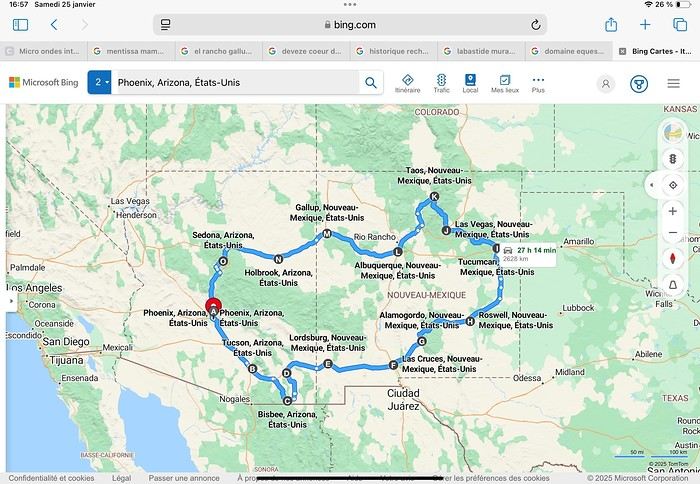
Day 1: Flight Marseille-Paris-Phoenix, then Gold Canyon (133 km) Day 2: Tucson (271 km) Lost Dutchman State Park Day 3: Tucson (155 km) Day 4: Tucson (34 km) Day 5: Bisbee (182 km) Day 6: Lordsburg (345 km) Day 7: Las Cruces (253 km) Day 8: Alamogordo (162 km) Day 9: Roswell (264 km) Day 10: Tucumcari (369 km) Day 11: Las Vegas (281 km) – the one in New Mexico Day 12: Taos (213 km) Day 13: Santa Fe (224 km) Day 14: Albuquerque (123 km) Day 15: Gallup (246 km) Day 16: Holbrook (224 km) Day 17: Flagstaff (179 km) Day 18: Sedona (118 km) Day 19: Sedona (48 km) Day 20: Sedona (41 km) Day 21: Phoenix (256 km) Day 22: Phoenix Airport (35 km)
📊 **Budget**: A little over 7,500 € for both of us, all included. The exchange rate was in our favor (1.17 dollars to 1 €). 📊 **Flights**: Marseille-Paris Charles de Gaulle-Phoenix: 1,787 € for two, with one checked bag each (Air France) 📊 **ESTA**: $42 📊 **America the Beautiful Pass**: $80 📊 **Parking**: 134 € (super eco at Marseille) 📊 **Car rental (Hertz)**: 865 €. Since there were no SUVs left in the reserved category (Nissan Rogue), we got an upgrade (4x4 Ford Explorer). We booked through Air France (15% discount). We’d originally reserved it in December for 1,140 €, but since prices dropped in March, we canceled and rebooked for 865 €. Hertz offers a free Hertz Gold Plus Rewards program, which gives you priority counter service when picking up the car. 📊 **Accommodation**: 2,400 € We stayed in hotels and motels of varying standards (from 60 to 203 € per night, depending on the city), all booked through Booking.com or Hotels.com. Out of 21 nights, only two didn’t include breakfast in the price. Booking.com sometimes offers slightly cheaper rates if you book by phone using the mobile app, and our Genius 3 status on the site also got us some preferential rates. 📊 **Supplementary insurance**: AVA 200 € for medical care if needed 📊 **Cash**: $2,078. We left with 1,000 € exchanged before departure and made two withdrawals of $500. This cash covered: - Evening restaurants and tips - Midday picnics - Gas: $298 for 4,160 km - Museum and private park entries (per person): - Lost Dutchman: $10 - Arizona-Sonora Desert Museum: $28 - Bird Cage Theater: $16 - Tombstone Shootout: $8 - New Mexico Farm & Ranch Museum: $12 - Roswell International UFO Museum: $5 - Billy the Kid Museum: $7 - Rancho de Taos: $22 - West Fork Oak Creek Trail entry: $15 We got a few discounts thanks to our senior age (+65). - Souvenirs and little treats
Like on our previous road trips, we didn’t rent a GPS. We got around using offline GPS apps Here WeGo and Organic Maps, with maps of the states we visited downloaded before we left (on our phones).
❤️❤️❤️ **Highlights** (there are so many!) 📍 Goldfield Ghost Town (even if it’s a reconstruction) 📍 The standing army of Saguaro cacti at Saguaro National Park West 📍 Diving into the cowboy universe of Tombstone 📍 The welcome from Rick and Henry at our guesthouse in Bisbee (Garden at Mile High Ranch) 📍 The tangled rocks of Chiricahua National Monument 📍 The flavored pistachios from Dwayne’s Fresh Jerky and Mac Ginnis Pistachioland 📍 Restaurants: La Posta (Las Cruces), Diner 66 (Albuquerque), and the Haunted Hamburger (Jerome) 📍 The old plazas of New Mexico 📍 The solitude and beauty of the white dunes at White Sands National Park 📍 Stepping back in time at the Billy the Kid Museum (Fort Stanton) 📍 Sections of historic Route 66 and the old motels of Tucumcari, especially at night when all the neon lights are on 📍 Taos Pueblo and diving into Native American culture 📍 After the Rio Grande Bridge, the descent via NM 567 to the very bottom of the Rio Grande Gorge, then the road along the riverbanks to Taos 📍 The tranquility of the Chimayo Sanctuary 📍 Discovering the ingenious native dwellings at Bandelier National Monument and Walnut Canyon National Park 📍 The small towns along the Turquoise Trail 📍 The red rocks of Red Rock Park and the Painted Desert 📍 The extraordinary colors of the petrified trees at Petrified Forest National Park 📍 Sedona, its red rocks, and the reward of the viewpoints at the end of hikes (Devil’s Bridge, The Subway, and West Fork Oak Creek) 📍 The immersion in Mexico when visiting Tlaquepaque 📍 The almost-ghost town of Jerome and its terraced streets 📍 The incredible kindness of Americans, always ready to help and up for a chat ❤️
☹️☹️☹️ **Flops** (there are very few) 📍 Several museums and churches being closed, so we couldn’t visit them 📍 Some museums and visitor centers opening late (10 AM) and closing early (4 PM) 📍 A 64 € phone roaming charge because we got near the Mexican border and picked up their cell tower 📍 The outrageous price ($5.99) for a gallon of gas at the Shell near Phoenix Airport
I hope this helps! Anyway, thanks for reading my long post. Don’t hesitate to reach out, even via PM, if you see I haven’t replied and you’d like more details. Have a great evening, everyone! 🙂
We’re back from our September 2025 road trip, this time to explore Arizona and New Mexico, and it’s time for me to start my travel journal—especially since everything’s already booked for another trip in September 2026 (to California), and I need to get started on the planning.
I was a little worried this new visit to Uncle Sam’s country might not be as "wow" as the others, but we still discovered some incredible places.
For those who don’t know us, we’re a couple in our seventies who speak very little English, but that didn’t stop us from fully enjoying our stay.
For this 6th road trip in the U.S., we spent 21 nights there, drove 4,160 km by car, and walked nearly 160 km in a loop starting from Phoenix.
We’d been to Arizona before (but not this side) and never to New Mexico. This whole road trip was a huge discovery for us.
In the prices mentioned (some in euros, others in dollars), bank fees and exchange charges are included. The flights, car rental, and parking were all paid for in December 2024 when we booked.
We’d downloaded the MPC (Mobile Passport Control) app, but there wasn’t a dedicated line at Phoenix Airport. Still, we got through quickly with friendly, smiling agents.
I don’t drive at all (I hate it), so the stops were chosen based on activities but also, for some, to limit daily mileage for the sole driver. The kilometers listed in the itinerary are the daily distances.
We traveled from September 9th to 22nd, unfortunately once again without our dear friends Mimi and Maumau.
The itinerary
Day 1: Flight Marseille-Paris-Phoenix, then Gold Canyon (133 km) Day 2: Tucson (271 km) Lost Dutchman State Park Day 3: Tucson (155 km) Day 4: Tucson (34 km) Day 5: Bisbee (182 km) Day 6: Lordsburg (345 km) Day 7: Las Cruces (253 km) Day 8: Alamogordo (162 km) Day 9: Roswell (264 km) Day 10: Tucumcari (369 km) Day 11: Las Vegas (281 km) – the one in New Mexico Day 12: Taos (213 km) Day 13: Santa Fe (224 km) Day 14: Albuquerque (123 km) Day 15: Gallup (246 km) Day 16: Holbrook (224 km) Day 17: Flagstaff (179 km) Day 18: Sedona (118 km) Day 19: Sedona (48 km) Day 20: Sedona (41 km) Day 21: Phoenix (256 km) Day 22: Phoenix Airport (35 km)
📊 **Budget**: A little over 7,500 € for both of us, all included. The exchange rate was in our favor (1.17 dollars to 1 €). 📊 **Flights**: Marseille-Paris Charles de Gaulle-Phoenix: 1,787 € for two, with one checked bag each (Air France) 📊 **ESTA**: $42 📊 **America the Beautiful Pass**: $80 📊 **Parking**: 134 € (super eco at Marseille) 📊 **Car rental (Hertz)**: 865 €. Since there were no SUVs left in the reserved category (Nissan Rogue), we got an upgrade (4x4 Ford Explorer). We booked through Air France (15% discount). We’d originally reserved it in December for 1,140 €, but since prices dropped in March, we canceled and rebooked for 865 €. Hertz offers a free Hertz Gold Plus Rewards program, which gives you priority counter service when picking up the car. 📊 **Accommodation**: 2,400 € We stayed in hotels and motels of varying standards (from 60 to 203 € per night, depending on the city), all booked through Booking.com or Hotels.com. Out of 21 nights, only two didn’t include breakfast in the price. Booking.com sometimes offers slightly cheaper rates if you book by phone using the mobile app, and our Genius 3 status on the site also got us some preferential rates. 📊 **Supplementary insurance**: AVA 200 € for medical care if needed 📊 **Cash**: $2,078. We left with 1,000 € exchanged before departure and made two withdrawals of $500. This cash covered: - Evening restaurants and tips - Midday picnics - Gas: $298 for 4,160 km - Museum and private park entries (per person): - Lost Dutchman: $10 - Arizona-Sonora Desert Museum: $28 - Bird Cage Theater: $16 - Tombstone Shootout: $8 - New Mexico Farm & Ranch Museum: $12 - Roswell International UFO Museum: $5 - Billy the Kid Museum: $7 - Rancho de Taos: $22 - West Fork Oak Creek Trail entry: $15 We got a few discounts thanks to our senior age (+65). - Souvenirs and little treats
Like on our previous road trips, we didn’t rent a GPS. We got around using offline GPS apps Here WeGo and Organic Maps, with maps of the states we visited downloaded before we left (on our phones).
❤️❤️❤️ **Highlights** (there are so many!) 📍 Goldfield Ghost Town (even if it’s a reconstruction) 📍 The standing army of Saguaro cacti at Saguaro National Park West 📍 Diving into the cowboy universe of Tombstone 📍 The welcome from Rick and Henry at our guesthouse in Bisbee (Garden at Mile High Ranch) 📍 The tangled rocks of Chiricahua National Monument 📍 The flavored pistachios from Dwayne’s Fresh Jerky and Mac Ginnis Pistachioland 📍 Restaurants: La Posta (Las Cruces), Diner 66 (Albuquerque), and the Haunted Hamburger (Jerome) 📍 The old plazas of New Mexico 📍 The solitude and beauty of the white dunes at White Sands National Park 📍 Stepping back in time at the Billy the Kid Museum (Fort Stanton) 📍 Sections of historic Route 66 and the old motels of Tucumcari, especially at night when all the neon lights are on 📍 Taos Pueblo and diving into Native American culture 📍 After the Rio Grande Bridge, the descent via NM 567 to the very bottom of the Rio Grande Gorge, then the road along the riverbanks to Taos 📍 The tranquility of the Chimayo Sanctuary 📍 Discovering the ingenious native dwellings at Bandelier National Monument and Walnut Canyon National Park 📍 The small towns along the Turquoise Trail 📍 The red rocks of Red Rock Park and the Painted Desert 📍 The extraordinary colors of the petrified trees at Petrified Forest National Park 📍 Sedona, its red rocks, and the reward of the viewpoints at the end of hikes (Devil’s Bridge, The Subway, and West Fork Oak Creek) 📍 The immersion in Mexico when visiting Tlaquepaque 📍 The almost-ghost town of Jerome and its terraced streets 📍 The incredible kindness of Americans, always ready to help and up for a chat ❤️
☹️☹️☹️ **Flops** (there are very few) 📍 Several museums and churches being closed, so we couldn’t visit them 📍 Some museums and visitor centers opening late (10 AM) and closing early (4 PM) 📍 A 64 € phone roaming charge because we got near the Mexican border and picked up their cell tower 📍 The outrageous price ($5.99) for a gallon of gas at the Shell near Phoenix Airport
I hope this helps! Anyway, thanks for reading my long post. Don’t hesitate to reach out, even via PM, if you see I haven’t replied and you’d like more details. Have a great evening, everyone! 🙂
CALL FOR PARTICIPANTS – GRANDS REPORTAGES (TF1) “Motorhome: A Different Idea of Happiness”
CALL FOR PARTICIPANTS – GRANDS REPORTAGES (TF1)
“Motorhome: A Different Idea of Happiness”
Hi everyone,
I’m Julie Thierry, a journalist and director for Grands Reportages (TF1). I’m working on a documentary about families traveling in motorhomes or vans, and we’d love to follow one of them on the road across Asia—from Nepal to Thailand, Laos to India, all the way to the roads of Central Asia.
What we love filming It’s real life on the road: the little morning rituals, moments of connection, encounters, stops, and above all, that incredible freedom you experience every day. School on the road, unexpected bivouacs, breathtaking landscapes, shared meals, or conversations around a fire—everything that tells the story of a human adventure, sincere and alive.
Our team is very small (just 2 people), discreet, and respectful. We love blending in without disrupting, to capture authentic moments, from the perspective of those traveling.
Profiles we’re looking for: • Families with kids, all ages welcome • Departure recently or planned for 2025 / 2026 • Long-term travel (a few months or more) • All types of vehicles: motorhome, van, adventure truck, etc. The idea: to follow a few families throughout their journey to share a different idea of happiness—free, simple, and inspiring.
If you’re leaving soon, already on the road, or know a family who fits, email me at juliethierry@duritegroupe.com. Thanks for your shares and messages, and maybe see you soon somewhere on the trails of Asia! 🚐✨
Hi everyone,
I’m Julie Thierry, a journalist and director for Grands Reportages (TF1). I’m working on a documentary about families traveling in motorhomes or vans, and we’d love to follow one of them on the road across Asia—from Nepal to Thailand, Laos to India, all the way to the roads of Central Asia.
What we love filming It’s real life on the road: the little morning rituals, moments of connection, encounters, stops, and above all, that incredible freedom you experience every day. School on the road, unexpected bivouacs, breathtaking landscapes, shared meals, or conversations around a fire—everything that tells the story of a human adventure, sincere and alive.
Our team is very small (just 2 people), discreet, and respectful. We love blending in without disrupting, to capture authentic moments, from the perspective of those traveling.
Profiles we’re looking for: • Families with kids, all ages welcome • Departure recently or planned for 2025 / 2026 • Long-term travel (a few months or more) • All types of vehicles: motorhome, van, adventure truck, etc. The idea: to follow a few families throughout their journey to share a different idea of happiness—free, simple, and inspiring.
If you’re leaving soon, already on the road, or know a family who fits, email me at juliethierry@duritegroupe.com. Thanks for your shares and messages, and maybe see you soon somewhere on the trails of Asia! 🚐✨
The era of travel advice: between AI, free forums, and local expertise
The end of a golden age
For years, travel forums embodied the spirit of mutual aid on the web. Travelers generously shared their experiences, tips, and secret spots. This collective generosity seemed endless. But behind this altruistic facade lay a more complex reality.
The silent infiltration of forums Free travel forums have gradually become marketing hunting grounds. Under the guise of "experienced travelers," professionals in tourism, affiliates seeking commissions, or aspiring influencers testing monetization strategies now lurk.
These fake profiles master the community’s codes. They build credibility by answering dozens of basic questions before subtly slipping in their paid recommendations. A "favorite" hotel mentioned insistently, an "essential" guidebook systematically cited, an "extraordinary" local agency that keeps coming up in conversations.
New travelers can no longer tell the difference between selfless advice and disguised promotion. This informational pollution has gradually eroded the trust that gave these platforms their value.
The rise of paid Travel Planners Faced with this decline, a new profession has emerged: the independent Travel Planner. These professionals fully embrace their commercial status and charge for personalized advice.
The model is transparent: you pay for real expertise, tailor-made itineraries, and guaranteed availability. Some offer packages for 150-300 € to plan a two-week trip entirely. Others charge by the hour.
This professionalization marks a turning point. Travel advice is leaving the realm of volunteerism and entering the world of paid services. Paradoxically, this acknowledged monetization can restore a form of trust: you know what you’re paying for.
The irruption of artificial intelligence But now, a third option is emerging: generative AI. ChatGPT, Claude, Gemini, and others can now generate travel itineraries in seconds, for free, with no commercial agenda.
AI promises neutral, synthetic, endlessly customizable information. It compiles thousands of sources in real time, suggests alternatives, and adapts recommendations to your budget and time constraints. It doesn’t sell anything, earns no commissions, and has no hotels to promote.
But this apparent neutrality hides its own limitations. AI feeds on existing data, often from the same polluted forums or marketing content. It can invent restaurants that don’t exist, mix up tourist seasons, or ignore recent local realities. It has never walked a city’s streets, negotiated with a tuk-tuk driver, or felt the atmosphere of a neighborhood at nightfall.
The forgotten alternative: authentic local experts In this landscape saturated with dubious information, imperfect AI, and monetized services, one often-overlooked option remains: consulting real local professionals.
Not the agencies at the top of Google’s first page—often the most expensive and generic. But small local businesses, independent guides established for years, still-free municipal tourism offices, and cultural associations organizing themed tours.
These players offer what neither AI nor forums can: embodied, up-to-date, contextualized knowledge of the area. They know the newly opened restaurant, the museum temporarily closed for renovations, the impromptu weekend festival, or the alternative route to avoid construction.
Finding them takes extra effort. You have to search in the local language, look beyond the first page of results, check regional institutional websites, and join community Facebook groups. But this approach is often rewarded with free or low-cost advice of unmatched precision.
Toward an ecology of travel advice The future of travel advice likely won’t be binary but hybrid. AI can rough out itineraries, propose logistical options, and compare alternatives. Travel Planners can refine, personalize, and reassure anxious travelers. Local experts can enrich, correct, and ground advice in on-the-ground reality.
But for this ecosystem to work, we’ll need to develop new discernment. Learn to spot fake profiles on forums. Systematically verify AI suggestions. Assess the real value of a Travel Planner before paying. And, above all, rediscover the habit of contacting those who live there directly.
Travel has always been a school of discernment. It teaches us to distinguish the authentic from the fake, sincere advice from commercial manipulation. In the digital age, this skill becomes more crucial than ever.
Because ultimately, the real question isn’t which information source to prioritize, but how to cultivate our own ability to evaluate, cross-check, and ultimately make informed choices. The best travel guide may still be our critical thinking.
Photo credit: Arakis Travel
The silent infiltration of forums Free travel forums have gradually become marketing hunting grounds. Under the guise of "experienced travelers," professionals in tourism, affiliates seeking commissions, or aspiring influencers testing monetization strategies now lurk.
These fake profiles master the community’s codes. They build credibility by answering dozens of basic questions before subtly slipping in their paid recommendations. A "favorite" hotel mentioned insistently, an "essential" guidebook systematically cited, an "extraordinary" local agency that keeps coming up in conversations.
New travelers can no longer tell the difference between selfless advice and disguised promotion. This informational pollution has gradually eroded the trust that gave these platforms their value.
The rise of paid Travel Planners Faced with this decline, a new profession has emerged: the independent Travel Planner. These professionals fully embrace their commercial status and charge for personalized advice.
The model is transparent: you pay for real expertise, tailor-made itineraries, and guaranteed availability. Some offer packages for 150-300 € to plan a two-week trip entirely. Others charge by the hour.
This professionalization marks a turning point. Travel advice is leaving the realm of volunteerism and entering the world of paid services. Paradoxically, this acknowledged monetization can restore a form of trust: you know what you’re paying for.
The irruption of artificial intelligence But now, a third option is emerging: generative AI. ChatGPT, Claude, Gemini, and others can now generate travel itineraries in seconds, for free, with no commercial agenda.
AI promises neutral, synthetic, endlessly customizable information. It compiles thousands of sources in real time, suggests alternatives, and adapts recommendations to your budget and time constraints. It doesn’t sell anything, earns no commissions, and has no hotels to promote.
But this apparent neutrality hides its own limitations. AI feeds on existing data, often from the same polluted forums or marketing content. It can invent restaurants that don’t exist, mix up tourist seasons, or ignore recent local realities. It has never walked a city’s streets, negotiated with a tuk-tuk driver, or felt the atmosphere of a neighborhood at nightfall.
The forgotten alternative: authentic local experts In this landscape saturated with dubious information, imperfect AI, and monetized services, one often-overlooked option remains: consulting real local professionals.
Not the agencies at the top of Google’s first page—often the most expensive and generic. But small local businesses, independent guides established for years, still-free municipal tourism offices, and cultural associations organizing themed tours.
These players offer what neither AI nor forums can: embodied, up-to-date, contextualized knowledge of the area. They know the newly opened restaurant, the museum temporarily closed for renovations, the impromptu weekend festival, or the alternative route to avoid construction.
Finding them takes extra effort. You have to search in the local language, look beyond the first page of results, check regional institutional websites, and join community Facebook groups. But this approach is often rewarded with free or low-cost advice of unmatched precision.
Toward an ecology of travel advice The future of travel advice likely won’t be binary but hybrid. AI can rough out itineraries, propose logistical options, and compare alternatives. Travel Planners can refine, personalize, and reassure anxious travelers. Local experts can enrich, correct, and ground advice in on-the-ground reality.
But for this ecosystem to work, we’ll need to develop new discernment. Learn to spot fake profiles on forums. Systematically verify AI suggestions. Assess the real value of a Travel Planner before paying. And, above all, rediscover the habit of contacting those who live there directly.
Travel has always been a school of discernment. It teaches us to distinguish the authentic from the fake, sincere advice from commercial manipulation. In the digital age, this skill becomes more crucial than ever.
Because ultimately, the real question isn’t which information source to prioritize, but how to cultivate our own ability to evaluate, cross-check, and ultimately make informed choices. The best travel guide may still be our critical thinking.
Photo credit: Arakis Travel
Feedback on my Colorado - New Mexico - Arizona road trip
Hi everyone,
Let me introduce myself. I’m 45 and traveling with my husband and my daughter, who’ll be 17 soon. We’re used to road-trip-style vacations, in the US or elsewhere. This will be our 5th trip to the US. We’ve already visited several states: New York, Massachusetts, Rhode Island, Washington DC, Florida, Wyoming, South Dakota, California, Utah, Nevada, and Arizona. I’d like to plan another trip starting from Denver to Colorado and New Mexico, which we haven’t explored yet, with a stop in a part of Arizona we haven’t visited before. So, I’d love to hear your thoughts on this itinerary if you’re familiar with the area. We’ll be traveling in the summer of 2026—admittedly not the best time for this route, but it’s the only time we can all get away for long enough. I’m also tied to the dates for Cheyenne Frontier Days, which we want to attend at the start of the trip. Thanks in advance for your input!
Day 1: Departure from Frankfurt > Arrival in Denver around 3 PM. Night in Denver
Day 2: Denver > Cheyenne Quick visit to Denver Drive to Cheyenne in the late afternoon 2-hour drive Night in Cheyenne Day 3: Cheyenne Frontier Days Night in Cheyenne
Day 4: Cheyenne > Estes Park (Rocky Mountains) Frontier Days during the day. Departure in the late afternoon for Estes Park 2-hour drive Night in Estes Park
Day 5: Hiking in the Rocky Mountains Nights in Estes Park
Day 6: Estes Park > Glenwood Springs We’ll take the day to drive the scenic route and stop at various viewpoints. Night in Glenwood Springs
Day 7: Glenwood Springs Hiking the Hanging Lake Trail + relaxing in the hot springs Night in Glenwood Springs
Day 8: Glenwood Springs > Montrose Visit Colorado NM along the way 3.5-hour drive Night in Montrose
Day 9: Black Canyon Night in Montrose
Day 10: Montrose > Farmington Visit Durango (without taking the train), Ouray, or Silverton along the way? 3.5-hour drive Night in Farmington
Day 11: Farmington > Chinle Bisti Badlands until early afternoon 3-hour drive Night in Chinle
Day 12: Chinle > Sedona Canyon de Chelly in the morning 4-hour drive Night in Sedona
Day 13 - 14: Hiking in Sedona Nights in Sedona
Day 15: Sedona > Tucson Saguaro West Park 3.5-hour drive Night at a ranch in Tucson
Day 16 - 17: Tucson City visit in the morning + ranch activities in the afternoon Nights at a ranch in Tucson
Day 18: > Wilcox Chiricahua NP 1-hour drive Night in Wilcox
Day 19: Wilcox > Alamogordo White Sands in the late afternoon 4.5-hour drive Night in Alamogordo
Day 20: Alamogordo > Carlsbad White Sands in the morning Bat viewing in the evening at Carlsbad 4.5-hour drive Night in Carlsbad
Day 21: Carlsbad > Albuquerque Cave visit in the morning Quick stop in Roswell 4.25-hour drive Night in Albuquerque Day 22: Albuquerque > Santa Fe Visit Albuquerque 1-hour drive Night in Santa Fe
Day 23: Santa Fe Kasha Katuwe Tent Rocks in the morning Visit Santa Fe in the afternoon Night in Santa Fe
Day 24: Santa Fe Bandelier in the morning Visit Santa Fe in the afternoon Night in Santa Fe
Day 25: Santa Fe > Alamosa Taos Pueblo along the way Great Sand Dunes in the late afternoon Zapata Falls Night in Alamosa
Day 26: Alamosa > Denver 4-hour drive Departure around 7 PM
Looking forward to your suggestions, corrections, and feedback!
Let me introduce myself. I’m 45 and traveling with my husband and my daughter, who’ll be 17 soon. We’re used to road-trip-style vacations, in the US or elsewhere. This will be our 5th trip to the US. We’ve already visited several states: New York, Massachusetts, Rhode Island, Washington DC, Florida, Wyoming, South Dakota, California, Utah, Nevada, and Arizona. I’d like to plan another trip starting from Denver to Colorado and New Mexico, which we haven’t explored yet, with a stop in a part of Arizona we haven’t visited before. So, I’d love to hear your thoughts on this itinerary if you’re familiar with the area. We’ll be traveling in the summer of 2026—admittedly not the best time for this route, but it’s the only time we can all get away for long enough. I’m also tied to the dates for Cheyenne Frontier Days, which we want to attend at the start of the trip. Thanks in advance for your input!
Day 1: Departure from Frankfurt > Arrival in Denver around 3 PM. Night in Denver
Day 2: Denver > Cheyenne Quick visit to Denver Drive to Cheyenne in the late afternoon 2-hour drive Night in Cheyenne Day 3: Cheyenne Frontier Days Night in Cheyenne
Day 4: Cheyenne > Estes Park (Rocky Mountains) Frontier Days during the day. Departure in the late afternoon for Estes Park 2-hour drive Night in Estes Park
Day 5: Hiking in the Rocky Mountains Nights in Estes Park
Day 6: Estes Park > Glenwood Springs We’ll take the day to drive the scenic route and stop at various viewpoints. Night in Glenwood Springs
Day 7: Glenwood Springs Hiking the Hanging Lake Trail + relaxing in the hot springs Night in Glenwood Springs
Day 8: Glenwood Springs > Montrose Visit Colorado NM along the way 3.5-hour drive Night in Montrose
Day 9: Black Canyon Night in Montrose
Day 10: Montrose > Farmington Visit Durango (without taking the train), Ouray, or Silverton along the way? 3.5-hour drive Night in Farmington
Day 11: Farmington > Chinle Bisti Badlands until early afternoon 3-hour drive Night in Chinle
Day 12: Chinle > Sedona Canyon de Chelly in the morning 4-hour drive Night in Sedona
Day 13 - 14: Hiking in Sedona Nights in Sedona
Day 15: Sedona > Tucson Saguaro West Park 3.5-hour drive Night at a ranch in Tucson
Day 16 - 17: Tucson City visit in the morning + ranch activities in the afternoon Nights at a ranch in Tucson
Day 18: > Wilcox Chiricahua NP 1-hour drive Night in Wilcox
Day 19: Wilcox > Alamogordo White Sands in the late afternoon 4.5-hour drive Night in Alamogordo
Day 20: Alamogordo > Carlsbad White Sands in the morning Bat viewing in the evening at Carlsbad 4.5-hour drive Night in Carlsbad
Day 21: Carlsbad > Albuquerque Cave visit in the morning Quick stop in Roswell 4.25-hour drive Night in Albuquerque Day 22: Albuquerque > Santa Fe Visit Albuquerque 1-hour drive Night in Santa Fe
Day 23: Santa Fe Kasha Katuwe Tent Rocks in the morning Visit Santa Fe in the afternoon Night in Santa Fe
Day 24: Santa Fe Bandelier in the morning Visit Santa Fe in the afternoon Night in Santa Fe
Day 25: Santa Fe > Alamosa Taos Pueblo along the way Great Sand Dunes in the late afternoon Zapata Falls Night in Alamosa
Day 26: Alamosa > Denver 4-hour drive Departure around 7 PM
Looking forward to your suggestions, corrections, and feedback!
Travelers are changing their habits as the climate deteriorates
Hi everyone.
Not sure if guidebooks, agencies, and other tour operators are keeping up by changing their visiting hours and offerings.
Personally, I see a promising opportunity here—jumping on this adaptation to extreme climates before others do, since they’re inevitably coming.
From my own travel experience, I’ve met a few guides so far who are starting to adjust, like in Egypt, Kenya, Senegal, and elsewhere.
They avoid crowds and the hottest hours by starting their tours around 6–7 AM, when it’s cooler.
Yeah, you’ve gotta wake up early, but the payoff is so worth it. 😴
If you’ve got any great tips like this, why not discuss them in this thread and share addresses or websites where the people in charge have realized climate change is real and are adapting? 😊
Southwest USA in August: possible or not with the heat?
Hi everyone.
For 2026, I’m considering what might be my last long trip to the States.
A loop from Dallas back to Dallas via Houston, San Antonio, Tucson, Albuquerque...
Simple question: Is it doable in August with the extreme heat?
Best,
For 2026, I’m considering what might be my last long trip to the States.
A loop from Dallas back to Dallas via Houston, San Antonio, Tucson, Albuquerque...
Simple question: Is it doable in August with the extreme heat?
Best,
USA 2022 Road Trip
During our first road trip across the United States, we covered 23,000 km and crossed 28 states in 53 days.
Originally, we had planned to drive Route 66 all the way to Oatman in Arizona and visit various national parks in the American West over a two-month period.
This itinerary was planned before our departure, and all the relevant information had been gathered to stick to the schedule.
Everything went so smoothly that we finished visiting the national parks well ahead of our planned return date.
It helped that having a bed, a portable toilet, and a cooler in our vehicle gave us some autonomy since we didn’t have to worry about accommodation.
So, we decided to extend our road trip to the cities of Nashville and Memphis in Tennessee.
We then headed to Louisiana to visit Baton Rouge and New Orleans.
We crossed Mississippi and Alabama before driving along Florida’s west coast all the way to Key West.
We returned via Florida’s east coast and then crossed the eastern U.S. states to get back to Quebec through the Jackman border crossing in Maine.
So, I invite you to keep reading this long recap, which will let you discover the different attractions we visited throughout this amazing journey.
Videos are included throughout the recap. Click on the image to start the video.
To jump to a specific post, here are the relevant links:
Route 66 - Illinois & Missouri Route 66 - St. Louis (Missouri) - Gateway Arch National Park Route 66 - Cuba (Missouri) - City Murals Route 66 - Springfield (Missouri) - Fantastic Caverns Route 66 - Kansas & Oklahoma Route 66 - Texas & Arizona Route 66 - Texas - The Stations of the Cross in Groom Route 66 - Texas - Panhandle - VW Slug Bug Ranch Texas - Palo Duro Canyon State Park - Juniper Trails Texas - Palo Duro Canyon State Park - The Lighthouse Trail Route 66 - Texas - Amarillo - Cadillac Ranch Route 66 - New Mexico - Santa Rosa Blue Hole New Mexico - Bandelier National Monument - Alcove House Trail via Main Loop Trail New Mexico - Bandelier National Monument - Tsankawi Ruins Trail New Mexico - White Rock Overlook Route 66 - New Mexico - Albuquerque - Old Town New Mexico - White Sands National Park New Mexico - White Sands National Park - Dune Life Nature Trail New Mexico - White Sands National Park - Playa Trail New Mexico - White Sands National Park - Interdune Boardwalk New Mexico - Gila Cliff Dwellings National Monument New Mexico - Grants - Ice Cave & Bandera Volcano New Mexico - Gallup - Pyramide Rock Trail & Church Rock Trail Arizona - Holbrook - Painted Desert Arizona - Petrified Forest National Park - Puerco Pueblo & Newspaper Rock Viewpoint Arizona - Petrified Forest National Park - Blue Mesa Arizona - Petrified Forest National Park - The Teepees, Agate Bridge & Jasper Forest Overlook Arizona - Petrified Forest National Park - Crystal Forest Trail Arizona - Petrified Forest National Park - Giant Logs Trail Arizona - Winslow - Two Guns Ghost Town Arizona - Cameron - Little Colorado River Gorge Overlooks Arizona - Grand Canyon National Park - Shoshone Point Trail Arizona - Grand Canyon National Park - Desert View Drive Arizona - Grand Canyon National Park - Rim Route (Orange) & Village Route (Blue) Arizona - Grand Canyon National Park - Hermit Route (Red Line) Route 66 - Arizona - Historic Town of Oatman Arizona - Bullhead City Community Park Nevada - Red Rock Canyon - Calico I & II & Sandstone Quarry Nevada - Red Rock Canyon - Willow Springs Nevada - Red Rock Canyon Lookouts Nevada - Valley of Fire State Park - White Domes Trail Nevada - Valley of Fire State Park - Seven Wonders Trail, Pink Canyon, Fire Wave Nevada - Valley of Fire State Park - Rainbow Vista Trail Nevada - Valley of Fire State Park - Mouse's Tank Trail Nevada - Valley of Fire State Park - Rock Formations Nevada - Valley of Fire State Park - Scenic Routes Nevada - Cathedral Gorge State Park - Slot Canyons Nevada - Cathedral Gorge State Park - Eagle Point & Miller Point Utah - Bryce Canyon National Park - Mossy Cave & Tropic Ditch Waterfall Trail Utah - Bryce Canyon National Park - Scenic Drive Utah - Zion National Park - Pa'rus Trail Utah - Zion National Park - Sand Bench Trail Utah - Zion National Park - Emerald Pools Trail Utah - Zion National Park - West Rim Trail (Trail connecting to Angels Landing) Utah - Zion National Park - Riverside Walk Utah - Zion National Park - Court of The Patriarchs & Big Bend Utah - Zion National Park - Mount Carmel Highway Scenic Drive Utah - Kanab - Jackson Flat Reservoir Utah - Toadstools Trail in Grand Staircase-Escalante National Monument Arizona - Page - Glen Canyon Dam Overlook Arizona - Page - Glen Canyon National Recreation Area Arizona - Page - Horseshoe Bend Overlook Arizona - Page - Upper Antelope Canyon Arizona - Page - Navajo Canyon Boat Tour at Lake Powell Arizona - Page - Antelope Canyon X Arizona - Canyon de Chelly National Monument - Chelly Canyon Arizona - Canyon de Chelly National Monument - Canyon del Muerto Arizona - Monument Valley Navajo Tribal Park Utah - Mexican Hat Utah - Mexican Hat - Goosenecks State Park Utah - Mexican Hat - Valley of the Gods Utah - The Moki Dugway Scenic Backway Utah - Blanding - Natural Bridges National Monument Utah - Lake Powell - Hite Crossing Bridge Utah - Lake Powell - Glen Canyon National Recreation Area - Hite Overlook Utah - Capitol Reef National Park - Chimney Rock Loop Trail Utah - Capitol Reef National Park - Hickman Bridge Trail Utah - Capitol Reef National Park - Grand Wash Trail Utah - Capitol Reef National Park - Sunset Point Trail Utah - Capitol Reef National Park - Goosenecks Trail Utah - Capitol Reef National Park - Viewpoints - Fruita Area Utah - Capitol Reef National Park - Viewpoints - Scenic Drive Utah - Capitol Reef National Park - Cassidy Arch Trail Utah - Capitol Reef National Park - On the way to Capitol Gorge Trailhead Utah - Capitol Reef National Park - Capitol Gorge Trailhead Utah - Monroe - Mystic Hot Springs Utah - Scenic Overlooks on UT-24, UT-119 & I-70 Utah - Arches National Park - Park Avenue Trail Utah - Arches National Park - Courthouse Towers Section's Viewpoints Utah - Arches National Park - Balanced Rock, Pothole Arch, Ham Rock & Garden of Eden Utah - Arches National Park - Double Arch Trail, Cove Arch, Cove of Caves & Panorama Point Utah - Arches National Park - Windows Loop & Turret Arch Trail Utah - Arches National Park - Delicate Arch Trail Utah - Arches National Park - Upper Delicate Arch Viewpoint Trail Utah - Arches National Park - Fiery Furnace Section - Viewpoints Utah - Arches National Park - Sand Dune Arch Trail Utah - Arches National Park - Skyline Arch Trail Utah - Arches National Park - Devils Garden Trail Utah - Dead Horse Point State Park - West Rim Trail Utah - Dead Horse Point State Park - East Rim Trail Utah - Moab - Utah State Route 279 (Potash Road) Utah - Moab - Shafer Trail - Potash Evaporation Ponds Utah - Moab - Potash Road Dinosaur Tracks and Petroglyphs Utah - Moab - Potash Road - Corona, Bowtie & Pinto Arches Trail Utah - Moab - Potash Road - Wall Street Climbing Area Utah - Moab - Kane Springs Road Utah - Moab - Kane Springs Road - Side By Side Adventure Utah - Moab - Kane Springs Road to Moab Utah - Canyonlands National Park - Island in the Sky - Mesa Arch Trail Utah - Canyonlands National Park - Island in the Sky - Aztec Butte Trail Utah - Canyonlands National Park - Island in the Sky - Whale Rock Trail Utah - Canyonlands National Park - Island in the Sky - Upheaval Dome Trail Utah - Canyonlands National Park - Island in the Sky - Grand View Point Overlook Trail Utah - Canyonlands National Park - Island in the Sky - White Rim Overlook Trail Utah - Canyonlands National Park - Island in the Sky - Overlooks Utah - Moab - Wilson Arch Utah - Monticello - Newspaper Rock State Historical Monument Utah - Canyonlands National Park - The Needles - Road Side Ruin Trail Utah - Canyonlands National Park - The Needles - Cave Spring Trail Utah - Canyonlands National Park - The Needles - Pothole Point Trail Utah - Canyonlands National Park - The Needles - Big Spring Canyon Overlook Trail Utah - Canyonlands National Park - The Needles - Overlooks Colorado - Mesa Verde National Park - Mesa Top Ruins Road Colorado - Mesa Verde National Park - Chapin Mesa Road Colorado - Mesa Verde National Park - Mesa Top Loop Colorado - Mesa Verde National Park - Wetherill Mesa Road Colorado - Great Sand Dunes National Park Colorado - Mosca - Zapata Falls Colorado - Colorado Springs - Garden of the Gods Colorado - Black Canyon of the Gunnison National Park Colorado - Gunnison - Curecanti National Recreation Area Colorado - Gunnison - Blue Mesa Dam & Reservoir Colorado - Lake Pueblo State Park (Pueblo Reservoir) Kentucky - Mayfield, 5 months after an EF4 tornado Tennessee - Nashville - Downtown Walking Tour Tennessee - Graceland Mansion - Home of Elvis Presley Tennessee - Graceland - Lisa Marie & Hound Dog II Jets Tennessee - Graceland - Elvis Presley Automobile Museum & Exhibits Tennessee - Exploring Memphis Louisiana - Exploring Baton Rouge Louisiana - Exploring Lafayette Louisiana - Exploring Houma Louisiana - New Orleans - French Quarter Tour Louisiana - New Orleans - Garden District Tour Louisiana - New Orleans - Creole Queen Mississippi River Cruise Florida - Clearwater Beach Florida - Sanibel Island - Bowman's Beach Florida - Siesta Key Beach Florida - Captiva Island - Turner Beach Florida - Key Largo - Sunset Florida - Key West - Smathers Beach Florida - Miami Beach - Art Deco District Florida - Miami Beach South Carolina - Myrtle Beach Virginia - Virginia Beach Maine - Scarborough - Pine Point Beach
Originally, we had planned to drive Route 66 all the way to Oatman in Arizona and visit various national parks in the American West over a two-month period.
This itinerary was planned before our departure, and all the relevant information had been gathered to stick to the schedule.
Everything went so smoothly that we finished visiting the national parks well ahead of our planned return date.
It helped that having a bed, a portable toilet, and a cooler in our vehicle gave us some autonomy since we didn’t have to worry about accommodation.
So, we decided to extend our road trip to the cities of Nashville and Memphis in Tennessee.
We then headed to Louisiana to visit Baton Rouge and New Orleans.
We crossed Mississippi and Alabama before driving along Florida’s west coast all the way to Key West.
We returned via Florida’s east coast and then crossed the eastern U.S. states to get back to Quebec through the Jackman border crossing in Maine.
So, I invite you to keep reading this long recap, which will let you discover the different attractions we visited throughout this amazing journey.
Videos are included throughout the recap. Click on the image to start the video.
To jump to a specific post, here are the relevant links:
Route 66 - Illinois & Missouri Route 66 - St. Louis (Missouri) - Gateway Arch National Park Route 66 - Cuba (Missouri) - City Murals Route 66 - Springfield (Missouri) - Fantastic Caverns Route 66 - Kansas & Oklahoma Route 66 - Texas & Arizona Route 66 - Texas - The Stations of the Cross in Groom Route 66 - Texas - Panhandle - VW Slug Bug Ranch Texas - Palo Duro Canyon State Park - Juniper Trails Texas - Palo Duro Canyon State Park - The Lighthouse Trail Route 66 - Texas - Amarillo - Cadillac Ranch Route 66 - New Mexico - Santa Rosa Blue Hole New Mexico - Bandelier National Monument - Alcove House Trail via Main Loop Trail New Mexico - Bandelier National Monument - Tsankawi Ruins Trail New Mexico - White Rock Overlook Route 66 - New Mexico - Albuquerque - Old Town New Mexico - White Sands National Park New Mexico - White Sands National Park - Dune Life Nature Trail New Mexico - White Sands National Park - Playa Trail New Mexico - White Sands National Park - Interdune Boardwalk New Mexico - Gila Cliff Dwellings National Monument New Mexico - Grants - Ice Cave & Bandera Volcano New Mexico - Gallup - Pyramide Rock Trail & Church Rock Trail Arizona - Holbrook - Painted Desert Arizona - Petrified Forest National Park - Puerco Pueblo & Newspaper Rock Viewpoint Arizona - Petrified Forest National Park - Blue Mesa Arizona - Petrified Forest National Park - The Teepees, Agate Bridge & Jasper Forest Overlook Arizona - Petrified Forest National Park - Crystal Forest Trail Arizona - Petrified Forest National Park - Giant Logs Trail Arizona - Winslow - Two Guns Ghost Town Arizona - Cameron - Little Colorado River Gorge Overlooks Arizona - Grand Canyon National Park - Shoshone Point Trail Arizona - Grand Canyon National Park - Desert View Drive Arizona - Grand Canyon National Park - Rim Route (Orange) & Village Route (Blue) Arizona - Grand Canyon National Park - Hermit Route (Red Line) Route 66 - Arizona - Historic Town of Oatman Arizona - Bullhead City Community Park Nevada - Red Rock Canyon - Calico I & II & Sandstone Quarry Nevada - Red Rock Canyon - Willow Springs Nevada - Red Rock Canyon Lookouts Nevada - Valley of Fire State Park - White Domes Trail Nevada - Valley of Fire State Park - Seven Wonders Trail, Pink Canyon, Fire Wave Nevada - Valley of Fire State Park - Rainbow Vista Trail Nevada - Valley of Fire State Park - Mouse's Tank Trail Nevada - Valley of Fire State Park - Rock Formations Nevada - Valley of Fire State Park - Scenic Routes Nevada - Cathedral Gorge State Park - Slot Canyons Nevada - Cathedral Gorge State Park - Eagle Point & Miller Point Utah - Bryce Canyon National Park - Mossy Cave & Tropic Ditch Waterfall Trail Utah - Bryce Canyon National Park - Scenic Drive Utah - Zion National Park - Pa'rus Trail Utah - Zion National Park - Sand Bench Trail Utah - Zion National Park - Emerald Pools Trail Utah - Zion National Park - West Rim Trail (Trail connecting to Angels Landing) Utah - Zion National Park - Riverside Walk Utah - Zion National Park - Court of The Patriarchs & Big Bend Utah - Zion National Park - Mount Carmel Highway Scenic Drive Utah - Kanab - Jackson Flat Reservoir Utah - Toadstools Trail in Grand Staircase-Escalante National Monument Arizona - Page - Glen Canyon Dam Overlook Arizona - Page - Glen Canyon National Recreation Area Arizona - Page - Horseshoe Bend Overlook Arizona - Page - Upper Antelope Canyon Arizona - Page - Navajo Canyon Boat Tour at Lake Powell Arizona - Page - Antelope Canyon X Arizona - Canyon de Chelly National Monument - Chelly Canyon Arizona - Canyon de Chelly National Monument - Canyon del Muerto Arizona - Monument Valley Navajo Tribal Park Utah - Mexican Hat Utah - Mexican Hat - Goosenecks State Park Utah - Mexican Hat - Valley of the Gods Utah - The Moki Dugway Scenic Backway Utah - Blanding - Natural Bridges National Monument Utah - Lake Powell - Hite Crossing Bridge Utah - Lake Powell - Glen Canyon National Recreation Area - Hite Overlook Utah - Capitol Reef National Park - Chimney Rock Loop Trail Utah - Capitol Reef National Park - Hickman Bridge Trail Utah - Capitol Reef National Park - Grand Wash Trail Utah - Capitol Reef National Park - Sunset Point Trail Utah - Capitol Reef National Park - Goosenecks Trail Utah - Capitol Reef National Park - Viewpoints - Fruita Area Utah - Capitol Reef National Park - Viewpoints - Scenic Drive Utah - Capitol Reef National Park - Cassidy Arch Trail Utah - Capitol Reef National Park - On the way to Capitol Gorge Trailhead Utah - Capitol Reef National Park - Capitol Gorge Trailhead Utah - Monroe - Mystic Hot Springs Utah - Scenic Overlooks on UT-24, UT-119 & I-70 Utah - Arches National Park - Park Avenue Trail Utah - Arches National Park - Courthouse Towers Section's Viewpoints Utah - Arches National Park - Balanced Rock, Pothole Arch, Ham Rock & Garden of Eden Utah - Arches National Park - Double Arch Trail, Cove Arch, Cove of Caves & Panorama Point Utah - Arches National Park - Windows Loop & Turret Arch Trail Utah - Arches National Park - Delicate Arch Trail Utah - Arches National Park - Upper Delicate Arch Viewpoint Trail Utah - Arches National Park - Fiery Furnace Section - Viewpoints Utah - Arches National Park - Sand Dune Arch Trail Utah - Arches National Park - Skyline Arch Trail Utah - Arches National Park - Devils Garden Trail Utah - Dead Horse Point State Park - West Rim Trail Utah - Dead Horse Point State Park - East Rim Trail Utah - Moab - Utah State Route 279 (Potash Road) Utah - Moab - Shafer Trail - Potash Evaporation Ponds Utah - Moab - Potash Road Dinosaur Tracks and Petroglyphs Utah - Moab - Potash Road - Corona, Bowtie & Pinto Arches Trail Utah - Moab - Potash Road - Wall Street Climbing Area Utah - Moab - Kane Springs Road Utah - Moab - Kane Springs Road - Side By Side Adventure Utah - Moab - Kane Springs Road to Moab Utah - Canyonlands National Park - Island in the Sky - Mesa Arch Trail Utah - Canyonlands National Park - Island in the Sky - Aztec Butte Trail Utah - Canyonlands National Park - Island in the Sky - Whale Rock Trail Utah - Canyonlands National Park - Island in the Sky - Upheaval Dome Trail Utah - Canyonlands National Park - Island in the Sky - Grand View Point Overlook Trail Utah - Canyonlands National Park - Island in the Sky - White Rim Overlook Trail Utah - Canyonlands National Park - Island in the Sky - Overlooks Utah - Moab - Wilson Arch Utah - Monticello - Newspaper Rock State Historical Monument Utah - Canyonlands National Park - The Needles - Road Side Ruin Trail Utah - Canyonlands National Park - The Needles - Cave Spring Trail Utah - Canyonlands National Park - The Needles - Pothole Point Trail Utah - Canyonlands National Park - The Needles - Big Spring Canyon Overlook Trail Utah - Canyonlands National Park - The Needles - Overlooks Colorado - Mesa Verde National Park - Mesa Top Ruins Road Colorado - Mesa Verde National Park - Chapin Mesa Road Colorado - Mesa Verde National Park - Mesa Top Loop Colorado - Mesa Verde National Park - Wetherill Mesa Road Colorado - Great Sand Dunes National Park Colorado - Mosca - Zapata Falls Colorado - Colorado Springs - Garden of the Gods Colorado - Black Canyon of the Gunnison National Park Colorado - Gunnison - Curecanti National Recreation Area Colorado - Gunnison - Blue Mesa Dam & Reservoir Colorado - Lake Pueblo State Park (Pueblo Reservoir) Kentucky - Mayfield, 5 months after an EF4 tornado Tennessee - Nashville - Downtown Walking Tour Tennessee - Graceland Mansion - Home of Elvis Presley Tennessee - Graceland - Lisa Marie & Hound Dog II Jets Tennessee - Graceland - Elvis Presley Automobile Museum & Exhibits Tennessee - Exploring Memphis Louisiana - Exploring Baton Rouge Louisiana - Exploring Lafayette Louisiana - Exploring Houma Louisiana - New Orleans - French Quarter Tour Louisiana - New Orleans - Garden District Tour Louisiana - New Orleans - Creole Queen Mississippi River Cruise Florida - Clearwater Beach Florida - Sanibel Island - Bowman's Beach Florida - Siesta Key Beach Florida - Captiva Island - Turner Beach Florida - Key Largo - Sunset Florida - Key West - Smathers Beach Florida - Miami Beach - Art Deco District Florida - Miami Beach South Carolina - Myrtle Beach Virginia - Virginia Beach Maine - Scarborough - Pine Point Beach
Newfoundland - Hikes in the Western Part of the Island
INTRODUCTION
Trip taken in 2021, but still relevant for exploring the island of Newfoundland.
We went on multiple hikes in this Canadian province, which offers a unique and breathtaking landscape.
GPS coordinates: 46.20884, -60.24498 Marine Atlantic Ferry
To do this, we traveled to North Sydney, Nova Scotia, to board a Marine Atlantic ferry that took us to Port aux Basques in Newfoundland. The crossing takes about 7 hours.
The ferry *Highlanders* features spacious cabins for two or four people, a restaurant, a retail store, and a play area for kids.
The reclining seats are comfortable and include a headphone jack and a USB charging port.
We went out on the open-air panoramic observation deck several times to admire the Atlantic Ocean, hoping to spot some marine wildlife. Unfortunately, we didn’t see any.
This short video gives you an overview of the facilities. For more details, I invite you to check out Marine Atlantic’s website at the following address: https://www.marineatlantique.ca/.
https://youtu.be/oV9_7AcJnEQ
Trip taken in 2021, but still relevant for exploring the island of Newfoundland.
We went on multiple hikes in this Canadian province, which offers a unique and breathtaking landscape.
GPS coordinates: 46.20884, -60.24498 Marine Atlantic Ferry
To do this, we traveled to North Sydney, Nova Scotia, to board a Marine Atlantic ferry that took us to Port aux Basques in Newfoundland. The crossing takes about 7 hours.
The ferry *Highlanders* features spacious cabins for two or four people, a restaurant, a retail store, and a play area for kids.
The reclining seats are comfortable and include a headphone jack and a USB charging port.
We went out on the open-air panoramic observation deck several times to admire the Atlantic Ocean, hoping to spot some marine wildlife. Unfortunately, we didn’t see any.
This short video gives you an overview of the facilities. For more details, I invite you to check out Marine Atlantic’s website at the following address: https://www.marineatlantique.ca/.
https://youtu.be/oV9_7AcJnEQ
Which route to choose for Taos to Albuquerque?
Hi everyone,
For our leg from Taos to Albuquerque, we have two options with roughly the same mileage and driving time:
Either the light blue route (NM 518 then NM 76)
or the dark blue route (NM 68), which would let us visit the Embudo Gas Museum.
We’d love to stop at the Chimayó Sanctuary if it’s worth the small detour.
We’ll have already taken NM 518 from Las Vegas to Taos.
Which route is prettier and has the most points of interest?
Afterward, we’ll take the Turquoise Trail between Santa Fe and Albuquerque.
Thanks for your input!
Marcalamar :)
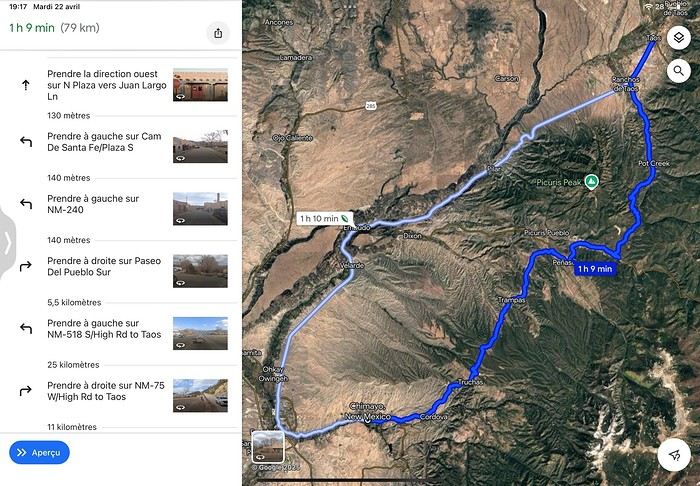
Solo traveler: Discovering Argentina differently
If you dream of an extraordinary adventure, you’ve come to the right place! Argentina, this land at the end of the world, offers a unique change of scenery and the perfect opportunity to travel solo. With its spectacular landscapes, stretching from the ends of Tierra del Fuego to the high Andean plateaus, this vast country captivates both nature lovers and those passionate about authentic encounters. Here, the notions of borders and distance fade away: the glaciers of Patagonia, the Iguazu Falls in the heart of the tropical forest, wild steppes, and Andean villages nestled in colorful valleys. In Argentina, you quickly forget the passing of time, as the human experience and the beauty of the places leave their mark on every moment.
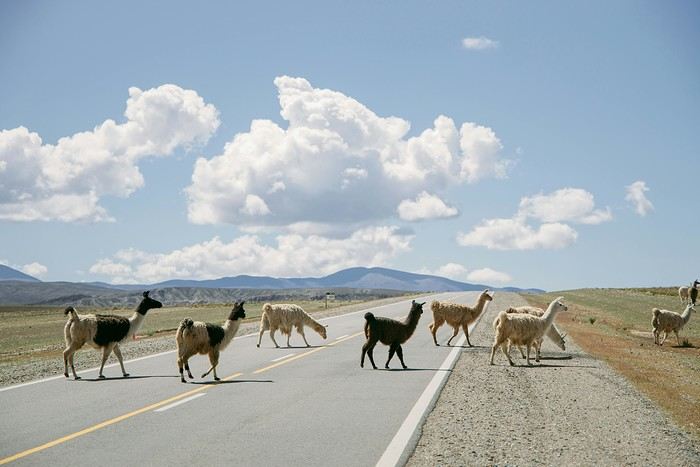
The perfect place to escape mass tourism
When traveling solo, there’s nothing like Argentina to get off the beaten path and avoid the crowds. Of course, some iconic spots like the Perito Moreno Glacier in El Calafate or Tierra del Fuego National Park in Ushuaia attract travelers from all over the world. However, the country’s vastness offers plenty of opportunities to find yourself almost alone in nature. A sunrise over the Andes, an afternoon riding with gauchos in the pampa, or a hike deep in Patagonia—these suspended moments happen far from the crowds.
A country ideal for connecting with local communities
One of Argentina’s strengths is the warmth of its people. Deeply attached to their traditions and genuinely curious about visitors, Argentinians have a knack for breaking down barriers, whether linguistic or cultural. You might find yourself chatting in Spanish over a mate (the local herbal tea), joining an impromptu barbecue, or even trying a few tango steps in a milonga. Simply showing interest in their culture and history is often enough to start a conversation. With Argentinians’ innate sense of hospitality, you never feel alone, even as a solo traveler.
Meeting local communities: a unique human adventure
Traveling solo in Argentina also means encountering its diverse communities. Staying with a local family or in an estancia (an Argentine ranch) lets you dive into the daily lives of families who often live self-sufficiently. In the Northwest, for example, you can share the life of an Andean community and learn to cook delicious local specialties. In Bariloche, some stays even include discovering a Mapuche community, offering a chance to better understand their relationship with the land and the importance of their ancestral traditions.
Diverse experiences for an unforgettable trip
Argentina is a true playground for outdoor enthusiasts: hikes in the steppes, sailing on the Beagle Channel in Tierra del Fuego, whale watching in Puerto Madryn (from June to December), or exploring the Iguazu jungle to encounter its wildlife and flora. And just when you think you’ve seen it all, Argentina still has surprises in store. In the Salta region, the Quebrada de Humahuaca reveals mountains with seven colors that tell the geological history of the Andes. It’s a feast for the eyes!
Why not join a small group with Tierra Latina?
Traveling alone doesn’t mean you can’t share parts of your journey with other enthusiasts. That’s what Tierra Latina offers: small-group tours (between 2 and 12 people), designed to balance the freedom of traveling in a small group with the camaraderie of exchanges between travelers. Each itinerary is crafted to alternate highlights (like visiting must-sees: Buenos Aires, Ushuaia, Perito Moreno…) with more intimate moments, far from mass tourism.
The focus is on authentic encounters and respect for local communities—that’s Tierra Latina’s signature. For example, in northwestern Argentina, Tierra Latina offers the chance to spend time in an Andean community to learn about traditional dish preparation during a cooking workshop. It’s an opportunity to exchange recipes and knowledge passed down through generations. The goal: to go beyond simple sightseeing and experience true moments of sharing.
In a small group, you quickly feel like part of a family of travelers, all united by the beauty of the landscapes. You also benefit from French-speaking guides who share their tips and anecdotes while leaving plenty of free time to explore at your own pace. Whether you’re traveling solo, as a couple, or with friends, you’ll find the perfect balance between independence and the comfort of being surrounded.
Human connections at the heart of the journey
At Tierra Latina, the goal is to put people at the center of the experience. Accommodations are chosen for their authentic character, often tested and approved by the team itself. Whether you’re staying with an Andean family in a small village in the Quebrada de Humahuaca or in an estancia in the heart of the Patagonian steppe, you’ll take part in local life and contribute to the economy of these sometimes isolated regions.
This responsible approach to travel helps minimize environmental impact while maintaining a privileged connection with those who make Argentina so rich: its people. You’ll leave with intense memories, marked by moments of sharing that are hard to replicate elsewhere. So, ready to pack your bags? Follow the guide and fly off to this fascinating country—you’ll only want one thing: to come back!
The perfect place to escape mass tourism
When traveling solo, there’s nothing like Argentina to get off the beaten path and avoid the crowds. Of course, some iconic spots like the Perito Moreno Glacier in El Calafate or Tierra del Fuego National Park in Ushuaia attract travelers from all over the world. However, the country’s vastness offers plenty of opportunities to find yourself almost alone in nature. A sunrise over the Andes, an afternoon riding with gauchos in the pampa, or a hike deep in Patagonia—these suspended moments happen far from the crowds.
A country ideal for connecting with local communities
One of Argentina’s strengths is the warmth of its people. Deeply attached to their traditions and genuinely curious about visitors, Argentinians have a knack for breaking down barriers, whether linguistic or cultural. You might find yourself chatting in Spanish over a mate (the local herbal tea), joining an impromptu barbecue, or even trying a few tango steps in a milonga. Simply showing interest in their culture and history is often enough to start a conversation. With Argentinians’ innate sense of hospitality, you never feel alone, even as a solo traveler.
Meeting local communities: a unique human adventure
Traveling solo in Argentina also means encountering its diverse communities. Staying with a local family or in an estancia (an Argentine ranch) lets you dive into the daily lives of families who often live self-sufficiently. In the Northwest, for example, you can share the life of an Andean community and learn to cook delicious local specialties. In Bariloche, some stays even include discovering a Mapuche community, offering a chance to better understand their relationship with the land and the importance of their ancestral traditions.
Diverse experiences for an unforgettable trip
Argentina is a true playground for outdoor enthusiasts: hikes in the steppes, sailing on the Beagle Channel in Tierra del Fuego, whale watching in Puerto Madryn (from June to December), or exploring the Iguazu jungle to encounter its wildlife and flora. And just when you think you’ve seen it all, Argentina still has surprises in store. In the Salta region, the Quebrada de Humahuaca reveals mountains with seven colors that tell the geological history of the Andes. It’s a feast for the eyes!
Why not join a small group with Tierra Latina?
Traveling alone doesn’t mean you can’t share parts of your journey with other enthusiasts. That’s what Tierra Latina offers: small-group tours (between 2 and 12 people), designed to balance the freedom of traveling in a small group with the camaraderie of exchanges between travelers. Each itinerary is crafted to alternate highlights (like visiting must-sees: Buenos Aires, Ushuaia, Perito Moreno…) with more intimate moments, far from mass tourism.
The focus is on authentic encounters and respect for local communities—that’s Tierra Latina’s signature. For example, in northwestern Argentina, Tierra Latina offers the chance to spend time in an Andean community to learn about traditional dish preparation during a cooking workshop. It’s an opportunity to exchange recipes and knowledge passed down through generations. The goal: to go beyond simple sightseeing and experience true moments of sharing.
In a small group, you quickly feel like part of a family of travelers, all united by the beauty of the landscapes. You also benefit from French-speaking guides who share their tips and anecdotes while leaving plenty of free time to explore at your own pace. Whether you’re traveling solo, as a couple, or with friends, you’ll find the perfect balance between independence and the comfort of being surrounded.
Human connections at the heart of the journey
At Tierra Latina, the goal is to put people at the center of the experience. Accommodations are chosen for their authentic character, often tested and approved by the team itself. Whether you’re staying with an Andean family in a small village in the Quebrada de Humahuaca or in an estancia in the heart of the Patagonian steppe, you’ll take part in local life and contribute to the economy of these sometimes isolated regions.
This responsible approach to travel helps minimize environmental impact while maintaining a privileged connection with those who make Argentina so rich: its people. You’ll leave with intense memories, marked by moments of sharing that are hard to replicate elsewhere. So, ready to pack your bags? Follow the guide and fly off to this fascinating country—you’ll only want one thing: to come back!
Cécile, from Big Sur to Sausalito
After our first trip discovering the American West with our teens, Cécile asked me to go back for a romantic getaway to this wonderful destination. Whatever my wife wants, so here we are on a plane in September 2022, heading to San Francisco. Since we’d already visited the main parks two years earlier, this time we took the scenic route:
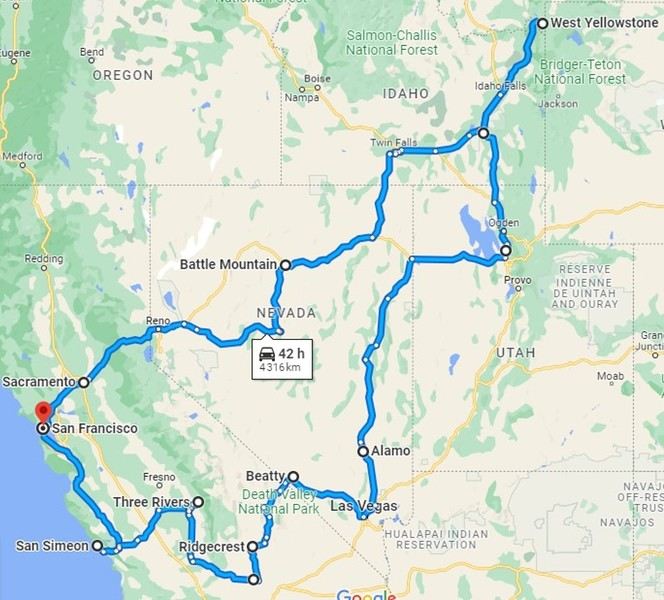
We arrived late in the evening, spent a short night at the hotel, and picked up our rental car to hit Highway 1 and the Pacific coast. The sky was gray, foggy, and a bit disappointing for now.
As Brittany lovers, we know coastal weather can change quickly... but no! Bixby Bridge was just a quick view from the car, and it was only 11°C outside.
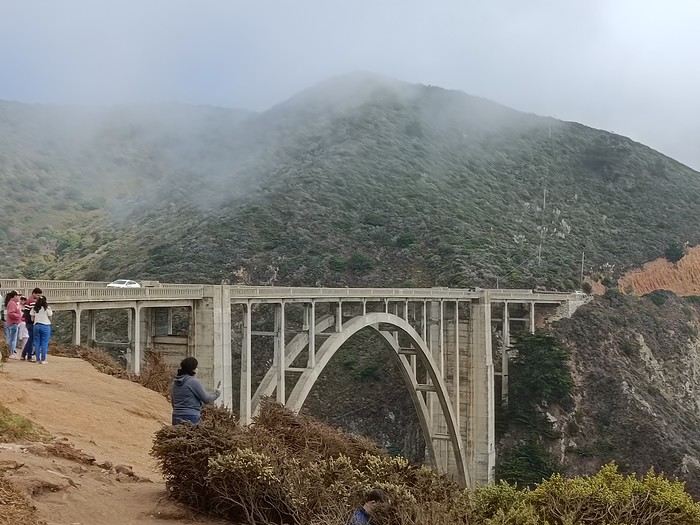
We had a quick picnic on the spot, quickly bothered by the local wildlife.
And then—miracle! This charming animal made the wind shift and brought us sunshine. So this coast is absolutely worth the trip—it’s just stunning.
Only the sound of the wind and the seals’ calls disturbed the tranquility of the moment.
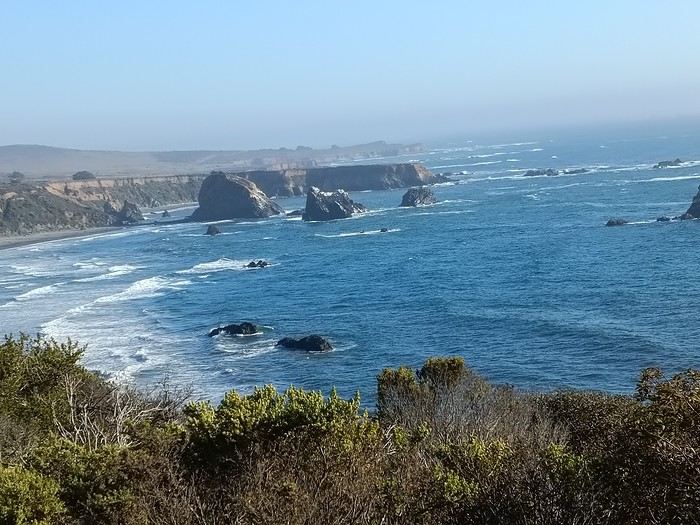
But even the best things come to an end, and we turned inland toward the sequoias. We drove through a long plain with fruit trees, vineyards, and endless straight roads.
First night at the hotel, tired but happy! !
We arrived late in the evening, spent a short night at the hotel, and picked up our rental car to hit Highway 1 and the Pacific coast. The sky was gray, foggy, and a bit disappointing for now.
As Brittany lovers, we know coastal weather can change quickly... but no! Bixby Bridge was just a quick view from the car, and it was only 11°C outside.
We had a quick picnic on the spot, quickly bothered by the local wildlife.
And then—miracle! This charming animal made the wind shift and brought us sunshine. So this coast is absolutely worth the trip—it’s just stunning.
Only the sound of the wind and the seals’ calls disturbed the tranquility of the moment.
But even the best things come to an end, and we turned inland toward the sequoias. We drove through a long plain with fruit trees, vineyards, and endless straight roads.
First night at the hotel, tired but happy! !
Exploring Namibia independently or with an agency?
Hello,
Namibia in April for 11 days from the 10th to the 21st with 2 adults and 3 (our son from the 16th to the 21st). We’re looking to combine 2 short circuits for this brief stay. Should we book a vehicle and accommodation through an agency?
We’re used to traveling independently, but we’re hesitant about Namibia! Any recommendations for vehicle rental sites? And agencies?
We’re planning two short circuits—partly with accommodation and partly with camping. Thanks for sharing your experience!
We’re flying from Cape Town to Windhoek on the 10th and returning on the 21st or 22nd. Marie
We’re used to traveling independently, but we’re hesitant about Namibia! Any recommendations for vehicle rental sites? And agencies?
We’re planning two short circuits—partly with accommodation and partly with camping. Thanks for sharing your experience!
We’re flying from Cape Town to Windhoek on the 10th and returning on the 21st or 22nd. Marie