Results for "Rawai+|+8+>+193"
782 results found.
Hôtels sur Phuket pour le 30 décembre prochain? (Thaïlande) English translation pending
Bonjour,
Je recherche des adresses d'hôtels (guesthouse) sur Phuket pour le 30 Dec prochain. Nous y resterons 4 nuits. Pas mal d'hôtels sont déjà complets pour cette période.
Merci pour vos bons tuyaux.😉
Merci pour vos bons tuyaux.😉
Transfert Bangkok-Phuket English translation pending
Bonsoir à tous, j'aimerai quelques infos sur les transferts bangkok phuket.
Je part de Paris via air thai, arrivée prévue à bangkok à 6h00 du mat'. Je voulais déjà réserver mon billet bangkok phuket sur le Net, j'ai trouvé via air asia un billet avec un départ pour 7h50. Pensez vous que moi et mon amie nous aurons le temps de faire le transfert. Et comment cela se passe t'il pour les bagages, et pour l'enregistrement.
Amicalement
Quelle île choisir en Thaïlande pour une semaine fin juillet? English translation pending
Bonjour,
Quelle Ile me conseillez vous pour 1 semaine avec ma copine, fin juillet.
Ko Samui, Ko Lanta, Ko Phi Phi, Phuket ?
Ainsi qu un tres bel hotel bord de plage ?
Merci. 🙂
Quelle Ile me conseillez vous pour 1 semaine avec ma copine, fin juillet.
Ko Samui, Ko Lanta, Ko Phi Phi, Phuket ?
Ainsi qu un tres bel hotel bord de plage ?
Merci. 🙂
Village le plus agréable de Phuket English translation pending
🙂Bonjour,
Je pense que je vais en agacer certains car je pense que la question a déjà été posée, mais après des jours et des jours de lecture de VF, je suis épuisée de chercher sans trouver.
Alors, à tous ceux qui ont déjà répondu à ce type de question, d'avance pardonnez moi, mais où puis-je me poser tranquillement en arrivant à Phuket dans le but de d'abord louer une moto, pour chercher un hotel simple et joli et dans mes prix, c'est à dire environ 20 euros.
Et tout ça, partout sauf à Patong.
Si vous avez de bonnes adresses je suis preneuse.
D'avance merci merci merci (je n'en peux plus !) 🏴☠️
Bungalow sur la plage à Koh Phi Phi et Phuket? English translation pending
Bonjour tous
J'aimerais savoir si vous avez un nom avec peut-être le site internet d'endroit pour dormir àPucket et à Kho Phi Phi. Je ne cherche pas du luxe. Y a-t-il des bungalows sur la plage à un prix raisonnable? Sinon vaut-il mieux s'éloigner?
Bref quelqu'un connait-il de bonnes adresses?
Merci
J'aimerais savoir si vous avez un nom avec peut-être le site internet d'endroit pour dormir àPucket et à Kho Phi Phi. Je ne cherche pas du luxe. Y a-t-il des bungalows sur la plage à un prix raisonnable? Sinon vaut-il mieux s'éloigner?
Bref quelqu'un connait-il de bonnes adresses?
Merci
Perte des passeports....alors que je suis à Phuket English translation pending
j ai un tres gros probleme... moi et mes deux amis avons perdus, si l on peut dire, nos passeports... nous avons nos billets retoura bangkok le 1er fevrier...sachant que la nous sommes sur phuket.
en gros on est en galere....
quelqu un pourrait il nous conseiller sur les demarches a suivre sachant que je suis le seul a ne pas etre assure...et sachant aussi que meme si c un gros probleme, je n ai pas non plusenvie de passer mon tps et de perdre mon sejour a cause de cet incident...
j ajoute aussi que la reception de l hotel possede la photocopie de mon passeport ce ki peut tjrs m aider et que je possede aussi ma carte nationale d itentite...
Transfert de Phuket vers l'île de Coral Island English translation pending
bonjour quelqu'un connait il les horaires et tarifs depuis port de phuket vers l'ile de coral island et si on peut s'y rendre sans passer par l'intermediaire d'une agence ou site de reservation ?
merci d'avance
Journée sur la jonque June Bathra dans la baie de Phang Nga, île Koh Raya (Thaïlande) English translation pending
BONJOUR A TOUS
bientot le grand départ pour nous, mais j'ai encore diverses questions pour peaufiner ce voyage tant rêvé !
Nous sommes une groupe de 10 (6 adultes et 4 enfants) et souhaitons passer la journée sur la Jonque June Bathra dans la baie de Phang Nga, comment fait-on pour réserver cette jonque, doit-on aller à Patong dans une agence, passer par notre hotel, aller directement à l'embarcadère (d'ailleur où se trouve-t-il ?), peut-on négocier un prix pour 10 ?
et ma 2ème question : koh Raya est une très belle ile, mieux vaut y aller en long tail et le louer à la 1/2 journée (pour 10 !) ou prendre un bateau rapide ? et où doit-t-on aller pour prendre ces différents types de transports ? sur une plage, un embarcadère, une agence sur Patong ?
Désolée, j'ai beaucoup de questions mais je souhaite un séjour bien préparé pour éviter de perdre du temps sur place, il est trop précieux ! merci à tous pour votre aide
Nouvelle attaque de touristes à Phuket English translation pending
Pour la iéme fois des touristes ont été attaqués et dévalisés à Phuket...depuis un certain temps déja entre kamala et Patong ainsi que Raway et kata....
Je mets ce post car je trouve que c'est de plus en plus souvent et prévenir de faire attention en motorbike et aux sac à main en bandouliére...
Le mode opératoire est tjrs le méme, a savoir vous roulez seul ou avec un passager et dans un endroit sombre de la route la moto qui vous suit vous rattrape et un des mec vous jette par terre et vous menace d'un revolver et ou d'un couteau...
Il n'y a pas longtemps un resident Norvégien est mort de plusieurs coups de couteau !
Friday, October 12, 2007 Another attack in Rawai, Aussie and Brit mugged
RAWAI: An Australian woman was pulled off her motorcycle and robbed at gunpoint early Sunday morning in the same area where Norwegian tourist Simen Knudsen was killed two weeks earlier.
The victim, 27-year-old Australian Sooz Lomas, arrived in Phuket about two weeks ago to study Thai boxing at the Rawai Muay Thai camp.
About 2:30 am on Sunday, Ms Lomas left the nearby Icon Bar with an English friend named Paul, also 27. As Paul drove the motorbike and Ms Lomas rode pillion, the pair were approached from behind by two men on another motorbike.
Ms Lomas said the attack happened off the main road from Rawai to Kata.
“I don’t know the roads very well and neither did the guy who was driving. I think we may have taken a wrong turn, because we ended up somewhere that was very dark. I think we were followed from the bar, ” she said.
“It was very soon after we left, and there were a bunch of people standing outside as we were leaving. We were going slowly, about 30kmh. Then two guys came up from behind, on the right. One of them reached out and grabbed my bag, pulling me off the motorbike.
“I came off and hit the ground face first, while the driver skidded along for a bit. I hit my head, so I was still a bit confused about exactly what had happened. One of the attackers went up to Paul, pointed a gun at him and asked for money. So he emptied his pockets.
“They both had guns. I was lying face down on the ground. I didn’t really know what was going on, but one of the guys came up to me saying, ‘Money! Money! Money!’ I wasn’t really sure what was happening, but I didn’t want to give up my bag straight away. Then I felt my bag being grabbed and they cut the strap and pulled it off me, ” Ms Lomas said
Once they had taken all her possessions, the gunmen left quickly, getting away with about 1, 500 baht in cash, credit cards, a mobile phone and camera – in addition to the money stolen from Paul. RAWAI: An Australian woman was pulled off her motorcycle and robbed at gunpoint early Sunday morning in the same area where Norwegian tourist Simen Knudsen was killed two weeks earlier.
The victim, 27-year-old Australian Sooz Lomas, arrived in Phuket about two weeks ago to study Thai boxing at the Rawai Muay Thai camp.
About 2:30 am on Sunday, Ms Lomas left the nearby Icon Bar with an English friend named Paul, also 27. As Paul drove the motorbike and Ms Lomas rode pillion, the pair were approached from behind by two men on another motorbike.
Ms Lomas said the attack happened off the main road from Rawai to Kata.
“I don’t know the roads very well and neither did the guy who was driving. I think we may have taken a wrong turn, because we ended up somewhere that was very dark. I think we were followed from the bar, ” she said.
“It was very soon after we left, and there were a bunch of people standing outside as we were leaving. We were going slowly, about 30kmh. Then two guys came up from behind, on the right. One of them reached out and grabbed my bag, pulling me off the motorbike.
“I came off and hit the ground face first, while the driver skidded along for a bit. I hit my head, so I was still a bit confused about exactly what had happened. One of the attackers went up to Paul, pointed a gun at him and asked for money. So he emptied his pockets.
“They both had guns. I was lying face down on the ground. I didn’t really know what was going on, but one of the guys came up to me saying, ‘Money! Money! Money!’ I wasn’t really sure what was happening, but I didn’t want to give up my bag straight away. Then I felt my bag being grabbed and they cut the strap and pulled it off me, ” Ms Lomas said
Once they had taken all her possessions, the gunmen left quickly, getting away with about 1, 500 baht in cash, credit cards, a mobile phone and camera – in addition to the money stolen from Paul. Australian tourist Sooz Lomas, 27, is still recovering from her injuries after being pulled off her motorbike by gun-toting and knife-wielding thugs in the same area of Rawai where Simen Knudsen was killed two weeks earlier.
Paix à son ame... Norwegian sea captain Simen Sparre Knudsen (pictured above) had been coming to Thailand for 30 years before he was stabbed to death on September 23. The case, headline news in Norway, again puts the spotlight on tourist safety in Phuket.
Ps. photo du Norvégien tué qui laisse femme et enfants derriére lui...
Je mets ce post car je trouve que c'est de plus en plus souvent et prévenir de faire attention en motorbike et aux sac à main en bandouliére...
Le mode opératoire est tjrs le méme, a savoir vous roulez seul ou avec un passager et dans un endroit sombre de la route la moto qui vous suit vous rattrape et un des mec vous jette par terre et vous menace d'un revolver et ou d'un couteau...
Il n'y a pas longtemps un resident Norvégien est mort de plusieurs coups de couteau !
Friday, October 12, 2007 Another attack in Rawai, Aussie and Brit mugged
RAWAI: An Australian woman was pulled off her motorcycle and robbed at gunpoint early Sunday morning in the same area where Norwegian tourist Simen Knudsen was killed two weeks earlier.
The victim, 27-year-old Australian Sooz Lomas, arrived in Phuket about two weeks ago to study Thai boxing at the Rawai Muay Thai camp.
About 2:30 am on Sunday, Ms Lomas left the nearby Icon Bar with an English friend named Paul, also 27. As Paul drove the motorbike and Ms Lomas rode pillion, the pair were approached from behind by two men on another motorbike.
Ms Lomas said the attack happened off the main road from Rawai to Kata.
“I don’t know the roads very well and neither did the guy who was driving. I think we may have taken a wrong turn, because we ended up somewhere that was very dark. I think we were followed from the bar, ” she said.
“It was very soon after we left, and there were a bunch of people standing outside as we were leaving. We were going slowly, about 30kmh. Then two guys came up from behind, on the right. One of them reached out and grabbed my bag, pulling me off the motorbike.
“I came off and hit the ground face first, while the driver skidded along for a bit. I hit my head, so I was still a bit confused about exactly what had happened. One of the attackers went up to Paul, pointed a gun at him and asked for money. So he emptied his pockets.
“They both had guns. I was lying face down on the ground. I didn’t really know what was going on, but one of the guys came up to me saying, ‘Money! Money! Money!’ I wasn’t really sure what was happening, but I didn’t want to give up my bag straight away. Then I felt my bag being grabbed and they cut the strap and pulled it off me, ” Ms Lomas said
Once they had taken all her possessions, the gunmen left quickly, getting away with about 1, 500 baht in cash, credit cards, a mobile phone and camera – in addition to the money stolen from Paul. RAWAI: An Australian woman was pulled off her motorcycle and robbed at gunpoint early Sunday morning in the same area where Norwegian tourist Simen Knudsen was killed two weeks earlier.
The victim, 27-year-old Australian Sooz Lomas, arrived in Phuket about two weeks ago to study Thai boxing at the Rawai Muay Thai camp.
About 2:30 am on Sunday, Ms Lomas left the nearby Icon Bar with an English friend named Paul, also 27. As Paul drove the motorbike and Ms Lomas rode pillion, the pair were approached from behind by two men on another motorbike.
Ms Lomas said the attack happened off the main road from Rawai to Kata.
“I don’t know the roads very well and neither did the guy who was driving. I think we may have taken a wrong turn, because we ended up somewhere that was very dark. I think we were followed from the bar, ” she said.
“It was very soon after we left, and there were a bunch of people standing outside as we were leaving. We were going slowly, about 30kmh. Then two guys came up from behind, on the right. One of them reached out and grabbed my bag, pulling me off the motorbike.
“I came off and hit the ground face first, while the driver skidded along for a bit. I hit my head, so I was still a bit confused about exactly what had happened. One of the attackers went up to Paul, pointed a gun at him and asked for money. So he emptied his pockets.
“They both had guns. I was lying face down on the ground. I didn’t really know what was going on, but one of the guys came up to me saying, ‘Money! Money! Money!’ I wasn’t really sure what was happening, but I didn’t want to give up my bag straight away. Then I felt my bag being grabbed and they cut the strap and pulled it off me, ” Ms Lomas said
Once they had taken all her possessions, the gunmen left quickly, getting away with about 1, 500 baht in cash, credit cards, a mobile phone and camera – in addition to the money stolen from Paul.
Australian tourist Sooz Lomas, 27, is still recovering from her injuries after being pulled off her motorbike by gun-toting and knife-wielding thugs in the same area of Rawai where Simen Knudsen was killed two weeks earlier. Paix à son ame...
Norwegian sea captain Simen Sparre Knudsen (pictured above) had been coming to Thailand for 30 years before he was stabbed to death on September 23. The case, headline news in Norway, again puts the spotlight on tourist safety in Phuket.Ps. photo du Norvégien tué qui laisse femme et enfants derriére lui...
Hôtel Novotel Panwa Beach Resort à Phuket? English translation pending
bonjour à tous!
j'aimerais avoir qq infos concernant le novotel de cap panwa à phuket??? si certaines personnes connaissent déjà cet hôtel, ce serait très sympa de m'en parler car je ne suis jamais aller en thaîlande, j'ai pas envie de me planter ... pour la mi-septembre, j'ai trouvé 1 très belle offre pour cet hôtel et je m'apprêtais à aller réserver début de semaine prochaine! j'ai lu autre part que la plage n'était vraiment pas terrible de ce côté de l'île (à marrée basse/corail)
merci d'avance 😉
j'aimerais avoir qq infos concernant le novotel de cap panwa à phuket??? si certaines personnes connaissent déjà cet hôtel, ce serait très sympa de m'en parler car je ne suis jamais aller en thaîlande, j'ai pas envie de me planter ... pour la mi-septembre, j'ai trouvé 1 très belle offre pour cet hôtel et je m'apprêtais à aller réserver début de semaine prochaine! j'ai lu autre part que la plage n'était vraiment pas terrible de ce côté de l'île (à marrée basse/corail)
merci d'avance 😉
Guest houses à bas prix au sud de Phuket? English translation pending
Salut à tous,
Partant du 18/10 au 14/11 je compte passer les 10 derniers jours dans les iles et en particulier à Phuket pour faire du surf.
J'ai vu des plages sympa avec des bonnes vagues sur le sud de l'ile (nai harn beach, freedom beach) mais j'ai pas trouvé vraiment de GH bon marché (le seul est le Sabana resort qui est un peu hors budget, est ce possible de trouver moins cher dans le coin? si oui que me recommander vous (dans les 600-700 bths)?
Merci pour vos réponses.
A+
Fab
Partant du 18/10 au 14/11 je compte passer les 10 derniers jours dans les iles et en particulier à Phuket pour faire du surf.
J'ai vu des plages sympa avec des bonnes vagues sur le sud de l'ile (nai harn beach, freedom beach) mais j'ai pas trouvé vraiment de GH bon marché (le seul est le Sabana resort qui est un peu hors budget, est ce possible de trouver moins cher dans le coin? si oui que me recommander vous (dans les 600-700 bths)?
Merci pour vos réponses.
A+
Fab
Logement à Phuket English translation pending
Bonjour
Je pars pour Phuket le semaine prochaine et je ne sais meme pas encore ou aller pour trouver un logement. Svp connaissez vous des places pas trop brouillante, propres et surtout a prix abordables..... Svp si vous pourriez m'aider n'hesitez pas je serai tres reconnaisant mon voyage arrive a grand pas.
Merci
Je pars pour Phuket le semaine prochaine et je ne sais meme pas encore ou aller pour trouver un logement. Svp connaissez vous des places pas trop brouillante, propres et surtout a prix abordables..... Svp si vous pourriez m'aider n'hesitez pas je serai tres reconnaisant mon voyage arrive a grand pas.
Merci
Où passer cinq semaines sur la plage en Thaïlande? English translation pending
Bonjour,
Je ne suis jamais allé en Thailande. Je voudrais y passer 5 semaines cet hiver; papa, maman et deux ados.
Le but est de louer une petite villa sur la plage, pas trop loin d'un village sympa (surtout pour les filles). Moi je me contente de nager 4h en mer tous les jours et de rapporter les repas.
Sans aller dans un coin gavé de touristes, ni au fond d'un trou perdu (faut quand meme un peu d'animation) il doit bien y avoir des spots ou les locaux sont sympa et le budget raisonable.
Merci d'avances pour vos idées et conseils (et peut-etre l'occasion de rencontrer ceux qui y seront pour un pot ou une langouste grillée)
Florian
Sans aller dans un coin gavé de touristes, ni au fond d'un trou perdu (faut quand meme un peu d'animation) il doit bien y avoir des spots ou les locaux sont sympa et le budget raisonable.
Merci d'avances pour vos idées et conseils (et peut-etre l'occasion de rencontrer ceux qui y seront pour un pot ou une langouste grillée)
Florian
Recherche restaurant sur Kata et les environs à Phuket English translation pending
Bonjour à tous.
Je recherche des restos sur Kata et les autres plages de PHUKET.
Merci pour vos réponses.
Recherche une petite cantine sympathique à Phuket English translation pending
Bonjour je pars avec le fiston (24 ans ) une quinzaine de jours au karon beach, au menu : découverte de la thailande, plongée
et un peu de farniente . Je cherche donc une petite cantine qui sera notre base culinaire, pas de chichi, de la cuisine simple mais
bonne .........donc amis pros de la thailande et de phuket en particulier je suis tout prêt à lire et ensuite à visiter les adresses où vos papilles se sont régalées.........
et j abuserai avec une petite adresse d un club plongée sérieux ...........c est que j ai qu'une vie et que sentimentalement j 'y tiens..........
Merci à vous ..........
Suggestion plages et hôtels sur la côte ouest de la Thaïlande English translation pending
Bonjour a tous,
Nous voudrions passer deux semaines sur la cote ouest de la thailande et aimerions aller sur une belle plage et un bon hotel avec piscine. Nous serons un groupe d'une quinzaine de personnes composes de personnes ages et de jeunes enfants. Pour l'instant nous voudrions passer une semaine a Phuket mais ou? et une semaine a kho lantha ou phi phi? Nos centres d'interet: jolie plage, hotel avec piscine, et petits restaus de rue disponibles pas trop loin.
Je fais appel a vos suggestions
D'avance merci.
Nous voudrions passer deux semaines sur la cote ouest de la thailande et aimerions aller sur une belle plage et un bon hotel avec piscine. Nous serons un groupe d'une quinzaine de personnes composes de personnes ages et de jeunes enfants. Pour l'instant nous voudrions passer une semaine a Phuket mais ou? et une semaine a kho lantha ou phi phi? Nos centres d'interet: jolie plage, hotel avec piscine, et petits restaus de rue disponibles pas trop loin.
Je fais appel a vos suggestions
D'avance merci.
Endroit sur Phuket qui soit un compromis entre Patong et Mai Khao? English translation pending
Existe t'il sur phuket un endroit qui soit un compromis entre patong la sulfureuse et mai khao la tranquille? Un endroit où la journée l'on peu se baigner sans scooter des mers tout en bringuant un minimum le soir.
Je sais je suis de nature utopiste...
Excursions à ne pas manquer autour de Phuket? English translation pending
slt a tous, je suis nouveaux sur ce forum, je vais bientot partir pour la thailande .
j'aimerais savoir les excusions a ne pas manquer autour de puket
Balade privée en bateau pour une journée dans les îles du sud de la Thaïlande English translation pending
Re
Petite question savez vous ou peut on trouver un petit bateau assez puissant et avec chaufeurs pour une ballade d'une journée à travers les iles du sud ? Et quel budget faut il sachant que nous voulon etre seul sur le betau et ne pas faire cette ballade avec 40 autres touristes acroché à leurs appareils photos ! Merci de votre aide
ps super le site ! un regal et plein d'infos super interessant
Petite question savez vous ou peut on trouver un petit bateau assez puissant et avec chaufeurs pour une ballade d'une journée à travers les iles du sud ? Et quel budget faut il sachant que nous voulon etre seul sur le betau et ne pas faire cette ballade avec 40 autres touristes acroché à leurs appareils photos ! Merci de votre aide
ps super le site ! un regal et plein d'infos super interessant
Excursions à Phuket English translation pending
Quelles sont les excursions à faire à Phuket (Patong) ? Prix ?
Location de maison bon marché en Thaïlande English translation pending
Bonjour à tous,
Je compte partir en thailande pour un an en octobre 2006 avec mon amie et ses deux enfants de 7 et 5 ans. Je voulais savoir si il était possible de louer une maison(2/3ch) entre 5000 et 10000 baths/mois ? Nous pensons nous rendre d'abord du côté de puket et Krabi avant de monter dans le nord à Chiang rai, y a t'il des endroits plus propices que d'autres accompagnés d'enfants dans ces régions? Merci d'avance pour la réponse...😇😎
Je compte partir en thailande pour un an en octobre 2006 avec mon amie et ses deux enfants de 7 et 5 ans. Je voulais savoir si il était possible de louer une maison(2/3ch) entre 5000 et 10000 baths/mois ? Nous pensons nous rendre d'abord du côté de puket et Krabi avant de monter dans le nord à Chiang rai, y a t'il des endroits plus propices que d'autres accompagnés d'enfants dans ces régions? Merci d'avance pour la réponse...😇😎
Shanti Lodge à Bangkok et Phuket English translation pending
Bonjour,
Est ce que quelqu'un a déjà été au Shanti Lodge à Bangkok et à Phuket? si oui est ce que c'est bien? car sur leur site ça parait très joli. Et si vous connaissez celui de Phuket, où est il situé à Phuket? quelle plage?
Est ce que quelqu'un a déjà été au Shanti Lodge à Bangkok et à Phuket? si oui est ce que c'est bien? car sur leur site ça parait très joli. Et si vous connaissez celui de Phuket, où est il situé à Phuket? quelle plage?
Hôtels et loisirs à Phuket English translation pending
salut à tous😉
Je pars le 19 novembre à phuket pour la première fois et j'aimerais avoir des petites infos sur des hotels, les loisirs ... tout ce qui pourais m'aider a passé de bonne vacance😏
Et merci d'avance a tous
Thaïlande: billets d'avion et hôtels English translation pending
Est-ce que quelqu'un peut m'aider ??
Je souhaiterai allé en thaïlande à phuket vers le 19 novembre avec 3 ami(e)s et j'aimerai savoir où je peux acheter des billets d'avion pas cher ainsi qu'avoir quelques bons plans pour trouver de bons hotels en zone touristiques pas chers aussi.pouvez-vous me donner des noms et adresses d'hotels ??
Merci
Quelqu'un pourrait me répondre ??
Merci🙂
Sinon j'aimerai savoir si les vols internes coutent chers (ex: bangkok-phuket)
Quelqu'un pourrait me répondre ??
Merci🙂
Sinon j'aimerai savoir si les vols internes coutent chers (ex: bangkok-phuket)
Hôtel Karon Princess à Phuket (Thaïlande)? English translation pending
connaissez vs cet hotel?toutes infos me serait utiles!!!merci d'avance😏
Hôtel Sabana Resort à Phuket (Thaïlande) English translation pending
Bonjour tout le monde,
Je souhaite partir jeudi 20 pour la thailande. Que pensez vous de l'hotel sabana ressort à Puket? J'aimerai savoir si le temps actuel est clément? Merci d'avance de vos avis sur l'hotel et de vos infos sur le climat😉
Je souhaite partir jeudi 20 pour la thailande. Que pensez vous de l'hotel sabana ressort à Puket? J'aimerai savoir si le temps actuel est clément? Merci d'avance de vos avis sur l'hotel et de vos infos sur le climat😉
Adventures of a Bygone Era: The Philippines in 1984
After several discussions on VF about travel journals from the Philippines, I decided to write this curiosity: a trip report from a journey made in 1984, when traveling to the Philippines was still an adventure.
A curiosity because writing a travel journal about a trip 35 years later isn’t common, but also (mostly?) because exploring the Philippines at that time had little in common with traveling there today.
Obviously, I’ve forgotten a number of facts, most of the details, but with the help of a few notes from that time and a stack of slides (yes, there was life before digital 😊), many memories came back and added to the highlights I’d never forgotten. The scanned slides aren’t always great quality, but there are still quite a few to brighten up this chatter. Back then, we didn’t snap photos like we do now—film was too expensive—so I don’t have pictures of every place we visited... too bad, comparing some of those spots to how they look today would’ve been interesting.
Why "Adventures"? Why call it "Adventures" in the Philippines in 1984, a word so often used for a simple exotic trip? - Because the lack of information (no *Guide du Routard*, no *Lonely Planet*, no *Michelin Guide*, nothing, and obviously no internet) gave this trip what’s at the heart of adventure: the unknown. - Because the political situation made the stay sometimes dangerous. - Because transportation conditions were always epic, often perilous. - Because the question of where we’d spend the night came up almost every evening. - And for... quite a few other reasons.
That said, we weren’t exactly explorers!
Why the Philippines? First of all, why go to the Philippines in 1984—a country not exactly set up for tourism and about which we knew very little? How could we get an idea of the beauty of the Philippines and its points of interest when we had no guides or photos?
The idea came to us from Thailand a year earlier, during our first long-haul trip. After touring the north of the country, we met a Frenchman living in Phuket, where there were only a few tourists in Patong, with just a few small hotels and guesthouses. Kata and Karon had no buildings or roads, Rawai only had three palm-thatched bungalows, including ours, and the other islands were unknown to tourists. There was plenty to discover, and we wanted to return to this beautiful country... but the Frenchman made us dream about the Philippines—a country to explore, with wild landscapes.
Long evenings of discussion over multiple Sprite-Mekong cocktails (what memories of those headaches!) finally convinced us we had to go to the Philippines.
Episode 0: Before Departure The decision was made: we’d go to the Philippines in May 1984. Our friends and family were surprised when we announced we were going on vacation to the Philippines (a bit like saying today we were going paddleboarding in the Kerguelen Islands 🤪).
These days, preparing for each of our trips takes long evenings of research, planning, and noting down good addresses... etc. But for the Philippines in 1984, preparation was quick: we had very little information about the country, we were leaving almost at random, and the discovery would only be more exciting.
We still had a few bits of info gathered here and there: the rice terraces in northern Luzon, volcanoes, Negros where we were supposed to visit an acquaintance, Cebu and its marine life (we ended up going elsewhere), and absolutely avoid Mindanao, which was practically at war with the regime. That was about it, but it was already a great itinerary.
Nothing was organized in advance; we’d see day by day. We had no idea about travel times or even the existence of transportation options. The main (and sometimes only) way to connect two islands was by overloaded, rusty ferry. Only the big cities had airports.
Let’s Go: Episode 1: Paris to Manila My travel journals always start after arriving at the airport—the Europe-to-“Other Continent” trip isn’t interesting—but the flight to the Philippines was already an adventure, so I’ll make an exception.
This was the era when only a few Asian airlines were on par with Western ones: Thai, Singapore Airlines, and Philippine Airlines. They had beautiful, brand-new planes, and to attract customers (almost exclusively “businessmen”) from the usual airlines (Air France, Lufthansa, British Airways), there was opulence on board: unlimited champagne, all sorts of cocktails... Compared to today’s long-haul flights, there was still one small difference: no personal screens, just one screen at the front of the cabin with one mandatory movie. And I don’t know why, but we only got James Bond films, both ways... that must’ve been the trend at the time.
The tourism boom to Southeast Asia hadn’t started yet, and the “Asian Tigers” weren’t a thing, so there weren’t many business trips. That meant long-haul flights made stops everywhere to fill the planes. Our Philippine Airlines Boeing 747 left London, picked us up in Paris, then stopped in Frankfurt to take on a few Germans. I don’t know why we then made a stop in Dubai—a totally exotic place at the time. There was nothing to do there... things have changed a lot since. It was a small town lost in the desert. The airport was tiny, with just one or two buildings and a supermarket. During the stopover, everyone had to get off the plane and walk to the supermarket. Photo and electronic equipment were dirt cheap—I guess that was the only reason for the stop. Maybe it was their first commercial move. Emirates didn’t exist yet, as I checked online, but anyway, the idea that such a remote place could have its own airline was unthinkable.
Online, I found this photo of Dubai Airport in 1980. Anyone who’s transited through today’s massive airport with its rows of A380s will appreciate it: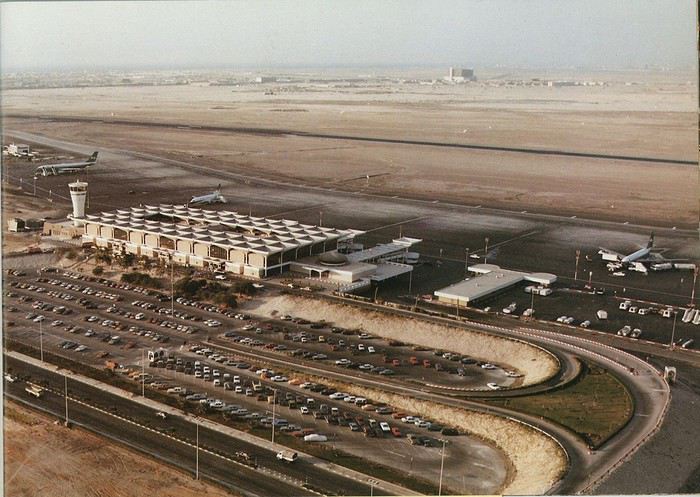
Next stop: New Delhi to drop off some Europeans and pick up a few Indians, and finally, the terminus: Manila. I don’t remember how long the trip took with its five stops—an unimaginable journey today. Despite all those stops to fill the plane, there was still enough space to stretch out on the four center seats of the 747, something that never happens these days despite all the flights in every direction.
So here we are, finally at Manila Airport around midnight.
Episode 1: Manila and Baguio To start, a quick note on the political and economic situation in the Philippines in 1984, which had consequences for us as tourists, as we’d soon realize upon arrival.
After several centuries of Spanish colonization, the Philippines became American at the start of the 20th century, then independent. In 1966, Marcos took power, and little by little, his regime sank into corruption and mismanagement, becoming a dictatorship with martial law, all for the benefit of his family and friends, who enriched themselves endlessly. The peak was the assassination of opposition leader Benigno Aquino in August 1983, which triggered harshly repressed protests. So we arrived a few months later in a very poor country, with omnipresent corruption and an extremely tense political situation, as we’d soon see for ourselves. Major protests took place in the main cities during our trip—I’ll come back to that. Two years later, Marcos fled to Hawaii after being forced out of power following rigged elections. This historical context explains a lot of the situations we found ourselves in over the following weeks.
Arriving in the middle of the night isn’t very cheerful. Manila was already a huge city with many slums, where you could find a few business hotels like the Hilton or Intercontinental—way out of our budget—and plenty of run-down hotels. Luckily, two Indians we’d chatted with on the plane offered to take us to their usual hotel. They came to Manila twice a year for business. We accepted their offer, relieved not to have to look for a place to stay in the middle of the night, figuring the address must be good since they came back every time... we were wrong 🙁
We left the airport and immediately got a taste of the local vibe when we got into the taxi: the police asked for our passports. We thought: what’s more normal than police in a dictatorship?
But that wasn’t it at all. Our two Indian friends explained that the police were noting our names along with the taxi number and time. Crime in Manila was so bad that the taxi driver would be held responsible if anything happened to us... welcome to the Philippines 😎 😎
Historically, the Philippines was a very violent country, where everything was settled with guns or machetes. Previous governments had banned carrying weapons, but Marcos later allowed the free sale and carrying of guns, and disputes were settled with pistols again (or worse, as we’d discover later). Since he’d released most of the criminals from prison to form a paramilitary militia at his service (I’ll talk about our encounter with these “heroes” later), it was pretty dangerous to go into many parts of Manila, where these “tonton macoutes” ruled.
We arrived at our hotel without incident... and then things started badly. The room was infested with big cockroaches—exactly what I hate most in those kinds of countries. No way to find another hotel at that hour. After the long flight, the urge to take a shower was so strong that we squeezed into the bathroom as best we could. After that, I don’t remember—I guess we must’ve fallen asleep exhausted under the sheets in the heat... air conditioning wasn’t widespread yet.
The next day, we just wanted to leave that dump as soon as possible. So we decided to head north right away, stopping in Baguio, and we’d visit Manila a bit on the way back.
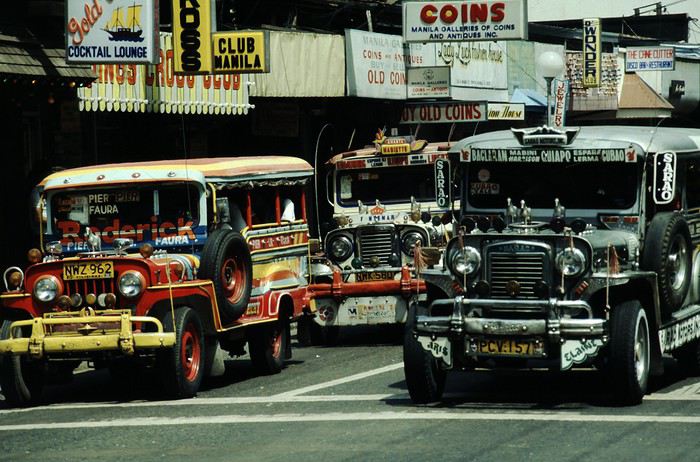
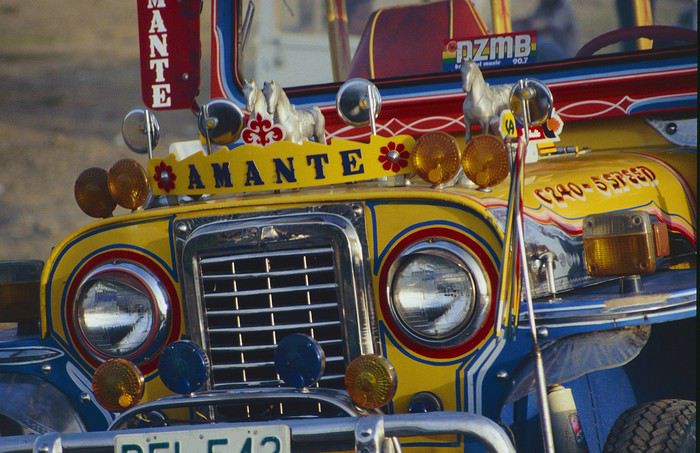
When we stepped outside, we discovered a pretty run-down neighborhood with potholed streets. But we also discovered the jeepneys. They were everywhere, flooding the streets.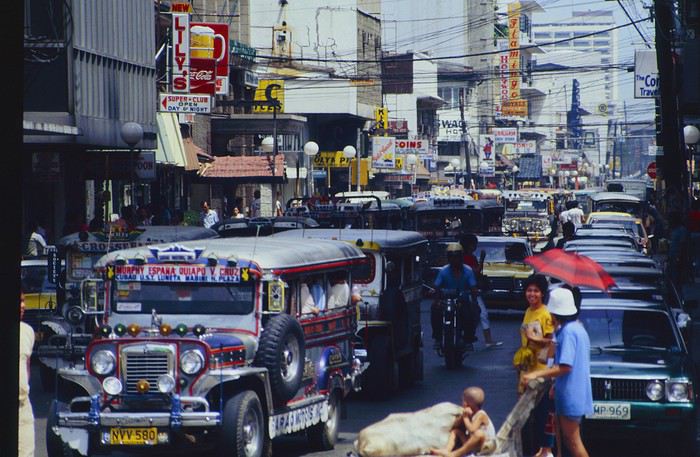
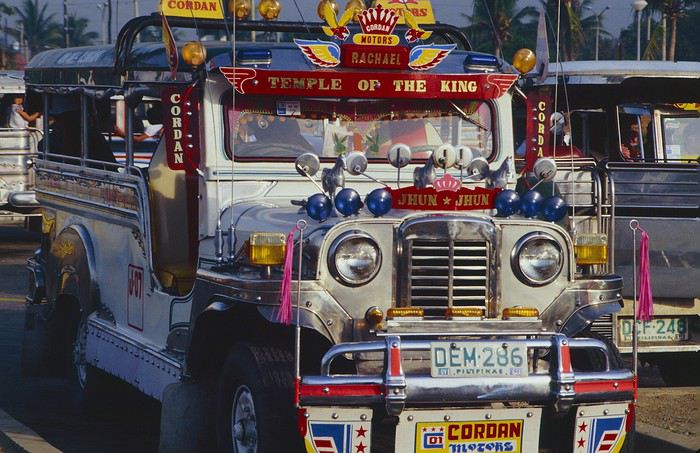
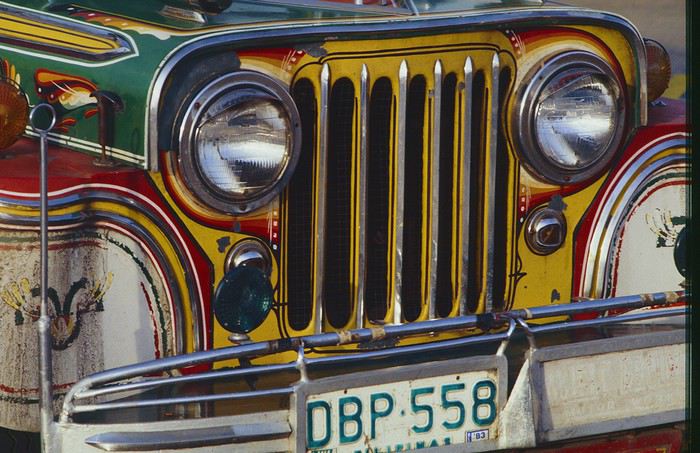
They had crazy sound systems, each one blasting louder than the last. The interiors were kitschy but fun. There weren’t many private cars—almost all transportation was by jeepney, with buses reserved for intercity trips.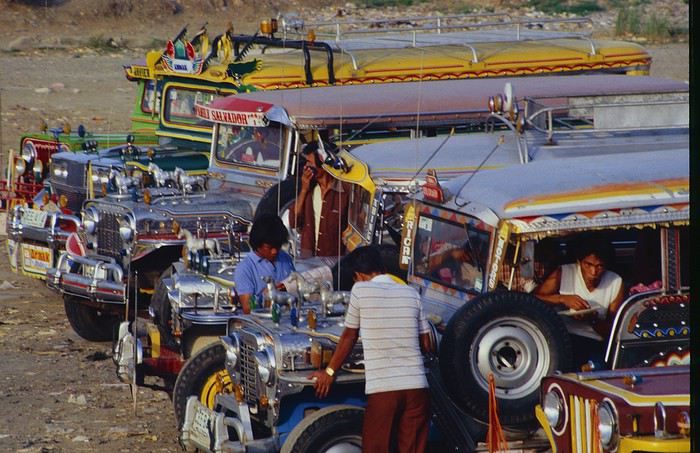
Before heading to the bus terminal for the north, somewhere on the outskirts of the city, we needed to exchange some money. I don’t remember how we ended up in a policeman’s jeep who offered his services: - Exchange money on the black market at a better rate than the banks. - Take us wherever we wanted, in this case, the bus terminal.
We accepted both offers (we’d still checked the official exchange rate from dollars to pesos). So we found ourselves in his jeep. After exchanging money, we left in his vehicle and stopped for gas. Without turning off the engine, he calmly smoked a cigarette while filling up. Since we were in a jeep with no doors or roof, we were ready to jump out if things went south, our travel bag in hand.
But we weren’t done with surprises yet. Once we left the small streets, we ended up in a neighborhood with wide avenues and not much traffic, which didn’t justify his incredible behavior. At every intersection, he made the sign of the cross, closed his eyes, and crossed without looking. I was more stunned than terrified! It wasn’t until we got out of the car later that I told Anne-Marie what had happened. I’d seen everything because the cop had put me in the front seat. Luckily, A-Marie hadn’t noticed anything from the back. Crossing Manila by trusting God rather than the rules of the road was ultimately effective. We were lucky—the trip was off to a good start. 🙂 🙂
We then passed through a neighborhood where slums stretched on for a while, and we left our policeman—friendly but a bit crazy—with relief.
A few hours by bus later, here we are in Baguio, cool in the mountains. My memories of Baguio are pretty fuzzy. I remember a small town. After some research while writing this journal, I found that the population was 120,000 in 1980. Given the population density in each home, that confirms my memory of a smallish town. Outside the “official” district with the president’s summer residence and government buildings, there were two or three paved streets with nice houses. The rest was very dirty and very poor, with lots of slums and dirt roads.
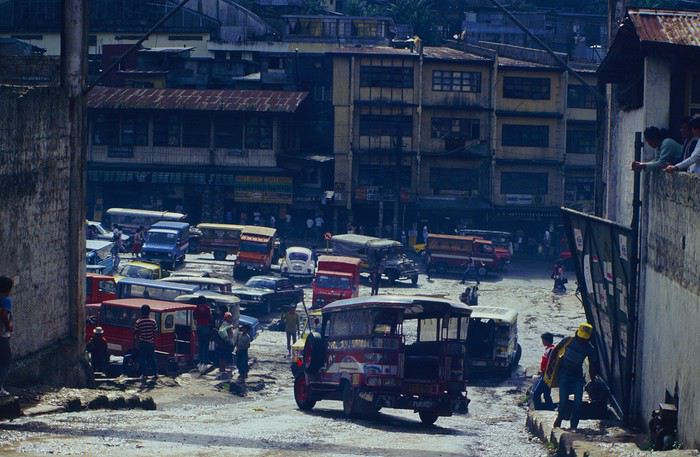
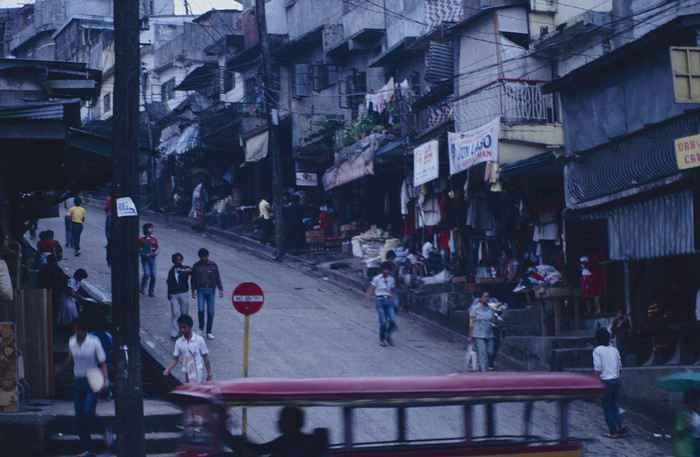
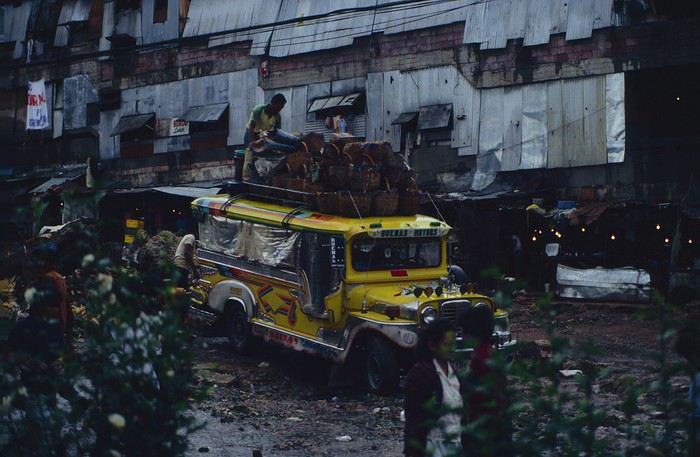
People we met on the street invited us to stay with them. These days, we wouldn’t just show up at strangers’ houses, which we should’ve done in Baguio—it would’ve saved us from an unimaginable and dangerous situation... which I won’t say anything about... !😊
The simple wooden house was on stilts at the edge of a hill with a view of the mountains. Since it was the start of the rainy season in a city that gets a lot of rain, we saw a lot of water. Our outings in town happened between downpours.
View from our lodging: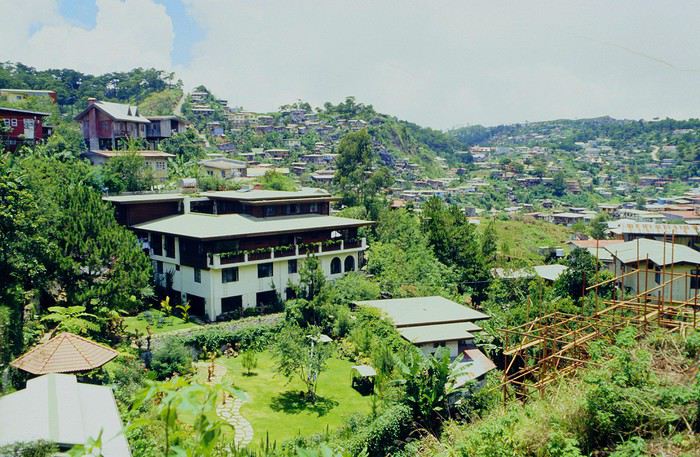
Episode 2: Baguio to Bontoc Aside from the situation briefly mentioned above, it was on the next leg to Bontoc that the adventure really began: an endless and dangerous road, a bus from another era, breathtaking landscapes, and surprising people.
We didn’t know the distance or how long it would take to get to Bontoc. When we arrived after about ten hours, we learned that Baguio to Bontoc was 140 km.
We got on a bus with wooden seats and settled in, two to a seat meant for two. As the bus filled up, passengers squeezed in three or four per seat, with chickens and baskets full of all sorts of things in the aisle. A little embarrassed, we didn’t know if we should squeeze in three on our seat. The seats were super tight (luckily, Filipinos are small), and I didn’t know where to put my legs given my height. I don’t remember if we stayed alone on our bench or if we ended up sharing with others.
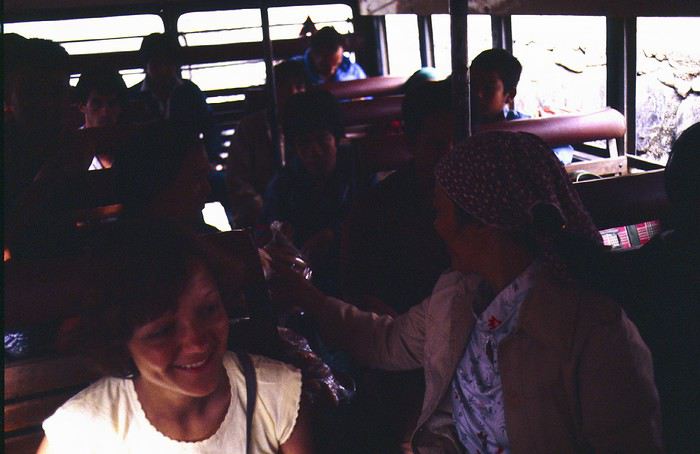
The “road” was a dirt track (or rather, a mud track) with endless turns. We held on as best we could to our slippery wooden seats—it was shaking in every direction. The woman behind us was carsick and throwing up... gross... but what were we doing there? Then we plunged into the Sierra Madre... just the name is dreamy!
Rice terraces started to appear: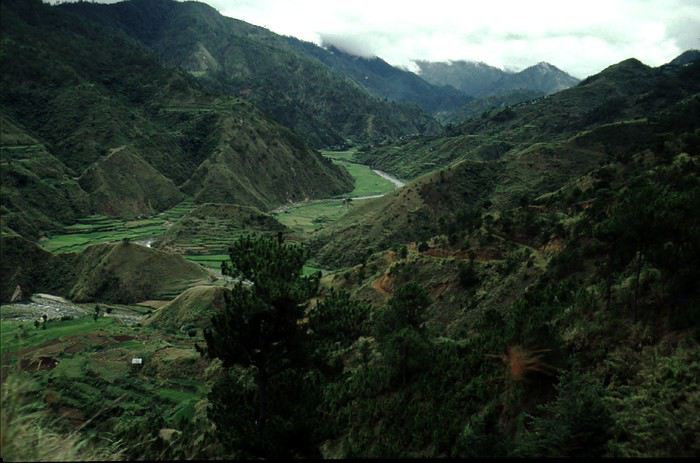
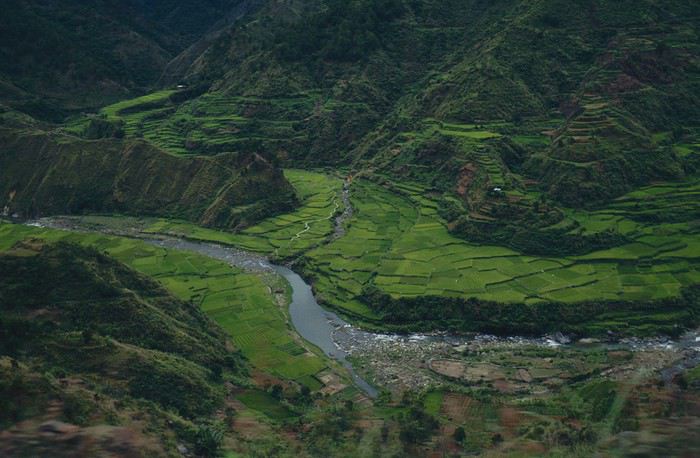
they took up more and more space along cliffs where we weren’t always reassured,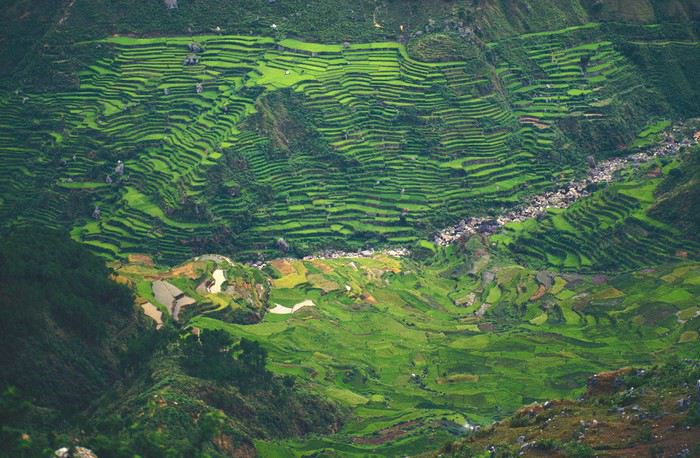
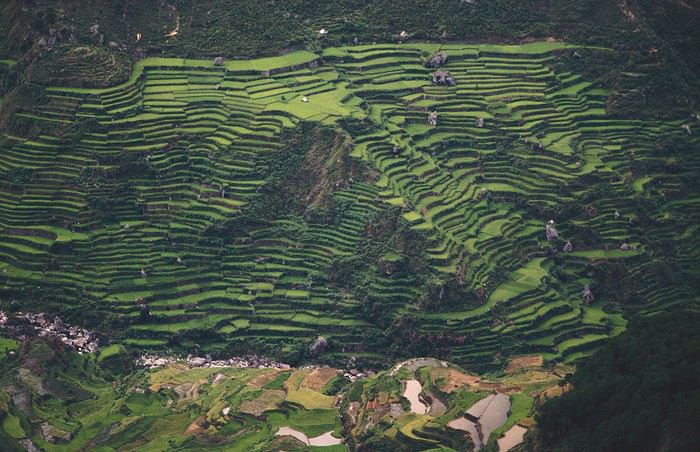
with lots of waterfalls (all that water had to go somewhere).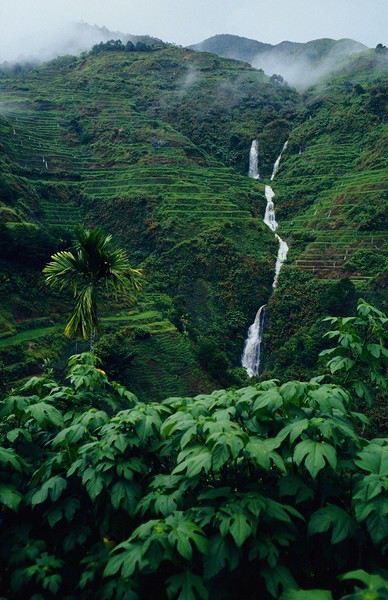
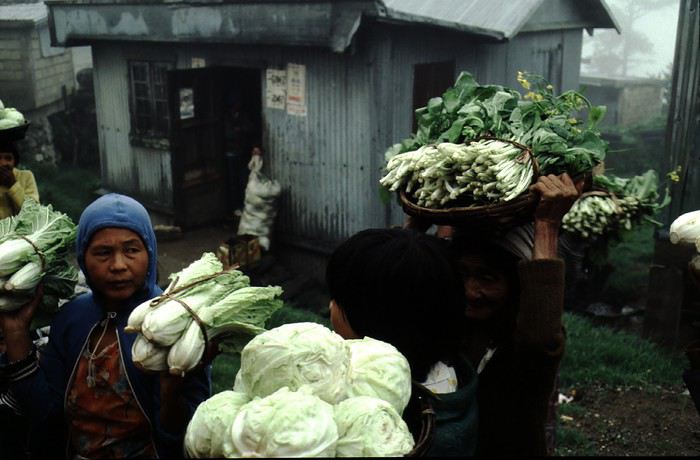
A few miserable villages stretched along the track, most often just a few houses balancing between the road and the drop. The bus stopped in every village—people got on or off and settled inside or on the roof. Street vendors offered their products to the bus passengers—a common sight in Asia, even today.
We were in another world—villagers were in loincloths, others had spears. The atmosphere was strange... but all good, we wanted exoticism, and we got it: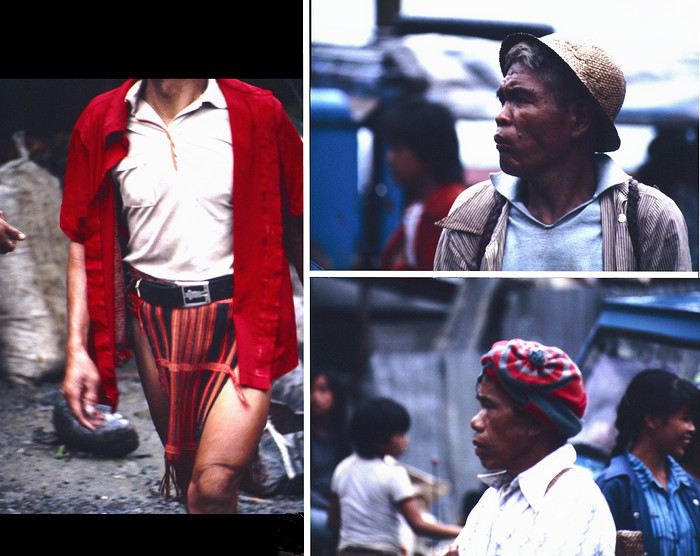
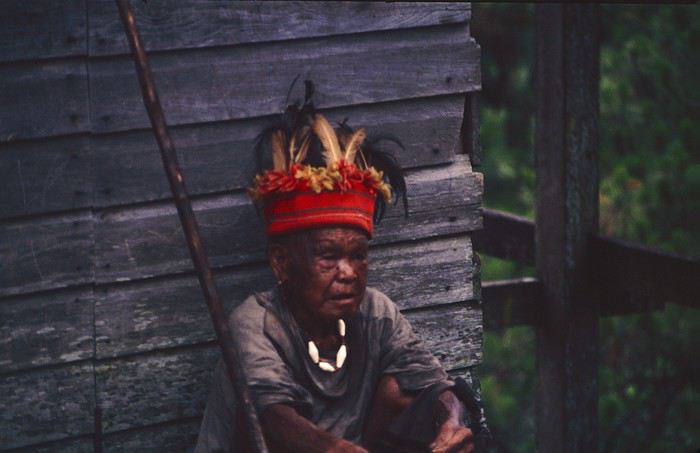
This so-called traditional outfit was everyday wear—it wasn’t for tourists since there weren’t any.
A curiosity because writing a travel journal about a trip 35 years later isn’t common, but also (mostly?) because exploring the Philippines at that time had little in common with traveling there today.
Obviously, I’ve forgotten a number of facts, most of the details, but with the help of a few notes from that time and a stack of slides (yes, there was life before digital 😊), many memories came back and added to the highlights I’d never forgotten. The scanned slides aren’t always great quality, but there are still quite a few to brighten up this chatter. Back then, we didn’t snap photos like we do now—film was too expensive—so I don’t have pictures of every place we visited... too bad, comparing some of those spots to how they look today would’ve been interesting.
Why "Adventures"? Why call it "Adventures" in the Philippines in 1984, a word so often used for a simple exotic trip? - Because the lack of information (no *Guide du Routard*, no *Lonely Planet*, no *Michelin Guide*, nothing, and obviously no internet) gave this trip what’s at the heart of adventure: the unknown. - Because the political situation made the stay sometimes dangerous. - Because transportation conditions were always epic, often perilous. - Because the question of where we’d spend the night came up almost every evening. - And for... quite a few other reasons.
That said, we weren’t exactly explorers!
Why the Philippines? First of all, why go to the Philippines in 1984—a country not exactly set up for tourism and about which we knew very little? How could we get an idea of the beauty of the Philippines and its points of interest when we had no guides or photos?
The idea came to us from Thailand a year earlier, during our first long-haul trip. After touring the north of the country, we met a Frenchman living in Phuket, where there were only a few tourists in Patong, with just a few small hotels and guesthouses. Kata and Karon had no buildings or roads, Rawai only had three palm-thatched bungalows, including ours, and the other islands were unknown to tourists. There was plenty to discover, and we wanted to return to this beautiful country... but the Frenchman made us dream about the Philippines—a country to explore, with wild landscapes.
Long evenings of discussion over multiple Sprite-Mekong cocktails (what memories of those headaches!) finally convinced us we had to go to the Philippines.
Episode 0: Before Departure The decision was made: we’d go to the Philippines in May 1984. Our friends and family were surprised when we announced we were going on vacation to the Philippines (a bit like saying today we were going paddleboarding in the Kerguelen Islands 🤪).
These days, preparing for each of our trips takes long evenings of research, planning, and noting down good addresses... etc. But for the Philippines in 1984, preparation was quick: we had very little information about the country, we were leaving almost at random, and the discovery would only be more exciting.
We still had a few bits of info gathered here and there: the rice terraces in northern Luzon, volcanoes, Negros where we were supposed to visit an acquaintance, Cebu and its marine life (we ended up going elsewhere), and absolutely avoid Mindanao, which was practically at war with the regime. That was about it, but it was already a great itinerary.
Nothing was organized in advance; we’d see day by day. We had no idea about travel times or even the existence of transportation options. The main (and sometimes only) way to connect two islands was by overloaded, rusty ferry. Only the big cities had airports.
Let’s Go: Episode 1: Paris to Manila My travel journals always start after arriving at the airport—the Europe-to-“Other Continent” trip isn’t interesting—but the flight to the Philippines was already an adventure, so I’ll make an exception.
This was the era when only a few Asian airlines were on par with Western ones: Thai, Singapore Airlines, and Philippine Airlines. They had beautiful, brand-new planes, and to attract customers (almost exclusively “businessmen”) from the usual airlines (Air France, Lufthansa, British Airways), there was opulence on board: unlimited champagne, all sorts of cocktails... Compared to today’s long-haul flights, there was still one small difference: no personal screens, just one screen at the front of the cabin with one mandatory movie. And I don’t know why, but we only got James Bond films, both ways... that must’ve been the trend at the time.
The tourism boom to Southeast Asia hadn’t started yet, and the “Asian Tigers” weren’t a thing, so there weren’t many business trips. That meant long-haul flights made stops everywhere to fill the planes. Our Philippine Airlines Boeing 747 left London, picked us up in Paris, then stopped in Frankfurt to take on a few Germans. I don’t know why we then made a stop in Dubai—a totally exotic place at the time. There was nothing to do there... things have changed a lot since. It was a small town lost in the desert. The airport was tiny, with just one or two buildings and a supermarket. During the stopover, everyone had to get off the plane and walk to the supermarket. Photo and electronic equipment were dirt cheap—I guess that was the only reason for the stop. Maybe it was their first commercial move. Emirates didn’t exist yet, as I checked online, but anyway, the idea that such a remote place could have its own airline was unthinkable.
Online, I found this photo of Dubai Airport in 1980. Anyone who’s transited through today’s massive airport with its rows of A380s will appreciate it:
Next stop: New Delhi to drop off some Europeans and pick up a few Indians, and finally, the terminus: Manila. I don’t remember how long the trip took with its five stops—an unimaginable journey today. Despite all those stops to fill the plane, there was still enough space to stretch out on the four center seats of the 747, something that never happens these days despite all the flights in every direction.
So here we are, finally at Manila Airport around midnight.
Episode 1: Manila and Baguio To start, a quick note on the political and economic situation in the Philippines in 1984, which had consequences for us as tourists, as we’d soon realize upon arrival.
After several centuries of Spanish colonization, the Philippines became American at the start of the 20th century, then independent. In 1966, Marcos took power, and little by little, his regime sank into corruption and mismanagement, becoming a dictatorship with martial law, all for the benefit of his family and friends, who enriched themselves endlessly. The peak was the assassination of opposition leader Benigno Aquino in August 1983, which triggered harshly repressed protests. So we arrived a few months later in a very poor country, with omnipresent corruption and an extremely tense political situation, as we’d soon see for ourselves. Major protests took place in the main cities during our trip—I’ll come back to that. Two years later, Marcos fled to Hawaii after being forced out of power following rigged elections. This historical context explains a lot of the situations we found ourselves in over the following weeks.
Arriving in the middle of the night isn’t very cheerful. Manila was already a huge city with many slums, where you could find a few business hotels like the Hilton or Intercontinental—way out of our budget—and plenty of run-down hotels. Luckily, two Indians we’d chatted with on the plane offered to take us to their usual hotel. They came to Manila twice a year for business. We accepted their offer, relieved not to have to look for a place to stay in the middle of the night, figuring the address must be good since they came back every time... we were wrong 🙁
We left the airport and immediately got a taste of the local vibe when we got into the taxi: the police asked for our passports. We thought: what’s more normal than police in a dictatorship?
But that wasn’t it at all. Our two Indian friends explained that the police were noting our names along with the taxi number and time. Crime in Manila was so bad that the taxi driver would be held responsible if anything happened to us... welcome to the Philippines 😎 😎
Historically, the Philippines was a very violent country, where everything was settled with guns or machetes. Previous governments had banned carrying weapons, but Marcos later allowed the free sale and carrying of guns, and disputes were settled with pistols again (or worse, as we’d discover later). Since he’d released most of the criminals from prison to form a paramilitary militia at his service (I’ll talk about our encounter with these “heroes” later), it was pretty dangerous to go into many parts of Manila, where these “tonton macoutes” ruled.
We arrived at our hotel without incident... and then things started badly. The room was infested with big cockroaches—exactly what I hate most in those kinds of countries. No way to find another hotel at that hour. After the long flight, the urge to take a shower was so strong that we squeezed into the bathroom as best we could. After that, I don’t remember—I guess we must’ve fallen asleep exhausted under the sheets in the heat... air conditioning wasn’t widespread yet.
The next day, we just wanted to leave that dump as soon as possible. So we decided to head north right away, stopping in Baguio, and we’d visit Manila a bit on the way back.
When we stepped outside, we discovered a pretty run-down neighborhood with potholed streets. But we also discovered the jeepneys. They were everywhere, flooding the streets.
They had crazy sound systems, each one blasting louder than the last. The interiors were kitschy but fun. There weren’t many private cars—almost all transportation was by jeepney, with buses reserved for intercity trips.
Before heading to the bus terminal for the north, somewhere on the outskirts of the city, we needed to exchange some money. I don’t remember how we ended up in a policeman’s jeep who offered his services: - Exchange money on the black market at a better rate than the banks. - Take us wherever we wanted, in this case, the bus terminal.
We accepted both offers (we’d still checked the official exchange rate from dollars to pesos). So we found ourselves in his jeep. After exchanging money, we left in his vehicle and stopped for gas. Without turning off the engine, he calmly smoked a cigarette while filling up. Since we were in a jeep with no doors or roof, we were ready to jump out if things went south, our travel bag in hand.
But we weren’t done with surprises yet. Once we left the small streets, we ended up in a neighborhood with wide avenues and not much traffic, which didn’t justify his incredible behavior. At every intersection, he made the sign of the cross, closed his eyes, and crossed without looking. I was more stunned than terrified! It wasn’t until we got out of the car later that I told Anne-Marie what had happened. I’d seen everything because the cop had put me in the front seat. Luckily, A-Marie hadn’t noticed anything from the back. Crossing Manila by trusting God rather than the rules of the road was ultimately effective. We were lucky—the trip was off to a good start. 🙂 🙂
We then passed through a neighborhood where slums stretched on for a while, and we left our policeman—friendly but a bit crazy—with relief.
A few hours by bus later, here we are in Baguio, cool in the mountains. My memories of Baguio are pretty fuzzy. I remember a small town. After some research while writing this journal, I found that the population was 120,000 in 1980. Given the population density in each home, that confirms my memory of a smallish town. Outside the “official” district with the president’s summer residence and government buildings, there were two or three paved streets with nice houses. The rest was very dirty and very poor, with lots of slums and dirt roads.
People we met on the street invited us to stay with them. These days, we wouldn’t just show up at strangers’ houses, which we should’ve done in Baguio—it would’ve saved us from an unimaginable and dangerous situation... which I won’t say anything about... !😊
The simple wooden house was on stilts at the edge of a hill with a view of the mountains. Since it was the start of the rainy season in a city that gets a lot of rain, we saw a lot of water. Our outings in town happened between downpours.
View from our lodging:
Episode 2: Baguio to Bontoc Aside from the situation briefly mentioned above, it was on the next leg to Bontoc that the adventure really began: an endless and dangerous road, a bus from another era, breathtaking landscapes, and surprising people.
We didn’t know the distance or how long it would take to get to Bontoc. When we arrived after about ten hours, we learned that Baguio to Bontoc was 140 km.
We got on a bus with wooden seats and settled in, two to a seat meant for two. As the bus filled up, passengers squeezed in three or four per seat, with chickens and baskets full of all sorts of things in the aisle. A little embarrassed, we didn’t know if we should squeeze in three on our seat. The seats were super tight (luckily, Filipinos are small), and I didn’t know where to put my legs given my height. I don’t remember if we stayed alone on our bench or if we ended up sharing with others.
The “road” was a dirt track (or rather, a mud track) with endless turns. We held on as best we could to our slippery wooden seats—it was shaking in every direction. The woman behind us was carsick and throwing up... gross... but what were we doing there? Then we plunged into the Sierra Madre... just the name is dreamy!
Rice terraces started to appear:
they took up more and more space along cliffs where we weren’t always reassured,
with lots of waterfalls (all that water had to go somewhere).
A few miserable villages stretched along the track, most often just a few houses balancing between the road and the drop. The bus stopped in every village—people got on or off and settled inside or on the roof. Street vendors offered their products to the bus passengers—a common sight in Asia, even today.
We were in another world—villagers were in loincloths, others had spears. The atmosphere was strange... but all good, we wanted exoticism, and we got it:
This so-called traditional outfit was everyday wear—it wasn’t for tourists since there weren’t any.
Memories of Thailand
ko samui
Voyage d'un mois en Thaïlande: 2/3 en Issan et 1/3 plage English translation pending
Bonjour,
Nous partons à 2 en Thaïlande en janvier 2020 pour un mois, et j'envisage de partager mon séjour en : 2/3 en Issan et 1/3 de plage. Et j'aurai besoin de vos conseils et avis. Nous sommes allés souvent en Thaïlande, mais jamais en janvier....
-En arrivant à Bangkok de France, j'ai déjà réservé un vol Bangkok/ Loeï afin de rejoindre Chiang Khan le même jour. Je compte rester 5 nuits à Chiang Khan, est ce que c'est correct ou est ce que ce n'est pas trop long ? Y-a-t-il des balades aux alentours( à pied ou en scooter)
-Par la suite je prévois de rejoindre Nong Khaï( que je connais déjà) par la route en longeant le Mékong. Est ce que le transport est facile entre Chiang Khan et Nong Khaï? Bus ? Mini van ? Combien de temps de transport en moyenne ?Est ce que ça vaut le coup de faire une halte d'une nuit quelque part entre ces 2 villes ?
-De Nong Khaï, je veux aller et loger à Bueng Khan pour être assez proche du Wat Phu Tuk. Même question que précédemment...Est ce que les moyens de transport sont faciles et fréquents entre ces 2 villes et combien de temps.. ? Pour rejoindre le site du Wat Phu Tuk je suppose qu'il faut passer par une agence ou un guide ? Doit-on prendre obligatoirement un taxi ?
-De Bueng Khan je prévois de rejoindre Udon Thani en bus ou mini van, Est ce faisable ? J'ai lu qu'il fallait environ 3heures... ? A Udon Thani, est ce que le lac aux lotus rouges vaut le déplacement ? Car j'ai vu qu'il n'est pas tout près.
-D'Udon Thani je voulais aller directement vers Krabi par avion, mais il n'y a que le vol vers Phuket qui arrive à 19h. Donc je dois obligatoirement dormir à Phuket. Quel endroit est le mieux pour passer une nuit afin de rejoindre facilement Ko Lanta par le ferry ? J'ai vu qu'il avait plusieurs compagnies, donc quel ferry est le mieux ? Ou bien vaut-il mieux rejoindre Krabi plutôt que Kho Lanta? Ou rester quelques jours sur Phuket... ?
J'ai lu pas mal d'avis mais je suis encore très indécis pour ces destinations plages de Phuket, Krabi, Kho Lanta et quel serait le meilleur «circuit» sur 10 jours, en arrivant par l'aéroport de Phuket et en repartant de Krabi en sachant que je ne veux pas speeder?
J'avais l'habitude de voyager en Thaïlande en juillet, et pour ceux qui connaissent, ma plage préférée pour juillet , était Thong Nai Pan Noï à Kho Phangan, mais c'est la première fois que je voyage en janvier et donc je ne connais pas du tout Phuket ou Krabi. Est ce qu'il est intéressant de rester quelques jours sur Phuket et si oui, quelle plage.... ? Hors Patong ou Kata... et surtout pas pour faire la fête mais un endroit cool( j'ai compris que janvier était la haute saison.....). J'ai entendu parler de Railey ? Freedom beach ? ou d'autres?
Et pour Kho Lanta et Krabi quel est votre plage préférée....?( qui ressemblerait à Tong Naï Pan Noï...!lol).
Beaucoup de questions... mais si vous pouvez me répondre à quelque unes.. ! Merci pour votre aide Guy
-En arrivant à Bangkok de France, j'ai déjà réservé un vol Bangkok/ Loeï afin de rejoindre Chiang Khan le même jour. Je compte rester 5 nuits à Chiang Khan, est ce que c'est correct ou est ce que ce n'est pas trop long ? Y-a-t-il des balades aux alentours( à pied ou en scooter)
-Par la suite je prévois de rejoindre Nong Khaï( que je connais déjà) par la route en longeant le Mékong. Est ce que le transport est facile entre Chiang Khan et Nong Khaï? Bus ? Mini van ? Combien de temps de transport en moyenne ?Est ce que ça vaut le coup de faire une halte d'une nuit quelque part entre ces 2 villes ?
-De Nong Khaï, je veux aller et loger à Bueng Khan pour être assez proche du Wat Phu Tuk. Même question que précédemment...Est ce que les moyens de transport sont faciles et fréquents entre ces 2 villes et combien de temps.. ? Pour rejoindre le site du Wat Phu Tuk je suppose qu'il faut passer par une agence ou un guide ? Doit-on prendre obligatoirement un taxi ?
-De Bueng Khan je prévois de rejoindre Udon Thani en bus ou mini van, Est ce faisable ? J'ai lu qu'il fallait environ 3heures... ? A Udon Thani, est ce que le lac aux lotus rouges vaut le déplacement ? Car j'ai vu qu'il n'est pas tout près.
-D'Udon Thani je voulais aller directement vers Krabi par avion, mais il n'y a que le vol vers Phuket qui arrive à 19h. Donc je dois obligatoirement dormir à Phuket. Quel endroit est le mieux pour passer une nuit afin de rejoindre facilement Ko Lanta par le ferry ? J'ai vu qu'il avait plusieurs compagnies, donc quel ferry est le mieux ? Ou bien vaut-il mieux rejoindre Krabi plutôt que Kho Lanta? Ou rester quelques jours sur Phuket... ?
J'ai lu pas mal d'avis mais je suis encore très indécis pour ces destinations plages de Phuket, Krabi, Kho Lanta et quel serait le meilleur «circuit» sur 10 jours, en arrivant par l'aéroport de Phuket et en repartant de Krabi en sachant que je ne veux pas speeder?
J'avais l'habitude de voyager en Thaïlande en juillet, et pour ceux qui connaissent, ma plage préférée pour juillet , était Thong Nai Pan Noï à Kho Phangan, mais c'est la première fois que je voyage en janvier et donc je ne connais pas du tout Phuket ou Krabi. Est ce qu'il est intéressant de rester quelques jours sur Phuket et si oui, quelle plage.... ? Hors Patong ou Kata... et surtout pas pour faire la fête mais un endroit cool( j'ai compris que janvier était la haute saison.....). J'ai entendu parler de Railey ? Freedom beach ? ou d'autres?
Et pour Kho Lanta et Krabi quel est votre plage préférée....?( qui ressemblerait à Tong Naï Pan Noï...!lol).
Beaucoup de questions... mais si vous pouvez me répondre à quelque unes.. ! Merci pour votre aide Guy
Tarifs des transports à Phuket et Kata Beach English translation pending
bonjour,
pourriez vous m'indiquez les tarifs des tuks tuks sur kata et phuket ainsi que les bus merci de vos réponses