Results for "confort+|+55"
38523 results found.
Bikepacking questions with a Brompton bike
Hi everyone,
I’m seriously considering going bikepacking with my Brompton (6-speed model) on a mixed route of roads and bike paths for a trip lasting a few days or even a week.
I know the Brompton isn’t the typical touring bike, but its compactness and practicality really appeal to me for combining train + bike travel and staying super mobile.
I’ve got a few questions, and I’d love to hear your experiences or tips:
What panniers or luggage setup do you recommend for a Brompton in travel mode? Have you run into any specific limitations (comfort, carrying capacity, elevation gain, etc.)? Should I adjust any components (tires, gearing, saddle) to make it more durable for multi-day trips? Do you prefer wild camping or lightweight accommodations (hostels, campsites, etc.) with this kind of setup? Finally: what types of routes do you think a Brompton handles well? (And what should I absolutely avoid?)
I’d love to chat with others who’ve tried (or are considering) the Brompton bikepacking adventure. Thanks in advance for your insights! 🚴♂️ Happy riding,
What panniers or luggage setup do you recommend for a Brompton in travel mode? Have you run into any specific limitations (comfort, carrying capacity, elevation gain, etc.)? Should I adjust any components (tires, gearing, saddle) to make it more durable for multi-day trips? Do you prefer wild camping or lightweight accommodations (hostels, campsites, etc.) with this kind of setup? Finally: what types of routes do you think a Brompton handles well? (And what should I absolutely avoid?)
I’d love to chat with others who’ve tried (or are considering) the Brompton bikepacking adventure. Thanks in advance for your insights! 🚴♂️ Happy riding,
Route 66: Is it better to do it in an SUV or a camper van?
Hi everyone,
We’re planning a road trip on Route 66 in 2027 with our two kids, who’ll be 7 and 4 years old.
My husband would prefer to do it in an SUV, while I’d rather go in a camper van.
What are the pros and cons of each option?
Thanks for your input!
We’re planning a road trip on Route 66 in 2027 with our two kids, who’ll be 7 and 4 years old.
My husband would prefer to do it in an SUV, while I’d rather go in a camper van.
What are the pros and cons of each option?
Thanks for your input!
Hotel near Saint-Exupéry Airport
Hi everyone!
I need to spend a short night near the airport to catch a 6:00 AM flight on June 18th.
Do you have any suggestions for me? I'm looking for a simple but clean hotel! With a reasonable price, of course, 🙂 and especially a transfer option from Saint-Exupéry train station the night before and to the airport the next morning.
Thanks in advance for your tips and experiences.
Self-sufficient road trip in Oman with a rooftop tent
Hi there, my partner and I did a road trip in Oman in January 2025 with a 4x4 and a rooftop tent. We only slept in free spots out in nature. It’s essential to have a 4x4 to experience this. The *Oman Off Road* book was a huge help—we bought it locally. I’ve written up our whole adventure and shared all our tips on my blog, including GPS coordinates to help you find campsites or even cross the desert on your own. Here’s the link: https://worldseenbymathilde.blogspot.com/2025/02/notre-itineraire-de-10-jours-oman-en.html
From Bangkok to Krabi, Thailand by Car!
This first trip of 2025 will have the taste of Asia.
More precisely, Thailand!
It’s not my first time—I’ve often traveled across Southeast Asia between 2000 and 2015. (This travel journal, for example...)
But it’ll be my partner’s first steps in this part of the world.
The itinerary we’ve chosen will alternate between familiar sights for me and new discoveries for both of us.
I’ll get to see how the country has changed in 20 years—and what’s stayed the same!
We were torn between the north and the south of the kingdom. Fears of smoke from slash-and-burn farming and a desire to relax on the sand tipped the scales toward the south...
What if we rented a car?
I think driving in sprawling Bangkok would be a bit ambitious, so we’ll only book our vehicle from Hua Hin to return it in Surat Thani.
Other transportation will range from tuk-tuks to overnight trains and ride-hailing services.
And of course, the plane!
I’d love to travel from Auvergne to Bangkok by road, but 15 days wouldn’t be enough...
Plus, the current geopolitical situation isn’t exactly favorable...
So, once again, we’ll be stuck for hours in the less-than-comfortable economy class of Qatar Airways.
The arrival time was on schedule, entry formalities were quick, and all our luggage made it.
We left Lyon in wind and cold—now we’re breathing in the warm, humid air of กรุงเทพมหานคร.
To reach our hotel, we first took the metro, which dropped us off in the city center in about 30 minutes for the incredible price of 1.18 €.
A few taps on the GRAB app, and we booked a ride-hailing service for the last few kilometers.
We waited a while for our driver due to insane traffic in the area, but once in the 4x4, we were at our lodging in no time.
We chose this small hotel for its riverside location, tranquility, and price.
It’ll do the job perfectly—the only downside is the weak breakfast.
The room is inviting, and we collapse onto the bed for a well-deserved short nap.
Wake-up call in an hour for our first visits!
See you soon...
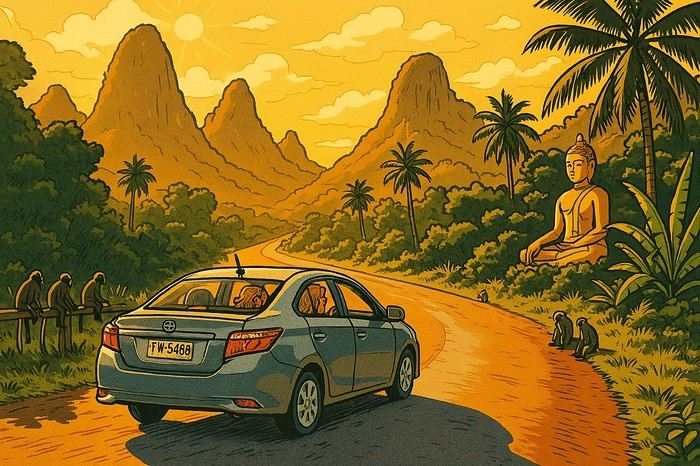
More precisely, Thailand!
It’s not my first time—I’ve often traveled across Southeast Asia between 2000 and 2015. (This travel journal, for example...)
But it’ll be my partner’s first steps in this part of the world.
The itinerary we’ve chosen will alternate between familiar sights for me and new discoveries for both of us.
I’ll get to see how the country has changed in 20 years—and what’s stayed the same!
We were torn between the north and the south of the kingdom. Fears of smoke from slash-and-burn farming and a desire to relax on the sand tipped the scales toward the south...
What if we rented a car?
I think driving in sprawling Bangkok would be a bit ambitious, so we’ll only book our vehicle from Hua Hin to return it in Surat Thani.
Other transportation will range from tuk-tuks to overnight trains and ride-hailing services.
And of course, the plane!
I’d love to travel from Auvergne to Bangkok by road, but 15 days wouldn’t be enough...
Plus, the current geopolitical situation isn’t exactly favorable...
So, once again, we’ll be stuck for hours in the less-than-comfortable economy class of Qatar Airways.
The arrival time was on schedule, entry formalities were quick, and all our luggage made it.
We left Lyon in wind and cold—now we’re breathing in the warm, humid air of กรุงเทพมหานคร.
To reach our hotel, we first took the metro, which dropped us off in the city center in about 30 minutes for the incredible price of 1.18 €.
A few taps on the GRAB app, and we booked a ride-hailing service for the last few kilometers.
We waited a while for our driver due to insane traffic in the area, but once in the 4x4, we were at our lodging in no time.
We chose this small hotel for its riverside location, tranquility, and price.
It’ll do the job perfectly—the only downside is the weak breakfast.
The room is inviting, and we collapse onto the bed for a well-deserved short nap.
Wake-up call in an hour for our first visits!
See you soon...
Budget for mainland Greece, Cyclades, and car rental
Hi there,
I’m planning a 3-week trip to Greece in July with my two daughters, aged 10 and 13.
After looking into it, I’m thinking of spending about ten days on the mainland and another ten in the Cyclades.
I’d like to avoid tourist traps but still hit a few must-see spots.
Could you share your best tips for renting a car on the mainland and what the budget might look like?
I’m all ears for any great tips (accommodation, activities with my girls, areas to avoid).
What’s a rough estimate for the total budget, all-inclusive?
Just to give you an idea, we’re experienced travelers who’ve already done a round-the-world trip.
We’re pretty adventurous, even though it’s a vacation—though we won’t be staying in no-frills hostels either!
Thanks! :)
15 days in Iceland in the fall: bookings and weather
Hello,
I’m planning our trip for two weeks in late September to early October. We’ll be renting a car and want to stay in hotels. I understand the weather starts to change and that the choice of places to visit depends on it. So, is it a good idea to book hotels now, or is it better to wait until we’re there? And in that case, is it easy to find hotels? (We’re 75 and 70 years old and really appreciate our comfort now🙂).
I have plenty of other questions and would love your advice. For example, I’ve heard the roads to the Westfjords can be closed, but is the Latrabjarg area doable in October? I’d also like to avoid changing locations every day, so is it a good idea to stay put for 2-3 days and explore the region?
Thanks in advance for your replies! Marie José
I have plenty of other questions and would love your advice. For example, I’ve heard the roads to the Westfjords can be closed, but is the Latrabjarg area doable in October? I’d also like to avoid changing locations every day, so is it a good idea to stay put for 2-3 days and explore the region?
Thanks in advance for your replies! Marie José
Past trips, future travels
My passion for travel
Travel is an endless source of wonder and discovery for me. It lets me escape the everyday and immerse myself in different cultures, varied landscapes, and unique ways of life. Every destination is an invitation to learn and grow, while fueling an insatiable curiosity.
The types of trips I love I’m especially drawn to trips that combine adventure and cultural immersion. I love discovering places off the beaten path, where authenticity takes precedence over mass tourism. Whether it’s trekking through isolated mountains, exploring historic cities, or staying in remote villages, every trip is a chance to step out of my comfort zone and embrace the world’s diversity.
I also prioritize trips that let me deepen my knowledge in a particular area, like gastronomy, history, or art. Exchanges with locals—whether sharing a meal or taking part in traditional events—are essential to making the experience rich and meaningful.
Trips I’ve taken Among the memorable trips I’ve done, some have been turning points in how I see the world. My journey through the Austrian Alps, for example, didn’t just offer spectacular landscapes—it also let me discover Austrian culture in all its diversity, from festivals to music to cuisine.
I’ve also had the chance to visit more exotic destinations, like Southeast Asia, where I immersed myself in fascinating cultures, learned ancient practices, and met people whose life philosophies really inspired me.
Future travels Looking ahead, I dream of going to Latin America to explore its vibrant cultures and breathtaking landscapes. A road trip through Peru, Bolivia, and Chile is one of my long-term travel goals. I’d also love to discover the Pacific Islands and maybe even take part in volunteer projects with local communities.
I hope my future travels will keep pushing my limits while letting me meet people who share this passion for travel and connection.
The types of trips I love I’m especially drawn to trips that combine adventure and cultural immersion. I love discovering places off the beaten path, where authenticity takes precedence over mass tourism. Whether it’s trekking through isolated mountains, exploring historic cities, or staying in remote villages, every trip is a chance to step out of my comfort zone and embrace the world’s diversity.
I also prioritize trips that let me deepen my knowledge in a particular area, like gastronomy, history, or art. Exchanges with locals—whether sharing a meal or taking part in traditional events—are essential to making the experience rich and meaningful.
Trips I’ve taken Among the memorable trips I’ve done, some have been turning points in how I see the world. My journey through the Austrian Alps, for example, didn’t just offer spectacular landscapes—it also let me discover Austrian culture in all its diversity, from festivals to music to cuisine.
I’ve also had the chance to visit more exotic destinations, like Southeast Asia, where I immersed myself in fascinating cultures, learned ancient practices, and met people whose life philosophies really inspired me.
Future travels Looking ahead, I dream of going to Latin America to explore its vibrant cultures and breathtaking landscapes. A road trip through Peru, Bolivia, and Chile is one of my long-term travel goals. I’d also love to discover the Pacific Islands and maybe even take part in volunteer projects with local communities.
I hope my future travels will keep pushing my limits while letting me meet people who share this passion for travel and connection.
Ara Wakam Cabin in Guadeloupe: A Scam to Avoid!
If you're heading to Basse-Terre in Pointe-Noire, Guadeloupe, **do not** stay at Ara Wakam cabin. It looks tempting on Booking, but it’s a total **SCAM**. There aren’t two bedrooms as advertised—just a double bed in the living area and two single beds in the attic, where it’s **scorchingly hot** and the fan is **extremely noisy**. But the worst part? It’s **THE HOUSE OF MOSQUITOES**. No windows, shutters with gaps that don’t seal—nowhere to escape. The owner is dishonest, and the concierge is arrogant. We lost **800 €**.
Sophie Meret
Sophie Meret
Which airline for Paris-Tokyo in business class?
Hi there,
My daughter, wife, and I are starting to plan a two-week trip to Japan for... April 2026. My wife wants us to really treat ourselves, so we’re considering business class (we usually fly premium economy or even economy). Since we’re departing from Paris and want a direct flight, we have three options: JAL, ANA, or Air France.
I’ve flown Air France in business quite a bit for work, and I do find it very comfortable. But I wonder if I’m just defaulting to a national bias—maybe the other two airlines have advantages I’m not considering.
If I’m looking at criteria like: - Comfort (especially for sleeping) - Meals - Entertainment
Any advice? Personal experiences? Have any of the three airlines updated their business class on this route recently?
Thanks! !
My daughter, wife, and I are starting to plan a two-week trip to Japan for... April 2026. My wife wants us to really treat ourselves, so we’re considering business class (we usually fly premium economy or even economy). Since we’re departing from Paris and want a direct flight, we have three options: JAL, ANA, or Air France.
I’ve flown Air France in business quite a bit for work, and I do find it very comfortable. But I wonder if I’m just defaulting to a national bias—maybe the other two airlines have advantages I’m not considering.
If I’m looking at criteria like: - Comfort (especially for sleeping) - Meals - Entertainment
Any advice? Personal experiences? Have any of the three airlines updated their business class on this route recently?
Thanks! !
Cheap hotel in New Delhi
My friend and I are arriving in New Delhi on March 4th at 12:05 AM. Could anyone recommend a decent and affordable hotel? Is 20 € the going rate?
Thanks!
Lots of questions for a trip to Flores and Komodo
Hi there!
Phew, this feels really strange—it’s my very first post after the forum’s long closure... like stepping back into that carefree pre-COVID time...
I’m trying to plan a short trip (just under two weeks) to Flores at the end of March, beginning of April, and I’ve got *so* many questions... - **Transport**: From what I’ve gathered, the only flights to Maumere are from Denpasar (or Labuan Bajo), right? Did I get that right? And for getting around the island, I was thinking of hiring a car with a driver for the main routes (we don’t ride motorbikes...). Any idea what the going rate is? And do you have any trusted contacts to recommend? - **Timing**: Even though the best season is later, is the weather still manageable at that time—especially for snorkeling with calm seas and good visibility? - **Komodo archipelago cruise**: I was considering a 3-day, 2-night cruise at the end of the trip, from Labuan Bajo to Komodo. Something comfortable (cabin with private facilities). I saw what Captain Komodo offers on the Alcira—has anyone tried it? Otherwise, any other recommendations?
Yeah, I know it’s a lot of questions! Usually, I travel a bit more spontaneously, but the transport logistics are making me a little nervous—we only have two weeks, so if it takes 5 flights and 3 days of travel just to get to Maumere, we might have to pick a more accessible destination...
Thanks in advance!
Cyrille
Phew, this feels really strange—it’s my very first post after the forum’s long closure... like stepping back into that carefree pre-COVID time...
I’m trying to plan a short trip (just under two weeks) to Flores at the end of March, beginning of April, and I’ve got *so* many questions... - **Transport**: From what I’ve gathered, the only flights to Maumere are from Denpasar (or Labuan Bajo), right? Did I get that right? And for getting around the island, I was thinking of hiring a car with a driver for the main routes (we don’t ride motorbikes...). Any idea what the going rate is? And do you have any trusted contacts to recommend? - **Timing**: Even though the best season is later, is the weather still manageable at that time—especially for snorkeling with calm seas and good visibility? - **Komodo archipelago cruise**: I was considering a 3-day, 2-night cruise at the end of the trip, from Labuan Bajo to Komodo. Something comfortable (cabin with private facilities). I saw what Captain Komodo offers on the Alcira—has anyone tried it? Otherwise, any other recommendations?
Yeah, I know it’s a lot of questions! Usually, I travel a bit more spontaneously, but the transport logistics are making me a little nervous—we only have two weeks, so if it takes 5 flights and 3 days of travel just to get to Maumere, we might have to pick a more accessible destination...
Thanks in advance!
Cyrille
Great accommodation tips for Tokyo, Kyoto, and Osaka
Hello,
I’m new to the forum (I live in Paris), though I’ve used it before during my past trips, a long time ago when I was young :). I’m now the venerable age of 49.
As mentioned in the title, I’m looking for some great accommodation tips for myself and my two daughters, aged 10 and 12, that you may have recently tried during your travels in Japan.
Ideally, since I haven’t been back to Japan since 2008, I’d love to get some reliable recommendations for hotels or ryokan where you’ve stayed.
When I visited Japan several times in 2007 and 2008, I didn’t have kids, so I wasn’t as concerned about comfort. Even though my daughters are used to traveling with me, I’d still like to use the Japan Rail Pass as I did before—except back then, I didn’t book in advance. With kids, I’d prefer to plan ahead.
So if you have any great recommendations to share for these cities (priority), but I’m also interested in Nara, Matsuyama, Fukuoka/Hakata, and Hiroshima.
All your suggestions based on your past experiences will be much appreciated here.
I’d also be happy to chat with you about the differences between Japan nearly 20 years ago, when I first visited, and today. Have many things changed or evolved?
Thanks so much for your help.
Arnaud
I’m new to the forum (I live in Paris), though I’ve used it before during my past trips, a long time ago when I was young :). I’m now the venerable age of 49.
As mentioned in the title, I’m looking for some great accommodation tips for myself and my two daughters, aged 10 and 12, that you may have recently tried during your travels in Japan.
Ideally, since I haven’t been back to Japan since 2008, I’d love to get some reliable recommendations for hotels or ryokan where you’ve stayed.
When I visited Japan several times in 2007 and 2008, I didn’t have kids, so I wasn’t as concerned about comfort. Even though my daughters are used to traveling with me, I’d still like to use the Japan Rail Pass as I did before—except back then, I didn’t book in advance. With kids, I’d prefer to plan ahead.
So if you have any great recommendations to share for these cities (priority), but I’m also interested in Nara, Matsuyama, Fukuoka/Hakata, and Hiroshima.
All your suggestions based on your past experiences will be much appreciated here.
I’d also be happy to chat with you about the differences between Japan nearly 20 years ago, when I first visited, and today. Have many things changed or evolved?
Thanks so much for your help.
Arnaud
7-seater car rental (4 adults and 3 kids)
Hi there
I’m looking for advice on a road trip in the United States. I need a 7-seater vehicle with enough space for 4 checked bags (25 kg each) and a few smaller pieces of luggage. Do you have any recommendations? I’m a bit unsure about whether there’ll be enough room for the bags. Thanks so much
I’m looking for advice on a road trip in the United States. I need a 7-seater vehicle with enough space for 4 checked bags (25 kg each) and a few smaller pieces of luggage. Do you have any recommendations? I’m a bit unsure about whether there’ll be enough room for the bags. Thanks so much
Travel companion for a mountain-bike crossing of the Atacama (Chile, Bolivia, Argentina) in October 2025
I’m planning a journey of about 2500 km starting from San Pedro de Atacama (duration: max. 2 months). This trip, almost entirely on remote trails, promises to be an extraordinary adventure.
Highlights of the trip - Crossing the Florido Desert (during the blooming season: October 15–30) - Hiking ascents of legendary volcanoes: - Ojos del Salado (6879 m) - Llullaillaco (6739 m) - Uturuncu (6008 m, with 5820 m reachable by mountain bike!) - A 300 km stage through the heart of the desert, with no resupply or habitation: the ultimate experience of solitude and self-transcendence.
Practical details - Daily distance: max. 100 km and 1000 m elevation gain per day - Average altitude: 4000 m (between 3500 and 5000 m) - Temperatures: ~15 °C during the day, down to -25 °C at night (in a tent) - Accommodation: ~50% in villages (with locals or small hostels), ~50% camping
Estimated budget - 1400 € for the flight ticket (including bike supplement) - 1000 € for on-the-ground expenses
Required equipment - Fatbike (essential for deep sand) - -25 °C comfort sleeping bag - Single-wheel trailer (indispensable for these tough terrains)
My experience In 2022, I completed a similar 1200 km trip north of San Pedro de Atacama: - Full crossing of the Salar de Uyuni (170 km) - Ascents of the Ollague (5868 m) and Aucanquilcha (6176 m) volcanoes - Two 200 km stages with no resupply or human presence Videos available for a glimpse of the adventure: - Atacama Crossing 2022 - Part 1 - Atacama Crossing 2022 - Part 2
Next steps If this adventure interests you, I suggest: 1. A first phone call to get to know each other 2. A meet-up over a drink or a test ride in the Bardenas Reales (similar terrain, and I live 100 km away)
Don’t hesitate to contact me for more info or to discuss the details!
Highlights of the trip - Crossing the Florido Desert (during the blooming season: October 15–30) - Hiking ascents of legendary volcanoes: - Ojos del Salado (6879 m) - Llullaillaco (6739 m) - Uturuncu (6008 m, with 5820 m reachable by mountain bike!) - A 300 km stage through the heart of the desert, with no resupply or habitation: the ultimate experience of solitude and self-transcendence.
Practical details - Daily distance: max. 100 km and 1000 m elevation gain per day - Average altitude: 4000 m (between 3500 and 5000 m) - Temperatures: ~15 °C during the day, down to -25 °C at night (in a tent) - Accommodation: ~50% in villages (with locals or small hostels), ~50% camping
Estimated budget - 1400 € for the flight ticket (including bike supplement) - 1000 € for on-the-ground expenses
Required equipment - Fatbike (essential for deep sand) - -25 °C comfort sleeping bag - Single-wheel trailer (indispensable for these tough terrains)
My experience In 2022, I completed a similar 1200 km trip north of San Pedro de Atacama: - Full crossing of the Salar de Uyuni (170 km) - Ascents of the Ollague (5868 m) and Aucanquilcha (6176 m) volcanoes - Two 200 km stages with no resupply or human presence Videos available for a glimpse of the adventure: - Atacama Crossing 2022 - Part 1 - Atacama Crossing 2022 - Part 2
Next steps If this adventure interests you, I suggest: 1. A first phone call to get to know each other 2. A meet-up over a drink or a test ride in the Bardenas Reales (similar terrain, and I live 100 km away)
Don’t hesitate to contact me for more info or to discuss the details!
Crete Spring 2024
CRETE
Spring 2024 from April 11 to May 9
Thursday, April 11: Flight Montreal – Athens (Air Canada # AC 898) Flight Athens – Heraklion (Air Agean # A 3318) Fri 12, Sat 13, and Sun 14 April: Heraklion: Marin Dream Hotel: room great (a bit cramped); location great; breakfast excellent. Spectacular view (5th floor) of the port, balcony, close to the center and restaurants, cleanliness and comfort. I’ll definitely go back! We enjoyed this city, often unfairly criticized because it’s compared to the "three beauties." It’s a great entry point to the island, lets you catch your breath after a few hours of flying and jet lag, and you won’t get bored for 2-3 days. Monday, April 15 am: Car rental (pickup at the airport) Rental company: Auto Europe / Enterprise. Opel Corsica. Efficient and courteous service. Clean car in good condition. No issues. Quick return. I’ll rent again. PS: The two trips between the city center and the airport: public transport (bus): fast, efficient, and cheap.
Mon 15, Tue 16, and Wed 17 April: Agios Nikolaos Highlights: Kritsa, Knossos, Spinalonga, and Mochlos (for the breathtaking descent and the restaurant (Taverna Natural) a short distance from the descent). Accommodation in Ammoudara 72 100 (7-8 km from A.N.): Panorama Bay Villas Apartments. Location (elevated with a view of the blue sea), setting (unbeatable view), convenience, cleanliness, pool: Excellent. I’d run back here. A breakfast in Kritsa is lovely.
Thu 18 and Fri 19 April: Mirtos 720 56: A small seaside town, a bit sleepy, that can be summed up by a main street parallel and very close to the sea, with simple and smiling people. A base for lovely mountain hikes... and Gortyn. Accommodation: Hotel Mirtos: I’ve seen better! But it was only for 2 nights, and considering the rates, the enormous breakfast, and the kindness of the lady... it’s hard to complain. I’d go back if I’m in the area... for 1 or 2 nights. A taverna worth mentioning: Sigelakis, in Sivas. Sat 20, Sun 21, and Mon 22 April: Matala area: Matala: can someone explain the hype? But we were charmed by the region, its small villages (a little nod to Agia Galini), a small mountain school with its students and teacher, and its hidden little beaches... and a taverna (whose owner was a shepherd in another life) and a restaurant where we had our 3 dinners (no need to look elsewhere!). Accommodation in Kamilari(on) 700 20: Aelia Apartments: A long, narrow road through olive groves... the further we went, the more we thought we were on the wrong track! Phew! What an apartment (kitchenette, living room, two bedrooms including one in a mezzanine, balcony). Phew! What a setting, overlooking the surroundings from the terrace! I’d book again right away! Tue 23, Wed 24, and Thu 25 April: Plakias: A favorite! A lovely seaside walk with several terrace bars for an aperitif and really feeling on vacation. Morning hikes and discoveries, and in the afternoon, beach-pool at all-inclusive resorts a few kilometers away (one drink gets you in) and other small beaches. The charm of Spili, the softness of Loutro, and the enchantment of the Imbros Gorge. Accommodation: Horizon Beach Hotel: on the upper floor, a large bright room, a big balcony, and the vast sea right in front of us. Great location. A 10-15 minute walk from the center of Plakias. A great find: I’ll remember this address. In the center, on a street perpendicular to the sea, at the end of this street on your left (facing a tiny bar), one of our best dinners in Crete. The Plakias-Chora Sfakion road is breathtaking, but avoid the road—or rather the path—that hugs the sea too closely... which we didn’t do. Guaranteed sweating!
Fri 26, Sat 27, Sun 28, and Mon 29: Chania: The "big" city. The contrast with the Cretan countryside! Chania offers many attractions for tourists. We happily got "lost" in its alleys. We really enjoyed the quays for a drink at any time and for the lively atmosphere... but I wouldn’t want to be there in July! Accommodation: Boutique Hotel Del Doge. Good location. Close to the port and well soundproofed. A slightly faded decor but very decent. Spacious room and a somewhat narrow bathroom. Parking in a vacant lot along the sea: a 15-20 minute walk. I’d go back unless I find something better! Our favorite spots: we’ll remember Faka, To Stachi, and a restaurant in the center of a small square in the old part (every time we passed by, the TV was on a sports channel!) for the food, service, and friendliness of the staff. AND the ice cream! Great excursions to Valmos and Balos, Kefalas, Kaviles, Almirida, and Gavalochori. Three (3) days would have been enough to get a good sense of the city and the immediate area. It’s not a city—and I’m not even talking about the historic part—where it’s easy to drive. Tue 30, Wed May 1, and Thu 2: Paleochora. Or rather near Paleochora, in Kountoura Selinou (730 01), we stayed at Vienna Rooms Apartments. A few kilometers from the city, a short 10-minute drive, in a lovely olive grove that makes you forget the greenhouses that proliferate in the neighborhood. A large green garden, a big pool, tranquility, and the sea in front of you. Lovely apartments, well furnished, functional, and brand new (still smells new!) On the P-KS road, halfway, on the sea side, there’s a small, brand-new hotel where I’ll stop next time. What a view from the upper floor! Paleochora is a charming little town with a pleasant seaside promenade and an inner street parallel to it, lined with pretty shops. And an important detail: there’s a well-stocked wine bar, Monika Wine Bar, with attentive staff. A good selection of restaurants and a superb breakfast offering. What extraordinary excursions! Elafonissi, Sougia by boat, and up high, many tiny villages and breathtaking panoramas! Fri 03, Sat 04, and Happy Easter May 05: Rethymnon Accommodation: Hotel Casa dei Delfini. Very well located, comfortable, modern, with a certain prestige. A large dining room, stone walls, and a monumental staircase... feels like a castle (parador) in Spain... and a great breakfast. Friendly staff. The market where you can park is a 10-minute walk away. I’ll book again. Of the three "beauties" of Crete, this is our favorite. The center doesn’t (yet) have the "shopping mall" vibe that Chania has a bit too much. It feels good there. It has a cheerful air. Great restaurants. Easter day: visit around Arkadi. Otherwise, we strolled through the city to soak in the beauty of this island. Mon 06, Tue 07, and Wed 08 May: Athens. Flight Aegean #3307 (from Heraklion) Thu 09 May: Return flight: Athens-Montreal. Air Canada #899.
This was our second trip to Greece but our first to Crete. I say "first" because we’re seriously thinking of coming back in May 2025. We traveled in the blooming spring, so without the tourist crowds, and with restaurant and hotel staff in good shape... we could imagine what Crete must be like between July 15 and August 15!!! So our comments should be considered with that in mind. We’re a couple, she’s 76, and he—the driver, GPS, road map, and more—is 79. We’re living proof that Cretan roads are good. They wind, which is normal—we’re in the mountains—sometimes narrow, which is normal—we’re in the mountains—but they’re in very good condition, and Cretan drivers are respectful. Ideal travel climate: not a drop of rain or I don’t remember any! We’ll come back in May for a bit more warmth to enjoy the sea more. Food: the quality and quantity of breakfasts; dinners are good or even very good but sometimes a bit "copy-paste." Landscapes, green mountains, dark canyons (what we saw at 76+79), and endless deep blue, breathtaking. Tomatoes, olives, and honey: we’d want more. The trust restaurateurs show: you have to insist to get the bill!!! Easter: we were in Rethymnon: the crowd was much less oppressive than in Chania two weeks earlier. The kindness and eagerness of people in shops and on the street... which doubles or triples when you stammer a few words of Greek. Our favorites: Kamilari, Plakias, and... Heraklion, yes. In short, we loved it!
PS: Car rental: Why Auto Europe (Enterprise)? The ‘small local rental companies’ don’t rent (re: insurance) to people over 75 springs old!
Thursday, April 11: Flight Montreal – Athens (Air Canada # AC 898) Flight Athens – Heraklion (Air Agean # A 3318) Fri 12, Sat 13, and Sun 14 April: Heraklion: Marin Dream Hotel: room great (a bit cramped); location great; breakfast excellent. Spectacular view (5th floor) of the port, balcony, close to the center and restaurants, cleanliness and comfort. I’ll definitely go back! We enjoyed this city, often unfairly criticized because it’s compared to the "three beauties." It’s a great entry point to the island, lets you catch your breath after a few hours of flying and jet lag, and you won’t get bored for 2-3 days. Monday, April 15 am: Car rental (pickup at the airport) Rental company: Auto Europe / Enterprise. Opel Corsica. Efficient and courteous service. Clean car in good condition. No issues. Quick return. I’ll rent again. PS: The two trips between the city center and the airport: public transport (bus): fast, efficient, and cheap.
Mon 15, Tue 16, and Wed 17 April: Agios Nikolaos Highlights: Kritsa, Knossos, Spinalonga, and Mochlos (for the breathtaking descent and the restaurant (Taverna Natural) a short distance from the descent). Accommodation in Ammoudara 72 100 (7-8 km from A.N.): Panorama Bay Villas Apartments. Location (elevated with a view of the blue sea), setting (unbeatable view), convenience, cleanliness, pool: Excellent. I’d run back here. A breakfast in Kritsa is lovely.
Thu 18 and Fri 19 April: Mirtos 720 56: A small seaside town, a bit sleepy, that can be summed up by a main street parallel and very close to the sea, with simple and smiling people. A base for lovely mountain hikes... and Gortyn. Accommodation: Hotel Mirtos: I’ve seen better! But it was only for 2 nights, and considering the rates, the enormous breakfast, and the kindness of the lady... it’s hard to complain. I’d go back if I’m in the area... for 1 or 2 nights. A taverna worth mentioning: Sigelakis, in Sivas. Sat 20, Sun 21, and Mon 22 April: Matala area: Matala: can someone explain the hype? But we were charmed by the region, its small villages (a little nod to Agia Galini), a small mountain school with its students and teacher, and its hidden little beaches... and a taverna (whose owner was a shepherd in another life) and a restaurant where we had our 3 dinners (no need to look elsewhere!). Accommodation in Kamilari(on) 700 20: Aelia Apartments: A long, narrow road through olive groves... the further we went, the more we thought we were on the wrong track! Phew! What an apartment (kitchenette, living room, two bedrooms including one in a mezzanine, balcony). Phew! What a setting, overlooking the surroundings from the terrace! I’d book again right away! Tue 23, Wed 24, and Thu 25 April: Plakias: A favorite! A lovely seaside walk with several terrace bars for an aperitif and really feeling on vacation. Morning hikes and discoveries, and in the afternoon, beach-pool at all-inclusive resorts a few kilometers away (one drink gets you in) and other small beaches. The charm of Spili, the softness of Loutro, and the enchantment of the Imbros Gorge. Accommodation: Horizon Beach Hotel: on the upper floor, a large bright room, a big balcony, and the vast sea right in front of us. Great location. A 10-15 minute walk from the center of Plakias. A great find: I’ll remember this address. In the center, on a street perpendicular to the sea, at the end of this street on your left (facing a tiny bar), one of our best dinners in Crete. The Plakias-Chora Sfakion road is breathtaking, but avoid the road—or rather the path—that hugs the sea too closely... which we didn’t do. Guaranteed sweating!
Fri 26, Sat 27, Sun 28, and Mon 29: Chania: The "big" city. The contrast with the Cretan countryside! Chania offers many attractions for tourists. We happily got "lost" in its alleys. We really enjoyed the quays for a drink at any time and for the lively atmosphere... but I wouldn’t want to be there in July! Accommodation: Boutique Hotel Del Doge. Good location. Close to the port and well soundproofed. A slightly faded decor but very decent. Spacious room and a somewhat narrow bathroom. Parking in a vacant lot along the sea: a 15-20 minute walk. I’d go back unless I find something better! Our favorite spots: we’ll remember Faka, To Stachi, and a restaurant in the center of a small square in the old part (every time we passed by, the TV was on a sports channel!) for the food, service, and friendliness of the staff. AND the ice cream! Great excursions to Valmos and Balos, Kefalas, Kaviles, Almirida, and Gavalochori. Three (3) days would have been enough to get a good sense of the city and the immediate area. It’s not a city—and I’m not even talking about the historic part—where it’s easy to drive. Tue 30, Wed May 1, and Thu 2: Paleochora. Or rather near Paleochora, in Kountoura Selinou (730 01), we stayed at Vienna Rooms Apartments. A few kilometers from the city, a short 10-minute drive, in a lovely olive grove that makes you forget the greenhouses that proliferate in the neighborhood. A large green garden, a big pool, tranquility, and the sea in front of you. Lovely apartments, well furnished, functional, and brand new (still smells new!) On the P-KS road, halfway, on the sea side, there’s a small, brand-new hotel where I’ll stop next time. What a view from the upper floor! Paleochora is a charming little town with a pleasant seaside promenade and an inner street parallel to it, lined with pretty shops. And an important detail: there’s a well-stocked wine bar, Monika Wine Bar, with attentive staff. A good selection of restaurants and a superb breakfast offering. What extraordinary excursions! Elafonissi, Sougia by boat, and up high, many tiny villages and breathtaking panoramas! Fri 03, Sat 04, and Happy Easter May 05: Rethymnon Accommodation: Hotel Casa dei Delfini. Very well located, comfortable, modern, with a certain prestige. A large dining room, stone walls, and a monumental staircase... feels like a castle (parador) in Spain... and a great breakfast. Friendly staff. The market where you can park is a 10-minute walk away. I’ll book again. Of the three "beauties" of Crete, this is our favorite. The center doesn’t (yet) have the "shopping mall" vibe that Chania has a bit too much. It feels good there. It has a cheerful air. Great restaurants. Easter day: visit around Arkadi. Otherwise, we strolled through the city to soak in the beauty of this island. Mon 06, Tue 07, and Wed 08 May: Athens. Flight Aegean #3307 (from Heraklion) Thu 09 May: Return flight: Athens-Montreal. Air Canada #899.
This was our second trip to Greece but our first to Crete. I say "first" because we’re seriously thinking of coming back in May 2025. We traveled in the blooming spring, so without the tourist crowds, and with restaurant and hotel staff in good shape... we could imagine what Crete must be like between July 15 and August 15!!! So our comments should be considered with that in mind. We’re a couple, she’s 76, and he—the driver, GPS, road map, and more—is 79. We’re living proof that Cretan roads are good. They wind, which is normal—we’re in the mountains—sometimes narrow, which is normal—we’re in the mountains—but they’re in very good condition, and Cretan drivers are respectful. Ideal travel climate: not a drop of rain or I don’t remember any! We’ll come back in May for a bit more warmth to enjoy the sea more. Food: the quality and quantity of breakfasts; dinners are good or even very good but sometimes a bit "copy-paste." Landscapes, green mountains, dark canyons (what we saw at 76+79), and endless deep blue, breathtaking. Tomatoes, olives, and honey: we’d want more. The trust restaurateurs show: you have to insist to get the bill!!! Easter: we were in Rethymnon: the crowd was much less oppressive than in Chania two weeks earlier. The kindness and eagerness of people in shops and on the street... which doubles or triples when you stammer a few words of Greek. Our favorites: Kamilari, Plakias, and... Heraklion, yes. In short, we loved it!
PS: Car rental: Why Auto Europe (Enterprise)? The ‘small local rental companies’ don’t rent (re: insurance) to people over 75 springs old!
Overnight buses in Colombia
Hi,
I read on a blog that for long overnight trips, there’s a "cama" category and even "cama VIP". I’m planning a Santa Marta/Bucaramanga route, but I can’t find this option on the bus company websites. Has anyone already done this route, and under what conditions? Thanks for your feedback!
Winter local transportation and getting around in Mongolia
Hi everyone, I’m setting off to put one foot in front of the other for 5 weeks in Mongolia starting mid-January. I always travel like the locals do—buses, shared "taxis," trucks... Has anyone here had experience with winter transportation there?
Weather-wise, I’ve dealt with extreme cold before, so I’m all set with gear.
See you soon, Marie
Weather-wise, I’ve dealt with extreme cold before, so I’m all set with gear.
See you soon, Marie
Itinerary for a solo trip to Northern India
Hi everyone,
Here’s my route—I’d like to stay at least 3 nights in each stop, take Indian dance classes, a cooking class, and any other discoveries you might recommend!
I arrive in Delhi in early March 2025, then take a flight to Jaisalmer.
Do you know of any charming, well-located hotels along this route?
Between buses, trains, or another flight, what would you suggest?
Jaisalmer / Jodhpur:
Jodhpur / Udaipur
Udaipur / Jaipur
Jaipur / Agra
Agra / Varanasi
Maybe head down to Kolkata and then back up to Delhi.
I’d love to hear about any firsthand experiences you’ve had!
Best, MurieJeanne
Best, MurieJeanne
21-Day Trip to La Gomera and La Palma
Travel Journal: 21 Days in La Gomera and La Palma
From February 6 to February 26, 2024
Tuesday, February 6 We left around 9 AM with our car, along with Pierre-Paul and Patricia, heading to the Bluepark parking lot in Bartenheim. As expected, we were awaited and left promptly for EuroAirport Basel. Took off at 12:25 PM for a 4-hour-15-minute flight under excellent conditions. Beautiful arrival in Tenerife with Teide in sight under a clear blue sky. Fifteen minutes later, we waited for bus No. 40 to Los Cristianos with quite a few other tourists, but we managed to find four seats. From the bus station, it was a 20-minute walk to our hotel. We checked into a lovely apartment for the four of us, complete with all the comforts. Outside, it was quite warm—at least 25°C! After dropping off our luggage, we went for a stroll. The immediate surroundings of the hotel held no interest for us: a modern, concrete area filled with hotels, bars, tourist agencies, and unappealing restaurants all offering the same bland international cuisine. Pat went to cool off at the pool, unfortunately overrun by loud, drunk English tourists. I took a walk to the paseo maritimo that leads to the port, skirting the seafront. The promenade was pleasant, but it could have been any seaside resort in the world—same old scene: a succession of bars with blaring music where many elderly people sipped cold beers waiting for the sunset, the backdrop a wall of resort-style hotels resembling rabbit hutches! Upon reaching the port, I scouted the route we’d take the next day to the Fred Olsen ferry. Back at the apartment, in the early evening, we looked for a non-touristy restaurant for dinner. Monique stopped a woman to ask her opinion! In this area, she told us, there’s no restaurant that serves Canarian or Spanish cuisine! The only place with decent restaurants is at the port. Off we went to the port, where we sat down at Al Bordo restaurant and ordered a seafood paella for four. Excellent, and at a very reasonable price (36 € for two). We returned to the hotel along the seafront.
Wednesday, February 7
Woke up at 6 AM. Had breakfast in the apartment with what we’d bought the day before at a supermarket. It was still dark when we left on foot toward the port, walking along the calm seafront at this early hour. Forty minutes later, we arrived and waited 10 minutes before the ferry docked. At 9:30 AM, we left the port of Los Cristianos for a 50-minute crossing on a calm sea under a beautiful blue sky. There were quite a few people on this large ferry, but many had no luggage, meaning they were visiting La Gomera for the day and would take the ferry back in the evening. Upon disembarking, we went straight to our rental car agency to pick up the car we’d booked online a few months earlier. It was a nice Peugeot 2008, spacious enough for the four of us and our luggage. We immediately took the beautiful road from San Sebastián that climbs directly into the mountains toward our rental in Vallehermoso. The road was in perfect condition—it seemed brand new, like all the others we’d take on this island later. This side of the island is very arid with little vegetation, and the terrain is particularly rugged, as it is throughout the island. We stopped at our first miradors, which would be followed by many more throughout our Canarian trip. Our first visit was to the small village of Agulo, perched on a promontory above the sea and at the foot of a high cliff. The village features typical Canarian houses with windows flush with the façade and black volcanic stone masonry on white or reddish-brown walls. The first recommended restaurant was already booked for a group, so we settled for the shaded terrace of the excellent El Alameda bar-restaurant. From Agulo, you can access the Abrante viewpoint via a winding road, where the view of Agulo, 600 meters below, is exceptional. A glass ledge over the void lets you test your fear of heights!
We drove to Vallehermoso to do our grocery shopping at the supermarket—a habit that would continue until the end of the trip. Our little house, "Casa rural El Encatadora," is located in a beautiful flower-filled valley a few kilometers west of Vallehermoso. Each of us had a bedroom with an en-suite bathroom, plus a living room, kitchen, and a small terrace overlooking the quiet street at the valley’s end, which didn’t bother us at all.
Thursday, February 8 The good weather seemed to follow us since our arrival in the Canary Islands. This morning, we took the road—still as beautiful and new—toward Arure, high up to the west. The landscape was magnificent, with breathtaking glimpses of the sea far below. In Arure, we parked in front of Conchita’s bar, where a hike (Rother No. 30) starts toward two viewpoints: Alojera, which we reached after 45 minutes on a lovely path. Monique, tired from the first steep climb, stopped at the first viewpoint and hitchhiked back to Arure. Meanwhile, we continued toward the second viewpoint, Los Barranquillos, where the view of the surroundings was partially hidden by misty clouds rising from the sea. The entire mountain is sculpted by ancient, endless terraces climbing until the slope becomes too steep for construction—visible traces of the hard work of past inhabitants trying to survive in a harsh environment. We had a decent lunch at La Conchita bar, then drove to the small seaside town of Puerto la Caleta, sheltered by an immense cliff plunging into the sea. Black sand beach, rough sea—despite our encouragement, Pat didn’t dare to swim! As for the old village of Caleta, it’s perched on the mountainside, and visiting it requires climbing steep, stair-filled alleys to discover a few traditional houses. Back at the casa, dinner in, and card games...
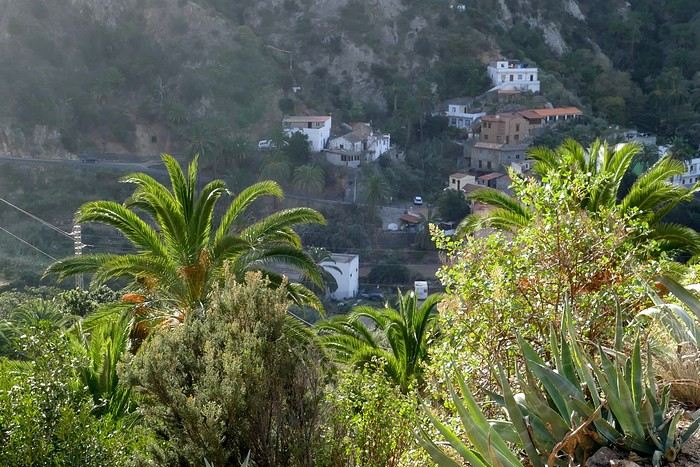 Vallehermoso
Friday, February 9 This morning, the sky was overcast, and the peaks around us were shrouded in clouds. We took the same road as yesterday to hike Las Creces. Quickly gaining altitude, we entered a thick fog—visibility was very limited. We stopped at the Las Creces parking lot; visibility improved, and the sun wasn’t far off. The hike is entirely within a beautiful laurel forest, with the sun playing hide-and-seek, but it wasn’t cold despite the altitude. After finishing the loop trail, we decided to picnic—not there, as it was too chilly—but on Vallehermoso’s beach, where we found a nice picnic area sheltered by large black rocks. A short digestive walk on the surrounding hill to admire the little beach from above. Back in Vallehermoso, we did some grocery shopping, then tried to return to the casa—only to find ourselves locked out because we’d left the key in the lock inside! After several attempts and with the help of Yéli, a relative of the owner we called for help, we were finally able to get back in!
Saturday, February 10
It rained last night, and the sky remained overcast. Monique decided to rest this morning. PP, Pat, and I set off on the hike that starts from the house toward the Marichal reservoir. The sun wasn’t far off, and by 11 AM, it was fully out. The pleasant hike passed by many flower-filled gardens and orchards—orange, lemon, and mandarin trees in fruit. The path climbed gently toward the reservoir, where the view of the Cano rock dominating the landscape was magnificent. The last part of the climb was a bit tough, overgrown with lush vegetation, and the trail was slippery from last night’s rain. We descended via a different, much more pleasant path and returned to the casa just in time for lunch, prepared by Monique. This valley is rich with its many farmers and market gardeners who’ve cultivated the entire valley, taking advantage of the water flowing down from the mountain, captured upstream and redistributed through countless pipes snaking along the paths. Numerous tanks also store water during dry periods. The houses are scattered across both sides of the valley, and these colorful little homes add a beautiful touch to the landscape. The many palm trees give this valley a distinctly tropical feel—you could almost imagine yourself in the Caribbean. Add to that some salsa music drifting from a hut where farmers were working, and the picture is complete. A well-chilled beer apéro capped off a lovely morning. The afternoon was dedicated to rest, relaxation, reading, and games.
Sunday, February 11 The blue sky returned, though a few clouds still capped the highest peaks. Today, we visited Garajonay National Park, which covers the highest central mountains. Up there, we were above the clouds, and the panoramas from the various viewpoints were stunning: first, Cherelepin, accessible from the Laguna Grande parking lot, then Alto de Garajonay, offering an exceptional view of Teide—over 3,000 meters high—emerging from the clouds on Tenerife, far in the distance. We continued to the Los Roques viewpoints, then stopped for lunch at the Degollada de Peraza restaurant, where the view of the barranco was impressive. We descended toward San Sebastián and checked into our new lodging, La Cabezada, located in the countryside about 3 km above San Sebastián. It’s a small apartment adjacent to the owner’s, with a lovely terrace overlooking the surrounding mountains and surrounded by a beautiful garden. Apéro, then dinner on our beautiful terrace.
Monday, February 12 This morning, we went down to visit San Sebastián de La Gomera: its old tower, main street with some beautiful traditional houses, and the Church of the Assumption. Back at the casa for lunch. In the afternoon, Pat, PP, and I set off on the short hike from San Sebastián beach to La Guancha beach. We drove down and parked on the beach. The path climbs along the hill overlooking San Sebastián, passes by the tall Christ statue dominating the landscape, and roughly follows the coast down to the isolated Guancha beach. A beautiful hike under a hot sun, and a swim was welcome, even if the beach and sea access weren’t very comfortable due to large pebbles and quickly deepening water. Apart from two nudist bathers, there was no one on this beach. We returned the same way.
Tuesday, February 13 Rest day. We went down to town to stroll and do some shopping. I took the opportunity to visit the parador, beautifully situated above the city in a lovely garden overlooking the port and town. Together, we went for a cuba libre at the "Cuba Libre" bar, then had lunch at Breñusca (mediocre paella!). Back at the casa, then we went back down to town to see a carnival parade, a "passacalles," which actually passed an hour earlier than scheduled. Oh well.
Wednesday, February 14 Each to their own program this morning. Pat went swimming at San Sebastián beach, Monique rested at the casa, and PP and I set off on the hike from Playa de Avalos to the Ermita de Guadalupe on Playa del Cangrejo. It wasn’t easy to find the right road or the parking spot, but we managed. The path seemed to have suffered landslides, according to a sign at the trailhead! We decided to check it out, ready to turn back if it seemed too dangerous. In the end, apart from one or two slightly tricky spots where we had to climb a pile of rocks, the trail remained passable, though a bit vertigo-inducing in places. The narrow path clings to very vertical cliffs nearly 300 meters above sea level! But what a magnificent view. At one point, the trail runs alongside a wall of basaltic pipes. We returned via the drivable track that parallels the trail a bit lower. Back at the house for lunch. In the late afternoon, we returned to town to attend the "Entierro de las Sardinas" (Burial of the Sardine), which closes the Canarian carnival festivities. While waiting, we strolled through the parador’s gardens and had mojitos in town. Around 9 PM, we heard the noise and cries of the mourners. The procession advanced, led by a large papier-mâché sardine on a float, surrounded by wailing mourners. The procession headed toward the sea, where the sardine was burned, and a mini fireworks display ended the procession. It was all very good-natured, and everyone had fun. We ended the evening with dinner at a good fish restaurant, El Pajar.
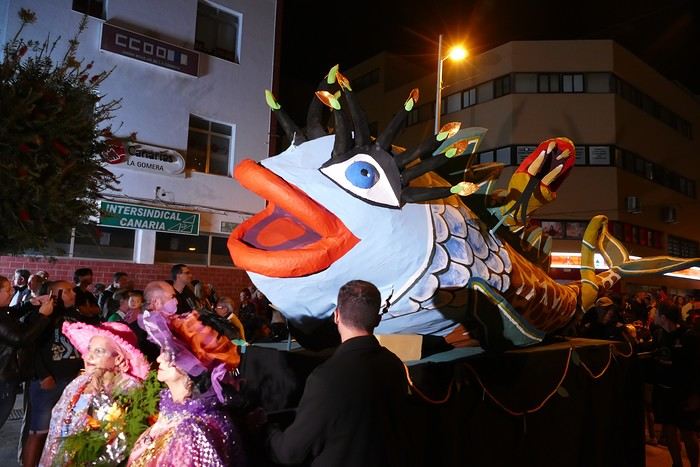 Entierro de la Sardina in San Sebastián de La Gomera
Thursday, February 15
Woke up at 5:15 AM. The only suitable ferry was at 7 AM, which would get us to La Palma by late morning rather than evening. We packed our bags, had breakfast, then headed to the port, left our rental car, and boarded the ferry to Tenerife, from where we’d continue to La Palma. Calm sea, beautiful sun—by 10:30 AM, we disembarked in La Palma. We picked up our car and immediately headed to our new apartment in Breña Alta. It’s a large apartment with a superb terrace facing the sea, fully equipped and very comfortable. The hosts recommended Casa Goyo restaurant, near the airport and close to us. It’s a restaurant with many small rooms, some of which can be reserved for families. The fish-based cuisine (chipirones, pulpo) was excellent, hearty, and reasonably priced. Since it’s in the airport’s flight path, we occasionally heard planes landing. Quick and efficient service. Afterward, we visited Santa Cruz de La Palma, which reminded us of the historic quarters of La Orotava in Tenerife or the capital of Gran Canaria.
Friday, February 16
Beautiful weather, blue sky. We headed to the San Bartolo viewpoint toward the northeast coast, then to the lovely village of San Andrés, which we explored. From there, we walked along the shore to the natural pools of Charco Azul, where we swam in the cool but "swimmable" sea. Back in San Andrés for lunch at the "San Andrés" restaurant on the beautiful church square. Very good fish-based meal. We got back in the car and continued along the north coast to the port of Espindola and the natural pools of Fajana near the Cumplida lighthouse. A fairly strong wind whipped up beautiful waves crashing onto the rocky coast in bursts of foam. Back in Santa Cruz, we stopped at the Mercadona supermarket to buy fresh shrimp for dinner.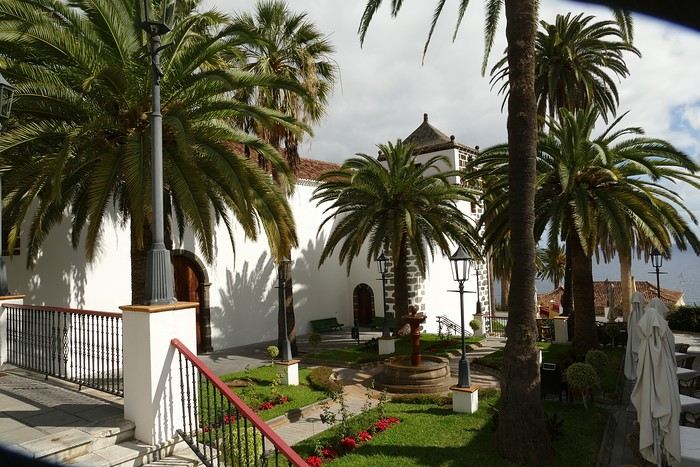 San Andrés
Saturday, February 17
Uniform blue sky, even on the heights. We took the beautiful road that winds up to the summit of the Caldera de Taburiente. Several viewpoints offer 360° views of the entire island and beyond: you can make out La Gomera, El Hierro, and, of course, Tenerife with the perfect triangle of Teide. We parked at the Los Andes viewpoint parking lot and started our hike to Pico de la Cruz along a trail following the ridge, offering superb views into the caldera. We got back in the car and passed by the Roque de los Muchachos astronomical complex, composed of numerous observatories, some with very aesthetic mirror telescopes. We hiked from the Roque de los Muchachos parking lot to the various viewpoints, always as impressive. Picnic on site, then back to Santa Cruz. We stopped by our car dealer because the oil warning light came on—better safe than sorry. The representative reassured us but preferred to give us a Fiat Cross SUV instead.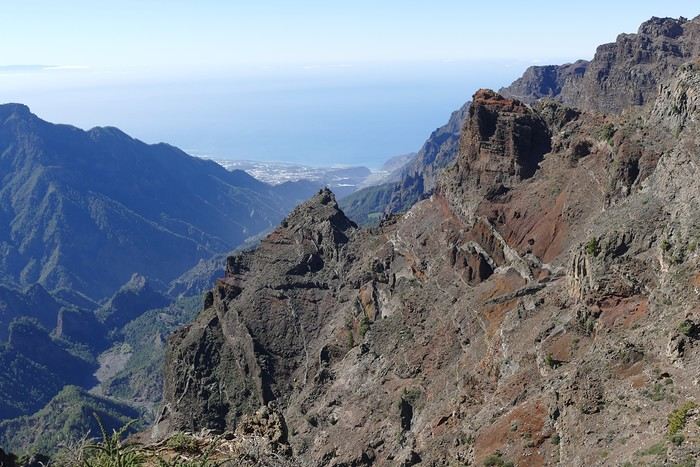 The Caldera de Taburiente
Sunday, February 18 The weather was a bit mixed, with cloudy patches. We set off to hike the Barranco de la Cuba de Galga. Unfortunately, the Los Tilos trail had been closed for several months due to a major landslide. The parking lot by the road was already quite full, and indeed, we crossed paths with many hikers along the way—it’s an easy hike with little elevation gain, which is rare here in La Palma! The beautiful path winds through a very narrow, deep gorge covered in lush tropical vegetation—you’d think you were in a Southeast Asian forest, especially with the humidity in the gorge bringing out earthy and floral scents. Halfway through, Monique turned back while the rest of us continued to the Cuba de Galga. A light drizzle accompanied us on the return. For lunch, we went to Chipi Chipi restaurant in the heights of Santa Cruz. The cool air forced us to leave the lovely terrace for the slightly noisy dining room. The meal was very good and hearty. Afternoon spent resting at our house.
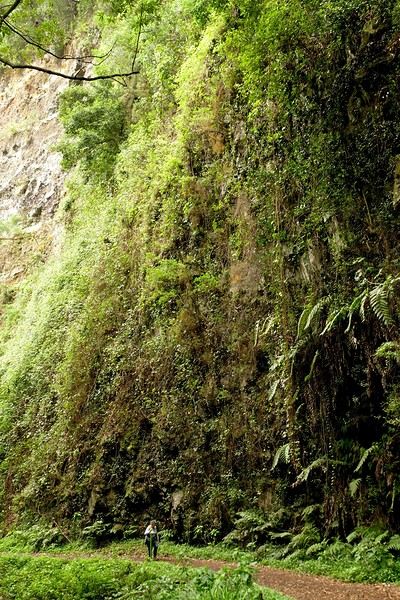 La Cuba de la Galga
Monday, February 19 A few clouds still clung to the nearby mountain peaks. We headed south to Los Canarios. We stopped in front of the small San Antonio Abad church, where a path leads to the viewpoint in 15 minutes. Then we visited the San Antonio Volcano Interpretation Center and climbed to the viewpoint via the trail along the crater’s edge, offering a plunging view into the crater. Then PP, Pat, and I headed toward the Teneguía volcano but turned back given the remaining distance and the intense heat bearing down on us! Plus, the landscape was rather arid and not very interesting. We got back in the car and drove down to the salt flats at the island’s southern tip. The ocean crashes here in large waves, exploding against the volcanic rocks and feeding a "blowhole" carved into the rock. We stopped for drinks at the salt flats restaurant, then headed home.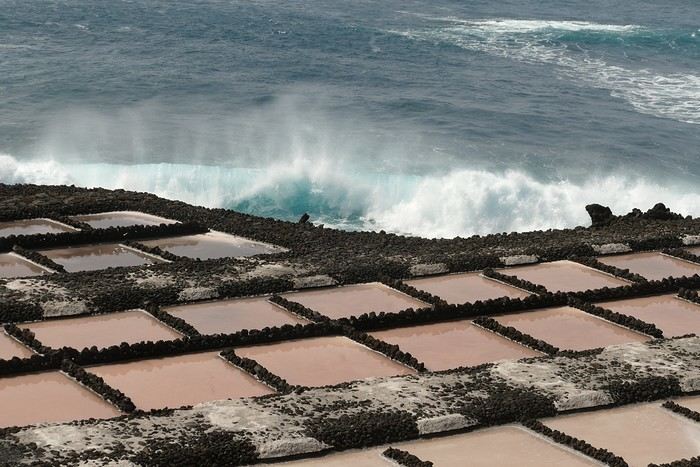 The salt flats in Fuencaliente
Tuesday, February 20 Beautiful weather with a few clouds clinging to the mountains, as usual. A relaxed morning since my parking reservation at La Cumbrecita didn’t start until 1 PM. It takes about 30 minutes from Santa Cruz to reach the valley floor via a beautiful but narrow road toward the end, though there’s very little traffic. Meanwhile, the clouds had disappeared, and the view from the La Cumbrecita viewpoint was superb. We recognized Pico de la Cruz in the distance, where we’d been a few days earlier. We then took the path leading to the Las Chozas viewpoint through a magnificent Canarian pine forest. We picnicked on site, then took the path to the Los Roques viewpoint. We returned the same way since the direct route was closed for construction. Back in Santa Cruz, we visited the Sanctuary of Las Nieves, with its beautiful golden Baroque altar.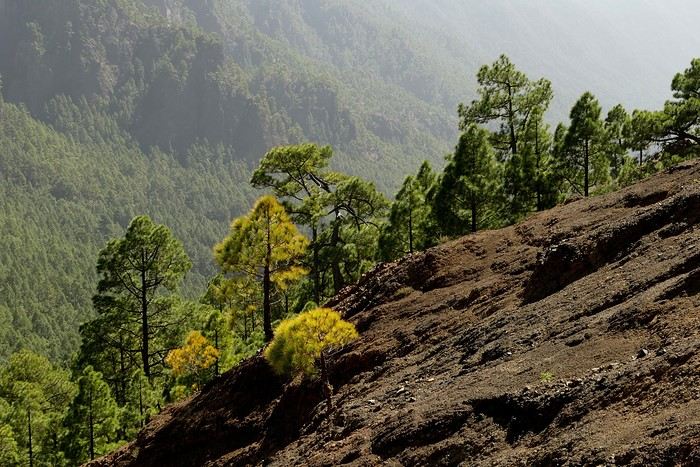 Hike from La Cumbrecita
Wednesday, February 21 After packing our things and loading the car, we left Santa Cruz under a very blue sky for Los Llanos de Aridane, where we stopped to visit this lovely town. The Church of Nuestra Señora de los Remedios has a beautiful coffered ceiling and an original papier-mâché Christ statue from the 16th century. Around it, colorful old Canarian houses brighten the streets of the town center. We took the opportunity to stroll, do some shopping, and finally sat down at La Pergola restaurant for a mediocre lunch. We got back in the car to check into our new house in Arecida. On the way, we stopped at the Mirador del Time, which once again offered an impressive panorama, allowing us—for the first time—to see the damage caused by the Tajogaite volcano eruption in 2021. You can clearly see the still-smoking crater and the large black lava flow covering the landscape down to the sea. We really liked our new accommodation: a local house that’s been renovated on the heights of Arecida, not far from the Canarian pine forest. From several terraces, we have a 360° view of the sea and mountains. We even have a private pool! There are two beautiful, brand-new bedrooms, each with its own bathroom—the best. Plus, we’re on the GR 131 trail that runs along the Barranco de las Angustias toward the northeast.
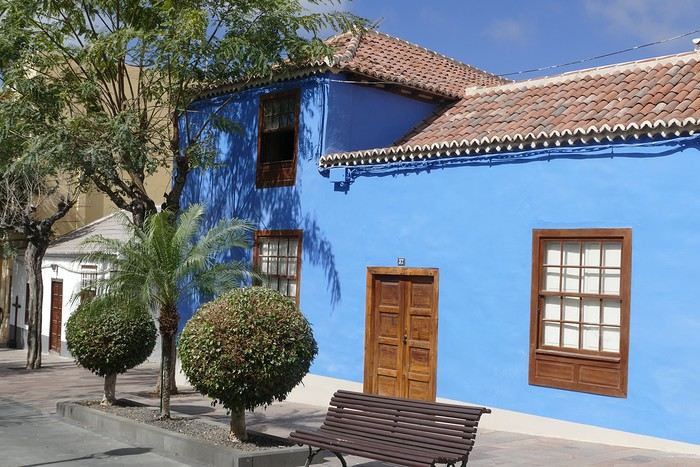 Los Llanos de Aridane
Thursday, February 22 Once again, beautiful weather greeted us when we woke up. We started the GR 131 with the goal of reaching the Torre del Time viewpoint—about 400 meters of elevation gain. The path, quite steep at first, winds through a superb Canarian pine forest. A few viewpoints let you appreciate the sheer drop of the Barranco de las Angustias—watch out for vertigo! At the Torre del Time viewpoint, there’s a nearly 1,000-meter vertical drop. We returned via another path, the PLP1, which meanders first through this beautiful forest, then along lovely flower-filled gardens adjacent to beautiful properties that cascade from the forest down to the road serving these neighborhoods. This afternoon, we tried to get closer to the area devastated by the 2021 lava flows. Several roads are still closed or reserved for residents, while others—brand new—have been rebuilt to open up this densely populated and cultivated region. In some places, the lava flow slightly diverted, sparing some properties that logically should have disappeared. Now, they’re encircled by a massive cooled lava field. In other spots, twisted and charred metal scraps or greenhouse remains protrude from the lava—all that’s left of the former banana plantations. A little higher up, you can see the slightly smoking crater of Tajogaite, responsible for this disaster. Back to Casa Barreros.
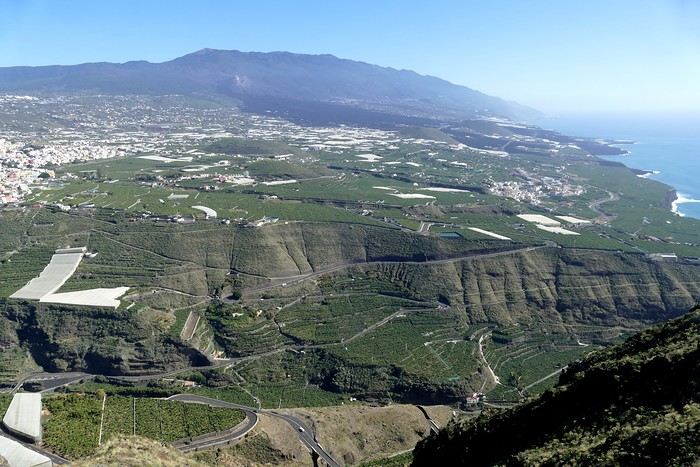 View of Los Llanos and, in the background, the 2021 lava flow
Friday, February 23
Though the sky was still blue, the temperature had dropped due to a chilly wind. By midday, it still rose to 22°C. Today, we headed north, specifically to the town of Tijarafe, where a very narrow road descends to the small port, Porís de Candelaria. The 3.7-kilometer road drops 700 meters in elevation, with gradients up to 30%—it was going to be intense! Indeed, the descent was scary, with the void right next to the very narrow road where passing was impossible except at a few rare spots. Everything went well—there was little traffic at this early hour. From the parking lot at the bottom, a path leads to Porís de Candelaria. It’s surprising to see this small fishing hamlet nestled in the shelter of an immense cave opening onto the sea, which was quite rough today. The sun, at this time of year, would appear late in the cave, which remained in shadow for much of the day. We returned via the same road, strolled through the small town of Puntagorda, and had lunch at El Jardín de los Naranjos restaurant—excellent meal.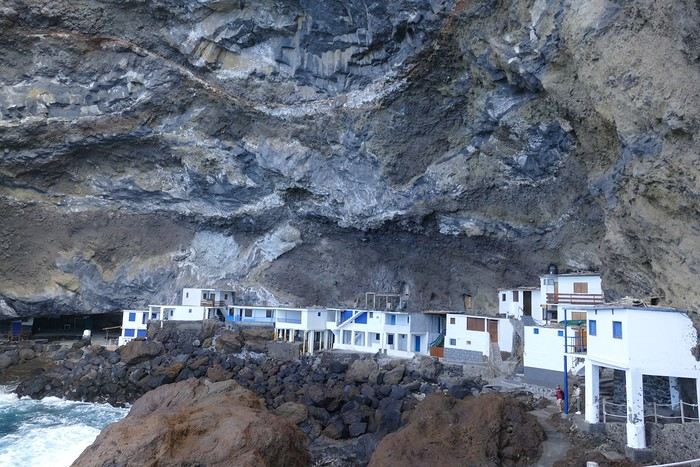 Fishing hamlet of Candelaria
Saturday, February 24 The air was still cool, but the sun was beautiful. While Monique stayed home to rest, the three of us headed to the village of Las Tricias to hike the Buracas Caves trail. We left the car parked on the LP1 road and took the small paved road down to the sign marking the trail’s start. The signage for all the trails we took here, as in La Gomera, was very well done. The path descended steadily, then more steeply toward the caves where the island’s first inhabitants lived—some petroglyphs are still visible in certain caves. The path then climbed back up, passing magnificent dragon trees and more or less elaborate huts occupied by Germans who’ve lived here for many years. Back at Casa Barreros for some rest.
Sunday, February 25 The weather once again blessed us with a beautiful day. This morning, we visited the local produce market held on weekends in Puntagorda. You’ll find agricultural products, crafts, and food to keep you going. A little further on, there’s a glass viewpoint overlooking the barranco plunging toward the sea, with a view of the thrill-seekers trying the zip line right next to it. Lunch at Naranjos—definitely a good spot—with their shrimp and spice tagliatelle. Back home for an afternoon of relaxation.
Monday, February 26 We left Arecida under a cloudy sky. Driving up from Los Llanos de Aridane toward the east, an enormous cascade of clouds poured from the mountain peaks into the Los Llanos plain—very impressive. Arriving in Santa Cruz, we went for a stroll, did some last-minute shopping, then had a final good-quality paella at La Chalana on the paseo maritimo. We left the car in the parking lot and took the 5 PM Olsen ferry to Tenerife on a slightly choppy sea, but the ferry didn’t rock too much. Arriving at 7:15 PM, we dropped off our things near the port in our reserved apartment and went for dinner at Abordo—rubbery chipirones. A digestive stroll among the ever-increasing number of tourists in Los Cristianos—restaurants were packed to the brim, the season is in full swing here. Gone is the calm of La Gomera and La Palma, and the laid-back tourism of German hikers among whom a few French were hiding!
Tuesday, February 27 To make our homemade breakfast more enjoyable, we went to buy pastries at the local bakery, then took one last walk on the paseo along the beaches, mingling with the many mobility scooters driven by elderly or disabled people, joggers, and tourists. Last apéro near the bus station, then off to the airport. After a smooth 4-hour-30-minute flight, we arrived in Basel-Mulhouse at 10:20 PM.
THE END
Conclusion A fantastic trip to two islands with magnificent and diverse nature, where landscapes range from desert-like to tropical depending on exposure to winds and clouds. Thanks to the many beautiful viewpoints, you can truly appreciate these exceptionally dynamic reliefs. A hiker’s paradise, the trails are all very well marked, though the choice of easy or moderate paths for "casual walkers" is quite limited. Another notable advantage, in our opinion, is that these islands are very lightly developed—you’ll hardly see any of those ugly hotel blocks that spoil the landscapes of some other Canary Islands. It’s true that the beaches on these two islands don’t meet traditional international tourism criteria: they’re small, with black sand, and often difficult to access. Special mention for the quality of the road network (except for a few small local roads), which seems brand new, well-paved, and well-signposted. We also enjoyed exceptional weather for February, with fewer than three days of gray or rainy weather out of 21.
Almost all the accommodations we chose met or exceeded our expectations, often at reasonable prices: an average of 98 € per night for an apartment or house with two bedrooms for four people.
All photos can be viewed by clicking this link: https://photos.app.goo.gl/G44pPk4g9PW1rNzg8
Tuesday, February 6 We left around 9 AM with our car, along with Pierre-Paul and Patricia, heading to the Bluepark parking lot in Bartenheim. As expected, we were awaited and left promptly for EuroAirport Basel. Took off at 12:25 PM for a 4-hour-15-minute flight under excellent conditions. Beautiful arrival in Tenerife with Teide in sight under a clear blue sky. Fifteen minutes later, we waited for bus No. 40 to Los Cristianos with quite a few other tourists, but we managed to find four seats. From the bus station, it was a 20-minute walk to our hotel. We checked into a lovely apartment for the four of us, complete with all the comforts. Outside, it was quite warm—at least 25°C! After dropping off our luggage, we went for a stroll. The immediate surroundings of the hotel held no interest for us: a modern, concrete area filled with hotels, bars, tourist agencies, and unappealing restaurants all offering the same bland international cuisine. Pat went to cool off at the pool, unfortunately overrun by loud, drunk English tourists. I took a walk to the paseo maritimo that leads to the port, skirting the seafront. The promenade was pleasant, but it could have been any seaside resort in the world—same old scene: a succession of bars with blaring music where many elderly people sipped cold beers waiting for the sunset, the backdrop a wall of resort-style hotels resembling rabbit hutches! Upon reaching the port, I scouted the route we’d take the next day to the Fred Olsen ferry. Back at the apartment, in the early evening, we looked for a non-touristy restaurant for dinner. Monique stopped a woman to ask her opinion! In this area, she told us, there’s no restaurant that serves Canarian or Spanish cuisine! The only place with decent restaurants is at the port. Off we went to the port, where we sat down at Al Bordo restaurant and ordered a seafood paella for four. Excellent, and at a very reasonable price (36 € for two). We returned to the hotel along the seafront.
Wednesday, February 7
Woke up at 6 AM. Had breakfast in the apartment with what we’d bought the day before at a supermarket. It was still dark when we left on foot toward the port, walking along the calm seafront at this early hour. Forty minutes later, we arrived and waited 10 minutes before the ferry docked. At 9:30 AM, we left the port of Los Cristianos for a 50-minute crossing on a calm sea under a beautiful blue sky. There were quite a few people on this large ferry, but many had no luggage, meaning they were visiting La Gomera for the day and would take the ferry back in the evening. Upon disembarking, we went straight to our rental car agency to pick up the car we’d booked online a few months earlier. It was a nice Peugeot 2008, spacious enough for the four of us and our luggage. We immediately took the beautiful road from San Sebastián that climbs directly into the mountains toward our rental in Vallehermoso. The road was in perfect condition—it seemed brand new, like all the others we’d take on this island later. This side of the island is very arid with little vegetation, and the terrain is particularly rugged, as it is throughout the island. We stopped at our first miradors, which would be followed by many more throughout our Canarian trip. Our first visit was to the small village of Agulo, perched on a promontory above the sea and at the foot of a high cliff. The village features typical Canarian houses with windows flush with the façade and black volcanic stone masonry on white or reddish-brown walls. The first recommended restaurant was already booked for a group, so we settled for the shaded terrace of the excellent El Alameda bar-restaurant. From Agulo, you can access the Abrante viewpoint via a winding road, where the view of Agulo, 600 meters below, is exceptional. A glass ledge over the void lets you test your fear of heights!
We drove to Vallehermoso to do our grocery shopping at the supermarket—a habit that would continue until the end of the trip. Our little house, "Casa rural El Encatadora," is located in a beautiful flower-filled valley a few kilometers west of Vallehermoso. Each of us had a bedroom with an en-suite bathroom, plus a living room, kitchen, and a small terrace overlooking the quiet street at the valley’s end, which didn’t bother us at all.
Thursday, February 8 The good weather seemed to follow us since our arrival in the Canary Islands. This morning, we took the road—still as beautiful and new—toward Arure, high up to the west. The landscape was magnificent, with breathtaking glimpses of the sea far below. In Arure, we parked in front of Conchita’s bar, where a hike (Rother No. 30) starts toward two viewpoints: Alojera, which we reached after 45 minutes on a lovely path. Monique, tired from the first steep climb, stopped at the first viewpoint and hitchhiked back to Arure. Meanwhile, we continued toward the second viewpoint, Los Barranquillos, where the view of the surroundings was partially hidden by misty clouds rising from the sea. The entire mountain is sculpted by ancient, endless terraces climbing until the slope becomes too steep for construction—visible traces of the hard work of past inhabitants trying to survive in a harsh environment. We had a decent lunch at La Conchita bar, then drove to the small seaside town of Puerto la Caleta, sheltered by an immense cliff plunging into the sea. Black sand beach, rough sea—despite our encouragement, Pat didn’t dare to swim! As for the old village of Caleta, it’s perched on the mountainside, and visiting it requires climbing steep, stair-filled alleys to discover a few traditional houses. Back at the casa, dinner in, and card games...
VallehermosoFriday, February 9 This morning, the sky was overcast, and the peaks around us were shrouded in clouds. We took the same road as yesterday to hike Las Creces. Quickly gaining altitude, we entered a thick fog—visibility was very limited. We stopped at the Las Creces parking lot; visibility improved, and the sun wasn’t far off. The hike is entirely within a beautiful laurel forest, with the sun playing hide-and-seek, but it wasn’t cold despite the altitude. After finishing the loop trail, we decided to picnic—not there, as it was too chilly—but on Vallehermoso’s beach, where we found a nice picnic area sheltered by large black rocks. A short digestive walk on the surrounding hill to admire the little beach from above. Back in Vallehermoso, we did some grocery shopping, then tried to return to the casa—only to find ourselves locked out because we’d left the key in the lock inside! After several attempts and with the help of Yéli, a relative of the owner we called for help, we were finally able to get back in!
Saturday, February 10
It rained last night, and the sky remained overcast. Monique decided to rest this morning. PP, Pat, and I set off on the hike that starts from the house toward the Marichal reservoir. The sun wasn’t far off, and by 11 AM, it was fully out. The pleasant hike passed by many flower-filled gardens and orchards—orange, lemon, and mandarin trees in fruit. The path climbed gently toward the reservoir, where the view of the Cano rock dominating the landscape was magnificent. The last part of the climb was a bit tough, overgrown with lush vegetation, and the trail was slippery from last night’s rain. We descended via a different, much more pleasant path and returned to the casa just in time for lunch, prepared by Monique. This valley is rich with its many farmers and market gardeners who’ve cultivated the entire valley, taking advantage of the water flowing down from the mountain, captured upstream and redistributed through countless pipes snaking along the paths. Numerous tanks also store water during dry periods. The houses are scattered across both sides of the valley, and these colorful little homes add a beautiful touch to the landscape. The many palm trees give this valley a distinctly tropical feel—you could almost imagine yourself in the Caribbean. Add to that some salsa music drifting from a hut where farmers were working, and the picture is complete. A well-chilled beer apéro capped off a lovely morning. The afternoon was dedicated to rest, relaxation, reading, and games.
Sunday, February 11 The blue sky returned, though a few clouds still capped the highest peaks. Today, we visited Garajonay National Park, which covers the highest central mountains. Up there, we were above the clouds, and the panoramas from the various viewpoints were stunning: first, Cherelepin, accessible from the Laguna Grande parking lot, then Alto de Garajonay, offering an exceptional view of Teide—over 3,000 meters high—emerging from the clouds on Tenerife, far in the distance. We continued to the Los Roques viewpoints, then stopped for lunch at the Degollada de Peraza restaurant, where the view of the barranco was impressive. We descended toward San Sebastián and checked into our new lodging, La Cabezada, located in the countryside about 3 km above San Sebastián. It’s a small apartment adjacent to the owner’s, with a lovely terrace overlooking the surrounding mountains and surrounded by a beautiful garden. Apéro, then dinner on our beautiful terrace.
Monday, February 12 This morning, we went down to visit San Sebastián de La Gomera: its old tower, main street with some beautiful traditional houses, and the Church of the Assumption. Back at the casa for lunch. In the afternoon, Pat, PP, and I set off on the short hike from San Sebastián beach to La Guancha beach. We drove down and parked on the beach. The path climbs along the hill overlooking San Sebastián, passes by the tall Christ statue dominating the landscape, and roughly follows the coast down to the isolated Guancha beach. A beautiful hike under a hot sun, and a swim was welcome, even if the beach and sea access weren’t very comfortable due to large pebbles and quickly deepening water. Apart from two nudist bathers, there was no one on this beach. We returned the same way.
Tuesday, February 13 Rest day. We went down to town to stroll and do some shopping. I took the opportunity to visit the parador, beautifully situated above the city in a lovely garden overlooking the port and town. Together, we went for a cuba libre at the "Cuba Libre" bar, then had lunch at Breñusca (mediocre paella!). Back at the casa, then we went back down to town to see a carnival parade, a "passacalles," which actually passed an hour earlier than scheduled. Oh well.
Wednesday, February 14 Each to their own program this morning. Pat went swimming at San Sebastián beach, Monique rested at the casa, and PP and I set off on the hike from Playa de Avalos to the Ermita de Guadalupe on Playa del Cangrejo. It wasn’t easy to find the right road or the parking spot, but we managed. The path seemed to have suffered landslides, according to a sign at the trailhead! We decided to check it out, ready to turn back if it seemed too dangerous. In the end, apart from one or two slightly tricky spots where we had to climb a pile of rocks, the trail remained passable, though a bit vertigo-inducing in places. The narrow path clings to very vertical cliffs nearly 300 meters above sea level! But what a magnificent view. At one point, the trail runs alongside a wall of basaltic pipes. We returned via the drivable track that parallels the trail a bit lower. Back at the house for lunch. In the late afternoon, we returned to town to attend the "Entierro de las Sardinas" (Burial of the Sardine), which closes the Canarian carnival festivities. While waiting, we strolled through the parador’s gardens and had mojitos in town. Around 9 PM, we heard the noise and cries of the mourners. The procession advanced, led by a large papier-mâché sardine on a float, surrounded by wailing mourners. The procession headed toward the sea, where the sardine was burned, and a mini fireworks display ended the procession. It was all very good-natured, and everyone had fun. We ended the evening with dinner at a good fish restaurant, El Pajar.
Entierro de la Sardina in San Sebastián de La GomeraThursday, February 15
Woke up at 5:15 AM. The only suitable ferry was at 7 AM, which would get us to La Palma by late morning rather than evening. We packed our bags, had breakfast, then headed to the port, left our rental car, and boarded the ferry to Tenerife, from where we’d continue to La Palma. Calm sea, beautiful sun—by 10:30 AM, we disembarked in La Palma. We picked up our car and immediately headed to our new apartment in Breña Alta. It’s a large apartment with a superb terrace facing the sea, fully equipped and very comfortable. The hosts recommended Casa Goyo restaurant, near the airport and close to us. It’s a restaurant with many small rooms, some of which can be reserved for families. The fish-based cuisine (chipirones, pulpo) was excellent, hearty, and reasonably priced. Since it’s in the airport’s flight path, we occasionally heard planes landing. Quick and efficient service. Afterward, we visited Santa Cruz de La Palma, which reminded us of the historic quarters of La Orotava in Tenerife or the capital of Gran Canaria.
Friday, February 16
Beautiful weather, blue sky. We headed to the San Bartolo viewpoint toward the northeast coast, then to the lovely village of San Andrés, which we explored. From there, we walked along the shore to the natural pools of Charco Azul, where we swam in the cool but "swimmable" sea. Back in San Andrés for lunch at the "San Andrés" restaurant on the beautiful church square. Very good fish-based meal. We got back in the car and continued along the north coast to the port of Espindola and the natural pools of Fajana near the Cumplida lighthouse. A fairly strong wind whipped up beautiful waves crashing onto the rocky coast in bursts of foam. Back in Santa Cruz, we stopped at the Mercadona supermarket to buy fresh shrimp for dinner.
San AndrésSaturday, February 17
Uniform blue sky, even on the heights. We took the beautiful road that winds up to the summit of the Caldera de Taburiente. Several viewpoints offer 360° views of the entire island and beyond: you can make out La Gomera, El Hierro, and, of course, Tenerife with the perfect triangle of Teide. We parked at the Los Andes viewpoint parking lot and started our hike to Pico de la Cruz along a trail following the ridge, offering superb views into the caldera. We got back in the car and passed by the Roque de los Muchachos astronomical complex, composed of numerous observatories, some with very aesthetic mirror telescopes. We hiked from the Roque de los Muchachos parking lot to the various viewpoints, always as impressive. Picnic on site, then back to Santa Cruz. We stopped by our car dealer because the oil warning light came on—better safe than sorry. The representative reassured us but preferred to give us a Fiat Cross SUV instead.
The Caldera de TaburienteSunday, February 18 The weather was a bit mixed, with cloudy patches. We set off to hike the Barranco de la Cuba de Galga. Unfortunately, the Los Tilos trail had been closed for several months due to a major landslide. The parking lot by the road was already quite full, and indeed, we crossed paths with many hikers along the way—it’s an easy hike with little elevation gain, which is rare here in La Palma! The beautiful path winds through a very narrow, deep gorge covered in lush tropical vegetation—you’d think you were in a Southeast Asian forest, especially with the humidity in the gorge bringing out earthy and floral scents. Halfway through, Monique turned back while the rest of us continued to the Cuba de Galga. A light drizzle accompanied us on the return. For lunch, we went to Chipi Chipi restaurant in the heights of Santa Cruz. The cool air forced us to leave the lovely terrace for the slightly noisy dining room. The meal was very good and hearty. Afternoon spent resting at our house.
La Cuba de la GalgaMonday, February 19 A few clouds still clung to the nearby mountain peaks. We headed south to Los Canarios. We stopped in front of the small San Antonio Abad church, where a path leads to the viewpoint in 15 minutes. Then we visited the San Antonio Volcano Interpretation Center and climbed to the viewpoint via the trail along the crater’s edge, offering a plunging view into the crater. Then PP, Pat, and I headed toward the Teneguía volcano but turned back given the remaining distance and the intense heat bearing down on us! Plus, the landscape was rather arid and not very interesting. We got back in the car and drove down to the salt flats at the island’s southern tip. The ocean crashes here in large waves, exploding against the volcanic rocks and feeding a "blowhole" carved into the rock. We stopped for drinks at the salt flats restaurant, then headed home.
The salt flats in FuencalienteTuesday, February 20 Beautiful weather with a few clouds clinging to the mountains, as usual. A relaxed morning since my parking reservation at La Cumbrecita didn’t start until 1 PM. It takes about 30 minutes from Santa Cruz to reach the valley floor via a beautiful but narrow road toward the end, though there’s very little traffic. Meanwhile, the clouds had disappeared, and the view from the La Cumbrecita viewpoint was superb. We recognized Pico de la Cruz in the distance, where we’d been a few days earlier. We then took the path leading to the Las Chozas viewpoint through a magnificent Canarian pine forest. We picnicked on site, then took the path to the Los Roques viewpoint. We returned the same way since the direct route was closed for construction. Back in Santa Cruz, we visited the Sanctuary of Las Nieves, with its beautiful golden Baroque altar.
Hike from La CumbrecitaWednesday, February 21 After packing our things and loading the car, we left Santa Cruz under a very blue sky for Los Llanos de Aridane, where we stopped to visit this lovely town. The Church of Nuestra Señora de los Remedios has a beautiful coffered ceiling and an original papier-mâché Christ statue from the 16th century. Around it, colorful old Canarian houses brighten the streets of the town center. We took the opportunity to stroll, do some shopping, and finally sat down at La Pergola restaurant for a mediocre lunch. We got back in the car to check into our new house in Arecida. On the way, we stopped at the Mirador del Time, which once again offered an impressive panorama, allowing us—for the first time—to see the damage caused by the Tajogaite volcano eruption in 2021. You can clearly see the still-smoking crater and the large black lava flow covering the landscape down to the sea. We really liked our new accommodation: a local house that’s been renovated on the heights of Arecida, not far from the Canarian pine forest. From several terraces, we have a 360° view of the sea and mountains. We even have a private pool! There are two beautiful, brand-new bedrooms, each with its own bathroom—the best. Plus, we’re on the GR 131 trail that runs along the Barranco de las Angustias toward the northeast.
Los Llanos de AridaneThursday, February 22 Once again, beautiful weather greeted us when we woke up. We started the GR 131 with the goal of reaching the Torre del Time viewpoint—about 400 meters of elevation gain. The path, quite steep at first, winds through a superb Canarian pine forest. A few viewpoints let you appreciate the sheer drop of the Barranco de las Angustias—watch out for vertigo! At the Torre del Time viewpoint, there’s a nearly 1,000-meter vertical drop. We returned via another path, the PLP1, which meanders first through this beautiful forest, then along lovely flower-filled gardens adjacent to beautiful properties that cascade from the forest down to the road serving these neighborhoods. This afternoon, we tried to get closer to the area devastated by the 2021 lava flows. Several roads are still closed or reserved for residents, while others—brand new—have been rebuilt to open up this densely populated and cultivated region. In some places, the lava flow slightly diverted, sparing some properties that logically should have disappeared. Now, they’re encircled by a massive cooled lava field. In other spots, twisted and charred metal scraps or greenhouse remains protrude from the lava—all that’s left of the former banana plantations. A little higher up, you can see the slightly smoking crater of Tajogaite, responsible for this disaster. Back to Casa Barreros.
View of Los Llanos and, in the background, the 2021 lava flowFriday, February 23
Though the sky was still blue, the temperature had dropped due to a chilly wind. By midday, it still rose to 22°C. Today, we headed north, specifically to the town of Tijarafe, where a very narrow road descends to the small port, Porís de Candelaria. The 3.7-kilometer road drops 700 meters in elevation, with gradients up to 30%—it was going to be intense! Indeed, the descent was scary, with the void right next to the very narrow road where passing was impossible except at a few rare spots. Everything went well—there was little traffic at this early hour. From the parking lot at the bottom, a path leads to Porís de Candelaria. It’s surprising to see this small fishing hamlet nestled in the shelter of an immense cave opening onto the sea, which was quite rough today. The sun, at this time of year, would appear late in the cave, which remained in shadow for much of the day. We returned via the same road, strolled through the small town of Puntagorda, and had lunch at El Jardín de los Naranjos restaurant—excellent meal.
Fishing hamlet of CandelariaSaturday, February 24 The air was still cool, but the sun was beautiful. While Monique stayed home to rest, the three of us headed to the village of Las Tricias to hike the Buracas Caves trail. We left the car parked on the LP1 road and took the small paved road down to the sign marking the trail’s start. The signage for all the trails we took here, as in La Gomera, was very well done. The path descended steadily, then more steeply toward the caves where the island’s first inhabitants lived—some petroglyphs are still visible in certain caves. The path then climbed back up, passing magnificent dragon trees and more or less elaborate huts occupied by Germans who’ve lived here for many years. Back at Casa Barreros for some rest.
Sunday, February 25 The weather once again blessed us with a beautiful day. This morning, we visited the local produce market held on weekends in Puntagorda. You’ll find agricultural products, crafts, and food to keep you going. A little further on, there’s a glass viewpoint overlooking the barranco plunging toward the sea, with a view of the thrill-seekers trying the zip line right next to it. Lunch at Naranjos—definitely a good spot—with their shrimp and spice tagliatelle. Back home for an afternoon of relaxation.
Monday, February 26 We left Arecida under a cloudy sky. Driving up from Los Llanos de Aridane toward the east, an enormous cascade of clouds poured from the mountain peaks into the Los Llanos plain—very impressive. Arriving in Santa Cruz, we went for a stroll, did some last-minute shopping, then had a final good-quality paella at La Chalana on the paseo maritimo. We left the car in the parking lot and took the 5 PM Olsen ferry to Tenerife on a slightly choppy sea, but the ferry didn’t rock too much. Arriving at 7:15 PM, we dropped off our things near the port in our reserved apartment and went for dinner at Abordo—rubbery chipirones. A digestive stroll among the ever-increasing number of tourists in Los Cristianos—restaurants were packed to the brim, the season is in full swing here. Gone is the calm of La Gomera and La Palma, and the laid-back tourism of German hikers among whom a few French were hiding!
Tuesday, February 27 To make our homemade breakfast more enjoyable, we went to buy pastries at the local bakery, then took one last walk on the paseo along the beaches, mingling with the many mobility scooters driven by elderly or disabled people, joggers, and tourists. Last apéro near the bus station, then off to the airport. After a smooth 4-hour-30-minute flight, we arrived in Basel-Mulhouse at 10:20 PM.
THE END
Conclusion A fantastic trip to two islands with magnificent and diverse nature, where landscapes range from desert-like to tropical depending on exposure to winds and clouds. Thanks to the many beautiful viewpoints, you can truly appreciate these exceptionally dynamic reliefs. A hiker’s paradise, the trails are all very well marked, though the choice of easy or moderate paths for "casual walkers" is quite limited. Another notable advantage, in our opinion, is that these islands are very lightly developed—you’ll hardly see any of those ugly hotel blocks that spoil the landscapes of some other Canary Islands. It’s true that the beaches on these two islands don’t meet traditional international tourism criteria: they’re small, with black sand, and often difficult to access. Special mention for the quality of the road network (except for a few small local roads), which seems brand new, well-paved, and well-signposted. We also enjoyed exceptional weather for February, with fewer than three days of gray or rainy weather out of 21.
Almost all the accommodations we chose met or exceeded our expectations, often at reasonable prices: an average of 98 € per night for an apartment or house with two bedrooms for four people.
All photos can be viewed by clicking this link: https://photos.app.goo.gl/G44pPk4g9PW1rNzg8
Conseils pour la Grande Traversée du Massif Central en tandem English translation pending
Bonjour,
Nous allons partir dans quelques jours pour la GTMC à partir de Clermont-ferrand. Pour cela, nous allons roulé sur un tandem lapierre VTT (2014) et y accrocher une remorque.
J'aurais besoin de conseil pour les pneumatiques. Quand on a acheté le vélo (occasion), il était équipé de pneus Geax Saguaro 2,0". Ils sont quelques peu abimés. J'ai récupéré la paire d'origine qui sont des Continental Rubber Queen 2,4". J'ai également, d'un autre vélo, un pneu Michelin with Grip'R 2,1" ainsi qu'un autre Michelin en 2,0".
Que me conseillez-vous de mettre? Je m'interroge sur le meilleur mix rendement/confort. Sachant qu'on ne veut pas faire un chrono mais que la route est longue donc que le rendement est quand même très important..
En vous remerciant par avance !
Tim
Nous allons partir dans quelques jours pour la GTMC à partir de Clermont-ferrand. Pour cela, nous allons roulé sur un tandem lapierre VTT (2014) et y accrocher une remorque.
J'aurais besoin de conseil pour les pneumatiques. Quand on a acheté le vélo (occasion), il était équipé de pneus Geax Saguaro 2,0". Ils sont quelques peu abimés. J'ai récupéré la paire d'origine qui sont des Continental Rubber Queen 2,4". J'ai également, d'un autre vélo, un pneu Michelin with Grip'R 2,1" ainsi qu'un autre Michelin en 2,0".
Que me conseillez-vous de mettre? Je m'interroge sur le meilleur mix rendement/confort. Sachant qu'on ne veut pas faire un chrono mais que la route est longue donc que le rendement est quand même très important..
En vous remerciant par avance !
Tim
Faire Compostelle avec un enfant, est-ce réaliste selon vous? English translation pending
Bonjour à tous,
Nous sommes Fab et Lilly, deux passionnés de randonnée et jeunes parents d'une petite fille de 2 ans. Après avoir fait le Chemin de Stevenson il y a 3 ans, nous souhaitons faire le chemin de Compostelle. Mais étant désormais des parents responsables 😉, nous souhaitons organiser ce voyage de la manière la plus réaliste possible et tout en respectant le confort de notre fille, quitte à le faire plus tard si vraiment c'est impossible.
Nous avons vu récemment l'histoire d'une famille qui est partie avec leurs 2 enfants (ils en ont fait un livre d'ailleurs) et on se prend vite à rêver d'un départ prochain... mais on aimerait avoir des retours d'expériences. Donc voici quelques questions :
- Est-ce que certains d'entres-vous marchent avec leurs enfants ? Vous avez commencé à quel age ? - Comment vous y prenez vous ? Combien de kilomètres faites vous par jour par exemple ? Comment rendez-vous la marche ludique ? Avez vous du matériel à conseiller (porte-bébé de randonnée, chariots, etc.) - Le Camino del Norte nous attire beaucoup mais il est réputé plus physique et escarpé. Est-ce que certains d'entres vous l'on fait ? Est-ce que cela vous semble réaliste de le faire en famille ? ou le Camino Francés est il plus approprié ?
Si vous avez des témoignages à nous partager ça serait top également. Merci encore à tous !
Nous sommes Fab et Lilly, deux passionnés de randonnée et jeunes parents d'une petite fille de 2 ans. Après avoir fait le Chemin de Stevenson il y a 3 ans, nous souhaitons faire le chemin de Compostelle. Mais étant désormais des parents responsables 😉, nous souhaitons organiser ce voyage de la manière la plus réaliste possible et tout en respectant le confort de notre fille, quitte à le faire plus tard si vraiment c'est impossible.
Nous avons vu récemment l'histoire d'une famille qui est partie avec leurs 2 enfants (ils en ont fait un livre d'ailleurs) et on se prend vite à rêver d'un départ prochain... mais on aimerait avoir des retours d'expériences. Donc voici quelques questions :
- Est-ce que certains d'entres-vous marchent avec leurs enfants ? Vous avez commencé à quel age ? - Comment vous y prenez vous ? Combien de kilomètres faites vous par jour par exemple ? Comment rendez-vous la marche ludique ? Avez vous du matériel à conseiller (porte-bébé de randonnée, chariots, etc.) - Le Camino del Norte nous attire beaucoup mais il est réputé plus physique et escarpé. Est-ce que certains d'entres vous l'on fait ? Est-ce que cela vous semble réaliste de le faire en famille ? ou le Camino Francés est il plus approprié ?
Si vous avez des témoignages à nous partager ça serait top également. Merci encore à tous !
Quel duvet pour septembre à la Réunion? (randonnée) English translation pending
Bonjour a tous
J'aimerais savoir quel duvet apporter au mois de septembre a la Réunion?
On dort dans des gîtes à Mafate, Belouve, piton de la fournaise, et piton des neiges?
J'ai un duvet pour des températures de 0° et un autre plutôt fin pour des températures de 15° environ.
Merci d'avance 😉
Carbone or not carbone? (à vélo) English translation pending
salut à tous,
Ma façon de voyager à vélo évolue. En vieillissant ... Je m'allège. J'ai considérablement réduit le poids de ce que je transporte, je reste maintenant en dessous de 15kg sacoches comprises. Reste le vélo. Je suis confortablement assis sur un tour de fer dont j'ai changé les plateaux qui ne me semblaient pas adaptés à la pratique. J'en suis content , mais il pèse quand même 14,5 kg. J'observe la mode du bikepacking avec des vélos gravel carbone à 8/9 kg . Et je sens la tentation d'augmenter ma collection de vélo ;-). L'autre jour j'ai essayé un vélo carbone route canyon (endurace cf sl) . Agréablement surpris par la nervosité, le poids, ca monte "tout seul" cette histoire (je suis dans les alpes). Mais très désagréablement surpris par le confort. Après un petit col rapidement monté j'avais mal au dos. On sent le moindre gravier, bref je me vois pas rester la-dessus pendant des heures. Certes la géométrie du truc n'est pas celle d'un gravel. Qu'en pensez vous ? Quelle est vôtre expérience ? Quel est le retour de ceux qui font du bikepacking sur des gravels carbone ? L'alu c'est mieux ? Je me sens un peu perplexe, j'attends vos avis et conseils ? Ma pratique c'est de faire des ballades de quelques jours à plus d'un mois, petites routes , pistes voir chemin propres. Je reste en Europe. Bien cordialement à tous, merci de vos réponses
Ma façon de voyager à vélo évolue. En vieillissant ... Je m'allège. J'ai considérablement réduit le poids de ce que je transporte, je reste maintenant en dessous de 15kg sacoches comprises. Reste le vélo. Je suis confortablement assis sur un tour de fer dont j'ai changé les plateaux qui ne me semblaient pas adaptés à la pratique. J'en suis content , mais il pèse quand même 14,5 kg. J'observe la mode du bikepacking avec des vélos gravel carbone à 8/9 kg . Et je sens la tentation d'augmenter ma collection de vélo ;-). L'autre jour j'ai essayé un vélo carbone route canyon (endurace cf sl) . Agréablement surpris par la nervosité, le poids, ca monte "tout seul" cette histoire (je suis dans les alpes). Mais très désagréablement surpris par le confort. Après un petit col rapidement monté j'avais mal au dos. On sent le moindre gravier, bref je me vois pas rester la-dessus pendant des heures. Certes la géométrie du truc n'est pas celle d'un gravel. Qu'en pensez vous ? Quelle est vôtre expérience ? Quel est le retour de ceux qui font du bikepacking sur des gravels carbone ? L'alu c'est mieux ? Je me sens un peu perplexe, j'attends vos avis et conseils ? Ma pratique c'est de faire des ballades de quelques jours à plus d'un mois, petites routes , pistes voir chemin propres. Je reste en Europe. Bien cordialement à tous, merci de vos réponses
Voyage avec 3 enfants: 23 jours au Pérou pour débuter notre tour du monde en juillet 2019 English translation pending
Nous sommes rentrés il y a quelques mois d'un tour du monde en famille avec nos 3 enfants et j'ai enfin pris le temps de rédiger au propre nos carnets de voyage. Voici pour commencer le récit de nos 23 jours au Pérou en juillet 2019.
Jour 1 Après un départ chaotique, une correspndance loupée à Madrid, une courte dans la capitale espagnole, un 2ème vol non prévu pour Amsterdam, nous décollons enfin pour Lima. 12h de vol plus tard, nous y voilà. Même s'il n'est que 18h là-bas quand nous arrivons, il est 1h du matin en France. On trouve nos bagages et un bus rapidement mais les enfants sont crevés et s'écroulent dans le bus. La ville est bien embouteillée et il nous faut 1h pour rejoindre notre quartier. Les 500 mètres à faire à pied sont compliqués, ça râle dans tous les sens ! Il faut dire qu’il fait nuit, il bruine, ça fait 10 fois qu’on réveille les enfants pendant leur sommeil, mais on n’a pas le choix ! Nous prenons rapidement nos chambres, pas le top du confort cette 1ère auberge mais ça fera l'affaire pour une nuit. Il est presque 21h, tout le monde dors.
Jour 2
Malgré la fatigue, le décalage horaire nous fait réveiller assez tôt. On en profite pour réserver notre bus pour le soir.
Après une petite discussion avec le gérant de l'auberge pour quelques conseils, on part à la recherche d'un endroit où prendre un petit déjeuner. On trouve un café local qui nous parait pas mal, de bons jus de fruits frais et quelques sandwichs. Nous ne sommes encore pas très à l'aise avec l'espagnol et comme la personne ne parle pas du tout anglais, on prend plusieurs choses au hasard et on se retrouve avec un sandwich au fromage, à l'œuf et à l'avocat. Surprenant mais très bon !
Nous n'avons pas beaucoup de temps à consacrer à Lima alors on se contente de se promener dans notre quartier, Miraflores. On va jusqu'à l'océan, on y trouve une aire de jeux pour les enfants.
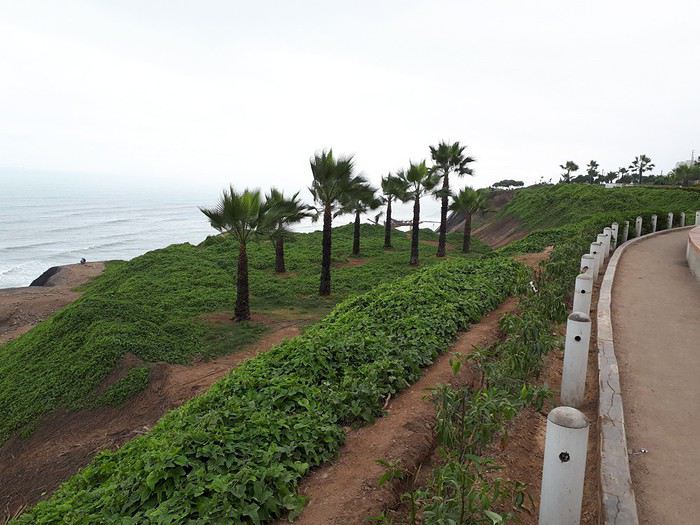
Retour à l’auberge, on saute dans un taxi direction la gare routière. On apprend que le repas du soir ainsi que le petit déjeuner sont servis à bord. On avait prévu quelques courses, tant pis ou tant mieux ! Nous embarquons donc pour Arequipa, notre prochaine étape, 19h de bus plus loin.
Jour 3
Nous nous réveillons en douceur dans le bus qui roule toujours. Les paysages qui défilent sont plutôt désertiques. On sait que la route est encore longue mais ça se passe bien. On nous sert un petit déjeuner basique mais appréciable. La grisaille laisse place peu à peu à un joli ciel bleu.
Il est midi lorsque nous arrivons à Arequipa. Un coup de taxi plus tard, nous découvrons notre hôtel pour les 3 prochaines nuits, une grande chambre confortable qui donne sur une jolie terrasse.
L’ambiance change complètement ici, il fait un grand soleil et une douce chaleur. Nous découvrons une ville plutôt calme avec des rues pavées et des bâtiments dans un style coloniale. C’est super sympa, on sent qu’on va s’y plaire ! Après avoir grignoté un morceau on part découvrir le centre-ville, on flâne, on boit du jus de fruit frais.
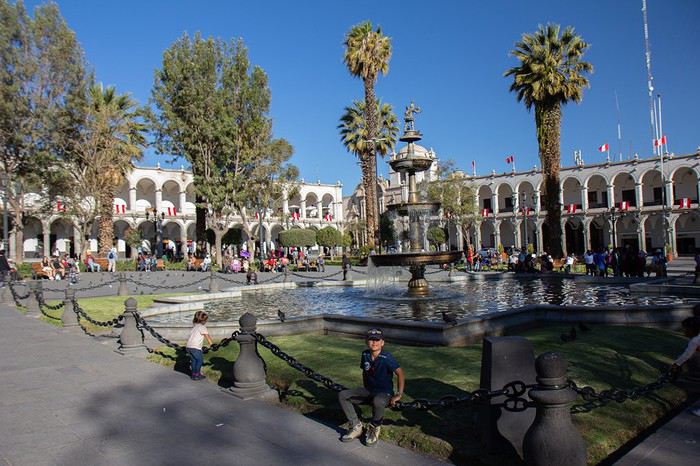
Le soir, on dîne dans un bar/restaurant qui diffuse la demi-finale de la Copa America, le Pérou joue contre le Chili, il y a de l’ambiance… Et c’est le Pérou qui se qualifie pour la finale 3-0 ! Déjà que les péruviens klaxonnent à longueur de journée, alors là c’était une symphonie !
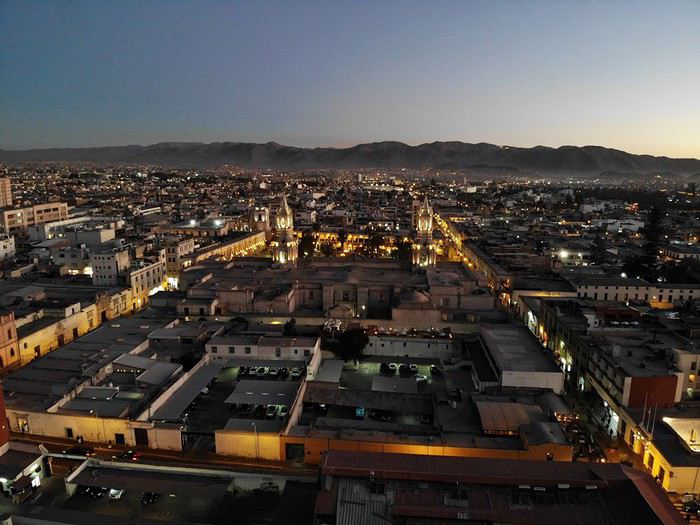
Jour 4
On découvre le copieux petit déjeuner de notre hôtel, on se régale et on prend des forces !
On part ensuite visiter le monastère Santa Catalina. C’était le lieu de résidences de religieuse jusqu’en 1969. Il est très bien préservé, ses murs sont colorés et l’endroit est très fleuri. C’est vraiment très beau. Les enfants ont aimé se perdre dans les nombreuses pièces qui communiquent entre-elles, jouer avec le grand lavoir ou encore se promener dans les étroites allées de ce beau monastère. On a bien pu se rendre compte de leurs conditions de vie.
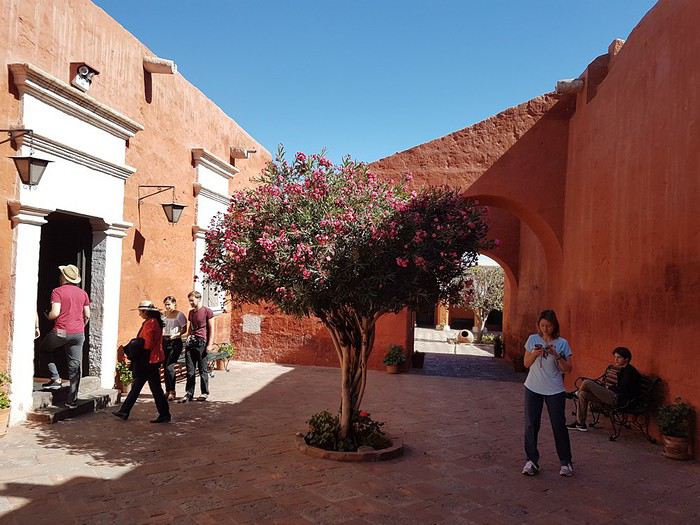
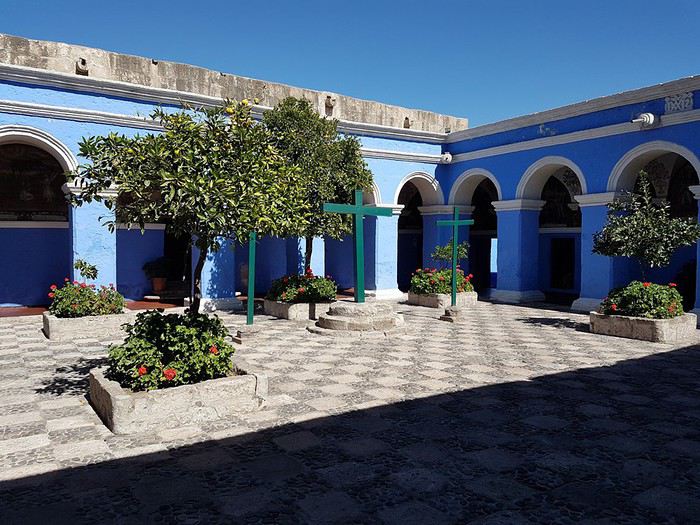
Pour le déjeuner, nous testons une adresse qui nous a été recommandé par d’autres voyageurs, le restaurant Ratatouille. Ils font de la cuisine française et les murs sont couverts de vieilles affiches de la côte d’Azur. On y mange très bien pour pas très cher. On reviendra !
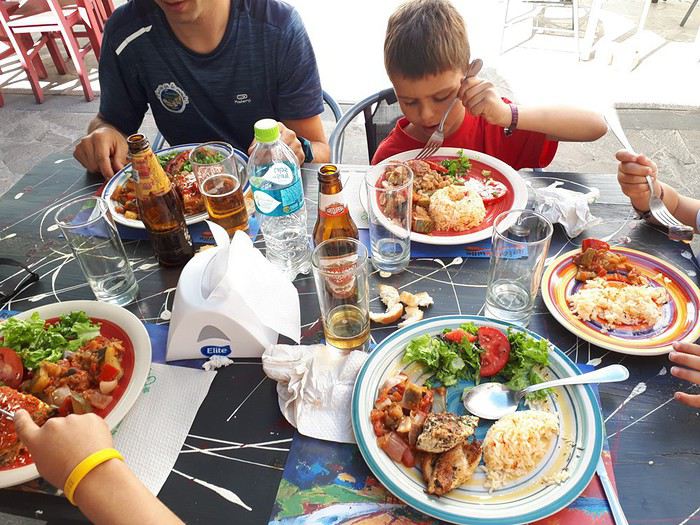
Les enfants fatiguent et on décide de rentrer pour une sieste. C’est l’occasion d’avancer les carnets de bord de chacun et pour d’autre de jouer avec le drone. On repart ensuite à la découverte des marchés couverts de souvenirs, un lieu de torture pour les enfants car ils voudraient tout acheter mais on ne peut plus rien mettre dans les sacs.
Jour 5
Nouveau petit déjeuner au calme sur notre terrasse. On se sent bien ici ! Ce matin, on décide de partir à la découverte d’un autre quartier d’Arequipa. On sort de la vieille ville. L’ambiance n’est pas la même, ça grouille de véhicules en tous genres, c’est bruyant et ça sent la pollution comme dirait Baptiste. On se dirige vers le quartier de Yanahueva qui a la particularité d’avoir une jolie petite place mais aussi un mirador avec une belle vue dégagée sur les volcans de la région. On confirme que la vue est superbe !
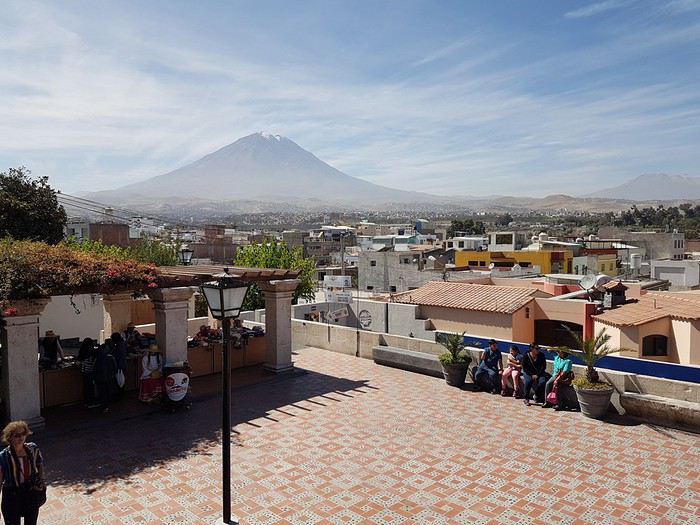
Puis les après-midis se suivent et se ressemblent, Julia fait la sieste, les garçons jouent aux cartes, on traîne et ça fait du bien après les semaines un peu speed d’avant le départ. On ressort ensuite se balader, cette ville est vraiment agréable, on découvre de nouveaux passages, on visite l’église de la Plaza de Armas.
Puis il est temps de rentrer faire nos sacs, demain nous reprenons le bus pour une nouvelle destination : Yanque (dans un prochain article) !
Pour plus d'infos sur nos adresses et infos technique ICI.
Jour 1 Après un départ chaotique, une correspndance loupée à Madrid, une courte dans la capitale espagnole, un 2ème vol non prévu pour Amsterdam, nous décollons enfin pour Lima. 12h de vol plus tard, nous y voilà. Même s'il n'est que 18h là-bas quand nous arrivons, il est 1h du matin en France. On trouve nos bagages et un bus rapidement mais les enfants sont crevés et s'écroulent dans le bus. La ville est bien embouteillée et il nous faut 1h pour rejoindre notre quartier. Les 500 mètres à faire à pied sont compliqués, ça râle dans tous les sens ! Il faut dire qu’il fait nuit, il bruine, ça fait 10 fois qu’on réveille les enfants pendant leur sommeil, mais on n’a pas le choix ! Nous prenons rapidement nos chambres, pas le top du confort cette 1ère auberge mais ça fera l'affaire pour une nuit. Il est presque 21h, tout le monde dors.
Jour 2
Malgré la fatigue, le décalage horaire nous fait réveiller assez tôt. On en profite pour réserver notre bus pour le soir.
Après une petite discussion avec le gérant de l'auberge pour quelques conseils, on part à la recherche d'un endroit où prendre un petit déjeuner. On trouve un café local qui nous parait pas mal, de bons jus de fruits frais et quelques sandwichs. Nous ne sommes encore pas très à l'aise avec l'espagnol et comme la personne ne parle pas du tout anglais, on prend plusieurs choses au hasard et on se retrouve avec un sandwich au fromage, à l'œuf et à l'avocat. Surprenant mais très bon !
Nous n'avons pas beaucoup de temps à consacrer à Lima alors on se contente de se promener dans notre quartier, Miraflores. On va jusqu'à l'océan, on y trouve une aire de jeux pour les enfants.
Retour à l’auberge, on saute dans un taxi direction la gare routière. On apprend que le repas du soir ainsi que le petit déjeuner sont servis à bord. On avait prévu quelques courses, tant pis ou tant mieux ! Nous embarquons donc pour Arequipa, notre prochaine étape, 19h de bus plus loin.
Jour 3
Nous nous réveillons en douceur dans le bus qui roule toujours. Les paysages qui défilent sont plutôt désertiques. On sait que la route est encore longue mais ça se passe bien. On nous sert un petit déjeuner basique mais appréciable. La grisaille laisse place peu à peu à un joli ciel bleu.
Il est midi lorsque nous arrivons à Arequipa. Un coup de taxi plus tard, nous découvrons notre hôtel pour les 3 prochaines nuits, une grande chambre confortable qui donne sur une jolie terrasse.
L’ambiance change complètement ici, il fait un grand soleil et une douce chaleur. Nous découvrons une ville plutôt calme avec des rues pavées et des bâtiments dans un style coloniale. C’est super sympa, on sent qu’on va s’y plaire ! Après avoir grignoté un morceau on part découvrir le centre-ville, on flâne, on boit du jus de fruit frais.
Le soir, on dîne dans un bar/restaurant qui diffuse la demi-finale de la Copa America, le Pérou joue contre le Chili, il y a de l’ambiance… Et c’est le Pérou qui se qualifie pour la finale 3-0 ! Déjà que les péruviens klaxonnent à longueur de journée, alors là c’était une symphonie !
Jour 4
On découvre le copieux petit déjeuner de notre hôtel, on se régale et on prend des forces !
On part ensuite visiter le monastère Santa Catalina. C’était le lieu de résidences de religieuse jusqu’en 1969. Il est très bien préservé, ses murs sont colorés et l’endroit est très fleuri. C’est vraiment très beau. Les enfants ont aimé se perdre dans les nombreuses pièces qui communiquent entre-elles, jouer avec le grand lavoir ou encore se promener dans les étroites allées de ce beau monastère. On a bien pu se rendre compte de leurs conditions de vie.
Pour le déjeuner, nous testons une adresse qui nous a été recommandé par d’autres voyageurs, le restaurant Ratatouille. Ils font de la cuisine française et les murs sont couverts de vieilles affiches de la côte d’Azur. On y mange très bien pour pas très cher. On reviendra !
Les enfants fatiguent et on décide de rentrer pour une sieste. C’est l’occasion d’avancer les carnets de bord de chacun et pour d’autre de jouer avec le drone. On repart ensuite à la découverte des marchés couverts de souvenirs, un lieu de torture pour les enfants car ils voudraient tout acheter mais on ne peut plus rien mettre dans les sacs.
Jour 5
Nouveau petit déjeuner au calme sur notre terrasse. On se sent bien ici ! Ce matin, on décide de partir à la découverte d’un autre quartier d’Arequipa. On sort de la vieille ville. L’ambiance n’est pas la même, ça grouille de véhicules en tous genres, c’est bruyant et ça sent la pollution comme dirait Baptiste. On se dirige vers le quartier de Yanahueva qui a la particularité d’avoir une jolie petite place mais aussi un mirador avec une belle vue dégagée sur les volcans de la région. On confirme que la vue est superbe !
Puis les après-midis se suivent et se ressemblent, Julia fait la sieste, les garçons jouent aux cartes, on traîne et ça fait du bien après les semaines un peu speed d’avant le départ. On ressort ensuite se balader, cette ville est vraiment agréable, on découvre de nouveaux passages, on visite l’église de la Plaza de Armas.
Puis il est temps de rentrer faire nos sacs, demain nous reprenons le bus pour une nouvelle destination : Yanque (dans un prochain article) !
Pour plus d'infos sur nos adresses et infos technique ICI.
Déménagement "CCR" en Algérie English translation pending
Salam
1- Quel est le montant autorisé à la Douane algérienne dans le cadre d'un déménagement CCR. 2- Quel enseigne en France ( type Cdiscount, Darty, Boulager, ...etc.) permettrait de récupérer la TVA sur l’électroménager ? Merci pour votre retour
1- Quel est le montant autorisé à la Douane algérienne dans le cadre d'un déménagement CCR. 2- Quel enseigne en France ( type Cdiscount, Darty, Boulager, ...etc.) permettrait de récupérer la TVA sur l’électroménager ? Merci pour votre retour
Quel vélo Gravel choisir en 2020? English translation pending
Bonjour,
J'ai acheté il y a 4 jours un gravel croix de fer Genesis 20, que je me suis fait vélo hier !!! J'avoue avoir eu un coup de coeur pour ce vélo.... mais depuis ce vol je me suis mise à nouveau en quête de recherche car j'ai à nouveau comparé les prix et les équipements et à nouveau le doute plane. Le problème du croix de fer c'est la dimension du cadre il faut avoir un buste assez long pour avoir un minimum de confort ou alors raccourcir la potence mais le guidon devient nerveux et la tenue de route se dégrade selon avis d'expert ! Alors toutes les questions sont là pour un budget entre 1000 et 1500e grand max car l'assurance heureusement va me rembourser mais je vais perdre de billes ! : - cadre acier ou alu - choisir un cadre et faire monter son vélo // cadre ll city par exemple // - choix de la transition - choix des freins - pneu en 700 de quelle marque ? car il paraît qu'on ne fait pas assez attention aux pneus quand on achète son vélo alors que ce sont eux qui après le cadre offre une belle adhérence et confort route
déjà une bonne base si je pouvais avoir vos avis d'expert ....! voire quelques modèles en exemple ....
Bonne journée à tous, Anne
J'ai acheté il y a 4 jours un gravel croix de fer Genesis 20, que je me suis fait vélo hier !!! J'avoue avoir eu un coup de coeur pour ce vélo.... mais depuis ce vol je me suis mise à nouveau en quête de recherche car j'ai à nouveau comparé les prix et les équipements et à nouveau le doute plane. Le problème du croix de fer c'est la dimension du cadre il faut avoir un buste assez long pour avoir un minimum de confort ou alors raccourcir la potence mais le guidon devient nerveux et la tenue de route se dégrade selon avis d'expert ! Alors toutes les questions sont là pour un budget entre 1000 et 1500e grand max car l'assurance heureusement va me rembourser mais je vais perdre de billes ! : - cadre acier ou alu - choisir un cadre et faire monter son vélo // cadre ll city par exemple // - choix de la transition - choix des freins - pneu en 700 de quelle marque ? car il paraît qu'on ne fait pas assez attention aux pneus quand on achète son vélo alors que ce sont eux qui après le cadre offre une belle adhérence et confort route
déjà une bonne base si je pouvais avoir vos avis d'expert ....! voire quelques modèles en exemple ....
Bonne journée à tous, Anne
Quelques campings à me conseiller en Bretagne? English translation pending
Bonjour à tous
Cet été je pédale en France : en Bretagne et Loire-Atlantique. En gros : Redon - Carhaix par le Canal de Nantes à Brest direction Concarneau puis le littoral Sud, quelques îles, golfe du Morbihan Guérande - Pornic.
Les tarifs stratosphériques de certains campings m'affolent un peu. Il est vrai que je pars à la mauvaise période : fin juillet - mi août...
Quant aux tarifs cyclos, j'en ai trouvé quelques uns mais à partir de la presqu'île de Rhuys et jusqu'à Pornic je sèche un peu... il reste l'option bivouac mais dans les coins très touristiques, je préfère éviter et surtout pouvoir me "poser" afin de me donner le temps de visiter :)
Avez vous des campings à me conseiller - toute catégories confondues - pour leur accueil, leur confort et/ou leurs tarifs, de Port Navalo à Pornic (où j'ai déjà réservé un hébergement).
Merci !
Cet été je pédale en France : en Bretagne et Loire-Atlantique. En gros : Redon - Carhaix par le Canal de Nantes à Brest direction Concarneau puis le littoral Sud, quelques îles, golfe du Morbihan Guérande - Pornic.
Les tarifs stratosphériques de certains campings m'affolent un peu. Il est vrai que je pars à la mauvaise période : fin juillet - mi août...
Quant aux tarifs cyclos, j'en ai trouvé quelques uns mais à partir de la presqu'île de Rhuys et jusqu'à Pornic je sèche un peu... il reste l'option bivouac mais dans les coins très touristiques, je préfère éviter et surtout pouvoir me "poser" afin de me donner le temps de visiter :)
Avez vous des campings à me conseiller - toute catégories confondues - pour leur accueil, leur confort et/ou leurs tarifs, de Port Navalo à Pornic (où j'ai déjà réservé un hébergement).
Merci !
Transmission à courroie, des nouveautés (à vélo) English translation pending
1. Un produit qui permet de passer d'une transmission à chaine à une transmission à courroie. Incompatible avec Gates.
https://www.veercycle.com/ https://www.veercycle.com/products/split-belt-pro?variant=29894666158158
Aides
https://www.veercycle.com/pages/splitbeltmanual
Vidéos
un exemple de montage sur un vélo
https://www.youtube.com/watch?v=cQSxJF4wqB4
Un exemple de conversion
https://www.youtube.com/watch?v=kVdbwoGaMtA
installation d'une roue arrière munie d'un moyeu Shimano Alphine ou Nexus
https://www.youtube.com/watch?v=lVuSmX4v8dA
Remarque:
nécessite :
- des dropouts horizontaux sinon un boitier de pédalier excentrique pour pouvoir régler la tension de la courroie. Sinon il faut pouvoir ajouter un stabilisateur (une sorte de tendeur à roulette comme les dérailleurs)
- une roue arrière à moyeu-boite de vitesse genre Nexus 8. Attention un entraxe de 132 mm. minimum pour un Nexus 8.
2. Un produit compatible avec Gates
https://www.driveline.com.tw/product/4/29
3. Un autre produit. Compatible avec Gates ?
http://www.accord.com.tw/html-en/product-FmJQMOfCHxzN-Belt+Driven+Set.html
https://www.veercycle.com/ https://www.veercycle.com/products/split-belt-pro?variant=29894666158158
Aides
https://www.veercycle.com/pages/splitbeltmanual
Vidéos
un exemple de montage sur un vélo
https://www.youtube.com/watch?v=cQSxJF4wqB4
Un exemple de conversion
https://www.youtube.com/watch?v=kVdbwoGaMtA
installation d'une roue arrière munie d'un moyeu Shimano Alphine ou Nexus
https://www.youtube.com/watch?v=lVuSmX4v8dA
Remarque:
nécessite :
- des dropouts horizontaux sinon un boitier de pédalier excentrique pour pouvoir régler la tension de la courroie. Sinon il faut pouvoir ajouter un stabilisateur (une sorte de tendeur à roulette comme les dérailleurs)
- une roue arrière à moyeu-boite de vitesse genre Nexus 8. Attention un entraxe de 132 mm. minimum pour un Nexus 8.
2. Un produit compatible avec Gates
https://www.driveline.com.tw/product/4/29
3. Un autre produit. Compatible avec Gates ?
http://www.accord.com.tw/html-en/product-FmJQMOfCHxzN-Belt+Driven+Set.html
Pompe ou pas pompe? (à vélo) English translation pending
Bonjour, nous sommes en hésitation.
Contexte: plus de dépenses pour ce voyage. J'ai parcouru le forum et je suis consciente qu'il y a plein de modèles super pour le voyage, mais nous sommes contraints de faire avec ce que l'on a. On aurait du anticiper, peut-être, mais c'est comme ça. Le voyage sera en France.
Nous avons deux pompes bon marché (DKT):
-manuelle avec soit disant baromètre mais qui n'a jamais précisé la pression. C'est celle qu'on a toujours amenée. Le soucis est qu'elle n'est pas suffisante, si on n'utilisait qu'elle, on serait toujours très bas en pression, puis il y a la peur de gonfler trop. En cours de voyage on essaie de gonfler ailleurs, mais pas toujours évident. L'année dernière par exemple pas facile.
-à pied: elle fait ses 720g avec la taille d'une pompe qui ne se soucie pas de réduire l'encombrement. Mais elle permet toujours un gonflage confort. Moi je me dis qu'il y a toujours moyen de la caler sur le porte bagages, mon compagnon dit que c'est "too much", et que pour le train on se cherche une galère de plus. Moi je pense que le train ce n'est que 2 fois dans le voyage et que peut-être ça vaut le coup.
Vous feriez quoi? Par avance merci
Vous feriez quoi? Par avance merci