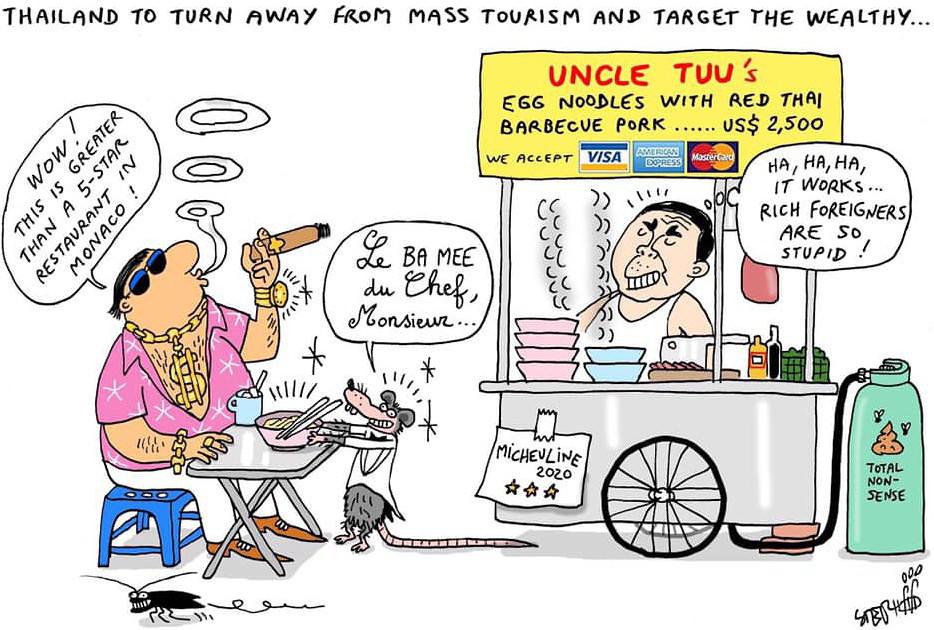
Les représentants du gouvernement voudrait un tourisme de luxe plutôt qu'un tourisme de masse. Cela pour compenser que les "bulles touristiques" ne seront pas prêtes en juillet. Donc sélection par le porte monnaie. Les hôteliers 3 et 4 étoiles et professionnels du tourisme ne sont pas d'accord. Cela profiterait surtout aux hôtels de luxe 5 étoiles.
pour le moment le gouvernement se concentre sur le tourisme intérieur en injectant 718 millions de dollars, cela profitera aux hôtels et restaurants, compagnies intérieures, agence de voyages Thaï.
Il est clair que le gouvernement veut profiter de la pandémie pour stopper le tourisme de masse qu'il trouve nocive pour l'environnement et monter en gamme.
Le tourisme 'haut de gamme' ne suffira pas à faire vivre tous ceux qui vivent du tourisme de la guesthouse aux 3* en passant par tous les services. Seules les chaînes internationales vont tirer leur épingle du jeu.
Un tourisme de pauvres et d'aventuriers, c'est pas mal non plus, plein de bungalows en bambou près des plages à la place d'énormes complexes de bétons qui ravagent l'environnement pour le confort des néo beaufs qui jouent les riches pendant une semaine.
On peut en pensé ce qu'on veut, mais le tourisme de masse fait de sacrés dégâts, on peut le voir en Thaïlande mais aussi ailleurs, comme Bali par exemple.😕
Exacte, justement je comparais deux trucs qui ne reviendront jamais.
à savoir, les années 70 en mode routard et un tourisme qui ne soit pas de masse.
Parce-que bon hein les déclarations de politiques repris pour faire un article feront vite place à la réalité économique dans quelques années quand tout ça sera derrière nous.
la préocupation de l'environnement va faire place à la machine à fric en Thaïlande?
Pis bon, ce qu'ils entendent par tourisme de luxe, ce n'est jamais très loin des groupes de chinois qui arrivent comme des sauterelles sur les îles avec un package tout compris.
Je crois surtout qu'ils n'ont aucune idée de comment sortir de ce bourbier covid19.
A un moment donné il va falloir choisir entre 0% de risque et reprise économique.
Je pense qu'il y a aura toujours de la place pour tous les budgets : Les touristes de "luxe" c'est Singapour, les Maldives, Seychelles ou Bora Bora : Des pays ou riches ou petite population dans un décors de rêve avec des vols au tarifs prohibitifs .. Aucun pays n'a pu passer d'un tourisme de "masse" à un tourisme haut de gamme en un claquement de doigt (et pourtant beaucoup faisait des annonces dans ce sens) : Moi je n'en connais pas .
C'est fini pour les crapoteux, les rsa-istes, les chomeurs pro et les
dealers de crack.Tourisme de moyenne gamme et haut de gamme
only.Et c'est tant mieux pour tout le monde. 😉😎 Le Sri Lanka a
entrepris ce virage aussi depuis 10 ans.D'autres pays suivront dans la decennie.
Un tourisme de pauvres et d'aventuriers, c'est pas mal non plus, plein de bungalows en bambou près des plages.
En effet c'est pas mal, j'ai connu cette époque de réve, mais alors pourquoi ça n'existe plus en Europe ou en France en particulier en bord de mer ..Personne ne dit rien?! ça existait aussi avant sur les cotes méditerranéennes.
Les Thaïs eux veulent de l'argent et ce n'est maintenant plus compatible avec des pauvres farang Kinoks qui n'intéressent personne ni ici ni ailleurs.
C'est fini pour les crapoteux, les rsa-istes, les chomeurs pro et les
dealers de crack.Tourisme de moyenne gamme et haut de gamme
only.Et c'est tant mieux pour tout le monde. 😉😎 Le Sri Lanka a
entrepris ce virage aussi depuis 10 ans.D'autres pays suivront dans la decennie.
Sri lanka ? tu peux avoir une nuité à moins de 10€ !! Les backpackers sont loin d'avoir disparu là bas ... Mais soit dit en passant c'est vrai qu'à l'immigration à Suvarnabhum, le spectacle est parfois affligeant 🤪
Un tourisme de pauvres et d'aventuriers, c'est pas mal non plus, plein de bungalows en bambou près des plages.
En effet c'est pas mal, j'ai connu cette époque de réve, mais alors pourquoi ça n'existe plus en Europe ou en France en particulier en bord de mer ..Personne ne dit rien?! ça existait aussi avant sur les cotes méditerranéennes.
Les Thaïs eux veulent de l'argent et ce n'est maintenant plus compatible avec des pauvres farang Kinoks qui n'intéressent personne ni ici ni ailleurs.
NTT😉
En Europe le coût de la main d’œuvre et le poids négligeable du travail informels sont incomparables . Oui il y aura surement une évolution (la Thaïlande d’aujourd’hui n'est pas celle que certains on pu connaitre dans les années 80) .. Mais il y a trop de concurrence dans hôtellerie, dans les transports, trop de travailleurs journaliers pour que tout d'un coup le pays se transforme en rocher de Monaco
Faire venir un "tourisme haut de gamme", revient régulièrement dans l'actualité mais je doute fort que cela puisse se faire avant une dizaine d'années. J'espère pour eux qu'ils n'écarteront pas le touriste "moyen" avant de pouvoir accueillir le "haut de gamme". Ils viennent de dépenser plusieurs dizaines de millions de baht pour rénover Khao San Road.
Pour faire fonctionner le tourisme de luxe, il faut aussi former du personnel pour une clientèle exigeante : maitrise des langues, professionnalisme, etc... De ce point de vue là, il y a du boulot. Il n'y a, par exemple, pas d'enseignement hôtelier à Phuket. Peut être à Bangkok, et je n'en suis pas certain.
Pour faire fonctionner le tourisme de luxe, il faut aussi former du personnel pour une clientèle exigeante : maitrise des langues, professionnalisme, etc... De ce point de vue là, il y a du boulot. Il n'y a, par exemple, pas d'enseignement hôtelier à Phuket. Peut être à Bangkok, et je n'en suis pas certain.
Entièrement d'accord. Plus d'autres manquements aussi.
20 ans seraient probablement plus réalistes. C'était l'échéance donnée par le gouvernement il y a un an , un an et demi.
Pour faire fonctionner le tourisme de luxe, il faut aussi former du personnel pour une clientèle exigeante : maitrise des langues, professionnalisme, etc... De ce point de vue là, il y a du boulot. Il n'y a, par exemple, pas d'enseignement hôtelier à Phuket. Peut être à Bangkok, et je n'en suis pas certain.
Certes! à Phuket, Samui par exemple se ne sont essentiellement que des Birmans qui travaillent dans l'hôtellerie et la restaurant ..Les Thaïs s'amusent ça rapporte plus beaucoup plus. Gagner du pognon en faisant la fête c'est risqué mais peut être très lucratif. Franchement on ne peut pas leur en vouloir. Bangkok c'est complétement à part. Le luxe part de là. La demande de luxe commence à se sentir en I-ssan, elle est forte. On y vient doucement mais surement...
En Thaïlande c'est toujours la demande qui fait l'offre, dans tout.
Pour faire fonctionner le tourisme de luxe, il faut aussi former du personnel pour une clientèle exigeante : maitrise des langues, professionnalisme, etc... De ce point de vue là, il y a du boulot.
Si la clientèle française pense qu' elle va trouver un hôtel de luxe avec service de niveau international pour 2000 ou 3000 bahts la nuit, c'est elle qui a un souci. 😎
Pour faire fonctionner le tourisme de luxe, il faut aussi former du personnel pour une clientèle exigeante : maitrise des langues, professionnalisme, etc... De ce point de vue là, il y a du boulot.
Si la clientèle française pense qu' elle va trouver un hôtel de luxe avec service de niveau international pour 2000 ou 3000 bahts la nuit, c'est elle qui a un souci. 😎
Ca c'est du moyen de gamme, mais c'est tres correct.C'est plutot le bas de gamme qui est vise.
Franchement, je ne sais pas s'ils veulent éliminer la clientèle des guesthouse à 400 - 800 B. J'ai plutôt l'impression qu'ils veulent, en plus, viser une clientèle plus aisée. Un peu comme le Vietnam fait à Danang. Une bande côtière avec des établissements de luxe et tout ce qui s'y rapportent : restaurants, loisirs, shopping, spectacles, sports, etc.
le but est de tuer le tourisme de masse en démarrant à de l’Hôtel 3 étoiles.
Je ne comprends pas très bien.
N'y a t il pas confusion entre l'expression "tourisme de masse" - qui dans ma tête n'est pas très claire et "surexploitation touristique" qui, est nettement plus claire ?
Parce que si tourisme de masse veut dire "beaucoup de gens", je n'ai pas l'impression que ce sont des hotels 3* qui vont freiner le nombre de touristes .
On parle bien des 2, baisse du nombre de touriste et monter en gamme des voyageurs en supprimant les hébergements à moins de 3 étoiles et se concentrer sur le 5 étoiles luxe.
A suivre au fil des news...
On parle bien des 2, baisse du nombre de touriste et monter en gamme des voyageurs en supprimant les hébergements à moins de 3 étoiles et se concentrer sur le 5 étoiles luxe.
A suivre au fil des news...
en supprimant les hébergements à moins de 3 étoiles et se concentrer sur le 5 étoiles luxe.
...
Là, je ne vous suis plus du tout je ne pense pas que cela arrivera un jour.
Ils ont en projet de créer une "Riviera" sur plusieurs km autours de Hua Hin. Et ils se donnent 20 ans pour y arriver. Bon, en 20 ans, c'est certain que la situation aura fort évolué. J'ai connu la Thaïlande il y a 40 ans et je vois le chemin parcouru.
Sauf bouleversement, il y aura un changement mais pas brutalement. C'est tout au moins mon analyse, mais je peux me tromper.
Et au fur et à mesure que la classe moyenne se développera, continuer à promouvoir le tourisme thaï à l'intérieur du pays.
On verra bien, c'est eux qui ont les cartes en mains, mais si on en arrive la, c'est aussi qui ont laissé faire dans le toujours plus de touristes; laisser faire que ce soit un pays plus connu pour sa prostitution de toutes sortes et que par son histoire, il est un peu tard pour compter les morts. Mais bon il y a un cas de conscience qui émerge.
En 2019 , tous les mois, et jusque février 2020, le leitmotiv était un nouveau record dans le nombre de touristes : on va dépasser les 40.000.000 ! Allez hop ! C'est carnaval
Mars c'est le covid -19 et en mai, c'est le tourisme de luxe.!?!?!
Ils cherchent à limiter la casse -et ils ont bien raison- mais dès que la situation le permettra, on visera les 40.000.000.
Où il semble qu'il y ait une prise de conscience, après le covid 19, c'est au niveau ce certains environnements. Il y a plusieurs discussions/projets pour laisser des périodes de repos.
On parle bien des 2, baisse du nombre de touriste et monter en gamme des voyageurs en supprimant les hébergements à moins de 3 étoiles et se concentrer sur le 5 étoiles luxe.
A suivre au fil des news...
Arrêtez votre délire apocalyptique !!
Les Français ne pourront plus rentrer facilement en Thaïlande le jour où :
- La Chine aura annexé le royaume😕
ou/et
- La France sera rétrogradé au niveau de pays en voie de développement dont la population serait fortement tentée par la perspective d'aller travailler dans les usines, les hôtels ou les bateaux thais ...
Tant que ceci ne s'est pas réalisé, vous jouez juste à vous faire peur .
Le scénario le plus crédible est une réorientation progressive (très progressive : au moins sur 10 ou 20 ans) du tourisme plutôt à destination des Chinois, mais ça ne deviendra pas pour autant inaccessible pour une bourse occidentale .
On parle bien des 2, baisse du nombre de touriste et monter en gamme des voyageurs en supprimant les hébergements à moins de 3 étoiles et se concentrer sur le 5 étoiles luxe.
A suivre au fil des news...
Arrêtez votre délire apocalyptique !!
Les Français ne pourront plus rentrer facilement en Thaïlande le jour où :
- La Chine aura annexé le royaume😕
ou/et
- La France sera rétrogradé au niveau de pays en voie de développement dont la population serait fortement tentée par la perspective d'aller travailler dans les usines, les hôtels ou les bateaux thais ...
Tant que ceci ne s'est pas réalisé, vous jouez juste à vous faire peur .
Le scénario le plus crédible est une réorientation progressive (très progressive : au moins sur 10 ou 20 ans) du tourisme plutôt à destination des Chinois, mais ça ne deviendra pas pour autant inaccessible pour une bourse occidentale .
Pour le coup c'est qui êtes en plein délire, la réalité vous rattrapera.😉
On parle bien des 2, baisse du nombre de touriste et monter en gamme des voyageurs en supprimant les hébergements à moins de 3 étoiles et se concentrer sur le 5 étoiles luxe.
A suivre au fil des news...
Arrêtez votre délire apocalyptique !!
Les Français ne pourront plus rentrer facilement en Thaïlande le jour où :
- La Chine aura annexé le royaume😕
ou/et
- La France sera rétrogradé au niveau de pays en voie de développement dont la population serait fortement tentée par la perspective d'aller travailler dans les usines, les hôtels ou les bateaux thais ...
Tant que ceci ne s'est pas réalisé, vous jouez juste à vous faire peur .
Le scénario le plus crédible est une réorientation progressive (très progressive : au moins sur 10 ou 20 ans) du tourisme plutôt à destination des Chinois, mais ça ne deviendra pas pour autant inaccessible pour une bourse occidentale .
Pour le coup c'est qui êtes en plein délire, la réalité vous rattrapera.😉
On se dirige vers la stratégie touristique du Bhoutan
Forfait journalier minimum
Le gouvernement local, à travers le ministère du Tourisme et le Conseil du tourisme de Bhoutan ou le CTB, établit une approche peu commune et bien structurée pour réglementer la venue des visiteurs étrangers. Un "minimum daily package" (forfait journalier) de 250US$ par personne est demandé afin de limiter le nombre de visiteurs dans le but de préserver son environnement mais aussi dans celui de gagner de l'argent pour se développer dans le bon sens.
Ce forfait journalier minimum est valable pour les groupes de 3 personnes. Pour les couples, il faut rajouter 30US$ par personne et par jours et 40US$ pour les personnes voyageant seules. Le forfait est abaissé à 200US$ en hiver et en période de mousson.
Ce tarif inclus :
Le service d'un guide
L'hébergement dans des hôtels 3 étoiles minimum
La taxe individuelle quotidienne qui s'élève à 65US$
Le transport en véhicule particulier
Les repas
Les entrées de musées
Le tarif n'inclus pas les boissons, les pourboires et les achats personnels et supplémentaires.
Il faut comparer ce qui est comparable.
Thaïlande 40 millions de touristes.
Bhoutan 0,3 million de touristes.
Dans ses rêves la Thaïlande veut 40 millions de touristes millionnaires.🙂
On se dirige vers la stratégie touristique du Bhoutan
Forfait journalier minimum
Le gouvernement local, à travers le ministère du Tourisme et le Conseil du tourisme de Bhoutan ou le CTB, établit une approche peu commune et bien structurée pour réglementer la venue des visiteurs étrangers. Un "minimum daily package" (forfait journalier) de 250US$ par personne est demandé afin de limiter le nombre de visiteurs dans le but de préserver son environnement mais aussi dans celui de gagner de l'argent pour se développer dans le bon sens.
Ce forfait journalier minimum est valable pour les groupes de 3 personnes. Pour les couples, il faut rajouter 30US$ par personne et par jours et 40US$ pour les personnes voyageant seules. Le forfait est abaissé à 200US$ en hiver et en période de mousson.
Ce tarif inclus :
Le service d'un guide
L'hébergement dans des hôtels 3 étoiles minimum
La taxe individuelle quotidienne qui s'élève à 65US$
Le transport en véhicule particulier
Les repas
Les entrées de musées
Le tarif n'inclus pas les boissons, les pourboires et les achats personnels et supplémentaires.
Sauf que la Thaïlande n'est pas le Bhoutan (un petit pays fermé depuis des siècles sans aucun poids sur l'échiquier mondial : un modèle qui pourrait s'adapter au Tibet s'il venait un jour à s'ouvrir au tourisme) ... La Thaïlande ne jouera pas cette carte car elle n'est pas toute seule dans la région, qu'elle a trop d'hôtels et d’opérateurs touristiques, qu'il y a beaucoup d'économie informelle, que sa population est consumériste à l'image du reste de l'Asie et contrairement au Bhoutan, etc ... : Même Singapour ou le Japon qui sont les vrais success story d'Asie n'ont jamais pratiqués cette stratégie .
Le Bhoutan la bonne blague 😏 un pays où le voyageur n'a aucune liberté de déplacement, faut m'expliquer le plaisir à y aller ?
Un jour ils vont même nous dire que la Thaïlande va devenir la nouvelle Corée du Nord 😄 .. Je ne comprends pas pourquoi ces intervenants jouent à se faire peur comme ça 😕
Citation
Il est clair que le gouvernement veut profiter de la pandémie pour stopper le tourisme de masse qu'il trouve nocive pour l'environnement et monter en gamme.
La Thailande veut effectivement un tourisme plus haut de gamme, sans parler que de palaces 5*, réduire l'offre aux 3 ,4, et 5 étoiles permettra de maintenir un bon niveau de recettes sans l'inconvénient de la masse.
Nul ne peut nier que le tourisme de masse est une plaie pour l'environnement et en fait n'enrichit que certains.
Depuis mon premier passage en Thaïlande il y a bientôt 35 ans je n'ai pas vraiment l'impression que le pourcentage de pauvres ait beaucoup changé.
Je crois que l'époque du tourisme de masse bon marché est une parenthèse en train d'etre close, l'époque des billets d'avion à 500€ pour aller au bout du monde va devenir un souvenir et ce sera certainement une bonne chose.
Ne nous en déplaise il y aura toujours des gens qui pourront voyager même si le coût du voyage est multiplié par 3 ou 4, et pour eux effectivement le séjour sera plus agréable.
Prenons l'exemple de l'Afrique sauf rares exceptions, voyager y est bien plus onéreux qu'en Asie, corolaire il y a moins de monde et l'atmosphère y reste magique.
Aujourd'hui tout le monde ne peut pas d'offrir un séjour aux Seychelles, aux Maldives au Bouthan ou au Botswana et bien demain cette zone d'exclusion englobera probablement l'Asie, nous n'y pourront rien .
La prise de conscience écologique aidera le plus grand nombre à se faire une raison ou à accepter de payer le prix fort.
Le voyage va redevenir un rêve qu'on réalise plutôt qu'un bien de consommation basique.
Il est inutile de spéculer sur le bien fondé des choix de certains pays en matière de tourisme car ils feront comme bon leur semblera et se moqueront bien de nos états d'âme.
Bénie soit la Covid19, peut être une chance pour l'espèce humaine, certainement un plus à terme pour certains pays.
Citation
Il est clair que le gouvernement veut profiter de la pandémie pour stopper le tourisme de masse qu'il trouve nocive pour l'environnement et monter en gamme.
La Thailande veut effectivement un tourisme plus haut de gamme, sans parler que de palaces 5*, réduire l'offre aux 3 ,4, et 5 étoiles permettra de maintenir un bon niveau de recettes sans l'inconvénient de la masse.
Nul ne peut nier que le tourisme de masse est une plaie pour l'environnement et en fait n'enrichit que certains.
Depuis mon premier passage en Thaïlande il y a bientôt 35 ans je n'ai pas vraiment l'impression que le pourcentage de pauvres ait beaucoup changé.
Je crois que l'époque du tourisme de masse bon marché est une parenthèse en train d'etre close, l'époque des billets d'avion à 500€ pour aller au bout du monde va devenir un souvenir et ce sera certainement une bonne chose.
Ne nous en déplaise il y aura toujours des gens qui pourront voyager même si le coût du voyage est multiplié par 3 ou 4, et pour eux effectivement le séjour sera plus agréable.
Prenons l'exemple de l'Afrique sauf rares exceptions, voyager y est bien plus onéreux qu'en Asie, corolaire il y a moins de monde et l'atmosphère y reste magique.
Aujourd'hui tout le monde ne peut pas d'offrir un séjour aux Seychelles, aux Maldives au Bouthan ou au Botswana et bien demain cette zone d'exclusion englobera probablement l'Asie, nous n'y pourront rien .
La prise de conscience écologique aidera le plus grand nombre à se faire une raison ou à accepter de payer le prix fort.
Le voyage va redevenir un rêve qu'on réalise plutôt qu'un bien de consommation basique.
Il est inutile de spéculer sur le bien fondé des choix de certains pays en matière de tourisme car ils feront comme bon leur semblera et se moqueront bien de nos états d'âme.
Bénie soit la Covid19, peut être une chance pour l'espèce humaine, certainement un plus à terme pour certains pays.
Elle est bien bonne celle là : l'Asean se préoccuperait dorénavant d'écologie et d'environnement 😏 (étonnant de la part d'un membre qui a un pseudo Indonésien!!??) : Je suis pas sûr qu'ils aient attendu les touristes pour polluer leur environnement (où alors vous devez confondre avec une autre région du globe) ..Je crois que vous n'avez pas compris que l'écologie n'est une réelle préoccupation qu'en occident et qu'une bonne partie de la planète ne peut pas encore se payer ce luxe (sinon vous ne verrez pas autant d'axes congestionnés, car tout le monde veut accéder à la propriété de son véhicule motorisé, autant de malls aux m2 avec l'air conditionné à fond, ou de saison des brulis qui polluent l'atmosphère pendant plusieurs mois, etc etc ). L'exemple de l'Afrique comme destination moins accessible (enfin surtout celle des safaris .. ) est un mauvais exemple : les prix y sont plus prohibitifs car peu de concurrence entre les rares établissements hôteliers et le monopole de certaines compagnies aérienne sur la destination (quand il ne s'agit pas tout simplement de la compagnie nationale) .
J y crois pas trop a un réveil écologique.
Par contre je vois un reboot de l economie mondiale , la Chine et l Inde en sortiront grandi mais l Europe devra redescendre à sa véritable place meme avec une annulation de dette
Hello
Je faisais de l'humour, je sais bien que l'écologie n'est qu'une préoccupation de bobos moralisateurs.
Une fois ceci dit , la fin du tourisme de masse est une très bonne chose et j'espère qu'elle se confirmera .
Quand je fais allusion à l'Afrique où j'ai pas mal bourlingué je constate simplement que moins sujet au tourisme de masse le voyage y est différent plus enrichissant, comme c'était le cas dans les années 80 en Asie.
Je suis actuellement au Vietnam depuis plus de 6 mois maintenant et c'est un vrai régal de ne pas croiser de hordes de touristes, je retrouve quelques sensations de mon premier séjour il y a bien longtemps.
J'habite en Provence et les dégâts du tourisme de masse je les observe chaque année, ce qui importe est le profit retiré et donc mieux vaut un tourisme de luxe qu'un tourisme de masse. Cela est à mon avis valable quelle que soit la destination.
Et puis la fin du tourisme de masse signifiera une forte réduction du transport aérien ce qui ne sera pas la pire des conséquences.
Il va falloir composer avec un nouveau monde où soit on reste chez soit on accepté de payer le prix.
Respectueusement
Oui vu comme ça je suis tout à fait d'accord avec toi : Après il faudrait nuancer sur ce qui favorise ou non le "tourisme de masse", et je ne pense pas que le niveau des prix suffisent à le limiter .. Prenons un exemple, Venise, la côte d'Azur, le Mont saint Michel ou Singapour pratiquent des prix prohibitifs mais n'en attirent pas moins des hordes de touristes qui dénaturent le lieu .. autre exemple, l'Inde où tu manges et loges pour 2 francs, six sous mais y a pas foule, surement parce que le pays est trop "roots" pour le commun des mortels : Je pense que le truc c'est surtout d'instaurer des règles strictes avec amendes à la clés, comme l'ont fait certains pays de la région (Japon, singapour) pour encadrer le tourisme (particulièrement turbulent en Thaïlande) et feront que naturellement, le mauvais tourisme (et il y a aussi du tourisme nuisible dans les grands resorts), diminuera de lui même (Mais bon encore faudrait il une volonté politique sur la durée suffisamment ferme pour tenir tête à des acteurs économiques à ne pas sous estimer 😕)
Hello
On est d'accord le tourisme de masse est une plaie, partout où il devait même en Europe et la cause première à mon avis est le coût trop faible, il est anormal qu'on puisse en Europe faire des trajets moyen courrier en avion à 50€ ou moins , il faut revenir à des prix reflétant tous les coûts y compris impact écologique mieux vaut 100 voyageurs payant 300€ un vol intra européen que 600 voyageurs payant 50€.
Et je pense idem pour les croisières sur les paquebots monstrueux qui bousillent la lagune de Venise, il suffit d'autoriser de petits bateaux et multiplier le prix par 10 ou 20 .
Je pense qu'il faut savoir ce qu'on veut le bordel ou une certaine tranquillité.
On observe la même révolte contre Airbnb dans nombre de villes fruit du tourisme de masse là encore il faut augmenter massivement le prix d'hébergement via une taxation lourde.
Je fais le constat que voyager en Afrique a une autre saveur que voyager en Asie car il y a moins de touristes pour une raison de prix et aussi parce que le voyage est plus hard, mais il y a au départ une sélection par le prix.
Je reste convaincu que lorsque le transport à vol prix disparaîtra , quand il faudra payer minimum 1500€AR pour un voyage en Asie il y aura un peu moins de monde et le séjour sera plus agréable.
Quand on observe le comportement de 80 % des visiteurs à l'étranger on se dit qu'un grand nombre ferait mieux de rester chez eux .
Le voyage pour tous n'est ni nécessaire ni naturelle mais une création artificielle nuisible, il faut que le voyage redevienne un plaisir qu'on savoure un plaisir désiré donc un plaisir onéreux.
Je prends l'exemple de l'Indonesie que je connais bien , les lieux qui sont encore peu abîmés par le tourisme sont des lieux à l'accès cher et hard et des lieux où l'hébergement est cher, et dans les deux cas on y fait des séjours magiques.
La pollution touristique est la pire de toute, mais tout cela n'engage que moi , j'ai mon rêve un monde sans touristes prédateurs.
Bonne journée
Cordialement
Hello everyone! I’m heading off solo in February and wanted to share my rough itinerary with you. Does this sound doable?
PS: I’m not really into beaches.
D1 Departure on February 17, 2027
D2 Arrival in Kuala Lumpur – stroll through Chinatown and visit the Petronas Towers
D3: Kuala Lumpur – Chow Kit Market, Batu Caves, Little India, Bukit Bintang downtown area
D4: Early morning bus to Malacca. Explore Malacca in the afternoon and evening
D5: Another 2–3 hours in Malacca in the morning, then bus back to Kuala Lumpur. Merdeka Square area. Stay in Chinatown
D6: Bus trip to Kuala Tahan. Night tour
D7: Morning – canopy walk and Bukit Terisek hike. Afternoon – off to Lata Berkoh
D8 & D9: 2-day jungle trek in Taman Negara National Park
D10: Head to Cameron Highlands
D11: Morning hike through the plantations. Afternoon still to be decided
D12: Morning – excursion to Mossy Forest and Sungei Plantation. Afternoon bus to Ipoh
D13: Morning – Mirror Lake / Sam Poh Temple area. Afternoon – explore downtown Ipoh
D14: Morning train to Penang. Afternoon – wander around Georgetown
D15: Morning – Penang Hill and Keh Loh Temple. Afternoon – Georgetown
D16: Bus to Butterfly Garden and Spice Garden. Late afternoon – Burmese and Thai temples
D17: Morning flight to Singapore. Afternoon – Chinatown and Marina Bay tour
D18: Morning – Gardens by the Bay area. Afternoon – Boat Quay, Clarke Quay, Kampong Glam
D19: Morning – The Ridges area and Botanical Garden. Afternoon – Little India, then back to Chinatown before 11:15 PM return flight
D20: Morning arrival
Hi everyone,
I’ll be in western Malaysia for 20 days in January and February.
I’m coming from southern Thailand to Ipoh for the Thaipusam festivities.
Then it’s off to Pangkor Island.
I’ll finish up in Malacca for the Chinese New Year celebrations before heading to Singapore.
I’ve got a 6-day gap.
I was thinking of going to K.Lipis for the jungle train and heading to Dabong, but the caves might not be open.
Any suggestions around K.L.?
Day treks?
A stopover between K.L. and Malacca?
Thanks
Hi, I’ve read that these two volcanoes are super popular and that there are *tons* of people for sunrise, especially in July. I’m looking for firsthand accounts from anyone who’s done it later, around 9–10 a.m.
Thanks for your help!
Laëtitia
I’m heading to Cambodia at the end of December 2026 – January 2027 for 3-4 weeks. Since I’ve already visited Cambodia twice, my itinerary is a bit different this time—I’d love to explore Botum Sakor Park, Chi Pat, the Tatai region, and the Cardamom Mountains. I’m traveling solo. If you have any tips on transportation, excursions, treks, sights, or accommodations in the area, I’d really appreciate it. Thanks for your feedback!
Has anyone traveled with the Laos travel agency ADV ?
I’m planning a trip to Laos and have received several quotes. Among them, this agency’s seem very reasonable, and so far, the interactions have been positive.
I’ve found a few positive reviews online, but I’d love to hear from travelers who’ve actually booked with them: how’s the organization, guide quality, accommodations, on-the-ground responsiveness, etc.
Thanks for sharing your experiences!
First stop on our discovery of the peninsula: Amphawa. It’s our first night in Thailand (we arrived at Suvarnabhumi at 8:50 AM).
Our initial plan was to explore the area before heading further south. The Mae Klong Railway Market is tempting... but what else is there to do????
We’ll be there on a Wednesday, and from what I’ve read on the forum, some say there’s absolutely nothing to do during the week—no floating market, barely any shops open, no restaurants, etc.
Others, though, say the place is actually more charming without the weekend crowds.
Could you share your thoughts? Missing the floating market is one thing, but if it’s really a ghost town on Wednesdays, I might just drop our bags somewhere else.
Amphawa seemed like a good first stop, just 1.5 hours from the airport, but I’d still like to settle somewhere a bit lively for our first evening.
We’ll be there at the end of October.
Thanks!
Hi,
I wanted to visit the plantations in the morning with GetYourGuide or by just showing up.
How much time should I really plan for?
I’d like to catch either the 3 PM or 5 PM bus back to KL.
Thanks
Hi,
I wanted to get some info about the cable car and the bridge—I see lots of different options...
How much time should we allow for these two activities? If we arrive around 4 PM, will we have enough time to visit without rushing?
Thanks
Hi there,
I didn’t plan to return to Thailand this year, but my health conditions mean it’ll be the best place for me to stay between two trips to India. The tourism setup there is so well-organized that it’s the most "comfortable" country for a short visit. Thailand feels too sanitized for my taste, and there’s too much religion, Buddha, and the King, but it’s still the best option given how my health has been evolving. I’d considered two weeks in ThaTon for hiking, but I got too sick from the burn-offs during my trips to the mountains around Chiang Rai. So I’m not sure where to go this year. Definitely not the sea, touristy spots, or the mountains with burn-offs...
Hi,
On September 1st, we're heading to Kalimantan for six weeks, probably from Pontianak to the Derawan Islands.
I've scoured this site, which is usually my go-to 😉, and others like VoyageForum, but recent info is pretty scarce.
I'd love any tips on places you've visited—our itinerary is still a work in progress.
We're two couples traveling with backpacks, using buses, boats, guesthouses, and homestays.
Thanks in advance!
Hi fellow travelers,
First trip to Vietnam.
We’ll be arriving in Ho Chi Minh City during Tet.
Is it complicated to find accommodation and get around during this period?
Any tips would be welcome.
Thanks for your replies.
Hi! I’d like to split my trip into two parts: 15 days in Phuket and 15 days in Krabi. Do you know if I can rent a car and drop it off in Krabi when I fly back to France?
Thanks for your feedback!
Have a great Sunday!
Martine
Hello,
After 1 night in Khao Sok, I’d like to find a 2 Days 1 Night package on the lake.
After reading a lot, I decided to "break the bank" and treat ourselves to a private tour—mainly to avoid the crowds.
But after contacting several operators, they offer "private tours" that are very expensive (around 700 €), yet in the details, the boats can only leave from the pier at 10 AM like everyone else. (I was hoping to leave much earlier.) The morning program is the same for everyone too (private or not). They drop us off at noon at our floating hotel (I’d chosen Phupha Waree). Free afternoon (swimming or kayaking in front of the hotel). We head back by boat for a 1-hour sunset ride. And the next morning, we leave the hotel at 8 AM to be at the pier by 9:30 AM at the latest—end of the trip.
So basically, we’re paying a lot for a private tour just to do the same thing as everyone else at the same time.
Or maybe I just had bad luck in my search.
I contacted Panida Ladi, who’s very popular on forums. We’d agreed on a private tour that matched my request (departure from the pier at 8 AM, very personalized itinerary). We settled on the itinerary and price, she asked for a Wise transfer for a 30% deposit, confirmed receipt of the deposit. Then 30 minutes later, she messaged me to say she was canceling everything because it was impossible to do the requested tour—and promised a quick refund of my deposit.
So here’s my question: Who’s done a *real* private tour on this lake? Who can recommend a reliable agency? Is it even really possible to do a private tour here?
I’m searching for a real gem for my 3rd stay in Koh Lanta: a lovely, high-quality hotel right by an easily accessible beach in a lively spot.
If you know of anything that fits what I’m looking for and want to share, don’t hesitate!
Hi, is anyone there in Flores right now? According to some websites, everything is closed and the situation is tough. But our guide says it's fine. Who should we believe? We're supposed to leave on September 2nd. Thanks to anyone in Flores at the moment!
Hi dear community,
I'm planning to visit Cambodia this winter, right after Christmas, for my first solo trip and my first trip to Asia. For two weeks (yes, I know it's short, but I really can't do more...). I have two main desires: Siem Reap and the countryside, the villages, the Mekong...
What do you think of this itinerary? Arrival in Siem Reap, departure from Phnom Penh.
SR: 5 days (1 day for arrival, 3 for the temples, 1 for the lake and its villages)
Kratie (stop on the way to Mondolkiri): 3 days (1 day of travel, 2 days there)
Mondolkiri/Sen Monorom: 4 days (1 day of travel, 1 day there, 2 days of treks)
PP: 3 days (1 day of travel, 2 days of sightseeing)
I think I need to cut one day somewhere if I travel from Saturday to Saturday or Sunday to Sunday. In Kratie, maybe? Or in PP? And I'll miss the boat trip that everyone recommends (SR-Battambang), but I don't see where to fit it in. Unless I do a PP-PP loop starting in the east, skip Kratie or just stay one night, then SR, then PP.
In my timing, Mondolkiri seems closer than Ratanakiri, which also tempted me a lot! Will it be too complicated alone? I'm thinking of using local guides or a small local agency for a nature and village getaway.
I've read that Siem Reap is very crowded between Christmas and New Year's. I could also do the circuit in the opposite direction. But I thought it would be easier to get familiar with the country by arriving in a touristy area—I might be wrong...
Thanks for your advice and opinions!
Hi everyone.
I’m planning my trip, and based on all the posts I’ve read, this country is amazing.
Of course, I’ve got a ton of questions for you.
Here’s a possible itinerary: Vientiane - Vang Vieng - Phonsavan - Sam Neua - Nong Khiaw + villages - Phongsali - Luang Namtha and the area - Udomxai - Huay Xai - Luang Prabang and back to Vientiane.
What do you think?
We’re planning to prioritize local transport—is it possible to do this loop?
We’d also love to go kayaking, but I’m not sure if the season’s right or where the best spot is.
For trekking—I read that Phongsali is the most authentic spot to visit villages and see wildlife. Do you know of a reliable agency and a guesthouse with reasonable prices?
Is it worth taking a slow boat for a stretch on the Mekong, and if so, which route?
For accommodations, is it better to book through Booking.com and Agoda or look when we arrive?
Are mosquitoes bad in Laos, and should we take malaria prophylaxis?
What’s the average daily budget (accommodation, food, visits)?
Is renting scooters a good option for exploring towns, and if so, which ones?
From what I’ve read, it’s best to carry cash—euros or dollars? Is it risky to walk around with that much cash?
I’ve still got tons of questions. Thanks to anyone who can help, and I’m open to all tips, info, etc.
Thanks again
Hi there,
I’m planning a family trip (my wife and I, both 47, and our two sons, aged 5 and 12) to Malaysia for the last week of June and the first two weeks of July 2027.
We used to love road trips as a couple, then as a trio, but since our second child arrived, we’ve taken a break with "camping village" style trips.
Now feels like the right time to get back to our old habits, while adjusting the pace for the kids.
We’re craving Asia. We’ve been lucky enough to visit Thailand, Indonesia (Bali and Lombok), and Sri Lanka before.
Friends have raved about Malaysia, so we’re definitely tempted.
For those who know and love Malaysia, what would be a good itinerary starting from Kuala Lumpur, with a maximum of 3-4 stops? We’d like a mix of culture, nature, and relaxation (just to clarify, we’re not big beach fans). All of this without rushing, of course.
Hello,
We’re a family of four with two teens aged 16 and 18. We’re heading to Thailand this summer. We’ll arrive in Bangkok and plan to take a flight to Luang Prabang.
I’ve seen there are some great visits and excursions to do (temples, markets, waterfalls) and maybe even venture a bit north to places like Nong Khiaw, Muang Xay, Muang Ngoy, or Oudom Xay.
But I’ve also heard about the Bokeo region with the Gibbon Experience.
Since we won’t be able to do everything, I’d love to hear about your experiences, impressions, and advice on the two options I’m considering, especially since we’ll be meeting family in Chiang Mai, Thailand, afterward.
Option 1: A loop from Luang Prabang heading slightly north, then a flight from Luang Prabang to Chiang Mai.
Option 2: A few days in Luang Prabang, exploring within a few dozen kilometers around, then heading to Bokeo province for the 2-day/1-night Gibbon Experience. For this option, I saw on Rome2Rio that it’s possible to book a ferry trip on the Mekong from Luang Prabang to Huay Xay—they mention about 8 hours. But is that realistic? What type of boat is it?
Then, to get to Chiang Mai, there aren’t many options—bus or minivan—but how does crossing the border work?
Finally, for those of you who’ve been to Laos in August, what was the weather like?
We’ve already visited Thailand, Vietnam, and Cambodia during the same period over the past four years and weren’t really bothered by bad weather.
I’m starting a discussion about guides in the Mekong Delta because we’ve just finished our trip in this region and had a hard time finding a French-speaking guide. We had Thanh—she speaks French really well and travels all over the delta region, including Ho Chi Minh City. She’s super friendly and flexible. I recommend her wholeheartedly. If it can help someone...
Feel free to contact us for her number.
Hi everyone,
I couldn’t find any recent info on Kuching.
Can anyone recommend a hotel or guesthouse for under 100 RM that’s nice and affordable? No dorms, please.
Also, does it rain a lot in November, and is it still worth visiting Semenggoh or Bako?
We’ll be arriving in Phnom Penh this coming January and we’re thinking of starting our trip with a stop in Kampong Cham, then Kratie.
After Kratie, we’re considering heading toward Siem Reap with a stop in Kampong Thom.
That said, I’m not really sure how long the Kratie–Kampong Thom journey might take or how complicated it is.
Does this stop on the way to Siem Reap seem like a good idea to you?
If we don’t visit the Sambor Prei Kuk site, are there still any walks or sights worth checking out in Kampong Thom?
Silly question—backpack or hard-shell suitcase for the Sepilok, Kinabatangan, Tioman, KL trip?
I’m struggling to fit all my son’s and my stuff into the 70L backpack... and I’m thinking a suitcase would be easier, but I’m not sure if it’ll work for getting around.
After a stay on Koh Phayam this coming November, I’d like to spend 2 or 3 days on Koh Phra Thong before heading further south.
Do you think it’s doable to leave Koh Phayam early enough to catch the 10 AM boat from Khura Buri to Koh Phra Thong? The next one isn’t until 4 PM, which would cost me a whole day.
I’m planning a trip to Indonesia, specifically Sulawesi and Java, in September for 10 days.
I don’t know this part of the world at all—any advice is welcome!
I’ll be traveling solo and would also love tips on meeting other travelers or locals.
Hello everyone,
Not long ago, I used to travel as a couple, but my husband has since passed away, and I’ve decided to set off again. The trip I took to Cambodia in January 2025 did me a world of good.
I’m now considering Thailand, a destination we never included in our plans because even 15 years ago, people said it was too touristy. Still, I’m thinking about the itinerary below, but I don’t feel up to arranging buses, trains, or guides on my own while I’m there. I’m looking for one or more drivers and have been in touch with an agency, but their offers are just copy-paste group tours that I don’t want.
So, if you have any contacts, experiences, or advice, I’d be so grateful if you’d share them with me. Here’s my rough plan:
Arrival in Bangkok
Ayutthaya (2 nights)
Kanchanaburi (2 or 3 nights)
Sangkhlaburi/Sai Yok (3 nights)
Sukhothai (2 nights)
Lampang (I’ve planned 3 nights, but that might be a bit much—it depends on what time I arrive in the city)
Chiang Mai
Chiang Dao
Pai
Chiang Rai
I was thinking about the Mae Hong Son loop—thoughts?
What do you think about staying overnight at the Golden Triangle?
When I look online, of course, I can find agencies that organize tours to national parks, etc.
I’m retired but in great physical shape. I’d rather go hiking than sit in hot springs with crowds of tourists who’ve all arranged meet-ups. I don’t want to spend a day at an elephant camp, and I don’t want to visit Karen villages.
I’d love to hear your advice.
Thank you all,
Hi everyone,
Could you share your thoughts on my 3-week itinerary?
We’re a small group (family + friends) of 12 people, planning to leave around January 21, 2027.
Here’s my itinerary:
3 nights in Bangkok
4 nights in Chiang Mai
3 nights on Koh Samui
3 nights on Koh Phangan
4 nights in Krabi
4 nights in Phuket
I’m also open to any great tips you might have...
Thanks, everyone! Alain.
Hi there,
We’re planning a 3-week family trip next summer with our three kids, who’ll be 8, 8, and 7 years old.
After some research, we’re leaning toward Malaysia to combine nature/forests and paradise beaches. The idea is to introduce our kids to the country’s culture, nature, and wildlife.
We want a great trip but without splurging on luxury options like high-end lodges and resorts. We’re looking for comfort with a touch of authenticity—basically, a good middle ground.
I’ve started putting together an itinerary and would love your expert advice and tips to help us build this amazing trip with our little ones.
Day 1: Departure from France
Day 2: Kuala Lumpur
Stay at a hotel near the airport or KL Sentral.
Just one night.
Day 3: Morning flight to Sandakan (Borneo).
Stay in Sepilok
Day 4: Sepilok:
* Orangutan Center
* Malayan Sun Bear Center
* Rainforest Discovery Centre
Day 5: Depart for Kinabatangan.
Boat safari in the late afternoon.
Day 6: Sunrise safari.
Jungle walk.
Evening safari.
Day 7: Final safari.
Return to Sandakan.
Flight to Kuala Lumpur, then to Kota Bharu (or overnight transit depending on schedules).
Day 8: Transfer to the port.
Boat to the Perhentian Islands.
Days 9 to 13: Perhentian Besar
5 full days.
* Snorkeling
* Hiking
* Turtle watching
* Wild beaches
* Relaxation
Day 14: Return to the mainland.
Bus or private car to Taman Negara.