Results for "Flores+|+9+>+264"
9865 results found.
Cherche toute info sur le Panama English translation pending
bonjour j aimerais savoir si il y une persone qui pourrais me donner des renseignements general sur le panama merci
Les baleines au Québec English translation pending
Qui peut me dire jusque quand et où peut-on admirer les baleines au Quebec??
Il semblerait que toutes les excursions se terminent au max. le 15 Octobre !🙁
Il semblerait que toutes les excursions se terminent au max. le 15 Octobre !🙁
Japan in August: Is it really a bad time?
Hey everyone,
Next year, we’re celebrating 20 years of marriage (and travel 🙂), and we’re looking for something new, pretty legendary, and something the teens will enjoy too.
The family council has settled on Japan for now. And it’d have to be a summer trip—no choice there.
The catch: I keep reading that August isn’t the right season for southern Japan. It’s hot, humid, and there’s a risk of typhoons… Okay, but what does that *actually* mean in practice? Are there any travelers who’ve been there during this time? Is it *that* unbearable? We’re pretty familiar with Southeast Asia—last year, we dealt with scorching heat in Vietnam and insane humidity, plus a typhoon we experienced from a distance, and visiting Angkor in the blazing sun. Is it worse than that?
Thanks for your feedback 😉
Next year, we’re celebrating 20 years of marriage (and travel 🙂), and we’re looking for something new, pretty legendary, and something the teens will enjoy too.
The family council has settled on Japan for now. And it’d have to be a summer trip—no choice there.
The catch: I keep reading that August isn’t the right season for southern Japan. It’s hot, humid, and there’s a risk of typhoons… Okay, but what does that *actually* mean in practice? Are there any travelers who’ve been there during this time? Is it *that* unbearable? We’re pretty familiar with Southeast Asia—last year, we dealt with scorching heat in Vietnam and insane humidity, plus a typhoon we experienced from a distance, and visiting Angkor in the blazing sun. Is it worse than that?
Thanks for your feedback 😉
June 2026 Theme Thread: Such a Beautiful Landscape
This is where we chat.
Which destination to prioritize in Southeast Asia in June/July/August/September?
🙂 Hi everyone!
Hope you're all doing well! It's been a while since I last traveled, but I'm finally heading out again soon!
For those familiar with SOUTHEAST ASIA, I'm planning to leave in mid-June (with the trip ending at the latest in November), and I don’t have a precise idea of exact places or itineraries yet. The thing is, this period is usually the rainy season...
Any advice? I was thinking of Malaysia or Indonesia, like Sulawesi, for example (all countries and islands in Southeast Asia interest me except Bali).
Any recommendations? I’m doing my research online, but if anyone here has the time and knowledge, I’d love to hear from you.
Thanks everyone, take care and stay happy! ❤️
Hope you're all doing well! It's been a while since I last traveled, but I'm finally heading out again soon!
For those familiar with SOUTHEAST ASIA, I'm planning to leave in mid-June (with the trip ending at the latest in November), and I don’t have a precise idea of exact places or itineraries yet. The thing is, this period is usually the rainy season...
Any advice? I was thinking of Malaysia or Indonesia, like Sulawesi, for example (all countries and islands in Southeast Asia interest me except Bali).
Any recommendations? I’m doing my research online, but if anyone here has the time and knowledge, I’d love to hear from you.
Thanks everyone, take care and stay happy! ❤️
Short stop in Bali: stay in Denpasar or go to Ubud?
Hi everyone,
This September, my partner and I are heading to North Sulawesi for 3 weeks. Our international flight is with Malaysia Airlines, departing from Paris. We have a layover in KL, then fly to Denpasar, followed by a domestic flight from Denpasar to Manado. We land in Bali Denpasar on 05/09 around 12:00 PM, and our flight to Manado is on 07/09 at 1:30 AM. The plan was to have at least one night (from the 5th to the 6th of September) between our international flight and our flight to Manado, just to recharge a bit since we're not 20 anymore 😛. My question is, given the very short stop in Bali (a day and a half), is it better to stay in Denpasar rather than go to Ubud for the night? I’ve been to Bali before, and from what I remember, even though the distances are short, transfers take a long time because of the extremely heavy traffic—but I was there in July, not September. I’m not sure if that makes a big difference? If the answer is "it’s better to stay in Denpasar," are there any nice places to visit? There’s very little feedback about the city since tourists usually don’t stick around. Thanks in advance for your replies.
This September, my partner and I are heading to North Sulawesi for 3 weeks. Our international flight is with Malaysia Airlines, departing from Paris. We have a layover in KL, then fly to Denpasar, followed by a domestic flight from Denpasar to Manado. We land in Bali Denpasar on 05/09 around 12:00 PM, and our flight to Manado is on 07/09 at 1:30 AM. The plan was to have at least one night (from the 5th to the 6th of September) between our international flight and our flight to Manado, just to recharge a bit since we're not 20 anymore 😛. My question is, given the very short stop in Bali (a day and a half), is it better to stay in Denpasar rather than go to Ubud for the night? I’ve been to Bali before, and from what I remember, even though the distances are short, transfers take a long time because of the extremely heavy traffic—but I was there in July, not September. I’m not sure if that makes a big difference? If the answer is "it’s better to stay in Denpasar," are there any nice places to visit? There’s very little feedback about the city since tourists usually don’t stick around. Thanks in advance for your replies.
March 2026 Photo Contest Theme: Metal, Metallic
The 139th edition of this contest is now open, and this month’s theme is:
« Metal, Metallic».
From ore to rockets, wire to the Eiffel Tower—or in a pinch, even a self-portrait at the bottom of a spoon—the theme is broad enough that you should be able to come up with at least three ideas pretty easily! Sure, things might get tricky when it’s time to vote, but that could just be a sign of a successful contest, right?! But we’re not there yet.
Contest rules: You can post up to three photos, each in a separate message, clearly indicating their number (1, 2, or 3) along with the location where the photo was taken. Any explanations about your photos are welcome.
You’ll vote for three photos, clearly stating the name of the participant you’ve chosen, followed by the photo number. The first photo in your vote will receive three points, the second two points, and the third one point.
The winner will be the person whose photo earns the most points. In case of a tie, the winner will be the one with the most first-place votes—or, if still tied, the most second-place votes. Finally, if it’s a perfect tie, the winner will be the one who reached their score first. The winner will then have the pleasure of choosing the theme for the April 2026 contest and organizing it. Ties for any position other than first won’t be broken. Lastly, you don’t need to participate in the contest to vote. However, participants (and I hope there’ll be lots of you!) are strongly encouraged to vote!
Please only post contest photos in this thread, and starting Thursday, March 26 (00:01 Paris time), only votes.
Key dates: You can submit your photos starting today, Tuesday, March 3, 2026, until Wednesday, March 25, 2026 (23:59 Paris time). Voting will begin the minute after and end on Monday, March 30 (23:59 Paris time). Results will be announced on Tuesday, March 31, 2026 ... if all goes well!
A discussion thread for this contest is open HERE: The photorama can be found HERE
From ore to rockets, wire to the Eiffel Tower—or in a pinch, even a self-portrait at the bottom of a spoon—the theme is broad enough that you should be able to come up with at least three ideas pretty easily! Sure, things might get tricky when it’s time to vote, but that could just be a sign of a successful contest, right?! But we’re not there yet.
Contest rules: You can post up to three photos, each in a separate message, clearly indicating their number (1, 2, or 3) along with the location where the photo was taken. Any explanations about your photos are welcome.
You’ll vote for three photos, clearly stating the name of the participant you’ve chosen, followed by the photo number. The first photo in your vote will receive three points, the second two points, and the third one point.
The winner will be the person whose photo earns the most points. In case of a tie, the winner will be the one with the most first-place votes—or, if still tied, the most second-place votes. Finally, if it’s a perfect tie, the winner will be the one who reached their score first. The winner will then have the pleasure of choosing the theme for the April 2026 contest and organizing it. Ties for any position other than first won’t be broken. Lastly, you don’t need to participate in the contest to vote. However, participants (and I hope there’ll be lots of you!) are strongly encouraged to vote!
Please only post contest photos in this thread, and starting Thursday, March 26 (00:01 Paris time), only votes.
Key dates: You can submit your photos starting today, Tuesday, March 3, 2026, until Wednesday, March 25, 2026 (23:59 Paris time). Voting will begin the minute after and end on Monday, March 30 (23:59 Paris time). Results will be announced on Tuesday, March 31, 2026 ... if all goes well!
A discussion thread for this contest is open HERE: The photorama can be found HERE
Societal Evolution
Hello everyone,
It’s something we often notice in this forum—and many others—this behavioral shift.
A long-time member, or even a new one, asks a question. They get one or more answers, some brief, some detailed, and then... nothing???
Not even a simple thank you!!!
From what I’ve gathered, if the answers don’t align with what they wanted to hear, it seems natural for the asker to just disappear!! 😕 Unless—(and I fear this is the case)—basic politeness is no longer part of our society????
Please forgive my little rant.
Wishing everyone all the best. Cheers,
Puma2A

...
It’s something we often notice in this forum—and many others—this behavioral shift.
A long-time member, or even a new one, asks a question. They get one or more answers, some brief, some detailed, and then... nothing???
Not even a simple thank you!!!
From what I’ve gathered, if the answers don’t align with what they wanted to hear, it seems natural for the asker to just disappear!! 😕 Unless—(and I fear this is the case)—basic politeness is no longer part of our society????
Please forgive my little rant.
Wishing everyone all the best. Cheers,
Puma2A
...
Cambodia and Indonesia in summer: ideal itinerary with kids?
Hi everyone,
After letting our backpacks gather dust for several years, we’ve decided to set off on another adventure—this time as a family, with our 10- and 12-year-old kids! We’re planning a trip from mid-June to the end of July, with two stops: Cambodia (2 weeks) and Indonesia (4 weeks). But before diving into the details, we’ve got quite a few questions and doubts.
About Cambodia: We know this period is the rainy season. Is it really a good idea to go then? And if so, is it better to start with Cambodia and then move on to Indonesia, or does the order not matter from a climate perspective? Here are the activities and sites we’ve shortlisted: · The Mekong and Irrawaddy dolphins: do we actually have a chance of seeing them? · The Mondulkiri Project (elephant sanctuary): is this an ethical project? We want to avoid any form of animal exploitation. · The temples of Angkor: are 2 or 3 days enough to fully enjoy them? · Floating villages: where should we go for an authentic experience? Is it possible to spend the night there? · Hikes with waterfalls, lakes, etc.: are there any must-do treks? · And most importantly, what activities or sites would appeal to kids?
For Indonesia: We were there 15 years ago and loved our itinerary: Yogyakarta / Borobudur → Bromo → Kawah Ijen → Bali → Gili Trawangan. This time, we’re torn: · Retracing part of that route to share it with our kids (even if revisiting the same places isn’t super appealing), · Or exploring new regions. What’s almost certain is that we’d like to spend about two weeks in Raja Ampat. For the other two weeks, we’re undecided. We’re looking for kid-friendly ideas for places and activities, while avoiding too many connections for budget and environmental reasons. Since we’ll already see temples in Cambodia, we’d like to mix things up.
And finally… On our last trip to the region, we traveled without kids and went super free-spirited: only the round-trip tickets were booked, and we improvised the rest day by day without any major issues finding accommodation, food, or accessing the activities we’d spotted. Do you think this style of travel is still doable with two kids? Or has it become too risky or stressful? Are there regions where the "backpacker" approach is still possible, and others where it’s better to book in advance? And for certain activities or sites, is it recommended to hire guides?
Thanks in advance for your tips and experiences!
After letting our backpacks gather dust for several years, we’ve decided to set off on another adventure—this time as a family, with our 10- and 12-year-old kids! We’re planning a trip from mid-June to the end of July, with two stops: Cambodia (2 weeks) and Indonesia (4 weeks). But before diving into the details, we’ve got quite a few questions and doubts.
About Cambodia: We know this period is the rainy season. Is it really a good idea to go then? And if so, is it better to start with Cambodia and then move on to Indonesia, or does the order not matter from a climate perspective? Here are the activities and sites we’ve shortlisted: · The Mekong and Irrawaddy dolphins: do we actually have a chance of seeing them? · The Mondulkiri Project (elephant sanctuary): is this an ethical project? We want to avoid any form of animal exploitation. · The temples of Angkor: are 2 or 3 days enough to fully enjoy them? · Floating villages: where should we go for an authentic experience? Is it possible to spend the night there? · Hikes with waterfalls, lakes, etc.: are there any must-do treks? · And most importantly, what activities or sites would appeal to kids?
For Indonesia: We were there 15 years ago and loved our itinerary: Yogyakarta / Borobudur → Bromo → Kawah Ijen → Bali → Gili Trawangan. This time, we’re torn: · Retracing part of that route to share it with our kids (even if revisiting the same places isn’t super appealing), · Or exploring new regions. What’s almost certain is that we’d like to spend about two weeks in Raja Ampat. For the other two weeks, we’re undecided. We’re looking for kid-friendly ideas for places and activities, while avoiding too many connections for budget and environmental reasons. Since we’ll already see temples in Cambodia, we’d like to mix things up.
And finally… On our last trip to the region, we traveled without kids and went super free-spirited: only the round-trip tickets were booked, and we improvised the rest day by day without any major issues finding accommodation, food, or accessing the activities we’d spotted. Do you think this style of travel is still doable with two kids? Or has it become too risky or stressful? Are there regions where the "backpacker" approach is still possible, and others where it’s better to book in advance? And for certain activities or sites, is it recommended to hire guides?
Thanks in advance for your tips and experiences!
Off on an adventure to Java (and a bit of Bali)
Hey there, community! Back this weekend, below is my travel journal from my adventure in Indonesia. Enjoy the read!!!
Day 1 - August 10, 2025 New life downloading for three weeks! And for that, Flo and I launched a public tender... A public tender? What’s that got to do with a travel journal???... Well, when you think about it, few destinations tick all the boxes for an August adventure: Meaning, finding a place that’s exotic in the middle of August, not too expensive, not too packed with tourists, warm but not *too* warm, with postcard-perfect landscapes, dreamy beaches, tasty cuisine with a hint of exoticism, friendly and welcoming locals, where you’re free to sleep under the stars among the mosquitos, take transport surrounded by chickens, and even eat from a pig trough if you feel like it—well, turns out it’s not that easy to find! I’d even say, given how thick the list of requirements is, there’s a big risk the tender could be declared unsuccessful for failing to meet just one criterion. Let’s just say the candidates better submit a rock-solid proposal!
After reviewing all the responses and presentations from the candidates, the obvious choice for us is... Indonesia! Except that trying to explore a country as vast as Indonesia and its 17,504 islands in less than five years is a bit like reading the summary of a Proust novel without taking the time to savor each of its 950 pages! Don’t worry, I won’t name them all here. Besides, do they even all have names? No! Only 7,870 have been named—their parents clearly ran out of ideas for the rest. Anyway, our society, which worships the "work more to earn more" mantra, unfortunately limits our adventure time. So we’ll only get to see a small part of Indonesia, and we’ll have to make a tough choice to head for the best of the best in this archipelago of over seventeen thousand islands. Each one has its own selling points: Sumatra, Sulawesi, Java, the Celebes, Bali, Borneo, Papua, Timor, the Moluccas... So many names that smell of adventure... Another tender, another list of requirements, another review of proposals... Drumroll... Splash splash... And the lucky winner is... Ta-da... Java, Bali’s big sister, where I’ve already been eight years ago... Java the programming language. The Java of Broadway. We’re gonna *do* the Java. Java the coffee. And yes, Java is also an island!
This island, four times smaller than France, is home to 136 million people, making it the most populated island in the world! Fun fact: Indonesia, with its 260 million inhabitants, is just shy of the podium for the world’s most populated countries, after the winning trio of India, China, and the United States. And it’s on this island of Java that you’ll find Jakarta, the (soon-to-be-former) capital and main airport of the country, where we’ll soon land after our nineteen-hour flight! Yep, nineteen hours! I mean, Indonesia in general—and Java in particular—is a *tad* farther than going on vacation to Grandma Yoyo’s! Not sure where it is? Easy. Grab a map. Plant your finger on the big island at the bottom right—aka Australia for those who struggle with geography—move it up two centimeters, and bam, welcome to Indonesia!
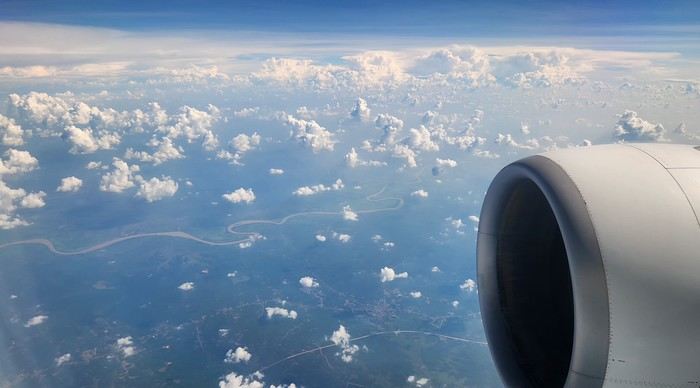
Nice transition, right? Because "Welcome to Indonesia" is exactly what the friendly flight attendant just said to me as we got off the plane! That’s it, our chakras are open, we’ve arrived at our (air)port. Time for rest, pool, cocktails, and a beach with our toes spread out... Wait, if you bought that, you clearly don’t know us yet! Since we still have energy to burn and need to adjust to the flight and time difference, we tackle the long administrative formalities to enter Indonesia, just to earn the right to hop in a 45-minute Grab taxi to the train station. The train station? What train station?... What do you usually do at a train station? Take a train, of course! Off we go for a three-hour train ride to Bandung, where we’ll officially start our adventure tomorrow after our first Indonesian night...
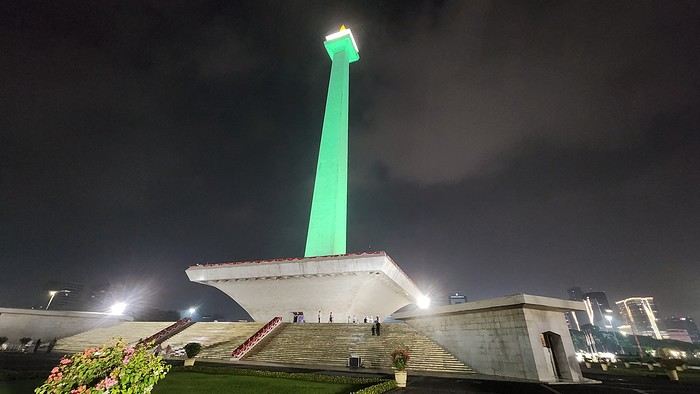
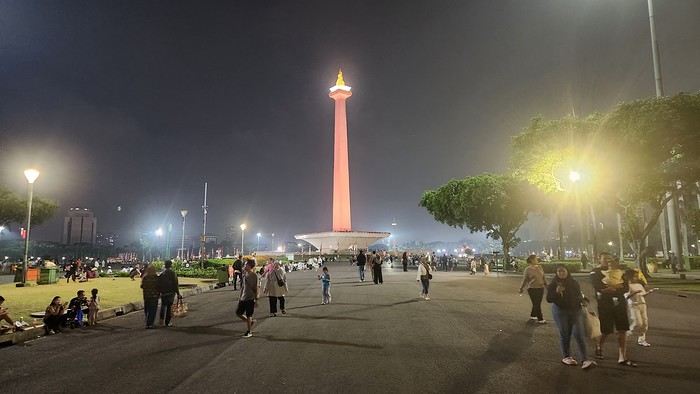
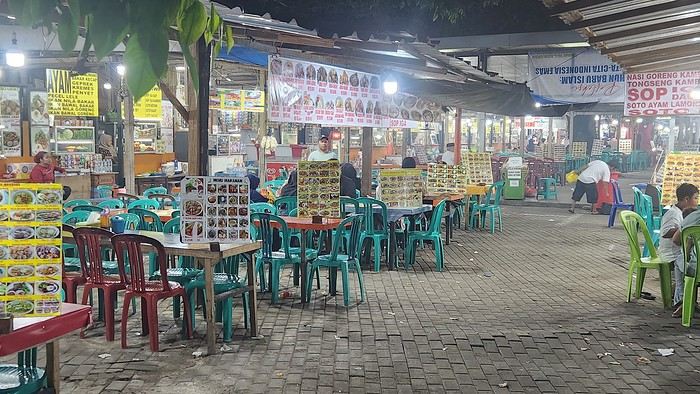
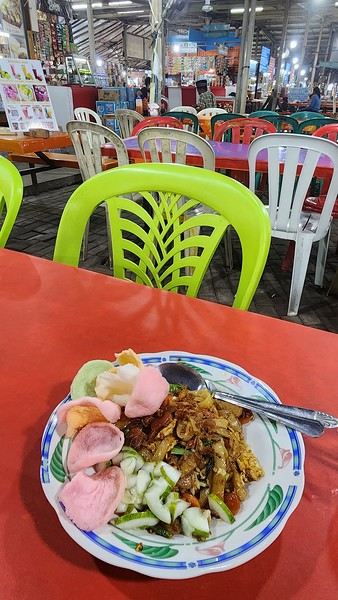
Unfortunately, we were a bit slow off the mark, which meant we missed the 6:25 PM train by two minutes. Oh well, we’ll have to wait until 11 PM. We take the opportunity to stretch our legs in Jakarta, soak up the atmosphere, and enjoy the delicious smells wafting from the *warungs*—those little typical street restaurants. A quick stop at the National Monument, a detour to a night market to devour our first *kwetiaw goreng* and *teh manis* for 60,000 rupiahs (that’s 3 € for two), and just like that, our penalty is lifted, and we’re allowed to hit the road again. Off to Bandung, where we arrive at 2 AM for... a *very* short night...
Day 1 - August 10, 2025 New life downloading for three weeks! And for that, Flo and I launched a public tender... A public tender? What’s that got to do with a travel journal???... Well, when you think about it, few destinations tick all the boxes for an August adventure: Meaning, finding a place that’s exotic in the middle of August, not too expensive, not too packed with tourists, warm but not *too* warm, with postcard-perfect landscapes, dreamy beaches, tasty cuisine with a hint of exoticism, friendly and welcoming locals, where you’re free to sleep under the stars among the mosquitos, take transport surrounded by chickens, and even eat from a pig trough if you feel like it—well, turns out it’s not that easy to find! I’d even say, given how thick the list of requirements is, there’s a big risk the tender could be declared unsuccessful for failing to meet just one criterion. Let’s just say the candidates better submit a rock-solid proposal!
After reviewing all the responses and presentations from the candidates, the obvious choice for us is... Indonesia! Except that trying to explore a country as vast as Indonesia and its 17,504 islands in less than five years is a bit like reading the summary of a Proust novel without taking the time to savor each of its 950 pages! Don’t worry, I won’t name them all here. Besides, do they even all have names? No! Only 7,870 have been named—their parents clearly ran out of ideas for the rest. Anyway, our society, which worships the "work more to earn more" mantra, unfortunately limits our adventure time. So we’ll only get to see a small part of Indonesia, and we’ll have to make a tough choice to head for the best of the best in this archipelago of over seventeen thousand islands. Each one has its own selling points: Sumatra, Sulawesi, Java, the Celebes, Bali, Borneo, Papua, Timor, the Moluccas... So many names that smell of adventure... Another tender, another list of requirements, another review of proposals... Drumroll... Splash splash... And the lucky winner is... Ta-da... Java, Bali’s big sister, where I’ve already been eight years ago... Java the programming language. The Java of Broadway. We’re gonna *do* the Java. Java the coffee. And yes, Java is also an island!
This island, four times smaller than France, is home to 136 million people, making it the most populated island in the world! Fun fact: Indonesia, with its 260 million inhabitants, is just shy of the podium for the world’s most populated countries, after the winning trio of India, China, and the United States. And it’s on this island of Java that you’ll find Jakarta, the (soon-to-be-former) capital and main airport of the country, where we’ll soon land after our nineteen-hour flight! Yep, nineteen hours! I mean, Indonesia in general—and Java in particular—is a *tad* farther than going on vacation to Grandma Yoyo’s! Not sure where it is? Easy. Grab a map. Plant your finger on the big island at the bottom right—aka Australia for those who struggle with geography—move it up two centimeters, and bam, welcome to Indonesia!
Nice transition, right? Because "Welcome to Indonesia" is exactly what the friendly flight attendant just said to me as we got off the plane! That’s it, our chakras are open, we’ve arrived at our (air)port. Time for rest, pool, cocktails, and a beach with our toes spread out... Wait, if you bought that, you clearly don’t know us yet! Since we still have energy to burn and need to adjust to the flight and time difference, we tackle the long administrative formalities to enter Indonesia, just to earn the right to hop in a 45-minute Grab taxi to the train station. The train station? What train station?... What do you usually do at a train station? Take a train, of course! Off we go for a three-hour train ride to Bandung, where we’ll officially start our adventure tomorrow after our first Indonesian night...
Unfortunately, we were a bit slow off the mark, which meant we missed the 6:25 PM train by two minutes. Oh well, we’ll have to wait until 11 PM. We take the opportunity to stretch our legs in Jakarta, soak up the atmosphere, and enjoy the delicious smells wafting from the *warungs*—those little typical street restaurants. A quick stop at the National Monument, a detour to a night market to devour our first *kwetiaw goreng* and *teh manis* for 60,000 rupiahs (that’s 3 € for two), and just like that, our penalty is lifted, and we’re allowed to hit the road again. Off to Bandung, where we arrive at 2 AM for... a *very* short night...
What to choose for a first summer trip to Asia: Indonesia or Thailand?
Hi there,
I’m planning my first trip to Asia next summer with my partner and our daughter, who’ll be 3 and a half at the time, for 4 weeks (maybe 5).
I’ve heard that the timing is better for visiting Indonesia, but I’m hesitant because Thailand seems more accessible, and I’m worried that traveling to Indonesia during high season might be less enjoyable and a lot more expensive due to the number of tourists. We love cultural sites as much as natural ones, and we’re big foodies. We’re not necessarily looking for luxury and tend to take our time, travel by public transport, and look for accommodations with a good value for money—though we do occasionally splurge on a high-end restaurant.
I’m also wondering when and where to buy flight tickets and how comfortable the journey will be (especially for our daughter) if we fly with Thai Airways or Garuda.
Thanks in advance for sharing your thoughts and tips!
Damien
I’m planning my first trip to Asia next summer with my partner and our daughter, who’ll be 3 and a half at the time, for 4 weeks (maybe 5).
I’ve heard that the timing is better for visiting Indonesia, but I’m hesitant because Thailand seems more accessible, and I’m worried that traveling to Indonesia during high season might be less enjoyable and a lot more expensive due to the number of tourists. We love cultural sites as much as natural ones, and we’re big foodies. We’re not necessarily looking for luxury and tend to take our time, travel by public transport, and look for accommodations with a good value for money—though we do occasionally splurge on a high-end restaurant.
I’m also wondering when and where to buy flight tickets and how comfortable the journey will be (especially for our daughter) if we fly with Thai Airways or Garuda.
Thanks in advance for sharing your thoughts and tips!
Damien
Join me in discovering Gran Canaria
Introduction
We stayed on the island of Gran Canaria during the first three months of 2024. It’s the third Canary Island we’ve visited, after Tenerife and Lanzarote.
We rented an apartment in Temisas. By staying in the same place for such a long period, the total price dropped by 50%.
We also rented a vehicle to make getting around the island easier.
Why the Canary Islands, and Gran Canaria in particular? For its pleasant climate, the nature and diversity of its landscapes, the charming villages, and especially the beauty of its many beaches.
In this travel journal, you’ll find a list of the many activities we did during our stay to explore the different attractions of this island.
These attractions are categorized to make it easier to find what interests you.
Videos are included throughout the summary. Click on the image to start the video.
To jump to a specific post, here are the relevant links:
HIKES:
Roque Nublo Maspalomas Dunes - Part 1 Maspalomas Dunes - Part 2 Los Azulejos de Veneguera Barranco de Las Vacas Ventana del Bentayga (Arco del Aserrador) Caves of the King Ventana de Morro (Ventana de la Ganifa) The Dog of Bentayga Cave of the Four Doors Ventana del Nublo Artenera - Caves of Acusa Seca Temisas - El Gigante Cave Fortress of Ansite Puerto de Las Nieves - Roque de Las Nieves Temisas - Cuevas de la Audiencia Roque Bentayga Guayadeque Ravine (Guayadeque Hermitage) Guayadeque Ravine (Cueva de Bartalo) El Zumacal - Barranco Tauco Casablanca Dam (Los Dolores Dam) Ayagaures - La Angostura Dam & Gambuesa Dam Santa Brígida - Alonso Ravine & Centennial Dragon Tree Pino Santo Hike in the Azuaje Ravine Gáldar - Red Lands of Samarrita Tejeda - Charco de La Paloma Bandama Boiler (Camino Borde de Caldera Bandama) Teror - Alamo Ravine Trail – SL-4 Telde - Calasio Caves Special Natural Reserve of Los Tilos de Moya Los Azulejos - Charco de Las Aneas Fataga Ravine Arinaga Military Battery Trail Maspalomas - Las Fuentes and del Canizo Ravines Mogán - Tauro Mountain Trail Tamabada - Llanos de La Mimbre & Sobre la Cueva Viewpoints Trail Hike to the Coronadero Arch via Barranco Hondo Barranco de Silva - Hike to the Jerez Caves Gáldar - Samson Cave - La Atalaya Peak Agaete - Roque Guayedra and Guayedra Ravine Artenara - Caballero Caves Arucas - Bufadero Salt Flats Barranco de Pino Gordo - Natural Pools Telde - Los Cernícalos Ravine Las Cruces - Toba Caves & Picón Puerto de Las Nieves - Moro Cave Agüimes - Morros de Ávila Caves Juncalillo del Sur - Laguna & Salinas de Abajo Caves of Camino de San Felipe Cruz de Tejeda, Cruz Chico and Degollada Viewpoint Hike on the Patalavaca Circuit Motor Grande - Puerto Rico Arch El Montañón - Los Hornos Dam Seafront Walk - Amadores Beach – Puerto Rico Beach Las Niñas Dam El Hornillo - Omega & Omicron Caves Arteara Necropolis Mogán - El Mulato Dam Las Garzas - El Regante Dam La Plata Route - Cho Flores Dam & El Charco Hondo Vega de Acusa - La Candelaria Dam Candelaria Hermitage – Acusa Seca Viewpoint Valsequillo de Gran Canaria – Roque La Vela Ayagaures Dam – GC-602 Lomo del Palo - Monte Pavón Trail Lugar La Laguna - Levada Fataga Dam & Ravine
BEACHES:
Mogán Beach Taurito Beach Tauro Beach Amadores Beach Puerto Rico Beach Anfi del Mar Beach Patalavaca Beach Meloneras Beach Maspalomas Beach English Beach (Playa del Inglés) Las Burras Beach San Agustin Beach Las Alcaravaneras Beach Las Canteras Beach (La Cicer) Las Canteras Beach (La Puntilla) Las Canteras Beach (Santa Catalina) Aquamarina Beach El Agujero - Bocabarranco Beach Hoya Del Pozo Beach Hoya Del Pozo Beach - Lizard with amputated tail El Cabron Beach Ojos de Garza Beach El Burrero Beach
NATURAL POOLS:
Charco Azul - El Risco Agaete Salt Flats Charco de Los Espejos - Sardina del Norte Natural Pools of Punta de Gáldar Snorkeling in the natural pool of Punta de Gáldar Natural Pool La Furnia o El Clavo - Gáldar Natural Pool of Los Dos Roques Emiliano Natural Pool - El Agujero Natural Pool of El Agujero Natural Pools of Roque Prieto Natural Pool El Altillo Los Charcones de Bañaderos – Arucas Natural Pools of El Charco de Las Palomas – Arucas Natural Pools of La Laja - Las Palmas de Gran Canaria Cueva de la Reina Mora - La Garita Natural Pools of Castillo del Romeral
TOWNS:
Center
Santa Brigida Vega de San Mateo Tejeda Artenara Vallesco Teror
Southwest
Santa Lucia de Tirajana Fataga San Bartolomé de Tirajana Puerto de Mogán La Aldea de San Nicolas
North
Arucas Firgas Moya Santa Maria de Guia Gáldar Agaete Puerto de Las Nieves
East
Vegueta - Las Palmas de Gran Canaria Triana - Las Palmas de Gran Canaria Ciudad Jardin - Las Palmas de Gran Canaria Canteras - Las Palmas de Gran Canaria Telde Valsequillo de Gran Canaria Ingenio Agüimes Temisas
VIEWPOINTS:
GC-60 Route (or nearby) GC-210 Route (or nearby) GC-210 Route between the tunnel and La Aldea de San Nicolás GC-215 & GC-65 Routes (or nearby) GC-200 Route (or nearby) GC-130 Route (or nearby) & GC-605 GC-70 Route (or nearby) & GC-21 Sheep herd on GC-70 Route GC-150, GC-240, GC-305, GC-350 & GC-301 Routes GC-606, GC-295, GC-231 and GC-41 Routes (or nearby) Viewpoints – GC-1 Route (or nearby) Viewpoints - Las Palmas de Gran Canaria Viewpoints - GC-2, GC-21, GC-15, GC-216 and GC-132 Routes (or nearby) Viewpoints - GC-503 & GC-217 Routes Viewpoints - GC-604, GC-505, GC-132, GC-42 and GC-802 Routes
MISCELLANEOUS:
San Rafael Aqueduct - Telde Abandoned San Rafael Estate - La Higuera Cenobio de Valerón La Cesta - Tejeda Puerto de la Aldea Scenic Route GC-671 to El Espinillo Scenic Route GC-607 to El Chorrillo The Galdar Cube (Santiago Quarry) Scenic Route GC-504 to Ayagaures Abandoned seaside resort in the Azuaje Ravine El Bufadero de La Garita – Telde GC-505 Route Abandoned Finca Las Haciendas (Los Mocanes) – Las Vegas de Valsequillo Ruins of San Juan Battery - Las Palmas de Gran Canaria Viera y Clavijo Canarian Botanical Garden - Las Palmas de Gran Canaria Tenefé Salt Flats Los Pérez, Lugarejos & Las Hoyas Dams Monte Pavón, Gran Canaria’s little Ireland Valleseco Lagoon Recreational Area Climbing - Fataga Ravine Surfing – El Agujero El Cairete Restaurant - Carrizal de Tejeda Paragliding flight observation - Los Giles La Cuevita Ayagaures Restaurant Statues and Murals - Cruce de Arinaga Aviation Monument (Las Majoreras) & Murals – Carrizal Artistic recycling by Antonio Peñita - Ojos de Garza Rainbows
We stayed on the island of Gran Canaria during the first three months of 2024. It’s the third Canary Island we’ve visited, after Tenerife and Lanzarote.
We rented an apartment in Temisas. By staying in the same place for such a long period, the total price dropped by 50%.
We also rented a vehicle to make getting around the island easier.
Why the Canary Islands, and Gran Canaria in particular? For its pleasant climate, the nature and diversity of its landscapes, the charming villages, and especially the beauty of its many beaches.
In this travel journal, you’ll find a list of the many activities we did during our stay to explore the different attractions of this island.
These attractions are categorized to make it easier to find what interests you.
Videos are included throughout the summary. Click on the image to start the video.
To jump to a specific post, here are the relevant links:
HIKES:
Roque Nublo Maspalomas Dunes - Part 1 Maspalomas Dunes - Part 2 Los Azulejos de Veneguera Barranco de Las Vacas Ventana del Bentayga (Arco del Aserrador) Caves of the King Ventana de Morro (Ventana de la Ganifa) The Dog of Bentayga Cave of the Four Doors Ventana del Nublo Artenera - Caves of Acusa Seca Temisas - El Gigante Cave Fortress of Ansite Puerto de Las Nieves - Roque de Las Nieves Temisas - Cuevas de la Audiencia Roque Bentayga Guayadeque Ravine (Guayadeque Hermitage) Guayadeque Ravine (Cueva de Bartalo) El Zumacal - Barranco Tauco Casablanca Dam (Los Dolores Dam) Ayagaures - La Angostura Dam & Gambuesa Dam Santa Brígida - Alonso Ravine & Centennial Dragon Tree Pino Santo Hike in the Azuaje Ravine Gáldar - Red Lands of Samarrita Tejeda - Charco de La Paloma Bandama Boiler (Camino Borde de Caldera Bandama) Teror - Alamo Ravine Trail – SL-4 Telde - Calasio Caves Special Natural Reserve of Los Tilos de Moya Los Azulejos - Charco de Las Aneas Fataga Ravine Arinaga Military Battery Trail Maspalomas - Las Fuentes and del Canizo Ravines Mogán - Tauro Mountain Trail Tamabada - Llanos de La Mimbre & Sobre la Cueva Viewpoints Trail Hike to the Coronadero Arch via Barranco Hondo Barranco de Silva - Hike to the Jerez Caves Gáldar - Samson Cave - La Atalaya Peak Agaete - Roque Guayedra and Guayedra Ravine Artenara - Caballero Caves Arucas - Bufadero Salt Flats Barranco de Pino Gordo - Natural Pools Telde - Los Cernícalos Ravine Las Cruces - Toba Caves & Picón Puerto de Las Nieves - Moro Cave Agüimes - Morros de Ávila Caves Juncalillo del Sur - Laguna & Salinas de Abajo Caves of Camino de San Felipe Cruz de Tejeda, Cruz Chico and Degollada Viewpoint Hike on the Patalavaca Circuit Motor Grande - Puerto Rico Arch El Montañón - Los Hornos Dam Seafront Walk - Amadores Beach – Puerto Rico Beach Las Niñas Dam El Hornillo - Omega & Omicron Caves Arteara Necropolis Mogán - El Mulato Dam Las Garzas - El Regante Dam La Plata Route - Cho Flores Dam & El Charco Hondo Vega de Acusa - La Candelaria Dam Candelaria Hermitage – Acusa Seca Viewpoint Valsequillo de Gran Canaria – Roque La Vela Ayagaures Dam – GC-602 Lomo del Palo - Monte Pavón Trail Lugar La Laguna - Levada Fataga Dam & Ravine
BEACHES:
Mogán Beach Taurito Beach Tauro Beach Amadores Beach Puerto Rico Beach Anfi del Mar Beach Patalavaca Beach Meloneras Beach Maspalomas Beach English Beach (Playa del Inglés) Las Burras Beach San Agustin Beach Las Alcaravaneras Beach Las Canteras Beach (La Cicer) Las Canteras Beach (La Puntilla) Las Canteras Beach (Santa Catalina) Aquamarina Beach El Agujero - Bocabarranco Beach Hoya Del Pozo Beach Hoya Del Pozo Beach - Lizard with amputated tail El Cabron Beach Ojos de Garza Beach El Burrero Beach
NATURAL POOLS:
Charco Azul - El Risco Agaete Salt Flats Charco de Los Espejos - Sardina del Norte Natural Pools of Punta de Gáldar Snorkeling in the natural pool of Punta de Gáldar Natural Pool La Furnia o El Clavo - Gáldar Natural Pool of Los Dos Roques Emiliano Natural Pool - El Agujero Natural Pool of El Agujero Natural Pools of Roque Prieto Natural Pool El Altillo Los Charcones de Bañaderos – Arucas Natural Pools of El Charco de Las Palomas – Arucas Natural Pools of La Laja - Las Palmas de Gran Canaria Cueva de la Reina Mora - La Garita Natural Pools of Castillo del Romeral
TOWNS:
Center
Santa Brigida Vega de San Mateo Tejeda Artenara Vallesco Teror
Southwest
Santa Lucia de Tirajana Fataga San Bartolomé de Tirajana Puerto de Mogán La Aldea de San Nicolas
North
Arucas Firgas Moya Santa Maria de Guia Gáldar Agaete Puerto de Las Nieves
East
Vegueta - Las Palmas de Gran Canaria Triana - Las Palmas de Gran Canaria Ciudad Jardin - Las Palmas de Gran Canaria Canteras - Las Palmas de Gran Canaria Telde Valsequillo de Gran Canaria Ingenio Agüimes Temisas
VIEWPOINTS:
GC-60 Route (or nearby) GC-210 Route (or nearby) GC-210 Route between the tunnel and La Aldea de San Nicolás GC-215 & GC-65 Routes (or nearby) GC-200 Route (or nearby) GC-130 Route (or nearby) & GC-605 GC-70 Route (or nearby) & GC-21 Sheep herd on GC-70 Route GC-150, GC-240, GC-305, GC-350 & GC-301 Routes GC-606, GC-295, GC-231 and GC-41 Routes (or nearby) Viewpoints – GC-1 Route (or nearby) Viewpoints - Las Palmas de Gran Canaria Viewpoints - GC-2, GC-21, GC-15, GC-216 and GC-132 Routes (or nearby) Viewpoints - GC-503 & GC-217 Routes Viewpoints - GC-604, GC-505, GC-132, GC-42 and GC-802 Routes
MISCELLANEOUS:
San Rafael Aqueduct - Telde Abandoned San Rafael Estate - La Higuera Cenobio de Valerón La Cesta - Tejeda Puerto de la Aldea Scenic Route GC-671 to El Espinillo Scenic Route GC-607 to El Chorrillo The Galdar Cube (Santiago Quarry) Scenic Route GC-504 to Ayagaures Abandoned seaside resort in the Azuaje Ravine El Bufadero de La Garita – Telde GC-505 Route Abandoned Finca Las Haciendas (Los Mocanes) – Las Vegas de Valsequillo Ruins of San Juan Battery - Las Palmas de Gran Canaria Viera y Clavijo Canarian Botanical Garden - Las Palmas de Gran Canaria Tenefé Salt Flats Los Pérez, Lugarejos & Las Hoyas Dams Monte Pavón, Gran Canaria’s little Ireland Valleseco Lagoon Recreational Area Climbing - Fataga Ravine Surfing – El Agujero El Cairete Restaurant - Carrizal de Tejeda Paragliding flight observation - Los Giles La Cuevita Ayagaures Restaurant Statues and Murals - Cruce de Arinaga Aviation Monument (Las Majoreras) & Murals – Carrizal Artistic recycling by Antonio Peñita - Ojos de Garza Rainbows
Malaysia or Mexico for a family trip: nature, beach, and culture?
Hi everyone!
We’re a family of 4: 2 adults and 2 kids aged 3 and 6.
I’m looking for a nature-beach-culture destination for May 2026. Right now, I’m torn between Mexico and Malaysia. I’ve read about the Yucatán, for example—it’s easy for a first trip to Mexico, but I’m worried I won’t get that authentic Mexican vibe, especially if we have to rent a car. I don’t want our trip to just be a checklist of beautiful sites. I love Asia for the atmosphere and the ease of traveling independently. Anyway, can you share your thoughts on these two destinations and help me with my research? Thanks!
Hélène
Back from 3 weeks in Guatemala – self-drive trip
Hi everyone.
I wanted to share a little feedback from our trip to Guatemala—we got back a month ago, and I really appreciated the well-commented posts here that helped us out. So, in turn, I wanted to share our own little recap.
We’ve traveled quite a bit together (we’re 38 and 42), and Guatemala had been on our radar for a while. But with so much info out there, it was hard to sort through it all—especially since we only had 3 weeks on the ground and didn’t want to waste time.
Here’s the itinerary we followed: Antigua, the Pacific coast, Lake Atitlán, a private coffee and bird reserve, Chichicastenango, Sayaxché, El Remate, Río Dulce, and Lake Izabal.
We rented a 4x4, which was essential given the state of some roads.
Our highlights: * **Pacific coast**: So authentic and preserved. We met sea turtles, cooked and baked coconut bread with a women’s community—such a meaningful exchange—and kayaked through a pristine mangrove full of birds. * **Lake Atitlán**: Even though we were worried it might feel too touristy, a private tour let us discover local crafts, hidden workshops (weaving, pottery), and the stunning views from the boat. * **Sayaxché**: The starting point for the Aguateca and Dos Pilas sites—one of our favorite outings. The site is breathtaking: walking through the canyon and jungle-covered ruins with almost no one around. We stayed in a little bungalow on an island, totally off the grid. * **In Petén**, we met an Itza Maya tribe—an unforgettable day sharing a meal and plant-based healing rituals. Wow. This tribe resisted the conquistadors and still lives traditionally. We also took a tour on Lake Petén and swam at hidden little beaches. Tikal was nice, but we preferred Yaxhá. * **Río Dulce**: A day at a private cocoa plantation—an adventure in a buggy with the owner himself. We harvested cocoa and ate the chocolate paste afterward, then swam in a waterfall on the property. Since it’s private, there was no one else around. A real privilege. * **Boat tour on the Río Dulce**: For us, the highlight. We visited a school where they’re committed to giving kids a solid education while blending Maya rituals. * **Lake Izabal**: A peaceful end to the trip in a magical setting. We visited Quiriguá.
We went through an organizer who knows the country really well. We weren’t initially planning on that, but thanks to her, we had experiences we never would’ve found on our own. On top of that, we actually paid less for the trip overall because of her local rates. I’m not getting anything out of this—I just think it could help other travelers. Her business is Secretplaceincostarica (she also does Costa Rica, which we’re now eager to explore).
On the ground, we felt completely safe. The people are lovely, the roads can be a little chaotic at times, but we loved every minute of it.
Happy travels to all! Marie
I wanted to share a little feedback from our trip to Guatemala—we got back a month ago, and I really appreciated the well-commented posts here that helped us out. So, in turn, I wanted to share our own little recap.
We’ve traveled quite a bit together (we’re 38 and 42), and Guatemala had been on our radar for a while. But with so much info out there, it was hard to sort through it all—especially since we only had 3 weeks on the ground and didn’t want to waste time.
Here’s the itinerary we followed: Antigua, the Pacific coast, Lake Atitlán, a private coffee and bird reserve, Chichicastenango, Sayaxché, El Remate, Río Dulce, and Lake Izabal.
We rented a 4x4, which was essential given the state of some roads.
Our highlights: * **Pacific coast**: So authentic and preserved. We met sea turtles, cooked and baked coconut bread with a women’s community—such a meaningful exchange—and kayaked through a pristine mangrove full of birds. * **Lake Atitlán**: Even though we were worried it might feel too touristy, a private tour let us discover local crafts, hidden workshops (weaving, pottery), and the stunning views from the boat. * **Sayaxché**: The starting point for the Aguateca and Dos Pilas sites—one of our favorite outings. The site is breathtaking: walking through the canyon and jungle-covered ruins with almost no one around. We stayed in a little bungalow on an island, totally off the grid. * **In Petén**, we met an Itza Maya tribe—an unforgettable day sharing a meal and plant-based healing rituals. Wow. This tribe resisted the conquistadors and still lives traditionally. We also took a tour on Lake Petén and swam at hidden little beaches. Tikal was nice, but we preferred Yaxhá. * **Río Dulce**: A day at a private cocoa plantation—an adventure in a buggy with the owner himself. We harvested cocoa and ate the chocolate paste afterward, then swam in a waterfall on the property. Since it’s private, there was no one else around. A real privilege. * **Boat tour on the Río Dulce**: For us, the highlight. We visited a school where they’re committed to giving kids a solid education while blending Maya rituals. * **Lake Izabal**: A peaceful end to the trip in a magical setting. We visited Quiriguá.
We went through an organizer who knows the country really well. We weren’t initially planning on that, but thanks to her, we had experiences we never would’ve found on our own. On top of that, we actually paid less for the trip overall because of her local rates. I’m not getting anything out of this—I just think it could help other travelers. Her business is Secretplaceincostarica (she also does Costa Rica, which we’re now eager to explore).
On the ground, we felt completely safe. The people are lovely, the roads can be a little chaotic at times, but we loved every minute of it.
Happy travels to all! Marie
Discussion Embracing Dawn: December 2024 Photo Contest
Hey there,
This is where we chat and share photos outside the contest.
Good night! 😛
This is where we chat and share photos outside the contest.
Good night! 😛
Photo Contest, September 2020: Departure or Arrival Scenes and Places
Hello everyone, 🙂
This month’s theme is: places, departure or arrival scenes.
The places include: train or bus stations, passenger ports, and airports.
Here, for example, is Beijing West Railway Station
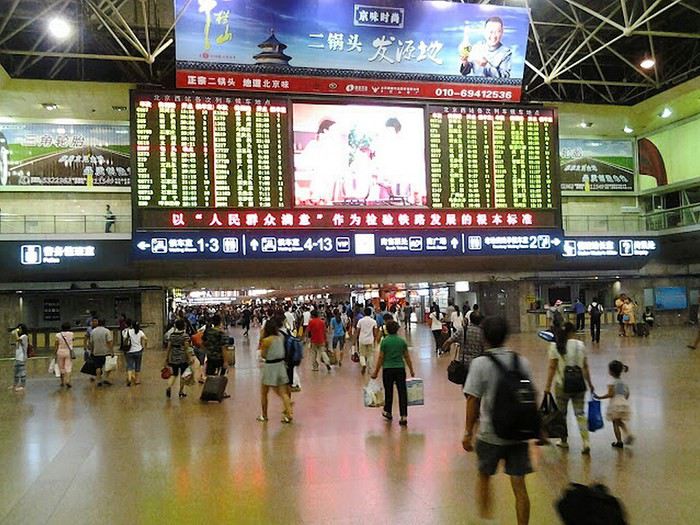 This is Beijing West Railway Station.
You can submit a photo of the whole place, a part of it (inside or outside, the platforms), or a detail (like a station clock) as long as it clearly shows it’s a departure or arrival spot—such as a timetable display.
Or here’s another example:
This is Beijing West Railway Station.
You can submit a photo of the whole place, a part of it (inside or outside, the platforms), or a detail (like a station clock) as long as it clearly shows it’s a departure or arrival spot—such as a timetable display.
Or here’s another example:
Even if you’re not in one of these places, a departure or arrival scene is welcome: Example: Early morning departure from a pagoda at Inle Lake (Myanmar) as people head back to their villages in the surrounding hills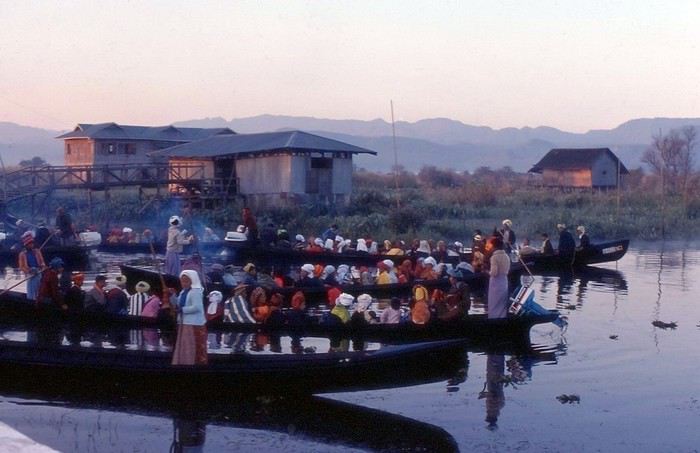
A vehicle about to leave: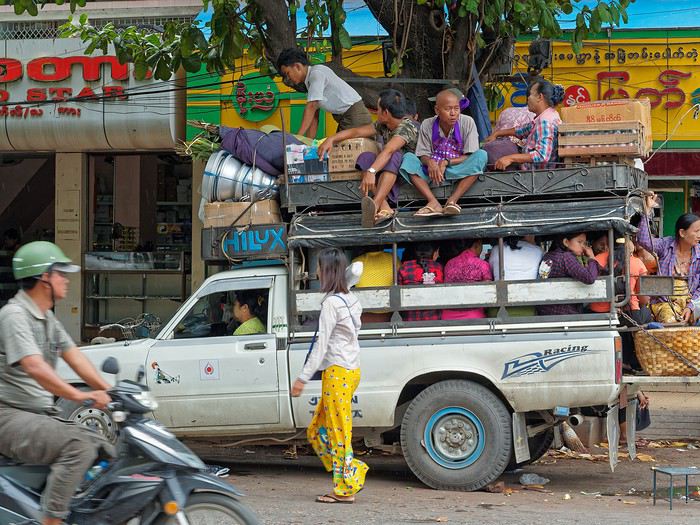
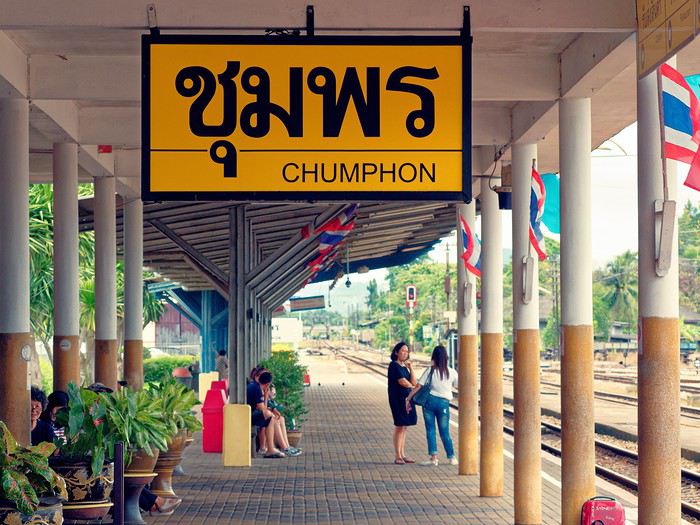
People are also allowed, as long as they’re clearly identified as travelers about to depart or who have just arrived. Bus station in Thailand (a photo I’d shared for the "solitude" theme)
Another example: in the foreground, a boat docked, and just above, another that has just left (Rangoon, Myanmar—these boats serve cities in the Irrawaddy Delta, and in some areas, they’re still the only means of transport for locals).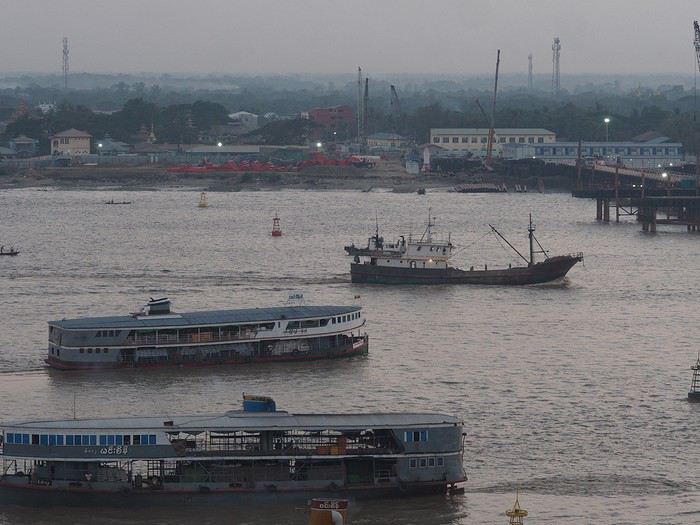
You can also include departures or arrivals from races, but again, it must be at the start or finish, not during the race: Boats before the start of the Route du Rhum in Saint-Malo: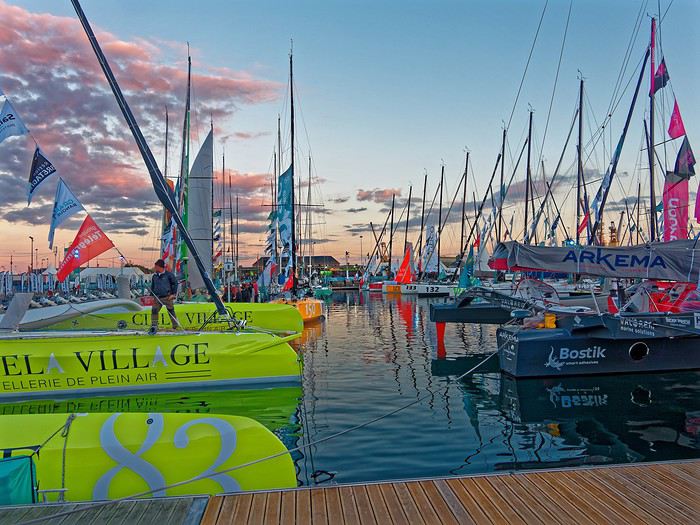
Participation: Each participant can submit up to 3 photos, until Tuesday, September 22 at 11:59 PM Paris time. Each photo must be posted in a separate message, with its number (1, 2, or 3). Don’t forget to add a short description (comment, location, etc.).
Voting: Every VoyageForum member can vote for the 4 photos they think are the best, based on their own criteria and the theme (I’m trying this format this month). Voting will take place from Wednesday, September 23 to Tuesday, September 29 at 11:59 PM Paris time.
Photos should be ranked in order of preference: - 1st photo: 4 points - 2nd: 3 points - 3rd: 2 points - 4th: 1 point
Each member can vote only once for 4 photos. No ties for 4th place with half a point each.
The winner is the photographer whose photo receives the most points. Results will be announced on September 30. In case of a tie, the number of first-place votes will decide. The winner will have the honor of organizing October’s contest.
Give me two or three days to put together the slideshow—I’ll definitely reach out to Masterpo via PM for advice if I’m stuck (and if he’s willing).
Good luck to everyone—may the best photographer win! Let’s get started! For discussion, it’s here
This is Beijing West Railway Station.
You can submit a photo of the whole place, a part of it (inside or outside, the platforms), or a detail (like a station clock) as long as it clearly shows it’s a departure or arrival spot—such as a timetable display.
Or here’s another example:
Even if you’re not in one of these places, a departure or arrival scene is welcome: Example: Early morning departure from a pagoda at Inle Lake (Myanmar) as people head back to their villages in the surrounding hills
A vehicle about to leave:
People are also allowed, as long as they’re clearly identified as travelers about to depart or who have just arrived. Bus station in Thailand (a photo I’d shared for the "solitude" theme)
Another example: in the foreground, a boat docked, and just above, another that has just left (Rangoon, Myanmar—these boats serve cities in the Irrawaddy Delta, and in some areas, they’re still the only means of transport for locals).
You can also include departures or arrivals from races, but again, it must be at the start or finish, not during the race: Boats before the start of the Route du Rhum in Saint-Malo:
Participation: Each participant can submit up to 3 photos, until Tuesday, September 22 at 11:59 PM Paris time. Each photo must be posted in a separate message, with its number (1, 2, or 3). Don’t forget to add a short description (comment, location, etc.).
Voting: Every VoyageForum member can vote for the 4 photos they think are the best, based on their own criteria and the theme (I’m trying this format this month). Voting will take place from Wednesday, September 23 to Tuesday, September 29 at 11:59 PM Paris time.
Photos should be ranked in order of preference: - 1st photo: 4 points - 2nd: 3 points - 3rd: 2 points - 4th: 1 point
Each member can vote only once for 4 photos. No ties for 4th place with half a point each.
The winner is the photographer whose photo receives the most points. Results will be announced on September 30. In case of a tie, the number of first-place votes will decide. The winner will have the honor of organizing October’s contest.
Give me two or three days to put together the slideshow—I’ll definitely reach out to Masterpo via PM for advice if I’m stuck (and if he’s willing).
Good luck to everyone—may the best photographer win! Let’s get started! For discussion, it’s here
Discussion parallèle au concours photo d'août: "Noir & Blanc" English translation pending
Je vous donne rendez-vous ici pour vos photos hors concours, pour discuter, échanger, conseiller, apprendre et s'amuser 😛
Le concours se passe par-là: https://voyageforum.com/v.f?post=10330487;a=10330487
Le concours se passe par-là: https://voyageforum.com/v.f?post=10330487;a=10330487
Discussion autour du concours de juillet 2020: Verticale(s) English translation pending
Pour discuter autour du concours de juillet 2020, Verticale(s), ça se passe ici.
Qui croit encore à un voyage en Indonésie cet été? English translation pending
Bonjour à tous
J'ai des billets pour un voyage en Indonésie (Raja Ampat et Sulawesi) avec un départ début juillet et retour fin aout. Mes billets ont été pris au mois d'octobre 2019... Est ce que certains sont dans le même cas? J'ai des billets Lufthansa pour Jakarta et ensuite des vols intérieurs pour Sorong et un retour de Manado avec Batik. Normalement je prends un visa touriste 60 jours qui mets au moins 3 semaines à être fait. J 'ai bien compris que le vol doit être annulé si on veut espérer au moins un avoir (je veux bien partir en 2021...). Je n'arrive pas à avoir des infos sur l'Indonésie. Je viens de voir que la Thaïlande ré ouvre complétement son pays au tourisme. Je me demande ce qu'il en est pour l'Indo... Est ce que quelqu'un a des infos? Quid de mon visa à temps pour début juin (le 9 de mémoire)? Merci pour vos retours. Ça commence à prendre la tête cette histoire...
J'ai des billets pour un voyage en Indonésie (Raja Ampat et Sulawesi) avec un départ début juillet et retour fin aout. Mes billets ont été pris au mois d'octobre 2019... Est ce que certains sont dans le même cas? J'ai des billets Lufthansa pour Jakarta et ensuite des vols intérieurs pour Sorong et un retour de Manado avec Batik. Normalement je prends un visa touriste 60 jours qui mets au moins 3 semaines à être fait. J 'ai bien compris que le vol doit être annulé si on veut espérer au moins un avoir (je veux bien partir en 2021...). Je n'arrive pas à avoir des infos sur l'Indonésie. Je viens de voir que la Thaïlande ré ouvre complétement son pays au tourisme. Je me demande ce qu'il en est pour l'Indo... Est ce que quelqu'un a des infos? Quid de mon visa à temps pour début juin (le 9 de mémoire)? Merci pour vos retours. Ça commence à prendre la tête cette histoire...
Littérature de voyage, échos du changement English translation pending
Bonjour,
Et si finalement on donnait la parole à d'autres ?
Aux écrivains qui nous sont chers, à tous ceux qui dans leurs livres ont évoqué bien mieux que nous les interrogations, les doutes, le changement, la mue et l'adaptation dans le voyage ?
Et si leur expérience et leurs mots à eux, en quelques paragraphes ou phrases isolées que vous publierez ici, éclairaient un peu notre lanterne pour les mois ou les années à venir ?
L.
--
Nicolas Bouvier. Retour d'Inde. Publié dans " Bleu Immortel. Voyages en Afghanistan ". Editions Zoe. 2003.
--
" Revenir d'Asie pose des problèmes très précis. En Suisse, retour d'Inde et du Japon, je me suis longtemps senti mal à l'aise. Les magasins, les rues m'inspiraient une répulsion irraisonnée. Noël qui approchait, la foule des acheteurs, les farces tartinées de santé, le bruit des sous, la couperose me donnaient le cafard. Le seul endroit où je respirais, où je croisais de vrais regards c'était -- tenez-vous bien -- l'hôpital. Pourtant, c'était mon pays que je m'étais réjoui de revoir, pourtant on m'avait partout accueilli avec une gentillesse qui ne se démentait pas. Alors ? Je crois que c'était l'argent qui me gênait. L'argent engorgeait tout. Et à cause de cet argent, il n'y avait plus de foule ; elle était rompue, divisée comme une étendue de sable par les mailles éparses d'un filet. Il n'y avait que de petites fortunes, de petites coquilles, de petites solitudes meublées, feutrées, équipées, mais solitudes quand même. Dans les salles de billard, dans les autobus, j'entendais souvent cette phrase qui me paraissait stupéfiante : " Moi, je n'ai besoin de personne. " La communauté n'existait plus -- communauté : le sentiment profond que le sort de n'importe lequel de vos semblables vous concerne et vous affecte en quelque façon, la conscience d'une interdépendance -- , et pour qu'elle se recrée il fallait un de ces chocs -- accident mortel sur la route, révolution hongroise -- qui montrent bien que l'argent n'est pas tout et que ce qui nous rapproche le plus des autres est plus fondamental que ce qui nous en éloigne. Autrement, et en temps normal, on n'avait besoin de personne. Ce n'était que trop vrai, et quelle indigence. L'Hindou et le Chinois exposés en permanence à manquer de riz et de galette ont perpétuellement besoin du voisin, et le voisin d'eux. Le paysan du Dekkan a beau avoir l'oeil vide et feindre l'indifférence ; mendier de la farine, prêter de la farine, voir -- à cause d'une rivière qui déborde à 200 kilomètres de là -- sa maison soudain remplie d'inconnus, et pour longtemps, il ne connaît que ça, c'est son ordinaire. Voilà qui fait des foules. La misère se partage, et c'est grâce à cela que les misérables vivent encore. L'égoïsme n'est pas dans leurs moyens, trop coûteux. La prospérité ne se partage pas. Il faut cependant quitter la misère. Les Indiens y travaillent et on leur souhaite de réussir. Je leur souhaite aussi de conserver alors le coeur qu'ils avaient quand ils n'avaient que ça. "
Et si finalement on donnait la parole à d'autres ?
Aux écrivains qui nous sont chers, à tous ceux qui dans leurs livres ont évoqué bien mieux que nous les interrogations, les doutes, le changement, la mue et l'adaptation dans le voyage ?
Et si leur expérience et leurs mots à eux, en quelques paragraphes ou phrases isolées que vous publierez ici, éclairaient un peu notre lanterne pour les mois ou les années à venir ?
L.
--
Nicolas Bouvier. Retour d'Inde. Publié dans " Bleu Immortel. Voyages en Afghanistan ". Editions Zoe. 2003.
--
" Revenir d'Asie pose des problèmes très précis. En Suisse, retour d'Inde et du Japon, je me suis longtemps senti mal à l'aise. Les magasins, les rues m'inspiraient une répulsion irraisonnée. Noël qui approchait, la foule des acheteurs, les farces tartinées de santé, le bruit des sous, la couperose me donnaient le cafard. Le seul endroit où je respirais, où je croisais de vrais regards c'était -- tenez-vous bien -- l'hôpital. Pourtant, c'était mon pays que je m'étais réjoui de revoir, pourtant on m'avait partout accueilli avec une gentillesse qui ne se démentait pas. Alors ? Je crois que c'était l'argent qui me gênait. L'argent engorgeait tout. Et à cause de cet argent, il n'y avait plus de foule ; elle était rompue, divisée comme une étendue de sable par les mailles éparses d'un filet. Il n'y avait que de petites fortunes, de petites coquilles, de petites solitudes meublées, feutrées, équipées, mais solitudes quand même. Dans les salles de billard, dans les autobus, j'entendais souvent cette phrase qui me paraissait stupéfiante : " Moi, je n'ai besoin de personne. " La communauté n'existait plus -- communauté : le sentiment profond que le sort de n'importe lequel de vos semblables vous concerne et vous affecte en quelque façon, la conscience d'une interdépendance -- , et pour qu'elle se recrée il fallait un de ces chocs -- accident mortel sur la route, révolution hongroise -- qui montrent bien que l'argent n'est pas tout et que ce qui nous rapproche le plus des autres est plus fondamental que ce qui nous en éloigne. Autrement, et en temps normal, on n'avait besoin de personne. Ce n'était que trop vrai, et quelle indigence. L'Hindou et le Chinois exposés en permanence à manquer de riz et de galette ont perpétuellement besoin du voisin, et le voisin d'eux. Le paysan du Dekkan a beau avoir l'oeil vide et feindre l'indifférence ; mendier de la farine, prêter de la farine, voir -- à cause d'une rivière qui déborde à 200 kilomètres de là -- sa maison soudain remplie d'inconnus, et pour longtemps, il ne connaît que ça, c'est son ordinaire. Voilà qui fait des foules. La misère se partage, et c'est grâce à cela que les misérables vivent encore. L'égoïsme n'est pas dans leurs moyens, trop coûteux. La prospérité ne se partage pas. Il faut cependant quitter la misère. Les Indiens y travaillent et on leur souhaite de réussir. Je leur souhaite aussi de conserver alors le coeur qu'ils avaient quand ils n'avaient que ça. "
Sur les terres mayas English translation pending
Bonjour à tous les amoureux de voyage,
Je me propose de vous faire partager notre voyage au Guatemala, pays assez peu renseigné sur VF. Je l’agrémenterai de quelques photos (tablette) sans prétention qui se veulent seulement illustratives et je demande par avance votre indulgence.
Initialement nous avions opté pour un périple au Pérou en février. Les agences contactées ont eu l’honnêteté, et nous les en remercions, de nous indiquer que cela n’était pas une bonne période pour se rendre sur les plateaux andins. Après une longue hésitation nous avons orienté nos recherches vers le Guatemala et le Honduras et avons pris des contacts avec 2 agences francophones à Antigua pour des propositions et des devis. Très vite nous avons retenu « Bon Voyage » plus réactive et nettement moins chère que sa consœur. Après plusieurs itérations avec Arnaud (patron de l’agence) nous avons convergé vers un circuit de 16 j entre le 6/2 et le 21/2/2020.
Jour 1 :
Pour les vols internationaux nous avions le choix entre une escale aux USA ou à Madrid. Pour à peine plus cher (660 €/p) et un temps de vol bien plus court nous avons finalement choisi IBERIA au détriment des compagnies et contraintes (ESTA et douane) américaines. De plus les vols IBERIA sont au départ (et retour) d’Orly plus commode pour nous.
L’horaire de départ étant très matinal nous décidons de dormir à Orly. L’hôtel Ibis Budget « cœur d’Orly » fera l’affaire. Disons le, c’est cher pour un hôtel de ce type (entrée de gamme) mais il a le mérite de servir le PdJ à partir de 4 h. Cet horaire nous permet de garer notre voiture dans un parking de la zone industriel de Senia et une navette nous dépose à l’aéroport vers 6h. Le vol Orly - Madrid part à 7h30 et nous attendrons 3h pour prendre celui qui nous mènera à Guatemala City où nous arrivons vers 17 h (heure locale soit – 7h de décalage. Ces vols seront sans histoire ni retard. A notre arrivée, Luis notre chauffeur, nous attend. Son sourire et sa gentillesse nous séduisent de suite. Il est chargé de nous conduire à Antigua. Mais les routes à cette heure sont saturées et nous mettrons plus de 2h pour parvenir à Antigua pourtant distante de moins de 40 km de la capitale. Il nous dépose à l’hôtel Posada San Pedro dans lequel nous résiderons 5 nuits durant notre séjour. L’hôtel n’a que 8 chambres et ne sert pas de PdJ mais il est bien situé (7ième avenue) et il dispose d’un joli jardin intérieur et d’un solarium. La chambre n’est pas très grande mais offre une vue directe sur le volcan Fuego en activité permanente. Des fumées s’en échappent régulièrement et parfois des rougeurs nous signalent des coulées de lave. Sitôt arrivés nous nous couchons pour être d’attaque le lendemain.
Jour 2 :
Notre première tâche est de trouver le lieu de notre PdJ car l’hôtel ne propose pas ce service. Il s’agit du restaurant « Viejo Café » dans la 6ième avenue. Ce lieu regroupe une boulangerie et un joli patio où sont servis les PdJ. L’offre est excellente et le service souriant. Tant mieux car nous y reviendrons à maintes reprises. Nous avons RDV avec notre agent de voyage dont nous faisons la connaissance. Il nous fourni un roadbook très détaillé de notre périple avec une carte détaillée pour chaque ville étape, une liste de restaurants qu’il recommande, les lieux à visiter, les recommandations (sûreté, banques, …) et un téléphone pour le joindre en cas de nécessité. Nous rejoignons ensuite un guide francophone qui nous fait découvrir cette jolie ville d’Antigua classée par l’UNESCO. Il nous fait un historique de la cité bâtie par les Espagnols et nous indique comment s’orienter le plan des rues, toutes pavées, s’apparente à celui des villes américaines et elles se coupent toutes à angle droit. Comme à New York la 5ième avenue est la principale artère de la ville. Nous visitons successivement l’église Merced, son monastère, son jardin et sa terrasse d’où l’on peut contempler les 3 volcans qui entourent la ville. L’église bâtie en 1548 a été détruite puis restaurée plusieurs fois suite aux nombreux séismes qui ont frappé la ville, le plus récent datant de 1976, sa façade est jaune et ornée de nénuphars. Puis notre visite se poursuit par le monastère dont il ne subsiste que des ruines. Au milieu de la cour centrale, on découvre une fontaine monumentale elle aussi en forme de nénuphar.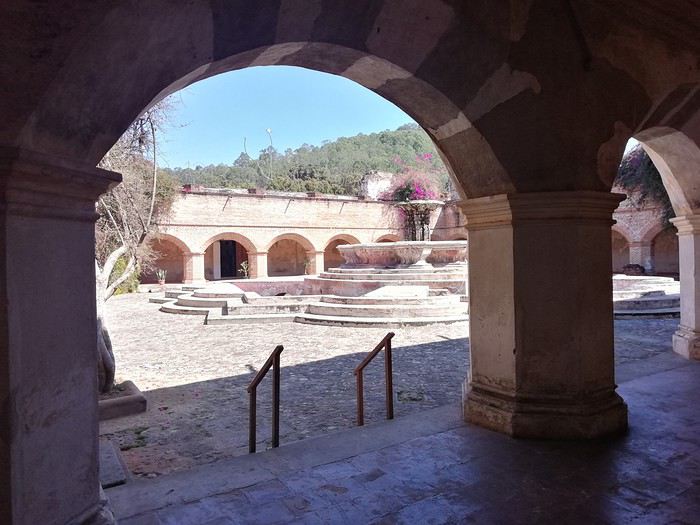
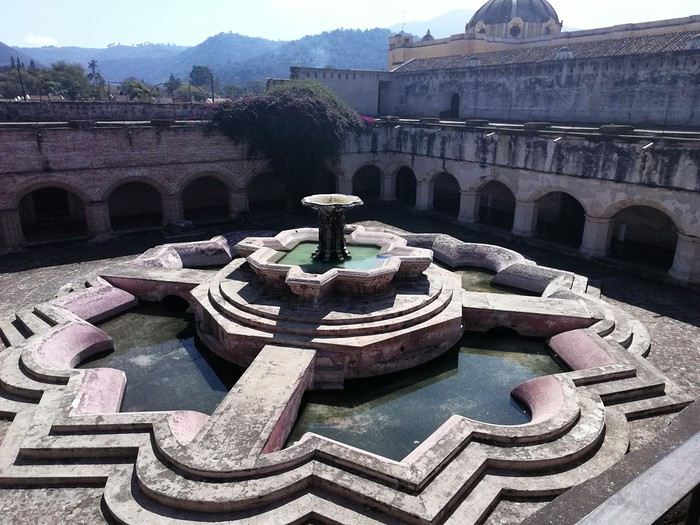
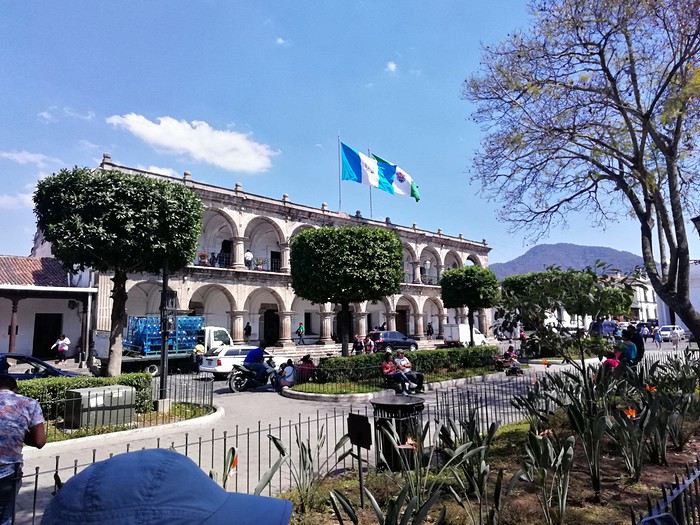
Pour profiter du panorama sur 3 volcans, nous gravissons les marches qui mènent à la terrasse. Puis nous gagnons la « Plaza mayor » cernée par de beaux édifices bâtis par les Espagnols, allant de la mairie à la cathédrale de la ville.
 Nous passons devant le musée du chocolat avant de faire une halte pour découvrir le plus beau « Mac Do » du monde logé dans une magnifique hacienda d’époque avec un grand patio fleuri.
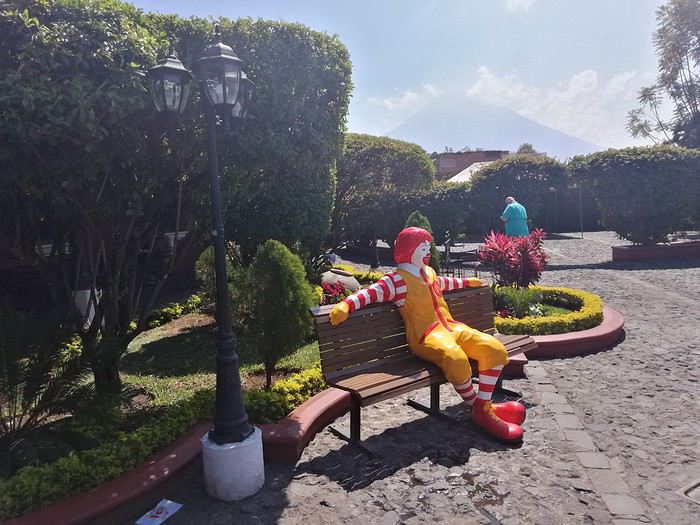
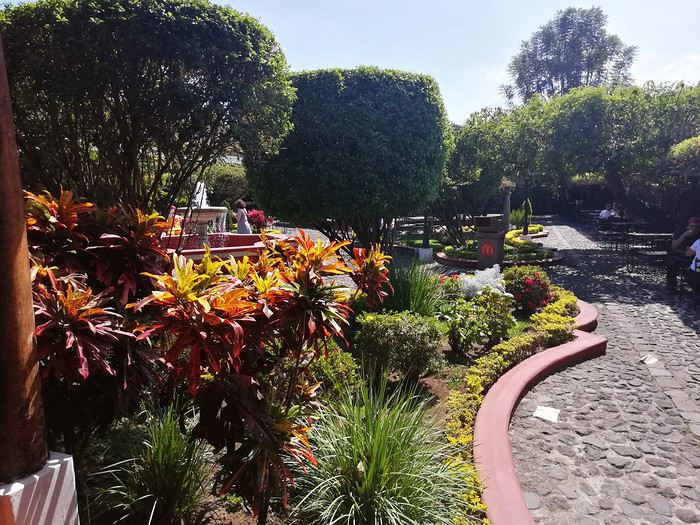
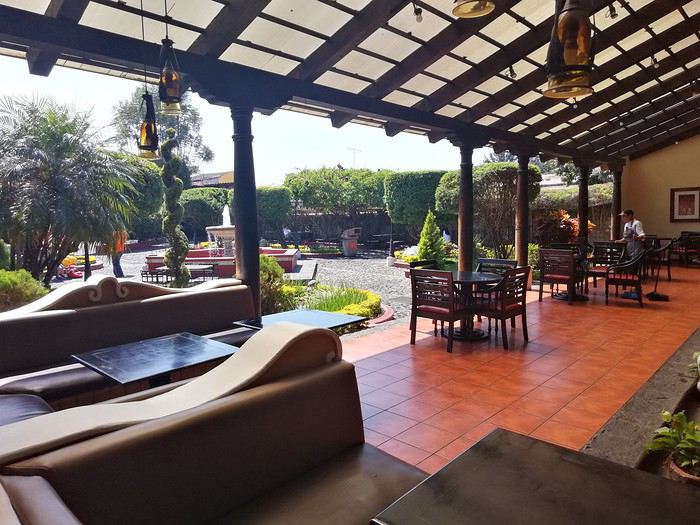 Cela change des établissements habituels de cette marque.
On arpente les rues de la ville, occasion de découvrir des demeures coloniales splendides aux patios intérieurs abondamment fleuris,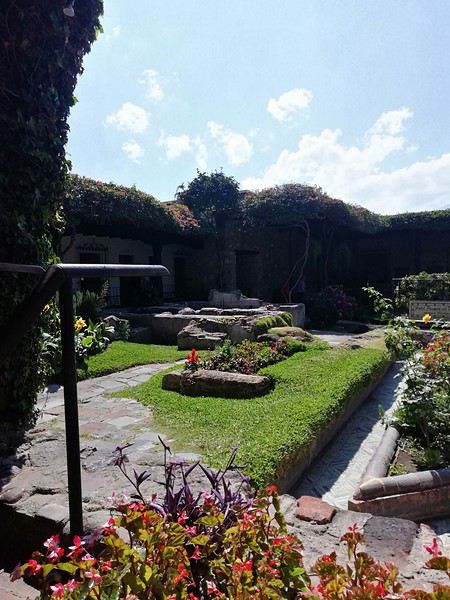
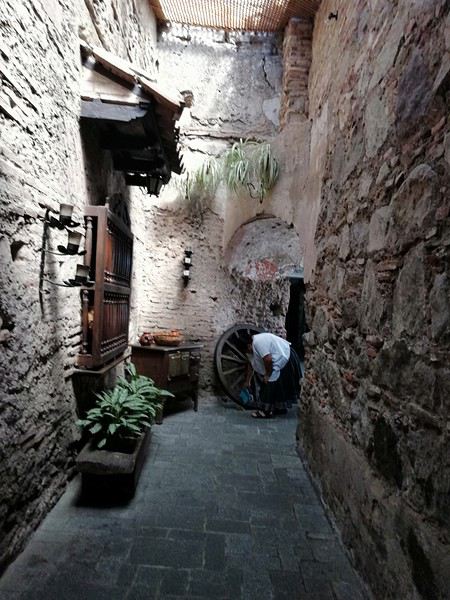
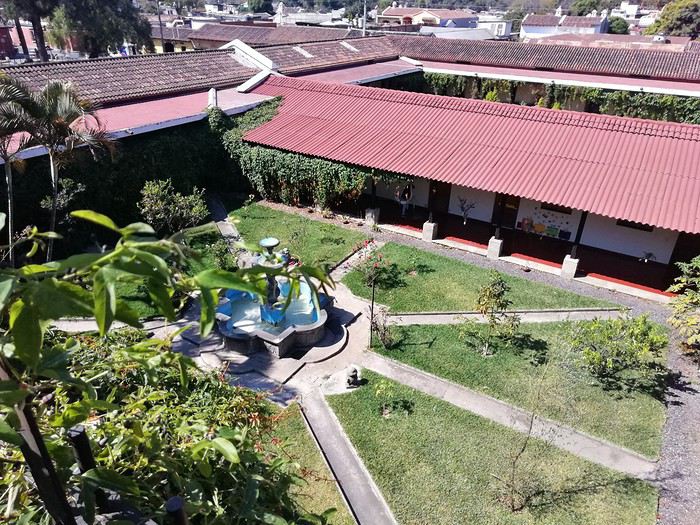
de voir un nombre impressionnant d’églises détruites par les tremblements de terre. Elles ne sont pas reconstruites faute de moyens pour les entretenir mais elles témoignent de l’emprise de la religion catholique sur le pays.
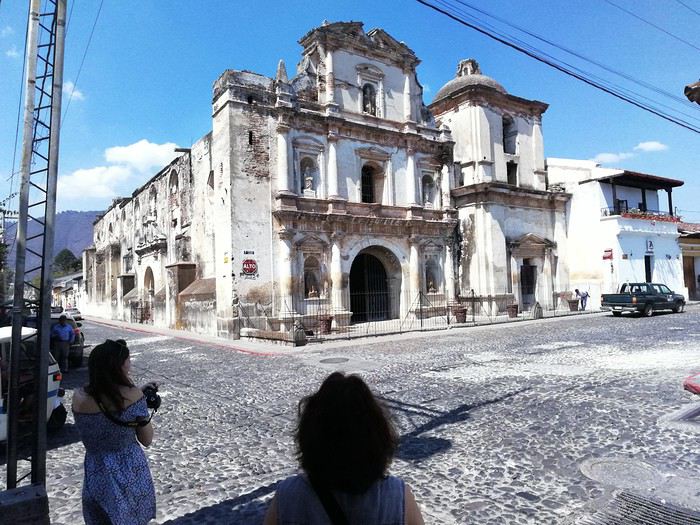
Notons à ce propos que l’on verra par la suite beaucoup de temples protestants de différentes obédiences, tout comme aux USA.
Je me propose de vous faire partager notre voyage au Guatemala, pays assez peu renseigné sur VF. Je l’agrémenterai de quelques photos (tablette) sans prétention qui se veulent seulement illustratives et je demande par avance votre indulgence.
Initialement nous avions opté pour un périple au Pérou en février. Les agences contactées ont eu l’honnêteté, et nous les en remercions, de nous indiquer que cela n’était pas une bonne période pour se rendre sur les plateaux andins. Après une longue hésitation nous avons orienté nos recherches vers le Guatemala et le Honduras et avons pris des contacts avec 2 agences francophones à Antigua pour des propositions et des devis. Très vite nous avons retenu « Bon Voyage » plus réactive et nettement moins chère que sa consœur. Après plusieurs itérations avec Arnaud (patron de l’agence) nous avons convergé vers un circuit de 16 j entre le 6/2 et le 21/2/2020.
Jour 1 :
Pour les vols internationaux nous avions le choix entre une escale aux USA ou à Madrid. Pour à peine plus cher (660 €/p) et un temps de vol bien plus court nous avons finalement choisi IBERIA au détriment des compagnies et contraintes (ESTA et douane) américaines. De plus les vols IBERIA sont au départ (et retour) d’Orly plus commode pour nous.
L’horaire de départ étant très matinal nous décidons de dormir à Orly. L’hôtel Ibis Budget « cœur d’Orly » fera l’affaire. Disons le, c’est cher pour un hôtel de ce type (entrée de gamme) mais il a le mérite de servir le PdJ à partir de 4 h. Cet horaire nous permet de garer notre voiture dans un parking de la zone industriel de Senia et une navette nous dépose à l’aéroport vers 6h. Le vol Orly - Madrid part à 7h30 et nous attendrons 3h pour prendre celui qui nous mènera à Guatemala City où nous arrivons vers 17 h (heure locale soit – 7h de décalage. Ces vols seront sans histoire ni retard. A notre arrivée, Luis notre chauffeur, nous attend. Son sourire et sa gentillesse nous séduisent de suite. Il est chargé de nous conduire à Antigua. Mais les routes à cette heure sont saturées et nous mettrons plus de 2h pour parvenir à Antigua pourtant distante de moins de 40 km de la capitale. Il nous dépose à l’hôtel Posada San Pedro dans lequel nous résiderons 5 nuits durant notre séjour. L’hôtel n’a que 8 chambres et ne sert pas de PdJ mais il est bien situé (7ième avenue) et il dispose d’un joli jardin intérieur et d’un solarium. La chambre n’est pas très grande mais offre une vue directe sur le volcan Fuego en activité permanente. Des fumées s’en échappent régulièrement et parfois des rougeurs nous signalent des coulées de lave. Sitôt arrivés nous nous couchons pour être d’attaque le lendemain.
Jour 2 :
Notre première tâche est de trouver le lieu de notre PdJ car l’hôtel ne propose pas ce service. Il s’agit du restaurant « Viejo Café » dans la 6ième avenue. Ce lieu regroupe une boulangerie et un joli patio où sont servis les PdJ. L’offre est excellente et le service souriant. Tant mieux car nous y reviendrons à maintes reprises. Nous avons RDV avec notre agent de voyage dont nous faisons la connaissance. Il nous fourni un roadbook très détaillé de notre périple avec une carte détaillée pour chaque ville étape, une liste de restaurants qu’il recommande, les lieux à visiter, les recommandations (sûreté, banques, …) et un téléphone pour le joindre en cas de nécessité. Nous rejoignons ensuite un guide francophone qui nous fait découvrir cette jolie ville d’Antigua classée par l’UNESCO. Il nous fait un historique de la cité bâtie par les Espagnols et nous indique comment s’orienter le plan des rues, toutes pavées, s’apparente à celui des villes américaines et elles se coupent toutes à angle droit. Comme à New York la 5ième avenue est la principale artère de la ville. Nous visitons successivement l’église Merced, son monastère, son jardin et sa terrasse d’où l’on peut contempler les 3 volcans qui entourent la ville. L’église bâtie en 1548 a été détruite puis restaurée plusieurs fois suite aux nombreux séismes qui ont frappé la ville, le plus récent datant de 1976, sa façade est jaune et ornée de nénuphars. Puis notre visite se poursuit par le monastère dont il ne subsiste que des ruines. Au milieu de la cour centrale, on découvre une fontaine monumentale elle aussi en forme de nénuphar.
Pour profiter du panorama sur 3 volcans, nous gravissons les marches qui mènent à la terrasse. Puis nous gagnons la « Plaza mayor » cernée par de beaux édifices bâtis par les Espagnols, allant de la mairie à la cathédrale de la ville.
Nous passons devant le musée du chocolat avant de faire une halte pour découvrir le plus beau « Mac Do » du monde logé dans une magnifique hacienda d’époque avec un grand patio fleuri.
Cela change des établissements habituels de cette marque.On arpente les rues de la ville, occasion de découvrir des demeures coloniales splendides aux patios intérieurs abondamment fleuris,
de voir un nombre impressionnant d’églises détruites par les tremblements de terre. Elles ne sont pas reconstruites faute de moyens pour les entretenir mais elles témoignent de l’emprise de la religion catholique sur le pays.
Notons à ce propos que l’on verra par la suite beaucoup de temples protestants de différentes obédiences, tout comme aux USA.
Concours photo de mai 2020: "Défilés et Cortèges" English translation pending
Salut à tou(te)s.
Gagnant du concours d'avril 2020 il m'échoit de vous proposer celui de mai 2020 :
En ce mois de mai propice aux défilés, surtout le 1er en temps normal (sans pandémie donc sans distanciation physique), je vous propose le sujet du concours de photo du mois « Défilés et Cortèges » avec les précautions suivantes :
Ce sera celui de participants au défilé en nombre, en extérieur, pour une cause explicite dans l'image proposée (pancarte ou slogan, costumes, décor...). Ce ne sera donc ni la déambulation d'une foule, même bigarrée, ni une file d'attente, mais un cortège de rue qu'il soit religieux, militaire, funéraire, festif, revendicatif, exprimant joie ou peine, colère ou détermination. La foule qui peut l'accompagner ne sera pas l'objet central de la photo mais son complément (prouvant son audience). Voir l'introduction de l'article Défilé sur Wikipédia : On l'aura compris : pas de défilé d'animaux, de chars, ni de roches fracturées : des gens qui se réunissent pour une cause explicite, affichant leurs costumes, leurs uniformes.
Exemples : Cortège du Palio de Sienne (août 2012) :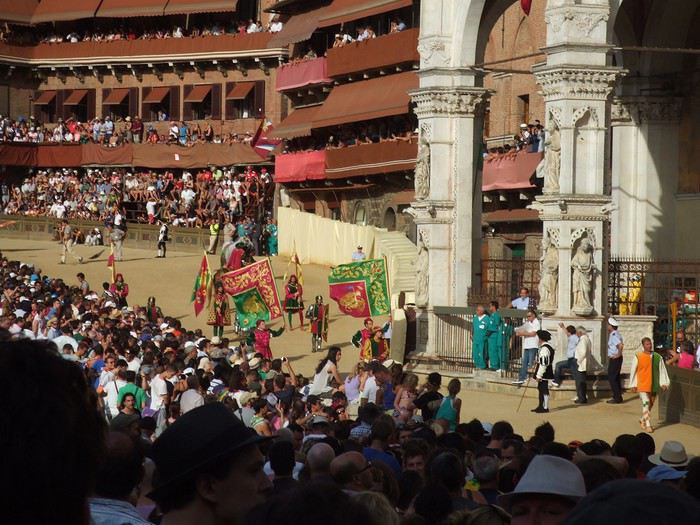
Fête des vignerons 2019 à Vevey, bout de fanfare :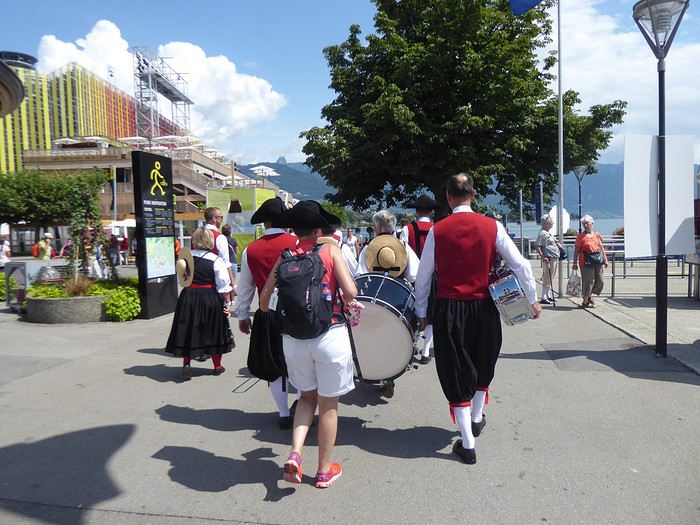
Fête des saintes patronnes de Santa Fiora (Toscane - juillet 2009). Toutes obédiences des autorités municipales à la fin de la procession :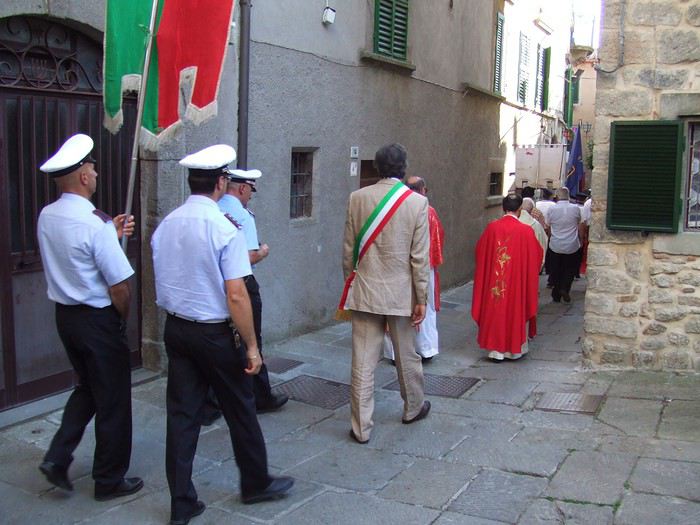
Participation Chaque participant(e) peut proposer jusqu'à 3 photos, et ce jusqu'au vendredi 22/05 à 20h00, heure de Paris. Chaque photo sera présentée dans un seul message, en indiquant son numéro (1, 2 ou 3). Pensez à ajouter une petite explication, commentaire, localisation, date de prise de vue.
Vote Chaque membre VF peut voter pour les 3 photos qu'il ou elle juge les meilleures selon ses propres critères et en tenant compte du thème.
Les votes se feront du samedi 23/05 au vendredi 29/05 à 20h00, heure de Paris. Les photos choisies seront citées dans l'ordre de préférence : - la 1re photo : 3 points - la 2e : 2 points - la 3e : 1 point
Un seul et unique vote pour 3 photos est accepté par membre.
Conclusion Le vainqueur est l'auteur de la photo ayant reçu le plus de points. Les résultats seront publiés le 30/05. En cas d'égalité, le nombre de premières places prévaudra. Le vainqueur aura l'honneur d'organiser le concours du mois de juin.
Le diaporama est là. La discussion est là
À vous de jouer !
En ce mois de mai propice aux défilés, surtout le 1er en temps normal (sans pandémie donc sans distanciation physique), je vous propose le sujet du concours de photo du mois « Défilés et Cortèges » avec les précautions suivantes :
Ce sera celui de participants au défilé en nombre, en extérieur, pour une cause explicite dans l'image proposée (pancarte ou slogan, costumes, décor...). Ce ne sera donc ni la déambulation d'une foule, même bigarrée, ni une file d'attente, mais un cortège de rue qu'il soit religieux, militaire, funéraire, festif, revendicatif, exprimant joie ou peine, colère ou détermination. La foule qui peut l'accompagner ne sera pas l'objet central de la photo mais son complément (prouvant son audience). Voir l'introduction de l'article Défilé sur Wikipédia : On l'aura compris : pas de défilé d'animaux, de chars, ni de roches fracturées : des gens qui se réunissent pour une cause explicite, affichant leurs costumes, leurs uniformes.
Exemples : Cortège du Palio de Sienne (août 2012) :
Fête des vignerons 2019 à Vevey, bout de fanfare :
Fête des saintes patronnes de Santa Fiora (Toscane - juillet 2009). Toutes obédiences des autorités municipales à la fin de la procession :
Participation Chaque participant(e) peut proposer jusqu'à 3 photos, et ce jusqu'au vendredi 22/05 à 20h00, heure de Paris. Chaque photo sera présentée dans un seul message, en indiquant son numéro (1, 2 ou 3). Pensez à ajouter une petite explication, commentaire, localisation, date de prise de vue.
Vote Chaque membre VF peut voter pour les 3 photos qu'il ou elle juge les meilleures selon ses propres critères et en tenant compte du thème.
Les votes se feront du samedi 23/05 au vendredi 29/05 à 20h00, heure de Paris. Les photos choisies seront citées dans l'ordre de préférence : - la 1re photo : 3 points - la 2e : 2 points - la 3e : 1 point
Un seul et unique vote pour 3 photos est accepté par membre.
Conclusion Le vainqueur est l'auteur de la photo ayant reçu le plus de points. Les résultats seront publiés le 30/05. En cas d'égalité, le nombre de premières places prévaudra. Le vainqueur aura l'honneur d'organiser le concours du mois de juin.
Le diaporama est là. La discussion est là
À vous de jouer !
Adventures of a Bygone Era: The Philippines in 1984
After several discussions on VF about travel journals from the Philippines, I decided to write this curiosity: a trip report from a journey made in 1984, when traveling to the Philippines was still an adventure.
A curiosity because writing a travel journal about a trip 35 years later isn’t common, but also (mostly?) because exploring the Philippines at that time had little in common with traveling there today.
Obviously, I’ve forgotten a number of facts, most of the details, but with the help of a few notes from that time and a stack of slides (yes, there was life before digital 😊), many memories came back and added to the highlights I’d never forgotten. The scanned slides aren’t always great quality, but there are still quite a few to brighten up this chatter. Back then, we didn’t snap photos like we do now—film was too expensive—so I don’t have pictures of every place we visited... too bad, comparing some of those spots to how they look today would’ve been interesting.
Why "Adventures"? Why call it "Adventures" in the Philippines in 1984, a word so often used for a simple exotic trip? - Because the lack of information (no *Guide du Routard*, no *Lonely Planet*, no *Michelin Guide*, nothing, and obviously no internet) gave this trip what’s at the heart of adventure: the unknown. - Because the political situation made the stay sometimes dangerous. - Because transportation conditions were always epic, often perilous. - Because the question of where we’d spend the night came up almost every evening. - And for... quite a few other reasons.
That said, we weren’t exactly explorers!
Why the Philippines? First of all, why go to the Philippines in 1984—a country not exactly set up for tourism and about which we knew very little? How could we get an idea of the beauty of the Philippines and its points of interest when we had no guides or photos?
The idea came to us from Thailand a year earlier, during our first long-haul trip. After touring the north of the country, we met a Frenchman living in Phuket, where there were only a few tourists in Patong, with just a few small hotels and guesthouses. Kata and Karon had no buildings or roads, Rawai only had three palm-thatched bungalows, including ours, and the other islands were unknown to tourists. There was plenty to discover, and we wanted to return to this beautiful country... but the Frenchman made us dream about the Philippines—a country to explore, with wild landscapes.
Long evenings of discussion over multiple Sprite-Mekong cocktails (what memories of those headaches!) finally convinced us we had to go to the Philippines.
Episode 0: Before Departure The decision was made: we’d go to the Philippines in May 1984. Our friends and family were surprised when we announced we were going on vacation to the Philippines (a bit like saying today we were going paddleboarding in the Kerguelen Islands 🤪).
These days, preparing for each of our trips takes long evenings of research, planning, and noting down good addresses... etc. But for the Philippines in 1984, preparation was quick: we had very little information about the country, we were leaving almost at random, and the discovery would only be more exciting.
We still had a few bits of info gathered here and there: the rice terraces in northern Luzon, volcanoes, Negros where we were supposed to visit an acquaintance, Cebu and its marine life (we ended up going elsewhere), and absolutely avoid Mindanao, which was practically at war with the regime. That was about it, but it was already a great itinerary.
Nothing was organized in advance; we’d see day by day. We had no idea about travel times or even the existence of transportation options. The main (and sometimes only) way to connect two islands was by overloaded, rusty ferry. Only the big cities had airports.
Let’s Go: Episode 1: Paris to Manila My travel journals always start after arriving at the airport—the Europe-to-“Other Continent” trip isn’t interesting—but the flight to the Philippines was already an adventure, so I’ll make an exception.
This was the era when only a few Asian airlines were on par with Western ones: Thai, Singapore Airlines, and Philippine Airlines. They had beautiful, brand-new planes, and to attract customers (almost exclusively “businessmen”) from the usual airlines (Air France, Lufthansa, British Airways), there was opulence on board: unlimited champagne, all sorts of cocktails... Compared to today’s long-haul flights, there was still one small difference: no personal screens, just one screen at the front of the cabin with one mandatory movie. And I don’t know why, but we only got James Bond films, both ways... that must’ve been the trend at the time.
The tourism boom to Southeast Asia hadn’t started yet, and the “Asian Tigers” weren’t a thing, so there weren’t many business trips. That meant long-haul flights made stops everywhere to fill the planes. Our Philippine Airlines Boeing 747 left London, picked us up in Paris, then stopped in Frankfurt to take on a few Germans. I don’t know why we then made a stop in Dubai—a totally exotic place at the time. There was nothing to do there... things have changed a lot since. It was a small town lost in the desert. The airport was tiny, with just one or two buildings and a supermarket. During the stopover, everyone had to get off the plane and walk to the supermarket. Photo and electronic equipment were dirt cheap—I guess that was the only reason for the stop. Maybe it was their first commercial move. Emirates didn’t exist yet, as I checked online, but anyway, the idea that such a remote place could have its own airline was unthinkable.
Online, I found this photo of Dubai Airport in 1980. Anyone who’s transited through today’s massive airport with its rows of A380s will appreciate it: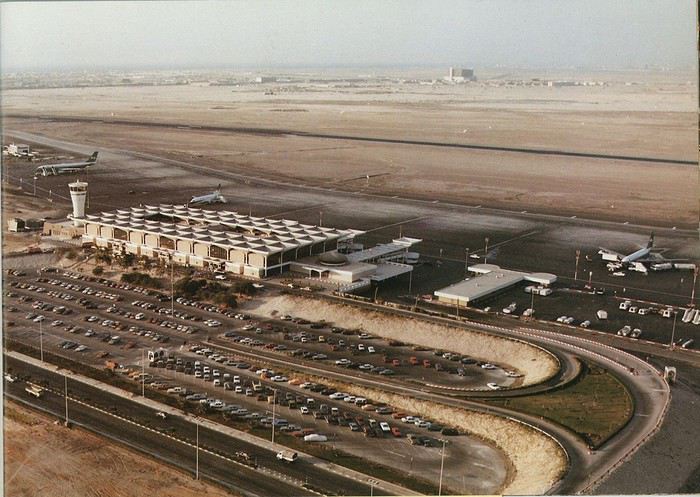
Next stop: New Delhi to drop off some Europeans and pick up a few Indians, and finally, the terminus: Manila. I don’t remember how long the trip took with its five stops—an unimaginable journey today. Despite all those stops to fill the plane, there was still enough space to stretch out on the four center seats of the 747, something that never happens these days despite all the flights in every direction.
So here we are, finally at Manila Airport around midnight.
Episode 1: Manila and Baguio To start, a quick note on the political and economic situation in the Philippines in 1984, which had consequences for us as tourists, as we’d soon realize upon arrival.
After several centuries of Spanish colonization, the Philippines became American at the start of the 20th century, then independent. In 1966, Marcos took power, and little by little, his regime sank into corruption and mismanagement, becoming a dictatorship with martial law, all for the benefit of his family and friends, who enriched themselves endlessly. The peak was the assassination of opposition leader Benigno Aquino in August 1983, which triggered harshly repressed protests. So we arrived a few months later in a very poor country, with omnipresent corruption and an extremely tense political situation, as we’d soon see for ourselves. Major protests took place in the main cities during our trip—I’ll come back to that. Two years later, Marcos fled to Hawaii after being forced out of power following rigged elections. This historical context explains a lot of the situations we found ourselves in over the following weeks.
Arriving in the middle of the night isn’t very cheerful. Manila was already a huge city with many slums, where you could find a few business hotels like the Hilton or Intercontinental—way out of our budget—and plenty of run-down hotels. Luckily, two Indians we’d chatted with on the plane offered to take us to their usual hotel. They came to Manila twice a year for business. We accepted their offer, relieved not to have to look for a place to stay in the middle of the night, figuring the address must be good since they came back every time... we were wrong 🙁
We left the airport and immediately got a taste of the local vibe when we got into the taxi: the police asked for our passports. We thought: what’s more normal than police in a dictatorship?
But that wasn’t it at all. Our two Indian friends explained that the police were noting our names along with the taxi number and time. Crime in Manila was so bad that the taxi driver would be held responsible if anything happened to us... welcome to the Philippines 😎 😎
Historically, the Philippines was a very violent country, where everything was settled with guns or machetes. Previous governments had banned carrying weapons, but Marcos later allowed the free sale and carrying of guns, and disputes were settled with pistols again (or worse, as we’d discover later). Since he’d released most of the criminals from prison to form a paramilitary militia at his service (I’ll talk about our encounter with these “heroes” later), it was pretty dangerous to go into many parts of Manila, where these “tonton macoutes” ruled.
We arrived at our hotel without incident... and then things started badly. The room was infested with big cockroaches—exactly what I hate most in those kinds of countries. No way to find another hotel at that hour. After the long flight, the urge to take a shower was so strong that we squeezed into the bathroom as best we could. After that, I don’t remember—I guess we must’ve fallen asleep exhausted under the sheets in the heat... air conditioning wasn’t widespread yet.
The next day, we just wanted to leave that dump as soon as possible. So we decided to head north right away, stopping in Baguio, and we’d visit Manila a bit on the way back.
When we stepped outside, we discovered a pretty run-down neighborhood with potholed streets. But we also discovered the jeepneys. They were everywhere, flooding the streets.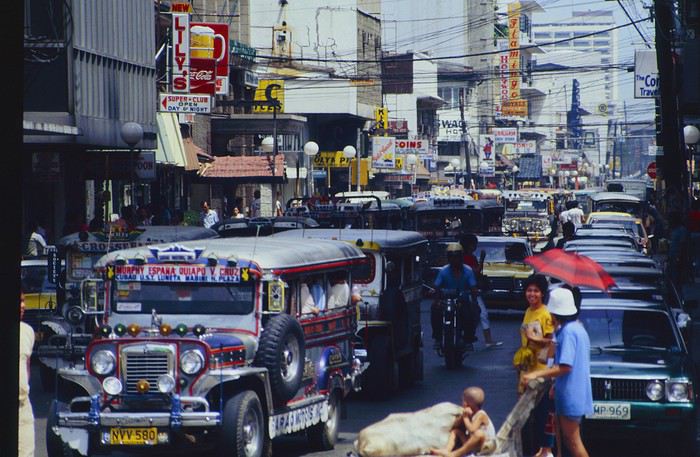
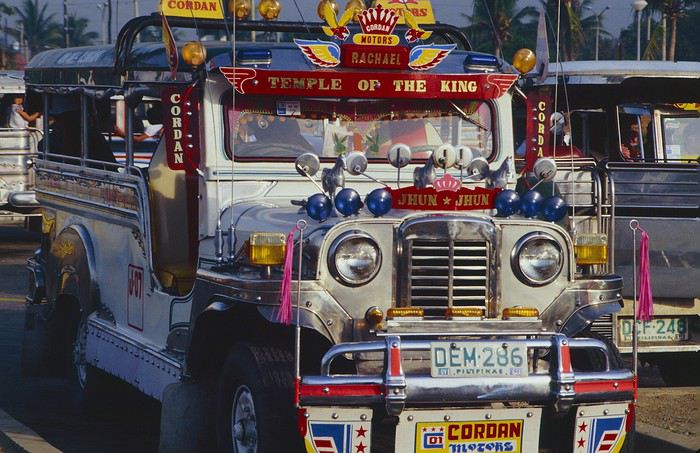
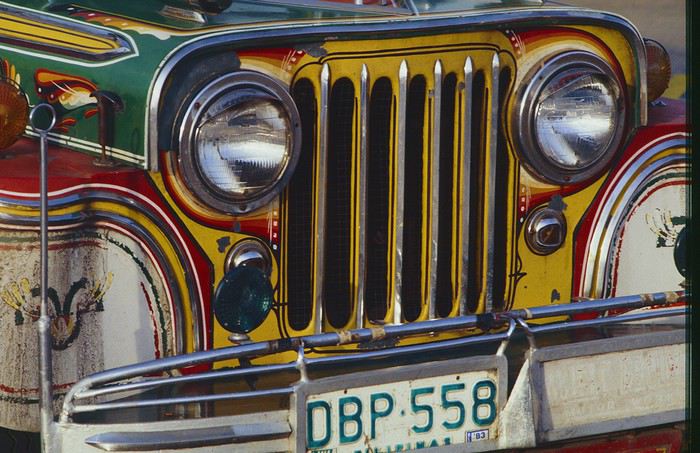
They had crazy sound systems, each one blasting louder than the last. The interiors were kitschy but fun. There weren’t many private cars—almost all transportation was by jeepney, with buses reserved for intercity trips.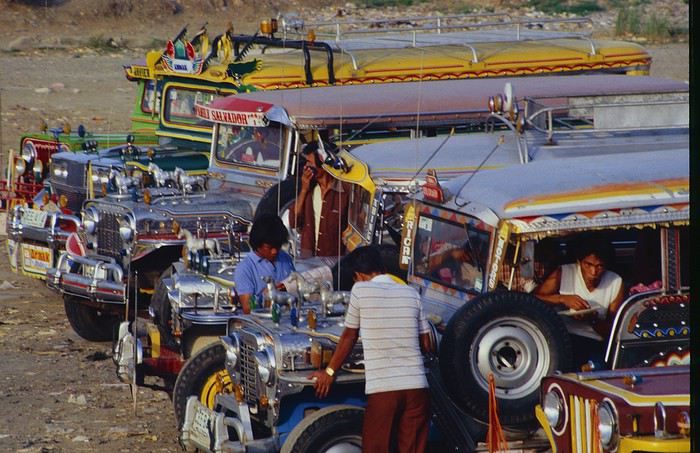
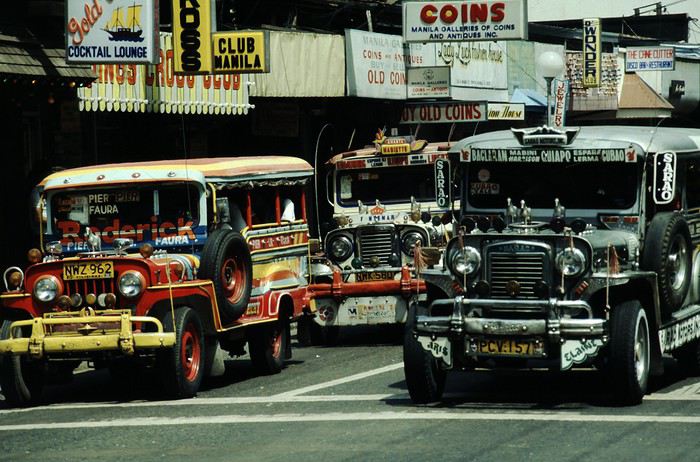
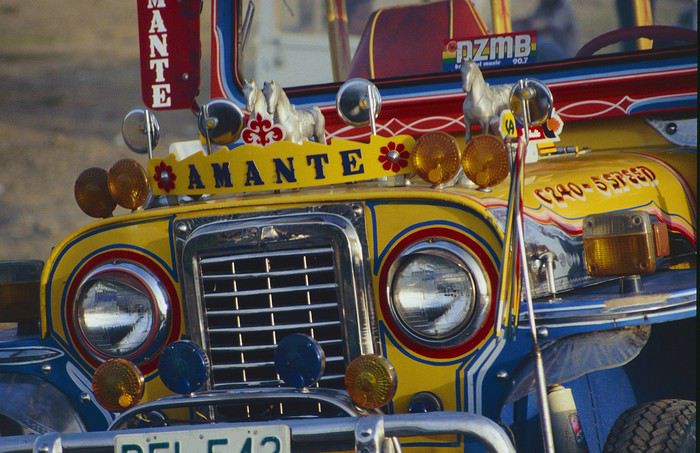
Before heading to the bus terminal for the north, somewhere on the outskirts of the city, we needed to exchange some money. I don’t remember how we ended up in a policeman’s jeep who offered his services: - Exchange money on the black market at a better rate than the banks. - Take us wherever we wanted, in this case, the bus terminal.
We accepted both offers (we’d still checked the official exchange rate from dollars to pesos). So we found ourselves in his jeep. After exchanging money, we left in his vehicle and stopped for gas. Without turning off the engine, he calmly smoked a cigarette while filling up. Since we were in a jeep with no doors or roof, we were ready to jump out if things went south, our travel bag in hand.
But we weren’t done with surprises yet. Once we left the small streets, we ended up in a neighborhood with wide avenues and not much traffic, which didn’t justify his incredible behavior. At every intersection, he made the sign of the cross, closed his eyes, and crossed without looking. I was more stunned than terrified! It wasn’t until we got out of the car later that I told Anne-Marie what had happened. I’d seen everything because the cop had put me in the front seat. Luckily, A-Marie hadn’t noticed anything from the back. Crossing Manila by trusting God rather than the rules of the road was ultimately effective. We were lucky—the trip was off to a good start. 🙂 🙂
We then passed through a neighborhood where slums stretched on for a while, and we left our policeman—friendly but a bit crazy—with relief.
A few hours by bus later, here we are in Baguio, cool in the mountains. My memories of Baguio are pretty fuzzy. I remember a small town. After some research while writing this journal, I found that the population was 120,000 in 1980. Given the population density in each home, that confirms my memory of a smallish town. Outside the “official” district with the president’s summer residence and government buildings, there were two or three paved streets with nice houses. The rest was very dirty and very poor, with lots of slums and dirt roads.
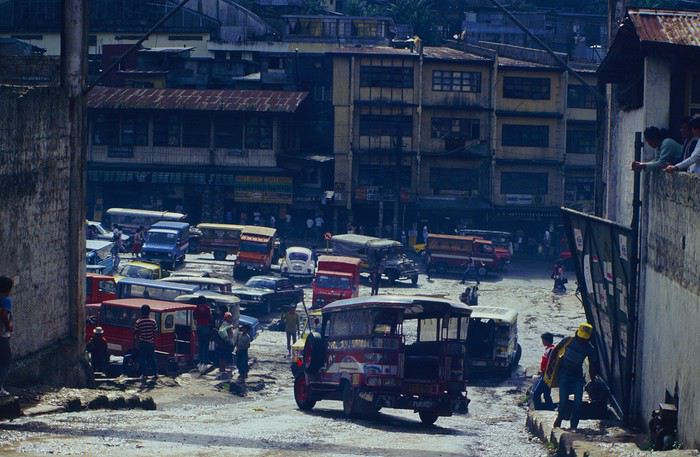
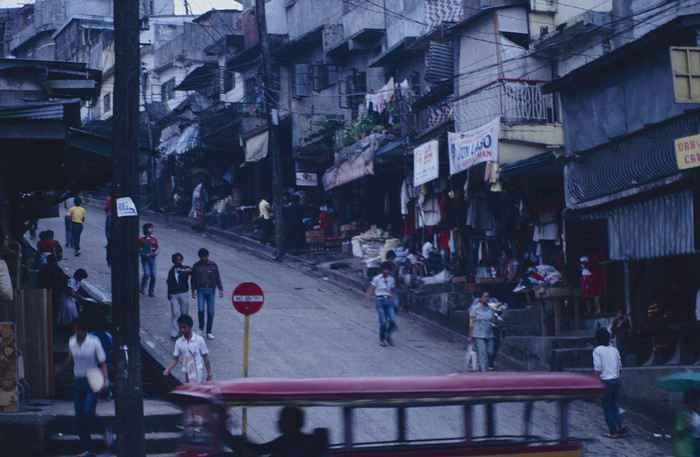
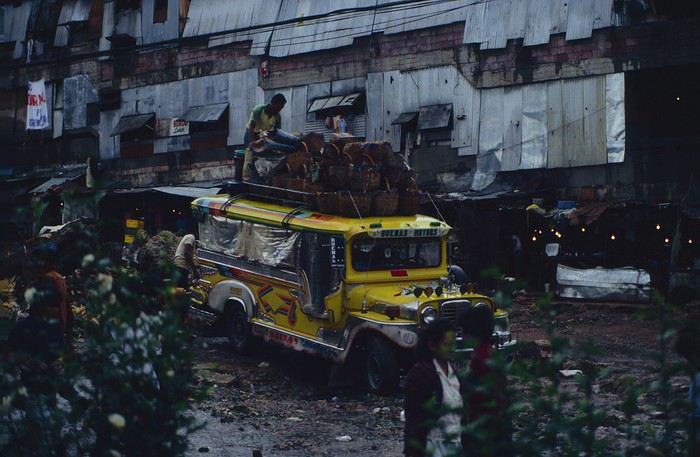
People we met on the street invited us to stay with them. These days, we wouldn’t just show up at strangers’ houses, which we should’ve done in Baguio—it would’ve saved us from an unimaginable and dangerous situation... which I won’t say anything about... !😊
The simple wooden house was on stilts at the edge of a hill with a view of the mountains. Since it was the start of the rainy season in a city that gets a lot of rain, we saw a lot of water. Our outings in town happened between downpours.
View from our lodging: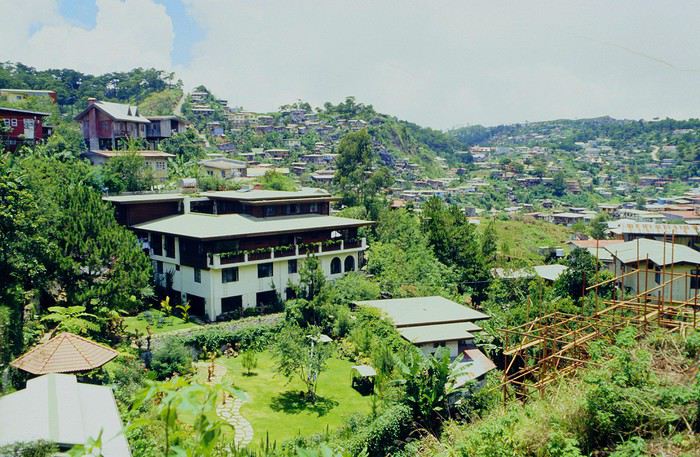
Episode 2: Baguio to Bontoc Aside from the situation briefly mentioned above, it was on the next leg to Bontoc that the adventure really began: an endless and dangerous road, a bus from another era, breathtaking landscapes, and surprising people.
We didn’t know the distance or how long it would take to get to Bontoc. When we arrived after about ten hours, we learned that Baguio to Bontoc was 140 km.
We got on a bus with wooden seats and settled in, two to a seat meant for two. As the bus filled up, passengers squeezed in three or four per seat, with chickens and baskets full of all sorts of things in the aisle. A little embarrassed, we didn’t know if we should squeeze in three on our seat. The seats were super tight (luckily, Filipinos are small), and I didn’t know where to put my legs given my height. I don’t remember if we stayed alone on our bench or if we ended up sharing with others.
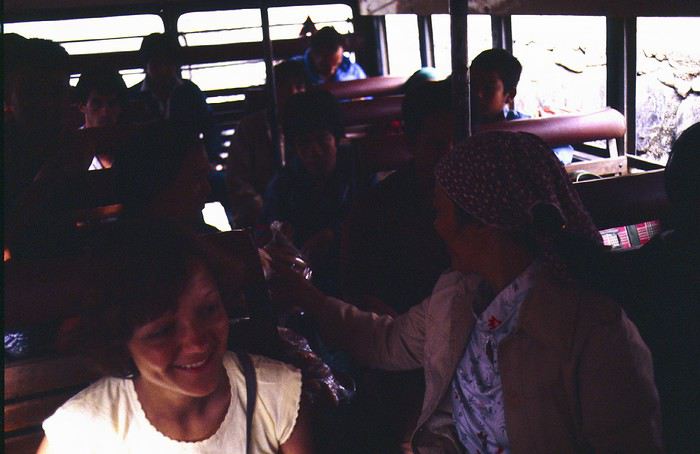
The “road” was a dirt track (or rather, a mud track) with endless turns. We held on as best we could to our slippery wooden seats—it was shaking in every direction. The woman behind us was carsick and throwing up... gross... but what were we doing there? Then we plunged into the Sierra Madre... just the name is dreamy!
Rice terraces started to appear: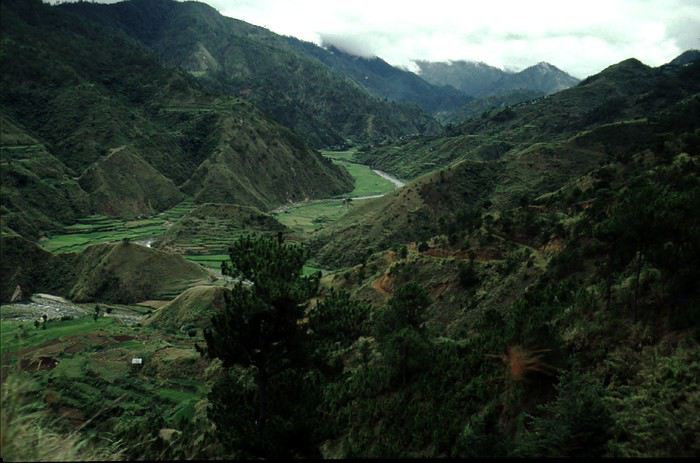
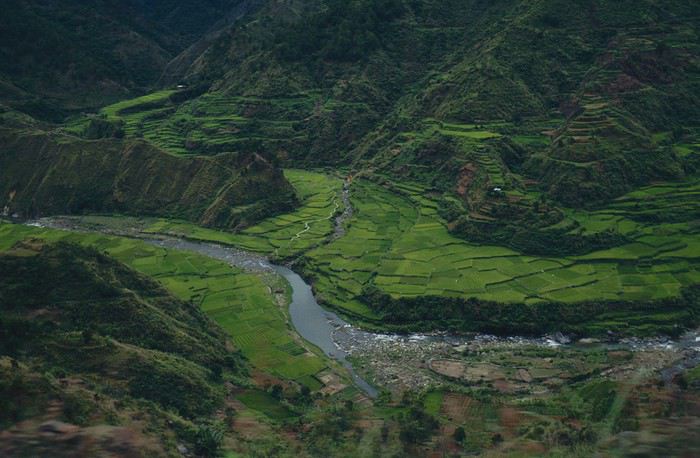
they took up more and more space along cliffs where we weren’t always reassured,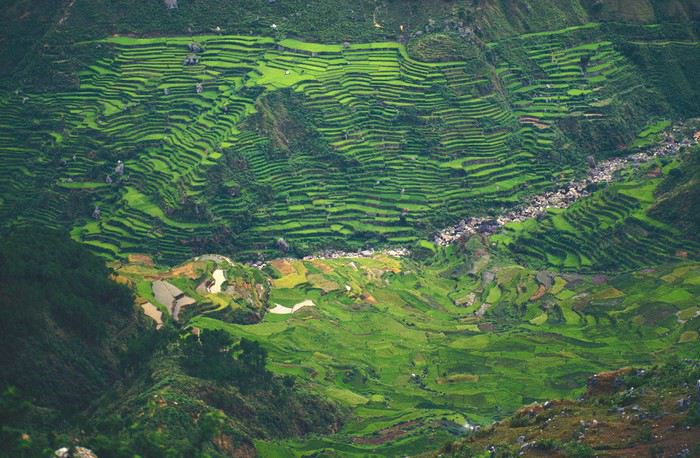
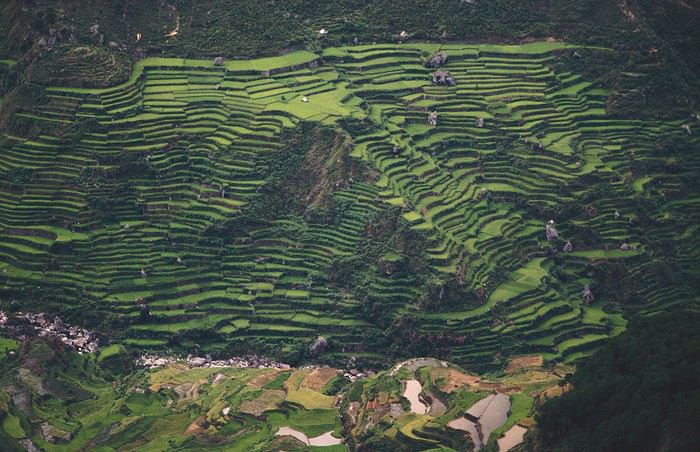
with lots of waterfalls (all that water had to go somewhere).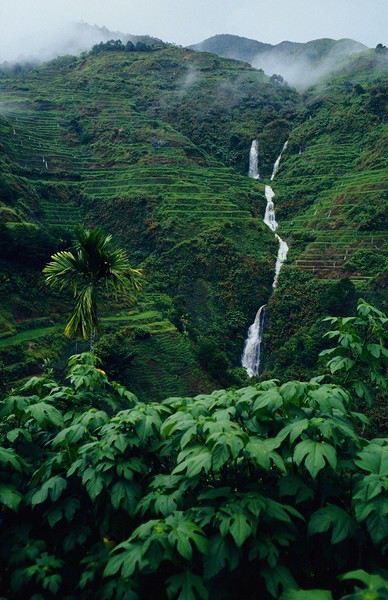
A few miserable villages stretched along the track, most often just a few houses balancing between the road and the drop. The bus stopped in every village—people got on or off and settled inside or on the roof. Street vendors offered their products to the bus passengers—a common sight in Asia, even today.
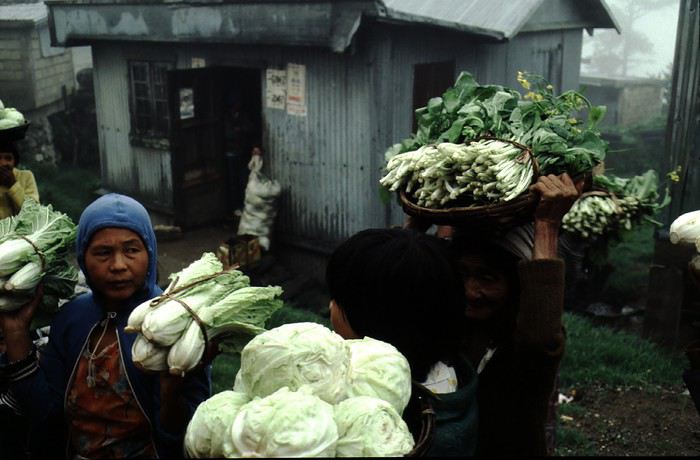
We were in another world—villagers were in loincloths, others had spears. The atmosphere was strange... but all good, we wanted exoticism, and we got it: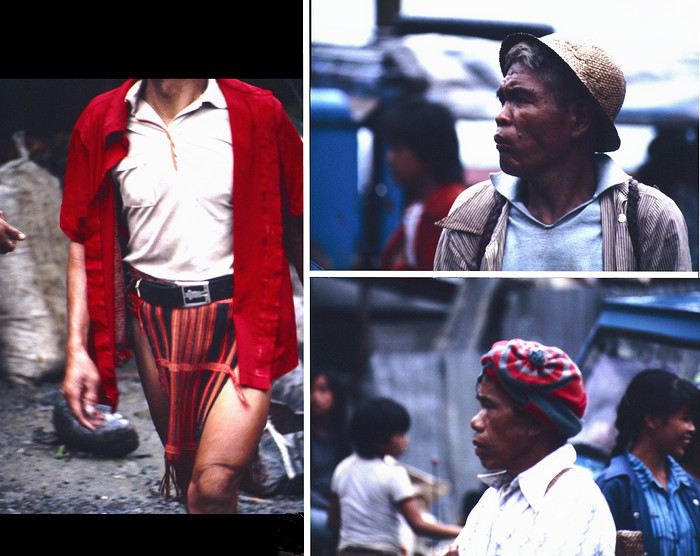
This so-called traditional outfit was everyday wear—it wasn’t for tourists since there weren’t any.
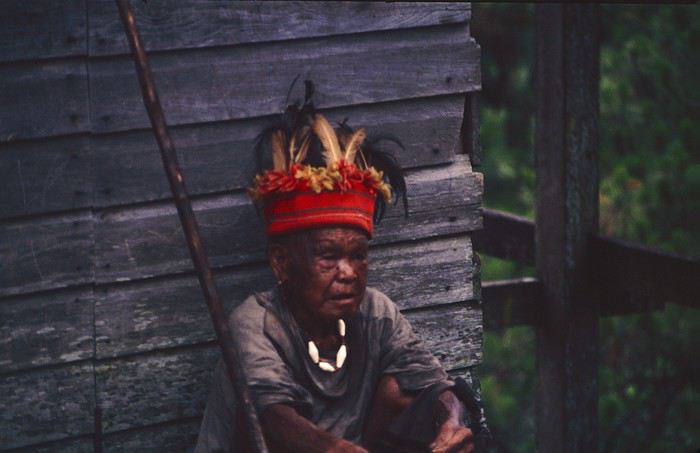
A curiosity because writing a travel journal about a trip 35 years later isn’t common, but also (mostly?) because exploring the Philippines at that time had little in common with traveling there today.
Obviously, I’ve forgotten a number of facts, most of the details, but with the help of a few notes from that time and a stack of slides (yes, there was life before digital 😊), many memories came back and added to the highlights I’d never forgotten. The scanned slides aren’t always great quality, but there are still quite a few to brighten up this chatter. Back then, we didn’t snap photos like we do now—film was too expensive—so I don’t have pictures of every place we visited... too bad, comparing some of those spots to how they look today would’ve been interesting.
Why "Adventures"? Why call it "Adventures" in the Philippines in 1984, a word so often used for a simple exotic trip? - Because the lack of information (no *Guide du Routard*, no *Lonely Planet*, no *Michelin Guide*, nothing, and obviously no internet) gave this trip what’s at the heart of adventure: the unknown. - Because the political situation made the stay sometimes dangerous. - Because transportation conditions were always epic, often perilous. - Because the question of where we’d spend the night came up almost every evening. - And for... quite a few other reasons.
That said, we weren’t exactly explorers!
Why the Philippines? First of all, why go to the Philippines in 1984—a country not exactly set up for tourism and about which we knew very little? How could we get an idea of the beauty of the Philippines and its points of interest when we had no guides or photos?
The idea came to us from Thailand a year earlier, during our first long-haul trip. After touring the north of the country, we met a Frenchman living in Phuket, where there were only a few tourists in Patong, with just a few small hotels and guesthouses. Kata and Karon had no buildings or roads, Rawai only had three palm-thatched bungalows, including ours, and the other islands were unknown to tourists. There was plenty to discover, and we wanted to return to this beautiful country... but the Frenchman made us dream about the Philippines—a country to explore, with wild landscapes.
Long evenings of discussion over multiple Sprite-Mekong cocktails (what memories of those headaches!) finally convinced us we had to go to the Philippines.
Episode 0: Before Departure The decision was made: we’d go to the Philippines in May 1984. Our friends and family were surprised when we announced we were going on vacation to the Philippines (a bit like saying today we were going paddleboarding in the Kerguelen Islands 🤪).
These days, preparing for each of our trips takes long evenings of research, planning, and noting down good addresses... etc. But for the Philippines in 1984, preparation was quick: we had very little information about the country, we were leaving almost at random, and the discovery would only be more exciting.
We still had a few bits of info gathered here and there: the rice terraces in northern Luzon, volcanoes, Negros where we were supposed to visit an acquaintance, Cebu and its marine life (we ended up going elsewhere), and absolutely avoid Mindanao, which was practically at war with the regime. That was about it, but it was already a great itinerary.
Nothing was organized in advance; we’d see day by day. We had no idea about travel times or even the existence of transportation options. The main (and sometimes only) way to connect two islands was by overloaded, rusty ferry. Only the big cities had airports.
Let’s Go: Episode 1: Paris to Manila My travel journals always start after arriving at the airport—the Europe-to-“Other Continent” trip isn’t interesting—but the flight to the Philippines was already an adventure, so I’ll make an exception.
This was the era when only a few Asian airlines were on par with Western ones: Thai, Singapore Airlines, and Philippine Airlines. They had beautiful, brand-new planes, and to attract customers (almost exclusively “businessmen”) from the usual airlines (Air France, Lufthansa, British Airways), there was opulence on board: unlimited champagne, all sorts of cocktails... Compared to today’s long-haul flights, there was still one small difference: no personal screens, just one screen at the front of the cabin with one mandatory movie. And I don’t know why, but we only got James Bond films, both ways... that must’ve been the trend at the time.
The tourism boom to Southeast Asia hadn’t started yet, and the “Asian Tigers” weren’t a thing, so there weren’t many business trips. That meant long-haul flights made stops everywhere to fill the planes. Our Philippine Airlines Boeing 747 left London, picked us up in Paris, then stopped in Frankfurt to take on a few Germans. I don’t know why we then made a stop in Dubai—a totally exotic place at the time. There was nothing to do there... things have changed a lot since. It was a small town lost in the desert. The airport was tiny, with just one or two buildings and a supermarket. During the stopover, everyone had to get off the plane and walk to the supermarket. Photo and electronic equipment were dirt cheap—I guess that was the only reason for the stop. Maybe it was their first commercial move. Emirates didn’t exist yet, as I checked online, but anyway, the idea that such a remote place could have its own airline was unthinkable.
Online, I found this photo of Dubai Airport in 1980. Anyone who’s transited through today’s massive airport with its rows of A380s will appreciate it:
Next stop: New Delhi to drop off some Europeans and pick up a few Indians, and finally, the terminus: Manila. I don’t remember how long the trip took with its five stops—an unimaginable journey today. Despite all those stops to fill the plane, there was still enough space to stretch out on the four center seats of the 747, something that never happens these days despite all the flights in every direction.
So here we are, finally at Manila Airport around midnight.
Episode 1: Manila and Baguio To start, a quick note on the political and economic situation in the Philippines in 1984, which had consequences for us as tourists, as we’d soon realize upon arrival.
After several centuries of Spanish colonization, the Philippines became American at the start of the 20th century, then independent. In 1966, Marcos took power, and little by little, his regime sank into corruption and mismanagement, becoming a dictatorship with martial law, all for the benefit of his family and friends, who enriched themselves endlessly. The peak was the assassination of opposition leader Benigno Aquino in August 1983, which triggered harshly repressed protests. So we arrived a few months later in a very poor country, with omnipresent corruption and an extremely tense political situation, as we’d soon see for ourselves. Major protests took place in the main cities during our trip—I’ll come back to that. Two years later, Marcos fled to Hawaii after being forced out of power following rigged elections. This historical context explains a lot of the situations we found ourselves in over the following weeks.
Arriving in the middle of the night isn’t very cheerful. Manila was already a huge city with many slums, where you could find a few business hotels like the Hilton or Intercontinental—way out of our budget—and plenty of run-down hotels. Luckily, two Indians we’d chatted with on the plane offered to take us to their usual hotel. They came to Manila twice a year for business. We accepted their offer, relieved not to have to look for a place to stay in the middle of the night, figuring the address must be good since they came back every time... we were wrong 🙁
We left the airport and immediately got a taste of the local vibe when we got into the taxi: the police asked for our passports. We thought: what’s more normal than police in a dictatorship?
But that wasn’t it at all. Our two Indian friends explained that the police were noting our names along with the taxi number and time. Crime in Manila was so bad that the taxi driver would be held responsible if anything happened to us... welcome to the Philippines 😎 😎
Historically, the Philippines was a very violent country, where everything was settled with guns or machetes. Previous governments had banned carrying weapons, but Marcos later allowed the free sale and carrying of guns, and disputes were settled with pistols again (or worse, as we’d discover later). Since he’d released most of the criminals from prison to form a paramilitary militia at his service (I’ll talk about our encounter with these “heroes” later), it was pretty dangerous to go into many parts of Manila, where these “tonton macoutes” ruled.
We arrived at our hotel without incident... and then things started badly. The room was infested with big cockroaches—exactly what I hate most in those kinds of countries. No way to find another hotel at that hour. After the long flight, the urge to take a shower was so strong that we squeezed into the bathroom as best we could. After that, I don’t remember—I guess we must’ve fallen asleep exhausted under the sheets in the heat... air conditioning wasn’t widespread yet.
The next day, we just wanted to leave that dump as soon as possible. So we decided to head north right away, stopping in Baguio, and we’d visit Manila a bit on the way back.
When we stepped outside, we discovered a pretty run-down neighborhood with potholed streets. But we also discovered the jeepneys. They were everywhere, flooding the streets.
They had crazy sound systems, each one blasting louder than the last. The interiors were kitschy but fun. There weren’t many private cars—almost all transportation was by jeepney, with buses reserved for intercity trips.
Before heading to the bus terminal for the north, somewhere on the outskirts of the city, we needed to exchange some money. I don’t remember how we ended up in a policeman’s jeep who offered his services: - Exchange money on the black market at a better rate than the banks. - Take us wherever we wanted, in this case, the bus terminal.
We accepted both offers (we’d still checked the official exchange rate from dollars to pesos). So we found ourselves in his jeep. After exchanging money, we left in his vehicle and stopped for gas. Without turning off the engine, he calmly smoked a cigarette while filling up. Since we were in a jeep with no doors or roof, we were ready to jump out if things went south, our travel bag in hand.
But we weren’t done with surprises yet. Once we left the small streets, we ended up in a neighborhood with wide avenues and not much traffic, which didn’t justify his incredible behavior. At every intersection, he made the sign of the cross, closed his eyes, and crossed without looking. I was more stunned than terrified! It wasn’t until we got out of the car later that I told Anne-Marie what had happened. I’d seen everything because the cop had put me in the front seat. Luckily, A-Marie hadn’t noticed anything from the back. Crossing Manila by trusting God rather than the rules of the road was ultimately effective. We were lucky—the trip was off to a good start. 🙂 🙂
We then passed through a neighborhood where slums stretched on for a while, and we left our policeman—friendly but a bit crazy—with relief.
A few hours by bus later, here we are in Baguio, cool in the mountains. My memories of Baguio are pretty fuzzy. I remember a small town. After some research while writing this journal, I found that the population was 120,000 in 1980. Given the population density in each home, that confirms my memory of a smallish town. Outside the “official” district with the president’s summer residence and government buildings, there were two or three paved streets with nice houses. The rest was very dirty and very poor, with lots of slums and dirt roads.
People we met on the street invited us to stay with them. These days, we wouldn’t just show up at strangers’ houses, which we should’ve done in Baguio—it would’ve saved us from an unimaginable and dangerous situation... which I won’t say anything about... !😊
The simple wooden house was on stilts at the edge of a hill with a view of the mountains. Since it was the start of the rainy season in a city that gets a lot of rain, we saw a lot of water. Our outings in town happened between downpours.
View from our lodging:
Episode 2: Baguio to Bontoc Aside from the situation briefly mentioned above, it was on the next leg to Bontoc that the adventure really began: an endless and dangerous road, a bus from another era, breathtaking landscapes, and surprising people.
We didn’t know the distance or how long it would take to get to Bontoc. When we arrived after about ten hours, we learned that Baguio to Bontoc was 140 km.
We got on a bus with wooden seats and settled in, two to a seat meant for two. As the bus filled up, passengers squeezed in three or four per seat, with chickens and baskets full of all sorts of things in the aisle. A little embarrassed, we didn’t know if we should squeeze in three on our seat. The seats were super tight (luckily, Filipinos are small), and I didn’t know where to put my legs given my height. I don’t remember if we stayed alone on our bench or if we ended up sharing with others.
The “road” was a dirt track (or rather, a mud track) with endless turns. We held on as best we could to our slippery wooden seats—it was shaking in every direction. The woman behind us was carsick and throwing up... gross... but what were we doing there? Then we plunged into the Sierra Madre... just the name is dreamy!
Rice terraces started to appear:
they took up more and more space along cliffs where we weren’t always reassured,
with lots of waterfalls (all that water had to go somewhere).
A few miserable villages stretched along the track, most often just a few houses balancing between the road and the drop. The bus stopped in every village—people got on or off and settled inside or on the roof. Street vendors offered their products to the bus passengers—a common sight in Asia, even today.
We were in another world—villagers were in loincloths, others had spears. The atmosphere was strange... but all good, we wanted exoticism, and we got it:
This so-called traditional outfit was everyday wear—it wasn’t for tourists since there weren’t any.
Itinéraire un mois Indonésie Sumatra - Java - Bali English translation pending
Bonjour,
Avec mon ami nous souhaitons partir 1 mois en Indonesie. Il va s’agir de notre première découverte dans ce pays, ainsi nous aimerions découvrir pas mal de choses, quitte à courir… sachant que cela ne sera sûrement pas notre dernière visite sur ces îles.
Voici ce qu'on aimerais bien faire :
J0 : Arrivée le matin à Medan + visite de la ville J1 – Départ pour Bukit Lawang J2 et J3 – Trek J4 – Route pour lac Toba J5 et J6 – Lac Toba J7 – Vol interne Silangit – Semarang J8 – Départ îles Karimunjawa J9 – îles Karimunjawa J10 – Route vers Magelang J11 – temples Borobudur et Prambanan J12 – Yogyakarta J13 – Route vers le Bromo (si c'est possible, sinon un autre volcan) J14 – Bromo + route vers Kawah Ijen J15 – Kawah Ijen + route Ubud J16 à J18 : Ubud J19 – Route vers Amed (+ Tirta Gangga) J20 – Amed J21 – Route vers îles Gili J22 – îles Gili J23 – Ferry vers Nusa Penida J24 – Nusa Penida J25 – Ferry vers Kuta J26 – Kuta J27 – Départ
Pouvez-vous nous dire si cela vous semble envisageable ? Surtout au niveau des transports, nous avons lus pas mal de discussion sur les difficultés des transports en Indonésie. Après, nous ne programmons pas les hôtels, transports en avance pour se laisser une marge de liberté dans notre parcours une fois sur place. Nous partons fin septembre - début octobre : pensez-vous que pour Bali cela ira malgré la saison des pluies ? Merci beaucoup à vous pour vos retours. Amélie
J0 : Arrivée le matin à Medan + visite de la ville J1 – Départ pour Bukit Lawang J2 et J3 – Trek J4 – Route pour lac Toba J5 et J6 – Lac Toba J7 – Vol interne Silangit – Semarang J8 – Départ îles Karimunjawa J9 – îles Karimunjawa J10 – Route vers Magelang J11 – temples Borobudur et Prambanan J12 – Yogyakarta J13 – Route vers le Bromo (si c'est possible, sinon un autre volcan) J14 – Bromo + route vers Kawah Ijen J15 – Kawah Ijen + route Ubud J16 à J18 : Ubud J19 – Route vers Amed (+ Tirta Gangga) J20 – Amed J21 – Route vers îles Gili J22 – îles Gili J23 – Ferry vers Nusa Penida J24 – Nusa Penida J25 – Ferry vers Kuta J26 – Kuta J27 – Départ
Pouvez-vous nous dire si cela vous semble envisageable ? Surtout au niveau des transports, nous avons lus pas mal de discussion sur les difficultés des transports en Indonésie. Après, nous ne programmons pas les hôtels, transports en avance pour se laisser une marge de liberté dans notre parcours une fois sur place. Nous partons fin septembre - début octobre : pensez-vous que pour Bali cela ira malgré la saison des pluies ? Merci beaucoup à vous pour vos retours. Amélie
Do we need to book our accommodations in advance for Sulawesi?
Hello,
My teenage daughter and I are heading to Sulawesi in July-August for 5 weeks. We don’t know Indonesia at all—this will be our first time. When we travel, we’re not used to booking accommodations in advance because we love improvising based on our mood and what comes up in the moment... For Sulawesi, though, from what I’ve read, I’m a little worried we might get stuck here and there, especially in more touristy spots, if we leave everything open... So, advice from those in the know—what do you think? Should we plan a bit ahead? Thanks a million for your feedback!
A'
My teenage daughter and I are heading to Sulawesi in July-August for 5 weeks. We don’t know Indonesia at all—this will be our first time. When we travel, we’re not used to booking accommodations in advance because we love improvising based on our mood and what comes up in the moment... For Sulawesi, though, from what I’ve read, I’m a little worried we might get stuck here and there, especially in more touristy spots, if we leave everything open... So, advice from those in the know—what do you think? Should we plan a bit ahead? Thanks a million for your feedback!
A'
Voyager sans connaître la destination? Nous voilà inscrits... English translation pending
Nous sommes à un mois de notre départ et nous ne connaissons pas la destination puisque c'est un voyage mystère que nous avons réservé par l'agence CAP MYSTERE....
Nous avons donc rempli un questionnaire assez détaillé sur notre type de voyage, nos envies , nos budget...
C'est donc un voyage lointain avec une destination au soleil alliant la faune et la flore et hors des sentiers battus.
Nous allons bientôt recevoir le premier indice.
Nous sommes méga surexcités et en ce qui me concerne (moins mon conjoint plus sage) , je ne cesse de chercher les vols possibles avec les éléments que j'ai....
Arghhhh c'est horriblement dure d'attendre.
Nous avons donc rempli un questionnaire assez détaillé sur notre type de voyage, nos envies , nos budget...
C'est donc un voyage lointain avec une destination au soleil alliant la faune et la flore et hors des sentiers battus.
Nous allons bientôt recevoir le premier indice.
Nous sommes méga surexcités et en ce qui me concerne (moins mon conjoint plus sage) , je ne cesse de chercher les vols possibles avec les éléments que j'ai....
Arghhhh c'est horriblement dure d'attendre.
Concours photo du mois de février 2020: Les volcans English translation pending
Ouverture du 115ème Concours Photos de Voyage Forum
Le thème a été un peu compliqué pour moi à trouver, je me suis donc posé les questions suivantes : qu’est-ce que j’aimerais voir, quels paysages m’interpellent lorsque je voyage ? Alors, la réponse est dans ce thème : « Les volcans »
Je me suis demandé s’il pouvait être redondant avec le thème du mois de Juin 2019 « Chaleur » mais même s’il y a eu quelques photos présentant de la lave, des volcans en éruption, ce n’était qu’une très faible partie des photos proposées.
Je ne serai pas restrictive sur des volcans en activités, toutes les photos ayant un lien avec les volcans seront les bienvenues : des volcans éteints, endormis, des calderas effondrées, des champs de lave, des geysers d’eau chaude …
Quelques exemples :
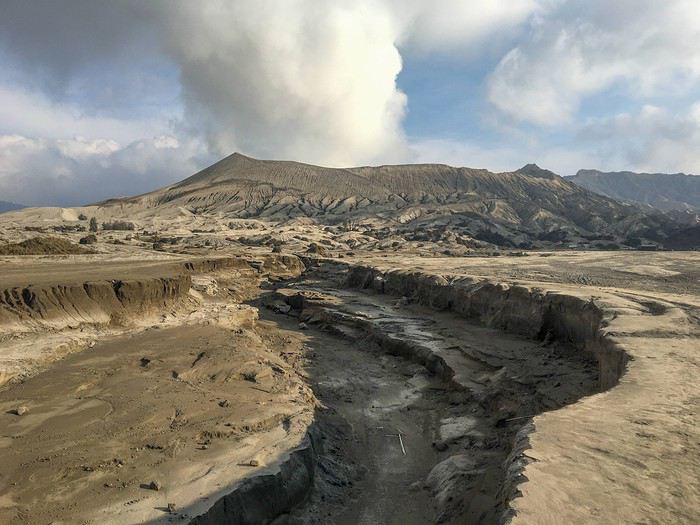 Mont Bromo sur l’île de Java en Indonésie
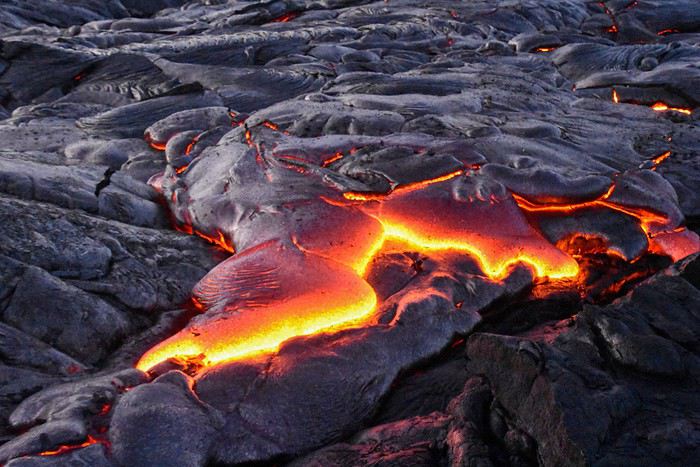 Coulée de lave provenant du volcan Kilauea sur Big Island à Hawaï
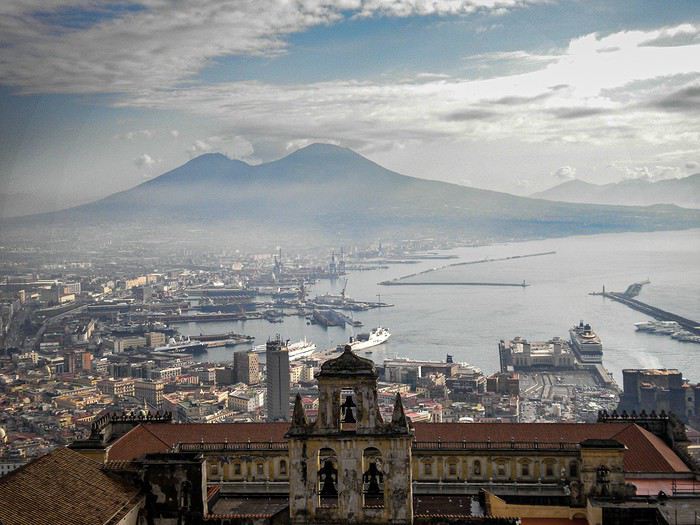 Vésuve dans la baie de Naples
Dépôt des photos jusqu’au Vendredi 21 Février minuit. Vous pouvez poster jusqu’à 3 photos, numérotées et postées dans des messages différents, accompagnées d’un petit descriptif (lieu, anecdote...)
Vote du Samedi 22 Février au Samedi 28 Février minuit. Merci d’indiquer le numéro de la photo, le pseudo et le nombre de points attribués. Photo n°1 = 3 pts Photo n°2 = 2 pts Photo n°3 = 1 pt Tous les membres de VF peuvent voter (même ceux qui n’ont pas déposé de photos).
En cas d’égalité de points pour la première position, la photo gagnante sera celle ayant obtenu le plus grand nombre de 1ères places, puis de secondes places ! L’heureux (se) gagnant(e) devra organiser le concours photo de Mars 2020.
Pour discuter, c’est par ici
Le thème a été un peu compliqué pour moi à trouver, je me suis donc posé les questions suivantes : qu’est-ce que j’aimerais voir, quels paysages m’interpellent lorsque je voyage ? Alors, la réponse est dans ce thème : « Les volcans »
Je me suis demandé s’il pouvait être redondant avec le thème du mois de Juin 2019 « Chaleur » mais même s’il y a eu quelques photos présentant de la lave, des volcans en éruption, ce n’était qu’une très faible partie des photos proposées.
Je ne serai pas restrictive sur des volcans en activités, toutes les photos ayant un lien avec les volcans seront les bienvenues : des volcans éteints, endormis, des calderas effondrées, des champs de lave, des geysers d’eau chaude …
Quelques exemples :
Mont Bromo sur l’île de Java en Indonésie
Coulée de lave provenant du volcan Kilauea sur Big Island à Hawaï
Vésuve dans la baie de NaplesDépôt des photos jusqu’au Vendredi 21 Février minuit. Vous pouvez poster jusqu’à 3 photos, numérotées et postées dans des messages différents, accompagnées d’un petit descriptif (lieu, anecdote...)
Vote du Samedi 22 Février au Samedi 28 Février minuit. Merci d’indiquer le numéro de la photo, le pseudo et le nombre de points attribués. Photo n°1 = 3 pts Photo n°2 = 2 pts Photo n°3 = 1 pt Tous les membres de VF peuvent voter (même ceux qui n’ont pas déposé de photos).
En cas d’égalité de points pour la première position, la photo gagnante sera celle ayant obtenu le plus grand nombre de 1ères places, puis de secondes places ! L’heureux (se) gagnant(e) devra organiser le concours photo de Mars 2020.
Pour discuter, c’est par ici
On part en vadrouille au Pérou / Bolivie / Chili! English translation pending
Hello les aficionados de voyages ! Un nouveau petit carnet pour vous raconter ma vadrouille au Pérou, en Bolivie et au Chili en 18 jours. Voyage intense, fatigant, mais au combien dépaysant... Je te laisse découvrir ça même si tu peux déjà retrouver la version complète ici :
onpartenvadrouille.over-blog.com/...-pas-l-pero...
Bonne lecture et n'hésite pas à me faire part de tes éventuels remarques / commentaires...
23 octobre C’est pas l’Pérou ? Si ! Quand j’étais petit, je n’étais pas grand… Normal, vas-tu me dire… Et quand j’étais petit, j’étais fasciné par la carte du monde. Comme mes vieux posters de Chris Waddle et de Jean-Pierre Papin, je la fixais comme un ahuri en me posant cette question toute bête : Qu’est-ce qu’il y a là-bas, de l’autre côté de la planète ? Mon envie de voyage a certainement commencé à poindre le bout de son nez à ce moment-là. Malheureusement pour mon porte-monnaie et pour ma femme, elle n’a fait que s’accroître avec le temps. Ma femme, justement, parlons-en !! Le jour (ou plus précisément la nuit) où nous avons dormi (ou plus précisément essayé de dormir) dans une maison (ou plus précisément dans une cabane) mal isolée (ou plus précisément pas isolée du tout) par une température revigorante (ou plus précisément glaciale) au fin fond de la Birmanie, elle a dit « Stop ! Finito ! Terminé ! Kaput ! Les voyages dans ces conditions, ce n’est plus de mon âge ! » Sauf que moi, premièrement, je ne fais pas son âge !!! S’en est donc suivi un voyage à Bali cet été dans des conditions à la brosser dans le sens du poil. Sauf que moi, deuxièmement, ça ne m’a pas comblé mon envie de dormir à l’arrache au milieu des cochons ! Et puis un voyage à quatre à Bali en conditions préférentielles, ça a un coup ! La cigale ayant dépensé tout l’été, se trouva fort dépourvue quand la bise fut venue. Sauf que moi, troisièmement, j’en ai gardé un peu sous le pied. Mais juste un tout p’tit peu… Juste pour une seule personne… Juste pour moi, en fait ! Sauf que moi, quatrièmement, je ne me vois pas partir en solo à l’assaut du monde pour dormir avec des cochons... Partenaire particulier, je cherche partenaire particulière, débloqué, pas trop timide et avec une bonne dose de savoir faire !
Et là, se pointe mon frère. Lors d’une soirée bien arrosée faisant suite à une journée de ski, il nous confesse que le générique des « Mystérieuses cités d’or » le hante au plus profond de son être depuis qu’il est tout petit et qu’il lui faut donc absolument étancher sa soif d’aller toiser le Machu Picchu en tête à tête. « Franck, pourquoi n’y emmènerais-tu pas ton frère ? » Incrédule ou femme parfaite, Dieu seul le sait ! En tout cas, Sandrine a prononcé ces quelques mots à 21h57. Sur le coup, je pense qu’elle ne perçoit pas la portée de ses mots. Crédule ou homme opportuniste, Dieu seul le sait ! En tout cas, je saisis l’opportunité par les deux mains et à 22h25, je suis scotché à mon écran en train de retourner le net pour y dénicher des billets d’avion pas chers. 22h49, emballé, c’est pesé, y’a plus rien à voir, cinq cents euros par personne, départ en octobre prochain !!! C’est ce qu’on appelle « battre le net tant qu’il est encore tôt ! » Je t’annonce donc solennellement que pour ce nouveau voyage, je prends la direction de l'Amérique du Sud, et plus précisément de la Cordillère des Andes, la plus longue chaîne de montagnes du monde... Une traversée de Lima au Pérou, jusqu’à San Pédro de Atacama au Chili en passant par La Paz en Bolivie, pour une durée totale de dix-huit jours sur place, du 23 octobre au 11 novembre. Au programme de ce roadtrip, des noms qui résonnent comme autant de lieux magiques… Les lignes de Nazca, l'incontournable Machu Picchu, la ville ancestrale de Cuzco, le Lac Titicaca, la tentaculaire capitale La Paz, le Salar d’Uyuni, le sud Lipez, le désert d'Atacama, … et bien d’autres de leurs amis qui riment avec Esteban, Tao et Zia ! Et tu l’as donc compris, dans la rubrique « C’est qui qui vient ? », je serai pour cette fois-ci accompagné par mon frère que je m’en vais te présenter de ce pas...
Pour commencer, soit-disant qu’il serait ma copie. Pâle, mais copie quand même dixit les personnes qui nous connaissent… Ensuite et c’est bien là le plus important, dormir avec des cochons ne le rebute pas du tout, bien au contraire ! Ne me fais pas dire ce que je n’ai pas dit, je parle bien de l’animal mâle… Enfin, sache qu’il a une dizaine d’années de moins que moi et qu’il se prénomme Sullivan. Voilà pour les présentations sommaires, tu en sauras plus sur lui en allant consulter son compte Tinder, ou tout au long de notre vadrouille qui débute… maintenant ! Car comme dirait ma grand-mère, « il y a de la route, faut y aller mes gamins ! » Trente minutes de voiture jusqu’à la gare TGV de Reims. Trente minutes supplémentaires de train pour gagner l’aéroport Charles de Gaulle. Neuf heures d’avion pour aller jusqu’à Atlanta, puis sept nouvelles heures de vol pour enfin atterrir à Lima. Ajoute à ça les temps d’attente dont les quatre heures d’escale à Atlanta, secoue le shaker et tu obtiens un résultat de vingt-et-une heures de transport !... Mais on est des oufs, nous ! Car je profite du fait d’être cette fois-ci exonéré de ralentisseurs plaintifs pour pousser le bouchon un peu plus loin. A cela, comprendre que je voyage léger, sans femme ni enfant. Pour gagner du temps, on enchaîne donc direct en arrivant à Lima avec une heure de taxi pour gagner la gare routière, trois heures d’attente sur un banc en pleine nuit, puis cinq heures de bus pour aller jusqu’à Ica. De là, on prend un nouveau taxi et terminus, tout le monde descend !!! Ouf, nous arrivons enfin à notre lieu de villégiature, Huacachina, pas moins de trente-trois heures après avoir regardé ma maison s’éloigner dans mon rétroviseur. Que retenir de ce voyage à part que ce fut extrêmement long ? Pas grand’chose à part qu’à l’immigration américaine, vu qu’on porte logiquement le même nom avec mon frère, on nous a demandé si nous étions mariés ensemble ; qu’on a tué le temps à l’aéroport d’Atlanta à boire des bières à la citrouille d’Halloween ; que nous avons été accueillis par des prostituées pratiquement nues dans les rues de Lima (merci à elles pour cette délicate attention), et que des affiches de Julien Clerc couvraient les murs de la ville. Oui, oui, « Lili voulait aller danser » a apparemment son public là-bas… Allez, maintenant, tu m’excuseras pour le caractère expéditif de cette fin de description de journée, mais le thermomètre ici affiche déjà près de trente degrés. Si on ajoute à l’équation le temps de transport, ainsi que les six heures de décalage horaire, on obtient deux français complètement crevés qui doivent aller se coucher pour être en forme demain. De toute façon, demain est une autre aventure...
Bonne lecture et n'hésite pas à me faire part de tes éventuels remarques / commentaires...
23 octobre C’est pas l’Pérou ? Si ! Quand j’étais petit, je n’étais pas grand… Normal, vas-tu me dire… Et quand j’étais petit, j’étais fasciné par la carte du monde. Comme mes vieux posters de Chris Waddle et de Jean-Pierre Papin, je la fixais comme un ahuri en me posant cette question toute bête : Qu’est-ce qu’il y a là-bas, de l’autre côté de la planète ? Mon envie de voyage a certainement commencé à poindre le bout de son nez à ce moment-là. Malheureusement pour mon porte-monnaie et pour ma femme, elle n’a fait que s’accroître avec le temps. Ma femme, justement, parlons-en !! Le jour (ou plus précisément la nuit) où nous avons dormi (ou plus précisément essayé de dormir) dans une maison (ou plus précisément dans une cabane) mal isolée (ou plus précisément pas isolée du tout) par une température revigorante (ou plus précisément glaciale) au fin fond de la Birmanie, elle a dit « Stop ! Finito ! Terminé ! Kaput ! Les voyages dans ces conditions, ce n’est plus de mon âge ! » Sauf que moi, premièrement, je ne fais pas son âge !!! S’en est donc suivi un voyage à Bali cet été dans des conditions à la brosser dans le sens du poil. Sauf que moi, deuxièmement, ça ne m’a pas comblé mon envie de dormir à l’arrache au milieu des cochons ! Et puis un voyage à quatre à Bali en conditions préférentielles, ça a un coup ! La cigale ayant dépensé tout l’été, se trouva fort dépourvue quand la bise fut venue. Sauf que moi, troisièmement, j’en ai gardé un peu sous le pied. Mais juste un tout p’tit peu… Juste pour une seule personne… Juste pour moi, en fait ! Sauf que moi, quatrièmement, je ne me vois pas partir en solo à l’assaut du monde pour dormir avec des cochons... Partenaire particulier, je cherche partenaire particulière, débloqué, pas trop timide et avec une bonne dose de savoir faire !
Et là, se pointe mon frère. Lors d’une soirée bien arrosée faisant suite à une journée de ski, il nous confesse que le générique des « Mystérieuses cités d’or » le hante au plus profond de son être depuis qu’il est tout petit et qu’il lui faut donc absolument étancher sa soif d’aller toiser le Machu Picchu en tête à tête. « Franck, pourquoi n’y emmènerais-tu pas ton frère ? » Incrédule ou femme parfaite, Dieu seul le sait ! En tout cas, Sandrine a prononcé ces quelques mots à 21h57. Sur le coup, je pense qu’elle ne perçoit pas la portée de ses mots. Crédule ou homme opportuniste, Dieu seul le sait ! En tout cas, je saisis l’opportunité par les deux mains et à 22h25, je suis scotché à mon écran en train de retourner le net pour y dénicher des billets d’avion pas chers. 22h49, emballé, c’est pesé, y’a plus rien à voir, cinq cents euros par personne, départ en octobre prochain !!! C’est ce qu’on appelle « battre le net tant qu’il est encore tôt ! » Je t’annonce donc solennellement que pour ce nouveau voyage, je prends la direction de l'Amérique du Sud, et plus précisément de la Cordillère des Andes, la plus longue chaîne de montagnes du monde... Une traversée de Lima au Pérou, jusqu’à San Pédro de Atacama au Chili en passant par La Paz en Bolivie, pour une durée totale de dix-huit jours sur place, du 23 octobre au 11 novembre. Au programme de ce roadtrip, des noms qui résonnent comme autant de lieux magiques… Les lignes de Nazca, l'incontournable Machu Picchu, la ville ancestrale de Cuzco, le Lac Titicaca, la tentaculaire capitale La Paz, le Salar d’Uyuni, le sud Lipez, le désert d'Atacama, … et bien d’autres de leurs amis qui riment avec Esteban, Tao et Zia ! Et tu l’as donc compris, dans la rubrique « C’est qui qui vient ? », je serai pour cette fois-ci accompagné par mon frère que je m’en vais te présenter de ce pas...
Pour commencer, soit-disant qu’il serait ma copie. Pâle, mais copie quand même dixit les personnes qui nous connaissent… Ensuite et c’est bien là le plus important, dormir avec des cochons ne le rebute pas du tout, bien au contraire ! Ne me fais pas dire ce que je n’ai pas dit, je parle bien de l’animal mâle… Enfin, sache qu’il a une dizaine d’années de moins que moi et qu’il se prénomme Sullivan. Voilà pour les présentations sommaires, tu en sauras plus sur lui en allant consulter son compte Tinder, ou tout au long de notre vadrouille qui débute… maintenant ! Car comme dirait ma grand-mère, « il y a de la route, faut y aller mes gamins ! » Trente minutes de voiture jusqu’à la gare TGV de Reims. Trente minutes supplémentaires de train pour gagner l’aéroport Charles de Gaulle. Neuf heures d’avion pour aller jusqu’à Atlanta, puis sept nouvelles heures de vol pour enfin atterrir à Lima. Ajoute à ça les temps d’attente dont les quatre heures d’escale à Atlanta, secoue le shaker et tu obtiens un résultat de vingt-et-une heures de transport !... Mais on est des oufs, nous ! Car je profite du fait d’être cette fois-ci exonéré de ralentisseurs plaintifs pour pousser le bouchon un peu plus loin. A cela, comprendre que je voyage léger, sans femme ni enfant. Pour gagner du temps, on enchaîne donc direct en arrivant à Lima avec une heure de taxi pour gagner la gare routière, trois heures d’attente sur un banc en pleine nuit, puis cinq heures de bus pour aller jusqu’à Ica. De là, on prend un nouveau taxi et terminus, tout le monde descend !!! Ouf, nous arrivons enfin à notre lieu de villégiature, Huacachina, pas moins de trente-trois heures après avoir regardé ma maison s’éloigner dans mon rétroviseur. Que retenir de ce voyage à part que ce fut extrêmement long ? Pas grand’chose à part qu’à l’immigration américaine, vu qu’on porte logiquement le même nom avec mon frère, on nous a demandé si nous étions mariés ensemble ; qu’on a tué le temps à l’aéroport d’Atlanta à boire des bières à la citrouille d’Halloween ; que nous avons été accueillis par des prostituées pratiquement nues dans les rues de Lima (merci à elles pour cette délicate attention), et que des affiches de Julien Clerc couvraient les murs de la ville. Oui, oui, « Lili voulait aller danser » a apparemment son public là-bas… Allez, maintenant, tu m’excuseras pour le caractère expéditif de cette fin de description de journée, mais le thermomètre ici affiche déjà près de trente degrés. Si on ajoute à l’équation le temps de transport, ainsi que les six heures de décalage horaire, on obtient deux français complètement crevés qui doivent aller se coucher pour être en forme demain. De toute façon, demain est une autre aventure...
Où aller en août 2020, Thaïlande, Cambodge, Vietnam...? English translation pending
Bonjour à tous,
je souhaite organiser des vacances avec mon épouse en août 2020.
Nous ne pouvons partir qu'à cette période là et ce n'est pas la meilleure il parait.
Nous sommes déjà partis en août en Martinique et à Cancun, il y a eu très peu de pluie. Mais comme c'est un autre coin du monde… on ne sait pas
On recherche des vacances en Asie car c'est moins cher qu'en France et en Europe. Nous n'aimons pas l'Europe et nous partons souvent aux usa mais l'été prochain nous aurons un budget plus serré.
Nous recherchons le coté plages, mer chaude et visites.
Que nous recommandez-vous ?
Merci beaucoup
je souhaite organiser des vacances avec mon épouse en août 2020.
Nous ne pouvons partir qu'à cette période là et ce n'est pas la meilleure il parait.
Nous sommes déjà partis en août en Martinique et à Cancun, il y a eu très peu de pluie. Mais comme c'est un autre coin du monde… on ne sait pas
On recherche des vacances en Asie car c'est moins cher qu'en France et en Europe. Nous n'aimons pas l'Europe et nous partons souvent aux usa mais l'été prochain nous aurons un budget plus serré.
Nous recherchons le coté plages, mer chaude et visites.
Que nous recommandez-vous ?
Merci beaucoup
Circuit Guatemala - Belize et trajets en shuttle ou bus English translation pending
Bonjour,
nous préparons un voyage en couple pour l'été prochain en circuit au Guatemala et au Belize.
Nous prévoyons d'effectuer les trajets en shuttle même si c'est un peu plus cher que les bus classiques. Toutefois si certains trajets peuvent être réalisés simplement en bus de ligne, nous sommes preneurs.
Le circuit que nous envisageons est le suivant, pourriez-vous nous donner votre avis ?
Jour Nuitée : où J1 Vol Toulouse – Madrid – Guatemala City → Antigua Antigua J2 Visite Antigua Antigua J3 Excursion Volcan Pacaya Antigua J4 Visite Antigua Antigua J5 Transfert vers Chichicastenango Chichicastenango J6 Marché Chichicastenango / Bus Panajachel et Lancha pour San Pedro / San Juan → réservation shuttle pour Lanquin pour J9 San Juan J7 Lago Atitlan / Marché Santiago + Visite San Pedro – San Juan - Marché Solola ? San Juan J8 Lago Atitlan / Treck de Indian Nose San Juan J9 Transfert vers Lanquin -> 12:00 de route Lanquin J10 Excursion Semuc Champey Lanquin J11 Transfert shuttle vers El Remate (temps de trajet 6:00) El Remate (Tikal) J12 Visite Site Maya de Tikal El Remate (Tikal?) J13 El Remate -> Belize -> Arrêt San Igniacio → Orange Walk (temps de trajet 4:00) Orange Walk J14 Visite Site Maya de Lamanai Orange Walk J15 Transfert vers Belize City (2:00) puis Caye Caulker (0:30, dernier départ 17:30) Caye Caulker J16 Caye Caulker -> Hol chan Caye Caulker J17 Caye Caulker Caye Caulker J18 Caye Caulker Caye Caulker J19 Transfert vers Punta Gorda Punta Gorda J20 Punta Gorda : Blue creek cave ou Sapodilla Cayes Punta Gorda J21 Tranfert pour Livingstone. Bateaux mardi et vendredi. 1:00 de traversée. Livingston J22 Livingstone, Cueva del Tigre (jungle, Rio Dulce). Livingston J23 Livingstone → Rio Dulce. Livingston J24 (Livingston →) Puerto Barrios → Rio Hondo (direct Guatemala City) → Chiquimula → El Forido (frontière)→ Copan (temps de trajet estimé 12:00) Copan J25 Visite Site Maya de Copan Copan J26 Copan → Guatemala City Gua. City J27 Vol Guatemala City – Madrid – Toulouse
Nous sommes conscients d'avoir 3 longues journées de trajet en J9, J11 et J24. Peut-être que nous prévoyons un peu trop de nuits dans certaines étapes... Nous vous remercions d'avance pour vos avis éclairés 😉 A très bientôt de vous lire
Jour Nuitée : où J1 Vol Toulouse – Madrid – Guatemala City → Antigua Antigua J2 Visite Antigua Antigua J3 Excursion Volcan Pacaya Antigua J4 Visite Antigua Antigua J5 Transfert vers Chichicastenango Chichicastenango J6 Marché Chichicastenango / Bus Panajachel et Lancha pour San Pedro / San Juan → réservation shuttle pour Lanquin pour J9 San Juan J7 Lago Atitlan / Marché Santiago + Visite San Pedro – San Juan - Marché Solola ? San Juan J8 Lago Atitlan / Treck de Indian Nose San Juan J9 Transfert vers Lanquin -> 12:00 de route Lanquin J10 Excursion Semuc Champey Lanquin J11 Transfert shuttle vers El Remate (temps de trajet 6:00) El Remate (Tikal) J12 Visite Site Maya de Tikal El Remate (Tikal?) J13 El Remate -> Belize -> Arrêt San Igniacio → Orange Walk (temps de trajet 4:00) Orange Walk J14 Visite Site Maya de Lamanai Orange Walk J15 Transfert vers Belize City (2:00) puis Caye Caulker (0:30, dernier départ 17:30) Caye Caulker J16 Caye Caulker -> Hol chan Caye Caulker J17 Caye Caulker Caye Caulker J18 Caye Caulker Caye Caulker J19 Transfert vers Punta Gorda Punta Gorda J20 Punta Gorda : Blue creek cave ou Sapodilla Cayes Punta Gorda J21 Tranfert pour Livingstone. Bateaux mardi et vendredi. 1:00 de traversée. Livingston J22 Livingstone, Cueva del Tigre (jungle, Rio Dulce). Livingston J23 Livingstone → Rio Dulce. Livingston J24 (Livingston →) Puerto Barrios → Rio Hondo (direct Guatemala City) → Chiquimula → El Forido (frontière)→ Copan (temps de trajet estimé 12:00) Copan J25 Visite Site Maya de Copan Copan J26 Copan → Guatemala City Gua. City J27 Vol Guatemala City – Madrid – Toulouse
Nous sommes conscients d'avoir 3 longues journées de trajet en J9, J11 et J24. Peut-être que nous prévoyons un peu trop de nuits dans certaines étapes... Nous vous remercions d'avance pour vos avis éclairés 😉 A très bientôt de vous lire