Results for "Pavie+|+9+>+215"
15332 results found.
Catalonia Bavaro Resort 5* à Punta Cana English translation pending
😉 Qui peux me donner des info sur l'hotel Catalonia Bavaro Resort 5***** à Punta Cana, merci d'avance
Hôtels, transports et visites à Saint Domingue English translation pending
Que faut il voir absolument à Santo Domingo ?
Comment s'y rendre depuis les hotels, bus, taxis, collectivos ???
Quelqu'un aurait il quelques bonnes adresses, bar, resto??
D'avance merci
EUSKADI
Comment s'y rendre depuis les hotels, bus, taxis, collectivos ???
Quelqu'un aurait il quelques bonnes adresses, bar, resto??
D'avance merci
EUSKADI
Guatemala et Belize English translation pending
Hello, nous serons 5 pour un voyage de trois semaines entre le Guatemala et le Belize. On décrit souvent le Guatemala comme une région à risque. Qu'en est-il exactement?
Nous sommes également à la recherche de la zone balnéaire idéale pour passer quelques jours de repos au Belize...nous n'avons pas encore trouvé notre bonheur. Une suggestion?
Nous sommes également à la recherche de la zone balnéaire idéale pour passer quelques jours de repos au Belize...nous n'avons pas encore trouvé notre bonheur. Une suggestion?
Is a suitcase possible for the Sepilok, Kinabatangan, Tioman, KL route?
Hey everyone,
Silly question—backpack or hard-shell suitcase for the Sepilok, Kinabatangan, Tioman, KL trip? I’m struggling to fit all my son’s and my stuff into the 70L backpack... and I’m thinking a suitcase would be easier, but I’m not sure if it’ll work for getting around.
Thanks! 🙂
Silly question—backpack or hard-shell suitcase for the Sepilok, Kinabatangan, Tioman, KL trip? I’m struggling to fit all my son’s and my stuff into the 70L backpack... and I’m thinking a suitcase would be easier, but I’m not sure if it’ll work for getting around.
Thanks! 🙂
Fees with Revolut card in Quebec
Hi everyone.
I’m heading to Quebec and New Brunswick this summer and got a Revolut Classic card for the trip. I’ve already exchanged some Canadian dollars in the app so I’ll have a reserve ready for my departure day. My question is whether I’ll incur any additional fees when using my Canadian dollar account. I think I’m limited to 200 € in ATM withdrawals for my part. Thanks!
I’m heading to Quebec and New Brunswick this summer and got a Revolut Classic card for the trip. I’ve already exchanged some Canadian dollars in the app so I’ll have a reserve ready for my departure day. My question is whether I’ll incur any additional fees when using my Canadian dollar account. I think I’m limited to 200 € in ATM withdrawals for my part. Thanks!
Off on an adventure in Uzbekistan!
April 5 - Day 1
After as many weeks as I have fingers on my right hand, we're hitting the road again, fully recovered from our pharaonic adventure. Back in France to drop off our daughters (sorry, girls!), this time it's just the two of us, ready to be welcomed by a new destination. They say it offers one of the richest cultural heritages in the world for those willing to put in the effort. It's the land of the ancient Silk Road, where we'll follow a journey steeped in history and discoveries straight out of *One Thousand and One Nights*. A former Soviet bloc region independent only since 1991, we'll be walking in the footsteps of Genghis Khan, Tamerlane, Alexander the Great, Marco Polo...
Another fun fact about this country: it's strictly forbidden to import porn on your phone. True story. The same goes for painkillers! Unless it's about sodomy—though the two don’t seem connected, that’s just how it is. Don’t ask me why! Anyway, I’m getting off track. Here’s the big question: Where do you think we’ve just landed?... To give you a hint, the locals are known for being incredibly welcoming. No sooner said than done—our first taxi driver, proud to transport French travelers, refused to let us pay for the ride. Great vibes for these two weeks ahead. So, any guesses? Uzbekistan!!!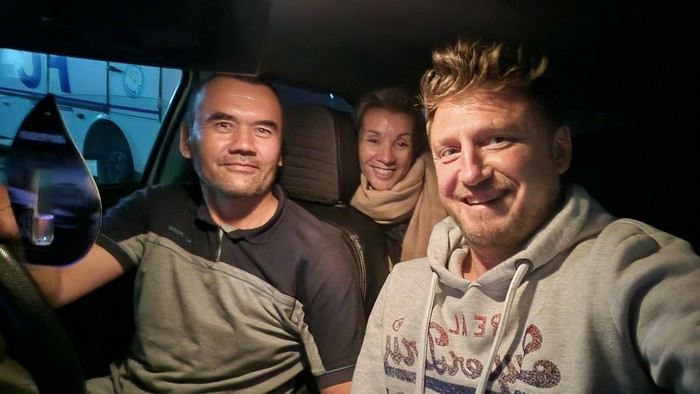
After as many weeks as I have fingers on my right hand, we're hitting the road again, fully recovered from our pharaonic adventure. Back in France to drop off our daughters (sorry, girls!), this time it's just the two of us, ready to be welcomed by a new destination. They say it offers one of the richest cultural heritages in the world for those willing to put in the effort. It's the land of the ancient Silk Road, where we'll follow a journey steeped in history and discoveries straight out of *One Thousand and One Nights*. A former Soviet bloc region independent only since 1991, we'll be walking in the footsteps of Genghis Khan, Tamerlane, Alexander the Great, Marco Polo...
Another fun fact about this country: it's strictly forbidden to import porn on your phone. True story. The same goes for painkillers! Unless it's about sodomy—though the two don’t seem connected, that’s just how it is. Don’t ask me why! Anyway, I’m getting off track. Here’s the big question: Where do you think we’ve just landed?... To give you a hint, the locals are known for being incredibly welcoming. No sooner said than done—our first taxi driver, proud to transport French travelers, refused to let us pay for the ride. Great vibes for these two weeks ahead. So, any guesses? Uzbekistan!!!
3 weeks in Laos, stress-free
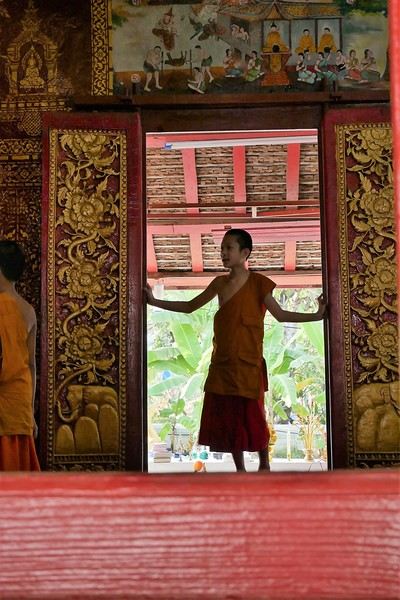 Come along, I'm taking you to this country where it's so nice to wander and slow down...
This trip was in 2023, but when I wanted to write my travel journal, VF was still closed to contributions... So, now that I've just finished my Japan travel journal here, I figured it was high time to honor this destination we came back from so enchanted. Disclaimer 1: This is a written travel journal. There’ll be text! Too much, for some! Disclaimer 2: This is an illustrated travel journal. There’ll be photos! Too many, for some!
I have to say, every time I try to discipline myself, to keep it shorter, to include fewer photos... I end up adding more. It feels like my dear Aunt Nicole, who exhausted us with her slide-show evenings in the 70s/80s, decided to take her revenge. The upside for you, readers, is that you can slip away anytime without offending Aunt Nicole. I won’t even notice!
Anyway, since I love maps, here’s one to give you an idea of where I’m taking you. As you can see, we only saw a tiny part of Laos (the areas circled in red); we only had 3 weeks for ourselves (my husband’s newly retired, I still work), and we prefer taking our time over rushing around like crazy.
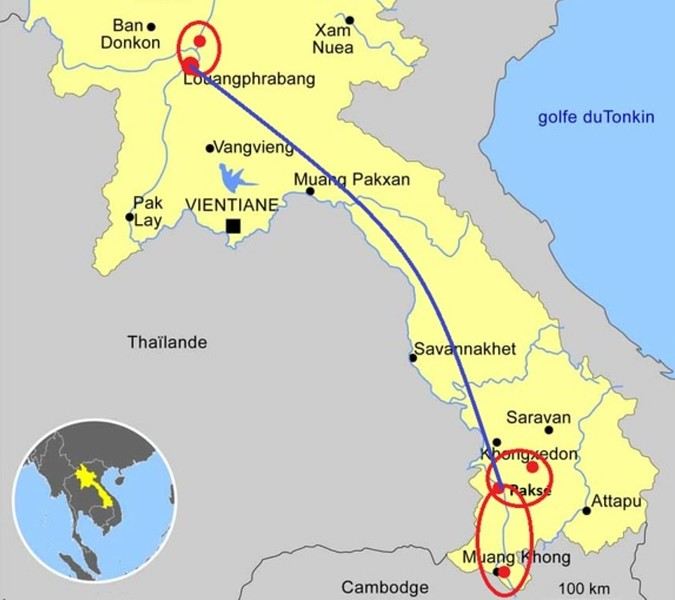
In broad strokes, it was very classic:
First, we “settled in” at Luang Prabang (8 days), because we wanted and needed to. From there, we took three days to venture a little further north—not far in kilometers, but as we know, distances aren’t just about km! Then we flew south to Paksé, letting ourselves drift down to the 4,000 Islands while stopping by the pre-Angkorian archaeological sites. We wrapped up with the Bolaven Plateau.
A few practical notes: We arrived via Bangkok, then took a Bangkok-Luang Prabang flight, having picked up our luggage in Bangkok to check it in for Luang Prabang. No issues—the Bangkok airport, which many of you know, is very well organized. We got our visas on arrival in Luang Prabang. Quick, but to be fair, we were on a “small” plane, and the big flights had arrived earlier, so we weren’t too crowded in line! At the end of our trip, we didn’t fly out of Paksé but from the nearby airport in Thailand, Ubon Ratchathani (a 2.5-hour drive from Paksé), then Bangkok and Paris. You’ll notice we skipped Vientiane to stay longer in Luang Prabang. That said, there’s now a high-speed train between Vientiane and Luang Prabang—good to know—and soon the (Chinese) train will go all the way to Bangkok and even Kuala Lumpur!
With that intro out of the way, let’s dive into the heart of the matter. To be continued: Slowing down the pace... in Luang Prabang
Prices in Albania
I’ve got some new questions about Albania!
My boyfriend and I are going there for just 9 days, including the two travel days… It’s not much, but oh well!
Looking at prices online, I get the impression everything’s more expensive than I thought 😅 So, I wanted to get your feedback on a few things:
* Is hitchhiking common, easy, and generally safe in Albania? * Is it possible to find day-to-day accommodations without booking ahead? If so, are they usually cheaper than the ones you find online? * Is wild camping allowed or at least tolerated?
If any of you have traveled there recently, I’d love all the tips and great deals you’ve got!
Thanks ☺️
My boyfriend and I are going there for just 9 days, including the two travel days… It’s not much, but oh well!
Looking at prices online, I get the impression everything’s more expensive than I thought 😅 So, I wanted to get your feedback on a few things:
* Is hitchhiking common, easy, and generally safe in Albania? * Is it possible to find day-to-day accommodations without booking ahead? If so, are they usually cheaper than the ones you find online? * Is wild camping allowed or at least tolerated?
If any of you have traveled there recently, I’d love all the tips and great deals you’ve got!
Thanks ☺️
Megacom SIM card, how does it work?
Hi there,
I’ve never bought a SIM card abroad or even used prepaid cards in France...
So I’m wondering how it all works?
You buy a SIM card and pop it into your phone. Okay, so far so good... 😏
But after that?
I can’t find the price of prepaid cards or how they work with MegaCom.
If someone could give me a step-by-step guide... 😊
Thanks! 🙂
I’ve never bought a SIM card abroad or even used prepaid cards in France...
So I’m wondering how it all works?
You buy a SIM card and pop it into your phone. Okay, so far so good... 😏
But after that?
I can’t find the price of prepaid cards or how they work with MegaCom.
If someone could give me a step-by-step guide... 😊
Thanks! 🙂
New B2 Tourist Visa Fee for the USA
Hi there,
We need to apply for a B2 visa because we visited Iran in 2018. It currently costs $185, but they’re planning an additional $250 fee per person for the same visa—it’s been approved but not yet implemented. Does anyone know when this fee will take effect?
Thanks in advance!
Elisabeth
Two weeks in Santo Antão and São Vicente – trip report
Hi everyone!
The forum has been a huge help during my moments of doubt, and since Cape Verde isn’t a destination with many discussions, I felt I had to share my trip report 🙂
First, the EASE: I could never validate it from my phone—I tried 50 times without success, and on the computer, it worked the first time. Then, Cabo Verde Airlines: forget online check-in. I went to the airport early to get my window seat (and in the end, the plane wasn’t full—I had three seats to myself, so I could finish my night peacefully). No in-flight entertainment for those who don’t sleep on planes.
Monday 9: Flight + arrival at Antonio’s (Oia Mindelo Guesthouse). Antonio’s apartment is up on the hill, but really, it’s only a 10-minute walk to the beach and 10 minutes to the city center (depending on where in the center). He picked me up at the airport (1000$). I continued relaxing by doing... nothing on the beach. Dinner in town at Café Mindelo: a pretty place, but otherwise meh—expensive and not necessarily good (2100$ for a beer and a fish that didn’t seem freshly caught as advertised). Tuesday 10: Antonio offered to do a tour of the island (for cheap), and we left with his other guests (a lovely English couple, 76 and 77 years old). Stops at Salamansa (I felt something special on that beach—I could’ve stayed there for an hour doing nothing), then another scenic spot, a restaurant, and Baias das Gatas (I took a quick dip, but to me, it had less charm than Salamansa). Then we crossed the island to return to São Pedro (beautiful but windy; the village looks cute). Exhausted, I went to bed early because of the ferry to Santo Antão the next day. Wednesday 11: Antonio took me to the ferry, and we’ll see each other again since he’s hosting me at his aunt’s place during Carnival. On the ferry, I had a Booking.com reservation for what I thought was in Ribeira Grande (the town), but it was actually *in* the ribeira—specifically in Manta Velha (aluguer to Cruzinha ~600$). I thought I’d fallen into a hole, but I ended up loving it—Casa Familiar Gilda. Gilda is a divine cook (dinner for 1000$—don’t eat lunch, or there won’t be room), the village has a typical rural Santo Antão vibe, the place has great energy, and you can get around easily by aluguer. Thursday 12: I left early by aluguer to Ribeira Grande (250$), then another aluguer to Ponta do Sol (100$)—a sleepy beauty at that hour—to do the Ponta do Sol-Cruzinha hike, finishing in Cha de Igreja. Departure at 8:22 AM from the cemetery in Ponta do Sol, passing through Fontainhas (those doing it the other way will have a fabulous climb at the end 😏), and let’s go! I loved this glimpse of rural life—past or present—the sea is stunning, and we were shaded most of the way (though it goes up and down, it’s manageable). The arrival at Cha de Mar is breathtaking, and Cruzinha is a charming little town (arrived at 12:30 PM). I’d brought my swimsuit after reading there was a beach, but I packed it back up—too many waves and big pebbles. I continued to Cha de Igreja (25 more minutes) after a short break (ask for the path that doesn’t go by the road). It’s adorable with its church square (you don’t see this layout much elsewhere). I might’ve stayed longer to enjoy the place, but a taxi driver asked if I wanted to return to Manta Velha (1000$), and like a fool, I said yes (it was 2:30 PM—I could’ve waited for the 4:30 PM aluguer for 100$, but oh well). But since I still had energy, I decided to see if I could find a grog distillery. I ran into a French guy arriving at Gilda’s, and we ended up talking to Rodrigo, who explained everything from A to Z about how they make grog (the simple cane juice is amazingly good—but the work is clearly tough). Friday 13: Transfer to Xoxo on Djalma’s advice 😉, where I’d booked a room at Casa Xoxo. I did the hike to Rabo Crusto... it’s tough, but I kept quiet when I saw a pregnant woman doing it with her two little ones 😄. There’s also a distillery I didn’t linger in, and I took a tea break with that wonderful landscape before heading back. I couldn’t find the path Jean-Michel had told me about (take a right at the village entrance), so I went back down to the water reservoir to turn off and take the waterfall path (anyone can point it out if needed). The bedding at Casa Xoxo was perfect, but the dinner atmosphere was less family-like. Saturday 14: No one at Casa Xoxo could tell me when the aluguer passed, so I scarfed down my breakfast and headed down a bit. I found one (not sure if he’d planned to work, but there were three of us, so he left). Arrived in Ribeira Grande, an aluguer driver told me the coastal road to Porto Novo was closed and we had to take the Corde road—but no one was leaving, so we’d have to charter... Sometimes, you just have to say it: aluguer drivers say there’s no ride just to make you pay the private price (3500$). But this time, it was true! With another French couple, we wanted to go to Tarrafal. Our driver called the Porto Novo-Tarrafal aluguer to wait for us. The Corde road is stunning—more different landscapes (thorny forest, misty peaks...). Changed aluguers in Porto Novo and headed to Tarrafal. Another world—lunar landscape on the way. Arrived in Tarrafal and relaxed. Sunday 15: Hike from Tarrafal to Monte Trigo, left at 8 AM, and I’m glad I did—I was in the shade until about 9:30 AM, then the sun got strong. Beautiful walk, arrived in Monte Trigo around 11:30 AM. The people weren’t particularly friendly, but oh well. Swam at the little beach in Monte Trigo (the water is *so* good). I waited for other French people who had “booked” a boat for the return. Came back with Javi (50 min—1000$ each), who lent us masks and snorkels for some snorkeling. Had grog with Ludo, Estelle’s husband, who was waiting at the bar, then filled my grog bottle at the *mercearia*. I admit, it’s delicious, but I don’t remember much of that evening 😇🤪. Except Javi put on a show saying he’d been robbed, had no money, and needed to pay the boat owner, etc. People paid again (apparently not me, since Ludo, Estelle, and I arrived at the restaurant after Javi’s drama). FYI, Javi does this often—my host had warned the couple renting the other room to watch out for him because he scams people for money. So Javi is 35 with hazel/special-colored eyes. But if you don’t repay the “service,” the day was still great. Monday 16: Several of us were taking the late-afternoon boat, so we chartered an aluguer (7000$) to avoid the 6 AM one—trip—boat to Mindelo. Antonio picked me up at the ferry, and boom—Carnival! I found a spot on Rua de Lisboa. My neighbor was from Santo Antão just for Carnival, spoke French, and explained that last year’s Carnival started 3 hours late because a float couldn’t fit under the power lines 😏 (like they don’t know the height by now hahaha). On Monday, it’s the teachers (nice—kind of a warm-up) and the Madingas. Once they passed my spot, I followed them along the route—I LOVED it! By midnight, they still hadn’t reached Praça Nova, and the police told them to speed up, but I loved that energy! Tuesday 17—Mardi Gras: Beach day, then Carnival! Antonio had bought me a seated ticket just in case (300$). Ended up in front of a punch stand, where I ran into two French women I’d met in Manta Velha. Two guys from Mindelo talked to us, and we did Carnival with them. And what was bound to happen, happened: a float couldn’t pass because... it was taller than the power lines 😏😏😏. The dancers kept dancing while the crowd tried to lift the cable. Finally, a guy in a tree climbed higher and used a pole to lift it... and the parade could continue 😉. Around 12:30–1:30 AM, when the concert was supposed to start, the power went out. I went home and later learned the concert started around 3 AM. Wednesday 18: I went home because I was taking the boat back to Santo Antão, heading to Casa Familiar Gilda. Walked the loop from Manta Velha. Thursday 19: Left early for Ribeira da Paul to do the loop to Sandra’s House. It’s truly breathtaking! Back at Gilda’s, I chilled. I wanted to go to Sinagoga’s natural pools, but the hike had worn me out. Friday 20: Return to Mindelo on the red company’s ferry—no comparison: way more comfortable than the blue company’s, especially for someone prone to seasickness. Beach. Exhausted, I struggled to sleep because the shop on the ground floor of my rental had a party until 3 AM (and the windows aren’t double-glazed—*hi*—but that’s common in Mindelo). Saturday 21: Ran into Estelle and Ludo by chance (the city’s small), and we arranged to share a taxi the next day since we had the same return flight. Beach (I tried Lazaretto Beach, but nope—not great—dead fish + weird smell = bad signs). So Laginhia was fine, and in the evening, a restaurant with singers, then Caravelle (the ground-floor shop didn’t bother me since I got home when they were saying goodbye 😏). Too bad—I dance salsa, bachata, kompa, zouk, but not kizomba hahaha, but it was still fun. Sunday 22: Took a taxi with Ludo and Estelle (1200$). Arrived *ages* before takeoff (no exchange office—get escudos in town if you have any left). Boom—CDG, boom—RER... home.
There you go—a super long trip report. Not sure if it’ll help, but the digital detox was amazing. These two islands are very different but so beautiful. I only got a glimpse, but they’re worth the trip. I was lucky to see Carnival (what joy in that city!) and happy the Cambodia ticket (my first idea) was way too expensive 😉
First, the EASE: I could never validate it from my phone—I tried 50 times without success, and on the computer, it worked the first time. Then, Cabo Verde Airlines: forget online check-in. I went to the airport early to get my window seat (and in the end, the plane wasn’t full—I had three seats to myself, so I could finish my night peacefully). No in-flight entertainment for those who don’t sleep on planes.
Monday 9: Flight + arrival at Antonio’s (Oia Mindelo Guesthouse). Antonio’s apartment is up on the hill, but really, it’s only a 10-minute walk to the beach and 10 minutes to the city center (depending on where in the center). He picked me up at the airport (1000$). I continued relaxing by doing... nothing on the beach. Dinner in town at Café Mindelo: a pretty place, but otherwise meh—expensive and not necessarily good (2100$ for a beer and a fish that didn’t seem freshly caught as advertised). Tuesday 10: Antonio offered to do a tour of the island (for cheap), and we left with his other guests (a lovely English couple, 76 and 77 years old). Stops at Salamansa (I felt something special on that beach—I could’ve stayed there for an hour doing nothing), then another scenic spot, a restaurant, and Baias das Gatas (I took a quick dip, but to me, it had less charm than Salamansa). Then we crossed the island to return to São Pedro (beautiful but windy; the village looks cute). Exhausted, I went to bed early because of the ferry to Santo Antão the next day. Wednesday 11: Antonio took me to the ferry, and we’ll see each other again since he’s hosting me at his aunt’s place during Carnival. On the ferry, I had a Booking.com reservation for what I thought was in Ribeira Grande (the town), but it was actually *in* the ribeira—specifically in Manta Velha (aluguer to Cruzinha ~600$). I thought I’d fallen into a hole, but I ended up loving it—Casa Familiar Gilda. Gilda is a divine cook (dinner for 1000$—don’t eat lunch, or there won’t be room), the village has a typical rural Santo Antão vibe, the place has great energy, and you can get around easily by aluguer. Thursday 12: I left early by aluguer to Ribeira Grande (250$), then another aluguer to Ponta do Sol (100$)—a sleepy beauty at that hour—to do the Ponta do Sol-Cruzinha hike, finishing in Cha de Igreja. Departure at 8:22 AM from the cemetery in Ponta do Sol, passing through Fontainhas (those doing it the other way will have a fabulous climb at the end 😏), and let’s go! I loved this glimpse of rural life—past or present—the sea is stunning, and we were shaded most of the way (though it goes up and down, it’s manageable). The arrival at Cha de Mar is breathtaking, and Cruzinha is a charming little town (arrived at 12:30 PM). I’d brought my swimsuit after reading there was a beach, but I packed it back up—too many waves and big pebbles. I continued to Cha de Igreja (25 more minutes) after a short break (ask for the path that doesn’t go by the road). It’s adorable with its church square (you don’t see this layout much elsewhere). I might’ve stayed longer to enjoy the place, but a taxi driver asked if I wanted to return to Manta Velha (1000$), and like a fool, I said yes (it was 2:30 PM—I could’ve waited for the 4:30 PM aluguer for 100$, but oh well). But since I still had energy, I decided to see if I could find a grog distillery. I ran into a French guy arriving at Gilda’s, and we ended up talking to Rodrigo, who explained everything from A to Z about how they make grog (the simple cane juice is amazingly good—but the work is clearly tough). Friday 13: Transfer to Xoxo on Djalma’s advice 😉, where I’d booked a room at Casa Xoxo. I did the hike to Rabo Crusto... it’s tough, but I kept quiet when I saw a pregnant woman doing it with her two little ones 😄. There’s also a distillery I didn’t linger in, and I took a tea break with that wonderful landscape before heading back. I couldn’t find the path Jean-Michel had told me about (take a right at the village entrance), so I went back down to the water reservoir to turn off and take the waterfall path (anyone can point it out if needed). The bedding at Casa Xoxo was perfect, but the dinner atmosphere was less family-like. Saturday 14: No one at Casa Xoxo could tell me when the aluguer passed, so I scarfed down my breakfast and headed down a bit. I found one (not sure if he’d planned to work, but there were three of us, so he left). Arrived in Ribeira Grande, an aluguer driver told me the coastal road to Porto Novo was closed and we had to take the Corde road—but no one was leaving, so we’d have to charter... Sometimes, you just have to say it: aluguer drivers say there’s no ride just to make you pay the private price (3500$). But this time, it was true! With another French couple, we wanted to go to Tarrafal. Our driver called the Porto Novo-Tarrafal aluguer to wait for us. The Corde road is stunning—more different landscapes (thorny forest, misty peaks...). Changed aluguers in Porto Novo and headed to Tarrafal. Another world—lunar landscape on the way. Arrived in Tarrafal and relaxed. Sunday 15: Hike from Tarrafal to Monte Trigo, left at 8 AM, and I’m glad I did—I was in the shade until about 9:30 AM, then the sun got strong. Beautiful walk, arrived in Monte Trigo around 11:30 AM. The people weren’t particularly friendly, but oh well. Swam at the little beach in Monte Trigo (the water is *so* good). I waited for other French people who had “booked” a boat for the return. Came back with Javi (50 min—1000$ each), who lent us masks and snorkels for some snorkeling. Had grog with Ludo, Estelle’s husband, who was waiting at the bar, then filled my grog bottle at the *mercearia*. I admit, it’s delicious, but I don’t remember much of that evening 😇🤪. Except Javi put on a show saying he’d been robbed, had no money, and needed to pay the boat owner, etc. People paid again (apparently not me, since Ludo, Estelle, and I arrived at the restaurant after Javi’s drama). FYI, Javi does this often—my host had warned the couple renting the other room to watch out for him because he scams people for money. So Javi is 35 with hazel/special-colored eyes. But if you don’t repay the “service,” the day was still great. Monday 16: Several of us were taking the late-afternoon boat, so we chartered an aluguer (7000$) to avoid the 6 AM one—trip—boat to Mindelo. Antonio picked me up at the ferry, and boom—Carnival! I found a spot on Rua de Lisboa. My neighbor was from Santo Antão just for Carnival, spoke French, and explained that last year’s Carnival started 3 hours late because a float couldn’t fit under the power lines 😏 (like they don’t know the height by now hahaha). On Monday, it’s the teachers (nice—kind of a warm-up) and the Madingas. Once they passed my spot, I followed them along the route—I LOVED it! By midnight, they still hadn’t reached Praça Nova, and the police told them to speed up, but I loved that energy! Tuesday 17—Mardi Gras: Beach day, then Carnival! Antonio had bought me a seated ticket just in case (300$). Ended up in front of a punch stand, where I ran into two French women I’d met in Manta Velha. Two guys from Mindelo talked to us, and we did Carnival with them. And what was bound to happen, happened: a float couldn’t pass because... it was taller than the power lines 😏😏😏. The dancers kept dancing while the crowd tried to lift the cable. Finally, a guy in a tree climbed higher and used a pole to lift it... and the parade could continue 😉. Around 12:30–1:30 AM, when the concert was supposed to start, the power went out. I went home and later learned the concert started around 3 AM. Wednesday 18: I went home because I was taking the boat back to Santo Antão, heading to Casa Familiar Gilda. Walked the loop from Manta Velha. Thursday 19: Left early for Ribeira da Paul to do the loop to Sandra’s House. It’s truly breathtaking! Back at Gilda’s, I chilled. I wanted to go to Sinagoga’s natural pools, but the hike had worn me out. Friday 20: Return to Mindelo on the red company’s ferry—no comparison: way more comfortable than the blue company’s, especially for someone prone to seasickness. Beach. Exhausted, I struggled to sleep because the shop on the ground floor of my rental had a party until 3 AM (and the windows aren’t double-glazed—*hi*—but that’s common in Mindelo). Saturday 21: Ran into Estelle and Ludo by chance (the city’s small), and we arranged to share a taxi the next day since we had the same return flight. Beach (I tried Lazaretto Beach, but nope—not great—dead fish + weird smell = bad signs). So Laginhia was fine, and in the evening, a restaurant with singers, then Caravelle (the ground-floor shop didn’t bother me since I got home when they were saying goodbye 😏). Too bad—I dance salsa, bachata, kompa, zouk, but not kizomba hahaha, but it was still fun. Sunday 22: Took a taxi with Ludo and Estelle (1200$). Arrived *ages* before takeoff (no exchange office—get escudos in town if you have any left). Boom—CDG, boom—RER... home.
There you go—a super long trip report. Not sure if it’ll help, but the digital detox was amazing. These two islands are very different but so beautiful. I only got a glimpse, but they’re worth the trip. I was lucky to see Carnival (what joy in that city!) and happy the Cambodia ticket (my first idea) was way too expensive 😉
Santo Antão: organizing luggage transfer
Hi,
Without booking in advance through an agency, is it possible/easy to organize luggage transfer from one night to the next between accommodations in Santo Antão?
Thanks.
Wi-Fi in Taiwan and budget-friendly hotels
Hi everyone who’s reading this!
I’m heading to Taiwan soon and would love some up-to-date info on Wi-Fi. From what I’ve gathered, Taiwan offers it for free, but I’ve heard it’s not secure since it’s not protected by a "password." Since I’ve been traveling outside the EU for years without a local SIM card, I only use Wi-Fi in hotels, restaurants, and cafés. For me, that’s more than enough. So, my question is: Do these places secure their Wi-Fi with a "password"? If not, does buying a SIM card or eSIM seem like the only alternative?
Also, if any of you have recommendations for budget-friendly hotels in the main "cities," I’d love to hear them!
Thanks in advance for your replies! !
I’m heading to Taiwan soon and would love some up-to-date info on Wi-Fi. From what I’ve gathered, Taiwan offers it for free, but I’ve heard it’s not secure since it’s not protected by a "password." Since I’ve been traveling outside the EU for years without a local SIM card, I only use Wi-Fi in hotels, restaurants, and cafés. For me, that’s more than enough. So, my question is: Do these places secure their Wi-Fi with a "password"? If not, does buying a SIM card or eSIM seem like the only alternative?
Also, if any of you have recommendations for budget-friendly hotels in the main "cities," I’d love to hear them!
Thanks in advance for your replies! !
Does the exchange office at Ivato buy ariary?
Hi there! I have to leave Ivato/Antananarivo on December 16th. I have a lot of ariary that I’d like to exchange for euros since I might not be coming back to Madagascar (after this 21st trip). I think the exchange office at Ivato also buys ariary back. If any of you have seen the rate for this buyback in advance, thanks a million!
Exchanging Euros in Cape Verde
Hi,
We’re heading to Cape Verde in January. We’re scheduled to arrive in Praia on a Saturday around 11 AM.
I read somewhere that the exchange rate for Euros to Escudos is the same everywhere—110 escudos for 1 euro. Can anyone confirm this? If that’s the case, I assume there’s a currency exchange desk at the airport, and the rate isn’t too bad? So, it’s better to exchange at the airport, right? What do you think? I don’t want to use ATMs.
Otherwise, are banks in town open on Saturdays? I read they close by 3 PM?
Hiking, camping, and snorkeling on Madagascar's east coast
Hello,
I’m continuing the Antalaha–Maroantsetra discussion but for some info in the other direction, specifically about hiking from Maroantsetra to Antalaha.
In mid-December, I plan to take it easy from Tamatave to Antalaha. I’m thinking of making a few stops, like Nosy Atafana—has anyone snorkeled there? Is it nice? Can you find bush taxis on the Soniera–Ivongo / Maroantsetra stretch?
After that, I’m considering walking from Maroantsetra to Antalaha and figuring things out as I go, since the path seems well-used, so I’m not planning on a guide. Good idea or totally foolish? Should I bring a tent and some camping gear, or, as I’ve read multiple times, are there several villages with lodging and food options along the way? Any spots worth stopping at or nothing special to see?
In Antalaha, I saw the recommendation for Villa Malaza in the previous discussion, so I’m keeping that in mind. If there’s space, I’ll plan to stay there. In Antalaha itself, are there any places to visit, things to see, or activities you’d recommend?
Thanks in advance to everyone for any tips—they’ll be really helpful!
In mid-December, I plan to take it easy from Tamatave to Antalaha. I’m thinking of making a few stops, like Nosy Atafana—has anyone snorkeled there? Is it nice? Can you find bush taxis on the Soniera–Ivongo / Maroantsetra stretch?
After that, I’m considering walking from Maroantsetra to Antalaha and figuring things out as I go, since the path seems well-used, so I’m not planning on a guide. Good idea or totally foolish? Should I bring a tent and some camping gear, or, as I’ve read multiple times, are there several villages with lodging and food options along the way? Any spots worth stopping at or nothing special to see?
In Antalaha, I saw the recommendation for Villa Malaza in the previous discussion, so I’m keeping that in mind. If there’s space, I’ll plan to stay there. In Antalaha itself, are there any places to visit, things to see, or activities you’d recommend?
Thanks in advance to everyone for any tips—they’ll be really helpful!
Very short layover at Doha Airport
Hi there
I completely forgot the transit procedure at Doha Airport and I’m a bit worried because I only have 1h30 to change planes, since my first flight was rescheduled. My flights: Barcelona/Doha: arrival at 6:15 AM Doha/Bangkok: departure at 7:50 AM
We only have carry-on luggage. Will they be checked again? Do we have to go through security again? Are the connections smooth and well signposted? Finally, is it common in this situation to ask a flight attendant for help?
Thanks! 🙂
I completely forgot the transit procedure at Doha Airport and I’m a bit worried because I only have 1h30 to change planes, since my first flight was rescheduled. My flights: Barcelona/Doha: arrival at 6:15 AM Doha/Bangkok: departure at 7:50 AM
We only have carry-on luggage. Will they be checked again? Do we have to go through security again? Are the connections smooth and well signposted? Finally, is it common in this situation to ask a flight attendant for help?
Thanks! 🙂
The era of travel advice: between AI, free forums, and local expertise
The end of a golden age
For years, travel forums embodied the spirit of mutual aid on the web. Travelers generously shared their experiences, tips, and secret spots. This collective generosity seemed endless. But behind this altruistic facade lay a more complex reality.
The silent infiltration of forums Free travel forums have gradually become marketing hunting grounds. Under the guise of "experienced travelers," professionals in tourism, affiliates seeking commissions, or aspiring influencers testing monetization strategies now lurk.
These fake profiles master the community’s codes. They build credibility by answering dozens of basic questions before subtly slipping in their paid recommendations. A "favorite" hotel mentioned insistently, an "essential" guidebook systematically cited, an "extraordinary" local agency that keeps coming up in conversations.
New travelers can no longer tell the difference between selfless advice and disguised promotion. This informational pollution has gradually eroded the trust that gave these platforms their value.
The rise of paid Travel Planners Faced with this decline, a new profession has emerged: the independent Travel Planner. These professionals fully embrace their commercial status and charge for personalized advice.
The model is transparent: you pay for real expertise, tailor-made itineraries, and guaranteed availability. Some offer packages for 150-300 € to plan a two-week trip entirely. Others charge by the hour.
This professionalization marks a turning point. Travel advice is leaving the realm of volunteerism and entering the world of paid services. Paradoxically, this acknowledged monetization can restore a form of trust: you know what you’re paying for.
The irruption of artificial intelligence But now, a third option is emerging: generative AI. ChatGPT, Claude, Gemini, and others can now generate travel itineraries in seconds, for free, with no commercial agenda.
AI promises neutral, synthetic, endlessly customizable information. It compiles thousands of sources in real time, suggests alternatives, and adapts recommendations to your budget and time constraints. It doesn’t sell anything, earns no commissions, and has no hotels to promote.
But this apparent neutrality hides its own limitations. AI feeds on existing data, often from the same polluted forums or marketing content. It can invent restaurants that don’t exist, mix up tourist seasons, or ignore recent local realities. It has never walked a city’s streets, negotiated with a tuk-tuk driver, or felt the atmosphere of a neighborhood at nightfall.
The forgotten alternative: authentic local experts In this landscape saturated with dubious information, imperfect AI, and monetized services, one often-overlooked option remains: consulting real local professionals.
Not the agencies at the top of Google’s first page—often the most expensive and generic. But small local businesses, independent guides established for years, still-free municipal tourism offices, and cultural associations organizing themed tours.
These players offer what neither AI nor forums can: embodied, up-to-date, contextualized knowledge of the area. They know the newly opened restaurant, the museum temporarily closed for renovations, the impromptu weekend festival, or the alternative route to avoid construction.
Finding them takes extra effort. You have to search in the local language, look beyond the first page of results, check regional institutional websites, and join community Facebook groups. But this approach is often rewarded with free or low-cost advice of unmatched precision.
Toward an ecology of travel advice The future of travel advice likely won’t be binary but hybrid. AI can rough out itineraries, propose logistical options, and compare alternatives. Travel Planners can refine, personalize, and reassure anxious travelers. Local experts can enrich, correct, and ground advice in on-the-ground reality.
But for this ecosystem to work, we’ll need to develop new discernment. Learn to spot fake profiles on forums. Systematically verify AI suggestions. Assess the real value of a Travel Planner before paying. And, above all, rediscover the habit of contacting those who live there directly.
Travel has always been a school of discernment. It teaches us to distinguish the authentic from the fake, sincere advice from commercial manipulation. In the digital age, this skill becomes more crucial than ever.
Because ultimately, the real question isn’t which information source to prioritize, but how to cultivate our own ability to evaluate, cross-check, and ultimately make informed choices. The best travel guide may still be our critical thinking.
Photo credit: Arakis Travel
The silent infiltration of forums Free travel forums have gradually become marketing hunting grounds. Under the guise of "experienced travelers," professionals in tourism, affiliates seeking commissions, or aspiring influencers testing monetization strategies now lurk.
These fake profiles master the community’s codes. They build credibility by answering dozens of basic questions before subtly slipping in their paid recommendations. A "favorite" hotel mentioned insistently, an "essential" guidebook systematically cited, an "extraordinary" local agency that keeps coming up in conversations.
New travelers can no longer tell the difference between selfless advice and disguised promotion. This informational pollution has gradually eroded the trust that gave these platforms their value.
The rise of paid Travel Planners Faced with this decline, a new profession has emerged: the independent Travel Planner. These professionals fully embrace their commercial status and charge for personalized advice.
The model is transparent: you pay for real expertise, tailor-made itineraries, and guaranteed availability. Some offer packages for 150-300 € to plan a two-week trip entirely. Others charge by the hour.
This professionalization marks a turning point. Travel advice is leaving the realm of volunteerism and entering the world of paid services. Paradoxically, this acknowledged monetization can restore a form of trust: you know what you’re paying for.
The irruption of artificial intelligence But now, a third option is emerging: generative AI. ChatGPT, Claude, Gemini, and others can now generate travel itineraries in seconds, for free, with no commercial agenda.
AI promises neutral, synthetic, endlessly customizable information. It compiles thousands of sources in real time, suggests alternatives, and adapts recommendations to your budget and time constraints. It doesn’t sell anything, earns no commissions, and has no hotels to promote.
But this apparent neutrality hides its own limitations. AI feeds on existing data, often from the same polluted forums or marketing content. It can invent restaurants that don’t exist, mix up tourist seasons, or ignore recent local realities. It has never walked a city’s streets, negotiated with a tuk-tuk driver, or felt the atmosphere of a neighborhood at nightfall.
The forgotten alternative: authentic local experts In this landscape saturated with dubious information, imperfect AI, and monetized services, one often-overlooked option remains: consulting real local professionals.
Not the agencies at the top of Google’s first page—often the most expensive and generic. But small local businesses, independent guides established for years, still-free municipal tourism offices, and cultural associations organizing themed tours.
These players offer what neither AI nor forums can: embodied, up-to-date, contextualized knowledge of the area. They know the newly opened restaurant, the museum temporarily closed for renovations, the impromptu weekend festival, or the alternative route to avoid construction.
Finding them takes extra effort. You have to search in the local language, look beyond the first page of results, check regional institutional websites, and join community Facebook groups. But this approach is often rewarded with free or low-cost advice of unmatched precision.
Toward an ecology of travel advice The future of travel advice likely won’t be binary but hybrid. AI can rough out itineraries, propose logistical options, and compare alternatives. Travel Planners can refine, personalize, and reassure anxious travelers. Local experts can enrich, correct, and ground advice in on-the-ground reality.
But for this ecosystem to work, we’ll need to develop new discernment. Learn to spot fake profiles on forums. Systematically verify AI suggestions. Assess the real value of a Travel Planner before paying. And, above all, rediscover the habit of contacting those who live there directly.
Travel has always been a school of discernment. It teaches us to distinguish the authentic from the fake, sincere advice from commercial manipulation. In the digital age, this skill becomes more crucial than ever.
Because ultimately, the real question isn’t which information source to prioritize, but how to cultivate our own ability to evaluate, cross-check, and ultimately make informed choices. The best travel guide may still be our critical thinking.
Photo credit: Arakis Travel
What's the best option: local SIM card or international plan?
Hi there,
A question for those who’ve looked into this.
What’s more advantageous or preferable: buying a local SIM card for GPS and SMS (we’ll handle calls via WhatsApp), or going with a plan from our mobile provider (Orange) that offers international packages with several options up to 150GB?
Does anyone know the price of SIM cards at Vodacom?
Thanks to anyone who chimes in! 😉
Dan
Thanks to anyone who chimes in! 😉
Dan
Solo road trip in Algeria
Hello, I’m preparing for a Tunisia-Algeria road trip.
I need to know if we can cross the Sahara to reach Djanet and Tamanrasset by road freely,
After that, obviously off-road in the desert with a guide.
What do the authorities say?
My trip: northern and southern Tunisia, a stroll in the desert.
Crossing the Tunisia-Algeria border via the Taleb Larbi customs.
I’ve already done this route through an agency, but this time we want to do it on our own.
Then heading down to Djanet for eight to fifteen days in the desert with Mouloud, a local guide.
Direction Tamanrasset: road and tracks, the mountains of the Assekrem, the Hermitage of Père de Foucauld.
Return via the Trans-Saharan Highway.
Visit to northern Algeria, then back by boat from Oran to Spain.
Dates: late December to mid-February.
We’ve got plenty of time.
If another crew is interested, we’re already two vehicles.
Looking forward to your replies.
Layover canceled 4 months before the flight by Lufthansa
Hi,
I’m traveling to New Zealand in January 2026 with Lufthansa.
To check the allowed baggage dimensions, I went to my "booking" account on the Lufthansa website.
And that’s when I discovered that my last layover, the Zurich-Bordeaux flight operated by Swiffairlines, was canceled. I never received an email, and even worse, it’s not even noted on my booking.
So I contacted Lufthansa. They told me that for now, there are no other flights but that there will be by the time I leave.
They advised me to call them every week to get a flight.
What do you think of their response?
Has this ever happened to you?
Emilie
Hitchhiking in the 70s-80s
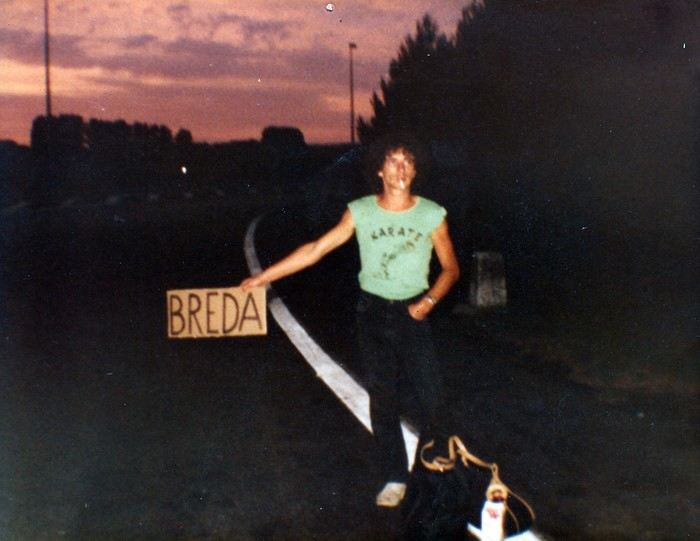
“Hey, your Marker... - My Marker? - The one you used to make hitchhiking signs.”
The marker in question is sitting proudly on the kitchen table. Marielle found it at the bottom of a moving box.
I’ve been meaning to tell the long story of my love affair with hitchhiking for years. Here we go.
To be honest, I’m not quite sure when it started. My earliest memory goes back to a fair with a bike race in my maternal grandparents’ village. I was with my cousin, my little sister, and three girl cousins. There were six of us, ages ranging from six or seven to thirteen or fourteen. Our parents stayed at the fair, and we’d had enough. So we decided to walk home. Only it was four kilometers away. So we hitchhiked. A guy driving an old car picked us all up and dropped us off at the farm. He probably found it amusing to see us thumbing a ride by the side of the road, but maybe it also worried him a bit. With everything you read in the papers...
Around fifteen or sixteen, I started hitchhiking regularly, alone or with a friend, to go to the nearby town. But it was especially when I started boarding school in Orléans that it became more regular. The first year, I’d leave Monday morning and come back Saturday noon by bus. It was an old, uncomfortable bus where we froze in winter. To make matters worse, I often got motion sickness if, as was too often the case, I ended up sitting in the back. In the spring, a high school friend suggested I hitchhike back. It meant a slight detour, but the advantage was taking only national roads.
So that’s how, from the end of tenth grade to twelfth grade, I’d thumb a ride every Saturday on the Pont de Bourgogne. Drivers were used to seeing young people hitchhiking, and it worked pretty well. Our biggest fear? Soldiers! At that time, military service was still mandatory, and on weekends, it wasn’t rare to see them competing with us. They’d keep their uniforms on to go home. That gave people confidence—with everything you read in the papers—and they’d rarely wait more than five minutes. We, with our long hair, were definitely less popular. From time to time, three big red-faced guys in a van coming back from a construction site would flip us off, yelling things like “go get a haircut, you bums!” Those were the good old days.
We still had a good laugh, though. Patrice, the friend I’d hitchhike back from school with on Saturdays, is a musician—I’d later discover he’s an excellent composer. A die-hard Beatles fan, he knows their repertoire by heart and spends his time singing at the top of his lungs while we thumb a ride. One Saturday late morning, we’d been waiting for a while at the exit of Châteauneuf-sur-Loire when a little lady came up to him and asked if he could please sing a little quieter: a baby was sleeping in the house. He put on the most sorry face: “Oh, sorry ma’am, we didn’t realize.” No sooner had the lady gone back inside than he started again. Luckily, a car stopped just then, sparing me the embarrassment of seeing the lady come back out.
Saturday was also the day when the cigarette pack was dangerously low. So before leaving, we’d go buy some “Parisiennes,” the “P4s” as we called them back then. They were slightly thinner cigarettes with a mix of tobacco scraps. Sometimes they tasted like light tobacco, sometimes like dark. Not great, but by the end of the week, our pocket money was gone. They were sold in small packs of four, hence the name P4. We’d only pay 20 centimes. On Saturdays, it was rare for the two of us to manage to scrape together 1.50 F to buy a whole pack of Gauloises...
The last twenty kilometers, I’d usually do alone, Patrice having reached his destination. From time to time, luck would smile on me: an acquaintance would just happen to pass by and stop. One January Saturday, at the exit of Gien, I ran into another guy from Argenton whom I knew a little. That day, the weather was nice, but the temperature was well below zero. It was around noon, and it was the off-peak hour. We were shivering, stamping our feet by the side of the road, when a Citroën “Tube” arrived: it was his father’s boss’s, a mason. They were both sitting in the front, but since they were obese, they had us climb onto the open back. Even though we huddled against the cab to shelter from the wind, the twenty kilometers felt very long, especially since we were only going sixty kilometers an hour. Our hands and cheeks were blue when we finally arrived.
The year I took my baccalaureate, a friend with a 2CV would take me Monday mornings with one or two others we’d pick up in nearby villages. We’d share the gas costs, but it was still cheaper than the bus. And in winter, the bus was my nightmare. You had to get up at five to catch it at six. Not enough sleep, and outside it was freezing or raining—or both. The 2CV was luxury. Plus, Philippe would pick me up at home. On the other hand, since I didn’t have class Saturday mornings—well, I did, but we only had PE the first two hours and nothing after—I’d skip class and slip out right after breakfast to thumb a ride at the Pont de Bourgogne.
Those three high school years were formative in this optional subject that was hitchhiking. Little by little, I learned the rules of the game. First, you shouldn’t walk along the road while thumbing. Cars go too fast and can’t stop easily. Accepting a ride that’s too short is also a no-go. The guy who offers to take you a little way but drops you off at some vague crossroads in the middle of nowhere? No thanks. You need to get dropped off in a town. If it’s a fairly big city, you often have to cross it from one end to the other, but it’s better. At the exit, you have to choose your spot well. Actually, you have to put yourself in the driver’s shoes: they need to see you early enough, not be going too fast, and be able to stop easily without risking an accident. So when leaving a city, it’s better not to go too far. It’s wiser to find a spot where cars go slowly and can stop easily. And preferably near a café. The café is for when you still have a few coins for a coffee and need to warm up. From time to time, you’d run into someone nice who’d make a detour to drop you off at a better spot to start again. Finally, if possible, avoid hitchhiking on Sundays. Cars are packed with whole families who, most of the time, aren’t going far. And then there’s the little worry of those people who rarely leave home: with everything you read in the papers...
During those high school years, it was only short trips, rarely exceeding a hundred kilometers. Later, I aimed bigger, and things were a bit different. In 1973-74, I crossed part of France for the first time on two or three occasions, coming back from the German border or returning to Bordeaux, where we lived briefly. Since there weren’t many highways back then, we took national roads. It was during these trips that I realized it was better to leave in the evening. As I said earlier, Sunday is to be avoided, but on weekdays, there’s another problem: if you leave in the morning, you only make short hops. First, it often takes longer to get going because drivers are people going to work nearby. Which brings us back to those who drop you off in a bad spot, far from everything. There, you have to know how to refuse. You thank the driver for stopping—oh, if only everyone could be like you—while explaining why you’d rather stay put. People don’t take offense, by the way. Those who pick up hitchhikers often hitchhiked themselves when they were in the military or before they had a car. In the late afternoon, you’d often run into salespeople or truckers, in other words, people who drive a lot. At that time, salespeople no longer had appointments and were more relaxed. They wanted to talk about something other than the merits of their products. On the radio, it was time for *Les Grosses Têtes*. You’d also quite often run into small business owners, professionals, or even hippies. The conversations were pleasant and often enriching. A little later in the evening, truckers would take over. They’d already driven a few hundred kilometers, and the depot or customs was still far away. So they’d gladly take a hitchhiker to stay awake at the wheel and chat. The radio with Max Ménier’s show *Les routiers sont sympas*, you’d eventually get tired of it. So a hitchhiker was a change. Others, who’d hit the road at midnight to be at their destination by morning, were nice and offered to let you lie down on the bunk while they drove. When you’d been hitchhiking since six in the evening, freezing in the wind between two vehicles, you weren’t unhappy to take a little nap.
Speaking of Max Ménier, he’d often make announcements for hitchhikers. One evening, I called him. It was getting late, and I still had quite a way to go. No luck: the show had ended for good the day before!
In short, it’s better not to rush, sleep in, and leave after lunch, or better yet, in the late afternoon. Obviously, I’m talking about when you have several hundred kilometers to cover. That’s when you have to play it pro.
First thing, especially at night, but it also applies in the middle of summer when the light is blinding: dress to be seen from far away. I’ll admit I have an advantage over most other hitchhikers: I’m small and don’t scare people. To balance that out, racist drivers often take me for an Arab and are less likely to pick me up, but overall, the balance tips in my favor. Back to the need to be seen: at night, I wear light-colored clothes. In headlights, you can see me from far away.
Second thing: travel light. Forget the big backpack with a frame. Drivers don’t always have room in the trunk or on the back seat, especially if it’s rained and the ground is wet. Plus, it forces them to get out of the car. If they’re nice enough to pick up a hitchhiker, you shouldn’t ask for too much either.
Third thing: bring a cardboard sign and a big marker—like the ones in the photo at the start of this post—to write the name of your destination. In the early 80s, I ran a tourist house in the Cher, but I lived in the Netherlands. In the off-season, it was only open on weekends. On Fridays, I’d leave Holland and return on Mondays. 1200 km round trip. On the way there, in Paris, I’d stand at Porte de la Chapelle. At that spot, the road is very wide, and drivers could stop easily. Obviously, on the sign, I didn’t write Eindhoven, which not everyone knows, and even less Amsterdam because of its seedy reputation. In that case, you’d expect to see a police car stop and two officers in kepis ask for your papers. So as a first destination, I’d write Compiègne. We were well out of Paris, and since it wasn’t too far, a trucker or salesperson was less reluctant to stop. Once past Compiègne, I’d take out my Lille sign. Once in Belgium, it wasn’t really necessary to use a sign anymore, since everyone was going in the same direction. Usually, the guy who picked me up at Porte de la Chapelle would say he wasn’t going far but could take me a little way. Before that, I’d still ask if there was a gas station on the highway where he could drop me off before exiting. While talking, the guy would realize he wasn’t dealing with a dangerous criminal. He’d pretend to check his watch, think for a moment, then say that actually, he was going to Belgium and could take me to the border or a little beyond. To leave Paris on the way back, I’d take the train to Melun, where it was easier to hitchhike than at Porte d’Italie.
Over all those years, I think I was pretty lucky. Or maybe philosophical enough not to imagine a car would stop after a few minutes. An hour’s wait was average. Sure, I sometimes waited three, four, or five hours. Most often at odd hours and in terrible weather. When it doesn’t work, it doesn’t work. But there’s always a moment when things pick up. Sure, when you’re soaked in freezing rain in the early morning after a sleepless night, you’re less philosophical than when I’m writing these lines comfortably at my computer, but it still holds true.
Earlier, I mentioned clothing and the importance of being well-rested before leaving. When you’ve eaten well and just gotten out of the shower, shaved, you’re in a better mood. And somehow, drivers sense it. Or at least, that’s the impression I’ve always had. It’s better to look in shape than disgusted at standing there, half-heartedly thumbing a ride. In short, when I’d start to get fed up with waiting, I’d go into the first café I saw for a coffee. Coming back out, I’d be refreshed, and most of the time, a car would stop within minutes. I’ve often said that when I stood by the side of the road thumbing a ride, I felt a bit like a gambler in front of a slot machine. It was a matter of giving luck a chance. And well, it worked out pretty well.
Then, there are countries where hitchhiking works really well and others where it’s harder. In the 70s-80s, it worked best in Germany and England. In the late afternoon, it wasn’t rare to be invited for tea. Well, that was in England. Tea meant being offered room and board. In Germany, they’d offer you coffee. Once there, they’d first show you the guest room and point out the bathroom before sitting you down in front of a big plate of cold cuts. In the evening, they’d go out in town, and the next morning, they’d usually drop you off at a good spot for hitchhiking. On the other hand, in Mediterranean and Scandinavian countries, you’d better be patient. In Spain or Italy, it’s better to take the train, which was dirt cheap back then. However, if you’re a couple traveling light, it’s already easier in most countries.
In 1982, I went on a trip around Turkey with my girlfriend. We only had two small bags, which was plenty. It was November-December, and we wore our warm, bulky clothes. Leaving Eindhoven at nine in the morning, we arrived in Graz, near the Yugoslav border, at eleven at night. 1300 km in a day! In just four or five vehicles. One to the German border, about fifty kilometers from Eindhoven, the second to Hagen in the Ruhr, the third to Salzburg, and the last to Graz at the Yugoslav border. Record broken. During the night crossing of Yugoslavia, we ran into a trucker close to retirement who lent us the truck’s bunk. So we arrived fresh and rested near Skopje the next morning. We continued to Thessaloniki in northern Greece before taking the train to Istanbul. In Turkey, we traveled a good part of the country by hitchhiking too. With truckers in old, overloaded, slow trucks that climbed hills at fifteen kilometers an hour, but also in cars where five or six people were already crammed in. And every time, we were invited for tea. Once, we were even picked up by a big shot in his Mercedes with a chauffeur. Until then, the average speed was around fifty kilometers an hour. There, we were going two hundred. On a national road, not a nice European highway.
I’ve also hitchhiked in Nepal, from Lumbini, Buddha’s birthplace, to a village on the way to Pokhara. It must have been midday. No bus until the next day. I gave it a try. A small truck overloaded with rice sacks, with two or three young people already perched on top, stopped. I rode on the roof of the cab. At fifty kilometers an hour when it was going well, with a breathtaking view. Coming back from India, I also crossed part of Iran by hitchhiking, from Tehran to the Turkish border. I did this trip with an Austrian I met at the hotel who, like me, had to watch his pennies. We gave it a shot. There was almost no traffic, but to our great surprise, the first car that passed in the area would always stop. They’d just ask for a modest contribution for gas, and it cost next to nothing.
Sometimes, you get scared too. After leaving Turkey in early December 82, we spent about two weeks in the southern Peloponnese harvesting olives. A few days before Christmas, we hitchhiked back to Holland. A girl picked us up in her little Fiat 500. We were driving on a mountain road, and that morning there was a bit of black ice. After crossing a pass, we saw the old Ford Taunus ahead of us at fifty meters start to skid. The driver let out a “heeee!” while grabbing my knees. I reflexively grabbed the wheel. Finally, the Taunus got back on track. And we didn’t swerve. But those few seconds felt very long.
In January 77, while I’d been living in Germany for a few months, I decided to spend a few days in Italy. By hitchhiking, of course. I left in the early afternoon, and by ten at night, I wasn’t far from Frankfurt. I saw a big Mercedes stop. The four or five young people crammed inside were listening to Schlager at full volume. Beer cans littered the floor. They didn’t have a precise destination, and as long as they were going south, that was fine with me. They’d finished their military service that very day and had clearly already celebrated their discharge. The driver was going 160, zigzagging dangerously from one side of the highway to the other. I should have realized he wasn’t entirely sober either. Luckily, there was almost no traffic. Finally, I managed to get dropped off at a gas station just before Frankfurt, relieved. I hope their trip didn’t end tragically.
Another time, coming back from Holland with my wife, we were picked up early in the morning near Senlis by two guys from Lille. They were going to work near Tours and could drop us off at Porte d’Italie. Apparently, they were coworkers but barely knew each other. The driver offered us a beer—at six in the morning, sure!—before opening another can for himself. He was clearly having trouble staying in the right lane. We politely declined, the passenger too. Everyone was tense. Luckily, it was rush hour on the ring road, and we were going slowly. When we got out of the car, the passenger said goodbye with the look of a guy being offered the condemned man’s rum and cigarette.
Finally, there are the annoying remarks from drivers who are either gay when you’re alone or turned on by the sight of your girlfriend when you’re a couple. In those cases, I’d get in the back so the guy wouldn’t feel too confident. And if the conversation got a little too suggestive, we’d deflect until we got dropped off.
And luckily, there are the times, not so rare after all, when you run into really nice people who invite you to eat and sleep at their place and drive you to a good spot the next morning. In Germany and England, that was common. And then there are the big strokes of luck, like during our trip to Turkey when we crossed most of Germany in one car, or that other time when some Germans drove me from the exit of Geneva all the way to the Costa Brava.
Going back to “with everything you read in the papers” and its variant “with everything you see on TV”—and now on the internet—it’s always left me perplexed. Personally, I’ve never heard of hitchhikers assaulting drivers, even if it may have happened. On the other hand, what was most common were hitchhikers being assaulted, especially girls. Anyway, even armed, it seems a bit stupid to assault the driver—wouldn’t that risk causing an accident?
Finally, since that time, I’ve occasionally wanted to hitchhike somewhere far away in France. Most often, too busy with work, it never happened, but the nostalgia hasn’t completely disappeared.
* * *
Other Hitchhikers
And then one day, I... settled down to become a driver myself. Ten years had passed, and you saw fewer and fewer hitchhikers. Or maybe I saw fewer because I had a regular job and wasn’t traveling the same way. And then I understood a few things.
Several times, I was tempted to pick up a hitchhiker, but they didn’t meet the required conditions. They were walking along the road instead of staying at the exit of the previous town. Hard to stop without risking an accident. Or the guy looked really scruffy. Or he was sulking, if not both. Then you think of that famous “with everything you read in the papers.” Not that I was scared, but unfortunately, the few hitchhikers I did pick up later were rarely interesting.
A few years ago, we picked up a young guy at the exit of a small town in Sologne. Not an easy spot for hitchhiking. Bad luck, he was a pretentious little jerk. He was barely 20 or 25 and talked like a bitter old man. He was a waiter in a restaurant. According to him, it was lucky he was there, otherwise the boss would have closed up shop long ago. You’d think he had thirty or forty years of professional experience behind him. As we approached Blois, he started ranting about Arabs, blaming them for all evils. And he laid it on thick. That morning, we were going to a teenager’s funeral who had just committed suicide, so he really got on our nerves, Mr. Know-It-All. Out of anger, I dropped him off next to a shopping center a few kilometers from downtown. Not nice, but it felt good.
Some time ago, we were driving around the Limousin on a Sunday to try out the used Twingo we’d just bought. We picked up a guy in his forties. A German who spoke French well. He started talking about the environment. He was a green Khmer. He got worked up all by himself with his pseudo-eco rant and, after a few kilometers, was almost yelling at us. As we were about to leave the main road for a small one, I dropped him off at a crossroads in the middle of nowhere. Normally, I would have made a little detour to take him to a better spot, but this time, I didn’t feel like doing the... eco-warrior a favor.
On the other hand, I’ve still done my good deed a few times. One June morning, coming back from Orléans, I saw a man in his sixties hitchhiking. The poor guy had had a rough time. He was from Montpellier and was coming back from Caen, where he’d been promised a job. Once there, they bluntly told him the position was already taken, and he had to go back. Except he didn’t have enough money left for the train. He’d spent the night hitchhiking without success. I could only take him as far as Lamotte-Beuvron, where I dropped him off near the fire station. Apparently, there was some vague shelter there or something, but it only opened a few hours later. In the meantime, he settled on the grass in a corner to sleep a little. While he was doing that, I quickly went to the train station to check the price of a ticket to Montpellier. It was within my means. Since he was sound asleep, I slipped the train ticket and 100 francs into his pocket. I couldn’t imagine him continuing to hitchhike all the way to Montpellier. And I bet he didn’t even have a piece of cardboard and a marker!
When we go to Brazil, we usually rent a small car. One day, we were coming back from Paracuru to Fortaleza when we saw a whole family hitchhiking. Two adults and two or three small children. Here near the equator, the sun sets very quickly, and it would soon be night. There was little traffic, and trucks wouldn’t stop because there was no room in the cab. As for the rich people driving big 4x4s, they wouldn’t stoop to picking up the lower classes. The only hope for this kind of family was usually a farmer or artisan who’d let them ride in the back of his pickup. Obviously, they were a bit surprised to see us. Everyone crammed in as best they could in the back of our little car. When we dropped them off, we got a whole string of “Deus lhes abençõe”—God bless you.
Still in Brazil, we were on the road from Barreirinhas to São Luís do Maranhão. About 150 km of deserted road with an isolated mud house here and there. A young woman flagged us down. She was very pregnant and had to get to the clinic twenty or thirty kilometers away to give birth. Someone was supposed to drive her, but the first signs of labor started earlier than expected, and the driver was unavailable. Even driving fast, we weren’t feeling great: it would be just our luck if she gave birth in the car!
Today, we’re in the age of smartphones and carpooling apps. Safety. With everything you see on TV... Three or four years ago, we signed up on a platform. Our first, and only, “client” was a little jerk who didn’t say a word the whole trip. No hello, no goodbye, and certainly no thank you. The next day, we found his Ray-Bans in the car. We didn’t run after him to give them back. Ha!
How many days should I plan for Nova Scotia?
Hi everyone,
I’m planning a trip to Canada this fall. I have 19 days total. The trip will start in Quebec, then continue to Gaspésie, New Brunswick, and finally Nova Scotia. I’ve already mapped out my itinerary, and it only leaves me with 3 days (including the departure day) in Nova Scotia. We’ll be flying out of Halifax for the return. That’s really not much time—just enough to see Halifax and the surrounding area.
I’d love to hear your thoughts: would it be better to cut some days from Gaspésie or New Brunswick to have more time in Nova Scotia? Do you think I’d be missing out by not spending more time in the region?
Thanks in advance to anyone who’s visited these parts and takes the time to reply.
I’m planning a trip to Canada this fall. I have 19 days total. The trip will start in Quebec, then continue to Gaspésie, New Brunswick, and finally Nova Scotia. I’ve already mapped out my itinerary, and it only leaves me with 3 days (including the departure day) in Nova Scotia. We’ll be flying out of Halifax for the return. That’s really not much time—just enough to see Halifax and the surrounding area.
I’d love to hear your thoughts: would it be better to cut some days from Gaspésie or New Brunswick to have more time in Nova Scotia? Do you think I’d be missing out by not spending more time in the region?
Thanks in advance to anyone who’s visited these parts and takes the time to reply.
Tips for beginners on a 3-month trip to South America
Hi everyone,
With a friend, we’re planning a big trip to South America from January to mid-April 2026.
Our planned itinerary:
Argentina Chile Brazil (for Rio’s Carnival) Peru Then heading to Costa Rica to wrap up the trip.
We don’t have a precise route yet, but here are the key stops we’d absolutely love to include:
Iguazu Falls (Foz de Iguaçu) Patagonia (especially the Perito Moreno Glacier) Atacama Desert Rio Carnival Machu Picchu
This is our first time taking a trip of this scale, and we’d love some advice from more experienced travelers. To narrow it down, here are the main things we’re worried about:
1. Travel agency
For a trip this big, do you think a travel agency is helpful, or is it better to organize everything ourselves? If so, which ones would you recommend for a tight budget? We were considering G Adventures for parts of the trip. Any feedback on them?
2. Practical tips and money
For luggage, would you recommend a small rolling suitcase or a big backpack?
About payments: Is it easy to pay by card, or is cash the way to go? If cash is king, how do you manage your budget—do you use services like Western Union for transfers? Currency exchange: Is it easy to exchange money on the spot? Which places are best for that? For costs, what’s a reasonable monthly budget for average travelers?
3. Accommodation
Is it easy to find hotels/hostels on the fly, or is it better to book a few days/weeks in advance (especially in high season)?
4. Transportation
Same question for buses: Can you buy tickets the same day, or should you book a few days/weeks (or even months) ahead for certain routes? Any recommendations for reliable companies between these countries and within them?
5. Phone service
How do you handle mobile networks, especially when crossing borders? Do you need a SIM card per country? Are there plans that cover multiple countries? Are eSIMs available? What’s the best way to set it up? Thanks in advance for your tips and experiences! We’re all ears for any great tips, hacks, or pitfalls to avoid.
Argentina Chile Brazil (for Rio’s Carnival) Peru Then heading to Costa Rica to wrap up the trip.
We don’t have a precise route yet, but here are the key stops we’d absolutely love to include:
Iguazu Falls (Foz de Iguaçu) Patagonia (especially the Perito Moreno Glacier) Atacama Desert Rio Carnival Machu Picchu
This is our first time taking a trip of this scale, and we’d love some advice from more experienced travelers. To narrow it down, here are the main things we’re worried about:
1. Travel agency
For a trip this big, do you think a travel agency is helpful, or is it better to organize everything ourselves? If so, which ones would you recommend for a tight budget? We were considering G Adventures for parts of the trip. Any feedback on them?
2. Practical tips and money
For luggage, would you recommend a small rolling suitcase or a big backpack?
About payments: Is it easy to pay by card, or is cash the way to go? If cash is king, how do you manage your budget—do you use services like Western Union for transfers? Currency exchange: Is it easy to exchange money on the spot? Which places are best for that? For costs, what’s a reasonable monthly budget for average travelers?
3. Accommodation
Is it easy to find hotels/hostels on the fly, or is it better to book a few days/weeks in advance (especially in high season)?
4. Transportation
Same question for buses: Can you buy tickets the same day, or should you book a few days/weeks (or even months) ahead for certain routes? Any recommendations for reliable companies between these countries and within them?
5. Phone service
How do you handle mobile networks, especially when crossing borders? Do you need a SIM card per country? Are there plans that cover multiple countries? Are eSIMs available? What’s the best way to set it up? Thanks in advance for your tips and experiences! We’re all ears for any great tips, hacks, or pitfalls to avoid.
Another side of my trip to Thailand: Villages, nature, countryside, mountains...
February 9th is a pivotal day during my trip to Thailand. Up until this date, my focus had been on cities, temples, and other urban landmarks. Starting February 10th, I’ll finally leave the city behind for the outskirts—one town, one life, farther from tourism, more real, more authentic... Then comes the bucolic surroundings of Chiang Mai, nature, the countryside, the mountains.
This morning, I head to visit the ethnographic museum. I’d been told about another one, but it’s permanently closed. I wonder if it’s the same one that might have changed its name and location.
I thoroughly enjoy visiting this museum. At first, I’m a bit annoyed because the place is packed with noisy school groups blocking the display cases without even showing the slightest interest. But soon, their chaperones manage to lead them into another room, giving me some peace. They maintain this distance throughout the tour, allowing me to explore the museum in complete tranquility. I really appreciate their tact.
I’m amazed by the absolutely stunning fabric displays and the countless everyday objects, especially the very old pottery. There’s so much beautiful basketry and intricately carved wood. The statues are also incredible... After seeing all of them, I no longer feel like buying any from the shops.
On my way back, not far from my hotel, I discover a rather unique place that only serves one drink, which they’ve made their specialty: egg coffee! A pretty surprising novelty. I have to try it.

At the bottom of the cup, they pour a layer of milk, topped with a layer of liquid coffee, followed by a layer of egg yolk, and finally a top layer that turns out to be a mix of coffee and cocoa powder. It’s a cold drink that, in the end, doesn’t have much flavor, and the price is pretty steep for such a small cup. You’re paying for the exclusivity!
Later in the day, I venture once again into small alleys, something I love doing when exploring a new city—no specific goal, just wandering east of the city, outside the walls.

I encounter very few tourists there and discover unsuspected little shops overflowing with lovely items, much cheaper than what you find in the heart of the tourist district. Then I wander through the floors of Warorot Market. I discover another kind of temple there: the temple of good deals. I love finding clothes that are really original for locals, not the flood of shirts and pants that tourists love but no Thai would ever buy, which invade the shops in the "Historic Square." I stop in my tracks in front of a stall with beautiful shirts featuring stunning geometric patterns in elegant color combinations and very short sleeves. Hmm, these would be perfect for showing off my biceps, one of which is adorned with the magnificent Ganesh tattoo I got last year in Bali. "When you’ve got nice things, you’ve got to show them off!" he said. 😜🙏💪 I pick out two for 380 baht and negotiate them down to 300. But the seller won’t go any lower. I understand I’ve reached the limit of her commercial possibilities. Just as I’m leaving the shop, happy with my purchase, my ever-helpful inner voice, Petite Voix, suggests: - You didn’t try them on because you were too lazy to take off the one you’re wearing and also because of the sweat, but you could just put one on over the one you’re wearing. It’s light enough that it won’t bother you.
I go back to the two sellers, who burst out laughing when I ask to try them on. - Oh no, it’s way too small for you! It’s a women’s shirt! - But they don’t look particularly feminine in style! And I chose XXL... I put the shirt on, and of course, it won’t close. Then I notice the buttons are on the wrong side. That’s why the sleeves seemed so short!!! They put the shirts back on the rack and refund me without any fuss, commenting amid total hilarity: - Well, thank goodness you tried it on just as you were leaving the shop!
Since I don’t want to walk too much before tomorrow’s first Big Outing with the driver, I end my stroll with a visit to two very pretty temples recommended by Joël.

I’d rather not post more temple photos. But these ones smell like village and countryside...


I’ve never seen anything like Wat Ket Karam, so extravagant...


And I end my day with two other lesser-known temples: Wat Noung Kham, simple and finally free of gold and glitter,

and Wat Dap Phai, where an intimate ceremony is taking place at the end of the day.
This morning, I head to visit the ethnographic museum. I’d been told about another one, but it’s permanently closed. I wonder if it’s the same one that might have changed its name and location.
I thoroughly enjoy visiting this museum. At first, I’m a bit annoyed because the place is packed with noisy school groups blocking the display cases without even showing the slightest interest. But soon, their chaperones manage to lead them into another room, giving me some peace. They maintain this distance throughout the tour, allowing me to explore the museum in complete tranquility. I really appreciate their tact.
I’m amazed by the absolutely stunning fabric displays and the countless everyday objects, especially the very old pottery. There’s so much beautiful basketry and intricately carved wood. The statues are also incredible... After seeing all of them, I no longer feel like buying any from the shops.
On my way back, not far from my hotel, I discover a rather unique place that only serves one drink, which they’ve made their specialty: egg coffee! A pretty surprising novelty. I have to try it.
At the bottom of the cup, they pour a layer of milk, topped with a layer of liquid coffee, followed by a layer of egg yolk, and finally a top layer that turns out to be a mix of coffee and cocoa powder. It’s a cold drink that, in the end, doesn’t have much flavor, and the price is pretty steep for such a small cup. You’re paying for the exclusivity!
Later in the day, I venture once again into small alleys, something I love doing when exploring a new city—no specific goal, just wandering east of the city, outside the walls.
I encounter very few tourists there and discover unsuspected little shops overflowing with lovely items, much cheaper than what you find in the heart of the tourist district. Then I wander through the floors of Warorot Market. I discover another kind of temple there: the temple of good deals. I love finding clothes that are really original for locals, not the flood of shirts and pants that tourists love but no Thai would ever buy, which invade the shops in the "Historic Square." I stop in my tracks in front of a stall with beautiful shirts featuring stunning geometric patterns in elegant color combinations and very short sleeves. Hmm, these would be perfect for showing off my biceps, one of which is adorned with the magnificent Ganesh tattoo I got last year in Bali. "When you’ve got nice things, you’ve got to show them off!" he said. 😜🙏💪 I pick out two for 380 baht and negotiate them down to 300. But the seller won’t go any lower. I understand I’ve reached the limit of her commercial possibilities. Just as I’m leaving the shop, happy with my purchase, my ever-helpful inner voice, Petite Voix, suggests: - You didn’t try them on because you were too lazy to take off the one you’re wearing and also because of the sweat, but you could just put one on over the one you’re wearing. It’s light enough that it won’t bother you.
I go back to the two sellers, who burst out laughing when I ask to try them on. - Oh no, it’s way too small for you! It’s a women’s shirt! - But they don’t look particularly feminine in style! And I chose XXL... I put the shirt on, and of course, it won’t close. Then I notice the buttons are on the wrong side. That’s why the sleeves seemed so short!!! They put the shirts back on the rack and refund me without any fuss, commenting amid total hilarity: - Well, thank goodness you tried it on just as you were leaving the shop!
Since I don’t want to walk too much before tomorrow’s first Big Outing with the driver, I end my stroll with a visit to two very pretty temples recommended by Joël.
I’d rather not post more temple photos. But these ones smell like village and countryside...
I’ve never seen anything like Wat Ket Karam, so extravagant...
And I end my day with two other lesser-known temples: Wat Noung Kham, simple and finally free of gold and glitter,
and Wat Dap Phai, where an intimate ceremony is taking place at the end of the day.
Tips for a first cruise
Hi everyone! I’m used to sailing on a sailboat with two or three people—it’s amazing. But I’d love to try the experience of a cruise. Just to clarify, I’ll be going alone. My first question: are there other solo travelers on these cruises, or is it mostly couples and families?
For a first cruise, I’d prefer a short one (maximum 8 days). Do those exist? And on the smallest boat possible. I live in Marseille, so a departure from Marseille would work, but I’m open to other ports too. If you have a cruise line to recommend and a destination you’ve enjoyed, or if you’ve had a great experience on a more intimate-sized ship, I’d love to hear about it!
Thanks a million for your replies! Marie
For a first cruise, I’d prefer a short one (maximum 8 days). Do those exist? And on the smallest boat possible. I live in Marseille, so a departure from Marseille would work, but I’m open to other ports too. If you have a cruise line to recommend and a destination you’ve enjoyed, or if you’ve had a great experience on a more intimate-sized ship, I’d love to hear about it!
Thanks a million for your replies! Marie
Alternative to WhatsApp in China
Hi there,
We’re planning a trip to China this autumn, and I just read that we won’t be able to use WhatsApp to stay in touch with people outside the country. What do you think would be the best alternative? Thanks!
Boat ride on the bayou
We're heading to the US in October and planning to take a boat ride on the bayou. We don’t want to fall into tourist traps with big boats—we’d prefer a more intimate experience. I can manage in French, but I know that’s not always possible. My English isn’t great.
We’re torn between: - Annie Miller's in Houma - Zam's Swamp or Torres Cajun in Thibodaux - Cajun Style in Marrero
Unless you have another spot to recommend. Thanks in advance for your help!
We’re torn between: - Annie Miller's in Houma - Zam's Swamp or Torres Cajun in Thibodaux - Cajun Style in Marrero
Unless you have another spot to recommend. Thanks in advance for your help!
90-Day Tourist Visa for France for a Malagasy National
Hello,
My partner, who is Malagasy, would like to visit France (ideally in mid-August) and therefore apply for a short-stay visa (90 days).
I’ve heard that many applications are refused even when all the required documents are submitted, which is why I’m here—to get advice and guidance to be "almost" sure the application will be accepted.
I have a lot of questions, and your help would be invaluable to us.
She is 27 years old, has a passport with her current occupation listed as self-employed (she owns a "taxi-brousse" truck) and thus has a statistical card, a business license, and annual tax certificates. She started her business at the beginning of this year.
As for me, I am an adult with a disability. I receive disability benefits until May 2026. I’m in the process of professional reintegration and will start a job in a few days, likely on a fixed-term contract (CDD).
Here are my questions about the supporting documents to provide:
-Purpose of the trip/stay
Flight ticket reservation (round-trip) (the ticket should only be purchased once the visa is approved). Letter of commitment to return, written on plain paper. Any other document demonstrating potential family, economic, or material ties in the country of residence. Confirmation of a booked organized trip or any other document outlining the planned itinerary.
I’ve been told that for the flight reservation, my partner just needs to go to Air Madagascar in Antananarivo and pay around 50,000 ariary to get this reservation. Given that the French short-stay visa takes between 15 to 45 days (I might be wrong) to be processed and approved, I wonder if the reservation will still be valid if the visa is approved late. For the letter of commitment to return, I assume two sentences are enough, and what matters most are the documents proving ties to the country of residence (her economic activity). Do you think that will be sufficient? And for the planned itinerary, since this isn’t an organized trip, what document could work? A handwritten letter explaining a few planned visits?
-Proof of residence in the country of origin
For employees: original work certificate, original leave certificate, last 3 payslips (or bank statements). For retirees: pensioner’s card and last 3 pension statements. For traders or entrepreneurs: professional registration, professional card, and recent bank statements.
For liberal professions: professional registration, professional card, and recent bank statements. For unemployed applicants and students: sponsorship letter and copies of the sponsor’s financial documents.
For this point, she can justify her self-employed status with the statistical card, business license, and annual tax certificates. As for bank statements, she deposits her earnings in cash into her bank account—will this be an issue during the application review?
-Financial resources
Bank account statements (last 3 months). Last 3 payslips or pension statements. Foreign currency allocation certificate, whose origin must be demonstrated (recent bank statement, savings account), issued by local banks or exchange offices (minimum 32.50 € per day if staying with a private individual or 65 € per day if staying in a hotel) or presentation of an international bank card with supporting account statement.
I need help with this point because I don’t fully understand what she needs to provide as a self-employed individual, especially since she doesn’t earn 32.50 € per day. I can obviously transfer money to cover this. So, overall, what documents should be provided for this section?
-Accommodation
Confirmed hotel reservation with the hotel’s phone number and reservation number / payment confirmation for stays longer than 1 month or original hosting attestation.
For this point, do I just need to write a handwritten letter stating that I will be hosting her? Then scan it and email it to her? Is that all?
-Travel medical insurance
Insurance certificate: must specify the amount and scope of coverage (30,000 € coverage / medical expenses and repatriation).
For this, I’ll opt for AXA Schengen insurance (low-cost). Any advice is still welcome...
I have one last question about the following point:
The short-stay visa allows you to stay for a maximum of 90 days for a continuous stay or multiple stays within the Schengen area over a 180-day period.
If we decide to leave the Schengen area during the stay (to visit the United Kingdom, for example), will the 90-day visa be paused and resume once we return to the Schengen area? And if so, can we plan a return ticket beyond the 3 months by justifying an exit/entry?
Thank you in advance for all your advice and suggestions. I may have forgotten some important points—feel free to let me know.
Best regards.
She is 27 years old, has a passport with her current occupation listed as self-employed (she owns a "taxi-brousse" truck) and thus has a statistical card, a business license, and annual tax certificates. She started her business at the beginning of this year.
As for me, I am an adult with a disability. I receive disability benefits until May 2026. I’m in the process of professional reintegration and will start a job in a few days, likely on a fixed-term contract (CDD).
Here are my questions about the supporting documents to provide:
-Purpose of the trip/stay
Flight ticket reservation (round-trip) (the ticket should only be purchased once the visa is approved). Letter of commitment to return, written on plain paper. Any other document demonstrating potential family, economic, or material ties in the country of residence. Confirmation of a booked organized trip or any other document outlining the planned itinerary.
I’ve been told that for the flight reservation, my partner just needs to go to Air Madagascar in Antananarivo and pay around 50,000 ariary to get this reservation. Given that the French short-stay visa takes between 15 to 45 days (I might be wrong) to be processed and approved, I wonder if the reservation will still be valid if the visa is approved late. For the letter of commitment to return, I assume two sentences are enough, and what matters most are the documents proving ties to the country of residence (her economic activity). Do you think that will be sufficient? And for the planned itinerary, since this isn’t an organized trip, what document could work? A handwritten letter explaining a few planned visits?
-Proof of residence in the country of origin
For employees: original work certificate, original leave certificate, last 3 payslips (or bank statements). For retirees: pensioner’s card and last 3 pension statements. For traders or entrepreneurs: professional registration, professional card, and recent bank statements.
For liberal professions: professional registration, professional card, and recent bank statements. For unemployed applicants and students: sponsorship letter and copies of the sponsor’s financial documents.
For this point, she can justify her self-employed status with the statistical card, business license, and annual tax certificates. As for bank statements, she deposits her earnings in cash into her bank account—will this be an issue during the application review?
-Financial resources
Bank account statements (last 3 months). Last 3 payslips or pension statements. Foreign currency allocation certificate, whose origin must be demonstrated (recent bank statement, savings account), issued by local banks or exchange offices (minimum 32.50 € per day if staying with a private individual or 65 € per day if staying in a hotel) or presentation of an international bank card with supporting account statement.
I need help with this point because I don’t fully understand what she needs to provide as a self-employed individual, especially since she doesn’t earn 32.50 € per day. I can obviously transfer money to cover this. So, overall, what documents should be provided for this section?
-Accommodation
Confirmed hotel reservation with the hotel’s phone number and reservation number / payment confirmation for stays longer than 1 month or original hosting attestation.
For this point, do I just need to write a handwritten letter stating that I will be hosting her? Then scan it and email it to her? Is that all?
-Travel medical insurance
Insurance certificate: must specify the amount and scope of coverage (30,000 € coverage / medical expenses and repatriation).
For this, I’ll opt for AXA Schengen insurance (low-cost). Any advice is still welcome...
I have one last question about the following point:
The short-stay visa allows you to stay for a maximum of 90 days for a continuous stay or multiple stays within the Schengen area over a 180-day period.
If we decide to leave the Schengen area during the stay (to visit the United Kingdom, for example), will the 90-day visa be paused and resume once we return to the Schengen area? And if so, can we plan a return ticket beyond the 3 months by justifying an exit/entry?
Thank you in advance for all your advice and suggestions. I may have forgotten some important points—feel free to let me know.
Best regards.
That's Kenya too...
Hey fellow travelers,
I'm back in the "travel journal" section to share our 15-day adventure in Kenya in November 2024. It was pretty much our first time in East Africa (since Zanzibar doesn’t really count 😜).
As usual, I’m sharing the journal I made for our loved ones—still as casual and cheerful as ever, just to give them a little break from their tough workdays 😄.
We organized the whole trip ourselves, and to be original here LOL, we took some *very* well-trodden paths: Naivasha, Tsavo, and Diani. But what I loved about this country is that it’s so easy to go off the beaten track—even on the "tourist highways" 😉.
So, if you're a safari fanatic or after stunning wildlife photos, you might be disappointed. But if you want to discover other sides of Kenya, you might just find what you're looking for 😉.
Looking forward to sharing this fun journey with you all 😊.
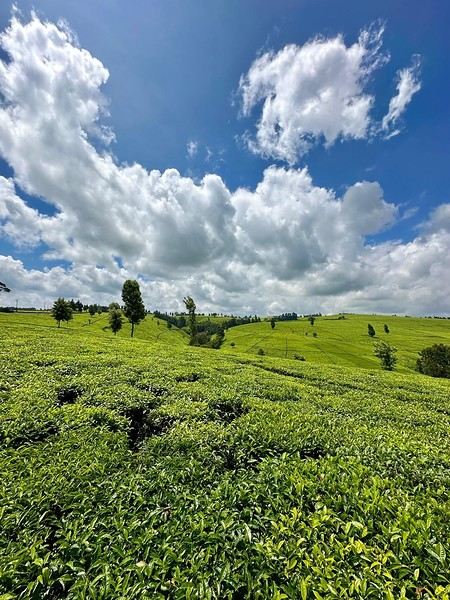
I'm back in the "travel journal" section to share our 15-day adventure in Kenya in November 2024. It was pretty much our first time in East Africa (since Zanzibar doesn’t really count 😜).
As usual, I’m sharing the journal I made for our loved ones—still as casual and cheerful as ever, just to give them a little break from their tough workdays 😄.
We organized the whole trip ourselves, and to be original here LOL, we took some *very* well-trodden paths: Naivasha, Tsavo, and Diani. But what I loved about this country is that it’s so easy to go off the beaten track—even on the "tourist highways" 😉.
So, if you're a safari fanatic or after stunning wildlife photos, you might be disappointed. But if you want to discover other sides of Kenya, you might just find what you're looking for 😉.
Looking forward to sharing this fun journey with you all 😊.