Results for "Bankside+ou+South+Bank+|+9+>+228"
7 results found.
Retour de Londres (du 6 au 11 décembre 2015) English translation pending
Bonjour,
je suis allé à Londres pour fêter les 40 ans de ma copine, je ne connaissais pas (ma copine connaissait), je n'ai vraiment pas regretté, j'ai ADORE !! Par contre la vie là-bas est chère (hébergement, transport, nourriture et attractions mise à part les musées qui sont gratuits sauf expo temporaire). En période de Noël, c'est féerique toutes les illuminations, les marchés de noël...
Pour l'avion, j'ai payé 150 euros A/R (avec valise en soute) depuis Marseille - Londres Gatwick via EasyJet.
J'ai noté des restau mais je n'ai pas pu tout faire...alors si ça vous dit de tester, n'hésitez pas ! J'ai trouvé qu'ils avaient des commentaires positifs sur tripadvisor.
A la fin, je détaille par journée.
On a fait Jack the ripper tour, c'était vraiment sympa.
LONDRES Du 6 au 11 décembre 2015
Décalage horaire Il y a une heure de décalage avec Londres (et le Royaume-Uni). Quand il est 8 h en France, il est 7 h en Angleterre (que ça soit l’été ou l’hiver). Prise de courant
Les prises électriques anglaises sont différentes des prises utilisées en France. Il faut donc un adaptateur (qui s’achète en grande surface, à l’aéroport…). Hébergement
Situé à la fin de Portsoken Street, tout proche de la Tour de Londres et du Tower Bridge. Studio : http://www.london-apartment-rental.com/
Banques
Si vous êtes à la BNP PARIBAS (ou la banque en ligne « HELLO BANK »), avec la carte de cette banque, les retraits sont gratuits dans toutes les banques BARCLAYS au Royaume-Uni. Transport
OYSTER card £5 (remboursable) que l’on peut recharger. La régie des transports londoniens et ses tarifs : https://tfl.gov.uk/fares-and-payments/ 7 jours pour un adulte (zone 1 et 2) : £32.10 Bon plan Londonpass Coupe file et comprends 60 attractions (voir liste sur le site). Possibilité de le prendre pour une journée (£55), 2 jours (£75), 3 jours (£80) ou 6 jours (£102,85). Circuit touristique gratuit en bus et croisières sur la Tamise également comprise. https://www.londonpass.fr/ Comédie musicale http://www.boxoffice.co.uk/ Avec le londonpass, petite réduction de quelques £ è https://concierge.londonpass.com/ Les Misérables au Queen’s Theatre à 19 h 30, le 10/12/2015 (£112 pour 2) Visites - Greenwich et le méridien. Royal Observatory : Inclus dans le londonpass sinon adulte £9,50 possibilité de combiner avec le Cutty Sark. Le bateau pour s’y rendre est également inclus dans le londonpass (Départ à côté du TowerBridge)
- Sur les traces de Jack l’éventreur, tous les soirs de 19 h à 21 h. £10 par adulte. (métro : Aldgate East) Réservation sur http://www.jack-the-ripper-tour.com/
- Tour de Londres. Inclus dans le londonpass sinon par adulte, £24,5 sur place / £23,10 sur internet (métro : Tower Hill)
- Tower Bridge. Inclus dans le londonpass sinon £9 par adulte (métro : Tower Hill)
- The Shard. 32 London Bridge St. Building en verre. Point de vue magnifique. A partir de £25,95 par adulte (métro : London Bridge). Réservation pour The Shard : http://www.theviewfromtheshard.com/fr/
- Tate modern, Bankside. Musée d’art moderne. Entrée gratuite sauf les expositions temporaires (métro : Southwark)
- Millennium Bridge. A faire surtout de nuit (métro : Mansion House) - Cathédrale St-Paul, St. Paul's Churchyard. Adulte £18 sur place / £15,50 par internet (métro : St-Paul’s)
- London Eye. Grande roue. Tour de 30 minutes pour admirer la vue sur Londres. Adulte £23 sur place / £19,35 par internet (métro : Waterloo)
- Sea Life London Aquarium, County Hall. Adulte : £23,50 sur place, £19,98 sur internet (métro : Waterloo)
- Le parlement et Big Ben le clocher (métro : Westminster)
- Downing Street, 10 est la résidence et le bureau du premier ministre britannique (métro : Westminster)
- Abbaye de Westminster, 20 Deans Yd. Inclus dans le londonpass sinon par adulte £20 (métro : Westminster)
- New Scotland Yard, 8-10 Broadway (métro : St Jame's Park)
- Buckingham Palace et St Jame’s Park (métro : St Jame’s Park ou Westminster). La résidence de la reine. On peut y voir la relève de la garde tous les jours à 11 h 30 l’été et en dehors de l’été, un jour sur deux si le temps le permet à la même heure. Y aller plus tôt car il y a beaucoup de monde. (durant notre séjour) 7 et 9 décembre 2015 http://www.householddivision.org.uk/changing-the-guard-calendar
- Trafalgar Square (métro : Charing Cross)
- National Gallery, Trafalgar Square. Entrée gratuite sauf les expositions temporaires (métro : Charing Cross)
- Piccadilly Circus (métro : Piccadilly Circus)
- M&M’s World, magasin de M&M’s, Swiss Court, 1 Leicester Square (métro : Piccadilly Circus)
- Quartier de Convent Garden (métro : Convent Garden)
- British Museum, Great Russell Street. Entrée gratuite sauf les expositions temporaires (métro : Tottenham Court Road)
- Madame Tussauds : musée de cire, Marylebone Road. £33 sur place / £23,10 sur internet par adulte (métro : Baker Street). Possibilité de combiner avec 2 ou 3 attractions (moins cher). Réservation : https://www.madametussauds.co.uk/london/en/tickets/
- 221B Baker Street : musée Sherlock Holmes. Adulte £15 (métro : Baker Street)
- Abbey Road : passage piéton des Beatles (métro : St. John's Wood)
- Camden market, Camden High Street (métro : Camden Town)
- The Regent’s Park avec son zoo. Entrée incluse pour le zoo dans le londonpass (métro : Regent’s Park)
- Natural History Museum. Cromwell Road. Musée d’histoire naturelle. Entrée gratuite sauf les expositions temporaires (métro : South Kensington) - Hype Park (métro : Marble Arch ou Hyde Park Corner)
- Quartier de Notting Hill et son marché Portobello Road market (métro : Notting Hill)
- Le jardin botanique Kew Gardens. Adulte £9 sur place / £8 sur internet (métro : Kew Gardens) Magasins
- Hamley's, 188-196 Regent Street, est le plus grand magasin de jouets au monde (métro : Oxford Circus) - Skandium, 245-249 Brompton Road, magasin de décoration (métro : South Kensington) -Twinings, 216 Strand (métro : Temple) -Harrod's, 87-135 Brompton Road (penser à aller au rayon alimentation) (métro : Knightsbridge) -Selfridges & Co, 400 Oxford Street, où l'on trouve du thé, biscuit, tooffé... (métro : Bond Street) - Orla Kiely, 31 Monmouth Street, magasin style années 50 (métro : Covent Garden) - Neal's yard, 15 Neal's Yard, on l’on trouve des produits de beauté naturel (métro : Covent Garden) Décorations de Noël
Les illuminations commencent la 2ème semaine de novembre pour se terminer la 1ère semaine de janvier : - La devanture de Harrods, 87-135 Brompton Road (métro : Knightsbridge) - La devanture de Harvey Nichols, 109-125 Knightsbridge (métro : Knightsbridge) - Regent Street - Oxford Street - Covent Garden Marchés de Noël
- Hyde Park Winter Wonderland: un marché, des manèges, une patinoire. De 10h à 22h sauf le 25 décembre 2015. Le plus grand parc de Noël à Londres mais aussi le plus bondé. (Métro: Hyde Park Corner)
- Southbank Centre Winter Festival, marché, nombreux stands pour déjeuner/diner, le long de la Tamise. De 11h à 22h. (Métro: Waterloo)
- Christmas Market at Tate Modern : un plus petit marché au pied du fameux Tate Modern (métro : Southwark) Soldes à Londres
Chaque année les soldes d’hiver à Londres débutent le 26 décembre que l’on appelle Boxing Day. Les soldes commencent facilement à -50% dès le début. Patin à glace
De nombreuses patinoires à Londres seront installées en extérieur, compter environ £10 par personne (+frais de réservation si vous réservez sur Internet)
- Somerset House certainement le plus beau cadre avec Hampton Court Palace pour chausser ses patins. (18 novembre au 18 janvier 2016) à partir de £7,50/enfant £14/adulte. Métro: Temple.
- Natural History Museum (29 octobre au 3 janvier 2016) à partir de £8,80/enfant £12,65/adulte. Métro: South Kensington.
- Tower of London Ice Rink (20 novembre au 3 janvier 2016) £8 à £9,50/enfant et £12 à £14/adulte. Métro: Tower Hill.
- Winterville Victoria Park (26 novembre au 23 décembre 2015) – £5,50/enfant £7/adulte ou bon plan juste £5,50/personne en heure creuse votre postcode est E9! Métro: Mile End/Bethnal Green.
- Hype Park Winter Wonderland (20 novembre au 3 janvier 2016) – £8 ou £8,50/enfant; £10,50 ou £14,50/adulte. Métro: Hyde Park Corner.
- Canary Wharf (31 octobre au 27 février 2016) à partir de £9,95/enfant £14,95/adulte. Métro: Canary Wharf.
- Hampton Court Palace (20 novembre au 4 janvier 2016) à partir de £8/enfant £11,50/adulte. Train: Hampton Court.
- Broadgate Ice Rink: (16 novembre au 25 février 2016) £9/enfant £13/adulte. Exchange Square. Métro: Liverpool Street.
- Wembley Park: (20 novembre au 3 janvier 2016) à partir de £5,50/enfant £7/adulte. Métro: Wembley Park. La Tamise (River Thames)
Il n’est pas rare de voir des phoques, des otaries et même des dauphins dans la Tamise. Pour preuve : http://sites.zsl.org/inthethames/#Public%20sightings
Le programme jour par jour : Jour 1 (dimanche 6 décembre 2015)
Tower Bridget (juste le traverser) et marché de Noël sur les bords de la Tamise. Marche jusqu'au millenium bridge et traversé de ce pont jusqu'à la cathédrale St Paul. Retour en métro.
Jack the ripper tour (19 h - 21 h). Covent Garden (by night) Manger : Five Guys (chaîne américaine de hamburger) => 3 hamburgers, deux frites et deux coca...£30 (£1 = 1,40 euro) 🤪 quand je vous disez que c'était cher !!
Jour 2 (lundi 7 décembre 2015) Retrait des LondonPass (Leicester Square) Buckingham Palace (relève de la garde) Green Park Hype Park (marché de noël) et manger sandwich (grosse wurst :)) on a joué un moment avec les écureuils (vous verrez sur les photos :) ) amenez leur des noisettes c'est sympa (à condition d'avoir un pantalon foncé quand il pleut ;) Le parlement et Big Ben London Eye (pas monté) Abbaye de Westminster (l'extérieur car fermée à 15 h 30 !!!) Downing Street Trafalgar Square Piccadilly Circus Le Parlement et Big Ben (by night)...l'extérieur London Eye (by night sans monté) Manger : St Stephen's Tavern Pub (très bon et pas excessif)
Jour 3 (mardi 8 décembre 2015) Visite de l'Abbaye de Westminster (LondonPass) et son cloître British Museum (gratuit) manger des sandwichs au musée Piccadilly Circus Magasin de jouet Hamleys Regent Street M&MS World
Jour 4 (mercredi 9 décembre 2015) London Tower (LondonPass) Tower Brigde (le traverser) The Shard (billet day & night) Croisière sur la Tamise, à partir de Tower Pier (LondonPass) Royal Observatory et le méridien de Greenwich (LondonPass) Cutty Shark (LondonPass) Retour sur le bâteau pour revenir à Tower Pier (LondonPass)...attention, dernier bâteau à 16 h 30 !!!! On a mangé à Bayrons (hamburger pour changer) à Greenwich Pier (mangé en moins de 5 minutes car sinon on raté le bâteau et c'était galère pour rentrer) The Shard (billet day & night) Magasin Harrods
Jour 5 (jeudi 10 décembre 2015) Visite de Tower Bridge...l'intérieur en haut et la salle des machines en bas (LondonPass) Cathédrale St Paul Trafalgar Square National Galery (gratuit)
Jour 6 (vendredi 11 décembre 2015) Retour à la maison !
Les photos de mon séjour : https://goo.gl/photos/qoQKqEkGkPZqhErKA
je suis allé à Londres pour fêter les 40 ans de ma copine, je ne connaissais pas (ma copine connaissait), je n'ai vraiment pas regretté, j'ai ADORE !! Par contre la vie là-bas est chère (hébergement, transport, nourriture et attractions mise à part les musées qui sont gratuits sauf expo temporaire). En période de Noël, c'est féerique toutes les illuminations, les marchés de noël...
Pour l'avion, j'ai payé 150 euros A/R (avec valise en soute) depuis Marseille - Londres Gatwick via EasyJet.
J'ai noté des restau mais je n'ai pas pu tout faire...alors si ça vous dit de tester, n'hésitez pas ! J'ai trouvé qu'ils avaient des commentaires positifs sur tripadvisor.
A la fin, je détaille par journée.
On a fait Jack the ripper tour, c'était vraiment sympa.
LONDRES Du 6 au 11 décembre 2015
Décalage horaire Il y a une heure de décalage avec Londres (et le Royaume-Uni). Quand il est 8 h en France, il est 7 h en Angleterre (que ça soit l’été ou l’hiver). Prise de courant
Les prises électriques anglaises sont différentes des prises utilisées en France. Il faut donc un adaptateur (qui s’achète en grande surface, à l’aéroport…). Hébergement
Situé à la fin de Portsoken Street, tout proche de la Tour de Londres et du Tower Bridge. Studio : http://www.london-apartment-rental.com/
Banques
Si vous êtes à la BNP PARIBAS (ou la banque en ligne « HELLO BANK »), avec la carte de cette banque, les retraits sont gratuits dans toutes les banques BARCLAYS au Royaume-Uni. Transport
OYSTER card £5 (remboursable) que l’on peut recharger. La régie des transports londoniens et ses tarifs : https://tfl.gov.uk/fares-and-payments/ 7 jours pour un adulte (zone 1 et 2) : £32.10 Bon plan Londonpass Coupe file et comprends 60 attractions (voir liste sur le site). Possibilité de le prendre pour une journée (£55), 2 jours (£75), 3 jours (£80) ou 6 jours (£102,85). Circuit touristique gratuit en bus et croisières sur la Tamise également comprise. https://www.londonpass.fr/ Comédie musicale http://www.boxoffice.co.uk/ Avec le londonpass, petite réduction de quelques £ è https://concierge.londonpass.com/ Les Misérables au Queen’s Theatre à 19 h 30, le 10/12/2015 (£112 pour 2) Visites - Greenwich et le méridien. Royal Observatory : Inclus dans le londonpass sinon adulte £9,50 possibilité de combiner avec le Cutty Sark. Le bateau pour s’y rendre est également inclus dans le londonpass (Départ à côté du TowerBridge)
- Sur les traces de Jack l’éventreur, tous les soirs de 19 h à 21 h. £10 par adulte. (métro : Aldgate East) Réservation sur http://www.jack-the-ripper-tour.com/
- Tour de Londres. Inclus dans le londonpass sinon par adulte, £24,5 sur place / £23,10 sur internet (métro : Tower Hill)
- Tower Bridge. Inclus dans le londonpass sinon £9 par adulte (métro : Tower Hill)
- The Shard. 32 London Bridge St. Building en verre. Point de vue magnifique. A partir de £25,95 par adulte (métro : London Bridge). Réservation pour The Shard : http://www.theviewfromtheshard.com/fr/
- Tate modern, Bankside. Musée d’art moderne. Entrée gratuite sauf les expositions temporaires (métro : Southwark)
- Millennium Bridge. A faire surtout de nuit (métro : Mansion House) - Cathédrale St-Paul, St. Paul's Churchyard. Adulte £18 sur place / £15,50 par internet (métro : St-Paul’s)
- London Eye. Grande roue. Tour de 30 minutes pour admirer la vue sur Londres. Adulte £23 sur place / £19,35 par internet (métro : Waterloo)
- Sea Life London Aquarium, County Hall. Adulte : £23,50 sur place, £19,98 sur internet (métro : Waterloo)
- Le parlement et Big Ben le clocher (métro : Westminster)
- Downing Street, 10 est la résidence et le bureau du premier ministre britannique (métro : Westminster)
- Abbaye de Westminster, 20 Deans Yd. Inclus dans le londonpass sinon par adulte £20 (métro : Westminster)
- New Scotland Yard, 8-10 Broadway (métro : St Jame's Park)
- Buckingham Palace et St Jame’s Park (métro : St Jame’s Park ou Westminster). La résidence de la reine. On peut y voir la relève de la garde tous les jours à 11 h 30 l’été et en dehors de l’été, un jour sur deux si le temps le permet à la même heure. Y aller plus tôt car il y a beaucoup de monde. (durant notre séjour) 7 et 9 décembre 2015 http://www.householddivision.org.uk/changing-the-guard-calendar
- Trafalgar Square (métro : Charing Cross)
- National Gallery, Trafalgar Square. Entrée gratuite sauf les expositions temporaires (métro : Charing Cross)
- Piccadilly Circus (métro : Piccadilly Circus)
- M&M’s World, magasin de M&M’s, Swiss Court, 1 Leicester Square (métro : Piccadilly Circus)
- Quartier de Convent Garden (métro : Convent Garden)
- British Museum, Great Russell Street. Entrée gratuite sauf les expositions temporaires (métro : Tottenham Court Road)
- Madame Tussauds : musée de cire, Marylebone Road. £33 sur place / £23,10 sur internet par adulte (métro : Baker Street). Possibilité de combiner avec 2 ou 3 attractions (moins cher). Réservation : https://www.madametussauds.co.uk/london/en/tickets/
- 221B Baker Street : musée Sherlock Holmes. Adulte £15 (métro : Baker Street)
- Abbey Road : passage piéton des Beatles (métro : St. John's Wood)
- Camden market, Camden High Street (métro : Camden Town)
- The Regent’s Park avec son zoo. Entrée incluse pour le zoo dans le londonpass (métro : Regent’s Park)
- Natural History Museum. Cromwell Road. Musée d’histoire naturelle. Entrée gratuite sauf les expositions temporaires (métro : South Kensington) - Hype Park (métro : Marble Arch ou Hyde Park Corner)
- Quartier de Notting Hill et son marché Portobello Road market (métro : Notting Hill)
- Le jardin botanique Kew Gardens. Adulte £9 sur place / £8 sur internet (métro : Kew Gardens) Magasins
- Hamley's, 188-196 Regent Street, est le plus grand magasin de jouets au monde (métro : Oxford Circus) - Skandium, 245-249 Brompton Road, magasin de décoration (métro : South Kensington) -Twinings, 216 Strand (métro : Temple) -Harrod's, 87-135 Brompton Road (penser à aller au rayon alimentation) (métro : Knightsbridge) -Selfridges & Co, 400 Oxford Street, où l'on trouve du thé, biscuit, tooffé... (métro : Bond Street) - Orla Kiely, 31 Monmouth Street, magasin style années 50 (métro : Covent Garden) - Neal's yard, 15 Neal's Yard, on l’on trouve des produits de beauté naturel (métro : Covent Garden) Décorations de Noël
Les illuminations commencent la 2ème semaine de novembre pour se terminer la 1ère semaine de janvier : - La devanture de Harrods, 87-135 Brompton Road (métro : Knightsbridge) - La devanture de Harvey Nichols, 109-125 Knightsbridge (métro : Knightsbridge) - Regent Street - Oxford Street - Covent Garden Marchés de Noël
- Hyde Park Winter Wonderland: un marché, des manèges, une patinoire. De 10h à 22h sauf le 25 décembre 2015. Le plus grand parc de Noël à Londres mais aussi le plus bondé. (Métro: Hyde Park Corner)
- Southbank Centre Winter Festival, marché, nombreux stands pour déjeuner/diner, le long de la Tamise. De 11h à 22h. (Métro: Waterloo)
- Christmas Market at Tate Modern : un plus petit marché au pied du fameux Tate Modern (métro : Southwark) Soldes à Londres
Chaque année les soldes d’hiver à Londres débutent le 26 décembre que l’on appelle Boxing Day. Les soldes commencent facilement à -50% dès le début. Patin à glace
De nombreuses patinoires à Londres seront installées en extérieur, compter environ £10 par personne (+frais de réservation si vous réservez sur Internet)
- Somerset House certainement le plus beau cadre avec Hampton Court Palace pour chausser ses patins. (18 novembre au 18 janvier 2016) à partir de £7,50/enfant £14/adulte. Métro: Temple.
- Natural History Museum (29 octobre au 3 janvier 2016) à partir de £8,80/enfant £12,65/adulte. Métro: South Kensington.
- Tower of London Ice Rink (20 novembre au 3 janvier 2016) £8 à £9,50/enfant et £12 à £14/adulte. Métro: Tower Hill.
- Winterville Victoria Park (26 novembre au 23 décembre 2015) – £5,50/enfant £7/adulte ou bon plan juste £5,50/personne en heure creuse votre postcode est E9! Métro: Mile End/Bethnal Green.
- Hype Park Winter Wonderland (20 novembre au 3 janvier 2016) – £8 ou £8,50/enfant; £10,50 ou £14,50/adulte. Métro: Hyde Park Corner.
- Canary Wharf (31 octobre au 27 février 2016) à partir de £9,95/enfant £14,95/adulte. Métro: Canary Wharf.
- Hampton Court Palace (20 novembre au 4 janvier 2016) à partir de £8/enfant £11,50/adulte. Train: Hampton Court.
- Broadgate Ice Rink: (16 novembre au 25 février 2016) £9/enfant £13/adulte. Exchange Square. Métro: Liverpool Street.
- Wembley Park: (20 novembre au 3 janvier 2016) à partir de £5,50/enfant £7/adulte. Métro: Wembley Park. La Tamise (River Thames)
Il n’est pas rare de voir des phoques, des otaries et même des dauphins dans la Tamise. Pour preuve : http://sites.zsl.org/inthethames/#Public%20sightings
Le programme jour par jour : Jour 1 (dimanche 6 décembre 2015)
Tower Bridget (juste le traverser) et marché de Noël sur les bords de la Tamise. Marche jusqu'au millenium bridge et traversé de ce pont jusqu'à la cathédrale St Paul. Retour en métro.
Jack the ripper tour (19 h - 21 h). Covent Garden (by night) Manger : Five Guys (chaîne américaine de hamburger) => 3 hamburgers, deux frites et deux coca...£30 (£1 = 1,40 euro) 🤪 quand je vous disez que c'était cher !!
Jour 2 (lundi 7 décembre 2015) Retrait des LondonPass (Leicester Square) Buckingham Palace (relève de la garde) Green Park Hype Park (marché de noël) et manger sandwich (grosse wurst :)) on a joué un moment avec les écureuils (vous verrez sur les photos :) ) amenez leur des noisettes c'est sympa (à condition d'avoir un pantalon foncé quand il pleut ;) Le parlement et Big Ben London Eye (pas monté) Abbaye de Westminster (l'extérieur car fermée à 15 h 30 !!!) Downing Street Trafalgar Square Piccadilly Circus Le Parlement et Big Ben (by night)...l'extérieur London Eye (by night sans monté) Manger : St Stephen's Tavern Pub (très bon et pas excessif)
Jour 3 (mardi 8 décembre 2015) Visite de l'Abbaye de Westminster (LondonPass) et son cloître British Museum (gratuit) manger des sandwichs au musée Piccadilly Circus Magasin de jouet Hamleys Regent Street M&MS World
Jour 4 (mercredi 9 décembre 2015) London Tower (LondonPass) Tower Brigde (le traverser) The Shard (billet day & night) Croisière sur la Tamise, à partir de Tower Pier (LondonPass) Royal Observatory et le méridien de Greenwich (LondonPass) Cutty Shark (LondonPass) Retour sur le bâteau pour revenir à Tower Pier (LondonPass)...attention, dernier bâteau à 16 h 30 !!!! On a mangé à Bayrons (hamburger pour changer) à Greenwich Pier (mangé en moins de 5 minutes car sinon on raté le bâteau et c'était galère pour rentrer) The Shard (billet day & night) Magasin Harrods
Jour 5 (jeudi 10 décembre 2015) Visite de Tower Bridge...l'intérieur en haut et la salle des machines en bas (LondonPass) Cathédrale St Paul Trafalgar Square National Galery (gratuit)
Jour 6 (vendredi 11 décembre 2015) Retour à la maison !
Les photos de mon séjour : https://goo.gl/photos/qoQKqEkGkPZqhErKA
Voyage de longue durée en Islande English translation pending
Ouf ! Malgré l'époque tardive pour la réservation, l'embarquement du camping-car est confirmé sur le Norrona pour le 23 mai.
Retour : le 2 septembre. Soit près de 14 semaines de voyage et de découverte de ce pays.
Evidemment plusieurs questions se posent :
- Le séjour excède trois mois. Il faut donc une prolongation du séjour touristique limité à trois mois. Normalement en contactant l'Ambassade d'Islande en France, cette prolongation devrait être accordée facilement. Quelqu'un a t il l'expérience de ce type d'action ? Quel délai prend elle ?
- Nous avons l'intention de réaliser ce voyage en effectuant des boucles par régions. Nous décrirons donc une cycloïde tout autour de l'île avec comme route maîtresse, bien sûr, la N1. Enfin chaque fois que cela sera possible. Dans le Sud Est, il n'y a pratiquement pas de possibilités de boucles. Question : dans quel sens effectuer cette cycloïde ? Commencer par le Nord d'abord pour privilégier les nuits "sans nuit" ? où par le Sud ? suivant les conditions climatiques des saisons, y a t il un sens plus intéressant que l'autre ? Notre choix est il le bon ? J'ai entendu parler de quelqu'un qui avait deux fois le tour de l'île pour un voyage de cette durée.
- Puisqu'on a le temps, quels sont les lieux à ne pas manquer. Ceux qui ne sont pas dans les guides.
- Le contrôle des denrées alimentaires à l'arrivée est il draconien ? Pour les produits frais, je m'en doute et c'est normal, mais pour les conserves ? Rassurez vous, je n'ai pas l'intention d'amener des conserves pour 14 semaines. Mais une petite choucroute de temps en temps, ça fait du bien .........
- Quelles sont les pistes F néanmoins accessibles au camping-car sous réserve des conditions météo. J'ai déjà monté de la tôle ondulée sur des pistes à 17-18% de dénivelé. Le plus problématique ce seront les gués, que je ne franchirais pas s'ils dépassent la moitié de la roue.
- les excursions en bus 4x4 sont elles intéressantes : prix, délai, vue du paysage pendant le trajet, arrêts , ............ ?
- En cas d'utilisation des services médicaux, avez vous des conseils ? Numéros d'appel, formalités ...........
Voilà ......... Merci à tous pour vos conseils et remarques si vous en faites. Kenavo
Evidemment plusieurs questions se posent :
- Le séjour excède trois mois. Il faut donc une prolongation du séjour touristique limité à trois mois. Normalement en contactant l'Ambassade d'Islande en France, cette prolongation devrait être accordée facilement. Quelqu'un a t il l'expérience de ce type d'action ? Quel délai prend elle ?
- Nous avons l'intention de réaliser ce voyage en effectuant des boucles par régions. Nous décrirons donc une cycloïde tout autour de l'île avec comme route maîtresse, bien sûr, la N1. Enfin chaque fois que cela sera possible. Dans le Sud Est, il n'y a pratiquement pas de possibilités de boucles. Question : dans quel sens effectuer cette cycloïde ? Commencer par le Nord d'abord pour privilégier les nuits "sans nuit" ? où par le Sud ? suivant les conditions climatiques des saisons, y a t il un sens plus intéressant que l'autre ? Notre choix est il le bon ? J'ai entendu parler de quelqu'un qui avait deux fois le tour de l'île pour un voyage de cette durée.
- Puisqu'on a le temps, quels sont les lieux à ne pas manquer. Ceux qui ne sont pas dans les guides.
- Le contrôle des denrées alimentaires à l'arrivée est il draconien ? Pour les produits frais, je m'en doute et c'est normal, mais pour les conserves ? Rassurez vous, je n'ai pas l'intention d'amener des conserves pour 14 semaines. Mais une petite choucroute de temps en temps, ça fait du bien .........
- Quelles sont les pistes F néanmoins accessibles au camping-car sous réserve des conditions météo. J'ai déjà monté de la tôle ondulée sur des pistes à 17-18% de dénivelé. Le plus problématique ce seront les gués, que je ne franchirais pas s'ils dépassent la moitié de la roue.
- les excursions en bus 4x4 sont elles intéressantes : prix, délai, vue du paysage pendant le trajet, arrêts , ............ ?
- En cas d'utilisation des services médicaux, avez vous des conseils ? Numéros d'appel, formalités ...........
Voilà ......... Merci à tous pour vos conseils et remarques si vous en faites. Kenavo
20 jours dans le Tamil Nadu (Inde du Sud): carnet (presque) en direct English translation pending
Bonjour à tous,
Me voilà depuis 3 jours dans la région Tamil Nadu, en solo et en indépendant: sac à dos (enfin petite valise cabine + petit sac à dos), transports publics, etc... Il s'agit de mon neuvième voyage en Inde.
Je publie ce carnet pour donner des renseignements pratiques et des impressions subjectives pour aider ceux qui envisagent un voyage dans la région, car il n'est pas facile de trouver des carnets précis très récents. Je décide aussi de le faire presque en direct, à mes heures perdues, pour donner des informations à chaud, parce qu'à chaque fois que j'ai voulu me lancer dans un carnet, les souvenirs et les détails étaient devenus flous, et avec le temps, on oublie plein de choses... Cette formule me paraît intéressante, même si j'écris avec peu de recul, à part celui de mon expérience passée de l'Inde.
Je n'ai pas vraiment d'itinéraire fixé et je décide de mes étapes au gré du voyage, même si j'ai une idée vague du circuit que je vais faire.
Je remercie tout particulièrement les membres du forum qui m'ont donné des informations précieuses et continuent à m'en donner: Marcomarco, Fabgreg, Aleph, Raggamuffin et Marien (désolé si j'en ai oublié, je les ajouterai plus tard). Je suis parti un peu à la dernière minute, sans vraiment préparer mon voyage, et leur aide me fait gagner beaucoup de temps.
Avant de commencer, quelques infos générales sur mon voyage: - Séjour de 20 jours dans le Tamil Nadu, mon premier vrai voyage en Inde du Sud à part un assez court passage dans le nord du Karnataka et à Goa en 2010. - Vol Air France/Jet Airways Toulouse-Paris-Chennai et Chennai-Mumbai-Paris-Toulouse: 622€ (réservé sur le site Jetcost une dizaine de jours avant le départ). À noter que le même vol depuis Paris, donc avec deux voyages en moins Toulouse-Paris et Paris-Toulouse, coûtait plus de 150€ en plus. Allez comprendre... Ça tombe bien, je devais me rendre à Toulouse! - e-tourist visa en ligne, qui a bien augmenté il y a quelque jours: j'ai oublié le prix exact, mais autour de 80€: abusif mais toujours plus avantageux que le visa de 6 mois si on part peu de temps. - J'ai investi dans la dernière version du Lonely Planet "Inde du Sud" qui est très décevante: de moins en moins de renseignements fiables et précis, des adresses de plus en plus chères, des cartes en moins... À 27€, c'est une arnaque. Je ne suis pas sûr qu'il existe encore des guides papiers vraiment utiles. Une époque révolue? Vive les forums!
Allez c'est parti!
Me voilà depuis 3 jours dans la région Tamil Nadu, en solo et en indépendant: sac à dos (enfin petite valise cabine + petit sac à dos), transports publics, etc... Il s'agit de mon neuvième voyage en Inde.
Je publie ce carnet pour donner des renseignements pratiques et des impressions subjectives pour aider ceux qui envisagent un voyage dans la région, car il n'est pas facile de trouver des carnets précis très récents. Je décide aussi de le faire presque en direct, à mes heures perdues, pour donner des informations à chaud, parce qu'à chaque fois que j'ai voulu me lancer dans un carnet, les souvenirs et les détails étaient devenus flous, et avec le temps, on oublie plein de choses... Cette formule me paraît intéressante, même si j'écris avec peu de recul, à part celui de mon expérience passée de l'Inde.
Je n'ai pas vraiment d'itinéraire fixé et je décide de mes étapes au gré du voyage, même si j'ai une idée vague du circuit que je vais faire.
Je remercie tout particulièrement les membres du forum qui m'ont donné des informations précieuses et continuent à m'en donner: Marcomarco, Fabgreg, Aleph, Raggamuffin et Marien (désolé si j'en ai oublié, je les ajouterai plus tard). Je suis parti un peu à la dernière minute, sans vraiment préparer mon voyage, et leur aide me fait gagner beaucoup de temps.
Avant de commencer, quelques infos générales sur mon voyage: - Séjour de 20 jours dans le Tamil Nadu, mon premier vrai voyage en Inde du Sud à part un assez court passage dans le nord du Karnataka et à Goa en 2010. - Vol Air France/Jet Airways Toulouse-Paris-Chennai et Chennai-Mumbai-Paris-Toulouse: 622€ (réservé sur le site Jetcost une dizaine de jours avant le départ). À noter que le même vol depuis Paris, donc avec deux voyages en moins Toulouse-Paris et Paris-Toulouse, coûtait plus de 150€ en plus. Allez comprendre... Ça tombe bien, je devais me rendre à Toulouse! - e-tourist visa en ligne, qui a bien augmenté il y a quelque jours: j'ai oublié le prix exact, mais autour de 80€: abusif mais toujours plus avantageux que le visa de 6 mois si on part peu de temps. - J'ai investi dans la dernière version du Lonely Planet "Inde du Sud" qui est très décevante: de moins en moins de renseignements fiables et précis, des adresses de plus en plus chères, des cartes en moins... À 27€, c'est une arnaque. Je ne suis pas sûr qu'il existe encore des guides papiers vraiment utiles. Une époque révolue? Vive les forums!
Allez c'est parti!
Bon hôtel dans le centre de Londres? English translation pending
Avez-vous un bon hotel dans le centre de Londres a me conseiller ?
Infos pratiques et hôtel à Londres English translation pending
bonjour,
j'offre à mon conjoint un sejour de 3 nuits à londres entre noel et nouvel an et la ville me semble tellement vaste qe meme qd ils marquent "centre ville " à cote d'un hotel, je ne suis pas sure que ce soit bien placé....
pour l'instant, j'ai pris un hotel à hammersmith, au hammersmith international center, 1 shortlands...c'ets un novotel....est-ce que c'est bien placé, est-ce un bon choix...je suis un peu perdue..sinon, j'en avais un autre à Euston....mais je ne sais pas non plus...
que me conseillez vous..
d'autre part, je vais également prendre la visitor traveler card par britcities pour 4 jours à 27 euros par personne...est-ce egalement un bon choix?
et enfin, j'atterris çà Gatwick, quel est le moyen le plus pratique ou le plus économique pour rejoindre le centre de londres, ou du moins mon hotel??
mille mercis pour vos tuyaux!!
julie
j'offre à mon conjoint un sejour de 3 nuits à londres entre noel et nouvel an et la ville me semble tellement vaste qe meme qd ils marquent "centre ville " à cote d'un hotel, je ne suis pas sure que ce soit bien placé....
pour l'instant, j'ai pris un hotel à hammersmith, au hammersmith international center, 1 shortlands...c'ets un novotel....est-ce que c'est bien placé, est-ce un bon choix...je suis un peu perdue..sinon, j'en avais un autre à Euston....mais je ne sais pas non plus...
que me conseillez vous..
d'autre part, je vais également prendre la visitor traveler card par britcities pour 4 jours à 27 euros par personne...est-ce egalement un bon choix?
et enfin, j'atterris çà Gatwick, quel est le moyen le plus pratique ou le plus économique pour rejoindre le centre de londres, ou du moins mon hotel??
mille mercis pour vos tuyaux!!
julie
"Glory": an Animal Farm for Zimbabwe—and the world
"400 pages of verbal pyrotechnics and animal magic" — The Times
"Bulawayo leans into exaggeration and irony to tell hard truths. *Glory* is jam-packed with comedy and farce, poking fun at an autocratic regime while illustrating the absurdity and surreal nature of a police state." — The Guardian
The cruelty and savagery of Zimbabwe’s (and Africa’s in general) "powerful animals"
Zimbabwean author NoViolet Bulawayo has written a novel that illustrates better than any documentary the complexity of colonial legacy. In doing so, she revisits George Orwell’s Animal Farm. Her novel *Glory* is a political satire about Zimbabwe—and it’s brimming with humor.
For thirty years, Zimbabwe has been stagnating under Robert Mugabe’s presidency. Human rights violations, corruption, and international sanctions have kept the population mired in poverty and oppression, while the regime exploits the meager earnings of the economy. As the 2017 elections approach, a power struggle erupts over the succession of the very elderly Father of the Nation (Mugabe). On the streets, people hope for long-awaited reforms; the people feel their moment has come.
And indeed, the army ousts Mugabe and his wife—"with her Gucci heels" (p.32)—who was positioning herself for the presidency. Hopes are dashed, however. The generals install former vice-president Emmerson Mnangagwa in power; the regime merely changes faces, but the problems remain the same.
In the novel, the country is called "Jidada, with a -da and another -da" (p.1); there’s no mistaking that this fictional state is Zimbabwe.
For *Glory*, her second novel, NoViolet Bulawayo invents a whole series of codes whose strength lies precisely in how easy they are to decipher. Like George Orwell’s Animal Farm, the characters populating Bulawayo’s universe aren’t humans but horses, goats, or crocodiles with all-too-human traits. Mugabe and Mnangagwa are horses, the spiritual leader is a pig, the soldiers are all bloodthirsty dogs, while the populace consists of goats, chickens, donkeys, and cats. The shift to the animal world serves only to better grasp the laws of despotism—and to ridicule real-life models. On one hand, the animals are humanized: they tweet, torture, travel in private jets. On the other, their greed, stupidity, and brutality stem from their animal nature.
It’s the old trick of fable: dressing men in animal disguises to make them easier to recognize. That’s how Orwell, in Animal Farm, traced how the promise of liberation from the Russian Revolution turned into Stalinist terror. In his 1945 fable, George Orwell describes how the animals of a farm drive out their farmer to organize the exploitation themselves, collectively. For a time, they truly taste freedom, but a clique of pigs ends up taking control. The central figures of the Soviet story—Stalin, Trotsky, Molotov—were easily recognizable.
Yet Bulawayo departs sharply from Orwell. She’s less concerned with precision and the force of argument than with satirical exaggeration. The deposed president is a senile old man who believes he can control even the sun’s course. The new stallion in power is a greedy debaucher. His soldiers sniff respectfully at his tail and backside.
In Bulawayo’s *Glory*, things are more complicated, but her novel also tells of a failed, incomplete liberation. In the author’s Animal Farm, Jidada, the colonial exploiters are followed by new forms of oppression. Because the former liberators become tyrants themselves. And because global power dynamics persist in neocolonial structures.
Wouldn’t that be enough to fuel a deeply depressing narrative? No—Bulawayo turns it into a blazing satire, full of wit and uncompromising criticism of power, a thread running through contemporary (not just) Zimbabwean history. The old warhorses in NoViolet Bulawayo’s Jidada, who continue to act as pack leaders, are easily recognizable as caricatures of the longtime dictator Robert Mugabe and his successor, current president Emmerson Mnangagwa.
The plot kicks off in high gear with independence day festivities. From the crack of dawn, everyone waits on Jidada Square for the Old Horse, the Father of the Nation and former liberator, whose reign "was nearing all of—not one, not two, not three, but four solid decades" (p.1). Everywhere, the colors of the Jidada Party shine; everywhere, true supporters cheer. Even the scorching sun plays its part: "At this point the sun, upon seeing arrive the leader who was decreed by God himself to rule and rule and keep ruling, a leader who'd in turn decreed the very sun to head his cheerleading squad, took a deep, deep breath and thoroughly blazed to impress" (p.2).
Finally, the Old Horse’s luxury carriage approaches "with the slowness of a hearse" (p.2), and "hoping to catch a glimpse of the legendary Father of the Nation," which causes "the animals fell over themselves like intoxicated frogs" (p.2). The sovereign’s speech is delayed a moment longer: "what I really want is a nap," groans the Old Horse as he takes his seat with such care "like his backside was made of expensive porcelain" (p.6).
Meanwhile, Bulawayo parades his entourage: the president’s wife (who earns her doctorate at Jidada University faster than "you could say diss, for dissertation. Tholukuthi it was as easy as ordering from a KFC drive-through, or perhaps even easier being that it was cheaper than KFC; it in fact cost her nothing and the degree actually came with a zero-calorie Diet Coke and a purple straw" (p.41), and she’s now known as Dr Sweet Mother. The cabinet includes "the Minister of the Revolution, the Minister of Corruption, the Minister of Order, the Minister of Things, the Minister of Nothing, the Minister of Propaganda, the Minister of Homophobic Affairs, the Minister of Disinformation and the Minister of Looting" (p.9). And of course the vice-president, who will soon become interim president when the Old Horse finally kicks the bucket—and then settle in as the new long-term president, who in the novel is called Tuvius Delight Shasha, or "Tuvy" for short (p.253), none other than Emmerson Mnangagwa. It’s him Bulawayo reserves her most merciless character description for.
"New Dispensation" (p.109) is Tuvy’s slogan for Jidada, and he loves repeating it so much he even named his parrot after it ("So inspired was Tuvy by the realisation that he rechristened his new pet parrot with the name New Dispensation—tholukuthi the bird having been acquired explicitly for the purposes of tweeting eulogies and accordingly glorifying the Saviour throughout the airs and skies of the nation. Tuvy then went on to hire a lecturer in English from the University of Jidada to teach New Dispensation to say the phrase 'New Dispensation'" p.110). But Tuvy’s Zimbabwe remains a nation without free, fair, and credible elections ("#freefairncredibleelection" p.161), and the promised equal treatment applies only insofar as Zimbabweans now queue up without discrimination in endless lines—and everyone is as poor as the next in the "queuenation" (p.283). Except for the powerful. They can "yes, tholukuthi, her immeasurable riches theirs to take. And take they did—
just take—take—take—take—take—take—take—take—take—take—take—take—take—take—take—take—take—take—take—take—take—take—take—take—take—take—take" (p.249-250).
In short: Bulawayo brilliantly depicts how former independence fighters become exploiters themselves. And how the country threatens to suffocate under the weight of corruption and repression. But she also literally stages the polyphony with which the people oppose imposed obedience to the official line.
Controversial online discussions keep interrupting the narrative—dialogues and social threads (see photo below) that Bulawayo masterfully integrates. From a literary standpoint, it’s a brilliant idea. And it shows, above all, that the author’s sympathy—so likeable—goes to all those who refuse to let their dream of true freedom be stolen, not even by the corrupt elites of their own country.
In the book’s acknowledgments, the first tribute goes to "The Jidadas of the world, clamouring for freedom on many fronts—A luta continua." (p.401) This reflects the realization that, not only in Jidada-Zimbabwe but in many other corners of the world, the end of colonial domination is still far from meaning the freedom hoped for by the vast majority of people. But it also means, more broadly, that this freedom must be won "on many fronts" (see above), both domestically and geopolitically.
That’s precisely what *Glory* so vividly highlights: how complex the project behind the term "postcolonialism" really is. With *Glory*, Bulawayo also delivers a scathing critique of the persistence of colonial mindsets in the West.
In the novel, the murder of George Floyd, racist police violence, and white-supremacist ideology in Trump’s United States perfectly illustrate the persistence of racism. It’s especially in the final chapters that Bulawayo lets Jidada’s inhabitants explicitly and unflinchingly criticize a neocolonial world order:
"It was not lost on us how the West, which loved to 'save' Africa and announce every action to the whole world, did so with one limb while manipulating, looting and fleecing us with the rest of its limbs so that more money in fact poured out of the continent than trickled in." (p.376)
"It was no mistake that multinational corporations yearly reaped and shipped colossal profits from Africa back to their countries as had been the case during colonial times. Even the sticks and stones would tell you that the African earth at any given time howled and shook and heaved from the extraction of its precious minerals that rarely benefited its own miserable children." (p.376)
"(...) we vowed to wage yet another war for Africa's second Liberation from neocolonial oppression. From exploitation. From plunder. From Western dominion. From indignity. From Abuse. We wanted real freedom. We wanted greedy, thieving paws off our wealth. We wanted Justice. We wanted a new world; we wanted a brand-new world so much we didn't sleep a wink that night." (p.377)
The Jidadas of this world must fight two enemies: Western neocolonialism and the autocratic instrumentalization of that argument; the persistence of Western racism and the populist appropriation of that humiliation by tyrants from their own ranks. Neither of these obstacles to freedom diminishes the historical and current guilt of the other. But the path to postcolonial liberation must overcome all these forms of oppression. After all, the colonizers didn’t bequeath democracies to formerly dominated nations, but instability and the principles of oppression and exploitation—which the so-called liberators have also internalized. Yet the fact that a satirical novel can capture the complexity of historical relationships while remaining, despite all the darkness of the subject, hilarious—well, that’s truly astonishing.
Finally, *Glory* ties into a major trauma in Zimbabwe’s post-independence history: the so-called Gukurahundi massacres. Between 1983 and 1987, tens of thousands of civilians were murdered by Mugabe’s bloody henchmen, most of them Ndebele. The State Security Minister and head of secret services at the time? You guessed it—Emmerson Mnangagwa.
When *Glory* turns to the massacres, the novel’s tone shifts completely. The story is now told through the narrative of the goat called Destiny, who, like NoViolet Bulawayo herself, left her home country at 18 for the United States and only returned after 13 years. In the book, the city of Bulawayo becomes a village where Destiny retraces her family’s history—and learns that part of it was also brutally murdered during the massacres.
The abuse of power and life under a dictatorship, dispossession, and a fiercely proud awareness of the psychological wounds and emotional vulnerability of a uprooted and disenfranchised people who had to forge a new language—a new set of names—to express their lived experiences are at the heart of this wonderful Zimbabwean author’s literary work, NoViolet Bulawayo. Shortly after her studies, she was already writing short stories about postcolonial power dynamics in Africa. But her playful, masterful, and often unconventional approach to language also plays a key role in her work. With virtuosity, she shifts from cynical images of power-obsessed elites to compassionate descriptions of the people’s suffering, ending with a hopeful sermon on courage—the courage to break free from fear and thus gain the strength for change ("And every one of them understood that whatever they heard within those hearts was the new national anthem, tholukuthi an anthem that spoke of the kind of glory that burns eternal and glows with living light." p.400). This novel is a genuine pleasure to read. And it’s exceptional. Good, African...
Book info (original English and German translation):
NoViolet Bulawayo. Glory. Chatto & Windus, 2022. NoViolet Bulawayo. Glory. Suhrkamp, 2023.
Hery
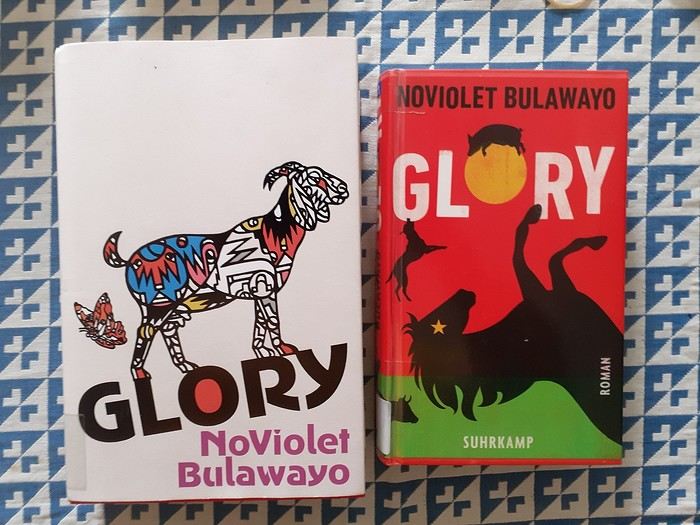 The books (in English, in German)
 Author NoViolet Bulawayo, Zimbabwe
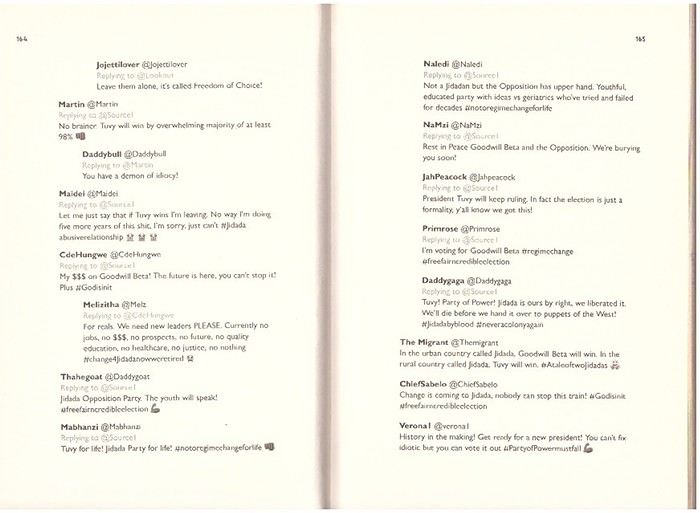 Threads (p.164-165)
"Bulawayo leans into exaggeration and irony to tell hard truths. *Glory* is jam-packed with comedy and farce, poking fun at an autocratic regime while illustrating the absurdity and surreal nature of a police state." — The Guardian
The cruelty and savagery of Zimbabwe’s (and Africa’s in general) "powerful animals"
Zimbabwean author NoViolet Bulawayo has written a novel that illustrates better than any documentary the complexity of colonial legacy. In doing so, she revisits George Orwell’s Animal Farm. Her novel *Glory* is a political satire about Zimbabwe—and it’s brimming with humor.
For thirty years, Zimbabwe has been stagnating under Robert Mugabe’s presidency. Human rights violations, corruption, and international sanctions have kept the population mired in poverty and oppression, while the regime exploits the meager earnings of the economy. As the 2017 elections approach, a power struggle erupts over the succession of the very elderly Father of the Nation (Mugabe). On the streets, people hope for long-awaited reforms; the people feel their moment has come.
And indeed, the army ousts Mugabe and his wife—"with her Gucci heels" (p.32)—who was positioning herself for the presidency. Hopes are dashed, however. The generals install former vice-president Emmerson Mnangagwa in power; the regime merely changes faces, but the problems remain the same.
In the novel, the country is called "Jidada, with a -da and another -da" (p.1); there’s no mistaking that this fictional state is Zimbabwe.
For *Glory*, her second novel, NoViolet Bulawayo invents a whole series of codes whose strength lies precisely in how easy they are to decipher. Like George Orwell’s Animal Farm, the characters populating Bulawayo’s universe aren’t humans but horses, goats, or crocodiles with all-too-human traits. Mugabe and Mnangagwa are horses, the spiritual leader is a pig, the soldiers are all bloodthirsty dogs, while the populace consists of goats, chickens, donkeys, and cats. The shift to the animal world serves only to better grasp the laws of despotism—and to ridicule real-life models. On one hand, the animals are humanized: they tweet, torture, travel in private jets. On the other, their greed, stupidity, and brutality stem from their animal nature.
It’s the old trick of fable: dressing men in animal disguises to make them easier to recognize. That’s how Orwell, in Animal Farm, traced how the promise of liberation from the Russian Revolution turned into Stalinist terror. In his 1945 fable, George Orwell describes how the animals of a farm drive out their farmer to organize the exploitation themselves, collectively. For a time, they truly taste freedom, but a clique of pigs ends up taking control. The central figures of the Soviet story—Stalin, Trotsky, Molotov—were easily recognizable.
Yet Bulawayo departs sharply from Orwell. She’s less concerned with precision and the force of argument than with satirical exaggeration. The deposed president is a senile old man who believes he can control even the sun’s course. The new stallion in power is a greedy debaucher. His soldiers sniff respectfully at his tail and backside.
In Bulawayo’s *Glory*, things are more complicated, but her novel also tells of a failed, incomplete liberation. In the author’s Animal Farm, Jidada, the colonial exploiters are followed by new forms of oppression. Because the former liberators become tyrants themselves. And because global power dynamics persist in neocolonial structures.
Wouldn’t that be enough to fuel a deeply depressing narrative? No—Bulawayo turns it into a blazing satire, full of wit and uncompromising criticism of power, a thread running through contemporary (not just) Zimbabwean history. The old warhorses in NoViolet Bulawayo’s Jidada, who continue to act as pack leaders, are easily recognizable as caricatures of the longtime dictator Robert Mugabe and his successor, current president Emmerson Mnangagwa.
The plot kicks off in high gear with independence day festivities. From the crack of dawn, everyone waits on Jidada Square for the Old Horse, the Father of the Nation and former liberator, whose reign "was nearing all of—not one, not two, not three, but four solid decades" (p.1). Everywhere, the colors of the Jidada Party shine; everywhere, true supporters cheer. Even the scorching sun plays its part: "At this point the sun, upon seeing arrive the leader who was decreed by God himself to rule and rule and keep ruling, a leader who'd in turn decreed the very sun to head his cheerleading squad, took a deep, deep breath and thoroughly blazed to impress" (p.2).
Finally, the Old Horse’s luxury carriage approaches "with the slowness of a hearse" (p.2), and "hoping to catch a glimpse of the legendary Father of the Nation," which causes "the animals fell over themselves like intoxicated frogs" (p.2). The sovereign’s speech is delayed a moment longer: "what I really want is a nap," groans the Old Horse as he takes his seat with such care "like his backside was made of expensive porcelain" (p.6).
Meanwhile, Bulawayo parades his entourage: the president’s wife (who earns her doctorate at Jidada University faster than "you could say diss, for dissertation. Tholukuthi it was as easy as ordering from a KFC drive-through, or perhaps even easier being that it was cheaper than KFC; it in fact cost her nothing and the degree actually came with a zero-calorie Diet Coke and a purple straw" (p.41), and she’s now known as Dr Sweet Mother. The cabinet includes "the Minister of the Revolution, the Minister of Corruption, the Minister of Order, the Minister of Things, the Minister of Nothing, the Minister of Propaganda, the Minister of Homophobic Affairs, the Minister of Disinformation and the Minister of Looting" (p.9). And of course the vice-president, who will soon become interim president when the Old Horse finally kicks the bucket—and then settle in as the new long-term president, who in the novel is called Tuvius Delight Shasha, or "Tuvy" for short (p.253), none other than Emmerson Mnangagwa. It’s him Bulawayo reserves her most merciless character description for.
"New Dispensation" (p.109) is Tuvy’s slogan for Jidada, and he loves repeating it so much he even named his parrot after it ("So inspired was Tuvy by the realisation that he rechristened his new pet parrot with the name New Dispensation—tholukuthi the bird having been acquired explicitly for the purposes of tweeting eulogies and accordingly glorifying the Saviour throughout the airs and skies of the nation. Tuvy then went on to hire a lecturer in English from the University of Jidada to teach New Dispensation to say the phrase 'New Dispensation'" p.110). But Tuvy’s Zimbabwe remains a nation without free, fair, and credible elections ("#freefairncredibleelection" p.161), and the promised equal treatment applies only insofar as Zimbabweans now queue up without discrimination in endless lines—and everyone is as poor as the next in the "queuenation" (p.283). Except for the powerful. They can "yes, tholukuthi, her immeasurable riches theirs to take. And take they did—
just take—take—take—take—take—take—take—take—take—take—take—take—take—take—take—take—take—take—take—take—take—take—take—take—take—take—take" (p.249-250).
In short: Bulawayo brilliantly depicts how former independence fighters become exploiters themselves. And how the country threatens to suffocate under the weight of corruption and repression. But she also literally stages the polyphony with which the people oppose imposed obedience to the official line.
Controversial online discussions keep interrupting the narrative—dialogues and social threads (see photo below) that Bulawayo masterfully integrates. From a literary standpoint, it’s a brilliant idea. And it shows, above all, that the author’s sympathy—so likeable—goes to all those who refuse to let their dream of true freedom be stolen, not even by the corrupt elites of their own country.
In the book’s acknowledgments, the first tribute goes to "The Jidadas of the world, clamouring for freedom on many fronts—A luta continua." (p.401) This reflects the realization that, not only in Jidada-Zimbabwe but in many other corners of the world, the end of colonial domination is still far from meaning the freedom hoped for by the vast majority of people. But it also means, more broadly, that this freedom must be won "on many fronts" (see above), both domestically and geopolitically.
That’s precisely what *Glory* so vividly highlights: how complex the project behind the term "postcolonialism" really is. With *Glory*, Bulawayo also delivers a scathing critique of the persistence of colonial mindsets in the West.
In the novel, the murder of George Floyd, racist police violence, and white-supremacist ideology in Trump’s United States perfectly illustrate the persistence of racism. It’s especially in the final chapters that Bulawayo lets Jidada’s inhabitants explicitly and unflinchingly criticize a neocolonial world order:
"It was not lost on us how the West, which loved to 'save' Africa and announce every action to the whole world, did so with one limb while manipulating, looting and fleecing us with the rest of its limbs so that more money in fact poured out of the continent than trickled in." (p.376)
"It was no mistake that multinational corporations yearly reaped and shipped colossal profits from Africa back to their countries as had been the case during colonial times. Even the sticks and stones would tell you that the African earth at any given time howled and shook and heaved from the extraction of its precious minerals that rarely benefited its own miserable children." (p.376)
"(...) we vowed to wage yet another war for Africa's second Liberation from neocolonial oppression. From exploitation. From plunder. From Western dominion. From indignity. From Abuse. We wanted real freedom. We wanted greedy, thieving paws off our wealth. We wanted Justice. We wanted a new world; we wanted a brand-new world so much we didn't sleep a wink that night." (p.377)
The Jidadas of this world must fight two enemies: Western neocolonialism and the autocratic instrumentalization of that argument; the persistence of Western racism and the populist appropriation of that humiliation by tyrants from their own ranks. Neither of these obstacles to freedom diminishes the historical and current guilt of the other. But the path to postcolonial liberation must overcome all these forms of oppression. After all, the colonizers didn’t bequeath democracies to formerly dominated nations, but instability and the principles of oppression and exploitation—which the so-called liberators have also internalized. Yet the fact that a satirical novel can capture the complexity of historical relationships while remaining, despite all the darkness of the subject, hilarious—well, that’s truly astonishing.
Finally, *Glory* ties into a major trauma in Zimbabwe’s post-independence history: the so-called Gukurahundi massacres. Between 1983 and 1987, tens of thousands of civilians were murdered by Mugabe’s bloody henchmen, most of them Ndebele. The State Security Minister and head of secret services at the time? You guessed it—Emmerson Mnangagwa.
When *Glory* turns to the massacres, the novel’s tone shifts completely. The story is now told through the narrative of the goat called Destiny, who, like NoViolet Bulawayo herself, left her home country at 18 for the United States and only returned after 13 years. In the book, the city of Bulawayo becomes a village where Destiny retraces her family’s history—and learns that part of it was also brutally murdered during the massacres.
The abuse of power and life under a dictatorship, dispossession, and a fiercely proud awareness of the psychological wounds and emotional vulnerability of a uprooted and disenfranchised people who had to forge a new language—a new set of names—to express their lived experiences are at the heart of this wonderful Zimbabwean author’s literary work, NoViolet Bulawayo. Shortly after her studies, she was already writing short stories about postcolonial power dynamics in Africa. But her playful, masterful, and often unconventional approach to language also plays a key role in her work. With virtuosity, she shifts from cynical images of power-obsessed elites to compassionate descriptions of the people’s suffering, ending with a hopeful sermon on courage—the courage to break free from fear and thus gain the strength for change ("And every one of them understood that whatever they heard within those hearts was the new national anthem, tholukuthi an anthem that spoke of the kind of glory that burns eternal and glows with living light." p.400). This novel is a genuine pleasure to read. And it’s exceptional. Good, African...
Book info (original English and German translation):
NoViolet Bulawayo. Glory. Chatto & Windus, 2022. NoViolet Bulawayo. Glory. Suhrkamp, 2023.
Hery
The books (in English, in German)
Author NoViolet Bulawayo, Zimbabwe
Threads (p.164-165)Three weeks in Japan with the family
Hi everyone,
Actually, we ended up going to Japan almost by chance. I’d caught glimpses of the country during business trips, and it had been on my “wish list” for a while, but I thought we’d go “when the kids were grown up.”
But this summer (2016), the kids couldn’t agree on a destination—their wishes were completely opposite. Then, realizing that flight tickets weren’t outrageously priced—and having read that Japan wasn’t as expensive as people think—we, the parents, suggested Japan… while warning that it would be scorching hot and humid and that no one should complain. Our eldest (18) was immediately thrilled: “Oh! Mom! I’ve always dreamed of going to Japan!” She convinced her brother (16) that it was the perfect destination. Deal sealed: we’re going to Japan, but no one complains about the heat.
After some forum discussions and family brainstorming, I settled on the following itinerary. One non-negotiable shaped part of our choices: being in Hiroshima on August 6th to attend the lantern floating ceremony. To avoid overloading the trip with extra transport, we skipped Nara, Nikko, and Kamakura.
Day 1 - Arrival at 8:30 AM in Osaka – Kyoto - around the station Day 2 - Kyoto - East - night: Kyoto Day 3 - Kyoto - North and center - night: Kyoto Day 4 - Osaka (stroll with Osaka Safari) - Fushimi Inari -night : Kyoto Day 5 - Train - Naoshima - night: Uno Day 6 - Teshima -night: Uno Day 7 - Naoshima – Hiroshima - night: Hiroshima Day 8 - Hiroshima – Commemorations - night: Hiroshima Day 10 - Miyajima- night: Miyajima Day 10 - Miyajima - Himeji Castle - night: Osaka Day 11 - Osaka - night: Osaka Day 12 - Kyoto - West -night: Osaka Day 13 - Kanazawa to Ainokura - night: Ainokura Day 14 - Shirakawa-go - Takayama - night: Takayama Day 15 - Kamikochi night: Takayama Day 16 - Takayama - return to Kanazawa night: Kanazawa Day 17 - Kanazawa -night: Kanazawa Day 18 - Travel to Tokyo (Shibuya) -night: Tokyo Day 19 - Tokyo (visit with Tokyo Free Guide – Yoyogi Park - Meiji Shrine - Harajuku - Takeshita-dori - Omote Sando - Odaiba) - night: Tokyo Day 20 - Tokyo (with Tokyo Safari) - night: Tokyo Day 21 - Tokyo (Tsukiji, Hama-Rikyu Onshi Teien, Asakusa and Senso-ji, Kappabashi, Ameyoko, and Ueno) - night: Tokyo Day 22 - Tokyo (Shibuya-Yoyogi Park again - Ikebukuro - Shinjuku (Tokyo Metropolitan Government Building, Omoide-yokocho, Golden Gai) - night: Tokyo Day 23 - Tokyo (Yanaka – Ueno – Edo-Tokyo Museum - Takashita-Dori again - back to Shibuya) - departure at 10:50 PM for Paris
(You can access the published days directly by clicking on them).
The itinerary perfectly matched our expectations: a good pace, a wide variety of visits, the must-sees, but also a first taste of rural Japan. If we were to do it again, I’d do exactly the same (except for the back-and-forth between Kyoto and Osaka on Days 4 and 12, which were due to my desire to explore Osaka with Osaka Safari). Of course, we had to skip some sights, especially in Kyoto where we missed a few “highlights,” but that was a deliberate choice—I’d limited our time in the city, which is known for being stifling in summer.
For accommodations, we mixed Airbnb apartments and quadruple rooms in guesthouses and ryokan. It worked out perfectly. The apartments gave us more space and the chance to dine in some evenings, while the guesthouses and ryokan helped us experience Japanese customs.
First, a quick recap: all four of us were enchanted by our trip. Japan is a constant source of wonder, just like the preface of *Tokyo Sanpo* by Florent Chavouet describes—I’ll take this opportunity to plug the book, which I read with great pleasure after our vacation. That’s exactly it: everything is a reason for amazement. Everything is so different from home. I wanted to photograph everything around me constantly. I promise, I won’t say “photograph like a Japanese” anymore—during this trip, *I* was the Japanese. And I better understand the culture shock Japanese travelers experience in Europe.
As a friend of mine put it: “It’s simple—they have ten fingers, so they count in base 10. Otherwise, they do everything differently from us.” Well summarized.
Another thing: everything is easy. Everything seems to have its place and be exactly where it should be. The smallest detail seems to have been thought out to make life easier. Things that come to mind: the incredibly well-designed signage in train stations and the subway, the ubiquitous public toilets, designated smoking areas, those hyper-detailed maps with all the useful information available at every place we visited… These maps are so well done that we got into the habit of picking them up systematically. It’s that simple: I came back to Paris with a complete collection. And when we arrived in Takayama by car, our first stop was at the train station to get THE map. But this order goes beyond all these practical elements. There’s a certain *je ne sais quoi* that makes you feel like everything is exactly where it should be. Even during rush hour, in the crowds, people manage to avoid each other in a smooth, collision-free flow—the opposite of the Paris metro. Anyone who’s experienced certain transfers in Paris at certain times will understand.
The exquisite politeness of the Japanese and their desire to be helpful are another highlight of the trip. Every person we met tried to help us and make our lives easier. It was really great.
Oh! I almost forgot: Japan’s hyper-safe side. I’ve rarely felt as safe as I did in Japan. No need to keep an eye on your belongings—they’re not going anywhere. One example among many: in Tokyo, Japanese women leave their bags open with their smartphones casually placed on top. Even I could’ve taken them without them noticing, let alone a pickpocket… No wonder France is seen as dangerous.
That said, I’m not claiming Japanese society is flawless. The role of women and gender relations are downright shocking and archaic from our European perspective. I also don’t think I could live in such a codified society, where the individual is so dissolved into the collective. But for a vacation, it’s simply delightful. On that note, I recommend *Nââânde?!* by Eriko Nakamura, which I discovered after our trip on the recommendation of our eldest’s friend. It’s the story of a Japanese woman married to a Frenchman living in Paris, recounting her astonishment at French habits and customs. Even though I tried to be careful, I’m sure I made quite a few blunders.
As for the climate, it didn’t stop us from enjoying our trip. Sure, we were hot—*really* hot—but by protecting ourselves from the sun (hat for me, caps for the others, plus umbrellas—Japanese-style parasols) and drinking liters and liters of water, it was manageable and didn’t bother us too much, even if we probably had a slower pace than we would’ve with milder weather. That said, with small children, we would’ve struggled more.
Last point before diving into the trip details: the cost. Despite what I’d read, traveling in Japan is still expensive. I’m not talking about our specific trip, where—using our daughter’s 18th birthday and our 20th wedding anniversary as an excuse—I splurged on a few extras that drove up the cost. I was particularly surprised by the price of quadruple rooms, which is roughly the same as two double rooms. So for a family, that’s a significant extra cost. The various paid sites in Kyoto also add up. As for food, it’s generally cheap, but it would be a shame not to budget for a few extras to try some less affordable specialties—like Hida beef in our case.
Actually, we ended up going to Japan almost by chance. I’d caught glimpses of the country during business trips, and it had been on my “wish list” for a while, but I thought we’d go “when the kids were grown up.”
But this summer (2016), the kids couldn’t agree on a destination—their wishes were completely opposite. Then, realizing that flight tickets weren’t outrageously priced—and having read that Japan wasn’t as expensive as people think—we, the parents, suggested Japan… while warning that it would be scorching hot and humid and that no one should complain. Our eldest (18) was immediately thrilled: “Oh! Mom! I’ve always dreamed of going to Japan!” She convinced her brother (16) that it was the perfect destination. Deal sealed: we’re going to Japan, but no one complains about the heat.
After some forum discussions and family brainstorming, I settled on the following itinerary. One non-negotiable shaped part of our choices: being in Hiroshima on August 6th to attend the lantern floating ceremony. To avoid overloading the trip with extra transport, we skipped Nara, Nikko, and Kamakura.
Day 1 - Arrival at 8:30 AM in Osaka – Kyoto - around the station Day 2 - Kyoto - East - night: Kyoto Day 3 - Kyoto - North and center - night: Kyoto Day 4 - Osaka (stroll with Osaka Safari) - Fushimi Inari -night : Kyoto Day 5 - Train - Naoshima - night: Uno Day 6 - Teshima -night: Uno Day 7 - Naoshima – Hiroshima - night: Hiroshima Day 8 - Hiroshima – Commemorations - night: Hiroshima Day 10 - Miyajima- night: Miyajima Day 10 - Miyajima - Himeji Castle - night: Osaka Day 11 - Osaka - night: Osaka Day 12 - Kyoto - West -night: Osaka Day 13 - Kanazawa to Ainokura - night: Ainokura Day 14 - Shirakawa-go - Takayama - night: Takayama Day 15 - Kamikochi night: Takayama Day 16 - Takayama - return to Kanazawa night: Kanazawa Day 17 - Kanazawa -night: Kanazawa Day 18 - Travel to Tokyo (Shibuya) -night: Tokyo Day 19 - Tokyo (visit with Tokyo Free Guide – Yoyogi Park - Meiji Shrine - Harajuku - Takeshita-dori - Omote Sando - Odaiba) - night: Tokyo Day 20 - Tokyo (with Tokyo Safari) - night: Tokyo Day 21 - Tokyo (Tsukiji, Hama-Rikyu Onshi Teien, Asakusa and Senso-ji, Kappabashi, Ameyoko, and Ueno) - night: Tokyo Day 22 - Tokyo (Shibuya-Yoyogi Park again - Ikebukuro - Shinjuku (Tokyo Metropolitan Government Building, Omoide-yokocho, Golden Gai) - night: Tokyo Day 23 - Tokyo (Yanaka – Ueno – Edo-Tokyo Museum - Takashita-Dori again - back to Shibuya) - departure at 10:50 PM for Paris
(You can access the published days directly by clicking on them).
The itinerary perfectly matched our expectations: a good pace, a wide variety of visits, the must-sees, but also a first taste of rural Japan. If we were to do it again, I’d do exactly the same (except for the back-and-forth between Kyoto and Osaka on Days 4 and 12, which were due to my desire to explore Osaka with Osaka Safari). Of course, we had to skip some sights, especially in Kyoto where we missed a few “highlights,” but that was a deliberate choice—I’d limited our time in the city, which is known for being stifling in summer.
For accommodations, we mixed Airbnb apartments and quadruple rooms in guesthouses and ryokan. It worked out perfectly. The apartments gave us more space and the chance to dine in some evenings, while the guesthouses and ryokan helped us experience Japanese customs.
First, a quick recap: all four of us were enchanted by our trip. Japan is a constant source of wonder, just like the preface of *Tokyo Sanpo* by Florent Chavouet describes—I’ll take this opportunity to plug the book, which I read with great pleasure after our vacation. That’s exactly it: everything is a reason for amazement. Everything is so different from home. I wanted to photograph everything around me constantly. I promise, I won’t say “photograph like a Japanese” anymore—during this trip, *I* was the Japanese. And I better understand the culture shock Japanese travelers experience in Europe.
As a friend of mine put it: “It’s simple—they have ten fingers, so they count in base 10. Otherwise, they do everything differently from us.” Well summarized.
Another thing: everything is easy. Everything seems to have its place and be exactly where it should be. The smallest detail seems to have been thought out to make life easier. Things that come to mind: the incredibly well-designed signage in train stations and the subway, the ubiquitous public toilets, designated smoking areas, those hyper-detailed maps with all the useful information available at every place we visited… These maps are so well done that we got into the habit of picking them up systematically. It’s that simple: I came back to Paris with a complete collection. And when we arrived in Takayama by car, our first stop was at the train station to get THE map. But this order goes beyond all these practical elements. There’s a certain *je ne sais quoi* that makes you feel like everything is exactly where it should be. Even during rush hour, in the crowds, people manage to avoid each other in a smooth, collision-free flow—the opposite of the Paris metro. Anyone who’s experienced certain transfers in Paris at certain times will understand.
The exquisite politeness of the Japanese and their desire to be helpful are another highlight of the trip. Every person we met tried to help us and make our lives easier. It was really great.
Oh! I almost forgot: Japan’s hyper-safe side. I’ve rarely felt as safe as I did in Japan. No need to keep an eye on your belongings—they’re not going anywhere. One example among many: in Tokyo, Japanese women leave their bags open with their smartphones casually placed on top. Even I could’ve taken them without them noticing, let alone a pickpocket… No wonder France is seen as dangerous.
That said, I’m not claiming Japanese society is flawless. The role of women and gender relations are downright shocking and archaic from our European perspective. I also don’t think I could live in such a codified society, where the individual is so dissolved into the collective. But for a vacation, it’s simply delightful. On that note, I recommend *Nââânde?!* by Eriko Nakamura, which I discovered after our trip on the recommendation of our eldest’s friend. It’s the story of a Japanese woman married to a Frenchman living in Paris, recounting her astonishment at French habits and customs. Even though I tried to be careful, I’m sure I made quite a few blunders.
As for the climate, it didn’t stop us from enjoying our trip. Sure, we were hot—*really* hot—but by protecting ourselves from the sun (hat for me, caps for the others, plus umbrellas—Japanese-style parasols) and drinking liters and liters of water, it was manageable and didn’t bother us too much, even if we probably had a slower pace than we would’ve with milder weather. That said, with small children, we would’ve struggled more.
Last point before diving into the trip details: the cost. Despite what I’d read, traveling in Japan is still expensive. I’m not talking about our specific trip, where—using our daughter’s 18th birthday and our 20th wedding anniversary as an excuse—I splurged on a few extras that drove up the cost. I was particularly surprised by the price of quadruple rooms, which is roughly the same as two double rooms. So for a family, that’s a significant extra cost. The various paid sites in Kyoto also add up. As for food, it’s generally cheap, but it would be a shame not to budget for a few extras to try some less affordable specialties—like Hida beef in our case.