last edited Dec 11, 2019
Overview of the Canary Islands
Location Map of Canary Islands
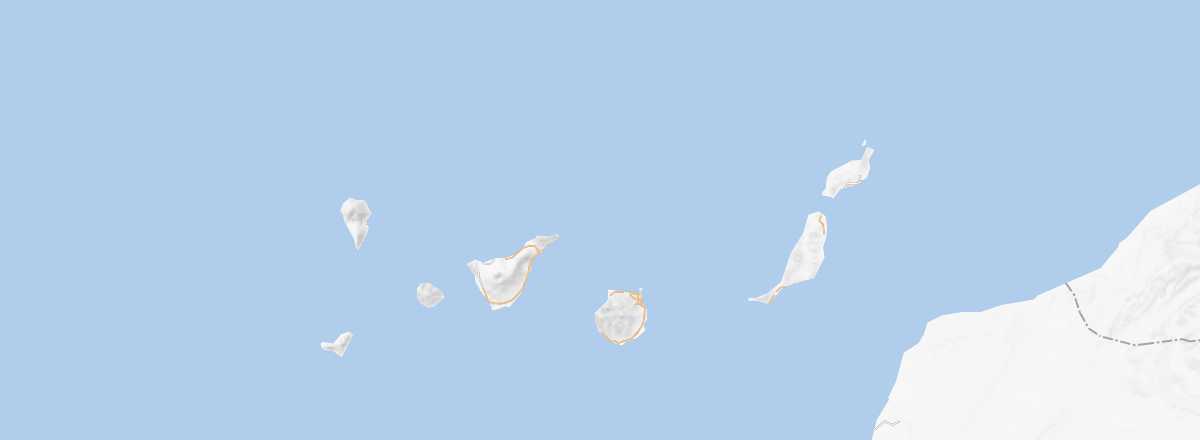 Canary Islands
Open the interactive map
Canary Islands
Open the interactive map
Quick overview
Off the coast of Morocco, but more European than African, the Canary Islands archipelago consists of seven main islands (from east to west): Lanzarote, Fuerteventura, Gran Canaria, Tenerife, La Gomera, La Palma, and El Hierro. The entire archipelago is volcanic in origin (hence the color of the sand on many beaches) and very mountainous, with peaks exceeding 3,000 m, such as Teide (Tenerife) at 3,718 m, the highest point in the archipelago.
Like mainland Spain, the Canary Islands are members of the European Union. They have the status of a Spanish autonomous community and are divided into two provinces: Las Palmas and Santa Cruz de Tenerife. The archipelago relies primarily on tourism, which is by far its main resource, along with some port activity. In contrast, with barely 10% of cultivable land, agriculture is only minimally developed.
The Canary Islands in seven islands
- El Hierro: Small, isolated, and sparsely populated, El Hierro has a peaceful and very different feel from the rest of the Canary Islands. It is the wildest island in terms of landscapes but also the least visited.
- Fuerteventura: Less than a hundred kilometers from the Moroccan coast, Fuerteventura is the second-largest island in the Canaries. It is also where most low-cost flights serving the archipelago arrive.
- Gran Canaria: After Tenerife, this is the most populated island in the Canaries. It offers a wide variety of landscapes and is home to the provincial capital of Las Palmas as well as the archipelago’s most important tourist zone.
- La Gomera: Just a few kilometers west of Tenerife, this island boasts some of the most spectacular and striking landscapes in the archipelago. The Garajonay National Park, which occupies its center, is a UNESCO World Heritage site.
- La Palma: The most forested of the Canary Islands, with a beautiful natural heritage, part of which is a national park. In scientific circles, it is known for hosting several telescopes and space observation instruments.
- Lanzarote: The easternmost island. It offers a very rich natural heritage, including Timanfaya National Park.
- Tenerife: The largest, highest, most populated, and most visited island, home to the provincial capital and co-capital of the autonomous community. In short, it is the main island and also hosts Teide National Park, one of the most visited parks in the world.
Key facts
- Type of place: province.
- Location: In the North Atlantic, a few dozen kilometers off the southern coast of Morocco.
- Latitude/longitude: 28.06' N, 15.24' W
- Local time:
- "Capitals": Santa Cruz de Tenerife and Las Palmas de Gran Canaria
- Nature of "the state": Autonomous community of Spain.
- Official language: Spanish.
- Currency: euro.
- Population: 2,218,344 inhabitants (2014).
- Area: 7,447 km².
- Density: 298 inhabitants/km².
- Highest point: Teide Peak (3,718 m).
- Lowest point: Sea level.
- Driving: On the right.
Tourism
The Canary Islands rely primarily on tourism and account for one-sixth of all visitors to mainland Spain or its islands. Although numbers have stagnated recently, around 14 million tourists—almost exclusively European—arrive in the archipelago each year (13.82 million in 2018) in search of beaches, sunshine, nature, partying, or simply to enjoy a holiday in one of the many all-inclusive resorts the destination offers.
Tourist pressure is highest in summer and around Christmas and New Year, though visitor numbers vary significantly between islands—or even between different areas on the same island. The most frequent visitors are Spaniards from the mainland, Germans, Britons, and Scandinavians. Nearly 300,000 French travelers also visit the Canary Islands each year. Overall, Tenerife (where 50% of visitors stay), Gran Canaria, and Lanzarote are the most popular islands.
Travel essentials
- Destination: For beginner travelers.
- By air: France–Canary Islands for 180 €–400 round trip.
- Entry requirements: ID card or passport.
- Currency to bring: Euros.
- Exchange rate:
- Backpacker daily budget: 45 €–60 per person.
- Accommodation: Guesthouses and small hotels, or weekly rentals for longer stays.
- Getting around: Buses and cars, plus inter-island ferries.
- Risks: Virtually none in terms of health or safety.
- Best time for climate/crowds/prices: May–June and late September to early November.
- Interests (out of ): Nature ; Adventure ; Culture ; Relaxation-holidays
Addresses in France
Spanish Tourist Office: Online only.