last edited Dec 11, 2019
Overview of Canada
Location Map of Canada
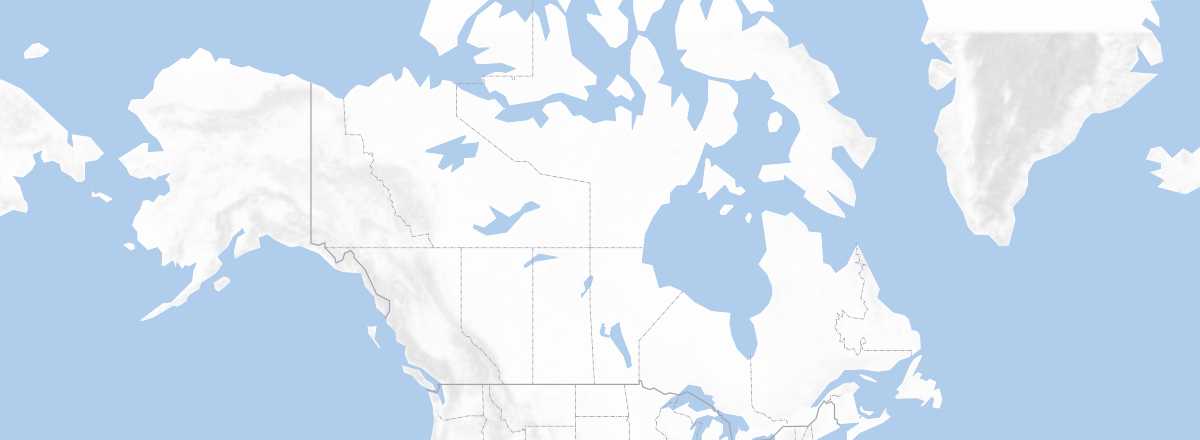 Canada
Open the interactive map
Canada
Open the interactive map
Quick Overview
Canada in Six Tourist Regions
- British Columbia: Known as "BC," this region offers visitors a great mix of experiences. While nature in all its splendor is omnipresent, as it is throughout the country, with stunning landscapes (Rocky Mountains parks, Glacier National Park, etc.), cities like Vancouver and Victoria are also well worth a visit.
- Northern Canada: Vast, desert-like, and almost uninhabited, these lands of the Far North remain one of the most isolated places on the planet. Rarely visited, they nonetheless have everything to delight lovers of untouched nature and off-the-beaten-path adventures.
- Ontario: A blend of lively cities, with Toronto and Ottawa leading the way, and nature to explore, particularly in the province's various parks. Ontario is also where, on the Canadian side, the famous Niagara Falls are located.
- The Prairies: Though not highly touristy, the three central provinces offer many parks and reserves with their unique wildlife (bears, bison, etc.) and landscapes of prairies, hills, mountains, forests, and lakes. Here and there, cities like Calgary, Edmonton, and Winnipeg are among the most pleasant.
- Atlantic Provinces: Facing the Atlantic, this Acadian land, discovered by the Vikings around the year 1000, is renowned for its spectacular coastal landscapes and still-pristine natural areas, attracting many visitors, particularly from neighboring Quebec.
- Quebec: A vast territory offering the chance to discover cities (Montreal and Quebec City foremost among them) and picturesque villages, remarkable national parks, and a multitude of festivals and activities for the whole family.
Key Facts
- Type of place: country.
- Location: In North America, bordered by the Atlantic, Pacific, and Arctic Oceans, as well as the United States.
- Latitude/longitude: 60.00' N, 95.00' W.
- Local time: There are six time zones.
-- "Newfoundland Time": for just the island of Newfoundland and a small part of Labrador.
-- "Atlantic Time": including New Brunswick and Nova Scotia, among others.
-- "Eastern Time": for much of Ontario and almost all of Quebec (including Montreal).
-- "Central Time": for Manitoba and northwestern Ontario, among others.
-- "Mountain Time": for Alberta and the Northwest Territories, among others.
-- "Pacific Time": for the Yukon and most of British Columbia.
- Capital: Ottawa.
- Nature of the state: Parliamentary democracy, federation, constitutional monarchy.
- Official language: French and English.
- Currency: Canadian dollar.
- Population: 35,881,659 inhabitants (2018).
- Area: 9,984,670 km².
- Density: 3.6 inhabitants/km².
- Highest point: Mount Logan (5,959 m) in the Yukon.
- Lowest point: Sea level.
- Coastline: 202,080 km.
- Driving: On the right.
Tourism
This vast country, from the Maritime Provinces to British Columbia, via Quebec or the Far North, offers astonishing diversity. Landscapes change with the seasons, and each region stands out for its historical heritage and natural riches.
As a result, Canada is attracting more and more visitors, with over 20 million per year (21.134 million in 2018). Unsurprisingly, Americans are by far the most numerous, accounting for 70% of arrivals, followed by the British, Chinese, French (604,000 in 2018, mainly to Quebec), Mexicans, Germans, and Australians. Economically, tourism in Canada supports 750,000 jobs and generates 102.5 billion dollars in annual revenue.
Travel Essentials
- Destination: For beginner travelers.
- By air:
-- France-Montreal: 450 to 900 €.
-- France-Vancouver:
- Entry requirements: Passport + return or onward ticket + proof of funds + Electronic Travel Authorization (eTA).
- Currency to bring:
- Exchange rate:
- Daily "backpacker" budget:
- Accommodation:
- Getting around:
- Risks: Low health risks and low to medium safety risks (occasionally related to nature).
- Best time for climate/crowds/prices:
- Interests (out of ): Nature ; Adventure ; Culture ; Relaxation/Holidays .
Useful Addresses
Tourist Office: Available online. Several cities and regions also have tourism representations (see regional guides).
Socio-Economic Statistics
- "Quality of life": 12/188 (rank in 2018)
- GDP per capita: $48,400 USD (2017)
- Average monthly income: $4,300 USD (2014)
- Inflation: +1.6% (2017)
- "Official" unemployment: 6.3% (2017)
- Population below the poverty line: 9.4% (2010)
- Life expectancy: 82 years (2018)
- Migration rate per 1,000 inhabitants: +5.7 (2017)
- Population growth: +0.72% (2018)
- Literacy rate:
- Urban population: 81.4% (2018)
- Press freedom: 18/180 (rank in 2018)
- Political regime: Democracy (6/167 in 2018)
Sources: World Bank, Human Development Indicators, RSF, The Economist, The World Factbook