After years of traveling, I finally settled down a few years ago in the Togean Islands, Indonesia (on the main island of Sulawesi).
For those planning to visit the Togeans via Wakai (arriving either by ferry from Gorontalo or speedboat from Ampana), watch out for a person who goes by the name Bagong, also known as Farid.
This gentleman is a teacher and supplements his income with tourism-related activities. He often hangs around Wakai port looking for tourists to sell things to (a charter boat transfer, a cabin on the ferry, etc.), using dishonest methods and lining his pockets.
More recently, he was hired by the authorities of Togean Islands National Park (TNKT) to sell entry tickets. And this is even worse: in the name of the National Park, he outright scams tourists, either by selling tickets at a higher price, asking them to pay again, or charging children who are supposed to enter for free.
Here’s what you need to know:
1. Entry fee for the National Park: 150,000 IDR (ONLY FOR ADULTS, aged 18 and up)
2. This entry fee is only payable once, even if the ticket states it’s a daily price. These tickets were printed a long time ago, before tourists even had to pay anything, and since then the payment system has changed. So it’s indeed 150,000 IDR per person, payable once regardless of how long you stay in the Togeans.
3. Where to pay (depends on your entry point to the Togeans):
Ampana: entry fee payable when departing from Ampana port
Gorontalo: entry fee payable upon arrival at Wakai port
Bumbulan (Marisa): entry fee payable upon arrival at Dolong port
If you’re asked to pay these fees anywhere else or when leaving the Togeans, it’s a scam—don’t pay.
4. You should receive one receipt per person in exchange for the 150,000 IDR. If not, know that the money won’t go to the National Park but into the ticket seller’s pocket. If someone offers to charge you less (e.g., 100,000 IDR), you won’t get a receipt, so the money still won’t go to the National Park.
Please don’t accept these practices, even if you think it’s good for your wallet (seriously, a 50,000 IDR discount is only about 3 €). The National Park needs these funds to protect the Togean Islands’ ecosystem. By saving 3 €, you’re just lining the pockets of a dishonest guy.
Several resorts have already reported Bagong’s (or Farid’s) dishonest practices to the National Park. The authorities are still struggling to find a trustworthy person to sell tickets in Wakai (no scams have been reported in the other two ports so far). We all hope this person will be replaced soon.
5. Contribution for the Ministry of Tourism: Since early 2019, every tourist staying in the Togean Islands must, in addition to the National Park entry fee, pay a 50,000 IDR contribution (regardless of the length of stay). These fees are to be paid at the same time as the 150,000 IDR for the National Park.
6. Price for renting a cabin on the ferry Wakai - Gorontalo (and vice versa): 500,000 IDR. If someone offers you 600,000 IDR, it’s a scam, and those extra 100,000 IDR will go into the same dishonest guy’s pocket (or one of his accomplices). Note that the 500,000 IDR already includes the commission for the person acting as an intermediary to rent the cabin.
7. Going rates for charter boats from Wakai to the various resorts (approximate prices, just to give you an idea—it may vary slightly from one boat operator to another or from one resort to another):
Wakai - Kadidiri (Harmony Bay, Kadidiri Paradise, Black Marlin, Pondo Lestari): usually free if the transfer is arranged by the resort (if you have a confirmed booking and stay more than one night), otherwise between 100,000 and 150,000 IDR
Wakai - Una Una (Sanctum, Pristine Paradise): I’ll get back to you with the info, but you can also check with these two resorts.
Wakai - Katupat (Fadhila Cottages and Bolilanga): 400,000 IDR
Wakai - Bomba (Polyalisa, Poki-Poki, Araya Dive Resort, Island Retreat): 400,000 IDR
Wakai - Malenge (Malenge Indah, Bahia Tomini, Sera Beach, Sandy Bay, Lestari Cottages): 600,000 IDR
Wakai - Waleakodi (Lia Beach, Pulotiga Resort): 900,000 IDR
There you go, fellow travelers—my little contribution to help you avoid what’s known here as the "Wakai mafia."
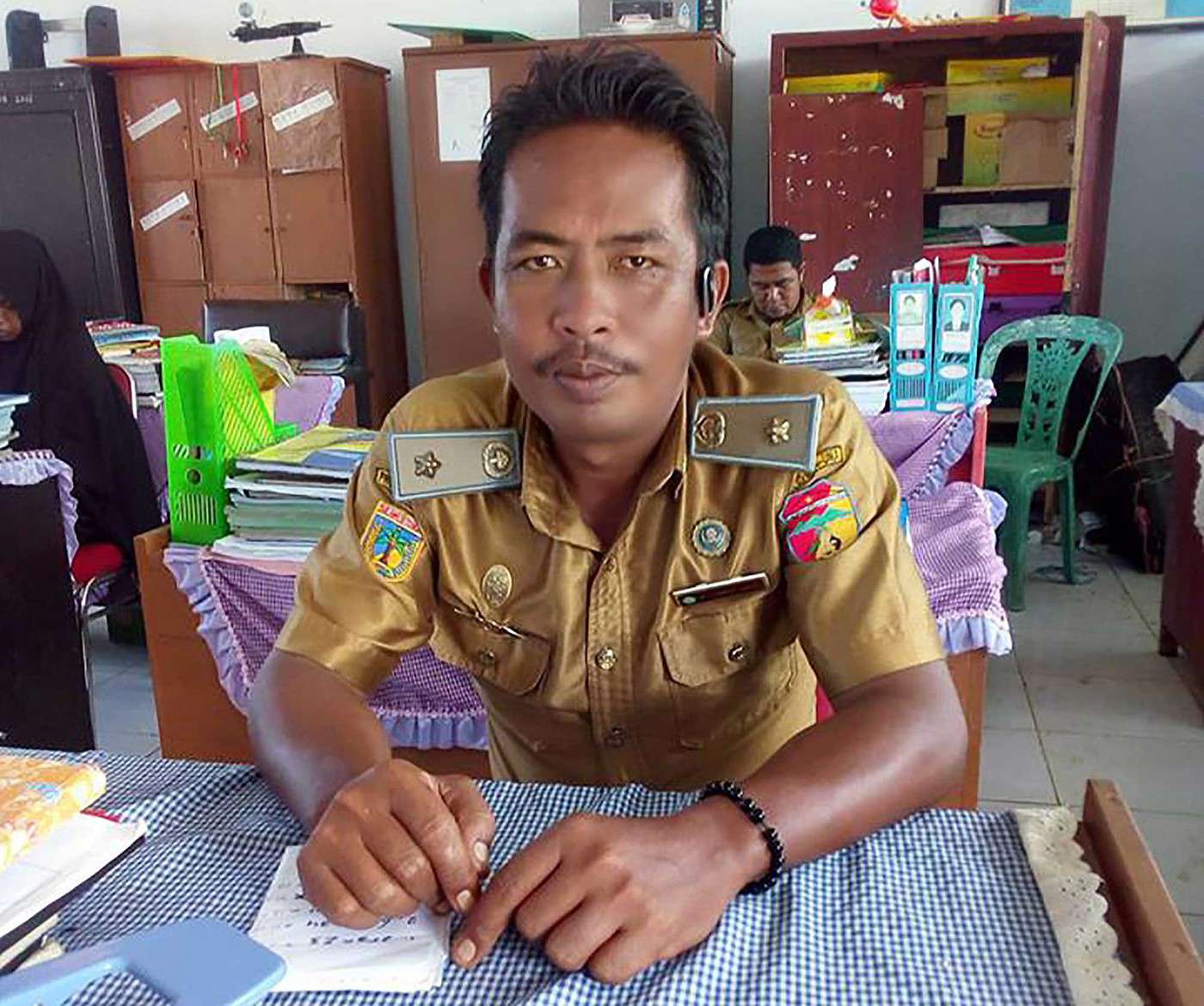
I’ve included some photos of Bagong/Farid (found on Facebook) so you can recognize him. Note that he sometimes wears glasses, sometimes not, sometimes has a mustache, sometimes not, and sometimes wears his teacher’s uniform to appear more official or legitimate. Heh, the habit doesn’t make the monk ;)
Other shady individuals in Wakai:
Lamin: sometimes sells ferry tickets to Gorontalo, but mostly acts as a taxi to resorts, with shady deals and unfair prices.
Uni: a seemingly charming woman, but not always honest. She offers cabin rentals on the ferry and arranges charter boat transfers to resorts.
And while I’m at it, if you meet "Miss Harbor" at Ampana port, run away like the plague. She doesn’t handle National Park ticket sales but will try to sell you a car rental for Toraja, Tentena, Luwuk, or Manado, a cabin rental on the ferry to Gorontalo, or other things. Her real name is Ulfa, and she’s a real scammer (on top of being an alcoholic and a bit unhinged). I’ll try to post something about her later.
Don’t worry, there are also plenty of great people in the Togean Islands :P :P
If, despite everything, you fall victim to these scammers’ schemes, be sure to report it to the resort where you’re staying. And of course, leave a comment here so I can report it to the National Park and the Ministry of Tourism (communications are difficult in the Togeans, and some resort owners don’t have many opportunities to contact the authorities).
Together, we can put an end to these dishonest practices and make the Togean Islands even more beautiful :)
Have a great summer, travel safely, and return with your heart filled with the beauty of our world!
Thanks for the info, Maboo! I visited the Togians (Kadidiri) two years ago and had only heard of Miss Harbor—not the other guys! Luckily, I didn’t have to deal with them. I’m hoping to return in early 2020 and would love to stay somewhere else. I’m really into snorkeling and would prefer spots I can reach without taking a boat—any recommendations?
More recently, he was commissioned by the authorities of Togean Islands National Park (TNKT) to sell entry tickets. And this is even worse: in the name of the National Park, he outright scams tourists, either by selling tickets at a higher price, asking them to pay again, or charging children who are supposed to enter for free.
We had to deal with this man who approached us at Wakai port shortly after our boat arrived from Ampana. He wanted to sell us entry tickets for the national park. He didn’t know we had come from Ampana, and I told him we’d already been on the islands for a few days, that we were making a round trip between Wakai and Malenge that day, and that we’d already paid for our entries—our tickets were in our bungalows in Malenge, and there was no way we’d pay twice for the national park entry. That was a lie—we hadn’t paid anything yet, neither in Ampana (where no one asked us for anything) nor in Wakai—but satisfied with our answer, he left us alone😏
Glad you didn’t have to deal with the troublemakers in Wakai! Miss Harbor has been causing issues for years, but apparently, she’s in someone’s good books in the government, so she stays put.
You might want to try a resort in Malenge. There are currently 6 of them—plenty of options! I’m not sure which one has the best snorkeling right off the beach, though. There are also reefs 4 and 5 nearby: you’d need to take a boat, but these two reefs are relatively close to the resorts. Alternatively, there’s Waleakodi Island and the resorts near Bomba village (Batudaka Island). I only know that the snorkeling isn’t great at Poki-Poki (even though the resort itself and its owners are lovely).
We had to deal with this guy who approached us at Wakai port shortly after our boat arrived from Ampana. He wanted to sell us entry tickets for the national park... He didn’t know we’d come from Ampana, and I told him we’d already been on the islands for a few days, that we were doing a round trip Wakai/Malenge today, and that we’d already paid the entry fees—our tickets were in our bungalows in Malenge, and there was no way we’d pay twice for the national park... Which was a lie—we hadn’t paid anything at all, neither in Ampana (where no one asked us) nor in Wakai. But satisfied with our answer, he left us alone 😏
Weird that no one asked you to pay the entry fee in Ampana. What year was this? For once, Bagong/Farid would’ve been right to charge you (as long as they gave you a ticket per person and charged the correct price)! It’s still important to pay to help protect the Togean Islands.
There was a time when the National Park staff weren’t very organized at Ampana port, so some travelers slipped through the cracks! Good for your wallet, not so great for the National Park 😉
Weird they didn’t ask you to pay the entrance fee in Ampana. What year was that?
In 2019. Last March... we took the 12/1 PM boat.
It’s still important to pay, for the protection of the Togean Islands.
Do you really think they’re protecting anything and that the money goes where it should when you see how trash is collected—or rather, dumped—in the Togian villages or even behind the bungalows of the "resorts"😏
I think it's a shame to be happy about not paying entrance fees for any park or site... 😕
No matter the PARK, everything is destroyed and polluted, and absolutely nothing goes toward protecting the marine environment—it all ends up in the pockets of a few corrupt people.
There too, you pay the entrance fee for the "marine park":www.thailandee.com/...uristes-indefiniment
And yet, Thailand is certainly doing more than Indonesia to preserve the natural environment.
In a few years, concrete will be everywhere, without proper waste or wastewater management, and the Togean Islands will be in the same state as all these other islands: Samui, Phi Phi, Boracay, El Nido, etc... with or without an entrance ticket.
It’s still important to pay, for the protection of the Togean Islands.
Do you really think they’re protecting anything and that the money goes where it should when you see how waste is handled—or rather, dumped—in Togean villages or even behind the bungalows of "resorts"😏
Absolutely, the money goes to the National Park (unless, as I explained in my post, you’re not given a ticket in exchange). The park is under the direct supervision of the Ministry of Environment in Jakarta, not its local branch in Ampana, which is much more effective.
The National Park does its best with the budget and human resources it has, and it’s clear that environmental conservation in the Togean Islands (like everywhere else) is a huge project that will take generations. Waste management isn’t specifically the National Park’s role (even if it’s part of its responsibilities). There’s also coral reef rehabilitation (like coral transplantation), cracking down on fishermen using explosives and cyanide (yes, it’s illegal but still happens), and protecting mangroves and forests, among other things.
The National Park can’t single-handedly change the mindset of an entire population in just a few months or years. A major effort in education and awareness is needed, which must be led by the Ministry of Education, the Ministry of Environment, and the National Park. Rome wasn’t built in a day 🙂
Paying the park entrance fee is contributing to the efforts in place, even if you don’t necessarily see the results yet. But if you weren’t asked to pay in Ampana, that’s not your fault.
As for waste management in resorts, that’s the responsibility of the owners, not the National Park, since it’s private property. Some owners are somewhat aware and others (often run by Westerners but not exclusively) implement waste management solutions.
It’s important to understand that there’s no waste collection (in resorts or elsewhere). So it’s not obvious what to do with your trash. If we transpose the situation to France, for example: what would you do with your waste if no garbage truck came to pick it up and there were no waste treatment companies? It’s all very complicated, and it’s great that travelers try to understand local issues without judging too quickly.
I find it a shame to be happy about not paying entry fees to a park or site, whatever it may be.... 😕
No matter the PARK, everything is destroyed and polluted, and absolutely nothing goes toward protecting the marine environment but instead into the pockets of a few corrupt individuals.
Over there, you also pay the entrance fee for the "marine park":www.thailandee.com/...uristes-indefiniment
And yet, Thailand certainly does more than Indonesia to preserve the natural environment.
In a few years, concrete will be there, without waste management or wastewater treatment, and the Togean Islands will be in the same state as all these other islands: Samui, Phi Phi, Boracay, El Nido, etc., with or without an entrance ticket.
We need to take a step back on all this and, once again, not judge too quickly. More importantly, we should verify our sources.
First, do you have proof that "nothing goes toward protecting the marine environment"? Have you met the people from Togean National Park, talked with them? Have you spoken to the local volunteers who work hand in hand with the National Park staff? I did say volunteers—unpaid, that is. These volunteers are actually simple villagers who live very modestly but understand the importance of environmental protection. Some resorts also carry out volunteer missions from time to time to join efforts with the National Park.
Togean National Park lacks human and financial resources, and as I mentioned in my previous reply, the task is enormous, and Rome wasn’t built in a day. The mindset of an entire population needs to change, and that takes a long time.
I invite you not to lump all national parks together. Making generalizations and taking shortcuts never helps. To judge, you need to speak with full knowledge of the situation, be aware of the realities on the ground—whether economic, sociological, geological, climatic, or otherwise. I don’t know how long you stayed in the Togean Islands, but I doubt a few days, weeks, or even months were enough to fully understand the ins and outs.
How can you claim that "nothing goes toward protecting the marine environment but into the pockets of a few corrupt individuals"? The Bagong/Farid I mentioned in my post is indeed corrupt. That doesn’t mean everyone is. Are you sure all the money goes to corrupt people? If so, I’ll ask you to present tangible evidence.
I’ve personally taken part in coral transplantation operations with the National Park. I’ve gone underwater with them and seen how complex the process is—scrubbing each transplanted coral with a toothbrush to clean them. I’ve seen National Park staff catch blast fishermen in very difficult conditions and hand them over to the authorities. I’ve cleaned beaches and villages with them, attended awareness sessions they organized in the villages. I’ve seen them get pelted with stones by crowds of villagers who lack the education to understand that limiting fishing in certain areas is crucial for the survival of marine ecosystems.
Please, don’t make such statements on a forum if you don’t really know what you’re talking about.
And don’t condemn the Togean Islands outright with your pessimism. You don’t know what’s being done there right now to protect the environment. Controlled tourism development is entirely possible, and unless you’re psychic, you have no idea how the Togean Islands will evolve. Neither do I, but I’m an optimist by nature, and my actions aim for positive development.
Second, since you give the example of Maya Bay in Thailand, forgive me, but it was tourism that destroyed this bay and its corals. And if Danny Boyle’s film *The Beach* hadn’t made the site famous, tourists wouldn’t have come. Should we blame Danny Boyle? I don’t think so.
Those tourists—you’re one of them. Because if the inhabitants of some developing countries don’t yet have an ecological conscience (and by the way, ecology in France isn’t that old either), tourism development isn’t without consequences for environmental degradation. Those tourist boats that drop anchor in Maya Bay or elsewhere and damage the corals—you take them too. And as a tourist, you also generate waste, consume freshwater, use sunscreens that kill coral reefs, and leave a carbon footprint.
Being a responsible tourist also means finding out about where you stay and choosing places based on their involvement in both environmental conservation and the empowerment of local communities. There are resorts in the Togean Islands that are very committed to this—they reduce and sort their waste, recycle some of it themselves, ensure their boats (and their clients) don’t damage the corals, use natural cleaning and toiletries, work with local communities to develop the economy, improve living conditions, and raise awareness about environmental issues. Maybe by staying in one of these resorts, you would have had a completely different understanding of the situation and a completely different appreciation of the Togean Islands and the work of the National Park. Don’t forget that you’re part of all this, and if you don’t want to be, you can always travel in France where everything is perfect and clean (I’ll come back to that later).
Waste management in the Togean Islands isn’t that simple: there’s no official waste collection yet, so each village takes the initiative—or not—to manage its waste.
Moreover, collection alone isn’t a solution to the problem: once you’ve collected it, what do you do with it all? There’s currently no waste treatment or recycling company in the region or beyond. Most recycling companies are only in East Java (Surabaya). Sending waste there isn’t necessarily a solution, considering the carbon footprint and cost.
The very first key is waste reduction (avoiding producing waste rather than having to deal with it), but again, this relies on education and awareness, as I mentioned in my previous reply.
We recently created the Togean Conservation Foundation, which a few resorts have already joined. It will act on the following fronts: waste management, reuse/upcycling of certain waste, environmental education, agricultural diversification (polyculture instead of monoculture), preserving biodiversity in agricultural systems, water retention, development of local crafts, etc. All these topics, and many more, will be addressed using permaculture principles. We have an Irish volunteer who specializes in permaculture and has been working on all these plans for a year and a half, in close collaboration with local communities and the National Park (yes, the famous park that’s lining its pockets). We hope to raise enough funds for the foundation to be able to pay this person so she can work sustainably.
The waste in the Togean Islands is shocking because it’s visible, and I’m the first to regret it. But we mustn’t forget that the West produces far more waste than rural Indonesian and Southeast Asian regions in general, which are often outside the consumer society. Their populations don’t buy cars, washing machines, dishwashers, or the latest smartphone when their current phone still works, and so on. Here in the Togean Islands, people consume little, repair, and reuse—not for ecological reasons, but simply for economic ones.
In the West, on the other hand, we’re in overconsumption and produce an astronomical amount of waste. But this waste is much less visible than in the Togean Islands or other developing regions simply because it’s "managed." So we get the impression that everything is clean. But beware: simply sorting your waste for recycling and having garbage trucks and collectors isn’t enough.
Do you know where your old washing machine goes when Darty delivers the new one and takes the old one away? Do you know where your recyclable waste ends up? Is it really all recycled? Do you have proof?
Did you know that 91% of the world’s plastic isn’t recycled?
What we need, on a global scale, is to REDUCE our consumption to create as little waste as possible. The zero-waste movement goes in this direction and is, in my opinion, an excellent driver for changing mindsets worldwide.
In the same vein, did you know that many European countries (including France), as well as the United States and Australia, export waste they don’t want to recycle to Asia because it’s cheaper? We sort our waste thinking we’re doing the right thing, but some of it ends up in nature in Asia (maybe even in the Togean Islands)!
A painful statistic: every year, France exports several hundred tons of household plastic to Malaysia (which, by the way, is sending it all back, like other Asian countries).
If Asia has become France’s dumping ground and that of other countries, we’re not really in a position to lecture the villagers of the Togean Islands who throw their waste into the sea. I’m not justifying their actions; I’m simply broadening the debate by highlighting two things:
Plastic arrived in the Togean Islands about thirty years ago. Did it take France less than 30 years to become eco-friendly (if we even are today!)? For example (among many others), the European law banning certain single-use plastics is very recent and won’t come into effect until 2021 (uh, how long have we been using these plastics in Europe?). Please, let’s give it time and focus on education, and do our part by setting an example—without hasty judgment.
It’s not that simple, and seeing the world in black and white, pointing fingers at the "bad students," isn’t really the solution. We ALL share responsibility for what we’re doing to our planet, here or elsewhere, at the government level as well as individually. It’s time for everyone to realize this instead of blaming others and start acting at their own level to stop the destruction. Every action counts, even what you might think is a drop in the ocean. "Together, we are stronger."
A few links for reflection:
www.facebook.com/...h/?v=447214106042086
Totally agree with you, Maboo. A lot of tourists get outraged by plastic pollution (which they contribute to) but don’t realize we pollute 100 times more in our own countries with far more dangerous products. Kudos for these actions with the park people—it seems essential to involve local communities in this kind of fight.
Your explanations are really clear... thanks! 🙂
It’s true that tourists often contribute to damaging the places they stay in. I was particularly shocked by the state of the beaches in the Thai islands—glass bottles, all kinds of trash, plastic bags... It’s easy to point fingers at locals when we can’t even behave properly ourselves...
Totally agree with you, Maboo. Many tourists get outraged by plastic pollution (which they contribute to) but don’t realize we pollute 100 times more in our own countries with far more dangerous products. Kudos for these efforts with the park’s locals—it’s essential to involve local communities in this kind of fight.
Thanks, Bouscaillou, for your clarity and encouragement—I really appreciate it! 🙂
Indeed, change can only come through local populations. It’s up to us (tourists, Westerners living there, associations, government bodies, and locals already involved/aware) to work hand in hand with those who aren’t yet aware of the danger and support them as best we can in this transition, which is so complicated but so necessary!
Your explanations are very clear... thanks! 🙂
Indeed, tourists often contribute to destroying the places they stay in... I was particularly shocked by the state of the beaches in the Thai islands... glass bottles, all kinds of waste, plastic bags... it’s easy to throw stones at the locals when we ourselves can’t behave properly...
Hi Gildadesiles, you’re welcome! 🙂
I hope I’ve managed to raise awareness a bit among those in this discussion about the reality on the ground.
It’s clear that tourists share some responsibility—thanks for acknowledging that, it’s important!
While it’s necessary to educate local communities about environmental issues, I’m convinced that many tourists also need to be educated. I don’t want to generalize, because there are also a lot of responsible tourists, but it’s true that there’s a category of travelers who couldn’t care less about the environment in the countries they visit (even though they’re much more respectful in their own countries). I’ve already heard (not in the Togean Islands) someone say: "Anyway, it’s already dirty, so it doesn’t matter if I throw my trash anywhere." That’s the typical selfish attitude and the "after me, the flood" mentality. Totally irresponsible in my eyes: just because a site or region isn’t aware of environmental problems doesn’t mean we should add to them and make the situation even worse. If protecting the environment is a core principle for someone, they’ll do it out of conviction, no matter the external conditions.
And then there are tourists who simply don’t care, at home or abroad!
But what really saddens me is the tourist who thinks they’ve got it all figured out and are better than the locals, just because they sort their trash at home. Yet, as we’ve seen above, selective sorting isn’t a guarantee of recycling... Besides, we often hear this confusion: "At home, we recycle." No, you don’t recycle—you sort. It’s not the same (unless you actually have a recycling workshop at home!).
Recycling is an industrial process (which, by the way, is very energy-intensive—that’s the other controversy around recycling... it’s not necessarily eco-friendly, and in fact, that’s another reason why waste reduction is a much more effective and sustainable solution than recycling) carried out by recycling companies or, occasionally, in an artisanal way by small communities (as is the case in some villages in the Togean Islands).
That kind of tourist is usually moralizing, a bit (or a lot) colonialist, and not at all interested in understanding local issues (but travel is also about that: understanding cultural differences, or at least being interested in them). They judge, belittle, generalize, and don’t care about the reality on the ground or the context.
It’s also this tourist, most of the time, who you’ll hear say: "Oh no, there’s no way I’m picking up trash or helping clean this beach/village—I’m on vacation! It’s not my job!" Okay, you’re on vacation, but aren’t you also a citizen of the world who sees beyond the comfort of your own little country and understands that protecting the environment is a global issue? Aren’t you here to participate in something, to exchange with locals? Isn’t that what travel is about? And don’t you take pride in contributing to something big and important, in helping a noble cause? Aren’t you a kind person toward others? Aren’t you full of gratitude for the nature that gives us so much, don’t you want to protect it just because without it, you’d be gasping for air, and because what it endures, even outside your country’s borders, affects the entire planet? A little loyalty, come on.
Is it really going to ruin your vacation to lend a hand for a few hours? And if it’s not your job, whose is it then? Associations? Other people who don’t litter but are concerned and altruistic enough to roll up their sleeves, bend down, and pick up trash? Or the locals (they should just deal with it, it’s their trash after all), who often don’t understand the stakes and are more worried about having enough to eat tonight and enough money to send their kids to school?
Unfortunately, selfishness and self-centeredness won’t get us very far 😕 And I’m pretty sad to see how little some travelers are actually curious about the world they claim to explore. Hey, we live on the same planet, don’t we??
I’m not saying all this to you, Gildadesiles, even though this reply is addressed to you! I’m just agreeing with your comment, which, like Bouscaillou’s, is very honest and clear-sighted. Safe travels to you! 🙂
Thanks so much, Marion, for your enlightening and well-reasoned message—I totally agree with you.
I was lucky enough to cross paths with you, and I know all the energy you put into preserving the Togian Islands. Modestly, you didn’t even mention the association you founded in 2012, EVERTO, which has done amazing work, especially in Katupat. Hope to see you soon!
Qui serait assez insensé pour mourir sans avoir fait au moins le tour de sa prison ?
Thanks Marion for your such enlightening and well-argued message—I agree with you completely.
I was lucky enough to cross paths with you, and I know all the energy you put into preserving the Togians. Modestly, you didn’t mention the association you founded in 2012, EVERTO, which did amazing work, especially in Katupat. Hope to see you soon!
Martine, Martine... who took Ida to Bali? So great to hear from you!!
Thank you so much for your message—it really touched me. I know you’ve traveled through quite a few countries over the years, always engaging with the context, seeking out local encounters, and striving to understand their daily lives and challenges. So glad there are travelers like you!
Yep, EVERTO—my first steps into waste management, diving into this tough but fascinating issue. Seven years already, time flies! Do you remember the trash bin stencil-painting sessions in Katupat? Such great moments shared between locals, travelers, and the association.
Are you still coming to the Togean Islands? Would be awesome to see you again :) Big hugs.
I’ve been traveling to Indonesia for 20 years, and honestly, I might’ve doubted the usefulness of paying the park entrance fees—just like Djalma did—but your reply really convinced me otherwise. 🙂 It’s awesome that you took the time to write such a long, detailed response. It really sets the record straight!!!
I’ve been visiting Indonesia for 20 years, and honestly, like Djalma, I could’ve doubted whether paying the park entrance fees was worth it. But your reply really convinced me otherwise 🙂 It’s really great that you took the time to write such a long, detailed response—it really sets the record straight!!!
Thanks so much, Vikingboy—I’m so glad I convinced you 🙂
I totally get travelers’ hesitations, the doubt, the fear of getting scammed (maybe because it’s happened to them before). All of that makes sense (which is why I posted about scams in Wakai). But be careful not to go to the extreme and dismiss everything outright, like saying all national parks are useless. What a shame! It’s good to be cautious, but you’ve also got to stay curious and do your research.
I think if you have those kinds of doubts, it’s best to do a little research before visiting a region—find out what’s going on there, any potential entrance fees, the initiatives in place, etc. We’re lucky to have the internet, this amazing tool that gives us access to so many valuable resources!
That’s why I took the time to write such a detailed reply: first, because the topic is really close to my heart, but also because I think travelers need this kind of information.
I truly believe that all of us, no matter where we are, have the power to make a difference in the world. And if I, living in the Togean Islands with firsthand knowledge of the context, can share this kind of info to make it accessible to as many people as possible, well, that’s already my way of contributing and making a difference.
Thanks again for your kindness and honesty. I’m really happy my words resonated with you 🙂🙂 Wishing you amazing travels.
The waste in the Togean Islands is shocking because it's so visible, and I’m the first to regret it. But we mustn’t forget that the West produces far more waste than rural Indonesian and Southeast Asian regions in general, which are often outside the consumer society. The people there don’t buy cars, washing machines, dishwashers, or the latest smartphone when their current phone still works—and that’s just the start. Here in the Togean Islands, people consume little, repair, and reuse, not for ecological reasons, but simply for economic ones.
In the West, on the other hand, we’re in a cycle of overconsumption and produce an astronomical amount of waste. The difference is that this waste is much less visible than in the Togean Islands or other developing regions simply because it’s "managed." So we get the impression that everything is clean. But beware—just sorting your waste for recycling and having garbage trucks and collectors isn’t enough.
Do you know where your old washing machine goes when Darty delivers your new one and takes the old one away? Do you know where your recyclables end up? Are they *really* all recycled? Do you have proof?
Did you know that 91% of the world’s plastic isn’t recycled?
What we need—on a global scale—is to REDUCE our consumption to create as little waste as possible. The zero-waste movement is heading in the right direction and, in my opinion, is an excellent driver for changing mindsets worldwide.
Along the same lines, did you know that many European countries (including France), as well as the U.S. and Australia, export waste they don’t want to recycle to Asia because it’s cheaper? We sort our waste thinking we’re doing the right thing, but some of it ends up in nature in Asia (maybe even in the Togean Islands!).
A painful statistic: every year, France exports several hundred tons of household plastic to Malaysia (which, by the way, is now sending it all back, just like other Asian countries).
I think we didn’t quite understand each other...
I’m fully aware of the problem, and my criticism isn’t really aimed at the Togean Islands or even Indonesia...
And it’s not just about waste management—it’s a much bigger issue you touched on: overconsumption, which is primarily a Western problem (though not exclusively, since China opened up to tourism). And we’re not really ready to turn the tide! This overconsumption goes hand in hand with the overexploitation of natural environments due to ever-increasing tourist concentrations in small areas.
I started traveling in Southeast Asia in the early 1970s, and I’ve seen how the natural environment (both land and sea) on an island like Samui, which was almost untouched, has gradually degraded over the years—and I understand why. Back then, these islands were home only to fishermen and copra farmers who trained monkeys to pick coconuts... No roads, no electricity, and no plastic! Just pristine beaches, coral, and fish... The few backpackers at the time got by with very little. We slept on mats on the sand, in palm-leaf huts; we ate fish, rice, and a few fruits. That was the daily life of these islanders...
A few years later, mass tourism developed, driven by demand for comfort—so concrete, roads, electricity, and consumer products with their plastic packaging started arriving from all over Thailand and abroad... Then came the airport and its ever-growing waves of tourists...
Some countries, like Cambodia, were spared for political and historical reasons until recently, but China has now set its sights on them, and anarchic concrete development is flooding in with its ugliness, along with hordes of Chinese tourists on the coast and islands... Money rules everywhere...
If the Togean Islands and other lesser-known islands are still spared, it’s because they’re relatively hard to access (it takes time) and lack comfort—but developers (as everywhere) will be stronger than the managers of the "natural park," and I’m convinced there’s no reason the Togeans, or Bunaken, or Raja Ampat, should escape the ecological disaster that’s already hit Samui, Phuket, Phi Phi in Thailand, Boracay, and El Nido in the Philippines...
I think the most effective way to protect these sites is to stop luring tourists with advertising...
Conclusion: Avoid going to the Togean Islands—it’s starting to get dirty and polluted, the coral is bleached, and on top of that, it’s infested with malaria-carrying mosquitoes and beaches overrun with sand fleas.
Am I pessimistic or just realistic?
Thanks for this beautiful, intelligent clarity—it restores dignity to the word "commitment" and shows it’s possible to engage respectfully in a foreign place.
A question’s been nagging me since reading the first post, even before the discussion took off... Maybe it’s off-base (like Djalma), but I’ll ask anyway:
With names, photos, and precise details, you’re calling out a small local mafia under your full identity and showing your (lovely) face.
Courage, recklessness, or peace of mind... Have you thought about the risk of retaliation?
Good afternoon Marion,
Thanks for this really valuable info.
I went to Fadilah twice a few years ago but never ran into this guy.
Just so you know, in 2017 I was in Tomia, which is part of Wakatobi Park, and there was also an entrance fee of 150,000 IDR (a park rep came to my guesthouse to collect the money and gave me a nice receipt valid for the duration of my stay in the park).
By the way, kudos for your contribution to preserving the environment in the Togians.
Best,
Patrick
Hello,
I find Maboo’s messages really insightful in more ways than one—I completely agree, even if I have to say that during my vacations, I don’t think I’d go so far as to join a beach cleanup campaign. And even though I share the idea that, like the hummingbird, everyone should do their small part to help put out the fire, I still remain extremely pessimistic about how things will turn out. I’m only talking about the effects of tourism or overconsumption without even getting into the even more disheartening fact that several leaders of the world’s most polluting countries have no ecological awareness whatsoever—in fact, quite the opposite...
So, much like you all do, I don’t share—or no longer share—certain spots I’ve discovered, hoping they’ll stay preserved from the ravages of mass tourism for a little while longer (though let’s be modest, my influence isn’t exactly huge).
When you see the damage that a single Instagram photo or the filming of a movie or music video can cause due to mindless, herd-like tourism...
Hi Marion.
Thanks for your post and especially for your involvement and local help.
I’m looking for news about a freelance guide based in Rantepao we traveled with twice. His name is Wempi Yarmin, and he’s perfectly fluent in French. Maybe you’ve heard of him? The contact info I have doesn’t work anymore, and I hope nothing’s happened to him.
Wishing you a lovely day.
Armindo.
Attention à une certaine Miss Harbour sur le port de Ampana. Elle vend des tickets de bateau, ferry... NE RIEN LUI ACHETER! Partant de ampana en direction des…
Arnaques à éviter en voyage › Indonésie · 7 replies
Nous nous sommes rendus à Florès depuis Djakarta en train et en bus. La fatigue aidant nous nous sommes fait avoir 2 fois entre Bali et Florès. En arrivant à…
Arnaques à éviter en voyage › Indonésie · 6 replies
J'ai été témoin d'une arnaque dans 3 bureaux de change à kuta. Cette pratique semble donc répandue dans cette ville. Voulant échanger des dollars, j'ai été…
Arnaques à éviter en voyage › Indonésie · 12 replies
ATTENTION!!!! Si vous arrivez sur l'île de Flores à l'aéroport de Maumere, refusez toute proposition d'un certain Anjelo qui a pour habitude de voler argent,…
In some countries, the price charged to tourists is often higher than the one for locals.
Is it legal for a restaurant, for example, to have a "price for locals" and a "price for foreigners"? Do they have the right to do that? (Because it really annoys me—you can’t imagine how much money I’ve lost to this scam.)
Aren’t there any local organizations that could call out this scam?
At the same time, since this kind of scam happens often in poorer countries, the money I lose ultimately goes to those countries, so it’s like I’m donating to a humanitarian organization. So in the end, it doesn’t bother me *that* much—when I get scammed, I just tell myself I’m doing a generous act to help the poor in that country.
My mom received an invitation for a free stay (though of course it comes with visits to carpet shops, jewelry stores, and other boutiques). She bought a carpet in Turkey about 10 years ago, and it was that carpet shop in Istanbul that sent this invitation. The whole thing is organized by a travel agency called "Habitat VIP Travel." Has anyone here heard of this agency and their "commercial tourism" practices? I’m not against the idea in principle—I just want to make sure it’s legit and not dangerous (I really don’t want to get kidnapped with my nearly 90-year-old mom!).
Thanks for your feedback
Hello everyone,
A message to warn potential customers of "Go Voyages" about my recent experience.
I left from Geneva for Colombo on December 18, 2025, with a round-trip business-class ticket purchased on Go Voyages, with Etihad Airways, and a layover in Abu Dhabi. Access to the business lounge was denied (I have a 7-hour layover both ways), and I had to pay $160 to get in, despite having a business-class boarding pass.
I’m currently in Sri Lanka, and for a month now, I’ve been trying to get an explanation for this refusal and to find out if I’ll be denied access again on my return on March 12, 2026.
After two calls to the priority line of the "Prime" service I subscribed to (a paid subscription, of course), which is supposed to assist me 24/7 during my trip, after about ten emails that only led to being redirected to links like Opodo, then eDreams (an inaccessible site), and then other links that just sent me in circles... it’s absolutely insane, all this just to answer a fairly simple question: why wasn’t I informed about this potential refusal by Etihad when I made my purchase? All Go Voyages would need to do is contact the airline to resolve this quickly... but no!!! After a month, ten emails, the last response was: contact the airline directly!!! Which, of course, redirected me back to Go Voyages!!
Completely unacceptable! The "Prime" service from Go Voyages is a total scam—completely ineffective, with customer service nowhere to be found. My issue isn’t life-or-death, but imagine a more serious situation where you’d need quick assistance... don’t count on "Go Voyages" to help you at all!! You’d likely be pretty disappointed!! My advice: RUN from this agency, which is headquartered in Spain and owns Opodo, eDreams, and Go Voyages.
Eight months after our vacation in Croatia, Europcar took 1,611.25 € from us... yes, you read that right—1,611.25 €!! At first, we thought it was a credit card scam, but after a little investigation and the documents sent by the rental company (which had the wrong email address), it turned out the city of Dubrovnik had hit us with this huge fine. Following the GPS on June 9, 2025, we were simply heading to our accommodation with parking on Zagrebačka Street. This one-way, busy street has been off-limits to vehicles without a pass issued by local authorities since June 2, 2025. There’s a checkpoint at the entrance with license plate scanning, but the signs announcing the zone are in Croatian! Our landlord didn’t warn us and hadn’t registered our plate with the authorities, as recommended on the city’s website. The result? A prohibitive fine for both the vehicle and the driver. On top of that, the rules say you only have 8 days to appeal... super convenient when you’re on a road trip abroad and no one flags the issue when you return the car a few days later. This is a real blow for us, but more importantly, it’s a massive tourist scam set up by the city of Dubrovnik. 🙁
Hi,
Back from South Africa since 24/10/25, we’re having trouble getting our deposit back after renting a car at Cape Town Airport with Pace Car Rental through Carwiz! It’s still a sum over 1000 €!!
Lots of email exchanges via WhatsApp where they send me the refund proof dated 25/11, but my bank can’t find any trace of it!! Just to clarify, the car was returned without a scratch, as they confirmed!
Has anyone else run into this issue with this rental company, or others for that matter? And if it’s a scam, what are the possible courses of action? I’m hoping there are some… I was thinking of contacting our Consulate in Cape Town to see if they can help with the next steps or even intervene with this rental company!
This kind of practice isn’t going to help boost tourism relations with South Africa!!
Thanks for your feedback,
Dan
hi everyone.
I usually exchange money at a bank in the city in every country, but this time I was being picked up by my guide, so I did it as quickly as possible and didn’t check my receipt.
I don’t remember the exact amount the cashier scammed me out of, but it was significant when I recounted everything later.
Two hours later, when my guide still hadn’t shown up, I ran into the police—a kind woman I explained the situation to—but it was too late because the cashier had already been replaced.
Be careful and don’t do what I did.
Check everything in front of them because afterward, it’s too late 😅
A disastrous experience with Lastminute.com – Family left outside with no assistance
I booked a stay at the Akgun Istanbul Hotel via for a total of 3 884 €. Despite receiving a booking confirmation, the hotel refused to accommodate us. My wife was sick, we had two children with us, and we literally found ourselves outside with no help at all. We had to book another hotel at our own expense, and even with the evidence we provided (medical documents, receipts, exchanges with customer service), only refunded 717 €. Customer service refused to reopen the case, completely ignoring the exceptional circumstances. No gesture, no assistance, no respect.
I strongly advise against using this platform for anyone traveling with family or in sensitive situations. If something goes wrong, you’ll be on your own.
Among other things, they don’t just mention fake taxis that rob you or express kidnappings (especially in Arequipa), but also drugs that can be slipped into your drink if left unattended, "with the risk of scopolamine being added."
They’ve marked the Cuzco region as a red zone (formally avoid!!) and central Lima as an orange zone, "to avoid after dark."
Zou! is the public transport service for the Région Sud Provence-Alpes-Côte d'Azur. We're Canadian and our plan was to hike the Mercantour Great Crossing (GR52). After landing in Nice, we needed to find transport to the trailhead in the village of Entraunes. It took us two months to figure out that the only service available was Zou!'s shuttle, and—after countless calls (not easy from Canada)—to actually speak to someone at the company. Even though they confirmed our reservation, on the day of the trip, they weren’t waiting for us. We ended up stranded in Guillaumes because the driver hadn’t been "informed" that he was supposed to go all the way to the terminus that day. In 40 years of traveling the world, I’ve never encountered a situation where customer service was this nonexistent and access to a region this difficult. I just wanted to share this experience to warn you if you’re planning to rely on public transport to reach the GR52...
I want to share an experience that really knocked the wind out of me and I hope it won’t ruin my long-awaited trip to Japan.
I recently used the services of a travel planner, Hima Voyage, which I found on social media, to organize my family vacation in Japan.
Unfortunately, my experience was extremely disappointing and frustrating, marked by a blatant lack of professionalism.
The major problems appeared when I received the itinerary: the proposed route was completely illogical in relation to the accommodation locations, forcing us to make much longer daily trips than necessary, with duplicate days suggesting a poorly done copy-paste sent to others.
She didn’t take into account the high-traffic days for the places we wanted to visit at all.
No personalized or concrete tips or advice were provided. Most of her “recommendations” were generic copy-pastes you can find anywhere on social media.
Faced with such a lack of optimization and logic, I’m forced—with less than 4 months until the trip—to start from scratch and completely reorganize my trip myself. This service, sold as an organizational aid, turned into a huge waste of time and money (825 euros down the drain).
I feel scammed and deeply disappointed by this service. I strongly recommend being extremely cautious before entrusting your travel plans to any “travel planner” found on social media.
I’m posting this as a not-so-pleasant experience, but one I think is important to share.
We stayed at MMV Arêches-Beaufort at the end of June 2025 (from the 21st to the 28th), in room 317, as a family with our young daughter.
Everything was fine until the night of June 25th to 26th, when we discovered a bed bug infestation right next to our bedhead.
We’d already slept 4 nights in that infested room without noticing anything. Needless to say, the shock was huge, especially with a little one.
MMV offered to relocate us, but by that point, trust was completely broken. The rest of the stay was spent in constant stress: disinfecting, isolating our belongings, and worrying about bringing these pests home with us.
They refunded our stay (which was the least they could do), but they’d also promised compensation of 150 €, which was never paid. Since then, no news at all.
We felt erased, ignored, and not taken seriously.
I’m sharing this not to stir up controversy, but to warn other travelers.
We thought we were staying in a reliable residence with responsive customer service—it wasn’t the case.
I’m genuinely wondering:
Am I an isolated case with MMV?
Have others experienced similar situations (bed bugs or a lack of consideration when problems arise)?
Thanks to those who take the time to read this.
And above all, be wary when everything seems "too good on paper."
Avoid the car rental company "locationauto"
No one was there when we arrived at the airport—we waited 1 hour for someone to pick us up and take us outside the airport.
The vehicle... 97,000 km!!!! Dirty inside and out, stained seats.
Return was the same—1.5-hour wait to drop off the car.
Sure, it’s cheap, but you get what you pay for!!!
With the $CAD/EUR exchange rate already worse than ever (thanks, Mr. Trump and his annexation threats), imagine my surprise when I found out that the EuroBank ATM (same for Alpha Bank) charged a 9% commission on the transaction. That pushed the exchange rate from the official 1.60$ to 1.77$ per euro. It’s better to buy euros in Canada or at a currency exchange office, or just pay by credit card, which I did (at a rate between 1.61$ and 1.63$).
If you take the bus from Bangkok Ekkamai to Pattaya, foreigners will be asked to pay an extra 20k for checked baggage, even though it’s already been paid for and listed on the ticket. They don’t even weigh it—a woman just demands you pay again, and if you refuse, she goes to get security colleagues who yell at you and threaten not to let you board. We later found out at the hotel that this is a well-known organized scam. The company is ROONG REUANG COACH, and we were about fifteen people—all foreign tourists—in the same situation. For Thai passengers, they didn’t ask for anything.
Then in Pattaya, violence and corruption rule. The next day, we learned the city is classified as "scarlet" (high-risk). A hotel guest was attacked with a knife by four Thais on a scooter—they stole his bag with his bank card and cash inside, luckily not his passport. A large hotel near ours was just shut down administratively for pedophilia. On Apple Maps, many reviews warn about how dangerous the city is. I’ve been coming to Thailand regularly for over 30 years, but I barely recognize the country since COVID. The "Land of Smiles" is turning into the "Land of Scowls," and a form of racism is emerging. For us, this will be the last time—next stop, Vietnam, and even China, which pleasantly surprised us.
Finally, China and the U.S. are advising their citizens against traveling to Thailand due to violence. Right now, most tourists here are Indians and Russians—together, they make up the majority—along with some from the Gulf (Qatar, Dubai, Oman).
If you're heading to Basse-Terre in Pointe-Noire, Guadeloupe, **do not** stay at Ara Wakam cabin. It looks tempting on Booking, but it’s a total **SCAM**. There aren’t two bedrooms as advertised—just a double bed in the living area and two single beds in the attic, where it’s **scorchingly hot** and the fan is **extremely noisy**. But the worst part? It’s **THE HOUSE OF MOSQUITOES**. No windows, shutters with gaps that don’t seal—nowhere to escape. The owner is dishonest, and the concierge is arrogant. We lost **800 €**.
! Never accept a flight waiver in exchange for financial compensation when flying with EasyJet—they don’t honor their commitments!
My family and I were among the victims of EasyJet flight EZY4481 on 28/12/2024 from Lyon to Marrakech. Instead of departing at 5 PM, the flight was canceled in the middle of the night and rescheduled for the next day on a smaller plane. We were doubly victimized: not only did we have to give up our trip, but we also chose to be among the 30 people who had to waive their seats at departure because the replacement plane was smaller. This was in exchange for compensation of 500 € per person, supposedly to be paid within 48 hours. It’s been over thirty days, and despite our complaints to EasyJet, we’ve heard nothing. They’re thieves—offering compensation and then not honoring it. What a disgrace!
We left the airport in tears on 28/12, just before midnight, having accepted their offer because we didn’t want our two young children to spend the night at the airport, with no idea of EasyJet’s level of .
Dear EasyJet employees, we won’t give up! !
Hi everyone : WARNING!!!! driver-guide in SENEGAL
I’m posting this just to warn you about this person: Jean Marie DIOUF
Here’s his Facebook page: https://www.facebook.com/profile.php?id=61552651919372&sk=reviews
He advertises himself as a cheap driver-guide at first, then raises the price but asks you to send a deposit for a so-called reservation of your dates. To gain your trust, he puts his so-called French wife on the phone with you.
In the end, you won’t see your money again!!!!
Please share this 😡
Hotel La suerte loca in Sidi Ifni.
Move along quickly!
LIAR AND DISHONEST.
Not to mention the state of the rooms. That’ll come later.
I booked three nights on-site without a bathroom in room (No. 16). I had called the day before to check availability. The next day, they told me I couldn’t stay in that room on the third night but offered to move me to another room—even more run-down than this one—and without a bathroom. They claimed there had been a mistake and the room was already booked, which is completely false. I’ve been traveling for 20 years and can spot hoteliers’ tricks. The woman running the place checked all her online sites and her schedule before confirming the room was available. She was sure. Especially since they display the booking schedule in front of each room to avoid mistakes. So, a pure lie. For what reason?
For me, two options: either take the run-down room for cheaper without a bathroom or leave. Great customer service. I found another hotel, Safa, a bit further away, at the same price with breakfast—100 times more luxurious and comfortable than this place. Or just down on the beach, Hotel Aït Baamrane, same price or even negotiable, and still much more comfortable.
When I left in the morning, they barely said goodbye, not a word of apology, no gesture to make up for kicking me out. NOTHING, NADA!
The woman running the place, with her fake friendliness and hypocrisy, only cares about one thing: money.
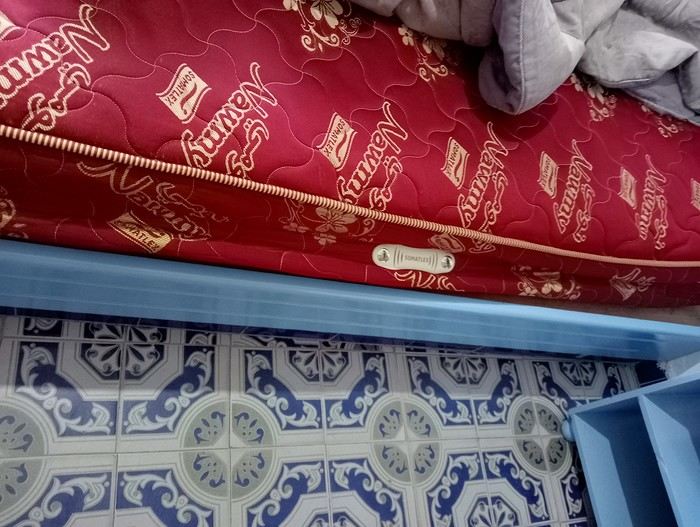
Otherwise, the place could be great if it were properly maintained. Instead of repainting the balconies, they should replace the mattresses, which are completely wrecked. The only good thing about this hotel is its location above the sea.
Otherwise, Room No. 16 was recently repainted.
Every time someone uses the water, there’s a huge noise from the pipes and vibrations.
The walls are paper-thin (figuratively speaking)—when neighbors talked or coughed, it was like they were in the room with me.
I had to wait to check in because of cleaning, but once inside, the bedside tables and the table were filthy (see photo).
In the bathroom, there’s a stale smell of old urine and sewage due to the worn-out toilet pipes (see photo), with minimal lighting. The showerhead is disgustingly dirty.
The gray duvet is dirty and very old, as are the blankets, which are dusty and grimy.
The Wi-Fi worked in the room the first day but not the next.
And finally, the worst part: the mattress is completely wrecked and sagging. The springs dig into your body. Horrible!
Instead of repainting, they’d do better to change the mattresses.
As for meals, the prices are outrageous.
This hotel relies on its old popularity, but it’s not worth 190 dirhams for this room. I’d say it’s barely worth over 100 dirhams.
Since I’ve been in Morocco, I’ve stayed in palaces for 130 dirhams with breakfast.
So, my advice: don’t trust the reviews and avoid this place. You’ll find much better at the same price, as mentioned above.
Hello,
I’m currently in Japan, in Osaka, and we just avoided a scam I wasn’t familiar with.
We were in the tall tower in Tennoji when we were approached by two Japanese guys around 20 years old.
One, speaking broken English, asked us to make a video for his friend who’s in the hospital.
The scam involves distracting you to steal your phone or later asking for money for this so-called friend, while the other stays in the background and keeps an eye on our surroundings. We obviously refused, pretending we didn’t speak English, and they left. But after 10 minutes, they came back, this time translating with his phone. After looking it up online, they call this the "sick friend scam"—used to ask for money. I’ve been coming to Japan twice a year for 15 years and had never seen this before. Also, I’ve noticed some aggressive behavior from a few Japanese people toward tourists—shoving in stores, a 1000¥ fee for luggage when taking the train from the airport, and terrible service in some hotels.
Japan plans to require an ETA (Electronic Travel Authorization) in 2025 for entry, which will need to be applied for and paid for online, along with a surveillance app. The exact date isn’t known yet, and Europe is protesting, considering reciprocity if necessary. Let’s see if this gets canceled, as the new prime minister seems to be backtracking.
I’d like to share the misadventure I had a few days ago when returning from French Polynesia.
It’s 10:30 PM on October 29, 2024. My wife and I just had an incredible trip and are about to face the gray skies of Paris again. We decide to buy two bottles of Mana'O rum as a souvenir from the Tahiti Dutyfree shop. The staff is charming, the price attractive, everything goes smoothly. They give us our products in a special customs bag—all good. Then my wife has a doubt: we’re transiting through the US, will the bottles make it through customs?
That’s when the trouble starts. I go back to the counter to confirm everything is in order and the products will pass through. They reassure me, explaining that with the special bag, there won’t be any issues. My wife checks customer reviews that say otherwise, so I go back. Again, they tell me there won’t be a problem and that they’ve never received complaints or negative feedback. After half an hour, I return, thinking I’d rather not take the risk. This time, they insist there won’t be a problem and even tell me that if US customs confiscate the bottles, they’ll refund me in full upon presenting the receipt and proof of confiscation: “contact us on Facebook, we’ll refund you.”
Ten hours later, I’m standing in front of a customs officer who opens the hermetically sealed bag and runs my bottles through some kind of obscure machine. Each bottle is tested three times—each fails. I’m not the only one; many other travelers have their bottles confiscated too. Without hesitation, I grab my phone and document the scene with the officer’s permission.
A few days later, I contact Tahiti Dutyfree, and they refuse to refund the products, claiming responsibility lies with US customs. A misleading response, since it would mean absolving themselves of the responsibility of selling products banned from entering the US to customers who are *required* to bring these purchases into the country.
For the record, it’s impossible that the management of this shop isn’t aware of the issue. They continue selling these items to customers, fully knowing they’ll end up in a trash bin at Seattle or Los Angeles airports.
I’d like to warn Tahiti Dutyfree customers and travelers who might want to bring back this kind of souvenir from French Polynesia, so my experience can help others avoid getting scammed.
If you’ve also been a victim of this, don’t hesitate to reply to this post :)
My poor bottles that will end up alone
The official ICAO-STEB duty-free bag
The US customs officer who let me capture this sweet moment
Hello les voyageurs,
Je voulais savoir si certaines d'entre vous avaient déjà rencontré des soucis au Belize ?
Je ne suis pas du tout de nature méfiante, je voyage souvent sans d'ailleurs faire assez attention. Il ne m'est jamais rien arrivé de négatif en voyage, si ce n'est au Belize.
J'étais allée avec ma meilleure amie (depuis le Mexique car nous habitions là-bas). Nous avions une chambre d'hôtel basique. Durant la nuit, un homme (un voleur bien connu de la ville), est entré dans notre chambre et nous a volé toutes nos affaires de valeur. Nous l'avons vu mais au moment où il repartait. C'était trop tard.
Ce qui est dingue dans cette histoire, c'est que cet homme avait eu la clef de notre chambre par le responsable de l'hôtel
Encore plus dingue, ce sont des enfants qui étaient à côté de nous sur la plage, qui a renseigné que deux jeunes filles seules séjournaient dans tel endroit...
Il vous est déjà arrivé une histoire complètement dingue ? Avez-vous eu des soucis au Belize ou pas du tout ? Je connais pas mal de personnes qui ont eu des problèmes à la frontière (moi aussi, ils ne voulaient pas nous laissé quitter le pays car il y avait une taxe à payer et nous n'avions du coup plus la moindre carte de banque ni centime...).
Je vous raconte pas ça pour que vous soyez suspicieux des locaux lors d'un voyage. Simplement, le touriste est la proie facile par excellence (encore plus lorsqu'il s'agit de deux jeunes filles seules). Il faut juste rester sur ses gardes. Après, je ne sais pas trop comment j'aurais pu éviter cette arnaque ci ^^
Je voulais vous faire part d'une arnaque aux taxis prépayés à l'aéroport international de Delhi.
Il existe un comptoir de vente dédié à l'intérieur de l'aéroport pour se rendre dans le centre de la ville. Quand l'employé de ce comptoir est absent, les autres compagnies situées juste à côté sortent un panneau intitulé: "Taxi prepaid".
C'est une énorme arnaque ! Normalement, le prix de la course pour se rendre dans le centre est de 600 roupies. Ils vous comptent la course 4 fois plus cher, et surtout ils n'ont aucune autorisation à vendre des tickets "taxi prepaid".
Le mieux pour se rendre au centre-ville est d'emprunter la ligne express du métro, très rapide, climatisée, sécurisée et hyper propre.
Il faut sortir de l'aérogare et suivre les panneaux "Metro" pour descendre dans la station. Il y a des guichets de vente après le passage de la sécurité (c'est la norme en Inde de passer par des portiques de sécurité pour pénétrer dans le métro) et le prix varie en fonction de votre station de destination. Ce prix est dérisoire et cette solution est beaucoup plus rapide et bien plus confortable pour se rendre à Delhi.
vol reservé le 10/02/2020 sous le numéro de résa: 4949548960, date prévu le 28/03/2020
aucun message du service client pour m'informer de l'annulation, puis apres des heure a essayer de les contacter , par chat , numéro surtaxé...
jai enfin réussi a etre contacté par mail car j'ai mis un avis défavorable sur un site , le mail m'informais le 15/05/2020 (1.5 mois apres l'annulation)que j'allais etre remboursé mais pas de la totalité, ils enlève des frais de ''d'intermédiation'' , en fait c'est des frais de résa , c'est vraiement du vol!!! n'achetez pas chez eux !!! utilisez ce site govoyage juste pour comparer mais je vous aurez prévenu , aujourdhui le 4 juin je n'ai aucun remboursement alors que qatar airways m'a confirmé que si javais acheté mon billet direct chez eux c'etait sous 7 jours et ils m'ont confirmé qu'ils avaient remboursé govoyage le 12 mars , c'est abusé leur facon de faire !!! mon message et aussi pou edream et opodo , c'est la meme société , de gros voleur !!! je souhaite a personne ma desaventure qui gache un voyage
Bonjour,
Considérant qu'il y a de plus en plus de vol dans les bus de nuit en Thaïlande, je voulais faire le point en ce mois d'avril 2017 afin d'informer les voyageurs qui comme moi sont inquiets. Alors, je viens régulièrement en Thaïlande, et depuis quelques années, il y a de pkus en plus de vol dans les bus de nuit. Un ami policier m'a aidé à comprendre. Il y a belle et bien une mafia surtout concernant les agences de Khao San Road, à éviter à tout prix, même si c'est tentanpour sauver quelques baths. Si c'est moins cher qu'ailleur alors vaut mieux se méfier. Les groupes organisés vols dans la soute à bagages lors du trajet, ils ont tout le temps pour bien fouiller, voler et tout remettre en ordre sans se rendre compte, sauf en arrivant à l'hôtel. Ne rien laisser de valeurs dans les sacs en soute. Il y a une seconde mode plus efficace ou certain groupe organisé font entrer un léger gaz dans la climatisation pour endormir les gens et les dépouiller de l'argent, Iphone, appareil photo, etc., toujoyrs à partir des agences sur Khao San Road.
Nous avons fait beaucoup de recherche pour éviter d'avoir des ennuies et avons trouvé des solutions à transmettre.
1. Prendre les bus gouvernementaux à partir de la station Monchit.
2. Prendre le train, plus lent mais plus sûr car présence policière dans les wagons.
3. Prendre des compagnies plus éloignées de Khao San Road qui ont pignon sur rue.
4. Mettre passeport et argent dans une ceinture soys les pantalons lors des déplacements en bus de nuit.
5. Nous, afin de dissuader les voleurs en soute, nous avons utilisé le fameux duck tape pour mettre sur tout nos attaches de sac, et nous mettons une housse sur notre sac que nous mettons ensuite dans un sac de plastique que nous attachons à nouveau avec le duck tape. Arrivé à destination, il est facile de savour si quelqu'un a fouillé nos affaire puisqu'il est difficile de recoller parfaitement le sac de plastique sans laisser de trace. De plus, cela rend la tâche difficile pour les gros méchants.
Suggestion: Pour une compagnie près de Khao San Road, nous avons utilisé la compagnie de transport ( Thaisriram transport, 18, Chakrabongse Rd, 086-351-9290). Se sont des bus de couleur blanc, et le propriétaire est un ancien policier. Nous avons été assuré qu'il n'y aurait aucun problème avec cette compagnie, et de fait. Nous sommes partie à l'heure, avons reçu un service parfait, confort à bord, et surtout l'assurance de piuvoir dormir tranquille sans crainte. Nous svons été très satisfait.
Pour donner suite à la très abondante littérature concernant la location de voiture au Portugal et particulièrement à Faro voici le détail de l'expérience que je viens de vivre.
Alerté par tous les problèmes de location dans ce pays j'avais pris la précaution d'éviter soigneusement les offres du genre 4€ par jour et autres propositions douteuses.
J'avais opté pour Avis société internationale et bien connu. J'ai loué un petit véhicule Micra pour 7 jours à l'aéroport de Faro.
Voici comment ça se passe. A l'aéroport tous les loueurs sont regroupés du coté départ et on a le choix car toutes les grandes enseignes sont présentes. Au stand Avis (mais c'est pareil pour les autres) on commence par faire la queue et ça peut être long car la demande est très soutenue. Il y a 6 ou 7 guichets qui sont pris d'assaut à chaque arrivée des vols. Après avoir attendu votre tour le moment est venu de faire votre choix, si ce n'est déjà fait par internet. L'opératrice vous indique les conditions dans un flot de parole ininterrompu dans la langue de Shakespeare, en ce qui nous concerne. Après quelques minutes et selon les options choisies (par exemple le boitier autoroute) on vous demande une signature digitale (sur écran) d'acceptation des conditions. Ce contrat vous ne le voyez pas car il vous est instantanément envoyé sur votre mail. Donc , sauf à le récupérer immédiatement sur un Smartphone par exemple, et à en consulter la quinzaine de pages pendant que derrière vous la file d'attente piaffe d'impatiente, vous ne pourrez pas exactement en connaitre le contenu. Ceci n'est finalement qu'un détail, même si on ne découvre qu'après avoir signé que l'on s'engage à payer toutes les réparations qui seront constatées par le loueur. Précision qu'il convient de savoir mais comme on a d'autre choix de signer sauf à rester sur le carreau, on signe.
Il était 18h quand l'hôtesse m'a donné les clefs du véhicule que je devais récupérer su le parking attenant. Le véhicule en question était en parfait état, une Nissan Micra dernier cri avec 3000 Km au compteur. Mais, première observation il n'y a personne de la société pour faire un constat de l'état du véhicule. J'ai fait un tour du véhicule sans rien y percevoir d'anormal.
J'ai utilisé le véhicule normalement sans problème le temps de la location. J'ai remis les clef du véhicule chez Avis dans la boxe prévue à cet effet, le jour convenu du retour, car notre avion partant à 6h du matin personne de chez le loueur n'était en mesure de réceptionner la voiture.
Rentré chez moi le soir je consulte mes mails et trouve un message de chez Avis me facturant 187€ pour une tache sur une aile du véhicule. A l'appuie une vague photo prise au Smartphone où l'on ne détecte que des reflets ?
Je conteste tout de suite par un mail chez Avis qui est toujours sans réponse à ce jour. 3 jours plus tard je suis débité de 231€ en plus de la location que j'avais déjà payé sans que je puisse m'y opposer d'une quelconque façon.
C'est ce qui me mets le plus en colère. En signant le contrat vous autorisez le loueur à prélever sur votre compte à peu prés n'importe quelle somme. Il faut le savoir. Avis Portugal vous enverra simplement une vague facture en Portugais comme justificatif, une fois que vous aurez regagné vos pénates.
J'ai payé ma location avec une carte Gold qui rembourse ce genre de dégâts et je me demande si le loueur n'en profite pas pour faire passer ces surplus, qui au final seront payés par Visa ???
En tout cas c'est une question que l'on peut se poser.
Je tenais à faire part de cette expérience pour tous ceux qui s'apprêtent à louer au Portugal en particulier à Faro. Je ne dis pas que mon cas est une généralité, je dis simplement qu'il se rajoute à la liste très longues de tous les problèmes déjà rencontrés dans ce pays et particulièrement à Faro, région très touristique ou la location de voiture est une véritable manne.
Conseil: au départ et à l'arrivée photographiez le véhicule sous toute les coutures, ça ne sera certes pas suffisant mais sa sera bien utile avant de se lancer dans de longues et pénibles réclamations.
A bon entendeur.
Bonjour,
je suis propriétaire de 3 gîtes , 2 à Amiens l'autre au tréport.
Je suis solliciter pour proposer mes locations par un club de vacances privé qui m'assure "12 semaines de réservations par an".
Les responsables sont établis à Vancouver et l'organisme se nomme : SIOCORLENTER
Quelqu'un aurait -t-il entendu parler de cette société ?
D'avance merci de vos réponses
Chamaigre
Je vous fais ce message pour vous prévenir sur la visite du Stade Vélodrome...
En effet, sur cette semaine, je me suis rendu deux fois au Vélodrome, une fois seul et une fois accompagné.
La première fois, un homme court vers moi en criant "supporter supporter", je me retourne, j'avais l'air du touriste avec mon sac à dos et appareil photo... Je m'arrête, il m'accoste et me demande si je suis fan de l'OM, après quelques baratinages, il propose de me prendre en photos, enfin "proposer" est un grand mot, il oblige. Ensuite, il te dit des trucs du style "Je te fais à 6 4 ou 4 8", puis il continue ses photos. C'est limite s'il menace, après il m'oblige à payer en scandant : "Donne moi 50, j'te rend la monnaie." A plusieurs fois, il me crie Allez l'OM et indique qu'il propose des visites gratuites du Vélodrome (or c'est l'office du tourisme qui le fait pour 6€ sur le parking voisin). Il m'agresse limite, je lui donne donc son billet et il me rend 22€, il m'a donc volé 28€ pour 2 photos polaroid...
Je reste quelques temps à l'intérieur de la boutique et surveille la sortie, je le vois occupé avec d'autres personnes, des touristes bien évidemment. Je passe discrètement derrière et bien évidemment ces pauvres gens sont dépouillés de 2 billets de 50€ également...
Je quitte en métro au plus vite sans prêter attention.
Quelques jours plus tard, je retourne au stade, accompagné, sans sac et avec des lunettes de soleil pour éviter qu'il me reconnaisse. Evidemment, je le vois occupé avec une troupe de personnes asiatiques, ils étaient 4-5 et rebelotte, il refrotte ses polaroids et plusieurs billets de 20 et 50€ redéfillent. J'ai également pu voir quelques dizaines de secondes après qu'il traine avec deux-trois autres personnes, ces copains, qui je suppose le protège en cas de récidive d'un touriste.
Voici donc la description des mecs :
Celui qui prend les photos était présent une fois à 14h et une autre fois à 10h, donc il doit rester souvent là, il porte une veste Adidas noire, des lunettes noires et il est vêtu d'un jogging (il me semble), cet homme est de type "arabe".
Une autre personne, jeune (+/- 18 ans) vêtu d'un jogging, également de type "arabe" attend devant les grilles, avec un air agressif.
Une autre personne était présente mais je n'ai pu la voir car elle se cachait derrière leur voiture, une FIAT Punto (des années 2000) bordeaux-rouge.
Dois-je avertir les autorités ? Étant donné que j'ai vu ce même type d'arnaque sur un autre topic de forum ?
Je vous écris concernant certaines pratiques frauduleuses rencontrées chez AVIS - BUDGET.
J'ai réservé et payé en ligne une location de voiture en Afrique du sud (Cap Town).
Le Tarif de 790 euros pour 15 jours comprenait :
- le kilométrage illimité
- les frais de retours dans une autre agence
- les assurances
- le rachat de franchise en cas d'accident
- les taxes locales
- la participation aux couts d'immatriculation
- le rachat de franchise.
Je ne devais payer sur place que les services optionnels, à savoir : la location du GPS et le conducteur supplémentaire, le tout pour 1900 Zar
La prise en charge du véhicule a été très rapide. On m'a juste demandé de présenter mon permis de conduire et ma carte bleue et de signer sur un petit écran IPAD pour confirmer ma location et de renseigner mon email. Et que j'allais recevoir le contrat plus tard (que je n'ai jamais reçu).
Un mois après le retour du véhicule, j'ai découvert que j'allais être débité de 615 euros supplémentaires pour des assurances que je n'avaispas demandé. Ce qui veut dire que je paye plus d'assurance que de location de voiture. Cela n'a pas de sens !!!
Mais jamais, la personne du guichet m'a proposé une souscription d'assurance complémentaire. On ne m'a rien remis en échange et on ne m'a parlé de rien, surtout pas d'assurances supplémentaires ou de frais supplémentaires.
A aucun moment on nous a informé et montré que nous étions en train de signer pour des assurances complémentaires.
Nous considérons que c'est de la vente déguisée, forcée, de la malhonnêteté, une arnaque à l'assurance et j'ai constaté tristement que nous sommes loin d’être les seules et que cette arnaque semble être érigée en système chez Avis-Budget dans TOUS LES PAYS comme je viens de le découvrir sur différents forum !!!
Donc éviter absolument cette société.




















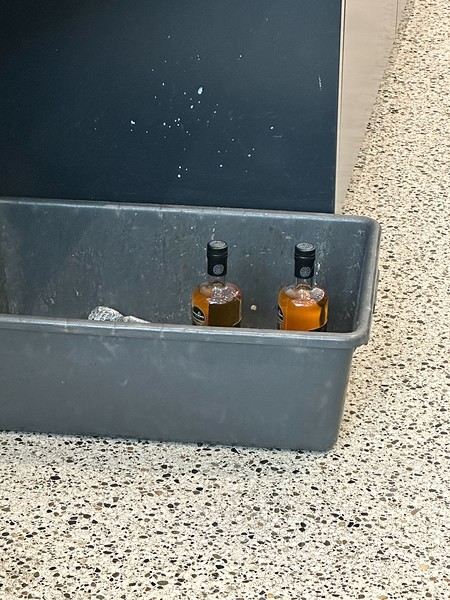 My poor bottles that will end up alone
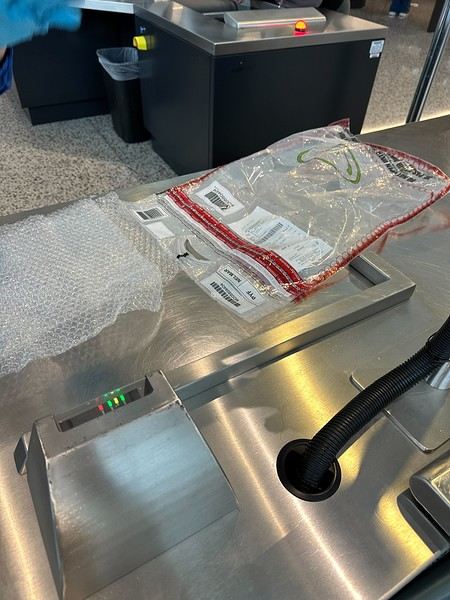 The official ICAO-STEB duty-free bag
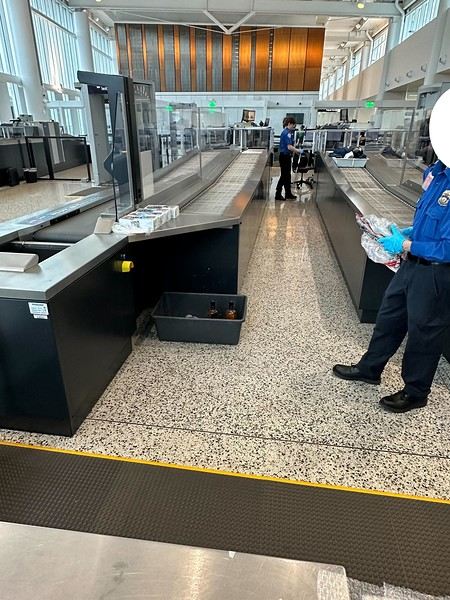 The US customs officer who let me capture this sweet moment