Among other things, they don’t just mention fake taxis that rob you or express kidnappings (especially in Arequipa), but also drugs that can be slipped into your drink if left unattended, "with the risk of scopolamine being added."
They’ve marked the Cuzco region as a red zone (formally avoid!!) and central Lima as an orange zone, "to avoid after dark."
The foreign ministry website gives the same kind of alarming info about pretty much every country in the world once you leave Western Europe... Scams and assaults exist, but listing them like that makes it seem like they’re super common, which isn’t the case. "Oh my God, all this is happening?"... It *can* happen, and it *has* happened, but when, to whom, how...
If you want to take a taxi safely, you can download the Tappsi app on your smartphone. The drivers who respond are "registered" and "traceable."
As for drinks being spiked with drugs, I’m guessing—and no offense meant—that you probably won’t be hitting up nightclubs or similar places.
If I had to give *one* safety tip, it’d be this: in the city, "watch out when crossing the road"... People drive pretty "rock ‘n’ roll" (I’d even use a harsher term, but oh well), and it can really catch you off guard.
The red zone is further north compared to Cusco and the Sacred Valley of the Incas, so no need to worry about those places.
For the rest, just like anywhere in Latin America, you should follow a few safety rules (avoid showing valuables, don’t take just any taxi in certain cities like Arequipa, avoid walking around in some neighborhoods, especially at night, etc.). By following these simple rules, there’s really very little chance anything will happen to you. As mentioned earlier, the government’s travel advisories are always a bit alarmist (but at least they keep people from going in too "gung-ho").
Thanks for your reply, but before sharing the link to the Foreign Affairs website, I took a look at the map of Cusco—it’s pretty shocking. Feels like you’re just as much at risk there as in the Sahel!!!
Weird, right?
Thanks for the info about the app. We're not exactly paranoid, but this thing about the tourist police who can check if taxis aren’t fake kind of surprises us.
Thanks for your reply, but before sharing the link to the Foreign Affairs website, I took a look at the map of Cusco—it’s pretty impressive.
Don’t fall into paranoia in Cusco—I’ve been there three times and never had any issues.
Back when I visited Peru, the country wasn’t as developed and was just coming out of a rough period (especially due to the Shining Path).
The thing is, it’s best to stick around Plaza de Armas in the evening—otherwise, the city is very tourist-friendly and doesn’t pose any real risks.
As for Lima, though, yeah, avoid Plaza San Martín at night. You *can* stroll along Jirón de la Unión, but it’s not really recommended.
Again, Miraflores is the place to stay.
If we follow the Foreign Affairs recommendations to the letter, we’d never leave our beds. That said, by using common-sense precautions, we can minimize risks—there are neighborhoods everywhere that are best avoided.
Hi there,
Barranco is a great area in Lima, really close to Miraflores.
As for that taxi story in Lima, it happened about fifteen years ago. So I can confidently say that the ministry’s page isn’t really up to date.
There *is* a so-called "tourist police" in the main tourist areas, meant to help visitors, but their effectiveness is pretty hit-or-miss!!!
It’s a good idea to read this page to stay cautious.
However, don’t fall into paranoia—nothing happens to 80% of tourists traveling in Peru. You just need common sense and to be careful in big cities like Lima and Arequipa.
Peruvians are generally attentive to tourists' safety. If you’re in a neighborhood where you shouldn’t be, they’ll warn you.
Stories about fake taxis and kidnappings mostly concern Lima and Arequipa. Just stick to formal taxis (clearly marked as taxis and with a radio for Aqp) and it’s best to use an app in Lima (like Uber), more to avoid getting ripped off on the price than anything else.
As for the "red zone," which is mainly limited to the VRAEM, it’s outside tourist circuits—you won’t accidentally cross it. Plus, the extent of the zone is a bit exaggerated, even if the ministry halved it in the last update.
"drugs that can be slipped into your drink if left unattended, "at the risk of scopolamine being added"
This warning isn’t useless for young Europeans who go clubbing thinking they’re still in Europe. In Peru, you NEVER leave your drink unattended. No issues elsewhere—it’s only in nightclubs ;-)
When the Chinese return to China, if one of them had their wallet stolen, they probably don’t go around advertising France either!
I read that the State Department recommends American tourists avoid France and Great Britain (because of terrorist attacks).
I’d rather be warned about potential risks in certain areas, follow advice from others, but that won’t stop me from going (though right now, Mali is giving me pause... some countries and situations just feel scarier than others).
I’ve been living here for 5 years, getting around, hosting family and friends—statistically, my risk rate is 100% certain. But that doesn’t mean anything; it only takes one time!!!
The recurring issue is definitely scams—like being charged S/.10 for something that’s only worth S/.5, which adds up to a little over 1 €. Some people get really worked up about this kind of rip-off, but it’s pretty obvious that flaunting your purchasing power in a country where the legal minimum wage (which is rarely actually paid...) is just over 200 € can make it tempting for others.
So there's a 1 in 5 chance of having problems as a tourist? This country really isn't safe....🙁
We did say you shouldn’t fall into paranoia and just avoid certain areas at night—it’s like any big city.
But Lima isn’t Rio, for example, where I had safety issues.
At night, just carry the essentials, no flashy watch on your wrist, no jewelry, and Lima locals are usually pretty welcoming.
The VRAEM, the acronym for the "Valley of the Apurímac, Ene, and Mantaro Rivers." This area is the heart of terrorist activity and drug trafficking in Peru, linked to what remains of the Shining Path.
When I arrived, the Europcar agent explained in English that, given my situation (delay at the airport, my reserved car had already left), he was making an "exception", that I’d be upgraded, and that I’d keep the same terms as my initial booking.
I repeated several times that I did NOT understand the language of the contract he was making me sign. He reassured me, saying everything was OK, that the amount requested was just a deposit, that I wouldn’t be charged, and that it matched the rental I’d already booked.
Result: nearly 650 € debited on top of the initial 124 € contract!
As if I’d rent a car for nearly 800 € for 6 days!
To me, this agent clearly lied and manipulated me to get my signature on a contract I’d specifically said I didn’t understand.
And as if that weren’t enough, the car I was given was defective. I reported it during the rental and have the emails to prove it. Even today, no one can tell me if the vehicle was actually checked and repaired after I returned it. I even strongly suspect it was put back into circulation without the reported issues being properly addressed.
Scandalous practices. Be extremely careful about what you’re told verbally at Europcar and don’t sign anything without having everything translated.
Booked a hotel in Hong Kong for 3 nights - displayed price with a good non-refundable Agoda deal at 401 €, listed as the last room. After payment, the same room was still available for 5% cheaper. Agoda refuses to refund the difference. You end up feeling scammed.
In some countries, the price charged to tourists is often higher than the one for locals.
Is it legal for a restaurant, for example, to have a "price for locals" and a "price for foreigners"? Do they have the right to do that? (Because it really annoys me—you can’t imagine how much money I’ve lost to this scam.)
Aren’t there any local organizations that could call out this scam?
At the same time, since this kind of scam happens often in poorer countries, the money I lose ultimately goes to those countries, so it’s like I’m donating to a humanitarian organization. So in the end, it doesn’t bother me *that* much—when I get scammed, I just tell myself I’m doing a generous act to help the poor in that country.
Outrageous and completely unacceptable experience with SIXT Funchal! JUNE 2026
During our trip to Madeira, we had pre-booked and prepaid a deposit online for a vehicle to pick up at the SIXT agency in Funchal via the "discovercar.com" website.
Upon arrival, we were faced with an employee whose behavior was unacceptable, aggressive, disdainful, and completely contrary to what you’d expect from a hospitality professional. She outright refused to hand over the vehicle, claiming that my husband’s paper driving license wasn’t allowed under SIXT’s rules.
The most shocking part is that the explanations given on the spot seemed dishonest and in bad faith. We’ve rented vehicles in several European Union countries with this same license without ever encountering any issues.
If SIXT doesn’t accept paper licenses, this condition should have been clearly stated before booking—and especially before taking our money. We only discovered this so-called condition once we were there, after traveling and having already paid part of the rental.
What followed was particularly painful: we had to return to the agency to get a refusal certificate. Fortunately, we had recorded the conversation, which allowed us to keep proof of the exchanges and push forward with our complaints. After many back-and-forths and three months of waiting, we finally got our money back thanks to discover.com’s customer service, who supported us in our efforts—otherwise, the SIXT agency would have continued to deny our visit, and we would have considered legal action.
This situation is simply scandalous. When you arrive in Madeira for a vacation, you certainly don’t expect to be greeted with such aggression, disdain, and bad faith.
We sincerely hope this person will no longer be in contact with customers, as her behavior was particularly shocking and seriously ruined our experience.
We strongly advise against using the SIXT agency in Funchal. If you want to avoid bad surprises, conflicts, and a terrible customer experience, steer clear.
For our part, SIXT Funchal:
NEVER AGAIN!
Hi everyone, although I’m still in love with Madagascar, I feel I must report the unacceptable behavior of some guides in Antalaha.
I know I’m responsible—I obviously shouldn’t have paid in advance for a service at this price. As someone who usually travels on a budget, I treated myself to a fully guided experience for once.
I was charged 1,500,000 ariary for a 4-day trek between Antalaha and Maroantsetra.
In reality, it was a total scam: terrible logistics, a motorbike taxi that abandoned us along the way (I’m not sure if the guide arranged this just to squeeze out a bit more money), basic Malagasy bush meals—which I expected since I know the country well—but the hotels were absolutely disgusting: mouse droppings in the bed, no way to get a blanket, cigarette butts on the floor, and of course, no water. I had warned them that at 73 years old, I needed a bit of comfort and some consideration—that’s why I paid this price.
In the end, to arrive a day early and get home faster, on the second day we walked from 5:30 AM to 4:30 PM with just a long siesta break at 1 PM. The park visit was nonexistent—I would’ve liked to see a lemur!
Anyway, be especially wary of Sylvano.
He’s apparently the head of the guides in Antalaha and organized this "charming" trip for me. He canceled the day before and sent his replacement, Théophile.
This poor guy kept complaining that tourists were scarce. I didn’t tell him everything I was thinking when we parted ways—it would’ve taken too long.
So, remember these two names: Sylvano and Théophile. The official rate is 800,000 ariary, and even that is way too much given the quality of the accommodations and food.
I’ve marked the guides’ office location on Google Maps to deal with them directly, but it seems the mafia is well-organized here…
My mom received an invitation for a free stay (though of course it comes with visits to carpet shops, jewelry stores, and other boutiques). She bought a carpet in Turkey about 10 years ago, and it was that carpet shop in Istanbul that sent this invitation. The whole thing is organized by a travel agency called "Habitat VIP Travel." Has anyone here heard of this agency and their "commercial tourism" practices? I’m not against the idea in principle—I just want to make sure it’s legit and not dangerous (I really don’t want to get kidnapped with my nearly 90-year-old mom!).
Thanks for your feedback
Hello everyone,
A message to warn potential customers of "Go Voyages" about my recent experience.
I left from Geneva for Colombo on December 18, 2025, with a round-trip business-class ticket purchased on Go Voyages, with Etihad Airways, and a layover in Abu Dhabi. Access to the business lounge was denied (I have a 7-hour layover both ways), and I had to pay $160 to get in, despite having a business-class boarding pass.
I’m currently in Sri Lanka, and for a month now, I’ve been trying to get an explanation for this refusal and to find out if I’ll be denied access again on my return on March 12, 2026.
After two calls to the priority line of the "Prime" service I subscribed to (a paid subscription, of course), which is supposed to assist me 24/7 during my trip, after about ten emails that only led to being redirected to links like Opodo, then eDreams (an inaccessible site), and then other links that just sent me in circles... it’s absolutely insane, all this just to answer a fairly simple question: why wasn’t I informed about this potential refusal by Etihad when I made my purchase? All Go Voyages would need to do is contact the airline to resolve this quickly... but no!!! After a month, ten emails, the last response was: contact the airline directly!!! Which, of course, redirected me back to Go Voyages!!
Completely unacceptable! The "Prime" service from Go Voyages is a total scam—completely ineffective, with customer service nowhere to be found. My issue isn’t life-or-death, but imagine a more serious situation where you’d need quick assistance... don’t count on "Go Voyages" to help you at all!! You’d likely be pretty disappointed!! My advice: RUN from this agency, which is headquartered in Spain and owns Opodo, eDreams, and Go Voyages.
Eight months after our vacation in Croatia, Europcar took 1,611.25 € from us... yes, you read that right—1,611.25 €!! At first, we thought it was a credit card scam, but after a little investigation and the documents sent by the rental company (which had the wrong email address), it turned out the city of Dubrovnik had hit us with this huge fine. Following the GPS on June 9, 2025, we were simply heading to our accommodation with parking on Zagrebačka Street. This one-way, busy street has been off-limits to vehicles without a pass issued by local authorities since June 2, 2025. There’s a checkpoint at the entrance with license plate scanning, but the signs announcing the zone are in Croatian! Our landlord didn’t warn us and hadn’t registered our plate with the authorities, as recommended on the city’s website. The result? A prohibitive fine for both the vehicle and the driver. On top of that, the rules say you only have 8 days to appeal... super convenient when you’re on a road trip abroad and no one flags the issue when you return the car a few days later. This is a real blow for us, but more importantly, it’s a massive tourist scam set up by the city of Dubrovnik. 🙁
Hi,
Back from South Africa since 24/10/25, we’re having trouble getting our deposit back after renting a car at Cape Town Airport with Pace Car Rental through Carwiz! It’s still a sum over 1000 €!!
Lots of email exchanges via WhatsApp where they send me the refund proof dated 25/11, but my bank can’t find any trace of it!! Just to clarify, the car was returned without a scratch, as they confirmed!
Has anyone else run into this issue with this rental company, or others for that matter? And if it’s a scam, what are the possible courses of action? I’m hoping there are some… I was thinking of contacting our Consulate in Cape Town to see if they can help with the next steps or even intervene with this rental company!
This kind of practice isn’t going to help boost tourism relations with South Africa!!
Thanks for your feedback,
Dan
hi everyone.
I usually exchange money at a bank in the city in every country, but this time I was being picked up by my guide, so I did it as quickly as possible and didn’t check my receipt.
I don’t remember the exact amount the cashier scammed me out of, but it was significant when I recounted everything later.
Two hours later, when my guide still hadn’t shown up, I ran into the police—a kind woman I explained the situation to—but it was too late because the cashier had already been replaced.
Be careful and don’t do what I did.
Check everything in front of them because afterward, it’s too late 😅
A disastrous experience with Lastminute.com – Family left outside with no assistance
I booked a stay at the Akgun Istanbul Hotel via for a total of 3 884 €. Despite receiving a booking confirmation, the hotel refused to accommodate us. My wife was sick, we had two children with us, and we literally found ourselves outside with no help at all. We had to book another hotel at our own expense, and even with the evidence we provided (medical documents, receipts, exchanges with customer service), only refunded 717 €. Customer service refused to reopen the case, completely ignoring the exceptional circumstances. No gesture, no assistance, no respect.
I strongly advise against using this platform for anyone traveling with family or in sensitive situations. If something goes wrong, you’ll be on your own.
Zou! is the public transport service for the Région Sud Provence-Alpes-Côte d'Azur. We're Canadian and our plan was to hike the Mercantour Great Crossing (GR52). After landing in Nice, we needed to find transport to the trailhead in the village of Entraunes. It took us two months to figure out that the only service available was Zou!'s shuttle, and—after countless calls (not easy from Canada)—to actually speak to someone at the company. Even though they confirmed our reservation, on the day of the trip, they weren’t waiting for us. We ended up stranded in Guillaumes because the driver hadn’t been "informed" that he was supposed to go all the way to the terminus that day. In 40 years of traveling the world, I’ve never encountered a situation where customer service was this nonexistent and access to a region this difficult. I just wanted to share this experience to warn you if you’re planning to rely on public transport to reach the GR52...
I want to share an experience that really knocked the wind out of me and I hope it won’t ruin my long-awaited trip to Japan.
I recently used the services of a travel planner, Hima Voyage, which I found on social media, to organize my family vacation in Japan.
Unfortunately, my experience was extremely disappointing and frustrating, marked by a blatant lack of professionalism.
The major problems appeared when I received the itinerary: the proposed route was completely illogical in relation to the accommodation locations, forcing us to make much longer daily trips than necessary, with duplicate days suggesting a poorly done copy-paste sent to others.
She didn’t take into account the high-traffic days for the places we wanted to visit at all.
No personalized or concrete tips or advice were provided. Most of her “recommendations” were generic copy-pastes you can find anywhere on social media.
Faced with such a lack of optimization and logic, I’m forced—with less than 4 months until the trip—to start from scratch and completely reorganize my trip myself. This service, sold as an organizational aid, turned into a huge waste of time and money (825 euros down the drain).
I feel scammed and deeply disappointed by this service. I strongly recommend being extremely cautious before entrusting your travel plans to any “travel planner” found on social media.
I’m posting this as a not-so-pleasant experience, but one I think is important to share.
We stayed at MMV Arêches-Beaufort at the end of June 2025 (from the 21st to the 28th), in room 317, as a family with our young daughter.
Everything was fine until the night of June 25th to 26th, when we discovered a bed bug infestation right next to our bedhead.
We’d already slept 4 nights in that infested room without noticing anything. Needless to say, the shock was huge, especially with a little one.
MMV offered to relocate us, but by that point, trust was completely broken. The rest of the stay was spent in constant stress: disinfecting, isolating our belongings, and worrying about bringing these pests home with us.
They refunded our stay (which was the least they could do), but they’d also promised compensation of 150 €, which was never paid. Since then, no news at all.
We felt erased, ignored, and not taken seriously.
I’m sharing this not to stir up controversy, but to warn other travelers.
We thought we were staying in a reliable residence with responsive customer service—it wasn’t the case.
I’m genuinely wondering:
Am I an isolated case with MMV?
Have others experienced similar situations (bed bugs or a lack of consideration when problems arise)?
Thanks to those who take the time to read this.
And above all, be wary when everything seems "too good on paper."
Avoid the car rental company "locationauto"
No one was there when we arrived at the airport—we waited 1 hour for someone to pick us up and take us outside the airport.
The vehicle... 97,000 km!!!! Dirty inside and out, stained seats.
Return was the same—1.5-hour wait to drop off the car.
Sure, it’s cheap, but you get what you pay for!!!
With the $CAD/EUR exchange rate already worse than ever (thanks, Mr. Trump and his annexation threats), imagine my surprise when I found out that the EuroBank ATM (same for Alpha Bank) charged a 9% commission on the transaction. That pushed the exchange rate from the official 1.60$ to 1.77$ per euro. It’s better to buy euros in Canada or at a currency exchange office, or just pay by credit card, which I did (at a rate between 1.61$ and 1.63$).
If you take the bus from Bangkok Ekkamai to Pattaya, foreigners will be asked to pay an extra 20k for checked baggage, even though it’s already been paid for and listed on the ticket. They don’t even weigh it—a woman just demands you pay again, and if you refuse, she goes to get security colleagues who yell at you and threaten not to let you board. We later found out at the hotel that this is a well-known organized scam. The company is ROONG REUANG COACH, and we were about fifteen people—all foreign tourists—in the same situation. For Thai passengers, they didn’t ask for anything.
Then in Pattaya, violence and corruption rule. The next day, we learned the city is classified as "scarlet" (high-risk). A hotel guest was attacked with a knife by four Thais on a scooter—they stole his bag with his bank card and cash inside, luckily not his passport. A large hotel near ours was just shut down administratively for pedophilia. On Apple Maps, many reviews warn about how dangerous the city is. I’ve been coming to Thailand regularly for over 30 years, but I barely recognize the country since COVID. The "Land of Smiles" is turning into the "Land of Scowls," and a form of racism is emerging. For us, this will be the last time—next stop, Vietnam, and even China, which pleasantly surprised us.
Finally, China and the U.S. are advising their citizens against traveling to Thailand due to violence. Right now, most tourists here are Indians and Russians—together, they make up the majority—along with some from the Gulf (Qatar, Dubai, Oman).
If you're heading to Basse-Terre in Pointe-Noire, Guadeloupe, **do not** stay at Ara Wakam cabin. It looks tempting on Booking, but it’s a total **SCAM**. There aren’t two bedrooms as advertised—just a double bed in the living area and two single beds in the attic, where it’s **scorchingly hot** and the fan is **extremely noisy**. But the worst part? It’s **THE HOUSE OF MOSQUITOES**. No windows, shutters with gaps that don’t seal—nowhere to escape. The owner is dishonest, and the concierge is arrogant. We lost **800 €**.
! Never accept a flight waiver in exchange for financial compensation when flying with EasyJet—they don’t honor their commitments!
My family and I were among the victims of EasyJet flight EZY4481 on 28/12/2024 from Lyon to Marrakech. Instead of departing at 5 PM, the flight was canceled in the middle of the night and rescheduled for the next day on a smaller plane. We were doubly victimized: not only did we have to give up our trip, but we also chose to be among the 30 people who had to waive their seats at departure because the replacement plane was smaller. This was in exchange for compensation of 500 € per person, supposedly to be paid within 48 hours. It’s been over thirty days, and despite our complaints to EasyJet, we’ve heard nothing. They’re thieves—offering compensation and then not honoring it. What a disgrace!
We left the airport in tears on 28/12, just before midnight, having accepted their offer because we didn’t want our two young children to spend the night at the airport, with no idea of EasyJet’s level of .
Dear EasyJet employees, we won’t give up! !
Hi everyone : WARNING!!!! driver-guide in SENEGAL
I’m posting this just to warn you about this person: Jean Marie DIOUF
Here’s his Facebook page: https://www.facebook.com/profile.php?id=61552651919372&sk=reviews
He advertises himself as a cheap driver-guide at first, then raises the price but asks you to send a deposit for a so-called reservation of your dates. To gain your trust, he puts his so-called French wife on the phone with you.
In the end, you won’t see your money again!!!!
Please share this 😡
After years of traveling, I finally settled down a few years ago in the Togean Islands, Indonesia (on the main island of Sulawesi).
For those planning to visit the Togeans via Wakai (arriving either by ferry from Gorontalo or speedboat from Ampana), watch out for a person who goes by the name Bagong, also known as Farid.
This gentleman is a teacher and supplements his income with tourism-related activities. He often hangs around Wakai port looking for tourists to sell things to (a charter boat transfer, a cabin on the ferry, etc.), using dishonest methods and lining his pockets.
More recently, he was hired by the authorities of Togean Islands National Park (TNKT) to sell entry tickets. And this is even worse: in the name of the National Park, he outright scams tourists, either by selling tickets at a higher price, asking them to pay again, or charging children who are supposed to enter for free.
Here’s what you need to know:
1. Entry fee for the National Park: 150,000 IDR (ONLY FOR ADULTS, aged 18 and up)
2. This entry fee is only payable once, even if the ticket states it’s a daily price. These tickets were printed a long time ago, before tourists even had to pay anything, and since then the payment system has changed. So it’s indeed 150,000 IDR per person, payable once regardless of how long you stay in the Togeans.
3. Where to pay (depends on your entry point to the Togeans):
Ampana: entry fee payable when departing from Ampana port
Gorontalo: entry fee payable upon arrival at Wakai port
Bumbulan (Marisa): entry fee payable upon arrival at Dolong port
If you’re asked to pay these fees anywhere else or when leaving the Togeans, it’s a scam—don’t pay.
4. You should receive one receipt per person in exchange for the 150,000 IDR. If not, know that the money won’t go to the National Park but into the ticket seller’s pocket. If someone offers to charge you less (e.g., 100,000 IDR), you won’t get a receipt, so the money still won’t go to the National Park.
Please don’t accept these practices, even if you think it’s good for your wallet (seriously, a 50,000 IDR discount is only about 3 €). The National Park needs these funds to protect the Togean Islands’ ecosystem. By saving 3 €, you’re just lining the pockets of a dishonest guy.
Several resorts have already reported Bagong’s (or Farid’s) dishonest practices to the National Park. The authorities are still struggling to find a trustworthy person to sell tickets in Wakai (no scams have been reported in the other two ports so far). We all hope this person will be replaced soon.
5. Contribution for the Ministry of Tourism: Since early 2019, every tourist staying in the Togean Islands must, in addition to the National Park entry fee, pay a 50,000 IDR contribution (regardless of the length of stay). These fees are to be paid at the same time as the 150,000 IDR for the National Park.
6. Price for renting a cabin on the ferry Wakai - Gorontalo (and vice versa): 500,000 IDR. If someone offers you 600,000 IDR, it’s a scam, and those extra 100,000 IDR will go into the same dishonest guy’s pocket (or one of his accomplices). Note that the 500,000 IDR already includes the commission for the person acting as an intermediary to rent the cabin.
7. Going rates for charter boats from Wakai to the various resorts (approximate prices, just to give you an idea—it may vary slightly from one boat operator to another or from one resort to another):
Wakai - Kadidiri (Harmony Bay, Kadidiri Paradise, Black Marlin, Pondo Lestari): usually free if the transfer is arranged by the resort (if you have a confirmed booking and stay more than one night), otherwise between 100,000 and 150,000 IDR
Wakai - Una Una (Sanctum, Pristine Paradise): I’ll get back to you with the info, but you can also check with these two resorts.
Wakai - Katupat (Fadhila Cottages and Bolilanga): 400,000 IDR
Wakai - Bomba (Polyalisa, Poki-Poki, Araya Dive Resort, Island Retreat): 400,000 IDR
Wakai - Malenge (Malenge Indah, Bahia Tomini, Sera Beach, Sandy Bay, Lestari Cottages): 600,000 IDR
Wakai - Waleakodi (Lia Beach, Pulotiga Resort): 900,000 IDR
There you go, fellow travelers—my little contribution to help you avoid what’s known here as the "Wakai mafia."
I’ve included some photos of Bagong/Farid (found on Facebook) so you can recognize him. Note that he sometimes wears glasses, sometimes not, sometimes has a mustache, sometimes not, and sometimes wears his teacher’s uniform to appear more official or legitimate. Heh, the habit doesn’t make the monk ;)
Other shady individuals in Wakai:
Lamin: sometimes sells ferry tickets to Gorontalo, but mostly acts as a taxi to resorts, with shady deals and unfair prices.
Uni: a seemingly charming woman, but not always honest. She offers cabin rentals on the ferry and arranges charter boat transfers to resorts.
And while I’m at it, if you meet "Miss Harbor" at Ampana port, run away like the plague. She doesn’t handle National Park ticket sales but will try to sell you a car rental for Toraja, Tentena, Luwuk, or Manado, a cabin rental on the ferry to Gorontalo, or other things. Her real name is Ulfa, and she’s a real scammer (on top of being an alcoholic and a bit unhinged). I’ll try to post something about her later.
Don’t worry, there are also plenty of great people in the Togean Islands :P :P
If, despite everything, you fall victim to these scammers’ schemes, be sure to report it to the resort where you’re staying. And of course, leave a comment here so I can report it to the National Park and the Ministry of Tourism (communications are difficult in the Togeans, and some resort owners don’t have many opportunities to contact the authorities).
Together, we can put an end to these dishonest practices and make the Togean Islands even more beautiful :)
Have a great summer, travel safely, and return with your heart filled with the beauty of our world!
Hotel La suerte loca in Sidi Ifni.
Move along quickly!
LIAR AND DISHONEST.
Not to mention the state of the rooms. That’ll come later.
I booked three nights on-site without a bathroom in room (No. 16). I had called the day before to check availability. The next day, they told me I couldn’t stay in that room on the third night but offered to move me to another room—even more run-down than this one—and without a bathroom. They claimed there had been a mistake and the room was already booked, which is completely false. I’ve been traveling for 20 years and can spot hoteliers’ tricks. The woman running the place checked all her online sites and her schedule before confirming the room was available. She was sure. Especially since they display the booking schedule in front of each room to avoid mistakes. So, a pure lie. For what reason?
For me, two options: either take the run-down room for cheaper without a bathroom or leave. Great customer service. I found another hotel, Safa, a bit further away, at the same price with breakfast—100 times more luxurious and comfortable than this place. Or just down on the beach, Hotel Aït Baamrane, same price or even negotiable, and still much more comfortable.
When I left in the morning, they barely said goodbye, not a word of apology, no gesture to make up for kicking me out. NOTHING, NADA!
The woman running the place, with her fake friendliness and hypocrisy, only cares about one thing: money.
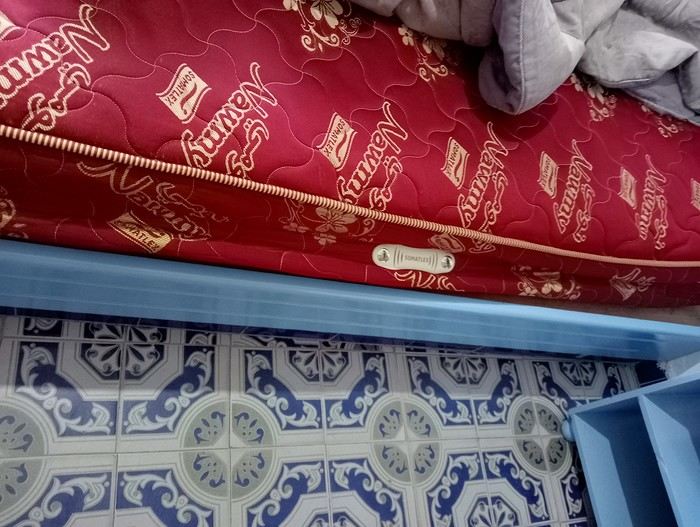
Otherwise, the place could be great if it were properly maintained. Instead of repainting the balconies, they should replace the mattresses, which are completely wrecked. The only good thing about this hotel is its location above the sea.
Otherwise, Room No. 16 was recently repainted.
Every time someone uses the water, there’s a huge noise from the pipes and vibrations.
The walls are paper-thin (figuratively speaking)—when neighbors talked or coughed, it was like they were in the room with me.
I had to wait to check in because of cleaning, but once inside, the bedside tables and the table were filthy (see photo).
In the bathroom, there’s a stale smell of old urine and sewage due to the worn-out toilet pipes (see photo), with minimal lighting. The showerhead is disgustingly dirty.
The gray duvet is dirty and very old, as are the blankets, which are dusty and grimy.
The Wi-Fi worked in the room the first day but not the next.
And finally, the worst part: the mattress is completely wrecked and sagging. The springs dig into your body. Horrible!
Instead of repainting, they’d do better to change the mattresses.
As for meals, the prices are outrageous.
This hotel relies on its old popularity, but it’s not worth 190 dirhams for this room. I’d say it’s barely worth over 100 dirhams.
Since I’ve been in Morocco, I’ve stayed in palaces for 130 dirhams with breakfast.
So, my advice: don’t trust the reviews and avoid this place. You’ll find much better at the same price, as mentioned above.
Hello,
I’m currently in Japan, in Osaka, and we just avoided a scam I wasn’t familiar with.
We were in the tall tower in Tennoji when we were approached by two Japanese guys around 20 years old.
One, speaking broken English, asked us to make a video for his friend who’s in the hospital.
The scam involves distracting you to steal your phone or later asking for money for this so-called friend, while the other stays in the background and keeps an eye on our surroundings. We obviously refused, pretending we didn’t speak English, and they left. But after 10 minutes, they came back, this time translating with his phone. After looking it up online, they call this the "sick friend scam"—used to ask for money. I’ve been coming to Japan twice a year for 15 years and had never seen this before. Also, I’ve noticed some aggressive behavior from a few Japanese people toward tourists—shoving in stores, a 1000¥ fee for luggage when taking the train from the airport, and terrible service in some hotels.
Japan plans to require an ETA (Electronic Travel Authorization) in 2025 for entry, which will need to be applied for and paid for online, along with a surveillance app. The exact date isn’t known yet, and Europe is protesting, considering reciprocity if necessary. Let’s see if this gets canceled, as the new prime minister seems to be backtracking.
I’d like to share the misadventure I had a few days ago when returning from French Polynesia.
It’s 10:30 PM on October 29, 2024. My wife and I just had an incredible trip and are about to face the gray skies of Paris again. We decide to buy two bottles of Mana'O rum as a souvenir from the Tahiti Dutyfree shop. The staff is charming, the price attractive, everything goes smoothly. They give us our products in a special customs bag—all good. Then my wife has a doubt: we’re transiting through the US, will the bottles make it through customs?
That’s when the trouble starts. I go back to the counter to confirm everything is in order and the products will pass through. They reassure me, explaining that with the special bag, there won’t be any issues. My wife checks customer reviews that say otherwise, so I go back. Again, they tell me there won’t be a problem and that they’ve never received complaints or negative feedback. After half an hour, I return, thinking I’d rather not take the risk. This time, they insist there won’t be a problem and even tell me that if US customs confiscate the bottles, they’ll refund me in full upon presenting the receipt and proof of confiscation: “contact us on Facebook, we’ll refund you.”
Ten hours later, I’m standing in front of a customs officer who opens the hermetically sealed bag and runs my bottles through some kind of obscure machine. Each bottle is tested three times—each fails. I’m not the only one; many other travelers have their bottles confiscated too. Without hesitation, I grab my phone and document the scene with the officer’s permission.
A few days later, I contact Tahiti Dutyfree, and they refuse to refund the products, claiming responsibility lies with US customs. A misleading response, since it would mean absolving themselves of the responsibility of selling products banned from entering the US to customers who are *required* to bring these purchases into the country.
For the record, it’s impossible that the management of this shop isn’t aware of the issue. They continue selling these items to customers, fully knowing they’ll end up in a trash bin at Seattle or Los Angeles airports.
I’d like to warn Tahiti Dutyfree customers and travelers who might want to bring back this kind of souvenir from French Polynesia, so my experience can help others avoid getting scammed.
If you’ve also been a victim of this, don’t hesitate to reply to this post :)
My poor bottles that will end up alone
The official ICAO-STEB duty-free bag
The US customs officer who let me capture this sweet moment


















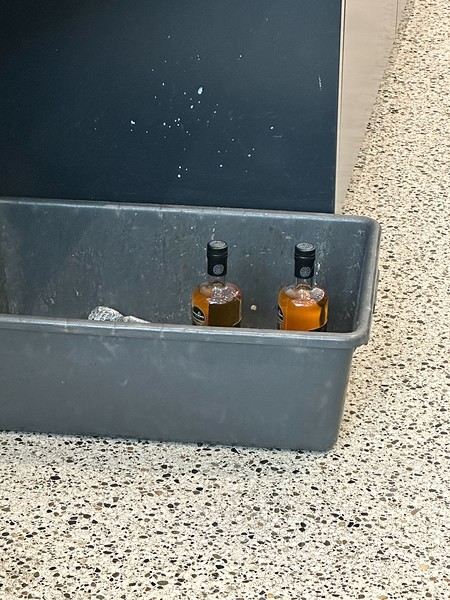 My poor bottles that will end up alone
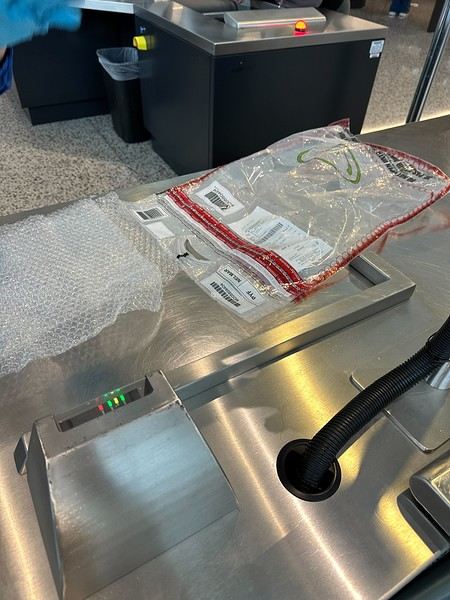 The official ICAO-STEB duty-free bag
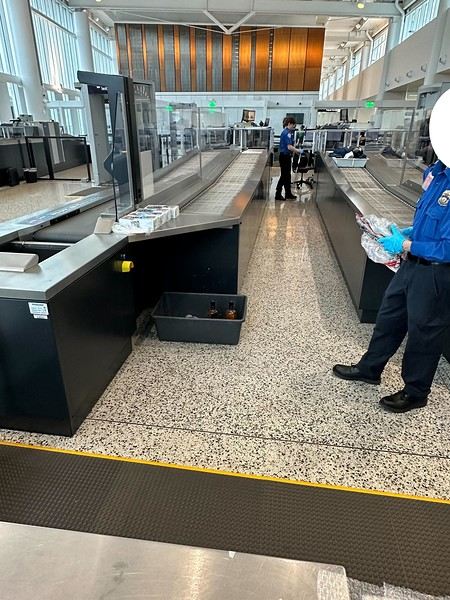 The US customs officer who let me capture this sweet moment